I.S.F.D LENGUAS VIVAS BARILOCHE - TALLER DE PRÁCTICA DOCENTE III
ENTREGA DE PLANIFICACIÓN
ALUMNO PRACTICANTE: Schneider, Vanesa Milagros
Sala/Grado y sección: 3rd and 4th years
Nivel lingüístico del curso: Beginners
Tipo de Planificación: Clase
Unidad Temática: Animals
Clase Nº: 4
Duration of the lesson: 50 minutes
Teaching points: Animals’ parts of the body .
Lesson Aims:
 To help students consolidate vocabulary learnt in the previous lessons;
 To revise the modal verb “Can” in its affirmative and negative forms to express abilities;
 To introduce vocabulary related to parts of the body;
 To introduce the verb “has got” to talk about animals´ body parts
 To develop students´ speaking skill;
 To develop students´ writing skill;
 To develop students´ reading skill;
 To develop students´ listening skill;
 To promote students´ collaborative learning while playing.
Language Focus:
LEXIS FUNCTIONS STRUCTURE
R
E
V
-Animals: Tiger, panther,
bear, snake, horse, cow,
hen, bird.
-Animals´ habitats: the
farm and the jungle
-Actions animals can and
can´t do: run, crawl, walk,
jump and fly.
-Identifying and
describing animals that
live on a farm and
animals that live in the
jungle.
-Identifying what animals
can and can´t do
-Linking sentences using
the connectors “and/but”
This is a panther. This is
a tiger. This is a horse…
The panther is black. The
cow is black and white…
The horse can run but it
can´t fly.
N
E
W
-What animals have got:
Vocabulary related to
animals´ parts of the body:
legs, tail, ears, beak, wings,
eyes, head, and whiskers.
-Describing animals´
body parts
The tiger has got four
legs
The bird has got wings
Materials
- Animal flashcards
- Pictures of animals’ body parts
- Worksheets
- Riddles
- Chalk, pencil, backboard.
Routine (5 minutes)
Firstly, I greet students and then I ask them what the date is and ask one student (a different
student each lesson) to write it on the blackboard for all the learners to copy it down. After
that, I ask students about the weather and elicit answers. I then ask one student to choose a
picture which describes it (the pictures are always in the classroom since they used them when
they learnt the weather) and stick it on the blackboard. Then, I copy the information about the
weather on the board, too. They all copy the date and the weather down in their notebooks.
PROCEDURES
Warm-up (5 minutes)
To revise the vocabulary and the modal verb “can” in its affirmative and negative forms learnt
in the previous lesson, I start this lesson with a short activity.
I put the flashcards of the animals in a bag and sentences about them in another bag. I explain
to students that they have to pick up a sentence, read it aloud and choose the animal which the
sentence describes. For example, if they choose a sentence that says “This animal is black. It can
run”, they have to look for the picture of the panther in the other bag. When they find the right
picture, they have to say the name of the animal aloud and mime the action that the animal can
or can´t do. First, I model the activity for them to understand. Then, I encourage one of them to
do the activity. If students read the sentence but don´t understand what it says, I mime the
action, show them pictures or ask them questions to help them.
 Transition comment to link each stage of the lesson with the next one:
“Great! Now, we are ready to learn more about the animals!”
Presentation (10 minutes)
Once they have matched the sentences with the animals in the previous activity, I ask them to
classify the animals into different groups according to their parts of the body. I help them to
classify the animals. For example, I put the panther, the bear, the horse, the tiger and the cow
together and ask them what they have in common. I expect the answer “they have got four
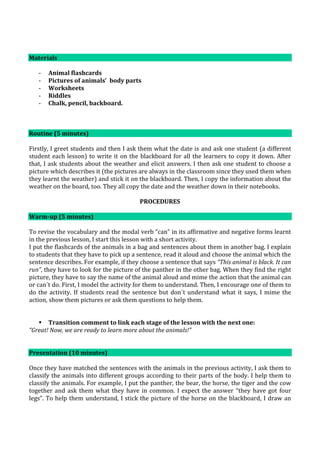
legs”. To help them understand, I stick the picture of the horse on the blackboard, I draw an
arrow from the legs, stick the picture of the legs and write the sentence “It has got four legs”
below the picture. This is a model:
It has got a TAIL
It has got four LEGS
I continue doing this with the following body parts: tail, ears and whiskers.
Then, we group the other animals. I ask them if the hen, the bird and the snake belong to the
same group. They may answer “no”, so I ask “why not?”. I expect they will say that it is because
the hen and the bird have got two legs, wings and a beak. So, I repeat the same procedure as
before.
Finally, I use the snake to teach head and eyes.
 Transition comment to link each stage of the lesson with the next one:
Excellent! Now we are going to do a writing activity!
Development PRACTICE and PRODUCTIO
Activity 1 (5 minutes)
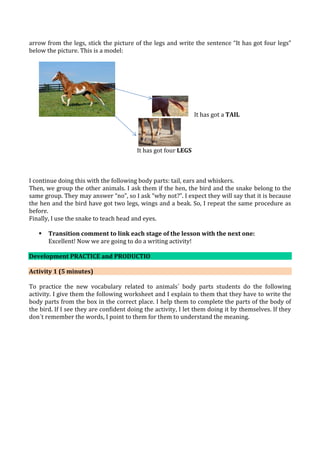
To practice the new vocabulary related to animals´ body parts students do the following
activity. I give them the following worksheet and I explain to them that they have to write the
body parts from the box in the correct place. I help them to complete the parts of the body of
the bird. If I see they are confident doing the activity, I let them doing it by themselves. If they
don´t remember the words, I point to them for them to understand the meaning.
 Transition comment to link each stage of the lesson with the next one:
“Excellent! Glue the worksheet in your notebooks. Now, we are going to do another
activity!
legs tail ears wings eyes head whiskers beak
Activity 2 (7 minutes)
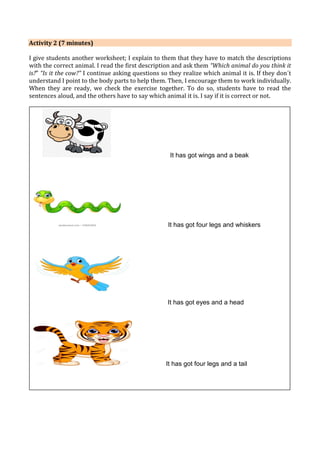
I give students another worksheet; I explain to them that they have to match the descriptions
with the correct animal. I read the first description and ask them “Which animal do you think it
is?” “Is it the cow?” I continue asking questions so they realize which animal it is. If they don´t
understand I point to the body parts to help them. Then, I encourage them to work individually.
When they are ready, we check the exercise together. To do so, students have to read the
sentences aloud, and the others have to say which animal it is. I say if it is correct or not.
 Transition comment to link each stage of the lesson with the next one:
“Excellent! Glue the worksheet in your notebooks. Now, we are ready to do another
activity!
It has got wings and a beak
It has got four legs and whiskers
It has got eyes and a head
It has got four legs and a tail
Activity 3 (10 minutes)
I ask students if they know what a riddle is. They may say “no”, so, I say the Spanish word
“adivinanza”. To engage them with the activity, I ask them if they know any riddle related to
animals. I let them tell me what they know. After that, I say to them that we are going to do one
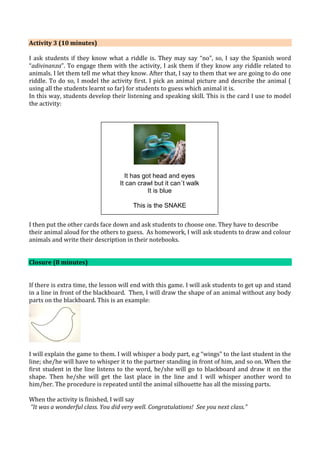
riddle. To do so, I model the activity first. I pick an animal picture and describe the animal (
using all the students learnt so far) for students to guess which animal it is.
In this way, students develop their listening and speaking skill. This is the card I use to model
the activity:
I then put the other cards face down and ask students to choose one. They have to describe
their animal aloud for the others to guess. As homework, I will ask students to draw and colour
animals and write their description in their notebooks.
Closure (8 minutes)
If there is extra time, the lesson will end with this game. I will ask students to get up and stand
in a line in front of the blackboard. Then, I will draw the shape of an animal without any body
parts on the blackboard. This is an example:
I will explain the game to them. I will whisper a body part, e.g “wings” to the last student in the
line; she/he will have to whisper it to the partner standing in front of him, and so on. When the
first student in the line listens to the word, he/she will go to blackboard and draw it on the
shape. Then he/she will get the last place in the line and I will whisper another word to
him/her. The procedure is repeated until the animal silhouette has all the missing parts.
When the activity is finished, I will say
“It was a wonderful class. You did very well. Congratulations! See you next class.”
It has got head and eyes
It can crawl but it can´t walk
It is blue
This is the SNAKE
Lesson plan
component
Excellent
5
Very Good
4
Good
3
Acceptable
2
Needs
improvement
1
Visual
organization
X
Coherence
and
sequencing
X
Variety of
resources
X
Stages and
activities
X
Scaffolding
strategies
X
Language
accuracy
X
Observations Great lesson plan!

Schneider vanesa practicadocenteii_lesson 4 - passed

  • 1.
    I.S.F.D LENGUAS VIVASBARILOCHE - TALLER DE PRÁCTICA DOCENTE III ENTREGA DE PLANIFICACIÓN ALUMNO PRACTICANTE: Schneider, Vanesa Milagros Sala/Grado y sección: 3rd and 4th years Nivel lingüístico del curso: Beginners Tipo de Planificación: Clase Unidad Temática: Animals Clase Nº: 4 Duration of the lesson: 50 minutes Teaching points: Animals’ parts of the body . Lesson Aims:  To help students consolidate vocabulary learnt in the previous lessons;  To revise the modal verb “Can” in its affirmative and negative forms to express abilities;  To introduce vocabulary related to parts of the body;  To introduce the verb “has got” to talk about animals´ body parts  To develop students´ speaking skill;  To develop students´ writing skill;  To develop students´ reading skill;  To develop students´ listening skill;  To promote students´ collaborative learning while playing. Language Focus: LEXIS FUNCTIONS STRUCTURE R E V -Animals: Tiger, panther, bear, snake, horse, cow, hen, bird. -Animals´ habitats: the farm and the jungle -Actions animals can and can´t do: run, crawl, walk, jump and fly. -Identifying and describing animals that live on a farm and animals that live in the jungle. -Identifying what animals can and can´t do -Linking sentences using the connectors “and/but” This is a panther. This is a tiger. This is a horse… The panther is black. The cow is black and white… The horse can run but it can´t fly. N E W -What animals have got: Vocabulary related to animals´ parts of the body: legs, tail, ears, beak, wings, eyes, head, and whiskers. -Describing animals´ body parts The tiger has got four legs The bird has got wings
  • 2.
    Materials - Animal flashcards -Pictures of animals’ body parts - Worksheets - Riddles - Chalk, pencil, backboard. Routine (5 minutes) Firstly, I greet students and then I ask them what the date is and ask one student (a different student each lesson) to write it on the blackboard for all the learners to copy it down. After that, I ask students about the weather and elicit answers. I then ask one student to choose a picture which describes it (the pictures are always in the classroom since they used them when they learnt the weather) and stick it on the blackboard. Then, I copy the information about the weather on the board, too. They all copy the date and the weather down in their notebooks. PROCEDURES Warm-up (5 minutes) To revise the vocabulary and the modal verb “can” in its affirmative and negative forms learnt in the previous lesson, I start this lesson with a short activity. I put the flashcards of the animals in a bag and sentences about them in another bag. I explain to students that they have to pick up a sentence, read it aloud and choose the animal which the sentence describes. For example, if they choose a sentence that says “This animal is black. It can run”, they have to look for the picture of the panther in the other bag. When they find the right picture, they have to say the name of the animal aloud and mime the action that the animal can or can´t do. First, I model the activity for them to understand. Then, I encourage one of them to do the activity. If students read the sentence but don´t understand what it says, I mime the action, show them pictures or ask them questions to help them.  Transition comment to link each stage of the lesson with the next one: “Great! Now, we are ready to learn more about the animals!” Presentation (10 minutes) Once they have matched the sentences with the animals in the previous activity, I ask them to classify the animals into different groups according to their parts of the body. I help them to classify the animals. For example, I put the panther, the bear, the horse, the tiger and the cow together and ask them what they have in common. I expect the answer “they have got four legs”. To help them understand, I stick the picture of the horse on the blackboard, I draw an
  • 3.
    arrow from thelegs, stick the picture of the legs and write the sentence “It has got four legs” below the picture. This is a model: It has got a TAIL It has got four LEGS I continue doing this with the following body parts: tail, ears and whiskers. Then, we group the other animals. I ask them if the hen, the bird and the snake belong to the same group. They may answer “no”, so I ask “why not?”. I expect they will say that it is because the hen and the bird have got two legs, wings and a beak. So, I repeat the same procedure as before. Finally, I use the snake to teach head and eyes.  Transition comment to link each stage of the lesson with the next one: Excellent! Now we are going to do a writing activity! Development PRACTICE and PRODUCTIO Activity 1 (5 minutes) To practice the new vocabulary related to animals´ body parts students do the following activity. I give them the following worksheet and I explain to them that they have to write the body parts from the box in the correct place. I help them to complete the parts of the body of the bird. If I see they are confident doing the activity, I let them doing it by themselves. If they don´t remember the words, I point to them for them to understand the meaning.
  • 4.
     Transition commentto link each stage of the lesson with the next one: “Excellent! Glue the worksheet in your notebooks. Now, we are going to do another activity! legs tail ears wings eyes head whiskers beak
  • 5.
    Activity 2 (7minutes) I give students another worksheet; I explain to them that they have to match the descriptions with the correct animal. I read the first description and ask them “Which animal do you think it is?” “Is it the cow?” I continue asking questions so they realize which animal it is. If they don´t understand I point to the body parts to help them. Then, I encourage them to work individually. When they are ready, we check the exercise together. To do so, students have to read the sentences aloud, and the others have to say which animal it is. I say if it is correct or not.  Transition comment to link each stage of the lesson with the next one: “Excellent! Glue the worksheet in your notebooks. Now, we are ready to do another activity! It has got wings and a beak It has got four legs and whiskers It has got eyes and a head It has got four legs and a tail
  • 6.
    Activity 3 (10minutes) I ask students if they know what a riddle is. They may say “no”, so, I say the Spanish word “adivinanza”. To engage them with the activity, I ask them if they know any riddle related to animals. I let them tell me what they know. After that, I say to them that we are going to do one riddle. To do so, I model the activity first. I pick an animal picture and describe the animal ( using all the students learnt so far) for students to guess which animal it is. In this way, students develop their listening and speaking skill. This is the card I use to model the activity: I then put the other cards face down and ask students to choose one. They have to describe their animal aloud for the others to guess. As homework, I will ask students to draw and colour animals and write their description in their notebooks. Closure (8 minutes) If there is extra time, the lesson will end with this game. I will ask students to get up and stand in a line in front of the blackboard. Then, I will draw the shape of an animal without any body parts on the blackboard. This is an example: I will explain the game to them. I will whisper a body part, e.g “wings” to the last student in the line; she/he will have to whisper it to the partner standing in front of him, and so on. When the first student in the line listens to the word, he/she will go to blackboard and draw it on the shape. Then he/she will get the last place in the line and I will whisper another word to him/her. The procedure is repeated until the animal silhouette has all the missing parts. When the activity is finished, I will say “It was a wonderful class. You did very well. Congratulations! See you next class.” It has got head and eyes It can crawl but it can´t walk It is blue This is the SNAKE
  • 7.
    Lesson plan component Excellent 5 Very Good 4 Good 3 Acceptable 2 Needs improvement 1 Visual organization X Coherence and sequencing X Varietyof resources X Stages and activities X Scaffolding strategies X Language accuracy X Observations Great lesson plan!