I.F.D.C. LENGUAS VIVAS BARILOCHE
PRÁCTICA DOCENTE I
Alumno residente: Nisca, María Abril
Institución Educativa:
Dirección:
Cantidad de alumnos: 20
Edad: 5 años
Unidad Temática: “My town”
Clase Nº: 1
Fecha:
Hora:
Duración de la clase: 30 minutos
Fecha de entrega de la planificación: 19 de agosto del 2019



Learning aims: 

During this lesson, learners will be able to…
- To acquire new vocabulary related to the town.
- To revise previous knowledge on numbers.
- To recognize different buildings and components of a town.
- To position themselves: “I’m in the school”.
- To listen and recognize different sounds related to the town and to
say where they belong.
- To express their creativity through play.
- To develop interpersonal skills.
- To work with blocks in a meaningful and creative way.
Learning focus:

- Vocabulary: people, car, supermarket, house, school, cinema, toy
shop, hospital, zebra crossing, library.
- Simple sentences: this is the (cinema), I’m in the supermarket.
- Working with blocks to create simple buildings and cars.

Integration of skills: 

- Auditory skills by listening to different “town sounds”
- Spatial skills by positioning themselves and their creations with
blocks into the town
- Fine motor skills by building with blocks
- Interpersonal skills by respecting each other’s turn to get involved
with the mockup and by working collaboratively.
- Visual skills by identifying the different components of a town in
the mockup.
- Speaking skills by talking about the mockup
- Creative skills by designing the buildings and cars.
- Logical skills by counting the blocks

Multiple intelligences:
- Spatial intelligence (position in the mockup)
- Linguistic intelligence (talking about the mockup and about their
creations)
- Musical intelligence (listening to and recognizing different sounds)
- Logical-mathematical intelligence (counting the blocks and
creating things through them)
- Bodily – kinesthetic intelligence (working with blocks)
- Interpersonal intelligence (working collaboratively and sharing
material)

Materials and resources:
- A mockup of a town made out of small recycled boxes,
cardboard tubes, paper, etc. The mockup needs to have blank
spaces
- Blocks and small dolls or finger puppets
- Separate recordings of different sounds related to the town
- Flashcards or pictures of places in town
- Models of houses or cars made out of blocks for the children
to observe.
Possible contingencies:
- Children disrupting or talking to each other while explaining
or while the recording is being played
- Children wanting to get closer to the mockup altogether
- Children touching the mockup without being allowed to
- Children fighting for the blocks
- Children throwing blocks one another
- Children not knowing how to build things with blocks
- Children not wanting to clean up
- Children standing up
- Some children may want to take the blocks home
Classroom management strategies:
- Explain children what they have to do clearly before starting; for
instance, explain that everyone will have a turn to get closer to the
mockup
- Explain that they can touch the mockup but carefully and in their
respective turns.
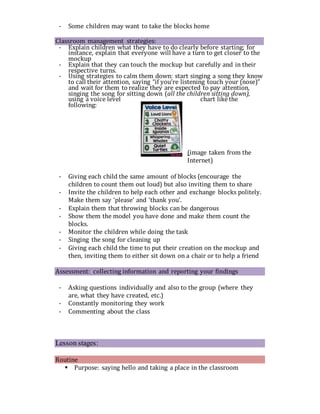
- Using strategies to calm them down: start singing a song they know
to call their attention, saying “if you’re listening touch your (nose)”
and wait for them to realize they are expected to pay attention,
singing the song for sitting down (all the children sitting down),
using a voice level chart like the
following:
(image taken from the
Internet)
- Giving each child the same amount of blocks (encourage the
children to count them out loud) but also inviting them to share
- Invite the children to help each other and exchange blocks politely.
Make them say ‘please’ and ‘thank you’.
- Explain them that throwing blocks can be dangerous
- Show them the model you have done and make them count the
blocks.
- Monitor the children while doing the task
- Singing the song for cleaning up
- Giving each child the time to put their creation on the mockup and
then, inviting them to either sit down on a chair or to help a friend
Assessment: collecting information and reporting your findings
- Asking questions individually and also to the group (where they
are, what they have created, etc.)
- Constantly monitoring they work
- Commenting about the class
Lesson stages:
Routine
 Purpose: saying hello and taking a place in the classroom
 Timing: 5 minutes
 Activity description and instructions as they will be said to
students (include direct speech):
- Make the children form a round to sing the ‘hello song’
- The children gather around on chairs disposed strategically. The
mockup must be in the centre
- They may tell some news (probably in longer lessons)
 Scaffolding strategies: modelling (if you ask them to sit
down, then you should sit down to), singing.
 Transition comment to link each stage of the lesson with the next
one: O.K. and now raising your hand, can you tell me what this is?
(pointing to the mockup)
Note: they will probably answer in L1 because they do not know
all the words. The teacher should not correct them but use
phrases like “yes, it is a small town”
Lead-in and presentation
 Purpose: to introduce the unit as well as the new vocabulary
 Timing: 5 minutes
 Activity description and instructions as they will be said to
students (include direct speech):
- Ask the children (by calling their names) to get closer to the
mockup in groups of three.
- After all of them have seen and/or touched carefully the
mockup, encourage they to name (L1) the different building
and things they see as you repeat them in L2. Use the
flashcards so as the children identify easily each place. They
can point to the mockup when they recognize something.
- Show the children a small doll or a finger puppet and explain
that it is ‘a small you’ and you are inside the mockup. Say
phrases like: Look! I’m in the supermarket. Then, call out
some of them (not more than three at a time) and hand them
in small dolls too. Invite them to place the dolls on the
mockup and ask them ‘where are you?’ Encourage all the
students to answer. Keep on until everyone have had the
chance to place a doll on the mockup.
-
 Scaffolding strategies: modelling, pointing, asking
questions and explaining
 Transition comment to link each stage of the lesson with the next
one: Look! I am in the car. How does a car sound? (make car
sounds). What other sounds in town do you know?
Development of the sequence of activities
Activity 1: listening comprehension
 Purpose: to develop children’s listening skills and to match relate
sounds with words.
 Timing: 5 minutes
 Activity description and instructions as they will be said to
students (include direct speech):
- Ask the children to listen carefully (Open your ears and pay
attention. What’s that?). Use a surprised expression on your
face.
- Play one of the recordings and as you do so, place one hand
on your hear encouraging children to do the same. Get your
ear close to the mockup. Ask where does it come from? Is it
the supermarket?
- When the children get right the first sound, go on with the
rest until you finish.
 Scaffolding strategies: modelling, pointing, acting.
 Transition comment to link each stage of the lesson with the next
one: Now, do you see these blank spaces? We need to complete
the town. Do you imagine how can we complete it? (Give them a
clue so they can guess they are going to work with blocks, for
example uncover the container of blocks slowly and make the
‘spy’).
Activity 2: building with blocks
 Purpose: to encourage children to use their creativity and fine
motor skills
 Timing: 10 minutes
 Activity description and instructions as they will be said to
students (include direct speech):
- Explain the children that they are architects now (it may be
a good idea to get some architect/constructor hats for them
to wear, it would reinforce the idea).
- Show them the models of a house and a car you have made
(only as examples). Ask them questions like What is it? and
answer with them but in L2.
(This image is
only
illustrative)
- Explain some rules to work with blocks (not throwing them,
sharing, etc.)
- Hand in the same amount of blocks to each child. Ask them
to count them.
- Give children time to create.
- Some children will finish before the rest. Take advantage of
that and ask questions individually so as to see if they
understood.
 Scaffolding strategies: showing previous models,
explaining, asking questions
 Transition comment to link each stage of the lesson with the next
one: O.K. Now that you’ve fisnished it’s time to clean up!
Closure
 Purpose: to say good-bye and to clean-up
 Timing: 5 minutes
 Activity description and instructions as they will be said to
students (include direct speech):
- Once they have finish working with blocks and placing each
work on the mockup, tell them it is time to clean up. Start
singing the ‘clean-up song’ as you clean so the children can
copy you.
- Tell them to put their coats and bags on as they sing the
good-bye song.
- Ask a helper to say good-bye out loud so the rest of them
answer back.
- Make a line
 Scaffolding strategies: modelling, singing, explaining
Lesson plan
component
Excellent
5
Very Good
4
Good
3
Acceptable
2
Needs
improvement
1
Visual
organization
Coherence and
sequencing
Variety of
resources
Stages and
activities
Scaffolding
strategies
Language
accuracy
Observations

Practica docente i_-_lesson_plan_template_-_unit_1_-_class_1_-_nisca

  • 1.
    I.F.D.C. LENGUAS VIVASBARILOCHE PRÁCTICA DOCENTE I Alumno residente: Nisca, María Abril Institución Educativa: Dirección: Cantidad de alumnos: 20 Edad: 5 años Unidad Temática: “My town” Clase Nº: 1 Fecha: Hora: Duración de la clase: 30 minutos Fecha de entrega de la planificación: 19 de agosto del 2019    Learning aims:   During this lesson, learners will be able to… - To acquire new vocabulary related to the town. - To revise previous knowledge on numbers. - To recognize different buildings and components of a town. - To position themselves: “I’m in the school”. - To listen and recognize different sounds related to the town and to say where they belong. - To express their creativity through play. - To develop interpersonal skills. - To work with blocks in a meaningful and creative way. Learning focus:  - Vocabulary: people, car, supermarket, house, school, cinema, toy shop, hospital, zebra crossing, library. - Simple sentences: this is the (cinema), I’m in the supermarket. - Working with blocks to create simple buildings and cars.  Integration of skills: 
  • 2.
     - Auditory skillsby listening to different “town sounds” - Spatial skills by positioning themselves and their creations with blocks into the town - Fine motor skills by building with blocks - Interpersonal skills by respecting each other’s turn to get involved with the mockup and by working collaboratively. - Visual skills by identifying the different components of a town in the mockup. - Speaking skills by talking about the mockup - Creative skills by designing the buildings and cars. - Logical skills by counting the blocks  Multiple intelligences: - Spatial intelligence (position in the mockup) - Linguistic intelligence (talking about the mockup and about their creations) - Musical intelligence (listening to and recognizing different sounds) - Logical-mathematical intelligence (counting the blocks and creating things through them) - Bodily – kinesthetic intelligence (working with blocks) - Interpersonal intelligence (working collaboratively and sharing material)  Materials and resources: - A mockup of a town made out of small recycled boxes, cardboard tubes, paper, etc. The mockup needs to have blank spaces - Blocks and small dolls or finger puppets - Separate recordings of different sounds related to the town - Flashcards or pictures of places in town - Models of houses or cars made out of blocks for the children to observe. Possible contingencies: - Children disrupting or talking to each other while explaining or while the recording is being played - Children wanting to get closer to the mockup altogether - Children touching the mockup without being allowed to - Children fighting for the blocks - Children throwing blocks one another - Children not knowing how to build things with blocks - Children not wanting to clean up - Children standing up
  • 3.
    - Some childrenmay want to take the blocks home Classroom management strategies: - Explain children what they have to do clearly before starting; for instance, explain that everyone will have a turn to get closer to the mockup - Explain that they can touch the mockup but carefully and in their respective turns. - Using strategies to calm them down: start singing a song they know to call their attention, saying “if you’re listening touch your (nose)” and wait for them to realize they are expected to pay attention, singing the song for sitting down (all the children sitting down), using a voice level chart like the following: (image taken from the Internet) - Giving each child the same amount of blocks (encourage the children to count them out loud) but also inviting them to share - Invite the children to help each other and exchange blocks politely. Make them say ‘please’ and ‘thank you’. - Explain them that throwing blocks can be dangerous - Show them the model you have done and make them count the blocks. - Monitor the children while doing the task - Singing the song for cleaning up - Giving each child the time to put their creation on the mockup and then, inviting them to either sit down on a chair or to help a friend Assessment: collecting information and reporting your findings - Asking questions individually and also to the group (where they are, what they have created, etc.) - Constantly monitoring they work - Commenting about the class Lesson stages: Routine  Purpose: saying hello and taking a place in the classroom
  • 4.
     Timing: 5minutes  Activity description and instructions as they will be said to students (include direct speech): - Make the children form a round to sing the ‘hello song’ - The children gather around on chairs disposed strategically. The mockup must be in the centre - They may tell some news (probably in longer lessons)  Scaffolding strategies: modelling (if you ask them to sit down, then you should sit down to), singing.  Transition comment to link each stage of the lesson with the next one: O.K. and now raising your hand, can you tell me what this is? (pointing to the mockup) Note: they will probably answer in L1 because they do not know all the words. The teacher should not correct them but use phrases like “yes, it is a small town” Lead-in and presentation  Purpose: to introduce the unit as well as the new vocabulary  Timing: 5 minutes  Activity description and instructions as they will be said to students (include direct speech): - Ask the children (by calling their names) to get closer to the mockup in groups of three. - After all of them have seen and/or touched carefully the mockup, encourage they to name (L1) the different building and things they see as you repeat them in L2. Use the flashcards so as the children identify easily each place. They can point to the mockup when they recognize something. - Show the children a small doll or a finger puppet and explain that it is ‘a small you’ and you are inside the mockup. Say phrases like: Look! I’m in the supermarket. Then, call out some of them (not more than three at a time) and hand them in small dolls too. Invite them to place the dolls on the mockup and ask them ‘where are you?’ Encourage all the students to answer. Keep on until everyone have had the chance to place a doll on the mockup. -  Scaffolding strategies: modelling, pointing, asking questions and explaining  Transition comment to link each stage of the lesson with the next
  • 5.
    one: Look! Iam in the car. How does a car sound? (make car sounds). What other sounds in town do you know? Development of the sequence of activities Activity 1: listening comprehension  Purpose: to develop children’s listening skills and to match relate sounds with words.  Timing: 5 minutes  Activity description and instructions as they will be said to students (include direct speech): - Ask the children to listen carefully (Open your ears and pay attention. What’s that?). Use a surprised expression on your face. - Play one of the recordings and as you do so, place one hand on your hear encouraging children to do the same. Get your ear close to the mockup. Ask where does it come from? Is it the supermarket? - When the children get right the first sound, go on with the rest until you finish.  Scaffolding strategies: modelling, pointing, acting.  Transition comment to link each stage of the lesson with the next one: Now, do you see these blank spaces? We need to complete the town. Do you imagine how can we complete it? (Give them a clue so they can guess they are going to work with blocks, for example uncover the container of blocks slowly and make the ‘spy’). Activity 2: building with blocks
  • 6.
     Purpose: toencourage children to use their creativity and fine motor skills  Timing: 10 minutes  Activity description and instructions as they will be said to students (include direct speech): - Explain the children that they are architects now (it may be a good idea to get some architect/constructor hats for them to wear, it would reinforce the idea). - Show them the models of a house and a car you have made (only as examples). Ask them questions like What is it? and answer with them but in L2. (This image is only illustrative) - Explain some rules to work with blocks (not throwing them, sharing, etc.) - Hand in the same amount of blocks to each child. Ask them to count them. - Give children time to create. - Some children will finish before the rest. Take advantage of that and ask questions individually so as to see if they understood.  Scaffolding strategies: showing previous models, explaining, asking questions  Transition comment to link each stage of the lesson with the next one: O.K. Now that you’ve fisnished it’s time to clean up!
  • 7.
    Closure  Purpose: tosay good-bye and to clean-up  Timing: 5 minutes  Activity description and instructions as they will be said to students (include direct speech): - Once they have finish working with blocks and placing each work on the mockup, tell them it is time to clean up. Start singing the ‘clean-up song’ as you clean so the children can copy you. - Tell them to put their coats and bags on as they sing the good-bye song. - Ask a helper to say good-bye out loud so the rest of them answer back. - Make a line  Scaffolding strategies: modelling, singing, explaining Lesson plan component Excellent 5 Very Good 4 Good 3 Acceptable 2 Needs improvement 1 Visual organization Coherence and sequencing Variety of resources Stages and activities Scaffolding strategies
  • 8.