ARTS AND CRAFTS OF
LUZON
Attires, Fabrics and
Tapestries Crafts and
Accessories and Body
Ornamentation
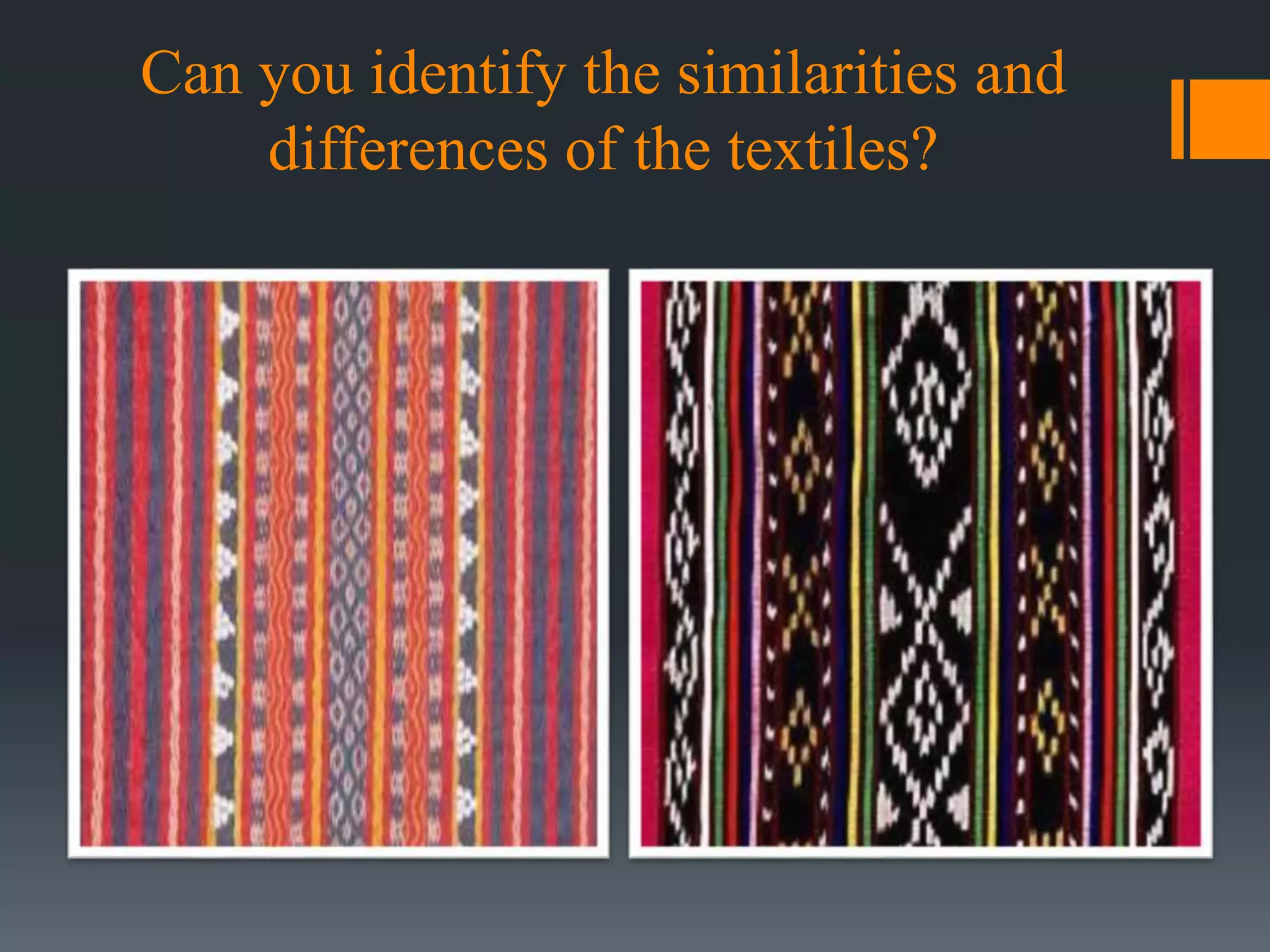
Can you identify the similarities and
differences of the textiles?
TEXTILE (Attire, Fabrics and
Tapestries)
INABEL
- is a handwoven fabric made by Ilocanos which
is more popularly known as “Abel Iloco”. It
comes from the root word “abel” which means
“to weave”. The word Inabel of Ilocanos
literally means “woven”. It is created by skilled
artisans using traditional wooden looms.
TEXTILE (Attire, Fabrics and
Tapestries)
INABEL
- It comes with different patterns inspired
by nature. One of the most recognizable
patterns of Inabel is Binakol (also known as
binakel, binakael, or binakul). Binakol
(meaning “twill”) can be easily recognized
by its interlocked geometric patterns which
represent the waves of the sea that protects
people from malevolent spirits.
INABEL
KAIN
is the basic dress for women of Cordillera
region. It is a type of wrap-around skirt (tapis in
Tagalog) characterized by horizontal stripes
bordered by decorated panels along the joins and
edges, uses bright colors especially fiery red and
embroidered with beads and shells.
Some kain used
other colors like
red, yellow,
white, black and
green which
signify the color
of things in
nature.
KADANGYAN
is a burial cloth for the rich people of
Mountain Province. It is a Cordilleran
term which literally means “rich”. In
earlier days, only the grandmothers
were allowed to weave burial cloths
(Kadangyan) but now, any able weaver
is allowed to weave burial cloths for
the dead.
KADANGYAN
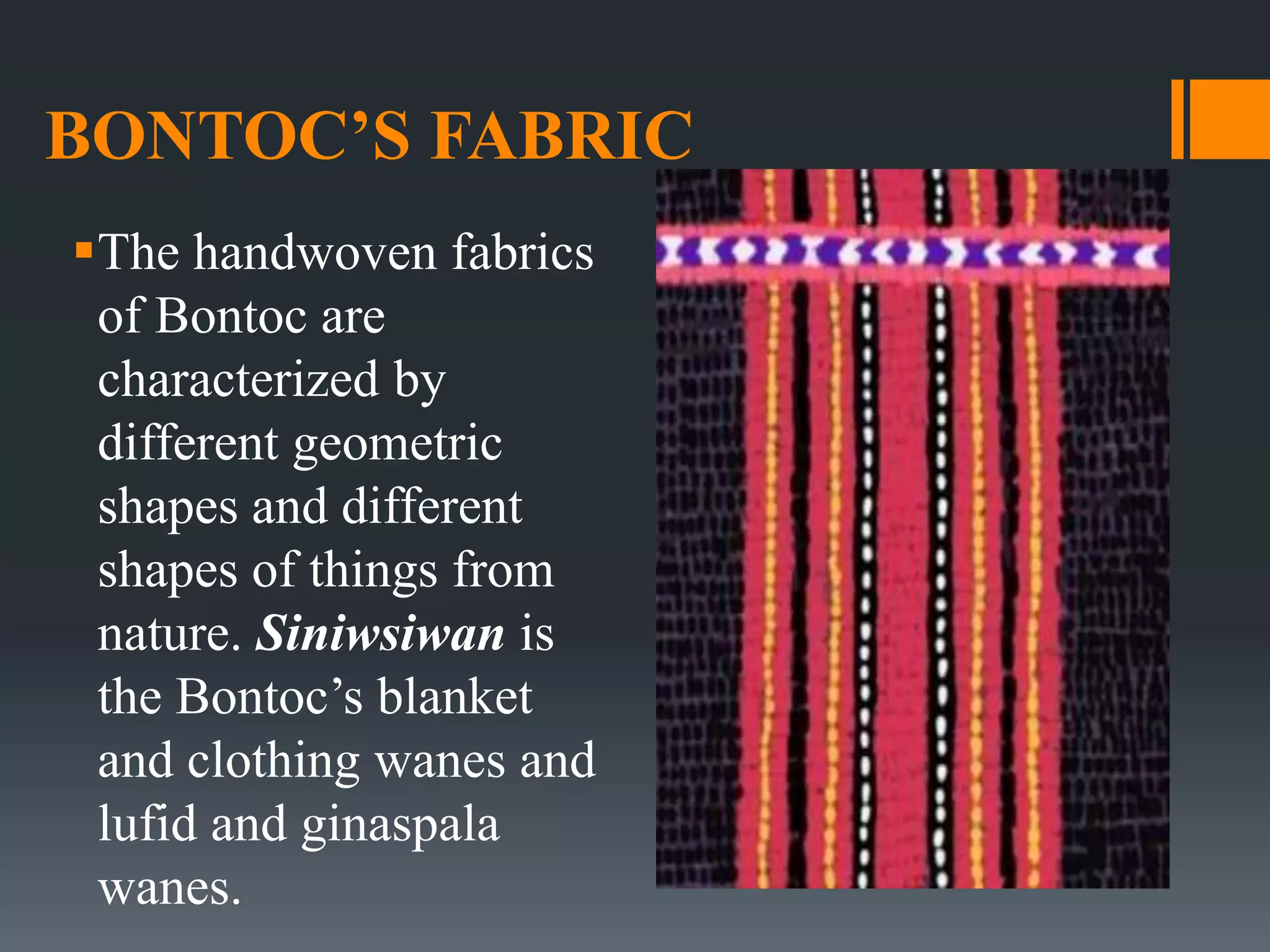
BONTOC’S FABRIC
The handwoven fabrics
of Bontoc are
characterized by
different geometric
shapes and different
shapes of things from
nature. Siniwsiwan is
the Bontoc’s blanket
and clothing wanes and
lufid and ginaspala
wanes.
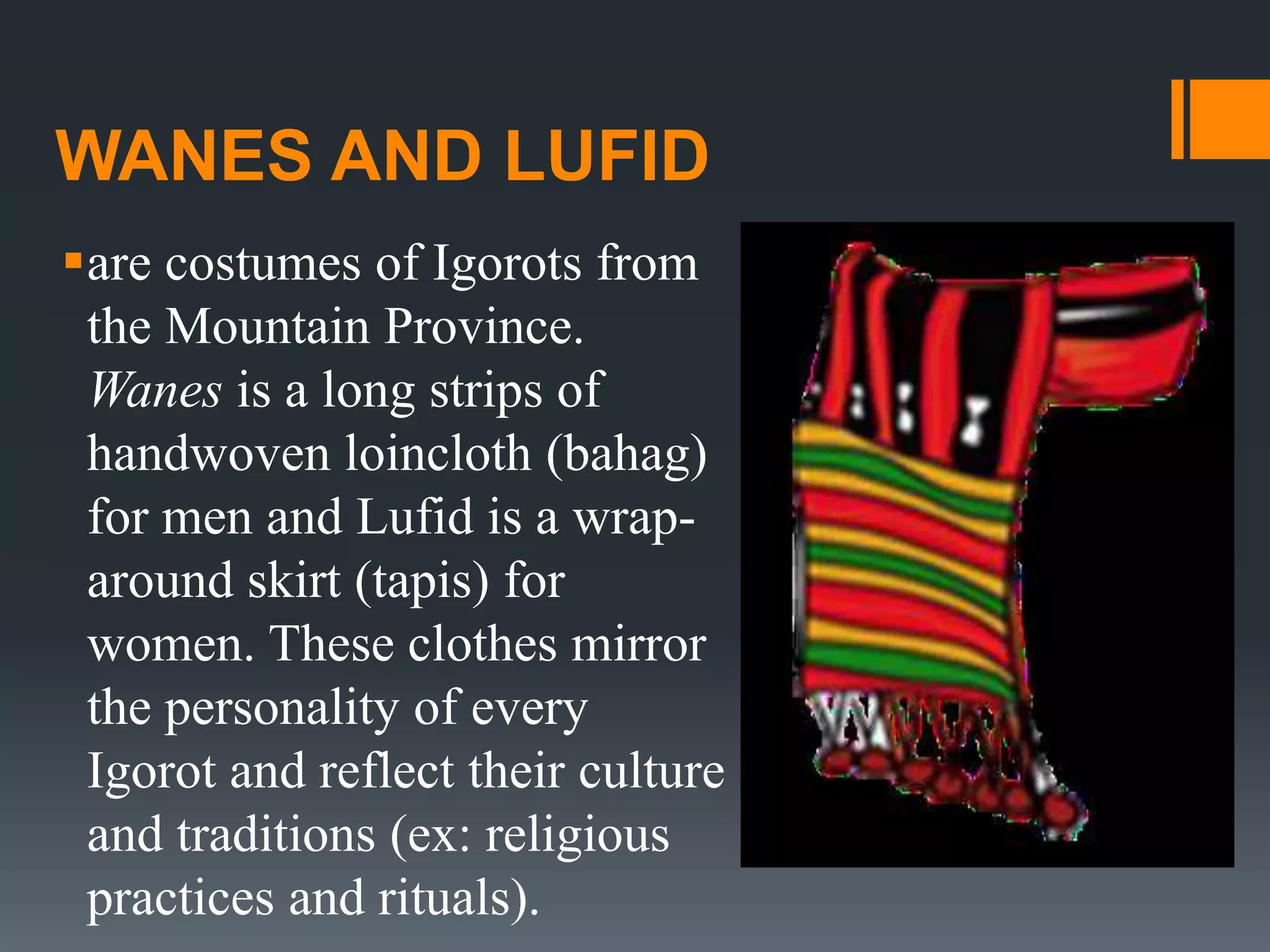
WANES AND LUFID
are costumes of Igorots from
the Mountain Province.
Wanes is a long strips of
handwoven loincloth (bahag)
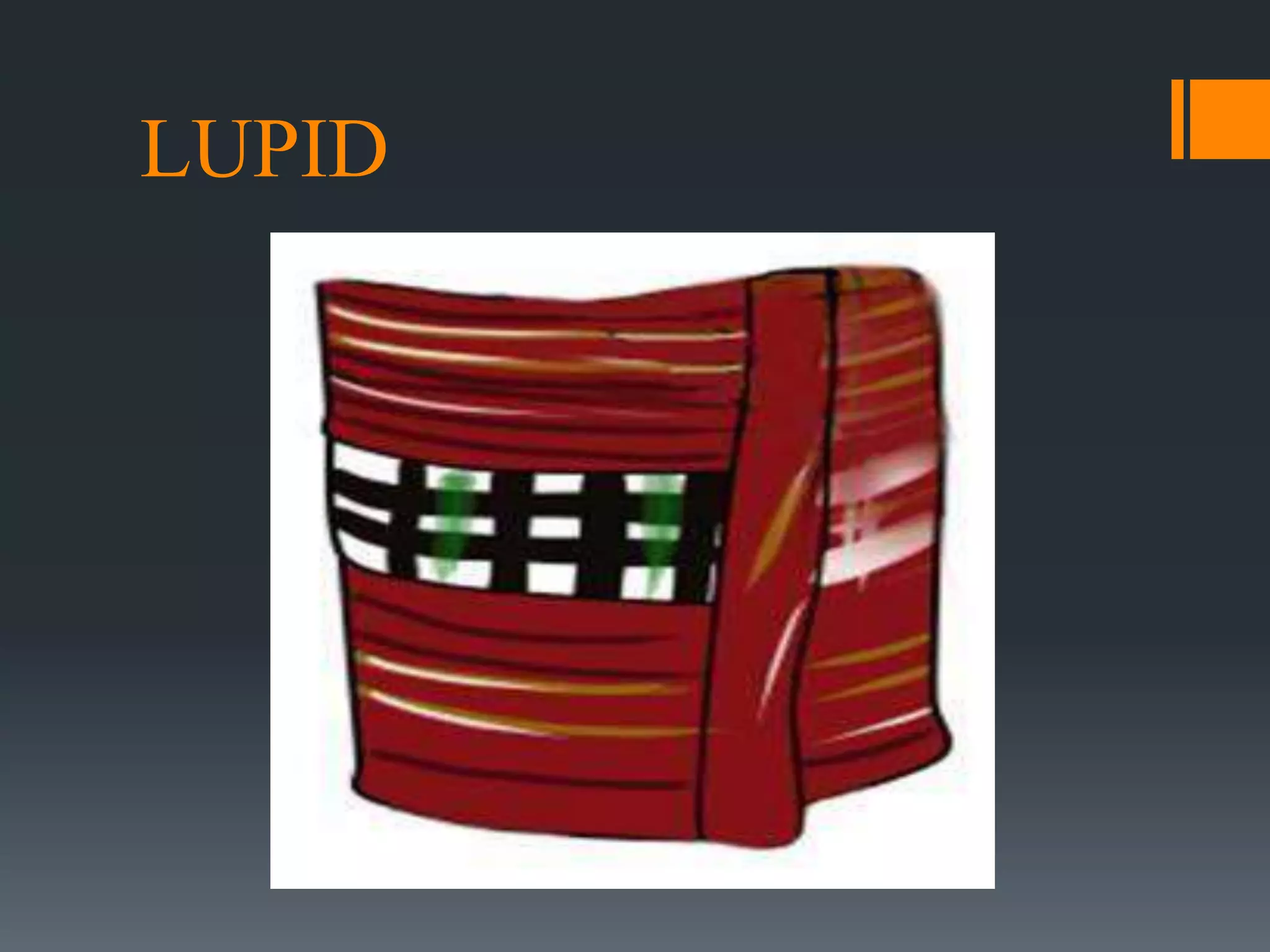
for men and Lufid is a wrap-
around skirt (tapis) for
women. These clothes mirror
the personality of every
Igorot and reflect their culture
and traditions (ex: religious
practices and rituals).
Ginaspala Wanes is a belt worn by a
married women of Bontoc and
Kankana-y that has Inawin designs
composed of continuous zigzag pattern.
LUPID
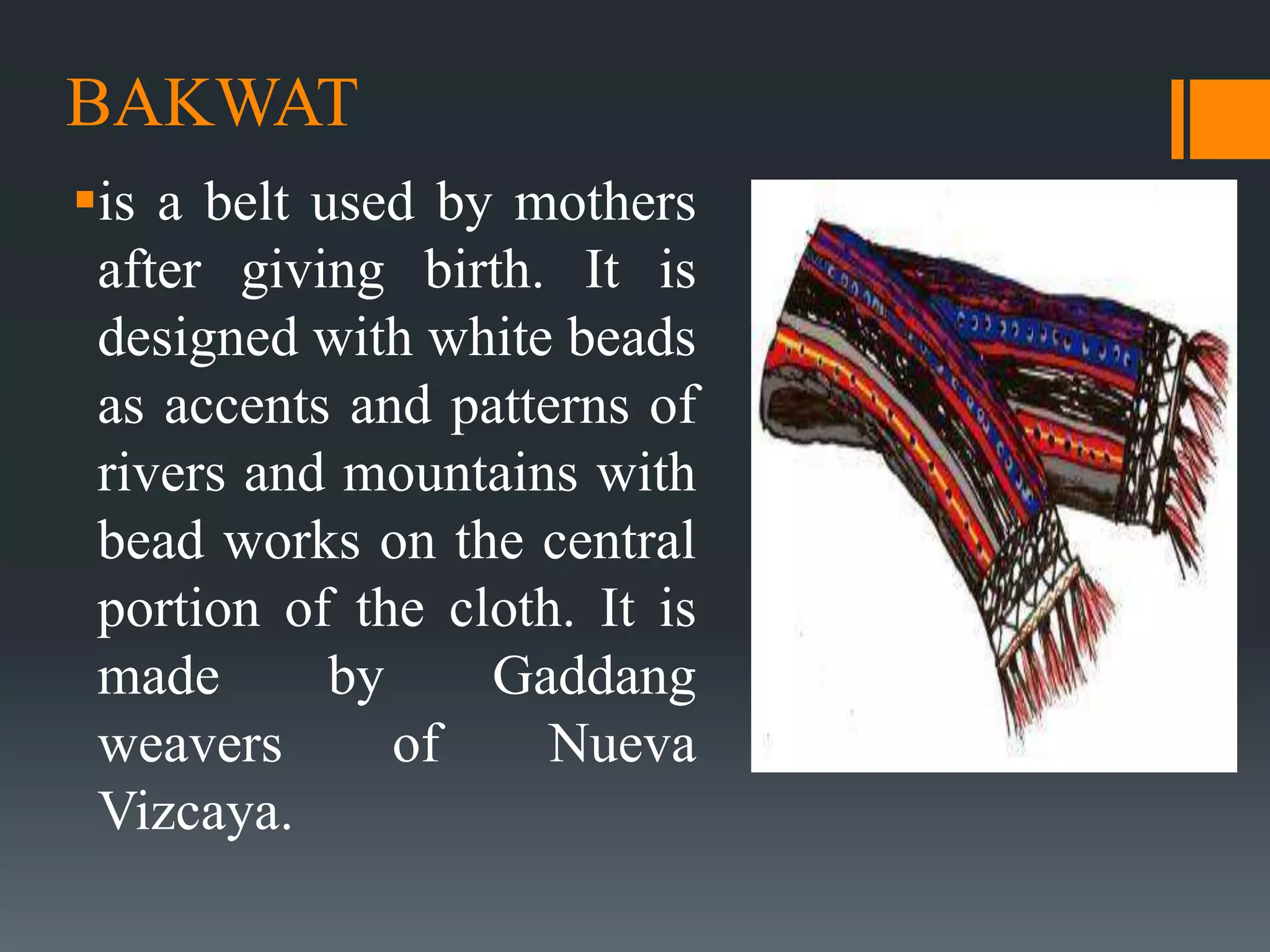
BAKWAT
is a belt used by mothers
after giving birth. It is
designed with white beads
as accents and patterns of
rivers and mountains with
bead works on the central
portion of the cloth. It is
made by Gaddang
weavers of Nueva
Vizcaya.
TINGGUIAN DESIGNS
- These are very meaningful for the people
of Abra. Their clothing has a simple linear
designs but are assigned with many
meanings. Some of their textiles are
reserved for use only during special
occasions such as birthgiving, weddings,
and harvesting. They use natural dyes from
different trees and plants (mahogany-red,
jackfruit/ginger – yellow, narra - brown,
malatayum- indigo).
BATANGAS
EMBROIDER
Y
Piňa and jusi are the traditional
fabrics in Batangas. In Taal,
hand embroideries are
characterized by a smooth
stitches, fine, composed of fine
delicate shapes, embossed, and
durable.
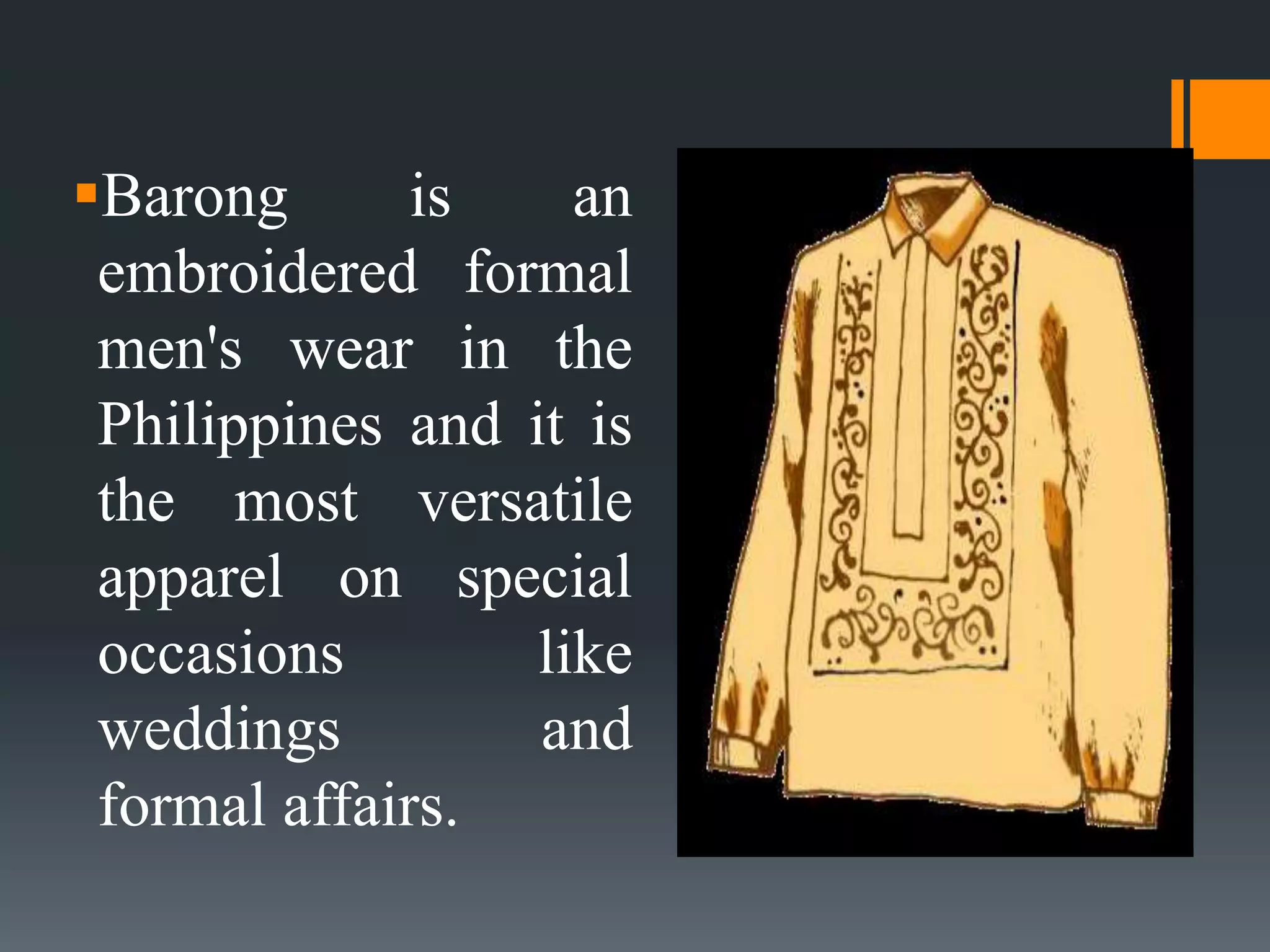
Barong is an
embroidered formal
men's wear in the
Philippines and it is
the most versatile
apparel on special
occasions like
weddings and
formal affairs.
CRAFTS
Burnay
- (locally known as tapayan or banga) is
an earthenware jar crafted by a skillful
potters with the use of potter’s wheel and
kiln. It is made by a grade- A clay and fine
sand. Burnay is commonly used for
storage of water, grains, fermented fish
(bagoong), basi (sugarcane wine), salt,
and other condiments.
Burnay has
small openings
while those with
bigger mouths
are called
wangging.
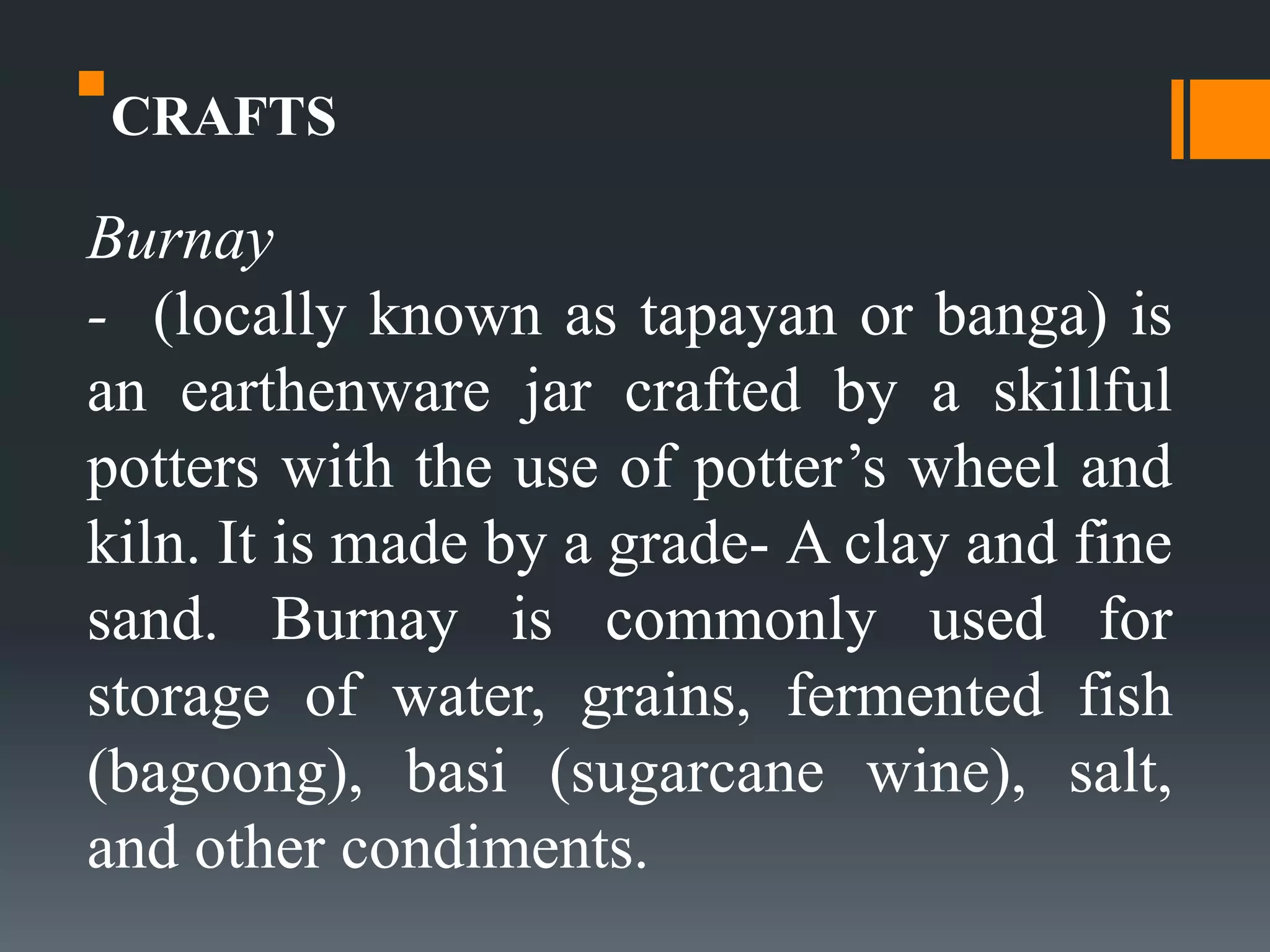
Buri
mat is the smoothy
woven mat from
Bolinao that is
made of dried
leaves of palm
(buri, raffia, and
buntal), dyed and
woven.
Labba is a bowl-
shaped coil
basket of Kalinga
that is made from
finely split rattan
and nito vine. It
is used for
carrying and
storing rice or
vegetables.
LINGLING-O OR DINUMUG
- is a common ancient artifact symbolizing
fertility, prosperity and love found in the Ifugao,
Bontoc and other Cordillera regions of the
northern Philippines. It has a negative space
formed that be considered the internal female
reproductive system—the womb and the birth
canal.
This fertility
symbol captured
the feminine
essence that
nurtures life
within itself and
gives birth to it.
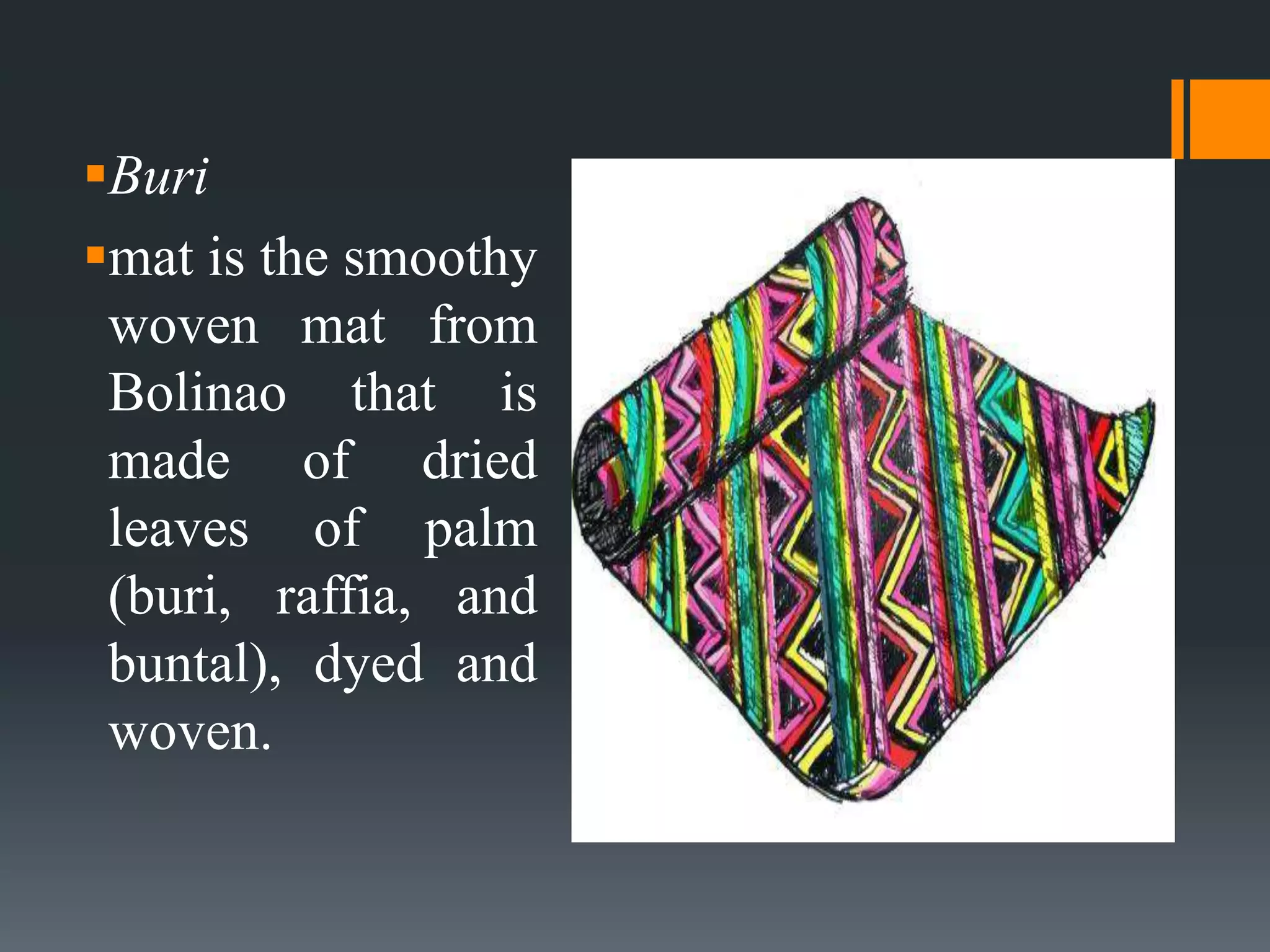
is the headgear
for Ivatan
women of
Batanes that is
used to protect
them from the
heat of the sun
and rains.
VAKUL
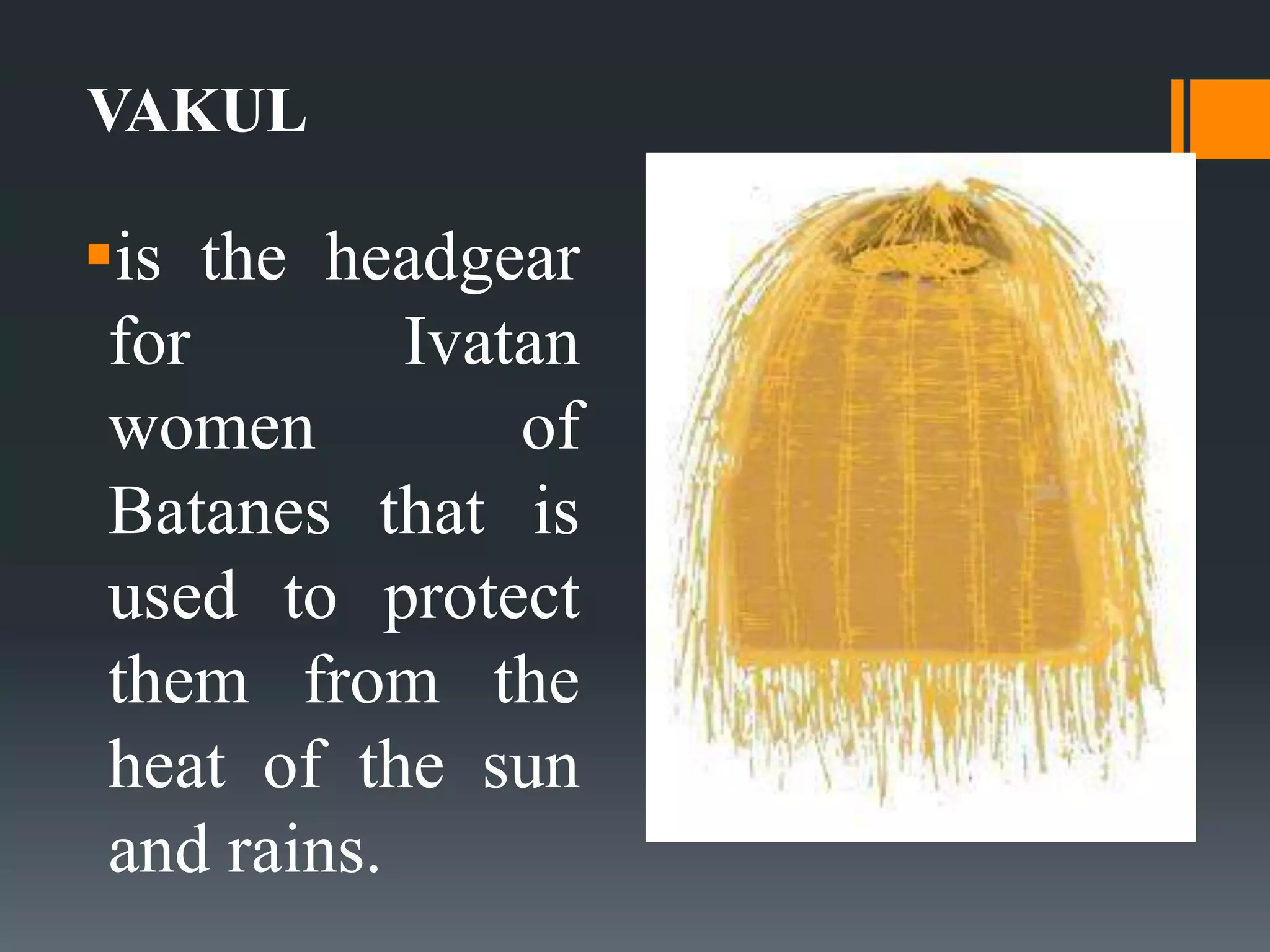
worn by Ivatan
men farmers.
Vakul and vest
are made from
the leaves of
vuyavuy, a tree
endemic to
Batanes.
VEST
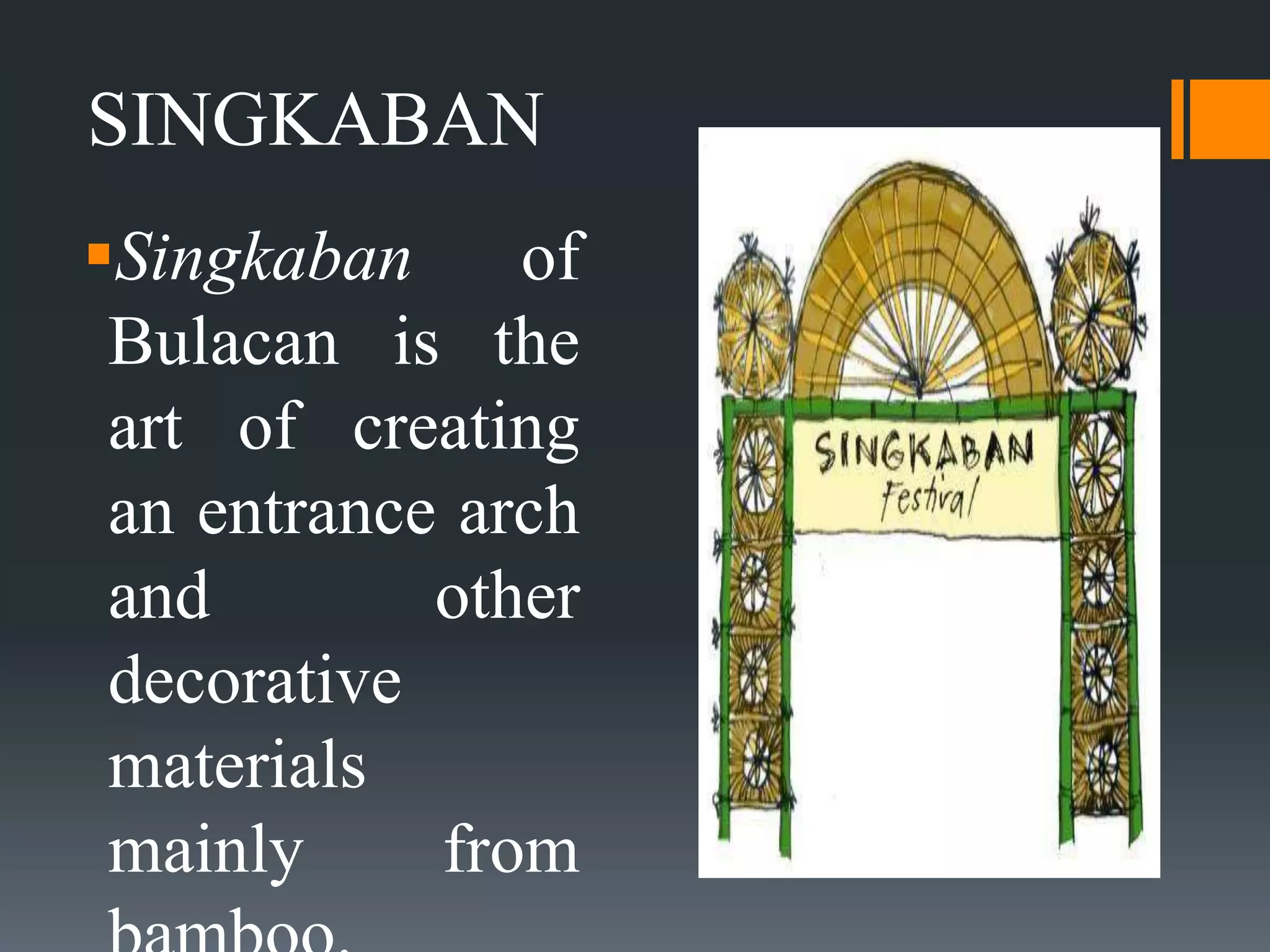
Singkaban of
Bulacan is the
art of creating
an entrance arch
and other
decorative
materials
mainly from
SINGKABAN
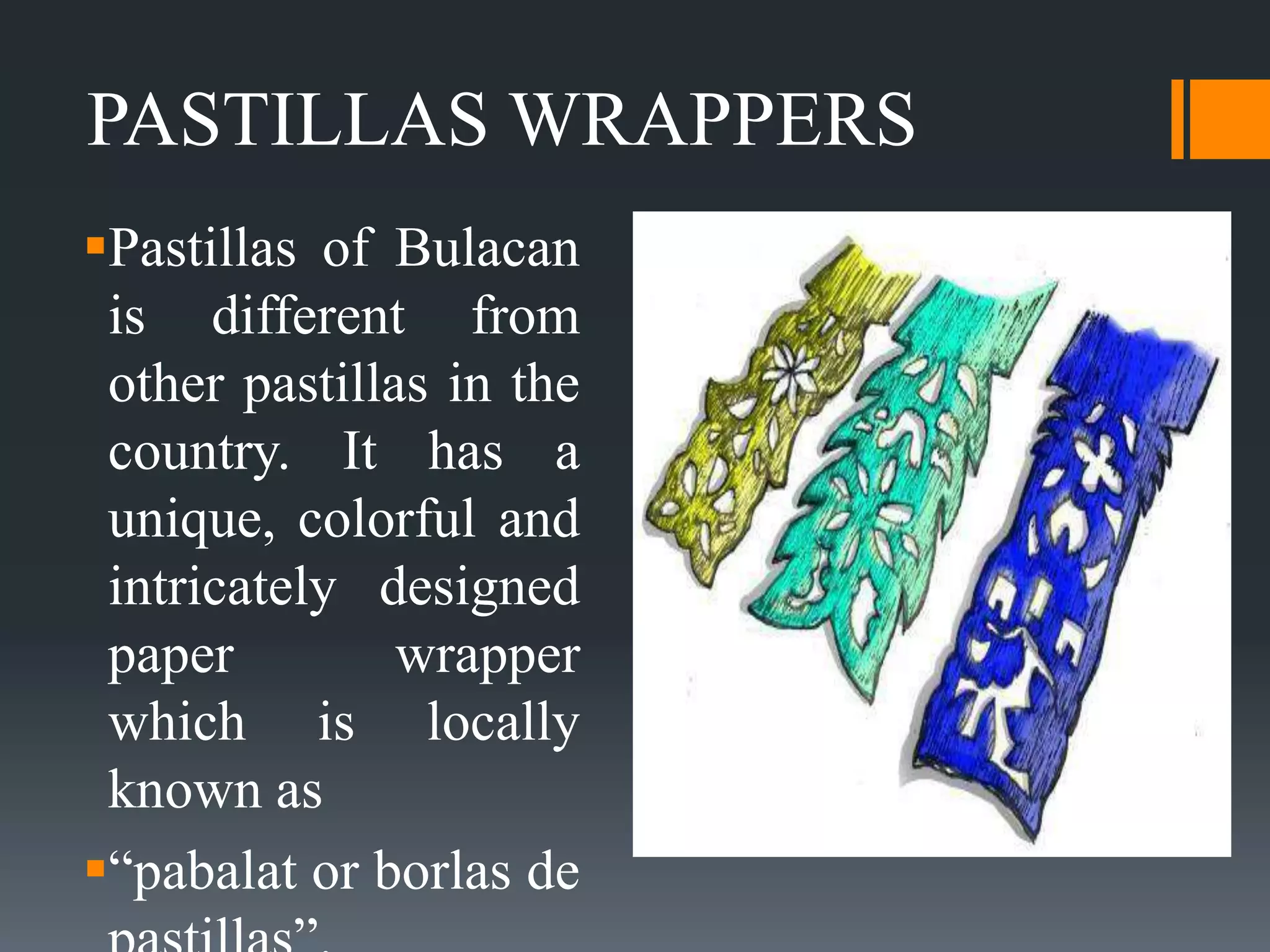
Pastillas of Bulacan
is different from
other pastillas in the
country. It has a
unique, colorful and
intricately designed
paper wrapper
which is locally
known as
“pabalat or borlas de
PASTILLAS WRAPPERS
Bulacan arts and crafts include fire crackers, and goldsmith.
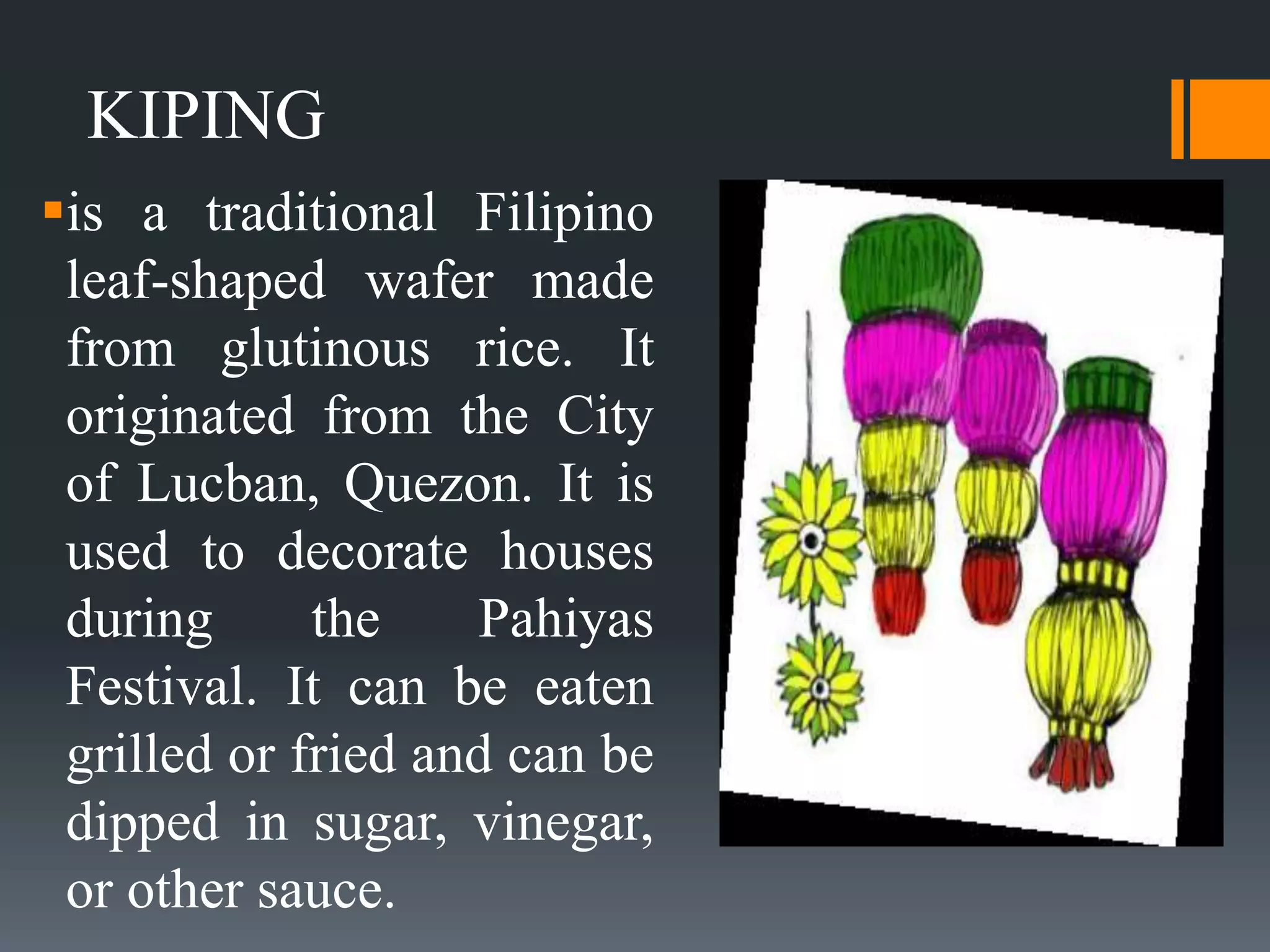
is a traditional Filipino
leaf-shaped wafer made
from glutinous rice. It
originated from the City
of Lucban, Quezon. It is
used to decorate houses
during the Pahiyas
Festival. It can be eaten
grilled or fried and can be
dipped in sugar, vinegar,
or other sauce.
KIPING
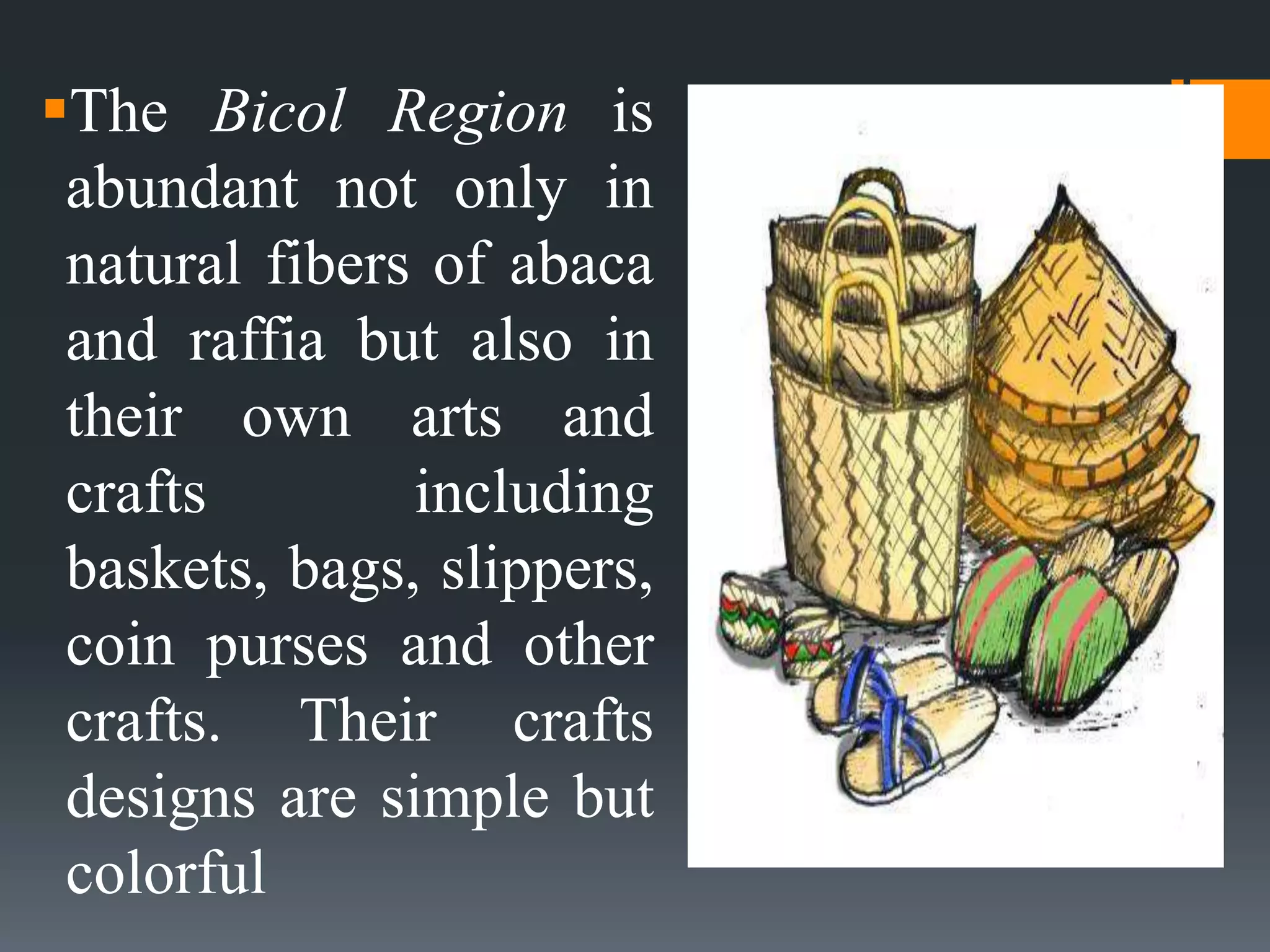
The Bicol Region is
abundant not only in
natural fibers of abaca
and raffia but also in
their own arts and
crafts including
baskets, bags, slippers,
coin purses and other
crafts. Their crafts
designs are simple but
colorful
Giant lanterns of Pampanga are known
for their special features. Before, giant
lanterns of Pampanga uses papel de
hapon for coverings but were then
innovated by using colored plastics as a
material for covering. In today’s ages,
Pampagenos use fiber glass and
homemade paper for their lanters.
GIANT LANTERN
Giant lanterns
are created
using steel
frames and other
locally available
materials.
ACCESSORIES AND
BODY
ORNAMENTATION
Batok
bbb
Kalinga's tattooing is a form of art that is
usually covering the chest and arms. It is
considered as a clothing and decorations
of the Kalingas.
 Batok is a thousand – year tattooing
tradition that uses indigenous materials
like a charcoal mixed with water in a
coconut shell, a thorn of a citrus tree as a
needle, a bamboo thorn holder,and a
bamboo used to tap it.
KABAYAN MUMMIES
In Mountain
Province the
close
examination of
the Kabayan
mummies reveal
that they have
body tattoos
similar to patterns
found in their
textiles.
KABAYAN MUMMIES
In Mountain
Province the
close
examination of
the Kabayan
mummies reveal
that they have
body tattoos
similar to patterns
found in their
textiles.

ARTS AND CRAFTS OF LUZON.pptx

  • 1.
    ARTS AND CRAFTSOF LUZON Attires, Fabrics and Tapestries Crafts and Accessories and Body Ornamentation
  • 2.
    Can you identifythe similarities and differences of the textiles?
  • 3.
    TEXTILE (Attire, Fabricsand Tapestries) INABEL - is a handwoven fabric made by Ilocanos which is more popularly known as “Abel Iloco”. It comes from the root word “abel” which means “to weave”. The word Inabel of Ilocanos literally means “woven”. It is created by skilled artisans using traditional wooden looms.
  • 5.
    TEXTILE (Attire, Fabricsand Tapestries) INABEL - It comes with different patterns inspired by nature. One of the most recognizable patterns of Inabel is Binakol (also known as binakel, binakael, or binakul). Binakol (meaning “twill”) can be easily recognized by its interlocked geometric patterns which represent the waves of the sea that protects people from malevolent spirits.
  • 6.
  • 7.
    KAIN is the basicdress for women of Cordillera region. It is a type of wrap-around skirt (tapis in Tagalog) characterized by horizontal stripes bordered by decorated panels along the joins and edges, uses bright colors especially fiery red and embroidered with beads and shells.
  • 8.
    Some kain used othercolors like red, yellow, white, black and green which signify the color of things in nature.
  • 9.
    KADANGYAN is a burialcloth for the rich people of Mountain Province. It is a Cordilleran term which literally means “rich”. In earlier days, only the grandmothers were allowed to weave burial cloths (Kadangyan) but now, any able weaver is allowed to weave burial cloths for the dead.
  • 10.
  • 11.
    BONTOC’S FABRIC The handwovenfabrics of Bontoc are characterized by different geometric shapes and different shapes of things from nature. Siniwsiwan is the Bontoc’s blanket and clothing wanes and lufid and ginaspala wanes.
  • 12.
    WANES AND LUFID arecostumes of Igorots from the Mountain Province. Wanes is a long strips of handwoven loincloth (bahag) for men and Lufid is a wrap- around skirt (tapis) for women. These clothes mirror the personality of every Igorot and reflect their culture and traditions (ex: religious practices and rituals).
  • 13.
    Ginaspala Wanes isa belt worn by a married women of Bontoc and Kankana-y that has Inawin designs composed of continuous zigzag pattern.
  • 14.
  • 15.
    BAKWAT is a beltused by mothers after giving birth. It is designed with white beads as accents and patterns of rivers and mountains with bead works on the central portion of the cloth. It is made by Gaddang weavers of Nueva Vizcaya.
  • 16.
    TINGGUIAN DESIGNS - Theseare very meaningful for the people of Abra. Their clothing has a simple linear designs but are assigned with many meanings. Some of their textiles are reserved for use only during special occasions such as birthgiving, weddings, and harvesting. They use natural dyes from different trees and plants (mahogany-red, jackfruit/ginger – yellow, narra - brown, malatayum- indigo).
  • 18.
  • 19.
    Piňa and jusiare the traditional fabrics in Batangas. In Taal, hand embroideries are characterized by a smooth stitches, fine, composed of fine delicate shapes, embossed, and durable.
  • 20.
    Barong is an embroideredformal men's wear in the Philippines and it is the most versatile apparel on special occasions like weddings and formal affairs.
  • 21.
    CRAFTS Burnay - (locally knownas tapayan or banga) is an earthenware jar crafted by a skillful potters with the use of potter’s wheel and kiln. It is made by a grade- A clay and fine sand. Burnay is commonly used for storage of water, grains, fermented fish (bagoong), basi (sugarcane wine), salt, and other condiments.
  • 22.
    Burnay has small openings whilethose with bigger mouths are called wangging.
  • 23.
    Buri mat is thesmoothy woven mat from Bolinao that is made of dried leaves of palm (buri, raffia, and buntal), dyed and woven.
  • 24.
    Labba is abowl- shaped coil basket of Kalinga that is made from finely split rattan and nito vine. It is used for carrying and storing rice or vegetables.
  • 25.
    LINGLING-O OR DINUMUG -is a common ancient artifact symbolizing fertility, prosperity and love found in the Ifugao, Bontoc and other Cordillera regions of the northern Philippines. It has a negative space formed that be considered the internal female reproductive system—the womb and the birth canal.
  • 26.
    This fertility symbol captured thefeminine essence that nurtures life within itself and gives birth to it.
  • 27.
    is the headgear forIvatan women of Batanes that is used to protect them from the heat of the sun and rains. VAKUL
  • 28.
    worn by Ivatan menfarmers. Vakul and vest are made from the leaves of vuyavuy, a tree endemic to Batanes. VEST
  • 29.
    Singkaban of Bulacan isthe art of creating an entrance arch and other decorative materials mainly from SINGKABAN
  • 30.
    Pastillas of Bulacan isdifferent from other pastillas in the country. It has a unique, colorful and intricately designed paper wrapper which is locally known as “pabalat or borlas de PASTILLAS WRAPPERS
  • 31.
    Bulacan arts andcrafts include fire crackers, and goldsmith.
  • 32.
    is a traditionalFilipino leaf-shaped wafer made from glutinous rice. It originated from the City of Lucban, Quezon. It is used to decorate houses during the Pahiyas Festival. It can be eaten grilled or fried and can be dipped in sugar, vinegar, or other sauce. KIPING
  • 33.
    The Bicol Regionis abundant not only in natural fibers of abaca and raffia but also in their own arts and crafts including baskets, bags, slippers, coin purses and other crafts. Their crafts designs are simple but colorful
  • 34.
    Giant lanterns ofPampanga are known for their special features. Before, giant lanterns of Pampanga uses papel de hapon for coverings but were then innovated by using colored plastics as a material for covering. In today’s ages, Pampagenos use fiber glass and homemade paper for their lanters. GIANT LANTERN
  • 35.
    Giant lanterns are created usingsteel frames and other locally available materials.
  • 36.
  • 37.
    bbb Kalinga's tattooing isa form of art that is usually covering the chest and arms. It is considered as a clothing and decorations of the Kalingas.  Batok is a thousand – year tattooing tradition that uses indigenous materials like a charcoal mixed with water in a coconut shell, a thorn of a citrus tree as a needle, a bamboo thorn holder,and a bamboo used to tap it.
  • 39.
    KABAYAN MUMMIES In Mountain Provincethe close examination of the Kabayan mummies reveal that they have body tattoos similar to patterns found in their textiles.
  • 40.
    KABAYAN MUMMIES In Mountain Provincethe close examination of the Kabayan mummies reveal that they have body tattoos similar to patterns found in their textiles.