Teacher Tin
Heavenly Father, we thank you for this
wonderful opportunity to learn with
everyone, May this day be another step to
be mindful and self-directed.
May we apply the fundamental skills and
processes as we understand deeper the
nature of communication and its different
models to help us to be an effective
OPENING PRAYER
Mary, our
Mother and
model,
Pray for us
St. Paul, our
patron
Pray for us
Fr. Louis
Chauvet and
our
first Sisters,
intercede for us.
May the love of
Christ impel us,
now and forever.
Amen.
Life Performance Outcome
I am mindful, self-directed
learner and role model.
Explain the factors that generally
affect their decisions and actions, and
assess the consequences they produce.
Essential Performance
Outcome
As a Paulinian learner, I can:
Intended Learning
Outcome
1. Explain the factors that generally affect
their decisions and actions in choosing
communication model and assess the
consequences they produce.
Models of
Communication
NATURE OF COMMUNICATION
Behavior Communication Decoding
Interact Message Motivates
Nonverbal Receiver Sender Written
WORD POOL
Direction: Complete the paragraph below by choosing the
correct word from the word pool.
Behavior Communication Decoding
Interact Message Motivates
Nonverbal Receiver Sender Written
WORD POOL
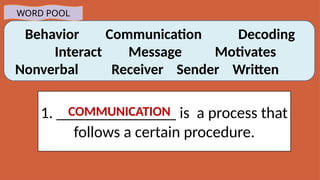
1. _______________ is a process that
follows a certain procedure.
COMMUNICATION
Behavior Communication Decoding
Interact Message Motivates
Nonverbal Receiver Sender Written
WORD POOL
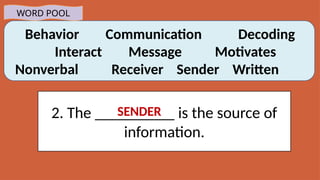
2. The __________ is the source of
information.
SENDER
Behavior Communication Decoding
Interact Message Motivates
Nonverbal Receiver Sender Written
WORD POOL
1. The ___________ is the recipient of
the message.
SENDER
Behavior Communication Decoding
Interact Message Motivates
Nonverbal Receiver Sender Written
WORD POOL
4. It can be articulated through
___________ or spoken words.
WRITTEN
Behavior Communication Decoding
Interact Message Motivates
Nonverbal Receiver Sender Written
WORD POOL
5. It can also be expressed through
gestures, facial expressions or actions
which are ______________.
NONVERBAL
Behavior Communication Decoding
Interact Message Motivates
Nonverbal Receiver Sender Written
WORD POOL
6. ____________ is the process of
interpreting the encoded 7. _________ of
the source by the receiver.
MESSAGE
DECODING
Behavior Communication Decoding
Interact Message Motivates
Nonverbal Receiver Sender Written
WORD POOL
8. Communication also functions to
control ______________.
BEHAVIOR
Behavior Communication Decoding
Interact Message Motivates
Nonverbal Receiver Sender Written
WORD POOL
9. It __________ or encourages people to
live better and allows individuals to 10.
_________ with other.
MOTIVATES
INTERACT
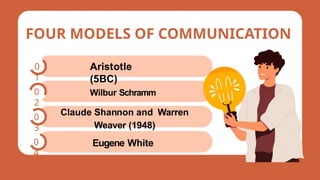
FOUR MODELS OF COMMUNICATION
0
1
0
2
0
3
0
4
Aristotle
(5BC)
Wilbur Schramm
Claude Shannon and Warren
Weaver (1948)
Eugene White
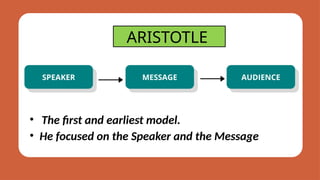
ARISTOTLE
ARISTOTLE
• The first and earliest model.
• He focused on the Speaker and the Message
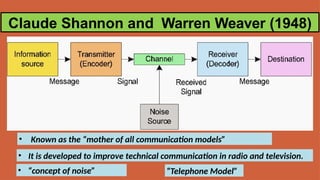
Claude Shannon and
Warren Weaver (1948)
• Known as the “mother of all communication models”
Claude Shannon and Warren Weaver (1948)
• It is developed to improve technical communication in radio and television.
• “concept of noise” “Telephone Model”
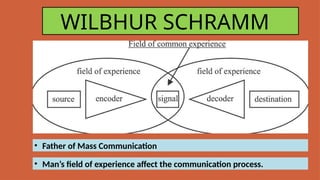
WILBHUR SCHRAMM
WILBHUR SCHRAMM
• Man’s field of experience affect the communication process.
• Father of Mass Communication
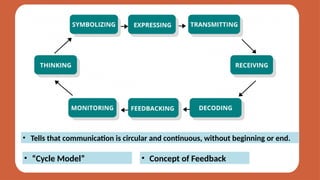
EUGENE WHITE
• Tells that communication is circular and continuous, without beginning or end.
• “Cycle Model”
• “Cycle Model” • Concept of Feedback
If you are to choose one
communication model,
which one do you think is
effective? why?
Among the four models, which
one is you least prefer?
What specific reason or factor
influenced you in choosing your
least preferred model?
SELF-DIRECTED LEARNING
Directions: Illustrate the four models of communication.
Provide a short explanation each model.
Life Performance Outcome
I am mindful, self-
directed learner
and role model.
Explain the factors that generally
affect their decisions and actions, and
assess the consequences they produce.

Essential Performance
Outcome
As a Paulinian learner, I can:
Intended Learning
Outcome
1. Describe the abilities needed in

determining the meaning of words and
expressions that reflect local culture.
Mary, our
Mother and
model,
Pray for us
St. Paul, our
patron
Pray for us
Fr. Louis
Chauvet and
our
first Sisters,
intercede for us.
May the love of
Christ impel us,
now and forever.
Amen.
Ms. Christine
“NEVER STOP
LEARNING
BECAUSE LIFE
NEVER STOPS
TEACHING”

Lesson 2 - Models of Communication.pptx

Editor's Notes

  • #23 Considered as the oldest model of communication and proposed before 300 bc. This model merely focus on the speaker and speech. This model iis higky used to develop public speaking skills and create propaganda at the time when proposed the reason that the audience remains passive.
  • #25 This was form in 1949 by the mathematician Claude Shannon and the scientist warren weaver. Known as the “mother of all communication models” It is developed to improve technical communication in radio and television. “mathetematical theory of communication,. Designed to develop effective communication between the sender and the receiver. The source or the information will be encoded by the transmitter through technological channel converting it into signals. The receiver will decode the message before interpreting it to arrive to its destination. “concept of noise”
  • #27 Proposed on 1954. “encoding” important because it initiates the process of communication.Schramm believes that the man’s fields of experience affect the communication process.m because the commonality of experience taking place between the sender and the receiver allows them to interact. For example, a professor of calculus would have a very little lack of communicating math pronciples to a classroom of kindergarten students because they do not share a field of experience that makes the message easy to understand. And encoding and decoding are the two essential processes of effective communication.
  • #29 This model is known as circular and continuous, wiotut beginning or end. The reason he made this model cyclical. He assumes that communication begins with . He is the one who contributed the concept of feedbacking to the field of communication.