MATHS PROJECT
ON
SYMMETRY
PRESENTED BY:
RIYA BEN
VII G
ROLL NO. 37
WHAT IS SYMMETRY?
If two or more parts of a figure are
identical after folding or flipping then
it is said to be symmetry.
To be symmetrical, the two halves of a
shape must be of same shape and size.
The concept of symmetry is commonly
found in geometry.
LINE OF SYMMETRY
The imaginary line that divides
an object into two identical
pieces is called as line of
symmetry. It is also called the
axis of symmetry.
• Eg. If we fold a figure in half
along its line of symmetry, we
will notice that both the halves
match each other exactly. AXIS OF
SYMMETRY
SYMMETRY IS WHERE SOMETHING IS THE SAME ON BOTH SIDES; THEN IT
WOULD BE SAID TO BE SYMMETRICAL.
LET’S HAVE A DISCUSSION ON FEW TYPES OF SYMMETRY:
• Linear symmetry
• Rotational symmetry
• Reflection symmetry
LINEAR SYMMETRY
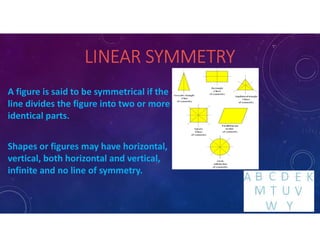
A figure is said to be symmetrical if the
line divides the figure into two or more
identical parts.
Shapes or figures may have horizontal,
vertical, both horizontal and vertical,
infinite and no line of symmetry.
ROTATIONAL SYMMETRY
The centre of the shape is the
point about which the shape is
rotated; it is called the centre
of rotation.
CENTRE OF
ROTATION
REFLECTION SYMMETRY
Reflection symmetry is a type of
symmetry which is with respect to
reflections.
Reflection symmetry is also known as
line symmetry or mirror symmetry.
It states that if there exists at least one
line that divides a figure into two
halves such that one-half is the mirror
image of the other half.
SYMMETRY IS WHAT WE SEE AT A GLANCE
Thanks for watching this presentation patiently!

Maths Project: Symmetry

  • 1.
  • 2.
    WHAT IS SYMMETRY? Iftwo or more parts of a figure are identical after folding or flipping then it is said to be symmetry. To be symmetrical, the two halves of a shape must be of same shape and size. The concept of symmetry is commonly found in geometry.
  • 3.
    LINE OF SYMMETRY Theimaginary line that divides an object into two identical pieces is called as line of symmetry. It is also called the axis of symmetry. • Eg. If we fold a figure in half along its line of symmetry, we will notice that both the halves match each other exactly. AXIS OF SYMMETRY
  • 4.
    SYMMETRY IS WHERESOMETHING IS THE SAME ON BOTH SIDES; THEN IT WOULD BE SAID TO BE SYMMETRICAL. LET’S HAVE A DISCUSSION ON FEW TYPES OF SYMMETRY: • Linear symmetry • Rotational symmetry • Reflection symmetry
  • 5.
    LINEAR SYMMETRY A figureis said to be symmetrical if the line divides the figure into two or more identical parts. Shapes or figures may have horizontal, vertical, both horizontal and vertical, infinite and no line of symmetry.
  • 6.
    ROTATIONAL SYMMETRY The centreof the shape is the point about which the shape is rotated; it is called the centre of rotation. CENTRE OF ROTATION
  • 7.
    REFLECTION SYMMETRY Reflection symmetryis a type of symmetry which is with respect to reflections. Reflection symmetry is also known as line symmetry or mirror symmetry. It states that if there exists at least one line that divides a figure into two halves such that one-half is the mirror image of the other half.
  • 8.
    SYMMETRY IS WHATWE SEE AT A GLANCE Thanks for watching this presentation patiently!