Republic of the Philippines
MINDANAO STATE UNIVERSITY
COLLEGE OF EDUCATION
Fatima, General Santos City
MODULE 3: MANAGEMENT OF INSTRUCTION
Lesson 1: Definition, Differentiation, and Importance of
Instructional/ Lesson Plan
Presented to: Ava Clare Marie
O. Robles, Ph. D.
Class Schedule:
TFr /10:30- 12:00
Discussant: Ierine Joy L.
Caserial
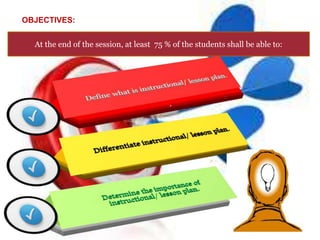
OBJECTIVES:
At the end of the session, at least 75 % of the students shall be able to:
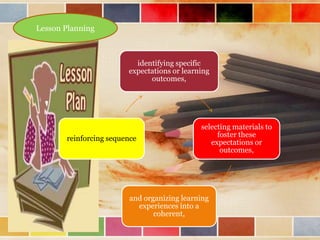
identifying specific
expectations or learning
outcomes,
selecting materials to
foster these
expectations or
outcomes,
and organizing learning
experiences into a
coherent,
reinforcing sequence
Lesson Planning
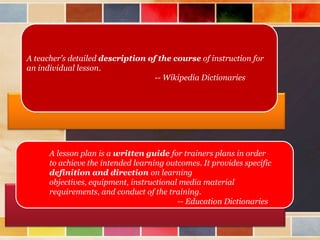
A teacher’s detailed description of the course of instruction for
an individual lesson.
-- Wikipedia Dictionaries
A lesson plan is a written guide for trainers plans in order
to achieve the intended learning outcomes. It provides specific
definition and direction on learning
objectives, equipment, instructional media material
requirements, and conduct of the training.
-- Education Dictionaries
Differentiated
instruction is a set of
unique decision that the
educator makes to bring
learning within the
grasp of all students.
Differentiated
instruction
“Differentiation means tailoring
instruction to meet individual needs.
Whether teachers differentiate
content, process, products, or the
learning environment, the use of
ongoing assessment and flexible
grouping makes this a successful
approach to instruction.”
IMPORTANCE OF LESSON
PLANNING
Being clear on what you want to teach.
•Give your teaching a framework, an overall shape.
•A reminder for the teacher when they get distracted.
It suggests a level of professionalism and real
commitment.
Being ready to cope with whatever happens
How is lesson planning important for the teacher and the
learners?
For the teacher
• They don’t have to
think on their feet.
• They don’t lose face in
front of their learners.
• They are clear on the
procedure to follow.
• They build on
previous teaching and
prepare for coming
lessons
For the learner
• They realize that the
teacher cares for their
learning.
• They attend a
structured lesson:
easier to assimilate
• They appreciate their
teacher’s work as a
model of well-
organized work to
imitate.
Republic of the Philippines
MINDANAO STATE UNIVERSITY
COLLEGE OF EDUCATION
Fatima, General Santos City
MODULE 3: MANAGEMENT OF INSTRUCTION
Lesson 2: Criteria of Effective Instructional Objective
(SMART: Specific, measurable, Attainable,
Result- Oriented and Time Bound)
Presented to: Ava Clare Marie
O. Robles, Ph. D.
Class Schedule:
TFr /10:30- 12:00
Discussant: Ierine Joy L.
Caserial
At the end of the session, at least 75 % of the students shall be able to:
OBJECTIVES:
S
M
T
R
A
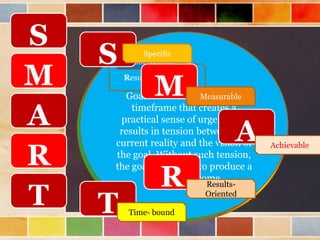
Goals should be simplistically
written and clearly define
what you are going to do.
Specific is the
What, Why, and How of the
S.M.A.R.T. model.
Goals should be measurable so that
you have tangible evidence that you
have accomplished the goal.
Usually, the entire goal statement is
a measure for the project, but there
are usually several short-term or
smaller measurements built into
the goal.
Goals should be achievable; they
should stretch you slightly so you feel
challenged, but defined well enough so
that you can achieve them. You must
possess the appropriate
knowledge, skills, and abilities needed
to achieve the goal.
You can meet most any goal when you
plan your steps wisely and establish a
timeframe that allows you to carry out
those steps.
Goals should
measure
outcomes, not
activities.
Goals should be linked to a
timeframe that creates a
practical sense of urgency, or
results in tension between the
current reality and the vision of
the goal. Without such tension,
the goal is unlikely to produce a
relevant outcome.
Specific:Measurable:Achievable:
Results -Oriented:
Time-bound:S
M
T
R
A
Specific
Measurable
Achievable
Results-
Oriented
Time- bound
Republic of the Philippines
MINDANAO STATE UNIVERSITY
COLLEGE OF EDUCATION
Fatima, General Santos City
MODULE 3: MANAGEMENT OF INSTRUCTION
Lesson 3: Definition and Differentiation between a Goal
and a Learning Objective
Presented to: Ava Clare Marie
O. Robles, Ph. D.
Class Schedule:
TFr /10:30- 12:00
Discussant: Ierine Joy L.
Caserial
At the end of the session, at least 75 % of the students shall be able to:
OBJECTIVES:
A
defines the end toward which effort is directed. It is a
statement of the program’s intent, purpose, or expected
outcomes.
Goal
Learning
Objectives
Objectives are written to describe outcomes, not what the
program will do. According to Teacher & Educational
Development, University of New Mexico School of Medicine
(2005), A learning objective is an outcome
statement that captures specifically what
knowledge, skills, attitudes learners should be able to exhibit
following instruction.
EXAMPLE:
A common misapplication of objectives is for the
teacher/presenter to state what he/she is going to
do (e.g., “My plan this morning is to talk
about…”), rather than what the student is
expected to be able to do (e.g., “After this
session, you should be able to…”).
A GOAL is a statement of the intended
general outcome of an instructional unit or
program. A goal statement describes a more
global learning outcome. A learning objective
is a statement of one of several specific
performances, the achievement of which
contributes to the attainment of the goal.
(Arreola, 1998).
What is the difference between a GOAL and a Learning
Objective?
GOALS
LEARNING
OBJECTIVES
Goals are
general.
Goals are
broad.
Goals are not as
tangible
It takes many
objectives to
measure a goal.
Objectives are
precise.
Objectives are
narrow.
Objectives are
tangible.
One objective
is measurable.
Sources:
Lesson 1: Definition, Differentiation, and Importance of
Instructional/ Lesson Plan
Arasian. “Instructional Planning And Assessment “. C H A P
T E R 3 pg 40. Retrieved on June 22, 2013 from
http://www.google.com.ph/url?sa=t&rct=j&q=&esrc=s&source=we
b&cd=2&ved=0CDIQFjAB&url=http%3A%2F%2Fhighered.mcgrawh
ill.com%2Fsites%2Fdl%
2Ffree%2F0070959668%2F405859%2FAirasian_88697_ch03.pdf&
ei=WnfFUc2 oE
vGwiQf6kICABw&usg=AFQjCNHUKhUYGpILVelDZsO3abhtqf8w7
w&sig2=4 ePn93-dg43NKNnMcdJRxw&bvm=bv.48293060,d.aGc
Fee, Lauren (2013). “Leveraging Technology to Differentiate
Instruction”. Retrieved on June 22, 2013 from
http://www.slideshare.net/itsco/leveraging-technology-to-
differentiate-instruction?from_search=1
Sources:
“Lesson Planning” . Retrieved on June 22, 2013 from
http://www.slideshare.net/tarakbr/lesson-plan-2468309
Linda Jensen. “Planning Lesson”. Retrieved on June 22, 2013 from
http://www.google.com.ph/url?sa=t&rct=j&q=&esrc=s&source=we
b&cd=1&sqi=2&ved=0CCoQFjAA&url=http%3A%2F%2Fwww.princ
eton.edu%2F~pia%2FTEFL.pdf&ei=k5bFUYO2N-
iBiQfW64GwDg&usg=AFQjCNGP2YJqL-wXP7odcAq-
nDR737FNHw&sig2=p-hj3eoWTJb3Idyys7SOEw
Mybookezz. “Differentiated Instruction”.Retrieved on June 22, 2013
fromhttp://www.mybookezz.org/ebook.php?u=aHR0cDovL2ZhY3V
sdHkuc2NmLmVkdS9zaGF
ycmljL2xlc3NvbjgvZGlmZmluc3Q4LnBkZgpbUERGXSBEaWZmZXJ
lbnRpYXRlZCBJbnN0cnVjdGlvbiBQUFQgLSBTY2Y
Suo, Yan (July 5, 2010). “How to Make Lesson Plan”. Retrieved on
June 22, 2013 from http://www.slideshare.net/yseauy/lesson-plan-
powerpoint-presentation?from_search=11
Sources:
•Zulueta, Francisco M. (2008). “Principles and Methods of Teaching.
National Bookstore, Philippines
Lesson 2: Criteria of Effective Instructional Objective (SMART):
Specific, measurable, Attainable, Result- Oriented and Time
Bound)
Barreto, Wanda (2002). “Setting SMART Goals and Objectives”
USC MAESTRIA CuMINICAcion, CMU639 Funciones Gerenciales.
Retrieved on June 22, 2013 from
http://www.google.com.ph/url?sa=t&rct=j&q=&esrc=s&source=web&
cd=1&ved=0CCwQFjAA&url=http%3A%2F%2Fwww.hr.virginia.edu%
2Fuploads%2Fdocuments%2Fmedia%2FWriting_SMART_Goals.pdf
&ei=y3_FUaCPO-
mZiQflrYGgCQ&usg=AFQjCNH7bhO24Li1p4OS5h6kJAzhQpS0WQ
&sig2=DeEx_R-lmyFfxR6lxdgjEQ&bvm=bv.48293060,d.aGc Lesson
3: Definition and Differentiation between a Goal and a Learning
Objective
Arreola, Ph.D.,Raoul A., et al. (1998)“Writing Learning
Objectives”. Retrieved on June 23, 2013 from
http://www.google.com.ph/url?sa=t&rct=j&q=&esrc=s&source=web&
Sources:
Calmorin, Laurentina (2010). Research and statistics. National
Bookstore, Inc. Manila, Philippines.
UHR, Employee Development. “Writing SMART Goals. Retrieved
on June 22, 2013 from
http://www.google.com.ph/url?sa=t&rct=j&q=&esrc=s&source=web&
cd=1&ved=0CCoQFjAA&url=http%3A%2F%2Fwww.hr.virginia.edu%
2Fuploads%2Fdocuments%2Fmedia%2FWriting_SMART_Goals.pdf
&ei=7pnFUc2FAqP-
iAePn4BI&usg=AFQjCNH7bhO24Li1p4OS5h6kJAzhQpS0WQ&sig2
=mKxubE8uOHIpPSxC0NaTwA
Sources:
Lesson 3: Definition and Differentiation between a Goal and a
Learning Objective
Arreola, Ph.D.,Raoul A., et al. (1998)“Writing Learning
Objectives”. Retrieved on June 23, 2013 from
http://www.google.com.ph/url?sa=t&rct=j&q=&esrc=s&source=we
b&cd=1&ved=0CDoQFjAA&url=http%3A%2F%2Fwww.uthsc.edu%2
Fgrad%2FCourseInfo%2FCurrManagement%2FLearning_Objective
s.pdf&ei=m4LFUa7hM6SkigelgoHoCw&usg=AFQjCNEofzE36nrgfZ
YtMO8N6JtXvwMXg&sig2=ZUHbDlRuDtoNfP2z2tRiMQ&bvm=bv.
48293060,d.aGc
“Goals and Objectives “. Retrieved on June 23, 2013 from
http://www.slideshare.net/rajansock/goalsobjectives-2091845
Sources:
Teacher & Educational Development (2005). “EFFECTIVE USE
OF PERFORMANCE OBJECTIVES FOR LEARNING AND
ASSESSMENT (For Use With Fink’s and Bloom’s
Taxonomies)”. University of New Mexico School of Medicine
Retrieved on June 23, 2013 from
http://www.google.com.ph/url?sa=t&rct=j&q=&esrc=s&source=we
b&cd=1&ved=0CCwQFjAA&url=http%3A%2F%2Fccoe.umdnj.edu%
2Fforms%2FEffectiveUseofLearningObjectives.pdf&ei=LYLFUY_sD
8myiQeyiYHgDw&usg=AFQjCNFgTZYBID3wxfudxl-
rmBPjSrVASw&sig2=P2pAUdSLNGglU0Jt8om8_w&bvm=bv.48293
060,d.aGc
Sources:
Wilde, Judith .PhD,”Goal Definition”. Albuquerque, NM
Retrieved on June 23, 2013 from
http://www.google.com.ph/url?sa=t&rct=j&q=&esrc=s&source=we
b&cd=2&ved=0CDQQFjAB&url=http%3A%2F%2Fwww.dpi.state.
nd.us%2Fbilingul%2Fnochild%2Fgoals.pdf&ei=y3_FUaCPO-
mZiQflrYGgCQ&usg=AFQjCNHiu4TWysKeCinW-
0VNKPojNbg1aA&sig2=j10p_793C_gG-
ukdtRc1jw&bvm=bv.48293060,d.aGc
Thank you for
listening.

lesson planning defintion Lesson 1- 3

  • 1.
    Republic of thePhilippines MINDANAO STATE UNIVERSITY COLLEGE OF EDUCATION Fatima, General Santos City MODULE 3: MANAGEMENT OF INSTRUCTION Lesson 1: Definition, Differentiation, and Importance of Instructional/ Lesson Plan Presented to: Ava Clare Marie O. Robles, Ph. D. Class Schedule: TFr /10:30- 12:00 Discussant: Ierine Joy L. Caserial
  • 2.
    OBJECTIVES: At the endof the session, at least 75 % of the students shall be able to:
  • 3.
    identifying specific expectations orlearning outcomes, selecting materials to foster these expectations or outcomes, and organizing learning experiences into a coherent, reinforcing sequence Lesson Planning
  • 4.
    A teacher’s detaileddescription of the course of instruction for an individual lesson. -- Wikipedia Dictionaries A lesson plan is a written guide for trainers plans in order to achieve the intended learning outcomes. It provides specific definition and direction on learning objectives, equipment, instructional media material requirements, and conduct of the training. -- Education Dictionaries
  • 5.
    Differentiated instruction is aset of unique decision that the educator makes to bring learning within the grasp of all students. Differentiated instruction “Differentiation means tailoring instruction to meet individual needs. Whether teachers differentiate content, process, products, or the learning environment, the use of ongoing assessment and flexible grouping makes this a successful approach to instruction.”
  • 6.
    IMPORTANCE OF LESSON PLANNING Beingclear on what you want to teach. •Give your teaching a framework, an overall shape. •A reminder for the teacher when they get distracted. It suggests a level of professionalism and real commitment. Being ready to cope with whatever happens
  • 7.
    How is lessonplanning important for the teacher and the learners? For the teacher • They don’t have to think on their feet. • They don’t lose face in front of their learners. • They are clear on the procedure to follow. • They build on previous teaching and prepare for coming lessons For the learner • They realize that the teacher cares for their learning. • They attend a structured lesson: easier to assimilate • They appreciate their teacher’s work as a model of well- organized work to imitate.
  • 8.
    Republic of thePhilippines MINDANAO STATE UNIVERSITY COLLEGE OF EDUCATION Fatima, General Santos City MODULE 3: MANAGEMENT OF INSTRUCTION Lesson 2: Criteria of Effective Instructional Objective (SMART: Specific, measurable, Attainable, Result- Oriented and Time Bound) Presented to: Ava Clare Marie O. Robles, Ph. D. Class Schedule: TFr /10:30- 12:00 Discussant: Ierine Joy L. Caserial
  • 9.
    At the endof the session, at least 75 % of the students shall be able to: OBJECTIVES:
  • 10.
    S M T R A Goals should besimplistically written and clearly define what you are going to do. Specific is the What, Why, and How of the S.M.A.R.T. model. Goals should be measurable so that you have tangible evidence that you have accomplished the goal. Usually, the entire goal statement is a measure for the project, but there are usually several short-term or smaller measurements built into the goal. Goals should be achievable; they should stretch you slightly so you feel challenged, but defined well enough so that you can achieve them. You must possess the appropriate knowledge, skills, and abilities needed to achieve the goal. You can meet most any goal when you plan your steps wisely and establish a timeframe that allows you to carry out those steps. Goals should measure outcomes, not activities. Goals should be linked to a timeframe that creates a practical sense of urgency, or results in tension between the current reality and the vision of the goal. Without such tension, the goal is unlikely to produce a relevant outcome. Specific:Measurable:Achievable: Results -Oriented: Time-bound:S M T R A Specific Measurable Achievable Results- Oriented Time- bound
  • 11.
    Republic of thePhilippines MINDANAO STATE UNIVERSITY COLLEGE OF EDUCATION Fatima, General Santos City MODULE 3: MANAGEMENT OF INSTRUCTION Lesson 3: Definition and Differentiation between a Goal and a Learning Objective Presented to: Ava Clare Marie O. Robles, Ph. D. Class Schedule: TFr /10:30- 12:00 Discussant: Ierine Joy L. Caserial
  • 12.
    At the endof the session, at least 75 % of the students shall be able to: OBJECTIVES:
  • 13.
    A defines the endtoward which effort is directed. It is a statement of the program’s intent, purpose, or expected outcomes. Goal Learning Objectives Objectives are written to describe outcomes, not what the program will do. According to Teacher & Educational Development, University of New Mexico School of Medicine (2005), A learning objective is an outcome statement that captures specifically what knowledge, skills, attitudes learners should be able to exhibit following instruction.
  • 14.
    EXAMPLE: A common misapplicationof objectives is for the teacher/presenter to state what he/she is going to do (e.g., “My plan this morning is to talk about…”), rather than what the student is expected to be able to do (e.g., “After this session, you should be able to…”).
  • 15.
    A GOAL isa statement of the intended general outcome of an instructional unit or program. A goal statement describes a more global learning outcome. A learning objective is a statement of one of several specific performances, the achievement of which contributes to the attainment of the goal. (Arreola, 1998). What is the difference between a GOAL and a Learning Objective?
  • 16.
    GOALS LEARNING OBJECTIVES Goals are general. Goals are broad. Goalsare not as tangible It takes many objectives to measure a goal. Objectives are precise. Objectives are narrow. Objectives are tangible. One objective is measurable.
  • 17.
    Sources: Lesson 1: Definition,Differentiation, and Importance of Instructional/ Lesson Plan Arasian. “Instructional Planning And Assessment “. C H A P T E R 3 pg 40. Retrieved on June 22, 2013 from http://www.google.com.ph/url?sa=t&rct=j&q=&esrc=s&source=we b&cd=2&ved=0CDIQFjAB&url=http%3A%2F%2Fhighered.mcgrawh ill.com%2Fsites%2Fdl% 2Ffree%2F0070959668%2F405859%2FAirasian_88697_ch03.pdf& ei=WnfFUc2 oE vGwiQf6kICABw&usg=AFQjCNHUKhUYGpILVelDZsO3abhtqf8w7 w&sig2=4 ePn93-dg43NKNnMcdJRxw&bvm=bv.48293060,d.aGc Fee, Lauren (2013). “Leveraging Technology to Differentiate Instruction”. Retrieved on June 22, 2013 from http://www.slideshare.net/itsco/leveraging-technology-to- differentiate-instruction?from_search=1
  • 18.
    Sources: “Lesson Planning” .Retrieved on June 22, 2013 from http://www.slideshare.net/tarakbr/lesson-plan-2468309 Linda Jensen. “Planning Lesson”. Retrieved on June 22, 2013 from http://www.google.com.ph/url?sa=t&rct=j&q=&esrc=s&source=we b&cd=1&sqi=2&ved=0CCoQFjAA&url=http%3A%2F%2Fwww.princ eton.edu%2F~pia%2FTEFL.pdf&ei=k5bFUYO2N- iBiQfW64GwDg&usg=AFQjCNGP2YJqL-wXP7odcAq- nDR737FNHw&sig2=p-hj3eoWTJb3Idyys7SOEw Mybookezz. “Differentiated Instruction”.Retrieved on June 22, 2013 fromhttp://www.mybookezz.org/ebook.php?u=aHR0cDovL2ZhY3V sdHkuc2NmLmVkdS9zaGF ycmljL2xlc3NvbjgvZGlmZmluc3Q4LnBkZgpbUERGXSBEaWZmZXJ lbnRpYXRlZCBJbnN0cnVjdGlvbiBQUFQgLSBTY2Y Suo, Yan (July 5, 2010). “How to Make Lesson Plan”. Retrieved on June 22, 2013 from http://www.slideshare.net/yseauy/lesson-plan- powerpoint-presentation?from_search=11
  • 19.
    Sources: •Zulueta, Francisco M.(2008). “Principles and Methods of Teaching. National Bookstore, Philippines Lesson 2: Criteria of Effective Instructional Objective (SMART): Specific, measurable, Attainable, Result- Oriented and Time Bound) Barreto, Wanda (2002). “Setting SMART Goals and Objectives” USC MAESTRIA CuMINICAcion, CMU639 Funciones Gerenciales. Retrieved on June 22, 2013 from http://www.google.com.ph/url?sa=t&rct=j&q=&esrc=s&source=web& cd=1&ved=0CCwQFjAA&url=http%3A%2F%2Fwww.hr.virginia.edu% 2Fuploads%2Fdocuments%2Fmedia%2FWriting_SMART_Goals.pdf &ei=y3_FUaCPO- mZiQflrYGgCQ&usg=AFQjCNH7bhO24Li1p4OS5h6kJAzhQpS0WQ &sig2=DeEx_R-lmyFfxR6lxdgjEQ&bvm=bv.48293060,d.aGc Lesson 3: Definition and Differentiation between a Goal and a Learning Objective Arreola, Ph.D.,Raoul A., et al. (1998)“Writing Learning Objectives”. Retrieved on June 23, 2013 from http://www.google.com.ph/url?sa=t&rct=j&q=&esrc=s&source=web&
  • 20.
    Sources: Calmorin, Laurentina (2010).Research and statistics. National Bookstore, Inc. Manila, Philippines. UHR, Employee Development. “Writing SMART Goals. Retrieved on June 22, 2013 from http://www.google.com.ph/url?sa=t&rct=j&q=&esrc=s&source=web& cd=1&ved=0CCoQFjAA&url=http%3A%2F%2Fwww.hr.virginia.edu% 2Fuploads%2Fdocuments%2Fmedia%2FWriting_SMART_Goals.pdf &ei=7pnFUc2FAqP- iAePn4BI&usg=AFQjCNH7bhO24Li1p4OS5h6kJAzhQpS0WQ&sig2 =mKxubE8uOHIpPSxC0NaTwA
  • 21.
    Sources: Lesson 3: Definitionand Differentiation between a Goal and a Learning Objective Arreola, Ph.D.,Raoul A., et al. (1998)“Writing Learning Objectives”. Retrieved on June 23, 2013 from http://www.google.com.ph/url?sa=t&rct=j&q=&esrc=s&source=we b&cd=1&ved=0CDoQFjAA&url=http%3A%2F%2Fwww.uthsc.edu%2 Fgrad%2FCourseInfo%2FCurrManagement%2FLearning_Objective s.pdf&ei=m4LFUa7hM6SkigelgoHoCw&usg=AFQjCNEofzE36nrgfZ YtMO8N6JtXvwMXg&sig2=ZUHbDlRuDtoNfP2z2tRiMQ&bvm=bv. 48293060,d.aGc “Goals and Objectives “. Retrieved on June 23, 2013 from http://www.slideshare.net/rajansock/goalsobjectives-2091845
  • 22.
    Sources: Teacher & EducationalDevelopment (2005). “EFFECTIVE USE OF PERFORMANCE OBJECTIVES FOR LEARNING AND ASSESSMENT (For Use With Fink’s and Bloom’s Taxonomies)”. University of New Mexico School of Medicine Retrieved on June 23, 2013 from http://www.google.com.ph/url?sa=t&rct=j&q=&esrc=s&source=we b&cd=1&ved=0CCwQFjAA&url=http%3A%2F%2Fccoe.umdnj.edu% 2Fforms%2FEffectiveUseofLearningObjectives.pdf&ei=LYLFUY_sD 8myiQeyiYHgDw&usg=AFQjCNFgTZYBID3wxfudxl- rmBPjSrVASw&sig2=P2pAUdSLNGglU0Jt8om8_w&bvm=bv.48293 060,d.aGc
  • 23.
    Sources: Wilde, Judith .PhD,”GoalDefinition”. Albuquerque, NM Retrieved on June 23, 2013 from http://www.google.com.ph/url?sa=t&rct=j&q=&esrc=s&source=we b&cd=2&ved=0CDQQFjAB&url=http%3A%2F%2Fwww.dpi.state. nd.us%2Fbilingul%2Fnochild%2Fgoals.pdf&ei=y3_FUaCPO- mZiQflrYGgCQ&usg=AFQjCNHiu4TWysKeCinW- 0VNKPojNbg1aA&sig2=j10p_793C_gG- ukdtRc1jw&bvm=bv.48293060,d.aGc
  • 24.