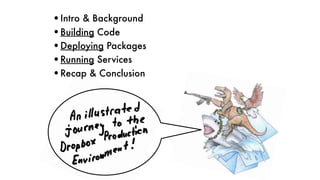




Building,
deploying and
running
production code
at Dropbox
Leonid Vasilyev, SRE at Dropbox. United Dev Conf ’17
•Intro & Background
•Building Code
•Deploying Packages
•Running Services
•Recap & Conclusion
Intro &
Background
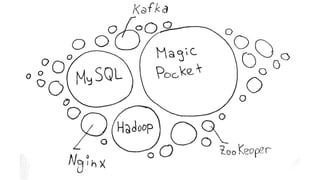
Dropbox Backend Infrastructure:
Something one might call a “Hybrid Cloud”.
Few datacenters + AWS VPCs + Edge Network (POPs).
Running Ubuntu Server, Puppet/Chef and Nagios.
Rest of the stack is pretty custom.
Dropbox today is not just “file storage”,
but dozens of services,
running on tens of thousands of machines.
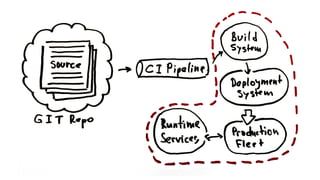
I. Building Code
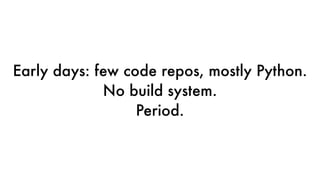
Early days: few code repos, mostly Python.
No build system.
Period.
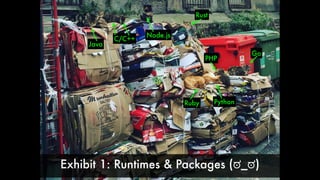
Why Bother?
Ruby Python
Java
C/C++
Node.js
Rust
Go
PHP
Exhibit 1: Runtimes & Packages (ಠ_ಠ)
Problems:
Repo is growing, new languages are in use:
Golang, Node.js, Rust.
No way to track dependencies,
dependencies installed in runtime via Puppet.
Global Encap repo deployed via rsync onto the whole fleet.
In search of a better build system
What are the requirements?
• Fast
• Reproducible
• Hermetic
• Flexible
• Explicit dependencies
A Historical Perspective*
•(2006) Google got annoyed with Make and began “Blaze”
•(2012) Looks like ex-googlers at Twitter were missing “Blaze”, hence
began “Pants”
•(2013) Looks like ex-googlers at Facebook were missing “Blaze”,
hence began “Buck”
•(2014) Google realised what’s going on and released “Blaze” as
“Bazel”
•(2016) Ex-googlers at Thought Machine are still missing “Blaze”,
hence began “Please”, in Go this time :)
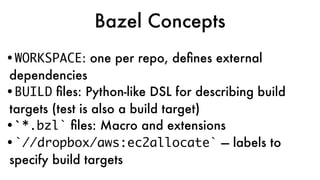
Bazel Concepts
•WORKSPACE: one per repo, defines external
dependencies
•BUILD files: Python-like DSL for describing build
targets (test is also a build target)
•`*.bzl` files: Macro and extensions
•`//dropbox/aws:ec2allocate` — labels to
specify build targets
native.new_http_archive(
name = "six_archive",
urls = [
“http://pypi.python.org/.../six-1.10.0.tar.gz”,
],
sha256 = “…”,
strip_prefix = "six-1.10.0",
build_file = str(Label("//third_party:six.BUILD")),
)
External Dependencies(1)
py_library(
name = "six",
srcs = ["six.py"],
visibility = ["//visibility:public"],
)
External Dependencies(2)
py_library(
name = "platform_benchmark",
srcs = ["platform/benchmark.py"],
deps = [
":client",
":platform",
"@six_archive//:six",
],
)
External Dependencies(3)
Bazel adoption at Dropbox
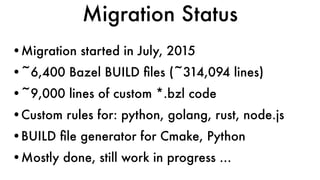
•Migration started in July, 2015
•~6,400 Bazel BUILD files (~314,094 lines)
•~9,000 lines of custom *.bzl code
•Custom rules for: python, golang, rust, node.js
•BUILD file generator for Cmake, Python
•Mostly done, still work in progress …
Migration Status
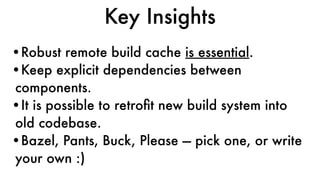
Key Insights
•Robust remote build cache is essential.
•Keep explicit dependencies between
components.
•It is possible to retrofit new build system into
old codebase.
•Bazel, Pants, Buck, Please — pick one, or write
your own :)
II. Deploying Packages
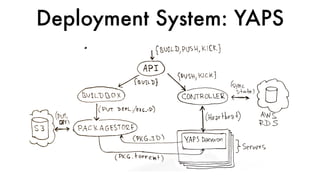
Deployment System: YAPS
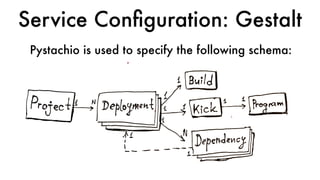
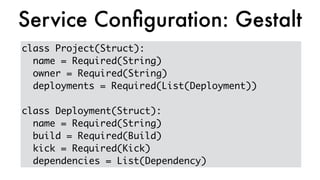
Service Configuration: Gestalt
Pystachio is used to specify the following schema:
class Project(Struct):
name = Required(String)
owner = Required(String)
deployments = Required(List(Deployment))
class Deployment(Struct):
name = Required(String)
build = Required(Build)
kick = Required(Kick)
dependencies = List(Dependency)
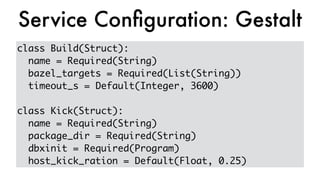
Service Configuration: Gestalt
class Build(Struct):
name = Required(String)
bazel_targets = Required(List(String))
timeout_s = Default(Integer, 3600)
class Kick(Struct):
name = Required(String)
package_dir = Required(String)
dbxinit = Required(Program)
host_kick_ration = Default(Float, 0.25)
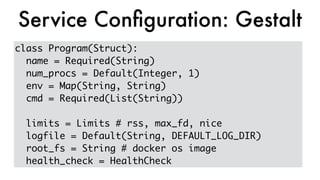
Service Configuration: Gestalt
class Program(Struct):
name = Required(String)
num_procs = Default(Integer, 1)
env = Map(String, String)
cmd = Required(List(String))
limits = Limits # rss, max_fd, nice
logfile = Default(String, DEFAULT_LOG_DIR)
root_fs = String # docker os image
health_check = HealthCheck
Service Configuration: Gestalt
•About 500 files and 60,000 SLOC
•Complex evaluation rules
•Configuration tends to become a Turing-complete
language
•Advanced linters and validation needed
•Specifying resource limits is tricky
Gestalt: Challenges
YAPS Packages
YAPS Packages: Historical
approach
•Install Debian packages via Puppet/Chef
•Use Python’s Virtualenv & PyPI
•Encap — “Bag of rats” dependencies :)
•Blast the whole repo via rsync every few minutes
by CRON
YAPS Packages: Current approach
•SquashFS images. Native Linux in-kernel support
•Transparent compression and de-duplication
•Read-only mounts, +1 from security
•Loopback device mounts are fast
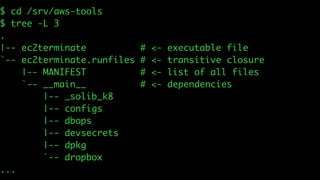
•SquashFS image has 1+ Bazel targets and
transitive dependency closure for each target
$ cd /srv/aws-tools
$ tree -L 3
.
|-- ec2terminate # <- executable file
`-- ec2terminate.runfiles # <- transitive closure
|-- MANIFEST # <- list of all files
`-- __main__ # <- dependencies
|-- _solib_k8
|-- configs
|-- dbops
|-- devsecrets
|-- dpkg
`-- dropbox
...
YAPS Packages: Challenges
•*.pyc files have to be in the package
•Unmountable packages due to open file descriptors
•If code has to be modified on the prod server
(YOLO), special procedure — “Hijacking” is
required
•Full package has be pushed even with a 1 line
change (Xdelta compression might help)
III. Running Services
Process Manager: Historical
approach
•Using Supervisord and configuration generated by
Puppet
•Update of Supervisord requires tasks to be restarted
•Loosing tasks if Supervisord killed by OOM
•Supervisord is really old, from 2004 (has
XMLRPC?!)
Process Manager: Current
approach
•Using Dbxinit: in-house project written in Go
•Keeps local state, thus can be updated without tasks
downtime, can survive OOM
•Supports health-checks for tasks
•Has resource limits: RSS, max fds, OOM score
•Speaks JSON HTTP
Configuration Management:
Historical approach
•Puppet 2.x in server mode
•Perf problems with server as fleet grew in size
•No linters or unit tests, caused a lot of errors
•“Blast to the fleet” deployment model
•Single global run via CRON, runs all modules - slow
Configuration Management:
Current approach
•Chef 12.x in Zero mode
•Invested heavily into linters and unit-testing
•Easy to test on a single production machine
•Has 3 runs: “platform”, “global” and “service”
•Cookbooks deployed via YAPS
•Generally trying to move service owners out of CM
It wouldn’t be 2017 if not … containers!
Containers: Runc for stateless
services
•Runc is integrated with Dbxinit, each task runs inside
its own container
•Runc uses minimal Ubuntu Docker image
•Main use case is dependency isolation via mount
namespaces
•Doesn’t use network namespaces yet
Containers: Challenges
•Log rotation. Logs should be moved from the box
ASAP, since machine with stateless service can be
shut down without notice
•Looking into ELK stack to solve that problem
•Resource accounting. Currently doesn’t enforce any
resource limits
VS
Human Automation
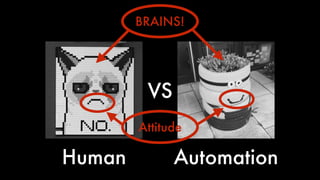
VS
Human Automation
BRAINS!
Attitude
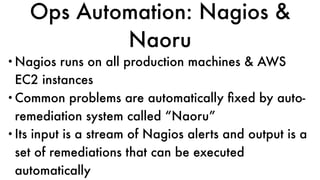
Ops Automation: Nagios &
Naoru
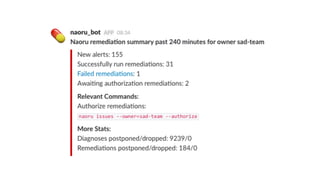
•Nagios runs on all production machines & AWS
EC2 instances
•Common problems are automatically fixed by auto-
remediation system called “Naoru”
•Its input is a stream of Nagios alerts and output is a
set of remediations that can be executed
automatically
Talk Summary
Building:
•Unified build system with clean dependencies
Deploying:
•One deployment system and sound packaging
Running:
•Robust process management and automation of
simple tasks
Thank You!
{twttr: @leo_vsl}

Leonid Vasilyev "Building, deploying and running production code at Dropbox"

  • 2.
    Building, deploying and running production code atDropbox Leonid Vasilyev, SRE at Dropbox. United Dev Conf ’17
  • 3.
    •Intro & Background •BuildingCode •Deploying Packages •Running Services •Recap & Conclusion
  • 4.
  • 6.
    Dropbox Backend Infrastructure: Somethingone might call a “Hybrid Cloud”. Few datacenters + AWS VPCs + Edge Network (POPs). Running Ubuntu Server, Puppet/Chef and Nagios. Rest of the stack is pretty custom. Dropbox today is not just “file storage”, but dozens of services, running on tens of thousands of machines.
  • 8.
  • 9.
    Early days: fewcode repos, mostly Python. No build system. Period.
  • 10.
  • 11.
  • 12.
    Problems: Repo is growing,new languages are in use: Golang, Node.js, Rust. No way to track dependencies, dependencies installed in runtime via Puppet. Global Encap repo deployed via rsync onto the whole fleet.
  • 13.
    In search ofa better build system What are the requirements? • Fast • Reproducible • Hermetic • Flexible • Explicit dependencies
  • 15.
    A Historical Perspective* •(2006)Google got annoyed with Make and began “Blaze” •(2012) Looks like ex-googlers at Twitter were missing “Blaze”, hence began “Pants” •(2013) Looks like ex-googlers at Facebook were missing “Blaze”, hence began “Buck” •(2014) Google realised what’s going on and released “Blaze” as “Bazel” •(2016) Ex-googlers at Thought Machine are still missing “Blaze”, hence began “Please”, in Go this time :)
  • 16.
    Bazel Concepts •WORKSPACE: oneper repo, defines external dependencies •BUILD files: Python-like DSL for describing build targets (test is also a build target) •`*.bzl` files: Macro and extensions •`//dropbox/aws:ec2allocate` — labels to specify build targets
  • 17.
    native.new_http_archive( name = "six_archive", urls= [ “http://pypi.python.org/.../six-1.10.0.tar.gz”, ], sha256 = “…”, strip_prefix = "six-1.10.0", build_file = str(Label("//third_party:six.BUILD")), ) External Dependencies(1)
  • 18.
    py_library( name = "six", srcs= ["six.py"], visibility = ["//visibility:public"], ) External Dependencies(2)
  • 19.
    py_library( name = "platform_benchmark", srcs= ["platform/benchmark.py"], deps = [ ":client", ":platform", "@six_archive//:six", ], ) External Dependencies(3)
  • 20.
  • 21.
    •Migration started inJuly, 2015 •~6,400 Bazel BUILD files (~314,094 lines) •~9,000 lines of custom *.bzl code •Custom rules for: python, golang, rust, node.js •BUILD file generator for Cmake, Python •Mostly done, still work in progress … Migration Status
  • 22.
    Key Insights •Robust remotebuild cache is essential. •Keep explicit dependencies between components. •It is possible to retrofit new build system into old codebase. •Bazel, Pants, Buck, Please — pick one, or write your own :)
  • 23.
  • 24.
  • 25.
    Service Configuration: Gestalt Pystachiois used to specify the following schema:
  • 26.
    class Project(Struct): name =Required(String) owner = Required(String) deployments = Required(List(Deployment)) class Deployment(Struct): name = Required(String) build = Required(Build) kick = Required(Kick) dependencies = List(Dependency) Service Configuration: Gestalt
  • 27.
    class Build(Struct): name =Required(String) bazel_targets = Required(List(String)) timeout_s = Default(Integer, 3600) class Kick(Struct): name = Required(String) package_dir = Required(String) dbxinit = Required(Program) host_kick_ration = Default(Float, 0.25) Service Configuration: Gestalt
  • 28.
    class Program(Struct): name =Required(String) num_procs = Default(Integer, 1) env = Map(String, String) cmd = Required(List(String)) limits = Limits # rss, max_fd, nice logfile = Default(String, DEFAULT_LOG_DIR) root_fs = String # docker os image health_check = HealthCheck Service Configuration: Gestalt
  • 29.
    •About 500 filesand 60,000 SLOC •Complex evaluation rules •Configuration tends to become a Turing-complete language •Advanced linters and validation needed •Specifying resource limits is tricky Gestalt: Challenges
  • 30.
  • 31.
    YAPS Packages: Historical approach •InstallDebian packages via Puppet/Chef •Use Python’s Virtualenv & PyPI •Encap — “Bag of rats” dependencies :) •Blast the whole repo via rsync every few minutes by CRON
  • 32.
    YAPS Packages: Currentapproach •SquashFS images. Native Linux in-kernel support •Transparent compression and de-duplication •Read-only mounts, +1 from security •Loopback device mounts are fast •SquashFS image has 1+ Bazel targets and transitive dependency closure for each target
  • 33.
    $ cd /srv/aws-tools $tree -L 3 . |-- ec2terminate # <- executable file `-- ec2terminate.runfiles # <- transitive closure |-- MANIFEST # <- list of all files `-- __main__ # <- dependencies |-- _solib_k8 |-- configs |-- dbops |-- devsecrets |-- dpkg `-- dropbox ...
  • 34.
    YAPS Packages: Challenges •*.pycfiles have to be in the package •Unmountable packages due to open file descriptors •If code has to be modified on the prod server (YOLO), special procedure — “Hijacking” is required •Full package has be pushed even with a 1 line change (Xdelta compression might help)
  • 35.
  • 36.
    Process Manager: Historical approach •UsingSupervisord and configuration generated by Puppet •Update of Supervisord requires tasks to be restarted •Loosing tasks if Supervisord killed by OOM •Supervisord is really old, from 2004 (has XMLRPC?!)
  • 37.
    Process Manager: Current approach •UsingDbxinit: in-house project written in Go •Keeps local state, thus can be updated without tasks downtime, can survive OOM •Supports health-checks for tasks •Has resource limits: RSS, max fds, OOM score •Speaks JSON HTTP
  • 38.
    Configuration Management: Historical approach •Puppet2.x in server mode •Perf problems with server as fleet grew in size •No linters or unit tests, caused a lot of errors •“Blast to the fleet” deployment model •Single global run via CRON, runs all modules - slow
  • 39.
    Configuration Management: Current approach •Chef12.x in Zero mode •Invested heavily into linters and unit-testing •Easy to test on a single production machine •Has 3 runs: “platform”, “global” and “service” •Cookbooks deployed via YAPS •Generally trying to move service owners out of CM
  • 40.
    It wouldn’t be2017 if not … containers!
  • 41.
    Containers: Runc forstateless services •Runc is integrated with Dbxinit, each task runs inside its own container •Runc uses minimal Ubuntu Docker image •Main use case is dependency isolation via mount namespaces •Doesn’t use network namespaces yet
  • 42.
    Containers: Challenges •Log rotation.Logs should be moved from the box ASAP, since machine with stateless service can be shut down without notice •Looking into ELK stack to solve that problem •Resource accounting. Currently doesn’t enforce any resource limits
  • 43.
  • 44.
  • 45.
    Ops Automation: Nagios& Naoru •Nagios runs on all production machines & AWS EC2 instances •Common problems are automatically fixed by auto- remediation system called “Naoru” •Its input is a stream of Nagios alerts and output is a set of remediations that can be executed automatically
  • 47.
    Talk Summary Building: •Unified buildsystem with clean dependencies Deploying: •One deployment system and sound packaging Running: •Robust process management and automation of simple tasks
  • 48.