




Evan Krall
2015-06-12
InfoQ.com: News & Community Site
• 750,000 unique visitors/month
• Published in 4 languages (English, Chinese, Japanese and Brazilian
Portuguese)
• Post content from our QCon conferences
• News 15-20 / week
• Articles 3-4 / week
• Presentations (videos) 12-15 / week
• Interviews 2-3 / week
• Books 1 / month
Watch the video with slide
synchronization on InfoQ.com!
http://www.infoq.com/presentations
/paasta-yelp
Presented at QCon New York
www.qconnewyork.com
Purpose of QCon
- to empower software development by facilitating the spread of
knowledge and innovation
Strategy
- practitioner-driven conference designed for YOU: influencers of
change and innovation in your teams
- speakers and topics driving the evolution and innovation
- connecting and catalyzing the influencers and innovators
Highlights
- attended by more than 12,000 delegates since 2007
- held in 9 cities worldwide
Evan Krall
SRE = development + sysadmin
4+ years at Yelp
Who is this person?
Paasta
Application Delivery at Yelp
Why?
History
Yelp started out as monolithic python app
Builds/pushes take a long time
Messing up is painful
So we build process to avoid messing up
Process makes pushes even slower
Service Oriented Architecture
Pull features out of monolith
Split into different applications
Smaller services -> faster pushes
fewer issues per push
total # of issues increases,
but we can fix issues faster.
Smaller parts -> easier to reason about
Bonus: can scale parts independently
SOA comes with challenges
Lots of services means lots of dependencies
Now your code is a ~distributed system~
If you thought running 1 app was hard, try 100
Standalone application
Stateless
Separate git repo
Usually, at Yelp:
HTTP API
Python, Pyramid, uWSGI
virtualenv
What is a service?
services responsible for providing init script
often not idempotent
central list of which hosts run which services
pull-model file transfers
reasonably reliable
push-model control (for host in hosts: ssh host ...)
What if hosts are down?
What if transfer hasn't completed yet?
Yelp SOA before Paasta
What is
Paasta?
What is Paasta?
Builds services
Deploys services
Interconnects services
Monitors services
Internal PaaS
What is Paasta?
Deploying
services should
be better!
Continuous
integration is
awesome!
Servers are not
snowflakes!
Declarative
control++
Monitor your
services!
Design
goals
Make ops happy
Fault tolerance
no single points of failure
recover from failures
Efficient use of resources
Simplify adding/removing resources
Make devs happy
We need adoption, but can't impose on devs
Must be possible to seamlessly port services
Must work in both datacenter and AWS
Must be compelling to developers
Features
Documentation
Flexibility
Make ourselves happy
Pick good abstractions
Avoid hacks
Write good tests
Don't reinvent the wheel: use open-source tools
Enforce opinions when necessary for scale
(paasta devs)
How
What runs in
production?
(or stage, or dev, or ...)
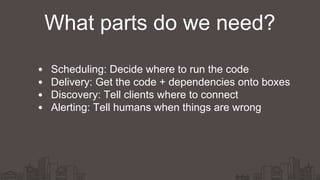
Scheduling: Decide where to run the code
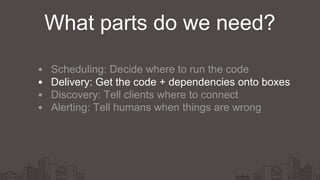
Delivery: Get the code + dependencies onto boxes
Discovery: Tell clients where to connect
Alerting: Tell humans when things are wrong
What parts do we need?
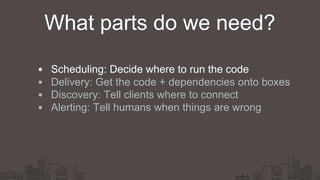
Scheduling: Decide where to run the code
Delivery: Get the code + dependencies onto boxes
Discovery: Tell clients where to connect
Alerting: Tell humans when things are wrong
What parts do we need?
Static: humans decide
puppet/chef: role X gets service Y
static mappings: boxes [A,B,C,...] get service Y
simple, reliable
slow to react to failure, resource changes
Scheduling:
Decide where to run the code
Dynamic: computers decide
Mesos, Kubernetes, Fleet, Swarm
IaaS: dedicated VMs for service, let Amazon
figure it out.
Automates around failure, resource changes
Makes discovery/delivery/monitoring harder
Scheduling:
Decide where to run the code
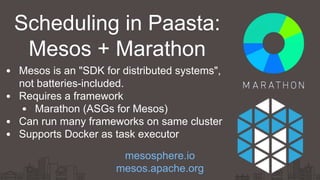
Scheduling in Paasta:
Mesos + Marathon
Mesos is an "SDK for distributed systems",
not batteries-included.
Requires a framework
Marathon (ASGs for Mesos)
Can run many frameworks on same cluster
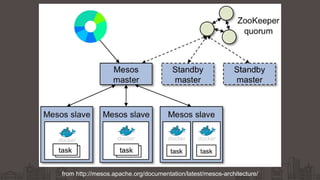
Supports Docker as task executor
mesosphere.io
mesos.apache.org
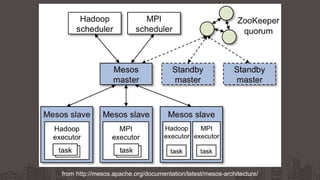
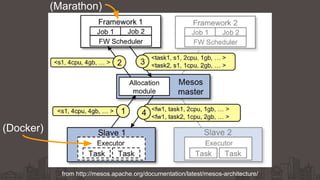
from http://mesos.apache.org/documentation/latest/mesos-architecture/
(Marathon)
(Docker)
Scheduling: Decide where to run the code
Delivery: Get the code + dependencies onto boxes
Discovery: Tell clients where to connect
Alerting: Tell humans when things are wrong
What parts do we need?
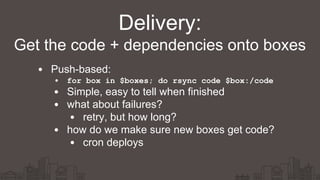
Push-based:
• for box in $boxes; do rsync code $box:/code
Simple, easy to tell when finished
what about failures?
retry, but how long?
how do we make sure new boxes get code?
cron deploys
Delivery:
Get the code + dependencies onto boxes
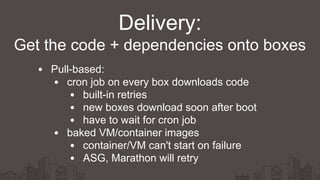
Delivery:
Pull-based:
cron job on every box downloads code
built-in retries
new boxes download soon after boot
have to wait for cron job
baked VM/container images
container/VM can't start on failure
ASG, Marathon will retry
Get the code + dependencies onto boxes
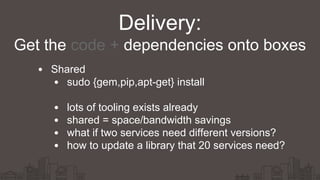
Shared
sudo {gem,pip,apt-get} install
lots of tooling exists already
shared = space/bandwidth savings
what if two services need different versions?
how to update a library that 20 services need?
Delivery:
Get the code + dependencies onto boxes
Isolated
virtualenv / rbenv / VM-per-service / Docker
more freedom for dev
services don't step on each others' toes
more disk/bandwidth
harder to audit for vulnerabilities
Delivery:
Get the code + dependencies onto boxes
Delivery in Paasta:
Docker
Containers: like lightweight VMs
Provides a language (Dockerfile)
for describing container image
Reproducible builds (mostly)
Provides software flexibility
docker.com
Scheduling: Decide where to run the code
Delivery: Get the code + dependencies onto boxes
Discovery: Tell clients where to connect
Alerting: Tell humans when things are wrong
What parts do we need?
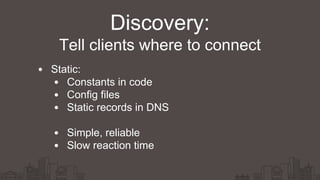
Static:
Constants in code
Config files
Static records in DNS
Simple, reliable
Slow reaction time
Discovery:
Tell clients where to connect
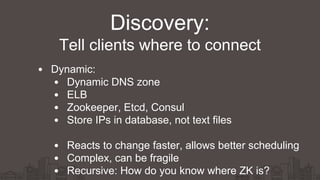
Dynamic:
Dynamic DNS zone
ELB
Zookeeper, Etcd, Consul
Store IPs in database, not text files
Reacts to change faster, allows better scheduling
Complex, can be fragile
Recursive: How do you know where ZK is?
Discovery:
Tell clients where to connect
in-process
DNS
Everyone supports DNS
TTLs are rarely respected, limit update rate
Lookups add critical-path latency
Talking to ZK, Etcd, Consul in service
Tricky. Risk of worker lockup if ZK hangs
Delegate to library
Few external dependencies
Discovery:
Tell clients where to connect
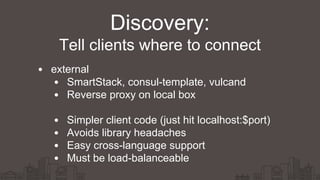
external
SmartStack, consul-template, vulcand
Reverse proxy on local box
Simpler client code (just hit localhost:$port)
Avoids library headaches
Easy cross-language support
Must be load-balanceable
Discovery:
Tell clients where to connect
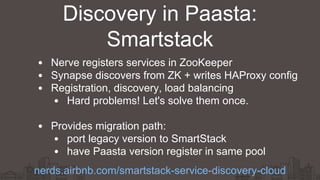
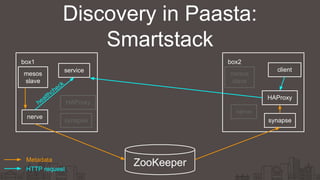
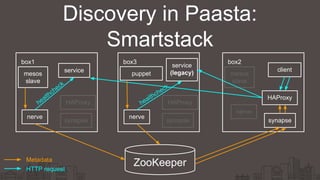
Nerve registers services in ZooKeeper
Synapse discovers from ZK + writes HAProxy config
Registration, discovery, load balancing
Hard problems! Let's solve them once.
Provides migration path:
port legacy version to SmartStack
have Paasta version register in same pool
Discovery in Paasta:
Smartstack
nerds.airbnb.com/smartstack-service-discovery-cloud
mesos
slave
box2
client
nerve
HAProxy
synapse
box1
service
nerve
mesos
slave
synapse
HAProxy
Discovery in Paasta:
Smartstack
ZooKeeperMetadata
HTTP request
healthcheck
why bother with registration?
why not ask your scheduler?
Scheduler portability!
box3
service
(legacy)
nerve
puppet
synapse
HAProxy
mesos
slave
box2
client
nerve
HAProxy
synapse
box1
service
nerve
mesos
slave
synapse
HAProxy
Discovery in Paasta:
Smartstack
ZooKeeperMetadata
HTTP request
healthcheck
healthcheck
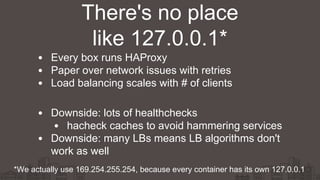
Every box runs HAProxy
Paper over network issues with retries
Load balancing scales with # of clients
Downside: lots of healthchecks
hacheck caches to avoid hammering services
Downside: many LBs means LB algorithms don't
work as well
There's no place
like 127.0.0.1*
*We actually use 169.254.255.254, because every container has its own 127.0.0.1
Scheduling: Decide where to run the code
Delivery: Get the code + dependencies onto boxes
Discovery: Tell clients where to connect
Alerting: Tell humans when things are wrong
What parts do we need?
Alerting:
Static
E.g. nagios, icinga
File-based configuration
Simple, familiar
Often not highly available
Hard to dynamically generate checks/alerts
Tell humans when things are wrong
Dynamic
e.g. Sensu, Consul
Allows you to add hosts & checks on the fly
Flexible
Generally newer, less battle-tested
Newer software is often built for high availability
Alerting:
Tell humans when things are wrong
Based around event bus
Replication monitoring
how many instances are up
in HAProxy?
Marathon app monitoring
is service failing to start?
Cron jobs on master boxes do checks, emit results.
Alerting in Paasta:
Sensu
sensuapp.org
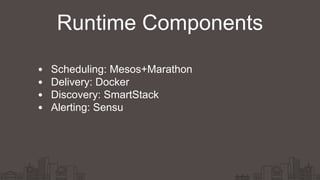
Runtime Components
Scheduling: Mesos+Marathon
Delivery: Docker
Discovery: SmartStack
Alerting: Sensu
How do we
control this thing?
Primary control plane
Convenient access controls (via gitolite, etc)
deploys, stop/start/restart indicated by tags
less-frequently changed metadata stored in a repo
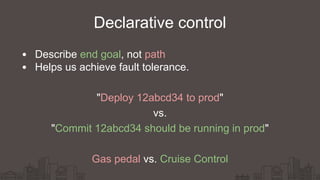
Declarative control
Describe end goal, not path
Helps us achieve fault tolerance.
"Deploy 12abcd34 to prod"
vs.
"Commit 12abcd34 should be running in prod"
Gas pedal vs. Cruise Control
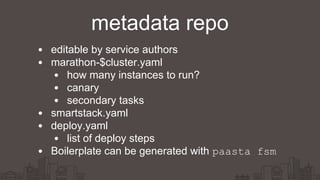
editable by service authors
marathon-$cluster.yaml
how many instances to run?
canary
secondary tasks
smartstack.yaml
deploy.yaml
list of deploy steps
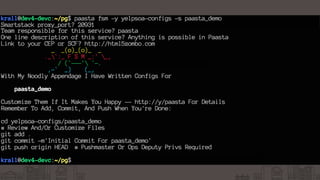
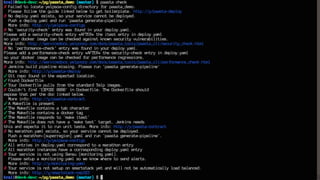
Boilerplate can be generated with paasta fsm
metadata repo
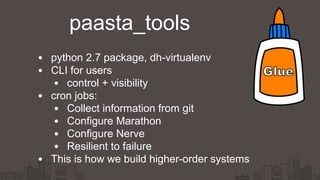
python 2.7 package, dh-virtualenv
CLI for users
control + visibility
cron jobs:
Collect information from git
Configure Marathon
Configure Nerve
Resilient to failure
This is how we build higher-order systems
paasta_tools
Bounce strategies
up-then-down:
wait for new version to start; kill old
down-then-up
wait for old version to die; start new
crossover
as instances of new version start, kill old
instances
Builds Docker images
Pushes to Docker registry
Marks image for deployment
GUI configuration is a Bad Idea,
so we automate it (deploy.yaml)
Most build steps call paasta command
Jenkins
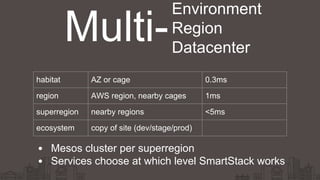
Multi-
Environment
Region
Datacenter
habitat AZ or cage 0.3ms
region AWS region, nearby cages 1ms
superregion nearby regions <5ms
ecosystem copy of site (dev/stage/prod)
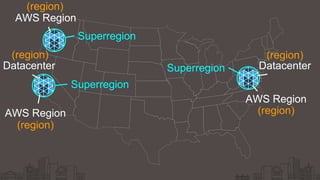
Mesos cluster per superregion
Services choose at which level SmartStack works
Superregion
Superregion
Superregion
Datacenter Datacenter
AWS Region
AWS Region
AWS Region
(region)
(region)
(region)
(region)
(region)
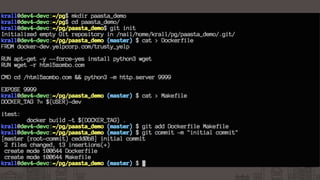
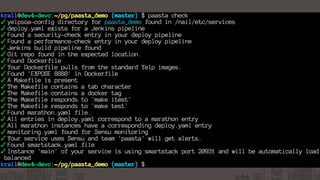
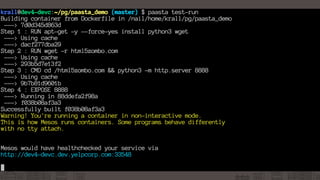
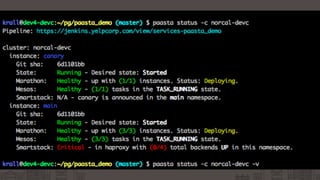
Walkthrough
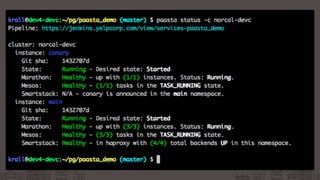
Let's deploy a service
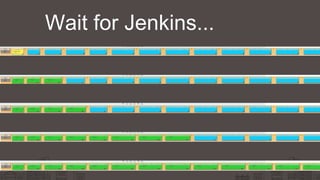
Wait for Jenkins...
Questions?
Watch the video with slide synchronization on
InfoQ.com!
http://www.infoq.com/presentations/paasta-
yelp

Paasta: Application Delivery at Yelp

  • 1.
  • 2.
    InfoQ.com: News &Community Site • 750,000 unique visitors/month • Published in 4 languages (English, Chinese, Japanese and Brazilian Portuguese) • Post content from our QCon conferences • News 15-20 / week • Articles 3-4 / week • Presentations (videos) 12-15 / week • Interviews 2-3 / week • Books 1 / month Watch the video with slide synchronization on InfoQ.com! http://www.infoq.com/presentations /paasta-yelp
  • 3.
    Presented at QConNew York www.qconnewyork.com Purpose of QCon - to empower software development by facilitating the spread of knowledge and innovation Strategy - practitioner-driven conference designed for YOU: influencers of change and innovation in your teams - speakers and topics driving the evolution and innovation - connecting and catalyzing the influencers and innovators Highlights - attended by more than 12,000 delegates since 2007 - held in 9 cities worldwide
  • 4.
    Evan Krall SRE =development + sysadmin 4+ years at Yelp Who is this person?
  • 6.
  • 7.
  • 8.
    History Yelp started outas monolithic python app Builds/pushes take a long time Messing up is painful So we build process to avoid messing up Process makes pushes even slower
  • 9.
    Service Oriented Architecture Pullfeatures out of monolith Split into different applications Smaller services -> faster pushes fewer issues per push total # of issues increases, but we can fix issues faster. Smaller parts -> easier to reason about Bonus: can scale parts independently
  • 10.
    SOA comes withchallenges Lots of services means lots of dependencies Now your code is a ~distributed system~ If you thought running 1 app was hard, try 100
  • 11.
    Standalone application Stateless Separate gitrepo Usually, at Yelp: HTTP API Python, Pyramid, uWSGI virtualenv What is a service?
  • 12.
    services responsible forproviding init script often not idempotent central list of which hosts run which services pull-model file transfers reasonably reliable push-model control (for host in hosts: ssh host ...) What if hosts are down? What if transfer hasn't completed yet? Yelp SOA before Paasta
  • 13.
  • 14.
    What is Paasta? Buildsservices Deploys services Interconnects services Monitors services Internal PaaS
  • 15.
    What is Paasta? Deploying servicesshould be better! Continuous integration is awesome! Servers are not snowflakes! Declarative control++ Monitor your services!
  • 16.
  • 17.
    Make ops happy Faulttolerance no single points of failure recover from failures Efficient use of resources Simplify adding/removing resources
  • 18.
    Make devs happy Weneed adoption, but can't impose on devs Must be possible to seamlessly port services Must work in both datacenter and AWS Must be compelling to developers Features Documentation Flexibility
  • 19.
    Make ourselves happy Pickgood abstractions Avoid hacks Write good tests Don't reinvent the wheel: use open-source tools Enforce opinions when necessary for scale (paasta devs)
  • 20.
  • 21.
    What runs in production? (orstage, or dev, or ...)
  • 22.
    Scheduling: Decide whereto run the code Delivery: Get the code + dependencies onto boxes Discovery: Tell clients where to connect Alerting: Tell humans when things are wrong What parts do we need?
  • 23.
    Scheduling: Decide whereto run the code Delivery: Get the code + dependencies onto boxes Discovery: Tell clients where to connect Alerting: Tell humans when things are wrong What parts do we need?
  • 24.
    Static: humans decide puppet/chef:role X gets service Y static mappings: boxes [A,B,C,...] get service Y simple, reliable slow to react to failure, resource changes Scheduling: Decide where to run the code
  • 25.
    Dynamic: computers decide Mesos,Kubernetes, Fleet, Swarm IaaS: dedicated VMs for service, let Amazon figure it out. Automates around failure, resource changes Makes discovery/delivery/monitoring harder Scheduling: Decide where to run the code
  • 26.
    Scheduling in Paasta: Mesos+ Marathon Mesos is an "SDK for distributed systems", not batteries-included. Requires a framework Marathon (ASGs for Mesos) Can run many frameworks on same cluster Supports Docker as task executor mesosphere.io mesos.apache.org
  • 27.
  • 28.
  • 29.
  • 30.
    Scheduling: Decide whereto run the code Delivery: Get the code + dependencies onto boxes Discovery: Tell clients where to connect Alerting: Tell humans when things are wrong What parts do we need?
  • 31.
    Push-based: • for boxin $boxes; do rsync code $box:/code Simple, easy to tell when finished what about failures? retry, but how long? how do we make sure new boxes get code? cron deploys Delivery: Get the code + dependencies onto boxes
  • 32.
    Delivery: Pull-based: cron job onevery box downloads code built-in retries new boxes download soon after boot have to wait for cron job baked VM/container images container/VM can't start on failure ASG, Marathon will retry Get the code + dependencies onto boxes
  • 33.
    Shared sudo {gem,pip,apt-get} install lotsof tooling exists already shared = space/bandwidth savings what if two services need different versions? how to update a library that 20 services need? Delivery: Get the code + dependencies onto boxes
  • 34.
    Isolated virtualenv / rbenv/ VM-per-service / Docker more freedom for dev services don't step on each others' toes more disk/bandwidth harder to audit for vulnerabilities Delivery: Get the code + dependencies onto boxes
  • 35.
    Delivery in Paasta: Docker Containers:like lightweight VMs Provides a language (Dockerfile) for describing container image Reproducible builds (mostly) Provides software flexibility docker.com
  • 36.
    Scheduling: Decide whereto run the code Delivery: Get the code + dependencies onto boxes Discovery: Tell clients where to connect Alerting: Tell humans when things are wrong What parts do we need?
  • 37.
    Static: Constants in code Configfiles Static records in DNS Simple, reliable Slow reaction time Discovery: Tell clients where to connect
  • 38.
    Dynamic: Dynamic DNS zone ELB Zookeeper,Etcd, Consul Store IPs in database, not text files Reacts to change faster, allows better scheduling Complex, can be fragile Recursive: How do you know where ZK is? Discovery: Tell clients where to connect
  • 39.
    in-process DNS Everyone supports DNS TTLsare rarely respected, limit update rate Lookups add critical-path latency Talking to ZK, Etcd, Consul in service Tricky. Risk of worker lockup if ZK hangs Delegate to library Few external dependencies Discovery: Tell clients where to connect
  • 41.
    external SmartStack, consul-template, vulcand Reverseproxy on local box Simpler client code (just hit localhost:$port) Avoids library headaches Easy cross-language support Must be load-balanceable Discovery: Tell clients where to connect
  • 42.
    Nerve registers servicesin ZooKeeper Synapse discovers from ZK + writes HAProxy config Registration, discovery, load balancing Hard problems! Let's solve them once. Provides migration path: port legacy version to SmartStack have Paasta version register in same pool Discovery in Paasta: Smartstack nerds.airbnb.com/smartstack-service-discovery-cloud
  • 43.
  • 44.
    why bother withregistration? why not ask your scheduler? Scheduler portability!
  • 45.
  • 46.
    Every box runsHAProxy Paper over network issues with retries Load balancing scales with # of clients Downside: lots of healthchecks hacheck caches to avoid hammering services Downside: many LBs means LB algorithms don't work as well There's no place like 127.0.0.1* *We actually use 169.254.255.254, because every container has its own 127.0.0.1
  • 47.
    Scheduling: Decide whereto run the code Delivery: Get the code + dependencies onto boxes Discovery: Tell clients where to connect Alerting: Tell humans when things are wrong What parts do we need?
  • 48.
    Alerting: Static E.g. nagios, icinga File-basedconfiguration Simple, familiar Often not highly available Hard to dynamically generate checks/alerts Tell humans when things are wrong
  • 49.
    Dynamic e.g. Sensu, Consul Allowsyou to add hosts & checks on the fly Flexible Generally newer, less battle-tested Newer software is often built for high availability Alerting: Tell humans when things are wrong
  • 50.
    Based around eventbus Replication monitoring how many instances are up in HAProxy? Marathon app monitoring is service failing to start? Cron jobs on master boxes do checks, emit results. Alerting in Paasta: Sensu sensuapp.org
  • 51.
    Runtime Components Scheduling: Mesos+Marathon Delivery:Docker Discovery: SmartStack Alerting: Sensu
  • 52.
    How do we controlthis thing?
  • 53.
    Primary control plane Convenientaccess controls (via gitolite, etc) deploys, stop/start/restart indicated by tags less-frequently changed metadata stored in a repo
  • 54.
    Declarative control Describe endgoal, not path Helps us achieve fault tolerance. "Deploy 12abcd34 to prod" vs. "Commit 12abcd34 should be running in prod" Gas pedal vs. Cruise Control
  • 55.
    editable by serviceauthors marathon-$cluster.yaml how many instances to run? canary secondary tasks smartstack.yaml deploy.yaml list of deploy steps Boilerplate can be generated with paasta fsm metadata repo
  • 56.
    python 2.7 package,dh-virtualenv CLI for users control + visibility cron jobs: Collect information from git Configure Marathon Configure Nerve Resilient to failure This is how we build higher-order systems paasta_tools
  • 57.
    Bounce strategies up-then-down: wait fornew version to start; kill old down-then-up wait for old version to die; start new crossover as instances of new version start, kill old instances
  • 58.
    Builds Docker images Pushesto Docker registry Marks image for deployment GUI configuration is a Bad Idea, so we automate it (deploy.yaml) Most build steps call paasta command Jenkins
  • 59.
    Multi- Environment Region Datacenter habitat AZ orcage 0.3ms region AWS region, nearby cages 1ms superregion nearby regions <5ms ecosystem copy of site (dev/stage/prod) Mesos cluster per superregion Services choose at which level SmartStack works
  • 60.
    Superregion Superregion Superregion Datacenter Datacenter AWS Region AWSRegion AWS Region (region) (region) (region) (region) (region)
  • 61.
  • 70.
  • 74.
  • 75.
    Watch the videowith slide synchronization on InfoQ.com! http://www.infoq.com/presentations/paasta- yelp