Legislative Redistricting


Legislative Technology Services Bureau
          Tony J. Van Der Wielen
                    GIS Manager


                Joel Ylvisaker
                    GIS Analyst


                Ryan Squires
                    GIS Analyst


 UW - Applied Population Laboratory
                Jim Beaudoin
         Senior GIS Applications Developer
The Legislative Redistricting Project


Wisconsin performs local, legislative and congressional redistricting following
                           the decennial U.S. Census.

•   Components of Legislative Redistricting

     – U.S. Census Bureau Redistricting Data Program (RDP)

     – Local Redistricting

     – Legislative Redistricting
The Legislative Redistricting Project


        The U.S. Census Bureau’s Redistricting Data Program

•   5 Phase Program

         • Phase 1 : State Legislative District Project (2005 - 2006)

         • Phase 2: Voting District/ Block Boundary Suggestions (2007 - 2009)

         • Phase 3: Data Delivery (2010-2011)

         • Phase 4: Collection of Post Redistricting Plans (2012 - 2013)

         • Phase 5: Evaluation and Recommendations for Census 2020
The Legislative Redistricting Project


               The U.S. Census Bureau’s Redistricting Data Program

•   Phase 1 : State Legislative District Project (2005 - 2006)

     •   This program allowed states to submit current legislative district boundaries to the U.S.
         Census Bureau to be enumerated.

           •   http://factfinder.census.gov

           • Allows Census 2000 to be calculated to Wisconsin Legislative Districts

           • These district lines will also be enumerated for Census 2010.
The Legislative Redistricting Project


                The U.S. Census Bureau’s Redistricting Data Program

•   Phase 2 : Voting District/Block boundary Suggestion Project (2007 - 2009)

     •   This program allowed states to submit current or historic Voting Districts (Wards) to the
         U.S. Census Bureau.

           • The voting district lines will be held for Census 2010.

           • The voting districts submitted will be enumerated for Census 2010.
               • Historical Perspective
               • Historic Election Data can be used with Census 2010 data.

     •   Phase 2: Verification process for phase 2 was completed on April 1, 2010.
The Legislative Redistricting Project


              The U.S. Census Bureau’s Redistricting Data Program

•   Phase 2 : Project NOTES

     •   TIGER Modernization
           • The Topologically Integrated Geographic Encoding and Referencing (TIGER)
               • System was developed in the late 1980’s (1990 and 2000 Census)
               • All Geographic features used for the Decimal Census.
                     • Blocks, Block Groups, Tracts
                     • Streets, Streams, Railroads, Political Boundaries (Cities, Towns and Villages)
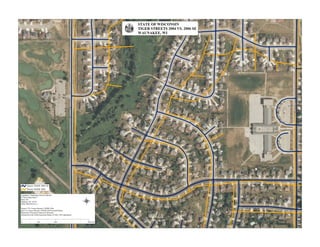
               • Positional Accuracy could be as far off as +/- 50 meters (+/-167 feet) before
                  modernization.
               • Post modernization accuracy goal was set at +/- 7.6 meters (+/- 25 feet).
               • ESRI Shapefile format.
The Legislative Redistricting Project


               The U.S. Census Bureau’s Redistricting Data Program

•   Phase 2 : Project NOTES

     •   TIGER Modernization
           • Although positional accuracy has been enhanced there are some problems with the new TIGER
             dataset.

           •   All 72 of the State of Wisconsin’s counties were not modernized.
                   • Local dataset licensing

           •   Line and boundary problems.
                  • Reprocessing of 1,159 counties.
                  • Boundary Repair Program
                         • Legislative district line problems
                         • Population density problems
The Legislative Redistricting Project


               The U.S. Census Bureau’s Redistricting Data Program

•   Phase 3: Delivery of Public Law 94-171 – Redistricting Data to State Liaisons

     •   Tabulation Block Geography from TIGER 2010 (November 2010)

     •   Tabulation Block Counts - PL 94-171 Data (February – March 2011)

     •   Data will be received on or before April 1, 2011.
           • Data will be made available on our website
              (http://legis.wisconsin.gov/ltsb/redistricting/districts.htm )
           • And through the WISE-LR website. (http://legis.wisconsin.gov/wiselr)

                     Delivery of this data to the Legislature (and then to the counties)
                           starts the process of local redistricting in Wisconsin.
The Legislative Redistricting Project


                            State of Wisconsin - Local Redistricting
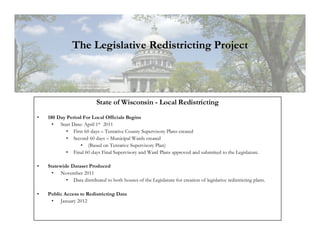
•   180 Day Period For Local Officials Begins
      • Start Date: April 1st 2011
            • First 60 days – Tentative County Supervisory Plans created
            • Second 60 days – Municipal Wards created
                  • (Based on Tentative Supervisory Plan)
            • Final 60 days Final Supervisory and Ward Plans approved and submitted to the Legislature.

•   Statewide Dataset Produced
      • November 2011
            • Data distributed to both houses of the Legislature for creation of legislative redistricting plans.

•   Public Access to Redistricting Data
     • January 2012
Monday, September 27, 2010
   WISE-LR is an application that allows counties and
    municipalities to create an electronic map of municipal
    wards by grouping census blocks.

   2000 Round of Redistricting:
       WISE (2000) – Pilot
       WISE-LR (2001) – Local Redistricting application for
        counties and MCDs.
       WISE-LegRed (2002) - Legislative Redistricting
        application for public access.

   WISE-LR was the starting point for the 2000
    Redistricting effort.

   All 72 counties of data was collected as part of the
    redistricting effort (in 1990, only 34/72).
   The new WISE-LR application will provide the same
    functionality as the previous desktop application that was
    delivered to all 72 Wisconsin counties on April 1, 2001
    for the 2001 Legislative Redistricting Project. The main
    difference between the two applications is the WISE-LR
    2010 application is now an internet application.

   The internet application eliminates the three most
    common issues encountered during the use of the
    desktop application: installation, performance, and data
    submission.

   Created by LTSB and the UW-Applied Population
    Laboratory.
 No installation needed.
 Secure access using a user name and
  password.
 Broadband internet access required for
  efficient use.
 2001 ward, 2009 streets, and 2009
  municipal layer are included as an overlay.
 Data is backed up on our servers.
 Bing Maps used as the base and/or aerial
  map.
   A letter and email was sent to county clerks across the
    state asking if they would like to participate in the pilot
    program.
   Currently 57 counties said “yes”, 15 counties said “no” to
    pilot participation.
   April 5, 2010 – Support for the pilot began at LTSB.
   September 1, 2010 – Pilot program ends.
   Gives counties an opportunity to use the WISE-LR
    application before its final release on April 1, 2011.
   Counties can assess the support and training materials,
    make enhancement suggestions, and test features of the
    new software.
   As an added benefit for participating, counties had the
    opportunity to have assignments made in the pilot
    program made available in the final release of the
   Administration Tool
    ◦ Allows the administrator to add annexations.
   Creation of GIS shapefiles.
   The ability to share plans.
    ◦ This allows others to import any plan that is shared into a new
      plan.
   The ability to approve plans.
    ◦ Supervisory Plans – once a supervisory plan is approved it is
      added as an overlay to all ward plans in the county.
    ◦ Ward Plans – once a ward plan is approved it is uploaded to the
      administration tool.
    ◦ Final County Ward Plans – once all ward assignments are
      approved and are verified in the administration tool the final
      county ward plan can be approved. This final approval will notify
      the legislature that ward submission is completed.
   WISE-LR Website
    www.legis.wisconsin.gov/wiselr
    ◦ Training Video
    ◦ Support Documentation
    ◦ Tutorials
    ◦ Frequently Asked Questions (FAQ’s)
    ◦ Contact information
      Support.wiselr@legis.wisconsin.gov
WISE-LR 2010 Demo
  UW - Applied Population Laboratory

                Jim Beaudoin
      Senior GIS Applications Developer

Legislative Redistricting

  • 1.
    Legislative Redistricting Legislative TechnologyServices Bureau Tony J. Van Der Wielen GIS Manager Joel Ylvisaker GIS Analyst Ryan Squires GIS Analyst UW - Applied Population Laboratory Jim Beaudoin Senior GIS Applications Developer
  • 2.
    The Legislative RedistrictingProject Wisconsin performs local, legislative and congressional redistricting following the decennial U.S. Census. • Components of Legislative Redistricting – U.S. Census Bureau Redistricting Data Program (RDP) – Local Redistricting – Legislative Redistricting
  • 3.
    The Legislative RedistrictingProject The U.S. Census Bureau’s Redistricting Data Program • 5 Phase Program • Phase 1 : State Legislative District Project (2005 - 2006) • Phase 2: Voting District/ Block Boundary Suggestions (2007 - 2009) • Phase 3: Data Delivery (2010-2011) • Phase 4: Collection of Post Redistricting Plans (2012 - 2013) • Phase 5: Evaluation and Recommendations for Census 2020
  • 4.
    The Legislative RedistrictingProject The U.S. Census Bureau’s Redistricting Data Program • Phase 1 : State Legislative District Project (2005 - 2006) • This program allowed states to submit current legislative district boundaries to the U.S. Census Bureau to be enumerated. • http://factfinder.census.gov • Allows Census 2000 to be calculated to Wisconsin Legislative Districts • These district lines will also be enumerated for Census 2010.
  • 5.
    The Legislative RedistrictingProject The U.S. Census Bureau’s Redistricting Data Program • Phase 2 : Voting District/Block boundary Suggestion Project (2007 - 2009) • This program allowed states to submit current or historic Voting Districts (Wards) to the U.S. Census Bureau. • The voting district lines will be held for Census 2010. • The voting districts submitted will be enumerated for Census 2010. • Historical Perspective • Historic Election Data can be used with Census 2010 data. • Phase 2: Verification process for phase 2 was completed on April 1, 2010.
  • 6.
    The Legislative RedistrictingProject The U.S. Census Bureau’s Redistricting Data Program • Phase 2 : Project NOTES • TIGER Modernization • The Topologically Integrated Geographic Encoding and Referencing (TIGER) • System was developed in the late 1980’s (1990 and 2000 Census) • All Geographic features used for the Decimal Census. • Blocks, Block Groups, Tracts • Streets, Streams, Railroads, Political Boundaries (Cities, Towns and Villages) • Positional Accuracy could be as far off as +/- 50 meters (+/-167 feet) before modernization. • Post modernization accuracy goal was set at +/- 7.6 meters (+/- 25 feet). • ESRI Shapefile format.
  • 8.
    The Legislative RedistrictingProject The U.S. Census Bureau’s Redistricting Data Program • Phase 2 : Project NOTES • TIGER Modernization • Although positional accuracy has been enhanced there are some problems with the new TIGER dataset. • All 72 of the State of Wisconsin’s counties were not modernized. • Local dataset licensing • Line and boundary problems. • Reprocessing of 1,159 counties. • Boundary Repair Program • Legislative district line problems • Population density problems
  • 10.
    The Legislative RedistrictingProject The U.S. Census Bureau’s Redistricting Data Program • Phase 3: Delivery of Public Law 94-171 – Redistricting Data to State Liaisons • Tabulation Block Geography from TIGER 2010 (November 2010) • Tabulation Block Counts - PL 94-171 Data (February – March 2011) • Data will be received on or before April 1, 2011. • Data will be made available on our website (http://legis.wisconsin.gov/ltsb/redistricting/districts.htm ) • And through the WISE-LR website. (http://legis.wisconsin.gov/wiselr) Delivery of this data to the Legislature (and then to the counties) starts the process of local redistricting in Wisconsin.
  • 11.
    The Legislative RedistrictingProject State of Wisconsin - Local Redistricting • 180 Day Period For Local Officials Begins • Start Date: April 1st 2011 • First 60 days – Tentative County Supervisory Plans created • Second 60 days – Municipal Wards created • (Based on Tentative Supervisory Plan) • Final 60 days Final Supervisory and Ward Plans approved and submitted to the Legislature. • Statewide Dataset Produced • November 2011 • Data distributed to both houses of the Legislature for creation of legislative redistricting plans. • Public Access to Redistricting Data • January 2012
  • 12.
  • 13.
    WISE-LR is an application that allows counties and municipalities to create an electronic map of municipal wards by grouping census blocks.  2000 Round of Redistricting:  WISE (2000) – Pilot  WISE-LR (2001) – Local Redistricting application for counties and MCDs.  WISE-LegRed (2002) - Legislative Redistricting application for public access.  WISE-LR was the starting point for the 2000 Redistricting effort.  All 72 counties of data was collected as part of the redistricting effort (in 1990, only 34/72).
  • 14.
    The new WISE-LR application will provide the same functionality as the previous desktop application that was delivered to all 72 Wisconsin counties on April 1, 2001 for the 2001 Legislative Redistricting Project. The main difference between the two applications is the WISE-LR 2010 application is now an internet application.  The internet application eliminates the three most common issues encountered during the use of the desktop application: installation, performance, and data submission.  Created by LTSB and the UW-Applied Population Laboratory.
  • 15.
     No installationneeded.  Secure access using a user name and password.  Broadband internet access required for efficient use.  2001 ward, 2009 streets, and 2009 municipal layer are included as an overlay.  Data is backed up on our servers.  Bing Maps used as the base and/or aerial map.
  • 16.
    A letter and email was sent to county clerks across the state asking if they would like to participate in the pilot program.  Currently 57 counties said “yes”, 15 counties said “no” to pilot participation.  April 5, 2010 – Support for the pilot began at LTSB.  September 1, 2010 – Pilot program ends.  Gives counties an opportunity to use the WISE-LR application before its final release on April 1, 2011.  Counties can assess the support and training materials, make enhancement suggestions, and test features of the new software.  As an added benefit for participating, counties had the opportunity to have assignments made in the pilot program made available in the final release of the
  • 17.
    Administration Tool ◦ Allows the administrator to add annexations.  Creation of GIS shapefiles.  The ability to share plans. ◦ This allows others to import any plan that is shared into a new plan.  The ability to approve plans. ◦ Supervisory Plans – once a supervisory plan is approved it is added as an overlay to all ward plans in the county. ◦ Ward Plans – once a ward plan is approved it is uploaded to the administration tool. ◦ Final County Ward Plans – once all ward assignments are approved and are verified in the administration tool the final county ward plan can be approved. This final approval will notify the legislature that ward submission is completed.
  • 19.
    WISE-LR Website www.legis.wisconsin.gov/wiselr ◦ Training Video ◦ Support Documentation ◦ Tutorials ◦ Frequently Asked Questions (FAQ’s) ◦ Contact information  Support.wiselr@legis.wisconsin.gov
  • 20.
    WISE-LR 2010 Demo UW - Applied Population Laboratory Jim Beaudoin Senior GIS Applications Developer