Legal and Regulatory Environment
Laws prescribe rules of conduct that are enforced by public authority Violation is threatened with punishment Laws serve mainly a protective purpose
Two main reasons why the long-term care sector is heavily regulated: The government is a major payer The clients are often frail and vulnerable
Two main categories of laws: Civil law Criminal law
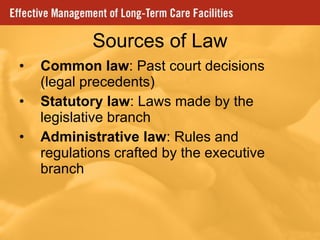
Sources of Law Common law : Past court decisions (legal precedents) Statutory law : Laws made by the legislative branch Administrative law : Rules and regulations crafted by the executive branch
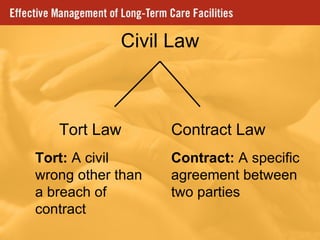
Civil Law Tort Law Contract Law Tort:  A civil wrong other than a breach of contract Contract:  A specific agreement between two parties
Civil law: Characteristics Deals with relationships between private parties When seeking remedy for injury, the plaintiff is a private party Penalties for wrongful acts are in the form of monetary damages
Criminal law: Characteristics Defines crimes and provides for punishments for crimes A crime is an offense against the general public Jail terms, fines, or both may be imposed The wrongdoer is prosecuted by a public prosecutor, but a harmed private party may also pursue civil action.
Crimes Specific to Health Care Delivery Billing programs for services not delivered Providing and billing for services that are not medically necessary Gross violation of commonly recognized standards of care  Reckless disregard for the safety and well-being for patients
Tort Damages Award of monetary damages to make the person whole again Punitive (exemplary) damages for egregious conduct, such as Malice Gross negligence Blatant violation of individual rights Fraud
Contract Legally binding agreement Between competent parties To carry out a legal purpose An agreement generally involves: - offer and acceptance - meeting of the minds - consideration
Regulations Classified as administrative law Crafted by administrative agencies of the government Interpret statutes and furnish details for implementing the statutes Carry the force of law Enforced by administrative agencies that crafted the regulations
Non-profit Ownership Prohibited from distributing profits to individuals Must serve a charitable purpose Tax exempt Private donors can claim charitable deductions on their tax returns
Proprietary Ownership Three main types: Corporation Partnership General Limited Sole proprietorship
Desirable Qualifications of Board Members Respected community leaders Technical expertise in some area (health care, finance, law, etc.) Be able to bring community and client perspectives
Current NHA Issues Lack of uniform qualifications for licensure across states Most states do not mandate a bachelor’s or higher degree in health care management Shortage of qualified administrators
Licensing of Health Professionals All states require nurses, therapists, and physicians to be licensed Some states also license other health professionals Licensing laws govern to main areas: - minimum qualifications - scope of practice
Personal Liability The administrator and other employees can be held personally liable for Committing wrongful acts that cause harm Failure to do something they should have done and harm occurs as a result of the omission Unlawful acts regardless of whether harm occurs
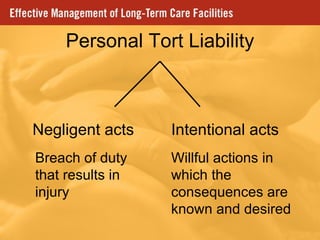
Personal Tort Liability Negligent acts Intentional acts Breach of duty that results in injury Willful actions in which the consequences are  known and desired
Injury from Negligence Four conditions must be present: A duty must be owed A breach of duty must occur An injury must result A direct cause-and-effect relationship must exist between the breach of duty and the resulting injury
Types of Intentional Torts Assault and battery False imprisonment Invasion of privacy or breach of confidentiality Defamation: libel and slander Fraud Infliction of mental distress
Respondeat Superior The nursing facility is held liable for the wrongful acts of its employees Individuals may also be held personally liable The organization is liable even if it takes all reasonable steps to select, train, and supervise employees A supervisor is not an employer and cannot be held liable for the acts of employees he or she supervises
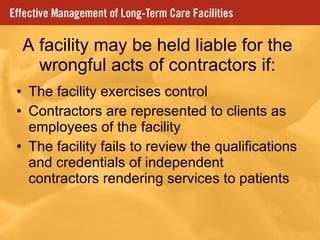
A facility may be held liable for the wrongful acts of contractors if: The facility exercises control Contractors are represented to clients as employees of the facility The facility fails to review the qualifications and credentials of independent contractors rendering services to patients
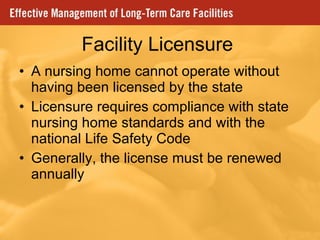
Facility Licensure A nursing home cannot operate without having been licensed by the state  Licensure requires compliance with state nursing home standards and with the national Life Safety Code Generally, the license must be renewed annually
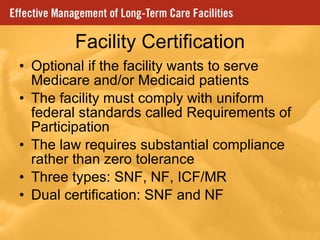
Facility Certification Optional if the facility wants to serve Medicare and/or Medicaid patients The facility must comply with uniform federal standards called Requirements of Participation The law requires substantial compliance rather than zero tolerance Three types: SNF, NF, ICF/MR Dual certification: SNF and NF
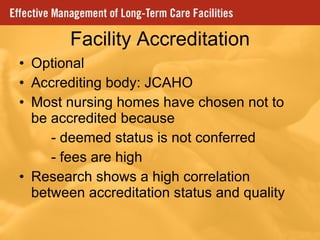
Facility Accreditation Optional Accrediting body: JCAHO Most nursing homes have chosen not to be accredited because - deemed status is not conferred - fees are high Research shows a high correlation between accreditation status and quality
Requirements of Participation (2) Equal access This requirement applies to certified facilities Such facilities are required to admit patients on a first-come-first-served basis regardless of the patient’s source of payment Patients in certified facilities must receive similar services
Enforcement of Certification Standards Survey process is the main tool Five different types of surveys: standard, abbreviated, extended, special, validation Citation of deficiencies Plan of correction
Deficiencies Violation of a standard Resident-centered: violation affecting a single resident (e.g., an incontinent resident has not been cleaned). Facility-centered: violation affecting an operational system, such as infection control Severity and scope
Possible Sanctions Directed plan of correction requiring external consultation Denial of payment Fines Temporary management appointed by the state Termination from Medicare and Medicaid
Antidiscrimination Laws Title VI of the Civil Rights Act of 1964 prohibits denial of benefits based on race, color, or national origin Section 504 of the Rehabilitation Act of 1973 prohibits discrimination based on physical or mental handicap Also protects people with HIV/AIDS
Patient Rights Governed by the Patient Self-Determination Act of 1990 To be informed of one’s rights Privacy and confidentiality Freedom from abuse, neglect, and misappropriation of property Option to make decisions about one’s own care
Substitute Decision-Making and Advance Directives Role of family members Legal guardian Advance directives: Living will Do-not-resuscitate order Durable power of attorney
HIPAA 1996 Governs the use and disclosure of patients’ protected healthcare information (PHI) It is illegal to gain access to PHI except for - delivering health care - carrying out facility operations - reimbursement Exceptions: Emergencies, patient’s transfer to another facility, legal requirements Other uses or disclosures require the patient’s written authorization
HIPAA  (contd.) Facility must protect transfer of PHI Facility must have a privacy policy detailing how the facility will use and disclose PHI A copy of the policy must be given to each patient or his/her guardian Policy must be posted in the facility Violations are subject to civil and criminal penalties

Legal & Regulatory Powerpoint

  • 1.
  • 2.
  • 3.
    Laws prescribe rulesof conduct that are enforced by public authority Violation is threatened with punishment Laws serve mainly a protective purpose
  • 4.
    Two main reasonswhy the long-term care sector is heavily regulated: The government is a major payer The clients are often frail and vulnerable
  • 5.
    Two main categoriesof laws: Civil law Criminal law
  • 6.
    Sources of LawCommon law : Past court decisions (legal precedents) Statutory law : Laws made by the legislative branch Administrative law : Rules and regulations crafted by the executive branch
  • 7.
    Civil Law TortLaw Contract Law Tort: A civil wrong other than a breach of contract Contract: A specific agreement between two parties
  • 8.
    Civil law: CharacteristicsDeals with relationships between private parties When seeking remedy for injury, the plaintiff is a private party Penalties for wrongful acts are in the form of monetary damages
  • 9.
    Criminal law: CharacteristicsDefines crimes and provides for punishments for crimes A crime is an offense against the general public Jail terms, fines, or both may be imposed The wrongdoer is prosecuted by a public prosecutor, but a harmed private party may also pursue civil action.
  • 10.
    Crimes Specific toHealth Care Delivery Billing programs for services not delivered Providing and billing for services that are not medically necessary Gross violation of commonly recognized standards of care Reckless disregard for the safety and well-being for patients
  • 11.
    Tort Damages Awardof monetary damages to make the person whole again Punitive (exemplary) damages for egregious conduct, such as Malice Gross negligence Blatant violation of individual rights Fraud
  • 12.
    Contract Legally bindingagreement Between competent parties To carry out a legal purpose An agreement generally involves: - offer and acceptance - meeting of the minds - consideration
  • 13.
    Regulations Classified asadministrative law Crafted by administrative agencies of the government Interpret statutes and furnish details for implementing the statutes Carry the force of law Enforced by administrative agencies that crafted the regulations
  • 14.
    Non-profit Ownership Prohibitedfrom distributing profits to individuals Must serve a charitable purpose Tax exempt Private donors can claim charitable deductions on their tax returns
  • 15.
    Proprietary Ownership Threemain types: Corporation Partnership General Limited Sole proprietorship
  • 16.
    Desirable Qualifications ofBoard Members Respected community leaders Technical expertise in some area (health care, finance, law, etc.) Be able to bring community and client perspectives
  • 17.
    Current NHA IssuesLack of uniform qualifications for licensure across states Most states do not mandate a bachelor’s or higher degree in health care management Shortage of qualified administrators
  • 18.
    Licensing of HealthProfessionals All states require nurses, therapists, and physicians to be licensed Some states also license other health professionals Licensing laws govern to main areas: - minimum qualifications - scope of practice
  • 19.
    Personal Liability Theadministrator and other employees can be held personally liable for Committing wrongful acts that cause harm Failure to do something they should have done and harm occurs as a result of the omission Unlawful acts regardless of whether harm occurs
  • 20.
    Personal Tort LiabilityNegligent acts Intentional acts Breach of duty that results in injury Willful actions in which the consequences are known and desired
  • 21.
    Injury from NegligenceFour conditions must be present: A duty must be owed A breach of duty must occur An injury must result A direct cause-and-effect relationship must exist between the breach of duty and the resulting injury
  • 22.
    Types of IntentionalTorts Assault and battery False imprisonment Invasion of privacy or breach of confidentiality Defamation: libel and slander Fraud Infliction of mental distress
  • 23.
    Respondeat Superior Thenursing facility is held liable for the wrongful acts of its employees Individuals may also be held personally liable The organization is liable even if it takes all reasonable steps to select, train, and supervise employees A supervisor is not an employer and cannot be held liable for the acts of employees he or she supervises
  • 24.
    A facility maybe held liable for the wrongful acts of contractors if: The facility exercises control Contractors are represented to clients as employees of the facility The facility fails to review the qualifications and credentials of independent contractors rendering services to patients
  • 25.
    Facility Licensure Anursing home cannot operate without having been licensed by the state Licensure requires compliance with state nursing home standards and with the national Life Safety Code Generally, the license must be renewed annually
  • 26.
    Facility Certification Optionalif the facility wants to serve Medicare and/or Medicaid patients The facility must comply with uniform federal standards called Requirements of Participation The law requires substantial compliance rather than zero tolerance Three types: SNF, NF, ICF/MR Dual certification: SNF and NF
  • 27.
    Facility Accreditation OptionalAccrediting body: JCAHO Most nursing homes have chosen not to be accredited because - deemed status is not conferred - fees are high Research shows a high correlation between accreditation status and quality
  • 28.
    Requirements of Participation(2) Equal access This requirement applies to certified facilities Such facilities are required to admit patients on a first-come-first-served basis regardless of the patient’s source of payment Patients in certified facilities must receive similar services
  • 29.
    Enforcement of CertificationStandards Survey process is the main tool Five different types of surveys: standard, abbreviated, extended, special, validation Citation of deficiencies Plan of correction
  • 30.
    Deficiencies Violation ofa standard Resident-centered: violation affecting a single resident (e.g., an incontinent resident has not been cleaned). Facility-centered: violation affecting an operational system, such as infection control Severity and scope
  • 31.
    Possible Sanctions Directedplan of correction requiring external consultation Denial of payment Fines Temporary management appointed by the state Termination from Medicare and Medicaid
  • 32.
    Antidiscrimination Laws TitleVI of the Civil Rights Act of 1964 prohibits denial of benefits based on race, color, or national origin Section 504 of the Rehabilitation Act of 1973 prohibits discrimination based on physical or mental handicap Also protects people with HIV/AIDS
  • 33.
    Patient Rights Governedby the Patient Self-Determination Act of 1990 To be informed of one’s rights Privacy and confidentiality Freedom from abuse, neglect, and misappropriation of property Option to make decisions about one’s own care
  • 34.
    Substitute Decision-Making andAdvance Directives Role of family members Legal guardian Advance directives: Living will Do-not-resuscitate order Durable power of attorney
  • 35.
    HIPAA 1996 Governsthe use and disclosure of patients’ protected healthcare information (PHI) It is illegal to gain access to PHI except for - delivering health care - carrying out facility operations - reimbursement Exceptions: Emergencies, patient’s transfer to another facility, legal requirements Other uses or disclosures require the patient’s written authorization
  • 36.
    HIPAA (contd.)Facility must protect transfer of PHI Facility must have a privacy policy detailing how the facility will use and disclose PHI A copy of the policy must be given to each patient or his/her guardian Policy must be posted in the facility Violations are subject to civil and criminal penalties