Policy Brainstorm
Extravaganza!!
MnSCU System Policy
Work
Credit Transfer




Student Transfer Survey
Appeals Tracking
MnTC Certification
Affordability







Tuition set for 2014-2015
Fees increase up to 3%
Credit for Prior Learning
Four-year degrees on two-year
campuses
Scholarship campaigns
College Readiness




Increasing credit opportunities in high
school
Aligning high school assessments with
college placement exams
Meeting Workforce Needs



Statewide academic planning
Increasing internship opportunities
State Legislative
Landscape
State Budget Outlook






FY 2014-2015 projected $627 million
shortfall, however $2.1billion in
revenue increases during legislative
session will cover the deficit
MN’s economy ranked 5th fastest
growing in 2012
November Forecast – Surplus of $825
million after K-12 school shifts are paid
back
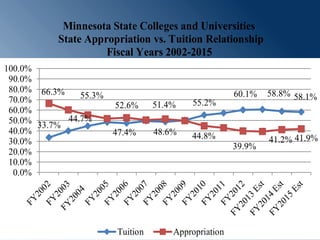
Minnesota State Colleges and Universities
State Appropriation vs. Tuition Relationship
Fiscal Years 2002-2015
100.0%
90.0%
80.0% 66.3%
55.3%
70.0%
60.0%
50.0% 33.7% 44.7%
40.0%
30.0%
20.0%
10.0%
0.0%

60.1%
52.6%

51.4%

55.2%

47.4%

48.6%

44.8%
39.9%

Tuition

Appropriation

58.8% 58.1%

41.2% 41.9%
Legislative Basics





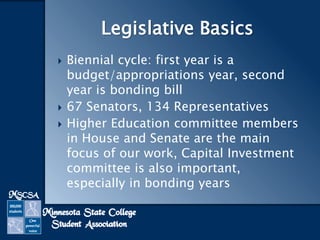
Biennial cycle: first year is a
budget/appropriations year, second
year is bonding bill
67 Senators, 134 Representatives
Higher Education committee members
in House and Senate are the main
focus of our work, Capital Investment
committee is also important,
especially in bonding years
What’s next at the Capitol?


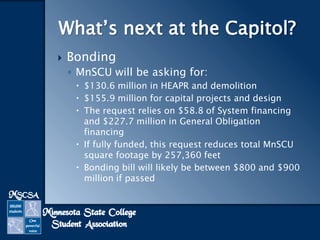
Bonding
◦ MnSCU will be asking for:
 $130.6 million in HEAPR and demolition
 $155.9 million for capital projects and design
 The request relies on $58.8 of System financing
and $227.7 million in General Obligation
financing
 If fully funded, this request reduces total MnSCU
square footage by 257,360 feet
 Bonding bill will likely be between $800 and $900
million if passed
What’s next at the Capitol?


The Unsession
◦ Governor Dayton has named the 2014
session as the “Unsession”
◦ The goal is to repeal outdated legislation,
streamline and improve government
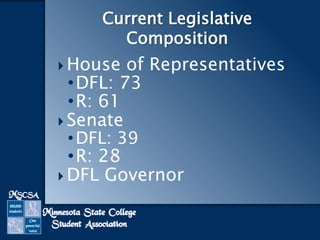
Current Legislative
Composition
 House

of Representatives
• DFL: 73
• R: 61
 Senate
• DFL: 39
• R: 28
 DFL Governor
Federal Legislative
Landscape
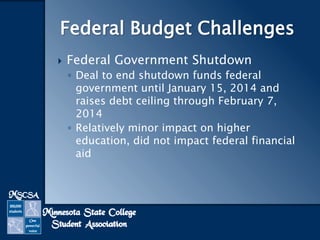
Federal Budget Challenges


Federal Government Shutdown
◦ Deal to end shutdown funds federal
government until January 15, 2014 and
raises debt ceiling through February 7,
2014
◦ Relatively minor impact on higher
education, did not impact federal financial
aid
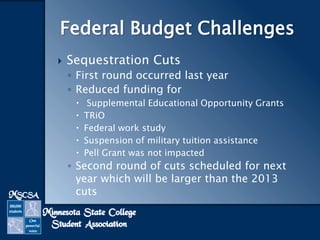
Federal Budget Challenges


Sequestration Cuts
◦ First round occurred last year
◦ Reduced funding for






Supplemental Educational Opportunity Grants
TRiO
Federal work study
Suspension of military tuition assistance
Pell Grant was not impacted

◦ Second round of cuts scheduled for next
year which will be larger than the 2013
cuts
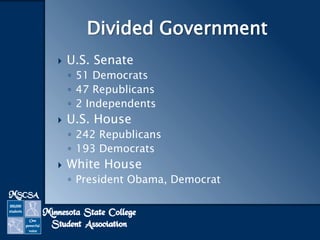
Divided Government


U.S. Senate
◦ 51 Democrats
◦ 47 Republicans
◦ 2 Independents



U.S. House
◦ 242 Republicans
◦ 193 Democrats



White House
◦ President Obama, Democrat
Time to Brainstorm!


Regional discussions

 What

are the most
important policy issues
facing students?

Legislative landscape presentation for policy brainstorming

  • 1.
  • 2.
  • 3.
    Credit Transfer    Student TransferSurvey Appeals Tracking MnTC Certification
  • 4.
    Affordability      Tuition set for2014-2015 Fees increase up to 3% Credit for Prior Learning Four-year degrees on two-year campuses Scholarship campaigns
  • 5.
    College Readiness   Increasing creditopportunities in high school Aligning high school assessments with college placement exams
  • 6.
    Meeting Workforce Needs   Statewideacademic planning Increasing internship opportunities
  • 7.
  • 8.
    State Budget Outlook    FY2014-2015 projected $627 million shortfall, however $2.1billion in revenue increases during legislative session will cover the deficit MN’s economy ranked 5th fastest growing in 2012 November Forecast – Surplus of $825 million after K-12 school shifts are paid back
  • 9.
    Minnesota State Collegesand Universities State Appropriation vs. Tuition Relationship Fiscal Years 2002-2015 100.0% 90.0% 80.0% 66.3% 55.3% 70.0% 60.0% 50.0% 33.7% 44.7% 40.0% 30.0% 20.0% 10.0% 0.0% 60.1% 52.6% 51.4% 55.2% 47.4% 48.6% 44.8% 39.9% Tuition Appropriation 58.8% 58.1% 41.2% 41.9%
  • 10.
    Legislative Basics    Biennial cycle:first year is a budget/appropriations year, second year is bonding bill 67 Senators, 134 Representatives Higher Education committee members in House and Senate are the main focus of our work, Capital Investment committee is also important, especially in bonding years
  • 11.
    What’s next atthe Capitol?  Bonding ◦ MnSCU will be asking for:  $130.6 million in HEAPR and demolition  $155.9 million for capital projects and design  The request relies on $58.8 of System financing and $227.7 million in General Obligation financing  If fully funded, this request reduces total MnSCU square footage by 257,360 feet  Bonding bill will likely be between $800 and $900 million if passed
  • 12.
    What’s next atthe Capitol?  The Unsession ◦ Governor Dayton has named the 2014 session as the “Unsession” ◦ The goal is to repeal outdated legislation, streamline and improve government
  • 13.
    Current Legislative Composition  House ofRepresentatives • DFL: 73 • R: 61  Senate • DFL: 39 • R: 28  DFL Governor
  • 15.
  • 16.
    Federal Budget Challenges  FederalGovernment Shutdown ◦ Deal to end shutdown funds federal government until January 15, 2014 and raises debt ceiling through February 7, 2014 ◦ Relatively minor impact on higher education, did not impact federal financial aid
  • 17.
    Federal Budget Challenges  SequestrationCuts ◦ First round occurred last year ◦ Reduced funding for      Supplemental Educational Opportunity Grants TRiO Federal work study Suspension of military tuition assistance Pell Grant was not impacted ◦ Second round of cuts scheduled for next year which will be larger than the 2013 cuts
  • 18.
    Divided Government  U.S. Senate ◦51 Democrats ◦ 47 Republicans ◦ 2 Independents  U.S. House ◦ 242 Republicans ◦ 193 Democrats  White House ◦ President Obama, Democrat
  • 20.
    Time to Brainstorm!  Regionaldiscussions  What are the most important policy issues facing students?

Editor's Notes

  • #9 Big picture- we faced a lot of financial challenges lately, deficit, things are looking better, higher ed received largest investment in decades, campuses still facing cuts, costs still going upMinnesota management and budget prepare a “forecast” or preview, of the state’s revenue. Nov and Feb. Governor will wait until Feb forecast to make a recommendation. Projected balance is 1.086 billion.
  • #10 Small increase 13-15
  • #11 Operate under biennial cycle Bonding- civic centers, transit, higher ed buildings Capital investment commitee
  • #12 Total that is likely based on what we’ve heard, governor’s proposal on jan 15th.
  • #13 Unsessionas “cleaning up” state government and statute
  • #14 Influences decisions
  • #15 Part-time grant pilot
  • #17 Kayley* So, pretty much no new funding for higher education programs
  • #18 JessEvery department gets cuts
  • #19 KayleyIndependentscaucus with democrats