Platform Document
Recommendations
By Tim St. Claire and Becca Branum
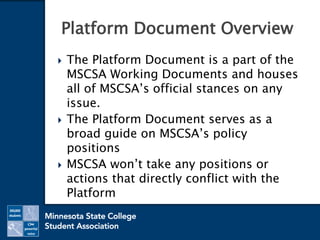
Platform Document Overview
 The Platform Document is a part of the
MSCSA Working Documents and houses
all of MSCSA’s official stances on any
issue.
 The Platform Document serves as a
broad guide on MSCSA’s policy
positions
 MSCSA won’t take any positions or
actions that directly conflict with the
Platform
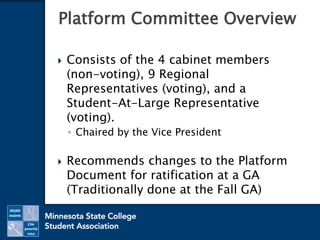
 Consists of the 4 cabinet members
(non-voting), 9 Regional
Representatives (voting), and a
Student-At-Large Representative
(voting).
◦ Chaired by the Vice President
 Recommends changes to the Platform
Document for ratification at a GA
(Traditionally done at the Fall GA)
Platform Committee Overview
Supports
 1. Financial aid based entirely on
income of the family, rather than the
cost of the institution.
 5. Increased funding and availability of
the SEOG Federal Supplemental
Educational Opportunity Grand (FSEOG),
and expanding award eligibility to non-
Pell qualified students.
Article II
 11. Legislation that would remove the
drug and selective service line-items
line items from the FAFSA application
form.
Opposes
 2. Using Use of students’ social security
numbers as an identifier identification
numbers, unless such use is already
required by federal or state law. outside
of FAFSA administration.
 4. Increased funding and expanded
eligibility for the Federal Work Work-
Study program.
 5. Expanded work study work-study
opportunities in the public, educational,
community, health care, non-profit and
for profit sectors.
 6. Students receiving the full benefit of
the work study work-study grant
entitlement.
Supports
 4. In In-state tuition rates for current
and former U.S. military members, and
their spouses, and their dependent
children.
 5. Expanded Loan loan forgiveness
programs for individuals in public
service.
Article III
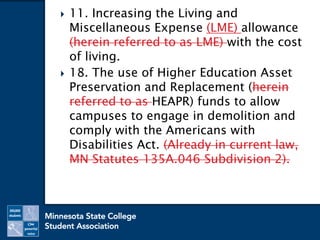
 11. Increasing the Living and
Miscellaneous Expense (LME) allowance
(herein referred to as LME) with the cost
of living.
 18. The use of Higher Education Asset
Preservation and Replacement (herein
referred to as HEAPR) funds to allow
campuses to engage in demolition and
comply with the Americans with
Disabilities Act. (Already in current law,
MN Statutes 135A.046 Subdivision 2).
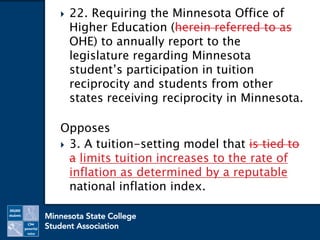
 22. Requiring the Minnesota Office of
Higher Education (herein referred to as
OHE) to annually report to the
legislature regarding Minnesota
student’s participation in tuition
reciprocity and students from other
states receiving reciprocity in Minnesota.
Opposes
 3. A tuition-setting model that is tied to
a limits tuition increases to the rate of
inflation as determined by a reputable
national inflation index.
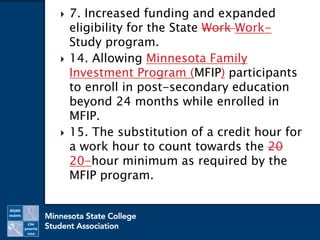
 7. Increased funding and expanded
eligibility for the State Work Work-
Study program.
 14. Allowing Minnesota Family
Investment Program (MFIP) participants
to enroll in post-secondary education
beyond 24 months while enrolled in
MFIP.
 15. The substitution of a credit hour for
a work hour to count towards the 20
20-hour minimum as required by the
MFIP program.
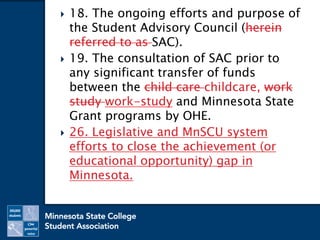
 18. The ongoing efforts and purpose of
the Student Advisory Council (herein
referred to as SAC).
 19. The consultation of SAC prior to
any significant transfer of funds
between the child care childcare, work
study work-study and Minnesota State
Grant programs by OHE.
 26. Legislative and MnSCU system
efforts to close the achievement (or
educational opportunity) gap in
Minnesota.
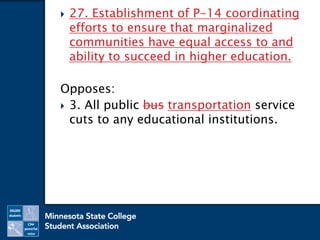
 27. Establishment of P-14 coordinating
efforts to ensure that marginalized
communities have equal access to and
ability to succeed in higher education.
Opposes:
 3. All public bus transportation service
cuts to any educational institutions.
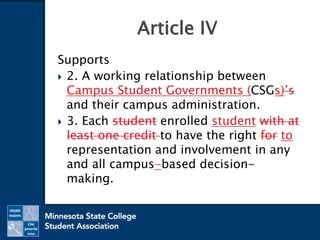
Supports
 2. A working relationship between
Campus Student Governments (CSGs)’s
and their campus administration.
 3. Each student enrolled student with at
least one credit to have the right for to
representation and involvement in any
and all campus-based decision-
making.
Article IV
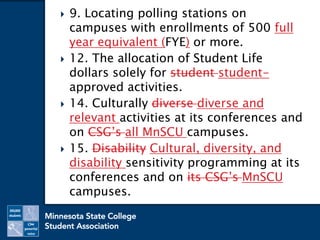
 9. Locating polling stations on
campuses with enrollments of 500 full
year equivalent (FYE) or more.
 12. The allocation of Student Life
dollars solely for student student-
approved activities.
 14. Culturally diverse diverse and
relevant activities at its conferences and
on CSG’s all MnSCU campuses.
 15. Disability Cultural, diversity, and
disability sensitivity programming at its
conferences and on its CSG’s MnSCU
campuses.
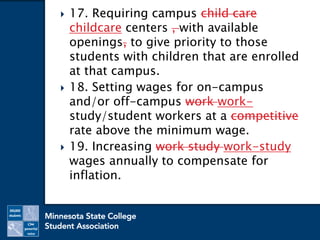
 17. Requiring campus child care
childcare centers , with available
openings, to give priority to those
students with children that are enrolled
at that campus.
 18. Setting wages for on-campus
and/or off-campus work work-
study/student workers at a competitive
rate above the minimum wage.
 19. Increasing work study work-study
wages annually to compensate for
inflation.
 21. Improved technology training on
the system’s instructional management
system for all faculty and on online
learning for all faculty and those who
that teach online/distance learning
courses.
Opposes
 3. Discrimination on the basis of race,
color, religion, gender, gender identity,
and sexual orientation, veteran’s status,
marital status, national origin, age,
mental or physical disability status, due
receipt of to public assistance, or any
other group, status, or class against
which discrimination could occur.
 6. Higher tuition costs and/or and fees
for taking online or /distance classes.
Supports
 1. Legislation that clarifies the
collection process of the Student and
Exchange Visitor Information System
(SEVIS) fee.
 2. International students obtaining a
temporary social security number,
regardless of working or job work
status.
Article V
Supports
 4. MnSCU institutions utilizing their full
allocation of student work work-study
and child care childcare dollars to avoid
any return of unused funds to OHE.
 5. The promotion of off-campus work
study work-study and internship
opportunities with non-profit and for-
profit groups.
Article VI
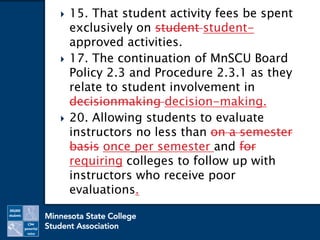
 15. That student activity fees be spent
exclusively on student student-
approved activities.
 17. The continuation of MnSCU Board
Policy 2.3 and Procedure 2.3.1 as they
relate to student involvement in
decisionmaking decision-making.
 20. Allowing students to evaluate
instructors no less than on a semester
basis once per semester and for
requiring colleges to follow up with
instructors who receive poor
evaluations.
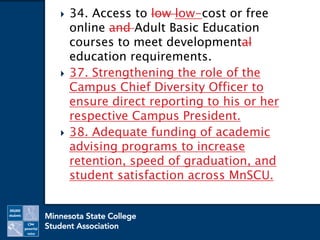
 34. Access to low low-cost or free
online and Adult Basic Education
courses to meet developmental
education requirements.
 37. Strengthening the role of the
Campus Chief Diversity Officer to
ensure direct reporting to his or her
respective Campus President.
 38. Adequate funding of academic
advising programs to increase
retention, speed of graduation, and
student satisfaction across MnSCU.
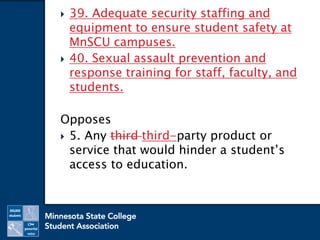
 39. Adequate security staffing and
equipment to ensure student safety at
MnSCU campuses.
 40. Sexual assault prevention and
response training for staff, faculty, and
students.
Opposes
 5. Any third third-party product or
service that would hinder a student’s
access to education.

Platform Document Recommendations 2015

  • 1.
    Platform Document Recommendations By TimSt. Claire and Becca Branum
  • 2.
    Platform Document Overview The Platform Document is a part of the MSCSA Working Documents and houses all of MSCSA’s official stances on any issue.  The Platform Document serves as a broad guide on MSCSA’s policy positions  MSCSA won’t take any positions or actions that directly conflict with the Platform
  • 3.
     Consists ofthe 4 cabinet members (non-voting), 9 Regional Representatives (voting), and a Student-At-Large Representative (voting). ◦ Chaired by the Vice President  Recommends changes to the Platform Document for ratification at a GA (Traditionally done at the Fall GA) Platform Committee Overview
  • 4.
    Supports  1. Financialaid based entirely on income of the family, rather than the cost of the institution.  5. Increased funding and availability of the SEOG Federal Supplemental Educational Opportunity Grand (FSEOG), and expanding award eligibility to non- Pell qualified students. Article II
  • 5.
     11. Legislationthat would remove the drug and selective service line-items line items from the FAFSA application form. Opposes  2. Using Use of students’ social security numbers as an identifier identification numbers, unless such use is already required by federal or state law. outside of FAFSA administration.
  • 6.
     4. Increasedfunding and expanded eligibility for the Federal Work Work- Study program.  5. Expanded work study work-study opportunities in the public, educational, community, health care, non-profit and for profit sectors.  6. Students receiving the full benefit of the work study work-study grant entitlement.
  • 7.
    Supports  4. InIn-state tuition rates for current and former U.S. military members, and their spouses, and their dependent children.  5. Expanded Loan loan forgiveness programs for individuals in public service. Article III
  • 8.
     11. Increasingthe Living and Miscellaneous Expense (LME) allowance (herein referred to as LME) with the cost of living.  18. The use of Higher Education Asset Preservation and Replacement (herein referred to as HEAPR) funds to allow campuses to engage in demolition and comply with the Americans with Disabilities Act. (Already in current law, MN Statutes 135A.046 Subdivision 2).
  • 9.
     22. Requiringthe Minnesota Office of Higher Education (herein referred to as OHE) to annually report to the legislature regarding Minnesota student’s participation in tuition reciprocity and students from other states receiving reciprocity in Minnesota. Opposes  3. A tuition-setting model that is tied to a limits tuition increases to the rate of inflation as determined by a reputable national inflation index.
  • 10.
     7. Increasedfunding and expanded eligibility for the State Work Work- Study program.  14. Allowing Minnesota Family Investment Program (MFIP) participants to enroll in post-secondary education beyond 24 months while enrolled in MFIP.  15. The substitution of a credit hour for a work hour to count towards the 20 20-hour minimum as required by the MFIP program.
  • 11.
     18. Theongoing efforts and purpose of the Student Advisory Council (herein referred to as SAC).  19. The consultation of SAC prior to any significant transfer of funds between the child care childcare, work study work-study and Minnesota State Grant programs by OHE.  26. Legislative and MnSCU system efforts to close the achievement (or educational opportunity) gap in Minnesota.
  • 12.
     27. Establishmentof P-14 coordinating efforts to ensure that marginalized communities have equal access to and ability to succeed in higher education. Opposes:  3. All public bus transportation service cuts to any educational institutions.
  • 13.
    Supports  2. Aworking relationship between Campus Student Governments (CSGs)’s and their campus administration.  3. Each student enrolled student with at least one credit to have the right for to representation and involvement in any and all campus-based decision- making. Article IV
  • 14.
     9. Locatingpolling stations on campuses with enrollments of 500 full year equivalent (FYE) or more.  12. The allocation of Student Life dollars solely for student student- approved activities.  14. Culturally diverse diverse and relevant activities at its conferences and on CSG’s all MnSCU campuses.  15. Disability Cultural, diversity, and disability sensitivity programming at its conferences and on its CSG’s MnSCU campuses.
  • 15.
     17. Requiringcampus child care childcare centers , with available openings, to give priority to those students with children that are enrolled at that campus.  18. Setting wages for on-campus and/or off-campus work work- study/student workers at a competitive rate above the minimum wage.  19. Increasing work study work-study wages annually to compensate for inflation.
  • 16.
     21. Improvedtechnology training on the system’s instructional management system for all faculty and on online learning for all faculty and those who that teach online/distance learning courses.
  • 17.
    Opposes  3. Discriminationon the basis of race, color, religion, gender, gender identity, and sexual orientation, veteran’s status, marital status, national origin, age, mental or physical disability status, due receipt of to public assistance, or any other group, status, or class against which discrimination could occur.  6. Higher tuition costs and/or and fees for taking online or /distance classes.
  • 18.
    Supports  1. Legislationthat clarifies the collection process of the Student and Exchange Visitor Information System (SEVIS) fee.  2. International students obtaining a temporary social security number, regardless of working or job work status. Article V
  • 19.
    Supports  4. MnSCUinstitutions utilizing their full allocation of student work work-study and child care childcare dollars to avoid any return of unused funds to OHE.  5. The promotion of off-campus work study work-study and internship opportunities with non-profit and for- profit groups. Article VI
  • 20.
     15. Thatstudent activity fees be spent exclusively on student student- approved activities.  17. The continuation of MnSCU Board Policy 2.3 and Procedure 2.3.1 as they relate to student involvement in decisionmaking decision-making.  20. Allowing students to evaluate instructors no less than on a semester basis once per semester and for requiring colleges to follow up with instructors who receive poor evaluations.
  • 21.
     34. Accessto low low-cost or free online and Adult Basic Education courses to meet developmental education requirements.  37. Strengthening the role of the Campus Chief Diversity Officer to ensure direct reporting to his or her respective Campus President.  38. Adequate funding of academic advising programs to increase retention, speed of graduation, and student satisfaction across MnSCU.
  • 22.
     39. Adequatesecurity staffing and equipment to ensure student safety at MnSCU campuses.  40. Sexual assault prevention and response training for staff, faculty, and students. Opposes  5. Any third third-party product or service that would hinder a student’s access to education.