Federal Legislative and
     Regulatory Update

            Pearson Learning Summit – Spring 2012

                                   The Phoenix Marriott Tempe at The Buttes
                                               Friday, April 27th
                                                   8:30 AM


Federal Legislative and Regulatory Update
Federal Legislative and
Regulatory Update
Brian Newman, APSCU
Brian.Newman@apscu.org

Tom E. Netting, Akerman Senterfitt
Tom.Netting@akerman.com

Karen Allanson, Pearson Learning Solutions
Karen.Allanson@Pearson.com
193

Federal Legislative and Regulatory Update
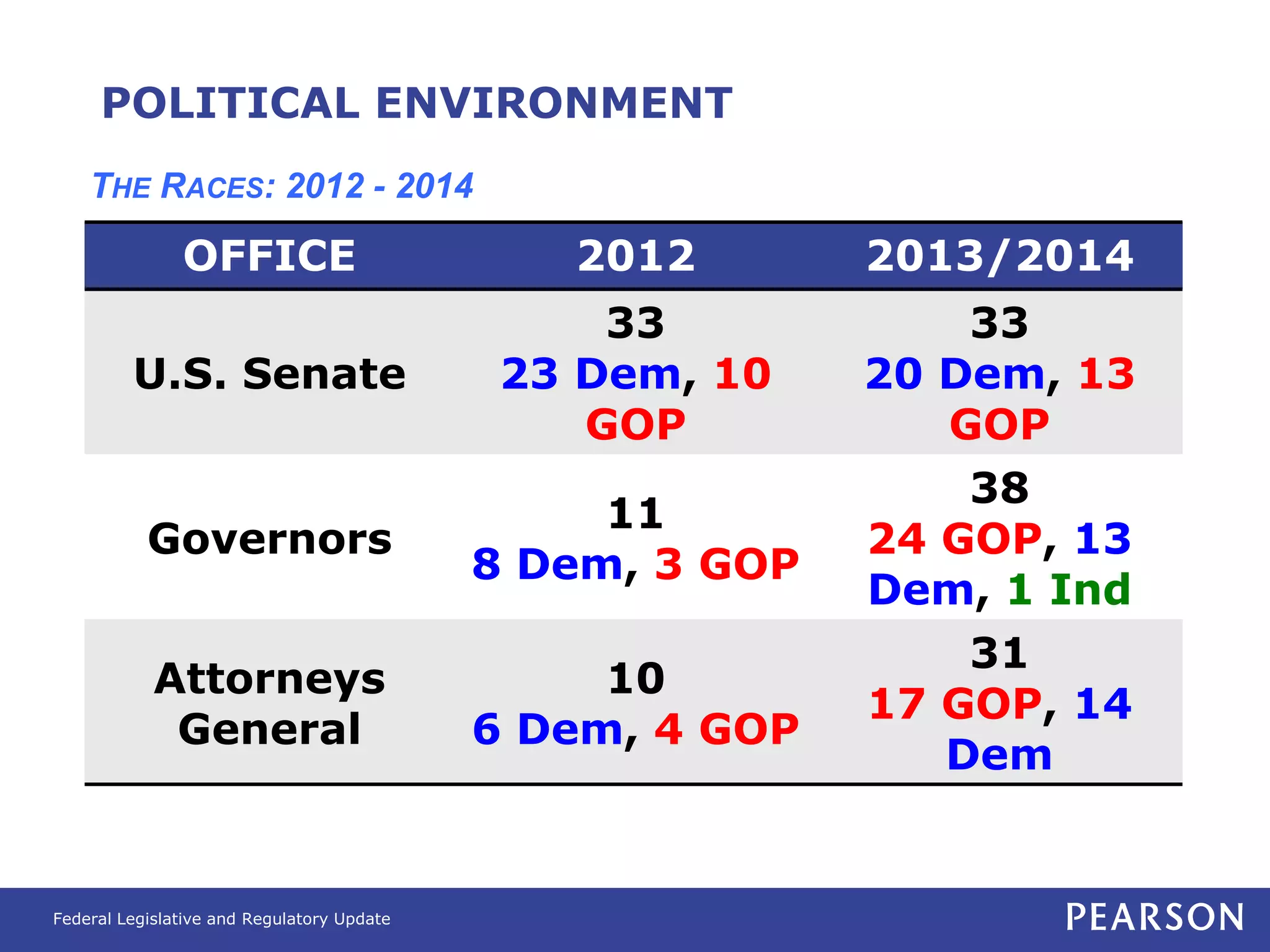
POLITICAL ENVIRONMENT
    THE RACES: 2012 - 2014

               OFFICE                          2012        2013/2014
                                                 33            33
         U.S. Senate                         23 Dem, 10    20 Dem, 13
                                                GOP           GOP
                                                               38
                                                 11
           Governors                                       24 GOP, 13
                                            8 Dem, 3 GOP
                                                           Dem, 1 Ind
                                                               31
            Attorneys                            10
                                                           17 GOP, 14
             General                        6 Dem, 4 GOP
                                                              Dem


Federal Legislative and Regulatory Update
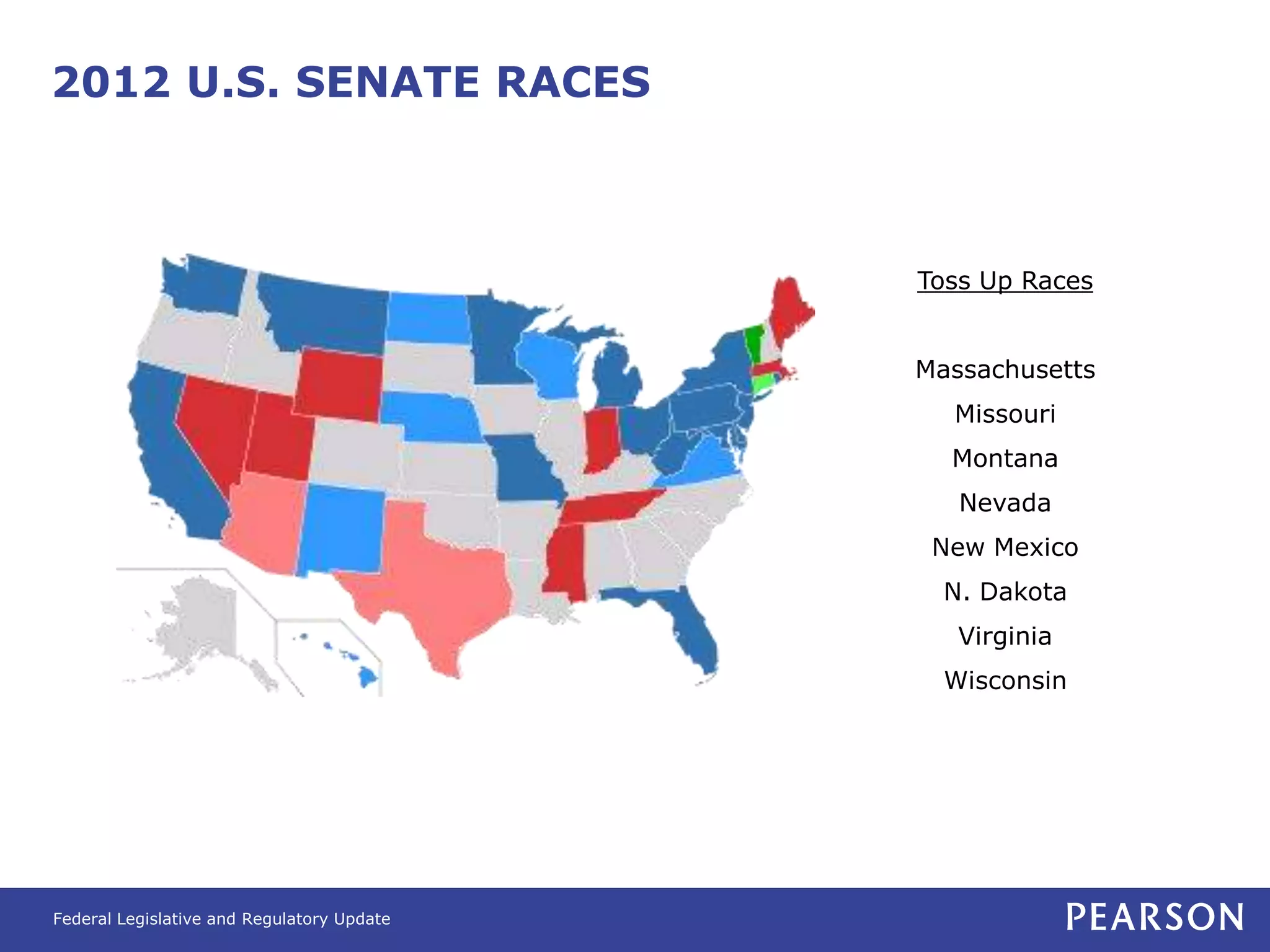
2012 U.S. SENATE RACES


                                            Toss Up Races


                                            Massachusetts
                                              Missouri
                                              Montana
                                               Nevada
                                             New Mexico
                                              N. Dakota
                                               Virginia
                                              Wisconsin


Federal Legislative and Regulatory Update
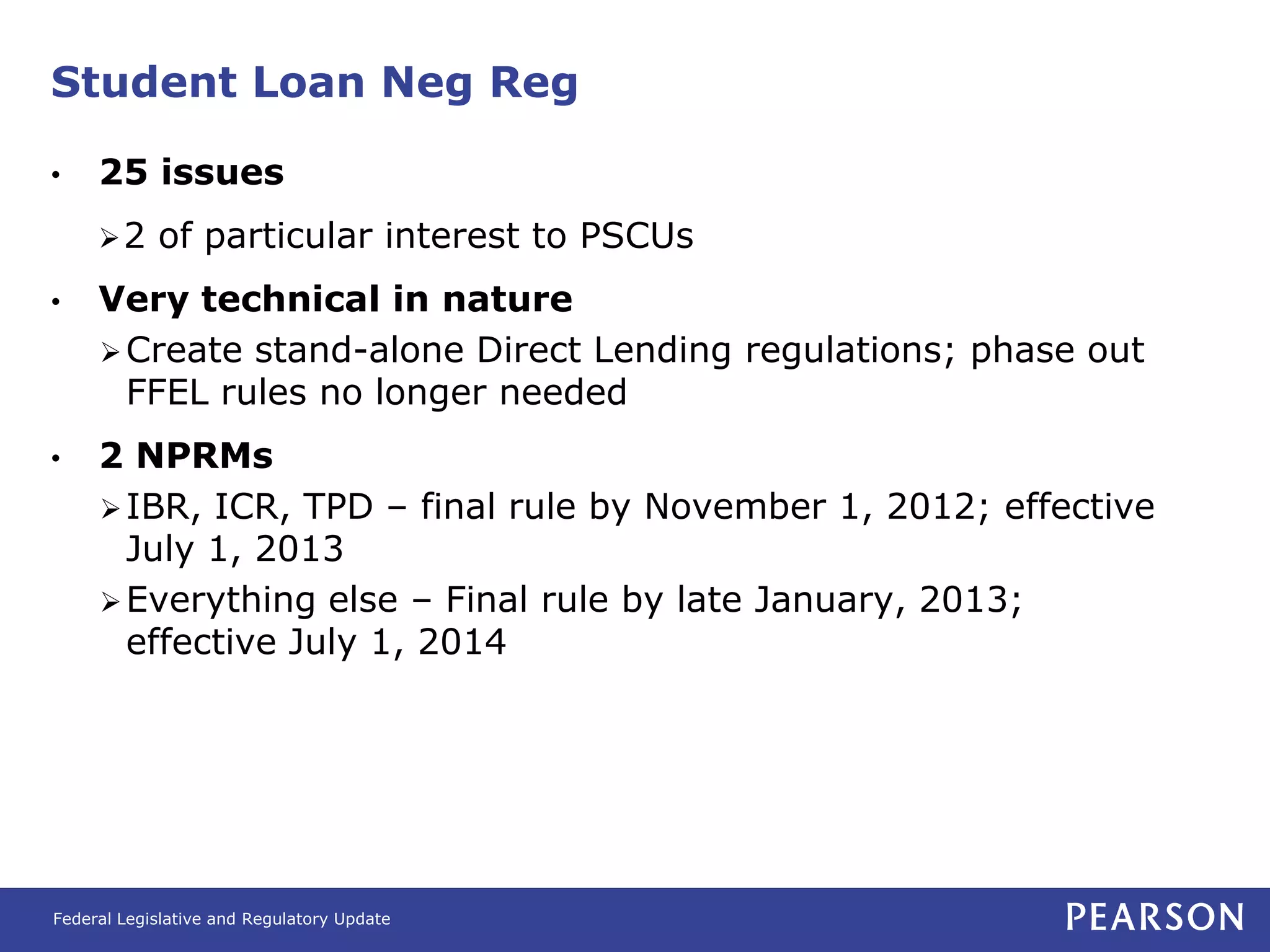
Student Loan Neg Reg

•    25 issues
     2     of particular interest to PSCUs
•    Very technical in nature
      Create stand-alone Direct Lending regulations; phase out
       FFEL rules no longer needed
•    2 NPRMs
      IBR, ICR, TPD – final rule by November 1, 2012; effective
       July 1, 2013
      Everything else – Final rule by late January, 2013;
       effective July 1, 2014


Federal Legislative and Regulatory Update
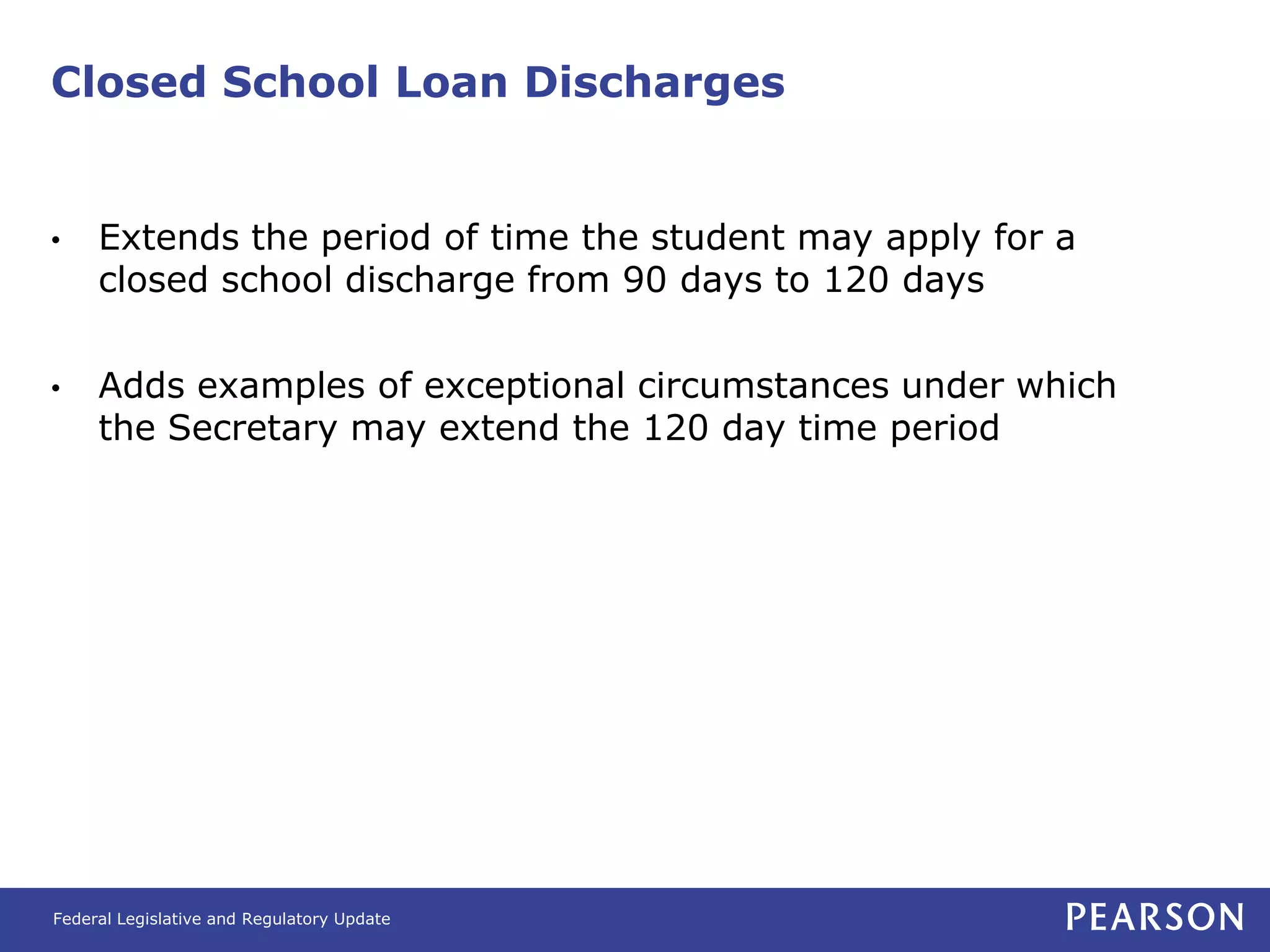
Closed School Loan Discharges


•    Extends the period of time the student may apply for a
     closed school discharge from 90 days to 120 days

•    Adds examples of exceptional circumstances under which
     the Secretary may extend the 120 day time period


Federal Legislative and Regulatory Update
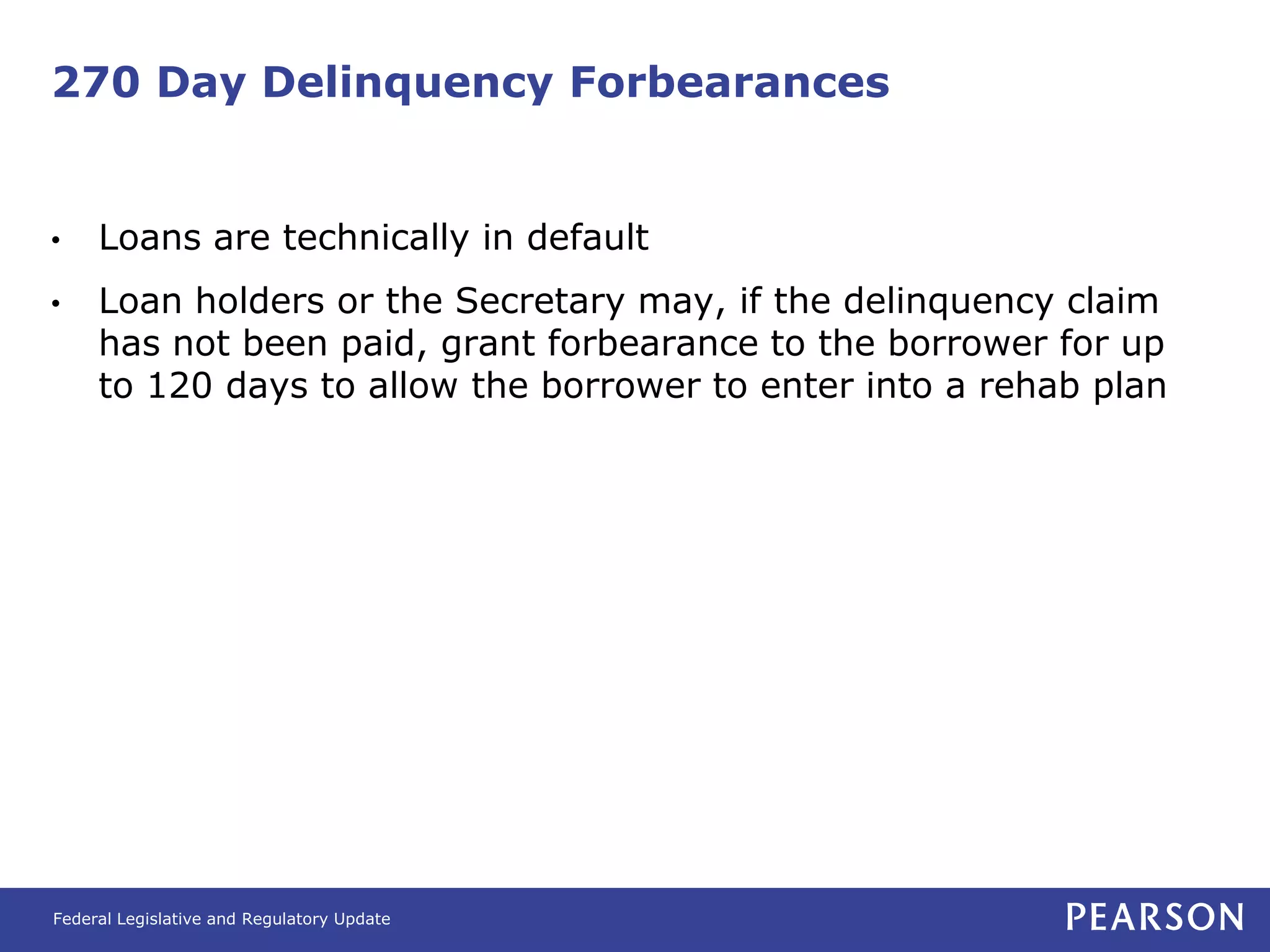
270 Day Delinquency Forbearances


•    Loans are technically in default
•    Loan holders or the Secretary may, if the delinquency claim
     has not been paid, grant forbearance to the borrower for up
     to 120 days to allow the borrower to enter into a rehab plan


Federal Legislative and Regulatory Update
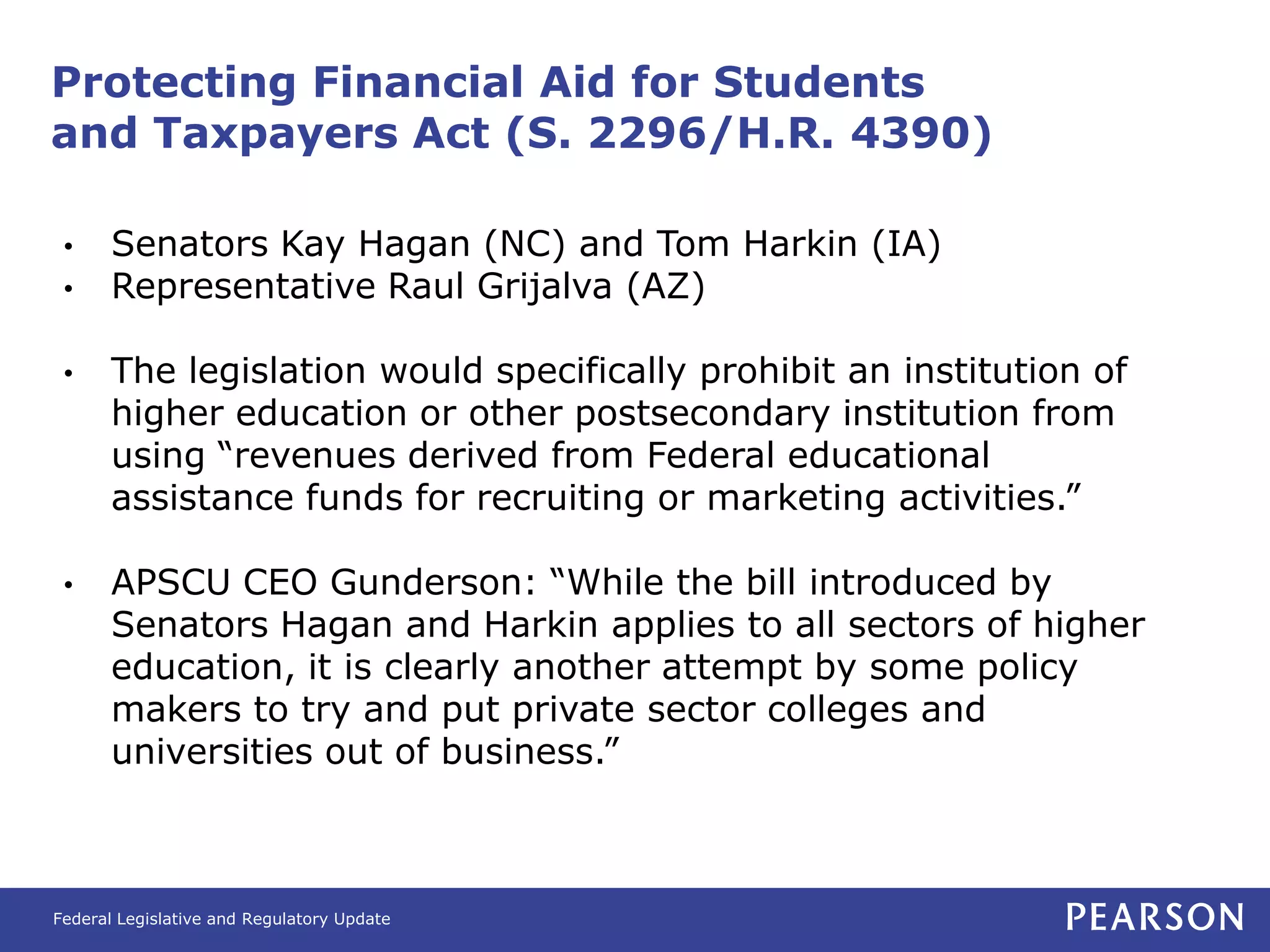
Protecting Financial Aid for Students
and Taxpayers Act (S. 2296/H.R. 4390)

 •     Senators Kay Hagan (NC) and Tom Harkin (IA)
 •     Representative Raul Grijalva (AZ)

 •     The legislation would specifically prohibit an institution of
       higher education or other postsecondary institution from
       using “revenues derived from Federal educational
       assistance funds for recruiting or marketing activities.”

 •     APSCU CEO Gunderson: “While the bill introduced by
       Senators Hagan and Harkin applies to all sectors of higher
       education, it is clearly another attempt by some policy
       makers to try and put private sector colleges and
       universities out of business.”


Federal Legislative and Regulatory Update
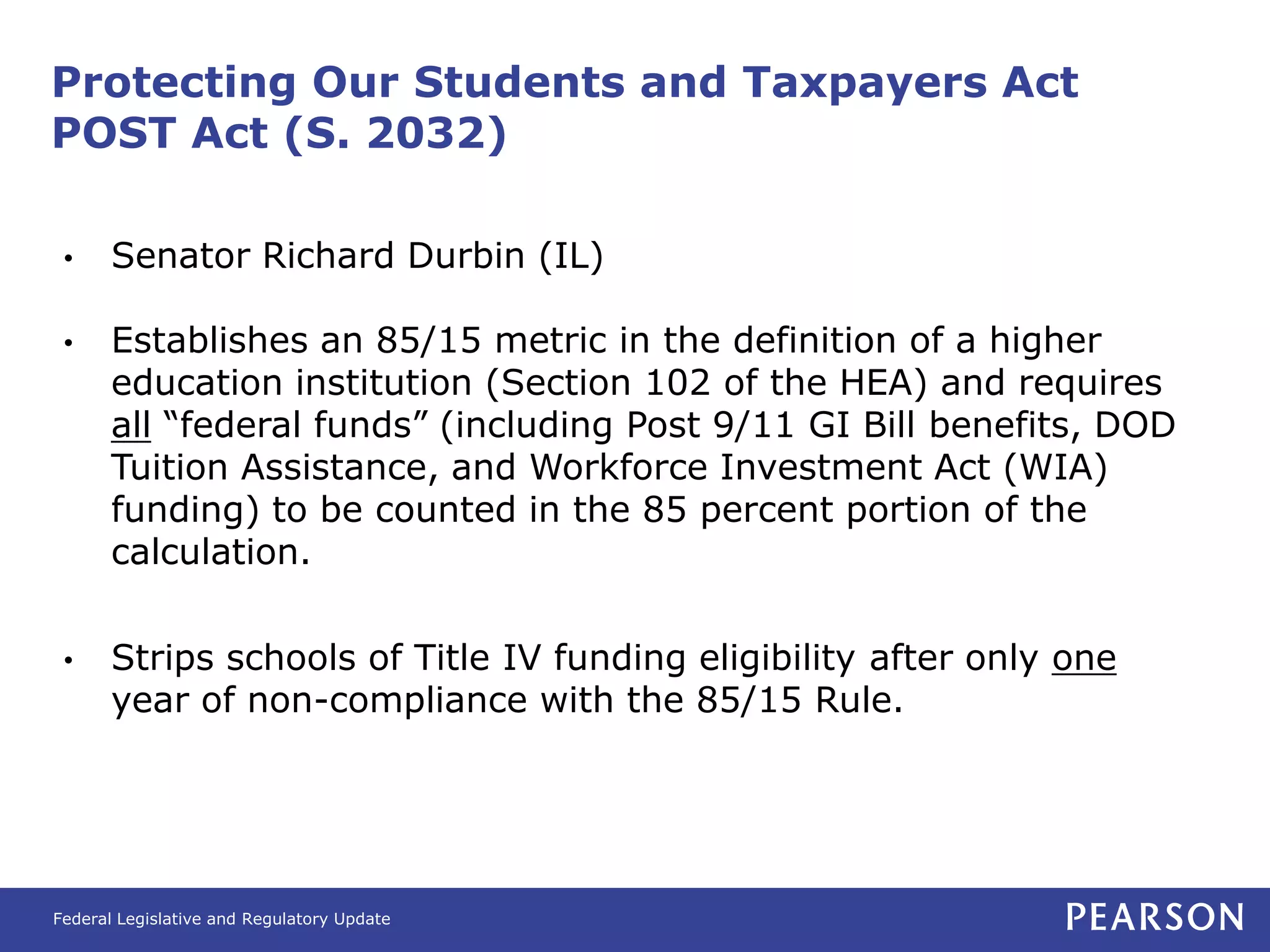
Protecting Our Students and Taxpayers Act
POST Act (S. 2032)

 •     Senator Richard Durbin (IL)

 •     Establishes an 85/15 metric in the definition of a higher
       education institution (Section 102 of the HEA) and requires
       all “federal funds” (including Post 9/11 GI Bill benefits, DOD
       Tuition Assistance, and Workforce Investment Act (WIA)
       funding) to be counted in the 85 percent portion of the
       calculation.

 •     Strips schools of Title IV funding eligibility after only one
       year of non-compliance with the 85/15 Rule.


Federal Legislative and Regulatory Update
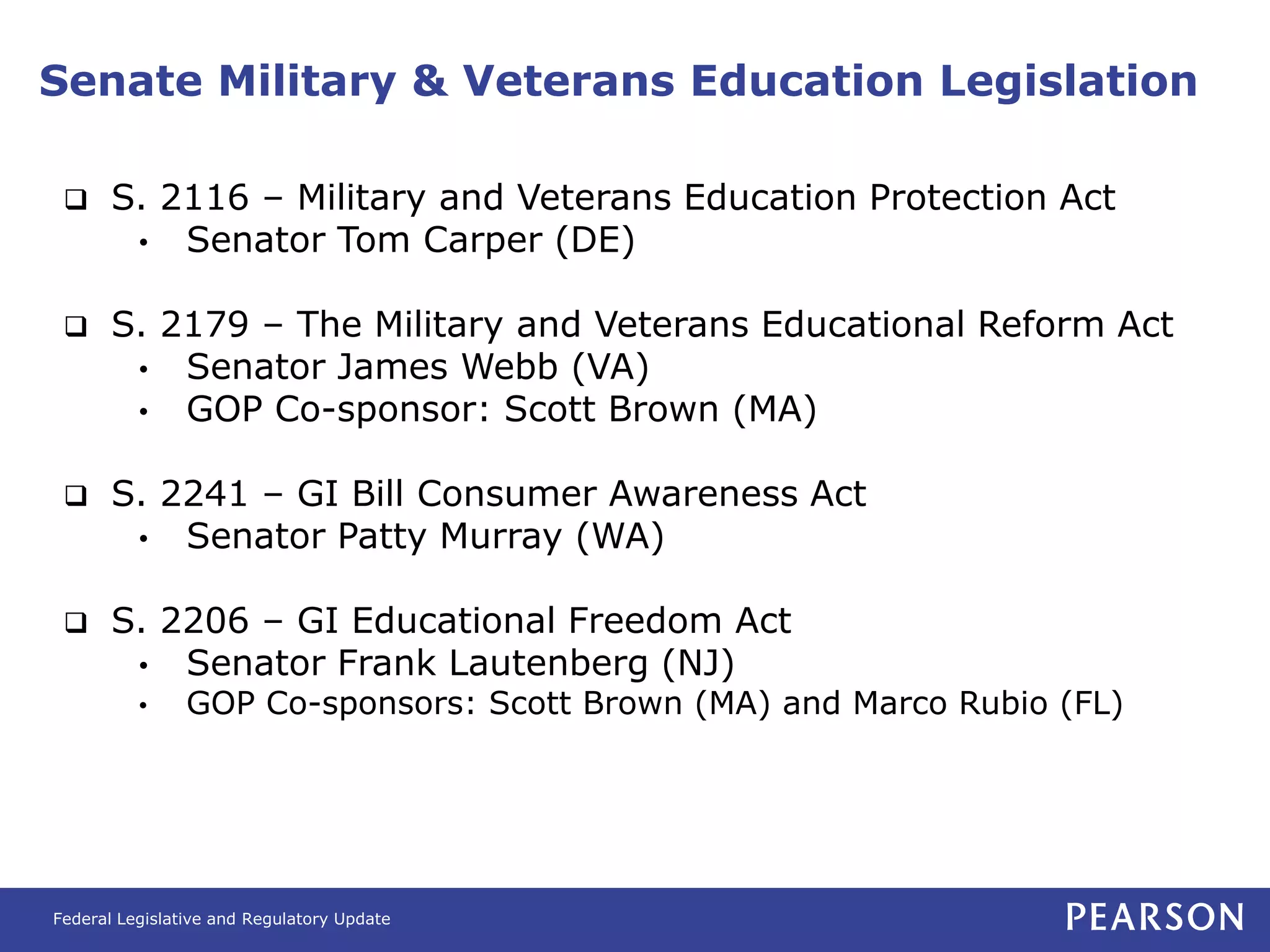
Senate Military & Veterans Education Legislation

      S. 2116 – Military and Veterans Education Protection Act
        • Senator Tom Carper (DE)


      S. 2179 – The Military and Veterans Educational Reform Act
        • Senator James Webb (VA)
        • GOP Co-sponsor: Scott Brown (MA)


      S. 2241 – GI Bill Consumer Awareness Act
        • Senator Patty Murray (WA)


      S. 2206 – GI Educational Freedom Act
        • Senator Frank Lautenberg (NJ)
          •     GOP Co-sponsors: Scott Brown (MA) and Marco Rubio (FL)


Federal Legislative and Regulatory Update
Improving Transparency of Education
Opportunities for Veterans Act (H.R. 4057)


 •     Rep. Gus Bilirakis

 Key components:

 •     Tracking Complaints and Enhanced Counseling

 •     Bill was the result of a dialogue with the Veterans of Foreign
       Wars (VFW) that result in a coalition letter to Capitol Hill
       and the White House.

 •     Steve Gunderson testified in support of the bill on March
       8th.


Federal Legislative and Regulatory Update
STATE AUTHORIZATION/CLOCK HOUR

S. 1297 (Burr/Nelson) and H.R. 2117 (Foxx)
•     Repeals new Department of Education regulations
      determining whether a school is eligible to participate in
      programs under the Higher Education Act of 1965 (HEA) by
      (1) requiring institutions of higher education and
      postsecondary vocational institutions (except religious
      schools) to be legally authorized by the state in which they
      are situated, (2) delineating what such legal authorization
      requires of states and schools, and (3) defining "credit
      hour."
Status:
•     House of Representative approved H.R. 2117 on 2/28.
•     Vote: 303-114 (69 Democratic Ayes)


Federal Legislative and Regulatory Update
CLOCK HOUR ISSUE

•    OPE staff are considering an interpretation that if a state has
     any requirement that an institution provide any information
     to it relating to the number of clock hours in a
     program, even if solely to confirm that the program includes
     sufficient hours to comply with the state’s clock to credit
     hour conversion ratio, that the program will be considered
     to be a clock hour program for federal aid purposes.

•    In this interpretation, the Department of Education (“DOE”)
     will not defer to the state’s interpretation as to whether it
     considers the program to be required to measure student
     progress in clock hours.


Federal Legislative and Regulatory Update
STATE TRENDS

•    State Attorney General Advocacy: Kentucky Attorney
     General Jack Conway Working Group
•    Pressure on State Legislatures to become more active due
     to State Authorization rule and State AG activity
•    State and local GR/PR efforts and community outreach by
     sector continues to be critical


Federal Legislative and Regulatory Update
Federal Fiscal Interests Driving Policy
Decisions


  "Show Me The Money!"


Federal Legislative and Regulatory Update
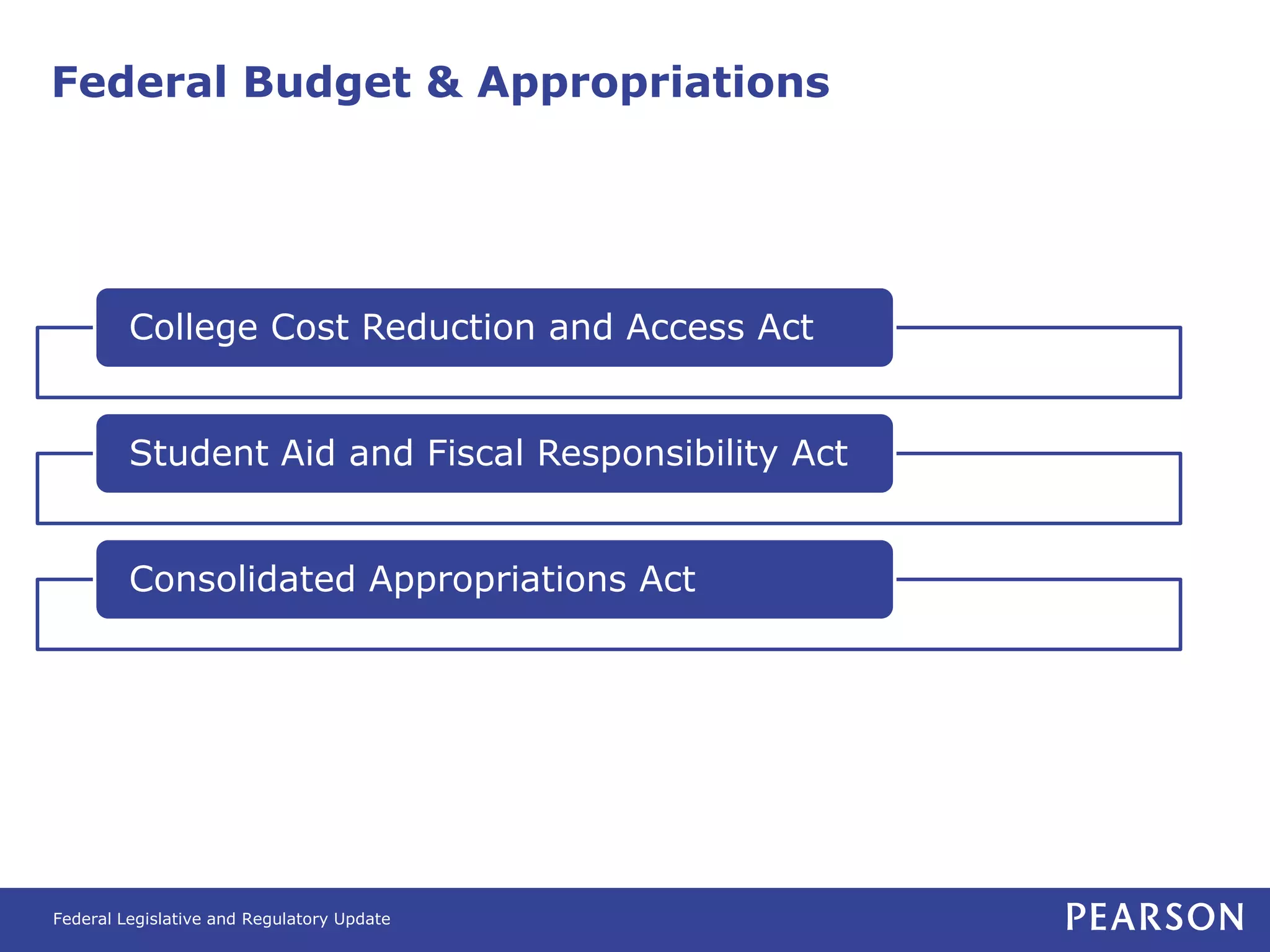
Federal Budget & Appropriations


         College Cost Reduction and Access Act


         Student Aid and Fiscal Responsibility Act


         Consolidated Appropriations Act


Federal Legislative and Regulatory Update
Federal Budget & Approps.

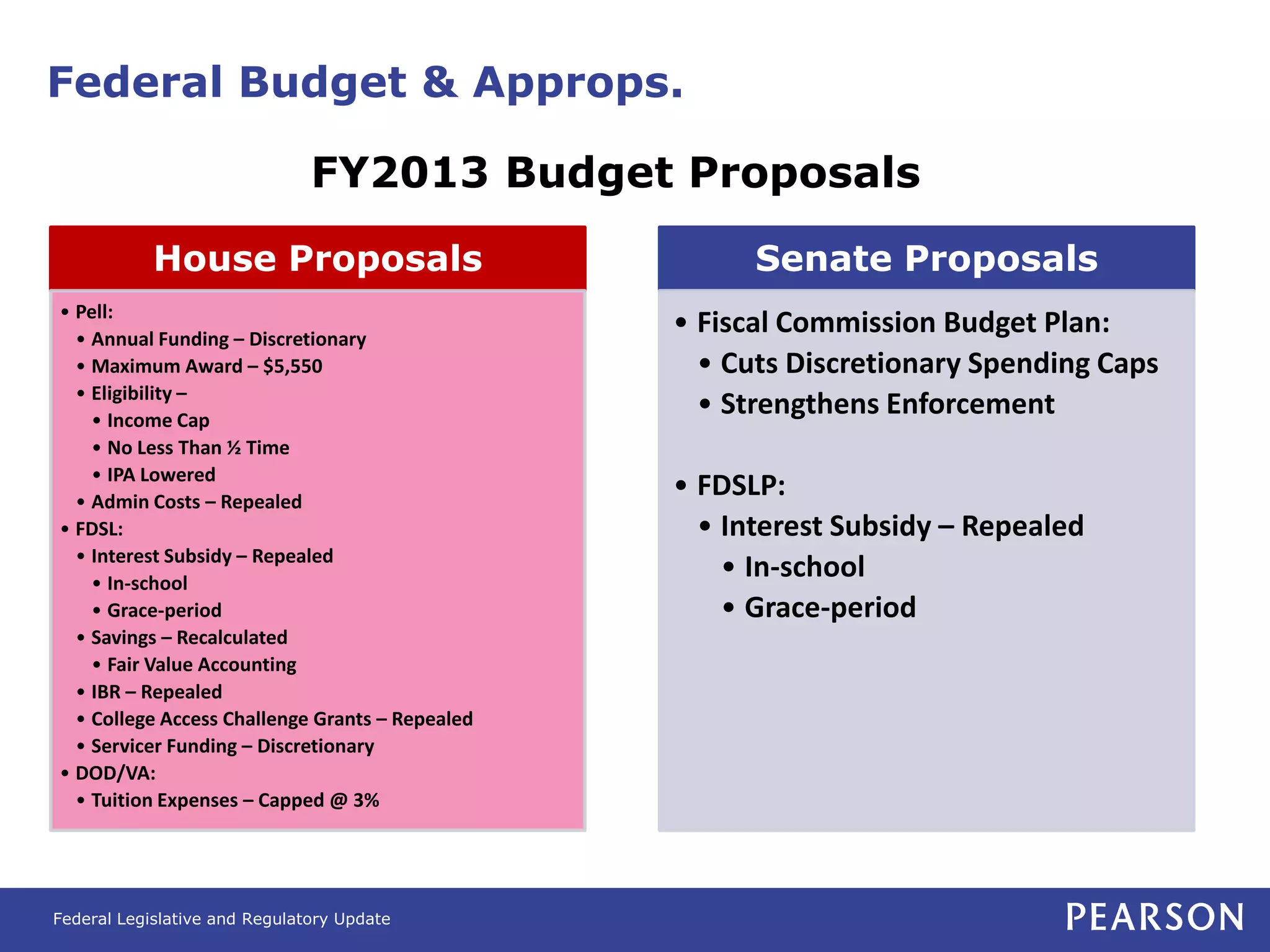
                               FY2013 Budget Proposals
            House Proposals                            Senate Proposals
• Pell:
  • Annual Funding – Discretionary
                                                 • Fiscal Commission Budget Plan:
  • Maximum Award – $5,550                         • Cuts Discretionary Spending Caps
  • Eligibility –
    • Income Cap
                                                   • Strengthens Enforcement
    • No Less Than ½ Time
    • IPA Lowered
  • Admin Costs – Repealed
                                                 • FDSLP:
• FDSL:                                            • Interest Subsidy – Repealed
  • Interest Subsidy – Repealed
    • In-school
                                                     • In-school
    • Grace-period                                   • Grace-period
  • Savings – Recalculated
    • Fair Value Accounting
  • IBR – Repealed
  • College Access Challenge Grants – Repealed
  • Servicer Funding – Discretionary
• DOD/VA:
  • Tuition Expenses – Capped @ 3%


Federal Legislative and Regulatory Update
Federal Budget & Approps


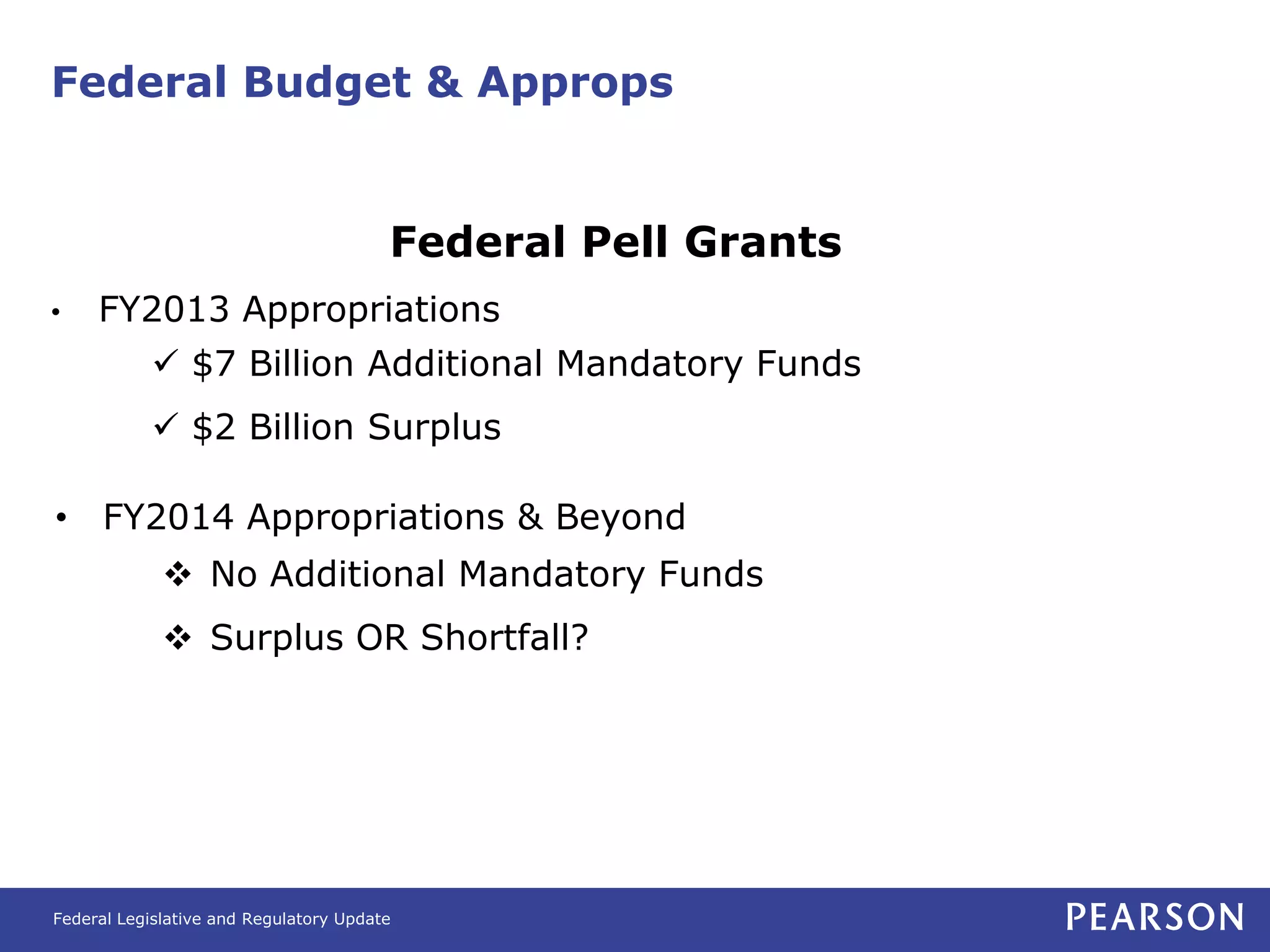
                                        Federal Pell Grants
•    FY2013 Appropriations
            $7 Billion Additional Mandatory Funds
            $2 Billion Surplus

• FY2014 Appropriations & Beyond
              No Additional Mandatory Funds
              Surplus OR Shortfall?


Federal Legislative and Regulatory Update
Federal Budget & Approps.


                          Current Funding of
                          Federal Pell Grants
                            Unsustainable


Federal Legislative and Regulatory Update
Consequences of Federal Fiscal Decisions


  Federal Pell Grant
    • Establishment & Removal of Year-Round Pell Grants
    • Revisions of Auto-zero and Income Protection Allowance
    • Others


  Student Loan Interest
    • 2 Yr. Elimination of Grace Period


Federal Legislative and Regulatory Update
URGENT - July 1, 2012

                                Elimination of ATB


                                            Doubling of
                  Student Loan Interest Rates


Federal Legislative and Regulatory Update
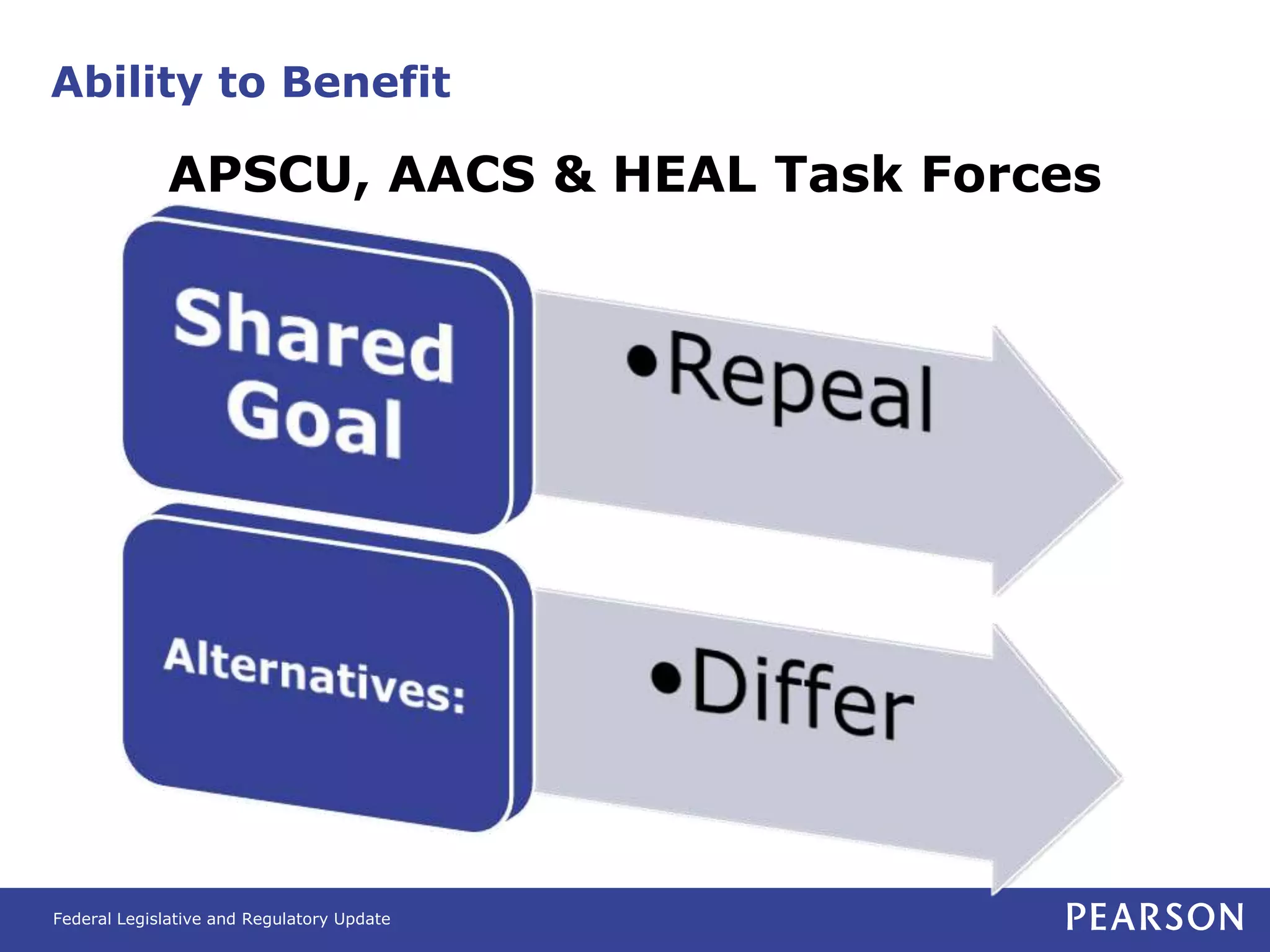
Ability to Benefit

             APSCU, AACS & HEAL Task Forces


Federal Legislative and Regulatory Update
Student Loan Interest Rate


Federal Legislative and Regulatory Update
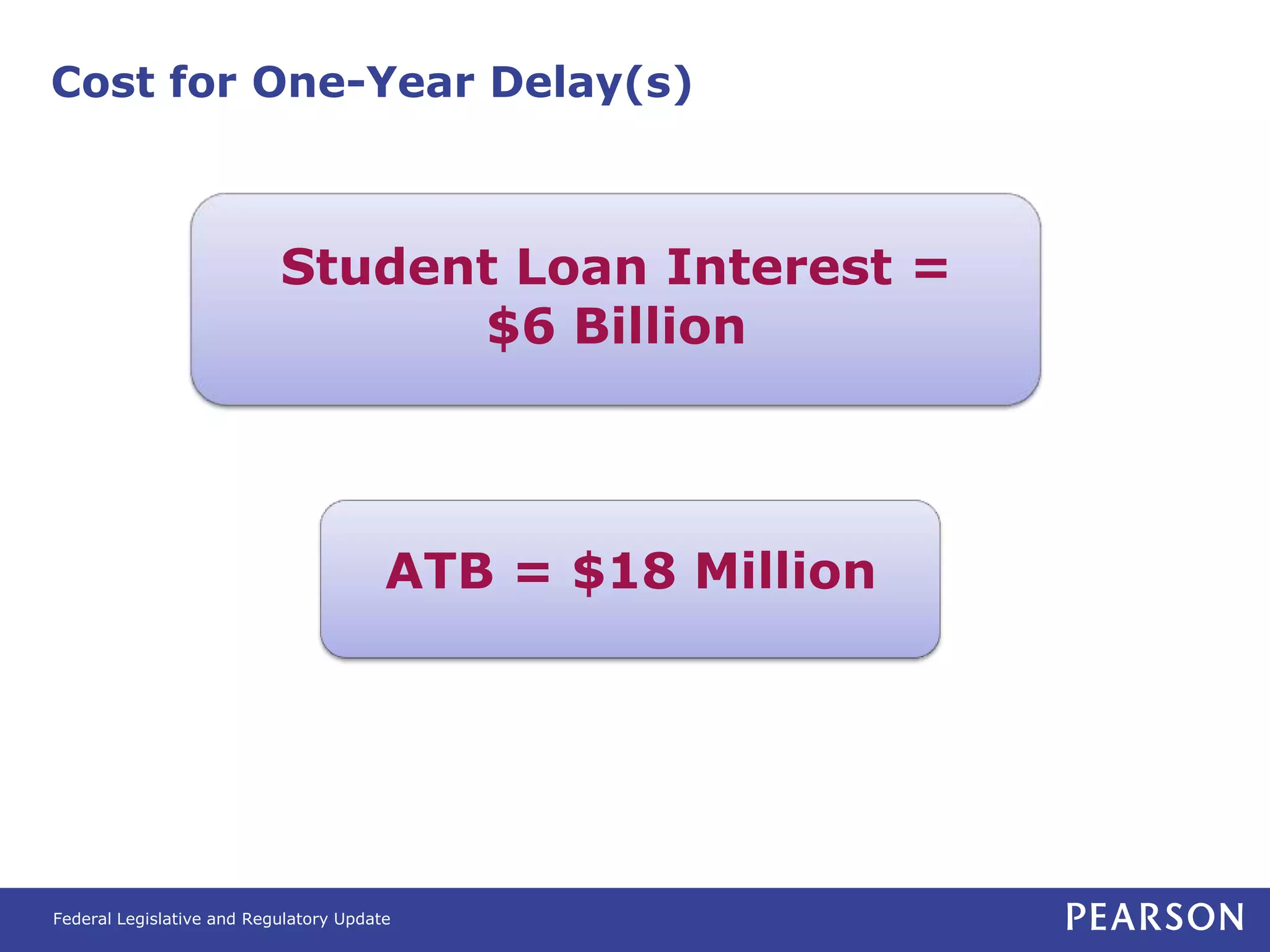
Cost for One-Year Delay(s)


                           Student Loan Interest =
                                 $6 Billion


                                        ATB = $18 Million


Federal Legislative and Regulatory Update
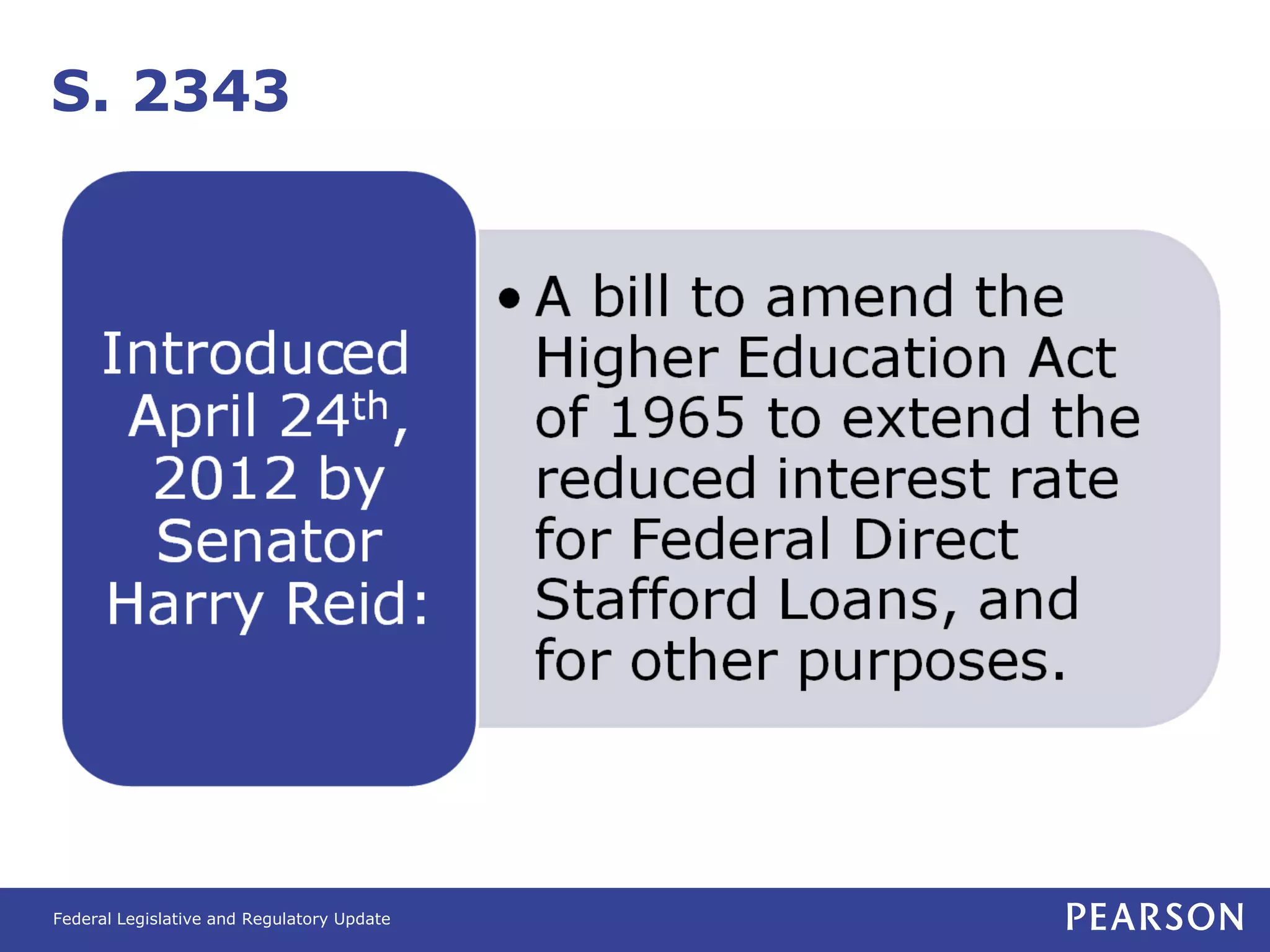
S. 2343


Federal Legislative and Regulatory Update
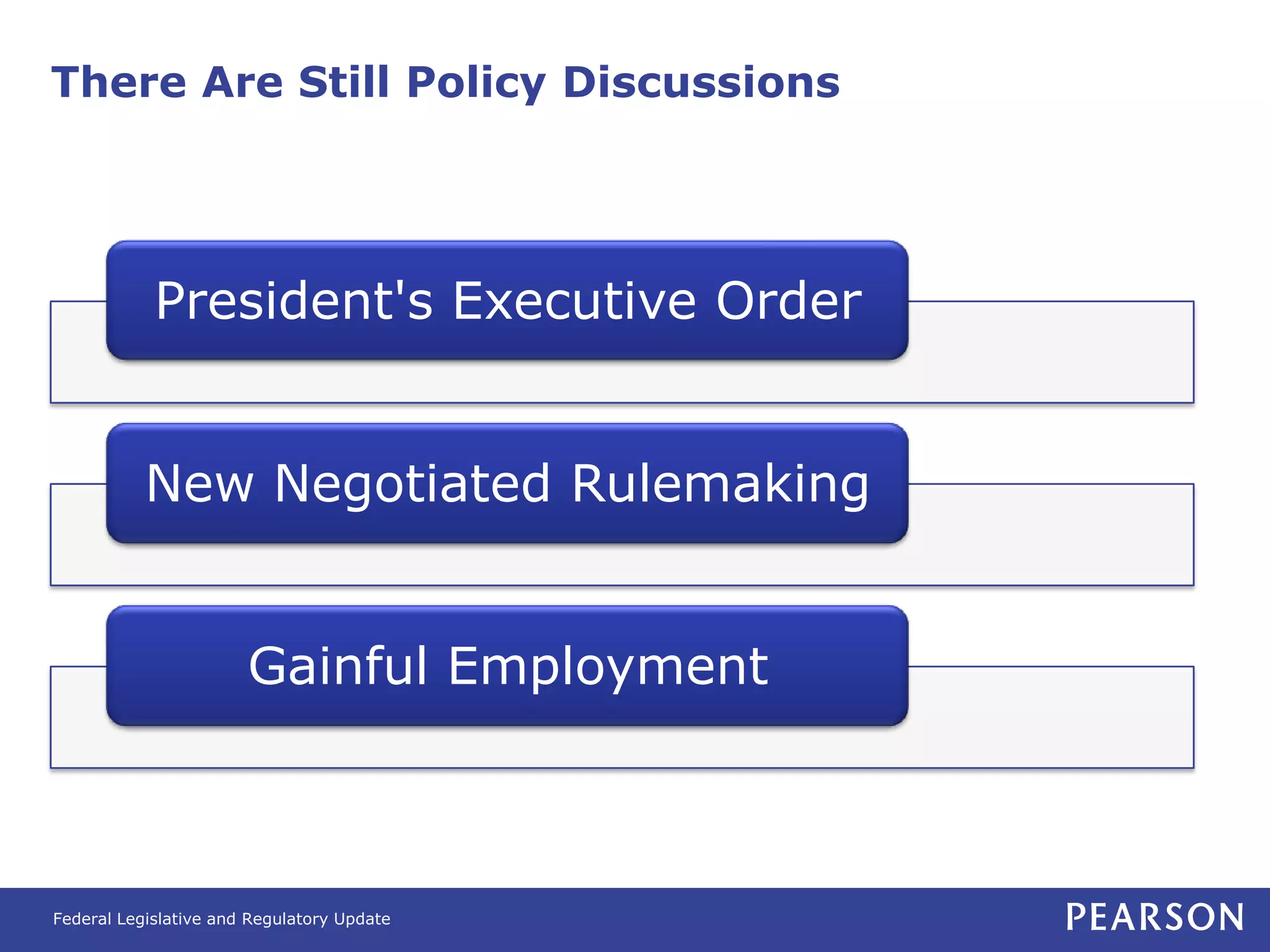
There Are Still Policy Discussions


            President's Executive Order


           New Negotiated Rulemaking


                       Gainful Employment


Federal Legislative and Regulatory Update
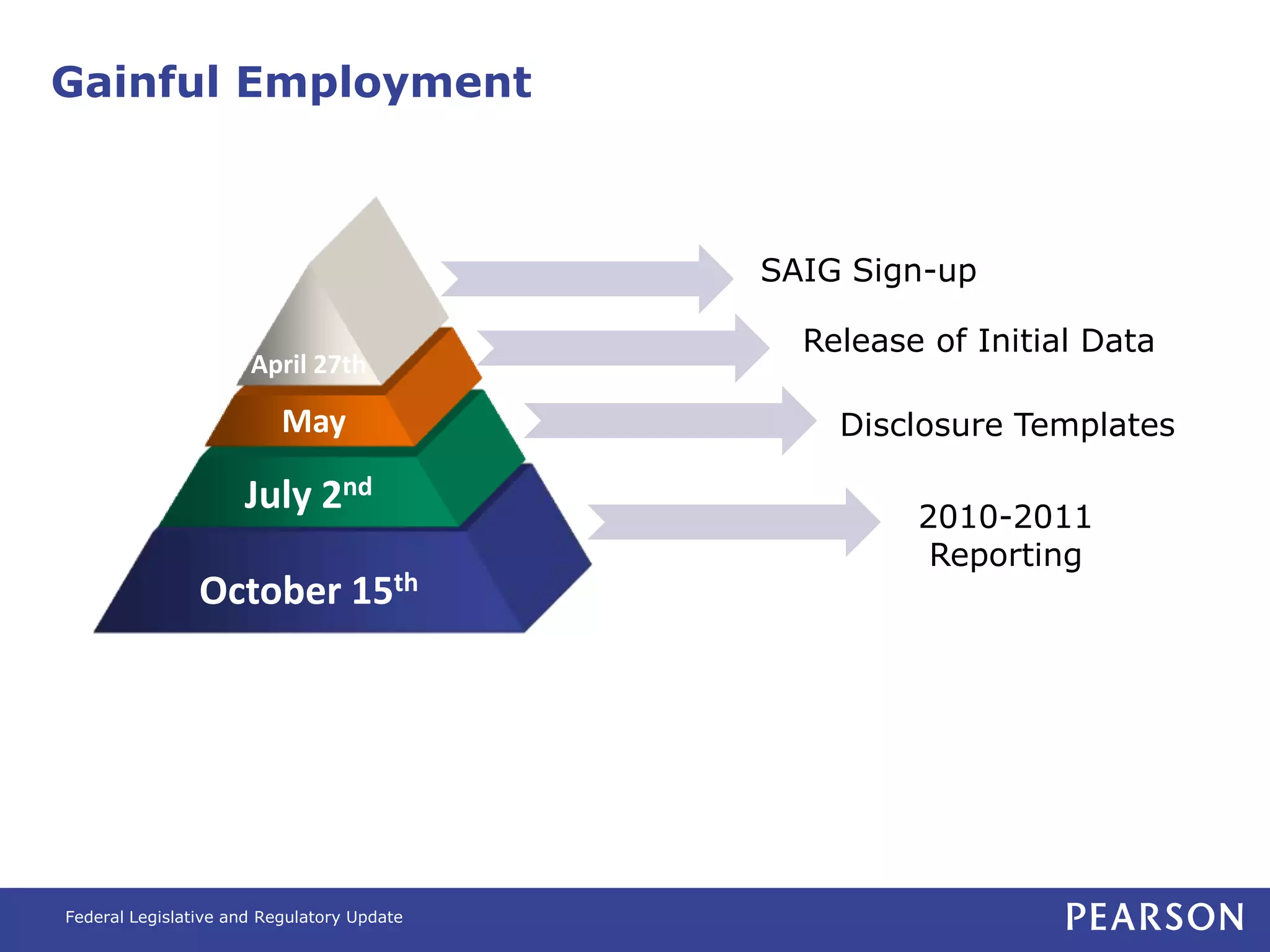
Gainful Employment


                                            SAIG Sign-up

                                              Release of Initial Data
                      April 27th

                          May                   Disclosure Templates

                     July 2nd                        2010-2011
                                                      Reporting
                October 15th


Federal Legislative and Regulatory Update
What Else Can We Expect


  Near-term
    • More Introduced Legislation
    • More Hearings & Mark Ups
    • Possible Enacted Legislation


  Longer-term
    • HEA Reauthorization
    • Budget Reconciliation
    • Pell Grant Cliff


Federal Legislative and Regulatory Update
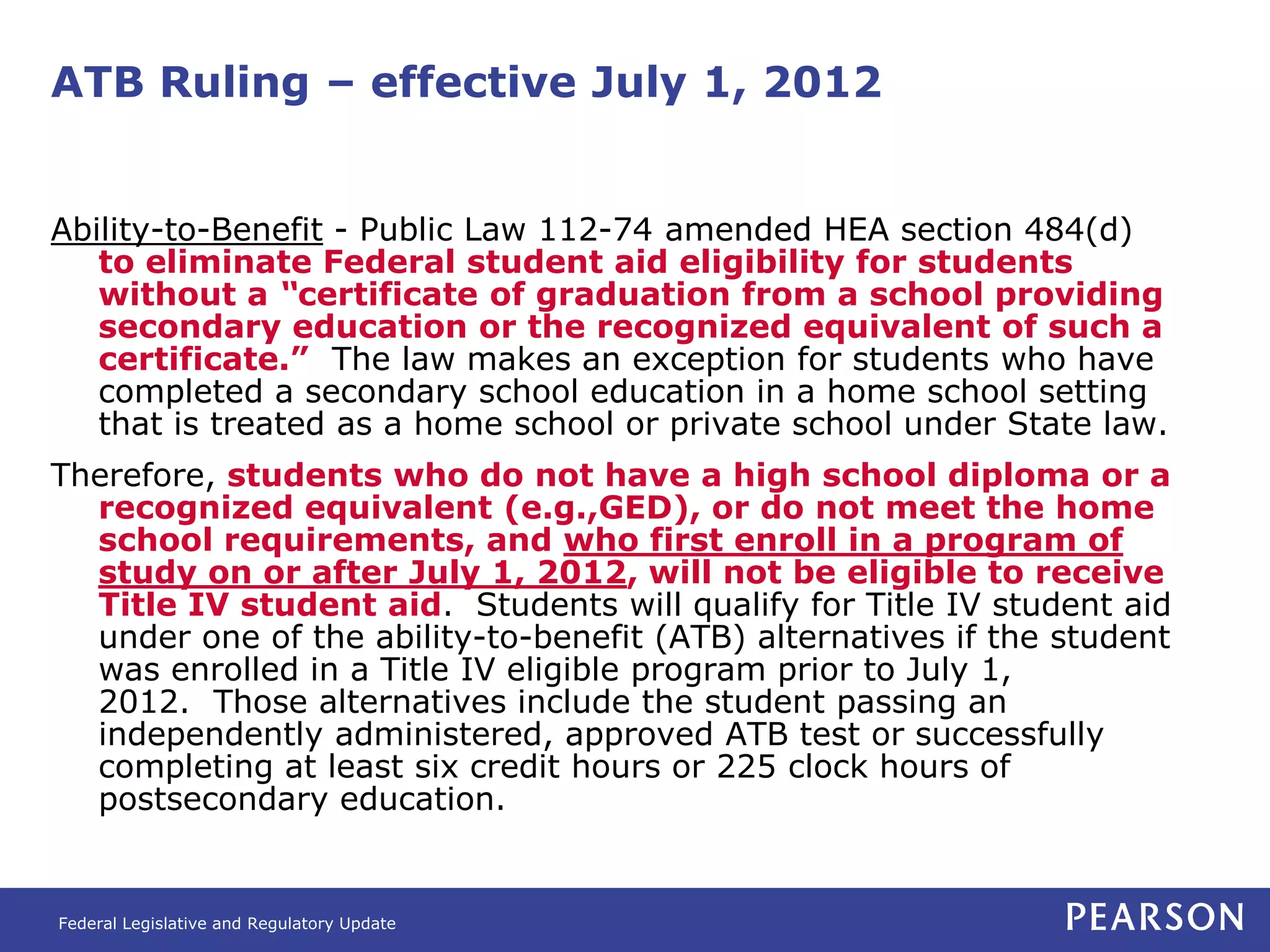
ATB Ruling – effective July 1, 2012


Ability-to-Benefit - Public Law 112-74 amended HEA section 484(d)
   to eliminate Federal student aid eligibility for students
   without a “certificate of graduation from a school providing
   secondary education or the recognized equivalent of such a
   certificate.” The law makes an exception for students who have
   completed a secondary school education in a home school setting
   that is treated as a home school or private school under State law.
Therefore, students who do not have a high school diploma or a
  recognized equivalent (e.g.,GED), or do not meet the home
  school requirements, and who first enroll in a program of
  study on or after July 1, 2012, will not be eligible to receive
  Title IV student aid. Students will qualify for Title IV student aid
  under one of the ability-to-benefit (ATB) alternatives if the student
  was enrolled in a Title IV eligible program prior to July 1,
  2012. Those alternatives include the student passing an
  independently administered, approved ATB test or successfully
  completing at least six credit hours or 225 clock hours of
  postsecondary education.


Federal Legislative and Regulatory Update
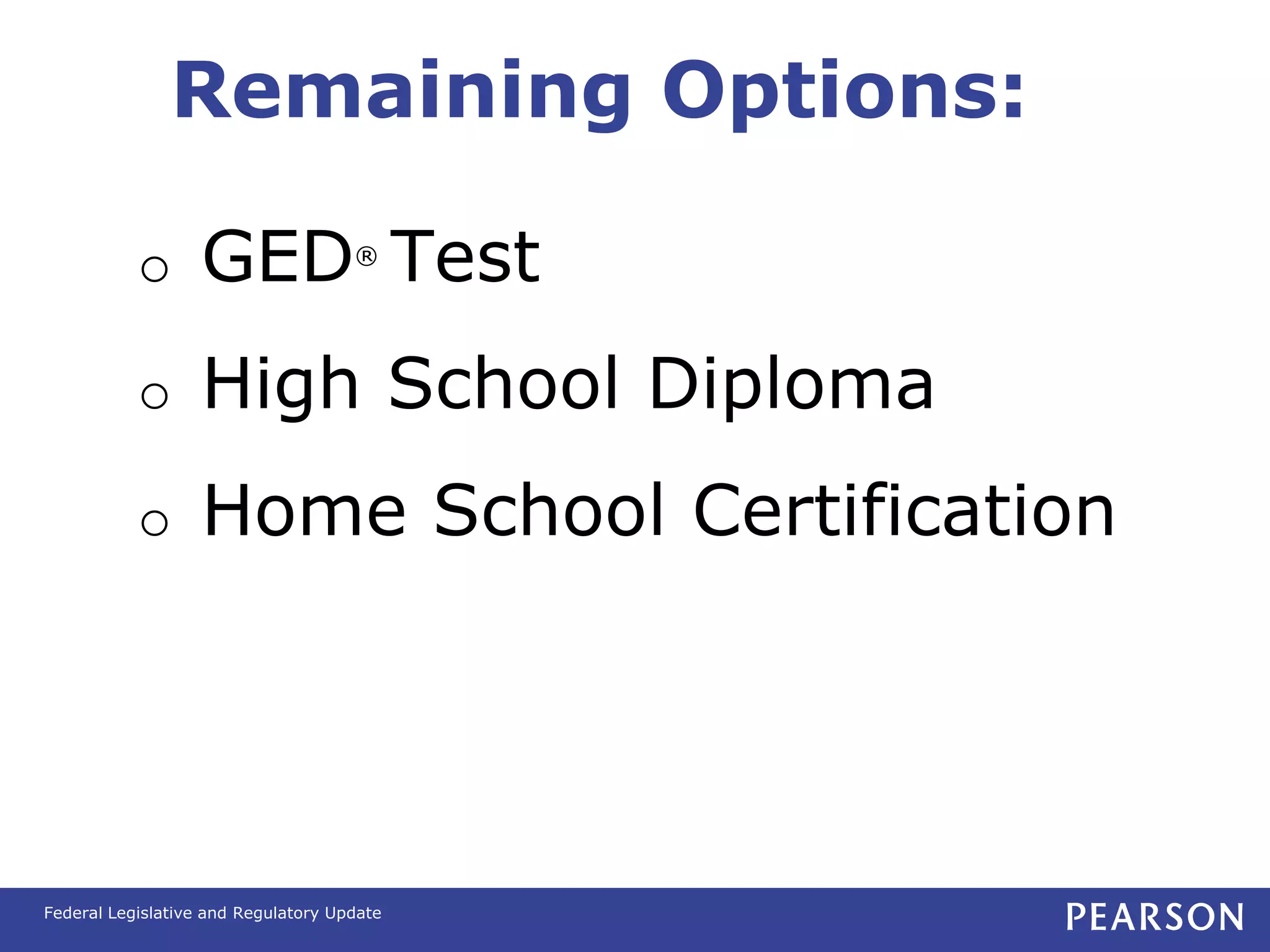
Remaining Options:

           o       GED Test          ®


           o       High School Diploma
           o       Home School Certification


Federal Legislative and Regulatory Update
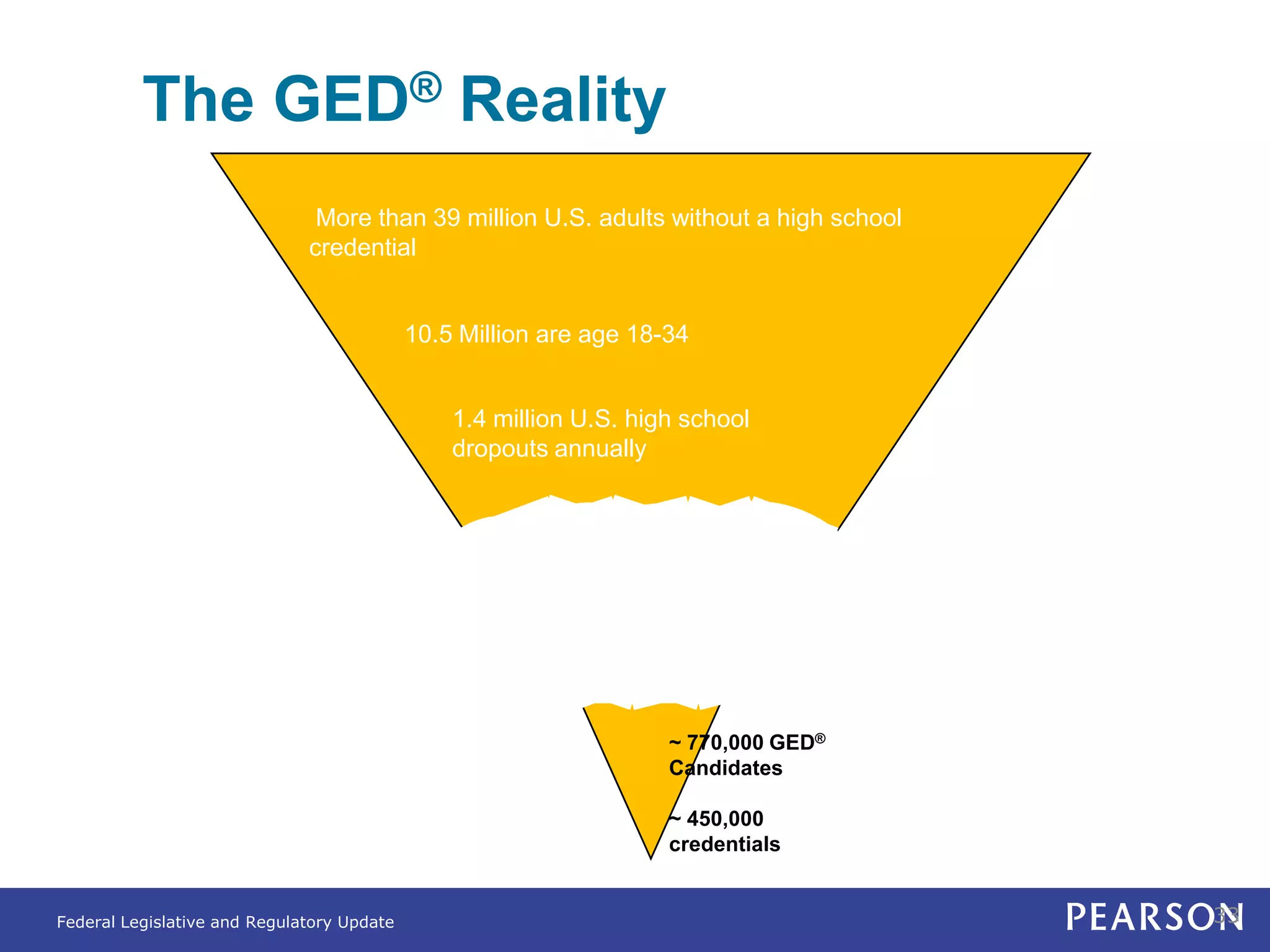
The GED® Reality
                               More than 39 million U.S. adults without a high school
                              credential


                                            10.5 Million are age 18-34


                                                1.4 million U.S. high school
                                                dropouts annually


                                                                    ~ 770,000 GED®
                                                                    Candidates

                                                                    ~ 450,000
                                                                    credentials


Federal Legislative and Regulatory Update                                               33
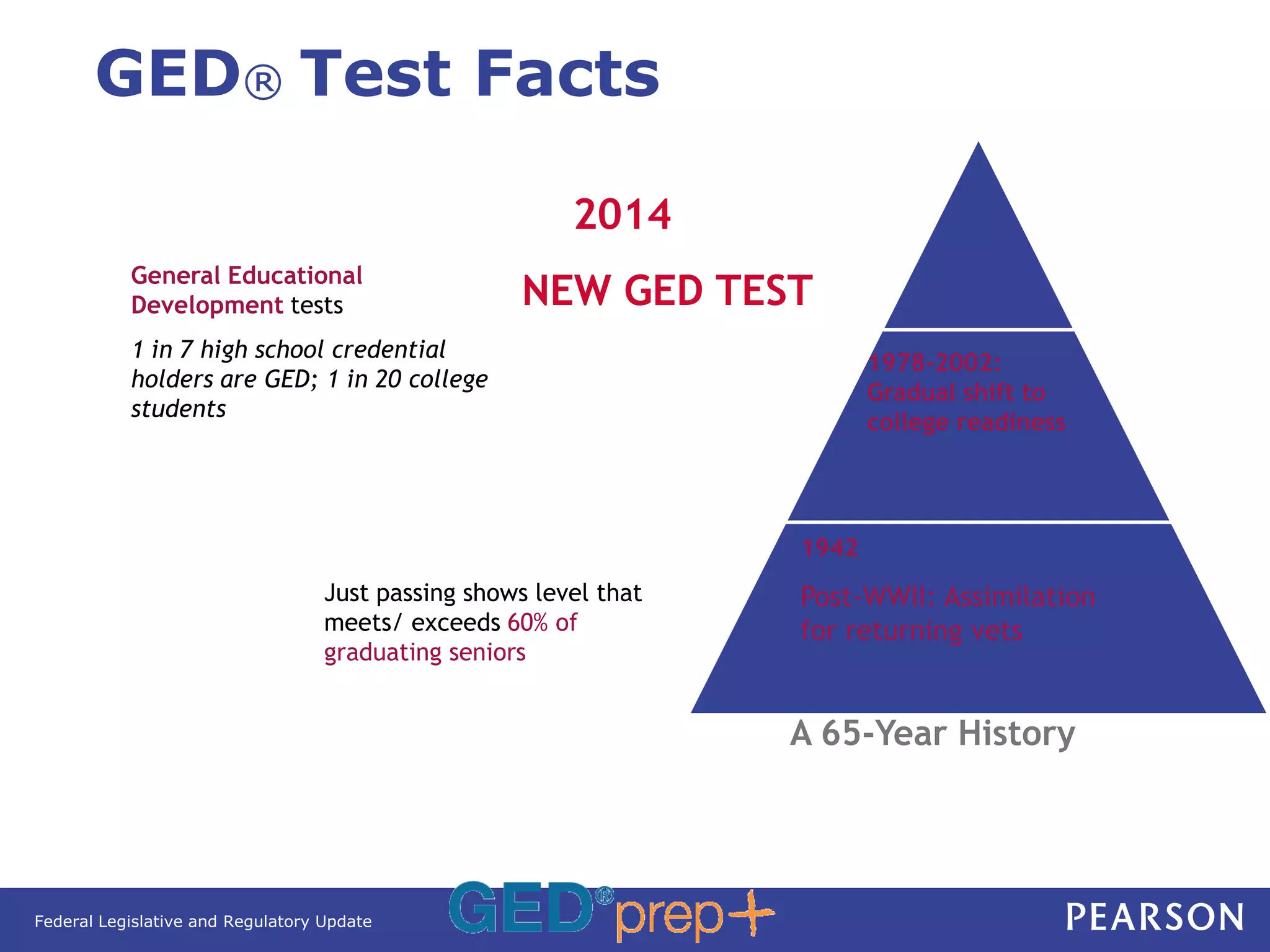
GED® Test Facts

                                                         2014
           General Educational
           Development tests                        NEW GED TEST
           1 in 7 high school credential
                                                                          1978-2002:
           holders are GED; 1 in 20 college
                                                                          Gradual shift to
           students
                                                                          college readiness


                                                                   1942
                                   Just passing shows level that   Post-WWII: Assimilation
                                   meets/ exceeds 60% of           for returning vets
                                   graduating seniors


                                                                   A 65-Year History


Federal Legislative and Regulatory Update
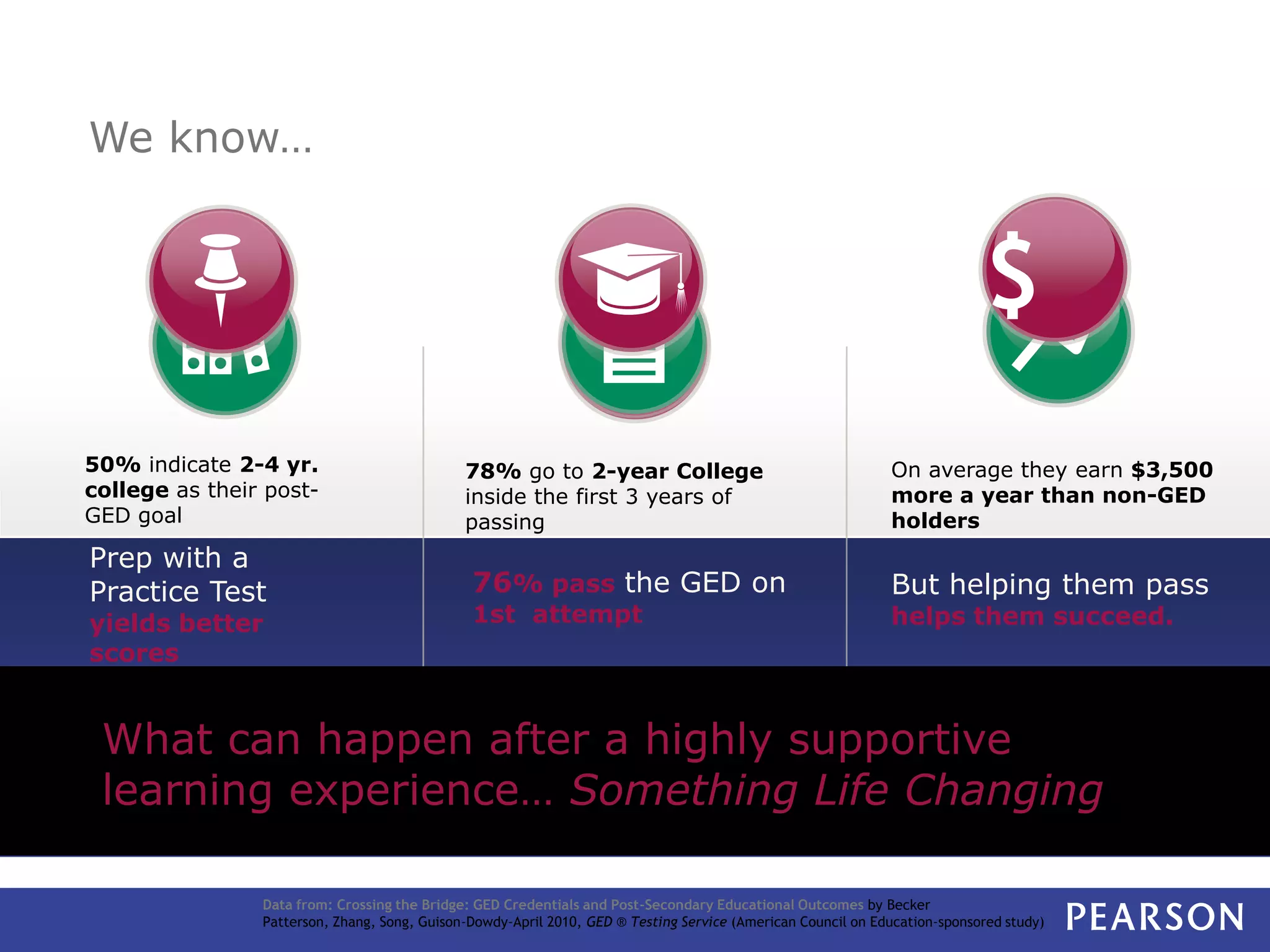
We know…


                                                                                                                             $
50% indicate 2-4 yr.                          78% go to 2-year College                                        On average they earn $3,500
college as their post-                        inside the first 3 years of                                     more a year than non-GED
GED goal                                      passing                                                         holders
Prep with a
Practice Test                                  76% pass the GED on                                            But helping them pass
yields better                                  1st attempt                                                    helps them succeed.
scores


 What can happen after a highly supportive
 learning experience… Something Life Changing

                Data from: Crossing the Bridge: GED Credentials and Post-Secondary Educational Outcomes by Becker
                Patterson, Zhang, Song, Guison-Dowdy-April 2010, GED ® Testing Service (American Council on Education-sponsored study)
Operational Strategies for
 Implementing GED Prep Programs


Federal Legislative and Regulatory Update
Alternate program for schools with
 ATB students


Federal Legislative and Regulatory Update
Low-cost avenue for
  generating qualified leads


Federal Legislative and Regulatory Update
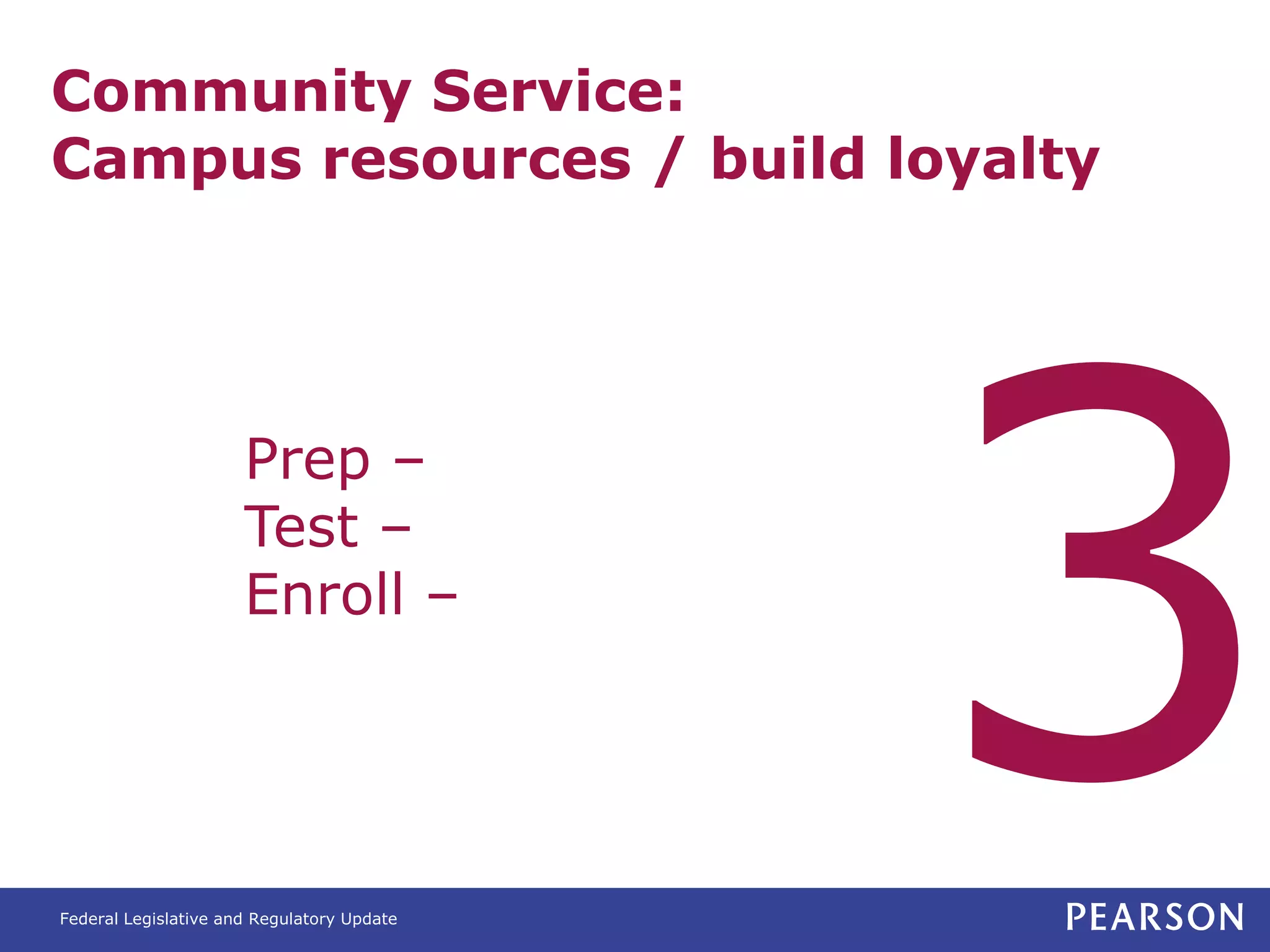
Community Service:
Campus resources / build loyalty


                      Prep –
                      Test –
                      Enroll –


Federal Legislative and Regulatory Update
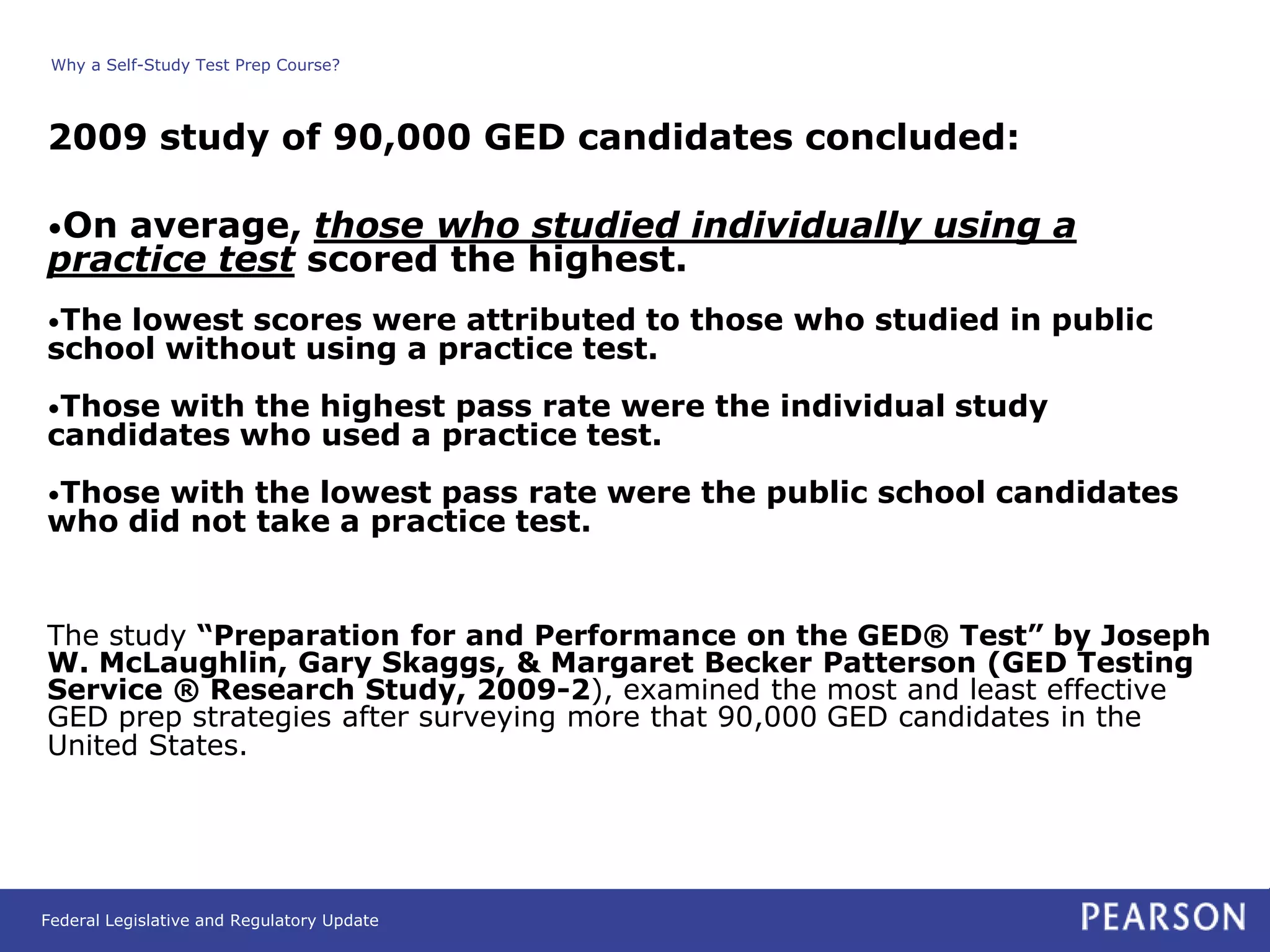
Why a Self-Study Test Prep Course?


2009 study of 90,000 GED candidates concluded:

•On average, those who studied individually using a
practice test scored the highest.
•Thelowest scores were attributed to those who studied in public
school without using a practice test.
•Those with the highest pass rate were the individual study
candidates who used a practice test.
•Those with the lowest pass rate were the public school candidates
who did not take a practice test.


The study “Preparation for and Performance on the GED® Test” by Joseph
W. McLaughlin, Gary Skaggs, & Margaret Becker Patterson (GED Testing
Service ® Research Study, 2009-2), examined the most and least effective
GED prep strategies after surveying more that 90,000 GED candidates in the
United States.


Federal Legislative and Regulatory Update
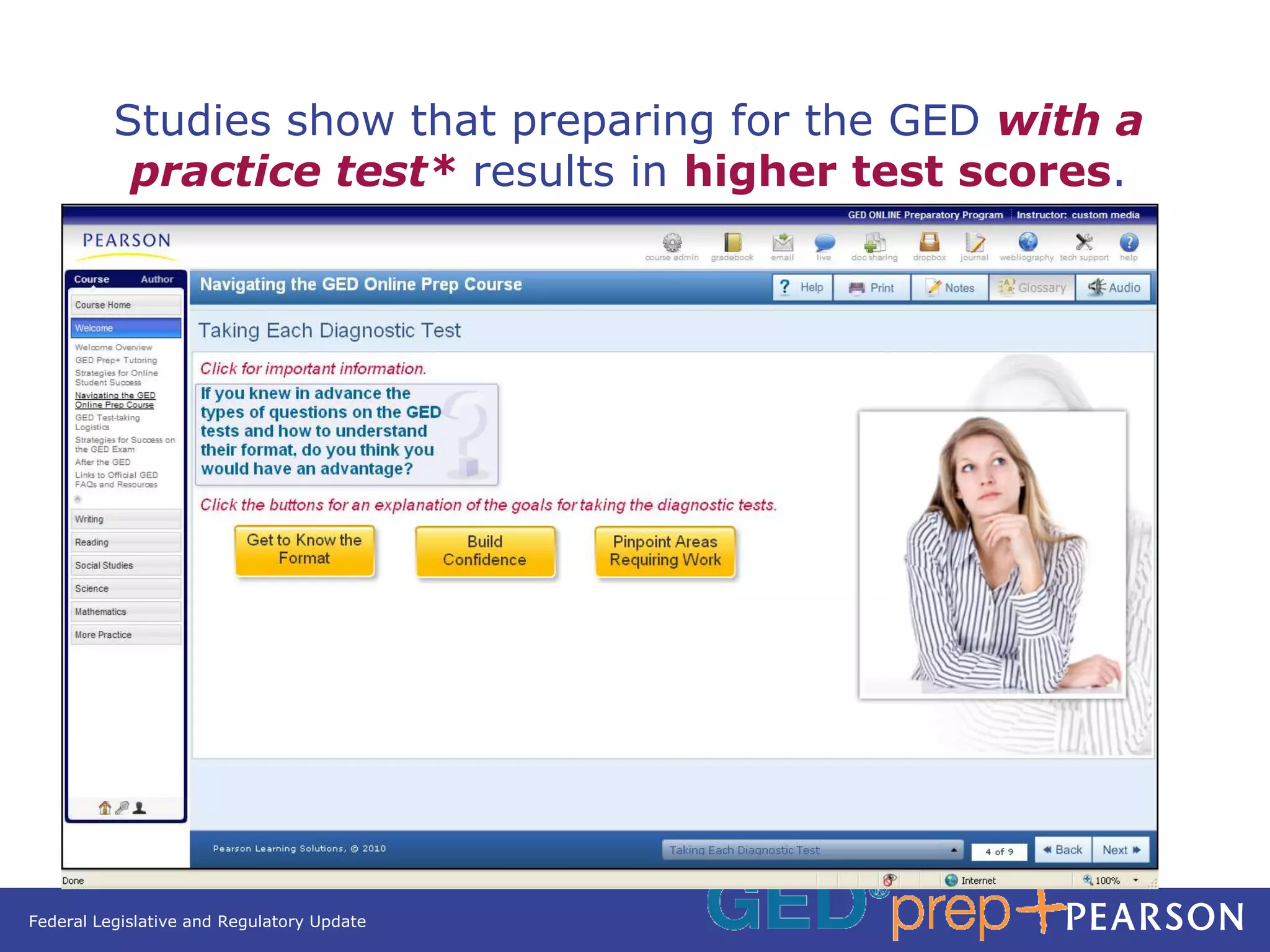
Studies show that preparing for the GED with a
           practice test* results in higher test scores.


Federal Legislative and Regulatory Update
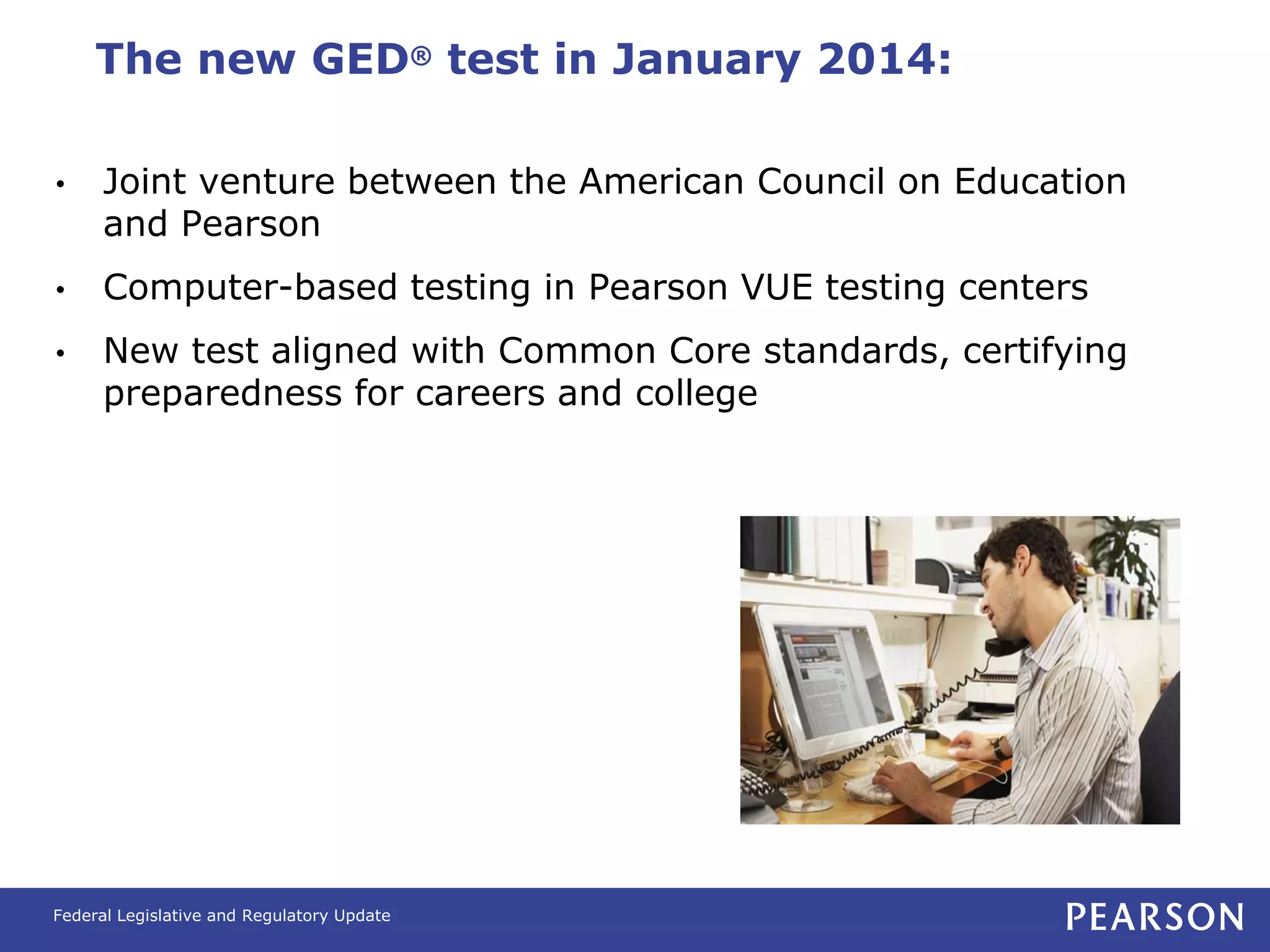
The new GED® test in January 2014:

•     Joint venture between the American Council on Education
      and Pearson
•     Computer-based testing in Pearson VUE testing centers
•     New test aligned with Common Core standards, certifying
      preparedness for careers and college


Federal Legislative and Regulatory Update
Online Resources
•     GED Testing Service website:

               – www.GEDtestingservice.com
•     Information about the new assessment:

               – www.GEDtestingservice.com/assessment
•     Information about fraudulent online programs – fake GED®
      programs and online high schools
                 – www.GEDtestingservice.com/fraud


Federal Legislative and Regulatory Update
Q&A


Federal Legislative and Regulatory Update
45 Presentation Title runs here l 00/00/00

Federal Legislative and Regulatory Update

  • 1.
    Federal Legislative and Regulatory Update Pearson Learning Summit – Spring 2012 The Phoenix Marriott Tempe at The Buttes Friday, April 27th 8:30 AM Federal Legislative and Regulatory Update
  • 3.
    Federal Legislative and RegulatoryUpdate Brian Newman, APSCU Brian.Newman@apscu.org Tom E. Netting, Akerman Senterfitt Tom.Netting@akerman.com Karen Allanson, Pearson Learning Solutions Karen.Allanson@Pearson.com
  • 4.
    193 Federal Legislative andRegulatory Update
  • 5.
    Federal Legislative andRegulatory Update
  • 6.
    POLITICAL ENVIRONMENT THE RACES: 2012 - 2014 OFFICE 2012 2013/2014 33 33 U.S. Senate 23 Dem, 10 20 Dem, 13 GOP GOP 38 11 Governors 24 GOP, 13 8 Dem, 3 GOP Dem, 1 Ind 31 Attorneys 10 17 GOP, 14 General 6 Dem, 4 GOP Dem Federal Legislative and Regulatory Update
  • 7.
    2012 U.S. SENATERACES Toss Up Races Massachusetts Missouri Montana Nevada New Mexico N. Dakota Virginia Wisconsin Federal Legislative and Regulatory Update
  • 8.
    Student Loan NegReg • 25 issues 2 of particular interest to PSCUs • Very technical in nature  Create stand-alone Direct Lending regulations; phase out FFEL rules no longer needed • 2 NPRMs  IBR, ICR, TPD – final rule by November 1, 2012; effective July 1, 2013  Everything else – Final rule by late January, 2013; effective July 1, 2014 Federal Legislative and Regulatory Update
  • 9.
    Closed School LoanDischarges • Extends the period of time the student may apply for a closed school discharge from 90 days to 120 days • Adds examples of exceptional circumstances under which the Secretary may extend the 120 day time period Federal Legislative and Regulatory Update
  • 10.
    270 Day DelinquencyForbearances • Loans are technically in default • Loan holders or the Secretary may, if the delinquency claim has not been paid, grant forbearance to the borrower for up to 120 days to allow the borrower to enter into a rehab plan Federal Legislative and Regulatory Update
  • 11.
    Protecting Financial Aidfor Students and Taxpayers Act (S. 2296/H.R. 4390) • Senators Kay Hagan (NC) and Tom Harkin (IA) • Representative Raul Grijalva (AZ) • The legislation would specifically prohibit an institution of higher education or other postsecondary institution from using “revenues derived from Federal educational assistance funds for recruiting or marketing activities.” • APSCU CEO Gunderson: “While the bill introduced by Senators Hagan and Harkin applies to all sectors of higher education, it is clearly another attempt by some policy makers to try and put private sector colleges and universities out of business.” Federal Legislative and Regulatory Update
  • 12.
    Protecting Our Studentsand Taxpayers Act POST Act (S. 2032) • Senator Richard Durbin (IL) • Establishes an 85/15 metric in the definition of a higher education institution (Section 102 of the HEA) and requires all “federal funds” (including Post 9/11 GI Bill benefits, DOD Tuition Assistance, and Workforce Investment Act (WIA) funding) to be counted in the 85 percent portion of the calculation. • Strips schools of Title IV funding eligibility after only one year of non-compliance with the 85/15 Rule. Federal Legislative and Regulatory Update
  • 13.
    Senate Military &Veterans Education Legislation  S. 2116 – Military and Veterans Education Protection Act • Senator Tom Carper (DE)  S. 2179 – The Military and Veterans Educational Reform Act • Senator James Webb (VA) • GOP Co-sponsor: Scott Brown (MA)  S. 2241 – GI Bill Consumer Awareness Act • Senator Patty Murray (WA)  S. 2206 – GI Educational Freedom Act • Senator Frank Lautenberg (NJ) • GOP Co-sponsors: Scott Brown (MA) and Marco Rubio (FL) Federal Legislative and Regulatory Update
  • 14.
    Improving Transparency ofEducation Opportunities for Veterans Act (H.R. 4057) • Rep. Gus Bilirakis Key components: • Tracking Complaints and Enhanced Counseling • Bill was the result of a dialogue with the Veterans of Foreign Wars (VFW) that result in a coalition letter to Capitol Hill and the White House. • Steve Gunderson testified in support of the bill on March 8th. Federal Legislative and Regulatory Update
  • 15.
    STATE AUTHORIZATION/CLOCK HOUR S.1297 (Burr/Nelson) and H.R. 2117 (Foxx) • Repeals new Department of Education regulations determining whether a school is eligible to participate in programs under the Higher Education Act of 1965 (HEA) by (1) requiring institutions of higher education and postsecondary vocational institutions (except religious schools) to be legally authorized by the state in which they are situated, (2) delineating what such legal authorization requires of states and schools, and (3) defining "credit hour." Status: • House of Representative approved H.R. 2117 on 2/28. • Vote: 303-114 (69 Democratic Ayes) Federal Legislative and Regulatory Update
  • 16.
    CLOCK HOUR ISSUE • OPE staff are considering an interpretation that if a state has any requirement that an institution provide any information to it relating to the number of clock hours in a program, even if solely to confirm that the program includes sufficient hours to comply with the state’s clock to credit hour conversion ratio, that the program will be considered to be a clock hour program for federal aid purposes. • In this interpretation, the Department of Education (“DOE”) will not defer to the state’s interpretation as to whether it considers the program to be required to measure student progress in clock hours. Federal Legislative and Regulatory Update
  • 17.
    STATE TRENDS • State Attorney General Advocacy: Kentucky Attorney General Jack Conway Working Group • Pressure on State Legislatures to become more active due to State Authorization rule and State AG activity • State and local GR/PR efforts and community outreach by sector continues to be critical Federal Legislative and Regulatory Update
  • 18.
    Federal Fiscal InterestsDriving Policy Decisions "Show Me The Money!" Federal Legislative and Regulatory Update
  • 19.
    Federal Budget &Appropriations College Cost Reduction and Access Act Student Aid and Fiscal Responsibility Act Consolidated Appropriations Act Federal Legislative and Regulatory Update
  • 20.
    Federal Budget &Approps. FY2013 Budget Proposals House Proposals Senate Proposals • Pell: • Annual Funding – Discretionary • Fiscal Commission Budget Plan: • Maximum Award – $5,550 • Cuts Discretionary Spending Caps • Eligibility – • Income Cap • Strengthens Enforcement • No Less Than ½ Time • IPA Lowered • Admin Costs – Repealed • FDSLP: • FDSL: • Interest Subsidy – Repealed • Interest Subsidy – Repealed • In-school • In-school • Grace-period • Grace-period • Savings – Recalculated • Fair Value Accounting • IBR – Repealed • College Access Challenge Grants – Repealed • Servicer Funding – Discretionary • DOD/VA: • Tuition Expenses – Capped @ 3% Federal Legislative and Regulatory Update
  • 21.
    Federal Budget &Approps Federal Pell Grants • FY2013 Appropriations  $7 Billion Additional Mandatory Funds  $2 Billion Surplus • FY2014 Appropriations & Beyond  No Additional Mandatory Funds  Surplus OR Shortfall? Federal Legislative and Regulatory Update
  • 22.
    Federal Budget &Approps. Current Funding of Federal Pell Grants Unsustainable Federal Legislative and Regulatory Update
  • 23.
    Consequences of FederalFiscal Decisions Federal Pell Grant • Establishment & Removal of Year-Round Pell Grants • Revisions of Auto-zero and Income Protection Allowance • Others Student Loan Interest • 2 Yr. Elimination of Grace Period Federal Legislative and Regulatory Update
  • 24.
    URGENT - July1, 2012 Elimination of ATB Doubling of Student Loan Interest Rates Federal Legislative and Regulatory Update
  • 25.
    Ability to Benefit APSCU, AACS & HEAL Task Forces Federal Legislative and Regulatory Update
  • 26.
    Student Loan InterestRate Federal Legislative and Regulatory Update
  • 27.
    Cost for One-YearDelay(s) Student Loan Interest = $6 Billion ATB = $18 Million Federal Legislative and Regulatory Update
  • 28.
    S. 2343 Federal Legislativeand Regulatory Update
  • 29.
    There Are StillPolicy Discussions President's Executive Order New Negotiated Rulemaking Gainful Employment Federal Legislative and Regulatory Update
  • 30.
    Gainful Employment SAIG Sign-up Release of Initial Data April 27th May Disclosure Templates July 2nd 2010-2011 Reporting October 15th Federal Legislative and Regulatory Update
  • 31.
    What Else CanWe Expect Near-term • More Introduced Legislation • More Hearings & Mark Ups • Possible Enacted Legislation Longer-term • HEA Reauthorization • Budget Reconciliation • Pell Grant Cliff Federal Legislative and Regulatory Update
  • 32.
    ATB Ruling –effective July 1, 2012 Ability-to-Benefit - Public Law 112-74 amended HEA section 484(d) to eliminate Federal student aid eligibility for students without a “certificate of graduation from a school providing secondary education or the recognized equivalent of such a certificate.” The law makes an exception for students who have completed a secondary school education in a home school setting that is treated as a home school or private school under State law. Therefore, students who do not have a high school diploma or a recognized equivalent (e.g.,GED), or do not meet the home school requirements, and who first enroll in a program of study on or after July 1, 2012, will not be eligible to receive Title IV student aid. Students will qualify for Title IV student aid under one of the ability-to-benefit (ATB) alternatives if the student was enrolled in a Title IV eligible program prior to July 1, 2012. Those alternatives include the student passing an independently administered, approved ATB test or successfully completing at least six credit hours or 225 clock hours of postsecondary education. Federal Legislative and Regulatory Update
  • 33.
    Remaining Options: o GED Test ® o High School Diploma o Home School Certification Federal Legislative and Regulatory Update
  • 34.
    The GED® Reality More than 39 million U.S. adults without a high school credential 10.5 Million are age 18-34 1.4 million U.S. high school dropouts annually ~ 770,000 GED® Candidates ~ 450,000 credentials Federal Legislative and Regulatory Update 33
  • 35.
    GED® Test Facts 2014 General Educational Development tests NEW GED TEST 1 in 7 high school credential 1978-2002: holders are GED; 1 in 20 college Gradual shift to students college readiness 1942 Just passing shows level that Post-WWII: Assimilation meets/ exceeds 60% of for returning vets graduating seniors A 65-Year History Federal Legislative and Regulatory Update
  • 36.
    We know… $ 50% indicate 2-4 yr. 78% go to 2-year College On average they earn $3,500 college as their post- inside the first 3 years of more a year than non-GED GED goal passing holders Prep with a Practice Test 76% pass the GED on But helping them pass yields better 1st attempt helps them succeed. scores What can happen after a highly supportive learning experience… Something Life Changing Data from: Crossing the Bridge: GED Credentials and Post-Secondary Educational Outcomes by Becker Patterson, Zhang, Song, Guison-Dowdy-April 2010, GED ® Testing Service (American Council on Education-sponsored study)
  • 37.
    Operational Strategies for Implementing GED Prep Programs Federal Legislative and Regulatory Update
  • 38.
    Alternate program forschools with ATB students Federal Legislative and Regulatory Update
  • 39.
    Low-cost avenue for generating qualified leads Federal Legislative and Regulatory Update
  • 40.
    Community Service: Campus resources/ build loyalty Prep – Test – Enroll – Federal Legislative and Regulatory Update
  • 41.
    Why a Self-StudyTest Prep Course? 2009 study of 90,000 GED candidates concluded: •On average, those who studied individually using a practice test scored the highest. •Thelowest scores were attributed to those who studied in public school without using a practice test. •Those with the highest pass rate were the individual study candidates who used a practice test. •Those with the lowest pass rate were the public school candidates who did not take a practice test. The study “Preparation for and Performance on the GED® Test” by Joseph W. McLaughlin, Gary Skaggs, & Margaret Becker Patterson (GED Testing Service ® Research Study, 2009-2), examined the most and least effective GED prep strategies after surveying more that 90,000 GED candidates in the United States. Federal Legislative and Regulatory Update
  • 42.
    Studies show thatpreparing for the GED with a practice test* results in higher test scores. Federal Legislative and Regulatory Update
  • 43.
    The new GED®test in January 2014: • Joint venture between the American Council on Education and Pearson • Computer-based testing in Pearson VUE testing centers • New test aligned with Common Core standards, certifying preparedness for careers and college Federal Legislative and Regulatory Update
  • 44.
    Online Resources • GED Testing Service website: – www.GEDtestingservice.com • Information about the new assessment: – www.GEDtestingservice.com/assessment • Information about fraudulent online programs – fake GED® programs and online high schools – www.GEDtestingservice.com/fraud Federal Legislative and Regulatory Update
  • 45.
    Q&A Federal Legislative andRegulatory Update
  • 46.
    45 Presentation Titleruns here l 00/00/00

Editor's Notes

  • #8 IBR, ICR and Total & Permanent Disability are priorities of this administrationBoth rule packages will have 30 – 45 day comment periods