
LEED NDDeveloped by the U.S. Green Building Council (USGBC), Congress for the New Urbanism (CNU), and Natural Resources Defense Council to create a national standard.LEED for Neighborhood Developments (LEED-ND) emphasizes smart growth aspects of development while still incorporating a selection of the most important green building practices.
Smart Growth	an initiative that focuses on positive growth solutions which advocates for compact, transit-oriented, walkable, bicycle-friendly mixed use developmentThe LEED for Neighborhood Development Rating System integrates the principles of: - smart growth- urbanism- green building LEED certification provides independent, third-party verification that a development's location and design meet accepted high levels of environmentally responsible, sustainable development.
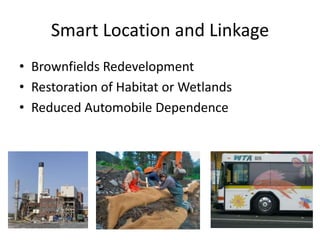
Smart Location and LinkageBrownfields RedevelopmentRestoration of Habitat or WetlandsReduced Automobile Dependence
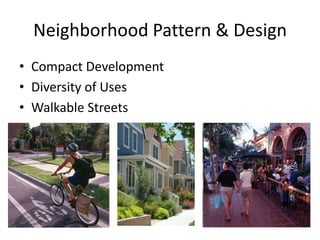
Neighborhood Pattern & DesignCompact DevelopmentDiversity of UsesWalkable Streets
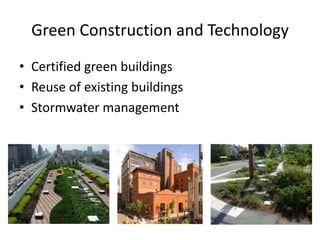
Green Construction and TechnologyCertified green buildingsReuse of existing buildingsStormwater management
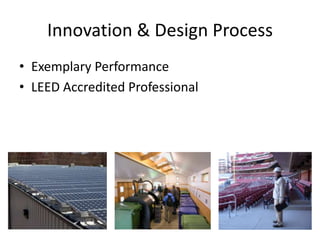
Innovation & Design ProcessExemplary PerformanceLEED Accredited Professional
Benefits of LEED-ND Reduce Urban Sprawl create more livable communities create locations that are closer to existing town and city centers  areas with good transit access  infill sites   previously developed sites  sites adjacent to existing development
Smart Location & LinkageLocation and Connectivity Smart LocationPreferred LocationReduced Automobile DependenceBicycle NetworkSchool ProximityCredits Met: 10Alternative Credits: 1Total Credits: 11
Smart Location & LinkageLocation and ConnectivitySmart LocationPrerequisite is met through current actionsThe project is located near existing adequate transit service. More than 50% of the business entrances within the project are within ÂĽ mile walk distance of the Cordata Maplewood and Hospital route bus stops provided through the existing trail system and the planned service road.
Smart Location & LinkageLocation and ConnectivityPreferred LocationCredit is met through current actionsThe street grid density within one mile of the site boundaries is 14.3. This is an indication of connectivity to other streets in the areaIt is an infill site that is also a previously developed site
Smart Location & LinkageLocation and ConnectivityReduced Automobile DependenceCredit is met through current actionsAt least 50% of the business entrances are within ÂĽ mile of two bus stops at the corner of Maryland St and Patton StOn weekdays these routes offer a total of 24 transit rides per day, meeting the minimum requirement of 20 rides per day
Smart Location & LinkageLocation and ConnectivityBicycle NetworkCredit is met through current actionsBike lanes on Squalicum Drive lead to the Bay to Baker and Cornwall Park trail systems and bike lanes on Marine Dr  Diverse uses include Marine Dr Market, The North Shore Church, Whatcom Co. Fire Station and Parkview ElementaryThe site has 118 parking spaces and 35 spaces for bicycles, meeting the requirement of 15% capacity for bicyclists
BIKE MAP
Smart Location & LinkageLocation and ConnectivitySchool ProximityCredit is met through alternative actionsMeeting this credit requires the project to have residential component.  For this to be possible the zoning would have to be changed to residential from industrialThe project could meet this credit if 25% of the project square footage is converted to residential.  The project is currently 1/2 mile from The Madrona School
Smart Location & LinkageWetlands and HabitatImperiled Species and Ecological CommunitiesWetland and Water Body ConservationSite Design for Habitat or Wetlands ConservationRestoration of Habitat or WetlandsConservation Management of Habitat or WetlandsCredits Met: 1Alternative Credits: 2Total Credits: 3
Smart Location & LinkageWetlands and HabitatImperiled Species and Ecological CommunitiesPrerequisite is met through current actionsNo imperiled or endangered species reside within the site buffer
Smart Location & LinkageWetlands and HabitatWetland and Water Body ConservationPrerequisite is met through current actionsThe project site is 100 feet or more removed from significant water bodies and any wetlands
Smart Location & LinkageWetlands and HabitatSite Design for Habitat or Wetlands ConservationCredit is met through current actionsThe site is planned  for greater than 98% native vegetation and no invasive vegetation.Smart Location & LinkageWetlands and HabitatRestoration of Habitat or WetlandsCredit is met through alternative actionsRestore the small on-site pond and surrounding area equaling at least 10% of the development footprint as a wetland by adding herbaceous wetland plants to the current landscape planDonate the restored area to an accredited land trust such as the Nature Conservancy
Smart Location & LinkageWetlands and HabitatConservation Management of Habitat or WetlandsCredit is met through alternative actionsThere are no wetlands on the propertyThe restored pond and surrounding area would be converted to a wetland ecosystem and donated to an accredited land trust such as The Nature ConservancyThe 10-year management plan for the site would include measures regarding:HydrologyMaintenance as a self-sustaining, persistent systemEffects on nearby upland and deepwater habitatMonitoring of the wetland throughout the course of the management program
Smart Location & LinkageLand UseProximity to Water and Wastewater InfrastructureAgricultural Land ConservationFloodplain AvoidancePrerequisites Achieved
Smart Location & LinkageLand UseProximity to Water and Wastewater InfrastructurePrerequisite is met through current actionsThe project is located on a previously developed infill site that is served by existing water and wastewater infrastructure
The plans call for limited additional infrastructure to be constructed for the projectSmart Location & LinkageLand UseAgricultural Land ConservationPrerequisite is met through current actionsThe soils are not of agricultural valueThere were no forest or farm lands on the site prior to development
Smart Location & LinkageLand UseFloodplain AvoidancePrerequisite is met through current actionsProject is located on a previously developed siteNo buildings will be constructed on the part of the site that is within the 100-year floodplain
Smart Location & LinkageUnachievable CreditsBrownfield RedevelopmentHigh Priority Brownfields RedevelopmentHousing and Jobs ProximitySteep Slope Protection
Smart Location & LinkageSummary and RecommendationsAll Prerequisites are achievedCredits Met: 11Alternative Credits: 3Total Credits: 14 out of a possible 30RecommendationsConvert on-site pond and surrounding area into a wetlandDonate restored pond area to an accredited land trust
Neighborhood Pattern & DesignCommunity ConnectivityOpen CommunityCompact DevelopmentDiversity of UsesWalkable StreetsStreet NetworkCredits Met: 0Alternative Credits: 9Total Credits: 9
Neighborhood Pattern & DesignCommunity ConnectivityOpen CommunityPrerequisite is met through alternative actionsThe main street access and the sidewalks within the site is currently planned to be gated to the community along with the emergency access road.In order to meet this prerequisite, all streets and sidewalks that are built as part of the project or serving the project directly would be designated as available for general public use and not gated.
Neighborhood Pattern & DesignCommunity ConnectivityCompact DevelopmentPrerequisite and credit are met through alternative actionsRedesign the project to include two additional levels on each of the four buildingsThe result would be an increase of 191,918 square feet for a project total of 291,378 square feetThe floor area ratio would equal 0.87 and the project would earn one point for the credit and meet the prerequisite.
Neighborhood Pattern & DesignCommunity ConnectivityDiversity of UsesCredit is met through alternative actionsA residential component equaling at least 25% of the project’s total building square footage would be achieved in the redesign, as the additional floors in buildings B and C would be dedicated exclusively to residential units.After completing this action the credit will be passed as the current building entrances are within a half mile walking distance of 4 diverse uses including Squalicum Park, Bellingham Technical College Library, Madronia School, and Immanuel Bible Church.Additional points could be earned for this credit if additional diverse uses were added.
Diverse use map?
Neighborhood Pattern & DesignCommunity ConnectivityWalkable StreetsCredit is met through alternative actionsArrange the buildings so that the site allows for parking to be placed in the rear of the building or create an underground garage for the site parking, leaving the frontages and streetscapes free of surface parking.As the buildings will be redesigned to increase residential density the building height to street width proportions of 1:3 will be met. There are no streets currently bordering the project site or planned adjacent buildings.Redesign the sidewalks throughout the sight to  border both sides of the street at a minimum of 4 feet. And provide connections to all footpaths from sidewalks for connectivity to areas surrounding the site.
Neighborhood Pattern & DesignCommunity ConnectivityStreet NetworkCredit is met through alternative actionsThe street grid density of the 7.56 acre site is approximately 49.1centerline miles per square mile, meeting the standard for street grid density.However, his credit is not met currently due to the emergency access road being gated and closed to public access.This credit could be met if the current emergency access road is opened to traffic, auto and bike. The topography of the site does not allow for any other street connections to the adjoining neighborhood.
Street map?
Neighborhood Pattern & DesignSocioeconomic DiversityDiversity of Housing TypesAffordable Rental HousingAffordable For-Sale HousingCredits Met: 0Alternative Credits: 5Total Credits: 5
Neighborhood Pattern & DesignSocioeconomic DiversityDiversity of Housing TypesCredit is met through alternative actionsThe development would be rezoned to include residential units in Buildings B and C in the levels added in the redesign. Four different housing types could possibly be represented in the units.94 new residential units could be built in this space at an average of 23.5 units for each dwelling type, earning a score of 0.53 on the Simpson Diversity Index, indicating a moderate diversity of housing types within the development.
Neighborhood Pattern & DesignSocioeconomic DiversityAffordable Rental HousingCredit is met through alternative actionsAbout half of the 94 residential units in the development’s redesign would be rental properties. The median income in Bellingham, WA for 2009 is $64400.  15% of the rental units would be priced for households with an income of up to 50% of $64400, and 15% of the rental units would be priced for households with an income of up to 80% of $64400.
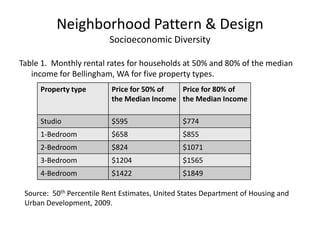
Neighborhood Pattern & DesignSocioeconomic DiversityTable 1.  Monthly rental rates for households at 50% and 80% of the median income for Bellingham, WA for five property types. Source:  50th Percentile Rent Estimates, United States Department of Housing and Urban Development, 2009.
Neighborhood Pattern & DesignSocioeconomic DiversityAffordable For-Sale HousingCredit is met through alternative actions10% of the for-sale units would be priced for households with an income of up to 80% of the median income, and 10% of the for-sale units would be priced for households with an income of up to 120% of the median income.Affordable housing is defined by the Area Median Income (AMI) Standard as 30% or less of a household’s monthly income being spent on housing costs.  For 10% of the units, monthly housing costs could not exceed $1288, and for another 10% of the units, monthly housing costs could not exceed $1932.Additionally, the mortgages on the specified units would need to be such that households at 80% and 120% of the median income could be eligible for them.
Neighborhood Pattern & DesignTransportationReduced Parking FootprintTransit FacilitiesTransportation Demand ManagementCredits Met: 0Alternative Credits: 4Total Credits: 4
Neighborhood Pattern & DesignTransportationReduced Parking FootprintCredit is met through alternative actionsThe sites surface parking facilities are within the 20% development footprint maximum requirement and the site plans show that118bicycle parking spots will be installed.However, all the non-residential buildings within the project locate their off-street parking along the frontages of Buildings A and B. Building A has a majority of the parking to the side between the building and the street, thus not meeting the streetscape and building frontage requirements. The alternative would arrange the buildings so that the site allows for parking to be placed in the rear of the building or create an underground garage for the site parking, leaving the frontages and streetscapes free of surface parking.
Neighborhood Pattern & DesignTransportationTransit FacilitiesCredit is met through alternative actionsA bus route would be added to Squalicum Way for this alternative to be viableThe project could meet this credit by following these actions:build at least one partially enclosed transit stop within the project
build kiosks displaying local transit information and a description of the kiosk
add a bus route to Squalicum WayNeighborhood Pattern & DesignTransportationTransportation Demand ManagementCredit is met through alternative actionsThe developer would provide Whatcom Transit Authority annual passes to employees for three years at half the original price of $250.00Bus passes would be publicized and distributed through business owners
Neighborhood Pattern & DesignSite AccessibilityAccess to Surrounding VicinityAccess to Public SpacesAccess to Active Public SpacesUniversal AccessibilityCredits Met: 1Alternative Credits: 2Total Credits: 3
Neighborhood Pattern & DesignSite AccessibilityAccess to Surrounding VicinityCredit is met through alternative actionsThe access road that runs along the east side of the site is gated and does not allow open accessRemoving the gate would allow for a through street from Squalicum Parkway to Lafayette StreetThe west side of the property is exempt from this requirement due to the extreme topography
Neighborhood Pattern & Design Site AccessibilityAccess to Public SpacesCredit is met through alternative actionsThere are small green spaces on the east side of each building but none of them are 150 feet wide, and do not equal ½ acre.Use space behind Building A as a green space measuring at least 150 feet wide and equaling at least 1/6 acre.In order to meet the required sum of ½ acre, additional green space would be added on the west side of Building C.The above changes coupled with the existing green spaces would meet the ½ acre requirement.
Neighborhood Pattern & DesignSite AccessibilityAccess to Active Public SpacesCredit is met through current actionsProject is adjacent to Squalicum Creek Park which contains a baseball field with plans for two additional fieldsInsert pretty park map?
Neighborhood Pattern & DesignLocal Food ProductionCredit is met through alternative actionsDevelop regulations that prevent the ban of food production on the site.Purchase shares in a CSA program for at least 80% of the households on the site for at least two years. Choose from the many CSA programs in Whatcom County by inhabitants’ vote.
Neighborhood Pattern & DesignUnachievable CreditsCommunity Outreach and InvolvementDoes not meet the requirement to receive this credit, nor are there any applicable alternatives given that community involvement must occur in the pre-design phase.Universal AccessibilityDoes not meet the requirement due to inability to meet the requirements for separate kinds of residences (err this is awkward)
Neighborhood Pattern & DesignSummary and Recommendations
Green Construction & TechnologyMinimization of Pollution and Site DisturbanceConstruction Activity Pollution PreventionMinimize Site Disturbance through Site DesignMinimize Site Disturbance During ConstructionLight Pollution ReductionHeat Island ReductionCredits Met: 0Alternative Credits: 4Total Credits: 4
Green Construction & TechnologyMinimization of Pollution and Site DisturbanceConstruction Activity Pollution PreventionPrerequisite is met through current actionsThe Squalicum Lofts Stormwater Report indicates areas where sedimentation and erosion control are necessary during construction.BMPs include means to:Control flow ratesInstall sediment controlsStabilize soilsProtect slopesControl pollutantsThe plan also includes means for monitoring and adjusting the plan if it is not working as intended.
Green Construction & TechnologyMinimization of Pollution and Site DisturbanceMinimize Site Disturbance Through Site DesignCredit is met through alternative actionsLimit the zone of construction impact to the area immediately near the site which is also previously developedProtect the conservation easement, that includes the proposed wetland, from development
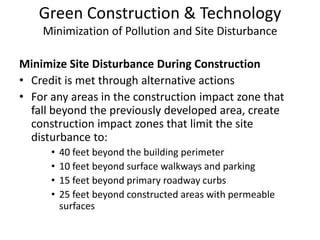
Green Construction & TechnologyMinimization of Pollution and Site DisturbanceMinimize Site Disturbance During ConstructionCredit is met through alternative actionsFor any areas in the construction impact zone that fall beyond the previously developed area, create construction impact zones that limit the site disturbance to: 40 feet beyond the building perimeter10 feet beyond surface walkways and parking15 feet beyond primary roadway curbs25 feet beyond constructed areas with permeable surfaces
Green Construction & TechnologyMinimization of Pollution and Site DisturbanceHeat Island ReductionCredit is met through alternative actionsThe site has plans to use pervious pavement, but not the required 50%The project could meet this credit by following these actions: Use pervious pavement to cover at least 50% of the projects impervious areasUsing trees for shade or reluctant pavement may be a better option if more cost-effective
Green Construction & TechnologyMinimization of Pollution and Site DisturbanceLight Pollution ReductionCredit met through alternative actionsReduce the luminance to a value lower than 0.20 footcandles at the sites boundary, and 0.01 15 feet beyond the site No more than 5% of the fixtures should emit light at an angle of 90 degrees or higher.
Green Construction & TechnologyEnergy EfficiencyLEED Certified Green BuildingsEnergy Efficiency in BuildingsDistrict Heating & CoolingInfrastructure Energy EfficiencyCredits Met: 3Alternative Credits: 3Total Credits: 6
Green Construction & TechnologyEnergy EfficiencyLEED Certified Green BuildingsCredit met through current actionsThis project is planned for four LEED silver structures.
Green Construction & TechnologyEnergy EfficiencyEnergy Efficiency in Buildings ConfusingCredit met through alternative actionTo earn one point under this credit the project would need 90% of buildings to show a 10% improvement in the proposed building performance rating compared to the baseline building performance ratingMust follow ASHRA/IESNA guidelines
Green Construction & TechnologyEnergy EfficiencyDistrict Heating and CoolingCredit met through alternative actionsInclude a district heating system for all buildings, such that 80% of the project's total square footage is connected and 80% of the project total peak heating load is connected If the project does not already include a district heating system the viability of installing a district heating system would need to be assessed
Green Construction & TechnologyEnergy EfficiencyInfrastructure Energy Efficiency Credit met through alternative actionsMeeting this credit requires a large investment by the developer. If the budget is large enough this credit could plausibly be metThe project could meet this credit if infrastructure such as traffic lights, street lights, water and wastewater pumps and treatment systems achieve a 15% annual energy reduction from an estimated baseline
Green Construction & TechnologyWater ManagementReduced Water UseStormwater ManagementWastewater ManagementCredits Met: 0Alternative Credits: 9Total Credits: 9
Green Construction & TechnologyWater ManagementReduced Water UseCredit met through alternative actions90% of all buildings need to be built so that indoor water use is reduced by 30%.  This can be accomplished by using efficient fixtures: urinals, lavatory faucets, showers, and kitchen faucetsInstall landscaping that doesn’t require irrigation
Green Construction & TechnologyWater ManagementStormwater Management This seems super confusingCredit met through alternative actionsAlthough the site has a progressive and well-developed stormwater management system planned, it is based on capture of storm water and energy/temperature dampening, with the intent of mitigating the impacts of stormwater released into the bay. LEED-ND GCT Credit 9 is rated on how much rainfall re-enters ground stock, so Squalicum’sstormwater management plan is not necessarily creditable under LEED.Adding green roofs, more permeable pavements, rain gardens, would allow maximum point reward of 5 to be awarded, based on a successful capture and infiltration of 2.25" of rain.
Green Construction & TechnologyWater ManagementWastewater ManagementCredit met through alternative actionsGreywater recycling systems would allow for the project to capture and reuse a high portion of water, and reduce the amount of potable water used for non-human consumptive purposes.The addition of greywater recapture and infiltration into rain gardens would also help satisfy the requirements of GCT Credit 9: Stormwater Management
Green Construction & TechnologyWaste and Recycling ManagementRecycled Content for InfrastructureConstruction Waste ManagementComprehensive Waste ManagementCredits Met: 0Alternative Credits: 3Total Credits: 3
Green Construction & TechnologyWaste and Recycling ManagementRecycled Content for Infrastructure Credit met through alternative actionsDesign project such that the aggregate base and subbase are at least 90% recycled aggregate materials Any asphalt base is at least 15% recycled content  Any asphalt concrete pavement is at least 15% recycled asphalt pavementAny Portland cement concrete pavement and any piping made from Portland cement concrete needs to contain at least 25% recycled mineral admixtures and 10% reclaimed concrete material aggregate
Green Construction & TechnologyWaste and Recycling ManagementConstruction Waste ManagementCredit met through alternative actionsGarco Building Systems would need to develop a construction waste management planRecycle at least 50% of the excess steel used in the manufacturing process
Green Construction & TechnologyWaste and Recycling ManagementComprehensive Waste ManagementCredit met through alternative actionsAdd any 2 of the following 3 services household hazardous materials pickup, composting, and separated recyclingRecycling is likely to be included, although composting is not likely, as the current site usage is slated for commercial and light industrial works. Household hazardous materials include substances such as bleach and other cleaning supplies, making pickup service a valuable portion of the credit, even if recycling and compost have already been added
Green Construction & TechnologyOn-Site EnergyOn-Site Energy GenerationOn-Site Renewable Energy SourcesCredits Met: 0Alternative Credits: 2Total Credits: 2
Green Construction & TechnologyOn-Site EnergyOn-Site Energy GenerationCredit met through alternative actions5% of the project's total energy consumption must come from on-site generation Examples?
Green Construction & TechnologyOn-Site EnergyOn-Site Renewable Energy SourcesCredit met through alternative actionsIncorporate renewable energy technologies such as solar, wind, or biomass so that 5% of the project’s energy comes from these technologies A written commitment to meet the requirements would be included
Green Construction & TechnologyUnachievable CreditsBuilding Reuse and Adaptive ReuseReuse of Historic BuildingsContaminant Reduction in Brownfields RemediationSolar Orientation
Green Construction & TechnologySummaryPrerequisite is achievedCredits Met: 3Alternative Credits: 21Total Credits: 24 out of a possible 31
Green Construction & TechnologyRecommendationsLimit the zone of construction impact to the area immediately near the site Create construction impact zones that limit the site disturbanceUse pervious pavement to cover at least 50% of the projects impervious areasReduce the luminance of lighting systemsInclude a district heating system for all buildingsInstall water efficient fixtures
Green Construction & TechnologyRecommendationsAdd green roofs, greywater recycling systems and rain gardens for rainwater captureUse recycled aggregate materials in pavement and concrete structuresRecycle at least 50% of the excess steel used in the manufacturing processAdd 2 recycling or waste management servicesReceive 5% of energy from on-site or on-site renewable sources such as solar or wind

LEED ND Squalicum Lofts

  • 2.
    LEED NDDeveloped bythe U.S. Green Building Council (USGBC), Congress for the New Urbanism (CNU), and Natural Resources Defense Council to create a national standard.LEED for Neighborhood Developments (LEED-ND) emphasizes smart growth aspects of development while still incorporating a selection of the most important green building practices.
  • 3.
    Smart Growth an initiativethat focuses on positive growth solutions which advocates for compact, transit-oriented, walkable, bicycle-friendly mixed use developmentThe LEED for Neighborhood Development Rating System integrates the principles of: - smart growth- urbanism- green building LEED certification provides independent, third-party verification that a development's location and design meet accepted high levels of environmentally responsible, sustainable development.
  • 4.
    Smart Location andLinkageBrownfields RedevelopmentRestoration of Habitat or WetlandsReduced Automobile Dependence
  • 5.
    Neighborhood Pattern &DesignCompact DevelopmentDiversity of UsesWalkable Streets
  • 6.
    Green Construction andTechnologyCertified green buildingsReuse of existing buildingsStormwater management
  • 7.
    Innovation & DesignProcessExemplary PerformanceLEED Accredited Professional
  • 8.
    Benefits of LEED-NDReduce Urban Sprawl create more livable communities create locations that are closer to existing town and city centers areas with good transit access infill sites  previously developed sites sites adjacent to existing development
  • 9.
    Smart Location &LinkageLocation and Connectivity Smart LocationPreferred LocationReduced Automobile DependenceBicycle NetworkSchool ProximityCredits Met: 10Alternative Credits: 1Total Credits: 11
  • 10.
    Smart Location &LinkageLocation and ConnectivitySmart LocationPrerequisite is met through current actionsThe project is located near existing adequate transit service. More than 50% of the business entrances within the project are within ÂĽ mile walk distance of the Cordata Maplewood and Hospital route bus stops provided through the existing trail system and the planned service road.
  • 11.
    Smart Location &LinkageLocation and ConnectivityPreferred LocationCredit is met through current actionsThe street grid density within one mile of the site boundaries is 14.3. This is an indication of connectivity to other streets in the areaIt is an infill site that is also a previously developed site
  • 12.
    Smart Location &LinkageLocation and ConnectivityReduced Automobile DependenceCredit is met through current actionsAt least 50% of the business entrances are within ÂĽ mile of two bus stops at the corner of Maryland St and Patton StOn weekdays these routes offer a total of 24 transit rides per day, meeting the minimum requirement of 20 rides per day
  • 13.
    Smart Location &LinkageLocation and ConnectivityBicycle NetworkCredit is met through current actionsBike lanes on Squalicum Drive lead to the Bay to Baker and Cornwall Park trail systems and bike lanes on Marine Dr Diverse uses include Marine Dr Market, The North Shore Church, Whatcom Co. Fire Station and Parkview ElementaryThe site has 118 parking spaces and 35 spaces for bicycles, meeting the requirement of 15% capacity for bicyclists
  • 14.
  • 15.
    Smart Location &LinkageLocation and ConnectivitySchool ProximityCredit is met through alternative actionsMeeting this credit requires the project to have residential component.  For this to be possible the zoning would have to be changed to residential from industrialThe project could meet this credit if 25% of the project square footage is converted to residential.  The project is currently 1/2 mile from The Madrona School
  • 16.
    Smart Location &LinkageWetlands and HabitatImperiled Species and Ecological CommunitiesWetland and Water Body ConservationSite Design for Habitat or Wetlands ConservationRestoration of Habitat or WetlandsConservation Management of Habitat or WetlandsCredits Met: 1Alternative Credits: 2Total Credits: 3
  • 17.
    Smart Location &LinkageWetlands and HabitatImperiled Species and Ecological CommunitiesPrerequisite is met through current actionsNo imperiled or endangered species reside within the site buffer
  • 18.
    Smart Location &LinkageWetlands and HabitatWetland and Water Body ConservationPrerequisite is met through current actionsThe project site is 100 feet or more removed from significant water bodies and any wetlands
  • 19.
    Smart Location &LinkageWetlands and HabitatSite Design for Habitat or Wetlands ConservationCredit is met through current actionsThe site is planned for greater than 98% native vegetation and no invasive vegetation.Smart Location & LinkageWetlands and HabitatRestoration of Habitat or WetlandsCredit is met through alternative actionsRestore the small on-site pond and surrounding area equaling at least 10% of the development footprint as a wetland by adding herbaceous wetland plants to the current landscape planDonate the restored area to an accredited land trust such as the Nature Conservancy
  • 20.
    Smart Location &LinkageWetlands and HabitatConservation Management of Habitat or WetlandsCredit is met through alternative actionsThere are no wetlands on the propertyThe restored pond and surrounding area would be converted to a wetland ecosystem and donated to an accredited land trust such as The Nature ConservancyThe 10-year management plan for the site would include measures regarding:HydrologyMaintenance as a self-sustaining, persistent systemEffects on nearby upland and deepwater habitatMonitoring of the wetland throughout the course of the management program
  • 21.
    Smart Location &LinkageLand UseProximity to Water and Wastewater InfrastructureAgricultural Land ConservationFloodplain AvoidancePrerequisites Achieved
  • 22.
    Smart Location &LinkageLand UseProximity to Water and Wastewater InfrastructurePrerequisite is met through current actionsThe project is located on a previously developed infill site that is served by existing water and wastewater infrastructure
  • 23.
    The plans callfor limited additional infrastructure to be constructed for the projectSmart Location & LinkageLand UseAgricultural Land ConservationPrerequisite is met through current actionsThe soils are not of agricultural valueThere were no forest or farm lands on the site prior to development
  • 24.
    Smart Location &LinkageLand UseFloodplain AvoidancePrerequisite is met through current actionsProject is located on a previously developed siteNo buildings will be constructed on the part of the site that is within the 100-year floodplain
  • 25.
    Smart Location &LinkageUnachievable CreditsBrownfield RedevelopmentHigh Priority Brownfields RedevelopmentHousing and Jobs ProximitySteep Slope Protection
  • 26.
    Smart Location &LinkageSummary and RecommendationsAll Prerequisites are achievedCredits Met: 11Alternative Credits: 3Total Credits: 14 out of a possible 30RecommendationsConvert on-site pond and surrounding area into a wetlandDonate restored pond area to an accredited land trust
  • 27.
    Neighborhood Pattern &DesignCommunity ConnectivityOpen CommunityCompact DevelopmentDiversity of UsesWalkable StreetsStreet NetworkCredits Met: 0Alternative Credits: 9Total Credits: 9
  • 28.
    Neighborhood Pattern &DesignCommunity ConnectivityOpen CommunityPrerequisite is met through alternative actionsThe main street access and the sidewalks within the site is currently planned to be gated to the community along with the emergency access road.In order to meet this prerequisite, all streets and sidewalks that are built as part of the project or serving the project directly would be designated as available for general public use and not gated.
  • 29.
    Neighborhood Pattern &DesignCommunity ConnectivityCompact DevelopmentPrerequisite and credit are met through alternative actionsRedesign the project to include two additional levels on each of the four buildingsThe result would be an increase of 191,918 square feet for a project total of 291,378 square feetThe floor area ratio would equal 0.87 and the project would earn one point for the credit and meet the prerequisite.
  • 30.
    Neighborhood Pattern &DesignCommunity ConnectivityDiversity of UsesCredit is met through alternative actionsA residential component equaling at least 25% of the project’s total building square footage would be achieved in the redesign, as the additional floors in buildings B and C would be dedicated exclusively to residential units.After completing this action the credit will be passed as the current building entrances are within a half mile walking distance of 4 diverse uses including Squalicum Park, Bellingham Technical College Library, Madronia School, and Immanuel Bible Church.Additional points could be earned for this credit if additional diverse uses were added.
  • 31.
  • 32.
    Neighborhood Pattern &DesignCommunity ConnectivityWalkable StreetsCredit is met through alternative actionsArrange the buildings so that the site allows for parking to be placed in the rear of the building or create an underground garage for the site parking, leaving the frontages and streetscapes free of surface parking.As the buildings will be redesigned to increase residential density the building height to street width proportions of 1:3 will be met. There are no streets currently bordering the project site or planned adjacent buildings.Redesign the sidewalks throughout the sight to  border both sides of the street at a minimum of 4 feet. And provide connections to all footpaths from sidewalks for connectivity to areas surrounding the site.
  • 33.
    Neighborhood Pattern &DesignCommunity ConnectivityStreet NetworkCredit is met through alternative actionsThe street grid density of the 7.56 acre site is approximately 49.1centerline miles per square mile, meeting the standard for street grid density.However, his credit is not met currently due to the emergency access road being gated and closed to public access.This credit could be met if the current emergency access road is opened to traffic, auto and bike. The topography of the site does not allow for any other street connections to the adjoining neighborhood.
  • 34.
  • 35.
    Neighborhood Pattern &DesignSocioeconomic DiversityDiversity of Housing TypesAffordable Rental HousingAffordable For-Sale HousingCredits Met: 0Alternative Credits: 5Total Credits: 5
  • 36.
    Neighborhood Pattern &DesignSocioeconomic DiversityDiversity of Housing TypesCredit is met through alternative actionsThe development would be rezoned to include residential units in Buildings B and C in the levels added in the redesign. Four different housing types could possibly be represented in the units.94 new residential units could be built in this space at an average of 23.5 units for each dwelling type, earning a score of 0.53 on the Simpson Diversity Index, indicating a moderate diversity of housing types within the development.
  • 37.
    Neighborhood Pattern &DesignSocioeconomic DiversityAffordable Rental HousingCredit is met through alternative actionsAbout half of the 94 residential units in the development’s redesign would be rental properties. The median income in Bellingham, WA for 2009 is $64400. 15% of the rental units would be priced for households with an income of up to 50% of $64400, and 15% of the rental units would be priced for households with an income of up to 80% of $64400.
  • 38.
    Neighborhood Pattern &DesignSocioeconomic DiversityTable 1. Monthly rental rates for households at 50% and 80% of the median income for Bellingham, WA for five property types. Source: 50th Percentile Rent Estimates, United States Department of Housing and Urban Development, 2009.
  • 39.
    Neighborhood Pattern &DesignSocioeconomic DiversityAffordable For-Sale HousingCredit is met through alternative actions10% of the for-sale units would be priced for households with an income of up to 80% of the median income, and 10% of the for-sale units would be priced for households with an income of up to 120% of the median income.Affordable housing is defined by the Area Median Income (AMI) Standard as 30% or less of a household’s monthly income being spent on housing costs. For 10% of the units, monthly housing costs could not exceed $1288, and for another 10% of the units, monthly housing costs could not exceed $1932.Additionally, the mortgages on the specified units would need to be such that households at 80% and 120% of the median income could be eligible for them.
  • 40.
    Neighborhood Pattern &DesignTransportationReduced Parking FootprintTransit FacilitiesTransportation Demand ManagementCredits Met: 0Alternative Credits: 4Total Credits: 4
  • 41.
    Neighborhood Pattern &DesignTransportationReduced Parking FootprintCredit is met through alternative actionsThe sites surface parking facilities are within the 20% development footprint maximum requirement and the site plans show that118bicycle parking spots will be installed.However, all the non-residential buildings within the project locate their off-street parking along the frontages of Buildings A and B. Building A has a majority of the parking to the side between the building and the street, thus not meeting the streetscape and building frontage requirements. The alternative would arrange the buildings so that the site allows for parking to be placed in the rear of the building or create an underground garage for the site parking, leaving the frontages and streetscapes free of surface parking.
  • 42.
    Neighborhood Pattern &DesignTransportationTransit FacilitiesCredit is met through alternative actionsA bus route would be added to Squalicum Way for this alternative to be viableThe project could meet this credit by following these actions:build at least one partially enclosed transit stop within the project
  • 43.
    build kiosks displayinglocal transit information and a description of the kiosk
  • 44.
    add a busroute to Squalicum WayNeighborhood Pattern & DesignTransportationTransportation Demand ManagementCredit is met through alternative actionsThe developer would provide Whatcom Transit Authority annual passes to employees for three years at half the original price of $250.00Bus passes would be publicized and distributed through business owners
  • 45.
    Neighborhood Pattern &DesignSite AccessibilityAccess to Surrounding VicinityAccess to Public SpacesAccess to Active Public SpacesUniversal AccessibilityCredits Met: 1Alternative Credits: 2Total Credits: 3
  • 46.
    Neighborhood Pattern &DesignSite AccessibilityAccess to Surrounding VicinityCredit is met through alternative actionsThe access road that runs along the east side of the site is gated and does not allow open accessRemoving the gate would allow for a through street from Squalicum Parkway to Lafayette StreetThe west side of the property is exempt from this requirement due to the extreme topography
  • 47.
    Neighborhood Pattern &Design Site AccessibilityAccess to Public SpacesCredit is met through alternative actionsThere are small green spaces on the east side of each building but none of them are 150 feet wide, and do not equal ½ acre.Use space behind Building A as a green space measuring at least 150 feet wide and equaling at least 1/6 acre.In order to meet the required sum of ½ acre, additional green space would be added on the west side of Building C.The above changes coupled with the existing green spaces would meet the ½ acre requirement.
  • 48.
    Neighborhood Pattern &DesignSite AccessibilityAccess to Active Public SpacesCredit is met through current actionsProject is adjacent to Squalicum Creek Park which contains a baseball field with plans for two additional fieldsInsert pretty park map?
  • 49.
    Neighborhood Pattern &DesignLocal Food ProductionCredit is met through alternative actionsDevelop regulations that prevent the ban of food production on the site.Purchase shares in a CSA program for at least 80% of the households on the site for at least two years. Choose from the many CSA programs in Whatcom County by inhabitants’ vote.
  • 50.
    Neighborhood Pattern &DesignUnachievable CreditsCommunity Outreach and InvolvementDoes not meet the requirement to receive this credit, nor are there any applicable alternatives given that community involvement must occur in the pre-design phase.Universal AccessibilityDoes not meet the requirement due to inability to meet the requirements for separate kinds of residences (err this is awkward)
  • 51.
    Neighborhood Pattern &DesignSummary and Recommendations
  • 52.
    Green Construction &TechnologyMinimization of Pollution and Site DisturbanceConstruction Activity Pollution PreventionMinimize Site Disturbance through Site DesignMinimize Site Disturbance During ConstructionLight Pollution ReductionHeat Island ReductionCredits Met: 0Alternative Credits: 4Total Credits: 4
  • 53.
    Green Construction &TechnologyMinimization of Pollution and Site DisturbanceConstruction Activity Pollution PreventionPrerequisite is met through current actionsThe Squalicum Lofts Stormwater Report indicates areas where sedimentation and erosion control are necessary during construction.BMPs include means to:Control flow ratesInstall sediment controlsStabilize soilsProtect slopesControl pollutantsThe plan also includes means for monitoring and adjusting the plan if it is not working as intended.
  • 54.
    Green Construction &TechnologyMinimization of Pollution and Site DisturbanceMinimize Site Disturbance Through Site DesignCredit is met through alternative actionsLimit the zone of construction impact to the area immediately near the site which is also previously developedProtect the conservation easement, that includes the proposed wetland, from development
  • 55.
    Green Construction &TechnologyMinimization of Pollution and Site DisturbanceMinimize Site Disturbance During ConstructionCredit is met through alternative actionsFor any areas in the construction impact zone that fall beyond the previously developed area, create construction impact zones that limit the site disturbance to: 40 feet beyond the building perimeter10 feet beyond surface walkways and parking15 feet beyond primary roadway curbs25 feet beyond constructed areas with permeable surfaces
  • 56.
    Green Construction &TechnologyMinimization of Pollution and Site DisturbanceHeat Island ReductionCredit is met through alternative actionsThe site has plans to use pervious pavement, but not the required 50%The project could meet this credit by following these actions: Use pervious pavement to cover at least 50% of the projects impervious areasUsing trees for shade or reluctant pavement may be a better option if more cost-effective
  • 57.
    Green Construction &TechnologyMinimization of Pollution and Site DisturbanceLight Pollution ReductionCredit met through alternative actionsReduce the luminance to a value lower than 0.20 footcandles at the sites boundary, and 0.01 15 feet beyond the site No more than 5% of the fixtures should emit light at an angle of 90 degrees or higher.
  • 58.
    Green Construction &TechnologyEnergy EfficiencyLEED Certified Green BuildingsEnergy Efficiency in BuildingsDistrict Heating & CoolingInfrastructure Energy EfficiencyCredits Met: 3Alternative Credits: 3Total Credits: 6
  • 59.
    Green Construction &TechnologyEnergy EfficiencyLEED Certified Green BuildingsCredit met through current actionsThis project is planned for four LEED silver structures.
  • 60.
    Green Construction &TechnologyEnergy EfficiencyEnergy Efficiency in Buildings ConfusingCredit met through alternative actionTo earn one point under this credit the project would need 90% of buildings to show a 10% improvement in the proposed building performance rating compared to the baseline building performance ratingMust follow ASHRA/IESNA guidelines
  • 61.
    Green Construction &TechnologyEnergy EfficiencyDistrict Heating and CoolingCredit met through alternative actionsInclude a district heating system for all buildings, such that 80% of the project's total square footage is connected and 80% of the project total peak heating load is connected If the project does not already include a district heating system the viability of installing a district heating system would need to be assessed
  • 62.
    Green Construction &TechnologyEnergy EfficiencyInfrastructure Energy Efficiency Credit met through alternative actionsMeeting this credit requires a large investment by the developer. If the budget is large enough this credit could plausibly be metThe project could meet this credit if infrastructure such as traffic lights, street lights, water and wastewater pumps and treatment systems achieve a 15% annual energy reduction from an estimated baseline
  • 63.
    Green Construction &TechnologyWater ManagementReduced Water UseStormwater ManagementWastewater ManagementCredits Met: 0Alternative Credits: 9Total Credits: 9
  • 64.
    Green Construction &TechnologyWater ManagementReduced Water UseCredit met through alternative actions90% of all buildings need to be built so that indoor water use is reduced by 30%. This can be accomplished by using efficient fixtures: urinals, lavatory faucets, showers, and kitchen faucetsInstall landscaping that doesn’t require irrigation
  • 65.
    Green Construction &TechnologyWater ManagementStormwater Management This seems super confusingCredit met through alternative actionsAlthough the site has a progressive and well-developed stormwater management system planned, it is based on capture of storm water and energy/temperature dampening, with the intent of mitigating the impacts of stormwater released into the bay. LEED-ND GCT Credit 9 is rated on how much rainfall re-enters ground stock, so Squalicum’sstormwater management plan is not necessarily creditable under LEED.Adding green roofs, more permeable pavements, rain gardens, would allow maximum point reward of 5 to be awarded, based on a successful capture and infiltration of 2.25" of rain.
  • 66.
    Green Construction &TechnologyWater ManagementWastewater ManagementCredit met through alternative actionsGreywater recycling systems would allow for the project to capture and reuse a high portion of water, and reduce the amount of potable water used for non-human consumptive purposes.The addition of greywater recapture and infiltration into rain gardens would also help satisfy the requirements of GCT Credit 9: Stormwater Management
  • 67.
    Green Construction &TechnologyWaste and Recycling ManagementRecycled Content for InfrastructureConstruction Waste ManagementComprehensive Waste ManagementCredits Met: 0Alternative Credits: 3Total Credits: 3
  • 68.
    Green Construction &TechnologyWaste and Recycling ManagementRecycled Content for Infrastructure Credit met through alternative actionsDesign project such that the aggregate base and subbase are at least 90% recycled aggregate materials Any asphalt base is at least 15% recycled content Any asphalt concrete pavement is at least 15% recycled asphalt pavementAny Portland cement concrete pavement and any piping made from Portland cement concrete needs to contain at least 25% recycled mineral admixtures and 10% reclaimed concrete material aggregate
  • 69.
    Green Construction &TechnologyWaste and Recycling ManagementConstruction Waste ManagementCredit met through alternative actionsGarco Building Systems would need to develop a construction waste management planRecycle at least 50% of the excess steel used in the manufacturing process
  • 70.
    Green Construction &TechnologyWaste and Recycling ManagementComprehensive Waste ManagementCredit met through alternative actionsAdd any 2 of the following 3 services household hazardous materials pickup, composting, and separated recyclingRecycling is likely to be included, although composting is not likely, as the current site usage is slated for commercial and light industrial works. Household hazardous materials include substances such as bleach and other cleaning supplies, making pickup service a valuable portion of the credit, even if recycling and compost have already been added
  • 71.
    Green Construction &TechnologyOn-Site EnergyOn-Site Energy GenerationOn-Site Renewable Energy SourcesCredits Met: 0Alternative Credits: 2Total Credits: 2
  • 72.
    Green Construction &TechnologyOn-Site EnergyOn-Site Energy GenerationCredit met through alternative actions5% of the project's total energy consumption must come from on-site generation Examples?
  • 73.
    Green Construction &TechnologyOn-Site EnergyOn-Site Renewable Energy SourcesCredit met through alternative actionsIncorporate renewable energy technologies such as solar, wind, or biomass so that 5% of the project’s energy comes from these technologies A written commitment to meet the requirements would be included
  • 74.
    Green Construction &TechnologyUnachievable CreditsBuilding Reuse and Adaptive ReuseReuse of Historic BuildingsContaminant Reduction in Brownfields RemediationSolar Orientation
  • 75.
    Green Construction &TechnologySummaryPrerequisite is achievedCredits Met: 3Alternative Credits: 21Total Credits: 24 out of a possible 31
  • 76.
    Green Construction &TechnologyRecommendationsLimit the zone of construction impact to the area immediately near the site Create construction impact zones that limit the site disturbanceUse pervious pavement to cover at least 50% of the projects impervious areasReduce the luminance of lighting systemsInclude a district heating system for all buildingsInstall water efficient fixtures
  • 77.
    Green Construction &TechnologyRecommendationsAdd green roofs, greywater recycling systems and rain gardens for rainwater captureUse recycled aggregate materials in pavement and concrete structuresRecycle at least 50% of the excess steel used in the manufacturing processAdd 2 recycling or waste management servicesReceive 5% of energy from on-site or on-site renewable sources such as solar or wind