Making Great Neighborhoods:
Greening Stormwater Permits and
           Programs
         Congress for New Urbanism
               June 13, 2008


             Lynn Richards
     U.S. Environmental Protection Agency
            Smart Growth Program
“Bad” Responses
   Same standards for greenfield development as redevelopment
       Can make it harder to redevelop, create dense urban areas
       Especially problematic with very high green infrastructure standards
   Many SW requirements are trying to do two things:
       Regulate stormwater
       Fix past ills: retrofitting existing development
   Newest standard that is emerging
       Pre = post
       What is “pre” for a parking lot?
       Creates confusion
   Stormwater requirements links to planning or other non-environmental
    outcomes, like affordable housing
       Where’s the water quality benefit?!
   Cluster development- conservation sub divisions
       Maybe a good option in some rural areas, but in general these subdivisions
        still require significant off site impervious surfaces and significant driving
   Requiring sidewalks on only one side of the road
Better Responses
   Develop different standards for greenfield
    development and redevelopment
   Recognize land use strategies that have a
    *direct* water quality benefit
   Differentiate between your stormwater standard
    and a retrofit policy
   Retrofit policy should include:
       Redevelopment
       Parking lots and other large paved areas
       Transportation network: streets and roads
State General Stormwater Permit
   Proposed by West Virginia and Tennessee
       Other states considering
       EPA is considering national rule making
   All development must use green infrastructure
    approaches to manage stormwater on site.
       Meet a numeric performance standard: 90 % of
        average annual storm event (WV = 1 inch)
   For projects that cannot meet 100% of the
    requirement on-site, two alternatives are available:
    off-site mitigation and payment in lieu.
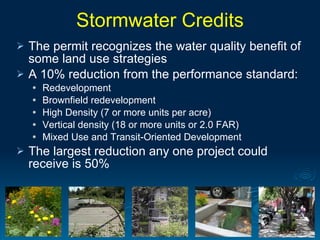
Stormwater Credits
   The permit recognizes the water quality benefit of
    some land use strategies
   A 10% reduction from the performance standard:
       Redevelopment
       Brownfield redevelopment
       High Density (7 or more units per acre)
       Vertical density (18 or more units or 2.0 FAR)
       Mixed Use and Transit-Oriented Development
   The largest reduction any one project could
    receive is 50%
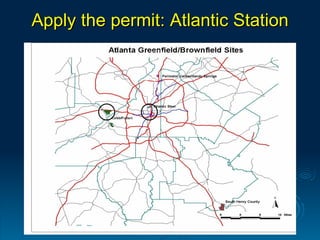
Apply the permit: Atlantic Station
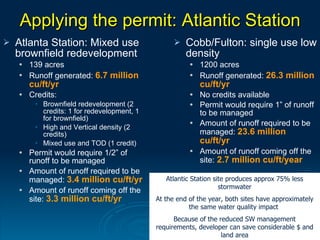
Applying the permit: Atlantic Station
   Atlanta Station: Mixed use                        Cobb/Fulton: single use low
    brownfield redevelopment                           density
       139 acres                                          1200 acres
       Runoff generated: 6.7 million                      Runoff generated: 26.3 million
        cu/ft/yr                                            cu/ft/yr
       Credits:                                           No credits available
         • Brownfield redevelopment (2                     Permit would require 1” of runoff
           credits: 1 for redevelopment, 1                  to be managed
           for brownfield)
         • High and Vertical density (2
                                                           Amount of runoff required to be
           credits)                                         managed: 23.6 million
         • Mixed use and TOD (1 credit)                     cu/ft/yr
       Permit would require 1/2” of                       Amount of runoff coming off the
        runoff to be managed                                site: 2.7 million cu/ft/year
       Amount of runoff required to be
        managed: 3.4 million cu/ft/yr           Atlantic Station site produces approx 75% less
                                                                   stormwater
       Amount of runoff coming off the
        site: 3.3 million cu/ft/yr           At the end of the year, both sites have approximately
                                                        the same water quality impact
                                                   Because of the reduced SW management
                                             requirements, developer can save considerable $ and
                                                                   land area
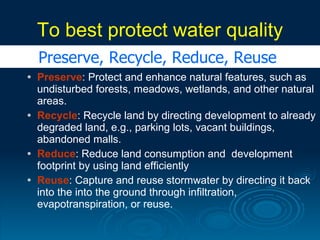
To best protect water quality
    Preserve, Recycle, Reduce, Reuse
   Preserve: Protect and enhance natural features, such as
    undisturbed forests, meadows, wetlands, and other natural
    areas.
   Recycle: Recycle land by directing development to already
    degraded land, e.g., parking lots, vacant buildings,
    abandoned malls.
   Reduce: Reduce land consumption and development
    footprint by using land efficiently
   Reuse: Capture and reuse stormwater by directing it back
    into the into the ground through infiltration,
    evapotranspiration, or reuse.
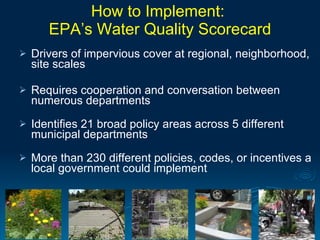
How to Implement:
       EPA’s Water Quality Scorecard
   Drivers of impervious cover at regional, neighborhood,
    site scales

   Requires cooperation and conversation between
    numerous departments
   Identifies 21 broad policy areas across 5 different
    municipal departments
   More than 230 different policies, codes, or incentives a
    local government could implement
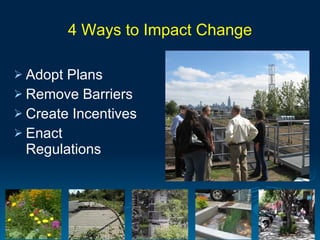
4 Ways to Impact Change

 Adopt Plans
 Remove Barriers
 Create Incentives
 Enact
  Regulations
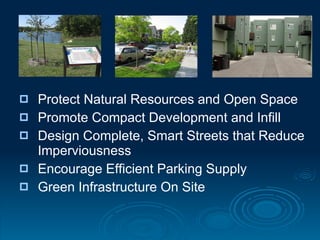
   Protect Natural Resources and Open Space
   Promote Compact Development and Infill
   Design Complete, Smart Streets that Reduce
    Imperviousness
   Encourage Efficient Parking Supply
   Green Infrastructure On Site
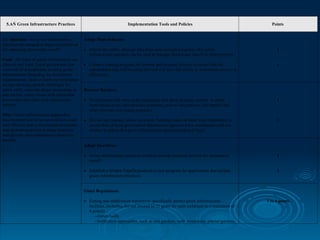
5.AŃ Green Infrastructure Practices                                     Implementation Tools and Policies                                     Points


(1) Question: Are green infrastructure          Adopt Plans/Educate:
practices encouraged as legal and preferred
for managing stormwater runoff?                 • Inform the public, through education and outreach programs, that green                           1
                                                   infrastructure practices can be used to manage stormwater runoff on their property.
Goal: All types of green infrastructure are
allowed and legal. Local government has         • Create a training program for internal and external reviews to ensure that the                   1
removed all impediments to using green             stakeholders that will be using this tool will have the ability to understand and use it
infrastructure (including for stormwater           effectively.
requirements), such as limits on infiltration
in right-of-ways, permit challenges for
green roofs, concerns about mosquitoes in       Remove Barriers:
rain barrels, safety issues with permeable
pavements, and other such unnecessary           • Development and other codes encourage and allow property owners to adopt                         1
barriers.                                          home-based green infrastructure practices, such as rain gardens, rain barrels and
                                                   other rainwater harvesting practices.
Why: Green infrastructure approaches
have been proven to be more effective and       • Review and change, where necessary, building codes or other local regulations to                 1
cost efficient than conventional stormwater        ensure that all local government departments/agencies have coordinated with one
management practices in many instances             another to ensure that green infrastructure implementation is legal.
and provide other substantial community
benefits.
                                                Adopt Incentives:

                                                • Green infrastructure practices credited towards required controls for stormwater                 1
                                                   runoff.

                                                • Establish a ŅGr
                                                                een TapeÓexpedited review program for applications that include                    1
                                                   green infrastructure practices.


                                                Enact Regulations:

                                                • Zoning and subdivision regulations specifically permit green infrastructure                 1 to 4 points
                                                   facilities, including but not limited to: (1 point for each technique to a maximum of
                                                   4 points)
                                                      --Green roofs;
                                                      --Infiltration approaches, such as rain gardens, curb extensions, planter gardens,
Thank You
    Lynn Richards,
 EPA’s Smart Growth
       Program
    202-566-2858
Richards.Lynn@epa.gov

green streets_richards

  • 1.
    Making Great Neighborhoods: GreeningStormwater Permits and Programs Congress for New Urbanism June 13, 2008 Lynn Richards U.S. Environmental Protection Agency Smart Growth Program
  • 2.
    “Bad” Responses  Same standards for greenfield development as redevelopment  Can make it harder to redevelop, create dense urban areas  Especially problematic with very high green infrastructure standards  Many SW requirements are trying to do two things:  Regulate stormwater  Fix past ills: retrofitting existing development  Newest standard that is emerging  Pre = post  What is “pre” for a parking lot?  Creates confusion  Stormwater requirements links to planning or other non-environmental outcomes, like affordable housing  Where’s the water quality benefit?!  Cluster development- conservation sub divisions  Maybe a good option in some rural areas, but in general these subdivisions still require significant off site impervious surfaces and significant driving  Requiring sidewalks on only one side of the road
  • 3.
    Better Responses  Develop different standards for greenfield development and redevelopment  Recognize land use strategies that have a *direct* water quality benefit  Differentiate between your stormwater standard and a retrofit policy  Retrofit policy should include:  Redevelopment  Parking lots and other large paved areas  Transportation network: streets and roads
  • 4.
    State General StormwaterPermit  Proposed by West Virginia and Tennessee  Other states considering  EPA is considering national rule making  All development must use green infrastructure approaches to manage stormwater on site.  Meet a numeric performance standard: 90 % of average annual storm event (WV = 1 inch)  For projects that cannot meet 100% of the requirement on-site, two alternatives are available: off-site mitigation and payment in lieu.
  • 5.
    Stormwater Credits  The permit recognizes the water quality benefit of some land use strategies  A 10% reduction from the performance standard:  Redevelopment  Brownfield redevelopment  High Density (7 or more units per acre)  Vertical density (18 or more units or 2.0 FAR)  Mixed Use and Transit-Oriented Development  The largest reduction any one project could receive is 50%
  • 6.
    Apply the permit:Atlantic Station
  • 7.
    Applying the permit:Atlantic Station  Atlanta Station: Mixed use  Cobb/Fulton: single use low brownfield redevelopment density  139 acres  1200 acres  Runoff generated: 6.7 million  Runoff generated: 26.3 million cu/ft/yr cu/ft/yr  Credits:  No credits available • Brownfield redevelopment (2  Permit would require 1” of runoff credits: 1 for redevelopment, 1 to be managed for brownfield) • High and Vertical density (2  Amount of runoff required to be credits) managed: 23.6 million • Mixed use and TOD (1 credit) cu/ft/yr  Permit would require 1/2” of  Amount of runoff coming off the runoff to be managed site: 2.7 million cu/ft/year  Amount of runoff required to be managed: 3.4 million cu/ft/yr Atlantic Station site produces approx 75% less stormwater  Amount of runoff coming off the site: 3.3 million cu/ft/yr At the end of the year, both sites have approximately the same water quality impact Because of the reduced SW management requirements, developer can save considerable $ and land area
  • 8.
    To best protectwater quality Preserve, Recycle, Reduce, Reuse  Preserve: Protect and enhance natural features, such as undisturbed forests, meadows, wetlands, and other natural areas.  Recycle: Recycle land by directing development to already degraded land, e.g., parking lots, vacant buildings, abandoned malls.  Reduce: Reduce land consumption and development footprint by using land efficiently  Reuse: Capture and reuse stormwater by directing it back into the into the ground through infiltration, evapotranspiration, or reuse.
  • 9.
    How to Implement: EPA’s Water Quality Scorecard  Drivers of impervious cover at regional, neighborhood, site scales  Requires cooperation and conversation between numerous departments  Identifies 21 broad policy areas across 5 different municipal departments  More than 230 different policies, codes, or incentives a local government could implement
  • 10.
    4 Ways toImpact Change  Adopt Plans  Remove Barriers  Create Incentives  Enact Regulations
  • 11.
    Protect Natural Resources and Open Space  Promote Compact Development and Infill  Design Complete, Smart Streets that Reduce Imperviousness  Encourage Efficient Parking Supply  Green Infrastructure On Site
  • 12.
    5.AŃ Green InfrastructurePractices Implementation Tools and Policies Points (1) Question: Are green infrastructure Adopt Plans/Educate: practices encouraged as legal and preferred for managing stormwater runoff? • Inform the public, through education and outreach programs, that green 1 infrastructure practices can be used to manage stormwater runoff on their property. Goal: All types of green infrastructure are allowed and legal. Local government has • Create a training program for internal and external reviews to ensure that the 1 removed all impediments to using green stakeholders that will be using this tool will have the ability to understand and use it infrastructure (including for stormwater effectively. requirements), such as limits on infiltration in right-of-ways, permit challenges for green roofs, concerns about mosquitoes in Remove Barriers: rain barrels, safety issues with permeable pavements, and other such unnecessary • Development and other codes encourage and allow property owners to adopt 1 barriers. home-based green infrastructure practices, such as rain gardens, rain barrels and other rainwater harvesting practices. Why: Green infrastructure approaches have been proven to be more effective and • Review and change, where necessary, building codes or other local regulations to 1 cost efficient than conventional stormwater ensure that all local government departments/agencies have coordinated with one management practices in many instances another to ensure that green infrastructure implementation is legal. and provide other substantial community benefits. Adopt Incentives: • Green infrastructure practices credited towards required controls for stormwater 1 runoff. • Establish a ŅGr een TapeÓexpedited review program for applications that include 1 green infrastructure practices. Enact Regulations: • Zoning and subdivision regulations specifically permit green infrastructure 1 to 4 points facilities, including but not limited to: (1 point for each technique to a maximum of 4 points) --Green roofs; --Infiltration approaches, such as rain gardens, curb extensions, planter gardens,
  • 13.
    Thank You Lynn Richards, EPA’s Smart Growth Program 202-566-2858 Richards.Lynn@epa.gov