Many slides are courtesy of USGBC and the LEED v4 Team!
The ViewThe ViewThe ViewThe View
from thefrom thefrom thefrom the
MEP Seats!MEP Seats!MEP Seats!MEP Seats!
Scott Bowman, PE
LEED AP BD+C
Principal
Corporate Sustainability
Leader
bowmansc@kjww.com
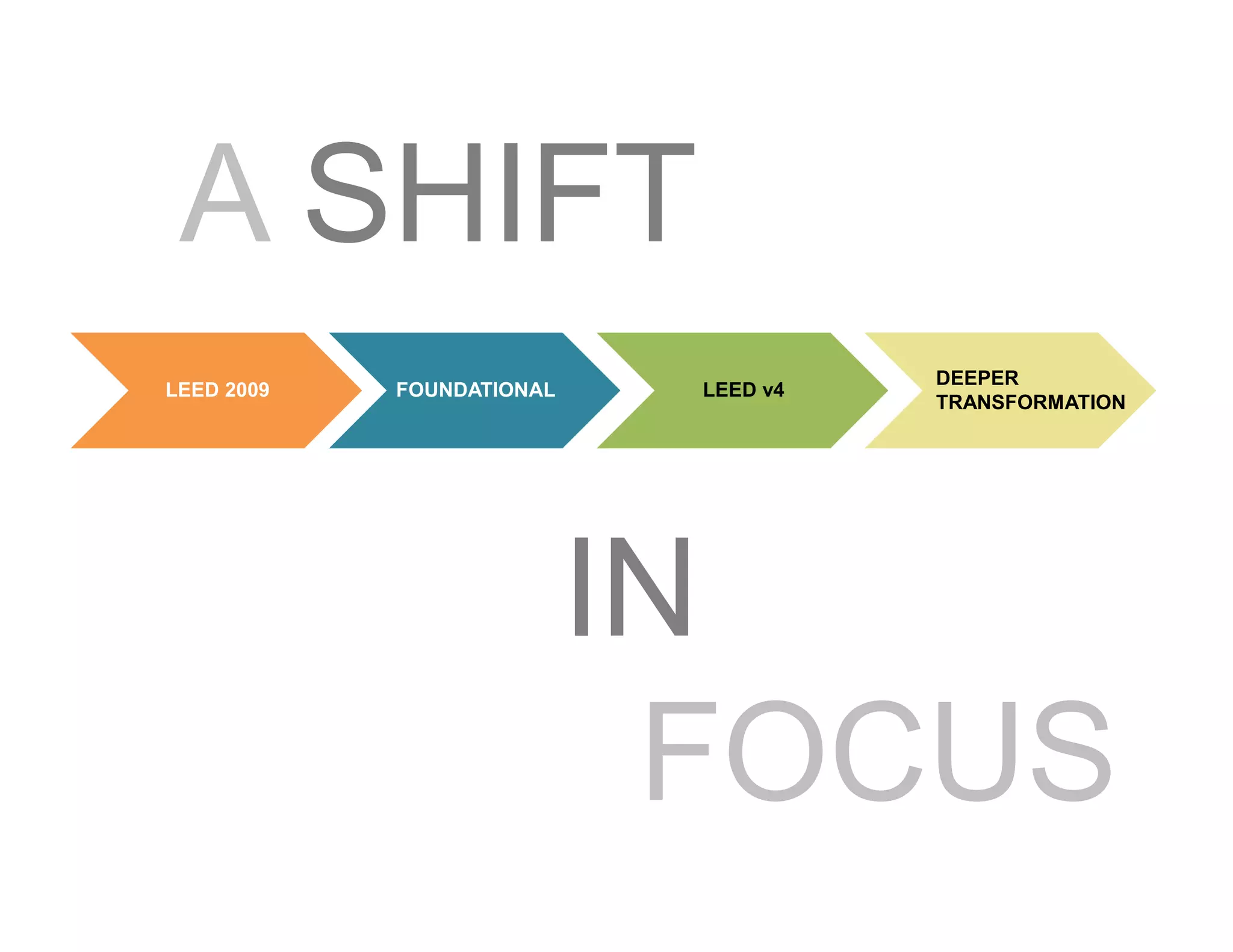
LEED 2009 FOUNDATIONAL LEED v4
A SHIFT
IN
FOCUS
DEEPER
TRANSFORMATION
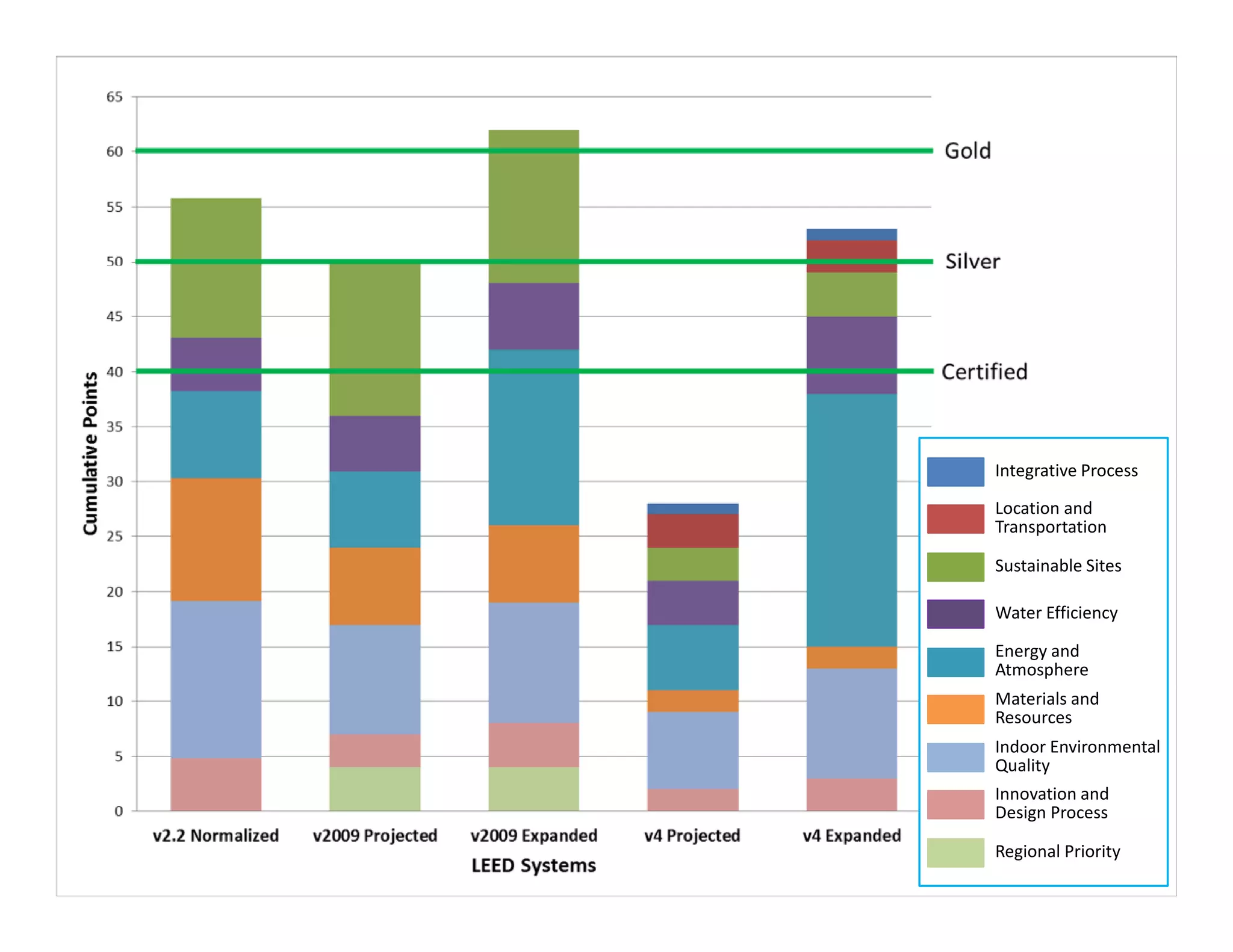
LEED v4
Location and
Transportation
Sustainable Sites
Water Efficiency
Energy and
Atmosphere
Indoor Environmental
Quality
Innovation and
Design Process
Regional Priority
Integrative Process
Materials and
Resources
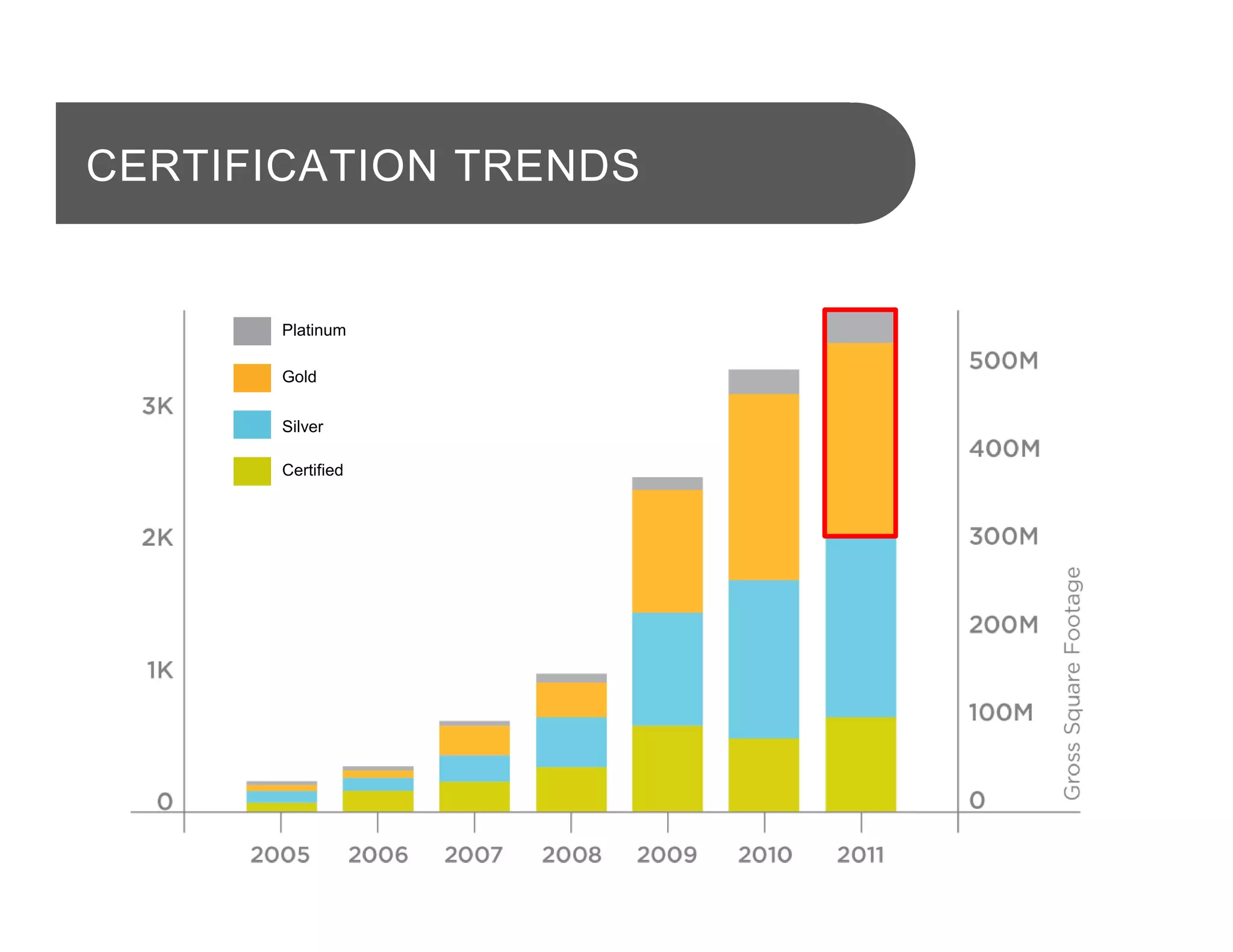
Platinum
Gold
Silver
Certified
CERTIFICATION TRENDS
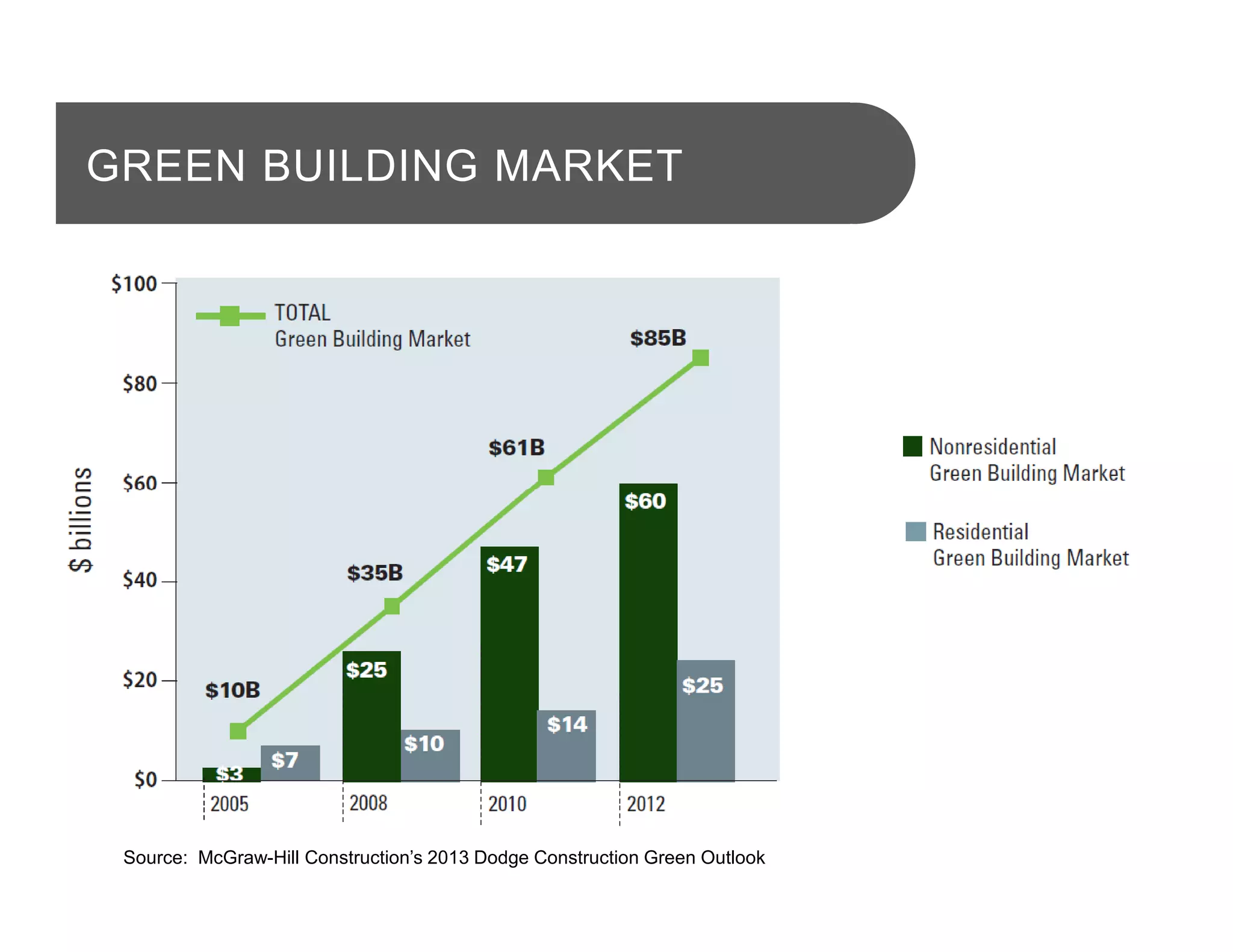
GREEN BUILDING MARKET
Source: McGraw-Hill Construction’s 2013 Dodge Construction Green Outlook
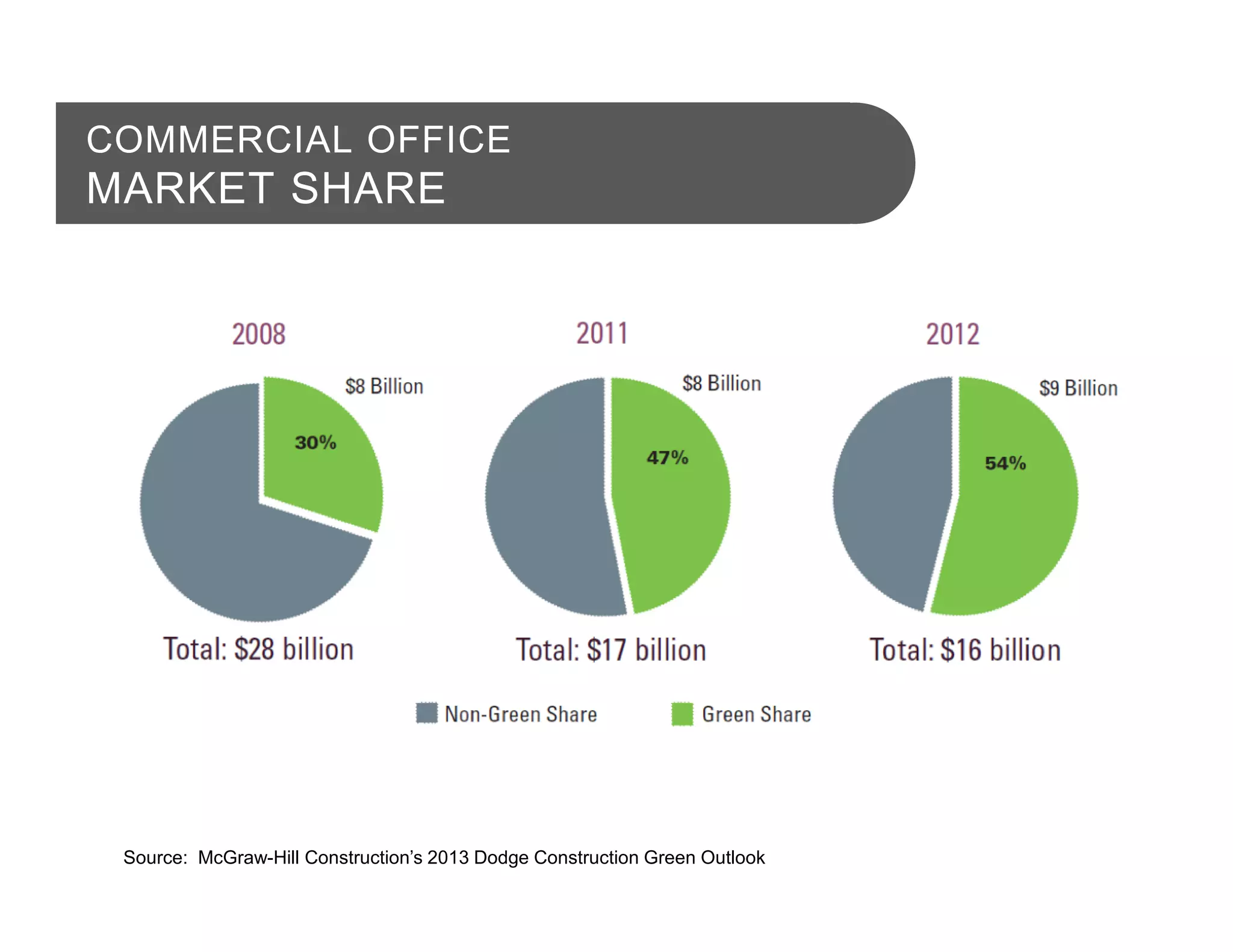
COMMERCIAL OFFICE
MARKET SHARE
Source: McGraw-Hill Construction’s 2013 Dodge Construction Green Outlook
DOE 30%
Reduction
Target
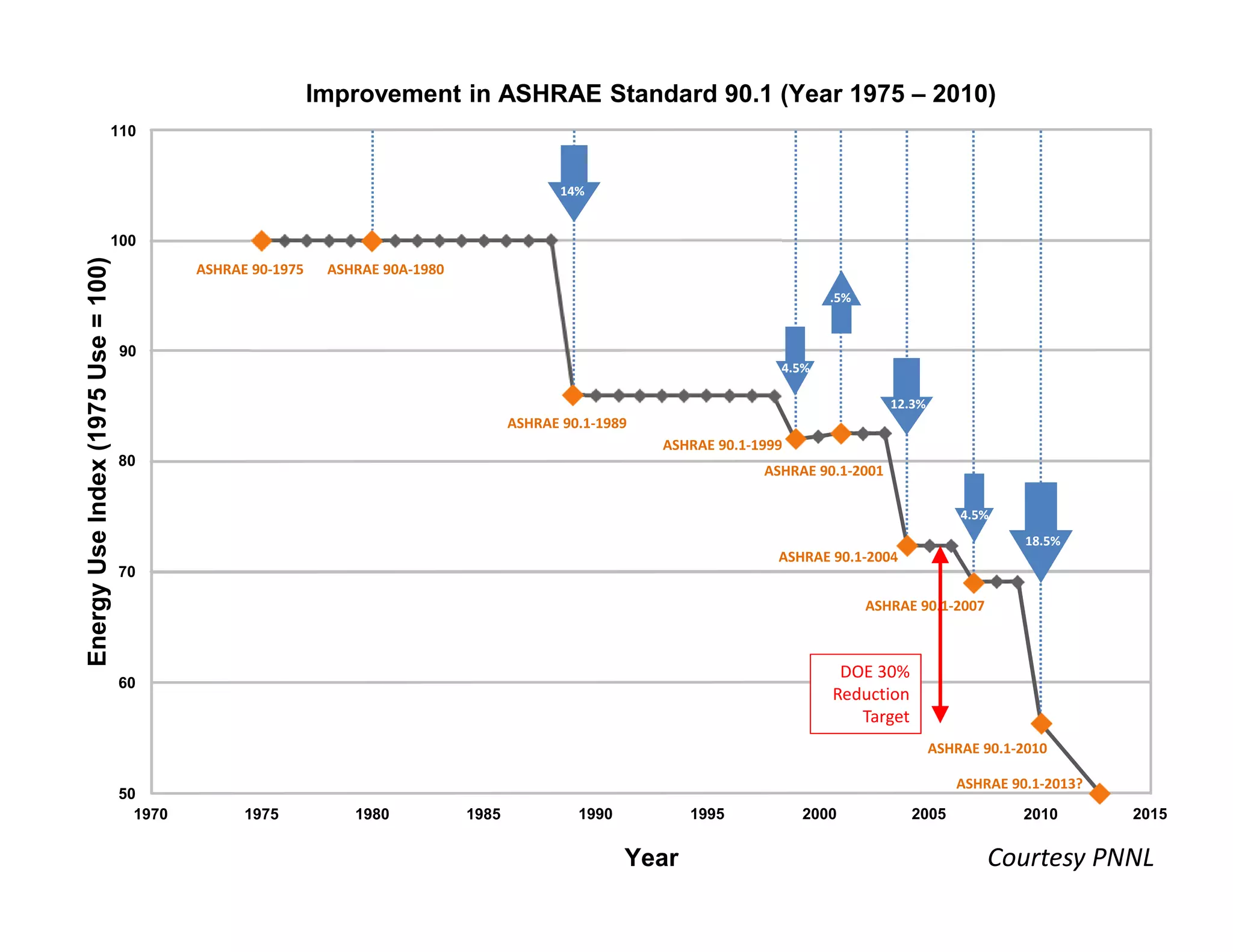
Courtesy PNNL
ASHRAE 90.1-2013?
ASHRAE 90-1975 ASHRAE 90A-1980
ASHRAE 90.1-1999
ASHRAE 90.1-2001
ASHRAE 90.1-2007
ASHRAE 90.1-2004
ASHRAE 90.1-1989
ASHRAE 90.1-2010
Improvement in ASHRAE Standard 90.1 (Year 1975 – 2010)EnergyUseIndex(1975Use=100)
Year
1970 1975 1980 1985 1990
50
1995 20152000 20102005
110
100
90
80
70
60
14%
4.5%
.5%
12.3%
4.5%
18.5%
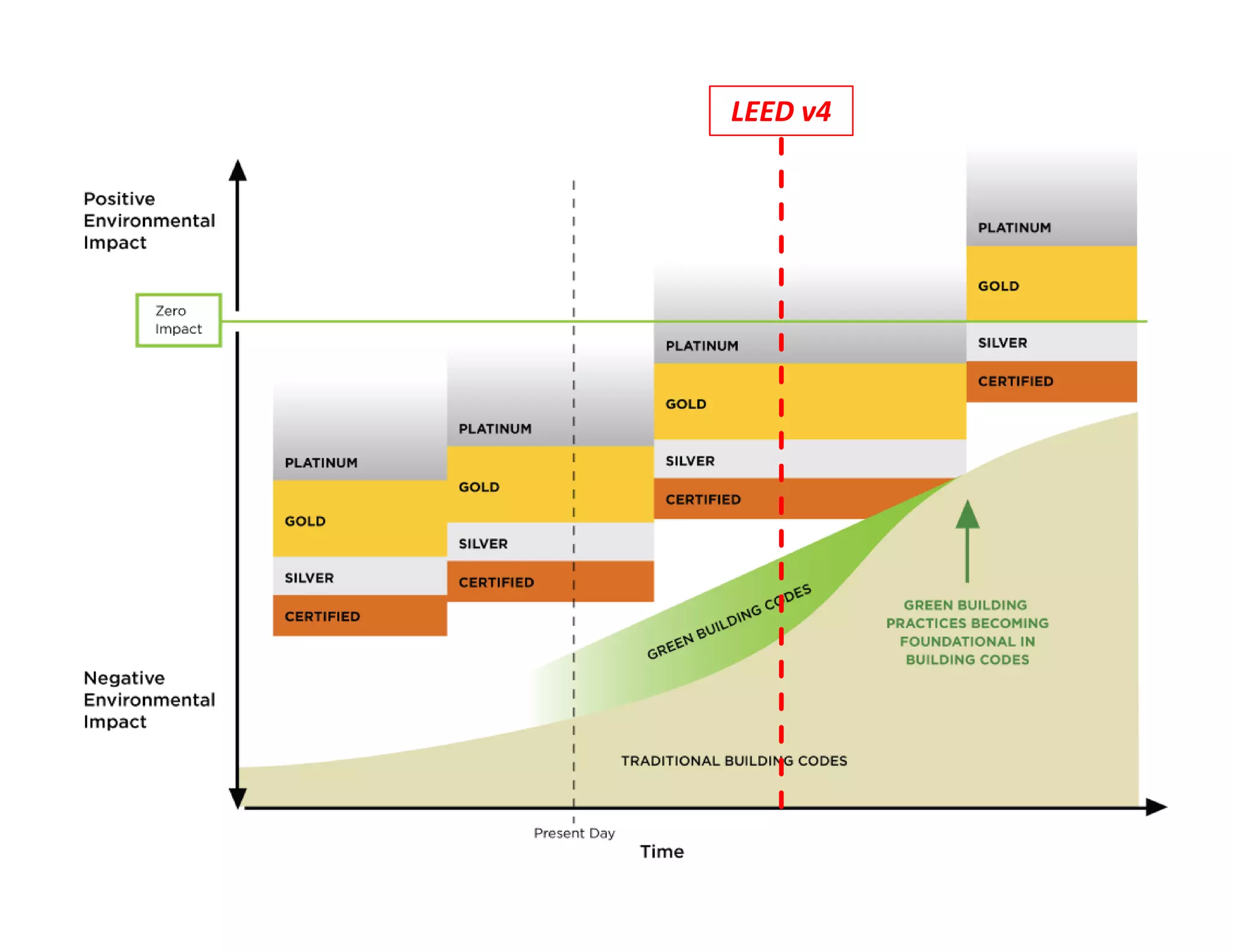
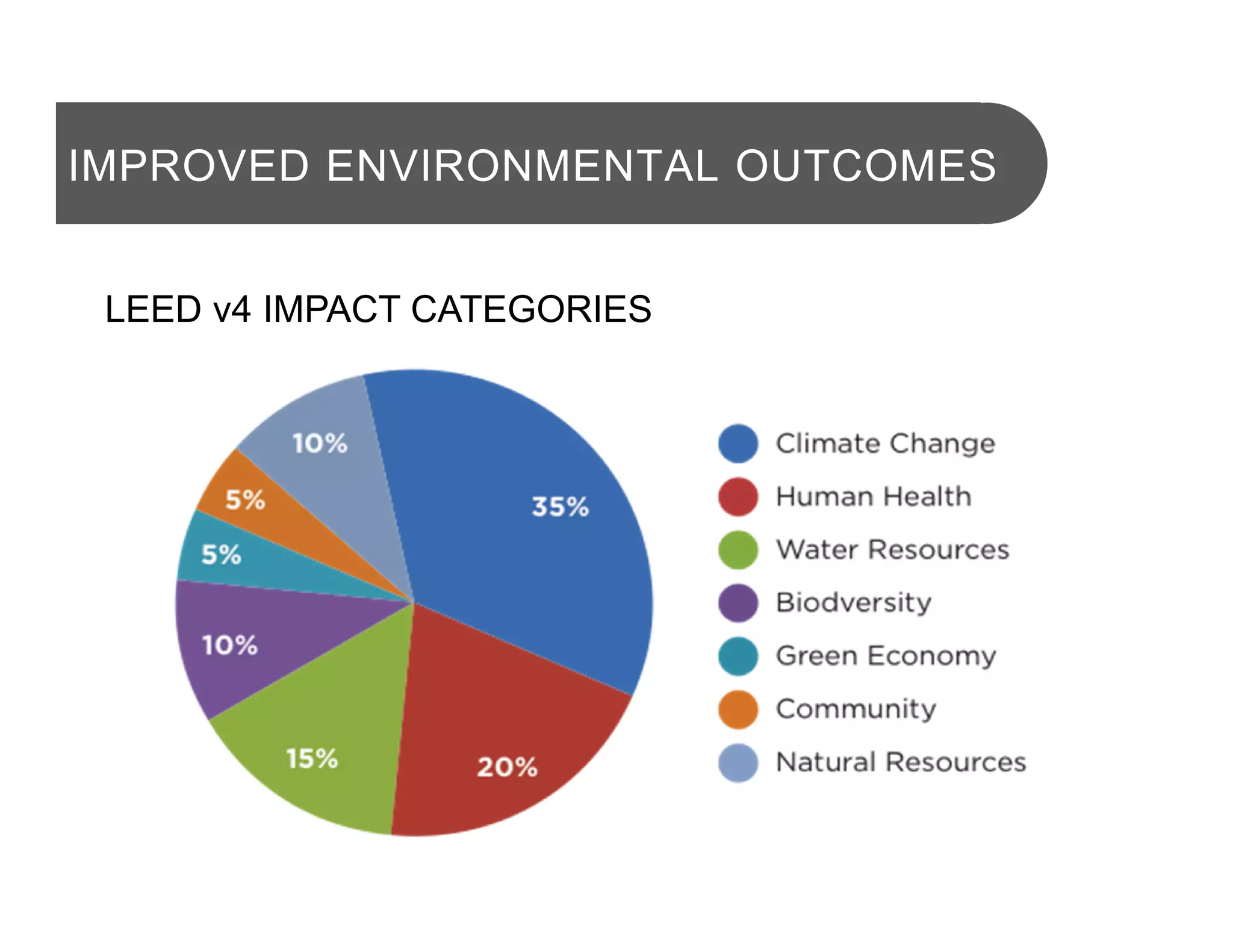
LEED v4 IMPACT CATEGORIES
IMPROVED ENVIRONMENTAL OUTCOMES
LEED CERTIFICATION TRENDS
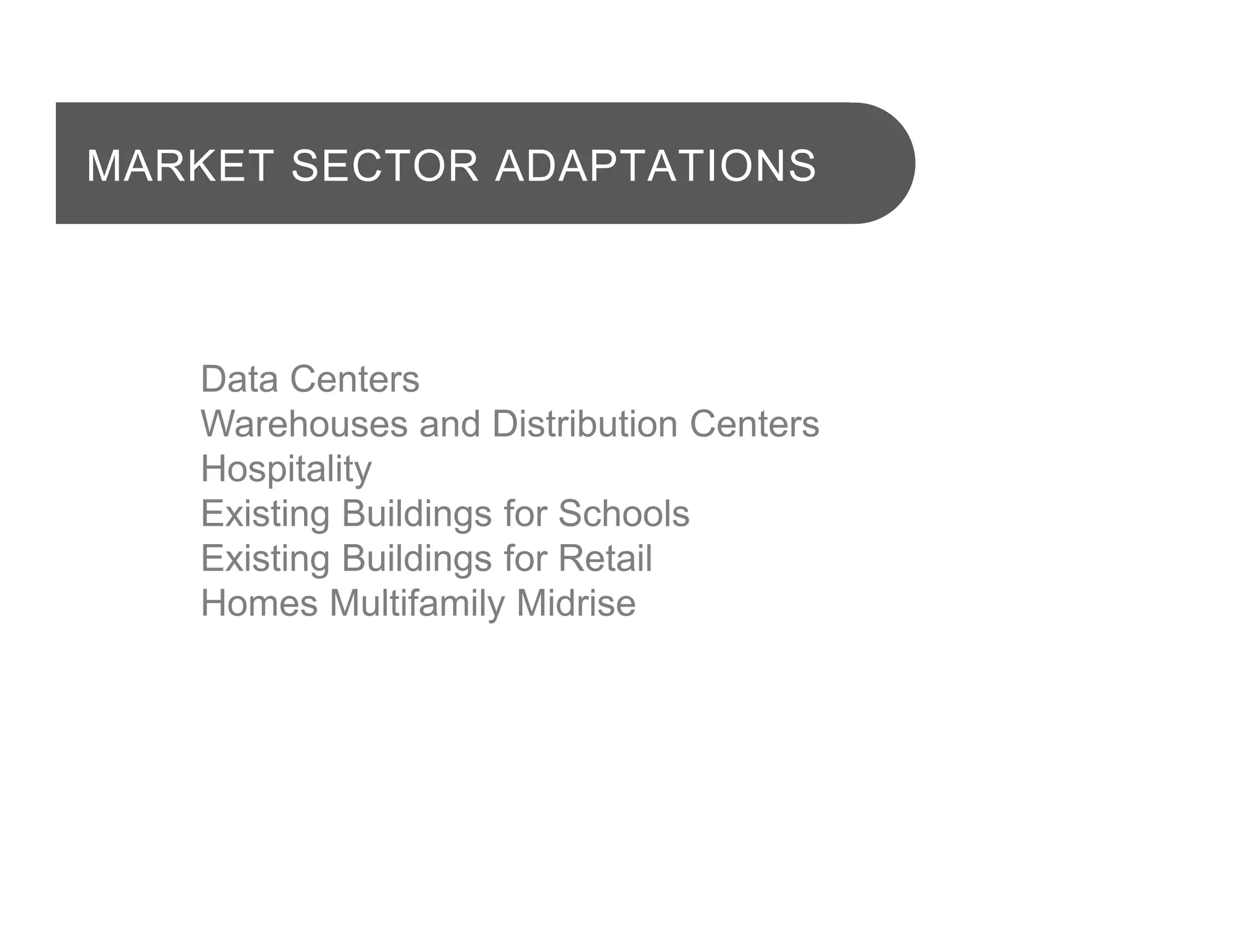
MARKET SECTOR ADAPTATIONS
Data Centers
Warehouses and Distribution Centers
Hospitality
Existing Buildings for Schools
Existing Buildings for Retail
Homes Multifamily Midrise
BD+C
LEED v4
BUILDING DESIGN &
CONSTRUCTION
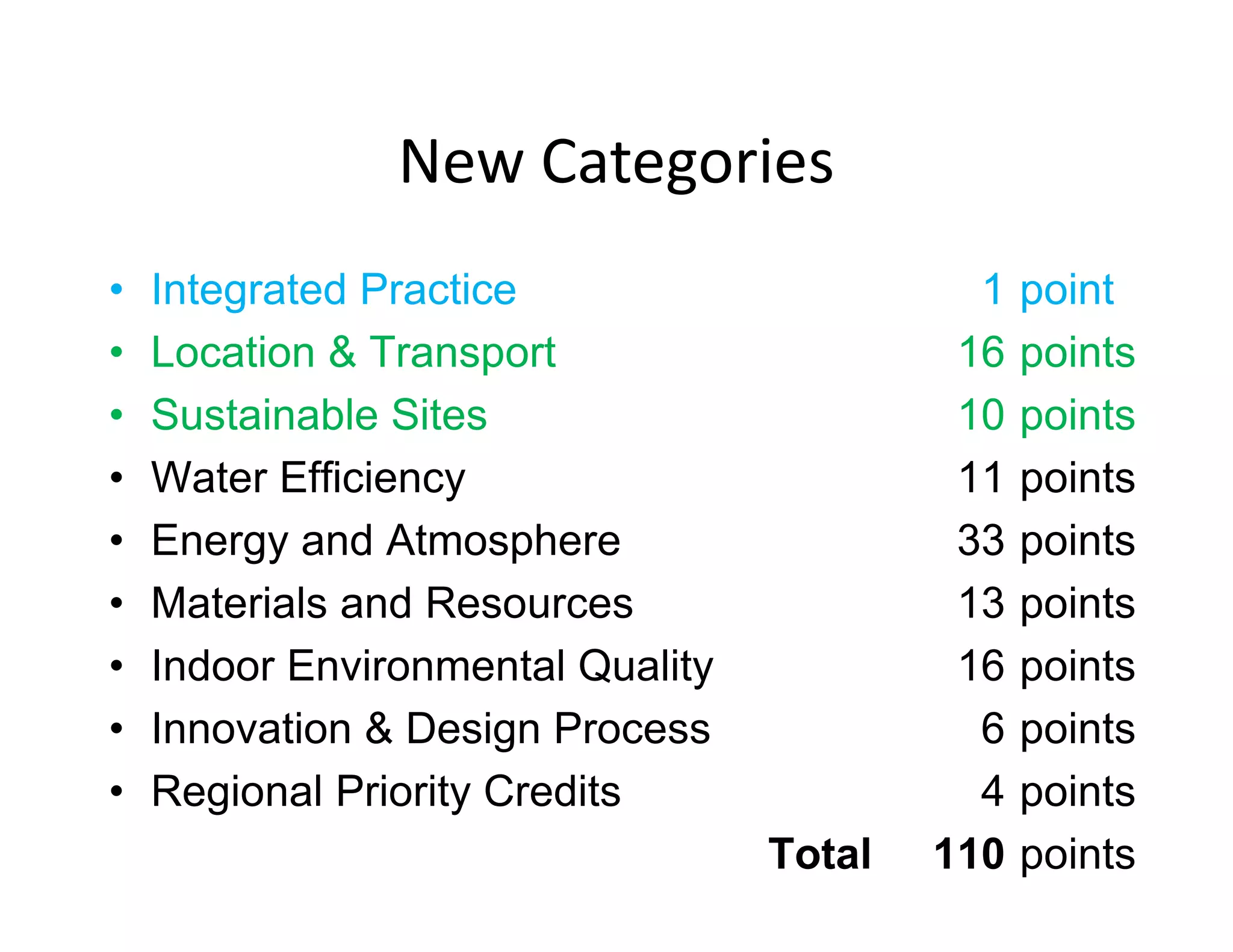
New Categories
• Integrated Practice 1 point
• Location & Transport 16 points
• Sustainable Sites 10 points
• Water Efficiency 11 points
• Energy and Atmosphere 33 points
• Materials and Resources 13 points
• Indoor Environmental Quality 16 points
• Innovation & Design Process 6 points
• Regional Priority Credits 4 points
Total 110 points
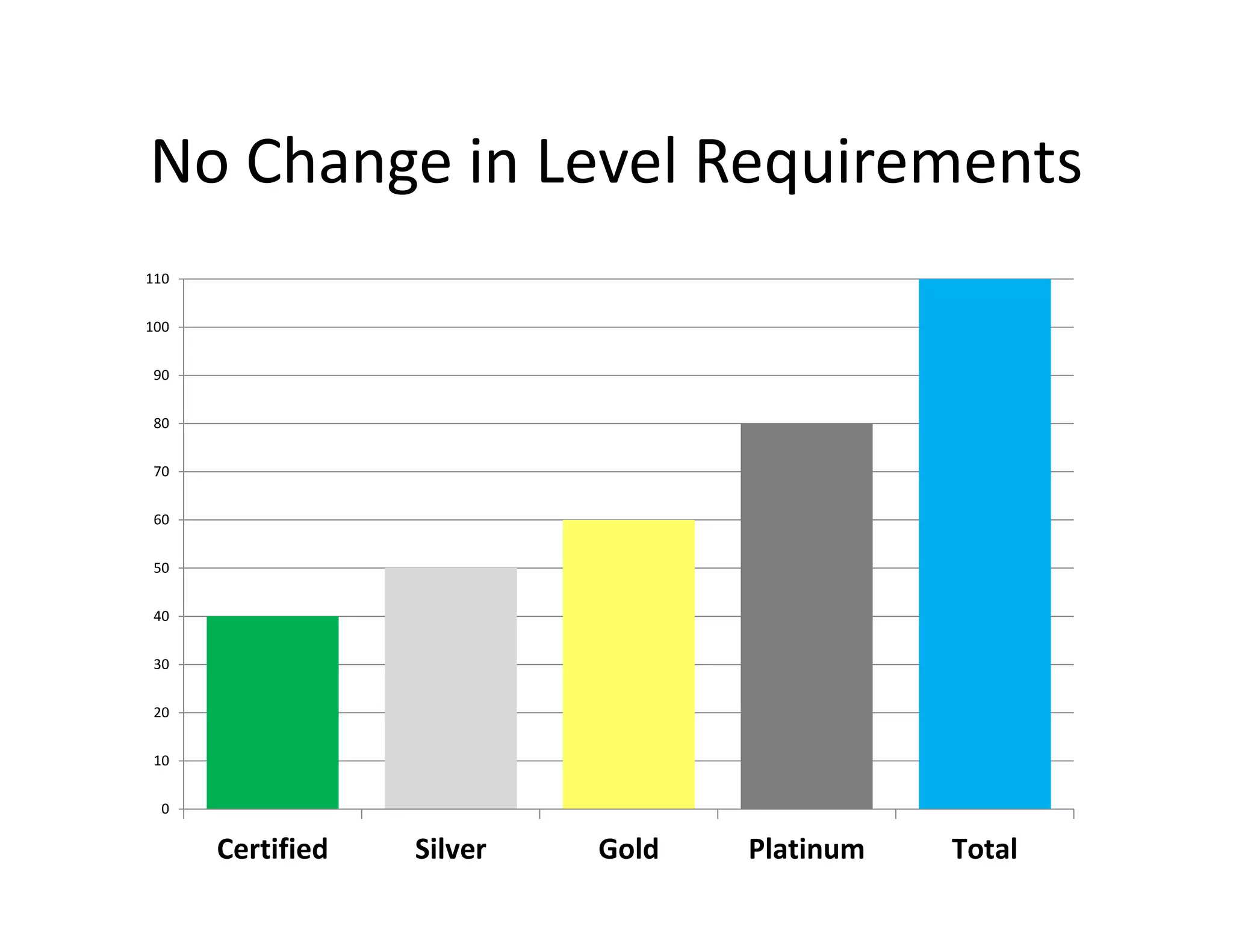
No Change in Level Requirements
0
10
20
30
40
50
60
70
80
90
100
110
Certified Silver Gold Platinum Total
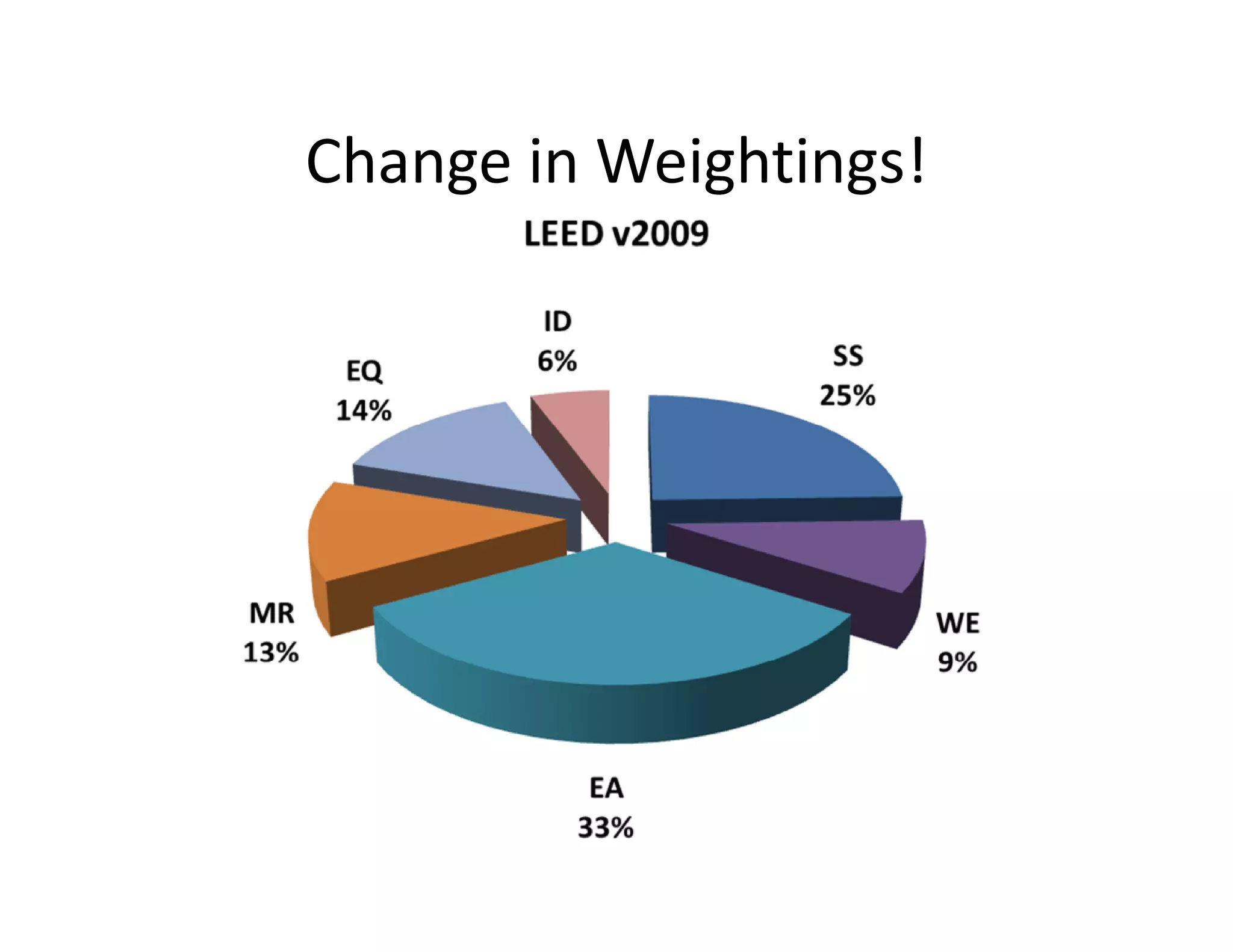
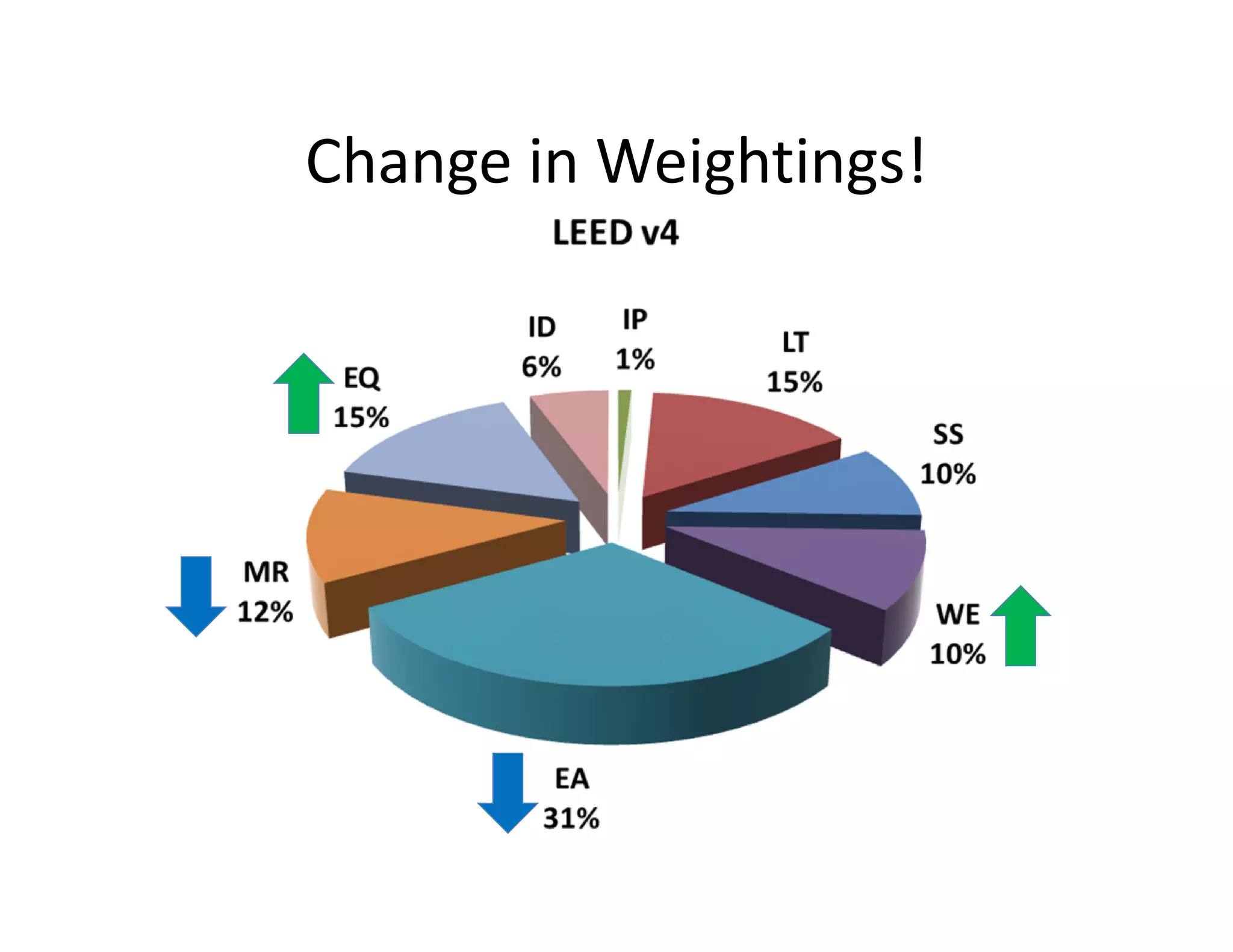
Change in Weightings!
Use v4 Credits now!
• Select v4 credits can be substituted for v2009
• Complete v4 sample form
• In v2009 form, check alternate compliance
path and list the substitution
• Credits marked are approved for substitution
• Site below has more detailed information
• Can also use Pilot Credits that are applicable
http://www.usgbc.org/articles/use-v4-credits-your-v2009-project/
v2009
IP101r Integrated Project Planning
and Design
• The prerequisite only applies to HC
• Credit library now says “required”
• New prerequisite, but not quite a category!
• Requires:
– OPR
– Preliminary Rating Goals
– Integrated Project Team
– Design Charette
IP102 Integrative Process
• New credit (HC too)
• 1 point
• Early “simple box” energy analysis
• Lists parametric options to reviewed
• Includes water performance
• Requires cost analysis and bundling
• Documentation in Word Document Template
• Reward for doing the analysis early
Performance in
Location and Transportation
LOCATION AND TRANSPORTATION
Highlights:
New credit category to improve alignment between
commercial rating systems and LEED ND.
More performance-based credits with improved ties to
anticipated outcome.
bicycle facilities [link to bike network]
quality transit [trip frequency, walking distance]
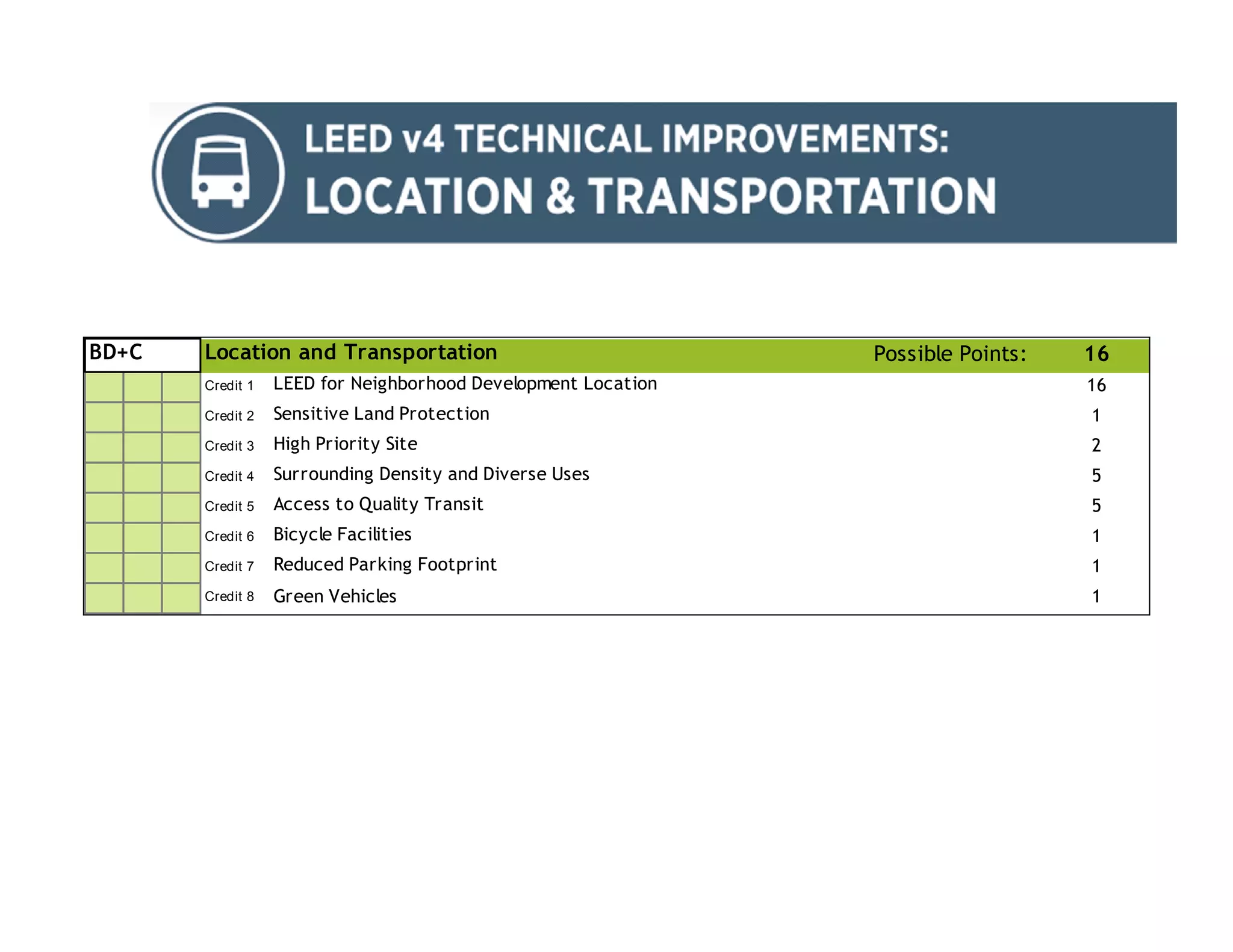
Possible Points: 16
Credit 1 16
Credit 2 1
Credit 3 2
Credit 4 5
Credit 5 5
Credit 6 1
Credit 7 1
Credit 8 Green Vehicles 1
BD+C Location and Transportation
Sensitive Land Protection
LEED for Neighborhood Development Location
Bicycle Facilities
High Priority Site
Surrounding Density and Diverse Uses
Access to Quality Transit
Reduced Parking Footprint
Performance in
Sustainable Sites
SUSTAINABLE SITES
Highlights:
New credit for site assessment.
Financial support option in protect or restore habitat.
Major simplification to Light Pollution Reduction credit
through new option for BUG rated equipment.
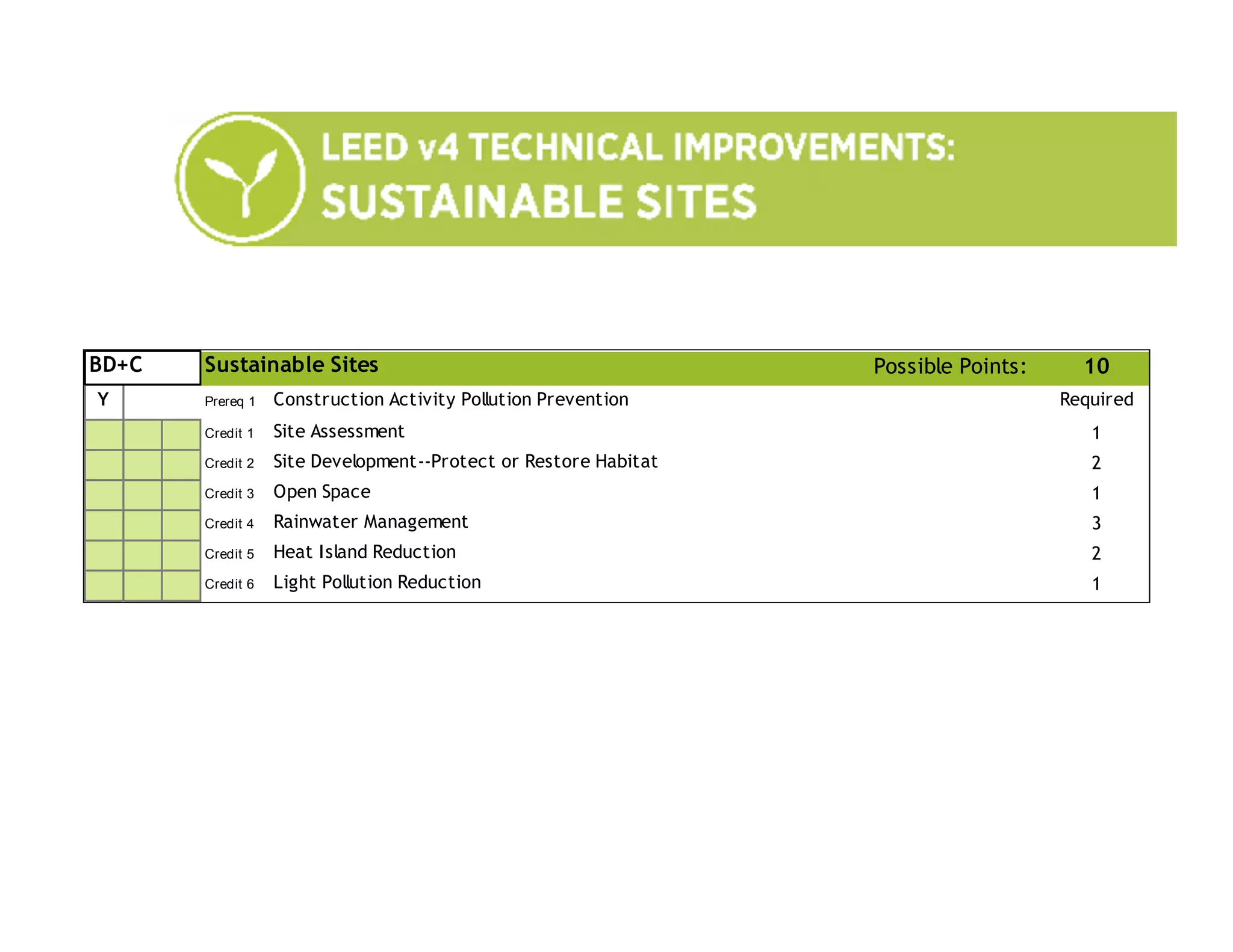
Possible Points: 10
Y Prereq 1 Required
Credit 1 1
Credit 2 2
Credit 3 1
Credit 4 3
Credit 5 2
Credit 6 1
BD+C
Site Assessment
Site Development--Protect or Restore Habitat
Rainwater Management
Light Pollution Reduction
Heat Island Reduction
Open Space
Construction Activity Pollution Prevention
Sustainable Sites
LEED 2009 LEED v4
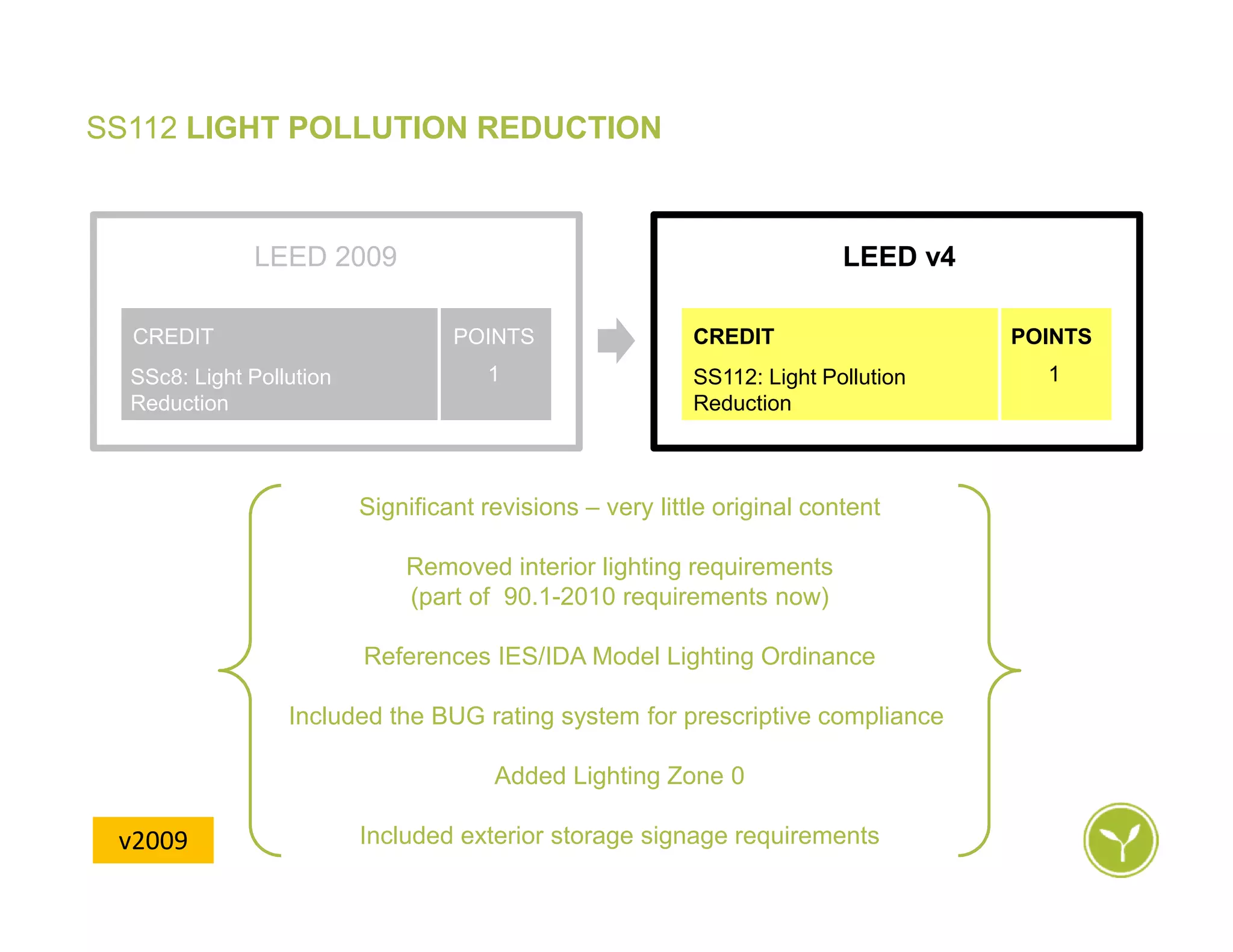
SS112 LIGHT POLLUTION REDUCTION
SS112: Light Pollution
Reduction
CREDIT
Significant revisions – very little original content
Removed interior lighting requirements
(part of 90.1-2010 requirements now)
References IES/IDA Model Lighting Ordinance
Included the BUG rating system for prescriptive compliance
Added Lighting Zone 0
Included exterior storage signage requirements
SSc8: Light Pollution
Reduction
CREDIT POINTS
1
POINTS
1
v2009
Performance in
Water Efficiency
WATER EFFICIENCY
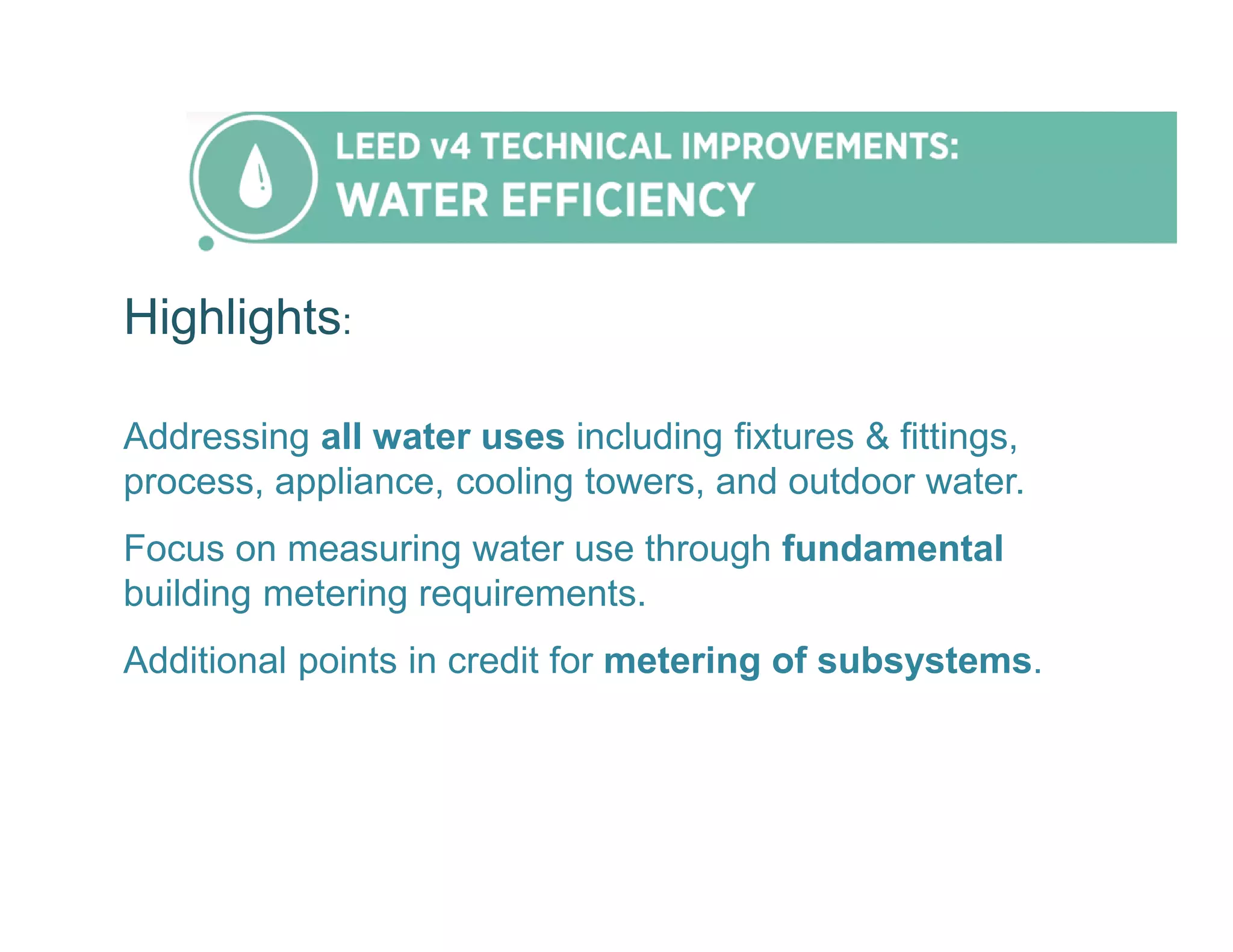
Highlights:
Addressing all water uses including fixtures & fittings,
process, appliance, cooling towers, and outdoor water.
Focus on measuring water use through fundamental
building metering requirements.
Additional points in credit for metering of subsystems.
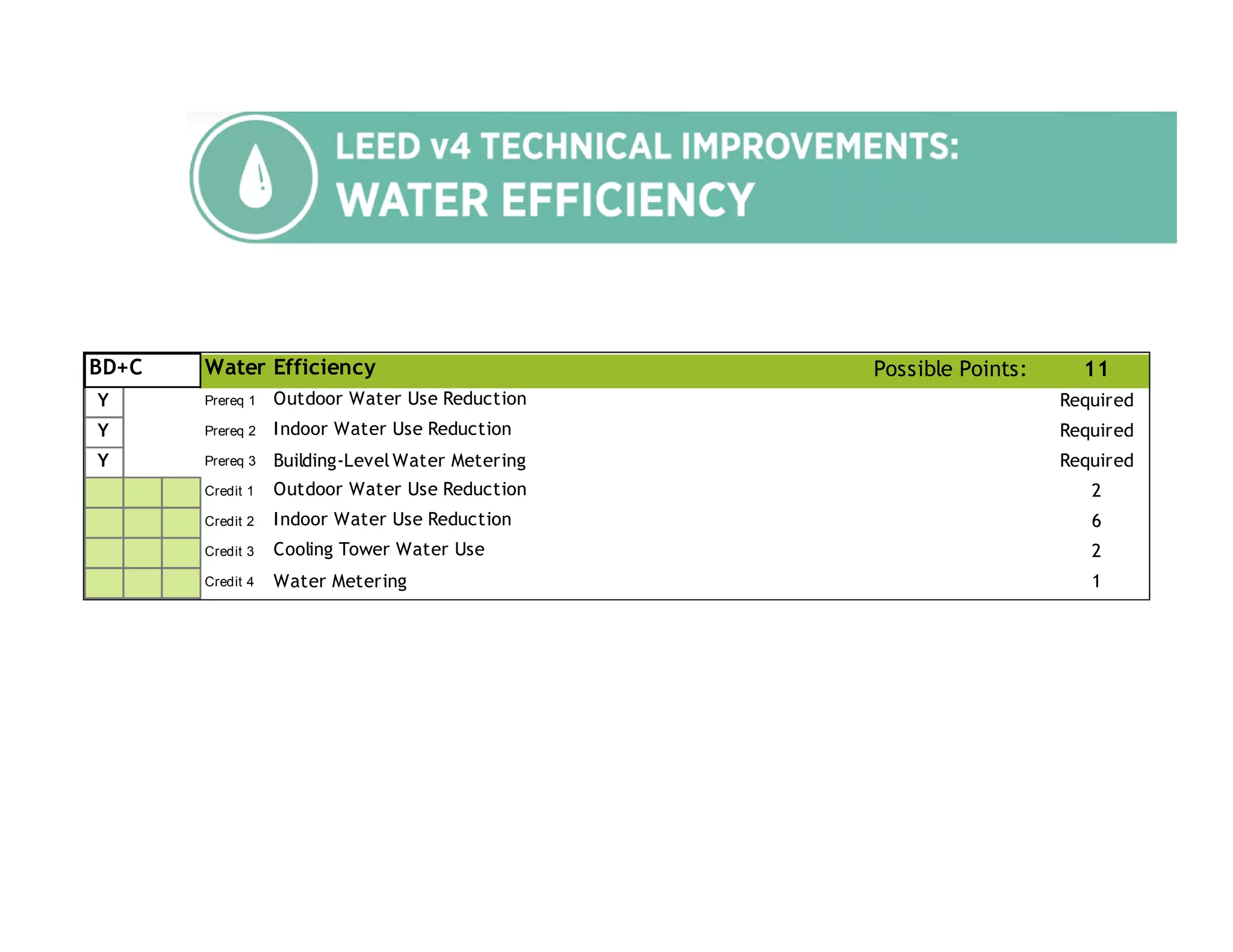
Possible Points: 11
Y Prereq 1 Required
Y Prereq 2 Required
Y Prereq 3 Building-Level Water Metering Required
Credit 1 2
Credit 2 6
Credit 3 2
Credit 4 Water Metering 1
BD+C Water Efficiency
Outdoor Water Use Reduction
Indoor Water Use Reduction
Outdoor Water Use Reduction
Indoor Water Use Reduction
Cooling Tower Water Use
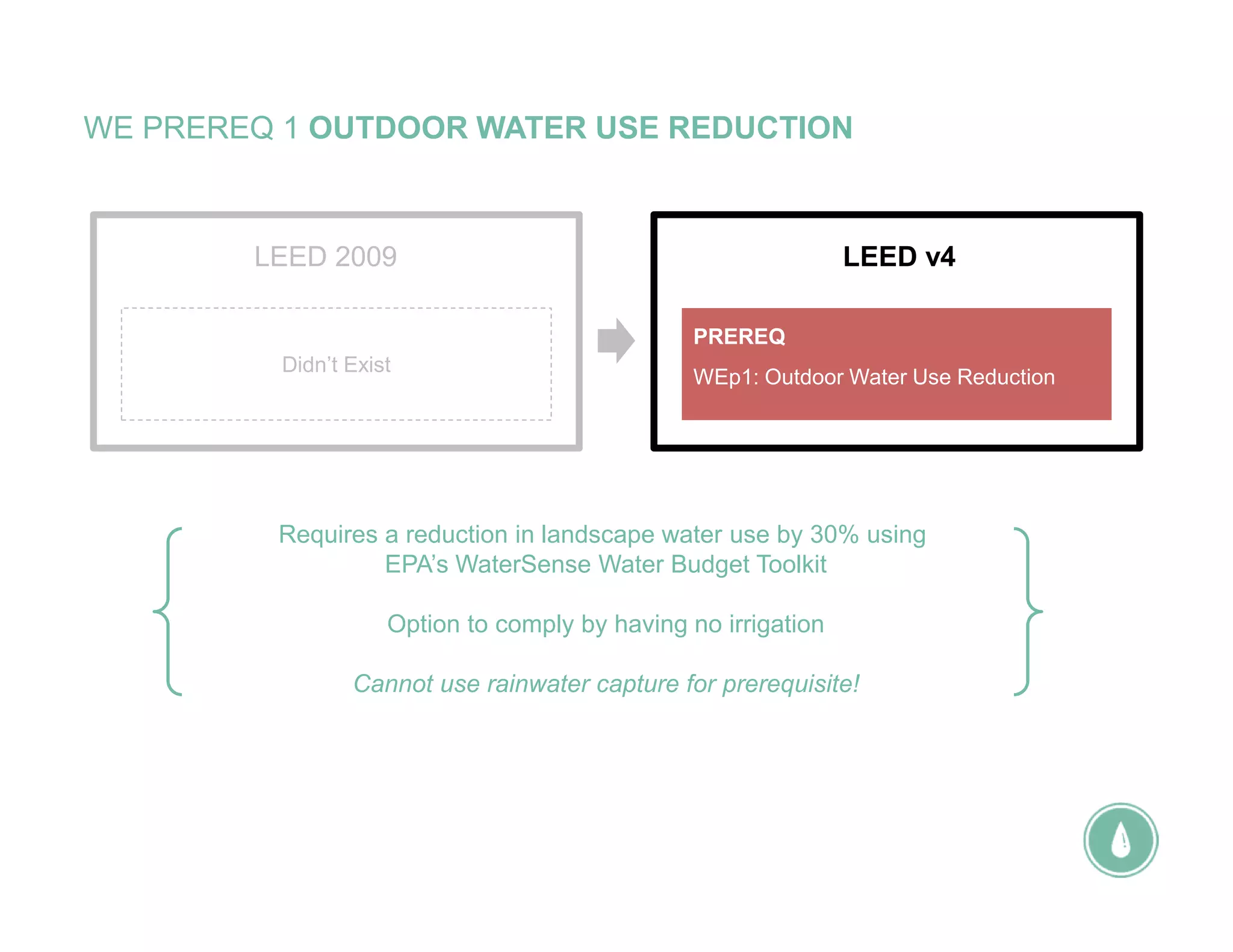
WE PREREQ 1 OUTDOOR WATER USE REDUCTION
Requires a reduction in landscape water use by 30% using
EPA’s WaterSense Water Budget Toolkit
Option to comply by having no irrigation
Cannot use rainwater capture for prerequisite!
LEED v4
WEp1: Outdoor Water Use Reduction
PREREQ
LEED 2009
Didn’t Exist
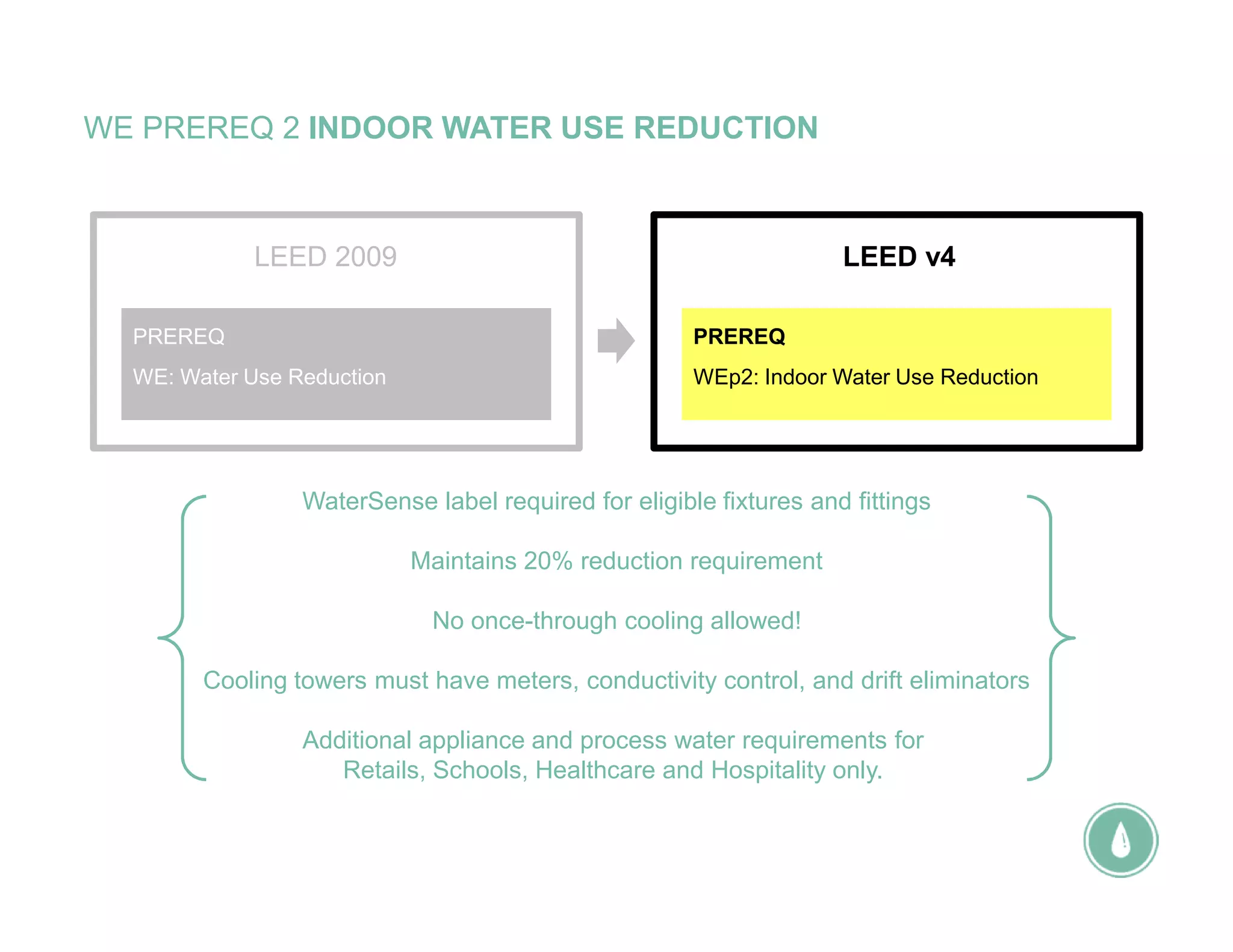
WE PREREQ 2 INDOOR WATER USE REDUCTION
WaterSense label required for eligible fixtures and fittings
Maintains 20% reduction requirement
No once-through cooling allowed!
Cooling towers must have meters, conductivity control, and drift eliminators
Additional appliance and process water requirements for
Retails, Schools, Healthcare and Hospitality only.
LEED v4
WEp2: Indoor Water Use Reduction
PREREQ
LEED 2009
WE: Water Use Reduction
PREREQ
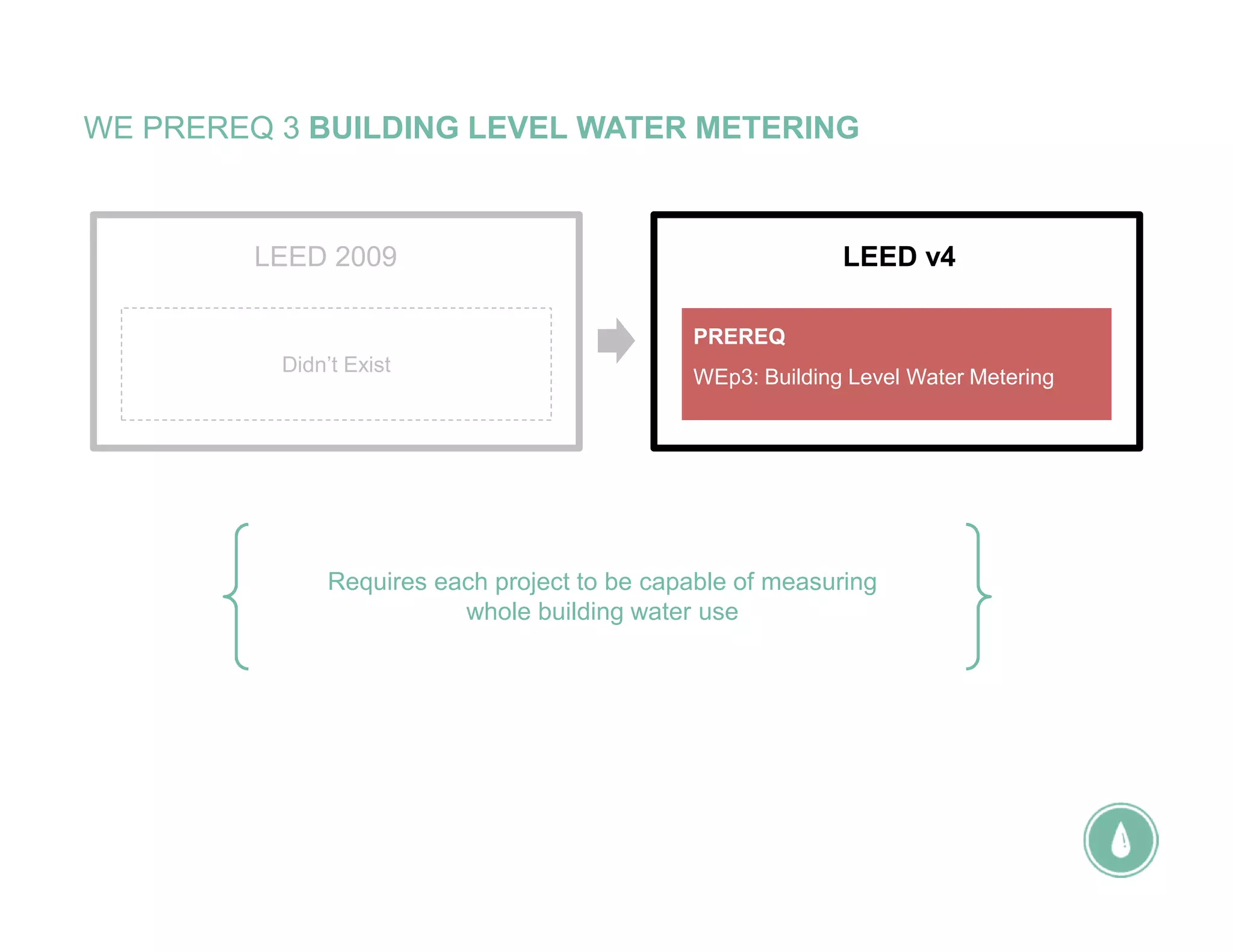
WE PREREQ 3 BUILDING LEVEL WATER METERING
Requires each project to be capable of measuring
whole building water use
LEED v4
WEp3: Building Level Water Metering
PREREQ
LEED 2009
Didn’t Exist
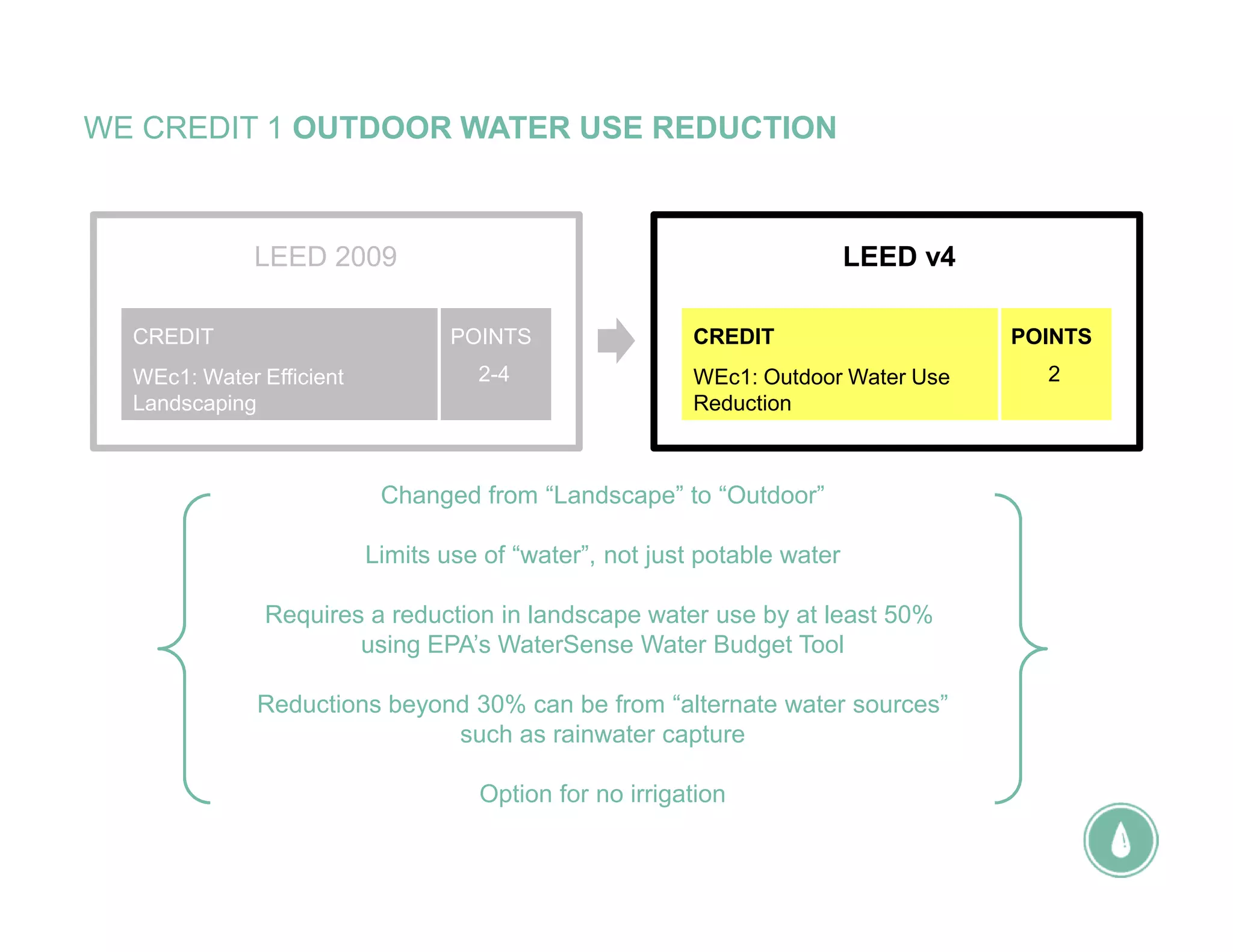
WE CREDIT 1 OUTDOOR WATER USE REDUCTION
Changed from “Landscape” to “Outdoor”
Limits use of “water”, not just potable water
Requires a reduction in landscape water use by at least 50%
using EPA’s WaterSense Water Budget Tool
Reductions beyond 30% can be from “alternate water sources”
such as rainwater capture
Option for no irrigation
LEED 2009 LEED v4
WEc1: Outdoor Water Use
Reduction
CREDIT POINTS
2WEc1: Water Efficient
Landscaping
CREDIT POINTS
2-4
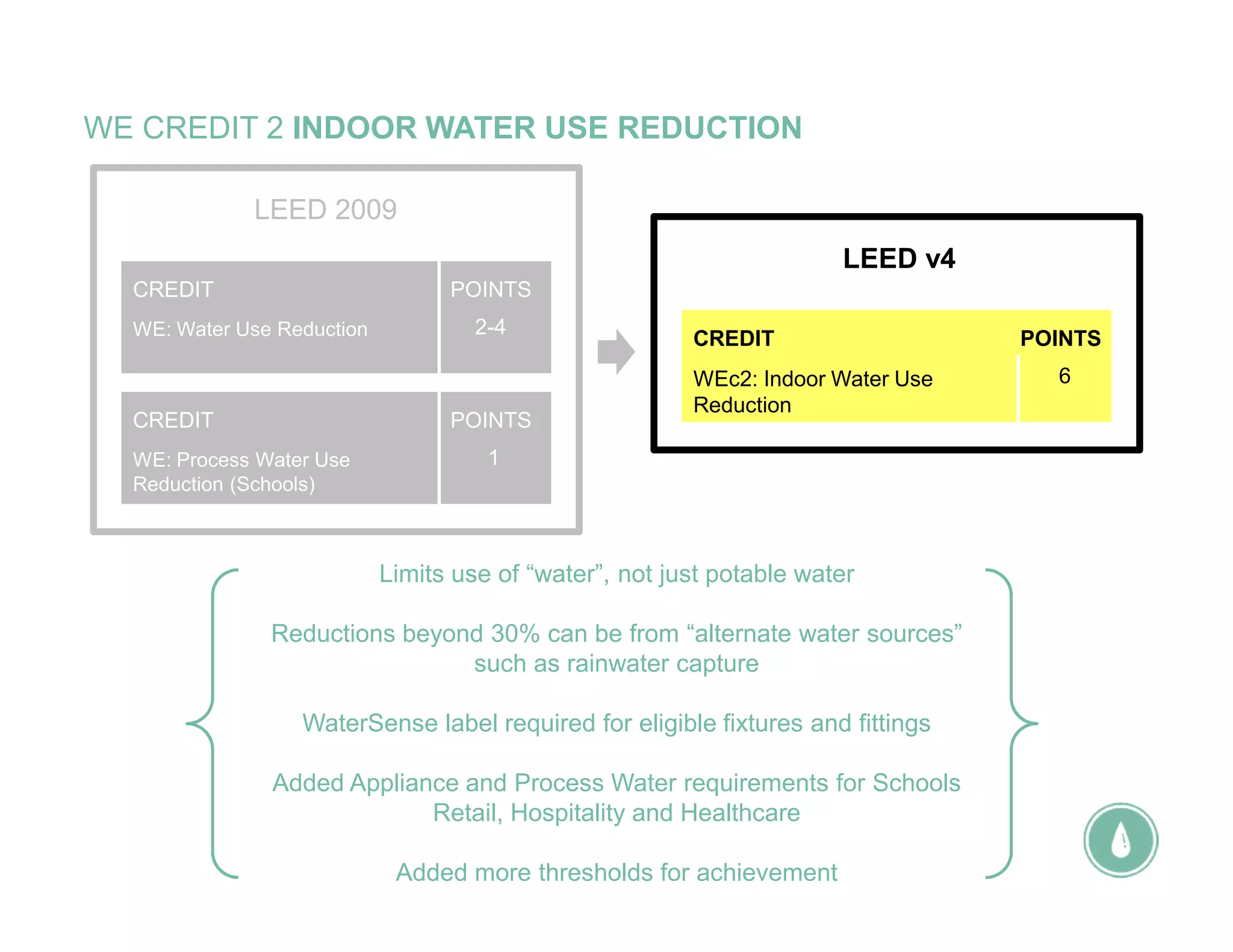
WE CREDIT 2 INDOOR WATER USE REDUCTION
Limits use of “water”, not just potable water
Reductions beyond 30% can be from “alternate water sources”
such as rainwater capture
WaterSense label required for eligible fixtures and fittings
Added Appliance and Process Water requirements for Schools
Retail, Hospitality and Healthcare
Added more thresholds for achievement
LEED 2009
LEED v4
WEc2: Indoor Water Use
Reduction
CREDIT POINTS
6
WE: Water Use Reduction
CREDIT POINTS
2-4
WE: Process Water Use
Reduction (Schools)
CREDIT POINTS
1
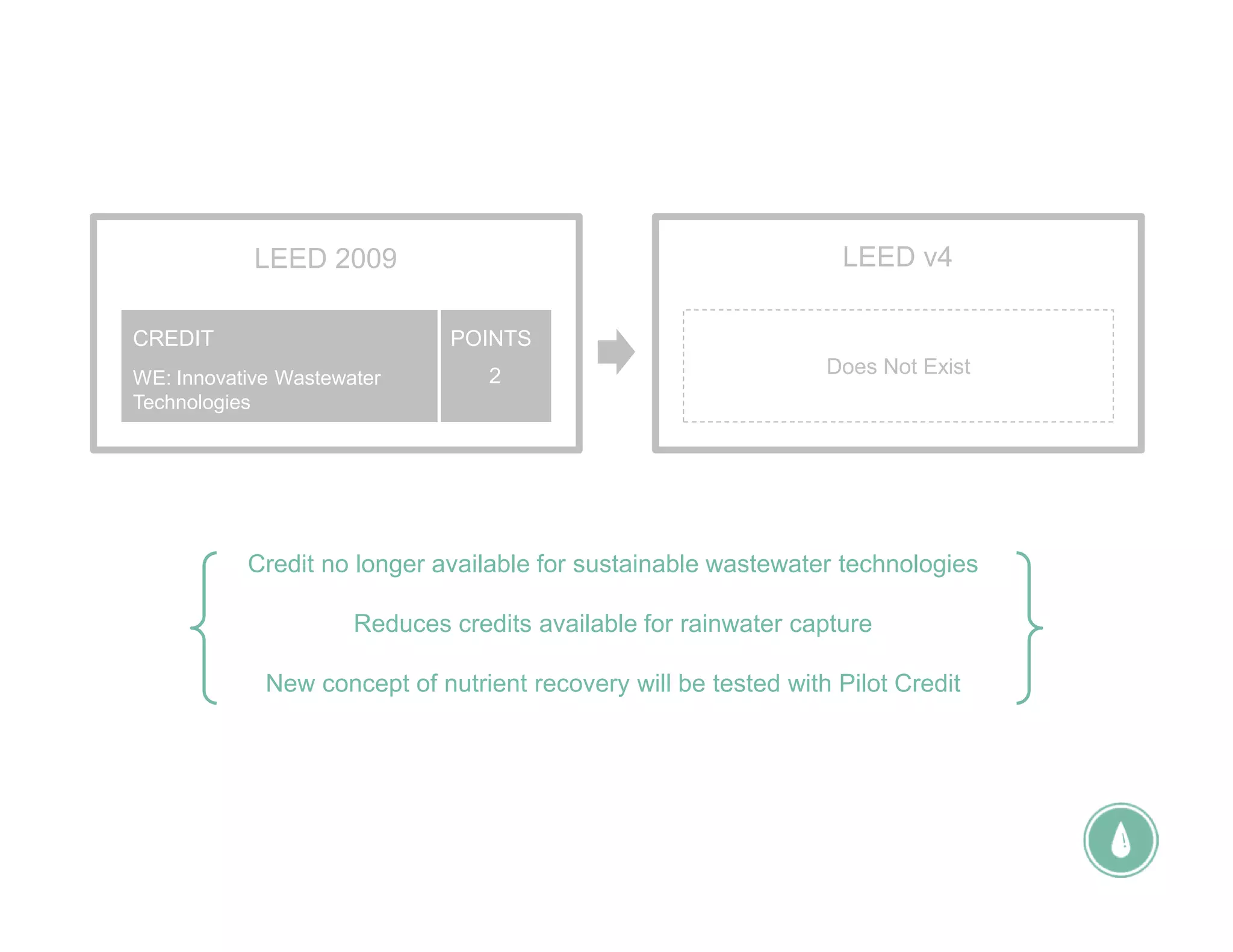
Credit no longer available for sustainable wastewater technologies
Reduces credits available for rainwater capture
New concept of nutrient recovery will be tested with Pilot Credit
LEED 2009
WE: Innovative Wastewater
Technologies
CREDIT POINTS
2
LEED v4
Does Not Exist
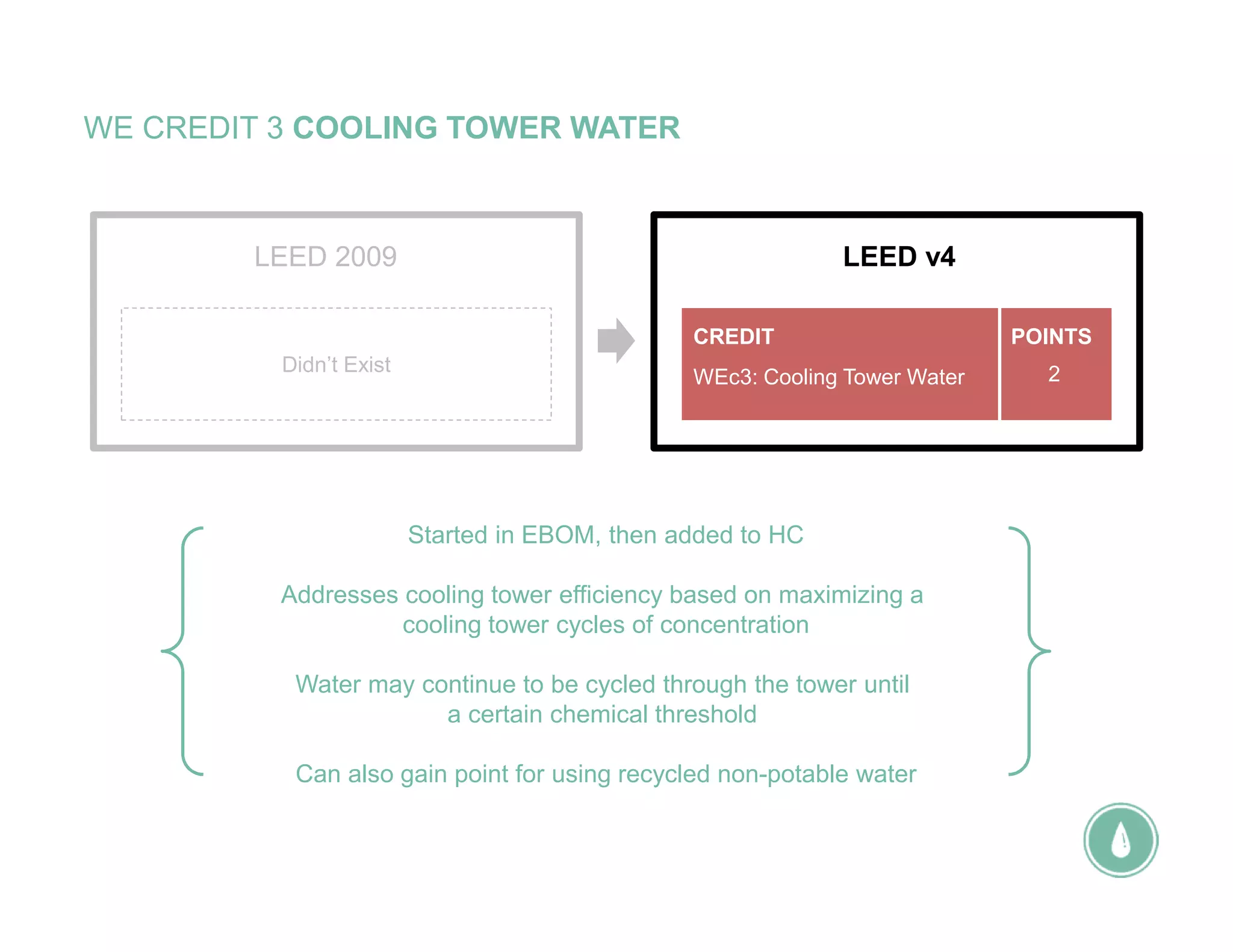
WE CREDIT 3 COOLING TOWER WATER
Started in EBOM, then added to HC
Addresses cooling tower efficiency based on maximizing a
cooling tower cycles of concentration
Water may continue to be cycled through the tower until
a certain chemical threshold
Can also gain point for using recycled non-potable water
LEED 2009
Didn’t Exist
LEED v4
WEc3: Cooling Tower Water
CREDIT POINTS
2
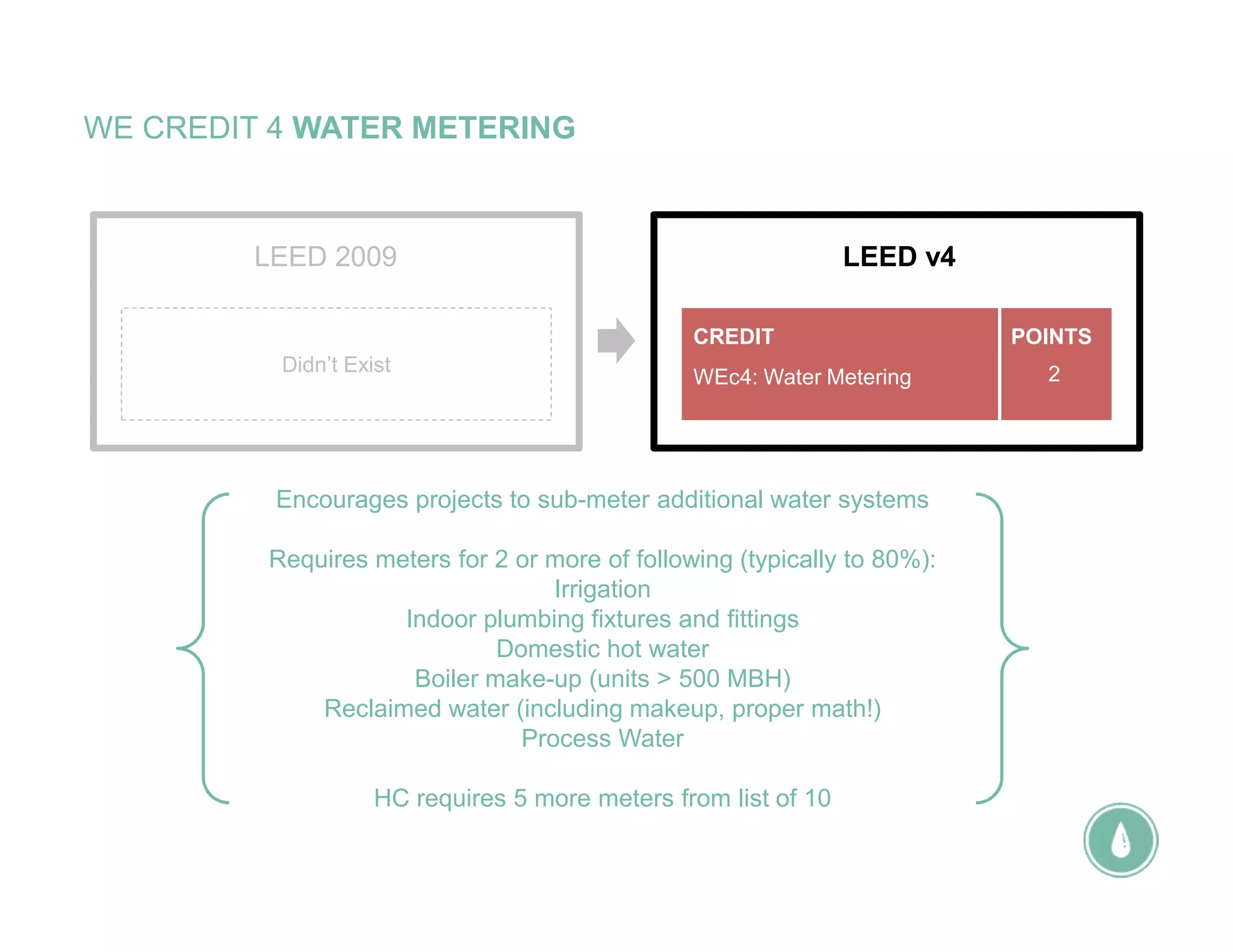
WE CREDIT 4 WATER METERING
Encourages projects to sub-meter additional water systems
Requires meters for 2 or more of following (typically to 80%):
Irrigation
Indoor plumbing fixtures and fittings
Domestic hot water
Boiler make-up (units > 500 MBH)
Reclaimed water (including makeup, proper math!)
Process Water
HC requires 5 more meters from list of 10
LEED v4
WEc4: Water Metering
CREDIT POINTS
2
LEED 2009
Didn’t Exist
Defining Performance in
Energy & Atmosphere
ENERGY AND ATMOSPHERE
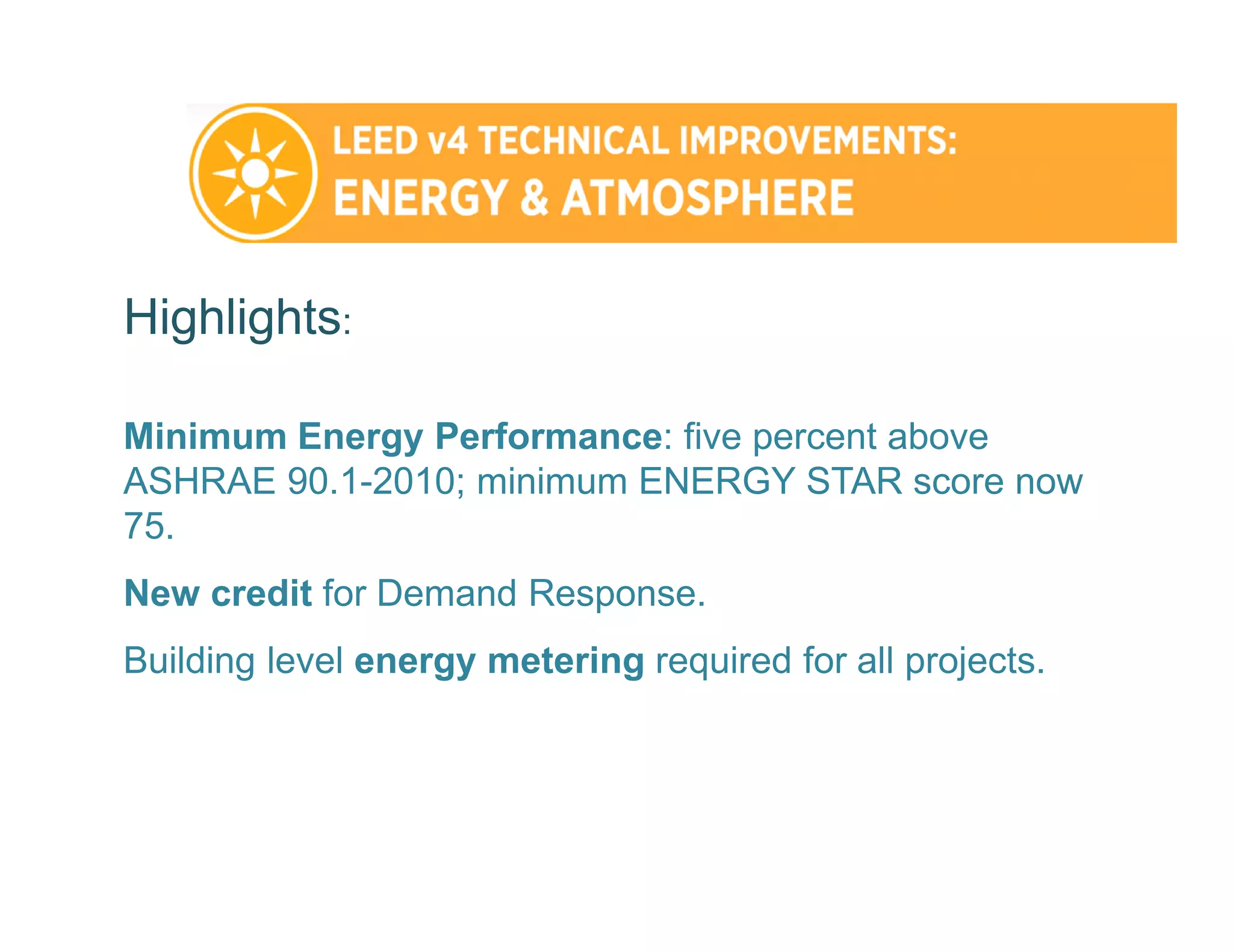
Highlights:
Minimum Energy Performance: five percent above
ASHRAE 90.1-2010; minimum ENERGY STAR score now
75.
New credit for Demand Response.
Building level energy metering required for all projects.
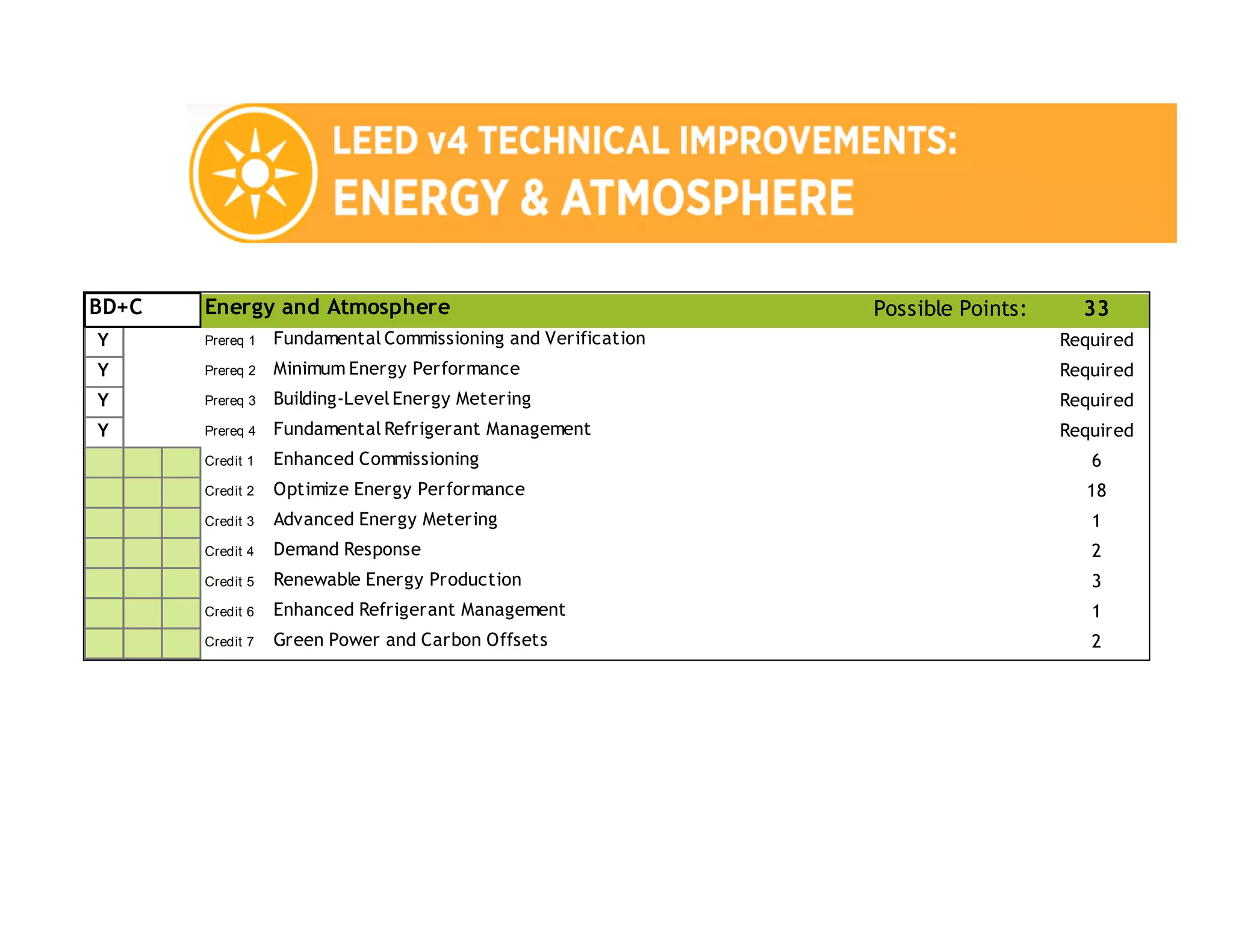
Possible Points: 33
Y Prereq 1 Required
Y Prereq 2 Required
Y Prereq 3 Required
Y Prereq 4 Required
Credit 1 6
Credit 2 18
Credit 3 1
Credit 4 2
Credit 5 3
Credit 6 1
Credit 7 2
BD+C
Green Power and Carbon Offsets
Enhanced Commissioning
Demand Response
Renewable Energy Production
Enhanced Refrigerant Management
Optimize Energy Performance
Energy and Atmosphere
Minimum Energy Performance
Building-Level Energy Metering
Fundamental Commissioning and Verification
Fundamental Refrigerant Management
Advanced Energy Metering
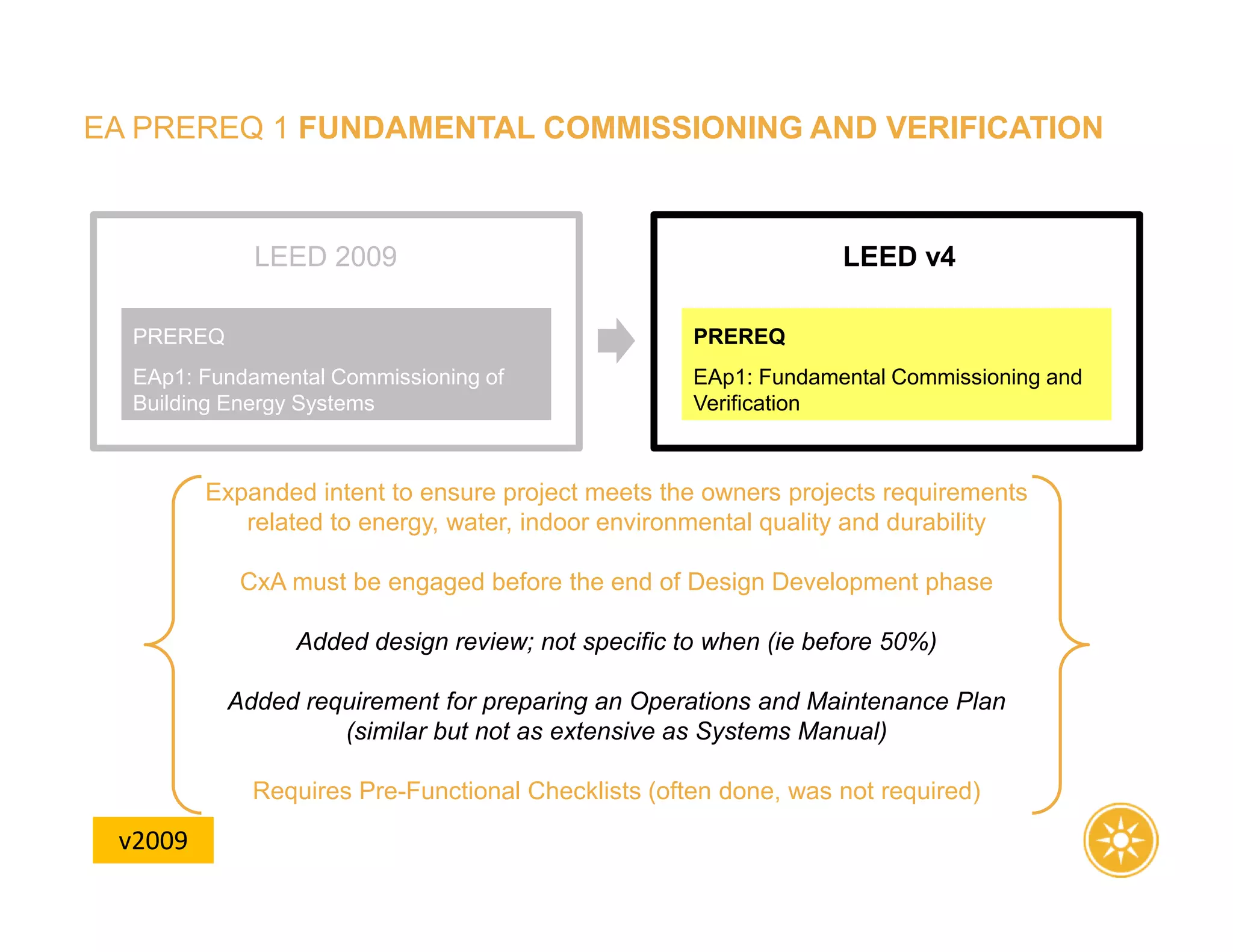
EA PREREQ 1 FUNDAMENTAL COMMISSIONING AND VERIFICATION
Expanded intent to ensure project meets the owners projects requirements
related to energy, water, indoor environmental quality and durability
CxA must be engaged before the end of Design Development phase
Added design review; not specific to when (ie before 50%)
Added requirement for preparing an Operations and Maintenance Plan
(similar but not as extensive as Systems Manual)
Requires Pre-Functional Checklists (often done, was not required)
LEED v4
EAp1: Fundamental Commissioning and
Verification
PREREQ
LEED 2009
EAp1: Fundamental Commissioning of
Building Energy Systems
PREREQ
v2009
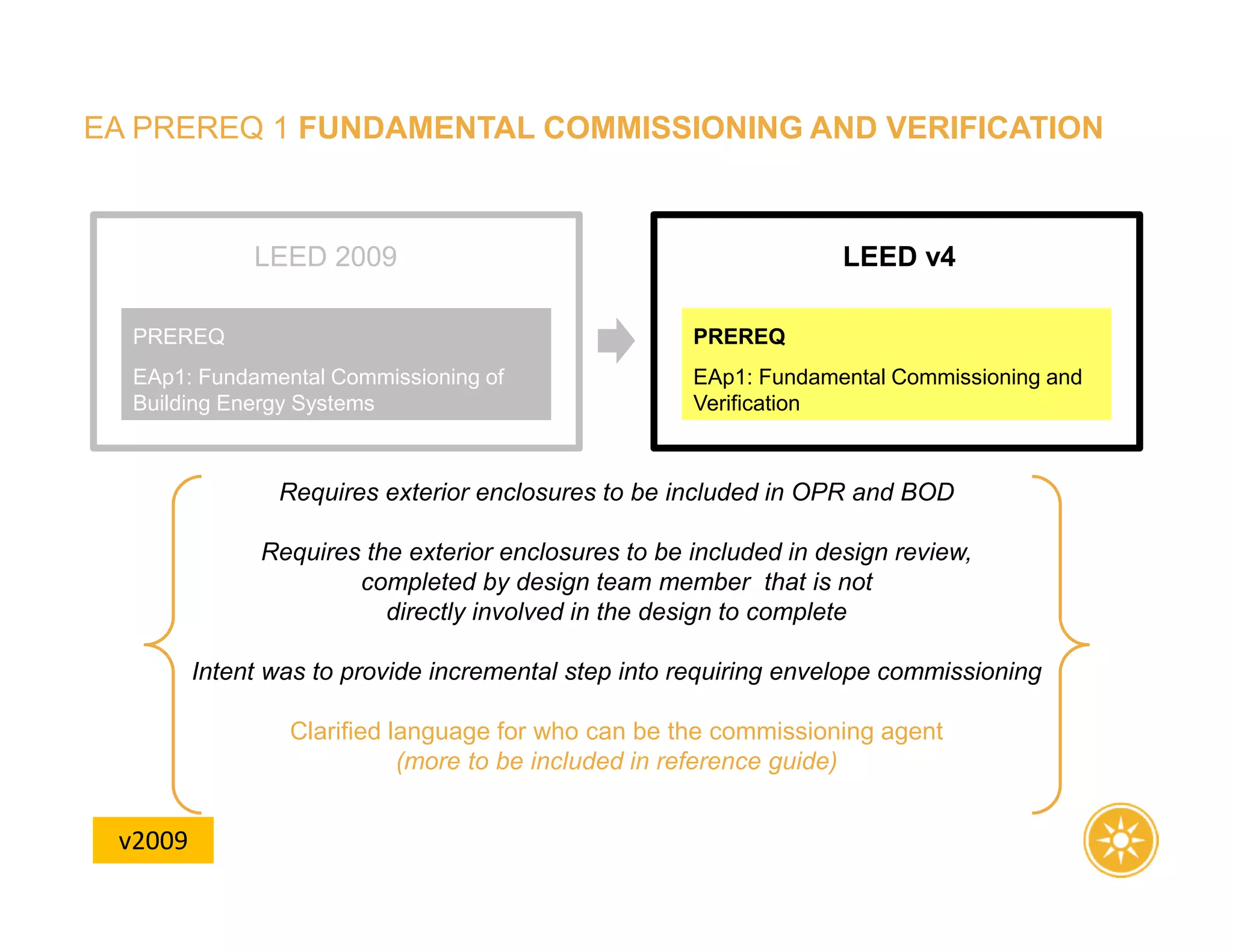
EA PREREQ 1 FUNDAMENTAL COMMISSIONING AND VERIFICATION
Requires exterior enclosures to be included in OPR and BOD
Requires the exterior enclosures to be included in design review,
completed by design team member that is not
directly involved in the design to complete
Intent was to provide incremental step into requiring envelope commissioning
Clarified language for who can be the commissioning agent
(more to be included in reference guide)
LEED v4
EAp1: Fundamental Commissioning and
Verification
PREREQ
LEED 2009
EAp1: Fundamental Commissioning of
Building Energy Systems
PREREQ
v2009
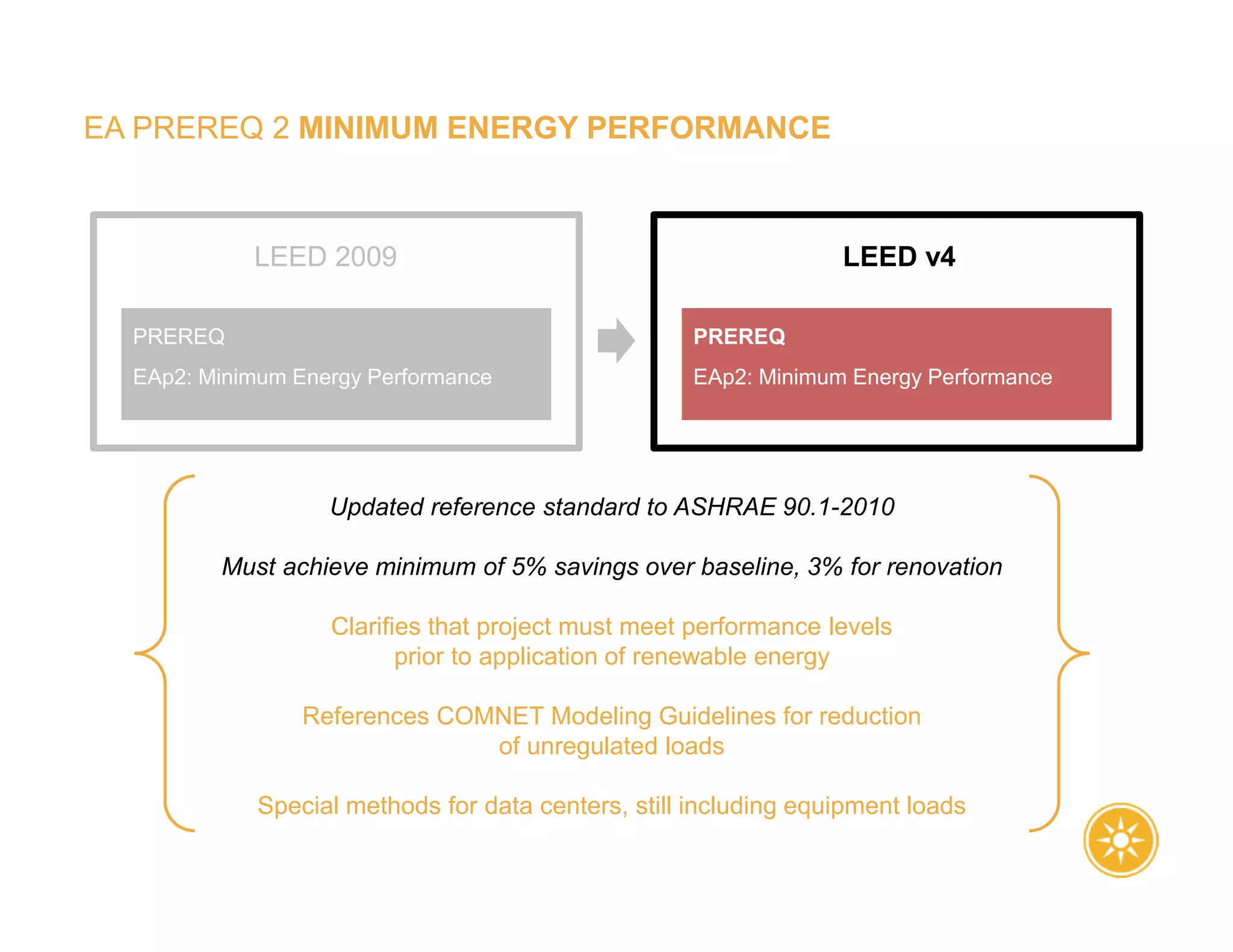
EA PREREQ 2 MINIMUM ENERGY PERFORMANCE
Updated reference standard to ASHRAE 90.1-2010
Must achieve minimum of 5% savings over baseline, 3% for renovation
Clarifies that project must meet performance levels
prior to application of renewable energy
References COMNET Modeling Guidelines for reduction
of unregulated loads
Special methods for data centers, still including equipment loads
LEED v4
EAp2: Minimum Energy Performance
PREREQ
LEED 2009
EAp2: Minimum Energy Performance
PREREQ
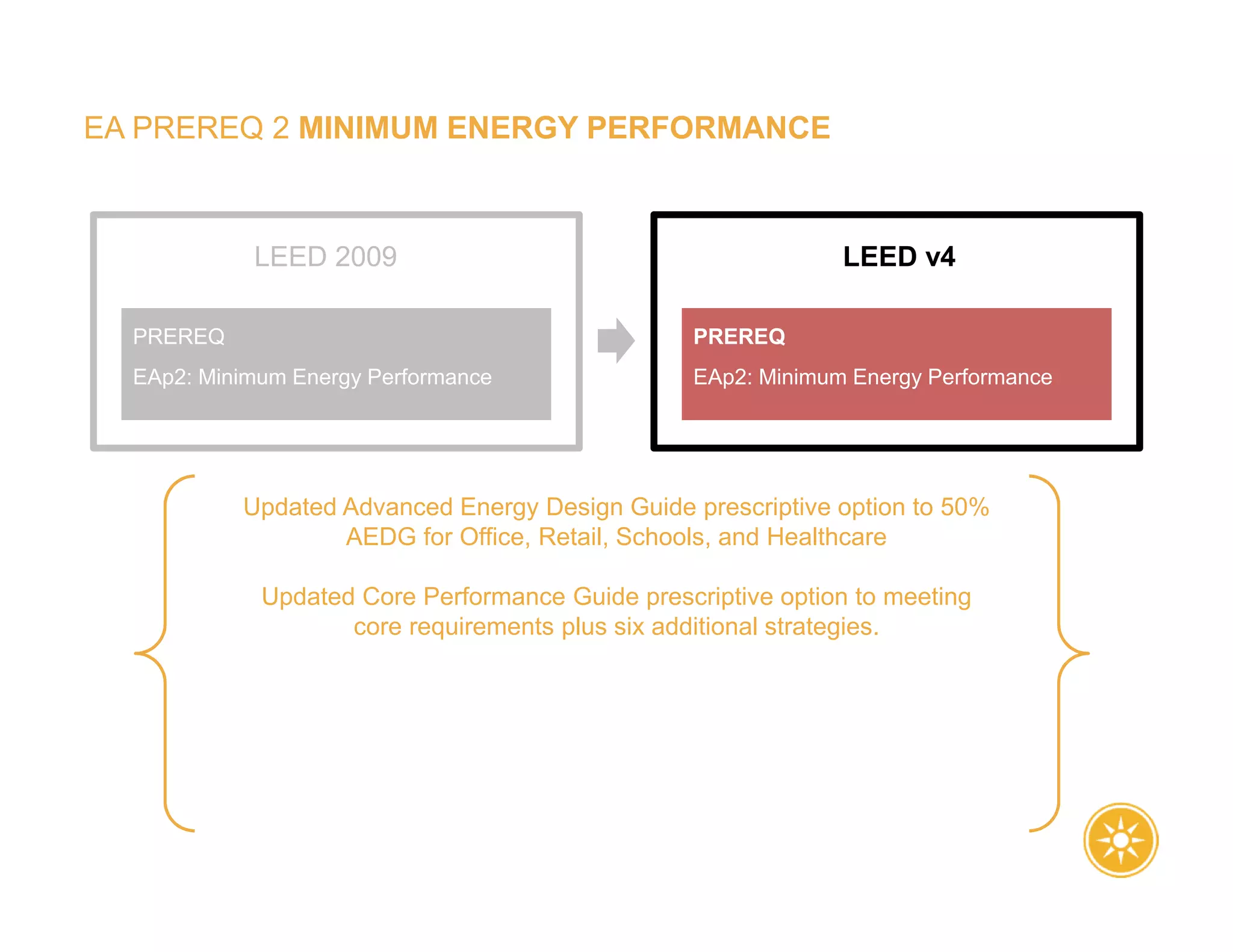
EA PREREQ 2 MINIMUM ENERGY PERFORMANCE
Updated Advanced Energy Design Guide prescriptive option to 50%
AEDG for Office, Retail, Schools, and Healthcare
Updated Core Performance Guide prescriptive option to meeting
core requirements plus six additional strategies.
LEED v4
EAp2: Minimum Energy Performance
PREREQ
LEED 2009
EAp2: Minimum Energy Performance
PREREQ
ASHRAE 90.1-2010
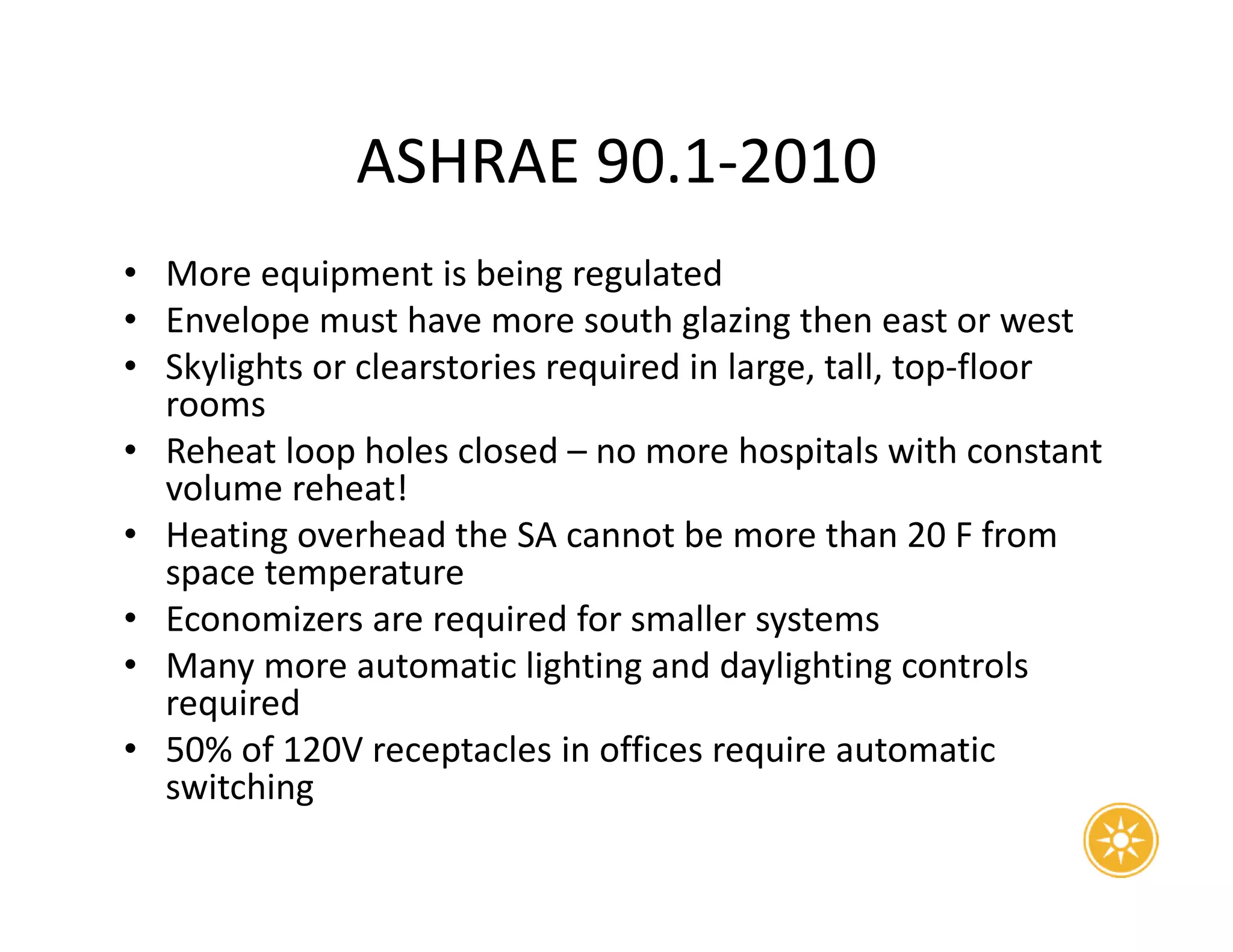
• More equipment is being regulated
• Envelope must have more south glazing then east or west
• Skylights or clearstories required in large, tall, top-floor
rooms
• Reheat loop holes closed – no more hospitals with constant
volume reheat!
• Heating overhead the SA cannot be more than 20 F from
space temperature
• Economizers are required for smaller systems
• Many more automatic lighting and daylighting controls
required
• 50% of 120V receptacles in offices require automatic
switching
Appendix G
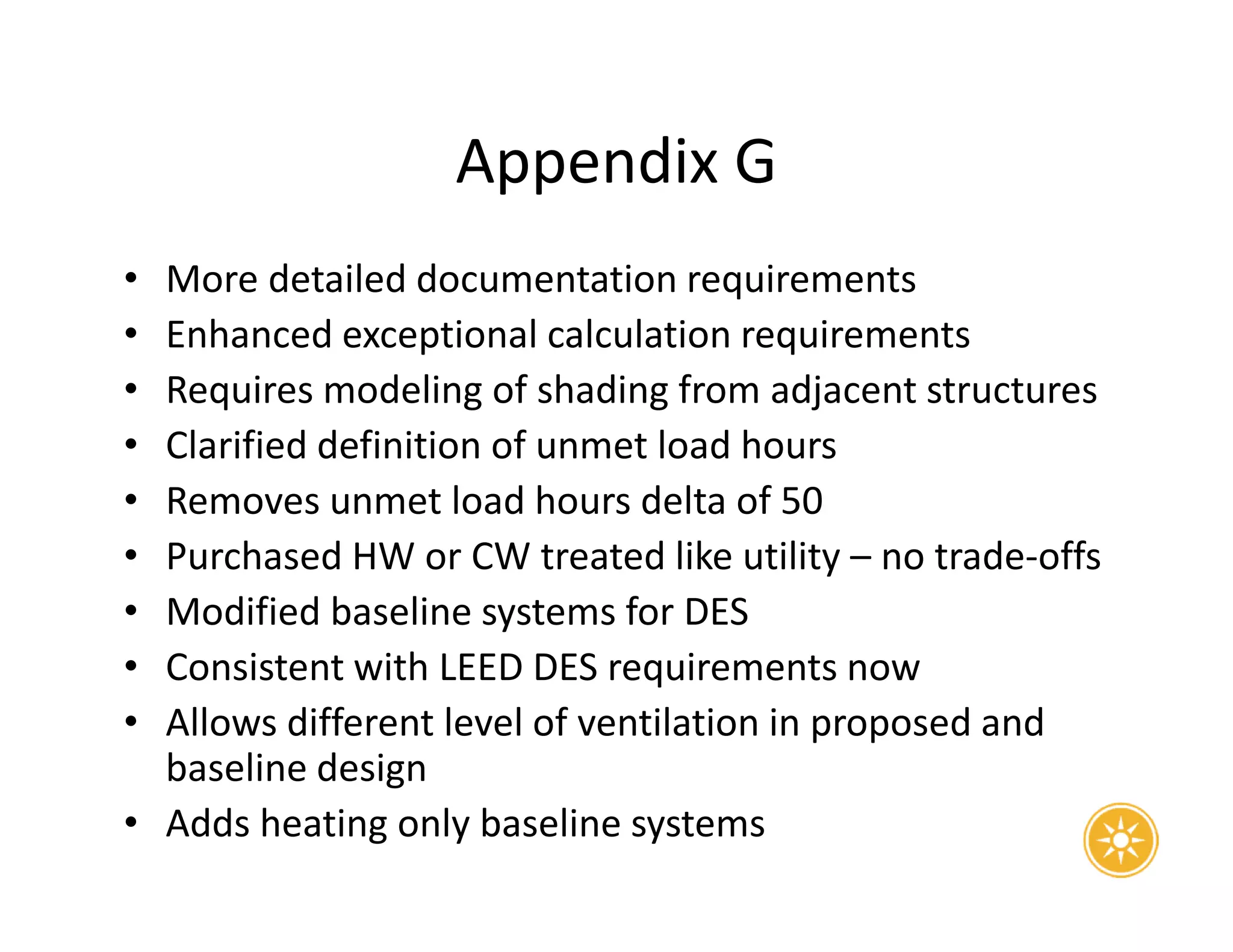
• More detailed documentation requirements
• Enhanced exceptional calculation requirements
• Requires modeling of shading from adjacent structures
• Clarified definition of unmet load hours
• Removes unmet load hours delta of 50
• Purchased HW or CW treated like utility – no trade-offs
• Modified baseline systems for DES
• Consistent with LEED DES requirements now
• Allows different level of ventilation in proposed and
baseline design
• Adds heating only baseline systems
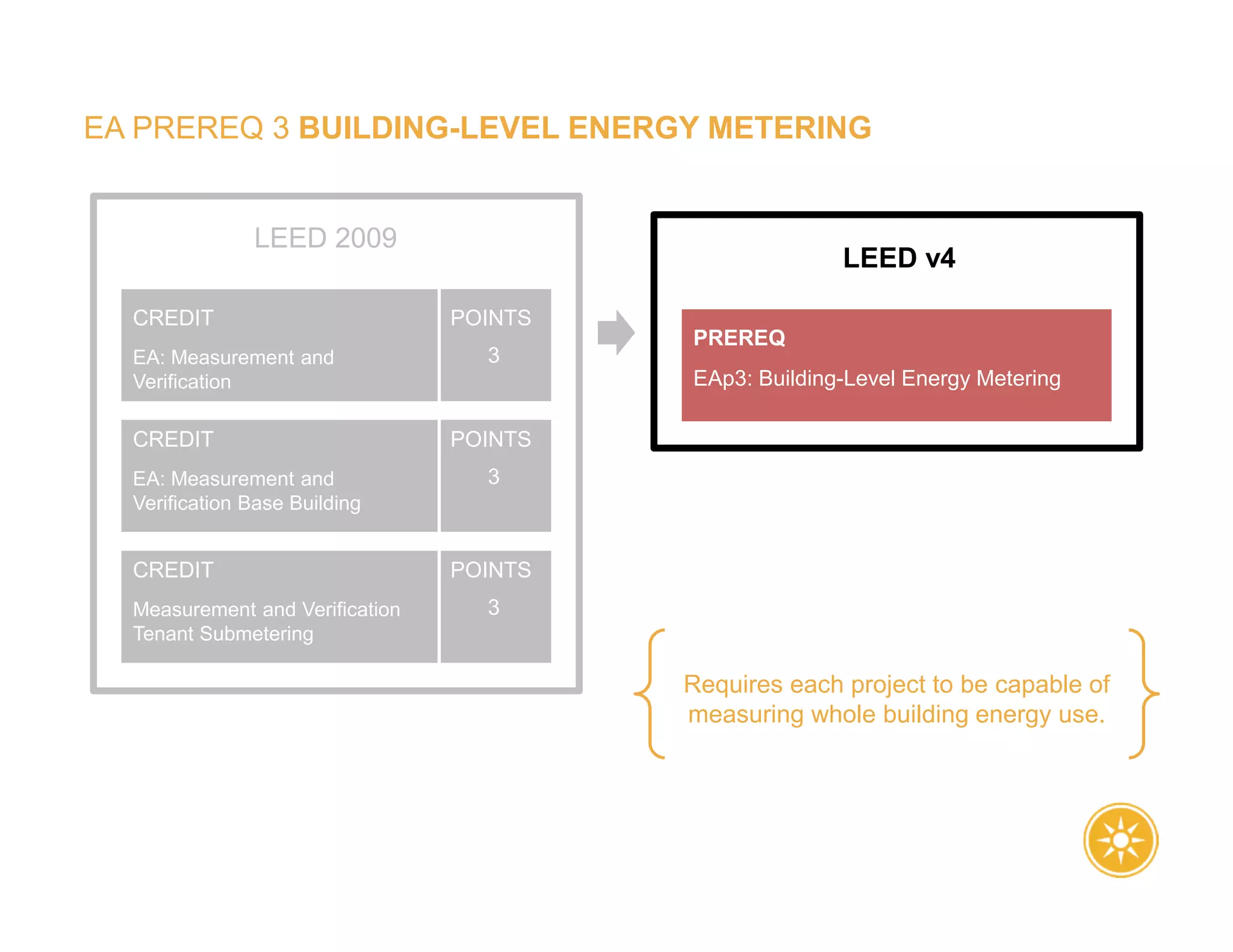
EA PREREQ 3 BUILDING-LEVEL ENERGY METERING
Requires each project to be capable of
measuring whole building energy use.
LEED v4
EAp3: Building-Level Energy Metering
PREREQ
LEED 2009
EA: Measurement and
Verification
CREDIT POINTS
3
EA: Measurement and
Verification Base Building
CREDIT POINTS
3
Measurement and Verification
Tenant Submetering
CREDIT POINTS
3
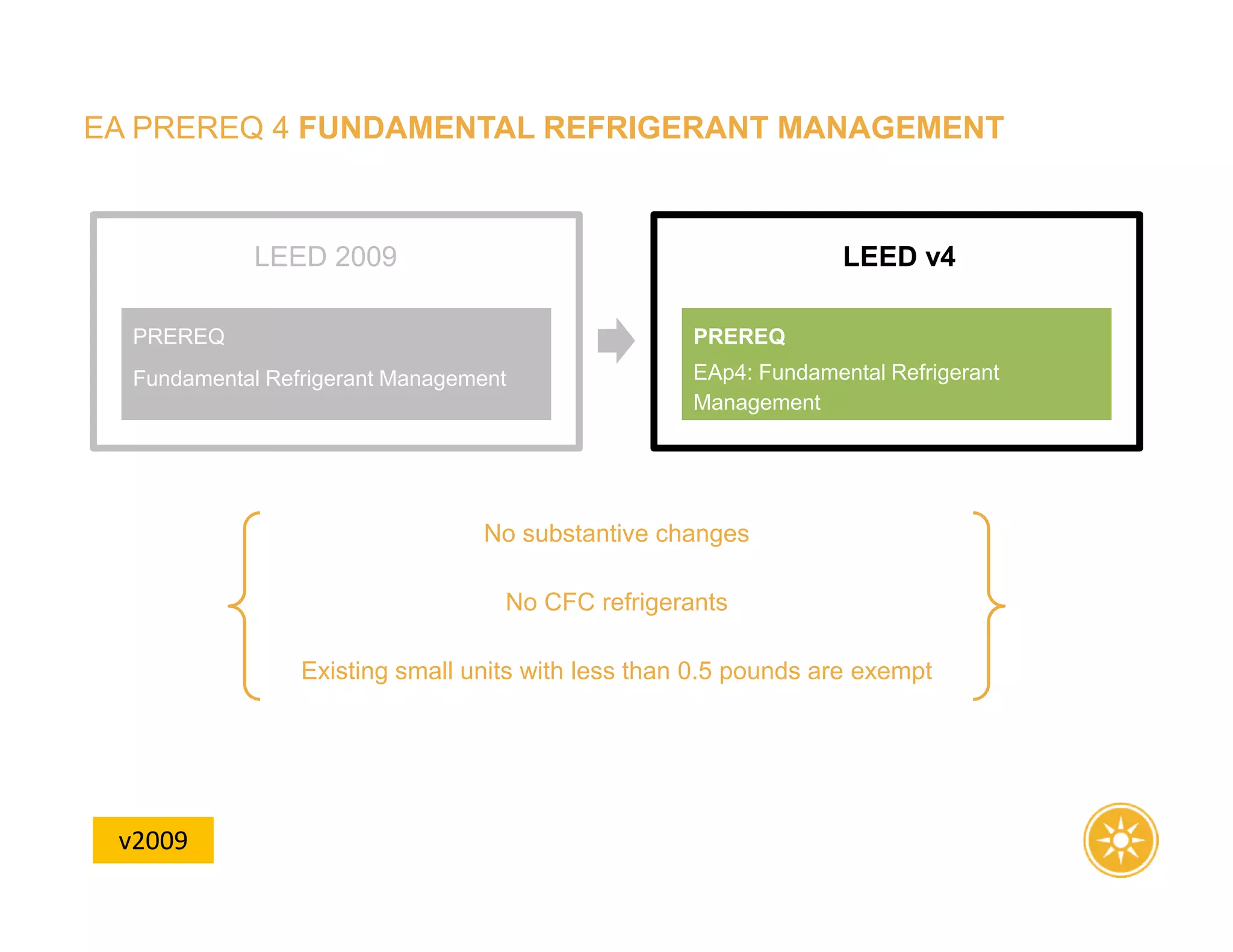
EA PREREQ 4 FUNDAMENTAL REFRIGERANT MANAGEMENT
No substantive changes
No CFC refrigerants
Existing small units with less than 0.5 pounds are exempt
LEED v4
EAp4: Fundamental Refrigerant
Management
PREREQ
LEED 2009
Fundamental Refrigerant Management
PREREQ
v2009
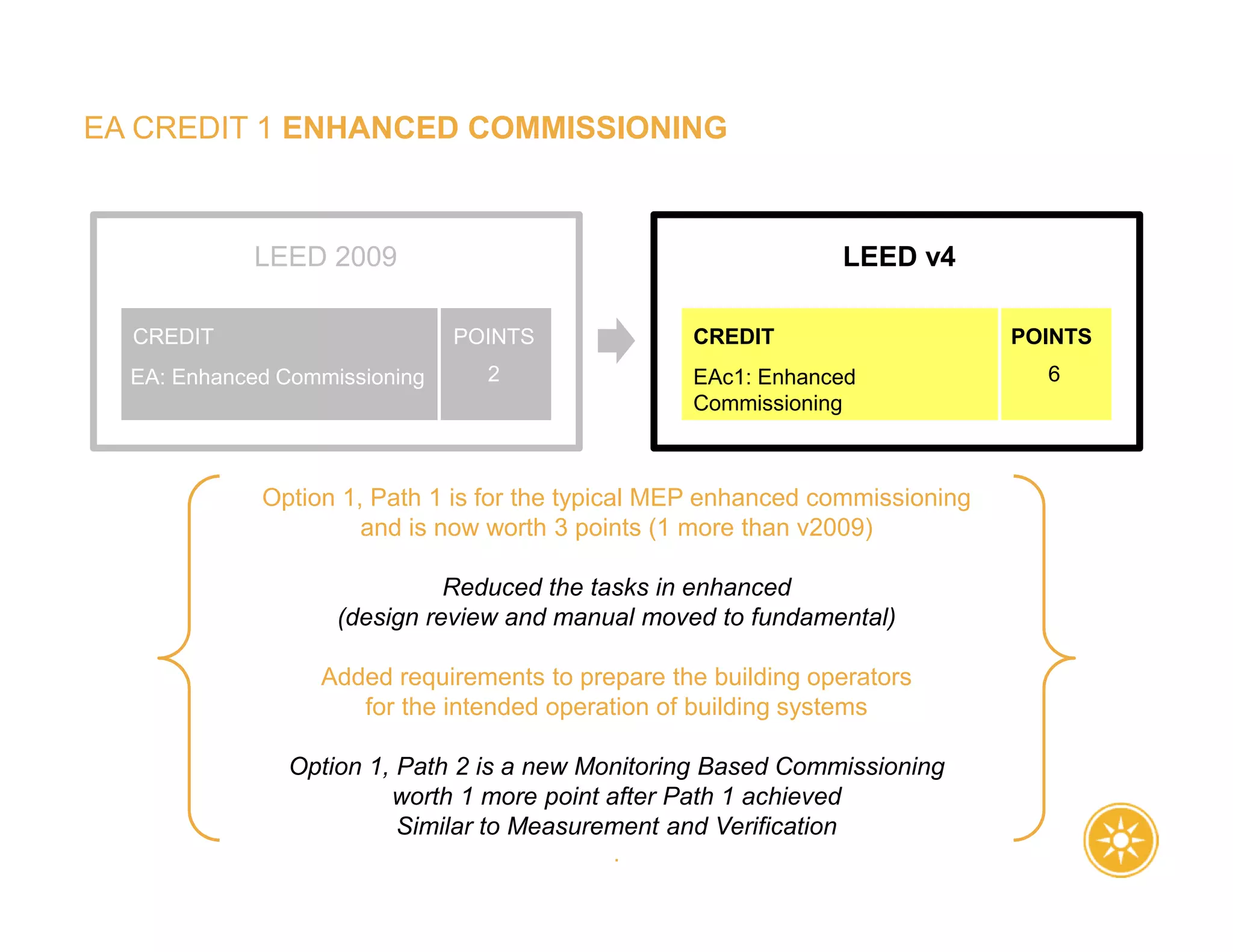
EA CREDIT 1 ENHANCED COMMISSIONING
Option 1, Path 1 is for the typical MEP enhanced commissioning
and is now worth 3 points (1 more than v2009)
Reduced the tasks in enhanced
(design review and manual moved to fundamental)
Added requirements to prepare the building operators
for the intended operation of building systems
Option 1, Path 2 is a new Monitoring Based Commissioning
worth 1 more point after Path 1 achieved
Similar to Measurement and Verification
.
LEED 2009 LEED v4
EAc1: Enhanced
Commissioning
CREDIT
EA: Enhanced Commissioning
CREDIT POINTS
2
POINTS
6
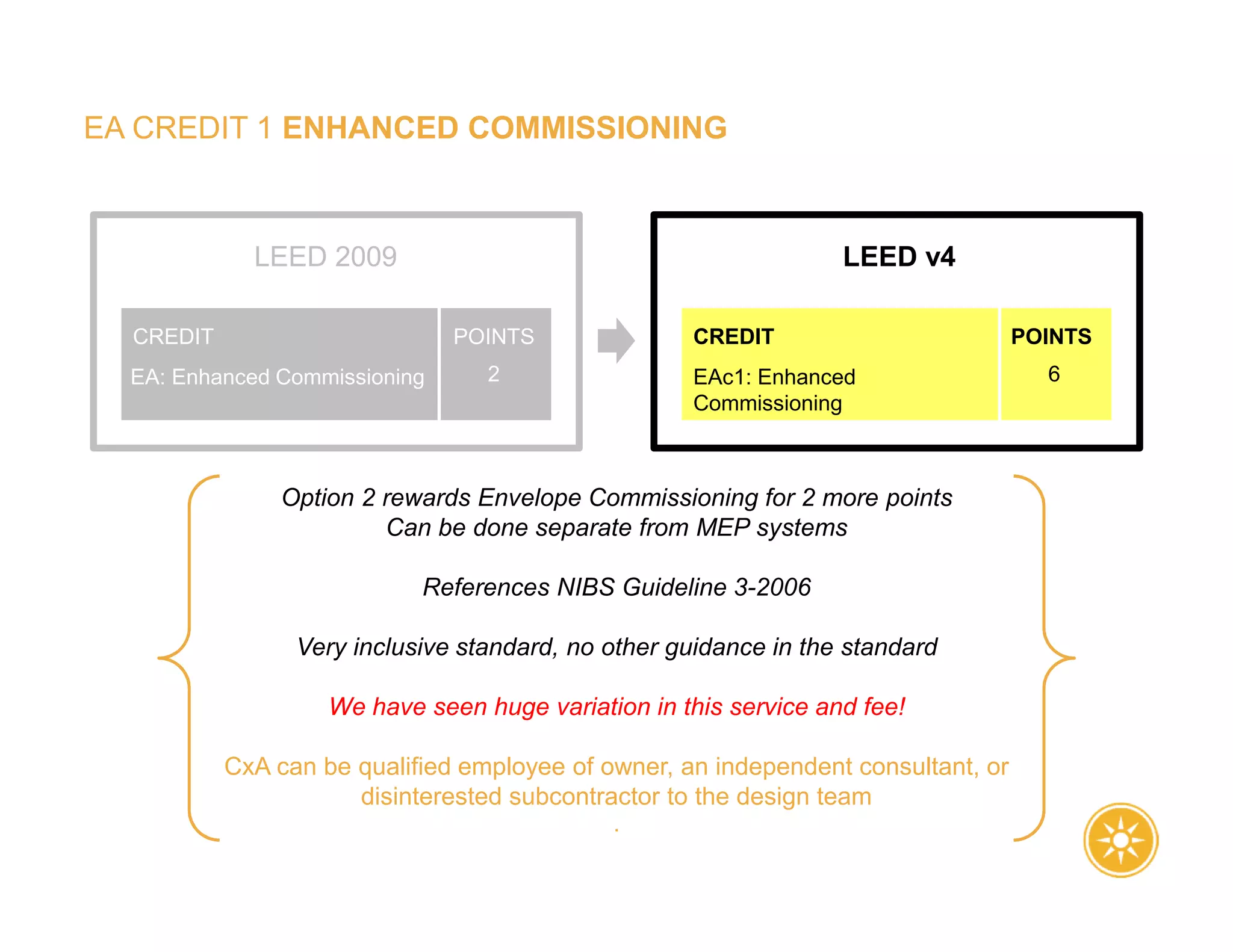
EA CREDIT 1 ENHANCED COMMISSIONING
Option 2 rewards Envelope Commissioning for 2 more points
Can be done separate from MEP systems
References NIBS Guideline 3-2006
Very inclusive standard, no other guidance in the standard
We have seen huge variation in this service and fee!
CxA can be qualified employee of owner, an independent consultant, or
disinterested subcontractor to the design team
.
LEED 2009 LEED v4
EAc1: Enhanced
Commissioning
CREDIT
EA: Enhanced Commissioning
CREDIT POINTS
2
POINTS
6
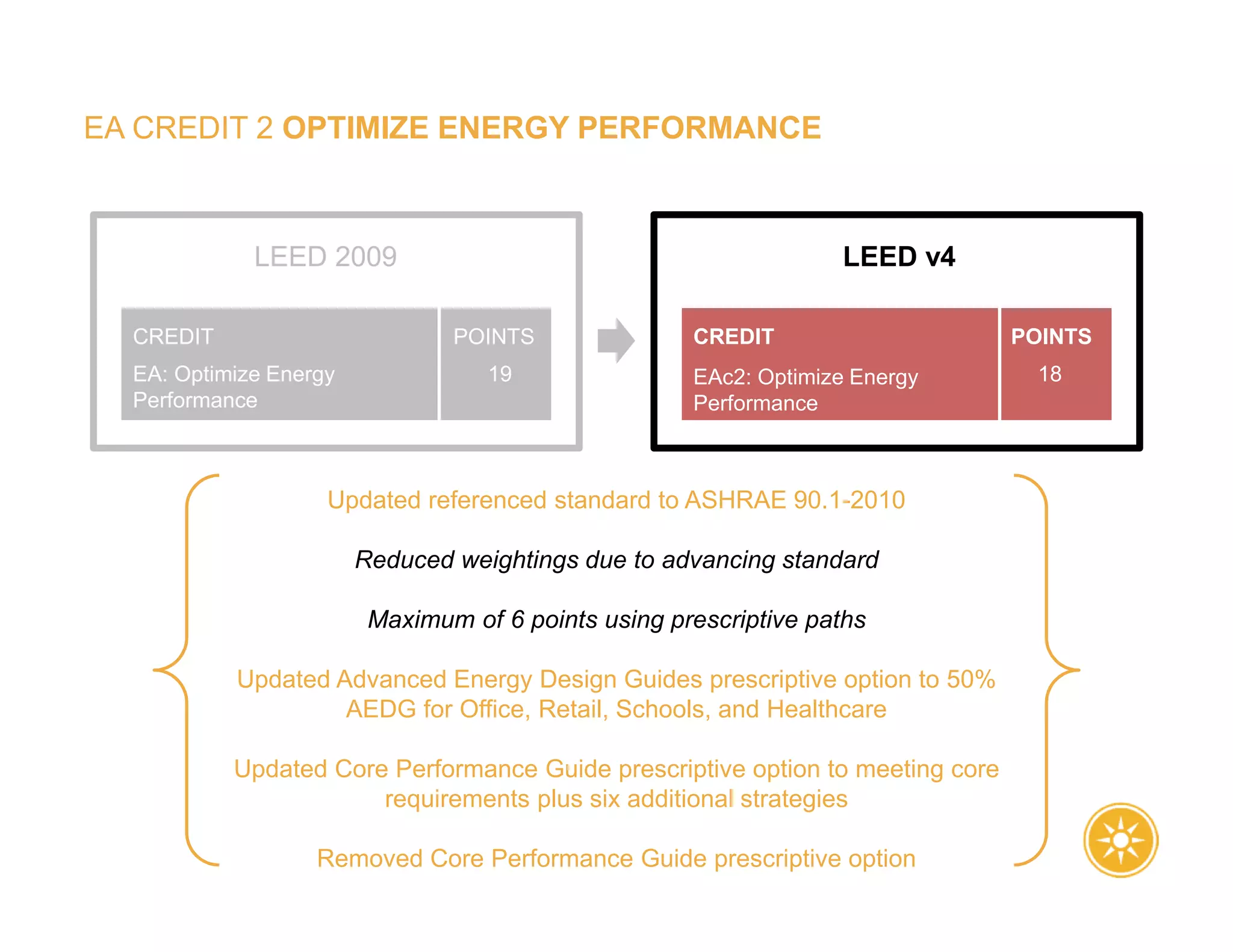
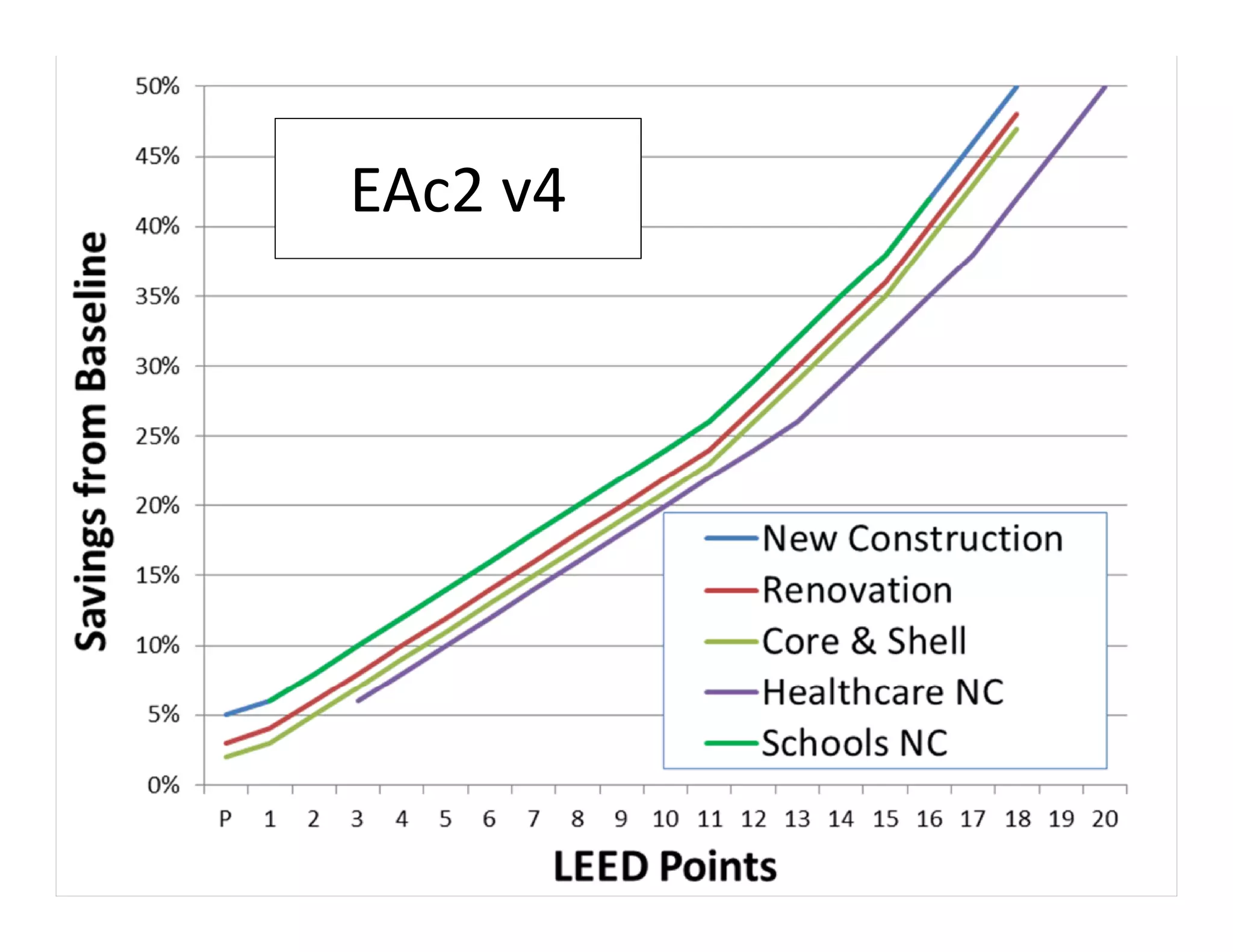
EA CREDIT 2 OPTIMIZE ENERGY PERFORMANCE
Updated referenced standard to ASHRAE 90.1-2010
Reduced weightings due to advancing standard
Maximum of 6 points using prescriptive paths
Updated Advanced Energy Design Guides prescriptive option to 50%
AEDG for Office, Retail, Schools, and Healthcare
Updated Core Performance Guide prescriptive option to meeting core
requirements plus six additional strategies
Removed Core Performance Guide prescriptive option
LEED 2009 LEED v4
EAc2: Optimize Energy
Performance
CREDIT
EA: Optimize Energy
Performance
CREDIT POINTS
19
POINTS
18
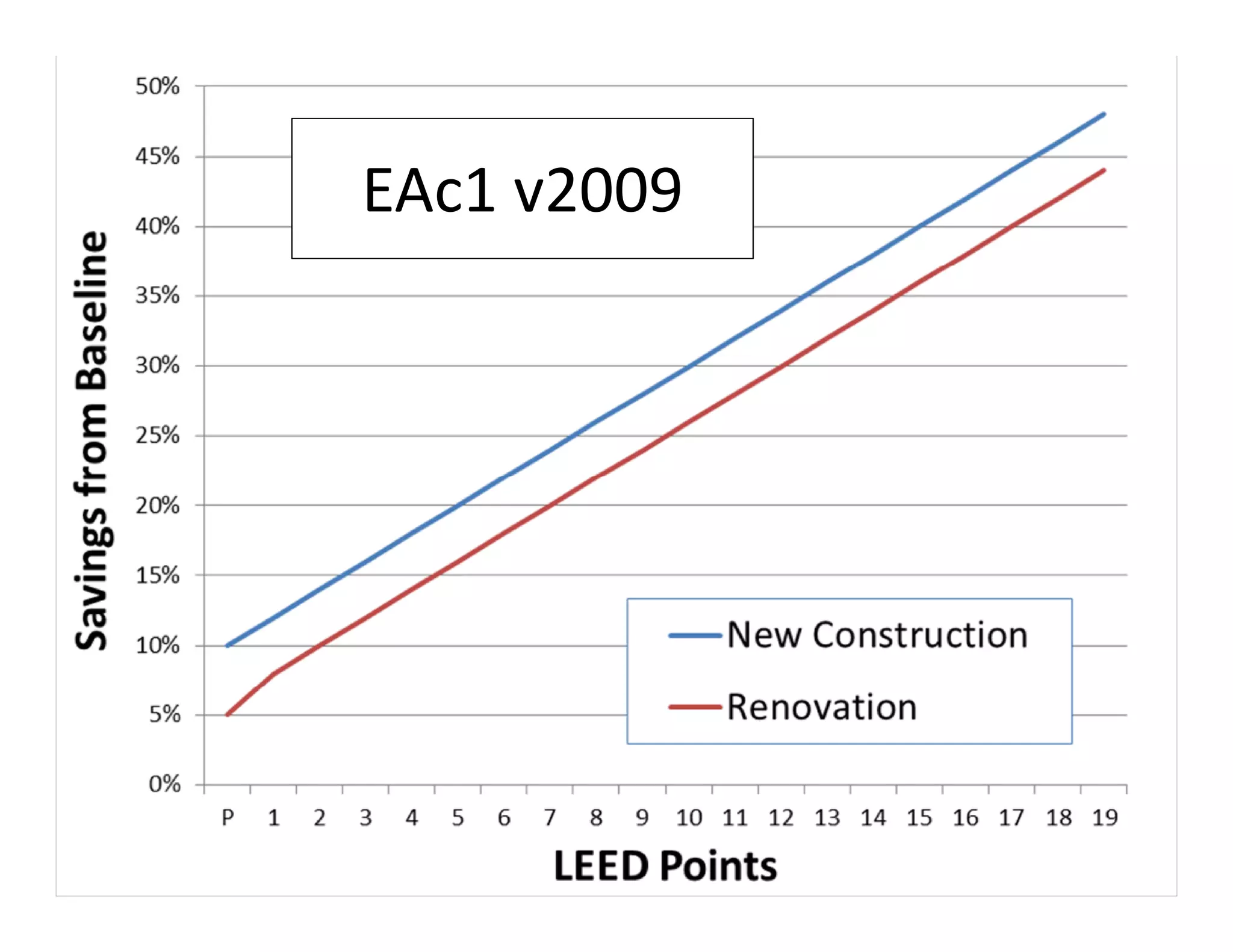
EAc1 v2009
EAc2 v4
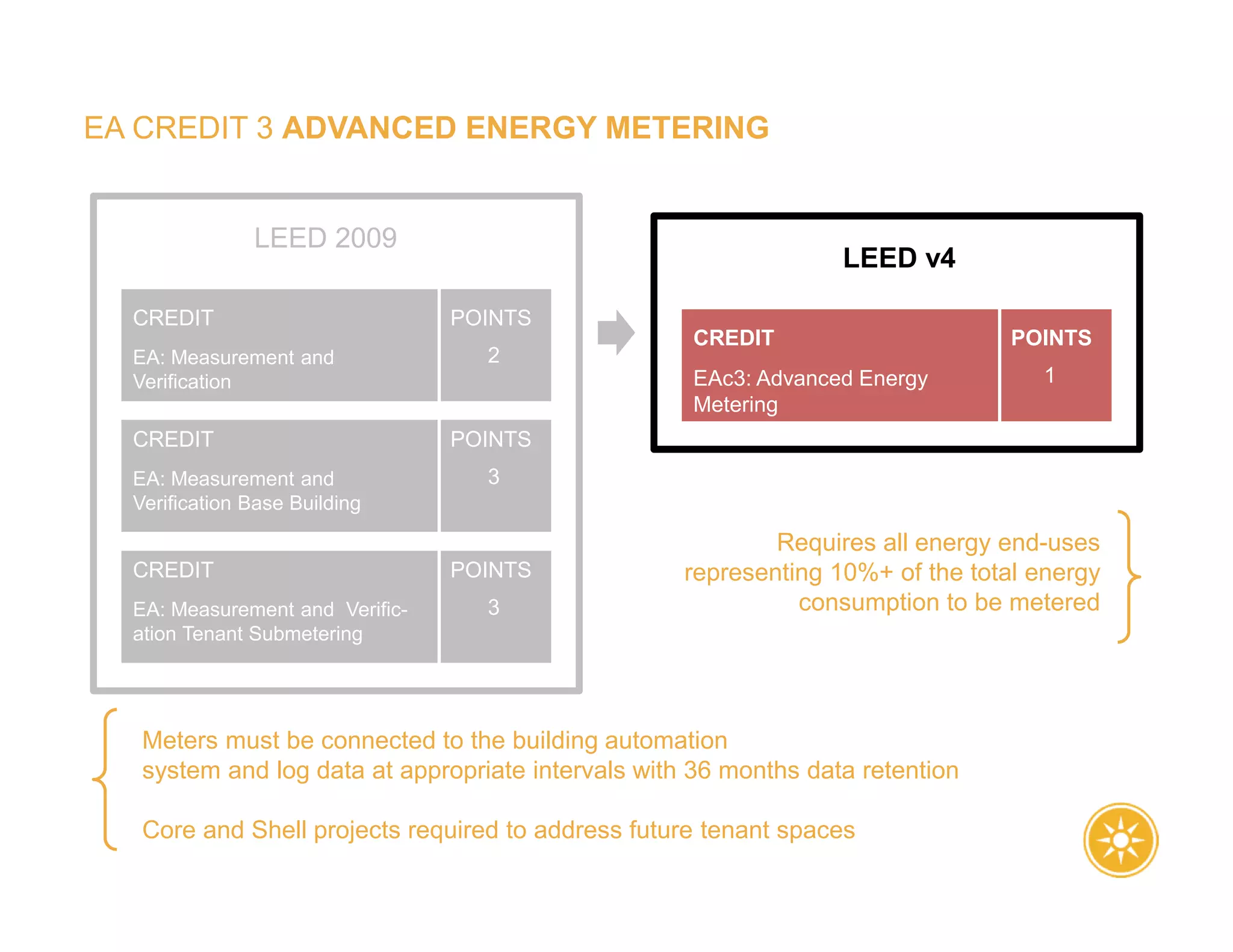
EA CREDIT 3 ADVANCED ENERGY METERING
LEED v4
LEED 2009
EA: Measurement and
Verification
CREDIT POINTS
2
EA: Measurement and
Verification Base Building
CREDIT POINTS
3
EA: Measurement and Verific-
ation Tenant Submetering
CREDIT POINTS
3
EAc3: Advanced Energy
Metering
CREDIT POINTS
1
Requires all energy end-uses
representing 10%+ of the total energy
consumption to be metered
Meters must be connected to the building automation
system and log data at appropriate intervals with 36 months data retention
Core and Shell projects required to address future tenant spaces
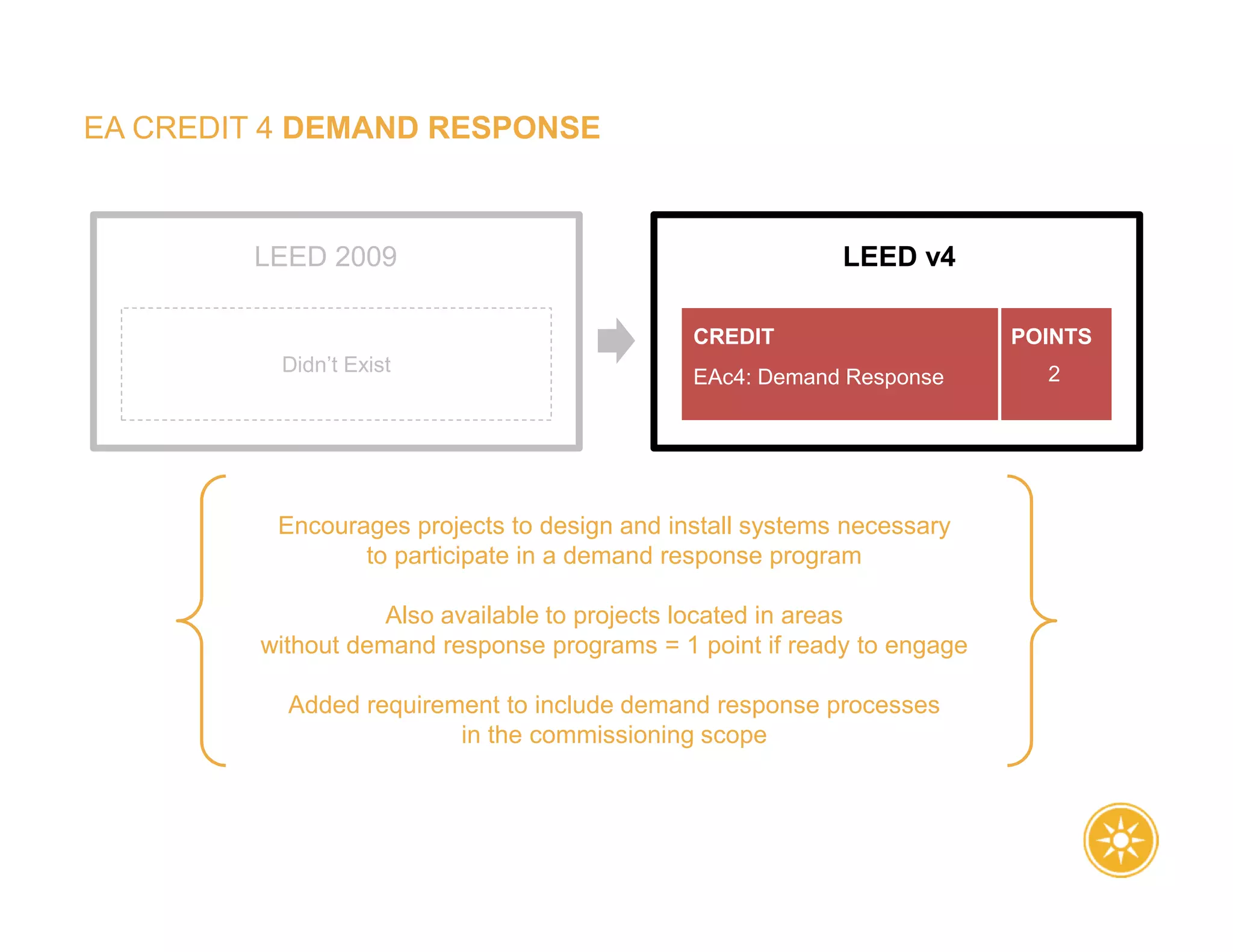
EA CREDIT 4 DEMAND RESPONSE
Encourages projects to design and install systems necessary
to participate in a demand response program
Also available to projects located in areas
without demand response programs = 1 point if ready to engage
Added requirement to include demand response processes
in the commissioning scope
LEED v4
EAc4: Demand Response
CREDIT POINTS
2
LEED 2009
Didn’t Exist
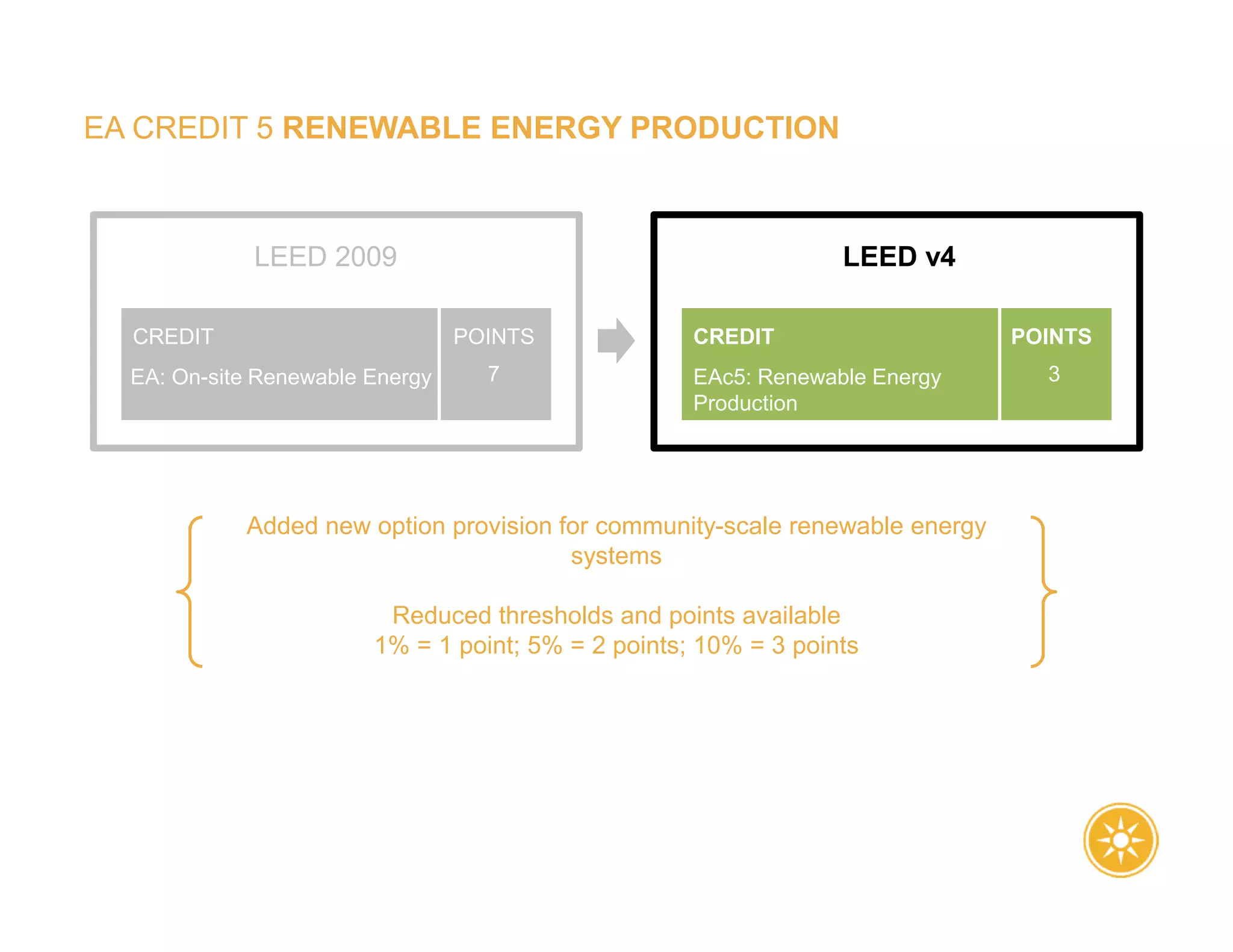
EA CREDIT 5 RENEWABLE ENERGY PRODUCTION
Added new option provision for community-scale renewable energy
systems
Reduced thresholds and points available
1% = 1 point; 5% = 2 points; 10% = 3 points
LEED 2009 LEED v4
EAc5: Renewable Energy
Production
CREDIT
EA: On-site Renewable Energy
CREDIT POINTS
7
POINTS
3
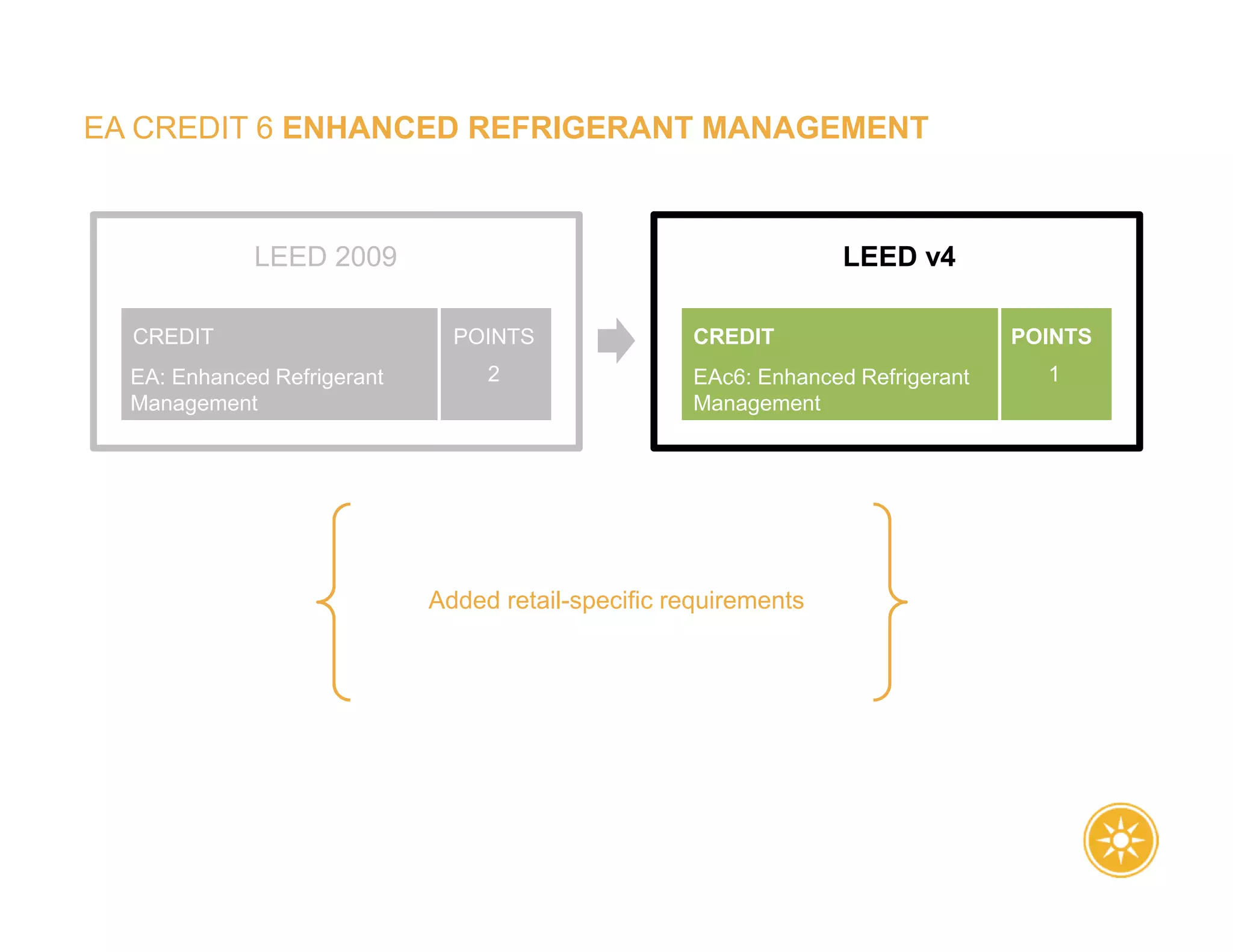
EA CREDIT 6 ENHANCED REFRIGERANT MANAGEMENT
Added retail-specific requirements
LEED 2009 LEED v4
EAc6: Enhanced Refrigerant
Management
CREDIT
EA: Enhanced Refrigerant
Management
CREDIT POINTS
2
POINTS
1
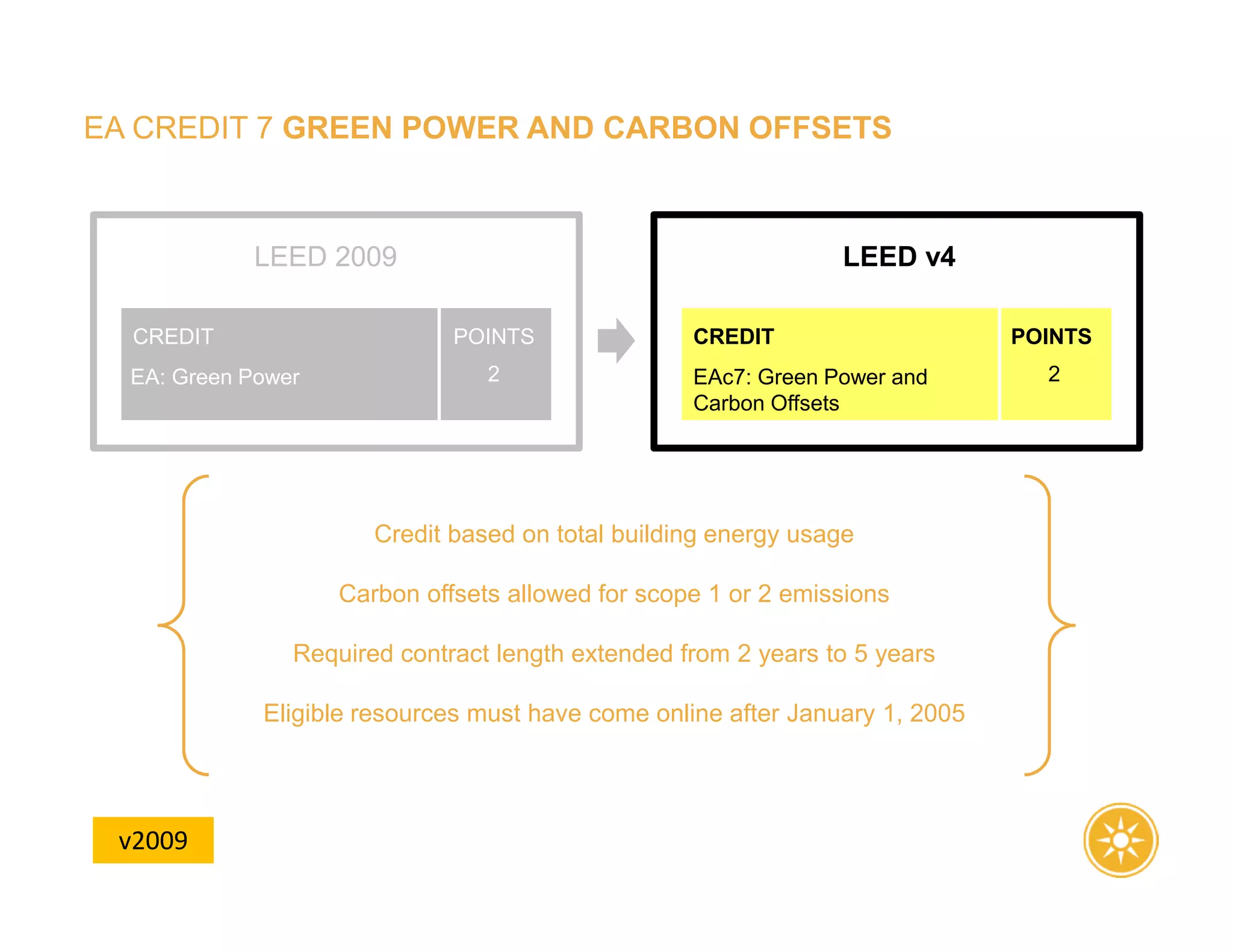
EA CREDIT 7 GREEN POWER AND CARBON OFFSETS
Credit based on total building energy usage
Carbon offsets allowed for scope 1 or 2 emissions
Required contract length extended from 2 years to 5 years
Eligible resources must have come online after January 1, 2005
LEED 2009 LEED v4
EAc7: Green Power and
Carbon Offsets
CREDIT
EA: Green Power
CREDIT POINTS
2
POINTS
2
v2009
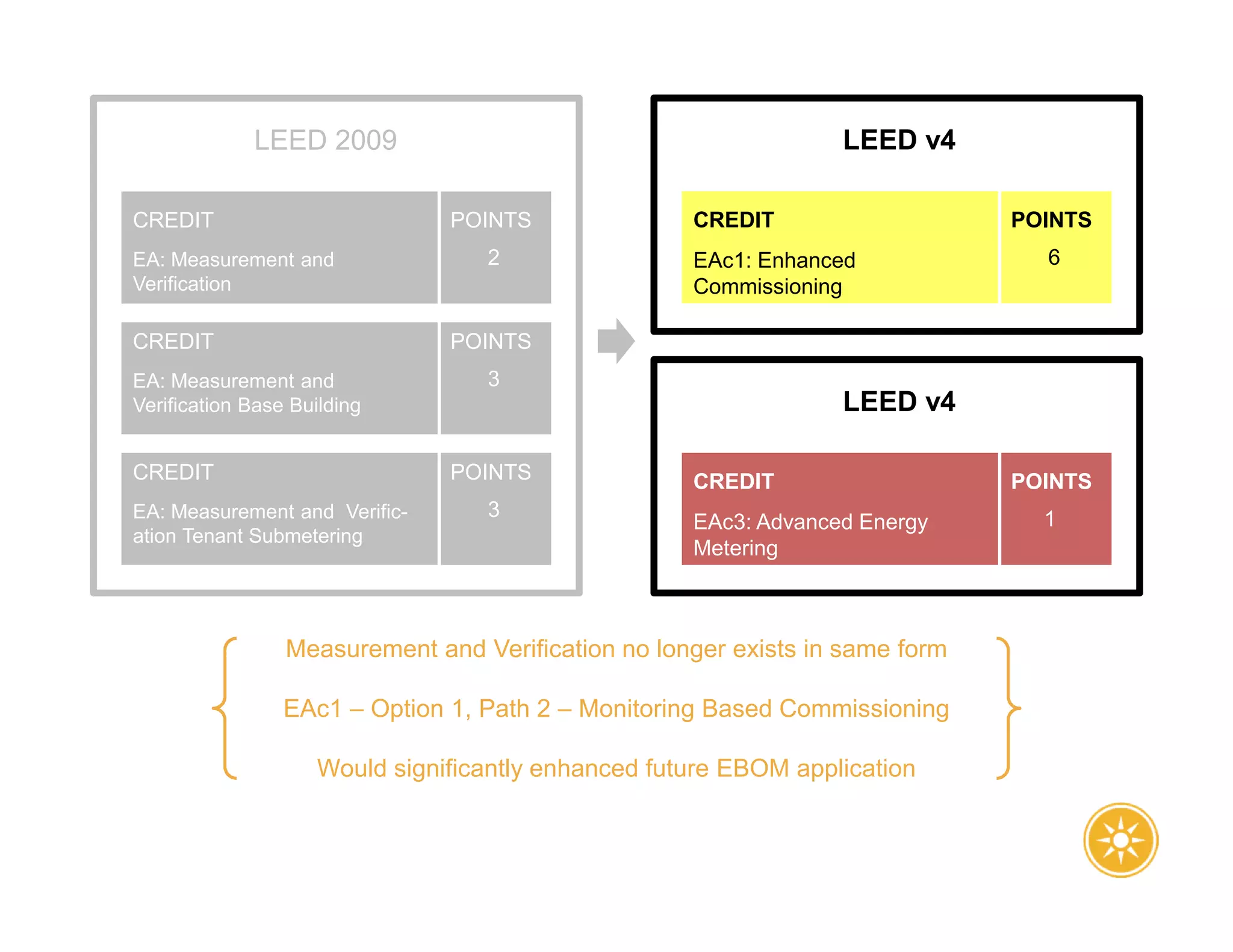
LEED v4
LEED 2009
EA: Measurement and
Verification
CREDIT POINTS
2
EA: Measurement and
Verification Base Building
CREDIT POINTS
3
EA: Measurement and Verific-
ation Tenant Submetering
CREDIT POINTS
3
EAc3: Advanced Energy
Metering
CREDIT POINTS
1
Measurement and Verification no longer exists in same form
EAc1 – Option 1, Path 2 – Monitoring Based Commissioning
Would significantly enhanced future EBOM application
LEED v4
EAc1: Enhanced
Commissioning
CREDIT POINTS
6
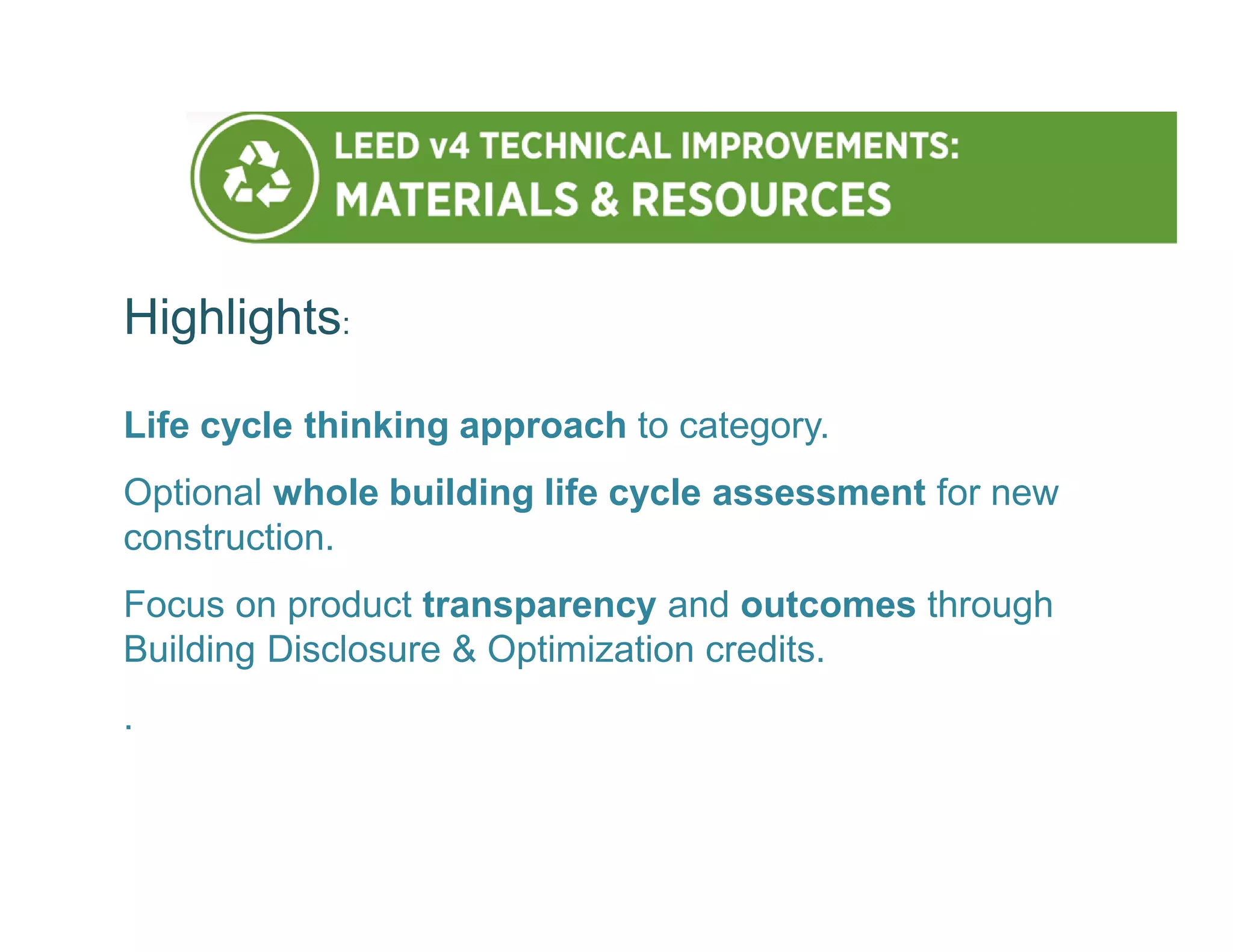
Materials & Resources
MATERIALS AND RESOURCES
Highlights:
Life cycle thinking approach to category.
Optional whole building life cycle assessment for new
construction.
Focus on product transparency and outcomes through
Building Disclosure & Optimization credits.
.
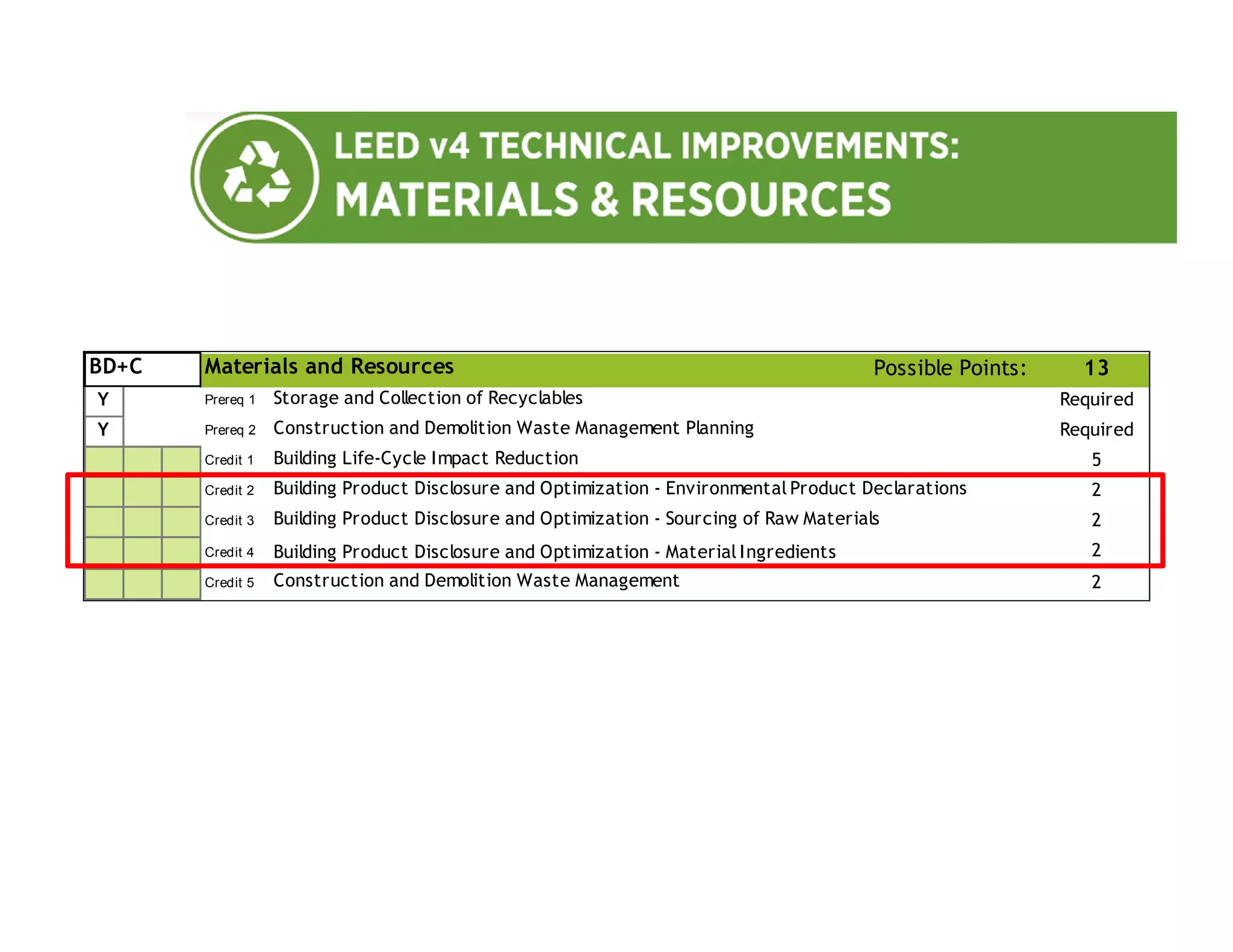
Possible Points: 13
Y Prereq 1 Required
Y Prereq 2 Required
Credit 1 5
Credit 2 2
Credit 3 2
Credit 4 Building Product Disclosure and Optimization - Material Ingredients 2
Credit 5 2
BD+C
Building Product Disclosure and Optimization - Sourcing of Raw Materials
Building Life-Cycle Impact Reduction
Construction and Demolition Waste Management
Construction and Demolition Waste Management Planning
Materials and Resources
Storage and Collection of Recyclables
Building Product Disclosure and Optimization - Environmental Product Declarations
INDOOR ENVIRONMENTAL QUALITY
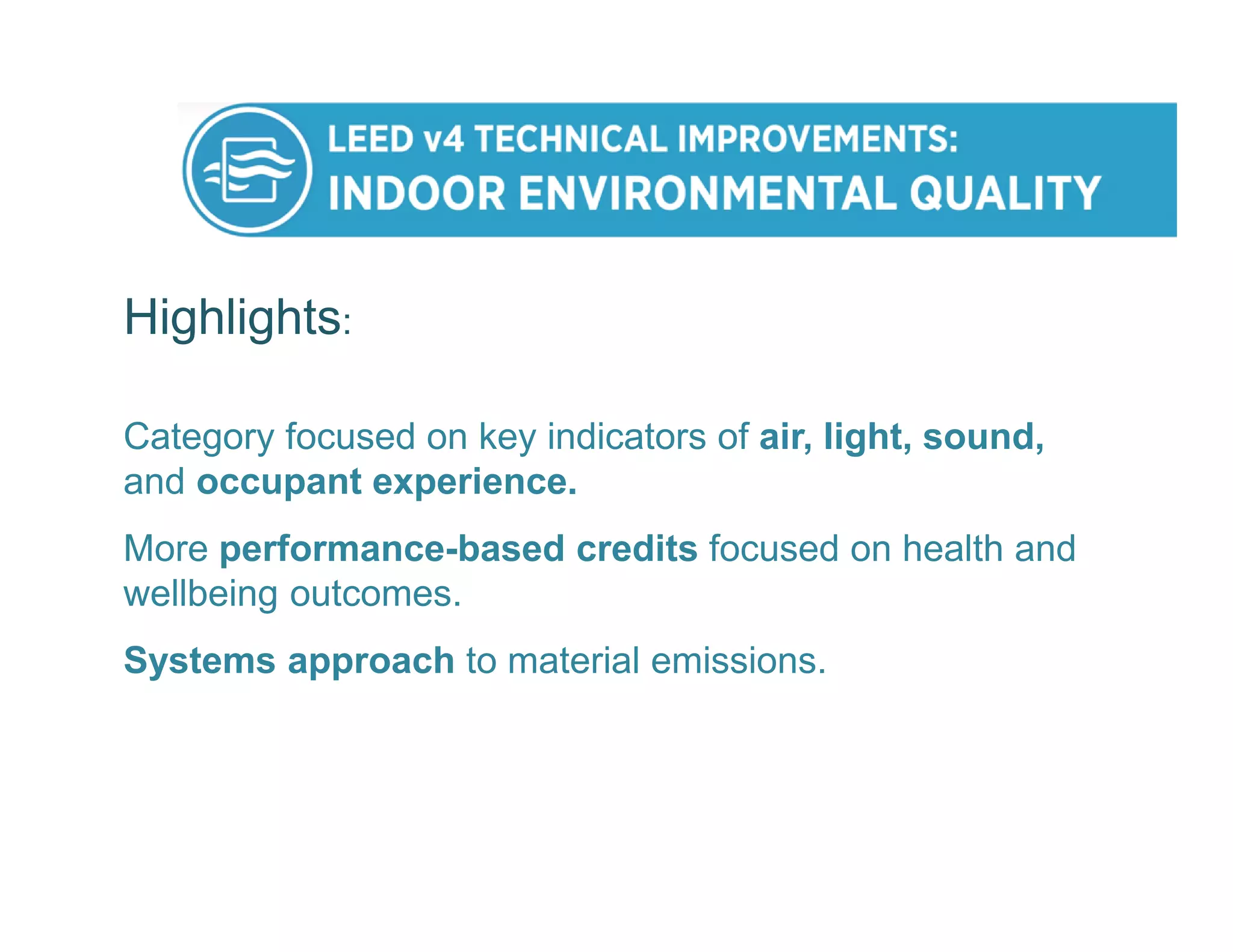
Highlights:
Category focused on key indicators of air, light, sound,
and occupant experience.
More performance-based credits focused on health and
wellbeing outcomes.
Systems approach to material emissions.
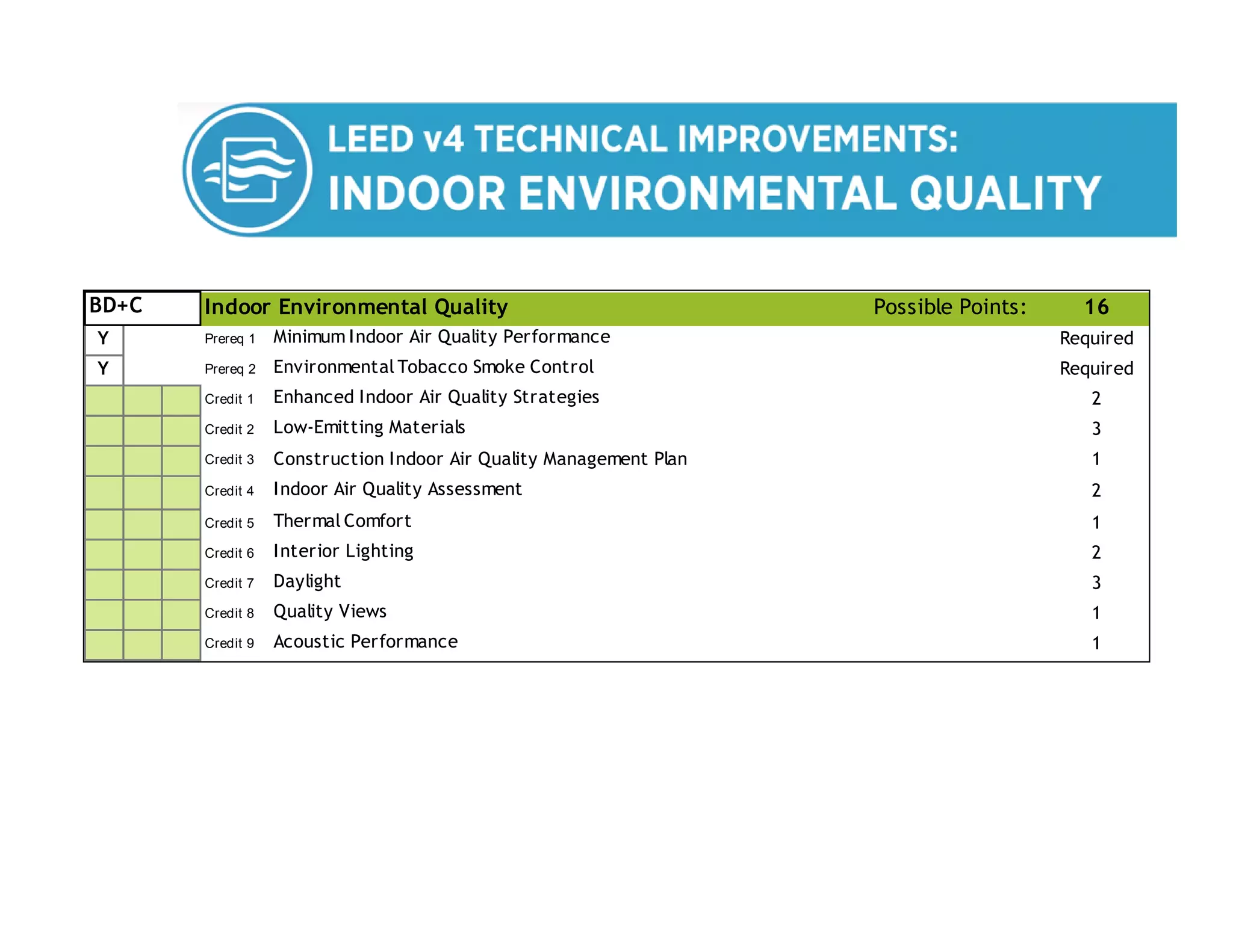
Indoor Environmental Quality Possible Points: 16
Y Prereq 1 Required
Y Prereq 2 Required
Credit 1 2
Credit 2 3
Credit 3 Construction Indoor Air Quality Management Plan 1
Credit 4 2
Credit 5 1
Credit 6 2
Credit 7 3
Credit 8 1
Credit 9 1
BD+C
Quality Views
Enhanced Indoor Air Quality Strategies
Low-Emitting Materials
Indoor Air Quality Assessment
Minimum Indoor Air Quality Performance
Environmental Tobacco Smoke Control
Thermal Comfort
Acoustic Performance
Interior Lighting
Daylight
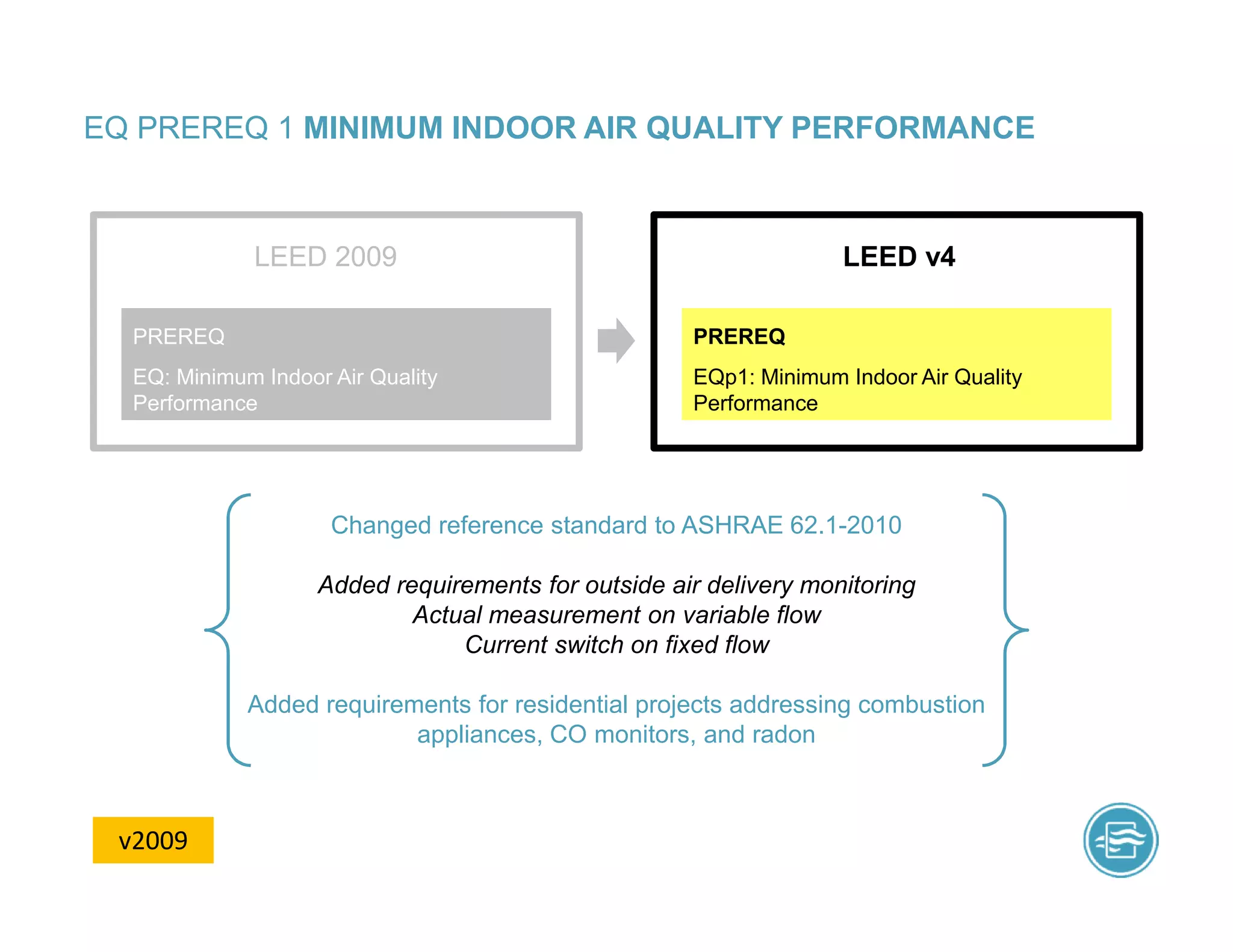
EQ PREREQ 1 MINIMUM INDOOR AIR QUALITY PERFORMANCE
Changed reference standard to ASHRAE 62.1-2010
Added requirements for outside air delivery monitoring
Actual measurement on variable flow
Current switch on fixed flow
Added requirements for residential projects addressing combustion
appliances, CO monitors, and radon
LEED v4
EQp1: Minimum Indoor Air Quality
Performance
PREREQ
LEED 2009
EQ: Minimum Indoor Air Quality
Performance
PREREQ
v2009
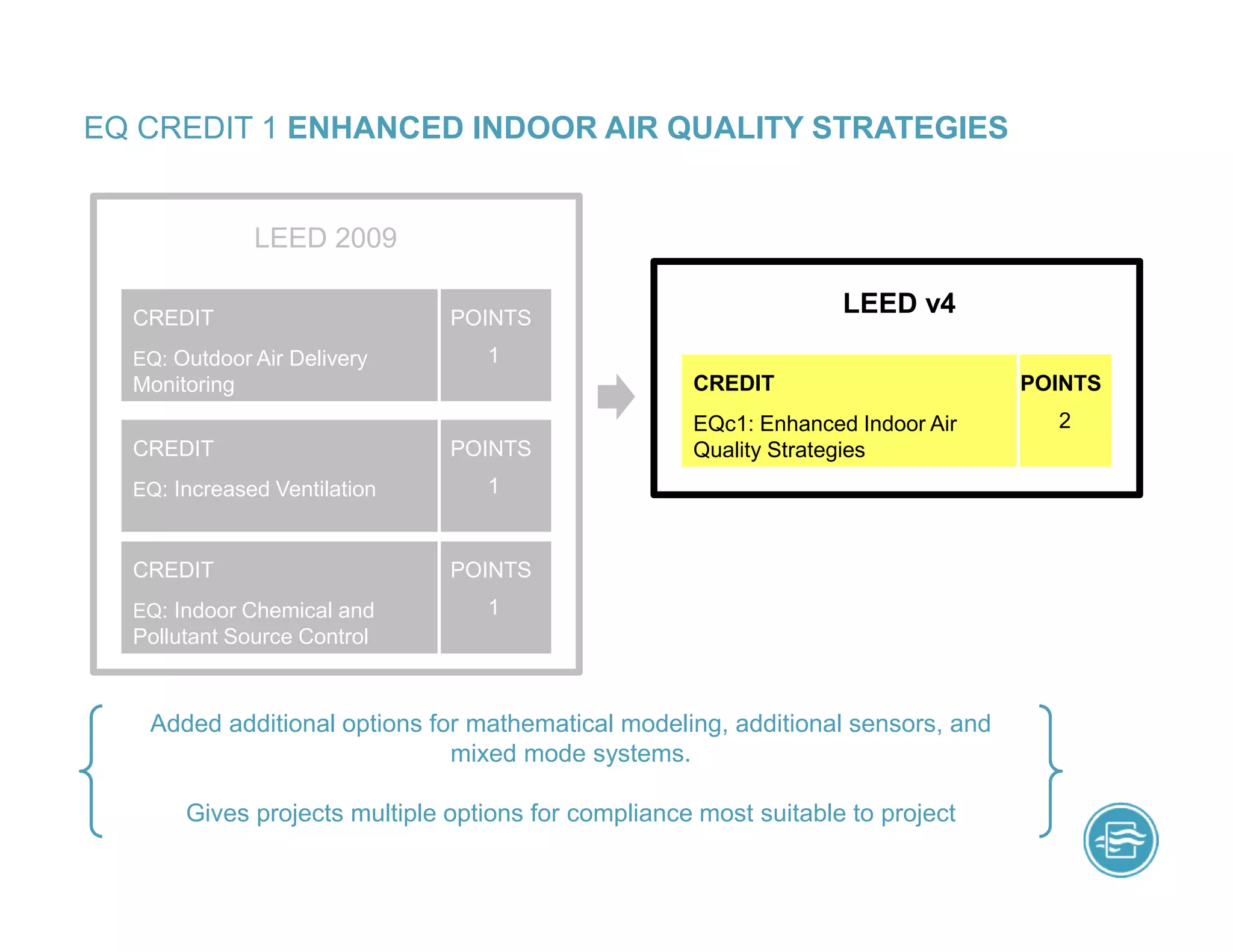
EQ CREDIT 1 ENHANCED INDOOR AIR QUALITY STRATEGIES
Added additional options for mathematical modeling, additional sensors, and
mixed mode systems.
Gives projects multiple options for compliance most suitable to project
LEED 2009
LEED v4
EQc1: Enhanced Indoor Air
Quality Strategies
CREDIT POINTS
2
EQ: Outdoor Air Delivery
Monitoring
CREDIT POINTS
1
EQ: Increased Ventilation
CREDIT POINTS
1
EQ: Indoor Chemical and
Pollutant Source Control
CREDIT POINTS
1
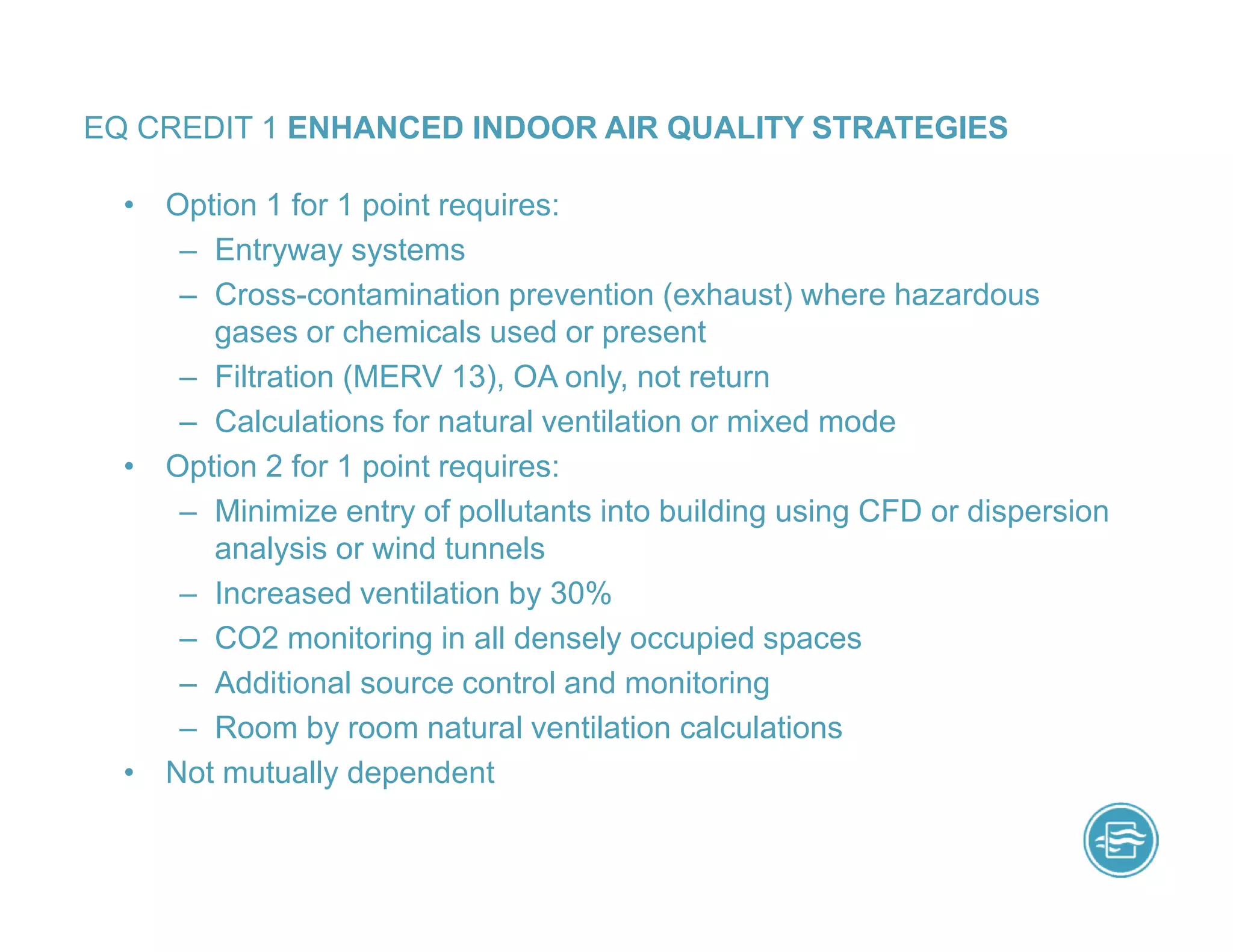
• Option 1 for 1 point requires:
– Entryway systems
– Cross-contamination prevention (exhaust) where hazardous
gases or chemicals used or present
– Filtration (MERV 13), OA only, not return
– Calculations for natural ventilation or mixed mode
• Option 2 for 1 point requires:
– Minimize entry of pollutants into building using CFD or dispersion
analysis or wind tunnels
– Increased ventilation by 30%
– CO2 monitoring in all densely occupied spaces
– Additional source control and monitoring
– Room by room natural ventilation calculations
• Not mutually dependent
EQ CREDIT 1 ENHANCED INDOOR AIR QUALITY STRATEGIES
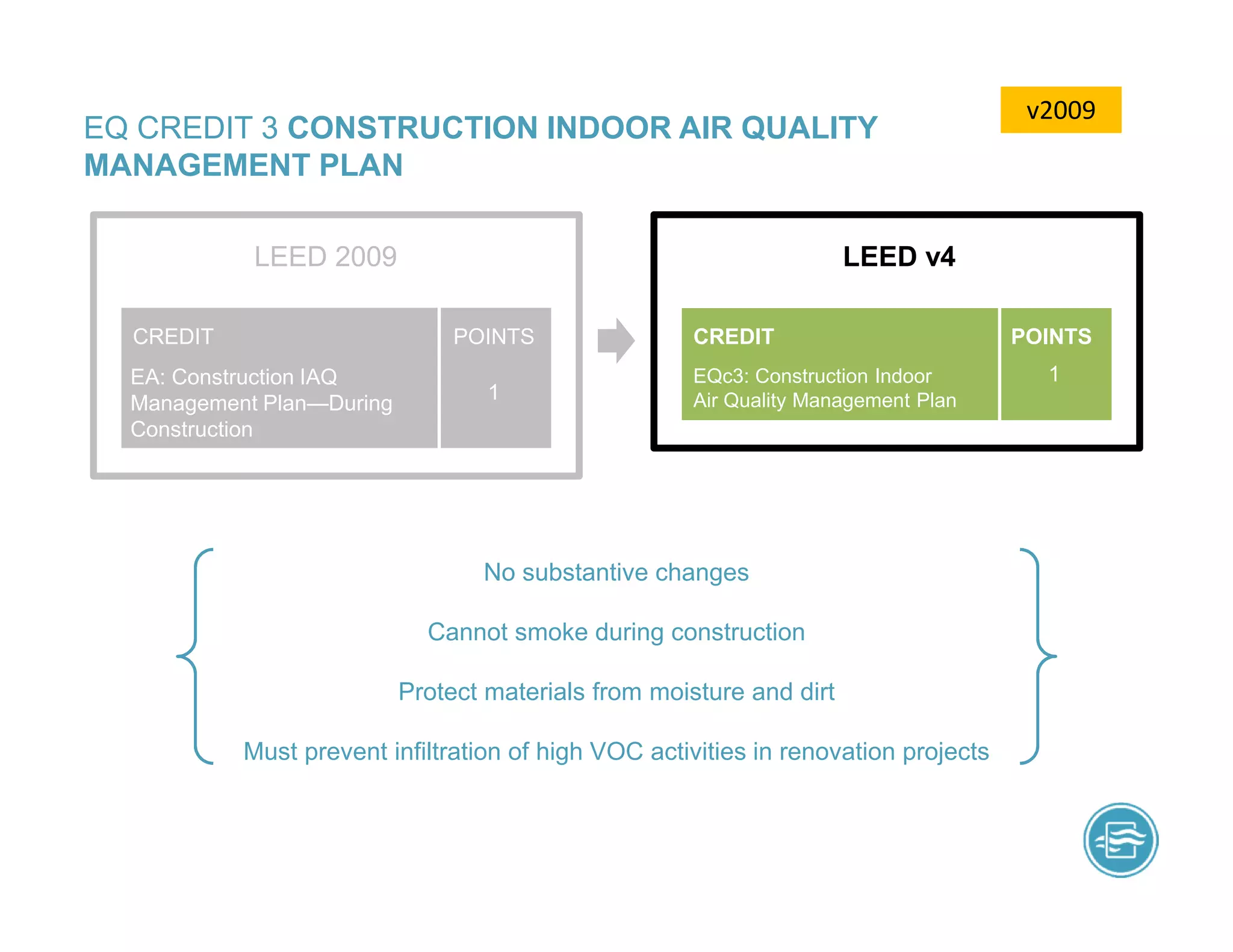
EQ CREDIT 3 CONSTRUCTION INDOOR AIR QUALITY
MANAGEMENT PLAN
No substantive changes
Cannot smoke during construction
Protect materials from moisture and dirt
Must prevent infiltration of high VOC activities in renovation projects
LEED 2009 LEED v4
EQc3: Construction Indoor
Air Quality Management Plan
CREDIT
EA: Construction IAQ
Management Plan—During
Construction
CREDIT POINTS
1
POINTS
1
v2009
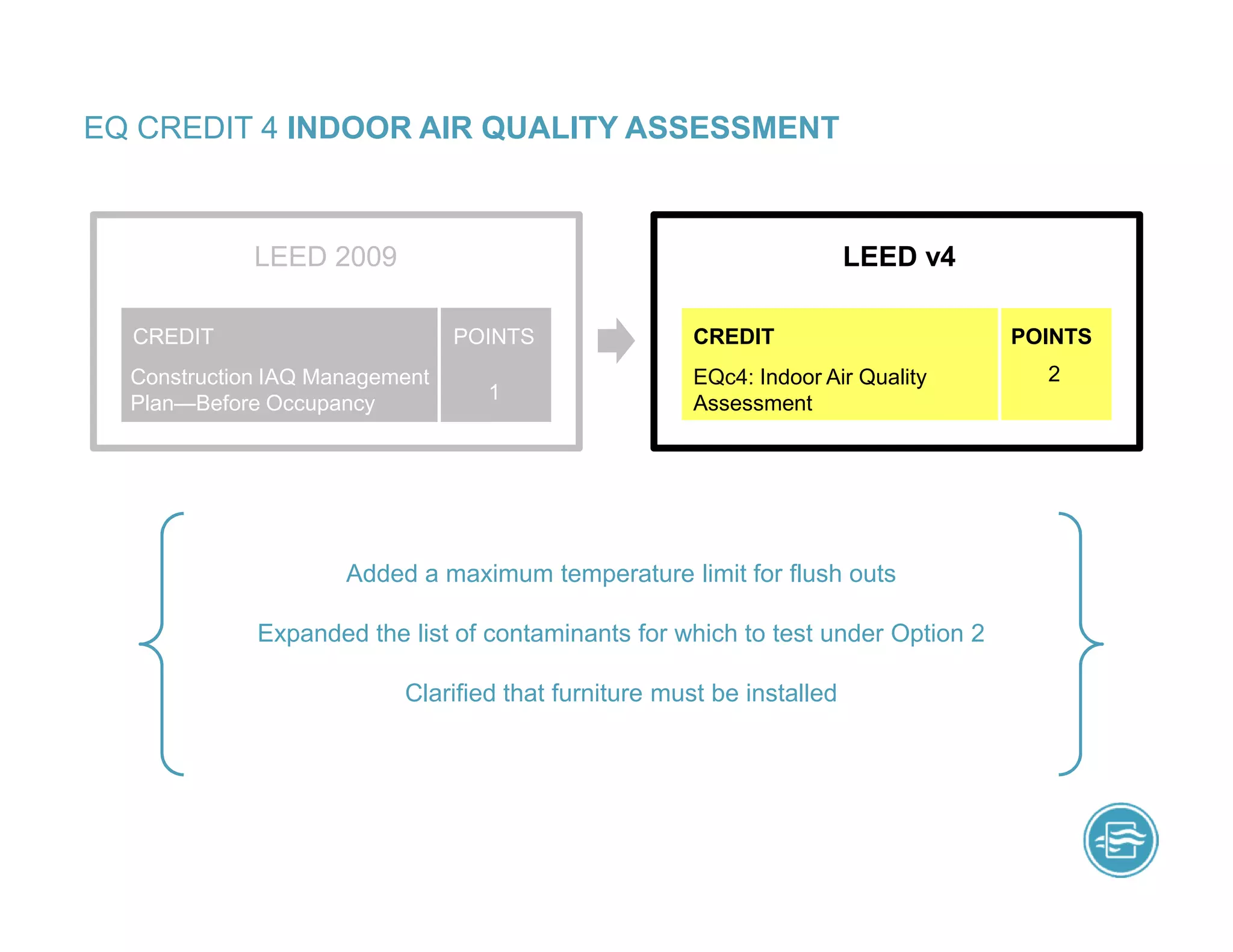
EQ CREDIT 4 INDOOR AIR QUALITY ASSESSMENT
Added a maximum temperature limit for flush outs
Expanded the list of contaminants for which to test under Option 2
Clarified that furniture must be installed
LEED 2009 LEED v4
EQc4: Indoor Air Quality
Assessment
CREDIT
Construction IAQ Management
Plan—Before Occupancy
CREDIT POINTS POINTS
2
1
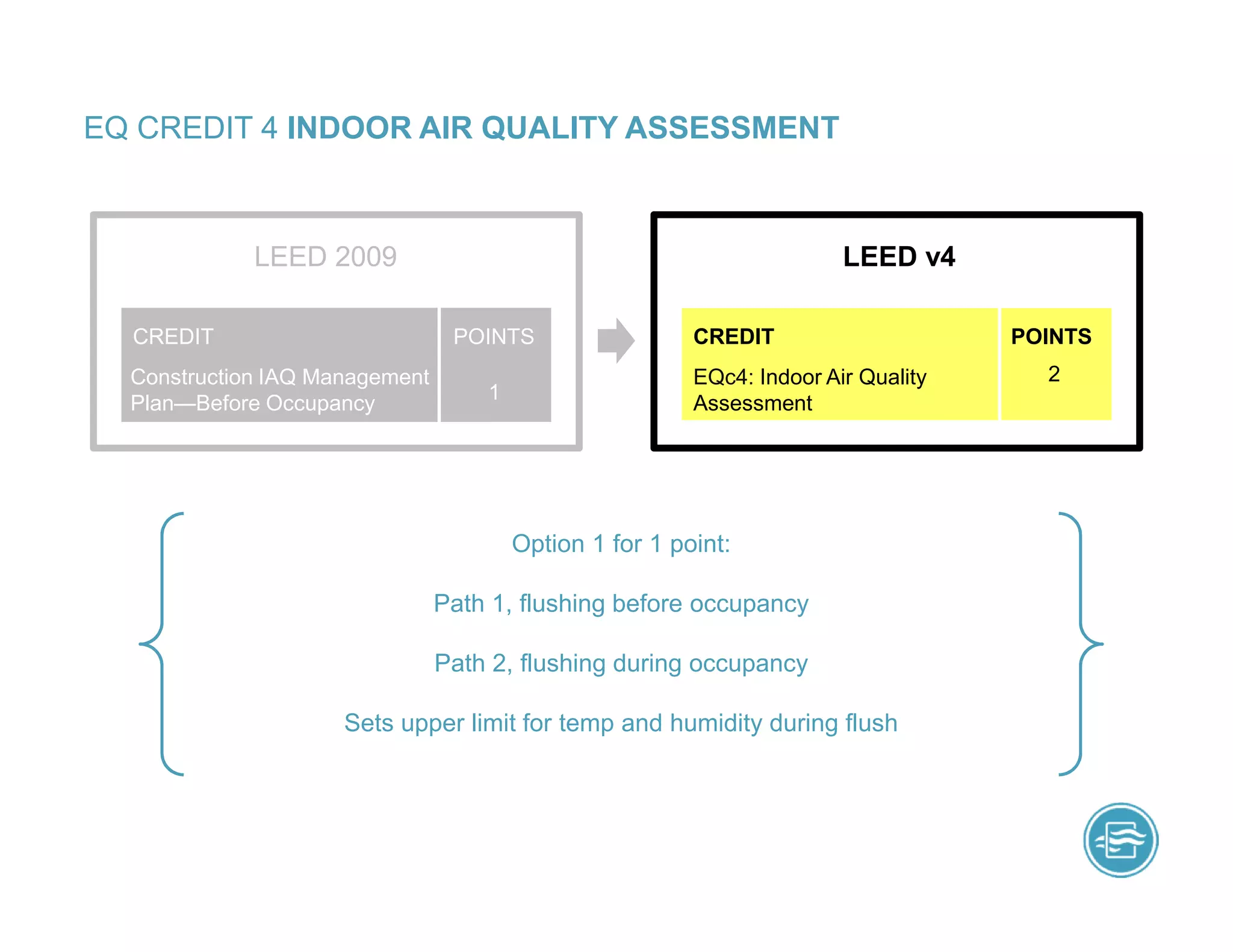
EQ CREDIT 4 INDOOR AIR QUALITY ASSESSMENT
Option 1 for 1 point:
Path 1, flushing before occupancy
Path 2, flushing during occupancy
Sets upper limit for temp and humidity during flush
LEED 2009 LEED v4
EQc4: Indoor Air Quality
Assessment
CREDIT
Construction IAQ Management
Plan—Before Occupancy
CREDIT POINTS POINTS
2
1
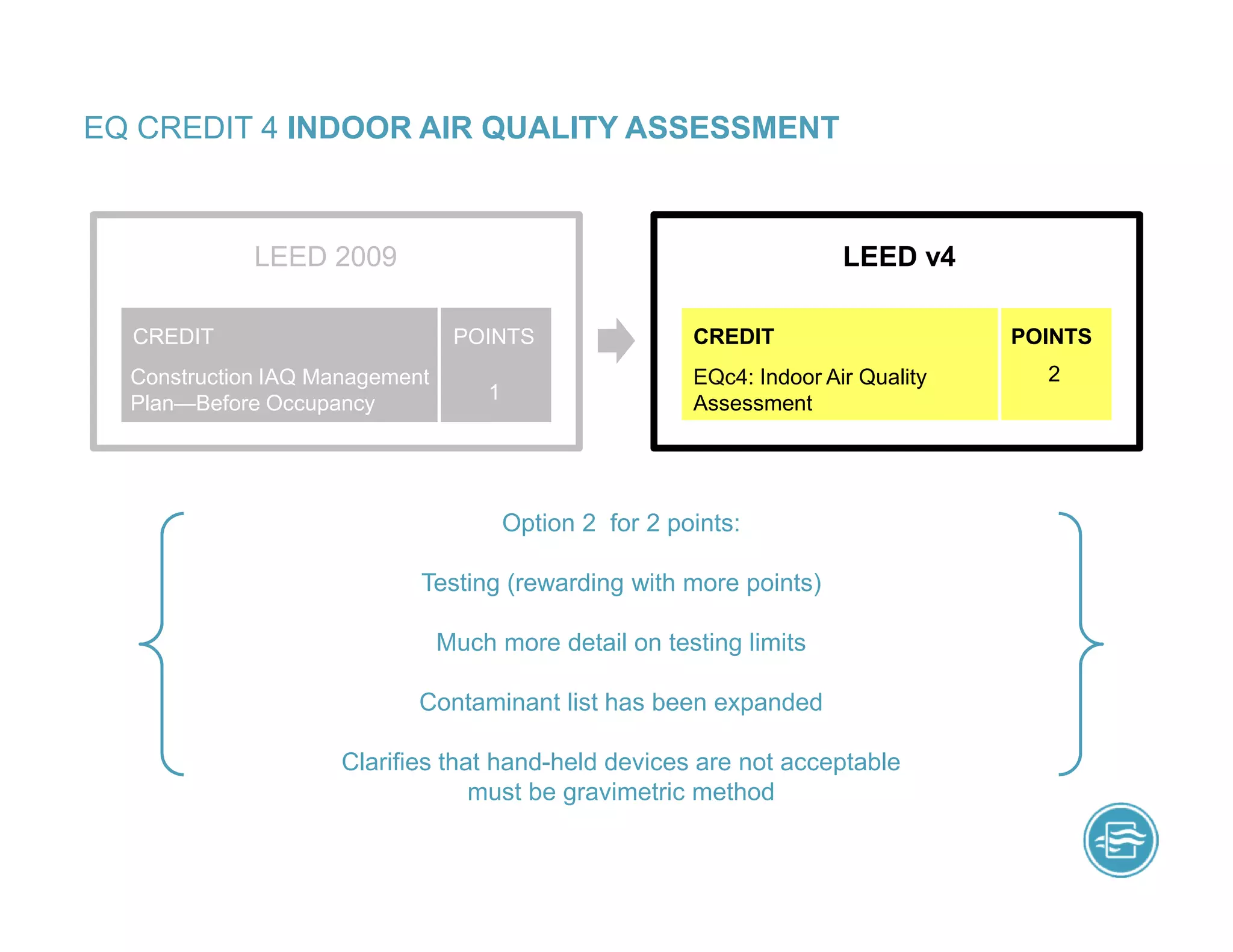
EQ CREDIT 4 INDOOR AIR QUALITY ASSESSMENT
Option 2 for 2 points:
Testing (rewarding with more points)
Much more detail on testing limits
Contaminant list has been expanded
Clarifies that hand-held devices are not acceptable
must be gravimetric method
LEED 2009 LEED v4
EQc4: Indoor Air Quality
Assessment
CREDIT
Construction IAQ Management
Plan—Before Occupancy
CREDIT POINTS POINTS
2
1
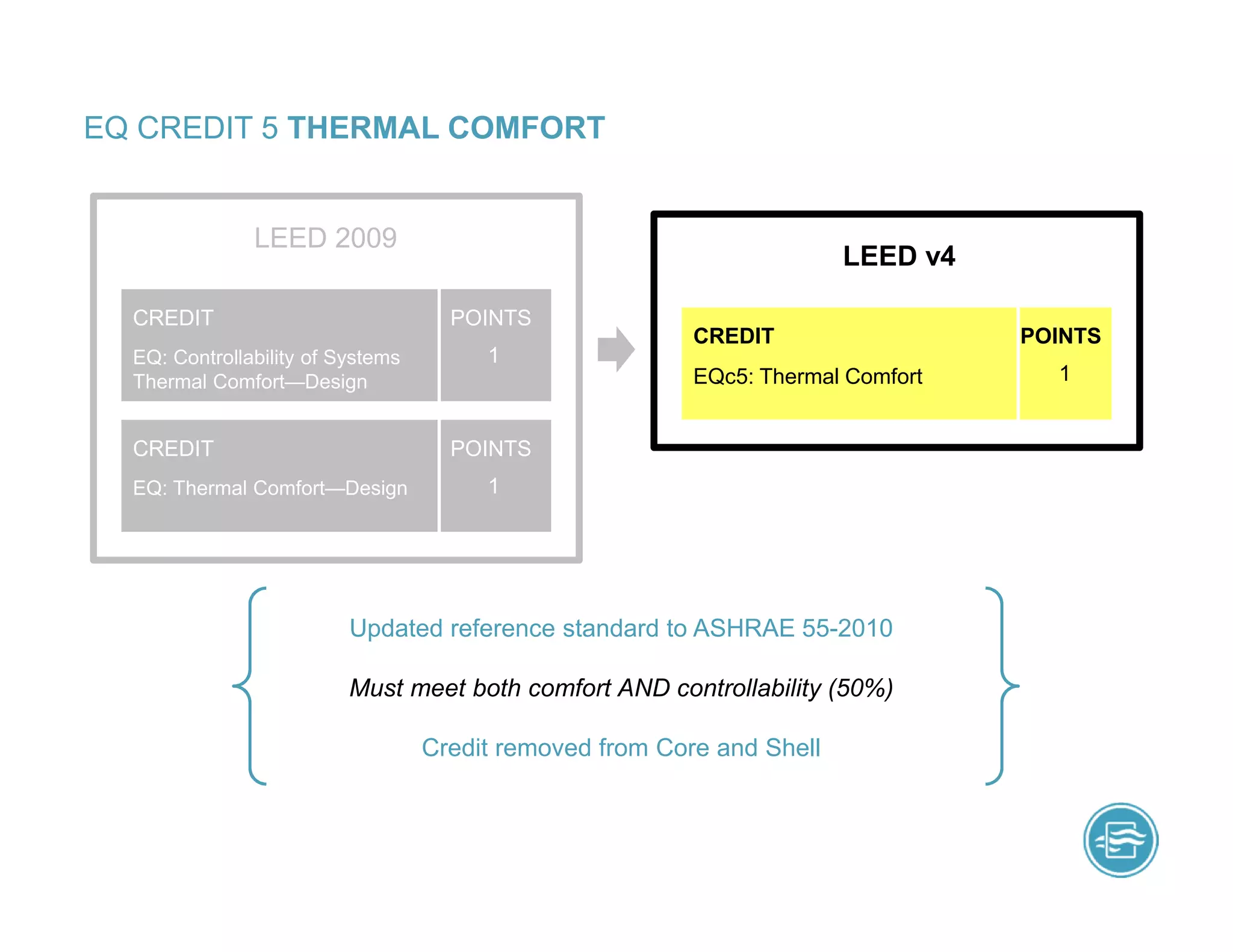
EQ CREDIT 5 THERMAL COMFORT
Updated reference standard to ASHRAE 55-2010
Must meet both comfort AND controllability (50%)
Credit removed from Core and Shell
LEED 2009
LEED v4
EQc5: Thermal Comfort
CREDIT POINTS
1
EQ: Controllability of Systems
Thermal Comfort—Design
CREDIT POINTS
1
EQ: Thermal Comfort—Design
CREDIT POINTS
1
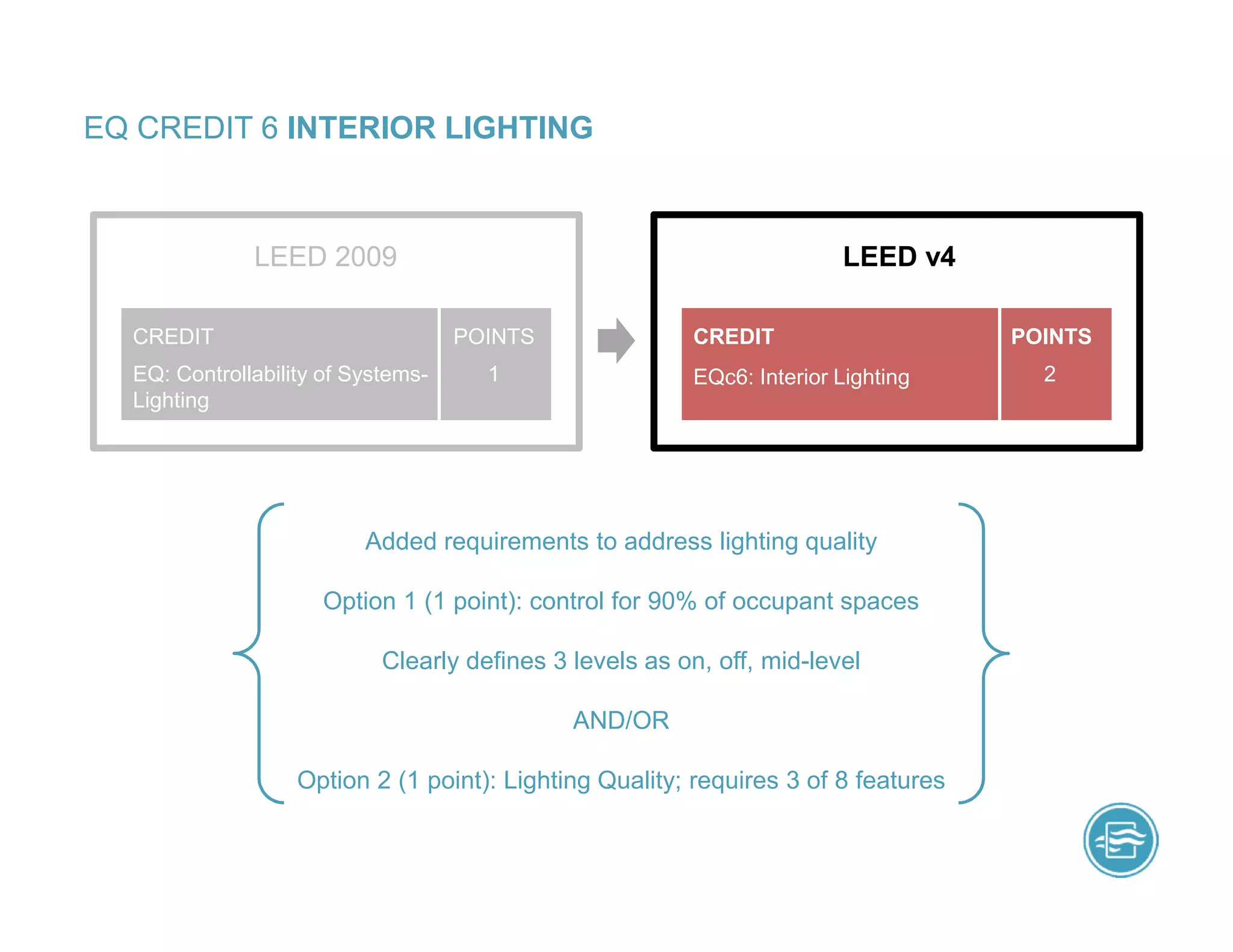
EQ CREDIT 6 INTERIOR LIGHTING
Added requirements to address lighting quality
Option 1 (1 point): control for 90% of occupant spaces
Clearly defines 3 levels as on, off, mid-level
AND/OR
Option 2 (1 point): Lighting Quality; requires 3 of 8 features
LEED 2009 LEED v4
EQc6: Interior Lighting
CREDIT
EQ: Controllability of Systems-
Lighting
CREDIT POINTS
1
POINTS
2
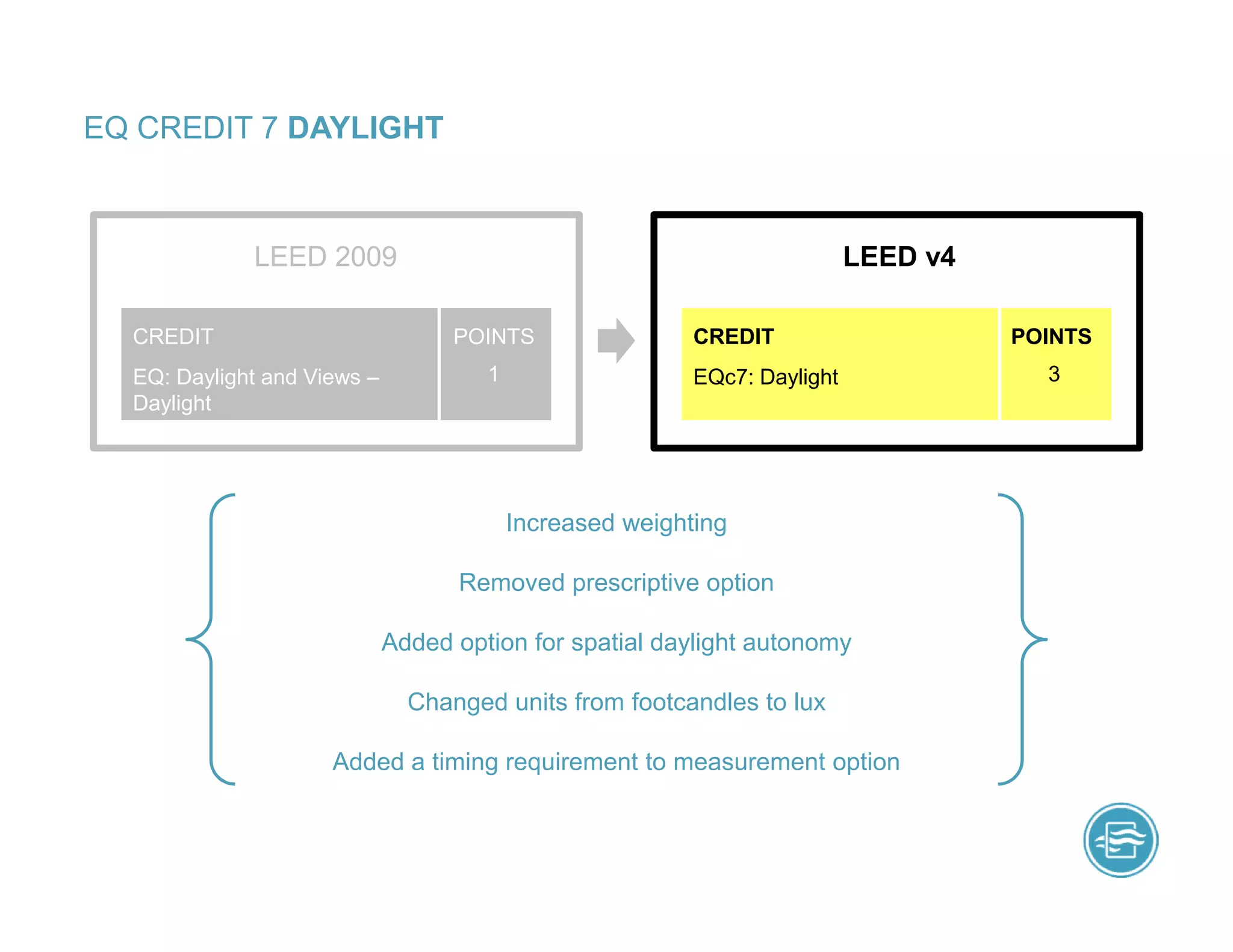
EQ CREDIT 7 DAYLIGHT
Increased weighting
Removed prescriptive option
Added option for spatial daylight autonomy
Changed units from footcandles to lux
Added a timing requirement to measurement option
LEED v4
EQc7: Daylight
CREDIT
LEED 2009
EQ: Daylight and Views –
Daylight
CREDIT POINTS
1
POINTS
3
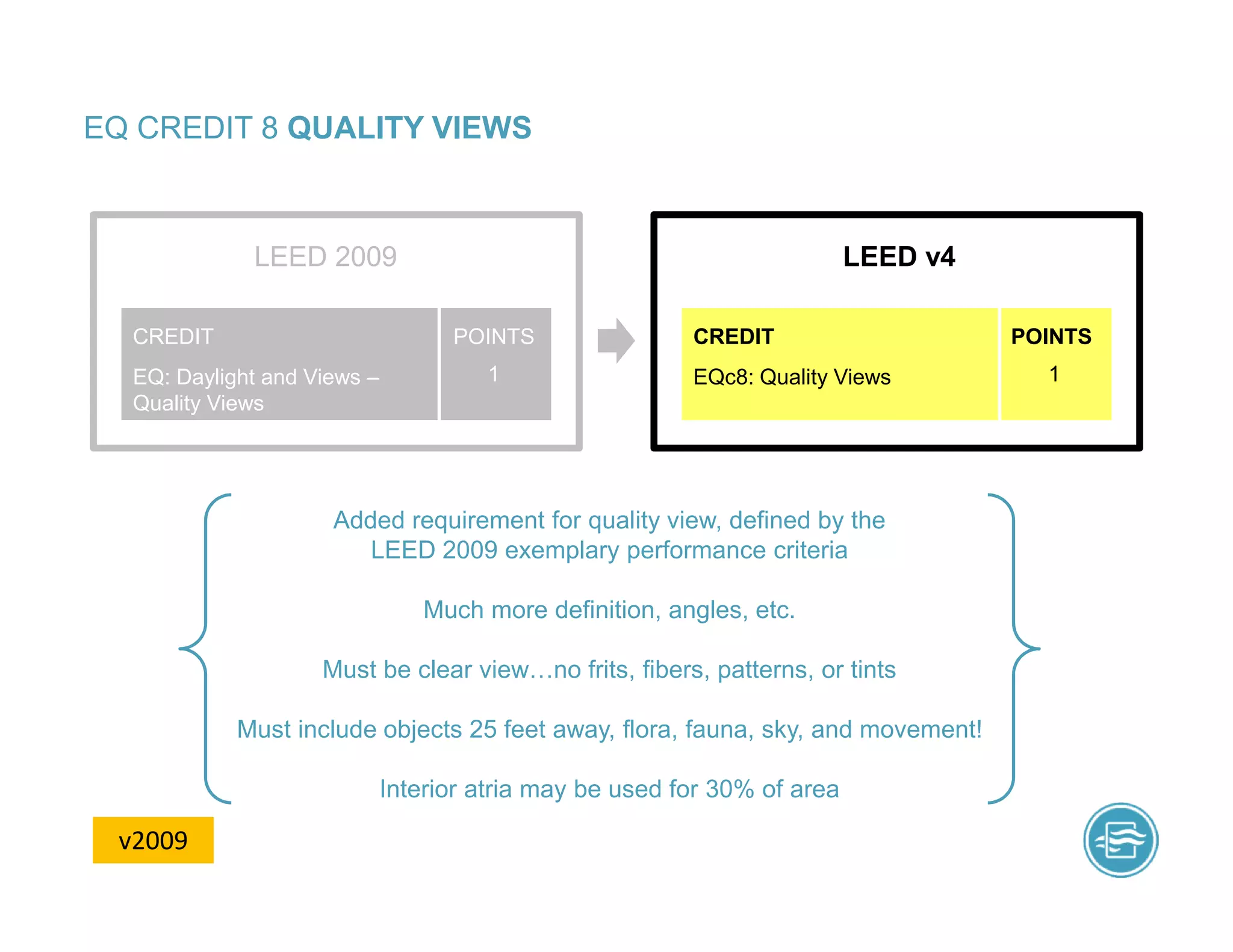
EQ CREDIT 8 QUALITY VIEWS
Added requirement for quality view, defined by the
LEED 2009 exemplary performance criteria
Much more definition, angles, etc.
Must be clear viewUno frits, fibers, patterns, or tints
Must include objects 25 feet away, flora, fauna, sky, and movement!
Interior atria may be used for 30% of area
LEED v4
EQc8: Quality Views
CREDIT
LEED 2009
EQ: Daylight and Views –
Quality Views
CREDIT POINTS
1
POINTS
1
v2009
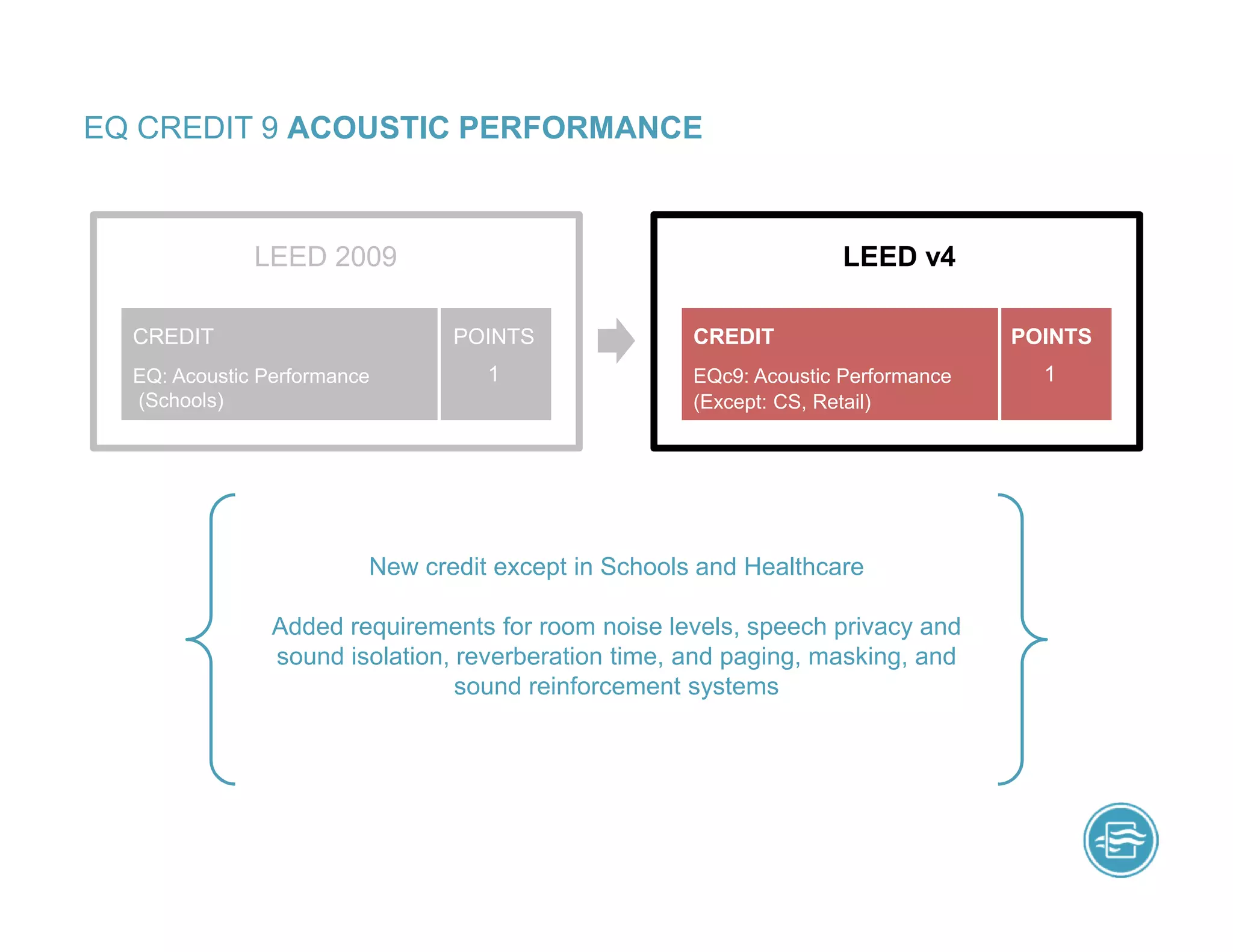
EQ CREDIT 9 ACOUSTIC PERFORMANCE
New credit except in Schools and Healthcare
Added requirements for room noise levels, speech privacy and
sound isolation, reverberation time, and paging, masking, and
sound reinforcement systems
LEED v4
EQc9: Acoustic Performance
(Except: CS, Retail)
CREDIT
LEED 2009
EQ: Acoustic Performance
(Schools)
CREDIT POINTS
1
POINTS
1
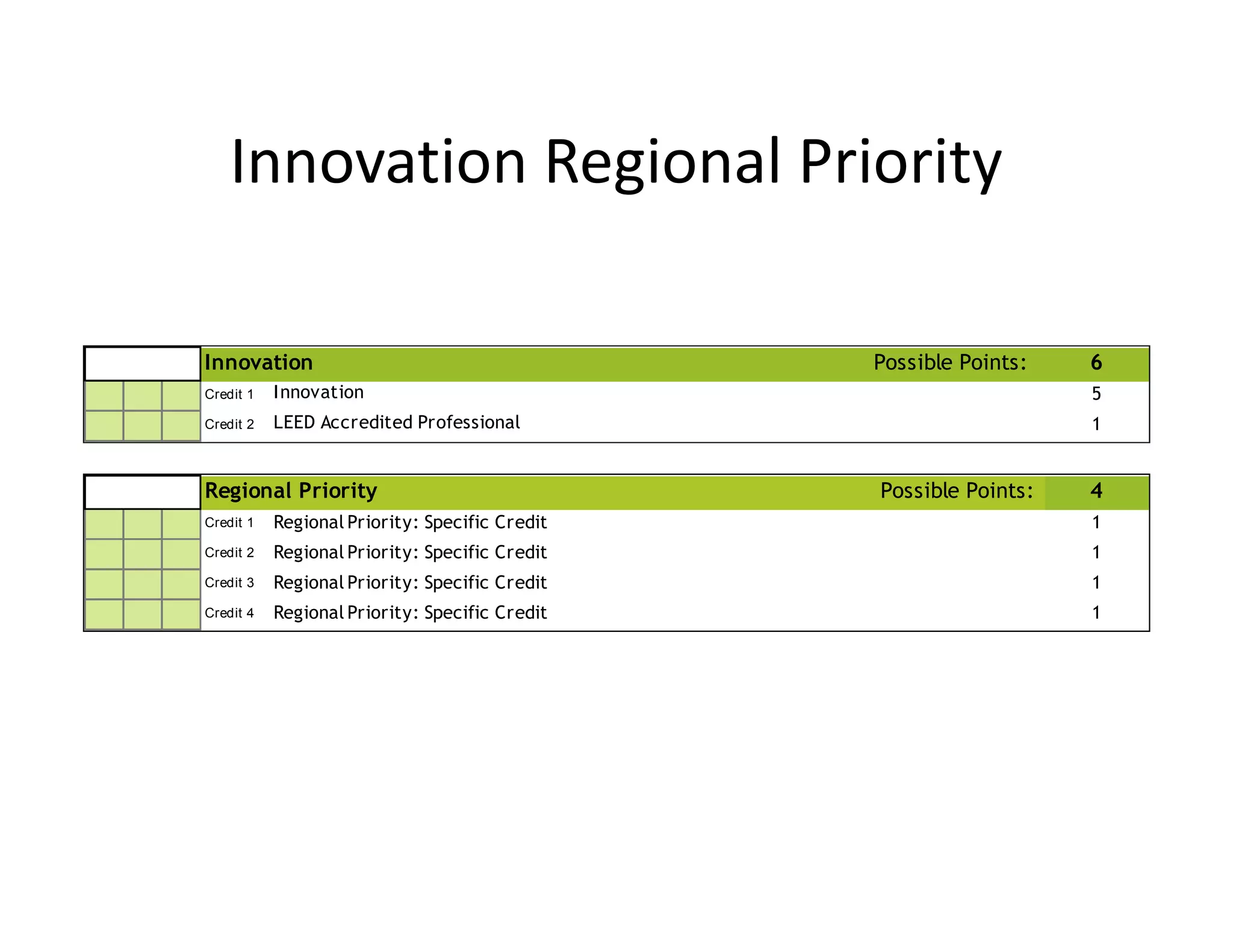
Innovation Regional Priority
Innovation Possible Points: 6
Credit 1 5
Credit 2 1
Innovation
LEED Accredited Professional
Regional Priority Possible Points: 4
Credit 1 Regional Priority: Specific Credit 1
Credit 2 Regional Priority: Specific Credit 1
Credit 3 Regional Priority: Specific Credit 1
Credit 4 Regional Priority: Specific Credit 1
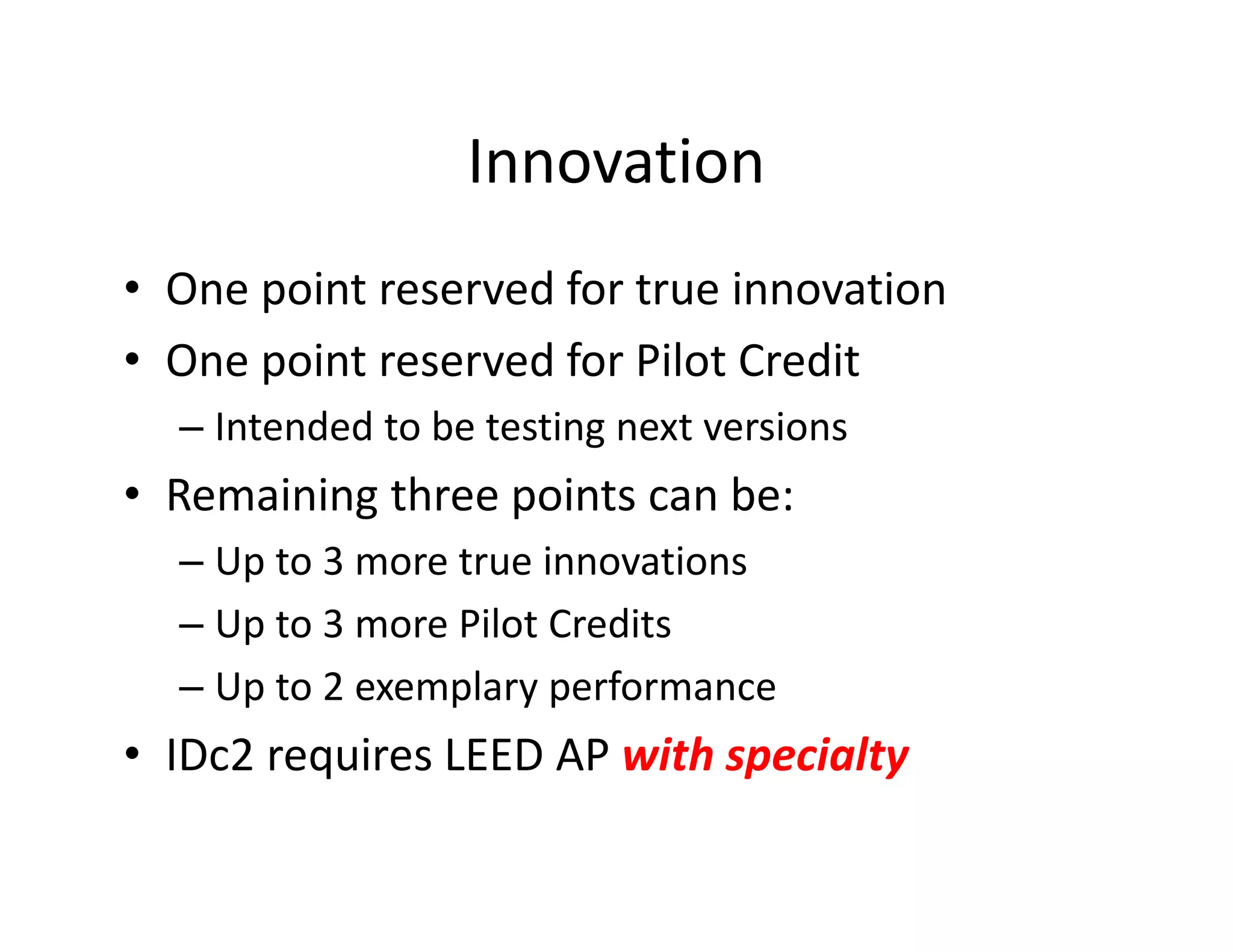
Innovation
• One point reserved for true innovation
• One point reserved for Pilot Credit
– Intended to be testing next versions
• Remaining three points can be:
– Up to 3 more true innovations
– Up to 3 more Pilot Credits
– Up to 2 exemplary performance
• IDc2 requires LEED AP with specialty
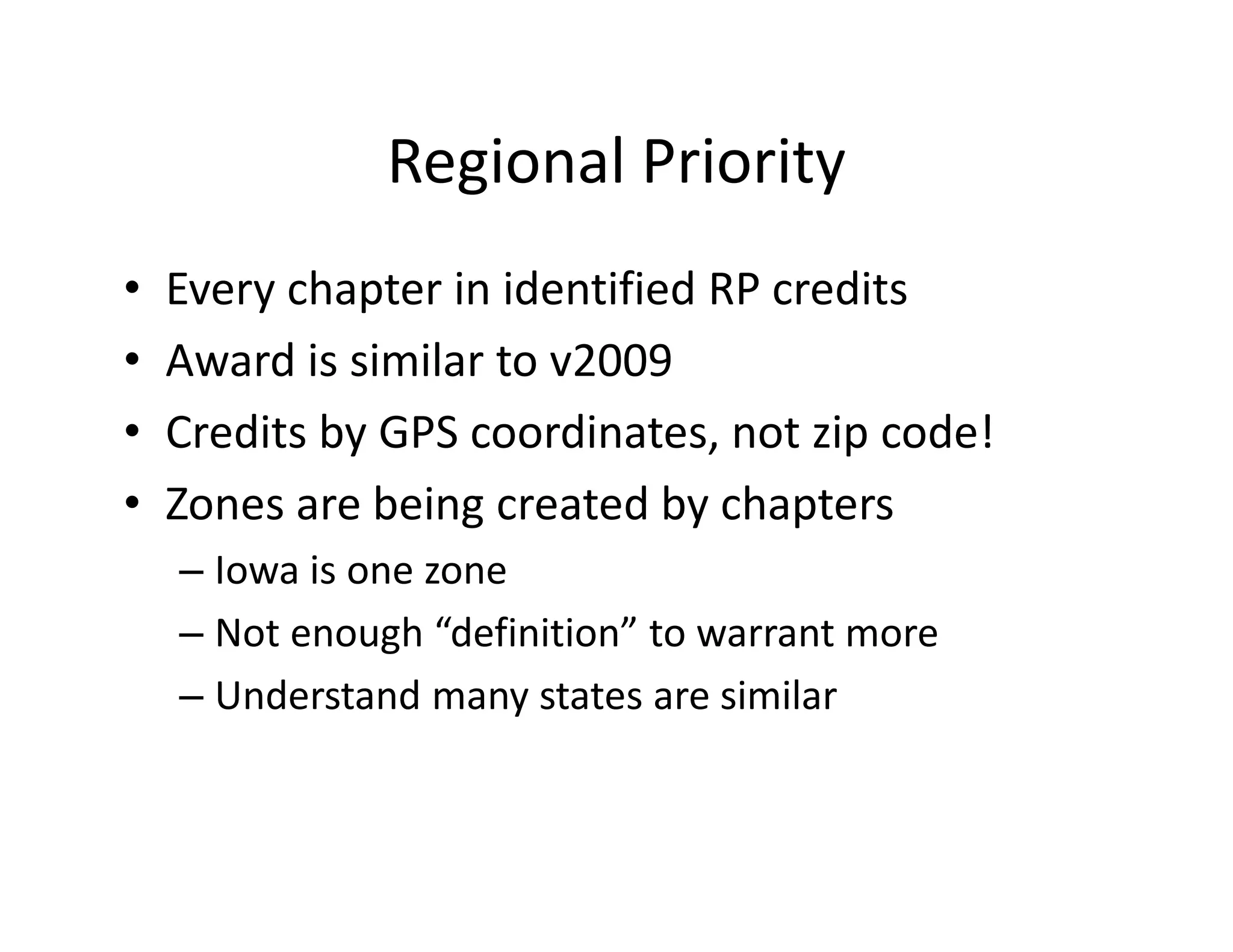
Regional Priority
• Every chapter in identified RP credits
• Award is similar to v2009
• Credits by GPS coordinates, not zip code!
• Zones are being created by chapters
– Iowa is one zone
– Not enough “definition” to warrant more
– Understand many states are similar
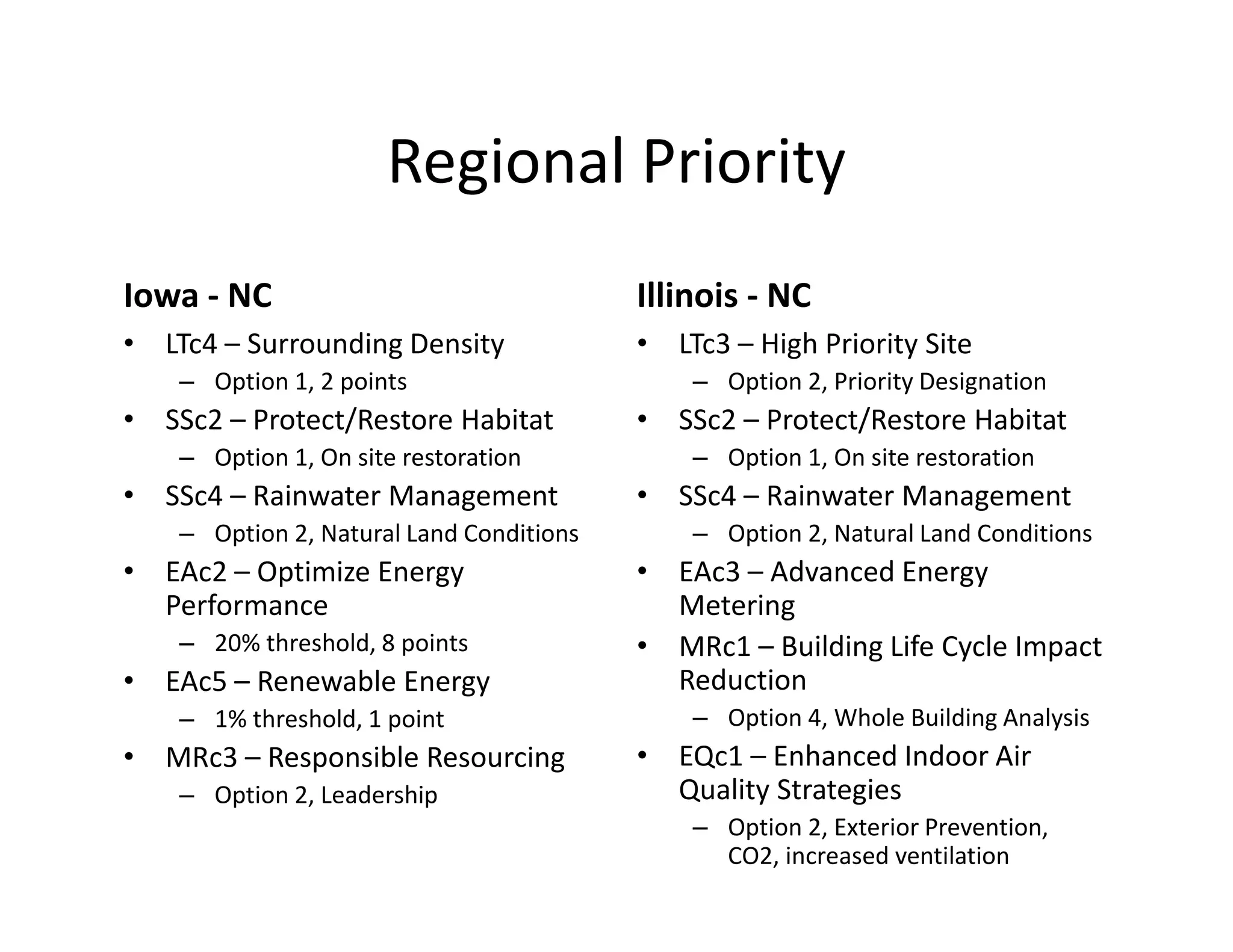
Regional Priority
Iowa - NC
• LTc4 – Surrounding Density
– Option 1, 2 points
• SSc2 – Protect/Restore Habitat
– Option 1, On site restoration
• SSc4 – Rainwater Management
– Option 2, Natural Land Conditions
• EAc2 – Optimize Energy
Performance
– 20% threshold, 8 points
• EAc5 – Renewable Energy
– 1% threshold, 1 point
• MRc3 – Responsible Resourcing
– Option 2, Leadership
Illinois - NC
• LTc3 – High Priority Site
– Option 2, Priority Designation
• SSc2 – Protect/Restore Habitat
– Option 1, On site restoration
• SSc4 – Rainwater Management
– Option 2, Natural Land Conditions
• EAc3 – Advanced Energy
Metering
• MRc1 – Building Life Cycle Impact
Reduction
– Option 4, Whole Building Analysis
• EQc1 – Enhanced Indoor Air
Quality Strategies
– Option 2, Exterior Prevention,
CO2, increased ventilation
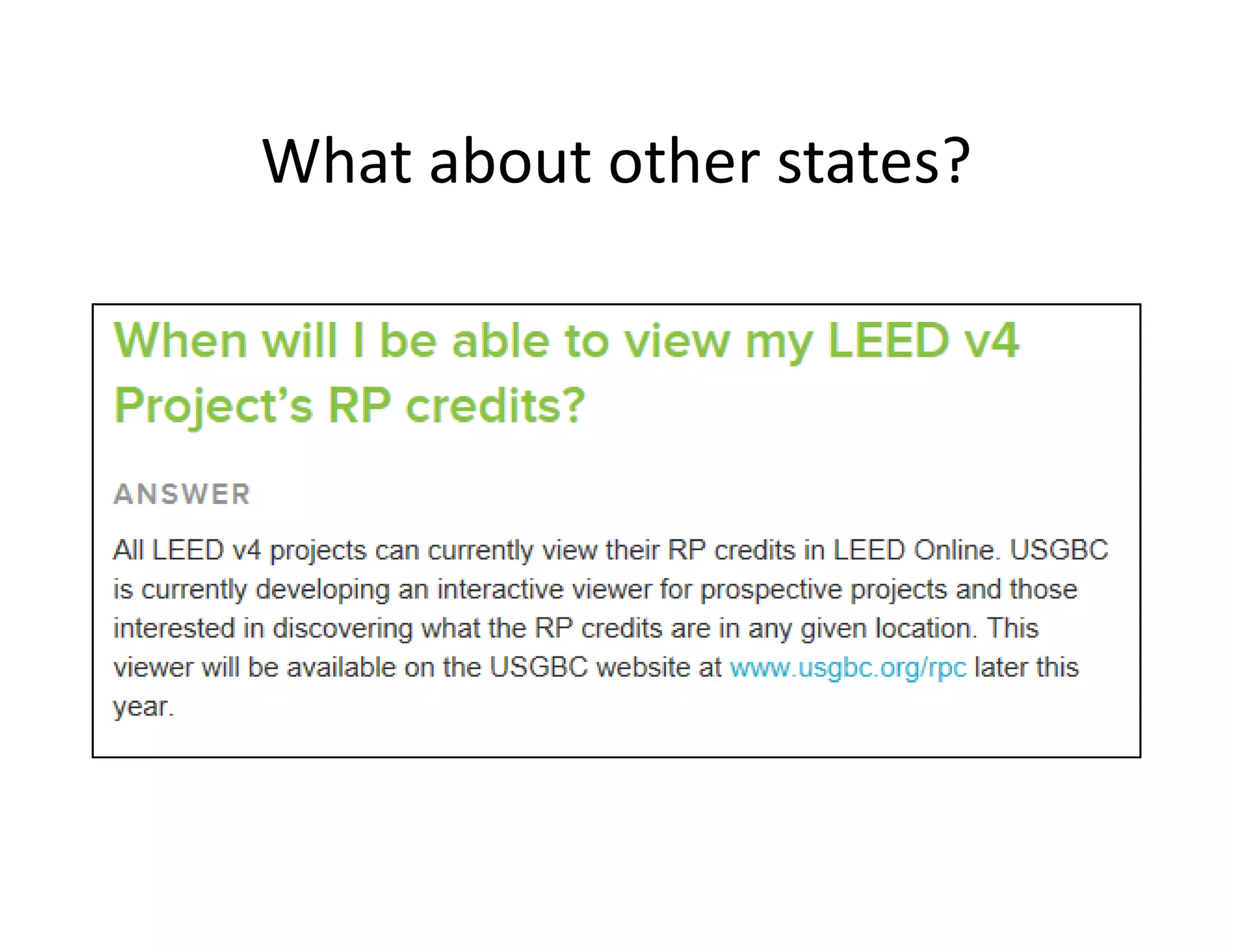
What about other states?
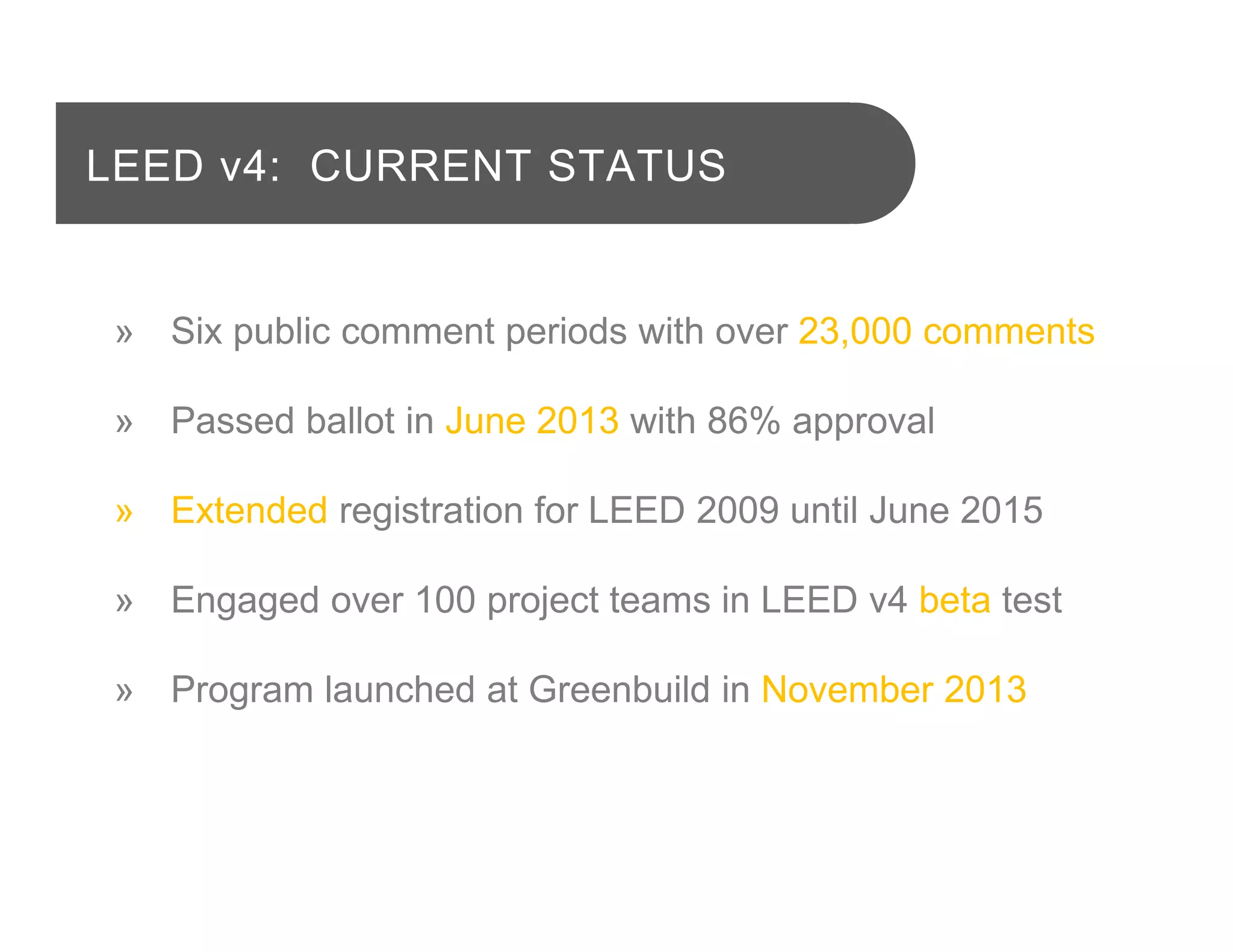
» Six public comment periods with over 23,000 comments
» Passed ballot in June 2013 with 86% approval
» Extended registration for LEED 2009 until June 2015
» Engaged over 100 project teams in LEED v4 beta test
» Program launched at Greenbuild in November 2013
LEED v4: CURRENT STATUS
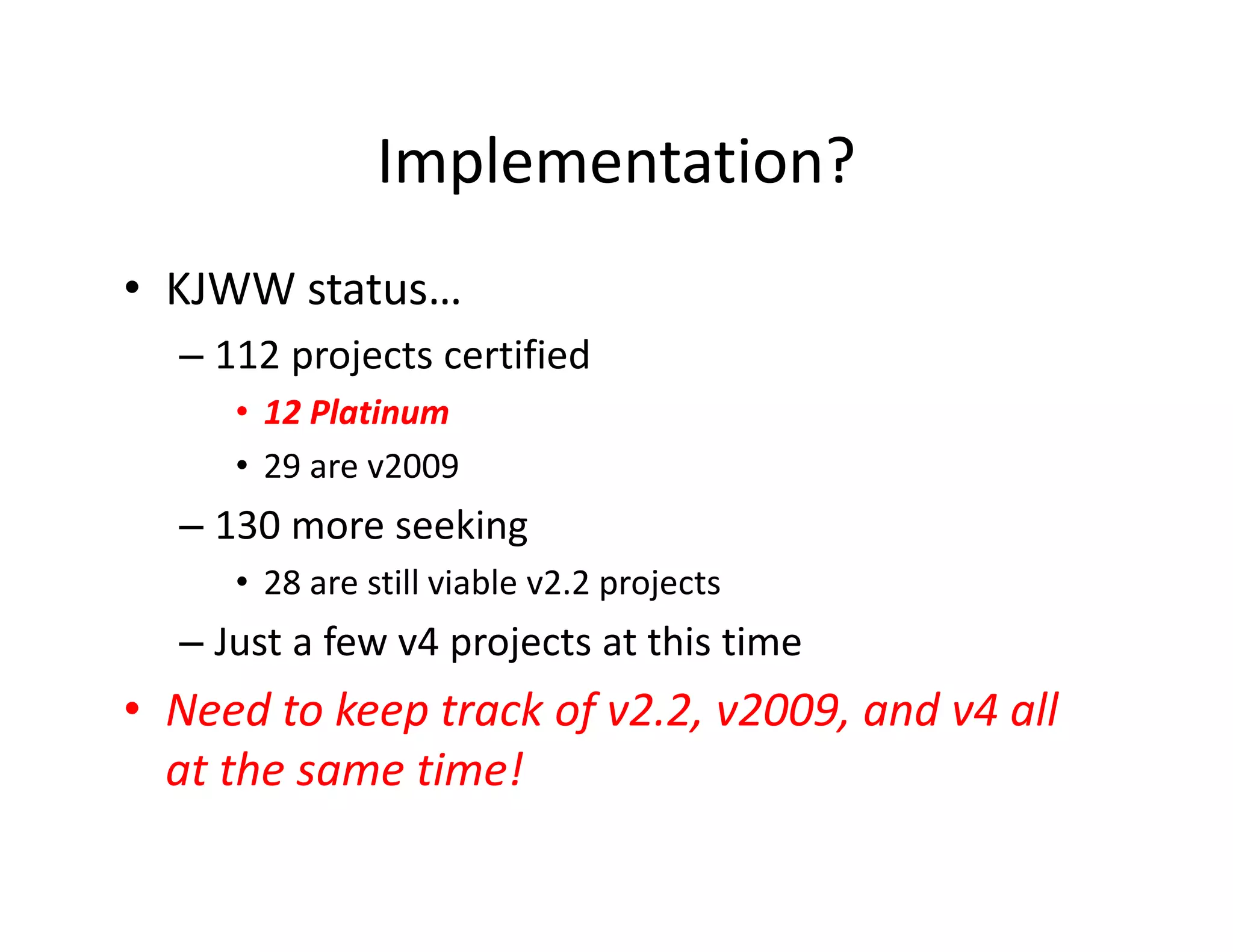
Implementation?
• KJWW status…
– 112 projects certified
• 12 Platinum
• 29 are v2009
– 130 more seeking
• 28 are still viable v2.2 projects
– Just a few v4 projects at this time
• Need to keep track of v2.2, v2009, and v4 all
at the same time!
www.usgbc.org/leedv4
IMPROVED USER EXPERIENCE
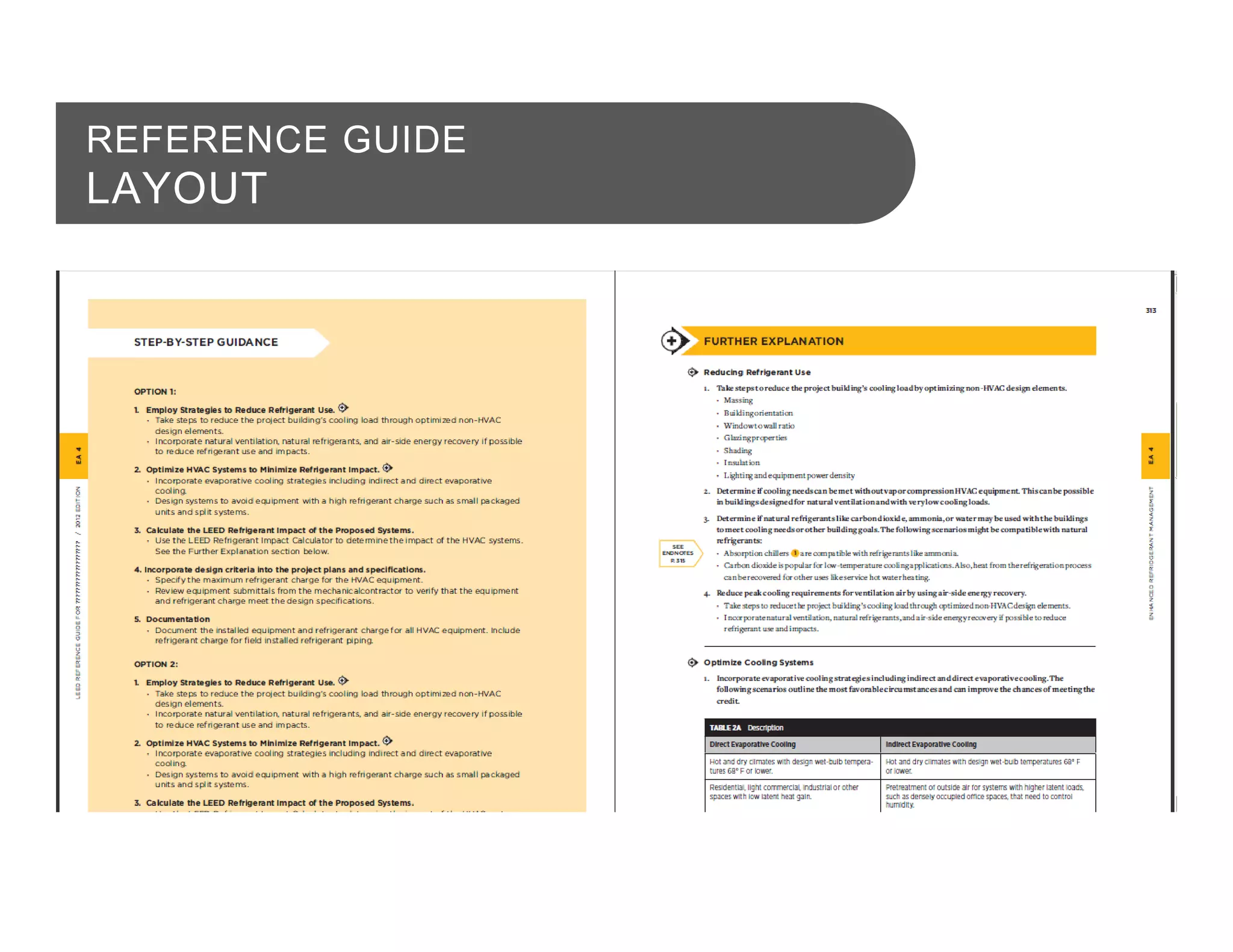
REFERENCE GUIDE
LAYOUT
REFERENCE GUIDE
DELIVERY
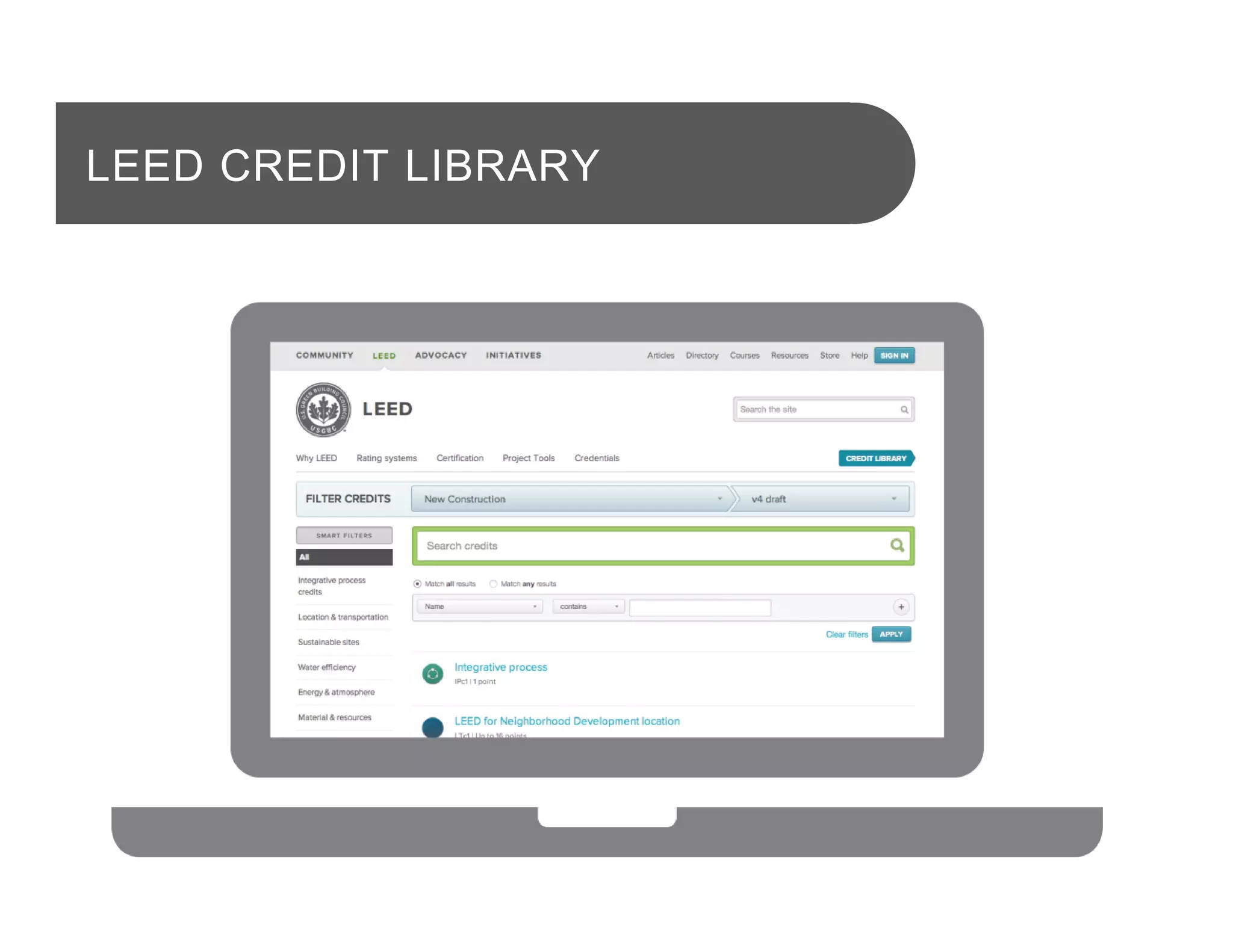
LEED CREDIT LIBRARY
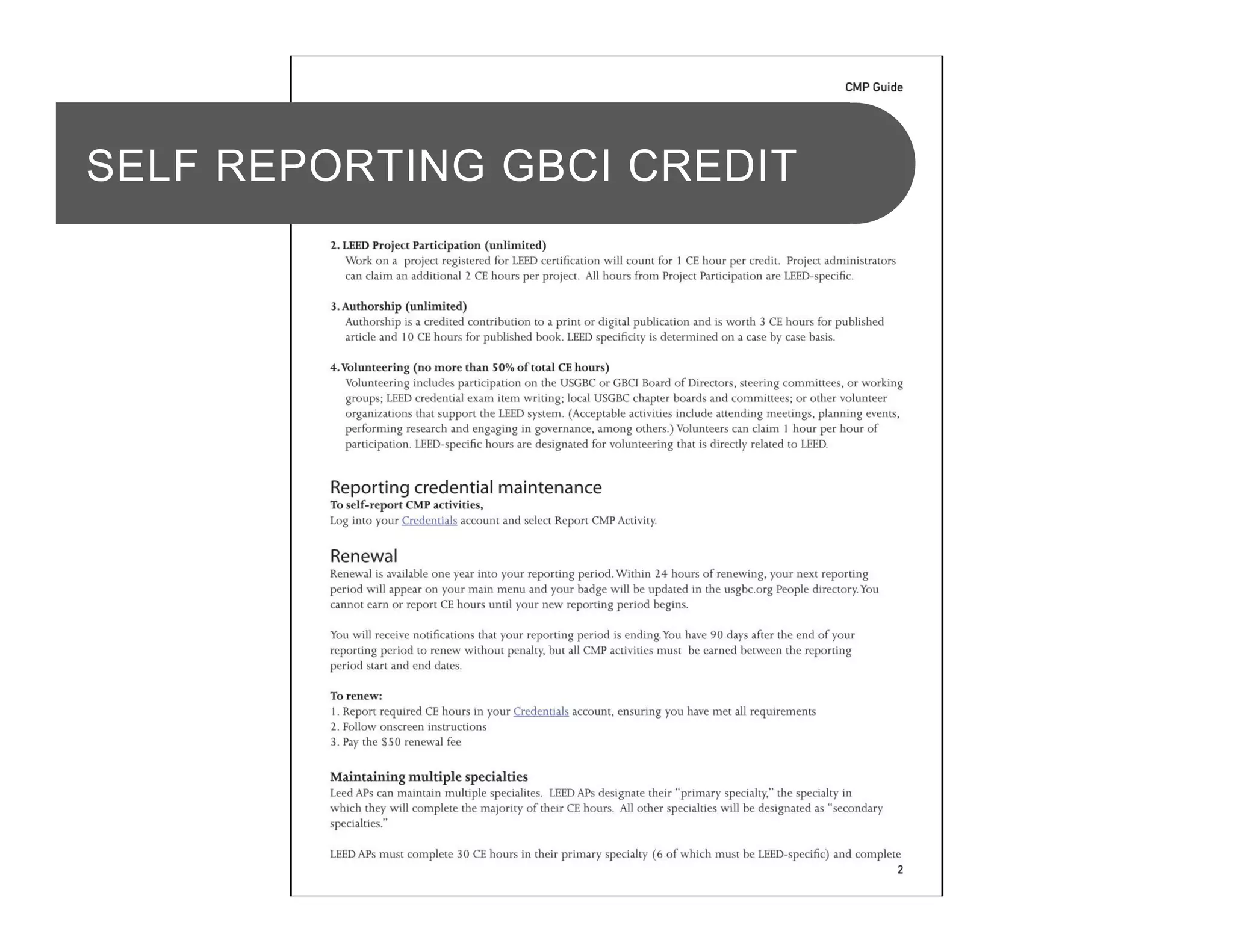
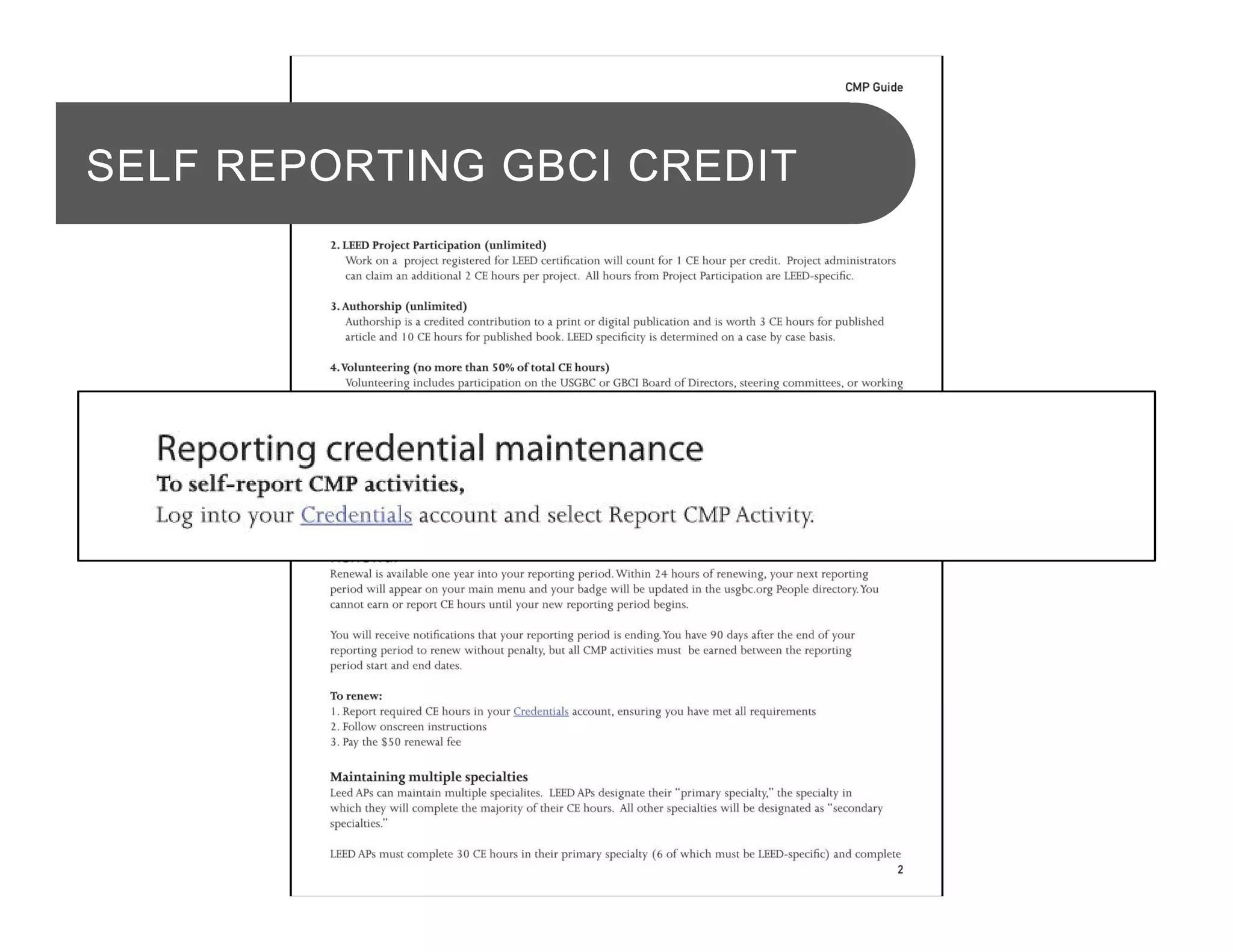
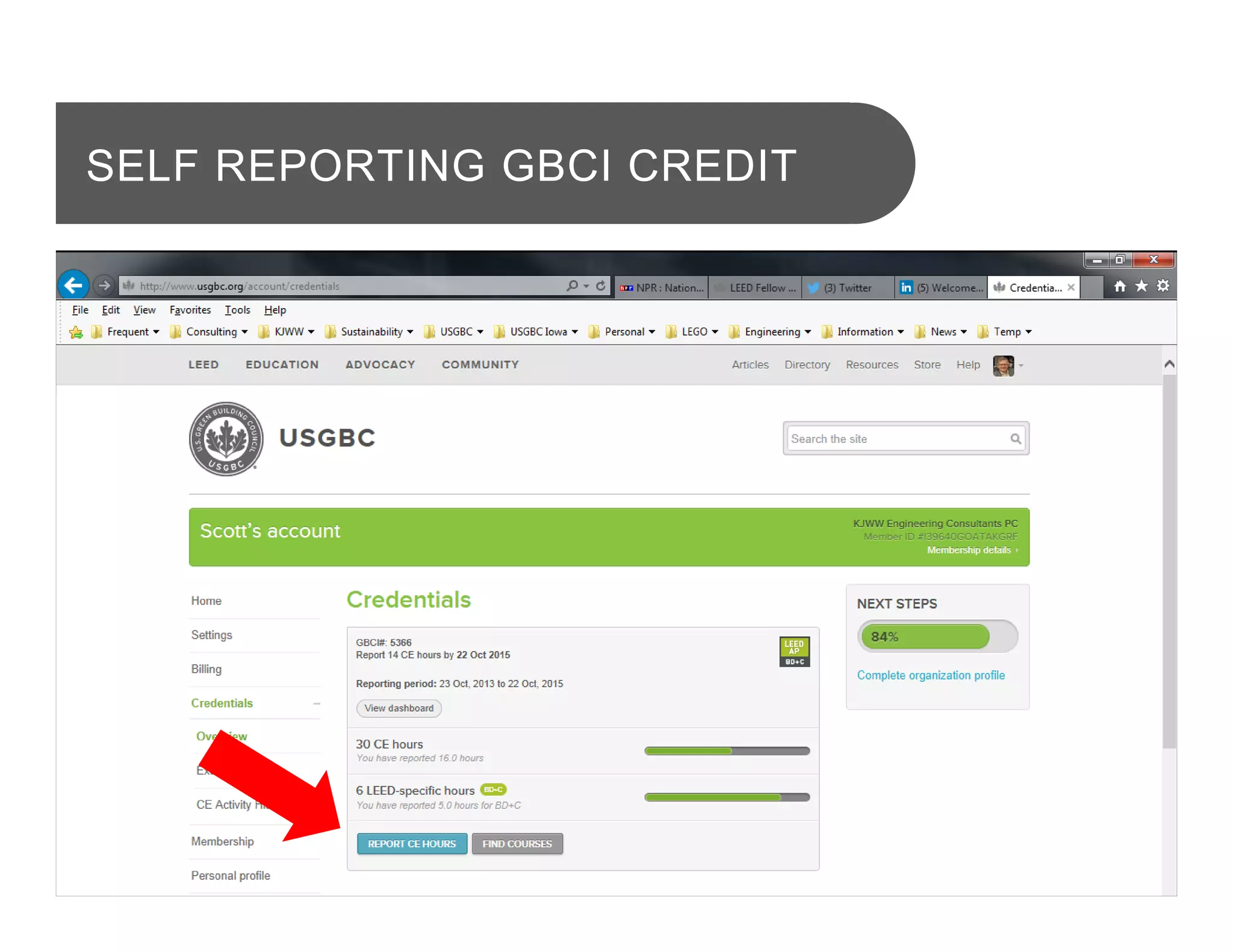
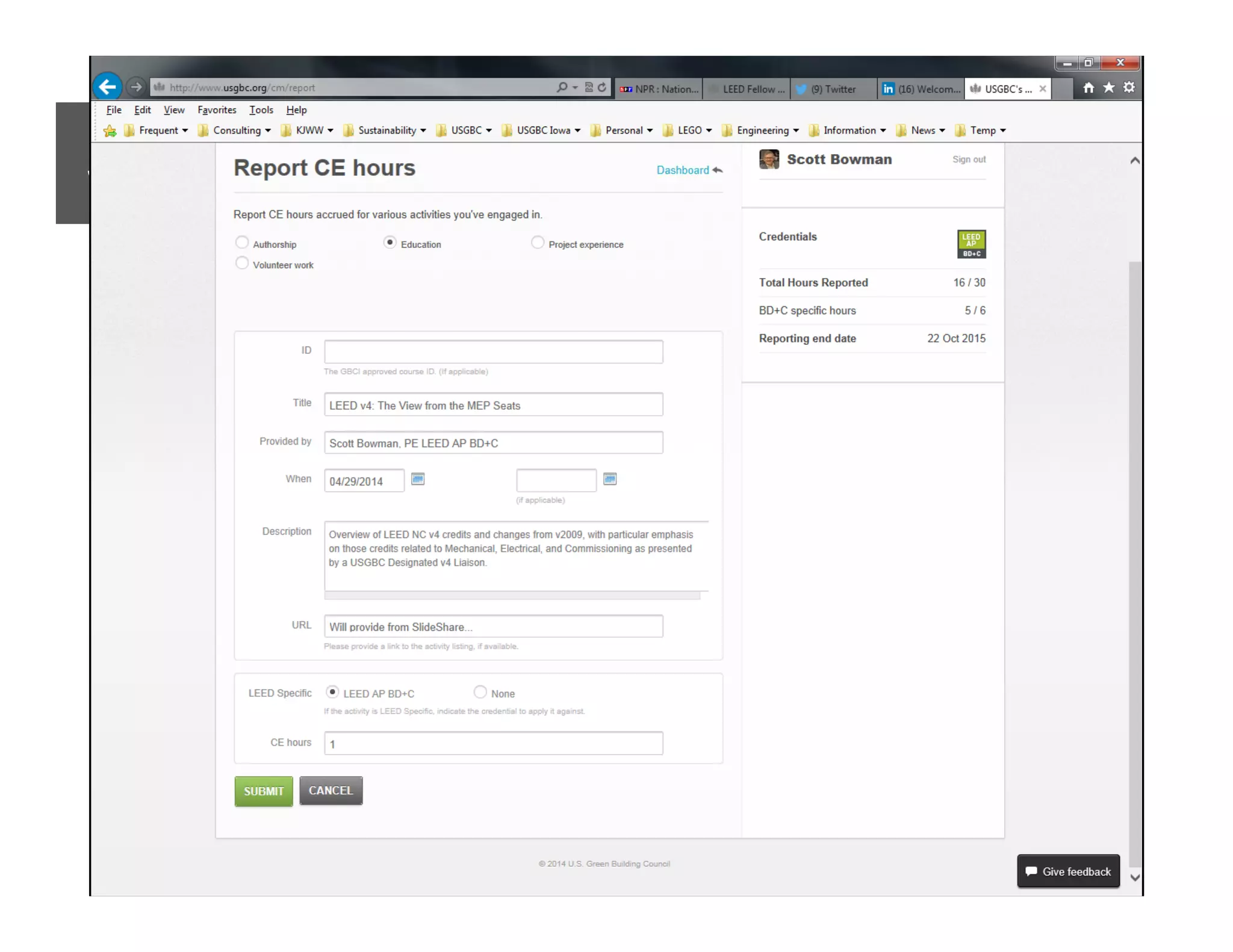
SELF REPORTING GBCI CREDIT
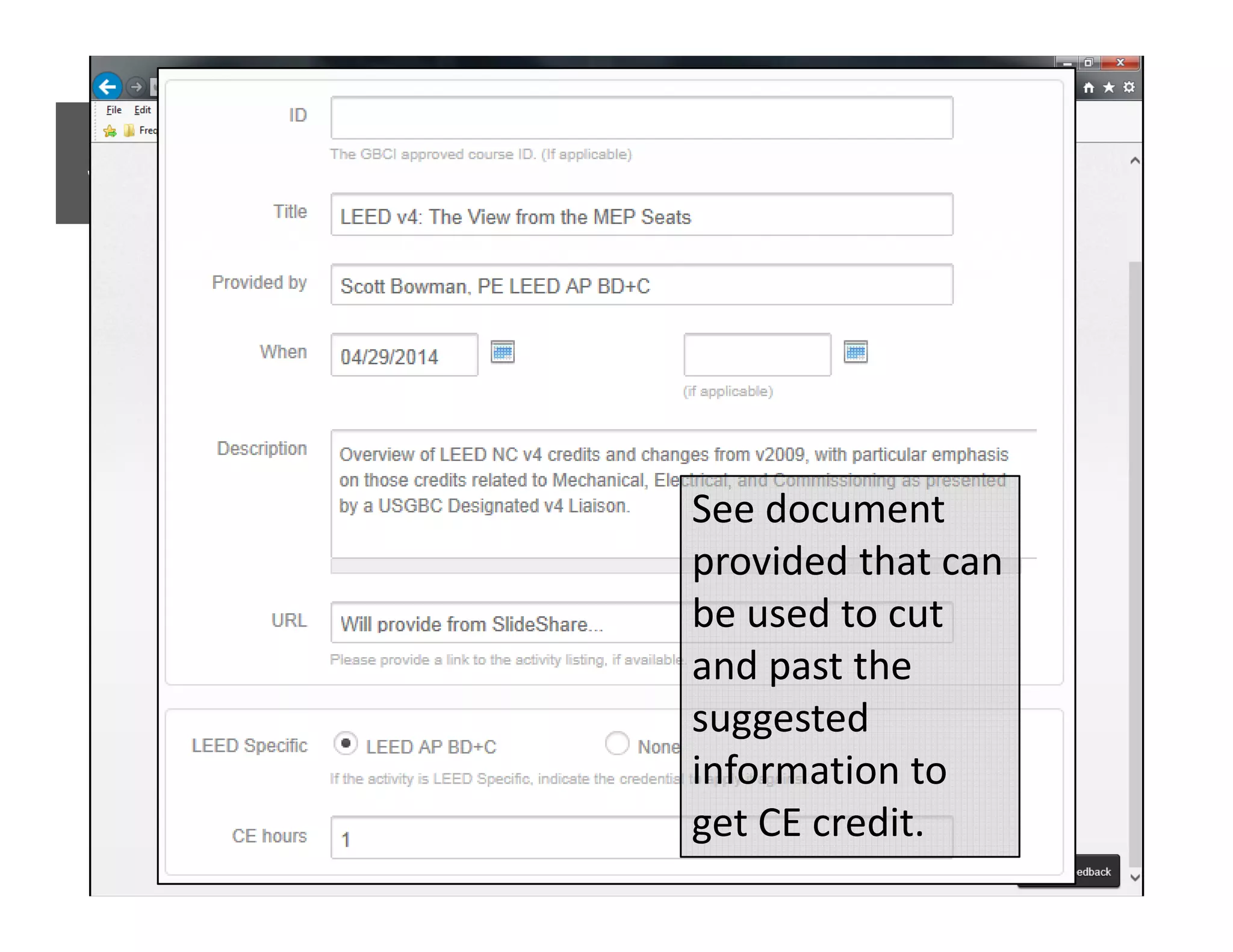
See document
provided that can
be used to cut
and past the
suggested
information to
get CE credit.
Leed v4-view-from-mep-seats-140429

Leed v4-view-from-mep-seats-140429

  • 2.
    Many slides arecourtesy of USGBC and the LEED v4 Team! The ViewThe ViewThe ViewThe View from thefrom thefrom thefrom the MEP Seats!MEP Seats!MEP Seats!MEP Seats!
  • 3.
    Scott Bowman, PE LEEDAP BD+C Principal Corporate Sustainability Leader bowmansc@kjww.com
  • 4.
    LEED 2009 FOUNDATIONALLEED v4 A SHIFT IN FOCUS DEEPER TRANSFORMATION
  • 5.
  • 6.
    Location and Transportation Sustainable Sites WaterEfficiency Energy and Atmosphere Indoor Environmental Quality Innovation and Design Process Regional Priority Integrative Process Materials and Resources
  • 7.
  • 8.
    GREEN BUILDING MARKET Source:McGraw-Hill Construction’s 2013 Dodge Construction Green Outlook
  • 9.
    COMMERCIAL OFFICE MARKET SHARE Source:McGraw-Hill Construction’s 2013 Dodge Construction Green Outlook
  • 10.
    DOE 30% Reduction Target Courtesy PNNL ASHRAE90.1-2013? ASHRAE 90-1975 ASHRAE 90A-1980 ASHRAE 90.1-1999 ASHRAE 90.1-2001 ASHRAE 90.1-2007 ASHRAE 90.1-2004 ASHRAE 90.1-1989 ASHRAE 90.1-2010 Improvement in ASHRAE Standard 90.1 (Year 1975 – 2010)EnergyUseIndex(1975Use=100) Year 1970 1975 1980 1985 1990 50 1995 20152000 20102005 110 100 90 80 70 60 14% 4.5% .5% 12.3% 4.5% 18.5%
  • 11.
    LEED v4 IMPACTCATEGORIES IMPROVED ENVIRONMENTAL OUTCOMES
  • 12.
    LEED CERTIFICATION TRENDS MARKETSECTOR ADAPTATIONS Data Centers Warehouses and Distribution Centers Hospitality Existing Buildings for Schools Existing Buildings for Retail Homes Multifamily Midrise
  • 13.
  • 14.
    New Categories • IntegratedPractice 1 point • Location & Transport 16 points • Sustainable Sites 10 points • Water Efficiency 11 points • Energy and Atmosphere 33 points • Materials and Resources 13 points • Indoor Environmental Quality 16 points • Innovation & Design Process 6 points • Regional Priority Credits 4 points Total 110 points
  • 15.
    No Change inLevel Requirements 0 10 20 30 40 50 60 70 80 90 100 110 Certified Silver Gold Platinum Total
  • 16.
  • 17.
  • 18.
    Use v4 Creditsnow! • Select v4 credits can be substituted for v2009 • Complete v4 sample form • In v2009 form, check alternate compliance path and list the substitution • Credits marked are approved for substitution • Site below has more detailed information • Can also use Pilot Credits that are applicable http://www.usgbc.org/articles/use-v4-credits-your-v2009-project/ v2009
  • 19.
    IP101r Integrated ProjectPlanning and Design • The prerequisite only applies to HC • Credit library now says “required” • New prerequisite, but not quite a category! • Requires: – OPR – Preliminary Rating Goals – Integrated Project Team – Design Charette
  • 20.
    IP102 Integrative Process •New credit (HC too) • 1 point • Early “simple box” energy analysis • Lists parametric options to reviewed • Includes water performance • Requires cost analysis and bundling • Documentation in Word Document Template • Reward for doing the analysis early
  • 21.
    Performance in Location andTransportation LOCATION AND TRANSPORTATION
  • 22.
    Highlights: New credit categoryto improve alignment between commercial rating systems and LEED ND. More performance-based credits with improved ties to anticipated outcome. bicycle facilities [link to bike network] quality transit [trip frequency, walking distance]
  • 23.
    Possible Points: 16 Credit1 16 Credit 2 1 Credit 3 2 Credit 4 5 Credit 5 5 Credit 6 1 Credit 7 1 Credit 8 Green Vehicles 1 BD+C Location and Transportation Sensitive Land Protection LEED for Neighborhood Development Location Bicycle Facilities High Priority Site Surrounding Density and Diverse Uses Access to Quality Transit Reduced Parking Footprint
  • 24.
  • 25.
    Highlights: New credit forsite assessment. Financial support option in protect or restore habitat. Major simplification to Light Pollution Reduction credit through new option for BUG rated equipment.
  • 26.
    Possible Points: 10 YPrereq 1 Required Credit 1 1 Credit 2 2 Credit 3 1 Credit 4 3 Credit 5 2 Credit 6 1 BD+C Site Assessment Site Development--Protect or Restore Habitat Rainwater Management Light Pollution Reduction Heat Island Reduction Open Space Construction Activity Pollution Prevention Sustainable Sites
  • 27.
    LEED 2009 LEEDv4 SS112 LIGHT POLLUTION REDUCTION SS112: Light Pollution Reduction CREDIT Significant revisions – very little original content Removed interior lighting requirements (part of 90.1-2010 requirements now) References IES/IDA Model Lighting Ordinance Included the BUG rating system for prescriptive compliance Added Lighting Zone 0 Included exterior storage signage requirements SSc8: Light Pollution Reduction CREDIT POINTS 1 POINTS 1 v2009
  • 28.
  • 29.
    Highlights: Addressing all wateruses including fixtures & fittings, process, appliance, cooling towers, and outdoor water. Focus on measuring water use through fundamental building metering requirements. Additional points in credit for metering of subsystems.
  • 30.
    Possible Points: 11 YPrereq 1 Required Y Prereq 2 Required Y Prereq 3 Building-Level Water Metering Required Credit 1 2 Credit 2 6 Credit 3 2 Credit 4 Water Metering 1 BD+C Water Efficiency Outdoor Water Use Reduction Indoor Water Use Reduction Outdoor Water Use Reduction Indoor Water Use Reduction Cooling Tower Water Use
  • 31.
    WE PREREQ 1OUTDOOR WATER USE REDUCTION Requires a reduction in landscape water use by 30% using EPA’s WaterSense Water Budget Toolkit Option to comply by having no irrigation Cannot use rainwater capture for prerequisite! LEED v4 WEp1: Outdoor Water Use Reduction PREREQ LEED 2009 Didn’t Exist
  • 32.
    WE PREREQ 2INDOOR WATER USE REDUCTION WaterSense label required for eligible fixtures and fittings Maintains 20% reduction requirement No once-through cooling allowed! Cooling towers must have meters, conductivity control, and drift eliminators Additional appliance and process water requirements for Retails, Schools, Healthcare and Hospitality only. LEED v4 WEp2: Indoor Water Use Reduction PREREQ LEED 2009 WE: Water Use Reduction PREREQ
  • 33.
    WE PREREQ 3BUILDING LEVEL WATER METERING Requires each project to be capable of measuring whole building water use LEED v4 WEp3: Building Level Water Metering PREREQ LEED 2009 Didn’t Exist
  • 34.
    WE CREDIT 1OUTDOOR WATER USE REDUCTION Changed from “Landscape” to “Outdoor” Limits use of “water”, not just potable water Requires a reduction in landscape water use by at least 50% using EPA’s WaterSense Water Budget Tool Reductions beyond 30% can be from “alternate water sources” such as rainwater capture Option for no irrigation LEED 2009 LEED v4 WEc1: Outdoor Water Use Reduction CREDIT POINTS 2WEc1: Water Efficient Landscaping CREDIT POINTS 2-4
  • 35.
    WE CREDIT 2INDOOR WATER USE REDUCTION Limits use of “water”, not just potable water Reductions beyond 30% can be from “alternate water sources” such as rainwater capture WaterSense label required for eligible fixtures and fittings Added Appliance and Process Water requirements for Schools Retail, Hospitality and Healthcare Added more thresholds for achievement LEED 2009 LEED v4 WEc2: Indoor Water Use Reduction CREDIT POINTS 6 WE: Water Use Reduction CREDIT POINTS 2-4 WE: Process Water Use Reduction (Schools) CREDIT POINTS 1
  • 36.
    Credit no longeravailable for sustainable wastewater technologies Reduces credits available for rainwater capture New concept of nutrient recovery will be tested with Pilot Credit LEED 2009 WE: Innovative Wastewater Technologies CREDIT POINTS 2 LEED v4 Does Not Exist
  • 37.
    WE CREDIT 3COOLING TOWER WATER Started in EBOM, then added to HC Addresses cooling tower efficiency based on maximizing a cooling tower cycles of concentration Water may continue to be cycled through the tower until a certain chemical threshold Can also gain point for using recycled non-potable water LEED 2009 Didn’t Exist LEED v4 WEc3: Cooling Tower Water CREDIT POINTS 2
  • 38.
    WE CREDIT 4WATER METERING Encourages projects to sub-meter additional water systems Requires meters for 2 or more of following (typically to 80%): Irrigation Indoor plumbing fixtures and fittings Domestic hot water Boiler make-up (units > 500 MBH) Reclaimed water (including makeup, proper math!) Process Water HC requires 5 more meters from list of 10 LEED v4 WEc4: Water Metering CREDIT POINTS 2 LEED 2009 Didn’t Exist
  • 39.
    Defining Performance in Energy& Atmosphere ENERGY AND ATMOSPHERE
  • 40.
    Highlights: Minimum Energy Performance:five percent above ASHRAE 90.1-2010; minimum ENERGY STAR score now 75. New credit for Demand Response. Building level energy metering required for all projects.
  • 41.
    Possible Points: 33 YPrereq 1 Required Y Prereq 2 Required Y Prereq 3 Required Y Prereq 4 Required Credit 1 6 Credit 2 18 Credit 3 1 Credit 4 2 Credit 5 3 Credit 6 1 Credit 7 2 BD+C Green Power and Carbon Offsets Enhanced Commissioning Demand Response Renewable Energy Production Enhanced Refrigerant Management Optimize Energy Performance Energy and Atmosphere Minimum Energy Performance Building-Level Energy Metering Fundamental Commissioning and Verification Fundamental Refrigerant Management Advanced Energy Metering
  • 42.
    EA PREREQ 1FUNDAMENTAL COMMISSIONING AND VERIFICATION Expanded intent to ensure project meets the owners projects requirements related to energy, water, indoor environmental quality and durability CxA must be engaged before the end of Design Development phase Added design review; not specific to when (ie before 50%) Added requirement for preparing an Operations and Maintenance Plan (similar but not as extensive as Systems Manual) Requires Pre-Functional Checklists (often done, was not required) LEED v4 EAp1: Fundamental Commissioning and Verification PREREQ LEED 2009 EAp1: Fundamental Commissioning of Building Energy Systems PREREQ v2009
  • 43.
    EA PREREQ 1FUNDAMENTAL COMMISSIONING AND VERIFICATION Requires exterior enclosures to be included in OPR and BOD Requires the exterior enclosures to be included in design review, completed by design team member that is not directly involved in the design to complete Intent was to provide incremental step into requiring envelope commissioning Clarified language for who can be the commissioning agent (more to be included in reference guide) LEED v4 EAp1: Fundamental Commissioning and Verification PREREQ LEED 2009 EAp1: Fundamental Commissioning of Building Energy Systems PREREQ v2009
  • 44.
    EA PREREQ 2MINIMUM ENERGY PERFORMANCE Updated reference standard to ASHRAE 90.1-2010 Must achieve minimum of 5% savings over baseline, 3% for renovation Clarifies that project must meet performance levels prior to application of renewable energy References COMNET Modeling Guidelines for reduction of unregulated loads Special methods for data centers, still including equipment loads LEED v4 EAp2: Minimum Energy Performance PREREQ LEED 2009 EAp2: Minimum Energy Performance PREREQ
  • 45.
    EA PREREQ 2MINIMUM ENERGY PERFORMANCE Updated Advanced Energy Design Guide prescriptive option to 50% AEDG for Office, Retail, Schools, and Healthcare Updated Core Performance Guide prescriptive option to meeting core requirements plus six additional strategies. LEED v4 EAp2: Minimum Energy Performance PREREQ LEED 2009 EAp2: Minimum Energy Performance PREREQ
  • 46.
    ASHRAE 90.1-2010 • Moreequipment is being regulated • Envelope must have more south glazing then east or west • Skylights or clearstories required in large, tall, top-floor rooms • Reheat loop holes closed – no more hospitals with constant volume reheat! • Heating overhead the SA cannot be more than 20 F from space temperature • Economizers are required for smaller systems • Many more automatic lighting and daylighting controls required • 50% of 120V receptacles in offices require automatic switching
  • 47.
    Appendix G • Moredetailed documentation requirements • Enhanced exceptional calculation requirements • Requires modeling of shading from adjacent structures • Clarified definition of unmet load hours • Removes unmet load hours delta of 50 • Purchased HW or CW treated like utility – no trade-offs • Modified baseline systems for DES • Consistent with LEED DES requirements now • Allows different level of ventilation in proposed and baseline design • Adds heating only baseline systems
  • 48.
    EA PREREQ 3BUILDING-LEVEL ENERGY METERING Requires each project to be capable of measuring whole building energy use. LEED v4 EAp3: Building-Level Energy Metering PREREQ LEED 2009 EA: Measurement and Verification CREDIT POINTS 3 EA: Measurement and Verification Base Building CREDIT POINTS 3 Measurement and Verification Tenant Submetering CREDIT POINTS 3
  • 49.
    EA PREREQ 4FUNDAMENTAL REFRIGERANT MANAGEMENT No substantive changes No CFC refrigerants Existing small units with less than 0.5 pounds are exempt LEED v4 EAp4: Fundamental Refrigerant Management PREREQ LEED 2009 Fundamental Refrigerant Management PREREQ v2009
  • 50.
    EA CREDIT 1ENHANCED COMMISSIONING Option 1, Path 1 is for the typical MEP enhanced commissioning and is now worth 3 points (1 more than v2009) Reduced the tasks in enhanced (design review and manual moved to fundamental) Added requirements to prepare the building operators for the intended operation of building systems Option 1, Path 2 is a new Monitoring Based Commissioning worth 1 more point after Path 1 achieved Similar to Measurement and Verification . LEED 2009 LEED v4 EAc1: Enhanced Commissioning CREDIT EA: Enhanced Commissioning CREDIT POINTS 2 POINTS 6
  • 51.
    EA CREDIT 1ENHANCED COMMISSIONING Option 2 rewards Envelope Commissioning for 2 more points Can be done separate from MEP systems References NIBS Guideline 3-2006 Very inclusive standard, no other guidance in the standard We have seen huge variation in this service and fee! CxA can be qualified employee of owner, an independent consultant, or disinterested subcontractor to the design team . LEED 2009 LEED v4 EAc1: Enhanced Commissioning CREDIT EA: Enhanced Commissioning CREDIT POINTS 2 POINTS 6
  • 52.
    EA CREDIT 2OPTIMIZE ENERGY PERFORMANCE Updated referenced standard to ASHRAE 90.1-2010 Reduced weightings due to advancing standard Maximum of 6 points using prescriptive paths Updated Advanced Energy Design Guides prescriptive option to 50% AEDG for Office, Retail, Schools, and Healthcare Updated Core Performance Guide prescriptive option to meeting core requirements plus six additional strategies Removed Core Performance Guide prescriptive option LEED 2009 LEED v4 EAc2: Optimize Energy Performance CREDIT EA: Optimize Energy Performance CREDIT POINTS 19 POINTS 18
  • 53.
  • 54.
  • 55.
    EA CREDIT 3ADVANCED ENERGY METERING LEED v4 LEED 2009 EA: Measurement and Verification CREDIT POINTS 2 EA: Measurement and Verification Base Building CREDIT POINTS 3 EA: Measurement and Verific- ation Tenant Submetering CREDIT POINTS 3 EAc3: Advanced Energy Metering CREDIT POINTS 1 Requires all energy end-uses representing 10%+ of the total energy consumption to be metered Meters must be connected to the building automation system and log data at appropriate intervals with 36 months data retention Core and Shell projects required to address future tenant spaces
  • 56.
    EA CREDIT 4DEMAND RESPONSE Encourages projects to design and install systems necessary to participate in a demand response program Also available to projects located in areas without demand response programs = 1 point if ready to engage Added requirement to include demand response processes in the commissioning scope LEED v4 EAc4: Demand Response CREDIT POINTS 2 LEED 2009 Didn’t Exist
  • 57.
    EA CREDIT 5RENEWABLE ENERGY PRODUCTION Added new option provision for community-scale renewable energy systems Reduced thresholds and points available 1% = 1 point; 5% = 2 points; 10% = 3 points LEED 2009 LEED v4 EAc5: Renewable Energy Production CREDIT EA: On-site Renewable Energy CREDIT POINTS 7 POINTS 3
  • 58.
    EA CREDIT 6ENHANCED REFRIGERANT MANAGEMENT Added retail-specific requirements LEED 2009 LEED v4 EAc6: Enhanced Refrigerant Management CREDIT EA: Enhanced Refrigerant Management CREDIT POINTS 2 POINTS 1
  • 59.
    EA CREDIT 7GREEN POWER AND CARBON OFFSETS Credit based on total building energy usage Carbon offsets allowed for scope 1 or 2 emissions Required contract length extended from 2 years to 5 years Eligible resources must have come online after January 1, 2005 LEED 2009 LEED v4 EAc7: Green Power and Carbon Offsets CREDIT EA: Green Power CREDIT POINTS 2 POINTS 2 v2009
  • 60.
    LEED v4 LEED 2009 EA:Measurement and Verification CREDIT POINTS 2 EA: Measurement and Verification Base Building CREDIT POINTS 3 EA: Measurement and Verific- ation Tenant Submetering CREDIT POINTS 3 EAc3: Advanced Energy Metering CREDIT POINTS 1 Measurement and Verification no longer exists in same form EAc1 – Option 1, Path 2 – Monitoring Based Commissioning Would significantly enhanced future EBOM application LEED v4 EAc1: Enhanced Commissioning CREDIT POINTS 6
  • 61.
  • 62.
    Highlights: Life cycle thinkingapproach to category. Optional whole building life cycle assessment for new construction. Focus on product transparency and outcomes through Building Disclosure & Optimization credits. .
  • 63.
    Possible Points: 13 YPrereq 1 Required Y Prereq 2 Required Credit 1 5 Credit 2 2 Credit 3 2 Credit 4 Building Product Disclosure and Optimization - Material Ingredients 2 Credit 5 2 BD+C Building Product Disclosure and Optimization - Sourcing of Raw Materials Building Life-Cycle Impact Reduction Construction and Demolition Waste Management Construction and Demolition Waste Management Planning Materials and Resources Storage and Collection of Recyclables Building Product Disclosure and Optimization - Environmental Product Declarations
  • 64.
  • 65.
    Highlights: Category focused onkey indicators of air, light, sound, and occupant experience. More performance-based credits focused on health and wellbeing outcomes. Systems approach to material emissions.
  • 66.
    Indoor Environmental QualityPossible Points: 16 Y Prereq 1 Required Y Prereq 2 Required Credit 1 2 Credit 2 3 Credit 3 Construction Indoor Air Quality Management Plan 1 Credit 4 2 Credit 5 1 Credit 6 2 Credit 7 3 Credit 8 1 Credit 9 1 BD+C Quality Views Enhanced Indoor Air Quality Strategies Low-Emitting Materials Indoor Air Quality Assessment Minimum Indoor Air Quality Performance Environmental Tobacco Smoke Control Thermal Comfort Acoustic Performance Interior Lighting Daylight
  • 67.
    EQ PREREQ 1MINIMUM INDOOR AIR QUALITY PERFORMANCE Changed reference standard to ASHRAE 62.1-2010 Added requirements for outside air delivery monitoring Actual measurement on variable flow Current switch on fixed flow Added requirements for residential projects addressing combustion appliances, CO monitors, and radon LEED v4 EQp1: Minimum Indoor Air Quality Performance PREREQ LEED 2009 EQ: Minimum Indoor Air Quality Performance PREREQ v2009
  • 68.
    EQ CREDIT 1ENHANCED INDOOR AIR QUALITY STRATEGIES Added additional options for mathematical modeling, additional sensors, and mixed mode systems. Gives projects multiple options for compliance most suitable to project LEED 2009 LEED v4 EQc1: Enhanced Indoor Air Quality Strategies CREDIT POINTS 2 EQ: Outdoor Air Delivery Monitoring CREDIT POINTS 1 EQ: Increased Ventilation CREDIT POINTS 1 EQ: Indoor Chemical and Pollutant Source Control CREDIT POINTS 1
  • 69.
    • Option 1for 1 point requires: – Entryway systems – Cross-contamination prevention (exhaust) where hazardous gases or chemicals used or present – Filtration (MERV 13), OA only, not return – Calculations for natural ventilation or mixed mode • Option 2 for 1 point requires: – Minimize entry of pollutants into building using CFD or dispersion analysis or wind tunnels – Increased ventilation by 30% – CO2 monitoring in all densely occupied spaces – Additional source control and monitoring – Room by room natural ventilation calculations • Not mutually dependent EQ CREDIT 1 ENHANCED INDOOR AIR QUALITY STRATEGIES
  • 70.
    EQ CREDIT 3CONSTRUCTION INDOOR AIR QUALITY MANAGEMENT PLAN No substantive changes Cannot smoke during construction Protect materials from moisture and dirt Must prevent infiltration of high VOC activities in renovation projects LEED 2009 LEED v4 EQc3: Construction Indoor Air Quality Management Plan CREDIT EA: Construction IAQ Management Plan—During Construction CREDIT POINTS 1 POINTS 1 v2009
  • 71.
    EQ CREDIT 4INDOOR AIR QUALITY ASSESSMENT Added a maximum temperature limit for flush outs Expanded the list of contaminants for which to test under Option 2 Clarified that furniture must be installed LEED 2009 LEED v4 EQc4: Indoor Air Quality Assessment CREDIT Construction IAQ Management Plan—Before Occupancy CREDIT POINTS POINTS 2 1
  • 72.
    EQ CREDIT 4INDOOR AIR QUALITY ASSESSMENT Option 1 for 1 point: Path 1, flushing before occupancy Path 2, flushing during occupancy Sets upper limit for temp and humidity during flush LEED 2009 LEED v4 EQc4: Indoor Air Quality Assessment CREDIT Construction IAQ Management Plan—Before Occupancy CREDIT POINTS POINTS 2 1
  • 73.
    EQ CREDIT 4INDOOR AIR QUALITY ASSESSMENT Option 2 for 2 points: Testing (rewarding with more points) Much more detail on testing limits Contaminant list has been expanded Clarifies that hand-held devices are not acceptable must be gravimetric method LEED 2009 LEED v4 EQc4: Indoor Air Quality Assessment CREDIT Construction IAQ Management Plan—Before Occupancy CREDIT POINTS POINTS 2 1
  • 74.
    EQ CREDIT 5THERMAL COMFORT Updated reference standard to ASHRAE 55-2010 Must meet both comfort AND controllability (50%) Credit removed from Core and Shell LEED 2009 LEED v4 EQc5: Thermal Comfort CREDIT POINTS 1 EQ: Controllability of Systems Thermal Comfort—Design CREDIT POINTS 1 EQ: Thermal Comfort—Design CREDIT POINTS 1
  • 75.
    EQ CREDIT 6INTERIOR LIGHTING Added requirements to address lighting quality Option 1 (1 point): control for 90% of occupant spaces Clearly defines 3 levels as on, off, mid-level AND/OR Option 2 (1 point): Lighting Quality; requires 3 of 8 features LEED 2009 LEED v4 EQc6: Interior Lighting CREDIT EQ: Controllability of Systems- Lighting CREDIT POINTS 1 POINTS 2
  • 76.
    EQ CREDIT 7DAYLIGHT Increased weighting Removed prescriptive option Added option for spatial daylight autonomy Changed units from footcandles to lux Added a timing requirement to measurement option LEED v4 EQc7: Daylight CREDIT LEED 2009 EQ: Daylight and Views – Daylight CREDIT POINTS 1 POINTS 3
  • 77.
    EQ CREDIT 8QUALITY VIEWS Added requirement for quality view, defined by the LEED 2009 exemplary performance criteria Much more definition, angles, etc. Must be clear viewUno frits, fibers, patterns, or tints Must include objects 25 feet away, flora, fauna, sky, and movement! Interior atria may be used for 30% of area LEED v4 EQc8: Quality Views CREDIT LEED 2009 EQ: Daylight and Views – Quality Views CREDIT POINTS 1 POINTS 1 v2009
  • 78.
    EQ CREDIT 9ACOUSTIC PERFORMANCE New credit except in Schools and Healthcare Added requirements for room noise levels, speech privacy and sound isolation, reverberation time, and paging, masking, and sound reinforcement systems LEED v4 EQc9: Acoustic Performance (Except: CS, Retail) CREDIT LEED 2009 EQ: Acoustic Performance (Schools) CREDIT POINTS 1 POINTS 1
  • 79.
    Innovation Regional Priority InnovationPossible Points: 6 Credit 1 5 Credit 2 1 Innovation LEED Accredited Professional Regional Priority Possible Points: 4 Credit 1 Regional Priority: Specific Credit 1 Credit 2 Regional Priority: Specific Credit 1 Credit 3 Regional Priority: Specific Credit 1 Credit 4 Regional Priority: Specific Credit 1
  • 80.
    Innovation • One pointreserved for true innovation • One point reserved for Pilot Credit – Intended to be testing next versions • Remaining three points can be: – Up to 3 more true innovations – Up to 3 more Pilot Credits – Up to 2 exemplary performance • IDc2 requires LEED AP with specialty
  • 81.
    Regional Priority • Everychapter in identified RP credits • Award is similar to v2009 • Credits by GPS coordinates, not zip code! • Zones are being created by chapters – Iowa is one zone – Not enough “definition” to warrant more – Understand many states are similar
  • 82.
    Regional Priority Iowa -NC • LTc4 – Surrounding Density – Option 1, 2 points • SSc2 – Protect/Restore Habitat – Option 1, On site restoration • SSc4 – Rainwater Management – Option 2, Natural Land Conditions • EAc2 – Optimize Energy Performance – 20% threshold, 8 points • EAc5 – Renewable Energy – 1% threshold, 1 point • MRc3 – Responsible Resourcing – Option 2, Leadership Illinois - NC • LTc3 – High Priority Site – Option 2, Priority Designation • SSc2 – Protect/Restore Habitat – Option 1, On site restoration • SSc4 – Rainwater Management – Option 2, Natural Land Conditions • EAc3 – Advanced Energy Metering • MRc1 – Building Life Cycle Impact Reduction – Option 4, Whole Building Analysis • EQc1 – Enhanced Indoor Air Quality Strategies – Option 2, Exterior Prevention, CO2, increased ventilation
  • 83.
  • 84.
    » Six publiccomment periods with over 23,000 comments » Passed ballot in June 2013 with 86% approval » Extended registration for LEED 2009 until June 2015 » Engaged over 100 project teams in LEED v4 beta test » Program launched at Greenbuild in November 2013 LEED v4: CURRENT STATUS
  • 85.
    Implementation? • KJWW status… –112 projects certified • 12 Platinum • 29 are v2009 – 130 more seeking • 28 are still viable v2.2 projects – Just a few v4 projects at this time • Need to keep track of v2.2, v2009, and v4 all at the same time!
  • 86.
  • 88.
  • 89.
  • 90.
  • 91.
  • 93.
  • 94.
  • 95.
  • 96.
  • 97.
  • 98.
    SELF REPORTING GBCICREDIT See document provided that can be used to cut and past the suggested information to get CE credit.