UNITAR’s Local
   Development Programme
Workshop on knowledge transfer and capacity building
for water and sanitation services in Asia and the Pacific


                  Bangkok, Thailand

                  18th February 2009
United Nations Institute
    for Training and
  Research (UNITAR)
UNITAR                                                          3


  Purpose
  To enhance the effectiveness of the UN through appropriate
  training and research


  Vision
  To be a centre of excellence for standard-setting
  methodologies, high-quality training, research capacity and
  knowledge systems


  Historical Background
  Established as an autonomous body within the United Nations
  system in 1965
UNITAR                                                       4


Thematic focal areas

   Environment
      Chemicals and Waste Management
      Climate Change
      Biodiversity
      Environmental Governance and Law

   Governance
      E-Governance

      Local Development
      Public Finance and Trade

   Peace, Security and Diplomacy
      International Law
      Multilateral Diplomacy
      Peacemaking and Conflict Prevention
                                            www.unitar.org
      Peacekeeping Training

   Research
      Knowledge Systems Innovation
      UNOSAT
Local Development Programme
            (LDP)
LDP                                                                                                       6


Our mission
To provide training to local actors in order to enhance                            LDP’s Target
their capacity to implement locally the Millennium                                   group:
Development Goals and other international conventions.                             Local authorities

Vision                                                                            in partnerships with :

To become a hub for information, communication and                           •   National Governments
training between United Nations Agencies, academic                           •   Civil Society
                                                                             •   IGO’s
institutions, national stakeholders and local actors such                    •   Private Sector
as local authorities, civil society and public and private
companies.
                                                                      “If my neighbor
Activities                                                           can do it, then so
     Undertake a participatory process (training workshops,               can I!”
     etc.) to support local authorities in their local development

     Enable exchange of knowledge, expertise and best-practice       Simon Compaoré,
     experiences                                                          Mayor of
                                                                       Ouagadougou,
     Promote decentralized and city-to-city cooperation              President of MDP,
     Strengthen community and stakeholders’ involvement                 Burkina Faso
     Promote local democracy and good governance through
     capacity building
LDP                        7


      www.unitar.org/ldp
LDP                                                                                                     8


Areas of action
The training sessions for local authorities
focus on four major areas:
    Sustainable Urbanization and Environment
        Urban planning

        Urban environment services (transport, water, waste, energy)

        Climate Change

    Local governance and Economic Development
        Local governance (gender, public participation, e-Governance)       The Unitar/UN-Habitat
                                                                            initiative on «Access to
        Local economic development (Income generation, PPP,
                                                                            basic services for All»
        employability, business skills and management)
                                                                            highlights the rights and
    Local Institutional Support                                             responsibilities of the
                                                                            stakeholders involved in
        Building local capacities (accountability and transparency, local   the provision of basic
        leadership and municipal management, reform and                     services and aims at
        decentralization support)                                           improving the delivery of
                                                                            these services to the
    Health and Human Security                                               poorest.
        Human security (urban safety and social coexistence)

        Local health management ( Urban management of HIV Aids,
        local risk management of pandemics)
LDP                                                                  9


CIFAL

LDP implements its training programmes
through a network of 10 CIFAL centers :

   Americas:
        CIFAL Atlanta
        CIFAL Curitiba

   Africa:
        CIFAL Durban                         CIFAL centers are
        CIFAL Ouagadougou
                                               established in
                                           cooperation with local
   Asia and Pacific                        authorities and other
        CIFAL Kuala Lumpur                     stakeholders.
        CIFAL Shanghai
                                             The acronym CIFAL
   Europe                                 signifies "International
        CIFAL Barcelona                     Training Centre for
        CIFAL Bilbao                                 Local
        CIFAL Findhorn                      Authorities/Actors“
                                            Authorities/Actors
        CIFAL Plock
LDP                                                         10


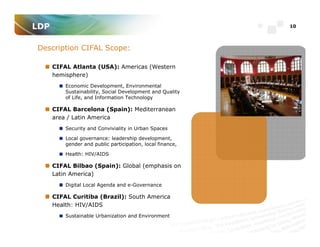
Description CIFAL Scope:

      CIFAL Atlanta (USA): Americas (Western
      hemisphere)
          Economic Development, Environmental
          Sustainability, Social Development and Quality
          of Life, and Information Technology

      CIFAL Barcelona (Spain): Mediterranean
      area / Latin America
          Security and Conviviality in Urban Spaces

          Local governance: leadership development,
          gender and public participation, local finance,

          Health: HIV/AIDS

      CIFAL Bilbao (Spain): Global (emphasis on
      Latin America)
          Digital Local Agenda and e-Governance

      CIFAL Curitiba (Brazil): South America
      Health: HIV/AIDS
          Sustainable Urbanization and Environment
LDP                                                    11


  CIFAL Durban (South Africa): Africa /
  Anglophones countries
      Sustainable urbanisation/Environment and Local
      governance
      Health: HIV/AIDS

  CIFAL Findhorn (Scotland): Northern
  Europe
      Sustainable Urbanisation and Environment

  CIFAL Kuala Lumpur (Malaysia): Asia-
  Pacific
      Sustainable Urbanisation and Environment

  CIFAL Ouagadougou (Burkina Faso):
  Africa /francophones countries
      Sustainable urbanisation/Environment and Local
      governance
  CIFAL Plock (Poland): Central and Eastern Europe
      Sustainable Urbanisation and Environment
  CIFAL Shanghai (China): Asia-Pacific
      Information society
LDP                                                                                                                                   12


Partnerships
   Private sector                                                World and Regional Associations of Cities
        VEOLIA ENVIRONNEMENT
                                                                      United Cities and Local Governments (UCLG)
        TOTAL
                                                                      The Regional Network of Local Authorities for the Management of
        Bolloré
                                                                      Human Settlements (CITYNET)
        Addax Petroleum
                                                                      Federación Latinoamericana de Ciudades, Municipios y Asociaciones
   State Governments                                                  (FLACMA)
        Estonia                                                       Partenariat pour le Développement Municipal (PDM)
        Spain
                                                                      IT4ALL-Network of Local Authorities for the Information Society
        France
        Republic of Korea                                        Foundations and NGOs
        Switzerland
                                                                      Fondation Albert II de Monaco
        Principauté de Monaco
                                                                      Global Ecovillage Network
   Local Governments
                                                                      The African Capacity Building Foundation (ACBF)
        Basque region of Spain
        Generalitat de Catalunya (Catalan Government of Spain)
        City of Curitiba
        City of Atlanta
        City of Findhorn
        City of Plock
        City of Lyon
        City of Tallinn
        City of Ouagadougou
        City of Durban
        City of Kuala Lumpur
        City of Shanghai

   United Nations
        United Nations Development Programme (UNDP)
        United Nations Human Settlements Programme (UN-HABITAT)
        World Bank Institute
LDP                                                                                     13


Methodology
                                                                   LDP has been applying
                                                                  Knowledge Management
In the seminars, traditional training methods,                        techniques to its
such as presentations by practitioners, are                        capacity-development
combined with interactive approaches based on                     activities since early 2003
knowledge management techniques and field
visits. This encourages cooperation between
the participating cities.

Workshops objectives:
                                                            City Share
                                                           methodology:
    To assess current levels of competencies in each                                .
    city                                                    • Self-assessment
                                                                 exercise
                                                         •Discussions about good
    To share experiences, knowledge, skills and              and bad practises
    innovative ideas with peer participants               • Peer assist exercises
                                                        •Producing an Action Plan
    To learn from experts’ lectures and discussions       •Building cooperation

    To see and experience best practices in the field

    To find partner(s) for future city-to-city
    cooperation
LDP and Water Sanitation
Water and Sanitation: LDP’                    objectives                                         15


To strengthen the capacities of local authorities in order to improve in a
sustainable way, the standards and the quality of the services provided
to the populations, particularly to the most underprivileged sections. This
objective includes:
     The strengthening of human capacities:
In order for municipal staff to be able to plan, develop, operate and evaluate water and
sanitation facilities

     Development of efficient institutional frameworks
To facilitate resources mobilization and access to international financing

To facilitate inter-sectoral coordination of activities within the municipality and with other
development partners,

To improve accountability, transparency and optimal use of public resources (human
and financial resources)

     Provision of efficient management tools
To encourage legal reforms in the sector

For operational follow up, environmental management, etc.

     Provision of innovative, efficient solutions and mechanisms in
     order to improve access to water and sanitation for the poor
Face-to-face workshops on water and sanitation                            16


LDP conducted many training activites in water and sanitation in
CIFAL Durban, CIFAL Kuala Lumpur and CIFAL Ouagadougou on the
following issues:


    Financing Municipal Water Services: the creditworthiness challenge


    The water resource management


    Water & Sanitation Infrastructure Development & Skills Mobilization


    Water and sanitation: Access to international funds
LDP and E-learning on
“Governance in Urban
     Sanitation”
E-learning course on water and sanitation:                                           18
Goal and Methodology

Goal

To enhance the capacity of local decision-makers to make the most efficient and
pro-poor choices and investments in urban sanitation. The course provides
analytical tools to understand the financial and institutional framework of the
sanitation sector, creating the ability to assess specific situations and make
recommendations to design and implement financial and institutional reforms in
the sector.

Methodology

The course will be delivered through UNITAR virtual learning environment.

The learning activities are based in sound adult learning pedagogical principles.
They include, among others:

    self-assessment activities,

    peer-to-peer review and evaluation,

    and social elements.
The modules are structured in a non-linear way so as to provide learners with a
high degree of flexibility in choosing the learning path that is the most adequate
to them
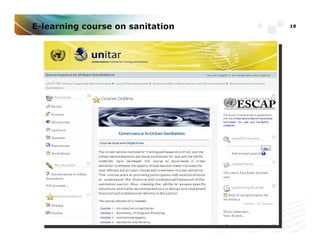
E-learning course on sanitation   19
E-learning course on sanitation   20
E-learning course on sanitation: Approach                           21


    30 participants from Asia and the Pacific region will be
    selected to participate in the first session of the course
    “Governance in Urban Sanitation”.

    20 participants with the most outstanding results will be
    selected to participate in a face-to-face workshop to be
    held in the Asia and Pacific region in June 2009. During this
    workshop participants will deepen their knowledge in
    sanitation issues and be trained as online facilitators so as
    to be able to become tutors in future sessions of the
    course.

    Possibility of providing the course contents to a third party
    for translation and eventually running the course
E-learning course on sanitation: Applications                   22


   Applications: 220 applications received as of 6th February


   Beginning of the course: 23rd March


   Duration of the course: 8 weeks; 23 March to 15 May 2009
Thank you

UNITAR
Local Development Programme

Maison Internationale de l'Environnement (MIE)
11, chemin des Anémones
1219 Genève - Châtelaine - SUISSE


Tél: +41 (0) 22 917 85 75
Fax: +41 (0) 22 917 80 47
www.unitar.org/ldp
ldp@unitar.org

United Nations Institute for Training and Research (UNITAR)

  • 1.
    UNITAR’s Local Development Programme Workshop on knowledge transfer and capacity building for water and sanitation services in Asia and the Pacific Bangkok, Thailand 18th February 2009
  • 2.
    United Nations Institute for Training and Research (UNITAR)
  • 3.
    UNITAR 3 Purpose To enhance the effectiveness of the UN through appropriate training and research Vision To be a centre of excellence for standard-setting methodologies, high-quality training, research capacity and knowledge systems Historical Background Established as an autonomous body within the United Nations system in 1965
  • 4.
    UNITAR 4 Thematic focal areas Environment Chemicals and Waste Management Climate Change Biodiversity Environmental Governance and Law Governance E-Governance Local Development Public Finance and Trade Peace, Security and Diplomacy International Law Multilateral Diplomacy Peacemaking and Conflict Prevention www.unitar.org Peacekeeping Training Research Knowledge Systems Innovation UNOSAT
  • 5.
  • 6.
    LDP 6 Our mission To provide training to local actors in order to enhance LDP’s Target their capacity to implement locally the Millennium group: Development Goals and other international conventions. Local authorities Vision in partnerships with : To become a hub for information, communication and • National Governments training between United Nations Agencies, academic • Civil Society • IGO’s institutions, national stakeholders and local actors such • Private Sector as local authorities, civil society and public and private companies. “If my neighbor Activities can do it, then so Undertake a participatory process (training workshops, can I!” etc.) to support local authorities in their local development Enable exchange of knowledge, expertise and best-practice Simon Compaoré, experiences Mayor of Ouagadougou, Promote decentralized and city-to-city cooperation President of MDP, Strengthen community and stakeholders’ involvement Burkina Faso Promote local democracy and good governance through capacity building
  • 7.
    LDP 7 www.unitar.org/ldp
  • 8.
    LDP 8 Areas of action The training sessions for local authorities focus on four major areas: Sustainable Urbanization and Environment Urban planning Urban environment services (transport, water, waste, energy) Climate Change Local governance and Economic Development Local governance (gender, public participation, e-Governance) The Unitar/UN-Habitat initiative on «Access to Local economic development (Income generation, PPP, basic services for All» employability, business skills and management) highlights the rights and Local Institutional Support responsibilities of the stakeholders involved in Building local capacities (accountability and transparency, local the provision of basic leadership and municipal management, reform and services and aims at decentralization support) improving the delivery of these services to the Health and Human Security poorest. Human security (urban safety and social coexistence) Local health management ( Urban management of HIV Aids, local risk management of pandemics)
  • 9.
    LDP 9 CIFAL LDP implements its training programmes through a network of 10 CIFAL centers : Americas: CIFAL Atlanta CIFAL Curitiba Africa: CIFAL Durban CIFAL centers are CIFAL Ouagadougou established in cooperation with local Asia and Pacific authorities and other CIFAL Kuala Lumpur stakeholders. CIFAL Shanghai The acronym CIFAL Europe signifies "International CIFAL Barcelona Training Centre for CIFAL Bilbao Local CIFAL Findhorn Authorities/Actors“ Authorities/Actors CIFAL Plock
  • 10.
    LDP 10 Description CIFAL Scope: CIFAL Atlanta (USA): Americas (Western hemisphere) Economic Development, Environmental Sustainability, Social Development and Quality of Life, and Information Technology CIFAL Barcelona (Spain): Mediterranean area / Latin America Security and Conviviality in Urban Spaces Local governance: leadership development, gender and public participation, local finance, Health: HIV/AIDS CIFAL Bilbao (Spain): Global (emphasis on Latin America) Digital Local Agenda and e-Governance CIFAL Curitiba (Brazil): South America Health: HIV/AIDS Sustainable Urbanization and Environment
  • 11.
    LDP 11 CIFAL Durban (South Africa): Africa / Anglophones countries Sustainable urbanisation/Environment and Local governance Health: HIV/AIDS CIFAL Findhorn (Scotland): Northern Europe Sustainable Urbanisation and Environment CIFAL Kuala Lumpur (Malaysia): Asia- Pacific Sustainable Urbanisation and Environment CIFAL Ouagadougou (Burkina Faso): Africa /francophones countries Sustainable urbanisation/Environment and Local governance CIFAL Plock (Poland): Central and Eastern Europe Sustainable Urbanisation and Environment CIFAL Shanghai (China): Asia-Pacific Information society
  • 12.
    LDP 12 Partnerships Private sector World and Regional Associations of Cities VEOLIA ENVIRONNEMENT United Cities and Local Governments (UCLG) TOTAL The Regional Network of Local Authorities for the Management of Bolloré Human Settlements (CITYNET) Addax Petroleum Federación Latinoamericana de Ciudades, Municipios y Asociaciones State Governments (FLACMA) Estonia Partenariat pour le Développement Municipal (PDM) Spain IT4ALL-Network of Local Authorities for the Information Society France Republic of Korea Foundations and NGOs Switzerland Fondation Albert II de Monaco Principauté de Monaco Global Ecovillage Network Local Governments The African Capacity Building Foundation (ACBF) Basque region of Spain Generalitat de Catalunya (Catalan Government of Spain) City of Curitiba City of Atlanta City of Findhorn City of Plock City of Lyon City of Tallinn City of Ouagadougou City of Durban City of Kuala Lumpur City of Shanghai United Nations United Nations Development Programme (UNDP) United Nations Human Settlements Programme (UN-HABITAT) World Bank Institute
  • 13.
    LDP 13 Methodology LDP has been applying Knowledge Management In the seminars, traditional training methods, techniques to its such as presentations by practitioners, are capacity-development combined with interactive approaches based on activities since early 2003 knowledge management techniques and field visits. This encourages cooperation between the participating cities. Workshops objectives: City Share methodology: To assess current levels of competencies in each . city • Self-assessment exercise •Discussions about good To share experiences, knowledge, skills and and bad practises innovative ideas with peer participants • Peer assist exercises •Producing an Action Plan To learn from experts’ lectures and discussions •Building cooperation To see and experience best practices in the field To find partner(s) for future city-to-city cooperation
  • 14.
    LDP and WaterSanitation
  • 15.
    Water and Sanitation:LDP’ objectives 15 To strengthen the capacities of local authorities in order to improve in a sustainable way, the standards and the quality of the services provided to the populations, particularly to the most underprivileged sections. This objective includes: The strengthening of human capacities: In order for municipal staff to be able to plan, develop, operate and evaluate water and sanitation facilities Development of efficient institutional frameworks To facilitate resources mobilization and access to international financing To facilitate inter-sectoral coordination of activities within the municipality and with other development partners, To improve accountability, transparency and optimal use of public resources (human and financial resources) Provision of efficient management tools To encourage legal reforms in the sector For operational follow up, environmental management, etc. Provision of innovative, efficient solutions and mechanisms in order to improve access to water and sanitation for the poor
  • 16.
    Face-to-face workshops onwater and sanitation 16 LDP conducted many training activites in water and sanitation in CIFAL Durban, CIFAL Kuala Lumpur and CIFAL Ouagadougou on the following issues: Financing Municipal Water Services: the creditworthiness challenge The water resource management Water & Sanitation Infrastructure Development & Skills Mobilization Water and sanitation: Access to international funds
  • 17.
    LDP and E-learningon “Governance in Urban Sanitation”
  • 18.
    E-learning course onwater and sanitation: 18 Goal and Methodology Goal To enhance the capacity of local decision-makers to make the most efficient and pro-poor choices and investments in urban sanitation. The course provides analytical tools to understand the financial and institutional framework of the sanitation sector, creating the ability to assess specific situations and make recommendations to design and implement financial and institutional reforms in the sector. Methodology The course will be delivered through UNITAR virtual learning environment. The learning activities are based in sound adult learning pedagogical principles. They include, among others: self-assessment activities, peer-to-peer review and evaluation, and social elements. The modules are structured in a non-linear way so as to provide learners with a high degree of flexibility in choosing the learning path that is the most adequate to them
  • 19.
    E-learning course onsanitation 19
  • 20.
    E-learning course onsanitation 20
  • 21.
    E-learning course onsanitation: Approach 21 30 participants from Asia and the Pacific region will be selected to participate in the first session of the course “Governance in Urban Sanitation”. 20 participants with the most outstanding results will be selected to participate in a face-to-face workshop to be held in the Asia and Pacific region in June 2009. During this workshop participants will deepen their knowledge in sanitation issues and be trained as online facilitators so as to be able to become tutors in future sessions of the course. Possibility of providing the course contents to a third party for translation and eventually running the course
  • 22.
    E-learning course onsanitation: Applications 22 Applications: 220 applications received as of 6th February Beginning of the course: 23rd March Duration of the course: 8 weeks; 23 March to 15 May 2009
  • 23.
    Thank you UNITAR Local DevelopmentProgramme Maison Internationale de l'Environnement (MIE) 11, chemin des Anémones 1219 Genève - Châtelaine - SUISSE Tél: +41 (0) 22 917 85 75 Fax: +41 (0) 22 917 80 47 www.unitar.org/ldp ldp@unitar.org