THE FUTURE IS NOW
SCIENCE FOR ACHIEVING
SUSTAINABLE DEVELOPMENT
GLOBAL SUSTAINABLE
DEVELOPMENT REPORT 2 19
Note
In the outcome document of the Rio+20 Conference, in 2012, entitled “The future we want”, and again in “Transforming
our world: the 2030 Agenda for Sustainable Development”, in 2015, United Nations Member States decided that the High-
Level Political Forum on Sustainable Development would be informed by the Global Sustainable Development Report. In
the Ministerial Declaration of the 2016 Forum, Member States decided that the report would be produced quadrennially
by an independent group of scientists appointed by the United Nations Secretary-General and comprising 15 experts
representing a variety of backgrounds, scientific disciplines and institutions, with geographical and gender balance.
This report, The Future is Now: Science for Achieving Sustainable Development, is the first quadrennial Global Sustainable
Development Report prepared by an independent group of scientists.
Independent Group of Scientists 2019
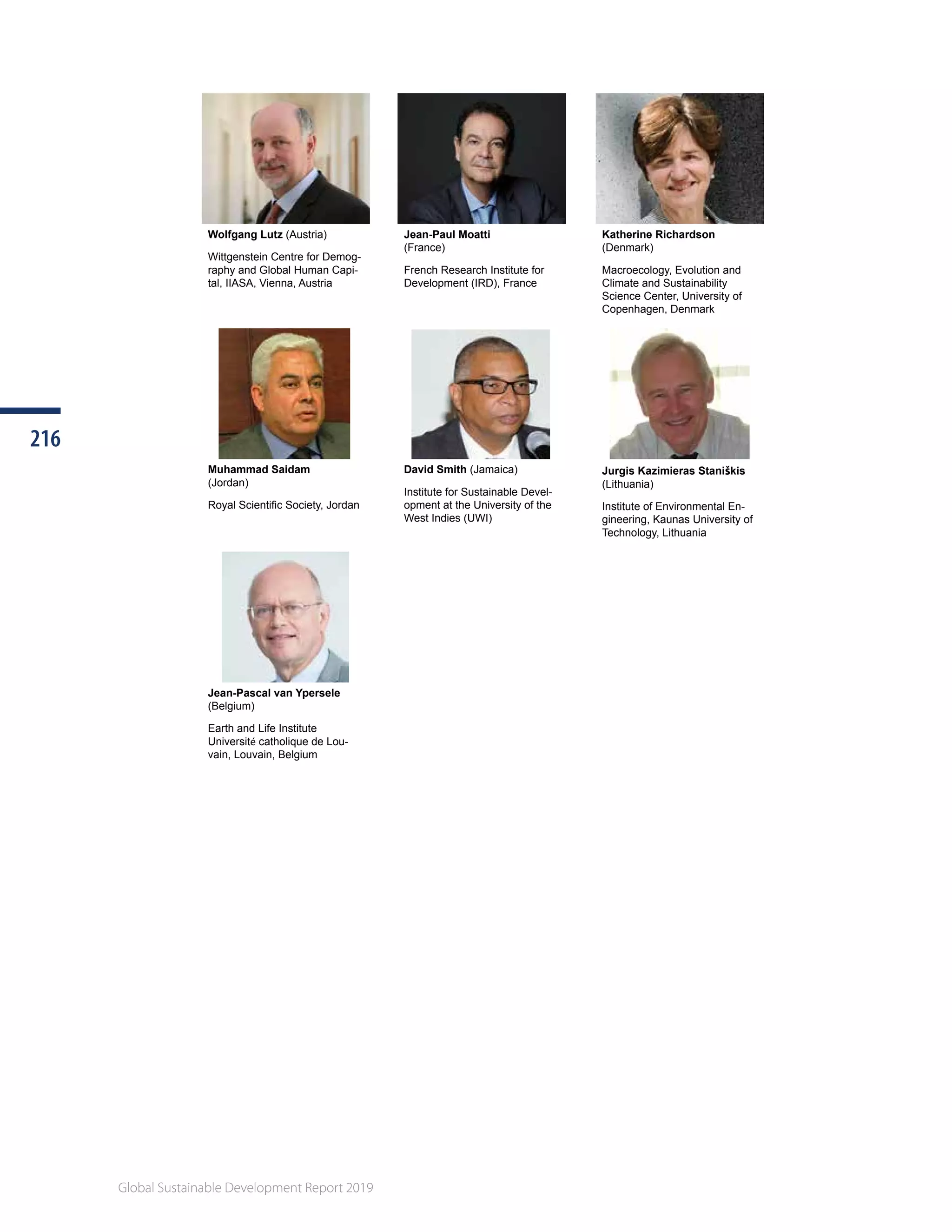
Co-chairs
•	 Peter Messerli (Switzerland), Centre for Development and Environment (CDE), University of Bern, Switzerland
•	 Endah Murniningtyas (Indonesia), National Development Planning Agency (Bappenas), Republic of Indonesia
Members
•	 Parfait Eloundou-Enyegue (Cameroon), Department of Development Sociology, Cornell University, USA
•	 Ernest G. Foli (Ghana), Council for Scientific and Industrial Research (CSIR), Forestry Research Institute, Ghana
•	 Eeva Furman (Finland), Finnish environment institute (SYKE), Finland
•	 Amanda Glassman (USA), Center for Global Development, USA
•	 Gonzalo Hernández Licona (Mexico), National Council for the Evaluation of Social Development Policy (CONEVAL),
Mexico
•	 Eun Mee Kim (Republic of Korea), Graduate School of International Studies, Ewha Womans University, Republic of
Korea.
•	 Wolfgang Lutz (Austria), Wittgenstein Centre for Demography and Global Human Capital, International Institute of
Applied Systems Analysis (IIASA), Austria
•	 Jean-Paul Moatti (France), Research Institute for Development (IRD), France
•	 Katherine Richardson (Denmark), Sustainability Science Center, University of Copenhagen, Denmark
•	 Muhammad Saidam (Jordan), Royal Scientific Society, Jordan
•	 David Smith (Jamaica), Institute for Sustainable Development, University of the West Indies (UWI)
•	 Jurgis Kazimieras Staniškis (Lithuania), Institute of Environmental Engineering, Kaunas University of Technology,
Lithuania
•	 Jean-Pascal van Ypersele (Belgium), Earth and Life Institute, Université catholique de Louvain, Belgium
Recommended citation: Independent Group of Scientists appointed by the Secretary-General, Global Sustainable
Development Report 2019: The Future is Now – Science for Achieving Sustainable Development, (United Nations, New York,
2019).
Cover design and graphics by Camilo J. Salomon
Copyright © 2019 United Nations
All rights reserved
United Nations publication issued by the Department of Economic and Social Affairs
iiiiii
Global Sustainable Development Report 2019
iv
Contents
vv
Contents
FOREWORD . . . . . . . . . . . . . . . . . . . . . . . . . . . . . . . . . . . . . . . . . . . . . . . . . . . . . . . . . . . . . . . . . . . . . . . . . . . . . . xi
PREFACE . . . . . . . . . . . . . . . . . . . . . . . . . . . . . . . . . . . . . . . . . . . . . . . . . . . . . . . . . . . . . . . . . . . . . . . . . xiii
PROLOGUE . . . . . . . . . . . . . . . . . . . . . . . . . . . . . . . . . . . . . . . . . . . . . . . . . . . . . . . . . . . . . . . . . . . . . . . . . . xv
EXECUTIVE SUMMARY . . . . . . . . . . . . . . . . . . . . . . . . . . . . . . . . . . . . . . . . . . . . . . . . . . . . . . . . . . . . . . . . . xix
CHAPTER I  THE TRANSFORMATIVE POWER OF SUSTAINABLE DEVELOPMENT . . . . . . . . . . . . 1
1.1 Understanding sustainable development in the 2030 Agenda . . . . . . . . . . . . . . . . . 3
1.2 Progress to date . . . . . . . . . . . . . . . . . . . . . . . . . . . . . . . . . . . . . . . . . . . . . . . . . . . . . . . . . . . 8
1.3 Knowledge-based transformations for sustainable development . . . . . . . . . . . . . . . . . . 21
CHAPTER II  TRANSFORMATIONS . . . . . . . . . . . . . . . . . . . . . . . . . . . . . . . . . . . . . . . . . . . . . . . . . . . . . . . . . 27
2.1 Lever 1 – Governance . . . . . . . . . . . . . . . . . . . . . . . . . . . . . . . . . . . . . . . . . . . . . . . . . . . . . . 29
2.2 Lever 2 – Economy and finance . . . . . . . . . . . . . . . . . . . . . . . . . . . . . . . . . . . . . . . . . . . . 32
2.3 Lever 3 – Individual and collective action . . . . . . . . . . . . . . . . . . . . . . . . . . . . . . . . 34
2.4 Lever 4 – Science and technology . . . . . . . . . . . . . . . . . . . . . . . . . . . . . . . . . . . . . . . . . 36
2.5 Entry point 1 – Human well-being and capabilities . . . . . . . . . . . . . . . . . . . . . . . . . . . . . . 38
2.6 Entry point 2 – Sustainable and just economies . . . . . . . . . . . . . . . . . . . . . . . . . . . . 50
2.7 Entry point 3 – Food systems and nutrition patterns. . . . . . . . . . . . . . . . . . . . . . . . . . . . 64
2.8 Entry point 4 – Energy decarbonization and universal access . . . . . . . . . . . . . . . . . . . . . 75
2.9 Entry point 5 – Urban and peri-urban development. . . . . . . . . . . . . . . . . . . . . . . . . . . 83
2.10 Entry point 6 – Global environmental commons . . . . . . . . . . . . . . . . . . . . . . . . . . . . . . 94
2.11 Shared responsibility for transformation . . . . . . . . . . . . . . . . . . . . . . . . . . . . . . . . . . . . . . . . 106
CHAPTER III  SCIENCE FOR SUSTAINABLE DEVELOPMENT. . . . . . . . . . . . . . . . . . . . . . . . . . . . . . . 111
3.1 The 2030 Agenda as a shared compass to harness advances
in science and technology . . . . . . . . . . . . . . . . . . . . . . . . . . . . . . . . . . . . . . . . . . . . . . . . . . . . . . 115
3.2 Sustainability science . . . . . . . . . . . . . . . . . . . . . . . . . . . . . . . . . . . . . . . . . . . . . . . . . . . . . . . . . . . 120
3.3 Partners for transformation . . . . . . . . . . . . . . . . . . . . . . . . . . . . . . . . . . . . . . . . . . . . . . . . . . . . . 123
CHAPTER IV  CALL TO ACTION . . . . . . . . . . . . . . . . . . . . . . . . . . . . . . . . . . . . . . . . . . . . . . . . . . . . . . . 127
4.1 Strengthening human well-being and capabilities . . . . . . . . . . . . . . . . . . . . . . . . . . . . . . . . 127
4.2 Shifting towards sustainable and just economies . . . . . . . . . . . . . . . . . . . . . . . . . . . . . . . . . 128
4.3 Building sustainable food systems and healthy nutrition patterns . . . . . . . . . . . . . . . . . . . . 129
4.4 Achieving energy decarbonization with universal access to energy . . . . . . . . . . . . . . . . . 130
4.5 Promoting sustainable urban and peri-urban development . . . . . . . . . . . . . . . . . . . . . . . . . 131
4.6 Securing the global environmental commons . . . . . . . . . . . . . . . . . . . . . . . . . . . . . . . . . . . . 132
4.7 Science and technology for sustainable development . . . . . . . . . . . . . . . . . . . . . . . . . . . . 133
4.8 Not incremental change but transformation . . . . . . . . . . . . . . . . . . . . . . . . . . . . . . . . . . . . . . 135
Global Sustainable Development Report 2019
vi
AFTERWORD . . . . . . . . . . . . . . . . . . . . . . . . . . . . . . . . . . . . . . . . . . . . . . . . . . . . . . . . . . . . . . . . . . . . . . . . . 139
NOTES . . . . . . . . . . . . . . . . . . . . . . . . . . . . . . . . . . . . . . . . . . . . . . . . . . . . . . . . . . . . . . . . . . . . . . . . . . . . . . . 143
REFERENCES . . . . . . . . . . . . . . . . . . . . . . . . . . . . . . . . . . . . . . . . . . . . . . . . . . . . . . . . . . . . . . . . . . . . . . . . . 159
ANNEXES
ANNEX I  MINISTERIAL DECLARATION . . . . . . . . . . . . . . . . . . . . . . . . . . . . . . . . . . . . . . . . . . . . . . . . . 195
ANNEX II  ACKNOWLEDGMENTS . . . . . . . . . . . . . . . . . . . . . . . . . . . . . . . . . . . . . . . . . . . . . . . . . . . . . . . 203
ANNEX III  REVIEW PROCESS . . . . . . . . . . . . . . . . . . . . . . . . . . . . . . . . . . . . . . . . . . . . . . . . . . . . . . . . . . 211
ANNEXIV  INDEPENDENTGROUPOFSCIENTISTS2019.................................. 215
BOXES
1-1 The Global Sustainable Development Report . . . . . . . . . . . . . . . . . . . . . . . . . . . . . . . . . . . . . . . . 3
1-2 Interactions among Sustainable Development Goals . . . . . . . . . . . . . . . . . . . . . . . . . . . . . . 6
Figure source: Author’s calculation
1-3 The Global Monitoring Framework . . . . . . . . . . . . . . . . . . . . . . . . . . . . . . . . . . . . . . . . . . . . . 9
Figure source: United Nations, 2019
1-4 Other assessments of progress . . . . . . . . . . . . . . . . . . . . . . . . . . . . . . . . . . . . . . . . . . . . . . . . . 12
1-5 Tipping points . . . . . . . . . . . . . . . . . . . . . . . . . . . . . . . . . . . . . . . . . . . . . . . . . . . . . . . . . . . . . . . 13
1-6 Small island developing States . . . . . . . . . . . . . . . . . . . . . . . . . . . . . . . . . . . . . . . . . . . . . . . . . 14
1-7 Least developed countries . . . . . . . . . . . . . . . . . . . . . . . . . . . . . . . . . . . . . . . . . . . . . . . . . . . . . 15
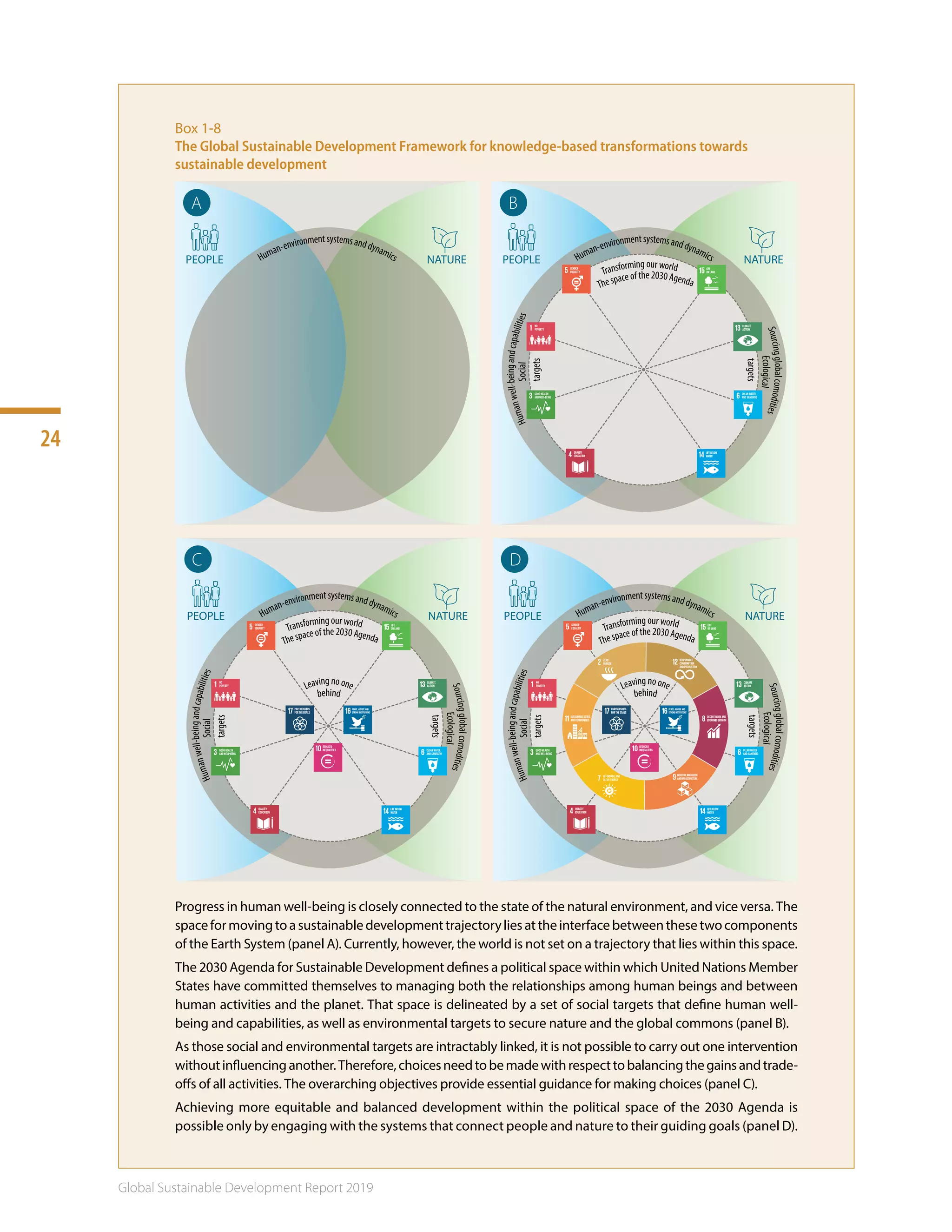
1-8 The Global Sustainable Development Framework for knowledge-based
transformations towards sustainable development . . . . . . . . . . . . . . . . . . . . . . . . . . . . . . 24
2-1 Political equality . . . . . . . . . . . . . . . . . . . . . . . . . . . . . . . . . . . . . . . . . . . . . . . . . . . . . . . . . . . . . 31
2-2 The continuing significance of international financial cooperation . . . . . . . . . . . . . . . . 33
Figure source: Leininger, J., et al., 2019
2-3 Cognitive capacity for sustainable development choices . . . . . . . . . . . . . . . . . . . . . . . . . 35
2-4 Adaptive collaborative management . . . . . . . . . . . . . . . . . . . . . . . . . . . . . . . . . . . . . . . . . . 36
2-5 Widespread deprivations in safely managed drinking water
and sanitation services . . . . . . . . . . . . . . . . . . . . . . . . . . . . . . . . . . . . . . . . . . . . . . . . . . . . . . . 40
2-6 Climate change disproportionately affects the most vulnerable . . . . . . . . . . . . . . . . . . . 41
2-7 Ensuring refugees and migrants are counted and visible . . . . . . . . . . . . . . . . . . . . . . . . . 42
2-8 Tackling inequality is good for poverty reduction . . . . . . . . . . . . . . . . . . . . . . . . . . . . . . . 44
Figure source: Lakner, et al., 2019
2-9 Private-sector innovations towards better health . . . . . . . . . . . . . . . . . . . . . . . . . . . . . . . . 45
2-10 Shifting behaviour for better health in Indonesia . . . . . . . . . . . . . . . . . . . . . . . . . . . . . . . . 46
2-11 Mitigating health emergencies using emerging technology . . . . . . . . . . . . . . . . . . . . . 47
2-12 Measuring multidimensional poverty at the national level . . . . . . . . . . . . . . . . . . . . . . . 48
2-13 Early childhood interventions build capabilities . . . . . . . . . . . . . . . . . . . . . . . . . . . . . . . . . 49
2-14 Partnerships for access to health care in Ghana . . . . . . . . . . . . . . . . . . . . . . . . . . . . . . . . . 50
2-15 Alternatives to GDP as a measure of progress . . . . . . . . . . . . . . . . . . . . . . . . . . . . . . . . . . . 52
2-16 Damage caused by fossil fuel subsidies . . . . . . . . . . . . . . . . . . . . . . . . . . . . . . . . . . . . . . . . . 56
2-17 Carbon pricing . . . . . . . . . . . . . . . . . . . . . . . . . . . . . . . . . . . . . . . . . . . . . . . . . . . . . . . . . . . . . 57
2-18 Just transition for coal workers and communities . . . . . . . . . . . . . . . . . . . . . . . . . . . . . . . . 59
Contents
vii
2-19 Addressing the needs of the poor in a circular economy . . . . . . . . . . . . . . . . . . . . . . . . . 62
2-20 Stranded assets. . . . . . . . . . . . . . . . . . . . . . . . . . . . . . . . . . . . . . . . . . . . . . . . . . . . . . . . . . . . . . 63
2-21 Global surveillance system for crop diseases . . . . . . . . . . . . . . . . . . . . . . . . . . . . . . . . . . . . . . 66
2-22 ColdHubssolar-poweredstorageinNigeria. . . . . . . . . . . . . . . . . . . . . . . . . . . . . . . . . . . . . . . . . . . . . 71
2-23 Belo Horizonte urban food policy . . . . . . . . . . . . . . . . . . . . . . . . . . . . . . . . . . . . . . . . . . . . . 72
2-24 NutriFish in Bangladesh . . . . . . . . . . . . . . . . . . . . . . . . . . . . . . . . . . . . . . . . . . . . . . . . . . . . . . 74
2-25 The water-food-energy-environment nexus in the Middle East
and North Africa . . . . . . . . . . . . . . . . . . . . . . . . . . . . . . . . . . . . . . . . . . . . . . . . . . . . . . . . . . . . . 75
2-26 Expanding solar lighting and sustainable electricity access in urban
and rural Togo . . . . . . . . . . . . . . . . . . . . . . . . . . . . . . . . . . . . . . . . . . . . . . . . . . . . . . . . . . . . . . . 81
2-27 Holistic approach to promoting energy efficiency in Greece . . . . . . . . . . . . . . . . . . . . . . . . 81
2-28 Nuclear energy . . . . . . . . . . . . . . . . . . . . . . . . . . . . . . . . . . . . . . . . . . . . . . . . . . . . . . . . . . . . . 82
2-29 Intersection of gender, health and energy in Indonesia: clean cooking
initiatives and fiscal sustainability . . . . . . . . . . . . . . . . . . . . . . . . . . . . . . . . . . . . . . . . . . . . . 83
2-30 Future city growth . . . . . . . . . . . . . . . . . . . . . . . . . . . . . . . . . . . . . . . . . . . . . . . . . . . . . . . . . . 88
2-31 Urban development opportunities in landlocked developing countries . . . . . . . . . . . . 89
2-32 Technology for sustainability in the cement industry . . . . . . . . . . . . . . . . . . . . . . . . . . . 90
2-33 Leaving no one behind: three transport examples . . . . . . . . . . . . . . . . . . . . . . . . . . . . . . 91
2-34 Architecture to reflect regional culture and advance the
Sustainable Development Goals: examples from the Middle East . . . . . . . . . . . . . . . . . 92
2-35 Inclusive urban planning: water management at Zaatari camp . . . . . . . . . . . . . . . . . . . . 93
2-36 Sustainable Development Goals for resilient mountain communities . . . . . . . . . . . . . . 97
2-37 Sustainable management of chemicals throughout their life cycle . . . . . . . . . . . . . . . . 100
2-38 Using technology to protect old-growth tropical rainforest
in a small country . . . . . . . . . . . . . . . . . . . . . . . . . . . . . . . . . . . . . . . . . . . . . . . . . . . . . . . . . . . . 102
2-39 Networked Sustainable Development Goals through a climate lens . . . . . . . . . . . . . . . 102
2-40 Bhutan – a carbon-negative country . . . . . . . . . . . . . . . . . . . . . . . . . . . . . . . . . . . . . . . . . . 104
2-41 Sustainable hydrology for fresh water as a common good . . . . . . . . . . . . . . . . . . . . . . . 104
2-42 Example of a mechanism that mixes multiple pathways in regional
cooperation . . . . . . . . . . . . . . . . . . . . . . . . . . . . . . . . . . . . . . . . . . . . . . . . . . . . . . . . . . . . . . . . 105
2-43 Science diplomacy . . . . . . . . . . . . . . . . . . . . . . . . . . . . . . . . . . . . . . . . . . . . . . . . . . . . . . . . . . 105
2-44 Integrated pathways towards sustainable and equitable water access . . . . . . . . . . . . 106
2-45 Equitable land governance as an integrated pathway
to sustainable development . . . . . . . . . . . . . . . . . . . . . . . . . . . . . . . . . . . . . . . . . . . . . . . . . . 108
3-1 Modes of scientific engagement with the Sustainable Development Goals . . . . . . . . 113
3-2 Decades of interdisciplinary research . . . . . . . . . . . . . . . . . . . . . . . . . . . . . . . . . . . . . . . . . . 114
3-3 Strengthening the science-policy interface . . . . . . . . . . . . . . . . . . . . . . . . . . . . . . . . . . . . . 116
3-4 The digital revolution. . . . . . . . . . . . . . . . . . . . . . . . . . . . . . . . . . . . . . . . . . . . . . . . . . . . . . . . . . 118
3-5 Indigenous knowledge for sustainable development . . . . . . . . . . . . . . . . . . . . . . . . . . . . 120
3-6 Open access to published scientific knowledge . . . . . . . . . . . . . . . . . . . . . . . . . . . . . . . . . 122
3-7 Transboundary research partnerships . . . . . . . . . . . . . . . . . . . . . . . . . . . . . . . . . . . . . . . . . 125
Global Sustainable Development Report 2019
viii
FIGURES
1-1 Cross-national flows of information, goods, capital and people . . . . . . . . . . . . . . . . . . . 4
Source: United Nations, 2019; World Bank, 2019
1-2 Technology: exponential increases in power and rapid adoption,
but also inequalities in access . . . . . . . . . . . . . . . . . . . . . . . . . . . . . . . . . . . . . . . . . . . . . . . . . 7
Source: Rupp, 2015; World Bank, 2019
1-3 Children out of school . . . . . . . . . . . . . . . . . . . . . . . . . . . . . . . . . . . . . . . . . . . . . . . . . . . . . . . 11
Source: World Bank, 2019
1-4 Global inequality and growth, 1980–2016 . . . . . . . . . . . . . . . . . . . . . . . . . . . . . . . . . . . . . 17
Source: Alvaredo, Facundo, et al., 2018
1-5 Intergenerational mobility and inequality. . . . . . . . . . . . . . . . . . . . . . . . . . . . . . . . . . . . . 17
Source: Corak, 2013
1-6 Human activity induces climate change: rising CO2 levels, increasing
mean temperatures, shrinking sea ice, elevated sea levels . . . . . . . . . . . . . . . . . . . . . . . . 18
Source: Macfarling Meure, C., et al., 2006; World Meteorological Organization, 2019
1-7 Continuing loss of species . . . . . . . . . . . . . . . . . . . . . . . . . . . . . . . . . . . . . . . . . . . . . . . . . . . 20
Source: International Union for Conservation of Nature 2019
1-8 Human activities drive biodiversity loss . . . . . . . . . . . . . . . . . . . . . . . . . . . . . . . . . . . . . . . 20
Source: Intergovernmental Science-Policy Platform on Biodiversity and Ecosystem
Services, 2019
1-9 Striking the balance: no country is meeting basic human goals
within biophysical boundaries . . . . . . . . . . . . . . . . . . . . . . . . . . . . . . . . . . . . . . . . . . . . . . . . 22
Source: O’Neill, et al., 2018
2-1 Systemic interactions related to Goal 2 (zero hunger) . . . . . . . . . . . . . . . . . . . . . . . . . . . . 28
Source: Author’s calculations
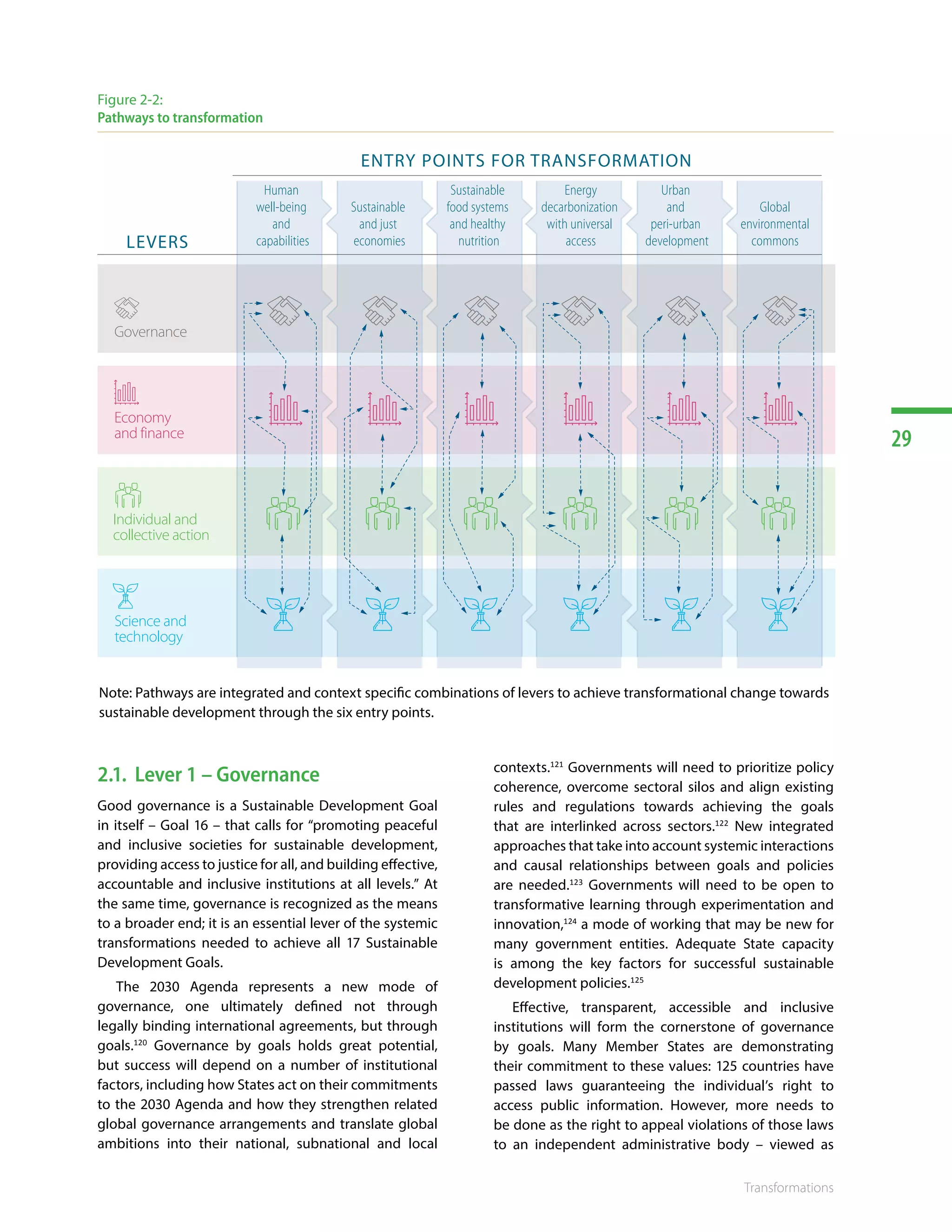
2-2 Pathways to transformation . . . . . . . . . . . . . . . . . . . . . . . . . . . . . . . . . . . . . . . . . . . . . . . . . . . 29
2-3 Human well-being and capabilities: where the world is falling short . . . . . . . . . . . . . . 39
Source: Alkire, et al., 2018; International Labour Organization, 2017a; International
Telecommunication Union, 2018c; United Nations, 2019; United Nations Children’s
Fund, 2018; World Bank, 2018f
2-4 Sustainable and just economies: the facts . . . . . . . . . . . . . . . . . . . . . . . . . . . . . . . . . . . . . 51
Source: International Labour Organization, 2018b; International Labour Organization, 2019;
Organization for Economic Cooperation and Development 2019c; World Bank, 2018e; World
Resources Institute, 2016
2-5 GDP growth and CO2 emissions per capita . . . . . . . . . . . . . . . . . . . . . . . . . . . . . . . . . . . . . . 52
Source: World Bank, 2019
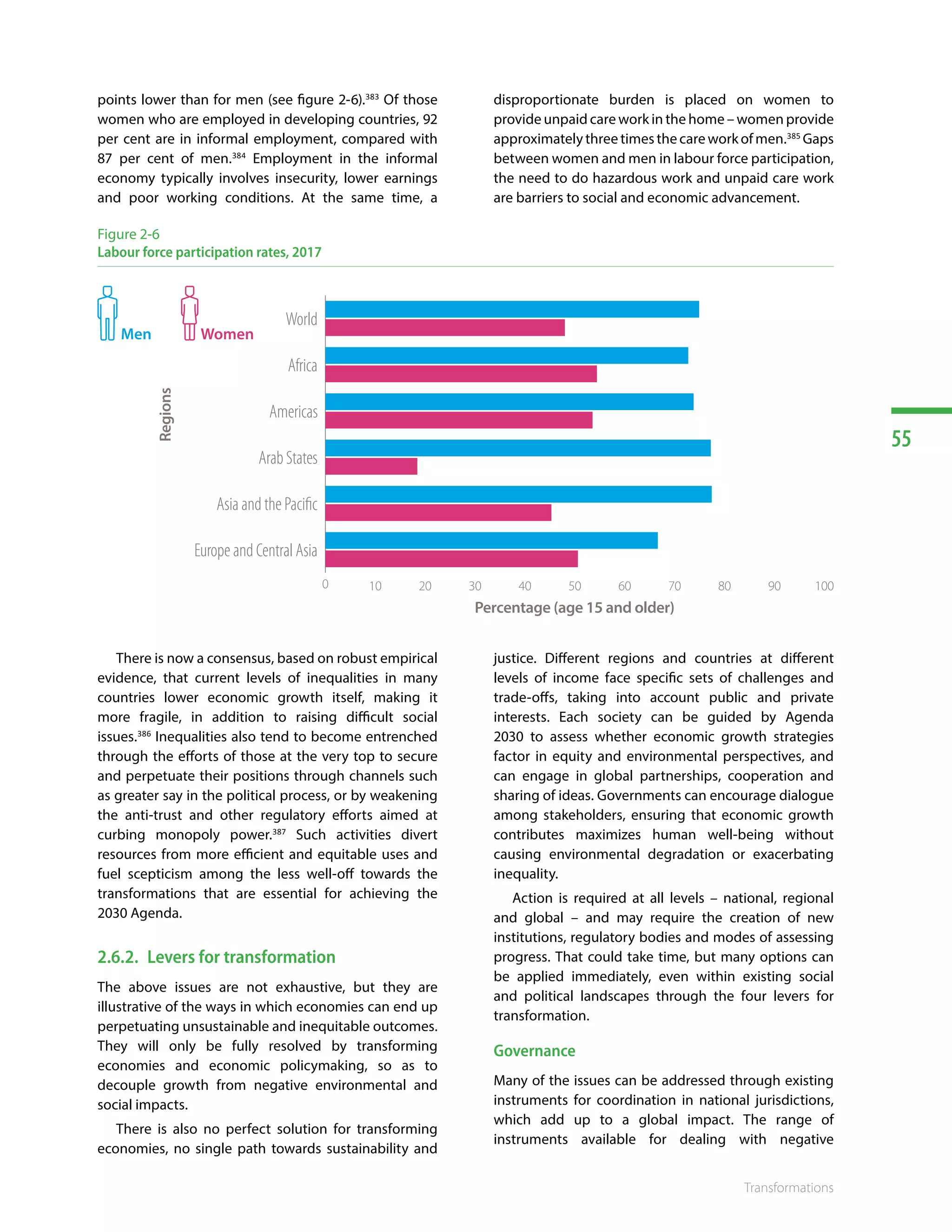
2-6 Labour force participation rates, 2017 . . . . . . . . . . . . . . . . . . . . . . . . . . . . . . . . . . . . . . . . . . 55
Source: International Labour Organization, 2019
2-7 The circular economy . . . . . . . . . . . . . . . . . . . . . . . . . . . . . . . . . . . . . . . . . . . . . . . . . . . . . . . . 62
Source: Murray, et al., 2015
2-8 Food systems and nutrition patterns: changing food systems
is essential for sustainable development . . . . . . . . . . . . . . . . . . . . . . . . . . . . . . . . . . . . . . . 65
Source: Food and Agriculture Organization, 2017c; Food and Agriculture Organization, 2019;
International Labour Organization, 2017b; Gustavsson, et al., 2011; Vermeulen, et al., 2012; Willett,
et al., 2019
2-9 Impact of food on the environment: selected proteins. . . . . . . . . . . . . . . . . . . . . . . . . . 68
Source: Poore and Nemecek 2018
Contents
ix
2-10 Solutions to reduce agricultural emissions . . . . . . . . . . . . . . . . . . . . . . . . . . . . . . . . . . . . . . 70
Source: Searchinger et al. 2018
2-11 Impact of nitrogen fertilizer use. . . . . . . . . . . . . . . . . . . . . . . . . . . . . . . . . . . . . . . . . . . . . . . 73
2-12 Energy decarbonization with universal access. . . . . . . . . . . . . . . . . . . . . . . . . . . . . . . . . . 77
Source: International Energy Agency, 2018a; International Energy Agency 2019;
United Nations, 2018c; World Bank, 2019a; World Health Organization, 2018b
2-13 The emissions gap: current commitments insufficient to achieve
necessary reductions in emissions . . . . . . . . . . . . . . . . . . . . . . . . . . . . . . . . . . . . . . . . . . . . . 77
Source: United Nations Environment Programme, 2018
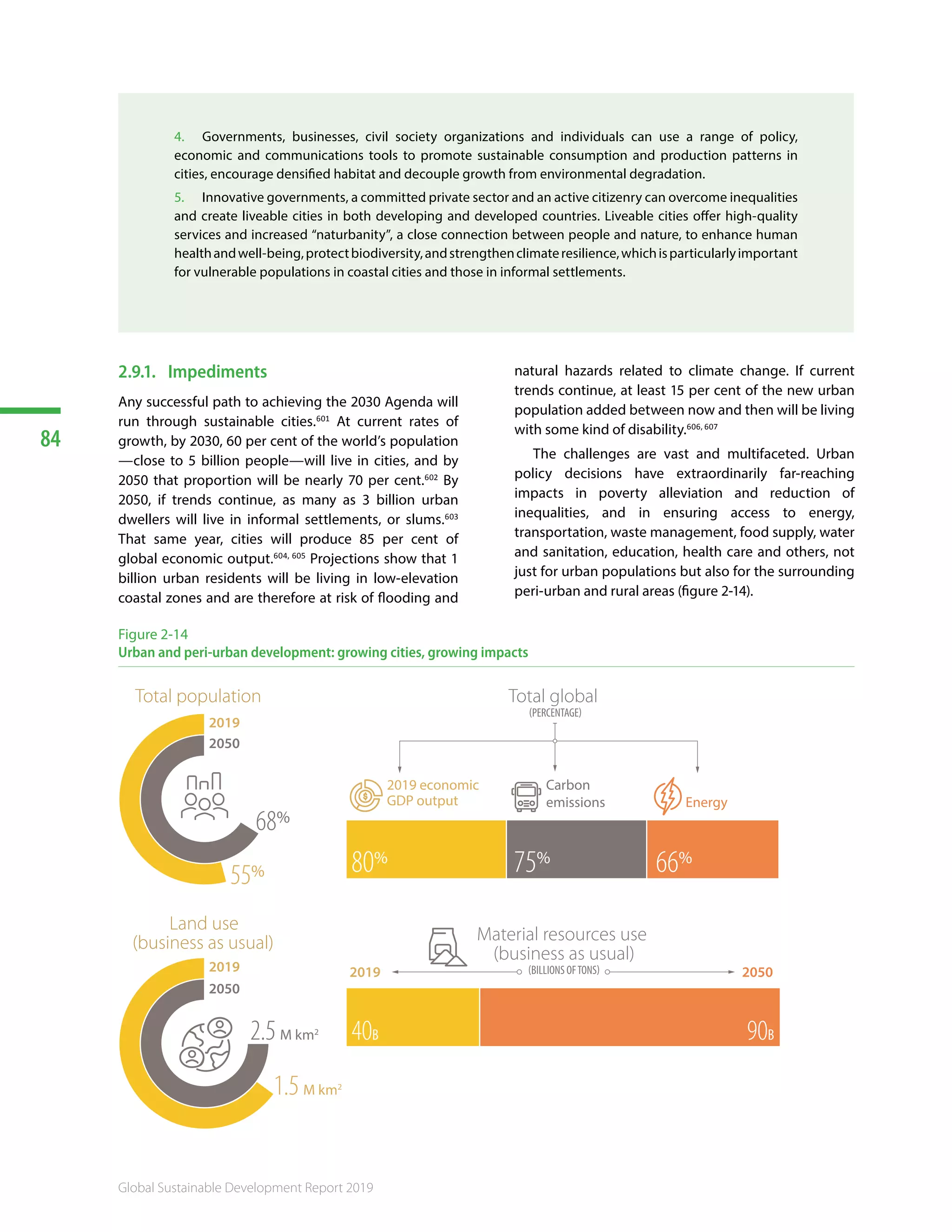
2-14 Urban and peri-urban development: growing cities, growing impacts. . . . . . . . . . . . 84
Source: International Energy Agency 2016; International Resource Panel, 2018;
United Nations, 2018a; United Nations Environment Programme, 2016c; United Nations
Environment Programme, 2017b; World Bank, 2019f
2-15 Human survival and the global environmental commons . . . . . . . . . . . . . . . . . . . . . . . . 95
Source: Food and Agriculture Organization, 2018d; Food and Agriculture Organization, 2018e;
International Energy Agency, 2018; International Energy Agency, 2019; United Nations 2018d;
World Bank, 2019; World Health Organization, 2018
3-1 Types of sustainability challenges. . . . . . . . . . . . . . . . . . . . . . . . . . . . . . . . . . . . . . . . . . . . . 112
Source: Adapted from Messerli and Bieri, 2018
3-2 Research and development expenditure worldwide, 2015. . . . . . . . . . . . . . . . . . . . . . . 119
Source: United Nations Educational, Scientific and Cultural Organization 2019
TABLES
1-1 Projected distance from targets by 2030 (at current trends) . . . . . . . . . . . . . . . . . . . . . 10
Source: Calculations based on data from United Nations, 2019; United Nations Development
Programme, 2018; World Meteorological Organization, 2019.
2-1 Ranking of top 30 economic units by revenue. . . . . . . . . . . . . . . . . . . . . . . . . . . . . . . . . . . . 54
Source: Babic, et al., 2017
Note: Country revenues are national government figures compared on exchange rate basis.
2-2 Policy instruments by type and by concept of rights over nature. . . . . . . . . . . . . . . . . 56
Source: Adapted from Sterner, et al., 2019
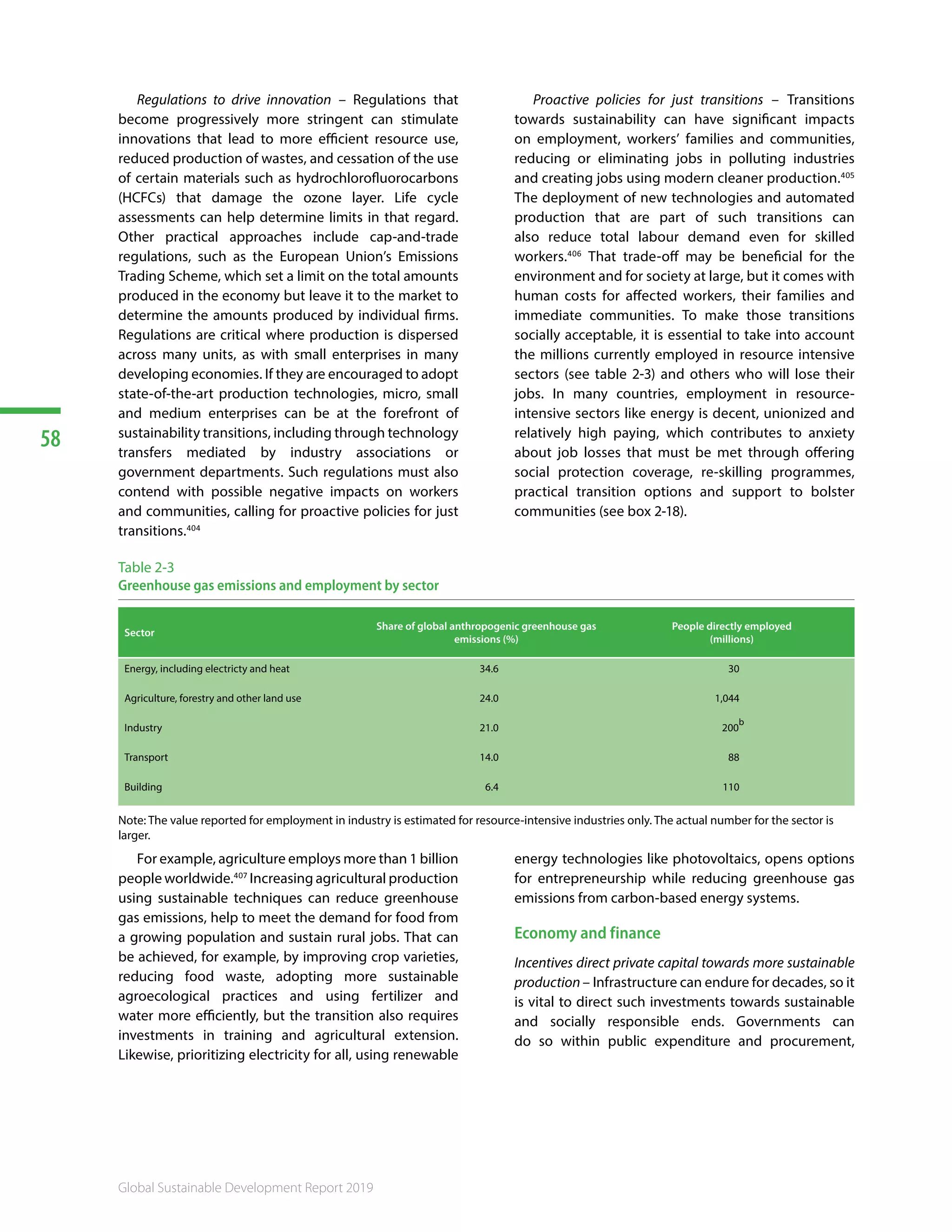
2-3 Greenhouse gas emissions and employment by sector. . . . . . . . . . . . . . . . . . . . . . . . . . . 58
Source: United Nations Intergovernmental Panel on Climate Change
Global Sustainable Development Report 2019
x
Foreword
xixi
Foreword
Our world as we know it and the future we want are at risk.
Despite considerable efforts these past four years, we are not on track to achieve the
Sustainable Development Goals by 2030. We must dramatically step up the pace of
implementation as we enter a decisive decade for people and the planet. We must connect
the dots across all that we do – as individuals, civic groups, corporations, municipalities and
Member States of the United Nations – and truly embrace the principles of inclusion and
sustainability.
Science is our great ally in the efforts to achieve the Goals. The Global Sustainable
Development Report 2019, prepared by an independent group of scientists, presents an
objective assessment of where we are falling short and what needs to be done. The Report
highlights central entry points to leverage interlinkages and accelerate progress across all 17
Sustainable Development Goals.
This Report reminds us that the future is determined by what we do now and the window
of opportunity is closing fast. I encourage all actors to translate the insights from this
analysis into collective action.
Together, let us make the difficult choices that are necessary to realize our ambition and
commit to accelerating progress towards achieving the Sustainable Development Goals.
António Guterres
Secretary-General
Global Sustainable Development Report 2019
xii
Preface
xiiixiii
Preface
In 2015, United Nations Member States committed to the ambitious but achievable 2030
Agenda for Sustainable Development, charting a new path of balance for humanity and the
planet.
Important steps have been taken, and innovative partnerships are taking shape. But if we
are to achieve all of the Sustainable Development Goals, more needs to be done.
This Global Sustainable Development Report is a poignant reminder of the risks we face
if we do not act swiftly and with purpose.
The Report makes clear that we are at risk of irreversibly degrading the natural systems
that sustain us and further points out where we are off track in “leaving no one behind”.
More ambitious, more transformative and more integrated responses are urgently needed.
Thisevidence-basedandaction-orientedReportfurtherhighlightstheindispensablerole
of science for ending hunger, tackling climate change, reducing inequality and accelerating
progress across the Sustainable Development Goals.
The Global Sustainable Development Report complements the Secretary-General’s
annual Sustainable Development Goals progress report. It helps bridge the gap between
knowledge and policy by synthesizing analysis and identifying evidence-driven pathways
to transformation.
The Report rightly acknowledges that strengthening the science-policy interface and
advancing the knowledge base to inform action require greater support and resources for
scientific institutions.
Liu Zhenmin
Under-Secretary-General for
Economic and Social Affairs
Global Sustainable Development Report 2019
xiv
Prologue
xvxv
Prologue
Sustainable development has been the driving force in my political life for more than forty
years.
I am as convinced today as I was as a young Environment Minister in Norway, in the early
1970s, that we will only secure a prosperous, peaceful and liveable planet if we harness
economic growth and development to social solidarity across and between generations.
In 1983, I was charged by the General Assembly and the Secretary General of the United
Nations to assemble and lead the World Commission on Environment and Development.
The Commission produced the ground-breaking report “Our Common Future”, in
1987, which called for fundamental changes in our patterns of development so as to save
humanity and the Earth from imminent disaster.
We called for “sustainable development”, a pattern of development that meets the needs
of present generations, without compromising the rights of future generations to fulfil their
needs.
The report and its recommendations fed into the 1992 landmark Rio Summit. Two
decades later, in 2012, there was finally enough support internationally for the essential
efforts to start developing sustainable development goals.
Today, faced with the imperative of tackling climate change and responding to radical,
fast-paced shifts in global technology, consumption and population patterns, there
is growing consensus that sustainable development is the only way that we can avert
environmental and social disaster.
The adoption of the Sustainable Development Goals in September 2015 was a key
moment in defining that agenda and building a consensus for urgent, inclusive action.
The 2030 Agenda for Sustainable Development and the Paris Agreement on climate
changethatwasadoptedinthesameyear,aretangibleproofofthebenefitsofmultilateralism
and the indispensable role that the United Nations can play to find global solutions to global
challenges.
Their implementation offers a pathway to a world where poverty, inequality and conflict
willnotblightthelifechancesofmillionsofpeoplewhoarecurrentlydeniedtheopportunity
to enjoy their fundamental rights and freedoms.
But implementation requires States and all other relevant stakeholders from businesses
and labour unions to civil society and academia to understand and engage with the scientific
realities that underpin the relations between human activity and the natural world.
That is the critical contribution of this first quadrennial Global Sustainable Development
Report, which is designed to be an evidence-based instrument that provides guidance on
the state of global sustainable development from a scientific perspective.
Global Sustainable Development Report 2019
xvi
As a medical doctor and a political leader, I have
always placed the utmost importance on scientific
evidence in formulating policies and measuring their
impact.
By the same token, I have always believed that
the development of science itself must be informed
by humane values, and its awesome power must be
applied in ways that respect human rights and share
the benefits of progress in an equal and just fashion.
The present report is a clear and practical expression
of the social and sustainable purpose of science. Most
importantly, it emphasizes the need for a collective,
holistic approach:
“The true transformative potential of the 2030
Agenda can be realised through a systemic approach
that helps identify and manage trade-offs while
maximising co-benefits.”
I hope that politicians and policymakers take note
of the aims of the six key “entry points” identified in
the report, where focused and collaborative action by
various stakeholders can accelerate progress towards
the Goals:
1.	 Strengthening human well-being and
capabilities;
2.	 Shifting towards sustainable and just economies;
3.	 Building sustainable food systems and healthy
nutrition patterns;
4.	 Achieving energy decarbonization and universal
access to energy;
5.	 Promoting sustainable urban and peri-urban
development;
6.	 Securing the global environmental commons.
In all of those areas, scientific expertise and innovation
can be brought to bear and yield impressive results, but
the determining factor will always be political will.
This is why the sort of research and consultation
on display in this report needs to be complemented
by sustained advocacy and campaigning in the public
sphere, to both mobilize public support for the 2030
Agenda and use that support to hold leaders to their
words.
In his famous study of human courage and cowardice
entitled, “An Enemy of the People”, the Norwegian
dramatist Henrik Ibsen gave the following words to one
of his characters:
“A community is like a ship – everyone ought to be
prepared to take the helm.“
Our global ship is currently tossing and turning
through stormy and dangerous waters.
But is anyone prepared to take the helm and steer a
course that will bring us to safety, whatever hardships
that may entail? And is anyone listening to the voice
from the crow’s nest, warning of fresh dangers on the
horizon?
Or are we huddled below deck, either waiting for
someone else to take the initiative or fooling ourselves
that all is fine, that the waters will calm themselves of
their own accord and there is no need to trim the sails
or change course?
Each of us, from scientists and doctors to politicians
and even playwrights, needs to be prepared to take the
helm in an appropriate and realistic way – from our local
community to national and international levels.
If we are prepared to do so, we will find that the
Sustainable Development Goals themselves are the
chart to see us through the storm.
The Sustainable Development Goals cover all aspects of
human life and development – from health, education
and the environment to peace, justice, security and
equality.
Unlike the Millennium Development Goals, they
apply to all countries and not just the developing
world. That is important. Every Head of State, every
Government and every citizen has a responsibility to
ensure that the Sustainable Development Goals are
met.
Instead of reducing international relations to
business transactions and trade wars, the Goals are
significant achievements that show the power of
multilateral diplomacy and States coming together in
their collective self-interest.
And crucially, the Goals and the work towards their
implementation are not static.
As with the Paris Agreement, they are organic and
evolving instruments that must increase momentum
and ambition to be successful.
Much of that work is technical, scientific and highly
specific. Without reliable and robust measurements, it
will be impossible to judge whether sufficient progress
is being made across the 169 indicators for the 17
Sustainable Development Goals, or for the 193 different
nationally determined contributions of the signatories
to the Paris Agreement.
Just as important, however, is continued political
pressure to tackle the underlying causes of the
problems the Goals seek to address, namely, poverty,
discrimination, conflict and inequality.
If we do not put inequality at the heart of the global
development agenda, we are doomed to failure.
Prologue
xvii
We need courage to confront the vested political,
business and economic interests that seek to maintain
the current unequal order, and we need to grasp the
opportunity that the move to a low carbon economy
offers in order to rectify current inequalities.
We need to promote agreement, inclusivity and
consensus to achieve policies that work for the common
good, rather than narrow self-interest, across both the
public and the private sectors.
And we need to inspire hope across all sections of
society, especially among young people, letting them
know that their voices will be heard, their experiences
will be acknowledged and their ideas will be anchored
in the policymaking process.
The data and the proposals in the present report
are critical elements in society’s armoury in the fight
against climate change, poverty and injustice.
Ahead of the United Nations summits on Climate
Action and on the Sustainable Development Goals
in September this year, the report offers a practical
guide to future progress on those key issues and an
inescapable call to action.
Gro Harlem Brundtland
Former Prime Minister of Norway,
former Director-General of the World Health Organization
and member of The Elders, an international non-
governmental organization founded by Nelson Mandela and
comprising independent global leaders working together for
peace, justice and human rights
Global Sustainable Development Report 2019
xviii
Executivesummary
xixxix
Executive summary
Introduction
The present Global Sustainable Development Report was prepared following the decision
of the United Nations Member States at the 2016 high-level political forum for sustainable
development (HLPF) (see E/HLS/2016/1, annex IV, para. 7). The Report reflects the universal,
indivisible and integrated nature of the 2030 Agenda for Sustainable Development. It
also seeks to strengthen the science-policy interface as an evidence-based instrument to
support policymakers and other stakeholders in the implementation of the 2030 Agenda
across the social, economic and environmental dimensions of sustainable development.
The Global Sustainable Development Report is distinct from, and complementary to, the
annual Sustainable Development Goals progress report prepared by the Secretary-General,
which tracks progress across goals and targets using indicators from the global indicator
framework. It does not produce new evidence; rather it capitalizes on existing knowledge
across disciplines, through an “assessment of assessments”. It highlights state-of-the-art
knowledge for transformations towards sustainable development and identifies concrete
areas where rapid, transformational change is possible. The Report is not only a product
but also a process for advancing collaboration among actors in science, Government, the
private sector and civil society in all regions of the world towards identifying and realizing
concrete pathways for transformation driven by evidence.
The Report draws upon an extensive and diverse knowledge base, including numerous
published articles in scholarly literature; and international assessments, like the Secretary-
General’s Sustainable Development Goals progress report (2019), the Global Environment
Outlook 6 (GEO-6) regional assessments (2019), the Intergovernmental Panel on Climate
Change (IPCC) special report (2018), the Intergovernmental Science-Policy Platform on
Biodiversity and Ecosystem Services (IPBES) global assessment (2019), the International
LabourOrganization(ILO)andtheOrganizationforEconomicCooperationandDevelopment
(OECD) reports on the future of work (2019) and others. It benefitted from five regional
consultations with academic, policy, business and civil society communities; an extensive
series of inputs received following an online call; a review by approximately one hundred
expertscoordinatedbytheInternationalScienceCouncil(ISC),theInterAcademyPartnership
(IAP) and the World Federation of Engineering Organizations (WFEO); and comments on an
earlier draft from United Nations Member States and accredited stakeholders.
The Global Sustainable Development Report was prepared by an independent group of
scientists appointed by the Secretary-General, comprising 15 experts from various regions
and representing a variety of scientific disciplines and institutions. The Group was supported
by a task team comprising representatives from the United Nations Department of Economic
and Social Affairs; the United Nations Educational, Scientific and Cultural Organization
Global Sustainable Development Report 2019
xx
(UNESCO); the United Nations Environment Programme
(UNEP); the United Nations Development Programme
(UNDP); the United Nations Conference on Trade and
Development (UNCTAD) and the World Bank.
While benefiting from all inputs, the content of the
report is the sole responsibility of the Independent
Group of Scientists. The Group has addressed
sustainable development as both a scientific and a
normative concept, using it as a guide to analyse the
problem and weigh the evidence, and, where needed,
recommend policy-relevant solutions. For that purpose,
the Report follows not just the letter but also the spirit
of the 2030 Agenda, with the overarching goal of
advancing human well-being in an equitable and just
fashion, and ensuring that no one is left behind, while
the natural systems that sustain us are safeguarded.
The Report uses the latest scientific assessments,
evidence bases about good practices, and scenarios
that link future trajectories to current actions to
identify calls to action by a range of stakeholders
that can accelerate progress towards achieving the
Sustainable Development Goals. Those actions derive
from knowledge about the interconnections across
individual Goals and targets, recognizing that the true
transformative potential of the 2030 Agenda can be
realized only through a systemic approach that helps
identify and manage trade-offs while maximizing
co-benefits.
I.  The transformative power of
sustainable development
Since the adoption of the Sustainable Development
Goals, there have been many positive developments.
Countries have started to incorporate the Goals into
national plans and strategies, and many have set up
coordinating structures for coherent implementation.
Of the 110 voluntary national reviews submitted during
the 2016, 2017 and 2018 sessions of the high-level
political forum, 35 mentioned explicit measures to link
the Goals to their national budgets or were considering
such action. There have also been initiatives aimed
at safeguarding the environment, notably regarding
climate change, land use and oceans. And important
parts of the private sector have begun to move away
from business-as-usual models, for example by
adopting and reporting on sustainability standards.
Meanwhile, the mobilization of civil society and non-
governmental organizations in favour of sustainable
development is rising.
However, despite the initial efforts, the world is
not on track for achieving most of the 169 targets that
comprise the Goals. The limited success in progress
towards the Goals raises strong concerns and sounds
the alarm for the international community. Much more
needs to happen – and quickly – to bring about the
transformative changes that are required: impeding
policies should urgently be reversed or modified, and
recent advances that holistically promote the Goals
should be scaled up in an accelerated fashion.
Adding to the concern is the fact that recent trends
along several dimensions with cross-cutting impacts
acrosstheentire2030Agendaarenotevenmovinginthe
right direction. Four in particular fall into that category:
rising inequalities, climate change, biodiversity loss and
increasing amounts of waste from human activity that
are overwhelming capacities to process them. Critically,
recent analysis suggests that some of those negative
trends presage a move towards the crossing of negative
tipping points, which would lead to dramatic changes
in the conditions of the Earth system in ways that are
irreversible on time scales meaningful for society.
Recent assessments show that, under current trends,
the world’s social and natural biophysical systems
cannot support the aspirations for universal human
well-being embedded in the Sustainable Development
Goals.
Just over 10 years remain to achieve the 2030
Agenda, but no country is yet convincingly able to meet
a set of basic human needs at a globally sustainable
level of resource use. All are distant to varying degrees
from the overarching target of balancing human well-
being with a healthy environment. Each country must
respond to its own conditions and priorities, while
breaking away from current practices of growing first
and cleaning up later. The universal transformation
towards sustainable development in the next decade
depends on the simultaneous achievement of country-
specific innovative pathways.
Nevertheless, there is reason for hope. Human
well-being need not depend on intensive resource
use, nor need it exacerbate or entrench inequalities
and deprivations. Scientific knowledge allows for
the identification of critical pathways that break that
pattern, and there are numerous examples from across
the world that show that it is possible.
Thescienceandpracticeofsustainabledevelopment
thus points the way forward. Advancing the 2030
Agenda must involve an urgent and intentional
transformation of socioenvironmental-economic
systems, differentiated across countries but also adding
up to the desired regional and global outcomes, to
ensure human well-being, societal health and limited
environmental impact. Achieving that transformation
– a profound and intentional departure from business
as usual – means carefully taking into account the
Executive summary
xxi
interactions between Goals and targets. Policymakers
will find similarities and contradictions within them, as
well as systemic interactions and cascade effects, as
action towards one Goal can alter the possibilities for
meetingothergoals.Asignificantamountofknowledge
is already available about those important interactions,
and more research is under way.
An important key to action is to recognize that,
while the present state of imbalance across the three
dimensions of sustainable development arises from
not having fully appreciated the interlinkages across
them or having unduly prioritised the short-term, it is
these same interlinkages that will lead to the desired
transformative change when properly taken into
account. The most efficient – or sometimes the only
– way to make progress on a given target is to take
advantage of positive synergies with other targets
while resolving or ameliorating the negative trade-offs
with yet others. Translating that insight into practical
action for the Goals is informed in the Report by current
assessments that emphasize the need for urgency,
forward-looking expectations about a growing global
population seeking higher levels of well-being and
normative considerations, such as leaving no one
behind.
Those actions can be undertaken by a more diverse
group of people and organizations than governments
of United Nations Member States alone. At the local,
national and international levels, new key development
actors are emerging and gaining greater power and
influence. Innovative and powerful partnerships
can result from collaborations between traditional
stakeholders and emerging actors. The success of the
2030 Agenda thus depends on the cooperation of
governments, institutions, agencies, the private sector
and civil society across various sectors, locations,
borders and levels.
II.  Transformations for sustainable
development
the present Global Sustainable Development Report
identifies six entry points that offer the most promise for
achieving the desired transformations at the necessary
scale and speed. In doing so it takes into account the
urgency, the forward-looking expectations about a
growing global population seeking higher levels of
well-being, and normative considerations, such as
leaving no one behind, These are not entry points into
individual or even clusters of Goals, but rather into the
underlying systems. At the same time, not attending to
the interlinkages that are intrinsic to these entry points,
and cut across them – for example, through focusing on
individual Goals and targets – would imperil progress
across multiple elements of the 2030 Agenda. The
selected entry points are:
ff Human well-being and capabilities
ff Sustainable and just economies
ff Food systems and nutrition patterns
ff Energy decarbonization with universal access
ff Urban and peri-urban development
ff Global environmental commons.
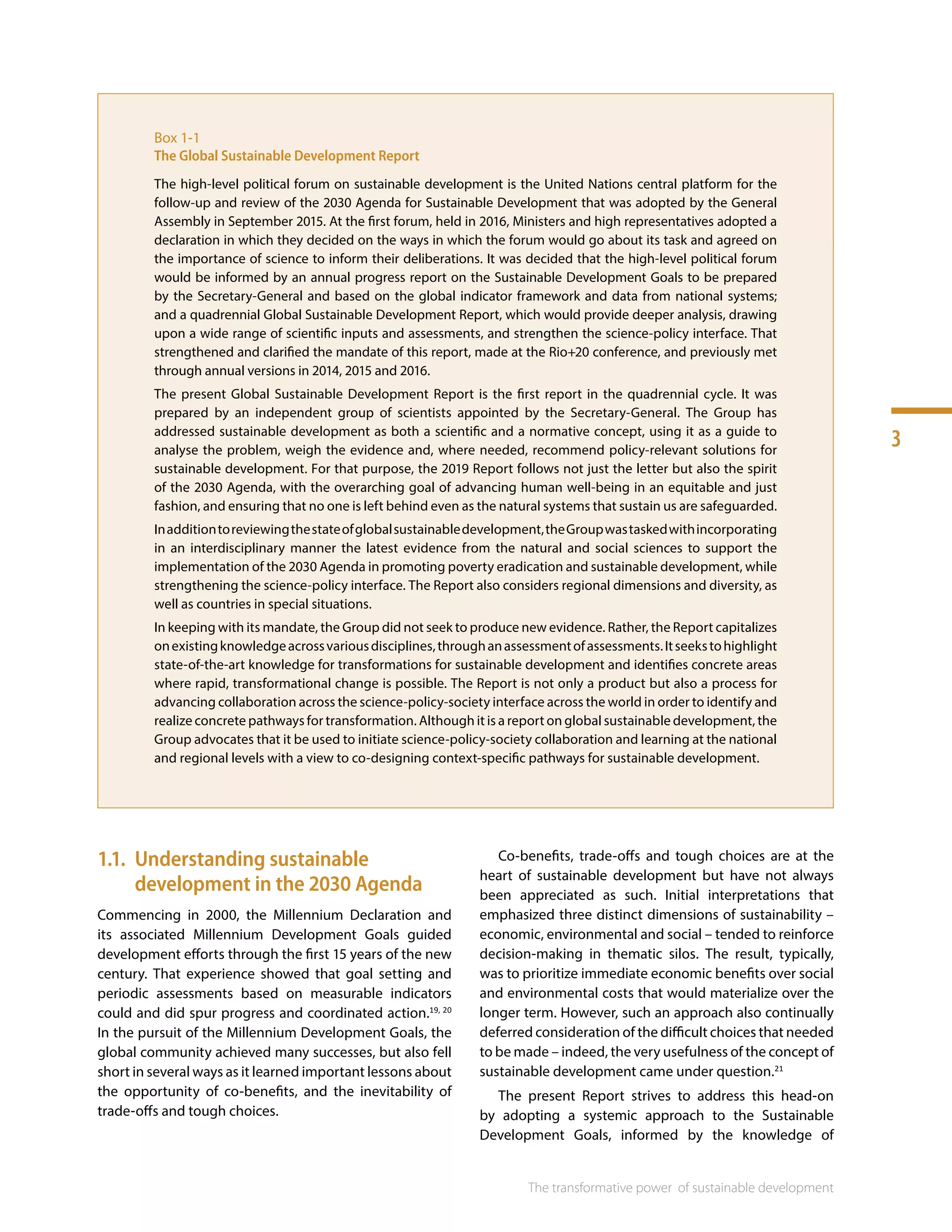
The Report also identifies four levers, which can be
coherently deployed through each entry point to bring
about the necessary transformations:
ff Governance
ff Economy and finance
ff Individual and collective action
ff Science and technology.
Theleversarerelatedtothemeansofimplementation
characterized in Goal 17, but are also different, in that
they accommodate the multiple, complementary roles
that individual actors and entities play in bringing
about change. Each lever can contribute individually
to systemic change; however, the present Report
argues that it is only through their context-dependent
combinations that it will be possible to bring about
the transformations necessary for balancing across
the dimensions of sustainable development and
achieving the 2030 Agenda. As illustrated in the figure
below, those combinations are integrative pathways to
transformation, which underlie the call to action issued
in the Report.
Decision makers need to act based on current
knowledge and understanding of the linked human-
social-environmental systems at all levels. That
knowledge also needs to be more widely available to all
countries and actors, motivating innovative coalitions
and partnerships for success.
Moreover, new scientific and technological research,
as well as the adaptation of existing knowledge and
technologies to specific local and regional contexts,
are needed to further streamline efforts, maximize
synergies between the Goals and pre-emptively
accommodate emerging challenges beyond the 2030
horizon. The present Report constitutes an innovation
in the way scientific expertise is mobilized by the
United Nations system as a whole. It proposes new
ways of strengthening the contribution of science and
technology to the 2030 Agenda, helping improve the
science-policy interface.
Global Sustainable Development Report 2019
xxii
III.  Entry points and call to action for
sustainable development
The strategies and call to action proposed in the Report
for each of the six entry points for transformations, and
for improving the role of science in implementing the
Goals, are summarized below.
A.  Human well-being and capabilities
Advancing human well-being – including material
well-being, health, education, voice, access to a clean
and safe environment and resilience – is at the core
of transformations towards sustainable development.
Not only is human well-being inherently important,
but people’s capabilities, in turn, drive global social,
economic and environmental change according to sets
of knowledge, skills, competencies, and psychological
and physical abilities. Health and education are not
just development outcomes. They are also the means
of achieving key aspects of the global development
agenda.
The world has made substantial advances in human
well-being in recent decades, but extreme deprivations
linger, and progress remains uneven. Extreme poverty
– defined as living below the monetary threshold
of $1.90 per person/day – was at 8.6 per cent of the
world population in 2018, and is concentrated – with
more than half the world’s extreme poor living in five
countries in sub-Saharan Africa and South Asia. In 2030,
fragile States affected by crisis and conflict will be home
to 85 per cent of those remaining in extreme poverty –
some 342 million people.
Current estimates indicate that the world is not on
track, without additional effort, to eradicate extreme
poverty by 2030. Extreme poverty is now concentrated
among marginalized groups – women, indigenous
peoples, ethnic minorities, persons with disabilities and
others.Genderinequality,whichlimitstheopportunities
and capabilities of half the world’s population, further
exacerbates the condition of women in poverty. In
many places, there are socioeconomic gaps between
persons with and persons without disabilities, because
persons with disabilities often experience lower levels
of education, higher rates of unemployment and
economic inactivity, and a lack of social protection in
comparison with their peers.
Income poverty, poor health, low levels of
education, lack of access to water and sanitation and
other deprivations tend to overlap. Households and
individuals often suffer multiple forms of poverty. In
2015, the number of people living in extreme poverty
LEVERS
ENTRY POINTS FOR TRANSFORMATION
Human
well-being
and
capabilities
Sustainable
and just
economies
Sustainable
food systems
and healthy
nutrition
Energy
decarbonization
with universal
access
Urban
and
peri-urban
development
Global
environmental
commons
Human
well-being
and
capabilities
Sustainable
and just
economies
Sustainable
food systems
and healthy
nutrition
Energy
decarbonization
with universal
access
Urban
and
peri-urban
development
Global
environmental
commons
Governance
Economy
and finance
Individual and
collective action
Science and
technology
Executive summary
xxiii
had fallen to 736 million. But the multidimensional
poverty index calculated in 2018 for 105 countries
presented a more sobering picture, indicating that
1.3 billion people live in households with overlapping
deprivations. There is also clear evidence that
multidimensional poverty has been falling more slowly
than income poverty. National, regional and local
authorities and communities should focus on reducing
gaps in opportunities and basic rights among social
groups that are most at risk of being left behind in their
own territories.
In addition, nearly 1 billion people live on $2 to $3
per person/day, barely above the extreme poverty
threshold of $1.90. Those who have just moved out
of extreme poverty, and the 4 billion people who do
not have any form of social protection, remain highly
vulnerable to economic and environmental crises,
climate change, armed conflicts and other shocks that
threaten to push them into extreme poverty. Action
must be taken to eliminate deprivations and build
resilience, especially through targeted interventions
where poverty and vulnerability are concentrated, or
billions of people are at risk of being left behind.
Eradicating poverty, advancing gender equality
and reducing other forms of inequality are closely
interrelated objectives and require expanding
interventions and measures far beyond the monetary
thresholds of extreme deprivations to address
the multidimensional and overlapping nature of
poverty. Economic growth alone cannot achieve
that. Deprivations and inequalities exist in education,
health care, access to clean water and energy, access to
sanitation services, exposure to infectious diseases and
many other critical dimensions of well-being.
Quality social services, such as health and education,
and protection against natural hazards, including
disaster risk reduction, should be available to everyone.
Legal and social discrimination against marginalized
people should be eliminated, including barriers that
limit access by women and girls. This is critical for
realizing human rights for all people and respecting
human dignity.
Furthering human well-being and protecting the
Earth’s resources require expanding human capabilities
far beyond the thresholds of extreme poverty, whether
based on income or other basic needs, so that people
are empowered and equipped to bring about change.
Investment in early childhood development, access to
high-quality education, higher enrolment in science,
technology, engineering and mathematics (STEM)
programmes – especially for girls – expansion of
healthy years of life, and attention to mental health
and non-communicable diseases can improve lifelong
chances for individuals and are cost-effective means of
accelerating sustainable development.
Effective action in any of those areas requires
acknowledging and addressing the links among them
– the close ties between climate change and human
health, for instance, or the ways in which biodiversity
loss and deterioration of ecosystem services exacerbate
inequalities. Pathways to advance human well-being
ultimately require cooperation, collaboration and
dialogue among multiple actors, and employing many
levers of change. There is no single pathway, and
different combinations of efforts are required across
regions and for countries in special situations.
Call to action
ff All stakeholders should contribute to
eliminating deprivations and building resilience
across multiple dimensions through universal
provision of and access to quality basic services
(health, education, water, sanitation, energy,
disaster risk management, information and
communication technology, adequate housing and
social protection), that are universally accessible
with targeted attention where poverty and
vulnerability are concentrated and with special
attention to individuals who are most likely to be left
behind – women and girls, persons with disabilities,
indigenous peoples and others.
ff Governments should ensure equal access to
opportunities, end legal and social discrimination
and invest in building human capabilities so that all
people are empowered and equipped to shape their
lives and bring about collective change.
B.  Sustainable and just economies
Economic growth has increased national incomes
significantly, albeit unevenly, across countries. While
that has contributed to advances in human, social and
economic well-being, the effects on human societies
and the environment are currently unsustainable.
Economic activity should be seen not as an end in itself,
but rather as a means for sustainably advancing human
capabilities. Decoupling the benefits of economic
activity from its costs at all levels is essential in itself
and can also support the systemic transformations
envisaged through the other five entry points
advocated in this Report. Such an outcome would
greatly accelerate the necessary reconfiguration and
help to put people, societies and nature on the path to
sustainable development.
Currently, there are numerous reasons why that is
not happening. One oft-cited reason is the use of the
gross domestic product (GDP) – the market value of
goods and services produced over a year – as the sole
Global Sustainable Development Report 2019
xxiv
or predominant metric for guiding economic policy for
human development. While reforming policymaking at
this level is essential, it may not happen rapidly enough
across the world to guarantee effective pathways
towards sustainable development.
On the other hand, several other significant
impediments could be addressed, even in the very
short term. Production valuations do not account for
all costs or value added, since prices charged for goods
and services do not reflect the full costs of negative
externalities, such as waste generated and released
into the environment. Continually increasing the
consumption of waste-generating goods and services
globally is unsustainable. On current trends, annual
global resource use is projected to reach over 18 tons
per capita by 2060, with unsustainable impacts from
increases in greenhouse gas emissions, industrial water
withdrawals and agricultural land area. Examining
the life cycles of specific items, such as plastics and
electronics, leads to similar conclusions. Indeed, social
and economic deprivations in many parts of the world
canbeaddressedonlythroughincreasingconsumption,
but that needs to be balanced by shifting consumption
globally towards goods and services produced with
much lower environmental impact.
Investment in the Sustainable Development Goals
from all sources is significantly short of what is needed.
Production across national jurisdictions also leads
to its own set of challenges. While globalization has
contributed to reducing poverty, generating jobs,
enabling greater access to a wider range of products
and sparking innovation, the distribution of production
across different national jurisdictions can also result in
a race to the bottom in terms of environmental and
labour standards. Nationally determined instruments,
such as regulations or taxes, may not be adequate to
manage those effects.
In recent times, economic growth has also been
deeply unequal. There has been an unprecedented
increase in wealth and income disparities in many
countries, primarily driven by concentration at the top,
with the share of the richest 1 per cent of the world
population reaching about 33 per cent of total wealth
on the planet, in 2017. For the lowest quarter of the
distribution, the share was only about 10 per cent.
For individuals caught between those two extremes –
primarily the middle classes in Western Europe and the
United States of America –, the period was marked by –
at best – sluggish income growth. Concerns remain that
increasing automation, including the work performed
by skilled workers, may lead to worsening outcomes
for many, with increasing inequalities and ever greater
concentration of wealth and power. In addition, labour
market inequalities between women and men limit the
advancementofgenderequalityandtheempowerment
of women. Income, wealth and gender inequalities
often translate into inequalities in opportunity
through unequal access to quality childhood nutrition,
education, health care or societal discrimination,
and they limit intergenerational mobility. Indeed,
inequalities can become self-perpetuating, through
inherited wealth or exclusive access to high-quality
education and skills.
There is now consensus – based on robust empirical
evidence – that high levels of inequalities not only raise
difficult issues for social justice, but also lower long-term
economic growth and make such growth more fragile.
Inequalities also tend to become entrenched through
the efforts of those at the very top to secure and
perpetuate their positions through various channels,
such as having a greater say in the political process or
weakening anti-trust and other regulatory efforts that
are aimed at curbing monopoly power and improving
market efficiency.
Perpetuating current modes of production and
consumption, and current levels of inequality threaten
the achievement of the entire 2030 Agenda. Urgent
transitioning away from patterns of economic growth,
production and consumption that perpetuate
deprivations, generate inequalities, deplete the global
environmental commons and threaten irreversible
damage is needed. Transitioning towards long-
term decarbonized and sustainable development
that maximizes positive human impacts, equalizes
opportunities among social groups and women and
men, and minimizes environmental degradation is
essential.
A significant part of the transformation will come
from changing volumes and patterns of investment –
both public and private. Estimates of the magnitude
of the investment needed vary, but are generally of
the order of trillions of dollars annually. Increasing the
volume of investments and redirecting them towards
sustainable development will be key: national and
international financial systems must be aligned with
the Goals. Investments from development finance
institutions, official development assistance (ODA) in
keeping with international commitments and domestic
public budgets at national and local levels can help to
crowd in investments from the private sector. At the
same time, all flows must be made consistent with
sustainable development pathways through means
that are ambitious, transparent and accurate. An agreed
upon sustainable development investment label
could help channel capital flows towards assets that
contribute to sustainable development.
Executive summary
xxv
Call to action
ff Governments, international organizations
and the private sector should work to encourage
investment that is more strongly aligned to longer-
term sustainability pathways and to facilitate
disinvestment away from pathways that are less
sustainable.
ff All stakeholders should work together to
achieve a global decoupling of GDP growth from the
overuse of environmental resources, with different
starting points that require different approaches
across rich, middle-income and poor countries.
ff Governments, supported by civil society
and the private sector, should promote an upward
convergence in living standards and opportunities,
accompanied by reduced inequalities in wealth and
income, within and across countries.
C.  Food systems and nutrition patterns
Food is essential to human survival, and its provision
employs over 1 billion people. The global food system
comprises many local and regional food systems. It
includes not only food production but also all food-
related activities and how those activities interact
with the Earth’s natural resources and processes.
Because of its climate and environmental impacts and
shortcomings in healthy, safe nutrition for all, today’s
global food system is unsustainable. Moreover, it does
not guarantee healthy food patterns for the world’s
population. It is estimated that more than 820 million
people are still hungry. At the same time, rising obesity
and overweight can be seen in almost every region of
the world. Globally, 2 billion adults are overweight, as
are 40 million children under 5 years of age.
Billions of hectares of land have already been
degraded, and an additional 12 million hectares of
agricultural land are likely to become unusable for
food production every year. Furthermore, agricultural
practices can lead to eutrophication of the aquatic
environment, groundwater contamination, soil
acidificationandatmosphericpollution.Thosepractices
were also responsible for 60 per cent of the global
emissions of the greenhouse gas nitrous oxide (N2O) in
2011. However, the share of N2O from agriculture seems
to be decreasing. When all emissions associated with
the global food system are considered, they account
for more than 19 to 29 per cent of total greenhouse
gas emissions. Without technological improvements
or other forms of mitigation, especially the restoration
of soil health in order to increase its carbon content,
greenhouse gas emissions from global agriculture
could rise by as much as 87 per cent if production is
simply increased to meet the demands of the global
population in 2050. That scenario is incompatible with
the Paris Agreement and the Sustainable Development
Agenda.
Another concern is fluctuating food prices and
asymmetric contractual and trade agreements, which
handicap the world’s 750 million smallholder farmers in
developing countries and affect the poorer households,
which spend a high proportion of their income on food.
Moreover, although there are many economic actors
in the global food market, many of its components
are controlled by a relatively small number of actors.
Concentration runs the risk of reducing the resilience
of the global food system by generating uniformity in
industrial agricultural practices.
Scaling up the food system as it exists today to
feed a growing global population through 2050 and
beyond, while accommodating non-food agricultural
commodities is an overarching concern. However,
under business-as-usual scenarios, an estimated
637 million people will be undernourished, and the
environmental impacts of increased production would
eliminate any chance of achieving the Goals of the
2030 Agenda. In addition, pests and crop diseases put
global food supplies at risk; but managing them with
increased use of chemical inputs could jeopardize many
environment-related Goals.
Thus, business-as-usual pathways and upscaling
current practices are not options if the global food
system is to sustainably and equitably meet the needs
of the global population in the future. Fortunately,
however, the challenge of transitioning food systems
onto a sustainable trajectory is not insurmountable.
Recent studies describe food systems that are capable
of delivering nutritious food for a global population
of 9 to 10 billion with greatly reduced environmental
impacts. Transitioning to sustainable food systems
requires technological innovation, strategic use of
economic incentives, new forms of governance and
value and behavioural changes.
Because the quantity, quality and price of
agricultural goods produced by worldwide plant
production systems remain heavily dependent on
chemical fertilization and the control of pests and
weeds, technological innovations in food production
methods are prerequisites for transitioning towards
environment-friendly and healthy production systems.
However, technologies alone cannot deliver the
transition. Policy and institutional and cultural changes
are needed to enable more equitable global access
to nutritional foods and to promote agroecological
practices that are deeply rooted in local and indigenous
cultures and knowledge, and based on small- and
medium-scale farms that have temporal and spatial
Global Sustainable Development Report 2019
xxvi
diversification and locally adapted varieties and breeds
that can be strongly resistant to environmental stress.
Agroecology has proven successful in helping farmers
overcome the effects of degraded soil and poor weather
in many developing countries.
In transitioning towards sustainable food systems,
the focus must be on enabling more equitable
global access to nutritional foods and maximizing
the nutritional value of produce while, at the same
time, minimizing the climate and environmental
impacts of production. The actions of all four levers
that can transform the food system vary from region
to region and there are clearly many viable pathways.
As prescribed in Goal 17, it will take a combination of
different tools, actors and solutions adapted to diverse
contexts to achieve transformation of the food system.
Call to action
ff All stakeholders should work to make
substantial changes to existing infrastructure,
policies, regulations, norms, and preferences so as
to transition towards food and nutrition systems
that foster universal good health and eliminate
malnutrition while minimizing environmental
impact.
ff Countries must take the responsibility for the
entire value chain related to their food consumption
so as to improve quality, build resilience and reduce
environmental impact, with developed countries
supporting sustainable agricultural growth in
developing countries.
D.  Energy decarbonization with universal
access
Access to energy is universally recognized as key
to economic development and to the realization of
human and social well-being. Energy poverty remains
extensive, with close to 1 billion people without access
to electricity – predominantly in sub-Saharan Africa
– and more than 3 billion people relying on polluting
solid fuels for cooking, which causes an estimated 3.8
million premature deaths each year, according to the
World Health Organization (WHO). In many regions,
the current use of biomass fuels requires women and
children to spend many hours per week collecting
and carrying traditional biomass that is burned in
highly inefficient and polluting stoves. Yet, electricity
generation, heat production and transport rely heavily
on fossil fuels and together account for roughly 70 per
cent of global greenhouse gas emissions, including
40 per cent from electricity. The fastest progress in
renewables continues to be in electricity generation,
wherecloseto25percentcamefromrenewablesin2016,
thanks to the rapid expansion of solar photovoltaics
(PV) and wind. The use of modern renewables for heat
and transport remains limited, with shares of 9 per
cent and 3.3 per cent, respectively. Considering that
heat and transport represent 80 per cent of total final
energy consumption, particular efforts are needed in
those areas to accelerate the uptake of renewables.
With renewable energy increasingly dominating power
production, modernization of electricity transport and
distribution, including options such as hydrogen and
storage technologies, and electrification of energy end
uses can become the drivers of decarbonization in the
energy sector.
Technologies already exist for moving to
decarbonized pathways. In 2016, nearly one fourth of
electricity generation came from renewables, including
solar PV and wind. However, progress has been
hampered by slow progress in smart-grid management
and long-term electricity storage. The amount of
modern renewable energy in the total global energy
supply increased by an average of 5.4 per cent annually
over the past decade and for five years in a row (2014-
2018), global investments in clean energy exceeded
$300 billion annually. That was facilitated by the fact
that, since 2009, the price of renewable electricity has
dropped by 77 per cent for solar PV and by 38 per cent
for onshore wind, while the cost of electricity from
conventional sources has undergone only modest
reductions.
Difficultiesinadopting,atasufficientscale,alternative
energies to fossil fuels, including nuclear, hydro,
bioenergy and other renewables, imperil substantial
portionsofthe2030Agenda.Globally,directandindirect
subsidies to fossil fuels still far exceed subsidies to
renewable energy, and such distortion of market prices
is slowing the diffusion of renewable energy sources.
Reliance on fossil fuels for transport remains massive.
Shifts in consumer behaviour may reduce global oil
use for cars, which is expected to reach its peak in the
2020s, but the demand for trucks, ships and aircraft
continues to push overall oil demand for transport on
a rapid upward trajectory. Global passenger demand
(measured in passenger-kilometres) is expected to
more than double between 2015 and 2050, with most
of the growth occurring in developing economies.
The positive benefits of electric vehicles for reducing
greenhouse gas emissions and human exposure to
pollutants may greatly vary depending on the type
of electric vehicle, the source of energy generation,
driving conditions, charging patterns and availability
of charging infrastructure, government policies and the
local climate in the region of use. Indeed, promotion of
public transportation and slow mobility (e.g. walking
and biking) remain key strategies for decarbonizing the
Executive summary
xxvii
transport and energy sectors. With regard to biomass:
it is a limited resource and should be prioritized for use
in situations in which there is no obvious alternative, as
its harvesting can lead to loss of biodiversity and trade-
offs in terms of land rights, food security and access to
water. Biomass burning is also a significant source of air
pollution, therefore its use should be subject to strong
regulations, and alternatives should be encouraged,
particularly for cooking.
Between 1965 and 2015, world per capita energy
consumption increased from 1.3 to 1.9 tons of oil
equivalent but individual average consumption is three
to four times higher in developed countries, where
progress in energy efficiency has been able to limit only
the rate of growth of demand. Because rising incomes
and a growing population mostly added to urban areas
in developing countries, at the world level, demand
for energy is expected to increase by 25 per cent in
2040, and the increase could be twice as large were
not for continued improvements in energy efficiency.
According to the International Energy Agency, if annual
investment in renewables does not at least double, and
continues at the current pace, fossil fuels will retain
a predominant role in supplying up to 78 per cent of
total energy in 2030, and a similar share even in 2050.
The direct consequence will be the persistence of the
current negative trend of increasing greenhouse gas
emissions, which will make it impossible to reach the
Paris Agreement objective of holding the increase
in the global average temperature to well below 2°C
above pre-industrial levels.
In 2017, for the first time, the number of people
without access to electricity dipped below 1 billion,
but trends on energy access fell short of global
goals. Nonetheless, with current trends, 650 million
people, living predominantly in rural settlements in
sub-Saharan Africa, are projected to remain without
electricity in 2040.
The share of electricity in global final energy
consumption is approaching 20 per cent and is set
to rise further. A doubling of electricity demand
in developing economies puts cleaner, universally
available and affordable electricity at the centre of
strategies for economic sustainable development and
greenhouse gas emissions reduction. Electrification
brings benefits – notably by reducing local pollution
– and requires additional measures to decarbonize
power supply if it is to unlock its full potential as a way
to meet climate goals. The potential for progress is
clear. The convergence of cheaper renewable energy
technologies, digital applications and the rising role of
electricity is a crucial vector for change. Solutions need
to be context specific with energy mixes, including
decentralized renewable energies, emerging from
the disruptive changes in energy production and
consumption, and presenting significant transition risks
to long-term fossil fuel infrastructure investment.
Call to action
ff All stakeholders must ensure universal access
to affordable, reliable and modern energy services
through the accelerated, cost-efficient provision of
clean electricity coupled with making clean cooking
solutions a top political priority and moving away
from using traditional biomass for cooking. All
stakeholders should promote clean, reliable and
modern energy sources, including by harnessing
the potential of decentralized renewable energy
solutions.
ff International and national entities and
stakeholders must collaborate to reshape the global
energy system so that it participates fully towards
the implementation of Goal 7 by transitioning to
net-zero CO2 emissions by mid-century so as to
meet the goals of the Paris Agreement including by
introducing carbon pricing and phasing out fossil
fuel subsidies.
E.  Urban and peri-urban development
If current trends continue, cities will contain
approximately 70 per cent of the world’s population
and produce 85 per cent of global economic output
by 2050. The human and environmental impact of
cities is staggeringly high, and imposes a high cost on
surrounding rural areas. Ninety per cent of people living
in cities breathe air that fails to meet WHO standards
of air quality (10 micrograms per cubic metre (µg/m)
of particulate matter); no metropolitan city in sub-
Saharan Africa or Asia meets that standard. The water
footprint of cities – their water source area – accounts
for 41 per cent of the Earth’s surface, while their physical
footprint – their land area – covers only 2 per cent; the
land occupied by cities in the developing world will
triple by 2050. Cities are responsible for 70 per cent
of the global greenhouse gas emissions from burning
fossil fuels, and will need to become carbon neutral
if the world is to achieve the targets contained in the
Paris Agreement. If development continues in the
business-as-usual model, the cities of the world will
consume 90 billion tons per year of raw materials, such
as sand, gravel, iron ore, coal and wood, by 2050, That
will have irreversible consequences on the depletion of
those finite resources, and will mean the destruction of
natural habitats and green space, and resulting loss of
biodiversity. In many cases, urbanization is proceeding
organically, without planning, and since urban centres
concentrate in coastal areas, urban residents live with
a high risk of flooding, mudslides and other disasters.
Global Sustainable Development Report 2019
xxviii
In addition, cities give rise to the potential for severe
income disparity and extreme inequality in health, food
security, housing, education and access to meaningful
social and cultural lives and fulfilling work. Globally,
35 per cent of urban populations have no access to
municipal waste management. Persons with disabilities
face several barriers to active life in many cities around
the world when public transport, public buildings and
commercial centres are not made accessible to them. In
sub-Saharan Africa, more than half (56 per cent) of the
urban population currently live in slums. In many North
American and European cities, a wide income gulf
separates the rich and poor, sometimes even within the
radius of a few kilometres.
However, much urbanization takes place in areas
where new infrastructure is being built, freeing cities
from path dependencies and allowing for novel,
sustainable solutions. Policy and investment decisions
made today will have a deep and long-lasting impact
based on that concentration of people and economic
activities, but also because of the locked-in, long-
term nature of urban systems – energy and water
systems, transportation networks, buildings and other
infrastructure.Withkeyinterventions,citiescanbecome
sustainable development leaders and laboratories for
the world at large. A 2030 Agenda city will be compact
and accessible to all, including women, youth, persons
with disabilities and other vulnerable populations, with
sufficient public transit and active mobility options,
a flourishing economic base with decent jobs for all,
accessible digital infrastructure and mixed land use,
including residential, commercial, educational spaces
and green public spaces.
Urban development should proceed in a well-
planned, integrated and inclusive manner, with city
governments working together with businesses,
civil society organizations, individuals, national
governments, the authorities in neighbouring peri-
urban towns and rural areas, and peer cities around the
world, leading to an active and dynamic movement. A
new,robustscienceofcitiescangiveurbanpolicymakers
around the world access to a body of knowledge and
good practices.
Urban and peri-urban decision makers should take
thecentraltenetofthe2030Agendatoheartandensure
that no one is left behind in their cities and towns. That
means prioritizing pro-poor development and access
to decent jobs, effective public services, and safe and
attractive public spaces for all, regardless of gender,
age, ability and ethnicity. Bridging the last mile to those
currently living without quality health care, education,
safe drinking water and sanitation services, nutritious
food and reliable transportation is critical, particularly
because inequality is often extremely high in cities.
Strengthening climate resilience and adaptation
measures will be particularly important for vulnerable
populations in coastal cities.
The reality of cities – people living in close proximity
to one another – creates opportunities for fully
decoupling economic growth from environmental
degradationandadvancingalongsustainablepathways
to development. Governments, businesses, civil society
organizations and individuals can use a range of policy,
economic and communications tools to promote
sustainable consumption and production patterns
through well-planned land use, effective urban public
transport systems, including active mobility – walking
and biking –, rapid scale-up of renewable energy and
energy efficiency, and promotion of sustainable and
technology-enabled businesses and jobs.
Innovative governments, a committed private sector
and an active – and often, young and well-educated –
citizenry can overcome inequalities and create liveable
cities in both developing and developed countries. A
liveable city will provide high-quality services and foster
“naturbanity” – a close connection between people and
nature to protect biodiversity, enhance human health
and well-being, and strengthen climate resilience.
Liveable cities can be smart cities that use technology
to provide services in a more efficient and equitable
manner. Liveable cities will also create more equitable
and symbiotic relationships with the surrounding peri-
urban and rural areas.
Call to action
ff National governments should give cities the
autonomy and resources to engage in effective,
evidence-based and inclusive participatory
policymaking with an engaged and informed
citizenry.
ff National governments and local city
authorities, in close collaboration with the private
sector, should promote people-centred and
pro-poor policies and investments for a liveable
city that provides decent, sustainable jobs,
sustainable universal access to vital services such
as water, transport, energy and sanitation, with
effective management of all waste and pollutants.
Individuals and communities should also scale up
their engagement in advancing sustainable urban
development.
F.  Global environmental commons
The global environmental commons comprise the
atmosphere, the hydrosphere, the global ocean, the
cryosphere, polar regions, large-scale biomes and
natural resources systems such as forests, land, water
Executive summary
xxix
and biodiversity, which make up the Earth’s shared
resources. The commons contribute to the functioning
of the biosphere – the global ecological system – and
are vital for human survival and well-being. Conditions
on Earth are shaped by the interaction among all
living organisms (biosphere) and the climate system.
Consequently, changes in the biosphere’s functioning
caused by human activities are eventually reflected in
the overall environmental conditions on Earth.
Ensuring the long-term health of the global
environmental commons is therefore essential. Current
human action is rapidly depleting and degrading
the commons. There is an urgent need to manage
how resources are extracted from the commons,
how efficiently the resources are used, how they are
distributed, and how waste is disposed of. Since the
global environmental commons are intrinsically linked
to one another, achieving sustainability of the Earth’s
systems requires anticipating feedback effects among
the commons in order to maximize co-benefits and
minimize trade-offs, both globally and locally.
Breaching the limits of those systems presents
risks that incur severe social, economic and political
consequences. In the Summary for policymakers
of the global assessment report on biodiversity
and ecosystem services (IPBES/7/10/Add.1, annex),
the Intergovernmental Science-Policy Platform on
Biodiversity and Ecosystem Services (IPBES) stated that
“nature across most of the globe has been significantly
altered by multiple human drivers, with the great
majority of indicators of ecosystems and biodiversity
showing rapid decline”. Seventy-five percent of Earth’s
land surface has been significantly altered, 66 per cent
of the ocean area is experiencing increasing cumulative
impacts, and over 85 per cent of wetlands has been lost.
One immediate implication is that natural capital
stocks that are necessary for most economic activities
have been degraded and depleted. Much natural
capital cannot be fully substituted by human-made
infrastructure. For example, coastal flooding that often
results from storm surges can be reduced by naturally
occurring coastal mangroves or by human-made dikes
and sea walls. However, built infrastructure is quite
expensive, usually incurs high maintenance costs in
the future and fails to provide additional benefits,
such as nursery habitats for edible fish or recreational
opportunities. Other ecological functions or ecosystem
services are irreplaceable. Loss of biodiversity can
permanently reduce future options – such as wild plants
that might be domesticated as new crops or used for
genetic improvement – and threatens resilience, as lost
species may have been resistant to diseases, pests or
climate change.
Biodiversity loss is particularly dire, with the global
rate of species extinction already tens to hundreds
of times higher than it has averaged over the past 10
million years, implying that nearly 1 million species
already face extinction. Many pollinating species
have declined in abundance and are threatened with
further loss, putting the production of 75 per cent
of food crops at risk. Local varieties and breeds of
domesticated plants and animals are also disappearing.
This unprecedented loss of biodiversity is driven by
several interrelated negative externalities occasioned
by human activity, including resource overexploitation,
chemical pollution, fragmentation of land, introduction
of invasive species, poaching, the disposal of plastics
and, not least, climate change.
Other constituents of the global environmental
commons are under threat: the atmospheric system is
being degraded from greenhouse gas emissions, air
pollution, stratospheric ozone depletion and persistent
organicpollutants.Giventheinterconnectionsacrossthe
commons, those agents have severe deleterious effects
on oceanic and terrestrial ecosystems. Climate change,
for example, disrupts the supporting, regulating and
provisioning services of ecosystems while increasing
the intensity of hazards such as extreme heat, intense
rainfall, floods, landslides, rise in sea level and drought.
Air pollution presents one of the highest health risks
globally, especially in fast-growing cities in developing
countries, with 91 per cent of the world’s population
breathing air in which pollutants exceed the World
Health Organization pollution guidelines. According to
the World Health Organization, indoor and outdoor air
pollution kills an estimated 8 million people per year.
The ocean provides critical regulating and
provisioning services that synergistically support most
of the Sustainable Development Goals. Securing the
ocean can feed and provide livelihoods for people and,
at the same time, maintain habitats, protect biodiversity
and coastal areas, and regulate climate change through
its role as a carbon sink. Projected changes in the
ocean are expected to create feedback that will lead
to greater global warming. Warming itself, coupled
with ocean acidification – which is caused by carbon
uptake – attacks coral reefs and impacts biodiversity,
local livelihoods and coastal protection. The ocean
supports the livelihoods of 40 million fishers; however,
overfishing and ocean acidification threaten those
livelihoods. The ocean also receives a growing amount
of garbage, sewage, plastic debris, anthropogenic
nanoparticles, fertilizers, hazardous chemicals and oil,
all of which endanger marine species and biodiversity,
contaminate human food chains, pose risks to the
human immune system, reduce fertility and increase
the risks of cancer.
Global Sustainable Development Report 2019
xxx
A similar picture emerges with regard to land
systems. Despite international and national efforts
to limit deforestation, forests worldwide have been
disappearingatanalarmingrate.Nolessthan1.3million
square kilometres of forests have been lost since 1990,
mostly in tropical regions (South and Central America,
sub-Saharan Africa and South-East Asia), covering
an area equivalent to the size of South Africa. Those
forests were cleared for agriculture, access to extractive
resources, urbanization and other reasons. In particular,
Earth’s two largest rainforest areas, the Amazon
rainforest in South America and the Congo rainforest in
Central Africa are key to global environmental health.
They influence climate change, through their crucial
role in carbon capture and storage, affect weather
patterns across the two continents, and safeguard
unique species and biodiverse communities. Capturing
carbon by avoiding deforestation is more efficient than
afforestation because old-growth forests capture more
carbon than recently planted trees. Protecting existing
old-growth forests creates simultaneous benefits for
biodiversity, cultural and ecosystem services, climate
change mitigation and adaption for people.
Achieving land degradation neutrality can
contribute to accelerating the achievement of the
Sustainable Development Goals. Restoring the soils of
degraded ecosystems has the estimated potential to
store up to 3 billion tons of carbon annually. Climate-
smart land management practices, including low-
emissions agriculture, agroforestry and restoration
of high-carbon-value ecosystems, such as forests
and peatlands, nearly always come with adaptation
co-benefits.
The effects of depletion can also be clearly observed
in the case of freshwater availability. It is expected that
by 2025, 1.8 billion people will experience absolute
water scarcity, and two thirds of the world’s population
will be living in water-stressed conditions. Drought
and water scarcity are considered to be the most far-
reaching of all natural hazards, causing short- and
long-term economic, health and ecological losses. Land
restoration raises groundwater levels, increases crop
yields and induces positive changes in the fauna of the
region concerned, as exemplified by recent evidence
from Ethiopia and Niger.
At all levels, it is essential to reverse the trend
of overexploitation of the global environmental
commons. Exploitation must be managed within
boundaries that maintain the resilience and stability of
natural ecosystems, and allow for the natural renewal
of resources.
Multilateral agreements, such as the United Nations
Framework Convention on Climate Change, the
Convention on Biological Diversity and the United
Nations Convention to Combat Desertification, are
mechanisms to protect the global environmental
commons and guarantee their global sustainable
management. Importantly, each agreement is
supported by a formal scientific advisory body:
the Intergovernmental Panel on Climate Change,
the Intergovernmental Science-Policy Platform
on Biodiversity and Ecosystem Services, and the
Committee on Science and Technology, respectively.
That suggests that science diplomacy can improve the
management of the global environmental commons
and support partnerships to effectively manage the
commons in conflicting contexts.
However, ensuring the sustainability of the global
commons is not just a matter of global governance;
a plethora of actions at all levels – from global to
local – and involvement of the most directly affected
communities is equally important. Indeed, policies must
address hard-to-change behaviours that are damaging
totheenvironment,includingeconomicincentivessuch
as removing harmful subsidies, introducing appropriate
taxation, and regulation such as progressive carbon
taxation mechanisms. Empowering people to make
positive change through education, awareness raising
and social movements is critical. Social acceptability
of those much-needed changes will be facilitated if
managementoftheglobalcommonsexplicitlyaddresses
human well-being and environmental injustice. Such
management should avoid maldistribution and seek
to repair the damage already caused by poor technical,
financial and political interventions. especially where
indigenous communities and other vulnerable groups
are concerned, with concerted efforts to leave no one
behind.
Call to action
ff Governments, local communities, the private
sectorandinternationalactorsmusturgentlyachieve
the necessary transformations for conserving,
restoring and sustainably using natural resources,
while simultaneously achieving the Sustainable
Development Goals.
ff Governments must accurately assess
environmental externalities – in particular those that
affect the global environmental commons – and
change patterns of use through pricing, transfers,
regulation and other mechanisms.
G.  Science for sustainable development
For better or for worse, science and technology are
powerful agents of change, depending on how they
are steered. Guided by the 2030 Agenda, increased
Executive summary
xxxi
science-policy- society cooperation can harness
breakthroughs in our understanding of coupled
human-environment systems and the shaping of
innovative pathways towards achieving the Sustainable
Development Goals. The fact that a large number of
countries are now incorporating science, technology
and innovation in their national development agenda
is a promising sign.
Despite the economic and financial crisis of
2008–2009, expenditure on research and development
increased worldwide by 30.5 per cent between 2007
and 2013 – more than global GDP (up 20 per cent). The
number of researchers worldwide expanded by 21 per
cent and the number of scientific publications grew by
23 per cent. Moreover, there is a growing tendency for
governments and companies to invest in sustainable
technologies. Recent reports show that, over the past
10 years, at least 101 economies across the developed
and developing world (accounting for more than 90
per cent of global GDP) adopted formal industrial
development strategies, which increased opportunities
for formulating new ways to promote innovations
toward sustainable development. However, developing
technology alone is not enough: technology must be
made available, accessible and sufficiently attractive
to encourage widespread adoption. Hence, in addition
to research and development, the scaling up and the
adoption of sustainable technologies are critically
needed.
Rapid technological advances in computer
sciences, artificial intelligence and biotechnologies
hold the promise of providing solutions to many of
the challenges facing the Sustainable Development
Goals, including those that involve difficult trade-offs.
For example, technology can facilitate accessibility to
built environments, transport and information and
communication services, promote inclusion and help
realize the full and equal participation in society of the
1 billion persons with disabilities worldwide.
At the same time, technological innovations risk
further entrenching existing inequalities, introducing
new ones and, through unintended consequences,
setting back progress towards the 2030 Agenda. For
example, without access to digital infrastructure and
accessible information and communication technology,
persons with disabilities are at increased risk of being
excluded from statistics and surveys used to develop
future programmes and policies.
The Multi-stakeholder Forum on Science Technology
and Innovation for the Sustainable Development
Goals, part of the Technology Facilitation Mechanism
mandated by the 2030 Agenda and the Addis Ababa
Action Agenda, has already met four times in New
York. The Forum is intended to provide a venue for
facilitating interaction between relevant stakeholders
in order to identify and examine needs and gaps with
regard to science and technology, innovation and
capacity-building, and to help facilitate development,
transfer and dissemination of relevant technologies for
the sustainable development goals.
Furthermore, international scientific assessments
that have already contributed to tracking progress and
identifying barriers towards sustainable development
can synthesize existing knowledge and build consensus
on key insights. They also provide crucial advice for
policymaking. Going forward, more effort is needed to
integrate regional perspectives and maximize synergies
between different assessments.
Despite those advances, significant gaps remain
for bridging the scientific and technological divide
between developed and developing countries. The
highly uneven global distribution of scientific capacity
and access to knowledge threatens to derail the 2030
Agenda. Over 60 per cent of total scientific literature
and most research and development are carried out
in high-income countries. Facilitating multidirectional
science and technology transfers from North to South
and from South to North and through South-South
collaborations will contribute to better aligning
progress and innovation trajectories to meet the needs
of the 2030 Agenda. Ultimately, the universality of the
Agenda requires that every country have at its disposal
the necessary science and technology to devise the
transformative pathways to respond to its specific
characteristics, needs and priorities.
On the gender equality front, although the number
of women in science and engineering is growing at the
global level, men still outnumber women, especially at
the upper levels of those professions. Even in countries
where girls and boys take math and science courses
in roughly equal numbers, and about as many girls
as boys leave secondary school prepared to pursue
careers in science and engineering, fewer women than
men actually do so. Actively promoting gender equality
in the sciences has the potential to lead to substantial
knowledge, social and economic gains.
States are currently spending relatively little on
research and development to implement the 2030
Agenda. During the post-war golden era of economic
growth, basic research, as well as radical invention
risk-taking and technological innovation, were
financed largely by the public sector. Nowadays, most
research is driven by commercial interests or funded
by private funds and philanthropic organizations
– and is concentrated in certain countries. That
phenomenon is worrying because meeting today’s
Global Sustainable Development Report 2019
xxxii
challenges and circumventing vested interests requires
rapid, unprecedented funding, with an appropriate
balance between public and private investments,
and a significant increase of research capacities in all
developing countries. Very little of the current research
investment is focused on elucidating the interactions
between levers and actions that are so critical for
achieving the Sustainable Development Goals.
The urgent need for sustainable transformations
requires strengthening the directionality of science
on behalf of a mutually beneficial “moon landing”
for humanity and the Earth. Researchers, science
policymakers and funding agencies can use the 2030
Agenda as a shared compass to increase the relevance
and benefits of science and technology for the global
community.
In recent decades, scientists have begun to
address the web of challenges facing humanity, with
interdisciplinary research focused on coupled human-
environment systems or socio-ecological systems.
That has given birth to a new, more engaged academic
discipline – sustainability science – that draws on
all scientific disciplines, including social sciences
and humanities in a problem-solving approach, and
seeks to shed light on complex, often contentious
and value-laden nature-society interactions, while
generating usable scientific knowledge for sustainable
development. Sustainability science can help tackle
the trade-offs and contested issues involved in
implementing the 2030 Agenda, such as dealing
with risks, uncertainty, ethical dimensions and the
appropriate use of the precautionary principle. It
involvesworkingwithaffectedgroupsandcommunities
to recognize problems and goals, and identify key
trade-offs. Sustainability science has attracted tens of
thousands of researchers, practitioners, knowledge
users, teachers and students from diverse institutions
and disciplines across the world. However, massive
investment from the scientific and engineering
communities, as well as funding bodies, is still needed.
Call to action
ff Stakeholders must work with the academic
community in all disciplines to mobilize, harness and
disseminate existing knowledge to accelerate the
implementation of the Sustainable Development
Goals.
ff Governments, research consortiums,
universities, libraries and other stakeholders must
work to enhance the current levels of access to
knowledge and disaggregated data, and scientific
capacity and good-quality higher education, in
low- and middle-income countries and countries in
special situations. They must also actively promote
gender equality in science and engineering.
ff Universities, policymakers and research
funders must scale up support to mission-
oriented research, guided by the 2030 Agenda, in
sustainability science and other disciplines, with
simultaneous strengthening of the science-policy-
society interface.
ff Allstakeholdersshouldmakedeliberateefforts
to facilitate multidirectional (North-South, South-
North and South-South) transfers of technologies for
achieving the Sustainable Development Goals.
H.  Not incremental change but
transformation
The 2030 Agenda is more than the sum of measurable
Goals, targets, and indicators. It is both a normative
orientation and a guide for action for identifying and
pursuing sustainable development priorities and
creating coherence between policies and sectors, in
all contexts – local, regional, national, transnational
and global. While the six entry points and four levers
proposedintheGlobalSustainableDevelopmentReport
indicate a general plan of action, they do not provide an
exhaustive coverage of the challenges to achieving the
2030 Agenda. The entry points and levers should rather
be used as references to guide countries and all actors
in their own context-specific implementation strategies
for achieving the Sustainable Development Goals and
in their assessment of the Goals-related trade-offs that
are underlined in the Report.
To conclude, the first quadrennial edition of the Global
Sustainable Development Report proposes three final
global calls to action that would be especially helpful
for the implementation of the other 17 calls for action
issued therein, in a way that would appropriately take
into account the interlinkages across all Goals and the
holistic character of the 2030 Agenda.
Call to action
ff Multilateral organizations, governments
and public authorities should explicitly adopt
the Sustainable Development Goals as a guiding
framework for their programming, planning
and budgetary procedures. To accelerate the
implementation of the 2030 Agenda, they should
devote special attention to directing resources –
including finances, official development assistance
at levels that meet international commitments,
and technologies – to the six entry points, applying
knowledge of the interlinkages across Goals and
targets, contributing to the realization of co-benefits
and resolving trade-offs. The United Nations and
other international and regional organizations
Executive summary
xxxiii
should facilitate exchange of information and
dissemination of lessons learned on the use of the
Sustainable Development Goals framework among
countries.
ff The four levers of change – governance,
economy and finance, individual and collective
action, and science and technology – should be
coherently deployed and combined to bring about
transformational change. All actors should strive for
coordinated efforts and prioritize policy coherence
and consistency across sectors.
ff Every country and region should design
and rapidly implement integrated pathways to
sustainable development that correspond to their
specific needs and priorities, and contribute also to
the necessary global transformation.
Global Sustainable Development Report 2019
xxxiv
ChapterI
1
Chapter I
1
The transformative power
of sustainable development
S
cience now recognizes the Earth as a closely linked human-environment system, and
provides a better understanding of the extent to which our shared progress as hu-
man beings is undermined by the ways in which we have gone about achieving it.
Governments can lead the transformation of the world’s social, economic and environ-
mental status towards universally beneficial outcomes when guided by the Sustainable
Development Goals. But they must recognize that such transformation will involve tough
choices and trade-offs.
In September 2015, United Nations’ Member States decided jointly on a global project
to shape our common future in a new, better and more intentional way. Building upon
wide consultations with civil society representatives, business people, scientists and others,
they established the 2030 Agenda for Sustainable Development. Entitled Transforming Our
World, this project reflects the global community’s high expectations of finally reversing the
destruction of our natural and social habitats, and achieving a more balanced and equitable
pathway towards the well-being of all.
In many ways, this project can be seen as the latest stage of a long process of change that
startedin1972withtheUnitedNationsConferenceontheHumanEnvironment,inStockholm,
and included the United Nations Conference on Environment and Development – the Earth
Summit – held in Rio de Janeiro in 1992, the Millennium Declaration adopted by the General
Assembly in 2000, and the United Nations Conference on Sustainable Development (Rio+20
Conference) in 2012. But the 2030 Agenda, with its focus on transformation, also represents
a change of gear. Transformation differs from evolutionary or chaotic change, in that it is
intentional change based on societal agreement and factual understanding, and achieves
outcomes at scale.1, 2, 3
Indeed, many of the Sustainable Development Goals carry forward the unfinished
business of the Millennium Development Goals, while several others can be traced back
to objectives already agreed to in different United Nations forums. What is unique about
the Sustainable Development Goals is that they have been brought together within one
frameworkasanindivisibleanduniversalwhole.Therefore,notonlytheGoalsandtargets,but
also the interactions among them, are brought into focus in the 2030 Agenda. The emphasis
on interactions was likely influenced by the growing scientific understanding of the Earth
as a closely linked human-environment system.4, 5, 6
Past and current gains in human well-
being have come almost always at the expense of the Earth’s resources. Such costs emerge
from both the direct removal and use of living organisms and non-living resources from the
Earth’s surface, and through the release of waste into the air, land and water.
There is no question that, on average, human well-being has been continually improving
over recent times. Today, although serious deprivations persist, the people across the
world live, on the whole in unprecedented prosperity.7
However, the environmental and
2
Global Sustainable Development Report 2019
social costs of achieving that level of well-being for
the growing world population are now obvious at the
planetary level.
Since the middle of the twentieth century, human-
caused global change has accelerated sharply,8,9
creating multiple ecological pressures on the Earth.
Those pressures are already too great to guarantee a
safe habitat for future generations.10
Changes in global conditions may appear slow
and of little concern at present; however, scientific
understanding of how conditions on Earth have
changed in the past indicates that what, at first glance,
may look like a small and unimportant change can
trigger sudden, dramatic and irreversible changes in
the Earth’s conditions. The Earth system is extremely
complex and once beyond certain thresholds, even
minor changes can lead to major events with drastic
and irrevocable consequences. As a result, the Earth
can reach tipping points. In the climate system, for
example, tipping points are found where increasing
global warming can lead to rapid changes, such as the
melting of the Arctic summer sea ice, or the permafrost,
that further accelerate global warming in a vicious
circle leading to an irrevocable change.11, 12
Thus, the
accumulated impacts of human activities on the planet
now present a considerable risk of the Earth system
itself being changed beyond recognition, with grave
consequences for humanity and all life on the planet.
However, not all humans are equally responsible for
the impact that humanity is having on our planetary
home: neither do all humans benefit equally from the
activities that produce that impact. There is a very
clear and well-recognized detrimental relationship
between the standard of living and the ecological
footprint (elaborated subsequently).  A large part of the
world’s population is still experiencing critical human
deprivations and lacks dignified living conditions, even as
many others experience high standards of living, but at
an aggregate environmental cost that is borne by all.13, 14
In view of that alarming level of inequality, the
challenge of achieving sustainable development is
to secure human well-being in ways that are not only
safe, in terms of not threatening the Earth system
with irreversible change, but also just. Ultimately
then, sustainable development should be pursued
in the spirit of finding pathways that enable a good
life for all, leaving no one behind, while safeguarding
the environment for future generations and ensuring
planetary justice.
Since humankind is shaping both the Earth system
and societies, humans must also assume responsibility
for their health.15, 16
We need to solve the problems
relating to poverty, inequality and the rapidly
deteriorating environment, and urgently. Indeed, the
primary window of opportunity for change could be
within the coming decade.17, 18
The 2030 Agenda is a globally agreed mandate for
transformation. Nevertheless, it must compete with
powerful oppositional interests that benefit from the
statusquoorevenintensifysociallyandenvironmentally
damaging activities. The status quo may seem attractive
in the short term, but it is clearly unsustainable and with
negative longer-term consequences that will ultimately
lead to chaotic and destructive outcomes.
The present Report presents a scientific take on
integrated ways to accomplish the transformation
of our world, in response to the request made of the
scientific community at the high-level political forum
on sustainable development in 2016 (see box 1-1).
Scientific knowledge has long informed policymaking
– helping to ground actions in evidence –, and a
rational understanding of how the world works. The
Global Sustainable Development Report continues the
practice of speaking to policymakers, but also seeks to
inform the decisions of a broader range of stakeholders
whose actions will ultimately determine how the 2030
Agenda is achieved.
The present Report identifies six essential entry
points, where the interconnections across the
Sustainable Development Goals and targets are
particularly suitable for accelerating the necessary
transformation. Those entry points are:
ff Human well-being and capabilities
ff Sustainable and just economies
ff Food systems and nutrition patterns
ff Energy decarbonization and universal access
ff Urban and peri-urban development
ff Global environmental commons.
The Report also identifies four levers that can be
applied to those critical entry points in order to right
the balance between achieving human well-being and
its social and environmental costs. The levers are:
ff Governance
ff Economy and finance
ff Individual and collective action
ff Science and technology.
The present Report considers how science can
best accelerate the achievement of the Sustainable
Development Goals.
It argues in favour of a sustainability science as a new
way for science to contribute directly to sustainable
development.
3
The transformative power 
of sustainable development
Box 1-1
The Global Sustainable Development Report
The high-level political forum on sustainable development is the United Nations central platform for the
follow-up and review of the 2030 Agenda for Sustainable Development that was adopted by the General
Assembly in September 2015. At the first forum, held in 2016, Ministers and high representatives adopted a
declaration in which they decided on the ways in which the forum would go about its task and agreed on
the importance of science to inform their deliberations. It was decided that the high-level political forum
would be informed by an annual progress report on the Sustainable Development Goals to be prepared
by the Secretary-General and based on the global indicator framework and data from national systems;
and a quadrennial Global Sustainable Development Report, which would provide deeper analysis, drawing
upon a wide range of scientific inputs and assessments, and strengthen the science-policy interface. That
strengthened and clarified the mandate of this report, made at the Rio+20 conference, and previously met
through annual versions in 2014, 2015 and 2016.
The present Global Sustainable Development Report is the first report in the quadrennial cycle. It was
prepared by an independent group of scientists appointed by the Secretary-General. The Group has
addressed sustainable development as both a scientific and a normative concept, using it as a guide to
analyse the problem, weigh the evidence and, where needed, recommend policy-relevant solutions for
sustainable development. For that purpose, the 2019 Report follows not just the letter but also the spirit
of the 2030 Agenda, with the overarching goal of advancing human well-being in an equitable and just
fashion, and ensuring that no one is left behind even as the natural systems that sustain us are safeguarded.
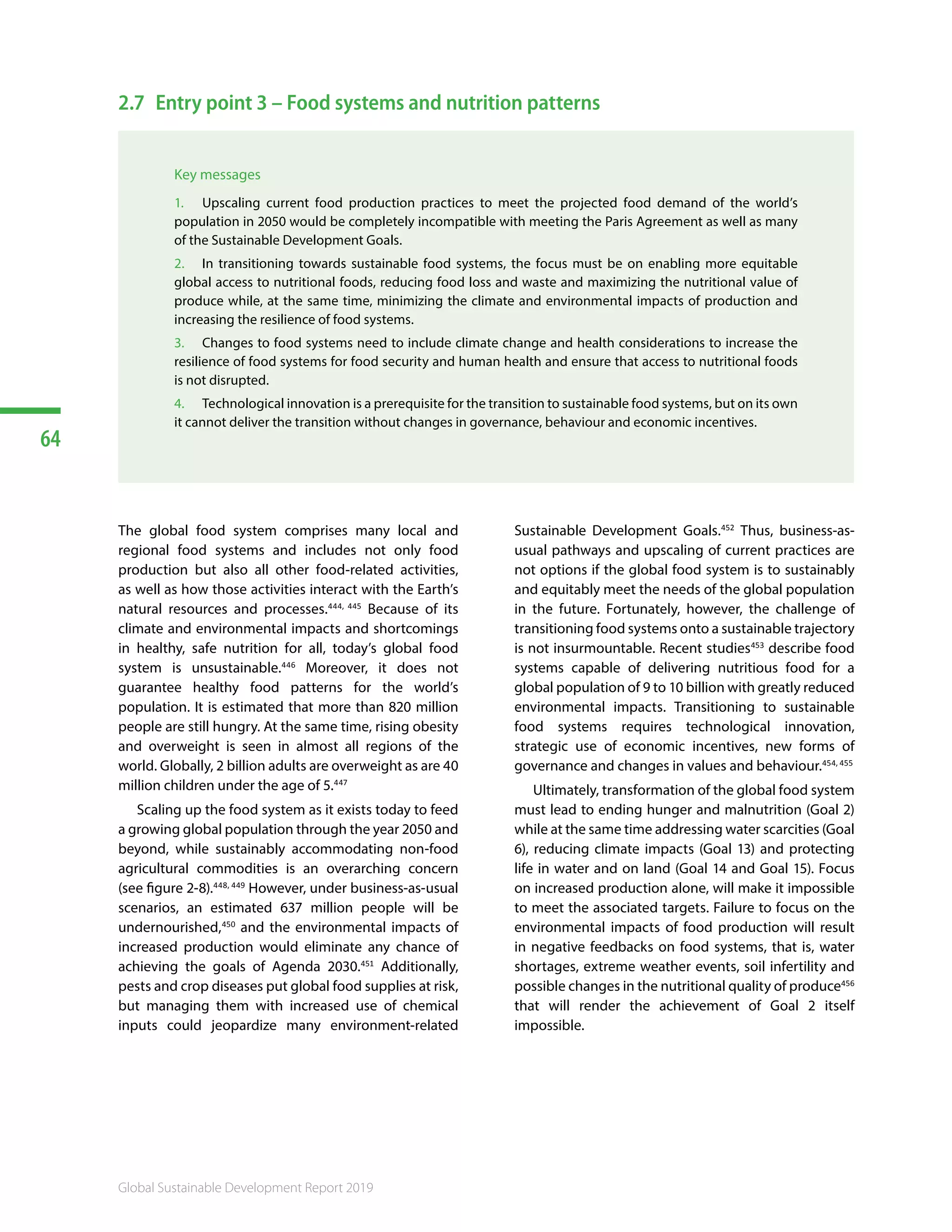
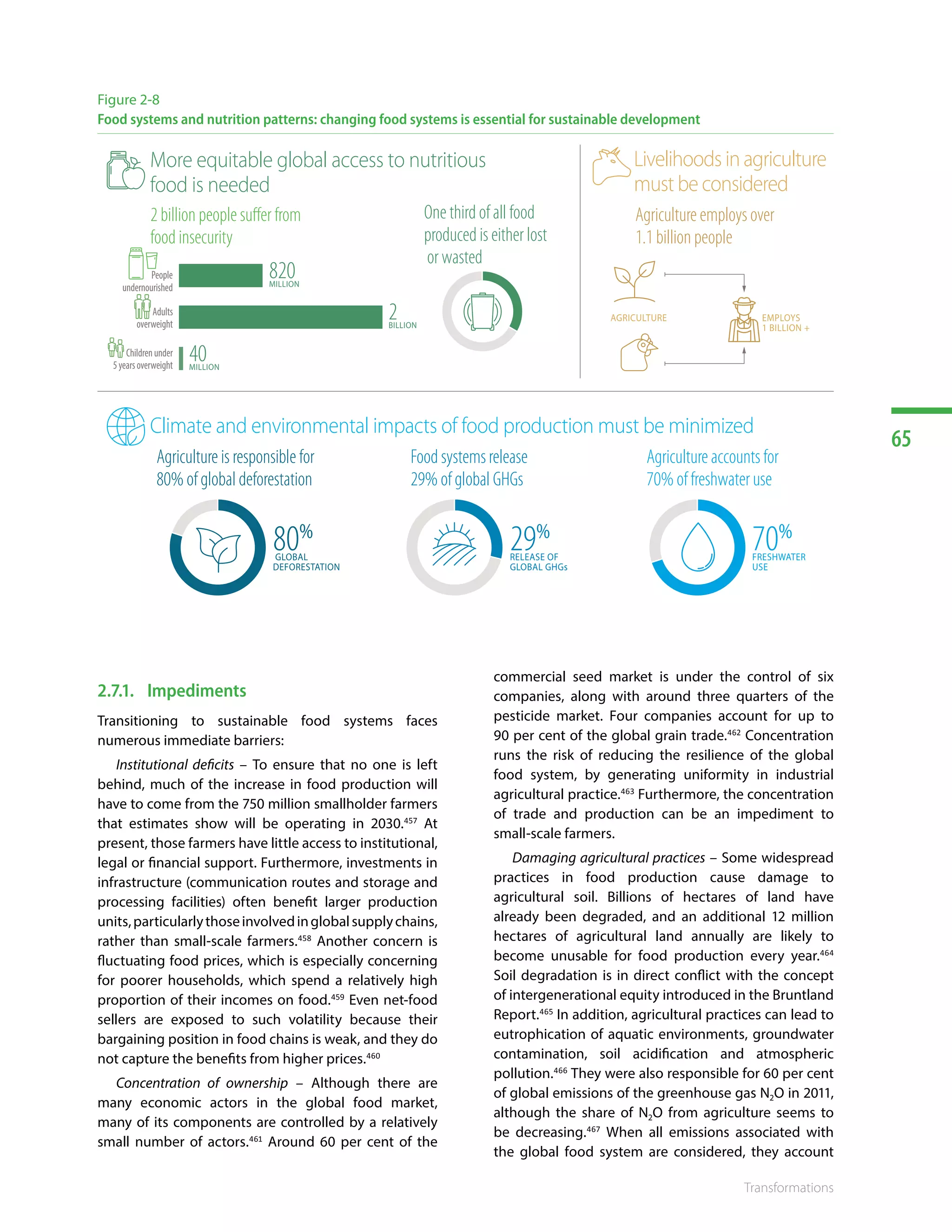
Inadditiontoreviewingthestateofglobalsustainabledevelopment,theGroupwastaskedwithincorporating
in an interdisciplinary manner the latest evidence from the natural and social sciences to support the
implementation of the 2030 Agenda in promoting poverty eradication and sustainable development, while
strengthening the science-policy interface. The Report also considers regional dimensions and diversity, as
well as countries in special situations.
In keeping with its mandate, the Group did not seek to produce new evidence. Rather, the Report capitalizes
onexistingknowledgeacrossvariousdisciplines,throughanassessmentofassessments.Itseekstohighlight
state-of-the-art knowledge for transformations for sustainable development and identifies concrete areas
where rapid, transformational change is possible. The Report is not only a product but also a process for
advancing collaboration across the science-policy-society interface across the world in order to identify and
realize concrete pathways for transformation. Although it is a report on global sustainable development, the
Group advocates that it be used to initiate science-policy-society collaboration and learning at the national
and regional levels with a view to co-designing context-specific pathways for sustainable development.
1.1.	 Understanding sustainable
development in the 2030 Agenda
Commencing in 2000, the Millennium Declaration and
its associated Millennium Development Goals guided
development efforts through the first 15 years of the new
century. That experience showed that goal setting and
periodic assessments based on measurable indicators
could and did spur progress and coordinated action.19, 20
In the pursuit of the Millennium Development Goals, the
global community achieved many successes, but also fell
short in several ways as it learned important lessons about
the opportunity of co-benefits, and the inevitability of
trade-offs and tough choices.
Co-benefits, trade-offs and tough choices are at the
heart of sustainable development but have not always
been appreciated as such. Initial interpretations that
emphasized three distinct dimensions of sustainability –
economic, environmental and social – tended to reinforce
decision-making in thematic silos. The result, typically,
was to prioritize immediate economic benefits over social
and environmental costs that would materialize over the
longer term. However, such an approach also continually
deferred consideration of the difficult choices that needed
to be made – indeed, the very usefulness of the concept of
sustainable development came under question.21
The present Report strives to address this head-on
by adopting a systemic approach to the Sustainable
Development Goals, informed by the knowledge of
4
Global Sustainable Development Report 2019
the interactions among them. In this way, it identifies
the biggest transformative potentials of the 2030
Agenda, not through the pursuit of individual Goals
and targets but rather by explicitly considering their
interlinkages and resultant co-benefits and trade-offs.
In an increasingly globalized and hyper-connected
world, any intervention on behalf of just one Goal can
lead to unintended consequences for the achievement
of other Goals nearby or faraway, today or tomorrow.
Conversely, the chances of progress on one Goal in a
specific part of the world will depend on interventions
made in other sectors, in sometimes distant places.
Those interactions often imply trade-offs, but also
give rise to co-benefits and the significant potential for
transformations towards sustainable development.
The key to the implementation of the 2030
Agenda thus lies in leveraging interactions among
the Sustainable Development Goals away from trade-
offs and towards co-benefits, from vicious to virtuous
circles. Based on existing assessments and evidence,
the Report begins by considering where we are today
in the pursuit of sustainable development. It then
identifies systemic entry points for transformation
that could accelerate the implementation of the 2030
Agenda across multiple Goals and targets. These entry
points are the means to harness important synergies,
multiplier effects and trade-offs across several Goals
so as to accelerate progress. They help to identify
the levers and actors that can make it happen. At the
country level, the entry points could serve to introduce
a more integrated approach towards implementation
and assessment underlined in the Report. Countries and
subnational entities could then develop acceleration
roadmaps based on the scientific evidence most
relevant to their circumstances and context.22
Figure 1-1
Cross-national flows of information, goods, capital and people
Cross-national flows of information, goods, capital and people increased dramatically in the last decades, underpinning a world
that is more interconnected than ever.22
Flowsofinformation
Individuals using the Internet
Mobile cellular subscriptions
Monthly active Facebook
users worldwide
0
20%
40%
20182008199819881978196819581950
%ofpopulation
0
2B
4B
6B
8B
20182008199819881978196819581950
Subscriptions(billions)
0
1B
2B
20182008199819881978196819581950
Activeusers(billions)
Flowsofgoods
Merchandise exports
Air transport, freight
Rice imports by the European
Union
0
5T
10T
15T
20T
20182008199819881978196819581950
GoodsexportsUS$(trillions)
0
1,000K
200K
20182008199819881978196819581950
Millionton-km(thousands)
0
500M
1000M
1500M
2000M
20182008199819881978196819581950
Weightinkg(millions)
Flowsofcapital
Personal remittances, received
Foreign direct investment,
net outflows
Net official development
assistance received
0
200B
400B
600B
20182008199819881978196819581950
ReceivedUS$(billions)
0
1T
2T
3T
20182008199819881978196819581950
FDIUS$(trillions)
0
50B
100B
150B
20182008199819881978196819581950
ODAUS$(billions)
Flowsofpeople
Air transport, passengers carried
International tourism, arrivals
International migrants, total
0
1B
2B
3B
4B
20182008199819881978196819581950
Passengers(billions)
0
500M
1000M
20182008199819881978196819581950
Arrivals(millions)
0
100M
200M
20182008199819881978196819581950
Migrants(millions)
5
The transformative power 
of sustainable development
1.1.1.	 An increasingly interconnected world
The world is now closely interconnected by flows of
goods, capital, people and information. Those flows
overlap and interconnect and link the development
of nations and regions across North and South, global
and local, today and tomorrow (see figure 1-1). The
flows produce many benefits: for example, through
remittances, finances are transferred from richer parts
of the world to poorer ones and using the Internet can
give small entrepreneurs and artisans access to the
global marketplace.
On the other hand, the flows can also result in
or propagate negative impacts, such as deepening
inequalities, unfair competition, resource depletion
and environmental pollution and destruction. In
many cases, such as with unsustainable resource use
or environmental degradation, those impacts can
be seen as a transfer of the problem beyond national
jurisdictions, and present challenges for countries that
may be ill-equipped to deal with them.
The flows interact with the natural interconnections
across the Goals, so that decisions and actions in one
country or region can affect outcomes in another one,
and even leave footprints all over the world. Conversely,
the most effective solutions to critical sustainability
problems in one country may be found through action
in others, facilitated by international collaboration.
As a result, States may sometimes feel they have less
autonomy to shape their own development. While
this can lead to States and communities feeling
disempowered, it is also an opportunity for them to
work collectively towards a shared future based on
sustainable development.
The world in the twenty-first century is therefore
marked by close systemic interlinkages with positive
synergies, but also negative interactions and
externalities that imply difficult trade-offs between
various dimensions – sectoral, local, regional, global
and temporal. Advancing the 2030 Agenda must
involve an urgent and intentional transformation of
socio-environmental-economic systems, differentiated
across countries, but also aggregating up to provide
the desired regional and global outcomes, so as to
ensure human well-being, social justice and limited
environmental impact.
1.1.2.	 A vision for 2030 and beyond
The 2030 Agenda calls for eradicating poverty and
other deprivations, enhancing human capabilities,
reducing inequalities, fostering peace, reversing the
degradation of the planet, and strengthening the
Global Partnership for Sustainable Development.
For that purpose, the Agenda provides a detailed
roadmap in the form of carefully elaborated Goals,
targets and indicators. But the Agenda is more than a
long wish list, it is also an integrated vision of how to
achieve the Sustainable Development Goals, while
jointly advancing the well-being of humanity and the
planet, ensuring that natural resources can be shared
and conserved for the well-being of the world’s people
in 2030 and beyond.23
Connections across Goals and
targets also imply the need to make difficult choices,
with the potential of producing winners and losers.
Sustainable development, while identifying a bridge
to the future, is inevitably dependent on the making of
choices through the political process.
Achieving transformation – a profound and
intentional departure from business as usual – will mean
carefully taking into account the interactions between
the Goals and the targets. Policymakers will find both
areas of support and contradictions among them,
as well as systemic interactions and cascade effects
as action towards one Goal can alter the possibilities
for achieving others.24
Much is known about those
important interactions, even as they remain to be fully
explored, with considerable research underway.
1.1.3.	 Understanding the importance of
interactions
An assessment of current knowledge about the
interactions between the targets demonstrates both
gaps and progress (see box 1-2) Based on 112 scientific
articles with explicit reference to the Sustainable
Development Goals, as well as 65 global assessments,
it shows that only about 10 per cent of the potential
target-level interactions are covered at least once, and
significant blind spots remain, clearly underscoring the
need for further research on those interactions.
Dealing with such complex synergies and trade-offs
poses a challenge for planners and decision-makers.25
But these systemic interactions offer already identified
and sometimes unexpected solutions for seemingly
insurmountable problems. For example, governments
can replace the frequently rigid and sequential
development paths that place economic growth ahead
of social equity and environmental protection. Instead,
policymakerscanadoptsystemicapproaches,following
different pathways to sustainable development that
offer multiple solutions and drivers, across different
sectors and jurisdictions. Effective action in different
systems will require that the links among them be
acknowledged and addressed – the connection
between climate change and human health, for
instance, or between climate change and inequalities.
6
Global Sustainable Development Report 2019
1.1.4.	 Engaging diverse actors
Those activities can be undertaken by a diverse
group of stakeholders and organizations, other than
governments of United Nations Member States alone.
At the local, national and international levels, new
key development actors are emerging and gaining
greater power and influence. Innovative and powerful
partnerships can result from collaborations between
traditional stakeholders and emerging actors.
The success of the 2030 Agenda depends on the
cooperation of governments, institutions, agencies, the
private sector and civil society across different sectors,
locations, borders and levels.26
Box 1-2
Interactions among Sustainable Development Goals
Trade-offs to be addressed Co-benefits to be harnessed
≥150100501
TOTAL STRENGTH
FROM
TO TOTAL
INFLUENCE
EXERTED
INFLUENCED GOALS
INFLUENCINGGOALS
TOTAL
INFLUENCE
RECEIVED
Thefigureaboveshowstheresultofasystematiccompilationofknowledgeaboutcausalinteractions
among the Sustainable Development Goals, extracted primarily at the target level and using the
7-point scale developed by the International Council for Science (ICSU)26
in terms of co-benefits
7
The transformative power 
of sustainable development
1.1.5.	 Taking advantage of technology
The success of the 2030 Agenda will also require
deliberate engagement with other trends that are already
playing out across the world. One of the most immediate
trends is the rapid advance of technology (see figure 1-2).
Indeed, technology can generate solutions to many of
the challenges relating to the Sustainable Development
Goals, including some that currently involve difficult
trade-offs. At the same time, technology risks further
entrenching existing inequalities, introducing new ones
and, through unintended consequences, setting back the
vision of the 2030 Agenda.27
Those issues are explored in
chapter 3.
Figure 1-2
Technology: exponential increases in power and rapid adoption, but inequalities in access remain
Transistors per chip (millions) Mobile cellular and fixed broadband
subscriptions (per 100 people)
The number of transistors
which fit into a microprocessor
famously follow Moore’s Law,
doubling every two years.
Exponential changes in
technology can have impacts,
both negative and positive,
that cut across the Goals.
0
20
40
60
80
100
120
1980
1985
1990
1995
2000
2005
2010
2017
Year
OECD members—
Rest of world—
Mobile cellular
OECD members—
Rest of world—
Fixed broadband
2,000 M
4,000 M
6,000 M
8,000 M
10,000 M2017
2015
2014
2013
2009
2007
2006 2005
20033
2002
2004
2001
2000
1999
19951998
1989
1993
1985
10M
20M
30M
40M
50M
and trade-offs. The compilation is based on a total of 65 global assessments comprising United
Nations flagship reports and international scientific assessments, as well as 112 scientific articles
published since 2015 with explicit reference to the Sustainable Development Goals. Mapping the
summed scores of influencing (horizontal) and influenced (vertical) interactions among the Goals,
this assessment of assessments reveals the relative importance of the potential trade-offs, but
the dominance of positive (blue) over negative (red) interactions in the current body of knowledge
suggests that recent research has brought to the fore extensive co-benefits as well. The figure also
shows important blind spots or gaps in knowledge where certain cells in the matrix are left blank. Of
all possible target-level interactions, only about 10 per cent were covered at least once. Aggregated
to the Goals level, however, the matrix reveals that 92 per cent of Goal-level interactions were
assessed. In systemic terms, the figure suggests that change towards achieving the Sustainable
Development Goals offers many opportunities for reinforcing rather than inhibiting itself.
8
Global Sustainable Development Report 2019
1.1.6.	 Adapting to demographic change
The world population is still growing, but growth
rates vary considerably across regions. The largest
growth rate is in sub-Saharan Africa, where the
population is projected to double by 2050.28
In
Europe and Northern America, as well as Eastern and
South-Eastern Asia,29
on the other hand, birth rates
are low. Together with increasing life expectancy, this
results in growing proportions of older persons in the
populations of these regions.
Meeting basic needs, providing opportunities
and enhancing the well-being of a larger and aging
world population may strain social, economic and
environmental resources. At the same time, improving
humancapitalthroughaccesstohigh-qualityeducation
and health increases the capacity for global resilience. In
most countries, the younger cohorts of the population
are better educated than the older ones, which implies
future progress in human capital.30
Historically, fertility and mortality rates have
fallen with higher levels of education and economic
opportunity for women and girls. It is thus expected
that current advances in human capital will impact
the future size and age composition of the global
population.
1.2.	Progress to date
The 2030 Agenda is both a normative orientation and a
guide for action. It identifies and pursues development
priorities while requiring coherence among all policy
areas and sectors, at the local, regional, national and
transnational levels.
Since the adoption of the Sustainable Development
Goals, there have been many positive initiatives.
Countries have started to incorporate the Goals into
national plans and strategies, and many have set up
coordinating structures for coherent implementation.31
Of the 110 voluntary national reviews submitted
during the 2016, 2017 and 2018 sessions of the high-
level political forum, 35 mentioned explicit measures
to link the Goals to their national budgets or were
considering such action.32
That is an important step as
incorporating the Sustainable Development Goals into
national budgets can improve programming. A number
of countries have set up coordination structures to
ensure the coherent implementation of the Goals
across sectors. There have also been initiatives directed
towards nature, notably regarding climate change,
land use or the oceans. Furthermore, important parts
of the private sector have begun to move away from
business-as-usual models, for example, by adopting
and reporting on sustainability standards.33
Meanwhile,
the mobilization of civil society and non-governmental
organizations in favour of sustainable development is
rising.
Over time, sustaining such efforts can significantly
advance the achievement of the Sustainable
Development Goals. However, the initial efforts have
not yet reversed several negative trends that stall
progress towards sustainable development. The limited
success in implementing the 2030 Agenda should
raise strong concerns, and even sound the alarm for
the international community. Much more needs to be
done and quickly to bring about the transformative
changes that are required: impeding policies should
urgently be reversed or modified, and recent advances
that holistically promote the Sustainable Development
Goals should be scaled up in an accelerated fashion.
1.2.1.	 Where we are and what we can expect
The scale and scope of what is needed can be seen by
examining the rates at which progress is being made
towards the numerical targets (see box 1-3) associated
with the Sustainable Development Goals.34
The rate of
progress towards each target – assuming they continue
unchanged - can be used to estimate whether that
target will be achieved or, if not, how closely it will be
approached by 2030. Table 1-1 shows the current state
of play at the global level for some selected indicators
for which adequate data are currently available. It
draws primarily upon the database used for preparing
the Secretary-General’s annual progress reports on the
Sustainable Development Goals.35
9
The transformative power 
of sustainable development
Box 1-3
The Global Monitoring Framework
The 2030 Agenda defined 17 Sustainable Development Goals and 169 targets. Tracking progress towards
these targets at the global level is made possible by indicators that are consistently defined and measured
across countries. The Inter-Agency and Expert Group on Sustainable Development Goal Indicators has
developed a global indicator framework that was agreed by the United Nations Statistical Commission at its
forty-eighth session in March 2017, and adopted by the General Assembly in July 2017.
There are currently 232 indicators in the global framework, classified into three tiers depending on their level
of methodological development and the availability of data. Tier I indicators are well defined, with sufficient
data regularly collected at the country level for reliable and timely global reporting; Tier II indicators are
well defined, but data are not regularly collected at country level; Tier III indicators are those for which
definitions, methodologies or standards are under development.
More indicators have been moving into Tier I over time, and progress is being made in strengthening the
conceptual and methodological foundations of the remaining Tier III indicators. As of May 2019, out of the
232 indicators, 104 were Tier I, 88 were Tier II, 34 are Tier III and 6 are categorized under multiple tiers
(different components of the indicator are classified into different tiers).35
The share of indicators within
each tier varies across goals (see below):
Tier I
Goal1
Goal5
Goal2
Goal3
Goal4
Goal6
Goal7
Goal8
Goal9
Goal10
Goal11
Goal12
Goal13
Goal14
Goal15
Goal16
Goal17
Tier II Tier III Multiple tiers
0% 10% 20% 30% 40% 50% 60% 70% 80% 90% 100%
The process of establishing Tier III indicators, while technical, may also be contingent on consensus being
developed in other forums. For example, more than 50 per cent of the indicators for Goal 13 (climate action)
are in Tier III. Currently available climate indicators are being used as proxies for monitoring the targets
under Goal 13, while the UNFCCC process continues to develop modalities for measuring the targets.
In accordance with General Assembly resolution 71/313, the global indicator framework will be reviewed
comprehensively by the Statistical Commission at its fifty-first session, to be held in March 2020. The 2020
comprehensive review will provide an opportunity to improve the indicator framework to advance the
global monitoring of the Sustainable Development Goals.
10
Global Sustainable Development Report 2019
Table 1-1
Projected distance from reaching selected targets by 2030 (at current trends)
Distance from reaching the target by 2030 without transformation
WITHIN 5%GOAL 5–10% 10% NEGATIVE LONG-TERM TREND
Goal 2
1.3.Socialprotectionforall
Goal 5 5.5.Womenpoliticalparticipation
Goal 1
2.1.Endinghunger
(undernourishment)
1.1.Eradicatingextremepoverty
2.2.Endingmalnutrition
(overweight)
2.2.Endingmalnutrition(stunting)
2.5.Maintaininggeneticdiversity
2.a.Investmentinagriculture*
3.2.Under-5mortality
3.2.NeonatalmortalityGoal 3
3.1.Maternalmortality
3.4.Prematuredeathsfrom
non-communicablediseases
4.1Enrolmentinprimaryeducation
4.6Literacyamongyouth
andadultsGoal 4
4.2.Earlychildhooddevelopment
4.1Enrolmentinsecondaryeducation
4.3Enrolmentintertiaryeducation
Goal 6
6.1.Accesstosafelymanaged
drinkingwater
6.2.Accesstosafelymanaged
sanitationservices
7.1.Accesstoelectricity
6.2.Accesstosafesanitation
(opendefecationpractices)
Goal 7
7.2.Shareofrenewableenergy*
7.3.Energyintensity
Goal 8
9.5.Enhancingscientificresearch
(RDexpenditure)
8.7.Useofchildlabour
Goal 9
9.5.Enhancingscientificresearch
(numberofresearchers)
Goal 10 10.c.Remittancecosts Inequalityinincome*
Goal 11 11.1.Urbanpopulationlivinginslums*
Goal 12 12.2.Absolutematerialfootprint,
andDMC*
GlobalGHGemissionsrelative
toParistargets*
14.1.Continueddeterioration
ofcoastalwaters*
14.4.Overfishing*
15.5.Biodiversityloss*
15.7.Wildlifepoachingandtrafficking*
Goal 13
Goal 14
Goal 15
Goal 16 16.9Universalbirthregistration**
At the global level, table 1-1 and several other
assessments (see box 1-4), as well as the 2019 Global
Environment Outlook (GEO-6) assessment, the 2018
and 2019 Intergovernmental Panel on Climate Change
(IPCC) reports, the 2019 Intergovernmental Science-
Policy Platform on Biodiversity and Ecosystem Services
(IPBES) report and the latest report of the Committee
for the Review of the Implementation of the Convention
to Combat Desertification (CRIC), paint a similar picture
that allow for broad conclusions.36
Note: Selected indicators only. SDG 17 is not included as it consists of a wide range of indicators that cannot easily be captured using the methodology
for assessing distance from reaching targets. Estimates of the distance from the target by 2030 are based on forecasted value of the corresponding
indicator in 2030, relative to target. Forecasts based on best-fit trends of individual indicators, given the available data range.
* Quantitative target for 2030 is not specified in the SDG indicator framework; targets are estimated.
** Assessment is based on indicators outside the SDG indicator framework; inequality in income is based on data from household surveys.
11
The transformative power 
of sustainable development
A straightforward read suggests that, at current rates
ofprogress,severaloftheobjectivesofthe2030Agenda
should be attainable by 2030 – those depicted in table
1-1 as being within 5 per cent of the target –, including
reducing child mortality and full enrolment in primary
school. Other goals may also be reached with some
additional effort – those depicted as being within 5 to
10 per cent of the target –, such as eradicating extreme
poverty, ending hunger, ensuring universal access to
electricity, eliminating open defecation, literacy among
youth and adults, and desirable levels of expenditure
on scientific RD.
However, that straightforward projection ignores
possible complexities. As targets are approached, rates
of progress may start to slow, therefore predictions
basedonpriorrateswillbeover-optimistic.Forexample,
the World Bank’s 2018 report on poverty found that
in the 25-year period from 1990 to 2015, the extreme
poverty rate fell, on average, at a rate of about one
percentage point per year. However, in the period from
2013 to 2015, the rate fell to less than one percentage
point.37
A similar pattern can be seen with regard to
primary school enrolment; an extended period of sharp
decline began to level off as the ultimate objective of
full enrolment was approached (see figure 1-3).
Such declines in rates of progress are apparent
in other indicators, particularly when approaching a
target of complete eradication. That may be because
the populations being left behind are significantly
harder to reach, or they suffer multiple deprivations
that go beyond the specific Goal and that require action
on other issues that are inherently intractable.38
For
example, Most of the people living in extreme poverty
are increasingly concentrated in regions that combine
multiple factors, including conflict, weak institutions
and high population growth rates.39
In such contexts,
extraordinary efforts are needed to meet the Goals.40
A second group of targets are those where trends
in the selected indicators are in the desired direction,
but progress is too slow to meet the target. In table 1-1,
for example, maternal mortality rates continue to fall,
but progress is only at half the rate needed to achieve
the target. The situation is similar for child malnutrition,
access to safe drinking water and sanitation services,
the share of renewables in the energy mix, early
childhood development and enrolment in post-primary
education. Other targets in that category include some
of the necessary conditions for ending deprivations
and reducing inequalities. For instance, the percentage
of the population covered by social protection or birth
registration is improving, but the rates of progress
are clearly insufficient to meet the target of universal
coverage. 4142
Figure 1-3
Children out of school
United Nations classification
Least developed countries
60.6%
8.9%
18.6%
World
27.8%
1970 1980 1990 2000 2010 2017
43444546
12
Global Sustainable Development Report 2019
Box 1-4
Other assessments of progress
Several authors have provided alternate assessments of the prospects for meeting the Sustainable
Development Goals at the global, regional and country levels, with some using indicators that go beyond
those in the global indicator framework. While methodologies and specific results vary, in general the
alternate assessments agree that, based on current trends, many of the targets will not be met. For example,
one study found that, of the 24 targets relating to health that are currently being measured, only 5 are likely
to be met;41
another reported that, 44 countries with populations exceeding 1 million, will not meet the
goals for secondary education;42
while yet another found that, of the 93 environment-related indicators, 22
are generally on track, but for the remaining 71, there is either insufficient data or trends point toward them
not being met.43
At the regional level, one particular study looked at the likelihood of reaching each Goal in five main regions
defined by the Organization for Economic Cooperation and Development (OECD) – the United States of
America, OECD (excluding the United States), China, BRISE (Brazil, Russia, India, South Africa and ten other
emerging economies) and ROW (rest of the world). It found that the United States, OECD and China regions
were most likely to meet several of the Goals, such as those relating to hunger, health, education, clean
water and sanitation, and industry, innovation and infrastructure. The BRISE and ROW regions were unlikely
to meet any, but the BRISE region was more likely to be closer to the targets than the ROW region. All regions
were likely to remain in the category of being furthest away from target for the Goals relating to inequality,
responsible consumption and production,44
and nature (climate, life on land, life on water).45
Another
study46
found that the level of change needed to reach the Goals varied widely across developing regions
and countries: sub-Saharan Africa was likely to be the furthest behind, with more substantial progress likely
across South Asia, East Asia and the Pacific, and Latin America.
With regard to country-level assessments and forecasts, in 2019, one study found that no country was on
track to meet all of the Goals by 2030. While data availability by country and by Goal varied, no Goal had
more than 50 per cent of countries on track to reach it by 2030.47
Most worrisome, though, are the targets for which
recent trends are not even in the right direction, either
because implementation of the Goals has not yet been
able to reverse pre-existing deterioration, or because
world recovery from the 2008 economic crisis has
brought back negative trends that had for the moment
beenstalled,suchasobesity,inequality,greenhousegas
emissions, land degradation, biodiversity loss, wildlife
trafficking, absolute material footprints, overfishing and
deterioration of coastal waters. Several of those targets,
for which even the direction of the trend is wrong, are
of particular importance. Not only do they represent
trends that are difficult to change, but they also make
it harder to reach other Goals and targets, sometimes in
ways that cascade across the entire 2030 Agenda.
Four trends, in particular, fall into that category:
rising inequalities, climate change, biodiversity loss, and
the increasing amount of waste from human activity
that are overwhelming processing capacities. Critically,
recent analysis suggests that some trends presage a
move towards the crossing of negative tipping points,
which would lead to dramatic changes in the conditions
of the Earth system, in ways that are irreversible on time
scales meaningful for society (see box 1-5).47
13
The transformative power 
of sustainable development
Box 1-5
Tipping points
A tipping point is a critical point in an Earth system component, around which small perturbations can
trigger an irreversible transition from one stable state to another. Transitions are not necessarily abrupt; but
once begun can be impossible to reverse, and the eventual change is very dramatic. It is believed that such
points exist for many components of the Earth system – such as the Arctic summer sea ice, the Greenland
and Antarctic ice sheets, and the Amazon rainforest.
The dynamics can be illustrated by the Arctic summer sea ice, which is currently melting fast due to climate
change. As the ice melts, more of the ocean area becomes darker and so absorbs more sunlight, which
increases global warming and speeds up the melting. As a result, the Arctic is warming much faster than
the rest of the world. The tipping point for the Arctic sea ice will be the critical temperature, after which the
melting will become rapid and irreversible. Some estimate that it will take just 10 years for the ice to melt
completely after the tipping point is reached.
The increase in greenhouse gases in the atmosphere and warming causing the melting of the Arctic sea ice
may also have complex impacts on other systems, for example, the release of methane due to melting of
permafrost will further exacerbate climate change; melting of the Greenland ice sheet; ocean circulation
changes; ocean acidification; extreme weather events; and accelerated biodiversity loss.
Each of those impacts can lead to transitions in other components of the Earth system, in vicious feedback
loops that would lead, through a cascade of transitions, to radically different states for many components.
Those transitions would be irreversible on the time scales relevant for society. The exact point at which such
transitions can be precipitated is difficult to estimate, but they are believed to be likely under many different
scenarios.
The Earth system could likely be kept in its current state by actions such as reducing greenhouse gas
emissions and strengthening carbon sinks to achieve net-zero emissions. However, the time window within
which such actions need to occur could be a short one.48
1.2.2.	 Regions and population groups
Individual countries, as well as their groupings along
regional or other parameters, can differ significantly
in the challenges they face toward achieving the
Sustainable Development Goals. Those challenges
will only be described very briefly in this Report; more
detailedtreatmentsareavailableinregionalSustainable
Development Goals reports and the voluntary national
reviews.
Seeforexamplethespecialchallengesfacedbysmall
island developing States (box 1-6) and least developed
countries (box 1-7). 484950
14
Global Sustainable Development Report 2019
Box 1-6
Small island developing States49
Starting in 1992, the United Nations consider small island developing States (SIDS) as special cases for
sustainable development owing to their unique combination of vulnerabilities – whether they are located
in the Caribbean, or in the Pacific, Atlantic or Indian Oceans. Their defining features include:
ff Small size;
ff Remoteness from global market centres;
ff Undiversified economies and resulting susceptibility to economic shocks and high debt load;
ff Immediacy of climate change impacts, including sea-level rise, salt-water encroachment, ocean
acidification, and more frequent and intense storms.
Many small island developing States have relatively high per capita GDPs, which can hinder their access to
concessional financing and other development assistance. However, because of their structural challenges,
many have been calling for the use of criteria beyond GDP, when deciding on eligibility.
Small island developing States have also been at the forefront of the fight against climate change. Some
States have acted as moral leaders in the push for more ambitious mitigation targets, holistic and innovative
approaches to climate adaptation, and compensation for loss and damage.
Another hurdle facing small island development States is the lack of high-quality, disaggregated data. Even
when the data exist, the small size of their populations often makes it difficult to use standard data metrics
to track progress on a variety of Sustainable Development Goals indicators.
The most common challenges faced by small island development States are:
ff Climate variability and sea-level rise
ff Little resilience to natural hazards
ff Constraints in terms of both the quality and quantity of freshwater
ff Narrow resource base that deprives them of the benefits of economies of scale
ff Small domestic markets and heavy dependence on a few external and remote markets
ff High fixed costs for the public sector and high per capita costs for civil infrastructure
ff Low and irregular international traffic volumes
ff High volatility of economic growth
ff Limited opportunities for the private sector and a correspondingly large economic reliance
on the public sector
ff Fragile natural environments
ff Vulnerability to fluctuations in price or availability of food imports
ff High indebtedness and constrained fiscal space
15
The transformative power 
of sustainable development
Box 1-7
Least developed countries50
The 2030 Agenda is a universal undertaking, adopted by all 193 United Nations Member States and
representing a global commitment to transform our world. However, certain groups of countries face
particular challenges that require redoubled engagement and support from the international community.
The least developed countries are the 43 Member States with the highest levels of poverty and deprivation
in the world. Their vulnerability can be seen across all the Sustainable Development Goals.
The least developed countries are home to 12 per cent of the global population, but account for only 2
per cent of global GDP and 1 per cent of global trade. Their growth in GDP per capita was 4.5 per cent in
2017, and is projected at 5.7 per cent in 2020, which is below the 7 per cent called for in the 2030 Agenda.
Least developed countries often rely on a limited number of commodity exports, which makes them
extremely vulnerable to shocks, and they are currently off track in relation to the Goal 9 target to double the
manufacturing industry’s share of GDP by 2030. The shortfall is especially severe in the medium- and high-
technology sectors. Those sectors represent 47.4 per cent of manufacturing production in North America
and Europe, but only 10.4 per cent in least developed countries.
The least developed countries lag behind other groups of countries in many other targets as well. For
example, they have higher rates of neglected tropical diseases, and physical and/or sexual partner violence,
lower numbers of medical personnel and women in management positions, lower rates of Internet access
and access to pre-primary education. Individuals in least developed countries are less likely to have access
to electricity (51 per cent in 2017, while the global rate was 88.8 per cent) or to a basic handwashing facility
at home (34 per cent, while the global rate is 60 per cent).
Nonetheless, there is scope for optimism. The Technology Bank for Least Developed Countries, established
in 2018, following the call in the Istanbul Programme of Action for the Least Developed Countries and the
2030 Agenda, is working to make science, technology and innovation resources available to institutions and
individualsinleastdevelopedcountriesandtostrengthenthescience,technologyandinnovationecosystemin
least developed countries. Furthermore, least developed countries are taking strong steps in the climate action
arena. At the twenty-second Conference of the Parties (COP 22) to the United Nations Framework Convention
on Climate Change, held in Marrakech, Morocco in 2016, 24 least developed countries, members of the Climate
Vulnerable Forum, announced that they would transition to 100 per cent renewable energy by 2050.
Attheregionallevelalso,certainbroadcharacteristics
are evident. In Africa, targets related to poverty, food
security, maternal health and education are among the
greatest challenges.51
There is also a growing youth
population seeking employment, but opportunities are
limited – between 10–12 million youth seek to join the
labour force each year, vying for only about 3.7 million
jobs.52, 53
In the Arab region, challenges relate to ongoing
conflicts in the Syrian Arab Republic and Yemen that
have raised the region’s poverty rate, increased food
insecurity and worsened human development.54, 55, 56
Theregionalsocontains14oftheworld’s20mostwater-
stressed countries. Youth unemployment surpasses 30
per cent, reaching 48 per cent among young women.57
The Asia-Pacific region has made progress with
regard to poverty eradication, high-quality education,
and affordable and clean energy.58
The majority of
countries in the region have already achieved, or are
close to achieving, universal primary education.59
The
challenge there may be to reach those groups who,
despite progress, are most at risk of being left behind
as well as to accommodate an ageing population
structure.
In South Asia, progress has been slow in areas like
gender equality, and the region has taken some steps
back in areas such as clean water and sanitation, decent
work, economic growth, and responsible consumption
and production.60
In Europe and other developed regions, countries
face challenges in reducing carbon dioxide emissions,
with emissions per capita remaining much higher
than global averages. Countries also need to manage
demographic transitions and inequalities, including
closing gender gaps in labour participation and wages.
Declining labour shares of GDP are also noticeable
acrosswealthycountries,linkingtogrowinginequality.61
Trends vary across population groups. Individual
population groups, such as women and girls, youth,
persons with disabilities and indigenous peoples,
16
Global Sustainable Development Report 2019
among others, continue to suffer systemic deprivations.
Gender inequality persists throughout the life cycle –
girls have fewer opportunities for learning at school,
especially in the sciences; women face barriers in the
labour market with lower wages and lower labour
force participation rates; and older women – who
are expected to live 3 years longer than men, on
average – are more affected by a lack of long-term care
protections.62, 63, 64
Data indicate that women spend about three times
as many hours in unpaid work as men.65
Labour force
participation rates in paid work are lower for women
(48.7 per cent) than for men (75.3 per cent), and
unemployment rates are higher for women compared
to men at a ratio of 1.24.66
Furthermore, opportunities
for women and girls are limited by norms such as
childhood marriage (which affects 650 million girls
and women today); female genital mutilation (which
affects 1 in 3 girls aged 15 to 19 in countries where it
is practised); and the threat of physical and/or sexual
violence (which affects 20 per cent of girls aged 15 to 19
in countries with data).67
Accelerating progress toward
the Sustainable Development Goals for women and
girls would empower half the world’s population, and
significantly close remaining gaps in achievement.
More than one billion people in the world today
(an estimated 15 per cent of the world population)68
experience some form of disability. Persons with
disabilitiesfacevariousformsofexclusion,andgenerally
have poorer health, lower education achievements,
fewer economic opportunities and higher rates of
poverty than people without disabilities. This is largely
due to the lack of services available to them and the
many obstacles – including negative attitudes, beliefs
and prejudices – that they face in their everyday lives.
Thirteen years after the adoption of the Convention on
the Rights of Persons with Disabilities, in 2006, progress
in its practical implementation remains far too limited.69
Indigenous peoples number over 370 million in
some 90 countries (2009 estimates), yet their situation
in many parts of the world continues to be critical.
They often face discrimination and exclusion from
political and economic power, with disproportionately
high rates of poverty, ill health, poor education and
destitution.Additionalchallengesincludedispossession
of ancestral lands and the threat of extinction of
traditional languages and identities.70
1.2.3.	 Rising inequality
The entire 2030 agenda is threatened by rising
inequalities in income and wealth. Since 1980,
notwithstanding some gains at the lowest parts of the
income distribution of the global population, income
inequality has risen sharply. Although the poorest 50
per cent of the world population did see incomes rise
significantly (primarily due to high growth in Asia), they
only received a 12 per cent share of the global gains,
while the richest 1 per cent of the world population
received 27 per cent.71
Growing wealth and income
inequality has been primarily driven by concentration at
the top. In the 1980s, the richest 1 per cent of the world
population had 28 per cent of total wealth, but by 2017,
they had 33 per cent, while the bottom 75 per cent had
stagnated around only 10 per cent.72
For individuals
caught between the two extremes – primarily the
middle classes in Western Europe and the United States
– the period was marked by, at best, sluggish income
growth.73
The skewed nature of the gains is represented
in figure 1-4.
The increase in income share at the top of the global
income distribution is related to several other factors. In
the United States, for example, while the productivity of
workers has doubled since the 1980s, almost all the gains
have gone to executives, owners and investors, while
wages for those in production or non-supervisory jobs
have stagnated.74, 75
Several factors have contributed
to that trend, including globalization, automation, the
declining influence of unions, and stagnant federal and
state minimum wages. That has led to a substantial
hollowing-out of the labour market, with job creation
primarily at the high- and low-skill ends.
Increasing inequalities are also apparent in other
countries and regions. Researchers have observed
an increasing concentration of income in a range of
countries with the top 10 per cent trending towards a
high-inequality frontier with a Gini-coefficient of over
60.76
In parallel, while income across countries appeared
to be converging over the period from 2000 to 2010,
such movement has slowed or even reversed in recent
years, especially in sub-Saharan Africa compared to the
rest of the world.77
Therelationshipbetweeninequalityandwell-beingis
complex. Current levels of inequality in income or wealth
can represent historical patterns in the distribution of
assets or opportunities. At the same time, they may
also connect to future-oriented behaviour – retaining
monopoly positions, on the one hand, while motivating
individual efforts, on the other. There is no scientific
consensus on what would be optimal for the Sustainable
DevelopmentGoals,butthereismountingevidencethat
current levels and trends present challenges. Several
streams of research indicate the mechanisms through
which those challenges are manifested.
17
The transformative power 
of sustainable development
Figure 1-4:
Global inequality and growth, 1980–2016
10
50%
100%
150%
200%
250%
0%
20
Rise of
emerging
countries
Squeezed bottom 90%
in the United States 
Western Europe
Income group (percentile)
Bottom 50%
captured 12%
of total growth
Top 1%
captured 27%
of total growth
235.41%
Prosperity of
the global 1%
30 40 50 60 70 80 90 99 99.9 99.99 99.999
Rising inequalities in income and wealth can indicate
inequalities in opportunity, such as unequal access to
good-quality childhood nutrition, education, health
care or societal discrimination. At sufficiently high
levels, inequality also represents challenges to inter-
generational mobility. Inequalities can become self-
perpetuating, for example through inherited wealth or
exclusive access to high-quality education and skills.78
In the United States, roughly one half of the inequality
that existed during the parents’ generation is passed
on to the children. However, public policies can be
important drivers of social mobility in countries like
Germany or Denmark, where only one fifth and one
sixth, respectively, of income inequality is transmitted
between generations.79
That relationship can be demonstrated by plotting
measures of intergenerational mobility against income
inequality for a group of rich countries (see figure 1-5).80
Known as the Great Gatsby Curve, the graph shows how,
as inequality rises, intergenerational mobility falls.81, 82
Rising intra-country inequality also threatens
progress more broadly, making economic growth
slower and more fragile. As people with less education
and poorer access to healthcare work below their full
potential, social instability can rise, further deterring
investment and reducing the capacity to recover from
shocks.83
Poor access to good-quality health care
widens inequalities in health outcomes, and lower
socioeconomic status in unequal societies contributes
to worsening health through increasing and sustained
stress levels. It is well documented that stress has
biochemical effects on the body throughout life.84, 85
Figure 1-5
Intergenerational mobility and inequality
Sweden
Germany
Finland
20
0.1
0.2
0.3
0.4
0.5
25 30 35
Norway
New Zealand
Canada
Australia
Japan
France
Italy
United States
United
Knigdom
Denmark
Income inequality (more inequality )
Intergenerationalearningselasticity(lessmobility)
Greater inequality can also affect the environment,
as those at the upper end of the income distribution
may be able to shift the environmental costs of their
lifestyles and consumption decisions to those at the
lower end. That can occur at both the national and
international levels.86, 87
Such shifts occur at the global
scale in the case of climate change: the top 10 per cent
of emitters contribute to about 45 per cent of global
carbon dioxide emissions, while the bottom 50 per cent
of emitters contribute to 13 per cent of global emissions.
Similar unequal patterns are also apparent at national
and subnational levels.88
Those at the bottom of the income distribution
are also more at risk of facing the consequences of
degraded environments and biodiversity loss. The
recent GEO-6 assessment noted that the livelihoods of
more than 70 per cent of the world’s poor are natural
resources based. Globally, 29 per cent of land is already
degraded, affecting the lives and livelihoods of 1.3–3.2
billion people, and in some cases leading to migration
and even conflict.89
Inequality may have broader negative impacts when
the efforts by those at the top to maintain their positions
divert resources from accelerating the transformations
that are needed to achieve the 2030 Agenda.
1.2.4.	 Climate change
Since the industrial revolution, human activities have
increased atmospheric concentrations of greenhouse
gases, primarily CO2. Their presence in the atmosphere
has already warmed the Earth by a mean average
temperature of about 1o
C. Emissions are once again on
the rise globally, and if current trends continue, global
warming is set to cross the 1.5o
C benchmark between
2030 and 2052.90
18
Global Sustainable Development Report 2019
Figure 1-6:
Human activity induces climate change: rising CO2 levels, increasing mean temperatures, shrinking sea ice, elevated sea levels
1 20181000
Year
1500500
WORLD
405.385ppm
Sea ice extent change since 1981–2010, %
Total sea level change since 1993
Global temperature change (from pre-industrial period)
Cumulative increases inCO2
emissions
can have adverse impacts across the
Sustainable Development Goals.
276.064ppm
Partspermillion
Average over 2009 to 2018
260
280
300
320
340
360
380
400
420
September
Antarctic sea ice
September
Arctic sea ice
March Arctic
sea ice
-5.2%
-0.6%
-27.5%
60mm
0.93ºC
The impacts of planetary warming are already
apparent. Over the past decade, a large number of
countries have registered their warmest-ever years.
Extreme events such as hurricanes, floods and forest
fires have also become more severe.
Even a temperature rise limited to 1.5o
C above pre-
industrial levels could damage the prospects for the
Sustainable Development Goals,91
and put pressure on
500 million people exposed and vulnerable to water
stress, 4 billion people exposed to heat waves, and tens
of millions of people exposed to coastal flooding. A
1.5o
C temperature rise would also reduce agricultural
yields and increase the levels of species extinction.92,
93
Should the actual temperature rise be higher, the
scale of devastation would be worse. Based on current
policies and pledges, human-caused global warming is
estimated to exceed 3o
C by the end of this century. 94
The Intergovernmental Panel on Climate Change
(IPCC) report on limiting global warming to 1.5o
C above
pre-industrial levels considered different scenarios
for reaching that objective:95
all require net zero CO2
emissions by 2050 and concurrent deep reductions
in non-CO2 greenhouse gas (particularly methane)
emissions, with global reductions beginning soon.
The scenarios studied were all consistent with the
continuing improvement in people’s lives across the
globe but differ markedly in how the reductions in
emissions will be achieved.
One scenario is a pathway that assumes a continuing
widespread adoption of greenhouse-gas-intensive
lifestyles,withhighdemandfortransportationfuelsand
livestockproducts.Achievingtheglobalwarmingtarget
(with a significant overshoot above 1.5 o
C warming)
would only be possible through a rapid and large-scale
deployment of technologies that remove CO2 from the
atmosphere. However, although technologies that can
do so are under development, none as yet exist at the
scale needed for the required impact. Most of those
technologies could have significant impacts on land,
energy, water or nutrients if deployed at large scale, and
may have significant impacts on agricultural and food
systems, biodiversity, and other ecosystem functions
and services. In this scenario, final energy demand in
2030 is 39 per cent higher than in 2010, and agricultural
methane emissions are 14 per cent higher over the
same time period.
Another scenario assumes that improvement
in people’s lives must be accompanied by lifestyle
changes that lower total energy demand, while also
reducing the land and greenhouse-gas intensity of
food consumption. Social, business and technological
innovations would generate services with far lower total
energy use, while diets across the world would move
towards better nutrition, with improved agricultural
productivity,andpreferencesforlesslivestock-intensive
foods that would lead to change.96
This scenario relies
on the removal of much smaller amounts of CO2 – that
can be managed within natural forest and land use
systems, without the need to develop, validate and
deploy new technologies at scale. In this scenario, final
energy demand and agricultural methane emissions in
2030 are 15 per cent and 24 per cent lower, respectively,
than in 2010.
1.2.5.	 Rising waste production
Waste, the by-product of human activity, threatens
progress towards sustainable development when
collective processing capacities are overwhelmed.
19
The transformative power 
of sustainable development
Waste comes in many forms: gaseous – such as
greenhouse gases leading to climate change, liquid and
solid. Much of the current solid waste production is in
the form of plastics. Large-scale plastics production
began in the early 1950s, and by 2015, humans had
generated 8.3 billion metric tons of plastics, of which
6.3 billion tons ended up as waste. Of that amount,
only 9 per cent was recycled, while 12 per cent was
incinerated, and 79 per cent was deposited in landfills
or in the natural environment.97
In 2010 alone, 8 million
tons of plastic were dumped into the ocean, threatening
the well-being of marine life. Beyond the ecological
consequences, plastic waste also causes immense
economic damage.98
In the Asia-Pacific region alone,
plastic litter costs $1.3 billion a year in the tourism,
fishing and shipping industries.99
Worldwide, the total
damage to the world’s marine ecosystem is estimated
at least at $13 billion annually.100
Those trends show no signs of slowing down. The
volume of plastic-waste production could grow from
260 million tons per year in 2016 to 460 million tons
by 2030.101
Nearly half of that comes from packaging
materials. Plastic packaging can increase resource
productivity by extending the shelf life of food,
and because it is light, less fuel is consumed during
transportation. However, close to half of single-
use packaging ends up in landfills or leaks out of
formal waste collection systems, with devastating
consequences for the environment.102
Another major concern in terms of solid waste is
electronic waste, or e-waste, which is growing faster
than any other type of refuse. Between 2014 and 2016,
the generation of e-waste increased by 8 per cent to 43
million tons per year. By 2021, the annual total could be
52 million tons,103
driven partly by shortening product
cycles. In the United States, China and major European
Union economies, the average lifecycle of a smartphone
is between 18 months to 2 years.104
In 2016, the value of recoverable materials, such
as gold, silver and aluminium, in global e-waste was
estimated at $64 billion, but only about 20 per cent
of e-waste was properly recycled. Around 60 per cent
ended up in landfills, where elements like mercury
and lead can leak into soil and groundwater.105
Both
plastics and e-waste can, even when produced and
consumed in developed countries, can end up in the
landfills or recycling processes in developing countries.
Even recycling valuable e-waste can be harmful. In
developing countries, e-waste collection and recycling
is often done informally by self-employed individuals,
who often do not wear protective equipment and/or
are unaware that they are handling hazardous materials.
After informal door-to-door collection, many electronic
products are recycled using substandard methods
that could be hazardous to human and environmental
health. Children are especially vulnerable to e-waste
exposure as their central nervous, immune and
digestive systems are still developing.106
Anumberofcountriesaretakingactioninresponseto
the pressures and devastating consequences of plastic
and electronic waste. In Bangladesh, where plastic bags
were choking drainage systems during severe floods,
the Government was the first worldwide to ban their
use in 2002. In 2008, Rwanda and China issued policies
to reduce the number of plastic bags in circulation: in
China, the number fell by around 40 billion in just one
year.107
Several countries are banning, or planning to
restrict, the use of various plastics products. 
CountriesinLatinAmericaaretakingstepstoregulate
e-waste. Colombia has adopted a national system for
the collection and management of e-waste.108
As of
2017, seven countries (Bolivia (Plurinational State of),
Chile, Colombia, Costa Rica, Ecuador, Mexico and Peru)
have been enforcing national legislation on e-waste,
while four others (Argentina, Brazil, Panama and
Uruguay) had embarked upon the process of adopting
similar rules. Between 2014 and 2016, the proportion
of the world population covered by national e-waste
management regulation increased from 44 to 66 per
cent.109
1.2.6.	 Biodiversity loss
Ultimately, the state of the Earth system is determined
by the interaction between all living organisms (the
biosphere) and the non-living physical systems.
Biodiversity is therefore critical to the maintenance
of the Earth conditions that support humanity.
Biodiversity is also critical to ecosystem health and
stability.110
Sustainable development relies on resilient
and biodiverse ecosystems that support household
livelihoods, food production and the availability of
clean water, while also promoting climate change
mitigation and resilience. The diversity of species on
land and in the ocean plays a key role in ecosystems
and their provisioning, regulating and supporting
services. However, as pointed out in the 2019 global
assessment report of the Intergovernmental Science-
Policy Platform on Biodiversity and Ecosystem Services
(IPBES), the rate of loss of species and genetic resources
experienced over the past decades may lead to a sixth
mass extinction if immediate action is not taken. About
a quarter of the species in assessed animal and plant
groups are threatened, suggesting that nearly 1 million
species already face extinction – many within decades
–, unless action is taken to reduce biodiversity loss. If
not, there will be a further acceleration in the global
rate of species extinction, which is already at least tens
20
Global Sustainable Development Report 2019
to hundreds of times higher than averaged over the
past 10 million years.111
Animal pollinators, for example,
account for up to $577 billion of global crop production
worldwide, and contribute to the production of
medicines, fibres and biofuels, as well as to the quality of
culture and recreation.112
According to IPBES estimates,
pollinators of 75 per cent of crops are being threatened.
The overall biodiversity picture across all global regions
is grim113
(see figures 1-7 and 1-8).
Globally, local varieties and breeds of domesticated
plants and animals are disappearing. Loss of diversity,
including genetic diversity, poses a serious risk to
global food security as it undermines the resilience of
agricultural systems to pests, pathogens and climate
change. This unprecedented loss of biodiversity is
driven by several interrelated factors: change in land
and water use, overexploitation of resources, climate
change, pollution and emergence of invasive species
(see figure 1-7). It is likely that most of the Aichi
Biodiversity Targets for the period 2011–2020, adopted
at the tenth meeting of the Conference of the Parties to
the Convention on Biodiversity, held in Aichi Prefecture,
Japan, in October 2010, will be missed, although
supporting conservation of biodiversity for future
generations is key for sustainable development.
Figure 1-7
Continuing loss of species
Birds
Amphibians
Cycads
Red list index
Mammals
Corals
0.5
0.6
0.7
0.8
0.9
1.0
201920152010200520001995199019851980
Figure 1-8
Human activities drive biodiversity loss
Land/sea use change Direct exploitation Climate change Pollution Invasive alien species Others
Terrestrial
ecosystems
Freshwater
ecosystems
Marine
ecosystems
DIRECT DRIVERS
0 20 40 60 80 100
Percentage
Note: The Red List Index (RLI) shows trends in overall extinction risk for species with extinction at an index of zero.
21
The transformative power 
of sustainable development
1.3.	Knowledge-based transformations
for sustainable development
The Sustainable Development Goals are characterized
by three signature elements: balancing the economic,
environmental and social dimensions of sustainable
development; leaving no one behind; and ensuring
the basic requirements for the well-being of future
generations. All those elements are at risk of not being
realized. Recent assessments show that, under current
trends, the world’s social and natural biophysical systems
cannot support the aspirations for universal human
development that is embedded in the Goals.114
No country is yet convincingly able to meet a set of
basic human needs at a globally sustainable level of
resource use.115
This is illustrated in figure 1-9, which shows
the status of countries according to the extent to which
they are meeting social thresholds – that is, minimally
acceptable levels of individual and social well-being along
multiple dimensions –, while transgressing biophysical
boundaries – that is, multidimensional assessments of
environmental impact.116
Most of the richer countries are
clustered in the top right quadrant, while poorer countries
are in the bottom left quadrant. The ideal position –
based on national averages – but neglecting intracountry
distributions – is the top left quadrant, where countries
would be meeting or exceeding social thresholds without
transgressing biophysical boundaries.
Other formulations also capture this imperative for
people and planet to move towards a fundamentally
different endpoint: some are national, such as the
ecological footprint relative to the human development
index; others are subnational, such as indicators at the
provincial level.117
These formulations complement
evidence presented earlier on the overlapping nature
of multiple deprivations and the concentration of
populations that are deprived in this manner within
specific geographic areas and among particular groups.
It is clear that a business-as-usual scenario will not achieve
many of the Sustainable Development Goals and may not
even be a guarantee against backsliding.
The currently available evidence shows that no country
is on track in reconfiguring the relationship between
people and nature in a sustainable manner. All are
distant in varying degrees from the overarching target of
balancing human well-being with a healthy environment.
Each country must respond to its own conditions and
priorities, while breaking away from the current practice
of growing first and cleaning up later. The universal
transformation towards sustainable development in the
next decade depends on the simultaneous achievements
of individual innovative pathways that manage to make
that break.
There is reason for hope: human well-being need
not depend on intensive resource use. One study found
considerable variation in levels of biophysical resource use
acrosscountriesthathadsuccessfullycrossedidentifiedsocial
thresholds–anumberofcountrieshaddonesowhilestaying
within biophysical boundaries.118, 119
Indeed, there were
best-case examples for almost all of the social thresholds,
which demonstrate that it is possible to advance human
development within the sustainability limits of impacting
nature.
In order to accelerate progress in that way, a more
integrated approach that addresses multiple goals
simultaneously is needed, rather than narrow, sectoral
approaches that focus on one or an excessively narrow
subset of goals at a time. The more efficient – or even the
only – way to make progress on a given target is to take
advantage of positive synergies with other targets while
resolving or ameliorating the negative trade-offs with yet
others.
An important key to doing that is to recognize that,
while the present state of imbalance across the three
dimensions of sustainable development arises from not
having fully appreciated the interlinkages across them or
having unduly prioritized the short term, it is those same
interlinkages that will lead to the desired transformative
change, when properly taken into account. Translating
that insight into practical action for the Sustainable
Development Goals needs to be informed by knowledge
that emphasizes the need for urgency, forward-looking
expectations about a growing global population seeking
higher levels of well-being, and normative considerations
such as leaving no one behind. That basic understanding
has guided this Report’s concept and structure, leading to
its identification of knowledge-based transformations for
sustainable development (see box 1-8).
Accordingly, the present Report identifies six entry
points that offer the most promise for achieving the
desired rebalancing at the scale and speed needed
for the 2030 Agenda. These are not entry points into
22
Global Sustainable Development Report 2019
individual or even clusters of SDGs, but rather into the
underlying systems. At the same time, not attending to
the interlinkages that are intrinsic to the entry points, as
well as across them – for example, through focusing on
individual Goals and targets – would imperil progress
across multiple elements of the 2030 Agenda.
The six entry points are:
ff Human well-being and capabilities
ff Sustainable and just economies
ff Food systems and nutrition patterns
ff Energy decarbonization and universal access
ff Urban and peri-urban development
ff Global environmental commons
Human well-being and capabilities: This is key to
the overarching mission of eradicating poverty in all
its forms and manifestations and reducing inequalities
to leave no one behind. However, we are at risk of
not succeeding due to inequalities in opportunities;
persistent gender inequality; mismatches between
education and skills, especially looking to the future;
unequal access to health care, exposure to disease,
and attainment of high standards of health; insufficient
resilience to recover from shocks; and inadequate
preparation for dealing with ageing. Many of the
needed transformations in this area are demonstrably
possible within more balanced economic paths.
Sustainable and just economies: Economic activity
provides livelihoods, jobs, incomes and the means to
attain many other elements of a better life, however,
current production and consumption systems also
threatenthewell-beingofpresentandfuturegenerations
through increasingly negative impacts on the
environment and, in many cases, inequality. Such trends
seem set to continue. A fundamental reconfiguration is
neededintheproductionandconsumptionofgoodsand
services, guided by a lowered environmental footprint
and greater distributional justice. Moreover, national
and international financial systems must be aligned
to the Sustainable Development Goals. Achieving the
2030 Agenda for sustainable development will require
leadership from both the public and the private sector,
Socialthresholdsachieved
Biophysical boundaries transgressed
0 1 2 3 4 5 6 7 8
0
1
2
3
4
5
6
7
8
9
10
11
12
Malawi
Philippines
Yemen
Iran
Russia
Turkey
Japan
Jordan
Algeria
Kuwait
RomaniaVenezuela
Canada
IrelandSlovenia
Cambodia
Vietnam
Ghana
Morocco
Indonesia
Germany Austria
Netherlands
Lesotho
Kyrgyzstan
South Africa
Eswatini
Mongolia
Ecuador
EgyptPeru
Dominican Republic
Georgia
Mali Uganda
Zimbabwe
India
Niger
Argentina
Uruguay
Estonia
New Zealand
Nepal
Sri Lanka
Bangladesh
Pakistan
Bolivia
El Salvador
Bulgaria
Angola
Chad
Albania
Panama
Brazil
Costa Rica
Mexico
Chile
Greece
Kazakhstan
Spain
United States of America
Portugal
China
Paraguay
Ukraine
Tunisia
Colombia
Syrian Arab Republic
Czechia
Croatia
ItalyThailand
United Kingdom
Israel
Republic of Korea
Hungary
Armenia
Australia
Denmark
Sweden
France
No countries are in top left quadrant where basic human
needs and sustainable resource use are more in balance.
Figure 1-9
Striking the balance: no country is meeting basic human goals within biophysical boundaries
23
The transformative power 
of sustainable development
targeted policy interventions, and shifts in social and
lifestyle norms.
Food systems and nutrition patterns: This is essential
for sustenance and health, yet current practices along
the entire food production and consumption chain
lead to unsustainable resource use, biodiversity loss,
land degradation, river and ocean pollution, climate
change, undernutrition, as well as obesity and non-
communicable diseases.
Energydecarbonizationanduniversalaccess:Energy
is key to economic growth, poverty eradication and the
realization of human potential, but it is also the single
largest contributor to climate change and particulate air
pollution, as well as other negative impacts on people
and the planet. At the same time, many people do not
have access to energy. Technologies exist for moving
towards universal access and increased efficiency along
decarbonized pathways, but major difficulties persist in
achieving adoption at scale.
Urban and peri-urban development: More than
half the world’s population already live in urban areas
and that number is growing, offering the opportunity
to achieve multiple Goals at scale and with efficiency,
provided synergies are realized and trade-offs avoided.
Areas of concern include unsustainable natural resource
use, large volumes of waste, and stark inequalities.
Decisions on urban and peri-urban infrastructure
investment can lock populations into unsustainable
development for the very long term.
Global environmental commons: This is essential
for the overall balance between nature and humanity.
Naturalsystemsareinterconnectedonaglobalscaleand
affected by actions at all levels that have implications
across the world. Achieving transformation in the entry
points would help to secure the global environmental
commons. However, the entry points alone may not
be sufficient, especially if actions do not adequately
address global interconnections or take full account of
the non-economic, but intrinsic value of nature.
The Report also identifies four levers:
ff Governance,
ff Economy and finance,
ff Individual and collective action, and
ff Science and technology.
The levers can be deployed to bring about the
necessary transformations through each entry point.
They are related to the means of implementation
characterized in Goal 17 but are also different in that
they accommodate the multiple, complementary roles
that individual actors and entities play in bringing about
change. For example, engineers develop technology
solutions (included in the science and technology lever)
but can also collaboratively set standards for ethical
applications of advanced technologies (as part of both
the governance and the collective action levers).
Each of the levers can contribute to systemic
change, however, in this Report, it is argued that only
through their context-dependent combinations will it
be possible to achieve the transformations necessary
for balancing across the dimensions of sustainable
development and achieving the 2030 Agenda. The role
of the levers will be discussed further in the following
chapter.
24
Global Sustainable Development Report 2019
Box 1-8
The Global Sustainable Development Framework for knowledge-based transformations towards
sustainable development
D
Human-environmentsystemsanddynamics
Humanwell-beingandcapabilities
Sourcingglobalcomodities
Social
targets
Ecological
targets
Transformingourworld
Thespaceof the2030Agenda
Leavingnoone
behind
C
Human-environmentsystemsanddynamics
Humanwell-beingandcapabilities
Sourcingglobalcomodities
Social
targets
Ecological
targets
Transformingourworld
Thespaceof the2030Agenda
Leavingnoone
behind
B
Human-environmentsystemsanddynamics
Humanwell-beingandcapabilities
Sourcingglobalcomodities
Social
targets
Ecological
targets
Transformingourworld
Thespaceof the2030Agenda
A
PEOPLE
PEOPLE
NATURE
NATURE
PEOPLE
PEOPLE
NATURE
NATUREHuman-environmentsystemsanddynamics
Progress in human well-being is closely connected to the state of the natural environment, and vice versa. The
spaceformovingtoasustainabledevelopmenttrajectoryliesattheinterfacebetweenthesetwocomponents
of the Earth System (panel A). Currently, however, the world is not set on a trajectory that lies within this space.
The 2030 Agenda for Sustainable Development defines a political space within which United Nations Member
States have committed themselves to managing both the relationships among human beings and between
human activities and the planet. That space is delineated by a set of social targets that define human well-
being and capabilities, as well as environmental targets to secure nature and the global commons (panel B).
As those social and environmental targets are intractably linked, it is not possible to carry out one intervention
withoutinfluencinganother.Therefore,choicesneedtobemadewithrespecttobalancingthegainsandtrade-
offs of all activities. The overarching objectives provide essential guidance for making choices (panel C).
Achieving more equitable and balanced development within the political space of the 2030 Agenda is
possible only by engaging with the systems that connect people and nature to their guiding goals (panel D).
25
The transformative power 
of sustainable development
26
ChapterII
27
Chapter II
27
Transformations
T
he 2030 Agenda proposes a plan of action that does not just indicate the world’s as-
pirations for 2030, but also outlines steps towards achieving transformation. Taking a
systemic perspective on the Sustainable Development Goals and their interactions,
the present Report identifies six key entry points for successful transformations towards
sustainable development, and four levers that are critical to maximizing impacts in differ-
ent parts of the world.
As stated previously, the biggest transformative potentials of the 2030 Agenda do not
lie in pursuing single Goals or targets but rather in a systemic approach that manages their
myriad interactions. This chapter sets out options for knowledge-based transformations
towards sustainable development, using the six entry points introduced in the previous
chapter that relate to human well-being; sustainable and just economies; sustainable food
systems and nutrition patterns; energy decarbonization and universal access to energy;
sustainable urban and peri-urban development; and the global environmental commons.
Although some of those entry-points may seem to single out individual Goals, the
Report focuses on the systems in which they are embedded. Progress on any Sustainable
Development Goal will depend on a range of interactions with other Goals that either
support achievement through co-benefits or hinder achievement through trade-offs.
At the same time, any intervention directed towards a particular target will cause chains
of influences – intended and unintended – on other targets (see for example, figure 2-1
relating to Goal 2 (Zero hunger)).
Harnessing the transformative potential of those systems as accessed through the
identified entry points, implies a careful and structured management of interactions.
Progress on all the Goals will only be achieved if important trade-offs are addressed and
transformed, and if co-benefits are deliberately realized. In other words, managing the
arrows is more important than managing the boxes/circles of individual targets.
The four levers introduced earlier – governance, economy and finance, individual
and collective action, and science and technology – are critical to achieve successful
transformation. Each lever is a powerful agent of change in its own right and impact the
Goals through the identified entry points. It should be pointed out, however, that true
transformation is possible only when the levers are deployed together in an integrated
and intentional manner. Such an integrated approach will set the world on pathways to
transformation. The central innovation needed to advance the implementation of the 2030
Agenda must therefore come from novel combinations of different levers and the novel
collaboration of the respective actors in governance, economy and finance, individual and
collective action, and science and technology.
28
Global Sustainable Development Report 2019
Figure 2-1:
Systemic interactions related to Goal 2 (Zero hunger)
There is no one-size-fits-all solution for achieving
sustainable societal development. Transformations –
and relevant lever combinations – will look different
depending on the national and regional context,
and the time frame or level of urgency of the desired
change. In every context, it will be critical to understand
the specific challenges, and capitalize on synergies and
co-benefits, while minimizing the trade-offs stemming
from various interventions.
This report defines a pathway as the integrated
and context-specific combination of levers to achieve
transformational change towards sustainable
development through the six entry points. The levers
influence the six entry points (see figure 2-2); the levers
have to work together coherently within a particular
entry point to drive change, while recognizing that each
entry point is connected to other entry points, thereby
creating knock-on effects across them.
For example, increasing childhood obesity is
a cause for concern in most countries. That is an
element of the entry point, food systems and nutrition
patterns. Depending on the country context, different
combinations of levers would constitute pathways
towards eradicating childhood obesity. For instance,
changes in food habits towards more healthy diets
may result from individual and collective action, which
is informed by scientific knowledge that can directly
influence choices made by families, while supporting
governance initiatives such as mandatory food labelling
and schools’ limiting students’ access to sugary
drinks. These influences across the levers can go both
ways – scientific research supports policy setting (e.g.,
mandatory food labelling), and policy impact will itself
be the subject of further research. At the same time,
linkages across entry points matter: urban development
that does not incentivize physical activity can make it
harder to reduce childhood obesity.
FOOD SECURITY (2.1)15 153 44 14
Co-benefits Trade-offs
A Co-benefits and trade-offs
B Target 2.1 (food security): Significant
co-benefits received through interactions C Target 2.3 (increased productivity): Significant
negative impacts
TOWARDS GOAL 2 FROM OTHER TARGETS FROM GOAL 2 TOWARDS OTHER TARGETS
NUTRITION (2.2)4 62 53 6
INCREASED PRODUTIVITY (2.3)14 77 63 109
SUSTAINABLE AGRICULTURE (2.4)10 88 102 8
GENETIC DIVERSITY (2.5)
2.1
2.3
2.4
2.5
1.41.3
5.5
5.4
5.3
5.2
5.1
5.6
6.2
6.1
6.3
6.4
10.1 9.4
8.1
7.1
7.2
7.3
8.8
8.5
9.5 9.1
11.5
12.2
11.2
11.1
12.4
12.3
13.2
13.1
14.1
14.7
14.5
14.4
14.2
17.1
16.1
15.2
15.1
15.3
15.5
17.617.5
17.3
2.3
2.11.5
6.3
2.4
6.3 6.1
3.4
3.1
3.2
3.3
5.1
3.9
6.2 5.5
7.1
7.2
6.6
6.4
8.2
8.1
10.1
8.5
10.2
13.3
13.2
13.1
11.4
1.1
15.9
15.2
15.1
15.3
15.5
1.41.3
1.2
Note: Refer to box 1-2 for methodology.
29
Transformations
Figure 2-2:
Pathways to transformation
LEVERS
ENTRY POINTS FOR TRANSFORMATION
Human
well-being
and
capabilities
Sustainable
and just
economies
Sustainable
food systems
and healthy
nutrition
Energy
decarbonization
with universal
access
Urban
and
peri-urban
development
Global
environmental
commons
Human
well-being
and
capabilities
Sustainable
and just
economies
Sustainable
food systems
and healthy
nutrition
Energy
decarbonization
with universal
access
Urban
and
peri-urban
development
Global
environmental
commons
Governance
Economy
and finance
Individual and
collective action
Science and
technology
2.1.	Lever 1 – Governance
Good governance is a Sustainable Development Goal
in itself – Goal 16 – that calls for “promoting peaceful
and inclusive societies for sustainable development,
providing access to justice for all, and building effective,
accountable and inclusive institutions at all levels.” At
the same time, governance is recognized as the means
to a broader end; it is an essential lever of the systemic
transformations needed to achieve all 17 Sustainable
Development Goals.
The 2030 Agenda represents a new mode of
governance, one ultimately defined not through
legally binding international agreements, but through
goals.120
Governance by goals holds great potential,
but success will depend on a number of institutional
factors, including how States act on their commitments
to the 2030 Agenda and how they strengthen related
global governance arrangements and translate global
ambitions into their national, subnational and local
contexts.121
Governments will need to prioritize policy
coherence, overcome sectoral silos and align existing
rules and regulations towards achieving the goals
that are interlinked across sectors.122
New integrated
approaches that take into account systemic interactions
and causal relationships between goals and policies
are needed.123
Governments will need to be open to
transformative learning through experimentation and
innovation,124
a mode of working that may be new for
many government entities. Adequate State capacity
is among the key factors for successful sustainable
development policies.125
Effective, transparent, accessible and inclusive
institutions will form the cornerstone of governance
by goals. Many Member States are demonstrating
their commitment to these values: 125 countries have
passed laws guaranteeing the individual’s right to
access public information. However, more needs to
be done as the right to appeal violations of those laws
to an independent administrative body – viewed as
Note: Pathways are integrated and context specific combinations of levers to achieve transformational change towards
sustainable development through the six entry points.
30
Global Sustainable Development Report 2019
essential to successful implementation – does not exist
in nearly one third of those countries. Effective and
transparent institutions can fight against corruption
and make policy and budget planning in a transparent
and rigorous manner, with citizen participation where
possible. Currently, actual public spending in one out
of ten countries is not within 15 per cent of their yearly
planned budget, and over half of low-income countries
deviate by more than 10 per cent from their planned
budget. Effective institutions must also protect rule
of law and access to justice and guarantee a safe and
productive space in which civil society organizations
can operate. Recent trends in that regard are troubling,
with countries around the world seeing increased
numbers of killings of civil rights activists, journalists
and trade union leaders. A safe civic space is critical,
if governments are to benefit from the full and active
participation of its citizens – a key source of creativity
and innovation that achieving the Sustainable
Development Goals will require.126
Governments drive implementation of the Goals
in many ways. There is no one-size-fits-all solution, so
governance approaches need to be diverse, tailored,
innovative and adaptive, using science to support
decision-making and develop early-warning systems
that can pick up and authenticate weak signals.127, 128
All
governments should incorporate targets and indicators
into their national plans and budgets, formulate
policies and programmes to achieve them, and create
institutions that deal with uncertainties and risks, as
well as systems for monitoring and evaluation.
The primary actors in policy design and
implementation are governments, and they will
be effective only when they work with other key
actors, including the private sector and civil society
organizations at the regional, multilateral and
international levels. Inclusive governance that involves
State and non-State actors will be able to support
more effective policy interventions by shifting the
incentives of those with power, reshaping their
preferences in favour of sustainable development,
and taking into account the interests of previously
excluded participants.129
Furthermore, an increasingly
connected and globalized civil society and private
sector can – through individual and collective action
– play a supportive role in governing transboundary
flows of goods, capital, information and people where
individual States may have limited options.
Scientific and research communities can offer
evidence-based options for action, taking advantage
of the latest technologies and providing an important
perspective on the potential and pitfalls of various
governance alternatives. To keep up with scientific
advances, governments need to invest in knowledge
systems – indicators, data, assessments and sharing
platforms.130
Scientists and researchers can provide
an invaluable service in measuring genuine progress
toward the Sustainable Development Goals and
helping governments and other stakeholders to assess
which governance arrangements are working, and
where course correction is needed.
While many of the Goals can be addressed at
the local and national levels, other issues transcend
national frontiers, such as flooding, pollution or disease
outbreak. Traditionally, such issues have been resolved
through agreements between States. One successful
example is the Montreal Protocol that has helped
manage damage to the Earth’s ozone layer.131
There are opportunities for moving in pragmatic,
open and pluralist directions in global governance.132
The last 10 years have seen the development of a myriad
of new governance arrangements, involving a wide
range of actors working individually and collectively.
The Non-State Actor Zone for Climate Action (NAZCA)
records over 17,000 examples of such collaborations
including subnational governments, the finance sector
and private industry alongside non-governmental and
civil society organizations.133
While voluntary in nature,
many such initiatives have significant potential to
contribute to global goals, particularly because some
also undertake rigorous monitoring and evaluation.134
Different actors may have differing views on how
sustainable development can best be achieved.135
However,thereareseveralpointsofagreementinglobal
sustainable development governance: (1) involving
grassroots actors in processes towards inclusive,
multi-scale politics;136
(2) identifying and supporting
regimes and transformative alliances between
traditional and new actors (governments, academia,
science, citizens, cities, private sector) towards greater
dynamism in transformative governance;137
(3)
improving the ability to manage hard choices, build
coordination and consensus, and channel the necessary
resources.138139140141142143144145
31
Transformations
Box 2-1
Political equality138
Both socioeconomic and political equality are fundamental for leaving no one behind when implementing
the 2030 Agenda. Achieving equality requires a deep structural transformation of social, political and
economic relations. Analyses of inequality normally focus on individual outcomes, notably income
inequality. Such analyses can be motivated by the idea that income equality – at the level of individuals – is
both a cause and consequence of other forms of inequality.139
Research shows, however, that a diverse set
of opportunity structures that go beyond individuals’ control affect income inequality between individuals
and groups.140
Thus, in order to achieve the Sustainable Development Goals directly related to reducing
inequality, both socioeconomic and political inequality must be addressed.
Middle East and North Africa
Asia-PacificWestern Europe and North AmericaSub-Saharan Africa
Equal Access Index Equal Distribution of Resources Index
Eastern Europe and Central Asia Latin America and Caribbean
1972 1982 1992 2002 2012 1972 1982 1992 2002 20121972
0
.2
.4
.6
.8
1
0
.2
.4
.6
.8
1
1982 1992 2002 2012
32
Global Sustainable Development Report 2019
2.2.	Lever 2 – Economy and finance
Economic policy and financial flows are powerful levers
for achieving the transformations necessary for the
Sustainable Development Goals. At the same time, they
can be limited – and even counterproductive – as they
set incentives and drive action towards sustainable and
socially just outcomes. Strengthening those instruments
so as to avoid undesirable outcomes requires a
rethinking of their effects beyond purely monetary or
financial terms, which will be discussed subsequently
as an entry point for transformation to sustainable and
just economies. This section introduces the principal
components of the economy and finance lever.
Economic policy typically encompasses fiscal,
monetary and trade policy, while financial flows
include flows from public and private sources, within
and across national borders. Policies often signal ends
towards which financial flows are directed and can
have strong cross-border effects. Historically, trade
has been an engine for development and poverty
reduction by providing access to new markets and
facilitating the sharing of technologies and ingenuity.
Trade in sustainable technologies can facilitate greater
global adoption and technology transfers, assist in
scaling up such technologies, and accelerate broader
progress towards sustainable development. Trade
policy can be used to forge new partnerships and
create shared interests among countries as well as open
up employment opportunities and lower the costs of
goods. Trade subsidies can be applied or eliminated
to support the protection of scarce natural resources
and reduce environmental degradation, for example,
by limiting overfishing or unsustainable agricultural
practices.146
Policies that encourage trade in sustainably
produced goods and services with fair prices, decent
labour conditions and wages, and environmentally
friendly production techniques can significantly boost
progress toward the Sustainable Development Goals.
As with trade in goods and services, the ways in
which finance flows within countries and across borders
shape the Sustainable Development Goals outcomes.
Minimizing the volatility of financial flows is important
for ensuring resilience against shocks and providing
consistent and predictable public spending for social
welfare programmes. Long-term investment decision-
making combined with capital account management
can help to reduce volatility.147
Adequate fiscal and
foreign reserve buffers are even more important, given
the interconnected nature of the global economy.148
Remittances constitute important cross-national flows
in many countries.
Attracting private capital and encouraging official
development assistance (ODA) towards sectors and
activities that enhance human well-being and reduce
environmental externalities is also critical. It is estimated
that developing countries face an annual investment
gap of $2.5 trillion relating to Sustainable Development
Goals implementation.149
Health and education
spending alone will require massive investments,
with estimates ranging from additional spending
of $1.2 trillion in 2030 in low-income developing
countries and emerging market economies150
to only
$200 billion to $300 billion in low-income and lower-
middle-income countries,151
with the differences based
on the definitions of additional spending.152
Massive
investment will also be needed in advanced economies.
Closing the financing gap will depend on public
finance, complemented by other sources. Fiscal
Data from the Varieties of Democracy (V-Dem) project show how socioeconomic and political equality
varies across societies.141
First, patterns of equality differ across world regions; for instance, in Eastern and
Western Europe and the Middle East, levels of equality in the distribution of resources is higher than levels
of equality in access to power. The reverse is generally true in Asia, Latin America and Sub-Saharan Africa,
where equality in access to power is higher and equality in the distribution of resources is lower142
(see figure
above). Second, only a very small share of the world’s population lives in societies with an equal distribution
of power by gender, social group and socioeconomic status. Over 5 billion people live in societies where
women are discriminated against when it comes to political rights and freedoms.143
Regarding power
distribution by socioeconomic status, States in which the less wealthy are partly excluded from the political
process are home to 4.6 billion people.144
Third, while there is a cluster of countries that have achieved high
levels of equality in both distribution of resources and access to power, in many countries, equal distribution
of resources does not lead to equal distribution of power, and vice versa.145
Exactly how inclusive institutions are to be designed depends on a better understanding of the relationship
between socioeconomic and political inequalities.
33
Transformations
policy is key in this respect: effective tax policies can
not only generate resources for public expenditures
and investments within the regions where economic
activity takes place, but also support the reduction of
inequalities. Predictable and transparent tax rules can
alsoreduceillicitfinancialflowsandincreaseinvestment
in sustainable goods and services.
Official development assistance remains vital in
many developing countries. ODA amounted to $147.2
billion in 2017, remaining flat relative to 2016, and
capping a period of steady growth over the last decade.
Fivecountries(Denmark,Luxembourg,Norway,Sweden
and the United Kingdom) met or exceeded the target
of 0.7 per cent of gross national income. However, on
aggregate, donors fell short of that target, reaching an
average of 0.31 per cent of GNI. International financial
cooperation continues to be significant, even as it is
changing in some ways153
(see box 2-2)
Bilateral and multilateral providers have scaled up
blended finance. At least 23 out of the 30 members
of OECD Development Assistance Committee engage
in blended finance. Blending activities by donor
governments mobilized a total of $152.1 billion from
commercial sources between 2012 and 2017. The
activities of development finance institutions also
reflected this trend growth. In 2017, nine development
finance institutions reported that they had financed
over $8.8 billion in projects through blending. Blending
might advance some Sustainable Development Goals
more than others, as most blended deals are focused
on sectors with significant potential for economic
returns.154
Climate finance has also seen significant growth,
even as it remains below the commitment made by
developed countries to jointly mobilize $100 billion
a year by 2020. Total climate finance flows from
developed to developing countries – including public
flows and mobilized private flows – reached $71 billion
in 2016, an increase of almost 20 per cent over 2015.
Both public and private flows increased in 2016, from
$49 billion to $56 billion and from $11 billion to $16
billion, respectively.155156
Box 2-2
The continuing significance of international financial cooperation
Official development assistance (ODA) remains central to achieving the SDGs in many countries. ODA to
least developed countries increased 10.2 per cent in real terms in 2017, but the increase mainly reflected aid
for humanitarian assistance in three countries.
The2030Agendahassignificantlybroadenedthesetofglobaldevelopmentpriorities,andaboutonequarter
of bilateral ODA is now dedicated to humanitarian expenditure and in-donor refugee spending, compared
to less than one sixth in 2010. While social sectors remain the largest ODA category, social spending has
fallen as a percentage of total ODA, from 40 per cent in 2010 to 35 per cent in 2017. That reflects a shift in
donors’ focus to economic aid and support for production sectors. Assistance to economic infrastructure
and services – the second largest ODA category – has been growing in recent years, particularly in the
energy sector.
As humanitarian expenditure and in-donor refugee spending have risen, the share of ODA for country
programmable aid and budget support has decreased in recent years. In 2017, the share of ODA for country
programmable aid was 48.3 per cent (6.6 percentage points below the share in 2010), while ODA provided
as recipient-country budget support was $3.3 billion (compared to $4 billion in 2010).
South-South cooperation and triangular cooperation are continuing to expand and are making a vital
contribution to the implementation of the 2030 Agenda. A 2017 survey conducted by the Department of
Economic and Social Affairs of the United Nations found that 74 per cent of developing countries provided
some form of development cooperation, compared to only 63 per cent in 2015. However, such cooperation
complements ODA rather than replacing it; many countries reported rather modest expenditure on South-
South cooperation, with only 16 per cent of countries reporting expenditure of $1 million or more per year.
Triangular cooperation has also been increasing in scope across regions: 51 per cent in Latin America, 21 per
cent for multiregional projects, 13 per cent for projects in Africa and 11 per cent for projects in Asia-Pacific.156
While the primary mandate of central banks is to
uphold macroeconomic policy, central banks can also
play a role in directing financial sector development,
promoting financial inclusion and aligning the financial
system with sustainable development.157
34
Global Sustainable Development Report 2019
Development finance institutions, including public
development banks at the multilateral, national and
regional levels, represented $1.9 trillion in investments
in 2018, and can also play a significant role.
Increased national public spending is important,
but it will not suffice alone to generate enough funding
toward the Sustainable Development Goals. Private
investments – including foreign investment – is critical.
Even a limited proportion of global finance could
ensure the achievement of the Goals. As an indication
of the global financial environment, global financial
assets are almost $140 trillion. Institutional investors,
notably pension funds, manage around $100 trillion,
while the bond markets stand at $100 trillion and the
equities market at $73 trillion.158
Steering foreign direct investment (FDI) and
private domestic spending towards the Goals can be
achieved through initiatives like social, environmental
and corporate governance reporting; sustainable
stock exchange systems; or principles for responsible
investing.159
But risks associated with Goal-related
investment must also be reduced. Blended finance,
as discussed earlier, is one modality through which
risks are shared with guarantees and public-private
partnerships.160
Driven partly by legislation and public pressure,
some investors are taking account of sustainability
when making investment decisions.161
Although
current market practices do not yet reflect the shift
towards sustainable finance at the levels needed, there
are some changes in a positive direction. In 2018, for
example, 17 per cent of European Union pension funds
considered the risks to their portfolios posed by climate
change, an increase from 5 per cent a year earlier.162
In
June 2019, the European Commission published new
guidelines on corporate climate-related information
reporting as part of its Sustainable Finance Action Plan.
The guidelines will provide companies with practical
recommendations on how to better report the impact
that their activities are having on climate, as well as
the impact of climate change on their business.163
Recognizing the threats from climate change, investors
themselves are calling for action; recently, investors
managing over $34 trillion in assets sent an open letter
to the Group of 20 (G20) demanding climate action.164
Finance flows also depend on the other levers.
Governance can establish priority areas for investment
and, in developed countries, set adequate levels of
official development assistance, while new technology
can help mobilize domestic resources and speed up the
flow of remittances.
2.3.	Lever 3 – Individual and collective
action
Empowerment, self-determination and participation
are bedrocks of human well-being. Engaged citizenry
with the tools to effect change – especially for groups
most at risk of being left behind – are essential forces
for advancing sustainable development.165
Enabling
people to participate in setting development priorities,
monitoring results and holding decision makers
accountable ensures that policies are tailored to the
needsofthepopulation,andincreasesthesustainability
of their impact.166
Encouraging and enabling people
to contribute, individually or collectively, expands
resources for development and advances human
ingenuity for innovation.167
Women’s empowerment is essential for supporting
transformations to sustainable development. Yet, in
many instances, women and girls do not receive the
same economic, social and political opportunities as
men and boys. Women hold only 23.5 per cent of seats
in Parliaments; the unemployment rate for women is
1.24 times that of men; and violence against women
is a strong limiting factor for empowerment. In least
developed countries, 38.1 per cent of women have
experienced intimate partner violence.168
Advancing women’s empowerment through
legal reforms, policies, programmes, advocacy
and other means would be a game changer for
individual and collective action by half the world’s
population, with profound impacts across a range of
Sustainable Development Goals. Empowering women
as policymakers can have impacts on the scale and
distribution of public goods in ways that better reflect
women’s preferences. Research showed that increasing
the representation of women in policymaking
also raised adolescent girls’ career aspirations and
educational attainment.169, 170
Women’s empowerment
can also benefit conflict reduction and prevention:
peace agreements with female signatories have been
associated with durable peace.171
Women and girls are disproportionately affected
by climate change and natural disasters. Studies have
shown that women and children are 14 times more
likely than men to die during a disaster and are more
reliant on agricultural work.172, 173
Given their exposure,
women can offer valuable insights and solutions into
better managing climate risk.
People’s participation is an asset for development
but is also valuable in and of itself. People value the
ability to influence their own lives and those of their
communities, locally and globally. People who are
healthy and well informed are in a better position
35
Transformations
to take advantage of opportunities as they arise and
to engage in public dialogue.174
Empowerment and
enhanced capabilities are thus not just the objective
of sustainable human development, but also a lever for
change (see box 2-3).
Transformative change will mean harnessing
bottom-up social, technological and institutional
innovation, including indigenous knowledge and
creativity at the grassroots level and in the informal
sector, particularly – but not exclusively – in developing
and emerging economies.175, 176
For example, coastal
and river communities have been living and coping with
weather events for centuries; they have accumulated
critical knowledge that could be applied to climate
changeadaptation. Innovationsthatcombineadvanced
and traditional technologies, bringing together the best
of multiple forms of knowledge, also need to be scaled
up, where available, so as to have greater reach.177, 178
179180181182
Transformative change also requires the
reconfiguration of social practices, social norms, values
and laws that promote unsustainable or discriminatory
behaviour and choices183, 184
to, for example, ease the
disproportionate burden of care work on women or
to provide incentives for consuming fewer disposable
goods and recycling. Often behaviour is extremely
culturally embedded and linked to power hierarchies
and dynamics of influence that strongly condition
individual choices as well as collective action.185
The
political and legal marginalization of some groups and
the inequalities between men and women must be
eliminated in order for all people to be equally able to
participate fully in society.
There are many mechanisms for empowering
people, changing behaviours and expanding space for
collective action. Laws and regulations, taxes and fines
are strong signals of the importance society places on
certain behaviours. Advertising and public information
campaigns can influence individual decision-making
Box 2-3
Cognitive capacity for sustainable development choices
During the long period of human evolution, humans have overcome multiple complex challenges, and
remained highly adaptive. There is therefore reason to hope that we will also overcome the current
challenges to sustainability that are faced on a societal – indeed global – scale.
Evolutionary adaptation is most often based on tangible experiences, short-term outcomes and relatively
straightforward theories of change. Several aspects of the transformation towards sustainability can be
different. Carbon dioxide emissions, for example, are not seen, smelled or directly experienced as harmful,
and their negative impacts will occur relatively far into the future, while they are often associated in the
present with behaviours that are immediately useful or pleasurable. Their likely impacts and delayed risks
are inferred from science-based models rather than immediate individual experience, although that may
currently be changing.
Changing behaviours towards evolutionary adaptation in such a context can therefore be different from
other contexts in which humanity has had to deal with society-wide challenges. Individuals will play
a pivotal role in driving the necessary transformations. Understanding how people – as consumers and
engaged citizens – make choices and decisions in that regard can help to further motivate such action.179
Cognitive science, psychology, behavioural economics, neurobiology and brain research can provide
important insights in that regard.180
They might indicate, for example, what is going on in our brains when
we hear science-based information about sustainability challenges, and consequently make decisions and
choices.
Recent research indicates that individual competencies to make such qualitatively different decisions that
will accelerate the transition to sustainability vary and are strengthened by the provision of supportive and
stimulating environmental conditions in early childhood,181
formal and informal high-quality education,
and lifelong learning. Such interventions do not narrowly target specific choices and actions, but rather
contribute towards a more generalized ability. Many of them are expressed as parts of different Goals and
targets, but their consolidated impact in empowering people to make choices towards sustainability itself
is only now becoming directly evident.182
36
Global Sustainable Development Report 2019
and beliefs about what others are doing and thereby
shift norms.186
Increasing the civic space for people
to organize and participate in public dialogue and
decision-making increases the likelihood of arriving
at representative outcomes. Unions, political parties,
women’s groups and other collectives have provided
the means for forming shared goals and pursuing them
jointly (see, for example, box 2-4).187
Individuals and households also need access to
more information and facts on which to make informed
choices for themselves and for society as a whole.
Sometimes,simplyprovidingexplicitinformationwillbe
enough, but personal decisions can also be influenced
if target behaviour is made easier, more convenient
and more attractive188
or the default option.189
The
insights of behavioural economics show the potential
of peer pressure, for example: it has been found that
people make more efforts to use less energy if they are
informed that they are consuming more energy than
their neighbours.190 191192, 193194195196, 197
Box 2-4
Adaptive collaborative management
Social norms that have been perpetuated over centuries can be mitigated in certain contexts through
adaptive collaborative management.191
That involves iterative loops of joint problem analysis, planning,
action, monitoring, reflection and social learning, followed by appropriately adapted new action, as actors
strive to move from an undesired situation to a desired, agreed-upon future state.192, 193
The transformative
potentialofadaptivecollaborativeapproacheshasbeenattributedtotheirstrongfocusonsociallearning.194
Inherentinadaptivecollaborativemanagementisthenotionofdynamic,complexanduncertainsystems.195
In Nepal, Zimbabwe and Uganda, for example, adaptive collaborative management has empowered
both women and men to participate in natural resource management. In Uganda, adaptive collaborative
management has opened to women domains that were traditionally controlled by men, including tree
planting – which symbolizes land ownership – and political participation.196, 197
2.4.	Lever 4 – Science and technology
Science and technology are at the heart of the 2030
Agenda, included as one of the means of implementation
under Goal 17. Realizing the full potential of science
and technology depends on a host of actors, including
scientists and engineers in both the public and private
sectors, entrepreneurs, financiers, policymakers and
educators, among others.
Science itself establishes the factual basis, anticipates
future consequences, generates and assesses evidence,
and thus contributes towards finding pathways to
sustainability transformations. Chapter 3 will examine the
important role of science in sustainable development in
greater detail.
Technological innovation has long been recognized
as crucial to achieving development objectives. Scaling
up applications of existing scientific knowledge and
technological innovation – in both the natural and social
sciences – while pursuing further research, can enable
shifts away from business-as-usual actions and address
development challenges across many sectors. Often the
technology already exists and the task is to identify and
address the obstacles to widespread deployment. United
Nations and Member State initiatives, including the
Technology Bank for Least Developed Countries and the
Technology Facilitation Mechanism could promote the
sharing and transfer of technology towards those ends.
In the context of the Sustainable Development Goals,
technology can be central to resolving trade-offs that
can arise if individual Goals and targets are addressed
in isolation. For example, target 2.3 requires a doubling
of agricultural productivity, which could be achieved
by prioritizing productivity gains over everything else,
but that could then negatively impact a myriad of
other targets, including those related to livelihoods,
health, climate change mitigation, biodiversity and
water. However, those issues can be minimized through
the strategic deployment of new technologies – from
advanced water use sensors to climate-smart agriculture,
to renewable energy technologies.198
In another example,
advances in gene-editing technologies, notably Clustered
Regularly Interspaced Short Palindromic Repeats
(CRISPR),199
can improve the prospects for gene therapy at
the individual level with gains in productivity and control
vector-borne diseases such as malaria, and facilitate the
precision breeding of plants and animals.200
Deploying
advanced technologies like artificial intelligence could
also play a major role in achieving the Sustainable
Development Goals. Many such applications are under
development but need careful assessment of potential
broader consequences before deployment.
37
Transformations
Fully leveraging the potential of science and
technology will require substantial investment in
research and development (RD).201
Currently, global
investment stands at nearly $1.7 trillion per year, of
which 10 countries are responsible for 80 per cent.202
While some developing countries are accelerating their
RD investment at a faster rate than their developed
country counterparts, most developing countries,
especially least developed countries, small island
developing States and land-locked least developed
countries,203
need better technology and knowledge
access through cooperation with developing countries,
and through modalities such as South-South and
triangular cooperation.
However, developing technology is not enough;
technology must be made available, accessible and
sufficiently attractive to encourage widespread
adoption, accompanied by the development of
relevant user capacity.204, 205, 206, 207
Countries need more
locally relevant content, local innovation centres and
technology hubs, and support for open data initiatives.
The transfer of technology, especially to institutions in
developing countries, will be critical to scale up and
accelerate the implementation of the 2030 Agenda.
The private sector and public-private partnerships
can promote innovations aimed at sustainable
development, appropriately protecting intellectual
property rights while increasing access of developing
countries to essential goods and technologies.208
Technology also plays a central role in discussions
around inequality. On the one hand, inequalities
in access to, or capacity to work with, technology
threatens to translate into a broader set of inequalities
related to well-being. Some of those inequalities are
well documented: for instance, there is a gender gap in
mobile internet use in developing countries, estimated
at 23 per cent globally, with especially high values in
South Asia (58 per cent) and sub-Saharan Africa (41 per
cent), but down to 2 per cent in Latin America.209
Such
persistent gaps in connectivity can also be observed
among other population groups. In order to integrate
social objectives in science, technology and innovation
policies, it would be important to consider the specific
situations and needs of poor people, women and other
vulnerable groups.210
Otherwise, impoverished and
vulnerablepopulationsmayhavetodealwithunsuitable
technologies chosen by others.211, 212
At the same time, new technologies hold the
potential for delivering great benefits, for example
by enabling new business models and by formalizing
traditionally informal activities, and providing access to
finance.213
The use of information and communications
technology(ICT)andaccessibleandassistivetechnology
can improve the quality of life of persons and children
with disabilities by increasing access to education,
employment, community activities and other services. If
considered in line with the Convention on the Rights of
Persons with Disabilities and if technology developers
prioritize accessibility for all, ICT can be a critical driver
to ensure that the Sustainable Development Goals are
achieved for persons with disabilities. Nonetheless,
here as elsewhere, cultural norms can act as barriers to
access and usage.214, 215, 216, 217, 218, 219, 220, 221, 222, 223
Artificial intelligence (AI) promises to bring a new
generation of sustainable development solutions.
However, in order to foster public trust in AI systems, AI
regulations and codes of conduct should strike a proper
balance between technological progress and people’s
right to privacy and human dignity.224
Digitalization is
often described as a huge upheaval, to which societies
must adapt. On the other hand, digitalization must
be shaped in such a way that it can serve as a lever to
support transformations towards and be synchronized
with sustainability.225
For example, with job losses due
to technological change being anticipated at various
scales, policymakers must work in partnership with the
private sector to provide effective measures to support
displaced workers towards new jobs.226, 227
Our entire future – the way we work, move, interact
and experience world – will be shaped in countless
ways by digitalization. It is critical to ensure that the
digital revolution is shaped in a comprehensive and
far-sighted manner that prioritizes equity, accessibility,
inclusion, human dignity, international collaboration
and sustainability. 228,229
38
Global Sustainable Development Report 2019
2.5.	Entry point 1 – Human well-being and capabilities
Key messages
1.	 In recent decades, the world has made substantial advances in the areas of human well-being and
capabilities, including improvements in life expectancy, education and quality of life, but extreme
deprivations linger, and progress remains uneven. National, regional and local authorities and communities
should focus on reducing gaps in opportunities and rights between social groups who are most at risk of
being left behind in their own territories.
2.	 Those who have just moved out of extreme poverty and the 4 billion people who do not have any
form of social protection remain highly vulnerable to shocks that threaten to push them into extreme
poverty. Actions must be taken to eliminate deprivations and build resilience, especially through targeted
interventions, where poverty and vulnerability are concentrated or where millions risk being left behind.
3.	 Growing economic and social inequality limit access to opportunities for the poor and marginalized,
which in turn limit chances for upward mobility and subsequently lead to widening gaps in income and
wealth. Changes in access to opportunities can reverse trends of growing wealth and income inequality as
well as inequalities in opportunities and support upward mobility.
4.	 Eradicating world poverty and reducing inequality are closely interrelated goals that require expanding
interventionsandmeasurestoaddressthemultidimensionalandoverlappingnatureofpovertyineducation,
health care, access to safely managed drinking water and energy, access to sanitation services, exposure to
infectious diseases and many other critical dimensions of well-being. Economic growth can contribute to
absolute income poverty alleviation, but GDP growth will not address multidimensional poverty by itself.
Measuring and directly tackling inequalities and deprivations are requirements for advancing well-being.
5.	 People are the greatest asset in the fight for sustainability. Furthering human well-being and protecting
the earth’s resources require expanding human capabilities so that people are empowered and equipped to
bring about change. Investments are also needed in early childhood development, access to high-quality
education, greater protection against natural and technological disasters, higher enrolment in science,
technology, engineering and mathematics (STEM) programmes, expansion of healthy years of life and
attention to mental health and non-communicable diseases.
The 2030 Agenda sets a course “to end poverty and
hunger, in all their forms and dimensions, and to
ensure that all human beings can fulfil their potential
in dignity and equality and in a healthy environment.”
Advancing human well-being, including material well-
being and health, as well as other aspects of life that
people value, like education, a voice, access to a clean
and safe environment and resilience,230
is at the core
of transformations towards sustainable development.
Not only is human well-being inherently important,
but people’s capabilities in turn drive global social,
economic and environmental change according to sets
of knowledge, skills, competencies, and psychological
and physical abilities. While health and education
are often seen as development outcomes, they are
also means of achieving key aspects of the global
development agenda.231
In many respects, progress to enhance human
well-being has been made. On average, people today
are healthier, more educated and have access to more
resourcesthanatanytimeinhistory.Nevertheless,there
are many extreme deprivations (see figure 2-3). Least
developed countries in particular still suffer from high
levels of poverty, illiteracy, and under-5 and maternal
mortality, while millions of people lack access to safe
drinking water and sanitation services. Even those
who have moved out of poverty may be vulnerable to
shocks, disasters and unexpected health or job changes
that could push them back into poverty.
At the same time, many countries are experiencing
increasing inequality that limits opportunities for
upward mobility.232
The current conditions not only
limit the fulfilment of human rights and dignity for
many groups and individuals, they also limit the scope
for human action towards many pressing challenges to
achieving the 2030 Agenda.
39
Transformations
Figure 2-3
Human well-being and capabilities: where the world is falling short
Basic deprivations are
shrinking, but action
is needed toward
full eradication
Building resilience to
shocks is imperative
to secure gains
in well-being
Inequalities in
opportunities must be
eliminated to expand
human capabilities
1.9BILLION
1.3BILLION
750MILLION
adults
areilliterate
peoplelack
accesstoeven
basicsanitation
peoplelivein
multidimensional
poverty–half
ofthem
arechildren
900MILLION
1.7BILLION
4.0BILLION
peopleare
withoutany
socialprotection
benefits
peopleare
vulnerableto
multidimensional
poverty
adultsare
unbanked
650MILLION
3.7BILLION
617MILLION
childrenarenot
atminimum
proficiencylevels
inreadingand
mathematics
girlsandwomen
weremarried
inchildhood
peopledonot
haveaccess
totheInternet
2.5.1.	Impediments
Overlapping and concentrated deprivations
Income poverty, poor health, low levels of education,
lack of access to water and sanitation, and other
deprivations tend to overlap.233
Households and
individuals often suffer multiple forms of poverty. This
can be illustrated using the multidimensional poverty
index (MPI) which captures the severe deprivations that
each person faces with respect to education, health and
living standards. In 2015, the number of people living in
extreme poverty on less than $1.90 a day had dropped
to 736 million.234
However, the 2018 multidimensional
poverty index that covered 105 countries, presents a
more sobering picture, indicating that 1.3 billion people
live in households with overlapping deprivations.235
There is also clear evidence that multidimensional
poverty has been decreasing more slowly than income
poverty.236
Those deprivations are concentrated among
particular regions and groups. Women, older people,
ethnic and racial minorities, certain religious groups,
indigenous peoples, persons with disabilities, children
and other groups are below the population average in
many contexts across measures of well-being. Of the
multidimensionally poor, 1.1 billion live in rural areas
and almost half are children.237
Sub-Saharan Africa
is home to 342 million of multidimensionally poor
people, followed by South Asia with 546 million.238
Those regions are also home to a majority of extremely
poor people and in Sub-Saharan Africa, the number of
extremely poor is growing.239
Not only are those deprivations overlapping, but
they are interdependent and mutually reinforcing. For
example, people who lack access to safely managed
drinking water, sanitation services, and hygiene
services are likely, as a consequence, to suffer health
deprivations, especially diarrhoeal diseases, which can
cause severe illness and death, particularly in infants
and children (see box 2-5). In 2012, lack of access to those
services resulted in around 842,000 premature deaths
from diarrhoeal disease, over 40 per cent of which were
children under 5 years of age.240 241242243244245246247
40
Global Sustainable Development Report 2019
At least half of the world’s population cannot
obtain essential health services; that means that large
numbers of households receive insufficient health care
and are pushed into income poverty when they have to
pay for health care out of their own pockets.248
Around
800 million people spend at least 10 per cent of their
household budgets on health expenses for themselves
or a sick family member.249
People living in rural areas
in particular lack access to a consistent supply of well-
trained health workers and teachers due to inadequate
incentives for rural placements and/or few incentives
for recruitment and retention.250
Reducing income poverty can be achieved
through equitable economic growth. But addressing
multidimensional poverty is more complex, and
requires other interventions that need to be carried
out simultaneously.251
Although health and education
are often considered as outcomes of successful
development in the Sustainable Development Agenda,
they are also means to achieving other key elements of
the Agenda.252
Good health, for example, contributes
to reducing poverty, attaining quality education and
reducing inequalities; likewise, quality education
is a precondition for many areas of sustainable
development, from reproductive health, mortality
and poverty to social equity, social cohesion and
environmental sustainability.253
Deprivations are passed down across generations
Deprivations experienced by parents often limit
opportunities for their children, so that deprivations
are typically transferred from one generation to the
next. Parents’ educational attainment and earnings, for
example, are strong predictors of children’s educational
attainment and future incomes.254
That is particularly
marked in very unequal societies: in the poorest
countries, primary school children from the richest 20
per cent of households are four times more likely to
learn at desired levels than children from the poorest
20 per cent of households.255
Among the poorest 20 per
cent of the population in low-income countries, only 4
per cent complete secondary school.256
Income poverty
is also closely correlated with poor health outcomes
due to a lack of parental knowledge about health, and
their inability to afford high-quality health services.257
In the United Republic of Tanzania, for example,
malaria prevalence is 23 per cent in the poorest
households compared to 1 per cent among the
wealthiest households.258
In Nigeria, the wealthiest
fifth of women, who, on average, have better access to
education and health care, are nearly twice as likely as
the poorest fifth to know that HIV can be transmitted to
children through breastfeeding.259
Furthermore, children
of less educated mothers or households are more likely
to be undernourished260
and have worse access to safely
managed drinking water and sanitation services.261
Greater resilience is needed to secure gains in
well-being
Poor households are very vulnerable to shocks and
setbacks. For example, someone falling ill or dying from
an infectious disease can generate significant health,
economic and social costs.262, 263
That can happen to
many households simultaneously during times of
natural hazards or outbreaks of disease. Climate change,
for example, can have long-lasting impacts especially on
vulnerable groups who may be less equipped to cope
with natural hazards, and who are more exposed to the
public health impacts of rising sea levels (see box 2-6).
Poor households are also vulnerable when
technological change renders skills outdated and
eliminates job opportunities.264
Faced with the loss of a
job or another source of income, families without much
savings and without social protection may cut back on
food, spend less on health care or forego spending on
Box 2-5
Widespread deprivations in safely managed drinking water and sanitation services
Water is fundamental to life and development. Today, more than 2 billion people are drinking contaminated
water,241
and every two minutes, a child dies from a water-related disease.242, 243
Some 785 million people live
without access to any kind of safely managed drinking water service; more than half of those who obtain
drinking water from surface water sources live in sub-Saharan Africa, and 80 per cent of those who lack
basic services live in rural areas.244
In 2017, 673 million people still practised open defecation, and 2 billion people did not have basic sanitation
services.245
The situation is worst in least developed countries, which are home to one third of people who
lack basic sanitation services, and only around one quarter of the population have handwashing facilities
with soap and water.246
Those gaps in access increase inequality within and across countries, and women
and infants in low-income communities in developing countries are faring worse.247
41
Transformations
children’seducation.Around4billionpeopleworldwide
lack social protection benefits.265
Attention towards building greater resilience against
shocks is also needed at the societal level: for example,
taking steps to minimize the spread of infectious
diseases due to human mobility and climate change,
or to minimize financial volatility that can impact
individual incomes and the health of economies. In an
increasingly interdependent world, hazards and risks
are often woven through communities, societies and
economies in complex ways that lead to systemic and
cascading risks. The Sendai Framework for Disaster
Risk Reduction 2015-2030 emphasizes that building
resiliencetodisastersisakeycontributiontosustainable
development. Implementation of the Framework can
support the Sustainable Development Goals and other
landmark United Nations agreements such as the Paris
Agreement and the New Urban Agenda – Habitat III.266
267268269270271272273274
Box 2-6
Climate change disproportionately affects the most vulnerable
Natural hazards linked to climate change will affect whole communities, but they hit the poor the hardest.
The poor are generally more likely to live in floodplains, build their homes with flimsy materials and live
without air conditioning that can offer protection during heat waves.267
They are also more likely to depend
on natural resources for their livelihoods.
Poor families are also unlikely to have insurance. In low-income countries, only 1 per cent of households
and businesses have catastrophe insurance, compared with 3 per cent in middle-income countries, and
30 per cent in high-income countries.268
Instead of insurance, most people rely on support from family
and governments, which is not always available, especially when disasters affect entire communities. Poor
households may resort to selling off assets or reducing consumption to cope with disaster, which leaves
them even more vulnerable in the future.269
The disproportionate vulnerabilities are felt in tangible ways: from loss of income to poor health. During
Hurricane Mitch in Honduras in 1998, poorer households experienced significantly greater loss of assets (31
per cent) than higher income households (11 per cent) despite being less exposed.270
In Bangladesh, those
living in coastal areas are increasingly exposed to health risks due to increasing salinity in freshwater as sea
levels rise.271
Climate change can also hit hardest at persons with disabilities, who may lack the information or capacity
to adapt.272
Women are also disproportionately affected by climate change impacts: they often lack land
rights and access to financial resources, training and technology,273
and they may have little influence on
political decision-making. Similarly, many indigenous peoples do not possess the financial resources or
technological capacity required for climate change adaptation.274
However, women, indigenous peoples
and other vulnerable communities can be powerful agents of change when included in the design of
solutions, since they are first-hand witnesses of climate change impacts.
Social, economic and political barriers
The deprivations that people experience are not only
due to lack of technical or financial resources, but are
often linked to deeply rooted structures of social and
political inequality and discriminatory laws and social
norms. Thus, women typically have fewer opportunities
than men; the poor have fewer opportunities than
the rich; migrants have fewer opportunities than
citizens; and some ethnicities have fewer opportunities
than others.275
The consequences are exclusion and
marginalization. The most deprived often experience
intersecting deprivations – poor, older or younger age,
ethnic group, gender.
In some countries, women are constrained by
traditions of child marriage and laws that limit their
property rights, for example, or they require approval
from their husbands to work. Typically, women also
shoulder the bulk of unpaid care work which restricts
their access to education and health care services and
to paid work.
Persons with disabilities face multiple deprivations
that can exclude them from economic, political, social,
civil and cultural life, including employment, education
and health care. An estimated 80 per cent of persons
with disabilities live in poverty.276
42
Global Sustainable Development Report 2019
Refugees and migrants also face numerous barriers
(see box 2-7). Action is required to address the root
causes of conflict and fragility that generate refugee
flows and internally displaced people. Action is also
required to facilitate safe and orderly migration. 277278279
Box 2-7
Ensuring refugees and migrants are counted and visible
The world will not meet the Sustainable Development Goals if we do not reach people caught in fragile
and conflict-affected States, where millions are being displaced and left behind, particularly women and
girls. Up to four out of five fragile and conflict-affected States are off-track to achieve select sustainable
development targets by 2030.277
Those States will be home to around 85 per cent of those remaining in
extreme poverty – some 342 million people – in 2030. Those countries are also the ones where refugees
reside, often for protracted periods; 12 out of the top 15 refugee-hosting countries are considered fragile.278
People caught in crisis situations, including refugees, are being left out and left behind in progress towards
the Sustainable Development Goals.
In 2018, only 15 out of 46 countries that submitted voluntary national reviews – including several which have
hosted refugees for decades – mentioned the needs and contributions of the refugee populations. And
among those, data were inconsistently reported. Furthermore, those groups are routinely left out entirely
of national data collection. Household surveys – with rare exceptions – typically omit people living outside
of traditional household settings, including those in refugee camps. Refugees living outside of camps,
accounting for 75 per cent of the total number of refugees, are also likely to be rendered invisible as they
are not routinely counted in national censuses and are invisible in development plans. Without accelerated
action on behalf of fragile States and conflict-affected populations, and inclusion of people caught in crises
in national development plans and progress reports on the Sustainable Development Goals, we simply will
not meet the Goals. There is a need to take action and correct the course.
Refugees are not the only group at risk of being left behind. Migrants who migrate in order to access
higher wage jobs and overcome barriers to socioeconomic mobility are also vulnerable to myriad risks
and structural obstacles and forms of discrimination. Moving to a new country often triples the wages of
migrants and enables them to escape poverty and send remittances to support relatives at home.279
Yet,
since migrants are invisible to many institutions, they are at risk of being bypassed by commitments to
ensure rights, security and a voice. Additional and more widespread national and global efforts to reduce
recruitment and remittance costs; recognize the skills that migrants bring; enhance the portability of social
security coverage; and remove restrictions on access to paid work for displaced persons warrant greater
consideration. The recent adoption of the Global Compact for Safe, Orderly and Regular Migration is a
significant step in that direction.
Capabilities for transformation
For sustainable development, the greatest asset is
people. They need to be empowered and engaged
in community life to enjoy a high level of satisfaction
with life and to age in dignity and good health. If they
are to cope with emerging technologies, they need
the necessary capacities.280
That means raising the bar
in terms of learning opportunities, health care, and
resources for innovation. It is not acceptable that 617
million children and adolescents around the world have
not achieved minimum levels of proficiency in reading
and mathematics. It is even more concerning when we
consider that two thirds of these children are in school
and not learning.281
Access to quality education in early
childhood, as well as primary, secondary and higher
education, are essential to build capabilities for all,
including for policymakers and scientists to address the
challenges embodied in the 2030 Agenda.
Likewise, the world could do much better to improve
health outcomes. In 2016, global life expectancy at birth
was 72 years, but healthy life expectancy at birth was
only 63 years.282
People can also lack adequate support
for mental health even in richer countries. For example,
one study in 2017 found that in high-income countries
the proportion of people with depressive disorders
being adequately treated was only around 1 in 5, and in
low- and middle-income countries it was only 1 in 27.283
Everyone should be able to enjoy the highest standards
of physical and mental health.
43
Transformations
2.5.2	 Levers for transformation
Achieving all the Sustainable Development Goals
requires more forceful action and transformation in
the ways that societies foster human well-being and
build human capabilities. That is especially true for
Goal 1 (eliminating poverty); Goal 3 (good health and
well-being); Goal 4 (quality education); Goal 5 (gender
equality); Goal 6 (clean water and sanitation); and
Goal 10 (reducing inequalities). Guided by evidence,
governments,theprivatesector,civilsociety,individuals
and scientists can initiate new forms of cooperation.
They can break cycles of intergenerational poverty and
deprivation by creating new incentives and perceptions
around the value of investing in human well-being
and capabilities – so as to increase quality education,
health care, nutrition, clean water, energy, sanitation
and technologies – as critical elements of sustainability
and resilience.
Governance
Expanding human capabilities and overcoming
deprivations and inequalities relies not only on
governments, but also on the contributions of many
other stakeholders who need to make policies work in
practice.
Provide universal access – Eliminating poverty,
closing opportunity gaps and building capabilities
requires universal health care and education, in
addition to services like clean water, sanitation, energy,
telecommunications and others. Target 3.8 aims to
ensure universal access to essential quality health
services, but those services need to be supported
by programmes that ensure access and use by those
most in need. Otherwise, additional expenditures on
health care or other services can disproportionately
benefit wealthier groups.284
Moreover, out-of-pocket
payments and user fees at the point of health-care
delivery (accounting for approximately 30 to more than
70 per cent of total health-care expenditures in many
developing countries) are the most regressive mode
of financing health-care systems and often create
insurmountable barriers for the poor.285
Uganda and other countries have, for example,
removed user fees to access public health-care facilities,
and have been offering free access to HIV, tuberculosis
and malaria treatment. That can significantly increase
service use among the poorest populations.286
That will
mean reducing formal out-of-pocket expenditures, as
well as building pre-payment insurance mechanisms
for access to quality health care.287
Equality of access
can in turn help to reduce poverty (see box 2-8).
In a similar vein, all girls and boys should have access
to quality education from pre-primary education to
primary and secondary education, as well as technical,
vocational and tertiary education, including university.
School fees, as well as textbooks, supplies or uniforms,
can be limiting factors, especially for the poor.
Ensure high-quality services –Governments should
provide various forms of incentives to increase the
number of service providers and improve their
qualifications, extend the hours that services are
available and enhance their performance.288
Countries
have been trying to bolster retention rates of staff by
offering financial and in-kind incentives, though there is
not much empirical evidence on the results, and where
available this is mixed.289
Countries also need to ensure
that training in new technologies and techniques is
available and encouraged. Education systems, for
example,needtoaddresstheneedsforlifelonglearning
and advanced skills, while health systems in developing
countries need the skills to tackle non-co`mmunicable
diseases. Health and education provision also needs to
evolve to meet new demands. 290291
44
Global Sustainable Development Report 2019
Box 2-8
Tackling inequality is good for poverty reduction290
The goals of ending extreme poverty – defined by the monetary threshold of living with less than $1.90
per person/day – by 2030 and working towards a more equal distribution of incomes are prominent in
international development and agreed upon in the Sustainable Development Goals 1 and 10. The idea
that increased in-country inequality is the price to pay for alleviating poverty is clearly misleading. On the
contrary, research strongly suggests that reducing inequality might have strong links to reducing poverty.
One study uses data from 164 countries that comprise 97 per cent of the world’s population to simulate a set
of scenarios for global poverty from 2018 to 2030 under different assumptions about growth and inequality.
That allows for quantifying the interdependence of the poverty and inequality goals. When holding within-
country inequality constant and letting GDP per capita grow according to IMF expectations, simulations
suggest that the number of extreme poor (living below $1.90/day) will remain above 550 million in 2030,
resulting in a global extreme poverty rate of 6.5 per cent. If the Gini coefficient in each country decreases
by 1 per cent per year, the global poverty rate could decrease to around 5.4 per cent in 2030, equivalent
to 100 million fewer people living in extreme poverty.291
Reducing each country’s Gini coefficient by 1 per
cent per year has a larger impact on global poverty than increasing each country’s annual growth one
percentage point above expectations. Achieving higher growth rates by one percentage point is often more
difficult than decreasing the Gini 1 per cent through government intervention, suggesting that decreasing
inequality might be the most viable path to lowering extreme poverty.
Simulations of global poverty under different growth and Gini scenarios
Growth rates from 2018 to 2030
Growth rates from 2018 to 2023, approx 1%
No change in Gini
approx. 1% annual Gini change
approx. 2% annual Gini change
Changing growth rates Changing inequality
Povertyrate(%)
Povertyrate(%)
2015 2018 2021 2024 2027 2030
4
6
8
10
12
2015 2018 2021 2024 2027 2030
4
6
8
10
12
Note: Projected global poverty rate measured at $1.90/day based on 2011 purchasing power parity and
assuming that countries undershoot/overshoot the growth projections of the World Economic Outlook
by 1 or 2 percentage points annually (left panel) or assuming that countries follow the World Economic
Outlook projections exactly, but reduce/increase their Gini coefficient by 1 or 2 per cent annually (right
panel).
Eliminate discrimination in laws and norms – Countries
need to strengthen the rule of law, enforcing anti-
discrimination laws and ensuring universal and effective
access to justice. Where there are high levels of inequality
among groups, including between men and women,
governments and societies can apply legal instruments
and incentives, including affirmative action laws and
quotas, non-discrimination laws in hiring practices and
wages, targeted skills training, campaigns that seek
to reduce stigmatization of certain groups, subsidized
services, financial inclusion and access to identification to
name just a few.292
In any context, measures need to be
45
Transformations
carefully selected to reach the social groups most at risk
of falling further behind. For example, Latin American
countries might focus on measures that reduce gaps
in education attainment and access to justice between
indigenous women and the rest of society.
Expand social protection to increase resilience – Social
protectionshouldextendbeyondworkersinformal,full-
timejobs.Billionsofothercitizensintheinformalsectoror
who are unable to participate in the labour market need
support so that they are able to withstand hardship.293
Those efforts can be based on new social contracts
between states and citizens embodying the principle
that individuals, civil society, the private sector and
governments carry joint responsibilities for social
well-being294
and for promoting progressive financing
– with contributions increasing with income levels – for
various schemes of social insurance.295
Economy and finance
Eradicating deprivations, building capabilities and
opening up opportunities require investment.
Governments can increase public spending, but
that is not enough, so the private sector also has to
help increase access and offer new approaches to
provisioning.
Incentivize private sector investments in capabilities
– Much of the decision-making power is in the private
sector, so businesses and industries have to share
responsibility for human well-being. Performance
evaluations for managers and companies at all levels
should explicitly include their contribution to social
well-being, improving communities and building
capabilities of employees.296
That should also be
reflected in the assessments by credit rating agencies.
Agreements for foreign direct investment should
include contributions to social well-being.297
Increase public-private partnerships, ensuring that
citizen needs are kept at the forefront – Public funds, even
supported by ODA (official development assistance),
will fall far short of what is necessary to meet the
Sustainable Development Goals. Much more is needed
from the private sector, including public-private
partnerships.298
All public-private partnerships should
be designed to ensure that risk is allocated fairly and
that the public interest is not subsumed into private or
corporate interests.
Coordinate systems for funding – Many funding
estimates are ad hoc and vary from source to source.
It would be better to complement the United Nations
information systems for tracking progress with a
coherent and coordinated system for estimating
funding needs for the Sustainable Development
Goals.299
Encourage private sector investments in public goods –
If it is to invest more in human well-being, the private
sector will require greater incentives. Those can come in
the form of government regulations and taxation that
direct profits towards the necessary public goods.300
However, it should also be noted that prioritizing
human well-being could generate enormous business
opportunities for welfare investments. An example of
business initiatives that have already made a difference
is summarized in box 2-9. 301302303
Box 2-9
Private-sector innovations towards better health301
The company ViiV Healthcare was granted approval in the European Union in 2014 for its innovative
antiretroviral treatment. The approach is based on an integrase inhibitor used in combination with other
antiretroviral medicinal products to treat adults and adolescents living with HIV. It has secured approval in
the United States and Europe for a new single-pill treatment.302
ViiV Healthcare ensures access to its medicines with royalty-free, voluntary licenses offered in all low-
income, least-developed and sub-Saharan African countries. In middle-income countries a flexible pricing
policy is applied based on GDP and the degree of impact of the epidemic on the country. Based on 14
royalty-free licence agreements, companies manufacturing generic medicines are able to market low-cost
versions of all ViiV Healthcare’s antiretrovirals for use in donor agency and public-sector programs.
Increase access to finance – Without bank accounts or other
access to finance, families are vulnerable to unexpected
health or education expenses. Financial inclusion can be
facilitated by modern technologies. Mobile phone systems
of banking and money transfers like M-Pesa in Kenya and
bKash in Bangladesh are reaching the unbanked.303
46
Global Sustainable Development Report 2019
Individual and collective action
Human well-being opportunities and outcomes are
shaped by the decisions of individuals, the incentives
that drive individual behaviour and the opportunities
and drivers of collective action. Behaviours can lead
to unintended outcomes from various technological,
fiscal and policy actions, so they must be accounted for
in policymaking.
Translate evidence into options – Individuals make
decisions for many reasons and considering multiple
sources of information. They are more likely to base their
actions on firm evidence if it is communicated in a clear,
interesting and easily understood way that stimulates
action (see box 2-10). Social media can support change
towards healthier lifestyles, for example, by bringing
peopletogetherwhoregularlyandpubliclyreportabout
methods they have used, for example, with stopping
smoking, using alcohol or drugs or tackling obesity.
Address barriers to technology use – Safe, convenient,
and affordable alternatives to traditional methods
for accessing water or energy must also be culturally
appropriate and address users’ needs. Evidence from
Bangladesh, for example, shows that many users
are reluctant to switch to newer technologies.304
It is
important therefore to research and fund a variety of
solutions that address locally specific needs. 305
306 307 308 309
Box 2-10
Shifting behaviour for better health in Indonesia
In Indonesia in 2007, the Government partnered with the World Bank to reduce the prevalence of open
defecation in East Java. This was based on “community-led total sanitation”, which directly addresses
individuals’ opportunities, abilities and motivation to change their behaviour.305
The project conducted
market research on barriers to the use of latrines and worked with the local newspaper to hold leaders
accountable on sanitation access. The project also tried to motivate people to use sanitation, employing
facilitators to illustrate to community groups how faeces from open defecation can contaminate drinking
water and spread diseases.306
Those activities steadily reduced an established, but harmful practice. Residents of communities selected
to receive information about community-led total sanitation were 9 per cent less likely to defecate in the
open, and 23 per cent were more likely to build a toilet. The behaviour changes resulted in a 30 per cent
reduction in the prevalence of diarrhoea among people in the target communities.307
In other countries,
community-led total sanitation interventions have also been shown to reduce stunting.308
Empower everyone for collective action – Policies are the
result of debates, dialogue and sometimes struggles and
conflicts between different groups of actors. In unequal
societies the most influential voices are often those of the
rich and powerful. For public dialogue to result in actions
that address the needs everyone, all voices need to be
heard. That can be achieved through political parties,
unions, women’s groups and other collectives, all of
which need the freedom to organize and gain access to
information and knowledge.309
Science and technology
Science and technology offer many tools for improving
the understanding of risks and possibilities and for
guiding different lines of action. New technologies
and research in the natural and social sciences are
expanding the scope of health care and cognitive
development. They are also reducing the costs of health
care, education and other services in some contexts
and helping to more effectively reach persons with
disabilities and those in rural areas, as well as other
groups at risk of being left behind.310
Applynewtechnologiestoservicedelivery – Innovative
technological solutions are being developed to support
universal access to health care and health-care facilities.
Those include risk pooling to extend health insurance
coverage, tele-health to reach underserved populations
and those with limited mobility and activity services to
tackle and prevent non-communicable diseases.311
In
addition, in Rwanda, Tanzania and elsewhere, drone
technologies are being used to transport lifesaving
blood and medicines to remote areas. Similarly, more
education for remote areas can now be carried out
online. And technology can also increase the frequency
and reach of teacher training and certification.
Furthermore, technology through online labour
47
Transformations
platforms provides new earning possibilities for people
in developing countries, provided they have the right
skills and adequate connectivity.312
New technology
also offers water recycling and purification using smaller
and more portable equipment accessible to a range
of users, including those in rural areas.313
Additionally,
those new technologies can transform production
processes, which ensures quicker and cheaper service
delivery that is also accessible in developing countries.
For instance, 3D printing allows for cheap development
and low-volume production of complex components.314
Generate better data – Policies to expand capabilities
should be based on detailed and disaggregated
longitudinal data that track individuals through the life
cycle and across generations.315
That means improving
datacollectionanddataliteracyamongdecisionmakers
so that they understand life cycle and intergeneration
links in deprivations and are better able to align actions
with needs and design policies according to specific
regional and national contexts. That may include the
use of big data and analytics.
Advance medical research and applications – Public
health and the management of epidemics and
infectious disease can take advantage of the latest
technologies. Research organizations can collaborate
across the health-care sector to develop innovative,
low-cost preventive and curative treatments. Those can
tackle communicable and non-communicable diseases,
considering especially their variants in low- and middle-
income countries, and for women whose different
symptoms and needs in dosage are often excluded
from medical research. They can also involve treatment
for multi-drug-resistant tuberculosis or strategies to
address growing anti-microbial resistance.316
Efforts
can develop low-price, high-volume models to expand
access to vaccines, diagnostic tests, pharmaceuticals,
supplements and family planning in low- and middle-
incomecountries.317
Finally,newformsofdatacollection
can help reduce the spread of infectious disease (see
box 2-11). 318319
Box 2-11
Mitigating health emergencies using emerging technology318
Telefonica Research in Spain, in collaboration with the Institute for Scientific Interchange and United Nations
Global Pulse, is currently being used in Colombia to monitor the epidemic spread of the Zika virus at the
local level. That involves harnessing mobile phone data based on call detail records created by telecom
operators for billing purposes, including data on phone calls, text messages and data connections. Those
digital traces are collected continuously and provide an ongoing and relatively low-cost way of tracking
and identifying human movements at an unprecedented scale. That can help public health authorities in
planning timely interventions. In Mexico, Telefonica partnered with the Government to tackle the spreading
of H1N1 influenza by monitoring the mobility patterns of citizens’ cell phones.319
Increaseaccesstotechnologyandinformation–Access
to many services, including health and education,
increasingly requires access to mobile phones and the
Internet. By 2017, across the world there were 7.8 billion
mobile phone subscriptions and 3.9 billion Internet
users.320
And further growth is expected. Even in sub-
Saharan Africa, between 2017 and 2025, the number
of unique mobile subscriptions is expected to rise
from 444 million to 634 million.321
Nevertheless, that
means that close to half of the world’s people (48.8 per
cent) do not use the Internet, with the unconnected
more likely to be women than men and living in rural
rather than urban areas.322
Increasing access means
improving technology infrastructure, starting with
electricity services and more training in the use of
mobile technologies.
2.5.3	 Integrated pathways to transformation
Pathways to advance human well-being ultimately
require cooperation, collaboration and dialogue
between multiple actors and employing many levers
of change. There is no single pathway, and different
combinations of efforts are required across regions and
for countries in special situations.
Just as issues of sustainable development do not
operate in silos, the levers of governance, economies,
behaviour and technologies are intrinsically linked and
changes in one area trigger changes in the others, links
that need to be mapped and understood to inform
actions for well-being.
A multidimensional approach – Countries should
measure and address poverty in a multidimensional
48
Global Sustainable Development Report 2019
way, with special attention to those dimensions that
are the most pertinent in their context and according
to their own definitions.323
Multiple stakeholders
usually led by the government, should agree to an
understanding of multidimensional poverty that
typically includes deprivations in education, health,
food/nutrition, housing and social security, and other
dimensions that seem important for each country,
according to their internal agreements. On that basis
they can rethink the country’s development process
to address multiple Sustainable Development Goals
and increase communication and coordination among
various actors and between ministries (see box 2-12).
Empowering women in STEM – Enhancing
opportunities for women and girls in education can
have huge impacts on human well-being and across
all the Sustainable Development Goals – including
through STEM (science, technology, engineering and
mathematics) programmes. The proportion of women
in tertiary education has been growing; indeed, it is
4.4 percentage points higher than for males.324
But for
STEM programmes women are lagging behind and
make up only 35 per cent of students.325
Increasing the
number of women in science could provide greater job
security and well-paid jobs. The starting point should
be to address behaviour so that girls feel encouraged
and welcomed in STEM programmes. That can partly be
addressed through improving media representations
of women.326
Families also have a great influence with
mothers’rolesandviewsinparticularshapingoutcomes
for daughters and the perceptions of sons.327
Teaching
institutions and learning technologies, as well as
teachers, must have equal expectations of girls and use
gender-balanced curricula that take into account girls’
interests and provide hands-on learning opportunities.
Enrolment can also be balanced through scholarship
funds with public and private contributions.328
The
private sector also needs to recognize the business
case for expanding the number of women in the STEM
labour force.329 330331
Box 2-12
Measuring multidimensional poverty at the national level
Multidimensional poverty measurements identify the prevalent vulnerability dimensions among the
population and measure them accordingly. Those who are deprived in those dimensions, meaning that
they don’t have access to the rights, services or goods they refer to, can be characterized at a national level
as being left behind. Countries can then coordinate social development efforts between dimensions and
sectors to leave no one behind under one coherent logic: a multidimensional poverty measure.
The selected dimensions vary between countries and may be selected based on the country’s constitutional
priorities, by identifying the basic conditions needed to guarantee better life outcomes. Countries such as
Bhutan, Chile, Colombia, Costa Rica, El Salvador, Mexico, Panama and others have all designed their own
multidimensional poverty methodology from their specific country needs and priorities. For many of them,
the support of the Oxford Poverty and Human Development Initiative (OPHI) has been very important. This
has generated data that can be disaggregated by vulnerable sub-groups and provided indicators that can
be monitored through time to track progress and help shape public policy.
In2009,Mexicobecamethefirstcountrytoofficiallyimplementamultidimensionalpovertymeasurement.330
El Consejo Nacional de Evaluación de la Política de Desarrollo Social (CONEVAL) developed a measure
composed of six equally weighted social dimensions – education and health services, social security,
quality and space in the dwelling, basic services in the dwelling and food insecurity. There were also two
income thresholds: an income poverty line, and an extreme income poverty line. The social dimensions
established in this indicator are part of the 2030 Agenda. Mexico is also simultaneously addressing Goals
1, 2, 3, 4, 6, 7, 10 and 11.
Based on CONEVAL data, federal, state and municipal governments work together to decrease social
deprivations. Through working groups, government ministries coordinate and focus on poverty relief
programmes with specific targets for each poverty dimension. Between 2014 and 2016, multidimensional
extreme poverty fell from 10 to 8 per cent.331
Consistent attention to early childhood – Early-
childhood poverty, and even exposure to poverty
before birth, negatively affects adult attainment,
behaviour and health during the whole life cycle of the
concerned individuals.332,333
The most cost-effective
way to simultaneously address nutrition, health and
49
Transformations
education Sustainable Development Goals is to target
pregnant women and young children, especially those
in single-parent households and orphans.334
That
should include maternal mental health and support
for breastfeeding and encouraging psychosocial
stimulation.335
Businesses can also contribute by
providing on-site child-care facilities, as well as paid
maternity and paternity leave. Then it is important to
ensure universal early childhood education, removing
the hidden costs of attending school while improving
school facilities for safely managed drinking water
and sanitation services336
(see box ). Additionally,
providing meals in schools can improve attendance
among the poorest families and alleviate hunger and
malnutrition.337 338339340341342
Box 2-13
Early childhood interventions build capabilities
Adequate nutrition and social nurturing in early childhood heavily influence crucial outcomes in adulthood
such as earnings, societal participation, and health. A study of 129 growth-stunted children in Jamaica found
that early stimulation interventions of play sessions designed to develop the child’s cognitive, language,
and psychosocial skills had positive impacts on educational attainment, and reduced participation in
violent crimes.338
Moreover, 20 years later the earnings of the group that received the intervention were
25 per cent higher than the control group and had even caught up with the earnings of the non-stunted
comparison group.339
Early childhood interventions for disadvantaged children can thus improve labour
market outcomes and compensate for developmental delays.
Other studies have taken a larger-scale comparative approach to identify higher-impact early childhood
interventions. An analysis of the long-term benefits of early education in 12 developing countries found
that children who attended preschool stayed an average of one year longer in school and were more likely
to be employed in higher-skilled jobs on average.340
Evidence from 40 developing countries found that
early childhood development focusing on parental support, early stimulation and education, nutrition and
health, income supplementation, and comprehensive and integrated programmes had positive effects on
a child’s cognitive development, with the largest effects associated with comprehensive programmes.341
Another survey found that in a large majority of affected countries, malaria control programmes of the
Global Fund to Fight AIDS, Tuberculosis and Malaria led to substantial increases in years of schooling and
grade level as well as reduction in schooling delay.342
Building resilience through education and
empowerment – Education reduces vulnerability to
environmental change.343
Households with a higher
level of education have higher disaster preparedness,
are more able to employ non-deteriorating strategies
to cope with natural hazards, suffer lower loss and
damage and recover faster from catastrophic shocks.344
More educated households are also more likely to have
modern,electrificationandothercleanerenergysources,
so women and children are less exposed to indoor air
pollution.345
In the digital age, resilience also requires
continuous learning in response to technological
change. Some projections to 2020 predict a shortage
of workers with tertiary education of 40 million and a
surplus of medium and low-skilled workers of 90 to 95
million.346
The mismatch makes education and training
criticalforfutureresiliencenotjustforyouth,butalsofor
people of all ages who require access to lifelong training
and education to remain adept at negotiating changes
in technology. In particular, students need education
in mathematics and natural sciences, learning to write
and communicate persuasively, cooperate in teams
and acquire leadership and systems thinking.347
The
2030 Agenda, emphasizes eco-literacy – understanding
the processes that maintain healthy functioning of the
Earth system and sustain life.348
Creating new partnerships and using technology –
Implementing new policies and technologies requires
community and private sector engagement.349
Governments thus need to work systematically with
stakeholders to promote acceptance and ownership
while improving sustainability and quality. In
underserved communities, in particular, it is important
to have strong partnerships that leverage the unique
skills and resources of governments, the private sector
and civil society. That has been the case with health
care where resource, infrastructure and technology
constraints can make universal provisioning seem
unattainable. The developments in Ghana outlined
in box 2-14 illustrate the value of innovative practices
and cross-sector collaborations for achieving universal
health care. 350351352353354355356357
50
Global Sustainable Development Report 2019
Box 2-14
Partnerships for access to health care in Ghana
In 2003, Ghana became the first country in sub-Saharan Africa to introduce a national health insurance
scheme by law, with the goal of providing access to free basic health care services.350
Between 2004 and
2013, the number of active members in the scheme increased from 2.5 million to over 10 million, covering
about 38 per cent of the population.351
Enrolment in the scheme has increased utilization of maternal
health-care services,352
increased access to medication, clinics, and formal health care,353
and helped drive
improvements in life expectancy, which between 1995 and 2014 rose from 61 to 65 years. Challenges remain
however; there are substantial inequities in access to health care that affect poor and rural populations,354
and the fiscal pressures associated with an increasing set of benefits and an expanding population under
cover threatens the sustainability of the scheme.355
Like many other countries in Africa, Ghana faces a shortage of health-care personnel, especially in rural
hospitals. To address those challenges, Ghana has increased the number of medical training institutions
and revised curricula to reflect current trends in health care. In the early 2000s, for example, a strategy was
adopted to increase the number of midwives trained and deployed in health service. As a result, over 1,000
midwives are inducted into the profession every year, with a majority employed by the public sector.356
The Ghana College of Physicians and Surgeons was also established to provide in-country postgraduate
training. As part of Ghana’s new strategic plan, training institutions are encouraged to increase the intake
of all health workers.357
Ghana’s government has also collaborated with the private sector to expand access to quality health care
including through the application of technologies to serve remote areas. For example, Zipline International,
a drone-delivery company, plans to expand its operations to transport key medical supplies to 2,000 health
facilities across the country. In Ghana, where 30 million people are scattered across wide areas, drones can
bypass mountains, rivers, and washed out roads to deliver supplies to the most remote communities at a
speed of about 100 kilometres an hour. Those improvements are expected to benefit 12 million people and
may help contribute to the Government’s efforts to enhance equity and health impact.
2.6	 Entry point 2 – Sustainable and just economies
Key messages
1.	 Economic growth has increased national incomes significantly, albeit unevenly, across countries.
That has contributed to advances in human well-being, but the effects on human society and the global
environmental commons are unsustainable.
2.	 In recent times, economic growth, has been deeply unequal, increasing disparities in wealth and
income and generating expectations that they will continue to be exacerbated into the future.
3.	 Current modes of production and consumption may be unsustainable if trade-offs related to human
well-being, equality and environmental protection are not addressed, representing a challenge to the
achievement of the entire 2030 Agenda.
4.	 It is now urgent to address those aspects of economic growth and production that perpetuate
deprivations, generate socioeconomic and gender inequalities, deplete the global environmental commons
andthreatenirreversibledamage;transformingtowardslong-termsustainabledevelopmentthatmaximizes
positive human impacts, equalizes opportunities and minimizes environmental degradation.
51
Transformations
Much of the behaviour of individuals, households,
governments, firms and other civic entities is driven by
economic incentives and systems that generate jobs,
livelihoods and incomes. They fuel economic growth
and generate public resources that provide basic
services and public goods. Considerable effort and
ingenuity go into expanding the production of goods
and services – activity captured through measures such
as GDP growth.
However,economicactivityshouldbeseennotasanend
in itself but rather as a means for sustainably advancing
human potential. What matters is not the quantity
of growth but its quality. In fact, some aspects of the
current organization of production could well have
socially detrimental and catastrophic environmental
consequences, pushing the world irreversibly beyond
certain tipping points and threatening the well-being
of current and future generations. Progress is also
held back along other dimensions of the Sustainable
DevelopmentGoalswheneconomieswideninequalities
or perpetuate inefficiencies.
This disconnect between the benefits of economic
activity and its costs is not inevitable, but it can be
addressed, including through remedying perverse
incentives, taking full account of externalities and
appropriate policies. Doing so is urgent: globally, the
population is growing and living longer, and continuing
to meet its aspirations for a better life is putting even
greater strain on biophysical systems and societies.
Decoupling the benefits of economic activity from its
costsatalllevelsisessentialinitselfandcanalsosupport
the systemic transformations envisaged through the
other five entry points of this report. Such an outcome
would greatly accelerate the reconfiguration, discussed
in box 1-8, which helps put people, societies and nature
on the path to sustainable development.
Figure 2-4
Sustainable and just economies: the facts
Economicgrowthcanbedecoupled
fromenvironmentalimpacts
Economiesneedtogeneratehigher
andmoreequallivingstandards
20+
COUNTRIES
Since 2000, have reduced annual GHG
emissions while growing their economies
Carbon pricing revenues raised by governments
in 2018 were US$44 billion compared
to US$33 billion in 2017
In almost three quarters of countries,, the share
of income paid to workers has declined
2017
US$33BILLION IN CARBON
PRICING REVENUES
2018
US$44BILLION IN CARBON
PRICING REVENUES
Global primary material use expected
to almost double by 2060
2017
89GIGATONS
2060
167GIGATONS
On average, women continue to be paid
approximately 20% less than men
20%
of workers in low- and middle-income
countries live in extreme or moderate poverty
The association between economic growth and
waste production, as demonstrated by per capita
carbon dioxide emissions at the global level, is
illustrative (see figure 2-5). In the initial period over the
1960s, per capita carbon dioxide emissions rose roughly
in parallel with per capita GDP, then they levelled off,
starting in about 1980, only to start rising again from
the beginning of the millennium. The association
between the two is the result of hundreds of thousands
of decisions that are made by individuals, households
52
Global Sustainable Development Report 2019
and firms in response to incentives set by the economy.
At present those incentives are not being aligned with
the broader objectives of the 2030 Agenda to support
balanced progress in sustainable development. At the
same time, such a balance is possible, as is evident from
the periods when per capita GDP growth has outpaced
per capita emissions growth.
Some of that misalignment results from the use of
GDP growth as a driving goal in economic planning,
on the assumption that other important aspects of
human well-being go hand in hand with GDP. However,
GDP includes values for many goods and services that
do not necessarily contribute to, and are sometimes
detrimental for, human well-being and exclude many
that are critical elements of human progress, including
healthy ecosystems and reduced inequalities.358
Ignoring negative outcomes, such as the irreversible
degradation of ecosystems, that are strongly correlated
to GDP, or including economic activity that is strongly
correlated to negative consequences for well-being,
such as cigarette consumption, limit the usefulness of
GDP as an overarching measure of human progress.
Part of the necessary transformation is to use other
measures to track progress (see box 2-15).
Figure 2-5:
GDP growth and CO2 emissions per capita
Initially per capita carbon emissions rose roughly
in parallel with GDP per capita, then they leveled off,
only to start rising again from the beginning of the millennium
Year
Index,1960=100
GDP
per capita
290.15
CO2
per capita
160.37
1960 1965 1970 1975 1980 1985 1990 1995 2000 2005 2010 2015 2018
0
50
100
150
200
250
300
300
A more representative measure to drive economic
policymaking is needed, but achieving consensus
around one that works, and is adopted across
countries, may take a while.359
Even as such work
advances, countries should harness the four levers
of transformation so as to attain the necessary
reconfiguration towards sustainable and just
economies. 360361362363364365366
Box 2-15
Alternatives to GDP as a measure of progress
GDP, which measures the market value of goods and services produced in a country in a year, aims to
aggregate a country’s varied economic activity into a single number. It was introduced in the aftermath
of the Great Depression of the 1930s as a way of aggregating information collected through the system
of national income accounts and, over the years, became ubiquitous as an indicator of overall economic
health, as well as a numerical target for policy.360
In most countries, GDP growth continues to be a primary
objective of economic policy.361
Economic growth, however, is not an end in itself but rather a means towards improving well-being, and
GDP falls short of being an adequate measure for that objective, which has multiple components.362
For
example, it fails to include the value of activities, such as unpaid care work,363
that contribute positively
to society but take place outside of the market. It cannot capture economic inequality, which can increase
53
Transformations
Box 2-15 (continued)
along with GDP but which is ultimately inimical to societal well-being. Nor does it factor environmental
impacts into economic decision-making. Hence its near-universal use to drive policy can end up
constraining or even undermining the more holistic approach to priority setting and action required by
the 2030 Agenda.
Those limitations are immediately apparent when one considers that economic valuations – like GDP or
income – capture only one aspect of well-being. They stand out even more starkly when inter-temporal
aspects are taken into account. GDP, by definition, measures only a current value, while sustainability
requires also a consideration of the resources available to future generations.
There have been many alternative approaches: hybrid indices such as the human development index
include the GDP as one component; green GDP, which seeks to build in aspects related to sustainability and
inter-generational well-being; and subjective well-being measures. Heffetz (2014) points to the inescapable
pragmatic trade-offs: what is too complex is not operational, but what is too simple is wrong. Most current
thinking proposes a suite of indicators for economic decision-making, but there is as yet no clear consensus
on what such a set would contain.364
Stiglitz-Sen-Fitoussi, for example, identify eight dimensions – material living standards (income,
consumption and wealth); education; health; work and other personal activities; political voice and
governance; social connections and relationships; the natural environment both now and in the future;
and insecurity, both economic and physical – as key towards assessing people’s well-being in a more
comprehensive manner.365
Inequalities across population groups and individuals across those dimensions
are also considered important.366
They recommend that a dashboard of indicators, rather than a single
aggregate measure be used for assessing sustainability, and that those indicators are based on objective
physical measures such as those measuring proximity to dangerous levels of environmental damage, such
as associated with climate change or the depletion of fishing stocks).
2.6.1.	Impediments
Production valuations do not account for all costs or value
added – The prices charged for goods and services do
not reflect the full costs of negative externalities, such as
waste generated and released into the environment.367
The harmful effects of those wastes, whether they be
greenhouse gases, plastics, e-waste, or nanomaterials
or other novel entities, may become apparent only
after the products they are associated with come into
widespread use, making it even harder to transition
away from them. Corrective action is easier for impacts
that are experienced immediately and are within the
jurisdiction where the producer is located. Much more
difficult to tackle are products for which negative
impacts are slow to manifest or are widely dispersed.
Continually increasing the consumption of waste-
generating goods and services is unsustainable –
Consumption of goods and services is essential to
human well-being, yet countries and populations are
marked by wide differences both in the aggregate
amounts and types of consumption undertaken. For
instance, some 840 million people across the world, as
of 2019, are still without access to electricity. At the same
time, the per-capita electricity consumption, averaged
over the five countries with the highest values for that
statistic, stood at 25.62 MWh in 2016.368
A similar divergence is seen in the consumption of
many other items, and it is reflected in the amount of
resourcesusedtomeetaggregatelevelsofconsumption
indifferentcountries.Forhigh-incomecountries,theper
capita material footprint – the quantity of materials that
must be mobilized to meet the per capita consumption
of an individual country – is 60 per cent higher than for
upper-middle-income countries and 13 times that of
the level of low-income countries.369
While boosting consumption in poorer countries
and populations is essential to promote convergence
in well-being, that is not a viable option at the global
level, given current methods of production. According
to current trends, global resource use will continue to
grow, reaching over 18 tons per capita by 2060, with
correspondingly increased levels of greenhouse gas
emissions (43 per cent relative to 2015), industrial water
withdrawals (up to 100 per cent relative to 2010) and
agricultural land area (up to 20 per cent relative to 2015,
with a reduction in forests by over 10 per cent and other
natural habitats such as grassland and savannah by
around 20 per cent).370
54
Global Sustainable Development Report 2019
Resource use at those levels are clearly not viable.
Instead, even as consumption levels rise at faster levels
in poorer countries and populations, there is a need to
shift consumption globally towards greener, longer-
lasting and recycled, goods, as well as services that can
generate sustainable development and better quality
of life with a smaller environmental footprint.371
Inadequate investments in sustainable production –
Investment needs for the Sustainable Development
Goals have been variously estimated to be in the trillions
of dollars per year.372
Official development assistance
amounted to $163 billion in 2017, while averaging 0.31
per cent of gross national income, less than half than the
commitment of 0.7 per cent.373
Similarly, global officially
recorded remittances from migrant workers are often
not available for production-related investments,
although they are relatively large in aggregate terms
($626 billion in 2018, including almost $481 billion to
low and middle-income countries).374
Foreign direct
investment and public sector financing can help close
the gap but remains far from being sufficient. Funding
needs for sustainable development will be covered only
if national and international financial systems, including
the private sector, direct investments towards meeting
the Goals. Initiatives towards sustainable development
need access to private capital at scale, with banking
alone managing financial assets of almost $140 trillion
worldwide, institutional investors, notably pension
funds, managing over $100 trillion, and capital markets,
includingbondandequities,exceeding$100trillionand
$73 trillion respectively.375
A fundamental challenge is to
guide the financial system with ambition, transparency
and accuracy towards the financing of sustainable
development.
Costs of sharing production across jurisdictions –
Globalization distributes production across various
national jurisdictions, enables greater access to a wider
range of goods and sparks innovation, generating
jobs and reducing global poverty. However, it can also
result in a race to the bottom in terms of environmental
or labour standards. Critically, pollutants can also be
dispersed globally, and national instruments, such as
regulation or taxes, may not be available at the global
level. International efforts then depend on negotiation
and coordination.376
Governance issues are further challenged by the
presence of giant corporations, often with operations
across national jurisdictions themselves, and with
considerable power to advance their interests.377
Table
2-1 indicates that out of the top 30 global entities
in terms of revenue, one third are corporations. The
significant number of industries based on fossil fuels
is indicative of one of the challenges in transitioning
towards lower carbon growth paths.378, 379
Table 2-1
Ranking of top 30 economic units by revenue
Rank Country/Corporation Revenue (US$B)
1 United States of America 3363
2 China 2465
3 Japan 1696
4 Germany 1507
5 France 1288
6 United Kingdom 996
7 Italy 843
8 Brazil 632
9 Canada 595
10 Walmart (US) 482
11 Spain 461
12 Australia 421
13 State Grid (CN) 330
14 Netherlands 323
15 Republic of Korea 304
16 China Nat. Petroleum (CN) 299
17 Sinopec Group (CN) 294
18 Royal Dutch Shell (NL/GB) 272
19 Sweden 248
20 Exxon Mobil (US) 246
21 Volkswagen (DE) 237
22 Toyota Motor (JP) 237
23 Apple (US) 234
24 Belgium 232
25 BP (GB) 226
26 Mexico 224
27 Switerland 216
28 Berkshire Hathaway (US) 211
29 India 200
30 Norway 200
Nation States Multinational companies
Widening inequalities in income and wealth – In
recent times, economic growth has been accompanied
by unprecedented increases in income and wealth
disparities in many countries, driven primarily by
concentration at the top of the distribution.380
In 2017,
the richest 1 per cent of the global population owned
33 per cent of the total wealth.381
While incomes of the
poorest grew, those in between – primarily middle
classes in Western Europe and the USA – saw, at best,
onlysluggishincreases.Concernsremainthatincreasing
automation, including among skilled workers, may lead
to worsening labour market outcomes for many, with
ever growing concentrations of wealth and power at
the top of the distribution.382
Genderinequalityinthelabourmarket– Women make
up half the world’s population, but in 2017 labour force
participation rates for women were 26.5 percentage
55
Transformations
points lower than for men (see figure 2-6).383
Of those
women who are employed in developing countries, 92
per cent are in informal employment, compared with
87 per cent of men.384
Employment in the informal
economy typically involves insecurity, lower earnings
and poor working conditions. At the same time, a
disproportionate burden is placed on women to
provide unpaid care work in the home – women provide
approximately three times the care work of men.385
Gaps
between women and men in labour force participation,
the need to do hazardous work and unpaid care work
are barriers to social and economic advancement.
Figure 2-6
Labour force participation rates, 2017
Percentage (age 15 and older)
Regions
Men Women
0 10 20 30 40 50 60 70 80 90 100
Europe and Central Asia
Asia and the Pacific
ArabStates
Americas
Africa
World
There is now a consensus, based on robust empirical
evidence, that current levels of inequalities in many
countries lower economic growth itself, making it
more fragile, in addition to raising difficult social
issues.386
Inequalities also tend to become entrenched
through the efforts of those at the very top to secure
and perpetuate their positions through channels such
as greater say in the political process, or by weakening
the anti-trust and other regulatory efforts aimed at
curbing monopoly power.387
Such activities divert
resources from more efficient and equitable uses and
fuel scepticism among the less well-off towards the
transformations that are essential for achieving the
2030 Agenda.
2.6.2.	 Levers for transformation
The above issues are not exhaustive, but they are
illustrative of the ways in which economies can end up
perpetuating unsustainable and inequitable outcomes.
They will only be fully resolved by transforming
economies and economic policymaking, so as to
decouple growth from negative environmental and
social impacts.
There is also no perfect solution for transforming
economies, no single path towards sustainability and
justice. Different regions and countries at different
levels of income face specific sets of challenges and
trade-offs, taking into account public and private
interests. Each society can be guided by Agenda
2030 to assess whether economic growth strategies
factor in equity and environmental perspectives, and
can engage in global partnerships, cooperation and
sharing of ideas. Governments can encourage dialogue
among stakeholders, ensuring that economic growth
contributes maximizes human well-being without
causing environmental degradation or exacerbating
inequality.
Action is required at all levels – national, regional
and global – and may require the creation of new
institutions, regulatory bodies and modes of assessing
progress. That could take time, but many options can
be applied immediately, even within existing social
and political landscapes through the four levers for
transformation.
Governance
Many of the issues can be addressed through existing
instruments for coordination in national jurisdictions,
which add up to a global impact. The range of
instruments available for dealing with negative
56
Global Sustainable Development Report 2019
externalities, for example, is summarized in table 2-2,388
which classifies them according to whether priority
is given for protecting or compensating victims of
pollution or for giving incentives for polluters to reduce
their damaging emissions (see box 2-16). Depending on
context, different combinations of these instruments
could be deployed.
Table 2-2
Policy instruments by type and by concept of rights over nature
‘Pigouvian
(price-based)
‘Coasian’
(rights-based)
Regulatory Legal/information/finance
Victims
Taxes
Charges, fees, tariffs
Tradable permits/
quotas (auctioned)
Bans
Strict liability
Stricter financial regulation
Rights primarily
allocated to

Deposit-refund
Refunded charges
(Green) certificates
Common property
resource manage-
ment
Zoning
Performance/tech-
nology standards
Negligence liability
Financial regulation
Public participation
Polluter Subsidies
Tradable permits/
quotas (allocated
freely)
Permits
Voluntary agreements
Information disclosure
Note: Most instuments here apply to both consumption and prodution, based on negative externalities. Positive, learning-by-doing spillovers require their own
sets of interventions by means of technology standards, patent law, among others, that can be categorized in an analogous manner
Atthegloballevelthereiscurrentlylesscoordination.
But a good approach is to balance top-down negotiated
agreements with bottom-up local interventions,
starting with small steps, using feasible instruments,
testing their effectiveness and only then gradually
increasing ambition.389
That approach is being followed
in implementing the Paris Agreement, by which
countries can ratchet up their ambitions over successive
periods of implementation and review. However, that
may not produce results on the necessary scale. For
example, aggregating the current commitments in the
nationally determined contributions implies global
warming of about 3o
C (and rising) above pre-industrial
levels in 2100, well below the 2o
C or 1.5o
C ambitions of
the Paris Agreement (see box 2-17).390
Other approaches may involve citizen-led
movements that put pressure on corporations. Where
productionisconcentratedwithinafewfirmsinselected
sectors, there is the possibility for self-regulation that
will add to results at the global level. Campaigns such as
Rugmark have driven out child labour from the carpet
industry in South Asia.391 392393394395396397398399400401402403
Box 2-16
Damage caused by fossil fuel subsidies
Fossil fuel subsidies are detrimental in terms of economic, social and environmental sustainability. In 2009
in Pittsburgh, Pennsylvania, G20 leaders committed to phase out, over the medium-term, inefficient fossil
fuel subsidies that encouraged wasteful consumption. Those subsidies have effectively declined world-
wide from $572 billion in 2012 to $296 billion in 2017.392
However, they keep strongly encouraging con-
sumption at higher levels than are efficient because they distort the price, which does not reflect the full
societal and environmental costs. The extra use of fossil fuels due to subsidies was estimated by the same
study at about $4.9 trillion in 2017.393
Fossil fuel subsidies therefore remain a major barrier for appropriate
implementation of the 2030 Agenda. Subsidies are primarily concentrated on oil and natural gas (around
70 per cent) with coal attracting less than 5 per cent.394
Morocco successfully implemented fossil fuel subsidy reforms through a phased approach launched
in 2012 and introduced over three years until full price liberalization. The preparatory phase focused
57
Transformations
Box 2-16 (continued)
on identifying population groups that would be affected, surveying households and businesses, and
designing impact-mitigation strategies. In the second phase the government introduced partial fuel-price
indexation mechanisms for diesel, gasoline and industrial fuel oil, followed by the progressive removal of
subsidies for gasoline and industrial fuel oil, then for power generation, and eventually diesel, culminating
in deregulated prices at the end of 2015. The incremental approach to increasing prices helped ensure
a smoother transition and maintain public support for the reforms. Subsidies were eliminated first on
those products more likely to be consumed in larger amounts by the wealthy, such as gasoline, while
reform directed at products that would hurt the poor the most, such as liquefied petroleum gas, has been
delayed. The Government also took measures to expand existing targeted social protection programmes
to compensate for the welfare losses of subsidy removal. Support was also provided for public transport
to compensate for the cost of higher fuel prices and to limit fare increases. Critical to the success of the
approach was a large communication campaign, which built public acceptance for the reform measures.
The reforms have been very effective in reducing the budget deficit while protecting the most vulnerable
parts of the population. 395
Box 2-17
Carbon pricing
Human activity in energy, agriculture, transport and industry is essential for growth and well-being, but it
tends to have an important negative externality. The greenhouse gases that are emitted as by-products
cause climate change. But as the market does not directly price the cost in terms of environmental and
subsequent economic and social damage, far too much is produced.396
Pricing carbon is an indispensable
tool in reducing emissions of the carbon-containing greenhouse gases, particularly carbon dioxide and
methane, and in enabling the decarbonization of the economy.397
There were 74 such schemes at national
and regional levels in 2018, estimated to cover about 20 per cent of total emissions.398
One of the more effective methods involves taxing carbon, thus raising prices of fuels and other materials
that produce emissions, which results in reduction in demand.399
Taxes raise government revenue, but
they also raise prices on essential goods and services, immediately affecting the less well-off and could
potentially reduce profits for large industries. Unless alleviated in some way, the potential price increases
due to the tax can mobilize powerful political opposition. Consequently, taxes also tend to be too low: a
recent survey of climate scientists and economists concluded that the initial rate would have to be in the
range of $150 to $300 per ton of CO2 (rising over time until the necessary reductions are achieved)400
to
drive a sufficiently large decrease in use. At present, the actual global carbon price is at most a tenth of this
range – and close to zero in many countries that may have introduced such schemes.401
One approach that works around the issue of political opposition to price increases is one in which all or
most of the revenue from the tax is refunded to voters. Switzerland, for example, rebates two thirds of
the revenue collected back to households and firms. Even a sizable tax could become acceptable if the
dividend back to citizens – particularly those least able to deal with the rise in prices – was large enough
to offset increased costs of living.402
A group of 45 leading economists from across the political spectrum
in the United States initiated a call for such a mechanism to be put into place.403
Similar calls have been
addressed to public opinion in many countries. Sufficiently high – and consistent – taxes can also minimize
regulatory burdens besides providing price signals that serve as incentives towards innovation and
investment towards decarbonization and more sustainable economic growth.
58
Global Sustainable Development Report 2019
Regulations to drive innovation – Regulations that
become progressively more stringent can stimulate
innovations that lead to more efficient resource use,
reduced production of wastes, and cessation of the use
of certain materials such as hydrochlorofluorocarbons
(HCFCs) that damage the ozone layer. Life cycle
assessments can help determine limits in that regard.
Other practical approaches include cap-and-trade
regulations, such as the European Union’s Emissions
Trading Scheme, which set a limit on the total amounts
produced in the economy but leave it to the market to
determine the amounts produced by individual firms.
Regulations are critical where production is dispersed
across many units, as with small enterprises in many
developing economies. If they are encouraged to adopt
state-of-the-art production technologies, micro, small
and medium enterprises can be at the forefront of
sustainability transitions, including through technology
transfers mediated by industry associations or
government departments. Such regulations must also
contend with possible negative impacts on workers
and communities, calling for proactive policies for just
transitions.404
Proactive policies for just transitions – Transitions
towards sustainability can have significant impacts
on employment, workers’ families and communities,
reducing or eliminating jobs in polluting industries
and creating jobs using modern cleaner production.405
The deployment of new technologies and automated
production that are part of such transitions can
also reduce total labour demand even for skilled
workers.406
That trade-off may be beneficial for the
environment and for society at large, but it comes with
human costs for affected workers, their families and
immediate communities. To make those transitions
socially acceptable, it is essential to take into account
the millions currently employed in resource intensive
sectors (see table 2-3) and others who will lose their
jobs. In many countries, employment in resource-
intensive sectors like energy is decent, unionized and
relatively high paying, which contributes to anxiety
about job losses that must be met through offering
social protection coverage, re-skilling programmes,
practical transition options and support to bolster
communities (see box 2-18).
Table 2-3
Greenhouse gas emissions and employment by sector
Sector
Share of global anthropogenic greenhouse gas
emissions (%)
People directly employed
(millions)
Energy, including electricty and heat 34.6 30
Agriculture, forestry and other land use 24.0 1,044
Industry 21.0 200
b
Transport 14.0 88
Building 6.4 110
Note: The value reported for employment in industry is estimated for resource-intensive industries only. The actual number for the sector is
larger.
For example, agriculture employs more than 1 billion
people worldwide.407
Increasing agricultural production
using sustainable techniques can reduce greenhouse
gas emissions, help to meet the demand for food from
a growing population and sustain rural jobs. That can
be achieved, for example, by improving crop varieties,
reducing food waste, adopting more sustainable
agroecological practices and using fertilizer and
water more efficiently, but the transition also requires
investments in training and agricultural extension.
Likewise, prioritizing electricity for all, using renewable
energy technologies like photovoltaics, opens options
for entrepreneurship while reducing greenhouse gas
emissions from carbon-based energy systems. 408
Economy and finance
Incentives direct private capital towards more sustainable
production – Infrastructure can endure for decades, so it
is vital to direct such investments towards sustainable
and socially responsible ends. Governments can
do so within public expenditure and procurement,
59
Transformations
as well as through regulation and by providing
incentives through tax breaks. But the private sector
itself, can also direct investments in more productive
directions, using environmental, social and governance
standards aligned with the Sustainable Development
Goals. While interest in such transitions is growing,
it is not happening rapidly enough to be effective. A
Sustainable Development Investment label would allow
an assessment of the existing flows contributing to the
achievement of the Sustainable Development Goals
in proportion to the total annual global investment,
provide a technically robust classification system to
establish market clarity on what is sustainable and help
to channel capital flows towards assets that contribute
to sustainable development. Establishment of the
Sustainable Development Investment label therefore
requires an international platform, where labelled
solutions and investors, as well as relevant information
providers, can come together. That platform should also
guide a work programme to advance labelling methods
and extend information sources.
Fiscal systems can facilitate fair redistribution –
Redistributive strategies are already a means to achieve
the Goal 10 target on inequality. Governments should
agree on explicit quantitative targets in reducing
income inequalities in favour of the worse-off. Fiscal
policy – raising revenue through taxes and directing
public expenditures to specific ends – can promote
equity, finance public goods and communicate
priorities with which the private sectors and others
can align themselves. Systematic empirical studies409
from across a range of countries have established that
redistribution does not hurt growth, and so strengthens
the potential contribution of fiscal policy in this context.
However, both the progressivity of the tax system (i.e.,
the extent to which wealthier parts of society finance a
greater proportion of public goods) and the alignment
of expenditures with inequality reduction have to be
considered together for overall effect on inequality. In
general, more can be done to improve tax progressivity
in all countries. In OECD countries, the top personal
income tax rate fell from an average of 62 per cent in
1981 to 35 per cent in 2015.410
In developing countries
lower tax capacity, informality, especially at the upper
ends of the income distribution, and a larger share of
indirect taxes all contribute to less progressive systems.
Over the last few years, the median tax revenue,
as percentage of GDP, for most country categories
(developedcountries,leastdevelopedcountries,middle
income countries and small island developing States)
have been following a rising trend since the end of the
world financial and economic crisis.411
Applying those
Box 2-18
Just transition for coal workers and communities408
Canada has committed to phasing out coal-fired electricity by 2030. In 2015, it accounted for 11 per cent
of the electricity produced and 78 per cent of the sector’s greenhouse gas emissions. Its Task Force on
Just Transition for Canadian Coal Power Workers and Communities (2018) estimated that it would affect
nearly 50 communities, 3,000 to 3,900 workers, over a dozen generating stations and nine mines. It would
accelerate a transition that had already commenced in the country.
Through a series of consultations with affected stakeholders, the task force identified seven principles for
a just transition, including respect for workers, unions, communities and families; worker participation at
every stage of the transition; immediate yet durable support; and nationally coherent, regionally driven and
locally delivered actions.
Its 10 recommendations are clustered around six areas:
ff Embedding the just transition principles in planning, legislative, regulatory and advisory processes
to ensure ongoing and concrete actions throughout the transition;
ff Ensuring locally available supports, such as transition centres in affected communities;
ff Providing a pathway to retirement through a pension bridging programme for those retiring earlier
than planned due to the transition;
ff Enabling the transition of those remaining in the labour market across the various stages of securing
a new job including with access to information, income support, education and skills building,
re-employment and mobility;
ff Investing in community infrastructure;
ff Funding community planning, collaboration, diversification and stabilization.
60
Global Sustainable Development Report 2019
increasing revenues towards redistribution (quality
health and education services and social protection
systems), while also improving the progressivity of tax
systems and reducing tax avoidance, will deliver greater
benefits for society while strengthening sustainable
economic growth.412
Internationalcollaborationontaxesisalsoimportant,
particularly as much economic activity is spread across
national jurisdictions, thus enabling trans-boundary
corporations to avoid taxes through base erosion and
profitshifting,whichisthesystematicreportingofprofit
in jurisdictions with lower tax rates.413
Exchanging tax
information across countries is a starting point towards
combating tax evasion. At the same time, other illicit
financial flows, such as corruption and the transfer of
proceeds from crime, which have especially significant
consequences for economic, social and political
stability, also require international collaboration. While
reliable estimates for those are hard to come by, greater
transparency, collaboration and the creative use of
technology are all necessary for curbing tax evasion
and other illicit financial flows.414
Public sector research and development – Market price
signals do not necessarily result in the best investment
decisions for research and development from a longer
term, sustainability oriented perspective.415
In that
case the public sector may need to step in, either
through research within public institutions, such as
universities and other public research organizations,
or by subsidizing private sector research in key areas,
such as disease prevention and control or climate
change mitigation and adaptation. The aim should be
to drive down costs and make the new technologies
competitive with the older ones. In the case of climate-
related technologies, active early intervention towards
their development and deployment through research
subsidies is less costly, and also reduces the amount of
carbon taxes needed to make the shift.416
In addition to
research and development investment in sustainability-
related technologies, the public sector can play a role
in supporting the commercialization, diffusion and
adoption of these technologies at a broader level.
Individual and collective action
Reducing waste-oriented demand and promoting
responsibleconsumption–Inmanydevelopedeconomies
most basic consumption needs have been met, while
material footprints are large.417
The aim now should
be to enhance well-being while lowering the material
footprint. Norms that encourage this include repair
and reuse as well as collaboration and sharing. Social
movements towards these ends, especially among the
youth, can incentivize business models incorporating
longer product cycles and product warranties along
with and slower rates of obsolescence. Those can bring
about lasting change in how economies function.
Workers as agents of change – During previous eras
of technological change, workers’ organizations helped
ensure that conditions at work improved, and wages
rose so that productivity gains were more widely
distributed, and social cohesion strengthened. They
could continue to play such roles in the near future;
however, a broader coalition including governments
and employers could be more effective, especially
given the decline of workforce participation in labour
unions in many countries and sectors.418
Disruptive new
technologies and globalization indicate that significant
numbers of people may work as self-employed
workers, or under non-standard labour contracts, for
example in platform labour markets like drivers for
car-hailing services. With those trends in mind, the ILO’s
Commission on the Future of Work has recommended
measures, such as universal labour guarantees to
cover all workers irrespective of contractual status, and
governance systems for labour platforms.419
In those
contexts, too, the freedom to organize can enhance
worker agency and generate more bargaining power
for workers, if it is accompanied by the evolution of
innovative worker organizations.420
Change social norms and laws that limit women’s
labour participation and perpetuate other differences
at work – It is important to revise incentives to move
towards gender parity of opportunities in work. That
should include expanding options for care services
for the elderly and for young children, providing and
encouraging paternity leave and encouraging men’s
engagement in unpaid work, while removing wage and
hiring discrimination in paid work for women. Likewise,
it is important to increase security in informal work,
for example through ratification of the Convention on
Decent Work for Domestic Workers.421
Science and technology
Technologies may help resolve trade-offs, but holistic
assessments are needed – Many new technologies
have the potential to mitigate trade-offs between
production and the environment. For example, energy
production is becoming more sustainable and cheaper
through innovation in, for instance, nanotechnology
for solar panels.422
Solar power is now cost-competitive
61
Transformations
with energy generated from fossil fuels. Meanwhile,
renewable off-grid solutions provide alternatives to
costly network extensions and can therefore electrify
remote areas more efficiently and quickly.423
Hence
energy production is becoming more equitable and
sustainable.
On the demand side, a smartphone, for example,
can now provide in one machine the services previously
offered by numerous separate devices, thus potentially
reducing total energy demand, if also serving to
replace the use of those devices by the consumer.424
Emerging technologies such as artificial intelligence,
the “Internet of things” and blockchains are bringing
forward applications that can accelerate the transition
away from inefficient and polluting production and
consumption425
– for example, through electric vehicle
fleets or improved, remotely controlled thermostats
that manage household heating and cooling more
efficiently.426,
But such innovations need not translate into
reduced aggregate demand if consumers respond
to greater efficiency by simply consuming more or if
they come with damaging side effects. For example, a
car-hailing service operating with electric cars should
reduce the carbon footprint per ride. But it may add
to total emissions if it draws passengers away from
more efficient and more broadly accessible public
transport systems and increases traffic congestion. 427
New technologies, including smartphones, may also
introduce new pollutants – novel substances – into the
Earth system, for which existing processing capacities
may be inadequate. Applications such as blockchain
and cloud computing also make large energy demands.
Added concerns arise when more efficient production
results in lost jobs and workers whose skills may become
redundant.
2.6.3.	 Integrated pathways to transformation
Using those levers requires action on multiple fronts,
through engaging governments, the private sector,
individuals and society, as well as the science and
technology community. Short-term changes or local
initiatives should be seen as the first steps along a path
to the long-term goal of sustainable development.
In the context of climate change, government action
in pricing carbon, coupled with a people-centred
approach to transformation, complements private
sector leadership in innovation and investment to help
create economies where development is inclusive,
sustainable, strong and balanced. 428
One model for
guiding decision-making is the concept of a circular
economy, in which waste management and upstream
product design and service development are planned
to extend product lifetimes and reduce the use of
natural resources (see figure 2-7), while creating jobs
and helping reduce poverty.429
In developing countries,
particularly in Asia and Africa, micro, small and medium
enterprises generate livelihoods and work and, when
following the circular economy model, can help
mitigate trade-offs with the environment as well.
Transitions away from business-as-usual pathways
involve winners and losers in the short term, which
must be taken into account (see box 2-19). Yet another
example, as the world makes the critical transition
from fossil fuels to renewable energy, city and business
leaders will need to deal with “stranded assets”, that are
rendered obsolete even if they are still operationally
viable. Stranded assets could be minerals that remain
in the ground, infrastructure designed for traditional
energy production, training for jobs based on fossil
fuels (see box 2-20). In those cases, it is important to
change the frame of reference regarding them not as
asset but as liabilities, ensuring that the costs and risks
are fairly assigned. The Group of 20 has charged its
Financial Stability Board to propose an approach to the
issue that maximizes transparency and effectiveness.430
Incentive structures towards a circular economy must
also consider the impacts on poor and marginalized
groups and ensure that transitions do not push them
further behind.
62
Global Sustainable Development Report 2019
Figure 2-7:
The circular economy431 432433434435436437438439440441442443
BENEFITS
• Minimized pollution, climate emission,
waste and use of raw materials
• Preservation of natural systems
• Increased competitiveness
• New markets
• Employment opportunities
• Social benefits
PRODUCTION OF
PRODUCTS AND
SERVICES
DESIGN OF PRODUCTS
AND SERVICES
PROCESSING
OF RAW AND
RECYCLED
MATERIALS
CONSUMPTION, REUSE,
REFINE, RECYCLE
TRADE AND
LOGISTICS
CIRCULAR
ECONOMY
Box 2-19
Addressing the needs of the poor in a circular economy
Whiletransitioningtomoresustainableeconomies,governmentsshouldtakecaretosafeguardtheinterests
of the poor, thereby ensuring that the transition is a just one.432
For example, they could use carbon tax
revenue to finance poverty alleviation programmes and make climate policy progressive by compensating
low-income households; introduce and strengthen carbon pricing; invest in low-carbon infrastructure;
introduce payments for environmental services that help the rural poor while achieving environmental
goals such as reducing deforestation; and adopt employment guarantee schemes that, alongside
guaranteeing labour and income to households in poverty, help build energy and environmentally friendly
infrastructure.433
Brazil has historically been proactive in many of those areas by committing to emissions reduction and
actively tackling poverty. One example is Bolsa Verde, a programme for ecological services payments
(giving cash transfers to the rural poorest in exchange for forest protection). Yet another is the concessions
given to electricity distribution companies based on the commitment to electrify the poorer and isolated
areas.434
Studies have shown that providing access to modern energy through direct policies is significantly
more efficient than relying on economic development to reach the poorest segments of the population.435
63
Transformations
Box 2-20
Stranded assets
Stranded assets are assets that prematurely became obsolete or non-performing and must therefore be
written off. They can appear as a result of government policies, technological change, shift in demand due
to changing social norms and similar factors.
Environmental concerns and especially climate change challenges can drive this phenomenon: in order
to stay within 1.5°C warming above the pre-industrial level with a probability higher than 66 per cent, the
Special Report on Global Warming of 1.5 °C of the International Panel on Climate Change estimated that the
world should emit no more than 420 gigatons of CO2, which is about eight times less than would be possible
if the known fossil fuel reserves were burned.436, 437
That implies that 80 to 90 per cent of global oil, gas
and coal reserves should remain unused,438
and a majority of fossil fuel reserves, as well as related capital
assets, are going to become stranded assets. As a result, companies that have made massive investments
into accessing fossil fuel reserves and built required infrastructure may not ever be able to extract those
reserves and repay their debt. Governments that own fossil fuel reserves also lose sovereign bond value.439
Downstream sectors, such as power generation, buildings and industry will also experience stranding of
their assets. In power generation and industry, stranded assets are fossil fuel power plants or industrial
equipment that should be shut down or become obsolete before the end of their anticipated technical
lifetimes owing to climate requirements.
According to estimates by the International Renewable Energy Agency, even if policy actions are taken
immediately, cumulative stranded assets in 2015–2050 will account for approximately $5 trillion in buildings,
$4 trillion in the upstream sector and $1 trillion in industry and power generation. Delayed policy action
(i.e., no policy action until 2030) will result in costs at least twice as high for all the sectors.440
Accumulation of stranded assets has the potential to cause financial instability.441
A study shows that
exposure of European Union financial institutions to firms holding fossil fuel reserves and to fossil fuel
commodities exceed 1 trillion euros.442
Policy actions are needed to disincentive investment into assets that are likely to become stranded.
They include higher carbon prices, tighter regulations, encouraging industry to invest in retrofitting and
energy efficiency improvements through tax incentives, regulatory standards and concessional finance.
Given the exposure of the financial sector, the problem also requires attention from financial regulators.
Some recommendations include extending stress tests required by regulators to environment-related
risks driving stranded assets and higher capital requirements for assets with greater levels of exposure to
environment-related risks.443
Companies exposed to such risk factors should also pay more attention to managing them. One way to
reduce the risk from those factors is to use financial securities and other financing mechanism, such as
catastrophe bonds, national or international insurance pools and programmes and contingent credit.
64
Global Sustainable Development Report 2019
2.7	 Entry point 3 – Food systems and nutrition patterns
Key messages
1.	 Upscaling current food production practices to meet the projected food demand of the world’s
population in 2050 would be completely incompatible with meeting the Paris Agreement as well as many
of the Sustainable Development Goals.
2.	 In transitioning towards sustainable food systems, the focus must be on enabling more equitable
global access to nutritional foods, reducing food loss and waste and maximizing the nutritional value of
produce while, at the same time, minimizing the climate and environmental impacts of production and
increasing the resilience of food systems.
3.	 Changes to food systems need to include climate change and health considerations to increase the
resilience of food systems for food security and human health and ensure that access to nutritional foods
is not disrupted.
4.	 Technological innovation is a prerequisite for the transition to sustainable food systems, but on its own
it cannot deliver the transition without changes in governance, behaviour and economic incentives.
The global food system comprises many local and
regional food systems and includes not only food
production but also all other food-related activities,
as well as how those activities interact with the Earth’s
natural resources and processes.444, 445
Because of its
climate and environmental impacts and shortcomings
in healthy, safe nutrition for all, today’s global food
system is unsustainable.446
Moreover, it does not
guarantee healthy food patterns for the world’s
population. It is estimated that more than 820 million
people are still hungry. At the same time, rising obesity
and overweight is seen in almost all regions of the
world. Globally, 2 billion adults are overweight as are 40
million children under the age of 5.447
Scaling up the food system as it exists today to feed
a growing global population through the year 2050 and
beyond, while sustainably accommodating non-food
agricultural commodities is an overarching concern
(see figure 2-8).448, 449
However, under business-as-usual
scenarios, an estimated 637 million people will be
undernourished,450
and the environmental impacts of
increased production would eliminate any chance of
achieving the goals of Agenda 2030.451
Additionally,
pests and crop diseases put global food supplies at risk,
but managing them with increased use of chemical
inputs could jeopardize many environment-related
Sustainable Development Goals.452
Thus, business-as-
usual pathways and upscaling of current practices are
not options if the global food system is to sustainably
and equitably meet the needs of the global population
in the future. Fortunately, however, the challenge of
transitioning food systems onto a sustainable trajectory
is not insurmountable. Recent studies453
describe food
systems capable of delivering nutritious food for a
global population of 9 to 10 billion with greatly reduced
environmental impacts. Transitioning to sustainable
food systems requires technological innovation,
strategic use of economic incentives, new forms of
governance and changes in values and behaviour.454, 455
Ultimately, transformation of the global food system
must lead to ending hunger and malnutrition (Goal 2)
while at the same time addressing water scarcities (Goal
6), reducing climate impacts (Goal 13) and protecting
life in water and on land (Goal 14 and Goal 15). Focus
on increased production alone, will make it impossible
to meet the associated targets. Failure to focus on the
environmental impacts of food production will result
in negative feedbacks on food systems, that is, water
shortages, extreme weather events, soil infertility and
possible changes in the nutritional quality of produce456
that will render the achievement of Goal 2 itself
impossible.
65
Transformations
Figure 2-8
Food systems and nutrition patterns: changing food systems is essential for sustainable development
2.7.1.	Impediments
Transitioning to sustainable food systems faces
numerous immediate barriers:
Institutional deficits – To ensure that no one is left
behind, much of the increase in food production will
have to come from the 750 million smallholder farmers
that estimates show will be operating in 2030.457
At
present, those farmers have little access to institutional,
legal or financial support. Furthermore, investments in
infrastructure (communication routes and storage and
processing facilities) often benefit larger production
units,particularlythoseinvolvedinglobalsupplychains,
rather than small-scale farmers.458
Another concern is
fluctuating food prices, which is especially concerning
for poorer households, which spend a relatively high
proportion of their incomes on food.459
Even net-food
sellers are exposed to such volatility because their
bargaining position in food chains is weak, and they do
not capture the benefits from higher prices.460
Concentration of ownership – Although there are
many economic actors in the global food market,
many of its components are controlled by a relatively
small number of actors.461
Around 60 per cent of the
commercial seed market is under the control of six
companies, along with around three quarters of the
pesticide market. Four companies account for up to
90 per cent of the global grain trade.462
Concentration
runs the risk of reducing the resilience of the global
food system, by generating uniformity in industrial
agricultural practice.463
Furthermore, the concentration
of trade and production can be an impediment to
small-scale farmers.
Damaging agricultural practices – Some widespread
practices in food production cause damage to
agricultural soil. Billions of hectares of land have
already been degraded, and an additional 12 million
hectares of agricultural land annually are likely to
become unusable for food production every year.464
Soil degradation is in direct conflict with the concept
of intergenerational equity introduced in the Bruntland
Report.465
In addition, agricultural practices can lead to
eutrophication of aquatic environments, groundwater
contamination, soil acidification and atmospheric
pollution.466
They were also responsible for 60 per cent
of global emissions of the greenhouse gas N2O in 2011,
although the share of N2O from agriculture seems to
be decreasing.467
When all emissions associated with
the global food system are considered, they account
More equitable global access to nutritious
food is needed
Climate and environmental impacts of food production must be minimized
Livelihoods in agriculture
must be considered
820MILLION
2BILLION
2 billion people suffer from
food insecurity
Agriculture is responsible for
80% of global deforestation
Food systemsrelease
29% of global GHGs
6 Agriculture accounts for
70% of freshwater use
One third of all food
produced is either lost
or wasted
Agriculture employs over
1.1 billion people
People
undernourished
Adults
overweight
Childrenunder
5yearsoverweight
AGRICULTURE EMPLOYS
1 BILLION +
80%
GLOBAL
DEFORESTATION
29%
RELEASE OF
GLOBAL GHGs
70%
FRESHWATER
USE
40MILLION
66
Global Sustainable Development Report 2019
for more than 19 to 29 per cent of total greenhouse
gas emissions.468
Without technological improvements
or other forms of mitigation, especially restoration
of soil health in order to increase its carbon content,
greenhouse gas emissions from global agriculture
could rise by as much as 87 per cent if production is
simply increased to meet the demands of the global
population in 2050.469
That scenario is incompatible
with the Paris Agreement and Goal 13.
Wasteful food systems and food loss – Historically,
food consumption patterns have mirrored the rhythm
of the seasons. In a global food market, seasonal and
geographical variations in food commodity availability
are greatly reduced. That has led to new eating habits in
many countries. The transport and storage necessary to
support those new habits have, however, given rise to
increasing greenhouse gas emissions and food waste.470
Moreover, around one third of all food produced for
human consumption is lost or wasted, a consequence
both of poor logistics, particularly for the local
processing and transport of perishable crops, exposure
to pests and disease exacerbated by climate change,
and of marketing practices that rely on long periods
of transport and storage and encourage consumers
to buy more food than they can use.471
The Food and
Agriculture Organization of the United Nations (FAO)
has found that global food loss and waste is responsible
for annual greenhouse gas emissions surpassed only by
the national emissions of China and the United States.472
Threats to food security – Global plant and animal
diseases pose a threat to food security (see box 2-21).
Climate change is increasing the scale at which new
pests and diseases emerge, and pests are being moved
more rapidly between countries with increased trade.
Additionally, habitat changes are linked to agricultural
intensification. Thus, dietary habits, climate change and
human health are all intricately interconnected. The
current world food system presents a huge challenge
to policymakers, but there is also potential for change
through the four levers for transformation.473 474475
Box 2-21
Global surveillance system for crop diseases474
At the global level, yield losses caused by pests and diseases are estimated to average 21.5 per cent in
wheat, 30.0 per cent in rice, 22.6 per cent in maize, 17.2 per cent in potatoes and 21.4 per cent in soybeans.
Those crops constitute half of the global human calorie intake. The distribution, host range, and impact of
plant diseases is driven by climate change and global trade, while many of them can spread or re-emerge
after having been under control. While many national and regional plant-protection organizations monitor
and contain crop disease outbreaks, many countries, especially low-income countries, lack in efficiently
exchanging information, thus delaying coordinated transnational responses to avoid disease establishment
and spread.
The International Plant Protection Convention was adopted in 1951 and allows participating countries in
national and regional plant-protection organizations to collaborate in order to improve the awareness
of threats to agriculture from the entry and spread of regulated pests and pathogens. It comprises 183
national organizations and 10 regional organizations, in cooperation with the Convention Secretariat and
the Commission on Phytosanitary Measures, and it experiences many challenges, including dealing with a
high number of regulated pests (approximately 400 in Europe alone), with limited resources.
Major advances have been made in disease diagnostics in the past decade, particularly through genome
sequencing; CRISPR-based diagnostics; bioinformatics tools for genomic epidemiology, genomic
prediction, data mining, data analysis, and modeling; and development of social media platforms for
information sharing. These advances will transform the speed, accuracy, and wealth of information
collected during disease outbreaks. Mobile and Real-time Plant Disease diagnostics, for example, is a near
real-time, genomics-based, point-of-care diagnostics platform for wheat yellow rust, which directly informs
disease risk forecasting in Ethiopia.
To be more prepared against unexpected crop-disease spread, scientists have proposed the establishment
of a global surveillance system that could bring established biosecurity practices and networking facilities
to low-income countries, thus allowing them to quickly respond to emerging disease outbreaks and to
stabilize food supplies. The global surveillance system model is based on lessons learned from previous
outbreaks, regional plant protection efforts and best practices implemented in high-income countries.475
67
Transformations
2.7.2.	 Levers for transformation
Governance
Good governance, with the inclusion of multilevel
actors, is key to transforming food systems. Important
areas of focus are the following: monitoring and
correction of land ownership rights to avoid excessive
land concentration and ensure that a new generation
of farmers can emerge without facing the obstacle of
unaffordable prices for land; strengthening land tenure,
the level and targeting of public investments towards
public goods rather than, for example, the subsidization
of energy-intensive inputs;476
the ability of the state
to prevent conflict; water rights, including access
to irrigation and groundwater; and risk prevention
initiatives to increase resilience against food crises.
Social protection floors – Stronger social protection
floors and other social programmes can help
vulnerable populations become more food secure. In
order to increase resilience in agricultural production,
governments, in partnerships with the private sector,
can protect farmers and their livelihoods to help them
withstand and recover from environmental shocks and
the social and economic repercussions that follow.477, 478
Legislation – Legislation can minimize ecosystem
degradation, protect ecosystem services and
rehabilitate degraded environments, including by
rewarding protection of ecosystem services and
discouraging negative impacts on the environment and
on health that are caused by unsustainable farming and
manufacturing practices.479
Supply chains – Governments can improve processes
of certification and labelling for sustainable food
production. This will reduce transaction costs for
producers, improve monitoring practices, increase
consumer awareness and ensure overall greater
transparency within food supply chains. Certification
can be achieved using participatory methods so as to
ensure it is appropriate, but more efforts are needed
to make such schemes scalable.480
Small-scale farmers
should be supported in order to ensure such processes
and regulatory constraints do not negatively impact
their ability to enter supply chains.
Gender parity – Whereas agricultural production is
increasingly feminized, agricultural and food policies,
including training and research and development, do
not take into account the specific needs of women. That
is a considerable missed opportunity.481
Women have
limited access to decision-making processes of resource
management and have less access to resources that
increase agricultural output.482
The rights of women and
their active participation within agricultural production,
and throughout the supply chain, need to be addressed
and secured. Strengthening the voice of women and
girls in the production, purchase and distribution of
food, and increasing the control women and girls
have over decisions about infant feeding is strongly
needed. For instance, agricultural extension services
that support farmers in applying new techniques and
technologies should consciously account for gender
roles in agricultural and rural development, including
through the recruitment of female agricultural
extension workers.483
Economy and finance
From the local to the global level, food systems
are driven by economic and financial mechanisms.
Transformations in the economic and financial sectors
can redirect food supply chains towards a sustainable
trajectory. This will require participation from
governments, business and civil society.
Insurance – Reliable insurance opportunities are
important to help small-scale farmers withstand
and recover from environmental shocks. The use of
parametric or index-linked insurance for small farmers,
especially in areas subject to climate-related hazards,
is one option that has met with success in some
contexts.484
One such scheme for cotton farmers in Mali and
Burkina Faso indicates risk may have been reduced
and farmers were encouraged to invest more and
produce more.485
Nongovernmental organizations
(NGOs), such as World Cover, are implementing pilot
schemes.486
Science and technology support those
schemes in several ways. Cell phones can be used for
registration and participation in such schemes. In some
countries, payments can be made to the participant’s
phone. For most index schemes, remote-sensing
data is used to monitor weather and meteorological
events to determine whether triggers are reached. The
application of blockchain technology to such schemes
can make much of the process automatic and allow for
payment to eligible participants once the trigger point
has been passed.487
Trade agreements – Trade agreements should
incorporate economic, social and environmental
concerns throughout food supply chains. Trade policies
can help reduce inequalities (Goal 10) and create decent
work and inclusive economic growth (Goal 8), as well as
contribute to climate action (Goal 13), but only if such
policies are made coherent with those goals and take
into account core conventions of the International
Labour Organization and multilateral environmental
agreements.488
Market access – Agroecological systems based on
small- and medium-scale farms that have temporal
68
Global Sustainable Development Report 2019
and spatial diversification and locally adapted varieties
and breeds can respond to environmental stress.489
But
to compete with the output of industrial agricultural
systems, small-scale farmers need better access to
markets, groundwater and irrigation, credit and finance.
Individual and collective action
Transforming the food systems requires changes in
behaviour by consumers, producers and distributors.
That may require challenging social norms and cultural
practices while making it easier and less costly for the
relevant actors to make responsible decisions regarding
sustainable lifestyles.
Food waste – Reducing waste must be based
on increasing consumer and retail awareness of
purchasing patterns, challenging some dominant
cultural norms and expectations and in some cases
changing legislation.490
Addressing power imbalances
in food chains in order to ensure retailers and food
manufacturers are not allowed to impose on their
suppliers to deliver more than required goes a long way
towards meeting this challenge.
Nutrition – The implementation of nutrition policies
and provision of integrated food and nutritional
support and services, with special attention to the
needs of women, girls, infants and young children,
can help support better health outcomes and improve
choices for individuals. Such policies should ensure
access to sufficient, safe and nutritious food to meet
dietary needs and food requirements for an active and
healthy life, and should support adequate care and
optimal feeding practices, especially during pregnancy,
lactation and infancy, when nutritional requirements
are increased.
Dietary habits – In many developed countries,
consumers could reduce the demand for animal
products and improve their health by eating less meat,
that is, adopting meat-light or meat-free diets. In
many developing countries a shift away from staples
to other nutritious foods would improve nutrition.
Shifts in dietary habits are thus context specific. Food
consumption patterns can be changed from an early
age through education on sustainable and nutritious
diets and can also be achieved by involving the private
sector to reduce the promotion and advertising of ultra-
processed foods. The environmental impact of various
forms of food is illustrated in figure 2-9.491
Figure 2-9:
Impact of food on the environment: selected proteins
Average GHG emissions
(kg of CO2
equivalent
per 100 g of protein)
Average land use
(m2 per year
per 100 g of protein)
0 10 20 30 40 50
Grains
Nuts
Peas
Other pulses
Groundnuts
Tofu
Eggs
Poultry meat
Fish (farmed)
Pig meat
Cheese
Crustaceans(farmed)
Beef (dairy herd)
Lamb and mutton
Beef (beef herd)
0 50 100 150 200
Grains
Nuts
Peas
Other pulses
Groundnuts
Tofu
Eggs
Poultry meat
Fish (farmed)
Pig meat
Cheese
Crustaceans(farmed)
Beef (dairy herd)
Lamb and mutton
Beef (beef herd)
Science and technology
New technology can optimize food production and
distribution and offer innovative solutions to food-
system challenges.
Lower environmental impacts and better nutrition – A
focus on technological development that can lead to
maximizing the nutritional value of food produced
with respect to environmental impact of production
is a prerequisite for developing a sustainable global
food system. That includes approaches that can
increase production per unit land area, decrease water
use and decrease or eliminate the release of both
pesticides and reactive nitrogen and phosphorous
into the environment.492
There is evidence that
Note: Data are the mean values from approximately 38,700 commercially viable farms in 119 countries. Grains are shown here as they contribute
41 per cent of global protein intake, despite lower protein content.
69
Transformations
organic farming, which does not rely on the use of
artificial fertilizers and pesticides, may be able to make
significant contributions to the transition of some
food systems.493
Abstention from the use of artificial
fertilizers often leads to reduced yields compared with
conventional farming practices. However, studies that
compare yields between conventional and organic
farming practices indicate that the performance of the
two forms of farming is very context specific and that
organic farming does not consistently underperform in
comparison with conventional practices.494
It can also be noted that research on maximizing
yield in conventional agriculture has been carried out
much longer than in organic farming and other forms of
agroecology. Given the much-reduced environmental
impacts associated with the later production forms,495
further research directed towards maximizing yields
should be carried out. Finally, any change in practices
or technological innovation that can lead to an
increase in the soil carbon pool both increases soil
fertility and contributes to the mitigation of climate
change. The international 4 per 1000 initiative, which is
concerned with soils for food security and the climate,
aims to increase soil organic matter content and
carbon sequestration through the implementation of
agricultural practices adapted to local environmental,
social and economic conditions, as proposed in
particular by agroecology, agroforestry, conservation
agriculture or landscape management.496
Genetically modified organisms can also potentially
contribute to increasing the efficiency of food
production and crop varieties that are tolerant to
pests, diseases, drought, floods and salinity. However,
the benefits of genetically modified organisms to food
production are highly context specific.497
There are
also considerations around biosafety, that is, potential
negative effects of the exposure of genetically modified
organisms to natural ecosystems and their deployment
in highly industrialized mono-crop culturing systems
that can erode biodiversity and often degrade soil
health, and, so far, have had low contribution to creating
employment in rural areas, where costs of seeds remain
high.498
The approach to sustainable agriculture or food
systems should be to keep the focus on outcome goals,
such as improved nutrition and reduced food insecurity,
reduced land and input use, reduced environmental
externalities, and improved farmer livelihoods. Given
that socioeconomic and agroecological factors vary
widely, there is not one production system or approach
for achieving these goals. In some cases, sustainable
intensification and precision agriculture will be the best
approach, in others, organic or agroecology systems, as
key elements of a climate smart approach to agriculture,
will provide the greatest net benefits.
Information systems – Farmers can reduce on-farm
losses and become more resilient if they have better
access to market information, along with data on
climate and production. An agroecological approach
would entail thorough data collection and research to
identify areas best suited for agricultural production,
carbon storage, provision of high-biodiversity habitats
and biophysical climate regulation.499
Putting in place
a space climate observatory, an initiative supported
by all European space agencies, as well as other
states, including China, India, Mexico, Morocco, the
Russian Federation and the United Arab Emirates, to
guarantee free access to interoperable space-based
Earth observation data will be a significant step forward
in making available useful information for water, food
and land supply through an Earth monitoring system.500
Data collected using the social media platform Twitter
can be used to cheaply determine real-time market
prices for agricultural products.501
And satellite imagery
can be used to establish crop health, and, in connection
with machine learning and drones, can build detailed
weather models to help farmers maximize their yields
while reducing their environmental impact.502
Infrastructure and transportation – Investments are
needed in rural roads, electricity infrastructure, storage
and cooling systems. Attention to infrastructure and
transportationinthefoodsystemcanbelinkedtoefforts
to shift energy and industry towards more sustainable
practices and also to improve the accessibility and
availability of nutritious foods, particularly for the most
vulnerable, in hard-to-reach areas.
2.7.3.	 Integrated pathways to transformation
Societal development is to a very large degree based on
accessing the Earth’s natural resources. Access to those
resources is, however, very unequally distributed within
the global population. Leaving no one behind implies
that access for many people to the development
opportunities afforded by the Earth’s natural resources
must be increased. However, those resources are finite.
At the same time, we can see from climate and other
global changes that even the current human demand
for natural resources potentially undermines the
prospects for development to be based on accessing
even more of those resources. The overarching theme,
then, in the transformation required to bring the food
system on to a sustainable trajectory is reducing its
environmental impacts and ensuring that food systems
are resilient to the effects of climate change. The actions
of all four levers that can transform the food system
vary from region to region, and there are clearly many
70
Global Sustainable Development Report 2019
viable pathways. As prescribed in Goal 17, it will take a
combination of tools, actors and solutions adapted to
diverse contexts to achieve transformation of the food
system.503
Figure 2-10 shows an example of how various
initiatives could be combined to feed 10 billion people
with global food systems, resulting in a vastly reduced
emission of greenhouse gases.504
Figure 2-10
Solutions to reduce agricultural emissions
Reduce growth in demand
for food and other
agricultural products
Increasefoodproduction
withoutincreasing
agriculturalland
Increase
fish supply
Reduce GHG emissions from
agricultural production
Protect and
restore natural
ecosystems
Shiftdiets
Phaseout
crop-basedbiofuels
Reducefood
lossandwaste
Increase
cropyields
Increase
pasture
productivity
Plant
existing
cropland
more
frequently
Improve
wild
fisheries
management
Increase
aquaculture
productivity
Reduceenteric
fermentation
Reduceenergyemissions
Improve
manure
management
Reduceemissionsfrom
manureleftonpasture
Increasenitrogenuseefficiency
Improvericemanagementandbreeds
Restorepeatlands
Reforestation
Note: Size is proportional to relative impact.
Solid areas = changes in agricultural emissions
Hatched areas = emissions from land-use changes
There are doubtless myriad combinations of actions
that can create pathways to sustainable global food
systems. However, it is clear that the increase in the
quantity and nutritional quality of the food needed to
feed humanity in 2030 and beyond cannot be based
on an increase in the total land area used for food
production. Indeed, sustainable development in terms
of biodiversity (Goal 15) may require a reduction in the
total amount of land appropriated for food production,
especially in light of the current focus on developing a
bio-economy, in which biological resources are touted
as potential substitutes for fossil fuels in other sectors,
that is, energy and plastic production.505
The biomass
for those other societal uses also requires land area for
its production. Technological developments, including
industrial production forms and novel protein sources,
are important contributors to reducing the area needed
for food production. However, technology alone will
not deliver the transformation needed.506
If the world is to feed an additional 2 billion people in
2050, food losses and waste will also have to be reduced.
This means transforming the entire value chain from
fields to households and requires new technologies
in harvesting, transportation and storage (see box
2-22 on Nigeria’s ColdHubs), as well as enhanced trade
patterns and changes in consumer behaviour.507
Improving the nutritional quality of the food produced
and consumed also contributes to achieving the
Sustainable Development Goals, both in terms of
improving the general health of the population (Goals
3) and in order to increase the overall efficiency of food
systems, thereby relieving pressure on environmental
resources. Again, technology can play a role in
improving nutritional quality by, for example, making
new processing methods and products economically
viable and available for consumers. However, dietary
choices are also important. Meat consumption is the
obvious case in point. In some parts of the world, people
71
Transformations
eat meat only a few times per year, often in connection
with ceremonies. In others, they eat meat several times
per day. Meat production, especially when animals
are grain-fed, which requires growing crops for feed,
is particularly demanding in terms of environmental
costs and, in many developed countries, a reduction in
meat consumption would be accompanied by health
benefits (Goal 3).508 509
Box 2-22
ColdHubs solar-powered storage in Nigeria509
Owing to limited infrastructure, it takes time for farmers to get their fruits, roots and vegetables on the
market. When on the market, the sales price of the commodities fall quickly during the day as a cause of
temperature and light conditions. A kilo of tomatoes can have lost between 25 and 50 per cent of its market
value at noon compared with the price in the beginning of the morning.
At the end of the day, unsold commodities can be useless and farmers throw them out, which results not
only in a lost profit for the small-scale farmers, but also sums up to a significant loss of food. Local estimates
point to a loss of up to 25 per cent of annual income for the farmers. As soon as the perishable food is cut
off from its source of water and nutrition, the deterioration begins and the commodities start losing weight,
texture, flavour, nutritional value and consumer appeal.
To solve that dominant problem in many developing countries, the Nigerian start-up, ColdHubs, in
cooperation with German researchers, has developed a simple solar-powered storage facility that works
off-grid. Through a pay-as-you-store model, ColdHubs gives farmers the option to store their products
in cool and sun-covered condition at a dozen local markets. The daily handling of the storage facilities is
managed by local women, as the company experience is, that they can better be trusted with the flow of
payments. In that way, the solution not only decreases loss of food and increases income for small-scale
farmers, it also supports important livelihoods for women and their families.
Education (Goal 4) is a potentially important tool
in supporting nutritional dietary choices. In 2012, for
example, sustainability considerations were integrated
into dietary guidelines in several Nordic countries.
In Finland, where free lunches are offered to all
school children, those dietary guidelines help shape
consumption patterns from an early age. Cities and
municipalities organize school food service as part of
the curriculum, and they have put an emphasis on both
increasing the amount of vegetables and vegetarian
options available in schools and educating children
on healthy and sustainable lifestyles. Those early
interventions may have long-term transformational
effects.510
Economic tools (pricing) that favour food products
of high nutritional quality and low environmental
impact are, however, also necessary to bring the
practices that compose the global food system in line
with achieving Agenda 2030. Sustainable diets should
be made affordable, and unsustainable diets should
be discouraged: a wise employment of taxation tools
should align economic incentives with the health and
environmental requirements of sustainable diets and
discourage the consumption of ultra-processed food
products that contain high amounts of sugar, salt and
fat. Governments’ food subsidies on staple foods can
also support affordable, sustainable and nutritious
diets.
For many people all over the world, however,
better nutrition is not a question of choice, but rather
of access. Today, over half the world’s population
lives in urban areas, and, by 2050, that proportion is
expected to increase to nearly 70 per cent.511
Municipal
authorities of big cities can transform food systems by
applying various drivers of change (see box 2-23 on
Belo Horizonte). 512
72
Global Sustainable Development Report 2019
Box 2-23
Belo Horizonte urban food policy512
In Belo Horizonte, Brazil, urban, integrative governance has been a major driver in eradicating hunger. In
the beginning of the 1990s, 11 per cent of the city’s 2.5 million inhabitants were living in poverty and every
day 20 per cent of children were going hungry. Consistent with the right to an adequate standard of living,
including food, the Municipal Secretariat for Food and Nutrition Security initiated a policy encompassing a
range of approaches: subsidized food sales, school meal programmes, regulation of food markets, support
for urban agriculture, establishment of a nutritional knowledge centre and development of educational
food courses.
The integrative policy has contributed to a decline in extreme poverty rates from 17.2 per cent in 1991 to
5.6 per cent in 2010, while both infant and child mortality rates have more than halved in the same period
of time.
The combined effect of the policy has relied on a systematic approach. Therefore, such a range of initiatives
would not be possible if they were managed through traditional public governance silos. For example,
the Secretariat would not have been able to serve school food if it not had been for the Department of
Education, and the regulation of the food markets would not have been possible without the Agency for
Urban Cleaning and Municipal Environment.
The experiences from Belo Horizonte has been that intersectoral work is not easy or straightforward.
However, the longevity of the policy has depended not only on cooperation between governmental
departments, but also on partnerships with private businesses and civil society organizations, as those
have anchored the policy not with a single politician or party, but with local communities.
The discussion above concerning the environmental
impacts of the food system focused on the amount of
land dedicated to food production. Water is another
global resource appropriated by the food system.
Globally, approximately 70 per cent of the fresh water
used annually is for the production of food.513 In
regions experiencing permanent or periodic water
shortages, the focus in drought situations is usually
on the reduction of household water consumption.
In most cases, however, restricting agricultural water
consumption would potentially have a much greater
impact on local water availability. Thus, in regions with
limited water supply, agriculture often competes with
human access to safely managed drinking water and
sanitation services (Goal 6). The maximization of water-
use efficiency in food production is therefore essential
to achieving a sustainable global food system.
Food systems do not only directly use global
resources in the form of land and water. They also
release wastes in the form of nutrients, pesticides and
antibiotics into the environment. The potential threats
of poor management of pesticides to the environment
are well recognized. However, there are also human
health threats (Goal 3) generated by release of
antibacterial and antifungal agents to the environment.
Those agents can contribute to the development of
human pathogens that are resistant to antibiotics.514
Because animals get sick, antibiotics are often included
in feed, and consumers’ bodies gradually become less
resistant to antibiotic treatment. Today, some 700,000
people die annually of drug-resistant infections. As
use of antibiotics increases in low- and middle-income
countries, health risks also rise related to food-
processing biocides, such as disinfectants, food and
feed preservatives or decontaminants.515, 516
Fertilizer use was also once regarded either as
being relatively harmless to the environment, that
is, contributing at most to local environmental
degradation. However, global fertilizer nitrogen
consumption increased by almost 100 teragrams of
nitrogen per year between 1961 and 2013517
and, if
current practices continue, consumption is projected
to increase by a further 70 to 100 per cent by 2050.518
Globally, croplands account for over 60 per cent of
nitrogen pollution.519
Thus, the release of nutrients into
the environment by agriculture is not only a local but
also a global challenge.
The nitrogen contained in fertilizers influences the
Sustainable Development Goals via a complex array
of interactions that operate through climate, food
production, and human and ecosystem health. In
some cases, those interactions involve trade-offs, the
most obvious being the need to increase nitrogen in
degraded soils to meet Goal 2 while reducing nitrogen
to support Goals 13 and others (Goals 6, 14 and 15).
Working to achieve Goal 12 through sustainable
73
Transformations
management will positively affect those Goals with
targets related to too little or too much nitrogen use
(see figure 2-11).
Too little nitrogen fertilizer results in low yields, soil
nutrient mining and soil degradation, and subsequently
poor human nutrition.520
Where nitrogen use falls
below optimum levels, improved access to nitrogen
fertilizer is critical to ending poverty (Goal 1), hunger
(Goal 2) and improving health and well-being (Goal 3).
The flip side is that too much nitrogen fertilizer results
in significant nitrogen losses both on and off farms,
mainly through leaching and runoff, denitrification
and volatilization, which contribute to groundwater
contamination, eutrophication of freshwater and
estuarine ecosystems, atmospheric pollution and soil
acidification and degradation.521
Nitrogen run-off and
leaching are responsible for toxic aquatic algal blooms,
which result in depleted oxygen levels, fish death and
loss of biodiversity, which all undermine the realization
of Goals 6, 14 and 15.522
Nitrogen fertilizer is also
responsible for more than 30 per cent of agricultural-
related N2O emissions, with the sector being the major
source (approximately 60 per cent) of global N2O
emissions, which has potent greenhouse gas effects
and thus has the potential to contribute to climate
change (approximately 300 times greater than CO2).523
The key to overall good nitrogen fertilizer
management is balance, that is, applying sufficient
nitrogen fertilizer to meet the demand for food while
ensuring sustainability for future generations. Here,
again, employing agroecological practices in farming
and pursuing technological development, which can
lead to precision delivery of fertilizers or eliminate
the introduction of unused fertilizers to the open
environment, will be key in developing sustainable
fertilizer practices. However, governance (regulation),
and economic tools (pricing) can also contribute to
bringing current practices regarding fertilizer use to
a sustainable trajectory. The Netherlands provides a
good example of the effectiveness of well-targeted
policies to implement best nitrogen-management
practice; it has reduced fertilizer use to the same level
as in the 1960s while doubling yields.524
Figure 2-11:
Impact of nitrogen fertilizer use
Impact of nitrogen fertilizer use on the achievement of related Sustainable Development Goals and situations in which too little, too
much or optimal level of nitrogen
TOO LITTLE
OPTIMUM
TOO MUCH
NITROGEN
FERTILIZER
_
+
+
+
–
In some areas, for example, small island developing
States and Arctic regions, where land and/or climate
conditions are unsuitable for large-scale agricultural
production, a significant percentage of human
nutritional requirements has traditionally been
derived from the harvest of ocean biota. While that
continues to be the case, intense fishing and degraded
coastal environments are threatening the continued
exploitation of ocean resources by human societies.525
Decreasing food security, in some small island
developing States has led to an increasing recognition
of the need to protect and restore local marine
environments (Goals 14). 526
As pressure increases on the use of land area for food
production, there is an increasing focus on aquaculture
and sea ranching, that is, food production either in
localized marine facilities or release of cultured marine
74
Global Sustainable Development Report 2019
organisms to supplement the potential for harvest from
free-living marine populations.527
Indeed, the increases
recorded in marine harvests in recent years have been
basedonincreasesinaquacultureactivities.Aquaculture
currently accounts for approximately 50 per cent of fish
consumed by humans.528
Marine organisms are often
of high nutritional quality (see box 2-24 on NutriFish),
so there would seem to be tremendous potential for
ocean harvesting to contribute to feeding humanity
in the years to come. As in the case of conventional
agriculture, however, aquaculture activities usually
create negative environmental impacts. Thus, in order
for aquaculture activities to contribute to a sustainable
globalfoodsystem,theremustbeafocusonminimizing
its negative environmental impacts while maximizing
the nutritional value of its produce. 529
Box 2-24
NutriFish in Bangladesh529
In Bangladesh, a collaboration between scientists, a private sector digital media company, broadcasters
and the Government, produced a 60-second television spot to raise awareness among rural poor of the
importance of eating traditional small fish. The NutriFish were chosen for their high concentration of certain
micronutrientsandvitamins,whicharecriticaltothephysicalandcognitivedevelopmentofchildrenintheir
first 1,000 days of life. The initiative, which aims for behavioural change, was backed by new government
policies to expand pond production of small fish. The World Bank has also encouraged new aquaculture
solutions in its report on ending undernutrition in South Asia.
Already, we know enough to begin the
transformation of the global food system to sustainable
practices. However, a complete transformation of
the food system requires new knowledge and new
technologies. Thus, research has an important role to
play in transforming the global food system. Scientists
are already developing artificial meat either from
plant protein or grown in the laboratory from animal
tissues. Currently, culture of animal cells is very energy
intensive,530
soitisunclearwhethersuchanapproachhas
the potential to contribute substantially to sustainable
development. Other technologies are farther along
in their development, showing considerable promise
to increase yields without increasing land use, that
is, various forms of hydroculture, multi-storied
greenhouses (vertical farming) and aquaculture.531
It is, however, not only technological research that
can contribute to the development of sustainable food
systems. Research on what constitutes healthy food is
also necessary. Recent research, for instance, indicated
thatconsumptionofultra-processedfoodsisassociated
with increased risk of cancers and hypertension.532
Furthermore, diet is not only important for health, but
also for the organisms that live in the human body.
One emerging area of research concerns the role of
diet and lifestyle in influencing human gut microbiota
and the immune system.533
That represents yet another
interaction between Goal 2 and Goal 3 that may give
rise to a new understanding of human nutritional
needs and what types of diets actually best support
human health.
The transformation of the global food system must,
therefore, be carried out in a manner that allows the
incorporation of our changing understanding of what
constitutes healthy eating.
Progress in developing this understanding, as
well as the technologies necessary to reduce the
environmental impacts and increase the efficiency of
the global food system, requires allocation of resources
to research and development followed by active
business involvement. The overarching goal for all
actors involved in the transformation of the global food
system must be to minimize environmental costs while
at the same time maximizing the nutritional value of
the products consumed.
Regional perspectives
While the Sustainable Development Goals are
global, situations vary from region to region. Therefore,
the global food system comprises many very different
regional food systems. Access to the resources
necessary for food production, especially water and
fertile soil, also varies dramatically from region to
region. That, of course, means that food security and
reliance on imported food also vary regionally. Regions
where resources are scarce are increasingly turning
away from optimizing practices at the individual
sector level and are instead bringing different sectors
together to maximize their combined performance
(see box 2-25). 534535536537538539540
75
Transformations
Box 2-25
Water-food-energy-environment nexus in the Middle East and North Africa
In arid and semi-arid regions such as the Middle East and North Africa, there is focus on the water-food-
energy-environment (including climate) nexus, where interlinkages between those four sectors are
considered, that is, performance in the four sectors are considered together. Here, large amounts of
agricultural land are lost annually owing to increases in salinity and land degradation.534
In those countries,
projects are carried out that focus on, for example, growing halophytes (salt-tolerant plants) such as quinoa
and salicornia as bioenergy, feed and food crops; transitioning to agroecological systems in Morocco and
Tunisia, via intercropping practices, crop rotations and cover crops useful in organic farming, which enable
crop diversity, raise soil fertility, increase efficiency for nutrient uptake by plants, reduce pest pressures,
manage erosion and enhance water absorption; shifting to conservation agriculture (in Morocco and
Tunisia),whichhassocioeconomic,environmentalandagronomicbenefits(minimumtillagetechniquesthat
provide effective and natural solutions for soil and water conservation, increase organic matter content and
carbon sequestration and therefore productivity while saving fuel, time, and labor);535
using solar-powered
irrigation systems by subsidizing the cost of solar pumping in Morocco and Tunisia,536
coupling solar energy
with desalination technologies in the Gulf Cooperation Council countries,537
and recovering energy from
wastewater treatment and reusing the biogas in wastewater treatment plants (Jordan and Tunisia).538
Those
examples show the potential and benefits that can be unlocked if technology and innovation are fully
harnessed within such approaches.
Water resources are often shared over national boundaries, and interesting new governance mechanisms
are evolving to manage those resources. One such example is the North-Western Sahara Aquifer System,539
where Algeria, Tunisia and Libya established a consultative process at the technical level (in 2002) and
political level (in 2007) to support sustainable shared groundwater resources management at the national
and subregional levels. The project aims to strengthen transboundary water cooperation and institutional
coordinationamongthecountriesparticipatingintheSystem.Threemainobjectivesareaddressed:slowing
down the depletion of groundwater resources and rationalizing water use, modernizing and increasing the
value and viability of agriculture and providing sustainable energy for water management and economic
development. Such initiatives, by which challenges in several sectors are addressed simultaneously while
breaking down traditional silos, which are required to achieve the Sustainable Development Goals and
propose effective policies.540
2.8	 Entry point 4 – Energy decarbonization and universal access 541, 542543544545546
Key messages
1.	 Energy poverty remains extensive, with 840 million people lacking access to electricity, predominantly
in sub-Saharan Africa, and more than 3 billion people relying on polluting solid fuels for cooking, which
causes an estimated 3.8 million premature deaths each year.541, 542
2.	 Continuing improvements in energy efficiency will be critical. Between 1965 and 2015, the world per
capita energy consumption increased from 1.3 to 1.9 tons of oil equivalent, with average consumption
being three to four times higher in developed countries, and the rate of growth of demand would have
been even higher if not for the advances in energy efficiency during that period. Under a business as usual
scenario, the demand for energy is expected to rise by 25 per cent in 2040, due to rising incomes and to a
growing population particularly in the urban areas of developing countries, and again this increase could
be significantly higher if not for continued improvements in energy efficiency.
76
Global Sustainable Development Report 2019
3.	 Energy use for electricity generation, heat production and transport relies heavily on fossil fuels and
together accounts for roughly 70 per cent of global greenhouse gas emissions.543
Trends in energy-related
greenhouse gas emission reductions are far from being on track to meet the Paris Agreement objectives.
According to the Intergovernmental Panel on Climate Change, if current demand trends continue,
renewables will need to supply 70 to 85 per cent of electricity in 2050 if we are to achieve the 1.5°C pathway,
but the business-as-usual scenario sees renewables supplying only 22 per cent of the total energy in 2030,
and a similar share in 2050. Overall, the rate of decarbonization needs to triple to reach the 2°C target and
quintuple to reach the 1.5°C target.544
4.	 Cheaper renewable energy technologies, the rising role of electricity and digital applications are
critical vectors for change in providing various energy services, and fossil fuels can be replaced through
resilient, effective and context-specific energy mixes and with scaled-up efforts for energy efficiency and
the promotion of renewables.
5.	 Transforming the transport sector across various modes (road, rail, air and maritime) is critical to
achieving the goals of the 2030 Agenda and the Paris Agreement and require a combination of changes
in both demand and supply: moving towards more public transport, mixed-mode and active mobility and
towards new fuels, increased energy efficiency and sustainable electrification.545
6.	 Technological and policy obstacles remain. Slow progress in smart-grid management and long-term
electricity storage, currently inadequate alternative energy sources for some transport modes; the lack of
policies to ensure that biomass use does not reduce the free-standing biomass in nature; and the fact that
when then social and environmental costs are factored in, direct and indirect governments’ support to fossil
fuels table 2-reaches 5 trillion dollars per year, while global public subsidies for renewables are in the range
of 150 billion to 200 billion USD.546
Human survival and development depend on access
to energy for heating homes, manufacturing goods and
connecting across distances. In today’s world, however,
energy poverty remains extensive, with 840 million
people without access to electricity, predominantly
in sub-Saharan Africa, and more than 3 billion people
relying on polluting solid fuels for cooking, causing an
estimated 3.8 million premature deaths each year.547
At
the same time, humanity’s heavy reliance on fossil fuels
for meeting energy needs comes at an unacceptably
high price for the climate and the environment. In
particular, meeting the Sustainable Development Goals
and the Paris Agreement targets for climate change
depend on transformation and rapid decarbonization
of our heating, electricity, industry and transport
systems.548
The challenge, then, is to give everyone the
ability to meet their essential energy needs – to leave
no one behind – and, at the same time, protect the
climate and the environment.
Despite the adoption of the Paris Agreement and the
2030 Agenda in 2015, the global production of oil, coal
and gas is still increasing to meet the growing demand
for energy and infrastructure investments. This trend
is completely incompatible with achieving most of the
Sustainable Development Goals.549
Unless the ambition
level with respect to replacement of fossil fuel by non-
fossil-fuel-based energy sources is massively increased,
the energy-related global CO2 emissions will continue
to increase through to 2030 (see figure 2-13). As noted
above, the Intergovernmental Panel on Climate Change
has developed a number of scenarios for achieving
the 1.5°C objective contained in the Paris Agreement,
but even if the world is able to dramatically reduce its
demand for energy by changing patterns in lifestyle,
transport and diet, all countries will need to make swift
and decisive moves towards renewable sources of
energy.550
77
Transformations
Figure 2-12:
Energy decarbonization with universal access
Peopleremain
without
electricityaccess
840MILLION
Peoplestillcook
byburning
pollutingfuels
3BILLION
Deathseveryyear
relatedtosmokefrom
dirty cookstovesandfuels
3.8MILLION
Increasingaccesstocleanenergyisneeded
toreducepovertyandenhancewell-being
Decarbonizingenergysourcesmustspeed
upandscaleup
33.1GT
HISTORIC HIGH IN 2018 ON ENERGY-RELATED
CO2
EMISSIONS
IN 2016, THE SHARE OF RENEWABLES IN
TOTAL FINAL ENERGY CONSUMPTION REACHED
12.4%
TO MEET GLOBAL SDG TARGETS, GLOBAL ENERGY INTENSITY
NEEDS TO IMPROVE ANNUALLY BY
2.7%
Figure 2-13:
The emissions gap: current commitments insufficient to achieve necessary reductions in emissions
Units are gigatons of CO2 equivalent
Remaining gap
to stay within
20
C limit
Remaining gap
to stay within
1.50
C limit
Median estimate
of level consistent
with 20
C:
40 GtCO2
e
(range 38–45)
CURRENT POLICY SCENARIO
UNCONDITIONAL NDC SCENARIO
CONDITIONAL NDC SCENARIO
GIGATONS OF CO2
EMISSIONS
ConditionalNDCcase
UnconditionalNDCcase
Currentpolicycase
ConditionalNDCcase
UnconditionalNDCcase
Currentpolicycase
GtCO2
e
15
GtCO2
e
19
GtCO2
e
29
GtCO2
e
32
GtCO2
e
35
Median estimate
of level consistent
with 1.50
C:
24 GtCO2
e
(range 22–30)
GtCO2
e
13
Note : NDC scenarios are used to estimate what the total global GHG emissions would be in 2030 if countries fully implemented their pledged
contributions. The unconditional NDC scenario assumes countries only implement mitigation-related actions of their NDCs that have no con-
ditions attached. Under the conditional NDC scenario, it is assumed that countries implement both conditional and unconditional mitigation
actions of their NDCs.
78
Global Sustainable Development Report 2019
2.8.1.	 Impediments to progress
Supplying a world population in 2050 of an estimated 9
to10billionpeoplewithenergymainlyprovidedbyfossil
fuel sources is simply incompatible with meeting global
climate targets. Providing clean and efficient energy for
all in a climate-friendly way is economically and socially
desirable, and is technically feasible.551
The benefits are
predicted to outweigh the costs of transforming our
energy systems by a factor of three.552
It is estimated
that for every dollar spent on shifting to a sustainable
energy system, the transition would generate between
$3 and $7, including through savings from reduced air
pollution, improved health and lower environmental
damage arising from the transition to clean energy
sources.553
Nevertheless, the energy transition will not
accelerate by itself, and each individual segment of
the energy sector (heat, electricity and transport) faces
its own impediments with respect to its transition to
sources friendly to the climate and the environment.
Strong lobbying for the status quo – Extraction and sale
of fossil fuels has been a major contributor to economic
growth since the Industrial Revolution. In 2017, 7 of the
top 25 wealthiest global economic units (nation States
and multinational companies) were industries based on
fossilfuels(seetable2-1).Itgoeswithoutsayingthatthere
are strong economic interests in continuing the fossil
fuel dependence of the global energy system. Indeed,
there is strong evidence of funding from the fossil fuel
industry directed towards undermining the scientifically
documented link between CO2 emissions emanating
from the use of fossil fuels and climate change.554, 555
Insufficient electricity storage capability – Under
a business as usual scenario, rising incomes and
a growing population are expected to push the
demand for energy up, as high as 50 to 60 per cent
by 2050.556, 557
Some of that increased demand can be
met by increases in energy efficiency. However, the
replacement of fossil fuel by energy sources not based
on fossil fuels is necessary in order to meet societal
energy demand and, at the same time, achieve the
Sustainable Development Goals. Many non–fossil fuel
energy sources are intermittent in their delivery and
cannot be accessed on demand, so the current lack
of technologies for long-term electricity storage is an
impediment to widespread reliance on non–fossil fuel
energy sources.558
Negative emissions technologies not proven at scale
– Shifting towards generating clean energy from
sustainable sources is the main priority for mitigating
the climate impact of the energy sector. However,
in light of the urgency of the climate challenge and
the long lifetimes of expensive energy infrastructure,
the majority of modelled pathways towards the 1.5°C
Paris Agreement target rely on negative emissions
technologies. The amount of negative emissions is
larger for those scenarios allowing for a temporary
overshoot of 1.5°C warming limit above pre-industrial
levels.559, 560, 561
It is important to note that deploying
negative emissions technologies at scale is unproven,
and so relying on those technologies is quite uncertain
in terms of their ability to limit climate change, and it is
also a risk for food security and biodiversity.562, 563
Lack of alternatives to fossil fuels for transport – The
transport sector accounts for 14 per cent of total global
greenhouse gas emissions, and petroleum-based fuels
currently supply 95 per cent of the energy used in the
transport sector.564
Shifts in consumer behaviour may
reduce the demand for private transport dependent
on fossil fuel energy, which is expected to reach its
peak in the 2020s,565
but the demand for heavy land
transport, shipping and air transport continues to push
overall fossil fuel–based transport on an unacceptable
upward trajectory.566
Improved access to airports
and cheaper flights contribute to aviation being one
of the fastest-growing sources of greenhouse gas
emissions worldwide, and the projected growth of
aviation is incompatible with the achievement of the
Paris Agreement targets.567
Eliminating the reliance on
fossil fuels for transport – predominantly gasoline and
diesel – requires radical institutional, technological
and behavioural change. For road vehicles, shifting to
electric power is critical to decarbonizing transport,
though the impact568
varies depending on type of
electric vehicle, the source of energy generation,
driving conditions, charging patterns and availability
of charging infrastructure, governmental policies, and
local climate in the region of use.569, 570
Skewed economic incentives – Direct government
support for fossil fuel consumption in 2018 amounted
to nearly $400 billion globally. Other estimates that
factor in the social and environmental cost of the fossil
fuel subsidies are much higher (on the order of $5
trillion).571, 572
In comparison, the total impact of subsidies
for renewable power generation are estimated at
between $150 billion and $200 billion.573
Moreover, the
economic cost of using fossil fuel–based energy does
not reflect the true cost to society in terms of pollution
and health damage.574
Estimates vary widely, depending
on modelling assumptions, but climate scientists and
economists think that the cost could be as high as $150
to $300 per ton of CO2.575
There have been some efforts
to internalize the costs via carbon taxes, but those have
been too few, covered only a few economic sectors and
set at too low a value, often below $25 per ton of CO2.576
Overreliance on biomass – In 2017, bioenergy
accounted for roughly half the total global consumption
of renewable energy, more than hydro, wind and solar
79
Transformations
combined.577
Biomass most often is used for producing
heat, though biofuels are also an important substitute
for fossil fuels in transport.578
Although sometimes
mistakenly referred to as being climate neutral, the
burning of biomass does lead to the emission of CO2,
and biomass as an energy source can be considered
as climate neutral, or a renewable energy source only
when its use does not lead to a net reduction in global
forest area or plant cover, in other words, when it does
not reduce the function of the Earth’s natural biological
carbon sinks.579
Burning biomass is also a major source
ofotherairpollution,mostlyindoors,whichkillsmillions
of people every year, and it must therefore be subjected
to strict regulations and accompanied by increased
access to clean cooking technologies whenever it
is in use. That means that the availability of biomass
that can sustainably be used in the energy system is
finite and that there is a limit to the share of the global
renewable energy supply that can be supported by
biomass.580
Biomass is a limited resource and should
be prioritized for use in situations in which there is no
obvious alternative, as its harvesting can lead to loss of
biodiversity and trade-offs in terms of land rights, food
security and access to water.581
2.8.2.	 Levers for transformation
Strategies for transforming the energy sector must
maximize synergies and minimize trade-offs with other
Sustainable Development Goals, including combatting
climate change (Goal 13), achieving food security
(Goal 2), reducing land use (Goal 15) and protecting
freshwater sources (Goal 6).582
This means using all of
the available tools to advance the transformation to
accessible and decarbonized energy. The potential for
progress is clear, through a rapid scale-up of renewable
energy; modernization of electricity transport, storage
and distribution; and electrification of energy end uses.
Governance
The energy transformation requires long-term planning
and well-designed policies by national governments
and the private sector. Energy policies that include clear
standards or targets are critical, as they help increase
security for investors, reduce system costs and make
clean energy more affordable. In 2018, specific targets
for shares of renewables in heating and cooling were
found in only 48 countries and in transport in 42
countries.583, 584
Governments can set policies mandating or
incentivizing companies to make the necessary
changes, for instance, to prepare mandatory
decarbonization plans or participate in carbon-trading
schemes. Policymakers should also assess and make
clear the systemic risks to private investors of financing
unsustainable thermal power plants that may soon end
up as stranded assets.585
In designing energy policies, decision makers need
to prioritize those at risk of being left behind, giving
significant attention, for instance, to clean cooking
solutions. Public acceptance depends on ensuring
energy access for all and mitigating potential trade-offs
with other Sustainable Development Goals.
Economy and finance
As agreed by world leaders in the Paris Agreement,
global finance flows must be made consistent with low-
carbon pathways while supporting the development
and resilience of low- and middle-income countries.
Fulfilling that objective depends in part on the political
will to utilize the many promising available economic
and financial instruments.
Governments can shape their spending and taxation
policies to advance the energy transition by eliminating
harmful fossil fuel subsidies and enshrining the “polluter
pays”principle.Asnotedinbox2-16,therearesuccessful
examples of governments moving away from fossil fuel
subsidies while ensuring that vulnerable populations
do not suffer as a result. Carbon taxes and emissions
trading are among the most cost-efficient policy
instruments to reduce greenhouse gas emissions.586
For
carbon taxes to be most effective, policymakers should
coordinate efforts internationally to avoid carbon
leakage, by connecting existing trading systems and
imposing tariffs for products imported from countries
where no carbon control is being enforced.
Revenue from the above can be used to further
acceleratethegreentransitionandavoidnegativeeffects
of the energy policies on the poor.587
Governments
can invest in support to workers who lose livelihoods
from the phasing out of fossil fuels and consider
compensating income transfers for those at risk of losing
energy access or increasing poverty during the shift
away from subsidized fossil fuels. At the same time, it is
important to note that the energy transition is resulting
in net employment gains. In 2017 10.3 million people
were employed in renewable energy, and that number is
projected to potentially reach 24 million by 2030.588
People respond to price incentives, including off-
peak metering and real-time pricing, to reduce the
reliance on fossil fuel–based thermal power plants
during peak hours. Efficiency standards and regulations
have an essential role in reducing energy consumption
at the consumer level, and labelling schemes for electric
and electronic devices can also provide the information
needed to make sustainable choices for the benefit of
the planet, as well as for household economies.
80
Global Sustainable Development Report 2019
In addition to those government incentives, the
market itself offers incentives, as the price of some
renewable energy sources has dropped markedly. In
the past 10 years, costs of the generation of solar and
wind energy have fallen by about 80 per cent, and 2018
marked the fourth consecutive year when over half of
the added electricity generation capacity came from
renewables, for the simple reason that wind and solar
are now, in many cases, cheaper than fossil fuels.589
Individual and collective action
In addition to responding to policy and economic
mandates and incentives, individuals and communities
can make decisions based on their own principles,
priorities and social and cultural preferences. Lifestyle
choices made today—where and how to live and how to
move around—and consumption patterns, especially in
developed countries, can have a fundamental impact on
the climate and energy systems of the future. Individuals,
families and communities should demand greater energy
efficiency and higher rates of renewables, as well as
change current practices that rely on excessive energy use.
Education, advocacy and social mobilization are
important tools in influencing energy-use practices
both at home and with respect to transport.590
Social
and traditional media can amplify messages for change.
The case of Greta Thunberg, the Swedish teenager
who has inspired a worldwide youth movement for
climate change action, shows the power of individual
commitment communicated globally.
Science and technology
As noted above, many technologies already exist for
increasing energy access and moving to decarbonized
pathways, and those technologies are increasingly
affordable.591
Energy efficiency measures are simple
and very effective ways to reduce fossil fuel demand
and tackle air pollution, and energy saving technologies
often lead to economic benefits in the long run.
At the same time, new and improved technologies
are also needed, especially in smart-grid management
and development, interconnection with neighboring
regions, flexible generation, demand response, long-
term and cost-effective energy and electricity storage,
and energy sources for some transport modes. Research
and development should support the necessary
infrastructure for key technologies, including for
heating and cooling networks, charging stations for
electric vehicles and micro-grids for distributed energy
generation. Power systems need to be designed to allow
for high renewable energy penetration rates, and digital
technologies can be deployed to improve the efficiency
of distribution and availability of energy.592
For those new technologies and systems to come
online, governments will need to design policies and
incentives to encourage the necessary investments.
2.8.3.	 Integrated pathways to transformation
Access to energy and decarbonization are critical to
achieving all the Sustainable Development Goals,
securing human development, for example by fueling
sustainable economic development (Goal 8) and
improving livelihoods by reducing air, water and soil
pollution (Goal 3), while also combatting climate
change (Goal 13) and protecting our environment (Goal
14 and Goal 15). Providing access to clean energy also
relates to gender equality (Goal 5) and health (Goal 3), in
particular in the context of shifting away from biomass-
based cooking, with its severe health consequences.
Access to energy that can provide lighting can also
contribute to improved educational opportunities
(Goal 4), as it potentially allows students to study after
sunset. To reap those multilayered benefits and make
the energy transformation a reality, governments and
local authorities need deploy the levers outlined above
in an integrated and strategic manner.
Governments need to establish detailed plans
of action to close the electricity access gap, backed
by determined leadership, targeted policies and
regulations, multi-stakeholder partnerships and
increased investments in both on- and off-grid
solutions. Government and businesses need to shift
the focus from energy supply to the provision of energy
services, such as lighting, heating, cooling and mobility,
which can be delivered with a mix of energy and other
solutions, for instance through building design, urban
planning and the promotion of public transport and
active mobility (walking and cycling).
Thesolutionsneedtobecontextspecific,withenergy
mixes that include decentralized renewable energies
that emerge from the disruptive changes in energy
production and consumption.593
Strategic investments
by public and private sector entities, combined with
smart policy and technology deployment, will help
to shape the energy landscape in years to come
(see example in box 2-26). Fossil fuel–based power
generation without carbon capture and storage, as
well as the internal combustion engine, need to be
phased out by 2050. Given the long lifespan of energy
infrastructure – for instance, the average coal plant built
today, will be operational for at least 40 years – policy
decisions made now will have an impact well into the
middle of this century, when achieving the goals of the
Paris Agreement implies a global society with net-zero
greenhouse gas emission. 594
81
Transformations
Box 2-26
Expanding solar lighting and sustainable electricity access in urban and rural Togo594
Togo has committed to expanding urban lighting and electricity access without increasing the country’s
carbonemissionsthroughanextensivenetworkofsolar-poweredstreetlamps.Since2017,10,000solarstreet
lamps have been installed throughout the five regions of Togo, including 1,000 lamps with five electrical
outlets where consumers can charge household appliances and 1,000 lamps that combine charging
outlets with Wi-Fi Internet hotspots. At the same time, the Government of Togo is well aware that the rural
electrification rate lags far behind the urban rate and has therefore also initiated a programme to expand
off-grid solar home electrification. The solar systems will be supplied by BBOXX of the United Kingdom,
Soleva, a consortium of African-based Aphlion Energy and Wawa Energy Solutions. The Government of
Togo will provide monthly vouchers to households to cover the cost of the solar power hardware. The
International Finance Corporation is partnering with the Government in those efforts.
Governments also need to scale up investments
in and commitment to energy efficiency across all
sectors of the economy (see example in box 2-27),
supported with evidence-based policies, including
stringent building codes, responsible residential
zoning, minimum energy performance standards, strict
emission standards for light and heavy-duty vehicles,
energy performance labels, cost-reflective energy tariffs
and fuel economy requirements. Regional, national
and local action plans with effective enforcement and
monitoring will be critical. 595
Box 2-27
Holistic approach to promoting energy efficiency in Greece595
The European Union has set an energy efficiency target of 30 per cent savings by 2030. To move towards
that goal, the Government of Greece has established an annual target for the energy efficiency of energy
suppliersandusers,notablyoilsuppliers,thetransportandbuildingsectors,andhomeandbusinessowners.
The Government has used various initiatives to help suppliers and consumers meet the target, including
a public-private partnership by which 10 partner banks offer low- or no-interest loans to consumers for
upgrading heating systems, insulation, and doors and windows in existing buildings. The National Fund
for Entrepreneurship and Development partners with the banks in its In-house Saving II programme, and
the Government is also partnering with the European Investment Bank and Germany to advance efficiency
initiatives. Programmes found to be particularly promising by outside analysis include subsidizing upgrades
to buildings that house small and medium enterprises and appointing energy managers and enacting
comprehensive action plans in public-sector buildings. The Government of Greece predicts that its efforts
will lead to an annual energy savings of nearly 1 billion kW.
As noted above, transport poses particularly difficult
challenges to the energy transition. The potential
transformation pathway for heavy transport – aviation,
shipping and long-distance heavy-vehicles – involves
the use of biofuels, at least as an intermediate step.
There is an upper limit to the amount of biomass
that can be appropriated for human purposes without
diminishing the natural environment’s capacity to
take up and store CO2 from the atmosphere through
photosynthesis. Use of biomass potentially interacts
with Goal 14 and Goal 15 (life under water and on land)
and Goal 2 (zero hunger), as there may be competition
between land appropriated to food and energy crop
production. Given the limited availability of climate-
friendly biomass, it would seem appropriate to prioritize
its use to cases where there are no obvious alternatives.
Some forms of heavy transport, for example, aviation,
may be potential candidates for such prioritization, as
there currently do not appear to be viable alternatives
to decarbonize.
The energy landscape is shaped by national and
regional contexts, and in some cases, nuclear energy is
a part of the energy mix (see box 2-28.) 596597
82
Global Sustainable Development Report 2019
Box 2-28
Nuclear energy596
There were approximately 450 nuclear power reactors in the world in 2018, producing about 11 per cent
of the total electricity. For each kWh of electricity produced, a life-cycle assessment shows that nuclear
plants emit 4 to 110 grams of equivalent CO2, with a median value of 13.597
That is similar to the life-cycle
assessment emissions of wind and photovoltaic energy, and much lower than for electricity generated by
coal (typically 800 grams) or gas (about 400 grams). If the electricity now produced by nuclear plants was
based on gas or coal instead, world CO2 equivalent emissions would be higher by approximately 1 or 2
gigatons of CO2 equivalent emissions per year.
In 2018, the average age of nuclear plants was 30 years, and it continues to increase, as relatively few
new plants are built. After the Chernobyl and Fukushima accidents, and owing to safety concerns after
the terrorist attacks of 9/11, the safety requirements have been reinforced, and the building costs have
significantly increased. The levelized cost per MWh produced by a nuclear plant was estimated by the
Panel’s Working Group III (2014) at approximately $100 in 2012, compared with $70 for gas (see Annex II
of Fifth Assessment Report of Working Group III of the Intergovernmental Panel on Climate Change). In
2012, the estimate was $80 for onshore wind, and 220 for rooftop solar photovoltaic. The International
Renewable Energy Agency estimates $60 and $50, respectively, for 2018.
Even though there are limits to the use of levelized costs for comparing the competitiveness of energy
supply technologies, the observed trends suggest renewable energy will soon be increasingly more
competitive than nuclear energy. The economics of new nuclear plants is heavily influenced by their large
capital costs, and those have had a tendency to increase for safety reasons. That means that few private
investors are willing to invest in them. Adding to the difficulties is the fact that the safety of long-term
management of nuclear waste is still an unresolved issue, public concerns about nuclear safety have not
disappeared and only a small fraction of the risk of accidents is covered by insurance companies, the rest
being assumed by governments.
As a conclusion, existing nuclear power plants have avoided the emission of greenhouse gases, and their
decommissioning should take place only after careful planning, so that they are not replaced by new fossil
fuel power plants. Building new plants seems to be increasingly harder to justify, given the costs involved,
and the decreasing costs of renewables and storage capacities.
Any successful transformation pathway likewise
needs to be shaped by its regional and national
context. In low-income countries in Africa and Asia,
for instance, the emphasis will be on increasing access,
and for at least 50 per cent of the future connections
in sub-Saharan African, off-grid solar systems will be
the most cost-effective solution. In the Arab region,
94.5 per cent of households have access to electricity,
but uptake of renewables is a severe challenge. While
the Latin American region generates 27.6 per cent of its
total final energy consumption from renewables, the
rate of energy efficiency and renewable use is not rising
fast enough in OECD countries to meet the targets
in the Paris Agreement. And a stark figure reminds
us that 2030 Agenda will fail if we allow people to be
left behind: 90 per cent of the over 65 million people
worldwide who have been forcibly displaced from
their homes are living without access to electricity.598
The gender dimensions of energy transitions are often
overlooked but are important (see box 2-29). 599
83
Transformations
Box 2-29
Intersection of gender, health and energy in Indonesia: clean cooking initiatives and fiscal sustainability599
Household air pollution from biomass fuels is a significant challenge in Indonesia and was responsible for
60,835 deaths (4 per cent of all deaths) and 33.7 million lost disability-adjusted life years across the country
in 2016. The Indonesia Clean Stove Initiative, a partnership among the Indonesian government, Indonesian
civilsocietyorganizationsandprivatesectorcompanies,andtheWorldBank,aimstoexpandtheuseofclean
cooking technology, targeting communities currently cooking with biomass fuels. The programme now
focuses on the Central Java and Yogyakarta regions, and the World Bank has used results-based financing
approaches to provide incentives to 10 private sector suppliers who have distributed clean cookstoves in
those regions. Initial results find that the efforts to disseminate the clean cookstoves—whether based on
liquid petroleum gas or new, safer versions of wood-burning stoves—are most effective when paired with
community-based training and awareness-raising campaigns. Success will be particularly significant for
women, the primary users of the stoves, both in terms of their health outcomes and improved quality of
life as they are freed from firewood collection and other related duties. As part of the overall strategy to
improve energy access and address health concerns, the Government of Indonesia is also shifting subsidies
from kerosene to liquid petroleum gas. As a result, consumption of liquid petroleum gas in final energy mix
grew from 1.7 per cent in 2006 to 8 per cent in 2015. The Government is now working to ensure that the
subsidies reach the low-income households that need them most.
When national and regional energy policies are
developed, a thorough assessment on expected
impacts on the Goals in other parts of the world
should be carried out. The concept of telecoupling—
understanding how human and natural systems are
linked over long distances—can help in such analysis. A
recent study applying this concept to European Union
energy policy showed that although European policy
for promotion of renewable energy sources is regionally
ambitious, it also has major impacts beyond the region,
on biodiversity and the Goals.600
2.9	 Entry point 5 – Urban and peri-urban development
Key Messages
1.	 Sustainable cities are central to achieving all 17 Sustainable Development Goals, because if current
trends continue, by 2050 cities will contain approximately 70 per cent of the world’s population and produce
85 per cent of global economic output. Policy and investment decisions made today will have a deep and
long-lasting impact, based on the concentration of people and economic activities, and the “locked in,”
long-term nature of urban systems and infrastructure.
2.	 Urban development should proceed in a well-planned, integrated and inclusive manner, with city
governments working together with businesses, civil society organizations, academia and individuals, and
also with national governments, as well as the authorities in neighbouring peri-urban towns and rural areas,
and peer cities around the world. A robust “science of cities” can give urban policymakers around the world
access to a body of knowledge and good practices.
3.	 Urban and peri-urban decision makers should take the central tenet of the 2030 Agenda to heart and
ensure that no one is left behind in their cities and towns. That means prioritizing pro-poor development
and access to decent jobs; high-quality public services, health care and education; sustainable transport;
and safe and attractive public spaces for all, regardless of gender, age, ability and ethnicity.
84
Global Sustainable Development Report 2019
4.	 Governments, businesses, civil society organizations and individuals can use a range of policy,
economic and communications tools to promote sustainable consumption and production patterns in
cities, encourage densified habitat and decouple growth from environmental degradation.
5.	 Innovative governments, a committed private sector and an active citizenry can overcome inequalities
and create liveable cities in both developing and developed countries. Liveable cities offer high-quality
services and increased “naturbanity”, a close connection between people and nature, to enhance human
healthandwell-being,protectbiodiversity,andstrengthenclimateresilience,whichisparticularlyimportant
for vulnerable populations in coastal cities and those in informal settlements.
2.9.1.	Impediments
Any successful path to achieving the 2030 Agenda will
run through sustainable cities.601
At current rates of
growth, by 2030, 60 per cent of the world’s population
—close to 5 billion people—will live in cities, and by
2050 that proportion will be nearly 70 per cent.602
By
2050, if trends continue, as many as 3 billion urban
dwellers will live in informal settlements, or slums.603
That same year, cities will produce 85 per cent of
global economic output.604, 605
Projections show that 1
billion urban residents will be living in low-elevation
coastal zones and are therefore at risk of flooding and
natural hazards related to climate change. If current
trends continue, at least 15 per cent of the new urban
population added between now and then will be living
with some kind of disability.606, 607
The challenges are vast and multifaceted. Urban
policy decisions have extraordinarily far-reaching
impacts in poverty alleviation and reduction of
inequalities, and in ensuring access to energy,
transportation, waste management, food supply, water
and sanitation, education, health care and others, not
just for urban populations but also for the surrounding
peri-urban and rural areas (figure 2-14).
Figure 2-14
Urban and peri-urban development: growing cities, growing impacts
2019
2050
68%
55%
Total population
2019 economic
GDP output
Carbon
emissions Energy
Total global
(PERCENTAGE)
2019
2050
2.5M km2
1.5M km2
Land use
(business as usual)
80% 75% 66%
2019
Material resources use
(business as usual)
(BILLIONS OFTONS)
40B 90B
2050
85
Transformations
Cities can create opportunities for employment,
poverty alleviation and growth, and they are hubs of
research and development, with concentrations of
academic, scientific and private sector institutions that
drive innovation. The sheer number of people living
in cities means that there is the potential for efficiency
and large-scale progress. On the other hand, there is
also the risk of locking in unsustainable infrastructure
and urban designs that will affect large populations for
generations to come. Buildings constructed now – as
well as urban systems like water, transport, energy, and
others – need to contribute to carbon-neutral cities if
the world is to achieve the targets contained in the Paris
Agreement.
Inequality
Cities are not immune to the severe income disparities
and extreme inequalities that plague the world at
large. There is often a wide income gulf between rich
and poor, sometimes even within the radius of a few
miles and between well-established residents and the
recent migrants and urban poor who provide low-cost
services. In addition, urban areas are often supported
by surrounding peri-urban and rural areas that suffer
from high rates of poverty.608, 609, 610
In sub-Saharan
Africa, 47 per cent of the urban population currently
lives in slums.611
And the vulnerability of people living
in informal settlements, often in exposed areas with
inadequate infrastructure and low-quality housing,
is exacerbated by climate change and the associated
rising sea levels, flooding, landslides, heat stress, water
scarcity and other threats.612
Persons with disabilities
face difficult barriers to an active life in many cities
around the world when the public transport, public
buildings and commercial centres are not made
accessible to them.613
Pollution
Around 90 per cent of people living in cities breathe
air that fails to meet WHO standards (10 micrograms
of particulate matter per cubic metre), and in low- and
middle-income countries 97 per cent of cities with more
than 100,000 people fail to meet the standards.614
Cities are also producing solid waste at increasing
rates, and in 2016, cities produced 2 billion tons of
solid waste. The rates are projected to continue to rise,
and, unless trends change, by 2050 the solid waste
generated annually will increase by 70 per cent.615
Globally, only 65 per cent of the urban population has
access to municipal waste management.
Urban sprawl and resource use
In the developing world the land occupied by cities will
triple by 2050, signalling a move towards the sprawl that
already characterizes cities in developed countries.616
In many cases, that urbanization is proceeding
organically, without planning, and with urban centres
concentrating in coastal areas, residents live with a high
risk of flooding, mudslides and other disasters.617, 618
If development continues in the business-as-usual
model, by 2050 the cities of the world will consume
90 billion tons per year of raw materials such as sand,
gravel, iron ore, coal and wood.619
Urban growth
often involves destroying natural habitats and green
space, with the resulting loss of biodiversity. Even
accommodating more people in high-rise housing
increases environmental and infrastructure stress, and
recent studies show that low-rise, high-density housing
may be more effective and sustainable.620,621
And while
cities cover only 2 per cent of the Earth’s surface, their
“water footprint”—the area covered by the sources of
their water—accounts for 41 per cent of the Earth’s land
surface.622
Greenhouse gas emissions and climate change
Cities are responsible for 70 per cent of the global
greenhouse gas emissions from burning fossil fuels.
In some cases, particularly in developing countries
that are rapidly urbanizing, with the associated rise in
income, city dwellers contribute more to greenhouse
gas emissions per capita than their rural counterparts.
Developing world and developed world cities
contribute similar levels of greenhouse gas per capita,
while rural dwellers in developing countries contribute
much lower levels.623
On the contrary, in developed
countries, urbanites often contribute much lower levels
of CO2 than rural inhabitants in the same country.624
In addition, cities have elevated temperatures
compared with rural areas, a phenomenon known as
the “urban heat island”.625
In a recent systematic review
of scientific articles from January 2000 to May 2016,
urban growth was found to have a large impact on local
temperatures, in some cases by up to 5ºC, and climate
change exacerbated the impact.626
Higher temperatures
increase the risk of heat-related mortality.627
2.9.2.	 Levers for transformation
A 2030 Agenda city will be a liveable city with a
flourishing economic base with decent jobs for all and
a compact footprint with mixed land use, including
residential, commercial, educational and green public
spaces. That city will leave no one behind and will be
accessible to all, including women, youth, persons
86
Global Sustainable Development Report 2019
with disabilities and other vulnerable populations.628
Decision makers in the public and private sectors will
move their cities towards achieving the 2030 Agenda
using the levers of transformation for urban planning
and land use, high-quality infrastructure and public
services, transport systems and digital connectivity, as
well as inclusive and participatory decision-making.
Governance
Sustainable cities will not arise organically, or by
allowing business to proceed as usual or according to
the directives of the market. Rather, urban development
should proceed in a well-planned, evidence-based,
integrated and inclusive manner, with city governments
working together with businesses, civil society
organizations, and individuals, and also with national
governments, and the authorities in neighbouring
peri-urban towns and rural areas. In addition, city
governments can learn from, and act in concert with,
peer cities within their countries and around the world
to increase the impact of their policies.629
Successful urban governance is inclusive and
participatory, taking into account the priorities and
values of all stakeholders and reflecting the unique
character and history of a city’s community. Promoting
active decentralization or subsidiarity – devolving
responsibility to the lowest or least centralized level of
governancethatmakessense–isimportantforeffective
policymaking, service provision and budgeting.
Today, scholars recognize that there are many models
of cities – that is, various “urban fabrics” shaped in
part by the ways their citizens live and move around,
whether by walking, transit or automobile – and that
the policymakers and other stakeholders closest to
the ground are often best equipped to plan for a city’s
future.630
Effective urban, peri-urban and rural governance
also serves to secure land and property rights, a critical
issue, as currently less than 30 per cent of the global
population has documentary land rights. Studies show
that people and the private sector invest more in land
when they feel secure about access to land. Individual
and collective land rights  are important for the
improved resilience of indigenous peoples, women and
other vulnerable groups. 631
Economy and finance
Integrally tied to questions of governance are the
policy and business decisions that direct economic
activity, build infrastructure, provide services, and
drive innovation in urban areas and their surroundings.
Massive infrastructure investment is needed over the
coming decades, and investment decisions made now
will shape the sustainability of the urban landscape
for decades to come. The world needs more than $40
trillion in new and upgraded infrastructure between
2005 and 2030, and much of this investment will
be directed to cities in developing countries.632
The
African Development Bank estimates that the African
continent needs $130 billion to $170 billion per year
in infrastructure investment, with a current funding
gap of $68 billion to $108 billion annually.633
Those
investments, in buildings, transport, information and
communication technology will spur economic growth
and job creation, as well as enhance the quality of life
for urban citizens.634
The Climate Economy Report by the Global
Commission on the Economy and Climate found that
more compact and connected urban development,
built around mass public transport, can create cities
that are more economically dynamic and healthier and
that have lower emissions, and could reduce urban
infrastructure capital requirements by more than $3
trillion over the next 15 years.635
The economic activity of cities needs to revolve
around pro-poor development and access to decent
jobs for all, with special attention to access for women,
youth, persons with disabilities and other vulnerable
groups. Government and the private sector need to
investinsustainableandtechnology-enabledindustries
and livelihoods that will help decouple growth from
environmental damage.
Individual and collective action
In a city the degradation of the environmental
commons is not an abstract phenomenon. People see
it in the loss of green space and sense it in the polluted
air. Left-behind populations live and struggle in slums
sometimes a few feet away from wealthy communities
and bustling commercial districts. Refugee tensions
are a risk, as migrants escaping conflict and desperate
situations seek opportunities in urban areas, placing
strain on the resources and infrastructure of the host
cities. And when cities are not equipped to absorb the
newcomers, the resulting rootlessness and anomie
within the migrating populations can undermine their
social development.636
But with an appreciation of the problems can come
a communal spirit and a commitment to action. The
unavoidable reality of environmental strain, pollution
and waste challenges, for instance, can spur citizen
campaigns and social engagement. Many will follow
initial first adopters, especially because the population
of urban settings often skews younger, better educated
and more environmentally conscious. City dwellers
learn by observing and building on one another,
87
Transformations
breaking from old, unsustainable lifestyle choices and
pioneering new behaviours.
Science and technology
Cities are hubs of innovation and creativity, with their
concentration of universities and research institutions,
large commercial centres, infrastructure and multiple
outlets for social and cultural exchange. The trends are
self-reinforcing, as highly educated individuals from
rural and suburban areas are drawn to relocate to well-
resourced cities, seeking professional opportunities
and social and cultural enrichment. Recent studies have
found that multinational corporations are investing
the bulk of their research and development funds in
institutions based in global cities in developed and
developing countries and establishing their regional
headquarters in those same urban areas.637
In developed and developing countries, technology
is changing the way people live, with communication
and digital connectivity making it possible for people
work and interact online without leaving their homes.
Commerce in particular has been transformed, and
online shopping for everything from groceries to
medical prescriptions will continue to grow in a steep
upward trend in all regions in the world, according
to a recent study, with most of the growth occurring
in densely populated urban areas.638
Policymakers
and other stakeholders need to plan in a nimble and
responsive way to take full advantage of the role that
technology will play in the development of sustainable
cities. In some cases, that means acknowledging that
some of the value added of cities – the economies of
scale in providing services – will become less significant
as technology enables remote and virtual service
provision. For those countries – notably small island
developing States and landlocked developing countries
– that are far away from global market centres, the
new emphasis on e-commerce is requiring significant
investment in logistics and transport services.639
Since
2016, the United Nations Conference on Trade and
Development (UNCTAD) has conducted 17 Rapid
eTrade Readiness Assessments to help least developed
countries identify barriers to take advantage from
e-commerce and the digital economy development.
They underline the significant need for more assistance
to those countries to ensure more inclusive outcomes
from digitalization.640
Smart cities, where technology is leveraged to
improve the lives of urban citizens and help municipal
governments provide services more effectively, are
growing in all regions of the world. With access to a
wealth of data, city planners and policymakers can
cut down on traffic congestion and accidents, increase
nature-based solutions to adapt for climate change,
address pollution and other health and safety risks,
reduce CO2 emissions, take into account the logistical
needs of a circular economy and design commercial
areas that better meet the needs of consumers and
business owners.641, 642
In addition to the science and innovation emerging
from cities, effective urban development also benefits
from a robust and comprehensive science about cities.
Cities can learn from each other, and it is important that
local and national governments, universities, research
institutions, civil society organizations and businesses
support a strengthened transdisciplinary, multifaceted
urban science. The “science of cities” can be bolstered
by investing in education and training of well-qualified
urban planners and other professionals ready to
address the multiple challenges of urbanization. An
expert panel convened by Nature Sustainability found
that cities of all sizes and locations would benefit from
enhanced science-policy connections at the city level
that bring together experts from all relevant disciplines.
The panel called for cross-regional collaboration,
the development of urban observatories, and a
strengthened link between multilateral organizations
and cities.643
2.9.3.	 Integrated pathways to transformation
To be effective and sustainable, interventions in
governance, economy, behaviour and technology
shouldhappeninanintegratedandmutuallyreinforcing
manner, with the municipal government holding the
reins and working in close partnership with the national
government, private business, academia, civil society,
citizen groups and international organizations.
Governments and their partners will work towards
creating liveable cities, where people live free from
88
Global Sustainable Development Report 2019
poverty, free from the burden of inequality, including
gender inequality, and free to pursue decent livelihoods
with a guarantee of the essential social services needed
to ensure the well-being of each citizen.644,645
Creating
a liveable city means strengthening climate resilience
and addressing air pollution, especially for vulnerable
populations in coastal cities and other urban and peri-
urban areas. A liveable city is also one fulfils the less
tangible needs of its citizens, the need for connection
to the heritage and character of a place, the need for
links to nature and the surrounding peri-urban and
rural areas that provide so many of the resources
and services that enable urban life and the need for
community cohesion and social ties.646
As they move along the transformation pathway
to liveable cities, governments and their partners
must work towards fully decoupling growth from
environmental degradation and also from the
inequality that plagues so many cities today. Urban
decision makers should take the central tenet of the
2030 Agenda to heart and ensure that no one is left
behind in their cities and towns. That means prioritizing
pro-poor development and access to decent jobs,
effective public services, quality health care, education,
safe drinking water and sanitation services, nutritious
food, reliable transportation, and safe and attractive
public spaces for all regardless of gender, age, ability
and ethnicity.647
Urban planning should be carried out
in an inclusive manner, with particular attention paid
to the needs of those living in informal settlements,
refugees and persons with disabilities.648
The nature
of urban planning will vary according to the size and
circumstances of individual cities, with secondary
cities facing challenges related to their relative lack of
resources (see box 2-30). 649650651652
Box 2-30
Future city growth
By 2030, the world is projected to have 43 megacities (i.e., cities with more than 10 million people). Nine
of the 10 new megacities that will be added between now and then will be in the developing world.649
However, the majority of urban dwellers of the future will not live in well-resourced mega cities but rather
in secondary cities and other areas without well-defined boundaries and without adequate infrastructure.
Whilearoundoneineightlivein33megacities,nearlyhalfoftheworld’surbandwellersresideinsettlements
with fewer than 500,000 inhabitants or secondary cities.650
Although, generally, larger cities are more
well-resourced and economically powerful than their smaller counterparts, recent studies have shown
that size is not destiny. A World Bank report on competitive cities found that a number of secondary cities
were beating many larger cities in terms of job growth, productivity and foreign direct investment. Those
include Saltillo, Mexico; Meknes and Tangier, Morocco; Coimbatore, India; Gaziantep, Turkey; Bucaramanga,
Colombia; Onitsha, Nigeria; and Changsha, China.651, 652
There are regional variations. In developed
countries, local governments, businesses, civil society
organizations, and individuals can use a range of
policy, economic and communications tools to
promote sustainable consumption and production
patterns. Well-planned land use, effective urban
public transport systems including active mobility
(walking and biking), rapid scale-up of renewable
energy and energy efficiency, and promotion of
sustainable and technology-enabled businesses and
jobs will all be important. Eliminating poverty in all
its dimensions remains a top priority in developing
countries, and decision makers in the Global South will
also seek opportunities to follow a new, transformed
development path that avoids the “grow now and clean
up later” approach that characterized so much of the
North’s urban development.
Infrastructure and planning for resilience
Infrastructure offers an illustrative case. As noted above,
massive amounts of infrastructure investment will be
needed in the coming years to achieve the Sustainable
Development Goals. While retrofitting the “grey”
infrastructure of the West is critical, in the developing
world there are opportunities to “leapfrog” the older
resource-intensive approaches to infrastructure into
tech-enabled, green and sustainable choices.653, 654
The
Intergovernmental Panel on Climate Change found that
as secondary cities in developing countries develop,
they have particularly promising opportunities to
follow sustainable pathways, through investments in
infrastructure and urban design to advance climate
change mitigation, social inclusion and liveability (see
box 2-31).655
Accessibility to all, regardless of age or
ability, adhering to the principle of universal design,
should be a priority in all infrastructure planning.656 657658
89
Transformations
Box 2-31
Urban development opportunities in landlocked developing countries657
Landlocked developing countries experience a number of vulnerabilities, many of which stem from their
distance from major global market centres and from ocean-based trade routes. International investment
in landlocked developing countries has traditionally been relatively low, and infrastructure development
in cities in landlocked developing countries as a result has often lagged behind many other cities of
comparable size and population.658 That has created obstacles to growth and advancement landlocked
developing countries over the years, giving them and their partners added incentives to work to avoid the
“grey” infrastructure based on fossil fuels and automobiles that characterizes many more developed cities.
In Rwanda, government and business leaders have collaborated to build capital city Kigali into a smart and
liveable city. The government has launched the Irembo Platform so that citizens can access public records,
request birth certificates and schedule driver’s licence tests online. In partnership with global technology
companies Nokia and SRG, the city is deploying advanced sensors to aid in waste and utility management.
Solar lamps and effective public transport systems are making the city safer and more accessible to
residents while keeping air pollution and the carbon footprint in check. At the same time, links – at least
virtual links – are being strengthened between rural and urban areas in Rwanda as broadband coverage
expands into the hinterland, thanks in part to a partnership between the government and the International
Telecommunications Union. That connectivity, together with the increasing use of digital health records
and tele-medicine functions, is shrinking the gap between urban and rural quality of life. Challenges
remain, of course, including the fact that for a majority of the city’s population, the home prices in some
of the new neighbourhoods are far out of reach. Still, the development of Kigali illustrates the potential for
cities that start with underdeveloped infrastructure and services to leapfrog into an era of efficient tech-
enabled services and higher quality of life.
In addition, the geographical location itself of landlocked countries, which has long posed hardships to the
cities in them, may also provide opportunities. Cities in Mongolia and Lao People’s Democratic Republic, for
instance, are attracting infrastructure investment from China and other partners because of their strategic
locationalongtheBeltandRoadInitiativeroute.Asimportanttransitcountries,theselandlockeddeveloping
states can make a strong case for meaningful investment in sustainable transportation infrastructure within
and between their major cities.
Governments need to deploy the various levers
discussed above in an integrated and strategic manner
if there are to make effective decisions on infrastructure
investment and urban planning. National governments
can support sustainable urban development not only
by allowing the decentralization of responsibilities
to guide governance structures, but also by investing
in small and secondary cities, and encouraging
polycentric modes of development, in which people
live and work in mixed-use hubs connected by effective
and accessible public transport.659, 660
Governments also
need to invest in innovative approaches to building and
manufacturing to advance economic development and
expansion of livelihood opportunities while working
towards the 2030 Agenda as a whole.
With infrastructure’s high price, long lifespan and
direct impact on citizens’ lives, municipal governments
need to enter into a variety of partnerships when
embarkingonthoseprojects.Inclusiveandparticipatory
planning is critical, and it is particularly critical to ensure
that vulnerable populations have a seat at the table.
Fostering the use of local materials could provide
an economical and resilient alternative to the use of
standard building materials.
The private sector can be a key partner in
sustainable projects, and governments can use tax
and other positive incentives to motivate business
engagement.661, 662
It is imperative, though, that city
governments enter into partnerships with the private
sector with clear parameters and a determination
to form smart, mutually beneficial collaborations,
ensuring that the needs of their citizens come first.
Blended finance is not a panacea, particularly in low-
income countries, which may not be able to provide
private companies with the assurances of profit with
the relatively short timelines on which they are used
to operating.663
With that in mind, donor countries
and development banks and other finance institutions
should maintain a high level of commitment to funding
urban infrastructure projects in the developing world.
90
Global Sustainable Development Report 2019
Broadly speaking, economic tools to advance
sustainabledevelopmentinpartnershipwiththeprivate
sector need to revolve around the concept of accurately
pricing negative externalities in addition to positive
benefits. For instance, it is very important to calculate
the true environmental costs of the entire lifespan of
a building, which can depend, in part, on the building
materials used (see box 2-32).664
Governments can use
tools such as the “net present value plus” calculator to
estimate the true cost and value of a capital project by
incorporating traditionally non-costed impacts, such as
environmental degradation and carbon emissions, as
well as benefits like environmental resiliency.665 666
Box 2-32
Technology for sustainability in the cement industry
Concrete is the most produced material in the world at 4.2 billion tons per year, with most of the demand
for construction projects in fast-growing and emerging economies. The high volume of production makes
the global cement industry one of the largest producers of CO2, accounting for five to ten per cent of global
emissions.
In wood construction, the carbon bound by trees is retained in structures and furnishings for a long time,
reducing the carbon footprint and affecting the overall environmental impact of the construction industry
positively. Using wood reduces the carbon footprint of the construction industry when evaluating the
entire life-cycle of wood from the raw-material through manufacturing, use and recycling. Wood or glue
wood can be use as frame and facade construction material in detached houses but also in multistory block
of flats. For example, Finnish and Swedish companies have been developing cross-laminated timber and
laminated veneer lumber technologies that enable large element construction in controlled conditions.666
Nonetheless, for much urban construction the most feasible alternative is cement, so viable solutions
need to focus on reducing the emissions of cement production. Conventional Portland cement is made
by heating ground limestone and clay at 1,400°C and 1,500°C to produce nodules of clinker, which are
then ground and mixed with other materials to produce cement. Production of clinker is energy- and CO2-
intensive. Also, the CO2 embodied in limestone is released during production.
A joint research team from EPFL Switzerland, the Indian Institutes of Technology Delhi and Madras,
Development Alternatives/TARA and the Cuban institute Centro de Investigación y Desarrollo de
Medicamentos has developed limestone calcined clay cement. This new cement reduces the clinker content
by 50 per cent. Clays are produced at a lower temperature and do not release embodied CO2. Limestone is
used as is without burning. As a result, CO2 emissions are 30 per cent lower that for conventional cement.
Using limestone calcined clay cement instead of conventional cement can save up to 400 million tons of CO2
per year by 2050. That amount equals France’s entire yearly emissions or one per cent of global emissions.
Limestone calcined clay cement shows very similar performance characteristics to traditional cement and
even outperforms it in some regards such as resistance to chloride and alkali which can cause “concrete
cancer”. Because it uses less energy in production, limestone calcined clay cement is also approximately 25
per cent cheaper, and governments can accelerate production using tax incentives.
The concept of land value capture is rooted in the
idea that indirect beneficiaries of transport and other
infrastructure improvements should share the costs and
the risks. The Crossrail project in London, for instance,
incorporated public and private funding to build
new rail infrastructure, in part because the business
community saw that the project would benefit their
bottom line by improving the city’s transit situation.667
More generally, land regulation and standards are some
of the most powerful tools that decision makers have at
the municipal level to guide urban development onto a
sustainable pathway.668 669
91
Transformations
People-centred urban development
Liveable cities place people – not businesses and
not automobile transportation patterns – at the
centre of all planning decisions. Investing in urban
planning and design will allow cities in developed and
developing countries to proceed in a strategic manner,
prioritizing high-quality and resource-efficient water,
waste, transport (see box 2-33) and energy systems.
National and municipal governments will make land
use and spatial planning decisions to strengthen the
ties between cities and their peri-urban surroundings,
acknowledging the important role of secondary cities,
for instance, in linking farmers to input and output
markets, and to serve as logistics hubs for the transport
of goods. Cities can thus encourage diversification
of economies in developing countries and enhance
livelihoods and quality of life for urban, peri-urban and
rural citizens.670
As part of that approach, innovative governments,
a committed private sector and an active citizenry can
work together to foster naturbanity, a close connection
between people and nature to protect biodiversity,
enhance human health and well-being, and strengthen
climate resilience.
The ideas of naturbanity and urban metabolism
conceptualize cities as ecosystems, with humans and
the natural world taking and giving and taking again,
all within a sustainable framework.671
By thinking of
the city in these terms, decision makers will prioritize
renewable low- or no-carbon energy, water efficiency,
including reusing and recycling grey water, and local
and sustainable food production.672, 673
Nature-basedsolutions,suchasmaintainingwetlands
and green spaces to support water supply, urban runoff
and temperature regulation in a city, can substitute for
moreenergy-andresource-intensiveoptions.674, 675
Parks,
trees, urban gardens, rivers, coastal areas and others
can provide invaluable benefits in terms of livelihoods,
community building, human health, food security
and spiritual well-being, as well as the intrinsic value
of nature for nature’s sake.676, 677, 678
Studies have shown
that reduced contact with the natural environment and
Box 2-33
Leaving no one behind: three transport examples669
A critical means of decoupling urban growth from increased environmental degradation is using an
advanced public transport system of effective mass transit and attractive “active mobility” (walking, biking)
options.Privatecarsareresponsiblefor60percentoftransport-relatedemissionseventhoughtheyaccount
for only one third of total urban travel, and that, combined with the congestion and traffic fatalities, mean
that the automobile city is not compatible with achieving the 2030 Agenda. Cities are taking integrated
approaches to their transport systems, incorporating technology, encouraging sustainable behaviours and
making long-term governance and financing decisions.
Sustainable mobility management in Portugal – The Centre of Engineering and Product Development in
Portugal, has developed mobi.me, a solution for better and more sustainable mobility management that
monitors CO2 emissions in real time. Working in collaboration with local authorities and communities, mobi.
me allows city managers to monitor and promote mobility behaviours that are more sustainable and helps
users become more aware of their carbon footprint.
A smart night bus in the Republic of Korea – Owl bus is an intra-city night bus service in Seoul that runs
from midnight to 5:00 am. Seoul Metropolitan City, partnering with KT Corporation, designed the optimal
night bus routes using big data. KT Corporation collected data on mobile phone call history and taxi rides
across the city to visualize the moving pattern of citizens on a map. The information systems connected
inside the vehicles enable comprehensive control of bus operations and efficient adjustment of intervals,
while providing users and drivers with real-time operation information. The Owl bus was designed
to accommodate the city’s late-night commuters and lessen financial burdens on the economically
disadvantaged, such as self-employed small business owners.
A rapid transit bus service in South Africa – Johannesburg is pioneering sustainable urban transportation in
Africa with their Rea Vaya Bus Rapid Transit system, the continent’s first full bus rapid transit system. A major
goal is to provide access to marginalized communities, especially low-income areas still recovering from
the apartheid era. In the long term, the city hopes to reach more than 80 per cent of the population and to
stimulate economic growth, opportunity and inclusion. Rea Vaya also aims to have reduced CO2 emissions
by 1.6 million tons by 2020, as people transition from private cars and taxis to buses.
92
Global Sustainable Development Report 2019
biodiversity may adversely affect the human symbiotic
microbiota, as well as emotional and psychological
well-being.679
People-centred development is inclusive and
participatory and rooted in local culture and heritage
(see box 2-34). Studies have found that climate
adaptation measures aimed at people living in informal
settlements or those addressing industrial pollution, for
instance, are most effective if urban civil society and
those communities most at risk are involved in decision
making and implementation.680, 681 682683684
In cities in both developed and developing countries,
community groups and civic organisations contribute
to service provision, accessibility and quality of public
spaces, and the local economy.685, 686
For example, in
São Paolo and in many European cities, community
actors have started to take care of public spaces, and in
Kitale, Kenya citizens have led transformation in waste-
management practices to reduce negative health impacts
while improving livelihood prospects.687, 688, 689, 690
People-centred urban development promotes
equitable and symbiotic relationships with the
surrounding peri-urban and rural areas. Governments
and citizens alike are increasingly recognizing their own
vested interest in maintaining the ecosystem services
that support them. New York City, for instance, invests
heavily in c onservation of the upstream watershed
areas that the city relies on for freshwater supply. A
number of African cities are forming partnerships with
surrounding communities to bolster the farms and
ecosystem services that provide food security and
other resources to urban areas. In Durban, South Africa,
land-use planners are investing in reforestation in
nearby peri-urban areas for climate adaptation and as a
buffer to a large landfill.691
A recent study on European
and North African cities on the Mediterranean border
showed that the capacity of peri-urban areas to supply
urban ecosystem services increased in the last 20 years
for the four North African locations studied and three
out of the  eight European ones.692
Sudden surges of
population and humanitarian crises can threaten to
overwhelm existing systems and require proactive and
inclusive planning and management (see box 2-35). 693
Box 2-34
Architecture to reflect regional culture and advance the Sustainable Development Goals:
examples from the Middle East
Architecture and design shape people’s lived experience through their built environment, and today’s
practitioners are considering sustainability in all its aspects as a central principle, emphasizing resilience,
climate-friendly design, accessibility and the identity and heritage of a city.
The Middle East region offers a number of illustrations, as the architecture of the region embodies its
historical, cultural and religious influences while also pursuing innovative solutions for sustainable urban
developmentthatarerootedintheregionalclimate,buildingmaterialsandwayoflife.InLebanonarchitects
are incorporating the local practice of orienting buildings to take advantage of prevailing winds, using local
stone with its cooling properties and designing homes with the traditional design of a central hall around
an interior water feature and courtyard with access to all the rooms, improving circulation and cooling.
Wind towers are natural ventilation systems developed in the Middle East; using those kinds of traditional
designs have the potential to decrease energy demand.682
Municipal and national authorities are actively
encouraging the preservation of historic design, notably in the reconstruction of Beirut’s downtown, as well
as in Byblos (Jbeil), Batroun, Deir El-Qamar and Douma. The designers in the region are also incorporating
universal design or inclusive design, a principle that seeks to create an environment designed for all people,
regardless of age and ability. The United Arab Emirates, for instance, has committed to improving access to
all parts of urban and peri-urban life, including recreation, as evidenced by the recent addition of accessible
beach pathways to the ocean.683, 684
City networks
The 2030 Agenda emphasizes the importance of sharing
good practices across territories and regions. In addition
to the “science of cities” described above, city leaders
can learn from one another through participation in
city networks, coalitions and other initiatives.694
For
example, the C40 Cities Climate Leadership Group is a
group of 90 of the world’s most populated cities, which
represents more than 650 million people and one quarter
93
Transformations
of the global economy. It was put in place in 2005 for
tackling climate change and driving urban action that
reduces  greenhouse gas emissions  and  climate risks
while increasing the health, well-being and economic
opportunities of their urban citizens.
The links between cities are based on a variety of
factors. They rely on global markets for their trade,
and there is the clear appeal of sharing good practices
among comparable peers. A recent study found that
membership in one or more environmental networks
spurs action, especially when the goals of the networks
reflect existing policy priorities of the mayors and their
constituencies.695
The study finds that cities benefit
from the expertise and experiences of peer or larger
cities. For instance, Portland, Oregon, built on the
experience of fellow C40 members to launch a green
bond program, and Chicago, Illinois, learned from peer
cities in Europe and elsewhere as it developed its bus
rapid transit system.696
Many of the international collaborative partnerships
among city governments arose in the past two decades
to address climate change mitigation and adaptation.697
By taking joint action, cities amplify the impact of
their policy decisions, which can complement or even
substitute for action, or lack of action, at the national
level.698
Mayors of C40 cities, for instance, have pledged
thattheircitieswilluseonlyemissionfreebusesstarting
in 2025 and that by 2030 a major area of their cities
would be emission free by 2030.699
Nine African cities –
Accra, Addis Ababa, Cape Town, Dakar, Dar es Salaam,
Durban, Johannesburg, Lagos and Tshwane – have
pledged to cut carbon emissions to zero by 2050.700
City networks are finding areas of common
experience and common ground to learn from one
another, including about sociotechnical innovations
and how to standardize methods for urban emissions
measurement and reporting.701
The Urban Transitions
Alliance, for instance, is a partnership among industrial
legacy cities in Europe, North America and China
that are working to move from systems built on fossil
fuels and heavy industry to diversified, sustainable
urban systems that prioritize local value chains and
decent livelihoods and quality of life for all citizens.702
Membership in city networks can also provide
important resources, including technical assistance
programs, sharing of case studies and other good
practice reports, conferences and other opportunities
for face-to-face exchange for mayors and staff to
build relationships and even foster some constructive
competition. Each year, the European Commission, for
example, names one city as the European Green Capital
to reward green development and innovation.703
Box 2-35
Inclusive urban planning: water management at Zaatari camp693
Urban development challenges that are difficult in peacetime and made exponentially more complex
and problematic in conflict or post-conflict settings. The conflict in the Syrian Arab Republic has created
a humanitarian crisis for the surrounding countries, and those fleeing the war often find themselves in
extremely water-stressed areas. After war broke out, international refugee organizations and other partners
quickly established the Zaatari camp to accommodate the displaced people, and the camp soon became
the fourth-largest city in Jordan. The size of the population overwhelmed the water and sanitation services
of the camp, and, as a result, disease spread rapidly, as did tensions with host communities, which suffered
from water stresses of their own.
The Jordanian Ministry of Water and Irrigation took action to address the crisis, initiating a multi-stakeholder
consultation including refugee groups and the local host communities, international NGOs and multilateral
humanitarian agencies. With inclusive and strategic planning, the government and its partners built new
wells and rehabilitated and repurposed existing infrastructure, saving costs and providing improved service
to camp residents and the surrounding peri-urban areas. The water services are complemented by a solar
power plant, built with funding from the Government of Germany.
94
Global Sustainable Development Report 2019
2.10.	 Entry point 6 – Global environmental commons
Key messages
1.	 Access to the global environmental commons (biodiversity, land, atmosphere, and oceans) is essential,
but they are being depleted and degraded, and the impact is felt beyond national borders. There is thus an
urgent need to manage how natural resources are extracted from global commons and how the resulting
waste is managed.
2.	 Global environmental commons are intrinsically linked, and they ignore national frontiers. The Earth
system’s recovery and resilience imply anticipating the feedback effects between commons to maximize
co-benefits and minimize trade-offs at global and local levels. The management of global commons must
explicitly address environmental injustice, avoiding unequal use of resources and by repairing the damage
already caused, through a combination of technical, financial and political interventions.
3.	 The stock of natural capital provided by global environmental commons is currently deteriorating
beyond its rate of renewal and lacks proper valuation from markets and public policies. Fair access to global
commons, which can reduce inequalities, relies on global governance as well as a plethora of actions at all
levels.
4.	 Policies to protect global environmental commons can address hard-to-change behaviours in
economies and lifestyles through incentives, taxation and regulations, such as progressive carbon-taxation
mechanisms. Creating structural shifts in consumption behaviours through both economic and regulatory
incentives and cultural transformations of norms and practices can also contribute to the protection of
global commons.
5.	 Transnationalagreementsarekeytotheprotectionofthecommons,andadaptivegovernanceinvolving
a wide range of institutions and stakeholders can help ensure their sustainable management. Science
diplomacy can further strengthen the protection of global commons and help establish partnerships for
solving conflicts and for the sustainable management of commons.
According to international law, global commons refers to
four specific areas that fall outside of any national
jurisdiction:  the high seas, the atmosphere, Antarctica
and outer space. Discussions of sustainable development
and environmental protection have lately included other
commons, which may lie within well-defined national or
regional jurisdictions, but whose continuing existence
confers benefits beyond them. Those include  tropical
rain forests, land, biodiversity and climate.
The current report focuses on the global
environmental commons defined in that broader sense,
comprising various large-scale biomes and systems that
contribute directly or indirectly to the functioning of
the Earth system and hence to supporting life, including
biodiversity, the atmosphere, oceans, the cryosphere,
forests and the hydrosphere.704
 Those commons make
up a stock of natural capital from which flows benefits
often shared across humanity. For some, such as forests,
holdings, tenure rights and usufruct may overlap,
but are not necessarily mutually exclusive with the
concept of commons. Actions on global environmental
commons should help secure human well-being and
the survival of all living species.
The stock of natural capital is currently deteriorating
far beyond its rate of renewal. Overexploitation of
the global environmental commons, coupled with
emissions of harmful polluting substances, radiation,
waste and overuse of hazardous chemicals, is leading
to potentially irreversible changes and putting the Earth
system’s stability at risk. Our actual demands on the
global environmental commons have become so great
that they are influencing the Earth system as a whole.
Achieving the Sustainable Development Goals
requiresthatwereducethepressureonthosecommons.
At present, economic development is leading to an
even larger environmental footprint – a trend that must
be reversed if we are to secure human well-being and
support sustainable economies and businesses without
subjecting the global commons to mass extinction
of species, deforestation, land degradation and
unmanageable amounts of waste dumped and emitted.
Wastes generated by human activities, including
hazardouschemicals,plasticsande-waste,havereached
levels beyond the Earth system’s absorption capacity.
Hence, there is an urgent need to decarbonize human
activities, manage how resources are extracted from the
commons, how efficiently they are used, how they are
distributed and how waste is managed.
95
Transformations
Figure 2-15:
Human survival and the global commons
Atmosphere
Biodiversity
Oceans Land
33%
ofalllandisusedforagriculture
20%
oftheEarth’svegetatedlandsurfaceshoweddeclining
productivityfrom1998to2013
30.7%
oflandareacoveredbyforest
25%ofanimalsandplants
arethreatenedwithextinction
(nearly1millionspecies),
manyinthecomingdecades
75%ofourcropsareatrisk
duetolossofpollinators
25%
animalsandplants
goingextinct
75%
ofcropsatrisk
Airpollutionkillsapproximately
8millionpeopleannually
Thelivelihoodsof60millionfishersdependonoceanresources
8MILLION
peopledieannually
60MILLION
fishersdependon
oceanresources
Net-zero emissions must be reached in 2050 to keep
global warming limited to 1.5°C
33.1%
fishstocksarefishedatunsustainablelevels
50%
ofallcoralreefshave
beenlostsince1870
2.10.1	Impediments
Loss of biodiversity
The diversity of species on land and in oceans plays a key
roleinecosystemsandtheservicestheyprovide.However,
the 2019 report of the Intergovernmental Science-
Policy Platform on Biodiversity and Ecosystem Services
warns that an average of around 25 per cent of species
in assessed animal and plant groups are threatened,
suggesting that around 1 million species already face
extinction, many within decades, unless action is taken
to reduce the intensity of drivers of biodiversity loss.705
Without such action there will be a further acceleration
in the global rate of species extinction, which is already
at least tens to hundreds of times higher than it has
averaged over the past 10 million years.
Many pollinating species have declined in
abundance, or are threatened by chemical use and
agricultural expansion, putting the production of 75
per cent of our food crops at risk. Globally, local varieties
and breeds of domesticated plants and animals are
disappearing. That loss of diversity, including genetic
diversity, poses a serious risk to global food security
by undermining the resilience of many agricultural
systems to threats such as pests, pathogens and climate
change. That unprecedented loss of biodiversity is
driven by several interrelated drivers including climate
change, resource overexploitation, chemical pollution,
fragmentation of land, invasive species, poaching and
the disposal of plastics. It is likely that most of the Aichi
Biodiversity Targets for 2020 will be missed, in spite of
the fact that supporting conservation and securing a
safe operating space706
for future generations is key for
sustainable development.
The interaction between the living organisms on
this planet and the physical climate system controls
the state of the overall global environment, so the loss
of biodiversity reduces the resilience of the biosphere,
which is essential for maintaining the climate conditions
we enjoy on Earth.707
Extinctions reduce the genetic
diversity of the biosphere, and thus the resilience
of biosphere functions under changing climate
conditions. The pace at which biodiversity is being lost
isunprecedentedwithcurrentlynearly1millionspecies,
or 25 per cent of the assessed animals and plants, being
threatened by extinction in the coming decades.
96
Global Sustainable Development Report 2019
Damage to the atmosphere
Climate change, air pollution, stratospheric ozone
depletion, and persistent organic pollutants are the four
main challenges impacting the state of the atmosphere,
and they have important deleterious effects on oceanic
and terrestrial ecosystems. Climate change due to
human activity disrupts the support, regulation and
provision of services of ecosystems while increasing
the intensity of hazards such as extreme heat, intense
rainfall, floods, landslides, sea level rise and drought.
Infections and diseases may emerge and spread faster
with climate change, especially when coupled with
human mobility. Least developed countries and small
island developing States in tropical areas are likely
to feel irreversible consequences of climate change
before other countries,416
and they have less capacity
to prepare and respond. Conservative estimates give
a budget of 420 gigatons of CO2 for a 66 per cent
probability of limiting warming to 1.5°C, and known oil
reserves exceed that budget by far.
Air pollution presents one of the highest health risks
globally, especially in fast-growing cities in developing
countries. According to WHO, indoor and outdoor
air pollution kills an estimated 8 million people per
year, and, as noted above, 91 per cent of the world
population breathes air that exceeds the WHO pollution
guidelines. Low- and middle-income countries are
home to more than 90 per cent of deaths attributed
to air pollution. In cities in cold regions, where energy
for heating is in high demand, special attention should
be given to fumes from inefficient stoves, particularly
in cities in valleys, where reversed temperatures keep
the contaminated air trapped above urban dwellers.
In developing countries, black carbon produced by
incomplete combustion of fossil fuels and biomass has
increased along with the human exploitation of forest
resources. Black carbon, together with increases in
regional fire frequency and intensity, plays a critical role
in aerosol-planetary boundary layer interaction and
the further deterioration of near-surface air pollution in
most megacities.
Changes in the oceans
The ocean needs urgent protection to maintain its
pivotal role in providing regulating and provisioning
services which, in turn, support most other Sustainable
Development Goals. Securing the oceans can feed
and provide livelihoods for people while maintaining
habitats, protecting its biodiversity and coastal areas
and regulating climate change. The ocean performs an
important temperature and precipitation regulating
function, and it is also a carbon sink that has absorbed
some 40 per cent of the total CO2 emitted since pre-
industrial times. Projected changes in the ocean are,
therefore, expected to create impacts in the Earth
system that will lead to greater global warming.
Warming, coupled with ocean acidification due to
carbon uptake, creates a double challenge for coral
reefs, by reducing their growth, causing increased
bleaching and decreasing their storm-protective
function. The destruction of coral reefs affects oceans
biodiversity because they serve as habitats for 25
per cent of oceanic species. Additionally, reefs play
a vital role in the economy and coastal protection of
numerous tropical and subtropical countries, including
islands and developing countries.
The oceans support the livelihoods of 60 million
fishers who derive an income from ocean resources,
livelihoods that are threatened because acidification
reduces the survival of larval and adult stages of
several commercially important fishes. Global marine
fish stocks are at risk with overfished stocks, having
increased from 10 per cent in 1974 to 33.1 per cent in
2015. Oceans receive an ever-growing amount of land-
based garbage, sewage, plastic debris, anthropogenic
nanoparticles, fertilizers, hazardous chemicals and
oil spills as a result of hazardous technologies. Those
endanger marine species and biodiversity, contaminate
food chains, pose risks to human immune systems,
reduce fertility and increase the risk of cancer. Plastic
debris constitutes 60 to 80 per cent of marine debris
and converges at high concentration (200,000 pieces
per square kilometre) in ocean currents. Human activity
97
Transformations
also threatens marine mammals’ ability to communicate
and find food.
Competing claims on water and land and
accelerated degradation
By 2025, 1.8 billion people will experience absolute
water scarcity and two thirds of the world population
will be living under water-stressed conditions.  The
situation will ultimately deteriorate if no interventions
are carried out, especially since demand for water is
expected to increase by 50 per cent. As populations
increase, especially in dryland areas, more and more
people are becoming dependent on freshwater
supplies in land that are becoming degraded. Drought
and water scarcity are considered to be the most far-
reaching of all natural disasters, causing short- and
long-term economic and ecological losses. Addressing
land degradation upstream improves access to water in
downstream areas. Restoring land raises groundwater
levels, increases crop yields and induces positive
changes in the fauna of the region, as exemplified by
recent evidence from Ethiopia and Niger. 708709
Box 2-36
Sustainable Development Goals for resilient mountain communities708
Vulnerability to climate change is intricately linked with sustainable development. That is particularly true
for the approximately 900 million people who live in the world’s mountain regions, which are among the
most sensitive to climate change. Those people have high levels of poverty, and, in developing countries,
around 40 per cent face food insecurity. If they are to have a sustainable future and cope with climate
change, they will need greater capacity and resilience. That calls for considering the specific context of
mountains in implementing measures and reviewing progress towards the 2030 Agenda.709
A group of 66 mountain experts in Ecuador, Kyrgyzstan, Nepal, Switzerland and Uganda were asked to
identifysynergiesbetweentargetswithintheSustainableDevelopmentGoalsthataimatbuildingresilience
in mountain areas. The assessments highlight how targets that promote sustainable use of natural resources
and conserving terrestrial ecosystems (targets 6.5, 6.6, 11.4, 12.2, 15.1, 15.2 and 15.4) are indispensable
components for building resilience for vulnerable people and for the implementation of sustainable and
resilient agriculture practices (target 1.5 and 2.4). Moreover, providing universal health coverage (target
3.8), promoting education of children (target 4.1) and for sustainable development (target 4.7), access to
information (target 12.8), inclusive societies (targets 5.5 and 10.2), as well as coherent policies (target 17.14)
allow to overcome inequalities, and contribute to resilient mountain communities. The experts considered
that addressing the slow economic development of remote mountain areas involves sustainable tourism
(target 8.9) and strengthened rural-urban interlinkages (target 11.a).
Land comprises forests, cropland, coastal areas,
rangelands, drylands, mountains and other biomes, as
well as cities; each one faces particular challenges in
reaching the Goals (see box 2-36). Land is becoming an
increasing scarce resource, especially for growing food,
with a yearly loss of arable land estimated at 100,000
square kilometres.710
Between 1970 and 2000, the
amount of arable land per person decreased from 0.38
to 0.23 hectares, and by 2050 is expected to decline to
0.15 hectares.711
Around one third of the Earth’s ice-free land surface
– and of global available fresh water – is used for raising
livestock. In some parts of the world, notably drylands
and other resource-scarce areas where no other crop
can be grown, raising livestock may be an efficient use
of land, where non-edible plants are converted into
meat and milk to feed people. However, in other areas,
allocating land to livestock rearing is a non-rational use
of resources, because contaminants and greenhouse
gases are emitted and more efficient ways of producing
more food with fewer resources are excluded.712
The growing and competing claims on land across
the world and from global to local levels has made it
a global commodity. Since 2000, large tracts of land
in Africa, totalling an area roughly equal to the size of
Spain, have been acquired for ensuring food security
in other countries.713
Large-scale land acquisitions like
these create power imbalances between those who can
afford to buy land and those who cannot and reduces
access to land for local people, who face the risk of
evictions.714
Overall, maintaining and restoring land resources
can play a vital role in tackling climate change, securing
biodiversity and maintaining crucial ecosystem
services, while ensuring shared prosperity and well-
being. Achieving land degradation neutrality, which
98
Global Sustainable Development Report 2019
is composed of three physical markers: land cover
(land cover change), land productivity (net primary
productivity) and carbon stocks (soil organic carbon),
can become an accelerator of achieving the Sustainable
Development Goals. Restoring the soils of degraded
ecosystems has an estimated potential to store up to
3 billion tons of carbon annually. 715
Climate-smart land
management practices, including, for example, low-
emissions agriculture, agroforestry and the restoration
of high carbon–value ecosystems, such as forests
and peatlands, nearly always come with adaptation
co-benefits.
Major risks due to deforestation
World forests have been disappearing at an alarming
rate. No less than 1.3 million square kilometres of
forests have been lost since 1990, mostly in tropical
areas (Latin America, sub-Saharan Africa and South-
East Asia), which are equivalent to the size of South
Africa. Those forests were cleared for agriculture, access
to extractive resources, urbanization and other reasons.
In particular, the planet’s two largest rainforest blocks,
the Amazon forest in Latin America and the Central
African forests, are key to global environmental health,
because they influence climate change through their
crucial role as carbon sinks and storage, affect weather
patterns across the two continents and safeguard
unique species and biodiverse communities. Their fate
is important to everyone, not just today’s inhabitants.
According to 2018 official data, deforestation of the
Amazon rainforest in Brazil has hit its highest rate in a
decade.
Beyond national jurisdictions
Natural capital, which encompasses the stock of
renewable and nonrenewable resources and is
often termed “ecosystem services”, has typically not
been included in standard economic production
functions, largely because it was widely thought
that it could be taken for granted. That is no longer
the case. Even though it is critical for virtually all
kinds of production and most of the Sustainable
Development Goals are either directly concerned
with or strongly dependent on natural capital, it
continues to be degraded. It is essential to halt the
destruction of natural capital and instead manage
it within boundaries that maintain the resilience
and stability of natural ecosystems and allow for
resources to renew. Breaching the limits of those
systems presents risks of severe social, economic and
geopolitical consequences. Nature across most of the
globe has now been significantly altered by multiple
human drivers, with the great majority of indicators
of ecosystems and biodiversity showing rapid
decline. Seventy-five per cent of the land surface is
significantly altered, 66 per cent of the ocean area
is experiencing increasing cumulative impacts and
over 85 per cent of wetlands has been lost. According
to the Natural Capital at Risk – Top 100 Externalities
of Business study, primary production sectors
(agriculture, forestry, fisheries, mining, oil and gas
exploration, utilities) and primary processing sectors
(cement, steel, pulp and paper, and petrochemicals)
generated externality costs of $7.3 trillion, or 13
per cent of 2009 global economic output. Some of
those externalities already translate into stranded
assets for financial institutions in various sectors.
Nature managed by indigenous peoples and local
communities is under increasing pressure. At least a
quarter of the global land area is traditionally owned,
managed, used or occupied by indigenous peoples.
Those areas include approximately 35 per cent of the
area that is formally protected and approximately
35 per cent of all remaining terrestrial areas with
very low human intervention. Nature is generally
declining less rapidly in indigenous peoples’ land
than in other lands, but is nevertheless declining, as
is the knowledge of how to manage it.
Many of nature’s contributions are irreplaceable.
Loss of diversity, such as phylogenetic and functional
diversity, can permanently reduce future options, such
aswildspeciesthatmightbedomesticatedasnewcrops
and used for genetic improvement. People have created
substitutes for some other contributions of nature, but
many of them are imperfect or financially prohibitive.
Forexample,high-qualitydrinkingwatercanberealized
either through ecosystems that filter pollutants or
through human-engineered water-treatment facilities.
Similarly, coastal flooding from storm surges can be
reduced either by coastal mangroves or by dikes and
sea walls. In both cases, however, built infrastructure
can be extremely expensive, incur high future costs
and fail to provide synergistic benefits such as nursery
habitats for edible fish or recreational opportunities.
More generally, human-made replacements often
do not provide the full range of benefits provided by
nature.
The global environmental commons are being
degraded largely because negative externalities are
not treated by economic markets, leaving the affected
communities and societies as a whole to bear the brunt
ofthedamage.Thereissomecontrolthroughregulation,
but often the cause is in one national or regional
jurisdiction while the damage may be in many others. A
global example of that kind of environmental injustice
is climate change. Most of the CO2 in the atmosphere
99
Transformations
has been released by the industrialized countries
and the richest 10 per cent of people in the world are
responsible for around half of global emissions.716
Meanwhile, those who have released far less are most
exposed. Developing countries and specific groups
of countries such as small island developing States,
mountain communities and Arctic communities now
have to endure storms, sea-level rise, ice withdrawal
and other extreme climate hazards. Moreover, many
tropical countries will endure earlier ecosystem
transition and the dramatic effects of climate hazards
than industrialized countries.717
That imbalance is
reflected in climate negotiations and claims for financial
and technological support from advanced economies
to the most vulnerable countries. One such mechanism
supporting vulnerable countries is the Green Climate
Fund, which seeks to ensure a balanced allocation of
funds to adaptation and mitigation projects, as well
as ensuring that developing countries access funds
directly for a better integration in their climate national
action plan. Allocation of funds to that end have been at
times challenging, although to date those requirements
seem to be fulfilled. 718, 719
Moreover, the infrastructure through which we
access global commons is often owned by the private
sector. For example, around half of all marine sequences
included in gene patents are registered by a single
corporation.720
That warrants the need for involving the
private sector in the management of global commons
and also creating the framework and regulations
limiting the damage the private sector can inflict to the
global commons.
2.10.2	Levers for transformation
All aspects of the global environmental commons are
mutually supportive.
Sustainable land management and the adoption
of conservation agricultural practices can support
biodiversity and nutrient cycling, provide good-quality
water, and help with adaptation to and mitigation
of climate change.721
In return, mitigating climate
change can reduce the stress on land by reducing the
frequency and intensity of extreme events and hence
support ecosystems. Recognizing the links between
biodiversity and ecosystem services can support
achieving the 2030 Agenda with 41 targets across 12
Sustainable Development Goals, including both human
well-being and environmental goals.722, 723
Governance
Many people profit from the Earth’s resources – at the
local, national and global levels. When those resources
are part of the global environmental commons, those
who benefit from resource use may not bear the social
and environmental costs of their actions or bear them
only in a diffuse way beyond the jurisdiction of national
laws. That makes it difficult to recognize and establish
trade-offs.724
Most uses of the global environmental
commons generate specific benefits for some families,
small groups, private firms, and local, regional, and
national governments.725
Dilemmas arise when they
take far more than their fair share and overexploitation
threatens sustainable renewal of the existing stock of
natural capital.726
Hence, the global commons needs
adaptive governance at the interplay of actors with
diverging interests.727
Governance for the global commons needs to be
flexible and polycentric, involving diverse institutions,
overarching rules, mutual adjustment, local action and
building trust.728
That type of governance can create
conditions for mutual learning and coordination.729, 730
Institutional diversity – Institutional diversity enables
decisionmakerstoexperimentwithdifferentgovernance
solutions tailored to particular scales and social-
ecological contexts. Such experimentation enables
societies to learn and adapt their own governance
solutions.731
Solutions for climate change mitigation
and adaptation, for example, have proliferated in a
polycentric manner over the past decade, ranging
from international agreements through transnational
networks, national and subnational climate policies,
community-based initiatives, social movements and
private sector initiatives.732
They enable local progress
in climate governance even where governments that
retreat from mitigation commitments. 733
Overarching rules or goals – Maintaining the
global commons relies on multilateral agreements
and overarching rules, such as the Sustainable
Development Goals, that can support coherence
and conflict resolution. Multilateral agreements and
platforms, such as the  United Nations Framework
Convention on Climate Change, the Convention on
Biological Diversity and the United Nations Convention
to Combat Desertification, or the Strategic Approach
to International Chemicals Management (see box
2-37) are mechanisms to protect the global commons
and guarantee their global sustainable management.
Importantly, each is supported by a formal scientific
advisory body, the Intergovernmental Panel on
Climate Change, the Intergovernmental Science-Policy
Platform on Biodiversity and Ecosystem Services and
the Committee on Science and Technology of the
Convention. That suggests that science diplomacy
can improve the management of global commons
and support partnerships to manage commons
in conflicting contexts. Governments are likewise
informed by science as they continue to work for the
100
Global Sustainable Development Report 2019
conservation and sustainable use of marine biological
diversity of areas beyond national jurisdiction. Indeed,
the Sustainable Development Goals themselves directly
help regulate externalities felt beyond jurisdiction and
scales. However, ensuring the sustainability of global
commons is not just a matter of global governance; a
plethora of actions at all scales, from global to local, and
involvement of the most directly affected communities
is also important.
Box 2-37
Sustainable management of chemicals throughout their life cycle733
The global chemical sector is expected to almost double between 2015 and 2030. Numerous new chemicals
will enter the market, adding to the estimated 100,000 chemicals already in production. Chemicals offer
significant social, economic and environmental benefits, but many pose serious threats to human health
and the environment, thus requiring sound management at all levels. Apart from existing legally binding
multilateral environmental agreements, the Strategic Approach to International Chemicals Management
offers a voluntary, multi-stakeholder and multisectoral platform for collaborative decision-making, open
discussion and information exchange. The Approach supports the achievement of the “2020 goal” on
chemicals management agreed at the 2002 Johannesburg World Summit on Sustainable Development.
The2020goalcallsfortheminimizationofsignificantadverseeffectsonhumanhealthandtheenvironment,
but with a rapidly evolving and growing chemicals and waste sector, it is becoming obvious that the 2020
goal will not be achieved. A future policy framework on sound management of chemicals and waste beyond
2020, bringing together all relevant sectors, raising ambitions and strengthening policies are needed. An
intersessional process on the Approach is under way to work out the framework by the end of 2020.
Whatever a future global approach or framework might entail, the chemicals sector must transition towards
sustainability, including through enhanced resource efficiency, fostering innovation in materials and taking
the whole life cycle of chemicals into consideration.
Mutual adjustments and adaptive governance –
Coordinating the interplay among initiatives requires
multi-stakeholder platforms, regulated market
mechanisms and established legislative boundaries
among governance actors, providers and users of the
global commons.734
Decision makers can adopt a range
of strategies and governance approaches to enable
social learning, or learning new behaviour patterns by
observing and imitating others,735
Some of the most
effective action is at the local level in self-organizing,
community-based initiatives, particularly for
transforming the use of global sinks or resources.736
But
collective action at any scale depends upon building
trust.737
In polycentric governance systems, rather
than using than top-down legislative action, relations
can instead be ordered through soft inducement,
deliberation about collective goals or reputational
incentives, and self-organized networks.738, 739
Economy and finance
The world now needs new economic models such as the
circular economy with production system that enhance
Earth resilience and biodiversity while reducing
consumption and wastage, ultimately decoupling
economic growth from environmental impact.
Moreover, the innovations needed for sustainable
development offer economic growth opportunities
that can increase employment while curbing carbon
emissions and reducing the environmental impact.740
Science-based target initiatives – Targets can direct
corporations towards achieving the Sustainable
Development Goals. For instance, companies can
contribute to the climate action target to limit the
increase in global temperature to well-below 2°C. Such
initiatives reward industries that do not generate global
damage, including renewable energy, organic farming,
responsible fishing and extractives, or public transport.
Alternative business models – Developing countries
can follow different economic pathways than the ones
developed countries followed – leapfrogging directly
to more efficient and sustainable forms of production
and service provision. Companies anywhere can pursue
alternatives to the business-as-usual approach. An
interesting example is the chemical-leasing model. The
traditionalmodelofthelarge-scalesaleofchemicals,for
example, excessive high-volume sale of paints, solvents
and so on for industrial use, results in unnecessary
overconsumption, inefficient use and the generation
101
Transformations
of hazardous waste.741
The chemical leasing model
is an example of a circular business model742
in which
sales of chemicals are not based simply on the large
volume of sales, but rather on optimizing the volume
and the value-added service linked to the chemical
in consideration of the use to which it will be put, for
example, providing only as much specially formulated
paint as is needed for the number of items to be painted.
That extends the responsibility of the supplier who may
manage the entire life cycle. Chemical leasing provides
for cost efficiency and is a best practice for contributing
to fewer environmental and health impacts related to
the production and use of chemicals.743
Impact investment refers to investments whose
intention is to have social or environmental benefits
alongside a financial return. Those investments can
provide communities with development projects that
are inclusive and sustainable while also rewarding
investors. Those types of investments are increasingly
penetrating the development market and are suitable,
for example, for climate mitigation projects.
Individual and collective action
Pro-environmental individual and collective behaviours
can have a significant impact on land management,
meat consumption, transportation choice, waste
production and water use.744
Consumers can be guided
by the authorities, civil society and political rationalities
thereby constructing a sense of individual and shared
responsibility.745
Cultural transformations can also
create structural shifts and changes in consumption
behaviours.
Environmental stewardship – In the Anthropocene
era, human activity has become a geological force
affecting the Earth system. The responsibility of world
dwellers is thus to become active stewards and agents
of change of their own life support systems and find
ways of reversing environmental damage.746
Science and technology
New techniques and substitute technologies help
reduce the stress on the global environmental
commons.747
They can help, for example, in reducing
emissions in urban areas and the growing demand for
cement in developing countries (see box 2-32 on the
cement industry). It should be emphasized, however,
that technology needs to be part of overall economic
and social changes that lead to lower consumption.
Forest and soil-based carbon sequestration – To
offset difficult-to-eliminate emissions, it is possible
to encourage negative emissions.748
As noted above,
technologies to capture carbon are rapidly developing
but have not yet been proven at scale. Afforestation and
soil carbon sequestration remain the two most widely
used means for negative emissions, but there are limits
to the area that can be reforested and to the amount
of carbon that can be stored in soils. Afforestation
uses plant photosynthesis to remove CO2 from the
atmosphere. That can involve monoculture planting of
a single species, which, while efficient in sequestering
carbon, may disturb local flora and fauna, and users
of the land predating the afforestation.749
As the
Intergovernmental Panel on Climate Change reported
in 2015, the large-scale land use transitions required for
effective forest and soil-based carbon sequestration
can prove challenging for human settlements, food,
livestock feed, fibre, bioenergy, biodiversity and other
ecosystem services. In cases in which there are risks for
biodiversity and livelihoods, diverse indigenous trees
can be planted and communities involved in forest
management.750
Even more effective is to protect old-
growth forests, which are generally superior for water
andsoilconservationthannewforests,whilesupporting
biodiversity (see box 2-38), cultural and ecosystem
services, climate change mitigation and adaptation.751
Monitoring of deforestation and land-use change can
be greatly helped by the use of satellite imagery.
It is important to take actions to prevent the
irreversible deforestation of old-growth forests.
Certification systems are one means of reducing
deforestation, and support the integration of logging
with forest management, especially if the private
sector is part of the scheme, as was the case in the
East African forest.752
Negative emissions should be
part of an integrated energy system which coordinates
green energy supply, energy demand and carbon
sequestration or capture.753 754, 755
102
Global Sustainable Development Report 2019
Box 2-38
Using technology to protect old-growth tropical rainforest in a small country754, 755
With a population of less than 800,000 people, Guyana has an 87 per cent forest cover and its system for
monitoring, reporting and verification of forest carbon-based CO2 emissions meets international best
practice. The system was originally developed under a REDD+* programme to monitor Guyana’s agreement
with Norway to avoid deforestation. The monitoring, reporting and verification system now serves many
national functions, including measuring progress on the Sustainable Development Goals and providing
policy and decision makers with data for maintaining biodiversity, managing deforestation and keeping
forest degradation rates low.
Initially, the country’s forests were mapped using high-resolution satellite data, ground truthing and other
data collection methods. The system now uses freely available satellite data and is executed at low cost,
being maintained and managed by national staff. Annual mapping has taken place since 2010 and the
monitoring, reporting and verification system provides data on progress towards Sustainable Development
Goals Targets for changes in land use and biodiversity (Goal 13, targets 2 and 3; Goal 15, targets 1, 2, 3 and 4).
The monitoring, reporting and verification system provides is a replicable, resource-efficient model for
other forested countries, having been developed by international cooperation using satellite technology,
science and local resources; combining the talent of local and international experts, academia and
governments. Transformative bilateral partnerships can bolster local efforts to meet national needs
and support sustainable development. The system promotes access to technological data, recognizes
country constraints and provides evidence for policy implementation and sustainable natural-resources
management.
*REDD+: Reducing emissions from deforestation and forest degradation and the role of conservation,
sustainable management of forests and enhancement of forest carbon stocks in developing countries.
2.10.3.	Integrated pathways to transformation
Transformation for the global commons can take many
pathways and make use of Sustainable Development
Goals interlinkages (see box 2-39).756
Among the
fundamental pathways are those related to multilateral
environmental regimes, transnational municipal
networks, transnational movements, reconciling
livelihoods and conservation, and science diplomacy. 757
Box 2-39
Networked Sustainable Development Goals through a climate lens757
The adoption of the 2030 Agenda for Sustainable Development and the conclusion of the Paris Agreement
have enormous potential to create co-benefits between the 17 Sustainable Development Goals and the
nationally determined contributions.
The German Development Institute and the Stockholm Environment Institute have jointly analysed more
than 160 nationally determined contributions and their connections with the Sustainable Development
Goals (see www.NDC-SDG.info). The analysis illustrates how climate activities in the nationally determined
contributionscansupporttheachievementofmanyoftheSustainableDevelopmentGoalsandtheirtargets,
going well beyond Goal 13 on climate change. The Goals that are most extensively addressed by activities
presented in nationally determined contributions are Goal 7 (affordable and clean energy), Goal 15 (life
on land), Goal 2 (zero hunger), Goal 11 (sustainable cities), Goal 6 (clean water) and Goal 17 (partnerships).
The themes of each of those Goals and their targets were addressed by more than 500 activities across
the 160 nationally determined contributions assessed, highlighting substantial potential for co-benefits
and also pointing to the need for policy coherence and coordinated implementation processes. Moreover,
the analysis shows that social Goals, such as health, education and gender equality, were addressed less
frequently than environmental and economic Goals, pointing to existing gaps that need to be filled.
103
Transformations
Box 2-39 (continued)
Beyond the thematic overlaps between the Paris Agreement and the 2030 Agenda, nationally determined
contribution climate activities also underline the interlinked character of the Goals themselves. The analy-
sis reveals that even within one climate activity, several Goals and overarching themes can be mentioned.
For instance, climate-smart agriculture is linked not only to Goal 2 (zero hunger), but also to Goal 15 (life
on land) and Goal 6 (clean water and sanitation). By categorizing climate activities across a set of sustain-
able development issues, the authors identified a number of cross-cutting themes, such as water and
resilience. In nationally determined contribution activities, water is described both as an input and as an
essential output to meeting other Goals. For instance, rainwater-harvesting programmes are a prominent
measure in climate plans, introducing water-saving measures for increased agricultural production. At
the same time, climate plans contain multiple strategies to reduce water loss and adapt to water scarcity.
Identifying highly synergistic themes provides guidance to integrated policy design and highlights key
areas of focus.
While the analysis only focuses on synergistic connections between nationally determined contributions
and the Sustainable Development Goals, it is also essential to assess trade-offs in order to be able to manage
all levels of implementation, across all regions and time.
Multilateral environmental regimes are State-led
international agreements in specific environmental
issueareas.758
Oneofthemosticonicisthe1987Montreal
Protocol on the consumption and production of ozone-
depleting substances.759
That originated through
authoritative scientific assessments of the severity of
ozone depletion, combined with the sustained voice of
affected parties, social monitoring of emission data and
pressure for implementation of the agreements. Private
sector research and development investment also
led to technological substitutes for ozone-depleting
substances, which benefited industrial producers.760
Transnational movements – In addition to the
city networks described in the chapter above, self-
organizing, decentralized national networks are
coalescing around specific common concerns and focal
points. Prominent examples of movements in support
of the global commons include those promoting
divestment,761
agroecology762
and the environmental
justice movement.763
Such movements can raise
awareness, catalyse innovation and build social capital,
harness local knowledge and diffuse knowledge about
sociotechnical alternatives. At the same time, they can
influence local and global political agendas in favour of
the global commons.764
Reconciling livelihoods and conservation – Many
overuses of commons are rooted in unresolved claims
on using land or water resources.765
For fish resources,
one option is to establish marine protected areas
at transnational, national or subnational scales for
conserving marine ecosystems.766
There is however,
the risk that marine protected areas can displace small-
scale fishers from their access to crucial livelihood
assets.767
Decision-making on territorial use rights
should involve small-scale fisheries, with governments
subsequently enforcing and controlling the use of
the areas, and settling disputes.768
It is important
therefore to involve fishing communities in the
establishment of marine protected areas, as well as in
their management and the constitution of boards, and
in enforcement, while promoting the technologies
and social practices of sustainable fishing. It is also
possible to create partnerships among science and
transnational corporations. Those can generate
leverage within one single initiative over resource uses
controlled by major polluters, but they risk reinforcing
inequitable corporatist governance structures of the
global commons.769
Livelihoods and conservation can
be tackled through domestic laws and regulations
enforced to limit the degradation of resources while
supporting people, as implemented in Bhutan (see box
2-40). 770771
Sciencediplomacy–Thereareanumberofexamplesin
which science diplomacy has resulted in environmental
protection (see boxes 2-41, 2-42 and 2-43). However,
science within governments is underused as a
diplomatic tool. The degradation of global commons
needs higher emphasis on science diplomacy,
extending to the management of ungoverned spaces,
such as the seabed, space and cyberspace.
104
Global Sustainable Development Report 2019
Box 2-40
Bhutan – a carbon-negative country
Bhutan has implemented a number of environmental measures, some of which are legally binding. One is
to secure green cover. The constitution requires that 60 per cent of the land be covered by forests.770
The
legal mandate also regulates a compensation scheme, which requires that for any amount of wood used,
a governmental tax be levied for planting the equivalent of more saplings of appropriate tree species of
wood used.771
Another measure regulates the production and use of electricity. Bhutan has few coal-fired
power plants. Electricity is mostly sourced from hydropower, some of which is exported to India. Those
measures have made Bhutan a carbon-negative country. Tourism further supports nature conservation
and development. Visitors to Bhutan are requested to pay a minimum daily package fee of $250 to cover
accommodation, meals, licensed guides and other travelling expenses, of which $65 is used for social
services and infrastructure.
In sum, effective provision of the global commons
relies not only on single pathways, but also on
interactions among multiple pathways.772
For instance,
transnational climate change initiatives are interacting
with the United Nations Framework Convention
on Climate Change process and have provided an
important foundation for the Paris Agreement.773
In all
those areas, science and technology can make a critical
contribution, which is the subject of the next chapter.
774775776777778779
Box 2-41
Sustainable hydrology for fresh water as a common good774
One target of Goal 6 on water and sanitation is integrated water resources management. The international
community has had modest successes in this area, although it is often constrained by lack of knowledge on
the water cycle and its evolution.775
The following two cases exemplify this type of management.
InternationalCentreforIntegratedMountainDevelopment–Since2010,theInternationalCentreforIntegrated
Mountain Development has led international scientific collaboration towards researching the impacts of
climate change on the cryosphere of the Indus basin, covering the four Hindu Kush Himalaya countries:
Afghanistan, China, India and Pakistan. The International Centre for Integrated Mountain Development
has a platform for long-term collaboration and coordination among a broad and diverse group of leading
researchers, practitioners and policy specialists who work in the region. They have come together to
develop series of monitoring and assessment reports, and they contribute to dialogues between India and
Pakistan by means of science-diplomacy tools.776
UNESCO’s Hydrological Programme in West and Central Africa – West Africa and Central Africa have
experienced profound changes in recent decades owing to land use change and high climate variability.
Many water-management structures developed in the 1960s and 1970s have had negative consequences
on sustainability. And in recent years, frequent breaks in hydraulic structures have affected transport
and safety. With climate change, there will be an increase in the frequency of hydrological extremes. In
this context, since 2015, UNESCO’s hydrological programme has considered it urgent to update existing
hydrological guides and to extend them to the urban environment. There have been a series of meetings
involving the Economic Community of Central African States and the Economic Community of West African
States. In October 2016, a meeting of partners was held at UNESCO headquarters to launch that programme
and revise hydrological standards for sustainable water management in West Africa and Central Africa.777
105
Transformations
Box 2-42
Example of a mechanism that mixes multiple pathways in regional cooperation778
ActorsintheArcticregionareconsideringastrongerregionalorientationtowardssustainabledevelopment.
There are discussions and activities both among Arctic actors such as the Arctic Council, as well as actors
outside the Arctic region, such as the European Union and some North Pacific countries with an interest in
the Arctic.
The interest arises, on the one hand, from the history of the regional environmental collaboration in the
Arctic, which has been built on joint agendas between governments and indigenous communities, strong
contribution to the collaboration from civil society and academics, concrete strategies for managing shared
challenges, taking into account human well-being and environmental sensitivity.
On the other hand, it arises from the interests and opening possibilities for exploiting the natural resources
and sea routes of the Arctic and the awareness of risks if sustainable development is not taken into
consideration in the strategies and action plans. The interest towards sustainable development has brought
up the idea that the Arctic could be a role model or laboratory for implementing regional sustainable
development.
Taking that role, however, requires acknowledging that most countries of the Arctic, and members of the
Arctic Council, are among the wealthiest nations of the world, which has important negative spillover effects
on the circumpolar Arctic itself and the entire world. Once those questions have been discussed and taken
into consideration, the governance model of sustainable development of the Arctic can be recommended
as a role model for other regions of the world.
Box 2-43
Science diplomacy779
Science diplomacy has become much more than international science collaboration, although that may
well have diplomatic benefit. Science diplomacy is primarily the intentional application of sciences, both
natural and social, or scientific expertise in furtherance of diplomatic objectives. While science diplomacy
emerged in the cold war era as the major actors projected soft power, it is now a concept and a process
that can be used by all countries, both developing and developed, to further their direct national interests
and those shared with their regional and global communities. The latter inevitably include the global
environmental commons.
But structures for effective science diplomacy are often lacking. Few governments have science deeply
embedded within their diplomatic approaches; instead they may see science as something primarily to
support trade or security negotiations. However, good examples of science diplomacy exist at the regional
or bilateral level, for example, the transborder protection of the mountain gorilla in Central Africa or regional
disaster management in the Caribbean. To foster science diplomacy a Network of Science and Technology
Advisors to Foreign Ministers was formed, which, in turn, is supported by the rapidly expanding network of
academics and practitioners in science diplomacy in the Science Policy in Diplomacy and External Relations
division of the International Network for Government Science Advice.
Emerging issues are driving a much-needed enhanced emphasis on the shared global objectives and thus
the greater need for science diplomacy. Those issues include new technologies, digital and economic
transformation, environmental degradation, biodiversity loss, climate change, and the management of
ungoverned spaces (for example, the seabed and space). The global and regional challenges now emerging
in the face of fracturing or fractured societies also would benefit from scientific inputs to help find solutions.
The paradox is that while globalization is being impaired, the need to address the many issues of the global
commons is rising. All have scientific dimensions and indeed science will be at the core of their solutions
and should be used to help move past geopolitical debates that compromise progress.
106
Global Sustainable Development Report 2019
2.11.	 Shared responsibility for
transformation
Entry points to transformation are not exclusive of
the areas highlighted in this chapter. Indeed, when entry
points for transformation are considered at the regional,
national or local level, there are clear priorities. Likewise,
actions in any entry point need to be best suited for
local conditions (see chap. 4 for action options for each
entry point). Pathways of change through locally agreed
entry points should be pursued and can complement
and support feedback into other priority areas for
transformation, including those illustrated in this report,
such as food or energy systems. Water and land, for
example, are critical entry points for transformation in
many regions, and actions in these areas can have positive
impacts across the Sustainable Development Goals (see
boxes 2-44 and 2-45). 780781782783784785
Box 2-43 (continued)
The international policy system receives high quality scientific advice on specialized topics (such as the
reports of the Inter-Governmental Panel on Climate Change), but more could be done to strengthen
links broadly between the United Nations system and the science policy community, so that science can
consistently feature as a core input. There may be merit in thinking about whether a more formal and
systematic set of relationships between the global policy community and the science community could
help. But many other barriers being domestic and new, more effective forms of input within foreign and
science ministries are likely also needed. Science can assist with most policy challenges, and that is no
different for many diplomatic challenges and those of the global commons in particular.
Box 2-44
Integrated pathways towards sustainable and equitable water access
Access to water is a basic need to sustain life, yet many people lack access to safe drinking water (29 per
cent of the global population in 2015),780
and there are severe strains on water supplies in some regions.
In 22 countries, primarily in Northern Africa and South Asia, water stress levels exceed 70 per cent. Among
the most vulnerable to water scarcity are women and children in low-income communities in developing
countries. Growing population, pollution, urbanization and climate change continue to add further
pressure on already stressed water systems, jeopardizing the attainment of Goal 6, as well as also other
Goals, including Goal 1 (no poverty), Goal 3 (good health and well-being), Goal 5 (gender equality), and
Goal 14 (life below water).
Pathways to transformational change are the focus of this report bringing together context-specific
combinations of action in areas defined as “entry points” to support sustainable development and
accelerate action across the 2030 Agenda. Water management could be considered one such entry point,
where actions spill across individual Goals, and interventions can either build positive synergies (sustainable
pathways) or generate unintended challenges and environmental externalities and/or exacerbate
inequalities (unsustainable pathways).
In that context, a business-as-usual water management pathway might lead the world, albeit at different
scales across regions, to a shortage in water availability of about 40 per cent781
by 2030. More than 2 billion
people live in countries under high water stress today, and levels of water stress are expected to grow as
demands for water grow and climate effects intensify.782
Agriculture is the largest source of freshwater
consumption (69 per cent of annual withdrawals globally),783
and the expansion of irrigated crops in lands
with low levels of precipitation and surface water has increased pressures on groundwater supplies.784
To
chartamoresustainablepathway,asystemicapproachisneededtoaddresswaterinaholisticmannerusing
a transdisciplinary methodology that takes into account water’s interconnectedness with other systems
including those discussed in this report – sustainable economies, food, energy, urban development and
others.
107
Transformations
Essentially, the entry points to transformation are
important to get right for the greatest positive effect
and reach of actions and to fit global shared needs,
as well as local priorities. Even more important is
recognizing that through any entry point, positive
outcomes are possible only if levers – governance,
economic and financial instruments, individual and
collective action, and science and technology – work
in concert to strengthen the impact of actions towards
shared and agreed goals. 786787788789790791792793794795796797
Transformations are not simple or painless, but rapid
change can happen when actors work in an integrated
way towards agreed goals, sharing and applying available
scientific, technological and policymaking knowledge.
The positive results of actions are further amplified when
multiple outcomes are considered and evaluated by
decision makers, as opposed to working in silos in which
only a single goal or outcome is considered. There is a rich
store of scientific evidence, technologies and knowledge-
based solutions across disciplines and regions that must
be mobilized to shape action. At the same time, there are
also striking gaps in what we know and what we can do.
The next chapter delves into how science can contribute
to sustainable development.
Box 2-44 (continued)
A new holistic sustainable pathway for water needs to account for the Goals’ interdependencies, inclu-
siveness, partnerships and, most importantly, leaving no one behind, while capitalizing on new enabling
technologies applied to water that were not available during previous decades. Efforts are required to
accelerate implementation employing revised science, technology and innovation models, appropriate
technology transfer, multi-stakeholder engagement and fostering collaboration across stakeholders
including governments, the private sector, civil society and others at the local, national, regional and
international levels.
Global and regional cooperation are just as important, especially in shared water bodies. There are
286 shared river basins among 151 countries, whose population amount to 40 per cent of the world’s
population.785
As a large number of people live in countries having shared water bodies, cooperation is
essential to safeguard that global common good.
108
Global Sustainable Development Report 2019
Box 2-45
Equitable land governance as an integrated pathway to sustainable development
Land lies at the nexus of crucial societal and environmental challenges and opportunities to address food
security and livelihoods, poverty, women’s empowerment, access to water, biodiversity loss and climate
change among others. Land provides the bridge between the Sustainable Development Goals, as decisions
on land use, governed by social interactions among stakeholders and institutions, can serve as the very
pathways through which the well-being of humans and nature can be secured. More than three quarters of
the Earth’s terrestrial surface is currently managed to meet a combination of human needs via agriculture,
forestry and settlements,786
with consumers increasingly distant from the sites of production. In addition
to rising demands on agricultural production to support more people and changing dietary patterns,
landscapes play an increasingly important role in sustaining a wider variety of services, such as flood
control, water purification and cultural and aesthetic values; in securing global commons by sequestration
of carbon emissions in vegetation and soils; and in protection of biodiversity.787
More and more, land is a
limitedresourcewithmultiple,growing,andcompetingclaimsbynewandoldactorsalike.Aslandrentsand
food prices rise, forests continue to be lost, and land degradation has become a major global challenge.788
Governing land to meet the competing demands of diverse stakeholders is a wicked problem, in which
the values and aims of management solutions are defined differently by different stakeholders, and where
solutions yield additional problems, as inherent trade-offs between production, conservation and other
uses reshuffle winners and losers.789
Such competing claims on land are felt more acutely by the poor,
as power differentials in access to land and natural resources lock out local and indigenous peoples, and
women in particular, from secure land tenure and property rights. Currently, 2.5 billion people worldwide
live on and use land to which they have no secure legal rights, with much of this land used by communities
and claimed through customary means.790
Sharing the planet fairly with each other and the rest of nature is a collective challenge that demands a
new level of societal engagement. Importantly, this requires that the modes of governance move beyond
territorial approaches to better manage globalized flows of land-based resources and to address power
asymmetries between actors across scales and locations, from the overarching tenet of equity and
leaving no one behind. Numerous efforts are under way around the world. By supporting civil society, the
International Land Coalition, for example, endeavours to achieve people-centred land governance, assuring
land rights as both a fundamental human rights issue and a means to achieve multiple development
benefits, investing in and monitoring progress made on 10 broad critical commitments including securing
land rights, supporting family farming and protecting land rights defenders.791
As another example, while
international trade is increasingly driving land-based carbon emissions from tropical deforestation,792
promising initiatives are taking place to improve transparency and governance of international supply
chains793
and support companies to monitor and manage deforestation794
and further support forest
restoration.795
Finally, land-system science initiatives such as the Global Land Programme of Future
Earth796
provide an improved understanding of complex land-system dynamics and their governance in
an increasingly globalized world,797
and use transdisciplinary methods to include local, lay and indigenous
knowledge for transformations to sustainability.
109
Transformations
110
ChapterIII
111
Chapter III
111
Science for sustainable
development
S
cience lies at the heart of sustainable development. It establishes the factual basis,
anticipates future consequences, and contributes to finding pathways to sustainability
transformations. Science has always been embedded in society, and more than ever it
should consciously engage more with current societal and political challenges and debates.
Inspired and guided by the 2030 Agenda, the international scientific and engineering com-
munities should more directly help to shape the future of our societies, in particular through
strengthening the emerging interdisciplinary field of sustainability science.
This chapter looks at the science-policy-society interface and considers how science
can advance the 2030 Agenda. In that context, science encompasses the natural sciences
and engineering, life sciences and medicine, social sciences and humanities, law and more.
It also includes the scientists themselves, the evidence they generate and the incentives
that drive their research, as well as the systems of funding, the research and educational
institutions and beyond. Although not all technological innovations directly originate
from science, many scientific advances are key to the process of producing new and more
sustainable technologies. Science is further considered as a practice or process: the pursuit
and application of knowledge and understanding of the natural and social world following
a systematic methodology based on evidence.798
Science for sustainable development must provide the evidence to support breaking
through the current social, economic and, especially, political impasses to enable creative
and transformative solutions that bring forth far-reaching, if not permanent, changes.
Achieving the 2030 Agenda cannot be left to chance; it requires deliberate transformations.
The political scope for action largely depends, however, on the interplay between the
factual certainty that science can produce and sociopolitical factors that can be more
difficult to delineate and demand negotiation. As illustrated in figure 3-1, today’s problems
can be categorized as:
Simple challenges – Largely uncontested scientific evidence forms the basis for decision-
making and planning, such as recycling.
Complex challenges – Evidence is not contested, but there are many gaps in knowledge.
The way forward can be illuminated by increasing the understanding of coupled social and
ecological systems, such as more environmentally friendly farming practices that both local
and transnational companies find economical to adopt.
Complicated challenges – Sufficient evidence is available, but implementation requires
societal consensus. For example, policies of modest carbon taxation and income
redistribution. Those challenges require communications efforts to raise awareness,
mobilize responses, spur negotiations, circumnavigate vested interests and create adequate
societal demand for action.
112
Global Sustainable Development Report 2019
Wicked challenges – Not wicked in the sense of evil,
but rather wickedly difficult. Here low factual certainty
is combined with low societal support. Purely fact-
based decisions no longer seem possible, which can
make those challenges appear insurmountable. They
include decarbonization, for example, or ways of
creating sustainable food systems.799
Chaos – The issues are unknowable and non-
negotiable. Those include the turning of religious
fundamentalism to terrorist violence, for example, or
the full harm of crossing ecological tipping points.
Figure 3-1:
Types of sustainability challenges
The interplay between sociopolitical agreement and factual certainty influences how we approach sustainable development challenges
and what scope we see for political action. Different types of sustainable development challenges are shown on the left, and correspond-
ing examples of policy fields are shown on the right.800
Sustainable development challenges
Sociopoliticalagreement
Examples of policy fields
Factual certaintyFactual certainty
low
lowhigh
high
high
Simple
Uncontested facts:
cause-effect relations,
rational decision- and
policy making, project
planning
highlow low
Complicated
Contested facts:
communication,
awareness building,
mobilization, and
building political
majorities
Complex
Uncontested
knowledge gaps:
expertise, systemic
analysis, modeling,
scenario building
Chaos
Unknowable and
non-negotiable:
denial, avoidance,
demagoguery,
violence
Chaos
• Ecological
tipping points
• Fundamentalism
• Other
Simple
• Recycling
• Mosquito nets
against malaria
• Communication
technology
• Other
Complicated
• Carbon taxation
• Redistribution of
wealth and income
• The role of nuclear
energy
• Other
Complex
• Promoting eco-
friendly farming
• Maintaining social
cohesion
• Ensuring equal
opportunities
• Other
Wicked
• Inclusive energy
transition and
decarbonization
• Sustainable food
• Equitable trade and
investment flows
tipping points
• Fighting corruption
• Other
Wicked
Contested
knowledge gaps:
scientific and societal actors
jointly define problems and
co-produce knowledge and
solutions guided by equality
Matters
of belief
Religious
duties
Scientific expertise not
understood by the public
Non-intelligible
scientific expertise
Often driven by pressure to produce quick
results, many scientists, engineers, and development
practitioners continue to rely on simple framing and
research, or intervention methods, even for difficult
problems, such as the transitions to decarbonized
energy systems. Instead, there should be innovative
partnerships between science, technology, policy
and society. Guided by the 2030 Agenda, scientists in
relevant fields can work with diverse stakeholders to
build consensus for specific transformation pathways,
as described in box 3-1.801
Scientists, for whom professional independence and
rigour are defining principles, may be wary about such
engagement which is necessarily value-laden, worrying
that it threatens independence, rigour and even the
credibility of science. But that need not – indeed
must not – be the case. Scientific research focused on
sustainable development has to uphold the highest
standards of scientific rigour, in particular transparency,
reproducibility, falsifiability and compliance with specific
standards of the discipline, but it should also consider
relevant societal norms and objectives, as well as
people’s and communities’ aspirations and preferences,
and explicitly address these as part of the research.
Complex interactions between scientists and wider
society are not new. Throughout history, science has
forged alliances with political forces. In some cases,
that has served very narrow nationalistic, even imperial
interests.802
Vivid examples include the colonial
expansion of western powers from the sixteenth
through the twentieth centuries.
At the same time, there are inspiring examples
of scientific evidence stirring awareness of global
challenges, such as stratospheric ozone depletion,
deforestation and HIV/AIDS. And then there are cases of
scientific knowledge that marked turning points in public
knowledge or debates, but sometimes spurred sufficient
action only decades later, as with the discovery of
penicillin, Rachel Carson’s insights into pesticide use and
thecontributionofcarbonemissionstoclimatechange.803
Major international environmental agreements have
scientific assessment bodies that present evidence to
decision makers on difficult and complex topics.
113
Science for Sustainable Development
Box 3-1
Modes of scientific engagement with the Sustainable Development Goals
Three relevant modes of scientific research engagement with the Sustainable Development Goals can be
distinguished. They are not mutually exclusive, but they should complement each other in a pluralistic
manner.
Referring to the 2030 Agenda – Assessing the impact of human-environmental dynamics and providing a
better understanding of complex causal chains driving the phenomena that affect multiple dimensions of
sustainable development. Prompted by any public or private interest, it can aid understanding of the social
and/or natural world and its current dynamics or possible futures, for example, by modelling inequality in
a specific country.
Guided by the 2030 Agenda – Exploring solutions and possible pathways to achieve the Goals. Scientists
take the Goals and their interactions as a starting point and identify promising measures and interventions
to realize the objectives of the 2030 Agenda. In that case, while maintaining scientific rigour, the research
focus may shift significantly from understanding phenomena (e.g., social inequality) to identifying and
detailing ways of improving them (e.g., policies of redistribution, more inclusive economic models).
Conducted in accordance with the 2030 Agenda – Some development issues are both highly contested
and poorly understood, as when citizens dispute the environmental and social impacts of foreign direct
investment in agriculture. Evidence-based deliberations can build consensus on acceptable trade-offs,
which may then point to new knowledge needs. For complex systems that are difficult for different
stakeholders to understand, the skills of the researcher may become more important than the explanation
itself. Participation in co-production of knowledge typically requires researchers to be explicit about
their own values, while striving to preserve the independence, transparency, and reproducibility of their
methods.
Research referring to the 2030 Agenda:
Research assesing the impact of human-environment dynamics on the SDGs
Research guided to the 2030 Agenda:
Research exploring possible pathways to achive the SDGs
Research designed and conducted in accordance with the 2030 Agenda
Co-design and co-production of knowledge to solve wicked problems
ThenIf
Describing, modelling, forecasting
of human-environment systems, e.g.:
- Raising in-country inequality
- Continued CO2 emissions
- Biodiversity loss
Solution oriented research,
back-casting, levers of change, e.g.:
- Inclusive economic models?
- Policies for energy transitions?
- New technologies in conservation?
Assesing direct and indirect impacts
on SDGs, e.g.:
- Progress on SDG 10?
- SDG 13, Paris Climate Agreement?
- Progress on SDG 15? Aichi targets?
SDGs and their interactions
as starting points of research, e.g.:
- Reduce inequalities: SDG 10
- Climate action: SDG 13
- Life on land: SDG 15
Complexity of socioecological dynamics and sociopolitical disagreement
necessitate evidence-based deliberations on what goals and solutions are:
- What models of redistribution and for whom?
- How to make energy transition inclusive and fair?
- Conservation at the cost of local livelihoods?
Prerequisite:scientificrigour
(transparency,reproducibility,andfalsifiability)
Producingrelevnatknowledgeforthe2030Agenda
IfThen
ThenIf If
114
Global Sustainable Development Report 2019
Clearly, scientific research is not a tidy succession of
neutral discoveries and sterile facts. Rather, science is an
ever-evolving driver of widespread change embedded
in society. Ideally those changes are for the better (e.g.,
vaccines for eradicating diseases), but sometimes they
are for the worse (e.g., nuclear weapons development).
Furthermore, social and natural dynamics are tightly
interwoven in complex human-environment systems
and cannot be fully understood or managed separately.
Hence, by bringing about facts, practical knowledge,
and technological solutions, science has also a key role
to play in the Anthropocene, a period in Earth’s history
characterized by profound human impacts on the
planet as a whole.804
In recent decades, scientists have begun to
address the web of challenges facing humanity, with
interdisciplinary research focused on coupled human-
environment or socioecological systems. Those
integrated perspectives have been vitally important
(see box 3-2). For example, an investigation of the
links between deforestation and feeding growing
populations shows that people’s dietary choices, such
as consumption of red meat, has a major bearing on
future levels of deforestation.805
That kind of scientific
understanding of complex social-ecological dynamics
can reveal whether agreed societal goals, for example,
Goal 2 (zero hunger) and Goal 15 (life on land) or Goal
3 (health), will be achieved or missed, what trade-offs
are necessary, who will be impacted and how and
who holds the key to transformative pathways. As one
prominent expert in the Anthropocene put it: “The new
normal is about winners and losers, and navigating
trade-offs and surprises.”806 807808809
Box 3-2
Decades of interdisciplinary research
Beginning with the pioneering UNESCO Man and Biosphere Programme in the 1960s, interdisciplinary
research has received growing support from international programmes, facilitated by the International
Council of Science Unions and the International Social Science Council. The related rise in interdisciplinary
research led not only to a rapidly expanding body of valuable evidence but also to the symbolic merger of
those institutions into the International Science Council.807
Major improvements in data availability and new methods, such as integrated modelling and scenario
building, have enabled exploration and discussion of possible trajectories of environmental change and
givenbirthtoinitiativeslikeTheWorldin2050,whichexplorestransformationalpathwaystotheSustainable
Development Goals and beyond.808
Taken together, those efforts have painted a vivid portrait of a planet
under pressure and highlighted the risk of rising inequalities that imperil the sustainability of economies,
societies and communities.809
As the guardian of evidence-based knowledge,
science also has unique responsibilities. Scientists and
scientific institutions and actors in relevant fields should
thereforenolongermeasuresuccessmainlyonthebasis
of research outputs in the form of raw data, models, or
scientific articles. They should also consider how their
work can be communicated so that citizens everywhere
grasp the need for change and feasible ways forward.
UNESCO’s recommendations for scientific researchers
represents an important tool for ethical guidance and
defining rights and responsibilities in research.810
In
particular, more direct collaboration between scientists,
policymakers, civil society and business need to address
ecological and social crises.
115
Science for Sustainable Development
3.1	 The 2030 Agenda: a shared compass to harness advances in science
and technology
Key messages
1.	 Science and technology are powerful agents of change for better or worse, depending on how they
are steered. Guided by the 2030 Agenda, intensified science-policy cooperation can harness breakthroughs
in our understanding of human-environment systems to enable the achievement of the Sustainable
Development Goals.
2.	 International scientific assessments can synthesize existing knowledge and build consensus on
key insights. They also provide crucial advice for policymaking. Going forward, more effort is needed to
integrate regional perspectives and maximize synergies between different assessments.
3.	 The urgent need for transformations towards sustainable development demands that we strengthen
the directionality of science on behalf of a mutually beneficial “moon landing” for humanity and the planet.
Researchers, engineers, science policymakers and funding agencies can adopt the 2030 Agenda as a shared
compass to increase the relevance and benefits of science and technology for the global community.
3.1.1.	 Guidance from the Sustainable
Development Goals
Science can support and be guided by the 2030
Agenda, with its 17 Goals and inherent trade-offs and
co-benefits. Engagement on behalf of the Goals can be
facilitated by:
A knowledge platform – A globally coordinated,
and United Nations supported, knowledge platform
that enables country-by-country collection, synthesis,
and public sharing of the rapidly growing – but
fragmented – body of scientific knowledge relevant
for sustainable development. The structure could be
matrix of Sustainable Development Goals, targets,
and interactions integrating local, national, and global
levels of observation.811
Expertpanels – Permanent national and international
scientific expert panels and advisory councils for
sustainable development. Examples include the
German Advisory Council on Global Change or
the recently appointed French Defense Council on
ecology and South Africa’s Human Sciences Research
Council. Governments can also appoint chief scientific
advisors.812
Science-policynetworks – Dedicated, long-term science-
policy networks, global South-North collaborations
and communities of practice. Examples include the
International Network for Government Science Advice,
operating under the auspices of the International Science
Council (see Box 3-4).
Science diplomacy – Science diplomacy is primarily
the intentional application of sciences, both natural and
social,orscientificexpertiseinfurtheranceofdiplomatic
objectives. While science diplomacy emerged in the
cold war era as the major actors projected soft power,
it now encompasses a body of knowledge that can be
used by both large and small, by both developing and
developed countries (see box 2-43).
Science – society co-learning mechanism – Colla-
boration in which scientists and societal actors at local,
thematic, city and national level innovate sustainable
solutions and develop, test and practice new routines
in everyday life and business.
Research outreach – Funding research outreach
activities and collaboration with cultural and wider
educational institutions, to engage in common art
exhibitions, for example, film screenings, panel
discussions and research fairs.
Media skills – Major investment in the development
and maintenance of public and private media skills in
science journalism and communications. 813
116
Global Sustainable Development Report 2019
Box 3-3
Strengthening the science-policy interface813
In many parts of the world science and technology communities, the organizations and sectors in which
they work, as well as those who support them, are increasingly orienting their work towards the Sustainable
Development Goals. Within the United Nations system, several mechanisms enable science and technology
communities to interface with policy processes geared towards advancing the Goals. Those must be further
strengthened through improved coordination and more inclusive engagement of science and technology
communities from all parts of the world. The International Science Council, the World Federation of
Engineering Organizations and the InterAcademy Partnership are among those who work to respond to
that challenge.
In the context of global United Nations intergovernmental processes on sustainable development, the
Earth Summit of 1992 recognized that achieving sustainable development would require the active
participation of different stakeholders, and invited nine “Major Groups” to contribute. One of these is the
Scientific and Technological Community Major Group. At the global level, the International Science Council
and the World Federation of Engineering Organizations operate as the organizing partners of this Major
Group, helping bring inputs from this community to several United Nations intergovernmental processes
related to sustainable development.
The International Science Council (see www.council.science) brings together more than 140 national
scientific organizations, including academies and research councils, and 40 international scientific unions
and associations. It works to catalyse and convene international scientific expertise on issues of major
global concern and to effectively integrate science into policy and public action. The World Federation
of Engineering Organizations (see www.wfeo.org) unites more than 110 multidisciplinary engineering
organizations throughout the world. The Sustainable Development are a priority domain of impact for
both organizations, and both collaborate actively with a range of United Nations bodies.
For the successful implementation of the Goals, it is essential to connect efforts to advance evidence-
informed policymaking at the global level to those undertaken at national and regional levels. In this regard
the work of the International Science Council and World Federation of Engineering Organizations is reinforced
by the InterAcademy Partnership, the global network of over 140 merit-based science, engineering and
medical academies (see www.interacademies.org). The InterAcademy Partnership is raising awareness and
understanding of the Goals among academies, and encouraging them to engage with national and regional
processes related to the Goals to ensure that they can be more informed by evidence.
3.1.2.	 International scientific assessments
Scientific contributions will help countries navigate the
various trade-offs inherent in sustainable development.
Progress can also be tracked through a number of
international scientific assessments, of which three
broad groups can be distinguished:814
ff Intergovernmental scientific assessments –
such as the Intergovernmental Panel on Climate
Change, the Intergovernmental Science-Policy
Platform on Biodiversity and Ecosystem Services, the
International Assessment of Agricultural Knowledge,
Science and Technology for Development or the
Global Environment Outlook;
ff Scientific-technical assessments – such as the
United Nations flagship reports including the Global
Biodiversity Outlook, the Human Development
Report and the World Economic and Social Survey;
ff Scientific research collaborations – such as the
Millennium Ecosystem Assessment and the Global
Energy Assessment.
Those assessments differ greatly in terms of their
scope, scale, organization, participation and perceived
degree of policy relevance. However, they all aim to
discuss areas of scientific debate, identify common
understandings and reach evidence-based consensus
on key issues, with a view to informing major policy
decisions.
In any scientific field there is scope for disagree-
ment.815
Differences can result from dissimilar
methodologies, varying research questions, divergent
sample sizes and time horizons, errors and so on. Such
differences can be resolved through international
scientific assessments, which provide forums in which
results can be shared, compared and tested among
peers; synthesized and refined to find the signal in the
117
Science for Sustainable Development
noise;andscrutinizedtoassessremaininguncertainties.
Those and other efforts to find consensus can catalyse
science, giving rise to new research questions and
agendas.
Those assessments generally seek, formally or
informally, to guide policies on complex, usually global,
challenges. For example, the Intergovernmental Panel
on Climate Change, the Intergovernmental Science-
Policy Platform on Biodiversity and Ecosystem Services,
the Committee on Science and Technology established
in accordance with the United Nations Convention to
Combat Desertification have enabled policymakers to
determine priority issues and make global and regional
assessments.816
Such efforts seek to bridge the divide
between researchers and policymakers. To do so they
will need adequate governance structures, knowledge
platforms and expert dialogues. They must always
engage with multiple stakeholders whose priorities
may diverge.
Current international scientific assessments
have their limitations. First, they are often limited in
capturing important country-specific or subnational
differentiation. In particular, they may not adequately
reflect the unique challenges faced by small-island
developing States, least developed countries and
landlocked developing countries.817
Second, they
may fail to offer solutions and pathways to the 2030
Agenda. Typically, they focus on the impacts of human-
environmental dynamics on societal goals rather than
how such goals can be achieved. Third, they may not
always reach agreement or they may fail to resolve
major trade-offs, such as managing across the different
uses of land – for food production, biodiversity
conservation, carbon sequestration or biofuels.818
At the same time, it is important to strengthen
synergies and collaborations across scientific
assessments, including sharing knowledge and
databases and harmonizing protocols and procedures.
The 17 Goals can serve as the basis for more coherent
messagesandguidecontinuing,expandedassessments
of assessments under the auspices of the Global
Sustainable Development Report.
3.1.3.	 Beyond the goals
Research should also highlight social, economic,
environmental, political or technical dynamics that
were unanticipated when the 2030 Agenda was
drawn up, and could either significantly advance or
jeopardize its achievement. Despite being a vital,
globally negotiated vision of sustainability, a number
of key issues have been identified as missing, including
rapid technological change. By means of an open call,
the current Report has collected some others.819
They
include:
ff Ongoing armed conflicts – The Sustainable
Development Goals do not adequately address
the many protracted crises around the world that
impede or even destroy development and hamper
the achievement of the goals.820
The Goals do not
adequately discuss peacebuilding, military spending
and arms proliferation.
ff Pastoralism – The Goals barely mention
pastoralism and livestock production systems,
though these cover vast land surfaces, are key to
millions of livelihoods, can support biodiversity
and sustainable land management, have sensitivity
to cross-border conflicts and have the potential for
climate change mitigation.821
ff Spiritual values – The Goals ignore many of the
cultural and spiritual values people attach to natural
resources.822
ff Culture – Culture has received insufficient
attention as an intrinsic component of sustainable
developmentandmustbetranslatedandembedded
in national and local development. 823
ff Drugs – The significance of drug addiction is
overlooked, despite its being highly relevant to the
achievement of multiple Goals.
ff Animal welfare – The clear links between
human health and well-being and animal welfare
is increasingly being recognized in ethics- and
rights-based frameworks. Strong governance
should safeguard the well-being of both wildlife and
domesticated animals with rules on animal welfare
embedded in transnational trade.824,825
ff Human genome editing and transhumanism –
These new technologies are potentially a threat to
international security.826
It is also important to examine the political processes
behind adoption of the 2030 Agenda.827
There have
been concerns about the legitimacy of the overall
process, the depth of public engagement and the voices
dominating relevant discourses.828
Other criticisms
include oversimplified approaches to poverty, lack of
consideration of population growth and the absence of
mechanisms to resolve inevitable trade-offs between
different Goals or different notions of justice.829
Institutions aiming to implement the Goals have
to deal with these issues and other unexpected
developments and new, emerging issues. 830
On
the technology front, new developments include
digitalization and artificial intelligence (see box 3-4). On
the political front, the Sustainable Development Goals
also have to engage with competing discourses, such
as climate-change denial, pressures on multilateralism,
and economic and social paradigms that contradict
118
Global Sustainable Development Report 2019
the Goals in whole or in part. Finally, when examining
trends and dynamics that promote or threaten to derail
the Goals, post-2030 perspectives are also crucial, such
as The World in 2050 Initiative that assesses pathways
to social and economic sustainability based on a stable
Earth system in 2050 and beyond.831 832
3.1.4.	 A shared mission for the global
community
To realize the full power of science for sustainable
development, it is important to negotiate the direction
of research.833
In dialogue with society, researchers
in relevant fields should define the necessary
combination of disciplinary, inter- or trans-disciplinary
approaches. In that way, they can create a sense of
shared worldwide mission. The 2030 Agenda can help
to energize and crystallize a new global effort with a
common goal and become a new moon shot for the
global community.
One of the most crucial issues is funding. At
present, States are currently spending relatively little
on research and development to implement the 2030
Agenda. Nowadays, a large proportion of research
is driven by commercial interests (61 per cent of all
worldwide research and development) or comes
from private funds and philanthropic research and is
concentrated in certain countries (see figure 3-2). That
is worrying because during the post-war golden era of
economic growth and invention, radical risk-taking and
technological innovation were financed largely by the
public sector. Meeting today’s sustainability challenges
requires rapid, unprecedented funding, both public or
private.834
Box 3-4
The digital revolution832
A key enabler of sustainable development in the coming years will be the digital revolution, constituted by
ongoingadvancesinartificialintelligence,connectivity,digitizationofinformation,additivemanufacturing,
virtual reality, machine learning, blockchains, robotics, quantum computing and synthetic biology. The
convergence of those new digital technologies could be explosive, with many winners and losers.
The digital revolution is already reshaping work, leisure, behaviour, education and governance. In general,
those contributions can raise labour, energy, resource and carbon productivity; reduce production costs;
expand access to services; and may even dematerialize production.
But there are also clear dangers and downsides, including the loss of jobs, rising inequality, and the further
shift of income from labour to capital. With automation and advances in artificial intelligence and robotics,
many more workers, even those who are highly skilled, may find their jobs and earnings under threat. While
new jobs might replace old ones, the new jobs may come with lower real earnings and working conditions.
The fears about increasing inequalities have given rise to renewed interest in a guaranteed minimum
income.
There are several other perceived threats from the digital revolution. Many of those are concerned with
security and the invasion of privacy. Cyberattacks or cyberwarfare can interrupt or degrade private and
public service delivery. New monopolies are appearing in e-commerce, digital advertising, social media
and cloud services. Social media can be manipulated, undermining democratic processes. The personal
use of online technologies can be addictive and cause the onset of depressive disorders. Special dangers
relate to advanced weaponry. A more general question is whether the digital revolution as a self-evolving
evolutionary process that has generated huge global monopolies is even amenable to social steering. As
the digital revolution advances, ageing people need support in order to catch up and become users of
those advanced technologies so that they are not left behind.
In the Anthropocene, humans became major drivers of Earth system changes. In the digital Anthropocene
humans will also start to transform themselves, enhancing cognitive and brain capacities. Humanity is
moving towards new civilizational thresholds. Super-intelligent machines might even develop a life of their
own, with the capacity to harm human agents.
The digital transformation calls for a comprehensive set of regulatory and normative frameworks, physical
infrastructure and digital systems. An essential priority should be to develop science, technology and
innovation road maps and write the principles of digital transformation for sustainable development.
119
Science for Sustainable Development
Figure 3-2:
Research and development expenditure worldwide, 2015.
Note: Research and development funding worldwide in 2015. Business enterprise comprises private and public enterprises; Government
comprises any central, regional or local government units, except those related to higher education services; higher education includes
tertiary education institutions and their research institutes, centres and clinics; private non-profit comprises non-profit institutions serving
households, and households or individuals; rest of the world includes all institutions and individuals from outside of the economic territo-
ry, as well as international organizations and supranational entities.835
Furthermore, empowering women in science and
technology represents another important measure.836
Thus, women should be supported and encouraged
through education and career opportunities for
sustainability science but also by building strong
networks such as the International Network of
Women Engineers and Scientists, a global network
of organizations of women in science, technology,
engineering and mathematics.837
Science for the 2030 Agenda should also work with
other worldwide policy ideas and related initiatives to
end poverty. Indeed, the frontiers of science should
be pushed to enable equitable transformation and
progress towards the “five Ps” of the 2030 Agenda:
people, planet, prosperity, peace and partnership.
SOURCE OF RD EXPENDITURE Businessenterprise Government Highereducation Privatenon-profit Restoftheworld Notspecified
0 100billionUS$ 200billionUS$ 300billionUS$ 400billionUS$ 500billionUS$
NewZealand
Pakistan
VietNam
Greece
Hungary
Portugal
Ireland
Argentina
UnitedArabEmirates
SouthAfrica
Norway
Finland
Thailand
Czechia
Egypt
Denmark
Poland
Malaysia
Mexico
Belgium
Israel
Austria
Sweden
Turkey
Netherlands
Switzerland
Spain
Australia
Canada
Italy
RussianFederation
Brazil
UnitedKingdom
India
France
RepublicofKorea
Germany
Japan
China
UnitedStatesofAmerica
120
Global Sustainable Development Report 2019
3.2	 Sustainability science
Key messages
1.	 Sustainability science can help tackle the trade-offs and contested issues involved in implementing the
2030 Agenda. New initiatives are needed that bring together science communities, policymakers, funders,
representatives of lay, practical and indigenous knowledge and other stakeholders to scale up sustainability
science and transform scientific institutions towards engaged knowledge production for sustainable
development.
2.	 The United Nations should launch a globally coordinated knowledge platform to synthesize existing
international and country-by-country expertise on transformation pathways from scientific and non-
scientific sources, including lay, practical and indigenous knowledge.
3.	 Educational institutions at every level, especially universities, should incorporate high-quality
theoretical and practically oriented courses of study on sustainable development.
Science and technology have at times exacerbated
global problems by contributing to unsustainable
growth and climate change, for example or by making
efficiency breakthroughs that eventually lead to
greater aggregate use of scarce resources.838
Moreover,
the existing science system has failed on occasion to
translate its findings on issues such as climate change
into workable policy recommendations.839
The world now needs more sustainability science.840
That is a new, more engaged academic field of studies
that sheds light on complex, often contentious
and value-laden, nature-society interactions,
while generating usable scientific knowledge for
sustainable development. That means dealing with
risks, uncertainty, ethical issues and appropriate use of
the precautionary principle. It involves working with
affected groups to recognize problems and goals and
identify key trade-offs.841
Sustainability science has attracted tens of thou-
sands of researchers, practitioners, knowledge users,
teachers and students from diverse institutions and
disciplines fromacrosstheworld,notablyLatinAmerica,
Africa and Asia.842
That diversity alone sets it apart
from many other scientific fields. Typically, researchers
use transdisciplinary approaches, bringing together
scientific, lay, practical and indigenous knowledge,
as well as fundamentally different world views (see
box 3-5).843
A recent example concerns the phasing out
ofcoalinEurope.Therewasfoundtobelessresistancein
the coal-mining regions where scientists, policymakers,
and coal miners had come together to jointly identify
alternatives for regional development and individual
livelihoods.844
Nevertheless, in the broader scientific landscape
sustainability science remains a niche field. To realize
its full potential sustainability, science should be scaled
up significantly. That requires new priorities within the
research community, for example, expanding research
agendas and capacity building, as well as broader
transformation of science as an institution.845, 846 847
Box 3-5
Indigenous knowledge for sustainable development
Indigenous knowledge builds on long-term understanding and practices of socioecological systems of
various societies across the world. It is a social learning process by which practices and behaviours are
adjusted towards embracing better uses of the surrounding environment and contributing to the well-
being at individual, communal and societal levels. As such, indigenous knowledge has guided societies
and supported sustainable management of resources, especially in regions where practices have been
known for hundreds of years. In contrast, Western science often produces knowledge from simulating the
real world through modelling. Therefore, not only is indigenous knowledge an important indicator of how
sustainable development can be achieved, but it can also complement science and policy by placing them
in the local context for better implementation.
121
Science for Sustainable Development
Engaging with indigenous people, who have a diversity of know-how and cultures, for new collaborations
along the knowledge production value chain are therefore needed for co-producing informed policy,
improved evidence and the implementation of the 2030 Agenda. Existing indigenous knowledge on
megatrends such as biodiversity, climate change adaptation and land conservation must be documented.
More importantly, strong respect and ethics are crucial throughout the process. Harnessing and securing
indigenous knowledge must be undertaken with regards to the intellectual property ownership, which
belongs to the indigenous people. The Science, Technology and Innovation Strategy for Africa 2024 aims to
secures and utilise indigenous knowledge as part of its scientific prioritization.847
3.2.1.	 Transforming science institutions
For sustainability science to realize its potential there
needs to be significant adjustments to universities and
other research and training institutions.848
Individual
researchers and research initiatives in relevant fields
should become part of larger collective research
projects and holistic programmes. Long-term research
partnerships can identify socially relevant research
questions, generate meaningful insights, and bridge
the gap between knowledge and action.849
Researchers
often engage in new, experimental platforms and
processes at the science-society-policy interface,
including those initiated by wider social movements.
The current science-policy environment
frequently discourages that kind of engagement.
When considering proposals for funding, reviewers
frequently apply specialized disciplinary criteria rather
than considering the integrated whole.850
The field
is still relatively young, so sustainability science as a
discipline lacks recognition, and its researchers have
yet to establish powerful groups of peers or journals
that are more well recognized. That has consequences,
since academic careers are still typically built on
numbers of publications and citations in high-impact,
peer-reviewed journals rather than on researchers’
contributions to societal transformation.851
Therearealsoconcernsaboutscientists’capacityand
skills. Established academics may not be empowered to
design and implement collaborative research efforts
and may lack the required competences, skills, time and
other resources.852
Socially engaged researchers can
thus find it difficult to combine an academic career with
engagement at the science-society interface.853
The number of women in the natural sciences
and engineering is growing, but men continue to
outnumber women, especially at the upper levels
of those professions. Even in countries where girls
and boys take math and science courses in roughly
equal numbers, and about as many girls as boys leave
secondary school prepared to pursue science and
engineering, fewer women than men pursue those
careers. Despite progress in the past 50 years, female
scientists win fewer prizes and less money and prestige
than their male counterparts. Some quite convincingly
argue that long-standing, culturally derived beliefs
about gender have shaped attitudes and ideologies
aboutscientificrigour,inducinglimitationsinlaboratory
experiments and other research protocols. Promoting
gender equality in science has therefore the potential
to lead to substantial knowledge, social and economic
gains.
The sustainability science community is growing,
and it is increasingly engaged in United Nations
programmes of global governance. International
conferences, global and regional networks, pioneering
institutions and new initiatives around sustainability
issues are gaining attention, and there are significant
new scientific journals such as Sustainability Science
and Nature Sustainability. There is also an increasing
number of international initiatives, such as Future
Earth, which recognizes the value of interdisciplinary
and transdisciplinary sustainability research, as well
as funding initiatives such as Lira 2030 (International
Science Council); Transformations to Sustainability;
Horizon 2020 (European Union) and the Belmont
Forum. Further, there is a growing number of
universities, research centres, pioneering institutions
and transdisciplinary labs dedicated to sustainability
science.854
Finally, various related regional initiatives are
on the rise, for example, the African Transdisciplinary
Network and the Institute for African Renaissance
Studies.
3.2.2.	 Mobilizing existing knowledge
As yet there is relatively limited scientific knowledge
on how to achieve transformations to sustainable
development. That will require long-term investment
in sustainability science. It is also possible to make
better use of existing knowledge. There is a large
and underexploited body of lay, local and traditional
122
Global Sustainable Development Report 2019
knowledge, much of which remains untapped in the
minds of non-academic actors working in public policy,
business, NGOs and especially among ordinary people
in the global South, for example small farmers, who
have already found innovative ways of adapting their
livelihoods to rapidly changing environments. Further
expansion of the private sector research, consultancy
work, and philanthropic activity is also giving rise to
new sites of knowledge production and expertise.855
Those untapped sources should be systematically
collected and synthesized in a major international
independent assessment led by the United Nations
that brings together researchers and a wide range
of experts. Guided by the Sustainable Development
Goals and the major entry points for transformation
identified in this Report, they could then co-produce
knowledge on how levers of change can be combined
into innovative transformation pathways. That would
show how interactions between different Goals
can be managed equitably, turning trade-offs into
co-benefits. All that information would be held on a
new open-access platform. Successful examples of such
platforms include the World Overview of Conservation
Approaches and Technologies platform,856
which shares
practices of sustainable land management, and the
Atlas for Utopias on transformative cities.857
Those efforts can be enhanced by big data
technologies that can analyse, manage and systematize
information on an unprecedented scale.858
Journals
editors and publishers could support such initiatives
with special issues and by expanding open access to
the wealth of existing publications (see box 3-6).859
860861,862,863864865
Box 3-6
Open access to published scientific knowledge860
The number of scientific journals, articles and the overall amount of knowledge generated have soared.
Too often, however, access to that growing wealth of human knowledge remains restricted and in the
hands of commercial publishers, even when the research has been funded by taxpayers and States through
universities and other public institutions.861, 862, 863
For developing research and innovation capacities and
fast-tracking innovations for sustainable development, more open sharing of scientific knowledge could
play a significant role, especially in the Global South, where scientists typically experience even greater
challenges to access the most recent pay-walled academic literature than their counterparts in the North.
While traditional business models of scientific publishing are not conducive to this, there is now a growing
momentum for alternative models based on principles of open access. Various open scientific repositories
and initiatives enable greater access to scientific articles, setting different levels of use defined by authors.
For instance, Creative Commons licenses and institutional rights-retention open access policies may enable
researchers to share their work widely while retaining rights over material and publications.864
Besides the
benefits to knowledge users, scientists benefit from having their work shared more widely, as increased
visibility can also increase citations.
The European Union and various national funding agencies now require open access for scientific
publications they fund. Several philanthropic institutions also require the widest possible dissemination of
publications resulting from their research funding.
Finally, libraries and universities in Germany and other countries are forming consortiums to negotiate
fixed annual fees with major publishers to make their national scientists’ publications accessible worldwide.
That “publish and read” model could point the way forward if enough countries work together to unlock
published scientific knowledge for the benefit of all. Other models exist, such as the Plan S, which encourage
open-access publications.865
3.2.3.	 Education for sustainable development
ToimplementAgenda2030,societyneedstoincrease
its capacity to innovate and steer change through new
generations of researchers and practitioners who can
foster multi-stakeholder co-production of knowledge
on behalf of a sustainable future. One of the most
important parts of transformation should be to build
the capacity of young people, especially through
universities, which can provide space for increased
science-society-policy interaction, while synthesizing
knowledge on what works and strengthening the
123
Science for Sustainable Development
foundation and rigour of sustainability.866
Enhanced
education for sustainable development also needs to
happen in schools and within the adult population at
large to increase the awareness of the challenges and
the level of information about how to deal with them.
This implies activity in four crucial areas:
Core concepts and competencies – Scientists and
engineersmustfurtherelaboraterelevantcoreconcepts
and competencies. That includes reflecting on the role
of science in society, considering complementarity
between scientific knowledge and lay or indigenous
knowledge867
and focusing on the key skills students
need to tackle complex challenges.868
Institutional development – This should include
sustainability science–related curriculum reform, new
theoretical and methodological components and new
institutional frameworks.
Course review – Sustainability-related courses must
be critically evaluated and adapted across departments.
Partnerships – Universities must cultivate new
partnerships beyond academia and connect with
various institutions across the globe.
Educationforsustainabledevelopment,aswithmany
areas of science, research and publication, continues
to be dominated by Western institutions.869
There is
still a great imbalance between the global North and
South. While sustainable development is paramount in
the global South, textbook knowledge and university
curricula do not always enable students to realize
their full potential for innovation. The 2030 Agenda
affords everyone an active role and responsibility in
sustainable development. But if people are to take
advantage of it, they will need quality education on
sustainable development in curricula on natural and
social sciences, engineering, law and many others,
starting as early as possible and expanding on all
levels. North-South research partnerships are a highly
effective way of building transformative capacities
and concrete applications across countries. They can
also benefit from transdisciplinary collaboration, for
example, working directly with small farmers and other
resource users.870
3.3	 Partners for transformation
Key messages
1.	 Governments at every level should institutionalize science-policy-society alliances focused on
co-designing, implementing and monitoring context-specific pathways to sustainable development.
2.	 Actors from science, policy, the private sector and civil society must radically rethink their partnerships
and create experimental spaces for collaboration on transformation pathways. Governments should enable
co-creation of citizen science and testing of transformational ideas.
3.	 The highly uneven global distribution of scientific capacity and knowledge access threatens to derail
the 2030 Agenda. United Nations Member States must support a major coordinated effort to make all
relevant scientific knowledge immediately accessible, especially to low- and middle-income countries, and
to build knowledge societies in the longer term.
The 2030 Agenda and sustainability science are
based on shared scientific and societal deliberations
and decision-making.871
That requires spaces where
researchers in relevant fields, policymakers, other
decision makers and affected populations can meet and
exchange knowledge and co-design transformational
pathways.872
Citizen science enables participants to
make a direct contribution to research, increase their
scientific understanding and immerse themselves
deeply in learning about global challenges.873
Those
opportunities provide personally transformative
experiences. Key spaces include science-policy-society
knowledge hubs, networks, think tanks and solutions-
focused laboratories.874
To the extent possible, those
should be established at various organizational or
administrative levels (global, regional, national and
local) and networked to connect actors and institutions
horizontally and vertically.
Those hubs should be equipped to receive, store,
analyse, refine and further share data, whether global
satellite imagery, national censuses, jointly produced
community maps or inventories of traditional medicinal
124
Global Sustainable Development Report 2019
plants. For knowledge hubs with a special focus on spatial
data, an important example is the OneMap initiative in
Indonesia,875
Myanmar,876
and elsewhere.
There is a particular need for medium-scale knowledge
hubs to unite stakeholders in neighbouring countries
aroundmanagingvitalsharedneedsfocused,forexample,
on shared resources like rivers or biodiverse forest and
mountain ecosystems. The International Centre for
Integrated Mountain Development877
and the Nile Basin
Initiative and its centres, which unite 10 countries around
use of common water resources, provide useful models.878
3.3.1.	 Forging new partnerships
Major transformations in areas like energy systems,
health, food and urbanization make it necessary
to radically rethink partnerships between science,
government, the private sector, civil society and more.
The Sustainable Development Goals span numerous
sectors and distant places, yet each setting has its own
unique requirements and potential trade-offs between
Goals. Scientists everywhere can join forces with public
servants, businesspeople and other citizens to manage
such trade-offs fairly.
Scientists and engineers, concerned about the impact
on their careers, may be wary of partnerships because
of tensions and mistrust. Some may avoid working with
powerful State actors or corporations that they associate
with prior ecological and social harms, poor accountability
or a lack of commitment to equity.879
Other scientists
or engineers may avoid engaging with the rich body
of lay, local and traditional knowledge for fear of losing
credibility or because of misconceptions about its value in
comparison with academic knowledge.
The knowledge and solutions needed to reconcile
conflicting demands will probably emerge only from
new, even unlikely, alliances.880, 881
An example is the
One Health approach, to improve health and well-being
through prevention of risks and mitigation of diseases
that originate at the interface between humans, animals
and their natural environments. That brings together
communities such as herders, health officials, human
and veterinary doctors, ecologists, anthropologists and
others.882
Other new vehicles for cooperation provide
spaces for diverse stakeholders to work together on
creative, cross-sector innovation and decision-making.883
Those highly replicable trials include Sustainable
Development Goals labs,884
transformation labs885
or
governance labs.886
3.3.2.	 Boosting capacity in the global South
Around 8 million researchers are now active worldwide,
but the global distribution of this scientific capacity is
highly unequal. The OECD countries have about 3,500
researchers per million inhabitants, 50 times the rate in
the least developed countries, where there are only about
66 researchers per million inhabitants.887
That low number
of researchers, coupled with a lack of science tradition and
funding and little access to published science, seriously
hampers research systems in the global South. It also
puts those countries at a disadvantage in negotiating and
implementing the 2030 Agenda.
Least developed countries urgently need context-
specific knowledge and support so as to break away from
thehistoricalassociationbetweeneconomicdevelopment
and environmental degradation, and instead build solid
social foundations and environmental stewardship in
tandem with economic development.
Existing knowledge on practical sustainability
approaches and technologies should be systematically
compiled and shared via open-access knowledge
platforms. Least developed countries and small island
developing states should have priority access to such
resources, including scientific publications. But the data
sources for these platforms should go beyond standard
scientific research to include information from non-
academic knowledge providers, such as government
agencies, civil society organizations, the private sector,
citizen-science initiatives and local communities. Key
insights should be synthesized and translated into policy
options and actions, supported by earmarked funding
from official development assistance and international
research programmes.
Fair scientific partnerships are essential for
development. A recent initiative launched in sub-Saharan
Africa, the Research Fairness Initiative, encourages
governments, national research and innovation agencies,
academic and research institutions, business and
funders to report how they take measures to create fair
partnerships in research and innovation for health that
are trusting, lasting, transparent and more effective, and
how they will plan towards improvement in key areas of
the field.888
It is also important to invest in North-South and
South-South research partnerships. Those can build
transformative capacities and applications in developing
and transition countries, as well as in the global North.889
Various international donors and foundations have
increased their funding for research cooperation (see box
3-7). However, more support is needed, some of which
can come from domestic sources within developing and
transition countries. The African Open Science Platform890
provides a powerful example of African states’ developing
their own capacities towards usable interdisciplinary data
collection for scientists and societal actors. 891892
125
Science for Sustainable Development
3.3.3.	 Advancing research in society
Science does not exist in isolation from society. Today,
the credibility and legitimacy of science and technology
isincreasinglybeingquestionedbyhigh-profilepolitical
actors and constituencies, as well as corporations.
Such actions sow generalized doubt about facts and
evidence.
Scientists and engineers, too, have sometimes
neglected the responsibilities of being accountable to
society, failing to contribute their insights to pressing
issues and political deliberations about the future we
want. They may also conduct research and innovation
that lacks societal accountability, strengthening the
image of science as an ivory tower pursuit.
Sustainability requires freedom to conduct research
explicitly in the interest of humanity in a spirit of
stewardship of the environment and in consideration
of the fundamental values of justice.893
To that aim,
researchers, engineers and the wider public should
openly discuss and agree on the changing position of
science and technology, its freedoms and constraints
and its obligations. Ultimately, scientific freedom can
be preserved only when its role in society is mutually
deliberated, agreed and upheld.
People everywhere, especially the younger
generations,arereadytotackleoursharedsustainability
challenges. There is, for example, growing support
and political traction for climate action, changing
consumer behaviours and environmental protection.
Young scientists often play a central role in mobilizing
those ideas through creative science and independent
voices, facilitated by networks such as the Global Young
AcademyandtheMajorGrouponChildrenandYouth.894
By bringing together societal actors and non-academic
knowledge providers committed to the 2030 Agenda,
science can secure its position as an indispensable
provider of valuable, trustworthy evidence and advice.
Box 3-7
Transboundary research partnerships891
Transboundary research partnerships with developing and transition countries have been around since
the 1950s. A key feature of that partnership approach is collaboration with non-academic stakeholders
throughout the knowledge-generation process. To realize mutual benefits and generate sound knowledge
for sustainable development, successful research partnerships must observe certain key principles. Those
include joint agenda setting, building trust, mutual learning, shared ownership and accountability to
beneficiaries.892
Several countries, such as France and Canada, already invest significantly in research partnerships based
on those principles. The Government of the United Kingdom has committed £1.5 billion to partnership-
based development research covering the period from 2016 to 2021, on behalf of the 2030 Agenda. Finally,
foundations such as the Welcome Trust, the Volkswagen Foundation, and the Bill and Melinda Gates
Foundation are making considerable investments in research partnerships.
126
ChapterIV
127
Chapter IV
127
Call to action
I
t is clear that we need fundamental transformation in order to reach the sustainable
future outlined in the 2030 Agenda, and our window for action is the next decade. We
need all actors – government, the private sector, civil society, academia, communities
and individuals – to work together, capitalizing on the critical interlinkages among the Sus-
tainable Development Goals and taking bold, coordinated action to send the world along
effective pathways to sustainable development.
As the Independent Group of Scientists appointed by the Secretary-General to prepare
the first edition of the quadriennial Global Sustainable Development Report, we launch
the following calls to action, covering each of the six entry points identified in this Report:
strengthening human well-being and capabilities; shifting towards sustainable and just
economies; building sustainable food systems and healthy nutrition patterns; achieving
energy decarbonization with universal access to energy; promoting sustainable urban and
peri-urban development; and securing the global environmental commons. In addition, we
call for concrete actions to strengthen the science-policy interface to accelerate progress
and transformation for sustainable development.
4.1.	Strengthening human well-being and capabilities
The 2030 Agenda aims to secure human well-being, eradicating deprivations across multiple
dimensions, closing opportunity gaps and expanding capabilities, while safeguarding the
natural environment on which everyone depends. Pathways to advance human well-being
ultimately require cooperation, collaboration and dialogue between multiple actors, and
employing many levers of change. There is no single pathway, and there are different
combinations of efforts required across regions and for countries in special situations. The
result should be the same across contexts: no one should be left behind.
A1.	 All stakeholders should contribute to eliminate deprivations and build resilience
across multiple dimensions through universal provision of, and access to quality basic
services (health, education, water, sanitation, energy, disaster risk management,
information and communications technology, adequate housing and social
protection), that are universally accessible with targeted attention where poverty
and vulnerability are concentrated and with special attention to individuals who are
most likely to be left behind – women and girls, persons with disabilities, indigenous
peoples and others.
ff Measurepovertyinmultipledimensionsbasedonacountry-levelunderstandingof
poverty (e.g., deprivations in education, health, food/nutrition, housing, social security
and others); and use those measures to shape the development planning process and
promote coordination among ministries.
ff Promote universal social protection systems, financed through more progressive
fiscal strategies where individual contributions are proportionate to income and
revenues, to increase resilience in a world undergoing significant changes from climate
128
Global Sustainable Development Report 2019
change, rapidly advancing technologies and the
rise of informal work. Social protection, including
pensionsandsupportforolderpersonsandpersons
with disabilities, should not be limited to those who
spent their working years in formal, full-time jobs.
ff Provide universal access to health care,
with special attention paid to maternal health
and prenatal care and child care, as well as
comprehensive health care for women, and access
to education, with special attention paid to early
childhood education and the removal of barriers
to girls at all levels of education. Additionally, user
fees for access to public health care facilities should
be removed or significantly limited, and out-of-
pocket-payments for schooling should be reduced
in order to significantly increase service use among
the poorest population. Technology should
be employed to increase access to health and
education services for underserved populations
and those with limited mobility.
ff Increase investments in health and education
services and infrastructure for water and sanitation,
energy and telecommunications. Governments
can increase public spending, but the private and
not-for-profit sectors and civil society can also play
a vital strategic role in increasing access, innovating
new approaches to provisioning and removing
barriers. Private business and public organizations
can also contribute through improving services for
employees and their families.
ff Increase resilience to economic shocks and
natural and man-made disasters. In addition to
increasing social protection coverage, this can
be done through active implementation of the
Sendai Framework for Disaster Risk Reduction
(2015–2030) with improved coordination with other
landmark United Nations agreements like the Paris
Agreement (United Nations Framework Convention
on Climate Change, 2015) and the Habitat III New
Urban Agenda (2016).
A2.	 Governments should ensure equal access to
opportunities,endlegalandsocialdiscrimination
and invest in building human capabilities so
that all people are empowered and equipped
to shape their lives and bring about collective
change.
ff Strengthen the rule of law, enforce anti-
discrimination laws and address discriminatory
socialnormstoensureuniversalandeffectiveaccess
to justice for all groups across countries, to improve
equal access to opportunities and to reduce group
inequalities including between women and men.
ff Provide universal and equal access to quality
services to enhance human capabilities. Innovate
incentives to increase the numbers of service
providers in health care and education, improve
their qualifications, extend their presence and
enhance their performance. Make available and
encourage training in new technologies and
techniques.
ff Invest in early childhood development and
support higher enrolment in science, technology,
engineering and mathematics (STEM) programmes
to build human capabilities with particular
attention to gender inequalities. Increase research
on and support services for mental health and non-
communicable diseases.
ff Unions, non-governmental organizations,
women’s groups and other community
organizations provide a means for forming shared
goals and pursuing them in the face of social
inequalities. Those groups need to have the
freedom to organize, as well as have optimal access
to information and knowledge, thus boosting
their capabilities to contribute to the sustainability
transformation at various levels.
ff Ensure refugees and forcibly displaced people
are counted and made visible in activities related
to the Sustainable Development Goals. Promote
accelerated action in favour of fragile States and
conflict-affected populations. Include people
caught in crisis in national development plans and
strategies of the Goals.
4.2.	Shifting towards sustainable and
just economies
Growth needs to be decoupled from environmental
degradation by using different approaches in low- and
high-income countries. That requires environmentally
sustainable development, combined with the new
elements of a circular economy. All countries should
promote upward convergence in living standards and
opportunities, accompanied by reduced inequalities in
wealth and income.
A3.	 Governments, international organizations and
the private sector should work to encourage
investment that is more strongly aligned to
longer-term sustainability pathways and to
facilitate disinvestment away from those that are
less sustainable.
ff The United Nations and other organizations
should promote a new sustainable development
investment label to provide a technically robust
system that defines what sustainable means and
help to channel capital flows towards assets that
contribute to sustainable development.
ff The United Nations and other organizations
should promote measures other than GDP that
129
Call to action
reflect a more comprehensive assessment of overall
national well-being.
ff Governments and other stakeholders should
ensure suitable and just transitions for those losing
work owing to disinvestment.
A4.	 All stakeholders should work together to
achieve a global decoupling of GDP growth from
the overuse of environmental resources, with
different starting points that require different
approaches across rich, middle-income and poor
countries.
ff Attain higher levels of growth in poorer
countries, with effective universal provision of
quality services and transition to environmentally
sustainable development paths, including through
access to appropriate technologies and knowledge.
ff Build support for and implement coherent tax
and subsidy policies that accelerate the transition
to sustainable development.
ff Encourage changes in patterns of demand
and consumption, including through regulation,
promotion of sustainable advertising and
marketing practices, and consumer education, to
reduce environmental impact.
ff Promote the transition towards a circular
economy, including waste management and
planning approaches that emphasize waste
prevention as opposed to end-of-pipe waste
management.
ff Limit use of plastics and their presence in the
environment through government regulation and
multi-stakeholder engagement along the value
chain.
ff End the export of e-waste and hazardous
chemicals to countries that do not have the
advanced infrastructure to manage them.
A5.	Governments, supported by civil society
and the private sector, should promote an
upward convergence in living standards
and opportunities, accompanied by reduced
inequalities in wealth and income, within and
across countries.
ff Strengthen the returns to work to achieve a
more equitable balance with the returns to capital
and ensure full parity across genders.
ff Apply redistributive strategies appropriate
to context to reduce inequality, with additional
targets for the most severe inequality dimensions in
each country. Report on those targets in voluntary
national reviews.
ff Proactively assess and deploy new
technologies to ensure that they reduce inequalities
in wealth, income and opportunities rather than
increase them.
ff Ensure global cooperation on tax policy to
eliminate diversion and tax avoidance.
ff Promote the standardization and adoption of
alternative measures to GDP that better account
for human well-being, environmental and social
impacts.
ff Encourage governments, with the support
of the private sector and civil society, to explore
equitable employment opportunities for workers
displaced in the shift to the low-carbon economy.
4.3.	Building sustainable food systems
and healthy nutrition patterns
Leaving no one behind requires a focus on more
equitable access to nutritional foods, including
through substantial changes to the existing food
system infrastructure and attention to relative prices.
Improvements in global nutrition must be accompanied
by a reduction in the environmental impact of food
systems and an increase in food system resilience
to climate change and other potential disrupters,
including political instability and conflict.
A6.	 Allstakeholdersshouldworktomakesubstantial
changes to existing infrastructure, policies,
regulations, norms, and preferences so as to
transition towards food and nutrition systems
that foster universal good health and eliminate
malnutrition while minimizing environmental
impact.
ff Every country should use advocacy, education,
regulation and guidelines to promote food that
meets nutritional and environmental standards,
taking into consideration context and local cultures,
traditions and diets.
ff Governments should establish stronger social-
protection floors to enhance food security and
ensure adequate caloric intake and the quality of
diets, with special attention to the needs of women
and girls. Innovative insurance mechanisms can be
part of such floors. Special attention and support
are needed in least developed countries.
ff Promote agroforestry to increase forestation,
decrease soil erosion and strengthen resilience
by diversifying income, particularly in developing
countries.
ff Discourage excess usage of fertilizers in
agricultural production, especially those releasing
nitrogn and phosphorus into environment, which
can be done through regulation and through
130
Global Sustainable Development Report 2019
deploymentofnewtechnologies.Reuseofnutrients
and energy on farms should also be encouraged.
ff Establish and enforce quotas on fisheries,
ensuring the access of small-scale fishers and fish
producers.
ff Scale up reliance on agroecology as a means
to sustainably intensify food production and
to accelerate the transition towards a synthetic
pesticide–free agriculture. This requires a
reassessment of production practices, with the
least possible pesticide use and no critical residues
in plants and foodstuffs.
ff Diversify species and genetic resources in the
agroecosystems over time and space, from the field
to landscape levels, and focus on interactions and
productivity across the agricultural system rather
than focusing on individual species.
ff Invest in more environmentally friendly
and technologically advanced meat production
and ensure more equitable access to meat as a
food source, with significant reductions in meat
consumption where current rates are high.
ff Transform consumer awareness of, demand
for, and access to affordable, sustainable and
nutritious diets and strengthen the enabling
environment to promote and catalyse greater and
more responsible business investment in good
nutrition. Special attention is needed toward
eliminating malnutrition, as well as reducing
obesity and overweight and the incidence of
noncommunicable diseases.
ff Build a global surveillance system for crop
diseases in order to improve international and
national responses to plant-disease outbreaks.
A7.	 Countries must take responsibility for the entire
value chain related to their food consumption
so as to improve quality, build resilience and
reduce environmental impact, with developed
countries supporting sustainable agricultural
growth in developing countries.
ff The international community should support
sustainable development of agriculture in
developing countries, including through inclusive
business models in agriculture and promotion and
transfer of existing sustainable technologies.
ff Ensure that labelling on imported food
clearly indicates production origins and conditions
surrounding production. New information
technologies can enable that.
ff All countries must try to reduce dependence
on foods and food production methods that entail
high water demand. In order to secure national,
long-term food security, data on water flows
through food importation should be recorded.
ff National policies should be established to
build up food reserves, while keeping stable and
fair prices on food.
ff Governments should support domestic food
producers to reduce their environmental footprint.
ff Work to reduce food waste through the
regulation of packing, transportation, expiration
dates and waste practices in food-service industries.
ff Trading systems and trade agreements
should facilitate the realization of the objectives of
universal access to nutritious food at sustainable
environmental costs.
ff Strengthen the agri-food value chains and
pro-poor markets for nutritious foods, including
through naturally nutrient-dense foods (e.g., fruits,
vegetables, pulses, animal source foods and nuts)
and through biofortified and fortified staple foods.
4.4.	Achieving energy decarbonization
with universal access to energy
Strategies for transforming the energy sector must
use all available tools to promote accessible and
decarbonized energy, including through rapid scale-up
of renewable energy, modernization of electricity
transport and distribution, increased energy efficiency
and electrification of energy end-uses.
A8.	 All stakeholders must ensure universal access to
affordable, reliable and modern energy services
through the accelerated implementation of cost-
efficient provision of clean electricity, coupled
with making clean-cooking solutions a top
political priority, and moving away from using
traditional biomass for cooking. All stakeholders
should promote clean, reliable and modern
energy sources, including by harnessing the
potential of decentralized renewable energy
solutions.
ff All governments and local authorities need
to establish detailed plans of action to close the
electricity access gap, backed by determined
leadership, targeted policies and regulations,
multi-stakeholder partnerships and increased
investments in both on- and off-grid solutions.
ff Depending on country circumstances,
integrate cross-border grid connections, renewable
energy solutions and decentralized options into
action strategies.
ff Prioritize the adoption of clean-cooking
solutions, replacing biomass usage with cleaner
alternatives for cooking.
131
Call to action
A9.	International and national entities and
stakeholders must collaborate to reshape the
global energy system so that it participates
fully towards the implementation of Goal 7 by
transitioning to net-zero CO2 emissions by mid-
century, so as to meet the goals of the Paris
Agreement including by introducing carbon
pricing and phasing out fossil fuel subsidies.
ff Scale up investments in energy efficiency
across all sectors of the economy and support them
with evidence-based tools and policies.
ff Introduce carbon pricing, which is essential to
shift energy systems towards the net-zero target
by 2050. Ensure the fair usage of the revenues
collected, including to fund the energy transition
and offset additional costs for the poor.
ff Commit to the full transition away from
internal combustion engine vehicles to cleaner
alternatives, such as electric public transport and
shared electric vehicles
ff Phase out fossil-based power generation
without carbon capture and storage by 2050,
targeting coal power plants first, as they are
important sources of CO2 and other pollutants.
ff Discourage new investments in coal, oil and
gas exploration, as they risk leading to stranded
assets.
ff Phase out direct and indirect fossil fuel
subsidies by 2025 in developed countries and by
2030 in developing countries. The funds previously
used as subsidies should be reoriented towards
affordable renewable energy and energy efficiency
particularly for the poor.
ff Strongly accelerate the pace of transition
towards renewable energy, especially in end-use
sectors such as transport, buildings and industry.
ff Governments need to promote public and
private investments and international cooperation
for research, development, deployment and
diffusion of changes to the energy system that will
address Goal 7 and the decarbonization challenge
related to the 1.5°C target.
ff Direct climate finance and other public
finance, as well as shape trade agreements, in ways
that will promote maximum synergies between the
2030 Agenda and the Paris Agreement.
ff All stakeholders should pay special attention
to the interlinkages between energy and poverty
eradication, reduction of inequalities, gender
equality, jobs, biodiversity and climate change.
4.5.	Promoting sustainable urban and
peri-urban development
Priorities should be people-centred and pro-poor
policies and investments for liveable cities. Cities should
have the tools to engage in effective, evidence-based
and inclusive participatory policymaking.
A10.	 National governments should give cities the
autonomy and resources to engage in effective,
evidence-based and inclusive participatory
policymaking with an engaged and informed
citizenry.
ff Promote a decentralization principle so that
city governments and communities retain the
maximum possible authority and autonomy in
policy, service provision and budget matters.
ff Invest in institutions that are developing a new
“science of cities” and in partnerships among city
mayors, particularly between cities in developed
and developing countries, and among small and
medium-sized cities.
ff Increase support to and investment in
medium-sized cities and promote polycentric
urban development.
A11.	 National governments and local city authorities,
in close collaboration with the private sector,
should promote people-centred and pro-poor
policies and investments for a liveable city that
provides decent, sustainable jobs, sustainable
universal access to vital services such as water,
transport, energy and sanitation, with effective
management of all waste and pollutants.
Individuals and communities should also scale
up their engagement in advancing sustainable
urban development.
ff Invest in decent and sustainable jobs,
including those enabled by technology and nature-
based industries;
ff Expand investment in sustainable
infrastructure, water and sanitation and other
services and “smart city” technologies, including,
where workable and mutually beneficial, through
public-private partnerships;
ff Increaseinvestmentininnovativeandeffective
approaches to address waste and air pollution in
cities and surrounding peri-urban and rural areas;
ff Promote sustainable consumption and
production patterns through well-planned land
use, rapid scale-up of renewable energy and energy
efficiency, and effective sustainable urban mobility
plans, with fewer cars and more public transit
and active mobility options, with an emphasis on
accessibility for all;
132
Global Sustainable Development Report 2019
ff Scale up efforts to build urban resilience,
especially of coastal cities and civil infrastructure,
including through nature-based solutions;
ff Ensure that urban planning prioritizes those at
risk of being left behind, including those in informal
settlements and persons with disabilities;
ff Foster urban citizens’ relationship with nature
by promoting green space, urban biodiversity and
urban food production, and encourage cities to
strengthen ties with their surrounding peri-urban
and rural areas;
ff Invest in programmes to create an active
citizen base, encouraging collective action and
partnerships to change behaviour and advance
social cohesion and sustainable lifestyle choices.
4.6.	Securing the global environmental
commons
The world is largely off track in terms of sustainable
use of natural resources, and all actors must work in an
ambitious and coordinated manner to safeguard the
global environmental commons, including the large-
scale biomes and systems that contribute directly or
indirectly to the functioning of the Earth system and
hence to supporting life, including biodiversity, the
atmosphere, oceans, the cryosphere, forests and the
hydrosphere.
A12.	 Governments, local communities, the private
sector and international actors must urgently
achieve the necessary transformations for
conserving, restoring and sustainably using
natural resources while simultaneously
achieving the Sustainable Development Goals.
ff To improve control of air pollution, cities must
improve the quality of fuels used in vehicles and
offer greener, safer and higher-quality means of
public transportation for commuters in big cities.
Open fires of biomass, plastics and waste should be
regulated.
ff Governments should adhere to and fulfil their
commitments to multilateral agreements which
aim to secure global environmental commons
(particularly the United Nations Framework
Convention on Climate Change, the Convention
on Biodiversity and the United Nations Convention
to Combat Desertification), and explore new
multilateral agreements to guarantee the
protection of the largest tropical rainforests of
the planet (in Africa, Asia and South America) and
extend marine protected areas to at least one third
oftheoceanby2030.Governmentsshouldcontinue
to work for the conservation and sustainable use of
marine biological diversity of areas beyond national
jurisdiction.
ff Expand and effectively manage the current
network of protected areas (terrestrial, freshwater
and marine) through adaptive governance, strong
societal engagement, effective and equitable
benefit-sharing mechanisms, sustained funding,
and monitoring and enforcement of rules.
ff Engage in cross-sectoral and sector-specific
interventions and integrated water resources
management at all levels to sustain fresh water in
the context of climate change, rising demand for
water extraction and increased levels of pollution.
ff Governments should work with farmers,
industry and academia to develop and implement
sustainable irrigation or water harvesting schemes,
increase the efficiency of water use for major crops
and livestock and boost the recycling and reuse of
water. They should explore the cultivation of more
drought-tolerant crops, expand crop insurance
schemes and support alternative livelihoods that
can provide income in drought-prone areas.
ff Protecting oceans must include governance
towards sustainable planning for coastal areas and
regulations on pollution of rivers.
ff National governments should work with
scientists and fishers to increase the number
of sustainable fisheries within their exclusive
economic zones. Governments should work with
each other, scientists and fishers regionally and
internationally to consider how fishing outside
of exclusive economic zones should be managed
at sustainable levels or eliminated. They should
also take steps to eliminate illegal fishing by their
citizens and corporate entities within the exclusive
economic zones of other countries.
ff Governments should take immediate action to
support land degradation neutrality so as to benefit
food security, biodiversity and farmers’ livelihoods
and mitigate climate change. The transition to
sustainable land-management practices, requires
sectoralcoordinationandinvestmentsinintegrated
land-use planning. An evidence-based framework
for accounting for carbon debits and credits are
essential for measuring progress. Future carbon
accounting frameworks need to cover all land uses
and land-use changes so that the land-use sector’s
mitigationcontributioncanbeproperlyrecognized.
ff Halting deforestation remains one of the
most efficient “bouquet” measures to achieve
numerous goals in biodiversity, improving the
well-being of people whose livelihoods depend on
forests, water and soil conservation, and mitigating
climate change. Actors should include civil society,
communities (including indigenous peoples) and
governments. Responsible production, minimizing
133
Call to action
damage and integrating the cost of damage into
business plans should also guide forest owners
and businesses using forestland. Responsible
consumption and awareness and better traceability
of products is key for a societal vision for the
protection of forests and to reduce deforestation.
ff National Governments should work with
each other to increase the use of remote sensing
and other technology to monitor and manage the
state of forests and other vital ecosystems, such
as watersheds and the coastal zone in developing
countries. That may include policies to share
satellite imagery and other technological data and
to work with academia to build in-country capacity
for analysis.
ff Early warning systems for drought, floods and
other extreme meteorological events, combining
remote sensing with field data collection, could
guide vulnerable countries by providing timely
information that they can use to build resilience,
reduce risks and prepare more effective responses.
Better forecasts should be combined with
vulnerability and assessments of how landscapes
and societies respond to those events.
A13.	Governments must accurately assess
environmental externalities – in particular those
that affect the global environmental commons
– and change patterns of use through pricing,
transfers, regulation and other instruments.
ff National, regional and local authorities should
encourage and support the development and use
of standards, metrics and methods for quantifying,
reporting and managing natural capital risks and
opportunities. They should adopt a long-term
horizon, taking account of how technological
developments and existing environmental
regulatory provisions might evolve.
ff Governments should work with companies
that depend on or affect natural capital to
ensure they manage the related risks, including
supply-chain disruption and other operational,
reputational, production, legal and regulatory,
human rights and health risks.
ff Financial institutions should ensure that, at
the very least, they do no harm and do not support
companies that deplete natural capital. Financial
risk management should treat natural capital as
an integrated whole, not as a series of stand-alone
components. Climate change, water, biodiversity
and public health are interrelated, and those links
should be analysed to ensure no risks are missed.
4.7.	Science and technology for
sustainable development
Scientific evidence is a prerequisite for designing
and implementing transformations to sustainable
development. Given the urgency to act, the 2030
Agenda can serve as a shared compass to rapidly
mobilize and harness the extensive knowledge
available. Many low- and middle-income countries need
to design and pursue development that breaks the path
of Western-style path dependence of economic growth
at environmental costs.
A14.	Stakeholders must work with the academic
community in all disciplines to mobilize,
harness and disseminate existing knowledge
to accelerate the implementation of the
Sustainable Development Goals.
ff Member States should support international
scientific assessments and similar global
programmes that crystallize areas of scientific
consensus and broker knowledge to decision
makers, and establish a platform related to the
United Nations to synthesize knowledge, share
best practices in implementation of the Sustainable
Development Goals and provide continuous
support for assessment of the 2030 Agenda
and future editions of the Global Sustainable
Development Report. Increasing attention should
be paid to regional perspectives, understanding
how change is possible and maximizing coherency
and synergies between such assessments.
ff Member states should establish regional and
national knowledge platforms as part of a globally
coordinated, systematic effort to collect, synthesize
and translate scientific evidence with a view to
steering interactions among the Sustainable
Development Goals towards country-specific
pathways to sustainable development.
ff Governments at various levels should form
sustainable development councils that comprise
panels of diverse experts, including scientists, in an
effort to valorize available evidence and strengthen
knowledge diplomacy.
ff The scientific community should develop new
strategies and skills for collaboratively engaging
with civil society, the public sector and businesses
in order to pool available knowledge and align
research agendas towards implementation of the
2030 Agenda.
134
Global Sustainable Development Report 2019
A15.	Governments, research consortiums,
universities, libraries and other stakeholders
mustworktoenhancethecurrentlevelsofaccess
to knowledge and disaggregated data, as well
as scientific capacity and good-quality higher
education, in low- and middle-income countries
and countries in special development situations.
They must also actively promote gender equality
in science and engineering.
ff Member States, research consortiums and
libraries should work together to remove the
barriers to published scientific knowledge and data.
A more coordinated, harmonized international
effort is urgently needed to enable open access to
published research. It should prioritize low-income
countries and institutions that cannot afford
subscriptions or article processing fees and lack the
clout to negotiate better deals. Major gains could
be immediately realized by unlocking humanity’s
intellectual commons.
ff Member States, funding organizations and
academic communities should actively promote
gender equality in science and engineering
ff Member States and research consortiums
should work together to increase the amount
and coverage of technological data (e.g., satellite
imagery) that is freely available, especially to
developing countries in as many cases as possible.
ff Overseas development aid budgets should
prioritize boosting scientific capacity and access
in the global South. Key concrete measures
include establishing comprehensive, open-
access knowledge platforms on the Sustainable
Development Goals; maximizing existing research
capacity and cultivating future potential; and
building institutions to coordinate research
on behalf of implementation, monitoring and
evaluation of the Goals.
ff Research funders should recognize and
strongly support long-term North-South and
South-South research partnerships as an effective
means of tackling the acute social and ecological
challenges faced by low- and middle-income
countries.
ff International organizations, governments, and
academic institutions should strive to stem “brain
drain” from developing countries, and instead
support ongoing “brain circulation”. Promoting
continuous circular flows within the international
scientific community would boost capacities and
expertise in low- and middle-income countries and
within high-income countries as well.
ff To the extent possible, low- and middle-
income countries should facilitate high-quality
education in sustainable development in their
schools and universities.
ff Backed by the global community, low- and
middle-income countries should strive to build
their own national and regional funding institutions
for scientific research.
A16.	Universities, policymakers and research
funders must scale up support to mission-
oriented research, guided by the 2030 Agenda,
in sustainability science and other disciplines,
with simultaneous strengthening of the science-
policy-society interface.
ff Building on national knowledge platforms,
the United Nations should launch a major scientific
assessment of existing transformation knowledge
from both scientific and non-scientific sources,
including lay, practical and indigenous knowledge.
ff National and international science
policymakers and public and private funding
institutions should rapidly increase their support
for mission-oriented research – guided by the
2030 Agenda – in both relative and absolute
terms. Meeting today’s sustainability challenges
and overcoming vested interests requires
unprecedented levels of funding, from both public
and private sources.
ff Science funders should adapt their schemes to
support broader programme structures that enable
long-term, collective efforts by wider research
consortiums. That will encourage sustainability
science that employs the interdisciplinary and
transdisciplinary approaches needed to tackle the
complex, contested issues and trade-offs inherent
to sustainable development.
ff Research institutions such as universities,
academies and scientific associations should
expand their evaluation systems to recognize
interdisciplinary and transdisciplinary skills, and
reward research that strives for societal relevance
and impacts. Instituting the right incentives is
crucial to fostering the careers of up-and-coming
sustainability scientists. Senior researchers should
support and encourage their students and younger
colleagues to carry out sustainability science and
to engage fully in communicating it to an outside
audience.
ff Universities should fully embrace the mission
of advancing sustainable societies by promoting
education for sustainable development. Building
the capacities and skills of the next generation
of researchers and change makers is one of the
biggest leverage points towards sustainability at
humanity’s disposal.
ff Public, private and philanthropic donors
should nurture experimental spaces for
collaboration on transformation pathways. Taking
science-policy-society interfaces to the next
135
Call to action
level, those spaces can cultivate new partnerships
and foster co-creation, testing and extension of
transformational ideas.
A17.	 All stakeholders should make deliberate efforts
to facilitate multidirectional (North-South,
South-North and South-South) transfers of
technologies for achieving the Sustainable
Development Goals.
ff Increased efforts should be devoted to
operationalize the technology facilitation
mechanism related to the Sustainable
Development Goals to facilitate the dissemination
of environmentally sound and frugal technologies.
ff Technologies essential for the sustainability
transition and climate change action should be
made available under flexible terms to developing
countries, and those countries’ capacities for
putting them to use should be enhanced.
ff Member States should follow the principles
of the Nagoya Protocol on Access to Genetic
Resources and the Fair and Equitable Sharing of
Benefits Arising from their Utilization which was
introduced in 2010 as a supplementary agreement
to the 1992  Convention on Biological Diversity,895
and all should introduce practical mechanisms for
its application in their own legal and regulatory
systems.
ff Both public and private sectors should
collaborate to promote open-source innovations
with types of licences for computer software and
otherproductsthatallowthe sourcecode,blueprint
or design that can be used, modified and/or shared
under defined terms and conditions and is made
mostly available free of charge.
ff Artificial intelligence international, regional
and national standards should allow for data to flow
fairly and freely across borders so as to guarantee
interoperability. In order to foster public trust in
artificial intelligence systems, regulations and
codes of conduct should strike a proper balance
between technological progress and people’s right
to privacy and human dignity.
ff Accessibility and the principles of universal
design should be part of curricula in design,
computer science, user experience and other
relevant subjects, as well as mainstreamed in
industry settings. That will create environments
where the goods and services developed are usable
and accessible to the greatest number of people
possible.
4.8.	Not incremental change but
transformation
Science has shown that we are on an unsustainable
path that is destroying the natural world on which we
depend for survival. Science has also indicated that the
outcome is not inevitable. Guided by the Sustainable
Development Goals, governments and other national
and international organizations are already working
with civil society and academia to illuminate more
productive sustainable paths that will enable future
generations to live within the limits of the Earth system.
The need is critical, and action must be bold
and decisive, not just for change but for systemic
transformation.
A18.	Multilateral organizations, governments and
public authorities should explicitly adopt the
Sustainable Development Goals as a guiding
framework for their programming, planning
and budgetary procedures. To accelerate the
implementation of the 2030 Agenda, they
should devote special attention to directing
resources – including finances, official
development assistance at levels that meet
international commitments, and technologies
– to the six entry points, applying knowledge
of the interlinkages across Goals and targets,
contributing to the co-benefits and resolving
trade-offs. The United Nations and other
international and regional organizations
should facilitate exchange of information and
disseminations of lessons learned on the use of
the Sustainable Development Goals framework
among countries.
ff All stakeholders should work together towards
deep transformative changes in the six entry points
presented in this report, namely human well-being
and capabilities, sustainable and just economies,
sustainable foods systems and nutrition patterns,
energy decarbonization with universal access to
energy, sustainable urban peri-urban development
and the global environmental commons. They
should work towards coherence in policy and
budgetary decisions to advance change.
ff Stakeholders should recognize and leverage
the interactions among the Goals in order to resolve
the essential trade-offs hindering progress and to
harness co-benefits among Goals.
ff Governments must ensure that trade-offs
between the Goals are resolved and thus conflicts
of interests between different sectors and
administrative levels are addressed through the
necessary political processes.
136
Global Sustainable Development Report 2019
ff Multilateral organizations, governments
and public authorities should adopt the Goals
as the explicit mandatory framework for their
programming,planningandbudgetaryprocedures.
They should devote special attention to assessing
how policies targeted towards one Goal impact all
the other Goals.
ff Member States should also establish
mechanisms to improve and monitor policy
coherence for sustainable development to harness
the multiple co-benefits, increase effectiveness and
save costs in implementing the Goals.
ff The United Nations and other regional and
international organizations should facilitate regular
exchange of information, best practices and
lessons learned between countries on working
with interactions among the Goals through the six
systemic entry points.
A19.	 Thefourleversofchange–governance,economy
and finance, individual and collective action, and
science and technology – should be coherently
deployed and combined to bring about
transformational change. All actors should strive
for coordinated efforts and prioritize policy
coherence and consistency across sectors.
ff The four levers are a powerful agents of
change that can impact the world for better or for
worse. The 2030 Agenda must therefore be used
by all stakeholders as guidance and as a normative
reference to the deployment of those levers, and as
a criterion for evaluating their performance.
ff Development finance institutions, that is, all
public development banks – national, regional and
multilateral – as well as business and private finance
sectors, should put the onus on investors to take
account of sustainability when making investment
decisions or engaging with investees on their
portfolios. Through regulatory and behavioural
changes, market practices should better reflect the
need to orient financial flows towards sustainable
development and adopt sustainability standards.
ff Transformation is possible only when the
levers are deployed together in an integrated and
intentional manner. The key innovation needed to
advance the implementation of the 2030 Agenda
must come from novel combinations of levers.
Actors from governance, economy and finance,
civil society, and science and technology must
thus rethink their partnership and establish novel
collaborations.
A20.	Every country and region should design and
rapidly implement integrated pathways to
sustainable development that correspond
to the specific needs and priorities, and
which contribute also to the necessary global
transformation.
ff For each of the six entry points, Member
States and regions need to understand the specific
challenges and impediments and the needs
and priorities they have. That shall inform the
combination of levers and the collaboration of
actors needed to pursue an integrative pathway to
sustainable development in the six entry points.
ff Although each country faces diverging
challenges and has different priorities, as of today
all countries must start to pursue such innovative
pathways to reconfigure people-nature relations
determining the success of the Sustainable
Development Goals. Growing first and cleaning up
later is not an option in terms of both a country’s
own interest of not falling behind and the need for
achieving transformations universally.
ff Flows of goods, capital, information and
people connect the countries in a way the world has
neverknownbefore.Thatimpliesthateachpathway
that an individual country pursues may produce
negative spillover effects on other countries, but
the success of the pathway may depend on those
countries. Multilateral collaborations, agreements
and policies are thus essential and need to be
strengthened.
137
Call to action
Global Sustainable Development Report 2019
138
texthereAfterword
139139
Afterword
W
ith the submission of the Global Sustainable Development Report to the Unit-
ed Nations Sustainable Development Goals Summit in September 2019, the task
assigned to this first Independent Group of Scientists in the mandate by United
Nations Member States, comes to an end. According to that mandate, an outcome of the
2016 High-level Political Forum on Sustainable Development, the Report should incorpo-
rate the different strands of scientific knowledge to provide an integrated assessment of and
guidance on the state of global sustainable development and, at the same time, strengthen
the science-policy interface and put forward scientific evidence to support a wide range of
stakeholders in different regions and countries in the implementation of the 2030 Agenda.
The Independent Group of Scientists comprised 15 experts, women and men, from
geographical regions, representing a variety of backgrounds, scientific disciplines and
institutions. In taking up our mandate as such a heterogeneous group in early 2017, we
agreed that we needed to go beyond simply designing a process to ensure the inclusion
of perspectives from different scientific and policy fields, encompassing actors in different
sectors and varied geographic regions. We also agreed that the spirit of the 2030 Agenda
and its overarching goal to advance human well-being in an equitable and just fashion
should guide our deliberations and our work.
Facilitated by the United Nations Department of Economic and Social Affairs (UNDESA),
the Group met many times, both face-to-face and virtually, with consistent support from
a task team of six United Nations offices and entities.*1 Its work benefited from over 300
contributions received through an open call for inputs; six regional and cross-disciplinary
consultation workshops; regular briefings with and comments from Member States and
other stakeholders; and reviews of advance drafts by some 100 scientists
The mandate given by the Member States defined the scope of the report, and our analyses
led us to three essential insights. First, although our integrated “assessment of assessments”
shows that we are not on track to reach many Sustainable Development Goal targets – and not
even progressing in the right direction, in several cases – there is enough scientific knowledge
to indicate the ways forward. The evidence clearly shows that accelerated results over the
next 10 years are possible, but only through an approach that builds on a truly systemic
understanding of the indivisible and universal 2030 Agenda for Sustainable Development.
Only if we intentionally address the inherent trade-offs among the Goals and harness the
abundant co-benefits, will we be able to multiply and scale-up the transformations that we
urgently need. The report identifies six key entry points in that regard.
Second, we consider governance, business and finance, individual and collective
behaviour, and science and technology to be crucial levers for transforming vicious into
virtuous circles. However, diverging values and interests of powerful actors still hinder the
achievement of the Agenda and make it difficult to take the intentional and integrated
*	 Department of Economic and Social Affairs, United Nations Environment Programme (UNEP), United
Nations Conference on Trade and development (UNCTAD), United Nations Development Programme
(UNDP), United Nations Education, Scientific and Cultural Organization (UNESCO) and the World Bank.
Global Sustainable Development Report 2019
140
Global Sustainable Development Report 2019
140
actions that are necessary. Sustainable development
will therefore not be attained automatically as a fair
compromise across all actors. To achieve the needed
transformations in a narrow window of time, and in a
world that is increasingly hyper-connected across sectors
and national boundaries, hard choices will need to be
made. This requires strong political leadership and novel
collaborations with governments, business, finance, civil
society and academia.
Third, the success of the 2030 Agenda will depend
on implementation at the country level, as well as
international collaboration. The most useful knowledge
is context specific, and specific challenges, needs and
priorities also differ across countries. There will be many
distinct pathways to sustainable development worldwide.
Yet,allcountriessharethesamechallengeofreconfiguring
the relationship between people and nature and the
need to embark on such pathways now rather than later.
International collaborations and partnerships are essential
components of this effort.
The title of this report – The future is now: science for
achieving sustainable development – expresses its central
message. It points to the ultimate challenge we have
identified in it: in order to secure the future of humanity
and the planet we cannot wait for crises – with potentially
irreversible and unmanageable consequences – to trigger
change. Rather, we need to act now based on our current
knowledge and understanding.
The report clearly shows that such transformations are
possible, and that sufficient knowledge is available to get
started. However, we need to overcome the gap between
whatweknowandwhatisbeingdone.Westronglybelieve
that scientific evidence must contribute to triggering the
social and political debates about the hard choices that
need to be made, and to formulating effective policies for
the necessary transformations.
At the same time, it is equally important to recognize
that the values and the spirit of the 2030 Agenda must
guide the contributions of science in these critical times
to help address knowledge gaps, and find innovative
solutions.Inordertomeetthetransformationalchallenges
of the next decade, we need agree on a global mission
to achieve universally accessible and mutually beneficial
sustainability science.
Looking back at the preparation process for this first
quadrennial Global Sustainable Development Report, we
wish to acknowledge and thank the Member States for the
mandate, and the Secretary-General for appointing the
Group to draft the report. We are humbled by the Member
States’ confidence and their trust in our findings. We hope
that we have been able to establish a solid foundation
on which the next independent group of scientists can
continue and deepen scientific contributions towards
achieving sustainable development.
Asco-ChairsoftheGroup,wearedeeplyappreciativeof
theenthusiasm,dedicationandprofessionalcontributions
of all the members of the Group, the support teams in their
home institutions, and the governments that provided
financial backing. We would particularly like to thank
the staff of UNDESA, in particular Shantanu Mukherjee,
Stephanie Rambler, Astra Bonini and Maria Godunova, for
the extraordinary work and innumerable tasks performed
in supporting the coordination, preparation, drafting,
publication, release and communication of the Report.
We also wish to acknowledge and thank the individual
members of the Task Team, the numerous stakeholders
from all fields who participated in our consultation
workshops around the world, as well as the International
Science Council (ISC), the InterAcademy Partnership (IAP),
and the World Federation of Engineering Organizations
(WFEO) for coordinating the review by experts and
supporting our findings. Finally, we highly appreciated
the comments from Member States and accredited
stakeholders on an earlier draft of the Report. We trust
that our “call to action” will motivate what is needed in
order to realize our common future that is envisioned in
the 2030 Agenda for Sustainable Development.
Peter Messerli
Endah Murniningtyas
Co-Chairs of the Independent Group of Scientists 2019
Afterword
141
Afterword
141
Global Sustainable Development Report 2019
142
ChapterINotes
143143143
Notes
Chapter I: The transformative power of sustainable development notes (1-119)
	 1 	
Scoones et al., 2018.
	 2 	
Scoones et al., 2015.
	 3 	
Shepherd et al., 2015.
	 4 	
Millennium Ecosystem Assessment, 2005.
	 5 	
International Social Science Council (ICSU) and United Nations Educational Scientific
and Cultural Organization (UNESCO), 2013.
	 6 	
United Nations Environment Programme (UNEP), 2019b.
	 7 	
Rosling et al., 2018.
	 8 	
Steffen et al., 2005.
	 9 	
Steffen et al., 2018.
	 10 	
Rockström et al., 2009.
	 11 	
Intergovernmental Panel on Climate Change, 2015.
	 12 	
Intergovernmental Panel on Climate Change, 2018.
	 13 	
Boulet et al. (eds), 2019.
	 14 	
World Bank Group, 2016.
	 15 	
Crutzen, et al. (eds), 2006.
	 16 	
Steffen et al., 2007.
	 17 	
Figueres et al., 2017.
	 18 	
Leach et al., 2013; Raworth, 2017.
	 19 	
Biermann et al., 2017.
	 20 	
Jacob, 2017.
	 21 	
Sneddon et al., 2006.
	 22 	
World Bank, 2019; United Nations, 2019e.
	 23 	
United Nations, 2019b.
	 24 	
International Council for Science (ICSU) and International Social Science Council (ISSC),
2015; Nilsson et al., 2018.
	 25 	
Breuer et al., 2019.
	 26 	
Nilsson et al., 2017.
	 27 	
Arora, 2019.
	 28 	
United Nations, 2019b.
	 29 	
Ibid.
Global Sustainable Development Report 2019
144144
	 30 	
Lutz et al. (eds), 2014.
	 31 	
United Nations, 2016a.
	 32 	
United Nations Department of Economic and Social
Affairs (UNDESA), 2017 	and 2018d.
	 33 	
United Nations, 2016a.
	 34 	
United Nations, 2016b, 2017, 2018b, 2019f; United
Nations Environment Programme (UNEP), 2019b;
Intergovernmental Science-Policy Platform on
Biodiversity and Ecosystem Services (IPBES), 2018;
Intergovernmental Panel on Climate Change (IPCC),
2018.
	 35 	
United Nations, 2019a.
	 36 	
United Nations Environment Programme (UNEP),
2019b); IPBES, 2018; IPCC, 2018; United Nations
Convention to Combat Desertification (UNCCD),
2017.
	 37 	
World Bank, 2018b.
	 38 	
The 2018 	Multidimensional Poverty Index, covering
105 	countries, indicates that 1.3 billion people live in
households with overlapping deprivations in health,
education and living standards. The overlapping
deprivations are also disproportionately con-
centrated among certain groups – 1.1 billion of
the multidimensionally poor live in rural areas and
almost half are children. Women, older people,
ethnic and racial minorities, certain religious groups,
indigenous peoples, persons with disabilities,
children and other marginalized groups fall below
the population average in many contexts across
measuresofwell-being.(OxfordPovertyandHuman
Development Initiative, 2018.)
	 39 	
Ibid; Bourguignon and Morrisson, 2002.
	 40 	
World Bank, 2018b.
	 41 	
Center for Global Development, 2017.
	 42 	
Kenny and Snyder, 2017.
	 43 	
UNEP, 2019c.
	 44 	
The study found that the ROW region would attain
the sustainable consumption and production goal.
	 45 	
DNV-GL, 2019.
	 46 	
Nicolai et al., 2015.
	 47 	
Sachs et al., 2019.
	 48 	
Steffen et al., 2018.
	 49 	
United Nations Office of the High Representative
for the Least Developed Countries, Landlocked
Developing Countries and the Small Island
Developing States, 2013, 2015, 2017.
	 50 	
United Nations Office of the High Representative
for the Least Developed Countries, Landlocked
Developing Countries and the Small Island
Developing States, 2018.
	 51 	
United Nations, Economic and Social Council
(ECOSOC), 2019.
	 52 	
United Nations Development Programme (UNDP),
Africa, 2017.
	 53 	
Sustainable Development Goals Center for Africa
and Sustainable Development Solutions Network,
2018.
	 54 	
ECOSOC, 2019.
	 55 	
United Nations Economic and Social Commission
for Western Asia (ESCWA), 2018.
	 56 	
UNDP, 2018.
	 57 	
ECOSOC, 2019.
	 58 	
Ibid.
	 59 	
Asian Development Bank, 2017.
	 60 	
ECOSOC, 2019.
	 61 	
United Nations Economic Commission for Europe
(ECE), 2019.
	 62 	
ECOSOC, 2019
	 63 	
World Health Organization (WHO), 2019e.
	 64 	
International Labour Organization (ILO), 2017a.
	 65 	
United Nations, 2018b.
	 66 	
UNDP, 2018.
	 67 	
United Nations, 2018b.
	 68 	
WHO and the World Bank, 2011.
	 69 	
WHO, 2019.
	 70 	
United Nations, 2009.
	 71 	
Alvaredo et al., 2018.
	 72 	
Ibid.
	 73 	
Ibid.
	 74 	
Autor, 2019.
	 75 	
Bivens et al., 2014.
	 76 	
Alvaredo, et al., 2018.
	 77 	
UNDESA, 2019b.
	 78 	
Corak presents this relationship for a group of rich
countries, in a relationship referred to as “The Great
Gatsby Curve” (Krueger, 2012), whereby increasing
inequalities in income are accompanied by
decreasing levels of mobility. The curve shows that,
as inequalities increase, so does social immobility.
Evidence to that effect is also presented by Chetty
et al. (2016), who found that the proportion of
American 30-year-olds who earned more than their
parents at the same age (adjusted for inflation) was
as high as nine in ten in 1970, but fell to less than
half in 2014; a period over which income inequality
Notes
145145
in the country also rose. (Corak, 2011; Corak, 2013;
Chetty et al., 2016.)
	 79 	
Corak, 2016.
	 80 	
Krueger, 2012.
	 81 	
Corak, 2011.
	 82 	
Corak, 2013.
	 83 	
Ostry et al., 2014.
	 84 	
Marmot et al., 2012.
	 85 	
Sapolsky, 2018.
	 86 	
Boyce, 2018.
	 87 	
Cushing, et. al, 2015.
	 88 	
Chancel and Piketty, 2015 	
	 89 	
UNEP, 2019b.
	 90 	
IPCC, 2018.
	 91 	
Ibid.
	 92 	
Ibid., Table 5.1.
	 93 	
Water scarcity already affects every continent.
Around 1.2 	billion people, or almost one fifth of the
world’s population, live in areas of physical scarcity,
and 500 	million people are approaching this
situation. (Molden, ed., 2007)
	 94 	
Climatetracker.org.
	 95 	
IPCC, 2018.
	 96 	
Weindl et al., 2017.
	 97 	
Geyer et al., 2017.
	 98 	
Ibid.
	 99 	
UNEP, 2018b.
	100 	
Ibid.; UNEP, 2019.
	101 	
McKinsey  Company, 2018.
	102 	
Ritchie and Roser, 2018.
	103 	
Baldé et al., 2017.
	104 	
Ibid.
	105 	
Ibid.
	106 	
UNEP, 2018b.
	107 	
Ibid.
	108 	
Baldé et. al., 2017.
	109 	
Ibid.
	110 	
Grace et.al., 2016.
	111 	
IPBES, 2019.
	112 	
Ibid.
	113 	
Ibid.
	114 	
Raworth, 2012.
	115 	
O’Neill et al., 2018.
	116 	
Social thresholds are assessed with respect to the
following indicators: life satisfaction, healthy life
expectancy, nutrition, sanitation, income, access
to energy, education, social support, democratic
quality, equality and employment. Biophysical
boundaries are assessed on a per capita basis
relative to currently established limits (e.g., a 2°C
limit to global warming) and include the following
indicators: CO2 emissions, phosphorus, nitrogen,
blue water, eHANPP, ecological footprint and
material footprint.
	117 	
Dearing et al., 2014.
	118 	
These thresholds include indicators corresponding
tolifesatisfaction,healthylifeexpectancy,nutrition,
sanitation, income, access to energy, education,
social support, democratic quality, equality and
employment.
	119 	
O’Neill et al., 2018.
Chapter II: Transformations towards sustainable
development notes (120-797)
	120 	
Biermann et al., 2017.
	121 	
Ibid.
	122 	
UNEP, 2019b.
	123 	
Breuer et al., 2019; Collste et al., 2017; Nilsson et al.,
2016; O’Connor et al., 2016.
	124 	
UNEP, 2019b.
	125 	
Addison et al., 2018.; Asadullah and Savoia, 2018;
Nnadozie et al., 2017.
	126 	
ECOSOC, 2019.
	127 	
Biermann et al., 2017.
	128 	
Jordan et al., 2018; Bulkeley et al., 2014; Pattberg
and Widerberg, 2015.
	129 	
World Bank, 2017c.
	130 	
UNEP, 2019b.
	131 	
World Economic Forum, 2019.
	132 	
Ibid.
	133 	
Pattberg et al., 2019.
	134 	
Hsu, 2016.
	135 	
Bäckstrand and Kylsäter, 2014.
	136 	
Leach et al., 2012.
	137 	
Boas et al., 2016; Biermann et al., 2017; Leach et al.,
2018.
	138 	
Leininger et al., 2019.
	139 	
World Bank, 2016.
	140 	
Shimeles and Nabassaga, 2017.
	141 	
Coppedge et al., 2018.
	142 	
V-Dem Institute, 2018.
	143 	
Ibid.
Global Sustainable Development Report 2019
146146
	144 	
Ibid.
	145 	
Ibid.
	146 	
World Trade Organization (WTO), 2017.
	147 	
United Nations, Inter-agency Task Force on
Financing for Development, 2019.
	148 	
International Monetary Fund (IMF), 2019.
	149 	
United Nations Conference on Trade and
Development (UNCTAD), 2014.
	150 	
Gaspar et al., 2018.
	151 	
Schmidt-Traub, 2015.
	152 	
Gaspar et al., 2019.
	153 	
United Nations, Inter-agency Task Force on
Financing for Development, 2019.
	154 	
Ibid.
	155 	
Ibid.
	156 	
Ibid.
	157 	
Dafe and Volz, 2015.
	158 	
UNEP, 2016a.
	159 	
Zadek and Robins, 2015.
	160 	
United Nations, Inter-agency Task Force on
Financing for Development, 2019.
	161 	
Schoenmaker, 2018.
	162 	
Mercer, 2018.
	163 	
European Commission, 2019.
	164 	
Reuters, 2019b.
	165 	
Stuart and Woodroffe, 2016.
	166 	
Noori, 2017.
	167 	
Lee and.Trimi, 2018.
	168 	
UNEP, 2018.
	169 	
Duflo, 2012.
	170 	
Beaman et al., 2012.
	171 	
Krause et al., 2018.
	172 	
UNDP, 2013.
	173 	
United Nations Entity for Gender Equality and the
Empowerment of Women (UN-Women), 2019.
	174 	
van Holm et al., 2017.
	175 	
UNEP, 2019b.
	176 	
Leach et al., 2012.
	177 	
Ely et al., 2013.
	178 	
Pansera, 2013.
	179 	
Schellnhuber, et al., 2011.
	180 	
Hertwig, and Grüne-Yanoff, 2017.
	181 	
United Nations Children’s Fund (UNICEF), 2014.
	182 	
German National Academy of Science Leopoldina,
2018.
	183 	
UNEP, 2019b.
	184 	
United Nations Research Institute for Social
Development (UNRISD), 2017.
	185 	
Abrahamse and Steg, 2013; Steg et al., 2015.
	186 	
Wakefield et al., 2010.
	187 	
Evans, 2002.
	188 	
Steg, 2014.
	189 	
Johnson and Goldstein, 2003.
	190 	
Frederiks et al., 2015.
	191 	
Mwangi, 2018.
	192 	
Colfer, 2010.
	193 	
Evans et al., 2014.
	194 	
Ojha et al., 2013.
	195 	
Colfer, 2010.
	196 	
Mwangi, 2018.
	197 	
Evans et al., 2014.
	198 	
Nilsson et al., 2017.
	199 	
Shim et al., 2017.
	200 	
Chaverra-Rodriguez et al., 2018.
	 20 	
Organization for Economic Cooperation and
Development (OECD), 2015b.
	202 	
UNESCO Institute for Statistics, 2019a.
	203 	
National Research Council USA, 2012; Gonzalez-
Brambila et al., 2016
	204 	
Heeks et al., 2013.
	205 	
It is important to note that the development of
inclusive innovation is not necessarily restricted to
higher technical specifications. Inclusive innovation
can be developed from cutting-edge research or
it can consider fairly rudimentary or previously
existing technologies. This, however, does not limit
itspotentialtoproducesignificantimpact.UNCTAD,
Innovation policy tools for inclusive development,
(Note by the UNCTAD Secretariat, TD/B/C.II/25).
	206 	
UNCTAD, 2008, 2009, 2010, 2013c, 2014.
	207 	
UNCTAD, 2013a.
	208 	
Moreddu, C., 2016.
	209 	
GSM Association, 2019.
	210 	
International Telecommunication Union (ITU),
2018a.
	 21 	
UNCTAD, 2013a.
	212 	
Lebel and Lorek, 2008.
	213 	
UN Secretary-General’s Task Force on Digital
Financing of the Sustainable Development Goals
(DFTF), 2019.
	214 	
Oishi, et al., 2010.
	215 	
Balcazar et al., 2010.
Notes
147
	216 	
Association for the Advancement of Assistive
Technology in Europe and WHO, 2015.
	217 	
Mutanga, 2016.
	218 	
Helbing, 2016.
	219 	
Sharma, 2016.
	220 	
OECD, 2011.
	221 	
OECD, 2012.
	222 	
OECD, 2015a.
	223 	
United Nations System Task Team of the Post-2015 	
United Nations Development Agenda, 2015.
	224 	
UNDESA, 2018e.
	225 	
German Advisory Council on Global Change
(WBGU), 2019.
	226 	
Bruns and Alba, 2016.
	227 	
The suggestions are based on ongoing empirical
research carried out within the WaterPower
research project (www.waterpower.science) and
the Governance and Sustainability Lab, Trier
University.
	228 	
WBGU, 2019.
	229 	
United Nations, Secretary-General’s High-level
Panel on Digital Cooperation, 2019.
	230 	
Stiglitz et al, 2017; Sen, 1999.
	231 	
Bengtsson et al., 2018; Nunes et al., 2016.
	232 	
Alvaredo et al. (eds), 2018.
	233 	
Alkire et al., 2015; Alvaredo, et al. (eds), 2018.
	234 	
World Bank, 2018b; World Bank 2018d
	235 	
Alkire et al., 2018.
	236 	
Burchi et al., 2019.
	237 	
Alkire et al., 2018.
	238 	
Ibid.
	239 	
World Bank, 2018b.
	240 	
Prüss‐Ustün et al., 2014.
	241 	
WHO, 2019a.
	242 	
Water.org.
	243 	
WHO, 2019a.
	244 	
Ibid.
	245 	
WHO, 2019c.
	246 	
WHO and UNICEF, 2019.
	247 	
United Nations Educational Scientific and Cultural
Organization (UNESCO), 2019b.
	248 	
WHO, 2019d.
	249 	
Ibid.
	250 	
WHO, 2010.
	251 	
Drèze and Sen, 2013.
	252 	
Bengtsson et al., 2018; Nunes et al., 2016.
	253 	
Bengtsson et al., 2018.
	254 	
Blanden, 2013.
	255 	
International Commission on Financing Global
Education Opportunity, 2016.
	256 	
UNESCO, 2017b.
	257 	
WHO, 2002.
	258 	
Tanzania, Ministry of Health, 2016.
	259 	
Nigeria, National Population Commission, 2014.
	260 	
Alderman and Headey, 2017; Pamuk et al., 2011.
	261 	
Adams et al., 2016; Munamati et al., 2016; Tiwari and
Nayak, 2013.
	262 	
Infectious diseases are diseases that pass from
person to person and are caused by bacteria,
viruses, parasites or fungi.
	263 	
Fonkwo, 2008.
	264 	
Mutter, 2015.
	265 	
ILO, 2017a.
	266 	
United Nations Office for Disaster Risk Reduction,
2015; United Nations Conference on Housing and
Sustainable Urban Development, 2016; Fakhruddin,
Bapon, Virginia Murray, and Fernando Gouvea-Reis,
2019.
	267 	
United Nations, 2016b.
	268 	
Linnerooth-Bayer and Mechler, 2015; Satterthwaite,
2007.
	269 	
Helgeson et al., 2012.
	270 	
Carter et al., 2007.
	271 	
Talukder et al., 2016.
	272 	
CARE International and Maplecroft, 2009.
	273 	
Women Deliver 2017.
	274 	
United Nations, 2007.
	275 	
Stuart and Woodroffe, 2016.
	276 	
United Nations, 2015.
	277 	
Samman et al., 2018.
	278 	
Ibid.
	279 	
World Bank, 2018d.
	280 	
UNCTAD, 2019a.
	281 	
UNESCO, 2017b.
	282 	
WHO, 2019e.
	283 	
Thornicroft et al., 2017.
	284 	
Heaton et al., 2016.
	285 	
Souteyrand et al., 2008; Nabyonga et al., 2011.
	286 	
WHO, 2019b.
	287 	
WHO, 2017.
	288 	
International Council of Nurses, et al., 2008.
Global Sustainable Development Report 2019
148
	289 	
Willis-Shattuck et al., 2008; Mbemba et al.; 2013;
Buykx et al., 2010.
	290 	
Adapted from a contribution by Negre, Mario,
German Development Institute. Source: Lakner et
al., 2019 	
	291 	
Lakner et al., 2019.
	292 	
Stewart, 2005; Mandel and Semyonov, 2005;
Stewart et al. 2008.
	293 	
ILO, 2018a.
	294 	
Dahl, 2015; Bilecen and Barglowski, 2015.
	295 	
Ortiz et al, 2015.
	296 	
Schulte et al., 2015.
	297 	
Unver and Erdogan, 2015.
	298 	
P4G Partnerships, 2018.
	299 	
Reyers et al., 2017.
	300 	
Sagasti and Bezanson, 2001.
	301 	
United Nations Global Compact, and KPMG, 2016.
	302 	
ViiV Healthcare, 2019.
	303 	
Hove and Dubus, 2019.
	304 	
Mobarak et al., 2012.
	305 	
Amin et al., 2012.
	306 	
Ibid.
	307 	
Cameron et al, 2013.
	308 	
Bill and Melinda Gates Foundation, 2015.
	309 	
Evans, 2002.
	310 	
Kumar, 2011.
	311 	
International Association for the Study of Insurance
Economics, 2005.
	312 	
UNCTAD, 2017a.
	313 	
Gehrke et al., 2015; Clasen et al., 2006.
	314 	
UNCTAD, 2018.
	315 	
Wilson et al., 2006.
	316 	
WHO, 2016.
	317 	
Hoek., 2018.
	318 	
United Nations Global Pulse, 2018; International
Chamber of Commerce, 2018.
	319 	
International Chamber of Commerce, 2018.
	320 	
ITU, 2018c.
	321 	
GSM Association, 2018.
	322 	
ITU, 2018b.
	323 	
Alkire, 2013.
	324 	
UNESCO Institute for Statistics, 2018.
	325 	
UNESCO, 2017a.
	326 	
Ibid.
	327 	
McGinn et al., 2019.
	328 	
Ibid.
	329 	
Council on Foreign Relations, 2017.
	330 	
Licona, 2016.
	331 	
Ornelas, 2016.
	332 	
Duncan et al., 2010.
	333 	
Today, half of all people suffering from overlapping
deprivations in health, education and assets are
below the age of 18, according to the global MPI;
and in 35 	countries, half of all children are poor.
Further, some studies estimate that inequality rates
are even greater among children today than among
adults.
	334 	
Marmot and Bell, 2016.
	335 	
Vaivada et al., 2017.
	336 	
Kimmel, 2006.
	337 	
Rashmi et al., 2015.
	338 	
Gertler et al., 2014.
	339 	
Ibid.
	340 	
World Bank Group, 2018a.
	341 	
Rao et al., 2014.
	342 	
Kuecken et al. 2014.
	343 	
Lutz, W et al. (eds.), 2014; Muttarak and Lutz., 2014.
	344 	
Muttarak and Lutz, 2014.
	345 	
Pachauri, 2004; Pachauri, 2012; Pachauri and Jiang,
2008; Farsi et al., 2007.
	346 	
Dobbs et al., 2012.
	347 	
Trilling and Fadel, 2009.
	348 	
Collado-Ruano, 2018.
	349 	
National Academies of Sciences, Engineering, and
Medicine, 2017.
	350 	
Alhassan et al., 2016.
	351 	
Adua, E., et al., 2017.
	352 	
Bonfrer et al., 2016.
	353 	
Blanchet et al., 2012.
	354 	
Dake., 2018.
	355 	
Barroy et al., 2016.
	356 	
Dennis-Antwi et al., 2015.
	357 	
Gyedu et al., 2019.
	358 	
OECD, 2018c.
	359 	
The Human Development Index (HDI) is the best
established alternative to GDP, being reported
annually for all countries since 1989. However, its
use for economic decision making remains limited
and far from universal.
	360 	
Costanza et al., 2009.
	361 	
Van den Bergh, 2009.
Notes
149
	362 	
Critiques and alternatives are available in Fleurbaey
and Balnchet, 2013; Stiglitz et al. 2010.
	363 	
Budlender, 2010.
	364 	
Heffetz and Ligett, 2014; Fleurbaey and Balnchet,
2013.
	365 	
Stiglitz et al., 2010.
	366 	
Ibid.
	367 	
Helbling, 2012.
	368 	
Per capita statistic is the (unweighted) average
across the five countries with the highest per capita
consumption: International Energy Association
Atlas, 2016.
	369 	
UNEP, 2019a.
	370 	
Ibid.
	371 	
Sheth et al., 2011.
	372 	
Zhan et al., 2014.
	373 	
ECOSOC, 2019.
	374 	
World Bank, 2018g.
	375 	
UNEP, 2016a.
	376 	
Sterner et al., 2019.
	377 	
Deva, 2005.
	378 	
Babic et al., 2017.
	379 	
Country revenues are national government figures
compared on exchange rate basis.
	380 	
Alvaredo et al., (eds), 2018.
	381 	
Ibid.
	382 	
Dabla-Norris et al., 2015.
	383 	
ILO, 2018b.
	384 	
Bonnet et al., 2019.
	385 	
ECOSOC, 2019.
	386 	
Stiglitz, 2016; Neves et al., 2016; Gründler and
Scheuermeyer, 2018.
	387 	
Stiglitz, 2019.
	388 	
Sterner et al., 2019.
	389 	
Green et al., 2014.
	390 	
High-Level Commission on Carbon Prices, 2017.
	391 	
Ravi, 2001.
	392 	
Coady et al., 2019.
	393 	
Ibid.
	394 	
Jewell et al., 2018.
	395 	
Bousselmame, 2017.
	396 	
Helbling, 2012.
	397 	
Tvinnereim and Mehling, 2018.
	398 	
The Economist, 2018.
	399 	
Parry et al., 2018.
	400 	
Coady et al., 2017; Pindyck, 2016; National
Academies of Sciences, Engineering, and Medicine,
2017; Howard and Sylvan, 2015.
	401 	
OECD, 2018d
	402 	
Carl and Fedor, 2016.
	403 	
The scheme envisages that the tax increase each
year until emissions reduction goals are met; all
revenue be returned to ‘citizens through equal
lump-sum rebates,’ that there be a ‘border carbon
adjustment’ to ensure that production does not
shift abroad to less stringent locations, and be
revenue neutral to ‘avoid debates over the size of
government.’ (Wall Street Journal, 2019).
	404 	
Eneh, 2017.
	405 	
Del Río and Burguillo, 2008; Johnstone and Kivimaa,
2018.
	406 	
Arntz et al., 2016.
	407 	
Food and Agriculture Organization of the United
Nations (FAO), 2012.
	408 	
Task Force on Just transition for Canadian Coal
Power Workers and Communities, 2018.
	409 	
Ostry et al., 2019.
	410 	
Inter-agency Task Force on Financing for
Development,2019.
	411 	
Ibid. Section 2.1.
	412 	
Ibid.
	413 	
Fuest et al., 2013.
	414 	
Kar and Spanjers, 2011.
	415 	
Cash et al., 2003.
	416 	
Acemoglu, 2012.
	417 	
However, they are also applicable elsewhere, for
example in rapidly urbanizing areas in developing
economies. (Redclift, 2013).
	418 	
Across OECD countries, for example, trade union
membership has, on average, halved since 1985.
Organization for Economic Cooperation and
Development (OECD, 2019a).
	419 	
Global Commission on the Future of Work, 2019.
	420 	
Non-standard work has been present in other
sectors such as cultural and creative industries,
and in the temporary work agencies. Collective
bargaining arrangements in these sectors showed
the ability of systems to adapt and change. (OECD,
2019a).
	421 	
Blackett, A., 2012.
	422 	
UNCTAD, 2018.
	423 	
UNCTAD, 2019c.
	424 	
Grubler et al., 2018.
Global Sustainable Development Report 2019
150
	425 	
World Economic Forum, 2018.
	426 	
Li et al., 2016.
	427 	
Krueger et al., 2018.
	428 	
New Climate Economy, 2018.
	429 	
Some African countries including Rwanda, South
Africa, and Nigeria launched the African Circular
Economy Alliance in late 2017 	 in order to
develop, together with the World Economic Forum
and the Global Environment Facility, a continent-
wide alliance that will spur Africa’s transformation
to a circular economy. (Rogge and Reichardt, 2016;
Genovese et al., 2017).
	430 	
Berg et al., 2018 	 ; Ellen MacArthur
Foundation 2013 	 ; Murray et al., 2017.
	431 	
Harvard Business Review, 2017; Reuters,
2017; Caldecott, 2017; Institute for Advanced
Sustainability Studies (IASS), 2017.
	432 	
Jakob and Steckel, 2016; Nguyen et al., 2017.
	433 	
Barrientos, 2008.
	434 	
Pinho et al., 2014.
	435 	
Reiche et al., 2000.
	436 	
Carbon Tracker Initiative and Grantham Research
Institute, 2013.
	437 	
IPCC, 2015.
	438 	
McGlade and Ekins, 2015.
	439 	
Ansar et al., 2013.
	440 	
International Renewable Energy Agency (IRENA),
2017.
	441 	
The Economist, 2016.
	442 	
Bretschger and Soretz, 2018.
	443 	
Caldecott and Robins, 2014.
	444 	
The food system encompasses agricultural
production, the processing and distribution
of food, and food consumption (which can be
contextualized in the form of demand, diets, and
trade).
	445 	
Ericksen, 2008.
	446 	
Campbell et al., 2017.
	447 	
FAO, 2019c.
	448 	
Hunter et al., 2017.
	449 	
FAO, 2018a.
	450 	
Ibid.
	451 	
Springmann et al., 2018.
	452 	
Nicolopoulou-Stamati et al., 2016.
	453 	
Willett et al., 2019; Searchinger et al., 2019.
	454 	
Springmann et al., 2018.
	455 	
Carvajal-Yepes et al., 2019.
	456 	
Asseng et al., 2018.
	457 	
Campbell and Thornton, 2014.
	458 	
Ibid.
	459 	
Alwang and Norton, 2014.
	460 	
Birthal et al., 2005.
	461 	
International Panel of Experts on Sustainable Food
Systems (IPES-Food), 2017b.
	462 	
Ibid.
	463 	
Ibid.
	464 	
Beddington et al., 2012.
	465 	
Ibid.; World Commission on Environment and
Development, 1987.
	466 	
Beddington et al., 2012.
	467 	
Syakila and Kroeze, 2011.
	468 	
Vermeulen et al., 2012.
	469 	
Springmann et al., 2018.
	470 	
Beddington et al., 2012.
	471 	
FAO. 2013.
	472 	
Ibid.
	473 	
Schmidt-Traub et al., 2019.
	474 	
Adapted from Carvajal-Yepes et al., 2019.
	475 	
For example, European Plant Protection
Organization (EPPO), the U.S. NPDN, the European
Union Reference Laboratories, and the Global
influenza surveillance and response system (GISRS)
coordinated by WHO.
	476 	
United Nations, Human Rights Council, 2010.
	477 	
Zhang et al., 2018.
	478 	
Berg et al., 2009.
	479 	
The Economics of Ecosystems and Biodiversity
(TEEB), 2018; International Panel of Experts on
Sustainable Food Systems (IPES-Food), 2017a.
	480 	
Nelson et al., 2010.
	481 	
Asian Development Bank, 2013.
	482 	
UNCTAD, 2011.
	483 	
UNCTAD, 2017b.
	484 	
Van Asseldonk et al., 2015.
	485 	
Russell, 2018 	
	486 	
For review, see Greatrex et al., 2015.
	487 	
Hochrainer-Stigler et al, 2014 	
	488 	
De Schutter 2015.
	489 	
International Panel of Experts on Sustainable Food
Systems (IPES-Food), (2017b).
	490 	
Beddington et al., 2012.
	491 	
Poore and Nemecek, 2018.
	492 	
Campbell, 2014
Notes
151
	493 	
Eyhorn et al., 2019.
	494 	
Schrama et al., 2018; Badgley et al., 2007; Seufert et
al., 2012.
	495 	
Altieri, 2018.
	496 	
“4 	per 1000” initiative.
	497 	
Fischer et al., 2015.
	498 	
Ibid.
	499 	
Idrisa et al., 2012.
	500 	
See Space climate observatory website: www.
spaceclimateobservatory.org/?lang=en.
	501 	
UNCTAD, 2017b.
	502 	
Ibid.
	503 	
Springmann et al., 2018; World Resources Institute,
2018.
	504 	
World Resources Institute, 2018.
	505 	
Rosegrant et al., 2013.
	506 	
Nijdam et al., 2012.
	507 	
Parfitt et al., 2010 	
	508 	
Stoll-Kleemann, and Schmidt, 2017; Willett et al.,
2019.
	509 	
International Food Policy Research Institute, 2018.
	510 	
Kaljonen et al., 2019.
	511 	
UNDESA, 2018a.
	512 	
Rocha and Lessa, 2009; International Panel of
Experts on Sustainable Food Systems (IPES-Food),
2019.
	513 	
FAO, 2017a.
	514 	
Ji et al., 2012; Smith et al., 2002.
	515 	
Ventola, 2015; FAO, 2017b; Capita and Alonso-
Calleja, 2013.
	516 	
Interagency Coordination Group on Antimicrobial
Resistance, 2019.
	517 	
Lu and Tian, 2017.
	518 	
Godfray et al., 2010.
	519 	
Bodirsky et al., 2014.
	520 	
FAO, 2015.
	521 	
Aloe et al., 2014.
	522 	
FAO, 1996.
	523 	
Butterbach-Bahl et al., 2013.
	524 	
Lassaletta et al., 2014.
	525 	
Agardy et al., 2005.
	526 	
Garcia and Rosenberg, 2010.
	527 	
Naylor and Burke, 2005.
	528 	
FAO, 2019a.
	529 	
World Bank, 2018c.
	530 	
Mattick et al., 2015.
	531 	
Benke and Tomkins, 2017.
	532 	
Rico-Campà et al., 2019.
	533 	
Conlon and Bird., 2015; Bodirsky et al., 2014; FAO,
2019d; Foley et al., 2011; Godfray et al., 2010;
Lassaletta et al., 2014; Lu and Tian, 2017.
	534 	
Momblanch et al., 2019.
	535 	
Baccouri, 2018; Mrabet et al., 2012.
	536 	
FAO, 2015.
	537 	
International Bank for Reconstruction and
Development and World Bank, 2012.
	538 	
Kassam et al., 2012.
	539 	
AbuZeid, Elradawi and CEDARE, 2012.
	540 	
Ministère de l’Agriculture, des Ressources
Hydrauliques et de la Pêche de Tunisie and Agence
de la Vulgarisation et de la Formation Agricoles en
Tunisie, 2016; Réseau associatif de développement
durable des oasis (RADDO); International Center
for Biosaline Agriculture, 2019; ReliefWeb, 2019;
Baccouri, 2008; Chibani et al., 2018; FAO and the
German Agency for International Cooperation,
2015; Mrabet et al., 2012; International Bank for
Reconstruction and Development and World Bank,
2012; Système Aquifère du Sahara Septentrional
(SASS), 2013a; Système Aquifère du Sahara
Septentrional (SASS), 2013b; Al-Zubari, 2016.
	541 	
International Renewable Energy Agency (IRENA),
2019a.
	542 	
Ibid.; World Bank, 2019a; United Nations, 2019d.
	543 	
United States Environmental Protection Agency,
2017.
	544 	
UNEP, 2018.
	545 	
UNEP, 2019b.
	546 	
International Energy Agency (IEA), 2019.
	547 	
IRENA, 2019a; United Nations, 2019d.
	548 	
International Institute for Applied Systems Analysis
(IIASA), 2018.
	549 	
Davis and Socolow, 2014; Oil Change International,
2016.
	550 	
IPCC, 2018; Weindl et al, 2017
	551 	
Peters et al., 2017
	552 	
International Renewable Energy Agency (IRENA),
(2019b).
	553 	
Ibid.
	554 	
Dunlap and McCright, 2011.
	555 	
Oreskes and Conway, 2010; Brulle, 2014.
	556 	
UNEP, 2019b.
	557 	
UNEP, 2019b.
Global Sustainable Development Report 2019
152
	558 	
Environmental and Energy Study Institute (EESI),
2019a; Masaud et al., 2010; Barton and Infield, 2004.
	559 	
National Academies of Sciences, Engineering, and
Medicine, 2018.
	560 	
Fuss et al., 2016.
	561 	
IPCC, 2014; Intergovernmental Panel on Climate
Change, 2018; Pachauri et al., 2014; The Royal
Society and the Royal Academy of Engineering,
2018.
	562 	
IPCC, 2018.
	563 	
Environmental and Energy Study Institute (EESI),
2015.
	564 	
United States Environmental Protection Agency (US
EPA), 2017.
	565 	
McKinsey  Company, 2019.
	566 	
IEA, 2018b.
	567 	
European Commission, 2017.
	568 	
UNEP, 2019b.
	569 	
Cox et al., 2018.
	570 	
Hoekstra, 2019.
	571 	
Coady et al., 2017; International Energy Agency
(IEA), 2019.
	572 	
Coady et al., 2017.
	573 	
Ibid.
	574 	
Ricke et al., 2018; Machol and Rizk, 2013.
	575 	
Coady et al., 2017; Pindyck, 2016; National
Academies of Sciences, Engineering, and Medicine,
2017; Howard and Sylvan, 2015.
	576 	
Bonney et al., 2018; Coady et al., 2017; OECD, 2018a;
OECD, 2018d.
	577 	
IEA, 2018a.
	578 	
Coady et al., 2017.
	579 	
Karvonen et al., 2017.
	580 	
Searchinger et al, 2018.
	581 	
IPCC, 2018.
	582 	
International Institute for Applied Systems Analysis,
2018.
	583 	
REN21, 2018.
	584 	
Mead, 2018.
	585 	
Caldecott et al., 2016; Climate Analytics, 2016.
	586 	
International Carbon Action Partnership, 2018;
Freire-González, 2019; and Puig-Ventosa, 2019.
	587 	
Stiglitz et al., 2017.
	588 	
UNDESA, 2019c.
	589 	
REN21, 2019.
	590 	
Devine-Wright, 2012; Upham et al., 2019.
	591 	
Energy Institute, 2018.
	592 	
UNCTAD, 2019c.
	593 	
Network for Greening the Financial System, 2019.
	594 	
Reuters, 2019a; Togo, 2018; United States Agency
for International Development, 2018
	595 	
Greece, 2018; Forouli et al., 2019 	
	596 	
World Nuclear Association, 2019.
	597 	
Warner and Heath, 2012.
	598 	
UNDESA, 2019c.
	599 	
Clean Cooking Alliance, 2018; International Institute
for Sustainable Development, 2011; International
Institute for Sustainable Development and Global
Subsidy Initiative, 2018; Puzzolo et al., 2014; Renner
et al, 2017; Thoday et al., 2018; Yayasan Dian Desa,
2016; World Bank, 2017a; Staton and Harding, 2002;
Kojima, 2011.
	600 	
Meletiou et al, 2019.
	601	
There is no universal definition of “city.” The
United Nations defines cities loosely as “places
where large numbers of people live and work”
that are “hubs of government, commerce and
transportation.” Some countries like Denmark and
Iceland classify any settlement of 200 	 or more
people as “urban,” while others set the numerical
bar at 20,000 	(Netherlands), 30,000 	 (Mali) or
50,000 	(Japan). Other countries include additional
factors in their definition: Bhutan, for instance,
requires a certain population density and evidence
of future economic growth potential.
	602 	
United Nations, (2018a).
	603 	
UNDESA, 2013; According to UN-Habitat, a slum
household lacks at least one of the following: (1)
Durable housing of permanent nature that protects
against extreme climate conditions; (2) Adequate
living space, which means no more than three
people sharing the same room; (3) Easy access to
safe water in sufficient amounts at an affordable
price; (4) Access to sufficient level of sanitation in
the form of a private or public toilet shared by a
reasonable number of people; and (5) Security of
tenure that prevents forced evictions.
	604 	
Delgado et al., 2015.
	605 	
UN Habitat, 2016 	
	606 	
Merkens et al., 2016.
	607 	
Disability Inclusive and Accessible Urban
Development Network, 2016.
	608 	
Webster and Sassen, 2009
	609 	
SlavovaandOkwechime,2016;AfricanDevelopment
Bank Group, 2012.
	610 	
United Nations, 2017; Teferi and Newman, 2018.
	611Tusting
et al., 2019.
Notes
153
	612 	
Intergovernmental Panel on Climate Change, 2014.
	613 	
Disability Inclusive and Accessible Urban
Development Network, 2016.
	614 	
ECOSOC, 2019.
	615 	
World Bank, 2019c.
	616 	
United Nations, 2017; Angel et al., 2011; UNDESA,
2018c; UN Habitat, 2016.
	617 	
Patrick, 2012.
	618 	
Patrick, 2012.
	619 	
International Resource Panel,UNEP, 2018.
	620 	
Cheshmehzangia and Butters, 2016
	621 	
Rahman, 2002.
	622 	
United Nations Conference on Housing and
Sustainable Urban Development , 2015.
	623 	
Wang et al., 2012
	624 	
Heinonen and Junnila, 2011; Also, a study from
the University of California-Berkeley found that in
the United States, urban households contribute
50 	per cent below the national average of CO2 per
capita, while the suburban contribution is nearly
double the US average. (Jones and Kammen, 2014)
	625 	
Mora et al., 2013; Mora et al., 2017.
	626 	
Chapman et al., 2017.
	627 	
Ibid.
	628 	
Recognizing the need for this radical transition,
the United Nations’ global community met in
2016 	in Quito, Ecuador, to agree on a “New Urban
Agenda.” The New Urban Agenda calls for an “urban
paradigm shift,” a proactive re-imagining of the city
as a place that is human-centered and sustainable,
and accessible to all regardless of gender, age,
disability, ethnicity or culture is environmentally
sustainable. The New Urban Agenda envisions
cities as the embodiment of the values of the
Agenda 2030, places where no one is left behind.
(UN-Habitat, 2014; UN-Habitat 2017)
	629 	
Ayres 2018
	630 	
Russell, 2013 	; Newman et al, 2016 	
	631 	
World Bank, (2017b).
	632 	
United Nations Environment Programme (UNEP),
2013.
	633 	
African Development Bank, 2018.
	634 	
Global Sustainable Development Report, 2018.
	635 	
United Nations Secretary-General’s High-Level
Advisory Group on Sustainable Transport, 2014.
	636 	
Mohit, 2012; Muggah, 2018
	637 	
Csomós and Géza, 2016; Somers et al., 2016; Mulas
et al., 2016.
	638 	
Euromonitor International, 2016.
	639 	
Inter-American Development Bank, 2018.
	640 	
For information on assessments to date, see
UNCTAD, 2019b.
	641 	
Kitchin, 2014
	642 	
World Bank, 2015a.
	643 	
Acuto et al., 2018.
	644 	
UN-Habitat, 2017.
	645 	
Municipalities are adopting the concept of “liveable
city” in their planning documents in developed and
developing countries. See for instance eThekwini
Municipality (including Durban) in South Africa,
Integrated Development Plan Annual Review,
2016/2017.
	646 	
Bigio and Dahiya, 2004,
	647 	
The World in 2050, 2018; PwC, 2017
	648 	
Lobo, 2016; Shah et al., 2015
	649 	
UNDESA, 2018c.
	650 	
UNDESA, 2018b.
	651 	
Gashi and Watkins, 2015; PwC Global, 2016.
	652 	
Brookings Institution, 2018; World Bank, 2015b;
Marais et al., 2016
	653 	
International Resource Panel, UNEP, 2017.
	654 	
World Bank, 2010; United Nations High-Level
Political Forum on Sustainable Development, 2018;
Moran et al., 2018;
	655 	
IPCC, 2014.
	656 	
UNDESA, 2016a; Disability Inclusive and Accessible
Urban Development Network, 2016; Disability-
inclusive DRR Network for Asia and the Pacific, 2013.
	657 	
The Brookings Institution, 2017; Earley, 2018; ITU,
2018d) Ramasamy et al., 2017; Nsengimana, 2017 	
	658 	
Verchick and Govind, 2015.
	659 	
Cladera et al., 2009.
	660 	
Steuteville, 2017; Liu and Liu, 2018.
	661 	
Olubunmi et al., 2016 	 ; Frantzeskaki et al., 2003;
	662 	
Mäenpää and Faehnle, 2017.
	663 	
Helby Petersen, 2019; Ketterer and Powell, 2018
	664 	
World Business Council for Sustainable
Development, 2016.
	665 	
ibid
	666 	
Boden, 2017; Finland, Finnish Ministry of the
Environment, 2019; Scrivener et al., 2017; Scrivener
et al., 2018.
	667 	
Buck, 2017.
	668 	
UN-Habitat, 2016.
Global Sustainable Development Report 2019
154
	669 	
Cities Alliance, 2014; C40 	 Cities Climate
Leadership Group and ARUP, 2015; Lopes et al.,
2018; United Nations Global Compact, 2017; C40 	
Cities, 2014
	670 	
UN-Habitat, 2016.
	671 	
International Resource Panel, UNEP, 2018.
	672 	
Elmqvist et al., editors, 2018.
	673 	
Chiabaia, 2018
	674 	
United Nations Conference on Housing and
Sustainable Urban Development, 2015.
	675 	
Camps-Calveta et al., 2016.
	676 	
Kabisch et al., 2017; Keniger et al., 2013
	677 	
Flandroy et al., 2018.
	678 	
Ibid.; Kabisch et al., 2017; Keniger et al., 2013.
	679 	
Böbel et al., 2018; Carabotti, 2015.
	680 	
Oberlack and Eisenack, 2014.
	681 	
Landy (ed), 2018; McFarlane, 2012
	682 	
Dehghani-sanij et al., 2015.
	683 	
Adapted from a contribution by Albert S. Fakhoury,
President, Council for International Accreditation of
Architecture  Design (CIAAD)
	684 	
United Arab Emirates’ Government portal, 2019.
	685 	
Elmqvist et al. (eds), 2018.
	686 	
Ambole 2018.
	687 	
Elmqvist et al. eds), 2018.
	688 	
International Resource Panel, UNEP, 2018.
	689 	
Patti and Polyák (eds), 2017.
	690 	
Mahendra and Beard, 2018; Elmqvist, et al., 2018.
	691 	
Butterfield et al., 2017.
	692 	
Garcia-Neto et al., 2018.
	693 	
UNESCO, 2019b; Van der Helm et al. 2017; Hashem,
2017
	694 	
See for instance the Urban Agenda of the EU,
European Commission. European Commission,
2017.
	695 	
Lusk and Gunkel, 2018.
	696 	
Sisson, 2018.
	697 	
Fünfgeld, 2015; Bulkeley et al., 2014.
	698 	
Bansard et al., 2017.
	699 	
Paris, London, Los Angeles, Quito, Cape Town,
Seattle, Auckland, Mexico City, Milan, Rome,
Vancouver, Copenhagen and Barcelona.
	700 	
Wentworth, 2018.
	701 	
Bulkeley and Castán Broto, 2013; Gordon and
Johnson, 2018.
	702 	
International Council for Local Environmental
Initiatives, 2019.
	703 	
European Commission, European Green Capital
Award, 2019
	704 	
Rockström et al., 2009.
	705 	
IBPES, 2019.
	706 	
Rockström et al., 2009.
	707 	
Steffen, et al., 2015.
	708 	
Box adapted from contribution by Susanne
Wymann von Dach, CDE, University of Bern. Source:
Wymann von Dach et al., 2018.
	709 	
Kulonen et al., 2019.
	710 	
Schober, 2009
	711 	
FAO, 2019e.
	712 	
Herrero et al., 2013
	713 	
Nolte et al., 2016.
	714 	
Ibid.
	715 	
Arora, 2019
	716 	
Gore, 2015.
	717 	
Kreft et al., 2014.
	718 	
Orenstein and Reyes, 2017
	719 	
Bowman and Minas, 2019.
	720 	
Blasiak et al., 2018.
	721 	
Eekhout and de Vente, 2019.
	722 	
Wood et al., 2018.
	723 	
Policymakers would find key ecosystem service
allies in insects and pollinators for supporting food
systems, biodiversity, pollination, seed dispersal,
water filtration, carbon sequestration, and organic
matter cycling, contributing worth $57 billion per
year globally. (Dangles and Casas, 2019; Losey and
Vaughan, 2006)
	724 	
Spierenburg at al., 2008.
	725 	
IPCC, 2014
	726 	
Edenhofer et al., 2013.
	727 	
Schultz et al., 2015; Österblom and Folke, 2013.
	728 	
Jordan et al., 2018; Dorsch and Flachsland, 2017 	
	729 	
Ostrom, 2010; Cole, 2015; Carlisle and Gruby, 2017.
	730 	
Duit and Galaz, 2008; Heikkila et al., 2018; Tormos‐
Aponte et al, 2018; Piketty and Goldhammer, 2014.
	731 	
Gupta et al., 2013; Biermann et al., 2012; Biggs et al.,
2012; Cole, 2015
	732 	
Jordan et al., 2018.
	733 	
Adapted from a contribution by Dirk Bunke, Öko-
Institut; Nils Simon, Adelphi; Johanna Rose, German
Environment Agency; and Christopher Blum,
German Environment Agency
Notes
155
	734 	
Galaz et al., 2012; Jordan et al., 2018.
	735 	
Folke et al., 2005; Pahl-Wostl, 2009.
	736 	
Plummer and Armitage, 2007; Cox et al., 2010.
	737 	
Poteete et al., 2010.
	738 	
Abbott, 2017.
	739 	
Galaz et al., 2012; Cole, 2015; Galaz et al., 2016 	 ;
Duit and Galaz, 2010
	740 	
Rueff et al., 2015.
	741 	
Global Chemical Leasing Programme of UNIDO.
	742 	
OECD, 2018e.
	743 	
Global Chemical Leasing Programme of UNIDO.
	744 	
Byerly et al., 2018.
	745 	
Evans et al., 2017.
	746 	
Steffen et al., 2018.
	747 	
Ostrom et al., 1994.
	748 	
Davis et al., 2018; IPCC, 2018.
	749 	
Fairhead et al., 2012; Scoones at al., 2015; Cao et al.,
2010.
	750 	
Inam-ur-Rahim et al., 2011.
	751 	
Luyssaert et al., 2008.
	752 	
Abernethy et al., 2016 	 ; Damette and Delacote,
2011.
	753 	
Davis et al., 2018.
	754 	
Box adapted from contribution by David Smith,
University of the West Indies and Pradeepa
Bholanath, Guyana Forestry Commission
	755 	
Mora et al. (eds), 2012; Pearson et al., 2014; Romijn et
al., 2015; Bholanath and Cort, 2015; Pickering et al.,
2019
	756 	
Ostrom, Elinor, 2010.
	757 	
Box adapted from a contribution by Hannah
Janetschek, German Development Institute; Clara
Brandi, German Development Institute; and Adis
Dzebo, Swedish Environment Institute. Source:
Brandi et al. 2017 	 ; Dzebo et al. ; 2018; Breuer
et al. 2019 	; Janetschek, et al. 2019
	758 	
Young, 2011; Young, 2013; UNEP, 2019b.
	759 	
Miles et al., 2001.
	760 	
Parson, 2003; Epstein et al., 2014.
	761 	
Jordan et al., 2018.
	762 	
International Panel of Experts on Sustainable Food
systems (IPES-Food), 2016.
	763 	
Healy and Barry, 2017 	
	764 	
Martinez-Alier et al., 2014.
	765 	
Crona et al., 2015; Bennett, 2018.
	766 	
Gruby et al., 2016.
	767 	
Bennett et al., 2015.
	768 	
UNEP, 2019b; Di Franco et al., 2016 	 ;
Pomeroy et al., 2007
	769 	
Piketty and Goldhammer, 2014; Österblom et al.,
2017; Kubiszewski et al., 2013
	770 	
Kubiszewski et al., 2013
	771 	
Royal Government of Bhutan, Ministry of
Agriculture and Forests Department of Forests and
Park Services Thimphu, 2017.
	772 	
Young, 2011; Jordan et al., 2015.
	773 	
Betsill et al., 2015; Hale, 2016; Ayling and
Gunningham, 2017
	774 	
Box adapted from contribution by Jean Albergel,
French Research Institute for Development (IRD)
	775 	
Bielsa and Cazcarro, 2015; Molle, 2008.
	776 	
Wester et al., editors, 2019.
	777 	
Amani and Paturel, 2017.
	778 	
Adapted from contribution by Eeva Furman, Finnish
Environment Institute (SYKE)
	779 	
Adapted from contribution by Sir Peter Gluckman,
International Science Council and Centre for
Science in Policy, Diplomacy and Society, Public
Policy Institute and Liggins Institute, University of
Auckland
	780 	
ECOSOC, 2019; United Nations, 2019c.
	781 	
United Nations and World Bank, 2018.
	782 	
UNESCO, 2019b.
	783 	
Ibid.
	784 	
Wada et al., 2011.
	785 	
UNEP, 2016.
	786 	
Ramankutty et al., 2018 ; Venter et al., 2016.
	787 	
IPBES, 2019.
	788 	
IPBES, 2018.
	789 	
Ellis, 2019.
	790 	
Land Rights Now, 2019.
	791 	
International Land Coalition, 2019
	792 	
Pendrill et al., 2019.
	793 	
Transparent Supply Chains for Sustainable
Economies (TRASE).
	794 	
Rights and Resources Initiative, 2015.
	795 	
Bonn Challenge.
	796 	
Global Land Programme.
	797 	
Munroe et al., 2019.
Global Sustainable Development Report 2019
156
Chapter III: Science for sustainable development
notes (798-894)
	798 	
Science Council, 2018.
	799 	
Stirling, 2010; DeFries and Nagendra, 2017; Head,
2018.
	800 	
Adapted from Messerli and Bieri, 2018; inspired by
Stacey, 1996.
	801 	
Cornell et al., 2013; Durose et al., 2018; Hickey et al.,
2018 	; Willyard et al., 2018.
	802 	
Jasanoff et al. (eds), 1995.
	803 	
Fleck, 1980; Carson, 2002; Kuhn, 2012; Fleck et al.,
2017; Kuhn and Hacking, 2012 	
	804 	
Crutzen, 2002; Steffen et al., 2015; Kates et al., 2001;
Mooney, 2016.
	805 	
Erb et al., 2016
	806 	
Ellis, 2018.
	807 	
Van Noorden, 2015; International Science Council.
	808 	
Steffen, et al., 2017; The World in 2050, 2018.
	809 	
Millennium Ecosystem Assessment, 2005; Steffen
et al, 2006; International Social Science Council and
UNESCO, 2016.
	810 	
UNESCO, 2017c.
	811 	
International Council for Science, 2017; Nilsson,
2017.
	812 	
Rennkamp and Boulle, 2018.
	813 	
Adapted from a contribution from International
Science Council, World Federation of Engineering
Organizations, and InterAcademy Partnership.
	814 	
UNDESA, 2014.
	815 	
There were 7.8 	 million full-time equivalent
researchers in 2013, representing growth of 21 	
per cent since 2007. (UNESCO, 2015).
	816 	
Haas, 2016; UNEP, 2017a.
	817 	
UNDESA, 2014.
	818 	
Verburg et al., 2015; Anderson and Peters, 2016;
Creutzig, 2016; UNEP, 2017a
	819 	
All external contributions collected through the
open call for inputs are available on the GSDR2019 	
website
	820 	
Nakamitsu, 2018.
	821 	
Rueff and Rahim, 2016.
	822 	
Kothari et al., 2014; Chassagne, 2018.
	823 	
See also: UNESCO, 2019a.
	824 	
World Animal Protection, 2015.
	825 	
FAO, 2018b.
	826 	
United Nations Global Compact, 2017.
	827 	
Schneider et al., 2019.
	828 	
Chasek et al., 2016; Gellers, 2016.
	829 	
Lim et al., 2018.
	830 	
Biermann et al., 2017.
	831 	
The World in 2050, 2018.
	832 	
Box adapted from contribution by Nebojsa
Nakicenovic, International Institute for Applied
Systems Analysis and The World in 2050. Source:
The World in 2050, 2018.
	833 	
Mazzucato, 2018.
	834 	
Wren-Lewis, 2019.
	835 	
UNESCOInstituteforStatistics,2019c;Mapproduced
by Centre for Development and Environment (CDE),
University of Bern.
	836 	
UNCTAD, 2011.
	837 	
International Network of Women Engineers and
Scientists (INWES)
	838 	
Norgaard, 2015.
	839 	
Naustdalslid, 2011.
	840 	
Kates et al., 2001.
	841 	
Cash et al., 2003.
	842 	
Kates, 2011.
	843 	
Gergen, 2015; Hickey et al., 2018.
	844 	
Kates, 2018.
	845 	
Van den Hove, 2007; German Advisory Council on
Global Change, 2011; Sarewitz, 2015.
	846 	
Strohschneider and Brodocz, et al. (eds), 2014.
	847 	
New Partnership for Africa’s Development, 2019.
	848 	
Cai, 2018.
	849 	
Scoones et al., 2018.
	850 	
Woelert and Millar, 2013; Bromham et al., 2016.
	851 	
Rhoten and Parker, 2004; Kueffer et al., 2012.
	852 	
Kueffer et al., 2012.
	853 	
Wiesmann et al., 2011.
	854 	
Zondervan, 2017.
	855 	
Acuto et al., 2018.
	856 	
World Overview of Conservation Approaches and
Technologies (WOCAT), 2019
	857 	
Transformative Cities, 2019.
	858 	
United Nations Secretary-General’s Independent
Expert Advisory Group on a Data Revolution for
Sustainable Development, 2014
	859 	
Brainard, 2019.
	860 	
Box adapted from contribution by SYKE, Finland.
	861 	
Arza and Fressoli, 2017.
	862 	
Fecher and Friesike, 2014.
	863 	
McKiernan et al., 2016.
Notes
157
	864 	
Ibid.
	865 	
Brainard, 2019.
	866 	
Owen et al., 2013.
	867 	
Farley, 2014.
	868 	
Wiek et al., 2011; Wiek et al., 2015.
	869 	
Barth et al., 2015.
	870 	
Wiesmann et al., 2011.
	871 	
Lubchenco et al., 2015; Scoones et al., 2015; Fazey et
al., 2018.
	872 	
Sarkki et al., 2015; Isgren, 2017.
	873 	
Earthwatch, 2019.
	874 	
Cornell et al., 2013; Berg and Lidskog, 2018.
	875 	
Spatial Informatics Group, 2016.
	876 	
OneMap Myanmar, 2019.
	877 	
International Centre for Integrated Mountain
Development (ICIMOD), 2018.
	878 	
Nile Basin Initiative, 2019.
	879 	
Dauvergne and Lister, 2012; Österblom et al., 2017.
	880 	
Cash et al., 2003.
	881 	
Cornell et al., 2013.
	882 	
Zinsstag et al., 2011.
	883 	
Westley et al., 2011; Kaljonen et al., 2019.
	884 	
SDG Labs, Seedbeds of Transformation, 2018 	
	885 	
Steps Centre, 2018.	
	886 	
Institute for Advanced Sustainability Studies, 2018;
OECD, 2018b.
	887 	
UNESCO, 2015.
	888 	
Research Fairness Initiative.
	889 	
Lahsen et al., 2013.
	890 	
Committee on Data International Science Council,
2019.
	891 	
Adapted from contribution by the Center for
Development and Environment (CDE), University
of Bern, and Commission for Research Partnerships
with Developing Countries (KFPE)
	892 	
Swiss Academy of Sciences (SCNAT).
	893 	
American Association for the Advancement of
Science, 2011.
	894 	
Global Young Academy, 2019
Global Sustainable Development Report 2019
158
ChapterIReferencesReferences
159159159
References
4 per 1000. What is the “4 per 1000” Initiative? 2018.
Abbott, Kenneth W. Orchestration: strategic ordering in polycentric climate governance.
SSRN Electronic Journal, 2017.
Abernethy, Katharine, Fiona Maisels and Lee J. T. White. Environmental Issues in Central
Africa. Annual Review of Environment and Resources, vol. 41, No. 1 (February 2016).
Abrahamse, Wokje, and Linda Steg. Social influence approaches to encourage resource
conservation: A meta-analysis. Global Environmental Change, vol. 23, No. 6 (December
2013).
AbuZeid, Khaled, Mohamed Elradawi and CEDARE. North Western Sahara Aquifier System
(NWSAS) 2012: State of the Water Report. Monitoring and Evaluation for Water in North
Africa (MEWINA) Project Water Resources Management Program, CEDARE, 2012.
Acemoglu, Daron, et al. The environment and directed technical change. AmericanEconomic
Review, vol. 102, No. 1 (February 2012).
Acuto, Michele, et al. Science and the Future of Cities. Nature Sustainability. 2018.
Adams, Richard, et al. Sustainability-oriented Innovation: A Systematic Review. International
Journal of Management Reviews, vol. 18, No. 2 (April 2016).
Addison, Tony, Miguel Niño‐Zarazúa and Jukka Pirttilä. Fiscal policy, state building and
economic development. JournalofInternationalDevelopment, vol. 30, No. 2 (March 2018).
Adua, Eric, et al. Emerging issues in public health: a perspective on Ghana’s healthcare
expenditure, policies and outcomes. EPMA Journal, vol. 8, No. 3 (September 2017).
African Development Bank. Championing Inclusive Growth Across Africa. (10 October 2012).
__________ African Economic Outlook 2018. 2018.
Agardy, Tundi, et al. Synthesis: Condition and trends in system and services, trade-offs for
human well-being, and implications for the future. UN Millennium Ecosystem Assessment.
United Nations, 2005. 
Agrawal, Arun. Common property institutions and sustainable governance of resources.
World development, vol. 29, No.10 (October 2001).
Al-Zubari, Waleed K. The Water-Energy-Food Nexus in the Arab Region Understanding the
Nexus and Associated Risks. The WEF Nexus in the Arab Region Series. Cairo, Egypt:
League of Arab States (LAS), 2016. 
Alderman, Harold, and Derek D. Headey. How important is parental education for child
nutrition? World Development, vol. 94 (June 2017). 
Alhassan, Robert Kaba, Edward Nketiah-Amponsah and Daniel Kojo Arhinful. A review of
the National Health Insurance Scheme in Ghana: what are the sustainability threats and
prospects? PloS one, vol. 11, No. 11 (November 2016).
Global Sustainable Development Report 2019
160
Alkire, Sabina. HowtoMeasuretheManyDimensionsofPoverty? Organization for Economic Cooperation and Development
(OECD), 2013.
Alkire, Sabina, et al. Multidimensional Poverty Measurement and Analysis. 2015.
Alkire, Sabina, Usha Kanagaratnam and Nicolai Suppa. The Global Multidimensional Poverty Index (MPI): 2018 Revision.
OPHI MPI Methodological Notes, 46. Oxford, U.K.: University of Oxford, 2018.
Aloe, Armağan Karabulut, et al. Managing Nitrogen and Phosphorus Loads to Water Bodies: Characterisation and Solutions.
Towards Macro-Regional Integrated Nutrient Management. Joint Research Centre, JRC-Ispra, 2014.
Altieri, Miguel A. Agroecology: The Science of Sustainable Agriculture. Boca Raton, Florida: CRC Press, 2018.
Alvaredo, Facundo, et al., eds. World inequality report 2018. Belknap Press, 2018.
Alwang, Jeffrey, and George W. Norton. What types of safety nets would be most efficient and effective for protecting
small farmers and the poor against volatile food prices? Food Security, vol. 3, No. 1 (February 2014).
Amani, Abu, and Jean-Emmanuel Paturel. The project for the revision of hydrological standards in West and Central
Africa. Meteorology, vol. 96 (February 2017).
Ambole, Amollo. Nairobi’s Illegal City-Makers. In Urban Planet: Knowledge towards Sustainable Cities, Thomas Elmqvist
(ed). Cambridge University Press, 2018. 
American Association for the Advancement of Science. Sustainability from the Perspective of History (11 January 2011).
Amin, Samia, Anu Rangarajan and Evan Borkum. Improving Sanitation at Scale: Lessons from TSSM Implementation in East
Java, Indonesia. Mathematica Policy Research. 2012. 
Anderson, Kevin, and Glen Peters. The trouble with negative emissions. Science, vol. 354, No. 6309 (October 2016).
Angel, Shlomo, et al. Making Room for a Planet of Cities. Policy Focus Report. Cambridge, Massachusetts: Lincoln Institute
of Land Policy, 2011.
Ansar, Atif, B. L. Caldecott and James Tilbury. Stranded assets and the fossil fuel divestment campaign: what does
divestment mean for the valuation of fossil fuel assets? Stranded Asset Program, 2013.
Arntz, Melanie, Terry Gregory and Ulrich Zierahn. The Risk of Automation for Jobs in OECD Countries. Organization for
Economic Cooperation and Development (OECD), 2016.
Arora, N.K. Impact of climate change on agriculture production and its sustainable solutions. Environmental
Sustainability (June 2019).
Arora, Payal. The next billion users: Digital life beyond the West. Cambridge, Massachusetts: Harvard University Press, 2019.
Arza, Valeria, Mariano Fressoli. Systematizing benefits of open science practices. Information Services  Use, vol. 37, No. 4
(January 2017).
Asadullah,M.NiazandAntonioSavoia.Povertyreductionduring1990–2013:Didmillenniumdevelopmentgoalsadoption
and state capacity matter? World Development, vol. 105 (May 2018).
Asian Development Bank. Gender equality and food security—women’s empowerment as a tool against hunger. Manila,
2013. 
Asseng, Senthold, et al. Climate change impact and adaptation for wheat protein. Global Change Biology, vol. 25, No. 1
(November 2018).
Association for the Advancement of Assistive Technology in Europe and the World Health Organization (WHO). Global
Challenges in Assistive Technology. WHO, 2015.
Atlantic, The. Stop saying “Smart Cities”: Digital stardust won’t magically make future cities more affordable or resilient.
(12 February 2018).
Autor, David. Work of the past, work of the future. AEA Papers and Proceedings vol. 109. American Economic Associations,
2019.
Ayling, J., and N. Gunningham. Non-state governance and climate policy: the fossil fuel divestment movement. Climate
Policy, 17(2) 2017.
Ayres, Alysa. The New City Multilateralism. Council on Foreign Affairs. 2018.
Babic, Milan, Jan Fichtner and Eelke M. Heemskerk. States versus corporations: Rethinking the power of business in
international politics. The International Spectator, vol. 52, No. 4 (October 2017).
References
161
Baccouri, Sarra. Conservation agriculture in Tunisia. Lafayette, Indiana: Conservation Agriculture Carbon Offset
Consultation, 2008.
Bäckstrand, Karin, and Mikael Kylsäter. Old wine in new bottles? The legitimation and delegitimation of UN public–private
partnerships for sustainable development from the Johannesburg Summit to the Rio+ 20 Summit. Globalizations, vol.
11, No. 3 (May 2014).
Badgley, Catherine et al. Organic agriculture and the global food supply. Renewable agriculture and food systems, vol. 22,
No. 2 (June 2007).
Balcazar, Fabricio E., et al. Race, culture and disability: Rehabilitation science and practice. Sudbury, Massachusetts: James
and Bartlett Publishers, 2010.
Baldé, Cornelis P., et al. The global e-waste monitor 2017: Quantities, flows and resources. Bonn/Geneva/Vienna: United
Nations University, International Telecommunication Union, and International Solid Waste Association, 2017.
Bansard, Jennifer S., Philipp H. Pattberg and Oscar Widerberg. Cities to the rescue? Assessing the performance of
transnational municipal networks in global climate governance. International Environmental Agreements: Politics, Law
and Economics, vol. 17, No. 2 (April 2017).
Barrientos, Armando. Financing social protection. In Social Protection for the Poor and Poorest, Armando Barrientos and
David Hulme, eds. London: Palgrave Macmillan, 2008.
Barroy, Helene, Susan Sparkes and Elina Dale. Assessing Fiscal Space for Health Expansion in Low- and Middle-income
Countries: A Review of the Evidence. World Health Organization (WHO), 2016.
Barth, Matthias, ed. Routledge Handbook of Higher Education for Sustainable Development. Routledge International
Handbooks. London, New York: Routledge, 2015.
Beaman, Lori, et al. Female leadership raises aspirations and educational attainment for girls: A policy experiment in
India. Science, vol. 335, No. 6068 (February 2012).
Beddington, John R., et al. Achieving food security in the face of climate change: Final report from the Commission on
Sustainable Agriculture and Climate Change. Copenhagen, Denmark: CGIAR Research Program on Climate Change,
Agriculture and Food Security (CCAFS), 2012.
Bengtsson, Stephanie E.L., Bilal Barakat and Raya Muttarak. The role of education in enabling the sustainable development
agenda. New York: Routledge, 2018.
Benke, Kurt, and Bruce Tomkins. Future food-production systems: vertical farming and controlled-environment
agriculture. Sustainability: Science, Practice and Policy, vol. 13, No. 1 (January 2017).
Bennett, Nathan J., Hugh Govan and Terre Satterfield. Ocean grabbing. Marine Policy, vol. 57 (July 2015).
Bennett, Nathan James. Using perceptions as evidence to improve conservation and environmental management.
Conservation Biology, vol. 30, No. 3 (June 2016).
Berg, Alexis, Philippe Quirion and Benjamin Sultan. Weather-index drought insurance in Burkina-Faso: assessment of its
potential interest to farmers. Weather, Climate, and Society, vol. 1, No. 1 (February 2009).
Berg, Annukka, et al. Circular Economy for Sustainable Development. Finnish Environment Institute, 2018.
Berg, Monika, and Rolf Lidskog. Deliberative Democracy Meets Democratised Science : A Deliberative Systems Approach
to Global Environmental Governance. Environmental Politics, vol. 27, No. 1 (January 2018).
Bertelsmann Stiftung and Sustainable Development Solutions Network (SDSN). SDG Index and Dashboards Report 2019.
2019.
Betsill, Michele, et al. Building Productive Links between the UNFCCC and the Broader Global Climate Governance
Landscape. Global Environmental Politics, vol. 15, No. 2 (May 2015).
Bholanath, Pradeepa, and Kerry Anne Cort. National Scale Monitoring, Reporting and Verification of Deforestation
and Forest Degradation in Guyana. The International Archives of the Photogrammetry, Remote Sensing and Spatial
Information Sciences, Vol. XL-7/W3 (April 2015).
Bielsa, Jorge, and Ignacio Cazcarro. Implementing integrated water resources management in the Ebro River Basin: from
theory to facts. Sustainability, vol. 7, No. 1 (January 2015).
Biermann, Frank, et al. Earth system governance: a research framework. International Environmental Agreements: Politics,
Law and Economics, vol. 10, No. 4 (2012).
Global Sustainable Development Report 2019
162
Biermann, Frank, Norichika Kanie, Rakhyun E. Kim. Global governance by goal-setting: the novel approach of the UN
Sustainable Development Goals. Current Opinion in Environmental Sustainability, vol. 26–27 (January 2017).
Bigio, A. G., and B. Dahiya. Urban environment and infrastructure: Toward livable cities. The World Bank., 2004. 
Biggs, Reinett, et al. Toward Principles for Enhancing the Resilience of Ecosystem Services. Annual Review of Environment
and Resources, vol. 37 (November 2012).
Bilecen, Başak, and Karolina Barglowski. On the Assemblages of Informal and Formal Transnational Social Protection.
Population, Space and Place, vol. 21, No. 3 (April 2015).
Bill and Melinda Gates Foundation. Water, Sanitation and Hygiene, 2015.
Birthal, Pratap S., Pramod K. Joshi and Ashok Gulati. Vertical coordination in high-value commodities: Implications for
smallholders. MTID Discussion Paper No. 85. International Food Policy Research Institute, 2005.
Bivens Josh, et al. Raising America’s Pay: Why It’s Our Central Economic Policy Challenge.
Economic Policy Institute, Briefing Paper no. 378, 2014. Washington, D.C.: Economic Policy Institute, 2014.
Blackett, Adelle. The Decent Work for Domestic Workers Convention and Recommendation, 2011. American Journal of
International Law, vol. 106, No. 4 (October 2012).
Blanchet, Nathan J., Günther Fink and Isaac Osei-Akoto. The effect of Ghana’s National Health Insurance Scheme on
health care utilisation. Ghana Medical Journal, vol. 46, No. 2. 2012.
Blanden, Jo. Cross‐country rankings in intergenerational mobility: a comparison of approaches from economics and
sociology. Journal of Economic Surveys, vol. 27, No. 1 (February 2013).
Blasiak, Robert, et al. Corporate control and global governance of marine genetic resources. Science Advances, vol. 4, No.
6 (June 2018).
Boas, Ingrid, Frank Biermann and Norichika Kanie. Cross-sectoral strategies in global sustainability governance: towards a
nexus approach. International Environmental Agreements: Politics, Law and Economics, vol. 16, No. 3 (June 2016).
Böbel, Till S., et al. Less immune activation following social stress in rural vs. urban participants raised with regular or no
animal contact, respectively. Proceedings of the National Academy of Sciences, vol. 115, No. 20 (May 2018).
Boden, T. A., R.J. Andres and G. Marland. Global, Regional, and National Fossil-Fuel CO2 Emissions (1751–2014) (V. 2017).
United States, 2017.
Bodirsky, Benjamin Leon, et al. Reactive nitrogen requirements to feed the world in 2050 and potential to mitigate
nitrogen pollution. Nature Communications, vol. 5, No. 3858 (May 2014).
Bonfrer, Igna, Lyn Breebaart and Ellen Van de Poel. The effects of Ghana’s national health insurance scheme on maternal
and infant health care utilization. PloS one, vol. 11, No. 11 (November 2016).
Bonnet, Florence, Joann Vanek and Martha Chen. Women and Men in the Informal Economy – A Statistical Brief. Manchester,
UK: Women in Informal Employment: Globalizing and Organizing (WIEGO), 2019.
Bonney, Kyle, Darshan Joshi and Matt Strain. It starts with social cost of carbon. Chicago: Energy Policy Institute at the
University of Chicago, 2018. 
Boulet, Romain, Claire Lajaunie and Pierre Mazzega, eds. Law, Public Policies and Complex Systems: Networks in Action.
Cham, Switzerland: Springer, 2019.
Bourguignon, François, and Christian Morrisson. Inequality Among World Citizens: 1820–1992. AmericanEconomicReview,
vol. 92, No. 4 (September 2002).
Bousselmame, Hassan. A Phased Approach to Energy Subsidy Reform: Morocco Experience. Energy Sector Management
Assistance Program, 2017.
Bowman, Megan, and Stephen Minas. Resilience through interlinkage: the green climate fund and climate finance
governance. Climate Policy, vol. 19, No. 3 (March 2019).
Boyce, James K. The Environmental Cost of Inequality. Scientific American, vol. 319, No. 5 (November 2018).
Brainard, Jeffrey. Facing Plan S, Publishers May Set Papers Free. Science, vol. 364, No. 6441 (May 2019).
Bretschger, Lucas, and Susanne Soretz. Stranded assets: How policy uncertainty affects capital, growth, and the
environment. CER-ETH–Center of Economic Research at ETH Zurich Working Paper 18/288. Zurich: Swiss Federal
Institute of Technology Zurich, 2018.
References
163
Breuer, Anita, Hannah Janetschek and Daniele Malerba. Translating Sustainable Development Goal (SDG)
Interdependencies into Policy Advice. Sustainability, vol. 11, No. 7 (January 2019). 
Bromham, Lindell, Russell Dinnage and Xia Hua. Interdisciplinary Research Has Consistently Lower Funding Success.
Nature, vol. 534, No. 7609 (June 2016).
Brookings Africa Growth Initiative. Foresight Africa: Top priorities for the continent in 2017. Brookings, 2017.
Brookings Institution. Africa in Focus: Smart city initiatives in Africa, 1 November 2017.
__________. Can secondary cities bridge urban and rural economies in Africa? (21 June 2018).
Brulle, Robert J. Institutionalizing delay: foundation funding and the creation of climate change counter-movement
organizations. Climatic Change, vol. 122, No. 4 (February 2014).
Bruns, Antje, and Rosella Alba. Submission to UN survey among scientists on technology and the SDGs. 2016.
Buck, M. Crossrail project: finance, funding and value capture for London’s Elizabeth line. Proceedings of the Institution
of Civil Engineers–Civil Engineering. Vol. 170, No. 6. (November 2017).
Budlender, Debbie. What Do Time Use Studies Tell Us About Unpaid Care Work? Evidence from Seven Countries. New York:
Routledge, 2010. 
Bulkeley, Harriet, et al. Transnational climate change governance. Cambridge, U.K.: Cambridge University Press, 2014.
Bulkeley, Harriet, and Vanesa Castán Broto. Government by experiment? Global cities and the governing of climate
change. Transactions of the institute of British geographers, vol. 38, No. 3 (July 2013).
Burchi, Francesco, et al. Comparing Global trends in Multidimensional and Income Poverty and Assessing Horizontal
Inequalities. DIE Discussion Paper 2/1019. Bonn, Germany: German Development Institute, 2019.
Butterbach-Bahl, Klaus, et al. Nitrous oxide emissions from soils: how well do we understand the processes and their
controls? Philosophical Transactions of the Royal Society B, vol. 368, No. 1621 (July 2013).
Butterfield, Ruth, et al. Inspiring Climate Action in African Cities: Practical Options for Resilient Pathways. FRACTAL Working
Paper 4. Oxford, U.K.: Stockholm Environment Institute Oxford Centre, 2017.
Buykx, Penny, et al. Systematic review of effective retention incentives for health workers in rural and remote areas:
Towards evidence‐based policy. Australian Journal of Rural Health, vol. 18, No. 3 (June 2010).
Byerly, Hilary, et al. Nudging pro‐environmental behavior: evidence and opportunities. Frontiers in Ecology and the
Environment, vol. 16, No. 3 (April 2018).
C40 Cities Climate Leadership Group and ARUP. ClimateActioninMegacities3.0Networkingworks,thereisnoglobalsolution
without local action. London, 2015.
C40 Cities Climate Leadership Group. Johannesburg: Rea Vaya Bus Rapid Transit, 2014.
Cai, Yuzhuo. Towards a Socially Responsible Entrepreneurial University: Conceptual and Analytical Framework Building.
SPIRAL, vol. 18, No. 1 (June 2018).
Caldecott, Ben. Introduction to special issue: stranded assets and the environment. Journal of Sustainable Finance 
Investment, vol. 7, No. 1 (January 2017).
Caldecott, Ben, et al. Stranded assets: a climate risk challenge. Washington, D.C.: Inter-American Development Bank, 2016.
Caldecott, Ben, and Nick Robins. Greening China’s Financial Markets: The Risks and Opportunities of Stranded Assets. Smith
School of Enterprise and the Environment. University of Oxford, 2014. 
Cameron, Lisa, Manisha Shah and Susan Olivia. Impact Evaluation of a Large-Scale Rural Sanitation Project in Indonesia.
World Bank, 2013.
Campbell,B.M.,etal.AgricultureproductionasamajordriveroftheEarthsystemexceedingplanetaryboundaries. Ecology
and Society 22(4):8. 2017.
Campbell, Bruce M., and Philip K. Thornton. How many farmers in 2030 and how many will adopt climate resilient
innovations? Climate Change, Agriculture and Food Security Info Note. Consultative Group for International
Agricultural Research (CGIAR) Research Program on Climate Change, Agriculture and Food Security, 2014.
Camps-Calvet, Marta, et al. Ecosystem services provided by urban gardens in Barcelona, Spain: Insights for policy and
planning. Environmental Science  Policy, vol. 62 (August 2016).
Canada, Task Force on Just Transition for Canadian Coal Power Workers and Communities. A Just and Fair Transition for
Canadian Coal Power Workers and Communities. Gatineau, Quebec, 2019.
Global Sustainable Development Report 2019
164
Cao, S., Tian, T., L. Chen, X. Dong, X. Yu and G. Wang. Damage caused to the environment by reforestation policies in arid
and semi-arid areas of China. Ambio, 39(4). 2010.
Capita, Rosa, and Carlos Alonso-Calleja. Antibiotic-resistant bacteria: a challenge for the food industry. Critical Reviews in
Food Sciences and Nutrition, vol. 53, No. 1 (January 2013).
Carabotti, Marilia, et al. The gut-brain axis: interactions between enteric microbiota, central and enteric nervous systems.
Annals of gastroenterology: quarterly publication of the Hellenic Society of Gastroenterology, vol. 28, No. 2 (April 2015).
Carbon Tracker Initiative and Grantham Research Institute. Unburnable Carbon 2013: Wasted Capital and stranded Assets.
2013.
CARE International and Maplecroft. Humanitarian Implications of Climate Change: Mapping Emerging Trends and Risk
Hotspots. CARE International, 2009.
Carl, Jeremy, and David Fedor. Tracking Global Carbon Revenues: A Survey of Carbon Taxes Versus Cap-and-trade in the
Real World. Energy Policy, vol. 96 (September 2016).
Carlisle, Keith, and Rebecca L. Gruby. Polycentric Systems of Governance: A Theoretical Model for the Commons. Policy
Studies Journal. 2017.
Carson, Rachel. Silent Spring. New York: Houghton Mifflin Harcourt, 2002. 
Carter, Michael R., et al. Poverty traps and natural disasters in Ethiopia and Honduras. World Development, vol. 35, No. 5
(May 2007).
Carvajal-Yepes, Monica, et al. A global surveillance system for crop diseases: Global preparedness minimizes the risk to
food supplies. Science, vol. 364, No. 6447 (July 2019).
Cash, David W., et al. Knowledge Systems for Sustainable Development. Proceedings of the National Academy of Sciences,
vol. 100, No. 14 (July 2003).
Center for Global Development. Measuring Progress towards Health SDGs: Great Effort, More Needed (26 September
2017).
Center for Global Development. “Billions to Trillions” Is Not about Africa, 19 November 2018.
Chancel, Lucas, and Thomas Picketty. Carbon and Inequality: From Kyoto to Paris. Paris School of Economics. (November
2015).
Chapman, Sarah, et al. The impact of urbanization and climate change on urban temperatures: a systematic review.
Landscape Ecology, vol. 32, No. 10 (October 2017).
Chasek,PamelaS.,etal.Gettingto2030:NegotiatingthePost-2015SustainableDevelopmentAgenda.ReviewofEuropean,
Comparative  International Environmental Law, vol. 25, No. 1 (April 2016).
Chassagne, Natasha. Sustaining the “Good Life”: Buen Vivir as an Alternative to Sustainable Development. Community
Development Journal, 2018.
Chaverra-Rodriguez, Duverney, et al. Targeted Delivery of CRISPR-Cas9 Ribonucleoprotein into Arthropod Ovaries for
Heritable Germline Gene Editing. Nature Communications, vol. 9 (August 2018).
Cheshmehzangia, Ali and Chris Butters. Low carbon cities and urban energy systems Sustainable Living and Urban
Density: The Choices are Wide Open. Energy Procedia 88. 2016.
Chetty, Raj, et al. The Association Between Income and Life Expectancy in the United States, 2001–2014. JAMA, vol. 315,
No. 16 (April 2016).
Chiabaia, Aline. The nexus between climate change, ecosystem services and human health: Towards a conceptual
framework. Science of The Total Environment, vol. 635. 2018.
Chibani, Roukaya, et al. L’agriculture de conservation comme alternative pour améliorer la résistance des sols à l’érosion
hydrique dans le Nord de la Tunisie. Annales de l’Institut National de la Recherche Agronomique de Tunisie, vol. 91. 2018.
Cities Alliance. Seoul’s “Owl Bus” Based on Big Data Technology. Brussels, 2014.
Cladera, Josep R., Carlos R. Marmolejo Duarte and Montserrat Moix. Urban structure and polycentrism: Towards a
redefinition of the sub-centre concept. Urban Studies, vol. 46, No. 13 (December 2009).
Clasen, Thomas, et al. The Drinking Water Response to the Indian Ocean Tsunami, Including the Role of Household Water
Treatment. Disaster Prevention and Management: An International Journal, vol. 15, No. 1 (January 2006).
Clean Cooking Alliance. Indonesia Clean Stove Initiative. 2018.
References
165
Climate Action. African cities commit to reaching zero carbon by 2050, 18 May 2018.
Climate Tracker. The Next Generation of Climate Journalists, 2019.
ClimateWorks Australia and Australian National University. Pathways to deep decarbonization in 2050: How Australia can
prosper in a low carbon world. 2014. 
Coady, David, et al. How large are global fossil fuel subsidies? World Development, vol. 91 (March 2017).
Coady, David, et al. Global Fossil Fuel Subsidies Remain Large: An Update Based on Country-Level Estimates. IMF Working
Papers 19/89. Washington, D.C.: International Monetary Fund, 2019.
Cole, Daniel H., Advantages of a polycentric approach to climate change policy. Nature Climate Change, vol. 5, No. 2
(February 2015).
Colfer, Carol J.P. The complex forest: communities, uncertainty, and adaptive collaborative management. Washington, D.C.:
Resources for the Future and Center for International Forestry Research (CIFOR) 2010.
Collado Ruano, Javier. Cosmodern Education for a Sustainable Development: a Transdisciplinary and Biomimetic
Approach form the Big History. In Developing a Sustainability Mindset in Management Education, Kerul Kassel and
Isabel Rimanoczy, eds. Oxon and New York: Routledge, 2018.
Collste, David, Matteo Pedercini and Sarah E. Cornell. Policy coherence to achieve the SDGs: using integrated simulation
models to assess effective policies. Sustainability Science. vol. 12, No. 6 (November 2017).
Committee on Data of the International Science Council (CODATA). News  Articles, 2019.
Conlon, Michael A., and Anthony Bird. The impact of diet and lifestyle on gut microbiota and human health. Nutrients,
vol. 7, No. 1 (January 2015).
Coppedge, Michael, et al. V-Dem Methodology V8. V-Dem Working Paper. V-Dem Institute, 2018.
Corak, Miles. Inequality from generation to generation: The United States in comparison. Journal of Political Economy, vol.
80, No. 3 (May, 1972). 
Corak, Miles. Age at Immigration and the Education Outcomes of Children. SSRN Scholarly Paper ID 1971980, Social
Science Research Network, 2011.
Corak, Miles. Age at immigration and the education outcomes of children. In Realizing the Potential of Immigrant Youth,
Ann S. Masten, Karmela Liebkind and Donald J. Hernandez, eds. New York: Cambridge University Press, 2012. 
Corak, Miles. Income Inequality, Equality of Opportunity, and Intergenerational Mobility. Journal of Economic Perspectives,
vol. 27, No.3 (September 2013).
Cornell,Sarah,etal.OpeningupKnowledgeSystemsforBetterResponsestoGlobalEnvironmentalChange.Environmental
Science  Policy, vol. 28 (April 2013).
Costanza, Robert, et al. Beyond GDP: The Need for New Measures of Progress. Pardee Paper No. 4. Boston: Pardee Center
for the Study of the Longer-Range Future, 2009.
Costanza, Robert. Development: Time to Leave GDP Behind. Nature News, vol. 505, No. 7483 (January 2014).
Council on Foreign Relations. Man-Made Cities and Natural Disasters: The Growing Threat (14 August 2012). 
Council on Foreign Relations. Girls’ STEM Education Can Drive Economic Growth (16 June 2017).
Couture, Jérôme, and Sandra Breux. The Differentiated Effects of Health on Political Participation. The European Journal of
Public Health, vol. 27, No. 4 (January 2017).
Cox, Brian, et al. Uncertain Environmental Footprint of Current and Future Battery Electric Vehicles. Environmental Science
 Technology, vol. 52, No.8 (March 2018).
Cox, Michael, Gwen Arnold and Sergio Villamayor. A review of design principles for community-based natural resource
management. Ecology and Society, vol. 15, No. 4 (November 2010).
Creutzig, Felix. Economic and Ecological Views on Climate Change Mitigation with Bioenergy and Negative Emissions.
GCB Bioenergy, vol. 8, No. 1 (January 2016).
Crona, Beatrice I., et al. Using social–ecological syndromes to understand impacts of international seafood trade on
small-scale fisheries. Global Environmental Change, vol. 35 (November 2015).
Crutzen, Paul J. The “Anthropocene.” In Earth System Science in the Anthropocene, Eckart Ehlers and Thomas Krafft, eds.
Berlin: Springer, 2006.
Global Sustainable Development Report 2019
166
Csomós, György, and Géza Tóth. Exploring the position of cities in global corporate research and development: a
bibliometric analysis by two different geographical approaches. Journal of Informetrics, vol. 10, No. 2 (May 2016).
Cushing, Lara, et al. The Haves, the Have-Nots, and the Health of Everyone: The Relationship Between Social Inequality
and Environmental Quality. Annual Review of Public Health, vol. 36 (March 2015).
Dabla-Norris, Era, et al. Causes and consequences of income inequality: A global perspective. International Monetary Fund
(IMF), 2015.
Dafe, Florence, and Ulrich Volz. Financing global development: The role of central banks. German Development Institute/
Deutsches Institut für Entwicklungspolitik (DIE) Briefing Paper 8. Bonn: German Development Institute, 2015.
Dahl, Arthur Lyon. Putting the Individual at the Center of Development: Indicators of Well-being for a New Social Contract.
In Transitions to sustainability, François Mancebo and Ignacy Sachs, eds. Dordrecht: Springer, 2015.
Dake, Fidelia A.A. Examining Equity in Health Insurance Coverage: An Analysis of Ghana’s National Health Insurance
Scheme. International Journal for Equity in Health, vol. 17, No. 85 (June 2018).
Damette, O., and P. Delacote. Unsustainable timber harvesting, deforestation and the role of certification. Ecological
Economics, 70(6) 2011.
Dangles, Olivier, and Jérôme Casas. Ecosystem services provided by insects for achieving sustainable development
goals. Ecosystem services 35, 1. 2019.
Dauvergne, Peter, and Jane Lister. Big Brand Sustainability: Governance Prospects and Environmental Limits. Global
Environmental Change, vol. 22, No. 1 (February 2012).
Davis, Steven J., and Robert H. Socolow. Commitment accounting of CO2 emissions. Environmental Research Letters, vol. 9,
No. 8 (August 2014).
Davis, Steven J., et al. Net-zero emissions energy systems. Science, vol. 360, No. 6396 (June 2018).
De Schutter, Oliver. Trade in the Service of Sustainable Development: Linking Trade to Labour Rights and Environmental
Standards. Oxford and Portland: Hart Publishing, 2015.
Dearing, John A., et al. Safe and just operating spaces for regional social-ecological systems. GlobalEnvironmentalChange
vol. 28 (September 2014).
DeFries, Ruth, and Harini Nagendra. Ecosystem management as a wicked problem. Science. 2017.
Dehghani-sanij, Alireza R., Madjid Soltani and Kaamran Raahemifar. A new design of wind tower for passive ventilation
in buildings to reduce energy consumption in windy regions. Renewable and Sustainable Energy Reviews, vol. 42
(February 2015).
Del Río, Pablo, and Mercedes Burguillo. Assessing the Impact of Renewable Energy Deployment on Local Sustainability:
Towards a Theoretical Framework. Renewable and Sustainable Energy Reviews, vol. 12, No. 5 (June 2008).
Delgado, C., M. Wolosin and N. Purvis. Restoring and protecting agricultural and forest landscapes and increasing
agricultural productivity. New Climate Economy. 2015.
Dennis-Antwi, Jemima, Zoe Matthews and Jim Campbell. Joining Hands for Health Workforce Improvements: Ghana Hosts
Consultation on New Global Health Workforce Strategy. World Health Organization, 2015. 
Deva, Surya. Sustainable Good Governance and Corporations: An Analysis of Asymmetries. Georgetown International
Environmental Law Review, vol. 18. 2005.
Devine-Wright, Patrick. Energy citizenship: psychological aspects of evolution in sustainable energy technologies. In
Governing technology for sustainability, Joseph Murphy, ed. Oxon and New York: Routledge, 2012.
Di Franco, Antonio, et al. Five key attributes can increase marine protected areas performance for small-scale fisheries
management. Scientific Reports, vol. 6, No. 3813 (December 2016).
Disability Inclusive and Accessible Urban Development Network. The Inclusion Imperative: Towards Disability-inclusive
and Accessible Urban Development. Key Recommendations for an Inclusive Urban Agenda. 2016.
Disability-inclusive DRR Network for Asia and the Pacific. Disability inclusive disaster risk management: Voices from the field
and good practices. 2013.
DNV GL. Future of Spaceship Earth: The Sustainable Development Goals—Business Frontiers. 2016.
Dobbs, Richard, et al. The world at work: Jobs, pay, and skills for 3.5 billion people. McKinsey Global Institute, 2012.
References
167
Dorsch, M.J., and C. Flachsland. A polycentric approach to global climate governance. Global Environmental Politics, 17(2).
2017.
Drèze, Jean, and Amartya Sen. An Uncertain Glory: India and its Contradictions. Princeton: Princeton University Press, 2013.
Duflo, Esther. Women empowerment and economic development. JournalofEconomicLiterature, vol. 50, No. 4 (December
2012).
Duit, Andreas, and Victor Galaz. Governance and Complexity—Emerging Issues for Governance Theory. Governance, vol.
21, no. 3. 2008.
Duit, A., Galaz, V., K. Eckerberg and J. Ebbesson. Governance, complexity, and resilience. 2010.
Duncan, Greg J., Kathleen M. Ziol‐Guest and Ariel Kalil. Early‐childhood poverty and adult attainment, behavior, and
health. Child Development, vol. 81, No. 1 (January 2010).
Dunlap, Riley E., and Aaron M. McCright. Organized climate change denial. In The Oxford Handbook of Climate Change and
Society, John S. Dryzek and Richard B. Norgaard, eds. New York: Oxford University Press, 2011.
Durose, Catherine, Liz Richardson and Beth Perry. Craft Metrics to Value Co-Production. Nature, vol. 562, No. 7725 (October
2018).
Dzebo, Adis, et al. The Sustainable Development Goals Viewed through a Climate Lens. SEI Policy Brief. Stockholm
Environment Institute, 2018.
Earley, Robert. Transport Challenges and Opportunities for Landlocked Countries for Achieving Sustainable Development
Goals. 11th Intergovernmental Regional Environmentally Sustainable Transport (EST) Forum in Asia. Ulaanbaatar,
Mongolia: United Nations Centre for Regional Development, 2018.
Earthwatch Institute. Benefits of Citizen Science Increase data collection and impact, 2019.
Economist, The. Crossrail: Not So Boring. (22 November 2013).
Economist, The. How to Deal with Worries About Stranded Assets (24 November 2016). 
Economist, The. How to Design Carbon Taxes. (18 August 2018). 
Edenhofer, O., et al. The Atmosphere as a Global Commons: Challenges for International Cooperation and Governance.
In The Oxford Handbook of the Macroeconomics of Global Warming, Bernard, L., Semmler, W. eds. Oxford: Oxford
University Press, 2015. 
Economics of Ecosystems and Biodiversity (TEEB), The. TEEB for Agriculture  Food: an interim report. The Economics of
Ecosystems and Biodiversity, United Nations Environment Programme (UNEP): Geneva, Switzerland, 2018.
Eekhout, Joris, and Joris de Vente. Assessing the effectiveness of Sustainable Land Management for large-scale climate
change adaptation. Science of The Total Environment, vol. 654 (March 2019).
Ellen Reuterthur Foundation. Towards the Circular Economy: Economic and business rationale for an accelerated transition.
2013.
Ellis, Erle C. Sharing the land between nature and people. Science, vol. 364, No. 6447, 2019.
Elmqvist, Thomas, et al., eds. Urban Planet: Knowledge towards Sustainable Cities. Cambridge, U.K.: Cambridge University
Press, 2018.
Ely, Adrian, et al. Innovation politics post-Rio+ 20: hybrid pathways to sustainability? Environment and Planning C:
Government and Policy, vol. 31, No. 6 (December 2013).
Eneh, Onyenekenwa Cyprian. Growth and Development of Sustainable Micro, Small and Medium Enterprises Sector as
a Veritable Factor for Poverty Reduction in Developing Countries. Preface and Acknowledgements, vol. 6, No. 1. 2017.
Energy Institute. Plummeting costs for wind, solar and batteries pose major challenge to fossil fuels. (April 2018).
Environmental and Energy Study Institute (EESI). Behind the 2 Degree Scenario Presented at COP21. 2015.
__________. Fact Sheet: Energy Storage (22 February 2019a).
__________. Bipartisan Legislation Would Streamline the Development of Renewable Energy on Public Lands: House
Hearing Held on Public Land and Renewable Energy Development Act (12 August 2019b).
Epstein, Graham, et al. Governing the invisible commons: Ozone regulation and the Montreal Protocol. International
Journal of the Commons, vol. 8, No. 2 (August 2014).
Ericksen, Polly J. Conceptualizing Food Systems for Global Environmental Change Research. GlobalEnvironmentalChange,
vol. 18, No. 1 (February 2008).
Global Sustainable Development Report 2019
168
Erb, Karl-Heinz et al., Exploring the biophysical option speace for feeding the world without deforestation, Nature
Communications (April 2016).
Euromonitor International. What’s New in Retail: Emerging Global Concepts in 2016. 2016.
European Commission. Reducing emissions from aviation. 2017.
__________. Guidelines on Climate-Related Information Reporting: Sustainable Finance Action Plan. 2019.
Evans, David, Daniel Welch and Joanne Swaffield. Constructing and mobilizing “the consumer”: Responsibility,
consumption and the politics of sustainability. Environment and Planning, vol. 49, No. 6 (June 2017).
Evans, Kristen, et al. Field guide to adaptive collaborative management and improving women’s participation. Bogor,
Indonesia: CIFOR, 2014.
Evans, Peter. Collective capabilities, culture, and Amartya Sen’s Development as Freedom. Studies in Comparative
International Development, vol. 37, No. 2 (June 2002).
Eyhorn, Frank, et al. Sustainability in global agriculture driven by organic farming. Nature Sustainability, vol. 2, No. 4 (April
2019).
Fairhead, James, Melissa Leach and Ian Scoones. Green grabbing: a new appropriation of nature? Journal of Peasant
Studies, vol. 39, No. 2 (April 2012).
Fakhruddin, Bapon, Virginia Murray and Fernando Gouvea-Reis. Policy Brief: Disaster Loss Data in Monitoring the
Implementation of the Sendai Framework. International Science Council, 2019.
Farley, Joshua. Seeking Consilience for Sustainability Science: Physical Sciences, Life Sciences, and the New Economics.
Challenges in Sustainability, vol. 2, No. 1 (May 2014).
Farsi, Mehdi, Massimo Filippini and Shonali Pachauri. Fuel CHOICEs in Urban Indian Households. Environment and
Development Economics, vol. 12, No. 6 (December 2007).
Fazey, Ioan, et al. Ten Essentials for Action-Oriented and Second Order Energy Transitions, Transformations and Climate
Change Research. Energy Research  Social Science, vol. 40 (June 2018).
Fecher, Benedikt, and Sascha Friesike. Open science: one term, five schools of thought. In Open Science. Cham: Springer,
2014.
Figueres, Christiana, et al. Three years to safeguard our climate. Nature, vol. 546, No. 7660 (June 2017).
Finland, Finnish Ministry of the Environment, Wood Building Programme. Land uses and building, 2019.
Fischer, Klara, et al. Social impacts of GM crops in agriculture: A systematic literature review. Sustainability, vol. 7, No. 7
(July 2015).
Flandroy, Lucette, et al. The impact of human activities and lifestyles on the interlinked microbiota and health of humans
and of ecosystems. Science of the Total Environment, vol. 627 (June 2018).
Fleck, Ludwik, Lothar Schäfer and Thomas Schnelle, Hrsg. 2017. Entstehung und Entwicklung einer wissenschaftlichen
Tatsache: Einführung in die Lehre vom Denkstil und Denkkollektiv. 11. Auflage. Suhrkamp-Taschenbuch Wissenschaft
312. Frankfurt am Main: Suhrkamp.
Fleurbaey, Didier, and Marc Balnchet. Beyond GDP. New York: Oxford University Press, 2013.
Foley, Jonathan A., et al. Solutions for a cultivated planet. Nature, vol. 478 (October 2011).
Folke, Carl, et al. Adaptive governance of social-ecological systems. Annual Review of Environment and Resources, vol. 30
(November 2005).
Fonkwo, Peter Ndeboc. Pricing Infectious Disease: The Economic and Health Implications of Infectious Diseases. EMBO
Reports, vol. 9, No. 1S (July 2008).
Food and Agriculture Organization of the United Nations (FAO). Control of water pollution from agriculture. FAO Irrigation
and Drainage Paper 55. 1996.
__________. Achieving Sustainable Gains in Agriculture. 2019e
__________. Aquaculture, 2019a.
__________. FAOSTAT: Crops. FAO database. 2019d.
__________. Food wastage footprint: impacts on natural resources. 2013.
__________. The future of food and agriculture – Alternative pathways to 2050. 2018a.
References
169
__________. The Future of Food and Agriculture. Trends and challenges. 2017b.
__________. Climate Change Poised to Transform Marine and Freshwater Ecosystems. 2018d.
__________. Crops. 2019b.
__________. The State of Food and Agriculture. Social Protection and agriculture: breaking the cycle of rural poverty. Rome,
2015.
__________. The State of Food Security and Nutrition in the World. 2019c.
__________. The State of the World’s Forest—Forest Pathway to Sustainable Development, 2018e.
__________. Statistical Yearbook 2012. 2012.
__________. Water for Sustainable Food and Agriculture. 2017c.
__________. Water pollution from agriculture: a global review. 2017a.
__________. World Fertilizer Trends and Outlook to 2018. Rome, 2018c.
__________. World Livestock: Transforming the livestock sector through the Sustainable Development Goals. Rome, 2018b.
Food and Agriculture Organization of the United Nations (FAO) and the German Agency for International Cooperation.
International Workshop: Prospects for solar-powered irrigation systems (SPIS) in developing countries. 2015.
Forouli, Aikaterini, et al. Energy efficiency promotion in Greece in light of risk: Evaluating policies as portfolio assets.
Energy, vol. 170 (March 2019).
Frantzeskaki, Niki, et al. To Transform Cities, Support Civil Society. In Urban Planet: Knowledge towards Sustainable Cities,
Elmqvist, X. Bai, et al., eds. Cambridge, U.K.: Cambridge University Press, 2003.
Frederiks, Elisha R., Karen Stenner and Elizabeth V. Hobman. Household Energy Use: Applying Behavioural Economics to
Understand Consumer Decision-Making and Behaviour. Renewable and Sustainable Energy Reviews, vol. 41 (January
2015).
Freire-González, Jaume, and Ignasi Puig-Ventosa. Reformulating taxes for an energy transition. Energy Economics, vol. 78
(February 2019).
French National Research Institute for Sustainable Development, et al. Global Sustainable Development Report: Africa
Consultation Workshop Synthesis Report. Port Elizabeth, South Africa, 2018.
Frison, Emile A. From uniformity to diversity: a paradigm shift from industrial agriculture to diversified agroecological
systems. International Panel of Experts on Sustainable Food Systems (IPES-Food), 2016.
Fuest, Clemens, et al. Profit shifting and “aggressive” tax planning by multinational firms: Issues and options for reform.
ZEW-Centre for European Economic Research Discussion Paper. 2013.
Fünfgeld, Hartmut. Facilitating local climate change adaptation through transnational municipal networks. Current
Opinion in Environmental Sustainability, vol. 12 (February 2015).
Fuss, Sabine, et al. Research priorities for negative emissions. Environmental Research Letters, vol. 11, No. 11 (November
2016).
Galaz, Victor et al. Polycentric systems and interacting planetary boundaries—Emerging governance of climate change–
ocean acidification–marine biodiversity. Ecological Economics, vol. 81 (September 2012).
Galaz, Victor, et al. Global Networks and Global Change-Induced Tipping Points. International Environmental Agreements:
Politics, Law and Economics, vol. 16, no. 2. 2016.
Garcia-Neto, Ana Paula, et al. Impacts of urbanization around Mediterranean cities: Changes in ecosystem service supply.
Ecological indicators, vol. 91 (August 2018).
Garcia, Serge M., and Andrew A. Rosenberg. Food security and marine capture fisheries: characteristics, trends, drivers and
future perspectives. Philosophical Transactions of the Royal Society B: Biological Sciences, vol. 365, No. 1554 (September
2010).
Gashi, Drilon; Watkins, Joanna. A Users Guide to Implementing City Competitiveness Interventions : Competitive Cities
for Jobs and Growth, Companion Paper 4. World Bank, Washington, D.C., 2015
Gaspar, Vitor, et al. Fiscal Policy and Development: Human, Social, and Physical Investments for the SDGs. Staff Discussion
Notes No. 19/03. Washington, D.C., International Monetary Fund, 2018.
Gehrke, Ilka, Andreas Geiser and Annette Somborn-Schulz. Innovations in Nanotechnology for Water Treatment.
Nanotechnology, Science and Applications, vol. 8, No. 1 (January 2015).
Global Sustainable Development Report 2019
170
Gellers, Joshua C. Crowdsourcing Global Governance: Sustainable Development Goals, Civil Society, and the Pursuit of
Democratic Legitimacy. International Environmental Agreements: Politics, Law and Economics, vol. 16, No. 3 (June 2016).
Genovese, Andrea, et al. Sustainable Supply Chain Management and the Transition Towards a Circular Economy: Evidence
and Some Applications. Omega, vol. 66 (January 2017).
Gergen, Kenneth. From Mirroring to World-Making: Research as Future Forming. Journal for the Theory of Social Behaviour,
vol. 45, No. 3 (September 2015).
German Advisory Council on Global Change (WBGU). Towards our Common Digital Future. Berlin, 2019.
__________. World in Transition: A Social Contract for Sustainability. Flagship Report of the German Advisory Council on
Global Change. Berlin: WBGU, 2011.
German National Academy of Science Leopoldina. Brainpower for sustainable development, (13 June 2018).
Gertler, Paul, et al. Labor Market Returns to an Early Childhood Stimulation Intervention in Jamaica. Science, vol. 344, No.
6187 (May 2014).
Geyer, Roland, Jenna R. Jambeck and Kara Lavender Law. Production, Use, and Fate of All Plastics Ever Made. Science
Advances, vols. 3 and 7 (July 2017).
Global Chemical Leasing Programme of UNIDO. What is Chemical Leasing?
Global Commission on the Future of Work. Work for A Brighter Future. International Labour Organization, 2019.
Global Land Programme. An interdisciplinary community of science and practice fostering the study of land systems and
the co-design of solutions for global sustainability.
Global Young Academy. National Young Academies, 2019.
Godfray, H. Charles J., et al. Food security: the challenge of feeding 9 billion people. Science, vol. 327, No. 5967 (February
2010).
Gonzalez-Brambila, Claudia, et al. The Scientific Impact of Developing Nations. US National Library of Medicine, National
Institutes of Health, 2016.
Gordon, David J., and Craig A. Johnson City-networks, global climate governance, and the road to 1.5 C, Current Opinion
in Environmental Sustainability 30:35–41 (2018).
Gore, Timothy. Extreme Carbon Inequality: Why the Paris climate deal must put the poorest, lowest emitting and most
vulnerable people first. Oxfam, 2015.
Governance  Sustainability Lab. WaterPower The collision of mega-trends in a West African coastal city. 
Grace, James B., et al. Integrative modelling Reveals Mechanisms Linking Productivity and Plant Species Richness. Nature,
vol. 529 (January 2016).
Greatrex, Helen, et al. Scaling up index insurance for smallholder farmers: Recent evidence and insights. Report No. 14 by
Climate Change, Agriculture and Food Security. CGIAR Research Program on Climate Change, Agriculture and Food
Security (CCAFS), 2015.
Greece, Voluntary National Review, 2018
Green, Jessica F., Thomas Sterner and Gernot Wagner. A Balance of Bottom-up and Top-down in Linking Climate Policies.
Nature Climate Change, vol. 4, No. 12 (December 2014).
Grubler, Arnulf, et al. A low energy demand scenario for meeting the 1.5 C target and sustainable development goals
without negative emission technologies. Nature Energy, vol. 3, No. 6 (June 2018).
Gruby, Rebecca L., et al. Toward a social science research agenda for large marine protected areas. Conservation Letters,
vol. 9, No. 3 (May 2016).
Gründler, Klaus, and Philipp Scheuermeyer. Growth Effects of Inequality and Redistribution: What are the Transmission
Channels? Journal of Macroeconomics, vol. 55 (March 2018).
GSM Association. The Mobile Economy: Sub-Saharan Africa 2018. 2018.
__________. The Mobile Gender Gap Report. 2019.
Guardian, The. The truth about smart cities: “In the end, they will destroy democracy.” (17 December 2014.) 
Gupta, Joyeeta, et al. Policymakers’ reflections on water governance issues. Ecology and Society, vol. 18, No.1 (March 2013).
Gustavsson, Jenny, et al. Global food losses and food waste. Rome: FAO, 2011.
References
171
Gyedu, Adam, et al. In-country Training by the Ghana College of Physicians and Surgeons: An Initiative that Has Aided
Surgeon Retention and Distribution in Ghana. World Journal of Surgery, vol. 43, No. 3 (March 2019).
Haas, Peter M. Policy Brief: Expert Support for Implementing the SDGs. Policy Brief Earth System Governance Project.
Earth System Governance Project, 2016.
Hale, Thomas E. Catalytic Institutions for the Global Commons: Tragedy or Tipping Point? The Future of Global Order
Colloquium. BSG Working Paper Series. Oxford, U.K.: Blavatnik School of Government, University of Oxford, 2016.
Harvard Business Review. Coastal Cities Are Increasingly Vulnerable, and So Is the Economy that Relies on Them, (7
September 2017).
Hashem, Marwa. Jordan’s Za’atari camp goes green with new solar plant. United Nations High Commissioner for Refugees,
2017
Hassan, Rashid, Robert Scholes and Neville Ash, eds. Ecosystems and human well-being, current state and trends, vol. 1.
Washington, D.C.: Island Press, 2015.
Head, Brian W. Forty years of wicked problems literature: forging closer links to policy studies. Policy and Society. 2018.
Healy, N., and J. Barry. Politicizing energy justice and energy system transitions: Fossil fuel divestment and a “just
transition”. Energy Policy, 108, 2017.
Heaton, Tim B., et al. Social Inequality and Children’s Health in Africa: A Cross Sectional Study. International Journal for
Equity in Health, vol. 15, No.1 (December 2016).
Heeks,Richard,etal.InclusiveInnovation:Definition,ConceptualisationandFutureResearchPriorities.IDPMDevelopment
Informatics Working Papers. Manchester, U.K.: Centre for Development Informatics, Institute for Development Policy
and Management, SEED, 2013.
Heffetz, Ori, and Katrina Ligett. Privacy and Data-Based Research. Journal of Economic Perspectives, vol. 28, No. 2 (May
2014).
Heikkila, Tanya, Sergio Villamayor-Tomas and Dustin Garrick. Bringing polycentric systems into focus for environmental
governance. Environmental Policy and Governance, vol. 28, No. 4 (July 2018).
Heinonen, J., and S. Junnila. A carbon consumption comparison of rural and urban lifestyles. Sustainability, 3(8), 2011.
Helbing, Steffen. Suggestions for the conception of barrier-free disaster prevention in Germany. Berlin: Zentrum für Kultur
und visuelle Kommunikation der Gehörlosen, 2016.
Helbling, Thomas. Externalities: Prices Do Not Capture All Costs. International Monetary Fund, 2012. 
Helby Petersen, O. Evaluating the Costs, Quality and Value for Money of Infrastructure Public-Private Partnerships: A
Systematic Literature Review. Annals of Public and Cooperative Economies. 2019.
Helgeson, Jennifer, Simon Dietz and Stefan Hochrainer. Vulnerability to weather disasters: the choice of coping strategies
in rural Uganda. Centre for Climate Change Economics and Policy Working Paper 107 and Grantham Research Institute
on Climate Change and the Environment Working Paper No. 91. London, 2012.
Herrero, M., et al. Biomass use, production, feed efficiencies, and greenhouse gas emissions from global livestock
systems. Proceedings of the National Academy of Sciences, 110(52) 2013.
Hertwig, Ralph, and Till Grüne-Yanoff. Nudging and Boosting: Steering or Empowering Good Decisions. Perspectives in
Psychological Science, vol. 12 (November 2017).
Hickey, Gary, Tessa Richards and Jeff Sheley. Co-Production from Proposal to Paper. Nature, vol. 562, No. 7725 (October
2018).
High-Level Commission on Carbon Prices. Report of the High-Level Commission on Carbon Prices. Washginton, D.C.: World
Bank, 2017.
Hochrainer-Stigler, Stefan, et al. Remote sensing data for managing climate risks: Index-based insurance and growth
related applications for smallhold-farmers in Ethiopia. Climate Risk Management, vol. 6 (January 2014).
Hoek, Marga. The Trillion Dollar Shift. London: Routledge, 2018.
Hoekstra, Auke. Electric vehicles. Innovation Origins. (21 March 2019).
Hove, Leo Van, and Antoine Dubus. M-PESA and Financial Inclusion in Kenya: Of Paying Comes Saving? Sustainability, vol.
11, No. 3 (January 2019).
How we made it in Africa. Kenya: Secondary cities building their own tech hubs. (14 August 2015).
Global Sustainable Development Report 2019
172
Howard, Peter, and Derek Sylvan. Expert Consensus on the Economics of Climate Change. Institute for Policy Integrity, 2015.
Hsu, Angel. 2016 Environmental Performance Index. Yale University Press, 2016. 
Hunter, et al. Agriculture in 2050: Recalibrating Targets for Sustainable Intensification. BioScience 67(4) 2017.
Idrisa, Y.L., et al. Analysis of awareness and adaptation to climate change among farmers in the Sahel Savannah agro-
ecological zone of Borno State, Nigeria. British Journal of Environment  Climate Change, vol. 2, No. 2. 2012.
Inam-ur-Rahim, et al. Indigenous fodder trees can increase grazing accessibility for landless and mobile pastoralists in
northern Pakistan. Pastoralism: Research, Policy and Practice, vol. 1, No. 2 (December 2011).
Institute for Advanced Sustainability Studies (IASS). Governance Innovation Lab. IASS Policy Brief 1/2018. Potsdam, 2018.
__________. The Myth of “Stranded Assets” in Climate Protection, (8 December 2017).
Inter-American Development Bank. Promoting E-Commerce in Latin America and the Caribbean. (16 October 2018).
Intergovernmental Panel on Climate Change (IPCC). Climate Change 2014: Synthesis Report. Contribution of Working Groups
I, II and III to the Fifth Assessment Report of the Intergovernmental Panel on Climate Change. Geneva, Switzerland, 2014.
__________. Global Warming of 1.5°C. An IPCC Special Report on the impacts of global warming of 1.5°C above pre-industrial
levels and related global greenhouse gas emission pathways, in the context of strengthening the global response to the
threat of climate change, sustainable development, and efforts to eradicate poverty. Geneva, Switzerland, 2018.
Intergovernmental Science-Policy Platform on Biodiversity and Ecosystem Services (IPBES). The Assessment Report on
Pollinators, Pollination and Food Production. IPBES, 2016.
__________. Summary for policymakers of the global assessment report on biodiversity and ecosystem services of the
Intergovernmental Science-Policy Platform on Biodiversity and Ecosystem Services. IPBES, 2018.
__________. Summary for Policymakers of the Global Assessment Report on Biodiversity and Ecosystem Services of the
Intergovernmental Science-Policy Platform on Biodiversity and Ecosystem Services. IPBES, 2019. 
International Association for the Study of Insurance Economics. Health and Ageing: Research Programme on Health and
Productive Ageing. 2005.
International Bank for Reconstruction and Development and World Bank. Renewable energy desalination: an emerging
solution to close the water gap in the Middle East and North Africa, Washington, D.C., 2012.
International Carbon Action Partnership (ICAP). Emissions trading worldwide: Status Report 2018. 2018.
International Center for Biosaline Agriculture. Salt-tolerant Crops and Halophytes. 2019. 
International Centre for Integrated Mountain Development (ICIMOD). 2019.
International Chamber of Commerce. Business Action for Sustainable and Resilient Societies. 2018.
International Commission on Financing Global Education Opportunity. The Learning Generation: Investing in Education for
a Changing World. 2016.
International Council for Local Environmental Initiatives (ICLEI). Urban Transitions Alliance Roadmaps: Sustainability
Transition Pathways from Industrial Legacy Cities. Bonn, 2019.
International Council for Science (ICSU) and International Social Science Council (ISSC). Review of the Sustainable
Development Goals: The Science Perspective. Paris: ICSU, 2015.
International Council of Nurses, et al. Guidelines: Incentives for Health Professionals. 2008.
International Energy Agency (IEA). Energy Technology Perspectives—towards sustainable urban energy systems. 2016.
__________. Fossil fuel subsidies, 2019.
__________. Renewables 2018: Market analysis and forecast from 2018 to 2023. 2018a.
__________. Transport: Tracking Clean Energy Progress. 2018b.
International Energy Association Atlas. Electricity. 
International Expert Panel on Science and the Future of Cities. Science and the Future of Cities. London and Melbourne,
2018. 
International Food Policy Research Institute. ColdHubs: Addressing the crucial problem of food loss in Nigeria with solar-
powered refrigeration. (20 November 2018).  
International Institute for Sustainable Development (IISD). DESA Summarizes Countries’ Institutional Arrangements for
2030 Agenda. (28 July 2016).
References
173
International Institute for Sustainable Development’s Global Subsidies Initiative and the Institute for Essential Services
Reform. A Citizens’ Guide to Energy Subsidies in Indonesia. 2011.
International Institute for Sustainable Development’s Global Subsidy Initiative. Indonesia energy subsidy news briefing: A
review of developments in Indonesian energy subsidy policy and energy markets. 2018. 
International Labour Organization (ILO). Decent Work on Plantations—Brochure. 2017b.
__________. Global Wage Report—What Lies Behind Gender Pay Gaps. 2018c.
__________. ILOSTAT. 2019. 
__________. Women and Men in the Informal Economy: A Statistical Picture. 2018a. 
__________. World Employment and Social Outlook: Trends for Women 2018: Global Snapshot. 2018b.
__________. World Social Protection Report 2017–19: Universal Social Protection to Achieve the Sustainable Development
Goals. Geneva, 2017a.
International Land Coalition. Our Goal: People Centred Land Governance. 2019. 
International Monetary Fund (IMF). IMF and the Sustainable Development Goals. 2019.
International Network of Women Engineers and Scientists (INWES). Building a Better Future Worldwide. 
International Panel of Experts on Sustainable Food Systems (IPES-Food). From Uniformity to Diversity: A Paradigm Shift
from Industrial Agriculture to Diversified Agroecological Systems. 2016.
__________. Too big to feed. Exploring the impacts of mega-mergers, consolidation and concentration of power in the agri-
food sector. Brussels, 2017b. 
__________. Towards a common food policy for the European Union: The policy reform and realignment that is required to
build sustainable food systems in Europe. 2019.
__________. Unravelling the food-health nexus. Addressing practices, political economy, and power relations to build healthier
food systems. 2017a.
International Renewable Energy Agency (IRENA). Global Energy Transformation: A Roadmap to 2050. Abu Dhabi, 2019b.
__________. Stranded Assets and Renewables: How the Energy Transition Affects the Value of Energy Reserves, Buildings and
Capital Stock. 2017.
__________. Tracking SDG7: The Energy Progress Report. 2019a.
International Resource Panel. The Weight of Cities: Resource Requirements of Future Urbanization. Nairobi, Kenya: United
Nations Environment Programme, 2018.
International Social Science Council (ISSC) and United Nations Educational Scientific and Cultural Organization (UNESCO).
World Social Science Report 2013, Changing Global Environments. Paris: OECD Publishing and UNESCO Publishing, 2013.
International Social Science Council, University of Sussex Institute of Development Studies, and UNESCO, UNESCO
Publishing. World social science report, 2016: Challenging Inequalities; Pathways to A Just World. 2016. 
International Telecommunications Union (ITU). In Rwanda, Broadband Internet Connects Rural Communities to a Bright
Future. 2018d.
__________. Measuring the Information Society Report: Volume 1. ITU Publications. 2018a.
__________. New ITU Statistics Show More than Half the World is Now Using the Internet, 6 December 2018b.
__________. Statistics, 2018c.
International Union for the Conversation of Nature. The IUCN Red List of Threatened Species. 2019.
Isgren, Ellinor, Anne Jerneck and David O. Byrne. Pluralism in Search of Sustainability: Ethics, Knowledge and Methdology
in Sustainability Science. Challenges in Sustainability, vol. 5, No. 1 (February 2017).
ITU News Magazine. In Rwanda, Broadband Internet connects rural communities to a bright future. (5 October 2018).
Jacob, Arun. Mind the Gap: Analyzing the Impact of Data Gap in Millennium Development Goals’ (MDGs) Indicators on
the Progress toward MDGs. World Development, vol. 93 (May 2017).
Jakob, Michael, and Jan Christoph Steckel. Implications of Climate Change Mitigation for Sustainable Development.
Environmental Research Letters, vol. 11, No. 10. (October 2016).
Japan International Cooperation Agency (JICA) Research Institute. Development challenges in Africa Towards 2050. Tokyo,
2013.
Global Sustainable Development Report 2019
174
Jasanoff, Sheila, et al., eds. Handbook of Science and Technology Studies. Thousand Oaks, California: Sage Publications,
1995.
Jewell, Jessica et al. Limited Emission Reductions from Fuel Subsidy Removal Except in Energy-exporting Regions. Nature,
vol. 554 (February 2018).
Ji, Xiuling, et al. Antibiotic resistance gene abundances associated with antibiotics and heavy metals in animal manures
and agricultural soils adjacent to feedlots in Shanghai; China. Journal of hazardous materials, vol. 235 (October 2012).
Johnson, Eric J., and Daniel Goldstein. Do Defaults Save Lives? Science, vol. 302, No. 5649 (November 2003).
Johnstone, Phil, and Paula Kivimaa. Multiple Dimensions of Disruption, Energy Transitions and Industrial Policy. Energy
Research and Social Science, vol. 37 (March 2018).
Jones,Christopher,andDanielM.Kammen.SpatialdistributionofUShouseholdcarbonfootprintsrevealssuburbanization
undermines greenhouse gas benefits of urban population density. Environmental Science  Technology, vol. 48, No. 2
(January 2014).
Jordan, Andres, et al. Emergence of polycentric climate governance and its future prospects. Nature Climate Change, vol.
5 (November 2015).
Jordan, Andrew, et al. Governing climate change: polycentricity in action? Cambridge, U.K.: Cambridge University Press,
2018.
Kabisch, Nadja, Matilda van den Bosch and Raffaele Lafortezza. The health benefits of nature-based solutions to
urbanization challenges for children and the elderly–A systematic review. EnvironmentalResearch, vol. 159 (November
2017).
Kaljonen, Minna, et al. Attentive, speculative experimental research for sustainability transitions: An exploration in
sustainable eating. Journal of Cleaner Production, vol. 206 (January 2019). 
Kar, Dev, and Joseph Spanjers. Illicit financial flows from developing countries: 2004–2013. Global Financial Integrity, 2011. 
Karvonen, Jaakko, et al. Indicators and tools for assessing sustainability impacts of the forest bioeconomy. Forest
ecosystems, vol. 4, No. 2 (December 2017).
Kassam, Amir, et al. Conservation agriculture in the dry Mediterranean climate. Field Crops Research, vol. 132 (June 2012).
Kates, Robert W. What Kind of a Science Is Sustainability Science? Proceedings of the National Academy of Sciences, vol. 108,
No. 49 (December 2011). 
Kates, Robert W., et al. Sustainability science. Science, vol. 292, No. 5517 (April 2001).
Keniger, Lucy, et al. What are the benefits of interacting with nature? International Journal of Environmental Research and
Public Health, vol. 10, No. 3 (March 2013).
Kenny, Charles, and Mallika Snyder. Meeting the Sustainable Development Goal Zero Targets: What Could We Do? Center
for Global Development Working Paper 472. Washington, D.C.: Center for Global Development, 2017. 
Ketterer, J. A., and A. Powell. Financing Infrastructure: On the Quest for an Asset-Class (No. IDB-DP-00622). Inter-American
Development Bank, 2018.
Kimmel, Jean. Child Care, Female Employment, and Economic Growth. CommunityDevelopment, vol. 37, No. 2 (June 2006).
Kissinger, Gabrielle, et al. Drivers of Deforestation and Forest Degradation—a Synthesis Report for REDD+ Policymakers.
Vancouver, Canada: Lexeme Consulting, 2012.
Kitchin, R. The real-time city? Big data and smart urbanism. GeoJournal, 79(1). 2014.
Kojima, Masami. The Role of Liquefied Petroleum Gas in Reducing Energy Poverty. World Bank Group, 2011.
Kopplin, S. N. B., Green Infrastructure Planning: Options for Alternative Development. 2008.
Kothari, Ashish, Federico Demaria and Alberto Acosta. Buen Vivir, Degrowth and Ecological Swaraj: Alternatives to
Sustainable Development and the Green Economy. Development, vol. 57, No. 3 (December 2014).
Krause, Jana, Werner Krause and Piia Bränfors. Women’s Participation in peace negotiations and the durability of peace.
International Interactions, vol. 44, No. 6 (November 2018).
Kreft, S., et al. Global climate risk index 2015: who suffers most From extreme weather events? weather-related loss events
in 2013 and 1994 to 2013. 2014.
Krueger, Alan B. The Rise and Consequences of Inequality. Speech at the Council of Economic Advisers. Washington, D.C.:
Center for American Progress. 2012. 
References
175
Krueger, Robert F., et al. Progress in Achieving Quantitative Classification of Psychopathology. World Psychiatry, vol. 17,
No. 3 (October 2018).
Kubiszewski, I., et al. An initial estimate of the value of ecosystem services in Bhutan. Ecosystem Services, 3. 2013.
Kuecken, Maria Josselin Thuilliez and Marie-Anne Valfort. Does malaria control impact education? A study of the Global
Fund in Africa. Centre d’Economie de la Sorbonne, 2013.
Kueffer, Christoph, et al. Enabling Effective Problem-Oriented Research for Sustainable Development. EcologyandSociety,
vol. 17, No. 4 (October 2012).
Kuhn, Thomas S. and Hacking, Ian The Structure of Scientific Revolutions. Chicago: University of Chicago Press, 2012.
Kulonen, Aino, et al. Spatial context matters in monitoring and reporting on Sustainable Development Goals: Reflections
based on research in mountain regions. Gaia – Ecological Perspectives for Science and Society, vol. 28, No. 2 (January
2019).
Kumar, R. Krishna. Technology and healthcare costs. Annals of Pediatric Cardiology, vol. 4, No. 1 (January 2011).
Lahsen, Myanna, et al. The Contributions of Regional Knowledge Networks Researching Environmental Changes in Latin
America and Africa: A Synthesis of What They Can Do and Why They Can Be Policy Relevant. Ecology and Society, vol.
18, No. 3 (September 2013).
Lakner, Christoph, et al. How Much Does Reducing Inequality Matter for Global Poverty? World Bank, 2019.
Land Rights Now. A global call to secure Indigenous and community land rights, 2019.
Landy, Frédéric, ed. From Urban National Parks to Natured Cities in the Global South. Singapore: Springer, 2018.
Lassaletta, Luis, et al. 50 year trends in nitrogen use efficiency of world cropping systems: the relationship between yield
and nitrogen input to cropland. Environmental Research Letters, vol. 9, No. 10 (October 2014).
Lassaletta, Luis, et al. Food and feed trade as a driver in the global nitrogen cycle: 50-year trends. Biogeochemistry, vol.
118 (April 2014).
Leach, Melissa, et al. Transforming innovation for sustainability. Ecology and Society, vol. 17, No. 2. 2012.
Leach, Melissa, et al. Equity and Sustainability in the Anthropocene: A Social–Ecological Systems Perspective on Their
Intertwined Futures. Global Sustainability, vol. 1, No. 13 (November 2018).
Lebel, Louis, and Sylvia Lorek. Enabling Sustainable Production-Consumption Systems. Annual Review of Environmental
Resources, vol. 33 (November 2008).
Lee, Sang M., and Silvana Trimi. Innovation for creating a smart future. Journal of Innovation  Knowledge, vol. 3, No. 1
(January 2018).
Leininger,Julia,AnnaLührmannandRachelSigman.Therelevanceofsocialpoliciesfordemocracy:Preventingautocratisation
through synergies between SDG 10 and SDG 16. DIE Discussion Paper 7/2019. Bonn: German Development Institute,
2019.
Li, Ziru, Yili Hong and Zhongju Zhang. An empirical analysis of on-demand ride sharing and traffic congestion.Thirty
Seventh International Conference on Information Systems. Dublin: 2016.
Licona G.H. Multidimensional Poverty Measurement: The Mexican Wave. In: Stiglitz J.E., Guzman M., eds. Contemporary
Issues in Microeconomics. International Economic Association Series. Palgrave Macmillan, London, 2016.
Lim, Michelle, Peter Søgaard Jørgensen and Carina Wyborn. Reframing the Sustainable Development Goals to Achieve
Sustainable Development in the Anthropocene—a Systems Approach. Ecology and Society, vol. 23, No. 3 (August
2018).
Linnerooth-Bayer, Joanne, and Reinhard Mechler. Insurance for assisting adaptation to climate change in developing
countries: a proposed strategy. Climate Change and Insurance, vol. 6, No. 6. (February 2015).
Liu, Zhen, and Shenghe Liu. Polycentric development and the role of urban polycentric planning in china’s mega cities:
An examination of Beijing’s metropolitan area. Sustainability, vol. 10, No. 5. (May 2018).
Lobo, Jose. The science and practice of urban planning in slums. UrbanizationandGlobalEnvironmentalChangeViewpoint,
2016.
Lopes Toledo, André L. and Emílio Lèbre La Rovere. Urban Mobility and Greenhouse Gas Emissions: Status, Public Policies,
and Scenarios in a Developing Economy City, Natal, Brazil. Sustainability, vol. 10, No. 11. (November 2018).
Global Sustainable Development Report 2019
176
Losey, John E., and Mace Vaughan, The Economic Value of Ecological Services Provided by Insects, BioScience, vol. 56, No
4. (April 2006).
Lu, Chaoqun Crystal, and Hanqin Tian. Global nitrogen and phosphorus fertilizer use for agriculture production in the
past half century: shifted hot spots and nutrient imbalance. Earth System Science Data, vol. 9 (January 2017).
Lubchenco, Jane, et al. Sustainability Rooted in Science. Nature Geoscience, vol. 8, No. 10. (September 2015).
Lusk, Katharine and Gunkel, Nicolas. Cities Joining Ranks — Policy Networks on the Rise. Boston: Boston University
Initiative on Cities, 2018.
Lutz, Wolfgang, William P. Butz and Samir K.C., eds. World Population and Human Capital in the 21st Century. Oxford, U.K.:
Oxford University Press, 2014.
Luyssaert, Sebastiaan, et al. Old-growth forests as global carbon sinks. Nature, vol. 455, No. 7210. (September 2008).
MacFarling Meure, C., et al. Law Dome CO2, CH4 and N2O ice core records extended to 2000 years BP. Geophysical Research
Letters 33.14. 2006.
Machol, Ben, and Sarah Rizk. Economic value of U.S. fossil fuel electricity health impacts. Environment International, vol.
52 (February 2013).
Mäenpää, Pasi Antero, and Faehnle, Maija Elina. Civic activism as a resource for cities. Kvartti: Helsingin kaupungin
tietokeskuksen neljännesvuosijulkaisu, vol. 1 (2017).
Mahendra, Anjali, and Victoria Beard. Achieving Sustainable Cities by Focusing on the Urban Underserved. In The Urban
Planet:KnowledgeTowardsSustainableCities, Thomas Elmqvist, ed. Cambridge, U.K.: Cambridge University Press, 2018. 
Mandel, Hadas, and Moshe Semyonov. Family Policies, Wage Structures, and Gender Gaps: Sources of Earnings Inequality
in 20 Countries. American Sociological Review, vol. 70, No. 6 (December 2005).
Marais, Lochner, Etienne Nel and Ronnie Donaldson, eds. Secondary Cities and Development. London and New York:
Routledge, 2016.
Marmot, Michael, and Ruth Bell. Fair society, healthy lives. Public Health, vol. 126, No. 1 (September 2012). 
__________. Social inequalities in health: a proper concern of epidemiology. Annals of Epidemiology, vol. 26, No. 4 (April
2016).
Martinez-Alier, Joan, et al. Between activism and science: grassroots concepts for sustainability
coined by Environmental Justice Organizations. Journal of Political Ecology, vol. 21, No. 1. 2014.
Masaud, Tarek M., Keun Lee and P.K. Sen. An overview of energy storage technologies in electric power systems: What
is the future? North American Power Symposium 2010. Institute of Electrical and Electronics engineers (IEEE). 2010. 
Mattick, Carolyn S., et al. Anticipatory life cycle analysis of in vitro biomass cultivation for cultured meat production in the
United States. Environmental science  technology, vol. 49, No. 19 (September 2015).
Mazzucato, Mariana. Mission-Oriented Research  Innovation in the European Union a Problem-Solving Approach to Fuel
Innovation-Led Growth. European Commission, 2018.
Mbemba, Gisèle, et al. Interventions for Supporting Nurse Retention in Rural and Remote Areas: An Umbrella Review.
Human Resources for Health, vol. 11, No. 44 (December 2013).
McFarlane, C. The entrepreneurial slum: Civil society, mobility and the co-production of urban development. Urban
Studies, 49(13) 2012.
McGinn, Kathleen L., Mayra Ruiz Castro and Elizabeth Long Lingo. Learning From Mum: Cross-National Evidence Linking
Maternal Employment and Adult Children’s Outcomes. Work, Employment and Society, vol. 33, No. 3 (June 2019).
McGlade, Christopher, and Paul Ekins. The Geographical Distribution of Fossil Fuels Unused When Limiting Global
Warming to 2˚C. Nature, vol. 517 (January 2015).
McKiernan, Erin C., et al. How open science helps researchers succeed. ELife, vol. 5, No. e16800 (July 2016).
McKinsey  Company. Global Energy Perspective 2019: Reference Case, 2019.
__________. How plastics waste recycling could transform the chemical industry, December 2018.
Mead, Leila. REN21 Renewables Report: Heating, Cooling, Transport Lag Behind Power Sector in Energy Transformation. SDG
Knowledge Hub, 2018.
Meletiou, Alexis. EU renewable energy policies, global biodiversity, and the UN SDGs-A report of the EKLIPSE project.
Wallingford, U.K.: Centre for Ecology  Hydrology, 2019.
References
177
Mercer LLC. European Asset Allocation Survey 2018. 2018. 
Merkens, Jan-Ludolf, et al. Gridded population projections for the coastal zone under the Shared Socioeconomic Pathway.
Global and Planetary Change, vol. 145 (October 2016).
Messerli,Peter,andSabinBieri.KönnenwirdieZukunftgestalten?–DieAgenda2030alsImpulsfürdieHandlungsfähigkeit
der Schweiz. In Die Schweiz 2030: was muss die Politik heute anpacken? 77 Antworten, Schweizerische Bundeskanzlei,
ed. Bern: NZZ LIBRO, 2018. 
Miles, Edward L., et al. Environmental Regime Effectiveness: confronting theory with evidence. Cambridge, Massachusetts:
MIT Press, 2001.
Millennium Ecosystem Assessment. Ecosystems and Human Well-being: Synthesis. Washington, D.C.: Island Press, 2005.
Mobarak, Ahmed Mushfiq, et al. Low Demand for Nontraditional Cookstove Technologies. Proceedings of the National
Academy of the Sciences of the United States of America, vol. 109, No. 27 (July 2012).
Mohit, M. A., Bastee settlements of Dhaka City, Bangladesh: a review of policy approaches and challenges ahead. Procedia-
Social and Behavioral Sciences, 36, 2012
Molden, David, editor. Water for Food, Water for Life: A comprehensive assessment of water management in agriculture.
London, UK: Earthscan London and International Water Management Institute, 2007.
Molle, François. Nirvana concepts, narratives and policy models: Insights from the water sector. Water Alternatives, vol. 1,
No. 1 (2008).
Momblanch, Andrea, et al. Untangling the water-food-energy-environment nexus for global change adaptation in a
complex Himalayan water resource system. Science of the Total Environment, vol. 655 (March 2019).
Mooney, Harold. Editorial Overview: Sustainability Science: Social–Environmental Systems (SES) Research: How the Field
Has Developed and What We Have Learned for Future Efforts. Current Opinion in Environmental Sustainability, vol. 19
(2016).
Mora, Brice, et al. Capacity development in national forest monitoring: experiences and progress for REDD+. Bogor,
Indonesia: CIFOR and GOFC-GOLD, 2012.
Mora, Camilo, et al. Global risk of deadly heat. Nature Climate Change, vol. 7, No. 7 (June 2017).
Mora, Camilo, et al. The projected timing of climate departure from recent variability. Nature, vol. 502, No. 7470 (October
2013).
Moran, Daniel, et al. Carbon footprints of 13.000 cities. Environmental Research Letters, vol. 13, No. 6 (June 2018).
Moreddu, Catherine. Public-Private Partnerships for Agricultural Innovation: Lessons From Recent Experiences. OECD
Food, Agriculture and Fisheries Papers 92. OECD Publishing, 2016.
Mrabet, Rachid, et al. Conservation agriculture in dry areas of Morocco. Field Crops Research, vol. 132 (June 2012).
Muggah, Robert with Abdenur, Adriana Erthal. Refugees and the City: The Twenty-first-century Front Line. World Refugee
Council Research Paper No.2 (July 2018).
Mulas, Victor, Michael Minges and Hallie Applebaum. Boosting tech innovation. Ecosystems in cities: A framework for
growth and sustainability of urban tech innovation ecosystems. Innovations: Technology, Governance, Globalization,
vol. 11, No. 1–2 (January 2016).
Munamati, Muchaneta, Innocent Nhapi and Shepherd Misi. Exploring the Determinants of Sanitation Success in Sub-
Saharan Africa. Water Resources, vol. 103 (October 2016).
Munroe, Darla K., et al. Governing flows in telecoupled land systems. Current Opinion in Environmental Sustainability, vol.
38 (June 2019).
Murray, Alan, Keith Skene and Kathryn Haynes. The circular economy: an interdisciplinary exploration of the concept and
application in a global context. Journal of Business Ethics, vol. 140, No. 3 (February 2017).
Mutanga, Oliver. Submission to UN survey among scientists on technology and the SDGs. 2016.
Muttarak,Raya,andWolfgangLutz.Iseducationakeytoreducingvulnerabilitytonaturaldisastersandhenceunavoidable
climate change? Ecology and Society, vol. 19, No. 1 (2014).
Mutter, John C. The Disaster Profiteers: How Natural Disasters Make the Rich Richer and the Poor Even Poorer. New York: St.
Martin’s Press, 2015.
Global Sustainable Development Report 2019
178
Mwangi, Esther. Gender Transformative Outcomes: Strengthening Women’s Tenure Rights in Central Uganda.
Presentation at the Workshop Transformations towards Sustainable Development: Pathways to Equity and Economic
and Environmental Sustainability. Helsinki, Finland: CGIAR, 2018.
Myhr, Anne Ingeborg and Myskja, Bjørn Kåre. Gene-edited organisms should be assessed for sustainability, ethics and
societal impacts. In Professionals in food chains, Springer, Svenja and Grimm, Herwig, eds. Wageningen, Netherlands:
Wageningen Academic Publishers, 2018.
Nabyonga, Orem J., et al. Abolition of User Fees: The Uganda Paradox. Health Policy and Planning, vol. 26, No. 2 (July 2011).
Nakamitsu, Izumi, Advancing disarmament within the 2030 Agenda for Sustainable Development, UN Chronicle (August
2018)
National Academies of Sciences, Engineering, and Medicine. Engaging the Private Sector and Developing Partnerships to
Advance Health and the Sustainable Development Goals: Proceedings of a Workshop Series. National Academies Press,
2017.
__________. Negative emissions technologies and reliable sequestration: a research agenda. 2018. 
National Geographic. Visit the World’s Only Carbon-Negative Country, 2017.
National Research Council USA. Rising to the Challenge: US Innovation Policy for the Global Economy. Washington, D.C.:
National Academies Press, 2012.
Naustdalslid, Jon. Climate Change – the Challenge of Translating Scientific Knowledge into Action. International Journal
of Sustainable Development  World Ecology, vol. 18, No. 3 (June 2011).
Naylor, Rosamond, and Marshall Burke. Aquaculture and ocean resources: raising tigers of the sea. Annual Review of
Environment and Resources, vol. 30 (November 2005).
Negre, Mario et al. Estimations based on: Lakner, Christoph; Mahler, Daniel Gerszon; Negre, Mario; Prydz, Espen Beer.
2019. How Much Does Reducing Inequality Matter for Global Poverty? Policy Research working paper; no. WPS 8869;
Paper is funded by the Strategic Research Program (SRP). Washington, D.C.: World Bank Group.
Nelson, Erin, et al. Participatory organic certification in Mexico: an alternative approach to maintaining the integrity of the
organic label. Agriculture and Human Values, vol. 27, No. 2 (June 2010).
Network for Greening the Financial System. A call for action Climate change as a source of financial risk. 2019. 
Neves, Pedro, Óscar Afonso Cunha and Sandra Tavares Silva. A Meta-analytic Reassessment of the Effects of inequality on
Growth. World Development, vol. 78 (February 2016).
New Climate Economy, Unlocking the inclusive growth story of the 21st century.New Climate Economy, Washington, D.C.,
2018.
New Partnership for Africa’s Development. Science, Technology  Innovation Strategy for Africa (STISA)-South Africa. 2019.
New York Times, The. Science Alone Won’t Save the Earth. People Have to Do That. (11 August 2018).
Newman, Peter, Leo Kosonen and Jeffrey Kenworthy. Theory of urban fabrics: Planning the walking, transit/public
transport and automobile/motor car cities for reduced car dependency. The Town Planning Review. 87. (June 2016).
Nicolai, Susan, et al. Projecting Progress: Reaching the SDGs by 2030. ODI Research Reports and Studies. London: Overseas
Development Institute, 2015.
Nicolopoulou-Stamati, Polyxeni, et al. Chemical pesticides and human health: the urgent need for a new concept in
agriculture. Frontiers in Public Health, vol. 4, No. 148 (July 2016).
Nigeria, National Population Commission. Nigeria Demographic and Health Survey. Abuja, 2013.
Nijdam, Durk, Trudy Rood and Henk Westhoek. The price of protein: Review of land use and carbon footprints from life
cycle assessments of animal food products and their substitutes. Food policy, vol. 37, No. 6 (December 2012).
Nile Basin Initiative Secretariat (Nile-SEC). One River One People One Vision, 2019.
Nilsson, Måns. Important Interactions among the Sustainable Development Goals under Review at the High-Level
Political Forum 2017. Nis. Working paper. Stockholm Environment Institute, 2017.
Nilsson, Måns, Dave Griggs and Martin Visbeck. Policy: map the interactions between Sustainable Development Goals.
Nature News. vol. 534, No. 7607 (June 2016).
Nilsson, Måns, et al. A guide to SDG interactions: from science to implementation. Paris, France: International Council for
Science (ICSU), 2017.
References
179
Nilsson Måns, et al. Mapping Interactions Between the Sustainable Development Goals: Lessons Learned and Ways
Forward. Sustainability Science, vol. 13, No. 6 (November 2018).
Nnadozie, Emmanuel, et al. Domestic Resource Mobilization in Africa: Capacity Imperatives. In Development Finance:
Innovations for Sustainable Growth, Nicholas Biekpe, Danny Cassimon and Andrew William Mullineux, eds. Cham,
Switzerland: Springer International Publishing, 2017.
Nolte, Kerstin, Wytske Chamberlain and Markus Giger. International Land Deals for Agriculture. Fresh insights from the
Land Matrix: Analytical Report II. Bern, Montpellier, Hamburg, Pretoria: Centre for Development and Environment,
University of Bern; Centre de coopération internationale en recherche agronomique pour le développement; German
Institute of Global and Area Studies; University of Pretoria; Bern Open Publishing, 2016.
Noori, Hadi. Community Participation in Sustainability of Development Projects: A Case Study of National Solidarity
Program Afghanistan. Journal of Culture, Society and Development, vol. 30 (June 2017).
Norgaard, Richard. The church of economism and its discontents. The Great Transition Initiative, 2015.
Nsengimana, J.P. Reflections upon periclitations in privacy: perspectives from Rwanda’s digital transformation. Health
and Technology, 7(4) 2017.
Nunes, Ana Raquel, Kelley Lee and Tim O’Riordan. The importance of an integrating framework for achieving the
Sustainable Development Goals: the example of health and well-being. BMJ Global Health, vol. 1, No. 3 (November
2016).
O’Connor, David, et al. Universality, integration, and policy coherence for sustainable development: early SDG implementation
in selected OECD countries. Washington, D.C.: World Resources Institute, 2016. 
O’Neill, Daniel W., et al. A good life for all within planetary boundaries. Nature Sustainability, vol. 1, No. 2 (February 2018). 
Oberlack, Christoph, and Klaus Eisenack. Alleviating barriers to urban climate change adaptation through international
cooperation. Global Environmental Change, vol. 24 (January 2014).
Oil Change International. The Sky’s Limit: Why the Paris Climate Goals Require a Managed Decline of Fossil Fuel Production.
Washington, D.C., 2016.
Oishi, Meeko Mitsuko K., et al., eds. Design and use of assistive technology: social, technical, ethical, and economic challenges.
Berlin, Heidelberg: Springer Science  Business Media, 2010.
Ojha, Hemant R., Andy Hall and Rasheed V. Sulaiman. Adaptive Collaborative Approaches in Natural Resource Governance:
Rethinking Participation, Learning and Innovation. Oxon and New York: Routledge, 2013.
Olubunmi, O.A., P.B. Xia and M. Skitmore. Green building incentives: A review.  Renewable and Sustainable Energy
Reviews, 59, 2016.
OneMap Myanmar. Geoportal, 2019.
Orenstein, K., and O. Reyes. Green Climate Fund: A Performance Check. Friends of the Earth and Institute for Policy Studies,
Washington D.C., 2017.
Oreskes, Naomi, and Erik M. Conway. Merchants of Doubt: How a Handful of Scientists Obscured the Truth on Issues from
Tobacco Smoke to Global Warming. London: Bloomsburg Press, 2010.
Organization for Economic Cooperation and Development (OECD). Beyond GDP: Measuring What Counts for Economic and
Social Performance. Paris, 2018c.
__________. Business Models for the Circular Economy: Opportunities and Challenges from a Policy Perspective. OECD Policy
Highlights, OECD, Paris, 2018e.
__________. Business Models for the Circular Economy: Opportunities and Challenges from a Policy Perspective. OECD Policy
Highlights, OECD, Paris, 2019b. 
__________. Divided We Stand: Why Inequality Keeps Rising. Paris, 2011. 
__________. Effective Carbon Rates 2018: Pricing Carbon Emissions Through Taxes and Emissions Trading. 2018a.
__________. Embracing Innovation in Government. Global Trends 2018. 2018b.
__________. Few countries are pricing carbon high enough to meet climate targets. 2018d.
__________. The Future of Work. 2019a.
__________. Global Material Resources Outlook to 2060—Economic Drivers and Environmental Consequences. 2019c.
Global Sustainable Development Report 2019
180
__________. Innovation for Development: The Challenges Ahead. OECD Science, Technology and Industry Outlook 2012. OECD
Publishing, 2012.
__________. Innovation Policies for Inclusive Growth. OECD Publishing, 2015a.
__________. Investment for Sustainable Development. 2015b. 
Ornelas, Paloma Villagómez. Rural poverty in Mexico: prevalence and challenges. Mexico City: National Council for the
Evaluation of Social Development Policy, 2016.
Ortiz, Isabel, Matthew Cummins and Kalaivani Karunanethy. Fiscal Space for Social Protection: Options To Expand Social
Investments in 187 Countries. International Labour Organization (ILO), 2015.
Österblom, Henrik, and Carl Folke. Emergence of global adaptive governance for stewardship of regional marine
resources. Ecology and Society, vol. 18, No. 2 (April 2013).
Österblom, Henrik, et al. Emergence of a Global Science–Business Initiative for Ocean Stewardship. Proceedings of the
National Academy of Sciences, vol. 114, No. 34 (August 2017). 
Ostrom, Elinor. Beyond Markets and States: Polycentric Governance of Complex Economic Systems. American Economic
Review, vol. 100, No. 3 (June 2010).
Ostrom, Elinor, Roy Gardner and James Walker. Rules, games, and common-pool resources. Michigan, Ann Arbor: University
of Michigan Press, 1994.
Ostry, Jonathan D., Prakash Loungani and Andrew Berg. Confronting Inequality: How Societies Can Choose Inclusive Growth.
New York: Columbia University Press, 2019.
Ostry, Jonathan David, Andrew Berg and Charalambos G. Tsangarides. Redistribution, inequality, and growth. Washington,
D.C.: International Monetary Fund, 2014
Our World in Data. Plastic Pollution: by Hannah Ritchie and Max Roser, September 2018. 
Owen, Richard, et al. A framework for responsible innovation. Responsible innovation: managing the responsible emergence
of science and innovation in society. vol. 31 (April 2013).
Oxford Poverty and Human Development Initiative. Global Multidimensional Poverty Index 2018: The Most Detailed Picture
to Date of the World’s Poorest People. Oxford: University of Oxford, 2018.
P4G. Accelerating Public-Private Partnerships for Sustainable Development Growth. 2018.
Pachauri, Rahendra K., et al. Synthesis report: summary for policy makers. In Climate Change 2014: Mitigation of Climate
Change, Intergovernmental Panel on Climate Change and Cambridge University Press, 2014.
Pachauri, Rajendra K. Climate Change and its Implications for Development: The Role of IPCC Assessments. IDS Bulletin,
vol. 35, No. 3. 2004.
Pachauri, Rajendra K. The Way Forward in Climate Change Mitigation. WIREs Energy and Environment, vol. 1, No. 1 (July
2012).
Pachauri, Shonali, and Leiwen Jiang. The Household Energy Transition in India and China. Energy Policy, vol. 36, No. 11
(November 2008).
Pahl-Wostl, Claudia. A conceptual framework for analysing adaptive capacity and multi-level learning processes in
resource governance regimes. Global Environmental Change, vol. 19, No. 3 (August 2009).
Pamuk, Elsie R., Regina Fuchs and Wolfgang Lutz. Comparing relative effects of education and economic resources on
infant mortality in developing countries. Population and Development Review, vol. 37, No. 4 (December 2011).
Pansera, Mario. Frugality, Grassroots and Inclusiveness: New Challenges for Mainstream Innovation Theories. African
Journal of Science, Technology, Innovation and Development, vol. 5, No. 6 (August 2013).
Parfitt, Julian, Mark Barthel and Sarah Macnaughton. Food waste within food supply chains: quantification and potential
for change to 2050. Philosophical transactions of the royal society B: biological sciences, vol. 365, No. 1554 (September
2010).
Parry, Ian, Victor Mylonas and Nate Vernon. Mitigation Policies for the Paris Agreement: An Assessment for the G20 Countries.
International Monetary Fund (IMF), 2018.
Parson, Edward A. Protecting the Ozone Layer: Science and Strategy. Oxford, U.K.: Oxford University Press, 2003.
Pattberg,Philipp,andOscarWiderberg.TheorisingGlobalEnvironmentalGovernance:KeyFindingsandFutureQuestions.
Millennium, vol. 43, No. 2 (January 2015).
References
181
Pattberg, Philipp, Oscar Widerberg and Marcel T.J. Kok. Towards a Global Biodiversity Action Agenda. Global Policy.
Durham University and John Wiley  Sons Ltd., 2019.
Patti, Daniela, and Levente Polyák, eds. Funding the Cooperative City: Community Finance and the Economy of Civic Spaces.
Cooperative City Books, 2017.
Paul, Crutzen. Geology of mankind. Nature, vol. 415, No. 6827 (Januay 2002).
Pearson, Timothy R.H., Sandra Brown and Felipe Casarim. Carbon emissions from tropical forest degradation caused by
logging. Environmental Research Letters, vol. 9, No. 3 (March 2014).
Pendrill, Florence, et al. Agricultural and forestry trade drives large share of tropical deforestation emissions. Global
Environmental Change, vol. 56 (May 2019).
Peters, Glen P., et al. Key indicators to track current progress and future ambition of the Paris Agreement. Nature Climate
Change, vol. 7, No. 2 (February 2017).
Phillips, Nicola. Power and Inequality in the Global Political Economy. International Affairs, vol. 93, No. 2 (March 2017).
Pickering, Jeffrey, et al. Quantifying the trade-off between cost and precision in estimating area of forest loss and
degradation using probability sampling in Guyana. Remote Sensing of Environment, vol. 221 (February 2019).
Piketty, Thomas, and Arthur Goldhammer. Capital in the Twenty-First Century. Cambridge Massachusetts: The Belknap
Press of Harvard University Press, 2014.
Pindyck, Robert S. The Social Cost of Carbon Revisited. The National Bureau of Economic Research, 2016.
Pinho, Patricia Fernanda, et al. Ecosystem Protection and Poverty Alleviation in the Tropics: Perspective from a Historical
Evolution of Policy-making in the Brazilian Amazon. Ecosystem Services, vol. 8 (June 2014).
Plummer, R., and Armitage, D. A resilience-based framework for evaluating adaptive co-management: linking ecology,
economics and society in a complex world. Ecological economics, 61(1). 2007.
Pomeroy, R., et al. Fish wars: Conflict and collaboration in fisheries management in Southeast Asia. Marine Policy, 31(6).
2007.
Poore, Joseph, and Thomas Nemecek. Reducing food’s environmental impacts through producers and consumers.
Science, vol. 360, No. 6392 (June 2018).
Poteete, Amy R., Marco A. Janssen and Elinor Ostrom. Working together: collective action, the commons, and multiple
methods in practice. Princeton: Princeton University Press, 2010.
Prüss‐Ustün, Annette, et al. Burden of Disease from Inadequate Water, Sanitation and Hygiene in Low‐and Middle‐income
Settings: A Retrospective Analysis of Data from 145 Countries. Tropical Medicine and International Health, vol. 19, No.
8 (August 2014).
Puzzolo, Elisa, et al. WHO Indoor Air Quality Guidelines: Household Fuel Combustion. World Health Organization, 2014.
PwC. Prospects in the retail and consumer goods sector in ten sub-Saharan countries, 2016.
PwC Global. The long view: How will the global economic order change by 2050? 2017.
Rahman, Mahbubur. High-rise housing: In search for a solution to the urban housing crisis in the developing countries.
Journal of Applied Sciences, vol. 2, No. 1 (January 2002).
Ramankutty Navin, et al. Trends in global agricultural land use: Implications for environmental health and food security.
Annual Review of Plant Biology, vol. 69, No. 1 (April 2018).
Ramasamy, Bala, et al., Trade and trade facilitation along the Belt and Road Initiative corridors. ARTNeT Working Paper
Series, No. 172, Bangkok, ESCAP. (November 2017).
Rao, Nirmala. Earlychildhooddevelopmentandcognitivedevelopmentindevelopingcountries. Department for International
Development, 2014.
Rashmi, M. R., et al. Prevalence of Malnutrition and Relationship with Scholastic Performance Among Primary and
SecondarySchoolChildreninTwoSelectPrivateSchoolsinBangaloreRuralDistrict(India).IndianJournalofCommunity
Medicine: Official Publication of Indian Association of Preventive and Social Medicine, vol. 40, No. 2 (April 2015).
Ravi, Aparna. Combating Child Labour with Labels: Case of Rugmark. Economic and Political Weekly, vol. 36, No. 13 (March
2001).
Raworth, Kate. A Doughnut for the Anthropocene: Humanity’s Compass in the 21st Century. The Lancet Planetary Health,
vol. 1, No. 2 (May 2017).
Global Sustainable Development Report 2019
182
__________. A Safe and Just Space for Humanity: Can We Live Within the Doughnut? Oxfam Discussion Papers. Oxford,
U.K.: Oxfam International, 2012. 
Redclift, Michael. Wasted: counting the costs of global consumption. London: Routledge, 2013.
Reiche, Kilian, Alvaro Covarrubias and Eric Martinot. Expanding Electricity Access to Remote Areas: Off-Grid Rural
Electrification in Developing Countries. Fuel, vol. 1, No. 1.2 (2000).
ReliefWeb. A model farmer adopts conservation agriculture in North Africa, 20 January 2019.
REN21. Renewables 2018 Global Status Report. 2018.
REN21. Renewables 2019 Global Status Report. 2019. 
Renner, Sebastian, Jann Lay and Michael Schleicher. The Effects of Energy Price Changes: Heterogeneous Welfare Impacts,
Energy Poverty, and CO2 Emissions in Indonesia. GIGA Working Papers, No. 302. Hamburg, Germany: GIGA German
Institute of Global and Area Studies, 2017.
Rennkamp, Britta, and Michael Boulle. Novel shapes of South–South collaboration: emerging knowledge networks on
co-benefits of climate and development policies. Climate and Development, vol. 10, No. 3 (April 2018).
Research Fairness Initiative.
Reseau Associatif de Developpement Durable des Oasis (RADDO). Latest Publications, 2019.
Reuters. The Age of “Stranded Assets” Isn’t Just About Climate Change. (13 July 2017).
Reuters. Exclusive: Investors with $34 trillion demand urgent climate change action. 2019b. 
Reuters. Togo subsidises off-grid solar to extend electricity access to all. 2019a. 
Reyers, Belinda, et al. Essential Variables Help to Focus Sustainable Development Goals Monitoring. Current Opinion in
Environmental Sustainability, vol. 26 (June 2017).
Rhoten, Diana, and Andrew Parker. Risks and Rewards of an Interdisciplinary Research Path. Science, vol. 306, No. 5704
(December 2004).
Ricke, Katharine, et al. Country-level social cost of carbon. Nature Climate Change, vol. 8, No. 10 (October 2018).
Rico-Campà, Anaïs, et al. Association between consumption of ultra-processed foods and all cause mortality: SUN
prospective cohort study. BMJ, vol. 365 (May 2019).
Rights and Resources Initiative. Who owns the world’s land? A global baseline of formally recognized indigenous and
community land rights. Washington, D.C., 2015.
Roberts, Brian H. Managing Systems of Secondary Cities. Brussels: Cities Alliance, 2014.
Rocha, Cecilia, and Iara Lessa. Urban governance for food security: The alternative food system in Belo Horizonte, Brazil.
International Planning Studies, vol. 14, No. 4 (November 2009).
Rockström, Johan, et al. A safe operating space for humanity. Nature, vol. 461, No. 7263 (September 2009).
Rogge, Karoline S., and Kristin Reichardt. Policy Mixes for Sustainability Transitions: An Extended Concept and Framework
for Analysis. Research Policy, vol. 45, No. 8 (October 2016).
Romijn, Erika, et al. Assessing change in national forest monitoring capacities of 99 tropical Countries. Forest Ecology and
Management, vol. 352 (September 2015).
Rosegrant, Mark W., et al. Water and food in the bioeconomy: challenges and opportunities for development. Agricultural
Economics, vol. 44, No. s1 (November 2013).
Rosling, Hans, Anna Rosling Rönnlund and Ola Rosling. Factfulness: Ten Reasons We’re Wrong About the World—and Why
Things Are Better Than You Think. New York, NY: Flatiron Books, 2018.
Royal Government of Bhutan, Ministry of Agriculture and Forests. Forest and Nature Conservation Rules and Regulations of
Bhutan, 2017. Thimphu, Bhutan, 2017.
Royal Society and the Royal Academy of Engineering. Greenhouse gas removal. 2018.
Rueff, Henri, and Inam-ur-Rahim. Enhancing the Economic Viability of Pastoralism: The Need to Balance Interventions.
Revue Scientifique Et Technique (International Office of Epizootics), vol. 35, No. 2 (November 2016).
Rueff, Henri, et al. Can the green economy enhance sustainable mountain development? The potential role of awareness
building. Environmental Science  Policy, vol. 49 (May 2015).
Rupp, Karl. 25 Years of Microprocessor Trend Data. 2015.
References
183
Russell, Alex. Index Insurance Has Big Returns for Small-scale Cotton Farmers and Local Economies in West Africa.
University of California, 2018
Russell, Cathriona. Environmental Perspectives in Research Ethics. In  Ethics for Graduate Researchers  (pp. 209–226).
Elsevier, 2013.
Sagasti, Francisco R., and Keith Bezanson. Financing and providing global public goods: expectations and prospects.
Stockholm: Ministry for Foreign Affairs, 2001.
Samman, Emma, et al. SDG progress: Fragility, crisis and leaving no one behind. London: Overseas Development Institute,
2018.
Sanders, Robert. Suburban sprawl cancels carbon-footprint savings of dense urban cores. Berkeley News, UC Berkeley,
2014.
Sapolsky, Robert M. Behave: The Biology of Humans at Our Best and Worst. New York: Penguin Books, 2018.
Sarewitz, Daniel. CRISPR: Science Can’t Solve It. Nature News, vol. 522, No. 7557 (June 2015).
Sarkki, Simo, et al. Adding “Iterativity” to the Credibility, Relevance, Legitimacy: A Novel Scheme to Highlight Dynamic
Aspects of Science–Policy Interfaces. Environmental Science  Policy vol. 54 (December 2015).
Satterthwaite, David. Adapting to climate change in urban areas: the possibilities and constraints in low-and middle-income
nations. Human Settlements Working Paper Series Climate Change and Cities No. 1. London, England: International
Institute for Environment and Development (IIED), 2007.
Schellnhuber, Hans Joachim, et al. World in Transition: A Social Contract for Sustainability. Berlin: German Advisory Council
on Global Change (WBGU), 2011.
Schlosberg, David. Defining environmental justice: theories, movements, and nature. Oxford, U.K.: Oxford University Press,
2009.
Schmalzbauer, Bettina, and Martin Visbeck. The Sustainable Development Goals-conceptual approaches for science and
research projects. EGU General Assembly Conference Abstracts, vol. 19 (April 2017).
Schmidt-Traub, Guido. Investment needs to achieve the Sustainable Development Goals: understanding the billions and
trillions. Sustainable Development Solutions Network, 2015.
Schmidt-Traub, Guido, Michael Obersteiner and Aline Mosnier. Fix the broken food system in three steps. Nature, vol. 569
(May 2019).
Schneider, Flurina, et al. How can science support the 2030 Agenda for Sustainable Development? Four tasks to tackle the
normative dimension of sustainability. Sustainability Science (March 2019).
Schober, M., Farmland Forecast. AgWeb. 2009.
Schoenmaker, Dirk. Sustainable Investing: How to Do It. Europe, vol. 11, No. 21 (November 2018).
Schrama, Maarten, et al. Crop yield gap and stability in organic and conventional farming systems. Agriculture, Ecosystems
 Environment, vol. 256 (March 2018).
Schulte, Paul A., et al. Considerations for Incorporating “Well-being” in Public Policy for Workers and Workplaces. American
Journal of Public Health, vol. 105, No. 8 (August 2015).
SciDev.Net. Transforming cities for sustainability. (19 November 2014).
Science Council. Our definition of science. 2019.
Scoones, Ian, et al. Transformations to Sustainability. STEPS Working Paper 104. Brighton, U.K.: STEPS Centre, 2018.
Scoones, Ian, Melissa Leach and Peter Newell, eds. The Politics of Green Transformations. New York: Routledge, 2015.
Schultz, Lisen, et al. Adaptive governance, ecosystem management, and natural capital. Proceedings of the National
Academy of Sciences of the United States of America, vol. 112, no. 24. 2015.
Scrivener, K., et al. Calcinated Clay Limestone Cements. Cement and Concrete Research. 2017. 
Scrivener K., et al. Impacting factors and properties of limestone calcined clay cements (LC3). Green Materials. 2018
SDG Labs. Seedbeds of Transformation: the Role of Science with Society and the Sustainable Development Goals (SDGs)
in Africa. 2018.
Searchinger, Timothy D., et al. Europe’s renewable energy directive poised to harm global forests. NatureCommunications,
vol. 9, No. 3741 (September 2018).
Global Sustainable Development Report 2019
184
Searchinger, Timothy, et al. Sustainable Food Future: A Menu of Solutions to Feed Nearly 10 Billion People by 2050. World
Resources Report. World Resources Institute, 2019.
Sen, Amartya. Development as Freedom, New York: Knopf, 1999.
Seufert, Verena, Navin Ramankutty and Jonathan A. Foley. Comparing the yields of organic and conventional agriculture.
Nature, vol. 485, No. 7397 (May 2012).
Shah, P., et al. World: Inclusive Cities Approach Paper. Washington, D.C.: World Bank Group. 2015.
Sharma, Deepak. Submission to UN survey among scientists on technology and the SDGs. 2016.
Shepherd, Keith, et al. Policy: Development goals should enable decision-making. Nature, vol. 523, No. 7559 (July 2015).
Sheth, Jagdish N., Nirmal K. Sethia and Shanthi Srinivas. Mindful Consumption: A Customer-centric Approach to
Sustainability. Journal of the Academy of Marketing Science, vol. 39, No. 1 (February 2011).
Shim, Gayong, et al. Therapeutic Gene Editing: Delivery and Regulatory Perspectives. Acta Pharmacologica Sinica, vol. 04,
No. 10 (June 2017).
Shimeles, Abebe, and Tiguene Nabassaga. Why is inequality high in Africa? Journal of African Economies, vol. 27, No. 1
(December 2017).
Sisson, Patrick, Climate Mayors: The impact a year after the U.S. left the Paris agreement, Curbed. (30 May 2018).
Slavova, Mira, and Ekene Okwechime. African Smart Cities Strategies for Agenda 2063. Africa Journal of Management, vol.
2, No. 2 (July 2016).
Smith, David L., et al. Animal antibiotic use has an early but important impact on the emergence of antibiotic resistance
in human commensal bacteria. Proceedings of the National Academy of Sciences, vol. 99, No. 9 (April 2002).
Sneddon, Chris, Richard B. Howarth and Richard B. Norgaard. Sustainable Development in a Post-Brundtland World.
Ecological Economics, vol. 57 (May 2006). 	
Somers, Dieter, Helen Du and Rene Belderbos. Global Cities as Innovation Hubs: The Location of RD Investments by
Multinational Firms. Academy of Management Proceedings, vol. 2016, No. 1. 2017.
Souteyrand, Yves P., et al. Free Care at the Point of Service Delivery: A Key Component for Reaching Universal Access to
HIV/AIDS Treatment in Developing Countries. AIDS, vol. 22, No. 1 (July 2008).
South Africa, eThekwini Municipality. Integrated Development Plan (IDP): By 2030, eThekwini will be Africa’s most caring and
liveable City. eThekwini, 2019. 
Space Climate Observatory. SCO Space Climate Observatory. 
Spatial Informatics Group. The One Map Initiative – A single Land Database for Indonesia. 2016.
Spierenburg, Maria, Conrad Steenkamp and Harry Wels. Enclosing the local for the global commons: community land
rights in the Great Limpopo Transfrontier Conservation Area. Conservation and Society, vol. 6, No. 1. 2008.
Springmann, Marco, et al. Options for keeping the food system within environmental limits. Nature, vol. 562, No. 7728
(October 2018).
Stacey, Ralph D. Complexity and Creativity In Organizations. San Francisco, California: Berrett-Koehler Publishers, 1996.
Statista. Global No.1 Business Data Platform. 2019.
Staton, Donna M., and Marcus H. Harding. Health and Environmental Effects of Cooking Stove Use in Developing
Countries. BioEnergy Discussion Lists, 2002. 
Steffen, Will, et al. Global Change and the Earth System: A Planet Under Pressure. Global Change – The IGBP Series. Berlin
Heidelberg: Springer-Verlag, 2005.
Steffen, Will, et al. Planetary boundaries: Guiding human development on a changing planet. Science, vol. 347, No. 6223
(February 2015).
Steffen, Will, et al. Trajectories of the Earth System in the Anthropocene. Proceedings of the National Academy of Sciences,
vol. 115, No. 33 (August 2018).
Steffen Will, Paul J. Crutzen and John R. McNeill. The Anthropocene: Are humans now overwhelming the great forces of
nature? Ambio, vol. 36, No. 8 (December 2007).
Steg, Linda. An integrated Framework for Encouraging Pro-Environmental Behaviour: The Role of Values, Situational
Factors and Goals. Journal of Environmental Psychology, vol. 38 (June 2014).
References
185
Steg, Linda, Goda Perlaviciute and Ellen van der Werff. Understanding the human dimensions of a sustainable energy
transition. Frontiers in Psychology, vol. 6 (June 2015). 
STEPS Centre. The Transformation Labs (T-Labs) Approach to Change. (14 February 2018).
Sterner, Thomas, et al. Policy Design for the Anthropocene. Nature Sustainability, vol. 2, No. 1 (January 2019).
Steuteville, Robert. Great idea: The polycentric region. Public Square: A CNU Journal, Congress for the new urbanism. 2017.
Stewart, Frances. Horizontal Inequalities: A Neglected Dimension of Development. In Wider Perspectives on Global
Development. London: Palgrave Macmillan, 2005.
Stewart, Frances, Graham K. Brown and Arnim Langer. Policies Towards Horizontal Inequalities. Horizontal Inequalities
and Conflict. Palgrave Macmillan, 2008. 
Stiglitz, Joseph E., Amartya Sen and Jean-Paul Fitoussi. Mis-measuring Our Lives: Why GDP Doesn’t Add Up. New York: The
New Press, 2010.
__________. Report by the Commission on the Measurement of Economic Performance and Social Progress. 2017.
Stiglitz, Joseph E., et al. Report of the High-Level Commission on Carbon Prices. Washington, D.C.: World Bank Group, 2017.
Stiglitz, Joseph E. Inequality and Economic Growth. In Rethinking Capitalism: Economics and Policy for Sustainable and
Inclusive Growth, Michael Jacobs and Mariana Mazzucato, eds. West Sussex, U.K.: John Wiley  Sons, 2016.
Stiglitz, Joseph E. People, Power and Profits. W. W. Norton and Company, 2019.
Stirling, Andy. Keep it complex. Nature, vol. 468, No. 7327 (December 2010).
Stoll-Kleemann, Susanne, and Uta Johanna Schmidt. Reducing meat consumption in developed and transition countries
to counter climate change and biodiversity loss: a review of influence factors. Regional Environmental Change, vol. 17,
No. 5 (June 2017).
Strohschneider, Peter. Zur Politik der Transformativen Wissenschaft. In Die Verfassung des Politischen, André Brodocz, ed.
Wiesbaden: Springer Fachmedien, 2014. 
Stuart, Elizabeth, and Jessica Woodroffe. Leaving No-one Behind: Can the Sustainable Development Goals Succeed
Where the Millennium Development Goals Lacked? Gender and Development, vol. 24, No. 1 (January 2016).
Sustainable Development Goals Center for Africa and Sustainable Development Solutions Network. Africa: SDG Index and
Dashboard Report 2018. Kigali and New York, 2018. 
Swiss Academy of Sciences (SCNAT). 11 Principles  7 Questions.
Syakila, Alfi, and Carolien Kroeze. The global nitrous oxide budget revisited. Greenhouse Gas Measurement and
Management, vol. 1, No. 1 (February 2011).
Système Aquifère du Sahara Septentrional (SASS). Projet Nexus: Renforcement de la coopération transfrontière de l’eau
au niveau du SASS, 2013a.
__________. The North Western Sahara Aquifer System – SASS, 2013b._
Talukder, Mohammad Radwanur Rahman, et al. Drinking Water Contributes to High Salt Consumption in Young Adults in
Coastal Bangladesh. Journal of Water and Health, vol. 14, No. 2 (April 2016).
Tanzania, Ministry of Health, et al. Tanzania 2015–16 Demographic and Health Survey and Malaria Indicator Survey. 2016.
Technology Review. A smarter smart city: An ambitious project by Alphabet subsidiary Sidewalk Labs could reshape how
we live, work, and play in urban neighborhoods. (21 February 2018). 
Teferi, Zafu Assefa, and Peter Newman. Slum Upgrading: Can the 1.5° C Carbon Reduction Work with SDGs in these
Settlements? Urban Planning, vol. 3, No. 2 (April 2018).
Thoday, Katharine, et al. The Mega Conversion Program from kerosene to LPG in Indonesia: Lessons learned and
recommendations for future clean cooking energy expansion. Energy for Sustainable Development, vol. 46 (October
2018).
Thornicroft, Graham, et al. Undertreatment of people with major depressive disorder in 21 countries. The British Journal of
Psychiatry, vol. 201, No. 2 (February 2017).
Tiwari, Rashmi, and Sanatan Nayak. Drinking Water and Sanitation in Uttar Pradesh: A Regional Analysis. Journal of Rural
Development, vol. 32, No. 1 (March 2013).
Togo, Voluntary National Review, 2018
Global Sustainable Development Report 2019
186
Tormos‐Aponte, Fernando, and Gustavo A. García‐López. Polycentric struggles: The experience of the global climate
justice movement. Environmental Policy and Governance, vol. 28, No. 4 (July 2018).
Transformative Cities. Atlas of Utopias: 2019 Transformative Cities Featured Initiatives. 2019. 
Trase. Transparent supply chains for sustainable economies. 2019.
Trilling, Bernie, and Charles Fadel. 21st Century Skills: Learning for Life in Our Times. San Francisco, California: John Wiley 
Sons, 2009.
Tunisia, Ministère de l’Agriculture, des Ressources Hydrauliques et de la Pêche de Tunisie, and Agence de la Vulgarisation
et de la Formation Agricoles en Tunisie. Référentiel du développement agricole durable. Tunis, 2016. 
Tusting, Lucy S., et al. Mapping changes in housing in sub-Saharan Africa from 2000 to 2015. Nature, vol. 568 (April 2019).
Tvinnereim, Endre, and Michael Mehling. Carbon Pricing and Deep Decarbonisation. EnergyPolicy, vol. 121 (October 2018).
UGEC Viewpoints. The science and practice of urban planning in slums, 31 May 2016.
UN Chronicle. Advancing Disarmament within the 2030 Agenda for Sustainable Development. (August 2018).
UNESCO Institute for Statistics. Education Indicators, 2018.
__________. Data for the Sustainable Development Goals. 2019b.
__________. How Much Does Your Country Invest in RD. 2019a.
__________. Welcome to UIS. Stat. 2019c.
UN-Habitat. The Future We Want the City We Need. Nairobi, 2014.
__________. New Urban Agenda. 2017
__________. Urbanization and Development: Emerging Futures, World Cities Report 2016. Nairobi, 2016.
United Arab Emirates’ Government portal. 2019.
United Nations. Climate Change and Indigenous Peoples. 2007.
__________. The Energy Progress Report. 2019d.
__________. General Assembly resolution 70/1. Transforming Our World: the 2030 Agenda for Sustainable Development. 2015.
__________. IAEG-SDGs Tier Classification for Global SDG Indicators. 2019a.
__________. Overview of Institutional Arrangements. 2016a. 
__________. Population Division: Revision of the World Urbanization Prospects. 2018a.
__________. Population Division World Population Prospects 2019. 2019b.
__________. State of the World’s Indigenous Peoples. 2009.
__________. Sustainable Development Goal 6: Ensure availability and sustainable management of water and sanitation
for all. 2019c.
__________. Sustainable Development Goal 7: Ensure Access to Affordable, Reliable, Sustainable and Modern Energy for
all. 2018c.
__________. The Sustainable Development Goals Report 2016. New York, 2016b.
__________. The Sustainable Development Goals Report 2017. New York, 2017.
__________. The Sustainable Development Goals Report 2018. 2018b. 
__________. The Sustainable Development Goals Report 2019. 2019f.
__________. UN Comtrade. 2019e.
__________. The World Economic and Social Survey 2016: Climate Change Resilience—an Opportunity for Reducing
Inequalities. 2016b.
United Nations, Asian Development Bank, and United Nations Development Programme. Asia-Pacific Sustainable
Development Goals Outlook. Bangkok, Thailand, 2017. 
United Nations, Commission on Science and Technology for Development. The Role of Science, Technology and Innovation
in Promoting Renewable Energy by 2030. 2018.
United Nations, Economic and Social Council. Special Edition: Progress towards the Sustainable Development Goals Report
of the Secretary-General. 2019.
References
187
United Nations, Human Rights Council. Report submitted by the Special Rapporteur on the right to food, Olivier De Schutter.
(20 December 2010).
United Nations, Inter-agency Task Force on Financing for Development. Financing for Sustainable Development Report
2019. 2019.
United Nations, Interagency Coordination Group on Antimicrobial Resistance. No Time to Wait: Securing the future from
drug-resistant infections. Report to the Secretary-General of the United Nations. 2019.
United Nations, Trade and Development Board Investment, Enterprise and Development Commission. Innovation policy
tools for inclusive development: Note by the UNCTAD secretariat. (14 February 2014).
UnitedNationsandWorldBank.MakingEveryDropCount:AnAgendaforWaterAction.High-LevelPanelonWaterOutcome
Document. 2018. 
United Nations Children’s Fund (UNICEF). Building Better Brains: New Frontiers in Early Childhood Development. 2014.
__________. Child Statistics. 2018.
__________. UNICEF Data. 2018.
United Nations Conference on Housing and Sustainable Urban Development. Habitat III Issue Papers: Urban Ecosystems
and Resource Management. New York, 2015.
__________. Habitat III Policy Papers: Policy Paper 8 Urban Ecology and Resilience. New York, 2017.
__________. The New Urban Agenda. 2016.
United Nations Conference on Trade and Development (UNCTAD). Applying a Gender Lens to Science Technology and
Innovation. UNCTAD Current Studies on Science Technology and Innovation N.5. New York and Geneva, 2011. 
__________. Building Digital Competencies to Benefit from Frontier Technologies, Current Studies on Science, Technology and
Innovation. 2019a.
__________. Information Economy Report 2017: Digitalization, Trade and Development. 2017a.
__________. Rapid eTrade Readiness Assessment of Least Developed Countries (eT Ready). 2019b.
__________. The Role of Science, Technology and Innovation in Ensuring Food Security by 2030. 2017b.
__________. The Role of Science, Technology and Innovation in Promoting Renewable Energy by 2030, Current Studies on
Science, Technology and Innovation. United Nations, 2019c.
__________. Technology and Innovation Report 2018: Harnessing Frontier Technologies for Sustainable Development. 2018.
__________. Technology in Action: Good Practices in Science, Technology and Innovation Policies for Women in South Asia.
UNCTAD Current Studies on Science, Technology and Innovation, No. 12. 2013b.
__________. Transfer of Technology and Knowledge-sharing for Development: Science, Technology and Innovation Issues for
Developing Countries. UNCTAD Current Studies on Science, Technology and Innovation, No. 8. 2013a.
__________. World Investment Report 2014. Investing in the SDGs: An Action Plan. Geneva, 2008.
__________. World Investment Report 2014. Investing in the SDGs: An Action Plan. Geneva, 2009.
__________. World Investment Report 2014. Investing in the SDGs: An Action Plan. Geneva, 2010.
__________. World Investment Report 2014. Investing in the SDGs: An Action Plan. Geneva, 2013c.
__________. World Investment Report 2014. Investing in the SDGs: An Action Plan. Geneva, 2014.
United Nations Convention to Combat Desertification (UNCCD), Global Land Outlook. Bonn, Germany, 2017.
United Nations Department of Economic and Social Affairs of the United Nations Secretariat (UNDESA). 2018 Revision of
World Urbanization Prospects. 2018a.
__________. “68% of the world population projected to live in urban areas by 2050”, says UN. 2018b. 
__________. Accelerating SDG7 Achievement: Policy Briefs in Support of the First SDG7 Review at the UN High-Level Political
Forum 2018. 2018.
__________. Accelerating SDG7 Achievement: Policy Briefs in Support of the First SDG7 Review at the UN High-Level Political
Forum 2019. 2019c. 
__________. Compendium of National Institutional Arrangements for implementing the 2030 Agenda for Sustainable
Development. 2017.
Global Sustainable Development Report 2019
188
__________. Compendium of National Institutional Arrangements for implementing the 2030 Agenda for Sustainable
Development. 2018d.
__________. Compendium of National Institutional Arrangements for implementing the 2030 Agenda for Sustainable
Development. 2019a.
__________. Global Sustainable Development Report. 2014 Prototype Edition. 2014. 
__________. Good practices of accessible urban development: Making urban environments inclusive and fully accessible to all.
2016a. 
__________. World Economic and Social Survey 2016. Climate Change Resilience: An Opportunity for Reducing Inequalities.
Sales No.: E.16.II.C.1 2016b.
__________. World Economic and Social Survey 2013: Sustainable Development Challenges. No. E.13.II.C.1, 2013.
__________. WorldEconomicandSocialSurvey2018:FrontierTechnologiesforSustainableDevelopment. No. E.18.II.C.1. 2018e.
__________. World Economic Situation and Prospects. 2019b.
__________. The World’s Cities in 2018. 2018c.
United Nations Development Programme (UNDP). Gender and Disaster Risk Reduction. 2013.
__________. Human Development Indices and Indicators 2018: Statistical Update. 2018.
__________. Human Development Reports 1990–2016.
__________. Promise or Peril? Africa’s 830 Million Young People by 2050. (12 Aug 2017). 
UnitedNationsEconomicandSocialCommissionforWesternAsia(ESCWA).Reportonthe2018ArabForumforSustainable
Development. Natural Resources, Future Generations and the Common Good. Beirut, 2018. 
United Nations Economic Commission for Europe (ECE). Snapshot Report: SDGs in the UNECE Region. Geneva, 2019.
United Nations Educational Scientific and Cultural Organization (UNESCO). UNESCO Science Report: Towards 2030. Paris,
2015.
__________. Cracking the Code: Girls’ and Women’s Education in Science, Technology, Engineering and Mathematics (STEM).
2017a.
United Nations Educational Scientific and Cultural Organization (UNESCO). Culture for Sustainable Development. 2019a. 
__________. Global Education Monitoring Report 2017/18, Accountability in Education: Meeting Our Commitments. 2017b.
__________. Leaving No One Behind – the 2019 UN World Water Development Report. Paris, 2019b. 
__________. Recommendation on Science and Scientific Researchers. Paris, 2017c.
United Nations Entity for Gender Equality and the Empowerment of Women (UN-Women). Why Gender Equality
Matters Across All SDGs: An Excerpt of Turning Promises Into Action: Gender Equality in the 2030 Agenda for Sustainable
Development. 2019.
United Nations Environment Programme (UNEP). Cities and Climate Change. 2016c.
__________. City Level Decoupling: Urban Resource Flows and the Governance of Infrastructure Transitions. 2013.
__________. Emissions Gap Report 2018. Nairobi, 2018a.
__________. The Financial System We Need: Aligning the Financial System with Sustainable Development. United Nations,
2016a.
__________. Global Resources Outlook, 2019. United Nation, 2019a.
__________. Global Environment Outlook GEO-6: Healthy Planet, Healthy People. New York, NY: Cambridge University Press,
2019b.
__________. Measuring Progress Toward Achieving the Environmental Dimension of the SDGs. 2019c. 
__________. Single-Use Plastics: A Roadmap for Sustainability. 2018b.
__________. Strengthening the Science-Policy Interface: A gap analysis. Nairobi, 2017a.
__________. Transboundary River Basins: Status and Trends, Summary for Policy Makers. Nairobi, 2016b.
__________. With Resource Use Expected to Double by 2050, Better Natural Resource Use Essential for a Pollution-free
Planet. 2017b.
United Nations Global Compact. Making global goals local business: A new era for responsible business. 2017.
References
189
United Nations Global Compact, and KPMG. SDG Industry Matrix. United Nations, 2016. 
United Nations Global Compact and Volans. Gene Editing: Unlocking the power of biology. (24 May 2017).
United Nations Global Pulse. Can Mobile Phone Traces Help Shed Light on the Spread of Zika in Colombia? 2018.
United Nations High Commissioner for Refugees (UNCHR). Jordan’s Za’atari camp goes green with new solar plant. (14
November 2017). 
United Nations High-Level Political Forum on Sustainable Development. Make cities and human settlements inclusive,
safe, resilient and sustainable: A global perspective on SDG-11. 2018.
United Nations Office for Disaster Risk Reduction. Sendai Framework for Disaster Risk Reduction 2015–2030. 2015.
United Nations Office of the High Representative for the Least Developed Countries, Landlocked Developing Countries and
the Small Island Developing States.
United Nations Office of the High Representative for the Least Developed Countries, Landlocked Developing Countries and
the Small Island Developing States, Small Island Developing States in Numbers. 2013, 2015, 2017.
United Nations Research Institute for Social Development (UNRISD). Policy Innovations for Transformative Change:
Implementing the 2030 Agenda for Sustainable Development. Geneva, 2017.
United Nations Secretary-General’s High-Level Advisory Group on Sustainable Transport. Mobilizing for development:
Analysis and policy recommendations from the United Nations Secretary-General’s High-Level Advisory Group on
Sustainable Transport. United Nations, 2014. 
United Nations Secretary-General’s High-level Panel on Digital Cooperation. The Age of Digital Interdependence. 2019.
United Nations Secretary-General’s Independent Expert Advisory Group on a Data Revolution for Sustainable
Development. A World That Counts. 2014.
United Nations Secretary-General’s Task Force on Digital Financing of the Sustainable Development Goals (DFTF). The
Digital Revolution is Transforming Everything about Finance. 2019. 
United Nations System Task Team of the Post-2015 United Nations Development Agenda. Science, Technology and
Innovation for Sustainable Development in the Global Partnership for Development Beyond 2015. United Nations, 2015.
United States Agency for International Development (USAID). Togo: Power Africa Fact Sheet. (20 November 2018). 
United States Environmental Protection Agency (US EPA). Global Greenhouse Gas Emissions Data. United States
Environmental Protection Agency, 2017. 
University of California, Davis. Index Insurance Has Big Returns for Small-scale Cotton Farmers and Local Economies in
West Africa. (1 June 2018).
Unver, Mustafa, and Mahmut Erdogan. Social Effects of Foreign Direct Investments: International Empirical Evidences for
Education, Health and Social Security. International Research Journal of Finance and Economics, vol. 132 (April 2015).
Upham, Paul, Paula Bögel and Katinka Johansen. Energy Transitions and Social Psychology: A Sociotechnical Perspective.
New York: Routledge, 2019.
Urban Agenda of the EU, European Commission. The Urban Agenda for the EU. 2017.
UrbanTransitionAlliance,ICLEI–LocalGovernmentsforSustainability.UrbanTransitionsAllianceRoadmaps:sustainability
transition pathways from industrial legacy cities. 2014.
V-Dem Institute. Democracy for All? V-Dem Annual Democracy Report 2018. Gothenburg, 2018.
Vaivada, Tyler, Michelle F. Gaffey, Zulfiqar A. Bhutta. Promoting early child development with interventions in health and
nutrition: a systematic review. Pediatrics, vol. 140, No. 2 (August 2017).
Van Asseldonk, Marcel, et al. Is there evidence of linking crop insurance and rural credit and its potential benefits? FARMAF
Policy Brief No 1. Natural Resources Institute, University of Greenwich, 2015.
Van den Bergh, Jeroen C.J.M. The GDP Paradox. Journal of Economic Psychology, vol. 30, No. 2 (April 2009).
Van den Hove, Sybille. A Rationale for Science–Policy Interfaces. Futures, vol. 39, No. 7 (September 2007).
Van der Helm, Alex W.C., et al. Developing water and sanitation services in refugee settings from emergency to
sustainability – the case of Zaatari Camp in Jordan. Journal of Water, Sanitation and Hygiene for Development, vol. 7, No.
3 (September 2017).
Van Holm, Eric Joseph. Unequal Cities, Unequal Participation: The Effect of Income Inequality on Civic Engagement. The
American Review of Public Administration, vol. 49, No. 2 (February 2019).
Global Sustainable Development Report 2019
190
Van Noorden, Richard. Interdisciplinary research by the numbers. Nature, vol. 525, No. 7569 (September 2015).
Venter, Oscar, et al. Sixteen years of change in the global terrestrial human footprint and implications for biodiversity
conservation. Nature Communications, vol. 7, No. 12558 (August 2016).
Ventola, C. Lee. The antibiotic resistance crisis: part 1: causes and threats. Pharmacy and Therapeutics, vol. 40, No. 4 (April
2015).
Verburg, Peter H., et al. Land System Science and Sustainable Development of the Earth System: A Global Land Project
Perspective. Anthropocene, vol. 12 (December 2015).
Verchick, Robert R.M., and Govind, Paul. Natural disaster and climate change. In International Environmental Law and the
Global South : Comparative Perspectives, Alam, Shawkat, et al., eds. New York: Cambridge University Press, 2015.
Vermeulen, Sonja J., Bruce M. Campbell and John S.I. Ingram. Climate change and food systems. Annual Review of
Environmental Resources, vol. 37 (October 2012).
ViiV Healthcare. US FDA approves ViiV Healthcare’s Dovato. 2019.
Wada, Yoshihide, et al. Global monthly water stress: II. Water demand and severity of water stress. Water Resources
Research, vol. 47, No. 7 (July 2011).
Wakefield, Melanie A., Barbara Loken and Robert C. Hornik. Use of Mass Media Campaigns to Change Health Behaviour.
The Lancet, vol. 376, No. 9748 (October 2010).
Wall Street Journal, The. Economists’ Statement on Carbon Dividends. (16 January 2019).
Wang, H., et al. The carbon emissions of Chinese cities. Atmospheric Chemistry and Physics, 12(14) 2012.
Warner, Ethan S., and Garvin A. Heath. Life cycle greenhouse gas emissions of nuclear electricity generation: Systematic
review and harmonization. Journal of Industrial Ecology, vol. 16, No. S1 (April 2012).
Water.org. How is the water crisis a health crisis? 2019.
Webster, D., L. Muller and S. Sassen. Peri-urbanization: Zones of rural-urban transition. Human Settlement Development.
2009.
Wehnert, Timon, et al. Phasing-out Coal, Reinventing European Regions: An Analysis of EU Structural Funding in Four
European Coal Regions. Wuppertal and Berlin: Wuppertal Institute for Climate, Environment and Energy, 2017.
Weindl, Isabelle, et al. Livestock and human use of land: productivity trends and dietary choices as drivers of future land
and carbon dynamics. Global and Planetary Change, vol. 159 (December 2017).
Wentworth, Adam, African cities commit to reaching zero carbon by 2050. Climate Action. 2018.
Wester, Philippus, et al., eds. The Hindu Kush Himalaya Assessment: Mountains, Climate Change, Sustainability and People.
Cham, Switzerland: Springer Nature, 2019.
Westley, Frances, et al. Tipping Toward Sustainability: Emerging Pathways of Transformation. AMBIO: A Journal of the
Human Environment, vol. 40, No. 7 (November 2011).
Wiek, Arnim, Lauren Withycombe and Charles L. Redman. Key Competencies in Sustainability: A Reference Framework for
Academic Program Development. Sustainability Science, vol. 6, No. 2 (July 2011).
Wiek, Arnim, et al. Key Competencies in Sustainability: A Reference Framework for Academic Program Development.
Sustainability Science, vol. 6, No. 2 (July 2011). 
Wiek, Arnim, et al. Operationalising competencies in higher education for sustainable development. In Handbook of
Higher Education for Sustainable Development, Matthias Barth et al., eds. London: Routledge, 2015.
Wiesmann, Urs and Hans Hurni, eds. Perspectives of the Swiss National Centre of Competence in Research (NCCR) North-
South. Bern, Switzerland: Geographica Bernensia, 2011. 
Wiesmann, Urs, et al. Combining the concepts of transdisciplinarity and partnership in research for sustainable
development. In Research for Sustainable Development: Foundations, Experiences, and Perspectives, Urs Wiesmann and
Hans Hurni, eds. Bern: University of Bern, 2011. 
Willett, Walter, et al. Food in the Anthropocene: the EAT–Lancet Commission on healthy diets from sustainable food
systems. The Lancet 393.10170. 2019.
Willis-Shattuck, Mischa, et al. Motivation and Retention of Health Workers in Developing Countries: A Systematic Review.
BMC Health Services Research, vol. 8, No. 1 (December 2008).
References
191
Willyard, Cassandra, Megan Scudellari and Linda Nordling. How Three Research Groups Are Tearing down the Ivory
Tower. Nature, vol. 562, No. 7725 (October 2018).
Wilson, Ian, Sharon R.A. Huttly and Bridget Fenn. A Case Study of Sample Design for Longitudinal Research: Young Lives.
International Journal of Social Research Methodology, vol. 9, No. 5 (December 2006).
Woelert, Peter, and Victoria Millar. The “Paradox of Interdisciplinarity” in Australian Research Governance. Higher
Education, vol. 66, No. 6 (December 2013).
Women Deliver. Invest in Girls and Women to Tackle Climate Change and Conserve the Environment. Policy Brief. 2017.
Wood, Sylvia, et al. Distilling the role of ecosystem services in the Sustainable Development Goals. Ecosystem Services, vol.
29 (February 2018).
World Animal Protection. UN incorporate animal protection into 2030 Agenda for Sustainable Development. (25
September 2015).
World Bank Group. Brief: Smart Cities. 2015a.
World Bank Group. Cities and Climate Change: An Urgent Agenda. Urban Development Series, Knowledge Papers, no. 10.
Washington, D.C., 2010.
World Bank Group. Competitive Cities for Jobs and Growth. Washington, D.C., 2015b.
__________. Early Childhood Development, 2018a. 
__________. The Global Findex Database. 2018f.
__________. Piecing Together the Poverty Puzzle. Poverty and Shared Prosperity Series. Washington, D.C., 2018b.
__________. More People Have Access to Electricity Than Ever Before, but World Is Falling Short of Sustainable Energy Goals.
2019a.
__________. Moving for Prosperity: Global Migration and Labor Markets. Washington, D.C., 2018d.
__________. Personal remittances, received (current US$). 2019b. 
__________. Putting Clean Cooking on the Front Burner. 2017a. 
__________. Solid Waste Management. 2019c.
__________. South Asia’s new superfood or just fishy business? (17 December 2018c).
__________. State and Trends of Carbon Pricing Report. 2018e.
__________. Taking on Inequality. Poverty and Shared Prosperity Series. Washington, D.C., 2016.
__________. Urban Development. 2019f.
__________. Why Secure Land Rights Matter. 2017b.
__________. World Bank Open Data. 2019d.
__________. World Development Report 2017: Governance and the Law. Washington, D.C., 2017c.
__________. World Development Indicators. 2018g.
__________. World Development Report 2019: The Changing Nature of Work. Washington Group, D.C., 2019e.
World Business Council for Sustainable Development. The Business Case for the Use of Life Cycle Metrics. 2016.
World Commission on Environment and Development (WCED). Our common future. 1987.
World Economic Forum. Internet of Things: Guidelines for Sustainability. 2018. 
World Economic Forum. Global Risks Report 2019. 2019.
World in 2050 Initiative, International Institute for Applied Systems Analysis (IIASA). TWI2050 – The World in 2050:
Transformations to Achieve the Sustainable Development Goals. Laxenburg, Austria, 2018. 
World Inequality Lab. World Inequality Report 2018. Cambridge, Massachusetts and London, England: The Belknap Press
of Harvard University, 2018.
World Health Organization (WHO). Air Pollution. 2018a.
__________. Drinking-water. (14 June 2019a).
__________. Global Health Observatory data repository 2017. 2019b.
__________. Global Tuberculosis Report 2016. 2016.
__________. Health and Sustainable Development: Key Health Trends. 2002.
Global Sustainable Development Report 2019
192
__________. Household Air Pollution and Health. 2018b.
__________. Increasing Access to Health Workers in Remote and Rural Areas Through Improved Retention: Global Policy
Recommendations. 2010.
__________. New Perspectives on Global Health Spending for Universal Health Coverage. 2017.
__________. Sanitation, (14 June 2019c).
__________. Tracking Universal Health Coverage: 2017 Global Monitoring Report. 2019d.
__________. World Health Statistics 2019: Monitoring Health for the SDGs. 2019e.
World Health Organization (WHO) and UNICEF. Progress on household drinking water, sanitation and hygiene, 2000–2017.
2019.
World Health Organization (WHO) and World Bank Group. World Report on Disability. Washington, D.C., 2011.
World Meteorological Organization. WMO Statement on the State of the Global Climate in 2018. 2019.
World Nuclear Association. Nuclear Power in the World Today. (February 2019).
World Overview of Conservation Approaches and Technologies (WOCAT). Welcome to WOCAT, 2019.
World Resources Institute. 21 Countries are Reducing Emissions While Growing Economies. 2016.
World Resources Institute. How to Sustainably Feed 10 Billion People by 2050, in 21 Charts, 5 December 2018.
World Trade Organization (WTO). Mainstreaming Trade to Attain the Sustainable Development Goals. 2017.
__________. Mainstreaming trade to Attain the Sustainable Development Goals. 2018. 
Wren-Lewis, Simon. How to pay for the Green New Deal. Mainly Macro. (February 2019)
Wymann von Dach, Suzanne, et al. Leaving no one in mountains behind: Localizing the SDGs for resilience of mountain
people and ecosystems. Issue Brief on Sustainable Mountain Development. Bern: Bern Open Publishing, 2018. 
Xinhuanet. Feature: Irembo portal seeks to leapfrog Rwanda’s e-government services. (11 June 2017).
Yayasan Dian Desa. Renewable Energy, 2016.
Young, Oran R. Effectiveness of international environmental regimes: Existing knowledge, cutting-edge themes, and
research strategies. Proceedings of the National Academy of Sciences, vol. 108, No. 50 (December 2011).
Young, Oran R. On Environmental Governance: Sustainability, Efficiency and Equity. New York: Routledge, 2013.
Zadek, Simon and Nick Robins. Aligning the financial system with sustainable development: An invitation and background
briefing. United Nations, 2015.
Zhang, Liyun, Jinming Hu and Neera S. Pradhan. Public-private partnership in enhancing farmers’ adaptation to drought:
Insights from the Lujiang Flatland in the Nu River (Upper Salween) valley, China. Land use policy, vol. 71 (February
2018).
Zinsstag, Jakob, et al. From “One Medicine” to “One Health” and Systemic Approaches to Health and Well-Being. Preventive
Veterinary Medicine, vol. 101, No. 3–4 (September 2011).
Zondervan, Ruben. The scientific and technological community in the sustainable development goal process.
Environmental Scientist, vol. 26, No. 3 (September 2017).
References
193
Global Sustainable Development Report 2019
194
ChapterIAnnexI
195195
Annex I
195
Ministerial declaration of the
2016 high-level political forum on
sustainable development, convened
under the auspices of the Economic
and Social Council, on the theme
“Ensuring that no one is left behind”
[E/HLS/2016/1]
We, the Ministers and high representatives, having met at United Nations Headquarters in
New York,
	1.	Pledgethatnoonewillbeleftbehindinimplementingthe2030AgendaforSustainable
Development. In this first high-level political forum for sustainable development to be
convened following its historic adoption, we underscore the need for its 17 Sustainable
Development Goals and 169 targets to be met for all nations and peoples and for all
segments of society. We stress that the 2030 Agenda is people-centred, universal and
transformative and that its Goals and targets are integrated and indivisible and balance the
three dimensions of sustainable development — economic, social and environmental. It is
a plan of action for people, planet and prosperity that also seeks to strengthen universal
peace in larger freedom, to be implemented by all countries and stakeholders, acting in
collaborative partnership. We reaffirm all the principles recognized in the Agenda, and
that eradicating poverty in all its forms and dimensions, including extreme poverty, is the
greatest global challenge and an indispensable requirement for sustainable development;
	2.	Emphasize that the high-level political forum is called to provide political leadership,
guidance and recommendations for the implementation of sustainable development
commitments, and that it has a central role in overseeing a network of follow-up and review
processes of the 2030 Agenda at the global level, working coherently with the General
Assembly,theEconomicandSocialCouncilandotherrelevantorgansandforums,inlinewith
existing mandates. It will, inter alia, facilitate the sharing of experiences and best practices
and promote system-wide coherence and coordination of sustainable development
policies, considering that the 2030 Agenda is applicable to all, taking into account different
national realities, capacities and levels of development and respecting each country’s policy
space, and to be implemented consistent with the sovereign rights and obligations of States
under international law and with the Charter of the United Nations;
	3.	Welcome early efforts in implementing the 2030 Agenda at all levels, building on
the achievements of the Millennium Development Goals and seeking to address their
Global Sustainable Development Report 2019
196196
Global Sustainable Development Report 2019
unfinished business. We are encouraged by these efforts and, in this first year of its implementation, look forward to
further progress in, inter alia, revitalizing and enhancing the Global Partnership for Sustainable Development, aligning
existing policies with the new global plan of action, increasing policy and system-wide coherence and integration for
achieving the Sustainable Development Goals and targets, addressing existing and emerging challenges, enhancing
national capacities for evidence-based and data-driven decision-making, and favouring participatory, cooperative and
enabling environments at all levels. We take note with appreciation of the Secretary-General’s first annual progress report
on the Sustainable Development Goals;
	4.	Haveconsidered the theme of the 2016 high-level political forum, “Ensuring that no one is left behind”, and highlight
in this regard that the dignity of the human person is fundamental, and that we endeavour to reach the furthest behind
and the most vulnerable first. To ensure that no one is left behind, we are working to eradicate poverty and hunger and
achieve sustainable development in its three dimensions, inter alia, by promoting inclusive economic growth, protecting
the environment and promoting social inclusion in an integrated manner. We will ensure gender equality and women’s
and girls’ empowerment. We will also promote peaceful and inclusive societies, respect and promote all human rights,
and promote an equitable global economic system in which no country, people or person is left behind, enabling decent
work and productive livelihoods for all, while preserving the planet for our children and future generations. We strive for
a world of peace, free of fear and violence and free from terrorism. We pledge to make such a world a reality;
	5.	Commit, in our endeavour to ensure that no one is left behind, to focusing our efforts where the challenges are
greatest, including by ensuring the inclusion and participation of those who are furthest behind. We deem it of critical
importance, in this regard, to protect and empower people who are vulnerable. We recall that those whose needs are
reflected in the 2030 Agenda include all children, adolescents, youth, persons with disabilities, people living with HIV/
AIDS, older persons, indigenous peoples, refugees and internally displaced persons, migrants and peoples living in areas
affected by complex humanitarian emergencies, and peoples in areas affected by terrorism and conflict;
	6.	Emphasize that, to ensure that no one is left behind, we are committed to making real a world free of poverty,
hunger, disease, want and environmental degradation, where all life can thrive; a world with universal literacy and with
equitable and universal access to quality education at all levels and to health care and social protection, where physical,
mental and social well-being are assured, where we reaffirm our commitments regarding the human right to safe drinking
water and sanitation and where there is improved hygiene, and where food is sufficient, safe, affordable and nutritious;
	7.	Recognize that sustainable development cannot be realized without peace and security, and that peace and
security will be at risk without sustainable development. The 2030 Agenda recognizes the need to build peaceful, just
and inclusive societies that provide equal access to justice and that are based on respect for human rights, including
the right to development, on effective rule of law and good governance at all levels and on transparent, effective and
accountable institutions. Factors which give rise to violence, insecurity and injustice, such as inequality, corruption, poor
governance and illicit financial and arms flows, are addressed in the Agenda. We must redouble our efforts to resolve or
prevent conflict and to support post-conflict countries, including by ensuring that women have a role in peacebuilding
and State-building. We call for further effective measures and actions to be taken, in conformity with international law, to
remove the obstacles to the full realization of the right of self-determination of peoples living under colonial and foreign
occupation, which continue to adversely affect their economic and social development as well as their environment;
	8.	Emphasizethatuniversalrespectforhumanrightsandhumandignity,peace,justice,equalityandnon-discrimination
is central to our commitment to leaving no one behind. Our commitment also includes respect for race, ethnicity and
cultural diversity, and equal opportunity, permitting the full realization of human potential and contributing to shared
prosperity. We are committed to a world that invests in its children and youth and in which every child grows up free from
all forms of violence and exploitation. We envision a world in which every woman and girl enjoys full gender equality and
all legal, social and economic barriers to their empowerment have been removed. We will strive for a world where young
women and young men are key agents of change, supported by a culture of innovation, sustainability and inclusiveness,
to enable a better future for themselves and their communities; a just, equitable, tolerant, open, creative and socially
inclusive world in which the needs of the most vulnerable are met;
	9.	Also emphasize our commitment to making real a world in which every country enjoys sustained, inclusive and
sustainable economic growth and decent work for all, in which consumption and production patterns and the use of
all natural resources are sustainable; a world in which development is climate-sensitive and respects biodiversity, where
we restore and conserve and sustainably use all ecosystems and strengthen our cooperation to prevent environmental
degradation and promote resilience and disaster risk reduction; a world where human settlements and the application
of technology are inclusive, safe, resilient and sustainable and where there is universal access to safe, affordable, reliable
Ministerial declaration
197197
Ministerial declaration
and sustainable transport and energy systems; a world in which humanity lives in harmony with nature and in which
wildlife and other living species are protected;
	10.	Stressthatrealizinggenderequalityandtheempowermentofallwomenandgirlswillmakeacrucialcontribution
to progress across all the Goals and targets. Women and girls should enjoy equal access to quality education at all levels,
health-care services, economic and natural resources and civil and political participation as well as equal opportunities
with men and boys for employment, leadership and decision-making at all levels. We will work for a significant increase
in investments to close the gender gap and strengthen support for institutions in relation to gender equality and the
empowerment of all women and girls at the global, regional and national levels. We strive for a world where all forms of
discrimination and violence against women and girls will be eliminated, including through the engagement of men and
boys. The systematic mainstreaming of a gender perspective into the implementation of the 2030 Agenda is crucial;
	11.	Welcome the numerous contributions made by the United Nations and other relevant intergovernmental bodies
and forums to the implementation of the 2030 Agenda, including the General Assembly and the Economic and Social
Council, the United Nations development system and the United Nations specialized agencies. In the context of the
high-level segment of the Economic and Social Council, we welcome its annual work, including that of its functional and
regional commissions and segments, which has been guided by the theme “Implementing the post-2015 development
agenda: moving from commitments to results”. The Council is key in supporting our efforts to ensure that no one is
left behind by, inter alia, addressing existing and emerging challenges, facilitating multi-stakeholder participation and
promoting system-wide coherence and coordination. We highlight the important contributions made by its forums on
youth, on partnerships and on development cooperation; its segments on operational activities, on integration and on
humanitarian affairs; its special meetings on inequality, on the El Niño phenomenon and on the Zika virus; and its dialogue
on the longer-term positioning of the United Nations development system in the context of the 2030 Agenda, called to
inform the upcoming quadrennial comprehensive policy review, among other activities related to the implementation of
the 2030 Agenda. We look forward to the contributions of the Council and other relevant intergovernmental forums and
bodies in the coming years, including on the thematic reviews of the 2030 Agenda;
	12.	Stress, in regard to the thematic discussion of the Council’s high-level segment on “Infrastructure for sustainable
development for all”, the attention given by the 2030 Agenda to building resilient infrastructure and its particular
connection with the promotion of inclusive and sustainable industrialization and the fostering of innovation. We are
committed to addressing infrastructure gaps by, inter alia, improving investments and further building capacities within
a coherent policy framework, and consider this key for reducing inequalities within and among countries. We also stress
that infrastructure should be safe, accessible and people-centred, and promote economic integration and connectivity,
to ensure that no one is left behind;
	13.	Recognize that the scale and ambition of the 2030 Agenda require a revitalized and enhanced Global Partnership
for Sustainable Development to ensure its implementation, working in a spirit of global solidarity, in particular with the
poorest and with people who are vulnerable. We are fully committed to this, and to moving from all commitments to
results, working with all stakeholders. The provision of means of implementation, particularly as outlined under Goal 17
and under each Sustainable Development Goal, supported by the concrete policies and actions outlined in the Addis
Ababa Action Agenda of the Third International Conference on Financing for Development, which is an integral part of the
2030 Agenda, is critical for achieving our ambitious goals and ensuring that no one is left behind;
	14.	Welcome in this regard, inter alia, the holding of the inaugural forum on financing for development, take note
of its intergovernmentally agreed conclusions and recommendations, and look forward to further advancement in the
follow-up process. We also welcome the work of the United Nations Inter-Agency Task Force. We further welcome the
progress made in operationalizing the three components of the Technology Facilitation Mechanism and the holding of
the inaugural multistakeholder forum on science, technology and innovation for the Sustainable Development Goals,
which is important, inter alia, to help facilitate the development, transfer and dissemination of relevant technologies
for the Sustainable Development Goals. We look forward to the establishment of the online platform as part of the
Mechanism. We also welcome the progress made in operationalizing the technology bank for the least developed
countries;
	15.	Highlight the importance of participatory and inclusive implementation, follow-up and review of the 2030
Agenda at all levels. We acknowledge the primary responsibilities of Governments in this regard. We also acknowledge
the contribution of parliaments, subnational governments and all other relevant stakeholders, including the private
sector, civil society, academia and philanthropic organizations. Their participation supports accountability to our citizens
and enhances the effectiveness of our action, fostering synergies, multi-stakeholder partnerships and international
cooperation, and the exchange of best practices and mutual learning. We welcome the participation and contributions
Global Sustainable Development Report 2019
198198
Global Sustainable Development Report 2019
of major groups and other relevant stakeholders in the high-level political forum and encourage their continued
engagement in ensuring that no one is left behind;
	16.	Stress that the availability and use of accessible, timely, reliable and high-quality disaggregated data underpins
our efforts to leave no one behind by, inter alia, identifying inequalities. Such data should measure poverty in all its forms
and dimensions as well as progress on sustainable development, to reveal inequalities, gaps, progress and recurrent
challenges, identify innovative solutions and inform the implementation of the 2030 Agenda at all levels. We are
committed to developing broader measures of progress to complement gross domestic product. We urge Governments
and international organizations, including the United Nations system, international financial institutions and other
relevant stakeholders, to assist developing countries in further building and strengthening capacities for data collection,
disaggregation, dissemination and analysis at all levels, taking into account that the global review of the 2030 Agenda will
be based primarily on national official data sources. We welcome the decision of the Statistical Commission on the global
indicator framework for the Sustainable Development Goals and targets prepared by the Inter-Agency and Expert Group
on Sustainable Development Goal Indicators, which is a practical starting point, and look forward to its implementation
and continual improvement in an inclusive and transparent manner;
	17.	Commend the 22 countries1
that presented voluntary national reviews at the 2016 high-level political forum, and
highlight the commitment and leadership shown by these countries in their early steps to implement the 2030 Agenda,
including by integrating it into their national development and sustainable development strategies. Country-led reviews
at the national level should be the foundation for voluntary reviews at the regional and global levels, as appropriate.
Consistent with the 2030 Agenda, such reviews can promote the inclusive participation of all relevant stakeholders in
its implementation, fostering national and subnational ownership and thus enhancing our efforts to ensure that no one
is left behind. We stress the importance of building national capacities for follow-up and review, and the usefulness of
making assistance available for preparing for the national voluntary reviews at the high-level political forum, including
through voluntary guidance and methodologies to address issues such as the interlinkages among the Sustainable
Development Goals. We encourage countries to take into consideration experience gained and lessons learned from
these 22 State-led voluntary reviews, and to volunteer in the coming years;
	18.	Recognize the important role that regional and subregional forums can have in supporting the implementation
of the 2030 Agenda, including its follow-up and review process, by, inter alia, promoting peer learning and cooperation,
including South-South and triangular cooperation as appropriate, and helping to link the national and global levels of
implementation. In this regard, we welcome the identification, development and convening of appropriate regional and
subregional forums on sustainable development;
	19.	Stress that reducing vulnerability to climate change is a global challenge faced by all, in particular those living
in poverty. We recognize the synergies of the Paris Agreement with the 2030 Agenda for Sustainable Development.
We welcome the Paris Agreement, under which all parties will take urgent action to address climate change, and in
that regard look forward to its prompt ratification, acceptance, approval or accession and its early entry into force and
implementation. We also look forward to the mobilization of resources to assist its implementation. We recognize the
specific needs and special circumstances of developing countries, especially those that are particularly vulnerable to the
adverse effects of climate change;2
	20.	Reiterate that each country faces specific challenges in its pursuit of sustainable development. The most
vulnerable countries and, in particular, African countries, least developed countries, landlocked developing countries
and small island developing States deserve special attention, as do countries in conflict and post-conflict situations.
There are also serious challenges within many middle-income countries. In this regard, we welcome the progress made to
date and reaffirm support for the Istanbul Programme of Action for the Least Developed Countries for the Decade 2011-
2020, the SIDS Accelerated Modalities of Action (SAMOA Pathway) and the Vienna Programme of Action for Landlocked
Developing Countries for the Decade 2014-2024, and reaffirm the importance of supporting the African Union’s Agenda
2063 and the programme of the New Partnership for Africa’s Development, to ensure that no one is left behind. We also
take note of the principles set out in the New Deal for Engagement in Fragile States by the Group of Seven Plus, countries
that are, or have been, affected by conflict;
	21.	Look forward to all ongoing and upcoming intergovernmental processes which will contribute to the
implementation of the 2030 Agenda, including, inter alia, the United Nations Conference on Housing and Sustainable
1	 China, Colombia, Egypt, Estonia, Finland, France, Georgia, Germany, Madagascar, Mexico, Montenegro, Morocco, Norway, Philippines,
Republic of Korea, Samoa, Sierra Leone, Switzerland, Togo, Turkey, Uganda and Venezuela (Bolivarian Republic of).
2	 As provided for in the United Nations Framework Convention on Climate Change.
Ministerial declaration
199199
Ministerial declaration
Urban Development (Habitat III), to be held in Quito in October 2016; the United Nations high-level plenary meeting
on addressing large movements of refugees and migrants, to be held in New York in September 2016; the thirteenth
meeting of the Conference of the Parties of the Convention on Biological Diversity, to be held in Cancun, Mexico, in
December 2016; and the Group of 20 Summit to be held in Hangzhou, China, in September 2016. We recommend that
these processes and other efforts, including, inter alia, the Sendai Framework for Disaster Risk Reduction 2015-2030 and
the 10year Framework of Programmes on Sustainable Consumption and Production Patterns, should focus on ensuring
that no one is left behind. We stress the importance of system-wide strategic planning, implementation and reporting
in order to ensure coherent and integrated support for the effective implementation of the 2030 Agenda by the United
Nations development system, taking into account its integrated and indivisible nature;
	22.	Endorse the outcome of the process of consultation on the scope, methodology and frequency of the Global
Sustainable Development Report as well as its relationship with the Sustainable Development Goals progress report, as
laid out in the annex to the present declaration;
	23.	Are encouraged, despite varied new challenges emerging after the adoption of the 2030 Agenda, by the
enthusiasm, innovation and dedication of the wide array of actors already engaged, in collaborative partnerships, in its
implementation, showing that this is an Agenda of the peoples, by the peoples and for the peoples. In this regard, we
look forward to its continued inclusive implementation and urge that every effort be made to reach the furthest behind
first and to ensure that no one is left behind.
43rd plenary meeting
22 July 2016
Annex
Global Sustainable Development Report: scope, frequency, methodology and relationship with the
Sustainable Development Goals progress report
We, the Ministers and high representatives, having met at United Nations Headquarters in New York,
Scope
	 Recalling paragraph 83 of the 2030 Agenda for Sustainable Development,
	1.	Stress that the Global Sustainable Development Report is one important component of the follow-up and review
process for the 2030 Agenda for Sustainable Development;
	2.	Also stress that the Global Sustainable Development Report will inform the high-level political forum, and shall
strengthen the science-policy interface and provide a strong evidence-based instrument to support policymakers
in promoting poverty eradication and sustainable development. It will be available for a wide range of stakeholders,
including business and civil society as well as the wider public;
	3.	Resolve that the Report should incorporate scientific evidence in a multidisciplinary manner, considering all three
dimensions of sustainable development, in order to reflect the universal, indivisible and integrated nature of the 2030
Agenda. With its universal scope, the Report should also consider the regional dimension, as well as countries in special
situations. The Report will provide guidance on the state of global sustainable development from a scientific perspective,
which will help address the implementation of the 2030 Agenda, provide lessons learned, while focusing on challenges,
address new and emerging issues, and highlight emerging trends and actions. The Report should also focus on an
integrated approach and examine policy options with a view to sustaining the balance between the three dimensions of
sustainable development. These policy options should be in line with the 2030 Agenda to inform its implementation;
Frequency
	4.	Resolve that a comprehensive, in-depth Report will be produced every four years to inform the high-level political
forum convened under the auspices of the General Assembly;
	5.	Also resolve that each year, in order to strengthen the science-policy interface at the high-level political forum
convened under the auspices of the Economic and Social Council, scientists who work on the Report should be invited to
provide scientific input into the discussion, including on the theme of the forum;
Global Sustainable Development Report 2019
200200
Global Sustainable Development Report 2019
Methodology
	6.	Stress that the main principles guiding the methodology of the Report should be objectivity, independence,
transparency, inclusiveness, diversity, scientific excellence and integrity, and policy relevance. The Report represents the
result of an ongoing dialogue among scientists in all relevant fields on sustainable development worldwide, ensuring
geographically balanced participation and assessing existing assessments, including the relevant reports on sustainable
development from a variety of sources, including the United Nations system, as well as bringing together dispersed
information;
	7.	Request, therefore, the creation of an independent group of scientists to draft the quadrennial Global Sustainable
Development Report. The independent group of scientists is to comprise 15 experts representing a variety of backgrounds,
scientific disciplines and institutions, ensuring geographical and gender balance. The group will be appointed for each
Global Sustainable Development Report by the Secretary-General in open, transparent and inclusive consultations with
Member States, including the possibility of taking nominations from Member States. The group will commence its work by
theendof2016.Itwillbesupportedbyataskteam,co-chairedbyonerepresentativeeachoftheUnitedNationsSecretariat,
the United Nations Educational, Scientific and Cultural Organization, the United Nations Environment Programme, the
United Nations Development Programme, the United Nations Conference on Trade and Development and the World
Bank, with the logistical support of the United Nations Secretariat. The task team will coordinate inputs from a network
of existing networks, representing the United Nations, the private sector, civil society and academia. Inputs can also be
posted onto the high-level political forum online platform annually;
Relationship with the Sustainable Development Goals progress report
	8.	Acknowledge the distinct but complementary nature of the Sustainable Development Goals progress report and the
Global Sustainable Development Report, both contributing to the high-level political forum from different perspectives.
The high-level political forum will be informed by the annual Sustainable Development Goals progress report, which is to
be prepared by the Secretary-General in cooperation with the United Nations system, on the basis of the global indicator
framework, data produced by national statistical systems and information collected at the regional level. The Global
Sustainable Development Report will be more scientific and analytical, focused on the science-policy interface, and will
also inform the high-level political forum.
Ministerial declaration
201201
Ministerial declaration
Global Sustainable Development Report 2019
202
ChapterIAnnexII
203203203
Annex II
Acknowledgments
The preparation of the present Global Sustainable Development Report was made
possible by the contributions of a wide range of experts and stakeholders, bringing
together diverse perspectives and disciplinary backgrounds. A United Nations task team
supported the Independent Group of Scientists substantively and organizationally. Experts
from the scientists’ institutions also played an important role in the preparation process and
in outreach efforts. The Independent Group of Scientists would like to acknowledge the
following organizations and individuals.
The United Nations task team, coordinated by the Department of Economic and
Social Affairs
Department of Economic and Social Affairs: Shantanu Mukherjee, Astra Bonini, Stephanie
Rambler, Clovis Freire, Jr., Maria Godunova, Arthur de la Cruz, as well as David Le Blanc,
Richard Roehrl, Sumi Han, Wei Liu, Yongyi Min, Julie Powell, Martina Kuehner.
Assistance in finalizing the Report: Grace Chen, Ruijie Cheng, Christopher Dumont, Armin
Plum, Camilo Salomon, Peter Stalker, Xiangjun Wan, Simona Zampino.
Publication support from the Department for General Assembly and Conference
Management: Joanne Akai, Kathryn Kuchenbrod, Armin Kadic, Ben Knight, Brian Hogan.
United Nations Conference on Trade and Development (UNCTAD): Chantal Line
Carpentier, Clovis Freire, Jr., Torbjorn Fredriksson, Laura Cyron.
United Nations Development Programme (UNDP): Andrew Hudson, as well as Devika
Iyer, Gonzalo Pizarro, Renata Rubian, Bishwa Nath Tiwari.
United Nations Educational, Scientific and Cultural Organization (UNESCO): Hellin Brink,
Ana Persic, Livia Sagliocco.
United Nations Environment Programme (UNEP): Pierre Henri Boileau, Ludgarde
Coppens.
World Bank Group: Erick C.M. Fernandes, as well as Garo Batmanian, Eileen Burke,
Raffaello Cervigni, Richard Damania, Maitreyi B. Das, Peter D. Ellis, Sabina A. Espinoza, Ede
Jorge Ijjasz-Vasquez, Somik V. Lall, Gustavo Saltiel, Jennifer J. Sara, Ernesto Sanchez-Triana,
Sameh N. Wahba, Wael Zakout.
Independent Group of Scientists’ member institutions
Centre for Development and Environment (CDE), University of Bern, Bern, Switzerland:
Henri Rueff, Myriam Pham-Truffert.
Finnish Environment Institute/ Suomen ympäristökeskus (SYKE), Helsinki, Finland: Salla
Rantala.
French National Research Institute for Sustainable Development (IRD): Jean Albergel,
Ludovic Mollier, Aymeric Capitaine.
Sustainability Science Centre, University of Copenhagen, Copenhagen, Denmark: Jakob
Fritzbøger Christensen, Johan Møller Nielsen, Sarah Hellebek, Tania Charlton Christensen.
Global Sustainable Development Report 2019
204204
Global Sustainable Development Report 2019
Additional contributors
Emma Terämä, Minna Kaljonen, Iida-Maria Koskela, Riikka Paloniemi Annukka Beg, Riina Antikainen, Suvi Vikström,
Jari Lyytimäki, Timo Assmuth (Finnish Environment Institute); Paola Vela de la Garza (National Council for the Evaluation
of Social Development Policy, CONEVAL, Mexico); Olivier De Schutter (Institute for Interdisciplinary Research in Legal
Sciences, Université catholique de Louvain, Belgium); Philippe Marbaix (Earth and Life Institute, Université catholique de
Louvain, Belgium). Anu Lannen, Flurina Schneider, Cordula Ott, Sabina Bierri, Stephanie Moser, Thomas Breu, Susanne
Wymann von Dach, Christoph Oberlack (Centre for Development and Environment).
Contributing networks: EKLIPSE, Future Earth, International Land Coalition, International Union of Forest Research
Organizations.
**
Consultationswereundertakentocollectregionalandcross-disciplinaryperspectivesin:Helsinki,Finland;Washington,D.C.,
United States of America; Port Elizabeth, South Africa; Buenos Aires, Argentina; Dhaka, Bangladesh; Amman, Jordan.
The Independent Group of Scientists also participated in several topical workshops, including Brainpower for sustainable
development organized by Deutsche Akademie der Naturforscher Leopoldina, in Berlin, Germany; Science-Policy Interface
organized by the Polson Institute for Global Development, at Cornell University, Ithaca, New York; and Renewable energy
sources and their potential impacts on global biodiversity and the Sustainable Development Goals in Brussels, Belgium.
Financialandin-kindsupportfortheregionalandthematicconsultations(andsomeadditionalactivities)wasprovided
by the following entities: Center for Global Development (CGD), Washington D.C., United States of America; Centre for
Development and Environment, University of Bern, Switzerland; Department of Science and Technology, South Africa;
French National Research Institute for Sustainable Development (IRD), Marseille, France; French Ministry of European and
Foreign Affairs (MEAE); International Institute for Applied Systems Analysis (IIASA), Laxenburg, Austria; Federal Ministry
for Economic Cooperation and Development (BMZ), Germany; Federal Ministry for the Environment, Nature Conservation
and Nuclear Safety, Germany; Finnish Environment Institute/ Suomen ympäristökeskus (SYKE), Helsinki, Finland; Foreign
Ministry of Denmark; Foreign Ministry of the Republic of Korea; German Development Institute/Deutsches Institut
für Entwicklungspolitik (DIE); German Environment Agency; Gesellschaft für Internationale Zusammenarbeit (GIZ)
GmbH, Germany; Ministry of Foreign Affairs, Republic of Indonesia; Ministry  for Foreign Affairs, Finland; Ministry of
the Environment, Finland; Ministry of the Environment, Jordan; Ministry of Foreign Affairs of the Republic of Lithuania;
National Research Foundation, South Africa; Swiss Agency for Development and Cooperation (SDC); the World Bank,
Washington, D.C., United States of America.
Workshop participants
Helsinki, Finland
Akiça Bahri, Annukka Berg, Christian Binz, Raouf Boucekkine, Fadumo Dayib, Adrian Ely, Sakiko Fukuda-Parr, Minna Halme,
Tarja Halonen, Kurt Jax, Alan Koropitan, Mathieu Leporini, Yonglong Lu, Dirk Messner, Raoul Mille, Shantanu Mukherjee,
Esther Mwangi, Måns Nilsson, Riikka Paloniemi, Pinja Parkkonen, Ana Persic, Eeva Primmer, Anna Pulkka, Stephanie
Rambler, Ainol Rekola, Johan Schot, Thokozani Simelane, Liisa Varumo, Suvi Vikström, Oran Young
Washington, D.C., United States of America
Jesse Ausubel, Joao Pedro Wagner De Azevedo, Marianne Fay, Erick C. M. Fernandes, Francisco H.G. Ferreira, Clovis
Freire Jr., Marcelo M. Giugale, Samir KC, Charles Kenny, Denny Mahalia Lewis-Bynoe, Muthukumara S. Mani, Shantanu
Mukherjee, Partha Mukhopadhyay, Brian O’Neill, Luiz Carlos Bresser Pereira, Lant Pritchett, Stephanie Rambler, Michael
Toman, Juergen Voegele.
Acknowledgments
205205
Port Elizabeth, South Africa
Jean Albergel, Sarah Anyang Agbor, Doudou Ba, Akiça Bahri, Kwikiriza Benon, Robin Bourgeois, Wendy Broadgate,
Martin Bwalya, Jean Luc Chotte, Aïdara Daouda, Frédéric Djinadja, Ernest Foli, Faten Hamdi, Norbert Hounkonnou, Mekki
Insaf, Ibrahima Ka, Jackie Kado, Alioune Kane, Baye Kaleab, Boniface Kiteme, Désirée Kosciulek, Anne Kyomugisha, Sarah
Lawan Gana, Andrew Leitch, Amy Luers, Mahmoud Ibrahim Mahmoud, Kwabena Mante Bosompem, Hambani Mashelini,
Ndiyamthanda Matshoba, Timothy Mbi Mkonyo Anyang, Cheikh Mbow, Jo Mulongoy Kalemani, Peter Messerli, Hannah
Moersberger, Jean-Paul Moatti, Al Hassan Baba Muniru, Sandrine Eveline Nsango, Michael Obasola Olatunde, Fanfan
John Oliver, Jean-Pascal Torreton, Abdoulawahab Mohamed Toihr, Jean-Paul Toutain, Johanssen Odhiambo Obanda,
Laura Pereira, Myriam Pham-Truffert, Flurina Schneider, Odirilwe Selomane, Drissa Sérémé, Thokozani Simelane, Henri
Rueff, Loubie Rusch, Theresa Tribaldos, Gete Zeleke, Sarah Anyang Agbor, Martin Bwalya, Aïdara Daouda, Akiça Bahri.
Buenos Aires, Argentina
DianaAlarcòn,JoséEduardoAlatorre,IoneAnderson,PaulaAstudillo,MargaritaBeneke,BorisBranisa,CeciliaBuffa,Severin
Caminati, Agustina Carpio, Santiago Cueto, Maria Alejandra Davidziuk, Andre de Mello, Paulo Esteves, Eeva Furman,
Francisco Gaetani, Renata Grannini, Sven Grimm, Elizabeth Jiménez, Carmen Lacambra, Ivonne Lobos Alva, Luara Lopes,
Franco Maestri, Analia Marsella, Salvadora Morales, Mario Negre, Camila Oliveira, Andrea Ordoñez, Flor Ramirez, Henri
Rueff, Philpp Schönrock, Anna Schwachula, David Smith, Gustavo Sadot Sosa Nuñez, Javier Surasky, Rebecka Villanueva
Ulfgard, Christian von Haldenwang.
Dhaka, Bangladesh
Shakil Ahmed, Tajmary Akter, Batbuyan Batjav, Arpit Bhutani, Caren Blume, Nadja Emmanuel, Sherajum Monira Farin,
Ernest Foli, Guntram Glasbrenner, Nelia Granadillos, Asif Ibrahim, Wu Jin, Sachin Joshi, Claudia Kabel, Mikiko Kainuma,
Ray Kancherala, Vilami Kulikefu Puloka, Jimaima Lako, Sandhya Lyer, Shantanu Mukherjee, Endah Murniningtyas, Avia
Nahreen, Zeenat Niazi, Smita Premchander, Yulius Purwadi Hermawan, Marzuka Radia, Muntaha Rakib, Abu Hayat Saif
ul-Islam, Rabeya Rowshan, Henri Rueff, Anna Schwachula, Ishrat Shabnam, Jatna Supriatna, Muhammad Saidam, Jieae
Sohn, Jurgis Staniškis, Abdul Wadud, Lai Wan Teng, Dengshe Wang, Katinka Weinberger, Jianchu Xu, Xin Zhou
Amman, Jordan
Hala Abu Ali, Khalid Abu-Ismail, Majida Al-Assaf, Shireen Al Azzawi, Jalal Al Husseini, Jean Albergel, Yasmin Al-Damen,
Farqad Al-Hadeethi, Latifa Alhajji, Nesreen Al-Hmoud, Nour Al-Jazi, Fotouh Al-Ragom, Ahmed Al-Salaymeh, Etab Al-Taki,
Ruba Al-Zu’bi, Rafat Assi, Akiça Bahri, Ursula Becker, Astra Bonini, Mohamed Thameur Chaibi, Nart Dohjoka, Mariam
Mohamed El Forgani, Hazim El Naser, Nadja Emmanuel, Wadid Erian, Albert Fakhoury, Fidaa Haddad, Ramona Hägele,
Suleiman Halasah, Mustafa Hamarneh, Hatem Jemmali, Claudia Kabel, Aml Muhammad Khalid, Dureid Mahasneh, Samar
Muhareb, Endah Murniningtyas, Razan Mutasim Bashir Nimir, Heba Nassar, Myriam Pham-Truffert, Stephanie Rambler,
Katherine Richardson, Henri Rueff, Muhammad Saidam, Elias Salameh, Anna Schwachula, Maysa’a Shaqaqha, Hanna
Zaghloul, Maysoon Zoubi, Moneef R. Zou’bi, Akiça Bahri
**
An open call for inputs was issued from October 2017 to February 2018. The submissions from the following are
gratefully acknowledged:
Abadzi, Helen, University of Texas-Arlington, USA; Adebisi, Saheed Opeyemi, Sustainable Development Solutions
Network Nigeria; Adedugbe, Bola, Bola Adedugbe  Associates, Nigeria; Adler, Carolina, Mountain Research Initiativ,
Switzerland; Adogame, Leslie , University of St. Andrews, Scotland; Afeworki, Salem, Value Sustainability, USA; Aggarwal,
Rimjhim, Arizona State University, USA; Alba, Carlota Estalella, Africa Freedom of Information Centre, Kenya; Albuquerque,
Pedro H., KEDGE Business School, France; Allen, Cameron, UNSW Sydney, Australia; Alzubair, Yousif Ismail A., The Sudanese
Civil Society Forum For SDGs; Amba Oyon, Claude Marius, University of Yaounde II, Cameroon; Anand, Manish, The Energy
and Resources Institute, India; Aperebo, Michael, Cross River University of Technology, Nigeria; Argyriou, Meg, Monash
Sustainable Development Institute, Australia; Armstrong, Dave, Earth Times, United Kingdom; Arquitt, Steve , Millennium
Institute, USA; Attri, V.N., Indian Ocean Rim Association, Mauritius; Aublet, Anne Sophie, Swiss Water Partnership,
Global Sustainable Development Report 2019
206206
Global Sustainable Development Report 2019
Switzerland; Avidan, Miron, McGill University, Canada; Babenko, Mikhail , WWF Russia; Balsamo, Gianpaolo, ECMWF, UK;
Banhalmi-Zakar, Zsuzsa, James Cook University, Australia; Barau, Aliyu, Bayero University Kano, Nigeria; Barau, Aliyu,
Bayero University Kano, Nigeria; Barrett, Erika , University of Arizona, Mel and Enid Zuckerman College of Public Health,
Department of Epidemiology  Biostatistics, USA; Behera, Hari Charan, Indian Statistical Institute, India; Bekoff, Marc,
University of Colorado, Boulder (emeritus), USA; Benkeblia, Noureddine, University of the West Indies; Bernard, Margaret,
The University of the West Indies, Trinidad and Tobago; Bertani, Stéphane, French National Research Institute for
Sustainable Development (IRD; Bill Kelly, WFEO, US; Bindra, Satya, UNCSD Rio+20 Focal Point, Libya; Blayon, Hanson G.
icafe, Nigeria; Bodo Steiner, U of Helsinki, Germany; Bohnet, Iris, James Cook University, Australia; Bolton, Annette,
Institute for Environmental Science and Research, New Zealand; Bonanomi, Elisabeth Buergi, Centre for Development
and Environment, University of Bern, Switzerland; Bonnin, Marie, IRD, France  ; Bora, Jean Marie, Cabinet Praticiens
Fonciers, Burundi ; Bordignon, Jacopo, European Commission; Boubeka, Nubert, Ambivium Institution on Security and
Cooperation, USA; Boucherand, Sylvain, BL évolution, France  ; Brown, Rebekah, Monash Sustainable Development
Institute,Australia;BuergiBonanomi,Elisabeth,CentreforDevelopmentandEnvironment,UniversityofBern,Switzerland;
Busgopaul, Mahendranath, Halley Movement  PAN-Mauritius Coalition, Mauritius; Caron, Patrick, High Level Panel of
Experts of the UN Committee for world Food Security, Cirad, France; Caucci, Serena and Hettiarachchi, Hiroshan, United
NationsUniversity;ChaseKeenan,TheGlobalKnowledgeInitiative,USA;Chen,Sulan,UNDP;Chitikela,S.Rao,independent
expert, USA; Chong, Joanne, Institute for Sustainable Futures, University of Technology Sydney, Australia; Chouikha,
Mustapha, LEAD Tunisia; Coe, Barbara, University of Maryland University College, USA; Coelen, Sara, Christoph-Probst-
Gymnasium, Germany; Corcoran, Roisin P, University College Dublin, Ireland; Corcoran, Roisin P., University College
Dublin, Ireland; Cordova-Pozo, Kathya Lorena , South Group, Bolivia; Court, Eli, Monash Sustainable Development
Institute, Australia; Darmendrail, Dominique, ANR/Water Joint Programming Initiative, France ; de Menthiere, Nicolas,
IRSTEA, France ; de Vries, Michiel, EEAC Network, Netherlands ; Degbe, Jean-Claude Paul, ONG PADJENA, Benin ; Denis,
Amandine, Monash Sustainable Development Institute, Australia ; Denis, Amandine, Monash Sustainable Development
Institute, Australia ; Desclee, Doriane, UCLouvain, Belgium ; Diaz, Rogelio C. Jr., Total Quality Governance Philippines ; Dibi
Kangah, Pauline Agoh, University Felix Houphouet Boigny, Cote d’Ivoire ; Diedrich, Amy, James Cook University, Australia;
Douglas, Diane L., independent consultant, USA; Ducao, Arlene, Multimer, Massachusetts Institute of Technology, USA;
Edwards, Martin, Seton Hall University, USA; Eisenberg, Amy, University of Arizona, USA; Elder, Mark, Institute for Global
Environmental Strategies, Japan; Elder, Mark, Institute for Global Environmental Strategies, Japan; Elegbede, Isa,
Brandenburg University of Technology, Germany; Environmental Ambassadors for Sustainable Development, Serbia;
Erragragui, Elias, Université Picardie Jules Verne, France ; Euzen, Agathe, CNRS - National Center for Scientific Research,
France; Evoh, Chijioke J., Sustainability and Livelihood Research Organization, USA; Fenny, Ama Pokuaa , Institute of
Statistical, Social and Economic Research, University of Ghana, Ghana; Ferdinand-James, Debra , The University of the
West Indies, Trinidad and Tobago; Ferguson, Shenhaye, University of the West Indies, Jamaica; Ferrario, Marco, Caribbean
Environment Programme, Jamaica; Fidalgo Fonseca, Teresa de Jesus, Universidade de Trás-os-Montes e Alto Douro,
Portugal; Firth, Rebecca, Humanitarian OpenStreetMap Team, Colombia; Fleming, Aysha , CSIRO, Australia; Fleming,
Aysha, CSIRO, Australia; Gill, Joel C., British Geological Survey/Geology for Global Development, United Kingdom; Giurco,
Damien, University of Technology Sydney, Australia; Goheer, Arif, Global Change Impact Studies Centre, Pakistan; Gold,
Mitchell, homeplanet virtual university, Canada; Gordon, Stephen, University College Dublin, Ireland; Grandjean, Gilles,
BRGM, France; Grant, Melita, Institute for Sustainable Futures, University of Technology-Sydney, Australia; Griffiths,
Andrew,Sightsavers,UnitedKingdom;Griggs,Dave,MonashSustainableDevelopmentInstitute,UK;Gundimeda,Haripriya,
Indian Institute of Technology Bombay, India; Haberl, Helmut, Institute of Social Ecology, Austria; Hacker, Jörg, German
National Academy of Sciences Leopoldina; Heller, Bettina, UN Environment Program; Hilary Allison, UN Environment
WorldConservationMonitoringCentre,UnitedKingdom;Hoornweg,Daniel,UniversityofOntarioInstituteofTechnology,
Canada; Hudson, Andrew, UNDP; Hughes, Alice C., Xishuangbanna Tropical Botanical Garden, Chinese Academy of
Sciences, China; Hülsmann, Stephan , UNU-FLORES, Germany; Hülsmann, Stephan, UNU-FLORES, Germany; Humpenöder,
Florian, Potsdam Institute for Climate Impact Research, Germany; Hurlbert, Margot , Johnson Shoyama Graduate School
of Public Policy, Canada; Ilieva, Lili, Practical Action Latin America, Peru; Imabayashi, Fumie, Japan Science and Technology
Agency, Japan; Jasovský, Dušan, ReAct - Action on Antibiotic Resistance, Sweden; Jodoin, Sebastien, McGill University,
Canada; Joy, Stella, Active Remedy Ltd., UK; Juana, Independent, Luxembourg; Kanungwe Kalaba, Felix , Copperbelt
University, Zambia; Karvonen, Jaakko, Finnish Environment institute; Kaydor, Thomas, Liberia Foundation for Education;
Kedia, Shailly, Jawaharlal Nehru University; Kelly, Bill , World Federation of Engineering Organizations, USA; Kestin, Tahl,
Monash Sustainable Development Institute, Monash University, Australia; Kirthi, The Red Elephant Foundation, India;
Kittiprapas, Sauwalak, International Research Associates for Happy Societies, Thailand; Kolodziejczyk,Bart, Lund
University, Australia; Komai, Shoji, Nara Institute of Science and Technology, Japan; Koning, Niek, Wageningen University
Acknowledgments
207207
Acknowledgments
(emeritus), Netherlands; Kozakevicius, Alice, UFSM-Universidade Federal de Santa Maria, Brazil; Kraft, Volker , Center Of
Research Studies, USA; Kusch, Sigrid, University of Padua, Germany; Kwabena Donkor, Felix , University of the
Witwaterstrand, South Africa; Labordena, Mercè, ETH Zurich, Switzerland; Laura Ferrans, UNU-FLORES; Leotaud, Nicole,
Caribbean Natural Resources Institute, Trinidad and Tobago; Levy, Guy J., Pinchas Fine, Dina Goldstein, Asher Azenkot,
Avraham Zilberman, Amram Chazan, and Tzfrir Grinhut; Long, Graham, Newcastle University, UK; Malekpour, Shirin,
Monash Sutainable Development Institute, Australia; Manzoor Qadir, United Nations University Institute for Water,
Environment and Health; Mathez-Stiefel, Sarah-Lan , Centre for Development and Environment, University of Bern and
World Agroforestry Centre, Peru; McGowan, Philip, Newcastle University, United Kingdom; McQuibban, Jack, Cruelty Free
International, UK; Merriman, Pauli WWF International; Mijuskovic, Marija, Ministry of Sustainable Development and
Tourism, Montenegro; Miller, Greg, Global Dairy Platform , USA; Moalem, Meir , Sky and Space Global, UK; Moghaieb,
Heba, Institute of National Planning, Egypt; Moore, Nigel , Waterloo Institute for Sustainable Energy, Canada; Morand,
Serge, CNRS-CIRAD, France, and Kasetsart University, Thailand; Morrison, Tiffany , ARC Centre of Excellence for Coral Reef
Studies, Australia; Moses, Lyria Bennett, University of New South Wales, Australia; Mtimet, Amor, independent expert,
Tunisia; Munoz-Blanco,Javier,UNDPRegionalCentreinPanama;Musselli,Irene,CentreforDevelopmentandEnvironment,
University of Bern, Switzerland; Mustalahti, Irmeli, University of Eastern Finland; Mycoo, Michelle, The University of the
West Indies, Trinidad and Tobago; Nair, Malini, Christ University, India; Ndiaye, Papa, IFAN UCAD, Senegal; Neumann,
Barbara, Institute for Advanced Sustainability Studies, Germany; Nguema Ndoutoumou, Pamphile, Institut de Recherches
Agronomiques et Forestières, Gabon ; Nodirbek, Tashkent State University of Economics, Uzbekistan; Nordén, Anna, DSN
Northern Europe, Chalmers, Sweden; Nougier, Marie, International Drug Policy Consortium, UK; Obeng-Darko, Nana
Asare , University of Eastern Finland; Oberlack, Christoph, University of Bern, Switzerland; Obi, Amos, HETAVAD Skills
Initiative and Networks, Nigeria; Olupot, William, Nature and Livelihoods, Uganda; Olusanya, Bolajoko, Centre for Healthy
Start Initiative, Nigeria; Onesme, Ndisanze, University of Rwanda; O’Sullivan, Dominic, Charles Sturt University, Australia;
Ott, Cordula, University of Bern, Switzerland; Oyaya, Stephen, FLASHYEES PEST CONTROL SERVICES, Kenya; Pacheco, Luis
F. , Instituto de Ecología, Universidad Mayor de San Andrés, Bolivia; Painter, Claire, Monash Sustainable Development
Institute, Australia; Parkkonen, Pinja, The Finnish Innovation Fund Sitra; Patel, Ar Hetal, Cept University, India; Patil,
Parashram J. , University of Pune, India; Paul Lucas, PBL Netherlands Environmental Assessment Agency, Netherlands;
Peerless, Dan, Dairy Management Inc., USA; Penny, Ann, James Cook University, Australia; Penyalver, Domingo, CIMNE,
Spain; Pilon, André Francisco, University of São Paulo, International Academy of Science, Health  Ecology, Brazil; Pimental
Miglino, Maria Augusta, SEBRAE-SP, Brazil; Poissonnier, Lonne , CONCORD Europe, Belgium; Pollitzer, Elizabeth , Portia,
United Kingdom; Portier, Charlotte, Global Reporting Initiative, Netherlands; Pradhan, Prajal, Potsdam Institute for
Climate Impact Research, Germany; Pulungan, Agusdin, Indonesian farmer and fishery organization; Qadir, Manzoor ,
United Nations University Institute for Water, Environment and Health; Ramamohan, R V , Water and Livelihoods
Foundation, India; Rankine, Hitomi, UN-ESCAP, Trinidad and Tobago; Rankine, Hitomi, UN-ESCAP, Trinidad and Tobago;
Ravnborg, Helle Munk, Danish Institute for International Studies;Revellino , Paolo, WWF International; Rivillas, Juan Carlos
, Ministry of Health and Social Protection, Colombia; Robinson, Stacy-Ann, Brown University, USA; Rockström, Johan,
Stockholm Resilience Centre, Sweden; Rockström, Johan, Stockholm Resilience Centre, Sweden; Roger RB Leakey,
International Tree foundation, UK; Ronal GAINZA , UN Environment; Rosemann, Nils, Swiss Agency for Development and
Cooperation / Federal Department of Foreign Affairs, Switzerland; Rwengabo, Sabastiano, Advocates Coalition for
DevelopmentandEnvironment,Uganda;Rwengabo,Sabastiano,AdvocatesCoalitionforDevelopmentandEnvironment,
Uganda; Saarikoski, Heli, Finnish Environment Institute; Saeed, Shafqat, MNS University of Agriculture, Multan, Pakistan;
Saner, Raymond , CSEND, Switzerland; Sangha, Kamaljit K. , Charles Darwin University, Australia; Schwärzel, Kai, United
Nations University Institute for Integrated Management of Material Fluxes and of Resources; Schwerhoff, Gregor, Mercator
Research Institute on Global Commons and Climate Change (MCC), Germany; Sequeira, Jeanette, Global Forest Coalition,
Netherlands ; Sewell, Annelies , PBL Netherlands Environmental Assessment Agency; Shepherd, Keith, World Agroforestry
Centre (ICRAF), Kenya; Shkaruba, Anton, Central European University, Hungary; Shkaruba, Anton, Central European
University, Hungary; Sidorenko, Marina, independent entrepreneur, Russia; Silvestri, Luciana Carla, National Council of
Scientific Research, Argentina; Smith, Liam, Monash Sustainable Development Institute, Australia; Soon-Young Yoon,
Women’s Environment and Development Organization, USA; Steensland, Ann, Global Harvest Initiative, USA; Stevenson,
Linda Anne, Asia Pacific Network for Global Change Research, Japan; Stevenson, Linda Anne, Asia Pacific Network for
Global Change Research (APN), Japan; Studer, Rima Mekdaschi, Center for Development and Environment, University of
Bern, Switzerland; Sturm, Janina , SDSN Germany; Tall, Ibrahima, National Agency of Statistics and Demography, Senegal;
Tchouaffe Tchiadje, Norbert, Pan African Institute for Development, Cameroon; Thomas, Joel, SPIN Global, USA; Torres
Agredo, Miyerlandi , Red de Salud del Centro E.S.E, Colombia; UN-Water; Ustun, Taha Selim, Carnegie Mellon University,
USA; Vacchiano, Giorgio, Universita’ degli Studi di Milano, Italy; Valero, Alicia, Research Centre for Energy Resources and
Global Sustainable Development Report 2019
208208
Global Sustainable Development Report 2019
Consumption, Spain; van der Hel, Sandra, Utrecht University, Netherlands; van der Stichele, Alexander, FARO, Belgium;
van Dijk, Jiska, Norwegian Institute for Nature Research; van Veelen, Martin, World Federation of Engineering
Organizations, South Africa; Vazquez-Brust, Diego , University of Portsmouth, UK; Vazquez-Brust, Diego, University of
Portsmouth, UK; Vera López, Juana Isabel, El Colegio de la Frontera Norte, Mexico; Villanueva, Maria Ching, IFREMER,
France; Villanueva, Maria Ching, IFREMER, France; Walsh, Patrick Paul, University College Dublin, Ireland; wang, Fei,
Institute of Soil and Water Conservation, CAS and MWR, China; Welch, David, The Good Food Institute, USA; Wells-
Moultrie, Stacey , HD Wells Professional Planning Services, Bahamas; Wepukhulu, Daniel W., Kenya Meteorological
Department; White, Robin, Virginia Tech, USA; Wood, Sylvia, University of Quebec en Outaouais, Canada; Wright, Richard
N. , American Society of Civil Engineers, USA; Wright, Dawn, Environmental Systems Research Institute, USA; Yakovleva,
Natalia , Newcastle University London, UK; Zaman, Muhammad, Boston University, USA; Zelinka, David, Mortenson Center
in Engineering for Developing Communities at the University of Colorado-Boulder, USA; Zhang, Lulu and Schwärzel, Kai;
Zhou, Xin, Institute for Global Environmental Strategies, Japan; Christian Binz, Eawag: Swiss Federal Institute of Aquatic
Science and Technology.
Acknowledgments
209209
Acknowledgments
Global Sustainable Development Report 2019
210
ChapterIAnnexIII
211211211
Review process
The review of the 2019 Global Sustainable Development Report was coordinated by the
Department of Economic and Social Affairs of the United Nations (UNDESA), in collaboration
with the International Science Council (ISC), the InterAcademy Partnership (IAP) and the
World Federation of Engineering Organizations (WFEO).
Thanks to the following reviewers:
Wael R. Abdulmajeed, Iraqi Engineers Union; Alice Abreu, Federal University of Rio de
Janeiro; Philipp Aerni, University of Zurich, Swiss Academies of Arts and Sciences; María
BelénAlbornoz,FLACSOEcuador,SocietyforSocialStudiesofScience(4S);DanielBălteanu,
Institute of Geography, Romanian National Future Earth Committee, Romanian Academy;
Michael Barber, Australian Academy of Science; Elisabetta Basile, Sapienza University
of Rome, European Association of Development Research and Training Institutes; Alison
Blay-Palmer, Laurier Centre for Sustainable Food Systems, Social Sciences and Humanities
Research Council of Canada; Michel Boko, Université d’Abomey-Calavi, Académie
Nationale des Sciences, Arts et Lettres du Bénin; Basil Bornemann, University of Basel,
Swiss Academies of Arts and Sciences; Melody Brown Burkins, Dartmouth College; Marion
Burgess, University of New South Wales, International Commission for Acoustics; Stuart C.
Carr, Massey University, Royal Society Te Apārangi; Andrew Crabtree, Copenhagen Business
School, European Association of Development Research and Training Institutes; Geraldine
Cusack, Siemens, Royal Irish Academy; Darrel Danyluk, Engineers Canada; Gian Carlo
Delgado Ramos, National Autonomous University of Mexico, International Peace Research
Association; Riyanti Djalante, United Nations University – Institute for the Advanced Study
of Sustainability; Rajaâ Cherkaoui El Moursli, Hassan II Academy of Science and Technology,
MohammedVUniversityinRabat;DanielFavrat,ÉcolePolytechniqueFédéraledeLausanne,
Swiss Society of Engineers and Architects; Dirk Fransaer, VITO-Flemish Institute for
Technological Research, Royal Flemish Academy of Belgium; Louise O. Fresco, Wageningen
University  Research, Royal Netherlands Academy of Arts and Sciences; Aminata A. Garba,
Carnegie Mellon University Africa, Global Young Academy; Monica Gattinger, University
of Ottawa, National Research Council of Canada; Peter Gluckman, International Network
for Government Science Advice, New Zealand; Alex Oriel Godoy Faúndez, Centro de
Investigación en Sustentabilidad y Gestión Estratégica de Recursos, Facultad de Ingeniería,
Universidad del Desarrollo, Chile; Ke Gong, Professor, Vice-President, Chinese Institute
of Electronics; Elisabeth Hege, Institute for Sustainable Development and International
Relations; Wim Hugo, South African Environmental Observation Network/National Research
Foundation, ISC World Data System; Edvard Hviding, University of Bergen; Digvir Jayas,
University of Manitoba, Royal Society of Canada; Gabriel Kabanda, Zimbabwe Academy
of Sciences; Norichika Kanie, Keio University, Japan; William Kelly, Civil Engineer, United
States of America; Matthew Kennedy, University College Cork, Royal Irish Academy; Myanna
Lahsen, Wageningen University  Research, Society for Social Studies of Science(4S),
Netherlands; Peter Larsen, University of Geneva, Swiss Academies of Arts and Sciences;
Roderick Lawrence, University of Geneva, Swiss Academies of Arts and Sciences; Robert
Annex III
Global Sustainable Development Report 2019
212212
Global Sustainable Development Report 2019
Lepenies, Helmholtz Centre for Environmental Research, Leipzig, Global Young Academy; Stewart Lockie, James Cook
University, Australia; Ania Lopez, Consiglio Nazionale degli Ingegneri, Italy; François Lureau, Ingénieurs et scientifiques
de France; Reine Mbang Essobmadje, Digital Coalition, Cameroon; Vilas Mujumdar, Engineer, United States of America;
Jorge Alberto Neira, National Academy of Medicine of Argentina; John Ngundam, Cameroon Academy of Sciences;
Abdelaziz Nihou, Hassan II Academy of Science and Technology, Morocco; Imasiku Anayawa Nyambe, Zambia Academy
of Sciences; Philimon Nyakauru Gona, University of Massachusetts Boston, Global Young Academy; Stineke Oenema,
United Nations System Standing Committee on Nutrition, International Union of Nutritional Sciences; Heather O’Leary,
University of South Florida, International Union of Anthropological and Ethnological Sciences; Chioma Daisy Onyige,
University of Port Harcourt, Nigeria, Global Young Academy; Camila Ortolan F. O. Cervone, State University of Campinas,
Brazil; Emmanuel Owusu-Bennoah, Ghana Academy of Arts and Sciences; Kazawadi Papias Dedeki, Institution of
Engineers Rwanda; Susan Parnell, University of Cape Town and University of Bristol; Ramon Pichs-Madruga, Centre for
World Economy Studies, Academy of Sciences of Cuba; Nicky R.M. Pouw, University of Amsterdam, European Association
of Development Research and Training Institutes; Yvette Ramos, Swiss Engineering; Črtomir Remec, The Housing Fund
of the Republic of Slovenia, Slovenian Chamber of Engineers; Thomas Reuter, University of Melbourne, International
Union of Anthropological and Ethnological Sciences; Clarissa Jazmin Rios Rojas, Peru, Global Young Academy; Udoy
Saikia, Flinders University, Australia, International Geographical Union; Shekhar Saxena, Harvard School of Public Health,
International Union of Psychological Sciences; Michael Schwenk, International Union of Pure and Applied Chemistry,
Committee on Green Chemistry for Sustainable Development; Sunil Babu Shrestha, Nepal Academy of Science and
Technology; Ibrahim Sidi Zakari, Abdou Moumouni University of Niamey, Global Young Academy; Idah Sithole-Niang,
University of Zimbabwe, Zimbabwe Academy of Sciences; Ivo Šlaus, Ruđer Bošković Institute, Croatia, World Academy
of Art and Science; Himla Soodyall, Academy of Science of South Africa; Jorge Spitalnik, Engineer, Brazil; Magdalena
Stoeva, International Union for Physical and Engineering Sciences in Medicine; Pietro Tundo, Ca’ Foscari University of
Venice, International Union of Pure and Applied Chemistry; Reginald Vachon, American Association of Engineering
Societies.
Thanks also to additional reviewers from the following entities:
Academy of Sciences; Chinese Academy of Social Science; National Academy of Sciences of Georgia; Ghana
Academy of Arts and Sciences; Academy of Sciences Malaysia; United Nations Major Group for Children and Youth.
The review organizing committee included: Jacques de Méreuil (WFEO), Tracey Elliott (IAP), William Kelly (WFEO),
Lucilla Spini (ISC), Teresa Stoepler (IAP), and Reginald Vachon (WFEO).
Review process
213213
Review process
Global Sustainable Development Report 2019
214
ChapterIAnnexIV
215215215
Annex IV
Independent Group of
Scientists 2019
Co-Chair
Peter Messerli (Switzerland)
Centre for Development and
Environment (CDE), Universi-
ty of Bern, Switzerland
Co-Chair
Endah Murniningtyas
(Indonesia)
National Development Plan-
ning Agency (BAPPENAS),
Republic of Indonesia
Parfait Eloundou-
Enyegue (Cameroon)
Department of Development
Sociology, Cornell University,
Ithaca, New York, USA
Ernest G. Foli (Ghana)
Forestry Research Institute,
Ghana
Eeva Furman (Finland)
Finnish environment institute
(SYKE), Finland
Amanda Glassman
(United States)
Center for Global Development,
Washington D.C., USA
Gonzalo Hernandez Licona
(Mexico)
National Council
for the Evaluation of Social
Development Policy
(CONEVAL), Mexico
Eun Mee Kim
(Republic of Korea)
Graduate School of Interna-
tional Studies Ewha Womans
University, Seoul, Republic of
Korea
Global Sustainable Development Report 2019
216216
Global Sustainable Development Report 2019
Wolfgang Lutz (Austria)
Wittgenstein Centre for Demog-
raphy and Global Human Capi-
tal, IIASA, Vienna, Austria
Jean-Paul Moatti
(France)
French Research Institute for
Development (IRD), France
Katherine Richardson
(Denmark)
Macroecology, Evolution and
Climate and Sustainability
Science Center, University of
Copenhagen, Denmark
Muhammad Saidam
(Jordan)
Royal Scientific Society, Jordan
David Smith (Jamaica)
Institute for Sustainable Devel-
opment at the University of the
West Indies (UWI)
Jurgis Kazimieras Staniškis
(Lithuania)
Institute of Environmental En-
gineering, Kaunas University of
Technology, Lithuania
Jean-Pascal van Ypersele
(Belgium)
Earth and Life Institute
Université catholique de Lou-
vain, Louvain, Belgium

Global Sustainable Development Report 2019

  • 1.
    THE FUTURE ISNOW SCIENCE FOR ACHIEVING SUSTAINABLE DEVELOPMENT GLOBAL SUSTAINABLE DEVELOPMENT REPORT 2 19
  • 2.
    Note In the outcomedocument of the Rio+20 Conference, in 2012, entitled “The future we want”, and again in “Transforming our world: the 2030 Agenda for Sustainable Development”, in 2015, United Nations Member States decided that the High- Level Political Forum on Sustainable Development would be informed by the Global Sustainable Development Report. In the Ministerial Declaration of the 2016 Forum, Member States decided that the report would be produced quadrennially by an independent group of scientists appointed by the United Nations Secretary-General and comprising 15 experts representing a variety of backgrounds, scientific disciplines and institutions, with geographical and gender balance. This report, The Future is Now: Science for Achieving Sustainable Development, is the first quadrennial Global Sustainable Development Report prepared by an independent group of scientists. Independent Group of Scientists 2019 Co-chairs • Peter Messerli (Switzerland), Centre for Development and Environment (CDE), University of Bern, Switzerland • Endah Murniningtyas (Indonesia), National Development Planning Agency (Bappenas), Republic of Indonesia Members • Parfait Eloundou-Enyegue (Cameroon), Department of Development Sociology, Cornell University, USA • Ernest G. Foli (Ghana), Council for Scientific and Industrial Research (CSIR), Forestry Research Institute, Ghana • Eeva Furman (Finland), Finnish environment institute (SYKE), Finland • Amanda Glassman (USA), Center for Global Development, USA • Gonzalo Hernández Licona (Mexico), National Council for the Evaluation of Social Development Policy (CONEVAL), Mexico • Eun Mee Kim (Republic of Korea), Graduate School of International Studies, Ewha Womans University, Republic of Korea. • Wolfgang Lutz (Austria), Wittgenstein Centre for Demography and Global Human Capital, International Institute of Applied Systems Analysis (IIASA), Austria • Jean-Paul Moatti (France), Research Institute for Development (IRD), France • Katherine Richardson (Denmark), Sustainability Science Center, University of Copenhagen, Denmark • Muhammad Saidam (Jordan), Royal Scientific Society, Jordan • David Smith (Jamaica), Institute for Sustainable Development, University of the West Indies (UWI) • Jurgis Kazimieras Staniškis (Lithuania), Institute of Environmental Engineering, Kaunas University of Technology, Lithuania • Jean-Pascal van Ypersele (Belgium), Earth and Life Institute, Université catholique de Louvain, Belgium Recommended citation: Independent Group of Scientists appointed by the Secretary-General, Global Sustainable Development Report 2019: The Future is Now – Science for Achieving Sustainable Development, (United Nations, New York, 2019). Cover design and graphics by Camilo J. Salomon Copyright © 2019 United Nations All rights reserved United Nations publication issued by the Department of Economic and Social Affairs
  • 3.
  • 4.
    Global Sustainable DevelopmentReport 2019 iv Contents
  • 5.
    vv Contents FOREWORD . .. . . . . . . . . . . . . . . . . . . . . . . . . . . . . . . . . . . . . . . . . . . . . . . . . . . . . . . . . . . . . . . . . . . . . . . . . . . . xi PREFACE . . . . . . . . . . . . . . . . . . . . . . . . . . . . . . . . . . . . . . . . . . . . . . . . . . . . . . . . . . . . . . . . . . . . . . . . . xiii PROLOGUE . . . . . . . . . . . . . . . . . . . . . . . . . . . . . . . . . . . . . . . . . . . . . . . . . . . . . . . . . . . . . . . . . . . . . . . . . . xv EXECUTIVE SUMMARY . . . . . . . . . . . . . . . . . . . . . . . . . . . . . . . . . . . . . . . . . . . . . . . . . . . . . . . . . . . . . . . . . xix CHAPTER I  THE TRANSFORMATIVE POWER OF SUSTAINABLE DEVELOPMENT . . . . . . . . . . . . 1 1.1 Understanding sustainable development in the 2030 Agenda . . . . . . . . . . . . . . . . . 3 1.2 Progress to date . . . . . . . . . . . . . . . . . . . . . . . . . . . . . . . . . . . . . . . . . . . . . . . . . . . . . . . . . . . 8 1.3 Knowledge-based transformations for sustainable development . . . . . . . . . . . . . . . . . . 21 CHAPTER II  TRANSFORMATIONS . . . . . . . . . . . . . . . . . . . . . . . . . . . . . . . . . . . . . . . . . . . . . . . . . . . . . . . . . 27 2.1 Lever 1 – Governance . . . . . . . . . . . . . . . . . . . . . . . . . . . . . . . . . . . . . . . . . . . . . . . . . . . . . . 29 2.2 Lever 2 – Economy and finance . . . . . . . . . . . . . . . . . . . . . . . . . . . . . . . . . . . . . . . . . . . . 32 2.3 Lever 3 – Individual and collective action . . . . . . . . . . . . . . . . . . . . . . . . . . . . . . . . 34 2.4 Lever 4 – Science and technology . . . . . . . . . . . . . . . . . . . . . . . . . . . . . . . . . . . . . . . . . 36 2.5 Entry point 1 – Human well-being and capabilities . . . . . . . . . . . . . . . . . . . . . . . . . . . . . . 38 2.6 Entry point 2 – Sustainable and just economies . . . . . . . . . . . . . . . . . . . . . . . . . . . . 50 2.7 Entry point 3 – Food systems and nutrition patterns. . . . . . . . . . . . . . . . . . . . . . . . . . . . 64 2.8 Entry point 4 – Energy decarbonization and universal access . . . . . . . . . . . . . . . . . . . . . 75 2.9 Entry point 5 – Urban and peri-urban development. . . . . . . . . . . . . . . . . . . . . . . . . . . 83 2.10 Entry point 6 – Global environmental commons . . . . . . . . . . . . . . . . . . . . . . . . . . . . . . 94 2.11 Shared responsibility for transformation . . . . . . . . . . . . . . . . . . . . . . . . . . . . . . . . . . . . . . . . 106 CHAPTER III  SCIENCE FOR SUSTAINABLE DEVELOPMENT. . . . . . . . . . . . . . . . . . . . . . . . . . . . . . . 111 3.1 The 2030 Agenda as a shared compass to harness advances in science and technology . . . . . . . . . . . . . . . . . . . . . . . . . . . . . . . . . . . . . . . . . . . . . . . . . . . . . . 115 3.2 Sustainability science . . . . . . . . . . . . . . . . . . . . . . . . . . . . . . . . . . . . . . . . . . . . . . . . . . . . . . . . . . . 120 3.3 Partners for transformation . . . . . . . . . . . . . . . . . . . . . . . . . . . . . . . . . . . . . . . . . . . . . . . . . . . . . 123 CHAPTER IV  CALL TO ACTION . . . . . . . . . . . . . . . . . . . . . . . . . . . . . . . . . . . . . . . . . . . . . . . . . . . . . . . 127 4.1 Strengthening human well-being and capabilities . . . . . . . . . . . . . . . . . . . . . . . . . . . . . . . . 127 4.2 Shifting towards sustainable and just economies . . . . . . . . . . . . . . . . . . . . . . . . . . . . . . . . . 128 4.3 Building sustainable food systems and healthy nutrition patterns . . . . . . . . . . . . . . . . . . . . 129 4.4 Achieving energy decarbonization with universal access to energy . . . . . . . . . . . . . . . . . 130 4.5 Promoting sustainable urban and peri-urban development . . . . . . . . . . . . . . . . . . . . . . . . . 131 4.6 Securing the global environmental commons . . . . . . . . . . . . . . . . . . . . . . . . . . . . . . . . . . . . 132 4.7 Science and technology for sustainable development . . . . . . . . . . . . . . . . . . . . . . . . . . . . 133 4.8 Not incremental change but transformation . . . . . . . . . . . . . . . . . . . . . . . . . . . . . . . . . . . . . . 135
  • 6.
    Global Sustainable DevelopmentReport 2019 vi AFTERWORD . . . . . . . . . . . . . . . . . . . . . . . . . . . . . . . . . . . . . . . . . . . . . . . . . . . . . . . . . . . . . . . . . . . . . . . . . 139 NOTES . . . . . . . . . . . . . . . . . . . . . . . . . . . . . . . . . . . . . . . . . . . . . . . . . . . . . . . . . . . . . . . . . . . . . . . . . . . . . . . 143 REFERENCES . . . . . . . . . . . . . . . . . . . . . . . . . . . . . . . . . . . . . . . . . . . . . . . . . . . . . . . . . . . . . . . . . . . . . . . . . 159 ANNEXES ANNEX I  MINISTERIAL DECLARATION . . . . . . . . . . . . . . . . . . . . . . . . . . . . . . . . . . . . . . . . . . . . . . . . . 195 ANNEX II  ACKNOWLEDGMENTS . . . . . . . . . . . . . . . . . . . . . . . . . . . . . . . . . . . . . . . . . . . . . . . . . . . . . . . 203 ANNEX III  REVIEW PROCESS . . . . . . . . . . . . . . . . . . . . . . . . . . . . . . . . . . . . . . . . . . . . . . . . . . . . . . . . . . 211 ANNEXIV  INDEPENDENTGROUPOFSCIENTISTS2019.................................. 215 BOXES 1-1 The Global Sustainable Development Report . . . . . . . . . . . . . . . . . . . . . . . . . . . . . . . . . . . . . . . . 3 1-2 Interactions among Sustainable Development Goals . . . . . . . . . . . . . . . . . . . . . . . . . . . . . . 6 Figure source: Author’s calculation 1-3 The Global Monitoring Framework . . . . . . . . . . . . . . . . . . . . . . . . . . . . . . . . . . . . . . . . . . . . . 9 Figure source: United Nations, 2019 1-4 Other assessments of progress . . . . . . . . . . . . . . . . . . . . . . . . . . . . . . . . . . . . . . . . . . . . . . . . . 12 1-5 Tipping points . . . . . . . . . . . . . . . . . . . . . . . . . . . . . . . . . . . . . . . . . . . . . . . . . . . . . . . . . . . . . . . 13 1-6 Small island developing States . . . . . . . . . . . . . . . . . . . . . . . . . . . . . . . . . . . . . . . . . . . . . . . . . 14 1-7 Least developed countries . . . . . . . . . . . . . . . . . . . . . . . . . . . . . . . . . . . . . . . . . . . . . . . . . . . . . 15 1-8 The Global Sustainable Development Framework for knowledge-based transformations towards sustainable development . . . . . . . . . . . . . . . . . . . . . . . . . . . . . . 24 2-1 Political equality . . . . . . . . . . . . . . . . . . . . . . . . . . . . . . . . . . . . . . . . . . . . . . . . . . . . . . . . . . . . . 31 2-2 The continuing significance of international financial cooperation . . . . . . . . . . . . . . . . 33 Figure source: Leininger, J., et al., 2019 2-3 Cognitive capacity for sustainable development choices . . . . . . . . . . . . . . . . . . . . . . . . . 35 2-4 Adaptive collaborative management . . . . . . . . . . . . . . . . . . . . . . . . . . . . . . . . . . . . . . . . . . 36 2-5 Widespread deprivations in safely managed drinking water and sanitation services . . . . . . . . . . . . . . . . . . . . . . . . . . . . . . . . . . . . . . . . . . . . . . . . . . . . . . . 40 2-6 Climate change disproportionately affects the most vulnerable . . . . . . . . . . . . . . . . . . . 41 2-7 Ensuring refugees and migrants are counted and visible . . . . . . . . . . . . . . . . . . . . . . . . . 42 2-8 Tackling inequality is good for poverty reduction . . . . . . . . . . . . . . . . . . . . . . . . . . . . . . . 44 Figure source: Lakner, et al., 2019 2-9 Private-sector innovations towards better health . . . . . . . . . . . . . . . . . . . . . . . . . . . . . . . . 45 2-10 Shifting behaviour for better health in Indonesia . . . . . . . . . . . . . . . . . . . . . . . . . . . . . . . . 46 2-11 Mitigating health emergencies using emerging technology . . . . . . . . . . . . . . . . . . . . . 47 2-12 Measuring multidimensional poverty at the national level . . . . . . . . . . . . . . . . . . . . . . . 48 2-13 Early childhood interventions build capabilities . . . . . . . . . . . . . . . . . . . . . . . . . . . . . . . . . 49 2-14 Partnerships for access to health care in Ghana . . . . . . . . . . . . . . . . . . . . . . . . . . . . . . . . . 50 2-15 Alternatives to GDP as a measure of progress . . . . . . . . . . . . . . . . . . . . . . . . . . . . . . . . . . . 52 2-16 Damage caused by fossil fuel subsidies . . . . . . . . . . . . . . . . . . . . . . . . . . . . . . . . . . . . . . . . . 56 2-17 Carbon pricing . . . . . . . . . . . . . . . . . . . . . . . . . . . . . . . . . . . . . . . . . . . . . . . . . . . . . . . . . . . . . 57 2-18 Just transition for coal workers and communities . . . . . . . . . . . . . . . . . . . . . . . . . . . . . . . . 59
  • 7.
    Contents vii 2-19 Addressing theneeds of the poor in a circular economy . . . . . . . . . . . . . . . . . . . . . . . . . 62 2-20 Stranded assets. . . . . . . . . . . . . . . . . . . . . . . . . . . . . . . . . . . . . . . . . . . . . . . . . . . . . . . . . . . . . . 63 2-21 Global surveillance system for crop diseases . . . . . . . . . . . . . . . . . . . . . . . . . . . . . . . . . . . . . . 66 2-22 ColdHubssolar-poweredstorageinNigeria. . . . . . . . . . . . . . . . . . . . . . . . . . . . . . . . . . . . . . . . . . . . . 71 2-23 Belo Horizonte urban food policy . . . . . . . . . . . . . . . . . . . . . . . . . . . . . . . . . . . . . . . . . . . . . 72 2-24 NutriFish in Bangladesh . . . . . . . . . . . . . . . . . . . . . . . . . . . . . . . . . . . . . . . . . . . . . . . . . . . . . . 74 2-25 The water-food-energy-environment nexus in the Middle East and North Africa . . . . . . . . . . . . . . . . . . . . . . . . . . . . . . . . . . . . . . . . . . . . . . . . . . . . . . . . . . . . . 75 2-26 Expanding solar lighting and sustainable electricity access in urban and rural Togo . . . . . . . . . . . . . . . . . . . . . . . . . . . . . . . . . . . . . . . . . . . . . . . . . . . . . . . . . . . . . . . 81 2-27 Holistic approach to promoting energy efficiency in Greece . . . . . . . . . . . . . . . . . . . . . . . . 81 2-28 Nuclear energy . . . . . . . . . . . . . . . . . . . . . . . . . . . . . . . . . . . . . . . . . . . . . . . . . . . . . . . . . . . . . 82 2-29 Intersection of gender, health and energy in Indonesia: clean cooking initiatives and fiscal sustainability . . . . . . . . . . . . . . . . . . . . . . . . . . . . . . . . . . . . . . . . . . . . . 83 2-30 Future city growth . . . . . . . . . . . . . . . . . . . . . . . . . . . . . . . . . . . . . . . . . . . . . . . . . . . . . . . . . . 88 2-31 Urban development opportunities in landlocked developing countries . . . . . . . . . . . . 89 2-32 Technology for sustainability in the cement industry . . . . . . . . . . . . . . . . . . . . . . . . . . . 90 2-33 Leaving no one behind: three transport examples . . . . . . . . . . . . . . . . . . . . . . . . . . . . . . 91 2-34 Architecture to reflect regional culture and advance the Sustainable Development Goals: examples from the Middle East . . . . . . . . . . . . . . . . . 92 2-35 Inclusive urban planning: water management at Zaatari camp . . . . . . . . . . . . . . . . . . . . 93 2-36 Sustainable Development Goals for resilient mountain communities . . . . . . . . . . . . . . 97 2-37 Sustainable management of chemicals throughout their life cycle . . . . . . . . . . . . . . . . 100 2-38 Using technology to protect old-growth tropical rainforest in a small country . . . . . . . . . . . . . . . . . . . . . . . . . . . . . . . . . . . . . . . . . . . . . . . . . . . . . . . . . . . . 102 2-39 Networked Sustainable Development Goals through a climate lens . . . . . . . . . . . . . . . 102 2-40 Bhutan – a carbon-negative country . . . . . . . . . . . . . . . . . . . . . . . . . . . . . . . . . . . . . . . . . . 104 2-41 Sustainable hydrology for fresh water as a common good . . . . . . . . . . . . . . . . . . . . . . . 104 2-42 Example of a mechanism that mixes multiple pathways in regional cooperation . . . . . . . . . . . . . . . . . . . . . . . . . . . . . . . . . . . . . . . . . . . . . . . . . . . . . . . . . . . . . . . . 105 2-43 Science diplomacy . . . . . . . . . . . . . . . . . . . . . . . . . . . . . . . . . . . . . . . . . . . . . . . . . . . . . . . . . . 105 2-44 Integrated pathways towards sustainable and equitable water access . . . . . . . . . . . . 106 2-45 Equitable land governance as an integrated pathway to sustainable development . . . . . . . . . . . . . . . . . . . . . . . . . . . . . . . . . . . . . . . . . . . . . . . . . . 108 3-1 Modes of scientific engagement with the Sustainable Development Goals . . . . . . . . 113 3-2 Decades of interdisciplinary research . . . . . . . . . . . . . . . . . . . . . . . . . . . . . . . . . . . . . . . . . . 114 3-3 Strengthening the science-policy interface . . . . . . . . . . . . . . . . . . . . . . . . . . . . . . . . . . . . . 116 3-4 The digital revolution. . . . . . . . . . . . . . . . . . . . . . . . . . . . . . . . . . . . . . . . . . . . . . . . . . . . . . . . . . 118 3-5 Indigenous knowledge for sustainable development . . . . . . . . . . . . . . . . . . . . . . . . . . . . 120 3-6 Open access to published scientific knowledge . . . . . . . . . . . . . . . . . . . . . . . . . . . . . . . . . 122 3-7 Transboundary research partnerships . . . . . . . . . . . . . . . . . . . . . . . . . . . . . . . . . . . . . . . . . 125
  • 8.
    Global Sustainable DevelopmentReport 2019 viii FIGURES 1-1 Cross-national flows of information, goods, capital and people . . . . . . . . . . . . . . . . . . . 4 Source: United Nations, 2019; World Bank, 2019 1-2 Technology: exponential increases in power and rapid adoption, but also inequalities in access . . . . . . . . . . . . . . . . . . . . . . . . . . . . . . . . . . . . . . . . . . . . . . . . . 7 Source: Rupp, 2015; World Bank, 2019 1-3 Children out of school . . . . . . . . . . . . . . . . . . . . . . . . . . . . . . . . . . . . . . . . . . . . . . . . . . . . . . . 11 Source: World Bank, 2019 1-4 Global inequality and growth, 1980–2016 . . . . . . . . . . . . . . . . . . . . . . . . . . . . . . . . . . . . . 17 Source: Alvaredo, Facundo, et al., 2018 1-5 Intergenerational mobility and inequality. . . . . . . . . . . . . . . . . . . . . . . . . . . . . . . . . . . . . 17 Source: Corak, 2013 1-6 Human activity induces climate change: rising CO2 levels, increasing mean temperatures, shrinking sea ice, elevated sea levels . . . . . . . . . . . . . . . . . . . . . . . . 18 Source: Macfarling Meure, C., et al., 2006; World Meteorological Organization, 2019 1-7 Continuing loss of species . . . . . . . . . . . . . . . . . . . . . . . . . . . . . . . . . . . . . . . . . . . . . . . . . . . 20 Source: International Union for Conservation of Nature 2019 1-8 Human activities drive biodiversity loss . . . . . . . . . . . . . . . . . . . . . . . . . . . . . . . . . . . . . . . 20 Source: Intergovernmental Science-Policy Platform on Biodiversity and Ecosystem Services, 2019 1-9 Striking the balance: no country is meeting basic human goals within biophysical boundaries . . . . . . . . . . . . . . . . . . . . . . . . . . . . . . . . . . . . . . . . . . . . . . . . 22 Source: O’Neill, et al., 2018 2-1 Systemic interactions related to Goal 2 (zero hunger) . . . . . . . . . . . . . . . . . . . . . . . . . . . . 28 Source: Author’s calculations 2-2 Pathways to transformation . . . . . . . . . . . . . . . . . . . . . . . . . . . . . . . . . . . . . . . . . . . . . . . . . . . 29 2-3 Human well-being and capabilities: where the world is falling short . . . . . . . . . . . . . . 39 Source: Alkire, et al., 2018; International Labour Organization, 2017a; International Telecommunication Union, 2018c; United Nations, 2019; United Nations Children’s Fund, 2018; World Bank, 2018f 2-4 Sustainable and just economies: the facts . . . . . . . . . . . . . . . . . . . . . . . . . . . . . . . . . . . . . 51 Source: International Labour Organization, 2018b; International Labour Organization, 2019; Organization for Economic Cooperation and Development 2019c; World Bank, 2018e; World Resources Institute, 2016 2-5 GDP growth and CO2 emissions per capita . . . . . . . . . . . . . . . . . . . . . . . . . . . . . . . . . . . . . . 52 Source: World Bank, 2019 2-6 Labour force participation rates, 2017 . . . . . . . . . . . . . . . . . . . . . . . . . . . . . . . . . . . . . . . . . . 55 Source: International Labour Organization, 2019 2-7 The circular economy . . . . . . . . . . . . . . . . . . . . . . . . . . . . . . . . . . . . . . . . . . . . . . . . . . . . . . . . 62 Source: Murray, et al., 2015 2-8 Food systems and nutrition patterns: changing food systems is essential for sustainable development . . . . . . . . . . . . . . . . . . . . . . . . . . . . . . . . . . . . . . . 65 Source: Food and Agriculture Organization, 2017c; Food and Agriculture Organization, 2019; International Labour Organization, 2017b; Gustavsson, et al., 2011; Vermeulen, et al., 2012; Willett, et al., 2019 2-9 Impact of food on the environment: selected proteins. . . . . . . . . . . . . . . . . . . . . . . . . . 68 Source: Poore and Nemecek 2018
  • 9.
    Contents ix 2-10 Solutions toreduce agricultural emissions . . . . . . . . . . . . . . . . . . . . . . . . . . . . . . . . . . . . . . 70 Source: Searchinger et al. 2018 2-11 Impact of nitrogen fertilizer use. . . . . . . . . . . . . . . . . . . . . . . . . . . . . . . . . . . . . . . . . . . . . . . 73 2-12 Energy decarbonization with universal access. . . . . . . . . . . . . . . . . . . . . . . . . . . . . . . . . . 77 Source: International Energy Agency, 2018a; International Energy Agency 2019; United Nations, 2018c; World Bank, 2019a; World Health Organization, 2018b 2-13 The emissions gap: current commitments insufficient to achieve necessary reductions in emissions . . . . . . . . . . . . . . . . . . . . . . . . . . . . . . . . . . . . . . . . . . . . . 77 Source: United Nations Environment Programme, 2018 2-14 Urban and peri-urban development: growing cities, growing impacts. . . . . . . . . . . . 84 Source: International Energy Agency 2016; International Resource Panel, 2018; United Nations, 2018a; United Nations Environment Programme, 2016c; United Nations Environment Programme, 2017b; World Bank, 2019f 2-15 Human survival and the global environmental commons . . . . . . . . . . . . . . . . . . . . . . . . 95 Source: Food and Agriculture Organization, 2018d; Food and Agriculture Organization, 2018e; International Energy Agency, 2018; International Energy Agency, 2019; United Nations 2018d; World Bank, 2019; World Health Organization, 2018 3-1 Types of sustainability challenges. . . . . . . . . . . . . . . . . . . . . . . . . . . . . . . . . . . . . . . . . . . . . 112 Source: Adapted from Messerli and Bieri, 2018 3-2 Research and development expenditure worldwide, 2015. . . . . . . . . . . . . . . . . . . . . . . 119 Source: United Nations Educational, Scientific and Cultural Organization 2019 TABLES 1-1 Projected distance from targets by 2030 (at current trends) . . . . . . . . . . . . . . . . . . . . . 10 Source: Calculations based on data from United Nations, 2019; United Nations Development Programme, 2018; World Meteorological Organization, 2019. 2-1 Ranking of top 30 economic units by revenue. . . . . . . . . . . . . . . . . . . . . . . . . . . . . . . . . . . . 54 Source: Babic, et al., 2017 Note: Country revenues are national government figures compared on exchange rate basis. 2-2 Policy instruments by type and by concept of rights over nature. . . . . . . . . . . . . . . . . 56 Source: Adapted from Sterner, et al., 2019 2-3 Greenhouse gas emissions and employment by sector. . . . . . . . . . . . . . . . . . . . . . . . . . . 58 Source: United Nations Intergovernmental Panel on Climate Change
  • 10.
    Global Sustainable DevelopmentReport 2019 x Foreword
  • 11.
    xixi Foreword Our world aswe know it and the future we want are at risk. Despite considerable efforts these past four years, we are not on track to achieve the Sustainable Development Goals by 2030. We must dramatically step up the pace of implementation as we enter a decisive decade for people and the planet. We must connect the dots across all that we do – as individuals, civic groups, corporations, municipalities and Member States of the United Nations – and truly embrace the principles of inclusion and sustainability. Science is our great ally in the efforts to achieve the Goals. The Global Sustainable Development Report 2019, prepared by an independent group of scientists, presents an objective assessment of where we are falling short and what needs to be done. The Report highlights central entry points to leverage interlinkages and accelerate progress across all 17 Sustainable Development Goals. This Report reminds us that the future is determined by what we do now and the window of opportunity is closing fast. I encourage all actors to translate the insights from this analysis into collective action. Together, let us make the difficult choices that are necessary to realize our ambition and commit to accelerating progress towards achieving the Sustainable Development Goals. António Guterres Secretary-General
  • 12.
    Global Sustainable DevelopmentReport 2019 xii Preface
  • 13.
    xiiixiii Preface In 2015, UnitedNations Member States committed to the ambitious but achievable 2030 Agenda for Sustainable Development, charting a new path of balance for humanity and the planet. Important steps have been taken, and innovative partnerships are taking shape. But if we are to achieve all of the Sustainable Development Goals, more needs to be done. This Global Sustainable Development Report is a poignant reminder of the risks we face if we do not act swiftly and with purpose. The Report makes clear that we are at risk of irreversibly degrading the natural systems that sustain us and further points out where we are off track in “leaving no one behind”. More ambitious, more transformative and more integrated responses are urgently needed. Thisevidence-basedandaction-orientedReportfurtherhighlightstheindispensablerole of science for ending hunger, tackling climate change, reducing inequality and accelerating progress across the Sustainable Development Goals. The Global Sustainable Development Report complements the Secretary-General’s annual Sustainable Development Goals progress report. It helps bridge the gap between knowledge and policy by synthesizing analysis and identifying evidence-driven pathways to transformation. The Report rightly acknowledges that strengthening the science-policy interface and advancing the knowledge base to inform action require greater support and resources for scientific institutions. Liu Zhenmin Under-Secretary-General for Economic and Social Affairs
  • 14.
    Global Sustainable DevelopmentReport 2019 xiv Prologue
  • 15.
    xvxv Prologue Sustainable development hasbeen the driving force in my political life for more than forty years. I am as convinced today as I was as a young Environment Minister in Norway, in the early 1970s, that we will only secure a prosperous, peaceful and liveable planet if we harness economic growth and development to social solidarity across and between generations. In 1983, I was charged by the General Assembly and the Secretary General of the United Nations to assemble and lead the World Commission on Environment and Development. The Commission produced the ground-breaking report “Our Common Future”, in 1987, which called for fundamental changes in our patterns of development so as to save humanity and the Earth from imminent disaster. We called for “sustainable development”, a pattern of development that meets the needs of present generations, without compromising the rights of future generations to fulfil their needs. The report and its recommendations fed into the 1992 landmark Rio Summit. Two decades later, in 2012, there was finally enough support internationally for the essential efforts to start developing sustainable development goals. Today, faced with the imperative of tackling climate change and responding to radical, fast-paced shifts in global technology, consumption and population patterns, there is growing consensus that sustainable development is the only way that we can avert environmental and social disaster. The adoption of the Sustainable Development Goals in September 2015 was a key moment in defining that agenda and building a consensus for urgent, inclusive action. The 2030 Agenda for Sustainable Development and the Paris Agreement on climate changethatwasadoptedinthesameyear,aretangibleproofofthebenefitsofmultilateralism and the indispensable role that the United Nations can play to find global solutions to global challenges. Their implementation offers a pathway to a world where poverty, inequality and conflict willnotblightthelifechancesofmillionsofpeoplewhoarecurrentlydeniedtheopportunity to enjoy their fundamental rights and freedoms. But implementation requires States and all other relevant stakeholders from businesses and labour unions to civil society and academia to understand and engage with the scientific realities that underpin the relations between human activity and the natural world. That is the critical contribution of this first quadrennial Global Sustainable Development Report, which is designed to be an evidence-based instrument that provides guidance on the state of global sustainable development from a scientific perspective.
  • 16.
    Global Sustainable DevelopmentReport 2019 xvi As a medical doctor and a political leader, I have always placed the utmost importance on scientific evidence in formulating policies and measuring their impact. By the same token, I have always believed that the development of science itself must be informed by humane values, and its awesome power must be applied in ways that respect human rights and share the benefits of progress in an equal and just fashion. The present report is a clear and practical expression of the social and sustainable purpose of science. Most importantly, it emphasizes the need for a collective, holistic approach: “The true transformative potential of the 2030 Agenda can be realised through a systemic approach that helps identify and manage trade-offs while maximising co-benefits.” I hope that politicians and policymakers take note of the aims of the six key “entry points” identified in the report, where focused and collaborative action by various stakeholders can accelerate progress towards the Goals: 1. Strengthening human well-being and capabilities; 2. Shifting towards sustainable and just economies; 3. Building sustainable food systems and healthy nutrition patterns; 4. Achieving energy decarbonization and universal access to energy; 5. Promoting sustainable urban and peri-urban development; 6. Securing the global environmental commons. In all of those areas, scientific expertise and innovation can be brought to bear and yield impressive results, but the determining factor will always be political will. This is why the sort of research and consultation on display in this report needs to be complemented by sustained advocacy and campaigning in the public sphere, to both mobilize public support for the 2030 Agenda and use that support to hold leaders to their words. In his famous study of human courage and cowardice entitled, “An Enemy of the People”, the Norwegian dramatist Henrik Ibsen gave the following words to one of his characters: “A community is like a ship – everyone ought to be prepared to take the helm.“ Our global ship is currently tossing and turning through stormy and dangerous waters. But is anyone prepared to take the helm and steer a course that will bring us to safety, whatever hardships that may entail? And is anyone listening to the voice from the crow’s nest, warning of fresh dangers on the horizon? Or are we huddled below deck, either waiting for someone else to take the initiative or fooling ourselves that all is fine, that the waters will calm themselves of their own accord and there is no need to trim the sails or change course? Each of us, from scientists and doctors to politicians and even playwrights, needs to be prepared to take the helm in an appropriate and realistic way – from our local community to national and international levels. If we are prepared to do so, we will find that the Sustainable Development Goals themselves are the chart to see us through the storm. The Sustainable Development Goals cover all aspects of human life and development – from health, education and the environment to peace, justice, security and equality. Unlike the Millennium Development Goals, they apply to all countries and not just the developing world. That is important. Every Head of State, every Government and every citizen has a responsibility to ensure that the Sustainable Development Goals are met. Instead of reducing international relations to business transactions and trade wars, the Goals are significant achievements that show the power of multilateral diplomacy and States coming together in their collective self-interest. And crucially, the Goals and the work towards their implementation are not static. As with the Paris Agreement, they are organic and evolving instruments that must increase momentum and ambition to be successful. Much of that work is technical, scientific and highly specific. Without reliable and robust measurements, it will be impossible to judge whether sufficient progress is being made across the 169 indicators for the 17 Sustainable Development Goals, or for the 193 different nationally determined contributions of the signatories to the Paris Agreement. Just as important, however, is continued political pressure to tackle the underlying causes of the problems the Goals seek to address, namely, poverty, discrimination, conflict and inequality. If we do not put inequality at the heart of the global development agenda, we are doomed to failure.
  • 17.
    Prologue xvii We need courageto confront the vested political, business and economic interests that seek to maintain the current unequal order, and we need to grasp the opportunity that the move to a low carbon economy offers in order to rectify current inequalities. We need to promote agreement, inclusivity and consensus to achieve policies that work for the common good, rather than narrow self-interest, across both the public and the private sectors. And we need to inspire hope across all sections of society, especially among young people, letting them know that their voices will be heard, their experiences will be acknowledged and their ideas will be anchored in the policymaking process. The data and the proposals in the present report are critical elements in society’s armoury in the fight against climate change, poverty and injustice. Ahead of the United Nations summits on Climate Action and on the Sustainable Development Goals in September this year, the report offers a practical guide to future progress on those key issues and an inescapable call to action. Gro Harlem Brundtland Former Prime Minister of Norway, former Director-General of the World Health Organization and member of The Elders, an international non- governmental organization founded by Nelson Mandela and comprising independent global leaders working together for peace, justice and human rights
  • 18.
    Global Sustainable DevelopmentReport 2019 xviii Executivesummary
  • 19.
    xixxix Executive summary Introduction The presentGlobal Sustainable Development Report was prepared following the decision of the United Nations Member States at the 2016 high-level political forum for sustainable development (HLPF) (see E/HLS/2016/1, annex IV, para. 7). The Report reflects the universal, indivisible and integrated nature of the 2030 Agenda for Sustainable Development. It also seeks to strengthen the science-policy interface as an evidence-based instrument to support policymakers and other stakeholders in the implementation of the 2030 Agenda across the social, economic and environmental dimensions of sustainable development. The Global Sustainable Development Report is distinct from, and complementary to, the annual Sustainable Development Goals progress report prepared by the Secretary-General, which tracks progress across goals and targets using indicators from the global indicator framework. It does not produce new evidence; rather it capitalizes on existing knowledge across disciplines, through an “assessment of assessments”. It highlights state-of-the-art knowledge for transformations towards sustainable development and identifies concrete areas where rapid, transformational change is possible. The Report is not only a product but also a process for advancing collaboration among actors in science, Government, the private sector and civil society in all regions of the world towards identifying and realizing concrete pathways for transformation driven by evidence. The Report draws upon an extensive and diverse knowledge base, including numerous published articles in scholarly literature; and international assessments, like the Secretary- General’s Sustainable Development Goals progress report (2019), the Global Environment Outlook 6 (GEO-6) regional assessments (2019), the Intergovernmental Panel on Climate Change (IPCC) special report (2018), the Intergovernmental Science-Policy Platform on Biodiversity and Ecosystem Services (IPBES) global assessment (2019), the International LabourOrganization(ILO)andtheOrganizationforEconomicCooperationandDevelopment (OECD) reports on the future of work (2019) and others. It benefitted from five regional consultations with academic, policy, business and civil society communities; an extensive series of inputs received following an online call; a review by approximately one hundred expertscoordinatedbytheInternationalScienceCouncil(ISC),theInterAcademyPartnership (IAP) and the World Federation of Engineering Organizations (WFEO); and comments on an earlier draft from United Nations Member States and accredited stakeholders. The Global Sustainable Development Report was prepared by an independent group of scientists appointed by the Secretary-General, comprising 15 experts from various regions and representing a variety of scientific disciplines and institutions. The Group was supported by a task team comprising representatives from the United Nations Department of Economic and Social Affairs; the United Nations Educational, Scientific and Cultural Organization
  • 20.
    Global Sustainable DevelopmentReport 2019 xx (UNESCO); the United Nations Environment Programme (UNEP); the United Nations Development Programme (UNDP); the United Nations Conference on Trade and Development (UNCTAD) and the World Bank. While benefiting from all inputs, the content of the report is the sole responsibility of the Independent Group of Scientists. The Group has addressed sustainable development as both a scientific and a normative concept, using it as a guide to analyse the problem and weigh the evidence, and, where needed, recommend policy-relevant solutions. For that purpose, the Report follows not just the letter but also the spirit of the 2030 Agenda, with the overarching goal of advancing human well-being in an equitable and just fashion, and ensuring that no one is left behind, while the natural systems that sustain us are safeguarded. The Report uses the latest scientific assessments, evidence bases about good practices, and scenarios that link future trajectories to current actions to identify calls to action by a range of stakeholders that can accelerate progress towards achieving the Sustainable Development Goals. Those actions derive from knowledge about the interconnections across individual Goals and targets, recognizing that the true transformative potential of the 2030 Agenda can be realized only through a systemic approach that helps identify and manage trade-offs while maximizing co-benefits. I.  The transformative power of sustainable development Since the adoption of the Sustainable Development Goals, there have been many positive developments. Countries have started to incorporate the Goals into national plans and strategies, and many have set up coordinating structures for coherent implementation. Of the 110 voluntary national reviews submitted during the 2016, 2017 and 2018 sessions of the high-level political forum, 35 mentioned explicit measures to link the Goals to their national budgets or were considering such action. There have also been initiatives aimed at safeguarding the environment, notably regarding climate change, land use and oceans. And important parts of the private sector have begun to move away from business-as-usual models, for example by adopting and reporting on sustainability standards. Meanwhile, the mobilization of civil society and non- governmental organizations in favour of sustainable development is rising. However, despite the initial efforts, the world is not on track for achieving most of the 169 targets that comprise the Goals. The limited success in progress towards the Goals raises strong concerns and sounds the alarm for the international community. Much more needs to happen – and quickly – to bring about the transformative changes that are required: impeding policies should urgently be reversed or modified, and recent advances that holistically promote the Goals should be scaled up in an accelerated fashion. Adding to the concern is the fact that recent trends along several dimensions with cross-cutting impacts acrosstheentire2030Agendaarenotevenmovinginthe right direction. Four in particular fall into that category: rising inequalities, climate change, biodiversity loss and increasing amounts of waste from human activity that are overwhelming capacities to process them. Critically, recent analysis suggests that some of those negative trends presage a move towards the crossing of negative tipping points, which would lead to dramatic changes in the conditions of the Earth system in ways that are irreversible on time scales meaningful for society. Recent assessments show that, under current trends, the world’s social and natural biophysical systems cannot support the aspirations for universal human well-being embedded in the Sustainable Development Goals. Just over 10 years remain to achieve the 2030 Agenda, but no country is yet convincingly able to meet a set of basic human needs at a globally sustainable level of resource use. All are distant to varying degrees from the overarching target of balancing human well- being with a healthy environment. Each country must respond to its own conditions and priorities, while breaking away from current practices of growing first and cleaning up later. The universal transformation towards sustainable development in the next decade depends on the simultaneous achievement of country- specific innovative pathways. Nevertheless, there is reason for hope. Human well-being need not depend on intensive resource use, nor need it exacerbate or entrench inequalities and deprivations. Scientific knowledge allows for the identification of critical pathways that break that pattern, and there are numerous examples from across the world that show that it is possible. Thescienceandpracticeofsustainabledevelopment thus points the way forward. Advancing the 2030 Agenda must involve an urgent and intentional transformation of socioenvironmental-economic systems, differentiated across countries but also adding up to the desired regional and global outcomes, to ensure human well-being, societal health and limited environmental impact. Achieving that transformation – a profound and intentional departure from business as usual – means carefully taking into account the
  • 21.
    Executive summary xxi interactions betweenGoals and targets. Policymakers will find similarities and contradictions within them, as well as systemic interactions and cascade effects, as action towards one Goal can alter the possibilities for meetingothergoals.Asignificantamountofknowledge is already available about those important interactions, and more research is under way. An important key to action is to recognize that, while the present state of imbalance across the three dimensions of sustainable development arises from not having fully appreciated the interlinkages across them or having unduly prioritised the short-term, it is these same interlinkages that will lead to the desired transformative change when properly taken into account. The most efficient – or sometimes the only – way to make progress on a given target is to take advantage of positive synergies with other targets while resolving or ameliorating the negative trade-offs with yet others. Translating that insight into practical action for the Goals is informed in the Report by current assessments that emphasize the need for urgency, forward-looking expectations about a growing global population seeking higher levels of well-being and normative considerations, such as leaving no one behind. Those actions can be undertaken by a more diverse group of people and organizations than governments of United Nations Member States alone. At the local, national and international levels, new key development actors are emerging and gaining greater power and influence. Innovative and powerful partnerships can result from collaborations between traditional stakeholders and emerging actors. The success of the 2030 Agenda thus depends on the cooperation of governments, institutions, agencies, the private sector and civil society across various sectors, locations, borders and levels. II.  Transformations for sustainable development the present Global Sustainable Development Report identifies six entry points that offer the most promise for achieving the desired transformations at the necessary scale and speed. In doing so it takes into account the urgency, the forward-looking expectations about a growing global population seeking higher levels of well-being, and normative considerations, such as leaving no one behind, These are not entry points into individual or even clusters of Goals, but rather into the underlying systems. At the same time, not attending to the interlinkages that are intrinsic to these entry points, and cut across them – for example, through focusing on individual Goals and targets – would imperil progress across multiple elements of the 2030 Agenda. The selected entry points are: ff Human well-being and capabilities ff Sustainable and just economies ff Food systems and nutrition patterns ff Energy decarbonization with universal access ff Urban and peri-urban development ff Global environmental commons. The Report also identifies four levers, which can be coherently deployed through each entry point to bring about the necessary transformations: ff Governance ff Economy and finance ff Individual and collective action ff Science and technology. Theleversarerelatedtothemeansofimplementation characterized in Goal 17, but are also different, in that they accommodate the multiple, complementary roles that individual actors and entities play in bringing about change. Each lever can contribute individually to systemic change; however, the present Report argues that it is only through their context-dependent combinations that it will be possible to bring about the transformations necessary for balancing across the dimensions of sustainable development and achieving the 2030 Agenda. As illustrated in the figure below, those combinations are integrative pathways to transformation, which underlie the call to action issued in the Report. Decision makers need to act based on current knowledge and understanding of the linked human- social-environmental systems at all levels. That knowledge also needs to be more widely available to all countries and actors, motivating innovative coalitions and partnerships for success. Moreover, new scientific and technological research, as well as the adaptation of existing knowledge and technologies to specific local and regional contexts, are needed to further streamline efforts, maximize synergies between the Goals and pre-emptively accommodate emerging challenges beyond the 2030 horizon. The present Report constitutes an innovation in the way scientific expertise is mobilized by the United Nations system as a whole. It proposes new ways of strengthening the contribution of science and technology to the 2030 Agenda, helping improve the science-policy interface.
  • 22.
    Global Sustainable DevelopmentReport 2019 xxii III.  Entry points and call to action for sustainable development The strategies and call to action proposed in the Report for each of the six entry points for transformations, and for improving the role of science in implementing the Goals, are summarized below. A.  Human well-being and capabilities Advancing human well-being – including material well-being, health, education, voice, access to a clean and safe environment and resilience – is at the core of transformations towards sustainable development. Not only is human well-being inherently important, but people’s capabilities, in turn, drive global social, economic and environmental change according to sets of knowledge, skills, competencies, and psychological and physical abilities. Health and education are not just development outcomes. They are also the means of achieving key aspects of the global development agenda. The world has made substantial advances in human well-being in recent decades, but extreme deprivations linger, and progress remains uneven. Extreme poverty – defined as living below the monetary threshold of $1.90 per person/day – was at 8.6 per cent of the world population in 2018, and is concentrated – with more than half the world’s extreme poor living in five countries in sub-Saharan Africa and South Asia. In 2030, fragile States affected by crisis and conflict will be home to 85 per cent of those remaining in extreme poverty – some 342 million people. Current estimates indicate that the world is not on track, without additional effort, to eradicate extreme poverty by 2030. Extreme poverty is now concentrated among marginalized groups – women, indigenous peoples, ethnic minorities, persons with disabilities and others.Genderinequality,whichlimitstheopportunities and capabilities of half the world’s population, further exacerbates the condition of women in poverty. In many places, there are socioeconomic gaps between persons with and persons without disabilities, because persons with disabilities often experience lower levels of education, higher rates of unemployment and economic inactivity, and a lack of social protection in comparison with their peers. Income poverty, poor health, low levels of education, lack of access to water and sanitation and other deprivations tend to overlap. Households and individuals often suffer multiple forms of poverty. In 2015, the number of people living in extreme poverty LEVERS ENTRY POINTS FOR TRANSFORMATION Human well-being and capabilities Sustainable and just economies Sustainable food systems and healthy nutrition Energy decarbonization with universal access Urban and peri-urban development Global environmental commons Human well-being and capabilities Sustainable and just economies Sustainable food systems and healthy nutrition Energy decarbonization with universal access Urban and peri-urban development Global environmental commons Governance Economy and finance Individual and collective action Science and technology
  • 23.
    Executive summary xxiii had fallento 736 million. But the multidimensional poverty index calculated in 2018 for 105 countries presented a more sobering picture, indicating that 1.3 billion people live in households with overlapping deprivations. There is also clear evidence that multidimensional poverty has been falling more slowly than income poverty. National, regional and local authorities and communities should focus on reducing gaps in opportunities and basic rights among social groups that are most at risk of being left behind in their own territories. In addition, nearly 1 billion people live on $2 to $3 per person/day, barely above the extreme poverty threshold of $1.90. Those who have just moved out of extreme poverty, and the 4 billion people who do not have any form of social protection, remain highly vulnerable to economic and environmental crises, climate change, armed conflicts and other shocks that threaten to push them into extreme poverty. Action must be taken to eliminate deprivations and build resilience, especially through targeted interventions where poverty and vulnerability are concentrated, or billions of people are at risk of being left behind. Eradicating poverty, advancing gender equality and reducing other forms of inequality are closely interrelated objectives and require expanding interventions and measures far beyond the monetary thresholds of extreme deprivations to address the multidimensional and overlapping nature of poverty. Economic growth alone cannot achieve that. Deprivations and inequalities exist in education, health care, access to clean water and energy, access to sanitation services, exposure to infectious diseases and many other critical dimensions of well-being. Quality social services, such as health and education, and protection against natural hazards, including disaster risk reduction, should be available to everyone. Legal and social discrimination against marginalized people should be eliminated, including barriers that limit access by women and girls. This is critical for realizing human rights for all people and respecting human dignity. Furthering human well-being and protecting the Earth’s resources require expanding human capabilities far beyond the thresholds of extreme poverty, whether based on income or other basic needs, so that people are empowered and equipped to bring about change. Investment in early childhood development, access to high-quality education, higher enrolment in science, technology, engineering and mathematics (STEM) programmes – especially for girls – expansion of healthy years of life, and attention to mental health and non-communicable diseases can improve lifelong chances for individuals and are cost-effective means of accelerating sustainable development. Effective action in any of those areas requires acknowledging and addressing the links among them – the close ties between climate change and human health, for instance, or the ways in which biodiversity loss and deterioration of ecosystem services exacerbate inequalities. Pathways to advance human well-being ultimately require cooperation, collaboration and dialogue among multiple actors, and employing many levers of change. There is no single pathway, and different combinations of efforts are required across regions and for countries in special situations. Call to action ff All stakeholders should contribute to eliminating deprivations and building resilience across multiple dimensions through universal provision of and access to quality basic services (health, education, water, sanitation, energy, disaster risk management, information and communication technology, adequate housing and social protection), that are universally accessible with targeted attention where poverty and vulnerability are concentrated and with special attention to individuals who are most likely to be left behind – women and girls, persons with disabilities, indigenous peoples and others. ff Governments should ensure equal access to opportunities, end legal and social discrimination and invest in building human capabilities so that all people are empowered and equipped to shape their lives and bring about collective change. B.  Sustainable and just economies Economic growth has increased national incomes significantly, albeit unevenly, across countries. While that has contributed to advances in human, social and economic well-being, the effects on human societies and the environment are currently unsustainable. Economic activity should be seen not as an end in itself, but rather as a means for sustainably advancing human capabilities. Decoupling the benefits of economic activity from its costs at all levels is essential in itself and can also support the systemic transformations envisaged through the other five entry points advocated in this Report. Such an outcome would greatly accelerate the necessary reconfiguration and help to put people, societies and nature on the path to sustainable development. Currently, there are numerous reasons why that is not happening. One oft-cited reason is the use of the gross domestic product (GDP) – the market value of goods and services produced over a year – as the sole
  • 24.
    Global Sustainable DevelopmentReport 2019 xxiv or predominant metric for guiding economic policy for human development. While reforming policymaking at this level is essential, it may not happen rapidly enough across the world to guarantee effective pathways towards sustainable development. On the other hand, several other significant impediments could be addressed, even in the very short term. Production valuations do not account for all costs or value added, since prices charged for goods and services do not reflect the full costs of negative externalities, such as waste generated and released into the environment. Continually increasing the consumption of waste-generating goods and services globally is unsustainable. On current trends, annual global resource use is projected to reach over 18 tons per capita by 2060, with unsustainable impacts from increases in greenhouse gas emissions, industrial water withdrawals and agricultural land area. Examining the life cycles of specific items, such as plastics and electronics, leads to similar conclusions. Indeed, social and economic deprivations in many parts of the world canbeaddressedonlythroughincreasingconsumption, but that needs to be balanced by shifting consumption globally towards goods and services produced with much lower environmental impact. Investment in the Sustainable Development Goals from all sources is significantly short of what is needed. Production across national jurisdictions also leads to its own set of challenges. While globalization has contributed to reducing poverty, generating jobs, enabling greater access to a wider range of products and sparking innovation, the distribution of production across different national jurisdictions can also result in a race to the bottom in terms of environmental and labour standards. Nationally determined instruments, such as regulations or taxes, may not be adequate to manage those effects. In recent times, economic growth has also been deeply unequal. There has been an unprecedented increase in wealth and income disparities in many countries, primarily driven by concentration at the top, with the share of the richest 1 per cent of the world population reaching about 33 per cent of total wealth on the planet, in 2017. For the lowest quarter of the distribution, the share was only about 10 per cent. For individuals caught between those two extremes – primarily the middle classes in Western Europe and the United States of America –, the period was marked by – at best – sluggish income growth. Concerns remain that increasing automation, including the work performed by skilled workers, may lead to worsening outcomes for many, with increasing inequalities and ever greater concentration of wealth and power. In addition, labour market inequalities between women and men limit the advancementofgenderequalityandtheempowerment of women. Income, wealth and gender inequalities often translate into inequalities in opportunity through unequal access to quality childhood nutrition, education, health care or societal discrimination, and they limit intergenerational mobility. Indeed, inequalities can become self-perpetuating, through inherited wealth or exclusive access to high-quality education and skills. There is now consensus – based on robust empirical evidence – that high levels of inequalities not only raise difficult issues for social justice, but also lower long-term economic growth and make such growth more fragile. Inequalities also tend to become entrenched through the efforts of those at the very top to secure and perpetuate their positions through various channels, such as having a greater say in the political process or weakening anti-trust and other regulatory efforts that are aimed at curbing monopoly power and improving market efficiency. Perpetuating current modes of production and consumption, and current levels of inequality threaten the achievement of the entire 2030 Agenda. Urgent transitioning away from patterns of economic growth, production and consumption that perpetuate deprivations, generate inequalities, deplete the global environmental commons and threaten irreversible damage is needed. Transitioning towards long- term decarbonized and sustainable development that maximizes positive human impacts, equalizes opportunities among social groups and women and men, and minimizes environmental degradation is essential. A significant part of the transformation will come from changing volumes and patterns of investment – both public and private. Estimates of the magnitude of the investment needed vary, but are generally of the order of trillions of dollars annually. Increasing the volume of investments and redirecting them towards sustainable development will be key: national and international financial systems must be aligned with the Goals. Investments from development finance institutions, official development assistance (ODA) in keeping with international commitments and domestic public budgets at national and local levels can help to crowd in investments from the private sector. At the same time, all flows must be made consistent with sustainable development pathways through means that are ambitious, transparent and accurate. An agreed upon sustainable development investment label could help channel capital flows towards assets that contribute to sustainable development.
  • 25.
    Executive summary xxv Call toaction ff Governments, international organizations and the private sector should work to encourage investment that is more strongly aligned to longer- term sustainability pathways and to facilitate disinvestment away from pathways that are less sustainable. ff All stakeholders should work together to achieve a global decoupling of GDP growth from the overuse of environmental resources, with different starting points that require different approaches across rich, middle-income and poor countries. ff Governments, supported by civil society and the private sector, should promote an upward convergence in living standards and opportunities, accompanied by reduced inequalities in wealth and income, within and across countries. C.  Food systems and nutrition patterns Food is essential to human survival, and its provision employs over 1 billion people. The global food system comprises many local and regional food systems. It includes not only food production but also all food- related activities and how those activities interact with the Earth’s natural resources and processes. Because of its climate and environmental impacts and shortcomings in healthy, safe nutrition for all, today’s global food system is unsustainable. Moreover, it does not guarantee healthy food patterns for the world’s population. It is estimated that more than 820 million people are still hungry. At the same time, rising obesity and overweight can be seen in almost every region of the world. Globally, 2 billion adults are overweight, as are 40 million children under 5 years of age. Billions of hectares of land have already been degraded, and an additional 12 million hectares of agricultural land are likely to become unusable for food production every year. Furthermore, agricultural practices can lead to eutrophication of the aquatic environment, groundwater contamination, soil acidificationandatmosphericpollution.Thosepractices were also responsible for 60 per cent of the global emissions of the greenhouse gas nitrous oxide (N2O) in 2011. However, the share of N2O from agriculture seems to be decreasing. When all emissions associated with the global food system are considered, they account for more than 19 to 29 per cent of total greenhouse gas emissions. Without technological improvements or other forms of mitigation, especially the restoration of soil health in order to increase its carbon content, greenhouse gas emissions from global agriculture could rise by as much as 87 per cent if production is simply increased to meet the demands of the global population in 2050. That scenario is incompatible with the Paris Agreement and the Sustainable Development Agenda. Another concern is fluctuating food prices and asymmetric contractual and trade agreements, which handicap the world’s 750 million smallholder farmers in developing countries and affect the poorer households, which spend a high proportion of their income on food. Moreover, although there are many economic actors in the global food market, many of its components are controlled by a relatively small number of actors. Concentration runs the risk of reducing the resilience of the global food system by generating uniformity in industrial agricultural practices. Scaling up the food system as it exists today to feed a growing global population through 2050 and beyond, while accommodating non-food agricultural commodities is an overarching concern. However, under business-as-usual scenarios, an estimated 637 million people will be undernourished, and the environmental impacts of increased production would eliminate any chance of achieving the Goals of the 2030 Agenda. In addition, pests and crop diseases put global food supplies at risk; but managing them with increased use of chemical inputs could jeopardize many environment-related Goals. Thus, business-as-usual pathways and upscaling current practices are not options if the global food system is to sustainably and equitably meet the needs of the global population in the future. Fortunately, however, the challenge of transitioning food systems onto a sustainable trajectory is not insurmountable. Recent studies describe food systems that are capable of delivering nutritious food for a global population of 9 to 10 billion with greatly reduced environmental impacts. Transitioning to sustainable food systems requires technological innovation, strategic use of economic incentives, new forms of governance and value and behavioural changes. Because the quantity, quality and price of agricultural goods produced by worldwide plant production systems remain heavily dependent on chemical fertilization and the control of pests and weeds, technological innovations in food production methods are prerequisites for transitioning towards environment-friendly and healthy production systems. However, technologies alone cannot deliver the transition. Policy and institutional and cultural changes are needed to enable more equitable global access to nutritional foods and to promote agroecological practices that are deeply rooted in local and indigenous cultures and knowledge, and based on small- and medium-scale farms that have temporal and spatial
  • 26.
    Global Sustainable DevelopmentReport 2019 xxvi diversification and locally adapted varieties and breeds that can be strongly resistant to environmental stress. Agroecology has proven successful in helping farmers overcome the effects of degraded soil and poor weather in many developing countries. In transitioning towards sustainable food systems, the focus must be on enabling more equitable global access to nutritional foods and maximizing the nutritional value of produce while, at the same time, minimizing the climate and environmental impacts of production. The actions of all four levers that can transform the food system vary from region to region and there are clearly many viable pathways. As prescribed in Goal 17, it will take a combination of different tools, actors and solutions adapted to diverse contexts to achieve transformation of the food system. Call to action ff All stakeholders should work to make substantial changes to existing infrastructure, policies, regulations, norms, and preferences so as to transition towards food and nutrition systems that foster universal good health and eliminate malnutrition while minimizing environmental impact. ff Countries must take the responsibility for the entire value chain related to their food consumption so as to improve quality, build resilience and reduce environmental impact, with developed countries supporting sustainable agricultural growth in developing countries. D.  Energy decarbonization with universal access Access to energy is universally recognized as key to economic development and to the realization of human and social well-being. Energy poverty remains extensive, with close to 1 billion people without access to electricity – predominantly in sub-Saharan Africa – and more than 3 billion people relying on polluting solid fuels for cooking, which causes an estimated 3.8 million premature deaths each year, according to the World Health Organization (WHO). In many regions, the current use of biomass fuels requires women and children to spend many hours per week collecting and carrying traditional biomass that is burned in highly inefficient and polluting stoves. Yet, electricity generation, heat production and transport rely heavily on fossil fuels and together account for roughly 70 per cent of global greenhouse gas emissions, including 40 per cent from electricity. The fastest progress in renewables continues to be in electricity generation, wherecloseto25percentcamefromrenewablesin2016, thanks to the rapid expansion of solar photovoltaics (PV) and wind. The use of modern renewables for heat and transport remains limited, with shares of 9 per cent and 3.3 per cent, respectively. Considering that heat and transport represent 80 per cent of total final energy consumption, particular efforts are needed in those areas to accelerate the uptake of renewables. With renewable energy increasingly dominating power production, modernization of electricity transport and distribution, including options such as hydrogen and storage technologies, and electrification of energy end uses can become the drivers of decarbonization in the energy sector. Technologies already exist for moving to decarbonized pathways. In 2016, nearly one fourth of electricity generation came from renewables, including solar PV and wind. However, progress has been hampered by slow progress in smart-grid management and long-term electricity storage. The amount of modern renewable energy in the total global energy supply increased by an average of 5.4 per cent annually over the past decade and for five years in a row (2014- 2018), global investments in clean energy exceeded $300 billion annually. That was facilitated by the fact that, since 2009, the price of renewable electricity has dropped by 77 per cent for solar PV and by 38 per cent for onshore wind, while the cost of electricity from conventional sources has undergone only modest reductions. Difficultiesinadopting,atasufficientscale,alternative energies to fossil fuels, including nuclear, hydro, bioenergy and other renewables, imperil substantial portionsofthe2030Agenda.Globally,directandindirect subsidies to fossil fuels still far exceed subsidies to renewable energy, and such distortion of market prices is slowing the diffusion of renewable energy sources. Reliance on fossil fuels for transport remains massive. Shifts in consumer behaviour may reduce global oil use for cars, which is expected to reach its peak in the 2020s, but the demand for trucks, ships and aircraft continues to push overall oil demand for transport on a rapid upward trajectory. Global passenger demand (measured in passenger-kilometres) is expected to more than double between 2015 and 2050, with most of the growth occurring in developing economies. The positive benefits of electric vehicles for reducing greenhouse gas emissions and human exposure to pollutants may greatly vary depending on the type of electric vehicle, the source of energy generation, driving conditions, charging patterns and availability of charging infrastructure, government policies and the local climate in the region of use. Indeed, promotion of public transportation and slow mobility (e.g. walking and biking) remain key strategies for decarbonizing the
  • 27.
    Executive summary xxvii transport andenergy sectors. With regard to biomass: it is a limited resource and should be prioritized for use in situations in which there is no obvious alternative, as its harvesting can lead to loss of biodiversity and trade- offs in terms of land rights, food security and access to water. Biomass burning is also a significant source of air pollution, therefore its use should be subject to strong regulations, and alternatives should be encouraged, particularly for cooking. Between 1965 and 2015, world per capita energy consumption increased from 1.3 to 1.9 tons of oil equivalent but individual average consumption is three to four times higher in developed countries, where progress in energy efficiency has been able to limit only the rate of growth of demand. Because rising incomes and a growing population mostly added to urban areas in developing countries, at the world level, demand for energy is expected to increase by 25 per cent in 2040, and the increase could be twice as large were not for continued improvements in energy efficiency. According to the International Energy Agency, if annual investment in renewables does not at least double, and continues at the current pace, fossil fuels will retain a predominant role in supplying up to 78 per cent of total energy in 2030, and a similar share even in 2050. The direct consequence will be the persistence of the current negative trend of increasing greenhouse gas emissions, which will make it impossible to reach the Paris Agreement objective of holding the increase in the global average temperature to well below 2°C above pre-industrial levels. In 2017, for the first time, the number of people without access to electricity dipped below 1 billion, but trends on energy access fell short of global goals. Nonetheless, with current trends, 650 million people, living predominantly in rural settlements in sub-Saharan Africa, are projected to remain without electricity in 2040. The share of electricity in global final energy consumption is approaching 20 per cent and is set to rise further. A doubling of electricity demand in developing economies puts cleaner, universally available and affordable electricity at the centre of strategies for economic sustainable development and greenhouse gas emissions reduction. Electrification brings benefits – notably by reducing local pollution – and requires additional measures to decarbonize power supply if it is to unlock its full potential as a way to meet climate goals. The potential for progress is clear. The convergence of cheaper renewable energy technologies, digital applications and the rising role of electricity is a crucial vector for change. Solutions need to be context specific with energy mixes, including decentralized renewable energies, emerging from the disruptive changes in energy production and consumption, and presenting significant transition risks to long-term fossil fuel infrastructure investment. Call to action ff All stakeholders must ensure universal access to affordable, reliable and modern energy services through the accelerated, cost-efficient provision of clean electricity coupled with making clean cooking solutions a top political priority and moving away from using traditional biomass for cooking. All stakeholders should promote clean, reliable and modern energy sources, including by harnessing the potential of decentralized renewable energy solutions. ff International and national entities and stakeholders must collaborate to reshape the global energy system so that it participates fully towards the implementation of Goal 7 by transitioning to net-zero CO2 emissions by mid-century so as to meet the goals of the Paris Agreement including by introducing carbon pricing and phasing out fossil fuel subsidies. E.  Urban and peri-urban development If current trends continue, cities will contain approximately 70 per cent of the world’s population and produce 85 per cent of global economic output by 2050. The human and environmental impact of cities is staggeringly high, and imposes a high cost on surrounding rural areas. Ninety per cent of people living in cities breathe air that fails to meet WHO standards of air quality (10 micrograms per cubic metre (µg/m) of particulate matter); no metropolitan city in sub- Saharan Africa or Asia meets that standard. The water footprint of cities – their water source area – accounts for 41 per cent of the Earth’s surface, while their physical footprint – their land area – covers only 2 per cent; the land occupied by cities in the developing world will triple by 2050. Cities are responsible for 70 per cent of the global greenhouse gas emissions from burning fossil fuels, and will need to become carbon neutral if the world is to achieve the targets contained in the Paris Agreement. If development continues in the business-as-usual model, the cities of the world will consume 90 billion tons per year of raw materials, such as sand, gravel, iron ore, coal and wood, by 2050, That will have irreversible consequences on the depletion of those finite resources, and will mean the destruction of natural habitats and green space, and resulting loss of biodiversity. In many cases, urbanization is proceeding organically, without planning, and since urban centres concentrate in coastal areas, urban residents live with a high risk of flooding, mudslides and other disasters.
  • 28.
    Global Sustainable DevelopmentReport 2019 xxviii In addition, cities give rise to the potential for severe income disparity and extreme inequality in health, food security, housing, education and access to meaningful social and cultural lives and fulfilling work. Globally, 35 per cent of urban populations have no access to municipal waste management. Persons with disabilities face several barriers to active life in many cities around the world when public transport, public buildings and commercial centres are not made accessible to them. In sub-Saharan Africa, more than half (56 per cent) of the urban population currently live in slums. In many North American and European cities, a wide income gulf separates the rich and poor, sometimes even within the radius of a few kilometres. However, much urbanization takes place in areas where new infrastructure is being built, freeing cities from path dependencies and allowing for novel, sustainable solutions. Policy and investment decisions made today will have a deep and long-lasting impact based on that concentration of people and economic activities, but also because of the locked-in, long- term nature of urban systems – energy and water systems, transportation networks, buildings and other infrastructure.Withkeyinterventions,citiescanbecome sustainable development leaders and laboratories for the world at large. A 2030 Agenda city will be compact and accessible to all, including women, youth, persons with disabilities and other vulnerable populations, with sufficient public transit and active mobility options, a flourishing economic base with decent jobs for all, accessible digital infrastructure and mixed land use, including residential, commercial, educational spaces and green public spaces. Urban development should proceed in a well- planned, integrated and inclusive manner, with city governments working together with businesses, civil society organizations, individuals, national governments, the authorities in neighbouring peri- urban towns and rural areas, and peer cities around the world, leading to an active and dynamic movement. A new,robustscienceofcitiescangiveurbanpolicymakers around the world access to a body of knowledge and good practices. Urban and peri-urban decision makers should take thecentraltenetofthe2030Agendatoheartandensure that no one is left behind in their cities and towns. That means prioritizing pro-poor development and access to decent jobs, effective public services, and safe and attractive public spaces for all, regardless of gender, age, ability and ethnicity. Bridging the last mile to those currently living without quality health care, education, safe drinking water and sanitation services, nutritious food and reliable transportation is critical, particularly because inequality is often extremely high in cities. Strengthening climate resilience and adaptation measures will be particularly important for vulnerable populations in coastal cities. The reality of cities – people living in close proximity to one another – creates opportunities for fully decoupling economic growth from environmental degradationandadvancingalongsustainablepathways to development. Governments, businesses, civil society organizations and individuals can use a range of policy, economic and communications tools to promote sustainable consumption and production patterns through well-planned land use, effective urban public transport systems, including active mobility – walking and biking –, rapid scale-up of renewable energy and energy efficiency, and promotion of sustainable and technology-enabled businesses and jobs. Innovative governments, a committed private sector and an active – and often, young and well-educated – citizenry can overcome inequalities and create liveable cities in both developing and developed countries. A liveable city will provide high-quality services and foster “naturbanity” – a close connection between people and nature to protect biodiversity, enhance human health and well-being, and strengthen climate resilience. Liveable cities can be smart cities that use technology to provide services in a more efficient and equitable manner. Liveable cities will also create more equitable and symbiotic relationships with the surrounding peri- urban and rural areas. Call to action ff National governments should give cities the autonomy and resources to engage in effective, evidence-based and inclusive participatory policymaking with an engaged and informed citizenry. ff National governments and local city authorities, in close collaboration with the private sector, should promote people-centred and pro-poor policies and investments for a liveable city that provides decent, sustainable jobs, sustainable universal access to vital services such as water, transport, energy and sanitation, with effective management of all waste and pollutants. Individuals and communities should also scale up their engagement in advancing sustainable urban development. F.  Global environmental commons The global environmental commons comprise the atmosphere, the hydrosphere, the global ocean, the cryosphere, polar regions, large-scale biomes and natural resources systems such as forests, land, water
  • 29.
    Executive summary xxix and biodiversity,which make up the Earth’s shared resources. The commons contribute to the functioning of the biosphere – the global ecological system – and are vital for human survival and well-being. Conditions on Earth are shaped by the interaction among all living organisms (biosphere) and the climate system. Consequently, changes in the biosphere’s functioning caused by human activities are eventually reflected in the overall environmental conditions on Earth. Ensuring the long-term health of the global environmental commons is therefore essential. Current human action is rapidly depleting and degrading the commons. There is an urgent need to manage how resources are extracted from the commons, how efficiently the resources are used, how they are distributed, and how waste is disposed of. Since the global environmental commons are intrinsically linked to one another, achieving sustainability of the Earth’s systems requires anticipating feedback effects among the commons in order to maximize co-benefits and minimize trade-offs, both globally and locally. Breaching the limits of those systems presents risks that incur severe social, economic and political consequences. In the Summary for policymakers of the global assessment report on biodiversity and ecosystem services (IPBES/7/10/Add.1, annex), the Intergovernmental Science-Policy Platform on Biodiversity and Ecosystem Services (IPBES) stated that “nature across most of the globe has been significantly altered by multiple human drivers, with the great majority of indicators of ecosystems and biodiversity showing rapid decline”. Seventy-five percent of Earth’s land surface has been significantly altered, 66 per cent of the ocean area is experiencing increasing cumulative impacts, and over 85 per cent of wetlands has been lost. One immediate implication is that natural capital stocks that are necessary for most economic activities have been degraded and depleted. Much natural capital cannot be fully substituted by human-made infrastructure. For example, coastal flooding that often results from storm surges can be reduced by naturally occurring coastal mangroves or by human-made dikes and sea walls. However, built infrastructure is quite expensive, usually incurs high maintenance costs in the future and fails to provide additional benefits, such as nursery habitats for edible fish or recreational opportunities. Other ecological functions or ecosystem services are irreplaceable. Loss of biodiversity can permanently reduce future options – such as wild plants that might be domesticated as new crops or used for genetic improvement – and threatens resilience, as lost species may have been resistant to diseases, pests or climate change. Biodiversity loss is particularly dire, with the global rate of species extinction already tens to hundreds of times higher than it has averaged over the past 10 million years, implying that nearly 1 million species already face extinction. Many pollinating species have declined in abundance and are threatened with further loss, putting the production of 75 per cent of food crops at risk. Local varieties and breeds of domesticated plants and animals are also disappearing. This unprecedented loss of biodiversity is driven by several interrelated negative externalities occasioned by human activity, including resource overexploitation, chemical pollution, fragmentation of land, introduction of invasive species, poaching, the disposal of plastics and, not least, climate change. Other constituents of the global environmental commons are under threat: the atmospheric system is being degraded from greenhouse gas emissions, air pollution, stratospheric ozone depletion and persistent organicpollutants.Giventheinterconnectionsacrossthe commons, those agents have severe deleterious effects on oceanic and terrestrial ecosystems. Climate change, for example, disrupts the supporting, regulating and provisioning services of ecosystems while increasing the intensity of hazards such as extreme heat, intense rainfall, floods, landslides, rise in sea level and drought. Air pollution presents one of the highest health risks globally, especially in fast-growing cities in developing countries, with 91 per cent of the world’s population breathing air in which pollutants exceed the World Health Organization pollution guidelines. According to the World Health Organization, indoor and outdoor air pollution kills an estimated 8 million people per year. The ocean provides critical regulating and provisioning services that synergistically support most of the Sustainable Development Goals. Securing the ocean can feed and provide livelihoods for people and, at the same time, maintain habitats, protect biodiversity and coastal areas, and regulate climate change through its role as a carbon sink. Projected changes in the ocean are expected to create feedback that will lead to greater global warming. Warming itself, coupled with ocean acidification – which is caused by carbon uptake – attacks coral reefs and impacts biodiversity, local livelihoods and coastal protection. The ocean supports the livelihoods of 40 million fishers; however, overfishing and ocean acidification threaten those livelihoods. The ocean also receives a growing amount of garbage, sewage, plastic debris, anthropogenic nanoparticles, fertilizers, hazardous chemicals and oil, all of which endanger marine species and biodiversity, contaminate human food chains, pose risks to the human immune system, reduce fertility and increase the risks of cancer.
  • 30.
    Global Sustainable DevelopmentReport 2019 xxx A similar picture emerges with regard to land systems. Despite international and national efforts to limit deforestation, forests worldwide have been disappearingatanalarmingrate.Nolessthan1.3million square kilometres of forests have been lost since 1990, mostly in tropical regions (South and Central America, sub-Saharan Africa and South-East Asia), covering an area equivalent to the size of South Africa. Those forests were cleared for agriculture, access to extractive resources, urbanization and other reasons. In particular, Earth’s two largest rainforest areas, the Amazon rainforest in South America and the Congo rainforest in Central Africa are key to global environmental health. They influence climate change, through their crucial role in carbon capture and storage, affect weather patterns across the two continents, and safeguard unique species and biodiverse communities. Capturing carbon by avoiding deforestation is more efficient than afforestation because old-growth forests capture more carbon than recently planted trees. Protecting existing old-growth forests creates simultaneous benefits for biodiversity, cultural and ecosystem services, climate change mitigation and adaption for people. Achieving land degradation neutrality can contribute to accelerating the achievement of the Sustainable Development Goals. Restoring the soils of degraded ecosystems has the estimated potential to store up to 3 billion tons of carbon annually. Climate- smart land management practices, including low- emissions agriculture, agroforestry and restoration of high-carbon-value ecosystems, such as forests and peatlands, nearly always come with adaptation co-benefits. The effects of depletion can also be clearly observed in the case of freshwater availability. It is expected that by 2025, 1.8 billion people will experience absolute water scarcity, and two thirds of the world’s population will be living in water-stressed conditions. Drought and water scarcity are considered to be the most far- reaching of all natural hazards, causing short- and long-term economic, health and ecological losses. Land restoration raises groundwater levels, increases crop yields and induces positive changes in the fauna of the region concerned, as exemplified by recent evidence from Ethiopia and Niger. At all levels, it is essential to reverse the trend of overexploitation of the global environmental commons. Exploitation must be managed within boundaries that maintain the resilience and stability of natural ecosystems, and allow for the natural renewal of resources. Multilateral agreements, such as the United Nations Framework Convention on Climate Change, the Convention on Biological Diversity and the United Nations Convention to Combat Desertification, are mechanisms to protect the global environmental commons and guarantee their global sustainable management. Importantly, each agreement is supported by a formal scientific advisory body: the Intergovernmental Panel on Climate Change, the Intergovernmental Science-Policy Platform on Biodiversity and Ecosystem Services, and the Committee on Science and Technology, respectively. That suggests that science diplomacy can improve the management of the global environmental commons and support partnerships to effectively manage the commons in conflicting contexts. However, ensuring the sustainability of the global commons is not just a matter of global governance; a plethora of actions at all levels – from global to local – and involvement of the most directly affected communities is equally important. Indeed, policies must address hard-to-change behaviours that are damaging totheenvironment,includingeconomicincentivessuch as removing harmful subsidies, introducing appropriate taxation, and regulation such as progressive carbon taxation mechanisms. Empowering people to make positive change through education, awareness raising and social movements is critical. Social acceptability of those much-needed changes will be facilitated if managementoftheglobalcommonsexplicitlyaddresses human well-being and environmental injustice. Such management should avoid maldistribution and seek to repair the damage already caused by poor technical, financial and political interventions. especially where indigenous communities and other vulnerable groups are concerned, with concerted efforts to leave no one behind. Call to action ff Governments, local communities, the private sectorandinternationalactorsmusturgentlyachieve the necessary transformations for conserving, restoring and sustainably using natural resources, while simultaneously achieving the Sustainable Development Goals. ff Governments must accurately assess environmental externalities – in particular those that affect the global environmental commons – and change patterns of use through pricing, transfers, regulation and other mechanisms. G.  Science for sustainable development For better or for worse, science and technology are powerful agents of change, depending on how they are steered. Guided by the 2030 Agenda, increased
  • 31.
    Executive summary xxxi science-policy- societycooperation can harness breakthroughs in our understanding of coupled human-environment systems and the shaping of innovative pathways towards achieving the Sustainable Development Goals. The fact that a large number of countries are now incorporating science, technology and innovation in their national development agenda is a promising sign. Despite the economic and financial crisis of 2008–2009, expenditure on research and development increased worldwide by 30.5 per cent between 2007 and 2013 – more than global GDP (up 20 per cent). The number of researchers worldwide expanded by 21 per cent and the number of scientific publications grew by 23 per cent. Moreover, there is a growing tendency for governments and companies to invest in sustainable technologies. Recent reports show that, over the past 10 years, at least 101 economies across the developed and developing world (accounting for more than 90 per cent of global GDP) adopted formal industrial development strategies, which increased opportunities for formulating new ways to promote innovations toward sustainable development. However, developing technology alone is not enough: technology must be made available, accessible and sufficiently attractive to encourage widespread adoption. Hence, in addition to research and development, the scaling up and the adoption of sustainable technologies are critically needed. Rapid technological advances in computer sciences, artificial intelligence and biotechnologies hold the promise of providing solutions to many of the challenges facing the Sustainable Development Goals, including those that involve difficult trade-offs. For example, technology can facilitate accessibility to built environments, transport and information and communication services, promote inclusion and help realize the full and equal participation in society of the 1 billion persons with disabilities worldwide. At the same time, technological innovations risk further entrenching existing inequalities, introducing new ones and, through unintended consequences, setting back progress towards the 2030 Agenda. For example, without access to digital infrastructure and accessible information and communication technology, persons with disabilities are at increased risk of being excluded from statistics and surveys used to develop future programmes and policies. The Multi-stakeholder Forum on Science Technology and Innovation for the Sustainable Development Goals, part of the Technology Facilitation Mechanism mandated by the 2030 Agenda and the Addis Ababa Action Agenda, has already met four times in New York. The Forum is intended to provide a venue for facilitating interaction between relevant stakeholders in order to identify and examine needs and gaps with regard to science and technology, innovation and capacity-building, and to help facilitate development, transfer and dissemination of relevant technologies for the sustainable development goals. Furthermore, international scientific assessments that have already contributed to tracking progress and identifying barriers towards sustainable development can synthesize existing knowledge and build consensus on key insights. They also provide crucial advice for policymaking. Going forward, more effort is needed to integrate regional perspectives and maximize synergies between different assessments. Despite those advances, significant gaps remain for bridging the scientific and technological divide between developed and developing countries. The highly uneven global distribution of scientific capacity and access to knowledge threatens to derail the 2030 Agenda. Over 60 per cent of total scientific literature and most research and development are carried out in high-income countries. Facilitating multidirectional science and technology transfers from North to South and from South to North and through South-South collaborations will contribute to better aligning progress and innovation trajectories to meet the needs of the 2030 Agenda. Ultimately, the universality of the Agenda requires that every country have at its disposal the necessary science and technology to devise the transformative pathways to respond to its specific characteristics, needs and priorities. On the gender equality front, although the number of women in science and engineering is growing at the global level, men still outnumber women, especially at the upper levels of those professions. Even in countries where girls and boys take math and science courses in roughly equal numbers, and about as many girls as boys leave secondary school prepared to pursue careers in science and engineering, fewer women than men actually do so. Actively promoting gender equality in the sciences has the potential to lead to substantial knowledge, social and economic gains. States are currently spending relatively little on research and development to implement the 2030 Agenda. During the post-war golden era of economic growth, basic research, as well as radical invention risk-taking and technological innovation, were financed largely by the public sector. Nowadays, most research is driven by commercial interests or funded by private funds and philanthropic organizations – and is concentrated in certain countries. That phenomenon is worrying because meeting today’s
  • 32.
    Global Sustainable DevelopmentReport 2019 xxxii challenges and circumventing vested interests requires rapid, unprecedented funding, with an appropriate balance between public and private investments, and a significant increase of research capacities in all developing countries. Very little of the current research investment is focused on elucidating the interactions between levers and actions that are so critical for achieving the Sustainable Development Goals. The urgent need for sustainable transformations requires strengthening the directionality of science on behalf of a mutually beneficial “moon landing” for humanity and the Earth. Researchers, science policymakers and funding agencies can use the 2030 Agenda as a shared compass to increase the relevance and benefits of science and technology for the global community. In recent decades, scientists have begun to address the web of challenges facing humanity, with interdisciplinary research focused on coupled human- environment systems or socio-ecological systems. That has given birth to a new, more engaged academic discipline – sustainability science – that draws on all scientific disciplines, including social sciences and humanities in a problem-solving approach, and seeks to shed light on complex, often contentious and value-laden nature-society interactions, while generating usable scientific knowledge for sustainable development. Sustainability science can help tackle the trade-offs and contested issues involved in implementing the 2030 Agenda, such as dealing with risks, uncertainty, ethical dimensions and the appropriate use of the precautionary principle. It involvesworkingwithaffectedgroupsandcommunities to recognize problems and goals, and identify key trade-offs. Sustainability science has attracted tens of thousands of researchers, practitioners, knowledge users, teachers and students from diverse institutions and disciplines across the world. However, massive investment from the scientific and engineering communities, as well as funding bodies, is still needed. Call to action ff Stakeholders must work with the academic community in all disciplines to mobilize, harness and disseminate existing knowledge to accelerate the implementation of the Sustainable Development Goals. ff Governments, research consortiums, universities, libraries and other stakeholders must work to enhance the current levels of access to knowledge and disaggregated data, and scientific capacity and good-quality higher education, in low- and middle-income countries and countries in special situations. They must also actively promote gender equality in science and engineering. ff Universities, policymakers and research funders must scale up support to mission- oriented research, guided by the 2030 Agenda, in sustainability science and other disciplines, with simultaneous strengthening of the science-policy- society interface. ff Allstakeholdersshouldmakedeliberateefforts to facilitate multidirectional (North-South, South- North and South-South) transfers of technologies for achieving the Sustainable Development Goals. H.  Not incremental change but transformation The 2030 Agenda is more than the sum of measurable Goals, targets, and indicators. It is both a normative orientation and a guide for action for identifying and pursuing sustainable development priorities and creating coherence between policies and sectors, in all contexts – local, regional, national, transnational and global. While the six entry points and four levers proposedintheGlobalSustainableDevelopmentReport indicate a general plan of action, they do not provide an exhaustive coverage of the challenges to achieving the 2030 Agenda. The entry points and levers should rather be used as references to guide countries and all actors in their own context-specific implementation strategies for achieving the Sustainable Development Goals and in their assessment of the Goals-related trade-offs that are underlined in the Report. To conclude, the first quadrennial edition of the Global Sustainable Development Report proposes three final global calls to action that would be especially helpful for the implementation of the other 17 calls for action issued therein, in a way that would appropriately take into account the interlinkages across all Goals and the holistic character of the 2030 Agenda. Call to action ff Multilateral organizations, governments and public authorities should explicitly adopt the Sustainable Development Goals as a guiding framework for their programming, planning and budgetary procedures. To accelerate the implementation of the 2030 Agenda, they should devote special attention to directing resources – including finances, official development assistance at levels that meet international commitments, and technologies – to the six entry points, applying knowledge of the interlinkages across Goals and targets, contributing to the realization of co-benefits and resolving trade-offs. The United Nations and other international and regional organizations
  • 33.
    Executive summary xxxiii should facilitateexchange of information and dissemination of lessons learned on the use of the Sustainable Development Goals framework among countries. ff The four levers of change – governance, economy and finance, individual and collective action, and science and technology – should be coherently deployed and combined to bring about transformational change. All actors should strive for coordinated efforts and prioritize policy coherence and consistency across sectors. ff Every country and region should design and rapidly implement integrated pathways to sustainable development that correspond to their specific needs and priorities, and contribute also to the necessary global transformation.
  • 34.
    Global Sustainable DevelopmentReport 2019 xxxiv ChapterI
  • 35.
    1 Chapter I 1 The transformativepower of sustainable development S cience now recognizes the Earth as a closely linked human-environment system, and provides a better understanding of the extent to which our shared progress as hu- man beings is undermined by the ways in which we have gone about achieving it. Governments can lead the transformation of the world’s social, economic and environ- mental status towards universally beneficial outcomes when guided by the Sustainable Development Goals. But they must recognize that such transformation will involve tough choices and trade-offs. In September 2015, United Nations’ Member States decided jointly on a global project to shape our common future in a new, better and more intentional way. Building upon wide consultations with civil society representatives, business people, scientists and others, they established the 2030 Agenda for Sustainable Development. Entitled Transforming Our World, this project reflects the global community’s high expectations of finally reversing the destruction of our natural and social habitats, and achieving a more balanced and equitable pathway towards the well-being of all. In many ways, this project can be seen as the latest stage of a long process of change that startedin1972withtheUnitedNationsConferenceontheHumanEnvironment,inStockholm, and included the United Nations Conference on Environment and Development – the Earth Summit – held in Rio de Janeiro in 1992, the Millennium Declaration adopted by the General Assembly in 2000, and the United Nations Conference on Sustainable Development (Rio+20 Conference) in 2012. But the 2030 Agenda, with its focus on transformation, also represents a change of gear. Transformation differs from evolutionary or chaotic change, in that it is intentional change based on societal agreement and factual understanding, and achieves outcomes at scale.1, 2, 3 Indeed, many of the Sustainable Development Goals carry forward the unfinished business of the Millennium Development Goals, while several others can be traced back to objectives already agreed to in different United Nations forums. What is unique about the Sustainable Development Goals is that they have been brought together within one frameworkasanindivisibleanduniversalwhole.Therefore,notonlytheGoalsandtargets,but also the interactions among them, are brought into focus in the 2030 Agenda. The emphasis on interactions was likely influenced by the growing scientific understanding of the Earth as a closely linked human-environment system.4, 5, 6 Past and current gains in human well- being have come almost always at the expense of the Earth’s resources. Such costs emerge from both the direct removal and use of living organisms and non-living resources from the Earth’s surface, and through the release of waste into the air, land and water. There is no question that, on average, human well-being has been continually improving over recent times. Today, although serious deprivations persist, the people across the world live, on the whole in unprecedented prosperity.7 However, the environmental and
  • 36.
    2 Global Sustainable DevelopmentReport 2019 social costs of achieving that level of well-being for the growing world population are now obvious at the planetary level. Since the middle of the twentieth century, human- caused global change has accelerated sharply,8,9 creating multiple ecological pressures on the Earth. Those pressures are already too great to guarantee a safe habitat for future generations.10 Changes in global conditions may appear slow and of little concern at present; however, scientific understanding of how conditions on Earth have changed in the past indicates that what, at first glance, may look like a small and unimportant change can trigger sudden, dramatic and irreversible changes in the Earth’s conditions. The Earth system is extremely complex and once beyond certain thresholds, even minor changes can lead to major events with drastic and irrevocable consequences. As a result, the Earth can reach tipping points. In the climate system, for example, tipping points are found where increasing global warming can lead to rapid changes, such as the melting of the Arctic summer sea ice, or the permafrost, that further accelerate global warming in a vicious circle leading to an irrevocable change.11, 12 Thus, the accumulated impacts of human activities on the planet now present a considerable risk of the Earth system itself being changed beyond recognition, with grave consequences for humanity and all life on the planet. However, not all humans are equally responsible for the impact that humanity is having on our planetary home: neither do all humans benefit equally from the activities that produce that impact. There is a very clear and well-recognized detrimental relationship between the standard of living and the ecological footprint (elaborated subsequently).  A large part of the world’s population is still experiencing critical human deprivations and lacks dignified living conditions, even as many others experience high standards of living, but at an aggregate environmental cost that is borne by all.13, 14 In view of that alarming level of inequality, the challenge of achieving sustainable development is to secure human well-being in ways that are not only safe, in terms of not threatening the Earth system with irreversible change, but also just. Ultimately then, sustainable development should be pursued in the spirit of finding pathways that enable a good life for all, leaving no one behind, while safeguarding the environment for future generations and ensuring planetary justice. Since humankind is shaping both the Earth system and societies, humans must also assume responsibility for their health.15, 16 We need to solve the problems relating to poverty, inequality and the rapidly deteriorating environment, and urgently. Indeed, the primary window of opportunity for change could be within the coming decade.17, 18 The 2030 Agenda is a globally agreed mandate for transformation. Nevertheless, it must compete with powerful oppositional interests that benefit from the statusquoorevenintensifysociallyandenvironmentally damaging activities. The status quo may seem attractive in the short term, but it is clearly unsustainable and with negative longer-term consequences that will ultimately lead to chaotic and destructive outcomes. The present Report presents a scientific take on integrated ways to accomplish the transformation of our world, in response to the request made of the scientific community at the high-level political forum on sustainable development in 2016 (see box 1-1). Scientific knowledge has long informed policymaking – helping to ground actions in evidence –, and a rational understanding of how the world works. The Global Sustainable Development Report continues the practice of speaking to policymakers, but also seeks to inform the decisions of a broader range of stakeholders whose actions will ultimately determine how the 2030 Agenda is achieved. The present Report identifies six essential entry points, where the interconnections across the Sustainable Development Goals and targets are particularly suitable for accelerating the necessary transformation. Those entry points are: ff Human well-being and capabilities ff Sustainable and just economies ff Food systems and nutrition patterns ff Energy decarbonization and universal access ff Urban and peri-urban development ff Global environmental commons. The Report also identifies four levers that can be applied to those critical entry points in order to right the balance between achieving human well-being and its social and environmental costs. The levers are: ff Governance ff Economy and finance ff Individual and collective action ff Science and technology. The present Report considers how science can best accelerate the achievement of the Sustainable Development Goals. It argues in favour of a sustainability science as a new way for science to contribute directly to sustainable development.
  • 37.
    3 The transformative power of sustainable development Box 1-1 The Global Sustainable Development Report The high-level political forum on sustainable development is the United Nations central platform for the follow-up and review of the 2030 Agenda for Sustainable Development that was adopted by the General Assembly in September 2015. At the first forum, held in 2016, Ministers and high representatives adopted a declaration in which they decided on the ways in which the forum would go about its task and agreed on the importance of science to inform their deliberations. It was decided that the high-level political forum would be informed by an annual progress report on the Sustainable Development Goals to be prepared by the Secretary-General and based on the global indicator framework and data from national systems; and a quadrennial Global Sustainable Development Report, which would provide deeper analysis, drawing upon a wide range of scientific inputs and assessments, and strengthen the science-policy interface. That strengthened and clarified the mandate of this report, made at the Rio+20 conference, and previously met through annual versions in 2014, 2015 and 2016. The present Global Sustainable Development Report is the first report in the quadrennial cycle. It was prepared by an independent group of scientists appointed by the Secretary-General. The Group has addressed sustainable development as both a scientific and a normative concept, using it as a guide to analyse the problem, weigh the evidence and, where needed, recommend policy-relevant solutions for sustainable development. For that purpose, the 2019 Report follows not just the letter but also the spirit of the 2030 Agenda, with the overarching goal of advancing human well-being in an equitable and just fashion, and ensuring that no one is left behind even as the natural systems that sustain us are safeguarded. Inadditiontoreviewingthestateofglobalsustainabledevelopment,theGroupwastaskedwithincorporating in an interdisciplinary manner the latest evidence from the natural and social sciences to support the implementation of the 2030 Agenda in promoting poverty eradication and sustainable development, while strengthening the science-policy interface. The Report also considers regional dimensions and diversity, as well as countries in special situations. In keeping with its mandate, the Group did not seek to produce new evidence. Rather, the Report capitalizes onexistingknowledgeacrossvariousdisciplines,throughanassessmentofassessments.Itseekstohighlight state-of-the-art knowledge for transformations for sustainable development and identifies concrete areas where rapid, transformational change is possible. The Report is not only a product but also a process for advancing collaboration across the science-policy-society interface across the world in order to identify and realize concrete pathways for transformation. Although it is a report on global sustainable development, the Group advocates that it be used to initiate science-policy-society collaboration and learning at the national and regional levels with a view to co-designing context-specific pathways for sustainable development. 1.1. Understanding sustainable development in the 2030 Agenda Commencing in 2000, the Millennium Declaration and its associated Millennium Development Goals guided development efforts through the first 15 years of the new century. That experience showed that goal setting and periodic assessments based on measurable indicators could and did spur progress and coordinated action.19, 20 In the pursuit of the Millennium Development Goals, the global community achieved many successes, but also fell short in several ways as it learned important lessons about the opportunity of co-benefits, and the inevitability of trade-offs and tough choices. Co-benefits, trade-offs and tough choices are at the heart of sustainable development but have not always been appreciated as such. Initial interpretations that emphasized three distinct dimensions of sustainability – economic, environmental and social – tended to reinforce decision-making in thematic silos. The result, typically, was to prioritize immediate economic benefits over social and environmental costs that would materialize over the longer term. However, such an approach also continually deferred consideration of the difficult choices that needed to be made – indeed, the very usefulness of the concept of sustainable development came under question.21 The present Report strives to address this head-on by adopting a systemic approach to the Sustainable Development Goals, informed by the knowledge of
  • 38.
    4 Global Sustainable DevelopmentReport 2019 the interactions among them. In this way, it identifies the biggest transformative potentials of the 2030 Agenda, not through the pursuit of individual Goals and targets but rather by explicitly considering their interlinkages and resultant co-benefits and trade-offs. In an increasingly globalized and hyper-connected world, any intervention on behalf of just one Goal can lead to unintended consequences for the achievement of other Goals nearby or faraway, today or tomorrow. Conversely, the chances of progress on one Goal in a specific part of the world will depend on interventions made in other sectors, in sometimes distant places. Those interactions often imply trade-offs, but also give rise to co-benefits and the significant potential for transformations towards sustainable development. The key to the implementation of the 2030 Agenda thus lies in leveraging interactions among the Sustainable Development Goals away from trade- offs and towards co-benefits, from vicious to virtuous circles. Based on existing assessments and evidence, the Report begins by considering where we are today in the pursuit of sustainable development. It then identifies systemic entry points for transformation that could accelerate the implementation of the 2030 Agenda across multiple Goals and targets. These entry points are the means to harness important synergies, multiplier effects and trade-offs across several Goals so as to accelerate progress. They help to identify the levers and actors that can make it happen. At the country level, the entry points could serve to introduce a more integrated approach towards implementation and assessment underlined in the Report. Countries and subnational entities could then develop acceleration roadmaps based on the scientific evidence most relevant to their circumstances and context.22 Figure 1-1 Cross-national flows of information, goods, capital and people Cross-national flows of information, goods, capital and people increased dramatically in the last decades, underpinning a world that is more interconnected than ever.22 Flowsofinformation Individuals using the Internet Mobile cellular subscriptions Monthly active Facebook users worldwide 0 20% 40% 20182008199819881978196819581950 %ofpopulation 0 2B 4B 6B 8B 20182008199819881978196819581950 Subscriptions(billions) 0 1B 2B 20182008199819881978196819581950 Activeusers(billions) Flowsofgoods Merchandise exports Air transport, freight Rice imports by the European Union 0 5T 10T 15T 20T 20182008199819881978196819581950 GoodsexportsUS$(trillions) 0 1,000K 200K 20182008199819881978196819581950 Millionton-km(thousands) 0 500M 1000M 1500M 2000M 20182008199819881978196819581950 Weightinkg(millions) Flowsofcapital Personal remittances, received Foreign direct investment, net outflows Net official development assistance received 0 200B 400B 600B 20182008199819881978196819581950 ReceivedUS$(billions) 0 1T 2T 3T 20182008199819881978196819581950 FDIUS$(trillions) 0 50B 100B 150B 20182008199819881978196819581950 ODAUS$(billions) Flowsofpeople Air transport, passengers carried International tourism, arrivals International migrants, total 0 1B 2B 3B 4B 20182008199819881978196819581950 Passengers(billions) 0 500M 1000M 20182008199819881978196819581950 Arrivals(millions) 0 100M 200M 20182008199819881978196819581950 Migrants(millions)
  • 39.
    5 The transformative power of sustainable development 1.1.1. An increasingly interconnected world The world is now closely interconnected by flows of goods, capital, people and information. Those flows overlap and interconnect and link the development of nations and regions across North and South, global and local, today and tomorrow (see figure 1-1). The flows produce many benefits: for example, through remittances, finances are transferred from richer parts of the world to poorer ones and using the Internet can give small entrepreneurs and artisans access to the global marketplace. On the other hand, the flows can also result in or propagate negative impacts, such as deepening inequalities, unfair competition, resource depletion and environmental pollution and destruction. In many cases, such as with unsustainable resource use or environmental degradation, those impacts can be seen as a transfer of the problem beyond national jurisdictions, and present challenges for countries that may be ill-equipped to deal with them. The flows interact with the natural interconnections across the Goals, so that decisions and actions in one country or region can affect outcomes in another one, and even leave footprints all over the world. Conversely, the most effective solutions to critical sustainability problems in one country may be found through action in others, facilitated by international collaboration. As a result, States may sometimes feel they have less autonomy to shape their own development. While this can lead to States and communities feeling disempowered, it is also an opportunity for them to work collectively towards a shared future based on sustainable development. The world in the twenty-first century is therefore marked by close systemic interlinkages with positive synergies, but also negative interactions and externalities that imply difficult trade-offs between various dimensions – sectoral, local, regional, global and temporal. Advancing the 2030 Agenda must involve an urgent and intentional transformation of socio-environmental-economic systems, differentiated across countries, but also aggregating up to provide the desired regional and global outcomes, so as to ensure human well-being, social justice and limited environmental impact. 1.1.2. A vision for 2030 and beyond The 2030 Agenda calls for eradicating poverty and other deprivations, enhancing human capabilities, reducing inequalities, fostering peace, reversing the degradation of the planet, and strengthening the Global Partnership for Sustainable Development. For that purpose, the Agenda provides a detailed roadmap in the form of carefully elaborated Goals, targets and indicators. But the Agenda is more than a long wish list, it is also an integrated vision of how to achieve the Sustainable Development Goals, while jointly advancing the well-being of humanity and the planet, ensuring that natural resources can be shared and conserved for the well-being of the world’s people in 2030 and beyond.23 Connections across Goals and targets also imply the need to make difficult choices, with the potential of producing winners and losers. Sustainable development, while identifying a bridge to the future, is inevitably dependent on the making of choices through the political process. Achieving transformation – a profound and intentional departure from business as usual – will mean carefully taking into account the interactions between the Goals and the targets. Policymakers will find both areas of support and contradictions among them, as well as systemic interactions and cascade effects as action towards one Goal can alter the possibilities for achieving others.24 Much is known about those important interactions, even as they remain to be fully explored, with considerable research underway. 1.1.3. Understanding the importance of interactions An assessment of current knowledge about the interactions between the targets demonstrates both gaps and progress (see box 1-2) Based on 112 scientific articles with explicit reference to the Sustainable Development Goals, as well as 65 global assessments, it shows that only about 10 per cent of the potential target-level interactions are covered at least once, and significant blind spots remain, clearly underscoring the need for further research on those interactions. Dealing with such complex synergies and trade-offs poses a challenge for planners and decision-makers.25 But these systemic interactions offer already identified and sometimes unexpected solutions for seemingly insurmountable problems. For example, governments can replace the frequently rigid and sequential development paths that place economic growth ahead of social equity and environmental protection. Instead, policymakerscanadoptsystemicapproaches,following different pathways to sustainable development that offer multiple solutions and drivers, across different sectors and jurisdictions. Effective action in different systems will require that the links among them be acknowledged and addressed – the connection between climate change and human health, for instance, or between climate change and inequalities.
  • 40.
    6 Global Sustainable DevelopmentReport 2019 1.1.4. Engaging diverse actors Those activities can be undertaken by a diverse group of stakeholders and organizations, other than governments of United Nations Member States alone. At the local, national and international levels, new key development actors are emerging and gaining greater power and influence. Innovative and powerful partnerships can result from collaborations between traditional stakeholders and emerging actors. The success of the 2030 Agenda depends on the cooperation of governments, institutions, agencies, the private sector and civil society across different sectors, locations, borders and levels.26 Box 1-2 Interactions among Sustainable Development Goals Trade-offs to be addressed Co-benefits to be harnessed ≥150100501 TOTAL STRENGTH FROM TO TOTAL INFLUENCE EXERTED INFLUENCED GOALS INFLUENCINGGOALS TOTAL INFLUENCE RECEIVED Thefigureaboveshowstheresultofasystematiccompilationofknowledgeaboutcausalinteractions among the Sustainable Development Goals, extracted primarily at the target level and using the 7-point scale developed by the International Council for Science (ICSU)26 in terms of co-benefits
  • 41.
    7 The transformative power of sustainable development 1.1.5. Taking advantage of technology The success of the 2030 Agenda will also require deliberate engagement with other trends that are already playing out across the world. One of the most immediate trends is the rapid advance of technology (see figure 1-2). Indeed, technology can generate solutions to many of the challenges relating to the Sustainable Development Goals, including some that currently involve difficult trade-offs. At the same time, technology risks further entrenching existing inequalities, introducing new ones and, through unintended consequences, setting back the vision of the 2030 Agenda.27 Those issues are explored in chapter 3. Figure 1-2 Technology: exponential increases in power and rapid adoption, but inequalities in access remain Transistors per chip (millions) Mobile cellular and fixed broadband subscriptions (per 100 people) The number of transistors which fit into a microprocessor famously follow Moore’s Law, doubling every two years. Exponential changes in technology can have impacts, both negative and positive, that cut across the Goals. 0 20 40 60 80 100 120 1980 1985 1990 1995 2000 2005 2010 2017 Year OECD members— Rest of world— Mobile cellular OECD members— Rest of world— Fixed broadband 2,000 M 4,000 M 6,000 M 8,000 M 10,000 M2017 2015 2014 2013 2009 2007 2006 2005 20033 2002 2004 2001 2000 1999 19951998 1989 1993 1985 10M 20M 30M 40M 50M and trade-offs. The compilation is based on a total of 65 global assessments comprising United Nations flagship reports and international scientific assessments, as well as 112 scientific articles published since 2015 with explicit reference to the Sustainable Development Goals. Mapping the summed scores of influencing (horizontal) and influenced (vertical) interactions among the Goals, this assessment of assessments reveals the relative importance of the potential trade-offs, but the dominance of positive (blue) over negative (red) interactions in the current body of knowledge suggests that recent research has brought to the fore extensive co-benefits as well. The figure also shows important blind spots or gaps in knowledge where certain cells in the matrix are left blank. Of all possible target-level interactions, only about 10 per cent were covered at least once. Aggregated to the Goals level, however, the matrix reveals that 92 per cent of Goal-level interactions were assessed. In systemic terms, the figure suggests that change towards achieving the Sustainable Development Goals offers many opportunities for reinforcing rather than inhibiting itself.
  • 42.
    8 Global Sustainable DevelopmentReport 2019 1.1.6. Adapting to demographic change The world population is still growing, but growth rates vary considerably across regions. The largest growth rate is in sub-Saharan Africa, where the population is projected to double by 2050.28 In Europe and Northern America, as well as Eastern and South-Eastern Asia,29 on the other hand, birth rates are low. Together with increasing life expectancy, this results in growing proportions of older persons in the populations of these regions. Meeting basic needs, providing opportunities and enhancing the well-being of a larger and aging world population may strain social, economic and environmental resources. At the same time, improving humancapitalthroughaccesstohigh-qualityeducation and health increases the capacity for global resilience. In most countries, the younger cohorts of the population are better educated than the older ones, which implies future progress in human capital.30 Historically, fertility and mortality rates have fallen with higher levels of education and economic opportunity for women and girls. It is thus expected that current advances in human capital will impact the future size and age composition of the global population. 1.2. Progress to date The 2030 Agenda is both a normative orientation and a guide for action. It identifies and pursues development priorities while requiring coherence among all policy areas and sectors, at the local, regional, national and transnational levels. Since the adoption of the Sustainable Development Goals, there have been many positive initiatives. Countries have started to incorporate the Goals into national plans and strategies, and many have set up coordinating structures for coherent implementation.31 Of the 110 voluntary national reviews submitted during the 2016, 2017 and 2018 sessions of the high- level political forum, 35 mentioned explicit measures to link the Goals to their national budgets or were considering such action.32 That is an important step as incorporating the Sustainable Development Goals into national budgets can improve programming. A number of countries have set up coordination structures to ensure the coherent implementation of the Goals across sectors. There have also been initiatives directed towards nature, notably regarding climate change, land use or the oceans. Furthermore, important parts of the private sector have begun to move away from business-as-usual models, for example, by adopting and reporting on sustainability standards.33 Meanwhile, the mobilization of civil society and non-governmental organizations in favour of sustainable development is rising. Over time, sustaining such efforts can significantly advance the achievement of the Sustainable Development Goals. However, the initial efforts have not yet reversed several negative trends that stall progress towards sustainable development. The limited success in implementing the 2030 Agenda should raise strong concerns, and even sound the alarm for the international community. Much more needs to be done and quickly to bring about the transformative changes that are required: impeding policies should urgently be reversed or modified, and recent advances that holistically promote the Sustainable Development Goals should be scaled up in an accelerated fashion. 1.2.1. Where we are and what we can expect The scale and scope of what is needed can be seen by examining the rates at which progress is being made towards the numerical targets (see box 1-3) associated with the Sustainable Development Goals.34 The rate of progress towards each target – assuming they continue unchanged - can be used to estimate whether that target will be achieved or, if not, how closely it will be approached by 2030. Table 1-1 shows the current state of play at the global level for some selected indicators for which adequate data are currently available. It draws primarily upon the database used for preparing the Secretary-General’s annual progress reports on the Sustainable Development Goals.35
  • 43.
    9 The transformative power of sustainable development Box 1-3 The Global Monitoring Framework The 2030 Agenda defined 17 Sustainable Development Goals and 169 targets. Tracking progress towards these targets at the global level is made possible by indicators that are consistently defined and measured across countries. The Inter-Agency and Expert Group on Sustainable Development Goal Indicators has developed a global indicator framework that was agreed by the United Nations Statistical Commission at its forty-eighth session in March 2017, and adopted by the General Assembly in July 2017. There are currently 232 indicators in the global framework, classified into three tiers depending on their level of methodological development and the availability of data. Tier I indicators are well defined, with sufficient data regularly collected at the country level for reliable and timely global reporting; Tier II indicators are well defined, but data are not regularly collected at country level; Tier III indicators are those for which definitions, methodologies or standards are under development. More indicators have been moving into Tier I over time, and progress is being made in strengthening the conceptual and methodological foundations of the remaining Tier III indicators. As of May 2019, out of the 232 indicators, 104 were Tier I, 88 were Tier II, 34 are Tier III and 6 are categorized under multiple tiers (different components of the indicator are classified into different tiers).35 The share of indicators within each tier varies across goals (see below): Tier I Goal1 Goal5 Goal2 Goal3 Goal4 Goal6 Goal7 Goal8 Goal9 Goal10 Goal11 Goal12 Goal13 Goal14 Goal15 Goal16 Goal17 Tier II Tier III Multiple tiers 0% 10% 20% 30% 40% 50% 60% 70% 80% 90% 100% The process of establishing Tier III indicators, while technical, may also be contingent on consensus being developed in other forums. For example, more than 50 per cent of the indicators for Goal 13 (climate action) are in Tier III. Currently available climate indicators are being used as proxies for monitoring the targets under Goal 13, while the UNFCCC process continues to develop modalities for measuring the targets. In accordance with General Assembly resolution 71/313, the global indicator framework will be reviewed comprehensively by the Statistical Commission at its fifty-first session, to be held in March 2020. The 2020 comprehensive review will provide an opportunity to improve the indicator framework to advance the global monitoring of the Sustainable Development Goals.
  • 44.
    10 Global Sustainable DevelopmentReport 2019 Table 1-1 Projected distance from reaching selected targets by 2030 (at current trends) Distance from reaching the target by 2030 without transformation WITHIN 5%GOAL 5–10% 10% NEGATIVE LONG-TERM TREND Goal 2 1.3.Socialprotectionforall Goal 5 5.5.Womenpoliticalparticipation Goal 1 2.1.Endinghunger (undernourishment) 1.1.Eradicatingextremepoverty 2.2.Endingmalnutrition (overweight) 2.2.Endingmalnutrition(stunting) 2.5.Maintaininggeneticdiversity 2.a.Investmentinagriculture* 3.2.Under-5mortality 3.2.NeonatalmortalityGoal 3 3.1.Maternalmortality 3.4.Prematuredeathsfrom non-communicablediseases 4.1Enrolmentinprimaryeducation 4.6Literacyamongyouth andadultsGoal 4 4.2.Earlychildhooddevelopment 4.1Enrolmentinsecondaryeducation 4.3Enrolmentintertiaryeducation Goal 6 6.1.Accesstosafelymanaged drinkingwater 6.2.Accesstosafelymanaged sanitationservices 7.1.Accesstoelectricity 6.2.Accesstosafesanitation (opendefecationpractices) Goal 7 7.2.Shareofrenewableenergy* 7.3.Energyintensity Goal 8 9.5.Enhancingscientificresearch (RDexpenditure) 8.7.Useofchildlabour Goal 9 9.5.Enhancingscientificresearch (numberofresearchers) Goal 10 10.c.Remittancecosts Inequalityinincome* Goal 11 11.1.Urbanpopulationlivinginslums* Goal 12 12.2.Absolutematerialfootprint, andDMC* GlobalGHGemissionsrelative toParistargets* 14.1.Continueddeterioration ofcoastalwaters* 14.4.Overfishing* 15.5.Biodiversityloss* 15.7.Wildlifepoachingandtrafficking* Goal 13 Goal 14 Goal 15 Goal 16 16.9Universalbirthregistration** At the global level, table 1-1 and several other assessments (see box 1-4), as well as the 2019 Global Environment Outlook (GEO-6) assessment, the 2018 and 2019 Intergovernmental Panel on Climate Change (IPCC) reports, the 2019 Intergovernmental Science- Policy Platform on Biodiversity and Ecosystem Services (IPBES) report and the latest report of the Committee for the Review of the Implementation of the Convention to Combat Desertification (CRIC), paint a similar picture that allow for broad conclusions.36 Note: Selected indicators only. SDG 17 is not included as it consists of a wide range of indicators that cannot easily be captured using the methodology for assessing distance from reaching targets. Estimates of the distance from the target by 2030 are based on forecasted value of the corresponding indicator in 2030, relative to target. Forecasts based on best-fit trends of individual indicators, given the available data range. * Quantitative target for 2030 is not specified in the SDG indicator framework; targets are estimated. ** Assessment is based on indicators outside the SDG indicator framework; inequality in income is based on data from household surveys.
  • 45.
    11 The transformative power of sustainable development A straightforward read suggests that, at current rates ofprogress,severaloftheobjectivesofthe2030Agenda should be attainable by 2030 – those depicted in table 1-1 as being within 5 per cent of the target –, including reducing child mortality and full enrolment in primary school. Other goals may also be reached with some additional effort – those depicted as being within 5 to 10 per cent of the target –, such as eradicating extreme poverty, ending hunger, ensuring universal access to electricity, eliminating open defecation, literacy among youth and adults, and desirable levels of expenditure on scientific RD. However, that straightforward projection ignores possible complexities. As targets are approached, rates of progress may start to slow, therefore predictions basedonpriorrateswillbeover-optimistic.Forexample, the World Bank’s 2018 report on poverty found that in the 25-year period from 1990 to 2015, the extreme poverty rate fell, on average, at a rate of about one percentage point per year. However, in the period from 2013 to 2015, the rate fell to less than one percentage point.37 A similar pattern can be seen with regard to primary school enrolment; an extended period of sharp decline began to level off as the ultimate objective of full enrolment was approached (see figure 1-3). Such declines in rates of progress are apparent in other indicators, particularly when approaching a target of complete eradication. That may be because the populations being left behind are significantly harder to reach, or they suffer multiple deprivations that go beyond the specific Goal and that require action on other issues that are inherently intractable.38 For example, Most of the people living in extreme poverty are increasingly concentrated in regions that combine multiple factors, including conflict, weak institutions and high population growth rates.39 In such contexts, extraordinary efforts are needed to meet the Goals.40 A second group of targets are those where trends in the selected indicators are in the desired direction, but progress is too slow to meet the target. In table 1-1, for example, maternal mortality rates continue to fall, but progress is only at half the rate needed to achieve the target. The situation is similar for child malnutrition, access to safe drinking water and sanitation services, the share of renewables in the energy mix, early childhood development and enrolment in post-primary education. Other targets in that category include some of the necessary conditions for ending deprivations and reducing inequalities. For instance, the percentage of the population covered by social protection or birth registration is improving, but the rates of progress are clearly insufficient to meet the target of universal coverage. 4142 Figure 1-3 Children out of school United Nations classification Least developed countries 60.6% 8.9% 18.6% World 27.8% 1970 1980 1990 2000 2010 2017 43444546
  • 46.
    12 Global Sustainable DevelopmentReport 2019 Box 1-4 Other assessments of progress Several authors have provided alternate assessments of the prospects for meeting the Sustainable Development Goals at the global, regional and country levels, with some using indicators that go beyond those in the global indicator framework. While methodologies and specific results vary, in general the alternate assessments agree that, based on current trends, many of the targets will not be met. For example, one study found that, of the 24 targets relating to health that are currently being measured, only 5 are likely to be met;41 another reported that, 44 countries with populations exceeding 1 million, will not meet the goals for secondary education;42 while yet another found that, of the 93 environment-related indicators, 22 are generally on track, but for the remaining 71, there is either insufficient data or trends point toward them not being met.43 At the regional level, one particular study looked at the likelihood of reaching each Goal in five main regions defined by the Organization for Economic Cooperation and Development (OECD) – the United States of America, OECD (excluding the United States), China, BRISE (Brazil, Russia, India, South Africa and ten other emerging economies) and ROW (rest of the world). It found that the United States, OECD and China regions were most likely to meet several of the Goals, such as those relating to hunger, health, education, clean water and sanitation, and industry, innovation and infrastructure. The BRISE and ROW regions were unlikely to meet any, but the BRISE region was more likely to be closer to the targets than the ROW region. All regions were likely to remain in the category of being furthest away from target for the Goals relating to inequality, responsible consumption and production,44 and nature (climate, life on land, life on water).45 Another study46 found that the level of change needed to reach the Goals varied widely across developing regions and countries: sub-Saharan Africa was likely to be the furthest behind, with more substantial progress likely across South Asia, East Asia and the Pacific, and Latin America. With regard to country-level assessments and forecasts, in 2019, one study found that no country was on track to meet all of the Goals by 2030. While data availability by country and by Goal varied, no Goal had more than 50 per cent of countries on track to reach it by 2030.47 Most worrisome, though, are the targets for which recent trends are not even in the right direction, either because implementation of the Goals has not yet been able to reverse pre-existing deterioration, or because world recovery from the 2008 economic crisis has brought back negative trends that had for the moment beenstalled,suchasobesity,inequality,greenhousegas emissions, land degradation, biodiversity loss, wildlife trafficking, absolute material footprints, overfishing and deterioration of coastal waters. Several of those targets, for which even the direction of the trend is wrong, are of particular importance. Not only do they represent trends that are difficult to change, but they also make it harder to reach other Goals and targets, sometimes in ways that cascade across the entire 2030 Agenda. Four trends, in particular, fall into that category: rising inequalities, climate change, biodiversity loss, and the increasing amount of waste from human activity that are overwhelming processing capacities. Critically, recent analysis suggests that some trends presage a move towards the crossing of negative tipping points, which would lead to dramatic changes in the conditions of the Earth system, in ways that are irreversible on time scales meaningful for society (see box 1-5).47
  • 47.
    13 The transformative power of sustainable development Box 1-5 Tipping points A tipping point is a critical point in an Earth system component, around which small perturbations can trigger an irreversible transition from one stable state to another. Transitions are not necessarily abrupt; but once begun can be impossible to reverse, and the eventual change is very dramatic. It is believed that such points exist for many components of the Earth system – such as the Arctic summer sea ice, the Greenland and Antarctic ice sheets, and the Amazon rainforest. The dynamics can be illustrated by the Arctic summer sea ice, which is currently melting fast due to climate change. As the ice melts, more of the ocean area becomes darker and so absorbs more sunlight, which increases global warming and speeds up the melting. As a result, the Arctic is warming much faster than the rest of the world. The tipping point for the Arctic sea ice will be the critical temperature, after which the melting will become rapid and irreversible. Some estimate that it will take just 10 years for the ice to melt completely after the tipping point is reached. The increase in greenhouse gases in the atmosphere and warming causing the melting of the Arctic sea ice may also have complex impacts on other systems, for example, the release of methane due to melting of permafrost will further exacerbate climate change; melting of the Greenland ice sheet; ocean circulation changes; ocean acidification; extreme weather events; and accelerated biodiversity loss. Each of those impacts can lead to transitions in other components of the Earth system, in vicious feedback loops that would lead, through a cascade of transitions, to radically different states for many components. Those transitions would be irreversible on the time scales relevant for society. The exact point at which such transitions can be precipitated is difficult to estimate, but they are believed to be likely under many different scenarios. The Earth system could likely be kept in its current state by actions such as reducing greenhouse gas emissions and strengthening carbon sinks to achieve net-zero emissions. However, the time window within which such actions need to occur could be a short one.48 1.2.2. Regions and population groups Individual countries, as well as their groupings along regional or other parameters, can differ significantly in the challenges they face toward achieving the Sustainable Development Goals. Those challenges will only be described very briefly in this Report; more detailedtreatmentsareavailableinregionalSustainable Development Goals reports and the voluntary national reviews. Seeforexamplethespecialchallengesfacedbysmall island developing States (box 1-6) and least developed countries (box 1-7). 484950
  • 48.
    14 Global Sustainable DevelopmentReport 2019 Box 1-6 Small island developing States49 Starting in 1992, the United Nations consider small island developing States (SIDS) as special cases for sustainable development owing to their unique combination of vulnerabilities – whether they are located in the Caribbean, or in the Pacific, Atlantic or Indian Oceans. Their defining features include: ff Small size; ff Remoteness from global market centres; ff Undiversified economies and resulting susceptibility to economic shocks and high debt load; ff Immediacy of climate change impacts, including sea-level rise, salt-water encroachment, ocean acidification, and more frequent and intense storms. Many small island developing States have relatively high per capita GDPs, which can hinder their access to concessional financing and other development assistance. However, because of their structural challenges, many have been calling for the use of criteria beyond GDP, when deciding on eligibility. Small island developing States have also been at the forefront of the fight against climate change. Some States have acted as moral leaders in the push for more ambitious mitigation targets, holistic and innovative approaches to climate adaptation, and compensation for loss and damage. Another hurdle facing small island development States is the lack of high-quality, disaggregated data. Even when the data exist, the small size of their populations often makes it difficult to use standard data metrics to track progress on a variety of Sustainable Development Goals indicators. The most common challenges faced by small island development States are: ff Climate variability and sea-level rise ff Little resilience to natural hazards ff Constraints in terms of both the quality and quantity of freshwater ff Narrow resource base that deprives them of the benefits of economies of scale ff Small domestic markets and heavy dependence on a few external and remote markets ff High fixed costs for the public sector and high per capita costs for civil infrastructure ff Low and irregular international traffic volumes ff High volatility of economic growth ff Limited opportunities for the private sector and a correspondingly large economic reliance on the public sector ff Fragile natural environments ff Vulnerability to fluctuations in price or availability of food imports ff High indebtedness and constrained fiscal space
  • 49.
    15 The transformative power of sustainable development Box 1-7 Least developed countries50 The 2030 Agenda is a universal undertaking, adopted by all 193 United Nations Member States and representing a global commitment to transform our world. However, certain groups of countries face particular challenges that require redoubled engagement and support from the international community. The least developed countries are the 43 Member States with the highest levels of poverty and deprivation in the world. Their vulnerability can be seen across all the Sustainable Development Goals. The least developed countries are home to 12 per cent of the global population, but account for only 2 per cent of global GDP and 1 per cent of global trade. Their growth in GDP per capita was 4.5 per cent in 2017, and is projected at 5.7 per cent in 2020, which is below the 7 per cent called for in the 2030 Agenda. Least developed countries often rely on a limited number of commodity exports, which makes them extremely vulnerable to shocks, and they are currently off track in relation to the Goal 9 target to double the manufacturing industry’s share of GDP by 2030. The shortfall is especially severe in the medium- and high- technology sectors. Those sectors represent 47.4 per cent of manufacturing production in North America and Europe, but only 10.4 per cent in least developed countries. The least developed countries lag behind other groups of countries in many other targets as well. For example, they have higher rates of neglected tropical diseases, and physical and/or sexual partner violence, lower numbers of medical personnel and women in management positions, lower rates of Internet access and access to pre-primary education. Individuals in least developed countries are less likely to have access to electricity (51 per cent in 2017, while the global rate was 88.8 per cent) or to a basic handwashing facility at home (34 per cent, while the global rate is 60 per cent). Nonetheless, there is scope for optimism. The Technology Bank for Least Developed Countries, established in 2018, following the call in the Istanbul Programme of Action for the Least Developed Countries and the 2030 Agenda, is working to make science, technology and innovation resources available to institutions and individualsinleastdevelopedcountriesandtostrengthenthescience,technologyandinnovationecosystemin least developed countries. Furthermore, least developed countries are taking strong steps in the climate action arena. At the twenty-second Conference of the Parties (COP 22) to the United Nations Framework Convention on Climate Change, held in Marrakech, Morocco in 2016, 24 least developed countries, members of the Climate Vulnerable Forum, announced that they would transition to 100 per cent renewable energy by 2050. Attheregionallevelalso,certainbroadcharacteristics are evident. In Africa, targets related to poverty, food security, maternal health and education are among the greatest challenges.51 There is also a growing youth population seeking employment, but opportunities are limited – between 10–12 million youth seek to join the labour force each year, vying for only about 3.7 million jobs.52, 53 In the Arab region, challenges relate to ongoing conflicts in the Syrian Arab Republic and Yemen that have raised the region’s poverty rate, increased food insecurity and worsened human development.54, 55, 56 Theregionalsocontains14oftheworld’s20mostwater- stressed countries. Youth unemployment surpasses 30 per cent, reaching 48 per cent among young women.57 The Asia-Pacific region has made progress with regard to poverty eradication, high-quality education, and affordable and clean energy.58 The majority of countries in the region have already achieved, or are close to achieving, universal primary education.59 The challenge there may be to reach those groups who, despite progress, are most at risk of being left behind as well as to accommodate an ageing population structure. In South Asia, progress has been slow in areas like gender equality, and the region has taken some steps back in areas such as clean water and sanitation, decent work, economic growth, and responsible consumption and production.60 In Europe and other developed regions, countries face challenges in reducing carbon dioxide emissions, with emissions per capita remaining much higher than global averages. Countries also need to manage demographic transitions and inequalities, including closing gender gaps in labour participation and wages. Declining labour shares of GDP are also noticeable acrosswealthycountries,linkingtogrowinginequality.61 Trends vary across population groups. Individual population groups, such as women and girls, youth, persons with disabilities and indigenous peoples,
  • 50.
    16 Global Sustainable DevelopmentReport 2019 among others, continue to suffer systemic deprivations. Gender inequality persists throughout the life cycle – girls have fewer opportunities for learning at school, especially in the sciences; women face barriers in the labour market with lower wages and lower labour force participation rates; and older women – who are expected to live 3 years longer than men, on average – are more affected by a lack of long-term care protections.62, 63, 64 Data indicate that women spend about three times as many hours in unpaid work as men.65 Labour force participation rates in paid work are lower for women (48.7 per cent) than for men (75.3 per cent), and unemployment rates are higher for women compared to men at a ratio of 1.24.66 Furthermore, opportunities for women and girls are limited by norms such as childhood marriage (which affects 650 million girls and women today); female genital mutilation (which affects 1 in 3 girls aged 15 to 19 in countries where it is practised); and the threat of physical and/or sexual violence (which affects 20 per cent of girls aged 15 to 19 in countries with data).67 Accelerating progress toward the Sustainable Development Goals for women and girls would empower half the world’s population, and significantly close remaining gaps in achievement. More than one billion people in the world today (an estimated 15 per cent of the world population)68 experience some form of disability. Persons with disabilitiesfacevariousformsofexclusion,andgenerally have poorer health, lower education achievements, fewer economic opportunities and higher rates of poverty than people without disabilities. This is largely due to the lack of services available to them and the many obstacles – including negative attitudes, beliefs and prejudices – that they face in their everyday lives. Thirteen years after the adoption of the Convention on the Rights of Persons with Disabilities, in 2006, progress in its practical implementation remains far too limited.69 Indigenous peoples number over 370 million in some 90 countries (2009 estimates), yet their situation in many parts of the world continues to be critical. They often face discrimination and exclusion from political and economic power, with disproportionately high rates of poverty, ill health, poor education and destitution.Additionalchallengesincludedispossession of ancestral lands and the threat of extinction of traditional languages and identities.70 1.2.3. Rising inequality The entire 2030 agenda is threatened by rising inequalities in income and wealth. Since 1980, notwithstanding some gains at the lowest parts of the income distribution of the global population, income inequality has risen sharply. Although the poorest 50 per cent of the world population did see incomes rise significantly (primarily due to high growth in Asia), they only received a 12 per cent share of the global gains, while the richest 1 per cent of the world population received 27 per cent.71 Growing wealth and income inequality has been primarily driven by concentration at the top. In the 1980s, the richest 1 per cent of the world population had 28 per cent of total wealth, but by 2017, they had 33 per cent, while the bottom 75 per cent had stagnated around only 10 per cent.72 For individuals caught between the two extremes – primarily the middle classes in Western Europe and the United States – the period was marked by, at best, sluggish income growth.73 The skewed nature of the gains is represented in figure 1-4. The increase in income share at the top of the global income distribution is related to several other factors. In the United States, for example, while the productivity of workers has doubled since the 1980s, almost all the gains have gone to executives, owners and investors, while wages for those in production or non-supervisory jobs have stagnated.74, 75 Several factors have contributed to that trend, including globalization, automation, the declining influence of unions, and stagnant federal and state minimum wages. That has led to a substantial hollowing-out of the labour market, with job creation primarily at the high- and low-skill ends. Increasing inequalities are also apparent in other countries and regions. Researchers have observed an increasing concentration of income in a range of countries with the top 10 per cent trending towards a high-inequality frontier with a Gini-coefficient of over 60.76 In parallel, while income across countries appeared to be converging over the period from 2000 to 2010, such movement has slowed or even reversed in recent years, especially in sub-Saharan Africa compared to the rest of the world.77 Therelationshipbetweeninequalityandwell-beingis complex. Current levels of inequality in income or wealth can represent historical patterns in the distribution of assets or opportunities. At the same time, they may also connect to future-oriented behaviour – retaining monopoly positions, on the one hand, while motivating individual efforts, on the other. There is no scientific consensus on what would be optimal for the Sustainable DevelopmentGoals,butthereismountingevidencethat current levels and trends present challenges. Several streams of research indicate the mechanisms through which those challenges are manifested.
  • 51.
    17 The transformative power of sustainable development Figure 1-4: Global inequality and growth, 1980–2016 10 50% 100% 150% 200% 250% 0% 20 Rise of emerging countries Squeezed bottom 90% in the United States Western Europe Income group (percentile) Bottom 50% captured 12% of total growth Top 1% captured 27% of total growth 235.41% Prosperity of the global 1% 30 40 50 60 70 80 90 99 99.9 99.99 99.999 Rising inequalities in income and wealth can indicate inequalities in opportunity, such as unequal access to good-quality childhood nutrition, education, health care or societal discrimination. At sufficiently high levels, inequality also represents challenges to inter- generational mobility. Inequalities can become self- perpetuating, for example through inherited wealth or exclusive access to high-quality education and skills.78 In the United States, roughly one half of the inequality that existed during the parents’ generation is passed on to the children. However, public policies can be important drivers of social mobility in countries like Germany or Denmark, where only one fifth and one sixth, respectively, of income inequality is transmitted between generations.79 That relationship can be demonstrated by plotting measures of intergenerational mobility against income inequality for a group of rich countries (see figure 1-5).80 Known as the Great Gatsby Curve, the graph shows how, as inequality rises, intergenerational mobility falls.81, 82 Rising intra-country inequality also threatens progress more broadly, making economic growth slower and more fragile. As people with less education and poorer access to healthcare work below their full potential, social instability can rise, further deterring investment and reducing the capacity to recover from shocks.83 Poor access to good-quality health care widens inequalities in health outcomes, and lower socioeconomic status in unequal societies contributes to worsening health through increasing and sustained stress levels. It is well documented that stress has biochemical effects on the body throughout life.84, 85 Figure 1-5 Intergenerational mobility and inequality Sweden Germany Finland 20 0.1 0.2 0.3 0.4 0.5 25 30 35 Norway New Zealand Canada Australia Japan France Italy United States United Knigdom Denmark Income inequality (more inequality ) Intergenerationalearningselasticity(lessmobility) Greater inequality can also affect the environment, as those at the upper end of the income distribution may be able to shift the environmental costs of their lifestyles and consumption decisions to those at the lower end. That can occur at both the national and international levels.86, 87 Such shifts occur at the global scale in the case of climate change: the top 10 per cent of emitters contribute to about 45 per cent of global carbon dioxide emissions, while the bottom 50 per cent of emitters contribute to 13 per cent of global emissions. Similar unequal patterns are also apparent at national and subnational levels.88 Those at the bottom of the income distribution are also more at risk of facing the consequences of degraded environments and biodiversity loss. The recent GEO-6 assessment noted that the livelihoods of more than 70 per cent of the world’s poor are natural resources based. Globally, 29 per cent of land is already degraded, affecting the lives and livelihoods of 1.3–3.2 billion people, and in some cases leading to migration and even conflict.89 Inequality may have broader negative impacts when the efforts by those at the top to maintain their positions divert resources from accelerating the transformations that are needed to achieve the 2030 Agenda. 1.2.4. Climate change Since the industrial revolution, human activities have increased atmospheric concentrations of greenhouse gases, primarily CO2. Their presence in the atmosphere has already warmed the Earth by a mean average temperature of about 1o C. Emissions are once again on the rise globally, and if current trends continue, global warming is set to cross the 1.5o C benchmark between 2030 and 2052.90
  • 52.
    18 Global Sustainable DevelopmentReport 2019 Figure 1-6: Human activity induces climate change: rising CO2 levels, increasing mean temperatures, shrinking sea ice, elevated sea levels 1 20181000 Year 1500500 WORLD 405.385ppm Sea ice extent change since 1981–2010, % Total sea level change since 1993 Global temperature change (from pre-industrial period) Cumulative increases inCO2 emissions can have adverse impacts across the Sustainable Development Goals. 276.064ppm Partspermillion Average over 2009 to 2018 260 280 300 320 340 360 380 400 420 September Antarctic sea ice September Arctic sea ice March Arctic sea ice -5.2% -0.6% -27.5% 60mm 0.93ºC The impacts of planetary warming are already apparent. Over the past decade, a large number of countries have registered their warmest-ever years. Extreme events such as hurricanes, floods and forest fires have also become more severe. Even a temperature rise limited to 1.5o C above pre- industrial levels could damage the prospects for the Sustainable Development Goals,91 and put pressure on 500 million people exposed and vulnerable to water stress, 4 billion people exposed to heat waves, and tens of millions of people exposed to coastal flooding. A 1.5o C temperature rise would also reduce agricultural yields and increase the levels of species extinction.92, 93 Should the actual temperature rise be higher, the scale of devastation would be worse. Based on current policies and pledges, human-caused global warming is estimated to exceed 3o C by the end of this century. 94 The Intergovernmental Panel on Climate Change (IPCC) report on limiting global warming to 1.5o C above pre-industrial levels considered different scenarios for reaching that objective:95 all require net zero CO2 emissions by 2050 and concurrent deep reductions in non-CO2 greenhouse gas (particularly methane) emissions, with global reductions beginning soon. The scenarios studied were all consistent with the continuing improvement in people’s lives across the globe but differ markedly in how the reductions in emissions will be achieved. One scenario is a pathway that assumes a continuing widespread adoption of greenhouse-gas-intensive lifestyles,withhighdemandfortransportationfuelsand livestockproducts.Achievingtheglobalwarmingtarget (with a significant overshoot above 1.5 o C warming) would only be possible through a rapid and large-scale deployment of technologies that remove CO2 from the atmosphere. However, although technologies that can do so are under development, none as yet exist at the scale needed for the required impact. Most of those technologies could have significant impacts on land, energy, water or nutrients if deployed at large scale, and may have significant impacts on agricultural and food systems, biodiversity, and other ecosystem functions and services. In this scenario, final energy demand in 2030 is 39 per cent higher than in 2010, and agricultural methane emissions are 14 per cent higher over the same time period. Another scenario assumes that improvement in people’s lives must be accompanied by lifestyle changes that lower total energy demand, while also reducing the land and greenhouse-gas intensity of food consumption. Social, business and technological innovations would generate services with far lower total energy use, while diets across the world would move towards better nutrition, with improved agricultural productivity,andpreferencesforlesslivestock-intensive foods that would lead to change.96 This scenario relies on the removal of much smaller amounts of CO2 – that can be managed within natural forest and land use systems, without the need to develop, validate and deploy new technologies at scale. In this scenario, final energy demand and agricultural methane emissions in 2030 are 15 per cent and 24 per cent lower, respectively, than in 2010. 1.2.5. Rising waste production Waste, the by-product of human activity, threatens progress towards sustainable development when collective processing capacities are overwhelmed.
  • 53.
    19 The transformative power of sustainable development Waste comes in many forms: gaseous – such as greenhouse gases leading to climate change, liquid and solid. Much of the current solid waste production is in the form of plastics. Large-scale plastics production began in the early 1950s, and by 2015, humans had generated 8.3 billion metric tons of plastics, of which 6.3 billion tons ended up as waste. Of that amount, only 9 per cent was recycled, while 12 per cent was incinerated, and 79 per cent was deposited in landfills or in the natural environment.97 In 2010 alone, 8 million tons of plastic were dumped into the ocean, threatening the well-being of marine life. Beyond the ecological consequences, plastic waste also causes immense economic damage.98 In the Asia-Pacific region alone, plastic litter costs $1.3 billion a year in the tourism, fishing and shipping industries.99 Worldwide, the total damage to the world’s marine ecosystem is estimated at least at $13 billion annually.100 Those trends show no signs of slowing down. The volume of plastic-waste production could grow from 260 million tons per year in 2016 to 460 million tons by 2030.101 Nearly half of that comes from packaging materials. Plastic packaging can increase resource productivity by extending the shelf life of food, and because it is light, less fuel is consumed during transportation. However, close to half of single- use packaging ends up in landfills or leaks out of formal waste collection systems, with devastating consequences for the environment.102 Another major concern in terms of solid waste is electronic waste, or e-waste, which is growing faster than any other type of refuse. Between 2014 and 2016, the generation of e-waste increased by 8 per cent to 43 million tons per year. By 2021, the annual total could be 52 million tons,103 driven partly by shortening product cycles. In the United States, China and major European Union economies, the average lifecycle of a smartphone is between 18 months to 2 years.104 In 2016, the value of recoverable materials, such as gold, silver and aluminium, in global e-waste was estimated at $64 billion, but only about 20 per cent of e-waste was properly recycled. Around 60 per cent ended up in landfills, where elements like mercury and lead can leak into soil and groundwater.105 Both plastics and e-waste can, even when produced and consumed in developed countries, can end up in the landfills or recycling processes in developing countries. Even recycling valuable e-waste can be harmful. In developing countries, e-waste collection and recycling is often done informally by self-employed individuals, who often do not wear protective equipment and/or are unaware that they are handling hazardous materials. After informal door-to-door collection, many electronic products are recycled using substandard methods that could be hazardous to human and environmental health. Children are especially vulnerable to e-waste exposure as their central nervous, immune and digestive systems are still developing.106 Anumberofcountriesaretakingactioninresponseto the pressures and devastating consequences of plastic and electronic waste. In Bangladesh, where plastic bags were choking drainage systems during severe floods, the Government was the first worldwide to ban their use in 2002. In 2008, Rwanda and China issued policies to reduce the number of plastic bags in circulation: in China, the number fell by around 40 billion in just one year.107 Several countries are banning, or planning to restrict, the use of various plastics products.  CountriesinLatinAmericaaretakingstepstoregulate e-waste. Colombia has adopted a national system for the collection and management of e-waste.108 As of 2017, seven countries (Bolivia (Plurinational State of), Chile, Colombia, Costa Rica, Ecuador, Mexico and Peru) have been enforcing national legislation on e-waste, while four others (Argentina, Brazil, Panama and Uruguay) had embarked upon the process of adopting similar rules. Between 2014 and 2016, the proportion of the world population covered by national e-waste management regulation increased from 44 to 66 per cent.109 1.2.6. Biodiversity loss Ultimately, the state of the Earth system is determined by the interaction between all living organisms (the biosphere) and the non-living physical systems. Biodiversity is therefore critical to the maintenance of the Earth conditions that support humanity. Biodiversity is also critical to ecosystem health and stability.110 Sustainable development relies on resilient and biodiverse ecosystems that support household livelihoods, food production and the availability of clean water, while also promoting climate change mitigation and resilience. The diversity of species on land and in the ocean plays a key role in ecosystems and their provisioning, regulating and supporting services. However, as pointed out in the 2019 global assessment report of the Intergovernmental Science- Policy Platform on Biodiversity and Ecosystem Services (IPBES), the rate of loss of species and genetic resources experienced over the past decades may lead to a sixth mass extinction if immediate action is not taken. About a quarter of the species in assessed animal and plant groups are threatened, suggesting that nearly 1 million species already face extinction – many within decades –, unless action is taken to reduce biodiversity loss. If not, there will be a further acceleration in the global rate of species extinction, which is already at least tens
  • 54.
    20 Global Sustainable DevelopmentReport 2019 to hundreds of times higher than averaged over the past 10 million years.111 Animal pollinators, for example, account for up to $577 billion of global crop production worldwide, and contribute to the production of medicines, fibres and biofuels, as well as to the quality of culture and recreation.112 According to IPBES estimates, pollinators of 75 per cent of crops are being threatened. The overall biodiversity picture across all global regions is grim113 (see figures 1-7 and 1-8). Globally, local varieties and breeds of domesticated plants and animals are disappearing. Loss of diversity, including genetic diversity, poses a serious risk to global food security as it undermines the resilience of agricultural systems to pests, pathogens and climate change. This unprecedented loss of biodiversity is driven by several interrelated factors: change in land and water use, overexploitation of resources, climate change, pollution and emergence of invasive species (see figure 1-7). It is likely that most of the Aichi Biodiversity Targets for the period 2011–2020, adopted at the tenth meeting of the Conference of the Parties to the Convention on Biodiversity, held in Aichi Prefecture, Japan, in October 2010, will be missed, although supporting conservation of biodiversity for future generations is key for sustainable development. Figure 1-7 Continuing loss of species Birds Amphibians Cycads Red list index Mammals Corals 0.5 0.6 0.7 0.8 0.9 1.0 201920152010200520001995199019851980 Figure 1-8 Human activities drive biodiversity loss Land/sea use change Direct exploitation Climate change Pollution Invasive alien species Others Terrestrial ecosystems Freshwater ecosystems Marine ecosystems DIRECT DRIVERS 0 20 40 60 80 100 Percentage Note: The Red List Index (RLI) shows trends in overall extinction risk for species with extinction at an index of zero.
  • 55.
    21 The transformative power of sustainable development 1.3. Knowledge-based transformations for sustainable development The Sustainable Development Goals are characterized by three signature elements: balancing the economic, environmental and social dimensions of sustainable development; leaving no one behind; and ensuring the basic requirements for the well-being of future generations. All those elements are at risk of not being realized. Recent assessments show that, under current trends, the world’s social and natural biophysical systems cannot support the aspirations for universal human development that is embedded in the Goals.114 No country is yet convincingly able to meet a set of basic human needs at a globally sustainable level of resource use.115 This is illustrated in figure 1-9, which shows the status of countries according to the extent to which they are meeting social thresholds – that is, minimally acceptable levels of individual and social well-being along multiple dimensions –, while transgressing biophysical boundaries – that is, multidimensional assessments of environmental impact.116 Most of the richer countries are clustered in the top right quadrant, while poorer countries are in the bottom left quadrant. The ideal position – based on national averages – but neglecting intracountry distributions – is the top left quadrant, where countries would be meeting or exceeding social thresholds without transgressing biophysical boundaries. Other formulations also capture this imperative for people and planet to move towards a fundamentally different endpoint: some are national, such as the ecological footprint relative to the human development index; others are subnational, such as indicators at the provincial level.117 These formulations complement evidence presented earlier on the overlapping nature of multiple deprivations and the concentration of populations that are deprived in this manner within specific geographic areas and among particular groups. It is clear that a business-as-usual scenario will not achieve many of the Sustainable Development Goals and may not even be a guarantee against backsliding. The currently available evidence shows that no country is on track in reconfiguring the relationship between people and nature in a sustainable manner. All are distant in varying degrees from the overarching target of balancing human well-being with a healthy environment. Each country must respond to its own conditions and priorities, while breaking away from the current practice of growing first and cleaning up later. The universal transformation towards sustainable development in the next decade depends on the simultaneous achievements of individual innovative pathways that manage to make that break. There is reason for hope: human well-being need not depend on intensive resource use. One study found considerable variation in levels of biophysical resource use acrosscountriesthathadsuccessfullycrossedidentifiedsocial thresholds–anumberofcountrieshaddonesowhilestaying within biophysical boundaries.118, 119 Indeed, there were best-case examples for almost all of the social thresholds, which demonstrate that it is possible to advance human development within the sustainability limits of impacting nature. In order to accelerate progress in that way, a more integrated approach that addresses multiple goals simultaneously is needed, rather than narrow, sectoral approaches that focus on one or an excessively narrow subset of goals at a time. The more efficient – or even the only – way to make progress on a given target is to take advantage of positive synergies with other targets while resolving or ameliorating the negative trade-offs with yet others. An important key to doing that is to recognize that, while the present state of imbalance across the three dimensions of sustainable development arises from not having fully appreciated the interlinkages across them or having unduly prioritized the short term, it is those same interlinkages that will lead to the desired transformative change, when properly taken into account. Translating that insight into practical action for the Sustainable Development Goals needs to be informed by knowledge that emphasizes the need for urgency, forward-looking expectations about a growing global population seeking higher levels of well-being, and normative considerations such as leaving no one behind. That basic understanding has guided this Report’s concept and structure, leading to its identification of knowledge-based transformations for sustainable development (see box 1-8). Accordingly, the present Report identifies six entry points that offer the most promise for achieving the desired rebalancing at the scale and speed needed for the 2030 Agenda. These are not entry points into
  • 56.
    22 Global Sustainable DevelopmentReport 2019 individual or even clusters of SDGs, but rather into the underlying systems. At the same time, not attending to the interlinkages that are intrinsic to the entry points, as well as across them – for example, through focusing on individual Goals and targets – would imperil progress across multiple elements of the 2030 Agenda. The six entry points are: ff Human well-being and capabilities ff Sustainable and just economies ff Food systems and nutrition patterns ff Energy decarbonization and universal access ff Urban and peri-urban development ff Global environmental commons Human well-being and capabilities: This is key to the overarching mission of eradicating poverty in all its forms and manifestations and reducing inequalities to leave no one behind. However, we are at risk of not succeeding due to inequalities in opportunities; persistent gender inequality; mismatches between education and skills, especially looking to the future; unequal access to health care, exposure to disease, and attainment of high standards of health; insufficient resilience to recover from shocks; and inadequate preparation for dealing with ageing. Many of the needed transformations in this area are demonstrably possible within more balanced economic paths. Sustainable and just economies: Economic activity provides livelihoods, jobs, incomes and the means to attain many other elements of a better life, however, current production and consumption systems also threatenthewell-beingofpresentandfuturegenerations through increasingly negative impacts on the environment and, in many cases, inequality. Such trends seem set to continue. A fundamental reconfiguration is neededintheproductionandconsumptionofgoodsand services, guided by a lowered environmental footprint and greater distributional justice. Moreover, national and international financial systems must be aligned to the Sustainable Development Goals. Achieving the 2030 Agenda for sustainable development will require leadership from both the public and the private sector, Socialthresholdsachieved Biophysical boundaries transgressed 0 1 2 3 4 5 6 7 8 0 1 2 3 4 5 6 7 8 9 10 11 12 Malawi Philippines Yemen Iran Russia Turkey Japan Jordan Algeria Kuwait RomaniaVenezuela Canada IrelandSlovenia Cambodia Vietnam Ghana Morocco Indonesia Germany Austria Netherlands Lesotho Kyrgyzstan South Africa Eswatini Mongolia Ecuador EgyptPeru Dominican Republic Georgia Mali Uganda Zimbabwe India Niger Argentina Uruguay Estonia New Zealand Nepal Sri Lanka Bangladesh Pakistan Bolivia El Salvador Bulgaria Angola Chad Albania Panama Brazil Costa Rica Mexico Chile Greece Kazakhstan Spain United States of America Portugal China Paraguay Ukraine Tunisia Colombia Syrian Arab Republic Czechia Croatia ItalyThailand United Kingdom Israel Republic of Korea Hungary Armenia Australia Denmark Sweden France No countries are in top left quadrant where basic human needs and sustainable resource use are more in balance. Figure 1-9 Striking the balance: no country is meeting basic human goals within biophysical boundaries
  • 57.
    23 The transformative power of sustainable development targeted policy interventions, and shifts in social and lifestyle norms. Food systems and nutrition patterns: This is essential for sustenance and health, yet current practices along the entire food production and consumption chain lead to unsustainable resource use, biodiversity loss, land degradation, river and ocean pollution, climate change, undernutrition, as well as obesity and non- communicable diseases. Energydecarbonizationanduniversalaccess:Energy is key to economic growth, poverty eradication and the realization of human potential, but it is also the single largest contributor to climate change and particulate air pollution, as well as other negative impacts on people and the planet. At the same time, many people do not have access to energy. Technologies exist for moving towards universal access and increased efficiency along decarbonized pathways, but major difficulties persist in achieving adoption at scale. Urban and peri-urban development: More than half the world’s population already live in urban areas and that number is growing, offering the opportunity to achieve multiple Goals at scale and with efficiency, provided synergies are realized and trade-offs avoided. Areas of concern include unsustainable natural resource use, large volumes of waste, and stark inequalities. Decisions on urban and peri-urban infrastructure investment can lock populations into unsustainable development for the very long term. Global environmental commons: This is essential for the overall balance between nature and humanity. Naturalsystemsareinterconnectedonaglobalscaleand affected by actions at all levels that have implications across the world. Achieving transformation in the entry points would help to secure the global environmental commons. However, the entry points alone may not be sufficient, especially if actions do not adequately address global interconnections or take full account of the non-economic, but intrinsic value of nature. The Report also identifies four levers: ff Governance, ff Economy and finance, ff Individual and collective action, and ff Science and technology. The levers can be deployed to bring about the necessary transformations through each entry point. They are related to the means of implementation characterized in Goal 17 but are also different in that they accommodate the multiple, complementary roles that individual actors and entities play in bringing about change. For example, engineers develop technology solutions (included in the science and technology lever) but can also collaboratively set standards for ethical applications of advanced technologies (as part of both the governance and the collective action levers). Each of the levers can contribute to systemic change, however, in this Report, it is argued that only through their context-dependent combinations will it be possible to achieve the transformations necessary for balancing across the dimensions of sustainable development and achieving the 2030 Agenda. The role of the levers will be discussed further in the following chapter.
  • 58.
    24 Global Sustainable DevelopmentReport 2019 Box 1-8 The Global Sustainable Development Framework for knowledge-based transformations towards sustainable development D Human-environmentsystemsanddynamics Humanwell-beingandcapabilities Sourcingglobalcomodities Social targets Ecological targets Transformingourworld Thespaceof the2030Agenda Leavingnoone behind C Human-environmentsystemsanddynamics Humanwell-beingandcapabilities Sourcingglobalcomodities Social targets Ecological targets Transformingourworld Thespaceof the2030Agenda Leavingnoone behind B Human-environmentsystemsanddynamics Humanwell-beingandcapabilities Sourcingglobalcomodities Social targets Ecological targets Transformingourworld Thespaceof the2030Agenda A PEOPLE PEOPLE NATURE NATURE PEOPLE PEOPLE NATURE NATUREHuman-environmentsystemsanddynamics Progress in human well-being is closely connected to the state of the natural environment, and vice versa. The spaceformovingtoasustainabledevelopmenttrajectoryliesattheinterfacebetweenthesetwocomponents of the Earth System (panel A). Currently, however, the world is not set on a trajectory that lies within this space. The 2030 Agenda for Sustainable Development defines a political space within which United Nations Member States have committed themselves to managing both the relationships among human beings and between human activities and the planet. That space is delineated by a set of social targets that define human well- being and capabilities, as well as environmental targets to secure nature and the global commons (panel B). As those social and environmental targets are intractably linked, it is not possible to carry out one intervention withoutinfluencinganother.Therefore,choicesneedtobemadewithrespecttobalancingthegainsandtrade- offs of all activities. The overarching objectives provide essential guidance for making choices (panel C). Achieving more equitable and balanced development within the political space of the 2030 Agenda is possible only by engaging with the systems that connect people and nature to their guiding goals (panel D).
  • 59.
    25 The transformative power of sustainable development
  • 60.
  • 61.
    27 Chapter II 27 Transformations T he 2030Agenda proposes a plan of action that does not just indicate the world’s as- pirations for 2030, but also outlines steps towards achieving transformation. Taking a systemic perspective on the Sustainable Development Goals and their interactions, the present Report identifies six key entry points for successful transformations towards sustainable development, and four levers that are critical to maximizing impacts in differ- ent parts of the world. As stated previously, the biggest transformative potentials of the 2030 Agenda do not lie in pursuing single Goals or targets but rather in a systemic approach that manages their myriad interactions. This chapter sets out options for knowledge-based transformations towards sustainable development, using the six entry points introduced in the previous chapter that relate to human well-being; sustainable and just economies; sustainable food systems and nutrition patterns; energy decarbonization and universal access to energy; sustainable urban and peri-urban development; and the global environmental commons. Although some of those entry-points may seem to single out individual Goals, the Report focuses on the systems in which they are embedded. Progress on any Sustainable Development Goal will depend on a range of interactions with other Goals that either support achievement through co-benefits or hinder achievement through trade-offs. At the same time, any intervention directed towards a particular target will cause chains of influences – intended and unintended – on other targets (see for example, figure 2-1 relating to Goal 2 (Zero hunger)). Harnessing the transformative potential of those systems as accessed through the identified entry points, implies a careful and structured management of interactions. Progress on all the Goals will only be achieved if important trade-offs are addressed and transformed, and if co-benefits are deliberately realized. In other words, managing the arrows is more important than managing the boxes/circles of individual targets. The four levers introduced earlier – governance, economy and finance, individual and collective action, and science and technology – are critical to achieve successful transformation. Each lever is a powerful agent of change in its own right and impact the Goals through the identified entry points. It should be pointed out, however, that true transformation is possible only when the levers are deployed together in an integrated and intentional manner. Such an integrated approach will set the world on pathways to transformation. The central innovation needed to advance the implementation of the 2030 Agenda must therefore come from novel combinations of different levers and the novel collaboration of the respective actors in governance, economy and finance, individual and collective action, and science and technology.
  • 62.
    28 Global Sustainable DevelopmentReport 2019 Figure 2-1: Systemic interactions related to Goal 2 (Zero hunger) There is no one-size-fits-all solution for achieving sustainable societal development. Transformations – and relevant lever combinations – will look different depending on the national and regional context, and the time frame or level of urgency of the desired change. In every context, it will be critical to understand the specific challenges, and capitalize on synergies and co-benefits, while minimizing the trade-offs stemming from various interventions. This report defines a pathway as the integrated and context-specific combination of levers to achieve transformational change towards sustainable development through the six entry points. The levers influence the six entry points (see figure 2-2); the levers have to work together coherently within a particular entry point to drive change, while recognizing that each entry point is connected to other entry points, thereby creating knock-on effects across them. For example, increasing childhood obesity is a cause for concern in most countries. That is an element of the entry point, food systems and nutrition patterns. Depending on the country context, different combinations of levers would constitute pathways towards eradicating childhood obesity. For instance, changes in food habits towards more healthy diets may result from individual and collective action, which is informed by scientific knowledge that can directly influence choices made by families, while supporting governance initiatives such as mandatory food labelling and schools’ limiting students’ access to sugary drinks. These influences across the levers can go both ways – scientific research supports policy setting (e.g., mandatory food labelling), and policy impact will itself be the subject of further research. At the same time, linkages across entry points matter: urban development that does not incentivize physical activity can make it harder to reduce childhood obesity. FOOD SECURITY (2.1)15 153 44 14 Co-benefits Trade-offs A Co-benefits and trade-offs B Target 2.1 (food security): Significant co-benefits received through interactions C Target 2.3 (increased productivity): Significant negative impacts TOWARDS GOAL 2 FROM OTHER TARGETS FROM GOAL 2 TOWARDS OTHER TARGETS NUTRITION (2.2)4 62 53 6 INCREASED PRODUTIVITY (2.3)14 77 63 109 SUSTAINABLE AGRICULTURE (2.4)10 88 102 8 GENETIC DIVERSITY (2.5) 2.1 2.3 2.4 2.5 1.41.3 5.5 5.4 5.3 5.2 5.1 5.6 6.2 6.1 6.3 6.4 10.1 9.4 8.1 7.1 7.2 7.3 8.8 8.5 9.5 9.1 11.5 12.2 11.2 11.1 12.4 12.3 13.2 13.1 14.1 14.7 14.5 14.4 14.2 17.1 16.1 15.2 15.1 15.3 15.5 17.617.5 17.3 2.3 2.11.5 6.3 2.4 6.3 6.1 3.4 3.1 3.2 3.3 5.1 3.9 6.2 5.5 7.1 7.2 6.6 6.4 8.2 8.1 10.1 8.5 10.2 13.3 13.2 13.1 11.4 1.1 15.9 15.2 15.1 15.3 15.5 1.41.3 1.2 Note: Refer to box 1-2 for methodology.
  • 63.
    29 Transformations Figure 2-2: Pathways totransformation LEVERS ENTRY POINTS FOR TRANSFORMATION Human well-being and capabilities Sustainable and just economies Sustainable food systems and healthy nutrition Energy decarbonization with universal access Urban and peri-urban development Global environmental commons Human well-being and capabilities Sustainable and just economies Sustainable food systems and healthy nutrition Energy decarbonization with universal access Urban and peri-urban development Global environmental commons Governance Economy and finance Individual and collective action Science and technology 2.1. Lever 1 – Governance Good governance is a Sustainable Development Goal in itself – Goal 16 – that calls for “promoting peaceful and inclusive societies for sustainable development, providing access to justice for all, and building effective, accountable and inclusive institutions at all levels.” At the same time, governance is recognized as the means to a broader end; it is an essential lever of the systemic transformations needed to achieve all 17 Sustainable Development Goals. The 2030 Agenda represents a new mode of governance, one ultimately defined not through legally binding international agreements, but through goals.120 Governance by goals holds great potential, but success will depend on a number of institutional factors, including how States act on their commitments to the 2030 Agenda and how they strengthen related global governance arrangements and translate global ambitions into their national, subnational and local contexts.121 Governments will need to prioritize policy coherence, overcome sectoral silos and align existing rules and regulations towards achieving the goals that are interlinked across sectors.122 New integrated approaches that take into account systemic interactions and causal relationships between goals and policies are needed.123 Governments will need to be open to transformative learning through experimentation and innovation,124 a mode of working that may be new for many government entities. Adequate State capacity is among the key factors for successful sustainable development policies.125 Effective, transparent, accessible and inclusive institutions will form the cornerstone of governance by goals. Many Member States are demonstrating their commitment to these values: 125 countries have passed laws guaranteeing the individual’s right to access public information. However, more needs to be done as the right to appeal violations of those laws to an independent administrative body – viewed as Note: Pathways are integrated and context specific combinations of levers to achieve transformational change towards sustainable development through the six entry points.
  • 64.
    30 Global Sustainable DevelopmentReport 2019 essential to successful implementation – does not exist in nearly one third of those countries. Effective and transparent institutions can fight against corruption and make policy and budget planning in a transparent and rigorous manner, with citizen participation where possible. Currently, actual public spending in one out of ten countries is not within 15 per cent of their yearly planned budget, and over half of low-income countries deviate by more than 10 per cent from their planned budget. Effective institutions must also protect rule of law and access to justice and guarantee a safe and productive space in which civil society organizations can operate. Recent trends in that regard are troubling, with countries around the world seeing increased numbers of killings of civil rights activists, journalists and trade union leaders. A safe civic space is critical, if governments are to benefit from the full and active participation of its citizens – a key source of creativity and innovation that achieving the Sustainable Development Goals will require.126 Governments drive implementation of the Goals in many ways. There is no one-size-fits-all solution, so governance approaches need to be diverse, tailored, innovative and adaptive, using science to support decision-making and develop early-warning systems that can pick up and authenticate weak signals.127, 128 All governments should incorporate targets and indicators into their national plans and budgets, formulate policies and programmes to achieve them, and create institutions that deal with uncertainties and risks, as well as systems for monitoring and evaluation. The primary actors in policy design and implementation are governments, and they will be effective only when they work with other key actors, including the private sector and civil society organizations at the regional, multilateral and international levels. Inclusive governance that involves State and non-State actors will be able to support more effective policy interventions by shifting the incentives of those with power, reshaping their preferences in favour of sustainable development, and taking into account the interests of previously excluded participants.129 Furthermore, an increasingly connected and globalized civil society and private sector can – through individual and collective action – play a supportive role in governing transboundary flows of goods, capital, information and people where individual States may have limited options. Scientific and research communities can offer evidence-based options for action, taking advantage of the latest technologies and providing an important perspective on the potential and pitfalls of various governance alternatives. To keep up with scientific advances, governments need to invest in knowledge systems – indicators, data, assessments and sharing platforms.130 Scientists and researchers can provide an invaluable service in measuring genuine progress toward the Sustainable Development Goals and helping governments and other stakeholders to assess which governance arrangements are working, and where course correction is needed. While many of the Goals can be addressed at the local and national levels, other issues transcend national frontiers, such as flooding, pollution or disease outbreak. Traditionally, such issues have been resolved through agreements between States. One successful example is the Montreal Protocol that has helped manage damage to the Earth’s ozone layer.131 There are opportunities for moving in pragmatic, open and pluralist directions in global governance.132 The last 10 years have seen the development of a myriad of new governance arrangements, involving a wide range of actors working individually and collectively. The Non-State Actor Zone for Climate Action (NAZCA) records over 17,000 examples of such collaborations including subnational governments, the finance sector and private industry alongside non-governmental and civil society organizations.133 While voluntary in nature, many such initiatives have significant potential to contribute to global goals, particularly because some also undertake rigorous monitoring and evaluation.134 Different actors may have differing views on how sustainable development can best be achieved.135 However,thereareseveralpointsofagreementinglobal sustainable development governance: (1) involving grassroots actors in processes towards inclusive, multi-scale politics;136 (2) identifying and supporting regimes and transformative alliances between traditional and new actors (governments, academia, science, citizens, cities, private sector) towards greater dynamism in transformative governance;137 (3) improving the ability to manage hard choices, build coordination and consensus, and channel the necessary resources.138139140141142143144145
  • 65.
    31 Transformations Box 2-1 Political equality138 Bothsocioeconomic and political equality are fundamental for leaving no one behind when implementing the 2030 Agenda. Achieving equality requires a deep structural transformation of social, political and economic relations. Analyses of inequality normally focus on individual outcomes, notably income inequality. Such analyses can be motivated by the idea that income equality – at the level of individuals – is both a cause and consequence of other forms of inequality.139 Research shows, however, that a diverse set of opportunity structures that go beyond individuals’ control affect income inequality between individuals and groups.140 Thus, in order to achieve the Sustainable Development Goals directly related to reducing inequality, both socioeconomic and political inequality must be addressed. Middle East and North Africa Asia-PacificWestern Europe and North AmericaSub-Saharan Africa Equal Access Index Equal Distribution of Resources Index Eastern Europe and Central Asia Latin America and Caribbean 1972 1982 1992 2002 2012 1972 1982 1992 2002 20121972 0 .2 .4 .6 .8 1 0 .2 .4 .6 .8 1 1982 1992 2002 2012
  • 66.
    32 Global Sustainable DevelopmentReport 2019 2.2. Lever 2 – Economy and finance Economic policy and financial flows are powerful levers for achieving the transformations necessary for the Sustainable Development Goals. At the same time, they can be limited – and even counterproductive – as they set incentives and drive action towards sustainable and socially just outcomes. Strengthening those instruments so as to avoid undesirable outcomes requires a rethinking of their effects beyond purely monetary or financial terms, which will be discussed subsequently as an entry point for transformation to sustainable and just economies. This section introduces the principal components of the economy and finance lever. Economic policy typically encompasses fiscal, monetary and trade policy, while financial flows include flows from public and private sources, within and across national borders. Policies often signal ends towards which financial flows are directed and can have strong cross-border effects. Historically, trade has been an engine for development and poverty reduction by providing access to new markets and facilitating the sharing of technologies and ingenuity. Trade in sustainable technologies can facilitate greater global adoption and technology transfers, assist in scaling up such technologies, and accelerate broader progress towards sustainable development. Trade policy can be used to forge new partnerships and create shared interests among countries as well as open up employment opportunities and lower the costs of goods. Trade subsidies can be applied or eliminated to support the protection of scarce natural resources and reduce environmental degradation, for example, by limiting overfishing or unsustainable agricultural practices.146 Policies that encourage trade in sustainably produced goods and services with fair prices, decent labour conditions and wages, and environmentally friendly production techniques can significantly boost progress toward the Sustainable Development Goals. As with trade in goods and services, the ways in which finance flows within countries and across borders shape the Sustainable Development Goals outcomes. Minimizing the volatility of financial flows is important for ensuring resilience against shocks and providing consistent and predictable public spending for social welfare programmes. Long-term investment decision- making combined with capital account management can help to reduce volatility.147 Adequate fiscal and foreign reserve buffers are even more important, given the interconnected nature of the global economy.148 Remittances constitute important cross-national flows in many countries. Attracting private capital and encouraging official development assistance (ODA) towards sectors and activities that enhance human well-being and reduce environmental externalities is also critical. It is estimated that developing countries face an annual investment gap of $2.5 trillion relating to Sustainable Development Goals implementation.149 Health and education spending alone will require massive investments, with estimates ranging from additional spending of $1.2 trillion in 2030 in low-income developing countries and emerging market economies150 to only $200 billion to $300 billion in low-income and lower- middle-income countries,151 with the differences based on the definitions of additional spending.152 Massive investment will also be needed in advanced economies. Closing the financing gap will depend on public finance, complemented by other sources. Fiscal Data from the Varieties of Democracy (V-Dem) project show how socioeconomic and political equality varies across societies.141 First, patterns of equality differ across world regions; for instance, in Eastern and Western Europe and the Middle East, levels of equality in the distribution of resources is higher than levels of equality in access to power. The reverse is generally true in Asia, Latin America and Sub-Saharan Africa, where equality in access to power is higher and equality in the distribution of resources is lower142 (see figure above). Second, only a very small share of the world’s population lives in societies with an equal distribution of power by gender, social group and socioeconomic status. Over 5 billion people live in societies where women are discriminated against when it comes to political rights and freedoms.143 Regarding power distribution by socioeconomic status, States in which the less wealthy are partly excluded from the political process are home to 4.6 billion people.144 Third, while there is a cluster of countries that have achieved high levels of equality in both distribution of resources and access to power, in many countries, equal distribution of resources does not lead to equal distribution of power, and vice versa.145 Exactly how inclusive institutions are to be designed depends on a better understanding of the relationship between socioeconomic and political inequalities.
  • 67.
    33 Transformations policy is keyin this respect: effective tax policies can not only generate resources for public expenditures and investments within the regions where economic activity takes place, but also support the reduction of inequalities. Predictable and transparent tax rules can alsoreduceillicitfinancialflowsandincreaseinvestment in sustainable goods and services. Official development assistance remains vital in many developing countries. ODA amounted to $147.2 billion in 2017, remaining flat relative to 2016, and capping a period of steady growth over the last decade. Fivecountries(Denmark,Luxembourg,Norway,Sweden and the United Kingdom) met or exceeded the target of 0.7 per cent of gross national income. However, on aggregate, donors fell short of that target, reaching an average of 0.31 per cent of GNI. International financial cooperation continues to be significant, even as it is changing in some ways153 (see box 2-2) Bilateral and multilateral providers have scaled up blended finance. At least 23 out of the 30 members of OECD Development Assistance Committee engage in blended finance. Blending activities by donor governments mobilized a total of $152.1 billion from commercial sources between 2012 and 2017. The activities of development finance institutions also reflected this trend growth. In 2017, nine development finance institutions reported that they had financed over $8.8 billion in projects through blending. Blending might advance some Sustainable Development Goals more than others, as most blended deals are focused on sectors with significant potential for economic returns.154 Climate finance has also seen significant growth, even as it remains below the commitment made by developed countries to jointly mobilize $100 billion a year by 2020. Total climate finance flows from developed to developing countries – including public flows and mobilized private flows – reached $71 billion in 2016, an increase of almost 20 per cent over 2015. Both public and private flows increased in 2016, from $49 billion to $56 billion and from $11 billion to $16 billion, respectively.155156 Box 2-2 The continuing significance of international financial cooperation Official development assistance (ODA) remains central to achieving the SDGs in many countries. ODA to least developed countries increased 10.2 per cent in real terms in 2017, but the increase mainly reflected aid for humanitarian assistance in three countries. The2030Agendahassignificantlybroadenedthesetofglobaldevelopmentpriorities,andaboutonequarter of bilateral ODA is now dedicated to humanitarian expenditure and in-donor refugee spending, compared to less than one sixth in 2010. While social sectors remain the largest ODA category, social spending has fallen as a percentage of total ODA, from 40 per cent in 2010 to 35 per cent in 2017. That reflects a shift in donors’ focus to economic aid and support for production sectors. Assistance to economic infrastructure and services – the second largest ODA category – has been growing in recent years, particularly in the energy sector. As humanitarian expenditure and in-donor refugee spending have risen, the share of ODA for country programmable aid and budget support has decreased in recent years. In 2017, the share of ODA for country programmable aid was 48.3 per cent (6.6 percentage points below the share in 2010), while ODA provided as recipient-country budget support was $3.3 billion (compared to $4 billion in 2010). South-South cooperation and triangular cooperation are continuing to expand and are making a vital contribution to the implementation of the 2030 Agenda. A 2017 survey conducted by the Department of Economic and Social Affairs of the United Nations found that 74 per cent of developing countries provided some form of development cooperation, compared to only 63 per cent in 2015. However, such cooperation complements ODA rather than replacing it; many countries reported rather modest expenditure on South- South cooperation, with only 16 per cent of countries reporting expenditure of $1 million or more per year. Triangular cooperation has also been increasing in scope across regions: 51 per cent in Latin America, 21 per cent for multiregional projects, 13 per cent for projects in Africa and 11 per cent for projects in Asia-Pacific.156 While the primary mandate of central banks is to uphold macroeconomic policy, central banks can also play a role in directing financial sector development, promoting financial inclusion and aligning the financial system with sustainable development.157
  • 68.
    34 Global Sustainable DevelopmentReport 2019 Development finance institutions, including public development banks at the multilateral, national and regional levels, represented $1.9 trillion in investments in 2018, and can also play a significant role. Increased national public spending is important, but it will not suffice alone to generate enough funding toward the Sustainable Development Goals. Private investments – including foreign investment – is critical. Even a limited proportion of global finance could ensure the achievement of the Goals. As an indication of the global financial environment, global financial assets are almost $140 trillion. Institutional investors, notably pension funds, manage around $100 trillion, while the bond markets stand at $100 trillion and the equities market at $73 trillion.158 Steering foreign direct investment (FDI) and private domestic spending towards the Goals can be achieved through initiatives like social, environmental and corporate governance reporting; sustainable stock exchange systems; or principles for responsible investing.159 But risks associated with Goal-related investment must also be reduced. Blended finance, as discussed earlier, is one modality through which risks are shared with guarantees and public-private partnerships.160 Driven partly by legislation and public pressure, some investors are taking account of sustainability when making investment decisions.161 Although current market practices do not yet reflect the shift towards sustainable finance at the levels needed, there are some changes in a positive direction. In 2018, for example, 17 per cent of European Union pension funds considered the risks to their portfolios posed by climate change, an increase from 5 per cent a year earlier.162 In June 2019, the European Commission published new guidelines on corporate climate-related information reporting as part of its Sustainable Finance Action Plan. The guidelines will provide companies with practical recommendations on how to better report the impact that their activities are having on climate, as well as the impact of climate change on their business.163 Recognizing the threats from climate change, investors themselves are calling for action; recently, investors managing over $34 trillion in assets sent an open letter to the Group of 20 (G20) demanding climate action.164 Finance flows also depend on the other levers. Governance can establish priority areas for investment and, in developed countries, set adequate levels of official development assistance, while new technology can help mobilize domestic resources and speed up the flow of remittances. 2.3. Lever 3 – Individual and collective action Empowerment, self-determination and participation are bedrocks of human well-being. Engaged citizenry with the tools to effect change – especially for groups most at risk of being left behind – are essential forces for advancing sustainable development.165 Enabling people to participate in setting development priorities, monitoring results and holding decision makers accountable ensures that policies are tailored to the needsofthepopulation,andincreasesthesustainability of their impact.166 Encouraging and enabling people to contribute, individually or collectively, expands resources for development and advances human ingenuity for innovation.167 Women’s empowerment is essential for supporting transformations to sustainable development. Yet, in many instances, women and girls do not receive the same economic, social and political opportunities as men and boys. Women hold only 23.5 per cent of seats in Parliaments; the unemployment rate for women is 1.24 times that of men; and violence against women is a strong limiting factor for empowerment. In least developed countries, 38.1 per cent of women have experienced intimate partner violence.168 Advancing women’s empowerment through legal reforms, policies, programmes, advocacy and other means would be a game changer for individual and collective action by half the world’s population, with profound impacts across a range of Sustainable Development Goals. Empowering women as policymakers can have impacts on the scale and distribution of public goods in ways that better reflect women’s preferences. Research showed that increasing the representation of women in policymaking also raised adolescent girls’ career aspirations and educational attainment.169, 170 Women’s empowerment can also benefit conflict reduction and prevention: peace agreements with female signatories have been associated with durable peace.171 Women and girls are disproportionately affected by climate change and natural disasters. Studies have shown that women and children are 14 times more likely than men to die during a disaster and are more reliant on agricultural work.172, 173 Given their exposure, women can offer valuable insights and solutions into better managing climate risk. People’s participation is an asset for development but is also valuable in and of itself. People value the ability to influence their own lives and those of their communities, locally and globally. People who are healthy and well informed are in a better position
  • 69.
    35 Transformations to take advantageof opportunities as they arise and to engage in public dialogue.174 Empowerment and enhanced capabilities are thus not just the objective of sustainable human development, but also a lever for change (see box 2-3). Transformative change will mean harnessing bottom-up social, technological and institutional innovation, including indigenous knowledge and creativity at the grassroots level and in the informal sector, particularly – but not exclusively – in developing and emerging economies.175, 176 For example, coastal and river communities have been living and coping with weather events for centuries; they have accumulated critical knowledge that could be applied to climate changeadaptation. Innovationsthatcombineadvanced and traditional technologies, bringing together the best of multiple forms of knowledge, also need to be scaled up, where available, so as to have greater reach.177, 178 179180181182 Transformative change also requires the reconfiguration of social practices, social norms, values and laws that promote unsustainable or discriminatory behaviour and choices183, 184 to, for example, ease the disproportionate burden of care work on women or to provide incentives for consuming fewer disposable goods and recycling. Often behaviour is extremely culturally embedded and linked to power hierarchies and dynamics of influence that strongly condition individual choices as well as collective action.185 The political and legal marginalization of some groups and the inequalities between men and women must be eliminated in order for all people to be equally able to participate fully in society. There are many mechanisms for empowering people, changing behaviours and expanding space for collective action. Laws and regulations, taxes and fines are strong signals of the importance society places on certain behaviours. Advertising and public information campaigns can influence individual decision-making Box 2-3 Cognitive capacity for sustainable development choices During the long period of human evolution, humans have overcome multiple complex challenges, and remained highly adaptive. There is therefore reason to hope that we will also overcome the current challenges to sustainability that are faced on a societal – indeed global – scale. Evolutionary adaptation is most often based on tangible experiences, short-term outcomes and relatively straightforward theories of change. Several aspects of the transformation towards sustainability can be different. Carbon dioxide emissions, for example, are not seen, smelled or directly experienced as harmful, and their negative impacts will occur relatively far into the future, while they are often associated in the present with behaviours that are immediately useful or pleasurable. Their likely impacts and delayed risks are inferred from science-based models rather than immediate individual experience, although that may currently be changing. Changing behaviours towards evolutionary adaptation in such a context can therefore be different from other contexts in which humanity has had to deal with society-wide challenges. Individuals will play a pivotal role in driving the necessary transformations. Understanding how people – as consumers and engaged citizens – make choices and decisions in that regard can help to further motivate such action.179 Cognitive science, psychology, behavioural economics, neurobiology and brain research can provide important insights in that regard.180 They might indicate, for example, what is going on in our brains when we hear science-based information about sustainability challenges, and consequently make decisions and choices. Recent research indicates that individual competencies to make such qualitatively different decisions that will accelerate the transition to sustainability vary and are strengthened by the provision of supportive and stimulating environmental conditions in early childhood,181 formal and informal high-quality education, and lifelong learning. Such interventions do not narrowly target specific choices and actions, but rather contribute towards a more generalized ability. Many of them are expressed as parts of different Goals and targets, but their consolidated impact in empowering people to make choices towards sustainability itself is only now becoming directly evident.182
  • 70.
    36 Global Sustainable DevelopmentReport 2019 and beliefs about what others are doing and thereby shift norms.186 Increasing the civic space for people to organize and participate in public dialogue and decision-making increases the likelihood of arriving at representative outcomes. Unions, political parties, women’s groups and other collectives have provided the means for forming shared goals and pursuing them jointly (see, for example, box 2-4).187 Individuals and households also need access to more information and facts on which to make informed choices for themselves and for society as a whole. Sometimes,simplyprovidingexplicitinformationwillbe enough, but personal decisions can also be influenced if target behaviour is made easier, more convenient and more attractive188 or the default option.189 The insights of behavioural economics show the potential of peer pressure, for example: it has been found that people make more efforts to use less energy if they are informed that they are consuming more energy than their neighbours.190 191192, 193194195196, 197 Box 2-4 Adaptive collaborative management Social norms that have been perpetuated over centuries can be mitigated in certain contexts through adaptive collaborative management.191 That involves iterative loops of joint problem analysis, planning, action, monitoring, reflection and social learning, followed by appropriately adapted new action, as actors strive to move from an undesired situation to a desired, agreed-upon future state.192, 193 The transformative potentialofadaptivecollaborativeapproacheshasbeenattributedtotheirstrongfocusonsociallearning.194 Inherentinadaptivecollaborativemanagementisthenotionofdynamic,complexanduncertainsystems.195 In Nepal, Zimbabwe and Uganda, for example, adaptive collaborative management has empowered both women and men to participate in natural resource management. In Uganda, adaptive collaborative management has opened to women domains that were traditionally controlled by men, including tree planting – which symbolizes land ownership – and political participation.196, 197 2.4. Lever 4 – Science and technology Science and technology are at the heart of the 2030 Agenda, included as one of the means of implementation under Goal 17. Realizing the full potential of science and technology depends on a host of actors, including scientists and engineers in both the public and private sectors, entrepreneurs, financiers, policymakers and educators, among others. Science itself establishes the factual basis, anticipates future consequences, generates and assesses evidence, and thus contributes towards finding pathways to sustainability transformations. Chapter 3 will examine the important role of science in sustainable development in greater detail. Technological innovation has long been recognized as crucial to achieving development objectives. Scaling up applications of existing scientific knowledge and technological innovation – in both the natural and social sciences – while pursuing further research, can enable shifts away from business-as-usual actions and address development challenges across many sectors. Often the technology already exists and the task is to identify and address the obstacles to widespread deployment. United Nations and Member State initiatives, including the Technology Bank for Least Developed Countries and the Technology Facilitation Mechanism could promote the sharing and transfer of technology towards those ends. In the context of the Sustainable Development Goals, technology can be central to resolving trade-offs that can arise if individual Goals and targets are addressed in isolation. For example, target 2.3 requires a doubling of agricultural productivity, which could be achieved by prioritizing productivity gains over everything else, but that could then negatively impact a myriad of other targets, including those related to livelihoods, health, climate change mitigation, biodiversity and water. However, those issues can be minimized through the strategic deployment of new technologies – from advanced water use sensors to climate-smart agriculture, to renewable energy technologies.198 In another example, advances in gene-editing technologies, notably Clustered Regularly Interspaced Short Palindromic Repeats (CRISPR),199 can improve the prospects for gene therapy at the individual level with gains in productivity and control vector-borne diseases such as malaria, and facilitate the precision breeding of plants and animals.200 Deploying advanced technologies like artificial intelligence could also play a major role in achieving the Sustainable Development Goals. Many such applications are under development but need careful assessment of potential broader consequences before deployment.
  • 71.
    37 Transformations Fully leveraging thepotential of science and technology will require substantial investment in research and development (RD).201 Currently, global investment stands at nearly $1.7 trillion per year, of which 10 countries are responsible for 80 per cent.202 While some developing countries are accelerating their RD investment at a faster rate than their developed country counterparts, most developing countries, especially least developed countries, small island developing States and land-locked least developed countries,203 need better technology and knowledge access through cooperation with developing countries, and through modalities such as South-South and triangular cooperation. However, developing technology is not enough; technology must be made available, accessible and sufficiently attractive to encourage widespread adoption, accompanied by the development of relevant user capacity.204, 205, 206, 207 Countries need more locally relevant content, local innovation centres and technology hubs, and support for open data initiatives. The transfer of technology, especially to institutions in developing countries, will be critical to scale up and accelerate the implementation of the 2030 Agenda. The private sector and public-private partnerships can promote innovations aimed at sustainable development, appropriately protecting intellectual property rights while increasing access of developing countries to essential goods and technologies.208 Technology also plays a central role in discussions around inequality. On the one hand, inequalities in access to, or capacity to work with, technology threatens to translate into a broader set of inequalities related to well-being. Some of those inequalities are well documented: for instance, there is a gender gap in mobile internet use in developing countries, estimated at 23 per cent globally, with especially high values in South Asia (58 per cent) and sub-Saharan Africa (41 per cent), but down to 2 per cent in Latin America.209 Such persistent gaps in connectivity can also be observed among other population groups. In order to integrate social objectives in science, technology and innovation policies, it would be important to consider the specific situations and needs of poor people, women and other vulnerable groups.210 Otherwise, impoverished and vulnerablepopulationsmayhavetodealwithunsuitable technologies chosen by others.211, 212 At the same time, new technologies hold the potential for delivering great benefits, for example by enabling new business models and by formalizing traditionally informal activities, and providing access to finance.213 The use of information and communications technology(ICT)andaccessibleandassistivetechnology can improve the quality of life of persons and children with disabilities by increasing access to education, employment, community activities and other services. If considered in line with the Convention on the Rights of Persons with Disabilities and if technology developers prioritize accessibility for all, ICT can be a critical driver to ensure that the Sustainable Development Goals are achieved for persons with disabilities. Nonetheless, here as elsewhere, cultural norms can act as barriers to access and usage.214, 215, 216, 217, 218, 219, 220, 221, 222, 223 Artificial intelligence (AI) promises to bring a new generation of sustainable development solutions. However, in order to foster public trust in AI systems, AI regulations and codes of conduct should strike a proper balance between technological progress and people’s right to privacy and human dignity.224 Digitalization is often described as a huge upheaval, to which societies must adapt. On the other hand, digitalization must be shaped in such a way that it can serve as a lever to support transformations towards and be synchronized with sustainability.225 For example, with job losses due to technological change being anticipated at various scales, policymakers must work in partnership with the private sector to provide effective measures to support displaced workers towards new jobs.226, 227 Our entire future – the way we work, move, interact and experience world – will be shaped in countless ways by digitalization. It is critical to ensure that the digital revolution is shaped in a comprehensive and far-sighted manner that prioritizes equity, accessibility, inclusion, human dignity, international collaboration and sustainability. 228,229
  • 72.
    38 Global Sustainable DevelopmentReport 2019 2.5. Entry point 1 – Human well-being and capabilities Key messages 1. In recent decades, the world has made substantial advances in the areas of human well-being and capabilities, including improvements in life expectancy, education and quality of life, but extreme deprivations linger, and progress remains uneven. National, regional and local authorities and communities should focus on reducing gaps in opportunities and rights between social groups who are most at risk of being left behind in their own territories. 2. Those who have just moved out of extreme poverty and the 4 billion people who do not have any form of social protection remain highly vulnerable to shocks that threaten to push them into extreme poverty. Actions must be taken to eliminate deprivations and build resilience, especially through targeted interventions, where poverty and vulnerability are concentrated or where millions risk being left behind. 3. Growing economic and social inequality limit access to opportunities for the poor and marginalized, which in turn limit chances for upward mobility and subsequently lead to widening gaps in income and wealth. Changes in access to opportunities can reverse trends of growing wealth and income inequality as well as inequalities in opportunities and support upward mobility. 4. Eradicating world poverty and reducing inequality are closely interrelated goals that require expanding interventionsandmeasurestoaddressthemultidimensionalandoverlappingnatureofpovertyineducation, health care, access to safely managed drinking water and energy, access to sanitation services, exposure to infectious diseases and many other critical dimensions of well-being. Economic growth can contribute to absolute income poverty alleviation, but GDP growth will not address multidimensional poverty by itself. Measuring and directly tackling inequalities and deprivations are requirements for advancing well-being. 5. People are the greatest asset in the fight for sustainability. Furthering human well-being and protecting the earth’s resources require expanding human capabilities so that people are empowered and equipped to bring about change. Investments are also needed in early childhood development, access to high-quality education, greater protection against natural and technological disasters, higher enrolment in science, technology, engineering and mathematics (STEM) programmes, expansion of healthy years of life and attention to mental health and non-communicable diseases. The 2030 Agenda sets a course “to end poverty and hunger, in all their forms and dimensions, and to ensure that all human beings can fulfil their potential in dignity and equality and in a healthy environment.” Advancing human well-being, including material well- being and health, as well as other aspects of life that people value, like education, a voice, access to a clean and safe environment and resilience,230 is at the core of transformations towards sustainable development. Not only is human well-being inherently important, but people’s capabilities in turn drive global social, economic and environmental change according to sets of knowledge, skills, competencies, and psychological and physical abilities. While health and education are often seen as development outcomes, they are also means of achieving key aspects of the global development agenda.231 In many respects, progress to enhance human well-being has been made. On average, people today are healthier, more educated and have access to more resourcesthanatanytimeinhistory.Nevertheless,there are many extreme deprivations (see figure 2-3). Least developed countries in particular still suffer from high levels of poverty, illiteracy, and under-5 and maternal mortality, while millions of people lack access to safe drinking water and sanitation services. Even those who have moved out of poverty may be vulnerable to shocks, disasters and unexpected health or job changes that could push them back into poverty. At the same time, many countries are experiencing increasing inequality that limits opportunities for upward mobility.232 The current conditions not only limit the fulfilment of human rights and dignity for many groups and individuals, they also limit the scope for human action towards many pressing challenges to achieving the 2030 Agenda.
  • 73.
    39 Transformations Figure 2-3 Human well-beingand capabilities: where the world is falling short Basic deprivations are shrinking, but action is needed toward full eradication Building resilience to shocks is imperative to secure gains in well-being Inequalities in opportunities must be eliminated to expand human capabilities 1.9BILLION 1.3BILLION 750MILLION adults areilliterate peoplelack accesstoeven basicsanitation peoplelivein multidimensional poverty–half ofthem arechildren 900MILLION 1.7BILLION 4.0BILLION peopleare withoutany socialprotection benefits peopleare vulnerableto multidimensional poverty adultsare unbanked 650MILLION 3.7BILLION 617MILLION childrenarenot atminimum proficiencylevels inreadingand mathematics girlsandwomen weremarried inchildhood peopledonot haveaccess totheInternet 2.5.1. Impediments Overlapping and concentrated deprivations Income poverty, poor health, low levels of education, lack of access to water and sanitation, and other deprivations tend to overlap.233 Households and individuals often suffer multiple forms of poverty. This can be illustrated using the multidimensional poverty index (MPI) which captures the severe deprivations that each person faces with respect to education, health and living standards. In 2015, the number of people living in extreme poverty on less than $1.90 a day had dropped to 736 million.234 However, the 2018 multidimensional poverty index that covered 105 countries, presents a more sobering picture, indicating that 1.3 billion people live in households with overlapping deprivations.235 There is also clear evidence that multidimensional poverty has been decreasing more slowly than income poverty.236 Those deprivations are concentrated among particular regions and groups. Women, older people, ethnic and racial minorities, certain religious groups, indigenous peoples, persons with disabilities, children and other groups are below the population average in many contexts across measures of well-being. Of the multidimensionally poor, 1.1 billion live in rural areas and almost half are children.237 Sub-Saharan Africa is home to 342 million of multidimensionally poor people, followed by South Asia with 546 million.238 Those regions are also home to a majority of extremely poor people and in Sub-Saharan Africa, the number of extremely poor is growing.239 Not only are those deprivations overlapping, but they are interdependent and mutually reinforcing. For example, people who lack access to safely managed drinking water, sanitation services, and hygiene services are likely, as a consequence, to suffer health deprivations, especially diarrhoeal diseases, which can cause severe illness and death, particularly in infants and children (see box 2-5). In 2012, lack of access to those services resulted in around 842,000 premature deaths from diarrhoeal disease, over 40 per cent of which were children under 5 years of age.240 241242243244245246247
  • 74.
    40 Global Sustainable DevelopmentReport 2019 At least half of the world’s population cannot obtain essential health services; that means that large numbers of households receive insufficient health care and are pushed into income poverty when they have to pay for health care out of their own pockets.248 Around 800 million people spend at least 10 per cent of their household budgets on health expenses for themselves or a sick family member.249 People living in rural areas in particular lack access to a consistent supply of well- trained health workers and teachers due to inadequate incentives for rural placements and/or few incentives for recruitment and retention.250 Reducing income poverty can be achieved through equitable economic growth. But addressing multidimensional poverty is more complex, and requires other interventions that need to be carried out simultaneously.251 Although health and education are often considered as outcomes of successful development in the Sustainable Development Agenda, they are also means to achieving other key elements of the Agenda.252 Good health, for example, contributes to reducing poverty, attaining quality education and reducing inequalities; likewise, quality education is a precondition for many areas of sustainable development, from reproductive health, mortality and poverty to social equity, social cohesion and environmental sustainability.253 Deprivations are passed down across generations Deprivations experienced by parents often limit opportunities for their children, so that deprivations are typically transferred from one generation to the next. Parents’ educational attainment and earnings, for example, are strong predictors of children’s educational attainment and future incomes.254 That is particularly marked in very unequal societies: in the poorest countries, primary school children from the richest 20 per cent of households are four times more likely to learn at desired levels than children from the poorest 20 per cent of households.255 Among the poorest 20 per cent of the population in low-income countries, only 4 per cent complete secondary school.256 Income poverty is also closely correlated with poor health outcomes due to a lack of parental knowledge about health, and their inability to afford high-quality health services.257 In the United Republic of Tanzania, for example, malaria prevalence is 23 per cent in the poorest households compared to 1 per cent among the wealthiest households.258 In Nigeria, the wealthiest fifth of women, who, on average, have better access to education and health care, are nearly twice as likely as the poorest fifth to know that HIV can be transmitted to children through breastfeeding.259 Furthermore, children of less educated mothers or households are more likely to be undernourished260 and have worse access to safely managed drinking water and sanitation services.261 Greater resilience is needed to secure gains in well-being Poor households are very vulnerable to shocks and setbacks. For example, someone falling ill or dying from an infectious disease can generate significant health, economic and social costs.262, 263 That can happen to many households simultaneously during times of natural hazards or outbreaks of disease. Climate change, for example, can have long-lasting impacts especially on vulnerable groups who may be less equipped to cope with natural hazards, and who are more exposed to the public health impacts of rising sea levels (see box 2-6). Poor households are also vulnerable when technological change renders skills outdated and eliminates job opportunities.264 Faced with the loss of a job or another source of income, families without much savings and without social protection may cut back on food, spend less on health care or forego spending on Box 2-5 Widespread deprivations in safely managed drinking water and sanitation services Water is fundamental to life and development. Today, more than 2 billion people are drinking contaminated water,241 and every two minutes, a child dies from a water-related disease.242, 243 Some 785 million people live without access to any kind of safely managed drinking water service; more than half of those who obtain drinking water from surface water sources live in sub-Saharan Africa, and 80 per cent of those who lack basic services live in rural areas.244 In 2017, 673 million people still practised open defecation, and 2 billion people did not have basic sanitation services.245 The situation is worst in least developed countries, which are home to one third of people who lack basic sanitation services, and only around one quarter of the population have handwashing facilities with soap and water.246 Those gaps in access increase inequality within and across countries, and women and infants in low-income communities in developing countries are faring worse.247
  • 75.
    41 Transformations children’seducation.Around4billionpeopleworldwide lack social protectionbenefits.265 Attention towards building greater resilience against shocks is also needed at the societal level: for example, taking steps to minimize the spread of infectious diseases due to human mobility and climate change, or to minimize financial volatility that can impact individual incomes and the health of economies. In an increasingly interdependent world, hazards and risks are often woven through communities, societies and economies in complex ways that lead to systemic and cascading risks. The Sendai Framework for Disaster Risk Reduction 2015-2030 emphasizes that building resiliencetodisastersisakeycontributiontosustainable development. Implementation of the Framework can support the Sustainable Development Goals and other landmark United Nations agreements such as the Paris Agreement and the New Urban Agenda – Habitat III.266 267268269270271272273274 Box 2-6 Climate change disproportionately affects the most vulnerable Natural hazards linked to climate change will affect whole communities, but they hit the poor the hardest. The poor are generally more likely to live in floodplains, build their homes with flimsy materials and live without air conditioning that can offer protection during heat waves.267 They are also more likely to depend on natural resources for their livelihoods. Poor families are also unlikely to have insurance. In low-income countries, only 1 per cent of households and businesses have catastrophe insurance, compared with 3 per cent in middle-income countries, and 30 per cent in high-income countries.268 Instead of insurance, most people rely on support from family and governments, which is not always available, especially when disasters affect entire communities. Poor households may resort to selling off assets or reducing consumption to cope with disaster, which leaves them even more vulnerable in the future.269 The disproportionate vulnerabilities are felt in tangible ways: from loss of income to poor health. During Hurricane Mitch in Honduras in 1998, poorer households experienced significantly greater loss of assets (31 per cent) than higher income households (11 per cent) despite being less exposed.270 In Bangladesh, those living in coastal areas are increasingly exposed to health risks due to increasing salinity in freshwater as sea levels rise.271 Climate change can also hit hardest at persons with disabilities, who may lack the information or capacity to adapt.272 Women are also disproportionately affected by climate change impacts: they often lack land rights and access to financial resources, training and technology,273 and they may have little influence on political decision-making. Similarly, many indigenous peoples do not possess the financial resources or technological capacity required for climate change adaptation.274 However, women, indigenous peoples and other vulnerable communities can be powerful agents of change when included in the design of solutions, since they are first-hand witnesses of climate change impacts. Social, economic and political barriers The deprivations that people experience are not only due to lack of technical or financial resources, but are often linked to deeply rooted structures of social and political inequality and discriminatory laws and social norms. Thus, women typically have fewer opportunities than men; the poor have fewer opportunities than the rich; migrants have fewer opportunities than citizens; and some ethnicities have fewer opportunities than others.275 The consequences are exclusion and marginalization. The most deprived often experience intersecting deprivations – poor, older or younger age, ethnic group, gender. In some countries, women are constrained by traditions of child marriage and laws that limit their property rights, for example, or they require approval from their husbands to work. Typically, women also shoulder the bulk of unpaid care work which restricts their access to education and health care services and to paid work. Persons with disabilities face multiple deprivations that can exclude them from economic, political, social, civil and cultural life, including employment, education and health care. An estimated 80 per cent of persons with disabilities live in poverty.276
  • 76.
    42 Global Sustainable DevelopmentReport 2019 Refugees and migrants also face numerous barriers (see box 2-7). Action is required to address the root causes of conflict and fragility that generate refugee flows and internally displaced people. Action is also required to facilitate safe and orderly migration. 277278279 Box 2-7 Ensuring refugees and migrants are counted and visible The world will not meet the Sustainable Development Goals if we do not reach people caught in fragile and conflict-affected States, where millions are being displaced and left behind, particularly women and girls. Up to four out of five fragile and conflict-affected States are off-track to achieve select sustainable development targets by 2030.277 Those States will be home to around 85 per cent of those remaining in extreme poverty – some 342 million people – in 2030. Those countries are also the ones where refugees reside, often for protracted periods; 12 out of the top 15 refugee-hosting countries are considered fragile.278 People caught in crisis situations, including refugees, are being left out and left behind in progress towards the Sustainable Development Goals. In 2018, only 15 out of 46 countries that submitted voluntary national reviews – including several which have hosted refugees for decades – mentioned the needs and contributions of the refugee populations. And among those, data were inconsistently reported. Furthermore, those groups are routinely left out entirely of national data collection. Household surveys – with rare exceptions – typically omit people living outside of traditional household settings, including those in refugee camps. Refugees living outside of camps, accounting for 75 per cent of the total number of refugees, are also likely to be rendered invisible as they are not routinely counted in national censuses and are invisible in development plans. Without accelerated action on behalf of fragile States and conflict-affected populations, and inclusion of people caught in crises in national development plans and progress reports on the Sustainable Development Goals, we simply will not meet the Goals. There is a need to take action and correct the course. Refugees are not the only group at risk of being left behind. Migrants who migrate in order to access higher wage jobs and overcome barriers to socioeconomic mobility are also vulnerable to myriad risks and structural obstacles and forms of discrimination. Moving to a new country often triples the wages of migrants and enables them to escape poverty and send remittances to support relatives at home.279 Yet, since migrants are invisible to many institutions, they are at risk of being bypassed by commitments to ensure rights, security and a voice. Additional and more widespread national and global efforts to reduce recruitment and remittance costs; recognize the skills that migrants bring; enhance the portability of social security coverage; and remove restrictions on access to paid work for displaced persons warrant greater consideration. The recent adoption of the Global Compact for Safe, Orderly and Regular Migration is a significant step in that direction. Capabilities for transformation For sustainable development, the greatest asset is people. They need to be empowered and engaged in community life to enjoy a high level of satisfaction with life and to age in dignity and good health. If they are to cope with emerging technologies, they need the necessary capacities.280 That means raising the bar in terms of learning opportunities, health care, and resources for innovation. It is not acceptable that 617 million children and adolescents around the world have not achieved minimum levels of proficiency in reading and mathematics. It is even more concerning when we consider that two thirds of these children are in school and not learning.281 Access to quality education in early childhood, as well as primary, secondary and higher education, are essential to build capabilities for all, including for policymakers and scientists to address the challenges embodied in the 2030 Agenda. Likewise, the world could do much better to improve health outcomes. In 2016, global life expectancy at birth was 72 years, but healthy life expectancy at birth was only 63 years.282 People can also lack adequate support for mental health even in richer countries. For example, one study in 2017 found that in high-income countries the proportion of people with depressive disorders being adequately treated was only around 1 in 5, and in low- and middle-income countries it was only 1 in 27.283 Everyone should be able to enjoy the highest standards of physical and mental health.
  • 77.
    43 Transformations 2.5.2 Levers fortransformation Achieving all the Sustainable Development Goals requires more forceful action and transformation in the ways that societies foster human well-being and build human capabilities. That is especially true for Goal 1 (eliminating poverty); Goal 3 (good health and well-being); Goal 4 (quality education); Goal 5 (gender equality); Goal 6 (clean water and sanitation); and Goal 10 (reducing inequalities). Guided by evidence, governments,theprivatesector,civilsociety,individuals and scientists can initiate new forms of cooperation. They can break cycles of intergenerational poverty and deprivation by creating new incentives and perceptions around the value of investing in human well-being and capabilities – so as to increase quality education, health care, nutrition, clean water, energy, sanitation and technologies – as critical elements of sustainability and resilience. Governance Expanding human capabilities and overcoming deprivations and inequalities relies not only on governments, but also on the contributions of many other stakeholders who need to make policies work in practice. Provide universal access – Eliminating poverty, closing opportunity gaps and building capabilities requires universal health care and education, in addition to services like clean water, sanitation, energy, telecommunications and others. Target 3.8 aims to ensure universal access to essential quality health services, but those services need to be supported by programmes that ensure access and use by those most in need. Otherwise, additional expenditures on health care or other services can disproportionately benefit wealthier groups.284 Moreover, out-of-pocket payments and user fees at the point of health-care delivery (accounting for approximately 30 to more than 70 per cent of total health-care expenditures in many developing countries) are the most regressive mode of financing health-care systems and often create insurmountable barriers for the poor.285 Uganda and other countries have, for example, removed user fees to access public health-care facilities, and have been offering free access to HIV, tuberculosis and malaria treatment. That can significantly increase service use among the poorest populations.286 That will mean reducing formal out-of-pocket expenditures, as well as building pre-payment insurance mechanisms for access to quality health care.287 Equality of access can in turn help to reduce poverty (see box 2-8). In a similar vein, all girls and boys should have access to quality education from pre-primary education to primary and secondary education, as well as technical, vocational and tertiary education, including university. School fees, as well as textbooks, supplies or uniforms, can be limiting factors, especially for the poor. Ensure high-quality services –Governments should provide various forms of incentives to increase the number of service providers and improve their qualifications, extend the hours that services are available and enhance their performance.288 Countries have been trying to bolster retention rates of staff by offering financial and in-kind incentives, though there is not much empirical evidence on the results, and where available this is mixed.289 Countries also need to ensure that training in new technologies and techniques is available and encouraged. Education systems, for example,needtoaddresstheneedsforlifelonglearning and advanced skills, while health systems in developing countries need the skills to tackle non-co`mmunicable diseases. Health and education provision also needs to evolve to meet new demands. 290291
  • 78.
    44 Global Sustainable DevelopmentReport 2019 Box 2-8 Tackling inequality is good for poverty reduction290 The goals of ending extreme poverty – defined by the monetary threshold of living with less than $1.90 per person/day – by 2030 and working towards a more equal distribution of incomes are prominent in international development and agreed upon in the Sustainable Development Goals 1 and 10. The idea that increased in-country inequality is the price to pay for alleviating poverty is clearly misleading. On the contrary, research strongly suggests that reducing inequality might have strong links to reducing poverty. One study uses data from 164 countries that comprise 97 per cent of the world’s population to simulate a set of scenarios for global poverty from 2018 to 2030 under different assumptions about growth and inequality. That allows for quantifying the interdependence of the poverty and inequality goals. When holding within- country inequality constant and letting GDP per capita grow according to IMF expectations, simulations suggest that the number of extreme poor (living below $1.90/day) will remain above 550 million in 2030, resulting in a global extreme poverty rate of 6.5 per cent. If the Gini coefficient in each country decreases by 1 per cent per year, the global poverty rate could decrease to around 5.4 per cent in 2030, equivalent to 100 million fewer people living in extreme poverty.291 Reducing each country’s Gini coefficient by 1 per cent per year has a larger impact on global poverty than increasing each country’s annual growth one percentage point above expectations. Achieving higher growth rates by one percentage point is often more difficult than decreasing the Gini 1 per cent through government intervention, suggesting that decreasing inequality might be the most viable path to lowering extreme poverty. Simulations of global poverty under different growth and Gini scenarios Growth rates from 2018 to 2030 Growth rates from 2018 to 2023, approx 1% Growth rates from 2018 to 2023, approx 1% No change in Gini approx. 1% annual Gini change approx. 2% annual Gini change Changing growth rates Changing inequality Povertyrate(%) Povertyrate(%) 2015 2018 2021 2024 2027 2030 4 6 8 10 12 2015 2018 2021 2024 2027 2030 4 6 8 10 12 Note: Projected global poverty rate measured at $1.90/day based on 2011 purchasing power parity and assuming that countries undershoot/overshoot the growth projections of the World Economic Outlook by 1 or 2 percentage points annually (left panel) or assuming that countries follow the World Economic Outlook projections exactly, but reduce/increase their Gini coefficient by 1 or 2 per cent annually (right panel). Eliminate discrimination in laws and norms – Countries need to strengthen the rule of law, enforcing anti- discrimination laws and ensuring universal and effective access to justice. Where there are high levels of inequality among groups, including between men and women, governments and societies can apply legal instruments and incentives, including affirmative action laws and quotas, non-discrimination laws in hiring practices and wages, targeted skills training, campaigns that seek to reduce stigmatization of certain groups, subsidized services, financial inclusion and access to identification to name just a few.292 In any context, measures need to be
  • 79.
    45 Transformations carefully selected toreach the social groups most at risk of falling further behind. For example, Latin American countries might focus on measures that reduce gaps in education attainment and access to justice between indigenous women and the rest of society. Expand social protection to increase resilience – Social protectionshouldextendbeyondworkersinformal,full- timejobs.Billionsofothercitizensintheinformalsectoror who are unable to participate in the labour market need support so that they are able to withstand hardship.293 Those efforts can be based on new social contracts between states and citizens embodying the principle that individuals, civil society, the private sector and governments carry joint responsibilities for social well-being294 and for promoting progressive financing – with contributions increasing with income levels – for various schemes of social insurance.295 Economy and finance Eradicating deprivations, building capabilities and opening up opportunities require investment. Governments can increase public spending, but that is not enough, so the private sector also has to help increase access and offer new approaches to provisioning. Incentivize private sector investments in capabilities – Much of the decision-making power is in the private sector, so businesses and industries have to share responsibility for human well-being. Performance evaluations for managers and companies at all levels should explicitly include their contribution to social well-being, improving communities and building capabilities of employees.296 That should also be reflected in the assessments by credit rating agencies. Agreements for foreign direct investment should include contributions to social well-being.297 Increase public-private partnerships, ensuring that citizen needs are kept at the forefront – Public funds, even supported by ODA (official development assistance), will fall far short of what is necessary to meet the Sustainable Development Goals. Much more is needed from the private sector, including public-private partnerships.298 All public-private partnerships should be designed to ensure that risk is allocated fairly and that the public interest is not subsumed into private or corporate interests. Coordinate systems for funding – Many funding estimates are ad hoc and vary from source to source. It would be better to complement the United Nations information systems for tracking progress with a coherent and coordinated system for estimating funding needs for the Sustainable Development Goals.299 Encourage private sector investments in public goods – If it is to invest more in human well-being, the private sector will require greater incentives. Those can come in the form of government regulations and taxation that direct profits towards the necessary public goods.300 However, it should also be noted that prioritizing human well-being could generate enormous business opportunities for welfare investments. An example of business initiatives that have already made a difference is summarized in box 2-9. 301302303 Box 2-9 Private-sector innovations towards better health301 The company ViiV Healthcare was granted approval in the European Union in 2014 for its innovative antiretroviral treatment. The approach is based on an integrase inhibitor used in combination with other antiretroviral medicinal products to treat adults and adolescents living with HIV. It has secured approval in the United States and Europe for a new single-pill treatment.302 ViiV Healthcare ensures access to its medicines with royalty-free, voluntary licenses offered in all low- income, least-developed and sub-Saharan African countries. In middle-income countries a flexible pricing policy is applied based on GDP and the degree of impact of the epidemic on the country. Based on 14 royalty-free licence agreements, companies manufacturing generic medicines are able to market low-cost versions of all ViiV Healthcare’s antiretrovirals for use in donor agency and public-sector programs. Increase access to finance – Without bank accounts or other access to finance, families are vulnerable to unexpected health or education expenses. Financial inclusion can be facilitated by modern technologies. Mobile phone systems of banking and money transfers like M-Pesa in Kenya and bKash in Bangladesh are reaching the unbanked.303
  • 80.
    46 Global Sustainable DevelopmentReport 2019 Individual and collective action Human well-being opportunities and outcomes are shaped by the decisions of individuals, the incentives that drive individual behaviour and the opportunities and drivers of collective action. Behaviours can lead to unintended outcomes from various technological, fiscal and policy actions, so they must be accounted for in policymaking. Translate evidence into options – Individuals make decisions for many reasons and considering multiple sources of information. They are more likely to base their actions on firm evidence if it is communicated in a clear, interesting and easily understood way that stimulates action (see box 2-10). Social media can support change towards healthier lifestyles, for example, by bringing peopletogetherwhoregularlyandpubliclyreportabout methods they have used, for example, with stopping smoking, using alcohol or drugs or tackling obesity. Address barriers to technology use – Safe, convenient, and affordable alternatives to traditional methods for accessing water or energy must also be culturally appropriate and address users’ needs. Evidence from Bangladesh, for example, shows that many users are reluctant to switch to newer technologies.304 It is important therefore to research and fund a variety of solutions that address locally specific needs. 305 306 307 308 309 Box 2-10 Shifting behaviour for better health in Indonesia In Indonesia in 2007, the Government partnered with the World Bank to reduce the prevalence of open defecation in East Java. This was based on “community-led total sanitation”, which directly addresses individuals’ opportunities, abilities and motivation to change their behaviour.305 The project conducted market research on barriers to the use of latrines and worked with the local newspaper to hold leaders accountable on sanitation access. The project also tried to motivate people to use sanitation, employing facilitators to illustrate to community groups how faeces from open defecation can contaminate drinking water and spread diseases.306 Those activities steadily reduced an established, but harmful practice. Residents of communities selected to receive information about community-led total sanitation were 9 per cent less likely to defecate in the open, and 23 per cent were more likely to build a toilet. The behaviour changes resulted in a 30 per cent reduction in the prevalence of diarrhoea among people in the target communities.307 In other countries, community-led total sanitation interventions have also been shown to reduce stunting.308 Empower everyone for collective action – Policies are the result of debates, dialogue and sometimes struggles and conflicts between different groups of actors. In unequal societies the most influential voices are often those of the rich and powerful. For public dialogue to result in actions that address the needs everyone, all voices need to be heard. That can be achieved through political parties, unions, women’s groups and other collectives, all of which need the freedom to organize and gain access to information and knowledge.309 Science and technology Science and technology offer many tools for improving the understanding of risks and possibilities and for guiding different lines of action. New technologies and research in the natural and social sciences are expanding the scope of health care and cognitive development. They are also reducing the costs of health care, education and other services in some contexts and helping to more effectively reach persons with disabilities and those in rural areas, as well as other groups at risk of being left behind.310 Applynewtechnologiestoservicedelivery – Innovative technological solutions are being developed to support universal access to health care and health-care facilities. Those include risk pooling to extend health insurance coverage, tele-health to reach underserved populations and those with limited mobility and activity services to tackle and prevent non-communicable diseases.311 In addition, in Rwanda, Tanzania and elsewhere, drone technologies are being used to transport lifesaving blood and medicines to remote areas. Similarly, more education for remote areas can now be carried out online. And technology can also increase the frequency and reach of teacher training and certification. Furthermore, technology through online labour
  • 81.
    47 Transformations platforms provides newearning possibilities for people in developing countries, provided they have the right skills and adequate connectivity.312 New technology also offers water recycling and purification using smaller and more portable equipment accessible to a range of users, including those in rural areas.313 Additionally, those new technologies can transform production processes, which ensures quicker and cheaper service delivery that is also accessible in developing countries. For instance, 3D printing allows for cheap development and low-volume production of complex components.314 Generate better data – Policies to expand capabilities should be based on detailed and disaggregated longitudinal data that track individuals through the life cycle and across generations.315 That means improving datacollectionanddataliteracyamongdecisionmakers so that they understand life cycle and intergeneration links in deprivations and are better able to align actions with needs and design policies according to specific regional and national contexts. That may include the use of big data and analytics. Advance medical research and applications – Public health and the management of epidemics and infectious disease can take advantage of the latest technologies. Research organizations can collaborate across the health-care sector to develop innovative, low-cost preventive and curative treatments. Those can tackle communicable and non-communicable diseases, considering especially their variants in low- and middle- income countries, and for women whose different symptoms and needs in dosage are often excluded from medical research. They can also involve treatment for multi-drug-resistant tuberculosis or strategies to address growing anti-microbial resistance.316 Efforts can develop low-price, high-volume models to expand access to vaccines, diagnostic tests, pharmaceuticals, supplements and family planning in low- and middle- incomecountries.317 Finally,newformsofdatacollection can help reduce the spread of infectious disease (see box 2-11). 318319 Box 2-11 Mitigating health emergencies using emerging technology318 Telefonica Research in Spain, in collaboration with the Institute for Scientific Interchange and United Nations Global Pulse, is currently being used in Colombia to monitor the epidemic spread of the Zika virus at the local level. That involves harnessing mobile phone data based on call detail records created by telecom operators for billing purposes, including data on phone calls, text messages and data connections. Those digital traces are collected continuously and provide an ongoing and relatively low-cost way of tracking and identifying human movements at an unprecedented scale. That can help public health authorities in planning timely interventions. In Mexico, Telefonica partnered with the Government to tackle the spreading of H1N1 influenza by monitoring the mobility patterns of citizens’ cell phones.319 Increaseaccesstotechnologyandinformation–Access to many services, including health and education, increasingly requires access to mobile phones and the Internet. By 2017, across the world there were 7.8 billion mobile phone subscriptions and 3.9 billion Internet users.320 And further growth is expected. Even in sub- Saharan Africa, between 2017 and 2025, the number of unique mobile subscriptions is expected to rise from 444 million to 634 million.321 Nevertheless, that means that close to half of the world’s people (48.8 per cent) do not use the Internet, with the unconnected more likely to be women than men and living in rural rather than urban areas.322 Increasing access means improving technology infrastructure, starting with electricity services and more training in the use of mobile technologies. 2.5.3 Integrated pathways to transformation Pathways to advance human well-being ultimately require cooperation, collaboration and dialogue between multiple actors and employing many levers of change. There is no single pathway, and different combinations of efforts are required across regions and for countries in special situations. Just as issues of sustainable development do not operate in silos, the levers of governance, economies, behaviour and technologies are intrinsically linked and changes in one area trigger changes in the others, links that need to be mapped and understood to inform actions for well-being. A multidimensional approach – Countries should measure and address poverty in a multidimensional
  • 82.
    48 Global Sustainable DevelopmentReport 2019 way, with special attention to those dimensions that are the most pertinent in their context and according to their own definitions.323 Multiple stakeholders usually led by the government, should agree to an understanding of multidimensional poverty that typically includes deprivations in education, health, food/nutrition, housing and social security, and other dimensions that seem important for each country, according to their internal agreements. On that basis they can rethink the country’s development process to address multiple Sustainable Development Goals and increase communication and coordination among various actors and between ministries (see box 2-12). Empowering women in STEM – Enhancing opportunities for women and girls in education can have huge impacts on human well-being and across all the Sustainable Development Goals – including through STEM (science, technology, engineering and mathematics) programmes. The proportion of women in tertiary education has been growing; indeed, it is 4.4 percentage points higher than for males.324 But for STEM programmes women are lagging behind and make up only 35 per cent of students.325 Increasing the number of women in science could provide greater job security and well-paid jobs. The starting point should be to address behaviour so that girls feel encouraged and welcomed in STEM programmes. That can partly be addressed through improving media representations of women.326 Families also have a great influence with mothers’rolesandviewsinparticularshapingoutcomes for daughters and the perceptions of sons.327 Teaching institutions and learning technologies, as well as teachers, must have equal expectations of girls and use gender-balanced curricula that take into account girls’ interests and provide hands-on learning opportunities. Enrolment can also be balanced through scholarship funds with public and private contributions.328 The private sector also needs to recognize the business case for expanding the number of women in the STEM labour force.329 330331 Box 2-12 Measuring multidimensional poverty at the national level Multidimensional poverty measurements identify the prevalent vulnerability dimensions among the population and measure them accordingly. Those who are deprived in those dimensions, meaning that they don’t have access to the rights, services or goods they refer to, can be characterized at a national level as being left behind. Countries can then coordinate social development efforts between dimensions and sectors to leave no one behind under one coherent logic: a multidimensional poverty measure. The selected dimensions vary between countries and may be selected based on the country’s constitutional priorities, by identifying the basic conditions needed to guarantee better life outcomes. Countries such as Bhutan, Chile, Colombia, Costa Rica, El Salvador, Mexico, Panama and others have all designed their own multidimensional poverty methodology from their specific country needs and priorities. For many of them, the support of the Oxford Poverty and Human Development Initiative (OPHI) has been very important. This has generated data that can be disaggregated by vulnerable sub-groups and provided indicators that can be monitored through time to track progress and help shape public policy. In2009,Mexicobecamethefirstcountrytoofficiallyimplementamultidimensionalpovertymeasurement.330 El Consejo Nacional de Evaluación de la Política de Desarrollo Social (CONEVAL) developed a measure composed of six equally weighted social dimensions – education and health services, social security, quality and space in the dwelling, basic services in the dwelling and food insecurity. There were also two income thresholds: an income poverty line, and an extreme income poverty line. The social dimensions established in this indicator are part of the 2030 Agenda. Mexico is also simultaneously addressing Goals 1, 2, 3, 4, 6, 7, 10 and 11. Based on CONEVAL data, federal, state and municipal governments work together to decrease social deprivations. Through working groups, government ministries coordinate and focus on poverty relief programmes with specific targets for each poverty dimension. Between 2014 and 2016, multidimensional extreme poverty fell from 10 to 8 per cent.331 Consistent attention to early childhood – Early- childhood poverty, and even exposure to poverty before birth, negatively affects adult attainment, behaviour and health during the whole life cycle of the concerned individuals.332,333 The most cost-effective way to simultaneously address nutrition, health and
  • 83.
    49 Transformations education Sustainable DevelopmentGoals is to target pregnant women and young children, especially those in single-parent households and orphans.334 That should include maternal mental health and support for breastfeeding and encouraging psychosocial stimulation.335 Businesses can also contribute by providing on-site child-care facilities, as well as paid maternity and paternity leave. Then it is important to ensure universal early childhood education, removing the hidden costs of attending school while improving school facilities for safely managed drinking water and sanitation services336 (see box ). Additionally, providing meals in schools can improve attendance among the poorest families and alleviate hunger and malnutrition.337 338339340341342 Box 2-13 Early childhood interventions build capabilities Adequate nutrition and social nurturing in early childhood heavily influence crucial outcomes in adulthood such as earnings, societal participation, and health. A study of 129 growth-stunted children in Jamaica found that early stimulation interventions of play sessions designed to develop the child’s cognitive, language, and psychosocial skills had positive impacts on educational attainment, and reduced participation in violent crimes.338 Moreover, 20 years later the earnings of the group that received the intervention were 25 per cent higher than the control group and had even caught up with the earnings of the non-stunted comparison group.339 Early childhood interventions for disadvantaged children can thus improve labour market outcomes and compensate for developmental delays. Other studies have taken a larger-scale comparative approach to identify higher-impact early childhood interventions. An analysis of the long-term benefits of early education in 12 developing countries found that children who attended preschool stayed an average of one year longer in school and were more likely to be employed in higher-skilled jobs on average.340 Evidence from 40 developing countries found that early childhood development focusing on parental support, early stimulation and education, nutrition and health, income supplementation, and comprehensive and integrated programmes had positive effects on a child’s cognitive development, with the largest effects associated with comprehensive programmes.341 Another survey found that in a large majority of affected countries, malaria control programmes of the Global Fund to Fight AIDS, Tuberculosis and Malaria led to substantial increases in years of schooling and grade level as well as reduction in schooling delay.342 Building resilience through education and empowerment – Education reduces vulnerability to environmental change.343 Households with a higher level of education have higher disaster preparedness, are more able to employ non-deteriorating strategies to cope with natural hazards, suffer lower loss and damage and recover faster from catastrophic shocks.344 More educated households are also more likely to have modern,electrificationandothercleanerenergysources, so women and children are less exposed to indoor air pollution.345 In the digital age, resilience also requires continuous learning in response to technological change. Some projections to 2020 predict a shortage of workers with tertiary education of 40 million and a surplus of medium and low-skilled workers of 90 to 95 million.346 The mismatch makes education and training criticalforfutureresiliencenotjustforyouth,butalsofor people of all ages who require access to lifelong training and education to remain adept at negotiating changes in technology. In particular, students need education in mathematics and natural sciences, learning to write and communicate persuasively, cooperate in teams and acquire leadership and systems thinking.347 The 2030 Agenda, emphasizes eco-literacy – understanding the processes that maintain healthy functioning of the Earth system and sustain life.348 Creating new partnerships and using technology – Implementing new policies and technologies requires community and private sector engagement.349 Governments thus need to work systematically with stakeholders to promote acceptance and ownership while improving sustainability and quality. In underserved communities, in particular, it is important to have strong partnerships that leverage the unique skills and resources of governments, the private sector and civil society. That has been the case with health care where resource, infrastructure and technology constraints can make universal provisioning seem unattainable. The developments in Ghana outlined in box 2-14 illustrate the value of innovative practices and cross-sector collaborations for achieving universal health care. 350351352353354355356357
  • 84.
    50 Global Sustainable DevelopmentReport 2019 Box 2-14 Partnerships for access to health care in Ghana In 2003, Ghana became the first country in sub-Saharan Africa to introduce a national health insurance scheme by law, with the goal of providing access to free basic health care services.350 Between 2004 and 2013, the number of active members in the scheme increased from 2.5 million to over 10 million, covering about 38 per cent of the population.351 Enrolment in the scheme has increased utilization of maternal health-care services,352 increased access to medication, clinics, and formal health care,353 and helped drive improvements in life expectancy, which between 1995 and 2014 rose from 61 to 65 years. Challenges remain however; there are substantial inequities in access to health care that affect poor and rural populations,354 and the fiscal pressures associated with an increasing set of benefits and an expanding population under cover threatens the sustainability of the scheme.355 Like many other countries in Africa, Ghana faces a shortage of health-care personnel, especially in rural hospitals. To address those challenges, Ghana has increased the number of medical training institutions and revised curricula to reflect current trends in health care. In the early 2000s, for example, a strategy was adopted to increase the number of midwives trained and deployed in health service. As a result, over 1,000 midwives are inducted into the profession every year, with a majority employed by the public sector.356 The Ghana College of Physicians and Surgeons was also established to provide in-country postgraduate training. As part of Ghana’s new strategic plan, training institutions are encouraged to increase the intake of all health workers.357 Ghana’s government has also collaborated with the private sector to expand access to quality health care including through the application of technologies to serve remote areas. For example, Zipline International, a drone-delivery company, plans to expand its operations to transport key medical supplies to 2,000 health facilities across the country. In Ghana, where 30 million people are scattered across wide areas, drones can bypass mountains, rivers, and washed out roads to deliver supplies to the most remote communities at a speed of about 100 kilometres an hour. Those improvements are expected to benefit 12 million people and may help contribute to the Government’s efforts to enhance equity and health impact. 2.6 Entry point 2 – Sustainable and just economies Key messages 1. Economic growth has increased national incomes significantly, albeit unevenly, across countries. That has contributed to advances in human well-being, but the effects on human society and the global environmental commons are unsustainable. 2. In recent times, economic growth, has been deeply unequal, increasing disparities in wealth and income and generating expectations that they will continue to be exacerbated into the future. 3. Current modes of production and consumption may be unsustainable if trade-offs related to human well-being, equality and environmental protection are not addressed, representing a challenge to the achievement of the entire 2030 Agenda. 4. It is now urgent to address those aspects of economic growth and production that perpetuate deprivations, generate socioeconomic and gender inequalities, deplete the global environmental commons andthreatenirreversibledamage;transformingtowardslong-termsustainabledevelopmentthatmaximizes positive human impacts, equalizes opportunities and minimizes environmental degradation.
  • 85.
    51 Transformations Much of thebehaviour of individuals, households, governments, firms and other civic entities is driven by economic incentives and systems that generate jobs, livelihoods and incomes. They fuel economic growth and generate public resources that provide basic services and public goods. Considerable effort and ingenuity go into expanding the production of goods and services – activity captured through measures such as GDP growth. However,economicactivityshouldbeseennotasanend in itself but rather as a means for sustainably advancing human potential. What matters is not the quantity of growth but its quality. In fact, some aspects of the current organization of production could well have socially detrimental and catastrophic environmental consequences, pushing the world irreversibly beyond certain tipping points and threatening the well-being of current and future generations. Progress is also held back along other dimensions of the Sustainable DevelopmentGoalswheneconomieswideninequalities or perpetuate inefficiencies. This disconnect between the benefits of economic activity and its costs is not inevitable, but it can be addressed, including through remedying perverse incentives, taking full account of externalities and appropriate policies. Doing so is urgent: globally, the population is growing and living longer, and continuing to meet its aspirations for a better life is putting even greater strain on biophysical systems and societies. Decoupling the benefits of economic activity from its costsatalllevelsisessentialinitselfandcanalsosupport the systemic transformations envisaged through the other five entry points of this report. Such an outcome would greatly accelerate the reconfiguration, discussed in box 1-8, which helps put people, societies and nature on the path to sustainable development. Figure 2-4 Sustainable and just economies: the facts Economicgrowthcanbedecoupled fromenvironmentalimpacts Economiesneedtogeneratehigher andmoreequallivingstandards 20+ COUNTRIES Since 2000, have reduced annual GHG emissions while growing their economies Carbon pricing revenues raised by governments in 2018 were US$44 billion compared to US$33 billion in 2017 In almost three quarters of countries,, the share of income paid to workers has declined 2017 US$33BILLION IN CARBON PRICING REVENUES 2018 US$44BILLION IN CARBON PRICING REVENUES Global primary material use expected to almost double by 2060 2017 89GIGATONS 2060 167GIGATONS On average, women continue to be paid approximately 20% less than men 20% of workers in low- and middle-income countries live in extreme or moderate poverty The association between economic growth and waste production, as demonstrated by per capita carbon dioxide emissions at the global level, is illustrative (see figure 2-5). In the initial period over the 1960s, per capita carbon dioxide emissions rose roughly in parallel with per capita GDP, then they levelled off, starting in about 1980, only to start rising again from the beginning of the millennium. The association between the two is the result of hundreds of thousands of decisions that are made by individuals, households
  • 86.
    52 Global Sustainable DevelopmentReport 2019 and firms in response to incentives set by the economy. At present those incentives are not being aligned with the broader objectives of the 2030 Agenda to support balanced progress in sustainable development. At the same time, such a balance is possible, as is evident from the periods when per capita GDP growth has outpaced per capita emissions growth. Some of that misalignment results from the use of GDP growth as a driving goal in economic planning, on the assumption that other important aspects of human well-being go hand in hand with GDP. However, GDP includes values for many goods and services that do not necessarily contribute to, and are sometimes detrimental for, human well-being and exclude many that are critical elements of human progress, including healthy ecosystems and reduced inequalities.358 Ignoring negative outcomes, such as the irreversible degradation of ecosystems, that are strongly correlated to GDP, or including economic activity that is strongly correlated to negative consequences for well-being, such as cigarette consumption, limit the usefulness of GDP as an overarching measure of human progress. Part of the necessary transformation is to use other measures to track progress (see box 2-15). Figure 2-5: GDP growth and CO2 emissions per capita Initially per capita carbon emissions rose roughly in parallel with GDP per capita, then they leveled off, only to start rising again from the beginning of the millennium Year Index,1960=100 GDP per capita 290.15 CO2 per capita 160.37 1960 1965 1970 1975 1980 1985 1990 1995 2000 2005 2010 2015 2018 0 50 100 150 200 250 300 300 A more representative measure to drive economic policymaking is needed, but achieving consensus around one that works, and is adopted across countries, may take a while.359 Even as such work advances, countries should harness the four levers of transformation so as to attain the necessary reconfiguration towards sustainable and just economies. 360361362363364365366 Box 2-15 Alternatives to GDP as a measure of progress GDP, which measures the market value of goods and services produced in a country in a year, aims to aggregate a country’s varied economic activity into a single number. It was introduced in the aftermath of the Great Depression of the 1930s as a way of aggregating information collected through the system of national income accounts and, over the years, became ubiquitous as an indicator of overall economic health, as well as a numerical target for policy.360 In most countries, GDP growth continues to be a primary objective of economic policy.361 Economic growth, however, is not an end in itself but rather a means towards improving well-being, and GDP falls short of being an adequate measure for that objective, which has multiple components.362 For example, it fails to include the value of activities, such as unpaid care work,363 that contribute positively to society but take place outside of the market. It cannot capture economic inequality, which can increase
  • 87.
    53 Transformations Box 2-15 (continued) alongwith GDP but which is ultimately inimical to societal well-being. Nor does it factor environmental impacts into economic decision-making. Hence its near-universal use to drive policy can end up constraining or even undermining the more holistic approach to priority setting and action required by the 2030 Agenda. Those limitations are immediately apparent when one considers that economic valuations – like GDP or income – capture only one aspect of well-being. They stand out even more starkly when inter-temporal aspects are taken into account. GDP, by definition, measures only a current value, while sustainability requires also a consideration of the resources available to future generations. There have been many alternative approaches: hybrid indices such as the human development index include the GDP as one component; green GDP, which seeks to build in aspects related to sustainability and inter-generational well-being; and subjective well-being measures. Heffetz (2014) points to the inescapable pragmatic trade-offs: what is too complex is not operational, but what is too simple is wrong. Most current thinking proposes a suite of indicators for economic decision-making, but there is as yet no clear consensus on what such a set would contain.364 Stiglitz-Sen-Fitoussi, for example, identify eight dimensions – material living standards (income, consumption and wealth); education; health; work and other personal activities; political voice and governance; social connections and relationships; the natural environment both now and in the future; and insecurity, both economic and physical – as key towards assessing people’s well-being in a more comprehensive manner.365 Inequalities across population groups and individuals across those dimensions are also considered important.366 They recommend that a dashboard of indicators, rather than a single aggregate measure be used for assessing sustainability, and that those indicators are based on objective physical measures such as those measuring proximity to dangerous levels of environmental damage, such as associated with climate change or the depletion of fishing stocks). 2.6.1. Impediments Production valuations do not account for all costs or value added – The prices charged for goods and services do not reflect the full costs of negative externalities, such as waste generated and released into the environment.367 The harmful effects of those wastes, whether they be greenhouse gases, plastics, e-waste, or nanomaterials or other novel entities, may become apparent only after the products they are associated with come into widespread use, making it even harder to transition away from them. Corrective action is easier for impacts that are experienced immediately and are within the jurisdiction where the producer is located. Much more difficult to tackle are products for which negative impacts are slow to manifest or are widely dispersed. Continually increasing the consumption of waste- generating goods and services is unsustainable – Consumption of goods and services is essential to human well-being, yet countries and populations are marked by wide differences both in the aggregate amounts and types of consumption undertaken. For instance, some 840 million people across the world, as of 2019, are still without access to electricity. At the same time, the per-capita electricity consumption, averaged over the five countries with the highest values for that statistic, stood at 25.62 MWh in 2016.368 A similar divergence is seen in the consumption of many other items, and it is reflected in the amount of resourcesusedtomeetaggregatelevelsofconsumption indifferentcountries.Forhigh-incomecountries,theper capita material footprint – the quantity of materials that must be mobilized to meet the per capita consumption of an individual country – is 60 per cent higher than for upper-middle-income countries and 13 times that of the level of low-income countries.369 While boosting consumption in poorer countries and populations is essential to promote convergence in well-being, that is not a viable option at the global level, given current methods of production. According to current trends, global resource use will continue to grow, reaching over 18 tons per capita by 2060, with correspondingly increased levels of greenhouse gas emissions (43 per cent relative to 2015), industrial water withdrawals (up to 100 per cent relative to 2010) and agricultural land area (up to 20 per cent relative to 2015, with a reduction in forests by over 10 per cent and other natural habitats such as grassland and savannah by around 20 per cent).370
  • 88.
    54 Global Sustainable DevelopmentReport 2019 Resource use at those levels are clearly not viable. Instead, even as consumption levels rise at faster levels in poorer countries and populations, there is a need to shift consumption globally towards greener, longer- lasting and recycled, goods, as well as services that can generate sustainable development and better quality of life with a smaller environmental footprint.371 Inadequate investments in sustainable production – Investment needs for the Sustainable Development Goals have been variously estimated to be in the trillions of dollars per year.372 Official development assistance amounted to $163 billion in 2017, while averaging 0.31 per cent of gross national income, less than half than the commitment of 0.7 per cent.373 Similarly, global officially recorded remittances from migrant workers are often not available for production-related investments, although they are relatively large in aggregate terms ($626 billion in 2018, including almost $481 billion to low and middle-income countries).374 Foreign direct investment and public sector financing can help close the gap but remains far from being sufficient. Funding needs for sustainable development will be covered only if national and international financial systems, including the private sector, direct investments towards meeting the Goals. Initiatives towards sustainable development need access to private capital at scale, with banking alone managing financial assets of almost $140 trillion worldwide, institutional investors, notably pension funds, managing over $100 trillion, and capital markets, includingbondandequities,exceeding$100trillionand $73 trillion respectively.375 A fundamental challenge is to guide the financial system with ambition, transparency and accuracy towards the financing of sustainable development. Costs of sharing production across jurisdictions – Globalization distributes production across various national jurisdictions, enables greater access to a wider range of goods and sparks innovation, generating jobs and reducing global poverty. However, it can also result in a race to the bottom in terms of environmental or labour standards. Critically, pollutants can also be dispersed globally, and national instruments, such as regulation or taxes, may not be available at the global level. International efforts then depend on negotiation and coordination.376 Governance issues are further challenged by the presence of giant corporations, often with operations across national jurisdictions themselves, and with considerable power to advance their interests.377 Table 2-1 indicates that out of the top 30 global entities in terms of revenue, one third are corporations. The significant number of industries based on fossil fuels is indicative of one of the challenges in transitioning towards lower carbon growth paths.378, 379 Table 2-1 Ranking of top 30 economic units by revenue Rank Country/Corporation Revenue (US$B) 1 United States of America 3363 2 China 2465 3 Japan 1696 4 Germany 1507 5 France 1288 6 United Kingdom 996 7 Italy 843 8 Brazil 632 9 Canada 595 10 Walmart (US) 482 11 Spain 461 12 Australia 421 13 State Grid (CN) 330 14 Netherlands 323 15 Republic of Korea 304 16 China Nat. Petroleum (CN) 299 17 Sinopec Group (CN) 294 18 Royal Dutch Shell (NL/GB) 272 19 Sweden 248 20 Exxon Mobil (US) 246 21 Volkswagen (DE) 237 22 Toyota Motor (JP) 237 23 Apple (US) 234 24 Belgium 232 25 BP (GB) 226 26 Mexico 224 27 Switerland 216 28 Berkshire Hathaway (US) 211 29 India 200 30 Norway 200 Nation States Multinational companies Widening inequalities in income and wealth – In recent times, economic growth has been accompanied by unprecedented increases in income and wealth disparities in many countries, driven primarily by concentration at the top of the distribution.380 In 2017, the richest 1 per cent of the global population owned 33 per cent of the total wealth.381 While incomes of the poorest grew, those in between – primarily middle classes in Western Europe and the USA – saw, at best, onlysluggishincreases.Concernsremainthatincreasing automation, including among skilled workers, may lead to worsening labour market outcomes for many, with ever growing concentrations of wealth and power at the top of the distribution.382 Genderinequalityinthelabourmarket– Women make up half the world’s population, but in 2017 labour force participation rates for women were 26.5 percentage
  • 89.
    55 Transformations points lower thanfor men (see figure 2-6).383 Of those women who are employed in developing countries, 92 per cent are in informal employment, compared with 87 per cent of men.384 Employment in the informal economy typically involves insecurity, lower earnings and poor working conditions. At the same time, a disproportionate burden is placed on women to provide unpaid care work in the home – women provide approximately three times the care work of men.385 Gaps between women and men in labour force participation, the need to do hazardous work and unpaid care work are barriers to social and economic advancement. Figure 2-6 Labour force participation rates, 2017 Percentage (age 15 and older) Regions Men Women 0 10 20 30 40 50 60 70 80 90 100 Europe and Central Asia Asia and the Pacific ArabStates Americas Africa World There is now a consensus, based on robust empirical evidence, that current levels of inequalities in many countries lower economic growth itself, making it more fragile, in addition to raising difficult social issues.386 Inequalities also tend to become entrenched through the efforts of those at the very top to secure and perpetuate their positions through channels such as greater say in the political process, or by weakening the anti-trust and other regulatory efforts aimed at curbing monopoly power.387 Such activities divert resources from more efficient and equitable uses and fuel scepticism among the less well-off towards the transformations that are essential for achieving the 2030 Agenda. 2.6.2. Levers for transformation The above issues are not exhaustive, but they are illustrative of the ways in which economies can end up perpetuating unsustainable and inequitable outcomes. They will only be fully resolved by transforming economies and economic policymaking, so as to decouple growth from negative environmental and social impacts. There is also no perfect solution for transforming economies, no single path towards sustainability and justice. Different regions and countries at different levels of income face specific sets of challenges and trade-offs, taking into account public and private interests. Each society can be guided by Agenda 2030 to assess whether economic growth strategies factor in equity and environmental perspectives, and can engage in global partnerships, cooperation and sharing of ideas. Governments can encourage dialogue among stakeholders, ensuring that economic growth contributes maximizes human well-being without causing environmental degradation or exacerbating inequality. Action is required at all levels – national, regional and global – and may require the creation of new institutions, regulatory bodies and modes of assessing progress. That could take time, but many options can be applied immediately, even within existing social and political landscapes through the four levers for transformation. Governance Many of the issues can be addressed through existing instruments for coordination in national jurisdictions, which add up to a global impact. The range of instruments available for dealing with negative
  • 90.
    56 Global Sustainable DevelopmentReport 2019 externalities, for example, is summarized in table 2-2,388 which classifies them according to whether priority is given for protecting or compensating victims of pollution or for giving incentives for polluters to reduce their damaging emissions (see box 2-16). Depending on context, different combinations of these instruments could be deployed. Table 2-2 Policy instruments by type and by concept of rights over nature ‘Pigouvian (price-based) ‘Coasian’ (rights-based) Regulatory Legal/information/finance Victims Taxes Charges, fees, tariffs Tradable permits/ quotas (auctioned) Bans Strict liability Stricter financial regulation Rights primarily allocated to  Deposit-refund Refunded charges (Green) certificates Common property resource manage- ment Zoning Performance/tech- nology standards Negligence liability Financial regulation Public participation Polluter Subsidies Tradable permits/ quotas (allocated freely) Permits Voluntary agreements Information disclosure Note: Most instuments here apply to both consumption and prodution, based on negative externalities. Positive, learning-by-doing spillovers require their own sets of interventions by means of technology standards, patent law, among others, that can be categorized in an analogous manner Atthegloballevelthereiscurrentlylesscoordination. But a good approach is to balance top-down negotiated agreements with bottom-up local interventions, starting with small steps, using feasible instruments, testing their effectiveness and only then gradually increasing ambition.389 That approach is being followed in implementing the Paris Agreement, by which countries can ratchet up their ambitions over successive periods of implementation and review. However, that may not produce results on the necessary scale. For example, aggregating the current commitments in the nationally determined contributions implies global warming of about 3o C (and rising) above pre-industrial levels in 2100, well below the 2o C or 1.5o C ambitions of the Paris Agreement (see box 2-17).390 Other approaches may involve citizen-led movements that put pressure on corporations. Where productionisconcentratedwithinafewfirmsinselected sectors, there is the possibility for self-regulation that will add to results at the global level. Campaigns such as Rugmark have driven out child labour from the carpet industry in South Asia.391 392393394395396397398399400401402403 Box 2-16 Damage caused by fossil fuel subsidies Fossil fuel subsidies are detrimental in terms of economic, social and environmental sustainability. In 2009 in Pittsburgh, Pennsylvania, G20 leaders committed to phase out, over the medium-term, inefficient fossil fuel subsidies that encouraged wasteful consumption. Those subsidies have effectively declined world- wide from $572 billion in 2012 to $296 billion in 2017.392 However, they keep strongly encouraging con- sumption at higher levels than are efficient because they distort the price, which does not reflect the full societal and environmental costs. The extra use of fossil fuels due to subsidies was estimated by the same study at about $4.9 trillion in 2017.393 Fossil fuel subsidies therefore remain a major barrier for appropriate implementation of the 2030 Agenda. Subsidies are primarily concentrated on oil and natural gas (around 70 per cent) with coal attracting less than 5 per cent.394 Morocco successfully implemented fossil fuel subsidy reforms through a phased approach launched in 2012 and introduced over three years until full price liberalization. The preparatory phase focused
  • 91.
    57 Transformations Box 2-16 (continued) onidentifying population groups that would be affected, surveying households and businesses, and designing impact-mitigation strategies. In the second phase the government introduced partial fuel-price indexation mechanisms for diesel, gasoline and industrial fuel oil, followed by the progressive removal of subsidies for gasoline and industrial fuel oil, then for power generation, and eventually diesel, culminating in deregulated prices at the end of 2015. The incremental approach to increasing prices helped ensure a smoother transition and maintain public support for the reforms. Subsidies were eliminated first on those products more likely to be consumed in larger amounts by the wealthy, such as gasoline, while reform directed at products that would hurt the poor the most, such as liquefied petroleum gas, has been delayed. The Government also took measures to expand existing targeted social protection programmes to compensate for the welfare losses of subsidy removal. Support was also provided for public transport to compensate for the cost of higher fuel prices and to limit fare increases. Critical to the success of the approach was a large communication campaign, which built public acceptance for the reform measures. The reforms have been very effective in reducing the budget deficit while protecting the most vulnerable parts of the population. 395 Box 2-17 Carbon pricing Human activity in energy, agriculture, transport and industry is essential for growth and well-being, but it tends to have an important negative externality. The greenhouse gases that are emitted as by-products cause climate change. But as the market does not directly price the cost in terms of environmental and subsequent economic and social damage, far too much is produced.396 Pricing carbon is an indispensable tool in reducing emissions of the carbon-containing greenhouse gases, particularly carbon dioxide and methane, and in enabling the decarbonization of the economy.397 There were 74 such schemes at national and regional levels in 2018, estimated to cover about 20 per cent of total emissions.398 One of the more effective methods involves taxing carbon, thus raising prices of fuels and other materials that produce emissions, which results in reduction in demand.399 Taxes raise government revenue, but they also raise prices on essential goods and services, immediately affecting the less well-off and could potentially reduce profits for large industries. Unless alleviated in some way, the potential price increases due to the tax can mobilize powerful political opposition. Consequently, taxes also tend to be too low: a recent survey of climate scientists and economists concluded that the initial rate would have to be in the range of $150 to $300 per ton of CO2 (rising over time until the necessary reductions are achieved)400 to drive a sufficiently large decrease in use. At present, the actual global carbon price is at most a tenth of this range – and close to zero in many countries that may have introduced such schemes.401 One approach that works around the issue of political opposition to price increases is one in which all or most of the revenue from the tax is refunded to voters. Switzerland, for example, rebates two thirds of the revenue collected back to households and firms. Even a sizable tax could become acceptable if the dividend back to citizens – particularly those least able to deal with the rise in prices – was large enough to offset increased costs of living.402 A group of 45 leading economists from across the political spectrum in the United States initiated a call for such a mechanism to be put into place.403 Similar calls have been addressed to public opinion in many countries. Sufficiently high – and consistent – taxes can also minimize regulatory burdens besides providing price signals that serve as incentives towards innovation and investment towards decarbonization and more sustainable economic growth.
  • 92.
    58 Global Sustainable DevelopmentReport 2019 Regulations to drive innovation – Regulations that become progressively more stringent can stimulate innovations that lead to more efficient resource use, reduced production of wastes, and cessation of the use of certain materials such as hydrochlorofluorocarbons (HCFCs) that damage the ozone layer. Life cycle assessments can help determine limits in that regard. Other practical approaches include cap-and-trade regulations, such as the European Union’s Emissions Trading Scheme, which set a limit on the total amounts produced in the economy but leave it to the market to determine the amounts produced by individual firms. Regulations are critical where production is dispersed across many units, as with small enterprises in many developing economies. If they are encouraged to adopt state-of-the-art production technologies, micro, small and medium enterprises can be at the forefront of sustainability transitions, including through technology transfers mediated by industry associations or government departments. Such regulations must also contend with possible negative impacts on workers and communities, calling for proactive policies for just transitions.404 Proactive policies for just transitions – Transitions towards sustainability can have significant impacts on employment, workers’ families and communities, reducing or eliminating jobs in polluting industries and creating jobs using modern cleaner production.405 The deployment of new technologies and automated production that are part of such transitions can also reduce total labour demand even for skilled workers.406 That trade-off may be beneficial for the environment and for society at large, but it comes with human costs for affected workers, their families and immediate communities. To make those transitions socially acceptable, it is essential to take into account the millions currently employed in resource intensive sectors (see table 2-3) and others who will lose their jobs. In many countries, employment in resource- intensive sectors like energy is decent, unionized and relatively high paying, which contributes to anxiety about job losses that must be met through offering social protection coverage, re-skilling programmes, practical transition options and support to bolster communities (see box 2-18). Table 2-3 Greenhouse gas emissions and employment by sector Sector Share of global anthropogenic greenhouse gas emissions (%) People directly employed (millions) Energy, including electricty and heat 34.6 30 Agriculture, forestry and other land use 24.0 1,044 Industry 21.0 200 b Transport 14.0 88 Building 6.4 110 Note: The value reported for employment in industry is estimated for resource-intensive industries only. The actual number for the sector is larger. For example, agriculture employs more than 1 billion people worldwide.407 Increasing agricultural production using sustainable techniques can reduce greenhouse gas emissions, help to meet the demand for food from a growing population and sustain rural jobs. That can be achieved, for example, by improving crop varieties, reducing food waste, adopting more sustainable agroecological practices and using fertilizer and water more efficiently, but the transition also requires investments in training and agricultural extension. Likewise, prioritizing electricity for all, using renewable energy technologies like photovoltaics, opens options for entrepreneurship while reducing greenhouse gas emissions from carbon-based energy systems. 408 Economy and finance Incentives direct private capital towards more sustainable production – Infrastructure can endure for decades, so it is vital to direct such investments towards sustainable and socially responsible ends. Governments can do so within public expenditure and procurement,
  • 93.
    59 Transformations as well asthrough regulation and by providing incentives through tax breaks. But the private sector itself, can also direct investments in more productive directions, using environmental, social and governance standards aligned with the Sustainable Development Goals. While interest in such transitions is growing, it is not happening rapidly enough to be effective. A Sustainable Development Investment label would allow an assessment of the existing flows contributing to the achievement of the Sustainable Development Goals in proportion to the total annual global investment, provide a technically robust classification system to establish market clarity on what is sustainable and help to channel capital flows towards assets that contribute to sustainable development. Establishment of the Sustainable Development Investment label therefore requires an international platform, where labelled solutions and investors, as well as relevant information providers, can come together. That platform should also guide a work programme to advance labelling methods and extend information sources. Fiscal systems can facilitate fair redistribution – Redistributive strategies are already a means to achieve the Goal 10 target on inequality. Governments should agree on explicit quantitative targets in reducing income inequalities in favour of the worse-off. Fiscal policy – raising revenue through taxes and directing public expenditures to specific ends – can promote equity, finance public goods and communicate priorities with which the private sectors and others can align themselves. Systematic empirical studies409 from across a range of countries have established that redistribution does not hurt growth, and so strengthens the potential contribution of fiscal policy in this context. However, both the progressivity of the tax system (i.e., the extent to which wealthier parts of society finance a greater proportion of public goods) and the alignment of expenditures with inequality reduction have to be considered together for overall effect on inequality. In general, more can be done to improve tax progressivity in all countries. In OECD countries, the top personal income tax rate fell from an average of 62 per cent in 1981 to 35 per cent in 2015.410 In developing countries lower tax capacity, informality, especially at the upper ends of the income distribution, and a larger share of indirect taxes all contribute to less progressive systems. Over the last few years, the median tax revenue, as percentage of GDP, for most country categories (developedcountries,leastdevelopedcountries,middle income countries and small island developing States) have been following a rising trend since the end of the world financial and economic crisis.411 Applying those Box 2-18 Just transition for coal workers and communities408 Canada has committed to phasing out coal-fired electricity by 2030. In 2015, it accounted for 11 per cent of the electricity produced and 78 per cent of the sector’s greenhouse gas emissions. Its Task Force on Just Transition for Canadian Coal Power Workers and Communities (2018) estimated that it would affect nearly 50 communities, 3,000 to 3,900 workers, over a dozen generating stations and nine mines. It would accelerate a transition that had already commenced in the country. Through a series of consultations with affected stakeholders, the task force identified seven principles for a just transition, including respect for workers, unions, communities and families; worker participation at every stage of the transition; immediate yet durable support; and nationally coherent, regionally driven and locally delivered actions. Its 10 recommendations are clustered around six areas: ff Embedding the just transition principles in planning, legislative, regulatory and advisory processes to ensure ongoing and concrete actions throughout the transition; ff Ensuring locally available supports, such as transition centres in affected communities; ff Providing a pathway to retirement through a pension bridging programme for those retiring earlier than planned due to the transition; ff Enabling the transition of those remaining in the labour market across the various stages of securing a new job including with access to information, income support, education and skills building, re-employment and mobility; ff Investing in community infrastructure; ff Funding community planning, collaboration, diversification and stabilization.
  • 94.
    60 Global Sustainable DevelopmentReport 2019 increasing revenues towards redistribution (quality health and education services and social protection systems), while also improving the progressivity of tax systems and reducing tax avoidance, will deliver greater benefits for society while strengthening sustainable economic growth.412 Internationalcollaborationontaxesisalsoimportant, particularly as much economic activity is spread across national jurisdictions, thus enabling trans-boundary corporations to avoid taxes through base erosion and profitshifting,whichisthesystematicreportingofprofit in jurisdictions with lower tax rates.413 Exchanging tax information across countries is a starting point towards combating tax evasion. At the same time, other illicit financial flows, such as corruption and the transfer of proceeds from crime, which have especially significant consequences for economic, social and political stability, also require international collaboration. While reliable estimates for those are hard to come by, greater transparency, collaboration and the creative use of technology are all necessary for curbing tax evasion and other illicit financial flows.414 Public sector research and development – Market price signals do not necessarily result in the best investment decisions for research and development from a longer term, sustainability oriented perspective.415 In that case the public sector may need to step in, either through research within public institutions, such as universities and other public research organizations, or by subsidizing private sector research in key areas, such as disease prevention and control or climate change mitigation and adaptation. The aim should be to drive down costs and make the new technologies competitive with the older ones. In the case of climate- related technologies, active early intervention towards their development and deployment through research subsidies is less costly, and also reduces the amount of carbon taxes needed to make the shift.416 In addition to research and development investment in sustainability- related technologies, the public sector can play a role in supporting the commercialization, diffusion and adoption of these technologies at a broader level. Individual and collective action Reducing waste-oriented demand and promoting responsibleconsumption–Inmanydevelopedeconomies most basic consumption needs have been met, while material footprints are large.417 The aim now should be to enhance well-being while lowering the material footprint. Norms that encourage this include repair and reuse as well as collaboration and sharing. Social movements towards these ends, especially among the youth, can incentivize business models incorporating longer product cycles and product warranties along with and slower rates of obsolescence. Those can bring about lasting change in how economies function. Workers as agents of change – During previous eras of technological change, workers’ organizations helped ensure that conditions at work improved, and wages rose so that productivity gains were more widely distributed, and social cohesion strengthened. They could continue to play such roles in the near future; however, a broader coalition including governments and employers could be more effective, especially given the decline of workforce participation in labour unions in many countries and sectors.418 Disruptive new technologies and globalization indicate that significant numbers of people may work as self-employed workers, or under non-standard labour contracts, for example in platform labour markets like drivers for car-hailing services. With those trends in mind, the ILO’s Commission on the Future of Work has recommended measures, such as universal labour guarantees to cover all workers irrespective of contractual status, and governance systems for labour platforms.419 In those contexts, too, the freedom to organize can enhance worker agency and generate more bargaining power for workers, if it is accompanied by the evolution of innovative worker organizations.420 Change social norms and laws that limit women’s labour participation and perpetuate other differences at work – It is important to revise incentives to move towards gender parity of opportunities in work. That should include expanding options for care services for the elderly and for young children, providing and encouraging paternity leave and encouraging men’s engagement in unpaid work, while removing wage and hiring discrimination in paid work for women. Likewise, it is important to increase security in informal work, for example through ratification of the Convention on Decent Work for Domestic Workers.421 Science and technology Technologies may help resolve trade-offs, but holistic assessments are needed – Many new technologies have the potential to mitigate trade-offs between production and the environment. For example, energy production is becoming more sustainable and cheaper through innovation in, for instance, nanotechnology for solar panels.422 Solar power is now cost-competitive
  • 95.
    61 Transformations with energy generatedfrom fossil fuels. Meanwhile, renewable off-grid solutions provide alternatives to costly network extensions and can therefore electrify remote areas more efficiently and quickly.423 Hence energy production is becoming more equitable and sustainable. On the demand side, a smartphone, for example, can now provide in one machine the services previously offered by numerous separate devices, thus potentially reducing total energy demand, if also serving to replace the use of those devices by the consumer.424 Emerging technologies such as artificial intelligence, the “Internet of things” and blockchains are bringing forward applications that can accelerate the transition away from inefficient and polluting production and consumption425 – for example, through electric vehicle fleets or improved, remotely controlled thermostats that manage household heating and cooling more efficiently.426, But such innovations need not translate into reduced aggregate demand if consumers respond to greater efficiency by simply consuming more or if they come with damaging side effects. For example, a car-hailing service operating with electric cars should reduce the carbon footprint per ride. But it may add to total emissions if it draws passengers away from more efficient and more broadly accessible public transport systems and increases traffic congestion. 427 New technologies, including smartphones, may also introduce new pollutants – novel substances – into the Earth system, for which existing processing capacities may be inadequate. Applications such as blockchain and cloud computing also make large energy demands. Added concerns arise when more efficient production results in lost jobs and workers whose skills may become redundant. 2.6.3. Integrated pathways to transformation Using those levers requires action on multiple fronts, through engaging governments, the private sector, individuals and society, as well as the science and technology community. Short-term changes or local initiatives should be seen as the first steps along a path to the long-term goal of sustainable development. In the context of climate change, government action in pricing carbon, coupled with a people-centred approach to transformation, complements private sector leadership in innovation and investment to help create economies where development is inclusive, sustainable, strong and balanced. 428 One model for guiding decision-making is the concept of a circular economy, in which waste management and upstream product design and service development are planned to extend product lifetimes and reduce the use of natural resources (see figure 2-7), while creating jobs and helping reduce poverty.429 In developing countries, particularly in Asia and Africa, micro, small and medium enterprises generate livelihoods and work and, when following the circular economy model, can help mitigate trade-offs with the environment as well. Transitions away from business-as-usual pathways involve winners and losers in the short term, which must be taken into account (see box 2-19). Yet another example, as the world makes the critical transition from fossil fuels to renewable energy, city and business leaders will need to deal with “stranded assets”, that are rendered obsolete even if they are still operationally viable. Stranded assets could be minerals that remain in the ground, infrastructure designed for traditional energy production, training for jobs based on fossil fuels (see box 2-20). In those cases, it is important to change the frame of reference regarding them not as asset but as liabilities, ensuring that the costs and risks are fairly assigned. The Group of 20 has charged its Financial Stability Board to propose an approach to the issue that maximizes transparency and effectiveness.430 Incentive structures towards a circular economy must also consider the impacts on poor and marginalized groups and ensure that transitions do not push them further behind.
  • 96.
    62 Global Sustainable DevelopmentReport 2019 Figure 2-7: The circular economy431 432433434435436437438439440441442443 BENEFITS • Minimized pollution, climate emission, waste and use of raw materials • Preservation of natural systems • Increased competitiveness • New markets • Employment opportunities • Social benefits PRODUCTION OF PRODUCTS AND SERVICES DESIGN OF PRODUCTS AND SERVICES PROCESSING OF RAW AND RECYCLED MATERIALS CONSUMPTION, REUSE, REFINE, RECYCLE TRADE AND LOGISTICS CIRCULAR ECONOMY Box 2-19 Addressing the needs of the poor in a circular economy Whiletransitioningtomoresustainableeconomies,governmentsshouldtakecaretosafeguardtheinterests of the poor, thereby ensuring that the transition is a just one.432 For example, they could use carbon tax revenue to finance poverty alleviation programmes and make climate policy progressive by compensating low-income households; introduce and strengthen carbon pricing; invest in low-carbon infrastructure; introduce payments for environmental services that help the rural poor while achieving environmental goals such as reducing deforestation; and adopt employment guarantee schemes that, alongside guaranteeing labour and income to households in poverty, help build energy and environmentally friendly infrastructure.433 Brazil has historically been proactive in many of those areas by committing to emissions reduction and actively tackling poverty. One example is Bolsa Verde, a programme for ecological services payments (giving cash transfers to the rural poorest in exchange for forest protection). Yet another is the concessions given to electricity distribution companies based on the commitment to electrify the poorer and isolated areas.434 Studies have shown that providing access to modern energy through direct policies is significantly more efficient than relying on economic development to reach the poorest segments of the population.435
  • 97.
    63 Transformations Box 2-20 Stranded assets Strandedassets are assets that prematurely became obsolete or non-performing and must therefore be written off. They can appear as a result of government policies, technological change, shift in demand due to changing social norms and similar factors. Environmental concerns and especially climate change challenges can drive this phenomenon: in order to stay within 1.5°C warming above the pre-industrial level with a probability higher than 66 per cent, the Special Report on Global Warming of 1.5 °C of the International Panel on Climate Change estimated that the world should emit no more than 420 gigatons of CO2, which is about eight times less than would be possible if the known fossil fuel reserves were burned.436, 437 That implies that 80 to 90 per cent of global oil, gas and coal reserves should remain unused,438 and a majority of fossil fuel reserves, as well as related capital assets, are going to become stranded assets. As a result, companies that have made massive investments into accessing fossil fuel reserves and built required infrastructure may not ever be able to extract those reserves and repay their debt. Governments that own fossil fuel reserves also lose sovereign bond value.439 Downstream sectors, such as power generation, buildings and industry will also experience stranding of their assets. In power generation and industry, stranded assets are fossil fuel power plants or industrial equipment that should be shut down or become obsolete before the end of their anticipated technical lifetimes owing to climate requirements. According to estimates by the International Renewable Energy Agency, even if policy actions are taken immediately, cumulative stranded assets in 2015–2050 will account for approximately $5 trillion in buildings, $4 trillion in the upstream sector and $1 trillion in industry and power generation. Delayed policy action (i.e., no policy action until 2030) will result in costs at least twice as high for all the sectors.440 Accumulation of stranded assets has the potential to cause financial instability.441 A study shows that exposure of European Union financial institutions to firms holding fossil fuel reserves and to fossil fuel commodities exceed 1 trillion euros.442 Policy actions are needed to disincentive investment into assets that are likely to become stranded. They include higher carbon prices, tighter regulations, encouraging industry to invest in retrofitting and energy efficiency improvements through tax incentives, regulatory standards and concessional finance. Given the exposure of the financial sector, the problem also requires attention from financial regulators. Some recommendations include extending stress tests required by regulators to environment-related risks driving stranded assets and higher capital requirements for assets with greater levels of exposure to environment-related risks.443 Companies exposed to such risk factors should also pay more attention to managing them. One way to reduce the risk from those factors is to use financial securities and other financing mechanism, such as catastrophe bonds, national or international insurance pools and programmes and contingent credit.
  • 98.
    64 Global Sustainable DevelopmentReport 2019 2.7 Entry point 3 – Food systems and nutrition patterns Key messages 1. Upscaling current food production practices to meet the projected food demand of the world’s population in 2050 would be completely incompatible with meeting the Paris Agreement as well as many of the Sustainable Development Goals. 2. In transitioning towards sustainable food systems, the focus must be on enabling more equitable global access to nutritional foods, reducing food loss and waste and maximizing the nutritional value of produce while, at the same time, minimizing the climate and environmental impacts of production and increasing the resilience of food systems. 3. Changes to food systems need to include climate change and health considerations to increase the resilience of food systems for food security and human health and ensure that access to nutritional foods is not disrupted. 4. Technological innovation is a prerequisite for the transition to sustainable food systems, but on its own it cannot deliver the transition without changes in governance, behaviour and economic incentives. The global food system comprises many local and regional food systems and includes not only food production but also all other food-related activities, as well as how those activities interact with the Earth’s natural resources and processes.444, 445 Because of its climate and environmental impacts and shortcomings in healthy, safe nutrition for all, today’s global food system is unsustainable.446 Moreover, it does not guarantee healthy food patterns for the world’s population. It is estimated that more than 820 million people are still hungry. At the same time, rising obesity and overweight is seen in almost all regions of the world. Globally, 2 billion adults are overweight as are 40 million children under the age of 5.447 Scaling up the food system as it exists today to feed a growing global population through the year 2050 and beyond, while sustainably accommodating non-food agricultural commodities is an overarching concern (see figure 2-8).448, 449 However, under business-as-usual scenarios, an estimated 637 million people will be undernourished,450 and the environmental impacts of increased production would eliminate any chance of achieving the goals of Agenda 2030.451 Additionally, pests and crop diseases put global food supplies at risk, but managing them with increased use of chemical inputs could jeopardize many environment-related Sustainable Development Goals.452 Thus, business-as- usual pathways and upscaling of current practices are not options if the global food system is to sustainably and equitably meet the needs of the global population in the future. Fortunately, however, the challenge of transitioning food systems onto a sustainable trajectory is not insurmountable. Recent studies453 describe food systems capable of delivering nutritious food for a global population of 9 to 10 billion with greatly reduced environmental impacts. Transitioning to sustainable food systems requires technological innovation, strategic use of economic incentives, new forms of governance and changes in values and behaviour.454, 455 Ultimately, transformation of the global food system must lead to ending hunger and malnutrition (Goal 2) while at the same time addressing water scarcities (Goal 6), reducing climate impacts (Goal 13) and protecting life in water and on land (Goal 14 and Goal 15). Focus on increased production alone, will make it impossible to meet the associated targets. Failure to focus on the environmental impacts of food production will result in negative feedbacks on food systems, that is, water shortages, extreme weather events, soil infertility and possible changes in the nutritional quality of produce456 that will render the achievement of Goal 2 itself impossible.
  • 99.
    65 Transformations Figure 2-8 Food systemsand nutrition patterns: changing food systems is essential for sustainable development 2.7.1. Impediments Transitioning to sustainable food systems faces numerous immediate barriers: Institutional deficits – To ensure that no one is left behind, much of the increase in food production will have to come from the 750 million smallholder farmers that estimates show will be operating in 2030.457 At present, those farmers have little access to institutional, legal or financial support. Furthermore, investments in infrastructure (communication routes and storage and processing facilities) often benefit larger production units,particularlythoseinvolvedinglobalsupplychains, rather than small-scale farmers.458 Another concern is fluctuating food prices, which is especially concerning for poorer households, which spend a relatively high proportion of their incomes on food.459 Even net-food sellers are exposed to such volatility because their bargaining position in food chains is weak, and they do not capture the benefits from higher prices.460 Concentration of ownership – Although there are many economic actors in the global food market, many of its components are controlled by a relatively small number of actors.461 Around 60 per cent of the commercial seed market is under the control of six companies, along with around three quarters of the pesticide market. Four companies account for up to 90 per cent of the global grain trade.462 Concentration runs the risk of reducing the resilience of the global food system, by generating uniformity in industrial agricultural practice.463 Furthermore, the concentration of trade and production can be an impediment to small-scale farmers. Damaging agricultural practices – Some widespread practices in food production cause damage to agricultural soil. Billions of hectares of land have already been degraded, and an additional 12 million hectares of agricultural land annually are likely to become unusable for food production every year.464 Soil degradation is in direct conflict with the concept of intergenerational equity introduced in the Bruntland Report.465 In addition, agricultural practices can lead to eutrophication of aquatic environments, groundwater contamination, soil acidification and atmospheric pollution.466 They were also responsible for 60 per cent of global emissions of the greenhouse gas N2O in 2011, although the share of N2O from agriculture seems to be decreasing.467 When all emissions associated with the global food system are considered, they account More equitable global access to nutritious food is needed Climate and environmental impacts of food production must be minimized Livelihoods in agriculture must be considered 820MILLION 2BILLION 2 billion people suffer from food insecurity Agriculture is responsible for 80% of global deforestation Food systemsrelease 29% of global GHGs 6 Agriculture accounts for 70% of freshwater use One third of all food produced is either lost or wasted Agriculture employs over 1.1 billion people People undernourished Adults overweight Childrenunder 5yearsoverweight AGRICULTURE EMPLOYS 1 BILLION + 80% GLOBAL DEFORESTATION 29% RELEASE OF GLOBAL GHGs 70% FRESHWATER USE 40MILLION
  • 100.
    66 Global Sustainable DevelopmentReport 2019 for more than 19 to 29 per cent of total greenhouse gas emissions.468 Without technological improvements or other forms of mitigation, especially restoration of soil health in order to increase its carbon content, greenhouse gas emissions from global agriculture could rise by as much as 87 per cent if production is simply increased to meet the demands of the global population in 2050.469 That scenario is incompatible with the Paris Agreement and Goal 13. Wasteful food systems and food loss – Historically, food consumption patterns have mirrored the rhythm of the seasons. In a global food market, seasonal and geographical variations in food commodity availability are greatly reduced. That has led to new eating habits in many countries. The transport and storage necessary to support those new habits have, however, given rise to increasing greenhouse gas emissions and food waste.470 Moreover, around one third of all food produced for human consumption is lost or wasted, a consequence both of poor logistics, particularly for the local processing and transport of perishable crops, exposure to pests and disease exacerbated by climate change, and of marketing practices that rely on long periods of transport and storage and encourage consumers to buy more food than they can use.471 The Food and Agriculture Organization of the United Nations (FAO) has found that global food loss and waste is responsible for annual greenhouse gas emissions surpassed only by the national emissions of China and the United States.472 Threats to food security – Global plant and animal diseases pose a threat to food security (see box 2-21). Climate change is increasing the scale at which new pests and diseases emerge, and pests are being moved more rapidly between countries with increased trade. Additionally, habitat changes are linked to agricultural intensification. Thus, dietary habits, climate change and human health are all intricately interconnected. The current world food system presents a huge challenge to policymakers, but there is also potential for change through the four levers for transformation.473 474475 Box 2-21 Global surveillance system for crop diseases474 At the global level, yield losses caused by pests and diseases are estimated to average 21.5 per cent in wheat, 30.0 per cent in rice, 22.6 per cent in maize, 17.2 per cent in potatoes and 21.4 per cent in soybeans. Those crops constitute half of the global human calorie intake. The distribution, host range, and impact of plant diseases is driven by climate change and global trade, while many of them can spread or re-emerge after having been under control. While many national and regional plant-protection organizations monitor and contain crop disease outbreaks, many countries, especially low-income countries, lack in efficiently exchanging information, thus delaying coordinated transnational responses to avoid disease establishment and spread. The International Plant Protection Convention was adopted in 1951 and allows participating countries in national and regional plant-protection organizations to collaborate in order to improve the awareness of threats to agriculture from the entry and spread of regulated pests and pathogens. It comprises 183 national organizations and 10 regional organizations, in cooperation with the Convention Secretariat and the Commission on Phytosanitary Measures, and it experiences many challenges, including dealing with a high number of regulated pests (approximately 400 in Europe alone), with limited resources. Major advances have been made in disease diagnostics in the past decade, particularly through genome sequencing; CRISPR-based diagnostics; bioinformatics tools for genomic epidemiology, genomic prediction, data mining, data analysis, and modeling; and development of social media platforms for information sharing. These advances will transform the speed, accuracy, and wealth of information collected during disease outbreaks. Mobile and Real-time Plant Disease diagnostics, for example, is a near real-time, genomics-based, point-of-care diagnostics platform for wheat yellow rust, which directly informs disease risk forecasting in Ethiopia. To be more prepared against unexpected crop-disease spread, scientists have proposed the establishment of a global surveillance system that could bring established biosecurity practices and networking facilities to low-income countries, thus allowing them to quickly respond to emerging disease outbreaks and to stabilize food supplies. The global surveillance system model is based on lessons learned from previous outbreaks, regional plant protection efforts and best practices implemented in high-income countries.475
  • 101.
    67 Transformations 2.7.2. Levers fortransformation Governance Good governance, with the inclusion of multilevel actors, is key to transforming food systems. Important areas of focus are the following: monitoring and correction of land ownership rights to avoid excessive land concentration and ensure that a new generation of farmers can emerge without facing the obstacle of unaffordable prices for land; strengthening land tenure, the level and targeting of public investments towards public goods rather than, for example, the subsidization of energy-intensive inputs;476 the ability of the state to prevent conflict; water rights, including access to irrigation and groundwater; and risk prevention initiatives to increase resilience against food crises. Social protection floors – Stronger social protection floors and other social programmes can help vulnerable populations become more food secure. In order to increase resilience in agricultural production, governments, in partnerships with the private sector, can protect farmers and their livelihoods to help them withstand and recover from environmental shocks and the social and economic repercussions that follow.477, 478 Legislation – Legislation can minimize ecosystem degradation, protect ecosystem services and rehabilitate degraded environments, including by rewarding protection of ecosystem services and discouraging negative impacts on the environment and on health that are caused by unsustainable farming and manufacturing practices.479 Supply chains – Governments can improve processes of certification and labelling for sustainable food production. This will reduce transaction costs for producers, improve monitoring practices, increase consumer awareness and ensure overall greater transparency within food supply chains. Certification can be achieved using participatory methods so as to ensure it is appropriate, but more efforts are needed to make such schemes scalable.480 Small-scale farmers should be supported in order to ensure such processes and regulatory constraints do not negatively impact their ability to enter supply chains. Gender parity – Whereas agricultural production is increasingly feminized, agricultural and food policies, including training and research and development, do not take into account the specific needs of women. That is a considerable missed opportunity.481 Women have limited access to decision-making processes of resource management and have less access to resources that increase agricultural output.482 The rights of women and their active participation within agricultural production, and throughout the supply chain, need to be addressed and secured. Strengthening the voice of women and girls in the production, purchase and distribution of food, and increasing the control women and girls have over decisions about infant feeding is strongly needed. For instance, agricultural extension services that support farmers in applying new techniques and technologies should consciously account for gender roles in agricultural and rural development, including through the recruitment of female agricultural extension workers.483 Economy and finance From the local to the global level, food systems are driven by economic and financial mechanisms. Transformations in the economic and financial sectors can redirect food supply chains towards a sustainable trajectory. This will require participation from governments, business and civil society. Insurance – Reliable insurance opportunities are important to help small-scale farmers withstand and recover from environmental shocks. The use of parametric or index-linked insurance for small farmers, especially in areas subject to climate-related hazards, is one option that has met with success in some contexts.484 One such scheme for cotton farmers in Mali and Burkina Faso indicates risk may have been reduced and farmers were encouraged to invest more and produce more.485 Nongovernmental organizations (NGOs), such as World Cover, are implementing pilot schemes.486 Science and technology support those schemes in several ways. Cell phones can be used for registration and participation in such schemes. In some countries, payments can be made to the participant’s phone. For most index schemes, remote-sensing data is used to monitor weather and meteorological events to determine whether triggers are reached. The application of blockchain technology to such schemes can make much of the process automatic and allow for payment to eligible participants once the trigger point has been passed.487 Trade agreements – Trade agreements should incorporate economic, social and environmental concerns throughout food supply chains. Trade policies can help reduce inequalities (Goal 10) and create decent work and inclusive economic growth (Goal 8), as well as contribute to climate action (Goal 13), but only if such policies are made coherent with those goals and take into account core conventions of the International Labour Organization and multilateral environmental agreements.488 Market access – Agroecological systems based on small- and medium-scale farms that have temporal
  • 102.
    68 Global Sustainable DevelopmentReport 2019 and spatial diversification and locally adapted varieties and breeds can respond to environmental stress.489 But to compete with the output of industrial agricultural systems, small-scale farmers need better access to markets, groundwater and irrigation, credit and finance. Individual and collective action Transforming the food systems requires changes in behaviour by consumers, producers and distributors. That may require challenging social norms and cultural practices while making it easier and less costly for the relevant actors to make responsible decisions regarding sustainable lifestyles. Food waste – Reducing waste must be based on increasing consumer and retail awareness of purchasing patterns, challenging some dominant cultural norms and expectations and in some cases changing legislation.490 Addressing power imbalances in food chains in order to ensure retailers and food manufacturers are not allowed to impose on their suppliers to deliver more than required goes a long way towards meeting this challenge. Nutrition – The implementation of nutrition policies and provision of integrated food and nutritional support and services, with special attention to the needs of women, girls, infants and young children, can help support better health outcomes and improve choices for individuals. Such policies should ensure access to sufficient, safe and nutritious food to meet dietary needs and food requirements for an active and healthy life, and should support adequate care and optimal feeding practices, especially during pregnancy, lactation and infancy, when nutritional requirements are increased. Dietary habits – In many developed countries, consumers could reduce the demand for animal products and improve their health by eating less meat, that is, adopting meat-light or meat-free diets. In many developing countries a shift away from staples to other nutritious foods would improve nutrition. Shifts in dietary habits are thus context specific. Food consumption patterns can be changed from an early age through education on sustainable and nutritious diets and can also be achieved by involving the private sector to reduce the promotion and advertising of ultra- processed foods. The environmental impact of various forms of food is illustrated in figure 2-9.491 Figure 2-9: Impact of food on the environment: selected proteins Average GHG emissions (kg of CO2 equivalent per 100 g of protein) Average land use (m2 per year per 100 g of protein) 0 10 20 30 40 50 Grains Nuts Peas Other pulses Groundnuts Tofu Eggs Poultry meat Fish (farmed) Pig meat Cheese Crustaceans(farmed) Beef (dairy herd) Lamb and mutton Beef (beef herd) 0 50 100 150 200 Grains Nuts Peas Other pulses Groundnuts Tofu Eggs Poultry meat Fish (farmed) Pig meat Cheese Crustaceans(farmed) Beef (dairy herd) Lamb and mutton Beef (beef herd) Science and technology New technology can optimize food production and distribution and offer innovative solutions to food- system challenges. Lower environmental impacts and better nutrition – A focus on technological development that can lead to maximizing the nutritional value of food produced with respect to environmental impact of production is a prerequisite for developing a sustainable global food system. That includes approaches that can increase production per unit land area, decrease water use and decrease or eliminate the release of both pesticides and reactive nitrogen and phosphorous into the environment.492 There is evidence that Note: Data are the mean values from approximately 38,700 commercially viable farms in 119 countries. Grains are shown here as they contribute 41 per cent of global protein intake, despite lower protein content.
  • 103.
    69 Transformations organic farming, whichdoes not rely on the use of artificial fertilizers and pesticides, may be able to make significant contributions to the transition of some food systems.493 Abstention from the use of artificial fertilizers often leads to reduced yields compared with conventional farming practices. However, studies that compare yields between conventional and organic farming practices indicate that the performance of the two forms of farming is very context specific and that organic farming does not consistently underperform in comparison with conventional practices.494 It can also be noted that research on maximizing yield in conventional agriculture has been carried out much longer than in organic farming and other forms of agroecology. Given the much-reduced environmental impacts associated with the later production forms,495 further research directed towards maximizing yields should be carried out. Finally, any change in practices or technological innovation that can lead to an increase in the soil carbon pool both increases soil fertility and contributes to the mitigation of climate change. The international 4 per 1000 initiative, which is concerned with soils for food security and the climate, aims to increase soil organic matter content and carbon sequestration through the implementation of agricultural practices adapted to local environmental, social and economic conditions, as proposed in particular by agroecology, agroforestry, conservation agriculture or landscape management.496 Genetically modified organisms can also potentially contribute to increasing the efficiency of food production and crop varieties that are tolerant to pests, diseases, drought, floods and salinity. However, the benefits of genetically modified organisms to food production are highly context specific.497 There are also considerations around biosafety, that is, potential negative effects of the exposure of genetically modified organisms to natural ecosystems and their deployment in highly industrialized mono-crop culturing systems that can erode biodiversity and often degrade soil health, and, so far, have had low contribution to creating employment in rural areas, where costs of seeds remain high.498 The approach to sustainable agriculture or food systems should be to keep the focus on outcome goals, such as improved nutrition and reduced food insecurity, reduced land and input use, reduced environmental externalities, and improved farmer livelihoods. Given that socioeconomic and agroecological factors vary widely, there is not one production system or approach for achieving these goals. In some cases, sustainable intensification and precision agriculture will be the best approach, in others, organic or agroecology systems, as key elements of a climate smart approach to agriculture, will provide the greatest net benefits. Information systems – Farmers can reduce on-farm losses and become more resilient if they have better access to market information, along with data on climate and production. An agroecological approach would entail thorough data collection and research to identify areas best suited for agricultural production, carbon storage, provision of high-biodiversity habitats and biophysical climate regulation.499 Putting in place a space climate observatory, an initiative supported by all European space agencies, as well as other states, including China, India, Mexico, Morocco, the Russian Federation and the United Arab Emirates, to guarantee free access to interoperable space-based Earth observation data will be a significant step forward in making available useful information for water, food and land supply through an Earth monitoring system.500 Data collected using the social media platform Twitter can be used to cheaply determine real-time market prices for agricultural products.501 And satellite imagery can be used to establish crop health, and, in connection with machine learning and drones, can build detailed weather models to help farmers maximize their yields while reducing their environmental impact.502 Infrastructure and transportation – Investments are needed in rural roads, electricity infrastructure, storage and cooling systems. Attention to infrastructure and transportationinthefoodsystemcanbelinkedtoefforts to shift energy and industry towards more sustainable practices and also to improve the accessibility and availability of nutritious foods, particularly for the most vulnerable, in hard-to-reach areas. 2.7.3. Integrated pathways to transformation Societal development is to a very large degree based on accessing the Earth’s natural resources. Access to those resources is, however, very unequally distributed within the global population. Leaving no one behind implies that access for many people to the development opportunities afforded by the Earth’s natural resources must be increased. However, those resources are finite. At the same time, we can see from climate and other global changes that even the current human demand for natural resources potentially undermines the prospects for development to be based on accessing even more of those resources. The overarching theme, then, in the transformation required to bring the food system on to a sustainable trajectory is reducing its environmental impacts and ensuring that food systems are resilient to the effects of climate change. The actions of all four levers that can transform the food system vary from region to region, and there are clearly many
  • 104.
    70 Global Sustainable DevelopmentReport 2019 viable pathways. As prescribed in Goal 17, it will take a combination of tools, actors and solutions adapted to diverse contexts to achieve transformation of the food system.503 Figure 2-10 shows an example of how various initiatives could be combined to feed 10 billion people with global food systems, resulting in a vastly reduced emission of greenhouse gases.504 Figure 2-10 Solutions to reduce agricultural emissions Reduce growth in demand for food and other agricultural products Increasefoodproduction withoutincreasing agriculturalland Increase fish supply Reduce GHG emissions from agricultural production Protect and restore natural ecosystems Shiftdiets Phaseout crop-basedbiofuels Reducefood lossandwaste Increase cropyields Increase pasture productivity Plant existing cropland more frequently Improve wild fisheries management Increase aquaculture productivity Reduceenteric fermentation Reduceenergyemissions Improve manure management Reduceemissionsfrom manureleftonpasture Increasenitrogenuseefficiency Improvericemanagementandbreeds Restorepeatlands Reforestation Note: Size is proportional to relative impact. Solid areas = changes in agricultural emissions Hatched areas = emissions from land-use changes There are doubtless myriad combinations of actions that can create pathways to sustainable global food systems. However, it is clear that the increase in the quantity and nutritional quality of the food needed to feed humanity in 2030 and beyond cannot be based on an increase in the total land area used for food production. Indeed, sustainable development in terms of biodiversity (Goal 15) may require a reduction in the total amount of land appropriated for food production, especially in light of the current focus on developing a bio-economy, in which biological resources are touted as potential substitutes for fossil fuels in other sectors, that is, energy and plastic production.505 The biomass for those other societal uses also requires land area for its production. Technological developments, including industrial production forms and novel protein sources, are important contributors to reducing the area needed for food production. However, technology alone will not deliver the transformation needed.506 If the world is to feed an additional 2 billion people in 2050, food losses and waste will also have to be reduced. This means transforming the entire value chain from fields to households and requires new technologies in harvesting, transportation and storage (see box 2-22 on Nigeria’s ColdHubs), as well as enhanced trade patterns and changes in consumer behaviour.507 Improving the nutritional quality of the food produced and consumed also contributes to achieving the Sustainable Development Goals, both in terms of improving the general health of the population (Goals 3) and in order to increase the overall efficiency of food systems, thereby relieving pressure on environmental resources. Again, technology can play a role in improving nutritional quality by, for example, making new processing methods and products economically viable and available for consumers. However, dietary choices are also important. Meat consumption is the obvious case in point. In some parts of the world, people
  • 105.
    71 Transformations eat meat onlya few times per year, often in connection with ceremonies. In others, they eat meat several times per day. Meat production, especially when animals are grain-fed, which requires growing crops for feed, is particularly demanding in terms of environmental costs and, in many developed countries, a reduction in meat consumption would be accompanied by health benefits (Goal 3).508 509 Box 2-22 ColdHubs solar-powered storage in Nigeria509 Owing to limited infrastructure, it takes time for farmers to get their fruits, roots and vegetables on the market. When on the market, the sales price of the commodities fall quickly during the day as a cause of temperature and light conditions. A kilo of tomatoes can have lost between 25 and 50 per cent of its market value at noon compared with the price in the beginning of the morning. At the end of the day, unsold commodities can be useless and farmers throw them out, which results not only in a lost profit for the small-scale farmers, but also sums up to a significant loss of food. Local estimates point to a loss of up to 25 per cent of annual income for the farmers. As soon as the perishable food is cut off from its source of water and nutrition, the deterioration begins and the commodities start losing weight, texture, flavour, nutritional value and consumer appeal. To solve that dominant problem in many developing countries, the Nigerian start-up, ColdHubs, in cooperation with German researchers, has developed a simple solar-powered storage facility that works off-grid. Through a pay-as-you-store model, ColdHubs gives farmers the option to store their products in cool and sun-covered condition at a dozen local markets. The daily handling of the storage facilities is managed by local women, as the company experience is, that they can better be trusted with the flow of payments. In that way, the solution not only decreases loss of food and increases income for small-scale farmers, it also supports important livelihoods for women and their families. Education (Goal 4) is a potentially important tool in supporting nutritional dietary choices. In 2012, for example, sustainability considerations were integrated into dietary guidelines in several Nordic countries. In Finland, where free lunches are offered to all school children, those dietary guidelines help shape consumption patterns from an early age. Cities and municipalities organize school food service as part of the curriculum, and they have put an emphasis on both increasing the amount of vegetables and vegetarian options available in schools and educating children on healthy and sustainable lifestyles. Those early interventions may have long-term transformational effects.510 Economic tools (pricing) that favour food products of high nutritional quality and low environmental impact are, however, also necessary to bring the practices that compose the global food system in line with achieving Agenda 2030. Sustainable diets should be made affordable, and unsustainable diets should be discouraged: a wise employment of taxation tools should align economic incentives with the health and environmental requirements of sustainable diets and discourage the consumption of ultra-processed food products that contain high amounts of sugar, salt and fat. Governments’ food subsidies on staple foods can also support affordable, sustainable and nutritious diets. For many people all over the world, however, better nutrition is not a question of choice, but rather of access. Today, over half the world’s population lives in urban areas, and, by 2050, that proportion is expected to increase to nearly 70 per cent.511 Municipal authorities of big cities can transform food systems by applying various drivers of change (see box 2-23 on Belo Horizonte). 512
  • 106.
    72 Global Sustainable DevelopmentReport 2019 Box 2-23 Belo Horizonte urban food policy512 In Belo Horizonte, Brazil, urban, integrative governance has been a major driver in eradicating hunger. In the beginning of the 1990s, 11 per cent of the city’s 2.5 million inhabitants were living in poverty and every day 20 per cent of children were going hungry. Consistent with the right to an adequate standard of living, including food, the Municipal Secretariat for Food and Nutrition Security initiated a policy encompassing a range of approaches: subsidized food sales, school meal programmes, regulation of food markets, support for urban agriculture, establishment of a nutritional knowledge centre and development of educational food courses. The integrative policy has contributed to a decline in extreme poverty rates from 17.2 per cent in 1991 to 5.6 per cent in 2010, while both infant and child mortality rates have more than halved in the same period of time. The combined effect of the policy has relied on a systematic approach. Therefore, such a range of initiatives would not be possible if they were managed through traditional public governance silos. For example, the Secretariat would not have been able to serve school food if it not had been for the Department of Education, and the regulation of the food markets would not have been possible without the Agency for Urban Cleaning and Municipal Environment. The experiences from Belo Horizonte has been that intersectoral work is not easy or straightforward. However, the longevity of the policy has depended not only on cooperation between governmental departments, but also on partnerships with private businesses and civil society organizations, as those have anchored the policy not with a single politician or party, but with local communities. The discussion above concerning the environmental impacts of the food system focused on the amount of land dedicated to food production. Water is another global resource appropriated by the food system. Globally, approximately 70 per cent of the fresh water used annually is for the production of food.513 In regions experiencing permanent or periodic water shortages, the focus in drought situations is usually on the reduction of household water consumption. In most cases, however, restricting agricultural water consumption would potentially have a much greater impact on local water availability. Thus, in regions with limited water supply, agriculture often competes with human access to safely managed drinking water and sanitation services (Goal 6). The maximization of water- use efficiency in food production is therefore essential to achieving a sustainable global food system. Food systems do not only directly use global resources in the form of land and water. They also release wastes in the form of nutrients, pesticides and antibiotics into the environment. The potential threats of poor management of pesticides to the environment are well recognized. However, there are also human health threats (Goal 3) generated by release of antibacterial and antifungal agents to the environment. Those agents can contribute to the development of human pathogens that are resistant to antibiotics.514 Because animals get sick, antibiotics are often included in feed, and consumers’ bodies gradually become less resistant to antibiotic treatment. Today, some 700,000 people die annually of drug-resistant infections. As use of antibiotics increases in low- and middle-income countries, health risks also rise related to food- processing biocides, such as disinfectants, food and feed preservatives or decontaminants.515, 516 Fertilizer use was also once regarded either as being relatively harmless to the environment, that is, contributing at most to local environmental degradation. However, global fertilizer nitrogen consumption increased by almost 100 teragrams of nitrogen per year between 1961 and 2013517 and, if current practices continue, consumption is projected to increase by a further 70 to 100 per cent by 2050.518 Globally, croplands account for over 60 per cent of nitrogen pollution.519 Thus, the release of nutrients into the environment by agriculture is not only a local but also a global challenge. The nitrogen contained in fertilizers influences the Sustainable Development Goals via a complex array of interactions that operate through climate, food production, and human and ecosystem health. In some cases, those interactions involve trade-offs, the most obvious being the need to increase nitrogen in degraded soils to meet Goal 2 while reducing nitrogen to support Goals 13 and others (Goals 6, 14 and 15). Working to achieve Goal 12 through sustainable
  • 107.
    73 Transformations management will positivelyaffect those Goals with targets related to too little or too much nitrogen use (see figure 2-11). Too little nitrogen fertilizer results in low yields, soil nutrient mining and soil degradation, and subsequently poor human nutrition.520 Where nitrogen use falls below optimum levels, improved access to nitrogen fertilizer is critical to ending poverty (Goal 1), hunger (Goal 2) and improving health and well-being (Goal 3). The flip side is that too much nitrogen fertilizer results in significant nitrogen losses both on and off farms, mainly through leaching and runoff, denitrification and volatilization, which contribute to groundwater contamination, eutrophication of freshwater and estuarine ecosystems, atmospheric pollution and soil acidification and degradation.521 Nitrogen run-off and leaching are responsible for toxic aquatic algal blooms, which result in depleted oxygen levels, fish death and loss of biodiversity, which all undermine the realization of Goals 6, 14 and 15.522 Nitrogen fertilizer is also responsible for more than 30 per cent of agricultural- related N2O emissions, with the sector being the major source (approximately 60 per cent) of global N2O emissions, which has potent greenhouse gas effects and thus has the potential to contribute to climate change (approximately 300 times greater than CO2).523 The key to overall good nitrogen fertilizer management is balance, that is, applying sufficient nitrogen fertilizer to meet the demand for food while ensuring sustainability for future generations. Here, again, employing agroecological practices in farming and pursuing technological development, which can lead to precision delivery of fertilizers or eliminate the introduction of unused fertilizers to the open environment, will be key in developing sustainable fertilizer practices. However, governance (regulation), and economic tools (pricing) can also contribute to bringing current practices regarding fertilizer use to a sustainable trajectory. The Netherlands provides a good example of the effectiveness of well-targeted policies to implement best nitrogen-management practice; it has reduced fertilizer use to the same level as in the 1960s while doubling yields.524 Figure 2-11: Impact of nitrogen fertilizer use Impact of nitrogen fertilizer use on the achievement of related Sustainable Development Goals and situations in which too little, too much or optimal level of nitrogen TOO LITTLE OPTIMUM TOO MUCH NITROGEN FERTILIZER _ + + + – In some areas, for example, small island developing States and Arctic regions, where land and/or climate conditions are unsuitable for large-scale agricultural production, a significant percentage of human nutritional requirements has traditionally been derived from the harvest of ocean biota. While that continues to be the case, intense fishing and degraded coastal environments are threatening the continued exploitation of ocean resources by human societies.525 Decreasing food security, in some small island developing States has led to an increasing recognition of the need to protect and restore local marine environments (Goals 14). 526 As pressure increases on the use of land area for food production, there is an increasing focus on aquaculture and sea ranching, that is, food production either in localized marine facilities or release of cultured marine
  • 108.
    74 Global Sustainable DevelopmentReport 2019 organisms to supplement the potential for harvest from free-living marine populations.527 Indeed, the increases recorded in marine harvests in recent years have been basedonincreasesinaquacultureactivities.Aquaculture currently accounts for approximately 50 per cent of fish consumed by humans.528 Marine organisms are often of high nutritional quality (see box 2-24 on NutriFish), so there would seem to be tremendous potential for ocean harvesting to contribute to feeding humanity in the years to come. As in the case of conventional agriculture, however, aquaculture activities usually create negative environmental impacts. Thus, in order for aquaculture activities to contribute to a sustainable globalfoodsystem,theremustbeafocusonminimizing its negative environmental impacts while maximizing the nutritional value of its produce. 529 Box 2-24 NutriFish in Bangladesh529 In Bangladesh, a collaboration between scientists, a private sector digital media company, broadcasters and the Government, produced a 60-second television spot to raise awareness among rural poor of the importance of eating traditional small fish. The NutriFish were chosen for their high concentration of certain micronutrientsandvitamins,whicharecriticaltothephysicalandcognitivedevelopmentofchildrenintheir first 1,000 days of life. The initiative, which aims for behavioural change, was backed by new government policies to expand pond production of small fish. The World Bank has also encouraged new aquaculture solutions in its report on ending undernutrition in South Asia. Already, we know enough to begin the transformation of the global food system to sustainable practices. However, a complete transformation of the food system requires new knowledge and new technologies. Thus, research has an important role to play in transforming the global food system. Scientists are already developing artificial meat either from plant protein or grown in the laboratory from animal tissues. Currently, culture of animal cells is very energy intensive,530 soitisunclearwhethersuchanapproachhas the potential to contribute substantially to sustainable development. Other technologies are farther along in their development, showing considerable promise to increase yields without increasing land use, that is, various forms of hydroculture, multi-storied greenhouses (vertical farming) and aquaculture.531 It is, however, not only technological research that can contribute to the development of sustainable food systems. Research on what constitutes healthy food is also necessary. Recent research, for instance, indicated thatconsumptionofultra-processedfoodsisassociated with increased risk of cancers and hypertension.532 Furthermore, diet is not only important for health, but also for the organisms that live in the human body. One emerging area of research concerns the role of diet and lifestyle in influencing human gut microbiota and the immune system.533 That represents yet another interaction between Goal 2 and Goal 3 that may give rise to a new understanding of human nutritional needs and what types of diets actually best support human health. The transformation of the global food system must, therefore, be carried out in a manner that allows the incorporation of our changing understanding of what constitutes healthy eating. Progress in developing this understanding, as well as the technologies necessary to reduce the environmental impacts and increase the efficiency of the global food system, requires allocation of resources to research and development followed by active business involvement. The overarching goal for all actors involved in the transformation of the global food system must be to minimize environmental costs while at the same time maximizing the nutritional value of the products consumed. Regional perspectives While the Sustainable Development Goals are global, situations vary from region to region. Therefore, the global food system comprises many very different regional food systems. Access to the resources necessary for food production, especially water and fertile soil, also varies dramatically from region to region. That, of course, means that food security and reliance on imported food also vary regionally. Regions where resources are scarce are increasingly turning away from optimizing practices at the individual sector level and are instead bringing different sectors together to maximize their combined performance (see box 2-25). 534535536537538539540
  • 109.
    75 Transformations Box 2-25 Water-food-energy-environment nexusin the Middle East and North Africa In arid and semi-arid regions such as the Middle East and North Africa, there is focus on the water-food- energy-environment (including climate) nexus, where interlinkages between those four sectors are considered, that is, performance in the four sectors are considered together. Here, large amounts of agricultural land are lost annually owing to increases in salinity and land degradation.534 In those countries, projects are carried out that focus on, for example, growing halophytes (salt-tolerant plants) such as quinoa and salicornia as bioenergy, feed and food crops; transitioning to agroecological systems in Morocco and Tunisia, via intercropping practices, crop rotations and cover crops useful in organic farming, which enable crop diversity, raise soil fertility, increase efficiency for nutrient uptake by plants, reduce pest pressures, manage erosion and enhance water absorption; shifting to conservation agriculture (in Morocco and Tunisia),whichhassocioeconomic,environmentalandagronomicbenefits(minimumtillagetechniquesthat provide effective and natural solutions for soil and water conservation, increase organic matter content and carbon sequestration and therefore productivity while saving fuel, time, and labor);535 using solar-powered irrigation systems by subsidizing the cost of solar pumping in Morocco and Tunisia,536 coupling solar energy with desalination technologies in the Gulf Cooperation Council countries,537 and recovering energy from wastewater treatment and reusing the biogas in wastewater treatment plants (Jordan and Tunisia).538 Those examples show the potential and benefits that can be unlocked if technology and innovation are fully harnessed within such approaches. Water resources are often shared over national boundaries, and interesting new governance mechanisms are evolving to manage those resources. One such example is the North-Western Sahara Aquifer System,539 where Algeria, Tunisia and Libya established a consultative process at the technical level (in 2002) and political level (in 2007) to support sustainable shared groundwater resources management at the national and subregional levels. The project aims to strengthen transboundary water cooperation and institutional coordinationamongthecountriesparticipatingintheSystem.Threemainobjectivesareaddressed:slowing down the depletion of groundwater resources and rationalizing water use, modernizing and increasing the value and viability of agriculture and providing sustainable energy for water management and economic development. Such initiatives, by which challenges in several sectors are addressed simultaneously while breaking down traditional silos, which are required to achieve the Sustainable Development Goals and propose effective policies.540 2.8 Entry point 4 – Energy decarbonization and universal access 541, 542543544545546 Key messages 1. Energy poverty remains extensive, with 840 million people lacking access to electricity, predominantly in sub-Saharan Africa, and more than 3 billion people relying on polluting solid fuels for cooking, which causes an estimated 3.8 million premature deaths each year.541, 542 2. Continuing improvements in energy efficiency will be critical. Between 1965 and 2015, the world per capita energy consumption increased from 1.3 to 1.9 tons of oil equivalent, with average consumption being three to four times higher in developed countries, and the rate of growth of demand would have been even higher if not for the advances in energy efficiency during that period. Under a business as usual scenario, the demand for energy is expected to rise by 25 per cent in 2040, due to rising incomes and to a growing population particularly in the urban areas of developing countries, and again this increase could be significantly higher if not for continued improvements in energy efficiency.
  • 110.
    76 Global Sustainable DevelopmentReport 2019 3. Energy use for electricity generation, heat production and transport relies heavily on fossil fuels and together accounts for roughly 70 per cent of global greenhouse gas emissions.543 Trends in energy-related greenhouse gas emission reductions are far from being on track to meet the Paris Agreement objectives. According to the Intergovernmental Panel on Climate Change, if current demand trends continue, renewables will need to supply 70 to 85 per cent of electricity in 2050 if we are to achieve the 1.5°C pathway, but the business-as-usual scenario sees renewables supplying only 22 per cent of the total energy in 2030, and a similar share in 2050. Overall, the rate of decarbonization needs to triple to reach the 2°C target and quintuple to reach the 1.5°C target.544 4. Cheaper renewable energy technologies, the rising role of electricity and digital applications are critical vectors for change in providing various energy services, and fossil fuels can be replaced through resilient, effective and context-specific energy mixes and with scaled-up efforts for energy efficiency and the promotion of renewables. 5. Transforming the transport sector across various modes (road, rail, air and maritime) is critical to achieving the goals of the 2030 Agenda and the Paris Agreement and require a combination of changes in both demand and supply: moving towards more public transport, mixed-mode and active mobility and towards new fuels, increased energy efficiency and sustainable electrification.545 6. Technological and policy obstacles remain. Slow progress in smart-grid management and long-term electricity storage, currently inadequate alternative energy sources for some transport modes; the lack of policies to ensure that biomass use does not reduce the free-standing biomass in nature; and the fact that when then social and environmental costs are factored in, direct and indirect governments’ support to fossil fuels table 2-reaches 5 trillion dollars per year, while global public subsidies for renewables are in the range of 150 billion to 200 billion USD.546 Human survival and development depend on access to energy for heating homes, manufacturing goods and connecting across distances. In today’s world, however, energy poverty remains extensive, with 840 million people without access to electricity, predominantly in sub-Saharan Africa, and more than 3 billion people relying on polluting solid fuels for cooking, causing an estimated 3.8 million premature deaths each year.547 At the same time, humanity’s heavy reliance on fossil fuels for meeting energy needs comes at an unacceptably high price for the climate and the environment. In particular, meeting the Sustainable Development Goals and the Paris Agreement targets for climate change depend on transformation and rapid decarbonization of our heating, electricity, industry and transport systems.548 The challenge, then, is to give everyone the ability to meet their essential energy needs – to leave no one behind – and, at the same time, protect the climate and the environment. Despite the adoption of the Paris Agreement and the 2030 Agenda in 2015, the global production of oil, coal and gas is still increasing to meet the growing demand for energy and infrastructure investments. This trend is completely incompatible with achieving most of the Sustainable Development Goals.549 Unless the ambition level with respect to replacement of fossil fuel by non- fossil-fuel-based energy sources is massively increased, the energy-related global CO2 emissions will continue to increase through to 2030 (see figure 2-13). As noted above, the Intergovernmental Panel on Climate Change has developed a number of scenarios for achieving the 1.5°C objective contained in the Paris Agreement, but even if the world is able to dramatically reduce its demand for energy by changing patterns in lifestyle, transport and diet, all countries will need to make swift and decisive moves towards renewable sources of energy.550
  • 111.
    77 Transformations Figure 2-12: Energy decarbonizationwith universal access Peopleremain without electricityaccess 840MILLION Peoplestillcook byburning pollutingfuels 3BILLION Deathseveryyear relatedtosmokefrom dirty cookstovesandfuels 3.8MILLION Increasingaccesstocleanenergyisneeded toreducepovertyandenhancewell-being Decarbonizingenergysourcesmustspeed upandscaleup 33.1GT HISTORIC HIGH IN 2018 ON ENERGY-RELATED CO2 EMISSIONS IN 2016, THE SHARE OF RENEWABLES IN TOTAL FINAL ENERGY CONSUMPTION REACHED 12.4% TO MEET GLOBAL SDG TARGETS, GLOBAL ENERGY INTENSITY NEEDS TO IMPROVE ANNUALLY BY 2.7% Figure 2-13: The emissions gap: current commitments insufficient to achieve necessary reductions in emissions Units are gigatons of CO2 equivalent Remaining gap to stay within 20 C limit Remaining gap to stay within 1.50 C limit Median estimate of level consistent with 20 C: 40 GtCO2 e (range 38–45) CURRENT POLICY SCENARIO UNCONDITIONAL NDC SCENARIO CONDITIONAL NDC SCENARIO GIGATONS OF CO2 EMISSIONS ConditionalNDCcase UnconditionalNDCcase Currentpolicycase ConditionalNDCcase UnconditionalNDCcase Currentpolicycase GtCO2 e 15 GtCO2 e 19 GtCO2 e 29 GtCO2 e 32 GtCO2 e 35 Median estimate of level consistent with 1.50 C: 24 GtCO2 e (range 22–30) GtCO2 e 13 Note : NDC scenarios are used to estimate what the total global GHG emissions would be in 2030 if countries fully implemented their pledged contributions. The unconditional NDC scenario assumes countries only implement mitigation-related actions of their NDCs that have no con- ditions attached. Under the conditional NDC scenario, it is assumed that countries implement both conditional and unconditional mitigation actions of their NDCs.
  • 112.
    78 Global Sustainable DevelopmentReport 2019 2.8.1. Impediments to progress Supplying a world population in 2050 of an estimated 9 to10billionpeoplewithenergymainlyprovidedbyfossil fuel sources is simply incompatible with meeting global climate targets. Providing clean and efficient energy for all in a climate-friendly way is economically and socially desirable, and is technically feasible.551 The benefits are predicted to outweigh the costs of transforming our energy systems by a factor of three.552 It is estimated that for every dollar spent on shifting to a sustainable energy system, the transition would generate between $3 and $7, including through savings from reduced air pollution, improved health and lower environmental damage arising from the transition to clean energy sources.553 Nevertheless, the energy transition will not accelerate by itself, and each individual segment of the energy sector (heat, electricity and transport) faces its own impediments with respect to its transition to sources friendly to the climate and the environment. Strong lobbying for the status quo – Extraction and sale of fossil fuels has been a major contributor to economic growth since the Industrial Revolution. In 2017, 7 of the top 25 wealthiest global economic units (nation States and multinational companies) were industries based on fossilfuels(seetable2-1).Itgoeswithoutsayingthatthere are strong economic interests in continuing the fossil fuel dependence of the global energy system. Indeed, there is strong evidence of funding from the fossil fuel industry directed towards undermining the scientifically documented link between CO2 emissions emanating from the use of fossil fuels and climate change.554, 555 Insufficient electricity storage capability – Under a business as usual scenario, rising incomes and a growing population are expected to push the demand for energy up, as high as 50 to 60 per cent by 2050.556, 557 Some of that increased demand can be met by increases in energy efficiency. However, the replacement of fossil fuel by energy sources not based on fossil fuels is necessary in order to meet societal energy demand and, at the same time, achieve the Sustainable Development Goals. Many non–fossil fuel energy sources are intermittent in their delivery and cannot be accessed on demand, so the current lack of technologies for long-term electricity storage is an impediment to widespread reliance on non–fossil fuel energy sources.558 Negative emissions technologies not proven at scale – Shifting towards generating clean energy from sustainable sources is the main priority for mitigating the climate impact of the energy sector. However, in light of the urgency of the climate challenge and the long lifetimes of expensive energy infrastructure, the majority of modelled pathways towards the 1.5°C Paris Agreement target rely on negative emissions technologies. The amount of negative emissions is larger for those scenarios allowing for a temporary overshoot of 1.5°C warming limit above pre-industrial levels.559, 560, 561 It is important to note that deploying negative emissions technologies at scale is unproven, and so relying on those technologies is quite uncertain in terms of their ability to limit climate change, and it is also a risk for food security and biodiversity.562, 563 Lack of alternatives to fossil fuels for transport – The transport sector accounts for 14 per cent of total global greenhouse gas emissions, and petroleum-based fuels currently supply 95 per cent of the energy used in the transport sector.564 Shifts in consumer behaviour may reduce the demand for private transport dependent on fossil fuel energy, which is expected to reach its peak in the 2020s,565 but the demand for heavy land transport, shipping and air transport continues to push overall fossil fuel–based transport on an unacceptable upward trajectory.566 Improved access to airports and cheaper flights contribute to aviation being one of the fastest-growing sources of greenhouse gas emissions worldwide, and the projected growth of aviation is incompatible with the achievement of the Paris Agreement targets.567 Eliminating the reliance on fossil fuels for transport – predominantly gasoline and diesel – requires radical institutional, technological and behavioural change. For road vehicles, shifting to electric power is critical to decarbonizing transport, though the impact568 varies depending on type of electric vehicle, the source of energy generation, driving conditions, charging patterns and availability of charging infrastructure, governmental policies, and local climate in the region of use.569, 570 Skewed economic incentives – Direct government support for fossil fuel consumption in 2018 amounted to nearly $400 billion globally. Other estimates that factor in the social and environmental cost of the fossil fuel subsidies are much higher (on the order of $5 trillion).571, 572 In comparison, the total impact of subsidies for renewable power generation are estimated at between $150 billion and $200 billion.573 Moreover, the economic cost of using fossil fuel–based energy does not reflect the true cost to society in terms of pollution and health damage.574 Estimates vary widely, depending on modelling assumptions, but climate scientists and economists think that the cost could be as high as $150 to $300 per ton of CO2.575 There have been some efforts to internalize the costs via carbon taxes, but those have been too few, covered only a few economic sectors and set at too low a value, often below $25 per ton of CO2.576 Overreliance on biomass – In 2017, bioenergy accounted for roughly half the total global consumption of renewable energy, more than hydro, wind and solar
  • 113.
    79 Transformations combined.577 Biomass most oftenis used for producing heat, though biofuels are also an important substitute for fossil fuels in transport.578 Although sometimes mistakenly referred to as being climate neutral, the burning of biomass does lead to the emission of CO2, and biomass as an energy source can be considered as climate neutral, or a renewable energy source only when its use does not lead to a net reduction in global forest area or plant cover, in other words, when it does not reduce the function of the Earth’s natural biological carbon sinks.579 Burning biomass is also a major source ofotherairpollution,mostlyindoors,whichkillsmillions of people every year, and it must therefore be subjected to strict regulations and accompanied by increased access to clean cooking technologies whenever it is in use. That means that the availability of biomass that can sustainably be used in the energy system is finite and that there is a limit to the share of the global renewable energy supply that can be supported by biomass.580 Biomass is a limited resource and should be prioritized for use in situations in which there is no obvious alternative, as its harvesting can lead to loss of biodiversity and trade-offs in terms of land rights, food security and access to water.581 2.8.2. Levers for transformation Strategies for transforming the energy sector must maximize synergies and minimize trade-offs with other Sustainable Development Goals, including combatting climate change (Goal 13), achieving food security (Goal 2), reducing land use (Goal 15) and protecting freshwater sources (Goal 6).582 This means using all of the available tools to advance the transformation to accessible and decarbonized energy. The potential for progress is clear, through a rapid scale-up of renewable energy; modernization of electricity transport, storage and distribution; and electrification of energy end uses. Governance The energy transformation requires long-term planning and well-designed policies by national governments and the private sector. Energy policies that include clear standards or targets are critical, as they help increase security for investors, reduce system costs and make clean energy more affordable. In 2018, specific targets for shares of renewables in heating and cooling were found in only 48 countries and in transport in 42 countries.583, 584 Governments can set policies mandating or incentivizing companies to make the necessary changes, for instance, to prepare mandatory decarbonization plans or participate in carbon-trading schemes. Policymakers should also assess and make clear the systemic risks to private investors of financing unsustainable thermal power plants that may soon end up as stranded assets.585 In designing energy policies, decision makers need to prioritize those at risk of being left behind, giving significant attention, for instance, to clean cooking solutions. Public acceptance depends on ensuring energy access for all and mitigating potential trade-offs with other Sustainable Development Goals. Economy and finance As agreed by world leaders in the Paris Agreement, global finance flows must be made consistent with low- carbon pathways while supporting the development and resilience of low- and middle-income countries. Fulfilling that objective depends in part on the political will to utilize the many promising available economic and financial instruments. Governments can shape their spending and taxation policies to advance the energy transition by eliminating harmful fossil fuel subsidies and enshrining the “polluter pays”principle.Asnotedinbox2-16,therearesuccessful examples of governments moving away from fossil fuel subsidies while ensuring that vulnerable populations do not suffer as a result. Carbon taxes and emissions trading are among the most cost-efficient policy instruments to reduce greenhouse gas emissions.586 For carbon taxes to be most effective, policymakers should coordinate efforts internationally to avoid carbon leakage, by connecting existing trading systems and imposing tariffs for products imported from countries where no carbon control is being enforced. Revenue from the above can be used to further acceleratethegreentransitionandavoidnegativeeffects of the energy policies on the poor.587 Governments can invest in support to workers who lose livelihoods from the phasing out of fossil fuels and consider compensating income transfers for those at risk of losing energy access or increasing poverty during the shift away from subsidized fossil fuels. At the same time, it is important to note that the energy transition is resulting in net employment gains. In 2017 10.3 million people were employed in renewable energy, and that number is projected to potentially reach 24 million by 2030.588 People respond to price incentives, including off- peak metering and real-time pricing, to reduce the reliance on fossil fuel–based thermal power plants during peak hours. Efficiency standards and regulations have an essential role in reducing energy consumption at the consumer level, and labelling schemes for electric and electronic devices can also provide the information needed to make sustainable choices for the benefit of the planet, as well as for household economies.
  • 114.
    80 Global Sustainable DevelopmentReport 2019 In addition to those government incentives, the market itself offers incentives, as the price of some renewable energy sources has dropped markedly. In the past 10 years, costs of the generation of solar and wind energy have fallen by about 80 per cent, and 2018 marked the fourth consecutive year when over half of the added electricity generation capacity came from renewables, for the simple reason that wind and solar are now, in many cases, cheaper than fossil fuels.589 Individual and collective action In addition to responding to policy and economic mandates and incentives, individuals and communities can make decisions based on their own principles, priorities and social and cultural preferences. Lifestyle choices made today—where and how to live and how to move around—and consumption patterns, especially in developed countries, can have a fundamental impact on the climate and energy systems of the future. Individuals, families and communities should demand greater energy efficiency and higher rates of renewables, as well as change current practices that rely on excessive energy use. Education, advocacy and social mobilization are important tools in influencing energy-use practices both at home and with respect to transport.590 Social and traditional media can amplify messages for change. The case of Greta Thunberg, the Swedish teenager who has inspired a worldwide youth movement for climate change action, shows the power of individual commitment communicated globally. Science and technology As noted above, many technologies already exist for increasing energy access and moving to decarbonized pathways, and those technologies are increasingly affordable.591 Energy efficiency measures are simple and very effective ways to reduce fossil fuel demand and tackle air pollution, and energy saving technologies often lead to economic benefits in the long run. At the same time, new and improved technologies are also needed, especially in smart-grid management and development, interconnection with neighboring regions, flexible generation, demand response, long- term and cost-effective energy and electricity storage, and energy sources for some transport modes. Research and development should support the necessary infrastructure for key technologies, including for heating and cooling networks, charging stations for electric vehicles and micro-grids for distributed energy generation. Power systems need to be designed to allow for high renewable energy penetration rates, and digital technologies can be deployed to improve the efficiency of distribution and availability of energy.592 For those new technologies and systems to come online, governments will need to design policies and incentives to encourage the necessary investments. 2.8.3. Integrated pathways to transformation Access to energy and decarbonization are critical to achieving all the Sustainable Development Goals, securing human development, for example by fueling sustainable economic development (Goal 8) and improving livelihoods by reducing air, water and soil pollution (Goal 3), while also combatting climate change (Goal 13) and protecting our environment (Goal 14 and Goal 15). Providing access to clean energy also relates to gender equality (Goal 5) and health (Goal 3), in particular in the context of shifting away from biomass- based cooking, with its severe health consequences. Access to energy that can provide lighting can also contribute to improved educational opportunities (Goal 4), as it potentially allows students to study after sunset. To reap those multilayered benefits and make the energy transformation a reality, governments and local authorities need deploy the levers outlined above in an integrated and strategic manner. Governments need to establish detailed plans of action to close the electricity access gap, backed by determined leadership, targeted policies and regulations, multi-stakeholder partnerships and increased investments in both on- and off-grid solutions. Government and businesses need to shift the focus from energy supply to the provision of energy services, such as lighting, heating, cooling and mobility, which can be delivered with a mix of energy and other solutions, for instance through building design, urban planning and the promotion of public transport and active mobility (walking and cycling). Thesolutionsneedtobecontextspecific,withenergy mixes that include decentralized renewable energies that emerge from the disruptive changes in energy production and consumption.593 Strategic investments by public and private sector entities, combined with smart policy and technology deployment, will help to shape the energy landscape in years to come (see example in box 2-26). Fossil fuel–based power generation without carbon capture and storage, as well as the internal combustion engine, need to be phased out by 2050. Given the long lifespan of energy infrastructure – for instance, the average coal plant built today, will be operational for at least 40 years – policy decisions made now will have an impact well into the middle of this century, when achieving the goals of the Paris Agreement implies a global society with net-zero greenhouse gas emission. 594
  • 115.
    81 Transformations Box 2-26 Expanding solarlighting and sustainable electricity access in urban and rural Togo594 Togo has committed to expanding urban lighting and electricity access without increasing the country’s carbonemissionsthroughanextensivenetworkofsolar-poweredstreetlamps.Since2017,10,000solarstreet lamps have been installed throughout the five regions of Togo, including 1,000 lamps with five electrical outlets where consumers can charge household appliances and 1,000 lamps that combine charging outlets with Wi-Fi Internet hotspots. At the same time, the Government of Togo is well aware that the rural electrification rate lags far behind the urban rate and has therefore also initiated a programme to expand off-grid solar home electrification. The solar systems will be supplied by BBOXX of the United Kingdom, Soleva, a consortium of African-based Aphlion Energy and Wawa Energy Solutions. The Government of Togo will provide monthly vouchers to households to cover the cost of the solar power hardware. The International Finance Corporation is partnering with the Government in those efforts. Governments also need to scale up investments in and commitment to energy efficiency across all sectors of the economy (see example in box 2-27), supported with evidence-based policies, including stringent building codes, responsible residential zoning, minimum energy performance standards, strict emission standards for light and heavy-duty vehicles, energy performance labels, cost-reflective energy tariffs and fuel economy requirements. Regional, national and local action plans with effective enforcement and monitoring will be critical. 595 Box 2-27 Holistic approach to promoting energy efficiency in Greece595 The European Union has set an energy efficiency target of 30 per cent savings by 2030. To move towards that goal, the Government of Greece has established an annual target for the energy efficiency of energy suppliersandusers,notablyoilsuppliers,thetransportandbuildingsectors,andhomeandbusinessowners. The Government has used various initiatives to help suppliers and consumers meet the target, including a public-private partnership by which 10 partner banks offer low- or no-interest loans to consumers for upgrading heating systems, insulation, and doors and windows in existing buildings. The National Fund for Entrepreneurship and Development partners with the banks in its In-house Saving II programme, and the Government is also partnering with the European Investment Bank and Germany to advance efficiency initiatives. Programmes found to be particularly promising by outside analysis include subsidizing upgrades to buildings that house small and medium enterprises and appointing energy managers and enacting comprehensive action plans in public-sector buildings. The Government of Greece predicts that its efforts will lead to an annual energy savings of nearly 1 billion kW. As noted above, transport poses particularly difficult challenges to the energy transition. The potential transformation pathway for heavy transport – aviation, shipping and long-distance heavy-vehicles – involves the use of biofuels, at least as an intermediate step. There is an upper limit to the amount of biomass that can be appropriated for human purposes without diminishing the natural environment’s capacity to take up and store CO2 from the atmosphere through photosynthesis. Use of biomass potentially interacts with Goal 14 and Goal 15 (life under water and on land) and Goal 2 (zero hunger), as there may be competition between land appropriated to food and energy crop production. Given the limited availability of climate- friendly biomass, it would seem appropriate to prioritize its use to cases where there are no obvious alternatives. Some forms of heavy transport, for example, aviation, may be potential candidates for such prioritization, as there currently do not appear to be viable alternatives to decarbonize. The energy landscape is shaped by national and regional contexts, and in some cases, nuclear energy is a part of the energy mix (see box 2-28.) 596597
  • 116.
    82 Global Sustainable DevelopmentReport 2019 Box 2-28 Nuclear energy596 There were approximately 450 nuclear power reactors in the world in 2018, producing about 11 per cent of the total electricity. For each kWh of electricity produced, a life-cycle assessment shows that nuclear plants emit 4 to 110 grams of equivalent CO2, with a median value of 13.597 That is similar to the life-cycle assessment emissions of wind and photovoltaic energy, and much lower than for electricity generated by coal (typically 800 grams) or gas (about 400 grams). If the electricity now produced by nuclear plants was based on gas or coal instead, world CO2 equivalent emissions would be higher by approximately 1 or 2 gigatons of CO2 equivalent emissions per year. In 2018, the average age of nuclear plants was 30 years, and it continues to increase, as relatively few new plants are built. After the Chernobyl and Fukushima accidents, and owing to safety concerns after the terrorist attacks of 9/11, the safety requirements have been reinforced, and the building costs have significantly increased. The levelized cost per MWh produced by a nuclear plant was estimated by the Panel’s Working Group III (2014) at approximately $100 in 2012, compared with $70 for gas (see Annex II of Fifth Assessment Report of Working Group III of the Intergovernmental Panel on Climate Change). In 2012, the estimate was $80 for onshore wind, and 220 for rooftop solar photovoltaic. The International Renewable Energy Agency estimates $60 and $50, respectively, for 2018. Even though there are limits to the use of levelized costs for comparing the competitiveness of energy supply technologies, the observed trends suggest renewable energy will soon be increasingly more competitive than nuclear energy. The economics of new nuclear plants is heavily influenced by their large capital costs, and those have had a tendency to increase for safety reasons. That means that few private investors are willing to invest in them. Adding to the difficulties is the fact that the safety of long-term management of nuclear waste is still an unresolved issue, public concerns about nuclear safety have not disappeared and only a small fraction of the risk of accidents is covered by insurance companies, the rest being assumed by governments. As a conclusion, existing nuclear power plants have avoided the emission of greenhouse gases, and their decommissioning should take place only after careful planning, so that they are not replaced by new fossil fuel power plants. Building new plants seems to be increasingly harder to justify, given the costs involved, and the decreasing costs of renewables and storage capacities. Any successful transformation pathway likewise needs to be shaped by its regional and national context. In low-income countries in Africa and Asia, for instance, the emphasis will be on increasing access, and for at least 50 per cent of the future connections in sub-Saharan African, off-grid solar systems will be the most cost-effective solution. In the Arab region, 94.5 per cent of households have access to electricity, but uptake of renewables is a severe challenge. While the Latin American region generates 27.6 per cent of its total final energy consumption from renewables, the rate of energy efficiency and renewable use is not rising fast enough in OECD countries to meet the targets in the Paris Agreement. And a stark figure reminds us that 2030 Agenda will fail if we allow people to be left behind: 90 per cent of the over 65 million people worldwide who have been forcibly displaced from their homes are living without access to electricity.598 The gender dimensions of energy transitions are often overlooked but are important (see box 2-29). 599
  • 117.
    83 Transformations Box 2-29 Intersection ofgender, health and energy in Indonesia: clean cooking initiatives and fiscal sustainability599 Household air pollution from biomass fuels is a significant challenge in Indonesia and was responsible for 60,835 deaths (4 per cent of all deaths) and 33.7 million lost disability-adjusted life years across the country in 2016. The Indonesia Clean Stove Initiative, a partnership among the Indonesian government, Indonesian civilsocietyorganizationsandprivatesectorcompanies,andtheWorldBank,aimstoexpandtheuseofclean cooking technology, targeting communities currently cooking with biomass fuels. The programme now focuses on the Central Java and Yogyakarta regions, and the World Bank has used results-based financing approaches to provide incentives to 10 private sector suppliers who have distributed clean cookstoves in those regions. Initial results find that the efforts to disseminate the clean cookstoves—whether based on liquid petroleum gas or new, safer versions of wood-burning stoves—are most effective when paired with community-based training and awareness-raising campaigns. Success will be particularly significant for women, the primary users of the stoves, both in terms of their health outcomes and improved quality of life as they are freed from firewood collection and other related duties. As part of the overall strategy to improve energy access and address health concerns, the Government of Indonesia is also shifting subsidies from kerosene to liquid petroleum gas. As a result, consumption of liquid petroleum gas in final energy mix grew from 1.7 per cent in 2006 to 8 per cent in 2015. The Government is now working to ensure that the subsidies reach the low-income households that need them most. When national and regional energy policies are developed, a thorough assessment on expected impacts on the Goals in other parts of the world should be carried out. The concept of telecoupling— understanding how human and natural systems are linked over long distances—can help in such analysis. A recent study applying this concept to European Union energy policy showed that although European policy for promotion of renewable energy sources is regionally ambitious, it also has major impacts beyond the region, on biodiversity and the Goals.600 2.9 Entry point 5 – Urban and peri-urban development Key Messages 1. Sustainable cities are central to achieving all 17 Sustainable Development Goals, because if current trends continue, by 2050 cities will contain approximately 70 per cent of the world’s population and produce 85 per cent of global economic output. Policy and investment decisions made today will have a deep and long-lasting impact, based on the concentration of people and economic activities, and the “locked in,” long-term nature of urban systems and infrastructure. 2. Urban development should proceed in a well-planned, integrated and inclusive manner, with city governments working together with businesses, civil society organizations, academia and individuals, and also with national governments, as well as the authorities in neighbouring peri-urban towns and rural areas, and peer cities around the world. A robust “science of cities” can give urban policymakers around the world access to a body of knowledge and good practices. 3. Urban and peri-urban decision makers should take the central tenet of the 2030 Agenda to heart and ensure that no one is left behind in their cities and towns. That means prioritizing pro-poor development and access to decent jobs; high-quality public services, health care and education; sustainable transport; and safe and attractive public spaces for all, regardless of gender, age, ability and ethnicity.
  • 118.
    84 Global Sustainable DevelopmentReport 2019 4. Governments, businesses, civil society organizations and individuals can use a range of policy, economic and communications tools to promote sustainable consumption and production patterns in cities, encourage densified habitat and decouple growth from environmental degradation. 5. Innovative governments, a committed private sector and an active citizenry can overcome inequalities and create liveable cities in both developing and developed countries. Liveable cities offer high-quality services and increased “naturbanity”, a close connection between people and nature, to enhance human healthandwell-being,protectbiodiversity,andstrengthenclimateresilience,whichisparticularlyimportant for vulnerable populations in coastal cities and those in informal settlements. 2.9.1. Impediments Any successful path to achieving the 2030 Agenda will run through sustainable cities.601 At current rates of growth, by 2030, 60 per cent of the world’s population —close to 5 billion people—will live in cities, and by 2050 that proportion will be nearly 70 per cent.602 By 2050, if trends continue, as many as 3 billion urban dwellers will live in informal settlements, or slums.603 That same year, cities will produce 85 per cent of global economic output.604, 605 Projections show that 1 billion urban residents will be living in low-elevation coastal zones and are therefore at risk of flooding and natural hazards related to climate change. If current trends continue, at least 15 per cent of the new urban population added between now and then will be living with some kind of disability.606, 607 The challenges are vast and multifaceted. Urban policy decisions have extraordinarily far-reaching impacts in poverty alleviation and reduction of inequalities, and in ensuring access to energy, transportation, waste management, food supply, water and sanitation, education, health care and others, not just for urban populations but also for the surrounding peri-urban and rural areas (figure 2-14). Figure 2-14 Urban and peri-urban development: growing cities, growing impacts 2019 2050 68% 55% Total population 2019 economic GDP output Carbon emissions Energy Total global (PERCENTAGE) 2019 2050 2.5M km2 1.5M km2 Land use (business as usual) 80% 75% 66% 2019 Material resources use (business as usual) (BILLIONS OFTONS) 40B 90B 2050
  • 119.
    85 Transformations Cities can createopportunities for employment, poverty alleviation and growth, and they are hubs of research and development, with concentrations of academic, scientific and private sector institutions that drive innovation. The sheer number of people living in cities means that there is the potential for efficiency and large-scale progress. On the other hand, there is also the risk of locking in unsustainable infrastructure and urban designs that will affect large populations for generations to come. Buildings constructed now – as well as urban systems like water, transport, energy, and others – need to contribute to carbon-neutral cities if the world is to achieve the targets contained in the Paris Agreement. Inequality Cities are not immune to the severe income disparities and extreme inequalities that plague the world at large. There is often a wide income gulf between rich and poor, sometimes even within the radius of a few miles and between well-established residents and the recent migrants and urban poor who provide low-cost services. In addition, urban areas are often supported by surrounding peri-urban and rural areas that suffer from high rates of poverty.608, 609, 610 In sub-Saharan Africa, 47 per cent of the urban population currently lives in slums.611 And the vulnerability of people living in informal settlements, often in exposed areas with inadequate infrastructure and low-quality housing, is exacerbated by climate change and the associated rising sea levels, flooding, landslides, heat stress, water scarcity and other threats.612 Persons with disabilities face difficult barriers to an active life in many cities around the world when the public transport, public buildings and commercial centres are not made accessible to them.613 Pollution Around 90 per cent of people living in cities breathe air that fails to meet WHO standards (10 micrograms of particulate matter per cubic metre), and in low- and middle-income countries 97 per cent of cities with more than 100,000 people fail to meet the standards.614 Cities are also producing solid waste at increasing rates, and in 2016, cities produced 2 billion tons of solid waste. The rates are projected to continue to rise, and, unless trends change, by 2050 the solid waste generated annually will increase by 70 per cent.615 Globally, only 65 per cent of the urban population has access to municipal waste management. Urban sprawl and resource use In the developing world the land occupied by cities will triple by 2050, signalling a move towards the sprawl that already characterizes cities in developed countries.616 In many cases, that urbanization is proceeding organically, without planning, and with urban centres concentrating in coastal areas, residents live with a high risk of flooding, mudslides and other disasters.617, 618 If development continues in the business-as-usual model, by 2050 the cities of the world will consume 90 billion tons per year of raw materials such as sand, gravel, iron ore, coal and wood.619 Urban growth often involves destroying natural habitats and green space, with the resulting loss of biodiversity. Even accommodating more people in high-rise housing increases environmental and infrastructure stress, and recent studies show that low-rise, high-density housing may be more effective and sustainable.620,621 And while cities cover only 2 per cent of the Earth’s surface, their “water footprint”—the area covered by the sources of their water—accounts for 41 per cent of the Earth’s land surface.622 Greenhouse gas emissions and climate change Cities are responsible for 70 per cent of the global greenhouse gas emissions from burning fossil fuels. In some cases, particularly in developing countries that are rapidly urbanizing, with the associated rise in income, city dwellers contribute more to greenhouse gas emissions per capita than their rural counterparts. Developing world and developed world cities contribute similar levels of greenhouse gas per capita, while rural dwellers in developing countries contribute much lower levels.623 On the contrary, in developed countries, urbanites often contribute much lower levels of CO2 than rural inhabitants in the same country.624 In addition, cities have elevated temperatures compared with rural areas, a phenomenon known as the “urban heat island”.625 In a recent systematic review of scientific articles from January 2000 to May 2016, urban growth was found to have a large impact on local temperatures, in some cases by up to 5ºC, and climate change exacerbated the impact.626 Higher temperatures increase the risk of heat-related mortality.627 2.9.2. Levers for transformation A 2030 Agenda city will be a liveable city with a flourishing economic base with decent jobs for all and a compact footprint with mixed land use, including residential, commercial, educational and green public spaces. That city will leave no one behind and will be accessible to all, including women, youth, persons
  • 120.
    86 Global Sustainable DevelopmentReport 2019 with disabilities and other vulnerable populations.628 Decision makers in the public and private sectors will move their cities towards achieving the 2030 Agenda using the levers of transformation for urban planning and land use, high-quality infrastructure and public services, transport systems and digital connectivity, as well as inclusive and participatory decision-making. Governance Sustainable cities will not arise organically, or by allowing business to proceed as usual or according to the directives of the market. Rather, urban development should proceed in a well-planned, evidence-based, integrated and inclusive manner, with city governments working together with businesses, civil society organizations, and individuals, and also with national governments, and the authorities in neighbouring peri-urban towns and rural areas. In addition, city governments can learn from, and act in concert with, peer cities within their countries and around the world to increase the impact of their policies.629 Successful urban governance is inclusive and participatory, taking into account the priorities and values of all stakeholders and reflecting the unique character and history of a city’s community. Promoting active decentralization or subsidiarity – devolving responsibility to the lowest or least centralized level of governancethatmakessense–isimportantforeffective policymaking, service provision and budgeting. Today, scholars recognize that there are many models of cities – that is, various “urban fabrics” shaped in part by the ways their citizens live and move around, whether by walking, transit or automobile – and that the policymakers and other stakeholders closest to the ground are often best equipped to plan for a city’s future.630 Effective urban, peri-urban and rural governance also serves to secure land and property rights, a critical issue, as currently less than 30 per cent of the global population has documentary land rights. Studies show that people and the private sector invest more in land when they feel secure about access to land. Individual and collective land rights  are important for the improved resilience of indigenous peoples, women and other vulnerable groups. 631 Economy and finance Integrally tied to questions of governance are the policy and business decisions that direct economic activity, build infrastructure, provide services, and drive innovation in urban areas and their surroundings. Massive infrastructure investment is needed over the coming decades, and investment decisions made now will shape the sustainability of the urban landscape for decades to come. The world needs more than $40 trillion in new and upgraded infrastructure between 2005 and 2030, and much of this investment will be directed to cities in developing countries.632 The African Development Bank estimates that the African continent needs $130 billion to $170 billion per year in infrastructure investment, with a current funding gap of $68 billion to $108 billion annually.633 Those investments, in buildings, transport, information and communication technology will spur economic growth and job creation, as well as enhance the quality of life for urban citizens.634 The Climate Economy Report by the Global Commission on the Economy and Climate found that more compact and connected urban development, built around mass public transport, can create cities that are more economically dynamic and healthier and that have lower emissions, and could reduce urban infrastructure capital requirements by more than $3 trillion over the next 15 years.635 The economic activity of cities needs to revolve around pro-poor development and access to decent jobs for all, with special attention to access for women, youth, persons with disabilities and other vulnerable groups. Government and the private sector need to investinsustainableandtechnology-enabledindustries and livelihoods that will help decouple growth from environmental damage. Individual and collective action In a city the degradation of the environmental commons is not an abstract phenomenon. People see it in the loss of green space and sense it in the polluted air. Left-behind populations live and struggle in slums sometimes a few feet away from wealthy communities and bustling commercial districts. Refugee tensions are a risk, as migrants escaping conflict and desperate situations seek opportunities in urban areas, placing strain on the resources and infrastructure of the host cities. And when cities are not equipped to absorb the newcomers, the resulting rootlessness and anomie within the migrating populations can undermine their social development.636 But with an appreciation of the problems can come a communal spirit and a commitment to action. The unavoidable reality of environmental strain, pollution and waste challenges, for instance, can spur citizen campaigns and social engagement. Many will follow initial first adopters, especially because the population of urban settings often skews younger, better educated and more environmentally conscious. City dwellers learn by observing and building on one another,
  • 121.
    87 Transformations breaking from old,unsustainable lifestyle choices and pioneering new behaviours. Science and technology Cities are hubs of innovation and creativity, with their concentration of universities and research institutions, large commercial centres, infrastructure and multiple outlets for social and cultural exchange. The trends are self-reinforcing, as highly educated individuals from rural and suburban areas are drawn to relocate to well- resourced cities, seeking professional opportunities and social and cultural enrichment. Recent studies have found that multinational corporations are investing the bulk of their research and development funds in institutions based in global cities in developed and developing countries and establishing their regional headquarters in those same urban areas.637 In developed and developing countries, technology is changing the way people live, with communication and digital connectivity making it possible for people work and interact online without leaving their homes. Commerce in particular has been transformed, and online shopping for everything from groceries to medical prescriptions will continue to grow in a steep upward trend in all regions in the world, according to a recent study, with most of the growth occurring in densely populated urban areas.638 Policymakers and other stakeholders need to plan in a nimble and responsive way to take full advantage of the role that technology will play in the development of sustainable cities. In some cases, that means acknowledging that some of the value added of cities – the economies of scale in providing services – will become less significant as technology enables remote and virtual service provision. For those countries – notably small island developing States and landlocked developing countries – that are far away from global market centres, the new emphasis on e-commerce is requiring significant investment in logistics and transport services.639 Since 2016, the United Nations Conference on Trade and Development (UNCTAD) has conducted 17 Rapid eTrade Readiness Assessments to help least developed countries identify barriers to take advantage from e-commerce and the digital economy development. They underline the significant need for more assistance to those countries to ensure more inclusive outcomes from digitalization.640 Smart cities, where technology is leveraged to improve the lives of urban citizens and help municipal governments provide services more effectively, are growing in all regions of the world. With access to a wealth of data, city planners and policymakers can cut down on traffic congestion and accidents, increase nature-based solutions to adapt for climate change, address pollution and other health and safety risks, reduce CO2 emissions, take into account the logistical needs of a circular economy and design commercial areas that better meet the needs of consumers and business owners.641, 642 In addition to the science and innovation emerging from cities, effective urban development also benefits from a robust and comprehensive science about cities. Cities can learn from each other, and it is important that local and national governments, universities, research institutions, civil society organizations and businesses support a strengthened transdisciplinary, multifaceted urban science. The “science of cities” can be bolstered by investing in education and training of well-qualified urban planners and other professionals ready to address the multiple challenges of urbanization. An expert panel convened by Nature Sustainability found that cities of all sizes and locations would benefit from enhanced science-policy connections at the city level that bring together experts from all relevant disciplines. The panel called for cross-regional collaboration, the development of urban observatories, and a strengthened link between multilateral organizations and cities.643 2.9.3. Integrated pathways to transformation To be effective and sustainable, interventions in governance, economy, behaviour and technology shouldhappeninanintegratedandmutuallyreinforcing manner, with the municipal government holding the reins and working in close partnership with the national government, private business, academia, civil society, citizen groups and international organizations. Governments and their partners will work towards creating liveable cities, where people live free from
  • 122.
    88 Global Sustainable DevelopmentReport 2019 poverty, free from the burden of inequality, including gender inequality, and free to pursue decent livelihoods with a guarantee of the essential social services needed to ensure the well-being of each citizen.644,645 Creating a liveable city means strengthening climate resilience and addressing air pollution, especially for vulnerable populations in coastal cities and other urban and peri- urban areas. A liveable city is also one fulfils the less tangible needs of its citizens, the need for connection to the heritage and character of a place, the need for links to nature and the surrounding peri-urban and rural areas that provide so many of the resources and services that enable urban life and the need for community cohesion and social ties.646 As they move along the transformation pathway to liveable cities, governments and their partners must work towards fully decoupling growth from environmental degradation and also from the inequality that plagues so many cities today. Urban decision makers should take the central tenet of the 2030 Agenda to heart and ensure that no one is left behind in their cities and towns. That means prioritizing pro-poor development and access to decent jobs, effective public services, quality health care, education, safe drinking water and sanitation services, nutritious food, reliable transportation, and safe and attractive public spaces for all regardless of gender, age, ability and ethnicity.647 Urban planning should be carried out in an inclusive manner, with particular attention paid to the needs of those living in informal settlements, refugees and persons with disabilities.648 The nature of urban planning will vary according to the size and circumstances of individual cities, with secondary cities facing challenges related to their relative lack of resources (see box 2-30). 649650651652 Box 2-30 Future city growth By 2030, the world is projected to have 43 megacities (i.e., cities with more than 10 million people). Nine of the 10 new megacities that will be added between now and then will be in the developing world.649 However, the majority of urban dwellers of the future will not live in well-resourced mega cities but rather in secondary cities and other areas without well-defined boundaries and without adequate infrastructure. Whilearoundoneineightlivein33megacities,nearlyhalfoftheworld’surbandwellersresideinsettlements with fewer than 500,000 inhabitants or secondary cities.650 Although, generally, larger cities are more well-resourced and economically powerful than their smaller counterparts, recent studies have shown that size is not destiny. A World Bank report on competitive cities found that a number of secondary cities were beating many larger cities in terms of job growth, productivity and foreign direct investment. Those include Saltillo, Mexico; Meknes and Tangier, Morocco; Coimbatore, India; Gaziantep, Turkey; Bucaramanga, Colombia; Onitsha, Nigeria; and Changsha, China.651, 652 There are regional variations. In developed countries, local governments, businesses, civil society organizations, and individuals can use a range of policy, economic and communications tools to promote sustainable consumption and production patterns. Well-planned land use, effective urban public transport systems including active mobility (walking and biking), rapid scale-up of renewable energy and energy efficiency, and promotion of sustainable and technology-enabled businesses and jobs will all be important. Eliminating poverty in all its dimensions remains a top priority in developing countries, and decision makers in the Global South will also seek opportunities to follow a new, transformed development path that avoids the “grow now and clean up later” approach that characterized so much of the North’s urban development. Infrastructure and planning for resilience Infrastructure offers an illustrative case. As noted above, massive amounts of infrastructure investment will be needed in the coming years to achieve the Sustainable Development Goals. While retrofitting the “grey” infrastructure of the West is critical, in the developing world there are opportunities to “leapfrog” the older resource-intensive approaches to infrastructure into tech-enabled, green and sustainable choices.653, 654 The Intergovernmental Panel on Climate Change found that as secondary cities in developing countries develop, they have particularly promising opportunities to follow sustainable pathways, through investments in infrastructure and urban design to advance climate change mitigation, social inclusion and liveability (see box 2-31).655 Accessibility to all, regardless of age or ability, adhering to the principle of universal design, should be a priority in all infrastructure planning.656 657658
  • 123.
    89 Transformations Box 2-31 Urban developmentopportunities in landlocked developing countries657 Landlocked developing countries experience a number of vulnerabilities, many of which stem from their distance from major global market centres and from ocean-based trade routes. International investment in landlocked developing countries has traditionally been relatively low, and infrastructure development in cities in landlocked developing countries as a result has often lagged behind many other cities of comparable size and population.658 That has created obstacles to growth and advancement landlocked developing countries over the years, giving them and their partners added incentives to work to avoid the “grey” infrastructure based on fossil fuels and automobiles that characterizes many more developed cities. In Rwanda, government and business leaders have collaborated to build capital city Kigali into a smart and liveable city. The government has launched the Irembo Platform so that citizens can access public records, request birth certificates and schedule driver’s licence tests online. In partnership with global technology companies Nokia and SRG, the city is deploying advanced sensors to aid in waste and utility management. Solar lamps and effective public transport systems are making the city safer and more accessible to residents while keeping air pollution and the carbon footprint in check. At the same time, links – at least virtual links – are being strengthened between rural and urban areas in Rwanda as broadband coverage expands into the hinterland, thanks in part to a partnership between the government and the International Telecommunications Union. That connectivity, together with the increasing use of digital health records and tele-medicine functions, is shrinking the gap between urban and rural quality of life. Challenges remain, of course, including the fact that for a majority of the city’s population, the home prices in some of the new neighbourhoods are far out of reach. Still, the development of Kigali illustrates the potential for cities that start with underdeveloped infrastructure and services to leapfrog into an era of efficient tech- enabled services and higher quality of life. In addition, the geographical location itself of landlocked countries, which has long posed hardships to the cities in them, may also provide opportunities. Cities in Mongolia and Lao People’s Democratic Republic, for instance, are attracting infrastructure investment from China and other partners because of their strategic locationalongtheBeltandRoadInitiativeroute.Asimportanttransitcountries,theselandlockeddeveloping states can make a strong case for meaningful investment in sustainable transportation infrastructure within and between their major cities. Governments need to deploy the various levers discussed above in an integrated and strategic manner if there are to make effective decisions on infrastructure investment and urban planning. National governments can support sustainable urban development not only by allowing the decentralization of responsibilities to guide governance structures, but also by investing in small and secondary cities, and encouraging polycentric modes of development, in which people live and work in mixed-use hubs connected by effective and accessible public transport.659, 660 Governments also need to invest in innovative approaches to building and manufacturing to advance economic development and expansion of livelihood opportunities while working towards the 2030 Agenda as a whole. With infrastructure’s high price, long lifespan and direct impact on citizens’ lives, municipal governments need to enter into a variety of partnerships when embarkingonthoseprojects.Inclusiveandparticipatory planning is critical, and it is particularly critical to ensure that vulnerable populations have a seat at the table. Fostering the use of local materials could provide an economical and resilient alternative to the use of standard building materials. The private sector can be a key partner in sustainable projects, and governments can use tax and other positive incentives to motivate business engagement.661, 662 It is imperative, though, that city governments enter into partnerships with the private sector with clear parameters and a determination to form smart, mutually beneficial collaborations, ensuring that the needs of their citizens come first. Blended finance is not a panacea, particularly in low- income countries, which may not be able to provide private companies with the assurances of profit with the relatively short timelines on which they are used to operating.663 With that in mind, donor countries and development banks and other finance institutions should maintain a high level of commitment to funding urban infrastructure projects in the developing world.
  • 124.
    90 Global Sustainable DevelopmentReport 2019 Broadly speaking, economic tools to advance sustainabledevelopmentinpartnershipwiththeprivate sector need to revolve around the concept of accurately pricing negative externalities in addition to positive benefits. For instance, it is very important to calculate the true environmental costs of the entire lifespan of a building, which can depend, in part, on the building materials used (see box 2-32).664 Governments can use tools such as the “net present value plus” calculator to estimate the true cost and value of a capital project by incorporating traditionally non-costed impacts, such as environmental degradation and carbon emissions, as well as benefits like environmental resiliency.665 666 Box 2-32 Technology for sustainability in the cement industry Concrete is the most produced material in the world at 4.2 billion tons per year, with most of the demand for construction projects in fast-growing and emerging economies. The high volume of production makes the global cement industry one of the largest producers of CO2, accounting for five to ten per cent of global emissions. In wood construction, the carbon bound by trees is retained in structures and furnishings for a long time, reducing the carbon footprint and affecting the overall environmental impact of the construction industry positively. Using wood reduces the carbon footprint of the construction industry when evaluating the entire life-cycle of wood from the raw-material through manufacturing, use and recycling. Wood or glue wood can be use as frame and facade construction material in detached houses but also in multistory block of flats. For example, Finnish and Swedish companies have been developing cross-laminated timber and laminated veneer lumber technologies that enable large element construction in controlled conditions.666 Nonetheless, for much urban construction the most feasible alternative is cement, so viable solutions need to focus on reducing the emissions of cement production. Conventional Portland cement is made by heating ground limestone and clay at 1,400°C and 1,500°C to produce nodules of clinker, which are then ground and mixed with other materials to produce cement. Production of clinker is energy- and CO2- intensive. Also, the CO2 embodied in limestone is released during production. A joint research team from EPFL Switzerland, the Indian Institutes of Technology Delhi and Madras, Development Alternatives/TARA and the Cuban institute Centro de Investigación y Desarrollo de Medicamentos has developed limestone calcined clay cement. This new cement reduces the clinker content by 50 per cent. Clays are produced at a lower temperature and do not release embodied CO2. Limestone is used as is without burning. As a result, CO2 emissions are 30 per cent lower that for conventional cement. Using limestone calcined clay cement instead of conventional cement can save up to 400 million tons of CO2 per year by 2050. That amount equals France’s entire yearly emissions or one per cent of global emissions. Limestone calcined clay cement shows very similar performance characteristics to traditional cement and even outperforms it in some regards such as resistance to chloride and alkali which can cause “concrete cancer”. Because it uses less energy in production, limestone calcined clay cement is also approximately 25 per cent cheaper, and governments can accelerate production using tax incentives. The concept of land value capture is rooted in the idea that indirect beneficiaries of transport and other infrastructure improvements should share the costs and the risks. The Crossrail project in London, for instance, incorporated public and private funding to build new rail infrastructure, in part because the business community saw that the project would benefit their bottom line by improving the city’s transit situation.667 More generally, land regulation and standards are some of the most powerful tools that decision makers have at the municipal level to guide urban development onto a sustainable pathway.668 669
  • 125.
    91 Transformations People-centred urban development Liveablecities place people – not businesses and not automobile transportation patterns – at the centre of all planning decisions. Investing in urban planning and design will allow cities in developed and developing countries to proceed in a strategic manner, prioritizing high-quality and resource-efficient water, waste, transport (see box 2-33) and energy systems. National and municipal governments will make land use and spatial planning decisions to strengthen the ties between cities and their peri-urban surroundings, acknowledging the important role of secondary cities, for instance, in linking farmers to input and output markets, and to serve as logistics hubs for the transport of goods. Cities can thus encourage diversification of economies in developing countries and enhance livelihoods and quality of life for urban, peri-urban and rural citizens.670 As part of that approach, innovative governments, a committed private sector and an active citizenry can work together to foster naturbanity, a close connection between people and nature to protect biodiversity, enhance human health and well-being, and strengthen climate resilience. The ideas of naturbanity and urban metabolism conceptualize cities as ecosystems, with humans and the natural world taking and giving and taking again, all within a sustainable framework.671 By thinking of the city in these terms, decision makers will prioritize renewable low- or no-carbon energy, water efficiency, including reusing and recycling grey water, and local and sustainable food production.672, 673 Nature-basedsolutions,suchasmaintainingwetlands and green spaces to support water supply, urban runoff and temperature regulation in a city, can substitute for moreenergy-andresource-intensiveoptions.674, 675 Parks, trees, urban gardens, rivers, coastal areas and others can provide invaluable benefits in terms of livelihoods, community building, human health, food security and spiritual well-being, as well as the intrinsic value of nature for nature’s sake.676, 677, 678 Studies have shown that reduced contact with the natural environment and Box 2-33 Leaving no one behind: three transport examples669 A critical means of decoupling urban growth from increased environmental degradation is using an advanced public transport system of effective mass transit and attractive “active mobility” (walking, biking) options.Privatecarsareresponsiblefor60percentoftransport-relatedemissionseventhoughtheyaccount for only one third of total urban travel, and that, combined with the congestion and traffic fatalities, mean that the automobile city is not compatible with achieving the 2030 Agenda. Cities are taking integrated approaches to their transport systems, incorporating technology, encouraging sustainable behaviours and making long-term governance and financing decisions. Sustainable mobility management in Portugal – The Centre of Engineering and Product Development in Portugal, has developed mobi.me, a solution for better and more sustainable mobility management that monitors CO2 emissions in real time. Working in collaboration with local authorities and communities, mobi. me allows city managers to monitor and promote mobility behaviours that are more sustainable and helps users become more aware of their carbon footprint. A smart night bus in the Republic of Korea – Owl bus is an intra-city night bus service in Seoul that runs from midnight to 5:00 am. Seoul Metropolitan City, partnering with KT Corporation, designed the optimal night bus routes using big data. KT Corporation collected data on mobile phone call history and taxi rides across the city to visualize the moving pattern of citizens on a map. The information systems connected inside the vehicles enable comprehensive control of bus operations and efficient adjustment of intervals, while providing users and drivers with real-time operation information. The Owl bus was designed to accommodate the city’s late-night commuters and lessen financial burdens on the economically disadvantaged, such as self-employed small business owners. A rapid transit bus service in South Africa – Johannesburg is pioneering sustainable urban transportation in Africa with their Rea Vaya Bus Rapid Transit system, the continent’s first full bus rapid transit system. A major goal is to provide access to marginalized communities, especially low-income areas still recovering from the apartheid era. In the long term, the city hopes to reach more than 80 per cent of the population and to stimulate economic growth, opportunity and inclusion. Rea Vaya also aims to have reduced CO2 emissions by 1.6 million tons by 2020, as people transition from private cars and taxis to buses.
  • 126.
    92 Global Sustainable DevelopmentReport 2019 biodiversity may adversely affect the human symbiotic microbiota, as well as emotional and psychological well-being.679 People-centred development is inclusive and participatory and rooted in local culture and heritage (see box 2-34). Studies have found that climate adaptation measures aimed at people living in informal settlements or those addressing industrial pollution, for instance, are most effective if urban civil society and those communities most at risk are involved in decision making and implementation.680, 681 682683684 In cities in both developed and developing countries, community groups and civic organisations contribute to service provision, accessibility and quality of public spaces, and the local economy.685, 686 For example, in São Paolo and in many European cities, community actors have started to take care of public spaces, and in Kitale, Kenya citizens have led transformation in waste- management practices to reduce negative health impacts while improving livelihood prospects.687, 688, 689, 690 People-centred urban development promotes equitable and symbiotic relationships with the surrounding peri-urban and rural areas. Governments and citizens alike are increasingly recognizing their own vested interest in maintaining the ecosystem services that support them. New York City, for instance, invests heavily in c onservation of the upstream watershed areas that the city relies on for freshwater supply. A number of African cities are forming partnerships with surrounding communities to bolster the farms and ecosystem services that provide food security and other resources to urban areas. In Durban, South Africa, land-use planners are investing in reforestation in nearby peri-urban areas for climate adaptation and as a buffer to a large landfill.691 A recent study on European and North African cities on the Mediterranean border showed that the capacity of peri-urban areas to supply urban ecosystem services increased in the last 20 years for the four North African locations studied and three out of the  eight European ones.692 Sudden surges of population and humanitarian crises can threaten to overwhelm existing systems and require proactive and inclusive planning and management (see box 2-35). 693 Box 2-34 Architecture to reflect regional culture and advance the Sustainable Development Goals: examples from the Middle East Architecture and design shape people’s lived experience through their built environment, and today’s practitioners are considering sustainability in all its aspects as a central principle, emphasizing resilience, climate-friendly design, accessibility and the identity and heritage of a city. The Middle East region offers a number of illustrations, as the architecture of the region embodies its historical, cultural and religious influences while also pursuing innovative solutions for sustainable urban developmentthatarerootedintheregionalclimate,buildingmaterialsandwayoflife.InLebanonarchitects are incorporating the local practice of orienting buildings to take advantage of prevailing winds, using local stone with its cooling properties and designing homes with the traditional design of a central hall around an interior water feature and courtyard with access to all the rooms, improving circulation and cooling. Wind towers are natural ventilation systems developed in the Middle East; using those kinds of traditional designs have the potential to decrease energy demand.682 Municipal and national authorities are actively encouraging the preservation of historic design, notably in the reconstruction of Beirut’s downtown, as well as in Byblos (Jbeil), Batroun, Deir El-Qamar and Douma. The designers in the region are also incorporating universal design or inclusive design, a principle that seeks to create an environment designed for all people, regardless of age and ability. The United Arab Emirates, for instance, has committed to improving access to all parts of urban and peri-urban life, including recreation, as evidenced by the recent addition of accessible beach pathways to the ocean.683, 684 City networks The 2030 Agenda emphasizes the importance of sharing good practices across territories and regions. In addition to the “science of cities” described above, city leaders can learn from one another through participation in city networks, coalitions and other initiatives.694 For example, the C40 Cities Climate Leadership Group is a group of 90 of the world’s most populated cities, which represents more than 650 million people and one quarter
  • 127.
    93 Transformations of the globaleconomy. It was put in place in 2005 for tackling climate change and driving urban action that reduces  greenhouse gas emissions  and  climate risks while increasing the health, well-being and economic opportunities of their urban citizens. The links between cities are based on a variety of factors. They rely on global markets for their trade, and there is the clear appeal of sharing good practices among comparable peers. A recent study found that membership in one or more environmental networks spurs action, especially when the goals of the networks reflect existing policy priorities of the mayors and their constituencies.695 The study finds that cities benefit from the expertise and experiences of peer or larger cities. For instance, Portland, Oregon, built on the experience of fellow C40 members to launch a green bond program, and Chicago, Illinois, learned from peer cities in Europe and elsewhere as it developed its bus rapid transit system.696 Many of the international collaborative partnerships among city governments arose in the past two decades to address climate change mitigation and adaptation.697 By taking joint action, cities amplify the impact of their policy decisions, which can complement or even substitute for action, or lack of action, at the national level.698 Mayors of C40 cities, for instance, have pledged thattheircitieswilluseonlyemissionfreebusesstarting in 2025 and that by 2030 a major area of their cities would be emission free by 2030.699 Nine African cities – Accra, Addis Ababa, Cape Town, Dakar, Dar es Salaam, Durban, Johannesburg, Lagos and Tshwane – have pledged to cut carbon emissions to zero by 2050.700 City networks are finding areas of common experience and common ground to learn from one another, including about sociotechnical innovations and how to standardize methods for urban emissions measurement and reporting.701 The Urban Transitions Alliance, for instance, is a partnership among industrial legacy cities in Europe, North America and China that are working to move from systems built on fossil fuels and heavy industry to diversified, sustainable urban systems that prioritize local value chains and decent livelihoods and quality of life for all citizens.702 Membership in city networks can also provide important resources, including technical assistance programs, sharing of case studies and other good practice reports, conferences and other opportunities for face-to-face exchange for mayors and staff to build relationships and even foster some constructive competition. Each year, the European Commission, for example, names one city as the European Green Capital to reward green development and innovation.703 Box 2-35 Inclusive urban planning: water management at Zaatari camp693 Urban development challenges that are difficult in peacetime and made exponentially more complex and problematic in conflict or post-conflict settings. The conflict in the Syrian Arab Republic has created a humanitarian crisis for the surrounding countries, and those fleeing the war often find themselves in extremely water-stressed areas. After war broke out, international refugee organizations and other partners quickly established the Zaatari camp to accommodate the displaced people, and the camp soon became the fourth-largest city in Jordan. The size of the population overwhelmed the water and sanitation services of the camp, and, as a result, disease spread rapidly, as did tensions with host communities, which suffered from water stresses of their own. The Jordanian Ministry of Water and Irrigation took action to address the crisis, initiating a multi-stakeholder consultation including refugee groups and the local host communities, international NGOs and multilateral humanitarian agencies. With inclusive and strategic planning, the government and its partners built new wells and rehabilitated and repurposed existing infrastructure, saving costs and providing improved service to camp residents and the surrounding peri-urban areas. The water services are complemented by a solar power plant, built with funding from the Government of Germany.
  • 128.
    94 Global Sustainable DevelopmentReport 2019 2.10. Entry point 6 – Global environmental commons Key messages 1. Access to the global environmental commons (biodiversity, land, atmosphere, and oceans) is essential, but they are being depleted and degraded, and the impact is felt beyond national borders. There is thus an urgent need to manage how natural resources are extracted from global commons and how the resulting waste is managed. 2. Global environmental commons are intrinsically linked, and they ignore national frontiers. The Earth system’s recovery and resilience imply anticipating the feedback effects between commons to maximize co-benefits and minimize trade-offs at global and local levels. The management of global commons must explicitly address environmental injustice, avoiding unequal use of resources and by repairing the damage already caused, through a combination of technical, financial and political interventions. 3. The stock of natural capital provided by global environmental commons is currently deteriorating beyond its rate of renewal and lacks proper valuation from markets and public policies. Fair access to global commons, which can reduce inequalities, relies on global governance as well as a plethora of actions at all levels. 4. Policies to protect global environmental commons can address hard-to-change behaviours in economies and lifestyles through incentives, taxation and regulations, such as progressive carbon-taxation mechanisms. Creating structural shifts in consumption behaviours through both economic and regulatory incentives and cultural transformations of norms and practices can also contribute to the protection of global commons. 5. Transnationalagreementsarekeytotheprotectionofthecommons,andadaptivegovernanceinvolving a wide range of institutions and stakeholders can help ensure their sustainable management. Science diplomacy can further strengthen the protection of global commons and help establish partnerships for solving conflicts and for the sustainable management of commons. According to international law, global commons refers to four specific areas that fall outside of any national jurisdiction:  the high seas, the atmosphere, Antarctica and outer space. Discussions of sustainable development and environmental protection have lately included other commons, which may lie within well-defined national or regional jurisdictions, but whose continuing existence confers benefits beyond them. Those include  tropical rain forests, land, biodiversity and climate. The current report focuses on the global environmental commons defined in that broader sense, comprising various large-scale biomes and systems that contribute directly or indirectly to the functioning of the Earth system and hence to supporting life, including biodiversity, the atmosphere, oceans, the cryosphere, forests and the hydrosphere.704  Those commons make up a stock of natural capital from which flows benefits often shared across humanity. For some, such as forests, holdings, tenure rights and usufruct may overlap, but are not necessarily mutually exclusive with the concept of commons. Actions on global environmental commons should help secure human well-being and the survival of all living species. The stock of natural capital is currently deteriorating far beyond its rate of renewal. Overexploitation of the global environmental commons, coupled with emissions of harmful polluting substances, radiation, waste and overuse of hazardous chemicals, is leading to potentially irreversible changes and putting the Earth system’s stability at risk. Our actual demands on the global environmental commons have become so great that they are influencing the Earth system as a whole. Achieving the Sustainable Development Goals requiresthatwereducethepressureonthosecommons. At present, economic development is leading to an even larger environmental footprint – a trend that must be reversed if we are to secure human well-being and support sustainable economies and businesses without subjecting the global commons to mass extinction of species, deforestation, land degradation and unmanageable amounts of waste dumped and emitted. Wastes generated by human activities, including hazardouschemicals,plasticsande-waste,havereached levels beyond the Earth system’s absorption capacity. Hence, there is an urgent need to decarbonize human activities, manage how resources are extracted from the commons, how efficiently they are used, how they are distributed and how waste is managed.
  • 129.
    95 Transformations Figure 2-15: Human survivaland the global commons Atmosphere Biodiversity Oceans Land 33% ofalllandisusedforagriculture 20% oftheEarth’svegetatedlandsurfaceshoweddeclining productivityfrom1998to2013 30.7% oflandareacoveredbyforest 25%ofanimalsandplants arethreatenedwithextinction (nearly1millionspecies), manyinthecomingdecades 75%ofourcropsareatrisk duetolossofpollinators 25% animalsandplants goingextinct 75% ofcropsatrisk Airpollutionkillsapproximately 8millionpeopleannually Thelivelihoodsof60millionfishersdependonoceanresources 8MILLION peopledieannually 60MILLION fishersdependon oceanresources Net-zero emissions must be reached in 2050 to keep global warming limited to 1.5°C 33.1% fishstocksarefishedatunsustainablelevels 50% ofallcoralreefshave beenlostsince1870 2.10.1 Impediments Loss of biodiversity The diversity of species on land and in oceans plays a key roleinecosystemsandtheservicestheyprovide.However, the 2019 report of the Intergovernmental Science- Policy Platform on Biodiversity and Ecosystem Services warns that an average of around 25 per cent of species in assessed animal and plant groups are threatened, suggesting that around 1 million species already face extinction, many within decades, unless action is taken to reduce the intensity of drivers of biodiversity loss.705 Without such action there will be a further acceleration in the global rate of species extinction, which is already at least tens to hundreds of times higher than it has averaged over the past 10 million years. Many pollinating species have declined in abundance, or are threatened by chemical use and agricultural expansion, putting the production of 75 per cent of our food crops at risk. Globally, local varieties and breeds of domesticated plants and animals are disappearing. That loss of diversity, including genetic diversity, poses a serious risk to global food security by undermining the resilience of many agricultural systems to threats such as pests, pathogens and climate change. That unprecedented loss of biodiversity is driven by several interrelated drivers including climate change, resource overexploitation, chemical pollution, fragmentation of land, invasive species, poaching and the disposal of plastics. It is likely that most of the Aichi Biodiversity Targets for 2020 will be missed, in spite of the fact that supporting conservation and securing a safe operating space706 for future generations is key for sustainable development. The interaction between the living organisms on this planet and the physical climate system controls the state of the overall global environment, so the loss of biodiversity reduces the resilience of the biosphere, which is essential for maintaining the climate conditions we enjoy on Earth.707 Extinctions reduce the genetic diversity of the biosphere, and thus the resilience of biosphere functions under changing climate conditions. The pace at which biodiversity is being lost isunprecedentedwithcurrentlynearly1millionspecies, or 25 per cent of the assessed animals and plants, being threatened by extinction in the coming decades.
  • 130.
    96 Global Sustainable DevelopmentReport 2019 Damage to the atmosphere Climate change, air pollution, stratospheric ozone depletion, and persistent organic pollutants are the four main challenges impacting the state of the atmosphere, and they have important deleterious effects on oceanic and terrestrial ecosystems. Climate change due to human activity disrupts the support, regulation and provision of services of ecosystems while increasing the intensity of hazards such as extreme heat, intense rainfall, floods, landslides, sea level rise and drought. Infections and diseases may emerge and spread faster with climate change, especially when coupled with human mobility. Least developed countries and small island developing States in tropical areas are likely to feel irreversible consequences of climate change before other countries,416 and they have less capacity to prepare and respond. Conservative estimates give a budget of 420 gigatons of CO2 for a 66 per cent probability of limiting warming to 1.5°C, and known oil reserves exceed that budget by far. Air pollution presents one of the highest health risks globally, especially in fast-growing cities in developing countries. According to WHO, indoor and outdoor air pollution kills an estimated 8 million people per year, and, as noted above, 91 per cent of the world population breathes air that exceeds the WHO pollution guidelines. Low- and middle-income countries are home to more than 90 per cent of deaths attributed to air pollution. In cities in cold regions, where energy for heating is in high demand, special attention should be given to fumes from inefficient stoves, particularly in cities in valleys, where reversed temperatures keep the contaminated air trapped above urban dwellers. In developing countries, black carbon produced by incomplete combustion of fossil fuels and biomass has increased along with the human exploitation of forest resources. Black carbon, together with increases in regional fire frequency and intensity, plays a critical role in aerosol-planetary boundary layer interaction and the further deterioration of near-surface air pollution in most megacities. Changes in the oceans The ocean needs urgent protection to maintain its pivotal role in providing regulating and provisioning services which, in turn, support most other Sustainable Development Goals. Securing the oceans can feed and provide livelihoods for people while maintaining habitats, protecting its biodiversity and coastal areas and regulating climate change. The ocean performs an important temperature and precipitation regulating function, and it is also a carbon sink that has absorbed some 40 per cent of the total CO2 emitted since pre- industrial times. Projected changes in the ocean are, therefore, expected to create impacts in the Earth system that will lead to greater global warming. Warming, coupled with ocean acidification due to carbon uptake, creates a double challenge for coral reefs, by reducing their growth, causing increased bleaching and decreasing their storm-protective function. The destruction of coral reefs affects oceans biodiversity because they serve as habitats for 25 per cent of oceanic species. Additionally, reefs play a vital role in the economy and coastal protection of numerous tropical and subtropical countries, including islands and developing countries. The oceans support the livelihoods of 60 million fishers who derive an income from ocean resources, livelihoods that are threatened because acidification reduces the survival of larval and adult stages of several commercially important fishes. Global marine fish stocks are at risk with overfished stocks, having increased from 10 per cent in 1974 to 33.1 per cent in 2015. Oceans receive an ever-growing amount of land- based garbage, sewage, plastic debris, anthropogenic nanoparticles, fertilizers, hazardous chemicals and oil spills as a result of hazardous technologies. Those endanger marine species and biodiversity, contaminate food chains, pose risks to human immune systems, reduce fertility and increase the risk of cancer. Plastic debris constitutes 60 to 80 per cent of marine debris and converges at high concentration (200,000 pieces per square kilometre) in ocean currents. Human activity
  • 131.
    97 Transformations also threatens marinemammals’ ability to communicate and find food. Competing claims on water and land and accelerated degradation By 2025, 1.8 billion people will experience absolute water scarcity and two thirds of the world population will be living under water-stressed conditions.  The situation will ultimately deteriorate if no interventions are carried out, especially since demand for water is expected to increase by 50 per cent. As populations increase, especially in dryland areas, more and more people are becoming dependent on freshwater supplies in land that are becoming degraded. Drought and water scarcity are considered to be the most far- reaching of all natural disasters, causing short- and long-term economic and ecological losses. Addressing land degradation upstream improves access to water in downstream areas. Restoring land raises groundwater levels, increases crop yields and induces positive changes in the fauna of the region, as exemplified by recent evidence from Ethiopia and Niger. 708709 Box 2-36 Sustainable Development Goals for resilient mountain communities708 Vulnerability to climate change is intricately linked with sustainable development. That is particularly true for the approximately 900 million people who live in the world’s mountain regions, which are among the most sensitive to climate change. Those people have high levels of poverty, and, in developing countries, around 40 per cent face food insecurity. If they are to have a sustainable future and cope with climate change, they will need greater capacity and resilience. That calls for considering the specific context of mountains in implementing measures and reviewing progress towards the 2030 Agenda.709 A group of 66 mountain experts in Ecuador, Kyrgyzstan, Nepal, Switzerland and Uganda were asked to identifysynergiesbetweentargetswithintheSustainableDevelopmentGoalsthataimatbuildingresilience in mountain areas. The assessments highlight how targets that promote sustainable use of natural resources and conserving terrestrial ecosystems (targets 6.5, 6.6, 11.4, 12.2, 15.1, 15.2 and 15.4) are indispensable components for building resilience for vulnerable people and for the implementation of sustainable and resilient agriculture practices (target 1.5 and 2.4). Moreover, providing universal health coverage (target 3.8), promoting education of children (target 4.1) and for sustainable development (target 4.7), access to information (target 12.8), inclusive societies (targets 5.5 and 10.2), as well as coherent policies (target 17.14) allow to overcome inequalities, and contribute to resilient mountain communities. The experts considered that addressing the slow economic development of remote mountain areas involves sustainable tourism (target 8.9) and strengthened rural-urban interlinkages (target 11.a). Land comprises forests, cropland, coastal areas, rangelands, drylands, mountains and other biomes, as well as cities; each one faces particular challenges in reaching the Goals (see box 2-36). Land is becoming an increasing scarce resource, especially for growing food, with a yearly loss of arable land estimated at 100,000 square kilometres.710 Between 1970 and 2000, the amount of arable land per person decreased from 0.38 to 0.23 hectares, and by 2050 is expected to decline to 0.15 hectares.711 Around one third of the Earth’s ice-free land surface – and of global available fresh water – is used for raising livestock. In some parts of the world, notably drylands and other resource-scarce areas where no other crop can be grown, raising livestock may be an efficient use of land, where non-edible plants are converted into meat and milk to feed people. However, in other areas, allocating land to livestock rearing is a non-rational use of resources, because contaminants and greenhouse gases are emitted and more efficient ways of producing more food with fewer resources are excluded.712 The growing and competing claims on land across the world and from global to local levels has made it a global commodity. Since 2000, large tracts of land in Africa, totalling an area roughly equal to the size of Spain, have been acquired for ensuring food security in other countries.713 Large-scale land acquisitions like these create power imbalances between those who can afford to buy land and those who cannot and reduces access to land for local people, who face the risk of evictions.714 Overall, maintaining and restoring land resources can play a vital role in tackling climate change, securing biodiversity and maintaining crucial ecosystem services, while ensuring shared prosperity and well- being. Achieving land degradation neutrality, which
  • 132.
    98 Global Sustainable DevelopmentReport 2019 is composed of three physical markers: land cover (land cover change), land productivity (net primary productivity) and carbon stocks (soil organic carbon), can become an accelerator of achieving the Sustainable Development Goals. Restoring the soils of degraded ecosystems has an estimated potential to store up to 3 billion tons of carbon annually. 715 Climate-smart land management practices, including, for example, low- emissions agriculture, agroforestry and the restoration of high carbon–value ecosystems, such as forests and peatlands, nearly always come with adaptation co-benefits. Major risks due to deforestation World forests have been disappearing at an alarming rate. No less than 1.3 million square kilometres of forests have been lost since 1990, mostly in tropical areas (Latin America, sub-Saharan Africa and South- East Asia), which are equivalent to the size of South Africa. Those forests were cleared for agriculture, access to extractive resources, urbanization and other reasons. In particular, the planet’s two largest rainforest blocks, the Amazon forest in Latin America and the Central African forests, are key to global environmental health, because they influence climate change through their crucial role as carbon sinks and storage, affect weather patterns across the two continents and safeguard unique species and biodiverse communities. Their fate is important to everyone, not just today’s inhabitants. According to 2018 official data, deforestation of the Amazon rainforest in Brazil has hit its highest rate in a decade. Beyond national jurisdictions Natural capital, which encompasses the stock of renewable and nonrenewable resources and is often termed “ecosystem services”, has typically not been included in standard economic production functions, largely because it was widely thought that it could be taken for granted. That is no longer the case. Even though it is critical for virtually all kinds of production and most of the Sustainable Development Goals are either directly concerned with or strongly dependent on natural capital, it continues to be degraded. It is essential to halt the destruction of natural capital and instead manage it within boundaries that maintain the resilience and stability of natural ecosystems and allow for resources to renew. Breaching the limits of those systems presents risks of severe social, economic and geopolitical consequences. Nature across most of the globe has now been significantly altered by multiple human drivers, with the great majority of indicators of ecosystems and biodiversity showing rapid decline. Seventy-five per cent of the land surface is significantly altered, 66 per cent of the ocean area is experiencing increasing cumulative impacts and over 85 per cent of wetlands has been lost. According to the Natural Capital at Risk – Top 100 Externalities of Business study, primary production sectors (agriculture, forestry, fisheries, mining, oil and gas exploration, utilities) and primary processing sectors (cement, steel, pulp and paper, and petrochemicals) generated externality costs of $7.3 trillion, or 13 per cent of 2009 global economic output. Some of those externalities already translate into stranded assets for financial institutions in various sectors. Nature managed by indigenous peoples and local communities is under increasing pressure. At least a quarter of the global land area is traditionally owned, managed, used or occupied by indigenous peoples. Those areas include approximately 35 per cent of the area that is formally protected and approximately 35 per cent of all remaining terrestrial areas with very low human intervention. Nature is generally declining less rapidly in indigenous peoples’ land than in other lands, but is nevertheless declining, as is the knowledge of how to manage it. Many of nature’s contributions are irreplaceable. Loss of diversity, such as phylogenetic and functional diversity, can permanently reduce future options, such aswildspeciesthatmightbedomesticatedasnewcrops and used for genetic improvement. People have created substitutes for some other contributions of nature, but many of them are imperfect or financially prohibitive. Forexample,high-qualitydrinkingwatercanberealized either through ecosystems that filter pollutants or through human-engineered water-treatment facilities. Similarly, coastal flooding from storm surges can be reduced either by coastal mangroves or by dikes and sea walls. In both cases, however, built infrastructure can be extremely expensive, incur high future costs and fail to provide synergistic benefits such as nursery habitats for edible fish or recreational opportunities. More generally, human-made replacements often do not provide the full range of benefits provided by nature. The global environmental commons are being degraded largely because negative externalities are not treated by economic markets, leaving the affected communities and societies as a whole to bear the brunt ofthedamage.Thereissomecontrolthroughregulation, but often the cause is in one national or regional jurisdiction while the damage may be in many others. A global example of that kind of environmental injustice is climate change. Most of the CO2 in the atmosphere
  • 133.
    99 Transformations has been releasedby the industrialized countries and the richest 10 per cent of people in the world are responsible for around half of global emissions.716 Meanwhile, those who have released far less are most exposed. Developing countries and specific groups of countries such as small island developing States, mountain communities and Arctic communities now have to endure storms, sea-level rise, ice withdrawal and other extreme climate hazards. Moreover, many tropical countries will endure earlier ecosystem transition and the dramatic effects of climate hazards than industrialized countries.717 That imbalance is reflected in climate negotiations and claims for financial and technological support from advanced economies to the most vulnerable countries. One such mechanism supporting vulnerable countries is the Green Climate Fund, which seeks to ensure a balanced allocation of funds to adaptation and mitigation projects, as well as ensuring that developing countries access funds directly for a better integration in their climate national action plan. Allocation of funds to that end have been at times challenging, although to date those requirements seem to be fulfilled. 718, 719 Moreover, the infrastructure through which we access global commons is often owned by the private sector. For example, around half of all marine sequences included in gene patents are registered by a single corporation.720 That warrants the need for involving the private sector in the management of global commons and also creating the framework and regulations limiting the damage the private sector can inflict to the global commons. 2.10.2 Levers for transformation All aspects of the global environmental commons are mutually supportive. Sustainable land management and the adoption of conservation agricultural practices can support biodiversity and nutrient cycling, provide good-quality water, and help with adaptation to and mitigation of climate change.721 In return, mitigating climate change can reduce the stress on land by reducing the frequency and intensity of extreme events and hence support ecosystems. Recognizing the links between biodiversity and ecosystem services can support achieving the 2030 Agenda with 41 targets across 12 Sustainable Development Goals, including both human well-being and environmental goals.722, 723 Governance Many people profit from the Earth’s resources – at the local, national and global levels. When those resources are part of the global environmental commons, those who benefit from resource use may not bear the social and environmental costs of their actions or bear them only in a diffuse way beyond the jurisdiction of national laws. That makes it difficult to recognize and establish trade-offs.724 Most uses of the global environmental commons generate specific benefits for some families, small groups, private firms, and local, regional, and national governments.725 Dilemmas arise when they take far more than their fair share and overexploitation threatens sustainable renewal of the existing stock of natural capital.726 Hence, the global commons needs adaptive governance at the interplay of actors with diverging interests.727 Governance for the global commons needs to be flexible and polycentric, involving diverse institutions, overarching rules, mutual adjustment, local action and building trust.728 That type of governance can create conditions for mutual learning and coordination.729, 730 Institutional diversity – Institutional diversity enables decisionmakerstoexperimentwithdifferentgovernance solutions tailored to particular scales and social- ecological contexts. Such experimentation enables societies to learn and adapt their own governance solutions.731 Solutions for climate change mitigation and adaptation, for example, have proliferated in a polycentric manner over the past decade, ranging from international agreements through transnational networks, national and subnational climate policies, community-based initiatives, social movements and private sector initiatives.732 They enable local progress in climate governance even where governments that retreat from mitigation commitments. 733 Overarching rules or goals – Maintaining the global commons relies on multilateral agreements and overarching rules, such as the Sustainable Development Goals, that can support coherence and conflict resolution. Multilateral agreements and platforms, such as the  United Nations Framework Convention on Climate Change, the Convention on Biological Diversity and the United Nations Convention to Combat Desertification, or the Strategic Approach to International Chemicals Management (see box 2-37) are mechanisms to protect the global commons and guarantee their global sustainable management. Importantly, each is supported by a formal scientific advisory body, the Intergovernmental Panel on Climate Change, the Intergovernmental Science-Policy Platform on Biodiversity and Ecosystem Services and the Committee on Science and Technology of the Convention. That suggests that science diplomacy can improve the management of global commons and support partnerships to manage commons in conflicting contexts. Governments are likewise informed by science as they continue to work for the
  • 134.
    100 Global Sustainable DevelopmentReport 2019 conservation and sustainable use of marine biological diversity of areas beyond national jurisdiction. Indeed, the Sustainable Development Goals themselves directly help regulate externalities felt beyond jurisdiction and scales. However, ensuring the sustainability of global commons is not just a matter of global governance; a plethora of actions at all scales, from global to local, and involvement of the most directly affected communities is also important. Box 2-37 Sustainable management of chemicals throughout their life cycle733 The global chemical sector is expected to almost double between 2015 and 2030. Numerous new chemicals will enter the market, adding to the estimated 100,000 chemicals already in production. Chemicals offer significant social, economic and environmental benefits, but many pose serious threats to human health and the environment, thus requiring sound management at all levels. Apart from existing legally binding multilateral environmental agreements, the Strategic Approach to International Chemicals Management offers a voluntary, multi-stakeholder and multisectoral platform for collaborative decision-making, open discussion and information exchange. The Approach supports the achievement of the “2020 goal” on chemicals management agreed at the 2002 Johannesburg World Summit on Sustainable Development. The2020goalcallsfortheminimizationofsignificantadverseeffectsonhumanhealthandtheenvironment, but with a rapidly evolving and growing chemicals and waste sector, it is becoming obvious that the 2020 goal will not be achieved. A future policy framework on sound management of chemicals and waste beyond 2020, bringing together all relevant sectors, raising ambitions and strengthening policies are needed. An intersessional process on the Approach is under way to work out the framework by the end of 2020. Whatever a future global approach or framework might entail, the chemicals sector must transition towards sustainability, including through enhanced resource efficiency, fostering innovation in materials and taking the whole life cycle of chemicals into consideration. Mutual adjustments and adaptive governance – Coordinating the interplay among initiatives requires multi-stakeholder platforms, regulated market mechanisms and established legislative boundaries among governance actors, providers and users of the global commons.734 Decision makers can adopt a range of strategies and governance approaches to enable social learning, or learning new behaviour patterns by observing and imitating others,735 Some of the most effective action is at the local level in self-organizing, community-based initiatives, particularly for transforming the use of global sinks or resources.736 But collective action at any scale depends upon building trust.737 In polycentric governance systems, rather than using than top-down legislative action, relations can instead be ordered through soft inducement, deliberation about collective goals or reputational incentives, and self-organized networks.738, 739 Economy and finance The world now needs new economic models such as the circular economy with production system that enhance Earth resilience and biodiversity while reducing consumption and wastage, ultimately decoupling economic growth from environmental impact. Moreover, the innovations needed for sustainable development offer economic growth opportunities that can increase employment while curbing carbon emissions and reducing the environmental impact.740 Science-based target initiatives – Targets can direct corporations towards achieving the Sustainable Development Goals. For instance, companies can contribute to the climate action target to limit the increase in global temperature to well-below 2°C. Such initiatives reward industries that do not generate global damage, including renewable energy, organic farming, responsible fishing and extractives, or public transport. Alternative business models – Developing countries can follow different economic pathways than the ones developed countries followed – leapfrogging directly to more efficient and sustainable forms of production and service provision. Companies anywhere can pursue alternatives to the business-as-usual approach. An interesting example is the chemical-leasing model. The traditionalmodelofthelarge-scalesaleofchemicals,for example, excessive high-volume sale of paints, solvents and so on for industrial use, results in unnecessary overconsumption, inefficient use and the generation
  • 135.
    101 Transformations of hazardous waste.741 Thechemical leasing model is an example of a circular business model742 in which sales of chemicals are not based simply on the large volume of sales, but rather on optimizing the volume and the value-added service linked to the chemical in consideration of the use to which it will be put, for example, providing only as much specially formulated paint as is needed for the number of items to be painted. That extends the responsibility of the supplier who may manage the entire life cycle. Chemical leasing provides for cost efficiency and is a best practice for contributing to fewer environmental and health impacts related to the production and use of chemicals.743 Impact investment refers to investments whose intention is to have social or environmental benefits alongside a financial return. Those investments can provide communities with development projects that are inclusive and sustainable while also rewarding investors. Those types of investments are increasingly penetrating the development market and are suitable, for example, for climate mitigation projects. Individual and collective action Pro-environmental individual and collective behaviours can have a significant impact on land management, meat consumption, transportation choice, waste production and water use.744 Consumers can be guided by the authorities, civil society and political rationalities thereby constructing a sense of individual and shared responsibility.745 Cultural transformations can also create structural shifts and changes in consumption behaviours. Environmental stewardship – In the Anthropocene era, human activity has become a geological force affecting the Earth system. The responsibility of world dwellers is thus to become active stewards and agents of change of their own life support systems and find ways of reversing environmental damage.746 Science and technology New techniques and substitute technologies help reduce the stress on the global environmental commons.747 They can help, for example, in reducing emissions in urban areas and the growing demand for cement in developing countries (see box 2-32 on the cement industry). It should be emphasized, however, that technology needs to be part of overall economic and social changes that lead to lower consumption. Forest and soil-based carbon sequestration – To offset difficult-to-eliminate emissions, it is possible to encourage negative emissions.748 As noted above, technologies to capture carbon are rapidly developing but have not yet been proven at scale. Afforestation and soil carbon sequestration remain the two most widely used means for negative emissions, but there are limits to the area that can be reforested and to the amount of carbon that can be stored in soils. Afforestation uses plant photosynthesis to remove CO2 from the atmosphere. That can involve monoculture planting of a single species, which, while efficient in sequestering carbon, may disturb local flora and fauna, and users of the land predating the afforestation.749 As the Intergovernmental Panel on Climate Change reported in 2015, the large-scale land use transitions required for effective forest and soil-based carbon sequestration can prove challenging for human settlements, food, livestock feed, fibre, bioenergy, biodiversity and other ecosystem services. In cases in which there are risks for biodiversity and livelihoods, diverse indigenous trees can be planted and communities involved in forest management.750 Even more effective is to protect old- growth forests, which are generally superior for water andsoilconservationthannewforests,whilesupporting biodiversity (see box 2-38), cultural and ecosystem services, climate change mitigation and adaptation.751 Monitoring of deforestation and land-use change can be greatly helped by the use of satellite imagery. It is important to take actions to prevent the irreversible deforestation of old-growth forests. Certification systems are one means of reducing deforestation, and support the integration of logging with forest management, especially if the private sector is part of the scheme, as was the case in the East African forest.752 Negative emissions should be part of an integrated energy system which coordinates green energy supply, energy demand and carbon sequestration or capture.753 754, 755
  • 136.
    102 Global Sustainable DevelopmentReport 2019 Box 2-38 Using technology to protect old-growth tropical rainforest in a small country754, 755 With a population of less than 800,000 people, Guyana has an 87 per cent forest cover and its system for monitoring, reporting and verification of forest carbon-based CO2 emissions meets international best practice. The system was originally developed under a REDD+* programme to monitor Guyana’s agreement with Norway to avoid deforestation. The monitoring, reporting and verification system now serves many national functions, including measuring progress on the Sustainable Development Goals and providing policy and decision makers with data for maintaining biodiversity, managing deforestation and keeping forest degradation rates low. Initially, the country’s forests were mapped using high-resolution satellite data, ground truthing and other data collection methods. The system now uses freely available satellite data and is executed at low cost, being maintained and managed by national staff. Annual mapping has taken place since 2010 and the monitoring, reporting and verification system provides data on progress towards Sustainable Development Goals Targets for changes in land use and biodiversity (Goal 13, targets 2 and 3; Goal 15, targets 1, 2, 3 and 4). The monitoring, reporting and verification system provides is a replicable, resource-efficient model for other forested countries, having been developed by international cooperation using satellite technology, science and local resources; combining the talent of local and international experts, academia and governments. Transformative bilateral partnerships can bolster local efforts to meet national needs and support sustainable development. The system promotes access to technological data, recognizes country constraints and provides evidence for policy implementation and sustainable natural-resources management. *REDD+: Reducing emissions from deforestation and forest degradation and the role of conservation, sustainable management of forests and enhancement of forest carbon stocks in developing countries. 2.10.3. Integrated pathways to transformation Transformation for the global commons can take many pathways and make use of Sustainable Development Goals interlinkages (see box 2-39).756 Among the fundamental pathways are those related to multilateral environmental regimes, transnational municipal networks, transnational movements, reconciling livelihoods and conservation, and science diplomacy. 757 Box 2-39 Networked Sustainable Development Goals through a climate lens757 The adoption of the 2030 Agenda for Sustainable Development and the conclusion of the Paris Agreement have enormous potential to create co-benefits between the 17 Sustainable Development Goals and the nationally determined contributions. The German Development Institute and the Stockholm Environment Institute have jointly analysed more than 160 nationally determined contributions and their connections with the Sustainable Development Goals (see www.NDC-SDG.info). The analysis illustrates how climate activities in the nationally determined contributionscansupporttheachievementofmanyoftheSustainableDevelopmentGoalsandtheirtargets, going well beyond Goal 13 on climate change. The Goals that are most extensively addressed by activities presented in nationally determined contributions are Goal 7 (affordable and clean energy), Goal 15 (life on land), Goal 2 (zero hunger), Goal 11 (sustainable cities), Goal 6 (clean water) and Goal 17 (partnerships). The themes of each of those Goals and their targets were addressed by more than 500 activities across the 160 nationally determined contributions assessed, highlighting substantial potential for co-benefits and also pointing to the need for policy coherence and coordinated implementation processes. Moreover, the analysis shows that social Goals, such as health, education and gender equality, were addressed less frequently than environmental and economic Goals, pointing to existing gaps that need to be filled.
  • 137.
    103 Transformations Box 2-39 (continued) Beyondthe thematic overlaps between the Paris Agreement and the 2030 Agenda, nationally determined contribution climate activities also underline the interlinked character of the Goals themselves. The analy- sis reveals that even within one climate activity, several Goals and overarching themes can be mentioned. For instance, climate-smart agriculture is linked not only to Goal 2 (zero hunger), but also to Goal 15 (life on land) and Goal 6 (clean water and sanitation). By categorizing climate activities across a set of sustain- able development issues, the authors identified a number of cross-cutting themes, such as water and resilience. In nationally determined contribution activities, water is described both as an input and as an essential output to meeting other Goals. For instance, rainwater-harvesting programmes are a prominent measure in climate plans, introducing water-saving measures for increased agricultural production. At the same time, climate plans contain multiple strategies to reduce water loss and adapt to water scarcity. Identifying highly synergistic themes provides guidance to integrated policy design and highlights key areas of focus. While the analysis only focuses on synergistic connections between nationally determined contributions and the Sustainable Development Goals, it is also essential to assess trade-offs in order to be able to manage all levels of implementation, across all regions and time. Multilateral environmental regimes are State-led international agreements in specific environmental issueareas.758 Oneofthemosticonicisthe1987Montreal Protocol on the consumption and production of ozone- depleting substances.759 That originated through authoritative scientific assessments of the severity of ozone depletion, combined with the sustained voice of affected parties, social monitoring of emission data and pressure for implementation of the agreements. Private sector research and development investment also led to technological substitutes for ozone-depleting substances, which benefited industrial producers.760 Transnational movements – In addition to the city networks described in the chapter above, self- organizing, decentralized national networks are coalescing around specific common concerns and focal points. Prominent examples of movements in support of the global commons include those promoting divestment,761 agroecology762 and the environmental justice movement.763 Such movements can raise awareness, catalyse innovation and build social capital, harness local knowledge and diffuse knowledge about sociotechnical alternatives. At the same time, they can influence local and global political agendas in favour of the global commons.764 Reconciling livelihoods and conservation – Many overuses of commons are rooted in unresolved claims on using land or water resources.765 For fish resources, one option is to establish marine protected areas at transnational, national or subnational scales for conserving marine ecosystems.766 There is however, the risk that marine protected areas can displace small- scale fishers from their access to crucial livelihood assets.767 Decision-making on territorial use rights should involve small-scale fisheries, with governments subsequently enforcing and controlling the use of the areas, and settling disputes.768 It is important therefore to involve fishing communities in the establishment of marine protected areas, as well as in their management and the constitution of boards, and in enforcement, while promoting the technologies and social practices of sustainable fishing. It is also possible to create partnerships among science and transnational corporations. Those can generate leverage within one single initiative over resource uses controlled by major polluters, but they risk reinforcing inequitable corporatist governance structures of the global commons.769 Livelihoods and conservation can be tackled through domestic laws and regulations enforced to limit the degradation of resources while supporting people, as implemented in Bhutan (see box 2-40). 770771 Sciencediplomacy–Thereareanumberofexamplesin which science diplomacy has resulted in environmental protection (see boxes 2-41, 2-42 and 2-43). However, science within governments is underused as a diplomatic tool. The degradation of global commons needs higher emphasis on science diplomacy, extending to the management of ungoverned spaces, such as the seabed, space and cyberspace.
  • 138.
    104 Global Sustainable DevelopmentReport 2019 Box 2-40 Bhutan – a carbon-negative country Bhutan has implemented a number of environmental measures, some of which are legally binding. One is to secure green cover. The constitution requires that 60 per cent of the land be covered by forests.770 The legal mandate also regulates a compensation scheme, which requires that for any amount of wood used, a governmental tax be levied for planting the equivalent of more saplings of appropriate tree species of wood used.771 Another measure regulates the production and use of electricity. Bhutan has few coal-fired power plants. Electricity is mostly sourced from hydropower, some of which is exported to India. Those measures have made Bhutan a carbon-negative country. Tourism further supports nature conservation and development. Visitors to Bhutan are requested to pay a minimum daily package fee of $250 to cover accommodation, meals, licensed guides and other travelling expenses, of which $65 is used for social services and infrastructure. In sum, effective provision of the global commons relies not only on single pathways, but also on interactions among multiple pathways.772 For instance, transnational climate change initiatives are interacting with the United Nations Framework Convention on Climate Change process and have provided an important foundation for the Paris Agreement.773 In all those areas, science and technology can make a critical contribution, which is the subject of the next chapter. 774775776777778779 Box 2-41 Sustainable hydrology for fresh water as a common good774 One target of Goal 6 on water and sanitation is integrated water resources management. The international community has had modest successes in this area, although it is often constrained by lack of knowledge on the water cycle and its evolution.775 The following two cases exemplify this type of management. InternationalCentreforIntegratedMountainDevelopment–Since2010,theInternationalCentreforIntegrated Mountain Development has led international scientific collaboration towards researching the impacts of climate change on the cryosphere of the Indus basin, covering the four Hindu Kush Himalaya countries: Afghanistan, China, India and Pakistan. The International Centre for Integrated Mountain Development has a platform for long-term collaboration and coordination among a broad and diverse group of leading researchers, practitioners and policy specialists who work in the region. They have come together to develop series of monitoring and assessment reports, and they contribute to dialogues between India and Pakistan by means of science-diplomacy tools.776 UNESCO’s Hydrological Programme in West and Central Africa – West Africa and Central Africa have experienced profound changes in recent decades owing to land use change and high climate variability. Many water-management structures developed in the 1960s and 1970s have had negative consequences on sustainability. And in recent years, frequent breaks in hydraulic structures have affected transport and safety. With climate change, there will be an increase in the frequency of hydrological extremes. In this context, since 2015, UNESCO’s hydrological programme has considered it urgent to update existing hydrological guides and to extend them to the urban environment. There have been a series of meetings involving the Economic Community of Central African States and the Economic Community of West African States. In October 2016, a meeting of partners was held at UNESCO headquarters to launch that programme and revise hydrological standards for sustainable water management in West Africa and Central Africa.777
  • 139.
    105 Transformations Box 2-42 Example ofa mechanism that mixes multiple pathways in regional cooperation778 ActorsintheArcticregionareconsideringastrongerregionalorientationtowardssustainabledevelopment. There are discussions and activities both among Arctic actors such as the Arctic Council, as well as actors outside the Arctic region, such as the European Union and some North Pacific countries with an interest in the Arctic. The interest arises, on the one hand, from the history of the regional environmental collaboration in the Arctic, which has been built on joint agendas between governments and indigenous communities, strong contribution to the collaboration from civil society and academics, concrete strategies for managing shared challenges, taking into account human well-being and environmental sensitivity. On the other hand, it arises from the interests and opening possibilities for exploiting the natural resources and sea routes of the Arctic and the awareness of risks if sustainable development is not taken into consideration in the strategies and action plans. The interest towards sustainable development has brought up the idea that the Arctic could be a role model or laboratory for implementing regional sustainable development. Taking that role, however, requires acknowledging that most countries of the Arctic, and members of the Arctic Council, are among the wealthiest nations of the world, which has important negative spillover effects on the circumpolar Arctic itself and the entire world. Once those questions have been discussed and taken into consideration, the governance model of sustainable development of the Arctic can be recommended as a role model for other regions of the world. Box 2-43 Science diplomacy779 Science diplomacy has become much more than international science collaboration, although that may well have diplomatic benefit. Science diplomacy is primarily the intentional application of sciences, both natural and social, or scientific expertise in furtherance of diplomatic objectives. While science diplomacy emerged in the cold war era as the major actors projected soft power, it is now a concept and a process that can be used by all countries, both developing and developed, to further their direct national interests and those shared with their regional and global communities. The latter inevitably include the global environmental commons. But structures for effective science diplomacy are often lacking. Few governments have science deeply embedded within their diplomatic approaches; instead they may see science as something primarily to support trade or security negotiations. However, good examples of science diplomacy exist at the regional or bilateral level, for example, the transborder protection of the mountain gorilla in Central Africa or regional disaster management in the Caribbean. To foster science diplomacy a Network of Science and Technology Advisors to Foreign Ministers was formed, which, in turn, is supported by the rapidly expanding network of academics and practitioners in science diplomacy in the Science Policy in Diplomacy and External Relations division of the International Network for Government Science Advice. Emerging issues are driving a much-needed enhanced emphasis on the shared global objectives and thus the greater need for science diplomacy. Those issues include new technologies, digital and economic transformation, environmental degradation, biodiversity loss, climate change, and the management of ungoverned spaces (for example, the seabed and space). The global and regional challenges now emerging in the face of fracturing or fractured societies also would benefit from scientific inputs to help find solutions. The paradox is that while globalization is being impaired, the need to address the many issues of the global commons is rising. All have scientific dimensions and indeed science will be at the core of their solutions and should be used to help move past geopolitical debates that compromise progress.
  • 140.
    106 Global Sustainable DevelopmentReport 2019 2.11. Shared responsibility for transformation Entry points to transformation are not exclusive of the areas highlighted in this chapter. Indeed, when entry points for transformation are considered at the regional, national or local level, there are clear priorities. Likewise, actions in any entry point need to be best suited for local conditions (see chap. 4 for action options for each entry point). Pathways of change through locally agreed entry points should be pursued and can complement and support feedback into other priority areas for transformation, including those illustrated in this report, such as food or energy systems. Water and land, for example, are critical entry points for transformation in many regions, and actions in these areas can have positive impacts across the Sustainable Development Goals (see boxes 2-44 and 2-45). 780781782783784785 Box 2-43 (continued) The international policy system receives high quality scientific advice on specialized topics (such as the reports of the Inter-Governmental Panel on Climate Change), but more could be done to strengthen links broadly between the United Nations system and the science policy community, so that science can consistently feature as a core input. There may be merit in thinking about whether a more formal and systematic set of relationships between the global policy community and the science community could help. But many other barriers being domestic and new, more effective forms of input within foreign and science ministries are likely also needed. Science can assist with most policy challenges, and that is no different for many diplomatic challenges and those of the global commons in particular. Box 2-44 Integrated pathways towards sustainable and equitable water access Access to water is a basic need to sustain life, yet many people lack access to safe drinking water (29 per cent of the global population in 2015),780 and there are severe strains on water supplies in some regions. In 22 countries, primarily in Northern Africa and South Asia, water stress levels exceed 70 per cent. Among the most vulnerable to water scarcity are women and children in low-income communities in developing countries. Growing population, pollution, urbanization and climate change continue to add further pressure on already stressed water systems, jeopardizing the attainment of Goal 6, as well as also other Goals, including Goal 1 (no poverty), Goal 3 (good health and well-being), Goal 5 (gender equality), and Goal 14 (life below water). Pathways to transformational change are the focus of this report bringing together context-specific combinations of action in areas defined as “entry points” to support sustainable development and accelerate action across the 2030 Agenda. Water management could be considered one such entry point, where actions spill across individual Goals, and interventions can either build positive synergies (sustainable pathways) or generate unintended challenges and environmental externalities and/or exacerbate inequalities (unsustainable pathways). In that context, a business-as-usual water management pathway might lead the world, albeit at different scales across regions, to a shortage in water availability of about 40 per cent781 by 2030. More than 2 billion people live in countries under high water stress today, and levels of water stress are expected to grow as demands for water grow and climate effects intensify.782 Agriculture is the largest source of freshwater consumption (69 per cent of annual withdrawals globally),783 and the expansion of irrigated crops in lands with low levels of precipitation and surface water has increased pressures on groundwater supplies.784 To chartamoresustainablepathway,asystemicapproachisneededtoaddresswaterinaholisticmannerusing a transdisciplinary methodology that takes into account water’s interconnectedness with other systems including those discussed in this report – sustainable economies, food, energy, urban development and others.
  • 141.
    107 Transformations Essentially, the entrypoints to transformation are important to get right for the greatest positive effect and reach of actions and to fit global shared needs, as well as local priorities. Even more important is recognizing that through any entry point, positive outcomes are possible only if levers – governance, economic and financial instruments, individual and collective action, and science and technology – work in concert to strengthen the impact of actions towards shared and agreed goals. 786787788789790791792793794795796797 Transformations are not simple or painless, but rapid change can happen when actors work in an integrated way towards agreed goals, sharing and applying available scientific, technological and policymaking knowledge. The positive results of actions are further amplified when multiple outcomes are considered and evaluated by decision makers, as opposed to working in silos in which only a single goal or outcome is considered. There is a rich store of scientific evidence, technologies and knowledge- based solutions across disciplines and regions that must be mobilized to shape action. At the same time, there are also striking gaps in what we know and what we can do. The next chapter delves into how science can contribute to sustainable development. Box 2-44 (continued) A new holistic sustainable pathway for water needs to account for the Goals’ interdependencies, inclu- siveness, partnerships and, most importantly, leaving no one behind, while capitalizing on new enabling technologies applied to water that were not available during previous decades. Efforts are required to accelerate implementation employing revised science, technology and innovation models, appropriate technology transfer, multi-stakeholder engagement and fostering collaboration across stakeholders including governments, the private sector, civil society and others at the local, national, regional and international levels. Global and regional cooperation are just as important, especially in shared water bodies. There are 286 shared river basins among 151 countries, whose population amount to 40 per cent of the world’s population.785 As a large number of people live in countries having shared water bodies, cooperation is essential to safeguard that global common good.
  • 142.
    108 Global Sustainable DevelopmentReport 2019 Box 2-45 Equitable land governance as an integrated pathway to sustainable development Land lies at the nexus of crucial societal and environmental challenges and opportunities to address food security and livelihoods, poverty, women’s empowerment, access to water, biodiversity loss and climate change among others. Land provides the bridge between the Sustainable Development Goals, as decisions on land use, governed by social interactions among stakeholders and institutions, can serve as the very pathways through which the well-being of humans and nature can be secured. More than three quarters of the Earth’s terrestrial surface is currently managed to meet a combination of human needs via agriculture, forestry and settlements,786 with consumers increasingly distant from the sites of production. In addition to rising demands on agricultural production to support more people and changing dietary patterns, landscapes play an increasingly important role in sustaining a wider variety of services, such as flood control, water purification and cultural and aesthetic values; in securing global commons by sequestration of carbon emissions in vegetation and soils; and in protection of biodiversity.787 More and more, land is a limitedresourcewithmultiple,growing,andcompetingclaimsbynewandoldactorsalike.Aslandrentsand food prices rise, forests continue to be lost, and land degradation has become a major global challenge.788 Governing land to meet the competing demands of diverse stakeholders is a wicked problem, in which the values and aims of management solutions are defined differently by different stakeholders, and where solutions yield additional problems, as inherent trade-offs between production, conservation and other uses reshuffle winners and losers.789 Such competing claims on land are felt more acutely by the poor, as power differentials in access to land and natural resources lock out local and indigenous peoples, and women in particular, from secure land tenure and property rights. Currently, 2.5 billion people worldwide live on and use land to which they have no secure legal rights, with much of this land used by communities and claimed through customary means.790 Sharing the planet fairly with each other and the rest of nature is a collective challenge that demands a new level of societal engagement. Importantly, this requires that the modes of governance move beyond territorial approaches to better manage globalized flows of land-based resources and to address power asymmetries between actors across scales and locations, from the overarching tenet of equity and leaving no one behind. Numerous efforts are under way around the world. By supporting civil society, the International Land Coalition, for example, endeavours to achieve people-centred land governance, assuring land rights as both a fundamental human rights issue and a means to achieve multiple development benefits, investing in and monitoring progress made on 10 broad critical commitments including securing land rights, supporting family farming and protecting land rights defenders.791 As another example, while international trade is increasingly driving land-based carbon emissions from tropical deforestation,792 promising initiatives are taking place to improve transparency and governance of international supply chains793 and support companies to monitor and manage deforestation794 and further support forest restoration.795 Finally, land-system science initiatives such as the Global Land Programme of Future Earth796 provide an improved understanding of complex land-system dynamics and their governance in an increasingly globalized world,797 and use transdisciplinary methods to include local, lay and indigenous knowledge for transformations to sustainability.
  • 143.
  • 144.
  • 145.
    111 Chapter III 111 Science forsustainable development S cience lies at the heart of sustainable development. It establishes the factual basis, anticipates future consequences, and contributes to finding pathways to sustainability transformations. Science has always been embedded in society, and more than ever it should consciously engage more with current societal and political challenges and debates. Inspired and guided by the 2030 Agenda, the international scientific and engineering com- munities should more directly help to shape the future of our societies, in particular through strengthening the emerging interdisciplinary field of sustainability science. This chapter looks at the science-policy-society interface and considers how science can advance the 2030 Agenda. In that context, science encompasses the natural sciences and engineering, life sciences and medicine, social sciences and humanities, law and more. It also includes the scientists themselves, the evidence they generate and the incentives that drive their research, as well as the systems of funding, the research and educational institutions and beyond. Although not all technological innovations directly originate from science, many scientific advances are key to the process of producing new and more sustainable technologies. Science is further considered as a practice or process: the pursuit and application of knowledge and understanding of the natural and social world following a systematic methodology based on evidence.798 Science for sustainable development must provide the evidence to support breaking through the current social, economic and, especially, political impasses to enable creative and transformative solutions that bring forth far-reaching, if not permanent, changes. Achieving the 2030 Agenda cannot be left to chance; it requires deliberate transformations. The political scope for action largely depends, however, on the interplay between the factual certainty that science can produce and sociopolitical factors that can be more difficult to delineate and demand negotiation. As illustrated in figure 3-1, today’s problems can be categorized as: Simple challenges – Largely uncontested scientific evidence forms the basis for decision- making and planning, such as recycling. Complex challenges – Evidence is not contested, but there are many gaps in knowledge. The way forward can be illuminated by increasing the understanding of coupled social and ecological systems, such as more environmentally friendly farming practices that both local and transnational companies find economical to adopt. Complicated challenges – Sufficient evidence is available, but implementation requires societal consensus. For example, policies of modest carbon taxation and income redistribution. Those challenges require communications efforts to raise awareness, mobilize responses, spur negotiations, circumnavigate vested interests and create adequate societal demand for action.
  • 146.
    112 Global Sustainable DevelopmentReport 2019 Wicked challenges – Not wicked in the sense of evil, but rather wickedly difficult. Here low factual certainty is combined with low societal support. Purely fact- based decisions no longer seem possible, which can make those challenges appear insurmountable. They include decarbonization, for example, or ways of creating sustainable food systems.799 Chaos – The issues are unknowable and non- negotiable. Those include the turning of religious fundamentalism to terrorist violence, for example, or the full harm of crossing ecological tipping points. Figure 3-1: Types of sustainability challenges The interplay between sociopolitical agreement and factual certainty influences how we approach sustainable development challenges and what scope we see for political action. Different types of sustainable development challenges are shown on the left, and correspond- ing examples of policy fields are shown on the right.800 Sustainable development challenges Sociopoliticalagreement Sociopoliticalagreement Examples of policy fields Factual certaintyFactual certainty low lowhigh high high Simple Uncontested facts: cause-effect relations, rational decision- and policy making, project planning highlow low Complicated Contested facts: communication, awareness building, mobilization, and building political majorities Complex Uncontested knowledge gaps: expertise, systemic analysis, modeling, scenario building Chaos Unknowable and non-negotiable: denial, avoidance, demagoguery, violence Chaos • Ecological tipping points • Fundamentalism • Other Simple • Recycling • Mosquito nets against malaria • Communication technology • Other Complicated • Carbon taxation • Redistribution of wealth and income • The role of nuclear energy • Other Complex • Promoting eco- friendly farming • Maintaining social cohesion • Ensuring equal opportunities • Other Wicked • Inclusive energy transition and decarbonization • Sustainable food • Equitable trade and investment flows tipping points • Fighting corruption • Other Wicked Contested knowledge gaps: scientific and societal actors jointly define problems and co-produce knowledge and solutions guided by equality Matters of belief Religious duties Scientific expertise not understood by the public Non-intelligible scientific expertise Often driven by pressure to produce quick results, many scientists, engineers, and development practitioners continue to rely on simple framing and research, or intervention methods, even for difficult problems, such as the transitions to decarbonized energy systems. Instead, there should be innovative partnerships between science, technology, policy and society. Guided by the 2030 Agenda, scientists in relevant fields can work with diverse stakeholders to build consensus for specific transformation pathways, as described in box 3-1.801 Scientists, for whom professional independence and rigour are defining principles, may be wary about such engagement which is necessarily value-laden, worrying that it threatens independence, rigour and even the credibility of science. But that need not – indeed must not – be the case. Scientific research focused on sustainable development has to uphold the highest standards of scientific rigour, in particular transparency, reproducibility, falsifiability and compliance with specific standards of the discipline, but it should also consider relevant societal norms and objectives, as well as people’s and communities’ aspirations and preferences, and explicitly address these as part of the research. Complex interactions between scientists and wider society are not new. Throughout history, science has forged alliances with political forces. In some cases, that has served very narrow nationalistic, even imperial interests.802 Vivid examples include the colonial expansion of western powers from the sixteenth through the twentieth centuries. At the same time, there are inspiring examples of scientific evidence stirring awareness of global challenges, such as stratospheric ozone depletion, deforestation and HIV/AIDS. And then there are cases of scientific knowledge that marked turning points in public knowledge or debates, but sometimes spurred sufficient action only decades later, as with the discovery of penicillin, Rachel Carson’s insights into pesticide use and thecontributionofcarbonemissionstoclimatechange.803 Major international environmental agreements have scientific assessment bodies that present evidence to decision makers on difficult and complex topics.
  • 147.
    113 Science for SustainableDevelopment Box 3-1 Modes of scientific engagement with the Sustainable Development Goals Three relevant modes of scientific research engagement with the Sustainable Development Goals can be distinguished. They are not mutually exclusive, but they should complement each other in a pluralistic manner. Referring to the 2030 Agenda – Assessing the impact of human-environmental dynamics and providing a better understanding of complex causal chains driving the phenomena that affect multiple dimensions of sustainable development. Prompted by any public or private interest, it can aid understanding of the social and/or natural world and its current dynamics or possible futures, for example, by modelling inequality in a specific country. Guided by the 2030 Agenda – Exploring solutions and possible pathways to achieve the Goals. Scientists take the Goals and their interactions as a starting point and identify promising measures and interventions to realize the objectives of the 2030 Agenda. In that case, while maintaining scientific rigour, the research focus may shift significantly from understanding phenomena (e.g., social inequality) to identifying and detailing ways of improving them (e.g., policies of redistribution, more inclusive economic models). Conducted in accordance with the 2030 Agenda – Some development issues are both highly contested and poorly understood, as when citizens dispute the environmental and social impacts of foreign direct investment in agriculture. Evidence-based deliberations can build consensus on acceptable trade-offs, which may then point to new knowledge needs. For complex systems that are difficult for different stakeholders to understand, the skills of the researcher may become more important than the explanation itself. Participation in co-production of knowledge typically requires researchers to be explicit about their own values, while striving to preserve the independence, transparency, and reproducibility of their methods. Research referring to the 2030 Agenda: Research assesing the impact of human-environment dynamics on the SDGs Research guided to the 2030 Agenda: Research exploring possible pathways to achive the SDGs Research designed and conducted in accordance with the 2030 Agenda Co-design and co-production of knowledge to solve wicked problems ThenIf Describing, modelling, forecasting of human-environment systems, e.g.: - Raising in-country inequality - Continued CO2 emissions - Biodiversity loss Solution oriented research, back-casting, levers of change, e.g.: - Inclusive economic models? - Policies for energy transitions? - New technologies in conservation? Assesing direct and indirect impacts on SDGs, e.g.: - Progress on SDG 10? - SDG 13, Paris Climate Agreement? - Progress on SDG 15? Aichi targets? SDGs and their interactions as starting points of research, e.g.: - Reduce inequalities: SDG 10 - Climate action: SDG 13 - Life on land: SDG 15 Complexity of socioecological dynamics and sociopolitical disagreement necessitate evidence-based deliberations on what goals and solutions are: - What models of redistribution and for whom? - How to make energy transition inclusive and fair? - Conservation at the cost of local livelihoods? Prerequisite:scientificrigour (transparency,reproducibility,andfalsifiability) Producingrelevnatknowledgeforthe2030Agenda IfThen ThenIf If
  • 148.
    114 Global Sustainable DevelopmentReport 2019 Clearly, scientific research is not a tidy succession of neutral discoveries and sterile facts. Rather, science is an ever-evolving driver of widespread change embedded in society. Ideally those changes are for the better (e.g., vaccines for eradicating diseases), but sometimes they are for the worse (e.g., nuclear weapons development). Furthermore, social and natural dynamics are tightly interwoven in complex human-environment systems and cannot be fully understood or managed separately. Hence, by bringing about facts, practical knowledge, and technological solutions, science has also a key role to play in the Anthropocene, a period in Earth’s history characterized by profound human impacts on the planet as a whole.804 In recent decades, scientists have begun to address the web of challenges facing humanity, with interdisciplinary research focused on coupled human- environment or socioecological systems. Those integrated perspectives have been vitally important (see box 3-2). For example, an investigation of the links between deforestation and feeding growing populations shows that people’s dietary choices, such as consumption of red meat, has a major bearing on future levels of deforestation.805 That kind of scientific understanding of complex social-ecological dynamics can reveal whether agreed societal goals, for example, Goal 2 (zero hunger) and Goal 15 (life on land) or Goal 3 (health), will be achieved or missed, what trade-offs are necessary, who will be impacted and how and who holds the key to transformative pathways. As one prominent expert in the Anthropocene put it: “The new normal is about winners and losers, and navigating trade-offs and surprises.”806 807808809 Box 3-2 Decades of interdisciplinary research Beginning with the pioneering UNESCO Man and Biosphere Programme in the 1960s, interdisciplinary research has received growing support from international programmes, facilitated by the International Council of Science Unions and the International Social Science Council. The related rise in interdisciplinary research led not only to a rapidly expanding body of valuable evidence but also to the symbolic merger of those institutions into the International Science Council.807 Major improvements in data availability and new methods, such as integrated modelling and scenario building, have enabled exploration and discussion of possible trajectories of environmental change and givenbirthtoinitiativeslikeTheWorldin2050,whichexplorestransformationalpathwaystotheSustainable Development Goals and beyond.808 Taken together, those efforts have painted a vivid portrait of a planet under pressure and highlighted the risk of rising inequalities that imperil the sustainability of economies, societies and communities.809 As the guardian of evidence-based knowledge, science also has unique responsibilities. Scientists and scientific institutions and actors in relevant fields should thereforenolongermeasuresuccessmainlyonthebasis of research outputs in the form of raw data, models, or scientific articles. They should also consider how their work can be communicated so that citizens everywhere grasp the need for change and feasible ways forward. UNESCO’s recommendations for scientific researchers represents an important tool for ethical guidance and defining rights and responsibilities in research.810 In particular, more direct collaboration between scientists, policymakers, civil society and business need to address ecological and social crises.
  • 149.
    115 Science for SustainableDevelopment 3.1 The 2030 Agenda: a shared compass to harness advances in science and technology Key messages 1. Science and technology are powerful agents of change for better or worse, depending on how they are steered. Guided by the 2030 Agenda, intensified science-policy cooperation can harness breakthroughs in our understanding of human-environment systems to enable the achievement of the Sustainable Development Goals. 2. International scientific assessments can synthesize existing knowledge and build consensus on key insights. They also provide crucial advice for policymaking. Going forward, more effort is needed to integrate regional perspectives and maximize synergies between different assessments. 3. The urgent need for transformations towards sustainable development demands that we strengthen the directionality of science on behalf of a mutually beneficial “moon landing” for humanity and the planet. Researchers, engineers, science policymakers and funding agencies can adopt the 2030 Agenda as a shared compass to increase the relevance and benefits of science and technology for the global community. 3.1.1. Guidance from the Sustainable Development Goals Science can support and be guided by the 2030 Agenda, with its 17 Goals and inherent trade-offs and co-benefits. Engagement on behalf of the Goals can be facilitated by: A knowledge platform – A globally coordinated, and United Nations supported, knowledge platform that enables country-by-country collection, synthesis, and public sharing of the rapidly growing – but fragmented – body of scientific knowledge relevant for sustainable development. The structure could be matrix of Sustainable Development Goals, targets, and interactions integrating local, national, and global levels of observation.811 Expertpanels – Permanent national and international scientific expert panels and advisory councils for sustainable development. Examples include the German Advisory Council on Global Change or the recently appointed French Defense Council on ecology and South Africa’s Human Sciences Research Council. Governments can also appoint chief scientific advisors.812 Science-policynetworks – Dedicated, long-term science- policy networks, global South-North collaborations and communities of practice. Examples include the International Network for Government Science Advice, operating under the auspices of the International Science Council (see Box 3-4). Science diplomacy – Science diplomacy is primarily the intentional application of sciences, both natural and social,orscientificexpertiseinfurtheranceofdiplomatic objectives. While science diplomacy emerged in the cold war era as the major actors projected soft power, it now encompasses a body of knowledge that can be used by both large and small, by both developing and developed countries (see box 2-43). Science – society co-learning mechanism – Colla- boration in which scientists and societal actors at local, thematic, city and national level innovate sustainable solutions and develop, test and practice new routines in everyday life and business. Research outreach – Funding research outreach activities and collaboration with cultural and wider educational institutions, to engage in common art exhibitions, for example, film screenings, panel discussions and research fairs. Media skills – Major investment in the development and maintenance of public and private media skills in science journalism and communications. 813
  • 150.
    116 Global Sustainable DevelopmentReport 2019 Box 3-3 Strengthening the science-policy interface813 In many parts of the world science and technology communities, the organizations and sectors in which they work, as well as those who support them, are increasingly orienting their work towards the Sustainable Development Goals. Within the United Nations system, several mechanisms enable science and technology communities to interface with policy processes geared towards advancing the Goals. Those must be further strengthened through improved coordination and more inclusive engagement of science and technology communities from all parts of the world. The International Science Council, the World Federation of Engineering Organizations and the InterAcademy Partnership are among those who work to respond to that challenge. In the context of global United Nations intergovernmental processes on sustainable development, the Earth Summit of 1992 recognized that achieving sustainable development would require the active participation of different stakeholders, and invited nine “Major Groups” to contribute. One of these is the Scientific and Technological Community Major Group. At the global level, the International Science Council and the World Federation of Engineering Organizations operate as the organizing partners of this Major Group, helping bring inputs from this community to several United Nations intergovernmental processes related to sustainable development. The International Science Council (see www.council.science) brings together more than 140 national scientific organizations, including academies and research councils, and 40 international scientific unions and associations. It works to catalyse and convene international scientific expertise on issues of major global concern and to effectively integrate science into policy and public action. The World Federation of Engineering Organizations (see www.wfeo.org) unites more than 110 multidisciplinary engineering organizations throughout the world. The Sustainable Development are a priority domain of impact for both organizations, and both collaborate actively with a range of United Nations bodies. For the successful implementation of the Goals, it is essential to connect efforts to advance evidence- informed policymaking at the global level to those undertaken at national and regional levels. In this regard the work of the International Science Council and World Federation of Engineering Organizations is reinforced by the InterAcademy Partnership, the global network of over 140 merit-based science, engineering and medical academies (see www.interacademies.org). The InterAcademy Partnership is raising awareness and understanding of the Goals among academies, and encouraging them to engage with national and regional processes related to the Goals to ensure that they can be more informed by evidence. 3.1.2. International scientific assessments Scientific contributions will help countries navigate the various trade-offs inherent in sustainable development. Progress can also be tracked through a number of international scientific assessments, of which three broad groups can be distinguished:814 ff Intergovernmental scientific assessments – such as the Intergovernmental Panel on Climate Change, the Intergovernmental Science-Policy Platform on Biodiversity and Ecosystem Services, the International Assessment of Agricultural Knowledge, Science and Technology for Development or the Global Environment Outlook; ff Scientific-technical assessments – such as the United Nations flagship reports including the Global Biodiversity Outlook, the Human Development Report and the World Economic and Social Survey; ff Scientific research collaborations – such as the Millennium Ecosystem Assessment and the Global Energy Assessment. Those assessments differ greatly in terms of their scope, scale, organization, participation and perceived degree of policy relevance. However, they all aim to discuss areas of scientific debate, identify common understandings and reach evidence-based consensus on key issues, with a view to informing major policy decisions. In any scientific field there is scope for disagree- ment.815 Differences can result from dissimilar methodologies, varying research questions, divergent sample sizes and time horizons, errors and so on. Such differences can be resolved through international scientific assessments, which provide forums in which results can be shared, compared and tested among peers; synthesized and refined to find the signal in the
  • 151.
    117 Science for SustainableDevelopment noise;andscrutinizedtoassessremaininguncertainties. Those and other efforts to find consensus can catalyse science, giving rise to new research questions and agendas. Those assessments generally seek, formally or informally, to guide policies on complex, usually global, challenges. For example, the Intergovernmental Panel on Climate Change, the Intergovernmental Science- Policy Platform on Biodiversity and Ecosystem Services, the Committee on Science and Technology established in accordance with the United Nations Convention to Combat Desertification have enabled policymakers to determine priority issues and make global and regional assessments.816 Such efforts seek to bridge the divide between researchers and policymakers. To do so they will need adequate governance structures, knowledge platforms and expert dialogues. They must always engage with multiple stakeholders whose priorities may diverge. Current international scientific assessments have their limitations. First, they are often limited in capturing important country-specific or subnational differentiation. In particular, they may not adequately reflect the unique challenges faced by small-island developing States, least developed countries and landlocked developing countries.817 Second, they may fail to offer solutions and pathways to the 2030 Agenda. Typically, they focus on the impacts of human- environmental dynamics on societal goals rather than how such goals can be achieved. Third, they may not always reach agreement or they may fail to resolve major trade-offs, such as managing across the different uses of land – for food production, biodiversity conservation, carbon sequestration or biofuels.818 At the same time, it is important to strengthen synergies and collaborations across scientific assessments, including sharing knowledge and databases and harmonizing protocols and procedures. The 17 Goals can serve as the basis for more coherent messagesandguidecontinuing,expandedassessments of assessments under the auspices of the Global Sustainable Development Report. 3.1.3. Beyond the goals Research should also highlight social, economic, environmental, political or technical dynamics that were unanticipated when the 2030 Agenda was drawn up, and could either significantly advance or jeopardize its achievement. Despite being a vital, globally negotiated vision of sustainability, a number of key issues have been identified as missing, including rapid technological change. By means of an open call, the current Report has collected some others.819 They include: ff Ongoing armed conflicts – The Sustainable Development Goals do not adequately address the many protracted crises around the world that impede or even destroy development and hamper the achievement of the goals.820 The Goals do not adequately discuss peacebuilding, military spending and arms proliferation. ff Pastoralism – The Goals barely mention pastoralism and livestock production systems, though these cover vast land surfaces, are key to millions of livelihoods, can support biodiversity and sustainable land management, have sensitivity to cross-border conflicts and have the potential for climate change mitigation.821 ff Spiritual values – The Goals ignore many of the cultural and spiritual values people attach to natural resources.822 ff Culture – Culture has received insufficient attention as an intrinsic component of sustainable developmentandmustbetranslatedandembedded in national and local development. 823 ff Drugs – The significance of drug addiction is overlooked, despite its being highly relevant to the achievement of multiple Goals. ff Animal welfare – The clear links between human health and well-being and animal welfare is increasingly being recognized in ethics- and rights-based frameworks. Strong governance should safeguard the well-being of both wildlife and domesticated animals with rules on animal welfare embedded in transnational trade.824,825 ff Human genome editing and transhumanism – These new technologies are potentially a threat to international security.826 It is also important to examine the political processes behind adoption of the 2030 Agenda.827 There have been concerns about the legitimacy of the overall process, the depth of public engagement and the voices dominating relevant discourses.828 Other criticisms include oversimplified approaches to poverty, lack of consideration of population growth and the absence of mechanisms to resolve inevitable trade-offs between different Goals or different notions of justice.829 Institutions aiming to implement the Goals have to deal with these issues and other unexpected developments and new, emerging issues. 830 On the technology front, new developments include digitalization and artificial intelligence (see box 3-4). On the political front, the Sustainable Development Goals also have to engage with competing discourses, such as climate-change denial, pressures on multilateralism, and economic and social paradigms that contradict
  • 152.
    118 Global Sustainable DevelopmentReport 2019 the Goals in whole or in part. Finally, when examining trends and dynamics that promote or threaten to derail the Goals, post-2030 perspectives are also crucial, such as The World in 2050 Initiative that assesses pathways to social and economic sustainability based on a stable Earth system in 2050 and beyond.831 832 3.1.4. A shared mission for the global community To realize the full power of science for sustainable development, it is important to negotiate the direction of research.833 In dialogue with society, researchers in relevant fields should define the necessary combination of disciplinary, inter- or trans-disciplinary approaches. In that way, they can create a sense of shared worldwide mission. The 2030 Agenda can help to energize and crystallize a new global effort with a common goal and become a new moon shot for the global community. One of the most crucial issues is funding. At present, States are currently spending relatively little on research and development to implement the 2030 Agenda. Nowadays, a large proportion of research is driven by commercial interests (61 per cent of all worldwide research and development) or comes from private funds and philanthropic research and is concentrated in certain countries (see figure 3-2). That is worrying because during the post-war golden era of economic growth and invention, radical risk-taking and technological innovation were financed largely by the public sector. Meeting today’s sustainability challenges requires rapid, unprecedented funding, both public or private.834 Box 3-4 The digital revolution832 A key enabler of sustainable development in the coming years will be the digital revolution, constituted by ongoingadvancesinartificialintelligence,connectivity,digitizationofinformation,additivemanufacturing, virtual reality, machine learning, blockchains, robotics, quantum computing and synthetic biology. The convergence of those new digital technologies could be explosive, with many winners and losers. The digital revolution is already reshaping work, leisure, behaviour, education and governance. In general, those contributions can raise labour, energy, resource and carbon productivity; reduce production costs; expand access to services; and may even dematerialize production. But there are also clear dangers and downsides, including the loss of jobs, rising inequality, and the further shift of income from labour to capital. With automation and advances in artificial intelligence and robotics, many more workers, even those who are highly skilled, may find their jobs and earnings under threat. While new jobs might replace old ones, the new jobs may come with lower real earnings and working conditions. The fears about increasing inequalities have given rise to renewed interest in a guaranteed minimum income. There are several other perceived threats from the digital revolution. Many of those are concerned with security and the invasion of privacy. Cyberattacks or cyberwarfare can interrupt or degrade private and public service delivery. New monopolies are appearing in e-commerce, digital advertising, social media and cloud services. Social media can be manipulated, undermining democratic processes. The personal use of online technologies can be addictive and cause the onset of depressive disorders. Special dangers relate to advanced weaponry. A more general question is whether the digital revolution as a self-evolving evolutionary process that has generated huge global monopolies is even amenable to social steering. As the digital revolution advances, ageing people need support in order to catch up and become users of those advanced technologies so that they are not left behind. In the Anthropocene, humans became major drivers of Earth system changes. In the digital Anthropocene humans will also start to transform themselves, enhancing cognitive and brain capacities. Humanity is moving towards new civilizational thresholds. Super-intelligent machines might even develop a life of their own, with the capacity to harm human agents. The digital transformation calls for a comprehensive set of regulatory and normative frameworks, physical infrastructure and digital systems. An essential priority should be to develop science, technology and innovation road maps and write the principles of digital transformation for sustainable development.
  • 153.
    119 Science for SustainableDevelopment Figure 3-2: Research and development expenditure worldwide, 2015. Note: Research and development funding worldwide in 2015. Business enterprise comprises private and public enterprises; Government comprises any central, regional or local government units, except those related to higher education services; higher education includes tertiary education institutions and their research institutes, centres and clinics; private non-profit comprises non-profit institutions serving households, and households or individuals; rest of the world includes all institutions and individuals from outside of the economic territo- ry, as well as international organizations and supranational entities.835 Furthermore, empowering women in science and technology represents another important measure.836 Thus, women should be supported and encouraged through education and career opportunities for sustainability science but also by building strong networks such as the International Network of Women Engineers and Scientists, a global network of organizations of women in science, technology, engineering and mathematics.837 Science for the 2030 Agenda should also work with other worldwide policy ideas and related initiatives to end poverty. Indeed, the frontiers of science should be pushed to enable equitable transformation and progress towards the “five Ps” of the 2030 Agenda: people, planet, prosperity, peace and partnership. SOURCE OF RD EXPENDITURE Businessenterprise Government Highereducation Privatenon-profit Restoftheworld Notspecified 0 100billionUS$ 200billionUS$ 300billionUS$ 400billionUS$ 500billionUS$ NewZealand Pakistan VietNam Greece Hungary Portugal Ireland Argentina UnitedArabEmirates SouthAfrica Norway Finland Thailand Czechia Egypt Denmark Poland Malaysia Mexico Belgium Israel Austria Sweden Turkey Netherlands Switzerland Spain Australia Canada Italy RussianFederation Brazil UnitedKingdom India France RepublicofKorea Germany Japan China UnitedStatesofAmerica
  • 154.
    120 Global Sustainable DevelopmentReport 2019 3.2 Sustainability science Key messages 1. Sustainability science can help tackle the trade-offs and contested issues involved in implementing the 2030 Agenda. New initiatives are needed that bring together science communities, policymakers, funders, representatives of lay, practical and indigenous knowledge and other stakeholders to scale up sustainability science and transform scientific institutions towards engaged knowledge production for sustainable development. 2. The United Nations should launch a globally coordinated knowledge platform to synthesize existing international and country-by-country expertise on transformation pathways from scientific and non- scientific sources, including lay, practical and indigenous knowledge. 3. Educational institutions at every level, especially universities, should incorporate high-quality theoretical and practically oriented courses of study on sustainable development. Science and technology have at times exacerbated global problems by contributing to unsustainable growth and climate change, for example or by making efficiency breakthroughs that eventually lead to greater aggregate use of scarce resources.838 Moreover, the existing science system has failed on occasion to translate its findings on issues such as climate change into workable policy recommendations.839 The world now needs more sustainability science.840 That is a new, more engaged academic field of studies that sheds light on complex, often contentious and value-laden, nature-society interactions, while generating usable scientific knowledge for sustainable development. That means dealing with risks, uncertainty, ethical issues and appropriate use of the precautionary principle. It involves working with affected groups to recognize problems and goals and identify key trade-offs.841 Sustainability science has attracted tens of thou- sands of researchers, practitioners, knowledge users, teachers and students from diverse institutions and disciplines fromacrosstheworld,notablyLatinAmerica, Africa and Asia.842 That diversity alone sets it apart from many other scientific fields. Typically, researchers use transdisciplinary approaches, bringing together scientific, lay, practical and indigenous knowledge, as well as fundamentally different world views (see box 3-5).843 A recent example concerns the phasing out ofcoalinEurope.Therewasfoundtobelessresistancein the coal-mining regions where scientists, policymakers, and coal miners had come together to jointly identify alternatives for regional development and individual livelihoods.844 Nevertheless, in the broader scientific landscape sustainability science remains a niche field. To realize its full potential sustainability, science should be scaled up significantly. That requires new priorities within the research community, for example, expanding research agendas and capacity building, as well as broader transformation of science as an institution.845, 846 847 Box 3-5 Indigenous knowledge for sustainable development Indigenous knowledge builds on long-term understanding and practices of socioecological systems of various societies across the world. It is a social learning process by which practices and behaviours are adjusted towards embracing better uses of the surrounding environment and contributing to the well- being at individual, communal and societal levels. As such, indigenous knowledge has guided societies and supported sustainable management of resources, especially in regions where practices have been known for hundreds of years. In contrast, Western science often produces knowledge from simulating the real world through modelling. Therefore, not only is indigenous knowledge an important indicator of how sustainable development can be achieved, but it can also complement science and policy by placing them in the local context for better implementation.
  • 155.
    121 Science for SustainableDevelopment Engaging with indigenous people, who have a diversity of know-how and cultures, for new collaborations along the knowledge production value chain are therefore needed for co-producing informed policy, improved evidence and the implementation of the 2030 Agenda. Existing indigenous knowledge on megatrends such as biodiversity, climate change adaptation and land conservation must be documented. More importantly, strong respect and ethics are crucial throughout the process. Harnessing and securing indigenous knowledge must be undertaken with regards to the intellectual property ownership, which belongs to the indigenous people. The Science, Technology and Innovation Strategy for Africa 2024 aims to secures and utilise indigenous knowledge as part of its scientific prioritization.847 3.2.1. Transforming science institutions For sustainability science to realize its potential there needs to be significant adjustments to universities and other research and training institutions.848 Individual researchers and research initiatives in relevant fields should become part of larger collective research projects and holistic programmes. Long-term research partnerships can identify socially relevant research questions, generate meaningful insights, and bridge the gap between knowledge and action.849 Researchers often engage in new, experimental platforms and processes at the science-society-policy interface, including those initiated by wider social movements. The current science-policy environment frequently discourages that kind of engagement. When considering proposals for funding, reviewers frequently apply specialized disciplinary criteria rather than considering the integrated whole.850 The field is still relatively young, so sustainability science as a discipline lacks recognition, and its researchers have yet to establish powerful groups of peers or journals that are more well recognized. That has consequences, since academic careers are still typically built on numbers of publications and citations in high-impact, peer-reviewed journals rather than on researchers’ contributions to societal transformation.851 Therearealsoconcernsaboutscientists’capacityand skills. Established academics may not be empowered to design and implement collaborative research efforts and may lack the required competences, skills, time and other resources.852 Socially engaged researchers can thus find it difficult to combine an academic career with engagement at the science-society interface.853 The number of women in the natural sciences and engineering is growing, but men continue to outnumber women, especially at the upper levels of those professions. Even in countries where girls and boys take math and science courses in roughly equal numbers, and about as many girls as boys leave secondary school prepared to pursue science and engineering, fewer women than men pursue those careers. Despite progress in the past 50 years, female scientists win fewer prizes and less money and prestige than their male counterparts. Some quite convincingly argue that long-standing, culturally derived beliefs about gender have shaped attitudes and ideologies aboutscientificrigour,inducinglimitationsinlaboratory experiments and other research protocols. Promoting gender equality in science has therefore the potential to lead to substantial knowledge, social and economic gains. The sustainability science community is growing, and it is increasingly engaged in United Nations programmes of global governance. International conferences, global and regional networks, pioneering institutions and new initiatives around sustainability issues are gaining attention, and there are significant new scientific journals such as Sustainability Science and Nature Sustainability. There is also an increasing number of international initiatives, such as Future Earth, which recognizes the value of interdisciplinary and transdisciplinary sustainability research, as well as funding initiatives such as Lira 2030 (International Science Council); Transformations to Sustainability; Horizon 2020 (European Union) and the Belmont Forum. Further, there is a growing number of universities, research centres, pioneering institutions and transdisciplinary labs dedicated to sustainability science.854 Finally, various related regional initiatives are on the rise, for example, the African Transdisciplinary Network and the Institute for African Renaissance Studies. 3.2.2. Mobilizing existing knowledge As yet there is relatively limited scientific knowledge on how to achieve transformations to sustainable development. That will require long-term investment in sustainability science. It is also possible to make better use of existing knowledge. There is a large and underexploited body of lay, local and traditional
  • 156.
    122 Global Sustainable DevelopmentReport 2019 knowledge, much of which remains untapped in the minds of non-academic actors working in public policy, business, NGOs and especially among ordinary people in the global South, for example small farmers, who have already found innovative ways of adapting their livelihoods to rapidly changing environments. Further expansion of the private sector research, consultancy work, and philanthropic activity is also giving rise to new sites of knowledge production and expertise.855 Those untapped sources should be systematically collected and synthesized in a major international independent assessment led by the United Nations that brings together researchers and a wide range of experts. Guided by the Sustainable Development Goals and the major entry points for transformation identified in this Report, they could then co-produce knowledge on how levers of change can be combined into innovative transformation pathways. That would show how interactions between different Goals can be managed equitably, turning trade-offs into co-benefits. All that information would be held on a new open-access platform. Successful examples of such platforms include the World Overview of Conservation Approaches and Technologies platform,856 which shares practices of sustainable land management, and the Atlas for Utopias on transformative cities.857 Those efforts can be enhanced by big data technologies that can analyse, manage and systematize information on an unprecedented scale.858 Journals editors and publishers could support such initiatives with special issues and by expanding open access to the wealth of existing publications (see box 3-6).859 860861,862,863864865 Box 3-6 Open access to published scientific knowledge860 The number of scientific journals, articles and the overall amount of knowledge generated have soared. Too often, however, access to that growing wealth of human knowledge remains restricted and in the hands of commercial publishers, even when the research has been funded by taxpayers and States through universities and other public institutions.861, 862, 863 For developing research and innovation capacities and fast-tracking innovations for sustainable development, more open sharing of scientific knowledge could play a significant role, especially in the Global South, where scientists typically experience even greater challenges to access the most recent pay-walled academic literature than their counterparts in the North. While traditional business models of scientific publishing are not conducive to this, there is now a growing momentum for alternative models based on principles of open access. Various open scientific repositories and initiatives enable greater access to scientific articles, setting different levels of use defined by authors. For instance, Creative Commons licenses and institutional rights-retention open access policies may enable researchers to share their work widely while retaining rights over material and publications.864 Besides the benefits to knowledge users, scientists benefit from having their work shared more widely, as increased visibility can also increase citations. The European Union and various national funding agencies now require open access for scientific publications they fund. Several philanthropic institutions also require the widest possible dissemination of publications resulting from their research funding. Finally, libraries and universities in Germany and other countries are forming consortiums to negotiate fixed annual fees with major publishers to make their national scientists’ publications accessible worldwide. That “publish and read” model could point the way forward if enough countries work together to unlock published scientific knowledge for the benefit of all. Other models exist, such as the Plan S, which encourage open-access publications.865 3.2.3. Education for sustainable development ToimplementAgenda2030,societyneedstoincrease its capacity to innovate and steer change through new generations of researchers and practitioners who can foster multi-stakeholder co-production of knowledge on behalf of a sustainable future. One of the most important parts of transformation should be to build the capacity of young people, especially through universities, which can provide space for increased science-society-policy interaction, while synthesizing knowledge on what works and strengthening the
  • 157.
    123 Science for SustainableDevelopment foundation and rigour of sustainability.866 Enhanced education for sustainable development also needs to happen in schools and within the adult population at large to increase the awareness of the challenges and the level of information about how to deal with them. This implies activity in four crucial areas: Core concepts and competencies – Scientists and engineersmustfurtherelaboraterelevantcoreconcepts and competencies. That includes reflecting on the role of science in society, considering complementarity between scientific knowledge and lay or indigenous knowledge867 and focusing on the key skills students need to tackle complex challenges.868 Institutional development – This should include sustainability science–related curriculum reform, new theoretical and methodological components and new institutional frameworks. Course review – Sustainability-related courses must be critically evaluated and adapted across departments. Partnerships – Universities must cultivate new partnerships beyond academia and connect with various institutions across the globe. Educationforsustainabledevelopment,aswithmany areas of science, research and publication, continues to be dominated by Western institutions.869 There is still a great imbalance between the global North and South. While sustainable development is paramount in the global South, textbook knowledge and university curricula do not always enable students to realize their full potential for innovation. The 2030 Agenda affords everyone an active role and responsibility in sustainable development. But if people are to take advantage of it, they will need quality education on sustainable development in curricula on natural and social sciences, engineering, law and many others, starting as early as possible and expanding on all levels. North-South research partnerships are a highly effective way of building transformative capacities and concrete applications across countries. They can also benefit from transdisciplinary collaboration, for example, working directly with small farmers and other resource users.870 3.3 Partners for transformation Key messages 1. Governments at every level should institutionalize science-policy-society alliances focused on co-designing, implementing and monitoring context-specific pathways to sustainable development. 2. Actors from science, policy, the private sector and civil society must radically rethink their partnerships and create experimental spaces for collaboration on transformation pathways. Governments should enable co-creation of citizen science and testing of transformational ideas. 3. The highly uneven global distribution of scientific capacity and knowledge access threatens to derail the 2030 Agenda. United Nations Member States must support a major coordinated effort to make all relevant scientific knowledge immediately accessible, especially to low- and middle-income countries, and to build knowledge societies in the longer term. The 2030 Agenda and sustainability science are based on shared scientific and societal deliberations and decision-making.871 That requires spaces where researchers in relevant fields, policymakers, other decision makers and affected populations can meet and exchange knowledge and co-design transformational pathways.872 Citizen science enables participants to make a direct contribution to research, increase their scientific understanding and immerse themselves deeply in learning about global challenges.873 Those opportunities provide personally transformative experiences. Key spaces include science-policy-society knowledge hubs, networks, think tanks and solutions- focused laboratories.874 To the extent possible, those should be established at various organizational or administrative levels (global, regional, national and local) and networked to connect actors and institutions horizontally and vertically. Those hubs should be equipped to receive, store, analyse, refine and further share data, whether global satellite imagery, national censuses, jointly produced community maps or inventories of traditional medicinal
  • 158.
    124 Global Sustainable DevelopmentReport 2019 plants. For knowledge hubs with a special focus on spatial data, an important example is the OneMap initiative in Indonesia,875 Myanmar,876 and elsewhere. There is a particular need for medium-scale knowledge hubs to unite stakeholders in neighbouring countries aroundmanagingvitalsharedneedsfocused,forexample, on shared resources like rivers or biodiverse forest and mountain ecosystems. The International Centre for Integrated Mountain Development877 and the Nile Basin Initiative and its centres, which unite 10 countries around use of common water resources, provide useful models.878 3.3.1. Forging new partnerships Major transformations in areas like energy systems, health, food and urbanization make it necessary to radically rethink partnerships between science, government, the private sector, civil society and more. The Sustainable Development Goals span numerous sectors and distant places, yet each setting has its own unique requirements and potential trade-offs between Goals. Scientists everywhere can join forces with public servants, businesspeople and other citizens to manage such trade-offs fairly. Scientists and engineers, concerned about the impact on their careers, may be wary of partnerships because of tensions and mistrust. Some may avoid working with powerful State actors or corporations that they associate with prior ecological and social harms, poor accountability or a lack of commitment to equity.879 Other scientists or engineers may avoid engaging with the rich body of lay, local and traditional knowledge for fear of losing credibility or because of misconceptions about its value in comparison with academic knowledge. The knowledge and solutions needed to reconcile conflicting demands will probably emerge only from new, even unlikely, alliances.880, 881 An example is the One Health approach, to improve health and well-being through prevention of risks and mitigation of diseases that originate at the interface between humans, animals and their natural environments. That brings together communities such as herders, health officials, human and veterinary doctors, ecologists, anthropologists and others.882 Other new vehicles for cooperation provide spaces for diverse stakeholders to work together on creative, cross-sector innovation and decision-making.883 Those highly replicable trials include Sustainable Development Goals labs,884 transformation labs885 or governance labs.886 3.3.2. Boosting capacity in the global South Around 8 million researchers are now active worldwide, but the global distribution of this scientific capacity is highly unequal. The OECD countries have about 3,500 researchers per million inhabitants, 50 times the rate in the least developed countries, where there are only about 66 researchers per million inhabitants.887 That low number of researchers, coupled with a lack of science tradition and funding and little access to published science, seriously hampers research systems in the global South. It also puts those countries at a disadvantage in negotiating and implementing the 2030 Agenda. Least developed countries urgently need context- specific knowledge and support so as to break away from thehistoricalassociationbetweeneconomicdevelopment and environmental degradation, and instead build solid social foundations and environmental stewardship in tandem with economic development. Existing knowledge on practical sustainability approaches and technologies should be systematically compiled and shared via open-access knowledge platforms. Least developed countries and small island developing states should have priority access to such resources, including scientific publications. But the data sources for these platforms should go beyond standard scientific research to include information from non- academic knowledge providers, such as government agencies, civil society organizations, the private sector, citizen-science initiatives and local communities. Key insights should be synthesized and translated into policy options and actions, supported by earmarked funding from official development assistance and international research programmes. Fair scientific partnerships are essential for development. A recent initiative launched in sub-Saharan Africa, the Research Fairness Initiative, encourages governments, national research and innovation agencies, academic and research institutions, business and funders to report how they take measures to create fair partnerships in research and innovation for health that are trusting, lasting, transparent and more effective, and how they will plan towards improvement in key areas of the field.888 It is also important to invest in North-South and South-South research partnerships. Those can build transformative capacities and applications in developing and transition countries, as well as in the global North.889 Various international donors and foundations have increased their funding for research cooperation (see box 3-7). However, more support is needed, some of which can come from domestic sources within developing and transition countries. The African Open Science Platform890 provides a powerful example of African states’ developing their own capacities towards usable interdisciplinary data collection for scientists and societal actors. 891892
  • 159.
    125 Science for SustainableDevelopment 3.3.3. Advancing research in society Science does not exist in isolation from society. Today, the credibility and legitimacy of science and technology isincreasinglybeingquestionedbyhigh-profilepolitical actors and constituencies, as well as corporations. Such actions sow generalized doubt about facts and evidence. Scientists and engineers, too, have sometimes neglected the responsibilities of being accountable to society, failing to contribute their insights to pressing issues and political deliberations about the future we want. They may also conduct research and innovation that lacks societal accountability, strengthening the image of science as an ivory tower pursuit. Sustainability requires freedom to conduct research explicitly in the interest of humanity in a spirit of stewardship of the environment and in consideration of the fundamental values of justice.893 To that aim, researchers, engineers and the wider public should openly discuss and agree on the changing position of science and technology, its freedoms and constraints and its obligations. Ultimately, scientific freedom can be preserved only when its role in society is mutually deliberated, agreed and upheld. People everywhere, especially the younger generations,arereadytotackleoursharedsustainability challenges. There is, for example, growing support and political traction for climate action, changing consumer behaviours and environmental protection. Young scientists often play a central role in mobilizing those ideas through creative science and independent voices, facilitated by networks such as the Global Young AcademyandtheMajorGrouponChildrenandYouth.894 By bringing together societal actors and non-academic knowledge providers committed to the 2030 Agenda, science can secure its position as an indispensable provider of valuable, trustworthy evidence and advice. Box 3-7 Transboundary research partnerships891 Transboundary research partnerships with developing and transition countries have been around since the 1950s. A key feature of that partnership approach is collaboration with non-academic stakeholders throughout the knowledge-generation process. To realize mutual benefits and generate sound knowledge for sustainable development, successful research partnerships must observe certain key principles. Those include joint agenda setting, building trust, mutual learning, shared ownership and accountability to beneficiaries.892 Several countries, such as France and Canada, already invest significantly in research partnerships based on those principles. The Government of the United Kingdom has committed £1.5 billion to partnership- based development research covering the period from 2016 to 2021, on behalf of the 2030 Agenda. Finally, foundations such as the Welcome Trust, the Volkswagen Foundation, and the Bill and Melinda Gates Foundation are making considerable investments in research partnerships.
  • 160.
  • 161.
    127 Chapter IV 127 Call toaction I t is clear that we need fundamental transformation in order to reach the sustainable future outlined in the 2030 Agenda, and our window for action is the next decade. We need all actors – government, the private sector, civil society, academia, communities and individuals – to work together, capitalizing on the critical interlinkages among the Sus- tainable Development Goals and taking bold, coordinated action to send the world along effective pathways to sustainable development. As the Independent Group of Scientists appointed by the Secretary-General to prepare the first edition of the quadriennial Global Sustainable Development Report, we launch the following calls to action, covering each of the six entry points identified in this Report: strengthening human well-being and capabilities; shifting towards sustainable and just economies; building sustainable food systems and healthy nutrition patterns; achieving energy decarbonization with universal access to energy; promoting sustainable urban and peri-urban development; and securing the global environmental commons. In addition, we call for concrete actions to strengthen the science-policy interface to accelerate progress and transformation for sustainable development. 4.1. Strengthening human well-being and capabilities The 2030 Agenda aims to secure human well-being, eradicating deprivations across multiple dimensions, closing opportunity gaps and expanding capabilities, while safeguarding the natural environment on which everyone depends. Pathways to advance human well-being ultimately require cooperation, collaboration and dialogue between multiple actors, and employing many levers of change. There is no single pathway, and there are different combinations of efforts required across regions and for countries in special situations. The result should be the same across contexts: no one should be left behind. A1. All stakeholders should contribute to eliminate deprivations and build resilience across multiple dimensions through universal provision of, and access to quality basic services (health, education, water, sanitation, energy, disaster risk management, information and communications technology, adequate housing and social protection), that are universally accessible with targeted attention where poverty and vulnerability are concentrated and with special attention to individuals who are most likely to be left behind – women and girls, persons with disabilities, indigenous peoples and others. ff Measurepovertyinmultipledimensionsbasedonacountry-levelunderstandingof poverty (e.g., deprivations in education, health, food/nutrition, housing, social security and others); and use those measures to shape the development planning process and promote coordination among ministries. ff Promote universal social protection systems, financed through more progressive fiscal strategies where individual contributions are proportionate to income and revenues, to increase resilience in a world undergoing significant changes from climate
  • 162.
    128 Global Sustainable DevelopmentReport 2019 change, rapidly advancing technologies and the rise of informal work. Social protection, including pensionsandsupportforolderpersonsandpersons with disabilities, should not be limited to those who spent their working years in formal, full-time jobs. ff Provide universal access to health care, with special attention paid to maternal health and prenatal care and child care, as well as comprehensive health care for women, and access to education, with special attention paid to early childhood education and the removal of barriers to girls at all levels of education. Additionally, user fees for access to public health care facilities should be removed or significantly limited, and out-of- pocket-payments for schooling should be reduced in order to significantly increase service use among the poorest population. Technology should be employed to increase access to health and education services for underserved populations and those with limited mobility. ff Increase investments in health and education services and infrastructure for water and sanitation, energy and telecommunications. Governments can increase public spending, but the private and not-for-profit sectors and civil society can also play a vital strategic role in increasing access, innovating new approaches to provisioning and removing barriers. Private business and public organizations can also contribute through improving services for employees and their families. ff Increase resilience to economic shocks and natural and man-made disasters. In addition to increasing social protection coverage, this can be done through active implementation of the Sendai Framework for Disaster Risk Reduction (2015–2030) with improved coordination with other landmark United Nations agreements like the Paris Agreement (United Nations Framework Convention on Climate Change, 2015) and the Habitat III New Urban Agenda (2016). A2. Governments should ensure equal access to opportunities,endlegalandsocialdiscrimination and invest in building human capabilities so that all people are empowered and equipped to shape their lives and bring about collective change. ff Strengthen the rule of law, enforce anti- discrimination laws and address discriminatory socialnormstoensureuniversalandeffectiveaccess to justice for all groups across countries, to improve equal access to opportunities and to reduce group inequalities including between women and men. ff Provide universal and equal access to quality services to enhance human capabilities. Innovate incentives to increase the numbers of service providers in health care and education, improve their qualifications, extend their presence and enhance their performance. Make available and encourage training in new technologies and techniques. ff Invest in early childhood development and support higher enrolment in science, technology, engineering and mathematics (STEM) programmes to build human capabilities with particular attention to gender inequalities. Increase research on and support services for mental health and non- communicable diseases. ff Unions, non-governmental organizations, women’s groups and other community organizations provide a means for forming shared goals and pursuing them in the face of social inequalities. Those groups need to have the freedom to organize, as well as have optimal access to information and knowledge, thus boosting their capabilities to contribute to the sustainability transformation at various levels. ff Ensure refugees and forcibly displaced people are counted and made visible in activities related to the Sustainable Development Goals. Promote accelerated action in favour of fragile States and conflict-affected populations. Include people caught in crisis in national development plans and strategies of the Goals. 4.2. Shifting towards sustainable and just economies Growth needs to be decoupled from environmental degradation by using different approaches in low- and high-income countries. That requires environmentally sustainable development, combined with the new elements of a circular economy. All countries should promote upward convergence in living standards and opportunities, accompanied by reduced inequalities in wealth and income. A3. Governments, international organizations and the private sector should work to encourage investment that is more strongly aligned to longer-term sustainability pathways and to facilitate disinvestment away from those that are less sustainable. ff The United Nations and other organizations should promote a new sustainable development investment label to provide a technically robust system that defines what sustainable means and help to channel capital flows towards assets that contribute to sustainable development. ff The United Nations and other organizations should promote measures other than GDP that
  • 163.
    129 Call to action reflecta more comprehensive assessment of overall national well-being. ff Governments and other stakeholders should ensure suitable and just transitions for those losing work owing to disinvestment. A4. All stakeholders should work together to achieve a global decoupling of GDP growth from the overuse of environmental resources, with different starting points that require different approaches across rich, middle-income and poor countries. ff Attain higher levels of growth in poorer countries, with effective universal provision of quality services and transition to environmentally sustainable development paths, including through access to appropriate technologies and knowledge. ff Build support for and implement coherent tax and subsidy policies that accelerate the transition to sustainable development. ff Encourage changes in patterns of demand and consumption, including through regulation, promotion of sustainable advertising and marketing practices, and consumer education, to reduce environmental impact. ff Promote the transition towards a circular economy, including waste management and planning approaches that emphasize waste prevention as opposed to end-of-pipe waste management. ff Limit use of plastics and their presence in the environment through government regulation and multi-stakeholder engagement along the value chain. ff End the export of e-waste and hazardous chemicals to countries that do not have the advanced infrastructure to manage them. A5. Governments, supported by civil society and the private sector, should promote an upward convergence in living standards and opportunities, accompanied by reduced inequalities in wealth and income, within and across countries. ff Strengthen the returns to work to achieve a more equitable balance with the returns to capital and ensure full parity across genders. ff Apply redistributive strategies appropriate to context to reduce inequality, with additional targets for the most severe inequality dimensions in each country. Report on those targets in voluntary national reviews. ff Proactively assess and deploy new technologies to ensure that they reduce inequalities in wealth, income and opportunities rather than increase them. ff Ensure global cooperation on tax policy to eliminate diversion and tax avoidance. ff Promote the standardization and adoption of alternative measures to GDP that better account for human well-being, environmental and social impacts. ff Encourage governments, with the support of the private sector and civil society, to explore equitable employment opportunities for workers displaced in the shift to the low-carbon economy. 4.3. Building sustainable food systems and healthy nutrition patterns Leaving no one behind requires a focus on more equitable access to nutritional foods, including through substantial changes to the existing food system infrastructure and attention to relative prices. Improvements in global nutrition must be accompanied by a reduction in the environmental impact of food systems and an increase in food system resilience to climate change and other potential disrupters, including political instability and conflict. A6. Allstakeholdersshouldworktomakesubstantial changes to existing infrastructure, policies, regulations, norms, and preferences so as to transition towards food and nutrition systems that foster universal good health and eliminate malnutrition while minimizing environmental impact. ff Every country should use advocacy, education, regulation and guidelines to promote food that meets nutritional and environmental standards, taking into consideration context and local cultures, traditions and diets. ff Governments should establish stronger social- protection floors to enhance food security and ensure adequate caloric intake and the quality of diets, with special attention to the needs of women and girls. Innovative insurance mechanisms can be part of such floors. Special attention and support are needed in least developed countries. ff Promote agroforestry to increase forestation, decrease soil erosion and strengthen resilience by diversifying income, particularly in developing countries. ff Discourage excess usage of fertilizers in agricultural production, especially those releasing nitrogn and phosphorus into environment, which can be done through regulation and through
  • 164.
    130 Global Sustainable DevelopmentReport 2019 deploymentofnewtechnologies.Reuseofnutrients and energy on farms should also be encouraged. ff Establish and enforce quotas on fisheries, ensuring the access of small-scale fishers and fish producers. ff Scale up reliance on agroecology as a means to sustainably intensify food production and to accelerate the transition towards a synthetic pesticide–free agriculture. This requires a reassessment of production practices, with the least possible pesticide use and no critical residues in plants and foodstuffs. ff Diversify species and genetic resources in the agroecosystems over time and space, from the field to landscape levels, and focus on interactions and productivity across the agricultural system rather than focusing on individual species. ff Invest in more environmentally friendly and technologically advanced meat production and ensure more equitable access to meat as a food source, with significant reductions in meat consumption where current rates are high. ff Transform consumer awareness of, demand for, and access to affordable, sustainable and nutritious diets and strengthen the enabling environment to promote and catalyse greater and more responsible business investment in good nutrition. Special attention is needed toward eliminating malnutrition, as well as reducing obesity and overweight and the incidence of noncommunicable diseases. ff Build a global surveillance system for crop diseases in order to improve international and national responses to plant-disease outbreaks. A7. Countries must take responsibility for the entire value chain related to their food consumption so as to improve quality, build resilience and reduce environmental impact, with developed countries supporting sustainable agricultural growth in developing countries. ff The international community should support sustainable development of agriculture in developing countries, including through inclusive business models in agriculture and promotion and transfer of existing sustainable technologies. ff Ensure that labelling on imported food clearly indicates production origins and conditions surrounding production. New information technologies can enable that. ff All countries must try to reduce dependence on foods and food production methods that entail high water demand. In order to secure national, long-term food security, data on water flows through food importation should be recorded. ff National policies should be established to build up food reserves, while keeping stable and fair prices on food. ff Governments should support domestic food producers to reduce their environmental footprint. ff Work to reduce food waste through the regulation of packing, transportation, expiration dates and waste practices in food-service industries. ff Trading systems and trade agreements should facilitate the realization of the objectives of universal access to nutritious food at sustainable environmental costs. ff Strengthen the agri-food value chains and pro-poor markets for nutritious foods, including through naturally nutrient-dense foods (e.g., fruits, vegetables, pulses, animal source foods and nuts) and through biofortified and fortified staple foods. 4.4. Achieving energy decarbonization with universal access to energy Strategies for transforming the energy sector must use all available tools to promote accessible and decarbonized energy, including through rapid scale-up of renewable energy, modernization of electricity transport and distribution, increased energy efficiency and electrification of energy end-uses. A8. All stakeholders must ensure universal access to affordable, reliable and modern energy services through the accelerated implementation of cost- efficient provision of clean electricity, coupled with making clean-cooking solutions a top political priority, and moving away from using traditional biomass for cooking. All stakeholders should promote clean, reliable and modern energy sources, including by harnessing the potential of decentralized renewable energy solutions. ff All governments and local authorities need to establish detailed plans of action to close the electricity access gap, backed by determined leadership, targeted policies and regulations, multi-stakeholder partnerships and increased investments in both on- and off-grid solutions. ff Depending on country circumstances, integrate cross-border grid connections, renewable energy solutions and decentralized options into action strategies. ff Prioritize the adoption of clean-cooking solutions, replacing biomass usage with cleaner alternatives for cooking.
  • 165.
    131 Call to action A9. Internationaland national entities and stakeholders must collaborate to reshape the global energy system so that it participates fully towards the implementation of Goal 7 by transitioning to net-zero CO2 emissions by mid- century, so as to meet the goals of the Paris Agreement including by introducing carbon pricing and phasing out fossil fuel subsidies. ff Scale up investments in energy efficiency across all sectors of the economy and support them with evidence-based tools and policies. ff Introduce carbon pricing, which is essential to shift energy systems towards the net-zero target by 2050. Ensure the fair usage of the revenues collected, including to fund the energy transition and offset additional costs for the poor. ff Commit to the full transition away from internal combustion engine vehicles to cleaner alternatives, such as electric public transport and shared electric vehicles ff Phase out fossil-based power generation without carbon capture and storage by 2050, targeting coal power plants first, as they are important sources of CO2 and other pollutants. ff Discourage new investments in coal, oil and gas exploration, as they risk leading to stranded assets. ff Phase out direct and indirect fossil fuel subsidies by 2025 in developed countries and by 2030 in developing countries. The funds previously used as subsidies should be reoriented towards affordable renewable energy and energy efficiency particularly for the poor. ff Strongly accelerate the pace of transition towards renewable energy, especially in end-use sectors such as transport, buildings and industry. ff Governments need to promote public and private investments and international cooperation for research, development, deployment and diffusion of changes to the energy system that will address Goal 7 and the decarbonization challenge related to the 1.5°C target. ff Direct climate finance and other public finance, as well as shape trade agreements, in ways that will promote maximum synergies between the 2030 Agenda and the Paris Agreement. ff All stakeholders should pay special attention to the interlinkages between energy and poverty eradication, reduction of inequalities, gender equality, jobs, biodiversity and climate change. 4.5. Promoting sustainable urban and peri-urban development Priorities should be people-centred and pro-poor policies and investments for liveable cities. Cities should have the tools to engage in effective, evidence-based and inclusive participatory policymaking. A10. National governments should give cities the autonomy and resources to engage in effective, evidence-based and inclusive participatory policymaking with an engaged and informed citizenry. ff Promote a decentralization principle so that city governments and communities retain the maximum possible authority and autonomy in policy, service provision and budget matters. ff Invest in institutions that are developing a new “science of cities” and in partnerships among city mayors, particularly between cities in developed and developing countries, and among small and medium-sized cities. ff Increase support to and investment in medium-sized cities and promote polycentric urban development. A11. National governments and local city authorities, in close collaboration with the private sector, should promote people-centred and pro-poor policies and investments for a liveable city that provides decent, sustainable jobs, sustainable universal access to vital services such as water, transport, energy and sanitation, with effective management of all waste and pollutants. Individuals and communities should also scale up their engagement in advancing sustainable urban development. ff Invest in decent and sustainable jobs, including those enabled by technology and nature- based industries; ff Expand investment in sustainable infrastructure, water and sanitation and other services and “smart city” technologies, including, where workable and mutually beneficial, through public-private partnerships; ff Increaseinvestmentininnovativeandeffective approaches to address waste and air pollution in cities and surrounding peri-urban and rural areas; ff Promote sustainable consumption and production patterns through well-planned land use, rapid scale-up of renewable energy and energy efficiency, and effective sustainable urban mobility plans, with fewer cars and more public transit and active mobility options, with an emphasis on accessibility for all;
  • 166.
    132 Global Sustainable DevelopmentReport 2019 ff Scale up efforts to build urban resilience, especially of coastal cities and civil infrastructure, including through nature-based solutions; ff Ensure that urban planning prioritizes those at risk of being left behind, including those in informal settlements and persons with disabilities; ff Foster urban citizens’ relationship with nature by promoting green space, urban biodiversity and urban food production, and encourage cities to strengthen ties with their surrounding peri-urban and rural areas; ff Invest in programmes to create an active citizen base, encouraging collective action and partnerships to change behaviour and advance social cohesion and sustainable lifestyle choices. 4.6. Securing the global environmental commons The world is largely off track in terms of sustainable use of natural resources, and all actors must work in an ambitious and coordinated manner to safeguard the global environmental commons, including the large- scale biomes and systems that contribute directly or indirectly to the functioning of the Earth system and hence to supporting life, including biodiversity, the atmosphere, oceans, the cryosphere, forests and the hydrosphere. A12. Governments, local communities, the private sector and international actors must urgently achieve the necessary transformations for conserving, restoring and sustainably using natural resources while simultaneously achieving the Sustainable Development Goals. ff To improve control of air pollution, cities must improve the quality of fuels used in vehicles and offer greener, safer and higher-quality means of public transportation for commuters in big cities. Open fires of biomass, plastics and waste should be regulated. ff Governments should adhere to and fulfil their commitments to multilateral agreements which aim to secure global environmental commons (particularly the United Nations Framework Convention on Climate Change, the Convention on Biodiversity and the United Nations Convention to Combat Desertification), and explore new multilateral agreements to guarantee the protection of the largest tropical rainforests of the planet (in Africa, Asia and South America) and extend marine protected areas to at least one third oftheoceanby2030.Governmentsshouldcontinue to work for the conservation and sustainable use of marine biological diversity of areas beyond national jurisdiction. ff Expand and effectively manage the current network of protected areas (terrestrial, freshwater and marine) through adaptive governance, strong societal engagement, effective and equitable benefit-sharing mechanisms, sustained funding, and monitoring and enforcement of rules. ff Engage in cross-sectoral and sector-specific interventions and integrated water resources management at all levels to sustain fresh water in the context of climate change, rising demand for water extraction and increased levels of pollution. ff Governments should work with farmers, industry and academia to develop and implement sustainable irrigation or water harvesting schemes, increase the efficiency of water use for major crops and livestock and boost the recycling and reuse of water. They should explore the cultivation of more drought-tolerant crops, expand crop insurance schemes and support alternative livelihoods that can provide income in drought-prone areas. ff Protecting oceans must include governance towards sustainable planning for coastal areas and regulations on pollution of rivers. ff National governments should work with scientists and fishers to increase the number of sustainable fisheries within their exclusive economic zones. Governments should work with each other, scientists and fishers regionally and internationally to consider how fishing outside of exclusive economic zones should be managed at sustainable levels or eliminated. They should also take steps to eliminate illegal fishing by their citizens and corporate entities within the exclusive economic zones of other countries. ff Governments should take immediate action to support land degradation neutrality so as to benefit food security, biodiversity and farmers’ livelihoods and mitigate climate change. The transition to sustainable land-management practices, requires sectoralcoordinationandinvestmentsinintegrated land-use planning. An evidence-based framework for accounting for carbon debits and credits are essential for measuring progress. Future carbon accounting frameworks need to cover all land uses and land-use changes so that the land-use sector’s mitigationcontributioncanbeproperlyrecognized. ff Halting deforestation remains one of the most efficient “bouquet” measures to achieve numerous goals in biodiversity, improving the well-being of people whose livelihoods depend on forests, water and soil conservation, and mitigating climate change. Actors should include civil society, communities (including indigenous peoples) and governments. Responsible production, minimizing
  • 167.
    133 Call to action damageand integrating the cost of damage into business plans should also guide forest owners and businesses using forestland. Responsible consumption and awareness and better traceability of products is key for a societal vision for the protection of forests and to reduce deforestation. ff National Governments should work with each other to increase the use of remote sensing and other technology to monitor and manage the state of forests and other vital ecosystems, such as watersheds and the coastal zone in developing countries. That may include policies to share satellite imagery and other technological data and to work with academia to build in-country capacity for analysis. ff Early warning systems for drought, floods and other extreme meteorological events, combining remote sensing with field data collection, could guide vulnerable countries by providing timely information that they can use to build resilience, reduce risks and prepare more effective responses. Better forecasts should be combined with vulnerability and assessments of how landscapes and societies respond to those events. A13. Governments must accurately assess environmental externalities – in particular those that affect the global environmental commons – and change patterns of use through pricing, transfers, regulation and other instruments. ff National, regional and local authorities should encourage and support the development and use of standards, metrics and methods for quantifying, reporting and managing natural capital risks and opportunities. They should adopt a long-term horizon, taking account of how technological developments and existing environmental regulatory provisions might evolve. ff Governments should work with companies that depend on or affect natural capital to ensure they manage the related risks, including supply-chain disruption and other operational, reputational, production, legal and regulatory, human rights and health risks. ff Financial institutions should ensure that, at the very least, they do no harm and do not support companies that deplete natural capital. Financial risk management should treat natural capital as an integrated whole, not as a series of stand-alone components. Climate change, water, biodiversity and public health are interrelated, and those links should be analysed to ensure no risks are missed. 4.7. Science and technology for sustainable development Scientific evidence is a prerequisite for designing and implementing transformations to sustainable development. Given the urgency to act, the 2030 Agenda can serve as a shared compass to rapidly mobilize and harness the extensive knowledge available. Many low- and middle-income countries need to design and pursue development that breaks the path of Western-style path dependence of economic growth at environmental costs. A14. Stakeholders must work with the academic community in all disciplines to mobilize, harness and disseminate existing knowledge to accelerate the implementation of the Sustainable Development Goals. ff Member States should support international scientific assessments and similar global programmes that crystallize areas of scientific consensus and broker knowledge to decision makers, and establish a platform related to the United Nations to synthesize knowledge, share best practices in implementation of the Sustainable Development Goals and provide continuous support for assessment of the 2030 Agenda and future editions of the Global Sustainable Development Report. Increasing attention should be paid to regional perspectives, understanding how change is possible and maximizing coherency and synergies between such assessments. ff Member states should establish regional and national knowledge platforms as part of a globally coordinated, systematic effort to collect, synthesize and translate scientific evidence with a view to steering interactions among the Sustainable Development Goals towards country-specific pathways to sustainable development. ff Governments at various levels should form sustainable development councils that comprise panels of diverse experts, including scientists, in an effort to valorize available evidence and strengthen knowledge diplomacy. ff The scientific community should develop new strategies and skills for collaboratively engaging with civil society, the public sector and businesses in order to pool available knowledge and align research agendas towards implementation of the 2030 Agenda.
  • 168.
    134 Global Sustainable DevelopmentReport 2019 A15. Governments, research consortiums, universities, libraries and other stakeholders mustworktoenhancethecurrentlevelsofaccess to knowledge and disaggregated data, as well as scientific capacity and good-quality higher education, in low- and middle-income countries and countries in special development situations. They must also actively promote gender equality in science and engineering. ff Member States, research consortiums and libraries should work together to remove the barriers to published scientific knowledge and data. A more coordinated, harmonized international effort is urgently needed to enable open access to published research. It should prioritize low-income countries and institutions that cannot afford subscriptions or article processing fees and lack the clout to negotiate better deals. Major gains could be immediately realized by unlocking humanity’s intellectual commons. ff Member States, funding organizations and academic communities should actively promote gender equality in science and engineering ff Member States and research consortiums should work together to increase the amount and coverage of technological data (e.g., satellite imagery) that is freely available, especially to developing countries in as many cases as possible. ff Overseas development aid budgets should prioritize boosting scientific capacity and access in the global South. Key concrete measures include establishing comprehensive, open- access knowledge platforms on the Sustainable Development Goals; maximizing existing research capacity and cultivating future potential; and building institutions to coordinate research on behalf of implementation, monitoring and evaluation of the Goals. ff Research funders should recognize and strongly support long-term North-South and South-South research partnerships as an effective means of tackling the acute social and ecological challenges faced by low- and middle-income countries. ff International organizations, governments, and academic institutions should strive to stem “brain drain” from developing countries, and instead support ongoing “brain circulation”. Promoting continuous circular flows within the international scientific community would boost capacities and expertise in low- and middle-income countries and within high-income countries as well. ff To the extent possible, low- and middle- income countries should facilitate high-quality education in sustainable development in their schools and universities. ff Backed by the global community, low- and middle-income countries should strive to build their own national and regional funding institutions for scientific research. A16. Universities, policymakers and research funders must scale up support to mission- oriented research, guided by the 2030 Agenda, in sustainability science and other disciplines, with simultaneous strengthening of the science- policy-society interface. ff Building on national knowledge platforms, the United Nations should launch a major scientific assessment of existing transformation knowledge from both scientific and non-scientific sources, including lay, practical and indigenous knowledge. ff National and international science policymakers and public and private funding institutions should rapidly increase their support for mission-oriented research – guided by the 2030 Agenda – in both relative and absolute terms. Meeting today’s sustainability challenges and overcoming vested interests requires unprecedented levels of funding, from both public and private sources. ff Science funders should adapt their schemes to support broader programme structures that enable long-term, collective efforts by wider research consortiums. That will encourage sustainability science that employs the interdisciplinary and transdisciplinary approaches needed to tackle the complex, contested issues and trade-offs inherent to sustainable development. ff Research institutions such as universities, academies and scientific associations should expand their evaluation systems to recognize interdisciplinary and transdisciplinary skills, and reward research that strives for societal relevance and impacts. Instituting the right incentives is crucial to fostering the careers of up-and-coming sustainability scientists. Senior researchers should support and encourage their students and younger colleagues to carry out sustainability science and to engage fully in communicating it to an outside audience. ff Universities should fully embrace the mission of advancing sustainable societies by promoting education for sustainable development. Building the capacities and skills of the next generation of researchers and change makers is one of the biggest leverage points towards sustainability at humanity’s disposal. ff Public, private and philanthropic donors should nurture experimental spaces for collaboration on transformation pathways. Taking science-policy-society interfaces to the next
  • 169.
    135 Call to action level,those spaces can cultivate new partnerships and foster co-creation, testing and extension of transformational ideas. A17. All stakeholders should make deliberate efforts to facilitate multidirectional (North-South, South-North and South-South) transfers of technologies for achieving the Sustainable Development Goals. ff Increased efforts should be devoted to operationalize the technology facilitation mechanism related to the Sustainable Development Goals to facilitate the dissemination of environmentally sound and frugal technologies. ff Technologies essential for the sustainability transition and climate change action should be made available under flexible terms to developing countries, and those countries’ capacities for putting them to use should be enhanced. ff Member States should follow the principles of the Nagoya Protocol on Access to Genetic Resources and the Fair and Equitable Sharing of Benefits Arising from their Utilization which was introduced in 2010 as a supplementary agreement to the 1992  Convention on Biological Diversity,895 and all should introduce practical mechanisms for its application in their own legal and regulatory systems. ff Both public and private sectors should collaborate to promote open-source innovations with types of licences for computer software and otherproductsthatallowthe sourcecode,blueprint or design that can be used, modified and/or shared under defined terms and conditions and is made mostly available free of charge. ff Artificial intelligence international, regional and national standards should allow for data to flow fairly and freely across borders so as to guarantee interoperability. In order to foster public trust in artificial intelligence systems, regulations and codes of conduct should strike a proper balance between technological progress and people’s right to privacy and human dignity. ff Accessibility and the principles of universal design should be part of curricula in design, computer science, user experience and other relevant subjects, as well as mainstreamed in industry settings. That will create environments where the goods and services developed are usable and accessible to the greatest number of people possible. 4.8. Not incremental change but transformation Science has shown that we are on an unsustainable path that is destroying the natural world on which we depend for survival. Science has also indicated that the outcome is not inevitable. Guided by the Sustainable Development Goals, governments and other national and international organizations are already working with civil society and academia to illuminate more productive sustainable paths that will enable future generations to live within the limits of the Earth system. The need is critical, and action must be bold and decisive, not just for change but for systemic transformation. A18. Multilateral organizations, governments and public authorities should explicitly adopt the Sustainable Development Goals as a guiding framework for their programming, planning and budgetary procedures. To accelerate the implementation of the 2030 Agenda, they should devote special attention to directing resources – including finances, official development assistance at levels that meet international commitments, and technologies – to the six entry points, applying knowledge of the interlinkages across Goals and targets, contributing to the co-benefits and resolving trade-offs. The United Nations and other international and regional organizations should facilitate exchange of information and disseminations of lessons learned on the use of the Sustainable Development Goals framework among countries. ff All stakeholders should work together towards deep transformative changes in the six entry points presented in this report, namely human well-being and capabilities, sustainable and just economies, sustainable foods systems and nutrition patterns, energy decarbonization with universal access to energy, sustainable urban peri-urban development and the global environmental commons. They should work towards coherence in policy and budgetary decisions to advance change. ff Stakeholders should recognize and leverage the interactions among the Goals in order to resolve the essential trade-offs hindering progress and to harness co-benefits among Goals. ff Governments must ensure that trade-offs between the Goals are resolved and thus conflicts of interests between different sectors and administrative levels are addressed through the necessary political processes.
  • 170.
    136 Global Sustainable DevelopmentReport 2019 ff Multilateral organizations, governments and public authorities should adopt the Goals as the explicit mandatory framework for their programming,planningandbudgetaryprocedures. They should devote special attention to assessing how policies targeted towards one Goal impact all the other Goals. ff Member States should also establish mechanisms to improve and monitor policy coherence for sustainable development to harness the multiple co-benefits, increase effectiveness and save costs in implementing the Goals. ff The United Nations and other regional and international organizations should facilitate regular exchange of information, best practices and lessons learned between countries on working with interactions among the Goals through the six systemic entry points. A19. Thefourleversofchange–governance,economy and finance, individual and collective action, and science and technology – should be coherently deployed and combined to bring about transformational change. All actors should strive for coordinated efforts and prioritize policy coherence and consistency across sectors. ff The four levers are a powerful agents of change that can impact the world for better or for worse. The 2030 Agenda must therefore be used by all stakeholders as guidance and as a normative reference to the deployment of those levers, and as a criterion for evaluating their performance. ff Development finance institutions, that is, all public development banks – national, regional and multilateral – as well as business and private finance sectors, should put the onus on investors to take account of sustainability when making investment decisions or engaging with investees on their portfolios. Through regulatory and behavioural changes, market practices should better reflect the need to orient financial flows towards sustainable development and adopt sustainability standards. ff Transformation is possible only when the levers are deployed together in an integrated and intentional manner. The key innovation needed to advance the implementation of the 2030 Agenda must come from novel combinations of levers. Actors from governance, economy and finance, civil society, and science and technology must thus rethink their partnership and establish novel collaborations. A20. Every country and region should design and rapidly implement integrated pathways to sustainable development that correspond to the specific needs and priorities, and which contribute also to the necessary global transformation. ff For each of the six entry points, Member States and regions need to understand the specific challenges and impediments and the needs and priorities they have. That shall inform the combination of levers and the collaboration of actors needed to pursue an integrative pathway to sustainable development in the six entry points. ff Although each country faces diverging challenges and has different priorities, as of today all countries must start to pursue such innovative pathways to reconfigure people-nature relations determining the success of the Sustainable Development Goals. Growing first and cleaning up later is not an option in terms of both a country’s own interest of not falling behind and the need for achieving transformations universally. ff Flows of goods, capital, information and people connect the countries in a way the world has neverknownbefore.Thatimpliesthateachpathway that an individual country pursues may produce negative spillover effects on other countries, but the success of the pathway may depend on those countries. Multilateral collaborations, agreements and policies are thus essential and need to be strengthened.
  • 171.
  • 172.
    Global Sustainable DevelopmentReport 2019 138 texthereAfterword
  • 173.
    139139 Afterword W ith the submissionof the Global Sustainable Development Report to the Unit- ed Nations Sustainable Development Goals Summit in September 2019, the task assigned to this first Independent Group of Scientists in the mandate by United Nations Member States, comes to an end. According to that mandate, an outcome of the 2016 High-level Political Forum on Sustainable Development, the Report should incorpo- rate the different strands of scientific knowledge to provide an integrated assessment of and guidance on the state of global sustainable development and, at the same time, strengthen the science-policy interface and put forward scientific evidence to support a wide range of stakeholders in different regions and countries in the implementation of the 2030 Agenda. The Independent Group of Scientists comprised 15 experts, women and men, from geographical regions, representing a variety of backgrounds, scientific disciplines and institutions. In taking up our mandate as such a heterogeneous group in early 2017, we agreed that we needed to go beyond simply designing a process to ensure the inclusion of perspectives from different scientific and policy fields, encompassing actors in different sectors and varied geographic regions. We also agreed that the spirit of the 2030 Agenda and its overarching goal to advance human well-being in an equitable and just fashion should guide our deliberations and our work. Facilitated by the United Nations Department of Economic and Social Affairs (UNDESA), the Group met many times, both face-to-face and virtually, with consistent support from a task team of six United Nations offices and entities.*1 Its work benefited from over 300 contributions received through an open call for inputs; six regional and cross-disciplinary consultation workshops; regular briefings with and comments from Member States and other stakeholders; and reviews of advance drafts by some 100 scientists The mandate given by the Member States defined the scope of the report, and our analyses led us to three essential insights. First, although our integrated “assessment of assessments” shows that we are not on track to reach many Sustainable Development Goal targets – and not even progressing in the right direction, in several cases – there is enough scientific knowledge to indicate the ways forward. The evidence clearly shows that accelerated results over the next 10 years are possible, but only through an approach that builds on a truly systemic understanding of the indivisible and universal 2030 Agenda for Sustainable Development. Only if we intentionally address the inherent trade-offs among the Goals and harness the abundant co-benefits, will we be able to multiply and scale-up the transformations that we urgently need. The report identifies six key entry points in that regard. Second, we consider governance, business and finance, individual and collective behaviour, and science and technology to be crucial levers for transforming vicious into virtuous circles. However, diverging values and interests of powerful actors still hinder the achievement of the Agenda and make it difficult to take the intentional and integrated * Department of Economic and Social Affairs, United Nations Environment Programme (UNEP), United Nations Conference on Trade and development (UNCTAD), United Nations Development Programme (UNDP), United Nations Education, Scientific and Cultural Organization (UNESCO) and the World Bank.
  • 174.
    Global Sustainable DevelopmentReport 2019 140 Global Sustainable Development Report 2019 140 actions that are necessary. Sustainable development will therefore not be attained automatically as a fair compromise across all actors. To achieve the needed transformations in a narrow window of time, and in a world that is increasingly hyper-connected across sectors and national boundaries, hard choices will need to be made. This requires strong political leadership and novel collaborations with governments, business, finance, civil society and academia. Third, the success of the 2030 Agenda will depend on implementation at the country level, as well as international collaboration. The most useful knowledge is context specific, and specific challenges, needs and priorities also differ across countries. There will be many distinct pathways to sustainable development worldwide. Yet,allcountriessharethesamechallengeofreconfiguring the relationship between people and nature and the need to embark on such pathways now rather than later. International collaborations and partnerships are essential components of this effort. The title of this report – The future is now: science for achieving sustainable development – expresses its central message. It points to the ultimate challenge we have identified in it: in order to secure the future of humanity and the planet we cannot wait for crises – with potentially irreversible and unmanageable consequences – to trigger change. Rather, we need to act now based on our current knowledge and understanding. The report clearly shows that such transformations are possible, and that sufficient knowledge is available to get started. However, we need to overcome the gap between whatweknowandwhatisbeingdone.Westronglybelieve that scientific evidence must contribute to triggering the social and political debates about the hard choices that need to be made, and to formulating effective policies for the necessary transformations. At the same time, it is equally important to recognize that the values and the spirit of the 2030 Agenda must guide the contributions of science in these critical times to help address knowledge gaps, and find innovative solutions.Inordertomeetthetransformationalchallenges of the next decade, we need agree on a global mission to achieve universally accessible and mutually beneficial sustainability science. Looking back at the preparation process for this first quadrennial Global Sustainable Development Report, we wish to acknowledge and thank the Member States for the mandate, and the Secretary-General for appointing the Group to draft the report. We are humbled by the Member States’ confidence and their trust in our findings. We hope that we have been able to establish a solid foundation on which the next independent group of scientists can continue and deepen scientific contributions towards achieving sustainable development. Asco-ChairsoftheGroup,wearedeeplyappreciativeof theenthusiasm,dedicationandprofessionalcontributions of all the members of the Group, the support teams in their home institutions, and the governments that provided financial backing. We would particularly like to thank the staff of UNDESA, in particular Shantanu Mukherjee, Stephanie Rambler, Astra Bonini and Maria Godunova, for the extraordinary work and innumerable tasks performed in supporting the coordination, preparation, drafting, publication, release and communication of the Report. We also wish to acknowledge and thank the individual members of the Task Team, the numerous stakeholders from all fields who participated in our consultation workshops around the world, as well as the International Science Council (ISC), the InterAcademy Partnership (IAP), and the World Federation of Engineering Organizations (WFEO) for coordinating the review by experts and supporting our findings. Finally, we highly appreciated the comments from Member States and accredited stakeholders on an earlier draft of the Report. We trust that our “call to action” will motivate what is needed in order to realize our common future that is envisioned in the 2030 Agenda for Sustainable Development. Peter Messerli Endah Murniningtyas Co-Chairs of the Independent Group of Scientists 2019
  • 175.
  • 176.
    Global Sustainable DevelopmentReport 2019 142 ChapterINotes
  • 177.
    143143143 Notes Chapter I: Thetransformative power of sustainable development notes (1-119) 1 Scoones et al., 2018. 2 Scoones et al., 2015. 3 Shepherd et al., 2015. 4 Millennium Ecosystem Assessment, 2005. 5 International Social Science Council (ICSU) and United Nations Educational Scientific and Cultural Organization (UNESCO), 2013. 6 United Nations Environment Programme (UNEP), 2019b. 7 Rosling et al., 2018. 8 Steffen et al., 2005. 9 Steffen et al., 2018. 10 Rockström et al., 2009. 11 Intergovernmental Panel on Climate Change, 2015. 12 Intergovernmental Panel on Climate Change, 2018. 13 Boulet et al. (eds), 2019. 14 World Bank Group, 2016. 15 Crutzen, et al. (eds), 2006. 16 Steffen et al., 2007. 17 Figueres et al., 2017. 18 Leach et al., 2013; Raworth, 2017. 19 Biermann et al., 2017. 20 Jacob, 2017. 21 Sneddon et al., 2006. 22 World Bank, 2019; United Nations, 2019e. 23 United Nations, 2019b. 24 International Council for Science (ICSU) and International Social Science Council (ISSC), 2015; Nilsson et al., 2018. 25 Breuer et al., 2019. 26 Nilsson et al., 2017. 27 Arora, 2019. 28 United Nations, 2019b. 29 Ibid.
  • 178.
    Global Sustainable DevelopmentReport 2019 144144 30 Lutz et al. (eds), 2014. 31 United Nations, 2016a. 32 United Nations Department of Economic and Social Affairs (UNDESA), 2017 and 2018d. 33 United Nations, 2016a. 34 United Nations, 2016b, 2017, 2018b, 2019f; United Nations Environment Programme (UNEP), 2019b; Intergovernmental Science-Policy Platform on Biodiversity and Ecosystem Services (IPBES), 2018; Intergovernmental Panel on Climate Change (IPCC), 2018. 35 United Nations, 2019a. 36 United Nations Environment Programme (UNEP), 2019b); IPBES, 2018; IPCC, 2018; United Nations Convention to Combat Desertification (UNCCD), 2017. 37 World Bank, 2018b. 38 The 2018 Multidimensional Poverty Index, covering 105 countries, indicates that 1.3 billion people live in households with overlapping deprivations in health, education and living standards. The overlapping deprivations are also disproportionately con- centrated among certain groups – 1.1 billion of the multidimensionally poor live in rural areas and almost half are children. Women, older people, ethnic and racial minorities, certain religious groups, indigenous peoples, persons with disabilities, children and other marginalized groups fall below the population average in many contexts across measuresofwell-being.(OxfordPovertyandHuman Development Initiative, 2018.) 39 Ibid; Bourguignon and Morrisson, 2002. 40 World Bank, 2018b. 41 Center for Global Development, 2017. 42 Kenny and Snyder, 2017. 43 UNEP, 2019c. 44 The study found that the ROW region would attain the sustainable consumption and production goal. 45 DNV-GL, 2019. 46 Nicolai et al., 2015. 47 Sachs et al., 2019. 48 Steffen et al., 2018. 49 United Nations Office of the High Representative for the Least Developed Countries, Landlocked Developing Countries and the Small Island Developing States, 2013, 2015, 2017. 50 United Nations Office of the High Representative for the Least Developed Countries, Landlocked Developing Countries and the Small Island Developing States, 2018. 51 United Nations, Economic and Social Council (ECOSOC), 2019. 52 United Nations Development Programme (UNDP), Africa, 2017. 53 Sustainable Development Goals Center for Africa and Sustainable Development Solutions Network, 2018. 54 ECOSOC, 2019. 55 United Nations Economic and Social Commission for Western Asia (ESCWA), 2018. 56 UNDP, 2018. 57 ECOSOC, 2019. 58 Ibid. 59 Asian Development Bank, 2017. 60 ECOSOC, 2019. 61 United Nations Economic Commission for Europe (ECE), 2019. 62 ECOSOC, 2019 63 World Health Organization (WHO), 2019e. 64 International Labour Organization (ILO), 2017a. 65 United Nations, 2018b. 66 UNDP, 2018. 67 United Nations, 2018b. 68 WHO and the World Bank, 2011. 69 WHO, 2019. 70 United Nations, 2009. 71 Alvaredo et al., 2018. 72 Ibid. 73 Ibid. 74 Autor, 2019. 75 Bivens et al., 2014. 76 Alvaredo, et al., 2018. 77 UNDESA, 2019b. 78 Corak presents this relationship for a group of rich countries, in a relationship referred to as “The Great Gatsby Curve” (Krueger, 2012), whereby increasing inequalities in income are accompanied by decreasing levels of mobility. The curve shows that, as inequalities increase, so does social immobility. Evidence to that effect is also presented by Chetty et al. (2016), who found that the proportion of American 30-year-olds who earned more than their parents at the same age (adjusted for inflation) was as high as nine in ten in 1970, but fell to less than half in 2014; a period over which income inequality
  • 179.
    Notes 145145 in the countryalso rose. (Corak, 2011; Corak, 2013; Chetty et al., 2016.) 79 Corak, 2016. 80 Krueger, 2012. 81 Corak, 2011. 82 Corak, 2013. 83 Ostry et al., 2014. 84 Marmot et al., 2012. 85 Sapolsky, 2018. 86 Boyce, 2018. 87 Cushing, et. al, 2015. 88 Chancel and Piketty, 2015 89 UNEP, 2019b. 90 IPCC, 2018. 91 Ibid. 92 Ibid., Table 5.1. 93 Water scarcity already affects every continent. Around 1.2 billion people, or almost one fifth of the world’s population, live in areas of physical scarcity, and 500 million people are approaching this situation. (Molden, ed., 2007) 94 Climatetracker.org. 95 IPCC, 2018. 96 Weindl et al., 2017. 97 Geyer et al., 2017. 98 Ibid. 99 UNEP, 2018b. 100 Ibid.; UNEP, 2019. 101 McKinsey Company, 2018. 102 Ritchie and Roser, 2018. 103 Baldé et al., 2017. 104 Ibid. 105 Ibid. 106 UNEP, 2018b. 107 Ibid. 108 Baldé et. al., 2017. 109 Ibid. 110 Grace et.al., 2016. 111 IPBES, 2019. 112 Ibid. 113 Ibid. 114 Raworth, 2012. 115 O’Neill et al., 2018. 116 Social thresholds are assessed with respect to the following indicators: life satisfaction, healthy life expectancy, nutrition, sanitation, income, access to energy, education, social support, democratic quality, equality and employment. Biophysical boundaries are assessed on a per capita basis relative to currently established limits (e.g., a 2°C limit to global warming) and include the following indicators: CO2 emissions, phosphorus, nitrogen, blue water, eHANPP, ecological footprint and material footprint. 117 Dearing et al., 2014. 118 These thresholds include indicators corresponding tolifesatisfaction,healthylifeexpectancy,nutrition, sanitation, income, access to energy, education, social support, democratic quality, equality and employment. 119 O’Neill et al., 2018. Chapter II: Transformations towards sustainable development notes (120-797) 120 Biermann et al., 2017. 121 Ibid. 122 UNEP, 2019b. 123 Breuer et al., 2019; Collste et al., 2017; Nilsson et al., 2016; O’Connor et al., 2016. 124 UNEP, 2019b. 125 Addison et al., 2018.; Asadullah and Savoia, 2018; Nnadozie et al., 2017. 126 ECOSOC, 2019. 127 Biermann et al., 2017. 128 Jordan et al., 2018; Bulkeley et al., 2014; Pattberg and Widerberg, 2015. 129 World Bank, 2017c. 130 UNEP, 2019b. 131 World Economic Forum, 2019. 132 Ibid. 133 Pattberg et al., 2019. 134 Hsu, 2016. 135 Bäckstrand and Kylsäter, 2014. 136 Leach et al., 2012. 137 Boas et al., 2016; Biermann et al., 2017; Leach et al., 2018. 138 Leininger et al., 2019. 139 World Bank, 2016. 140 Shimeles and Nabassaga, 2017. 141 Coppedge et al., 2018. 142 V-Dem Institute, 2018. 143 Ibid.
  • 180.
    Global Sustainable DevelopmentReport 2019 146146 144 Ibid. 145 Ibid. 146 World Trade Organization (WTO), 2017. 147 United Nations, Inter-agency Task Force on Financing for Development, 2019. 148 International Monetary Fund (IMF), 2019. 149 United Nations Conference on Trade and Development (UNCTAD), 2014. 150 Gaspar et al., 2018. 151 Schmidt-Traub, 2015. 152 Gaspar et al., 2019. 153 United Nations, Inter-agency Task Force on Financing for Development, 2019. 154 Ibid. 155 Ibid. 156 Ibid. 157 Dafe and Volz, 2015. 158 UNEP, 2016a. 159 Zadek and Robins, 2015. 160 United Nations, Inter-agency Task Force on Financing for Development, 2019. 161 Schoenmaker, 2018. 162 Mercer, 2018. 163 European Commission, 2019. 164 Reuters, 2019b. 165 Stuart and Woodroffe, 2016. 166 Noori, 2017. 167 Lee and.Trimi, 2018. 168 UNEP, 2018. 169 Duflo, 2012. 170 Beaman et al., 2012. 171 Krause et al., 2018. 172 UNDP, 2013. 173 United Nations Entity for Gender Equality and the Empowerment of Women (UN-Women), 2019. 174 van Holm et al., 2017. 175 UNEP, 2019b. 176 Leach et al., 2012. 177 Ely et al., 2013. 178 Pansera, 2013. 179 Schellnhuber, et al., 2011. 180 Hertwig, and Grüne-Yanoff, 2017. 181 United Nations Children’s Fund (UNICEF), 2014. 182 German National Academy of Science Leopoldina, 2018. 183 UNEP, 2019b. 184 United Nations Research Institute for Social Development (UNRISD), 2017. 185 Abrahamse and Steg, 2013; Steg et al., 2015. 186 Wakefield et al., 2010. 187 Evans, 2002. 188 Steg, 2014. 189 Johnson and Goldstein, 2003. 190 Frederiks et al., 2015. 191 Mwangi, 2018. 192 Colfer, 2010. 193 Evans et al., 2014. 194 Ojha et al., 2013. 195 Colfer, 2010. 196 Mwangi, 2018. 197 Evans et al., 2014. 198 Nilsson et al., 2017. 199 Shim et al., 2017. 200 Chaverra-Rodriguez et al., 2018. 20 Organization for Economic Cooperation and Development (OECD), 2015b. 202 UNESCO Institute for Statistics, 2019a. 203 National Research Council USA, 2012; Gonzalez- Brambila et al., 2016 204 Heeks et al., 2013. 205 It is important to note that the development of inclusive innovation is not necessarily restricted to higher technical specifications. Inclusive innovation can be developed from cutting-edge research or it can consider fairly rudimentary or previously existing technologies. This, however, does not limit itspotentialtoproducesignificantimpact.UNCTAD, Innovation policy tools for inclusive development, (Note by the UNCTAD Secretariat, TD/B/C.II/25). 206 UNCTAD, 2008, 2009, 2010, 2013c, 2014. 207 UNCTAD, 2013a. 208 Moreddu, C., 2016. 209 GSM Association, 2019. 210 International Telecommunication Union (ITU), 2018a. 21 UNCTAD, 2013a. 212 Lebel and Lorek, 2008. 213 UN Secretary-General’s Task Force on Digital Financing of the Sustainable Development Goals (DFTF), 2019. 214 Oishi, et al., 2010. 215 Balcazar et al., 2010.
  • 181.
    Notes 147 216 Association forthe Advancement of Assistive Technology in Europe and WHO, 2015. 217 Mutanga, 2016. 218 Helbing, 2016. 219 Sharma, 2016. 220 OECD, 2011. 221 OECD, 2012. 222 OECD, 2015a. 223 United Nations System Task Team of the Post-2015 United Nations Development Agenda, 2015. 224 UNDESA, 2018e. 225 German Advisory Council on Global Change (WBGU), 2019. 226 Bruns and Alba, 2016. 227 The suggestions are based on ongoing empirical research carried out within the WaterPower research project (www.waterpower.science) and the Governance and Sustainability Lab, Trier University. 228 WBGU, 2019. 229 United Nations, Secretary-General’s High-level Panel on Digital Cooperation, 2019. 230 Stiglitz et al, 2017; Sen, 1999. 231 Bengtsson et al., 2018; Nunes et al., 2016. 232 Alvaredo et al. (eds), 2018. 233 Alkire et al., 2015; Alvaredo, et al. (eds), 2018. 234 World Bank, 2018b; World Bank 2018d 235 Alkire et al., 2018. 236 Burchi et al., 2019. 237 Alkire et al., 2018. 238 Ibid. 239 World Bank, 2018b. 240 Prüss‐Ustün et al., 2014. 241 WHO, 2019a. 242 Water.org. 243 WHO, 2019a. 244 Ibid. 245 WHO, 2019c. 246 WHO and UNICEF, 2019. 247 United Nations Educational Scientific and Cultural Organization (UNESCO), 2019b. 248 WHO, 2019d. 249 Ibid. 250 WHO, 2010. 251 Drèze and Sen, 2013. 252 Bengtsson et al., 2018; Nunes et al., 2016. 253 Bengtsson et al., 2018. 254 Blanden, 2013. 255 International Commission on Financing Global Education Opportunity, 2016. 256 UNESCO, 2017b. 257 WHO, 2002. 258 Tanzania, Ministry of Health, 2016. 259 Nigeria, National Population Commission, 2014. 260 Alderman and Headey, 2017; Pamuk et al., 2011. 261 Adams et al., 2016; Munamati et al., 2016; Tiwari and Nayak, 2013. 262 Infectious diseases are diseases that pass from person to person and are caused by bacteria, viruses, parasites or fungi. 263 Fonkwo, 2008. 264 Mutter, 2015. 265 ILO, 2017a. 266 United Nations Office for Disaster Risk Reduction, 2015; United Nations Conference on Housing and Sustainable Urban Development, 2016; Fakhruddin, Bapon, Virginia Murray, and Fernando Gouvea-Reis, 2019. 267 United Nations, 2016b. 268 Linnerooth-Bayer and Mechler, 2015; Satterthwaite, 2007. 269 Helgeson et al., 2012. 270 Carter et al., 2007. 271 Talukder et al., 2016. 272 CARE International and Maplecroft, 2009. 273 Women Deliver 2017. 274 United Nations, 2007. 275 Stuart and Woodroffe, 2016. 276 United Nations, 2015. 277 Samman et al., 2018. 278 Ibid. 279 World Bank, 2018d. 280 UNCTAD, 2019a. 281 UNESCO, 2017b. 282 WHO, 2019e. 283 Thornicroft et al., 2017. 284 Heaton et al., 2016. 285 Souteyrand et al., 2008; Nabyonga et al., 2011. 286 WHO, 2019b. 287 WHO, 2017. 288 International Council of Nurses, et al., 2008.
  • 182.
    Global Sustainable DevelopmentReport 2019 148 289 Willis-Shattuck et al., 2008; Mbemba et al.; 2013; Buykx et al., 2010. 290 Adapted from a contribution by Negre, Mario, German Development Institute. Source: Lakner et al., 2019 291 Lakner et al., 2019. 292 Stewart, 2005; Mandel and Semyonov, 2005; Stewart et al. 2008. 293 ILO, 2018a. 294 Dahl, 2015; Bilecen and Barglowski, 2015. 295 Ortiz et al, 2015. 296 Schulte et al., 2015. 297 Unver and Erdogan, 2015. 298 P4G Partnerships, 2018. 299 Reyers et al., 2017. 300 Sagasti and Bezanson, 2001. 301 United Nations Global Compact, and KPMG, 2016. 302 ViiV Healthcare, 2019. 303 Hove and Dubus, 2019. 304 Mobarak et al., 2012. 305 Amin et al., 2012. 306 Ibid. 307 Cameron et al, 2013. 308 Bill and Melinda Gates Foundation, 2015. 309 Evans, 2002. 310 Kumar, 2011. 311 International Association for the Study of Insurance Economics, 2005. 312 UNCTAD, 2017a. 313 Gehrke et al., 2015; Clasen et al., 2006. 314 UNCTAD, 2018. 315 Wilson et al., 2006. 316 WHO, 2016. 317 Hoek., 2018. 318 United Nations Global Pulse, 2018; International Chamber of Commerce, 2018. 319 International Chamber of Commerce, 2018. 320 ITU, 2018c. 321 GSM Association, 2018. 322 ITU, 2018b. 323 Alkire, 2013. 324 UNESCO Institute for Statistics, 2018. 325 UNESCO, 2017a. 326 Ibid. 327 McGinn et al., 2019. 328 Ibid. 329 Council on Foreign Relations, 2017. 330 Licona, 2016. 331 Ornelas, 2016. 332 Duncan et al., 2010. 333 Today, half of all people suffering from overlapping deprivations in health, education and assets are below the age of 18, according to the global MPI; and in 35 countries, half of all children are poor. Further, some studies estimate that inequality rates are even greater among children today than among adults. 334 Marmot and Bell, 2016. 335 Vaivada et al., 2017. 336 Kimmel, 2006. 337 Rashmi et al., 2015. 338 Gertler et al., 2014. 339 Ibid. 340 World Bank Group, 2018a. 341 Rao et al., 2014. 342 Kuecken et al. 2014. 343 Lutz, W et al. (eds.), 2014; Muttarak and Lutz., 2014. 344 Muttarak and Lutz, 2014. 345 Pachauri, 2004; Pachauri, 2012; Pachauri and Jiang, 2008; Farsi et al., 2007. 346 Dobbs et al., 2012. 347 Trilling and Fadel, 2009. 348 Collado-Ruano, 2018. 349 National Academies of Sciences, Engineering, and Medicine, 2017. 350 Alhassan et al., 2016. 351 Adua, E., et al., 2017. 352 Bonfrer et al., 2016. 353 Blanchet et al., 2012. 354 Dake., 2018. 355 Barroy et al., 2016. 356 Dennis-Antwi et al., 2015. 357 Gyedu et al., 2019. 358 OECD, 2018c. 359 The Human Development Index (HDI) is the best established alternative to GDP, being reported annually for all countries since 1989. However, its use for economic decision making remains limited and far from universal. 360 Costanza et al., 2009. 361 Van den Bergh, 2009.
  • 183.
    Notes 149 362 Critiques andalternatives are available in Fleurbaey and Balnchet, 2013; Stiglitz et al. 2010. 363 Budlender, 2010. 364 Heffetz and Ligett, 2014; Fleurbaey and Balnchet, 2013. 365 Stiglitz et al., 2010. 366 Ibid. 367 Helbling, 2012. 368 Per capita statistic is the (unweighted) average across the five countries with the highest per capita consumption: International Energy Association Atlas, 2016. 369 UNEP, 2019a. 370 Ibid. 371 Sheth et al., 2011. 372 Zhan et al., 2014. 373 ECOSOC, 2019. 374 World Bank, 2018g. 375 UNEP, 2016a. 376 Sterner et al., 2019. 377 Deva, 2005. 378 Babic et al., 2017. 379 Country revenues are national government figures compared on exchange rate basis. 380 Alvaredo et al., (eds), 2018. 381 Ibid. 382 Dabla-Norris et al., 2015. 383 ILO, 2018b. 384 Bonnet et al., 2019. 385 ECOSOC, 2019. 386 Stiglitz, 2016; Neves et al., 2016; Gründler and Scheuermeyer, 2018. 387 Stiglitz, 2019. 388 Sterner et al., 2019. 389 Green et al., 2014. 390 High-Level Commission on Carbon Prices, 2017. 391 Ravi, 2001. 392 Coady et al., 2019. 393 Ibid. 394 Jewell et al., 2018. 395 Bousselmame, 2017. 396 Helbling, 2012. 397 Tvinnereim and Mehling, 2018. 398 The Economist, 2018. 399 Parry et al., 2018. 400 Coady et al., 2017; Pindyck, 2016; National Academies of Sciences, Engineering, and Medicine, 2017; Howard and Sylvan, 2015. 401 OECD, 2018d 402 Carl and Fedor, 2016. 403 The scheme envisages that the tax increase each year until emissions reduction goals are met; all revenue be returned to ‘citizens through equal lump-sum rebates,’ that there be a ‘border carbon adjustment’ to ensure that production does not shift abroad to less stringent locations, and be revenue neutral to ‘avoid debates over the size of government.’ (Wall Street Journal, 2019). 404 Eneh, 2017. 405 Del Río and Burguillo, 2008; Johnstone and Kivimaa, 2018. 406 Arntz et al., 2016. 407 Food and Agriculture Organization of the United Nations (FAO), 2012. 408 Task Force on Just transition for Canadian Coal Power Workers and Communities, 2018. 409 Ostry et al., 2019. 410 Inter-agency Task Force on Financing for Development,2019. 411 Ibid. Section 2.1. 412 Ibid. 413 Fuest et al., 2013. 414 Kar and Spanjers, 2011. 415 Cash et al., 2003. 416 Acemoglu, 2012. 417 However, they are also applicable elsewhere, for example in rapidly urbanizing areas in developing economies. (Redclift, 2013). 418 Across OECD countries, for example, trade union membership has, on average, halved since 1985. Organization for Economic Cooperation and Development (OECD, 2019a). 419 Global Commission on the Future of Work, 2019. 420 Non-standard work has been present in other sectors such as cultural and creative industries, and in the temporary work agencies. Collective bargaining arrangements in these sectors showed the ability of systems to adapt and change. (OECD, 2019a). 421 Blackett, A., 2012. 422 UNCTAD, 2018. 423 UNCTAD, 2019c. 424 Grubler et al., 2018.
  • 184.
    Global Sustainable DevelopmentReport 2019 150 425 World Economic Forum, 2018. 426 Li et al., 2016. 427 Krueger et al., 2018. 428 New Climate Economy, 2018. 429 Some African countries including Rwanda, South Africa, and Nigeria launched the African Circular Economy Alliance in late 2017 in order to develop, together with the World Economic Forum and the Global Environment Facility, a continent- wide alliance that will spur Africa’s transformation to a circular economy. (Rogge and Reichardt, 2016; Genovese et al., 2017). 430 Berg et al., 2018 ; Ellen MacArthur Foundation 2013 ; Murray et al., 2017. 431 Harvard Business Review, 2017; Reuters, 2017; Caldecott, 2017; Institute for Advanced Sustainability Studies (IASS), 2017. 432 Jakob and Steckel, 2016; Nguyen et al., 2017. 433 Barrientos, 2008. 434 Pinho et al., 2014. 435 Reiche et al., 2000. 436 Carbon Tracker Initiative and Grantham Research Institute, 2013. 437 IPCC, 2015. 438 McGlade and Ekins, 2015. 439 Ansar et al., 2013. 440 International Renewable Energy Agency (IRENA), 2017. 441 The Economist, 2016. 442 Bretschger and Soretz, 2018. 443 Caldecott and Robins, 2014. 444 The food system encompasses agricultural production, the processing and distribution of food, and food consumption (which can be contextualized in the form of demand, diets, and trade). 445 Ericksen, 2008. 446 Campbell et al., 2017. 447 FAO, 2019c. 448 Hunter et al., 2017. 449 FAO, 2018a. 450 Ibid. 451 Springmann et al., 2018. 452 Nicolopoulou-Stamati et al., 2016. 453 Willett et al., 2019; Searchinger et al., 2019. 454 Springmann et al., 2018. 455 Carvajal-Yepes et al., 2019. 456 Asseng et al., 2018. 457 Campbell and Thornton, 2014. 458 Ibid. 459 Alwang and Norton, 2014. 460 Birthal et al., 2005. 461 International Panel of Experts on Sustainable Food Systems (IPES-Food), 2017b. 462 Ibid. 463 Ibid. 464 Beddington et al., 2012. 465 Ibid.; World Commission on Environment and Development, 1987. 466 Beddington et al., 2012. 467 Syakila and Kroeze, 2011. 468 Vermeulen et al., 2012. 469 Springmann et al., 2018. 470 Beddington et al., 2012. 471 FAO. 2013. 472 Ibid. 473 Schmidt-Traub et al., 2019. 474 Adapted from Carvajal-Yepes et al., 2019. 475 For example, European Plant Protection Organization (EPPO), the U.S. NPDN, the European Union Reference Laboratories, and the Global influenza surveillance and response system (GISRS) coordinated by WHO. 476 United Nations, Human Rights Council, 2010. 477 Zhang et al., 2018. 478 Berg et al., 2009. 479 The Economics of Ecosystems and Biodiversity (TEEB), 2018; International Panel of Experts on Sustainable Food Systems (IPES-Food), 2017a. 480 Nelson et al., 2010. 481 Asian Development Bank, 2013. 482 UNCTAD, 2011. 483 UNCTAD, 2017b. 484 Van Asseldonk et al., 2015. 485 Russell, 2018 486 For review, see Greatrex et al., 2015. 487 Hochrainer-Stigler et al, 2014 488 De Schutter 2015. 489 International Panel of Experts on Sustainable Food Systems (IPES-Food), (2017b). 490 Beddington et al., 2012. 491 Poore and Nemecek, 2018. 492 Campbell, 2014
  • 185.
    Notes 151 493 Eyhorn etal., 2019. 494 Schrama et al., 2018; Badgley et al., 2007; Seufert et al., 2012. 495 Altieri, 2018. 496 “4 per 1000” initiative. 497 Fischer et al., 2015. 498 Ibid. 499 Idrisa et al., 2012. 500 See Space climate observatory website: www. spaceclimateobservatory.org/?lang=en. 501 UNCTAD, 2017b. 502 Ibid. 503 Springmann et al., 2018; World Resources Institute, 2018. 504 World Resources Institute, 2018. 505 Rosegrant et al., 2013. 506 Nijdam et al., 2012. 507 Parfitt et al., 2010 508 Stoll-Kleemann, and Schmidt, 2017; Willett et al., 2019. 509 International Food Policy Research Institute, 2018. 510 Kaljonen et al., 2019. 511 UNDESA, 2018a. 512 Rocha and Lessa, 2009; International Panel of Experts on Sustainable Food Systems (IPES-Food), 2019. 513 FAO, 2017a. 514 Ji et al., 2012; Smith et al., 2002. 515 Ventola, 2015; FAO, 2017b; Capita and Alonso- Calleja, 2013. 516 Interagency Coordination Group on Antimicrobial Resistance, 2019. 517 Lu and Tian, 2017. 518 Godfray et al., 2010. 519 Bodirsky et al., 2014. 520 FAO, 2015. 521 Aloe et al., 2014. 522 FAO, 1996. 523 Butterbach-Bahl et al., 2013. 524 Lassaletta et al., 2014. 525 Agardy et al., 2005. 526 Garcia and Rosenberg, 2010. 527 Naylor and Burke, 2005. 528 FAO, 2019a. 529 World Bank, 2018c. 530 Mattick et al., 2015. 531 Benke and Tomkins, 2017. 532 Rico-Campà et al., 2019. 533 Conlon and Bird., 2015; Bodirsky et al., 2014; FAO, 2019d; Foley et al., 2011; Godfray et al., 2010; Lassaletta et al., 2014; Lu and Tian, 2017. 534 Momblanch et al., 2019. 535 Baccouri, 2018; Mrabet et al., 2012. 536 FAO, 2015. 537 International Bank for Reconstruction and Development and World Bank, 2012. 538 Kassam et al., 2012. 539 AbuZeid, Elradawi and CEDARE, 2012. 540 Ministère de l’Agriculture, des Ressources Hydrauliques et de la Pêche de Tunisie and Agence de la Vulgarisation et de la Formation Agricoles en Tunisie, 2016; Réseau associatif de développement durable des oasis (RADDO); International Center for Biosaline Agriculture, 2019; ReliefWeb, 2019; Baccouri, 2008; Chibani et al., 2018; FAO and the German Agency for International Cooperation, 2015; Mrabet et al., 2012; International Bank for Reconstruction and Development and World Bank, 2012; Système Aquifère du Sahara Septentrional (SASS), 2013a; Système Aquifère du Sahara Septentrional (SASS), 2013b; Al-Zubari, 2016. 541 International Renewable Energy Agency (IRENA), 2019a. 542 Ibid.; World Bank, 2019a; United Nations, 2019d. 543 United States Environmental Protection Agency, 2017. 544 UNEP, 2018. 545 UNEP, 2019b. 546 International Energy Agency (IEA), 2019. 547 IRENA, 2019a; United Nations, 2019d. 548 International Institute for Applied Systems Analysis (IIASA), 2018. 549 Davis and Socolow, 2014; Oil Change International, 2016. 550 IPCC, 2018; Weindl et al, 2017 551 Peters et al., 2017 552 International Renewable Energy Agency (IRENA), (2019b). 553 Ibid. 554 Dunlap and McCright, 2011. 555 Oreskes and Conway, 2010; Brulle, 2014. 556 UNEP, 2019b. 557 UNEP, 2019b.
  • 186.
    Global Sustainable DevelopmentReport 2019 152 558 Environmental and Energy Study Institute (EESI), 2019a; Masaud et al., 2010; Barton and Infield, 2004. 559 National Academies of Sciences, Engineering, and Medicine, 2018. 560 Fuss et al., 2016. 561 IPCC, 2014; Intergovernmental Panel on Climate Change, 2018; Pachauri et al., 2014; The Royal Society and the Royal Academy of Engineering, 2018. 562 IPCC, 2018. 563 Environmental and Energy Study Institute (EESI), 2015. 564 United States Environmental Protection Agency (US EPA), 2017. 565 McKinsey Company, 2019. 566 IEA, 2018b. 567 European Commission, 2017. 568 UNEP, 2019b. 569 Cox et al., 2018. 570 Hoekstra, 2019. 571 Coady et al., 2017; International Energy Agency (IEA), 2019. 572 Coady et al., 2017. 573 Ibid. 574 Ricke et al., 2018; Machol and Rizk, 2013. 575 Coady et al., 2017; Pindyck, 2016; National Academies of Sciences, Engineering, and Medicine, 2017; Howard and Sylvan, 2015. 576 Bonney et al., 2018; Coady et al., 2017; OECD, 2018a; OECD, 2018d. 577 IEA, 2018a. 578 Coady et al., 2017. 579 Karvonen et al., 2017. 580 Searchinger et al, 2018. 581 IPCC, 2018. 582 International Institute for Applied Systems Analysis, 2018. 583 REN21, 2018. 584 Mead, 2018. 585 Caldecott et al., 2016; Climate Analytics, 2016. 586 International Carbon Action Partnership, 2018; Freire-González, 2019; and Puig-Ventosa, 2019. 587 Stiglitz et al., 2017. 588 UNDESA, 2019c. 589 REN21, 2019. 590 Devine-Wright, 2012; Upham et al., 2019. 591 Energy Institute, 2018. 592 UNCTAD, 2019c. 593 Network for Greening the Financial System, 2019. 594 Reuters, 2019a; Togo, 2018; United States Agency for International Development, 2018 595 Greece, 2018; Forouli et al., 2019 596 World Nuclear Association, 2019. 597 Warner and Heath, 2012. 598 UNDESA, 2019c. 599 Clean Cooking Alliance, 2018; International Institute for Sustainable Development, 2011; International Institute for Sustainable Development and Global Subsidy Initiative, 2018; Puzzolo et al., 2014; Renner et al, 2017; Thoday et al., 2018; Yayasan Dian Desa, 2016; World Bank, 2017a; Staton and Harding, 2002; Kojima, 2011. 600 Meletiou et al, 2019. 601 There is no universal definition of “city.” The United Nations defines cities loosely as “places where large numbers of people live and work” that are “hubs of government, commerce and transportation.” Some countries like Denmark and Iceland classify any settlement of 200 or more people as “urban,” while others set the numerical bar at 20,000 (Netherlands), 30,000 (Mali) or 50,000 (Japan). Other countries include additional factors in their definition: Bhutan, for instance, requires a certain population density and evidence of future economic growth potential. 602 United Nations, (2018a). 603 UNDESA, 2013; According to UN-Habitat, a slum household lacks at least one of the following: (1) Durable housing of permanent nature that protects against extreme climate conditions; (2) Adequate living space, which means no more than three people sharing the same room; (3) Easy access to safe water in sufficient amounts at an affordable price; (4) Access to sufficient level of sanitation in the form of a private or public toilet shared by a reasonable number of people; and (5) Security of tenure that prevents forced evictions. 604 Delgado et al., 2015. 605 UN Habitat, 2016 606 Merkens et al., 2016. 607 Disability Inclusive and Accessible Urban Development Network, 2016. 608 Webster and Sassen, 2009 609 SlavovaandOkwechime,2016;AfricanDevelopment Bank Group, 2012. 610 United Nations, 2017; Teferi and Newman, 2018. 611Tusting et al., 2019.
  • 187.
    Notes 153 612 Intergovernmental Panelon Climate Change, 2014. 613 Disability Inclusive and Accessible Urban Development Network, 2016. 614 ECOSOC, 2019. 615 World Bank, 2019c. 616 United Nations, 2017; Angel et al., 2011; UNDESA, 2018c; UN Habitat, 2016. 617 Patrick, 2012. 618 Patrick, 2012. 619 International Resource Panel,UNEP, 2018. 620 Cheshmehzangia and Butters, 2016 621 Rahman, 2002. 622 United Nations Conference on Housing and Sustainable Urban Development , 2015. 623 Wang et al., 2012 624 Heinonen and Junnila, 2011; Also, a study from the University of California-Berkeley found that in the United States, urban households contribute 50 per cent below the national average of CO2 per capita, while the suburban contribution is nearly double the US average. (Jones and Kammen, 2014) 625 Mora et al., 2013; Mora et al., 2017. 626 Chapman et al., 2017. 627 Ibid. 628 Recognizing the need for this radical transition, the United Nations’ global community met in 2016 in Quito, Ecuador, to agree on a “New Urban Agenda.” The New Urban Agenda calls for an “urban paradigm shift,” a proactive re-imagining of the city as a place that is human-centered and sustainable, and accessible to all regardless of gender, age, disability, ethnicity or culture is environmentally sustainable. The New Urban Agenda envisions cities as the embodiment of the values of the Agenda 2030, places where no one is left behind. (UN-Habitat, 2014; UN-Habitat 2017) 629 Ayres 2018 630 Russell, 2013 ; Newman et al, 2016 631 World Bank, (2017b). 632 United Nations Environment Programme (UNEP), 2013. 633 African Development Bank, 2018. 634 Global Sustainable Development Report, 2018. 635 United Nations Secretary-General’s High-Level Advisory Group on Sustainable Transport, 2014. 636 Mohit, 2012; Muggah, 2018 637 Csomós and Géza, 2016; Somers et al., 2016; Mulas et al., 2016. 638 Euromonitor International, 2016. 639 Inter-American Development Bank, 2018. 640 For information on assessments to date, see UNCTAD, 2019b. 641 Kitchin, 2014 642 World Bank, 2015a. 643 Acuto et al., 2018. 644 UN-Habitat, 2017. 645 Municipalities are adopting the concept of “liveable city” in their planning documents in developed and developing countries. See for instance eThekwini Municipality (including Durban) in South Africa, Integrated Development Plan Annual Review, 2016/2017. 646 Bigio and Dahiya, 2004, 647 The World in 2050, 2018; PwC, 2017 648 Lobo, 2016; Shah et al., 2015 649 UNDESA, 2018c. 650 UNDESA, 2018b. 651 Gashi and Watkins, 2015; PwC Global, 2016. 652 Brookings Institution, 2018; World Bank, 2015b; Marais et al., 2016 653 International Resource Panel, UNEP, 2017. 654 World Bank, 2010; United Nations High-Level Political Forum on Sustainable Development, 2018; Moran et al., 2018; 655 IPCC, 2014. 656 UNDESA, 2016a; Disability Inclusive and Accessible Urban Development Network, 2016; Disability- inclusive DRR Network for Asia and the Pacific, 2013. 657 The Brookings Institution, 2017; Earley, 2018; ITU, 2018d) Ramasamy et al., 2017; Nsengimana, 2017 658 Verchick and Govind, 2015. 659 Cladera et al., 2009. 660 Steuteville, 2017; Liu and Liu, 2018. 661 Olubunmi et al., 2016 ; Frantzeskaki et al., 2003; 662 Mäenpää and Faehnle, 2017. 663 Helby Petersen, 2019; Ketterer and Powell, 2018 664 World Business Council for Sustainable Development, 2016. 665 ibid 666 Boden, 2017; Finland, Finnish Ministry of the Environment, 2019; Scrivener et al., 2017; Scrivener et al., 2018. 667 Buck, 2017. 668 UN-Habitat, 2016.
  • 188.
    Global Sustainable DevelopmentReport 2019 154 669 Cities Alliance, 2014; C40 Cities Climate Leadership Group and ARUP, 2015; Lopes et al., 2018; United Nations Global Compact, 2017; C40 Cities, 2014 670 UN-Habitat, 2016. 671 International Resource Panel, UNEP, 2018. 672 Elmqvist et al., editors, 2018. 673 Chiabaia, 2018 674 United Nations Conference on Housing and Sustainable Urban Development, 2015. 675 Camps-Calveta et al., 2016. 676 Kabisch et al., 2017; Keniger et al., 2013 677 Flandroy et al., 2018. 678 Ibid.; Kabisch et al., 2017; Keniger et al., 2013. 679 Böbel et al., 2018; Carabotti, 2015. 680 Oberlack and Eisenack, 2014. 681 Landy (ed), 2018; McFarlane, 2012 682 Dehghani-sanij et al., 2015. 683 Adapted from a contribution by Albert S. Fakhoury, President, Council for International Accreditation of Architecture Design (CIAAD) 684 United Arab Emirates’ Government portal, 2019. 685 Elmqvist et al. (eds), 2018. 686 Ambole 2018. 687 Elmqvist et al. eds), 2018. 688 International Resource Panel, UNEP, 2018. 689 Patti and Polyák (eds), 2017. 690 Mahendra and Beard, 2018; Elmqvist, et al., 2018. 691 Butterfield et al., 2017. 692 Garcia-Neto et al., 2018. 693 UNESCO, 2019b; Van der Helm et al. 2017; Hashem, 2017 694 See for instance the Urban Agenda of the EU, European Commission. European Commission, 2017. 695 Lusk and Gunkel, 2018. 696 Sisson, 2018. 697 Fünfgeld, 2015; Bulkeley et al., 2014. 698 Bansard et al., 2017. 699 Paris, London, Los Angeles, Quito, Cape Town, Seattle, Auckland, Mexico City, Milan, Rome, Vancouver, Copenhagen and Barcelona. 700 Wentworth, 2018. 701 Bulkeley and Castán Broto, 2013; Gordon and Johnson, 2018. 702 International Council for Local Environmental Initiatives, 2019. 703 European Commission, European Green Capital Award, 2019 704 Rockström et al., 2009. 705 IBPES, 2019. 706 Rockström et al., 2009. 707 Steffen, et al., 2015. 708 Box adapted from contribution by Susanne Wymann von Dach, CDE, University of Bern. Source: Wymann von Dach et al., 2018. 709 Kulonen et al., 2019. 710 Schober, 2009 711 FAO, 2019e. 712 Herrero et al., 2013 713 Nolte et al., 2016. 714 Ibid. 715 Arora, 2019 716 Gore, 2015. 717 Kreft et al., 2014. 718 Orenstein and Reyes, 2017 719 Bowman and Minas, 2019. 720 Blasiak et al., 2018. 721 Eekhout and de Vente, 2019. 722 Wood et al., 2018. 723 Policymakers would find key ecosystem service allies in insects and pollinators for supporting food systems, biodiversity, pollination, seed dispersal, water filtration, carbon sequestration, and organic matter cycling, contributing worth $57 billion per year globally. (Dangles and Casas, 2019; Losey and Vaughan, 2006) 724 Spierenburg at al., 2008. 725 IPCC, 2014 726 Edenhofer et al., 2013. 727 Schultz et al., 2015; Österblom and Folke, 2013. 728 Jordan et al., 2018; Dorsch and Flachsland, 2017 729 Ostrom, 2010; Cole, 2015; Carlisle and Gruby, 2017. 730 Duit and Galaz, 2008; Heikkila et al., 2018; Tormos‐ Aponte et al, 2018; Piketty and Goldhammer, 2014. 731 Gupta et al., 2013; Biermann et al., 2012; Biggs et al., 2012; Cole, 2015 732 Jordan et al., 2018. 733 Adapted from a contribution by Dirk Bunke, Öko- Institut; Nils Simon, Adelphi; Johanna Rose, German Environment Agency; and Christopher Blum, German Environment Agency
  • 189.
    Notes 155 734 Galaz etal., 2012; Jordan et al., 2018. 735 Folke et al., 2005; Pahl-Wostl, 2009. 736 Plummer and Armitage, 2007; Cox et al., 2010. 737 Poteete et al., 2010. 738 Abbott, 2017. 739 Galaz et al., 2012; Cole, 2015; Galaz et al., 2016 ; Duit and Galaz, 2010 740 Rueff et al., 2015. 741 Global Chemical Leasing Programme of UNIDO. 742 OECD, 2018e. 743 Global Chemical Leasing Programme of UNIDO. 744 Byerly et al., 2018. 745 Evans et al., 2017. 746 Steffen et al., 2018. 747 Ostrom et al., 1994. 748 Davis et al., 2018; IPCC, 2018. 749 Fairhead et al., 2012; Scoones at al., 2015; Cao et al., 2010. 750 Inam-ur-Rahim et al., 2011. 751 Luyssaert et al., 2008. 752 Abernethy et al., 2016 ; Damette and Delacote, 2011. 753 Davis et al., 2018. 754 Box adapted from contribution by David Smith, University of the West Indies and Pradeepa Bholanath, Guyana Forestry Commission 755 Mora et al. (eds), 2012; Pearson et al., 2014; Romijn et al., 2015; Bholanath and Cort, 2015; Pickering et al., 2019 756 Ostrom, Elinor, 2010. 757 Box adapted from a contribution by Hannah Janetschek, German Development Institute; Clara Brandi, German Development Institute; and Adis Dzebo, Swedish Environment Institute. Source: Brandi et al. 2017 ; Dzebo et al. ; 2018; Breuer et al. 2019 ; Janetschek, et al. 2019 758 Young, 2011; Young, 2013; UNEP, 2019b. 759 Miles et al., 2001. 760 Parson, 2003; Epstein et al., 2014. 761 Jordan et al., 2018. 762 International Panel of Experts on Sustainable Food systems (IPES-Food), 2016. 763 Healy and Barry, 2017 764 Martinez-Alier et al., 2014. 765 Crona et al., 2015; Bennett, 2018. 766 Gruby et al., 2016. 767 Bennett et al., 2015. 768 UNEP, 2019b; Di Franco et al., 2016 ; Pomeroy et al., 2007 769 Piketty and Goldhammer, 2014; Österblom et al., 2017; Kubiszewski et al., 2013 770 Kubiszewski et al., 2013 771 Royal Government of Bhutan, Ministry of Agriculture and Forests Department of Forests and Park Services Thimphu, 2017. 772 Young, 2011; Jordan et al., 2015. 773 Betsill et al., 2015; Hale, 2016; Ayling and Gunningham, 2017 774 Box adapted from contribution by Jean Albergel, French Research Institute for Development (IRD) 775 Bielsa and Cazcarro, 2015; Molle, 2008. 776 Wester et al., editors, 2019. 777 Amani and Paturel, 2017. 778 Adapted from contribution by Eeva Furman, Finnish Environment Institute (SYKE) 779 Adapted from contribution by Sir Peter Gluckman, International Science Council and Centre for Science in Policy, Diplomacy and Society, Public Policy Institute and Liggins Institute, University of Auckland 780 ECOSOC, 2019; United Nations, 2019c. 781 United Nations and World Bank, 2018. 782 UNESCO, 2019b. 783 Ibid. 784 Wada et al., 2011. 785 UNEP, 2016. 786 Ramankutty et al., 2018 ; Venter et al., 2016. 787 IPBES, 2019. 788 IPBES, 2018. 789 Ellis, 2019. 790 Land Rights Now, 2019. 791 International Land Coalition, 2019 792 Pendrill et al., 2019. 793 Transparent Supply Chains for Sustainable Economies (TRASE). 794 Rights and Resources Initiative, 2015. 795 Bonn Challenge. 796 Global Land Programme. 797 Munroe et al., 2019.
  • 190.
    Global Sustainable DevelopmentReport 2019 156 Chapter III: Science for sustainable development notes (798-894) 798 Science Council, 2018. 799 Stirling, 2010; DeFries and Nagendra, 2017; Head, 2018. 800 Adapted from Messerli and Bieri, 2018; inspired by Stacey, 1996. 801 Cornell et al., 2013; Durose et al., 2018; Hickey et al., 2018 ; Willyard et al., 2018. 802 Jasanoff et al. (eds), 1995. 803 Fleck, 1980; Carson, 2002; Kuhn, 2012; Fleck et al., 2017; Kuhn and Hacking, 2012 804 Crutzen, 2002; Steffen et al., 2015; Kates et al., 2001; Mooney, 2016. 805 Erb et al., 2016 806 Ellis, 2018. 807 Van Noorden, 2015; International Science Council. 808 Steffen, et al., 2017; The World in 2050, 2018. 809 Millennium Ecosystem Assessment, 2005; Steffen et al, 2006; International Social Science Council and UNESCO, 2016. 810 UNESCO, 2017c. 811 International Council for Science, 2017; Nilsson, 2017. 812 Rennkamp and Boulle, 2018. 813 Adapted from a contribution from International Science Council, World Federation of Engineering Organizations, and InterAcademy Partnership. 814 UNDESA, 2014. 815 There were 7.8 million full-time equivalent researchers in 2013, representing growth of 21 per cent since 2007. (UNESCO, 2015). 816 Haas, 2016; UNEP, 2017a. 817 UNDESA, 2014. 818 Verburg et al., 2015; Anderson and Peters, 2016; Creutzig, 2016; UNEP, 2017a 819 All external contributions collected through the open call for inputs are available on the GSDR2019 website 820 Nakamitsu, 2018. 821 Rueff and Rahim, 2016. 822 Kothari et al., 2014; Chassagne, 2018. 823 See also: UNESCO, 2019a. 824 World Animal Protection, 2015. 825 FAO, 2018b. 826 United Nations Global Compact, 2017. 827 Schneider et al., 2019. 828 Chasek et al., 2016; Gellers, 2016. 829 Lim et al., 2018. 830 Biermann et al., 2017. 831 The World in 2050, 2018. 832 Box adapted from contribution by Nebojsa Nakicenovic, International Institute for Applied Systems Analysis and The World in 2050. Source: The World in 2050, 2018. 833 Mazzucato, 2018. 834 Wren-Lewis, 2019. 835 UNESCOInstituteforStatistics,2019c;Mapproduced by Centre for Development and Environment (CDE), University of Bern. 836 UNCTAD, 2011. 837 International Network of Women Engineers and Scientists (INWES) 838 Norgaard, 2015. 839 Naustdalslid, 2011. 840 Kates et al., 2001. 841 Cash et al., 2003. 842 Kates, 2011. 843 Gergen, 2015; Hickey et al., 2018. 844 Kates, 2018. 845 Van den Hove, 2007; German Advisory Council on Global Change, 2011; Sarewitz, 2015. 846 Strohschneider and Brodocz, et al. (eds), 2014. 847 New Partnership for Africa’s Development, 2019. 848 Cai, 2018. 849 Scoones et al., 2018. 850 Woelert and Millar, 2013; Bromham et al., 2016. 851 Rhoten and Parker, 2004; Kueffer et al., 2012. 852 Kueffer et al., 2012. 853 Wiesmann et al., 2011. 854 Zondervan, 2017. 855 Acuto et al., 2018. 856 World Overview of Conservation Approaches and Technologies (WOCAT), 2019 857 Transformative Cities, 2019. 858 United Nations Secretary-General’s Independent Expert Advisory Group on a Data Revolution for Sustainable Development, 2014 859 Brainard, 2019. 860 Box adapted from contribution by SYKE, Finland. 861 Arza and Fressoli, 2017. 862 Fecher and Friesike, 2014. 863 McKiernan et al., 2016.
  • 191.
    Notes 157 864 Ibid. 865 Brainard,2019. 866 Owen et al., 2013. 867 Farley, 2014. 868 Wiek et al., 2011; Wiek et al., 2015. 869 Barth et al., 2015. 870 Wiesmann et al., 2011. 871 Lubchenco et al., 2015; Scoones et al., 2015; Fazey et al., 2018. 872 Sarkki et al., 2015; Isgren, 2017. 873 Earthwatch, 2019. 874 Cornell et al., 2013; Berg and Lidskog, 2018. 875 Spatial Informatics Group, 2016. 876 OneMap Myanmar, 2019. 877 International Centre for Integrated Mountain Development (ICIMOD), 2018. 878 Nile Basin Initiative, 2019. 879 Dauvergne and Lister, 2012; Österblom et al., 2017. 880 Cash et al., 2003. 881 Cornell et al., 2013. 882 Zinsstag et al., 2011. 883 Westley et al., 2011; Kaljonen et al., 2019. 884 SDG Labs, Seedbeds of Transformation, 2018 885 Steps Centre, 2018. 886 Institute for Advanced Sustainability Studies, 2018; OECD, 2018b. 887 UNESCO, 2015. 888 Research Fairness Initiative. 889 Lahsen et al., 2013. 890 Committee on Data International Science Council, 2019. 891 Adapted from contribution by the Center for Development and Environment (CDE), University of Bern, and Commission for Research Partnerships with Developing Countries (KFPE) 892 Swiss Academy of Sciences (SCNAT). 893 American Association for the Advancement of Science, 2011. 894 Global Young Academy, 2019
  • 192.
    Global Sustainable DevelopmentReport 2019 158 ChapterIReferencesReferences
  • 193.
    159159159 References 4 per 1000.What is the “4 per 1000” Initiative? 2018. Abbott, Kenneth W. Orchestration: strategic ordering in polycentric climate governance. SSRN Electronic Journal, 2017. Abernethy, Katharine, Fiona Maisels and Lee J. T. White. Environmental Issues in Central Africa. Annual Review of Environment and Resources, vol. 41, No. 1 (February 2016). Abrahamse, Wokje, and Linda Steg. Social influence approaches to encourage resource conservation: A meta-analysis. Global Environmental Change, vol. 23, No. 6 (December 2013). AbuZeid, Khaled, Mohamed Elradawi and CEDARE. North Western Sahara Aquifier System (NWSAS) 2012: State of the Water Report. Monitoring and Evaluation for Water in North Africa (MEWINA) Project Water Resources Management Program, CEDARE, 2012. Acemoglu, Daron, et al. The environment and directed technical change. AmericanEconomic Review, vol. 102, No. 1 (February 2012). Acuto, Michele, et al. Science and the Future of Cities. Nature Sustainability. 2018. Adams, Richard, et al. Sustainability-oriented Innovation: A Systematic Review. International Journal of Management Reviews, vol. 18, No. 2 (April 2016). Addison, Tony, Miguel Niño‐Zarazúa and Jukka Pirttilä. Fiscal policy, state building and economic development. JournalofInternationalDevelopment, vol. 30, No. 2 (March 2018). Adua, Eric, et al. Emerging issues in public health: a perspective on Ghana’s healthcare expenditure, policies and outcomes. EPMA Journal, vol. 8, No. 3 (September 2017). African Development Bank. Championing Inclusive Growth Across Africa. (10 October 2012). __________ African Economic Outlook 2018. 2018. Agardy, Tundi, et al. Synthesis: Condition and trends in system and services, trade-offs for human well-being, and implications for the future. UN Millennium Ecosystem Assessment. United Nations, 2005.  Agrawal, Arun. Common property institutions and sustainable governance of resources. World development, vol. 29, No.10 (October 2001). Al-Zubari, Waleed K. The Water-Energy-Food Nexus in the Arab Region Understanding the Nexus and Associated Risks. The WEF Nexus in the Arab Region Series. Cairo, Egypt: League of Arab States (LAS), 2016.  Alderman, Harold, and Derek D. Headey. How important is parental education for child nutrition? World Development, vol. 94 (June 2017).  Alhassan, Robert Kaba, Edward Nketiah-Amponsah and Daniel Kojo Arhinful. A review of the National Health Insurance Scheme in Ghana: what are the sustainability threats and prospects? PloS one, vol. 11, No. 11 (November 2016).
  • 194.
    Global Sustainable DevelopmentReport 2019 160 Alkire, Sabina. HowtoMeasuretheManyDimensionsofPoverty? Organization for Economic Cooperation and Development (OECD), 2013. Alkire, Sabina, et al. Multidimensional Poverty Measurement and Analysis. 2015. Alkire, Sabina, Usha Kanagaratnam and Nicolai Suppa. The Global Multidimensional Poverty Index (MPI): 2018 Revision. OPHI MPI Methodological Notes, 46. Oxford, U.K.: University of Oxford, 2018. Aloe, Armağan Karabulut, et al. Managing Nitrogen and Phosphorus Loads to Water Bodies: Characterisation and Solutions. Towards Macro-Regional Integrated Nutrient Management. Joint Research Centre, JRC-Ispra, 2014. Altieri, Miguel A. Agroecology: The Science of Sustainable Agriculture. Boca Raton, Florida: CRC Press, 2018. Alvaredo, Facundo, et al., eds. World inequality report 2018. Belknap Press, 2018. Alwang, Jeffrey, and George W. Norton. What types of safety nets would be most efficient and effective for protecting small farmers and the poor against volatile food prices? Food Security, vol. 3, No. 1 (February 2014). Amani, Abu, and Jean-Emmanuel Paturel. The project for the revision of hydrological standards in West and Central Africa. Meteorology, vol. 96 (February 2017). Ambole, Amollo. Nairobi’s Illegal City-Makers. In Urban Planet: Knowledge towards Sustainable Cities, Thomas Elmqvist (ed). Cambridge University Press, 2018.  American Association for the Advancement of Science. Sustainability from the Perspective of History (11 January 2011). Amin, Samia, Anu Rangarajan and Evan Borkum. Improving Sanitation at Scale: Lessons from TSSM Implementation in East Java, Indonesia. Mathematica Policy Research. 2012.  Anderson, Kevin, and Glen Peters. The trouble with negative emissions. Science, vol. 354, No. 6309 (October 2016). Angel, Shlomo, et al. Making Room for a Planet of Cities. Policy Focus Report. Cambridge, Massachusetts: Lincoln Institute of Land Policy, 2011. Ansar, Atif, B. L. Caldecott and James Tilbury. Stranded assets and the fossil fuel divestment campaign: what does divestment mean for the valuation of fossil fuel assets? Stranded Asset Program, 2013. Arntz, Melanie, Terry Gregory and Ulrich Zierahn. The Risk of Automation for Jobs in OECD Countries. Organization for Economic Cooperation and Development (OECD), 2016. Arora, N.K. Impact of climate change on agriculture production and its sustainable solutions. Environmental Sustainability (June 2019). Arora, Payal. The next billion users: Digital life beyond the West. Cambridge, Massachusetts: Harvard University Press, 2019. Arza, Valeria, Mariano Fressoli. Systematizing benefits of open science practices. Information Services Use, vol. 37, No. 4 (January 2017). Asadullah,M.NiazandAntonioSavoia.Povertyreductionduring1990–2013:Didmillenniumdevelopmentgoalsadoption and state capacity matter? World Development, vol. 105 (May 2018). Asian Development Bank. Gender equality and food security—women’s empowerment as a tool against hunger. Manila, 2013.  Asseng, Senthold, et al. Climate change impact and adaptation for wheat protein. Global Change Biology, vol. 25, No. 1 (November 2018). Association for the Advancement of Assistive Technology in Europe and the World Health Organization (WHO). Global Challenges in Assistive Technology. WHO, 2015. Atlantic, The. Stop saying “Smart Cities”: Digital stardust won’t magically make future cities more affordable or resilient. (12 February 2018). Autor, David. Work of the past, work of the future. AEA Papers and Proceedings vol. 109. American Economic Associations, 2019. Ayling, J., and N. Gunningham. Non-state governance and climate policy: the fossil fuel divestment movement. Climate Policy, 17(2) 2017. Ayres, Alysa. The New City Multilateralism. Council on Foreign Affairs. 2018. Babic, Milan, Jan Fichtner and Eelke M. Heemskerk. States versus corporations: Rethinking the power of business in international politics. The International Spectator, vol. 52, No. 4 (October 2017).
  • 195.
    References 161 Baccouri, Sarra. Conservationagriculture in Tunisia. Lafayette, Indiana: Conservation Agriculture Carbon Offset Consultation, 2008. Bäckstrand, Karin, and Mikael Kylsäter. Old wine in new bottles? The legitimation and delegitimation of UN public–private partnerships for sustainable development from the Johannesburg Summit to the Rio+ 20 Summit. Globalizations, vol. 11, No. 3 (May 2014). Badgley, Catherine et al. Organic agriculture and the global food supply. Renewable agriculture and food systems, vol. 22, No. 2 (June 2007). Balcazar, Fabricio E., et al. Race, culture and disability: Rehabilitation science and practice. Sudbury, Massachusetts: James and Bartlett Publishers, 2010. Baldé, Cornelis P., et al. The global e-waste monitor 2017: Quantities, flows and resources. Bonn/Geneva/Vienna: United Nations University, International Telecommunication Union, and International Solid Waste Association, 2017. Bansard, Jennifer S., Philipp H. Pattberg and Oscar Widerberg. Cities to the rescue? Assessing the performance of transnational municipal networks in global climate governance. International Environmental Agreements: Politics, Law and Economics, vol. 17, No. 2 (April 2017). Barrientos, Armando. Financing social protection. In Social Protection for the Poor and Poorest, Armando Barrientos and David Hulme, eds. London: Palgrave Macmillan, 2008. Barroy, Helene, Susan Sparkes and Elina Dale. Assessing Fiscal Space for Health Expansion in Low- and Middle-income Countries: A Review of the Evidence. World Health Organization (WHO), 2016. Barth, Matthias, ed. Routledge Handbook of Higher Education for Sustainable Development. Routledge International Handbooks. London, New York: Routledge, 2015. Beaman, Lori, et al. Female leadership raises aspirations and educational attainment for girls: A policy experiment in India. Science, vol. 335, No. 6068 (February 2012). Beddington, John R., et al. Achieving food security in the face of climate change: Final report from the Commission on Sustainable Agriculture and Climate Change. Copenhagen, Denmark: CGIAR Research Program on Climate Change, Agriculture and Food Security (CCAFS), 2012. Bengtsson, Stephanie E.L., Bilal Barakat and Raya Muttarak. The role of education in enabling the sustainable development agenda. New York: Routledge, 2018. Benke, Kurt, and Bruce Tomkins. Future food-production systems: vertical farming and controlled-environment agriculture. Sustainability: Science, Practice and Policy, vol. 13, No. 1 (January 2017). Bennett, Nathan J., Hugh Govan and Terre Satterfield. Ocean grabbing. Marine Policy, vol. 57 (July 2015). Bennett, Nathan James. Using perceptions as evidence to improve conservation and environmental management. Conservation Biology, vol. 30, No. 3 (June 2016). Berg, Alexis, Philippe Quirion and Benjamin Sultan. Weather-index drought insurance in Burkina-Faso: assessment of its potential interest to farmers. Weather, Climate, and Society, vol. 1, No. 1 (February 2009). Berg, Annukka, et al. Circular Economy for Sustainable Development. Finnish Environment Institute, 2018. Berg, Monika, and Rolf Lidskog. Deliberative Democracy Meets Democratised Science : A Deliberative Systems Approach to Global Environmental Governance. Environmental Politics, vol. 27, No. 1 (January 2018). Bertelsmann Stiftung and Sustainable Development Solutions Network (SDSN). SDG Index and Dashboards Report 2019. 2019. Betsill, Michele, et al. Building Productive Links between the UNFCCC and the Broader Global Climate Governance Landscape. Global Environmental Politics, vol. 15, No. 2 (May 2015). Bholanath, Pradeepa, and Kerry Anne Cort. National Scale Monitoring, Reporting and Verification of Deforestation and Forest Degradation in Guyana. The International Archives of the Photogrammetry, Remote Sensing and Spatial Information Sciences, Vol. XL-7/W3 (April 2015). Bielsa, Jorge, and Ignacio Cazcarro. Implementing integrated water resources management in the Ebro River Basin: from theory to facts. Sustainability, vol. 7, No. 1 (January 2015). Biermann, Frank, et al. Earth system governance: a research framework. International Environmental Agreements: Politics, Law and Economics, vol. 10, No. 4 (2012).
  • 196.
    Global Sustainable DevelopmentReport 2019 162 Biermann, Frank, Norichika Kanie, Rakhyun E. Kim. Global governance by goal-setting: the novel approach of the UN Sustainable Development Goals. Current Opinion in Environmental Sustainability, vol. 26–27 (January 2017). Bigio, A. G., and B. Dahiya. Urban environment and infrastructure: Toward livable cities. The World Bank., 2004.  Biggs, Reinett, et al. Toward Principles for Enhancing the Resilience of Ecosystem Services. Annual Review of Environment and Resources, vol. 37 (November 2012). Bilecen, Başak, and Karolina Barglowski. On the Assemblages of Informal and Formal Transnational Social Protection. Population, Space and Place, vol. 21, No. 3 (April 2015). Bill and Melinda Gates Foundation. Water, Sanitation and Hygiene, 2015. Birthal, Pratap S., Pramod K. Joshi and Ashok Gulati. Vertical coordination in high-value commodities: Implications for smallholders. MTID Discussion Paper No. 85. International Food Policy Research Institute, 2005. Bivens Josh, et al. Raising America’s Pay: Why It’s Our Central Economic Policy Challenge. Economic Policy Institute, Briefing Paper no. 378, 2014. Washington, D.C.: Economic Policy Institute, 2014. Blackett, Adelle. The Decent Work for Domestic Workers Convention and Recommendation, 2011. American Journal of International Law, vol. 106, No. 4 (October 2012). Blanchet, Nathan J., Günther Fink and Isaac Osei-Akoto. The effect of Ghana’s National Health Insurance Scheme on health care utilisation. Ghana Medical Journal, vol. 46, No. 2. 2012. Blanden, Jo. Cross‐country rankings in intergenerational mobility: a comparison of approaches from economics and sociology. Journal of Economic Surveys, vol. 27, No. 1 (February 2013). Blasiak, Robert, et al. Corporate control and global governance of marine genetic resources. Science Advances, vol. 4, No. 6 (June 2018). Boas, Ingrid, Frank Biermann and Norichika Kanie. Cross-sectoral strategies in global sustainability governance: towards a nexus approach. International Environmental Agreements: Politics, Law and Economics, vol. 16, No. 3 (June 2016). Böbel, Till S., et al. Less immune activation following social stress in rural vs. urban participants raised with regular or no animal contact, respectively. Proceedings of the National Academy of Sciences, vol. 115, No. 20 (May 2018). Boden, T. A., R.J. Andres and G. Marland. Global, Regional, and National Fossil-Fuel CO2 Emissions (1751–2014) (V. 2017). United States, 2017. Bodirsky, Benjamin Leon, et al. Reactive nitrogen requirements to feed the world in 2050 and potential to mitigate nitrogen pollution. Nature Communications, vol. 5, No. 3858 (May 2014). Bonfrer, Igna, Lyn Breebaart and Ellen Van de Poel. The effects of Ghana’s national health insurance scheme on maternal and infant health care utilization. PloS one, vol. 11, No. 11 (November 2016). Bonnet, Florence, Joann Vanek and Martha Chen. Women and Men in the Informal Economy – A Statistical Brief. Manchester, UK: Women in Informal Employment: Globalizing and Organizing (WIEGO), 2019. Bonney, Kyle, Darshan Joshi and Matt Strain. It starts with social cost of carbon. Chicago: Energy Policy Institute at the University of Chicago, 2018.  Boulet, Romain, Claire Lajaunie and Pierre Mazzega, eds. Law, Public Policies and Complex Systems: Networks in Action. Cham, Switzerland: Springer, 2019. Bourguignon, François, and Christian Morrisson. Inequality Among World Citizens: 1820–1992. AmericanEconomicReview, vol. 92, No. 4 (September 2002). Bousselmame, Hassan. A Phased Approach to Energy Subsidy Reform: Morocco Experience. Energy Sector Management Assistance Program, 2017. Bowman, Megan, and Stephen Minas. Resilience through interlinkage: the green climate fund and climate finance governance. Climate Policy, vol. 19, No. 3 (March 2019). Boyce, James K. The Environmental Cost of Inequality. Scientific American, vol. 319, No. 5 (November 2018). Brainard, Jeffrey. Facing Plan S, Publishers May Set Papers Free. Science, vol. 364, No. 6441 (May 2019). Bretschger, Lucas, and Susanne Soretz. Stranded assets: How policy uncertainty affects capital, growth, and the environment. CER-ETH–Center of Economic Research at ETH Zurich Working Paper 18/288. Zurich: Swiss Federal Institute of Technology Zurich, 2018.
  • 197.
    References 163 Breuer, Anita, HannahJanetschek and Daniele Malerba. Translating Sustainable Development Goal (SDG) Interdependencies into Policy Advice. Sustainability, vol. 11, No. 7 (January 2019).  Bromham, Lindell, Russell Dinnage and Xia Hua. Interdisciplinary Research Has Consistently Lower Funding Success. Nature, vol. 534, No. 7609 (June 2016). Brookings Africa Growth Initiative. Foresight Africa: Top priorities for the continent in 2017. Brookings, 2017. Brookings Institution. Africa in Focus: Smart city initiatives in Africa, 1 November 2017. __________. Can secondary cities bridge urban and rural economies in Africa? (21 June 2018). Brulle, Robert J. Institutionalizing delay: foundation funding and the creation of climate change counter-movement organizations. Climatic Change, vol. 122, No. 4 (February 2014). Bruns, Antje, and Rosella Alba. Submission to UN survey among scientists on technology and the SDGs. 2016. Buck, M. Crossrail project: finance, funding and value capture for London’s Elizabeth line. Proceedings of the Institution of Civil Engineers–Civil Engineering. Vol. 170, No. 6. (November 2017). Budlender, Debbie. What Do Time Use Studies Tell Us About Unpaid Care Work? Evidence from Seven Countries. New York: Routledge, 2010.  Bulkeley, Harriet, et al. Transnational climate change governance. Cambridge, U.K.: Cambridge University Press, 2014. Bulkeley, Harriet, and Vanesa Castán Broto. Government by experiment? Global cities and the governing of climate change. Transactions of the institute of British geographers, vol. 38, No. 3 (July 2013). Burchi, Francesco, et al. Comparing Global trends in Multidimensional and Income Poverty and Assessing Horizontal Inequalities. DIE Discussion Paper 2/1019. Bonn, Germany: German Development Institute, 2019. Butterbach-Bahl, Klaus, et al. Nitrous oxide emissions from soils: how well do we understand the processes and their controls? Philosophical Transactions of the Royal Society B, vol. 368, No. 1621 (July 2013). Butterfield, Ruth, et al. Inspiring Climate Action in African Cities: Practical Options for Resilient Pathways. FRACTAL Working Paper 4. Oxford, U.K.: Stockholm Environment Institute Oxford Centre, 2017. Buykx, Penny, et al. Systematic review of effective retention incentives for health workers in rural and remote areas: Towards evidence‐based policy. Australian Journal of Rural Health, vol. 18, No. 3 (June 2010). Byerly, Hilary, et al. Nudging pro‐environmental behavior: evidence and opportunities. Frontiers in Ecology and the Environment, vol. 16, No. 3 (April 2018). C40 Cities Climate Leadership Group and ARUP. ClimateActioninMegacities3.0Networkingworks,thereisnoglobalsolution without local action. London, 2015. C40 Cities Climate Leadership Group. Johannesburg: Rea Vaya Bus Rapid Transit, 2014. Cai, Yuzhuo. Towards a Socially Responsible Entrepreneurial University: Conceptual and Analytical Framework Building. SPIRAL, vol. 18, No. 1 (June 2018). Caldecott, Ben. Introduction to special issue: stranded assets and the environment. Journal of Sustainable Finance Investment, vol. 7, No. 1 (January 2017). Caldecott, Ben, et al. Stranded assets: a climate risk challenge. Washington, D.C.: Inter-American Development Bank, 2016. Caldecott, Ben, and Nick Robins. Greening China’s Financial Markets: The Risks and Opportunities of Stranded Assets. Smith School of Enterprise and the Environment. University of Oxford, 2014.  Cameron, Lisa, Manisha Shah and Susan Olivia. Impact Evaluation of a Large-Scale Rural Sanitation Project in Indonesia. World Bank, 2013. Campbell,B.M.,etal.AgricultureproductionasamajordriveroftheEarthsystemexceedingplanetaryboundaries. Ecology and Society 22(4):8. 2017. Campbell, Bruce M., and Philip K. Thornton. How many farmers in 2030 and how many will adopt climate resilient innovations? Climate Change, Agriculture and Food Security Info Note. Consultative Group for International Agricultural Research (CGIAR) Research Program on Climate Change, Agriculture and Food Security, 2014. Camps-Calvet, Marta, et al. Ecosystem services provided by urban gardens in Barcelona, Spain: Insights for policy and planning. Environmental Science Policy, vol. 62 (August 2016). Canada, Task Force on Just Transition for Canadian Coal Power Workers and Communities. A Just and Fair Transition for Canadian Coal Power Workers and Communities. Gatineau, Quebec, 2019.
  • 198.
    Global Sustainable DevelopmentReport 2019 164 Cao, S., Tian, T., L. Chen, X. Dong, X. Yu and G. Wang. Damage caused to the environment by reforestation policies in arid and semi-arid areas of China. Ambio, 39(4). 2010. Capita, Rosa, and Carlos Alonso-Calleja. Antibiotic-resistant bacteria: a challenge for the food industry. Critical Reviews in Food Sciences and Nutrition, vol. 53, No. 1 (January 2013). Carabotti, Marilia, et al. The gut-brain axis: interactions between enteric microbiota, central and enteric nervous systems. Annals of gastroenterology: quarterly publication of the Hellenic Society of Gastroenterology, vol. 28, No. 2 (April 2015). Carbon Tracker Initiative and Grantham Research Institute. Unburnable Carbon 2013: Wasted Capital and stranded Assets. 2013. CARE International and Maplecroft. Humanitarian Implications of Climate Change: Mapping Emerging Trends and Risk Hotspots. CARE International, 2009. Carl, Jeremy, and David Fedor. Tracking Global Carbon Revenues: A Survey of Carbon Taxes Versus Cap-and-trade in the Real World. Energy Policy, vol. 96 (September 2016). Carlisle, Keith, and Rebecca L. Gruby. Polycentric Systems of Governance: A Theoretical Model for the Commons. Policy Studies Journal. 2017. Carson, Rachel. Silent Spring. New York: Houghton Mifflin Harcourt, 2002.  Carter, Michael R., et al. Poverty traps and natural disasters in Ethiopia and Honduras. World Development, vol. 35, No. 5 (May 2007). Carvajal-Yepes, Monica, et al. A global surveillance system for crop diseases: Global preparedness minimizes the risk to food supplies. Science, vol. 364, No. 6447 (July 2019). Cash, David W., et al. Knowledge Systems for Sustainable Development. Proceedings of the National Academy of Sciences, vol. 100, No. 14 (July 2003). Center for Global Development. Measuring Progress towards Health SDGs: Great Effort, More Needed (26 September 2017). Center for Global Development. “Billions to Trillions” Is Not about Africa, 19 November 2018. Chancel, Lucas, and Thomas Picketty. Carbon and Inequality: From Kyoto to Paris. Paris School of Economics. (November 2015). Chapman, Sarah, et al. The impact of urbanization and climate change on urban temperatures: a systematic review. Landscape Ecology, vol. 32, No. 10 (October 2017). Chasek,PamelaS.,etal.Gettingto2030:NegotiatingthePost-2015SustainableDevelopmentAgenda.ReviewofEuropean, Comparative International Environmental Law, vol. 25, No. 1 (April 2016). Chassagne, Natasha. Sustaining the “Good Life”: Buen Vivir as an Alternative to Sustainable Development. Community Development Journal, 2018. Chaverra-Rodriguez, Duverney, et al. Targeted Delivery of CRISPR-Cas9 Ribonucleoprotein into Arthropod Ovaries for Heritable Germline Gene Editing. Nature Communications, vol. 9 (August 2018). Cheshmehzangia, Ali and Chris Butters. Low carbon cities and urban energy systems Sustainable Living and Urban Density: The Choices are Wide Open. Energy Procedia 88. 2016. Chetty, Raj, et al. The Association Between Income and Life Expectancy in the United States, 2001–2014. JAMA, vol. 315, No. 16 (April 2016). Chiabaia, Aline. The nexus between climate change, ecosystem services and human health: Towards a conceptual framework. Science of The Total Environment, vol. 635. 2018. Chibani, Roukaya, et al. L’agriculture de conservation comme alternative pour améliorer la résistance des sols à l’érosion hydrique dans le Nord de la Tunisie. Annales de l’Institut National de la Recherche Agronomique de Tunisie, vol. 91. 2018. Cities Alliance. Seoul’s “Owl Bus” Based on Big Data Technology. Brussels, 2014. Cladera, Josep R., Carlos R. Marmolejo Duarte and Montserrat Moix. Urban structure and polycentrism: Towards a redefinition of the sub-centre concept. Urban Studies, vol. 46, No. 13 (December 2009). Clasen, Thomas, et al. The Drinking Water Response to the Indian Ocean Tsunami, Including the Role of Household Water Treatment. Disaster Prevention and Management: An International Journal, vol. 15, No. 1 (January 2006). Clean Cooking Alliance. Indonesia Clean Stove Initiative. 2018.
  • 199.
    References 165 Climate Action. Africancities commit to reaching zero carbon by 2050, 18 May 2018. Climate Tracker. The Next Generation of Climate Journalists, 2019. ClimateWorks Australia and Australian National University. Pathways to deep decarbonization in 2050: How Australia can prosper in a low carbon world. 2014.  Coady, David, et al. How large are global fossil fuel subsidies? World Development, vol. 91 (March 2017). Coady, David, et al. Global Fossil Fuel Subsidies Remain Large: An Update Based on Country-Level Estimates. IMF Working Papers 19/89. Washington, D.C.: International Monetary Fund, 2019. Cole, Daniel H., Advantages of a polycentric approach to climate change policy. Nature Climate Change, vol. 5, No. 2 (February 2015). Colfer, Carol J.P. The complex forest: communities, uncertainty, and adaptive collaborative management. Washington, D.C.: Resources for the Future and Center for International Forestry Research (CIFOR) 2010. Collado Ruano, Javier. Cosmodern Education for a Sustainable Development: a Transdisciplinary and Biomimetic Approach form the Big History. In Developing a Sustainability Mindset in Management Education, Kerul Kassel and Isabel Rimanoczy, eds. Oxon and New York: Routledge, 2018. Collste, David, Matteo Pedercini and Sarah E. Cornell. Policy coherence to achieve the SDGs: using integrated simulation models to assess effective policies. Sustainability Science. vol. 12, No. 6 (November 2017). Committee on Data of the International Science Council (CODATA). News Articles, 2019. Conlon, Michael A., and Anthony Bird. The impact of diet and lifestyle on gut microbiota and human health. Nutrients, vol. 7, No. 1 (January 2015). Coppedge, Michael, et al. V-Dem Methodology V8. V-Dem Working Paper. V-Dem Institute, 2018. Corak, Miles. Inequality from generation to generation: The United States in comparison. Journal of Political Economy, vol. 80, No. 3 (May, 1972).  Corak, Miles. Age at Immigration and the Education Outcomes of Children. SSRN Scholarly Paper ID 1971980, Social Science Research Network, 2011. Corak, Miles. Age at immigration and the education outcomes of children. In Realizing the Potential of Immigrant Youth, Ann S. Masten, Karmela Liebkind and Donald J. Hernandez, eds. New York: Cambridge University Press, 2012.  Corak, Miles. Income Inequality, Equality of Opportunity, and Intergenerational Mobility. Journal of Economic Perspectives, vol. 27, No.3 (September 2013). Cornell,Sarah,etal.OpeningupKnowledgeSystemsforBetterResponsestoGlobalEnvironmentalChange.Environmental Science Policy, vol. 28 (April 2013). Costanza, Robert, et al. Beyond GDP: The Need for New Measures of Progress. Pardee Paper No. 4. Boston: Pardee Center for the Study of the Longer-Range Future, 2009. Costanza, Robert. Development: Time to Leave GDP Behind. Nature News, vol. 505, No. 7483 (January 2014). Council on Foreign Relations. Man-Made Cities and Natural Disasters: The Growing Threat (14 August 2012).  Council on Foreign Relations. Girls’ STEM Education Can Drive Economic Growth (16 June 2017). Couture, Jérôme, and Sandra Breux. The Differentiated Effects of Health on Political Participation. The European Journal of Public Health, vol. 27, No. 4 (January 2017). Cox, Brian, et al. Uncertain Environmental Footprint of Current and Future Battery Electric Vehicles. Environmental Science Technology, vol. 52, No.8 (March 2018). Cox, Michael, Gwen Arnold and Sergio Villamayor. A review of design principles for community-based natural resource management. Ecology and Society, vol. 15, No. 4 (November 2010). Creutzig, Felix. Economic and Ecological Views on Climate Change Mitigation with Bioenergy and Negative Emissions. GCB Bioenergy, vol. 8, No. 1 (January 2016). Crona, Beatrice I., et al. Using social–ecological syndromes to understand impacts of international seafood trade on small-scale fisheries. Global Environmental Change, vol. 35 (November 2015). Crutzen, Paul J. The “Anthropocene.” In Earth System Science in the Anthropocene, Eckart Ehlers and Thomas Krafft, eds. Berlin: Springer, 2006.
  • 200.
    Global Sustainable DevelopmentReport 2019 166 Csomós, György, and Géza Tóth. Exploring the position of cities in global corporate research and development: a bibliometric analysis by two different geographical approaches. Journal of Informetrics, vol. 10, No. 2 (May 2016). Cushing, Lara, et al. The Haves, the Have-Nots, and the Health of Everyone: The Relationship Between Social Inequality and Environmental Quality. Annual Review of Public Health, vol. 36 (March 2015). Dabla-Norris, Era, et al. Causes and consequences of income inequality: A global perspective. International Monetary Fund (IMF), 2015. Dafe, Florence, and Ulrich Volz. Financing global development: The role of central banks. German Development Institute/ Deutsches Institut für Entwicklungspolitik (DIE) Briefing Paper 8. Bonn: German Development Institute, 2015. Dahl, Arthur Lyon. Putting the Individual at the Center of Development: Indicators of Well-being for a New Social Contract. In Transitions to sustainability, François Mancebo and Ignacy Sachs, eds. Dordrecht: Springer, 2015. Dake, Fidelia A.A. Examining Equity in Health Insurance Coverage: An Analysis of Ghana’s National Health Insurance Scheme. International Journal for Equity in Health, vol. 17, No. 85 (June 2018). Damette, O., and P. Delacote. Unsustainable timber harvesting, deforestation and the role of certification. Ecological Economics, 70(6) 2011. Dangles, Olivier, and Jérôme Casas. Ecosystem services provided by insects for achieving sustainable development goals. Ecosystem services 35, 1. 2019. Dauvergne, Peter, and Jane Lister. Big Brand Sustainability: Governance Prospects and Environmental Limits. Global Environmental Change, vol. 22, No. 1 (February 2012). Davis, Steven J., and Robert H. Socolow. Commitment accounting of CO2 emissions. Environmental Research Letters, vol. 9, No. 8 (August 2014). Davis, Steven J., et al. Net-zero emissions energy systems. Science, vol. 360, No. 6396 (June 2018). De Schutter, Oliver. Trade in the Service of Sustainable Development: Linking Trade to Labour Rights and Environmental Standards. Oxford and Portland: Hart Publishing, 2015. Dearing, John A., et al. Safe and just operating spaces for regional social-ecological systems. GlobalEnvironmentalChange vol. 28 (September 2014). DeFries, Ruth, and Harini Nagendra. Ecosystem management as a wicked problem. Science. 2017. Dehghani-sanij, Alireza R., Madjid Soltani and Kaamran Raahemifar. A new design of wind tower for passive ventilation in buildings to reduce energy consumption in windy regions. Renewable and Sustainable Energy Reviews, vol. 42 (February 2015). Del Río, Pablo, and Mercedes Burguillo. Assessing the Impact of Renewable Energy Deployment on Local Sustainability: Towards a Theoretical Framework. Renewable and Sustainable Energy Reviews, vol. 12, No. 5 (June 2008). Delgado, C., M. Wolosin and N. Purvis. Restoring and protecting agricultural and forest landscapes and increasing agricultural productivity. New Climate Economy. 2015. Dennis-Antwi, Jemima, Zoe Matthews and Jim Campbell. Joining Hands for Health Workforce Improvements: Ghana Hosts Consultation on New Global Health Workforce Strategy. World Health Organization, 2015.  Deva, Surya. Sustainable Good Governance and Corporations: An Analysis of Asymmetries. Georgetown International Environmental Law Review, vol. 18. 2005. Devine-Wright, Patrick. Energy citizenship: psychological aspects of evolution in sustainable energy technologies. In Governing technology for sustainability, Joseph Murphy, ed. Oxon and New York: Routledge, 2012. Di Franco, Antonio, et al. Five key attributes can increase marine protected areas performance for small-scale fisheries management. Scientific Reports, vol. 6, No. 3813 (December 2016). Disability Inclusive and Accessible Urban Development Network. The Inclusion Imperative: Towards Disability-inclusive and Accessible Urban Development. Key Recommendations for an Inclusive Urban Agenda. 2016. Disability-inclusive DRR Network for Asia and the Pacific. Disability inclusive disaster risk management: Voices from the field and good practices. 2013. DNV GL. Future of Spaceship Earth: The Sustainable Development Goals—Business Frontiers. 2016. Dobbs, Richard, et al. The world at work: Jobs, pay, and skills for 3.5 billion people. McKinsey Global Institute, 2012.
  • 201.
    References 167 Dorsch, M.J., andC. Flachsland. A polycentric approach to global climate governance. Global Environmental Politics, 17(2). 2017. Drèze, Jean, and Amartya Sen. An Uncertain Glory: India and its Contradictions. Princeton: Princeton University Press, 2013. Duflo, Esther. Women empowerment and economic development. JournalofEconomicLiterature, vol. 50, No. 4 (December 2012). Duit, Andreas, and Victor Galaz. Governance and Complexity—Emerging Issues for Governance Theory. Governance, vol. 21, no. 3. 2008. Duit, A., Galaz, V., K. Eckerberg and J. Ebbesson. Governance, complexity, and resilience. 2010. Duncan, Greg J., Kathleen M. Ziol‐Guest and Ariel Kalil. Early‐childhood poverty and adult attainment, behavior, and health. Child Development, vol. 81, No. 1 (January 2010). Dunlap, Riley E., and Aaron M. McCright. Organized climate change denial. In The Oxford Handbook of Climate Change and Society, John S. Dryzek and Richard B. Norgaard, eds. New York: Oxford University Press, 2011. Durose, Catherine, Liz Richardson and Beth Perry. Craft Metrics to Value Co-Production. Nature, vol. 562, No. 7725 (October 2018). Dzebo, Adis, et al. The Sustainable Development Goals Viewed through a Climate Lens. SEI Policy Brief. Stockholm Environment Institute, 2018. Earley, Robert. Transport Challenges and Opportunities for Landlocked Countries for Achieving Sustainable Development Goals. 11th Intergovernmental Regional Environmentally Sustainable Transport (EST) Forum in Asia. Ulaanbaatar, Mongolia: United Nations Centre for Regional Development, 2018. Earthwatch Institute. Benefits of Citizen Science Increase data collection and impact, 2019. Economist, The. Crossrail: Not So Boring. (22 November 2013). Economist, The. How to Deal with Worries About Stranded Assets (24 November 2016).  Economist, The. How to Design Carbon Taxes. (18 August 2018).  Edenhofer, O., et al. The Atmosphere as a Global Commons: Challenges for International Cooperation and Governance. In The Oxford Handbook of the Macroeconomics of Global Warming, Bernard, L., Semmler, W. eds. Oxford: Oxford University Press, 2015.  Economics of Ecosystems and Biodiversity (TEEB), The. TEEB for Agriculture Food: an interim report. The Economics of Ecosystems and Biodiversity, United Nations Environment Programme (UNEP): Geneva, Switzerland, 2018. Eekhout, Joris, and Joris de Vente. Assessing the effectiveness of Sustainable Land Management for large-scale climate change adaptation. Science of The Total Environment, vol. 654 (March 2019). Ellen Reuterthur Foundation. Towards the Circular Economy: Economic and business rationale for an accelerated transition. 2013. Ellis, Erle C. Sharing the land between nature and people. Science, vol. 364, No. 6447, 2019. Elmqvist, Thomas, et al., eds. Urban Planet: Knowledge towards Sustainable Cities. Cambridge, U.K.: Cambridge University Press, 2018. Ely, Adrian, et al. Innovation politics post-Rio+ 20: hybrid pathways to sustainability? Environment and Planning C: Government and Policy, vol. 31, No. 6 (December 2013). Eneh, Onyenekenwa Cyprian. Growth and Development of Sustainable Micro, Small and Medium Enterprises Sector as a Veritable Factor for Poverty Reduction in Developing Countries. Preface and Acknowledgements, vol. 6, No. 1. 2017. Energy Institute. Plummeting costs for wind, solar and batteries pose major challenge to fossil fuels. (April 2018). Environmental and Energy Study Institute (EESI). Behind the 2 Degree Scenario Presented at COP21. 2015. __________. Fact Sheet: Energy Storage (22 February 2019a). __________. Bipartisan Legislation Would Streamline the Development of Renewable Energy on Public Lands: House Hearing Held on Public Land and Renewable Energy Development Act (12 August 2019b). Epstein, Graham, et al. Governing the invisible commons: Ozone regulation and the Montreal Protocol. International Journal of the Commons, vol. 8, No. 2 (August 2014). Ericksen, Polly J. Conceptualizing Food Systems for Global Environmental Change Research. GlobalEnvironmentalChange, vol. 18, No. 1 (February 2008).
  • 202.
    Global Sustainable DevelopmentReport 2019 168 Erb, Karl-Heinz et al., Exploring the biophysical option speace for feeding the world without deforestation, Nature Communications (April 2016). Euromonitor International. What’s New in Retail: Emerging Global Concepts in 2016. 2016. European Commission. Reducing emissions from aviation. 2017. __________. Guidelines on Climate-Related Information Reporting: Sustainable Finance Action Plan. 2019. Evans, David, Daniel Welch and Joanne Swaffield. Constructing and mobilizing “the consumer”: Responsibility, consumption and the politics of sustainability. Environment and Planning, vol. 49, No. 6 (June 2017). Evans, Kristen, et al. Field guide to adaptive collaborative management and improving women’s participation. Bogor, Indonesia: CIFOR, 2014. Evans, Peter. Collective capabilities, culture, and Amartya Sen’s Development as Freedom. Studies in Comparative International Development, vol. 37, No. 2 (June 2002). Eyhorn, Frank, et al. Sustainability in global agriculture driven by organic farming. Nature Sustainability, vol. 2, No. 4 (April 2019). Fairhead, James, Melissa Leach and Ian Scoones. Green grabbing: a new appropriation of nature? Journal of Peasant Studies, vol. 39, No. 2 (April 2012). Fakhruddin, Bapon, Virginia Murray and Fernando Gouvea-Reis. Policy Brief: Disaster Loss Data in Monitoring the Implementation of the Sendai Framework. International Science Council, 2019. Farley, Joshua. Seeking Consilience for Sustainability Science: Physical Sciences, Life Sciences, and the New Economics. Challenges in Sustainability, vol. 2, No. 1 (May 2014). Farsi, Mehdi, Massimo Filippini and Shonali Pachauri. Fuel CHOICEs in Urban Indian Households. Environment and Development Economics, vol. 12, No. 6 (December 2007). Fazey, Ioan, et al. Ten Essentials for Action-Oriented and Second Order Energy Transitions, Transformations and Climate Change Research. Energy Research Social Science, vol. 40 (June 2018). Fecher, Benedikt, and Sascha Friesike. Open science: one term, five schools of thought. In Open Science. Cham: Springer, 2014. Figueres, Christiana, et al. Three years to safeguard our climate. Nature, vol. 546, No. 7660 (June 2017). Finland, Finnish Ministry of the Environment, Wood Building Programme. Land uses and building, 2019. Fischer, Klara, et al. Social impacts of GM crops in agriculture: A systematic literature review. Sustainability, vol. 7, No. 7 (July 2015). Flandroy, Lucette, et al. The impact of human activities and lifestyles on the interlinked microbiota and health of humans and of ecosystems. Science of the Total Environment, vol. 627 (June 2018). Fleck, Ludwik, Lothar Schäfer and Thomas Schnelle, Hrsg. 2017. Entstehung und Entwicklung einer wissenschaftlichen Tatsache: Einführung in die Lehre vom Denkstil und Denkkollektiv. 11. Auflage. Suhrkamp-Taschenbuch Wissenschaft 312. Frankfurt am Main: Suhrkamp. Fleurbaey, Didier, and Marc Balnchet. Beyond GDP. New York: Oxford University Press, 2013. Foley, Jonathan A., et al. Solutions for a cultivated planet. Nature, vol. 478 (October 2011). Folke, Carl, et al. Adaptive governance of social-ecological systems. Annual Review of Environment and Resources, vol. 30 (November 2005). Fonkwo, Peter Ndeboc. Pricing Infectious Disease: The Economic and Health Implications of Infectious Diseases. EMBO Reports, vol. 9, No. 1S (July 2008). Food and Agriculture Organization of the United Nations (FAO). Control of water pollution from agriculture. FAO Irrigation and Drainage Paper 55. 1996. __________. Achieving Sustainable Gains in Agriculture. 2019e __________. Aquaculture, 2019a. __________. FAOSTAT: Crops. FAO database. 2019d. __________. Food wastage footprint: impacts on natural resources. 2013. __________. The future of food and agriculture – Alternative pathways to 2050. 2018a.
  • 203.
    References 169 __________. The Futureof Food and Agriculture. Trends and challenges. 2017b. __________. Climate Change Poised to Transform Marine and Freshwater Ecosystems. 2018d. __________. Crops. 2019b. __________. The State of Food and Agriculture. Social Protection and agriculture: breaking the cycle of rural poverty. Rome, 2015. __________. The State of Food Security and Nutrition in the World. 2019c. __________. The State of the World’s Forest—Forest Pathway to Sustainable Development, 2018e. __________. Statistical Yearbook 2012. 2012. __________. Water for Sustainable Food and Agriculture. 2017c. __________. Water pollution from agriculture: a global review. 2017a. __________. World Fertilizer Trends and Outlook to 2018. Rome, 2018c. __________. World Livestock: Transforming the livestock sector through the Sustainable Development Goals. Rome, 2018b. Food and Agriculture Organization of the United Nations (FAO) and the German Agency for International Cooperation. International Workshop: Prospects for solar-powered irrigation systems (SPIS) in developing countries. 2015. Forouli, Aikaterini, et al. Energy efficiency promotion in Greece in light of risk: Evaluating policies as portfolio assets. Energy, vol. 170 (March 2019). Frantzeskaki, Niki, et al. To Transform Cities, Support Civil Society. In Urban Planet: Knowledge towards Sustainable Cities, Elmqvist, X. Bai, et al., eds. Cambridge, U.K.: Cambridge University Press, 2003. Frederiks, Elisha R., Karen Stenner and Elizabeth V. Hobman. Household Energy Use: Applying Behavioural Economics to Understand Consumer Decision-Making and Behaviour. Renewable and Sustainable Energy Reviews, vol. 41 (January 2015). Freire-González, Jaume, and Ignasi Puig-Ventosa. Reformulating taxes for an energy transition. Energy Economics, vol. 78 (February 2019). French National Research Institute for Sustainable Development, et al. Global Sustainable Development Report: Africa Consultation Workshop Synthesis Report. Port Elizabeth, South Africa, 2018. Frison, Emile A. From uniformity to diversity: a paradigm shift from industrial agriculture to diversified agroecological systems. International Panel of Experts on Sustainable Food Systems (IPES-Food), 2016. Fuest, Clemens, et al. Profit shifting and “aggressive” tax planning by multinational firms: Issues and options for reform. ZEW-Centre for European Economic Research Discussion Paper. 2013. Fünfgeld, Hartmut. Facilitating local climate change adaptation through transnational municipal networks. Current Opinion in Environmental Sustainability, vol. 12 (February 2015). Fuss, Sabine, et al. Research priorities for negative emissions. Environmental Research Letters, vol. 11, No. 11 (November 2016). Galaz, Victor et al. Polycentric systems and interacting planetary boundaries—Emerging governance of climate change– ocean acidification–marine biodiversity. Ecological Economics, vol. 81 (September 2012). Galaz, Victor, et al. Global Networks and Global Change-Induced Tipping Points. International Environmental Agreements: Politics, Law and Economics, vol. 16, no. 2. 2016. Garcia-Neto, Ana Paula, et al. Impacts of urbanization around Mediterranean cities: Changes in ecosystem service supply. Ecological indicators, vol. 91 (August 2018). Garcia, Serge M., and Andrew A. Rosenberg. Food security and marine capture fisheries: characteristics, trends, drivers and future perspectives. Philosophical Transactions of the Royal Society B: Biological Sciences, vol. 365, No. 1554 (September 2010). Gashi, Drilon; Watkins, Joanna. A Users Guide to Implementing City Competitiveness Interventions : Competitive Cities for Jobs and Growth, Companion Paper 4. World Bank, Washington, D.C., 2015 Gaspar, Vitor, et al. Fiscal Policy and Development: Human, Social, and Physical Investments for the SDGs. Staff Discussion Notes No. 19/03. Washington, D.C., International Monetary Fund, 2018. Gehrke, Ilka, Andreas Geiser and Annette Somborn-Schulz. Innovations in Nanotechnology for Water Treatment. Nanotechnology, Science and Applications, vol. 8, No. 1 (January 2015).
  • 204.
    Global Sustainable DevelopmentReport 2019 170 Gellers, Joshua C. Crowdsourcing Global Governance: Sustainable Development Goals, Civil Society, and the Pursuit of Democratic Legitimacy. International Environmental Agreements: Politics, Law and Economics, vol. 16, No. 3 (June 2016). Genovese, Andrea, et al. Sustainable Supply Chain Management and the Transition Towards a Circular Economy: Evidence and Some Applications. Omega, vol. 66 (January 2017). Gergen, Kenneth. From Mirroring to World-Making: Research as Future Forming. Journal for the Theory of Social Behaviour, vol. 45, No. 3 (September 2015). German Advisory Council on Global Change (WBGU). Towards our Common Digital Future. Berlin, 2019. __________. World in Transition: A Social Contract for Sustainability. Flagship Report of the German Advisory Council on Global Change. Berlin: WBGU, 2011. German National Academy of Science Leopoldina. Brainpower for sustainable development, (13 June 2018). Gertler, Paul, et al. Labor Market Returns to an Early Childhood Stimulation Intervention in Jamaica. Science, vol. 344, No. 6187 (May 2014). Geyer, Roland, Jenna R. Jambeck and Kara Lavender Law. Production, Use, and Fate of All Plastics Ever Made. Science Advances, vols. 3 and 7 (July 2017). Global Chemical Leasing Programme of UNIDO. What is Chemical Leasing? Global Commission on the Future of Work. Work for A Brighter Future. International Labour Organization, 2019. Global Land Programme. An interdisciplinary community of science and practice fostering the study of land systems and the co-design of solutions for global sustainability. Global Young Academy. National Young Academies, 2019. Godfray, H. Charles J., et al. Food security: the challenge of feeding 9 billion people. Science, vol. 327, No. 5967 (February 2010). Gonzalez-Brambila, Claudia, et al. The Scientific Impact of Developing Nations. US National Library of Medicine, National Institutes of Health, 2016. Gordon, David J., and Craig A. Johnson City-networks, global climate governance, and the road to 1.5 C, Current Opinion in Environmental Sustainability 30:35–41 (2018). Gore, Timothy. Extreme Carbon Inequality: Why the Paris climate deal must put the poorest, lowest emitting and most vulnerable people first. Oxfam, 2015. Governance Sustainability Lab. WaterPower The collision of mega-trends in a West African coastal city.  Grace, James B., et al. Integrative modelling Reveals Mechanisms Linking Productivity and Plant Species Richness. Nature, vol. 529 (January 2016). Greatrex, Helen, et al. Scaling up index insurance for smallholder farmers: Recent evidence and insights. Report No. 14 by Climate Change, Agriculture and Food Security. CGIAR Research Program on Climate Change, Agriculture and Food Security (CCAFS), 2015. Greece, Voluntary National Review, 2018 Green, Jessica F., Thomas Sterner and Gernot Wagner. A Balance of Bottom-up and Top-down in Linking Climate Policies. Nature Climate Change, vol. 4, No. 12 (December 2014). Grubler, Arnulf, et al. A low energy demand scenario for meeting the 1.5 C target and sustainable development goals without negative emission technologies. Nature Energy, vol. 3, No. 6 (June 2018). Gruby, Rebecca L., et al. Toward a social science research agenda for large marine protected areas. Conservation Letters, vol. 9, No. 3 (May 2016). Gründler, Klaus, and Philipp Scheuermeyer. Growth Effects of Inequality and Redistribution: What are the Transmission Channels? Journal of Macroeconomics, vol. 55 (March 2018). GSM Association. The Mobile Economy: Sub-Saharan Africa 2018. 2018. __________. The Mobile Gender Gap Report. 2019. Guardian, The. The truth about smart cities: “In the end, they will destroy democracy.” (17 December 2014.)  Gupta, Joyeeta, et al. Policymakers’ reflections on water governance issues. Ecology and Society, vol. 18, No.1 (March 2013). Gustavsson, Jenny, et al. Global food losses and food waste. Rome: FAO, 2011.
  • 205.
    References 171 Gyedu, Adam, etal. In-country Training by the Ghana College of Physicians and Surgeons: An Initiative that Has Aided Surgeon Retention and Distribution in Ghana. World Journal of Surgery, vol. 43, No. 3 (March 2019). Haas, Peter M. Policy Brief: Expert Support for Implementing the SDGs. Policy Brief Earth System Governance Project. Earth System Governance Project, 2016. Hale, Thomas E. Catalytic Institutions for the Global Commons: Tragedy or Tipping Point? The Future of Global Order Colloquium. BSG Working Paper Series. Oxford, U.K.: Blavatnik School of Government, University of Oxford, 2016. Harvard Business Review. Coastal Cities Are Increasingly Vulnerable, and So Is the Economy that Relies on Them, (7 September 2017). Hashem, Marwa. Jordan’s Za’atari camp goes green with new solar plant. United Nations High Commissioner for Refugees, 2017 Hassan, Rashid, Robert Scholes and Neville Ash, eds. Ecosystems and human well-being, current state and trends, vol. 1. Washington, D.C.: Island Press, 2015. Head, Brian W. Forty years of wicked problems literature: forging closer links to policy studies. Policy and Society. 2018. Healy, N., and J. Barry. Politicizing energy justice and energy system transitions: Fossil fuel divestment and a “just transition”. Energy Policy, 108, 2017. Heaton, Tim B., et al. Social Inequality and Children’s Health in Africa: A Cross Sectional Study. International Journal for Equity in Health, vol. 15, No.1 (December 2016). Heeks,Richard,etal.InclusiveInnovation:Definition,ConceptualisationandFutureResearchPriorities.IDPMDevelopment Informatics Working Papers. Manchester, U.K.: Centre for Development Informatics, Institute for Development Policy and Management, SEED, 2013. Heffetz, Ori, and Katrina Ligett. Privacy and Data-Based Research. Journal of Economic Perspectives, vol. 28, No. 2 (May 2014). Heikkila, Tanya, Sergio Villamayor-Tomas and Dustin Garrick. Bringing polycentric systems into focus for environmental governance. Environmental Policy and Governance, vol. 28, No. 4 (July 2018). Heinonen, J., and S. Junnila. A carbon consumption comparison of rural and urban lifestyles. Sustainability, 3(8), 2011. Helbing, Steffen. Suggestions for the conception of barrier-free disaster prevention in Germany. Berlin: Zentrum für Kultur und visuelle Kommunikation der Gehörlosen, 2016. Helbling, Thomas. Externalities: Prices Do Not Capture All Costs. International Monetary Fund, 2012.  Helby Petersen, O. Evaluating the Costs, Quality and Value for Money of Infrastructure Public-Private Partnerships: A Systematic Literature Review. Annals of Public and Cooperative Economies. 2019. Helgeson, Jennifer, Simon Dietz and Stefan Hochrainer. Vulnerability to weather disasters: the choice of coping strategies in rural Uganda. Centre for Climate Change Economics and Policy Working Paper 107 and Grantham Research Institute on Climate Change and the Environment Working Paper No. 91. London, 2012. Herrero, M., et al. Biomass use, production, feed efficiencies, and greenhouse gas emissions from global livestock systems. Proceedings of the National Academy of Sciences, 110(52) 2013. Hertwig, Ralph, and Till Grüne-Yanoff. Nudging and Boosting: Steering or Empowering Good Decisions. Perspectives in Psychological Science, vol. 12 (November 2017). Hickey, Gary, Tessa Richards and Jeff Sheley. Co-Production from Proposal to Paper. Nature, vol. 562, No. 7725 (October 2018). High-Level Commission on Carbon Prices. Report of the High-Level Commission on Carbon Prices. Washginton, D.C.: World Bank, 2017. Hochrainer-Stigler, Stefan, et al. Remote sensing data for managing climate risks: Index-based insurance and growth related applications for smallhold-farmers in Ethiopia. Climate Risk Management, vol. 6 (January 2014). Hoek, Marga. The Trillion Dollar Shift. London: Routledge, 2018. Hoekstra, Auke. Electric vehicles. Innovation Origins. (21 March 2019). Hove, Leo Van, and Antoine Dubus. M-PESA and Financial Inclusion in Kenya: Of Paying Comes Saving? Sustainability, vol. 11, No. 3 (January 2019). How we made it in Africa. Kenya: Secondary cities building their own tech hubs. (14 August 2015).
  • 206.
    Global Sustainable DevelopmentReport 2019 172 Howard, Peter, and Derek Sylvan. Expert Consensus on the Economics of Climate Change. Institute for Policy Integrity, 2015. Hsu, Angel. 2016 Environmental Performance Index. Yale University Press, 2016.  Hunter, et al. Agriculture in 2050: Recalibrating Targets for Sustainable Intensification. BioScience 67(4) 2017. Idrisa, Y.L., et al. Analysis of awareness and adaptation to climate change among farmers in the Sahel Savannah agro- ecological zone of Borno State, Nigeria. British Journal of Environment Climate Change, vol. 2, No. 2. 2012. Inam-ur-Rahim, et al. Indigenous fodder trees can increase grazing accessibility for landless and mobile pastoralists in northern Pakistan. Pastoralism: Research, Policy and Practice, vol. 1, No. 2 (December 2011). Institute for Advanced Sustainability Studies (IASS). Governance Innovation Lab. IASS Policy Brief 1/2018. Potsdam, 2018. __________. The Myth of “Stranded Assets” in Climate Protection, (8 December 2017). Inter-American Development Bank. Promoting E-Commerce in Latin America and the Caribbean. (16 October 2018). Intergovernmental Panel on Climate Change (IPCC). Climate Change 2014: Synthesis Report. Contribution of Working Groups I, II and III to the Fifth Assessment Report of the Intergovernmental Panel on Climate Change. Geneva, Switzerland, 2014. __________. Global Warming of 1.5°C. An IPCC Special Report on the impacts of global warming of 1.5°C above pre-industrial levels and related global greenhouse gas emission pathways, in the context of strengthening the global response to the threat of climate change, sustainable development, and efforts to eradicate poverty. Geneva, Switzerland, 2018. Intergovernmental Science-Policy Platform on Biodiversity and Ecosystem Services (IPBES). The Assessment Report on Pollinators, Pollination and Food Production. IPBES, 2016. __________. Summary for policymakers of the global assessment report on biodiversity and ecosystem services of the Intergovernmental Science-Policy Platform on Biodiversity and Ecosystem Services. IPBES, 2018. __________. Summary for Policymakers of the Global Assessment Report on Biodiversity and Ecosystem Services of the Intergovernmental Science-Policy Platform on Biodiversity and Ecosystem Services. IPBES, 2019.  International Association for the Study of Insurance Economics. Health and Ageing: Research Programme on Health and Productive Ageing. 2005. International Bank for Reconstruction and Development and World Bank. Renewable energy desalination: an emerging solution to close the water gap in the Middle East and North Africa, Washington, D.C., 2012. International Carbon Action Partnership (ICAP). Emissions trading worldwide: Status Report 2018. 2018. International Center for Biosaline Agriculture. Salt-tolerant Crops and Halophytes. 2019.  International Centre for Integrated Mountain Development (ICIMOD). 2019. International Chamber of Commerce. Business Action for Sustainable and Resilient Societies. 2018. International Commission on Financing Global Education Opportunity. The Learning Generation: Investing in Education for a Changing World. 2016. International Council for Local Environmental Initiatives (ICLEI). Urban Transitions Alliance Roadmaps: Sustainability Transition Pathways from Industrial Legacy Cities. Bonn, 2019. International Council for Science (ICSU) and International Social Science Council (ISSC). Review of the Sustainable Development Goals: The Science Perspective. Paris: ICSU, 2015. International Council of Nurses, et al. Guidelines: Incentives for Health Professionals. 2008. International Energy Agency (IEA). Energy Technology Perspectives—towards sustainable urban energy systems. 2016. __________. Fossil fuel subsidies, 2019. __________. Renewables 2018: Market analysis and forecast from 2018 to 2023. 2018a. __________. Transport: Tracking Clean Energy Progress. 2018b. International Energy Association Atlas. Electricity.  International Expert Panel on Science and the Future of Cities. Science and the Future of Cities. London and Melbourne, 2018.  International Food Policy Research Institute. ColdHubs: Addressing the crucial problem of food loss in Nigeria with solar- powered refrigeration. (20 November 2018).   International Institute for Sustainable Development (IISD). DESA Summarizes Countries’ Institutional Arrangements for 2030 Agenda. (28 July 2016).
  • 207.
    References 173 International Institute forSustainable Development’s Global Subsidies Initiative and the Institute for Essential Services Reform. A Citizens’ Guide to Energy Subsidies in Indonesia. 2011. International Institute for Sustainable Development’s Global Subsidy Initiative. Indonesia energy subsidy news briefing: A review of developments in Indonesian energy subsidy policy and energy markets. 2018.  International Labour Organization (ILO). Decent Work on Plantations—Brochure. 2017b. __________. Global Wage Report—What Lies Behind Gender Pay Gaps. 2018c. __________. ILOSTAT. 2019.  __________. Women and Men in the Informal Economy: A Statistical Picture. 2018a.  __________. World Employment and Social Outlook: Trends for Women 2018: Global Snapshot. 2018b. __________. World Social Protection Report 2017–19: Universal Social Protection to Achieve the Sustainable Development Goals. Geneva, 2017a. International Land Coalition. Our Goal: People Centred Land Governance. 2019.  International Monetary Fund (IMF). IMF and the Sustainable Development Goals. 2019. International Network of Women Engineers and Scientists (INWES). Building a Better Future Worldwide.  International Panel of Experts on Sustainable Food Systems (IPES-Food). From Uniformity to Diversity: A Paradigm Shift from Industrial Agriculture to Diversified Agroecological Systems. 2016. __________. Too big to feed. Exploring the impacts of mega-mergers, consolidation and concentration of power in the agri- food sector. Brussels, 2017b.  __________. Towards a common food policy for the European Union: The policy reform and realignment that is required to build sustainable food systems in Europe. 2019. __________. Unravelling the food-health nexus. Addressing practices, political economy, and power relations to build healthier food systems. 2017a. International Renewable Energy Agency (IRENA). Global Energy Transformation: A Roadmap to 2050. Abu Dhabi, 2019b. __________. Stranded Assets and Renewables: How the Energy Transition Affects the Value of Energy Reserves, Buildings and Capital Stock. 2017. __________. Tracking SDG7: The Energy Progress Report. 2019a. International Resource Panel. The Weight of Cities: Resource Requirements of Future Urbanization. Nairobi, Kenya: United Nations Environment Programme, 2018. International Social Science Council (ISSC) and United Nations Educational Scientific and Cultural Organization (UNESCO). World Social Science Report 2013, Changing Global Environments. Paris: OECD Publishing and UNESCO Publishing, 2013. International Social Science Council, University of Sussex Institute of Development Studies, and UNESCO, UNESCO Publishing. World social science report, 2016: Challenging Inequalities; Pathways to A Just World. 2016.  International Telecommunications Union (ITU). In Rwanda, Broadband Internet Connects Rural Communities to a Bright Future. 2018d. __________. Measuring the Information Society Report: Volume 1. ITU Publications. 2018a. __________. New ITU Statistics Show More than Half the World is Now Using the Internet, 6 December 2018b. __________. Statistics, 2018c. International Union for the Conversation of Nature. The IUCN Red List of Threatened Species. 2019. Isgren, Ellinor, Anne Jerneck and David O. Byrne. Pluralism in Search of Sustainability: Ethics, Knowledge and Methdology in Sustainability Science. Challenges in Sustainability, vol. 5, No. 1 (February 2017). ITU News Magazine. In Rwanda, Broadband Internet connects rural communities to a bright future. (5 October 2018). Jacob, Arun. Mind the Gap: Analyzing the Impact of Data Gap in Millennium Development Goals’ (MDGs) Indicators on the Progress toward MDGs. World Development, vol. 93 (May 2017). Jakob, Michael, and Jan Christoph Steckel. Implications of Climate Change Mitigation for Sustainable Development. Environmental Research Letters, vol. 11, No. 10. (October 2016). Japan International Cooperation Agency (JICA) Research Institute. Development challenges in Africa Towards 2050. Tokyo, 2013.
  • 208.
    Global Sustainable DevelopmentReport 2019 174 Jasanoff, Sheila, et al., eds. Handbook of Science and Technology Studies. Thousand Oaks, California: Sage Publications, 1995. Jewell, Jessica et al. Limited Emission Reductions from Fuel Subsidy Removal Except in Energy-exporting Regions. Nature, vol. 554 (February 2018). Ji, Xiuling, et al. Antibiotic resistance gene abundances associated with antibiotics and heavy metals in animal manures and agricultural soils adjacent to feedlots in Shanghai; China. Journal of hazardous materials, vol. 235 (October 2012). Johnson, Eric J., and Daniel Goldstein. Do Defaults Save Lives? Science, vol. 302, No. 5649 (November 2003). Johnstone, Phil, and Paula Kivimaa. Multiple Dimensions of Disruption, Energy Transitions and Industrial Policy. Energy Research and Social Science, vol. 37 (March 2018). Jones,Christopher,andDanielM.Kammen.SpatialdistributionofUShouseholdcarbonfootprintsrevealssuburbanization undermines greenhouse gas benefits of urban population density. Environmental Science Technology, vol. 48, No. 2 (January 2014). Jordan, Andres, et al. Emergence of polycentric climate governance and its future prospects. Nature Climate Change, vol. 5 (November 2015). Jordan, Andrew, et al. Governing climate change: polycentricity in action? Cambridge, U.K.: Cambridge University Press, 2018. Kabisch, Nadja, Matilda van den Bosch and Raffaele Lafortezza. The health benefits of nature-based solutions to urbanization challenges for children and the elderly–A systematic review. EnvironmentalResearch, vol. 159 (November 2017). Kaljonen, Minna, et al. Attentive, speculative experimental research for sustainability transitions: An exploration in sustainable eating. Journal of Cleaner Production, vol. 206 (January 2019).  Kar, Dev, and Joseph Spanjers. Illicit financial flows from developing countries: 2004–2013. Global Financial Integrity, 2011.  Karvonen, Jaakko, et al. Indicators and tools for assessing sustainability impacts of the forest bioeconomy. Forest ecosystems, vol. 4, No. 2 (December 2017). Kassam, Amir, et al. Conservation agriculture in the dry Mediterranean climate. Field Crops Research, vol. 132 (June 2012). Kates, Robert W. What Kind of a Science Is Sustainability Science? Proceedings of the National Academy of Sciences, vol. 108, No. 49 (December 2011).  Kates, Robert W., et al. Sustainability science. Science, vol. 292, No. 5517 (April 2001). Keniger, Lucy, et al. What are the benefits of interacting with nature? International Journal of Environmental Research and Public Health, vol. 10, No. 3 (March 2013). Kenny, Charles, and Mallika Snyder. Meeting the Sustainable Development Goal Zero Targets: What Could We Do? Center for Global Development Working Paper 472. Washington, D.C.: Center for Global Development, 2017.  Ketterer, J. A., and A. Powell. Financing Infrastructure: On the Quest for an Asset-Class (No. IDB-DP-00622). Inter-American Development Bank, 2018. Kimmel, Jean. Child Care, Female Employment, and Economic Growth. CommunityDevelopment, vol. 37, No. 2 (June 2006). Kissinger, Gabrielle, et al. Drivers of Deforestation and Forest Degradation—a Synthesis Report for REDD+ Policymakers. Vancouver, Canada: Lexeme Consulting, 2012. Kitchin, R. The real-time city? Big data and smart urbanism. GeoJournal, 79(1). 2014. Kojima, Masami. The Role of Liquefied Petroleum Gas in Reducing Energy Poverty. World Bank Group, 2011. Kopplin, S. N. B., Green Infrastructure Planning: Options for Alternative Development. 2008. Kothari, Ashish, Federico Demaria and Alberto Acosta. Buen Vivir, Degrowth and Ecological Swaraj: Alternatives to Sustainable Development and the Green Economy. Development, vol. 57, No. 3 (December 2014). Krause, Jana, Werner Krause and Piia Bränfors. Women’s Participation in peace negotiations and the durability of peace. International Interactions, vol. 44, No. 6 (November 2018). Kreft, S., et al. Global climate risk index 2015: who suffers most From extreme weather events? weather-related loss events in 2013 and 1994 to 2013. 2014. Krueger, Alan B. The Rise and Consequences of Inequality. Speech at the Council of Economic Advisers. Washington, D.C.: Center for American Progress. 2012. 
  • 209.
    References 175 Krueger, Robert F.,et al. Progress in Achieving Quantitative Classification of Psychopathology. World Psychiatry, vol. 17, No. 3 (October 2018). Kubiszewski, I., et al. An initial estimate of the value of ecosystem services in Bhutan. Ecosystem Services, 3. 2013. Kuecken, Maria Josselin Thuilliez and Marie-Anne Valfort. Does malaria control impact education? A study of the Global Fund in Africa. Centre d’Economie de la Sorbonne, 2013. Kueffer, Christoph, et al. Enabling Effective Problem-Oriented Research for Sustainable Development. EcologyandSociety, vol. 17, No. 4 (October 2012). Kuhn, Thomas S. and Hacking, Ian The Structure of Scientific Revolutions. Chicago: University of Chicago Press, 2012. Kulonen, Aino, et al. Spatial context matters in monitoring and reporting on Sustainable Development Goals: Reflections based on research in mountain regions. Gaia – Ecological Perspectives for Science and Society, vol. 28, No. 2 (January 2019). Kumar, R. Krishna. Technology and healthcare costs. Annals of Pediatric Cardiology, vol. 4, No. 1 (January 2011). Lahsen, Myanna, et al. The Contributions of Regional Knowledge Networks Researching Environmental Changes in Latin America and Africa: A Synthesis of What They Can Do and Why They Can Be Policy Relevant. Ecology and Society, vol. 18, No. 3 (September 2013). Lakner, Christoph, et al. How Much Does Reducing Inequality Matter for Global Poverty? World Bank, 2019. Land Rights Now. A global call to secure Indigenous and community land rights, 2019. Landy, Frédéric, ed. From Urban National Parks to Natured Cities in the Global South. Singapore: Springer, 2018. Lassaletta, Luis, et al. 50 year trends in nitrogen use efficiency of world cropping systems: the relationship between yield and nitrogen input to cropland. Environmental Research Letters, vol. 9, No. 10 (October 2014). Lassaletta, Luis, et al. Food and feed trade as a driver in the global nitrogen cycle: 50-year trends. Biogeochemistry, vol. 118 (April 2014). Leach, Melissa, et al. Transforming innovation for sustainability. Ecology and Society, vol. 17, No. 2. 2012. Leach, Melissa, et al. Equity and Sustainability in the Anthropocene: A Social–Ecological Systems Perspective on Their Intertwined Futures. Global Sustainability, vol. 1, No. 13 (November 2018). Lebel, Louis, and Sylvia Lorek. Enabling Sustainable Production-Consumption Systems. Annual Review of Environmental Resources, vol. 33 (November 2008). Lee, Sang M., and Silvana Trimi. Innovation for creating a smart future. Journal of Innovation Knowledge, vol. 3, No. 1 (January 2018). Leininger,Julia,AnnaLührmannandRachelSigman.Therelevanceofsocialpoliciesfordemocracy:Preventingautocratisation through synergies between SDG 10 and SDG 16. DIE Discussion Paper 7/2019. Bonn: German Development Institute, 2019. Li, Ziru, Yili Hong and Zhongju Zhang. An empirical analysis of on-demand ride sharing and traffic congestion.Thirty Seventh International Conference on Information Systems. Dublin: 2016. Licona G.H. Multidimensional Poverty Measurement: The Mexican Wave. In: Stiglitz J.E., Guzman M., eds. Contemporary Issues in Microeconomics. International Economic Association Series. Palgrave Macmillan, London, 2016. Lim, Michelle, Peter Søgaard Jørgensen and Carina Wyborn. Reframing the Sustainable Development Goals to Achieve Sustainable Development in the Anthropocene—a Systems Approach. Ecology and Society, vol. 23, No. 3 (August 2018). Linnerooth-Bayer, Joanne, and Reinhard Mechler. Insurance for assisting adaptation to climate change in developing countries: a proposed strategy. Climate Change and Insurance, vol. 6, No. 6. (February 2015). Liu, Zhen, and Shenghe Liu. Polycentric development and the role of urban polycentric planning in china’s mega cities: An examination of Beijing’s metropolitan area. Sustainability, vol. 10, No. 5. (May 2018). Lobo, Jose. The science and practice of urban planning in slums. UrbanizationandGlobalEnvironmentalChangeViewpoint, 2016. Lopes Toledo, André L. and Emílio Lèbre La Rovere. Urban Mobility and Greenhouse Gas Emissions: Status, Public Policies, and Scenarios in a Developing Economy City, Natal, Brazil. Sustainability, vol. 10, No. 11. (November 2018).
  • 210.
    Global Sustainable DevelopmentReport 2019 176 Losey, John E., and Mace Vaughan, The Economic Value of Ecological Services Provided by Insects, BioScience, vol. 56, No 4. (April 2006). Lu, Chaoqun Crystal, and Hanqin Tian. Global nitrogen and phosphorus fertilizer use for agriculture production in the past half century: shifted hot spots and nutrient imbalance. Earth System Science Data, vol. 9 (January 2017). Lubchenco, Jane, et al. Sustainability Rooted in Science. Nature Geoscience, vol. 8, No. 10. (September 2015). Lusk, Katharine and Gunkel, Nicolas. Cities Joining Ranks — Policy Networks on the Rise. Boston: Boston University Initiative on Cities, 2018. Lutz, Wolfgang, William P. Butz and Samir K.C., eds. World Population and Human Capital in the 21st Century. Oxford, U.K.: Oxford University Press, 2014. Luyssaert, Sebastiaan, et al. Old-growth forests as global carbon sinks. Nature, vol. 455, No. 7210. (September 2008). MacFarling Meure, C., et al. Law Dome CO2, CH4 and N2O ice core records extended to 2000 years BP. Geophysical Research Letters 33.14. 2006. Machol, Ben, and Sarah Rizk. Economic value of U.S. fossil fuel electricity health impacts. Environment International, vol. 52 (February 2013). Mäenpää, Pasi Antero, and Faehnle, Maija Elina. Civic activism as a resource for cities. Kvartti: Helsingin kaupungin tietokeskuksen neljännesvuosijulkaisu, vol. 1 (2017). Mahendra, Anjali, and Victoria Beard. Achieving Sustainable Cities by Focusing on the Urban Underserved. In The Urban Planet:KnowledgeTowardsSustainableCities, Thomas Elmqvist, ed. Cambridge, U.K.: Cambridge University Press, 2018.  Mandel, Hadas, and Moshe Semyonov. Family Policies, Wage Structures, and Gender Gaps: Sources of Earnings Inequality in 20 Countries. American Sociological Review, vol. 70, No. 6 (December 2005). Marais, Lochner, Etienne Nel and Ronnie Donaldson, eds. Secondary Cities and Development. London and New York: Routledge, 2016. Marmot, Michael, and Ruth Bell. Fair society, healthy lives. Public Health, vol. 126, No. 1 (September 2012).  __________. Social inequalities in health: a proper concern of epidemiology. Annals of Epidemiology, vol. 26, No. 4 (April 2016). Martinez-Alier, Joan, et al. Between activism and science: grassroots concepts for sustainability coined by Environmental Justice Organizations. Journal of Political Ecology, vol. 21, No. 1. 2014. Masaud, Tarek M., Keun Lee and P.K. Sen. An overview of energy storage technologies in electric power systems: What is the future? North American Power Symposium 2010. Institute of Electrical and Electronics engineers (IEEE). 2010.  Mattick, Carolyn S., et al. Anticipatory life cycle analysis of in vitro biomass cultivation for cultured meat production in the United States. Environmental science technology, vol. 49, No. 19 (September 2015). Mazzucato, Mariana. Mission-Oriented Research Innovation in the European Union a Problem-Solving Approach to Fuel Innovation-Led Growth. European Commission, 2018. Mbemba, Gisèle, et al. Interventions for Supporting Nurse Retention in Rural and Remote Areas: An Umbrella Review. Human Resources for Health, vol. 11, No. 44 (December 2013). McFarlane, C. The entrepreneurial slum: Civil society, mobility and the co-production of urban development. Urban Studies, 49(13) 2012. McGinn, Kathleen L., Mayra Ruiz Castro and Elizabeth Long Lingo. Learning From Mum: Cross-National Evidence Linking Maternal Employment and Adult Children’s Outcomes. Work, Employment and Society, vol. 33, No. 3 (June 2019). McGlade, Christopher, and Paul Ekins. The Geographical Distribution of Fossil Fuels Unused When Limiting Global Warming to 2˚C. Nature, vol. 517 (January 2015). McKiernan, Erin C., et al. How open science helps researchers succeed. ELife, vol. 5, No. e16800 (July 2016). McKinsey Company. Global Energy Perspective 2019: Reference Case, 2019. __________. How plastics waste recycling could transform the chemical industry, December 2018. Mead, Leila. REN21 Renewables Report: Heating, Cooling, Transport Lag Behind Power Sector in Energy Transformation. SDG Knowledge Hub, 2018. Meletiou, Alexis. EU renewable energy policies, global biodiversity, and the UN SDGs-A report of the EKLIPSE project. Wallingford, U.K.: Centre for Ecology Hydrology, 2019.
  • 211.
    References 177 Mercer LLC. EuropeanAsset Allocation Survey 2018. 2018.  Merkens, Jan-Ludolf, et al. Gridded population projections for the coastal zone under the Shared Socioeconomic Pathway. Global and Planetary Change, vol. 145 (October 2016). Messerli,Peter,andSabinBieri.KönnenwirdieZukunftgestalten?–DieAgenda2030alsImpulsfürdieHandlungsfähigkeit der Schweiz. In Die Schweiz 2030: was muss die Politik heute anpacken? 77 Antworten, Schweizerische Bundeskanzlei, ed. Bern: NZZ LIBRO, 2018.  Miles, Edward L., et al. Environmental Regime Effectiveness: confronting theory with evidence. Cambridge, Massachusetts: MIT Press, 2001. Millennium Ecosystem Assessment. Ecosystems and Human Well-being: Synthesis. Washington, D.C.: Island Press, 2005. Mobarak, Ahmed Mushfiq, et al. Low Demand for Nontraditional Cookstove Technologies. Proceedings of the National Academy of the Sciences of the United States of America, vol. 109, No. 27 (July 2012). Mohit, M. A., Bastee settlements of Dhaka City, Bangladesh: a review of policy approaches and challenges ahead. Procedia- Social and Behavioral Sciences, 36, 2012 Molden, David, editor. Water for Food, Water for Life: A comprehensive assessment of water management in agriculture. London, UK: Earthscan London and International Water Management Institute, 2007. Molle, François. Nirvana concepts, narratives and policy models: Insights from the water sector. Water Alternatives, vol. 1, No. 1 (2008). Momblanch, Andrea, et al. Untangling the water-food-energy-environment nexus for global change adaptation in a complex Himalayan water resource system. Science of the Total Environment, vol. 655 (March 2019). Mooney, Harold. Editorial Overview: Sustainability Science: Social–Environmental Systems (SES) Research: How the Field Has Developed and What We Have Learned for Future Efforts. Current Opinion in Environmental Sustainability, vol. 19 (2016). Mora, Brice, et al. Capacity development in national forest monitoring: experiences and progress for REDD+. Bogor, Indonesia: CIFOR and GOFC-GOLD, 2012. Mora, Camilo, et al. Global risk of deadly heat. Nature Climate Change, vol. 7, No. 7 (June 2017). Mora, Camilo, et al. The projected timing of climate departure from recent variability. Nature, vol. 502, No. 7470 (October 2013). Moran, Daniel, et al. Carbon footprints of 13.000 cities. Environmental Research Letters, vol. 13, No. 6 (June 2018). Moreddu, Catherine. Public-Private Partnerships for Agricultural Innovation: Lessons From Recent Experiences. OECD Food, Agriculture and Fisheries Papers 92. OECD Publishing, 2016. Mrabet, Rachid, et al. Conservation agriculture in dry areas of Morocco. Field Crops Research, vol. 132 (June 2012). Muggah, Robert with Abdenur, Adriana Erthal. Refugees and the City: The Twenty-first-century Front Line. World Refugee Council Research Paper No.2 (July 2018). Mulas, Victor, Michael Minges and Hallie Applebaum. Boosting tech innovation. Ecosystems in cities: A framework for growth and sustainability of urban tech innovation ecosystems. Innovations: Technology, Governance, Globalization, vol. 11, No. 1–2 (January 2016). Munamati, Muchaneta, Innocent Nhapi and Shepherd Misi. Exploring the Determinants of Sanitation Success in Sub- Saharan Africa. Water Resources, vol. 103 (October 2016). Munroe, Darla K., et al. Governing flows in telecoupled land systems. Current Opinion in Environmental Sustainability, vol. 38 (June 2019). Murray, Alan, Keith Skene and Kathryn Haynes. The circular economy: an interdisciplinary exploration of the concept and application in a global context. Journal of Business Ethics, vol. 140, No. 3 (February 2017). Mutanga, Oliver. Submission to UN survey among scientists on technology and the SDGs. 2016. Muttarak,Raya,andWolfgangLutz.Iseducationakeytoreducingvulnerabilitytonaturaldisastersandhenceunavoidable climate change? Ecology and Society, vol. 19, No. 1 (2014). Mutter, John C. The Disaster Profiteers: How Natural Disasters Make the Rich Richer and the Poor Even Poorer. New York: St. Martin’s Press, 2015.
  • 212.
    Global Sustainable DevelopmentReport 2019 178 Mwangi, Esther. Gender Transformative Outcomes: Strengthening Women’s Tenure Rights in Central Uganda. Presentation at the Workshop Transformations towards Sustainable Development: Pathways to Equity and Economic and Environmental Sustainability. Helsinki, Finland: CGIAR, 2018. Myhr, Anne Ingeborg and Myskja, Bjørn Kåre. Gene-edited organisms should be assessed for sustainability, ethics and societal impacts. In Professionals in food chains, Springer, Svenja and Grimm, Herwig, eds. Wageningen, Netherlands: Wageningen Academic Publishers, 2018. Nabyonga, Orem J., et al. Abolition of User Fees: The Uganda Paradox. Health Policy and Planning, vol. 26, No. 2 (July 2011). Nakamitsu, Izumi, Advancing disarmament within the 2030 Agenda for Sustainable Development, UN Chronicle (August 2018) National Academies of Sciences, Engineering, and Medicine. Engaging the Private Sector and Developing Partnerships to Advance Health and the Sustainable Development Goals: Proceedings of a Workshop Series. National Academies Press, 2017. __________. Negative emissions technologies and reliable sequestration: a research agenda. 2018.  National Geographic. Visit the World’s Only Carbon-Negative Country, 2017. National Research Council USA. Rising to the Challenge: US Innovation Policy for the Global Economy. Washington, D.C.: National Academies Press, 2012. Naustdalslid, Jon. Climate Change – the Challenge of Translating Scientific Knowledge into Action. International Journal of Sustainable Development World Ecology, vol. 18, No. 3 (June 2011). Naylor, Rosamond, and Marshall Burke. Aquaculture and ocean resources: raising tigers of the sea. Annual Review of Environment and Resources, vol. 30 (November 2005). Negre, Mario et al. Estimations based on: Lakner, Christoph; Mahler, Daniel Gerszon; Negre, Mario; Prydz, Espen Beer. 2019. How Much Does Reducing Inequality Matter for Global Poverty? Policy Research working paper; no. WPS 8869; Paper is funded by the Strategic Research Program (SRP). Washington, D.C.: World Bank Group. Nelson, Erin, et al. Participatory organic certification in Mexico: an alternative approach to maintaining the integrity of the organic label. Agriculture and Human Values, vol. 27, No. 2 (June 2010). Network for Greening the Financial System. A call for action Climate change as a source of financial risk. 2019.  Neves, Pedro, Óscar Afonso Cunha and Sandra Tavares Silva. A Meta-analytic Reassessment of the Effects of inequality on Growth. World Development, vol. 78 (February 2016). New Climate Economy, Unlocking the inclusive growth story of the 21st century.New Climate Economy, Washington, D.C., 2018. New Partnership for Africa’s Development. Science, Technology Innovation Strategy for Africa (STISA)-South Africa. 2019. New York Times, The. Science Alone Won’t Save the Earth. People Have to Do That. (11 August 2018). Newman, Peter, Leo Kosonen and Jeffrey Kenworthy. Theory of urban fabrics: Planning the walking, transit/public transport and automobile/motor car cities for reduced car dependency. The Town Planning Review. 87. (June 2016). Nicolai, Susan, et al. Projecting Progress: Reaching the SDGs by 2030. ODI Research Reports and Studies. London: Overseas Development Institute, 2015. Nicolopoulou-Stamati, Polyxeni, et al. Chemical pesticides and human health: the urgent need for a new concept in agriculture. Frontiers in Public Health, vol. 4, No. 148 (July 2016). Nigeria, National Population Commission. Nigeria Demographic and Health Survey. Abuja, 2013. Nijdam, Durk, Trudy Rood and Henk Westhoek. The price of protein: Review of land use and carbon footprints from life cycle assessments of animal food products and their substitutes. Food policy, vol. 37, No. 6 (December 2012). Nile Basin Initiative Secretariat (Nile-SEC). One River One People One Vision, 2019. Nilsson, Måns. Important Interactions among the Sustainable Development Goals under Review at the High-Level Political Forum 2017. Nis. Working paper. Stockholm Environment Institute, 2017. Nilsson, Måns, Dave Griggs and Martin Visbeck. Policy: map the interactions between Sustainable Development Goals. Nature News. vol. 534, No. 7607 (June 2016). Nilsson, Måns, et al. A guide to SDG interactions: from science to implementation. Paris, France: International Council for Science (ICSU), 2017.
  • 213.
    References 179 Nilsson Måns, etal. Mapping Interactions Between the Sustainable Development Goals: Lessons Learned and Ways Forward. Sustainability Science, vol. 13, No. 6 (November 2018). Nnadozie, Emmanuel, et al. Domestic Resource Mobilization in Africa: Capacity Imperatives. In Development Finance: Innovations for Sustainable Growth, Nicholas Biekpe, Danny Cassimon and Andrew William Mullineux, eds. Cham, Switzerland: Springer International Publishing, 2017. Nolte, Kerstin, Wytske Chamberlain and Markus Giger. International Land Deals for Agriculture. Fresh insights from the Land Matrix: Analytical Report II. Bern, Montpellier, Hamburg, Pretoria: Centre for Development and Environment, University of Bern; Centre de coopération internationale en recherche agronomique pour le développement; German Institute of Global and Area Studies; University of Pretoria; Bern Open Publishing, 2016. Noori, Hadi. Community Participation in Sustainability of Development Projects: A Case Study of National Solidarity Program Afghanistan. Journal of Culture, Society and Development, vol. 30 (June 2017). Norgaard, Richard. The church of economism and its discontents. The Great Transition Initiative, 2015. Nsengimana, J.P. Reflections upon periclitations in privacy: perspectives from Rwanda’s digital transformation. Health and Technology, 7(4) 2017. Nunes, Ana Raquel, Kelley Lee and Tim O’Riordan. The importance of an integrating framework for achieving the Sustainable Development Goals: the example of health and well-being. BMJ Global Health, vol. 1, No. 3 (November 2016). O’Connor, David, et al. Universality, integration, and policy coherence for sustainable development: early SDG implementation in selected OECD countries. Washington, D.C.: World Resources Institute, 2016.  O’Neill, Daniel W., et al. A good life for all within planetary boundaries. Nature Sustainability, vol. 1, No. 2 (February 2018).  Oberlack, Christoph, and Klaus Eisenack. Alleviating barriers to urban climate change adaptation through international cooperation. Global Environmental Change, vol. 24 (January 2014). Oil Change International. The Sky’s Limit: Why the Paris Climate Goals Require a Managed Decline of Fossil Fuel Production. Washington, D.C., 2016. Oishi, Meeko Mitsuko K., et al., eds. Design and use of assistive technology: social, technical, ethical, and economic challenges. Berlin, Heidelberg: Springer Science Business Media, 2010. Ojha, Hemant R., Andy Hall and Rasheed V. Sulaiman. Adaptive Collaborative Approaches in Natural Resource Governance: Rethinking Participation, Learning and Innovation. Oxon and New York: Routledge, 2013. Olubunmi, O.A., P.B. Xia and M. Skitmore. Green building incentives: A review.  Renewable and Sustainable Energy Reviews, 59, 2016. OneMap Myanmar. Geoportal, 2019. Orenstein, K., and O. Reyes. Green Climate Fund: A Performance Check. Friends of the Earth and Institute for Policy Studies, Washington D.C., 2017. Oreskes, Naomi, and Erik M. Conway. Merchants of Doubt: How a Handful of Scientists Obscured the Truth on Issues from Tobacco Smoke to Global Warming. London: Bloomsburg Press, 2010. Organization for Economic Cooperation and Development (OECD). Beyond GDP: Measuring What Counts for Economic and Social Performance. Paris, 2018c. __________. Business Models for the Circular Economy: Opportunities and Challenges from a Policy Perspective. OECD Policy Highlights, OECD, Paris, 2018e. __________. Business Models for the Circular Economy: Opportunities and Challenges from a Policy Perspective. OECD Policy Highlights, OECD, Paris, 2019b.  __________. Divided We Stand: Why Inequality Keeps Rising. Paris, 2011.  __________. Effective Carbon Rates 2018: Pricing Carbon Emissions Through Taxes and Emissions Trading. 2018a. __________. Embracing Innovation in Government. Global Trends 2018. 2018b. __________. Few countries are pricing carbon high enough to meet climate targets. 2018d. __________. The Future of Work. 2019a. __________. Global Material Resources Outlook to 2060—Economic Drivers and Environmental Consequences. 2019c.
  • 214.
    Global Sustainable DevelopmentReport 2019 180 __________. Innovation for Development: The Challenges Ahead. OECD Science, Technology and Industry Outlook 2012. OECD Publishing, 2012. __________. Innovation Policies for Inclusive Growth. OECD Publishing, 2015a. __________. Investment for Sustainable Development. 2015b.  Ornelas, Paloma Villagómez. Rural poverty in Mexico: prevalence and challenges. Mexico City: National Council for the Evaluation of Social Development Policy, 2016. Ortiz, Isabel, Matthew Cummins and Kalaivani Karunanethy. Fiscal Space for Social Protection: Options To Expand Social Investments in 187 Countries. International Labour Organization (ILO), 2015. Österblom, Henrik, and Carl Folke. Emergence of global adaptive governance for stewardship of regional marine resources. Ecology and Society, vol. 18, No. 2 (April 2013). Österblom, Henrik, et al. Emergence of a Global Science–Business Initiative for Ocean Stewardship. Proceedings of the National Academy of Sciences, vol. 114, No. 34 (August 2017).  Ostrom, Elinor. Beyond Markets and States: Polycentric Governance of Complex Economic Systems. American Economic Review, vol. 100, No. 3 (June 2010). Ostrom, Elinor, Roy Gardner and James Walker. Rules, games, and common-pool resources. Michigan, Ann Arbor: University of Michigan Press, 1994. Ostry, Jonathan D., Prakash Loungani and Andrew Berg. Confronting Inequality: How Societies Can Choose Inclusive Growth. New York: Columbia University Press, 2019. Ostry, Jonathan David, Andrew Berg and Charalambos G. Tsangarides. Redistribution, inequality, and growth. Washington, D.C.: International Monetary Fund, 2014 Our World in Data. Plastic Pollution: by Hannah Ritchie and Max Roser, September 2018.  Owen, Richard, et al. A framework for responsible innovation. Responsible innovation: managing the responsible emergence of science and innovation in society. vol. 31 (April 2013). Oxford Poverty and Human Development Initiative. Global Multidimensional Poverty Index 2018: The Most Detailed Picture to Date of the World’s Poorest People. Oxford: University of Oxford, 2018. P4G. Accelerating Public-Private Partnerships for Sustainable Development Growth. 2018. Pachauri, Rahendra K., et al. Synthesis report: summary for policy makers. In Climate Change 2014: Mitigation of Climate Change, Intergovernmental Panel on Climate Change and Cambridge University Press, 2014. Pachauri, Rajendra K. Climate Change and its Implications for Development: The Role of IPCC Assessments. IDS Bulletin, vol. 35, No. 3. 2004. Pachauri, Rajendra K. The Way Forward in Climate Change Mitigation. WIREs Energy and Environment, vol. 1, No. 1 (July 2012). Pachauri, Shonali, and Leiwen Jiang. The Household Energy Transition in India and China. Energy Policy, vol. 36, No. 11 (November 2008). Pahl-Wostl, Claudia. A conceptual framework for analysing adaptive capacity and multi-level learning processes in resource governance regimes. Global Environmental Change, vol. 19, No. 3 (August 2009). Pamuk, Elsie R., Regina Fuchs and Wolfgang Lutz. Comparing relative effects of education and economic resources on infant mortality in developing countries. Population and Development Review, vol. 37, No. 4 (December 2011). Pansera, Mario. Frugality, Grassroots and Inclusiveness: New Challenges for Mainstream Innovation Theories. African Journal of Science, Technology, Innovation and Development, vol. 5, No. 6 (August 2013). Parfitt, Julian, Mark Barthel and Sarah Macnaughton. Food waste within food supply chains: quantification and potential for change to 2050. Philosophical transactions of the royal society B: biological sciences, vol. 365, No. 1554 (September 2010). Parry, Ian, Victor Mylonas and Nate Vernon. Mitigation Policies for the Paris Agreement: An Assessment for the G20 Countries. International Monetary Fund (IMF), 2018. Parson, Edward A. Protecting the Ozone Layer: Science and Strategy. Oxford, U.K.: Oxford University Press, 2003. Pattberg,Philipp,andOscarWiderberg.TheorisingGlobalEnvironmentalGovernance:KeyFindingsandFutureQuestions. Millennium, vol. 43, No. 2 (January 2015).
  • 215.
    References 181 Pattberg, Philipp, OscarWiderberg and Marcel T.J. Kok. Towards a Global Biodiversity Action Agenda. Global Policy. Durham University and John Wiley Sons Ltd., 2019. Patti, Daniela, and Levente Polyák, eds. Funding the Cooperative City: Community Finance and the Economy of Civic Spaces. Cooperative City Books, 2017. Paul, Crutzen. Geology of mankind. Nature, vol. 415, No. 6827 (Januay 2002). Pearson, Timothy R.H., Sandra Brown and Felipe Casarim. Carbon emissions from tropical forest degradation caused by logging. Environmental Research Letters, vol. 9, No. 3 (March 2014). Pendrill, Florence, et al. Agricultural and forestry trade drives large share of tropical deforestation emissions. Global Environmental Change, vol. 56 (May 2019). Peters, Glen P., et al. Key indicators to track current progress and future ambition of the Paris Agreement. Nature Climate Change, vol. 7, No. 2 (February 2017). Phillips, Nicola. Power and Inequality in the Global Political Economy. International Affairs, vol. 93, No. 2 (March 2017). Pickering, Jeffrey, et al. Quantifying the trade-off between cost and precision in estimating area of forest loss and degradation using probability sampling in Guyana. Remote Sensing of Environment, vol. 221 (February 2019). Piketty, Thomas, and Arthur Goldhammer. Capital in the Twenty-First Century. Cambridge Massachusetts: The Belknap Press of Harvard University Press, 2014. Pindyck, Robert S. The Social Cost of Carbon Revisited. The National Bureau of Economic Research, 2016. Pinho, Patricia Fernanda, et al. Ecosystem Protection and Poverty Alleviation in the Tropics: Perspective from a Historical Evolution of Policy-making in the Brazilian Amazon. Ecosystem Services, vol. 8 (June 2014). Plummer, R., and Armitage, D. A resilience-based framework for evaluating adaptive co-management: linking ecology, economics and society in a complex world. Ecological economics, 61(1). 2007. Pomeroy, R., et al. Fish wars: Conflict and collaboration in fisheries management in Southeast Asia. Marine Policy, 31(6). 2007. Poore, Joseph, and Thomas Nemecek. Reducing food’s environmental impacts through producers and consumers. Science, vol. 360, No. 6392 (June 2018). Poteete, Amy R., Marco A. Janssen and Elinor Ostrom. Working together: collective action, the commons, and multiple methods in practice. Princeton: Princeton University Press, 2010. Prüss‐Ustün, Annette, et al. Burden of Disease from Inadequate Water, Sanitation and Hygiene in Low‐and Middle‐income Settings: A Retrospective Analysis of Data from 145 Countries. Tropical Medicine and International Health, vol. 19, No. 8 (August 2014). Puzzolo, Elisa, et al. WHO Indoor Air Quality Guidelines: Household Fuel Combustion. World Health Organization, 2014. PwC. Prospects in the retail and consumer goods sector in ten sub-Saharan countries, 2016. PwC Global. The long view: How will the global economic order change by 2050? 2017. Rahman, Mahbubur. High-rise housing: In search for a solution to the urban housing crisis in the developing countries. Journal of Applied Sciences, vol. 2, No. 1 (January 2002). Ramankutty Navin, et al. Trends in global agricultural land use: Implications for environmental health and food security. Annual Review of Plant Biology, vol. 69, No. 1 (April 2018). Ramasamy, Bala, et al., Trade and trade facilitation along the Belt and Road Initiative corridors. ARTNeT Working Paper Series, No. 172, Bangkok, ESCAP. (November 2017). Rao, Nirmala. Earlychildhooddevelopmentandcognitivedevelopmentindevelopingcountries. Department for International Development, 2014. Rashmi, M. R., et al. Prevalence of Malnutrition and Relationship with Scholastic Performance Among Primary and SecondarySchoolChildreninTwoSelectPrivateSchoolsinBangaloreRuralDistrict(India).IndianJournalofCommunity Medicine: Official Publication of Indian Association of Preventive and Social Medicine, vol. 40, No. 2 (April 2015). Ravi, Aparna. Combating Child Labour with Labels: Case of Rugmark. Economic and Political Weekly, vol. 36, No. 13 (March 2001). Raworth, Kate. A Doughnut for the Anthropocene: Humanity’s Compass in the 21st Century. The Lancet Planetary Health, vol. 1, No. 2 (May 2017).
  • 216.
    Global Sustainable DevelopmentReport 2019 182 __________. A Safe and Just Space for Humanity: Can We Live Within the Doughnut? Oxfam Discussion Papers. Oxford, U.K.: Oxfam International, 2012.  Redclift, Michael. Wasted: counting the costs of global consumption. London: Routledge, 2013. Reiche, Kilian, Alvaro Covarrubias and Eric Martinot. Expanding Electricity Access to Remote Areas: Off-Grid Rural Electrification in Developing Countries. Fuel, vol. 1, No. 1.2 (2000). ReliefWeb. A model farmer adopts conservation agriculture in North Africa, 20 January 2019. REN21. Renewables 2018 Global Status Report. 2018. REN21. Renewables 2019 Global Status Report. 2019.  Renner, Sebastian, Jann Lay and Michael Schleicher. The Effects of Energy Price Changes: Heterogeneous Welfare Impacts, Energy Poverty, and CO2 Emissions in Indonesia. GIGA Working Papers, No. 302. Hamburg, Germany: GIGA German Institute of Global and Area Studies, 2017. Rennkamp, Britta, and Michael Boulle. Novel shapes of South–South collaboration: emerging knowledge networks on co-benefits of climate and development policies. Climate and Development, vol. 10, No. 3 (April 2018). Research Fairness Initiative. Reseau Associatif de Developpement Durable des Oasis (RADDO). Latest Publications, 2019. Reuters. The Age of “Stranded Assets” Isn’t Just About Climate Change. (13 July 2017). Reuters. Exclusive: Investors with $34 trillion demand urgent climate change action. 2019b.  Reuters. Togo subsidises off-grid solar to extend electricity access to all. 2019a.  Reyers, Belinda, et al. Essential Variables Help to Focus Sustainable Development Goals Monitoring. Current Opinion in Environmental Sustainability, vol. 26 (June 2017). Rhoten, Diana, and Andrew Parker. Risks and Rewards of an Interdisciplinary Research Path. Science, vol. 306, No. 5704 (December 2004). Ricke, Katharine, et al. Country-level social cost of carbon. Nature Climate Change, vol. 8, No. 10 (October 2018). Rico-Campà, Anaïs, et al. Association between consumption of ultra-processed foods and all cause mortality: SUN prospective cohort study. BMJ, vol. 365 (May 2019). Rights and Resources Initiative. Who owns the world’s land? A global baseline of formally recognized indigenous and community land rights. Washington, D.C., 2015. Roberts, Brian H. Managing Systems of Secondary Cities. Brussels: Cities Alliance, 2014. Rocha, Cecilia, and Iara Lessa. Urban governance for food security: The alternative food system in Belo Horizonte, Brazil. International Planning Studies, vol. 14, No. 4 (November 2009). Rockström, Johan, et al. A safe operating space for humanity. Nature, vol. 461, No. 7263 (September 2009). Rogge, Karoline S., and Kristin Reichardt. Policy Mixes for Sustainability Transitions: An Extended Concept and Framework for Analysis. Research Policy, vol. 45, No. 8 (October 2016). Romijn, Erika, et al. Assessing change in national forest monitoring capacities of 99 tropical Countries. Forest Ecology and Management, vol. 352 (September 2015). Rosegrant, Mark W., et al. Water and food in the bioeconomy: challenges and opportunities for development. Agricultural Economics, vol. 44, No. s1 (November 2013). Rosling, Hans, Anna Rosling Rönnlund and Ola Rosling. Factfulness: Ten Reasons We’re Wrong About the World—and Why Things Are Better Than You Think. New York, NY: Flatiron Books, 2018. Royal Government of Bhutan, Ministry of Agriculture and Forests. Forest and Nature Conservation Rules and Regulations of Bhutan, 2017. Thimphu, Bhutan, 2017. Royal Society and the Royal Academy of Engineering. Greenhouse gas removal. 2018. Rueff, Henri, and Inam-ur-Rahim. Enhancing the Economic Viability of Pastoralism: The Need to Balance Interventions. Revue Scientifique Et Technique (International Office of Epizootics), vol. 35, No. 2 (November 2016). Rueff, Henri, et al. Can the green economy enhance sustainable mountain development? The potential role of awareness building. Environmental Science Policy, vol. 49 (May 2015). Rupp, Karl. 25 Years of Microprocessor Trend Data. 2015.
  • 217.
    References 183 Russell, Alex. IndexInsurance Has Big Returns for Small-scale Cotton Farmers and Local Economies in West Africa. University of California, 2018 Russell, Cathriona. Environmental Perspectives in Research Ethics. In  Ethics for Graduate Researchers  (pp. 209–226). Elsevier, 2013. Sagasti, Francisco R., and Keith Bezanson. Financing and providing global public goods: expectations and prospects. Stockholm: Ministry for Foreign Affairs, 2001. Samman, Emma, et al. SDG progress: Fragility, crisis and leaving no one behind. London: Overseas Development Institute, 2018. Sanders, Robert. Suburban sprawl cancels carbon-footprint savings of dense urban cores. Berkeley News, UC Berkeley, 2014. Sapolsky, Robert M. Behave: The Biology of Humans at Our Best and Worst. New York: Penguin Books, 2018. Sarewitz, Daniel. CRISPR: Science Can’t Solve It. Nature News, vol. 522, No. 7557 (June 2015). Sarkki, Simo, et al. Adding “Iterativity” to the Credibility, Relevance, Legitimacy: A Novel Scheme to Highlight Dynamic Aspects of Science–Policy Interfaces. Environmental Science Policy vol. 54 (December 2015). Satterthwaite, David. Adapting to climate change in urban areas: the possibilities and constraints in low-and middle-income nations. Human Settlements Working Paper Series Climate Change and Cities No. 1. London, England: International Institute for Environment and Development (IIED), 2007. Schellnhuber, Hans Joachim, et al. World in Transition: A Social Contract for Sustainability. Berlin: German Advisory Council on Global Change (WBGU), 2011. Schlosberg, David. Defining environmental justice: theories, movements, and nature. Oxford, U.K.: Oxford University Press, 2009. Schmalzbauer, Bettina, and Martin Visbeck. The Sustainable Development Goals-conceptual approaches for science and research projects. EGU General Assembly Conference Abstracts, vol. 19 (April 2017). Schmidt-Traub, Guido. Investment needs to achieve the Sustainable Development Goals: understanding the billions and trillions. Sustainable Development Solutions Network, 2015. Schmidt-Traub, Guido, Michael Obersteiner and Aline Mosnier. Fix the broken food system in three steps. Nature, vol. 569 (May 2019). Schneider, Flurina, et al. How can science support the 2030 Agenda for Sustainable Development? Four tasks to tackle the normative dimension of sustainability. Sustainability Science (March 2019). Schober, M., Farmland Forecast. AgWeb. 2009. Schoenmaker, Dirk. Sustainable Investing: How to Do It. Europe, vol. 11, No. 21 (November 2018). Schrama, Maarten, et al. Crop yield gap and stability in organic and conventional farming systems. Agriculture, Ecosystems Environment, vol. 256 (March 2018). Schulte, Paul A., et al. Considerations for Incorporating “Well-being” in Public Policy for Workers and Workplaces. American Journal of Public Health, vol. 105, No. 8 (August 2015). SciDev.Net. Transforming cities for sustainability. (19 November 2014). Science Council. Our definition of science. 2019. Scoones, Ian, et al. Transformations to Sustainability. STEPS Working Paper 104. Brighton, U.K.: STEPS Centre, 2018. Scoones, Ian, Melissa Leach and Peter Newell, eds. The Politics of Green Transformations. New York: Routledge, 2015. Schultz, Lisen, et al. Adaptive governance, ecosystem management, and natural capital. Proceedings of the National Academy of Sciences of the United States of America, vol. 112, no. 24. 2015. Scrivener, K., et al. Calcinated Clay Limestone Cements. Cement and Concrete Research. 2017.  Scrivener K., et al. Impacting factors and properties of limestone calcined clay cements (LC3). Green Materials. 2018 SDG Labs. Seedbeds of Transformation: the Role of Science with Society and the Sustainable Development Goals (SDGs) in Africa. 2018. Searchinger, Timothy D., et al. Europe’s renewable energy directive poised to harm global forests. NatureCommunications, vol. 9, No. 3741 (September 2018).
  • 218.
    Global Sustainable DevelopmentReport 2019 184 Searchinger, Timothy, et al. Sustainable Food Future: A Menu of Solutions to Feed Nearly 10 Billion People by 2050. World Resources Report. World Resources Institute, 2019. Sen, Amartya. Development as Freedom, New York: Knopf, 1999. Seufert, Verena, Navin Ramankutty and Jonathan A. Foley. Comparing the yields of organic and conventional agriculture. Nature, vol. 485, No. 7397 (May 2012). Shah, P., et al. World: Inclusive Cities Approach Paper. Washington, D.C.: World Bank Group. 2015. Sharma, Deepak. Submission to UN survey among scientists on technology and the SDGs. 2016. Shepherd, Keith, et al. Policy: Development goals should enable decision-making. Nature, vol. 523, No. 7559 (July 2015). Sheth, Jagdish N., Nirmal K. Sethia and Shanthi Srinivas. Mindful Consumption: A Customer-centric Approach to Sustainability. Journal of the Academy of Marketing Science, vol. 39, No. 1 (February 2011). Shim, Gayong, et al. Therapeutic Gene Editing: Delivery and Regulatory Perspectives. Acta Pharmacologica Sinica, vol. 04, No. 10 (June 2017). Shimeles, Abebe, and Tiguene Nabassaga. Why is inequality high in Africa? Journal of African Economies, vol. 27, No. 1 (December 2017). Sisson, Patrick, Climate Mayors: The impact a year after the U.S. left the Paris agreement, Curbed. (30 May 2018). Slavova, Mira, and Ekene Okwechime. African Smart Cities Strategies for Agenda 2063. Africa Journal of Management, vol. 2, No. 2 (July 2016). Smith, David L., et al. Animal antibiotic use has an early but important impact on the emergence of antibiotic resistance in human commensal bacteria. Proceedings of the National Academy of Sciences, vol. 99, No. 9 (April 2002). Sneddon, Chris, Richard B. Howarth and Richard B. Norgaard. Sustainable Development in a Post-Brundtland World. Ecological Economics, vol. 57 (May 2006). Somers, Dieter, Helen Du and Rene Belderbos. Global Cities as Innovation Hubs: The Location of RD Investments by Multinational Firms. Academy of Management Proceedings, vol. 2016, No. 1. 2017. Souteyrand, Yves P., et al. Free Care at the Point of Service Delivery: A Key Component for Reaching Universal Access to HIV/AIDS Treatment in Developing Countries. AIDS, vol. 22, No. 1 (July 2008). South Africa, eThekwini Municipality. Integrated Development Plan (IDP): By 2030, eThekwini will be Africa’s most caring and liveable City. eThekwini, 2019.  Space Climate Observatory. SCO Space Climate Observatory.  Spatial Informatics Group. The One Map Initiative – A single Land Database for Indonesia. 2016. Spierenburg, Maria, Conrad Steenkamp and Harry Wels. Enclosing the local for the global commons: community land rights in the Great Limpopo Transfrontier Conservation Area. Conservation and Society, vol. 6, No. 1. 2008. Springmann, Marco, et al. Options for keeping the food system within environmental limits. Nature, vol. 562, No. 7728 (October 2018). Stacey, Ralph D. Complexity and Creativity In Organizations. San Francisco, California: Berrett-Koehler Publishers, 1996. Statista. Global No.1 Business Data Platform. 2019. Staton, Donna M., and Marcus H. Harding. Health and Environmental Effects of Cooking Stove Use in Developing Countries. BioEnergy Discussion Lists, 2002.  Steffen, Will, et al. Global Change and the Earth System: A Planet Under Pressure. Global Change – The IGBP Series. Berlin Heidelberg: Springer-Verlag, 2005. Steffen, Will, et al. Planetary boundaries: Guiding human development on a changing planet. Science, vol. 347, No. 6223 (February 2015). Steffen, Will, et al. Trajectories of the Earth System in the Anthropocene. Proceedings of the National Academy of Sciences, vol. 115, No. 33 (August 2018). Steffen Will, Paul J. Crutzen and John R. McNeill. The Anthropocene: Are humans now overwhelming the great forces of nature? Ambio, vol. 36, No. 8 (December 2007). Steg, Linda. An integrated Framework for Encouraging Pro-Environmental Behaviour: The Role of Values, Situational Factors and Goals. Journal of Environmental Psychology, vol. 38 (June 2014).
  • 219.
    References 185 Steg, Linda, GodaPerlaviciute and Ellen van der Werff. Understanding the human dimensions of a sustainable energy transition. Frontiers in Psychology, vol. 6 (June 2015).  STEPS Centre. The Transformation Labs (T-Labs) Approach to Change. (14 February 2018). Sterner, Thomas, et al. Policy Design for the Anthropocene. Nature Sustainability, vol. 2, No. 1 (January 2019). Steuteville, Robert. Great idea: The polycentric region. Public Square: A CNU Journal, Congress for the new urbanism. 2017. Stewart, Frances. Horizontal Inequalities: A Neglected Dimension of Development. In Wider Perspectives on Global Development. London: Palgrave Macmillan, 2005. Stewart, Frances, Graham K. Brown and Arnim Langer. Policies Towards Horizontal Inequalities. Horizontal Inequalities and Conflict. Palgrave Macmillan, 2008.  Stiglitz, Joseph E., Amartya Sen and Jean-Paul Fitoussi. Mis-measuring Our Lives: Why GDP Doesn’t Add Up. New York: The New Press, 2010. __________. Report by the Commission on the Measurement of Economic Performance and Social Progress. 2017. Stiglitz, Joseph E., et al. Report of the High-Level Commission on Carbon Prices. Washington, D.C.: World Bank Group, 2017. Stiglitz, Joseph E. Inequality and Economic Growth. In Rethinking Capitalism: Economics and Policy for Sustainable and Inclusive Growth, Michael Jacobs and Mariana Mazzucato, eds. West Sussex, U.K.: John Wiley Sons, 2016. Stiglitz, Joseph E. People, Power and Profits. W. W. Norton and Company, 2019. Stirling, Andy. Keep it complex. Nature, vol. 468, No. 7327 (December 2010). Stoll-Kleemann, Susanne, and Uta Johanna Schmidt. Reducing meat consumption in developed and transition countries to counter climate change and biodiversity loss: a review of influence factors. Regional Environmental Change, vol. 17, No. 5 (June 2017). Strohschneider, Peter. Zur Politik der Transformativen Wissenschaft. In Die Verfassung des Politischen, André Brodocz, ed. Wiesbaden: Springer Fachmedien, 2014.  Stuart, Elizabeth, and Jessica Woodroffe. Leaving No-one Behind: Can the Sustainable Development Goals Succeed Where the Millennium Development Goals Lacked? Gender and Development, vol. 24, No. 1 (January 2016). Sustainable Development Goals Center for Africa and Sustainable Development Solutions Network. Africa: SDG Index and Dashboard Report 2018. Kigali and New York, 2018.  Swiss Academy of Sciences (SCNAT). 11 Principles 7 Questions. Syakila, Alfi, and Carolien Kroeze. The global nitrous oxide budget revisited. Greenhouse Gas Measurement and Management, vol. 1, No. 1 (February 2011). Système Aquifère du Sahara Septentrional (SASS). Projet Nexus: Renforcement de la coopération transfrontière de l’eau au niveau du SASS, 2013a. __________. The North Western Sahara Aquifer System – SASS, 2013b._ Talukder, Mohammad Radwanur Rahman, et al. Drinking Water Contributes to High Salt Consumption in Young Adults in Coastal Bangladesh. Journal of Water and Health, vol. 14, No. 2 (April 2016). Tanzania, Ministry of Health, et al. Tanzania 2015–16 Demographic and Health Survey and Malaria Indicator Survey. 2016. Technology Review. A smarter smart city: An ambitious project by Alphabet subsidiary Sidewalk Labs could reshape how we live, work, and play in urban neighborhoods. (21 February 2018).  Teferi, Zafu Assefa, and Peter Newman. Slum Upgrading: Can the 1.5° C Carbon Reduction Work with SDGs in these Settlements? Urban Planning, vol. 3, No. 2 (April 2018). Thoday, Katharine, et al. The Mega Conversion Program from kerosene to LPG in Indonesia: Lessons learned and recommendations for future clean cooking energy expansion. Energy for Sustainable Development, vol. 46 (October 2018). Thornicroft, Graham, et al. Undertreatment of people with major depressive disorder in 21 countries. The British Journal of Psychiatry, vol. 201, No. 2 (February 2017). Tiwari, Rashmi, and Sanatan Nayak. Drinking Water and Sanitation in Uttar Pradesh: A Regional Analysis. Journal of Rural Development, vol. 32, No. 1 (March 2013). Togo, Voluntary National Review, 2018
  • 220.
    Global Sustainable DevelopmentReport 2019 186 Tormos‐Aponte, Fernando, and Gustavo A. García‐López. Polycentric struggles: The experience of the global climate justice movement. Environmental Policy and Governance, vol. 28, No. 4 (July 2018). Transformative Cities. Atlas of Utopias: 2019 Transformative Cities Featured Initiatives. 2019.  Trase. Transparent supply chains for sustainable economies. 2019. Trilling, Bernie, and Charles Fadel. 21st Century Skills: Learning for Life in Our Times. San Francisco, California: John Wiley Sons, 2009. Tunisia, Ministère de l’Agriculture, des Ressources Hydrauliques et de la Pêche de Tunisie, and Agence de la Vulgarisation et de la Formation Agricoles en Tunisie. Référentiel du développement agricole durable. Tunis, 2016.  Tusting, Lucy S., et al. Mapping changes in housing in sub-Saharan Africa from 2000 to 2015. Nature, vol. 568 (April 2019). Tvinnereim, Endre, and Michael Mehling. Carbon Pricing and Deep Decarbonisation. EnergyPolicy, vol. 121 (October 2018). UGEC Viewpoints. The science and practice of urban planning in slums, 31 May 2016. UN Chronicle. Advancing Disarmament within the 2030 Agenda for Sustainable Development. (August 2018). UNESCO Institute for Statistics. Education Indicators, 2018. __________. Data for the Sustainable Development Goals. 2019b. __________. How Much Does Your Country Invest in RD. 2019a. __________. Welcome to UIS. Stat. 2019c. UN-Habitat. The Future We Want the City We Need. Nairobi, 2014. __________. New Urban Agenda. 2017 __________. Urbanization and Development: Emerging Futures, World Cities Report 2016. Nairobi, 2016. United Arab Emirates’ Government portal. 2019. United Nations. Climate Change and Indigenous Peoples. 2007. __________. The Energy Progress Report. 2019d. __________. General Assembly resolution 70/1. Transforming Our World: the 2030 Agenda for Sustainable Development. 2015. __________. IAEG-SDGs Tier Classification for Global SDG Indicators. 2019a. __________. Overview of Institutional Arrangements. 2016a.  __________. Population Division: Revision of the World Urbanization Prospects. 2018a. __________. Population Division World Population Prospects 2019. 2019b. __________. State of the World’s Indigenous Peoples. 2009. __________. Sustainable Development Goal 6: Ensure availability and sustainable management of water and sanitation for all. 2019c. __________. Sustainable Development Goal 7: Ensure Access to Affordable, Reliable, Sustainable and Modern Energy for all. 2018c. __________. The Sustainable Development Goals Report 2016. New York, 2016b. __________. The Sustainable Development Goals Report 2017. New York, 2017. __________. The Sustainable Development Goals Report 2018. 2018b.  __________. The Sustainable Development Goals Report 2019. 2019f. __________. UN Comtrade. 2019e. __________. The World Economic and Social Survey 2016: Climate Change Resilience—an Opportunity for Reducing Inequalities. 2016b. United Nations, Asian Development Bank, and United Nations Development Programme. Asia-Pacific Sustainable Development Goals Outlook. Bangkok, Thailand, 2017.  United Nations, Commission on Science and Technology for Development. The Role of Science, Technology and Innovation in Promoting Renewable Energy by 2030. 2018. United Nations, Economic and Social Council. Special Edition: Progress towards the Sustainable Development Goals Report of the Secretary-General. 2019.
  • 221.
    References 187 United Nations, HumanRights Council. Report submitted by the Special Rapporteur on the right to food, Olivier De Schutter. (20 December 2010). United Nations, Inter-agency Task Force on Financing for Development. Financing for Sustainable Development Report 2019. 2019. United Nations, Interagency Coordination Group on Antimicrobial Resistance. No Time to Wait: Securing the future from drug-resistant infections. Report to the Secretary-General of the United Nations. 2019. United Nations, Trade and Development Board Investment, Enterprise and Development Commission. Innovation policy tools for inclusive development: Note by the UNCTAD secretariat. (14 February 2014). UnitedNationsandWorldBank.MakingEveryDropCount:AnAgendaforWaterAction.High-LevelPanelonWaterOutcome Document. 2018.  United Nations Children’s Fund (UNICEF). Building Better Brains: New Frontiers in Early Childhood Development. 2014. __________. Child Statistics. 2018. __________. UNICEF Data. 2018. United Nations Conference on Housing and Sustainable Urban Development. Habitat III Issue Papers: Urban Ecosystems and Resource Management. New York, 2015. __________. Habitat III Policy Papers: Policy Paper 8 Urban Ecology and Resilience. New York, 2017. __________. The New Urban Agenda. 2016. United Nations Conference on Trade and Development (UNCTAD). Applying a Gender Lens to Science Technology and Innovation. UNCTAD Current Studies on Science Technology and Innovation N.5. New York and Geneva, 2011.  __________. Building Digital Competencies to Benefit from Frontier Technologies, Current Studies on Science, Technology and Innovation. 2019a. __________. Information Economy Report 2017: Digitalization, Trade and Development. 2017a. __________. Rapid eTrade Readiness Assessment of Least Developed Countries (eT Ready). 2019b. __________. The Role of Science, Technology and Innovation in Ensuring Food Security by 2030. 2017b. __________. The Role of Science, Technology and Innovation in Promoting Renewable Energy by 2030, Current Studies on Science, Technology and Innovation. United Nations, 2019c. __________. Technology and Innovation Report 2018: Harnessing Frontier Technologies for Sustainable Development. 2018. __________. Technology in Action: Good Practices in Science, Technology and Innovation Policies for Women in South Asia. UNCTAD Current Studies on Science, Technology and Innovation, No. 12. 2013b. __________. Transfer of Technology and Knowledge-sharing for Development: Science, Technology and Innovation Issues for Developing Countries. UNCTAD Current Studies on Science, Technology and Innovation, No. 8. 2013a. __________. World Investment Report 2014. Investing in the SDGs: An Action Plan. Geneva, 2008. __________. World Investment Report 2014. Investing in the SDGs: An Action Plan. Geneva, 2009. __________. World Investment Report 2014. Investing in the SDGs: An Action Plan. Geneva, 2010. __________. World Investment Report 2014. Investing in the SDGs: An Action Plan. Geneva, 2013c. __________. World Investment Report 2014. Investing in the SDGs: An Action Plan. Geneva, 2014. United Nations Convention to Combat Desertification (UNCCD), Global Land Outlook. Bonn, Germany, 2017. United Nations Department of Economic and Social Affairs of the United Nations Secretariat (UNDESA). 2018 Revision of World Urbanization Prospects. 2018a. __________. “68% of the world population projected to live in urban areas by 2050”, says UN. 2018b.  __________. Accelerating SDG7 Achievement: Policy Briefs in Support of the First SDG7 Review at the UN High-Level Political Forum 2018. 2018. __________. Accelerating SDG7 Achievement: Policy Briefs in Support of the First SDG7 Review at the UN High-Level Political Forum 2019. 2019c.  __________. Compendium of National Institutional Arrangements for implementing the 2030 Agenda for Sustainable Development. 2017.
  • 222.
    Global Sustainable DevelopmentReport 2019 188 __________. Compendium of National Institutional Arrangements for implementing the 2030 Agenda for Sustainable Development. 2018d. __________. Compendium of National Institutional Arrangements for implementing the 2030 Agenda for Sustainable Development. 2019a. __________. Global Sustainable Development Report. 2014 Prototype Edition. 2014.  __________. Good practices of accessible urban development: Making urban environments inclusive and fully accessible to all. 2016a.  __________. World Economic and Social Survey 2016. Climate Change Resilience: An Opportunity for Reducing Inequalities. Sales No.: E.16.II.C.1 2016b. __________. World Economic and Social Survey 2013: Sustainable Development Challenges. No. E.13.II.C.1, 2013. __________. WorldEconomicandSocialSurvey2018:FrontierTechnologiesforSustainableDevelopment. No. E.18.II.C.1. 2018e. __________. World Economic Situation and Prospects. 2019b. __________. The World’s Cities in 2018. 2018c. United Nations Development Programme (UNDP). Gender and Disaster Risk Reduction. 2013. __________. Human Development Indices and Indicators 2018: Statistical Update. 2018. __________. Human Development Reports 1990–2016. __________. Promise or Peril? Africa’s 830 Million Young People by 2050. (12 Aug 2017).  UnitedNationsEconomicandSocialCommissionforWesternAsia(ESCWA).Reportonthe2018ArabForumforSustainable Development. Natural Resources, Future Generations and the Common Good. Beirut, 2018.  United Nations Economic Commission for Europe (ECE). Snapshot Report: SDGs in the UNECE Region. Geneva, 2019. United Nations Educational Scientific and Cultural Organization (UNESCO). UNESCO Science Report: Towards 2030. Paris, 2015. __________. Cracking the Code: Girls’ and Women’s Education in Science, Technology, Engineering and Mathematics (STEM). 2017a. United Nations Educational Scientific and Cultural Organization (UNESCO). Culture for Sustainable Development. 2019a.  __________. Global Education Monitoring Report 2017/18, Accountability in Education: Meeting Our Commitments. 2017b. __________. Leaving No One Behind – the 2019 UN World Water Development Report. Paris, 2019b.  __________. Recommendation on Science and Scientific Researchers. Paris, 2017c. United Nations Entity for Gender Equality and the Empowerment of Women (UN-Women). Why Gender Equality Matters Across All SDGs: An Excerpt of Turning Promises Into Action: Gender Equality in the 2030 Agenda for Sustainable Development. 2019. United Nations Environment Programme (UNEP). Cities and Climate Change. 2016c. __________. City Level Decoupling: Urban Resource Flows and the Governance of Infrastructure Transitions. 2013. __________. Emissions Gap Report 2018. Nairobi, 2018a. __________. The Financial System We Need: Aligning the Financial System with Sustainable Development. United Nations, 2016a. __________. Global Resources Outlook, 2019. United Nation, 2019a. __________. Global Environment Outlook GEO-6: Healthy Planet, Healthy People. New York, NY: Cambridge University Press, 2019b. __________. Measuring Progress Toward Achieving the Environmental Dimension of the SDGs. 2019c.  __________. Single-Use Plastics: A Roadmap for Sustainability. 2018b. __________. Strengthening the Science-Policy Interface: A gap analysis. Nairobi, 2017a. __________. Transboundary River Basins: Status and Trends, Summary for Policy Makers. Nairobi, 2016b. __________. With Resource Use Expected to Double by 2050, Better Natural Resource Use Essential for a Pollution-free Planet. 2017b. United Nations Global Compact. Making global goals local business: A new era for responsible business. 2017.
  • 223.
    References 189 United Nations GlobalCompact, and KPMG. SDG Industry Matrix. United Nations, 2016.  United Nations Global Compact and Volans. Gene Editing: Unlocking the power of biology. (24 May 2017). United Nations Global Pulse. Can Mobile Phone Traces Help Shed Light on the Spread of Zika in Colombia? 2018. United Nations High Commissioner for Refugees (UNCHR). Jordan’s Za’atari camp goes green with new solar plant. (14 November 2017).  United Nations High-Level Political Forum on Sustainable Development. Make cities and human settlements inclusive, safe, resilient and sustainable: A global perspective on SDG-11. 2018. United Nations Office for Disaster Risk Reduction. Sendai Framework for Disaster Risk Reduction 2015–2030. 2015. United Nations Office of the High Representative for the Least Developed Countries, Landlocked Developing Countries and the Small Island Developing States. United Nations Office of the High Representative for the Least Developed Countries, Landlocked Developing Countries and the Small Island Developing States, Small Island Developing States in Numbers. 2013, 2015, 2017. United Nations Research Institute for Social Development (UNRISD). Policy Innovations for Transformative Change: Implementing the 2030 Agenda for Sustainable Development. Geneva, 2017. United Nations Secretary-General’s High-Level Advisory Group on Sustainable Transport. Mobilizing for development: Analysis and policy recommendations from the United Nations Secretary-General’s High-Level Advisory Group on Sustainable Transport. United Nations, 2014.  United Nations Secretary-General’s High-level Panel on Digital Cooperation. The Age of Digital Interdependence. 2019. United Nations Secretary-General’s Independent Expert Advisory Group on a Data Revolution for Sustainable Development. A World That Counts. 2014. United Nations Secretary-General’s Task Force on Digital Financing of the Sustainable Development Goals (DFTF). The Digital Revolution is Transforming Everything about Finance. 2019.  United Nations System Task Team of the Post-2015 United Nations Development Agenda. Science, Technology and Innovation for Sustainable Development in the Global Partnership for Development Beyond 2015. United Nations, 2015. United States Agency for International Development (USAID). Togo: Power Africa Fact Sheet. (20 November 2018).  United States Environmental Protection Agency (US EPA). Global Greenhouse Gas Emissions Data. United States Environmental Protection Agency, 2017.  University of California, Davis. Index Insurance Has Big Returns for Small-scale Cotton Farmers and Local Economies in West Africa. (1 June 2018). Unver, Mustafa, and Mahmut Erdogan. Social Effects of Foreign Direct Investments: International Empirical Evidences for Education, Health and Social Security. International Research Journal of Finance and Economics, vol. 132 (April 2015). Upham, Paul, Paula Bögel and Katinka Johansen. Energy Transitions and Social Psychology: A Sociotechnical Perspective. New York: Routledge, 2019. Urban Agenda of the EU, European Commission. The Urban Agenda for the EU. 2017. UrbanTransitionAlliance,ICLEI–LocalGovernmentsforSustainability.UrbanTransitionsAllianceRoadmaps:sustainability transition pathways from industrial legacy cities. 2014. V-Dem Institute. Democracy for All? V-Dem Annual Democracy Report 2018. Gothenburg, 2018. Vaivada, Tyler, Michelle F. Gaffey, Zulfiqar A. Bhutta. Promoting early child development with interventions in health and nutrition: a systematic review. Pediatrics, vol. 140, No. 2 (August 2017). Van Asseldonk, Marcel, et al. Is there evidence of linking crop insurance and rural credit and its potential benefits? FARMAF Policy Brief No 1. Natural Resources Institute, University of Greenwich, 2015. Van den Bergh, Jeroen C.J.M. The GDP Paradox. Journal of Economic Psychology, vol. 30, No. 2 (April 2009). Van den Hove, Sybille. A Rationale for Science–Policy Interfaces. Futures, vol. 39, No. 7 (September 2007). Van der Helm, Alex W.C., et al. Developing water and sanitation services in refugee settings from emergency to sustainability – the case of Zaatari Camp in Jordan. Journal of Water, Sanitation and Hygiene for Development, vol. 7, No. 3 (September 2017). Van Holm, Eric Joseph. Unequal Cities, Unequal Participation: The Effect of Income Inequality on Civic Engagement. The American Review of Public Administration, vol. 49, No. 2 (February 2019).
  • 224.
    Global Sustainable DevelopmentReport 2019 190 Van Noorden, Richard. Interdisciplinary research by the numbers. Nature, vol. 525, No. 7569 (September 2015). Venter, Oscar, et al. Sixteen years of change in the global terrestrial human footprint and implications for biodiversity conservation. Nature Communications, vol. 7, No. 12558 (August 2016). Ventola, C. Lee. The antibiotic resistance crisis: part 1: causes and threats. Pharmacy and Therapeutics, vol. 40, No. 4 (April 2015). Verburg, Peter H., et al. Land System Science and Sustainable Development of the Earth System: A Global Land Project Perspective. Anthropocene, vol. 12 (December 2015). Verchick, Robert R.M., and Govind, Paul. Natural disaster and climate change. In International Environmental Law and the Global South : Comparative Perspectives, Alam, Shawkat, et al., eds. New York: Cambridge University Press, 2015. Vermeulen, Sonja J., Bruce M. Campbell and John S.I. Ingram. Climate change and food systems. Annual Review of Environmental Resources, vol. 37 (October 2012). ViiV Healthcare. US FDA approves ViiV Healthcare’s Dovato. 2019. Wada, Yoshihide, et al. Global monthly water stress: II. Water demand and severity of water stress. Water Resources Research, vol. 47, No. 7 (July 2011). Wakefield, Melanie A., Barbara Loken and Robert C. Hornik. Use of Mass Media Campaigns to Change Health Behaviour. The Lancet, vol. 376, No. 9748 (October 2010). Wall Street Journal, The. Economists’ Statement on Carbon Dividends. (16 January 2019). Wang, H., et al. The carbon emissions of Chinese cities. Atmospheric Chemistry and Physics, 12(14) 2012. Warner, Ethan S., and Garvin A. Heath. Life cycle greenhouse gas emissions of nuclear electricity generation: Systematic review and harmonization. Journal of Industrial Ecology, vol. 16, No. S1 (April 2012). Water.org. How is the water crisis a health crisis? 2019. Webster, D., L. Muller and S. Sassen. Peri-urbanization: Zones of rural-urban transition. Human Settlement Development. 2009. Wehnert, Timon, et al. Phasing-out Coal, Reinventing European Regions: An Analysis of EU Structural Funding in Four European Coal Regions. Wuppertal and Berlin: Wuppertal Institute for Climate, Environment and Energy, 2017. Weindl, Isabelle, et al. Livestock and human use of land: productivity trends and dietary choices as drivers of future land and carbon dynamics. Global and Planetary Change, vol. 159 (December 2017). Wentworth, Adam, African cities commit to reaching zero carbon by 2050. Climate Action. 2018. Wester, Philippus, et al., eds. The Hindu Kush Himalaya Assessment: Mountains, Climate Change, Sustainability and People. Cham, Switzerland: Springer Nature, 2019. Westley, Frances, et al. Tipping Toward Sustainability: Emerging Pathways of Transformation. AMBIO: A Journal of the Human Environment, vol. 40, No. 7 (November 2011). Wiek, Arnim, Lauren Withycombe and Charles L. Redman. Key Competencies in Sustainability: A Reference Framework for Academic Program Development. Sustainability Science, vol. 6, No. 2 (July 2011). Wiek, Arnim, et al. Key Competencies in Sustainability: A Reference Framework for Academic Program Development. Sustainability Science, vol. 6, No. 2 (July 2011).  Wiek, Arnim, et al. Operationalising competencies in higher education for sustainable development. In Handbook of Higher Education for Sustainable Development, Matthias Barth et al., eds. London: Routledge, 2015. Wiesmann, Urs and Hans Hurni, eds. Perspectives of the Swiss National Centre of Competence in Research (NCCR) North- South. Bern, Switzerland: Geographica Bernensia, 2011.  Wiesmann, Urs, et al. Combining the concepts of transdisciplinarity and partnership in research for sustainable development. In Research for Sustainable Development: Foundations, Experiences, and Perspectives, Urs Wiesmann and Hans Hurni, eds. Bern: University of Bern, 2011.  Willett, Walter, et al. Food in the Anthropocene: the EAT–Lancet Commission on healthy diets from sustainable food systems. The Lancet 393.10170. 2019. Willis-Shattuck, Mischa, et al. Motivation and Retention of Health Workers in Developing Countries: A Systematic Review. BMC Health Services Research, vol. 8, No. 1 (December 2008).
  • 225.
    References 191 Willyard, Cassandra, MeganScudellari and Linda Nordling. How Three Research Groups Are Tearing down the Ivory Tower. Nature, vol. 562, No. 7725 (October 2018). Wilson, Ian, Sharon R.A. Huttly and Bridget Fenn. A Case Study of Sample Design for Longitudinal Research: Young Lives. International Journal of Social Research Methodology, vol. 9, No. 5 (December 2006). Woelert, Peter, and Victoria Millar. The “Paradox of Interdisciplinarity” in Australian Research Governance. Higher Education, vol. 66, No. 6 (December 2013). Women Deliver. Invest in Girls and Women to Tackle Climate Change and Conserve the Environment. Policy Brief. 2017. Wood, Sylvia, et al. Distilling the role of ecosystem services in the Sustainable Development Goals. Ecosystem Services, vol. 29 (February 2018). World Animal Protection. UN incorporate animal protection into 2030 Agenda for Sustainable Development. (25 September 2015). World Bank Group. Brief: Smart Cities. 2015a. World Bank Group. Cities and Climate Change: An Urgent Agenda. Urban Development Series, Knowledge Papers, no. 10. Washington, D.C., 2010. World Bank Group. Competitive Cities for Jobs and Growth. Washington, D.C., 2015b. __________. Early Childhood Development, 2018a.  __________. The Global Findex Database. 2018f. __________. Piecing Together the Poverty Puzzle. Poverty and Shared Prosperity Series. Washington, D.C., 2018b. __________. More People Have Access to Electricity Than Ever Before, but World Is Falling Short of Sustainable Energy Goals. 2019a. __________. Moving for Prosperity: Global Migration and Labor Markets. Washington, D.C., 2018d. __________. Personal remittances, received (current US$). 2019b.  __________. Putting Clean Cooking on the Front Burner. 2017a.  __________. Solid Waste Management. 2019c. __________. South Asia’s new superfood or just fishy business? (17 December 2018c). __________. State and Trends of Carbon Pricing Report. 2018e. __________. Taking on Inequality. Poverty and Shared Prosperity Series. Washington, D.C., 2016. __________. Urban Development. 2019f. __________. Why Secure Land Rights Matter. 2017b. __________. World Bank Open Data. 2019d. __________. World Development Report 2017: Governance and the Law. Washington, D.C., 2017c. __________. World Development Indicators. 2018g. __________. World Development Report 2019: The Changing Nature of Work. Washington Group, D.C., 2019e. World Business Council for Sustainable Development. The Business Case for the Use of Life Cycle Metrics. 2016. World Commission on Environment and Development (WCED). Our common future. 1987. World Economic Forum. Internet of Things: Guidelines for Sustainability. 2018.  World Economic Forum. Global Risks Report 2019. 2019. World in 2050 Initiative, International Institute for Applied Systems Analysis (IIASA). TWI2050 – The World in 2050: Transformations to Achieve the Sustainable Development Goals. Laxenburg, Austria, 2018.  World Inequality Lab. World Inequality Report 2018. Cambridge, Massachusetts and London, England: The Belknap Press of Harvard University, 2018. World Health Organization (WHO). Air Pollution. 2018a. __________. Drinking-water. (14 June 2019a). __________. Global Health Observatory data repository 2017. 2019b. __________. Global Tuberculosis Report 2016. 2016. __________. Health and Sustainable Development: Key Health Trends. 2002.
  • 226.
    Global Sustainable DevelopmentReport 2019 192 __________. Household Air Pollution and Health. 2018b. __________. Increasing Access to Health Workers in Remote and Rural Areas Through Improved Retention: Global Policy Recommendations. 2010. __________. New Perspectives on Global Health Spending for Universal Health Coverage. 2017. __________. Sanitation, (14 June 2019c). __________. Tracking Universal Health Coverage: 2017 Global Monitoring Report. 2019d. __________. World Health Statistics 2019: Monitoring Health for the SDGs. 2019e. World Health Organization (WHO) and UNICEF. Progress on household drinking water, sanitation and hygiene, 2000–2017. 2019. World Health Organization (WHO) and World Bank Group. World Report on Disability. Washington, D.C., 2011. World Meteorological Organization. WMO Statement on the State of the Global Climate in 2018. 2019. World Nuclear Association. Nuclear Power in the World Today. (February 2019). World Overview of Conservation Approaches and Technologies (WOCAT). Welcome to WOCAT, 2019. World Resources Institute. 21 Countries are Reducing Emissions While Growing Economies. 2016. World Resources Institute. How to Sustainably Feed 10 Billion People by 2050, in 21 Charts, 5 December 2018. World Trade Organization (WTO). Mainstreaming Trade to Attain the Sustainable Development Goals. 2017. __________. Mainstreaming trade to Attain the Sustainable Development Goals. 2018.  Wren-Lewis, Simon. How to pay for the Green New Deal. Mainly Macro. (February 2019) Wymann von Dach, Suzanne, et al. Leaving no one in mountains behind: Localizing the SDGs for resilience of mountain people and ecosystems. Issue Brief on Sustainable Mountain Development. Bern: Bern Open Publishing, 2018.  Xinhuanet. Feature: Irembo portal seeks to leapfrog Rwanda’s e-government services. (11 June 2017). Yayasan Dian Desa. Renewable Energy, 2016. Young, Oran R. Effectiveness of international environmental regimes: Existing knowledge, cutting-edge themes, and research strategies. Proceedings of the National Academy of Sciences, vol. 108, No. 50 (December 2011). Young, Oran R. On Environmental Governance: Sustainability, Efficiency and Equity. New York: Routledge, 2013. Zadek, Simon and Nick Robins. Aligning the financial system with sustainable development: An invitation and background briefing. United Nations, 2015. Zhang, Liyun, Jinming Hu and Neera S. Pradhan. Public-private partnership in enhancing farmers’ adaptation to drought: Insights from the Lujiang Flatland in the Nu River (Upper Salween) valley, China. Land use policy, vol. 71 (February 2018). Zinsstag, Jakob, et al. From “One Medicine” to “One Health” and Systemic Approaches to Health and Well-Being. Preventive Veterinary Medicine, vol. 101, No. 3–4 (September 2011). Zondervan, Ruben. The scientific and technological community in the sustainable development goal process. Environmental Scientist, vol. 26, No. 3 (September 2017).
  • 227.
  • 228.
    Global Sustainable DevelopmentReport 2019 194 ChapterIAnnexI
  • 229.
    195195 Annex I 195 Ministerial declarationof the 2016 high-level political forum on sustainable development, convened under the auspices of the Economic and Social Council, on the theme “Ensuring that no one is left behind” [E/HLS/2016/1] We, the Ministers and high representatives, having met at United Nations Headquarters in New York, 1. Pledgethatnoonewillbeleftbehindinimplementingthe2030AgendaforSustainable Development. In this first high-level political forum for sustainable development to be convened following its historic adoption, we underscore the need for its 17 Sustainable Development Goals and 169 targets to be met for all nations and peoples and for all segments of society. We stress that the 2030 Agenda is people-centred, universal and transformative and that its Goals and targets are integrated and indivisible and balance the three dimensions of sustainable development — economic, social and environmental. It is a plan of action for people, planet and prosperity that also seeks to strengthen universal peace in larger freedom, to be implemented by all countries and stakeholders, acting in collaborative partnership. We reaffirm all the principles recognized in the Agenda, and that eradicating poverty in all its forms and dimensions, including extreme poverty, is the greatest global challenge and an indispensable requirement for sustainable development; 2. Emphasize that the high-level political forum is called to provide political leadership, guidance and recommendations for the implementation of sustainable development commitments, and that it has a central role in overseeing a network of follow-up and review processes of the 2030 Agenda at the global level, working coherently with the General Assembly,theEconomicandSocialCouncilandotherrelevantorgansandforums,inlinewith existing mandates. It will, inter alia, facilitate the sharing of experiences and best practices and promote system-wide coherence and coordination of sustainable development policies, considering that the 2030 Agenda is applicable to all, taking into account different national realities, capacities and levels of development and respecting each country’s policy space, and to be implemented consistent with the sovereign rights and obligations of States under international law and with the Charter of the United Nations; 3. Welcome early efforts in implementing the 2030 Agenda at all levels, building on the achievements of the Millennium Development Goals and seeking to address their
  • 230.
    Global Sustainable DevelopmentReport 2019 196196 Global Sustainable Development Report 2019 unfinished business. We are encouraged by these efforts and, in this first year of its implementation, look forward to further progress in, inter alia, revitalizing and enhancing the Global Partnership for Sustainable Development, aligning existing policies with the new global plan of action, increasing policy and system-wide coherence and integration for achieving the Sustainable Development Goals and targets, addressing existing and emerging challenges, enhancing national capacities for evidence-based and data-driven decision-making, and favouring participatory, cooperative and enabling environments at all levels. We take note with appreciation of the Secretary-General’s first annual progress report on the Sustainable Development Goals; 4. Haveconsidered the theme of the 2016 high-level political forum, “Ensuring that no one is left behind”, and highlight in this regard that the dignity of the human person is fundamental, and that we endeavour to reach the furthest behind and the most vulnerable first. To ensure that no one is left behind, we are working to eradicate poverty and hunger and achieve sustainable development in its three dimensions, inter alia, by promoting inclusive economic growth, protecting the environment and promoting social inclusion in an integrated manner. We will ensure gender equality and women’s and girls’ empowerment. We will also promote peaceful and inclusive societies, respect and promote all human rights, and promote an equitable global economic system in which no country, people or person is left behind, enabling decent work and productive livelihoods for all, while preserving the planet for our children and future generations. We strive for a world of peace, free of fear and violence and free from terrorism. We pledge to make such a world a reality; 5. Commit, in our endeavour to ensure that no one is left behind, to focusing our efforts where the challenges are greatest, including by ensuring the inclusion and participation of those who are furthest behind. We deem it of critical importance, in this regard, to protect and empower people who are vulnerable. We recall that those whose needs are reflected in the 2030 Agenda include all children, adolescents, youth, persons with disabilities, people living with HIV/ AIDS, older persons, indigenous peoples, refugees and internally displaced persons, migrants and peoples living in areas affected by complex humanitarian emergencies, and peoples in areas affected by terrorism and conflict; 6. Emphasize that, to ensure that no one is left behind, we are committed to making real a world free of poverty, hunger, disease, want and environmental degradation, where all life can thrive; a world with universal literacy and with equitable and universal access to quality education at all levels and to health care and social protection, where physical, mental and social well-being are assured, where we reaffirm our commitments regarding the human right to safe drinking water and sanitation and where there is improved hygiene, and where food is sufficient, safe, affordable and nutritious; 7. Recognize that sustainable development cannot be realized without peace and security, and that peace and security will be at risk without sustainable development. The 2030 Agenda recognizes the need to build peaceful, just and inclusive societies that provide equal access to justice and that are based on respect for human rights, including the right to development, on effective rule of law and good governance at all levels and on transparent, effective and accountable institutions. Factors which give rise to violence, insecurity and injustice, such as inequality, corruption, poor governance and illicit financial and arms flows, are addressed in the Agenda. We must redouble our efforts to resolve or prevent conflict and to support post-conflict countries, including by ensuring that women have a role in peacebuilding and State-building. We call for further effective measures and actions to be taken, in conformity with international law, to remove the obstacles to the full realization of the right of self-determination of peoples living under colonial and foreign occupation, which continue to adversely affect their economic and social development as well as their environment; 8. Emphasizethatuniversalrespectforhumanrightsandhumandignity,peace,justice,equalityandnon-discrimination is central to our commitment to leaving no one behind. Our commitment also includes respect for race, ethnicity and cultural diversity, and equal opportunity, permitting the full realization of human potential and contributing to shared prosperity. We are committed to a world that invests in its children and youth and in which every child grows up free from all forms of violence and exploitation. We envision a world in which every woman and girl enjoys full gender equality and all legal, social and economic barriers to their empowerment have been removed. We will strive for a world where young women and young men are key agents of change, supported by a culture of innovation, sustainability and inclusiveness, to enable a better future for themselves and their communities; a just, equitable, tolerant, open, creative and socially inclusive world in which the needs of the most vulnerable are met; 9. Also emphasize our commitment to making real a world in which every country enjoys sustained, inclusive and sustainable economic growth and decent work for all, in which consumption and production patterns and the use of all natural resources are sustainable; a world in which development is climate-sensitive and respects biodiversity, where we restore and conserve and sustainably use all ecosystems and strengthen our cooperation to prevent environmental degradation and promote resilience and disaster risk reduction; a world where human settlements and the application of technology are inclusive, safe, resilient and sustainable and where there is universal access to safe, affordable, reliable
  • 231.
    Ministerial declaration 197197 Ministerial declaration andsustainable transport and energy systems; a world in which humanity lives in harmony with nature and in which wildlife and other living species are protected; 10. Stressthatrealizinggenderequalityandtheempowermentofallwomenandgirlswillmakeacrucialcontribution to progress across all the Goals and targets. Women and girls should enjoy equal access to quality education at all levels, health-care services, economic and natural resources and civil and political participation as well as equal opportunities with men and boys for employment, leadership and decision-making at all levels. We will work for a significant increase in investments to close the gender gap and strengthen support for institutions in relation to gender equality and the empowerment of all women and girls at the global, regional and national levels. We strive for a world where all forms of discrimination and violence against women and girls will be eliminated, including through the engagement of men and boys. The systematic mainstreaming of a gender perspective into the implementation of the 2030 Agenda is crucial; 11. Welcome the numerous contributions made by the United Nations and other relevant intergovernmental bodies and forums to the implementation of the 2030 Agenda, including the General Assembly and the Economic and Social Council, the United Nations development system and the United Nations specialized agencies. In the context of the high-level segment of the Economic and Social Council, we welcome its annual work, including that of its functional and regional commissions and segments, which has been guided by the theme “Implementing the post-2015 development agenda: moving from commitments to results”. The Council is key in supporting our efforts to ensure that no one is left behind by, inter alia, addressing existing and emerging challenges, facilitating multi-stakeholder participation and promoting system-wide coherence and coordination. We highlight the important contributions made by its forums on youth, on partnerships and on development cooperation; its segments on operational activities, on integration and on humanitarian affairs; its special meetings on inequality, on the El Niño phenomenon and on the Zika virus; and its dialogue on the longer-term positioning of the United Nations development system in the context of the 2030 Agenda, called to inform the upcoming quadrennial comprehensive policy review, among other activities related to the implementation of the 2030 Agenda. We look forward to the contributions of the Council and other relevant intergovernmental forums and bodies in the coming years, including on the thematic reviews of the 2030 Agenda; 12. Stress, in regard to the thematic discussion of the Council’s high-level segment on “Infrastructure for sustainable development for all”, the attention given by the 2030 Agenda to building resilient infrastructure and its particular connection with the promotion of inclusive and sustainable industrialization and the fostering of innovation. We are committed to addressing infrastructure gaps by, inter alia, improving investments and further building capacities within a coherent policy framework, and consider this key for reducing inequalities within and among countries. We also stress that infrastructure should be safe, accessible and people-centred, and promote economic integration and connectivity, to ensure that no one is left behind; 13. Recognize that the scale and ambition of the 2030 Agenda require a revitalized and enhanced Global Partnership for Sustainable Development to ensure its implementation, working in a spirit of global solidarity, in particular with the poorest and with people who are vulnerable. We are fully committed to this, and to moving from all commitments to results, working with all stakeholders. The provision of means of implementation, particularly as outlined under Goal 17 and under each Sustainable Development Goal, supported by the concrete policies and actions outlined in the Addis Ababa Action Agenda of the Third International Conference on Financing for Development, which is an integral part of the 2030 Agenda, is critical for achieving our ambitious goals and ensuring that no one is left behind; 14. Welcome in this regard, inter alia, the holding of the inaugural forum on financing for development, take note of its intergovernmentally agreed conclusions and recommendations, and look forward to further advancement in the follow-up process. We also welcome the work of the United Nations Inter-Agency Task Force. We further welcome the progress made in operationalizing the three components of the Technology Facilitation Mechanism and the holding of the inaugural multistakeholder forum on science, technology and innovation for the Sustainable Development Goals, which is important, inter alia, to help facilitate the development, transfer and dissemination of relevant technologies for the Sustainable Development Goals. We look forward to the establishment of the online platform as part of the Mechanism. We also welcome the progress made in operationalizing the technology bank for the least developed countries; 15. Highlight the importance of participatory and inclusive implementation, follow-up and review of the 2030 Agenda at all levels. We acknowledge the primary responsibilities of Governments in this regard. We also acknowledge the contribution of parliaments, subnational governments and all other relevant stakeholders, including the private sector, civil society, academia and philanthropic organizations. Their participation supports accountability to our citizens and enhances the effectiveness of our action, fostering synergies, multi-stakeholder partnerships and international cooperation, and the exchange of best practices and mutual learning. We welcome the participation and contributions
  • 232.
    Global Sustainable DevelopmentReport 2019 198198 Global Sustainable Development Report 2019 of major groups and other relevant stakeholders in the high-level political forum and encourage their continued engagement in ensuring that no one is left behind; 16. Stress that the availability and use of accessible, timely, reliable and high-quality disaggregated data underpins our efforts to leave no one behind by, inter alia, identifying inequalities. Such data should measure poverty in all its forms and dimensions as well as progress on sustainable development, to reveal inequalities, gaps, progress and recurrent challenges, identify innovative solutions and inform the implementation of the 2030 Agenda at all levels. We are committed to developing broader measures of progress to complement gross domestic product. We urge Governments and international organizations, including the United Nations system, international financial institutions and other relevant stakeholders, to assist developing countries in further building and strengthening capacities for data collection, disaggregation, dissemination and analysis at all levels, taking into account that the global review of the 2030 Agenda will be based primarily on national official data sources. We welcome the decision of the Statistical Commission on the global indicator framework for the Sustainable Development Goals and targets prepared by the Inter-Agency and Expert Group on Sustainable Development Goal Indicators, which is a practical starting point, and look forward to its implementation and continual improvement in an inclusive and transparent manner; 17. Commend the 22 countries1 that presented voluntary national reviews at the 2016 high-level political forum, and highlight the commitment and leadership shown by these countries in their early steps to implement the 2030 Agenda, including by integrating it into their national development and sustainable development strategies. Country-led reviews at the national level should be the foundation for voluntary reviews at the regional and global levels, as appropriate. Consistent with the 2030 Agenda, such reviews can promote the inclusive participation of all relevant stakeholders in its implementation, fostering national and subnational ownership and thus enhancing our efforts to ensure that no one is left behind. We stress the importance of building national capacities for follow-up and review, and the usefulness of making assistance available for preparing for the national voluntary reviews at the high-level political forum, including through voluntary guidance and methodologies to address issues such as the interlinkages among the Sustainable Development Goals. We encourage countries to take into consideration experience gained and lessons learned from these 22 State-led voluntary reviews, and to volunteer in the coming years; 18. Recognize the important role that regional and subregional forums can have in supporting the implementation of the 2030 Agenda, including its follow-up and review process, by, inter alia, promoting peer learning and cooperation, including South-South and triangular cooperation as appropriate, and helping to link the national and global levels of implementation. In this regard, we welcome the identification, development and convening of appropriate regional and subregional forums on sustainable development; 19. Stress that reducing vulnerability to climate change is a global challenge faced by all, in particular those living in poverty. We recognize the synergies of the Paris Agreement with the 2030 Agenda for Sustainable Development. We welcome the Paris Agreement, under which all parties will take urgent action to address climate change, and in that regard look forward to its prompt ratification, acceptance, approval or accession and its early entry into force and implementation. We also look forward to the mobilization of resources to assist its implementation. We recognize the specific needs and special circumstances of developing countries, especially those that are particularly vulnerable to the adverse effects of climate change;2 20. Reiterate that each country faces specific challenges in its pursuit of sustainable development. The most vulnerable countries and, in particular, African countries, least developed countries, landlocked developing countries and small island developing States deserve special attention, as do countries in conflict and post-conflict situations. There are also serious challenges within many middle-income countries. In this regard, we welcome the progress made to date and reaffirm support for the Istanbul Programme of Action for the Least Developed Countries for the Decade 2011- 2020, the SIDS Accelerated Modalities of Action (SAMOA Pathway) and the Vienna Programme of Action for Landlocked Developing Countries for the Decade 2014-2024, and reaffirm the importance of supporting the African Union’s Agenda 2063 and the programme of the New Partnership for Africa’s Development, to ensure that no one is left behind. We also take note of the principles set out in the New Deal for Engagement in Fragile States by the Group of Seven Plus, countries that are, or have been, affected by conflict; 21. Look forward to all ongoing and upcoming intergovernmental processes which will contribute to the implementation of the 2030 Agenda, including, inter alia, the United Nations Conference on Housing and Sustainable 1 China, Colombia, Egypt, Estonia, Finland, France, Georgia, Germany, Madagascar, Mexico, Montenegro, Morocco, Norway, Philippines, Republic of Korea, Samoa, Sierra Leone, Switzerland, Togo, Turkey, Uganda and Venezuela (Bolivarian Republic of). 2 As provided for in the United Nations Framework Convention on Climate Change.
  • 233.
    Ministerial declaration 199199 Ministerial declaration UrbanDevelopment (Habitat III), to be held in Quito in October 2016; the United Nations high-level plenary meeting on addressing large movements of refugees and migrants, to be held in New York in September 2016; the thirteenth meeting of the Conference of the Parties of the Convention on Biological Diversity, to be held in Cancun, Mexico, in December 2016; and the Group of 20 Summit to be held in Hangzhou, China, in September 2016. We recommend that these processes and other efforts, including, inter alia, the Sendai Framework for Disaster Risk Reduction 2015-2030 and the 10year Framework of Programmes on Sustainable Consumption and Production Patterns, should focus on ensuring that no one is left behind. We stress the importance of system-wide strategic planning, implementation and reporting in order to ensure coherent and integrated support for the effective implementation of the 2030 Agenda by the United Nations development system, taking into account its integrated and indivisible nature; 22. Endorse the outcome of the process of consultation on the scope, methodology and frequency of the Global Sustainable Development Report as well as its relationship with the Sustainable Development Goals progress report, as laid out in the annex to the present declaration; 23. Are encouraged, despite varied new challenges emerging after the adoption of the 2030 Agenda, by the enthusiasm, innovation and dedication of the wide array of actors already engaged, in collaborative partnerships, in its implementation, showing that this is an Agenda of the peoples, by the peoples and for the peoples. In this regard, we look forward to its continued inclusive implementation and urge that every effort be made to reach the furthest behind first and to ensure that no one is left behind. 43rd plenary meeting 22 July 2016 Annex Global Sustainable Development Report: scope, frequency, methodology and relationship with the Sustainable Development Goals progress report We, the Ministers and high representatives, having met at United Nations Headquarters in New York, Scope Recalling paragraph 83 of the 2030 Agenda for Sustainable Development, 1. Stress that the Global Sustainable Development Report is one important component of the follow-up and review process for the 2030 Agenda for Sustainable Development; 2. Also stress that the Global Sustainable Development Report will inform the high-level political forum, and shall strengthen the science-policy interface and provide a strong evidence-based instrument to support policymakers in promoting poverty eradication and sustainable development. It will be available for a wide range of stakeholders, including business and civil society as well as the wider public; 3. Resolve that the Report should incorporate scientific evidence in a multidisciplinary manner, considering all three dimensions of sustainable development, in order to reflect the universal, indivisible and integrated nature of the 2030 Agenda. With its universal scope, the Report should also consider the regional dimension, as well as countries in special situations. The Report will provide guidance on the state of global sustainable development from a scientific perspective, which will help address the implementation of the 2030 Agenda, provide lessons learned, while focusing on challenges, address new and emerging issues, and highlight emerging trends and actions. The Report should also focus on an integrated approach and examine policy options with a view to sustaining the balance between the three dimensions of sustainable development. These policy options should be in line with the 2030 Agenda to inform its implementation; Frequency 4. Resolve that a comprehensive, in-depth Report will be produced every four years to inform the high-level political forum convened under the auspices of the General Assembly; 5. Also resolve that each year, in order to strengthen the science-policy interface at the high-level political forum convened under the auspices of the Economic and Social Council, scientists who work on the Report should be invited to provide scientific input into the discussion, including on the theme of the forum;
  • 234.
    Global Sustainable DevelopmentReport 2019 200200 Global Sustainable Development Report 2019 Methodology 6. Stress that the main principles guiding the methodology of the Report should be objectivity, independence, transparency, inclusiveness, diversity, scientific excellence and integrity, and policy relevance. The Report represents the result of an ongoing dialogue among scientists in all relevant fields on sustainable development worldwide, ensuring geographically balanced participation and assessing existing assessments, including the relevant reports on sustainable development from a variety of sources, including the United Nations system, as well as bringing together dispersed information; 7. Request, therefore, the creation of an independent group of scientists to draft the quadrennial Global Sustainable Development Report. The independent group of scientists is to comprise 15 experts representing a variety of backgrounds, scientific disciplines and institutions, ensuring geographical and gender balance. The group will be appointed for each Global Sustainable Development Report by the Secretary-General in open, transparent and inclusive consultations with Member States, including the possibility of taking nominations from Member States. The group will commence its work by theendof2016.Itwillbesupportedbyataskteam,co-chairedbyonerepresentativeeachoftheUnitedNationsSecretariat, the United Nations Educational, Scientific and Cultural Organization, the United Nations Environment Programme, the United Nations Development Programme, the United Nations Conference on Trade and Development and the World Bank, with the logistical support of the United Nations Secretariat. The task team will coordinate inputs from a network of existing networks, representing the United Nations, the private sector, civil society and academia. Inputs can also be posted onto the high-level political forum online platform annually; Relationship with the Sustainable Development Goals progress report 8. Acknowledge the distinct but complementary nature of the Sustainable Development Goals progress report and the Global Sustainable Development Report, both contributing to the high-level political forum from different perspectives. The high-level political forum will be informed by the annual Sustainable Development Goals progress report, which is to be prepared by the Secretary-General in cooperation with the United Nations system, on the basis of the global indicator framework, data produced by national statistical systems and information collected at the regional level. The Global Sustainable Development Report will be more scientific and analytical, focused on the science-policy interface, and will also inform the high-level political forum.
  • 235.
  • 236.
    Global Sustainable DevelopmentReport 2019 202 ChapterIAnnexII
  • 237.
    203203203 Annex II Acknowledgments The preparationof the present Global Sustainable Development Report was made possible by the contributions of a wide range of experts and stakeholders, bringing together diverse perspectives and disciplinary backgrounds. A United Nations task team supported the Independent Group of Scientists substantively and organizationally. Experts from the scientists’ institutions also played an important role in the preparation process and in outreach efforts. The Independent Group of Scientists would like to acknowledge the following organizations and individuals. The United Nations task team, coordinated by the Department of Economic and Social Affairs Department of Economic and Social Affairs: Shantanu Mukherjee, Astra Bonini, Stephanie Rambler, Clovis Freire, Jr., Maria Godunova, Arthur de la Cruz, as well as David Le Blanc, Richard Roehrl, Sumi Han, Wei Liu, Yongyi Min, Julie Powell, Martina Kuehner. Assistance in finalizing the Report: Grace Chen, Ruijie Cheng, Christopher Dumont, Armin Plum, Camilo Salomon, Peter Stalker, Xiangjun Wan, Simona Zampino. Publication support from the Department for General Assembly and Conference Management: Joanne Akai, Kathryn Kuchenbrod, Armin Kadic, Ben Knight, Brian Hogan. United Nations Conference on Trade and Development (UNCTAD): Chantal Line Carpentier, Clovis Freire, Jr., Torbjorn Fredriksson, Laura Cyron. United Nations Development Programme (UNDP): Andrew Hudson, as well as Devika Iyer, Gonzalo Pizarro, Renata Rubian, Bishwa Nath Tiwari. United Nations Educational, Scientific and Cultural Organization (UNESCO): Hellin Brink, Ana Persic, Livia Sagliocco. United Nations Environment Programme (UNEP): Pierre Henri Boileau, Ludgarde Coppens. World Bank Group: Erick C.M. Fernandes, as well as Garo Batmanian, Eileen Burke, Raffaello Cervigni, Richard Damania, Maitreyi B. Das, Peter D. Ellis, Sabina A. Espinoza, Ede Jorge Ijjasz-Vasquez, Somik V. Lall, Gustavo Saltiel, Jennifer J. Sara, Ernesto Sanchez-Triana, Sameh N. Wahba, Wael Zakout. Independent Group of Scientists’ member institutions Centre for Development and Environment (CDE), University of Bern, Bern, Switzerland: Henri Rueff, Myriam Pham-Truffert. Finnish Environment Institute/ Suomen ympäristökeskus (SYKE), Helsinki, Finland: Salla Rantala. French National Research Institute for Sustainable Development (IRD): Jean Albergel, Ludovic Mollier, Aymeric Capitaine. Sustainability Science Centre, University of Copenhagen, Copenhagen, Denmark: Jakob Fritzbøger Christensen, Johan Møller Nielsen, Sarah Hellebek, Tania Charlton Christensen.
  • 238.
    Global Sustainable DevelopmentReport 2019 204204 Global Sustainable Development Report 2019 Additional contributors Emma Terämä, Minna Kaljonen, Iida-Maria Koskela, Riikka Paloniemi Annukka Beg, Riina Antikainen, Suvi Vikström, Jari Lyytimäki, Timo Assmuth (Finnish Environment Institute); Paola Vela de la Garza (National Council for the Evaluation of Social Development Policy, CONEVAL, Mexico); Olivier De Schutter (Institute for Interdisciplinary Research in Legal Sciences, Université catholique de Louvain, Belgium); Philippe Marbaix (Earth and Life Institute, Université catholique de Louvain, Belgium). Anu Lannen, Flurina Schneider, Cordula Ott, Sabina Bierri, Stephanie Moser, Thomas Breu, Susanne Wymann von Dach, Christoph Oberlack (Centre for Development and Environment). Contributing networks: EKLIPSE, Future Earth, International Land Coalition, International Union of Forest Research Organizations. ** Consultationswereundertakentocollectregionalandcross-disciplinaryperspectivesin:Helsinki,Finland;Washington,D.C., United States of America; Port Elizabeth, South Africa; Buenos Aires, Argentina; Dhaka, Bangladesh; Amman, Jordan. The Independent Group of Scientists also participated in several topical workshops, including Brainpower for sustainable development organized by Deutsche Akademie der Naturforscher Leopoldina, in Berlin, Germany; Science-Policy Interface organized by the Polson Institute for Global Development, at Cornell University, Ithaca, New York; and Renewable energy sources and their potential impacts on global biodiversity and the Sustainable Development Goals in Brussels, Belgium. Financialandin-kindsupportfortheregionalandthematicconsultations(andsomeadditionalactivities)wasprovided by the following entities: Center for Global Development (CGD), Washington D.C., United States of America; Centre for Development and Environment, University of Bern, Switzerland; Department of Science and Technology, South Africa; French National Research Institute for Sustainable Development (IRD), Marseille, France; French Ministry of European and Foreign Affairs (MEAE); International Institute for Applied Systems Analysis (IIASA), Laxenburg, Austria; Federal Ministry for Economic Cooperation and Development (BMZ), Germany; Federal Ministry for the Environment, Nature Conservation and Nuclear Safety, Germany; Finnish Environment Institute/ Suomen ympäristökeskus (SYKE), Helsinki, Finland; Foreign Ministry of Denmark; Foreign Ministry of the Republic of Korea; German Development Institute/Deutsches Institut für Entwicklungspolitik (DIE); German Environment Agency; Gesellschaft für Internationale Zusammenarbeit (GIZ) GmbH, Germany; Ministry of Foreign Affairs, Republic of Indonesia; Ministry  for Foreign Affairs, Finland; Ministry of the Environment, Finland; Ministry of the Environment, Jordan; Ministry of Foreign Affairs of the Republic of Lithuania; National Research Foundation, South Africa; Swiss Agency for Development and Cooperation (SDC); the World Bank, Washington, D.C., United States of America. Workshop participants Helsinki, Finland Akiça Bahri, Annukka Berg, Christian Binz, Raouf Boucekkine, Fadumo Dayib, Adrian Ely, Sakiko Fukuda-Parr, Minna Halme, Tarja Halonen, Kurt Jax, Alan Koropitan, Mathieu Leporini, Yonglong Lu, Dirk Messner, Raoul Mille, Shantanu Mukherjee, Esther Mwangi, Måns Nilsson, Riikka Paloniemi, Pinja Parkkonen, Ana Persic, Eeva Primmer, Anna Pulkka, Stephanie Rambler, Ainol Rekola, Johan Schot, Thokozani Simelane, Liisa Varumo, Suvi Vikström, Oran Young Washington, D.C., United States of America Jesse Ausubel, Joao Pedro Wagner De Azevedo, Marianne Fay, Erick C. M. Fernandes, Francisco H.G. Ferreira, Clovis Freire Jr., Marcelo M. Giugale, Samir KC, Charles Kenny, Denny Mahalia Lewis-Bynoe, Muthukumara S. Mani, Shantanu Mukherjee, Partha Mukhopadhyay, Brian O’Neill, Luiz Carlos Bresser Pereira, Lant Pritchett, Stephanie Rambler, Michael Toman, Juergen Voegele.
  • 239.
    Acknowledgments 205205 Port Elizabeth, SouthAfrica Jean Albergel, Sarah Anyang Agbor, Doudou Ba, Akiça Bahri, Kwikiriza Benon, Robin Bourgeois, Wendy Broadgate, Martin Bwalya, Jean Luc Chotte, Aïdara Daouda, Frédéric Djinadja, Ernest Foli, Faten Hamdi, Norbert Hounkonnou, Mekki Insaf, Ibrahima Ka, Jackie Kado, Alioune Kane, Baye Kaleab, Boniface Kiteme, Désirée Kosciulek, Anne Kyomugisha, Sarah Lawan Gana, Andrew Leitch, Amy Luers, Mahmoud Ibrahim Mahmoud, Kwabena Mante Bosompem, Hambani Mashelini, Ndiyamthanda Matshoba, Timothy Mbi Mkonyo Anyang, Cheikh Mbow, Jo Mulongoy Kalemani, Peter Messerli, Hannah Moersberger, Jean-Paul Moatti, Al Hassan Baba Muniru, Sandrine Eveline Nsango, Michael Obasola Olatunde, Fanfan John Oliver, Jean-Pascal Torreton, Abdoulawahab Mohamed Toihr, Jean-Paul Toutain, Johanssen Odhiambo Obanda, Laura Pereira, Myriam Pham-Truffert, Flurina Schneider, Odirilwe Selomane, Drissa Sérémé, Thokozani Simelane, Henri Rueff, Loubie Rusch, Theresa Tribaldos, Gete Zeleke, Sarah Anyang Agbor, Martin Bwalya, Aïdara Daouda, Akiça Bahri. Buenos Aires, Argentina DianaAlarcòn,JoséEduardoAlatorre,IoneAnderson,PaulaAstudillo,MargaritaBeneke,BorisBranisa,CeciliaBuffa,Severin Caminati, Agustina Carpio, Santiago Cueto, Maria Alejandra Davidziuk, Andre de Mello, Paulo Esteves, Eeva Furman, Francisco Gaetani, Renata Grannini, Sven Grimm, Elizabeth Jiménez, Carmen Lacambra, Ivonne Lobos Alva, Luara Lopes, Franco Maestri, Analia Marsella, Salvadora Morales, Mario Negre, Camila Oliveira, Andrea Ordoñez, Flor Ramirez, Henri Rueff, Philpp Schönrock, Anna Schwachula, David Smith, Gustavo Sadot Sosa Nuñez, Javier Surasky, Rebecka Villanueva Ulfgard, Christian von Haldenwang. Dhaka, Bangladesh Shakil Ahmed, Tajmary Akter, Batbuyan Batjav, Arpit Bhutani, Caren Blume, Nadja Emmanuel, Sherajum Monira Farin, Ernest Foli, Guntram Glasbrenner, Nelia Granadillos, Asif Ibrahim, Wu Jin, Sachin Joshi, Claudia Kabel, Mikiko Kainuma, Ray Kancherala, Vilami Kulikefu Puloka, Jimaima Lako, Sandhya Lyer, Shantanu Mukherjee, Endah Murniningtyas, Avia Nahreen, Zeenat Niazi, Smita Premchander, Yulius Purwadi Hermawan, Marzuka Radia, Muntaha Rakib, Abu Hayat Saif ul-Islam, Rabeya Rowshan, Henri Rueff, Anna Schwachula, Ishrat Shabnam, Jatna Supriatna, Muhammad Saidam, Jieae Sohn, Jurgis Staniškis, Abdul Wadud, Lai Wan Teng, Dengshe Wang, Katinka Weinberger, Jianchu Xu, Xin Zhou Amman, Jordan Hala Abu Ali, Khalid Abu-Ismail, Majida Al-Assaf, Shireen Al Azzawi, Jalal Al Husseini, Jean Albergel, Yasmin Al-Damen, Farqad Al-Hadeethi, Latifa Alhajji, Nesreen Al-Hmoud, Nour Al-Jazi, Fotouh Al-Ragom, Ahmed Al-Salaymeh, Etab Al-Taki, Ruba Al-Zu’bi, Rafat Assi, Akiça Bahri, Ursula Becker, Astra Bonini, Mohamed Thameur Chaibi, Nart Dohjoka, Mariam Mohamed El Forgani, Hazim El Naser, Nadja Emmanuel, Wadid Erian, Albert Fakhoury, Fidaa Haddad, Ramona Hägele, Suleiman Halasah, Mustafa Hamarneh, Hatem Jemmali, Claudia Kabel, Aml Muhammad Khalid, Dureid Mahasneh, Samar Muhareb, Endah Murniningtyas, Razan Mutasim Bashir Nimir, Heba Nassar, Myriam Pham-Truffert, Stephanie Rambler, Katherine Richardson, Henri Rueff, Muhammad Saidam, Elias Salameh, Anna Schwachula, Maysa’a Shaqaqha, Hanna Zaghloul, Maysoon Zoubi, Moneef R. Zou’bi, Akiça Bahri ** An open call for inputs was issued from October 2017 to February 2018. The submissions from the following are gratefully acknowledged: Abadzi, Helen, University of Texas-Arlington, USA; Adebisi, Saheed Opeyemi, Sustainable Development Solutions Network Nigeria; Adedugbe, Bola, Bola Adedugbe Associates, Nigeria; Adler, Carolina, Mountain Research Initiativ, Switzerland; Adogame, Leslie , University of St. Andrews, Scotland; Afeworki, Salem, Value Sustainability, USA; Aggarwal, Rimjhim, Arizona State University, USA; Alba, Carlota Estalella, Africa Freedom of Information Centre, Kenya; Albuquerque, Pedro H., KEDGE Business School, France; Allen, Cameron, UNSW Sydney, Australia; Alzubair, Yousif Ismail A., The Sudanese Civil Society Forum For SDGs; Amba Oyon, Claude Marius, University of Yaounde II, Cameroon; Anand, Manish, The Energy and Resources Institute, India; Aperebo, Michael, Cross River University of Technology, Nigeria; Argyriou, Meg, Monash Sustainable Development Institute, Australia; Armstrong, Dave, Earth Times, United Kingdom; Arquitt, Steve , Millennium Institute, USA; Attri, V.N., Indian Ocean Rim Association, Mauritius; Aublet, Anne Sophie, Swiss Water Partnership,
  • 240.
    Global Sustainable DevelopmentReport 2019 206206 Global Sustainable Development Report 2019 Switzerland; Avidan, Miron, McGill University, Canada; Babenko, Mikhail , WWF Russia; Balsamo, Gianpaolo, ECMWF, UK; Banhalmi-Zakar, Zsuzsa, James Cook University, Australia; Barau, Aliyu, Bayero University Kano, Nigeria; Barau, Aliyu, Bayero University Kano, Nigeria; Barrett, Erika , University of Arizona, Mel and Enid Zuckerman College of Public Health, Department of Epidemiology Biostatistics, USA; Behera, Hari Charan, Indian Statistical Institute, India; Bekoff, Marc, University of Colorado, Boulder (emeritus), USA; Benkeblia, Noureddine, University of the West Indies; Bernard, Margaret, The University of the West Indies, Trinidad and Tobago; Bertani, Stéphane, French National Research Institute for Sustainable Development (IRD; Bill Kelly, WFEO, US; Bindra, Satya, UNCSD Rio+20 Focal Point, Libya; Blayon, Hanson G. icafe, Nigeria; Bodo Steiner, U of Helsinki, Germany; Bohnet, Iris, James Cook University, Australia; Bolton, Annette, Institute for Environmental Science and Research, New Zealand; Bonanomi, Elisabeth Buergi, Centre for Development and Environment, University of Bern, Switzerland; Bonnin, Marie, IRD, France  ; Bora, Jean Marie, Cabinet Praticiens Fonciers, Burundi ; Bordignon, Jacopo, European Commission; Boubeka, Nubert, Ambivium Institution on Security and Cooperation, USA; Boucherand, Sylvain, BL évolution, France  ; Brown, Rebekah, Monash Sustainable Development Institute,Australia;BuergiBonanomi,Elisabeth,CentreforDevelopmentandEnvironment,UniversityofBern,Switzerland; Busgopaul, Mahendranath, Halley Movement PAN-Mauritius Coalition, Mauritius; Caron, Patrick, High Level Panel of Experts of the UN Committee for world Food Security, Cirad, France; Caucci, Serena and Hettiarachchi, Hiroshan, United NationsUniversity;ChaseKeenan,TheGlobalKnowledgeInitiative,USA;Chen,Sulan,UNDP;Chitikela,S.Rao,independent expert, USA; Chong, Joanne, Institute for Sustainable Futures, University of Technology Sydney, Australia; Chouikha, Mustapha, LEAD Tunisia; Coe, Barbara, University of Maryland University College, USA; Coelen, Sara, Christoph-Probst- Gymnasium, Germany; Corcoran, Roisin P, University College Dublin, Ireland; Corcoran, Roisin P., University College Dublin, Ireland; Cordova-Pozo, Kathya Lorena , South Group, Bolivia; Court, Eli, Monash Sustainable Development Institute, Australia; Darmendrail, Dominique, ANR/Water Joint Programming Initiative, France ; de Menthiere, Nicolas, IRSTEA, France ; de Vries, Michiel, EEAC Network, Netherlands ; Degbe, Jean-Claude Paul, ONG PADJENA, Benin ; Denis, Amandine, Monash Sustainable Development Institute, Australia ; Denis, Amandine, Monash Sustainable Development Institute, Australia ; Desclee, Doriane, UCLouvain, Belgium ; Diaz, Rogelio C. Jr., Total Quality Governance Philippines ; Dibi Kangah, Pauline Agoh, University Felix Houphouet Boigny, Cote d’Ivoire ; Diedrich, Amy, James Cook University, Australia; Douglas, Diane L., independent consultant, USA; Ducao, Arlene, Multimer, Massachusetts Institute of Technology, USA; Edwards, Martin, Seton Hall University, USA; Eisenberg, Amy, University of Arizona, USA; Elder, Mark, Institute for Global Environmental Strategies, Japan; Elder, Mark, Institute for Global Environmental Strategies, Japan; Elegbede, Isa, Brandenburg University of Technology, Germany; Environmental Ambassadors for Sustainable Development, Serbia; Erragragui, Elias, Université Picardie Jules Verne, France ; Euzen, Agathe, CNRS - National Center for Scientific Research, France; Evoh, Chijioke J., Sustainability and Livelihood Research Organization, USA; Fenny, Ama Pokuaa , Institute of Statistical, Social and Economic Research, University of Ghana, Ghana; Ferdinand-James, Debra , The University of the West Indies, Trinidad and Tobago; Ferguson, Shenhaye, University of the West Indies, Jamaica; Ferrario, Marco, Caribbean Environment Programme, Jamaica; Fidalgo Fonseca, Teresa de Jesus, Universidade de Trás-os-Montes e Alto Douro, Portugal; Firth, Rebecca, Humanitarian OpenStreetMap Team, Colombia; Fleming, Aysha , CSIRO, Australia; Fleming, Aysha, CSIRO, Australia; Gill, Joel C., British Geological Survey/Geology for Global Development, United Kingdom; Giurco, Damien, University of Technology Sydney, Australia; Goheer, Arif, Global Change Impact Studies Centre, Pakistan; Gold, Mitchell, homeplanet virtual university, Canada; Gordon, Stephen, University College Dublin, Ireland; Grandjean, Gilles, BRGM, France; Grant, Melita, Institute for Sustainable Futures, University of Technology-Sydney, Australia; Griffiths, Andrew,Sightsavers,UnitedKingdom;Griggs,Dave,MonashSustainableDevelopmentInstitute,UK;Gundimeda,Haripriya, Indian Institute of Technology Bombay, India; Haberl, Helmut, Institute of Social Ecology, Austria; Hacker, Jörg, German National Academy of Sciences Leopoldina; Heller, Bettina, UN Environment Program; Hilary Allison, UN Environment WorldConservationMonitoringCentre,UnitedKingdom;Hoornweg,Daniel,UniversityofOntarioInstituteofTechnology, Canada; Hudson, Andrew, UNDP; Hughes, Alice C., Xishuangbanna Tropical Botanical Garden, Chinese Academy of Sciences, China; Hülsmann, Stephan , UNU-FLORES, Germany; Hülsmann, Stephan, UNU-FLORES, Germany; Humpenöder, Florian, Potsdam Institute for Climate Impact Research, Germany; Hurlbert, Margot , Johnson Shoyama Graduate School of Public Policy, Canada; Ilieva, Lili, Practical Action Latin America, Peru; Imabayashi, Fumie, Japan Science and Technology Agency, Japan; Jasovský, Dušan, ReAct - Action on Antibiotic Resistance, Sweden; Jodoin, Sebastien, McGill University, Canada; Joy, Stella, Active Remedy Ltd., UK; Juana, Independent, Luxembourg; Kanungwe Kalaba, Felix , Copperbelt University, Zambia; Karvonen, Jaakko, Finnish Environment institute; Kaydor, Thomas, Liberia Foundation for Education; Kedia, Shailly, Jawaharlal Nehru University; Kelly, Bill , World Federation of Engineering Organizations, USA; Kestin, Tahl, Monash Sustainable Development Institute, Monash University, Australia; Kirthi, The Red Elephant Foundation, India; Kittiprapas, Sauwalak, International Research Associates for Happy Societies, Thailand; Kolodziejczyk,Bart, Lund University, Australia; Komai, Shoji, Nara Institute of Science and Technology, Japan; Koning, Niek, Wageningen University
  • 241.
    Acknowledgments 207207 Acknowledgments (emeritus), Netherlands; Kozakevicius,Alice, UFSM-Universidade Federal de Santa Maria, Brazil; Kraft, Volker , Center Of Research Studies, USA; Kusch, Sigrid, University of Padua, Germany; Kwabena Donkor, Felix , University of the Witwaterstrand, South Africa; Labordena, Mercè, ETH Zurich, Switzerland; Laura Ferrans, UNU-FLORES; Leotaud, Nicole, Caribbean Natural Resources Institute, Trinidad and Tobago; Levy, Guy J., Pinchas Fine, Dina Goldstein, Asher Azenkot, Avraham Zilberman, Amram Chazan, and Tzfrir Grinhut; Long, Graham, Newcastle University, UK; Malekpour, Shirin, Monash Sutainable Development Institute, Australia; Manzoor Qadir, United Nations University Institute for Water, Environment and Health; Mathez-Stiefel, Sarah-Lan , Centre for Development and Environment, University of Bern and World Agroforestry Centre, Peru; McGowan, Philip, Newcastle University, United Kingdom; McQuibban, Jack, Cruelty Free International, UK; Merriman, Pauli WWF International; Mijuskovic, Marija, Ministry of Sustainable Development and Tourism, Montenegro; Miller, Greg, Global Dairy Platform , USA; Moalem, Meir , Sky and Space Global, UK; Moghaieb, Heba, Institute of National Planning, Egypt; Moore, Nigel , Waterloo Institute for Sustainable Energy, Canada; Morand, Serge, CNRS-CIRAD, France, and Kasetsart University, Thailand; Morrison, Tiffany , ARC Centre of Excellence for Coral Reef Studies, Australia; Moses, Lyria Bennett, University of New South Wales, Australia; Mtimet, Amor, independent expert, Tunisia; Munoz-Blanco,Javier,UNDPRegionalCentreinPanama;Musselli,Irene,CentreforDevelopmentandEnvironment, University of Bern, Switzerland; Mustalahti, Irmeli, University of Eastern Finland; Mycoo, Michelle, The University of the West Indies, Trinidad and Tobago; Nair, Malini, Christ University, India; Ndiaye, Papa, IFAN UCAD, Senegal; Neumann, Barbara, Institute for Advanced Sustainability Studies, Germany; Nguema Ndoutoumou, Pamphile, Institut de Recherches Agronomiques et Forestières, Gabon ; Nodirbek, Tashkent State University of Economics, Uzbekistan; Nordén, Anna, DSN Northern Europe, Chalmers, Sweden; Nougier, Marie, International Drug Policy Consortium, UK; Obeng-Darko, Nana Asare , University of Eastern Finland; Oberlack, Christoph, University of Bern, Switzerland; Obi, Amos, HETAVAD Skills Initiative and Networks, Nigeria; Olupot, William, Nature and Livelihoods, Uganda; Olusanya, Bolajoko, Centre for Healthy Start Initiative, Nigeria; Onesme, Ndisanze, University of Rwanda; O’Sullivan, Dominic, Charles Sturt University, Australia; Ott, Cordula, University of Bern, Switzerland; Oyaya, Stephen, FLASHYEES PEST CONTROL SERVICES, Kenya; Pacheco, Luis F. , Instituto de Ecología, Universidad Mayor de San Andrés, Bolivia; Painter, Claire, Monash Sustainable Development Institute, Australia; Parkkonen, Pinja, The Finnish Innovation Fund Sitra; Patel, Ar Hetal, Cept University, India; Patil, Parashram J. , University of Pune, India; Paul Lucas, PBL Netherlands Environmental Assessment Agency, Netherlands; Peerless, Dan, Dairy Management Inc., USA; Penny, Ann, James Cook University, Australia; Penyalver, Domingo, CIMNE, Spain; Pilon, André Francisco, University of São Paulo, International Academy of Science, Health Ecology, Brazil; Pimental Miglino, Maria Augusta, SEBRAE-SP, Brazil; Poissonnier, Lonne , CONCORD Europe, Belgium; Pollitzer, Elizabeth , Portia, United Kingdom; Portier, Charlotte, Global Reporting Initiative, Netherlands; Pradhan, Prajal, Potsdam Institute for Climate Impact Research, Germany; Pulungan, Agusdin, Indonesian farmer and fishery organization; Qadir, Manzoor , United Nations University Institute for Water, Environment and Health; Ramamohan, R V , Water and Livelihoods Foundation, India; Rankine, Hitomi, UN-ESCAP, Trinidad and Tobago; Rankine, Hitomi, UN-ESCAP, Trinidad and Tobago; Ravnborg, Helle Munk, Danish Institute for International Studies;Revellino , Paolo, WWF International; Rivillas, Juan Carlos , Ministry of Health and Social Protection, Colombia; Robinson, Stacy-Ann, Brown University, USA; Rockström, Johan, Stockholm Resilience Centre, Sweden; Rockström, Johan, Stockholm Resilience Centre, Sweden; Roger RB Leakey, International Tree foundation, UK; Ronal GAINZA , UN Environment; Rosemann, Nils, Swiss Agency for Development and Cooperation / Federal Department of Foreign Affairs, Switzerland; Rwengabo, Sabastiano, Advocates Coalition for DevelopmentandEnvironment,Uganda;Rwengabo,Sabastiano,AdvocatesCoalitionforDevelopmentandEnvironment, Uganda; Saarikoski, Heli, Finnish Environment Institute; Saeed, Shafqat, MNS University of Agriculture, Multan, Pakistan; Saner, Raymond , CSEND, Switzerland; Sangha, Kamaljit K. , Charles Darwin University, Australia; Schwärzel, Kai, United Nations University Institute for Integrated Management of Material Fluxes and of Resources; Schwerhoff, Gregor, Mercator Research Institute on Global Commons and Climate Change (MCC), Germany; Sequeira, Jeanette, Global Forest Coalition, Netherlands ; Sewell, Annelies , PBL Netherlands Environmental Assessment Agency; Shepherd, Keith, World Agroforestry Centre (ICRAF), Kenya; Shkaruba, Anton, Central European University, Hungary; Shkaruba, Anton, Central European University, Hungary; Sidorenko, Marina, independent entrepreneur, Russia; Silvestri, Luciana Carla, National Council of Scientific Research, Argentina; Smith, Liam, Monash Sustainable Development Institute, Australia; Soon-Young Yoon, Women’s Environment and Development Organization, USA; Steensland, Ann, Global Harvest Initiative, USA; Stevenson, Linda Anne, Asia Pacific Network for Global Change Research, Japan; Stevenson, Linda Anne, Asia Pacific Network for Global Change Research (APN), Japan; Studer, Rima Mekdaschi, Center for Development and Environment, University of Bern, Switzerland; Sturm, Janina , SDSN Germany; Tall, Ibrahima, National Agency of Statistics and Demography, Senegal; Tchouaffe Tchiadje, Norbert, Pan African Institute for Development, Cameroon; Thomas, Joel, SPIN Global, USA; Torres Agredo, Miyerlandi , Red de Salud del Centro E.S.E, Colombia; UN-Water; Ustun, Taha Selim, Carnegie Mellon University, USA; Vacchiano, Giorgio, Universita’ degli Studi di Milano, Italy; Valero, Alicia, Research Centre for Energy Resources and
  • 242.
    Global Sustainable DevelopmentReport 2019 208208 Global Sustainable Development Report 2019 Consumption, Spain; van der Hel, Sandra, Utrecht University, Netherlands; van der Stichele, Alexander, FARO, Belgium; van Dijk, Jiska, Norwegian Institute for Nature Research; van Veelen, Martin, World Federation of Engineering Organizations, South Africa; Vazquez-Brust, Diego , University of Portsmouth, UK; Vazquez-Brust, Diego, University of Portsmouth, UK; Vera López, Juana Isabel, El Colegio de la Frontera Norte, Mexico; Villanueva, Maria Ching, IFREMER, France; Villanueva, Maria Ching, IFREMER, France; Walsh, Patrick Paul, University College Dublin, Ireland; wang, Fei, Institute of Soil and Water Conservation, CAS and MWR, China; Welch, David, The Good Food Institute, USA; Wells- Moultrie, Stacey , HD Wells Professional Planning Services, Bahamas; Wepukhulu, Daniel W., Kenya Meteorological Department; White, Robin, Virginia Tech, USA; Wood, Sylvia, University of Quebec en Outaouais, Canada; Wright, Richard N. , American Society of Civil Engineers, USA; Wright, Dawn, Environmental Systems Research Institute, USA; Yakovleva, Natalia , Newcastle University London, UK; Zaman, Muhammad, Boston University, USA; Zelinka, David, Mortenson Center in Engineering for Developing Communities at the University of Colorado-Boulder, USA; Zhang, Lulu and Schwärzel, Kai; Zhou, Xin, Institute for Global Environmental Strategies, Japan; Christian Binz, Eawag: Swiss Federal Institute of Aquatic Science and Technology.
  • 243.
  • 244.
    Global Sustainable DevelopmentReport 2019 210 ChapterIAnnexIII
  • 245.
    211211211 Review process The reviewof the 2019 Global Sustainable Development Report was coordinated by the Department of Economic and Social Affairs of the United Nations (UNDESA), in collaboration with the International Science Council (ISC), the InterAcademy Partnership (IAP) and the World Federation of Engineering Organizations (WFEO). Thanks to the following reviewers: Wael R. Abdulmajeed, Iraqi Engineers Union; Alice Abreu, Federal University of Rio de Janeiro; Philipp Aerni, University of Zurich, Swiss Academies of Arts and Sciences; María BelénAlbornoz,FLACSOEcuador,SocietyforSocialStudiesofScience(4S);DanielBălteanu, Institute of Geography, Romanian National Future Earth Committee, Romanian Academy; Michael Barber, Australian Academy of Science; Elisabetta Basile, Sapienza University of Rome, European Association of Development Research and Training Institutes; Alison Blay-Palmer, Laurier Centre for Sustainable Food Systems, Social Sciences and Humanities Research Council of Canada; Michel Boko, Université d’Abomey-Calavi, Académie Nationale des Sciences, Arts et Lettres du Bénin; Basil Bornemann, University of Basel, Swiss Academies of Arts and Sciences; Melody Brown Burkins, Dartmouth College; Marion Burgess, University of New South Wales, International Commission for Acoustics; Stuart C. Carr, Massey University, Royal Society Te Apārangi; Andrew Crabtree, Copenhagen Business School, European Association of Development Research and Training Institutes; Geraldine Cusack, Siemens, Royal Irish Academy; Darrel Danyluk, Engineers Canada; Gian Carlo Delgado Ramos, National Autonomous University of Mexico, International Peace Research Association; Riyanti Djalante, United Nations University – Institute for the Advanced Study of Sustainability; Rajaâ Cherkaoui El Moursli, Hassan II Academy of Science and Technology, MohammedVUniversityinRabat;DanielFavrat,ÉcolePolytechniqueFédéraledeLausanne, Swiss Society of Engineers and Architects; Dirk Fransaer, VITO-Flemish Institute for Technological Research, Royal Flemish Academy of Belgium; Louise O. Fresco, Wageningen University Research, Royal Netherlands Academy of Arts and Sciences; Aminata A. Garba, Carnegie Mellon University Africa, Global Young Academy; Monica Gattinger, University of Ottawa, National Research Council of Canada; Peter Gluckman, International Network for Government Science Advice, New Zealand; Alex Oriel Godoy Faúndez, Centro de Investigación en Sustentabilidad y Gestión Estratégica de Recursos, Facultad de Ingeniería, Universidad del Desarrollo, Chile; Ke Gong, Professor, Vice-President, Chinese Institute of Electronics; Elisabeth Hege, Institute for Sustainable Development and International Relations; Wim Hugo, South African Environmental Observation Network/National Research Foundation, ISC World Data System; Edvard Hviding, University of Bergen; Digvir Jayas, University of Manitoba, Royal Society of Canada; Gabriel Kabanda, Zimbabwe Academy of Sciences; Norichika Kanie, Keio University, Japan; William Kelly, Civil Engineer, United States of America; Matthew Kennedy, University College Cork, Royal Irish Academy; Myanna Lahsen, Wageningen University Research, Society for Social Studies of Science(4S), Netherlands; Peter Larsen, University of Geneva, Swiss Academies of Arts and Sciences; Roderick Lawrence, University of Geneva, Swiss Academies of Arts and Sciences; Robert Annex III
  • 246.
    Global Sustainable DevelopmentReport 2019 212212 Global Sustainable Development Report 2019 Lepenies, Helmholtz Centre for Environmental Research, Leipzig, Global Young Academy; Stewart Lockie, James Cook University, Australia; Ania Lopez, Consiglio Nazionale degli Ingegneri, Italy; François Lureau, Ingénieurs et scientifiques de France; Reine Mbang Essobmadje, Digital Coalition, Cameroon; Vilas Mujumdar, Engineer, United States of America; Jorge Alberto Neira, National Academy of Medicine of Argentina; John Ngundam, Cameroon Academy of Sciences; Abdelaziz Nihou, Hassan II Academy of Science and Technology, Morocco; Imasiku Anayawa Nyambe, Zambia Academy of Sciences; Philimon Nyakauru Gona, University of Massachusetts Boston, Global Young Academy; Stineke Oenema, United Nations System Standing Committee on Nutrition, International Union of Nutritional Sciences; Heather O’Leary, University of South Florida, International Union of Anthropological and Ethnological Sciences; Chioma Daisy Onyige, University of Port Harcourt, Nigeria, Global Young Academy; Camila Ortolan F. O. Cervone, State University of Campinas, Brazil; Emmanuel Owusu-Bennoah, Ghana Academy of Arts and Sciences; Kazawadi Papias Dedeki, Institution of Engineers Rwanda; Susan Parnell, University of Cape Town and University of Bristol; Ramon Pichs-Madruga, Centre for World Economy Studies, Academy of Sciences of Cuba; Nicky R.M. Pouw, University of Amsterdam, European Association of Development Research and Training Institutes; Yvette Ramos, Swiss Engineering; Črtomir Remec, The Housing Fund of the Republic of Slovenia, Slovenian Chamber of Engineers; Thomas Reuter, University of Melbourne, International Union of Anthropological and Ethnological Sciences; Clarissa Jazmin Rios Rojas, Peru, Global Young Academy; Udoy Saikia, Flinders University, Australia, International Geographical Union; Shekhar Saxena, Harvard School of Public Health, International Union of Psychological Sciences; Michael Schwenk, International Union of Pure and Applied Chemistry, Committee on Green Chemistry for Sustainable Development; Sunil Babu Shrestha, Nepal Academy of Science and Technology; Ibrahim Sidi Zakari, Abdou Moumouni University of Niamey, Global Young Academy; Idah Sithole-Niang, University of Zimbabwe, Zimbabwe Academy of Sciences; Ivo Šlaus, Ruđer Bošković Institute, Croatia, World Academy of Art and Science; Himla Soodyall, Academy of Science of South Africa; Jorge Spitalnik, Engineer, Brazil; Magdalena Stoeva, International Union for Physical and Engineering Sciences in Medicine; Pietro Tundo, Ca’ Foscari University of Venice, International Union of Pure and Applied Chemistry; Reginald Vachon, American Association of Engineering Societies. Thanks also to additional reviewers from the following entities: Academy of Sciences; Chinese Academy of Social Science; National Academy of Sciences of Georgia; Ghana Academy of Arts and Sciences; Academy of Sciences Malaysia; United Nations Major Group for Children and Youth. The review organizing committee included: Jacques de Méreuil (WFEO), Tracey Elliott (IAP), William Kelly (WFEO), Lucilla Spini (ISC), Teresa Stoepler (IAP), and Reginald Vachon (WFEO).
  • 247.
  • 248.
    Global Sustainable DevelopmentReport 2019 214 ChapterIAnnexIV
  • 249.
    215215215 Annex IV Independent Groupof Scientists 2019 Co-Chair Peter Messerli (Switzerland) Centre for Development and Environment (CDE), Universi- ty of Bern, Switzerland Co-Chair Endah Murniningtyas (Indonesia) National Development Plan- ning Agency (BAPPENAS), Republic of Indonesia Parfait Eloundou- Enyegue (Cameroon) Department of Development Sociology, Cornell University, Ithaca, New York, USA Ernest G. Foli (Ghana) Forestry Research Institute, Ghana Eeva Furman (Finland) Finnish environment institute (SYKE), Finland Amanda Glassman (United States) Center for Global Development, Washington D.C., USA Gonzalo Hernandez Licona (Mexico) National Council for the Evaluation of Social Development Policy (CONEVAL), Mexico Eun Mee Kim (Republic of Korea) Graduate School of Interna- tional Studies Ewha Womans University, Seoul, Republic of Korea
  • 250.
    Global Sustainable DevelopmentReport 2019 216216 Global Sustainable Development Report 2019 Wolfgang Lutz (Austria) Wittgenstein Centre for Demog- raphy and Global Human Capi- tal, IIASA, Vienna, Austria Jean-Paul Moatti (France) French Research Institute for Development (IRD), France Katherine Richardson (Denmark) Macroecology, Evolution and Climate and Sustainability Science Center, University of Copenhagen, Denmark Muhammad Saidam (Jordan) Royal Scientific Society, Jordan David Smith (Jamaica) Institute for Sustainable Devel- opment at the University of the West Indies (UWI) Jurgis Kazimieras Staniškis (Lithuania) Institute of Environmental En- gineering, Kaunas University of Technology, Lithuania Jean-Pascal van Ypersele (Belgium) Earth and Life Institute Université catholique de Lou- vain, Louvain, Belgium