Project Management Session 9 Project Organization, Structure and Culture
Introduction When project is approved, the question is, how will it be implemented Need to consider the project management structures that optimize project delivery and fit with classical functional structure That is however not the only consideration with implementation – the organization culture is another very important factor Culture  –  “the way we do it here”
Project Management Structures Challenges to Organizing Projects: A good system balances the needs of the parent organization and the project; This is essentially achieved by defining the interface in terms of authority, allocation of resources and eventual integration of the project outcomes with the parent organization; Project – based on breakdown of tasks and delivery in according to defined timeline; Function breakdown of tasks in simplified repetitive work; Projects are multidisciplinary and require coordination across disciplines;  Function, based on clustering (silos).
Project Management Structures Organizing Projects: Functional Organization: Different segments of the project are delegated to respective functional units; Coordination is maintained through normal management channels; Used when the interest of one functional area dominates the project or one functional area has a dominant interest in the project’s success.
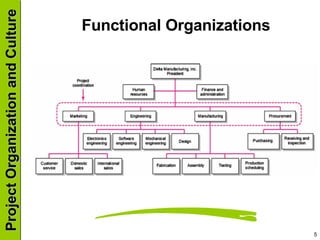
Functional Organizations
Functional Organization of Projects Advantages  – when has strong functional focus- No Structural Change: No radical change in design of parent organization; Flexibility: Specifically the use of staff, needed from all functions; In-Depth Expertise: Specifically if it has a strong functional focus; Easy Post-Project Transition: A very important consideration, specifically in expertise intensive projects, for example IT implementation
Functional Organization of Projects Disadvantages  – specifically for projects with broader, multifunctional scope- Lack of Focus: Takes focus of functional routine work; Could also take focus of project to do routine work; Different functions attach different priorities to a project; Poor Integration: Could have poor integration over functions, as functions care only for their own area and not whole project; Slow: Functional organization – silo. Project, cross functional; Lack of Ownership: Levels of commitment for a project differ, and is always considered in terms of contribution to own professional development.
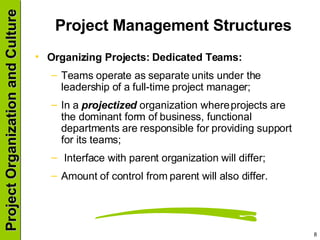
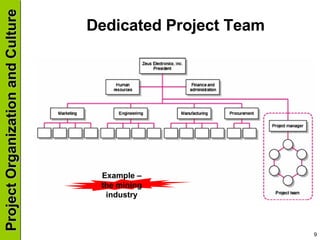
Project Management Structures  Organizing Projects: Dedicated Teams: Teams operate as separate units under the leadership of a full-time project manager; In a  projectized  organization where projects are the dominant form of business, functional departments are responsible for providing support for its teams; Interface with parent organization will differ; Amount of control from parent will also differ.
Dedicated Project Team Example – the mining industry
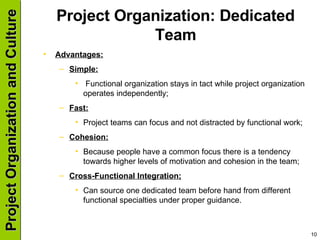
Project Organization: Dedicated Team Advantages: Simple: Functional organization stays in tact while project organization operates independently; Fast: Project teams can focus and not distracted by functional work; Cohesion: Because people have a common focus there is a tendency towards higher levels of motivation and cohesion in the team; Cross-Functional Integration; Can source one dedicated team before hand from different functional specialties under proper guidance.
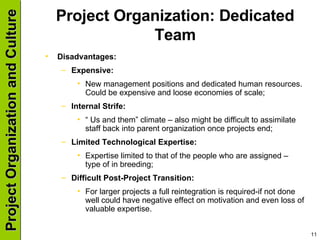
Project Organization: Dedicated Team Disadvantages: Expensive: New management positions and dedicated human resources. Could be expensive and loose economies of scale; Internal Strife: “  Us and them” climate – also might be difficult to assimilate staff back into parent organization once projects end; Limited Technological Expertise: Expertise limited to that of the people who are assigned – type of in breeding; Difficult Post-Project Transition: For larger projects a full reintegration is required-if not done well could have negative effect on motivation and even loss of valuable expertise.
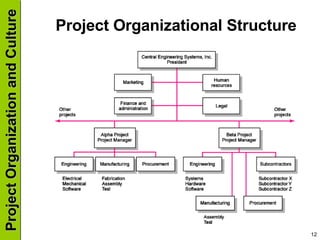
Project Organizational Structure
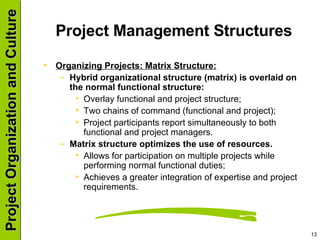
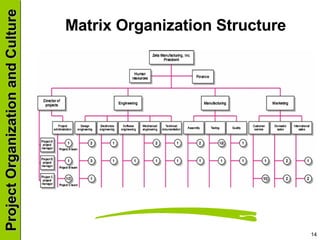
Project Management Structures  Organizing Projects: Matrix Structure: Hybrid organizational structure (matrix) is overlaid on the normal functional structure: Overlay functional and project structure; Two chains of command (functional and project); Project participants report simultaneously to both functional and project managers. Matrix structure optimizes the use of resources. Allows for participation on multiple projects while performing normal functional duties; Achieves a greater integration of expertise and project requirements.
Matrix Organization Structure
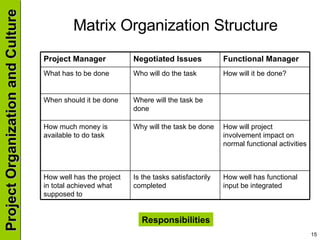
Matrix Organization Structure Responsibilities How well has functional input be integrated Is the tasks satisfactorily completed How well has the project in total achieved what supposed to How will project involvement impact on normal functional activities Why will the task be done How much money is available to do task Where will the task be done When should it be done How will it be done? Who will do the task What has to be done Functional Manager Negotiated Issues Project Manager
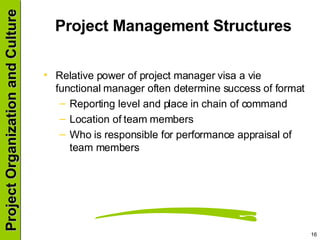
Project Management Structures  Relative power of project manager visa a vie functional manager often determine success of format Reporting level and place in chain of command Location of team members Who is responsible for performance appraisal of team members
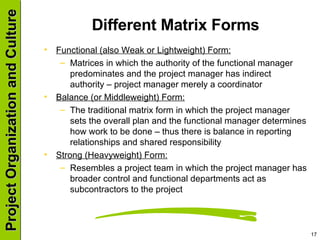
Different Matrix Forms Functional (also Weak or Lightweight) Form: Matrices in which the authority of the functional manager predominates and the project manager has indirect authority – project manager merely a coordinator Balance (or Middleweight) Form: The traditional matrix form in which the project manager sets the overall plan and the functional manager determines how work to be done – thus there is balance in reporting relationships and shared responsibility Strong (Heavyweight) Form: Resembles a project team in which the project manager has broader control and functional departments act as subcontractors to the project
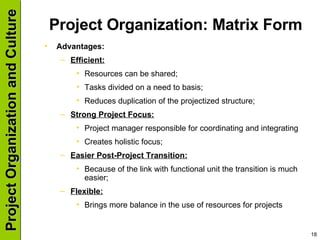
Project Organization: Matrix Form Advantages: Efficient: Resources can be shared; Tasks divided on a need to basis; Reduces duplication of the projectized structure; Strong Project Focus: Project manager responsible for coordinating and integrating Creates holistic focus; Easier Post-Project Transition: Because of the link with functional unit the transition is much easier; Flexible: Brings more balance in the use of resources for projects
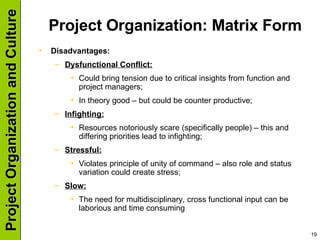
Project Organization: Matrix Form Disadvantages: Dysfunctional Conflict: Could bring tension due to critical insights from function and project managers; In theory good – but could be counter productive; Infighting: Resources notoriously scare (specifically people) – this and differing priorities lead to infighting; Stressful: Violates principle of unity of command – also role and status variation could create stress; Slow: The need for multidisciplinary, cross functional input can be laborious and time consuming
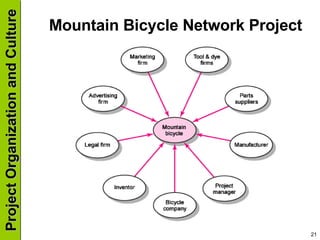
Project Management Structures  Organizing Projects: Network Organizations: Turn of the century - radical shift in organization formats; Network organization - an alliance of several organizations for the purpose of creating products or services; A “hub” or “core” firm with strong core competencies outsources key activities to a collaborative cluster of satellite organizations; Core competencies usually include marketing, intellectual capital rights and also research and development.
Mountain Bicycle Network Project
Project Organization: Network Form Advantages: Cost Reduction: Companies can secure competitive prices for contracted services; Overheads reduced as host company does not have to maintain the contracted services; High Level of Expertise: Does not have to keep abreast of technology advances; Can focus on core competence development; Flexible: Not constrained by their won resources and talent but can pursue wide range of projects; Globalization is also a viable option by working with foreign partners.
Project Organization: Network Form Disadvantages: Coordination of Breakdowns: Coordination of professionals from different organizations can be challenging especially if project work requires close collaboration and mutual adjustment; Well defined services level agreements are important – also deliverables; Loss of Control: Nature of the format is such that control is lost. Thus only control is in terms of the end product – need to build in safe guards; Conflict: Interpersonal conflict is there is not shared priorities, values and culture.
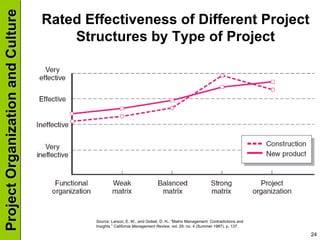
Rated Effectiveness of Different Project Structures by Type of Project Source:  Larson, E. W., and Gobeli, D. H., “Matrix Management: Contradictions and Insights,”  California Management Review,  vol. 29, no. 4 (Summer 1987), p. 137.
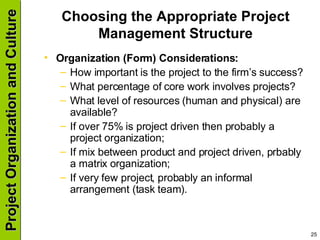
Choosing the Appropriate Project Management Structure Organization (Form) Considerations: How important is the project to the firm’s success? What percentage of core work involves projects? What level of resources (human and physical) are available? If over 75% is project driven then probably a project organization; If mix between product and project driven, prbably a matrix organization; If very few project, probably an informal arrangement (task team).
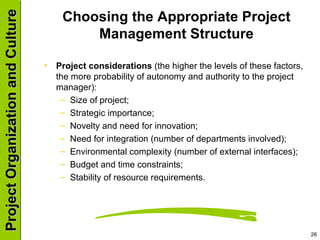
Choosing the Appropriate Project Management Structure Project considerations  (the higher the levels of these factors, the more probability of autonomy and authority to the project manager): Size of project; Strategic importance; Novelty and need for innovation; Need for integration (number of departments involved); Environmental complexity (number of external interfaces); Budget and time constraints; Stability of resource requirements.
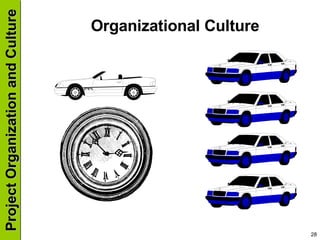
Organizational Culture Organizational Culture Defined: A system of shared norms, beliefs, values, and assumptions which bind people together, thereby creating  shared meanings ; The “personality” of the organization that sets it apart from other organizations: Provides a sense of identify to its members; Helps legitimize the management system of the organization; Clarifies and reinforces standards of behavior; The way we do things here…
Organizational Culture ?
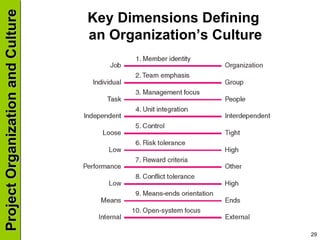
Key Dimensions Defining  an Organization’s Culture
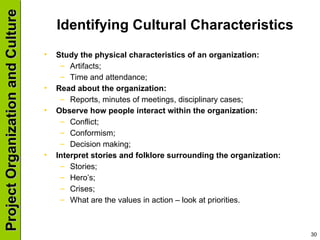
Identifying Cultural Characteristics Study the physical characteristics of an organization: Artifacts; Time and attendance; Read about the organization: Reports, minutes of meetings, disciplinary cases; Observe how people interact within the organization: Conflict; Conformism; Decision making; Interpret stories and folklore surrounding the organization: Stories; Hero’s; Crises; What are the values in action – look at priorities.
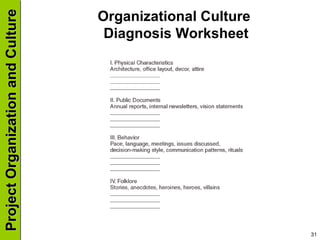
Organizational Culture  Diagnosis Worksheet
Implications of Organizational Culture  for Organizing Projects Challenges for Project Managers in Navigating Organizational Cultures: Interacting with the culture and subcultures of the parent organization; Interacting with the project’s clients or customer organizations; Interacting with other organizations connected to the project; The culture is the river and the project is the boat.
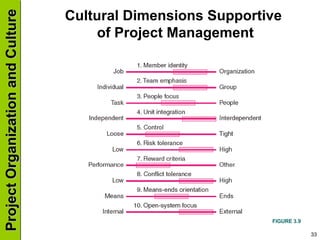
Cultural Dimensions Supportive  of Project Management FIGURE 3.9
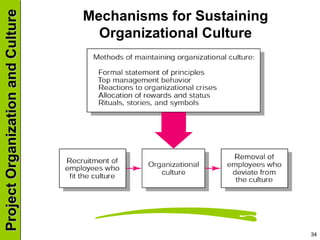
Mechanisms for Sustaining Organizational Culture
 

Pm Session 9

  • 1.
    Project Management Session9 Project Organization, Structure and Culture
  • 2.
    Introduction When projectis approved, the question is, how will it be implemented Need to consider the project management structures that optimize project delivery and fit with classical functional structure That is however not the only consideration with implementation – the organization culture is another very important factor Culture – “the way we do it here”
  • 3.
    Project Management StructuresChallenges to Organizing Projects: A good system balances the needs of the parent organization and the project; This is essentially achieved by defining the interface in terms of authority, allocation of resources and eventual integration of the project outcomes with the parent organization; Project – based on breakdown of tasks and delivery in according to defined timeline; Function breakdown of tasks in simplified repetitive work; Projects are multidisciplinary and require coordination across disciplines; Function, based on clustering (silos).
  • 4.
    Project Management StructuresOrganizing Projects: Functional Organization: Different segments of the project are delegated to respective functional units; Coordination is maintained through normal management channels; Used when the interest of one functional area dominates the project or one functional area has a dominant interest in the project’s success.
  • 5.
  • 6.
    Functional Organization ofProjects Advantages – when has strong functional focus- No Structural Change: No radical change in design of parent organization; Flexibility: Specifically the use of staff, needed from all functions; In-Depth Expertise: Specifically if it has a strong functional focus; Easy Post-Project Transition: A very important consideration, specifically in expertise intensive projects, for example IT implementation
  • 7.
    Functional Organization ofProjects Disadvantages – specifically for projects with broader, multifunctional scope- Lack of Focus: Takes focus of functional routine work; Could also take focus of project to do routine work; Different functions attach different priorities to a project; Poor Integration: Could have poor integration over functions, as functions care only for their own area and not whole project; Slow: Functional organization – silo. Project, cross functional; Lack of Ownership: Levels of commitment for a project differ, and is always considered in terms of contribution to own professional development.
  • 8.
    Project Management Structures Organizing Projects: Dedicated Teams: Teams operate as separate units under the leadership of a full-time project manager; In a projectized organization where projects are the dominant form of business, functional departments are responsible for providing support for its teams; Interface with parent organization will differ; Amount of control from parent will also differ.
  • 9.
    Dedicated Project TeamExample – the mining industry
  • 10.
    Project Organization: DedicatedTeam Advantages: Simple: Functional organization stays in tact while project organization operates independently; Fast: Project teams can focus and not distracted by functional work; Cohesion: Because people have a common focus there is a tendency towards higher levels of motivation and cohesion in the team; Cross-Functional Integration; Can source one dedicated team before hand from different functional specialties under proper guidance.
  • 11.
    Project Organization: DedicatedTeam Disadvantages: Expensive: New management positions and dedicated human resources. Could be expensive and loose economies of scale; Internal Strife: “ Us and them” climate – also might be difficult to assimilate staff back into parent organization once projects end; Limited Technological Expertise: Expertise limited to that of the people who are assigned – type of in breeding; Difficult Post-Project Transition: For larger projects a full reintegration is required-if not done well could have negative effect on motivation and even loss of valuable expertise.
  • 12.
  • 13.
    Project Management Structures Organizing Projects: Matrix Structure: Hybrid organizational structure (matrix) is overlaid on the normal functional structure: Overlay functional and project structure; Two chains of command (functional and project); Project participants report simultaneously to both functional and project managers. Matrix structure optimizes the use of resources. Allows for participation on multiple projects while performing normal functional duties; Achieves a greater integration of expertise and project requirements.
  • 14.
  • 15.
    Matrix Organization StructureResponsibilities How well has functional input be integrated Is the tasks satisfactorily completed How well has the project in total achieved what supposed to How will project involvement impact on normal functional activities Why will the task be done How much money is available to do task Where will the task be done When should it be done How will it be done? Who will do the task What has to be done Functional Manager Negotiated Issues Project Manager
  • 16.
    Project Management Structures Relative power of project manager visa a vie functional manager often determine success of format Reporting level and place in chain of command Location of team members Who is responsible for performance appraisal of team members
  • 17.
    Different Matrix FormsFunctional (also Weak or Lightweight) Form: Matrices in which the authority of the functional manager predominates and the project manager has indirect authority – project manager merely a coordinator Balance (or Middleweight) Form: The traditional matrix form in which the project manager sets the overall plan and the functional manager determines how work to be done – thus there is balance in reporting relationships and shared responsibility Strong (Heavyweight) Form: Resembles a project team in which the project manager has broader control and functional departments act as subcontractors to the project
  • 18.
    Project Organization: MatrixForm Advantages: Efficient: Resources can be shared; Tasks divided on a need to basis; Reduces duplication of the projectized structure; Strong Project Focus: Project manager responsible for coordinating and integrating Creates holistic focus; Easier Post-Project Transition: Because of the link with functional unit the transition is much easier; Flexible: Brings more balance in the use of resources for projects
  • 19.
    Project Organization: MatrixForm Disadvantages: Dysfunctional Conflict: Could bring tension due to critical insights from function and project managers; In theory good – but could be counter productive; Infighting: Resources notoriously scare (specifically people) – this and differing priorities lead to infighting; Stressful: Violates principle of unity of command – also role and status variation could create stress; Slow: The need for multidisciplinary, cross functional input can be laborious and time consuming
  • 20.
    Project Management Structures Organizing Projects: Network Organizations: Turn of the century - radical shift in organization formats; Network organization - an alliance of several organizations for the purpose of creating products or services; A “hub” or “core” firm with strong core competencies outsources key activities to a collaborative cluster of satellite organizations; Core competencies usually include marketing, intellectual capital rights and also research and development.
  • 21.
  • 22.
    Project Organization: NetworkForm Advantages: Cost Reduction: Companies can secure competitive prices for contracted services; Overheads reduced as host company does not have to maintain the contracted services; High Level of Expertise: Does not have to keep abreast of technology advances; Can focus on core competence development; Flexible: Not constrained by their won resources and talent but can pursue wide range of projects; Globalization is also a viable option by working with foreign partners.
  • 23.
    Project Organization: NetworkForm Disadvantages: Coordination of Breakdowns: Coordination of professionals from different organizations can be challenging especially if project work requires close collaboration and mutual adjustment; Well defined services level agreements are important – also deliverables; Loss of Control: Nature of the format is such that control is lost. Thus only control is in terms of the end product – need to build in safe guards; Conflict: Interpersonal conflict is there is not shared priorities, values and culture.
  • 24.
    Rated Effectiveness ofDifferent Project Structures by Type of Project Source: Larson, E. W., and Gobeli, D. H., “Matrix Management: Contradictions and Insights,” California Management Review, vol. 29, no. 4 (Summer 1987), p. 137.
  • 25.
    Choosing the AppropriateProject Management Structure Organization (Form) Considerations: How important is the project to the firm’s success? What percentage of core work involves projects? What level of resources (human and physical) are available? If over 75% is project driven then probably a project organization; If mix between product and project driven, prbably a matrix organization; If very few project, probably an informal arrangement (task team).
  • 26.
    Choosing the AppropriateProject Management Structure Project considerations (the higher the levels of these factors, the more probability of autonomy and authority to the project manager): Size of project; Strategic importance; Novelty and need for innovation; Need for integration (number of departments involved); Environmental complexity (number of external interfaces); Budget and time constraints; Stability of resource requirements.
  • 27.
    Organizational Culture OrganizationalCulture Defined: A system of shared norms, beliefs, values, and assumptions which bind people together, thereby creating shared meanings ; The “personality” of the organization that sets it apart from other organizations: Provides a sense of identify to its members; Helps legitimize the management system of the organization; Clarifies and reinforces standards of behavior; The way we do things here…
  • 28.
  • 29.
    Key Dimensions Defining an Organization’s Culture
  • 30.
    Identifying Cultural CharacteristicsStudy the physical characteristics of an organization: Artifacts; Time and attendance; Read about the organization: Reports, minutes of meetings, disciplinary cases; Observe how people interact within the organization: Conflict; Conformism; Decision making; Interpret stories and folklore surrounding the organization: Stories; Hero’s; Crises; What are the values in action – look at priorities.
  • 31.
    Organizational Culture Diagnosis Worksheet
  • 32.
    Implications of OrganizationalCulture for Organizing Projects Challenges for Project Managers in Navigating Organizational Cultures: Interacting with the culture and subcultures of the parent organization; Interacting with the project’s clients or customer organizations; Interacting with other organizations connected to the project; The culture is the river and the project is the boat.
  • 33.
    Cultural Dimensions Supportive of Project Management FIGURE 3.9
  • 34.
    Mechanisms for SustainingOrganizational Culture
  • 35.