Download to read offline
![Byte Code: To solve the security and portability problem is that output of java compiler is
not executable code but a byte code.
Byte code is a highly optimized set of instruction designed to be executed by the java run time
system (JRE) which is called JVM
A simple Java Program: to print a string “welcome to java”
Class Welcome
{
Public static void main (String arr[])
{
System.out.println (“Welcomes to Java”);
}}
Explanation:
a) The word class means we declared a new class with name Welcome
b) All the class members declared in opening and closing braces ({………..}.
c) All java applications begin their execution from main().
d) Main () is declared public because it is accessed outside the class by JVM.
e) Static allow main() to be accessed without declaring any object of class by JVM.
f) Keyword void() simply tells the compiler that main() does not return a value.
g) String store character string in arr[] if input is received by command line argument during
execution time.
h) System is predefined class that provides access to systemand out is output stream that is
connected to console (I/O).
The main feature (advantages of Java) of Java:
a. Simple: if you have experience with C/C++ language then programming in java is not a
difficult task
b. Object oriented language: java is purely object oriented language so developing the large
java applications is easy, easy for reusability as well to debug the program.
c. Robust: a language is robust if it executes and gives the same result of program on different
platform in different environment. and run error free after compiling and running at once
.what you written in code and what you expect the result is same on different hardware and
O/S.](https://image.slidesharecdn.com/lecture19-220203072058/85/Lecture19-07-2014-1-320.jpg)
![Byte Code: To solve the security and portability problem is that output of java compiler is
not executable code but a byte code.
Byte code is a highly optimized set of instruction designed to be executed by the java run time
system (JRE) which is called JVM
A simple Java Program: to print a string “welcome to java”
Class Welcome
{
Public static void main (String arr[])
{
System.out.println (“Welcomes to Java”);
}}
Explanation:
a) The word class means we declared a new class with name Welcome
b) All the class members declared in opening and closing braces ({………..}.
c) All java applications begin their execution from main().
d) Main () is declared public because it is accessed outside the class by JVM.
e) Static allow main() to be accessed without declaring any object of class by JVM.
f) Keyword void() simply tells the compiler that main() does not return a value.
g) String store character string in arr[] if input is received by command line argument during
execution time.
h) System is predefined class that provides access to systemand out is output stream that is
connected to console (I/O).
The main feature (advantages of Java) of Java:
a. Simple: if you have experience with C/C++ language then programming in java is not a
difficult task
b. Object oriented language: java is purely object oriented language so developing the large
java applications is easy, easy for reusability as well to debug the program.
c. Robust: a language is robust if it executes and gives the same result of program on different
platform in different environment. and run error free after compiling and running at once
.what you written in code and what you expect the result is same on different hardware and
O/S.](https://image.slidesharecdn.com/lecture19-220203072058/75/Lecture19-07-2014-1-2048.jpg)
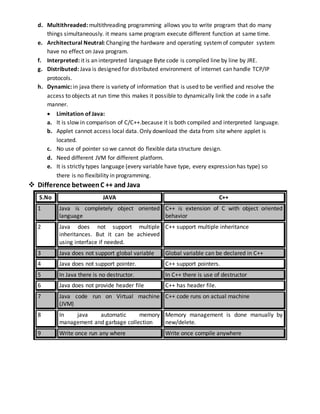

Byte code is the output of the Java compiler and is designed to be executed by the Java Virtual Machine (JVM). A simple Java program prints "Welcome to Java" by using classes, methods, and calling System.out.println from the main method. The main advantages of Java are that it is simple, object-oriented, robust, multithreaded, architecture neutral, interpreted, distributed, and dynamic. Some limitations are that it is slower than C/C++, applets cannot access local data, and it lacks pointers and flexibility compared to C++. Java differs from C++ in its support for interfaces over multiple inheritance, lack of pointers and global variables, automatic memory management, and portability.


