Introduction
We have moved from a knowledge based economy to a knowledge driven economy;
competition, intensity, and the global reach of firms brought about by advancements
in communication technology and supply chains, cost reduction, time to market,
customer satisfaction, and innovation are becoming the differentiating factors
between organisations. Innovation is not about being innovative but about adding
value through clear strategic objectives. In order to sole a problem you need to under
the need that is not being met by the the service or product, the desire to keep up with
the latest innovations will only be beneficial if it adds to the value of the business as a
whole. IT as well as well as improving staff productivity has led reduced the barriers
to entry inn many markets and industries that in turn mean intensification in
competition.
NB * within the project letters and numbers are used to identify capability building
blocks within the macro process i.e. IM A1 – vision.
Innovation
“Innovation is the application of practical tools and techniques that make changes,
large and small, to products, processes, and services that results in the introduction
of something new for the organisation that adds value to customers and contributes to
the knowledge store of the organisation.”
O’Sullivan and Dooley (2009).
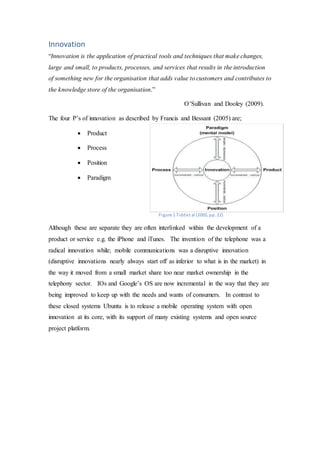
The four P’s of innovation as described by Francis and Bessant (2005) are;
 Product
 Process
 Position
 Paradigm
Although these are separate they are often interlinked within the development of a
product or service e.g. the iPhone and iTunes. The invention of the telephone was a
radical innovation while; mobile communications was a disruptive innovation
(disruptive innovations nearly always start off as inferior to what is in the market) in
the way it moved from a small market share too near market ownership in the
telephony sector. IOs and Google’s OS are now incremental in the way that they are
being improved to keep up with the needs and wants of consumers. In contrast to
these closed systems Ubuntu is to release a mobile operating system with open
innovation at its core, with its support of many existing systems and open source
project platform.
Figure 1 Tiddet al (2005, pp. 22)
Product Innovation
Product innovation refers to changes to a product or service that an organisation offers
to an end user. These occur in the mobile market place as incremental improvements
e.g. iPhone 4 versus the 4s; the product or service is improved to meet the needs and
expectations of customers. The same can be said of the Samsung Galaxy Note where
there was a perceived gap in the market between the phone and the tablet in the
market. Given the proliferation of individual devices running on different operating
systems and devices enterprise mobility is an issue. Here the issue of BYOD (bring
you own device) comes into play, using their own devices staffs are relying on them
for a range of enterprise tasks as well, from critical to basic operations.
“Transformative benefit of BYOD is employee-driven innovation — by allowing
employees to decide how, when, and with which tools work is done, companies can
unlock the next wave of value”
Bradley et al (2012).
The BYOD movement is quite new but the ability of the user to use a device of their
choosing (allowing for security concerns) gives the organisation scope to capitalize on
users outside of the working environment i.e. telecommuting and the cost advantage
in user support initiatives.
Process Innovation
This is a change to the way a product or service is delivered and or created. These
processes add value across the network and yield better returns for the company in the
long run. These processes reduce waste, time and increase returns on investment
across the product cycle. Dell used process innovation to gain competitive advantage
in the PC and laptop market by disintermediation, by elimination of the point of
physical contact with the product i.e. retailers, it moved the decoupling point into the
manufacturing facility which made postponement possible in the process. Dell
through the use of Lean processes, ERP, Six Sigma were able to deliver products built
to customer requirement cheaper and faster to their customers. By integrating supply
chains horizontally and vertically throughout the process and through the use of JIT
(just in time) inventory management, storage costs and inventory costs were reduced.
By using JIT the issue of redundant stock is not seen as stock is ordered on an as
needed basis, this level of optimization gave Dell a very flexible and agile supply
chain
Positioning Innovation
“Are changes in the context in which products/services are introduced” Tidd and
Bessant (2009, pp. 21).
Apple have transformed from a company that produced personal computers to that of
a company more in line with the multimedia and entertainment industry. The
development of the iPod a platform business model too a multi sided one with iTunes
saw the introduction of a new ecosystem for the mass music market. Upon this
platform and incorporating the app store into iTunes (along with iTunes U, podcasts
books and movies). Apple saw an unarticulated consumer need and designed the
ecosystem to address the problem yet as a percentage of revenue Apple spend only
3.1 percent on research and development Jaruzelski and Dehoff (2010, pp. 12).
IBM’s transition from a hardware company to a solutions deliverer was a positioning
innovation but also more so a business model innovation.
Paradigm Innovation
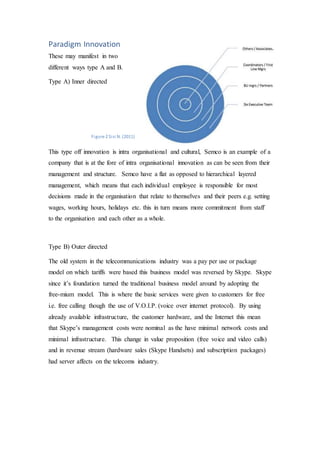
These may manifest in two
different ways type A and B.
Type A) Inner directed
This type off innovation is intra organisational and cultural, Semco is an example of a
company that is at the fore of intra organisational innovation as can be seen from their
management and structure. Semco have a flat as opposed to hierarchical layered
management, which means that each individual employee is responsible for most
decisions made in the organisation that relate to themselves and their peers e.g. setting
wages, working hours, holidays etc. this in turn means more commitment from staff
to the organisation and each other as a whole.
Type B) Outer directed
The old system in the telecommunications industry was a pay per use or package
model on which tariffs were based this business model was reversed by Skype. Skype
since it’s foundation turned the traditional business model around by adopting the
free-mium model. This is where the basic services were given to customers for free
i.e. free calling though the use of V.O.I.P. (voice over internet protocol). By using
already available infrastructure, the customer hardware, and the Internet this mean
that Skype’s management costs were nominal as the have minimal network costs and
minimal infrastructure. This change in value proposition (free voice and video calls)
and in revenue stream (hardware sales (Skype Handsets) and subscription packages)
had server affects on the telecoms industry.
Figure 2 Sisi N. (2011)
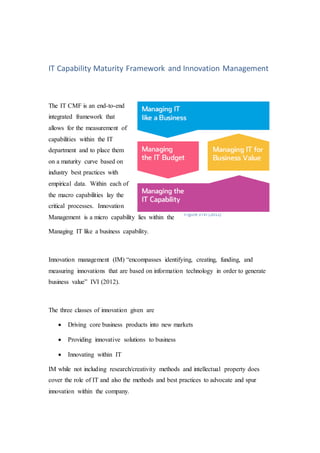
Figure 3 IVI (2012)
IT Capability Maturity Framework and Innovation Management
The IT CMF is an end-to-end
integrated framework that
allows for the measurement of
capabilities within the IT
department and to place them
on a maturity curve based on
industry best practices with
empirical data. Within each of
the macro capabilities lay the
critical processes. Innovation
Management is a micro capability lies within the
Managing IT like a business capability.
Innovation management (IM) “encompasses identifying, creating, funding, and
measuring innovations that are based on information technology in order to generate
business value” IVI (2012).
The three classes of innovation given are
 Driving core business products into new markets
 Providing innovative solutions to business
 Innovating within IT
IM while not including research/creativity methods and intellectual property does
cover the role of IT and also the methods and best practices to advocate and spur
innovation within the company.
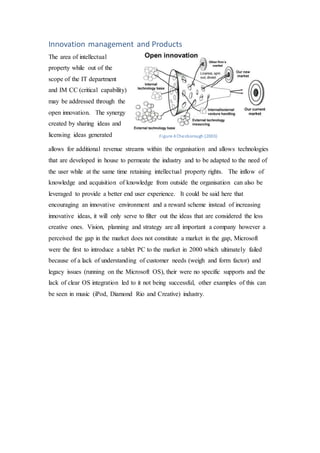
Innovation management and Products
The area of intellectual
property while out of the
scope of the IT department
and IM CC (critical capability)
may be addressed through the
open innovation. The synergy
created by sharing ideas and
licensing ideas generated
allows for additional revenue streams within the organisation and allows technologies
that are developed in house to permeate the industry and to be adapted to the need of
the user while at the same time retaining intellectual property rights. The inflow of
knowledge and acquisition of knowledge from outside the organisation can also be
leveraged to provide a better end user experience. It could be said here that
encouraging an innovative environment and a reward scheme instead of increasing
innovative ideas, it will only serve to filter out the ideas that are considered the less
creative ones. Vision, planning and strategy are all important a company however a
perceived the gap in the market does not constitute a market in the gap, Microsoft
were the first to introduce a tablet PC to the market in 2000 which ultimately failed
because of a lack of understanding of customer needs (weigh and form factor) and
legacy issues (running on the Microsoft OS), their were no specific supports and the
lack of clear OS integration led to it not being successful, other examples of this can
be seen in music (iPod, Diamond Rio and Creative) industry.
Figure 4 Chesborough (2003)
Innovation Management and Process
Process is the most clearly addressed innovation capability within the framework, as
the IM CC processes, tool, and metrics are tangible and can demonstrate a return on
investment in the near term. Key performance indicators (KPI’s) may be put in place
to measure any process innovations introduced by the company. Lean, Six Sigma,
TQM, ERP, and JIT are all capable of being quantified within the supply chain and in
the organisation as a whole. In many cases organisations are IT systems dependent
i.e. inventory control and waste reduction, and due to current economic conditions
programs to innovate have to compete for resources within the budget.
With the internet the possibility to involve the users in the research and development
process has been made much easier, lead user development and solutions delivery are
a much more fluid process which can happen in real time. IT departments can
develop tool to help streamline tools to improve the innovation process itself,
Unilever have done this through the Inoplan service which gathers and collates
information which allows for collaboration (IM B3), coordination and the sharing of
innovation initiatives throughout the organisation and beyond challenging the
traditional boundary of communication, 176 companies are using it and 1450 brands
Rumyantseva et al (2007). Portfolio management (IM A4) is the building of
continuous alternatives and taking high quality risks and implementing them quickly,
where feasible to maximize return on investment. This is very much a people and
process issue and having both aligned with the business strategy, through IM CC this
can be achieved through frameworks and tools.
Innovation Management and Position
Amazon, IBM, and Google have all transitioned from their core market entry into
other products and services; they have done this successfully due to their
competencies and those that were developed during their business processes. This
change in market stance and positioning came about due to the foresight of
management and staff in these industries. HTC transitioned from a device
manufacturer (for Orange T-Mobile etc.) to becoming a device company, by working
in house on the components and devices (HTC Touch) they were manufacturing and
then capitalized on collaboration (IM B3) and capability development (IM B4) to
transition into a brand name.
HTC’s manufacturing ability and the skills it had built up in its work force framed the
decision; this transition was achieved through strategic planning (IM A1, A2) and the
people and culture (IM B1 – B5) within the organisation. By creating a culture of
choice and pursuing a portfolio of balanced innovations i.e. radical and incremental
you can make savings and changes through a cumulative effect as well as coming up
with ideas which can alter the course of the organisation. Flickr started off as an
online gaming site with a photo sharing capacity, through the leveraging of existing
technologies at its disposal Flickr transformed itself into an on line photo sharing site
through an organic process.
Innovation Management and Paradigm
Inner directed innovation looks at the organisation and its people and leadership; in a
knowledge-based economy this means that people are a firms most valuable asset.
The key components of an innovative organisation are
 Shared vision and leadership (IM A1/B1)
 Structure (IM C2)
 Key individuals (IM B4/B5)
 Organisation wide participation (IM C4)
 Positive approach to innovation and support (IM B5/B6)
Tidd and Bessant (2009)
These components need to work in tandem with each other to establish an innovative
environment in which to work, the IM critical capability does give varying degrees of
support to an environment that supports them however it gives a way to manage
measure and sustain it within the organisation. This mean that using the IM CC an
organisation which wish to be innovative but which lacks the vision and leadership
will not be in a position to capitalize on this, as it is a management led process i.e.
CEO and CIO. When you train employees to be risk averse then you are letting the
organisation become reward challenged. Commitment to the ethos may also have a
damaging effect as with Lou Gerstner and IBM, while Gerstner was the CEO of the
oganisation at the time it was an initiative by Dave Grossman that took IBM on its
course to being a leader in e-business (bottom up innovation). It also does not address
the issue of core competencies, which can become core rigidities, Nokia saw their
handsets as their core strength and within a few years it’s European and North
American markets were cannibalized by the smartphone. While a company may want
to divest its interests the approach of a new technology or service may disrupt the
business model i.e. purchasing of music moved from bricks to clicks within a few
years.
Conclusion
The truth seems to me that it neither does nor does not address any of them, but gives
varying degrees of support to an environment that supports each of them, innovation
management has no particular interest in the type of an innovation, but wants to
manage, measure, and sustain the value of it. The IT CMF tells an organisation how
to put the framework into action through the use of tools, standard processes, and
documents and lets the organisation benchmark itself against the best practices in the
industry, which may themselves be near obsolesce, case in point is the large market
failure to see the emergence of the touchscreen smartphone. It can lead to cost
reduction in the through innovation in IT which can then funneled back into the
innovation process itself.
References
Bradley, J. Louckos, J. Macaulay, J. Medcalf. R. Buckalew, L. (2012): “BYOD: A
Global Perspective Harnessing Employee-Led Innovation” [online], Available from:
http://www.cisco.com/web/about/ac79/docs/re/BYOD_Horizons-Global.pdf
[Accessed: 19.1.2013].
Chesbrough, H. (2003) “The Era of Open Innovation”, Sloan Management Review,
Volume 44, Issue 3, pp. 35-41.
IVI (2012), Innovation Management (IM) [online], Available from:
http://ivi.nuim.ie/it-cmf/innovation-management [Accessed: 17.1.2013]
Jaruzelski, B. Dehoff, J. (2010): "How the Top Innovators Keep Winning", Strategy &
Business, Issue 61, Volume 12.
Rumyantseva, M. Enkel, E. Pos, A. 2007, “Knowledge Networks for Business
Growth”, [online], pp. 77 - 97, Available from:
http://link.springer.com/chapter/10.1007/978-3-540-33073-8_4 [Accessed:
14.1.2013].
Sisi, N. (2011): “Conflictingly criticizing in in the 21 century two companies Semco &
GE” [online], Managing People, Available from:
http://www.academia.edu/1470690/MANAGING_PEOPLE [Accessed: 04.1.2013]
Tidd, J. Bessant, J. (2009): “Managing Innovation, Integrating Technological, Market,
and Organizational Change”. 4th Edition, John Wiley & Sons Ltd., Chichester.

IT Agility&Innovation

  • 1.
    Introduction We have movedfrom a knowledge based economy to a knowledge driven economy; competition, intensity, and the global reach of firms brought about by advancements in communication technology and supply chains, cost reduction, time to market, customer satisfaction, and innovation are becoming the differentiating factors between organisations. Innovation is not about being innovative but about adding value through clear strategic objectives. In order to sole a problem you need to under the need that is not being met by the the service or product, the desire to keep up with the latest innovations will only be beneficial if it adds to the value of the business as a whole. IT as well as well as improving staff productivity has led reduced the barriers to entry inn many markets and industries that in turn mean intensification in competition. NB * within the project letters and numbers are used to identify capability building blocks within the macro process i.e. IM A1 – vision.
  • 2.
    Innovation “Innovation is theapplication of practical tools and techniques that make changes, large and small, to products, processes, and services that results in the introduction of something new for the organisation that adds value to customers and contributes to the knowledge store of the organisation.” O’Sullivan and Dooley (2009). The four P’s of innovation as described by Francis and Bessant (2005) are;  Product  Process  Position  Paradigm Although these are separate they are often interlinked within the development of a product or service e.g. the iPhone and iTunes. The invention of the telephone was a radical innovation while; mobile communications was a disruptive innovation (disruptive innovations nearly always start off as inferior to what is in the market) in the way it moved from a small market share too near market ownership in the telephony sector. IOs and Google’s OS are now incremental in the way that they are being improved to keep up with the needs and wants of consumers. In contrast to these closed systems Ubuntu is to release a mobile operating system with open innovation at its core, with its support of many existing systems and open source project platform. Figure 1 Tiddet al (2005, pp. 22)
  • 3.
    Product Innovation Product innovationrefers to changes to a product or service that an organisation offers to an end user. These occur in the mobile market place as incremental improvements e.g. iPhone 4 versus the 4s; the product or service is improved to meet the needs and expectations of customers. The same can be said of the Samsung Galaxy Note where there was a perceived gap in the market between the phone and the tablet in the market. Given the proliferation of individual devices running on different operating systems and devices enterprise mobility is an issue. Here the issue of BYOD (bring you own device) comes into play, using their own devices staffs are relying on them for a range of enterprise tasks as well, from critical to basic operations. “Transformative benefit of BYOD is employee-driven innovation — by allowing employees to decide how, when, and with which tools work is done, companies can unlock the next wave of value” Bradley et al (2012). The BYOD movement is quite new but the ability of the user to use a device of their choosing (allowing for security concerns) gives the organisation scope to capitalize on users outside of the working environment i.e. telecommuting and the cost advantage in user support initiatives.
  • 4.
    Process Innovation This isa change to the way a product or service is delivered and or created. These processes add value across the network and yield better returns for the company in the long run. These processes reduce waste, time and increase returns on investment across the product cycle. Dell used process innovation to gain competitive advantage in the PC and laptop market by disintermediation, by elimination of the point of physical contact with the product i.e. retailers, it moved the decoupling point into the manufacturing facility which made postponement possible in the process. Dell through the use of Lean processes, ERP, Six Sigma were able to deliver products built to customer requirement cheaper and faster to their customers. By integrating supply chains horizontally and vertically throughout the process and through the use of JIT (just in time) inventory management, storage costs and inventory costs were reduced. By using JIT the issue of redundant stock is not seen as stock is ordered on an as needed basis, this level of optimization gave Dell a very flexible and agile supply chain Positioning Innovation “Are changes in the context in which products/services are introduced” Tidd and Bessant (2009, pp. 21). Apple have transformed from a company that produced personal computers to that of a company more in line with the multimedia and entertainment industry. The development of the iPod a platform business model too a multi sided one with iTunes saw the introduction of a new ecosystem for the mass music market. Upon this platform and incorporating the app store into iTunes (along with iTunes U, podcasts books and movies). Apple saw an unarticulated consumer need and designed the ecosystem to address the problem yet as a percentage of revenue Apple spend only 3.1 percent on research and development Jaruzelski and Dehoff (2010, pp. 12). IBM’s transition from a hardware company to a solutions deliverer was a positioning innovation but also more so a business model innovation.
  • 5.
    Paradigm Innovation These maymanifest in two different ways type A and B. Type A) Inner directed This type off innovation is intra organisational and cultural, Semco is an example of a company that is at the fore of intra organisational innovation as can be seen from their management and structure. Semco have a flat as opposed to hierarchical layered management, which means that each individual employee is responsible for most decisions made in the organisation that relate to themselves and their peers e.g. setting wages, working hours, holidays etc. this in turn means more commitment from staff to the organisation and each other as a whole. Type B) Outer directed The old system in the telecommunications industry was a pay per use or package model on which tariffs were based this business model was reversed by Skype. Skype since it’s foundation turned the traditional business model around by adopting the free-mium model. This is where the basic services were given to customers for free i.e. free calling though the use of V.O.I.P. (voice over internet protocol). By using already available infrastructure, the customer hardware, and the Internet this mean that Skype’s management costs were nominal as the have minimal network costs and minimal infrastructure. This change in value proposition (free voice and video calls) and in revenue stream (hardware sales (Skype Handsets) and subscription packages) had server affects on the telecoms industry. Figure 2 Sisi N. (2011)
  • 6.
    Figure 3 IVI(2012) IT Capability Maturity Framework and Innovation Management The IT CMF is an end-to-end integrated framework that allows for the measurement of capabilities within the IT department and to place them on a maturity curve based on industry best practices with empirical data. Within each of the macro capabilities lay the critical processes. Innovation Management is a micro capability lies within the Managing IT like a business capability. Innovation management (IM) “encompasses identifying, creating, funding, and measuring innovations that are based on information technology in order to generate business value” IVI (2012). The three classes of innovation given are  Driving core business products into new markets  Providing innovative solutions to business  Innovating within IT IM while not including research/creativity methods and intellectual property does cover the role of IT and also the methods and best practices to advocate and spur innovation within the company.
  • 7.
    Innovation management andProducts The area of intellectual property while out of the scope of the IT department and IM CC (critical capability) may be addressed through the open innovation. The synergy created by sharing ideas and licensing ideas generated allows for additional revenue streams within the organisation and allows technologies that are developed in house to permeate the industry and to be adapted to the need of the user while at the same time retaining intellectual property rights. The inflow of knowledge and acquisition of knowledge from outside the organisation can also be leveraged to provide a better end user experience. It could be said here that encouraging an innovative environment and a reward scheme instead of increasing innovative ideas, it will only serve to filter out the ideas that are considered the less creative ones. Vision, planning and strategy are all important a company however a perceived the gap in the market does not constitute a market in the gap, Microsoft were the first to introduce a tablet PC to the market in 2000 which ultimately failed because of a lack of understanding of customer needs (weigh and form factor) and legacy issues (running on the Microsoft OS), their were no specific supports and the lack of clear OS integration led to it not being successful, other examples of this can be seen in music (iPod, Diamond Rio and Creative) industry. Figure 4 Chesborough (2003)
  • 8.
    Innovation Management andProcess Process is the most clearly addressed innovation capability within the framework, as the IM CC processes, tool, and metrics are tangible and can demonstrate a return on investment in the near term. Key performance indicators (KPI’s) may be put in place to measure any process innovations introduced by the company. Lean, Six Sigma, TQM, ERP, and JIT are all capable of being quantified within the supply chain and in the organisation as a whole. In many cases organisations are IT systems dependent i.e. inventory control and waste reduction, and due to current economic conditions programs to innovate have to compete for resources within the budget. With the internet the possibility to involve the users in the research and development process has been made much easier, lead user development and solutions delivery are a much more fluid process which can happen in real time. IT departments can develop tool to help streamline tools to improve the innovation process itself, Unilever have done this through the Inoplan service which gathers and collates information which allows for collaboration (IM B3), coordination and the sharing of innovation initiatives throughout the organisation and beyond challenging the traditional boundary of communication, 176 companies are using it and 1450 brands Rumyantseva et al (2007). Portfolio management (IM A4) is the building of continuous alternatives and taking high quality risks and implementing them quickly, where feasible to maximize return on investment. This is very much a people and process issue and having both aligned with the business strategy, through IM CC this can be achieved through frameworks and tools.
  • 9.
    Innovation Management andPosition Amazon, IBM, and Google have all transitioned from their core market entry into other products and services; they have done this successfully due to their competencies and those that were developed during their business processes. This change in market stance and positioning came about due to the foresight of management and staff in these industries. HTC transitioned from a device manufacturer (for Orange T-Mobile etc.) to becoming a device company, by working in house on the components and devices (HTC Touch) they were manufacturing and then capitalized on collaboration (IM B3) and capability development (IM B4) to transition into a brand name. HTC’s manufacturing ability and the skills it had built up in its work force framed the decision; this transition was achieved through strategic planning (IM A1, A2) and the people and culture (IM B1 – B5) within the organisation. By creating a culture of choice and pursuing a portfolio of balanced innovations i.e. radical and incremental you can make savings and changes through a cumulative effect as well as coming up with ideas which can alter the course of the organisation. Flickr started off as an online gaming site with a photo sharing capacity, through the leveraging of existing technologies at its disposal Flickr transformed itself into an on line photo sharing site through an organic process.
  • 10.
    Innovation Management andParadigm Inner directed innovation looks at the organisation and its people and leadership; in a knowledge-based economy this means that people are a firms most valuable asset. The key components of an innovative organisation are  Shared vision and leadership (IM A1/B1)  Structure (IM C2)  Key individuals (IM B4/B5)  Organisation wide participation (IM C4)  Positive approach to innovation and support (IM B5/B6) Tidd and Bessant (2009) These components need to work in tandem with each other to establish an innovative environment in which to work, the IM critical capability does give varying degrees of support to an environment that supports them however it gives a way to manage measure and sustain it within the organisation. This mean that using the IM CC an organisation which wish to be innovative but which lacks the vision and leadership will not be in a position to capitalize on this, as it is a management led process i.e. CEO and CIO. When you train employees to be risk averse then you are letting the organisation become reward challenged. Commitment to the ethos may also have a damaging effect as with Lou Gerstner and IBM, while Gerstner was the CEO of the oganisation at the time it was an initiative by Dave Grossman that took IBM on its course to being a leader in e-business (bottom up innovation). It also does not address the issue of core competencies, which can become core rigidities, Nokia saw their handsets as their core strength and within a few years it’s European and North American markets were cannibalized by the smartphone. While a company may want to divest its interests the approach of a new technology or service may disrupt the business model i.e. purchasing of music moved from bricks to clicks within a few years.
  • 11.
    Conclusion The truth seemsto me that it neither does nor does not address any of them, but gives varying degrees of support to an environment that supports each of them, innovation management has no particular interest in the type of an innovation, but wants to manage, measure, and sustain the value of it. The IT CMF tells an organisation how to put the framework into action through the use of tools, standard processes, and documents and lets the organisation benchmark itself against the best practices in the industry, which may themselves be near obsolesce, case in point is the large market failure to see the emergence of the touchscreen smartphone. It can lead to cost reduction in the through innovation in IT which can then funneled back into the innovation process itself.
  • 12.
    References Bradley, J. Louckos,J. Macaulay, J. Medcalf. R. Buckalew, L. (2012): “BYOD: A Global Perspective Harnessing Employee-Led Innovation” [online], Available from: http://www.cisco.com/web/about/ac79/docs/re/BYOD_Horizons-Global.pdf [Accessed: 19.1.2013]. Chesbrough, H. (2003) “The Era of Open Innovation”, Sloan Management Review, Volume 44, Issue 3, pp. 35-41. IVI (2012), Innovation Management (IM) [online], Available from: http://ivi.nuim.ie/it-cmf/innovation-management [Accessed: 17.1.2013] Jaruzelski, B. Dehoff, J. (2010): "How the Top Innovators Keep Winning", Strategy & Business, Issue 61, Volume 12. Rumyantseva, M. Enkel, E. Pos, A. 2007, “Knowledge Networks for Business Growth”, [online], pp. 77 - 97, Available from: http://link.springer.com/chapter/10.1007/978-3-540-33073-8_4 [Accessed: 14.1.2013]. Sisi, N. (2011): “Conflictingly criticizing in in the 21 century two companies Semco & GE” [online], Managing People, Available from: http://www.academia.edu/1470690/MANAGING_PEOPLE [Accessed: 04.1.2013] Tidd, J. Bessant, J. (2009): “Managing Innovation, Integrating Technological, Market, and Organizational Change”. 4th Edition, John Wiley & Sons Ltd., Chichester.