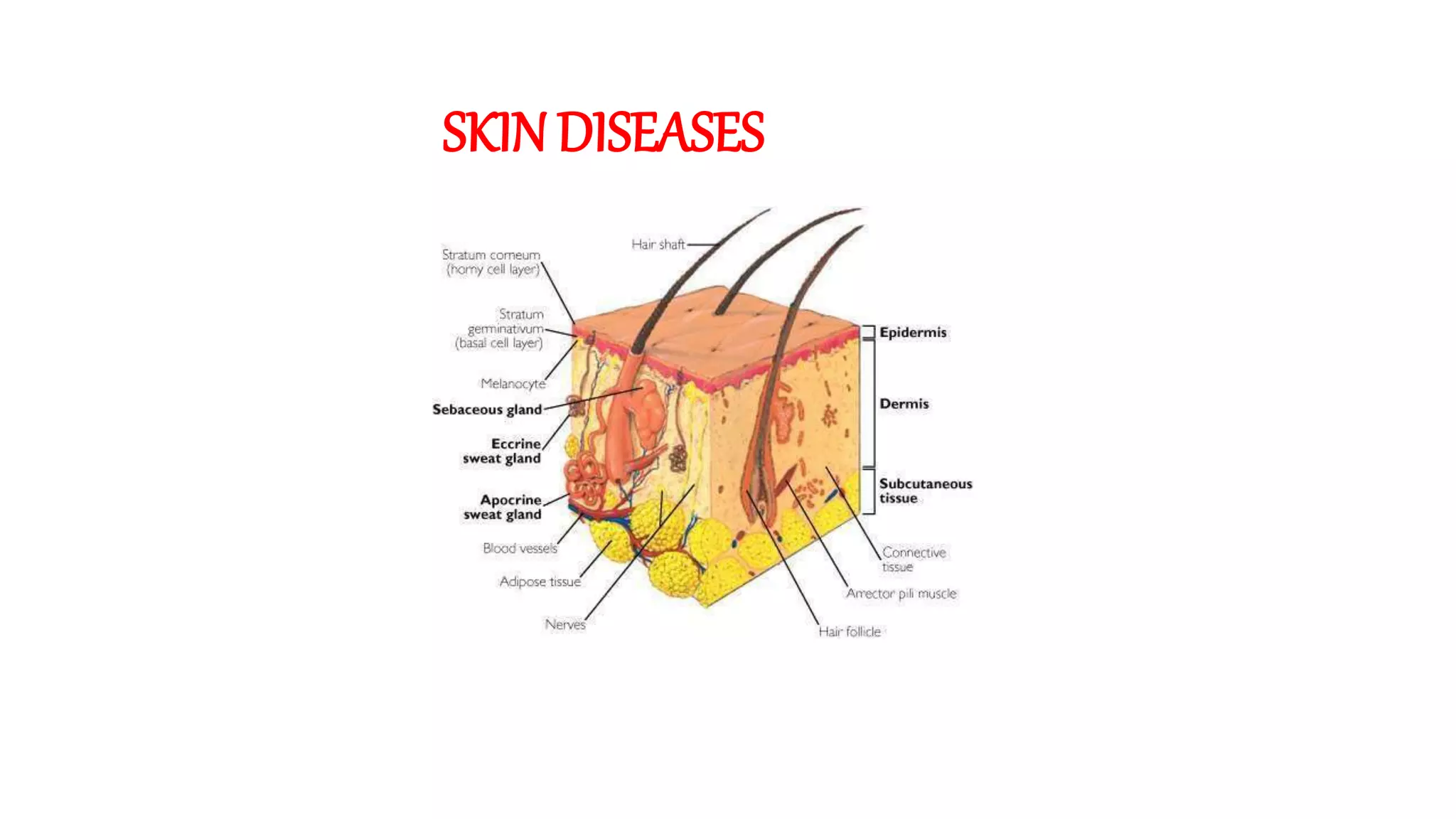
This document discusses several common skin diseases and infections. It begins by explaining that skin diseases can involve changes to the epidermis, dermis or subcutaneous tissue, and that their appearance may vary over time and with treatment. It then covers several primary and secondary bacterial skin infections like impetigo, folliculitis, boils, and cellulitis. It also discusses viral infections like chickenpox and shingles, as well as conditions such as acne, hidradenitis suppurativa, allergic eczema, and scabies. For each condition, it provides details on symptoms, signs, causes and characteristics.
Introduction:
Pathological changes mayarise in epidermis,
dermis and subcutaneous tissue. The pattern of
changes may allow a diagnosis to be made or it may
be non-specific. The appearance of many skin
diseases vary at different stages of their
development and may be altered by attempted
treatment and secondary changes such as scratching
or infection.
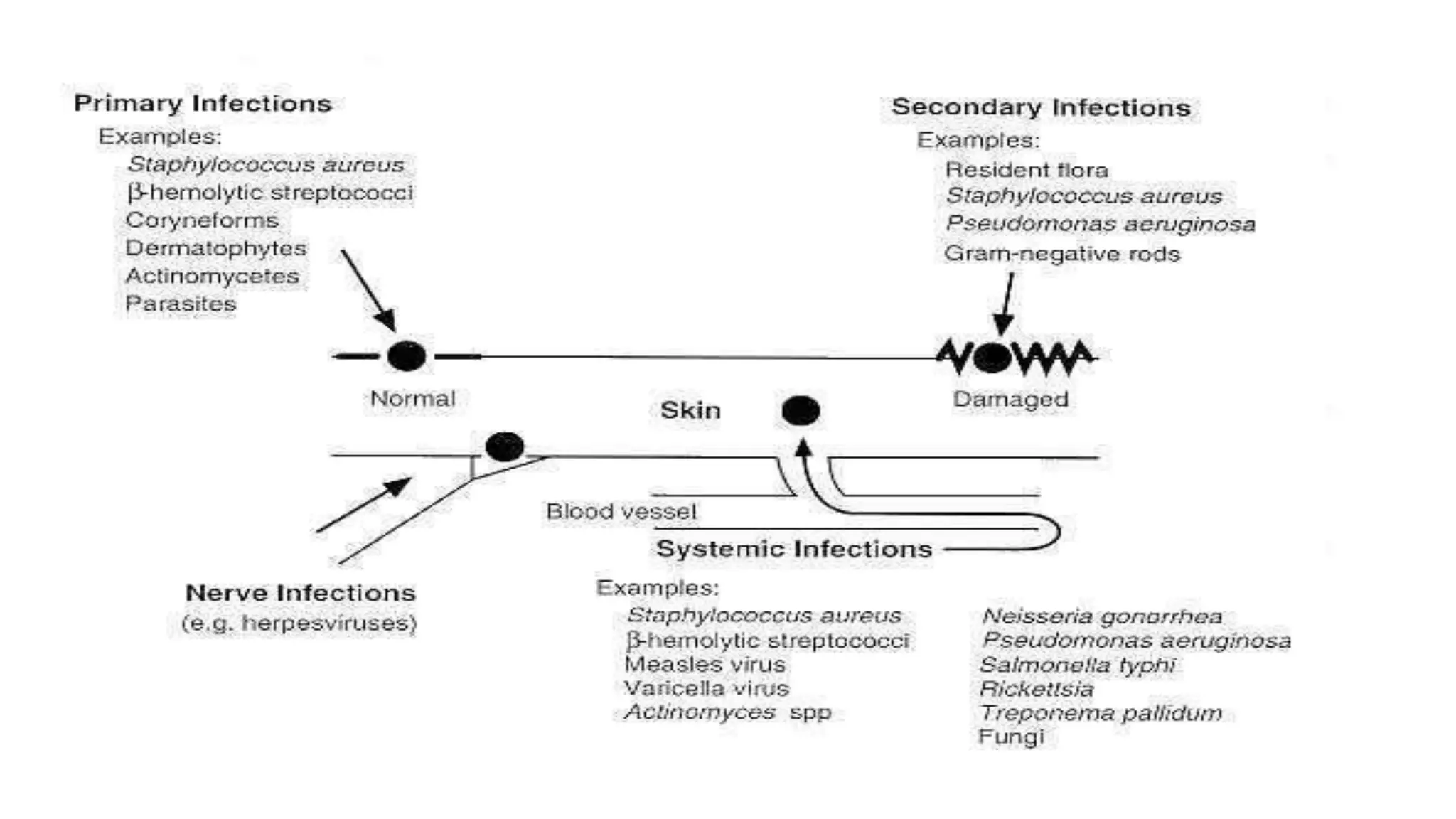
Primary Infections
• causedby a single pathogen, usually affect normal
skin.
• Impetigo, folliculitis, and boils are common types.
• The most common primary skin pathogens are
S aureus β-hemolytic streptococci, and coryneform bacteria.
• Organisms usually enter through a break in the skin.
Secondary Infections
• Secondary infections occur in skin that is already diseased.
• Because of the underlying disease, the clinical picture and course of these
infections vary.
6.
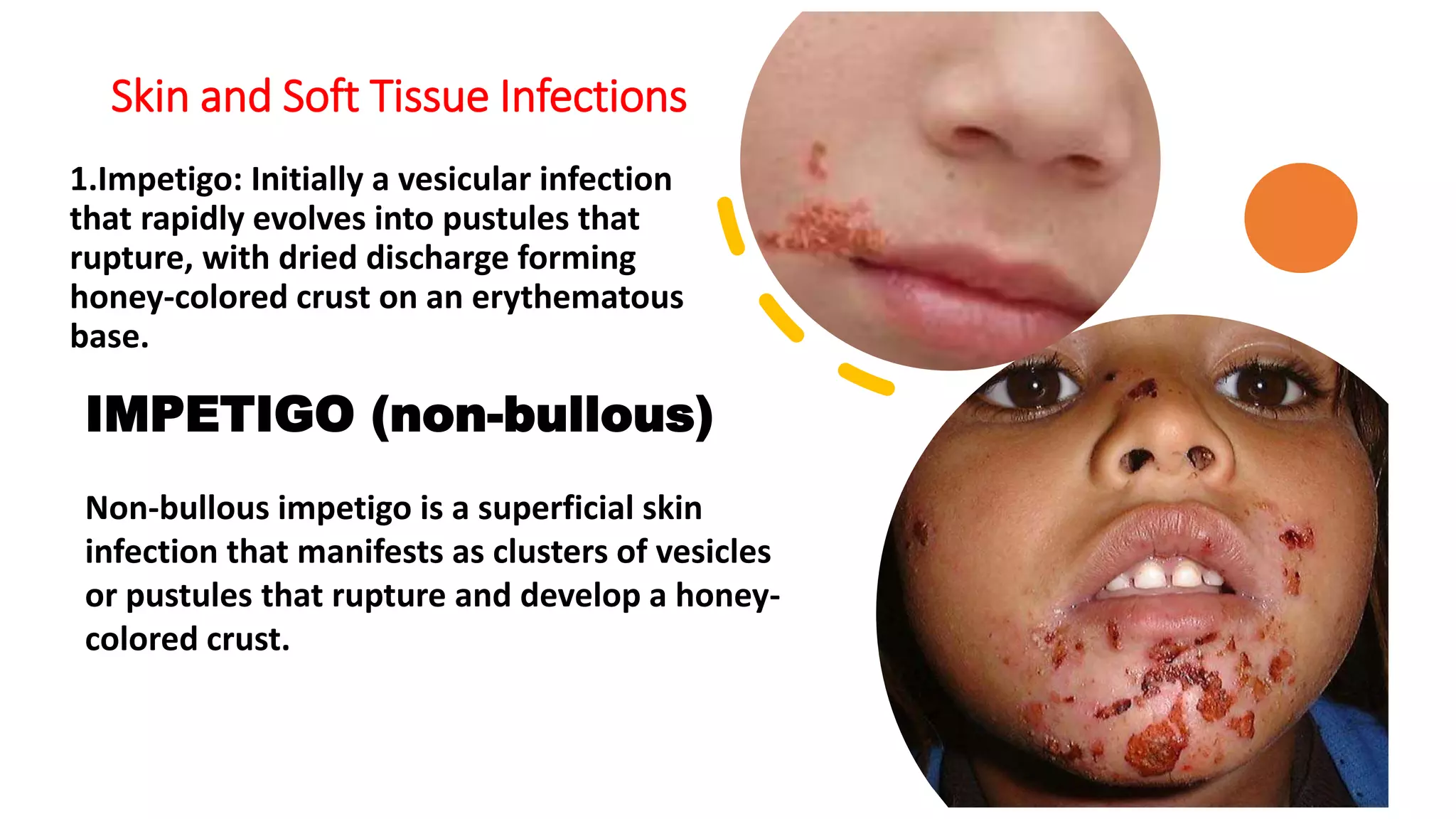
Skin and SoftTissue Infections
1.Impetigo: Initially a vesicular infection
that rapidly evolves into pustules that
rupture, with dried discharge forming
honey-colored crust on an erythematous
base.
IMPETIGO (non-bullous)
Non-bullous impetigo is a superficial skin
infection that manifests as clusters of vesicles
or pustules that rupture and develop a honey-
colored crust.
7.
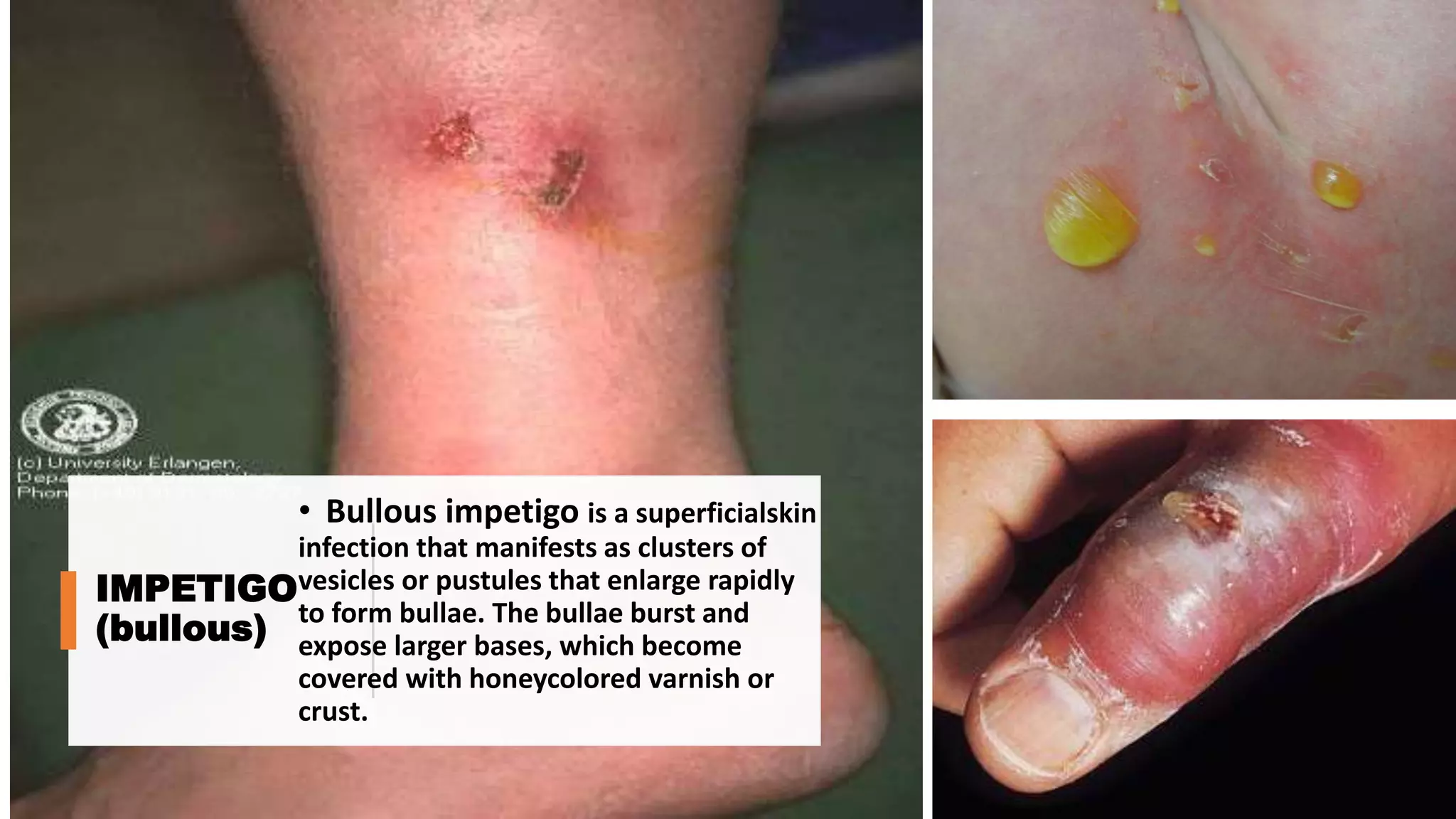
IMPETIGO
(bullous)
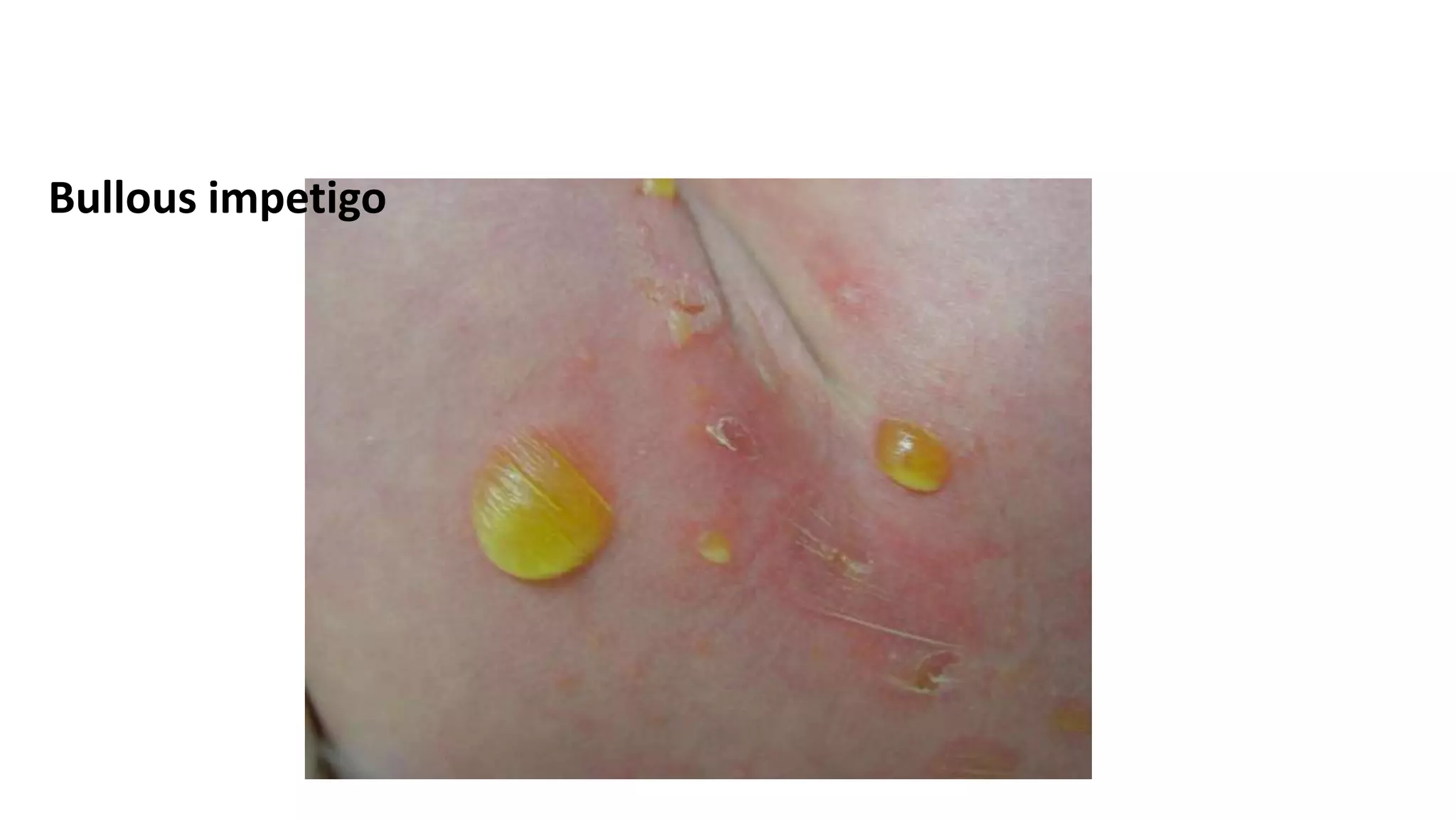
• Bullous impetigois a superficialskin
infection that manifests as clusters of
vesicles or pustules that enlarge rapidly
to form bullae. The bullae burst and
expose larger bases, which become
covered with honeycolored varnish or
crust.
8.
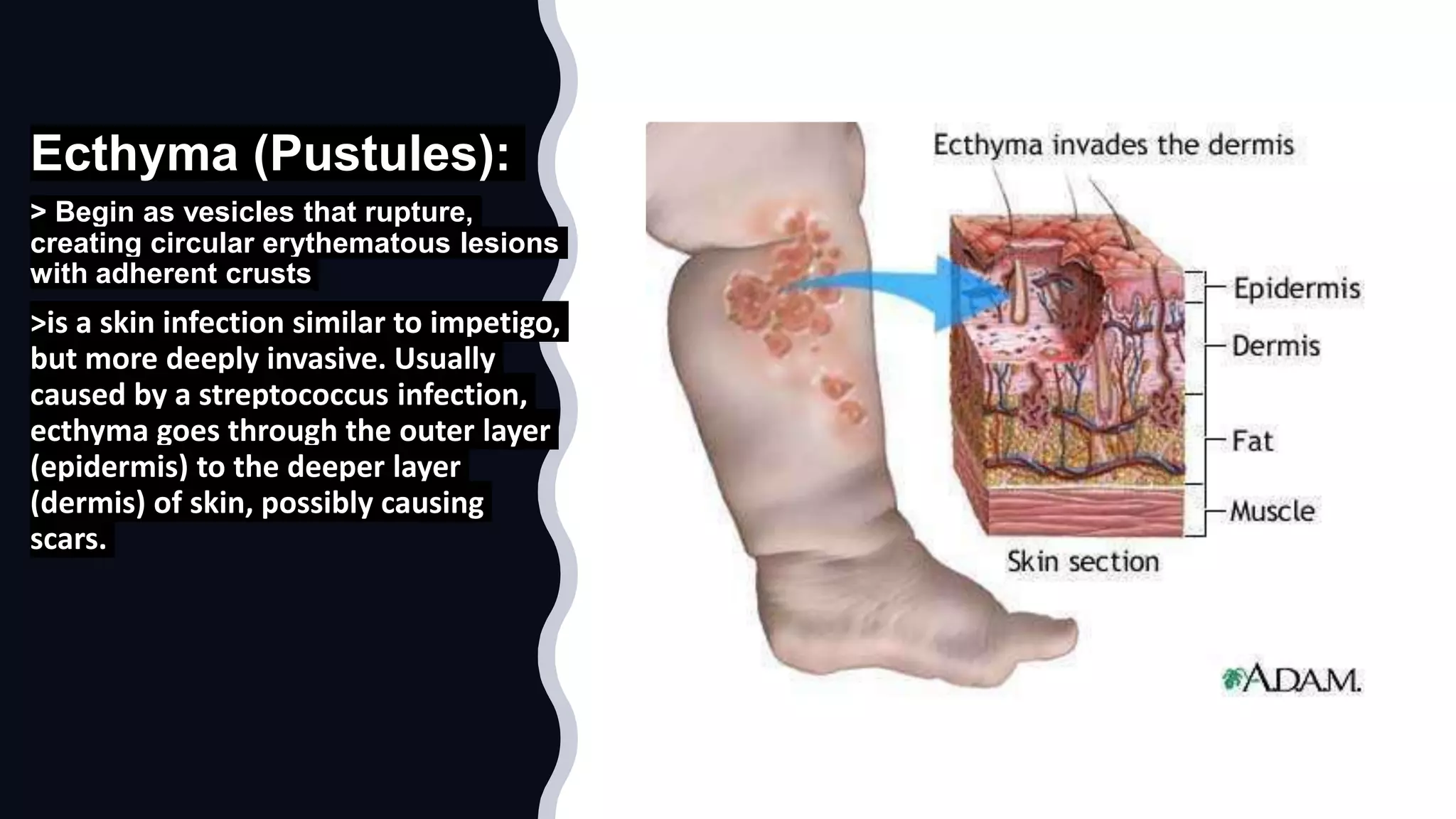
Ecthyma (Pustules):
> Beginas vesicles that rupture,
creating circular erythematous lesions
with adherent crusts
>is a skin infection similar to impetigo,
but more deeply invasive. Usually
caused by a streptococcus infection,
ecthyma goes through the outer layer
(epidermis) to the deeper layer
(dermis) of skin, possibly causing
scars.
9.
Folliculitis:
• Inflammation atthe opening of the hair follicle
that causes erythematous papules and pustules
surrounding individual hairs.
• It is usually caused by Staphylococcus aureus
but occasionally Pseudomonas aeruginosa (hot-
tub folliculitis)
• The bacteria is commonly found in contaminated
whirlpools, hot tubs or physiotherapy pools
• Children tend to get hot tub folliculitis more
• Hot-tub folliculitis occurs because of inadequate
treatment of water with chlorine or bromine.
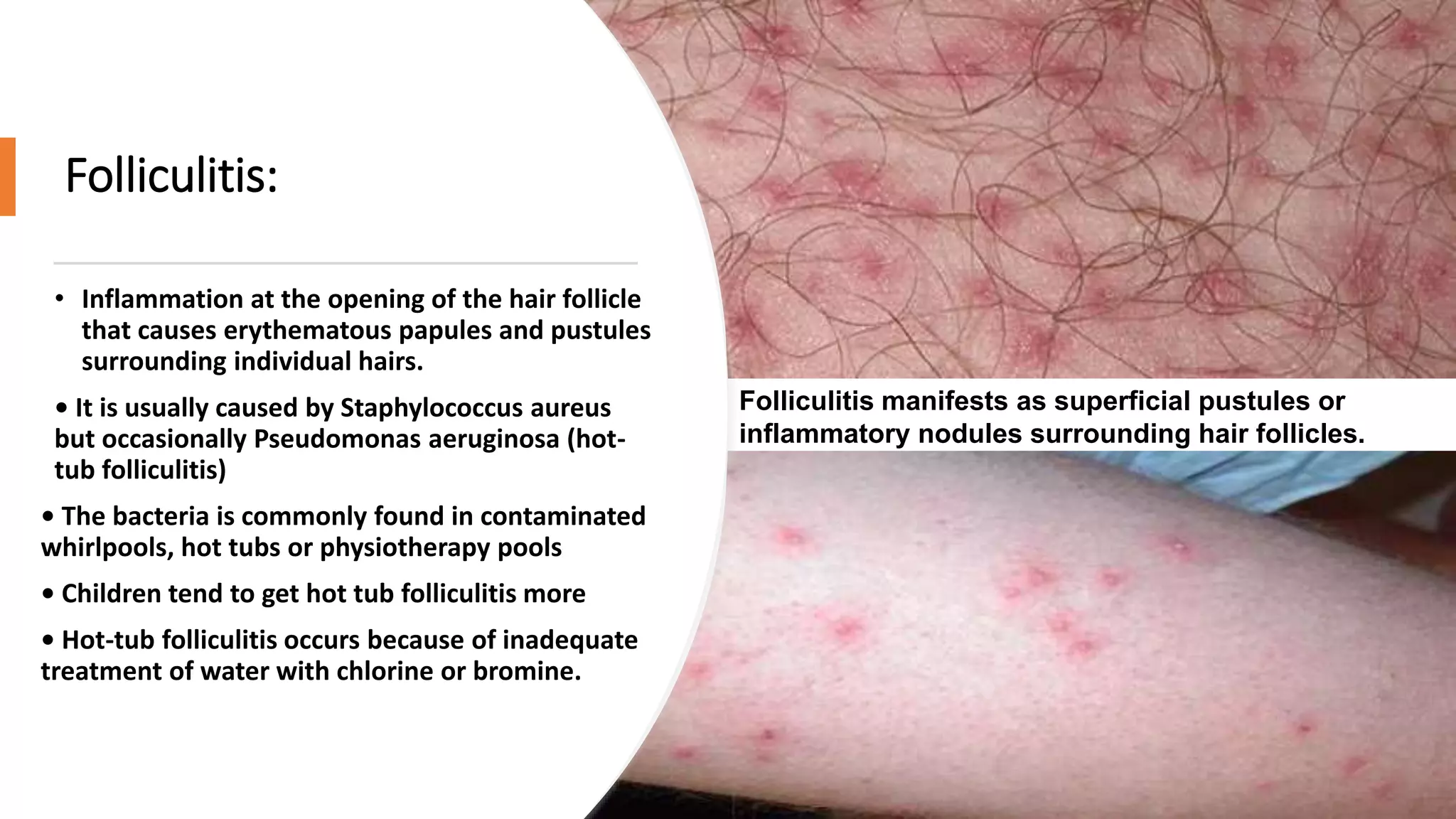
Folliculitis manifests as superficial pustules or
inflammatory nodules surrounding hair follicles.
10.
Furuncles and Carbuncles
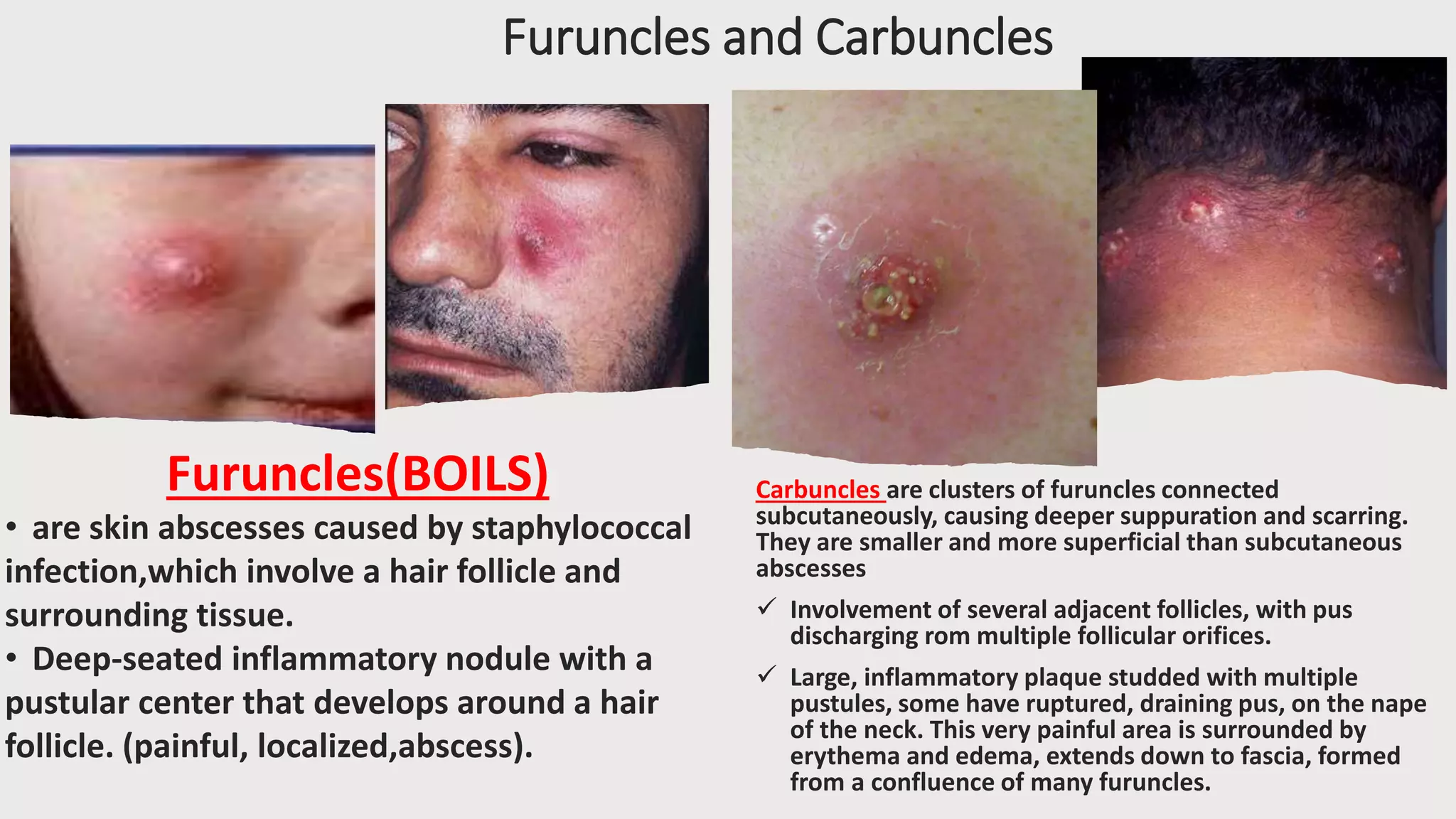
Carbunclesare clusters of furuncles connected
subcutaneously, causing deeper suppuration and scarring.
They are smaller and more superficial than subcutaneous
abscesses
Involvement of several adjacent follicles, with pus
discharging rom multiple follicular orifices.
Large, inflammatory plaque studded with multiple
pustules, some have ruptured, draining pus, on the nape
of the neck. This very painful area is surrounded by
erythema and edema, extends down to fascia, formed
from a confluence of many furuncles.
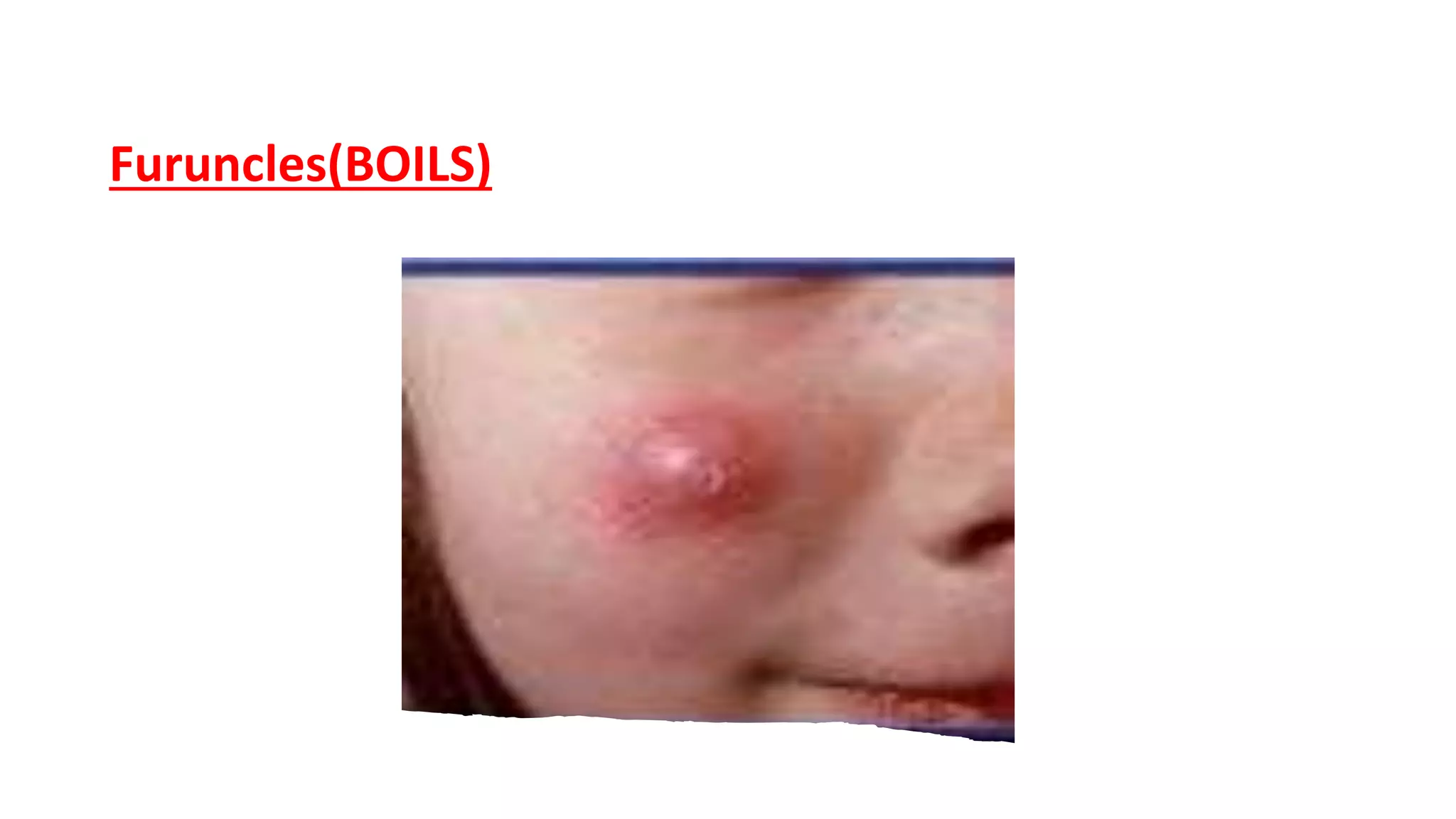
Furuncles(BOILS)
• are skin abscesses caused by staphylococcal
infection,which involve a hair follicle and
surrounding tissue.
• Deep-seated inflammatory nodule with a
pustular center that develops around a hair
follicle. (painful, localized,abscess).
11.
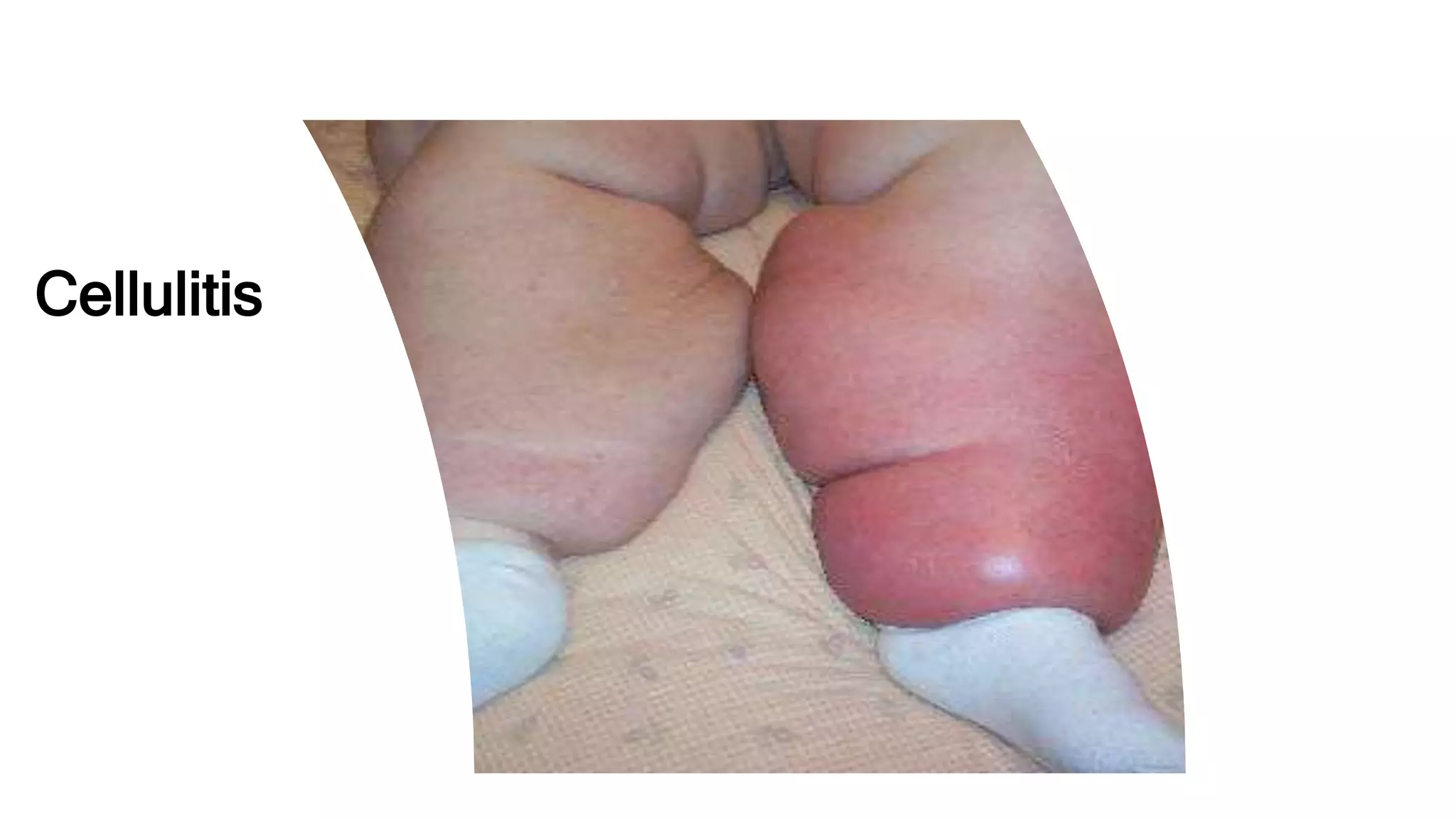
Cellulitis
• Cellulitis isan acute bacterial infection of
the skin and subcutaneous tissue most often
caused by streptococci or staphylococci.
• Some people are at risk for infection by
other types of bacteria. They include people
with weak immune system, and those who
handle fish, meat, poultry, or soil without
using gloves.
• Cellulitis can occur anywhere on the body.
In adults, it often occurs on the legs, face, or
arms. In children, it is most common on the
face or around the anus. An infection on the
face could lead to a dangerous eye infection.
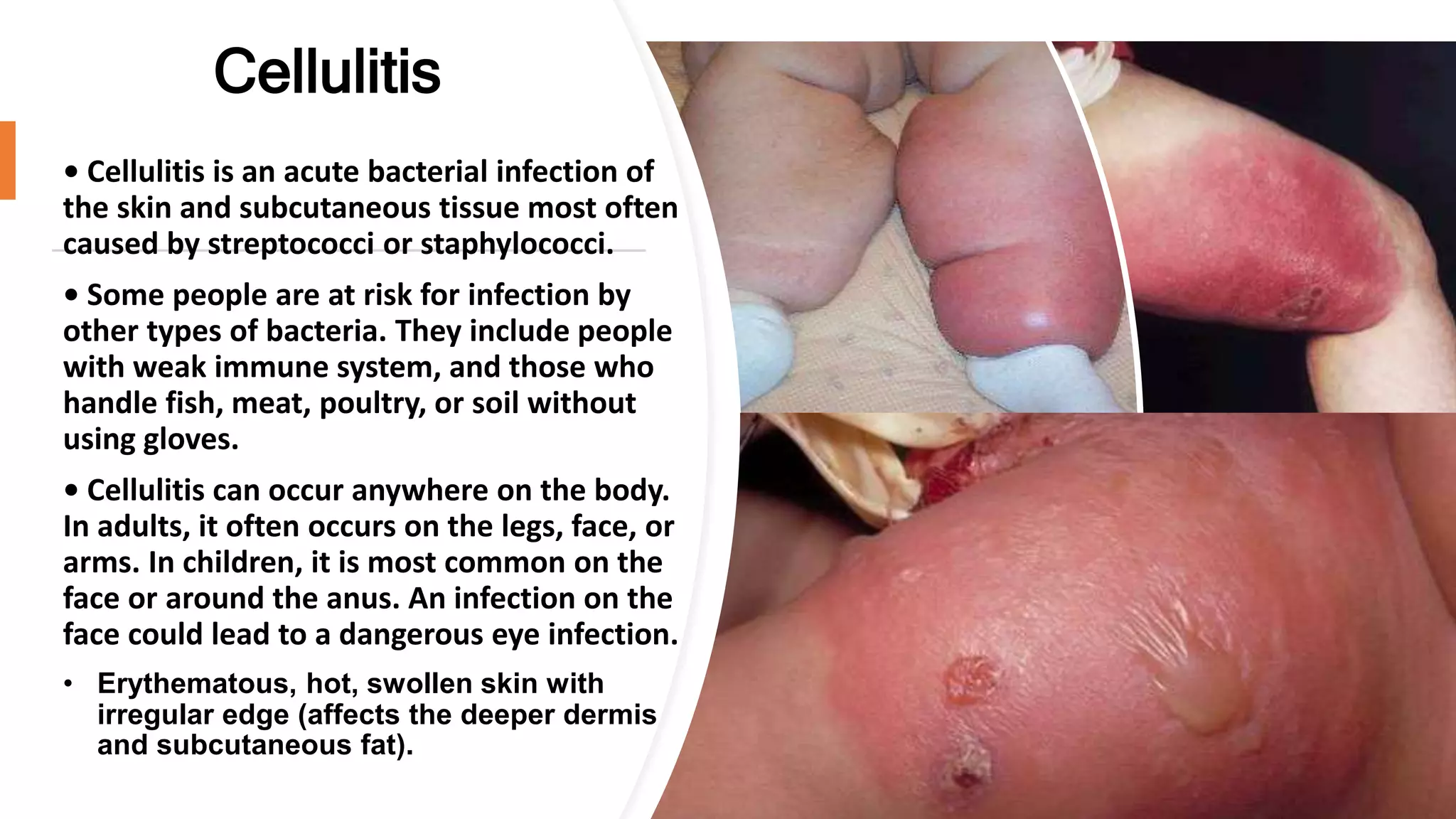
• Erythematous, hot, swollen skin with
irregular edge (affects the deeper dermis
and subcutaneous fat).
12.
Acne
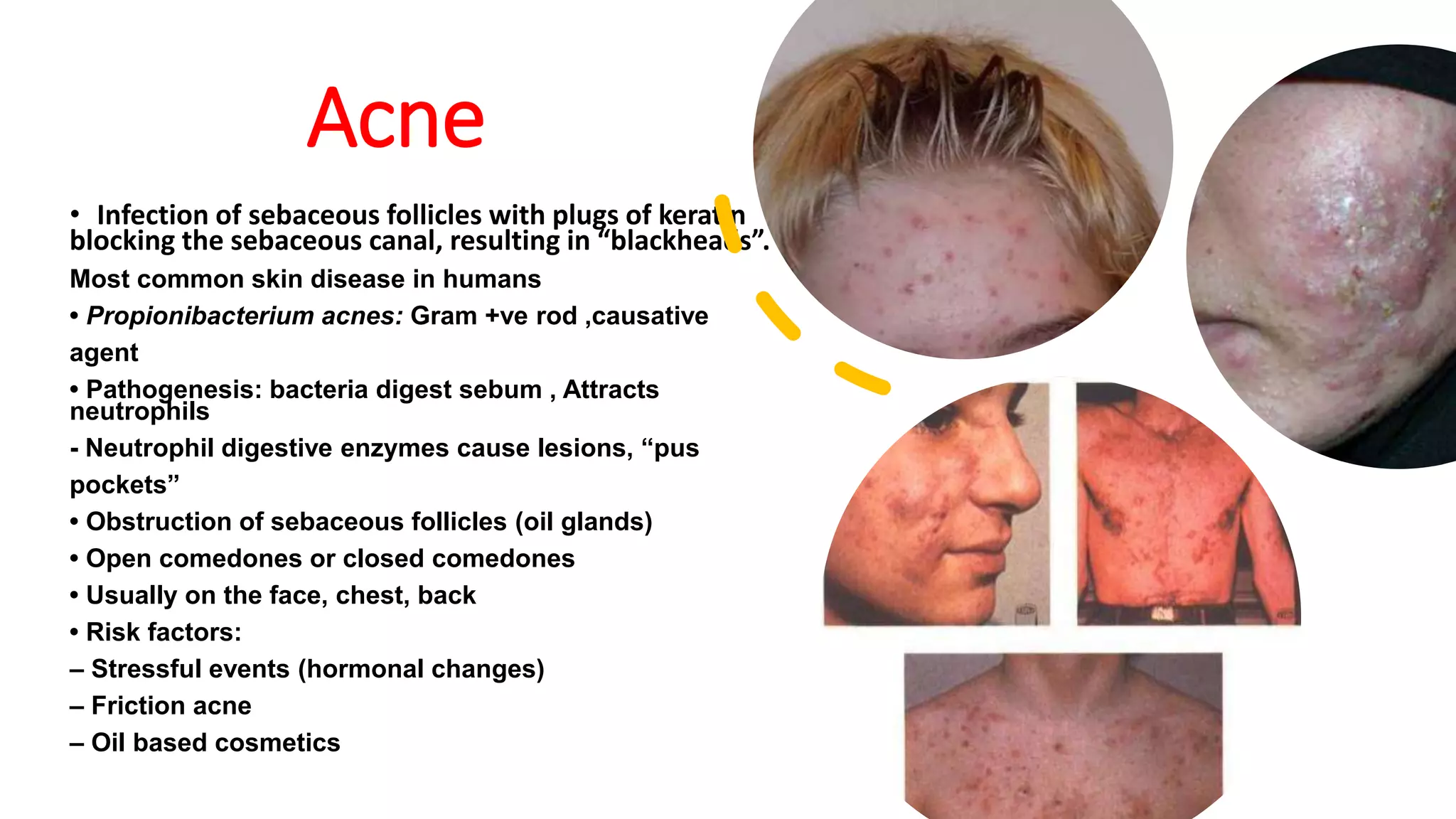
• Infection ofsebaceous follicles with plugs of keratin
blocking the sebaceous canal, resulting in “blackheads”.
Most common skin disease in humans
• Propionibacterium acnes: Gram +ve rod ,causative
agent
• Pathogenesis: bacteria digest sebum , Attracts
neutrophils
- Neutrophil digestive enzymes cause lesions, “pus
pockets”
• Obstruction of sebaceous follicles (oil glands)
• Open comedones or closed comedones
• Usually on the face, chest, back
• Risk factors:
– Stressful events (hormonal changes)
– Friction acne
– Oil based cosmetics
13.
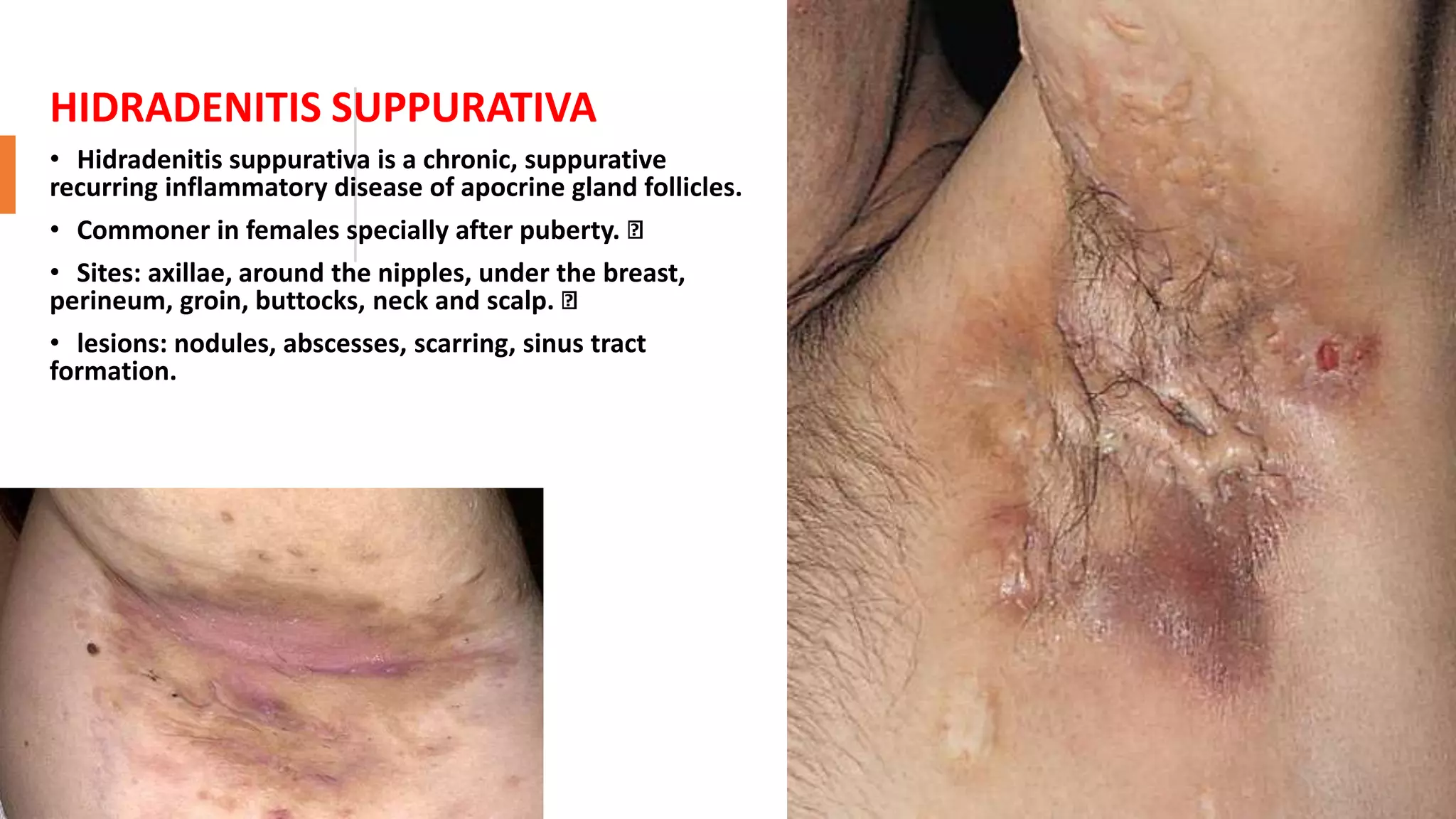
HIDRADENITIS SUPPURATIVA
• Hidradenitissuppurativa is a chronic, suppurative
recurring inflammatory disease of apocrine gland follicles.
• Commoner in females specially after puberty.
• Sites: axillae, around the nipples, under the breast,
perineum, groin, buttocks, neck and scalp.
• lesions: nodules, abscesses, scarring, sinus tract
formation.
14.
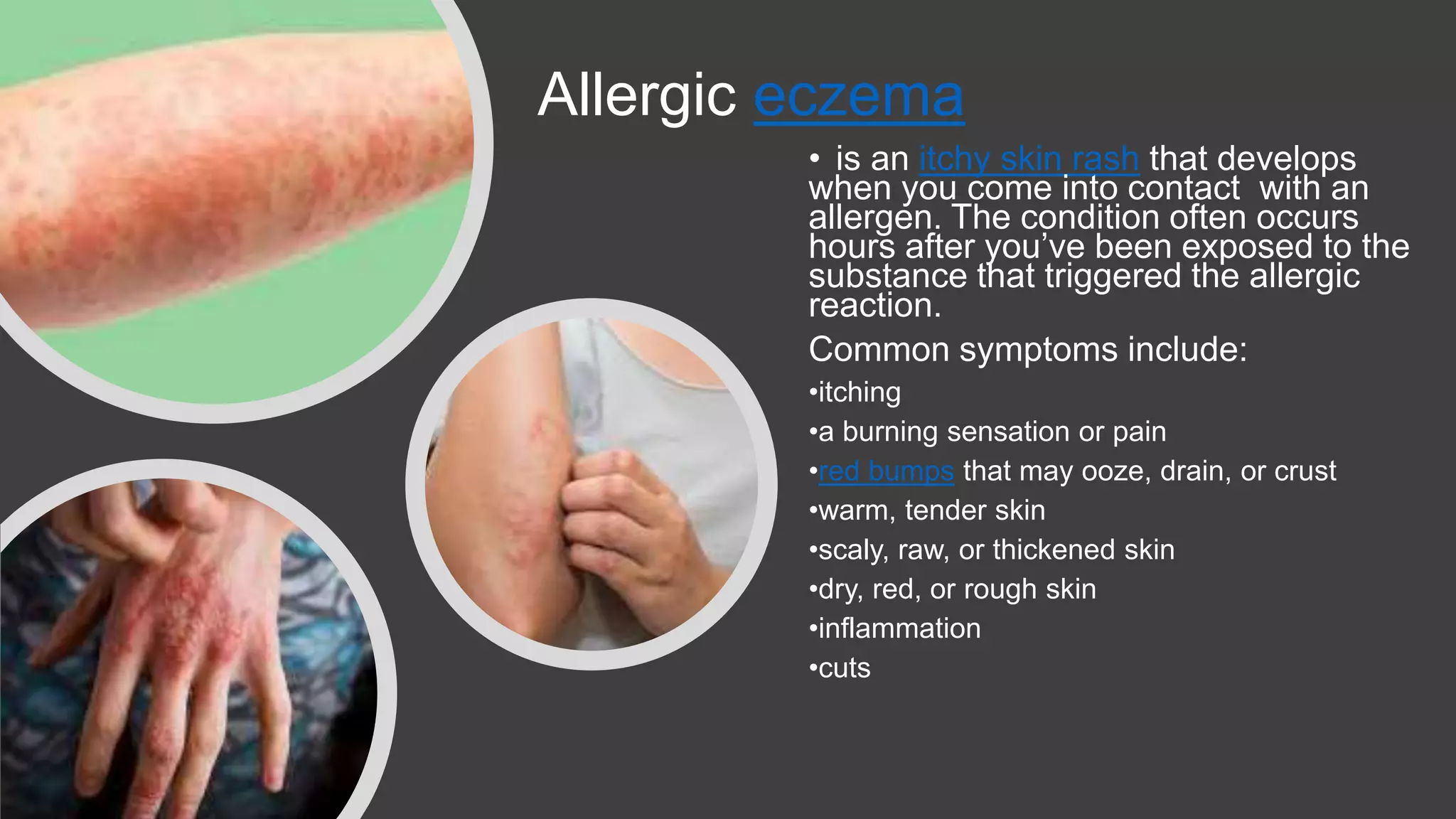
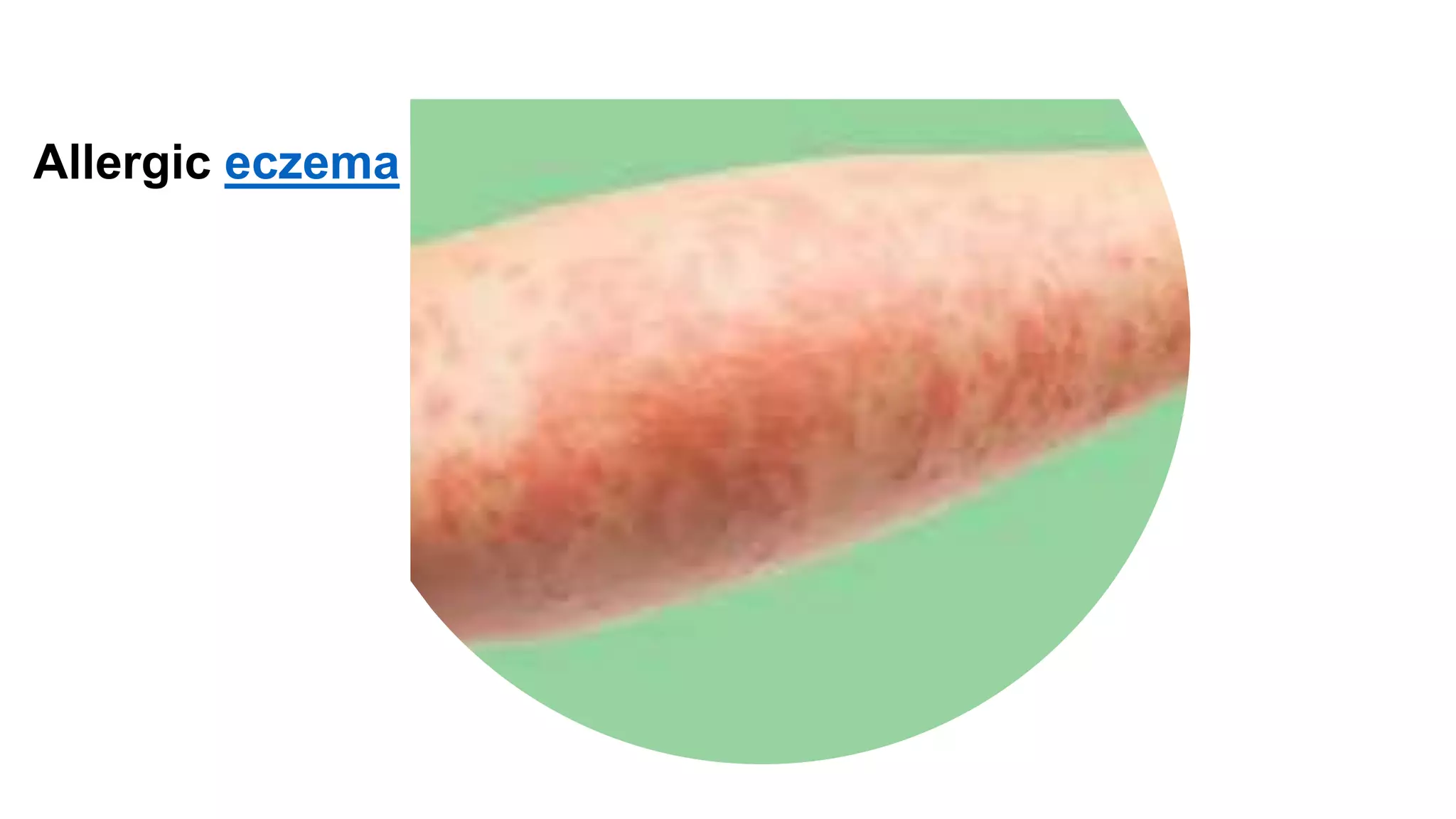
Allergic eczema
• isan itchy skin rash that develops
when you come into contact with an
allergen. The condition often occurs
hours after you’ve been exposed to the
substance that triggered the allergic
reaction.
Common symptoms include:
•itching
•a burning sensation or pain
•red bumps that may ooze, drain, or crust
•warm, tender skin
•scaly, raw, or thickened skin
•dry, red, or rough skin
•inflammation
•cuts
15.
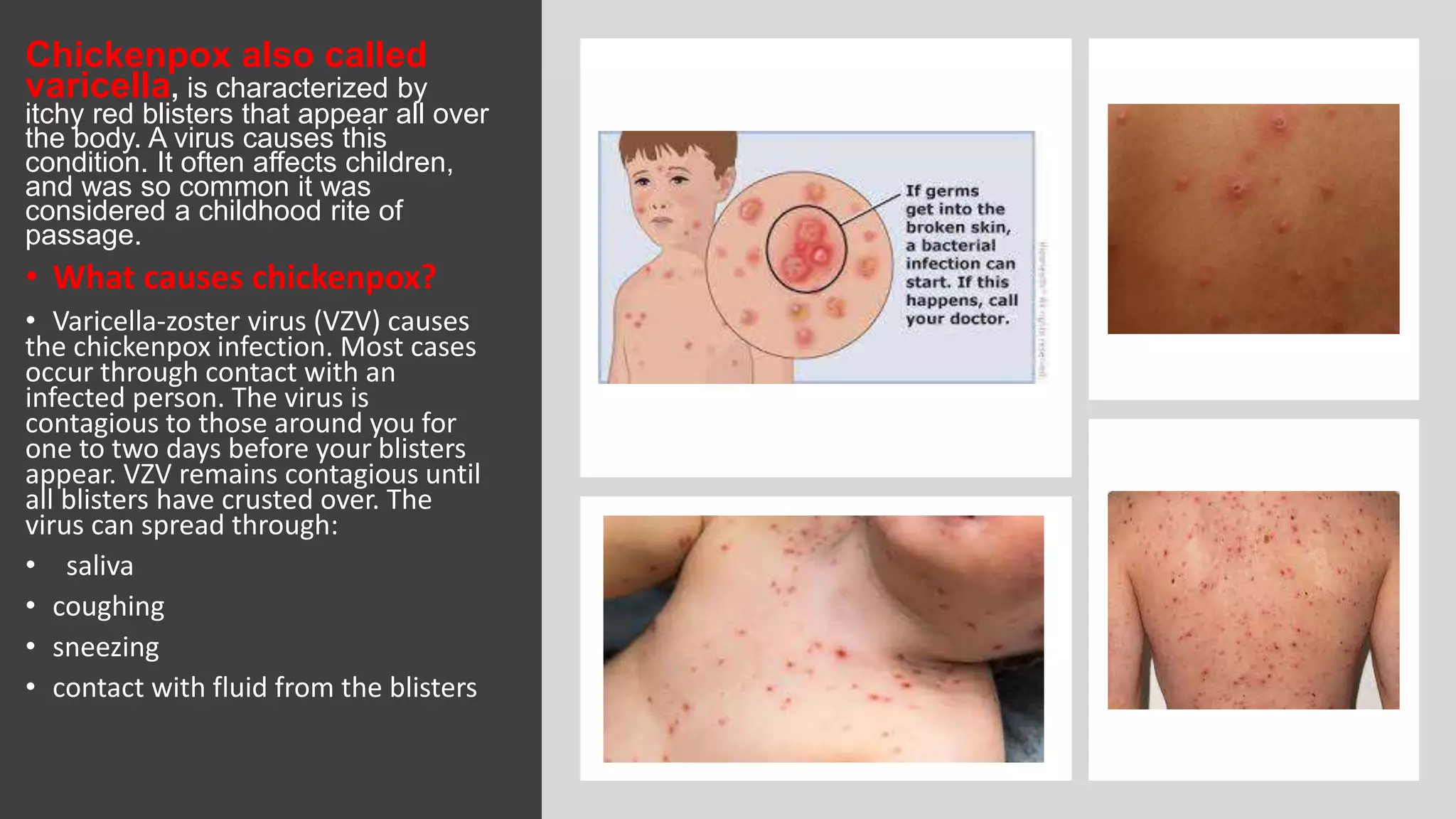
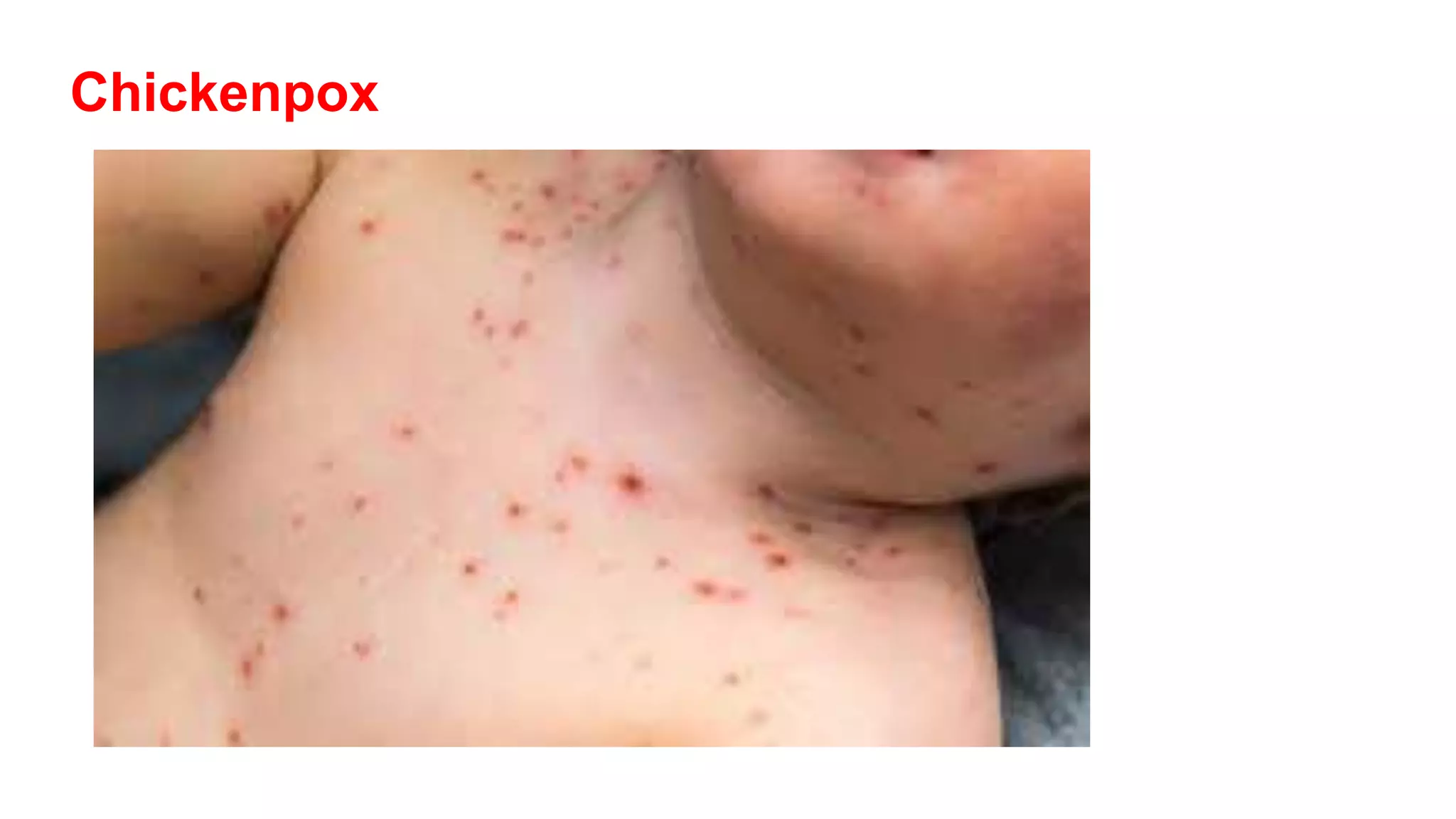
Chickenpox also called
varicella,is characterized by
itchy red blisters that appear all over
the body. A virus causes this
condition. It often affects children,
and was so common it was
considered a childhood rite of
passage.
• What causes chickenpox?
• Varicella-zoster virus (VZV) causes
the chickenpox infection. Most cases
occur through contact with an
infected person. The virus is
contagious to those around you for
one to two days before your blisters
appear. VZV remains contagious until
all blisters have crusted over. The
virus can spread through:
• saliva
• coughing
• sneezing
• contact with fluid from the blisters
16.
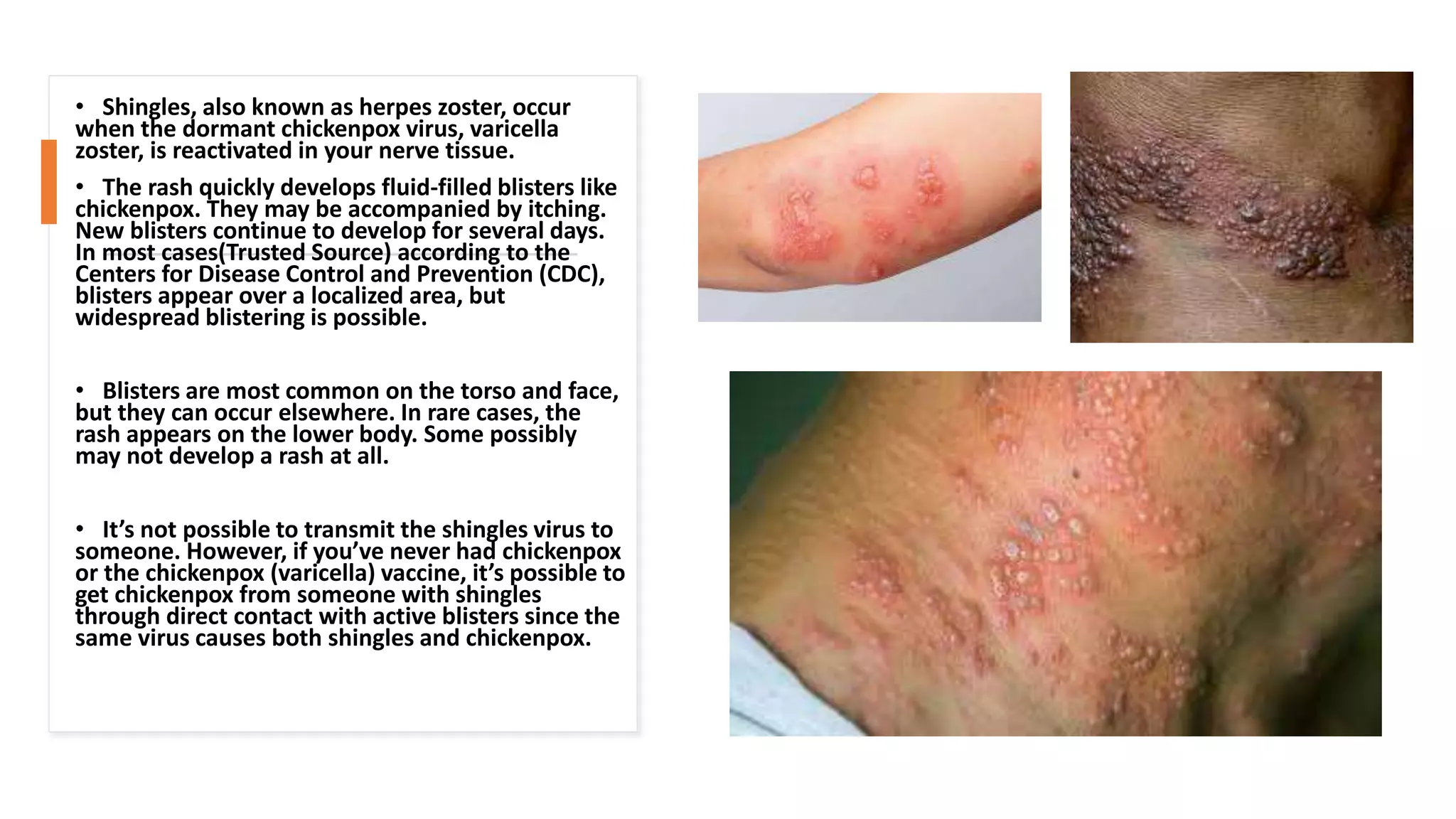
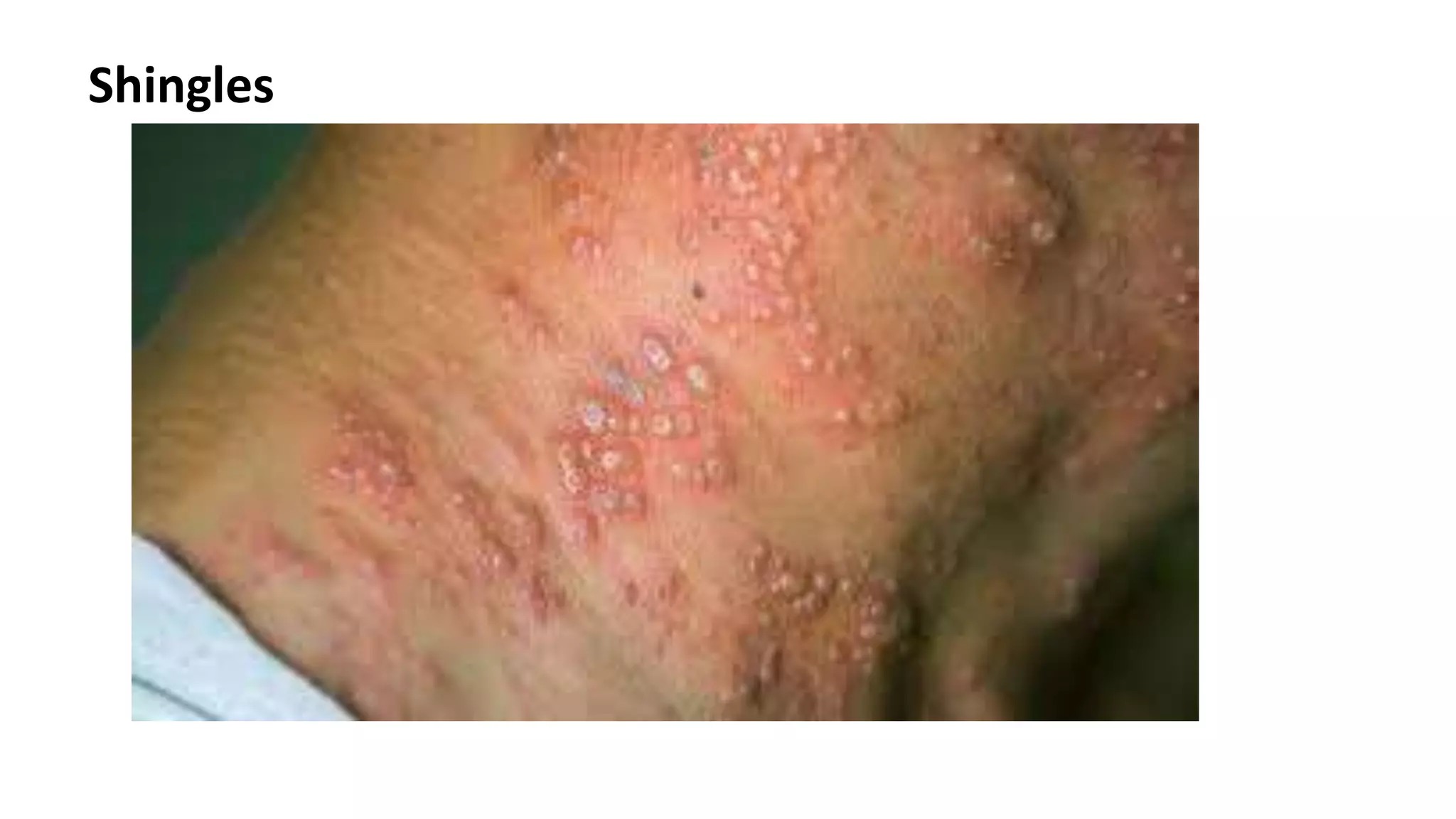
• Shingles, alsoknown as herpes zoster, occur
when the dormant chickenpox virus, varicella
zoster, is reactivated in your nerve tissue.
• The rash quickly develops fluid-filled blisters like
chickenpox. They may be accompanied by itching.
New blisters continue to develop for several days.
In most cases(Trusted Source) according to the
Centers for Disease Control and Prevention (CDC),
blisters appear over a localized area, but
widespread blistering is possible.
• Blisters are most common on the torso and face,
but they can occur elsewhere. In rare cases, the
rash appears on the lower body. Some possibly
may not develop a rash at all.
• It’s not possible to transmit the shingles virus to
someone. However, if you’ve never had chickenpox
or the chickenpox (varicella) vaccine, it’s possible to
get chickenpox from someone with shingles
through direct contact with active blisters since the
same virus causes both shingles and chickenpox.
17.
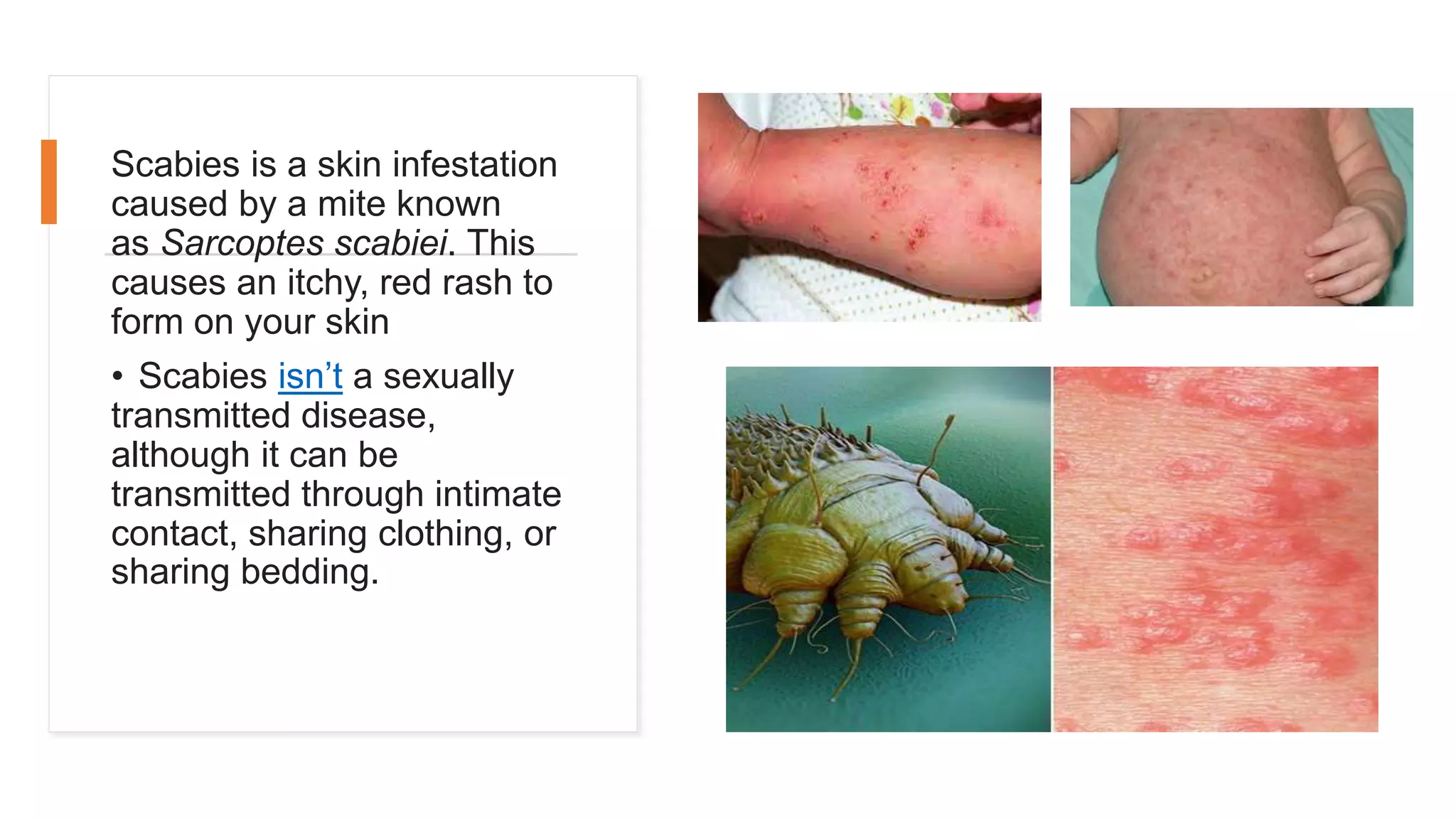
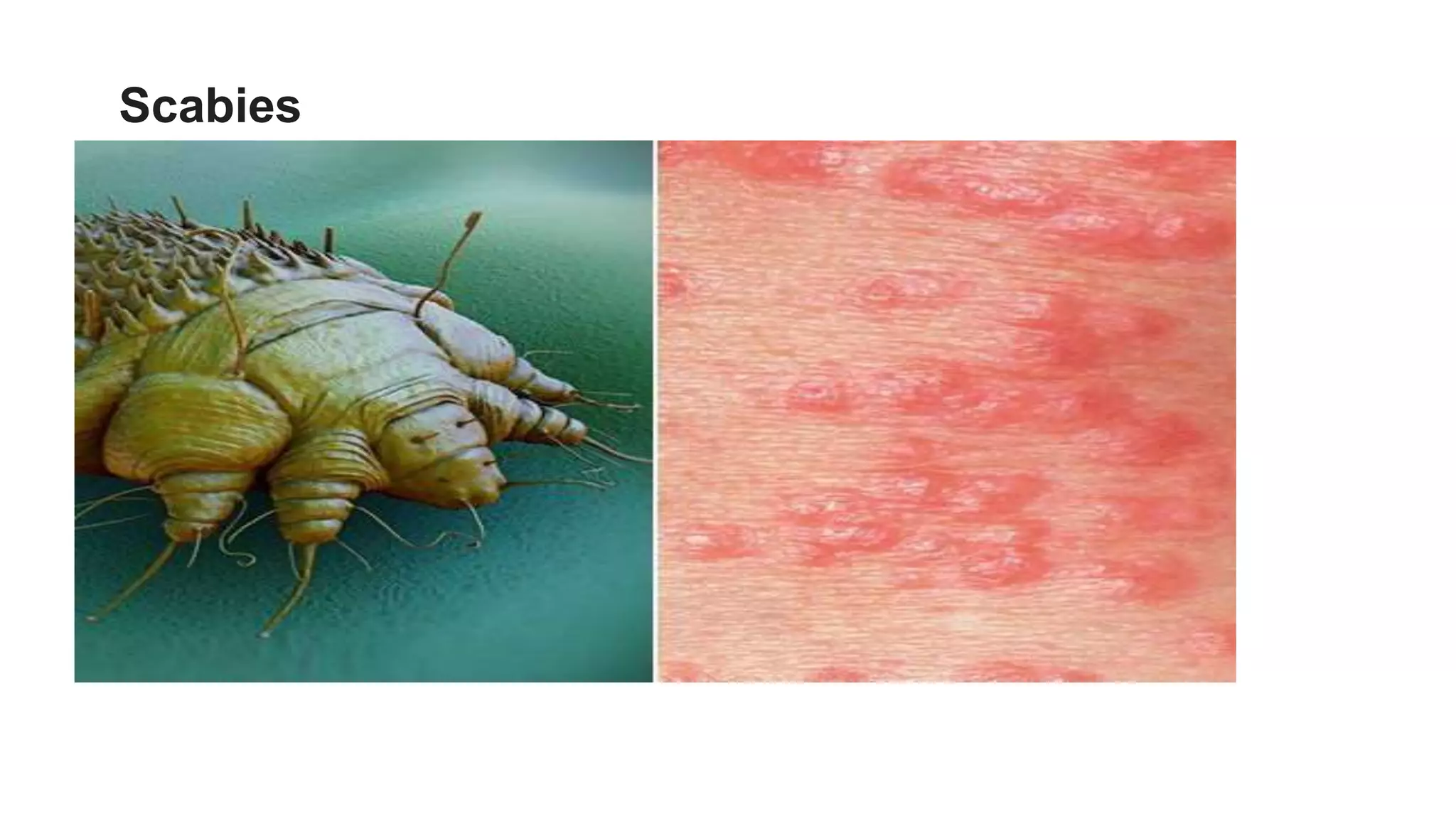
Scabies is askin infestation
caused by a mite known
as Sarcoptes scabiei. This
causes an itchy, red rash to
form on your skin
• Scabies isn’t a sexually
transmitted disease,
although it can be
transmitted through intimate
contact, sharing clothing, or
sharing bedding.
18.
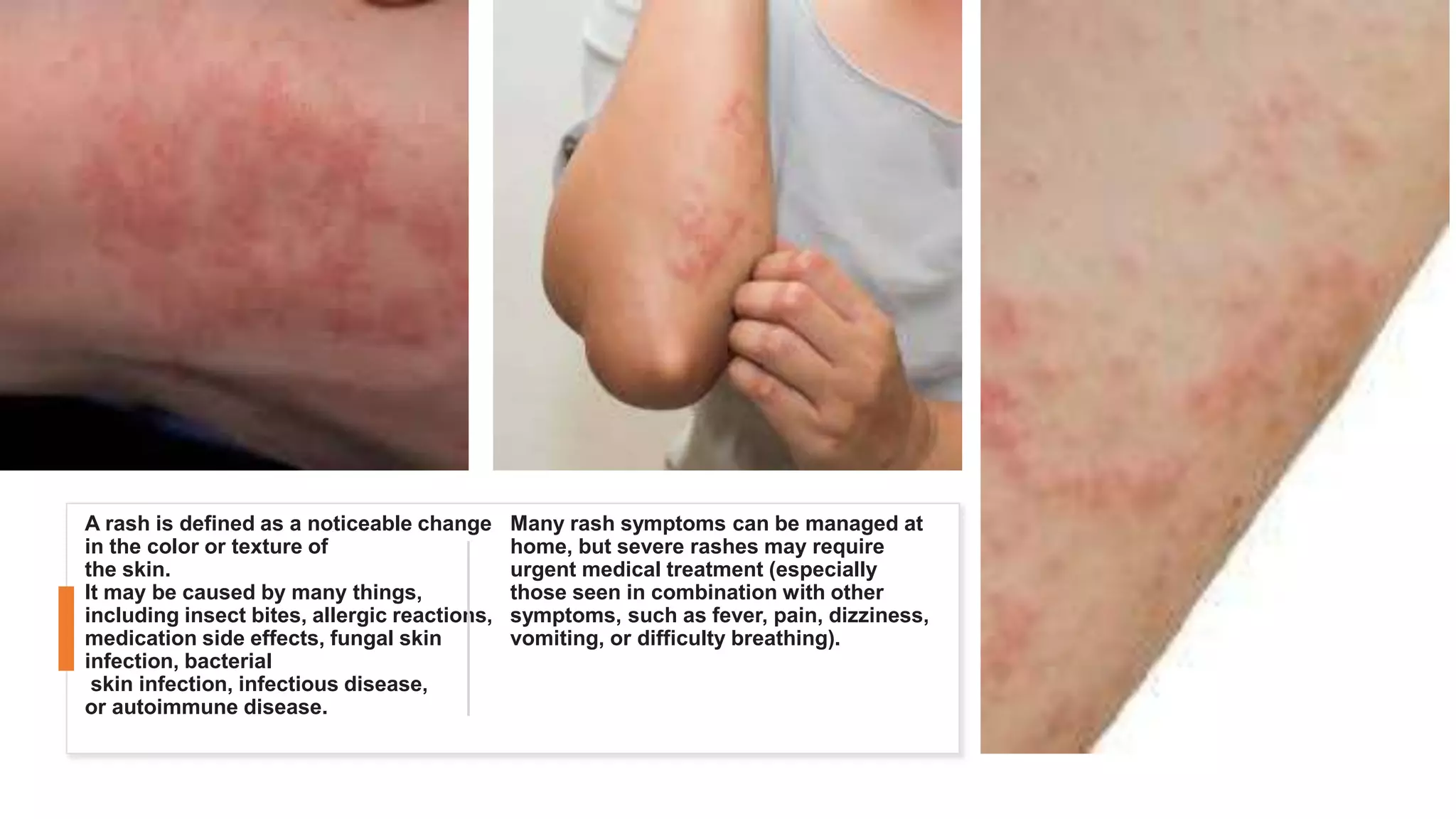
A rash isdefined as a noticeable change
in the color or texture of
the skin.
It may be caused by many things,
including insect bites, allergic reactions,
medication side effects, fungal skin
infection, bacterial
skin infection, infectious disease,
or autoimmune disease.
Many rash symptoms can be managed at
home, but severe rashes may require
urgent medical treatment (especially
those seen in combination with other
symptoms, such as fever, pain, dizziness,
vomiting, or difficulty breathing).
19.
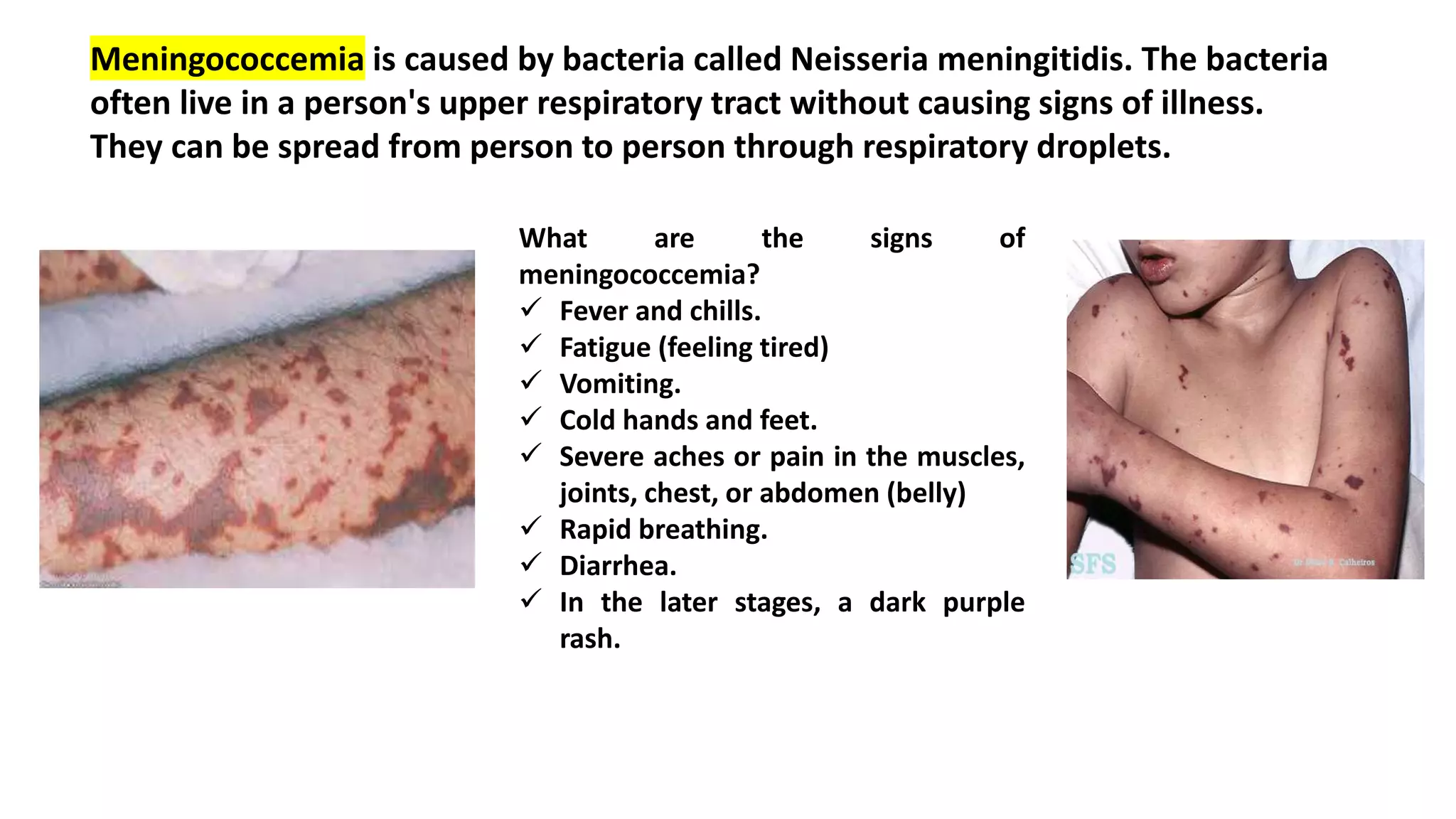
Meningococcemia is causedby bacteria called Neisseria meningitidis. The bacteria
often live in a person's upper respiratory tract without causing signs of illness.
They can be spread from person to person through respiratory droplets.
What are the signs of
meningococcemia?
Fever and chills.
Fatigue (feeling tired)
Vomiting.
Cold hands and feet.
Severe aches or pain in the muscles,
joints, chest, or abdomen (belly)
Rapid breathing.
Diarrhea.
In the later stages, a dark purple
rash.
20.
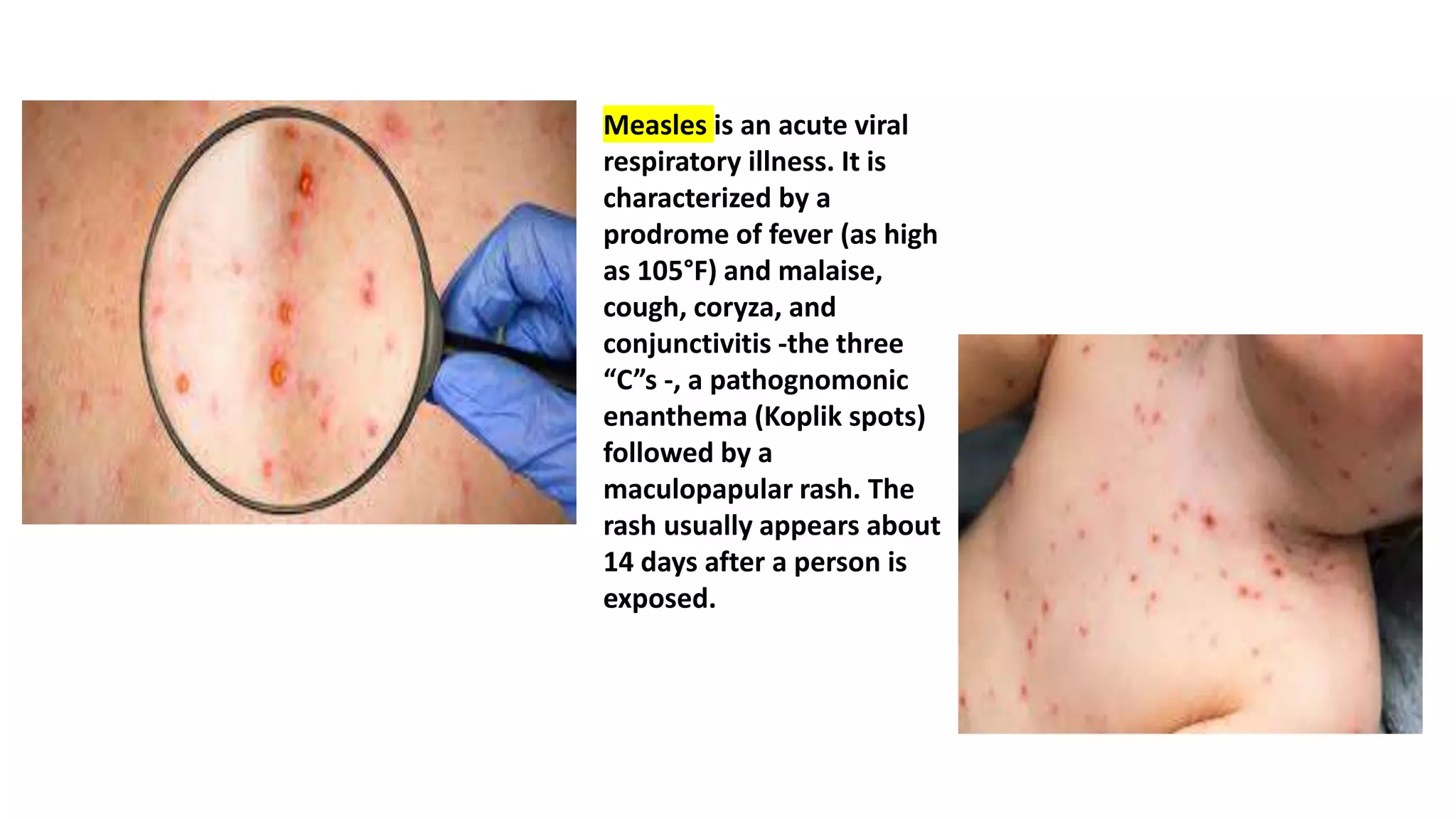
Measles is anacute viral
respiratory illness. It is
characterized by a
prodrome of fever (as high
as 105°F) and malaise,
cough, coryza, and
conjunctivitis -the three
“C”s -, a pathognomonic
enanthema (Koplik spots)
followed by a
maculopapular rash. The
rash usually appears about
14 days after a person is
exposed.
21.
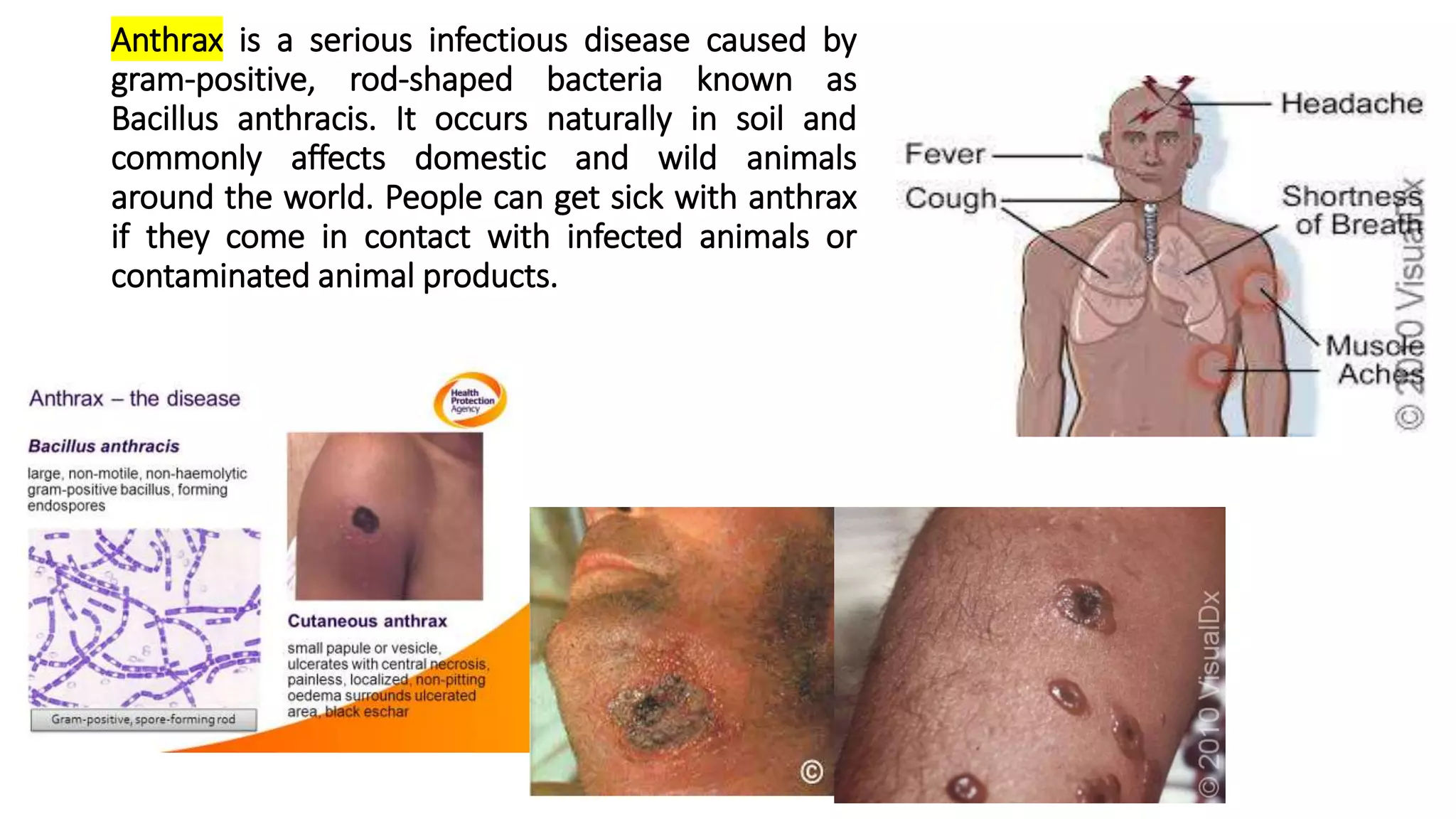
Anthrax is aserious infectious disease caused by
gram-positive, rod-shaped bacteria known as
Bacillus anthracis. It occurs naturally in soil and
commonly affects domestic and wild animals
around the world. People can get sick with anthrax
if they come in contact with infected animals or
contaminated animal products.



![Fungal infections of skin [compatibility mode]](https://cdn.slidesharecdn.com/ss_thumbnails/fungalinfectionsofskincompatibilitymode-130321223403-phpapp01-thumbnail.jpg?width=640&height=640&fit=bounds)


