CASE STUDY : PLASTERING
What is a Case Study?
A case study analysis requires you to
investigate a business problem, examine the
alternative solutions, and propose the most
effective solution using supporting evidence.
A case study should include background
information on the specific topic, an analysis
of the case under study showing problems or
effective strategies, as well as
recommendations. A case study can focus on
a business or entire industry, a specific
project or program, or a person.
 what is plastering ?
 This is a process of covering rough surface with a plastic
material to obtain an even, smooth, regular, clean &
durable surface.
– A mixture of lime or gypsum, sand, water, sometimes with
fiber added, that hardness to a smooth solid and is used for
coating walls & ceilings.
– The word ”PLASTER” comes from the Greek language
meaning ‘to daub on’.
 PLASTERING MATERIALS
i. Cement
ii. Lime or clay
iii. Aggregates
iv. Water
v. Accelerator
vi. Admixture
TYPES OF PLASTER :
I. Lime plaster
II. Cement plaster
III. Mud plaster
IV. Stucco plaster
V. Plaster on lath
SPECIAL TYPES OF FINISHING :
a) Smooth cast
b) Rough cast
c) Pebble cast
d) Scrapped finish
e) Textured finish
 ADVANTAGES OF PLASTERING :
a. Easy in application.
b. No surgery is required.
c. Plaster is the most common form of interior wall finishing.
d. If property mixed and applied, a plaster coating creats a
stronger and more durable.
 DISADVANTAGES OF PLASTERING :
a. when plaster cracks then difficult to repair.
b. Repairing is very expansive.
c. Despite the extra labor of hanging and finishing
drywall, it tends to be less expansive than
plastering
Maintenance and Remedial Work
Many plasterwork problems result from factors
independent of the materials used or the techniques
employed in plastering operations. Examples include
dampness of plasterwork due to rain penetration or a
defective DPC, cracking as a result of background
movement, and surface dampness due to hygroscopic salts.
Whatever the defect, it is essential that the primary cause
is identified and rectified before the plasterwork is
replaced. The main types of defect together with
recommended remedial treatments are listed below.
PLASTERING DEFECTS REMEDIES
Bond failure between plasterwork and
background
This is often the result of background
movement or deflection. However, it can also
be due to a weak bond caused by poor keying
of the background, inadequate control of
suction, use of the wrong grade of plaster or
the presence of residual moisture in the
structure.
When movement has ceased or the residual
moisture has been removed, the affected
plasterwork including any suspect areas should
be removed. The background should be
prepared and a coat of Thistle Bond-it applied
prior to the application of a suitable grade of
plaster
Bond failure between finish plaster and
sand/cement undercut
This takes the form of flaking, blistering,
curling or shelling of the plaster finish. It
normally results from applying plaster over a
‘green’ undercoat (i.e. insufficient time
allowed for the sand/cement undercoat to
complete its drying shrinkage) and/or
inadequate scratching of the undercoat surface
to provide a mechanical key. It can also be
caused by local exposure to excessive heat.
The affected plasterwork should be stripped
off. Re-plastering can take place once the
background is thoroughly dry after first
applying Thistle Bond-it in accordance
PLASTERING DEFECTS REMEDIES
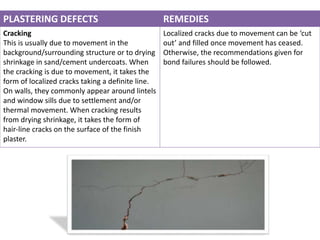
Cracking
This is usually due to movement in the
background/surrounding structure or to drying
shrinkage in sand/cement undercoats. When
the cracking is due to movement, it takes the
form of localized cracks taking a definite line.
On walls, they commonly appear around lintels
and window sills due to settlement and/or
thermal movement. When cracking results
from drying shrinkage, it takes the form of
hair-line cracks on the surface of the finish
plaster.
Localized cracks due to movement can be ‘cut
out’ and filled once movement has ceased.
Otherwise, the recommendations given for
bond failures should be followed.
PLASTERING DEFECTS REMEDIES
Crazing/dry-out of finish
plaster In hot weather conditions, or in
situations where the finish plaster has been
applied exceptionally thin, rapid drying out of
the plaster can occur before it has properly set.
This can result in a soft and powdery surface.
The problems can also be caused by excessive
suction, working the plaster past its setting
point or excessive draught during setting.
The plasterwork should be stripped off and any
dust removed from the undercoat surface prior
to re-plastering. Apply Thistle Bond-it
Dampness within the plaster
This can result from rain penetration, moisture
ingress, defective defective PC or poor drying
conditions preventing the plaster from drying
out.
The source of the problem must be identified
and corrected and the plasterwork allowed to
dry out. If the plasterwork fails to develop
adequate strength, it will need to be removed,
followed by suitable background preparation
and re-plastering.
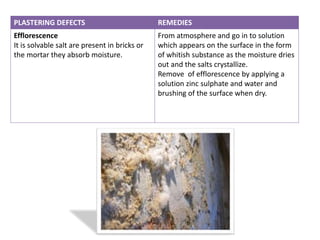
PLASTERING DEFECTS REMEDIES
Efflorescence
It is solvable salt are present in bricks or
the mortar they absorb moisture.
From atmosphere and go in to solution
which appears on the surface in the form
of whitish substance as the moisture dries
out and the salts crystallize.
Remove of efflorescence by applying a
solution zinc sulphate and water and
brushing of the surface when dry.
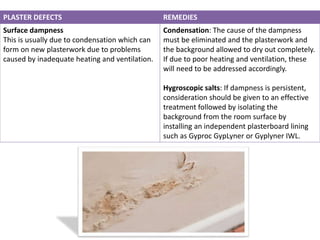
PLASTER DEFECTS REMEDIES
Surface dampness
This is usually due to condensation which can
form on new plasterwork due to problems
caused by inadequate heating and ventilation.
Condensation: The cause of the dampness
must be eliminated and the plasterwork and
the background allowed to dry out completely.
If due to poor heating and ventilation, these
will need to be addressed accordingly.
Hygroscopic salts: If dampness is persistent,
consideration should be given to an effective
treatment followed by isolating the
background from the room surface by
installing an independent plasterboard lining
such as Gyproc GypLyner or Gyplyner IWL.
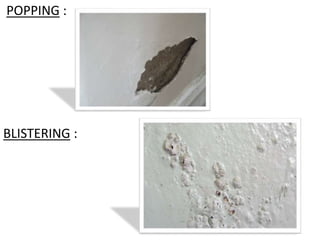
POPPING :
BLISTERING :

REPORT ON PLASTERING

  • 1.
    CASE STUDY :PLASTERING What is a Case Study? A case study analysis requires you to investigate a business problem, examine the alternative solutions, and propose the most effective solution using supporting evidence. A case study should include background information on the specific topic, an analysis of the case under study showing problems or effective strategies, as well as recommendations. A case study can focus on a business or entire industry, a specific project or program, or a person.
  • 2.
     what isplastering ?  This is a process of covering rough surface with a plastic material to obtain an even, smooth, regular, clean & durable surface. – A mixture of lime or gypsum, sand, water, sometimes with fiber added, that hardness to a smooth solid and is used for coating walls & ceilings. – The word ”PLASTER” comes from the Greek language meaning ‘to daub on’.
  • 3.
     PLASTERING MATERIALS i.Cement ii. Lime or clay iii. Aggregates iv. Water v. Accelerator vi. Admixture TYPES OF PLASTER : I. Lime plaster II. Cement plaster III. Mud plaster IV. Stucco plaster V. Plaster on lath
  • 4.
    SPECIAL TYPES OFFINISHING : a) Smooth cast b) Rough cast c) Pebble cast d) Scrapped finish e) Textured finish  ADVANTAGES OF PLASTERING : a. Easy in application. b. No surgery is required. c. Plaster is the most common form of interior wall finishing. d. If property mixed and applied, a plaster coating creats a stronger and more durable.
  • 5.
     DISADVANTAGES OFPLASTERING : a. when plaster cracks then difficult to repair. b. Repairing is very expansive. c. Despite the extra labor of hanging and finishing drywall, it tends to be less expansive than plastering
  • 6.
    Maintenance and RemedialWork Many plasterwork problems result from factors independent of the materials used or the techniques employed in plastering operations. Examples include dampness of plasterwork due to rain penetration or a defective DPC, cracking as a result of background movement, and surface dampness due to hygroscopic salts. Whatever the defect, it is essential that the primary cause is identified and rectified before the plasterwork is replaced. The main types of defect together with recommended remedial treatments are listed below.
  • 7.
    PLASTERING DEFECTS REMEDIES Bondfailure between plasterwork and background This is often the result of background movement or deflection. However, it can also be due to a weak bond caused by poor keying of the background, inadequate control of suction, use of the wrong grade of plaster or the presence of residual moisture in the structure. When movement has ceased or the residual moisture has been removed, the affected plasterwork including any suspect areas should be removed. The background should be prepared and a coat of Thistle Bond-it applied prior to the application of a suitable grade of plaster Bond failure between finish plaster and sand/cement undercut This takes the form of flaking, blistering, curling or shelling of the plaster finish. It normally results from applying plaster over a ‘green’ undercoat (i.e. insufficient time allowed for the sand/cement undercoat to complete its drying shrinkage) and/or inadequate scratching of the undercoat surface to provide a mechanical key. It can also be caused by local exposure to excessive heat. The affected plasterwork should be stripped off. Re-plastering can take place once the background is thoroughly dry after first applying Thistle Bond-it in accordance
  • 8.
    PLASTERING DEFECTS REMEDIES Cracking Thisis usually due to movement in the background/surrounding structure or to drying shrinkage in sand/cement undercoats. When the cracking is due to movement, it takes the form of localized cracks taking a definite line. On walls, they commonly appear around lintels and window sills due to settlement and/or thermal movement. When cracking results from drying shrinkage, it takes the form of hair-line cracks on the surface of the finish plaster. Localized cracks due to movement can be ‘cut out’ and filled once movement has ceased. Otherwise, the recommendations given for bond failures should be followed.
  • 9.
    PLASTERING DEFECTS REMEDIES Crazing/dry-outof finish plaster In hot weather conditions, or in situations where the finish plaster has been applied exceptionally thin, rapid drying out of the plaster can occur before it has properly set. This can result in a soft and powdery surface. The problems can also be caused by excessive suction, working the plaster past its setting point or excessive draught during setting. The plasterwork should be stripped off and any dust removed from the undercoat surface prior to re-plastering. Apply Thistle Bond-it Dampness within the plaster This can result from rain penetration, moisture ingress, defective defective PC or poor drying conditions preventing the plaster from drying out. The source of the problem must be identified and corrected and the plasterwork allowed to dry out. If the plasterwork fails to develop adequate strength, it will need to be removed, followed by suitable background preparation and re-plastering.
  • 10.
    PLASTERING DEFECTS REMEDIES Efflorescence Itis solvable salt are present in bricks or the mortar they absorb moisture. From atmosphere and go in to solution which appears on the surface in the form of whitish substance as the moisture dries out and the salts crystallize. Remove of efflorescence by applying a solution zinc sulphate and water and brushing of the surface when dry.
  • 11.
    PLASTER DEFECTS REMEDIES Surfacedampness This is usually due to condensation which can form on new plasterwork due to problems caused by inadequate heating and ventilation. Condensation: The cause of the dampness must be eliminated and the plasterwork and the background allowed to dry out completely. If due to poor heating and ventilation, these will need to be addressed accordingly. Hygroscopic salts: If dampness is persistent, consideration should be given to an effective treatment followed by isolating the background from the room surface by installing an independent plasterboard lining such as Gyproc GypLyner or Gyplyner IWL.
  • 12.