RESIDENTIAL
ARCHITECTURE
ELEVATIONS
Instructor:
Syed Arif Hussain
Elevations
Introduction
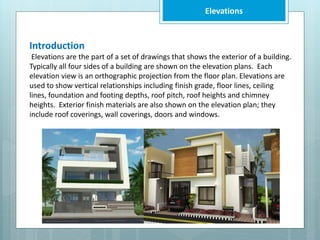
Elevations are the part of a set of drawings that shows the exterior of a building.
Typically all four sides of a building are shown on the elevation plans. Each
elevation view is an orthographic projection from the floor plan. Elevations are
used to show vertical relationships including finish grade, floor lines, ceiling
lines, foundation and footing depths, roof pitch, roof heights and chimney
heights. Exterior finish materials are also shown on the elevation plan; they
include roof coverings, wall coverings, doors and windows.
Elevations
Terms to Know
As you work through this module make sure you learn the definition and use of
each of the words listed below.
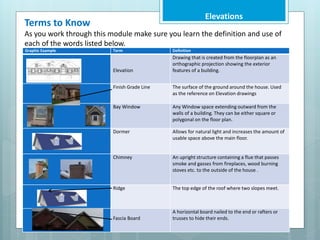
Graphic Example Term Definition
Elevation
Drawing that is created from the floorplan as an
orthographic projection showing the exterior
features of a building.
Finish Grade Line The surface of the ground around the house. Used
as the reference on Elevation drawings
Bay Window Any Window space extending outward from the
walls of a building. They can be either square or
polygonal on the floor plan.
Dormer Allows for natural light and increases the amount of
usable space above the main floor.
Chimney An upright structure containing a flue that passes
smoke and gasses from fireplaces, wood burning
stoves etc. to the outside of the house .
Ridge The top edge of the roof where two slopes meet.
Fascia Board
A horizontal board nailed to the end or rafters or
trusses to hide their ends.
Elevations
Terms to Know (Windows)
As you work through this module make sure you learn the definition and use of
each of the words listed below.
Graphic Example Term Definition
Fixed (Picture)
Window that does not move or open
Sliding A window that opens by sliding horizontally
Double or single
hung
A window that opens by sliding vertically
Casement A window that is attached to its frame by one or
more hinges
Ca
Awning
A window that is hinged at the bottom and opens
inward from the top - the reverse of hopper windows.
Hopper
A windows that is hinged at the bottom and opens
inward from the top - the reverse of awning windows.
Center Pivot A windows that is hinged in the middle and opens d
from the center
Jalousie A window which consists of parallel glass, acrylic, or
wooden louvers set in a frame. The louvers are locked
together onto a track, so that they may be tilted open
and shut in unison, to control airflow through the
window.
Elevations
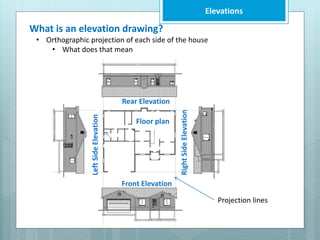
What is an elevation drawing?
• Orthographic projection of each side of the house
• What does that mean
Floor plan
Projection lines
Front Elevation
Rear Elevation
Right
Side
Elevation
Left
Side
Elevation
Elevations
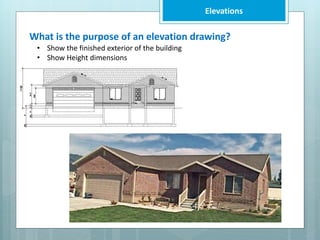
What is the purpose of an elevation drawing?
• Show the finished exterior of the building
• Show Height dimensions
Elevations
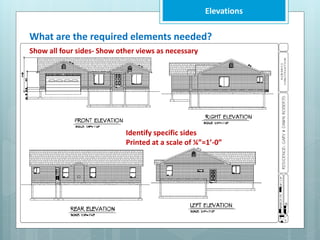
What are the required elements needed?
Show all four sides- Show other views as necessary
Identify specific sides
Printed at a scale of ¼”=1’-0”
Elevations
Required Elements
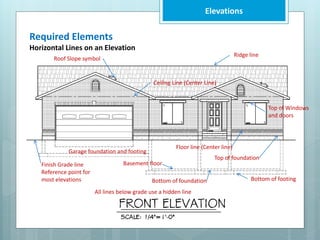
Horizontal Lines on an Elevation
Finish Grade line
Reference point for
most elevations
Top of foundation
Floor line (Center line)
Ceiling Line (Center Line)
Bottom of foundation Bottom of footing
Basement floor
Garage foundation and footing
Top of Windows
and doors
Ridge line
Roof Slope symbol
All lines below grade use a hidden line
Required Elements
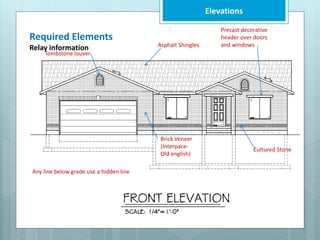
Relay information
Elevations
Any line below grade use a hidden line
Brick Veneer
(Interpace-
Old english)
Asphalt Shingles
Tombstone louver
Cultured Stone
Precast decorative
header over doors
and windows
Elevations
Required Elements
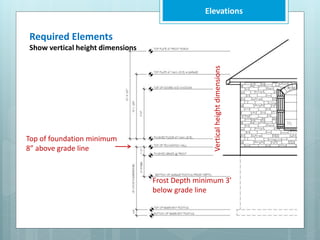
Show vertical height dimensions
Vertical
height
dimensions
Frost Depth minimum 3’
below grade line
Top of foundation minimum
8” above grade line
Elevations
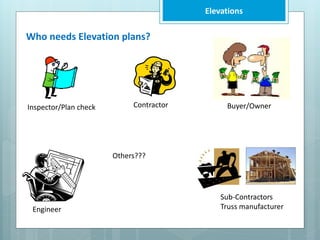
Who needs Elevation plans?
Buyer/Owner
Contractor
Sub-Contractors
Truss manufacturer
Engineer
Inspector/Plan check
Others???
Elevations
Summary
 An Elevation is an orthographic projection from the floor plan
 An Elevation shows what the outside of the house looks like
 An Elevation shows vertical height dimensions usually on the front view
 4 Elevations are usually shown on a set of plans
 Front, Rear, Right Side, Left Side
 Elevations are typically printed at ¼”= 1’-0”
 Used to relay information- Heights, Roof and Wall coverings,
 Lines below finish grade are drawn using hidden lines
 Floor and Ceiling lines drawn using center lines
 Finish grade is used as a reference on an elevation
Elevations
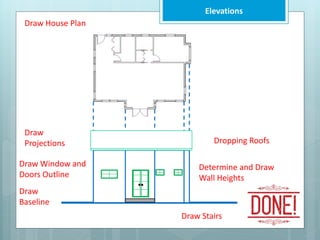
Draw House Plan
Draw
Baseline
Draw
Projections
Determine and Draw
Wall Heights
Draw Window and
Doors Outline
Dropping Roofs
Draw Stairs

Lecture 86 (Elevations) in for planning autocad

  • 1.
  • 2.
    Elevations Introduction Elevations are thepart of a set of drawings that shows the exterior of a building. Typically all four sides of a building are shown on the elevation plans. Each elevation view is an orthographic projection from the floor plan. Elevations are used to show vertical relationships including finish grade, floor lines, ceiling lines, foundation and footing depths, roof pitch, roof heights and chimney heights. Exterior finish materials are also shown on the elevation plan; they include roof coverings, wall coverings, doors and windows.
  • 3.
    Elevations Terms to Know Asyou work through this module make sure you learn the definition and use of each of the words listed below. Graphic Example Term Definition Elevation Drawing that is created from the floorplan as an orthographic projection showing the exterior features of a building. Finish Grade Line The surface of the ground around the house. Used as the reference on Elevation drawings Bay Window Any Window space extending outward from the walls of a building. They can be either square or polygonal on the floor plan. Dormer Allows for natural light and increases the amount of usable space above the main floor. Chimney An upright structure containing a flue that passes smoke and gasses from fireplaces, wood burning stoves etc. to the outside of the house . Ridge The top edge of the roof where two slopes meet. Fascia Board A horizontal board nailed to the end or rafters or trusses to hide their ends.
  • 4.
    Elevations Terms to Know(Windows) As you work through this module make sure you learn the definition and use of each of the words listed below. Graphic Example Term Definition Fixed (Picture) Window that does not move or open Sliding A window that opens by sliding horizontally Double or single hung A window that opens by sliding vertically Casement A window that is attached to its frame by one or more hinges Ca Awning A window that is hinged at the bottom and opens inward from the top - the reverse of hopper windows. Hopper A windows that is hinged at the bottom and opens inward from the top - the reverse of awning windows. Center Pivot A windows that is hinged in the middle and opens d from the center Jalousie A window which consists of parallel glass, acrylic, or wooden louvers set in a frame. The louvers are locked together onto a track, so that they may be tilted open and shut in unison, to control airflow through the window.
  • 5.
    Elevations What is anelevation drawing? • Orthographic projection of each side of the house • What does that mean Floor plan Projection lines Front Elevation Rear Elevation Right Side Elevation Left Side Elevation
  • 6.
    Elevations What is thepurpose of an elevation drawing? • Show the finished exterior of the building • Show Height dimensions
  • 7.
    Elevations What are therequired elements needed? Show all four sides- Show other views as necessary Identify specific sides Printed at a scale of ¼”=1’-0”
  • 8.
    Elevations Required Elements Horizontal Lineson an Elevation Finish Grade line Reference point for most elevations Top of foundation Floor line (Center line) Ceiling Line (Center Line) Bottom of foundation Bottom of footing Basement floor Garage foundation and footing Top of Windows and doors Ridge line Roof Slope symbol All lines below grade use a hidden line
  • 9.
    Required Elements Relay information Elevations Anyline below grade use a hidden line Brick Veneer (Interpace- Old english) Asphalt Shingles Tombstone louver Cultured Stone Precast decorative header over doors and windows
  • 10.
    Elevations Required Elements Show verticalheight dimensions Vertical height dimensions Frost Depth minimum 3’ below grade line Top of foundation minimum 8” above grade line
  • 11.
    Elevations Who needs Elevationplans? Buyer/Owner Contractor Sub-Contractors Truss manufacturer Engineer Inspector/Plan check Others???
  • 12.
    Elevations Summary  An Elevationis an orthographic projection from the floor plan  An Elevation shows what the outside of the house looks like  An Elevation shows vertical height dimensions usually on the front view  4 Elevations are usually shown on a set of plans  Front, Rear, Right Side, Left Side  Elevations are typically printed at ¼”= 1’-0”  Used to relay information- Heights, Roof and Wall coverings,  Lines below finish grade are drawn using hidden lines  Floor and Ceiling lines drawn using center lines  Finish grade is used as a reference on an elevation
  • 13.
    Elevations Draw House Plan Draw Baseline Draw Projections Determineand Draw Wall Heights Draw Window and Doors Outline Dropping Roofs Draw Stairs