Subjunctive Mood indicative mood imperative mood subjunctive mood
Two forms of subjunctive mood BE-subjunctive WERE-subjunctive
Two forms of subjunctive mood BE-subjunctive : realized by the  base form  of a verb WERE-subjunctive : realized by the verb “ were ”(past tense form)
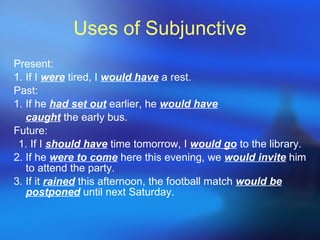
Uses of Subjunctive Present: 1. If I  were  tired, I  would have  a rest. Past: 1. If he  had set out  earlier, he  would have   caught  the early bus. Future: 1. If I  should have  time tomorrow, I  would go  to the library. 2. If he  were to come  here this evening, we  would invite  him to attend the party. 3. If it  rained  this afternoon, the football match  would be postponed  until next Saturday.
Uses of Subjunctive The subjunctive is used in English to express a  command ,  desire, hypothesis, purpose, doubt, or supposition . Content clauses  expressing commands, requests, or suggestions commonly use the present subjunctive.
Uses of Subjunctive such a clause may be introduced by a verb like propose, suggest, recommend, move (in the parliamentary sense), demand, or mandate, by an adjective like imperative, important, adamant, or necessary, or by a noun like insistence or proposal
Uses of Subjunctive To express a wish The past subjunctive is used after the verb to wish: I wish he were here or I wished he were there. This use of the subjunctive is sometimes known as the "volitional" subjunctive.
Uses of Subjunctive To express a hypothesis The past subjunctive is used after the conjunction if in a contrary-to-fact  protasis . For example: If I were a millionaire, I would buy a sports car.  If he had a car with him, he could drive us there.
Uses of Subjunctive By far the most common use of the subjunctive is the use of the subjunctive after "if" clauses that state or describe a hypothetical situation. If I were a butterfly, I would have wings.
BE-subjunctive Decide,decree, suggest, move 2. advisable, appropriate, essential, imperative 3. decision, decree, instruction, requirement
BE-subjunctive It is imperative that the new law  be  implemented. If the rumor  be  true, everything  is  possible. If the rumor were true, everything would be possible. If the rumor should be true, everything is possible
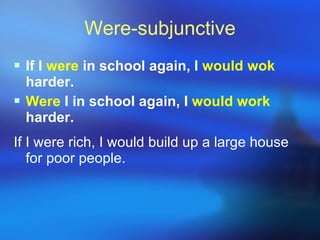
Were-subjunctive If I  were  in school again, I  would wok  harder. Were  I in school again, I  would work  harder. If I were rich, I would build up a large house for poor people.
Were-subjunctive simple past if …should if …were to
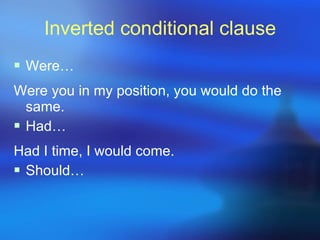
Inverted conditional clause Were… Were you in my position, you would do the same. Had… Had I time, I would come. Should…
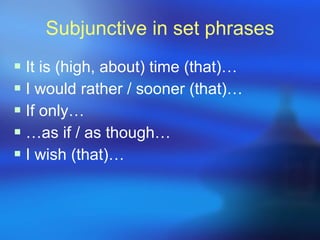
Subjunctive in set phrases It is (high, about) time (that)… I would rather / sooner (that)… If only… … as if / as though… I wish (that)…
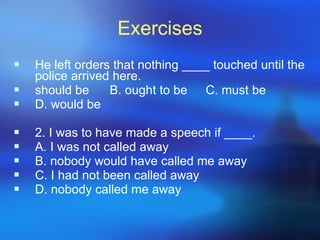
Exercises He left orders that nothing ____ touched until the police arrived here. should be B. ought to be C. must be D. would be 2. I was to have made a speech if ____. A. I was not called away B. nobody would have called me away C. I had not been called away D. nobody called me away
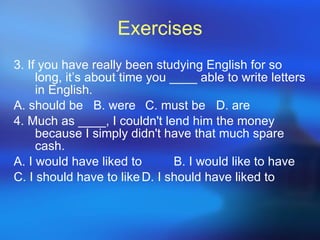
Exercises 3. If you have really been studying English for so long, it’s about time you ____ able to write letters in English. A. should be  B. were  C. must be   D. are 4. Much as ____, I couldn't lend him the money because I simply didn't have that much spare cash. A. I would have liked to B. I would like to have C. I should have to like D. I should have liked to
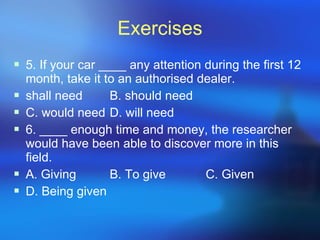
Exercises 5. If your car ____ any attention during the first 12 month, take it to an authorised dealer. shall need B. should need C. would need D. will need 6. ____ enough time and money, the researcher would have been able to discover more in this field. A. Giving B. To give C. Given D. Being given
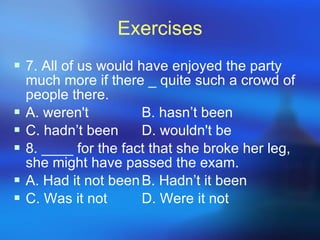
Exercises 7. All of us would have enjoyed the party much more if there _ quite such a crowd of people there. A. weren't B. hasn’t been C. hadn’t been D. wouldn't be 8. ____ for the fact that she broke her leg, she might have passed the exam. A. Had it not been B. Hadn’t it been C. Was it not D. Were it not

Lecture 7 Subjunctive Mood

  • 1.
    Subjunctive Mood indicativemood imperative mood subjunctive mood
  • 2.
    Two forms ofsubjunctive mood BE-subjunctive WERE-subjunctive
  • 3.
    Two forms ofsubjunctive mood BE-subjunctive : realized by the base form of a verb WERE-subjunctive : realized by the verb “ were ”(past tense form)
  • 4.
    Uses of SubjunctivePresent: 1. If I were tired, I would have a rest. Past: 1. If he had set out earlier, he would have caught the early bus. Future: 1. If I should have time tomorrow, I would go to the library. 2. If he were to come here this evening, we would invite him to attend the party. 3. If it rained this afternoon, the football match would be postponed until next Saturday.
  • 5.
    Uses of SubjunctiveThe subjunctive is used in English to express a command , desire, hypothesis, purpose, doubt, or supposition . Content clauses expressing commands, requests, or suggestions commonly use the present subjunctive.
  • 6.
    Uses of Subjunctivesuch a clause may be introduced by a verb like propose, suggest, recommend, move (in the parliamentary sense), demand, or mandate, by an adjective like imperative, important, adamant, or necessary, or by a noun like insistence or proposal
  • 7.
    Uses of SubjunctiveTo express a wish The past subjunctive is used after the verb to wish: I wish he were here or I wished he were there. This use of the subjunctive is sometimes known as the "volitional" subjunctive.
  • 8.
    Uses of SubjunctiveTo express a hypothesis The past subjunctive is used after the conjunction if in a contrary-to-fact protasis . For example: If I were a millionaire, I would buy a sports car. If he had a car with him, he could drive us there.
  • 9.
    Uses of SubjunctiveBy far the most common use of the subjunctive is the use of the subjunctive after "if" clauses that state or describe a hypothetical situation. If I were a butterfly, I would have wings.
  • 10.
    BE-subjunctive Decide,decree, suggest,move 2. advisable, appropriate, essential, imperative 3. decision, decree, instruction, requirement
  • 11.
    BE-subjunctive It isimperative that the new law be implemented. If the rumor be true, everything is possible. If the rumor were true, everything would be possible. If the rumor should be true, everything is possible
  • 12.
    Were-subjunctive If I were in school again, I would wok harder. Were I in school again, I would work harder. If I were rich, I would build up a large house for poor people.
  • 13.
    Were-subjunctive simple pastif …should if …were to
  • 14.
    Inverted conditional clauseWere… Were you in my position, you would do the same. Had… Had I time, I would come. Should…
  • 15.
    Subjunctive in setphrases It is (high, about) time (that)… I would rather / sooner (that)… If only… … as if / as though… I wish (that)…
  • 16.
    Exercises He leftorders that nothing ____ touched until the police arrived here. should be B. ought to be C. must be D. would be 2. I was to have made a speech if ____. A. I was not called away B. nobody would have called me away C. I had not been called away D. nobody called me away
  • 17.
    Exercises 3. Ifyou have really been studying English for so long, it’s about time you ____ able to write letters in English. A. should be B. were C. must be D. are 4. Much as ____, I couldn't lend him the money because I simply didn't have that much spare cash. A. I would have liked to B. I would like to have C. I should have to like D. I should have liked to
  • 18.
    Exercises 5. Ifyour car ____ any attention during the first 12 month, take it to an authorised dealer. shall need B. should need C. would need D. will need 6. ____ enough time and money, the researcher would have been able to discover more in this field. A. Giving B. To give C. Given D. Being given
  • 19.
    Exercises 7. Allof us would have enjoyed the party much more if there _ quite such a crowd of people there. A. weren't B. hasn’t been C. hadn’t been D. wouldn't be 8. ____ for the fact that she broke her leg, she might have passed the exam. A. Had it not been B. Hadn’t it been C. Was it not D. Were it not