Tuesday July 19, 2011

   Hubbs Center - ELL 7
   Agenda and Objectives
Objectives

• We will read Act 2, Scene 5 with a partner or to
  ourselves. Then, we will answer comprehension
  questions about Scene 5.
• We will discuss and practice the subjunctive
  mood.
• We will practice the reading strategy called
  monitoring and clarifying.
• We will finish Act 2 and begin Act 3.
• We will answer comprehension questions and
  practice making inferences about ideas from Act
  2.
Read to Self

• As a warm-up activity, you will either work with a
  partner or by yourself to read Act 2, Scene 5.
• Before you begin reading, please make a
  prediction about what you think Scene 5 might be
  about.
• While you are reading, please write down any
  questions or connections you make.
• After reading, please answer the comprehension
  questions and check your prediction.
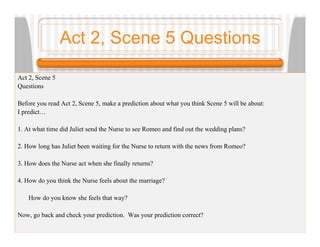
Act 2, Scene 5 Questions

Act 2, Scene 5
Questions

Before you read Act 2, Scene 5, make a prediction about what you think Scene 5 will be about:
I predict…

1. At what time did Juliet send the Nurse to see Romeo and find out the wedding plans?

2. How long has Juliet been waiting for the Nurse to return with the news from Romeo?

3. How does the Nurse act when she finally returns?

4. How do you think the Nurse feels about the marriage?

    How do you know she feels that way?

Now, go back and check your prediction. Was your prediction correct?
“If only I were a glove on that hand...”
•    The Subjunctive Mood:
•    We use subjunctives mainly when talking about events that are not certain to happen.
•    We use the subjunctive when talking about events that somebody:
    * wants to happen
    * hopes will happen
    * imagines happening

•    Examples:
    * The President requests that you be present at the meeting.
    * It is vital that you be present at the meeting.
    * If you were at the meeting, the President would be happy.

•    The subjunctive is typically used after two structures:
    * the verbs: ask, command, demand, insist, propose, recommend, request, suggest + that
    * the expressions: it is desirable, essential, important, necessary, vital + that

      adapted from: http://www.englishclub.com/grammar/verbs-subjunctive.htm
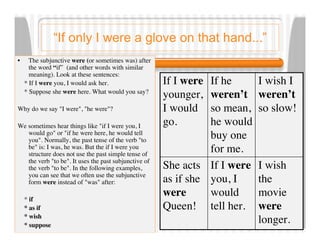
“If only I were a glove on that hand...”
•     The subjunctive were (or sometimes was) after
      the word “if” (and other words with similar
      meaning). Look at these sentences:
    * If I were you, I would ask her.                  If I were If he      I wish I
    * Suppose she were here. What would you say?
                                                       younger,  weren’t    weren’t
Why do we say "I were", "he were"?                     I would   so mean,   so slow!
We sometimes hear things like "if I were you, I        go.       he would
   would go" or "if he were here, he would tell
   you". Normally, the past tense of the verb "to
                                                                 buy one
   be" is: I was, he was. But the if I were you
   structure does not use the past simple tense of
                                                                 for me.
   the verb "to be". It uses the past subjunctive of
   the verb "to be". In the following examples,        She acts If I were   I wish
   you can see that we often use the subjunctive
   form were instead of "was" after:                   as if she you, I     the
    * if
                                                       were      would      movie
    * as if                                            Queen! tell her.     were
    * wish
    * suppose
                                                                            longer.
Let’s Brainstorm a List of
              Subjunctives!

• If I were you, I would...
• If I won the lottery, I would...
•
Strategy - Monitoring and
        Clarifying
We will finish Act 2 and begin Act 3.
      • Predictions
      • Connections
      • Questions
          Monitor and Clarify

• Capulets                • Montagues              • Neither
     Sampson
     Gregory                     Abraham            Prince
     Tybalt                      Balthasar
     Lord and Lady
      Capulet                     Benvolio
     Juliet                      Lord and Lady
     Nurse                        Montague
     Servant                     Romeo
     Paris
     Rosaline                    Mercutio
   Cousin Capulet
Act 2

• Answer comprehension questions about Act
  2.
• Make inferences about things that happened
  during Act 2.

7 19-11

  • 1.
    Tuesday July 19,2011 Hubbs Center - ELL 7 Agenda and Objectives
  • 2.
    Objectives • We willread Act 2, Scene 5 with a partner or to ourselves. Then, we will answer comprehension questions about Scene 5. • We will discuss and practice the subjunctive mood. • We will practice the reading strategy called monitoring and clarifying. • We will finish Act 2 and begin Act 3. • We will answer comprehension questions and practice making inferences about ideas from Act 2.
  • 3.
    Read to Self •As a warm-up activity, you will either work with a partner or by yourself to read Act 2, Scene 5. • Before you begin reading, please make a prediction about what you think Scene 5 might be about. • While you are reading, please write down any questions or connections you make. • After reading, please answer the comprehension questions and check your prediction.
  • 4.
    Act 2, Scene5 Questions Act 2, Scene 5 Questions Before you read Act 2, Scene 5, make a prediction about what you think Scene 5 will be about: I predict… 1. At what time did Juliet send the Nurse to see Romeo and find out the wedding plans? 2. How long has Juliet been waiting for the Nurse to return with the news from Romeo? 3. How does the Nurse act when she finally returns? 4. How do you think the Nurse feels about the marriage? How do you know she feels that way? Now, go back and check your prediction. Was your prediction correct?
  • 5.
    “If only Iwere a glove on that hand...” • The Subjunctive Mood: • We use subjunctives mainly when talking about events that are not certain to happen. • We use the subjunctive when talking about events that somebody: * wants to happen * hopes will happen * imagines happening • Examples: * The President requests that you be present at the meeting. * It is vital that you be present at the meeting. * If you were at the meeting, the President would be happy. • The subjunctive is typically used after two structures: * the verbs: ask, command, demand, insist, propose, recommend, request, suggest + that * the expressions: it is desirable, essential, important, necessary, vital + that adapted from: http://www.englishclub.com/grammar/verbs-subjunctive.htm
  • 6.
    “If only Iwere a glove on that hand...” • The subjunctive were (or sometimes was) after the word “if” (and other words with similar meaning). Look at these sentences: * If I were you, I would ask her. If I were If he I wish I * Suppose she were here. What would you say? younger, weren’t weren’t Why do we say "I were", "he were"? I would so mean, so slow! We sometimes hear things like "if I were you, I go. he would would go" or "if he were here, he would tell you". Normally, the past tense of the verb "to buy one be" is: I was, he was. But the if I were you structure does not use the past simple tense of for me. the verb "to be". It uses the past subjunctive of the verb "to be". In the following examples, She acts If I were I wish you can see that we often use the subjunctive form were instead of "was" after: as if she you, I the * if were would movie * as if Queen! tell her. were * wish * suppose longer.
  • 7.
    Let’s Brainstorm aList of Subjunctives! • If I were you, I would... • If I won the lottery, I would... •
  • 8.
    Strategy - Monitoringand Clarifying
  • 9.
    We will finishAct 2 and begin Act 3. • Predictions • Connections • Questions  Monitor and Clarify • Capulets • Montagues • Neither  Sampson  Gregory  Abraham  Prince  Tybalt  Balthasar  Lord and Lady Capulet  Benvolio  Juliet  Lord and Lady  Nurse Montague  Servant  Romeo  Paris  Rosaline  Mercutio  Cousin Capulet
  • 10.
    Act 2 • Answercomprehension questions about Act 2. • Make inferences about things that happened during Act 2.