Project closure
and audit
P R E S E N T A T I O N
S E R K I N T O N I B A L E R O S
R O M E R C E L E S T E
AGENDA
What is Closing a Project & Audit
Importance of Project Closure & Audit
Types of Project Closure
How do we know if the Project is done
The Closing Process
• Contract Closeout
• Administrative Closure
Inputs, Tools & Technique, Ouputs
Best Practices
WHAT IS
PROJECT CLOSURE
Project closure is the final phase of the
project management process, and it
involves completing all necessary activities
to formally close a project. This phase
ensures that all project objectives have
been achieved, all deliverables have been
produced, and the project has been
successfully handed over to the client or
end-users.
WHAT IS
PROJECT AUDIT
Project audit, also known as project review
or project health check, is a systematic and
independent examination of a project's
processes, performance, and outcomes.
The audit process helps identify potential
issues, assess project health, and make
informed decisions to improve project
management practices.
What is the Importance of Project
Closure and Audit?
IMPORTANCE OF
PROJECT CLOSURE
• Formal Completion The closure process provides a
structured and organized way to finalize a project, ensuring
that all objectives have been met, deliverables are completed,
and resources are appropriately released.
• Client Satisfaction Proper closure involves formal handover
of deliverables to the client, ensuring that they are satisfied
with the results and that the project has met their
expectations.
• Resource Optimization By releasing project resources back
to their regular roles or other projects, organizations can
optimize resource utilization and reduce unnecessary costs.
IMPORTANCE OF
PROJECT CLOSURE
• Knowledge Transfer Lessons learned during the closure
phase are documented and shared, enabling knowledge
transfer to improve future projects and avoid repeating
mistakes.
• Legal and Compliance Obligations Closure ensures that all
contracts, financial matters, and legal obligations are settled
appropriately, reducing the risk of legal issues or financial
discrepancies.
IMPORTANCE OF
PROJECT AUDIT
• Performance Assessment Audits evaluate project
performance against established criteria, allowing
stakeholders to gauge how well the project achieved its
objectives.
• Risk Identification Audits identify potential risks and
weaknesses in project management processes, enabling
timely corrective actions to mitigate risks and improve project
outcomes.
• Lessons for Improvement Audit findings highlight both
successful practices and areas needing improvement. These
insights help refine project management methodologies and
enhance future project planning and execution.
IMPORTANCE OF
PROJECT AUDIT
• Stakeholder Confidence Conducting regular audits
demonstrates a commitment to transparency and
accountability, fostering stakeholder trust in the project's
management and decision-making processes.
• Post-Implementation Assessment Post-implementation
audits verify whether the expected benefits and outcomes of
the project have been realized, helping organizations assess
the project's overall success.
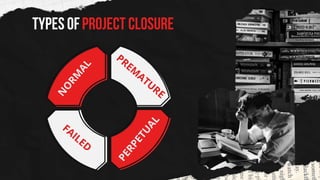
TYPES OFPROJECT CLOSURE
• Normal project closure refers to the typical and planned
conclusion of a project that has achieved its objectives within the
defined scope, schedule, and budget. All project deliverables have
been completed and accepted by stakeholders, and the project
has met its success criteria.
• Premature project closure occurs when a project is terminated
or closed before its intended objectives are achieved. This can
happen due to various reasons, such as changes in business
priorities, funding constraints, external factors, or technological
challenges. In such cases, the project is closed before reaching its
planned completion date, and any remaining deliverables or
activities may be left unfinished.
TYPES OFPROJECT CLOSURE
• Perpetual projects are those with no fixed end date, and they are
ongoing or continuous in nature. Perpetual projects are designed
to be sustained indefinitely, involving continuous improvement
efforts, maintenance activities, or ongoing support for a product
or service.
• Failed project closure occurs when a project is terminated due
to its inability to achieve its objectives or deliver the intended
outcomes. The reasons for project failure can vary, such as
inadequate planning, scope creep, budget overruns, or technical
issues. In a failed project closure, the project is formally closed
without achieving its intended goals, and the reasons for failure
are analyzed to identify lessons learned and areas for
improvement in future projects.
How do we know if the
Project is done?
HOW DO WE KNOW WHENTHE PROJECT IS DONE
Knowing when a project is done and ready for closure is a
critical aspect of project management. Several indicators
and criteria can help determine when a project is complete:
• Completion of Deliverables When all deliverables have
been produced and meet the required quality
standards, it's a strong signal that the project is ready to
be closed.
• Achievement of Objectives When all project objectives,
as outlined in the project charter or project
management plan, have been met, it indicates that the
project has accomplished its purpose.
3. Customer Acceptance The project is considered
complete when the deliverables have been formally
accepted by the customer. Their acceptance confirms that
the project's outcomes meet their requirements and
expectations.
4. Project Timeline The project's scheduled end date, as
defined in the project management plan, can serve as an
indication of when the project is expected to be completed.
HOW DO WE KNOW WHENTHE PROJECT IS DONE
The closing process
consists of:
• Contract closeout
• administrative closure
The Contract closeout process is concerned with
completing and settling the terms of the contract. It also
determines if the work described in the contract was
completed accurately and satisfactorily. This process is
called product verification. The product verification
performed during the closing process determines if all of
the work of the project was completed correctly and
satisfactorily according to stakeholder expectations.
contract closeout
contract closeout
• Completion of contratual-related activities (Project/Phase)
• Formal acceptance of vendor/seller deliverable/work
• Finalizing any open claims
• Updating record/documents to reflect final results
• Collect any project records
• Archive records/information for future use
ADMINISTRATIVE CLOSURE
The key activity of the administrative closure process is
concerned with gathering and disseminating information
to formalise project closure. Every project requires
closure and the completion of each project phase
requires administrative closure as well. Administrative
closure shouldn’t wait until project completion but
rather should be performed at the end of every
phase.
ADMINISTRATIVE CLOSURE
• Review all the work and ensure completion
• Ensure Completion or exit criteria for the phase/project
(all documents and deliverables are updated with current
information/ no pending change requests)
• All issues are resolved
• Confirm deliverable delivery/formak acceptance/transition
by client
• Reassign/reapportion excess materials/supplies
• Reallocate facilities/equipments
• Relevant costs charged to project
• Closing charge accounts/cost accounts/project accounts
• Complete final project report (may be a deliverable)
INPUTS, TOOLS AND TECHNIQUES, OUTPUTS
• Project Charter
• Project Management
Plan
• Project Documents
• Accepted Deliverables
• Business Document
• Procurement
Documentation
• Organizational
process assets
inputs tools & techniques
• Expert Judgment
• Data analysis
• Meetings
OUTPUTS
• Project Document
Updates
• Final product, service
or result transition
• Final Report
• Organizational
process assets
Updates
INPUTS, TOOLS AND TECHNIQUES, OUTPUTS
Source: A-Guide-to-a-Project-Management-Body-of-Knowledge_6th-Edition
TOOLS AND BEST PRACTICES
The Project Review Meeting
The review and agree stages of the Closing phase
should happen as part of a project review meeting.
Typically, this would take place as a presentation to
the project board, with key stakeholders also invited
to attend and participate.
By the end of the meeting you want two things:
firstly, an agreement that the project can be closed,
and secondly, a list of the items or tasks that need to
be completed before the end of the project.
TOOLS AND BEST PRACTICES
Project Sign-off
You should pull together a document that details
what was delivered, and references the original
Project Initiation Document as well as the change log
of decisions made through the project.
Getting the customer to sign on the dotted line to
agree that you have delivered what was asked is
good practice for closing the project, but also great
insurance against queries and concerns in the future.
TOOLS AND BEST PRACTICES
Customer Feedback and Key Measure Score
Both these tools achieve the same end: they help you
obtain feedback from your customers about how the
project was run. The focus here is on the project
manage-ment process itself, rather than what has
been delivered.
The mere act of asking for feedback can leave a very
positive impression on your customers—they will
appreciate that you care about improving, and want
to learn from the experience.
TOOLS AND BEST PRACTICES
The Closure Celebration
Making sure that individuals are rewarded for good
work has an impact not only on the project you’re just
finishing, but for future projects as well. If the next
person assigned to one of your project teams realizes
that hard work will be noticed, you’re more likely to get
that star performance than if they figure that you can
have no impact on their salary, promotion prospects,
or anything other than whether they get home on time
today.
THANK YOU
S E R K I N T O N I B A L E R O S
R O M E R C E L E S T E

Project Audit and Closure.pptx

  • 1.
    Project closure and audit PR E S E N T A T I O N S E R K I N T O N I B A L E R O S R O M E R C E L E S T E
  • 2.
    AGENDA What is Closinga Project & Audit Importance of Project Closure & Audit Types of Project Closure How do we know if the Project is done The Closing Process • Contract Closeout • Administrative Closure Inputs, Tools & Technique, Ouputs Best Practices
  • 3.
    WHAT IS PROJECT CLOSURE Projectclosure is the final phase of the project management process, and it involves completing all necessary activities to formally close a project. This phase ensures that all project objectives have been achieved, all deliverables have been produced, and the project has been successfully handed over to the client or end-users.
  • 4.
    WHAT IS PROJECT AUDIT Projectaudit, also known as project review or project health check, is a systematic and independent examination of a project's processes, performance, and outcomes. The audit process helps identify potential issues, assess project health, and make informed decisions to improve project management practices.
  • 5.
    What is theImportance of Project Closure and Audit?
  • 6.
    IMPORTANCE OF PROJECT CLOSURE •Formal Completion The closure process provides a structured and organized way to finalize a project, ensuring that all objectives have been met, deliverables are completed, and resources are appropriately released. • Client Satisfaction Proper closure involves formal handover of deliverables to the client, ensuring that they are satisfied with the results and that the project has met their expectations. • Resource Optimization By releasing project resources back to their regular roles or other projects, organizations can optimize resource utilization and reduce unnecessary costs.
  • 7.
    IMPORTANCE OF PROJECT CLOSURE •Knowledge Transfer Lessons learned during the closure phase are documented and shared, enabling knowledge transfer to improve future projects and avoid repeating mistakes. • Legal and Compliance Obligations Closure ensures that all contracts, financial matters, and legal obligations are settled appropriately, reducing the risk of legal issues or financial discrepancies.
  • 8.
    IMPORTANCE OF PROJECT AUDIT •Performance Assessment Audits evaluate project performance against established criteria, allowing stakeholders to gauge how well the project achieved its objectives. • Risk Identification Audits identify potential risks and weaknesses in project management processes, enabling timely corrective actions to mitigate risks and improve project outcomes. • Lessons for Improvement Audit findings highlight both successful practices and areas needing improvement. These insights help refine project management methodologies and enhance future project planning and execution.
  • 9.
    IMPORTANCE OF PROJECT AUDIT •Stakeholder Confidence Conducting regular audits demonstrates a commitment to transparency and accountability, fostering stakeholder trust in the project's management and decision-making processes. • Post-Implementation Assessment Post-implementation audits verify whether the expected benefits and outcomes of the project have been realized, helping organizations assess the project's overall success.
  • 10.
  • 11.
    TYPES OFPROJECT CLOSURE •Normal project closure refers to the typical and planned conclusion of a project that has achieved its objectives within the defined scope, schedule, and budget. All project deliverables have been completed and accepted by stakeholders, and the project has met its success criteria. • Premature project closure occurs when a project is terminated or closed before its intended objectives are achieved. This can happen due to various reasons, such as changes in business priorities, funding constraints, external factors, or technological challenges. In such cases, the project is closed before reaching its planned completion date, and any remaining deliverables or activities may be left unfinished.
  • 12.
    TYPES OFPROJECT CLOSURE •Perpetual projects are those with no fixed end date, and they are ongoing or continuous in nature. Perpetual projects are designed to be sustained indefinitely, involving continuous improvement efforts, maintenance activities, or ongoing support for a product or service. • Failed project closure occurs when a project is terminated due to its inability to achieve its objectives or deliver the intended outcomes. The reasons for project failure can vary, such as inadequate planning, scope creep, budget overruns, or technical issues. In a failed project closure, the project is formally closed without achieving its intended goals, and the reasons for failure are analyzed to identify lessons learned and areas for improvement in future projects.
  • 13.
    How do weknow if the Project is done?
  • 14.
    HOW DO WEKNOW WHENTHE PROJECT IS DONE Knowing when a project is done and ready for closure is a critical aspect of project management. Several indicators and criteria can help determine when a project is complete: • Completion of Deliverables When all deliverables have been produced and meet the required quality standards, it's a strong signal that the project is ready to be closed. • Achievement of Objectives When all project objectives, as outlined in the project charter or project management plan, have been met, it indicates that the project has accomplished its purpose.
  • 15.
    3. Customer AcceptanceThe project is considered complete when the deliverables have been formally accepted by the customer. Their acceptance confirms that the project's outcomes meet their requirements and expectations. 4. Project Timeline The project's scheduled end date, as defined in the project management plan, can serve as an indication of when the project is expected to be completed. HOW DO WE KNOW WHENTHE PROJECT IS DONE
  • 16.
    The closing process consistsof: • Contract closeout • administrative closure
  • 17.
    The Contract closeoutprocess is concerned with completing and settling the terms of the contract. It also determines if the work described in the contract was completed accurately and satisfactorily. This process is called product verification. The product verification performed during the closing process determines if all of the work of the project was completed correctly and satisfactorily according to stakeholder expectations. contract closeout
  • 18.
    contract closeout • Completionof contratual-related activities (Project/Phase) • Formal acceptance of vendor/seller deliverable/work • Finalizing any open claims • Updating record/documents to reflect final results • Collect any project records • Archive records/information for future use
  • 19.
    ADMINISTRATIVE CLOSURE The keyactivity of the administrative closure process is concerned with gathering and disseminating information to formalise project closure. Every project requires closure and the completion of each project phase requires administrative closure as well. Administrative closure shouldn’t wait until project completion but rather should be performed at the end of every phase.
  • 20.
    ADMINISTRATIVE CLOSURE • Reviewall the work and ensure completion • Ensure Completion or exit criteria for the phase/project (all documents and deliverables are updated with current information/ no pending change requests) • All issues are resolved • Confirm deliverable delivery/formak acceptance/transition by client • Reassign/reapportion excess materials/supplies • Reallocate facilities/equipments • Relevant costs charged to project • Closing charge accounts/cost accounts/project accounts • Complete final project report (may be a deliverable)
  • 21.
    INPUTS, TOOLS ANDTECHNIQUES, OUTPUTS • Project Charter • Project Management Plan • Project Documents • Accepted Deliverables • Business Document • Procurement Documentation • Organizational process assets inputs tools & techniques • Expert Judgment • Data analysis • Meetings OUTPUTS • Project Document Updates • Final product, service or result transition • Final Report • Organizational process assets Updates
  • 22.
    INPUTS, TOOLS ANDTECHNIQUES, OUTPUTS Source: A-Guide-to-a-Project-Management-Body-of-Knowledge_6th-Edition
  • 23.
  • 24.
  • 25.
  • 26.
  • 27.
  • 28.
    TOOLS AND BESTPRACTICES The Project Review Meeting The review and agree stages of the Closing phase should happen as part of a project review meeting. Typically, this would take place as a presentation to the project board, with key stakeholders also invited to attend and participate. By the end of the meeting you want two things: firstly, an agreement that the project can be closed, and secondly, a list of the items or tasks that need to be completed before the end of the project.
  • 29.
    TOOLS AND BESTPRACTICES Project Sign-off You should pull together a document that details what was delivered, and references the original Project Initiation Document as well as the change log of decisions made through the project. Getting the customer to sign on the dotted line to agree that you have delivered what was asked is good practice for closing the project, but also great insurance against queries and concerns in the future.
  • 30.
    TOOLS AND BESTPRACTICES Customer Feedback and Key Measure Score Both these tools achieve the same end: they help you obtain feedback from your customers about how the project was run. The focus here is on the project manage-ment process itself, rather than what has been delivered. The mere act of asking for feedback can leave a very positive impression on your customers—they will appreciate that you care about improving, and want to learn from the experience.
  • 31.
    TOOLS AND BESTPRACTICES The Closure Celebration Making sure that individuals are rewarded for good work has an impact not only on the project you’re just finishing, but for future projects as well. If the next person assigned to one of your project teams realizes that hard work will be noticed, you’re more likely to get that star performance than if they figure that you can have no impact on their salary, promotion prospects, or anything other than whether they get home on time today.
  • 32.
    THANK YOU S ER K I N T O N I B A L E R O S R O M E R C E L E S T E