TOPIC 31 Synapsesand TheirTypes: Electrical Synapses
Synapses
The junctionsbetweenaxonterminalsof one neuronandthe dendritesof anotherneuronare knownas
synapses.Atthese junctions,transmissionof signalstakes
place fromone neuronto another.
Types ofSynapses
There are twotypesof synapses:
• • Electrical synapses
• • Chemical synapses
Electrical Synapses
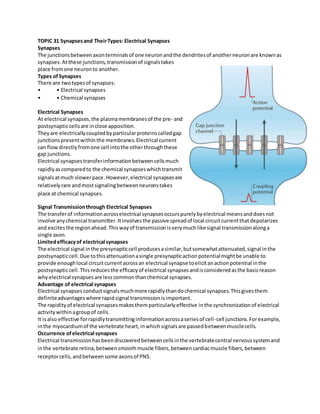
At electrical synapses,the plasmamembranesof the pre- and
postsynapticcellsare inclose apposition.
Theyare electricallycoupledbyparticularproteinscalledgap
junctionspresentwithinthe membranes.Electrical current
can flowdirectlyfromone cell intothe otherthroughthese
gap junctions.
Electrical synapsestransferinformationbetweencellsmuch
rapidlyascomparedto the chemical synapseswhichtransmit
signalsatmuch slowerpace.However,electrical synapsesare
relativelyrare andmostsignalingbetweenneuronstakes
place at chemical synapses.
Signal Transmissionthrough Electrical Synapses
The transferof informationacrosselectrical synapsesoccurspurelybyelectrical meansanddoesnot
involve anychemical transmitter.Itinvolvesthe passive spreadof local circuitcurrentthatdepolarizes
and excitesthe regionahead.Thiswayof transmissionisverymuchlike signal transmissionalonga
single axon.
Limitedefficacyof electrical synapses
The electrical signal inthe presynapticcell producesasimilar,butsomewhatattenuated,signal inthe
postsynapticcell.Due tothisattenuationasingle presynapticactionpotentialmightbe unable to
provide enoughlocal circuit currentacrossan electrical synapse toelicitanactionpotential inthe
postsynapticcell.Thisreducesthe efficacyof electrical synapsesandisconsideredasthe basicreason
whyelectrical synapsesare lesscommonthanchemical synapses.
Advantage of electrical synapses
Electrical synapsesconductsignalsmuchmore rapidlythandochemical synapses.Thisgivesthem
definiteadvantageswhere rapidsignal transmissionisimportant.
The rapidityof electrical synapsesmakesthemparticularlyeffective inthe synchronizationof electrical
activitywithinagroupof cells.
It isalso effective forrapidlytransmittinginformationacrossaseriesof cell-cell junctions.Forexample,
inthe myocardiumof the vertebrate heart,inwhichsignalsare passedbetweenmusclecells.
Occurrence ofelectrical synapses
Electrical transmissionhasbeendiscoveredbetweencellsinthe vertebratecentral nervoussystemand
inthe vertebrate retina,betweensmoothmuscle fibers,betweencardiacmuscle fibers,between
receptorcells,andbetweensome axonsof PNS.
TOPIC 32 Synapsesand TheirTypes: Chemical Synapses
The chemical synapses
The chemical synapsesare involvedinchemical synaptictransmissioninvolvingneurotransmitters.This
mode of synaptictransmissionismore commonascomparedto the electrical synaptictransmission.
Types ofchemical synapses
• • Fastchemical synapses
• • Slowchemical synapses
Fast Chemical Synapses
Fast chemical synapsesare foundinthe central nervoussystemandatthe neuromuscularjunctions.
Althoughthistransmissioniscalled"fast"itisinfactconsiderablyslowerthantransmissionacross
electrical synapses.
Neurotransmittersat Fast Chemical Synapses
• • The neurotransmittersinvolvedinfastchemical synapsesare typicallysmallmolecules(e.g.
Acetylcholine).
• • Neurotransmittersare storedinsynapticvesiclesthatare small,clearvesiclesinthe axon
terminals.
Release ofNeurotransmitters
• • Ata fastchemical synapse,actionpotentialsinthe presynapticneuroncause the release of
neurotransmittermoleculesatthe axonterminals.
• • Neurotransmittersare releasedbyexocytosisinto the synapticcleftthroughspecializedsites
on the membrane.
• • The synapticcleftisa narrow,fluid-filledspace,about20 nm wide thatseparatesthe
membranesof pre- andpostsynapticneurons.
Mode of Action of Neurotransmitters
• • Neurotransmittermoleculesbindtospecificproteinreceptorswhichare ligand-gatedion
channelsinthe postsynapticmembrane.
• • Thisbindingresultsinthe openingof the channelsthatallowsanioniccurrenttoflow intothe
postsynapticcell.
• • The postsynapticcurrentcausesa change inthe membrane potential of the postsynapticcell.
• • If the change inmembrane potentialexceedsthe threshold,anAPisinitiated.
Slow Chemical Synapses
Transmissionthroughslowchemicalsynapsestakesplace by adifferentpostsynapticmechanism.
The onsetof postsynapticresponseisslower(hundredsof milliseconds),butitcan lastmuch longer
(fromsecondstohours).
Neurotransmittersat Slow Chemical Synapses:
The neurotransmittersinvolvedinslow synaptictransmissionare:
• • typicallylarge molecules.
• • synthesizedfromone ormore aminoacids.
• • of two types:
Biogenicamines:are synthesizedfromasingle aminoacid
Neuropeptides:Consistof several aminoacidresidues.
Packaging and Release ofNeurotransmitters:
• • Vesiclesinthe slowsystemare larger.
• • Theyare usuallysynthesizedin the cell body,afterwhich
they are transportedtothe nerve terminals.
• • Vesiclesmayreleasethe transmittermoleculesatmany
sitesinthe presynapticterminal thatlackmorphological
specialization.Thesesitesare locatedawayfromthe sitesof
release of fastneurotransmitters.
Mode of Action of slowNeurotransmitters
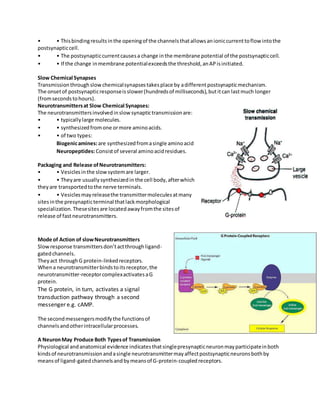
Slowresponse transmittersdon’tactthroughligand-
gatedchannels.
Theyact throughG protein-linkedreceptors.
Whena neurotransmitterbindstoitsreceptor,the
neurotransmitter-receptorcomplexactivatesaG
protein.
The G protein, in turn, activates a signal
transduction pathway through a second
messenger e.g. cAMP.
The secondmessengersmodifythe functionsof
channelsandotherintracellularprocesses.
A NeuronMay Produce Both Typesof Transmission
Physiological andanatomical evidence indicatesthatsinglepresynapticneuronmayparticipateinboth
kindsof neurotransmissionandasingle neurotransmittermayaffectpostsynapticneuronsbothby
meansof ligand-gatedchannelsandbymeansof G-protein-coupledreceptors.
TOPIC-35 Neurotransmitters:Diversityand Classification
Diversity
By the mid-1960s, onlythree neurotransmittershadbeenidentified.These wereacetylcholine,
norepinephrineandγ-aminobutyricacid(GABA).Today,more than100 neurotransmittershave been
identifiedthatvaryinsize andmolecularweightandbelongtovariouschemical categories.
ClassificationBasedon Chemical Structure
Basedon theirchemical structure,neurotransmitterscanbe sortedintotwogroups:
1. Small,low molecularweightNeurotransmitters.
Theyinclude:
• • Acetylcholine
• • Aminoacids
Include GABA,Glycine,Glutamate,Aspartate
• • Biogenicamines
Include Norepinephrine,Epinephrine,Dopamine,SerotoninandHistamine.
• • Gases
e.g.Nitricoxide (NO) andCarbonmonoxide(CO)
2. Large, highmolecular weightNeurotransmitters
Theyare derivedfromaminoacidsandinclude:
• Neuropeptides
Theyare largermoleculesthatare constructedof aminoacids.More than40 neuropeptidetransmitters
have beenidentifiedinthe mammalian central nervoussystem.Theseinclude manyhypothalamicand
pituitarypeptidehormones,Substance-P,endorphins,enkephalinsandmanyotheraminoacid
derivatives.
ClassificationBasedon Mode ofAction:
1. Fast, Direct Neurotransmitters
These transmittersactdirectlyonionchannel proteinsandchange the conductance of postsynaptic
membrane forvariousions.
These include acetylcholine,aminoacids(glutamate,aspartate,glycineandγ-Aminobutyricacid).
2. Slow,Indirect Neurotransmitters
These transmittersworkthroughanindirectbiochemical pathwaywithinthe postsynapticcell that
involvesGprotiens.Theychange the state of a secondmessengerthatresultsinchangesinconductance
of ionchannel proteins.
Theyinclude biogenicamines andneuropeptides.
Many of these neurotransmittersmayalsoact as neuromodulators.Neuromodulatorscanaffect
neighboringneuronsandmodifytheirbehavioratonce.

lecture 5 physio.docx

  • 1.
    TOPIC 31 SynapsesandTheirTypes: Electrical Synapses Synapses The junctionsbetweenaxonterminalsof one neuronandthe dendritesof anotherneuronare knownas synapses.Atthese junctions,transmissionof signalstakes place fromone neuronto another. Types ofSynapses There are twotypesof synapses: • • Electrical synapses • • Chemical synapses Electrical Synapses At electrical synapses,the plasmamembranesof the pre- and postsynapticcellsare inclose apposition. Theyare electricallycoupledbyparticularproteinscalledgap junctionspresentwithinthe membranes.Electrical current can flowdirectlyfromone cell intothe otherthroughthese gap junctions. Electrical synapsestransferinformationbetweencellsmuch rapidlyascomparedto the chemical synapseswhichtransmit signalsatmuch slowerpace.However,electrical synapsesare relativelyrare andmostsignalingbetweenneuronstakes place at chemical synapses. Signal Transmissionthrough Electrical Synapses The transferof informationacrosselectrical synapsesoccurspurelybyelectrical meansanddoesnot involve anychemical transmitter.Itinvolvesthe passive spreadof local circuitcurrentthatdepolarizes and excitesthe regionahead.Thiswayof transmissionisverymuchlike signal transmissionalonga single axon. Limitedefficacyof electrical synapses The electrical signal inthe presynapticcell producesasimilar,butsomewhatattenuated,signal inthe postsynapticcell.Due tothisattenuationasingle presynapticactionpotentialmightbe unable to provide enoughlocal circuit currentacrossan electrical synapse toelicitanactionpotential inthe postsynapticcell.Thisreducesthe efficacyof electrical synapsesandisconsideredasthe basicreason whyelectrical synapsesare lesscommonthanchemical synapses. Advantage of electrical synapses Electrical synapsesconductsignalsmuchmore rapidlythandochemical synapses.Thisgivesthem definiteadvantageswhere rapidsignal transmissionisimportant. The rapidityof electrical synapsesmakesthemparticularlyeffective inthe synchronizationof electrical activitywithinagroupof cells. It isalso effective forrapidlytransmittinginformationacrossaseriesof cell-cell junctions.Forexample, inthe myocardiumof the vertebrate heart,inwhichsignalsare passedbetweenmusclecells. Occurrence ofelectrical synapses Electrical transmissionhasbeendiscoveredbetweencellsinthe vertebratecentral nervoussystemand inthe vertebrate retina,betweensmoothmuscle fibers,betweencardiacmuscle fibers,between receptorcells,andbetweensome axonsof PNS.
  • 2.
    TOPIC 32 SynapsesandTheirTypes: Chemical Synapses The chemical synapses The chemical synapsesare involvedinchemical synaptictransmissioninvolvingneurotransmitters.This mode of synaptictransmissionismore commonascomparedto the electrical synaptictransmission. Types ofchemical synapses • • Fastchemical synapses • • Slowchemical synapses Fast Chemical Synapses Fast chemical synapsesare foundinthe central nervoussystemandatthe neuromuscularjunctions. Althoughthistransmissioniscalled"fast"itisinfactconsiderablyslowerthantransmissionacross electrical synapses. Neurotransmittersat Fast Chemical Synapses • • The neurotransmittersinvolvedinfastchemical synapsesare typicallysmallmolecules(e.g. Acetylcholine). • • Neurotransmittersare storedinsynapticvesiclesthatare small,clearvesiclesinthe axon terminals. Release ofNeurotransmitters • • Ata fastchemical synapse,actionpotentialsinthe presynapticneuroncause the release of neurotransmittermoleculesatthe axonterminals. • • Neurotransmittersare releasedbyexocytosisinto the synapticcleftthroughspecializedsites on the membrane. • • The synapticcleftisa narrow,fluid-filledspace,about20 nm wide thatseparatesthe membranesof pre- andpostsynapticneurons. Mode of Action of Neurotransmitters • • Neurotransmittermoleculesbindtospecificproteinreceptorswhichare ligand-gatedion channelsinthe postsynapticmembrane.
  • 3.
    • • Thisbindingresultsintheopeningof the channelsthatallowsanioniccurrenttoflow intothe postsynapticcell. • • The postsynapticcurrentcausesa change inthe membrane potential of the postsynapticcell. • • If the change inmembrane potentialexceedsthe threshold,anAPisinitiated. Slow Chemical Synapses Transmissionthroughslowchemicalsynapsestakesplace by adifferentpostsynapticmechanism. The onsetof postsynapticresponseisslower(hundredsof milliseconds),butitcan lastmuch longer (fromsecondstohours). Neurotransmittersat Slow Chemical Synapses: The neurotransmittersinvolvedinslow synaptictransmissionare: • • typicallylarge molecules. • • synthesizedfromone ormore aminoacids. • • of two types: Biogenicamines:are synthesizedfromasingle aminoacid Neuropeptides:Consistof several aminoacidresidues. Packaging and Release ofNeurotransmitters: • • Vesiclesinthe slowsystemare larger. • • Theyare usuallysynthesizedin the cell body,afterwhich they are transportedtothe nerve terminals. • • Vesiclesmayreleasethe transmittermoleculesatmany sitesinthe presynapticterminal thatlackmorphological specialization.Thesesitesare locatedawayfromthe sitesof release of fastneurotransmitters. Mode of Action of slowNeurotransmitters Slowresponse transmittersdon’tactthroughligand- gatedchannels. Theyact throughG protein-linkedreceptors. Whena neurotransmitterbindstoitsreceptor,the neurotransmitter-receptorcomplexactivatesaG protein. The G protein, in turn, activates a signal transduction pathway through a second messenger e.g. cAMP. The secondmessengersmodifythe functionsof channelsandotherintracellularprocesses. A NeuronMay Produce Both Typesof Transmission Physiological andanatomical evidence indicatesthatsinglepresynapticneuronmayparticipateinboth kindsof neurotransmissionandasingle neurotransmittermayaffectpostsynapticneuronsbothby meansof ligand-gatedchannelsandbymeansof G-protein-coupledreceptors.
  • 4.
    TOPIC-35 Neurotransmitters:Diversityand Classification Diversity Bythe mid-1960s, onlythree neurotransmittershadbeenidentified.These wereacetylcholine, norepinephrineandγ-aminobutyricacid(GABA).Today,more than100 neurotransmittershave been identifiedthatvaryinsize andmolecularweightandbelongtovariouschemical categories. ClassificationBasedon Chemical Structure Basedon theirchemical structure,neurotransmitterscanbe sortedintotwogroups: 1. Small,low molecularweightNeurotransmitters. Theyinclude: • • Acetylcholine • • Aminoacids Include GABA,Glycine,Glutamate,Aspartate • • Biogenicamines Include Norepinephrine,Epinephrine,Dopamine,SerotoninandHistamine. • • Gases e.g.Nitricoxide (NO) andCarbonmonoxide(CO) 2. Large, highmolecular weightNeurotransmitters Theyare derivedfromaminoacidsandinclude: • Neuropeptides Theyare largermoleculesthatare constructedof aminoacids.More than40 neuropeptidetransmitters have beenidentifiedinthe mammalian central nervoussystem.Theseinclude manyhypothalamicand pituitarypeptidehormones,Substance-P,endorphins,enkephalinsandmanyotheraminoacid derivatives. ClassificationBasedon Mode ofAction: 1. Fast, Direct Neurotransmitters These transmittersactdirectlyonionchannel proteinsandchange the conductance of postsynaptic membrane forvariousions. These include acetylcholine,aminoacids(glutamate,aspartate,glycineandγ-Aminobutyricacid). 2. Slow,Indirect Neurotransmitters These transmittersworkthroughanindirectbiochemical pathwaywithinthe postsynapticcell that involvesGprotiens.Theychange the state of a secondmessengerthatresultsinchangesinconductance of ionchannel proteins. Theyinclude biogenicamines andneuropeptides. Many of these neurotransmittersmayalsoact as neuromodulators.Neuromodulatorscanaffect neighboringneuronsandmodifytheirbehavioratonce.