COLLECTIVE ASSIGMENT LECTURE
INTRODUCTION TO LITERATURE Rahmila Murtiana,M.A
OLD ENGLISH
MADE BY :
GROUP I
1. ISTAWATI
2. BETTY YOHANA
3. AMINAH
4. AHMAD MURSYADA
INSTITUT AGAMA ISLAM NEGERI ANTASARI
FAKULTAS TARBIYAH
PENDIDIKAN BAHASA INGGRIS
BANJARMASIN
2013
History
• Old English (Ænglisc, Anglisc,
Englisc) or Anglo-Saxon is an early
form of the English language that
was spoken and written by
the Anglo-Saxons and their
descendants in parts of what are
now England and southern and
eastern Scotland, more specifically
in the England Old Period, between
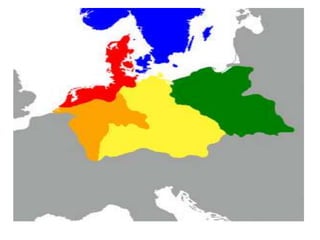
• It is a West Germanic language closely
related to Old Frisian and Old Saxon. Old
English had a grammar similar in many
ways to Classical Latin. In most respects,
including its grammar, it was much closer
to modern German and Icelandic than to
modern English.
• It was fully inflected with five grammatical
cases (nominative, accusative, genitive, d
ative, and instrumental), three grammatical
numbers (singular, plural, and dual) and
threegrammatical
genders (masculine, feminine,
The history of Old English can be subdivided into:
• Prehistoric Old English (c. 450 to 650); for this period, Old
English is mostly a reconstructed language as no literary
witnesses survive (with the exception of limited epigraphic
evidence). This language, or bloc of languages, spoken by
the Angles, Saxons, and Jutes, and pre-dating documented
Old English or Anglo-Saxon, has also been called Primitive
Old English.
• Early Old English (c. 650 to 900), the period of the oldest
manuscript traditions, with authors such
as Cædmon, Bede, Cynewulf and Aldhelm.
• Late Old English (c. 900 to 1066), the final stage of the
language leading up to the Norman conquest of
England and the subsequent transition toEarly Middle
English.
• The Old English period is followed by Middle English (12th
to 15th century),Early Modern English (ca. 1480 to 1650)
and finally Modern English (after 1650).
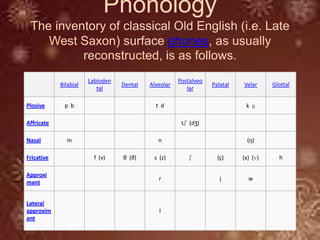
Phonology
The inventory of classical Old English (i.e. Late
West Saxon) surface phones, as usually
reconstructed, is as follows.
Bilabial
Labioden
tal
Dental Alveolar
Postalveo
lar
Palatal Velar Glottal
Plosive p b t d k ɡ
Affricate tʃ (dʒ)
Nasal m n (ŋ)
Fricative f (v) θ (ð) s (z) ʃ (ç) (x) (ɣ) h
Approxi
mant
r j w
Lateral
approxim
ant
l
The Sound
The sounds marked in parentheses in the chart above
are allophones:
• [dʒ] is an allophone of /j/ occurring after /n/ and
when geminated
• [ŋ] is an allophone of /n/ occurring before /k/ and /ɡ/
• [v, ð, z] are allophones of /f, θ, s/ respectively, occurring
between vowels or voiced consonants
• [ç, x] are allophones of /h/ occurring in coda position
after front and back vowels respectively
• [ɣ] is an allophone of /ɡ/ occurring after a vowel, and, at
an earlier stage of the language, in the syllable onset.
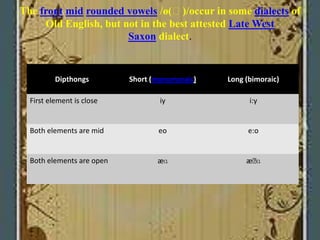
The front mid rounded vowels /ø(ː)/occur in some dialects of
Old English, but not in the best attested Late West
Saxon dialect.
Dipthongs Short (monomoraic) Long (bimoraic)
First element is close iy i:y
Both elements are mid eo e:o
Both elements are open æɑ æːɑ
Orthography
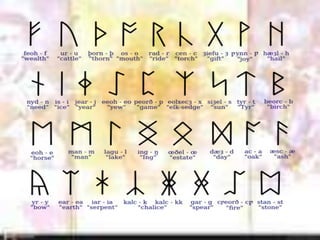
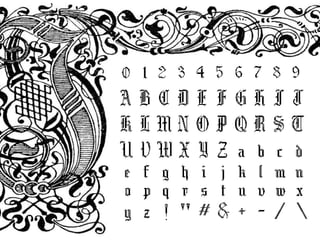
• Old English was first written in runes (futhorc) but shifted to a
(minuscule) half-uncial script of the Latin alphabet introduced by
Irish Christian missionaries[12] from around the 9th century. This was
replaced by insular script, a cursive and pointed version of the half-
uncial script. This was used until the end of the 12th century when
continental Carolingian minuscule (also known as Caroline) replaced
the insular.
• The letter ðæt ⟨ð⟩ (called eth or edh in modern English) was an
alteration of Latin ⟨d⟩, and the runic letters thorn ⟨þ⟩ and wynn ⟨ƿ⟩
are borrowings from futhorc. Also used was a symbol for
the conjunction and, a character similar to the number seven (⟨ː⟩,
called a Tironian note), and a symbol for the relative pronoun þæt,
a thorn with a crossbar through the ascender (⟨ː⟩). Macrons ⟨¯⟩
over vowels were rarely used to indicate long vowels. Also used
occasionally were abbreviations for a following m or n. All of the
sound descriptions below are given using IPA symbols.
Poetry
• Old English poetry falls broadly into two styles or
fields of reference, the heroic Germanic and the
Christian. With a few exceptions, almost all Old
English poets are anonymous.
• Although there are Anglo-Saxon discourses on
Latin prosody, the rules of Old English verse are
understood only through modern analyses of the
extant texts. The first widely accepted theory was
constructed by Eduard Sievers (1893).,[8] who
distinguished five distinct alliterativepatterns.
Alternative theories have been proposed; the
theory of John C. Pope (1942),[9] which uses
musical notation to track the verse patterns, has
been accepted in some quarters, and is hotly
debated.
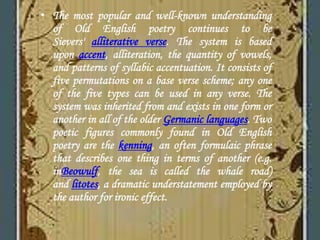
• The most popular and well-known understanding
of Old English poetry continues to be
Sievers' alliterative verse. The system is based
upon accent, alliteration, the quantity of vowels,
and patterns of syllabic accentuation. It consists of
five permutations on a base verse scheme; any one
of the five types can be used in any verse. The
system was inherited from and exists in one form or
another in all of the older Germanic languages. Two
poetic figures commonly found in Old English
poetry are the kenning, an often formulaic phrase
that describes one thing in terms of another (e.g.
inBeowulf, the sea is called the whale road)
and litotes, a dramatic understatement employed by
the author for ironic effect.
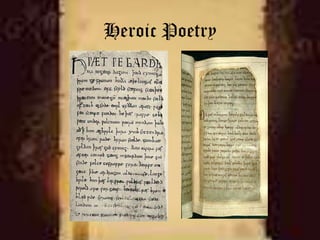
Beowulf
• The Original Beowulf Manuscript – a sample
Hwæt wē Gār-Dena in geār-dagum
þēod-cyninga þrym gefrūnon
hū ðā æþelingas ellen fremedon
Oft Scyld Scēfing sceaþena þrēatum
monegum mægþum meodo-setla oftēah
egsian eorl syððan ǣrest weorþan
• Hwæt *what!+ wē Gār-Dena [Spear-Danes] in geār-dagum [days of yore]
þēod-cyninga [king of a people] þrym [power] gefrūnon [hear of],
hū *how+ ðā æþelingas [prince,hero] ellen [deeds of
valour] fremedon [accomplish],
Oft [often] Scyld Scēfing [name: Danish dynasty of the
Scyldings] sceaþena [enemy] þrēatum [troop],
monegum [many] mægþum [nation] meodo-setla [mead-
bench] oftēah [take away];
egsian [terrify] eorl [warrior] syððan [after] ǣrest [first] weorþan [becom
e]
Heroic Poetry
Old English Prose
• The amount of surviving Old English prose is
much greater than the amount of poetry.Of
the surviving prose, the majority consists of
sermons and translations of religious works
that were composed in Latin.The division of
early medieval written prose works into
categories of "Christian" and "secular", as
below, is for convenience's sake only, for
literacy in Anglo-Saxon England was largely
the province of monks, nuns, and
ecclesiastics (or of those laypeople to whom
they had taught the skills of reading and
writing Latin and/or Old English). Old English
prose first appears in the 9th century, and
Secular Prose
• The Anglo-Saxon Chronicle was probably started in the time of
King Alfred the Great and continued for over 300 years as a
historical record of Anglo-Saxon history.
• A single example of a Classical romance has survived, it is a
fragment of the story of Apollonius of Tyre, from the 11th
century.
• A monk who was writing in Old English at the same time as
Aelfric and Wulfstan was Byrhtferth of Ramsey, whose
books Handboc and Manual were studies of mathematics and
rhetoric.
• Aelfric wrote two neo-scientific
works, Hexameron and Interrogationes Sigewulfi, dealing with
the stories of Creation.He also wrote a grammar and glossary in
Old English called Latin, later used by students interested in
learning Old French because it had been glossed in Old French.
• There are many surviving rules and calculations for finding feast
days, and tables on calculating the tides and the season of the
moon.
• In the Nowell Codex is the text of The Wonders of the
East which includes a remarkable map of the world, and other
illustrations.Also contained in Nowell is Alexander's Letter to
Aristotle.Because this is the same manuscript that
contains Beowulf, some scholars speculate it may have been a
collection of materials on exotic places and creatures.
• There are a number of interesting medical works.here is a
translation of Apuleius's Herbarium with striking illustrations,
found together with Medicina de Quadrupedibus.A second
collection of texts is Bald's Leechbook, a 10th century book
containing herbal and even some surgical cures.A third
collection, known as the Lacnunga, includes
many charms and incantations.
• Anglo-Saxon legal texts are a large and important part of the
overall corpus.By the 12th century they had been arranged into
two large collections (see Textus Roffensis).hey include laws of
the kings, beginning with those of Aethelbert of Kent, and texts
dealing with specific cases and places in the country.An
interesting example is Gerefa which outlines the duties of
a reeve on a large manor estate.There is also a large volume of
legal documents related to religious houses.
Play
• Because the manuscripts of medieval English plays
were usually ephemeral performance scripts rather than
reading matter, very few examples have survived from
what once must have been a very large dramatic
literature. What little survives from before the 15th
century includes some bilingual fragments, indicating
that the same play might have been given in English or
Anglo-Norman, according to the composition of the
audience. From the late 14th century onward, two main
dramatic genres are discernible, the mystery, or Corpus
Christi, cycles and the morality plays. Themystery
plays were long cyclic dramas of the Creation, ... (100
of 59,122 words)
The Movies old English
• Beowulf
• King Arthur
• Troy
• Kingdom of Heaven
• Beowulf and Grendel
• Robin Hood
• Canon and Barbarian,etc.

Presentaion group 1

  • 1.
    COLLECTIVE ASSIGMENT LECTURE INTRODUCTIONTO LITERATURE Rahmila Murtiana,M.A OLD ENGLISH MADE BY : GROUP I 1. ISTAWATI 2. BETTY YOHANA 3. AMINAH 4. AHMAD MURSYADA INSTITUT AGAMA ISLAM NEGERI ANTASARI FAKULTAS TARBIYAH PENDIDIKAN BAHASA INGGRIS BANJARMASIN 2013
  • 2.
    History • Old English(Ænglisc, Anglisc, Englisc) or Anglo-Saxon is an early form of the English language that was spoken and written by the Anglo-Saxons and their descendants in parts of what are now England and southern and eastern Scotland, more specifically in the England Old Period, between
  • 3.
    • It isa West Germanic language closely related to Old Frisian and Old Saxon. Old English had a grammar similar in many ways to Classical Latin. In most respects, including its grammar, it was much closer to modern German and Icelandic than to modern English. • It was fully inflected with five grammatical cases (nominative, accusative, genitive, d ative, and instrumental), three grammatical numbers (singular, plural, and dual) and threegrammatical genders (masculine, feminine,
  • 5.
    The history ofOld English can be subdivided into: • Prehistoric Old English (c. 450 to 650); for this period, Old English is mostly a reconstructed language as no literary witnesses survive (with the exception of limited epigraphic evidence). This language, or bloc of languages, spoken by the Angles, Saxons, and Jutes, and pre-dating documented Old English or Anglo-Saxon, has also been called Primitive Old English. • Early Old English (c. 650 to 900), the period of the oldest manuscript traditions, with authors such as Cædmon, Bede, Cynewulf and Aldhelm. • Late Old English (c. 900 to 1066), the final stage of the language leading up to the Norman conquest of England and the subsequent transition toEarly Middle English. • The Old English period is followed by Middle English (12th to 15th century),Early Modern English (ca. 1480 to 1650) and finally Modern English (after 1650).
  • 6.
    Phonology The inventory ofclassical Old English (i.e. Late West Saxon) surface phones, as usually reconstructed, is as follows. Bilabial Labioden tal Dental Alveolar Postalveo lar Palatal Velar Glottal Plosive p b t d k ɡ Affricate tʃ (dʒ) Nasal m n (ŋ) Fricative f (v) θ (ð) s (z) ʃ (ç) (x) (ɣ) h Approxi mant r j w Lateral approxim ant l
  • 7.
    The Sound The soundsmarked in parentheses in the chart above are allophones: • [dʒ] is an allophone of /j/ occurring after /n/ and when geminated • [ŋ] is an allophone of /n/ occurring before /k/ and /ɡ/ • [v, ð, z] are allophones of /f, θ, s/ respectively, occurring between vowels or voiced consonants • [ç, x] are allophones of /h/ occurring in coda position after front and back vowels respectively • [ɣ] is an allophone of /ɡ/ occurring after a vowel, and, at an earlier stage of the language, in the syllable onset.
  • 8.
    The front midrounded vowels /ø(ː)/occur in some dialects of Old English, but not in the best attested Late West Saxon dialect. Dipthongs Short (monomoraic) Long (bimoraic) First element is close iy i:y Both elements are mid eo e:o Both elements are open æɑ æːɑ
  • 9.
    Orthography • Old Englishwas first written in runes (futhorc) but shifted to a (minuscule) half-uncial script of the Latin alphabet introduced by Irish Christian missionaries[12] from around the 9th century. This was replaced by insular script, a cursive and pointed version of the half- uncial script. This was used until the end of the 12th century when continental Carolingian minuscule (also known as Caroline) replaced the insular. • The letter ðæt ⟨ð⟩ (called eth or edh in modern English) was an alteration of Latin ⟨d⟩, and the runic letters thorn ⟨þ⟩ and wynn ⟨ƿ⟩ are borrowings from futhorc. Also used was a symbol for the conjunction and, a character similar to the number seven (⟨ː⟩, called a Tironian note), and a symbol for the relative pronoun þæt, a thorn with a crossbar through the ascender (⟨ː⟩). Macrons ⟨¯⟩ over vowels were rarely used to indicate long vowels. Also used occasionally were abbreviations for a following m or n. All of the sound descriptions below are given using IPA symbols.
  • 12.
    Poetry • Old Englishpoetry falls broadly into two styles or fields of reference, the heroic Germanic and the Christian. With a few exceptions, almost all Old English poets are anonymous. • Although there are Anglo-Saxon discourses on Latin prosody, the rules of Old English verse are understood only through modern analyses of the extant texts. The first widely accepted theory was constructed by Eduard Sievers (1893).,[8] who distinguished five distinct alliterativepatterns. Alternative theories have been proposed; the theory of John C. Pope (1942),[9] which uses musical notation to track the verse patterns, has been accepted in some quarters, and is hotly debated.
  • 13.
    • The mostpopular and well-known understanding of Old English poetry continues to be Sievers' alliterative verse. The system is based upon accent, alliteration, the quantity of vowels, and patterns of syllabic accentuation. It consists of five permutations on a base verse scheme; any one of the five types can be used in any verse. The system was inherited from and exists in one form or another in all of the older Germanic languages. Two poetic figures commonly found in Old English poetry are the kenning, an often formulaic phrase that describes one thing in terms of another (e.g. inBeowulf, the sea is called the whale road) and litotes, a dramatic understatement employed by the author for ironic effect.
  • 14.
    Beowulf • The OriginalBeowulf Manuscript – a sample Hwæt wē Gār-Dena in geār-dagum þēod-cyninga þrym gefrūnon hū ðā æþelingas ellen fremedon Oft Scyld Scēfing sceaþena þrēatum monegum mægþum meodo-setla oftēah egsian eorl syððan ǣrest weorþan • Hwæt *what!+ wē Gār-Dena [Spear-Danes] in geār-dagum [days of yore] þēod-cyninga [king of a people] þrym [power] gefrūnon [hear of], hū *how+ ðā æþelingas [prince,hero] ellen [deeds of valour] fremedon [accomplish], Oft [often] Scyld Scēfing [name: Danish dynasty of the Scyldings] sceaþena [enemy] þrēatum [troop], monegum [many] mægþum [nation] meodo-setla [mead- bench] oftēah [take away]; egsian [terrify] eorl [warrior] syððan [after] ǣrest [first] weorþan [becom e]
  • 15.
  • 16.
    Old English Prose •The amount of surviving Old English prose is much greater than the amount of poetry.Of the surviving prose, the majority consists of sermons and translations of religious works that were composed in Latin.The division of early medieval written prose works into categories of "Christian" and "secular", as below, is for convenience's sake only, for literacy in Anglo-Saxon England was largely the province of monks, nuns, and ecclesiastics (or of those laypeople to whom they had taught the skills of reading and writing Latin and/or Old English). Old English prose first appears in the 9th century, and
  • 17.
    Secular Prose • TheAnglo-Saxon Chronicle was probably started in the time of King Alfred the Great and continued for over 300 years as a historical record of Anglo-Saxon history. • A single example of a Classical romance has survived, it is a fragment of the story of Apollonius of Tyre, from the 11th century. • A monk who was writing in Old English at the same time as Aelfric and Wulfstan was Byrhtferth of Ramsey, whose books Handboc and Manual were studies of mathematics and rhetoric. • Aelfric wrote two neo-scientific works, Hexameron and Interrogationes Sigewulfi, dealing with the stories of Creation.He also wrote a grammar and glossary in Old English called Latin, later used by students interested in learning Old French because it had been glossed in Old French. • There are many surviving rules and calculations for finding feast days, and tables on calculating the tides and the season of the moon.
  • 18.
    • In theNowell Codex is the text of The Wonders of the East which includes a remarkable map of the world, and other illustrations.Also contained in Nowell is Alexander's Letter to Aristotle.Because this is the same manuscript that contains Beowulf, some scholars speculate it may have been a collection of materials on exotic places and creatures. • There are a number of interesting medical works.here is a translation of Apuleius's Herbarium with striking illustrations, found together with Medicina de Quadrupedibus.A second collection of texts is Bald's Leechbook, a 10th century book containing herbal and even some surgical cures.A third collection, known as the Lacnunga, includes many charms and incantations. • Anglo-Saxon legal texts are a large and important part of the overall corpus.By the 12th century they had been arranged into two large collections (see Textus Roffensis).hey include laws of the kings, beginning with those of Aethelbert of Kent, and texts dealing with specific cases and places in the country.An interesting example is Gerefa which outlines the duties of a reeve on a large manor estate.There is also a large volume of legal documents related to religious houses.
  • 19.
    Play • Because themanuscripts of medieval English plays were usually ephemeral performance scripts rather than reading matter, very few examples have survived from what once must have been a very large dramatic literature. What little survives from before the 15th century includes some bilingual fragments, indicating that the same play might have been given in English or Anglo-Norman, according to the composition of the audience. From the late 14th century onward, two main dramatic genres are discernible, the mystery, or Corpus Christi, cycles and the morality plays. Themystery plays were long cyclic dramas of the Creation, ... (100 of 59,122 words)
  • 20.
    The Movies oldEnglish • Beowulf • King Arthur • Troy • Kingdom of Heaven • Beowulf and Grendel • Robin Hood • Canon and Barbarian,etc.