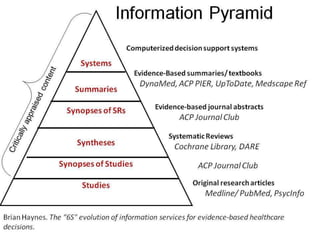
SEARCHING THE EVIDENCE
EVIDENCE BASED MEDICINE COURSE,
MASTER DEGREE CURRICULUM OF
MEDICAL STATISTICS
Dr. Iman El Sayed
MSc, Ph.D, Lecturer of Medical Statistics and Systematic Reviews.
Medical Research Institute, Alexandria University, Alexandria, Egypt.
Email: Eman.abd.elftaah@alexu.edu.eg
www.linkedin.com/in/imanelsayed83
GOALS:
To maximize the yield of relevant evidence
and minimize the search time you spend
 Identify appropriate resources to search for evidence .
October 2, 2019
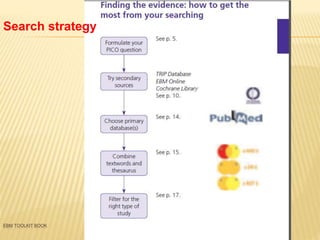
SEARCH STRATEGY
AVOID POTENTIAL PROBLEMS
 Too few results
 Too many results
 Irrelevant results
A STEPWISE APPROACH TO FINDING
THE BEST EVIDENCE EFFICIENTLY
 Step 1. Pull out the key terms from your evidence question PICO
(Covering the problem, intervention and outcome)
 Step 2. For questions with a narrow focus concentrate on information
contained in Evidence Based Secondary Publication
 Step 3. For EBP queries use sites like TRIP or SumSearch or NGC
 Step 4. Increase sensitivity or specificity of your search according to
the number of hits.
 Step 5. If previous steps fail then search for primary sources in
broader search engines like PubMed, or Google.
 Step 6. Modify your search strategies and rerun your search.
EXAMPLE
 Question: What is the reduction in mortality
from colorectal cancer if adults screened
with fecal occult blood-testing compared to
no screening?
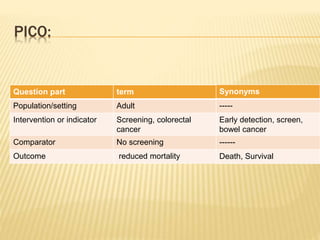
PICO:
Question part term
Population/setting Adult
Intervention or indicator Screening, colorectal
cancer
Comparator No screening
Outcome reduced mortality
Synonyms
-----
Early detection, screen,
bowel cancer
------
Death, Survival
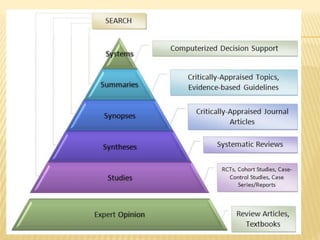
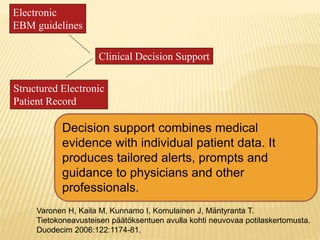
Electronic
EBM guidelines
Structured Electronic
Patient Record
Clinical Decision Support
Decision support combines medical
evidence with individual patient data. It
produces tailored alerts, prompts and
guidance to physicians and other
professionals.
Varonen H, Kaila M, Kunnamo I, Komulainen J, Mäntyranta T.
Tietokoneavusteisen päätöksentuen avulla kohti neuvovaa potilaskertomusta.
Duodecim 2006:122:1174-81.
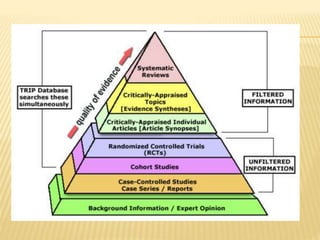
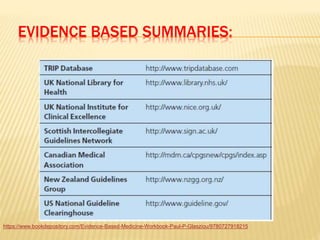
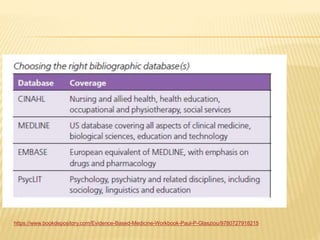
EVIDENCE BASED SUMMARIES:
https://www.bookdepository.com/Evidence-Based-Medicine-Workbook-Paul-P-Glasziou/9780727918215
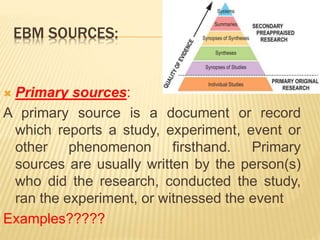
EBM SOURCES:
 Primary sources:
A primary source is a document or record
which reports a study, experiment, event or
other phenomenon firsthand. Primary
sources are usually written by the person(s)
who did the research, conducted the study,
ran the experiment, or witnessed the event
Examples?????
https://www.bookdepository.com/Evidence-Based-Medicine-Workbook-Paul-P-Glasziou/9780727918215
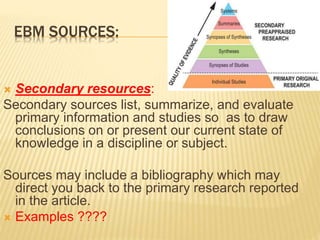
EBM SOURCES:
 Secondary resources:
Secondary sources list, summarize, and evaluate
primary information and studies so as to draw
conclusions on or present our current state of
knowledge in a discipline or subject.
Sources may include a bibliography which may
direct you back to the primary research reported
in the article.
 Examples ????
TRUE OR FALSE:
 Primary sources have higher levels of evidence than
secondary resources.
 Secondary sources resources are those where one or
more expert has identified the value of a study or a
group of studies and presented an analysis of the
findings and clinical relevance.
TRUE OR FALSE:
 Primary sources have higher levels of evidence than
secondary resources. False
 Secondary sources resources are those where one or
more expert has identified the value of a study or a
group of studies and presented an analysis of the
findings and clinical relevance. True
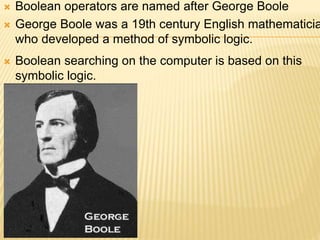
 Boolean operators are named after George Boole
 George Boole was a 19th century English mathematicia
who developed a method of symbolic logic.
 Boolean searching on the computer is based on this
symbolic logic.
KEY CONCEPTS
Keywords
Boolean Operators Search
Truncations
Citations & Abstract
Full-Text
THE QUICK GUIDE…
 Keywords: words identifying the concepts of your
research
 Boolean Operators: words combining the keywords
 Truncations: a truncation mark is a symbol added to
the stem of a word in order to search all forms of the
word
 Citations: the basic information of a record (Author,
title of the article, title of the periodical, date, page…)
 Abstract: a summary of the article (anything from 10
words to a few hundreds)
 Keywords are words or concepts extracted
from your topic (subject of research)
 They are unique and related to the field
being investigated.
 Do not forget that you are dealing with a
computer, not a human being! Do not write a
full sentence, just words (including
synonyms) unique to your topic.
THE CONCEPTS OF A SEARCH
KEYWORDS…
 Let’s try a topic, let’s squeeze words out of a
project
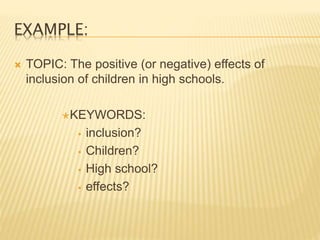
EXAMPLE:
 TOPIC: The positive (or negative) effects of
inclusion of children in high schools.
KEYWORDS:
 inclusion?
 Children?
 High school?
 effects?
 A Boolean Search is a computerized search using
“operators”
 They are words by which search terms (keywords)
are combined
 The operators may be used to expand or narrow a
search
 Most widely used are
 OR
 AND
 NOT
 (By default, Google will “and” your terms)
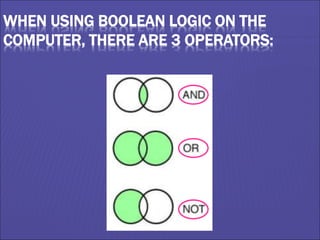
WHEN USING BOOLEAN LOGIC ON THE
COMPUTER, THERE ARE 3 OPERATORS:
 AND
 child* AND juvenile
 OR
 Child* OR juvenile
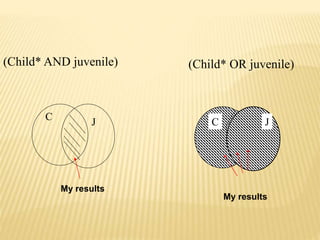
(Child* AND juvenile) (Child* OR juvenile)
C
CJ J
My results
My results
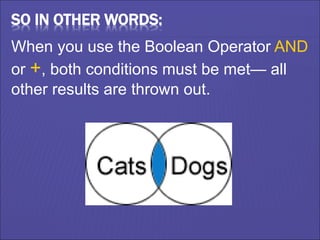
SO IN OTHER WORDS:
When you use the Boolean Operator AND
or +, both conditions must be met— all
other results are thrown out.
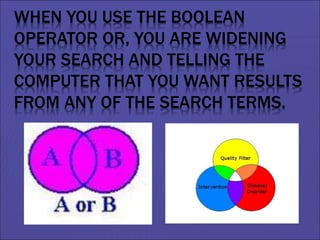
WHEN YOU USE THE BOOLEAN
OPERATOR OR, YOU ARE WIDENING
YOUR SEARCH AND TELLING THE
COMPUTER THAT YOU WANT RESULTS
FROM ANY OF THE SEARCH TERMS.
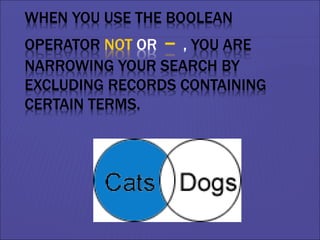
WHEN YOU USE THE BOOLEAN
OPERATOR NOT OR – , YOU ARE
NARROWING YOUR SEARCH BY
EXCLUDING RECORDS CONTAINING
CERTAIN TERMS.
WHEN MIGHT THIS BE USEFUL
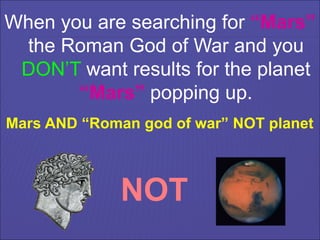
When you are searching for “Mars”
the Roman God of War and you
DON’T want results for the planet
“Mars” popping up.
NOT
Mars AND “Roman god of war” NOT planet
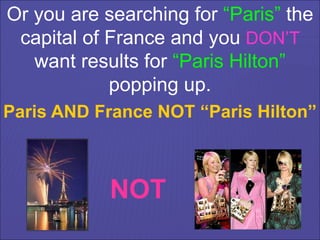
Or you are searching for “Paris” the
capital of France and you DON’T
want results for “Paris Hilton”
popping up.
NOT
Paris AND France NOT “Paris Hilton”
AT SOME OTHER SEARCH STRATEGIES
Let’s Look
* Truncation & ? Wildcards #
TRUNCATION
 Use truncation and wildcards to retrieve
variations of search terms.
 The truncation symbol (*) serves as a
substitute for any string of zero or more
characters.
 For example, the search golf* retrieves
articles containing the words golf, golfing
and golfer(s), as well as golfball(s).
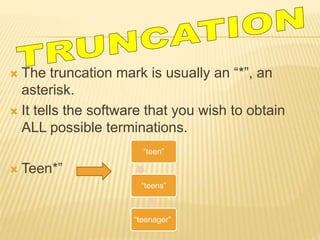
 The truncation mark is usually an “*”, an
asterisk.
 It tells the software that you wish to obtain
ALL possible terminations.
 Teen*”
“teen”
“teens”
“teenager”
BEFORE GOING ANY FURTHER:
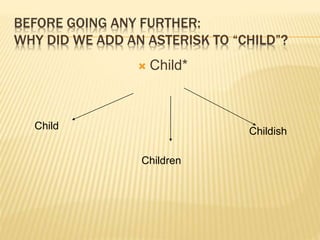
WHY DID WE ADD AN ASTERISK TO “CHILD”?
 Child*
Child
Children
Childish
WILDCARDS
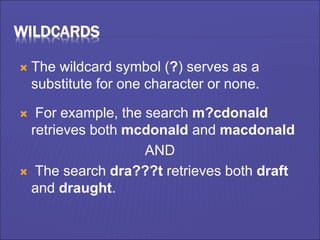
 The wildcard symbol (?) serves as a
substitute for one character or none.
 For example, the search m?cdonald
retrieves both mcdonald and macdonald
AND
 The search dra???t retrieves both draft
and draught.
DIFFERENT WILDCARD SYMBOLS MAY
BE USED DEPENDING ON THE SEARCH
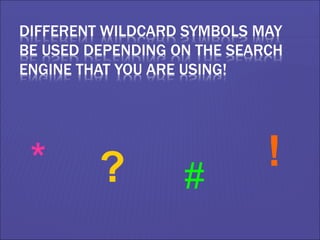
ENGINE THAT YOU ARE USING!
* ? #
!
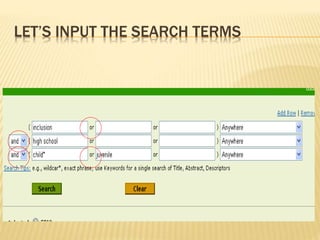
LET’S INPUT THE SEARCH TERMS
Click On “Search”, And Here Are The
Results, In “Short Format”
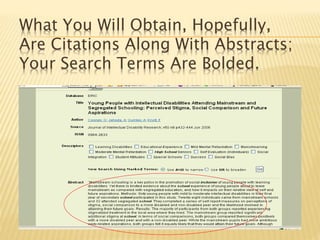
What You Will Obtain, Hopefully,
Are Citations Along With Abstracts;
Your Search Terms Are Bolded.
“QUOTATION MARKS”
 Using quotation marks narrows your
search.
 It requires words to be searched as a
phrase in the exact order that you type
them within the quotation marks.
 Helpful for searching multiple-word
terms, places, or a person’s
name.
Tara Guthrie, 2010
EXAMPLES USING “ ”
 “global warming”
 “New York City”
 “Brad Pitt”
Tara Guthrie, 2010
(PARENTHESES)
 (Parentheses) allow you to combine
any of the Boolean operators together
in combination.
 Use NOT and OR together to limit your
search.
 Use AND and OR together to expand
your search.
 Using ( ) allows you to combine two
possible searches into one,
and it saves you time.
Tara Guthrie, 2010
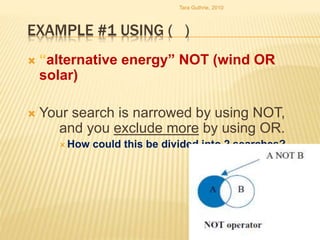
EXAMPLE #1 USING ( )
 “alternative energy” NOT (wind OR
solar)
 Your search is narrowed by using NOT,
and you exclude more by using OR.
 How could this be divided into 2 searches?
Tara Guthrie, 2010
EXAMPLE #2 USING ( )
 “peanut butter” and (salmonella OR
“food poisoning”)
 How could this be divided into 2 searches?
Tara Guthrie, 2010
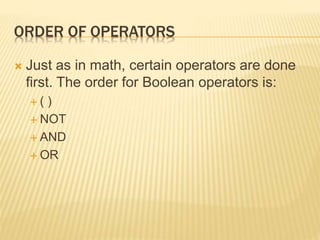
ORDER OF OPERATORS
 Just as in math, certain operators are done
first. The order for Boolean operators is:
 ( )
 NOT
 AND
 OR
BE SURE TO USE PROPER SEARCH
STRUCTURE
 What would the following search bring up?
Dogs AND ((rabies OR rabid) NOT (domestic OR Pet) )
 The search will look for the words: rabies, rabid
 Then domestic, pet
 Then remove all results that contain the words
domestic or pet from the results
 Then remove anything that does not contain the word
dog from the results
How to increase sensitivity of your search?
How to increase specificity of your search?
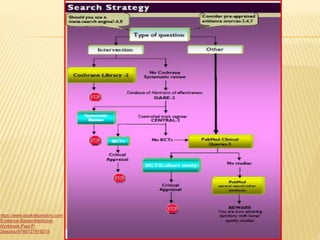
EBM TOOLKIT BOOK
Search strategy
Let’s practice more
SAMPLE QUESTION #3
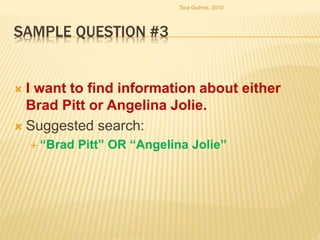
 I want to find information about either
Brad Pitt or Angelina Jolie.
 Suggested search:
 “Brad Pitt” OR “Angelina Jolie”
Tara Guthrie, 2010
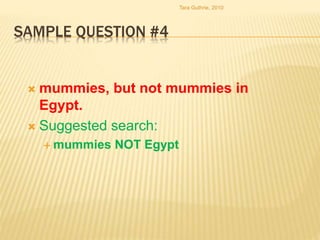
SAMPLE QUESTION #4
 mummies, but not mummies in
Egypt.
 Suggested search:
 mummies NOT Egypt
Tara Guthrie, 2010
SAMPLE QUESTION #5
 Designing web sites, but not on specific
web design software programs.
 Consider: which software programs help you
create web sites?
 Possible searches:
 “web site design” NOT (Dreamweaver OR
“Front Page”)
 “web site design” NOT software
Tara Guthrie, 2010
BOOLEAN SEARCH TIPS
 If you find too many search results?
 If you do not find enough search
results?
Tara Guthrie, 2010
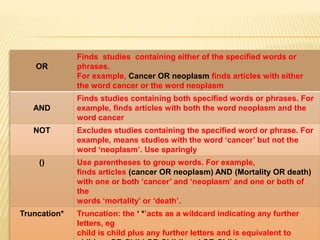
OR
Finds studies containing either of the specified words or
phrases.
For example, Cancer OR neoplasm finds articles with either
the word cancer or the word neoplasm
AND
Finds studies containing both specified words or phrases. For
example, finds articles with both the word neoplasm and the
word cancer
NOT Excludes studies containing the specified word or phrase. For
example, means studies with the word ‘cancer’ but not the
word ‘neoplasm’. Use sparingly
() Use parentheses to group words. For example,
finds articles (cancer OR neoplasm) AND (Mortality OR death)
with one or both ‘cancer’ and ‘neoplasm’ and one or both of
the
words ‘mortality’ or ‘death’.
Truncation* Truncation: the ‘ *’acts as a wildcard indicating any further
letters, eg
child is child plus any further letters and is equivalent to
https://www.bookdepository.com
/Evidence-Based-Medicine-
Workbook-Paul-P-
Glasziou/9780727918215
HAPPY SEARCHING!
ASSIGNMENT:
Please Extract All Keywords From Clinical Questions Of Previous Assignment and
add your suggested Boolean operators.
Bring out a hard copy

Evidence Based Medicine Master degree Course (Lecture 2): Searching literature

  • 1.
    SEARCHING THE EVIDENCE EVIDENCEBASED MEDICINE COURSE, MASTER DEGREE CURRICULUM OF MEDICAL STATISTICS Dr. Iman El Sayed MSc, Ph.D, Lecturer of Medical Statistics and Systematic Reviews. Medical Research Institute, Alexandria University, Alexandria, Egypt. Email: Eman.abd.elftaah@alexu.edu.eg www.linkedin.com/in/imanelsayed83
  • 2.
    GOALS: To maximize theyield of relevant evidence and minimize the search time you spend  Identify appropriate resources to search for evidence . October 2, 2019
  • 3.
    SEARCH STRATEGY AVOID POTENTIALPROBLEMS  Too few results  Too many results  Irrelevant results
  • 4.
    A STEPWISE APPROACHTO FINDING THE BEST EVIDENCE EFFICIENTLY  Step 1. Pull out the key terms from your evidence question PICO (Covering the problem, intervention and outcome)  Step 2. For questions with a narrow focus concentrate on information contained in Evidence Based Secondary Publication  Step 3. For EBP queries use sites like TRIP or SumSearch or NGC  Step 4. Increase sensitivity or specificity of your search according to the number of hits.  Step 5. If previous steps fail then search for primary sources in broader search engines like PubMed, or Google.  Step 6. Modify your search strategies and rerun your search.
  • 5.
    EXAMPLE  Question: Whatis the reduction in mortality from colorectal cancer if adults screened with fecal occult blood-testing compared to no screening?
  • 6.
    PICO: Question part term Population/settingAdult Intervention or indicator Screening, colorectal cancer Comparator No screening Outcome reduced mortality Synonyms ----- Early detection, screen, bowel cancer ------ Death, Survival
  • 12.
    Electronic EBM guidelines Structured Electronic PatientRecord Clinical Decision Support Decision support combines medical evidence with individual patient data. It produces tailored alerts, prompts and guidance to physicians and other professionals. Varonen H, Kaila M, Kunnamo I, Komulainen J, Mäntyranta T. Tietokoneavusteisen päätöksentuen avulla kohti neuvovaa potilaskertomusta. Duodecim 2006:122:1174-81.
  • 13.
  • 14.
    EBM SOURCES:  Primarysources: A primary source is a document or record which reports a study, experiment, event or other phenomenon firsthand. Primary sources are usually written by the person(s) who did the research, conducted the study, ran the experiment, or witnessed the event Examples?????
  • 15.
  • 16.
    EBM SOURCES:  Secondaryresources: Secondary sources list, summarize, and evaluate primary information and studies so as to draw conclusions on or present our current state of knowledge in a discipline or subject. Sources may include a bibliography which may direct you back to the primary research reported in the article.  Examples ????
  • 17.
    TRUE OR FALSE: Primary sources have higher levels of evidence than secondary resources.  Secondary sources resources are those where one or more expert has identified the value of a study or a group of studies and presented an analysis of the findings and clinical relevance.
  • 18.
    TRUE OR FALSE: Primary sources have higher levels of evidence than secondary resources. False  Secondary sources resources are those where one or more expert has identified the value of a study or a group of studies and presented an analysis of the findings and clinical relevance. True
  • 20.
     Boolean operatorsare named after George Boole  George Boole was a 19th century English mathematicia who developed a method of symbolic logic.  Boolean searching on the computer is based on this symbolic logic.
  • 21.
    KEY CONCEPTS Keywords Boolean OperatorsSearch Truncations Citations & Abstract Full-Text
  • 22.
    THE QUICK GUIDE… Keywords: words identifying the concepts of your research  Boolean Operators: words combining the keywords  Truncations: a truncation mark is a symbol added to the stem of a word in order to search all forms of the word  Citations: the basic information of a record (Author, title of the article, title of the periodical, date, page…)  Abstract: a summary of the article (anything from 10 words to a few hundreds)
  • 23.
     Keywords arewords or concepts extracted from your topic (subject of research)  They are unique and related to the field being investigated.  Do not forget that you are dealing with a computer, not a human being! Do not write a full sentence, just words (including synonyms) unique to your topic.
  • 24.
    THE CONCEPTS OFA SEARCH KEYWORDS…  Let’s try a topic, let’s squeeze words out of a project
  • 25.
    EXAMPLE:  TOPIC: Thepositive (or negative) effects of inclusion of children in high schools. KEYWORDS:  inclusion?  Children?  High school?  effects?
  • 26.
     A BooleanSearch is a computerized search using “operators”  They are words by which search terms (keywords) are combined  The operators may be used to expand or narrow a search  Most widely used are  OR  AND  NOT  (By default, Google will “and” your terms)
  • 27.
    WHEN USING BOOLEANLOGIC ON THE COMPUTER, THERE ARE 3 OPERATORS:
  • 28.
     AND  child*AND juvenile  OR  Child* OR juvenile
  • 29.
    (Child* AND juvenile)(Child* OR juvenile) C CJ J My results My results
  • 30.
    SO IN OTHERWORDS: When you use the Boolean Operator AND or +, both conditions must be met— all other results are thrown out.
  • 31.
    WHEN YOU USETHE BOOLEAN OPERATOR OR, YOU ARE WIDENING YOUR SEARCH AND TELLING THE COMPUTER THAT YOU WANT RESULTS FROM ANY OF THE SEARCH TERMS.
  • 32.
    WHEN YOU USETHE BOOLEAN OPERATOR NOT OR – , YOU ARE NARROWING YOUR SEARCH BY EXCLUDING RECORDS CONTAINING CERTAIN TERMS.
  • 33.
    WHEN MIGHT THISBE USEFUL
  • 34.
    When you aresearching for “Mars” the Roman God of War and you DON’T want results for the planet “Mars” popping up. NOT Mars AND “Roman god of war” NOT planet
  • 35.
    Or you aresearching for “Paris” the capital of France and you DON’T want results for “Paris Hilton” popping up. NOT Paris AND France NOT “Paris Hilton”
  • 36.
    AT SOME OTHERSEARCH STRATEGIES Let’s Look * Truncation & ? Wildcards #
  • 37.
    TRUNCATION  Use truncationand wildcards to retrieve variations of search terms.  The truncation symbol (*) serves as a substitute for any string of zero or more characters.  For example, the search golf* retrieves articles containing the words golf, golfing and golfer(s), as well as golfball(s).
  • 38.
     The truncationmark is usually an “*”, an asterisk.  It tells the software that you wish to obtain ALL possible terminations.  Teen*” “teen” “teens” “teenager”
  • 39.
    BEFORE GOING ANYFURTHER: WHY DID WE ADD AN ASTERISK TO “CHILD”?  Child* Child Children Childish
  • 40.
    WILDCARDS  The wildcardsymbol (?) serves as a substitute for one character or none.  For example, the search m?cdonald retrieves both mcdonald and macdonald AND  The search dra???t retrieves both draft and draught.
  • 41.
    DIFFERENT WILDCARD SYMBOLSMAY BE USED DEPENDING ON THE SEARCH ENGINE THAT YOU ARE USING! * ? # !
  • 42.
    LET’S INPUT THESEARCH TERMS
  • 43.
    Click On “Search”,And Here Are The Results, In “Short Format”
  • 44.
    What You WillObtain, Hopefully, Are Citations Along With Abstracts; Your Search Terms Are Bolded.
  • 45.
    “QUOTATION MARKS”  Usingquotation marks narrows your search.  It requires words to be searched as a phrase in the exact order that you type them within the quotation marks.  Helpful for searching multiple-word terms, places, or a person’s name. Tara Guthrie, 2010
  • 46.
    EXAMPLES USING “”  “global warming”  “New York City”  “Brad Pitt” Tara Guthrie, 2010
  • 47.
    (PARENTHESES)  (Parentheses) allowyou to combine any of the Boolean operators together in combination.  Use NOT and OR together to limit your search.  Use AND and OR together to expand your search.  Using ( ) allows you to combine two possible searches into one, and it saves you time. Tara Guthrie, 2010
  • 48.
    EXAMPLE #1 USING( )  “alternative energy” NOT (wind OR solar)  Your search is narrowed by using NOT, and you exclude more by using OR.  How could this be divided into 2 searches? Tara Guthrie, 2010
  • 49.
    EXAMPLE #2 USING( )  “peanut butter” and (salmonella OR “food poisoning”)  How could this be divided into 2 searches? Tara Guthrie, 2010
  • 50.
    ORDER OF OPERATORS Just as in math, certain operators are done first. The order for Boolean operators is:  ( )  NOT  AND  OR
  • 51.
    BE SURE TOUSE PROPER SEARCH STRUCTURE  What would the following search bring up? Dogs AND ((rabies OR rabid) NOT (domestic OR Pet) )  The search will look for the words: rabies, rabid  Then domestic, pet  Then remove all results that contain the words domestic or pet from the results  Then remove anything that does not contain the word dog from the results
  • 52.
    How to increasesensitivity of your search? How to increase specificity of your search?
  • 53.
  • 54.
  • 55.
    SAMPLE QUESTION #3 I want to find information about either Brad Pitt or Angelina Jolie.  Suggested search:  “Brad Pitt” OR “Angelina Jolie” Tara Guthrie, 2010
  • 56.
    SAMPLE QUESTION #4 mummies, but not mummies in Egypt.  Suggested search:  mummies NOT Egypt Tara Guthrie, 2010
  • 57.
    SAMPLE QUESTION #5 Designing web sites, but not on specific web design software programs.  Consider: which software programs help you create web sites?  Possible searches:  “web site design” NOT (Dreamweaver OR “Front Page”)  “web site design” NOT software Tara Guthrie, 2010
  • 58.
    BOOLEAN SEARCH TIPS If you find too many search results?  If you do not find enough search results? Tara Guthrie, 2010
  • 59.
    OR Finds studies containingeither of the specified words or phrases. For example, Cancer OR neoplasm finds articles with either the word cancer or the word neoplasm AND Finds studies containing both specified words or phrases. For example, finds articles with both the word neoplasm and the word cancer NOT Excludes studies containing the specified word or phrase. For example, means studies with the word ‘cancer’ but not the word ‘neoplasm’. Use sparingly () Use parentheses to group words. For example, finds articles (cancer OR neoplasm) AND (Mortality OR death) with one or both ‘cancer’ and ‘neoplasm’ and one or both of the words ‘mortality’ or ‘death’. Truncation* Truncation: the ‘ *’acts as a wildcard indicating any further letters, eg child is child plus any further letters and is equivalent to
  • 60.
  • 61.
  • 62.
    ASSIGNMENT: Please Extract AllKeywords From Clinical Questions Of Previous Assignment and add your suggested Boolean operators. Bring out a hard copy