Information Security
CS 3002
Dr. Haroon Mahmood
Assistant Professor
NUCES Lahore
Disclaimer: The contents of these slides have been taken
from the book of Computer Security by William Stallings.
2
Information Security
Database systems
 Structured collection of data stored for use by one or more
applications
 Contains the relationships between data items and groups
of data items
 Can sometimes contain sensitive data that needs to be
secured
 Query language: Provides a uniform interface to the
database
3
Information Security
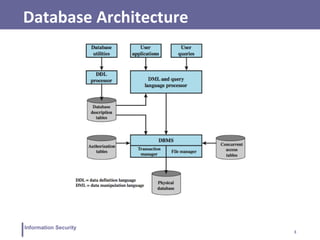
Database Architecture
4
Information Security
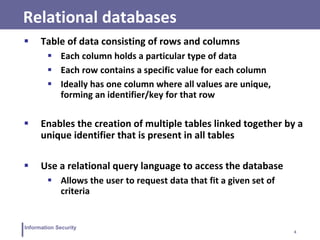
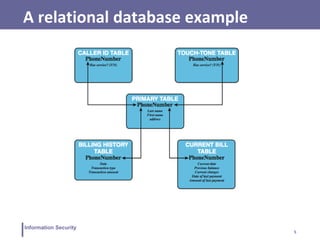
Relational databases
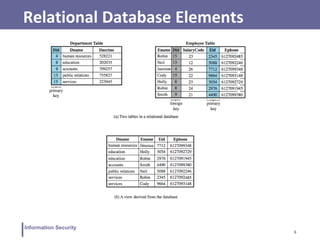
 Table of data consisting of rows and columns
 Each column holds a particular type of data
 Each row contains a specific value for each column
 Ideally has one column where all values are unique,
forming an identifier/key for that row
 Enables the creation of multiple tables linked together by a
unique identifier that is present in all tables
 Use a relational query language to access the database
 Allows the user to request data that fit a given set of
criteria
5
Information Security
A relational database example
6
Information Security
Relational Database Elements
7
Information Security
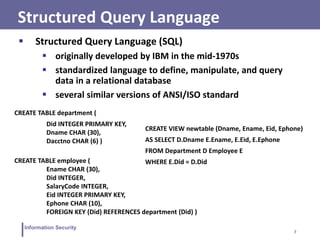
Structured Query Language
 Structured Query Language (SQL)
 originally developed by IBM in the mid-1970s
 standardized language to define, manipulate, and query
data in a relational database
 several similar versions of ANSI/ISO standard
CREATE TABLE department (
Did INTEGER PRIMARY KEY,
Dname CHAR (30),
Dacctno CHAR (6) )
CREATE TABLE employee (
Ename CHAR (30),
Did INTEGER,
SalaryCode INTEGER,
Eid INTEGER PRIMARY KEY,
Ephone CHAR (10),
FOREIGN KEY (Did) REFERENCES department (Did) )
CREATE VIEW newtable (Dname, Ename, Eid, Ephone)
AS SELECT D.Dname E.Ename, E.Eid, E.Ephone
FROM Department D Employee E
WHERE E.Did = D.Did
8
Information Security
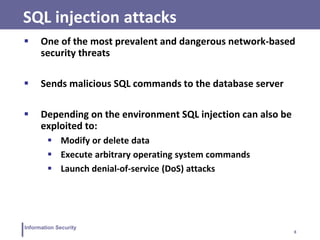
SQL injection attacks
 One of the most prevalent and dangerous network-based
security threats
 Sends malicious SQL commands to the database server
 Depending on the environment SQL injection can also be
exploited to:
 Modify or delete data
 Execute arbitrary operating system commands
 Launch denial-of-service (DoS) attacks
9
Information Security
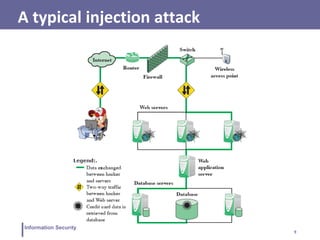
A typical injection attack
10
Information Security
Injection attack steps
1. Hacker finds a vulnerability in a custom Web application
and injects an SQL command to a database by sending the
command to the Web server. The command is injected into
traffic that will be accepted by the firewall.
2. The Web server receives the malicious code and sends it to
the Web application server.
3. The Web application server receives the malicious code
from the Web server and sends it to the database server.
4. The database server executes the malicious code on the
database. The database returns data from credit cards
table.
5. The Web application server dynamically generates a page
with data including credit card details from the database.
6. The Web server sends the credit card details to the hacker
11
Information Security
Sample SQL injection
 The SQLi attack typically works by prematurely terminating
a text string and appending a new command
SELECT fname
FROM student
where fname is ‘user prompt’;
What if user enters the following input?
User: John’; DROP table Course;--
12
Information Security
Sample SQL injection
 var ShipCity;
ShipCity = Request.form (“ShipCity”);
var sql = “select * from OrdersTable where ShipCity = ‘ ” +
ShipCity + “ ’ ”;
 SELECT * FROM OrdersTable WHERE ShipCity = ‘Redmond’

Suppose, however, the user enters the following:
Redmond’; DROP table OrdersTable --

This results in the following SQL query:
SELECT * FROM OrdersTable WHERE ShipCity =
‘Redmond’; DROP table OrdersTable--
13
Information Security
In-band attacks
 Tautology: This form of attack injects code in one or more
conditional statements so that they always evaluate to
true
 End-of-line comment: After injecting code into a particular
field, legitimate code that follows are nullified through
usage of end of line comments
 Piggybacked queries: The attacker adds additional queries
beyond the intended query, piggy-backing the attack on
top of a legitimate request
14
Information Security
Sample SQL injection: tautology
$query= “
SELECT info FROM user WHERE name =
`$_GET[“name”]’ AND pwd = `GET[“pwd”]`
”;
Attacker enters: ’ OR 1=1 --
SELECT info FROM users WHERE name = ‘ ’OR 1=1 -- AND pwpd
= ‘ ’
15
Information Security
Inferential attack (gathering info)
 There is no actual transfer of data, but the attacker is able
to reconstruct the information by sending particular
requests and observing the resulting behavior of the
Website/database server
 Illegal/logically incorrect queries: lets an attacker gather
important information about the type and structure of the
backend database of a Web application
 The vulnerability leveraged by this attack is that the
default error page returned by application servers is often
overly descriptive.
 Blind SQL injection: Allows attackers to infer the data
present in a database system even when the system is
sufficiently secure to not display any erroneous information
back to the attacker
 The attacker asks the server true/false questions to observe the
functionality in each case.
16
Information Security
SQLi countermeasures
 Defensive coding: Stronger data validation
 type checking, to check that inputs that are supposed to
be numeric contain no characters other than digits
 pattern matching to try to distinguish normal input from
abnormal input
 Detection
 Signature based
 Anomaly based
 Code analysis
 Runtime prevention: Check queries at runtime to see if
they conform to a model of expected queries
17
Information Security
Database Access Control
 DBMS provide access control for database
 It operates on assumption that user is already authenticated
 DBMS provides specific access rights to portions of the
database
 e.g. create, insert, delete, update, read, write
 to entire database, tables, selected rows or columns
 possibly dependent on contents of a table entry
 can support a range of policies:
 centralized administration
 ownership-based administration
 decentralized administration
18
Information Security
SQL Access Controls
 If the user has access to the entire database or just
portions of it
 Two commands:
 GRANT {privileges | role} [ON table] TO {user
| role | PUBLIC} [IDENTIFIED BY password]
[WITH GRANT OPTION]
 e.g. GRANT SELECT ON ANY TABLE TO john
 REVOKE {privileges | role} [ON table] FROM
{user | role | PUBLIC}
 e.g. REVOKE SELECT ON ANY TABLE FROM john
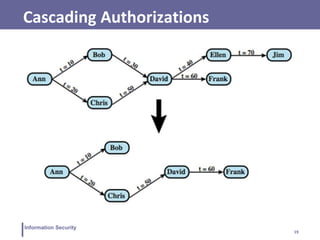
 WITH GRANT OPTION: whether grantee can grant
“GRANT” option to other users
 Typical access rights are:
 SELECT, INSERT, UPDATE, DELETE, REFERENCES
19
Information Security
Cascading Authorizations
20
Information Security
Role-Based Access Control (RBAC)
 Role-based access control work well for DBMS
 eases admin burden, improves security
 Categories of database users:
 application owner
 end user
 Administrator
 DB RBAC must manage roles and their users
21
Information Security
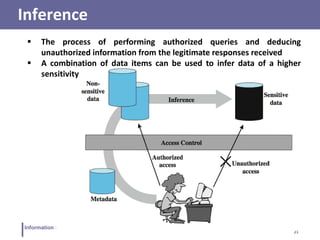
Inference
 The process of performing authorized queries and deducing
unauthorized information from the legitimate responses received
 A combination of data items can be used to infer data of a higher
sensitivity
22
Information Security
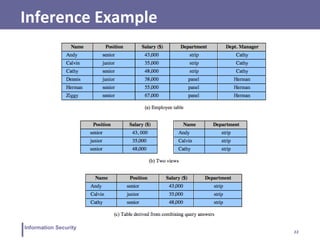
Inference Example
23
Information Security
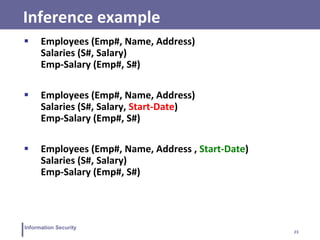
Inference example
 Employees (Emp#, Name, Address)
Salaries (S#, Salary)
Emp-Salary (Emp#, S#)
 Employees (Emp#, Name, Address)
Salaries (S#, Salary, Start-Date)
Emp-Salary (Emp#, S#)
 Employees (Emp#, Name, Address , Start-Date)
Salaries (S#, Salary)
Emp-Salary (Emp#, S#)
24
Information Security
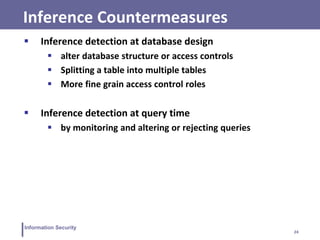
Inference Countermeasures
 Inference detection at database design
 alter database structure or access controls
 Splitting a table into multiple tables
 More fine grain access control roles
 Inference detection at query time
 by monitoring and altering or rejecting queries
25
Information Security
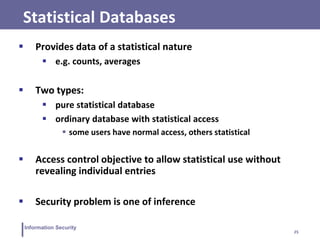
Statistical Databases
 Provides data of a statistical nature
 e.g. counts, averages
 Two types:
 pure statistical database
 ordinary database with statistical access
 some users have normal access, others statistical
 Access control objective to allow statistical use without
revealing individual entries
 Security problem is one of inference
26
Information Security
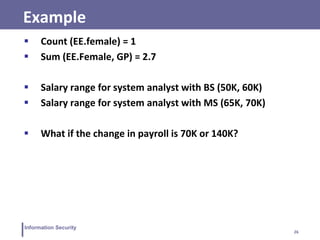
Example
 Count (EE.female) = 1
 Sum (EE.Female, GP) = 2.7
 Salary range for system analyst with BS (50K, 60K)
 Salary range for system analyst with MS (65K, 70K)
 What if the change in payroll is 70K or 140K?
27
Information Security
Protecting Against Inference
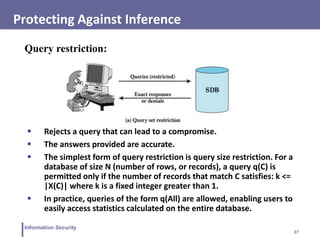
Query restriction:
 Rejects a query that can lead to a compromise.
 The answers provided are accurate.
 The simplest form of query restriction is query size restriction. For a
database of size N (number of rows, or records), a query q(C) is
permitted only if the number of records that match C satisfies: k <=
|X(C)| where k is a fixed integer greater than 1.
 In practice, queries of the form q(All) are allowed, enabling users to
easily access statistics calculated on the entire database.
28
Information Security
Perturbation
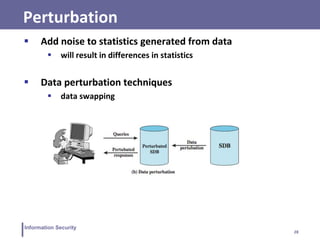
 Add noise to statistics generated from data
 will result in differences in statistics
 Data perturbation techniques
 data swapping
29
Information Security
Perturbation
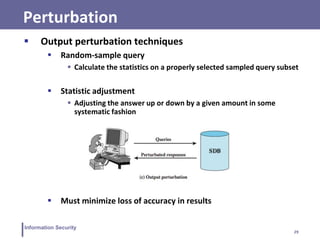
 Output perturbation techniques
 Random-sample query
 Calculate the statistics on a properly selected sampled query subset
 Statistic adjustment
 Adjusting the answer up or down by a given amount in some
systematic fashion
 Must minimize loss of accuracy in results
30
Information Security
Perturbation
 Add noise to statistics generated from data
 will result in differences in statistics
 Data perturbation techniques
 data swapping
 Output perturbation techniques
 random-sample query
 statistic adjustment
 Must minimize loss of accuracy in results
31
Information Security
Database Encryption
 Databases typically a valuable info resource
 protected by multiple layers of security: firewalls, authentication,
O/S access control systems, DB access control systems, and
database encryption
 Can encrypt
 entire database - very inflexible and inefficient
 individual fields - simple but inflexible
 records (rows) or columns (attributes) - best
 also need attribute indexes to help data retrieval
 Varying trade-offs
32
Information Security
Database Encryption
33
Information Security
Secured operations
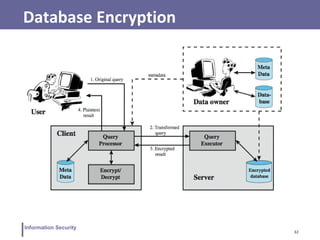
 Suppose that each individual item in the database is encrypted
separately.
 The encrypted database is stored at the server, but the server
does not have the key, so that the data is secure at the server.
The client system does have a copy of the encryption key.
 A user at the client can retrieve a record from the database
with the following sequence:
1. The user issues an SQL query for fields from one or more
records with a specific value of the primary key.
2. The query processor at the client encrypts the primary key,
modifies the SQL query accordingly, and transmits the query to
the server.
3. The server processes the query using the encrypted value of the
primary key and returns the appropriate record or records.
4. The query processor decrypts the data and returns the results.
34
Information Security
Example
SELECT Ename, Eid, Ephone
FROM Employee
WHERE Did = 15
Assume that the encryption key k is used and that the
encrypted value of the department id 15 is
E(k, 15) = 1000110111001110.
Then the query processor at the client could transform the
preceding query into
SELECT Ename, Eid, Ephone
FROM Employee
WHERE Did = 1000110111001110
35
Information Security
Issues
 This method is certainly straightforward but lacks
flexibility.
For example, suppose the Employee table contains a salary
attribute and the user wishes to retrieve all records for
salaries less than 70K.
There is no obvious way to do this, because the attribute
value for salary in each record is encrypted.
The set of encrypted values do not preserve the ordering of
values in the original attribute.
36
Information Security
Record level encryption and indexing
 Each record (row) of a table in the database is encrypted as
a block which is treated as a contiguous block.
 To assist in data retrieval, attribute indexes are associated
with each table. For some or all of the attributes an index
value is created.
 For each row in the original database, there is one row in
the encrypted database.
 For any attribute, the range of attribute values is divided
into a set of non-overlapping partitions that encompass all
possible values, and an index value is assigned to each
partition.
37
Information Security
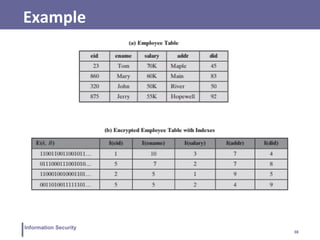
Example
 Suppose that employee ID (eid) values lie in the range [1,
1000]. We can divide these values into five partitions:
[1, 200], [201, 400], [401, 600], [601, 800], and [801, 1000];
and then assign index values 1, 2, 3, 4, and 5, respectively.
 For a text field, we can derive an index from the first letter
of the attribute value. For the attribute ename, let us
assign index 1 to values starting with A or B, index 2 to
values starting with C or D, and so on.
 Similar partitioning schemes can be used for each of the
attributes.
38
Information Security
Example

Lecture 15-16.pdf

  • 1.
    Information Security CS 3002 Dr.Haroon Mahmood Assistant Professor NUCES Lahore Disclaimer: The contents of these slides have been taken from the book of Computer Security by William Stallings.
  • 2.
    2 Information Security Database systems Structured collection of data stored for use by one or more applications  Contains the relationships between data items and groups of data items  Can sometimes contain sensitive data that needs to be secured  Query language: Provides a uniform interface to the database
  • 3.
  • 4.
    4 Information Security Relational databases Table of data consisting of rows and columns  Each column holds a particular type of data  Each row contains a specific value for each column  Ideally has one column where all values are unique, forming an identifier/key for that row  Enables the creation of multiple tables linked together by a unique identifier that is present in all tables  Use a relational query language to access the database  Allows the user to request data that fit a given set of criteria
  • 5.
  • 6.
  • 7.
    7 Information Security Structured QueryLanguage  Structured Query Language (SQL)  originally developed by IBM in the mid-1970s  standardized language to define, manipulate, and query data in a relational database  several similar versions of ANSI/ISO standard CREATE TABLE department ( Did INTEGER PRIMARY KEY, Dname CHAR (30), Dacctno CHAR (6) ) CREATE TABLE employee ( Ename CHAR (30), Did INTEGER, SalaryCode INTEGER, Eid INTEGER PRIMARY KEY, Ephone CHAR (10), FOREIGN KEY (Did) REFERENCES department (Did) ) CREATE VIEW newtable (Dname, Ename, Eid, Ephone) AS SELECT D.Dname E.Ename, E.Eid, E.Ephone FROM Department D Employee E WHERE E.Did = D.Did
  • 8.
    8 Information Security SQL injectionattacks  One of the most prevalent and dangerous network-based security threats  Sends malicious SQL commands to the database server  Depending on the environment SQL injection can also be exploited to:  Modify or delete data  Execute arbitrary operating system commands  Launch denial-of-service (DoS) attacks
  • 9.
  • 10.
    10 Information Security Injection attacksteps 1. Hacker finds a vulnerability in a custom Web application and injects an SQL command to a database by sending the command to the Web server. The command is injected into traffic that will be accepted by the firewall. 2. The Web server receives the malicious code and sends it to the Web application server. 3. The Web application server receives the malicious code from the Web server and sends it to the database server. 4. The database server executes the malicious code on the database. The database returns data from credit cards table. 5. The Web application server dynamically generates a page with data including credit card details from the database. 6. The Web server sends the credit card details to the hacker
  • 11.
    11 Information Security Sample SQLinjection  The SQLi attack typically works by prematurely terminating a text string and appending a new command SELECT fname FROM student where fname is ‘user prompt’; What if user enters the following input? User: John’; DROP table Course;--
  • 12.
    12 Information Security Sample SQLinjection  var ShipCity; ShipCity = Request.form (“ShipCity”); var sql = “select * from OrdersTable where ShipCity = ‘ ” + ShipCity + “ ’ ”;  SELECT * FROM OrdersTable WHERE ShipCity = ‘Redmond’  Suppose, however, the user enters the following: Redmond’; DROP table OrdersTable --  This results in the following SQL query: SELECT * FROM OrdersTable WHERE ShipCity = ‘Redmond’; DROP table OrdersTable--
  • 13.
    13 Information Security In-band attacks Tautology: This form of attack injects code in one or more conditional statements so that they always evaluate to true  End-of-line comment: After injecting code into a particular field, legitimate code that follows are nullified through usage of end of line comments  Piggybacked queries: The attacker adds additional queries beyond the intended query, piggy-backing the attack on top of a legitimate request
  • 14.
    14 Information Security Sample SQLinjection: tautology $query= “ SELECT info FROM user WHERE name = `$_GET[“name”]’ AND pwd = `GET[“pwd”]` ”; Attacker enters: ’ OR 1=1 -- SELECT info FROM users WHERE name = ‘ ’OR 1=1 -- AND pwpd = ‘ ’
  • 15.
    15 Information Security Inferential attack(gathering info)  There is no actual transfer of data, but the attacker is able to reconstruct the information by sending particular requests and observing the resulting behavior of the Website/database server  Illegal/logically incorrect queries: lets an attacker gather important information about the type and structure of the backend database of a Web application  The vulnerability leveraged by this attack is that the default error page returned by application servers is often overly descriptive.  Blind SQL injection: Allows attackers to infer the data present in a database system even when the system is sufficiently secure to not display any erroneous information back to the attacker  The attacker asks the server true/false questions to observe the functionality in each case.
  • 16.
    16 Information Security SQLi countermeasures Defensive coding: Stronger data validation  type checking, to check that inputs that are supposed to be numeric contain no characters other than digits  pattern matching to try to distinguish normal input from abnormal input  Detection  Signature based  Anomaly based  Code analysis  Runtime prevention: Check queries at runtime to see if they conform to a model of expected queries
  • 17.
    17 Information Security Database AccessControl  DBMS provide access control for database  It operates on assumption that user is already authenticated  DBMS provides specific access rights to portions of the database  e.g. create, insert, delete, update, read, write  to entire database, tables, selected rows or columns  possibly dependent on contents of a table entry  can support a range of policies:  centralized administration  ownership-based administration  decentralized administration
  • 18.
    18 Information Security SQL AccessControls  If the user has access to the entire database or just portions of it  Two commands:  GRANT {privileges | role} [ON table] TO {user | role | PUBLIC} [IDENTIFIED BY password] [WITH GRANT OPTION]  e.g. GRANT SELECT ON ANY TABLE TO john  REVOKE {privileges | role} [ON table] FROM {user | role | PUBLIC}  e.g. REVOKE SELECT ON ANY TABLE FROM john  WITH GRANT OPTION: whether grantee can grant “GRANT” option to other users  Typical access rights are:  SELECT, INSERT, UPDATE, DELETE, REFERENCES
  • 19.
  • 20.
    20 Information Security Role-Based AccessControl (RBAC)  Role-based access control work well for DBMS  eases admin burden, improves security  Categories of database users:  application owner  end user  Administrator  DB RBAC must manage roles and their users
  • 21.
    21 Information Security Inference  Theprocess of performing authorized queries and deducing unauthorized information from the legitimate responses received  A combination of data items can be used to infer data of a higher sensitivity
  • 22.
  • 23.
    23 Information Security Inference example Employees (Emp#, Name, Address) Salaries (S#, Salary) Emp-Salary (Emp#, S#)  Employees (Emp#, Name, Address) Salaries (S#, Salary, Start-Date) Emp-Salary (Emp#, S#)  Employees (Emp#, Name, Address , Start-Date) Salaries (S#, Salary) Emp-Salary (Emp#, S#)
  • 24.
    24 Information Security Inference Countermeasures Inference detection at database design  alter database structure or access controls  Splitting a table into multiple tables  More fine grain access control roles  Inference detection at query time  by monitoring and altering or rejecting queries
  • 25.
    25 Information Security Statistical Databases Provides data of a statistical nature  e.g. counts, averages  Two types:  pure statistical database  ordinary database with statistical access  some users have normal access, others statistical  Access control objective to allow statistical use without revealing individual entries  Security problem is one of inference
  • 26.
    26 Information Security Example  Count(EE.female) = 1  Sum (EE.Female, GP) = 2.7  Salary range for system analyst with BS (50K, 60K)  Salary range for system analyst with MS (65K, 70K)  What if the change in payroll is 70K or 140K?
  • 27.
    27 Information Security Protecting AgainstInference Query restriction:  Rejects a query that can lead to a compromise.  The answers provided are accurate.  The simplest form of query restriction is query size restriction. For a database of size N (number of rows, or records), a query q(C) is permitted only if the number of records that match C satisfies: k <= |X(C)| where k is a fixed integer greater than 1.  In practice, queries of the form q(All) are allowed, enabling users to easily access statistics calculated on the entire database.
  • 28.
    28 Information Security Perturbation  Addnoise to statistics generated from data  will result in differences in statistics  Data perturbation techniques  data swapping
  • 29.
    29 Information Security Perturbation  Outputperturbation techniques  Random-sample query  Calculate the statistics on a properly selected sampled query subset  Statistic adjustment  Adjusting the answer up or down by a given amount in some systematic fashion  Must minimize loss of accuracy in results
  • 30.
    30 Information Security Perturbation  Addnoise to statistics generated from data  will result in differences in statistics  Data perturbation techniques  data swapping  Output perturbation techniques  random-sample query  statistic adjustment  Must minimize loss of accuracy in results
  • 31.
    31 Information Security Database Encryption Databases typically a valuable info resource  protected by multiple layers of security: firewalls, authentication, O/S access control systems, DB access control systems, and database encryption  Can encrypt  entire database - very inflexible and inefficient  individual fields - simple but inflexible  records (rows) or columns (attributes) - best  also need attribute indexes to help data retrieval  Varying trade-offs
  • 32.
  • 33.
    33 Information Security Secured operations Suppose that each individual item in the database is encrypted separately.  The encrypted database is stored at the server, but the server does not have the key, so that the data is secure at the server. The client system does have a copy of the encryption key.  A user at the client can retrieve a record from the database with the following sequence: 1. The user issues an SQL query for fields from one or more records with a specific value of the primary key. 2. The query processor at the client encrypts the primary key, modifies the SQL query accordingly, and transmits the query to the server. 3. The server processes the query using the encrypted value of the primary key and returns the appropriate record or records. 4. The query processor decrypts the data and returns the results.
  • 34.
    34 Information Security Example SELECT Ename,Eid, Ephone FROM Employee WHERE Did = 15 Assume that the encryption key k is used and that the encrypted value of the department id 15 is E(k, 15) = 1000110111001110. Then the query processor at the client could transform the preceding query into SELECT Ename, Eid, Ephone FROM Employee WHERE Did = 1000110111001110
  • 35.
    35 Information Security Issues  Thismethod is certainly straightforward but lacks flexibility. For example, suppose the Employee table contains a salary attribute and the user wishes to retrieve all records for salaries less than 70K. There is no obvious way to do this, because the attribute value for salary in each record is encrypted. The set of encrypted values do not preserve the ordering of values in the original attribute.
  • 36.
    36 Information Security Record levelencryption and indexing  Each record (row) of a table in the database is encrypted as a block which is treated as a contiguous block.  To assist in data retrieval, attribute indexes are associated with each table. For some or all of the attributes an index value is created.  For each row in the original database, there is one row in the encrypted database.  For any attribute, the range of attribute values is divided into a set of non-overlapping partitions that encompass all possible values, and an index value is assigned to each partition.
  • 37.
    37 Information Security Example  Supposethat employee ID (eid) values lie in the range [1, 1000]. We can divide these values into five partitions: [1, 200], [201, 400], [401, 600], [601, 800], and [801, 1000]; and then assign index values 1, 2, 3, 4, and 5, respectively.  For a text field, we can derive an index from the first letter of the attribute value. For the attribute ename, let us assign index 1 to values starting with A or B, index 2 to values starting with C or D, and so on.  Similar partitioning schemes can be used for each of the attributes.
  • 38.