Professional Practices
Introduction
Course Objectives
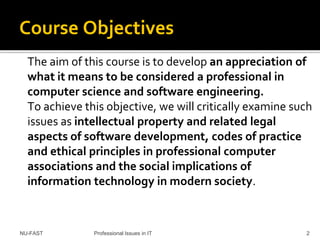
The aim of this course is to develop an appreciation of
what it means to be considered a professional in
computer science and software engineering.
To achieve this objective, we will critically examine such
issues as intellectual property and related legal
aspects of software development, codes of practice
and ethical principles in professional computer
associations and the social implications of
information technology in modern society.
NU-FAST Professional Issues in IT 2
Summary
Computing professionals need technical knowledge and
skills to grow effectively as well as they also need
understanding of the context they operate in.
Good understanding of the professional codes of conduct,
legal and ethical issues, social impacts and relationship
between technological change, society and law, and the
powerful role of IT professionals in this technological era
has become very essential. This course will help students
to be capable in their professional area, operating
effectively at work and in community situations and to
be aware of their environments for exponential growth
and successes in their career.
NU-FAST, Professional Issues in IT 3
Purpose / Importance of the Course
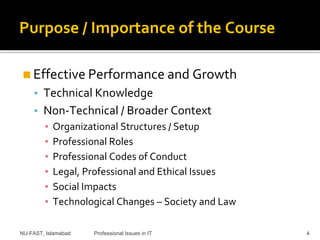
◼Effective Performance and Growth
▪ Technical Knowledge
▪ Non-Technical / Broader Context
▪ Organizational Structures / Setup
▪ Professional Roles
▪ Professional Codes of Conduct
▪ Legal, Professional and Ethical Issues
▪ Social Impacts
▪ Technological Changes – Society and Law
NU-FAST, Islamabad Professional Issues in IT 4
Scope of the Course / Coverage
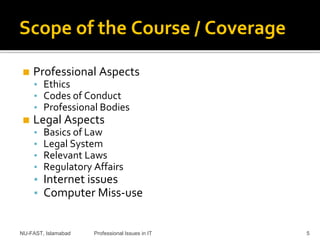
◼ Professional Aspects
▪ Ethics
▪ Codes of Conduct
▪ Professional Bodies
◼ Legal Aspects
▪ Basics of Law
▪ Legal System
▪ Relevant Laws
▪ Regulatory Affairs
▪ Internet issues
▪ Computer Miss-use
NU-FAST, Islamabad Professional Issues in IT 5
Scope of the Course / Coverage
◼Organizational Aspects
▪ Organization Types and Structures
▪ Legal Status of Organizations
▪ Financial Aspects of Organizations
▪ Financial issues for startups
◼Social Aspects of Computing
◼Human Resources Issues
◼Miscellaneous Topics
NU-FAST, Islamabad Professional Issues in IT 6
Code of Conduct
◼ Regularity
◼ Punctuality
◼ Discipline
◼ Positive Attitude
◼ High Level of Class Participation
◼ No Plagiarism, Cheating …
◼ No Change in Deadlines
◼ No Usage of Mobile / Other Devices
◼ …
NU-FAST, Islamabad Professional Issues in IT 7
The LAW
What is LAW
◼ Set of rules enforced
◼ Different in different countries
▪ Difference in divorce or selling of alcohol
◼ From the point of IT Professionals
▪ Rules in governing data protection, the rights of access of information and miss-use of
computers
◼ Legal systems
▪ Different legal systems
▪ Different system of courts
▪ Different rules for courts procedure
▪ Different procedures for appealing against courts decision
◼ Jurisdiction
▪ The area covered by single legal system and set of laws
◼ Different legal system and law in different areas within a country
▪ UK for instance, Scotland and Northern Island have different legal system and LAW
▪ As per our topic, all laws are same of England and Whales
▪ Referring to UK law OR British law shall mean laws across UK
▪ Referring to Law of England and Whales shall mean, there is difference else where in
UK
NU-FAST, Islamabad Professional Issues in IT 9
Criminal and Civil Law
◼ Criminal Law
▪ Set of mechanisms where law tries to punish wrongdoers
▪ It defines what constitutes a crime, lays down the mechanisms for deciding if a person is
guilty
▪ Specifies the range of punishments applicable of different categories of crime.
▪ Generally police is responsible for discovering of crime, collect the evidence and
convincing the court
▪ The state in forms of court start prosecuting the person in criminal court. The court then
decide a punishment, if guilty.
◼ Civil Law
▪ Provide rules for settling disputes between two
people/organization/company.
▪ The ways in an organization can get legal status
▪ Act of parliament
▪ Registering as a company
▪ By the grant of royal charter
▪ Litigation: Court action under civil law
▪ Must be initiated by one of the parties in dispute
▪ Initiator is called Claimant
NU-FAST, Islamabad Professional Issues in IT 10
Criminal and Civil Law
◼ Difference between Civil and Criminal law
▪ Standard of proof and burden of proof
▪ Criminal case: burden of proof on prosecution
▪ Civil case: both parties argue and present their case
NU-FAST, Islamabad Professional Issues in IT 11
Where does law come from?
◼ Two main sources of law
▪ Common law and Statute law in England
◼ Common Law
▪ Not written
▪ Precedents
▪ All countries in commonwealth share same traditions.
▪ This tradition of common law is not found in Continental Europe,
Germany and France has their on written codes
◼ Statute Law
▪ Legislation: Acts of parliament
▪ About two hundred years ago there was very little statute law, since
then the situation has changed
NU-FAST, Islamabad Professional Issues in IT 12
Where does law come from?
◼ Statute Law
▪ Legislation: Acts of parliament
▪ About two hundred years ago there was very little statute law, since
then the situation has changed
▪ Technical development and social changes
▪ Laws to regulate child labor
▪ Misuse of Computers
▪ Millions of common law judgments makes it hard to apply common
law
▪ Parliament passes legislation to bring together common law into
statute law
▪ A good example of this is the Theft Act 1968, which
consolidated the common law provisions regarding
crimes involving stealing.
NU-FAST, Islamabad Professional Issues in IT 13
Legislation Process in UK
◼ Two chamber or bicameral
◼ Legislature: Parliament
◼ House of Commons
▪ Elected members
▪ 659 constituencies
◼ House of Lords
▪ Members are appointed
◼ British government is made up of both, house of commons and house of
lords
◼ Members of house of lords are not in large number
◼ Prime minister, Foreign Secretary and Home Secretary are from house of
commons
NU-FAST, Islamabad Professional Issues in IT 14
Legislation Process in UK
◼ Bill
▪ New legislation is initiated by government as well as any member
▪ First in house of commons
▪ If approved, then house of lords
▪ If approved, it becomes ACT of Parliament
▪ It is then passed to QUEEN for approval, then becomes LAW
▪ House of commons has the power to override any changes suggested
by house of lords
NU-FAST, Islamabad Professional Issues in IT 15
Legislation Process of EU
◼ Group of 28 countries
◼ Economic and social integration involving harmonization of
many laws
◼ Parliament
▪ Elected by voters in all countries
◼ EU is run by commission, that directs members to amend
their law
◼ These directives discussed in parliament and approved by
member states before they come in effect.
▪ Such as data protection, protection of software
◼
NU-FAST, Islamabad Professional Issues in IT 16
Legislation Process in other
countries
◼ In USA legislature known as Congress. Senate and House of
representatives.
◼ Both houses’ members are elected but on different terms
▪ House of representatives for 2 years (1 for each district)
▪ Senators are elected for 7 years (2 for each state)
◼ Legislation must be approved by both houses
◼ President must also give his assent before act becomes law
◼ President can veto legislation
◼ As in other countries, supreme court can also strike out
legislation on finding it against constitution
◼ Unlike in UK courts cannot override legislation, although can
override secondary legislation
NU-FAST, Islamabad Professional Issues in IT 17
Legislation Process in other
countries
◼ Members of government of US are not members of congress
◼ President elected by public
◼ Members of government appointed by president, approved
by congress
◼ Important separation of 3 functions
▪ Legislature -> congress
▪ Judiciary ->applies and forces these laws
▪ Executive -> the government, runs the state
NU-FAST, Islamabad Professional Issues in IT 18
Legislation Process in other
countries
◼ US is a country of 50 states.
◼ Each has its own legislature and government
◼ On some topics each state can make its own laws but in
other laws are made at federal level
▪ E.g each state has its own laws about who can call themselves
engineer
◼ The issue on how much an individual state can override
federal laws is ongoing debate
▪ E.g supreme court has declared laws unconstitutional to regulate the
use of internet
NU-FAST, Islamabad Professional Issues in IT 19
Laws across borders
◼ to deal with a spy who passed on secrets to an enemy
country, even though the passing on of the secrets took
place on foreign soil
◼ The development of the web and other innovations in the
field of telecommunications has, however, created further
problems
▪ E.g If a hacker sitting in an apartment in New York hacks into a
European air traffic control computer located in the Netherlands so as
to cause a mid-air collision over Denmark, where was the crime
committed and which country’s laws and legal procedures should be
used in prosecuting the crime? What happens about an action that is
criminal in some of the countries it affects but not in others –
publishing obscene material over the internet is a case in point?
◼ Extradition
NU-FAST, Islamabad Professional Issues in IT 20
Laws across borders
◼ Civil cases are simpler
◼ Claimant has to decided, which country to initiate action
◼ The decision will depend
▪ Circumstances of the case
▪ Influenced by the reputation of country’s courts
▪ How favorable its laws will be to the claimant’s case
NU-FAST, Islamabad Professional Issues in IT 21

Lecture 1 - Introduction-LAW.pptx

  • 1.
  • 2.
    Course Objectives The aimof this course is to develop an appreciation of what it means to be considered a professional in computer science and software engineering. To achieve this objective, we will critically examine such issues as intellectual property and related legal aspects of software development, codes of practice and ethical principles in professional computer associations and the social implications of information technology in modern society. NU-FAST Professional Issues in IT 2
  • 3.
    Summary Computing professionals needtechnical knowledge and skills to grow effectively as well as they also need understanding of the context they operate in. Good understanding of the professional codes of conduct, legal and ethical issues, social impacts and relationship between technological change, society and law, and the powerful role of IT professionals in this technological era has become very essential. This course will help students to be capable in their professional area, operating effectively at work and in community situations and to be aware of their environments for exponential growth and successes in their career. NU-FAST, Professional Issues in IT 3
  • 4.
    Purpose / Importanceof the Course ◼Effective Performance and Growth ▪ Technical Knowledge ▪ Non-Technical / Broader Context ▪ Organizational Structures / Setup ▪ Professional Roles ▪ Professional Codes of Conduct ▪ Legal, Professional and Ethical Issues ▪ Social Impacts ▪ Technological Changes – Society and Law NU-FAST, Islamabad Professional Issues in IT 4
  • 5.
    Scope of theCourse / Coverage ◼ Professional Aspects ▪ Ethics ▪ Codes of Conduct ▪ Professional Bodies ◼ Legal Aspects ▪ Basics of Law ▪ Legal System ▪ Relevant Laws ▪ Regulatory Affairs ▪ Internet issues ▪ Computer Miss-use NU-FAST, Islamabad Professional Issues in IT 5
  • 6.
    Scope of theCourse / Coverage ◼Organizational Aspects ▪ Organization Types and Structures ▪ Legal Status of Organizations ▪ Financial Aspects of Organizations ▪ Financial issues for startups ◼Social Aspects of Computing ◼Human Resources Issues ◼Miscellaneous Topics NU-FAST, Islamabad Professional Issues in IT 6
  • 7.
    Code of Conduct ◼Regularity ◼ Punctuality ◼ Discipline ◼ Positive Attitude ◼ High Level of Class Participation ◼ No Plagiarism, Cheating … ◼ No Change in Deadlines ◼ No Usage of Mobile / Other Devices ◼ … NU-FAST, Islamabad Professional Issues in IT 7
  • 8.
  • 9.
    What is LAW ◼Set of rules enforced ◼ Different in different countries ▪ Difference in divorce or selling of alcohol ◼ From the point of IT Professionals ▪ Rules in governing data protection, the rights of access of information and miss-use of computers ◼ Legal systems ▪ Different legal systems ▪ Different system of courts ▪ Different rules for courts procedure ▪ Different procedures for appealing against courts decision ◼ Jurisdiction ▪ The area covered by single legal system and set of laws ◼ Different legal system and law in different areas within a country ▪ UK for instance, Scotland and Northern Island have different legal system and LAW ▪ As per our topic, all laws are same of England and Whales ▪ Referring to UK law OR British law shall mean laws across UK ▪ Referring to Law of England and Whales shall mean, there is difference else where in UK NU-FAST, Islamabad Professional Issues in IT 9
  • 10.
    Criminal and CivilLaw ◼ Criminal Law ▪ Set of mechanisms where law tries to punish wrongdoers ▪ It defines what constitutes a crime, lays down the mechanisms for deciding if a person is guilty ▪ Specifies the range of punishments applicable of different categories of crime. ▪ Generally police is responsible for discovering of crime, collect the evidence and convincing the court ▪ The state in forms of court start prosecuting the person in criminal court. The court then decide a punishment, if guilty. ◼ Civil Law ▪ Provide rules for settling disputes between two people/organization/company. ▪ The ways in an organization can get legal status ▪ Act of parliament ▪ Registering as a company ▪ By the grant of royal charter ▪ Litigation: Court action under civil law ▪ Must be initiated by one of the parties in dispute ▪ Initiator is called Claimant NU-FAST, Islamabad Professional Issues in IT 10
  • 11.
    Criminal and CivilLaw ◼ Difference between Civil and Criminal law ▪ Standard of proof and burden of proof ▪ Criminal case: burden of proof on prosecution ▪ Civil case: both parties argue and present their case NU-FAST, Islamabad Professional Issues in IT 11
  • 12.
    Where does lawcome from? ◼ Two main sources of law ▪ Common law and Statute law in England ◼ Common Law ▪ Not written ▪ Precedents ▪ All countries in commonwealth share same traditions. ▪ This tradition of common law is not found in Continental Europe, Germany and France has their on written codes ◼ Statute Law ▪ Legislation: Acts of parliament ▪ About two hundred years ago there was very little statute law, since then the situation has changed NU-FAST, Islamabad Professional Issues in IT 12
  • 13.
    Where does lawcome from? ◼ Statute Law ▪ Legislation: Acts of parliament ▪ About two hundred years ago there was very little statute law, since then the situation has changed ▪ Technical development and social changes ▪ Laws to regulate child labor ▪ Misuse of Computers ▪ Millions of common law judgments makes it hard to apply common law ▪ Parliament passes legislation to bring together common law into statute law ▪ A good example of this is the Theft Act 1968, which consolidated the common law provisions regarding crimes involving stealing. NU-FAST, Islamabad Professional Issues in IT 13
  • 14.
    Legislation Process inUK ◼ Two chamber or bicameral ◼ Legislature: Parliament ◼ House of Commons ▪ Elected members ▪ 659 constituencies ◼ House of Lords ▪ Members are appointed ◼ British government is made up of both, house of commons and house of lords ◼ Members of house of lords are not in large number ◼ Prime minister, Foreign Secretary and Home Secretary are from house of commons NU-FAST, Islamabad Professional Issues in IT 14
  • 15.
    Legislation Process inUK ◼ Bill ▪ New legislation is initiated by government as well as any member ▪ First in house of commons ▪ If approved, then house of lords ▪ If approved, it becomes ACT of Parliament ▪ It is then passed to QUEEN for approval, then becomes LAW ▪ House of commons has the power to override any changes suggested by house of lords NU-FAST, Islamabad Professional Issues in IT 15
  • 16.
    Legislation Process ofEU ◼ Group of 28 countries ◼ Economic and social integration involving harmonization of many laws ◼ Parliament ▪ Elected by voters in all countries ◼ EU is run by commission, that directs members to amend their law ◼ These directives discussed in parliament and approved by member states before they come in effect. ▪ Such as data protection, protection of software ◼ NU-FAST, Islamabad Professional Issues in IT 16
  • 17.
    Legislation Process inother countries ◼ In USA legislature known as Congress. Senate and House of representatives. ◼ Both houses’ members are elected but on different terms ▪ House of representatives for 2 years (1 for each district) ▪ Senators are elected for 7 years (2 for each state) ◼ Legislation must be approved by both houses ◼ President must also give his assent before act becomes law ◼ President can veto legislation ◼ As in other countries, supreme court can also strike out legislation on finding it against constitution ◼ Unlike in UK courts cannot override legislation, although can override secondary legislation NU-FAST, Islamabad Professional Issues in IT 17
  • 18.
    Legislation Process inother countries ◼ Members of government of US are not members of congress ◼ President elected by public ◼ Members of government appointed by president, approved by congress ◼ Important separation of 3 functions ▪ Legislature -> congress ▪ Judiciary ->applies and forces these laws ▪ Executive -> the government, runs the state NU-FAST, Islamabad Professional Issues in IT 18
  • 19.
    Legislation Process inother countries ◼ US is a country of 50 states. ◼ Each has its own legislature and government ◼ On some topics each state can make its own laws but in other laws are made at federal level ▪ E.g each state has its own laws about who can call themselves engineer ◼ The issue on how much an individual state can override federal laws is ongoing debate ▪ E.g supreme court has declared laws unconstitutional to regulate the use of internet NU-FAST, Islamabad Professional Issues in IT 19
  • 20.
    Laws across borders ◼to deal with a spy who passed on secrets to an enemy country, even though the passing on of the secrets took place on foreign soil ◼ The development of the web and other innovations in the field of telecommunications has, however, created further problems ▪ E.g If a hacker sitting in an apartment in New York hacks into a European air traffic control computer located in the Netherlands so as to cause a mid-air collision over Denmark, where was the crime committed and which country’s laws and legal procedures should be used in prosecuting the crime? What happens about an action that is criminal in some of the countries it affects but not in others – publishing obscene material over the internet is a case in point? ◼ Extradition NU-FAST, Islamabad Professional Issues in IT 20
  • 21.
    Laws across borders ◼Civil cases are simpler ◼ Claimant has to decided, which country to initiate action ◼ The decision will depend ▪ Circumstances of the case ▪ Influenced by the reputation of country’s courts ▪ How favorable its laws will be to the claimant’s case NU-FAST, Islamabad Professional Issues in IT 21