LECTURE 15: IMAGE MORPHOLOGY EXAMPLES
©2017Marwa_Ahmeid Page 1
1. (a) Give a morphological algorithm for converting an 8-connected binary boundary to
an m-connected boundary (see Section 2.5.2). You may assume that the boundary is
fully connected and that it is one pixel thick
(b) Does the operation of your algorithm require more than one iteration with each
structuring element? Explain your reasoning.
(c) Is the performance of your algorithm independent of the order in which the structuring
elements are applied? If your answer is yes, prove it; otherwise give an example
that illustrates the dependence of your procedure on the order of application of the
structuring elements.
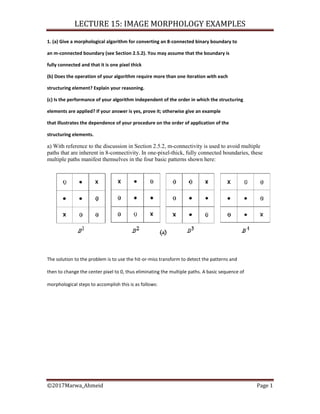
a) With reference to the discussion in Section 2.5.2, m-connectivity is used to avoid multiple
paths that are inherent in 8-connectivity. In one-pixel-thick, fully connected boundaries, these
multiple paths manifest themselves in the four basic patterns shown here:
The solution to the problem is to use the hit-or-miss transform to detect the patterns and
then to change the center pixel to 0, thus eliminating the multiple paths. A basic sequence of
morphological steps to accomplish this is as follows:
LECTURE 15: IMAGE MORPHOLOGY EXAMPLES
©2017Marwa_Ahmeid Page 2
where A is the input image containing the boundary.
b) Only one pass is required. Application of the hit-or-miss transform using a given Bi finds
all instances of occurrence of the pattern described by that structuring element.
c) The order does matter. For example, consider the sequence of points shown in next figure
and assume that we are traveling from left to right. If B1 is applied first, point a will be deleted
and point b will remain after application of all other structuring elements. If, on the other hand,
B3 is applied first, point b will be deleted and point a will remain. Thus, we would end up with
different (but of course, acceptable) m-paths.
2. How can the given object be cleaned up by using morphological operations? (The outline
of the zero in the image should be closed.)
0 0 0 0 0 0 0 0 0
0 0 1 1 0 1 1 0 0
0 0 1 0 1 0 0 1 0
0 0 0 0 0 0 1 0 0
0 0 1 0 0 0 1 0 0
0 1 1 1 1 1 1 0 0
0 0 0 0 0 0 0 0 0
LECTURE 15: IMAGE MORPHOLOGY EXAMPLES
©2017Marwa_Ahmeid Page 3
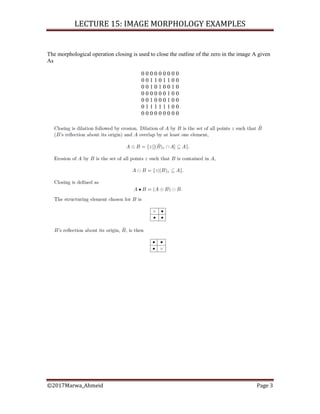
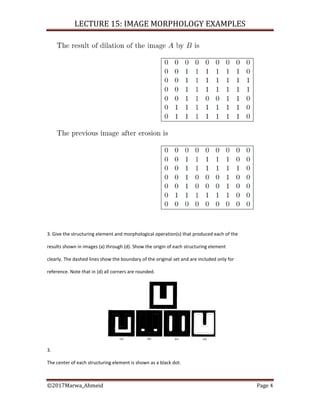
The morphological operation closing is used to close the outline of the zero in the image A given
As
0 0 0 0 0 0 0 0 0
0 0 1 1 0 1 1 0 0
0 0 1 0 1 0 0 1 0
0 0 0 0 0 0 1 0 0
0 0 1 0 0 0 1 0 0
0 1 1 1 1 1 1 0 0
0 0 0 0 0 0 0 0 0
LECTURE 15: IMAGE MORPHOLOGY EXAMPLES
©2017Marwa_Ahmeid Page 4
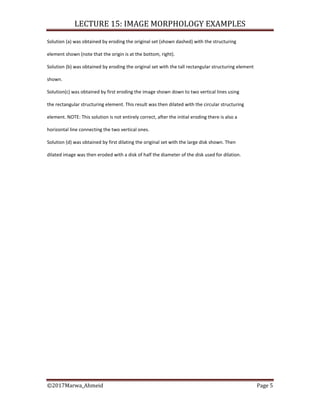
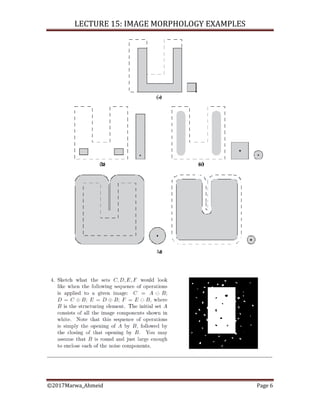
3. Give the structuring element and morphological operation(s) that produced each of the
results shown in images (a) through (d). Show the origin of each structuring element
clearly. The dashed lines show the boundary of the original set and are included only for
reference. Note that in (d) all corners are rounded.
3.
The center of each structuring element is shown as a black dot.
LECTURE 15: IMAGE MORPHOLOGY EXAMPLES
©2017Marwa_Ahmeid Page 5
Solution (a) was obtained by eroding the original set (shown dashed) with the structuring
element shown (note that the origin is at the bottom, right).
Solution (b) was obtained by eroding the original set with the tall rectangular structuring element
shown.
Solution(c) was obtained by first eroding the image shown down to two vertical lines using
the rectangular structuring element. This result was then dilated with the circular structuring
element. NOTE: This solution is not entirely correct, after the initial eroding there is also a
horizontal line connecting the two vertical ones.
Solution (d) was obtained by first dilating the original set with the large disk shown. Then
dilated image was then eroded with a disk of half the diameter of the disk used for dilation.
LECTURE 15: IMAGE MORPHOLOGY EXAMPLES
©2017Marwa_Ahmeid Page 6
---------------------------------------------------------------------------------------------------------------------------------------------
LECTURE 15: IMAGE MORPHOLOGY EXAMPLES
©2017Marwa_Ahmeid Page 7
The solution is shown in the next figure. Although the images shown could be sketched by hand,
they were done in MATLAB. The size of the original is 647 x 624 pixels. A disk structuring
element of radius 11 was used. This structuring element was just large enough to encompass all
noise elements, as given in the problem statement.
The images shown in the figure are: (a) erosion of the original, (b) dilation of the result, (c)
another dilation, and finally (d) an erosion.
The first erosion (leftmost image) should take out all noise elements that do not touch the rectangle,
should increase the size of the noise elements completely contained within the rectangle,
and should decrease the size of the rectangle. If worked by hand, the student may or may not realize
that some imperfections are left along the boundary of the object. We do not consider this
an important issue because it is scale-dependent, and nothing is said in the problem statement
about this.
The first dilation (next image) should shrink the noise components that were increased in erosion,
should increase the size of the rectangle, and should round the corners.
The next dilation should eliminate the internal noise components completely and further increase
the size of the rectangle.
The final erosion (last image on the right) should then decrease the size of the rectangle. The
rounded corners in the final answer are an important point that should be recognized by the
student.
LECTURE 15: IMAGE MORPHOLOGY EXAMPLES
©2017Marwa_Ahmeid Page 8
5-
LECTURE 15: IMAGE MORPHOLOGY EXAMPLES
©2017Marwa_Ahmeid Page 9
comparing the differences between them makes no sense. Often, special markings
are manufactured into the product for mechanical or image-based alignment
Controlled illumination (note that “illumination” is not limited to visible light)
obviously is important because changes in illumination can affect dramatically
the values in a difference image. One approach used often in conjunction with
illumination control is intensity scaling based on actual conditions. For example,
the products could have one or more small patches of a tightly controlled
color, and the intensity (and perhaps even color) of each pixels in the entire image
would be modified based on the actual versus expected intensity and/or
color of the patches in the image being processed.
Finally, the noise content of a difference image needs to be low enough so
that it does not materially affect comparisons between the golden and input images.
Good signal strength goes a long way toward reducing the effects of noise.
Another (sometimes complementary) approach is to implement image processing
techniques (e.g., image averaging) to reduce noise.
Obviously there are a number if variations of the basic theme just described.
For example, additional intelligence in the form of tests that are more sophisticated
than pixel-by-pixel threshold comparisons can be implemented. A technique
used often in this regard is to subdivide the golden image into different
regions and perform different (usually more than one) tests in each of the regions,
based on expected region content.
LECTURE 15: IMAGE MORPHOLOGY EXAMPLES
©2017Marwa_Ahmeid Page 10
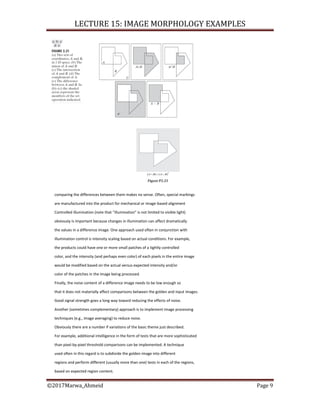
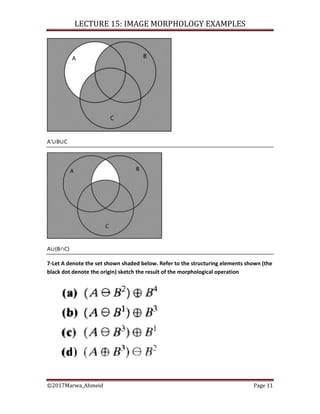
6-Give an expression for the set shaded in following figure:
A∩B ∪ C’
A∩B∩C′
LECTURE 15: IMAGE MORPHOLOGY EXAMPLES
©2017Marwa_Ahmeid Page 11
A′∪B∪C
A∪(B∩C)
7-Let A denote the set shown shaded below. Refer to the structuring elements shown (the
black dot denote the origin) sketch the result of the morphological operation
LECTURE 15: IMAGE MORPHOLOGY EXAMPLES
©2017Marwa_Ahmeid Page 12

Lecture 15 image morphology examples

  • 1.
    LECTURE 15: IMAGEMORPHOLOGY EXAMPLES ©2017Marwa_Ahmeid Page 1 1. (a) Give a morphological algorithm for converting an 8-connected binary boundary to an m-connected boundary (see Section 2.5.2). You may assume that the boundary is fully connected and that it is one pixel thick (b) Does the operation of your algorithm require more than one iteration with each structuring element? Explain your reasoning. (c) Is the performance of your algorithm independent of the order in which the structuring elements are applied? If your answer is yes, prove it; otherwise give an example that illustrates the dependence of your procedure on the order of application of the structuring elements. a) With reference to the discussion in Section 2.5.2, m-connectivity is used to avoid multiple paths that are inherent in 8-connectivity. In one-pixel-thick, fully connected boundaries, these multiple paths manifest themselves in the four basic patterns shown here: The solution to the problem is to use the hit-or-miss transform to detect the patterns and then to change the center pixel to 0, thus eliminating the multiple paths. A basic sequence of morphological steps to accomplish this is as follows:
  • 2.
    LECTURE 15: IMAGEMORPHOLOGY EXAMPLES ©2017Marwa_Ahmeid Page 2 where A is the input image containing the boundary. b) Only one pass is required. Application of the hit-or-miss transform using a given Bi finds all instances of occurrence of the pattern described by that structuring element. c) The order does matter. For example, consider the sequence of points shown in next figure and assume that we are traveling from left to right. If B1 is applied first, point a will be deleted and point b will remain after application of all other structuring elements. If, on the other hand, B3 is applied first, point b will be deleted and point a will remain. Thus, we would end up with different (but of course, acceptable) m-paths. 2. How can the given object be cleaned up by using morphological operations? (The outline of the zero in the image should be closed.) 0 0 0 0 0 0 0 0 0 0 0 1 1 0 1 1 0 0 0 0 1 0 1 0 0 1 0 0 0 0 0 0 0 1 0 0 0 0 1 0 0 0 1 0 0 0 1 1 1 1 1 1 0 0 0 0 0 0 0 0 0 0 0
  • 3.
    LECTURE 15: IMAGEMORPHOLOGY EXAMPLES ©2017Marwa_Ahmeid Page 3 The morphological operation closing is used to close the outline of the zero in the image A given As 0 0 0 0 0 0 0 0 0 0 0 1 1 0 1 1 0 0 0 0 1 0 1 0 0 1 0 0 0 0 0 0 0 1 0 0 0 0 1 0 0 0 1 0 0 0 1 1 1 1 1 1 0 0 0 0 0 0 0 0 0 0 0
  • 4.
    LECTURE 15: IMAGEMORPHOLOGY EXAMPLES ©2017Marwa_Ahmeid Page 4 3. Give the structuring element and morphological operation(s) that produced each of the results shown in images (a) through (d). Show the origin of each structuring element clearly. The dashed lines show the boundary of the original set and are included only for reference. Note that in (d) all corners are rounded. 3. The center of each structuring element is shown as a black dot.
  • 5.
    LECTURE 15: IMAGEMORPHOLOGY EXAMPLES ©2017Marwa_Ahmeid Page 5 Solution (a) was obtained by eroding the original set (shown dashed) with the structuring element shown (note that the origin is at the bottom, right). Solution (b) was obtained by eroding the original set with the tall rectangular structuring element shown. Solution(c) was obtained by first eroding the image shown down to two vertical lines using the rectangular structuring element. This result was then dilated with the circular structuring element. NOTE: This solution is not entirely correct, after the initial eroding there is also a horizontal line connecting the two vertical ones. Solution (d) was obtained by first dilating the original set with the large disk shown. Then dilated image was then eroded with a disk of half the diameter of the disk used for dilation.
  • 6.
    LECTURE 15: IMAGEMORPHOLOGY EXAMPLES ©2017Marwa_Ahmeid Page 6 ---------------------------------------------------------------------------------------------------------------------------------------------
  • 7.
    LECTURE 15: IMAGEMORPHOLOGY EXAMPLES ©2017Marwa_Ahmeid Page 7 The solution is shown in the next figure. Although the images shown could be sketched by hand, they were done in MATLAB. The size of the original is 647 x 624 pixels. A disk structuring element of radius 11 was used. This structuring element was just large enough to encompass all noise elements, as given in the problem statement. The images shown in the figure are: (a) erosion of the original, (b) dilation of the result, (c) another dilation, and finally (d) an erosion. The first erosion (leftmost image) should take out all noise elements that do not touch the rectangle, should increase the size of the noise elements completely contained within the rectangle, and should decrease the size of the rectangle. If worked by hand, the student may or may not realize that some imperfections are left along the boundary of the object. We do not consider this an important issue because it is scale-dependent, and nothing is said in the problem statement about this. The first dilation (next image) should shrink the noise components that were increased in erosion, should increase the size of the rectangle, and should round the corners. The next dilation should eliminate the internal noise components completely and further increase the size of the rectangle. The final erosion (last image on the right) should then decrease the size of the rectangle. The rounded corners in the final answer are an important point that should be recognized by the student.
  • 8.
    LECTURE 15: IMAGEMORPHOLOGY EXAMPLES ©2017Marwa_Ahmeid Page 8 5-
  • 9.
    LECTURE 15: IMAGEMORPHOLOGY EXAMPLES ©2017Marwa_Ahmeid Page 9 comparing the differences between them makes no sense. Often, special markings are manufactured into the product for mechanical or image-based alignment Controlled illumination (note that “illumination” is not limited to visible light) obviously is important because changes in illumination can affect dramatically the values in a difference image. One approach used often in conjunction with illumination control is intensity scaling based on actual conditions. For example, the products could have one or more small patches of a tightly controlled color, and the intensity (and perhaps even color) of each pixels in the entire image would be modified based on the actual versus expected intensity and/or color of the patches in the image being processed. Finally, the noise content of a difference image needs to be low enough so that it does not materially affect comparisons between the golden and input images. Good signal strength goes a long way toward reducing the effects of noise. Another (sometimes complementary) approach is to implement image processing techniques (e.g., image averaging) to reduce noise. Obviously there are a number if variations of the basic theme just described. For example, additional intelligence in the form of tests that are more sophisticated than pixel-by-pixel threshold comparisons can be implemented. A technique used often in this regard is to subdivide the golden image into different regions and perform different (usually more than one) tests in each of the regions, based on expected region content.
  • 10.
    LECTURE 15: IMAGEMORPHOLOGY EXAMPLES ©2017Marwa_Ahmeid Page 10 6-Give an expression for the set shaded in following figure: A∩B ∪ C’ A∩B∩C′
  • 11.
    LECTURE 15: IMAGEMORPHOLOGY EXAMPLES ©2017Marwa_Ahmeid Page 11 A′∪B∪C A∪(B∩C) 7-Let A denote the set shown shaded below. Refer to the structuring elements shown (the black dot denote the origin) sketch the result of the morphological operation
  • 12.
    LECTURE 15: IMAGEMORPHOLOGY EXAMPLES ©2017Marwa_Ahmeid Page 12