School of Business and Economics
TIME Research Area | Innovation & Entrepreneurship Group (WIN)
Entrepreneurship and Innovation
TU9 MOOC – Introduction to Effectuation
Univ.-Prof. Dr. Malte Brettel | Aachen | October, 20nd 2014
TIME Research Area | Innovation & Entrepreneurship Group (WIN)
2© Innovation & Entrepreneurship Group
Photo: http://www.darden.virginia.edu/web/Faculty-Research/Directory/Full-time/Saras-D-Sarasvathy/
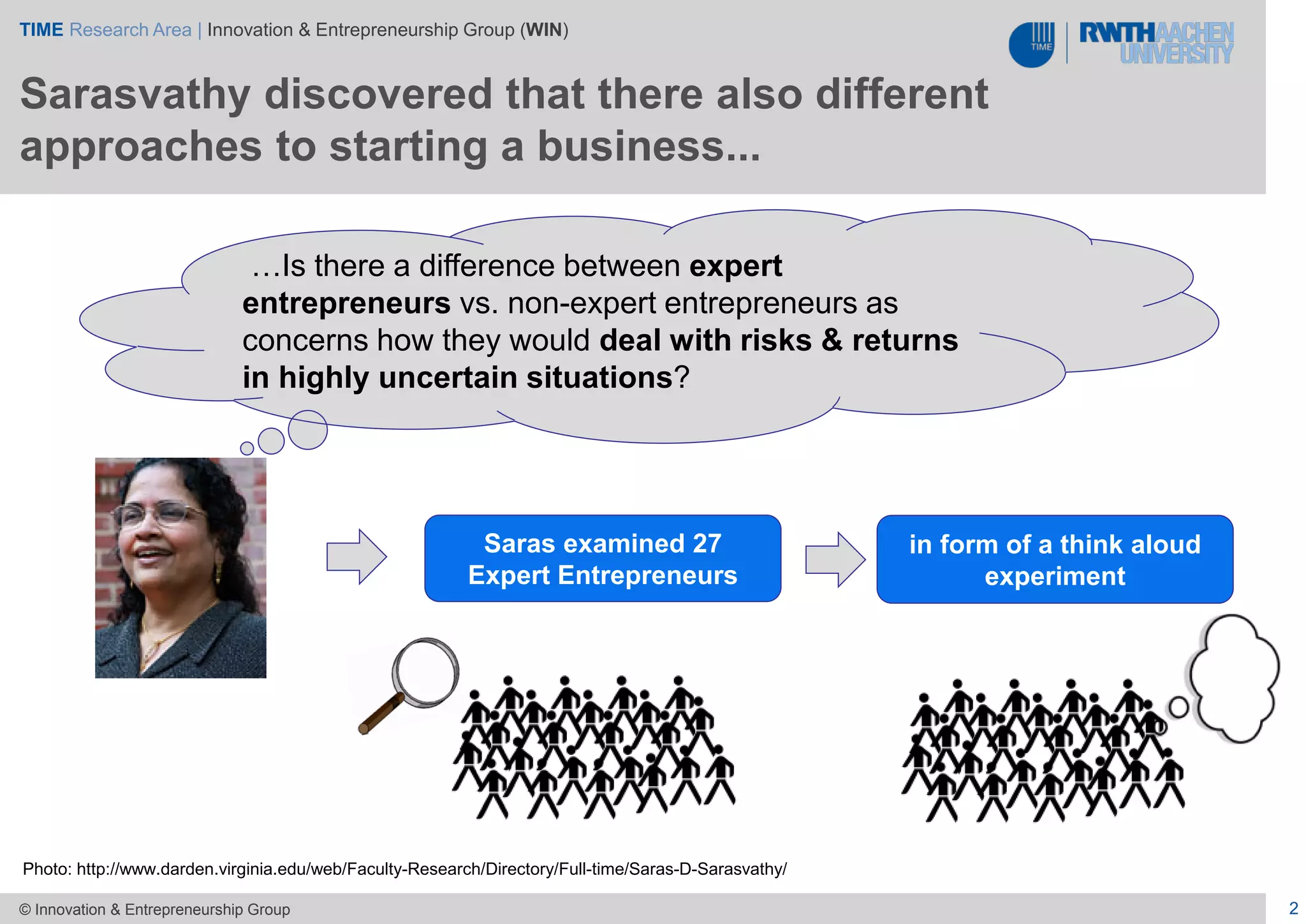
…Is there a difference between expert
entrepreneurs vs. non-expert entrepreneurs as
concerns how they would deal with risks & returns
in highly uncertain situations?
in form of a think aloud
experiment
Saras examined 27
Expert Entrepreneurs
Sarasvathy discovered that there also different
approaches to starting a business...
TIME Research Area | Innovation & Entrepreneurship Group (WIN)
3© Innovation & Entrepreneurship Group
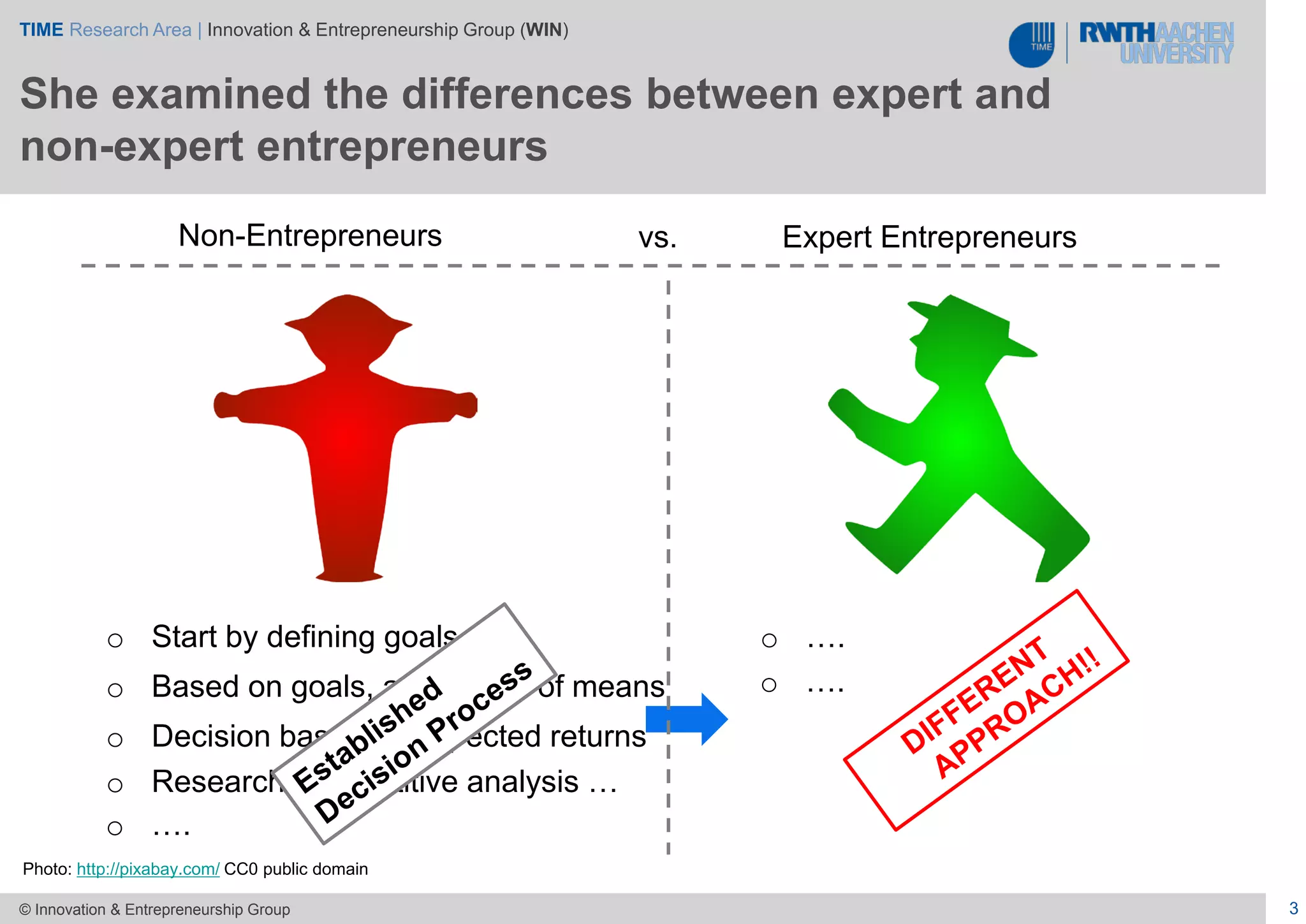
Expert EntrepreneursNon-Entrepreneurs vs.
o Start by defining goals
o Based on goals, acquisition of means
o Decision based on expected returns
o Research, competitive analysis …
o ….
o ….
o ….
She examined the differences between expert and
non-expert entrepreneurs
Photo: http://pixabay.com/ CC0 public domain
TIME Research Area | Innovation & Entrepreneurship Group (WIN)
4© Innovation & Entrepreneurship Group
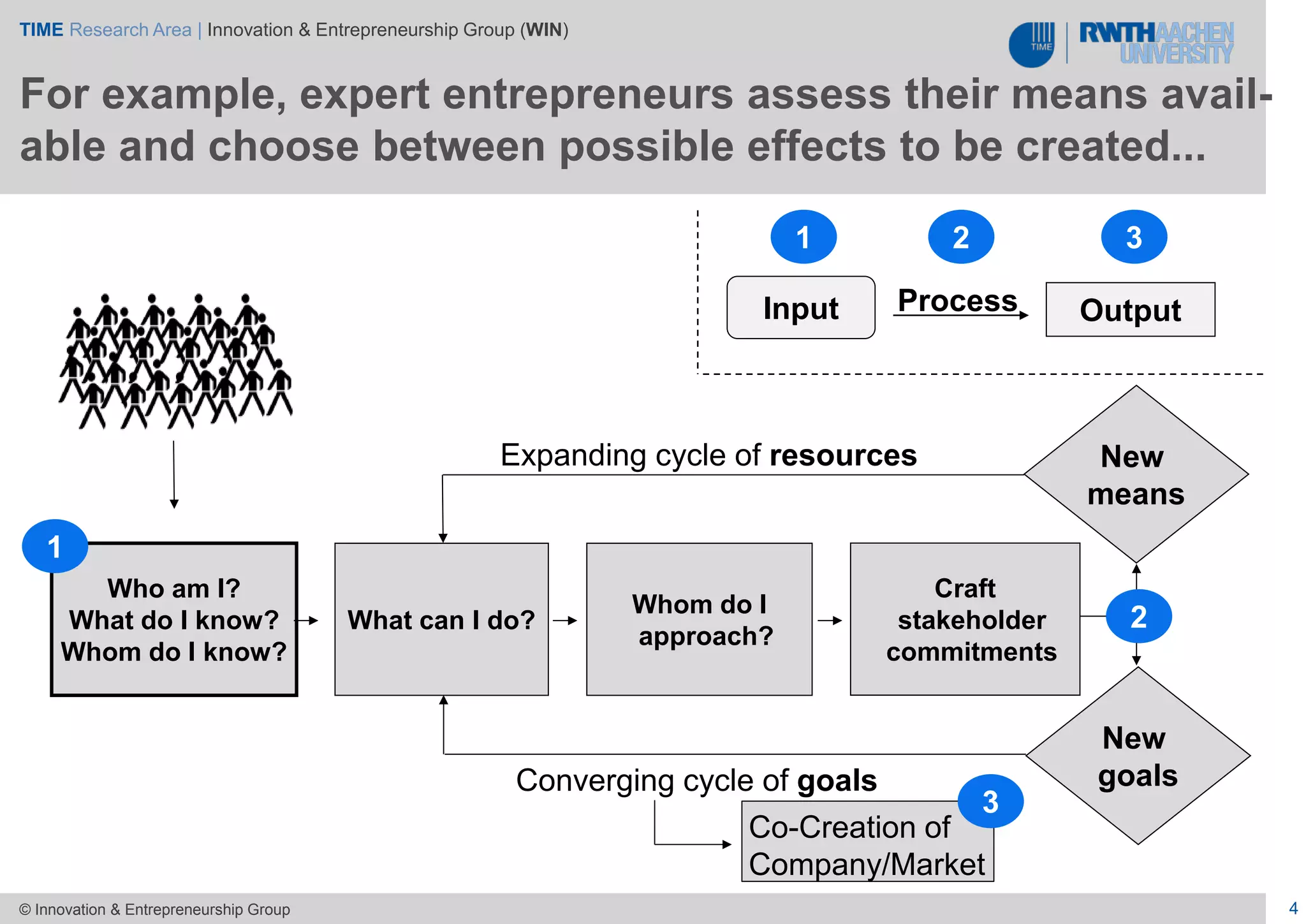
New
means
Input Process Output
What can I do?
Who am I?
What do I know?
Whom do I know?
1
1 2 3
Expanding cycle of resources
Whom do I
approach?
Craft
stakeholder
commitments
New
goalsConverging cycle of goals
2
Co-Creation of
Company/Market
3
For example, expert entrepreneurs assess their means avail-
able and choose between possible effects to be created...
TIME Research Area | Innovation & Entrepreneurship Group (WIN)
5© Innovation & Entrepreneurship Group
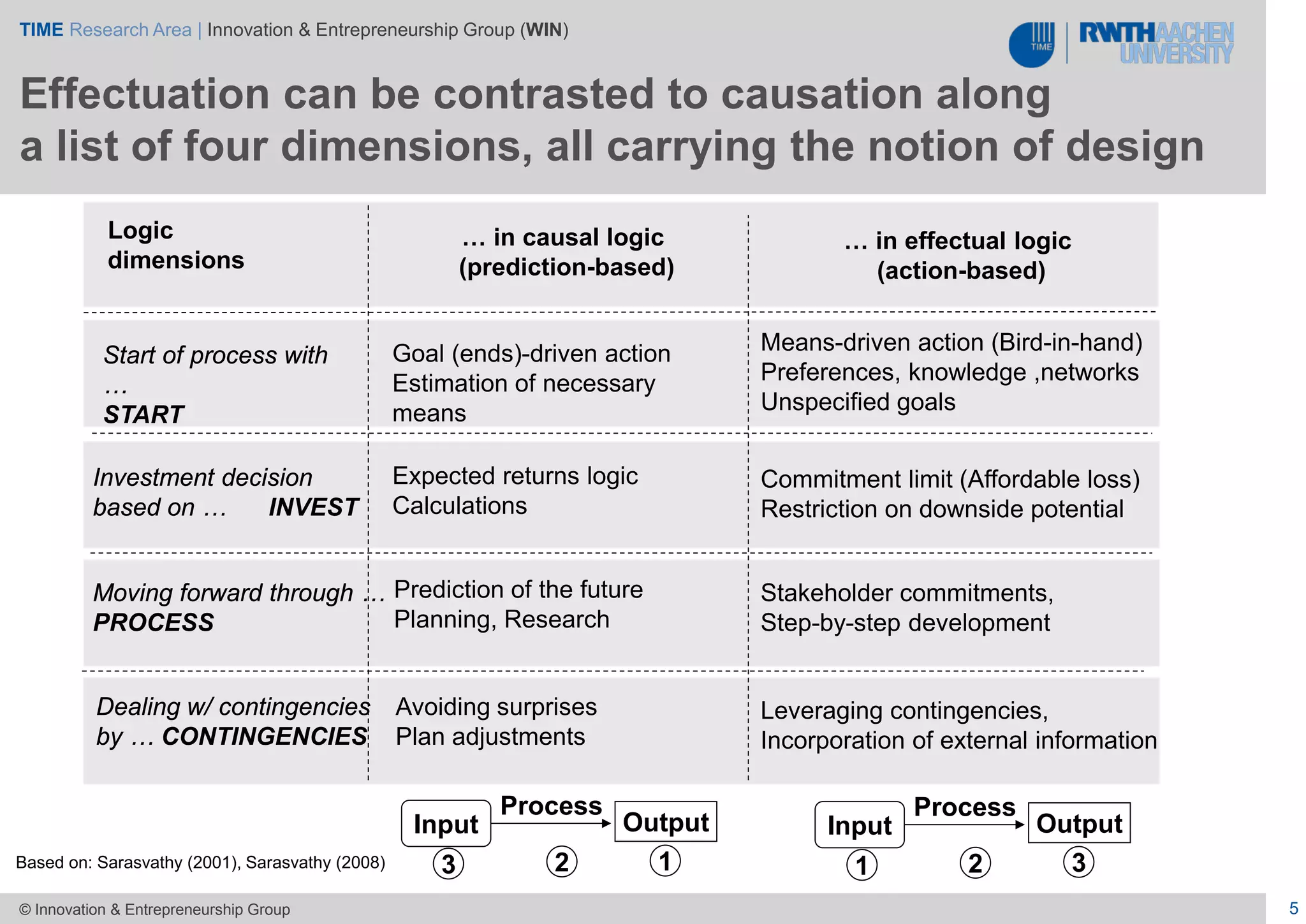
Start of process with
…
START
Logic
dimensions
… in causal logic
(prediction-based)
… in effectual logic
(action-based)
Goal (ends)-driven action
Estimation of necessary
means
Means-driven action (Bird-in-hand)
Preferences, knowledge ,networks
Unspecified goals
Investment decision
based on … INVEST
Expected returns logic
Calculations
Commitment limit (Affordable loss)
Restriction on downside potential
Moving forward through …
PROCESS
Prediction of the future
Planning, Research
Stakeholder commitments,
Step-by-step development
Dealing w/ contingencies
by … CONTINGENCIES
Avoiding surprises
Plan adjustments
Leveraging contingencies,
Incorporation of external information
Input
Process
Output
123
Input
Process
Output
321Based on: Sarasvathy (2001), Sarasvathy (2008)
Effectuation can be contrasted to causation along
a list of four dimensions, all carrying the notion of design
TIME Research Area | Innovation & Entrepreneurship Group (WIN)
6© Innovation & Entrepreneurship Group
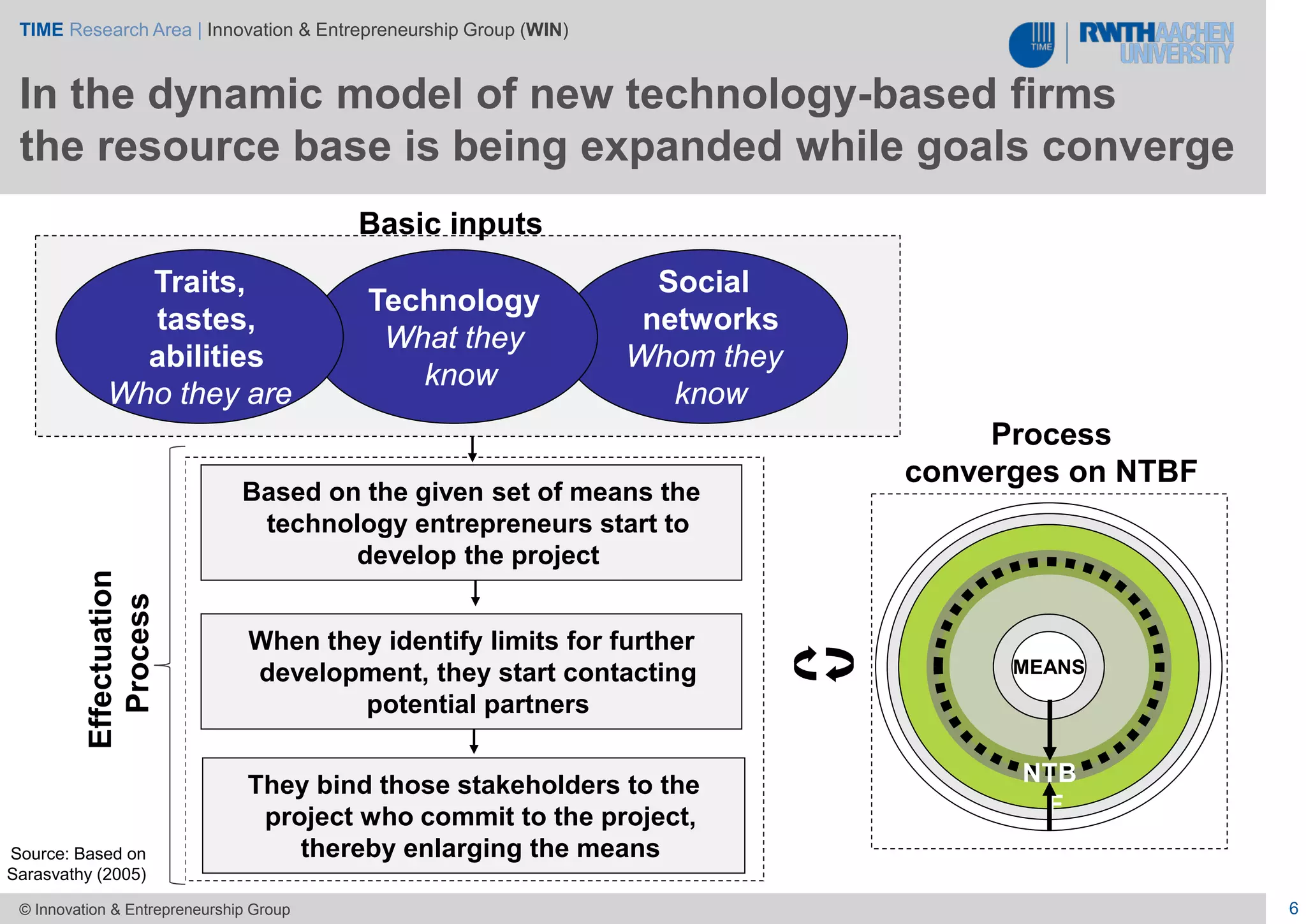
Social
networks
Whom they
know
Technology
What they
know
Traits,
tastes,
abilities
Who they are
Basic inputs
Based on the given set of means the
technology entrepreneurs start to
develop the project
When they identify limits for further
development, they start contacting
potential partners
NTB
F
MEANS
They bind those stakeholders to the
project who commit to the project,
thereby enlarging the means
Effectuation
Process
Process
converges on NTBF
Source: Based on
Sarasvathy (2005)
In the dynamic model of new technology-based firms
the resource base is being expanded while goals converge
TIME Research Area | Innovation & Entrepreneurship Group (WIN)
7© Innovation & Entrepreneurship Group
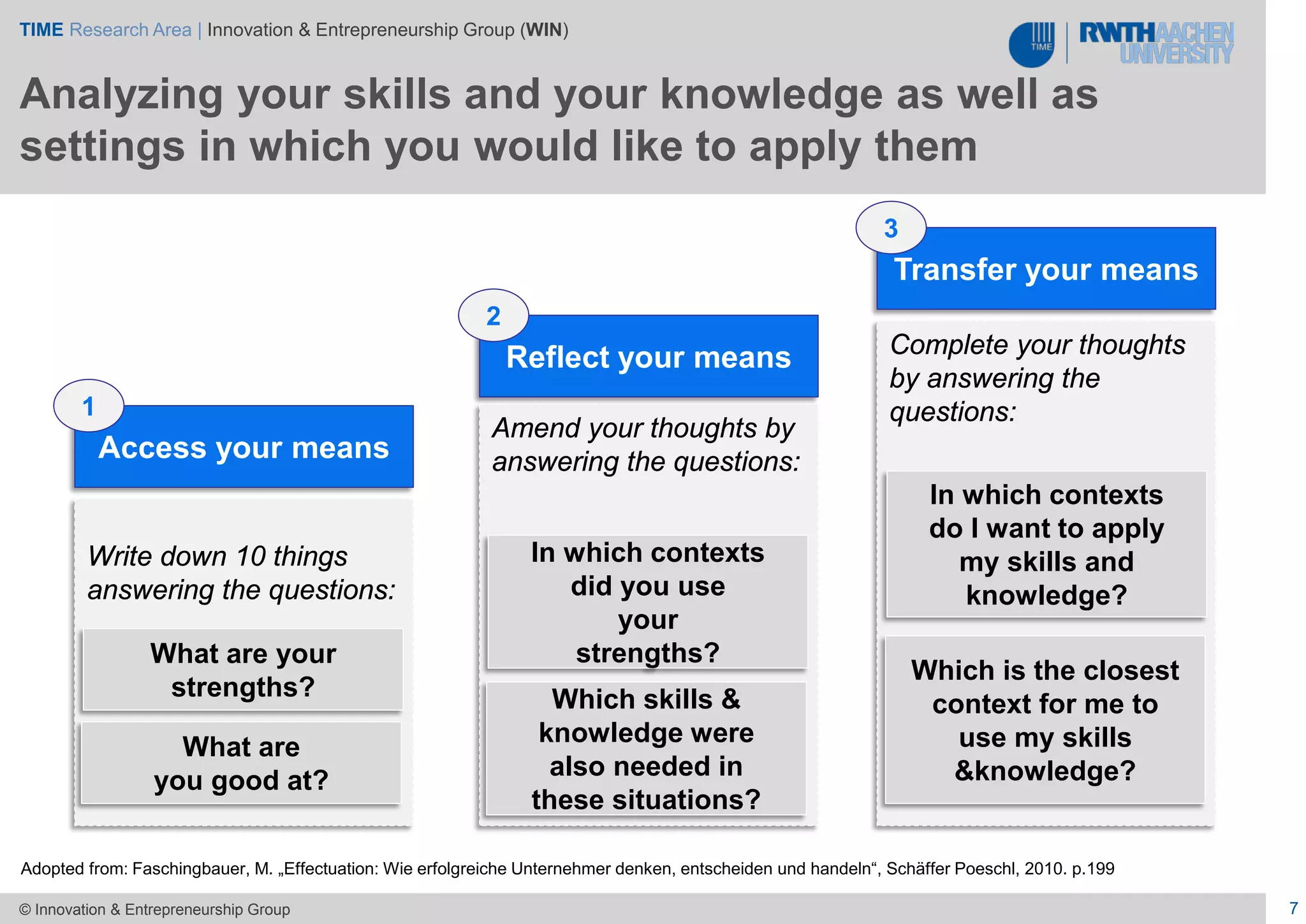
Access your means
1
Reflect your means
2
Transfer your means
3
Write down 10 things
answering the questions:
What are your
strengths?
What are
you good at?
Amend your thoughts by
answering the questions:
In which contexts
did you use
your
strengths?
Which skills &
knowledge were
also needed in
these situations?
Complete your thoughts
by answering the
questions:
In which contexts
do I want to apply
my skills and
knowledge?
Which is the closest
context for me to
use my skills
&knowledge?
Adopted from: Faschingbauer, M. „Effectuation: Wie erfolgreiche Unternehmer denken, entscheiden und handeln“, Schäffer Poeschl, 2010. p.199
Analyzing your skills and your knowledge as well as
settings in which you would like to apply them
TIME Research Area | Innovation & Entrepreneurship Group (WIN)
8© Innovation & Entrepreneurship Group
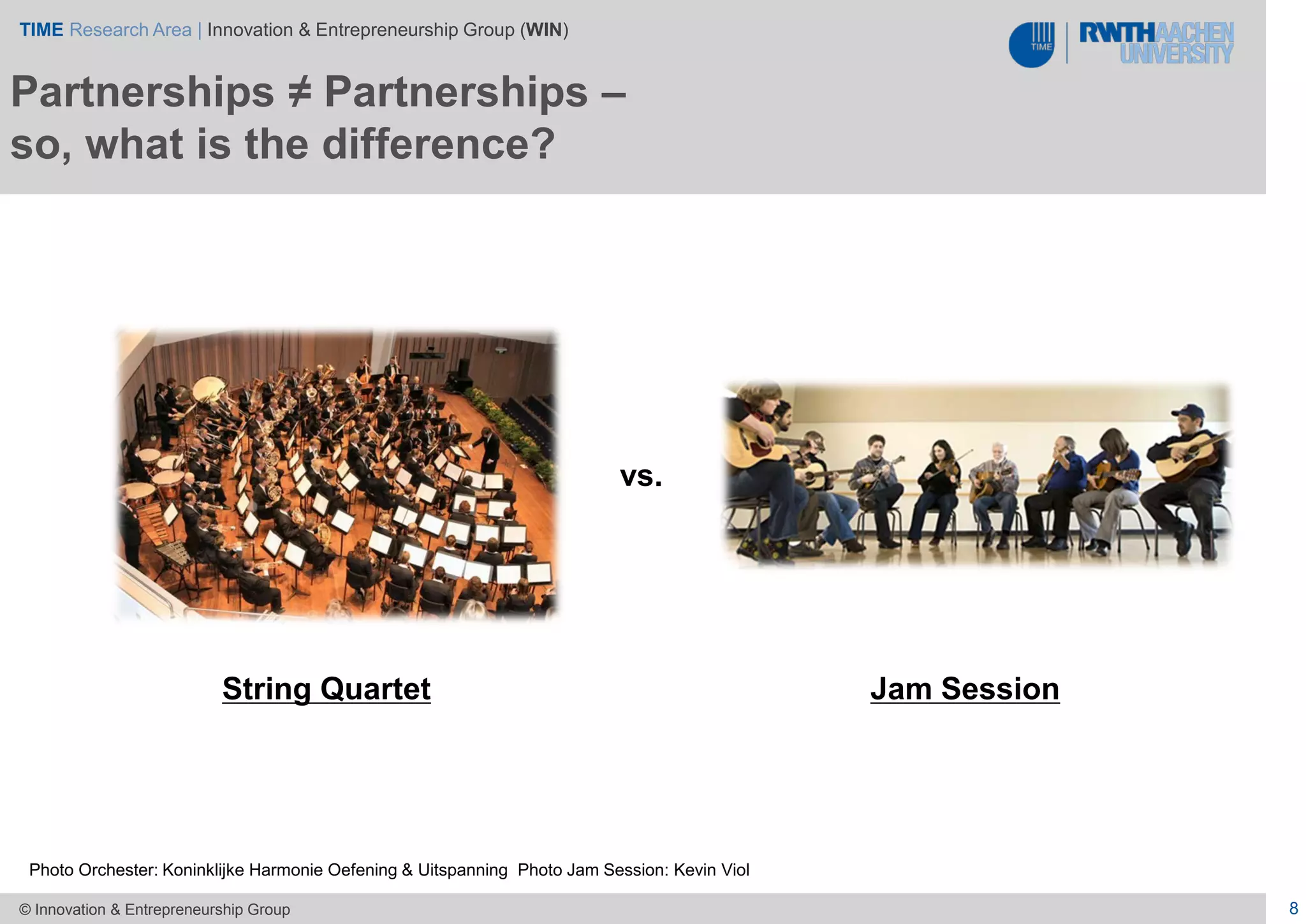
Partnerships ≠ Partnerships –
so, what is the difference?
String Quartet
vs.
Jam Session
Photo Orchester: Koninklijke Harmonie Oefening & Uitspanning Photo Jam Session: Kevin Viol
TIME Research Area | Innovation & Entrepreneurship Group (WIN)
9© Innovation & Entrepreneurship Group
*Dew et al. (2010) Photo: http://pixabay.com/ CC0 public domain
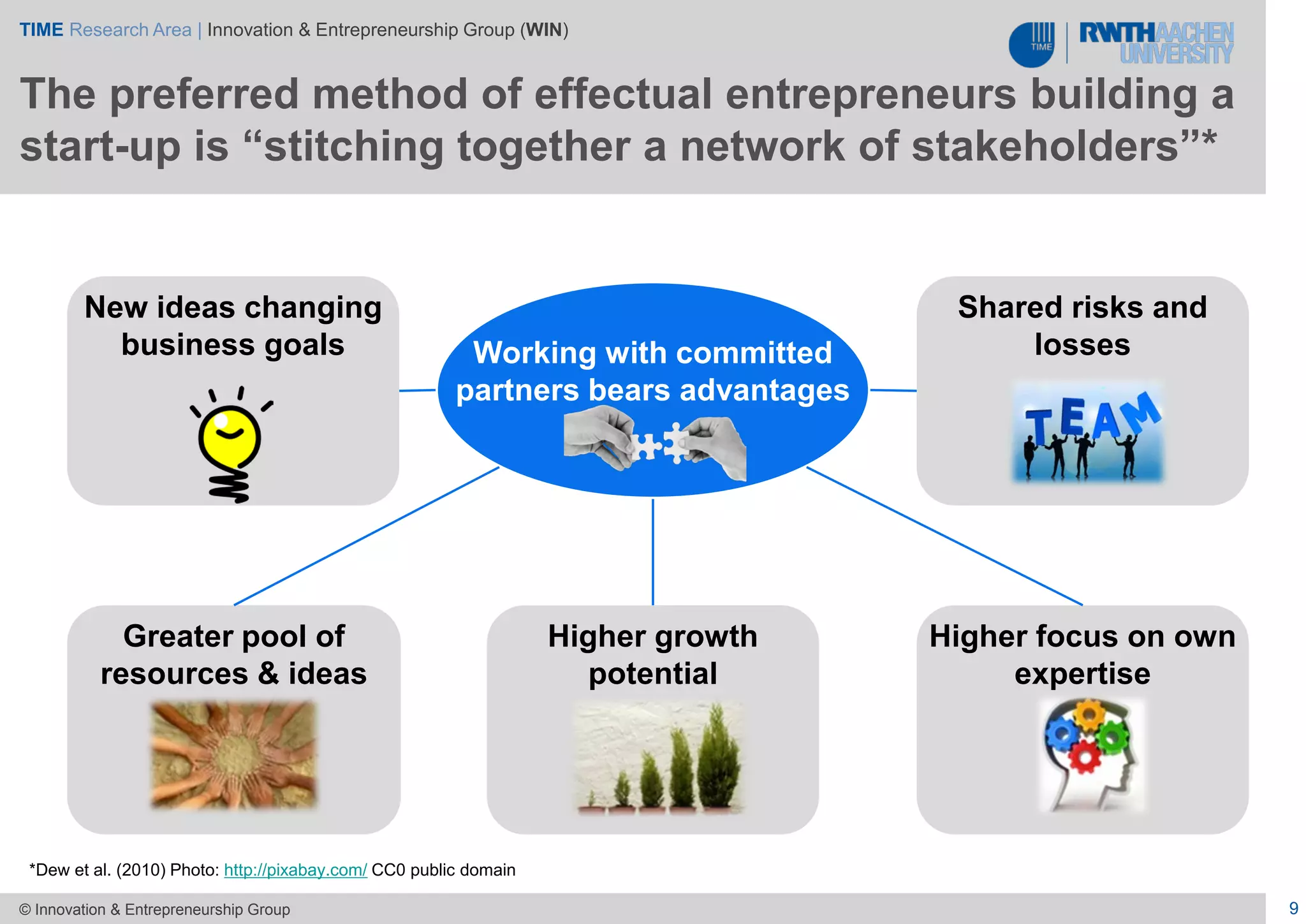
The preferred method of effectual entrepreneurs building a
start-up is “stitching together a network of stakeholders”*
Working with committed
partners bears advantages
Greater pool of
resources & ideas
New ideas changing
business goals
Shared risks and
losses
Higher focus on own
expertise
Higher growth
potential
TIME Research Area | Innovation & Entrepreneurship Group (WIN)
10© Innovation & Entrepreneurship Group
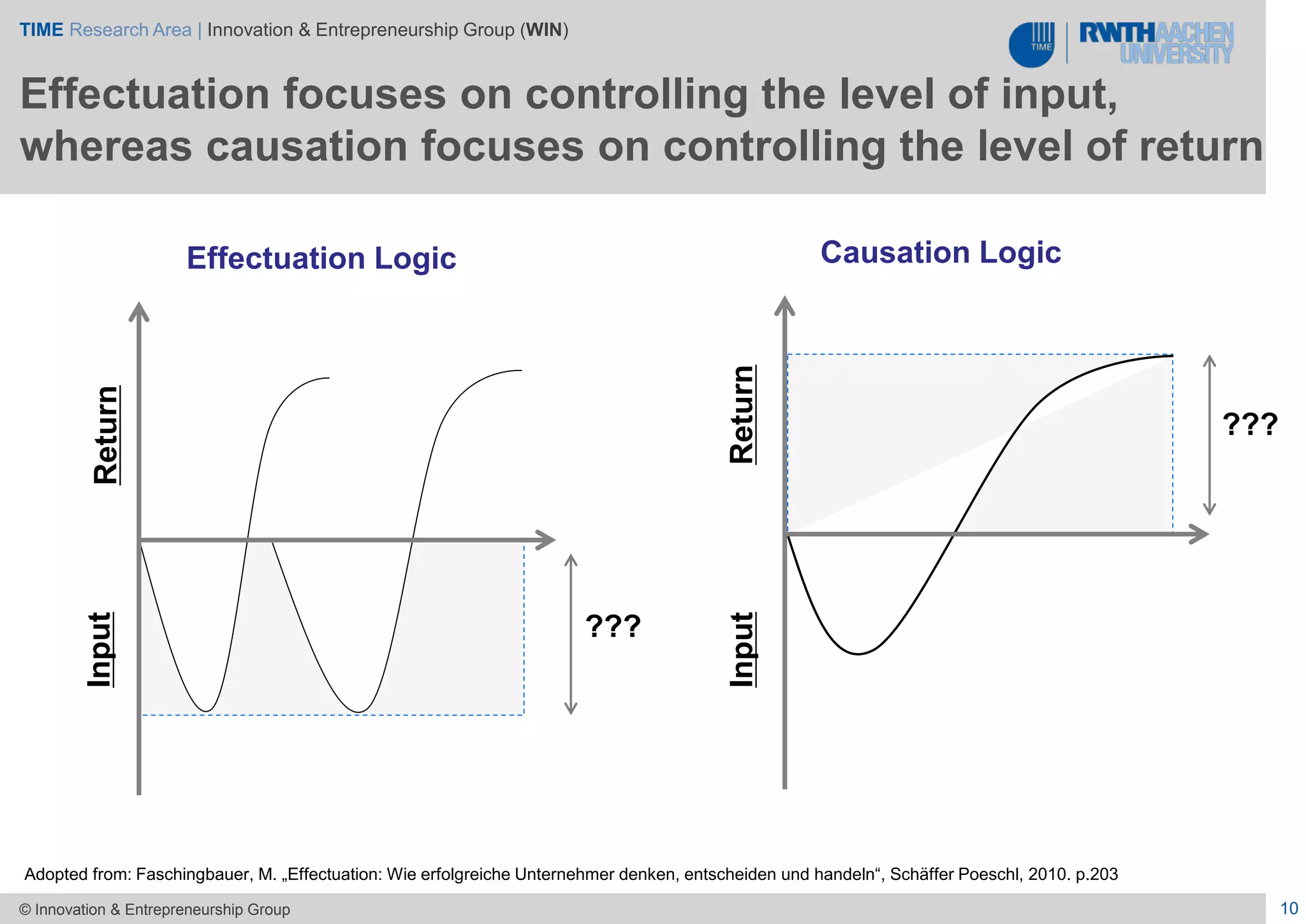
Causation LogicEffectuation Logic
???
???
ReturnInput
ReturnInput
Adopted from: Faschingbauer, M. „Effectuation: Wie erfolgreiche Unternehmer denken, entscheiden und handeln“, Schäffer Poeschl, 2010. p.203
Effectuation focuses on controlling the level of input,
whereas causation focuses on controlling the level of return
TIME Research Area | Innovation & Entrepreneurship Group (WIN)
11© Innovation & Entrepreneurship Group
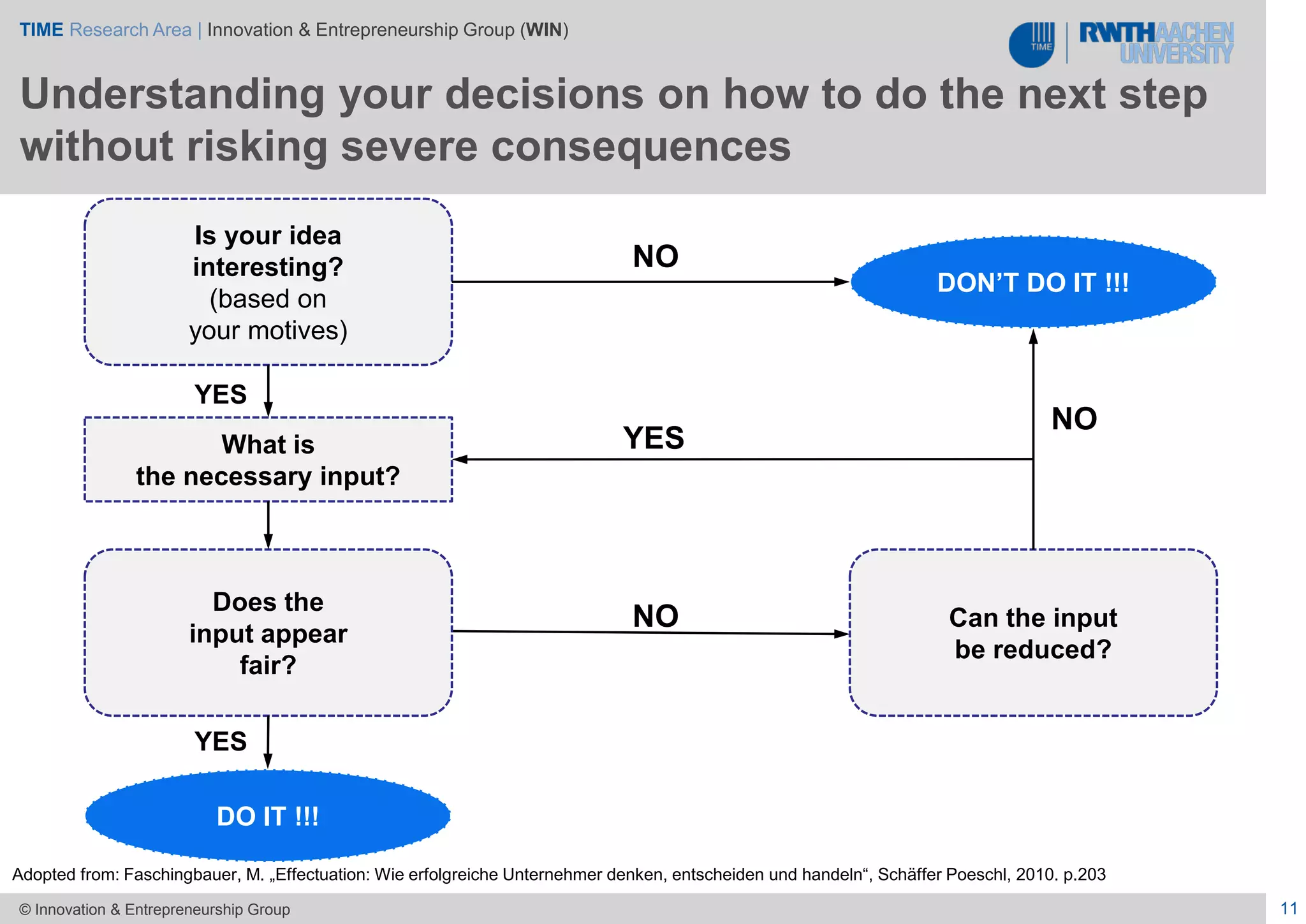
Is your idea
interesting?
(based on
your motives)
What is
the necessary input?
DON’T DO IT !!!
NO
Can the input
be reduced?
DO IT !!!
YES
NO
YES
NO
Does the
input appear
fair?
YES
Adopted from: Faschingbauer, M. „Effectuation: Wie erfolgreiche Unternehmer denken, entscheiden und handeln“, Schäffer Poeschl, 2010. p.203
Understanding your decisions on how to do the next step
without risking severe consequences
TIME Research Area | Innovation & Entrepreneurship Group (WIN)
12© Innovation & Entrepreneurship Group
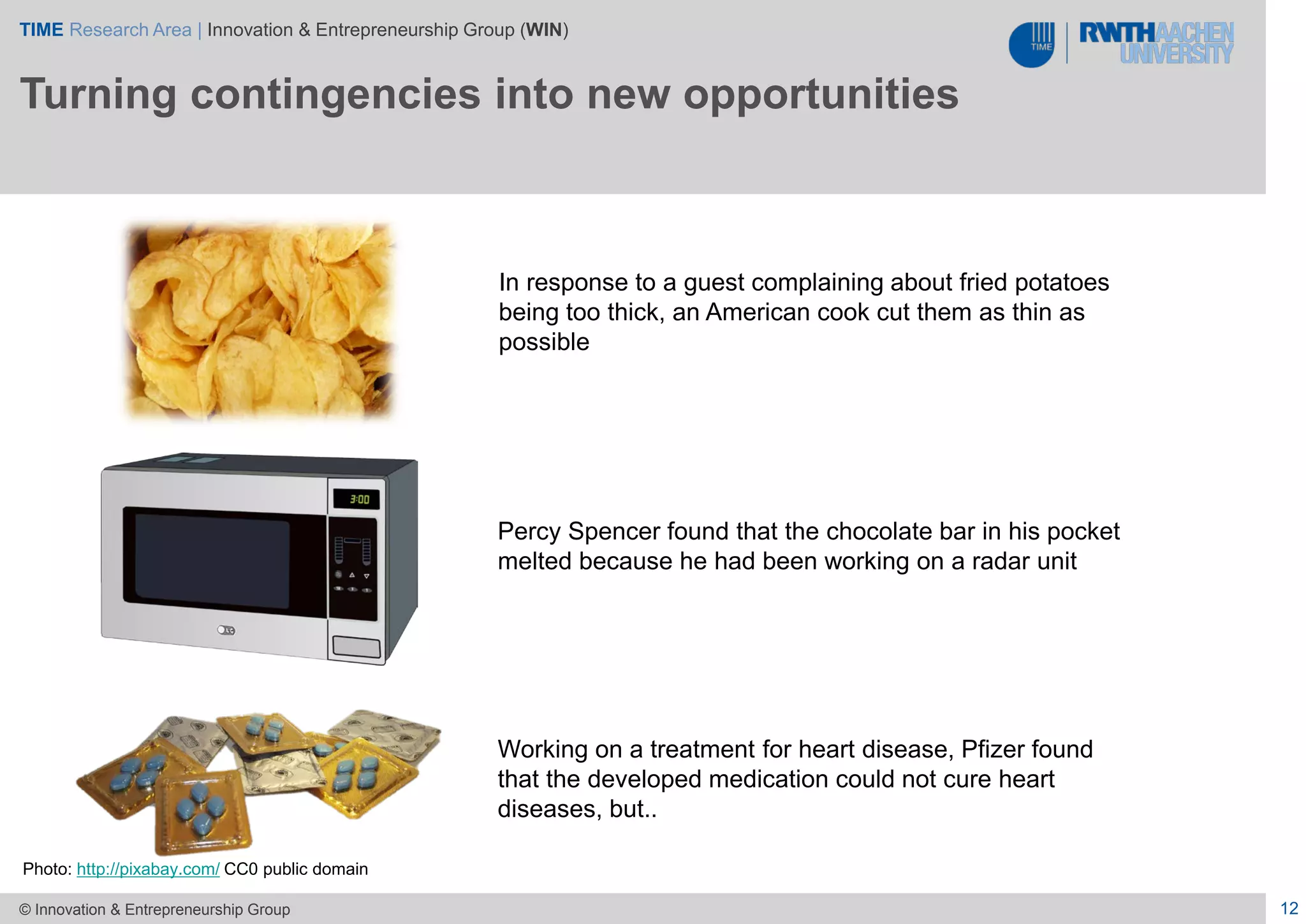
Turning contingencies into new opportunities
Photo: http://pixabay.com/ CC0 public domain
In response to a guest complaining about fried potatoes
being too thick, an American cook cut them as thin as
possible
Working on a treatment for heart disease, Pfizer found
that the developed medication could not cure heart
diseases, but..
Percy Spencer found that the chocolate bar in his pocket
melted because he had been working on a radar unit
TIME Research Area | Innovation & Entrepreneurship Group (WIN)
13© Innovation & Entrepreneurship Group
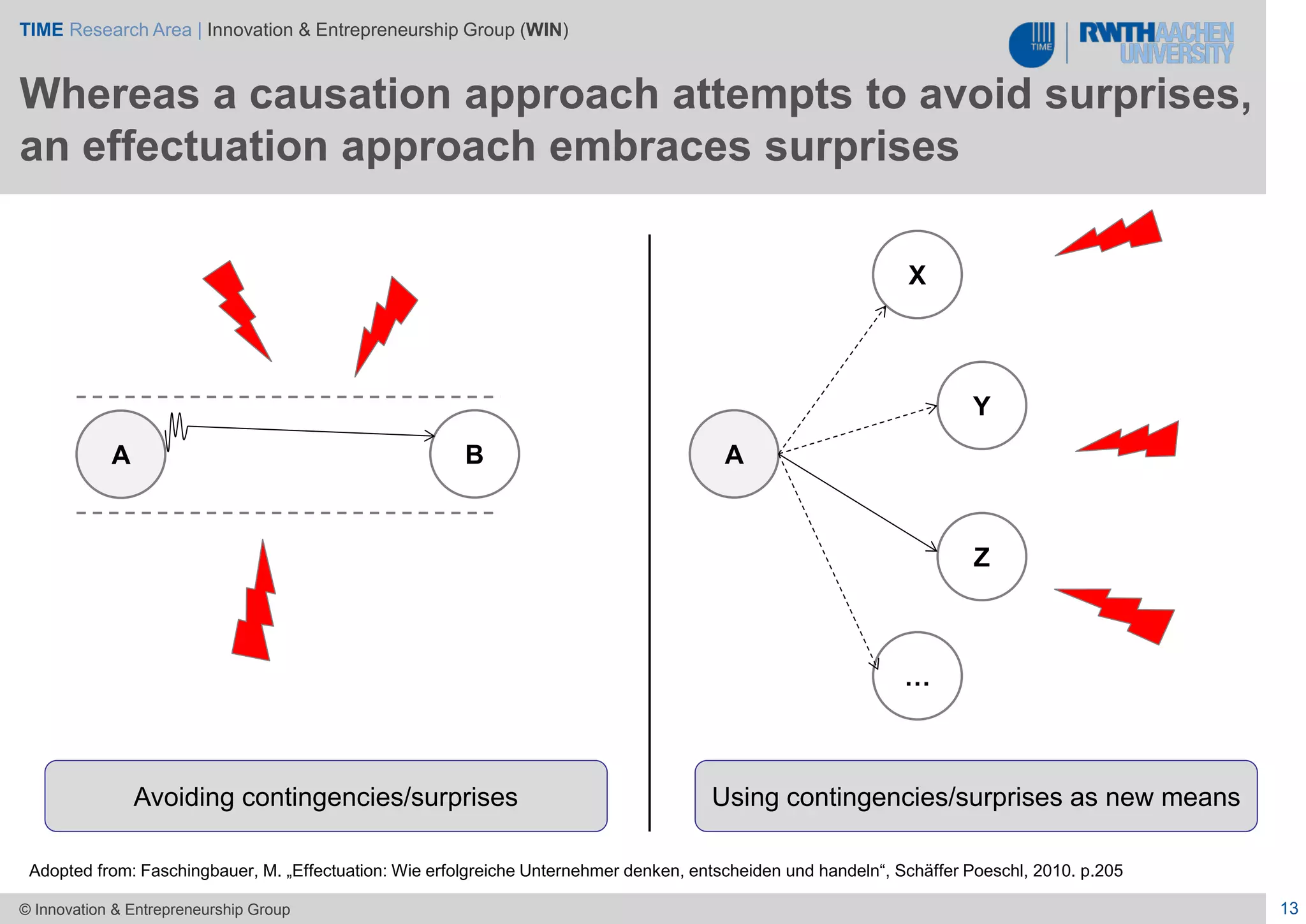
A B A
X
Y
Z
…
Avoiding contingencies/surprises Using contingencies/surprises as new means
Adopted from: Faschingbauer, M. „Effectuation: Wie erfolgreiche Unternehmer denken, entscheiden und handeln“, Schäffer Poeschl, 2010. p.205
Whereas a causation approach attempts to avoid surprises,
an effectuation approach embraces surprises

Lecture 1 MOOC@TU9: Entrepreneurship by Prof. Brettel

  • 1.
    School of Businessand Economics TIME Research Area | Innovation & Entrepreneurship Group (WIN) Entrepreneurship and Innovation TU9 MOOC – Introduction to Effectuation Univ.-Prof. Dr. Malte Brettel | Aachen | October, 20nd 2014
  • 2.
    TIME Research Area| Innovation & Entrepreneurship Group (WIN) 2© Innovation & Entrepreneurship Group Photo: http://www.darden.virginia.edu/web/Faculty-Research/Directory/Full-time/Saras-D-Sarasvathy/ …Is there a difference between expert entrepreneurs vs. non-expert entrepreneurs as concerns how they would deal with risks & returns in highly uncertain situations? in form of a think aloud experiment Saras examined 27 Expert Entrepreneurs Sarasvathy discovered that there also different approaches to starting a business...
  • 3.
    TIME Research Area| Innovation & Entrepreneurship Group (WIN) 3© Innovation & Entrepreneurship Group Expert EntrepreneursNon-Entrepreneurs vs. o Start by defining goals o Based on goals, acquisition of means o Decision based on expected returns o Research, competitive analysis … o …. o …. o …. She examined the differences between expert and non-expert entrepreneurs Photo: http://pixabay.com/ CC0 public domain
  • 4.
    TIME Research Area| Innovation & Entrepreneurship Group (WIN) 4© Innovation & Entrepreneurship Group New means Input Process Output What can I do? Who am I? What do I know? Whom do I know? 1 1 2 3 Expanding cycle of resources Whom do I approach? Craft stakeholder commitments New goalsConverging cycle of goals 2 Co-Creation of Company/Market 3 For example, expert entrepreneurs assess their means avail- able and choose between possible effects to be created...
  • 5.
    TIME Research Area| Innovation & Entrepreneurship Group (WIN) 5© Innovation & Entrepreneurship Group Start of process with … START Logic dimensions … in causal logic (prediction-based) … in effectual logic (action-based) Goal (ends)-driven action Estimation of necessary means Means-driven action (Bird-in-hand) Preferences, knowledge ,networks Unspecified goals Investment decision based on … INVEST Expected returns logic Calculations Commitment limit (Affordable loss) Restriction on downside potential Moving forward through … PROCESS Prediction of the future Planning, Research Stakeholder commitments, Step-by-step development Dealing w/ contingencies by … CONTINGENCIES Avoiding surprises Plan adjustments Leveraging contingencies, Incorporation of external information Input Process Output 123 Input Process Output 321Based on: Sarasvathy (2001), Sarasvathy (2008) Effectuation can be contrasted to causation along a list of four dimensions, all carrying the notion of design
  • 6.
    TIME Research Area| Innovation & Entrepreneurship Group (WIN) 6© Innovation & Entrepreneurship Group Social networks Whom they know Technology What they know Traits, tastes, abilities Who they are Basic inputs Based on the given set of means the technology entrepreneurs start to develop the project When they identify limits for further development, they start contacting potential partners NTB F MEANS They bind those stakeholders to the project who commit to the project, thereby enlarging the means Effectuation Process Process converges on NTBF Source: Based on Sarasvathy (2005) In the dynamic model of new technology-based firms the resource base is being expanded while goals converge
  • 7.
    TIME Research Area| Innovation & Entrepreneurship Group (WIN) 7© Innovation & Entrepreneurship Group Access your means 1 Reflect your means 2 Transfer your means 3 Write down 10 things answering the questions: What are your strengths? What are you good at? Amend your thoughts by answering the questions: In which contexts did you use your strengths? Which skills & knowledge were also needed in these situations? Complete your thoughts by answering the questions: In which contexts do I want to apply my skills and knowledge? Which is the closest context for me to use my skills &knowledge? Adopted from: Faschingbauer, M. „Effectuation: Wie erfolgreiche Unternehmer denken, entscheiden und handeln“, Schäffer Poeschl, 2010. p.199 Analyzing your skills and your knowledge as well as settings in which you would like to apply them
  • 8.
    TIME Research Area| Innovation & Entrepreneurship Group (WIN) 8© Innovation & Entrepreneurship Group Partnerships ≠ Partnerships – so, what is the difference? String Quartet vs. Jam Session Photo Orchester: Koninklijke Harmonie Oefening & Uitspanning Photo Jam Session: Kevin Viol
  • 9.
    TIME Research Area| Innovation & Entrepreneurship Group (WIN) 9© Innovation & Entrepreneurship Group *Dew et al. (2010) Photo: http://pixabay.com/ CC0 public domain The preferred method of effectual entrepreneurs building a start-up is “stitching together a network of stakeholders”* Working with committed partners bears advantages Greater pool of resources & ideas New ideas changing business goals Shared risks and losses Higher focus on own expertise Higher growth potential
  • 10.
    TIME Research Area| Innovation & Entrepreneurship Group (WIN) 10© Innovation & Entrepreneurship Group Causation LogicEffectuation Logic ??? ??? ReturnInput ReturnInput Adopted from: Faschingbauer, M. „Effectuation: Wie erfolgreiche Unternehmer denken, entscheiden und handeln“, Schäffer Poeschl, 2010. p.203 Effectuation focuses on controlling the level of input, whereas causation focuses on controlling the level of return
  • 11.
    TIME Research Area| Innovation & Entrepreneurship Group (WIN) 11© Innovation & Entrepreneurship Group Is your idea interesting? (based on your motives) What is the necessary input? DON’T DO IT !!! NO Can the input be reduced? DO IT !!! YES NO YES NO Does the input appear fair? YES Adopted from: Faschingbauer, M. „Effectuation: Wie erfolgreiche Unternehmer denken, entscheiden und handeln“, Schäffer Poeschl, 2010. p.203 Understanding your decisions on how to do the next step without risking severe consequences
  • 12.
    TIME Research Area| Innovation & Entrepreneurship Group (WIN) 12© Innovation & Entrepreneurship Group Turning contingencies into new opportunities Photo: http://pixabay.com/ CC0 public domain In response to a guest complaining about fried potatoes being too thick, an American cook cut them as thin as possible Working on a treatment for heart disease, Pfizer found that the developed medication could not cure heart diseases, but.. Percy Spencer found that the chocolate bar in his pocket melted because he had been working on a radar unit
  • 13.
    TIME Research Area| Innovation & Entrepreneurship Group (WIN) 13© Innovation & Entrepreneurship Group A B A X Y Z … Avoiding contingencies/surprises Using contingencies/surprises as new means Adopted from: Faschingbauer, M. „Effectuation: Wie erfolgreiche Unternehmer denken, entscheiden und handeln“, Schäffer Poeschl, 2010. p.205 Whereas a causation approach attempts to avoid surprises, an effectuation approach embraces surprises