Prof. Dr.-Ing. Guido Baltes
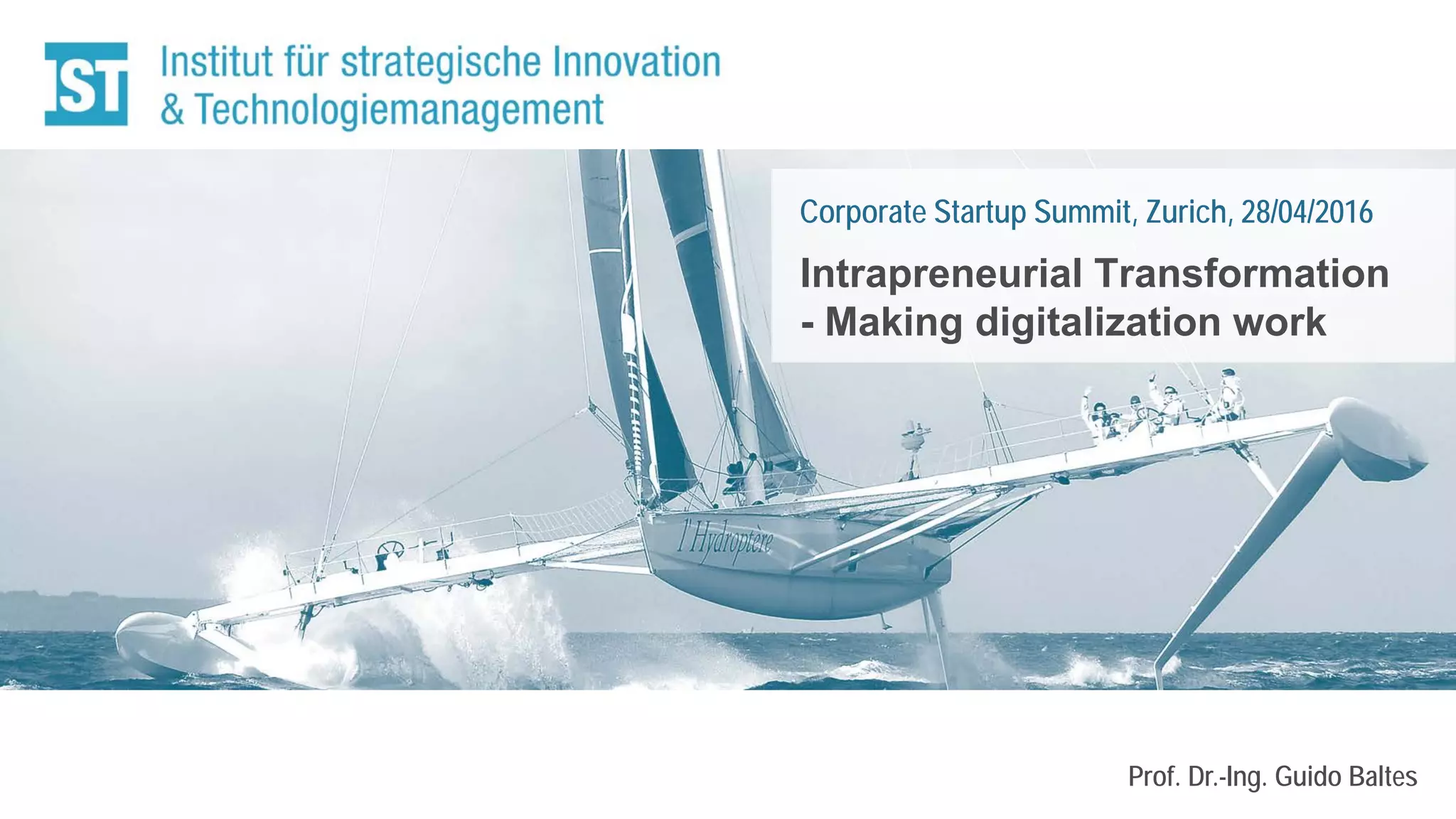
Corporate Startup Summit, Zurich, 28/04/2016
Intrapreneurial Transformation
- Making digitalization work
Page 1© Prof. Dr.-Ing. Guido Baltes
Prof. Dr.Ing. Guido Baltes - Professor for Strategy & Management,
Director Institute for Strategic innovation & Technology management
Current
 Professor for Strategy & Management
Lake Constance University (Hochschule Konstanz)
 Director Institute for Strategic innovation & Technology management
(IST), head of eArchitecture Innovation Lab & CoPS industry research group*
 Research focus: Strategic Innovation based on Dynamic Capabilities &
Corporate Entrepreneurship, supporting companies in strategic transition
and strategic re-newal to implement innovation-driven growth strategies
Industry background
 Management board member as Head of Strategy & Marketing, Siemens Business Services Germany
 Project management for strategic transition & turn-around projects (Corporate Strategy, Siemens AG)
 Project manager Strategic Management Consulting, project management aerospace
 PhD in Aeronautical Engineering & Master in Business Administration
* CoPS : Community of Practice for Strategic Management Architectures – CeTIM : Centre for Technology & Innovation Management
inno-ist.org
Page 2© Prof. Dr.-Ing. Guido Baltes
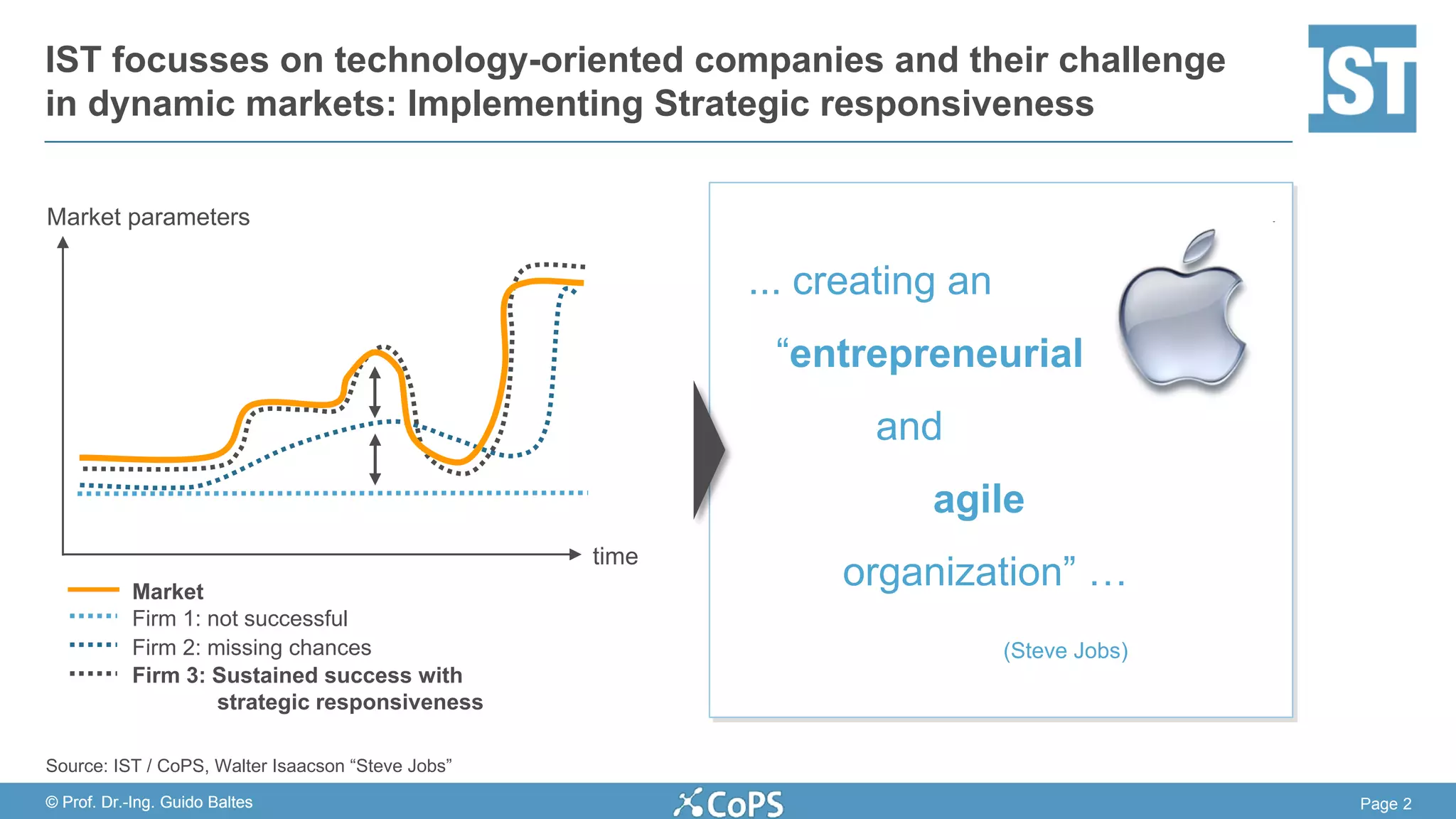
IST focusses on technology-oriented companies and their challenge
in dynamic markets: Implementing Strategic responsiveness
Firm 1: not successful
Firm 2: missing chances
Firm 3: Sustained success with
strategic responsiveness
Market parameters
time
Market
Source: IST / CoPS, Walter Isaacson “Steve Jobs”
© Prof. Dr.-Ing. Guido Baltes
... creating an
“entrepreneurial
and
agile
organization” …
(Steve Jobs)
Page 3© Prof. Dr.-Ing. Guido Baltes
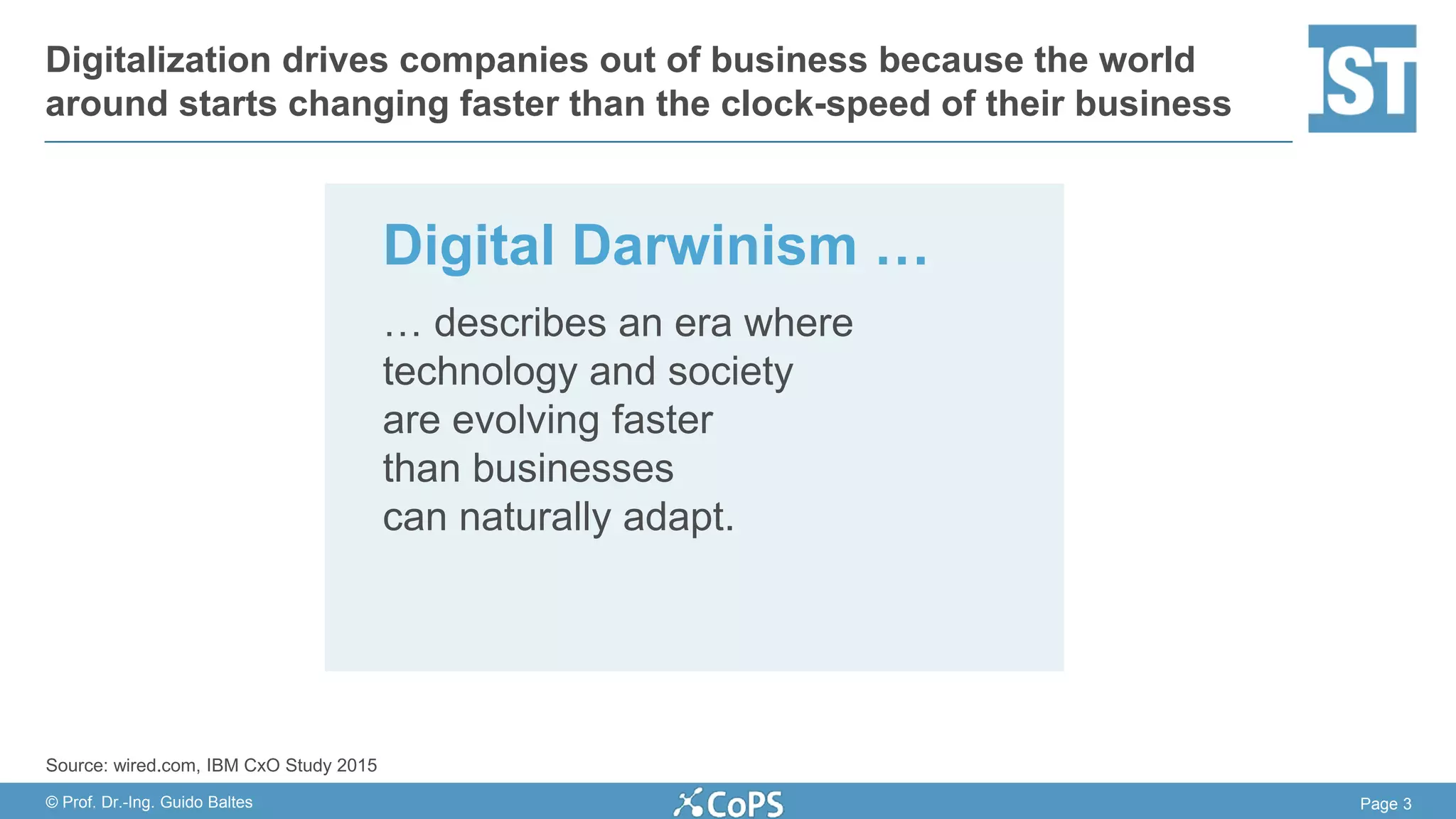
Digitalization drives companies out of business because the world
around starts changing faster than the clock-speed of their business
Digital Darwinism …
… describes an era where
technology and society
are evolving faster
than businesses
can naturally adapt.
Source: wired.com, IBM CxO Study 2015
Page 4© Prof. Dr.-Ing. Guido Baltes
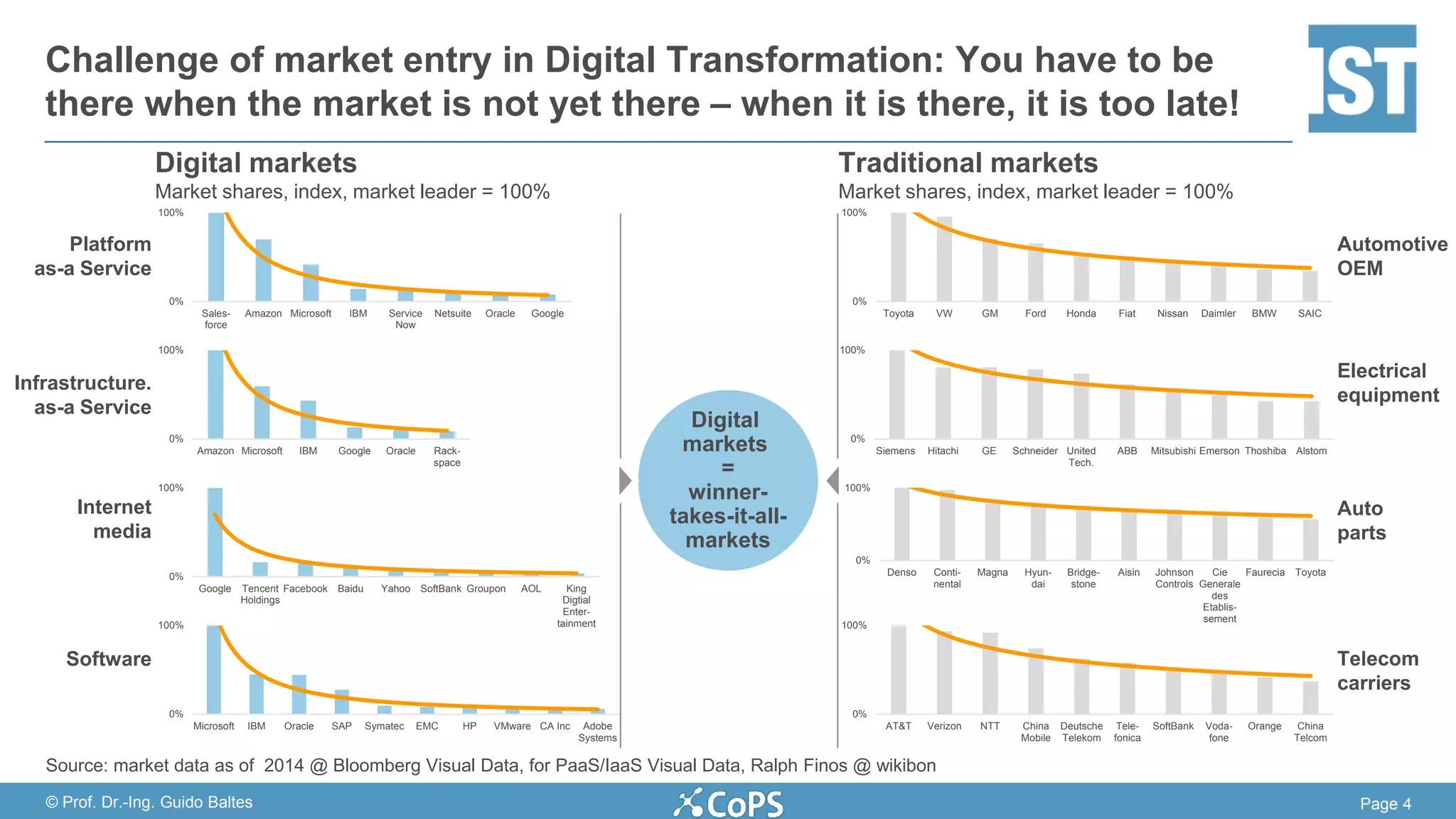
Challenge of market entry in Digital Transformation: You have to be
there when the market is not yet there – when it is there, it is too late!
Digital markets
Market shares, index, market leader = 100%
Platform
as-a Service
Infrastructure.
as-a Service
Traditional markets
Market shares, index, market leader = 100%
Automotive
OEM
Electrical
equipment
Internet
media
Auto
parts
Software Telecom
carriers
Digital
markets
=
winner-
takes-it-all-
markets
0%
100%
Microsoft IBM Oracle SAP Symatec EMC HP VMware CA Inc Adobe
Systems
0%
100%
Google Tencent
Holdings
Facebook Baidu Yahoo SoftBank Groupon AOL King
Digtial
Enter-
tainment
0%
100%
Amazon Microsoft IBM Google Oracle Rack-
space
0%
100%
Sales-
force
Amazon Microsoft IBM Service
Now
Netsuite Oracle Google
0%
100%
AT&T Verizon NTT China
Mobile
Deutsche
Telekom
Tele-
fonica
SoftBank Voda-
fone
Orange China
Telcom
0%
100%
Toyota VW GM Ford Honda Fiat Nissan Daimler BMW SAIC
0%
100%
Siemens Hitachi GE Schneider United
Tech.
ABB Mitsubishi Emerson Thoshiba Alstom
0%
100%
Denso Conti-
nental
Magna Hyun-
dai
Bridge-
stone
Aisin Johnson
Controls
Cie
Generale
des
Etablis-
sement
Faurecia Toyota
Source: market data as of 2014 @ Bloomberg Visual Data, for PaaS/IaaS Visual Data, Ralph Finos @ wikibon
Page 5© Prof. Dr.-Ing. Guido Baltes
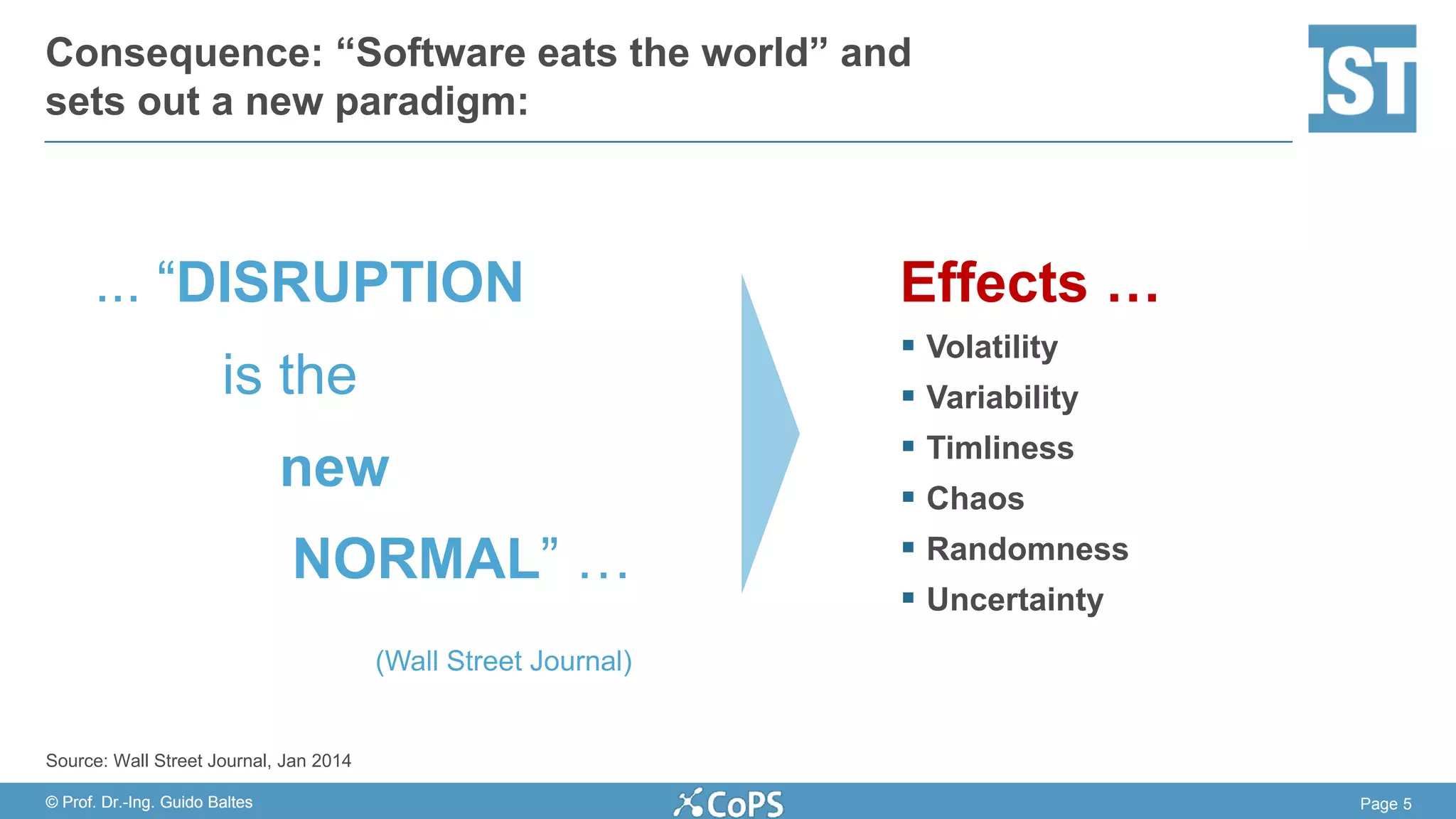
Consequence: “Software eats the world” and
sets out a new paradigm:
© Prof. Dr.-Ing. Guido Baltes
... “DISRUPTION
is the
new
NORMAL” …
(Wall Street Journal)
Source: Wall Street Journal, Jan 2014
Effects …
 Volatility
 Variability
 Timliness
 Chaos
 Randomness
 Uncertainty
Page 6© Prof. Dr.-Ing. Guido Baltes
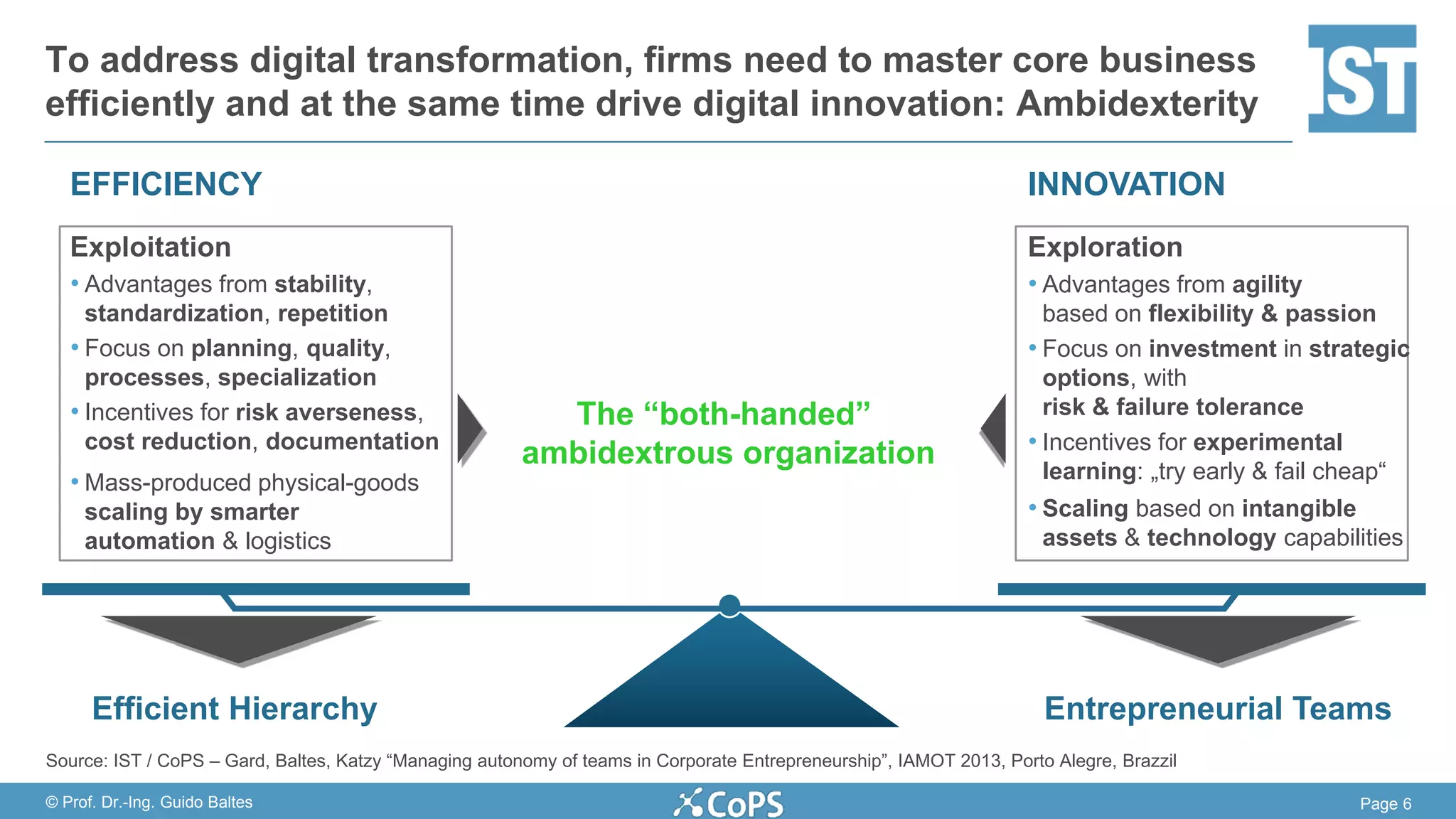
To address digital transformation, firms need to master core business
efficiently and at the same time drive digital innovation: Ambidexterity
Source: IST / CoPS – Gard, Baltes, Katzy “Managing autonomy of teams in Corporate Entrepreneurship”, IAMOT 2013, Porto Alegre, Brazzil
Exploitation
• Advantages from stability,
standardization, repetition
• Focus on planning, quality,
processes, specialization
• Incentives for risk averseness,
cost reduction, documentation
• Mass-produced physical-goods
scaling by smarter
automation & logistics
EFFICIENCY INNOVATION
Exploration
• Advantages from agility
based on flexibility & passion
• Focus on investment in strategic
options, with
risk & failure tolerance
• Incentives for experimental
learning: „try early & fail cheap“
• Scaling based on intangible
assets & technology capabilities
The “both-handed”
ambidextrous organization
Efficient Hierarchy Entrepreneurial Teams
Page 7© Prof. Dr.-Ing. Guido Baltes
Embedded Entrepreneurial team
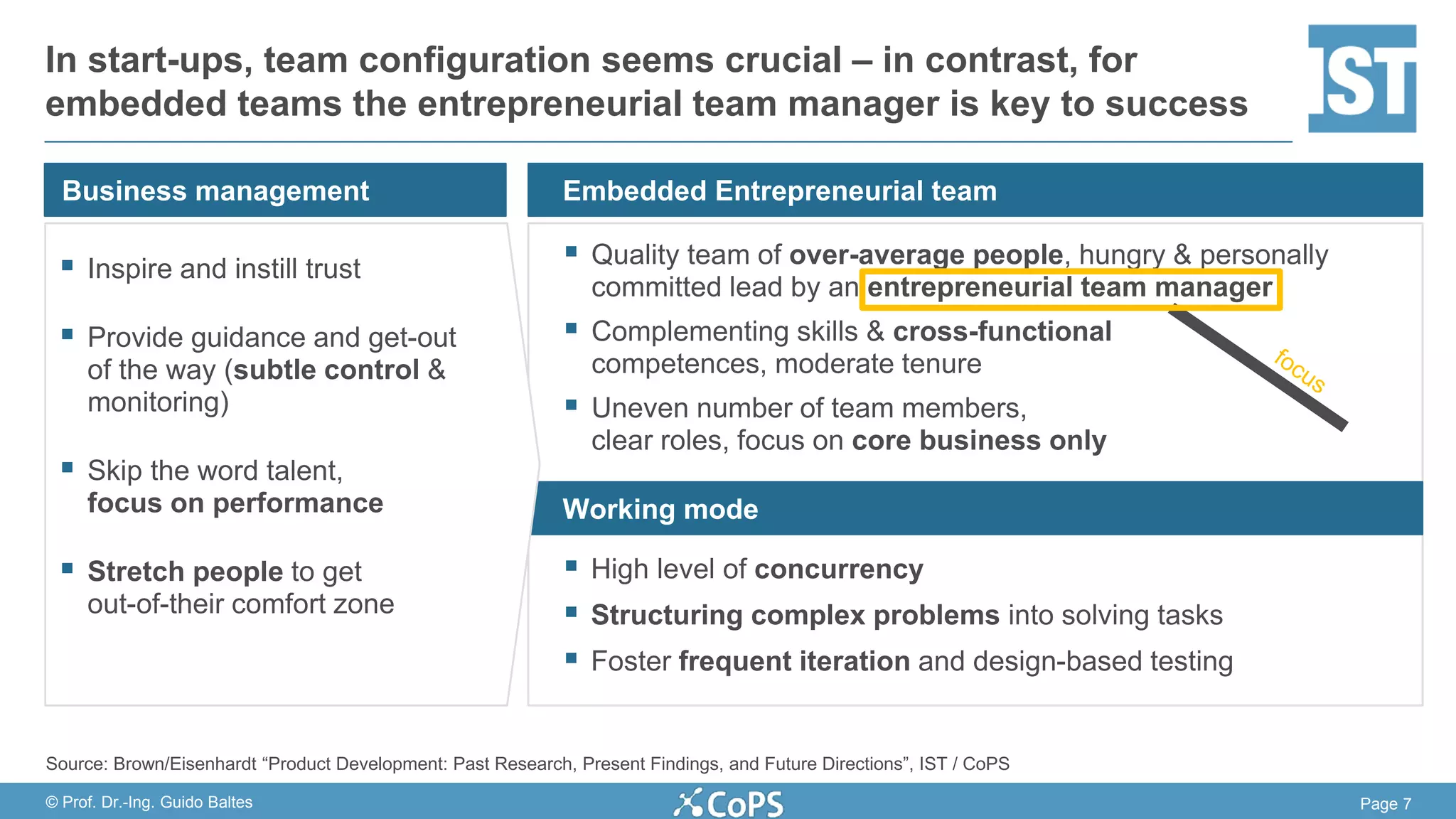
In start-ups, team configuration seems crucial – in contrast, for
embedded teams the entrepreneurial team manager is key to success
Source: Brown/Eisenhardt “Product Development: Past Research, Present Findings, and Future Directions”, IST / CoPS
 Quality team of over-average people, hungry & personally
committed lead by an entrepreneurial team manager
 Complementing skills & cross-functional
competences, moderate tenure
 Uneven number of team members,
clear roles, focus on core business only
 High level of concurrency
 Structuring complex problems into solving tasks
 Foster frequent iteration and design-based testing
Working mode
 Inspire and instill trust
 Provide guidance and get-out
of the way (subtle control &
monitoring)
 Skip the word talent,
focus on performance
 Stretch people to get
out-of-their comfort zone
Business management
Page 8© Prof. Dr.-Ing. Guido Baltes
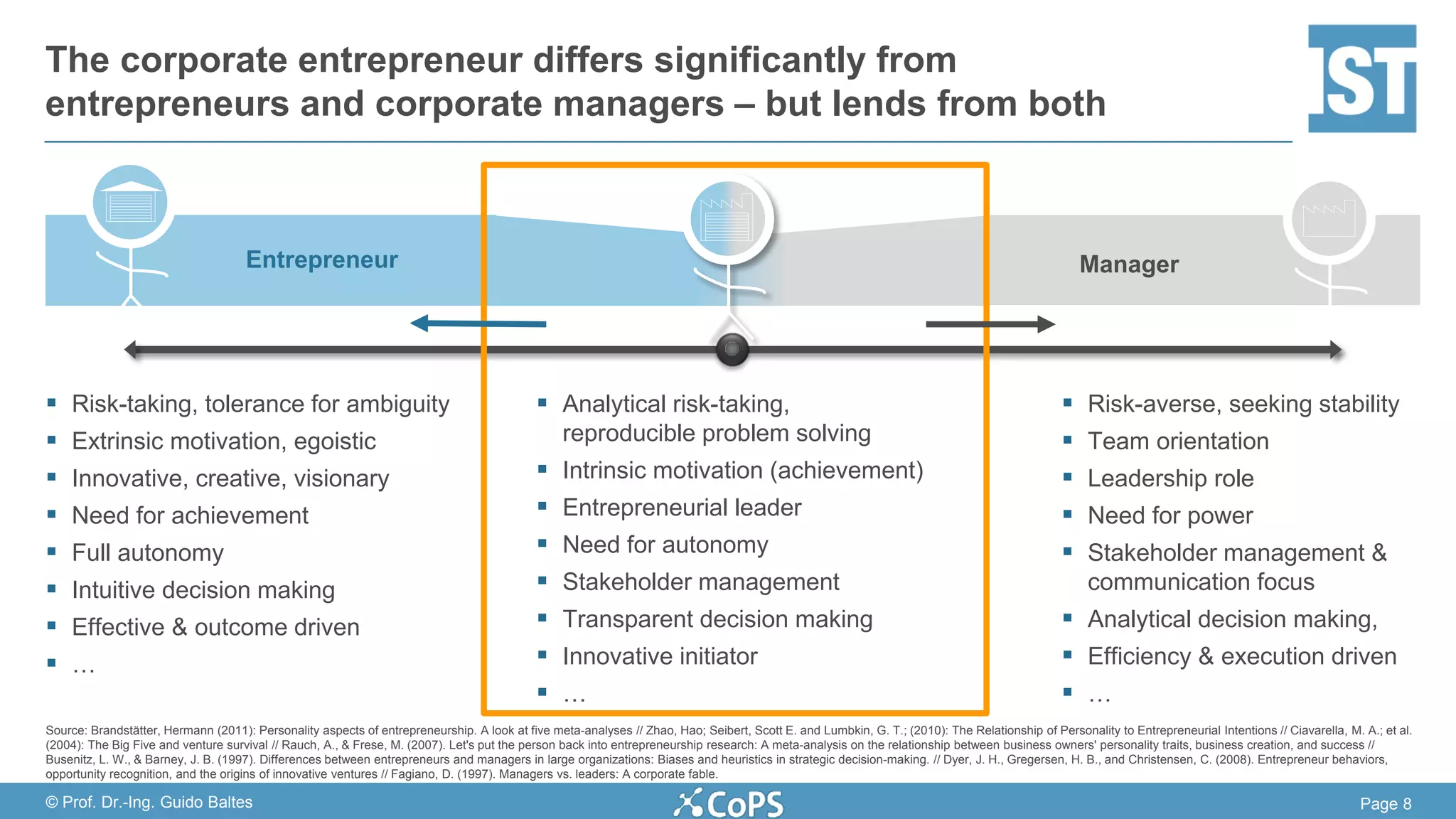
The corporate entrepreneur differs significantly from
entrepreneurs and corporate managers – but lends from both
 Risk-averse, seeking stability
 Team orientation
 Leadership role
 Need for power
 Stakeholder management &
communication focus
 Analytical decision making,
 Efficiency & execution driven
 …
 Risk-taking, tolerance for ambiguity
 Extrinsic motivation, egoistic
 Innovative, creative, visionary
 Need for achievement
 Full autonomy
 Intuitive decision making
 Effective & outcome driven
 …
Entrepreneur Manager
Source: Brandstätter, Hermann (2011): Personality aspects of entrepreneurship. A look at five meta-analyses // Zhao, Hao; Seibert, Scott E. and Lumbkin, G. T.; (2010): The Relationship of Personality to Entrepreneurial Intentions // Ciavarella, M. A.; et al.
(2004): The Big Five and venture survival // Rauch, A., & Frese, M. (2007). Let's put the person back into entrepreneurship research: A meta-analysis on the relationship between business owners' personality traits, business creation, and success //
Busenitz, L. W., & Barney, J. B. (1997). Differences between entrepreneurs and managers in large organizations: Biases and heuristics in strategic decision-making. // Dyer, J. H., Gregersen, H. B., and Christensen, C. (2008). Entrepreneur behaviors,
opportunity recognition, and the origins of innovative ventures // Fagiano, D. (1997). Managers vs. leaders: A corporate fable.
 Analytical risk-taking,
reproducible problem solving
 Intrinsic motivation (achievement)
 Entrepreneurial leader
 Need for autonomy
 Stakeholder management
 Transparent decision making
 Innovative initiator
 …
Page 9© Prof. Dr.-Ing. Guido Baltes
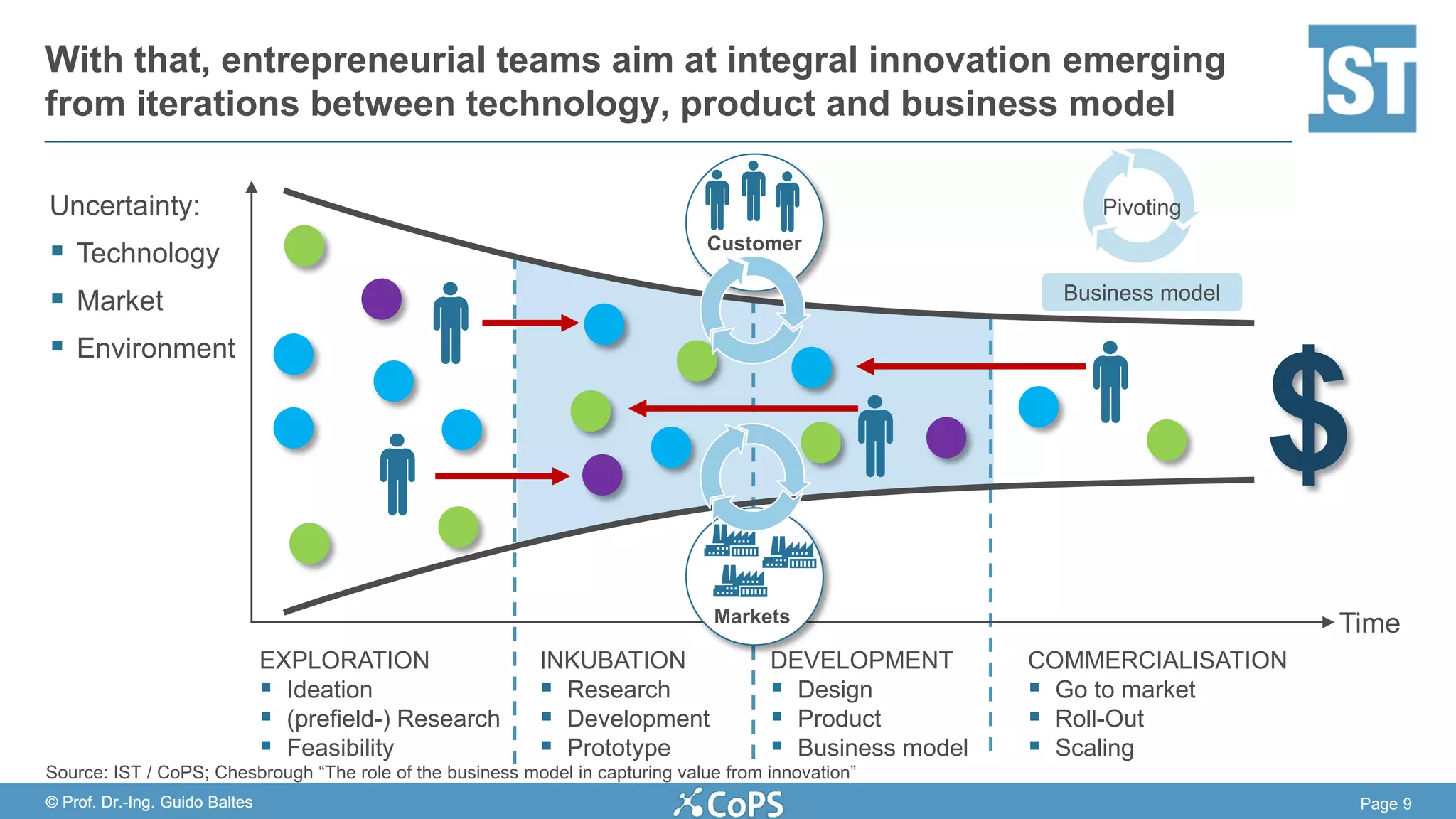
With that, entrepreneurial teams aim at integral innovation emerging
from iterations between technology, product and business model
Source: IST / CoPS; Chesbrough “The role of the business model in capturing value from innovation”
Uncertainty:
 Technology
 Market
 Environment
Time
EXPLORATION
 Ideation
 (prefield-) Research
 Feasibility
INKUBATION
 Research
 Development
 Prototype
DEVELOPMENT
 Design
 Product
 Business model
COMMERCIALISATION
 Go to market
 Roll-Out
 Scaling
$
Pivoting
Business model
Customer
Markets
© Prof. Dr.-Ing. Guido Baltes
Page 10© Prof. Dr.-Ing. Guido Baltes
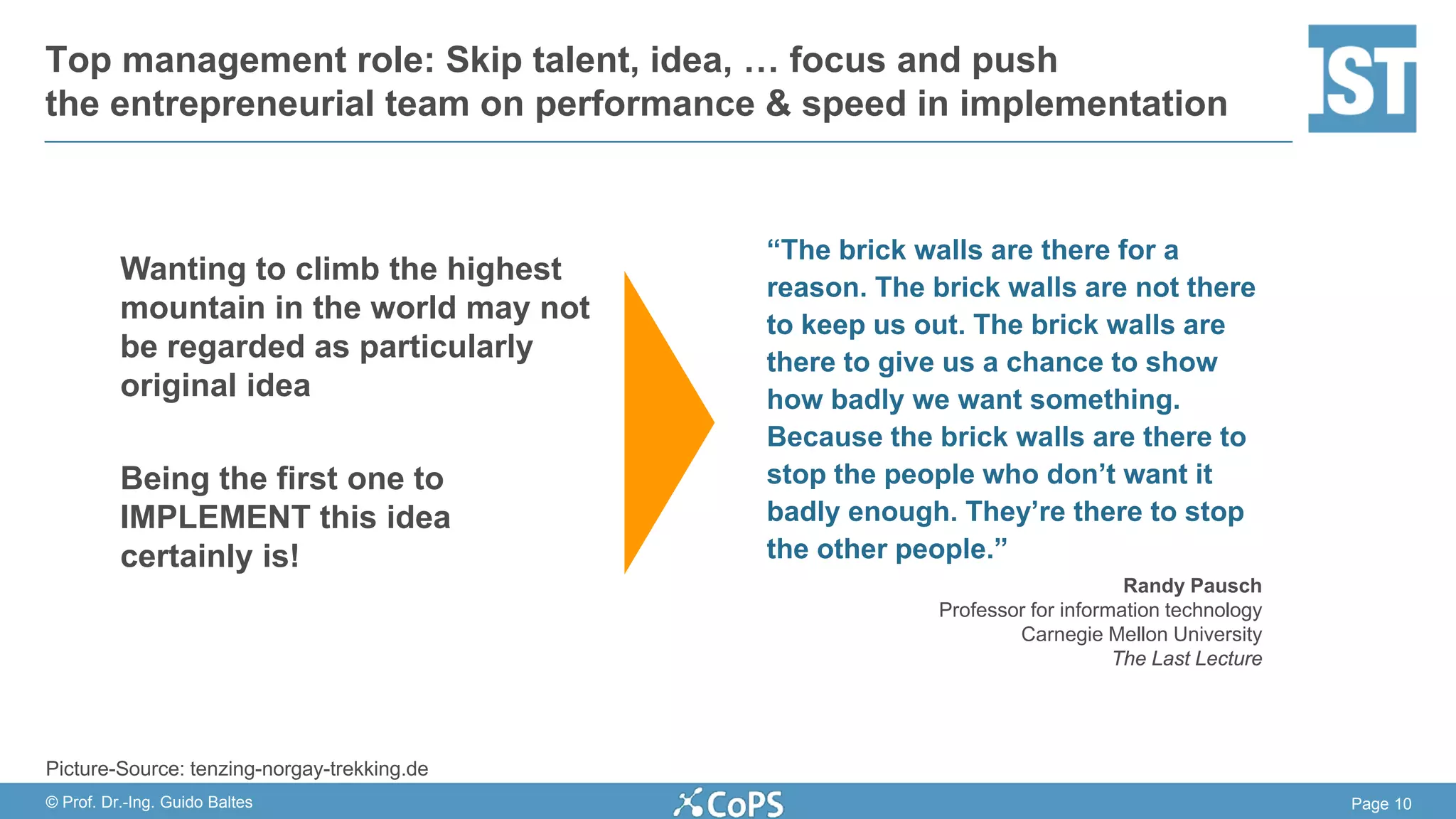
Wanting to climb the highest
mountain in the world may not
be regarded as particularly
original idea
Being the first one to
IMPLEMENT this idea
certainly is!
Top management role: Skip talent, idea, … focus and push
the entrepreneurial team on performance & speed in implementation
“The brick walls are there for a
reason. The brick walls are not there
to keep us out. The brick walls are
there to give us a chance to show
how badly we want something.
Because the brick walls are there to
stop the people who don’t want it
badly enough. They’re there to stop
the other people.”
Randy Pausch
Professor for information technology
Carnegie Mellon University
The Last Lecture
Picture-Source: tenzing-norgay-trekking.de
Page 11© Prof. Dr.-Ing. Guido Baltes
Prof. Dr.-Ing. Guido Baltes
Institute for
Strategic innovation &
Technology management
Hochschule Konstanz
Brauneggerstraße 55
78405 Konstanz,
gbaltes@htwg-konstanz.de
Tel +49 7531 206 310
Contact details
© Prof. Dr.-Ing. Guido Baltes
innovationsinstitut.org

Intrapreneurial Transformation – Making digitalization work

  • 1.
    Prof. Dr.-Ing. GuidoBaltes Corporate Startup Summit, Zurich, 28/04/2016 Intrapreneurial Transformation - Making digitalization work
  • 2.
    Page 1© Prof.Dr.-Ing. Guido Baltes Prof. Dr.Ing. Guido Baltes - Professor for Strategy & Management, Director Institute for Strategic innovation & Technology management Current  Professor for Strategy & Management Lake Constance University (Hochschule Konstanz)  Director Institute for Strategic innovation & Technology management (IST), head of eArchitecture Innovation Lab & CoPS industry research group*  Research focus: Strategic Innovation based on Dynamic Capabilities & Corporate Entrepreneurship, supporting companies in strategic transition and strategic re-newal to implement innovation-driven growth strategies Industry background  Management board member as Head of Strategy & Marketing, Siemens Business Services Germany  Project management for strategic transition & turn-around projects (Corporate Strategy, Siemens AG)  Project manager Strategic Management Consulting, project management aerospace  PhD in Aeronautical Engineering & Master in Business Administration * CoPS : Community of Practice for Strategic Management Architectures – CeTIM : Centre for Technology & Innovation Management inno-ist.org
  • 3.
    Page 2© Prof.Dr.-Ing. Guido Baltes IST focusses on technology-oriented companies and their challenge in dynamic markets: Implementing Strategic responsiveness Firm 1: not successful Firm 2: missing chances Firm 3: Sustained success with strategic responsiveness Market parameters time Market Source: IST / CoPS, Walter Isaacson “Steve Jobs” © Prof. Dr.-Ing. Guido Baltes ... creating an “entrepreneurial and agile organization” … (Steve Jobs)
  • 4.
    Page 3© Prof.Dr.-Ing. Guido Baltes Digitalization drives companies out of business because the world around starts changing faster than the clock-speed of their business Digital Darwinism … … describes an era where technology and society are evolving faster than businesses can naturally adapt. Source: wired.com, IBM CxO Study 2015
  • 5.
    Page 4© Prof.Dr.-Ing. Guido Baltes Challenge of market entry in Digital Transformation: You have to be there when the market is not yet there – when it is there, it is too late! Digital markets Market shares, index, market leader = 100% Platform as-a Service Infrastructure. as-a Service Traditional markets Market shares, index, market leader = 100% Automotive OEM Electrical equipment Internet media Auto parts Software Telecom carriers Digital markets = winner- takes-it-all- markets 0% 100% Microsoft IBM Oracle SAP Symatec EMC HP VMware CA Inc Adobe Systems 0% 100% Google Tencent Holdings Facebook Baidu Yahoo SoftBank Groupon AOL King Digtial Enter- tainment 0% 100% Amazon Microsoft IBM Google Oracle Rack- space 0% 100% Sales- force Amazon Microsoft IBM Service Now Netsuite Oracle Google 0% 100% AT&T Verizon NTT China Mobile Deutsche Telekom Tele- fonica SoftBank Voda- fone Orange China Telcom 0% 100% Toyota VW GM Ford Honda Fiat Nissan Daimler BMW SAIC 0% 100% Siemens Hitachi GE Schneider United Tech. ABB Mitsubishi Emerson Thoshiba Alstom 0% 100% Denso Conti- nental Magna Hyun- dai Bridge- stone Aisin Johnson Controls Cie Generale des Etablis- sement Faurecia Toyota Source: market data as of 2014 @ Bloomberg Visual Data, for PaaS/IaaS Visual Data, Ralph Finos @ wikibon
  • 6.
    Page 5© Prof.Dr.-Ing. Guido Baltes Consequence: “Software eats the world” and sets out a new paradigm: © Prof. Dr.-Ing. Guido Baltes ... “DISRUPTION is the new NORMAL” … (Wall Street Journal) Source: Wall Street Journal, Jan 2014 Effects …  Volatility  Variability  Timliness  Chaos  Randomness  Uncertainty
  • 7.
    Page 6© Prof.Dr.-Ing. Guido Baltes To address digital transformation, firms need to master core business efficiently and at the same time drive digital innovation: Ambidexterity Source: IST / CoPS – Gard, Baltes, Katzy “Managing autonomy of teams in Corporate Entrepreneurship”, IAMOT 2013, Porto Alegre, Brazzil Exploitation • Advantages from stability, standardization, repetition • Focus on planning, quality, processes, specialization • Incentives for risk averseness, cost reduction, documentation • Mass-produced physical-goods scaling by smarter automation & logistics EFFICIENCY INNOVATION Exploration • Advantages from agility based on flexibility & passion • Focus on investment in strategic options, with risk & failure tolerance • Incentives for experimental learning: „try early & fail cheap“ • Scaling based on intangible assets & technology capabilities The “both-handed” ambidextrous organization Efficient Hierarchy Entrepreneurial Teams
  • 8.
    Page 7© Prof.Dr.-Ing. Guido Baltes Embedded Entrepreneurial team In start-ups, team configuration seems crucial – in contrast, for embedded teams the entrepreneurial team manager is key to success Source: Brown/Eisenhardt “Product Development: Past Research, Present Findings, and Future Directions”, IST / CoPS  Quality team of over-average people, hungry & personally committed lead by an entrepreneurial team manager  Complementing skills & cross-functional competences, moderate tenure  Uneven number of team members, clear roles, focus on core business only  High level of concurrency  Structuring complex problems into solving tasks  Foster frequent iteration and design-based testing Working mode  Inspire and instill trust  Provide guidance and get-out of the way (subtle control & monitoring)  Skip the word talent, focus on performance  Stretch people to get out-of-their comfort zone Business management
  • 9.
    Page 8© Prof.Dr.-Ing. Guido Baltes The corporate entrepreneur differs significantly from entrepreneurs and corporate managers – but lends from both  Risk-averse, seeking stability  Team orientation  Leadership role  Need for power  Stakeholder management & communication focus  Analytical decision making,  Efficiency & execution driven  …  Risk-taking, tolerance for ambiguity  Extrinsic motivation, egoistic  Innovative, creative, visionary  Need for achievement  Full autonomy  Intuitive decision making  Effective & outcome driven  … Entrepreneur Manager Source: Brandstätter, Hermann (2011): Personality aspects of entrepreneurship. A look at five meta-analyses // Zhao, Hao; Seibert, Scott E. and Lumbkin, G. T.; (2010): The Relationship of Personality to Entrepreneurial Intentions // Ciavarella, M. A.; et al. (2004): The Big Five and venture survival // Rauch, A., & Frese, M. (2007). Let's put the person back into entrepreneurship research: A meta-analysis on the relationship between business owners' personality traits, business creation, and success // Busenitz, L. W., & Barney, J. B. (1997). Differences between entrepreneurs and managers in large organizations: Biases and heuristics in strategic decision-making. // Dyer, J. H., Gregersen, H. B., and Christensen, C. (2008). Entrepreneur behaviors, opportunity recognition, and the origins of innovative ventures // Fagiano, D. (1997). Managers vs. leaders: A corporate fable.  Analytical risk-taking, reproducible problem solving  Intrinsic motivation (achievement)  Entrepreneurial leader  Need for autonomy  Stakeholder management  Transparent decision making  Innovative initiator  …
  • 10.
    Page 9© Prof.Dr.-Ing. Guido Baltes With that, entrepreneurial teams aim at integral innovation emerging from iterations between technology, product and business model Source: IST / CoPS; Chesbrough “The role of the business model in capturing value from innovation” Uncertainty:  Technology  Market  Environment Time EXPLORATION  Ideation  (prefield-) Research  Feasibility INKUBATION  Research  Development  Prototype DEVELOPMENT  Design  Product  Business model COMMERCIALISATION  Go to market  Roll-Out  Scaling $ Pivoting Business model Customer Markets © Prof. Dr.-Ing. Guido Baltes
  • 11.
    Page 10© Prof.Dr.-Ing. Guido Baltes Wanting to climb the highest mountain in the world may not be regarded as particularly original idea Being the first one to IMPLEMENT this idea certainly is! Top management role: Skip talent, idea, … focus and push the entrepreneurial team on performance & speed in implementation “The brick walls are there for a reason. The brick walls are not there to keep us out. The brick walls are there to give us a chance to show how badly we want something. Because the brick walls are there to stop the people who don’t want it badly enough. They’re there to stop the other people.” Randy Pausch Professor for information technology Carnegie Mellon University The Last Lecture Picture-Source: tenzing-norgay-trekking.de
  • 12.
    Page 11© Prof.Dr.-Ing. Guido Baltes Prof. Dr.-Ing. Guido Baltes Institute for Strategic innovation & Technology management Hochschule Konstanz Brauneggerstraße 55 78405 Konstanz, gbaltes@htwg-konstanz.de Tel +49 7531 206 310 Contact details © Prof. Dr.-Ing. Guido Baltes innovationsinstitut.org