Management of Financial Risk
MANG6298
Arben Kita, Management of Financial Risk, 2017
Available
This module is available for the following
programmes:
• Msc Risk and Finance
• Msc Finance
Arben Kita, Management of Financial Risk, 2017
Instructor
• Arben Kita
• Office hours Wednseday 9:0 to 10:00 (email to
book a meeting with the subject of the
meeting)
• Email for appointment A.kita@soton.ac.uk
• Office building 2, room 4051
Arben Kita, Management of Financial Risk, 2017
Modules Aim and Objectives
• This module aims to provide a graduate level analysis of credit, market,
liquidity, interest rate and operational risk and how these financial risks can
be measured and then managed.
• Knowledge and understanding
Having successfully completed the module, you will be able to demonstrate
knowledge and understanding of:
– The role of options and volatilities and
correlations in the management of financial risk;
– How market, interest rate and credit risk are
measured;
– How credit, market, liquidity, interest rate and
operational risks are managed;
Arben Kita, Management of Financial Risk, 2017
Ground Rules
• This is an advanced course thus you are
expected to perform professional level work
• Arrive on time
• Print out the lecture notes before hand
• Switch off your mobiles or any electronic
devices
• No food
• Regularly check Blackboard & emails
Arben Kita, Management of Financial Risk, 2017
Assessment
• In-class test
– One-hour test
– Three questions, one of which numerical
– Accounts for 30% of your final mark
– Week 24, Tuesday 14th March 2017, Rooms 02A/2077, 09:00-10:00
• Final exam
– Two-hour written exam
– Answer any two out of three questions
– Numerical and assay-like questions
– Accounts for 70% of your final mark
Arben Kita, Management of Financial Risk, 2017
Textbook
• Hull, J. (2009) Risk Management and Financial Institutions,
Third/Fourth Edition, Wiley Finance. Recommended
• Hull, J. (2012) Options Futures and Other Derivatives, Eighth edition,
Pearson
• Bodie, Kane Marcus (2014) Investments, Tenth Global Edition,
McGraw Hill Education
• Cochrane, J.H. (2005), Asset Pricing (Princton University Press,
Princeton, N.J.)
Arben Kita, Management of Financial Risk, 2017
Mean-Variance Analysis,
CAPM, APT & Risk vs Returns for
Companies
Arben Kita, Management of Financial Risk, 2017
• The lecture will be divided in four parts:
- Mean-Variance analysis
- Capital Asset Pricing Model (CAPM)
- Arbitrage Pricing Theory (APT)
- Risk-Return for the companies
Structure of the lecture
Arben Kita, Management of Financial Risk, 2017
Diversification of risk within a portfolio
• Labels indicate portfolio weights for Intel and Coca-Cola.
• Portfolios on the red portion of the curve are efficient.
• Those on the blue portion are inefficient – alternative portfolios
exist with a higher expected return and lower risk, i.e. to the
north-west of the blue portion.
Arben Kita, Management of Financial Risk, 2017
Diversification of risk within a portfolio
Example: you can invest in any combination of GM, Intel and Coca-Cola.
What portfolio would you choose?
E[Rp] = (wGM x 1.08) + (wIntel x 1.32) + (wCoca-Cola x 1.75)
Var(Rp) = (wGM x 38.8) + (wIntel x 40.21) + (wCoca-Cola x 94.63) +
(2x wGM x wIntel x 16.13) + (2x wGM x wCoca-Cola x 22.43) +
(2x wIntel x wCoca-Cola x 23.99)
Variance Covariance Matrix
Stock Mean Std dev GM Intel Coca-Cola
GM 1.08 6.23 38.8 16.13 22.43
Intel 1.32 6.34 16.13 40.21 23.99
Coca-Cola 1.75 9.73 22.42 23.99 94.63
Arben Kita, Management of Financial Risk, 2017
Diversification of risk within a portfolio
• Effect of correlation:
Arben Kita, Management of Financial Risk, 2017
Diversification of risk within a portfolio
• Many stocks:
Arben Kita, Management of Financial Risk, 2017
The straight-line relationship of risky asset and risk-
free asset
Standard deviation
Exp.
return
(%)
Rf
Diversifiable risk and undiversifiable risk
P
Arben Kita, Management of Financial Risk, 2017
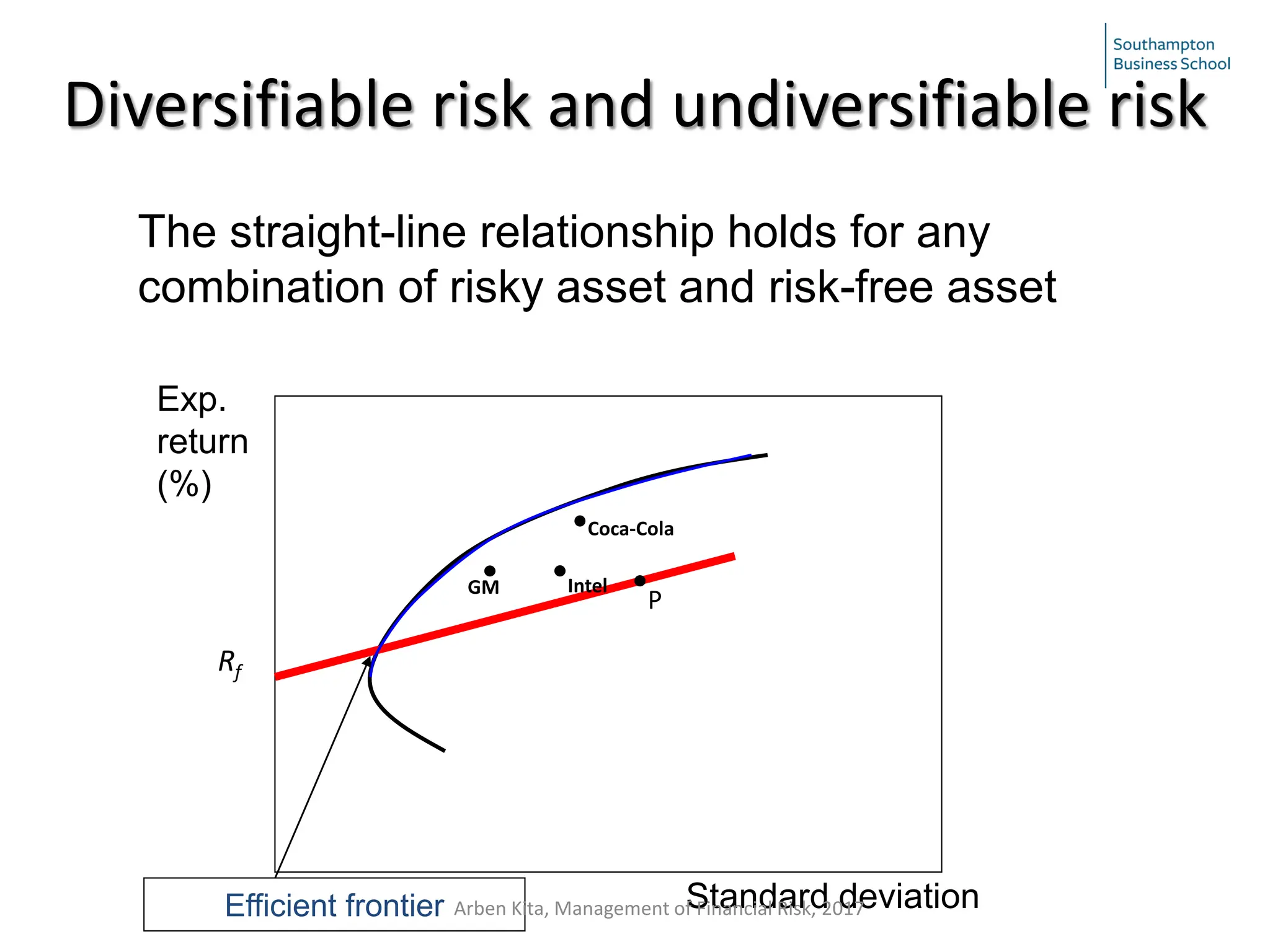
The straight-line relationship holds for any
combination of risky asset and risk-free asset
Standard deviation
Exp.
return
(%)
Rf
Efficient frontier
Diversifiable risk and undiversifiable risk
P
Intel
Coca-Cola
GM
Arben Kita, Management of Financial Risk, 2017
Standard deviation
Exp.
return
(%)
Line tangential to efficient frontier gives highest rate of
trade-off between risk and return – highest price for risk.
Rf
Combinations
of a risky
portfolio and
positive
(lending) or
negative
(borrowing)
holdings of
risk-free asset
Efficient frontier
Diversifiable risk and undiversifiable risk
P
Arben Kita, Management of Financial Risk, 2017
Now consider the combination (C) of a risky
portfolio (P) and a risk-free asset (with expected
return Rf), with weights w and 1-w, respectively:
)
]
[
(
)
1
(
]
[
]
[
f
P
f
f
P
C
R
R
E
w
R
R
w
R
wE
R
E
−
+
=
−
+
=
f
f R
P
2
R
2
2
P
C w
2w
+
w
+
w
= ,
2
2
)
1
(
)
1
( σ
σ
σ
σ −
−
where subscript Rf refers to the risk-free asset.
Diversifiable (unpriced, idiosyncratic) risk and
undiversifiable (priced, market) risk
and
Arben Kita, Management of Financial Risk, 2017
w
=
w
=
P
C
2
P
C
σ
σ
σ
σ
⇒
2
2
w P
C σ
σ /
=
)
]
[
(
]
[ f
P
f
C R
R
E
w
R
R
E −
+
=
Since a risk-free asset has no variance and has zero covariance with
everything else, the formula for the variance collapses to:
Substitution of w into previous return expression
gives
C
P
f
P
f
C
R
R
E
R
R
E σ
σ
)
]
[
(
]
[
−
+
=
A straight-line relationship Slope
, so .
Diversifiable risk and undiversifiable risk
Arben Kita, Management of Financial Risk, 2017
• The tangential portfolio of risky shares that (in
combination with the risk-free asset) gives the
highest rate of the trade-off between the risk and
return
• ‘Market portfolio’ (with expected return E[Rm]).
Diversifiable risk and undiversifiable risk
Arben Kita, Management of Financial Risk, 2017
Risk Free Return =
Std. Dev. of market portfolio =
Risk
.
Rf
‘Market portfolio’
σm
Rm
Market Return =
‘Capital Market Line’ Efficient Frontier
Diversifiable risk and undiversifiable risk
Exp. Return
Market portfolio dominates all other risky portfolios.
Arben Kita, Management of Financial Risk, 2017
• The straight-line relationship between the risk and
return of the market portfolio and the risk-free asset
is termed the Capital Market Line
• The slope of the Capital Market Line, (E[Rm]-Rf)/σm,
gives the market price of systematic risk (i.e. what
investors need to be offered in order to take on this
risk).
C
m
f
m
f
C
R
R
E
R
R
E σ
σ
)
]
[
(
]
[
−
+
=
Capital Asset Pricing Model (CAPM)
Arben Kita, Management of Financial Risk, 2017
Diversification of risk within a portfolio
• Many stocks:
Rf
P
Arben Kita, Management of Financial Risk, 2017
Capital Asset Pricing Model (CAPM)
• Sharpe Ratio: a measure of portfolio’s risk-return trade-off,
equal to the portfolio’s risk premium divided by its volatility
• The tangency portfolio has the highest possible Sharpe ratio
of any portfolio
• Aside: Alpha is a measure of a mutual fund’s risk-adjusted
performance. The tangency portfolio also maximises the
fund’s alpha
p
f
p R
R
E
o
SharpeRati
σ
−
=
]
[
Arben Kita, Management of Financial Risk, 2017
Implications of the Market Portfolio
• Efficient portfolios are combinations of the market portfolio and riskless asset
• Expected returns of efficient portfolios satisfy:
• This yields the required rate of return or cost of capital for efficient portfolios!
• Trade-off between risk and expected return
• Multiplier is the ratio of portfolio risk to market risk
• What about other (non-efficient) portfolios?
Capital Asset Pricing Model (CAPM)
[ ] [ ]
( )
f
p
m
p
f
p R
R
E
R
R
E −
+
=
σ
σ
Arben Kita, Management of Financial Risk, 2017
• Consider an individual stock, j, that is held as part
of a diversified portfolio.
• The investor only needs to be rewarded for that
part of risk which cannot be diversified because
it derives from the association between the
returns on the share and the returns of the
market as a whole (the market portfolio).
Capital Asset Pricing Model (CAPM)
Arben Kita, Management of Financial Risk, 2017
• Expressing the market-related (undiversifiable) risk in terms of standard
deviation
where ρjm is the correlation between returns of j and m,
• multiplying this by the market price of undiversifiable risk,
• and adding the result to the risk-free rate, gives the following expression
for the required return on share j:
jm
j
j
DIV
NON = ρ
σ
σ )
(
−
m
f
m R
R
E σ
/
)
]
[
( −
jm
j
m
f
m
f
j
R
R
E
R
R
E ρ
σ
σ
)
]
[
(
]
[
−
+
=
Capital Asset Pricing Model (CAPM)
Arben Kita, Management of Financial Risk, 2017
j
m
jm
m
jm
m
j
m
jm
j
β
σ
σ
σ
ρ
σ
σ
σ
ρ
σ
=
=
= 2
2
j
f
m
f
j R
R
E
R
R
E β
)
]
[
(
]
[ −
+
=
Covariance (j,m)
Variance (m)
This ratio is termed beta
The Capital Asset Pricing Model
Capital Asset Pricing Model (CAPM)
jm
j
m
f
m
f
j
R
R
E
R
R
E ρ
σ
σ
)
]
[
(
]
[
−
+
=
Arben Kita, Management of Financial Risk, 2017
• Required return is a linear function of beta.
• Beta is a measure of the extent to which the
returns on asset j are expected to co-vary with
those of the market portfolio.
• Beta is a measure of the market risk of the share.
• This market risk is the only part of risk that is
priced. Idiosyncratic risk is not priced.
Capital Asset Pricing Model (CAPM)
Arben Kita, Management of Financial Risk, 2017
Graphical representation of CAPM: Security
Market Line
Risk-free return =
Beta of market portfolio = 1.0
Exp. Return
Beta
.
Rf
‘Market portfolio’
1.0
Rm
Market return =
‘Security Market
Line’
m
jm
j
σ
ρ
σ
Systematic risk
j
f
m
f
j R
R
E
R
R
E β
)
]
[
(
]
[ −
+
=
Arben Kita, Management of Financial Risk, 2017
Capital Asset Pricing Model (CAPM):
SML
• E[Ri] = Rf + βi(E[Rm] - Rf)
• Implications:
• βi = 1 => E[Ri] = E[Rm]
• βi = 0 => E[Ri] = E[Rf]
• βi < 0 => E[Ri] < E[Rf] (Why?)
Security Market Line
Arben Kita, Management of Financial Risk, 2017
• The expression for beta has same form as the slope
coefficient in a univariate regression model, i.e., the
ratio of:
– the covariance between a dependent and an
independent variable and,
– the variance of the independent variable.
• In theory, beta is a forward-looking measure of how
returns are expected to co-vary in the future.
• In practice, it is often estimated by regression of a
time series of historical share returns on a matching
time series of market portfolio returns.
Capital Asset Pricing Model (CAPM)
Arben Kita, Management of Financial Risk, 2017
To apply beta in calculating the required rate of
return on a share, you need:
• Beta for that share
• The risk-free rate. (A market-wide factor, not
specific to the share)
• The excess of the required rate of return on the
market portfolio over the risk-free rate (the equity
(market) risk premium). (A market-wide factor, not
specific to the share.) There is much debate about
this. Opinion seems to be converging on something
in the region of 5-6%.
Capital Asset Pricing Model (CAPM)
Arben Kita, Management of Financial Risk, 2017
Capital Asset Pricing Model (CAPM)
 If the beta of the share is 1.07, the risk-free
rate is 9% and the equity (market) risk
premium is 5%, the required return on the
share is
.09 + (.05 * 1.07) = .1435 (14.35%).
 Investors must be promised at least this to
induce them to hold the share.
Arben Kita, Management of Financial Risk, 2017
• Things to consider:
– Choice of proxy for the market portfolio?
– What length of data set to use?
– Return interval: daily, weekly, monthly?
– Problem of thin trading which may cause sensitivity to
market to be underestimated for small stocks.
Capital Asset Pricing Model (CAPM)
Practicalities of beta estimation
Arben Kita, Management of Financial Risk, 2017
• Cisco’s returns tend to move in the same direction, but with
greater amplitude, than those of the S&P 500.
Measuring Betas
Example: Cisco
Arben Kita, Management of Financial Risk, 2017
Measuring Betas
Example: Cisco
• Beta corresponds to the slope of the best-fitting line. Deviations from
it reflect diversifiable (idiosyncratic) risk.
Arben Kita, Management of Financial Risk, 2017
Alpha
• Alpha measure the extra return on a portfolio
in excess of that predicted by CAPM
so that
)
(
)
( F
M
F
P R
R
R
R
E −
β
+
=
)
( F
M
F
P R
R
R
R −
β
−
−
=
α
Arben Kita, Management of Financial Risk, 2017
Arbitrage Pricing Theory
• Returns depend on several factors
• We can form portfolios to eliminate the
dependence on the factors
• This leads to result that expected return is
linearly dependent on the realization of the
factors
Arben Kita, Management of Financial Risk, 2017
Single Factor Model
• Returns on a security come from two
sources:
– Common macro-economic factor
– Firm specific events
• Possible common macro-economic factors
– Gross Domestic Product Growth
– Interest Rates
Arben Kita, Management of Financial Risk, 2017
Single Factor Model Equation
Ri = Excess return on security
βi= Factor sensitivity or factor loading or factor
beta
F = Surprise in macro-economic factor
(F could be positive or negative but has
expected value of zero)
ei = Firm specific events (zero expected value)
𝑅𝑅𝑖𝑖 = 𝐸𝐸(𝑅𝑅𝑖𝑖) + β𝑖𝑖𝐹𝐹 + 𝑒𝑒𝑖𝑖
Arben Kita, Management of Financial Risk, 2017
Multifactor Models
• Use more than one factor in addition to market return
– Examples include gross domestic product, expected
inflation, interest rates, etc.
– Estimate a beta or factor loading for each factor using
multiple regression.
Arben Kita, Management of Financial Risk, 2017
Multifactor Model Equation
Ri = Excess return for security i
βGDP = Factor sensitivity for GDP
βIR = Factor sensitivity for Interest Rate
ei = Firm specific events
( ) i
iIR
iGDP
i
i e
IR
GDP
R
E
R +
+
+
= β
β
Arben Kita, Management of Financial Risk, 2017
Interpretation
The expected return on a security is the sum of:
1. The risk-free rate
2. The sensitivity to GDP times the risk
premium for bearing GDP risk
3. The sensitivity to interest rate risk times
the risk premium for bearing interest rate
risk
Arben Kita, Management of Financial Risk, 2017
Arbitrage Pricing Theory
• Arbitrage occurs if there is a zero investment portfolio with a
sure profit.
Since no investment is
required, investors can create
large positions to obtain large
profits.
Arben Kita, Management of Financial Risk, 2017
Arbitrage Pricing Theory
• Regardless of wealth or risk aversion, investors will want an
infinite position in the risk-free arbitrage portfolio.
• In efficient markets, profitable arbitrage
opportunities will quickly disappear.
Arben Kita, Management of Financial Risk, 2017
APT & Well-Diversified Portfolios
RP = E (RP) + bPF + eP
F = some factor
• For a well-diversified portfolio, eP
–approaches zero as the number of securities in the portfolio
increases
–and their associated weights decrease
Arben Kita, Management of Financial Risk, 2017
No-Arbitrage Equation of APT
Arben Kita, Management of Financial Risk, 2017
APT, the CAPM and the Index Model
• Assumes a well-
diversified portfolio,
but residual risk is
still a factor.
• Does not assume
investors are mean-
variance optimizers.
• Uses an observable,
market index
• Reveals arbitrage
opportunities
APT CAPM
• Model is based on an
inherently unobservable
“market” portfolio.
• Rests on mean-variance
efficiency. The actions of
many small investors
restore CAPM
equilibrium.
Arben Kita, Management of Financial Risk, 2017
Multifactor APT
• Use of more than a single systematic factor
• Requires formation of factor portfolios
• What factors?
– Factors that are important to performance of the general
economy
– What about firm characteristics?
Arben Kita, Management of Financial Risk, 2017
Two-Factor Model
• The multifactor APT is similar to the one-factor case.
𝑅𝑅𝑖𝑖 = 𝐸𝐸(𝑅𝑅𝑖𝑖) + β𝑖𝑖1𝐹𝐹1 + β𝑖𝑖2𝐹𝐹2 + 𝑒𝑒𝑖𝑖
Arben Kita, Management of Financial Risk, 2017
Two-Factor Model
• Track with diversified factor portfolios:
– beta=1 for one of the factors and 0 for all other
factors.
• The factor portfolios track a particular source of
macroeconomic risk, but are uncorrelated with other
sources of risk.
Arben Kita, Management of Financial Risk, 2017
Fama-French Three-Factor Model
• SMB = Small Minus Big (firm size)
• HML = High Minus Low (book-to-market ratio)
• Are these firm characteristics correlated with
actual (but currently unknown) systematic risk
factors?
it
t
iHML
t
iSMB
Mt
iM
i
it e
HML
SMB
R
R +
+
+
+
= β
β
β
α
Arben Kita, Management of Financial Risk, 2017
The Multifactor CAPM and the APT
• A multi-index CAPM will inherit its risk factors from sources of
risk that a broad group of investors deem important enough
to hedge
• The APT is largely silent on where to look for priced sources
of risk
Arben Kita, Management of Financial Risk, 2017
Risk vs Return for Companies
• If shareholders care only about systematic risk, should the
same be true of company managers?
• In practice companies are concerned about total risk
• Earnings stability and company survival are important
managerial objectives
• The regulators of financial institutions are most interested in
total risk
• “Bankruptcy costs” arguments show that that managers can
be acting in the best interests of shareholders when they
consider total risk
Arben Kita, Management of Financial Risk, 2017
What Are Bankruptcy Costs?
• Lost sales (There is a reluctance to buy from a
bankrupt company.)
• Key employees leave
• Legal and accounting costs
Arben Kita, Management of Financial Risk, 2017
Approaches to Bank Risk
Management
• Risk aggregation: aims to get rid of non-
systematic risks with diversification
• Risk decomposition: tackles risks one by one
• In practice banks use both approaches
Arben Kita, Management of Financial Risk, 2017
Credit Ratings
Moody’s S&P and Fitch
Aaa AAA
Aa AA
A A
Baa BBB
Ba BB
B B
Caa CCC
Ca CC
C C
Investment
grade bonds
Non-investment
grade bonds
Arben Kita, Management of Financial Risk, 2017
Subdivisions
• Moody’s divides Aa into Aa1, Aa2, Aa3.
• S&P and Fitch divide AA into AA+, AA, and AA−
• Other rating categories are subdivided
similarly except AAA (Aaa) and the two lowest
categories.
Arben Kita, Management of Financial Risk, 2017

Lecture 1. Financial risk management lecture 1

  • 1.
    Management of FinancialRisk MANG6298 Arben Kita, Management of Financial Risk, 2017
  • 2.
    Available This module isavailable for the following programmes: • Msc Risk and Finance • Msc Finance Arben Kita, Management of Financial Risk, 2017
  • 3.
    Instructor • Arben Kita •Office hours Wednseday 9:0 to 10:00 (email to book a meeting with the subject of the meeting) • Email for appointment A.kita@soton.ac.uk • Office building 2, room 4051 Arben Kita, Management of Financial Risk, 2017
  • 4.
    Modules Aim andObjectives • This module aims to provide a graduate level analysis of credit, market, liquidity, interest rate and operational risk and how these financial risks can be measured and then managed. • Knowledge and understanding Having successfully completed the module, you will be able to demonstrate knowledge and understanding of: – The role of options and volatilities and correlations in the management of financial risk; – How market, interest rate and credit risk are measured; – How credit, market, liquidity, interest rate and operational risks are managed; Arben Kita, Management of Financial Risk, 2017
  • 5.
    Ground Rules • Thisis an advanced course thus you are expected to perform professional level work • Arrive on time • Print out the lecture notes before hand • Switch off your mobiles or any electronic devices • No food • Regularly check Blackboard & emails Arben Kita, Management of Financial Risk, 2017
  • 6.
    Assessment • In-class test –One-hour test – Three questions, one of which numerical – Accounts for 30% of your final mark – Week 24, Tuesday 14th March 2017, Rooms 02A/2077, 09:00-10:00 • Final exam – Two-hour written exam – Answer any two out of three questions – Numerical and assay-like questions – Accounts for 70% of your final mark Arben Kita, Management of Financial Risk, 2017
  • 7.
    Textbook • Hull, J.(2009) Risk Management and Financial Institutions, Third/Fourth Edition, Wiley Finance. Recommended • Hull, J. (2012) Options Futures and Other Derivatives, Eighth edition, Pearson • Bodie, Kane Marcus (2014) Investments, Tenth Global Edition, McGraw Hill Education • Cochrane, J.H. (2005), Asset Pricing (Princton University Press, Princeton, N.J.) Arben Kita, Management of Financial Risk, 2017
  • 8.
    Mean-Variance Analysis, CAPM, APT& Risk vs Returns for Companies Arben Kita, Management of Financial Risk, 2017
  • 9.
    • The lecturewill be divided in four parts: - Mean-Variance analysis - Capital Asset Pricing Model (CAPM) - Arbitrage Pricing Theory (APT) - Risk-Return for the companies Structure of the lecture Arben Kita, Management of Financial Risk, 2017
  • 10.
    Diversification of riskwithin a portfolio • Labels indicate portfolio weights for Intel and Coca-Cola. • Portfolios on the red portion of the curve are efficient. • Those on the blue portion are inefficient – alternative portfolios exist with a higher expected return and lower risk, i.e. to the north-west of the blue portion. Arben Kita, Management of Financial Risk, 2017
  • 11.
    Diversification of riskwithin a portfolio Example: you can invest in any combination of GM, Intel and Coca-Cola. What portfolio would you choose? E[Rp] = (wGM x 1.08) + (wIntel x 1.32) + (wCoca-Cola x 1.75) Var(Rp) = (wGM x 38.8) + (wIntel x 40.21) + (wCoca-Cola x 94.63) + (2x wGM x wIntel x 16.13) + (2x wGM x wCoca-Cola x 22.43) + (2x wIntel x wCoca-Cola x 23.99) Variance Covariance Matrix Stock Mean Std dev GM Intel Coca-Cola GM 1.08 6.23 38.8 16.13 22.43 Intel 1.32 6.34 16.13 40.21 23.99 Coca-Cola 1.75 9.73 22.42 23.99 94.63 Arben Kita, Management of Financial Risk, 2017
  • 12.
    Diversification of riskwithin a portfolio • Effect of correlation: Arben Kita, Management of Financial Risk, 2017
  • 13.
    Diversification of riskwithin a portfolio • Many stocks: Arben Kita, Management of Financial Risk, 2017
  • 14.
    The straight-line relationshipof risky asset and risk- free asset Standard deviation Exp. return (%) Rf Diversifiable risk and undiversifiable risk P Arben Kita, Management of Financial Risk, 2017
  • 15.
    The straight-line relationshipholds for any combination of risky asset and risk-free asset Standard deviation Exp. return (%) Rf Efficient frontier Diversifiable risk and undiversifiable risk P Intel Coca-Cola GM Arben Kita, Management of Financial Risk, 2017
  • 16.
    Standard deviation Exp. return (%) Line tangentialto efficient frontier gives highest rate of trade-off between risk and return – highest price for risk. Rf Combinations of a risky portfolio and positive (lending) or negative (borrowing) holdings of risk-free asset Efficient frontier Diversifiable risk and undiversifiable risk P Arben Kita, Management of Financial Risk, 2017
  • 17.
    Now consider thecombination (C) of a risky portfolio (P) and a risk-free asset (with expected return Rf), with weights w and 1-w, respectively: ) ] [ ( ) 1 ( ] [ ] [ f P f f P C R R E w R R w R wE R E − + = − + = f f R P 2 R 2 2 P C w 2w + w + w = , 2 2 ) 1 ( ) 1 ( σ σ σ σ − − where subscript Rf refers to the risk-free asset. Diversifiable (unpriced, idiosyncratic) risk and undiversifiable (priced, market) risk and Arben Kita, Management of Financial Risk, 2017
  • 18.
    w = w = P C 2 P C σ σ σ σ ⇒ 2 2 w P C σ σ/ = ) ] [ ( ] [ f P f C R R E w R R E − + = Since a risk-free asset has no variance and has zero covariance with everything else, the formula for the variance collapses to: Substitution of w into previous return expression gives C P f P f C R R E R R E σ σ ) ] [ ( ] [ − + = A straight-line relationship Slope , so . Diversifiable risk and undiversifiable risk Arben Kita, Management of Financial Risk, 2017
  • 19.
    • The tangentialportfolio of risky shares that (in combination with the risk-free asset) gives the highest rate of the trade-off between the risk and return • ‘Market portfolio’ (with expected return E[Rm]). Diversifiable risk and undiversifiable risk Arben Kita, Management of Financial Risk, 2017
  • 20.
    Risk Free Return= Std. Dev. of market portfolio = Risk . Rf ‘Market portfolio’ σm Rm Market Return = ‘Capital Market Line’ Efficient Frontier Diversifiable risk and undiversifiable risk Exp. Return Market portfolio dominates all other risky portfolios. Arben Kita, Management of Financial Risk, 2017
  • 21.
    • The straight-linerelationship between the risk and return of the market portfolio and the risk-free asset is termed the Capital Market Line • The slope of the Capital Market Line, (E[Rm]-Rf)/σm, gives the market price of systematic risk (i.e. what investors need to be offered in order to take on this risk). C m f m f C R R E R R E σ σ ) ] [ ( ] [ − + = Capital Asset Pricing Model (CAPM) Arben Kita, Management of Financial Risk, 2017
  • 22.
    Diversification of riskwithin a portfolio • Many stocks: Rf P Arben Kita, Management of Financial Risk, 2017
  • 23.
    Capital Asset PricingModel (CAPM) • Sharpe Ratio: a measure of portfolio’s risk-return trade-off, equal to the portfolio’s risk premium divided by its volatility • The tangency portfolio has the highest possible Sharpe ratio of any portfolio • Aside: Alpha is a measure of a mutual fund’s risk-adjusted performance. The tangency portfolio also maximises the fund’s alpha p f p R R E o SharpeRati σ − = ] [ Arben Kita, Management of Financial Risk, 2017
  • 24.
    Implications of theMarket Portfolio • Efficient portfolios are combinations of the market portfolio and riskless asset • Expected returns of efficient portfolios satisfy: • This yields the required rate of return or cost of capital for efficient portfolios! • Trade-off between risk and expected return • Multiplier is the ratio of portfolio risk to market risk • What about other (non-efficient) portfolios? Capital Asset Pricing Model (CAPM) [ ] [ ] ( ) f p m p f p R R E R R E − + = σ σ Arben Kita, Management of Financial Risk, 2017
  • 25.
    • Consider anindividual stock, j, that is held as part of a diversified portfolio. • The investor only needs to be rewarded for that part of risk which cannot be diversified because it derives from the association between the returns on the share and the returns of the market as a whole (the market portfolio). Capital Asset Pricing Model (CAPM) Arben Kita, Management of Financial Risk, 2017
  • 26.
    • Expressing themarket-related (undiversifiable) risk in terms of standard deviation where ρjm is the correlation between returns of j and m, • multiplying this by the market price of undiversifiable risk, • and adding the result to the risk-free rate, gives the following expression for the required return on share j: jm j j DIV NON = ρ σ σ ) ( − m f m R R E σ / ) ] [ ( − jm j m f m f j R R E R R E ρ σ σ ) ] [ ( ] [ − + = Capital Asset Pricing Model (CAPM) Arben Kita, Management of Financial Risk, 2017
  • 27.
    j m jm m jm m j m jm j β σ σ σ ρ σ σ σ ρ σ = = = 2 2 j f m f j R R E R R Eβ ) ] [ ( ] [ − + = Covariance (j,m) Variance (m) This ratio is termed beta The Capital Asset Pricing Model Capital Asset Pricing Model (CAPM) jm j m f m f j R R E R R E ρ σ σ ) ] [ ( ] [ − + = Arben Kita, Management of Financial Risk, 2017
  • 28.
    • Required returnis a linear function of beta. • Beta is a measure of the extent to which the returns on asset j are expected to co-vary with those of the market portfolio. • Beta is a measure of the market risk of the share. • This market risk is the only part of risk that is priced. Idiosyncratic risk is not priced. Capital Asset Pricing Model (CAPM) Arben Kita, Management of Financial Risk, 2017
  • 29.
    Graphical representation ofCAPM: Security Market Line Risk-free return = Beta of market portfolio = 1.0 Exp. Return Beta . Rf ‘Market portfolio’ 1.0 Rm Market return = ‘Security Market Line’ m jm j σ ρ σ Systematic risk j f m f j R R E R R E β ) ] [ ( ] [ − + = Arben Kita, Management of Financial Risk, 2017
  • 30.
    Capital Asset PricingModel (CAPM): SML • E[Ri] = Rf + βi(E[Rm] - Rf) • Implications: • βi = 1 => E[Ri] = E[Rm] • βi = 0 => E[Ri] = E[Rf] • βi < 0 => E[Ri] < E[Rf] (Why?) Security Market Line Arben Kita, Management of Financial Risk, 2017
  • 31.
    • The expressionfor beta has same form as the slope coefficient in a univariate regression model, i.e., the ratio of: – the covariance between a dependent and an independent variable and, – the variance of the independent variable. • In theory, beta is a forward-looking measure of how returns are expected to co-vary in the future. • In practice, it is often estimated by regression of a time series of historical share returns on a matching time series of market portfolio returns. Capital Asset Pricing Model (CAPM) Arben Kita, Management of Financial Risk, 2017
  • 32.
    To apply betain calculating the required rate of return on a share, you need: • Beta for that share • The risk-free rate. (A market-wide factor, not specific to the share) • The excess of the required rate of return on the market portfolio over the risk-free rate (the equity (market) risk premium). (A market-wide factor, not specific to the share.) There is much debate about this. Opinion seems to be converging on something in the region of 5-6%. Capital Asset Pricing Model (CAPM) Arben Kita, Management of Financial Risk, 2017
  • 33.
    Capital Asset PricingModel (CAPM)  If the beta of the share is 1.07, the risk-free rate is 9% and the equity (market) risk premium is 5%, the required return on the share is .09 + (.05 * 1.07) = .1435 (14.35%).  Investors must be promised at least this to induce them to hold the share. Arben Kita, Management of Financial Risk, 2017
  • 34.
    • Things toconsider: – Choice of proxy for the market portfolio? – What length of data set to use? – Return interval: daily, weekly, monthly? – Problem of thin trading which may cause sensitivity to market to be underestimated for small stocks. Capital Asset Pricing Model (CAPM) Practicalities of beta estimation Arben Kita, Management of Financial Risk, 2017
  • 35.
    • Cisco’s returnstend to move in the same direction, but with greater amplitude, than those of the S&P 500. Measuring Betas Example: Cisco Arben Kita, Management of Financial Risk, 2017
  • 36.
    Measuring Betas Example: Cisco •Beta corresponds to the slope of the best-fitting line. Deviations from it reflect diversifiable (idiosyncratic) risk. Arben Kita, Management of Financial Risk, 2017
  • 37.
    Alpha • Alpha measurethe extra return on a portfolio in excess of that predicted by CAPM so that ) ( ) ( F M F P R R R R E − β + = ) ( F M F P R R R R − β − − = α Arben Kita, Management of Financial Risk, 2017
  • 38.
    Arbitrage Pricing Theory •Returns depend on several factors • We can form portfolios to eliminate the dependence on the factors • This leads to result that expected return is linearly dependent on the realization of the factors Arben Kita, Management of Financial Risk, 2017
  • 39.
    Single Factor Model •Returns on a security come from two sources: – Common macro-economic factor – Firm specific events • Possible common macro-economic factors – Gross Domestic Product Growth – Interest Rates Arben Kita, Management of Financial Risk, 2017
  • 40.
    Single Factor ModelEquation Ri = Excess return on security βi= Factor sensitivity or factor loading or factor beta F = Surprise in macro-economic factor (F could be positive or negative but has expected value of zero) ei = Firm specific events (zero expected value) 𝑅𝑅𝑖𝑖 = 𝐸𝐸(𝑅𝑅𝑖𝑖) + β𝑖𝑖𝐹𝐹 + 𝑒𝑒𝑖𝑖 Arben Kita, Management of Financial Risk, 2017
  • 41.
    Multifactor Models • Usemore than one factor in addition to market return – Examples include gross domestic product, expected inflation, interest rates, etc. – Estimate a beta or factor loading for each factor using multiple regression. Arben Kita, Management of Financial Risk, 2017
  • 42.
    Multifactor Model Equation Ri= Excess return for security i βGDP = Factor sensitivity for GDP βIR = Factor sensitivity for Interest Rate ei = Firm specific events ( ) i iIR iGDP i i e IR GDP R E R + + + = β β Arben Kita, Management of Financial Risk, 2017
  • 43.
    Interpretation The expected returnon a security is the sum of: 1. The risk-free rate 2. The sensitivity to GDP times the risk premium for bearing GDP risk 3. The sensitivity to interest rate risk times the risk premium for bearing interest rate risk Arben Kita, Management of Financial Risk, 2017
  • 44.
    Arbitrage Pricing Theory •Arbitrage occurs if there is a zero investment portfolio with a sure profit. Since no investment is required, investors can create large positions to obtain large profits. Arben Kita, Management of Financial Risk, 2017
  • 45.
    Arbitrage Pricing Theory •Regardless of wealth or risk aversion, investors will want an infinite position in the risk-free arbitrage portfolio. • In efficient markets, profitable arbitrage opportunities will quickly disappear. Arben Kita, Management of Financial Risk, 2017
  • 46.
    APT & Well-DiversifiedPortfolios RP = E (RP) + bPF + eP F = some factor • For a well-diversified portfolio, eP –approaches zero as the number of securities in the portfolio increases –and their associated weights decrease Arben Kita, Management of Financial Risk, 2017
  • 47.
    No-Arbitrage Equation ofAPT Arben Kita, Management of Financial Risk, 2017
  • 48.
    APT, the CAPMand the Index Model • Assumes a well- diversified portfolio, but residual risk is still a factor. • Does not assume investors are mean- variance optimizers. • Uses an observable, market index • Reveals arbitrage opportunities APT CAPM • Model is based on an inherently unobservable “market” portfolio. • Rests on mean-variance efficiency. The actions of many small investors restore CAPM equilibrium. Arben Kita, Management of Financial Risk, 2017
  • 49.
    Multifactor APT • Useof more than a single systematic factor • Requires formation of factor portfolios • What factors? – Factors that are important to performance of the general economy – What about firm characteristics? Arben Kita, Management of Financial Risk, 2017
  • 50.
    Two-Factor Model • Themultifactor APT is similar to the one-factor case. 𝑅𝑅𝑖𝑖 = 𝐸𝐸(𝑅𝑅𝑖𝑖) + β𝑖𝑖1𝐹𝐹1 + β𝑖𝑖2𝐹𝐹2 + 𝑒𝑒𝑖𝑖 Arben Kita, Management of Financial Risk, 2017
  • 51.
    Two-Factor Model • Trackwith diversified factor portfolios: – beta=1 for one of the factors and 0 for all other factors. • The factor portfolios track a particular source of macroeconomic risk, but are uncorrelated with other sources of risk. Arben Kita, Management of Financial Risk, 2017
  • 52.
    Fama-French Three-Factor Model •SMB = Small Minus Big (firm size) • HML = High Minus Low (book-to-market ratio) • Are these firm characteristics correlated with actual (but currently unknown) systematic risk factors? it t iHML t iSMB Mt iM i it e HML SMB R R + + + + = β β β α Arben Kita, Management of Financial Risk, 2017
  • 53.
    The Multifactor CAPMand the APT • A multi-index CAPM will inherit its risk factors from sources of risk that a broad group of investors deem important enough to hedge • The APT is largely silent on where to look for priced sources of risk Arben Kita, Management of Financial Risk, 2017
  • 54.
    Risk vs Returnfor Companies • If shareholders care only about systematic risk, should the same be true of company managers? • In practice companies are concerned about total risk • Earnings stability and company survival are important managerial objectives • The regulators of financial institutions are most interested in total risk • “Bankruptcy costs” arguments show that that managers can be acting in the best interests of shareholders when they consider total risk Arben Kita, Management of Financial Risk, 2017
  • 55.
    What Are BankruptcyCosts? • Lost sales (There is a reluctance to buy from a bankrupt company.) • Key employees leave • Legal and accounting costs Arben Kita, Management of Financial Risk, 2017
  • 56.
    Approaches to BankRisk Management • Risk aggregation: aims to get rid of non- systematic risks with diversification • Risk decomposition: tackles risks one by one • In practice banks use both approaches Arben Kita, Management of Financial Risk, 2017
  • 57.
    Credit Ratings Moody’s S&Pand Fitch Aaa AAA Aa AA A A Baa BBB Ba BB B B Caa CCC Ca CC C C Investment grade bonds Non-investment grade bonds Arben Kita, Management of Financial Risk, 2017
  • 58.
    Subdivisions • Moody’s dividesAa into Aa1, Aa2, Aa3. • S&P and Fitch divide AA into AA+, AA, and AA− • Other rating categories are subdivided similarly except AAA (Aaa) and the two lowest categories. Arben Kita, Management of Financial Risk, 2017