Chapter 2 1
Software Defined Networks
Chapter 2
Why SDN?
Chapter 2 Page 2
These slides have been prepared to accompany the book “Software Defined Networks – A Comprehensive Approach” Dr. Paul
Goransson, Chuck Black, and Timothy Culver. The authors and publisher Morgan Kaufman allow lecturers and public and private
universities the right to modify these slides for their own use when the book is being used for a class. Since the SDN marketplace
is changing rapidly, the accompanying PowerPoints and related classroom material will be updated every few months
Chapter 2
Why SDN?
• Evolution of Switches and Control Planes
– Chapter 2
• Early days – Simple Forwarding and Routing via
Software
• Network device developers and standards focused on
autonomous and independence
– Networks small w/ large shared domains
– Plug and play devices
– Manual configuration of devices
Page 3
Chapter 2
Why SDN?
Page 4
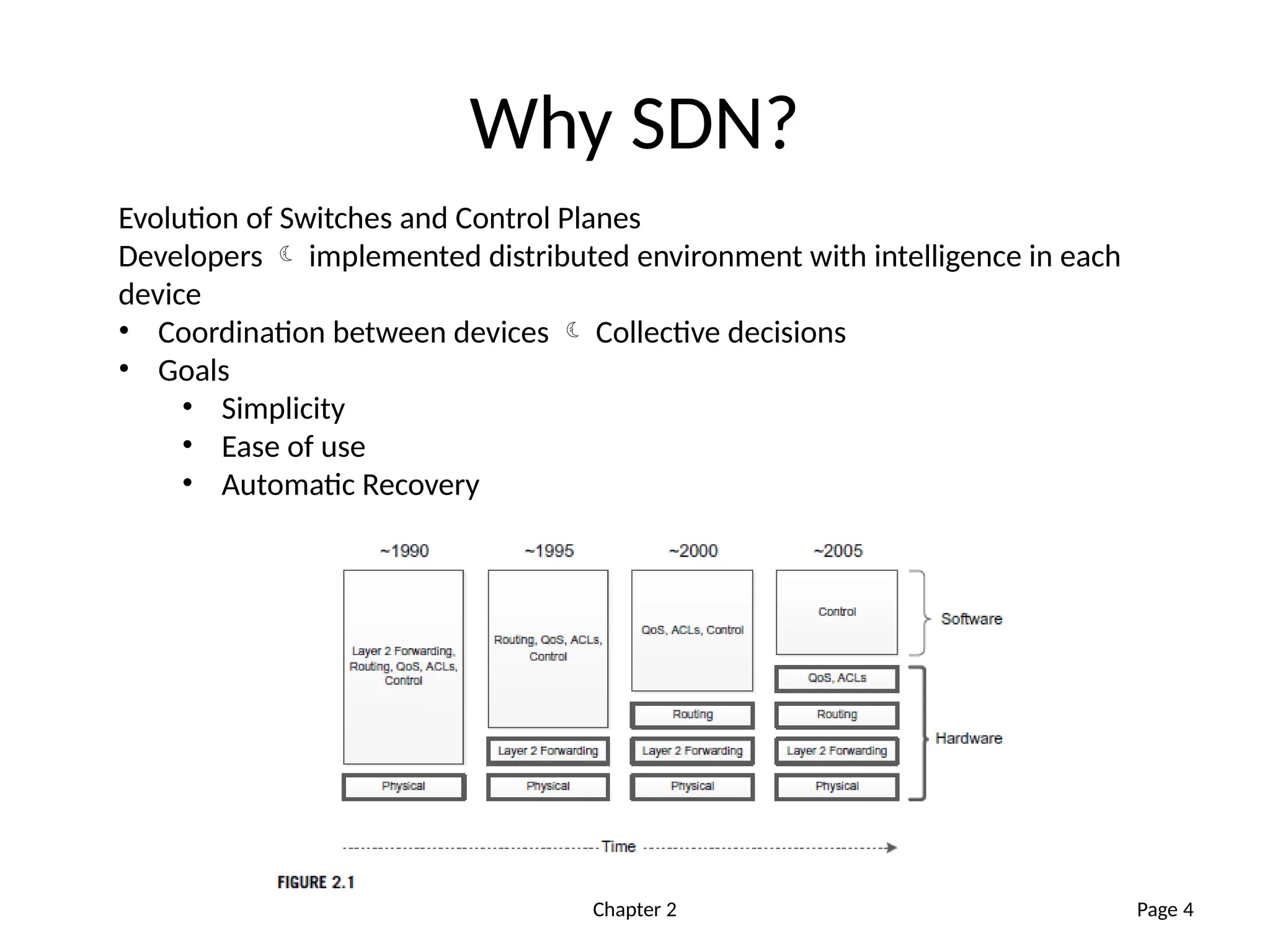
Evolution of Switches and Control Planes
Developers  implemented distributed environment with intelligence in each
device
• Coordination between devices  Collective decisions
• Goals
• Simplicity
• Ease of use
• Automatic Recovery
Chapter 2
Why SDN?
• Evolution of Switches and Control Planes
– Distributed Intelligence in L2 and L3
• Spanning Tree Protocol (STP) – IEEE 802.1D
– a.k.a. Transparent Bridging
– Enforces a hierarchy on the network
» Convergence latency
• Rapid Spanning Tree Protocol (RSTP) – IEEE 802.1D-2004
– Improves latency, but not deployed
Page 5
Chapter 2
Why SDN?
• Evolution of Switches and Control Planes
– Distributed Intelligence in L2 and L3
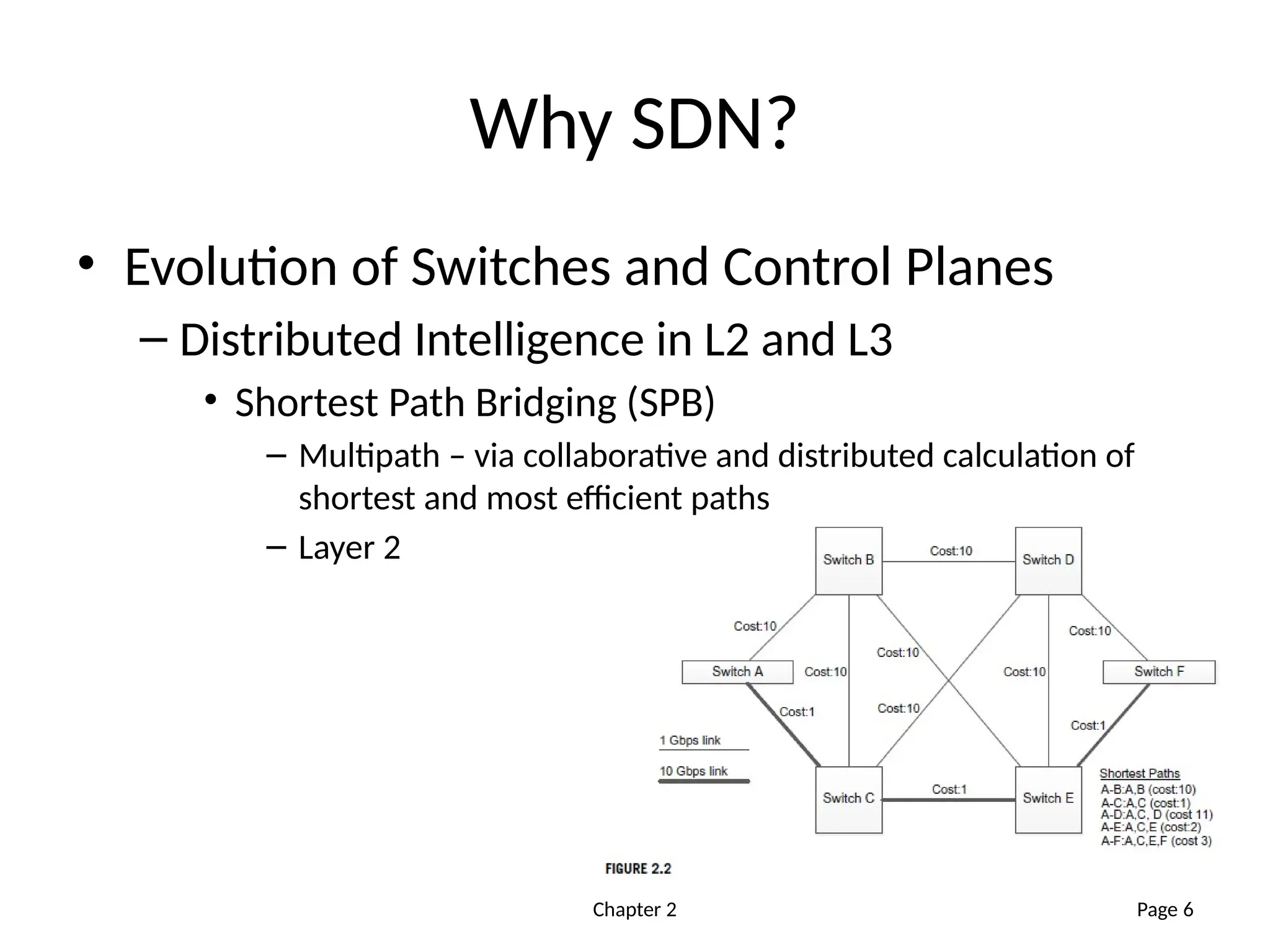
• Shortest Path Bridging (SPB)
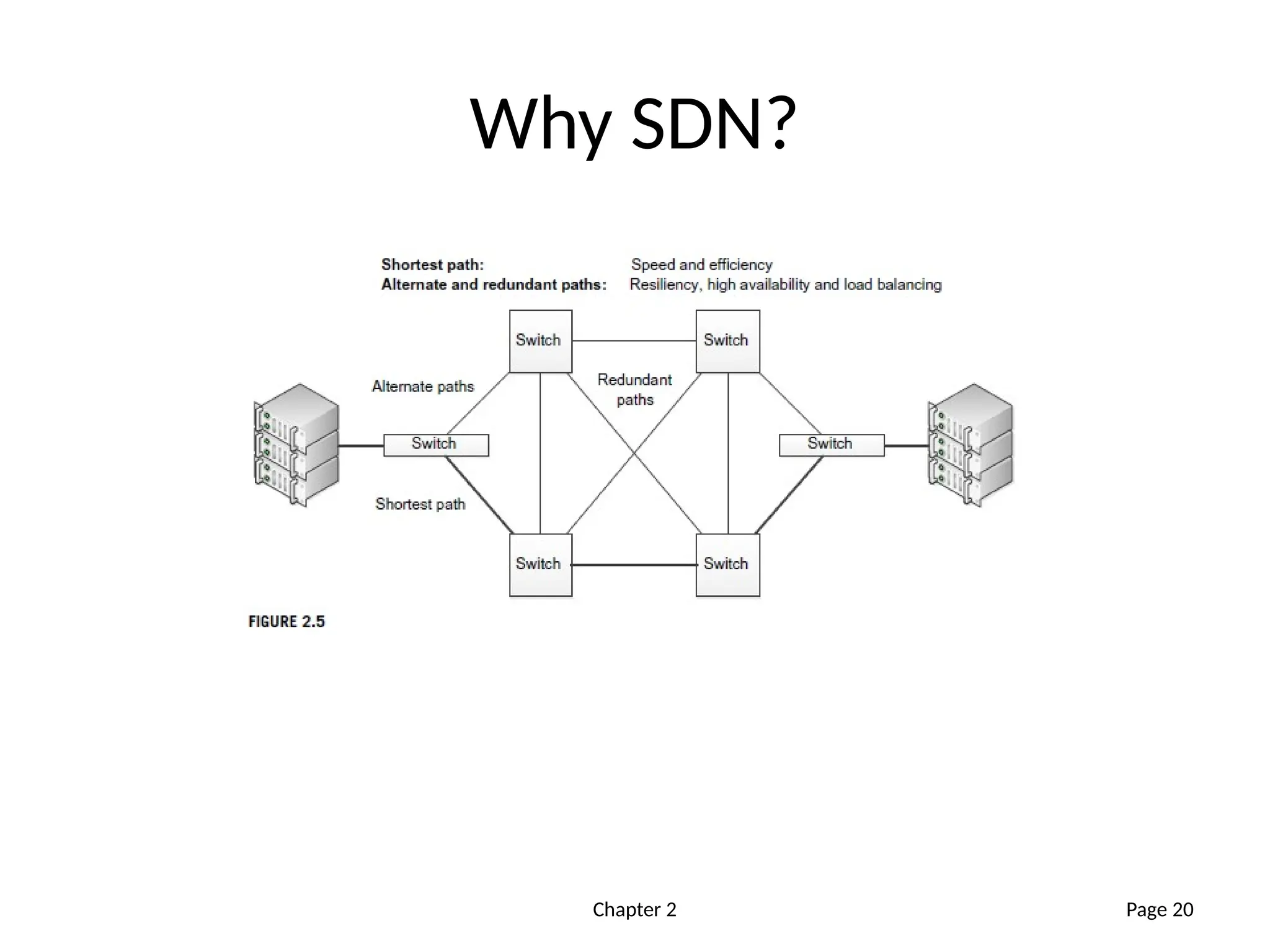
– Multipath – via collaborative and distributed calculation of
shortest and most efficient paths
– Layer 2
Page 6
Chapter 2
Why SDN?
• Evolution of Switches and Control Planes
– Distributed Intelligence in L2 and L3
• RIP, BGP, OSPF, and IS-IS
– Chapter 2
» Layer 3 requires the cooperation between devices
• Knowledge of which routers are attaching to which
subnets in a network.
Page 7
Chapter 2
Why SDN?
• Evolution of Switches and Control Planes
– Distributed Intelligence in L2 and L3
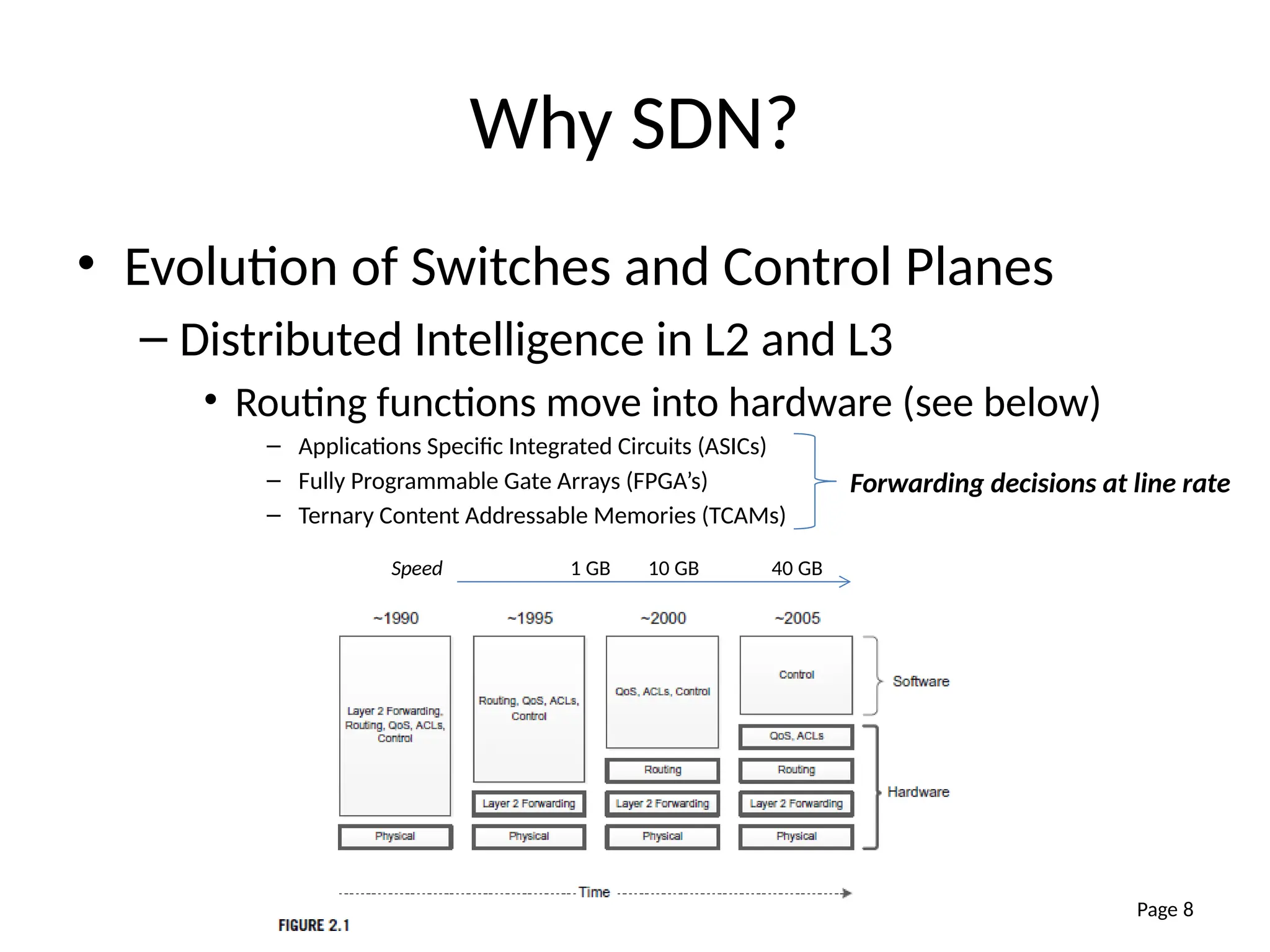
• Routing functions move into hardware (see below)
– Applications Specific Integrated Circuits (ASICs)
– Fully Programmable Gate Arrays (FPGA’s)
– Ternary Content Addressable Memories (TCAMs)
Page 8
Forwarding decisions at line rate
1 GB 10 GB 40 GB
Speed
Chapter 2
Why SDN?
• Evolution of Switches and Control Planes
– Hardware Forwarding and Control in Software
• The network device evolution we have recounted thus
far has yielded the following current situation:
– Bridging (layer two forwarding).
– Routing (layer three forwarding).
– Advanced filtering and prioritization.
– Control
Page 9
Chapter 2
Why SDN?
• Evolution of Switches and Control Planes
– Growing Need for Simplicity
• Network Devices
» Why?
• Need for autonomous and independent design
• Increased intelligence
• Complicated handshakes
• Network Management
– Primitive tools like SNMP and CLI
Page 10
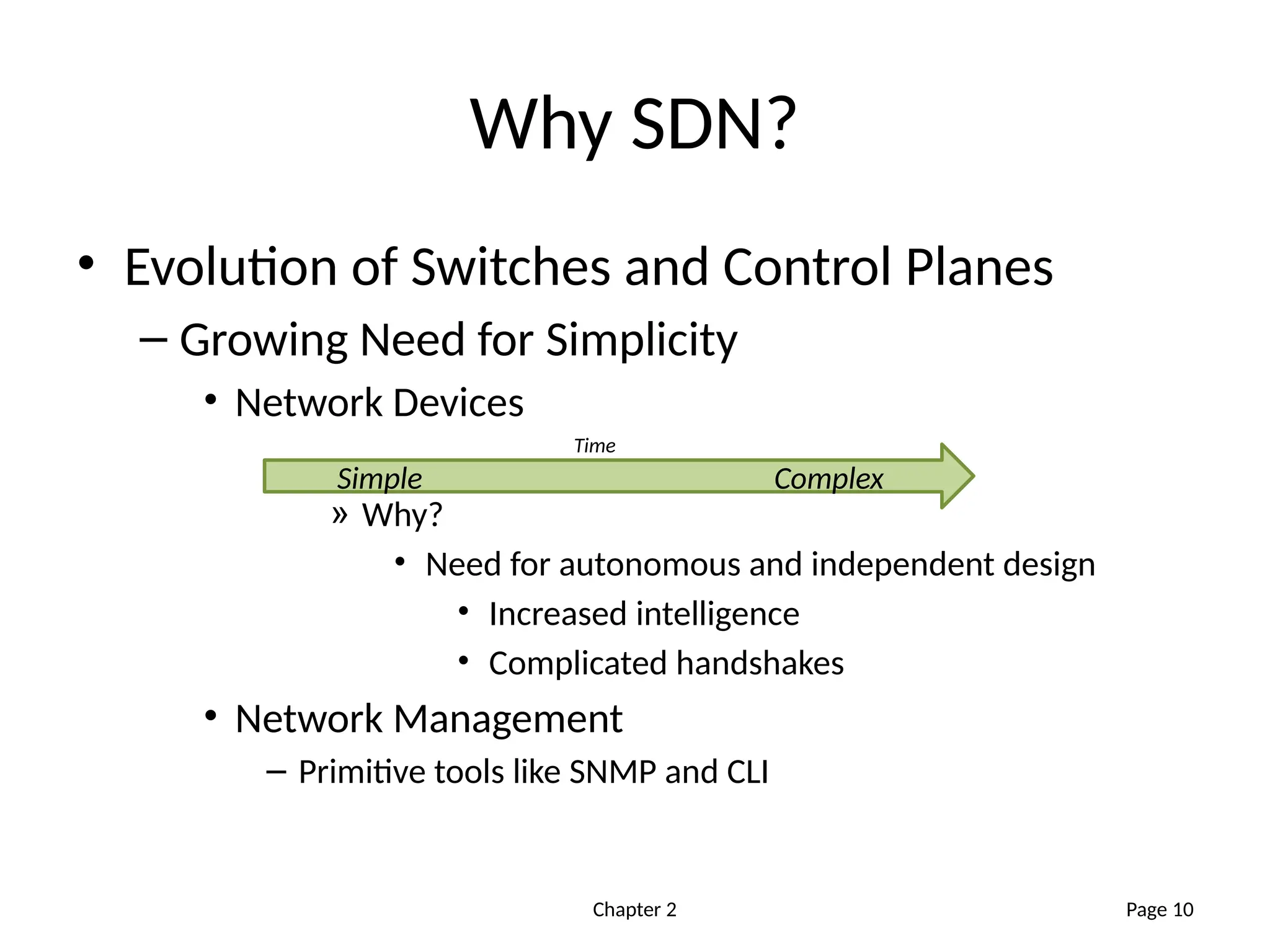
Simple Complex
Time
Chapter 2
Why SDN?
• Evolution of Switches and Control Planes
– Moving Control Off the Device
• Core of SDN  Move control software off the device and into a
centrally located compute resource
– Why?
» Central device can see entire network and make optimal decisions
– SDN attempts to segregate network activities in the
following manner:
• Forwarding, filtering, and prioritization.
• Control
• Application
Page 11
Here
Chapter 2 12
Chapter 2
Why SDN?
• Cost
– Increased Cost of Development
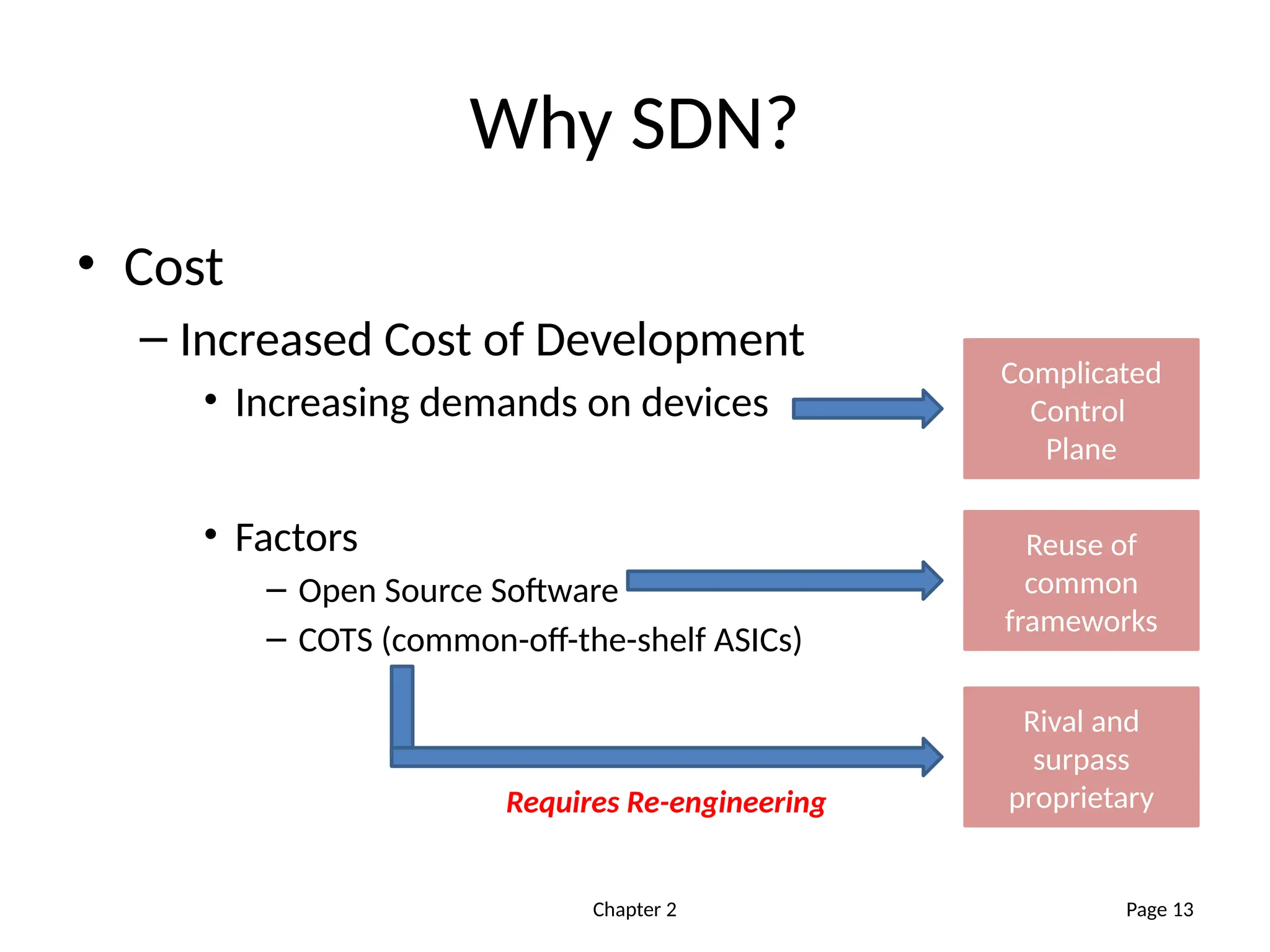
• Increasing demands on devices
• Factors
– Open Source Software
– COTS (common-off-the-shelf ASICs)
Page 13
Complicated
Control
Plane
Reuse of
common
frameworks
Rival and
surpass
proprietary
Requires Re-engineering
Chapter 2
Why SDN?
• Cost
– Closed Environments Encourage Vendor Lock-in
• Standards and Competitive Advantage
– Complexity and Resistance to Change
• “If its not broke, don’t fix it”
– Increased Cost of Operating the Network
• OPEX growing relative to CAPEX
– Why? Larger and more complex networks!
– SDN will lower OPEX
Page 14
Chapter 2
Why SDN?
• SDN Implications for Research and Innovation
– Status Quo Benefits Incumbent Vendors
• Few competitors
• Barriers to market entry due to costs
– Parallel to SaaS vendors (e.g. Force.com)
– SDN Promotes Research & Innovation
• Open software environments promote rapid pace of
advancement
– Examples: Linux, KVM, Xen, MySQL, Postgres
• Hardware commoditization and Openness  Innovation
Page 15
Chapter 2
Why SDN?
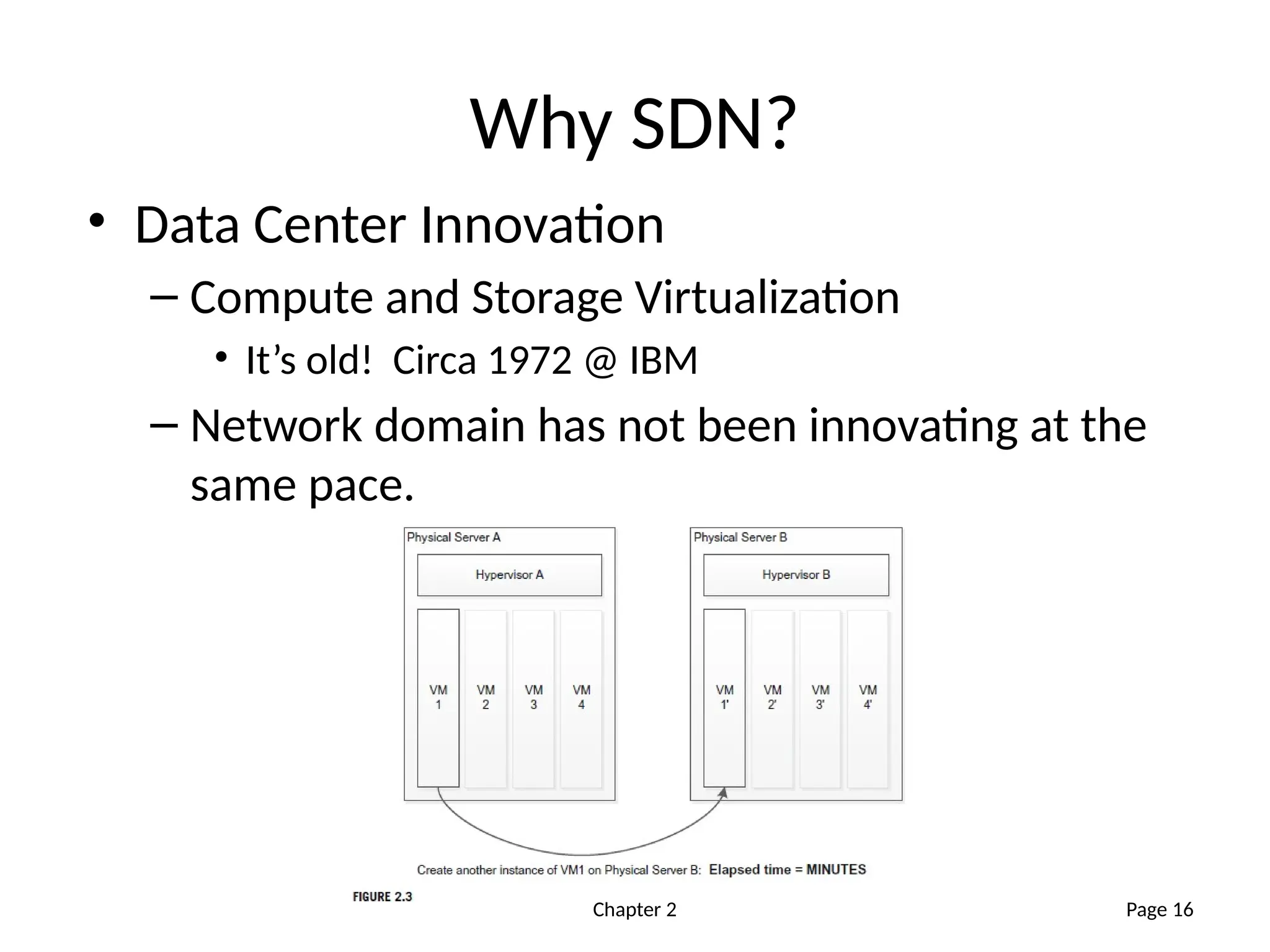
• Data Center Innovation
– Compute and Storage Virtualization
• It’s old! Circa 1972 @ IBM
– Network domain has not been innovating at the
same pace.
Page 16
Chapter 2
Physical Coordination
of Links and NICs
Physical Coordination
of Links and NICs
Why SDN?
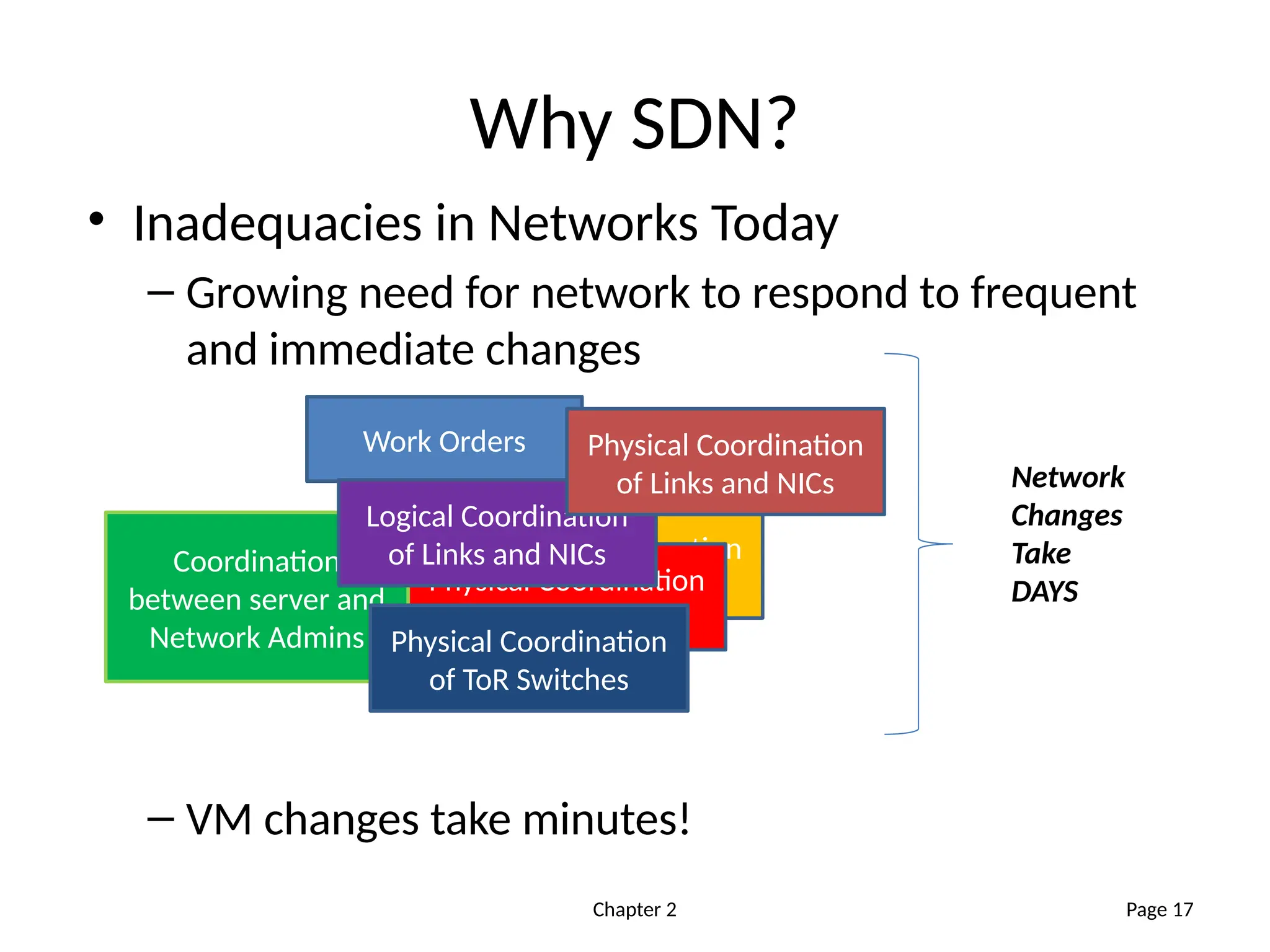
• Inadequacies in Networks Today
– Growing need for network to respond to frequent
and immediate changes
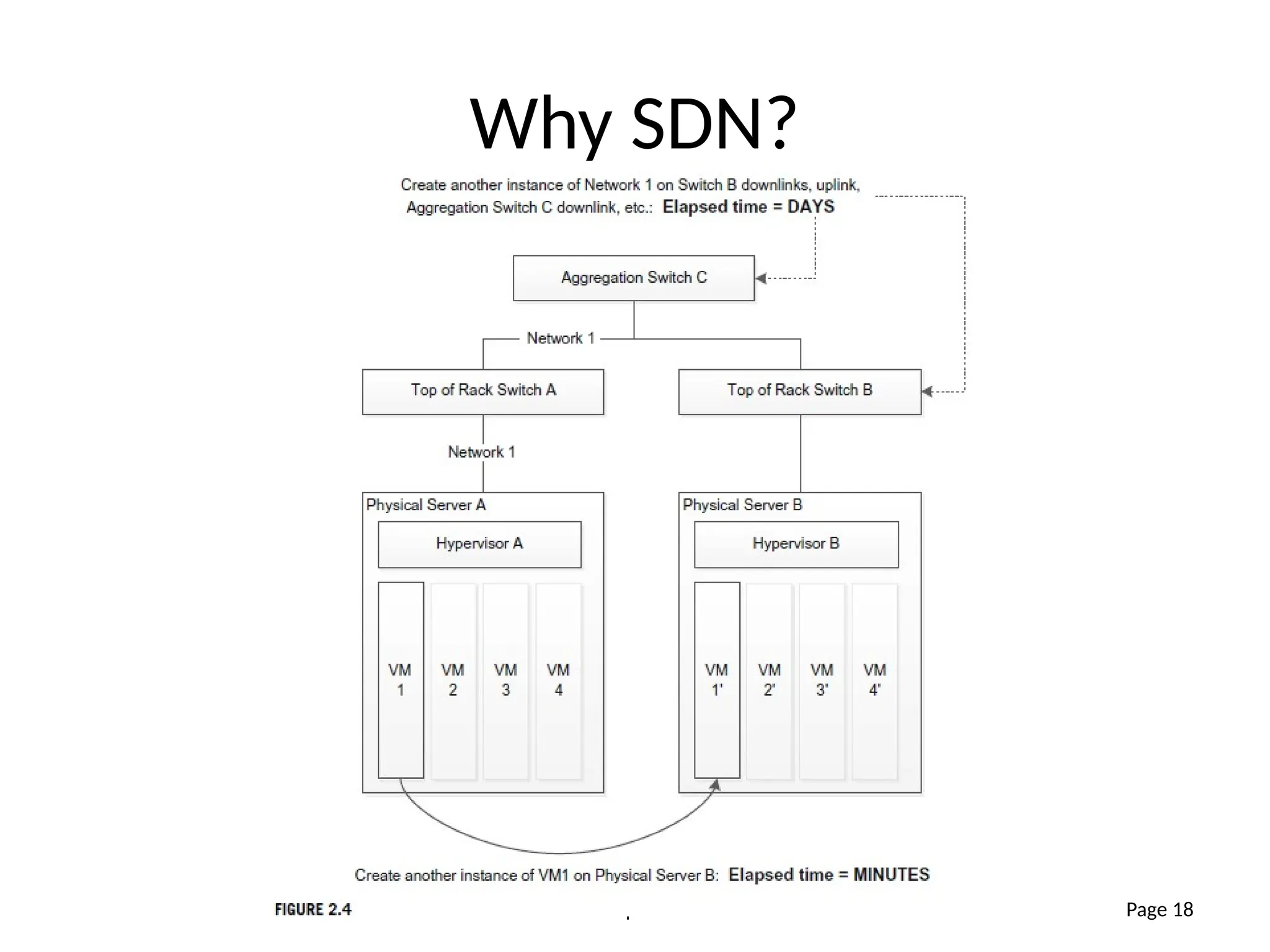
– VM changes take minutes!
Page 17
Work Orders
Coordination
between server and
Network Admins
Logical Coordination
of Links and NICs
Physical Coordination
of Links and NICs
Physical Coordination
of ToR Switches
Network
Changes
Take
DAYS
Chapter 2
Why SDN?
Page 18
Chapter 2
Why SDN?
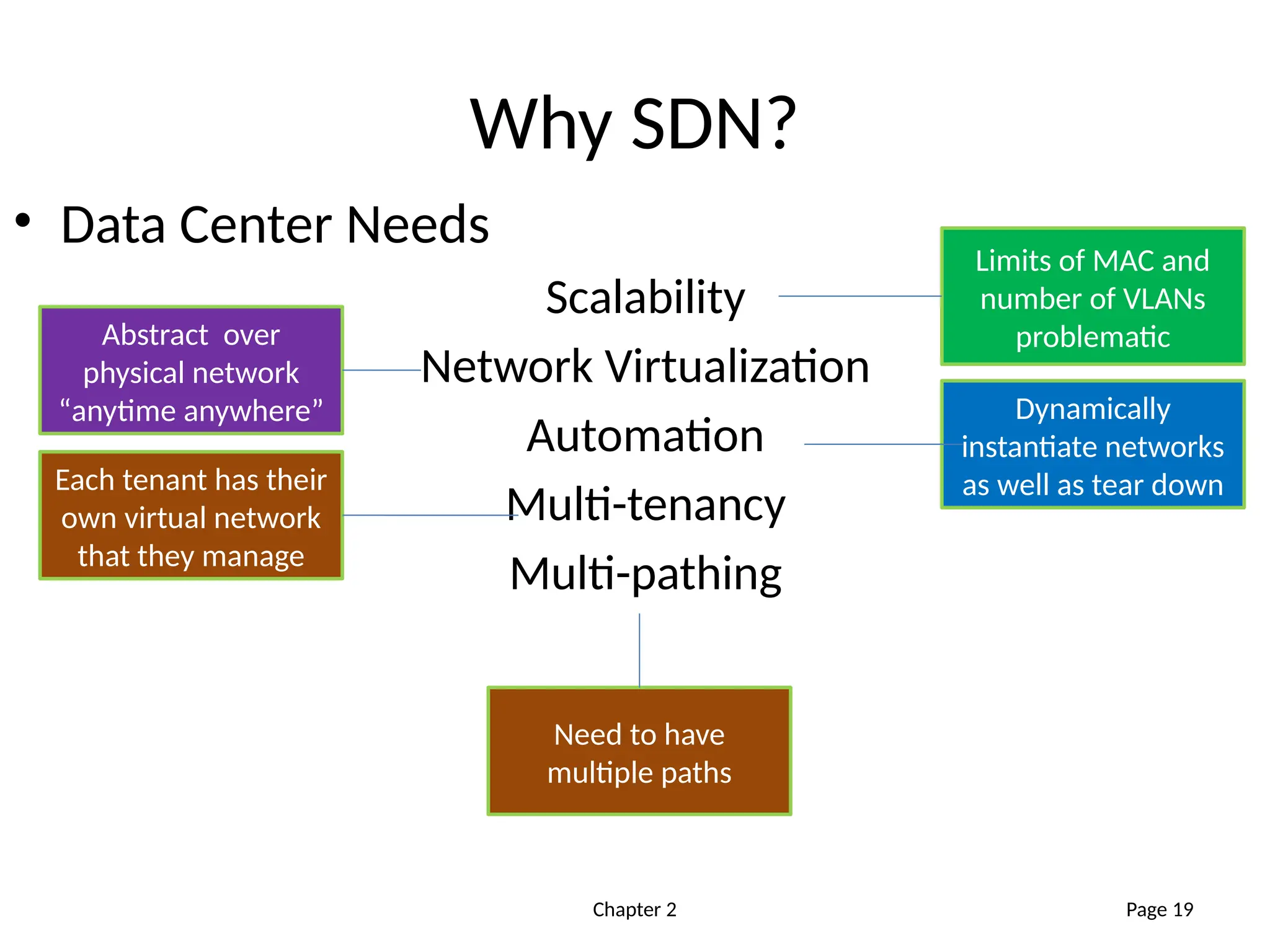
• Data Center Needs
Scalability
Network Virtualization
Automation
Multi-tenancy
Multi-pathing
Page 19
Limits of MAC and
number of VLANs
problematic
Dynamically
instantiate networks
as well as tear down
Abstract over
physical network
“anytime anywhere”
Each tenant has their
own virtual network
that they manage
Need to have
multiple paths
Chapter 2
Why SDN?
Page 20

software defined networks Chapter2-WhySDN.pptx

  • 1.
    Chapter 2 1 SoftwareDefined Networks Chapter 2 Why SDN?
  • 2.
    Chapter 2 Page2 These slides have been prepared to accompany the book “Software Defined Networks – A Comprehensive Approach” Dr. Paul Goransson, Chuck Black, and Timothy Culver. The authors and publisher Morgan Kaufman allow lecturers and public and private universities the right to modify these slides for their own use when the book is being used for a class. Since the SDN marketplace is changing rapidly, the accompanying PowerPoints and related classroom material will be updated every few months
  • 3.
    Chapter 2 Why SDN? •Evolution of Switches and Control Planes – Chapter 2 • Early days – Simple Forwarding and Routing via Software • Network device developers and standards focused on autonomous and independence – Networks small w/ large shared domains – Plug and play devices – Manual configuration of devices Page 3
  • 4.
    Chapter 2 Why SDN? Page4 Evolution of Switches and Control Planes Developers  implemented distributed environment with intelligence in each device • Coordination between devices  Collective decisions • Goals • Simplicity • Ease of use • Automatic Recovery
  • 5.
    Chapter 2 Why SDN? •Evolution of Switches and Control Planes – Distributed Intelligence in L2 and L3 • Spanning Tree Protocol (STP) – IEEE 802.1D – a.k.a. Transparent Bridging – Enforces a hierarchy on the network » Convergence latency • Rapid Spanning Tree Protocol (RSTP) – IEEE 802.1D-2004 – Improves latency, but not deployed Page 5
  • 6.
    Chapter 2 Why SDN? •Evolution of Switches and Control Planes – Distributed Intelligence in L2 and L3 • Shortest Path Bridging (SPB) – Multipath – via collaborative and distributed calculation of shortest and most efficient paths – Layer 2 Page 6
  • 7.
    Chapter 2 Why SDN? •Evolution of Switches and Control Planes – Distributed Intelligence in L2 and L3 • RIP, BGP, OSPF, and IS-IS – Chapter 2 » Layer 3 requires the cooperation between devices • Knowledge of which routers are attaching to which subnets in a network. Page 7
  • 8.
    Chapter 2 Why SDN? •Evolution of Switches and Control Planes – Distributed Intelligence in L2 and L3 • Routing functions move into hardware (see below) – Applications Specific Integrated Circuits (ASICs) – Fully Programmable Gate Arrays (FPGA’s) – Ternary Content Addressable Memories (TCAMs) Page 8 Forwarding decisions at line rate 1 GB 10 GB 40 GB Speed
  • 9.
    Chapter 2 Why SDN? •Evolution of Switches and Control Planes – Hardware Forwarding and Control in Software • The network device evolution we have recounted thus far has yielded the following current situation: – Bridging (layer two forwarding). – Routing (layer three forwarding). – Advanced filtering and prioritization. – Control Page 9
  • 10.
    Chapter 2 Why SDN? •Evolution of Switches and Control Planes – Growing Need for Simplicity • Network Devices » Why? • Need for autonomous and independent design • Increased intelligence • Complicated handshakes • Network Management – Primitive tools like SNMP and CLI Page 10 Simple Complex Time
  • 11.
    Chapter 2 Why SDN? •Evolution of Switches and Control Planes – Moving Control Off the Device • Core of SDN  Move control software off the device and into a centrally located compute resource – Why? » Central device can see entire network and make optimal decisions – SDN attempts to segregate network activities in the following manner: • Forwarding, filtering, and prioritization. • Control • Application Page 11 Here
  • 12.
  • 13.
    Chapter 2 Why SDN? •Cost – Increased Cost of Development • Increasing demands on devices • Factors – Open Source Software – COTS (common-off-the-shelf ASICs) Page 13 Complicated Control Plane Reuse of common frameworks Rival and surpass proprietary Requires Re-engineering
  • 14.
    Chapter 2 Why SDN? •Cost – Closed Environments Encourage Vendor Lock-in • Standards and Competitive Advantage – Complexity and Resistance to Change • “If its not broke, don’t fix it” – Increased Cost of Operating the Network • OPEX growing relative to CAPEX – Why? Larger and more complex networks! – SDN will lower OPEX Page 14
  • 15.
    Chapter 2 Why SDN? •SDN Implications for Research and Innovation – Status Quo Benefits Incumbent Vendors • Few competitors • Barriers to market entry due to costs – Parallel to SaaS vendors (e.g. Force.com) – SDN Promotes Research & Innovation • Open software environments promote rapid pace of advancement – Examples: Linux, KVM, Xen, MySQL, Postgres • Hardware commoditization and Openness  Innovation Page 15
  • 16.
    Chapter 2 Why SDN? •Data Center Innovation – Compute and Storage Virtualization • It’s old! Circa 1972 @ IBM – Network domain has not been innovating at the same pace. Page 16
  • 17.
    Chapter 2 Physical Coordination ofLinks and NICs Physical Coordination of Links and NICs Why SDN? • Inadequacies in Networks Today – Growing need for network to respond to frequent and immediate changes – VM changes take minutes! Page 17 Work Orders Coordination between server and Network Admins Logical Coordination of Links and NICs Physical Coordination of Links and NICs Physical Coordination of ToR Switches Network Changes Take DAYS
  • 18.
  • 19.
    Chapter 2 Why SDN? •Data Center Needs Scalability Network Virtualization Automation Multi-tenancy Multi-pathing Page 19 Limits of MAC and number of VLANs problematic Dynamically instantiate networks as well as tear down Abstract over physical network “anytime anywhere” Each tenant has their own virtual network that they manage Need to have multiple paths
  • 20.

Editor's Notes

  • #4 Note that the goals of the early developers and standards bodies were the same that we have for SDN
  • #5 IEEE 802.1D default timers for STP-15 seconds for listening and 20 seconds for max age timeout. Typical delays for convergence in older networks was 30 – 50 seconds Delays like this are unacceptable in today modern data centers.
  • #6 STP only allows 1 active path to a destination SPB accomplishes this goal by utilizing IS-IS to construct a graph representing the layer two link-state topology. Once this graph exists, shortest-path calculations are straightforward, though more complex than with spanning tree.
  • #8 hardware is now capable of handling all forwarding, routing, access control list (ACL), and QoS decisions. Higher-level control functions, responsible for network-wide collaboration with other devices, are implemented in software. This control software runs independently in each network device.
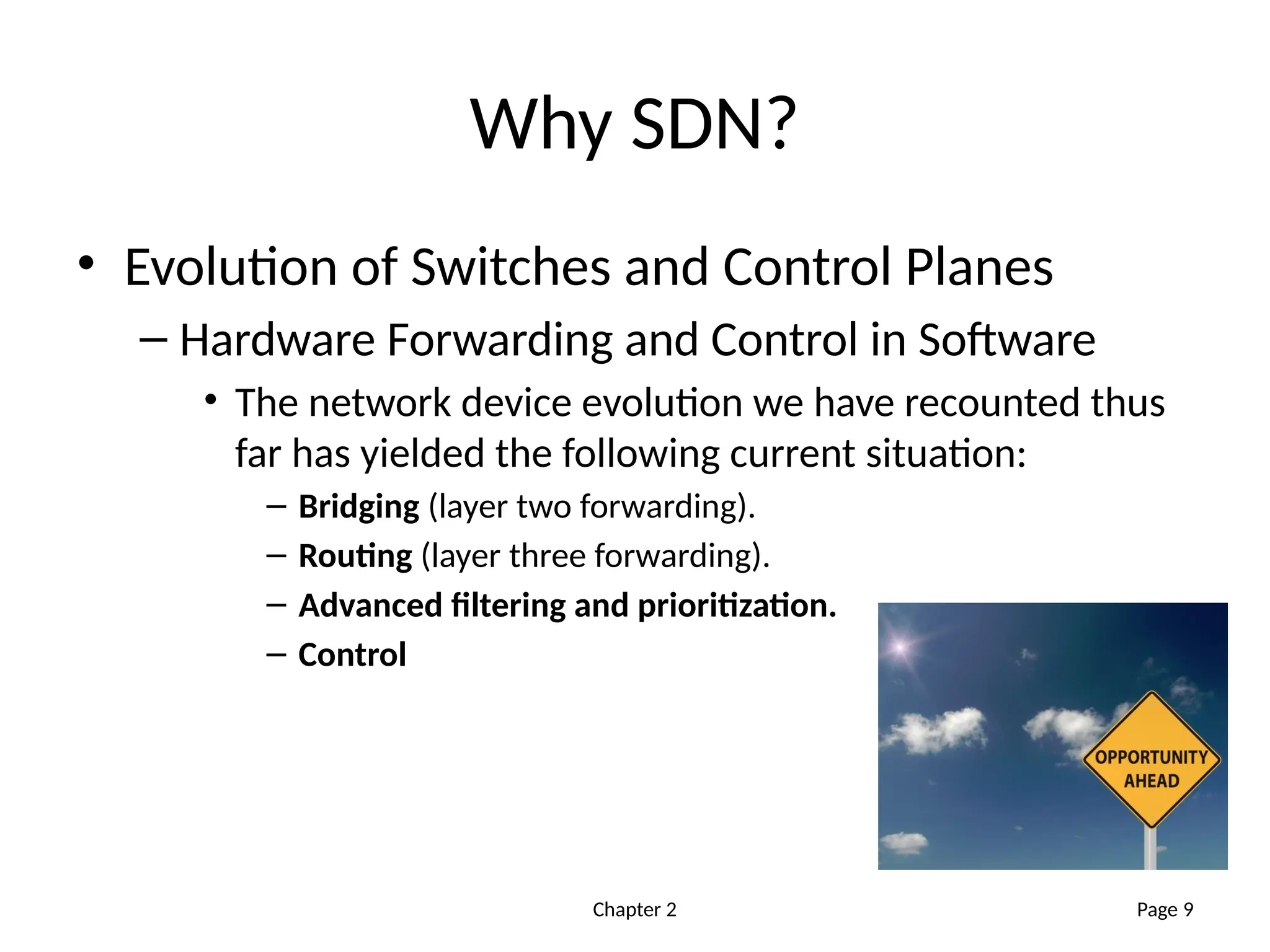
  • #9 The network device evolution we have recounted thus far has yielded the following current situation: • Bridging (layer two forwarding). Basic layer two MAC forwarding of packets is handled in the hardware tables. • Routing (layer three forwarding). To keep up with today’s high-speed links and to route packets at link speeds, layer three forwarding functionality is also implemented in hardware tables. • Advanced filtering and prioritization. General traffic management rules such as ACLs, which filter, forward, and prioritize packets, are handled via hardware tables located in the hardware (e.g., in TCAMs) and accessed through low-level software. • Control. The control software used to make broader routing decisions and to interact with other devices in order to converge on topologies and routing paths is implemented in software that runs autonomously inside the devices. Since the current control plane software in networking devices lacks the ability to distribute policy information about such things as security, QoS, and ACLs, these features must still be provisioned through relatively primitive configuration and management interfaces. Note there is an opportunity ahead…. The cloud is there for a reason  Opportunity to simplify the
  • #10 Devices similar to CPUs – overtime, they became overly complex and evolved to a model called RISC (reduced instruction set computing) Simple Network Management protocol Command Line Interface
  • #11 Devices similar to CPUs – overtime, they became overly complex and evolved to a model called RISC (reduced instruction set computing) Simple Network Management protocol Command Line Interface SDN attempts to segregate network activities in the following manner: • Forwarding, filtering, and prioritization. Forwarding responsibilities, implemented in hardware tables, remain on the device. In addition, features such as filtering based on ACLs and traffic prioritization are enforced locally on the device as well. • Control. Complicated control software is removed from the device and placed into a centralized controller, which has a complete view of the network and the ability to make optimal forwarding and routing decisions. There is a migration to a programming paradigm for the control plane. The forwarding hardware on the networking device is available to be programmed by external software on the controller. The control plane is no longer embedded, closed, closely coupled with the hardware, or optimized for particular embedded environments. • Application. Above the controller is where the network applications run, implementing higher-level functions and, additionally, participating in decisions about how best to manage and control packet forwarding and distribution within the network
  • #13 Though their products may be quite profitable, NEMs must write and support larger amounts of software than would otherwise be necessary if networking devices were developed in truly open environments. The fact that such a large body of software must run on each and every network device further cost.
  • #14 Telecom Vendors adopt industry standards and these alleviate vendor lock-in. However vendors add capabilities that are proprietary to gain competitive advantage. Vendor can charge more. Despite standardization, there is often a strong argument to have a Single vendor solution. Resistance to change. SDN lowers OPEX through faster provisioning of new services and the ability switch equipment between different services.
  • #15 Vendors have had control for 2 decades! Compare the hardware approach to Software and computing. Bring up JVM, NetBeans Integrated Dev Env and cross platform The barriers to entry for software companies to create products (no DC, no large capital requirements. Vendors have 30% or more in margins! Closed nature of networking today = challenging to experiment, test, research, and innovate
  • #16 Chapter 2 – past few years – server virtualization have caused the capacity and efficiency of data centers to increase exponentially This has promoted cloud solutions
  • #17 Promise of SDN is to have network reconfiguration take minutes as is the case for reconfiguration of VMs
  • #18 Even when we are configuring something virtual for the network, such as a VLAN, making changes is more cumbersome than in their server counterparts. In Chapter 2 we explained that although the control plane of legacy networks had sophisticated ways of autonomously and dynamically distributing layer two and layer three states, no corresponding protocols exist for distributing the policies that are used in policy-based routing. Thus, configuring security policy, such as ACLs or virtualization policy such as to which VLAN a host belongs, remains static and manual in traditional networks
  • #19 On Scalability – Too many physical devices -