Español I – Sr. Johnston
martes, el dieciocho de septiembre de 2012
                 9/18/2012
Para empezar
• Write Tarea (HW) in Agenda:
     • Complete the assignment: Famous Hispanic American


• Prepare for today’s quiz which will begin after
  we resume our discussion on National
  Hispanic American Heritage Month.

• Once we begin quizzing, we will do the final
  section of the quiz together FIRST.
Who is Hispanic?

"The terms "Hispanic" or "Latino" refer to
persons who trace their origin or descent to
Mexico, Puerto Rico, Cuba, Spanish speaking
Central and South America countries, and other
Spanish cultures. Origin can be considered as the
heritage, nationality group, lineage, or country of
the person or the person's parents or ancestors
before their arrival in the United States. People
who identify their origin as Hispanic or Latino
may be of any race.”
                         - U.S. Census Bureau, 2010
What is the origin of the word
           Hispanic?
The term Hispanic as used in the USA, was
coined by the U.S. Census Bureau in the 1970s
to describe people of Spanish-speaking origin.
It is not a term that originated from within the
culture. Primarily people who have been
formed and educated in the USA use Hispanic.
They are accustomed to the term by education
or by family custom. Latin American nationals,
recent immigrants to this country, may not
always self-identify as Hispanic.
…and what about the word Latino?
• Latino most often refers to people of Latin American
  descent, as distinct from Spanish descent (people
  from Spain). We hear this term used frequently in
  South America to describe people on the continent as
  a whole, including Portuguese-speaking Brazilians.
  (Brazilians consider themselves Latinos, but they do
  not call themselves Hispanic, as they do not speak
  Spanish.) Latino is more tied to national origin and
  not to language. Latino is more likely to be used by
  first or second-generation Latin Americans who have
  closer cultural ties to Latin America than to the USA.
From the White House:
“Our Nation's story would not be possible
without generations of Hispanics who have
shaped and strengthened the fabric of our Union.
They have enriched every aspect of our national
identity with traditions that stretch across
centuries and reflect the many ancestries that
comprise the Hispanic community. This month,
we celebrate this rich heritage and reflect on the
invaluable contributions Hispanics have made to
America.”
            - President Barack Obama, 9/15/2012
Hispanic Heritage Month
       WebQuest
Introduction
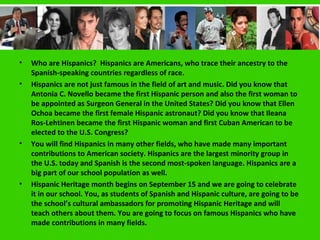
•   Who are Hispanics? Hispanics are Americans, who trace their ancestry to the
    Spanish-speaking countries regardless of race.
•   Hispanics are not just famous in the field of art and music. Did you know that
    Antonia C. Novello became the first Hispanic person and also the first woman to
    be appointed as Surgeon General in the United States? Did you know that Ellen
    Ochoa became the first female Hispanic astronaut? Did you know that Ileana
    Ros-Lehtinen became the first Hispanic woman and first Cuban American to be
    elected to the U.S. Congress?
•   You will find Hispanics in many other fields, who have made many important
    contributions to American society. Hispanics are the largest minority group in
    the U.S. today and Spanish is the second most-spoken language. Hispanics are a
    big part of our school population as well.
•   Hispanic Heritage month begins on September 15 and we are going to celebrate
    it in our school. You, as students of Spanish and Hispanic culture, are going to be
    the school’s cultural ambassadors for promoting Hispanic Heritage and will
    teach others about them. You are going to focus on famous Hispanics who have
    made contributions in many fields.
Task

• Your job is to choose one famous Hispanic
  American, find out several facts about that
  person, then write a brief biographical sketch
  about that person. You will complete the
  biographical form, adding a picture of your
  chosen person as well.
• These will be displayed in the hall to celebrate
  National Hispanic American Heritage Month!
Process
•   Visit the sites listed below. They are also listed at the
    course website www.johnstonbga.wikispaces.com

•   Meet 50 notable Hispanic American men and women who've made a difference in
    the arts, entertainment, sports, world affairs, human rights and history.
     • http://www.gale.cengage.com/free_resources/chh/bio/index.htm
•   Discover History Makers
     • http://teacher.scholastic.com/activities/hispanic/

•   Choose a famous Hispanic American and fill out the biographical worksheet listing
    5 facts about the person you chose. Search for a picture of the person you have
    chosen, right click on that picture and choose Save as. Save it to Mr. Johnston’s
    Flash Drive (ask to borrow it). After you have gathered facts and a picture of your
    famous Hispanic American, you will write a short biography of your person on the
    lines provided. Turn in this document and give it to Mr. Johnston to display.
Evaluation
• You will be evaluated on completion of your
  worksheet and the information you gather on
  the person you choose.
• Do your best!
• Begin your research today with a laptop, once
  you complete your quiz.
• Bring in your completed work to turn in
  tomorrow, Wednesday, September 18, 2012.
Prueba 1 – Quiz 1
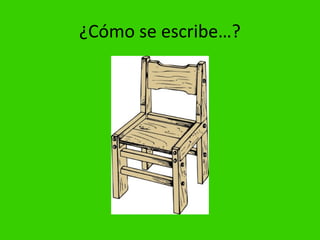
¿Cómo se escribe…?
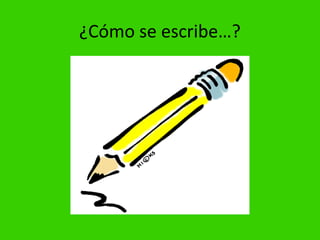
¿Cómo se escribe…?
¿Cómo se escribe…?
¿Cómo se escribe…?
¿Cómo se escribe…?
Famous Hispanic Americans

Leccion 9.18.12

  • 1.
    Español I –Sr. Johnston martes, el dieciocho de septiembre de 2012 9/18/2012
  • 2.
    Para empezar • WriteTarea (HW) in Agenda: • Complete the assignment: Famous Hispanic American • Prepare for today’s quiz which will begin after we resume our discussion on National Hispanic American Heritage Month. • Once we begin quizzing, we will do the final section of the quiz together FIRST.
  • 3.
    Who is Hispanic? "Theterms "Hispanic" or "Latino" refer to persons who trace their origin or descent to Mexico, Puerto Rico, Cuba, Spanish speaking Central and South America countries, and other Spanish cultures. Origin can be considered as the heritage, nationality group, lineage, or country of the person or the person's parents or ancestors before their arrival in the United States. People who identify their origin as Hispanic or Latino may be of any race.” - U.S. Census Bureau, 2010
  • 4.
    What is theorigin of the word Hispanic? The term Hispanic as used in the USA, was coined by the U.S. Census Bureau in the 1970s to describe people of Spanish-speaking origin. It is not a term that originated from within the culture. Primarily people who have been formed and educated in the USA use Hispanic. They are accustomed to the term by education or by family custom. Latin American nationals, recent immigrants to this country, may not always self-identify as Hispanic.
  • 5.
    …and what aboutthe word Latino? • Latino most often refers to people of Latin American descent, as distinct from Spanish descent (people from Spain). We hear this term used frequently in South America to describe people on the continent as a whole, including Portuguese-speaking Brazilians. (Brazilians consider themselves Latinos, but they do not call themselves Hispanic, as they do not speak Spanish.) Latino is more tied to national origin and not to language. Latino is more likely to be used by first or second-generation Latin Americans who have closer cultural ties to Latin America than to the USA.
  • 6.
    From the WhiteHouse: “Our Nation's story would not be possible without generations of Hispanics who have shaped and strengthened the fabric of our Union. They have enriched every aspect of our national identity with traditions that stretch across centuries and reflect the many ancestries that comprise the Hispanic community. This month, we celebrate this rich heritage and reflect on the invaluable contributions Hispanics have made to America.” - President Barack Obama, 9/15/2012
  • 8.
  • 9.
    Introduction • Who are Hispanics? Hispanics are Americans, who trace their ancestry to the Spanish-speaking countries regardless of race. • Hispanics are not just famous in the field of art and music. Did you know that Antonia C. Novello became the first Hispanic person and also the first woman to be appointed as Surgeon General in the United States? Did you know that Ellen Ochoa became the first female Hispanic astronaut? Did you know that Ileana Ros-Lehtinen became the first Hispanic woman and first Cuban American to be elected to the U.S. Congress? • You will find Hispanics in many other fields, who have made many important contributions to American society. Hispanics are the largest minority group in the U.S. today and Spanish is the second most-spoken language. Hispanics are a big part of our school population as well. • Hispanic Heritage month begins on September 15 and we are going to celebrate it in our school. You, as students of Spanish and Hispanic culture, are going to be the school’s cultural ambassadors for promoting Hispanic Heritage and will teach others about them. You are going to focus on famous Hispanics who have made contributions in many fields.
  • 10.
    Task • Your jobis to choose one famous Hispanic American, find out several facts about that person, then write a brief biographical sketch about that person. You will complete the biographical form, adding a picture of your chosen person as well. • These will be displayed in the hall to celebrate National Hispanic American Heritage Month!
  • 11.
    Process • Visit the sites listed below. They are also listed at the course website www.johnstonbga.wikispaces.com • Meet 50 notable Hispanic American men and women who've made a difference in the arts, entertainment, sports, world affairs, human rights and history. • http://www.gale.cengage.com/free_resources/chh/bio/index.htm • Discover History Makers • http://teacher.scholastic.com/activities/hispanic/ • Choose a famous Hispanic American and fill out the biographical worksheet listing 5 facts about the person you chose. Search for a picture of the person you have chosen, right click on that picture and choose Save as. Save it to Mr. Johnston’s Flash Drive (ask to borrow it). After you have gathered facts and a picture of your famous Hispanic American, you will write a short biography of your person on the lines provided. Turn in this document and give it to Mr. Johnston to display.
  • 12.
    Evaluation • You willbe evaluated on completion of your worksheet and the information you gather on the person you choose. • Do your best! • Begin your research today with a laptop, once you complete your quiz. • Bring in your completed work to turn in tomorrow, Wednesday, September 18, 2012.
  • 13.
  • 14.
  • 15.
  • 16.
  • 17.
  • 18.
  • 19.