Teaching the Latino/a Literature
                     of the U.S.


          José A. Carmona
      Independent Educational
             Consultant
      Dade City, Florida, USA
Dedication
                 by Gustavo Pérez Firmat

•   The fact that I            • don’t belong to English
•   am writing to you          • though I belong nowhere
•   in English                   else,
•   already falsifies what I   • if not here
•   wanted to tell you.        • in English.
•   My subject
•   how to explain to you
•   that I                     Copyright by Gustavo Perez-Firmat
Introduction
• The Latino/a literature of the United States,
  although widely published, is still missing across
  many campuses and curriculum in the U.S.

• This literature can be infused across the college
  curriculum in many ways.

• The following presentation will illustrate ways of
  achieving success when teaching this literature.
Who is the Latino/a Writer?
• Chicano/a            • Nuyorican

• Cuban American       • Puerto Rican
                         American
• Colombian American
                       • Etc.
• Dominican American
Who is the Latino/a Writer?

• He/she writes from the perspective of living
  in the U.S. and not from a Latin American
  perspective.

• He/she lives in a dichotomy of two
  dissimilar cultures with distinct values,
  goals and experiences.
What Language Do They Use?

• English

• Spanish

• Spanglish
What Do They Write About?

• Growing up in the U.S.

• The Urban Experience/Living in the U.S.

• Assimilation vs. Acculturation

• Language Barrier
What Do They Write About?

• Dual Identity

• Longing for Parents’ Culture/Nostalgia

• Closeness to the Earth

• Political Concerns
What Do They Write About?

• These themes, as well as others not mentioned
  here, make up this vast body of literature.

• The Latino/a writer has the opportunity to select
  the best from each culture:
            The Edge Effect Theory (Gustavo Perez-
  Firmat).
A Brief History of this Literature:
       The Coming of Age Events

• The following novels represent two major
  events in the coming of age narrative:

• Pocho (1959), José Antonio Villareal

• A Puerto Rican in New York and Other
  Stories (1961), Jesus Colón
A Brief History of this Literature:
               Chicano/a Writers


• José A. Villareal   • Rudolfo Anaya

• Tomás Rivera        • Oscar “Zeta”Acosta

• Ernesto Galarza     • Ron Arias
A Brief History of this Literature:
               Chicano/a Writers


• Arturo Islas       • Victor Villaseñor

• Rolando Hinojosa   • Gloria Anzaldúa

• Sandra Cisneros    • Ana Castillo
A Brief History of this Literature:
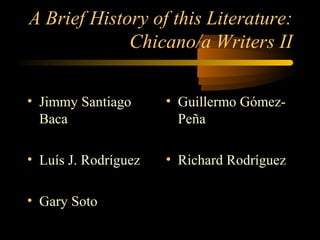
             Chicano/a Writers II

• Jimmy Santiago      • Guillermo Gómez-
  Baca                  Peña

• Luís J. Rodríguez   • Richard Rodríguez

• Gary Soto
A Brief History of this Literature:
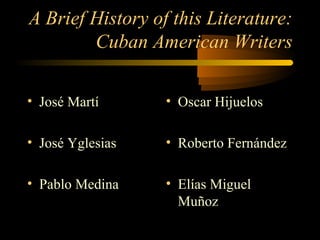
        Cuban American Writers

• José Martí      • Oscar Hijuelos

• José Yglesias   • Roberto Fernández

• Pablo Medina    • Elías Miguel
                    Muñoz
A Brief History of this Literature:
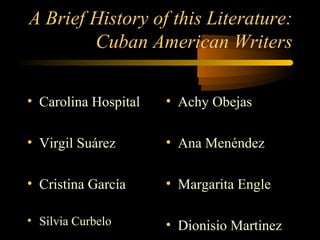
        Cuban American Writers

• Carolina Hospital   • Achy Obejas

• Virgil Suárez       • Ana Menéndez

• Cristina García     • Margarita Engle

• Silvia Curbelo      • Dionisio Martinez
A Brief History of this Literature:
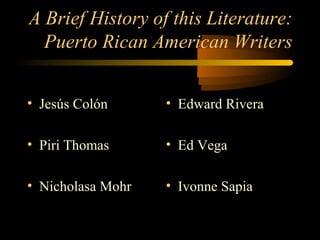
  Puerto Rican American Writers


• Jesús Colón      • Edward Rivera

• Piri Thomas      • Ed Vega

• Nicholasa Mohr   • Ivonne Sapia
A Brief History of this Literature:
  Puerto Rican American Writers


• Judith Ortíz Cofer

• Esmeralda Santiago

• Abraham Rodríguez
A Brief History of this Literature:
          Other Latino/a Writers

• Victor Perera      • Junot Díaz
  (Guatemalan Am.)     (Dominican Am.)

• Julia Alvarez
                     • Silvana Paternostro
  (Dominican Am.)
                       (Colombian Am.)
• Jaime Manrique
  (Colombian Am.)
How Can We Integrate this
   Literature in Our Curriculum?


• Latino/a Studies Programs

• English/Comparative Literature Classes

• Spanish Language Classes
How Can We Integrate this
   Literature in Our Curriculum?


• English as a Second Language Classes

• Latin American Literature Classes

• Sociology/Psychology Classes
How Can We Integrate this
   Literature in Our Curriculum?


• Environmental Classes

• Science Classes

• Mathematics Classes
Why should We Integrate this
    Literature in Our Curriculum?


• Representation in the Classroom

• Identity Booster

• Multiculturalism in the Curriculum
Why should We Integrate this
   Literature in Our Curriculum?


• Learn from Our Ethnic Experiences/
  Differences

• Find Who and Where We Are Now

• Showcase Widely Published Works
Conclusion


• Teaching the Latino/a literature of the U.S.
  is not a simple task.

• Learning is an ongoing process.

• Infuse small chunks at a time.
Conclusion


• Set attainable goals.

• Be prepared to make mistakes.

• Be prepared to learn from students.
Conclusion:
                 Questions to Ponder


• Which classes would you infuse right away
  with the Latino/a literature of the U.S.?

• How are you going to accomplish this?

• Where can you get more information?
Contact Information


• You may contact me at:
  joseacarmona@gmail.com

• By phone at: 386-675-8594

• Please, see handouts for bibliographies
References

• Augenbraum, Harold and Ilan Stavans. (1993). Growing
  Up Latino: Memoirs and Stories. NY: Houghton Mifflin.

• Kanellos, Nicolás. (1997). Hispanic Firsts: 500 Years of
  Extraordinary Achievement. MI: Visible Ink Press.

• Peréz Firmat, Gustavo. “Dedication.” In Hospital,
  Carolina. (1988). Cuban American Writers: Los Atrevidos.
  Princeton, NJ: Ediciones Ellas/Linden Lane Press.

Teachinglatinolitofus 120521225925-phpapp01

  • 1.
    Teaching the Latino/aLiterature of the U.S. José A. Carmona Independent Educational Consultant Dade City, Florida, USA
  • 2.
    Dedication by Gustavo Pérez Firmat • The fact that I • don’t belong to English • am writing to you • though I belong nowhere • in English else, • already falsifies what I • if not here • wanted to tell you. • in English. • My subject • how to explain to you • that I Copyright by Gustavo Perez-Firmat
  • 3.
    Introduction • The Latino/aliterature of the United States, although widely published, is still missing across many campuses and curriculum in the U.S. • This literature can be infused across the college curriculum in many ways. • The following presentation will illustrate ways of achieving success when teaching this literature.
  • 4.
    Who is theLatino/a Writer? • Chicano/a • Nuyorican • Cuban American • Puerto Rican American • Colombian American • Etc. • Dominican American
  • 5.
    Who is theLatino/a Writer? • He/she writes from the perspective of living in the U.S. and not from a Latin American perspective. • He/she lives in a dichotomy of two dissimilar cultures with distinct values, goals and experiences.
  • 6.
    What Language DoThey Use? • English • Spanish • Spanglish
  • 7.
    What Do TheyWrite About? • Growing up in the U.S. • The Urban Experience/Living in the U.S. • Assimilation vs. Acculturation • Language Barrier
  • 8.
    What Do TheyWrite About? • Dual Identity • Longing for Parents’ Culture/Nostalgia • Closeness to the Earth • Political Concerns
  • 9.
    What Do TheyWrite About? • These themes, as well as others not mentioned here, make up this vast body of literature. • The Latino/a writer has the opportunity to select the best from each culture: The Edge Effect Theory (Gustavo Perez- Firmat).
  • 10.
    A Brief Historyof this Literature: The Coming of Age Events • The following novels represent two major events in the coming of age narrative: • Pocho (1959), José Antonio Villareal • A Puerto Rican in New York and Other Stories (1961), Jesus Colón
  • 11.
    A Brief Historyof this Literature: Chicano/a Writers • José A. Villareal • Rudolfo Anaya • Tomás Rivera • Oscar “Zeta”Acosta • Ernesto Galarza • Ron Arias
  • 12.
    A Brief Historyof this Literature: Chicano/a Writers • Arturo Islas • Victor Villaseñor • Rolando Hinojosa • Gloria Anzaldúa • Sandra Cisneros • Ana Castillo
  • 13.
    A Brief Historyof this Literature: Chicano/a Writers II • Jimmy Santiago • Guillermo Gómez- Baca Peña • Luís J. Rodríguez • Richard Rodríguez • Gary Soto
  • 14.
    A Brief Historyof this Literature: Cuban American Writers • José Martí • Oscar Hijuelos • José Yglesias • Roberto Fernández • Pablo Medina • Elías Miguel Muñoz
  • 15.
    A Brief Historyof this Literature: Cuban American Writers • Carolina Hospital • Achy Obejas • Virgil Suárez • Ana Menéndez • Cristina García • Margarita Engle • Silvia Curbelo • Dionisio Martinez
  • 16.
    A Brief Historyof this Literature: Puerto Rican American Writers • Jesús Colón • Edward Rivera • Piri Thomas • Ed Vega • Nicholasa Mohr • Ivonne Sapia
  • 17.
    A Brief Historyof this Literature: Puerto Rican American Writers • Judith Ortíz Cofer • Esmeralda Santiago • Abraham Rodríguez
  • 18.
    A Brief Historyof this Literature: Other Latino/a Writers • Victor Perera • Junot Díaz (Guatemalan Am.) (Dominican Am.) • Julia Alvarez • Silvana Paternostro (Dominican Am.) (Colombian Am.) • Jaime Manrique (Colombian Am.)
  • 19.
    How Can WeIntegrate this Literature in Our Curriculum? • Latino/a Studies Programs • English/Comparative Literature Classes • Spanish Language Classes
  • 20.
    How Can WeIntegrate this Literature in Our Curriculum? • English as a Second Language Classes • Latin American Literature Classes • Sociology/Psychology Classes
  • 21.
    How Can WeIntegrate this Literature in Our Curriculum? • Environmental Classes • Science Classes • Mathematics Classes
  • 22.
    Why should WeIntegrate this Literature in Our Curriculum? • Representation in the Classroom • Identity Booster • Multiculturalism in the Curriculum
  • 23.
    Why should WeIntegrate this Literature in Our Curriculum? • Learn from Our Ethnic Experiences/ Differences • Find Who and Where We Are Now • Showcase Widely Published Works
  • 24.
    Conclusion • Teaching theLatino/a literature of the U.S. is not a simple task. • Learning is an ongoing process. • Infuse small chunks at a time.
  • 25.
    Conclusion • Set attainablegoals. • Be prepared to make mistakes. • Be prepared to learn from students.
  • 26.
    Conclusion: Questions to Ponder • Which classes would you infuse right away with the Latino/a literature of the U.S.? • How are you going to accomplish this? • Where can you get more information?
  • 27.
    Contact Information • Youmay contact me at: joseacarmona@gmail.com • By phone at: 386-675-8594 • Please, see handouts for bibliographies
  • 28.
    References • Augenbraum, Haroldand Ilan Stavans. (1993). Growing Up Latino: Memoirs and Stories. NY: Houghton Mifflin. • Kanellos, Nicolás. (1997). Hispanic Firsts: 500 Years of Extraordinary Achievement. MI: Visible Ink Press. • Peréz Firmat, Gustavo. “Dedication.” In Hospital, Carolina. (1988). Cuban American Writers: Los Atrevidos. Princeton, NJ: Ediciones Ellas/Linden Lane Press.