September 15-October 15
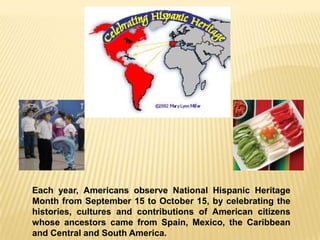
Each year, Americans observe National Hispanic Heritage
Month from September 15 to October 15, by celebrating the
histories, cultures and contributions of American citizens
whose ancestors came from Spain, Mexico, the Caribbean
and Central and South America.
HISTORY

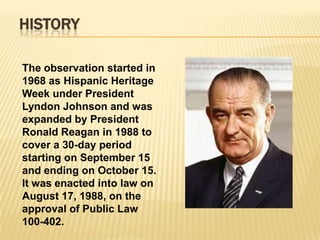
The observation started in
1968 as Hispanic Heritage
Week under President
Lyndon Johnson and was
expanded by President
Ronald Reagan in 1988 to
cover a 30-day period
starting on September 15
and ending on October 15.
It was enacted into law on
August 17, 1988, on the
approval of Public Law
100-402.
CELEBRATE THE HERITAGE


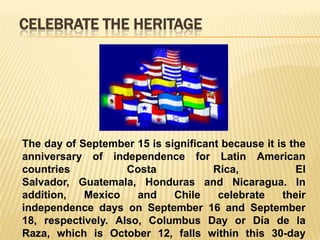
The day of September 15 is significant because it is the
anniversary of independence for Latin American
countries           Costa            Rica,            El
Salvador, Guatemala, Honduras and Nicaragua. In
addition,   Mexico    and    Chile    celebrate    their
independence days on September 16 and September
18, respectively. Also, Columbus Day or Día de la
Raza, which is October 12, falls within this 30-day
CELEBRATE THE HERITAGE
Latinos, or Hispanic Americans, constitute the second-
largest and most rapidly growing distinctive ethnic
group in the United States. The impact that this group
has had on domestic and international affairs in the
United States is substantial and promises to be even
more significant in the future.
CELEBRATE THE HERITAGE


While sharing close ties based on Spanish heritage and
language, Hispanic Americans are of diverse national
backgrounds, originating not only from the Iberian
Peninsula but from most of the nations of the Western
Hemisphere, including the Caribbean and Central and
South America.
SPANISH HERITAGE
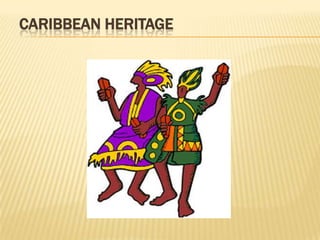
CARIBBEAN HERITAGE
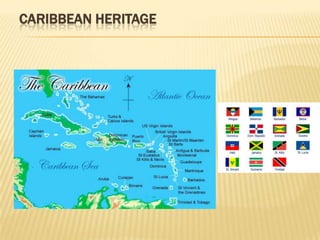
CARIBBEAN HERITAGE
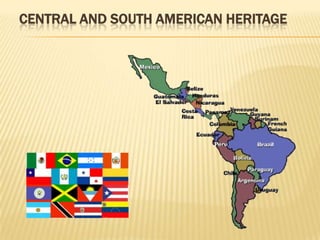
CENTRAL AND SOUTH AMERICAN HERITAGE
HISPANIC HERITAGE MONTH
Hispanic Heritage Month

Hispanic Heritage Month

  • 1.
  • 2.
    Each year, Americansobserve National Hispanic Heritage Month from September 15 to October 15, by celebrating the histories, cultures and contributions of American citizens whose ancestors came from Spain, Mexico, the Caribbean and Central and South America.
  • 3.
    HISTORY The observation startedin 1968 as Hispanic Heritage Week under President Lyndon Johnson and was expanded by President Ronald Reagan in 1988 to cover a 30-day period starting on September 15 and ending on October 15. It was enacted into law on August 17, 1988, on the approval of Public Law 100-402.
  • 4.
    CELEBRATE THE HERITAGE Theday of September 15 is significant because it is the anniversary of independence for Latin American countries Costa Rica, El Salvador, Guatemala, Honduras and Nicaragua. In addition, Mexico and Chile celebrate their independence days on September 16 and September 18, respectively. Also, Columbus Day or Día de la Raza, which is October 12, falls within this 30-day
  • 5.
    CELEBRATE THE HERITAGE Latinos,or Hispanic Americans, constitute the second- largest and most rapidly growing distinctive ethnic group in the United States. The impact that this group has had on domestic and international affairs in the United States is substantial and promises to be even more significant in the future.
  • 6.
    CELEBRATE THE HERITAGE Whilesharing close ties based on Spanish heritage and language, Hispanic Americans are of diverse national backgrounds, originating not only from the Iberian Peninsula but from most of the nations of the Western Hemisphere, including the Caribbean and Central and South America.
  • 7.
  • 8.
  • 9.
  • 10.
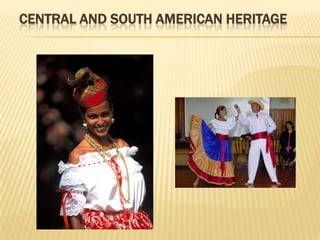
    CENTRAL AND SOUTHAMERICAN HERITAGE
  • 11.
    CENTRAL AND SOUTHAMERICAN HERITAGE
  • 12.
    CENTRAL AND SOUTHAMERICAN HERITAGE
  • 13.
  • 14.