01/13/2026 1
Instrumental Techniques in Food
Analysis
3(1-2)
FST-407
Engr. Abdul Hameed
Visiting Lecturer
Department of Food Science and Technology, GCC-GCUF
01/13/2026 2
Atomic spectrometry
Atomic absorption spectrometry (AAS) measures the quantity of light
absorbed by atoms of analyte.
AAS methods are used for accurately measuring trace amounts of mineral
elements in food analysis, nutrition and biochemistry
Atomic emission spectrometry (AES) measures the quantity of radiation
emitted by analyte atoms which have been promoted to higher energy levels.
To measure the mineral composition of foods and other materials rapidly,
accurately, and precisely.
01/13/2026 3
General Principles
Atomic absorption spectra are produced when ground state atoms (or ions)
absorb energy from a radiation source.
Atomic emission spectra are produced when excited neutral atoms emit energy
on returning to the ground state or a lower energy state.
Absorption of a photon of radiation causes an outer shell electron to jump to a
higher energy level, moving the atom into an excited state.
The excited atom may fall back to a lower energy state, releasing a photon in the
process.
01/13/2026 4
Atomic absorption spectrometry (AAS)
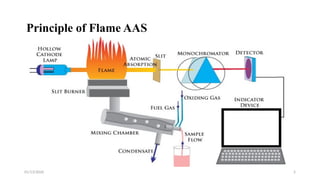
In flame AAS, a nebulizer–burner system is used to convert a solution of the
sample into an atomic vapor.
The sample solution is nebulized (dispersed into tiny droplets), mixed with fuel
and an oxidant, and burned in a flame produced by oxidation of the fuel by the
oxidant.
Atoms and ions are formed within the flame as analyte compounds are
decomposed by the high temperatures. The temperature of the flame is important
because it will affect the efficiency of converting compounds to atoms and ions.
01/13/2026 5
Principle of Flame AAS
01/13/2026 6
Components of AAS
Atomic absorption spectrometers consist of the following components
1. Radiation source, a hollow cathode lamp (HCL)
2. Atomizer, usually a nebulizer–burner system
3. Monochromator, (UV-Vis) grating
4. Detector, a photomultiplier tube (PMT) or a solid-state detector
5. Computer.
01/13/2026 7
1. Radiation Source
The radiation source in atomic absorption spectrometers is hollow cathode
lamps consist of a hollow metallic tube which has been coated with the analyte
of interest, filled with argon or neon, an anode made of tungsten.
When voltage (100-400 V) is applied across the electrodes, the lamp emits
radiation characteristic of the metal in the cathode; if the cathode is made of iron,
an iron spectrum is emitted. When this radiation passes through a flame
containing the sample, iron atoms in the flame will absorb some of it because it
contains radiation of exactly the right energy for exciting iron atoms.
01/13/2026 8
2. Atomizers
Several types of atomizers are used in AAS including flame, electrothermal,
cold vapor technique for mercury, and hydride generation.
The flame atomizer consists of a nebulizer and a burner. The nebulizer is
designed to convert the sample solution into a fine mist or aerosol. Only about
1% of the total sample is carried into the flame by the oxidant–fuel mixture. The
larger droplets fall to the bottom of the mixing chamber.
The burner head contains a long, narrow slot that produces a flame that may be
5–10 cm in length.
01/13/2026 9
3. Mono-chromator
The monochromator is positioned in the optical path between the flame and the
detector.
Its purpose is to isolate the resonance line of interest from the rest of the
radiation coming from the flame or furnace and the lamp so that only radiation
of the desired wavelength reaches the detector.
Typically, monochromators of the grating type are used
01/13/2026 10
4. Detector and computer
Two types of detectors are used in AA spectrometers, photomultiplier tubes and
solid-state detectors (SSD).
Detectors convert the radiant energy reaching it into an electrical signal.
This signal is processed to produce either an analog or a digital readout.
Modern instruments are interfaced with computers for data collection,
manipulation, and storage.
01/13/2026 11
ATOMIC EMISSION SPECTROSCOPY (AES)
In contrast to AAS, the source of radiation in AES is the excited atoms or ions in
the sample rather than an external source.
The difference is that in emission spectroscopy, sufficient heat is applied to the
sample to excite atoms to higher energy levels.
Aside from the external radiation source required for AAS, instrumentation for
AES is similar.
Emissions are produced when electrons from excited neutral atoms move back
to lower energy states.
01/13/2026 12
ATOMIC EMISSION SPECTROSCOPY
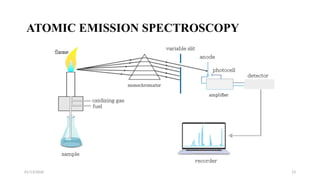
Flame in atomic emission spectroscopy finally excites the electrons to higher
energy levels.
These electrons return to the ground state by emission of radiation.
On dispersing, water or solvent is evaporated and dry salt is left in the flame.
On further heating at a higher temperature, the dry salt is vaporized and
molecules are dissociated to neutral atoms which are responsible for emission
phenomena.
01/13/2026 13
ATOMIC EMISSION SPECTROSCOPY

Lec8 Spectrometery (AAS,AES) .pptx for s

  • 1.
    01/13/2026 1 Instrumental Techniquesin Food Analysis 3(1-2) FST-407 Engr. Abdul Hameed Visiting Lecturer Department of Food Science and Technology, GCC-GCUF
  • 2.
    01/13/2026 2 Atomic spectrometry Atomicabsorption spectrometry (AAS) measures the quantity of light absorbed by atoms of analyte. AAS methods are used for accurately measuring trace amounts of mineral elements in food analysis, nutrition and biochemistry Atomic emission spectrometry (AES) measures the quantity of radiation emitted by analyte atoms which have been promoted to higher energy levels. To measure the mineral composition of foods and other materials rapidly, accurately, and precisely.
  • 3.
    01/13/2026 3 General Principles Atomicabsorption spectra are produced when ground state atoms (or ions) absorb energy from a radiation source. Atomic emission spectra are produced when excited neutral atoms emit energy on returning to the ground state or a lower energy state. Absorption of a photon of radiation causes an outer shell electron to jump to a higher energy level, moving the atom into an excited state. The excited atom may fall back to a lower energy state, releasing a photon in the process.
  • 4.
    01/13/2026 4 Atomic absorptionspectrometry (AAS) In flame AAS, a nebulizer–burner system is used to convert a solution of the sample into an atomic vapor. The sample solution is nebulized (dispersed into tiny droplets), mixed with fuel and an oxidant, and burned in a flame produced by oxidation of the fuel by the oxidant. Atoms and ions are formed within the flame as analyte compounds are decomposed by the high temperatures. The temperature of the flame is important because it will affect the efficiency of converting compounds to atoms and ions.
  • 5.
  • 6.
    01/13/2026 6 Components ofAAS Atomic absorption spectrometers consist of the following components 1. Radiation source, a hollow cathode lamp (HCL) 2. Atomizer, usually a nebulizer–burner system 3. Monochromator, (UV-Vis) grating 4. Detector, a photomultiplier tube (PMT) or a solid-state detector 5. Computer.
  • 7.
    01/13/2026 7 1. RadiationSource The radiation source in atomic absorption spectrometers is hollow cathode lamps consist of a hollow metallic tube which has been coated with the analyte of interest, filled with argon or neon, an anode made of tungsten. When voltage (100-400 V) is applied across the electrodes, the lamp emits radiation characteristic of the metal in the cathode; if the cathode is made of iron, an iron spectrum is emitted. When this radiation passes through a flame containing the sample, iron atoms in the flame will absorb some of it because it contains radiation of exactly the right energy for exciting iron atoms.
  • 8.
    01/13/2026 8 2. Atomizers Severaltypes of atomizers are used in AAS including flame, electrothermal, cold vapor technique for mercury, and hydride generation. The flame atomizer consists of a nebulizer and a burner. The nebulizer is designed to convert the sample solution into a fine mist or aerosol. Only about 1% of the total sample is carried into the flame by the oxidant–fuel mixture. The larger droplets fall to the bottom of the mixing chamber. The burner head contains a long, narrow slot that produces a flame that may be 5–10 cm in length.
  • 9.
    01/13/2026 9 3. Mono-chromator Themonochromator is positioned in the optical path between the flame and the detector. Its purpose is to isolate the resonance line of interest from the rest of the radiation coming from the flame or furnace and the lamp so that only radiation of the desired wavelength reaches the detector. Typically, monochromators of the grating type are used
  • 10.
    01/13/2026 10 4. Detectorand computer Two types of detectors are used in AA spectrometers, photomultiplier tubes and solid-state detectors (SSD). Detectors convert the radiant energy reaching it into an electrical signal. This signal is processed to produce either an analog or a digital readout. Modern instruments are interfaced with computers for data collection, manipulation, and storage.
  • 11.
    01/13/2026 11 ATOMIC EMISSIONSPECTROSCOPY (AES) In contrast to AAS, the source of radiation in AES is the excited atoms or ions in the sample rather than an external source. The difference is that in emission spectroscopy, sufficient heat is applied to the sample to excite atoms to higher energy levels. Aside from the external radiation source required for AAS, instrumentation for AES is similar. Emissions are produced when electrons from excited neutral atoms move back to lower energy states.
  • 12.
    01/13/2026 12 ATOMIC EMISSIONSPECTROSCOPY Flame in atomic emission spectroscopy finally excites the electrons to higher energy levels. These electrons return to the ground state by emission of radiation. On dispersing, water or solvent is evaporated and dry salt is left in the flame. On further heating at a higher temperature, the dry salt is vaporized and molecules are dissociated to neutral atoms which are responsible for emission phenomena.
  • 13.