The Product and Quotient RULES
The Product and
Quotient Rules
DIFFERENTIATION RULES
In this section, we will learn about:
Formulas that enable us to differentiate new functions
formed from old functions by multiplication or division.
By analogy with the Sum and Difference
Rules, one might be tempted to guess—as
Leibniz did three centuries ago—that the
derivative of a product is the product of the
derivatives.
 However, we can see that this guess is wrong
by looking at a particular example.
THE PRODUCT RULE
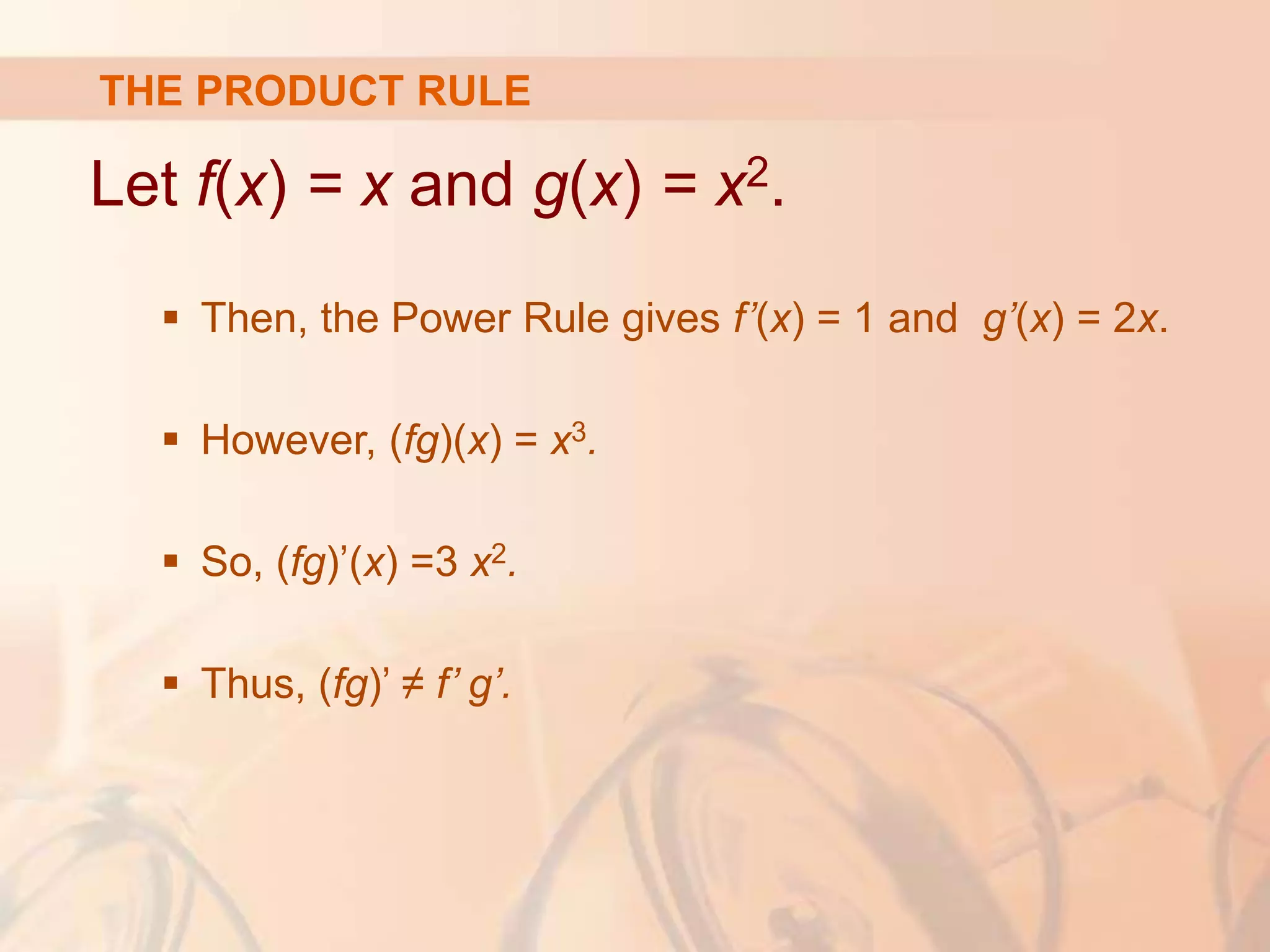
Let f(x) = x and g(x) = x2.
 Then, the Power Rule gives f’(x) = 1 and g’(x) = 2x.
 However, (fg)(x) = x3.
 So, (fg)’(x) =3 x2.
 Thus, (fg)’ ≠ f’ g’.
THE PRODUCT RULE
The correct formula was discovered by
Leibniz (soon after his false start) and is
called the Product Rule.
THE PRODUCT RULE
Before stating the Product Rule, let’s see
how we might discover it.
We start by assuming that u = f(x) and
v = g(x) are both positive differentiable
functions.
THE PRODUCT RULE
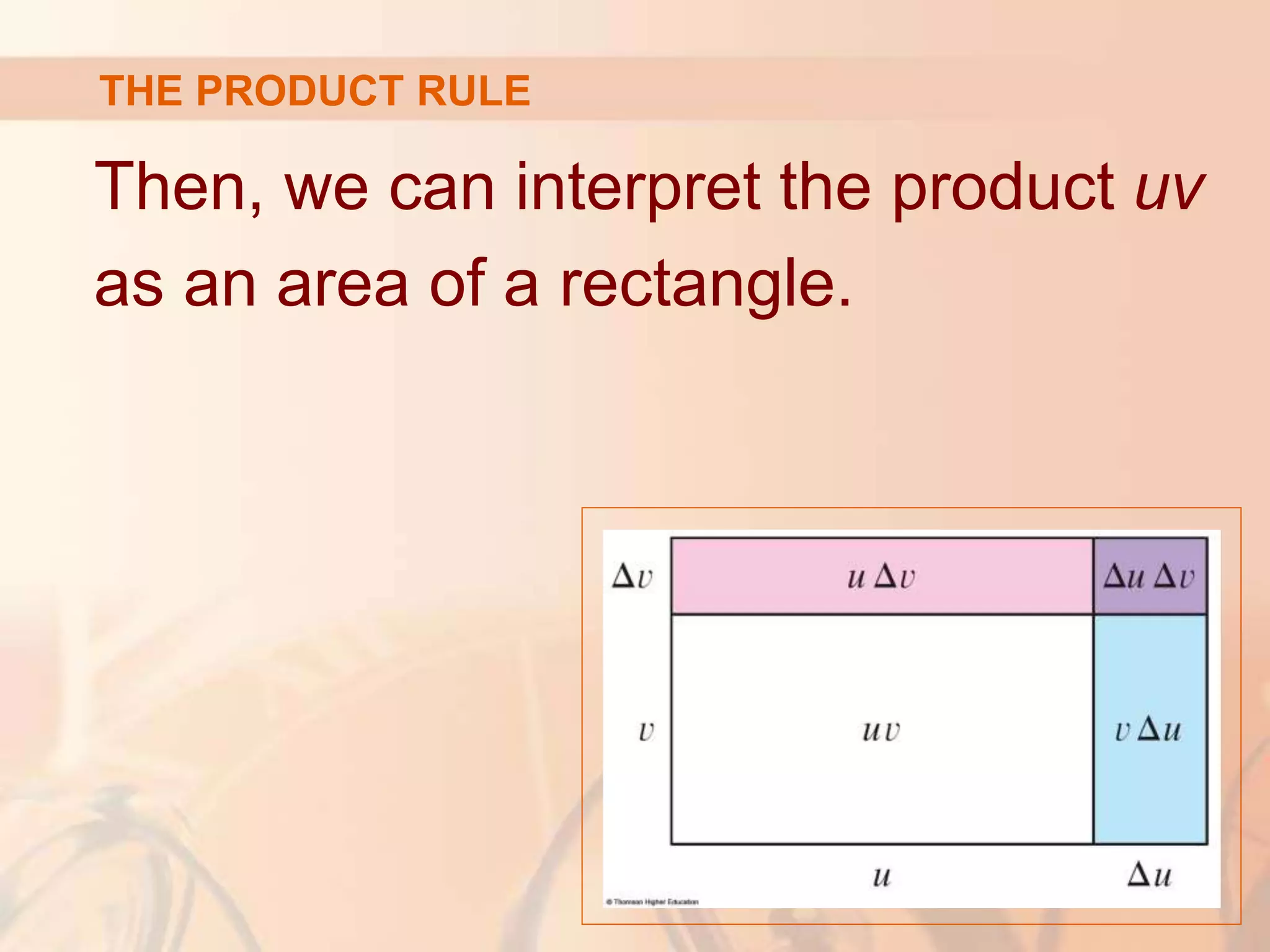
Then, we can interpret the product uv
as an area of a rectangle.
THE PRODUCT RULE
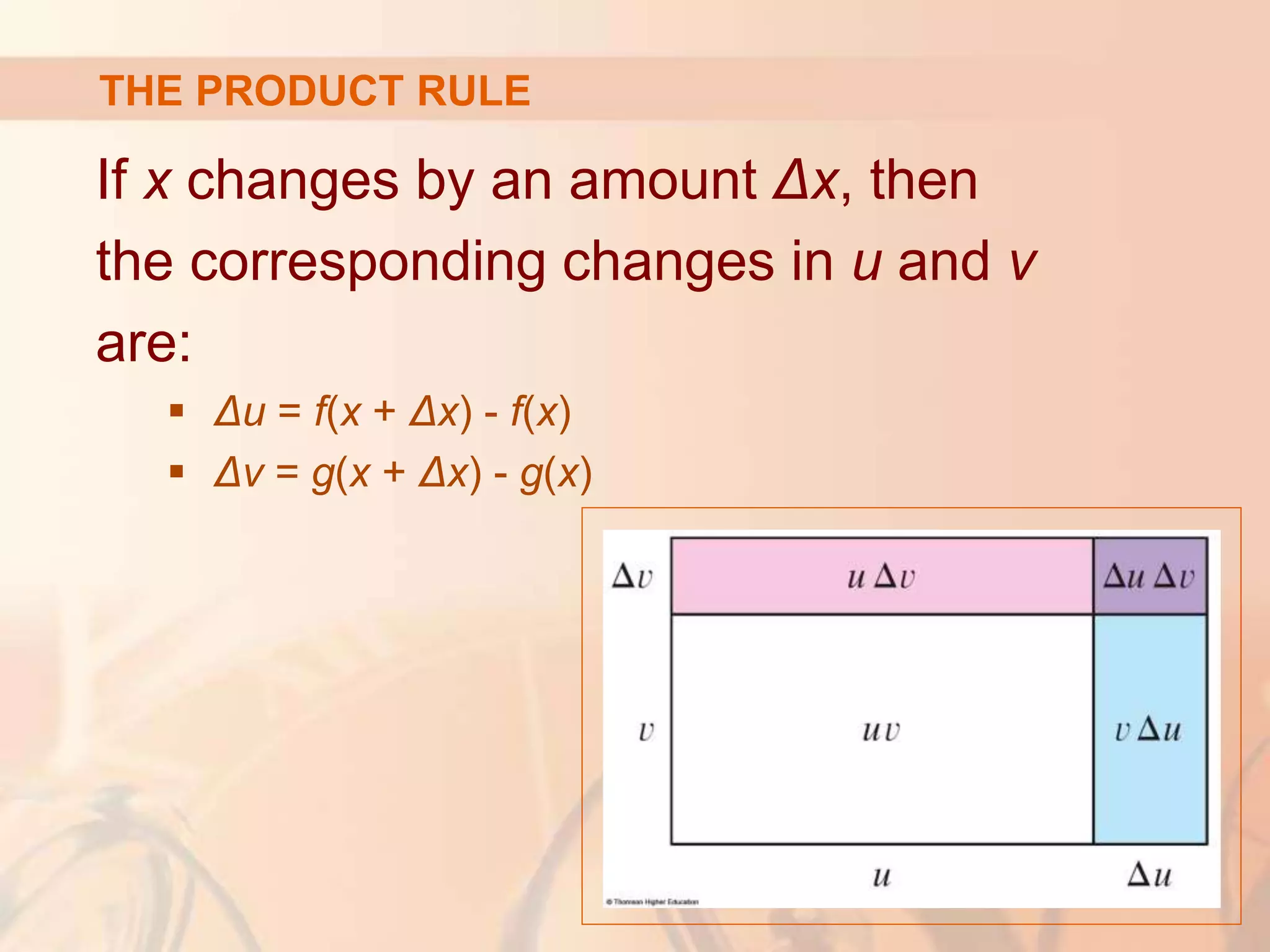
If x changes by an amount Δx, then
the corresponding changes in u and v
are:
 Δu = f(x + Δx) - f(x)
 Δv = g(x + Δx) - g(x)
THE PRODUCT RULE
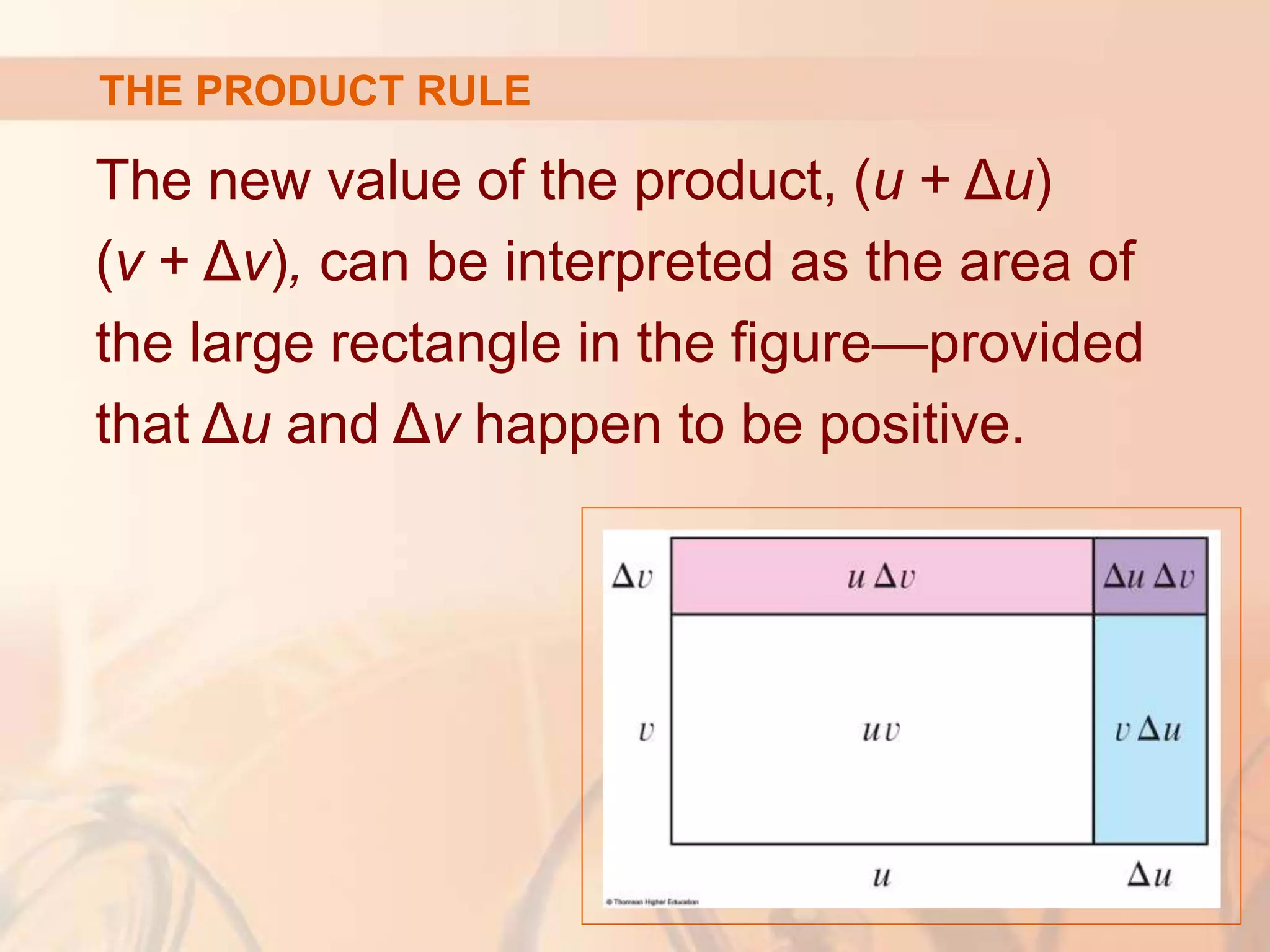
The new value of the product, (u + Δu)
(v + Δv), can be interpreted as the area of
the large rectangle in the figure—provided
that Δu and Δv happen to be positive.
THE PRODUCT RULE
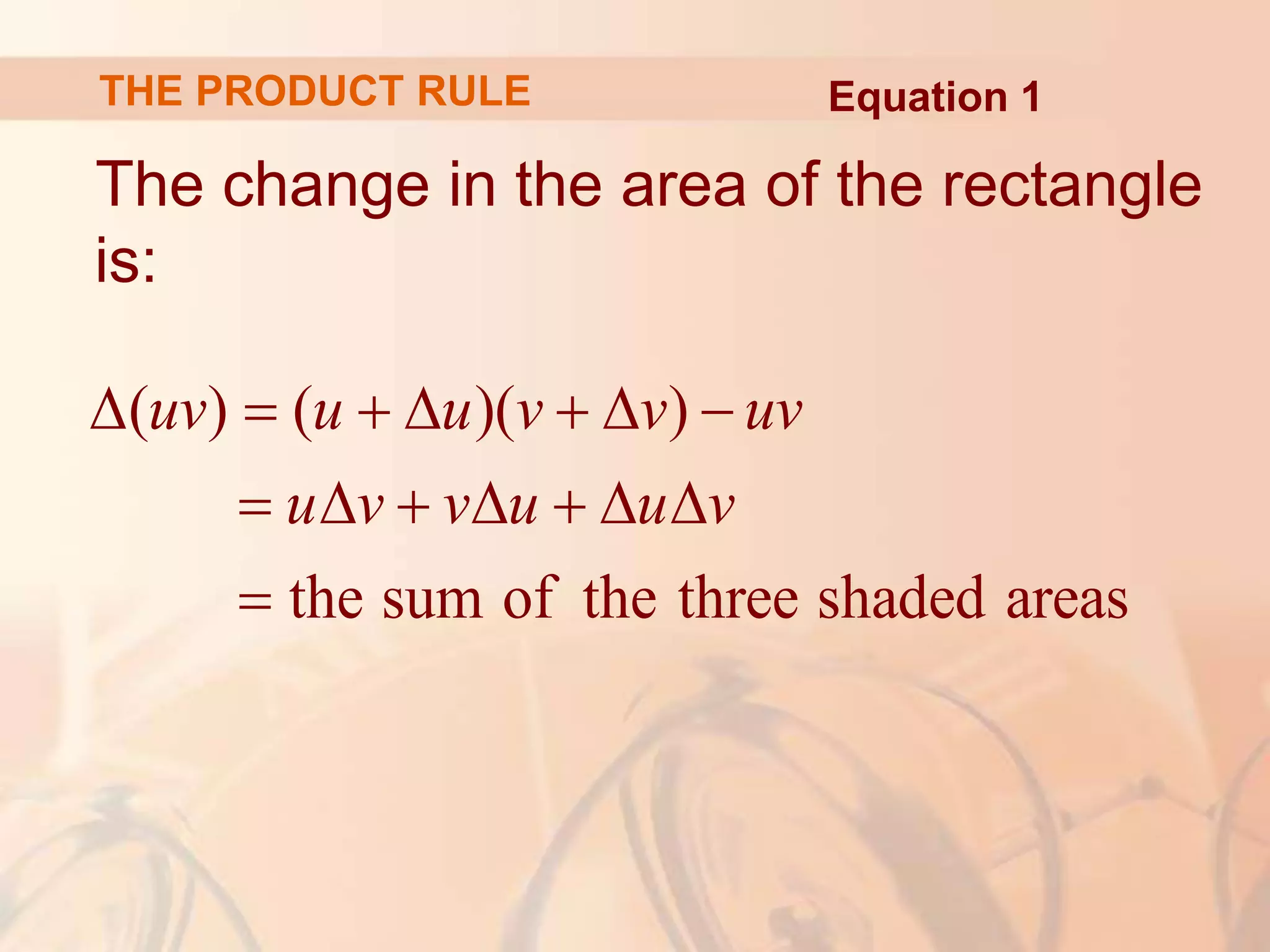
The change in the area of the rectangle
is:
( ) ( )( )
the sum of the three shaded areas
uv u u v v uv
u v v u u v
      
      

THE PRODUCT RULE Equation 1
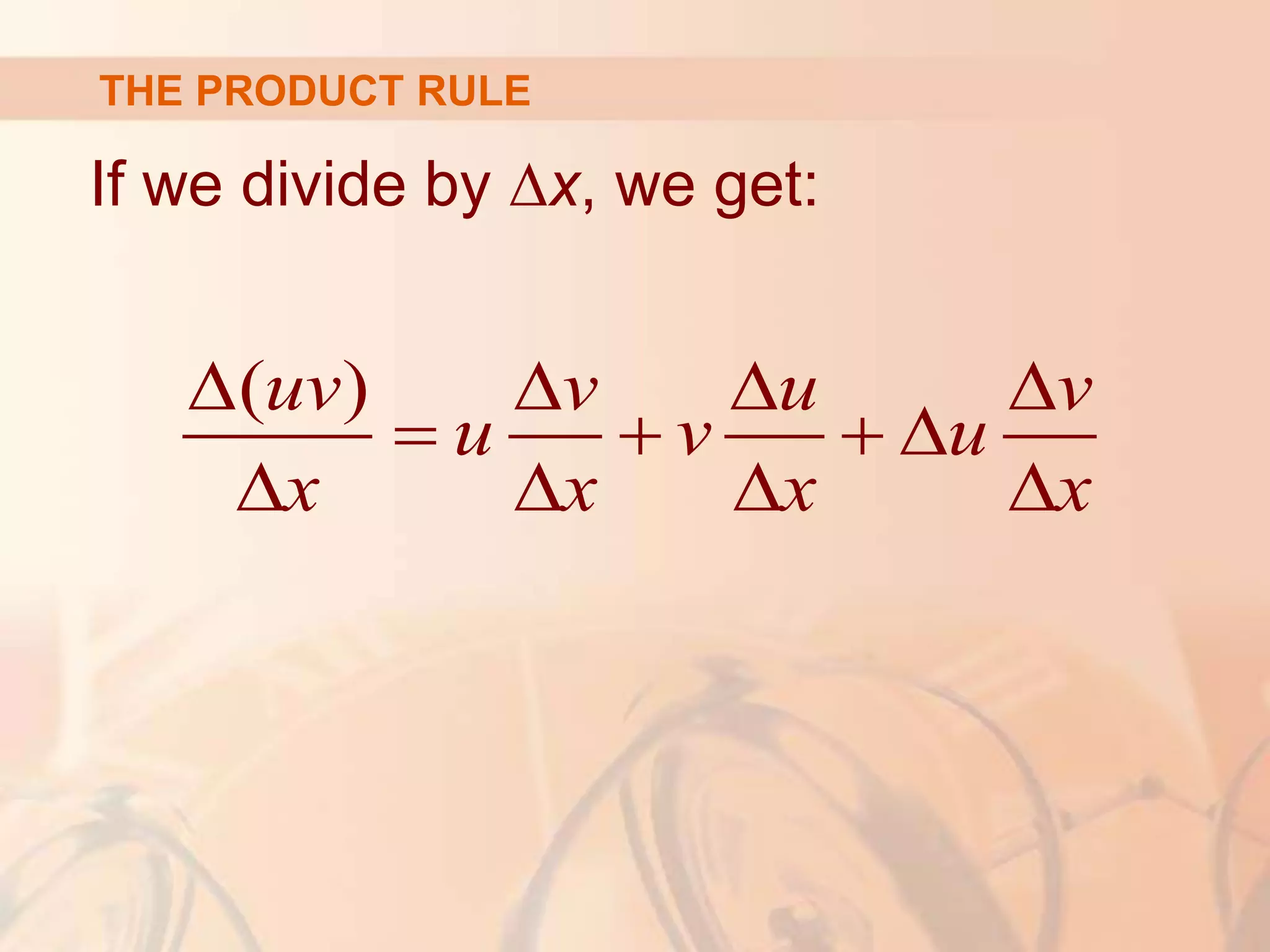
If we divide by ∆x, we get:
( )
uv v u v
u v u
x x x x
   
   
   
THE PRODUCT RULE
If we let ∆x → 0, we get the derivative of uv:
 
0
0
0 0 0 0
( )
( ) lim
lim
lim lim lim lim
0.
x
x
x x x x
d uv
uv
dx x
v u v
u v u
x x x
v u v
u v u
x x x
dv du dv
u v
dx dx dx
 
 
       



  
 
   
 
  
 
  
 
     
  
 
  
THE PRODUCT RULE
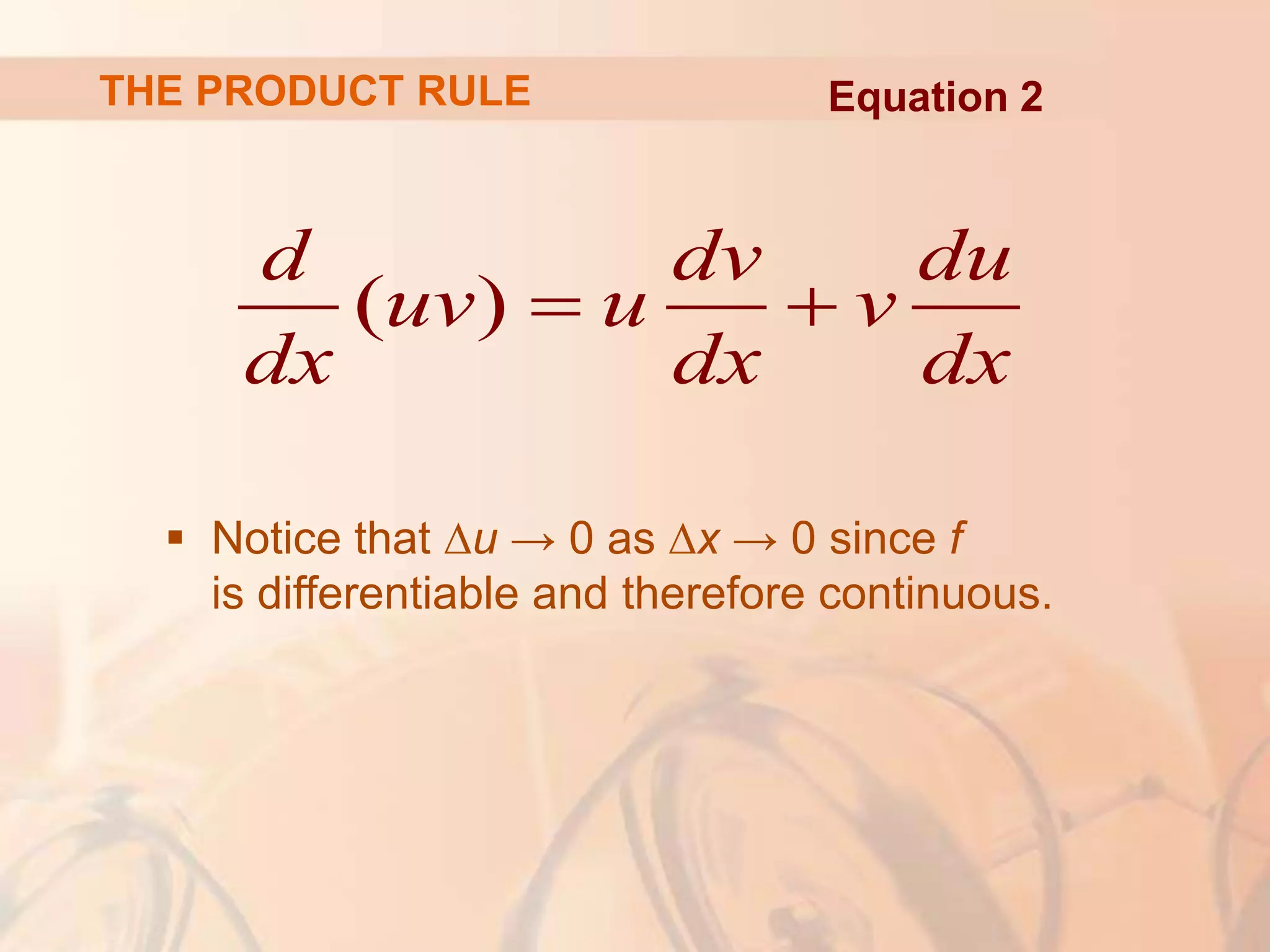
 Notice that ∆u → 0 as ∆x → 0 since f
is differentiable and therefore continuous.
( )
d dv du
uv u v
dx dx dx
 
THE PRODUCT RULE Equation 2
Though we began by assuming (for the
geometric interpretation) that all quantities are
positive, we see Equation 1 is always true.
 The algebra is valid whether u, v, ∆u, and ∆v
are positive or negative.
 So, we have proved Equation 2—known as
the Product Rule—for all differentiable functions
u and v.
THE PRODUCT RULE
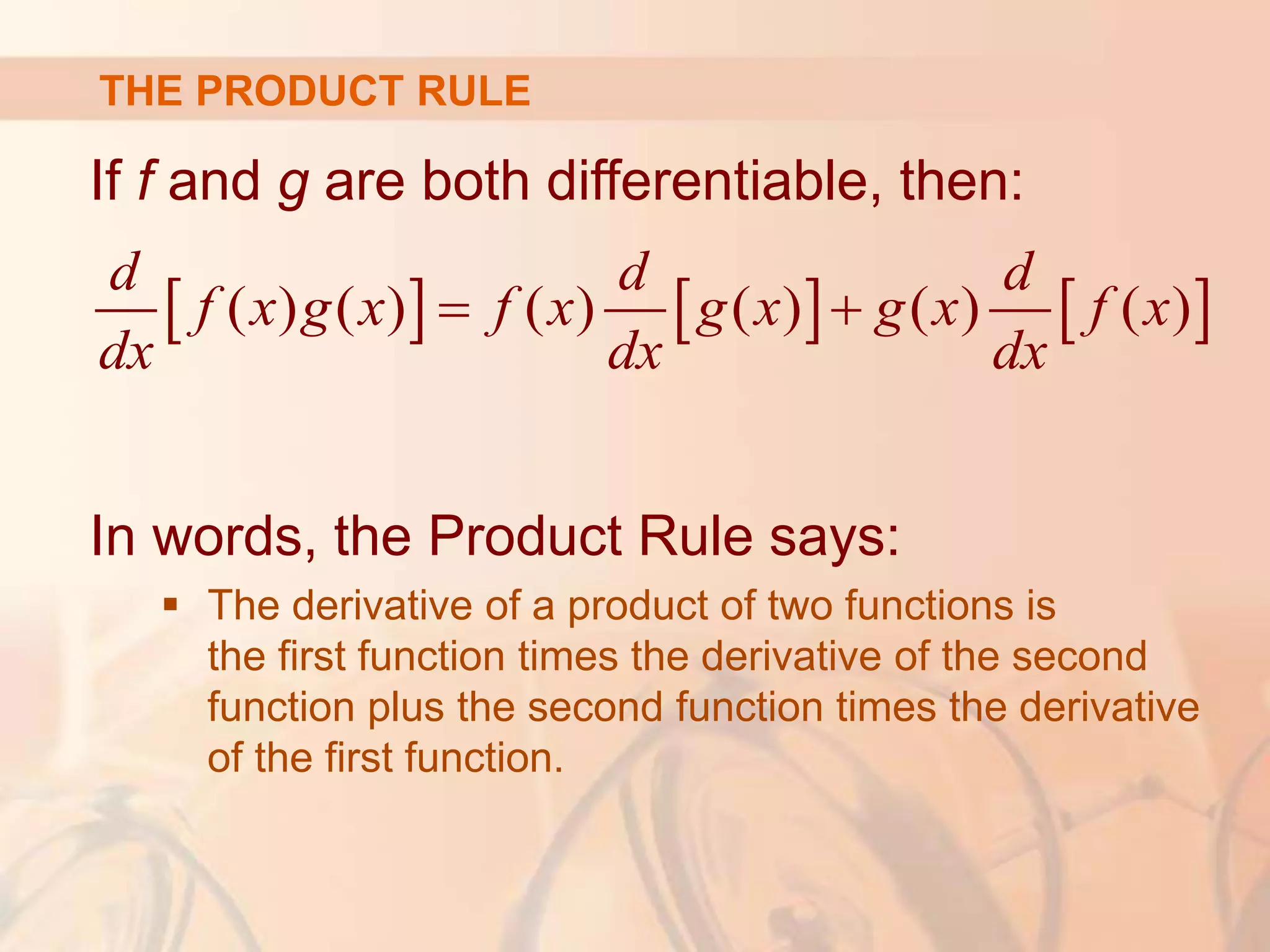
If f and g are both differentiable, then:
In words, the Product Rule says:
 The derivative of a product of two functions is
the first function times the derivative of the second
function plus the second function times the derivative
of the first function.
     
( ) ( ) ( ) ( ) ( ) ( )
d d d
f x g x f x g x g x f x
dx dx dx
 
THE PRODUCT RULE
a. If f(x) = xex, find f ’(x).
b. Find the nth derivative, f (n)(x)
THE PRODUCT RULE Example 1
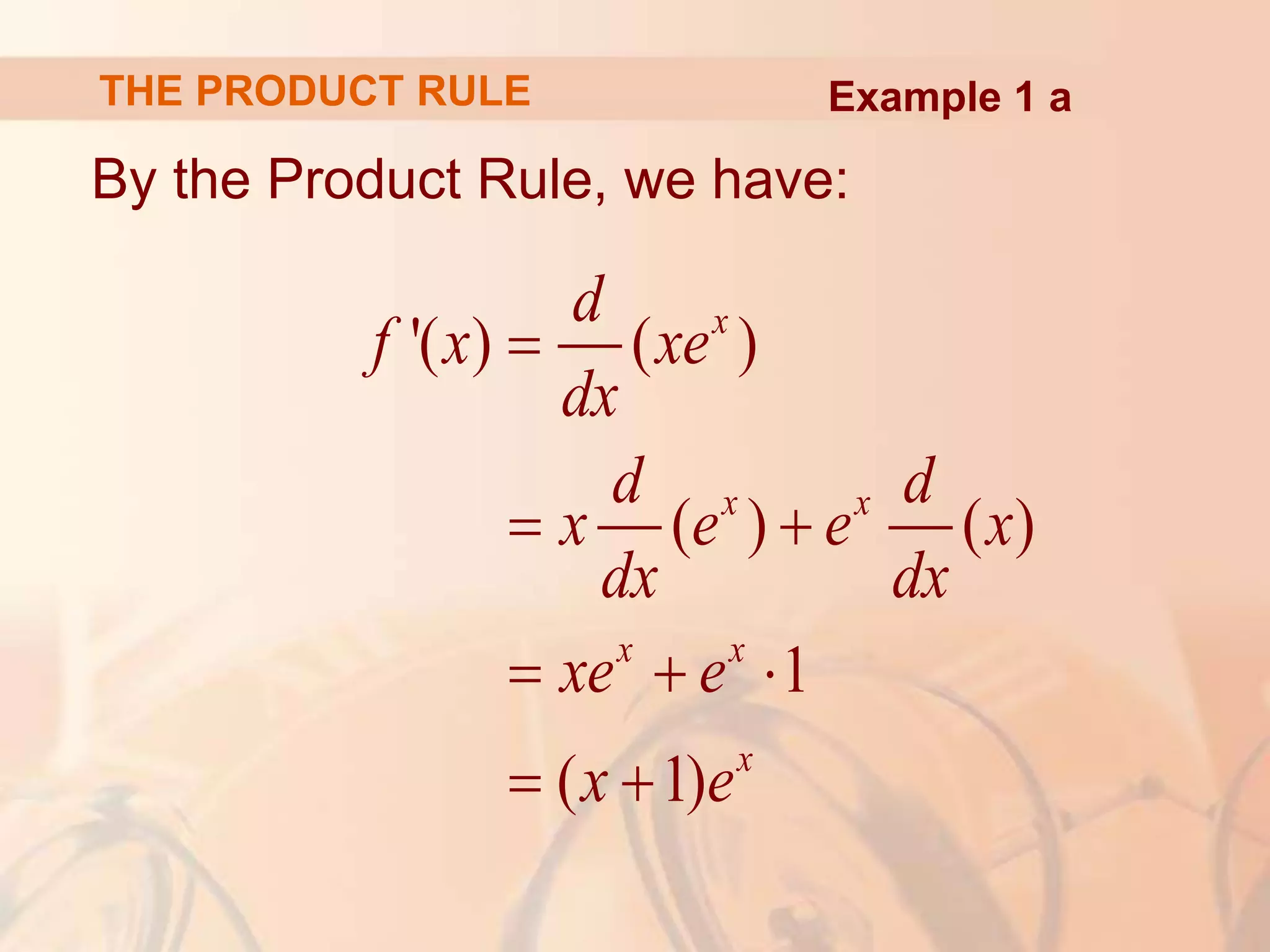
By the Product Rule, we have:
THE PRODUCT RULE Example 1 a
'( ) ( )
( ) ( )
1
( 1)
x
x x
x x
x
d
f x xe
dx
d d
x e e x
dx dx
xe e
x e

 
  
 
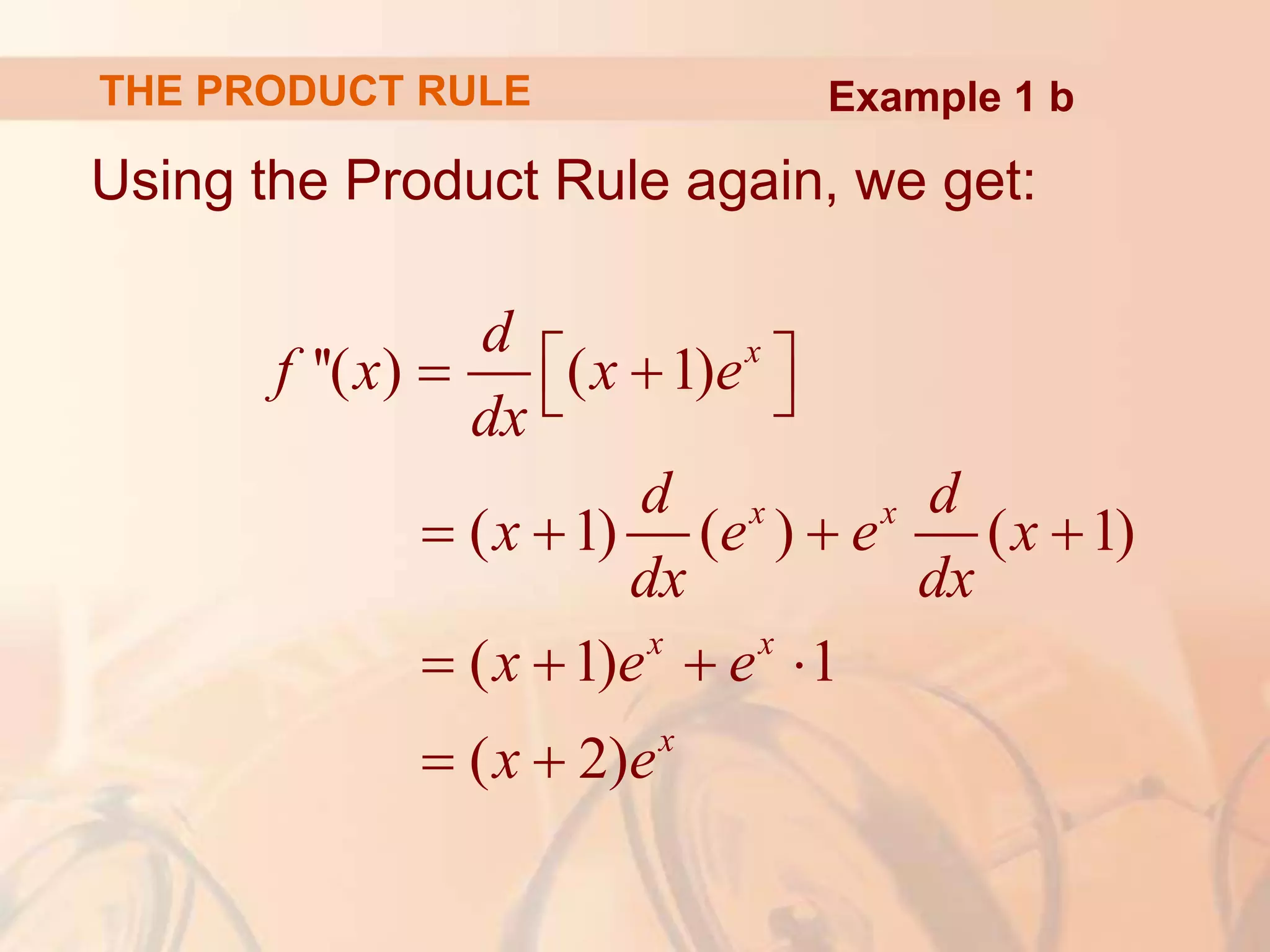
Using the Product Rule again, we get:
''( ) ( 1)
( 1) ( ) ( 1)
( 1) 1
( 2)
x
x x
x x
x
d
f x x e
dx
d d
x e e x
dx dx
x e e
x e
 
 
 
   
   
 
THE PRODUCT RULE Example 1 b
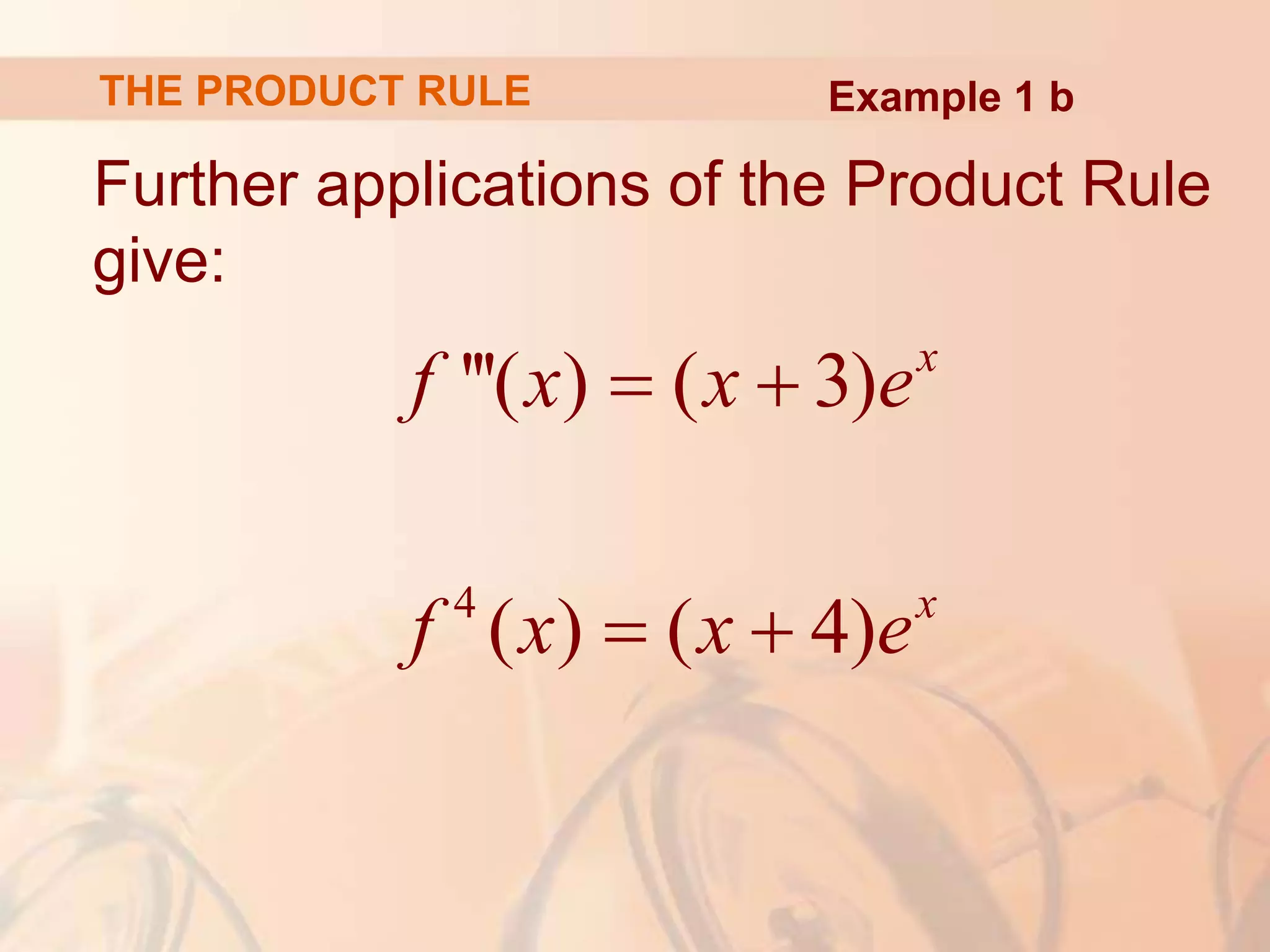
Further applications of the Product Rule
give:
4
'''( ) ( 3)
( ) ( 4)
x
x
f x x e
f x x e
 
 
THE PRODUCT RULE Example 1 b
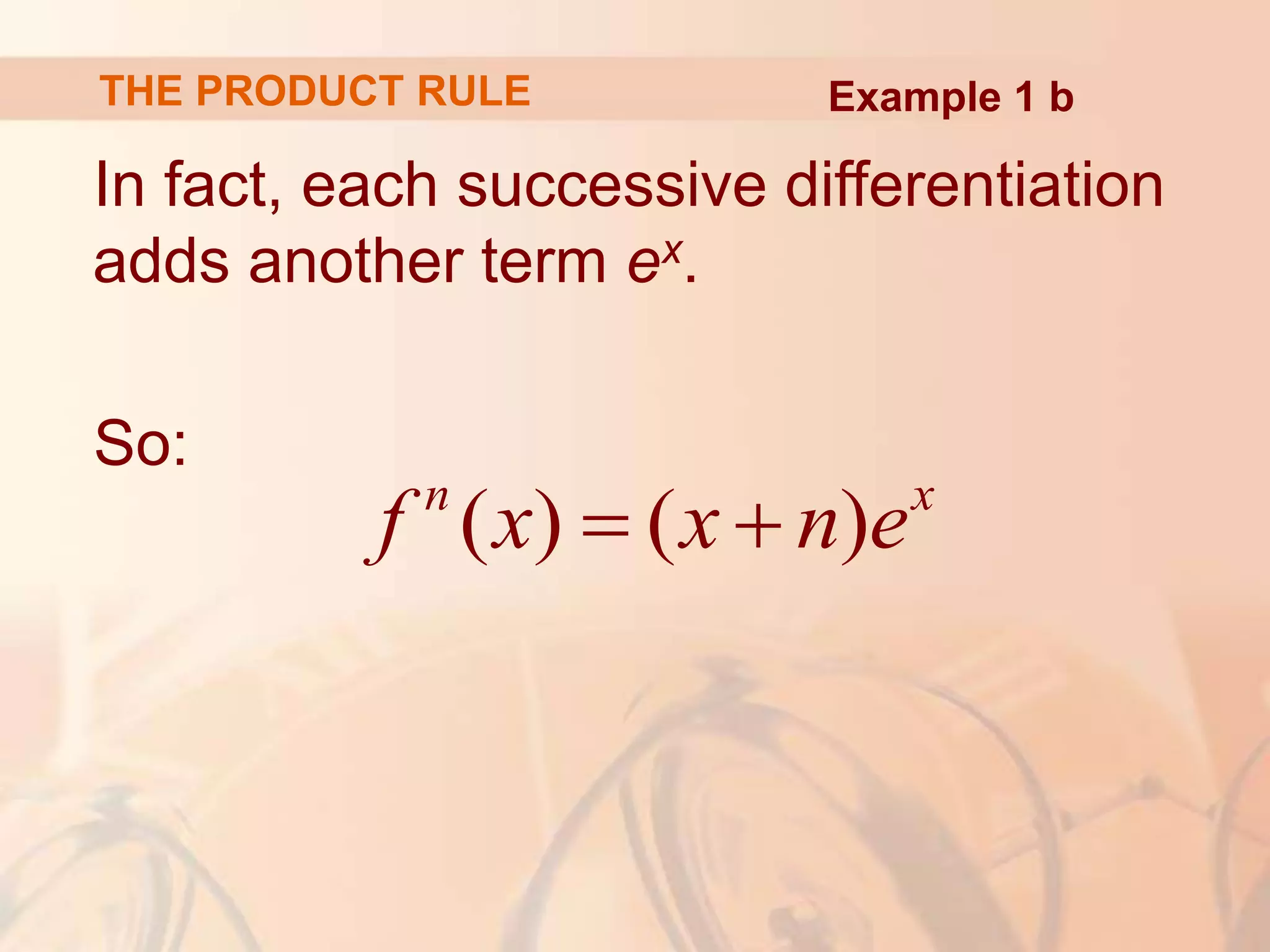
In fact, each successive differentiation
adds another term ex.
So:
( ) ( )
n x
f x x n e
 
THE PRODUCT RULE Example 1 b
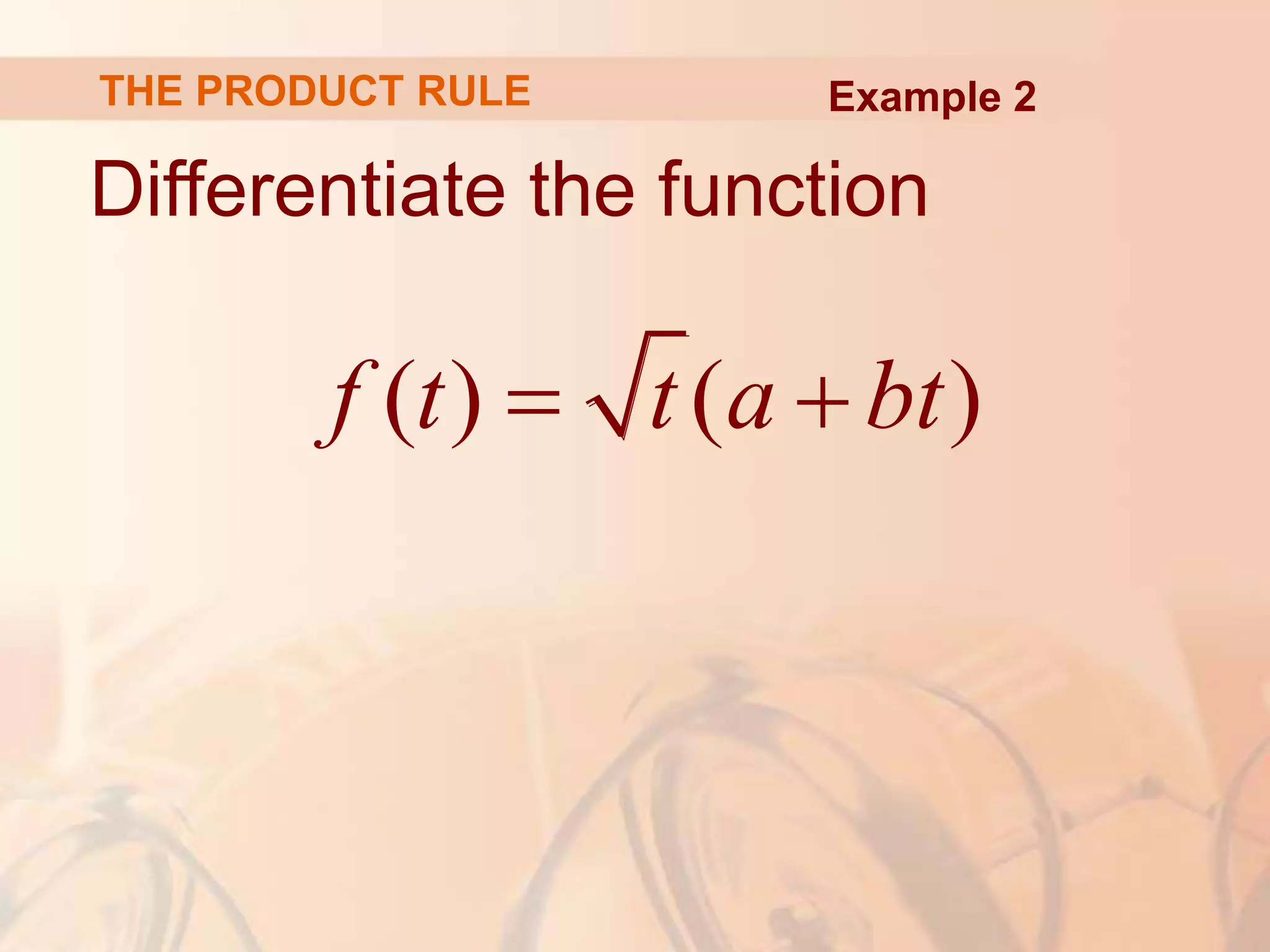
Differentiate the function
THE PRODUCT RULE Example 2
( ) ( )
f t t a bt
 
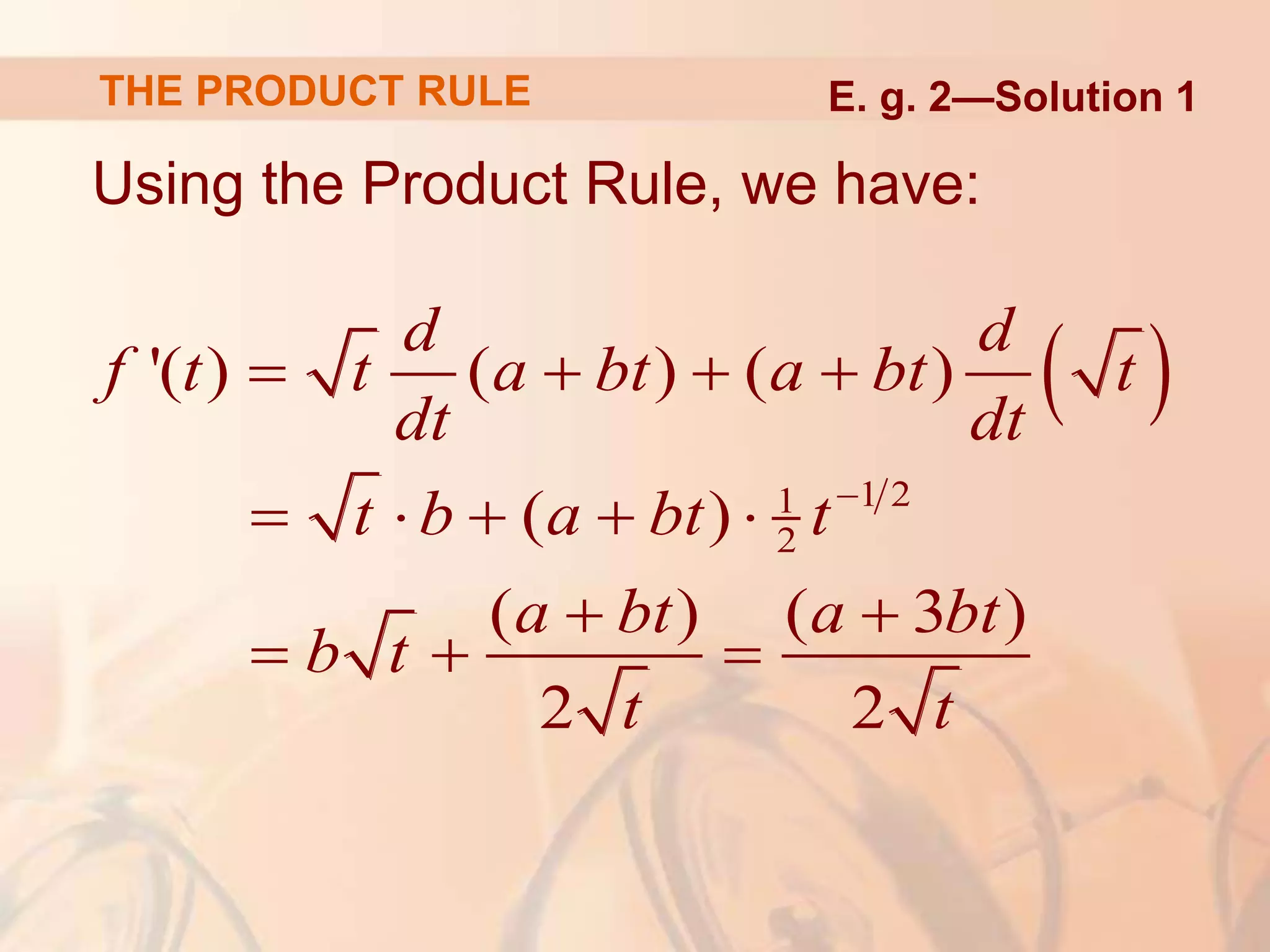
Using the Product Rule, we have:
THE PRODUCT RULE E. g. 2—Solution 1
 
1 2
1
2
'( ) ( ) ( )
( )
( ) ( 3 )
2 2
d d
f t t a bt a bt t
dt dt
t b a bt t
a bt a bt
b t
t t

   
    
 
  
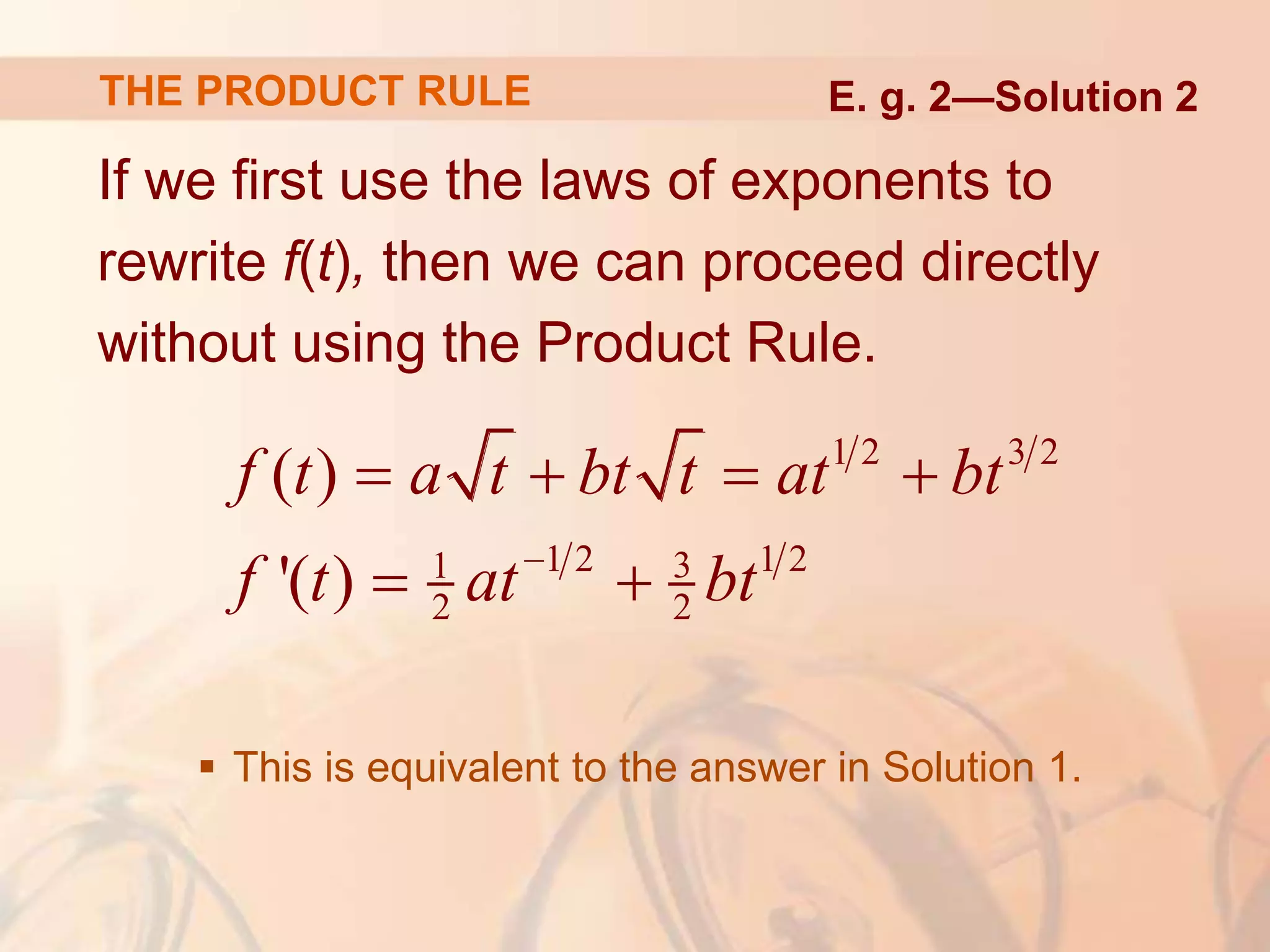
If we first use the laws of exponents to
rewrite f(t), then we can proceed directly
without using the Product Rule.
 This is equivalent to the answer in Solution 1.
1 2 3 2
1 2 1 2
3
1
2 2
( )
'( )
f t a t bt t at bt
f t at bt

   
 
THE PRODUCT RULE E. g. 2—Solution 2
Example 2 shows that it is sometimes easier
to simplify a product of functions than to use
the Product Rule.
In Example 1, however, the Product Rule is
the only possible method.
THE PRODUCT RULE
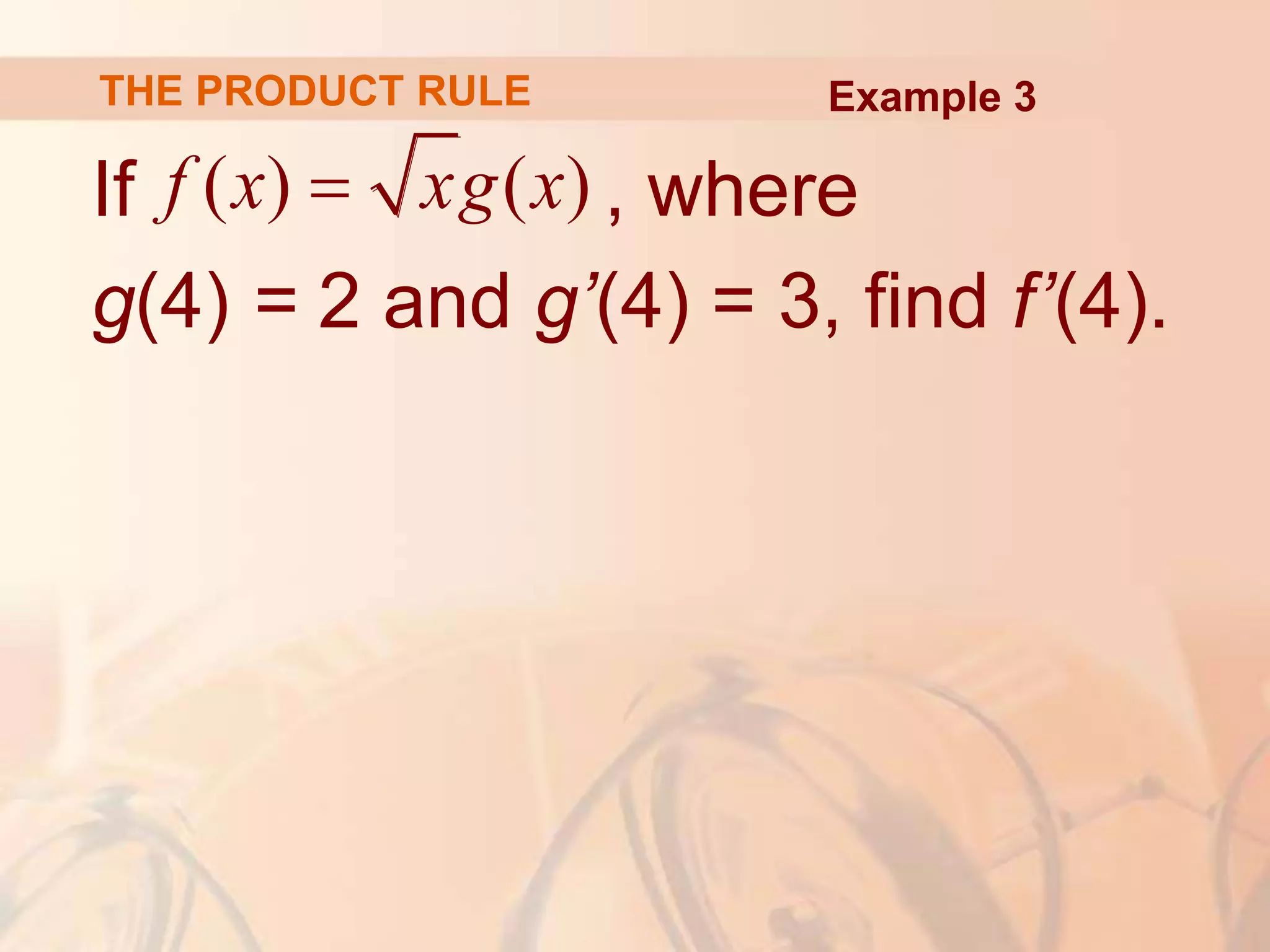
If , where
g(4) = 2 and g’(4) = 3, find f’(4).
THE PRODUCT RULE Example 3
( ) ( )
f x xg x

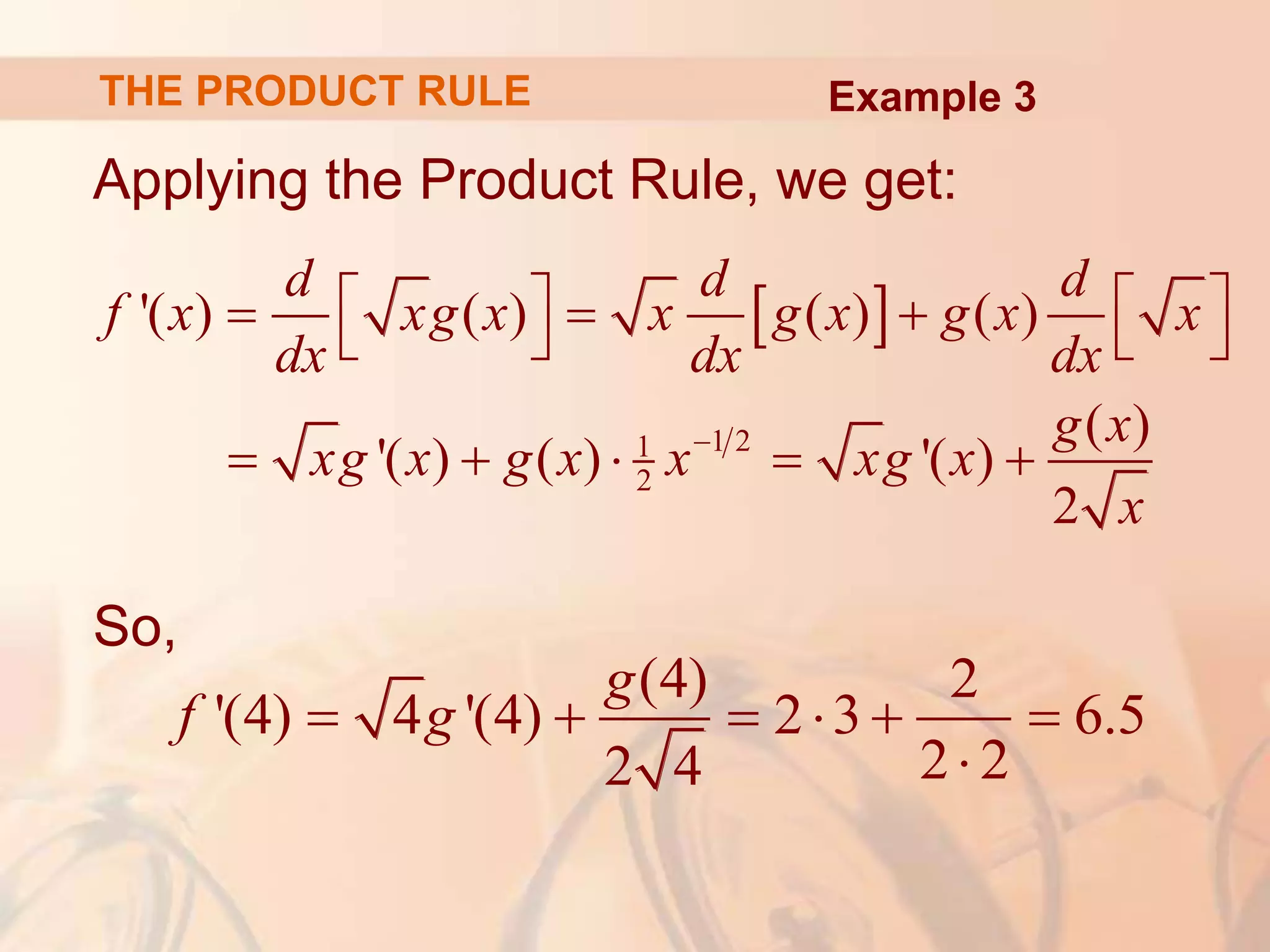
Applying the Product Rule, we get:
So,
THE PRODUCT RULE Example 3
 
1 2
1
2
'( ) ( ) ( ) ( )
( )
'( ) ( ) '( )
2
d d d
f x xg x x g x g x x
dx dx dx
g x
xg x g x x xg x
x

   
  
   
    
(4) 2
'(4) 4 '(4) 2 3 6.5
2 2
2 4
g
f g
     

We find a rule for differentiating the quotient
of two differentiable functions u = f(x) and
v = g(x) in much the same way that we found
the Product Rule.
THE QUOTIENT RULE
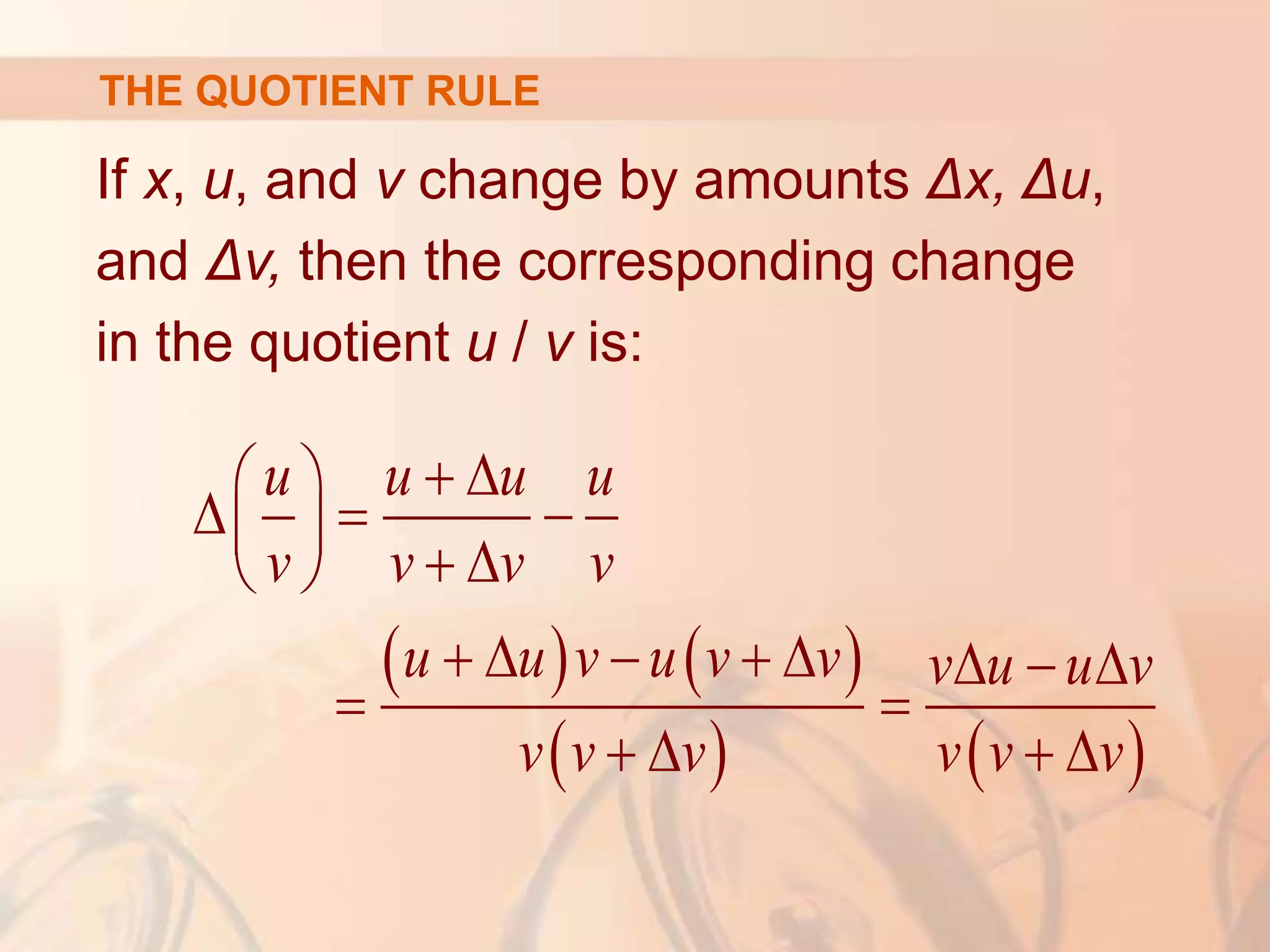
If x, u, and v change by amounts Δx, Δu,
and Δv, then the corresponding change
in the quotient u / v is:
   
   
u u u u
v v v v
u u v u v v v u u v
v v v v v v
 
 
  
 
 
 
       
 
   
THE QUOTIENT RULE
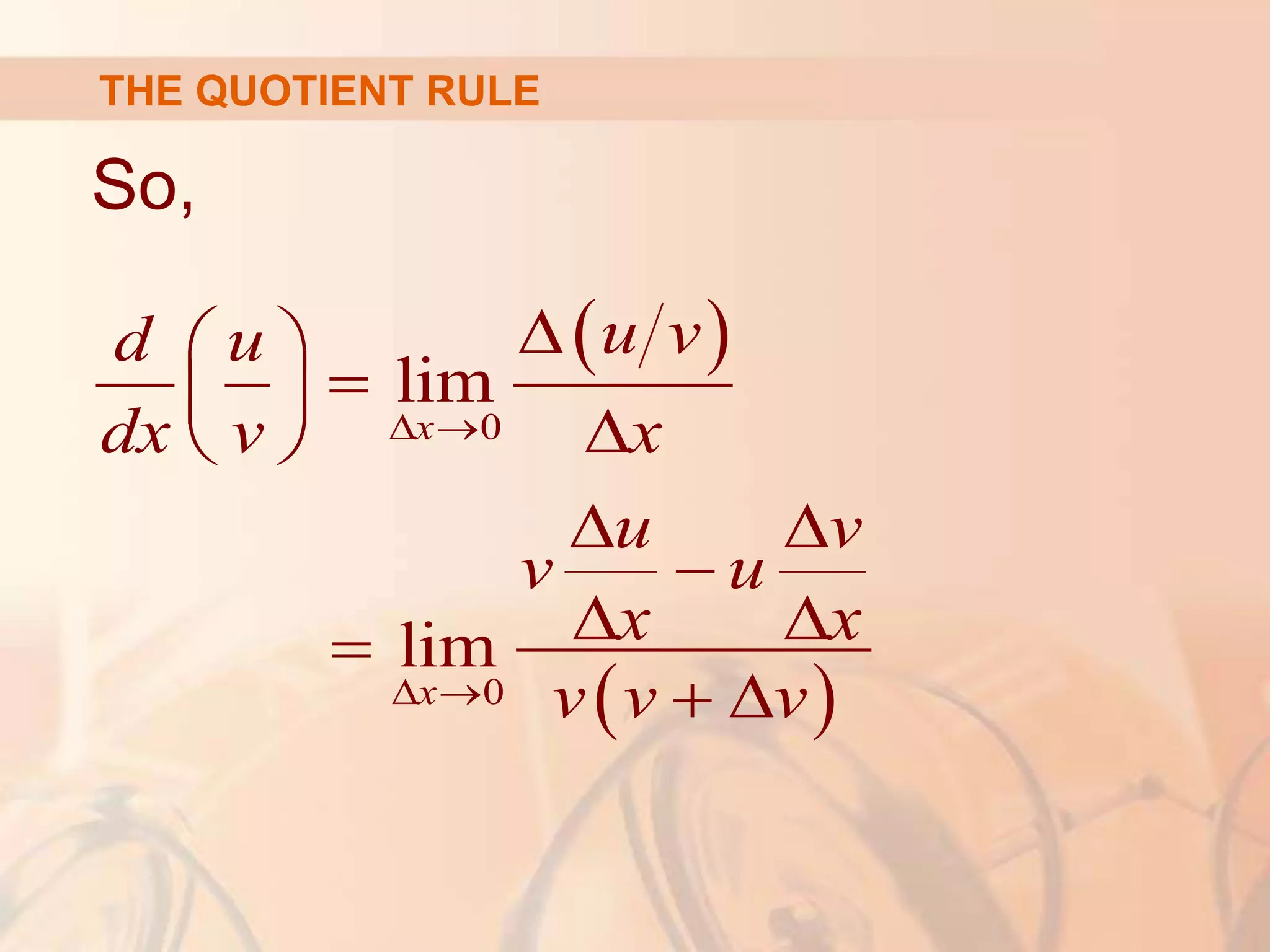
So,
 
 
0
0
lim
lim
x
x
u v
d u
dx v x
u v
v u
x x
v v v
 
 

 

 

 
 

 

 
THE QUOTIENT RULE
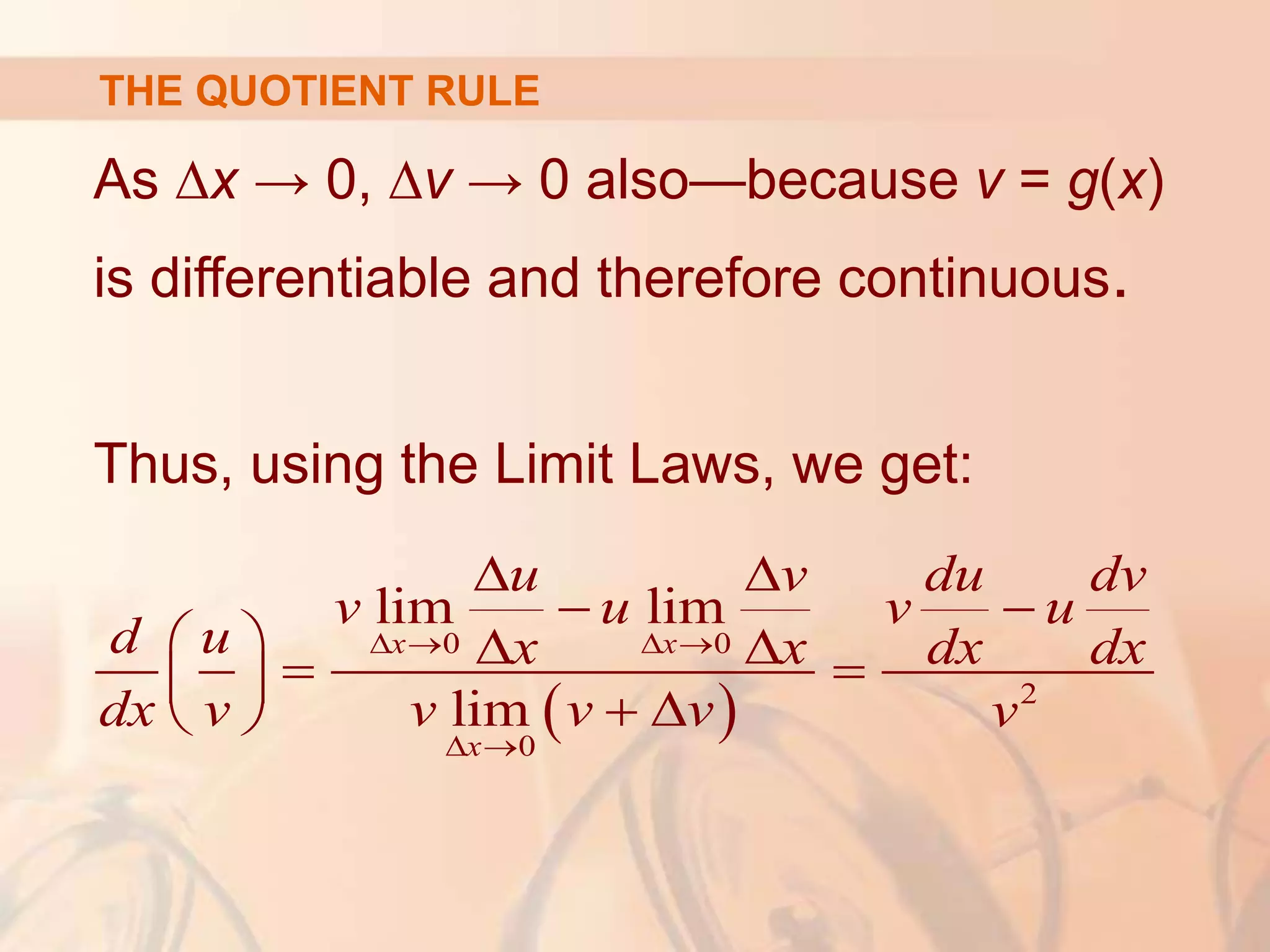
As ∆x → 0, ∆v → 0 also—because v = g(x)
is differentiable and therefore continuous.
Thus, using the Limit Laws, we get:
 
0 0
2
0
lim lim
lim
x x
x
u v du dv
v u v u
d u x x dx dx
dx v v v v v
   
 
 
 
   
 
 
 
 
THE QUOTIENT RULE
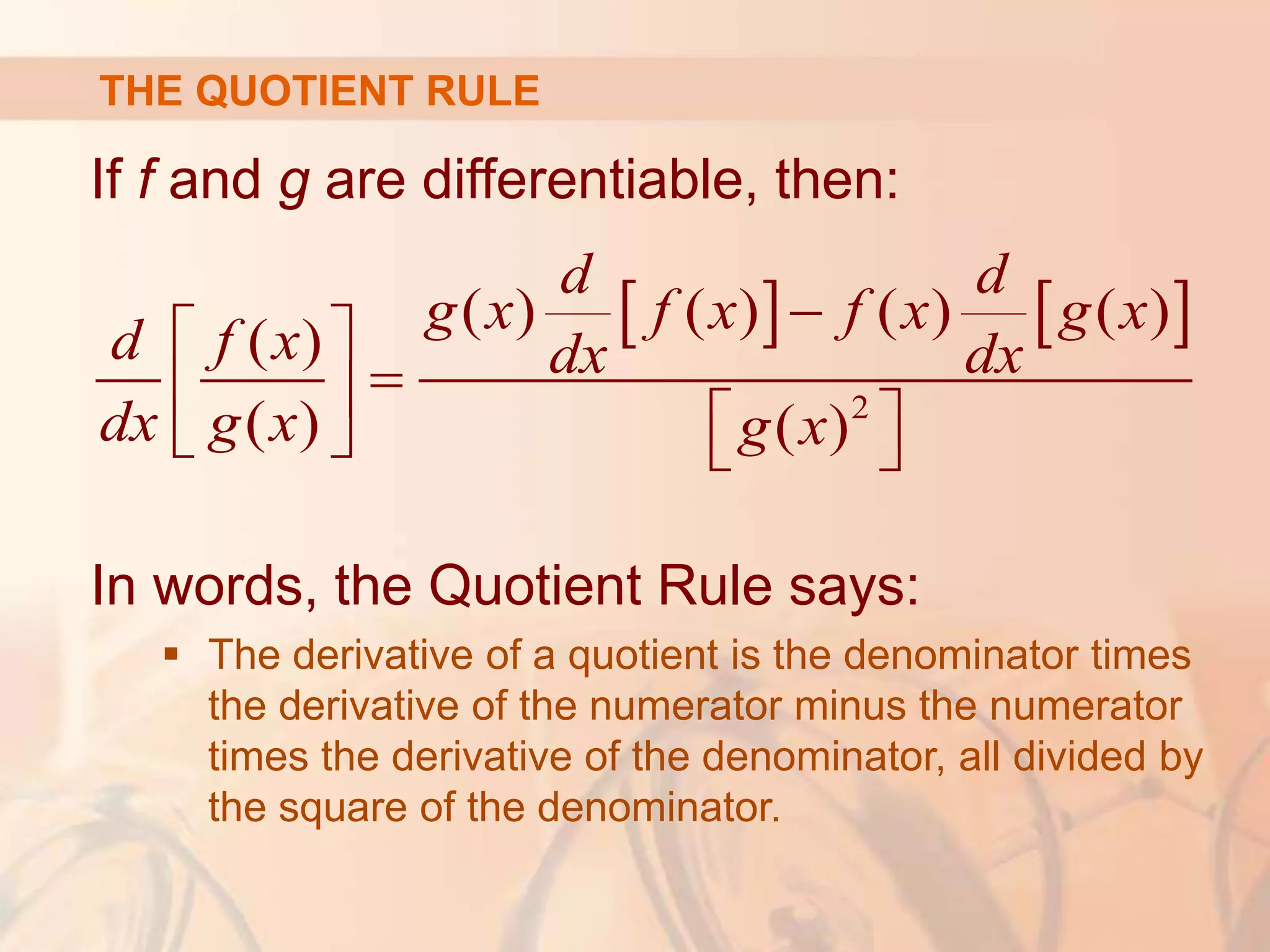
If f and g are differentiable, then:
In words, the Quotient Rule says:
 The derivative of a quotient is the denominator times
the derivative of the numerator minus the numerator
times the derivative of the denominator, all divided by
the square of the denominator.
   
2
( ) ( ) ( ) ( )
( )
( ) ( )
d d
g x f x f x g x
d f x dx dx
dx g x g x

 

   
   
THE QUOTIENT RULE
The Quotient Rule and the other
differentiation formulas enable us to
compute the derivative of any rational
function—as the next example illustrates.
THE QUOTIENT RULE
Let
2
3
2
6
x x
y
x
 


THE QUOTIENT RULE Example 4
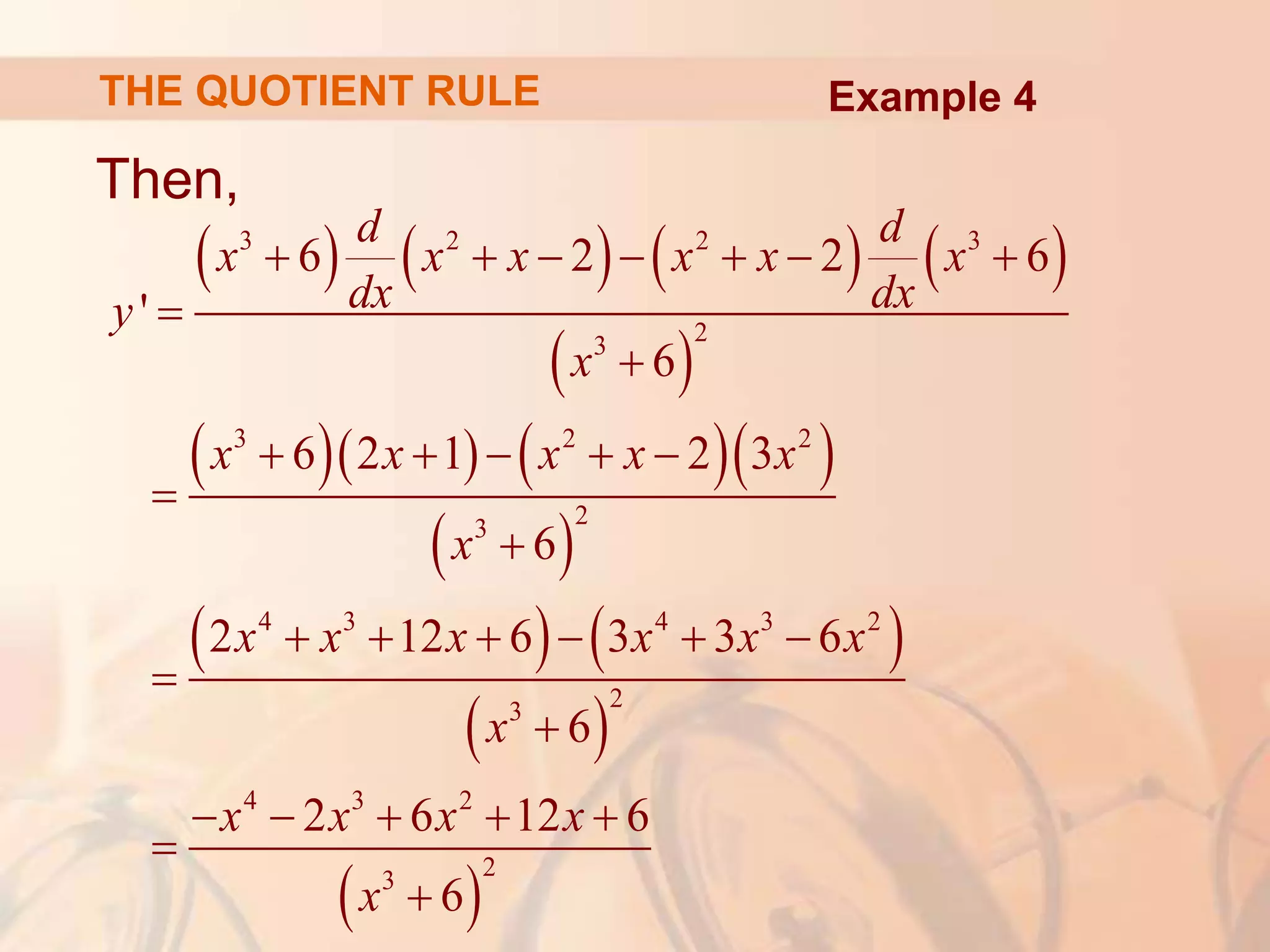
Then,
THE QUOTIENT RULE Example 4
       
 
     
 
   
 
 
3 2 2 3
2
3
3 2 2
2
3
4 3 4 3 2
2
3
4 3 2
2
3
6 2 2 6
'
6
6 2 1 2 3
6
2 12 6 3 3 6
6
2 6 12 6
6
d d
x x x x x x
dx dx
y
x
x x x x x
x
x x x x x x
x
x x x x
x
      


    


     


    


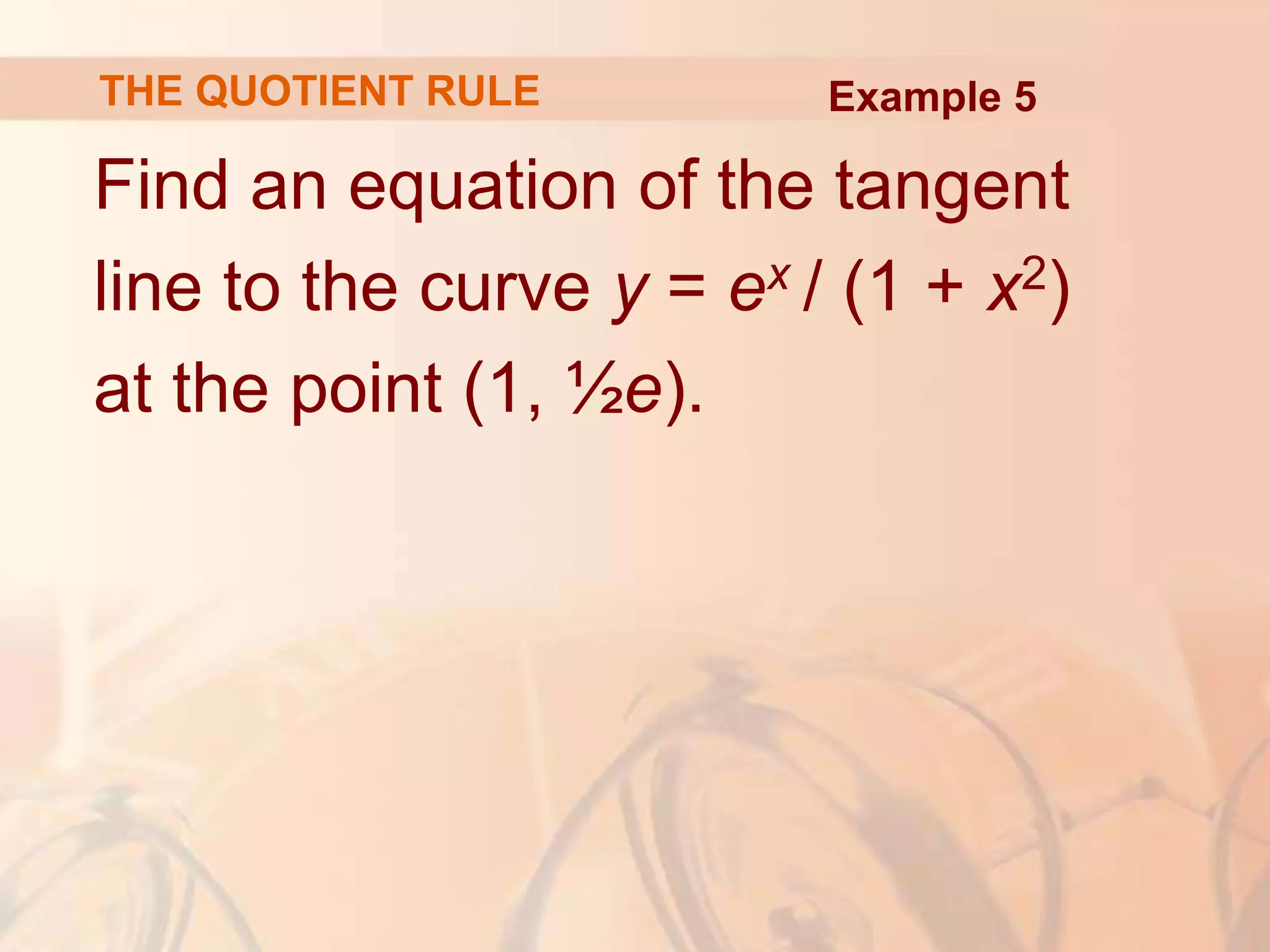
Find an equation of the tangent
line to the curve y = ex / (1 + x2)
at the point (1, ½e).
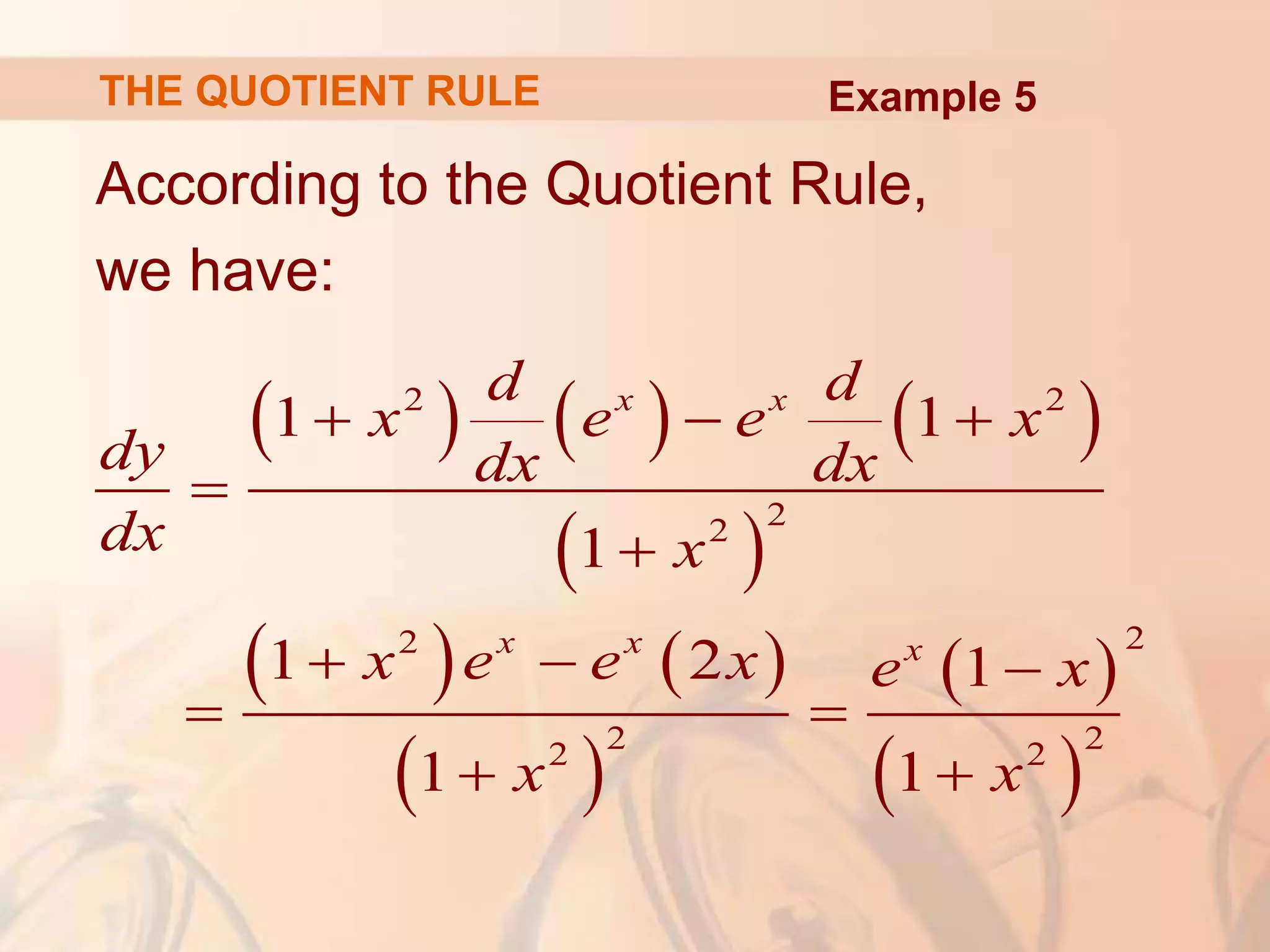
THE QUOTIENT RULE Example 5
According to the Quotient Rule,
we have:
THE QUOTIENT RULE Example 5
     
 
   
 
 
 
2 2
2
2
2
2
2 2
2 2
1 1
1
1 2 1
1 1
x x
x x x
d d
x e e x
dy dx dx
dx x
x e e x e x
x x
  


  
 
 
So, the slope of the tangent line at
(1, ½e) is:
 This means that the tangent line at (1, ½e)
is horizontal and its equation is y = ½e.
1
0
x
dy
dx 

THE QUOTIENT RULE Example 5
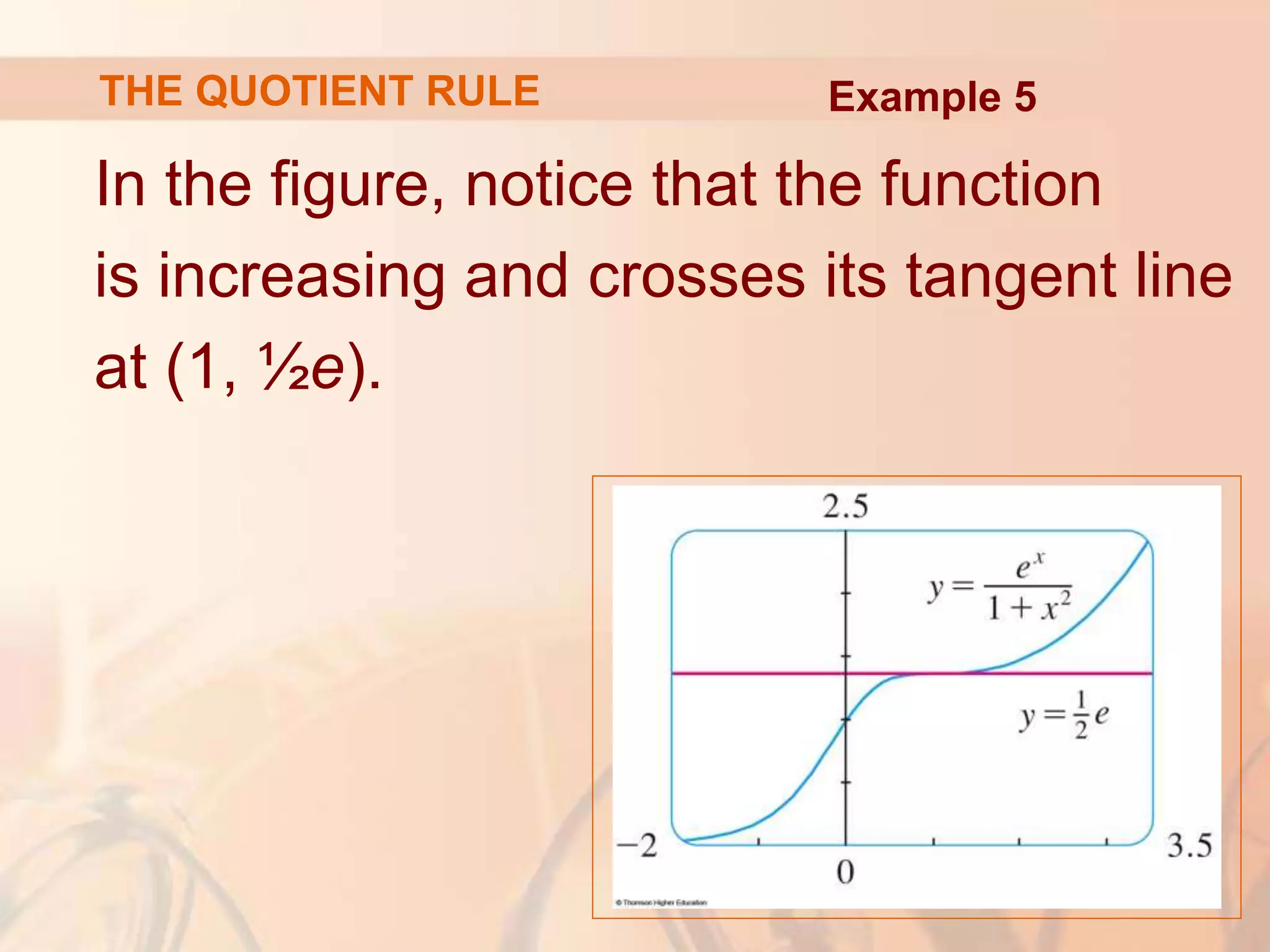
In the figure, notice that the function
is increasing and crosses its tangent line
at (1, ½e).
THE QUOTIENT RULE Example 5
Don’t use the Quotient Rule every
time you see a quotient.
 Sometimes, it’s easier to rewrite a quotient first
to put it in a form that is simpler for the purpose
of differentiation.
NOTE
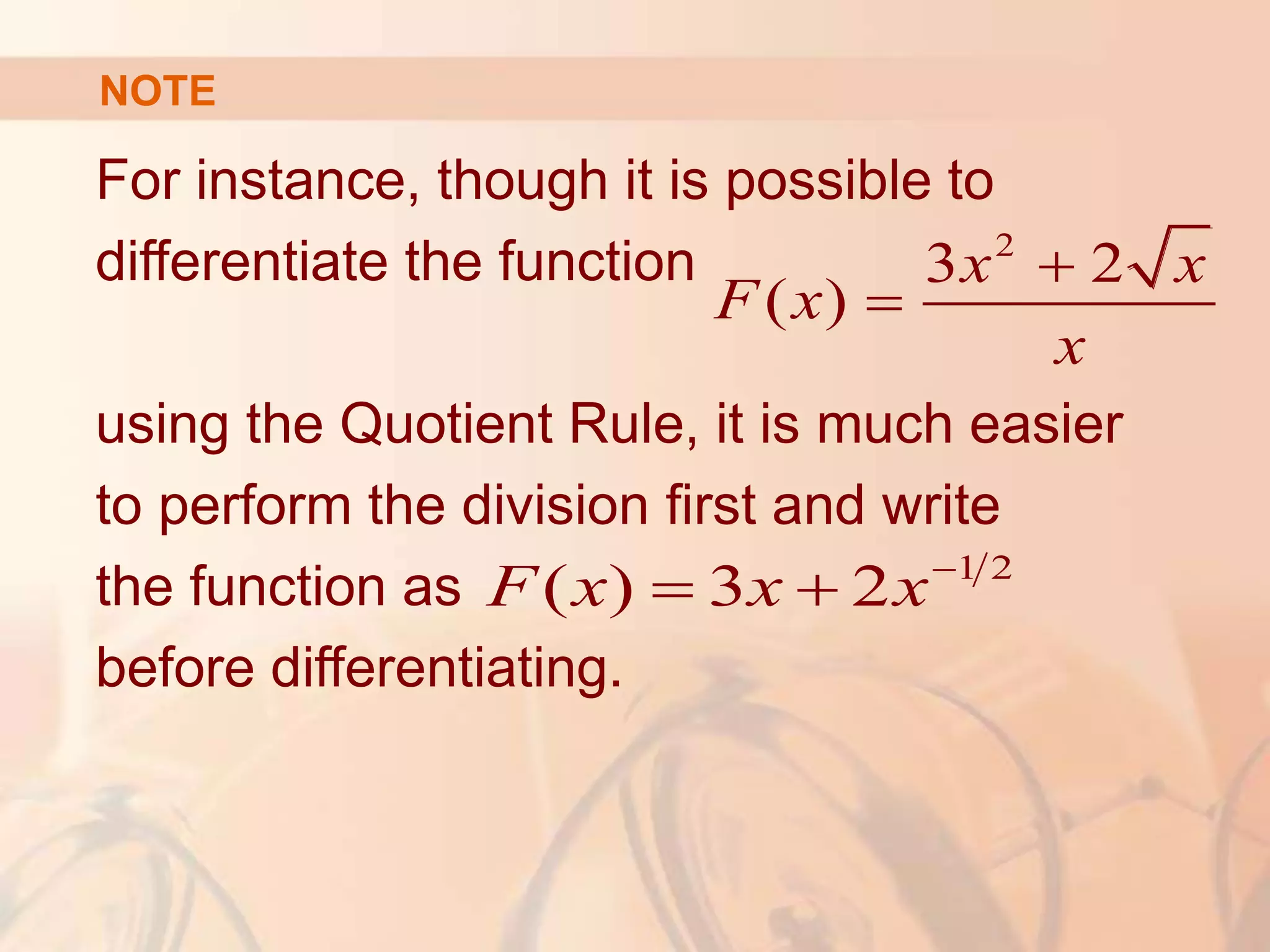
For instance, though it is possible to
differentiate the function
using the Quotient Rule, it is much easier
to perform the division first and write
the function as
before differentiating.
2
3 2
( )
x x
F x
x


1 2
( ) 3 2
F x x x
 
NOTE
Here’s a summary of the differentiation
formulas we have learned so far.
     
     
 
1
'
2
0
' ' ' ' ' ' ' '
' '
' ' '
n n x x
d d d
c x nx e e
dx dx dx
cf cf f g f g f g f g
f gf fg
fg fg gf
g g

  
      
  
  
 
 
DIFFERENTIATION FORMULAS

Lec5_Product & Quotient Rule.ppt

  • 1.
    The Product andQuotient RULES
  • 2.
    The Product and QuotientRules DIFFERENTIATION RULES In this section, we will learn about: Formulas that enable us to differentiate new functions formed from old functions by multiplication or division.
  • 3.
    By analogy withthe Sum and Difference Rules, one might be tempted to guess—as Leibniz did three centuries ago—that the derivative of a product is the product of the derivatives.  However, we can see that this guess is wrong by looking at a particular example. THE PRODUCT RULE
  • 4.
    Let f(x) =x and g(x) = x2.  Then, the Power Rule gives f’(x) = 1 and g’(x) = 2x.  However, (fg)(x) = x3.  So, (fg)’(x) =3 x2.  Thus, (fg)’ ≠ f’ g’. THE PRODUCT RULE
  • 5.
    The correct formulawas discovered by Leibniz (soon after his false start) and is called the Product Rule. THE PRODUCT RULE
  • 6.
    Before stating theProduct Rule, let’s see how we might discover it. We start by assuming that u = f(x) and v = g(x) are both positive differentiable functions. THE PRODUCT RULE
  • 7.
    Then, we caninterpret the product uv as an area of a rectangle. THE PRODUCT RULE
  • 8.
    If x changesby an amount Δx, then the corresponding changes in u and v are:  Δu = f(x + Δx) - f(x)  Δv = g(x + Δx) - g(x) THE PRODUCT RULE
  • 9.
    The new valueof the product, (u + Δu) (v + Δv), can be interpreted as the area of the large rectangle in the figure—provided that Δu and Δv happen to be positive. THE PRODUCT RULE
  • 10.
    The change inthe area of the rectangle is: ( ) ( )( ) the sum of the three shaded areas uv u u v v uv u v v u u v                THE PRODUCT RULE Equation 1
  • 11.
    If we divideby ∆x, we get: ( ) uv v u v u v u x x x x             THE PRODUCT RULE
  • 12.
    If we let∆x → 0, we get the derivative of uv:   0 0 0 0 0 0 ( ) ( ) lim lim lim lim lim lim 0. x x x x x x d uv uv dx x v u v u v u x x x v u v u v u x x x dv du dv u v dx dx dx                                                   THE PRODUCT RULE
  • 13.
     Notice that∆u → 0 as ∆x → 0 since f is differentiable and therefore continuous. ( ) d dv du uv u v dx dx dx   THE PRODUCT RULE Equation 2
  • 14.
    Though we beganby assuming (for the geometric interpretation) that all quantities are positive, we see Equation 1 is always true.  The algebra is valid whether u, v, ∆u, and ∆v are positive or negative.  So, we have proved Equation 2—known as the Product Rule—for all differentiable functions u and v. THE PRODUCT RULE
  • 15.
    If f andg are both differentiable, then: In words, the Product Rule says:  The derivative of a product of two functions is the first function times the derivative of the second function plus the second function times the derivative of the first function.       ( ) ( ) ( ) ( ) ( ) ( ) d d d f x g x f x g x g x f x dx dx dx   THE PRODUCT RULE
  • 16.
    a. If f(x)= xex, find f ’(x). b. Find the nth derivative, f (n)(x) THE PRODUCT RULE Example 1
  • 17.
    By the ProductRule, we have: THE PRODUCT RULE Example 1 a '( ) ( ) ( ) ( ) 1 ( 1) x x x x x x d f x xe dx d d x e e x dx dx xe e x e        
  • 18.
    Using the ProductRule again, we get: ''( ) ( 1) ( 1) ( ) ( 1) ( 1) 1 ( 2) x x x x x x d f x x e dx d d x e e x dx dx x e e x e                 THE PRODUCT RULE Example 1 b
  • 19.
    Further applications ofthe Product Rule give: 4 '''( ) ( 3) ( ) ( 4) x x f x x e f x x e     THE PRODUCT RULE Example 1 b
  • 20.
    In fact, eachsuccessive differentiation adds another term ex. So: ( ) ( ) n x f x x n e   THE PRODUCT RULE Example 1 b
  • 21.
    Differentiate the function THEPRODUCT RULE Example 2 ( ) ( ) f t t a bt  
  • 22.
    Using the ProductRule, we have: THE PRODUCT RULE E. g. 2—Solution 1   1 2 1 2 '( ) ( ) ( ) ( ) ( ) ( 3 ) 2 2 d d f t t a bt a bt t dt dt t b a bt t a bt a bt b t t t               
  • 23.
    If we firstuse the laws of exponents to rewrite f(t), then we can proceed directly without using the Product Rule.  This is equivalent to the answer in Solution 1. 1 2 3 2 1 2 1 2 3 1 2 2 ( ) '( ) f t a t bt t at bt f t at bt        THE PRODUCT RULE E. g. 2—Solution 2
  • 24.
    Example 2 showsthat it is sometimes easier to simplify a product of functions than to use the Product Rule. In Example 1, however, the Product Rule is the only possible method. THE PRODUCT RULE
  • 25.
    If , where g(4)= 2 and g’(4) = 3, find f’(4). THE PRODUCT RULE Example 3 ( ) ( ) f x xg x 
  • 26.
    Applying the ProductRule, we get: So, THE PRODUCT RULE Example 3   1 2 1 2 '( ) ( ) ( ) ( ) ( ) '( ) ( ) '( ) 2 d d d f x xg x x g x g x x dx dx dx g x xg x g x x xg x x                  (4) 2 '(4) 4 '(4) 2 3 6.5 2 2 2 4 g f g       
  • 27.
    We find arule for differentiating the quotient of two differentiable functions u = f(x) and v = g(x) in much the same way that we found the Product Rule. THE QUOTIENT RULE
  • 28.
    If x, u,and v change by amounts Δx, Δu, and Δv, then the corresponding change in the quotient u / v is:         u u u u v v v v u u v u v v v u u v v v v v v v                            THE QUOTIENT RULE
  • 29.
    So,     0 0 lim lim x x uv d u dx v x u v v u x x v v v                      THE QUOTIENT RULE
  • 30.
    As ∆x →0, ∆v → 0 also—because v = g(x) is differentiable and therefore continuous. Thus, using the Limit Laws, we get:   0 0 2 0 lim lim lim x x x u v du dv v u v u d u x x dx dx dx v v v v v                       THE QUOTIENT RULE
  • 31.
    If f andg are differentiable, then: In words, the Quotient Rule says:  The derivative of a quotient is the denominator times the derivative of the numerator minus the numerator times the derivative of the denominator, all divided by the square of the denominator.     2 ( ) ( ) ( ) ( ) ( ) ( ) ( ) d d g x f x f x g x d f x dx dx dx g x g x             THE QUOTIENT RULE
  • 32.
    The Quotient Ruleand the other differentiation formulas enable us to compute the derivative of any rational function—as the next example illustrates. THE QUOTIENT RULE
  • 33.
  • 34.
    Then, THE QUOTIENT RULEExample 4                           3 2 2 3 2 3 3 2 2 2 3 4 3 4 3 2 2 3 4 3 2 2 3 6 2 2 6 ' 6 6 2 1 2 3 6 2 12 6 3 3 6 6 2 6 12 6 6 d d x x x x x x dx dx y x x x x x x x x x x x x x x x x x x x                               
  • 35.
    Find an equationof the tangent line to the curve y = ex / (1 + x2) at the point (1, ½e). THE QUOTIENT RULE Example 5
  • 36.
    According to theQuotient Rule, we have: THE QUOTIENT RULE Example 5                   2 2 2 2 2 2 2 2 2 2 1 1 1 1 2 1 1 1 x x x x x d d x e e x dy dx dx dx x x e e x e x x x            
  • 37.
    So, the slopeof the tangent line at (1, ½e) is:  This means that the tangent line at (1, ½e) is horizontal and its equation is y = ½e. 1 0 x dy dx   THE QUOTIENT RULE Example 5
  • 38.
    In the figure,notice that the function is increasing and crosses its tangent line at (1, ½e). THE QUOTIENT RULE Example 5
  • 39.
    Don’t use theQuotient Rule every time you see a quotient.  Sometimes, it’s easier to rewrite a quotient first to put it in a form that is simpler for the purpose of differentiation. NOTE
  • 40.
    For instance, thoughit is possible to differentiate the function using the Quotient Rule, it is much easier to perform the division first and write the function as before differentiating. 2 3 2 ( ) x x F x x   1 2 ( ) 3 2 F x x x   NOTE
  • 41.
    Here’s a summaryof the differentiation formulas we have learned so far.               1 ' 2 0 ' ' ' ' ' ' ' ' ' ' ' ' ' n n x x d d d c x nx e e dx dx dx cf cf f g f g f g f g f gf fg fg fg gf g g                      DIFFERENTIATION FORMULAS