Lecture 37: Lenses and mirrors
• Spherical lenses: converging, diverging
• Plane mirrors
• Spherical mirrors: concave, convex
The animated ray diagrams were created by Dr. Alan Pringle.
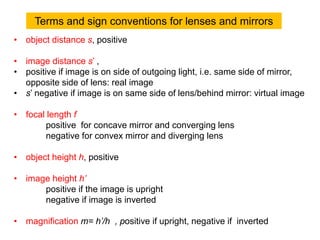
• object distance s, positive
• image distance s’ ,
• positive if image is on side of outgoing light, i.e. same side of mirror,
opposite side of lens: real image
• s’ negative if image is on same side of lens/behind mirror: virtual image
• focal length f
positive for concave mirror and converging lens
negative for convex mirror and diverging lens
• object height h, positive
• image height h’
positive if the image is upright
negative if image is inverted
• magnification m= h’/h , positive if upright, negative if inverted
Terms and sign conventions for lenses and mirrors
Lens equation
1
𝑠
+
1
𝑠′
=
1
𝑓 𝑚 = −
𝑠′
𝑠
=
ℎ′
ℎ
magnification
𝑠′ =
𝑓𝑠
𝑠 − 𝑓
thicker in the
center
• there are focal points on both sides of each lens
• focal length f on both sides is the same
F F
f f
Converging and diverging lenses
Rays refract towards optical axis Rays refract away from optical axis
thinner in the
center
Ray 1 is parallel to the axis and refracts through F.
Ray 2 passes through F’ before refracting parallel to the axis.
Ray 3 passes straight through the center of the lens.
object between f and 2f: image is real, inverted, enlarged
O F’
F I
object outside of 2f: image is real, inverted, reduced
object inside of f: image is virtual, upright, enlarged
Ray diagram for converging lens
Ray 1 is parallel to the axis and refracts as if from F.
Ray 2 heads towards F’ before refracting parallel to the axis.
Ray 3 passes straight through the center of the lens.
image is always virtual, upright and reduced
O F F’
I
Ray diagram for diverging lens
• point object A,
source of light
• reflected rays appear to come from A’  A’ is image of A
• image appears to be located behind the mirror  image is
virtual
Plane mirror
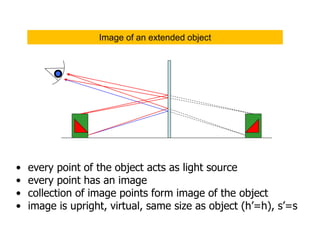
• every point of the object acts as light source
• every point has an image
• collection of image points form image of the object
• image is upright, virtual, same size as object (h’=h), s’=s
Image of an extended object
• made from (polished) sections cut from
a spherical surface
• center of curvature C is center of
original sphere
C
V
R
• radius of curvature R is radius of
sphere, or the distance from V to C.
• vertex V is center of mirror segment
Principal Axis
• principal axis (or optical axis) is line
passing through C and V
Spherical mirror
Rays parallel to the axis get reflected through a common point
the focal point or focus F.
Focal length f is distance from V to F.
C V
F
f
F
concave convex
Concave and convex mirror
Ray 1 is parallel to the axis
and reflects through F.
Ray 2 passes through F
before reflecting parallel to
the axis.
Ray 3 passes through
C and reflects back on
itself.
F
C
Ray 4 goes to the vertex V and reflects under the same
angle below the optical axis
V
Ray diagrams
C
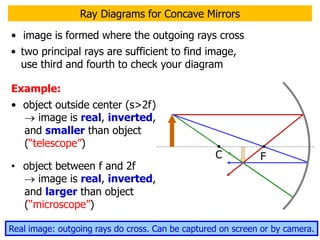
• image is formed where the outgoing rays cross
• object outside center (s>2f)
 image is real, inverted,
and smaller than object
(“telescope”)
Real image: outgoing rays do cross. Can be captured on screen or by camera.
F
Ray Diagrams for Concave Mirrors
• two principal rays are sufficient to find image,
use third and fourth to check your diagram
Example:
• object between f and 2f
 image is real, inverted,
and larger than object
(“microscope”)
C
• object inside the focal point (s<f)
 image is virtual, upright, and larger than object
(makeup mirror)
Ray 1: parallel to the axis
then through F.
Ray 2: through F then parallel to
the axis.
Ray 3: “through” C.
F
C
F
Ray Diagrams for Convex Mirrors
Ray 1: parallel to the axis
then from F.
Ray 2: Vertex.
Ray 3: from C.
• image is virtual, upright, and smaller
than object
Ray 4: towards F,
then parallel.
Concave mirrors:
Shaving and makeup mirrors
Solar cookers
Satellite dishes (for EM waves)
Convex mirrors:
Passenger side rear-view mirrors
Anti-shoplifting (surveillance) mirrors
Christmas tree ornaments
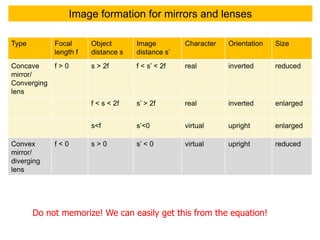
Image formation for mirrors and lenses
Type Focal
length f
Object
distance s
Image
distance s’
Character Orientation Size
Concave
mirror/
Converging
lens
f > 0 s > 2f f < s’ < 2f real inverted reduced
f < s < 2f s’ > 2f real inverted enlarged
s<f s’<0 virtual upright enlarged
Convex
mirror/
diverging
lens
f < 0 s > 0 s’ < 0 virtual upright reduced
Do not memorize! We can easily get this from the equation!

Lec37_2145 (1).pdf

  • 1.
    Lecture 37: Lensesand mirrors • Spherical lenses: converging, diverging • Plane mirrors • Spherical mirrors: concave, convex The animated ray diagrams were created by Dr. Alan Pringle.
  • 2.
    • object distances, positive • image distance s’ , • positive if image is on side of outgoing light, i.e. same side of mirror, opposite side of lens: real image • s’ negative if image is on same side of lens/behind mirror: virtual image • focal length f positive for concave mirror and converging lens negative for convex mirror and diverging lens • object height h, positive • image height h’ positive if the image is upright negative if image is inverted • magnification m= h’/h , positive if upright, negative if inverted Terms and sign conventions for lenses and mirrors
  • 3.
    Lens equation 1 𝑠 + 1 𝑠′ = 1 𝑓 𝑚= − 𝑠′ 𝑠 = ℎ′ ℎ magnification 𝑠′ = 𝑓𝑠 𝑠 − 𝑓
  • 4.
    thicker in the center •there are focal points on both sides of each lens • focal length f on both sides is the same F F f f Converging and diverging lenses Rays refract towards optical axis Rays refract away from optical axis thinner in the center
  • 5.
    Ray 1 isparallel to the axis and refracts through F. Ray 2 passes through F’ before refracting parallel to the axis. Ray 3 passes straight through the center of the lens. object between f and 2f: image is real, inverted, enlarged O F’ F I object outside of 2f: image is real, inverted, reduced object inside of f: image is virtual, upright, enlarged Ray diagram for converging lens
  • 6.
    Ray 1 isparallel to the axis and refracts as if from F. Ray 2 heads towards F’ before refracting parallel to the axis. Ray 3 passes straight through the center of the lens. image is always virtual, upright and reduced O F F’ I Ray diagram for diverging lens
  • 7.
    • point objectA, source of light • reflected rays appear to come from A’  A’ is image of A • image appears to be located behind the mirror  image is virtual Plane mirror
  • 8.
    • every pointof the object acts as light source • every point has an image • collection of image points form image of the object • image is upright, virtual, same size as object (h’=h), s’=s Image of an extended object
  • 9.
    • made from(polished) sections cut from a spherical surface • center of curvature C is center of original sphere C V R • radius of curvature R is radius of sphere, or the distance from V to C. • vertex V is center of mirror segment Principal Axis • principal axis (or optical axis) is line passing through C and V Spherical mirror
  • 10.
    Rays parallel tothe axis get reflected through a common point the focal point or focus F. Focal length f is distance from V to F. C V F f
  • 11.
  • 12.
    Ray 1 isparallel to the axis and reflects through F. Ray 2 passes through F before reflecting parallel to the axis. Ray 3 passes through C and reflects back on itself. F C Ray 4 goes to the vertex V and reflects under the same angle below the optical axis V Ray diagrams
  • 13.
    C • image isformed where the outgoing rays cross • object outside center (s>2f)  image is real, inverted, and smaller than object (“telescope”) Real image: outgoing rays do cross. Can be captured on screen or by camera. F Ray Diagrams for Concave Mirrors • two principal rays are sufficient to find image, use third and fourth to check your diagram Example: • object between f and 2f  image is real, inverted, and larger than object (“microscope”)
  • 14.
    C • object insidethe focal point (s<f)  image is virtual, upright, and larger than object (makeup mirror) Ray 1: parallel to the axis then through F. Ray 2: through F then parallel to the axis. Ray 3: “through” C. F
  • 15.
    C F Ray Diagrams forConvex Mirrors Ray 1: parallel to the axis then from F. Ray 2: Vertex. Ray 3: from C. • image is virtual, upright, and smaller than object Ray 4: towards F, then parallel.
  • 16.
    Concave mirrors: Shaving andmakeup mirrors Solar cookers Satellite dishes (for EM waves) Convex mirrors: Passenger side rear-view mirrors Anti-shoplifting (surveillance) mirrors Christmas tree ornaments
  • 17.
    Image formation formirrors and lenses Type Focal length f Object distance s Image distance s’ Character Orientation Size Concave mirror/ Converging lens f > 0 s > 2f f < s’ < 2f real inverted reduced f < s < 2f s’ > 2f real inverted enlarged s<f s’<0 virtual upright enlarged Convex mirror/ diverging lens f < 0 s > 0 s’ < 0 virtual upright reduced Do not memorize! We can easily get this from the equation!