IE 411/511:
Visual Programming for Industrial
Applications
Lecture Notes #2
Introduction to the
Visual Studio 2012 for Windows Desktop
Integrated Development Environment
2
Module Learning Objectives
In this module we will discuss:
 The basics of the Visual Studio 2012 for
Windows Desktop Integrated Development
Environment (IDE) for writing, running and
debugging your apps
 Visual Studio’s help features
 Key commands contained in the IDE’s menus and
toolbars
 The purpose of the various kinds of windows in the
Visual Studio 2012 for Windows Desktop IDE
 How to create, compile and execute a simple Visual
Basic app that displays text and an image
3
Introduction
 The examples, screen captures, and discussions in this
module are based on the Visual Studio Express
2012 for Windows Desktop
 From now on, the Visual Studio Express 2012 for
Windows Desktop IDE will be referred to simply as Visual
Studio 2012
 Examples will work on full versions of Visual Studio as
well
4
Introduction
 Visual Studio 2012 is Microsoft’s Integrated
Development Environment (IDE) for creating, running
and debugging applications (also called apps) written
in various .NET programming languages
 This module provides an overview of the Visual
Studio 2012 IDE
 Shows how to create a simple Visual Basic app by dragging
and dropping predefined building blocks into place
 A technique known as visual app development
5
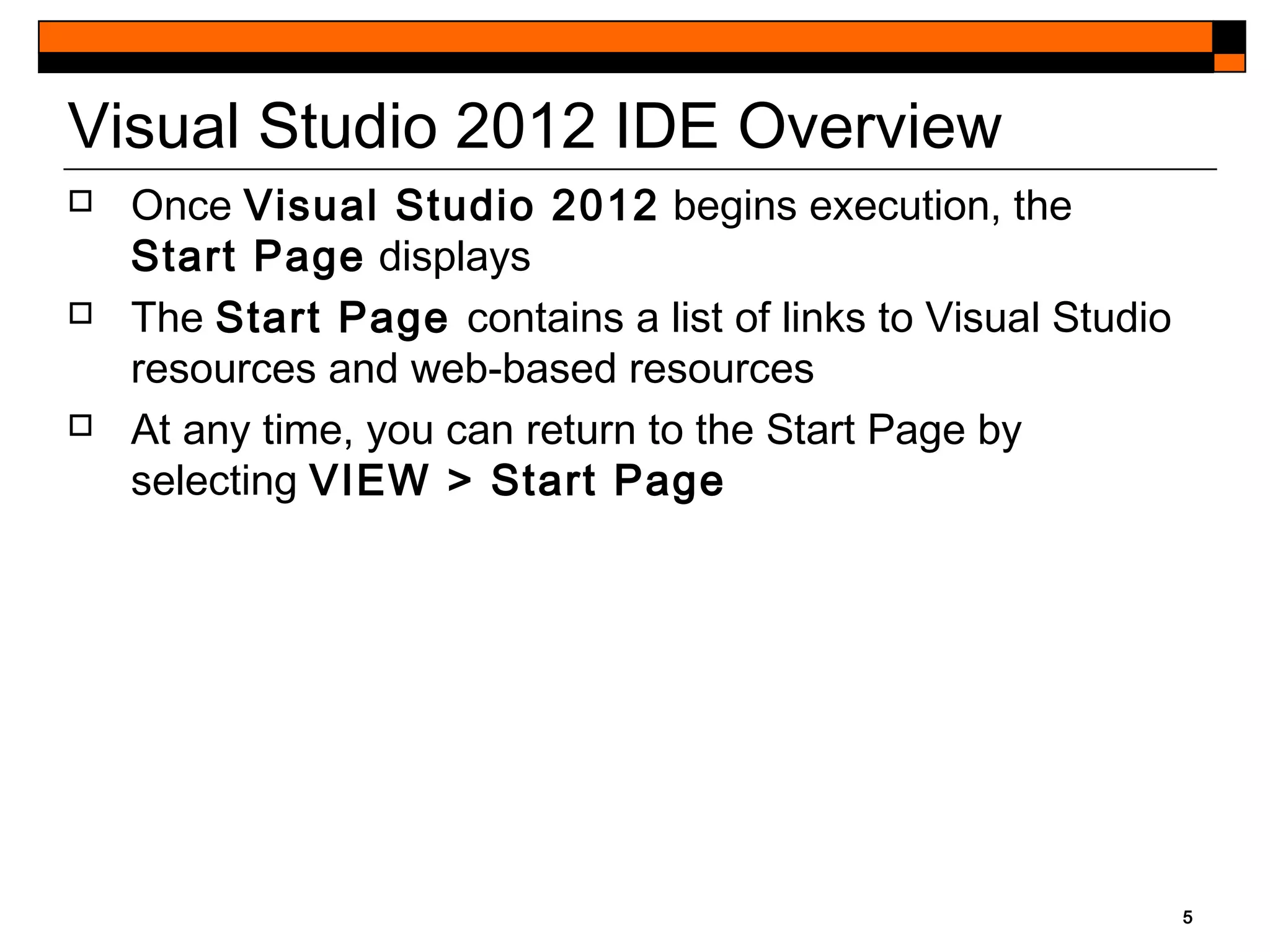
Visual Studio 2012 IDE Overview
 Once Visual Studio 2012 begins execution, the
Start Page displays
 The Start Page contains a list of links to Visual Studio
resources and web-based resources
 At any time, you can return to the Start Page by
selecting VIEW > Start Page
6
Visual Studio 2012 IDE Overview (cont.)
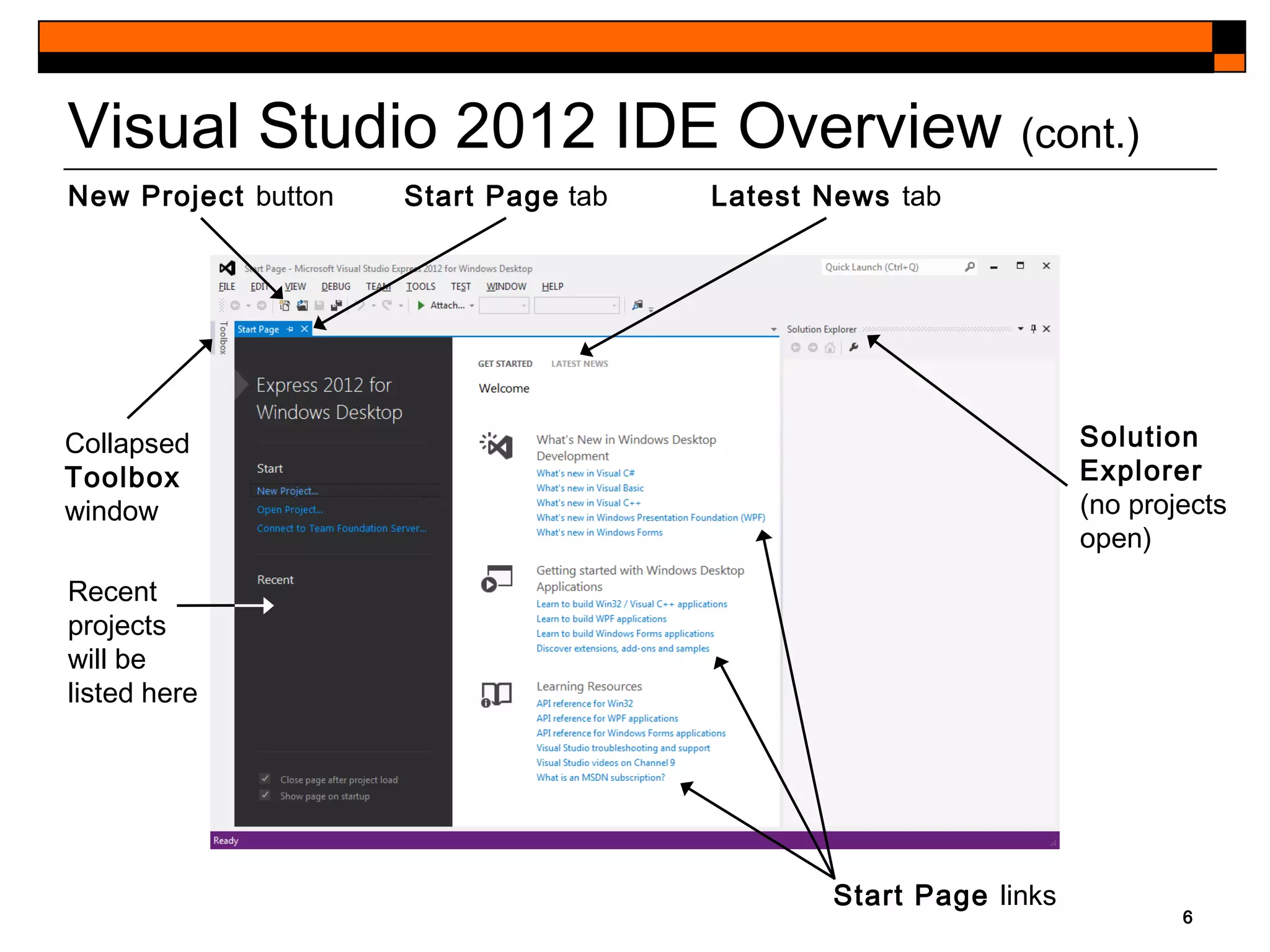
New Project button Start Page tab Latest News tab
Solution
Explorer
(no projects
open)
Collapsed
Toolbox
window
Recent
projects
will be
listed here
Start Page links
7
Visual Studio 2012 IDE Overview (cont.)
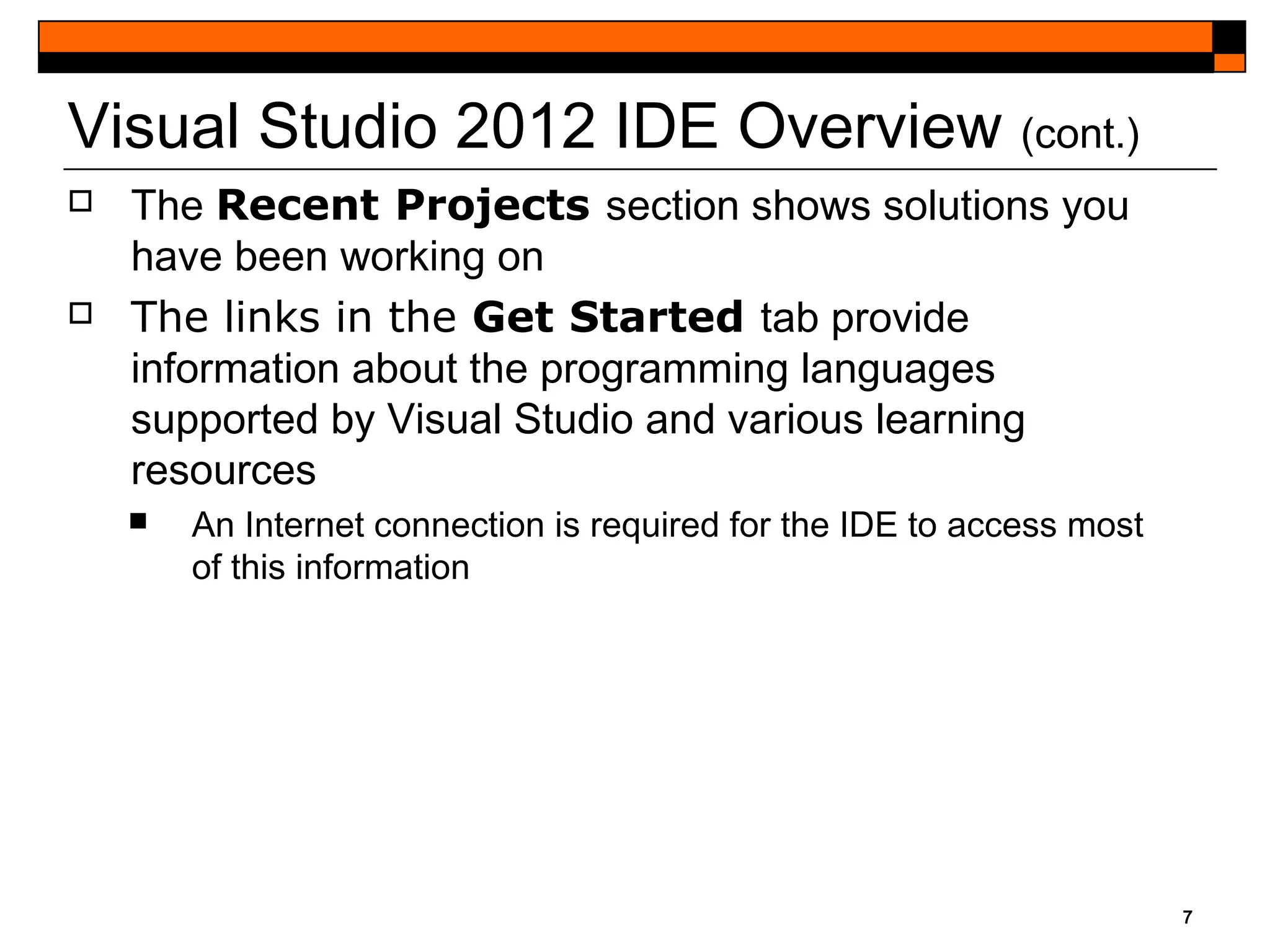
 The Recent Projects section shows solutions you
have been working on
 The links in the Get Started tab provide
information about the programming languages
supported by Visual Studio and various learning
resources
 An Internet connection is required for the IDE to access most
of this information
8
Visual Studio 2012 IDE Overview (cont.)
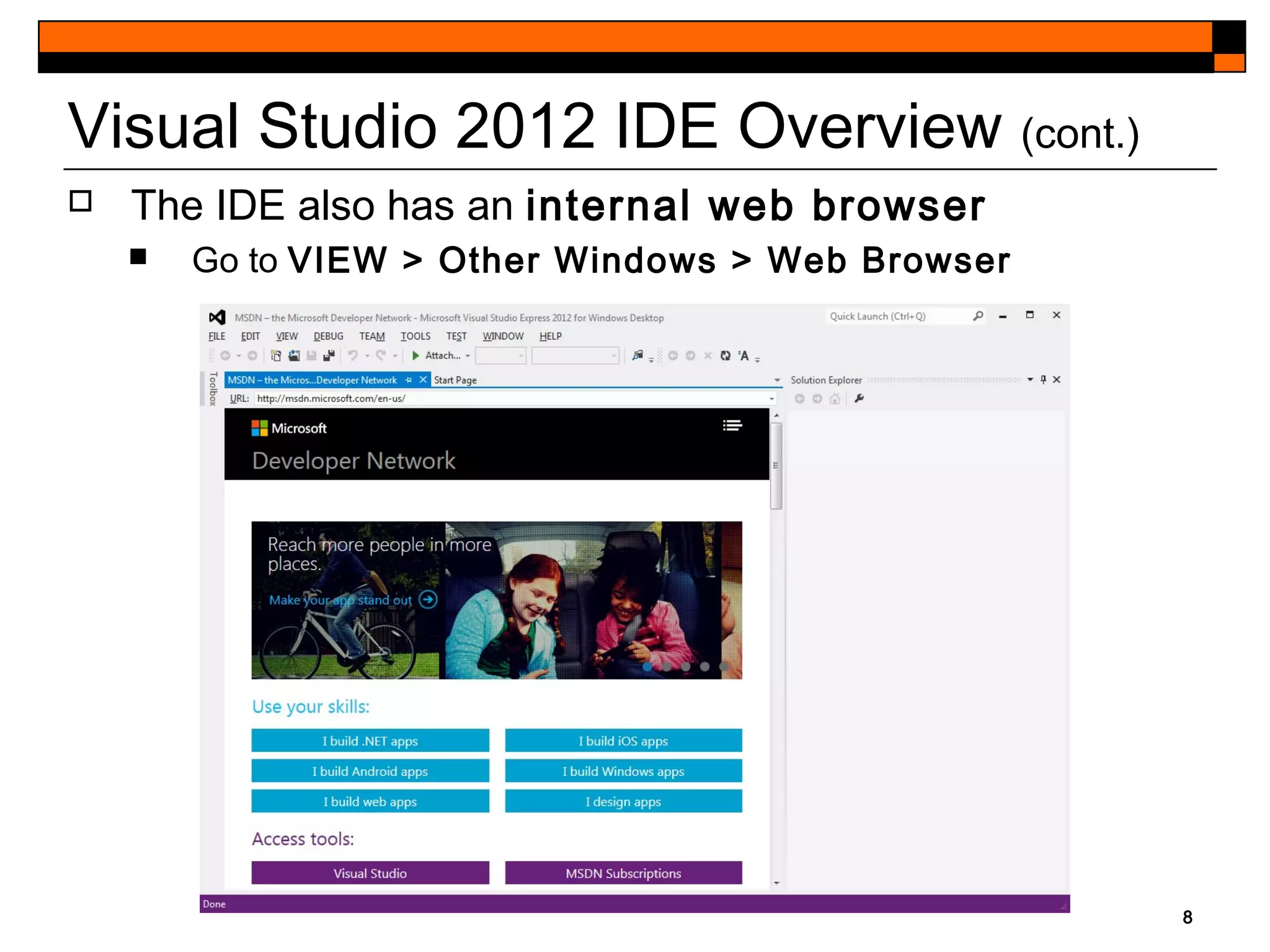
 The IDE also has an internal web browser
 Go to VIEW > Other Windows > Web Browser
9
Visual Studio 2012 IDE Overview (cont.)
Creating a New Project
Select File > New Project... to create a new project
 On the Start Page, just click the link labeled New Project…
A project is a group of related files, such as the Visual
Basic code and any images that might make up an app
Visual Studio organizes apps into projects and
solutions, which contain one or more projects
 However, most apps consist of a solution containing a single
project
10
Visual Studio 2012 IDE Overview (cont.)
Creating a New Project (cont.)
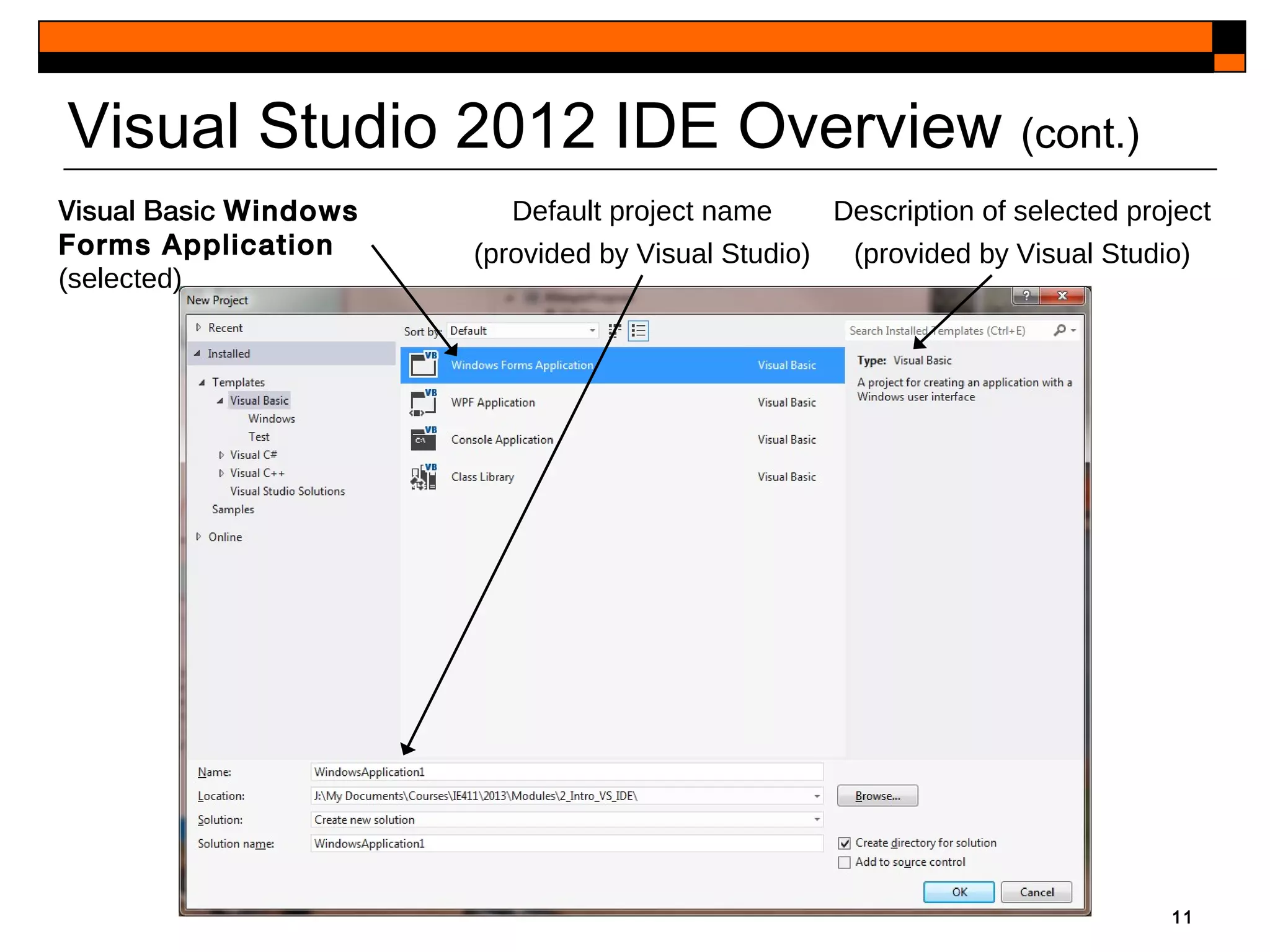
When you select FILE > New Project… or click the
New Project… link on the Start Page, the New
Project dialog displays
Visual Studio provides several templates
 Project types users can create in Visual Basic and other
languages
Project templates are the project types users can create
in Visual Basic
In this course, we will concentrate on Windows Forms
applications
 A Windows Forms application has a graphical user
interface (GUI)
11
Visual Studio 2012 IDE Overview (cont.)
Visual Basic Windows
Forms Application
(selected)
Default project name
(provided by Visual Studio)
Description of selected project
(provided by Visual Studio)
12
Visual Studio 2012 IDE Overview (cont.)
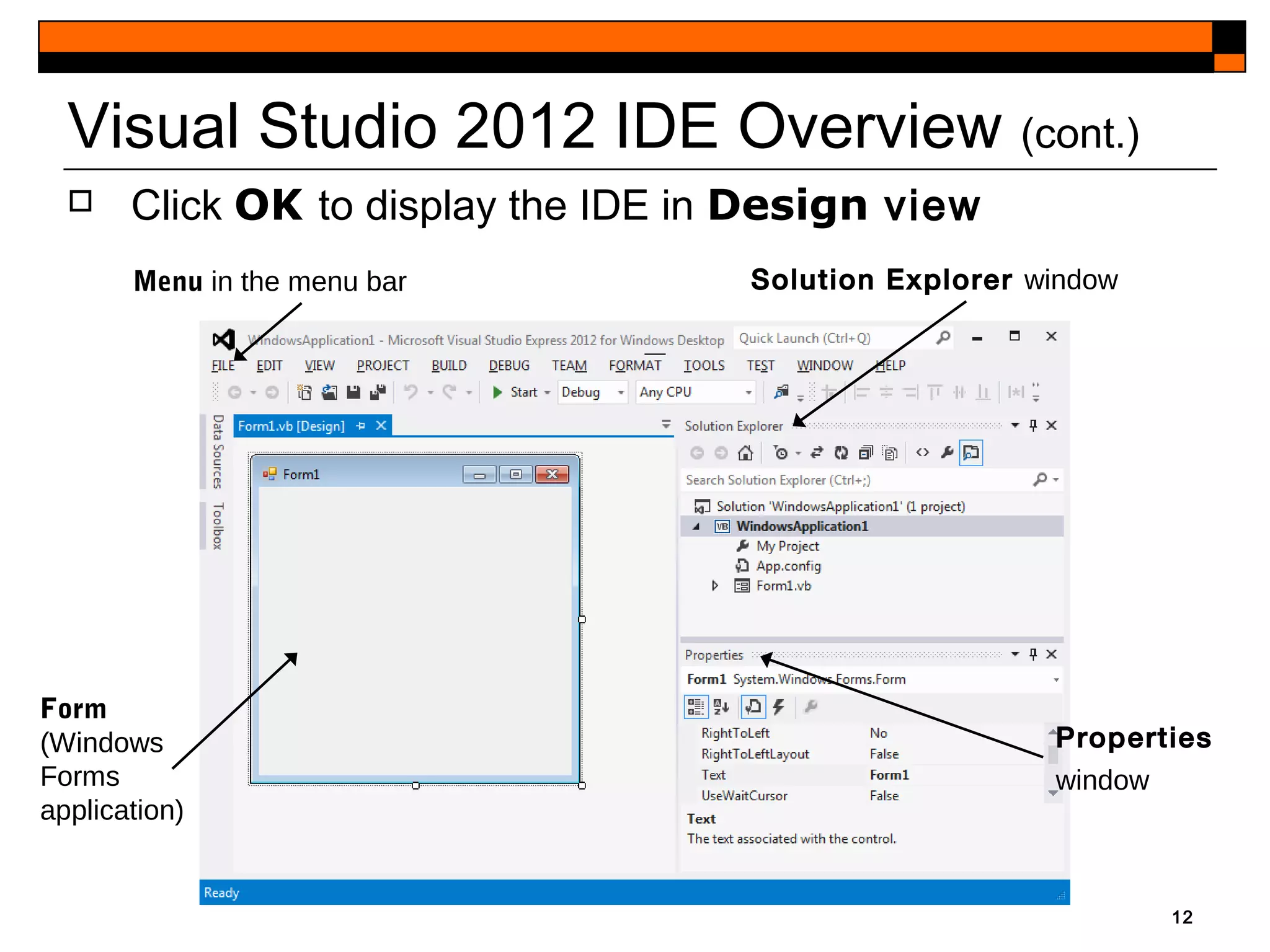
 Click OK to display the IDE in Design view
Menu in the menu bar Solution Explorer window
Form
(Windows
Forms
application)
Properties
window
13
Visual Studio 2012 IDE Overview (cont.)
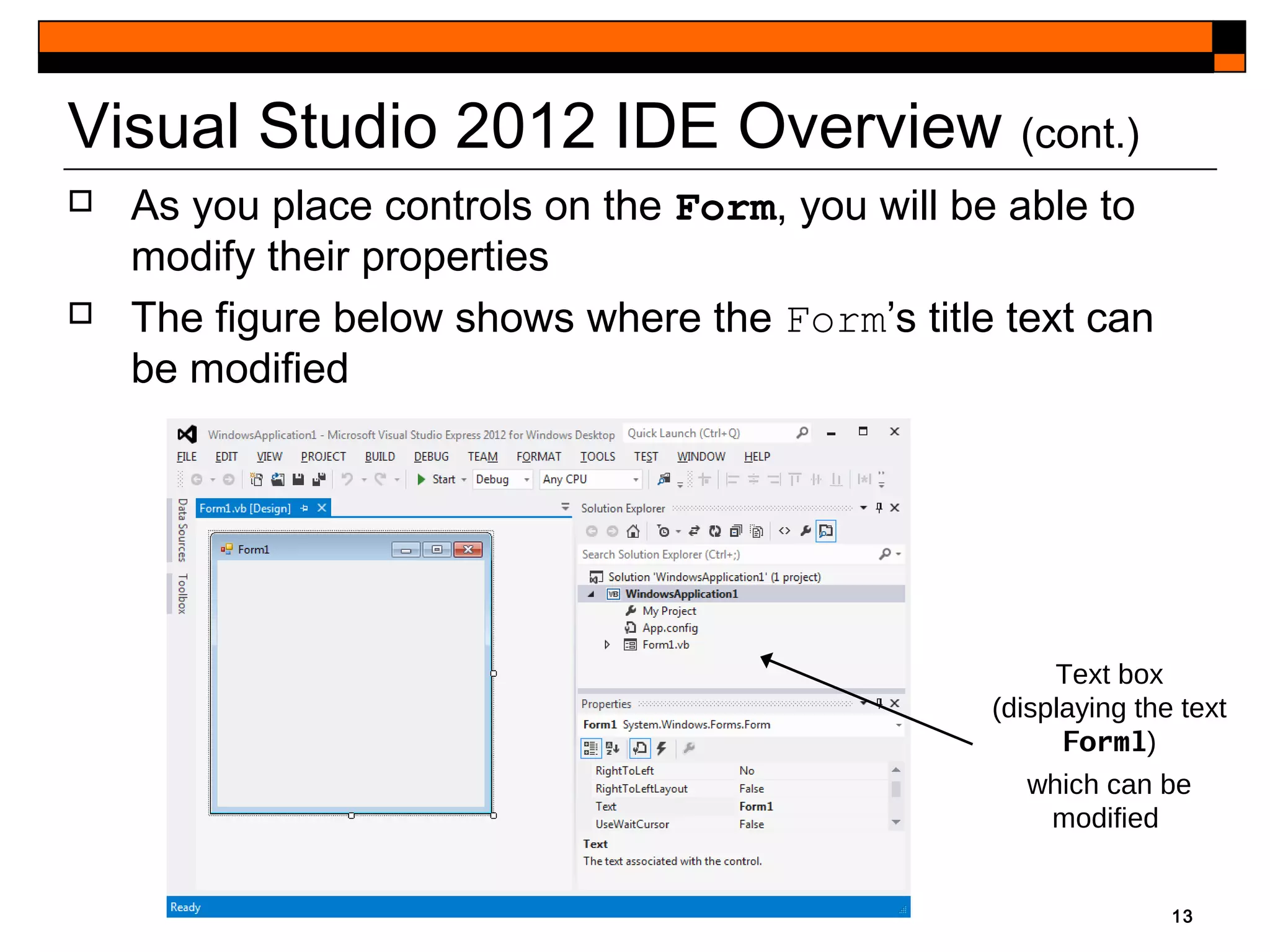
 As you place controls on the Form, you will be able to
modify their properties
 The figure below shows where the Form’s title text can
be modified
Text box
(displaying the text
Form1)
which can be
modified
14
Visual Studio 2012 IDE Overview (cont.)
 Collectively, the Form and controls make up the app’s
GUI
 Users enter data into the app by typing at the keyboard,
by clicking the mouse buttons and in a variety of other
ways
 Programs use the GUI to display instructions and other
information for users to view
15
Visual Studio 2012 IDE Overview (cont.)
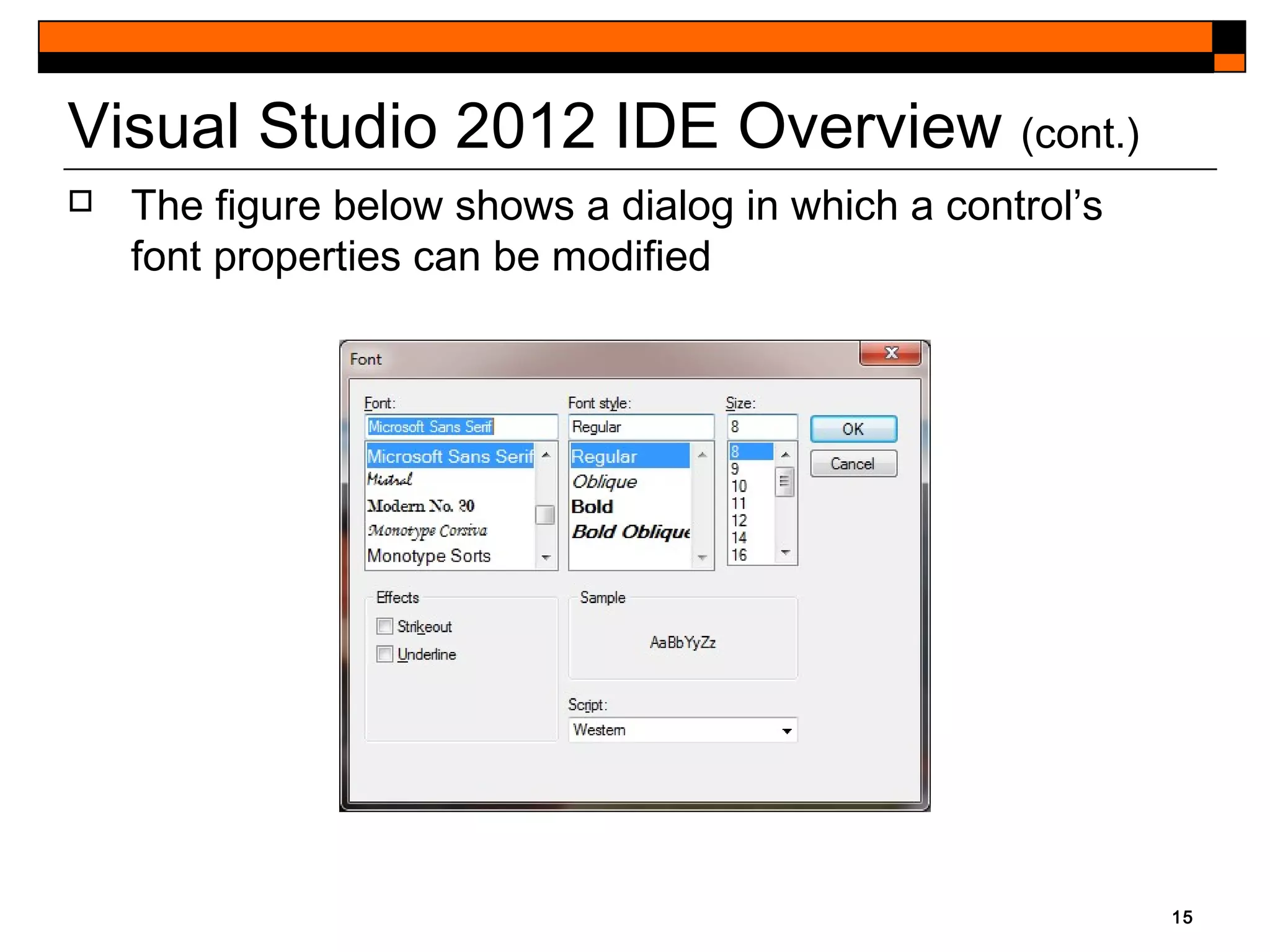
 The figure below shows a dialog in which a control’s
font properties can be modified
16
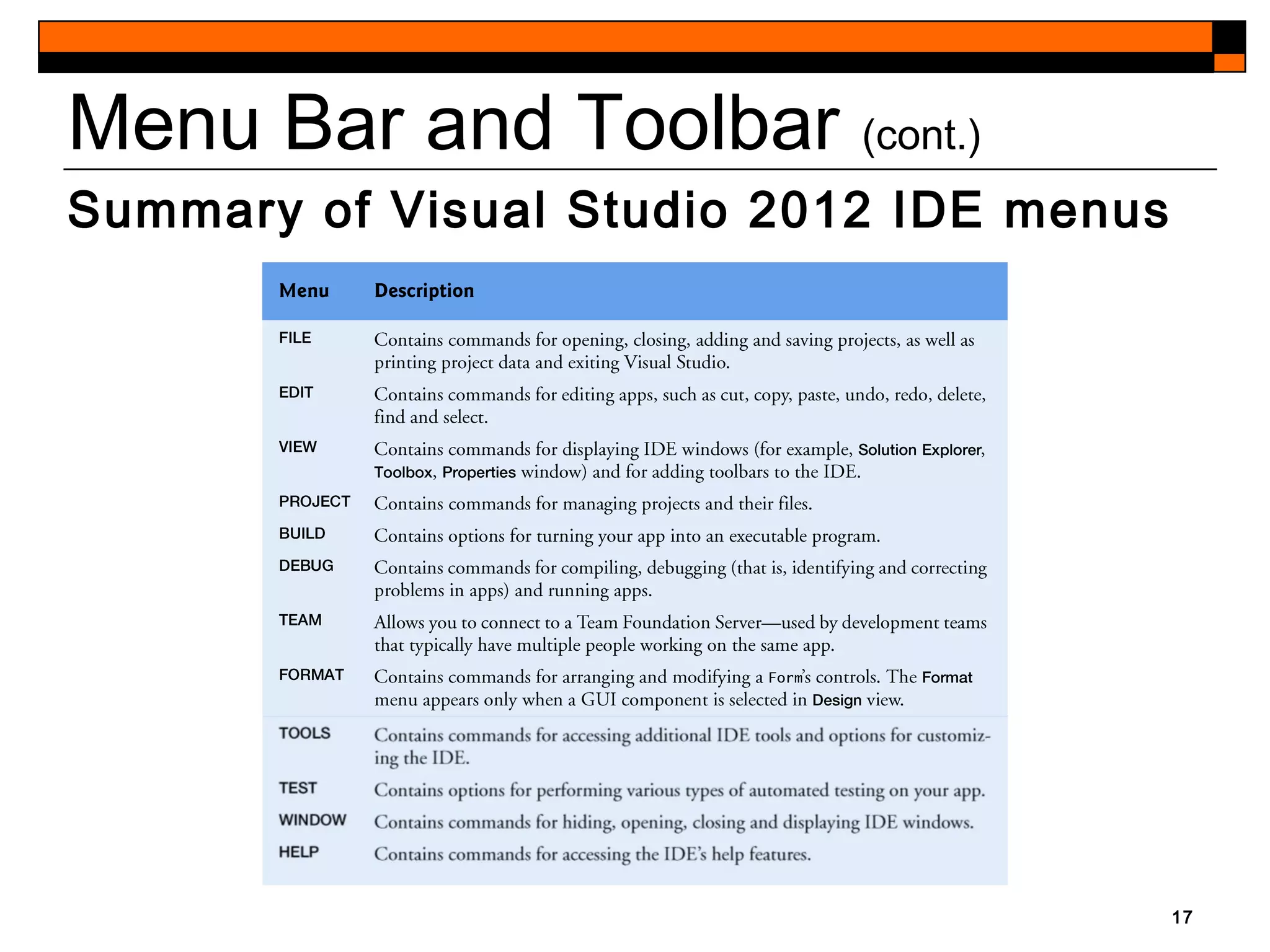
Menu Bar and Toolbar
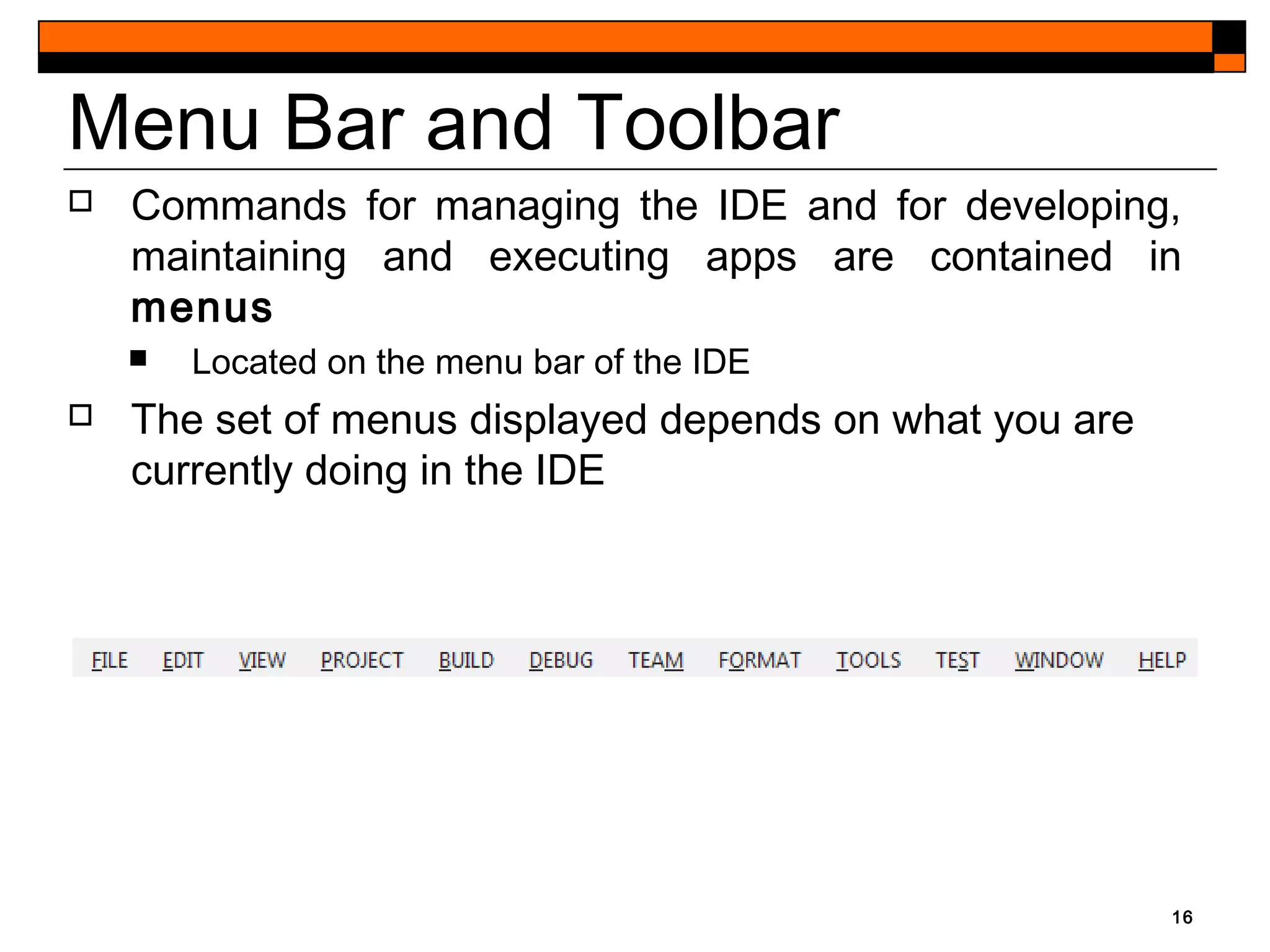
 Commands for managing the IDE and for developing,
maintaining and executing apps are contained in
menus
 Located on the menu bar of the IDE
 The set of menus displayed depends on what you are
currently doing in the IDE
17
Menu Bar and Toolbar (cont.)
Summary of Visual Studio 2012 IDE menus
18
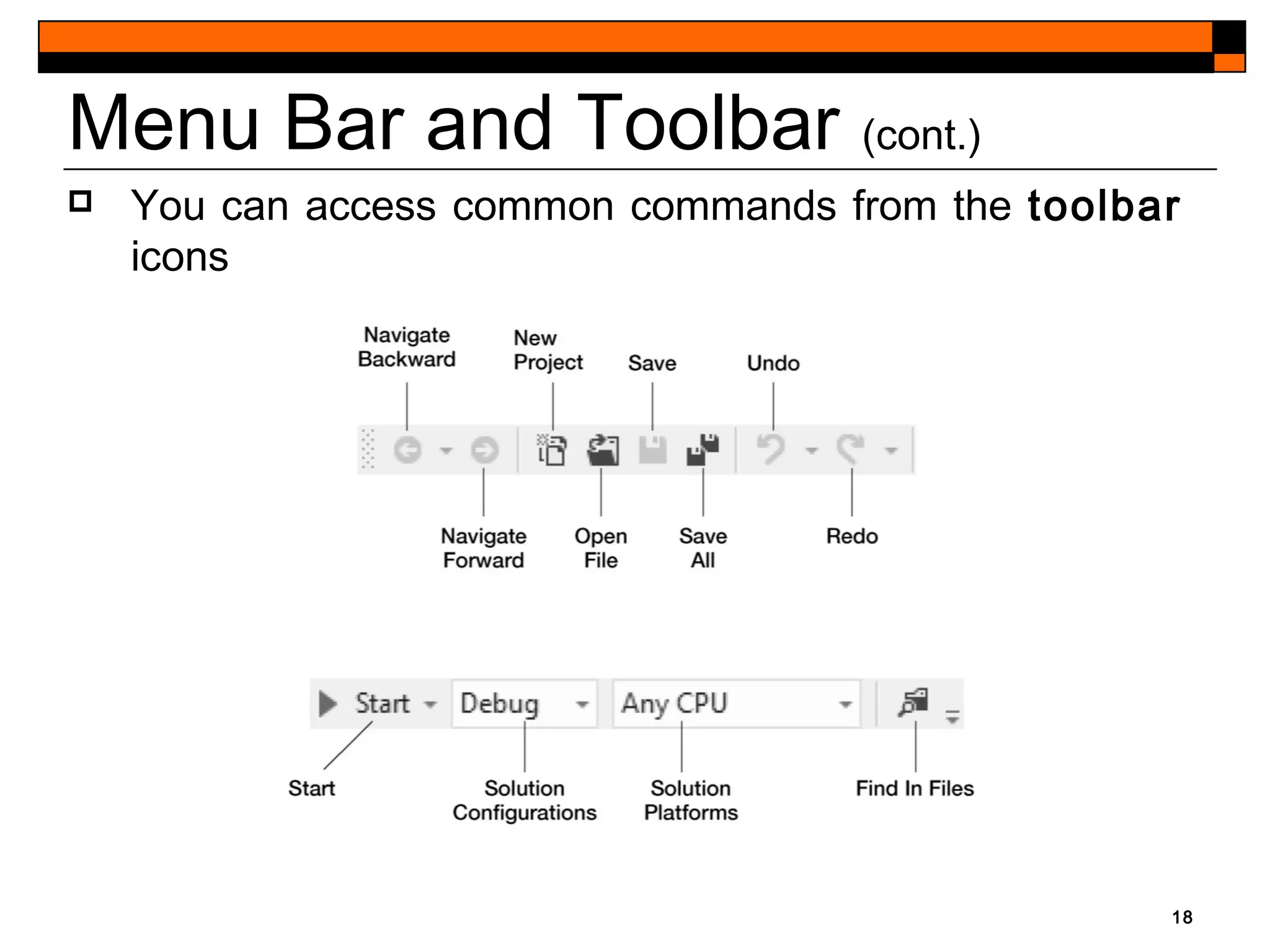
Menu Bar and Toolbar (cont.)
 You can access common commands from the toolbar
icons
19
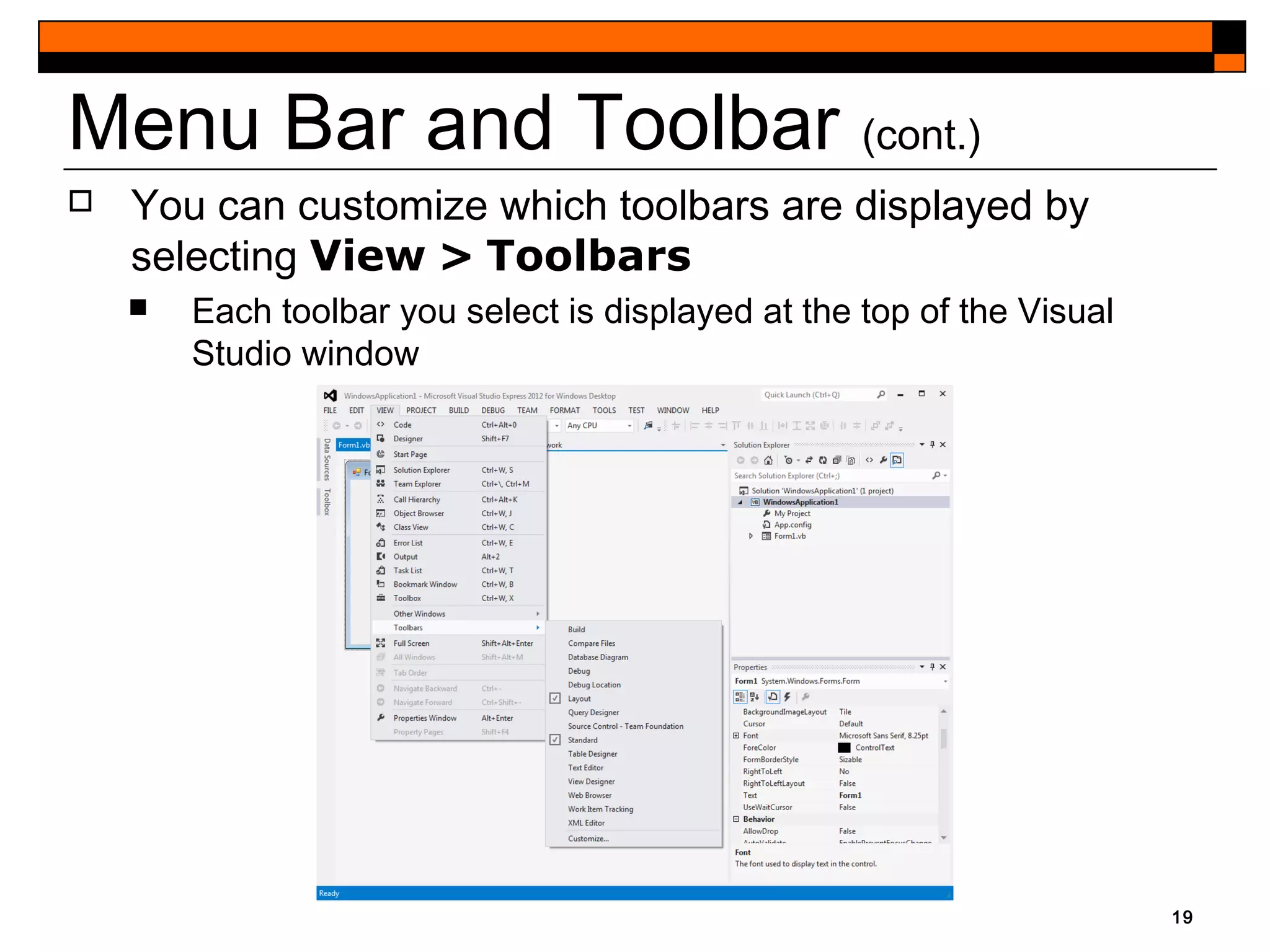
Menu Bar and Toolbar (cont.)
 You can customize which toolbars are displayed by
selecting View > Toolbars
 Each toolbar you select is displayed at the top of the Visual
Studio window
20
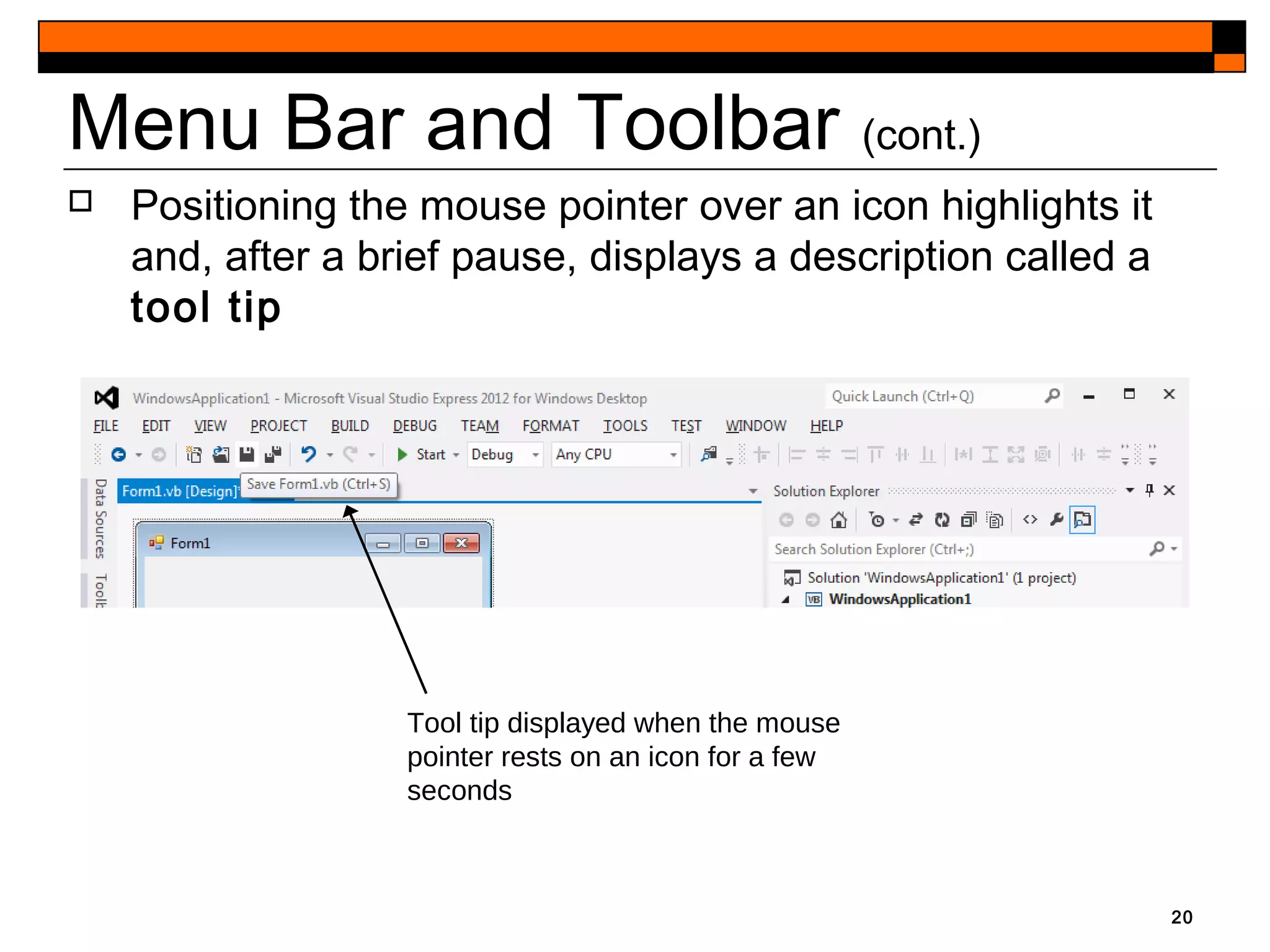
Menu Bar and Toolbar (cont.)
 Positioning the mouse pointer over an icon highlights it
and, after a brief pause, displays a description called a
tool tip
Tool tip displayed when the mouse
pointer rests on an icon for a few
seconds
21
Navigating the Visual Studio IDE
 The IDE provides windows for accessing project files
and customizing controls
 Solution Explorer Window
 Toolbox Window
 Properties Window
22
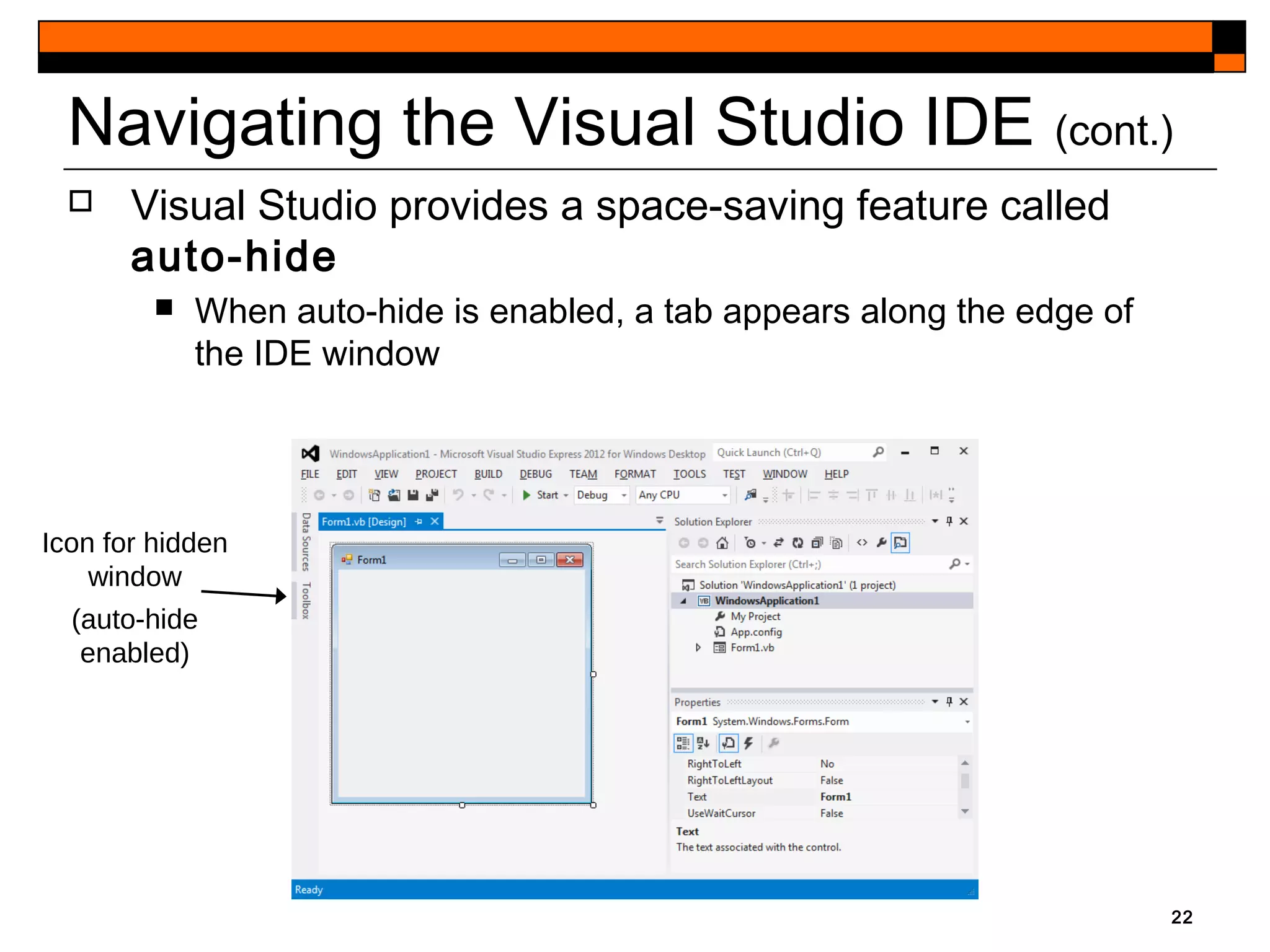
Navigating the Visual Studio IDE (cont.)
 Visual Studio provides a space-saving feature called
auto-hide
 When auto-hide is enabled, a tab appears along the edge of
the IDE window
Icon for hidden
window
(auto-hide
enabled)
23
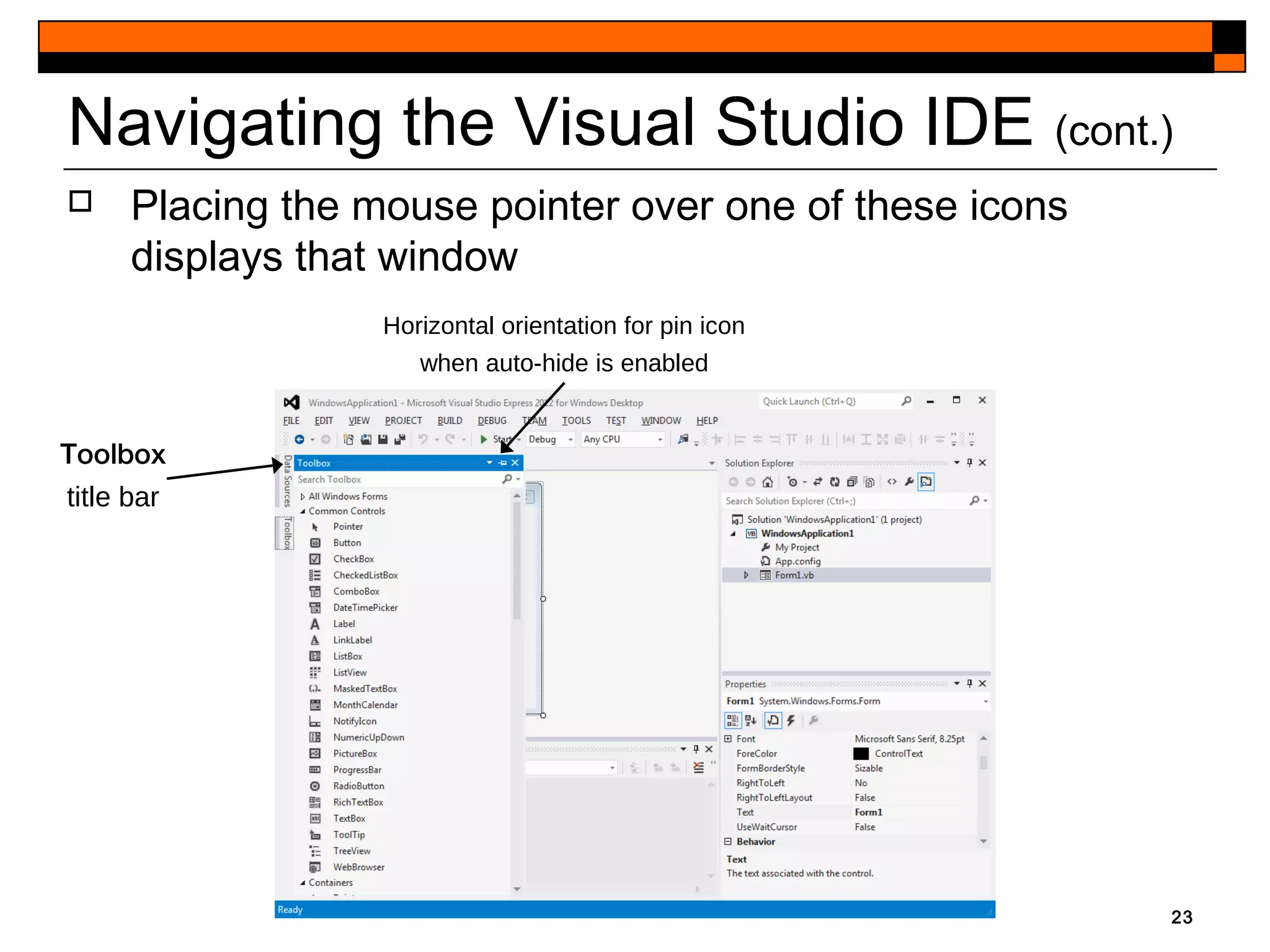
Navigating the Visual Studio IDE (cont.)
Toolbox
title bar
Horizontal orientation for pin icon
when auto-hide is enabled
 Placing the mouse pointer over one of these icons
displays that window
24
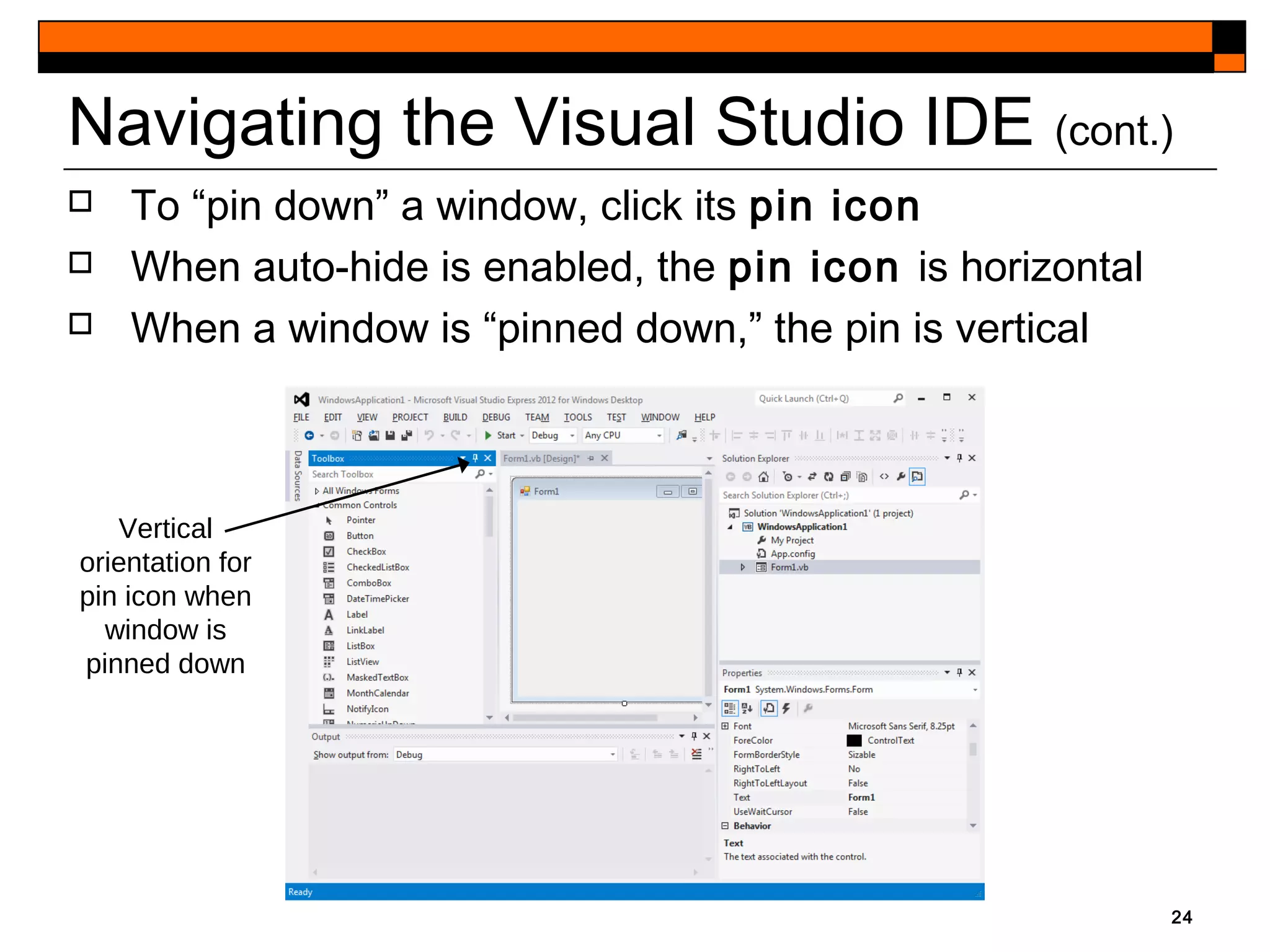
Navigating the Visual Studio IDE (cont.)
Vertical
orientation for
pin icon when
window is
pinned down
 To “pin down” a window, click its pin icon
 When auto-hide is enabled, the pin icon is horizontal
 When a window is “pinned down,” the pin is vertical
Navigating the Visual Studio IDE (cont.)
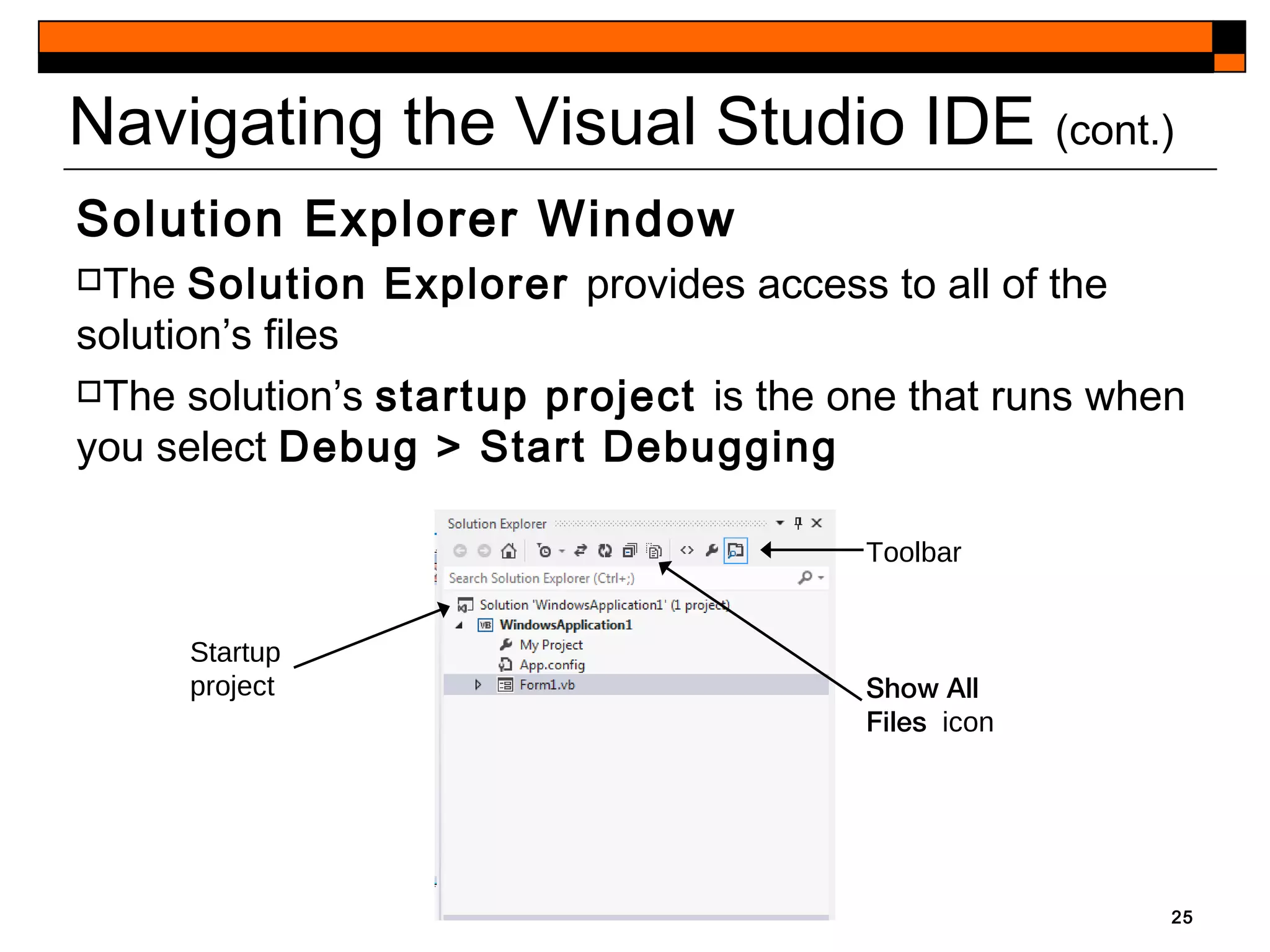
Solution Explorer Window
The Solution Explorer provides access to all of the
solution’s files
The solution’s startup project is the one that runs when
you select Debug > Start Debugging
25
Show All
Files icon
Toolbar
Startup
project
Navigating the Visual Studio IDE (cont.)
Solution Explorer Window
By default, the IDE displays only files that you may need
to edit
 Other files that the IDE generates are hidden
The Solution Explorer window includes a toolbar that
contains several icons
Clicking the Show All Files icon displays all the
solution’s files, including those generated by the IDE
 Clicking the arrows to the left of a file or folder expands or
collapses the project tree’s nodes
26
Navigating the Visual Studio IDE (cont.)
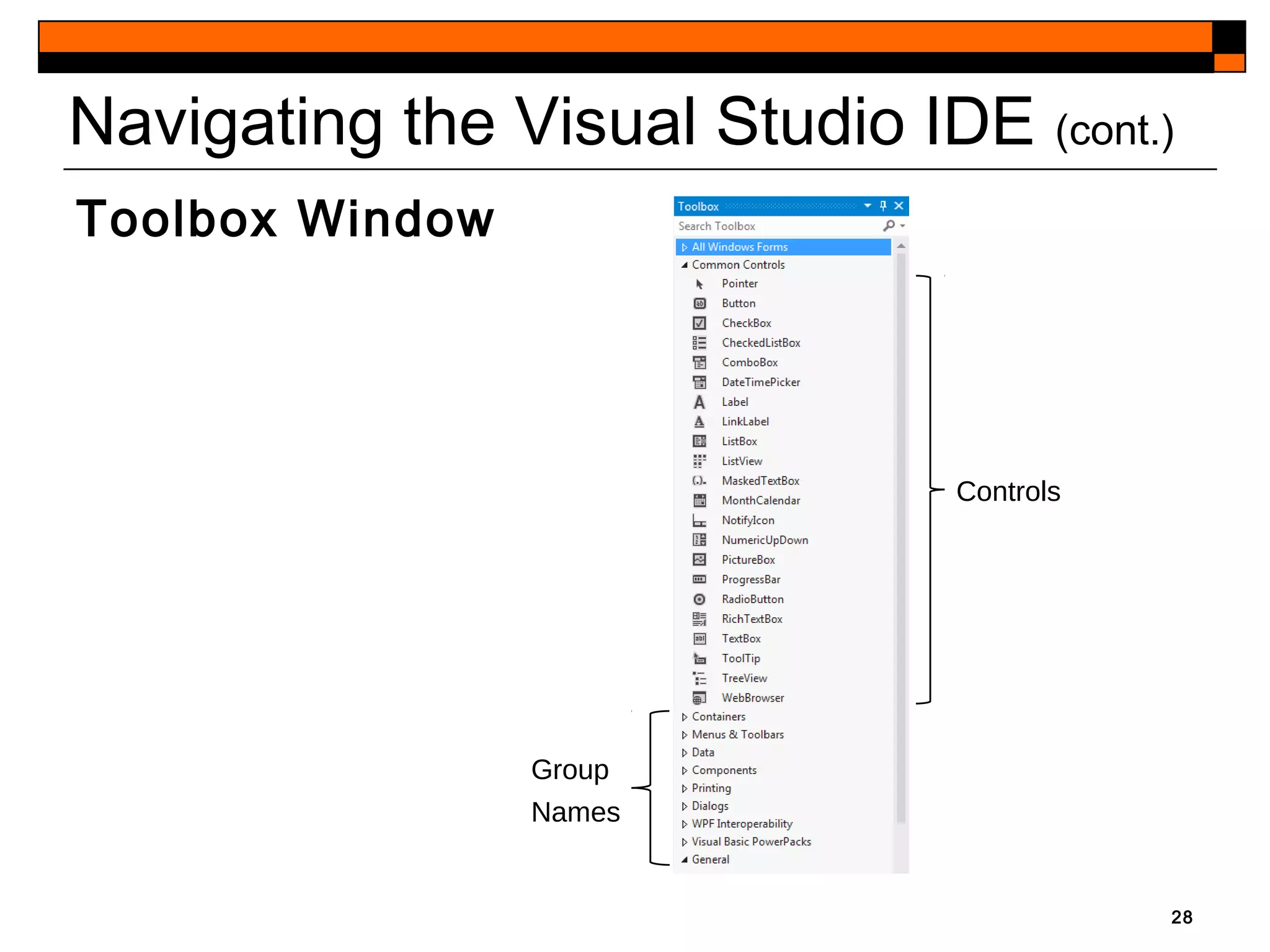
Toolbox Window
The Toolbox contains the controls used to customize
Forms
With visual app development, you can “drag and drop”
controls onto the Form and the IDE will write the code that
creates the controls for you
 Just as you do not need to know how to build an engine to
drive a car, you do not need to know how to build controls to
use them
Reusing preexisting controls saves time and money when
you develop apps
27
Navigating the Visual Studio IDE (cont.)
Toolbox Window
28
Group
Names
Controls
Navigating the Visual Studio IDE (cont.)
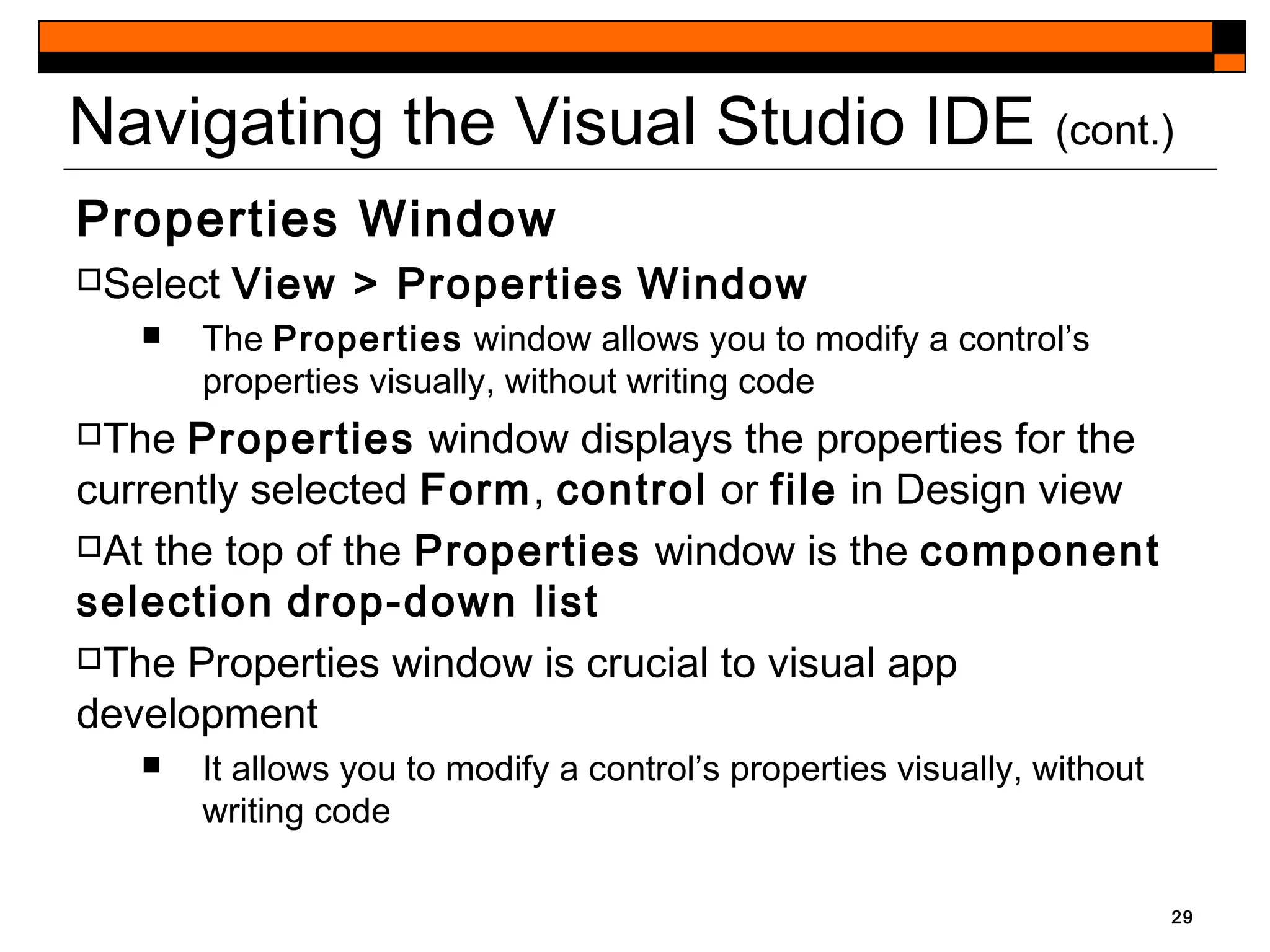
Properties Window
Select View > Properties Window
 The Properties window allows you to modify a control’s
properties visually, without writing code
The Properties window displays the properties for the
currently selected Form, control or file in Design view
At the top of the Properties window is the component
selection drop-down list
The Properties window is crucial to visual app
development
 It allows you to modify a control’s properties visually, without
writing code
29
Navigating the Visual Studio IDE (cont.)
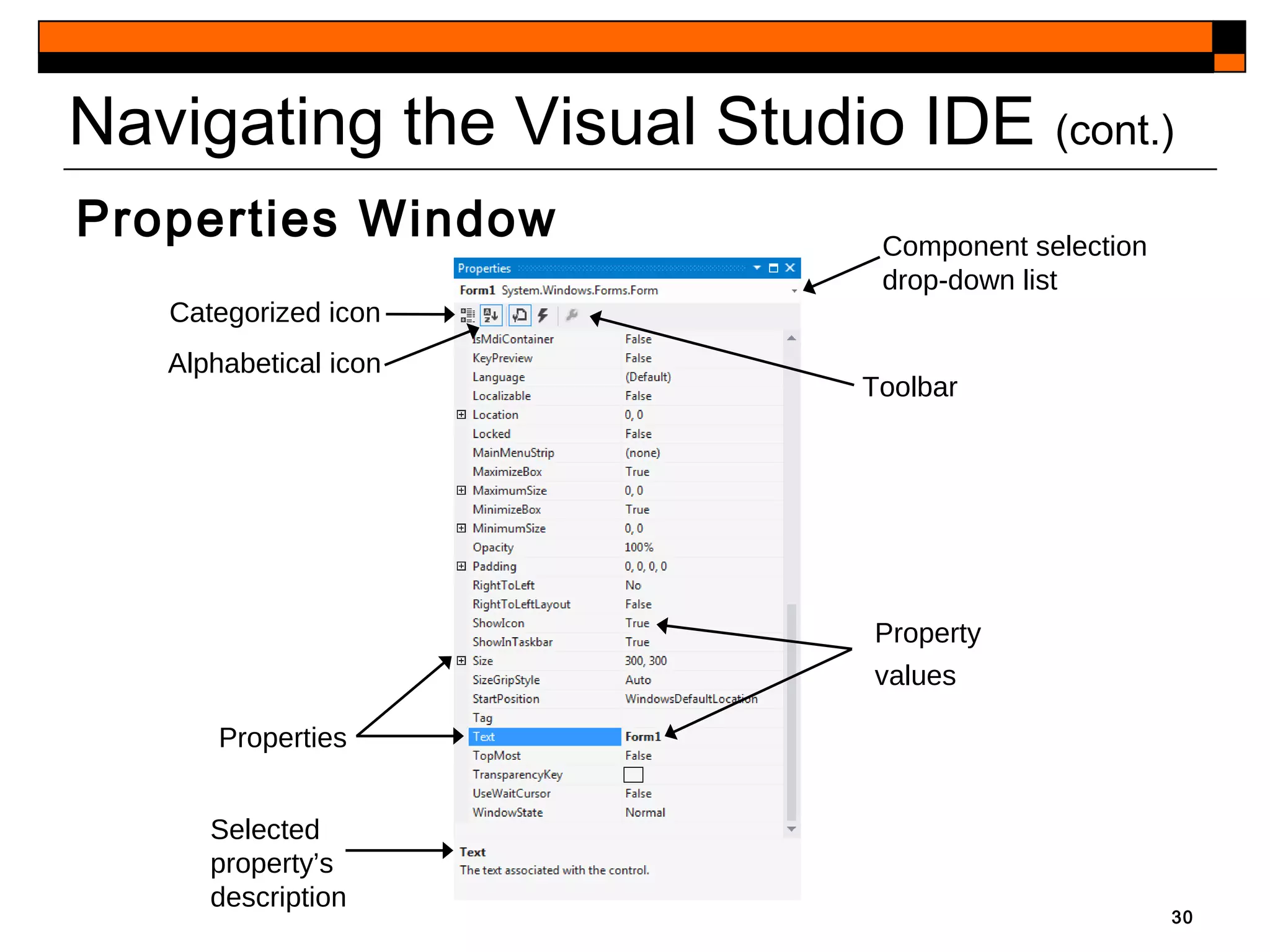
Properties Window
30
Categorized icon
Alphabetical icon
Properties
Selected
property’s
description
Property
values
Toolbar
Component selection
drop-down list
31
Using Help
Context-Sensitive Help
Visual Studio provides context-sensitive help pertaining to
the “current content”
 i.e., The items around the location of the mouse cursor
To use context-sensitive help, click an item, then press the
F1 key
 The help documentation is displayed in a web browser window
To return to the IDE, either close the browser window or
select the IDE’s icon in your Windows task bar
32
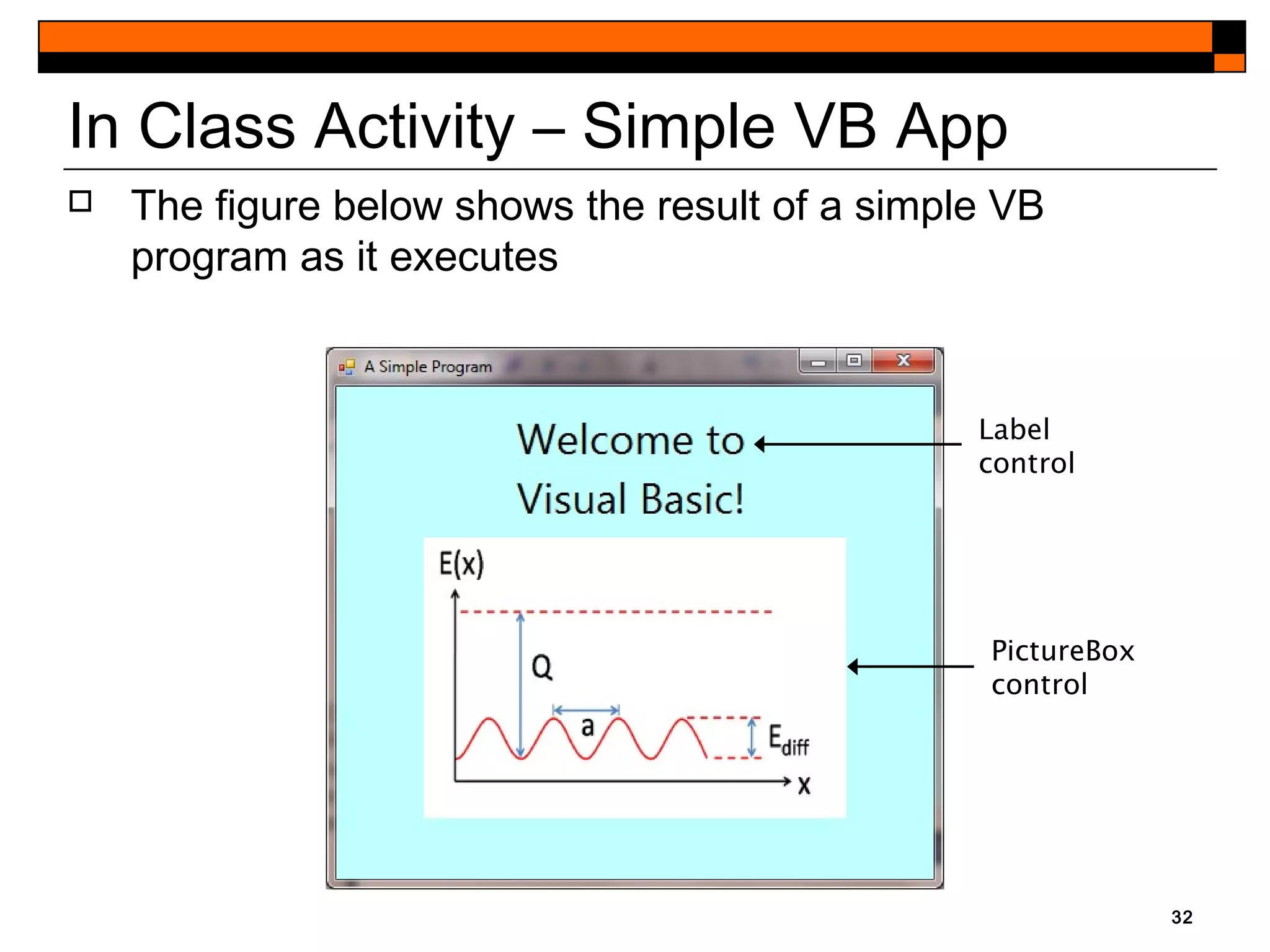
In Class Activity – Simple VB App
 The figure below shows the result of a simple VB
program as it executes
Label
control
PictureBox
control
33
In Class Activity – Simple VB App (cont.)
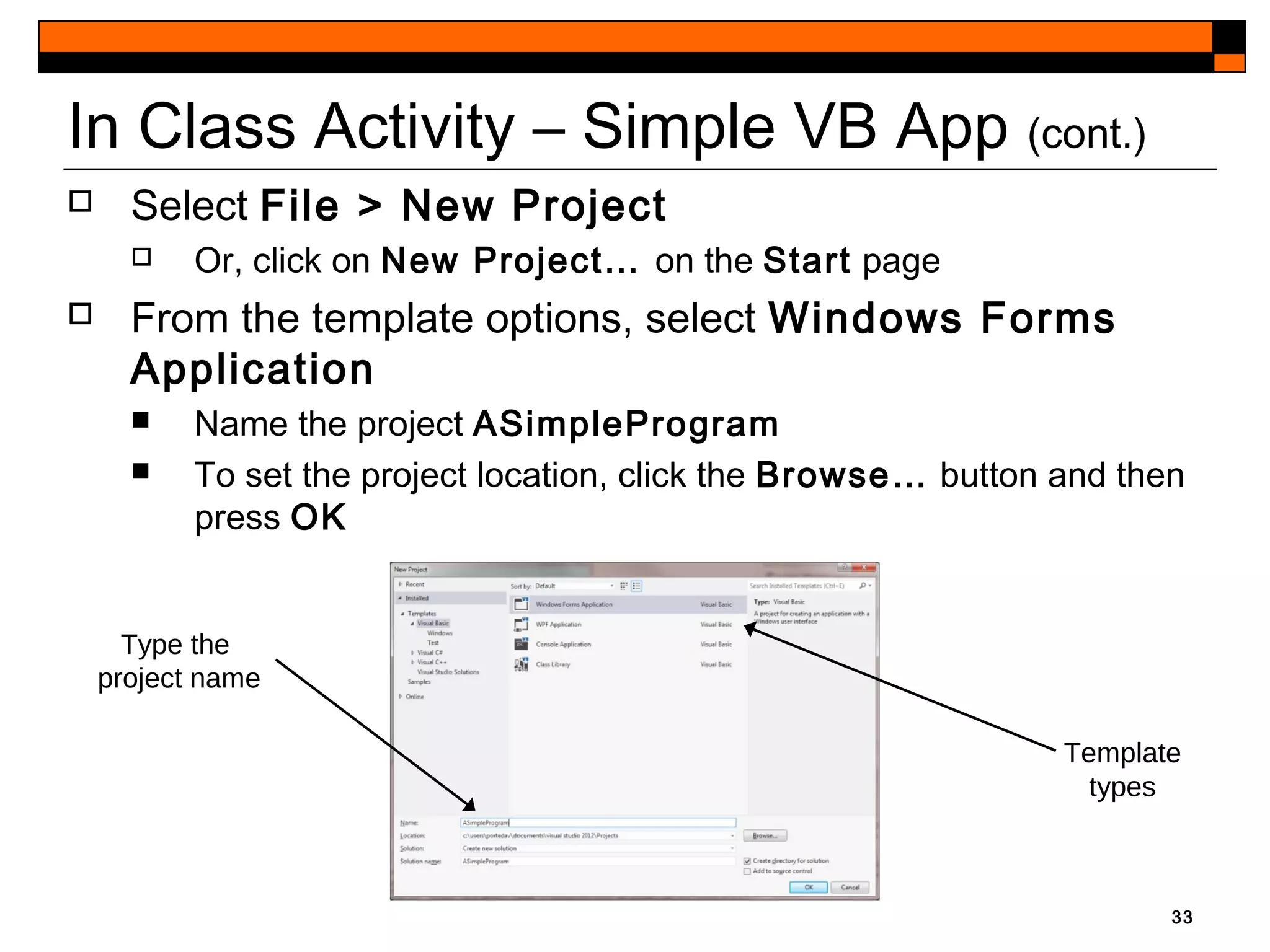
 Select File > New Project
 Or, click on New Project… on the Start page
 From the template options, select Windows Forms
Application
 Name the project ASimpleProgram
 To set the project location, click the Browse… button and then
press OK
Template
types
Type the
project name
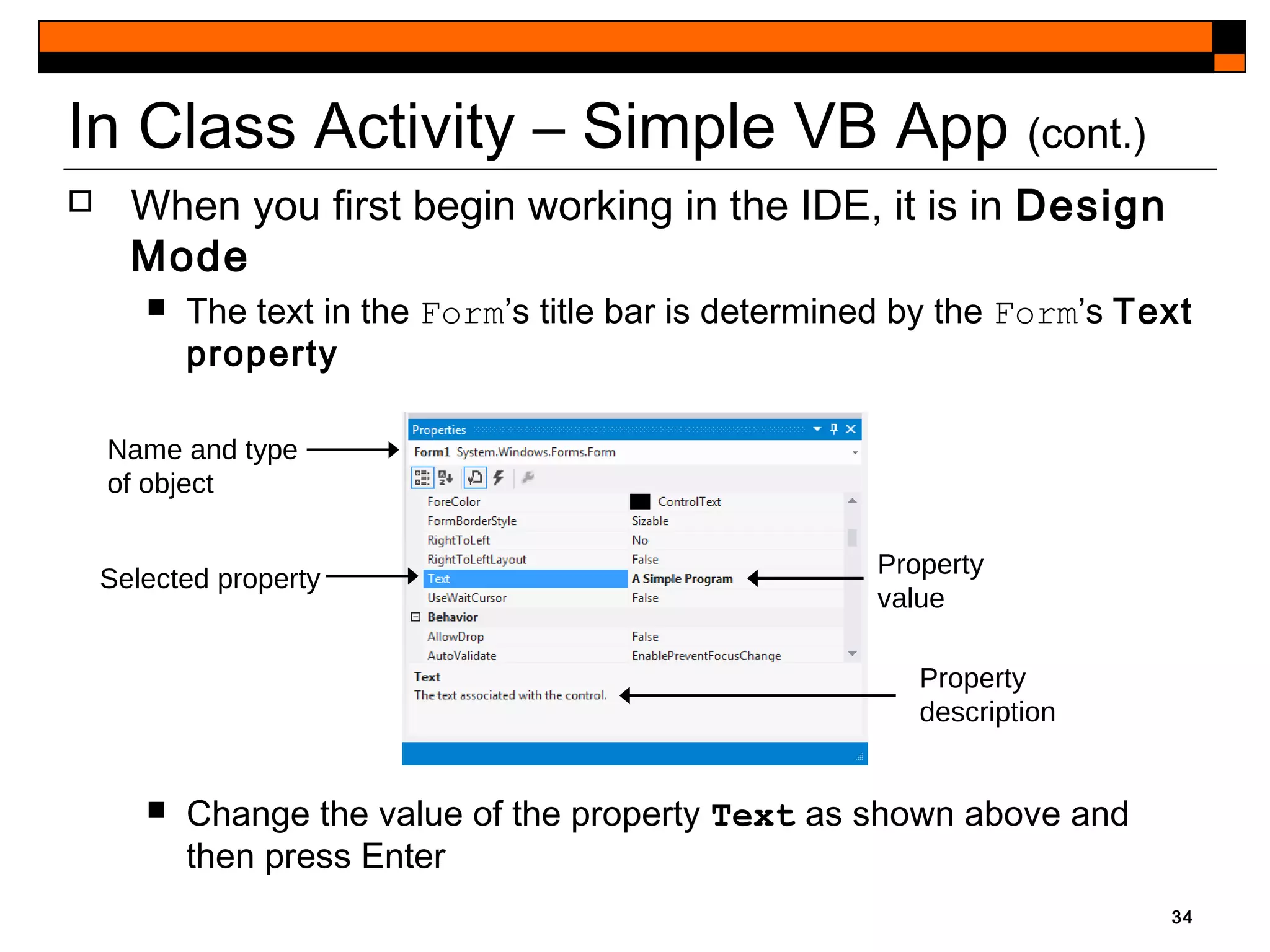
 When you first begin working in the IDE, it is in Design
Mode
 The text in the Form’s title bar is determined by the Form’s Text
property
 Change the value of the property Text as shown above and
then press Enter
34
In Class Activity – Simple VB App (cont.)
Name and type
of object
Property
value
Selected property
Property
description
35
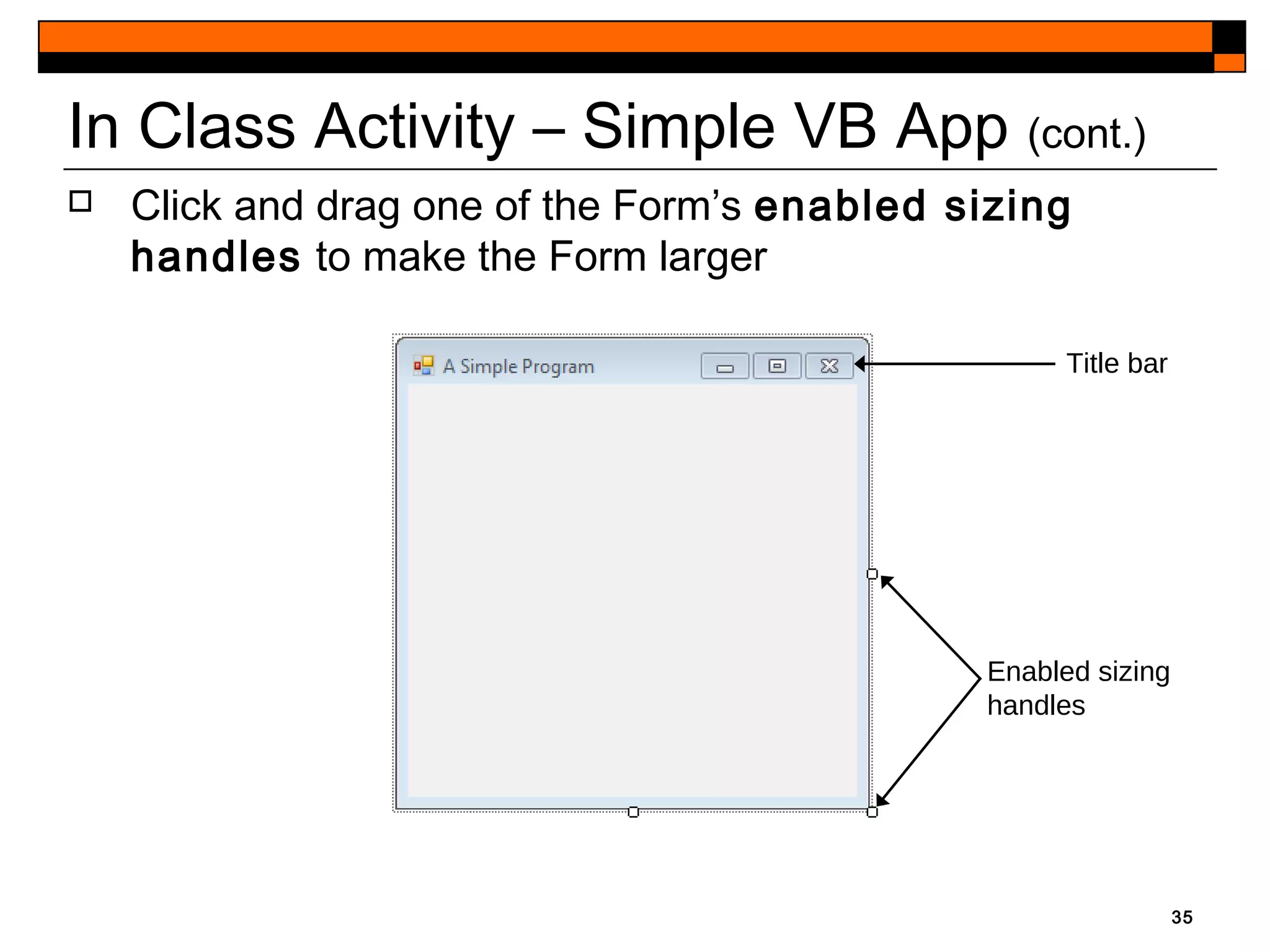
In Class Activity – Simple VB App (cont.)
 Click and drag one of the Form’s enabled sizing
handles to make the Form larger
Title bar
Enabled sizing
handles
36
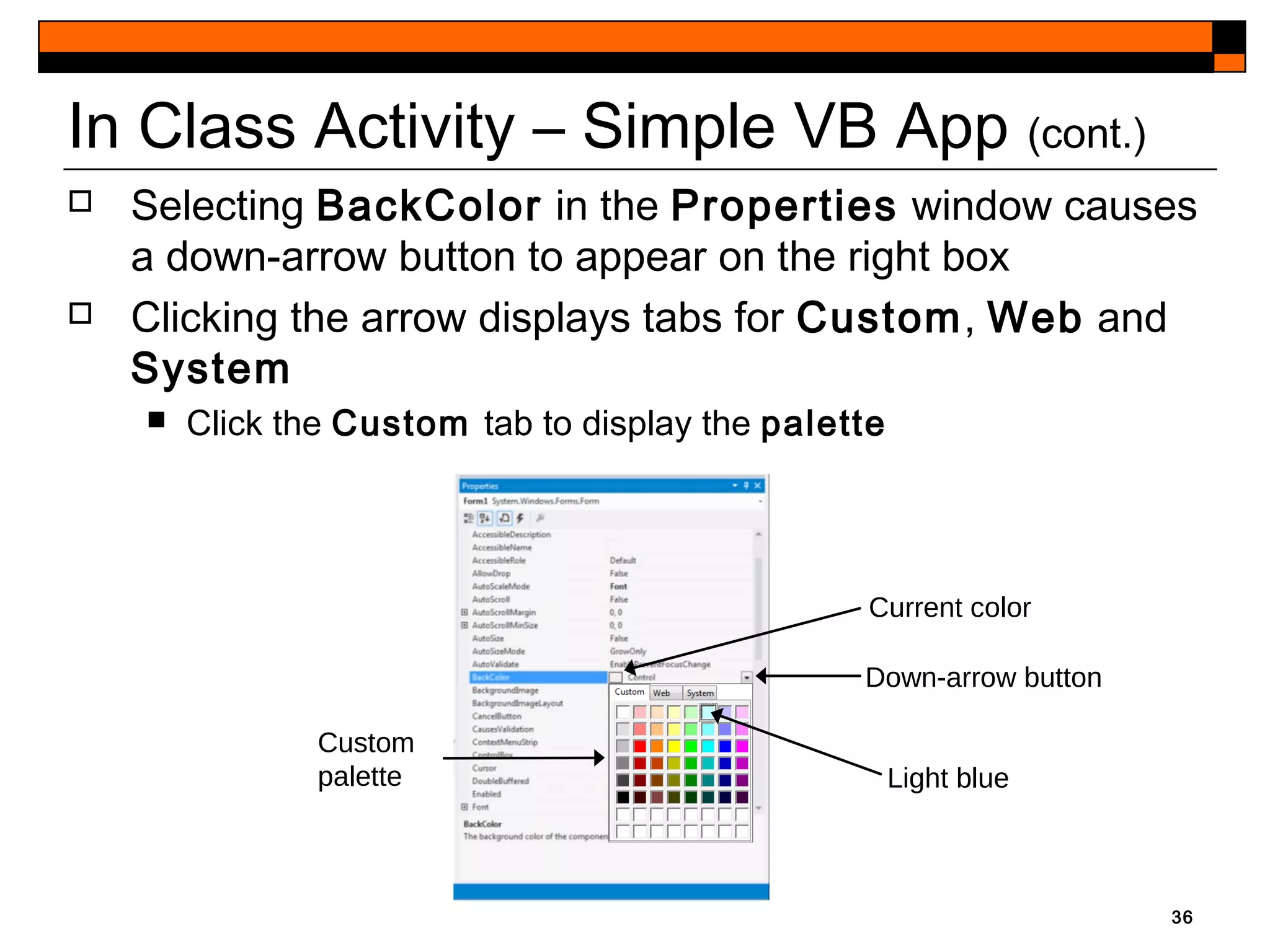
In Class Activity – Simple VB App (cont.)
 Selecting BackColor in the Properties window causes
a down-arrow button to appear on the right box
 Clicking the arrow displays tabs for Custom, Web and
System
 Click the Custom tab to display the palette
Current color
Down-arrow button
Light blue
Custom
palette
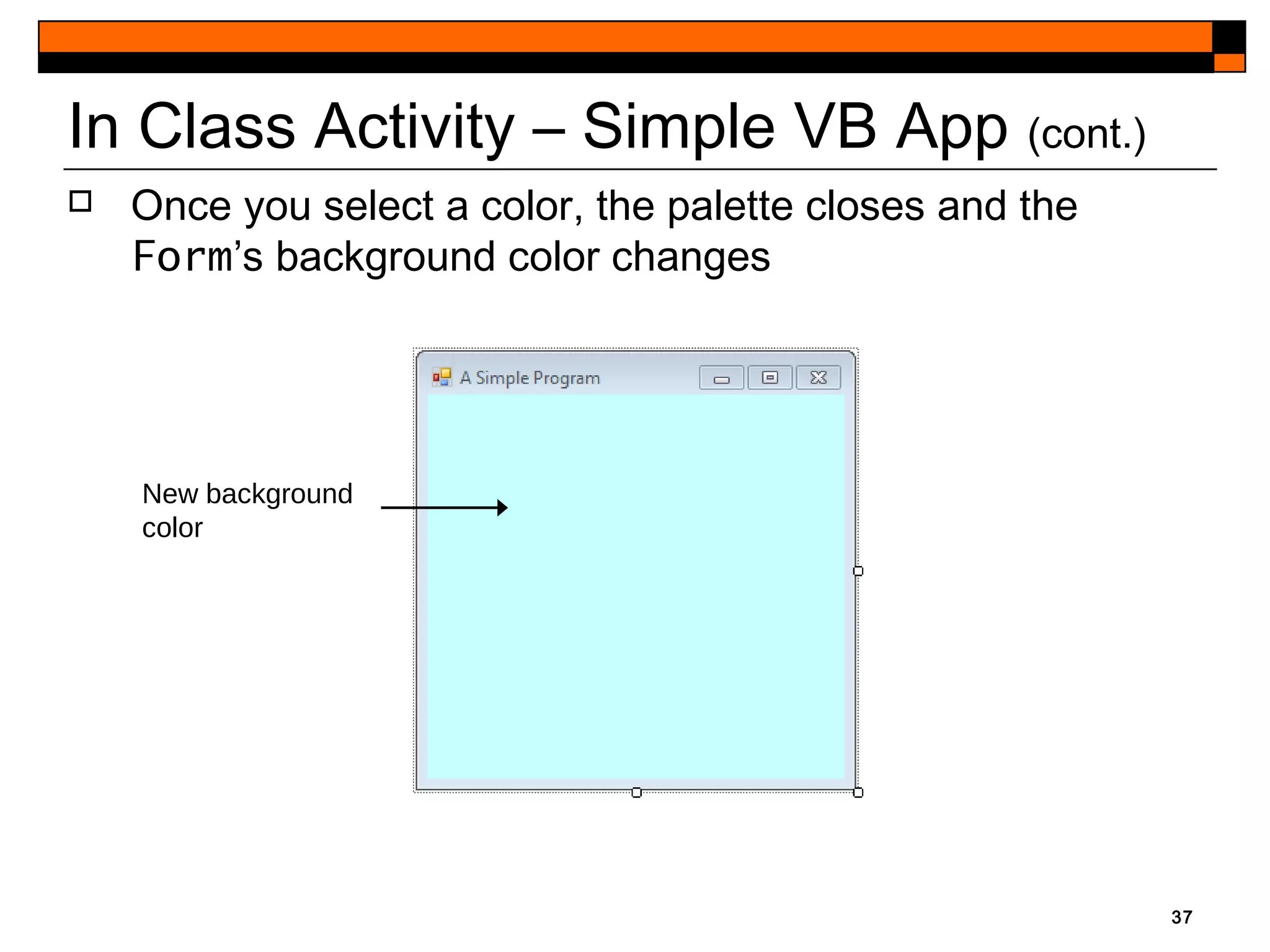
37
In Class Activity – Simple VB App (cont.)
New background
color
 Once you select a color, the palette closes and the
Form’s background color changes
38
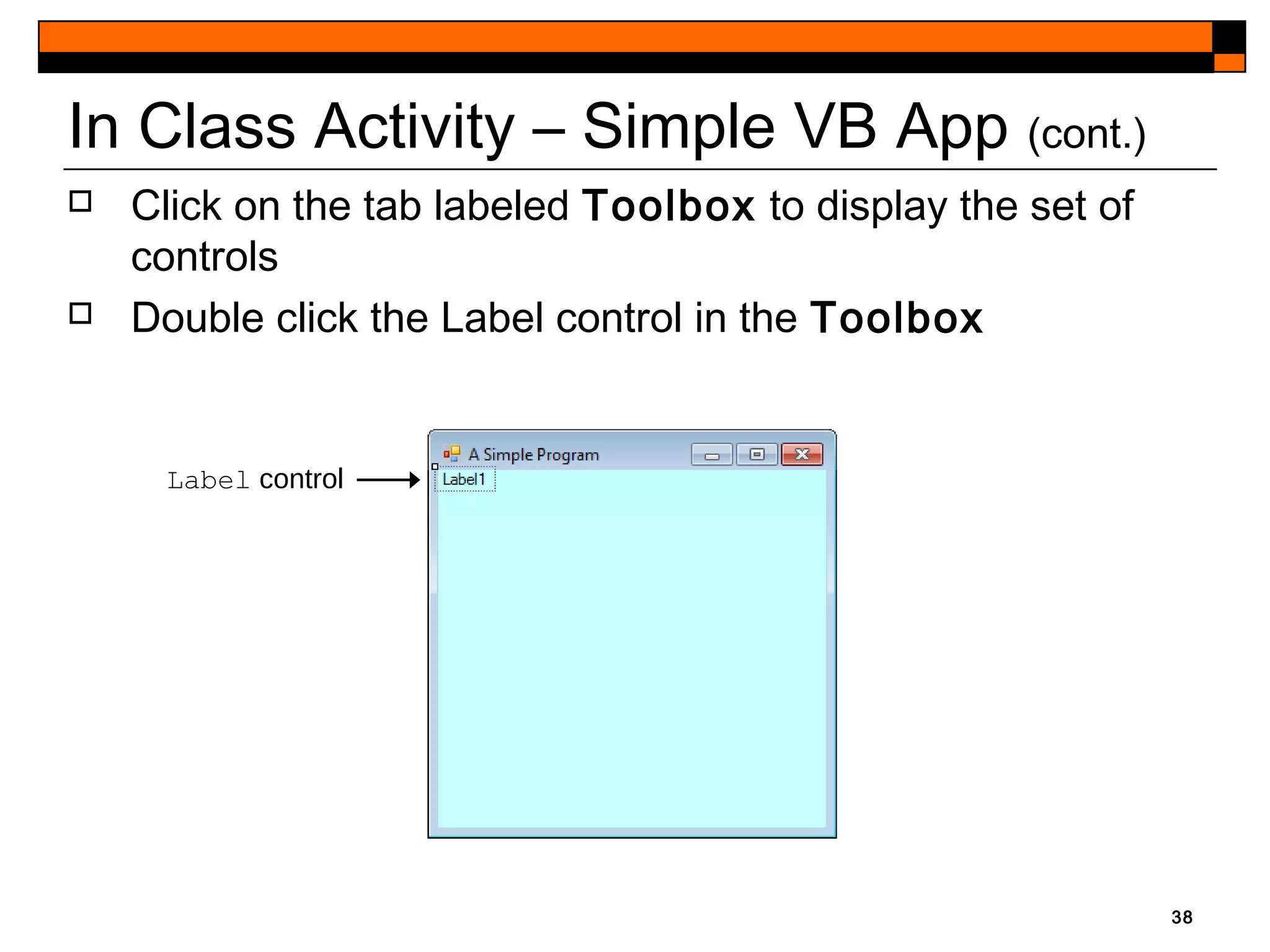
In Class Activity – Simple VB App (cont.)
Label control
 Click on the tab labeled Toolbox to display the set of
controls
 Double click the Label control in the Toolbox
39
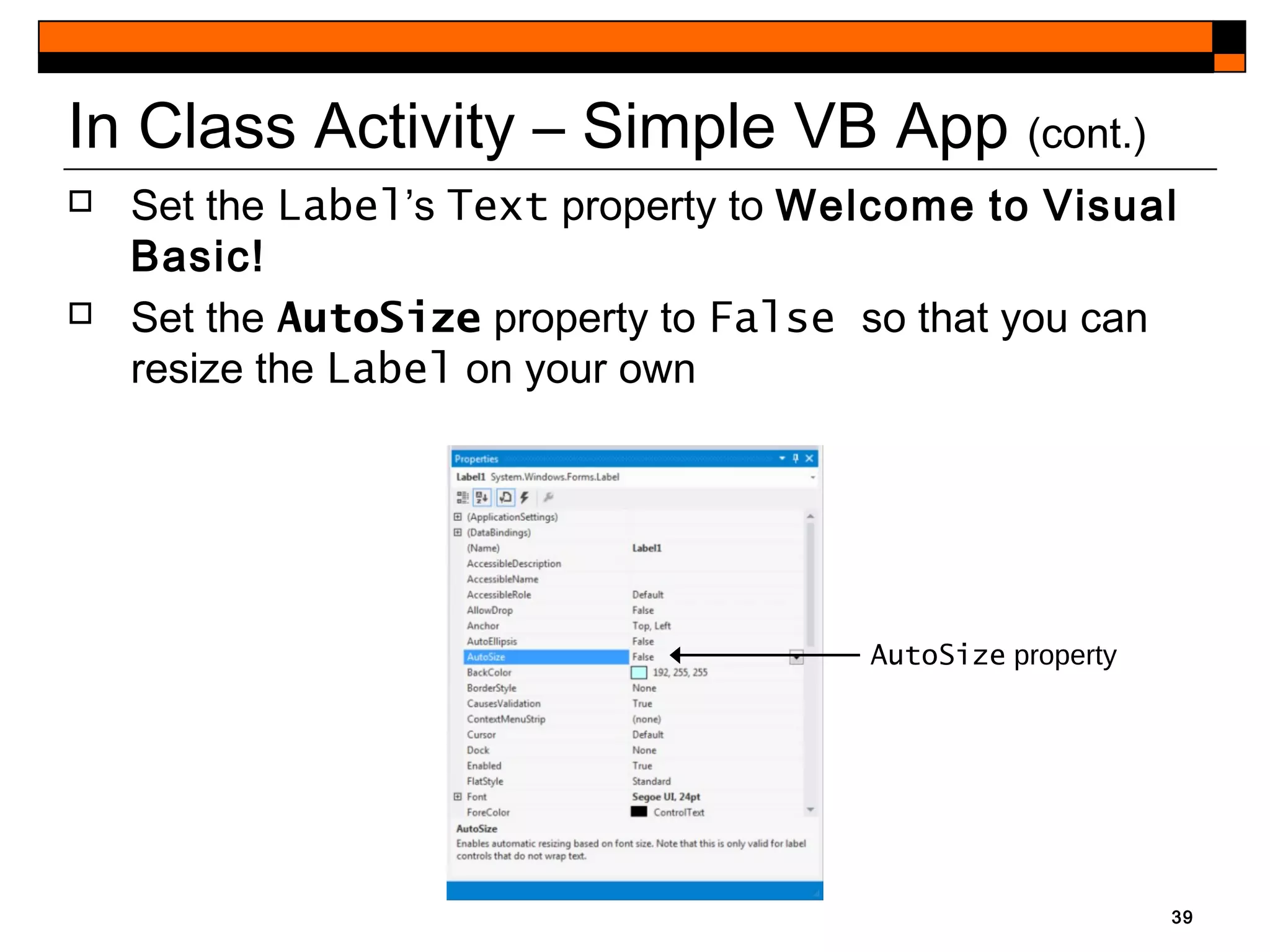
In Class Activity – Simple VB App (cont.)
AutoSize property
 Set the Label’s Text property to Welcome to Visual
Basic!
 Set the AutoSize property to False so that you can
resize the Label on your own
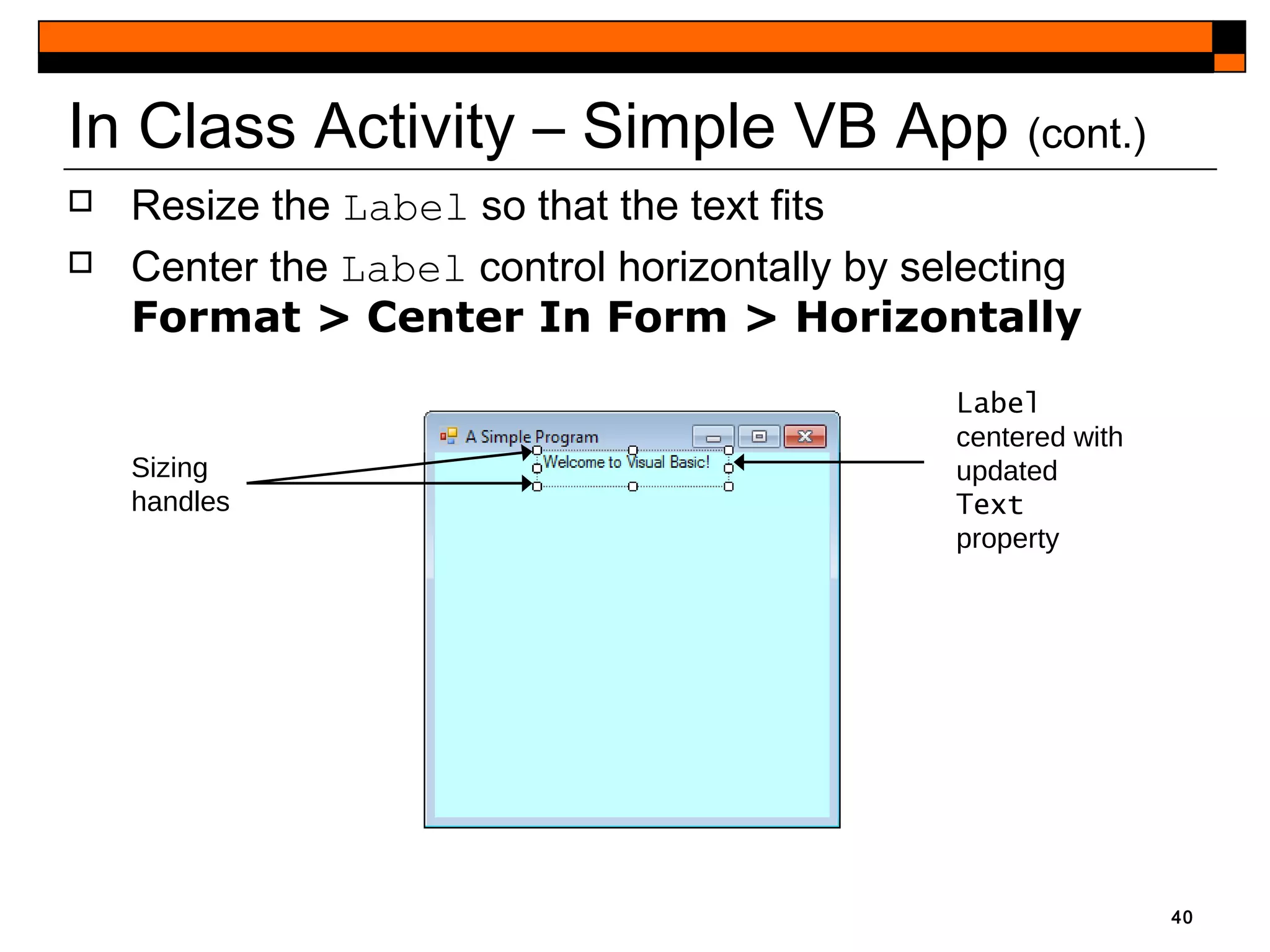
40
 Resize the Label so that the text fits
 Center the Label control horizontally by selecting
Format > Center In Form > Horizontally
In Class Activity – Simple VB App (cont.)
Sizing
handles
Label
centered with
updated
Text
property
41
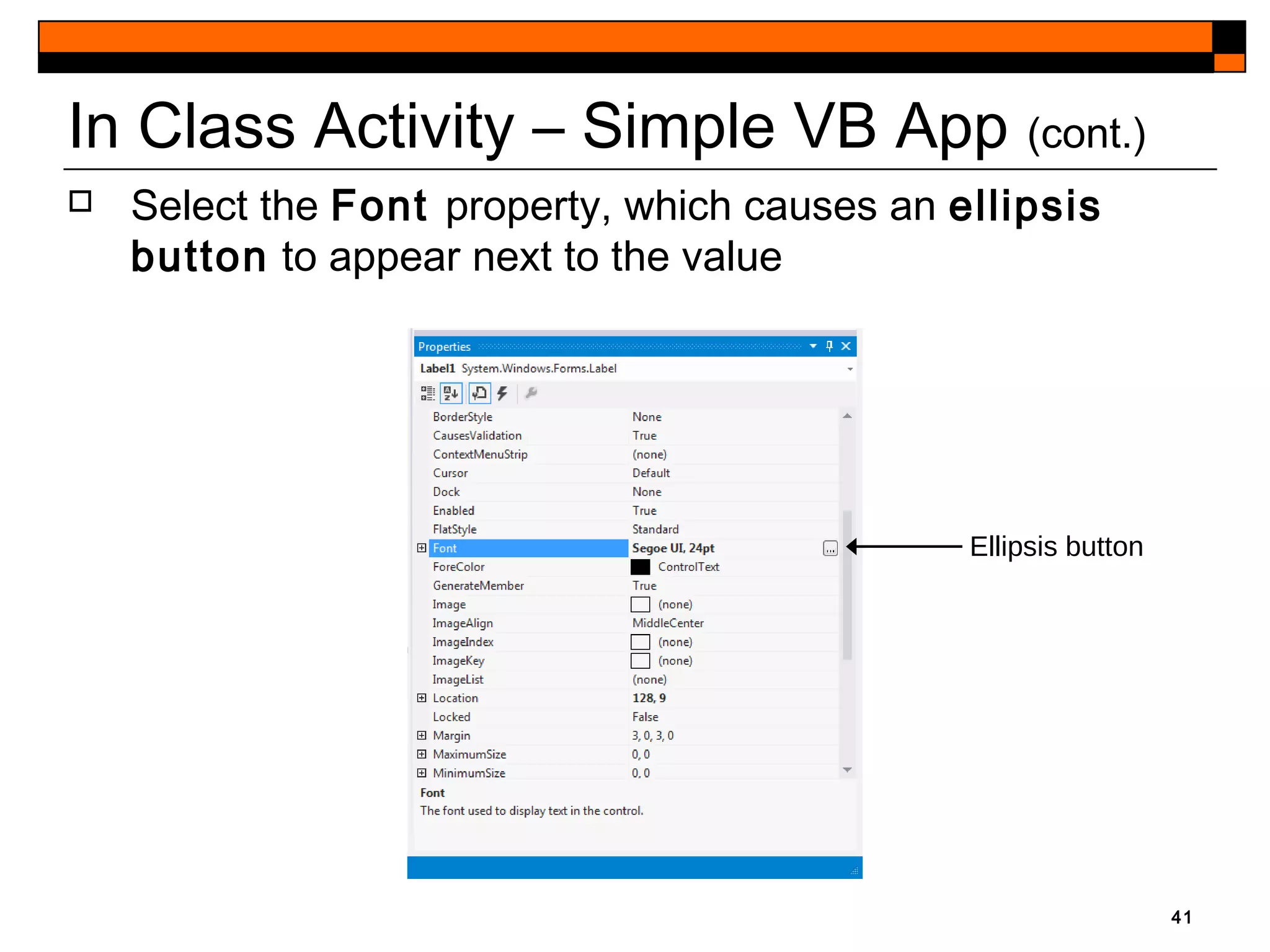
Ellipsis button
In Class Activity – Simple VB App (cont.)
 Select the Font property, which causes an ellipsis
button to appear next to the value
42
In Class Activity – Simple VB App (cont.)
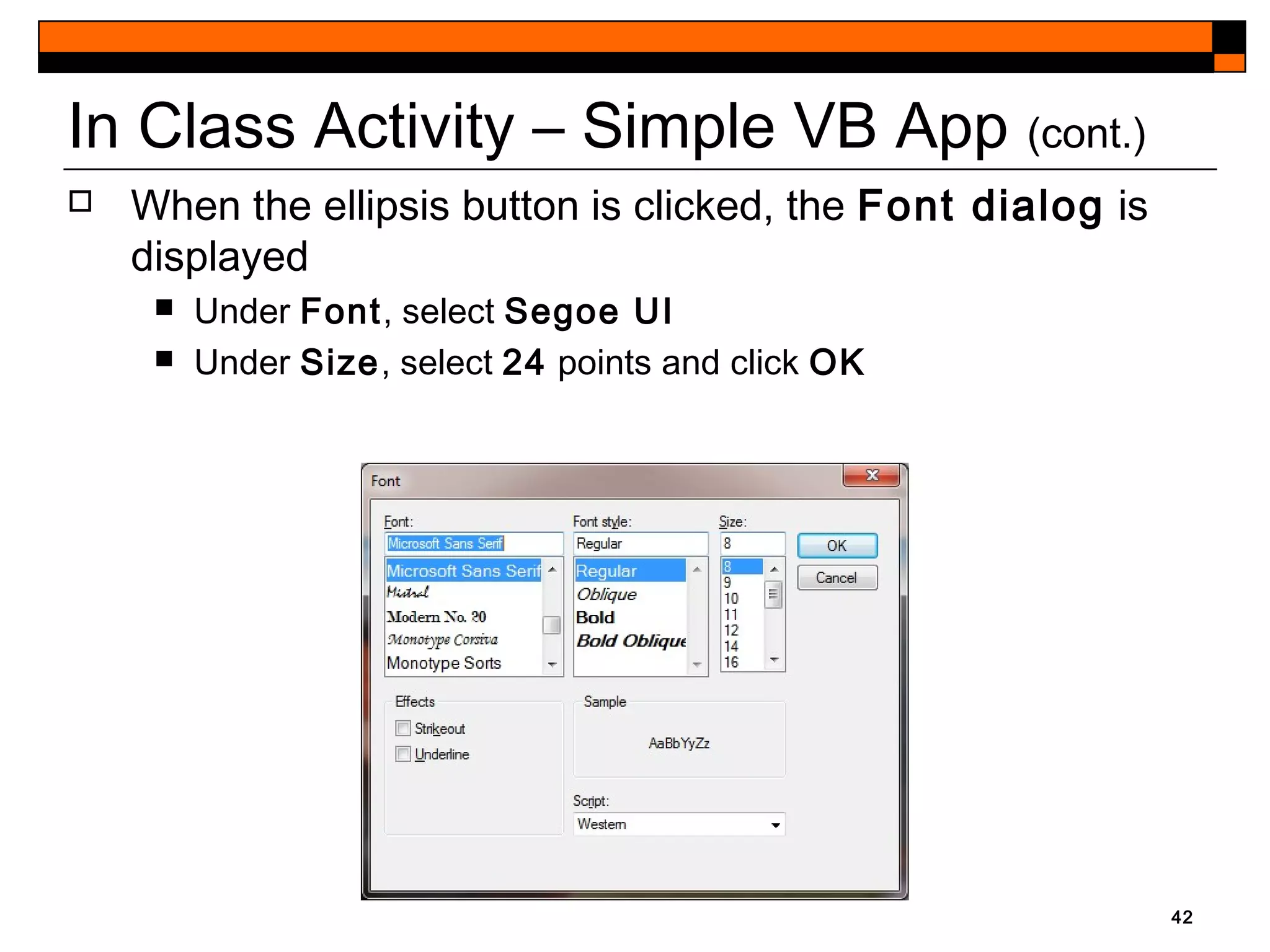
 When the ellipsis button is clicked, the Font dialog is
displayed
 Under Font, select Segoe UI
 Under Size, select 24 points and click OK
43
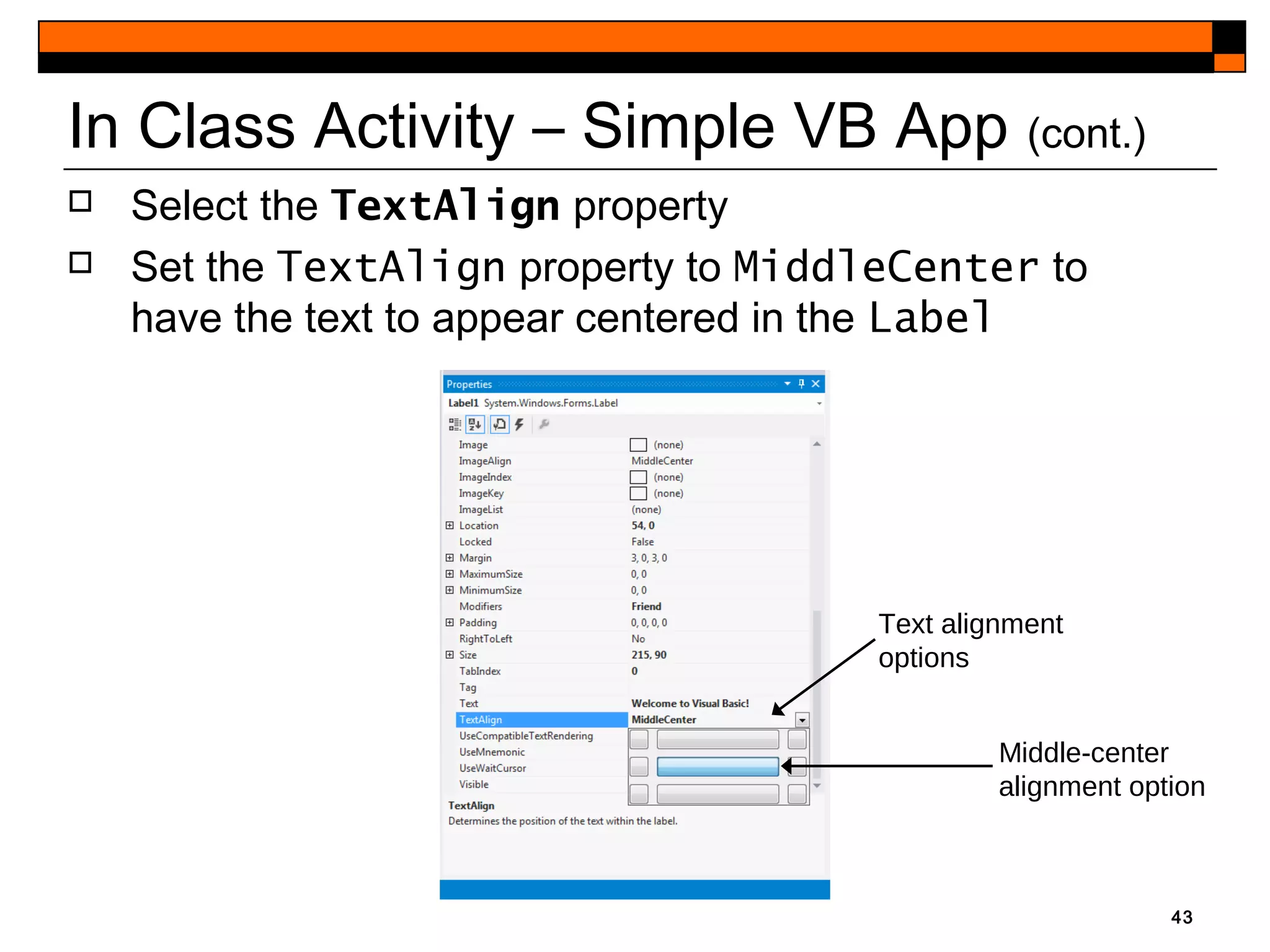
Text alignment
options
Middle-center
alignment option
In Class Activity – Simple VB App (cont.)
 Select the TextAlign property
 Set the TextAlign property to MiddleCenter to
have the text to appear centered in the Label
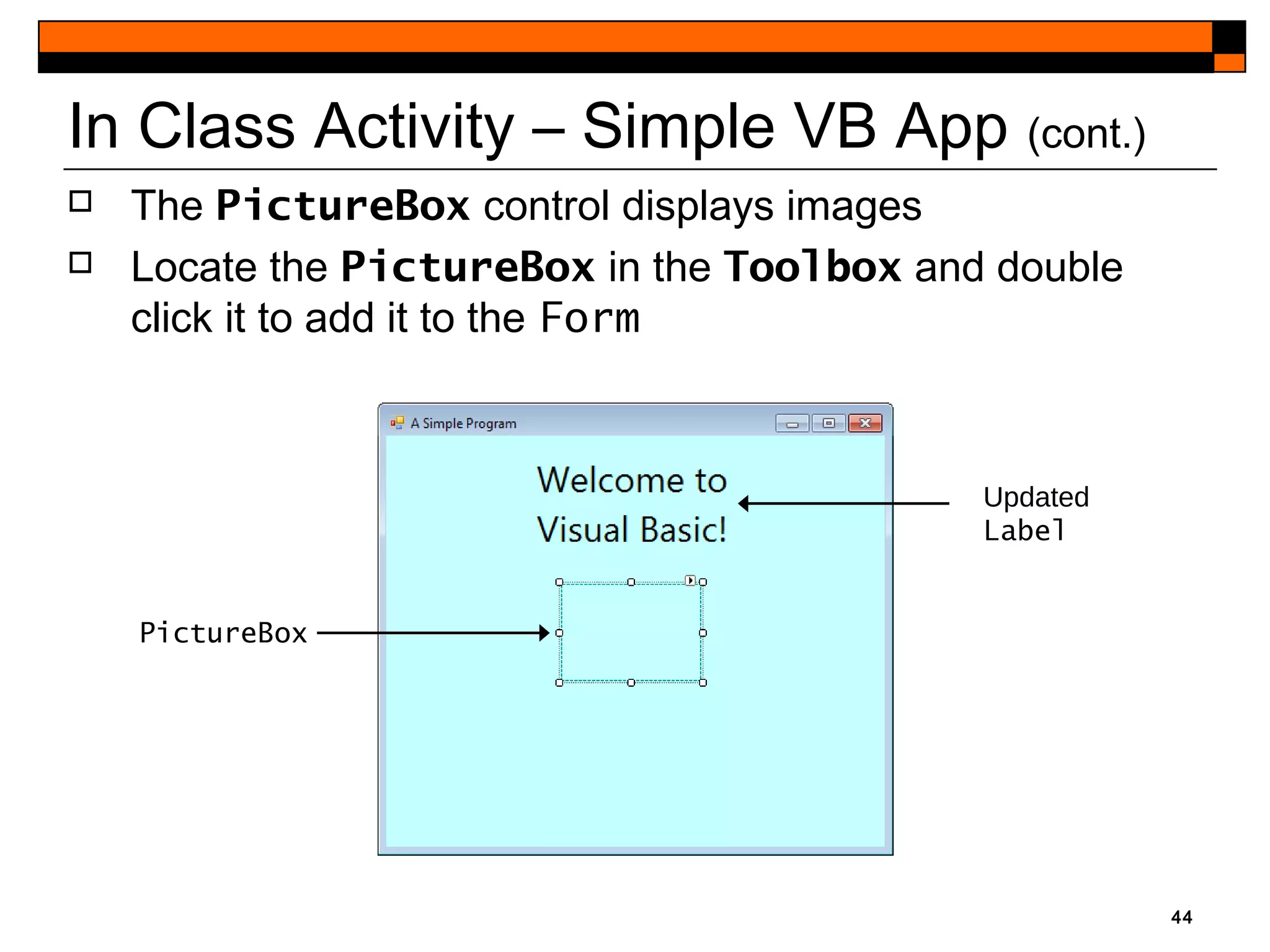
44
PictureBox
Updated
Label
In Class Activity – Simple VB App (cont.)
 The PictureBox control displays images
 Locate the PictureBox in the Toolbox and double
click it to add it to the Form
45
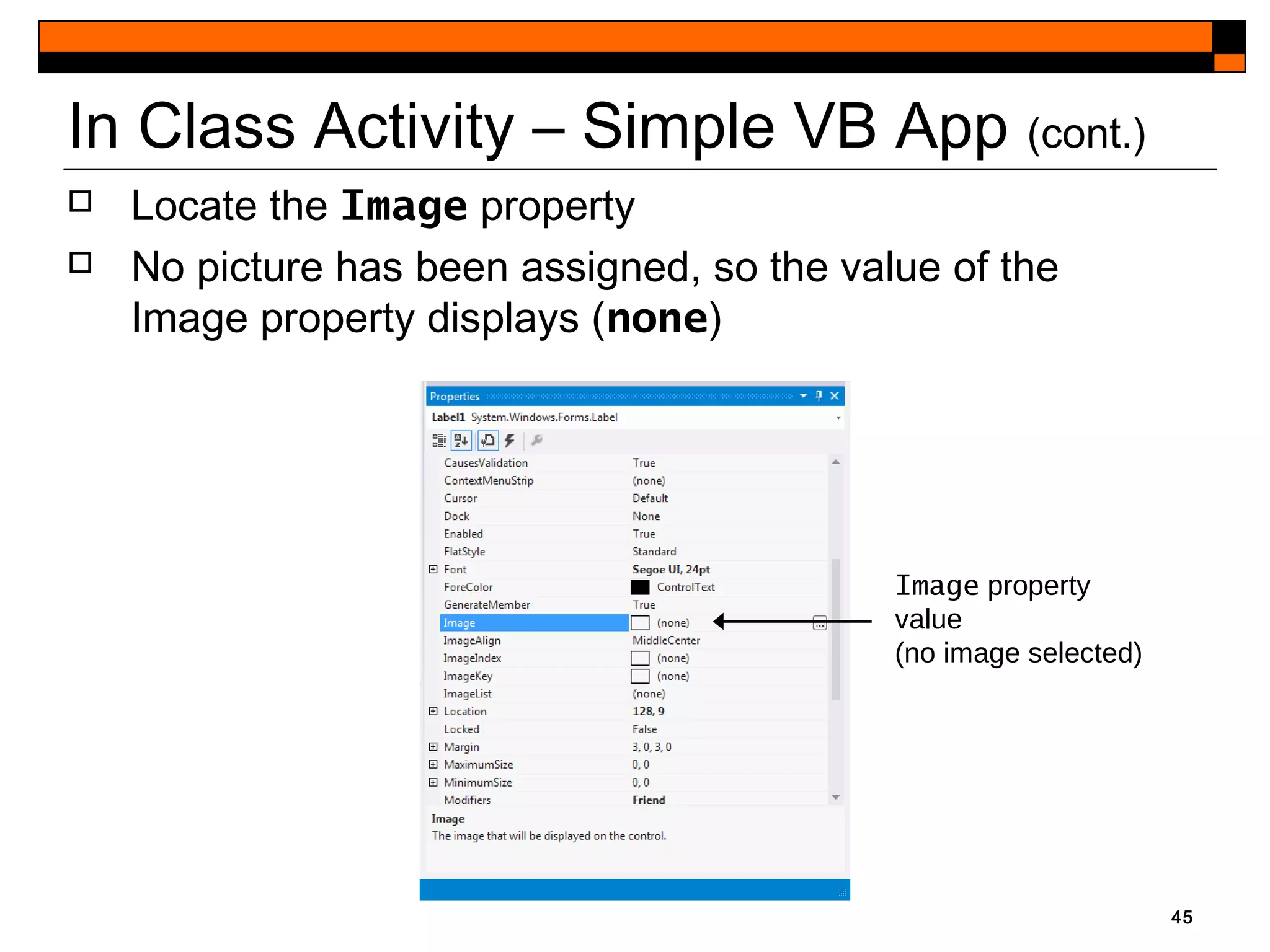
Image property
value
(no image selected)
In Class Activity – Simple VB App (cont.)
 Locate the Image property
 No picture has been assigned, so the value of the
Image property displays (none)
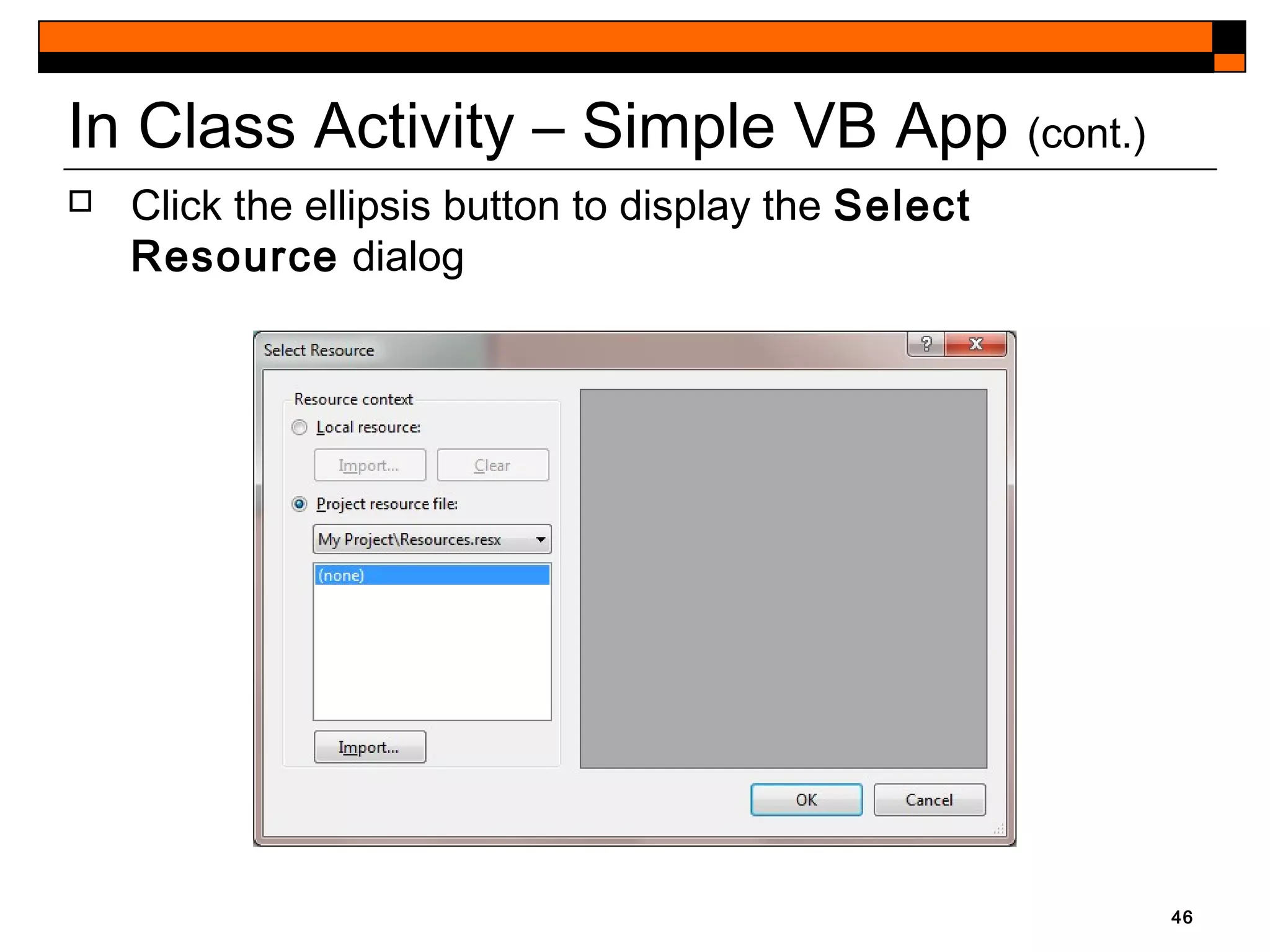
46
 Click the ellipsis button to display the Select
Resource dialog
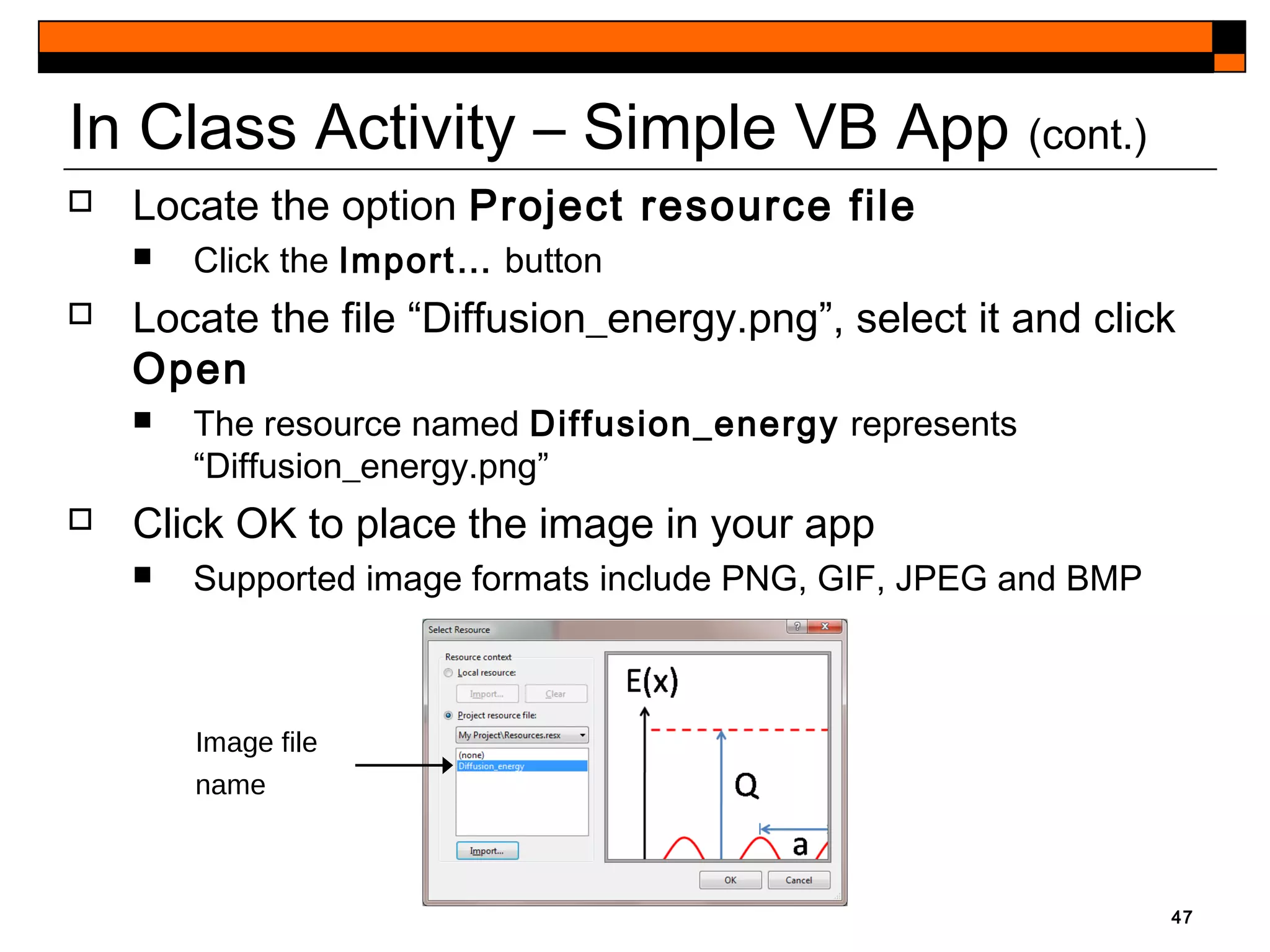
In Class Activity – Simple VB App (cont.)
 Locate the option Project resource file
 Click the Import… button
 Locate the file “Diffusion_energy.png”, select it and click
Open
 The resource named Diffusion_energy represents
“Diffusion_energy.png”
 Click OK to place the image in your app
 Supported image formats include PNG, GIF, JPEG and BMP
47
Image file
name
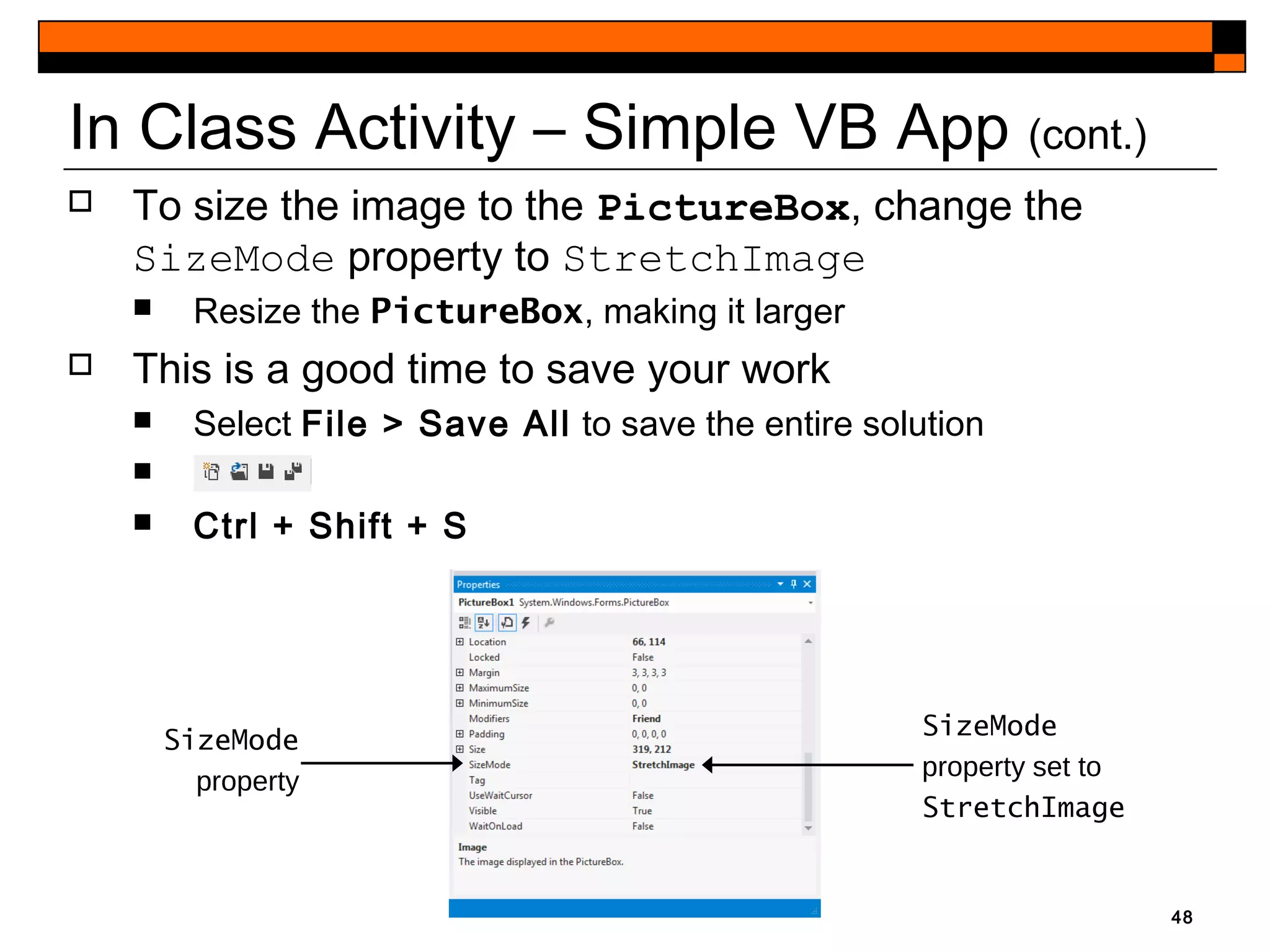
In Class Activity – Simple VB App (cont.)
 To size the image to the PictureBox, change the
SizeMode property to StretchImage
 Resize the PictureBox, making it larger
 This is a good time to save your work
 Select File > Save All to save the entire solution
 x
 Ctrl + Shift + S
48
SizeMode
property set to
StretchImage
SizeMode
property
49
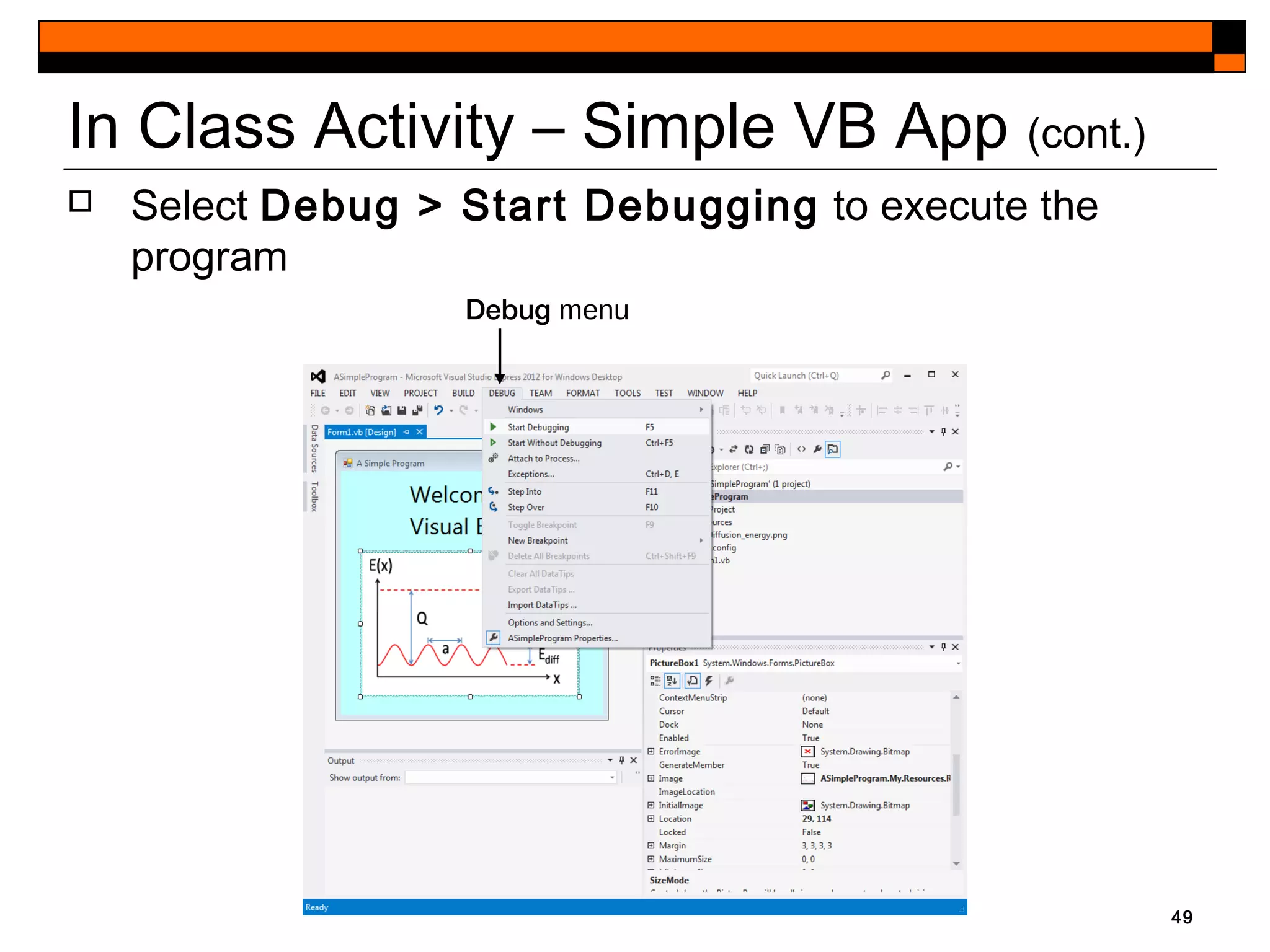
Debug menu
In Class Activity – Simple VB App (cont.)
 Select Debug > Start Debugging to execute the
program
50
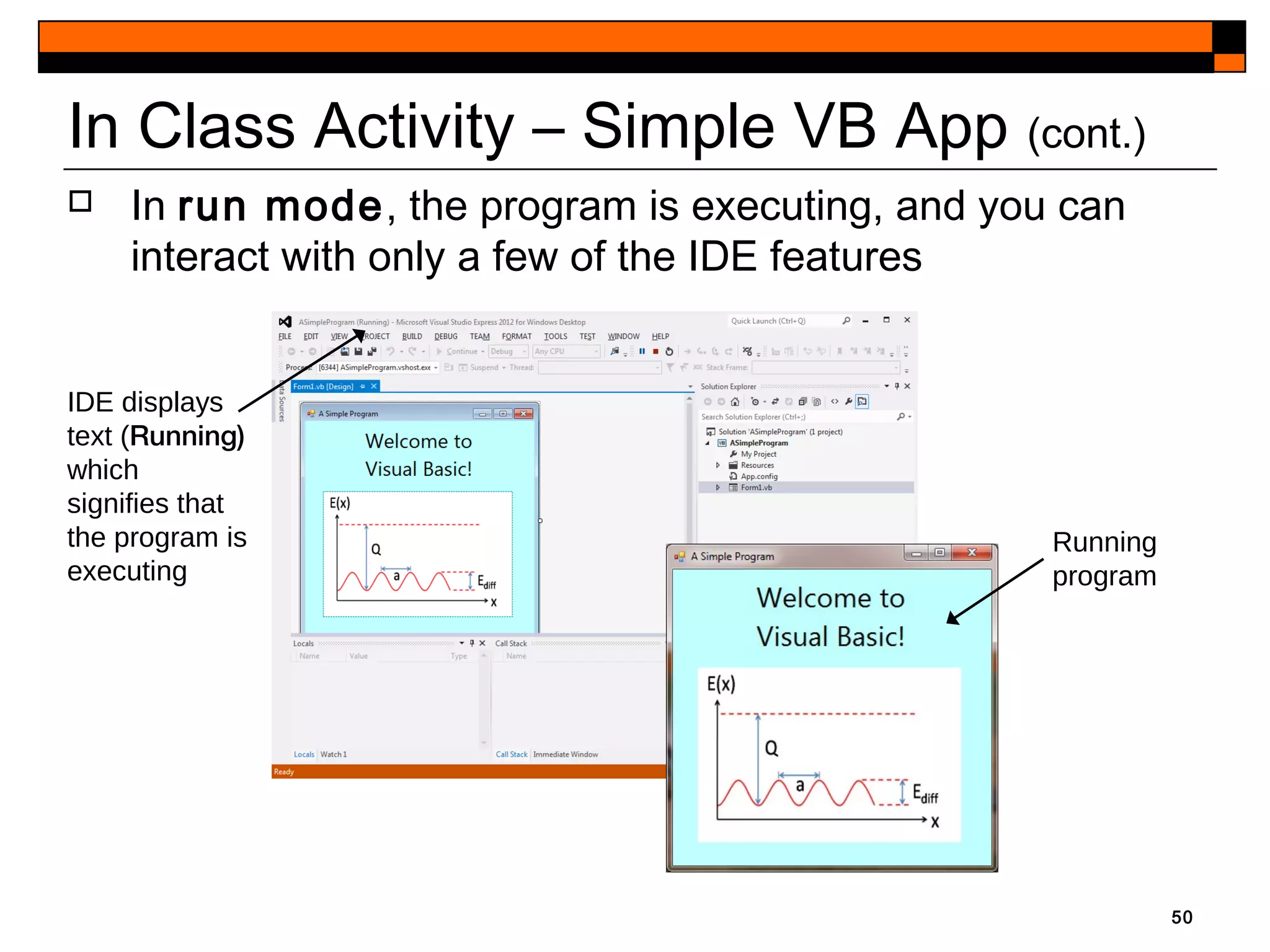
Running
program
IDE displays
text (Running)
which
signifies that
the program is
executing
In Class Activity – Simple VB App (cont.)
 In run mode, the program is executing, and you can
interact with only a few of the IDE features

Visual Studio 2012 Course Blackboard TIC

  • 1.
    IE 411/511: Visual Programmingfor Industrial Applications Lecture Notes #2 Introduction to the Visual Studio 2012 for Windows Desktop Integrated Development Environment
  • 2.
    2 Module Learning Objectives Inthis module we will discuss:  The basics of the Visual Studio 2012 for Windows Desktop Integrated Development Environment (IDE) for writing, running and debugging your apps  Visual Studio’s help features  Key commands contained in the IDE’s menus and toolbars  The purpose of the various kinds of windows in the Visual Studio 2012 for Windows Desktop IDE  How to create, compile and execute a simple Visual Basic app that displays text and an image
  • 3.
    3 Introduction  The examples,screen captures, and discussions in this module are based on the Visual Studio Express 2012 for Windows Desktop  From now on, the Visual Studio Express 2012 for Windows Desktop IDE will be referred to simply as Visual Studio 2012  Examples will work on full versions of Visual Studio as well
  • 4.
    4 Introduction  Visual Studio2012 is Microsoft’s Integrated Development Environment (IDE) for creating, running and debugging applications (also called apps) written in various .NET programming languages  This module provides an overview of the Visual Studio 2012 IDE  Shows how to create a simple Visual Basic app by dragging and dropping predefined building blocks into place  A technique known as visual app development
  • 5.
    5 Visual Studio 2012IDE Overview  Once Visual Studio 2012 begins execution, the Start Page displays  The Start Page contains a list of links to Visual Studio resources and web-based resources  At any time, you can return to the Start Page by selecting VIEW > Start Page
  • 6.
    6 Visual Studio 2012IDE Overview (cont.) New Project button Start Page tab Latest News tab Solution Explorer (no projects open) Collapsed Toolbox window Recent projects will be listed here Start Page links
  • 7.
    7 Visual Studio 2012IDE Overview (cont.)  The Recent Projects section shows solutions you have been working on  The links in the Get Started tab provide information about the programming languages supported by Visual Studio and various learning resources  An Internet connection is required for the IDE to access most of this information
  • 8.
    8 Visual Studio 2012IDE Overview (cont.)  The IDE also has an internal web browser  Go to VIEW > Other Windows > Web Browser
  • 9.
    9 Visual Studio 2012IDE Overview (cont.) Creating a New Project Select File > New Project... to create a new project  On the Start Page, just click the link labeled New Project… A project is a group of related files, such as the Visual Basic code and any images that might make up an app Visual Studio organizes apps into projects and solutions, which contain one or more projects  However, most apps consist of a solution containing a single project
  • 10.
    10 Visual Studio 2012IDE Overview (cont.) Creating a New Project (cont.) When you select FILE > New Project… or click the New Project… link on the Start Page, the New Project dialog displays Visual Studio provides several templates  Project types users can create in Visual Basic and other languages Project templates are the project types users can create in Visual Basic In this course, we will concentrate on Windows Forms applications  A Windows Forms application has a graphical user interface (GUI)
  • 11.
    11 Visual Studio 2012IDE Overview (cont.) Visual Basic Windows Forms Application (selected) Default project name (provided by Visual Studio) Description of selected project (provided by Visual Studio)
  • 12.
    12 Visual Studio 2012IDE Overview (cont.)  Click OK to display the IDE in Design view Menu in the menu bar Solution Explorer window Form (Windows Forms application) Properties window
  • 13.
    13 Visual Studio 2012IDE Overview (cont.)  As you place controls on the Form, you will be able to modify their properties  The figure below shows where the Form’s title text can be modified Text box (displaying the text Form1) which can be modified
  • 14.
    14 Visual Studio 2012IDE Overview (cont.)  Collectively, the Form and controls make up the app’s GUI  Users enter data into the app by typing at the keyboard, by clicking the mouse buttons and in a variety of other ways  Programs use the GUI to display instructions and other information for users to view
  • 15.
    15 Visual Studio 2012IDE Overview (cont.)  The figure below shows a dialog in which a control’s font properties can be modified
  • 16.
    16 Menu Bar andToolbar  Commands for managing the IDE and for developing, maintaining and executing apps are contained in menus  Located on the menu bar of the IDE  The set of menus displayed depends on what you are currently doing in the IDE
  • 17.
    17 Menu Bar andToolbar (cont.) Summary of Visual Studio 2012 IDE menus
  • 18.
    18 Menu Bar andToolbar (cont.)  You can access common commands from the toolbar icons
  • 19.
    19 Menu Bar andToolbar (cont.)  You can customize which toolbars are displayed by selecting View > Toolbars  Each toolbar you select is displayed at the top of the Visual Studio window
  • 20.
    20 Menu Bar andToolbar (cont.)  Positioning the mouse pointer over an icon highlights it and, after a brief pause, displays a description called a tool tip Tool tip displayed when the mouse pointer rests on an icon for a few seconds
  • 21.
    21 Navigating the VisualStudio IDE  The IDE provides windows for accessing project files and customizing controls  Solution Explorer Window  Toolbox Window  Properties Window
  • 22.
    22 Navigating the VisualStudio IDE (cont.)  Visual Studio provides a space-saving feature called auto-hide  When auto-hide is enabled, a tab appears along the edge of the IDE window Icon for hidden window (auto-hide enabled)
  • 23.
    23 Navigating the VisualStudio IDE (cont.) Toolbox title bar Horizontal orientation for pin icon when auto-hide is enabled  Placing the mouse pointer over one of these icons displays that window
  • 24.
    24 Navigating the VisualStudio IDE (cont.) Vertical orientation for pin icon when window is pinned down  To “pin down” a window, click its pin icon  When auto-hide is enabled, the pin icon is horizontal  When a window is “pinned down,” the pin is vertical
  • 25.
    Navigating the VisualStudio IDE (cont.) Solution Explorer Window The Solution Explorer provides access to all of the solution’s files The solution’s startup project is the one that runs when you select Debug > Start Debugging 25 Show All Files icon Toolbar Startup project
  • 26.
    Navigating the VisualStudio IDE (cont.) Solution Explorer Window By default, the IDE displays only files that you may need to edit  Other files that the IDE generates are hidden The Solution Explorer window includes a toolbar that contains several icons Clicking the Show All Files icon displays all the solution’s files, including those generated by the IDE  Clicking the arrows to the left of a file or folder expands or collapses the project tree’s nodes 26
  • 27.
    Navigating the VisualStudio IDE (cont.) Toolbox Window The Toolbox contains the controls used to customize Forms With visual app development, you can “drag and drop” controls onto the Form and the IDE will write the code that creates the controls for you  Just as you do not need to know how to build an engine to drive a car, you do not need to know how to build controls to use them Reusing preexisting controls saves time and money when you develop apps 27
  • 28.
    Navigating the VisualStudio IDE (cont.) Toolbox Window 28 Group Names Controls
  • 29.
    Navigating the VisualStudio IDE (cont.) Properties Window Select View > Properties Window  The Properties window allows you to modify a control’s properties visually, without writing code The Properties window displays the properties for the currently selected Form, control or file in Design view At the top of the Properties window is the component selection drop-down list The Properties window is crucial to visual app development  It allows you to modify a control’s properties visually, without writing code 29
  • 30.
    Navigating the VisualStudio IDE (cont.) Properties Window 30 Categorized icon Alphabetical icon Properties Selected property’s description Property values Toolbar Component selection drop-down list
  • 31.
    31 Using Help Context-Sensitive Help VisualStudio provides context-sensitive help pertaining to the “current content”  i.e., The items around the location of the mouse cursor To use context-sensitive help, click an item, then press the F1 key  The help documentation is displayed in a web browser window To return to the IDE, either close the browser window or select the IDE’s icon in your Windows task bar
  • 32.
    32 In Class Activity– Simple VB App  The figure below shows the result of a simple VB program as it executes Label control PictureBox control
  • 33.
    33 In Class Activity– Simple VB App (cont.)  Select File > New Project  Or, click on New Project… on the Start page  From the template options, select Windows Forms Application  Name the project ASimpleProgram  To set the project location, click the Browse… button and then press OK Template types Type the project name
  • 34.
     When youfirst begin working in the IDE, it is in Design Mode  The text in the Form’s title bar is determined by the Form’s Text property  Change the value of the property Text as shown above and then press Enter 34 In Class Activity – Simple VB App (cont.) Name and type of object Property value Selected property Property description
  • 35.
    35 In Class Activity– Simple VB App (cont.)  Click and drag one of the Form’s enabled sizing handles to make the Form larger Title bar Enabled sizing handles
  • 36.
    36 In Class Activity– Simple VB App (cont.)  Selecting BackColor in the Properties window causes a down-arrow button to appear on the right box  Clicking the arrow displays tabs for Custom, Web and System  Click the Custom tab to display the palette Current color Down-arrow button Light blue Custom palette
  • 37.
    37 In Class Activity– Simple VB App (cont.) New background color  Once you select a color, the palette closes and the Form’s background color changes
  • 38.
    38 In Class Activity– Simple VB App (cont.) Label control  Click on the tab labeled Toolbox to display the set of controls  Double click the Label control in the Toolbox
  • 39.
    39 In Class Activity– Simple VB App (cont.) AutoSize property  Set the Label’s Text property to Welcome to Visual Basic!  Set the AutoSize property to False so that you can resize the Label on your own
  • 40.
    40  Resize theLabel so that the text fits  Center the Label control horizontally by selecting Format > Center In Form > Horizontally In Class Activity – Simple VB App (cont.) Sizing handles Label centered with updated Text property
  • 41.
    41 Ellipsis button In ClassActivity – Simple VB App (cont.)  Select the Font property, which causes an ellipsis button to appear next to the value
  • 42.
    42 In Class Activity– Simple VB App (cont.)  When the ellipsis button is clicked, the Font dialog is displayed  Under Font, select Segoe UI  Under Size, select 24 points and click OK
  • 43.
    43 Text alignment options Middle-center alignment option InClass Activity – Simple VB App (cont.)  Select the TextAlign property  Set the TextAlign property to MiddleCenter to have the text to appear centered in the Label
  • 44.
    44 PictureBox Updated Label In Class Activity– Simple VB App (cont.)  The PictureBox control displays images  Locate the PictureBox in the Toolbox and double click it to add it to the Form
  • 45.
    45 Image property value (no imageselected) In Class Activity – Simple VB App (cont.)  Locate the Image property  No picture has been assigned, so the value of the Image property displays (none)
  • 46.
    46  Click theellipsis button to display the Select Resource dialog In Class Activity – Simple VB App (cont.)
  • 47.
    In Class Activity– Simple VB App (cont.)  Locate the option Project resource file  Click the Import… button  Locate the file “Diffusion_energy.png”, select it and click Open  The resource named Diffusion_energy represents “Diffusion_energy.png”  Click OK to place the image in your app  Supported image formats include PNG, GIF, JPEG and BMP 47 Image file name
  • 48.
    In Class Activity– Simple VB App (cont.)  To size the image to the PictureBox, change the SizeMode property to StretchImage  Resize the PictureBox, making it larger  This is a good time to save your work  Select File > Save All to save the entire solution  x  Ctrl + Shift + S 48 SizeMode property set to StretchImage SizeMode property
  • 49.
    49 Debug menu In ClassActivity – Simple VB App (cont.)  Select Debug > Start Debugging to execute the program
  • 50.
    50 Running program IDE displays text (Running) which signifiesthat the program is executing In Class Activity – Simple VB App (cont.)  In run mode, the program is executing, and you can interact with only a few of the IDE features