1
Fluid Static Forces
By:
Dr: Ezzat El-sayed Gomaa
2
Hydraulic I (2) Fluid Static Forces
Hydrostatic Forces on Plane Surfaces
- Magnitude,
 - Direction, it is the easiest !
Why ?
 - Line of action
 To define the force, we need:
3
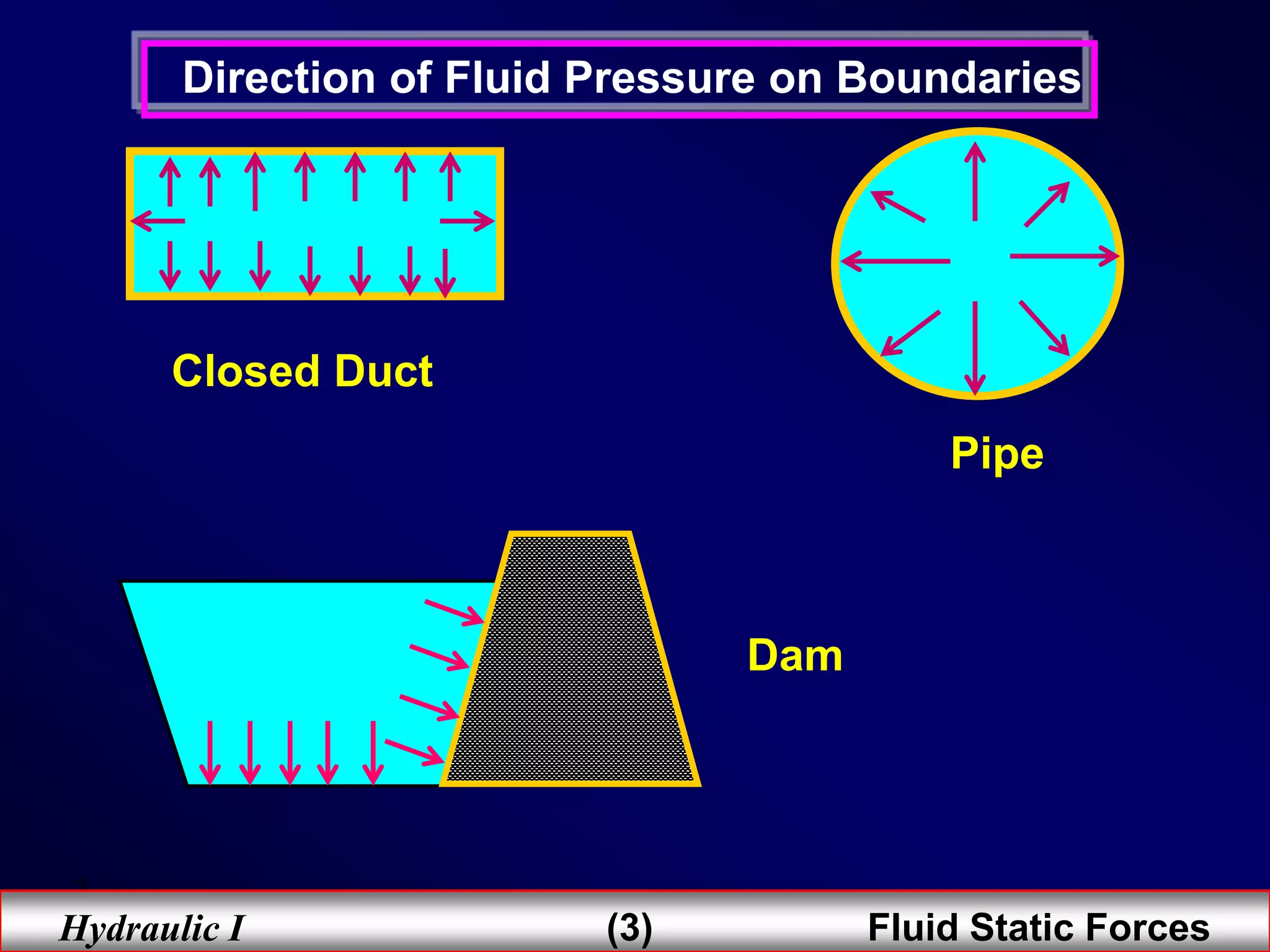
Closed Duct
Pipe
Dam
Hydraulic I (3) Fluid Static Forces
Direction of Fluid Pressure on Boundaries
4
Hydraulic I (4) Fluid Static Forces
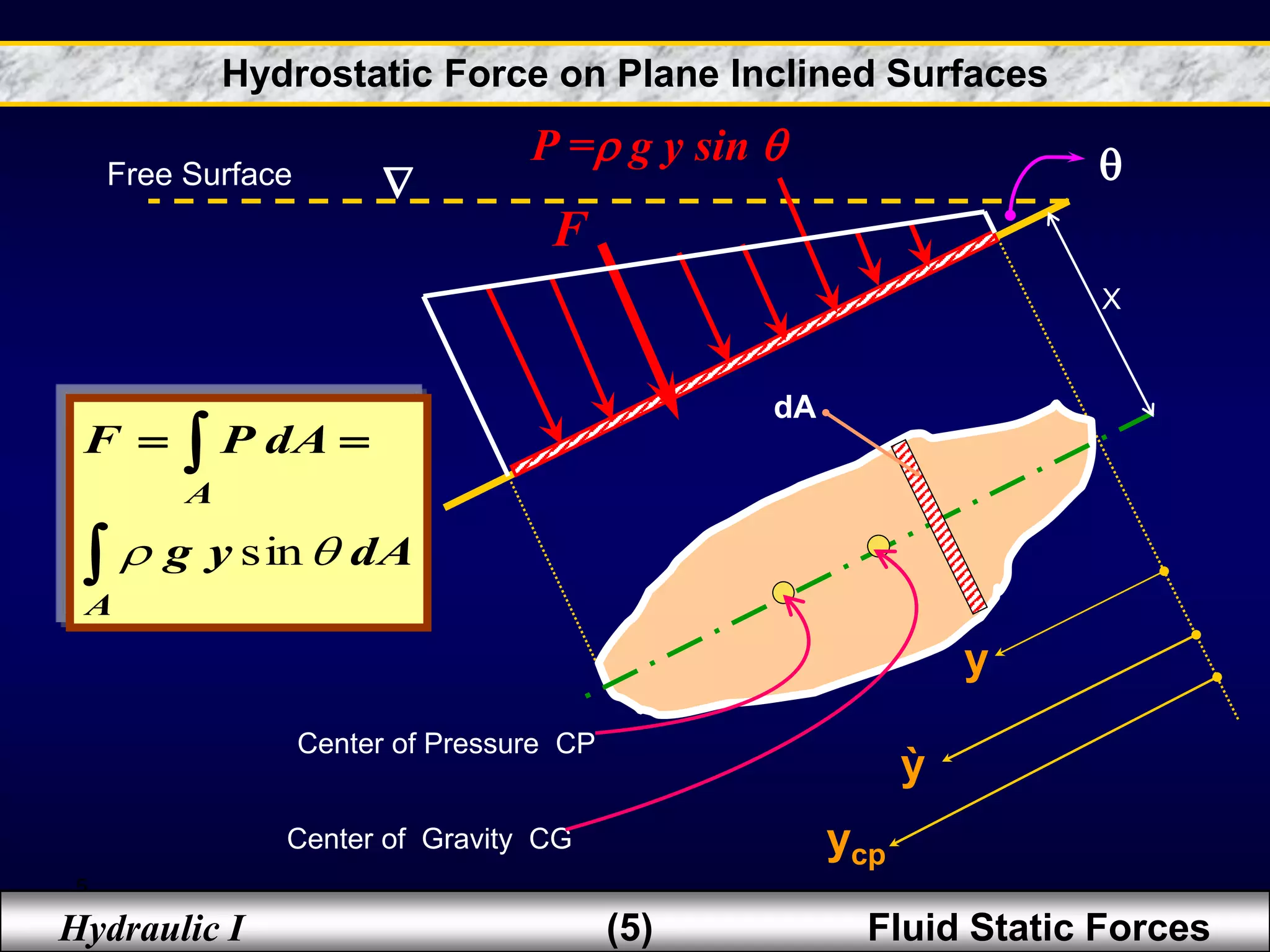
Hydrostatic Force on an Inclined Plane
Surfaces
 - Magnitude,
 - Location
5
X
dA
Hydraulic I (5) Fluid Static Forces
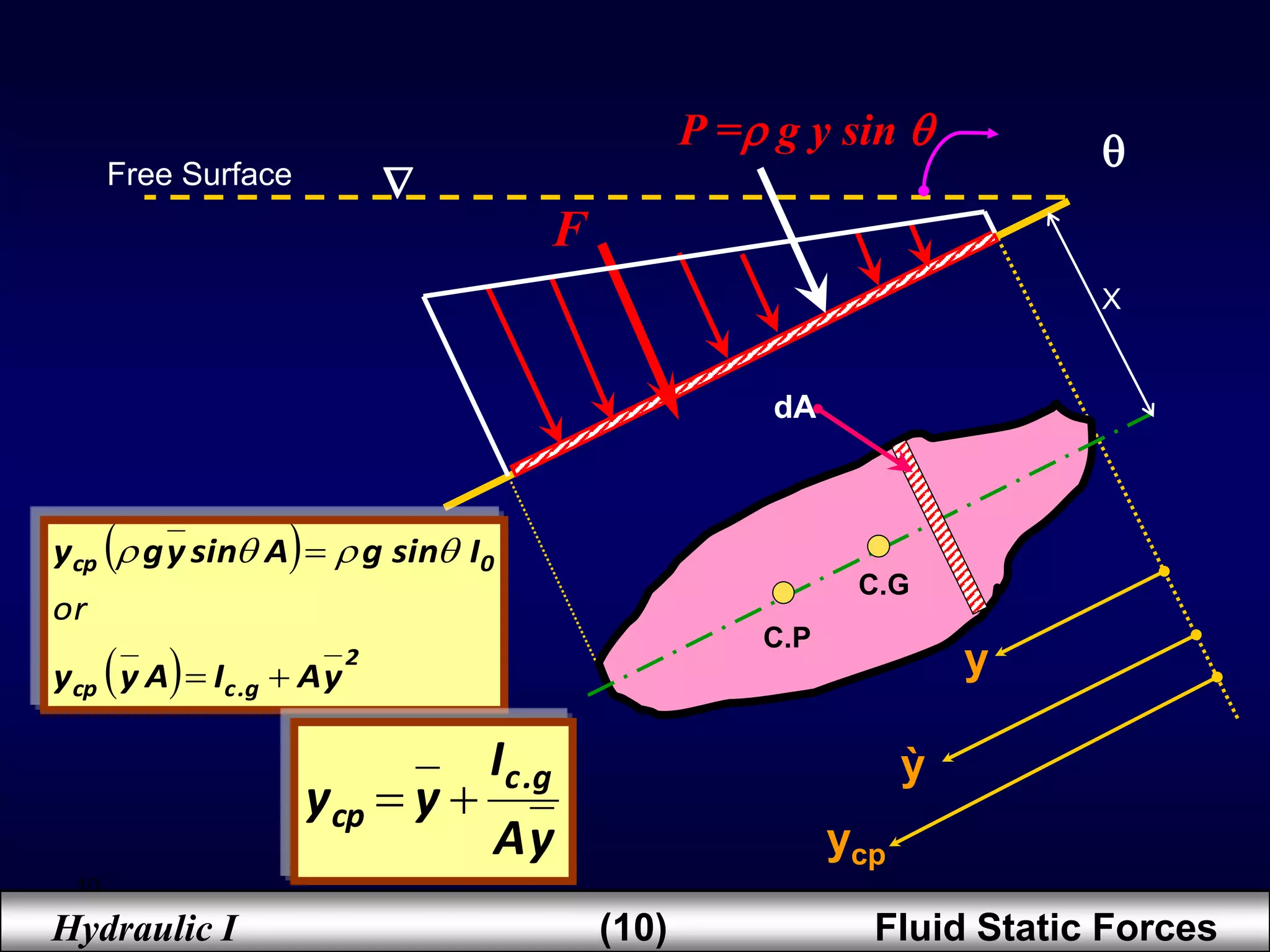
Center of Pressure CP
Center of Gravity CG
y
ỳ
ycp


F
P = g y sin 
Free Surface

 

A
A
dA
y
g
dA
P
F

 sin
Hydrostatic Force on Plane Inclined Surfaces
6
Hydraulic I (6) Fluid Static Forces
A
y
sin
g
dA
sin
y
g
dA
P
F
A
A
A


 

 



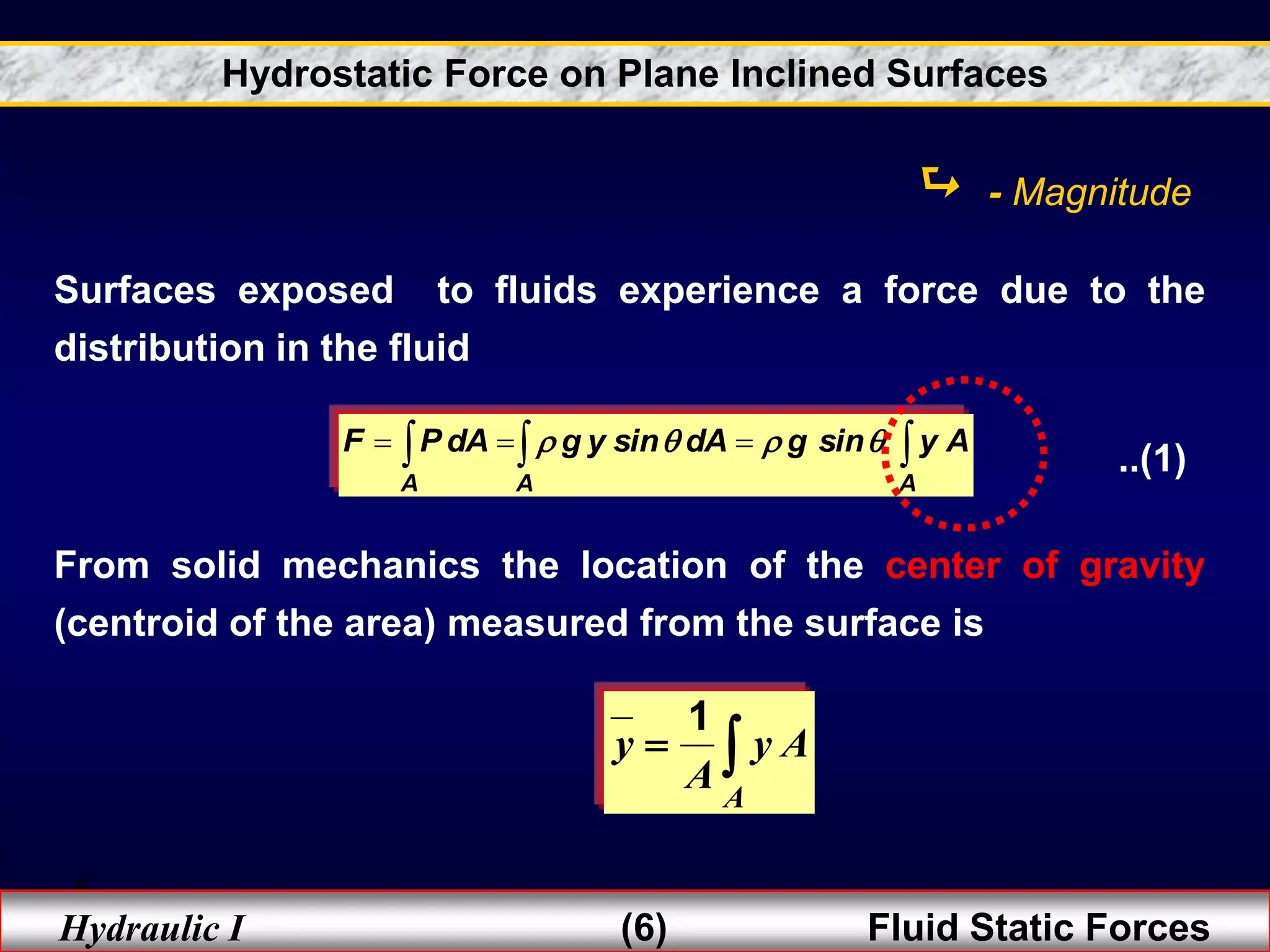
Surfaces exposed to fluids experience a force due to the
distribution in the fluid
From solid mechanics the location of the center of gravity
(centroid of the area) measured from the surface is
A
y
A
y
A


1
..(1)
 - Magnitude
Hydrostatic Force on Plane Inclined Surfaces
7
Hydraulic I (7) Fluid Static Forces
  A
P
A
h
g
A
sin
y
g
F 

 


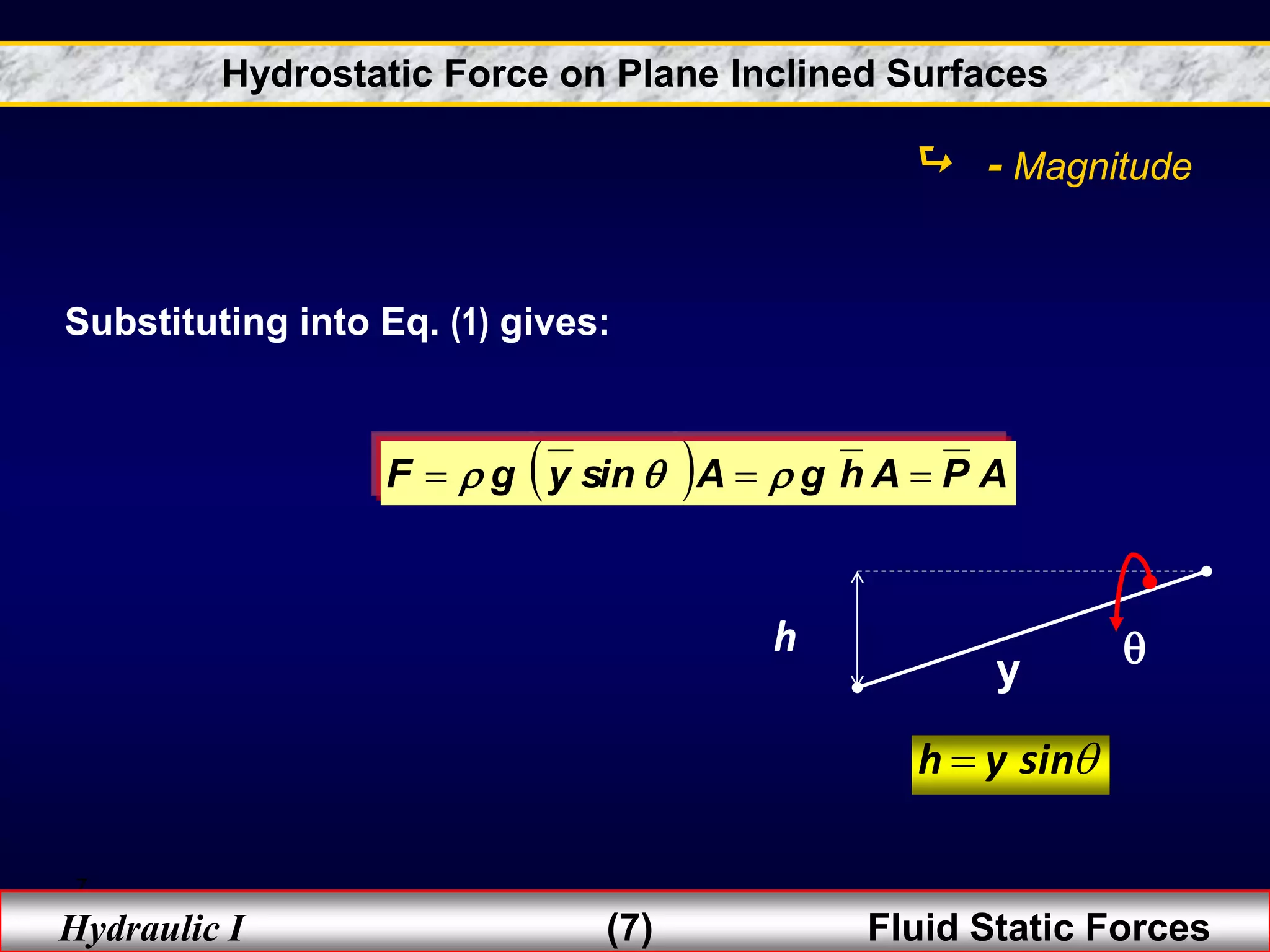
Substituting into Eq. (1) gives:
y
h 

sin
y
h 
 - Magnitude
Hydrostatic Force on Plane Inclined Surfaces
8
Hydraulic I (8) Fluid Static Forces
A
P
A
h
g
A
P
A
h
g
A
P
F atm
atm
)
R
(







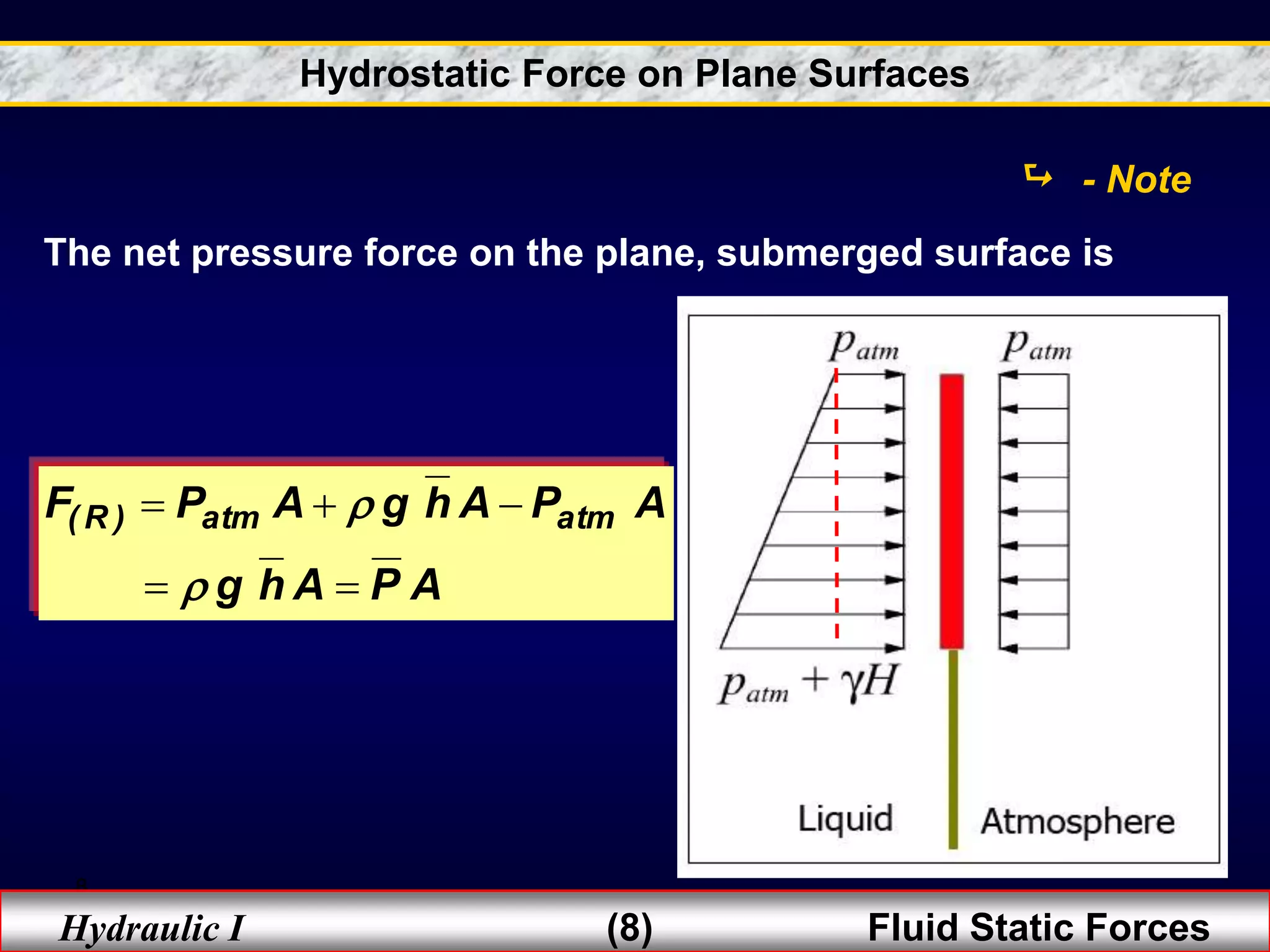
The net pressure force on the plane, submerged surface is
 - Note
Hydrostatic Force on Plane Surfaces
9
Hydraulic I (9) Fluid Static Forces
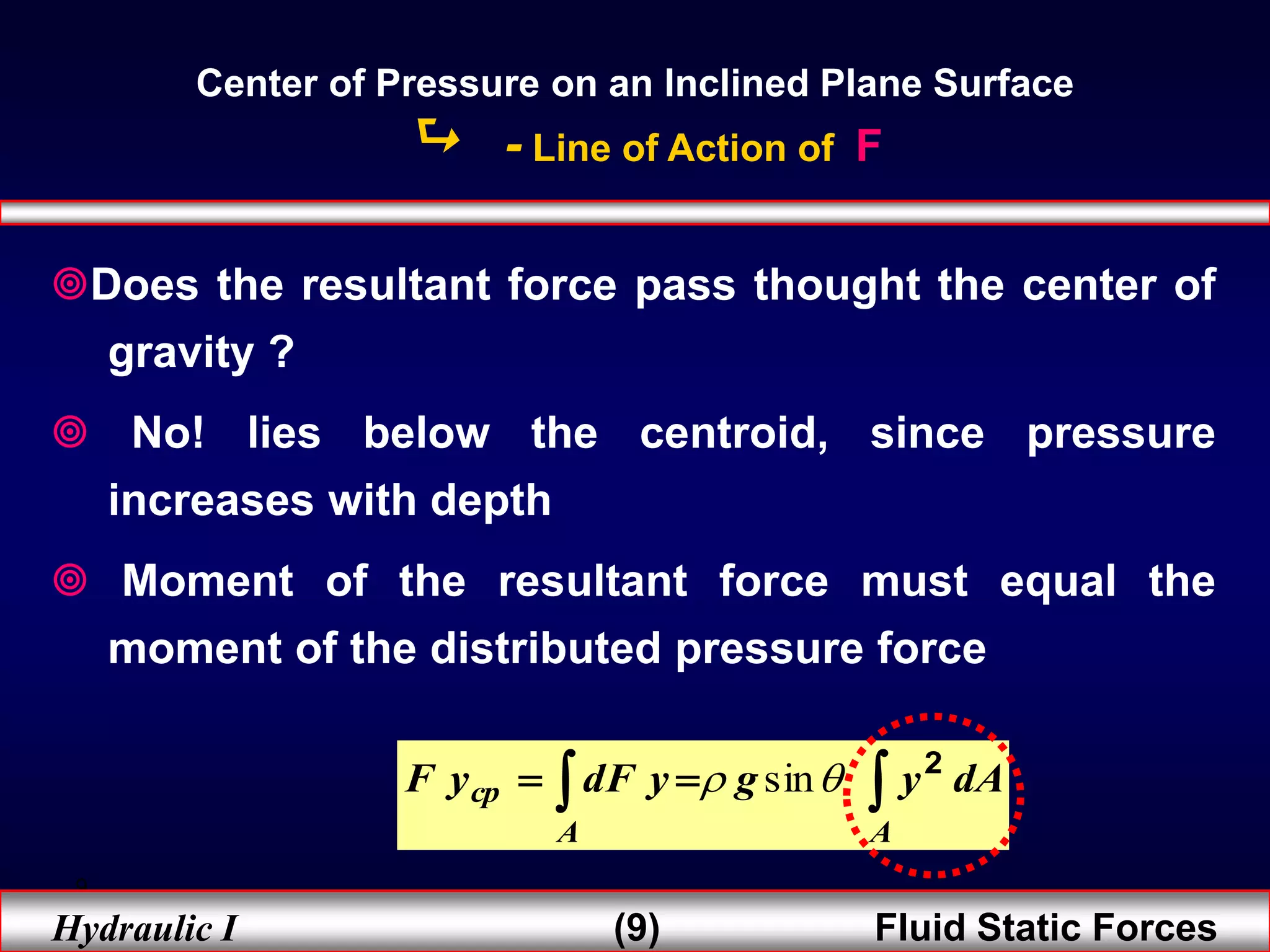
Center of Pressure on an Inclined Plane Surface
 - Line of Action of F
Does the resultant force pass thought the center of
gravity ?
 No! lies below the centroid, since pressure
increases with depth
 Moment of the resultant force must equal the
moment of the distributed pressure force
dA
y
g
y
dF
y
F
A
A
cp 
 
 2

 sin
10
X
dA
Hydraulic I (10) Fluid Static Forces
y
ỳ
ycp


F
P = g y sin 
Free Surface
 
  2
g
.
c
cp
0
cp
y
A
I
A
y
y
I
sin
g
A
sin
y
g
y



or




C.G
C.P
y
A
I
y
y g
.
c
cp 

11
Hydraulic I (11) Fluid Static Forces
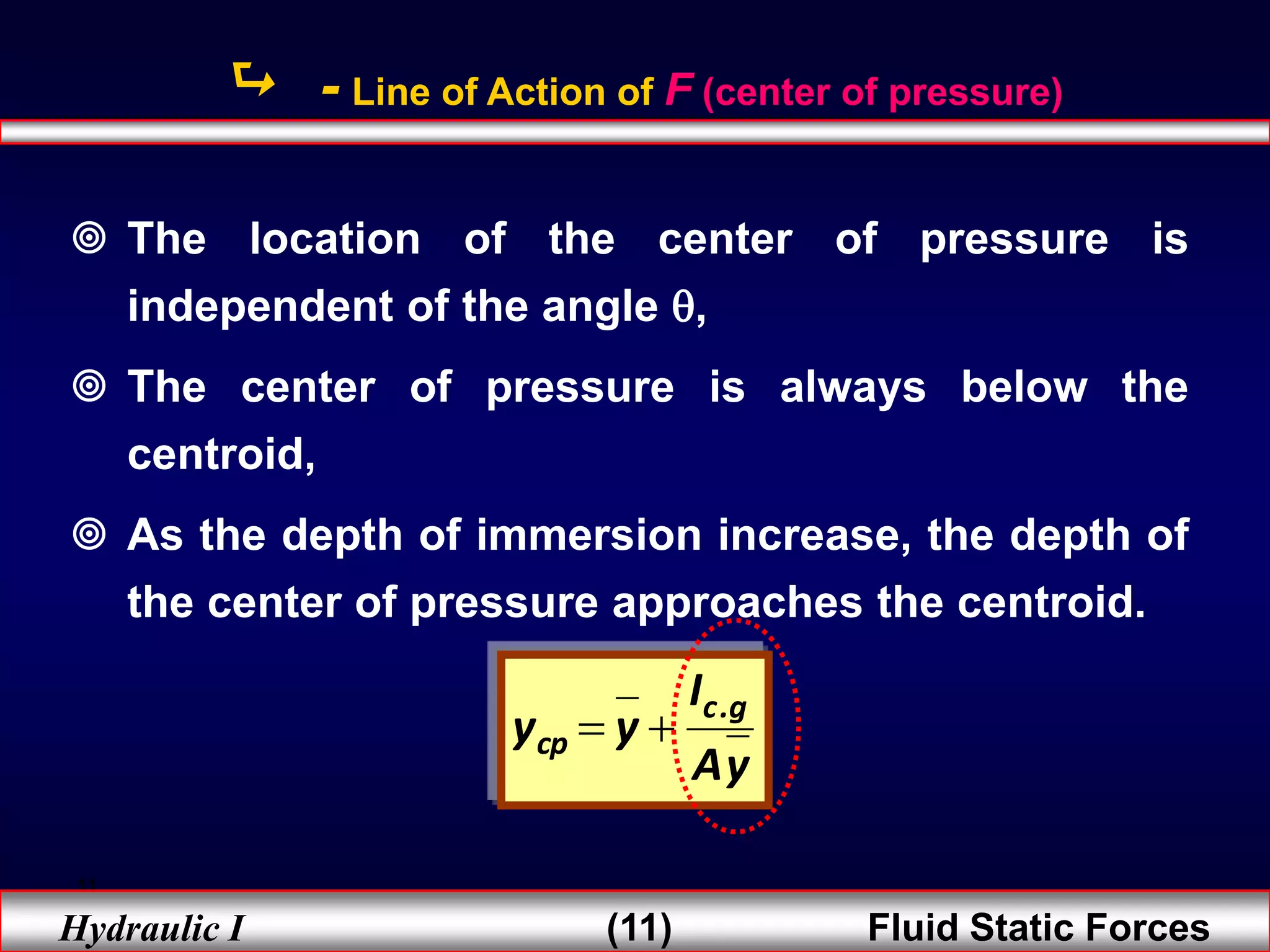
 - Line of Action of F (center of pressure)
 The location of the center of pressure is
independent of the angle ,
 The center of pressure is always below the
centroid,
 As the depth of immersion increase, the depth of
the center of pressure approaches the centroid.
y
A
I
y
y g
.
c
cp 

12
Hydraulic I (12) Fluid Static Forces
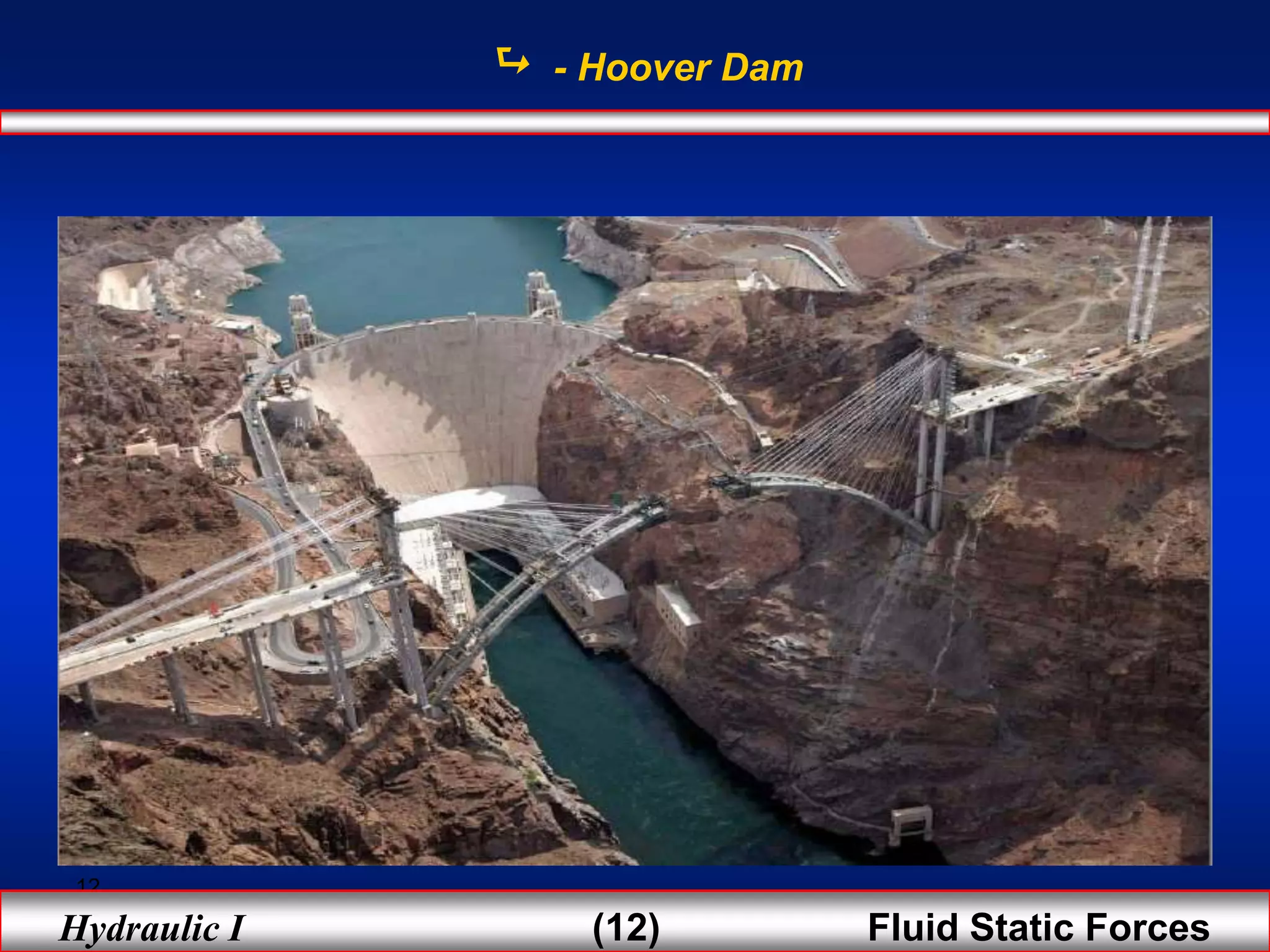
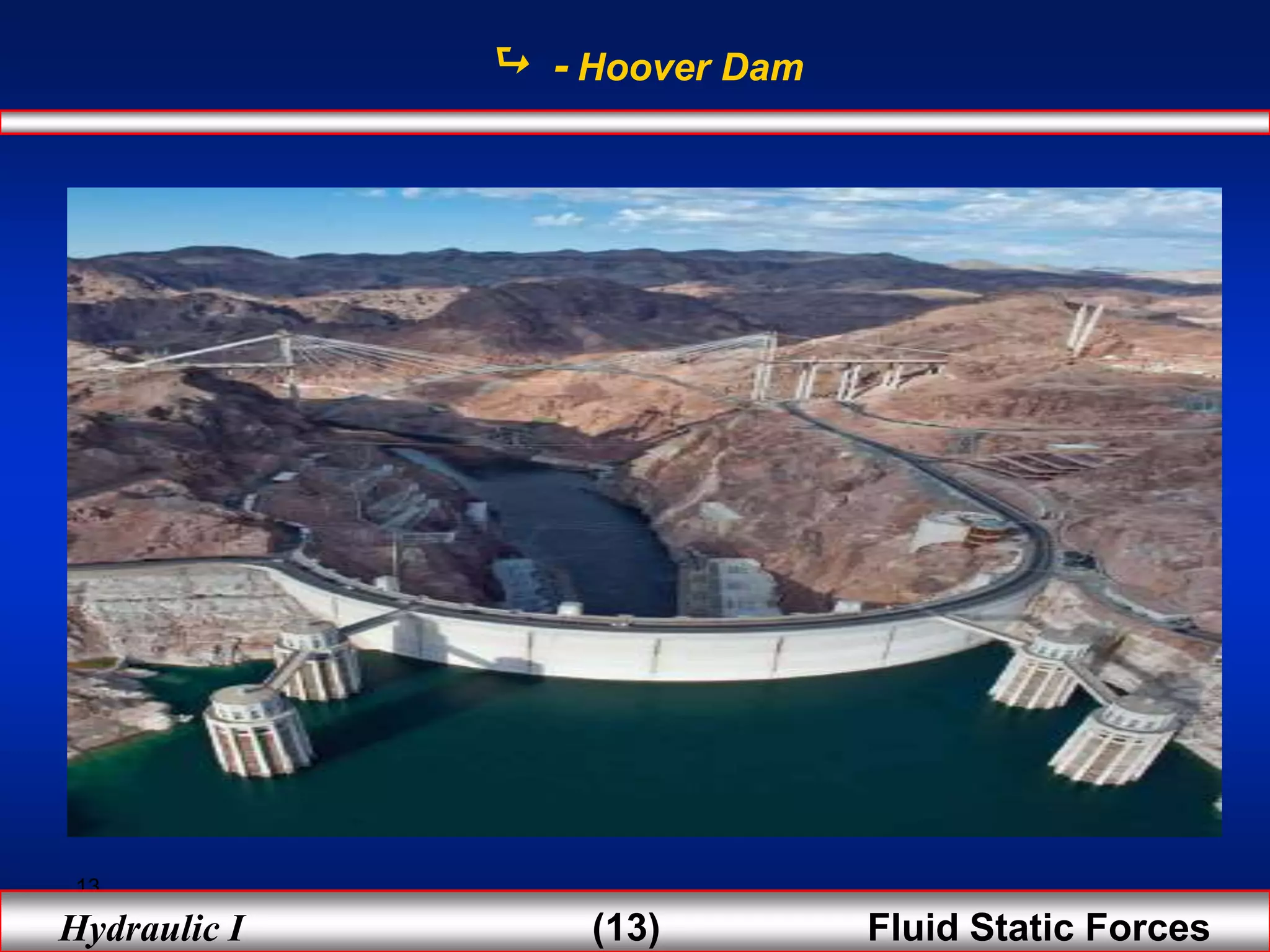
 - Hoover Dam
13
Hydraulic I (13) Fluid Static Forces
 - Hoover Dam
14
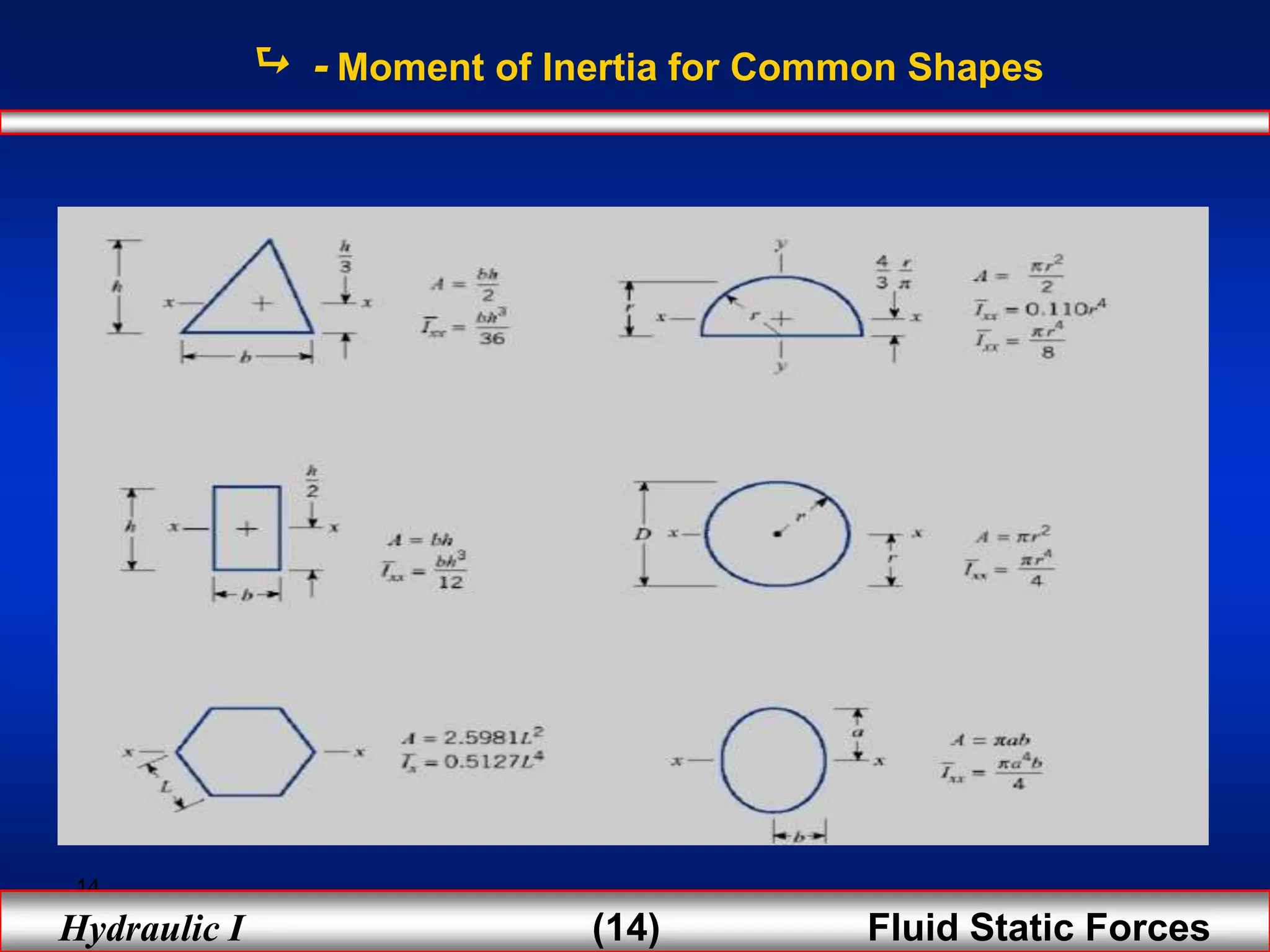
Hydraulic I (14) Fluid Static Forces
 - Moment of Inertia for Common Shapes
15

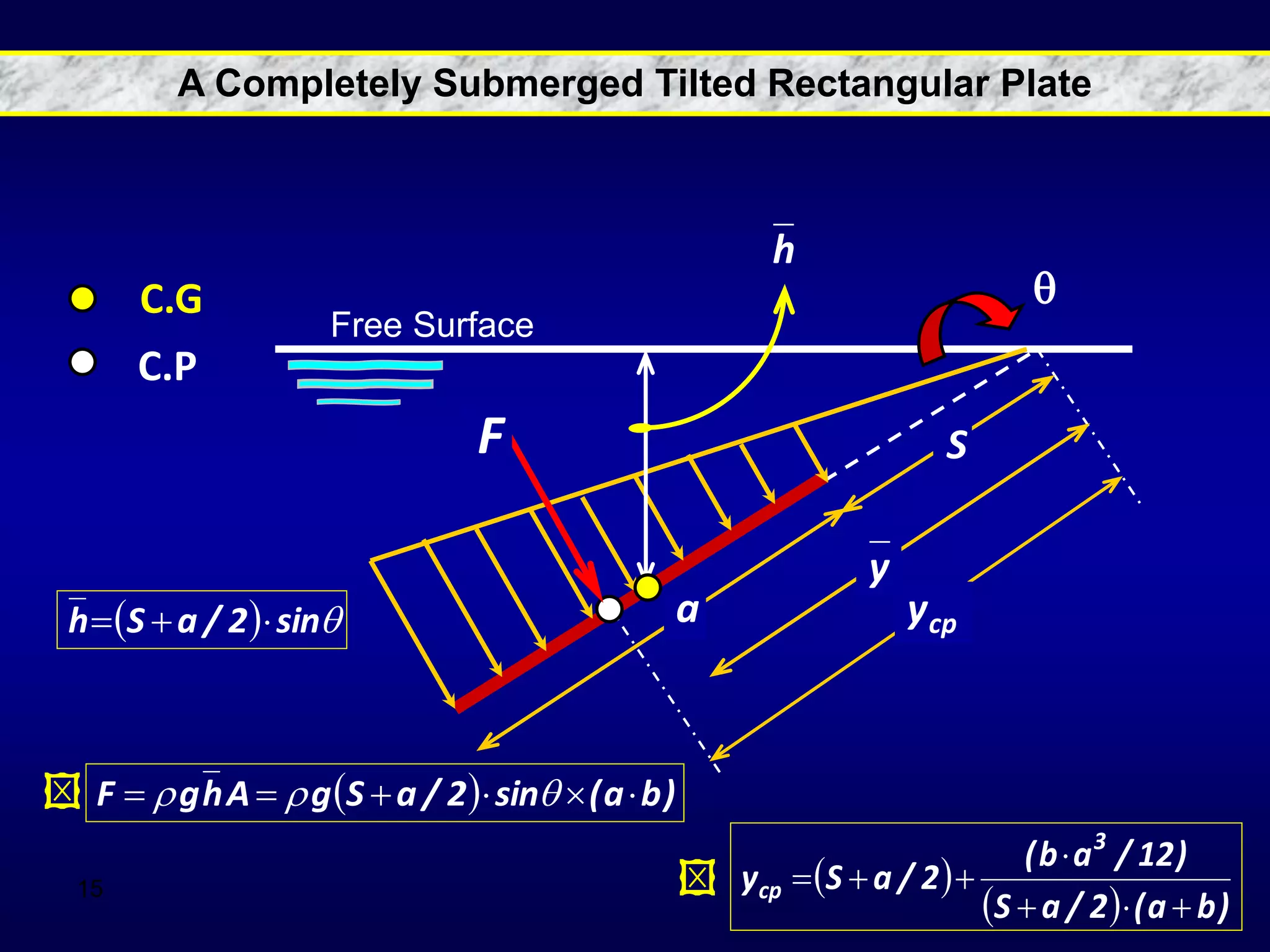
C.G
C.P
Free Surface
A Completely Submerged Tilted Rectangular Plate
  )
b
a
(
sin
2
/
a
S
g
A
h
g
F 




 


 
  )
b
a
(
2
/
a
S
)
12
/
a
b
(
2
/
a
S
y
3
cp







  
sin
2
/
a
S
h 


h
y
cp
y
S
F
a


16

C.G
C.P
Free Surface

sin
)
2
/
a
(
h 
 y
a
cp
y
F
  )
b
a
(
sin
2
/
a
g
A
h
g
F 




 


h
 
 
a
3
2
)
b
a
(
2
/
a
)
12
/
a
b
(
2
/
a
y
3
cp 





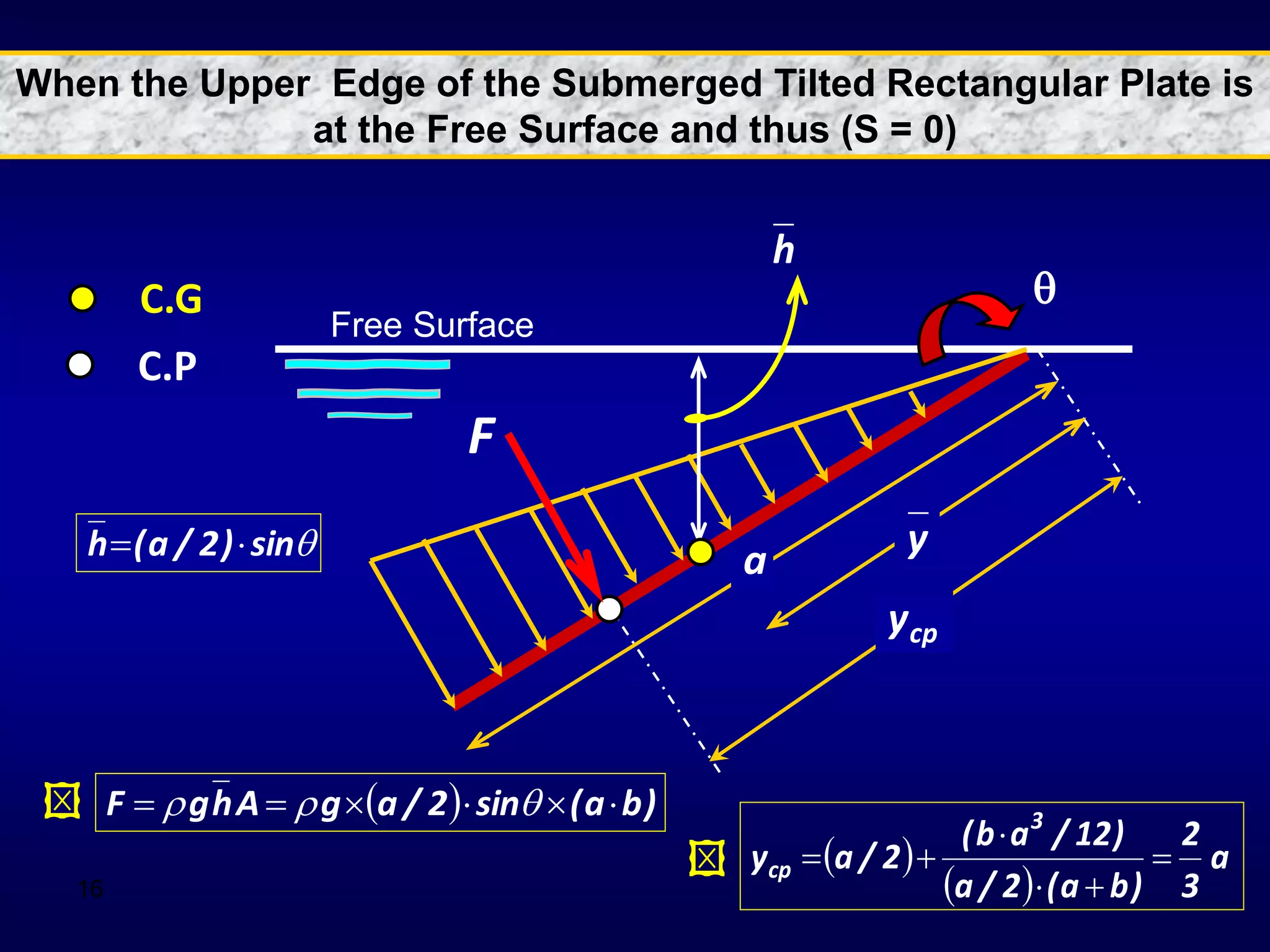
When the Upper Edge of the Submerged Tilted Rectangular Plate is
at the Free Surface and thus (S = 0)


17
 =90o
C.G
C.P
Free Surface
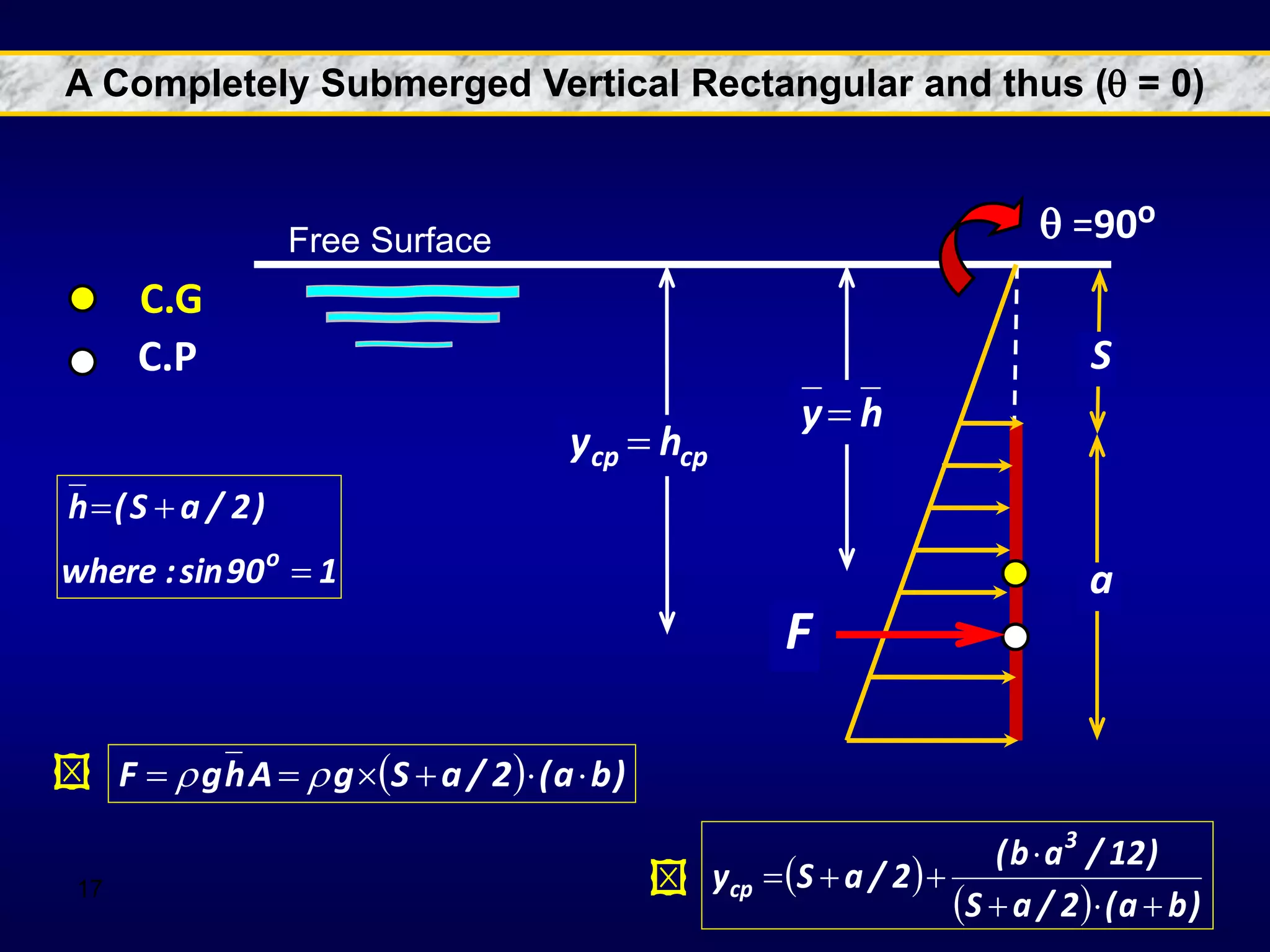
A Completely Submerged Vertical Rectangular and thus ( = 0)
a
S
1
90
sin
:
where
)
2
/
a
S
(
h
o



cp
cp h
y 
h
y
F
  )
b
a
(
2
/
a
S
g
A
h
g
F 




 

 
  )
b
a
(
2
/
a
S
)
12
/
a
b
(
2
/
a
S
y
3
cp









18
 =90o
C.G
C.P
Free Surface
h
y
cp
cp h
y 
0
S
,
1
90
sin
:
where
2
/
a
h
o


 a
F
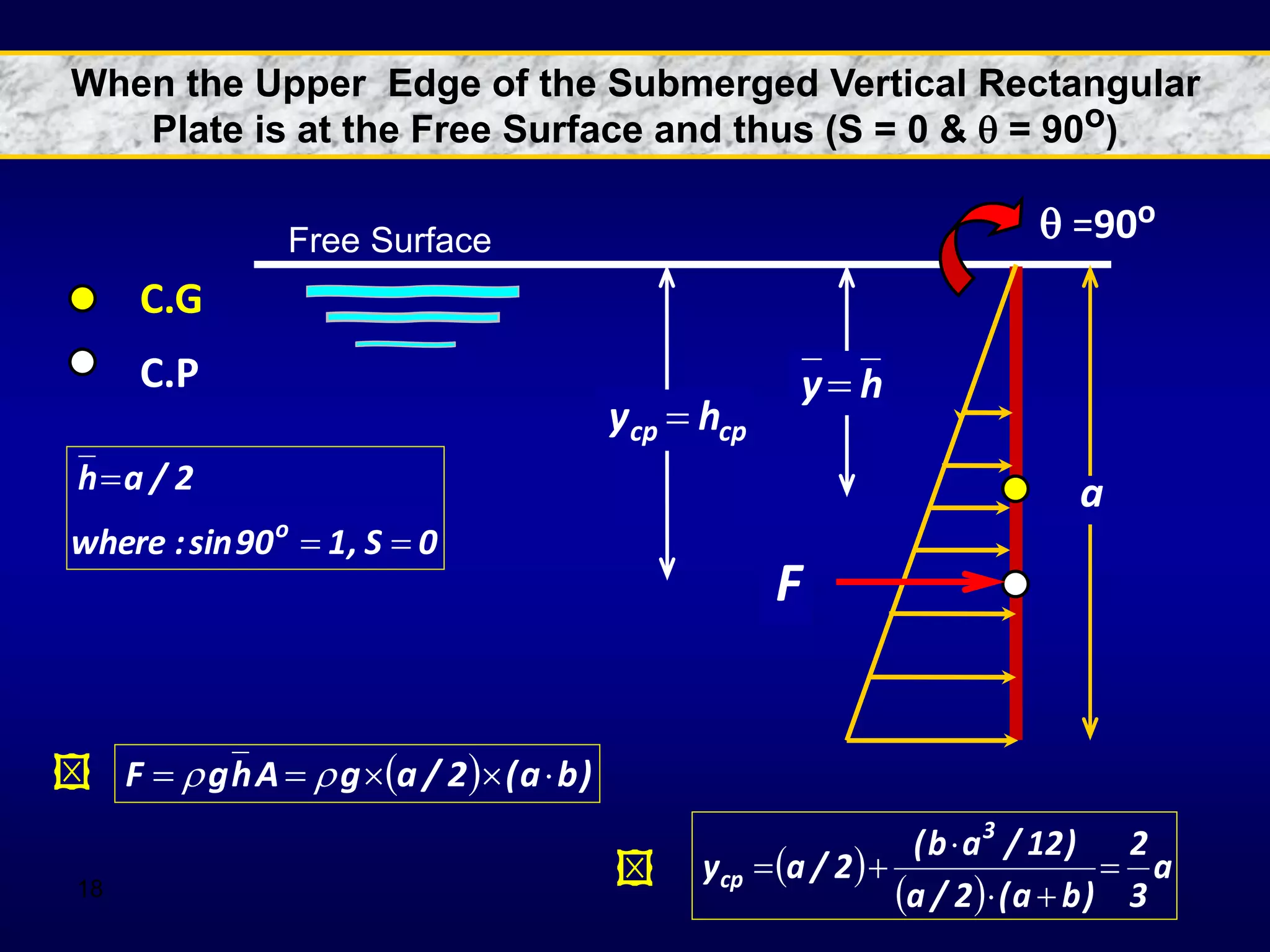
When the Upper Edge of the Submerged Vertical Rectangular
Plate is at the Free Surface and thus (S = 0 &  = 90o)
  )
b
a
(
2
/
a
g
A
h
g
F 



 

 
 
a
3
2
)
b
a
(
2
/
a
)
12
/
a
b
(
2
/
a
y
3
cp 







19
S
a
o

Patm. Patm.
h


F
y
h

F

sin
y
h 

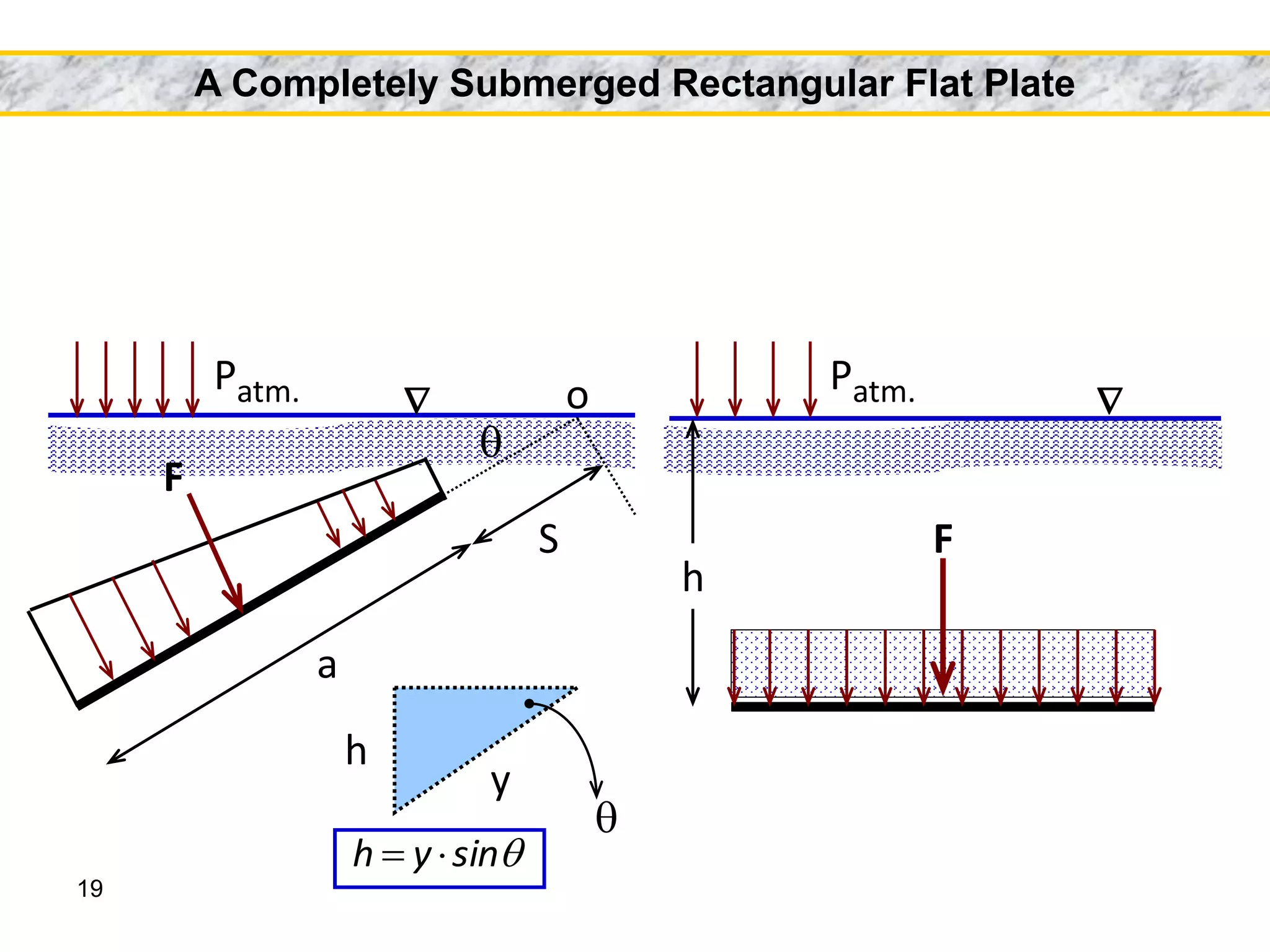
A Completely Submerged Rectangular Flat Plate
20
Patm.
h


F
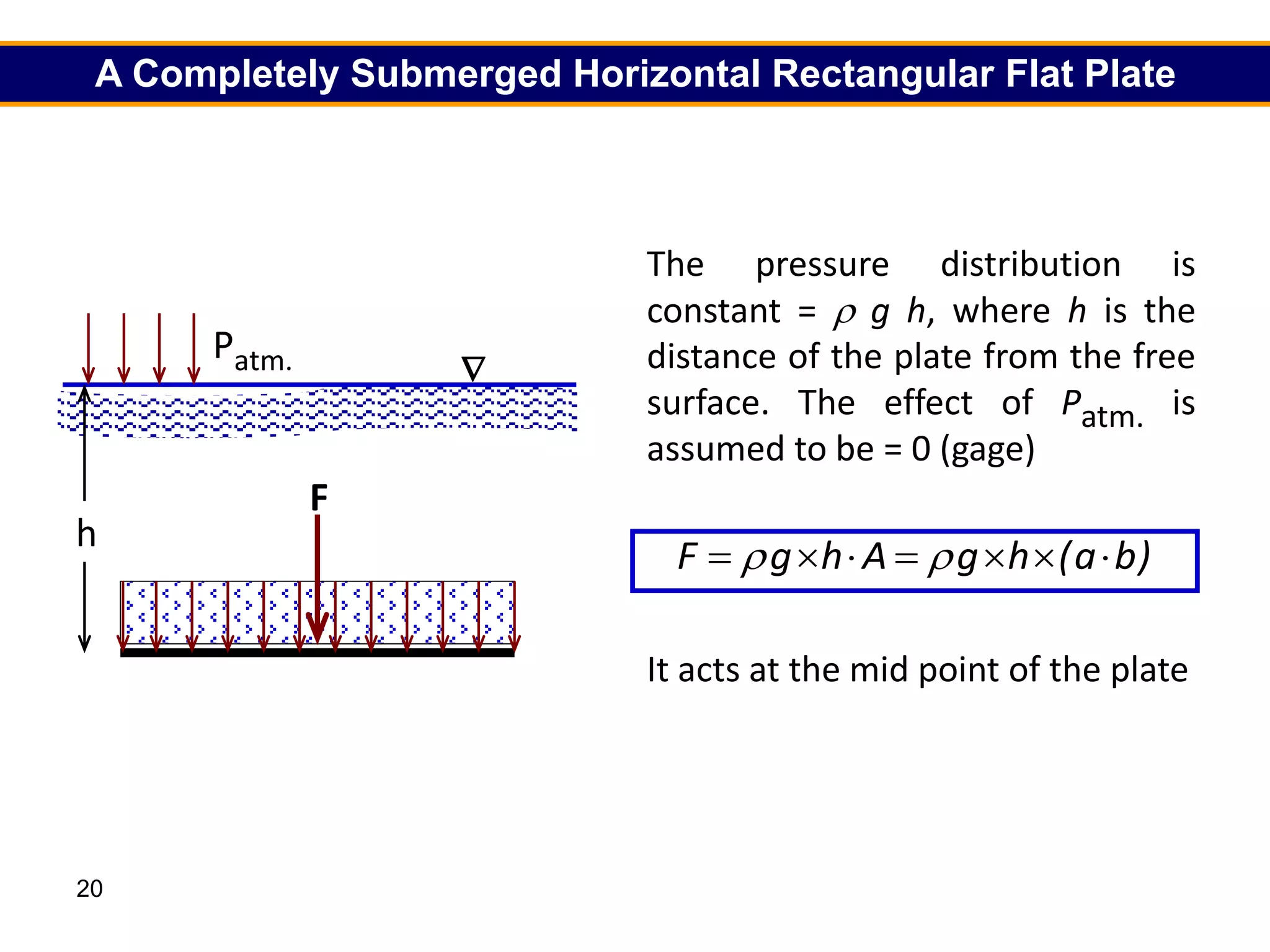
A Completely Submerged Horizontal Rectangular Flat Plate
The pressure distribution is
constant =  g h, where h is the
distance of the plate from the free
surface. The effect of Patm. is
assumed to be = 0 (gage)
)
b
a
(
h
g
A
h
g
F 





 

It acts at the mid point of the plate
21
19
S
a
o

Patm. Patm.
h


F
y
h

F

sin
y
h 

A Completely Submerged Rectangular Flat Plate
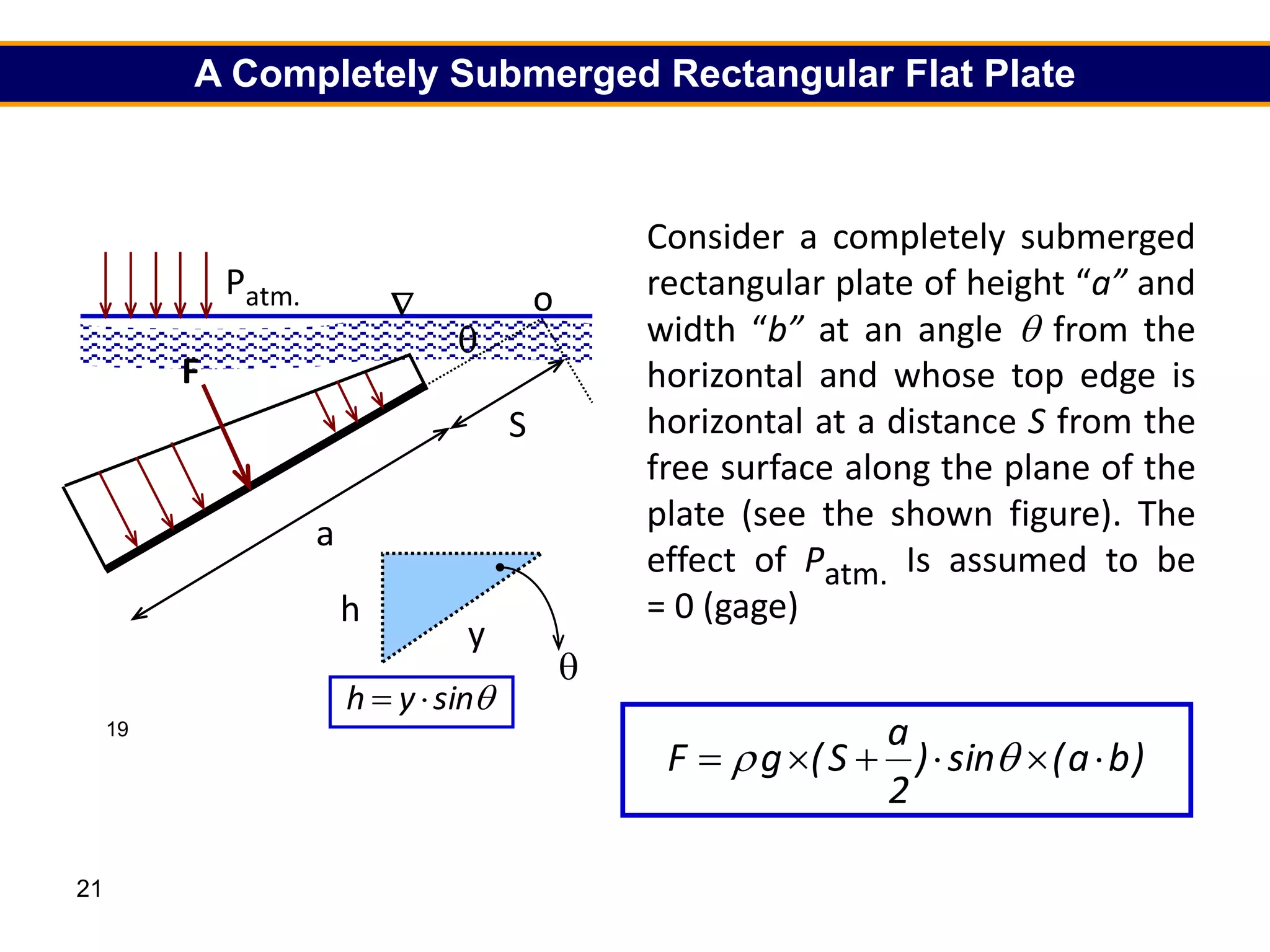
Consider a completely submerged
rectangular plate of height “a” and
width “b” at an angle  from the
horizontal and whose top edge is
horizontal at a distance S from the
free surface along the plane of the
plate (see the shown figure). The
effect of Patm. Is assumed to be
= 0 (gage)
)
b
a
(
sin
)
2
a
S
(
g
F 




 

22
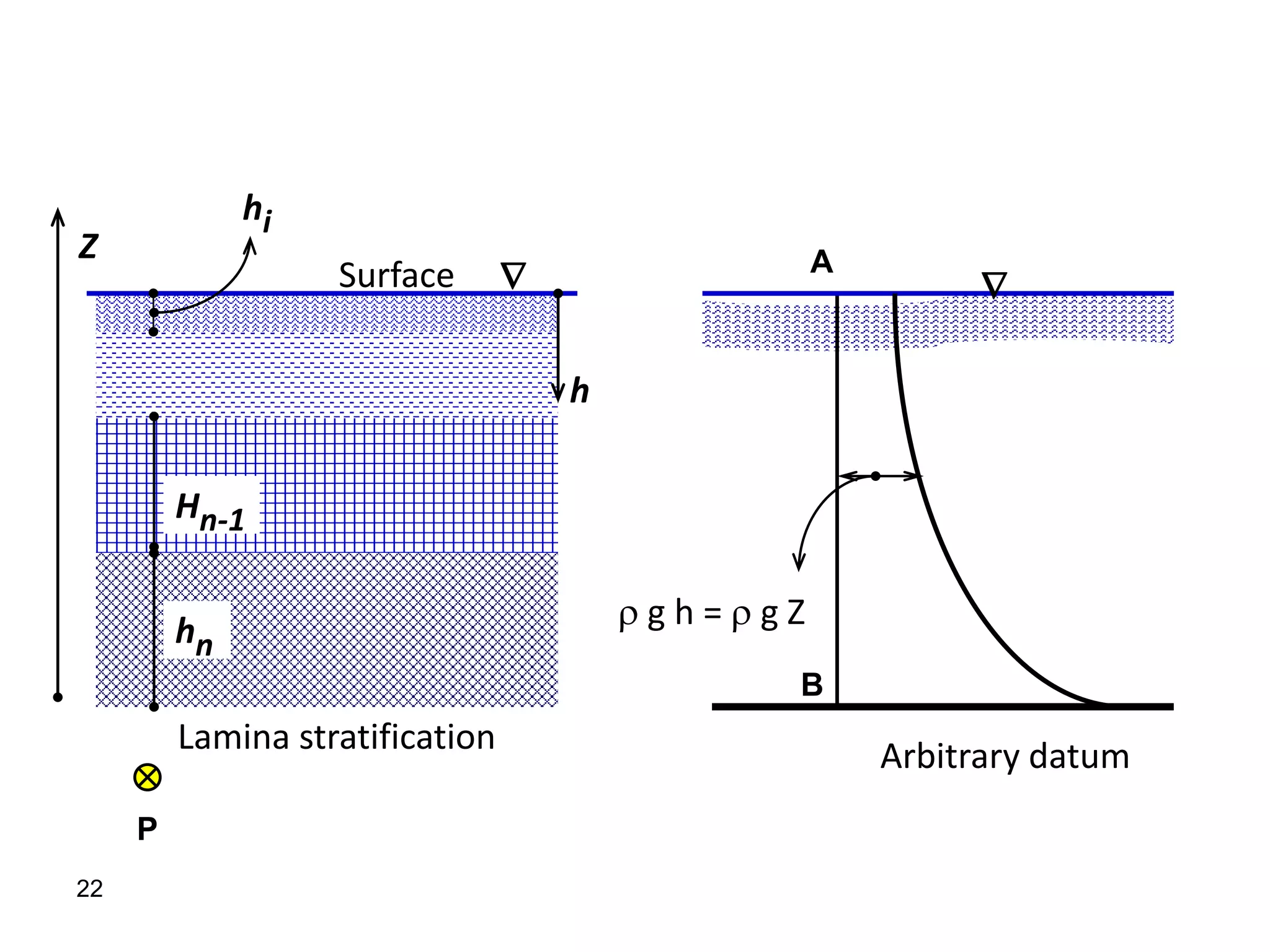
Arbitrary datum
A
B
 g h =  g Z
Surface
Z
h
hn
Hn-1
hi
Lamina stratification
P
 
23
X
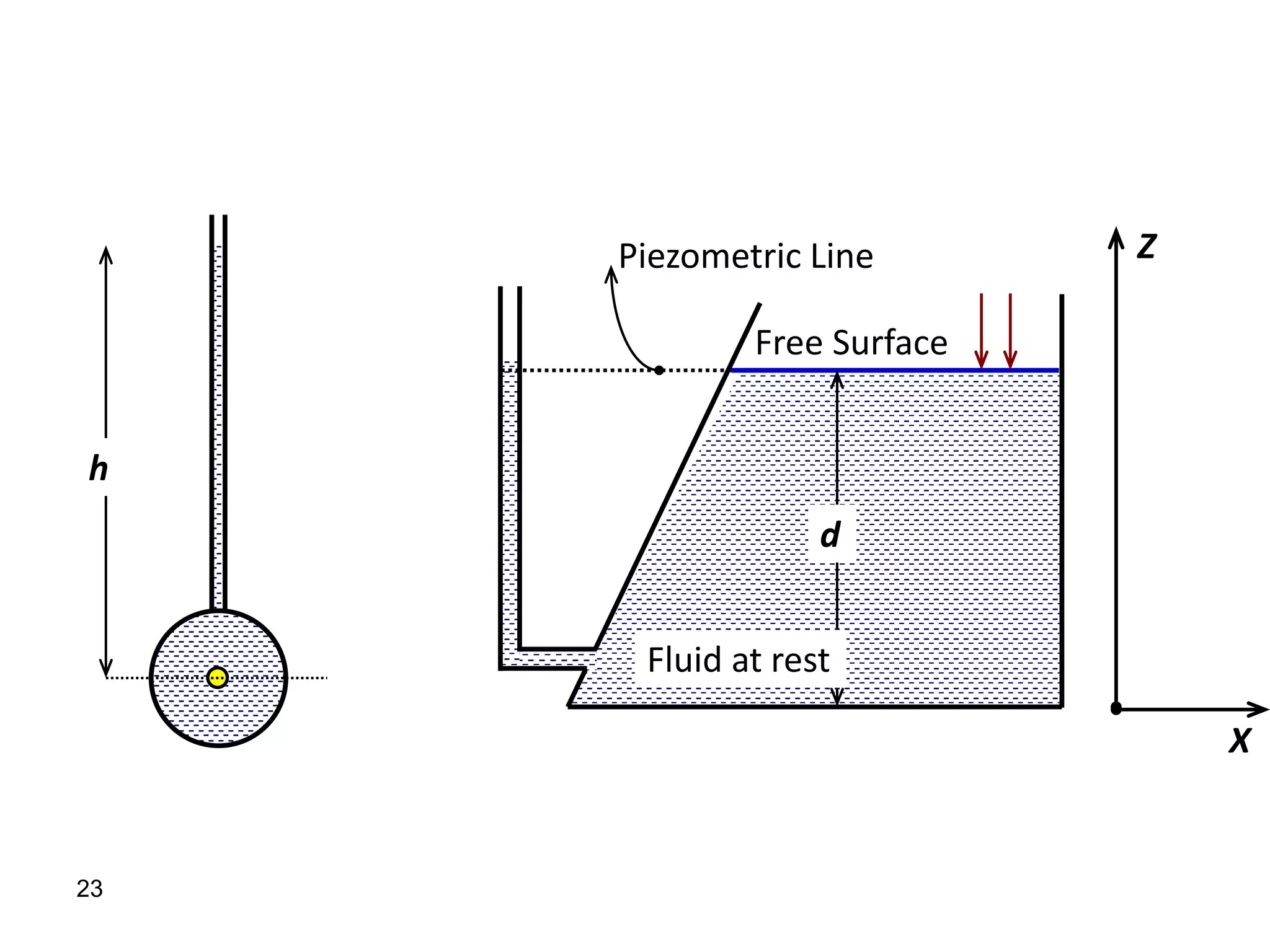
h
d
Free Surface
Piezometric Line Z
Fluid at rest
24
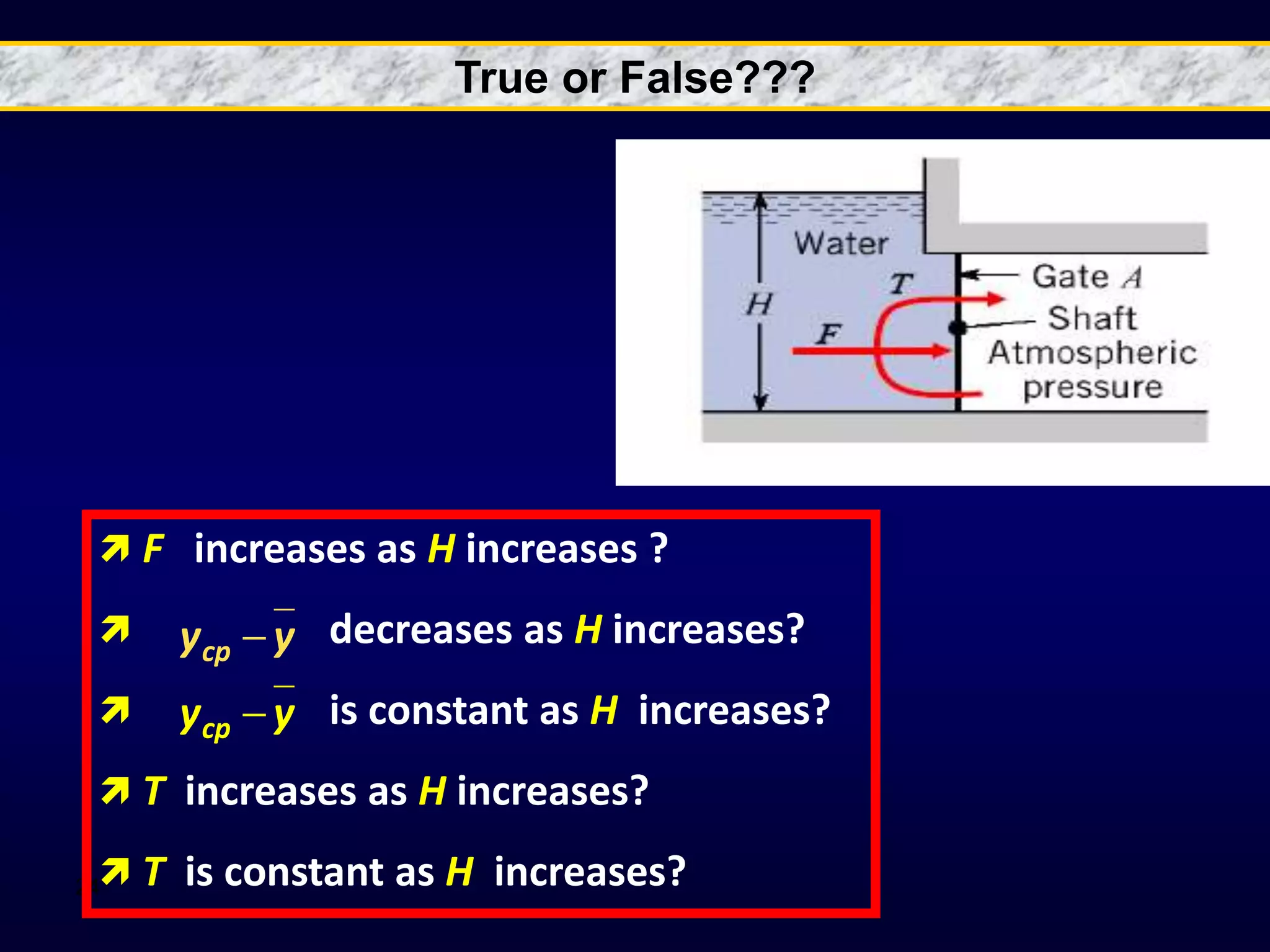
 F increases as H increases ?
 decreases as H increases?
 is constant as H increases?
 T increases as H increases?
 T is constant as H increases?
y
ycp 
y
ycp 
True or False???
25
Hydraulic I (20) Fluid Static Forces
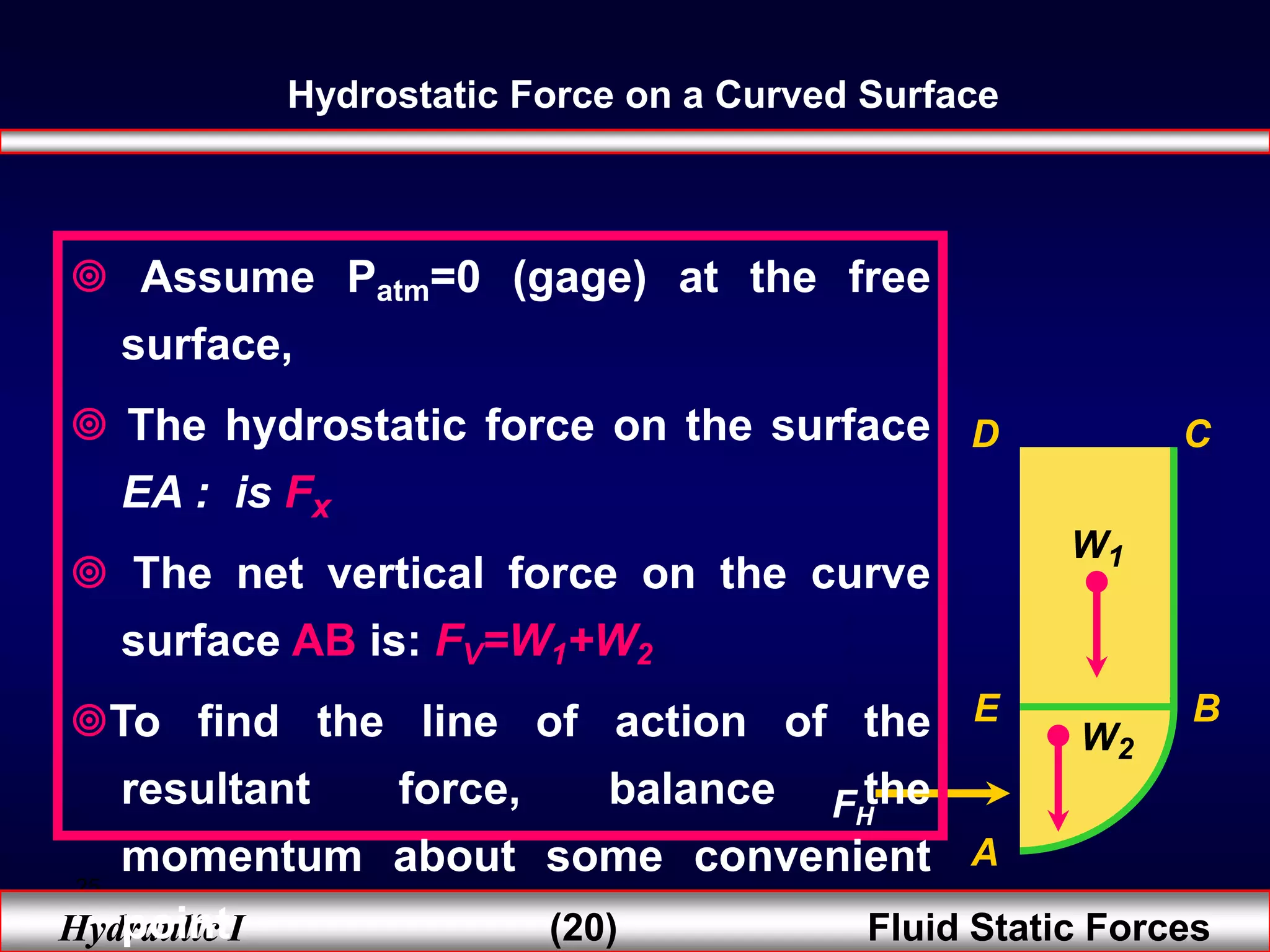
Hydrostatic Force on a Curved Surface
D C
E B
A
FH
W1
W2
 Assume Patm=0 (gage) at the free
surface,
 The hydrostatic force on the surface
EA : is Fx
 The net vertical force on the curve
surface AB is: FV=W1+W2
To find the line of action of the
resultant force, balance the
momentum about some convenient
point
26
Hydraulic I (21) Fluid Static Forces
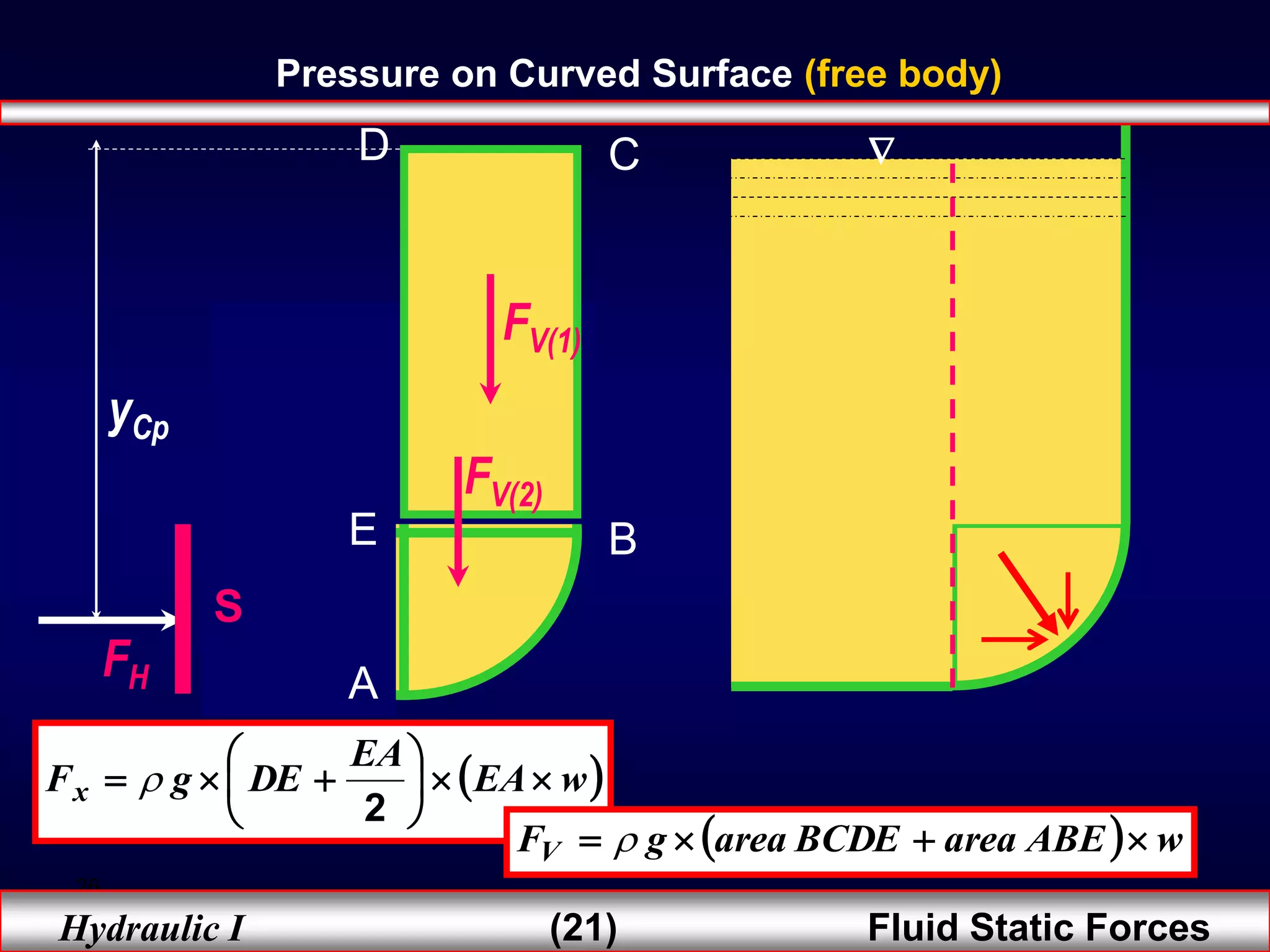
Pressure on Curved Surface (free body)

D
B
C
yCp
FV(1)
FH
FV(2)
E
 
w
EA
EA
DE
g
Fx 










2

A
  w
ABE
area
BCDE
area
g
FV 


 
S
27
Hydraulic I (22) Fluid Static Forces
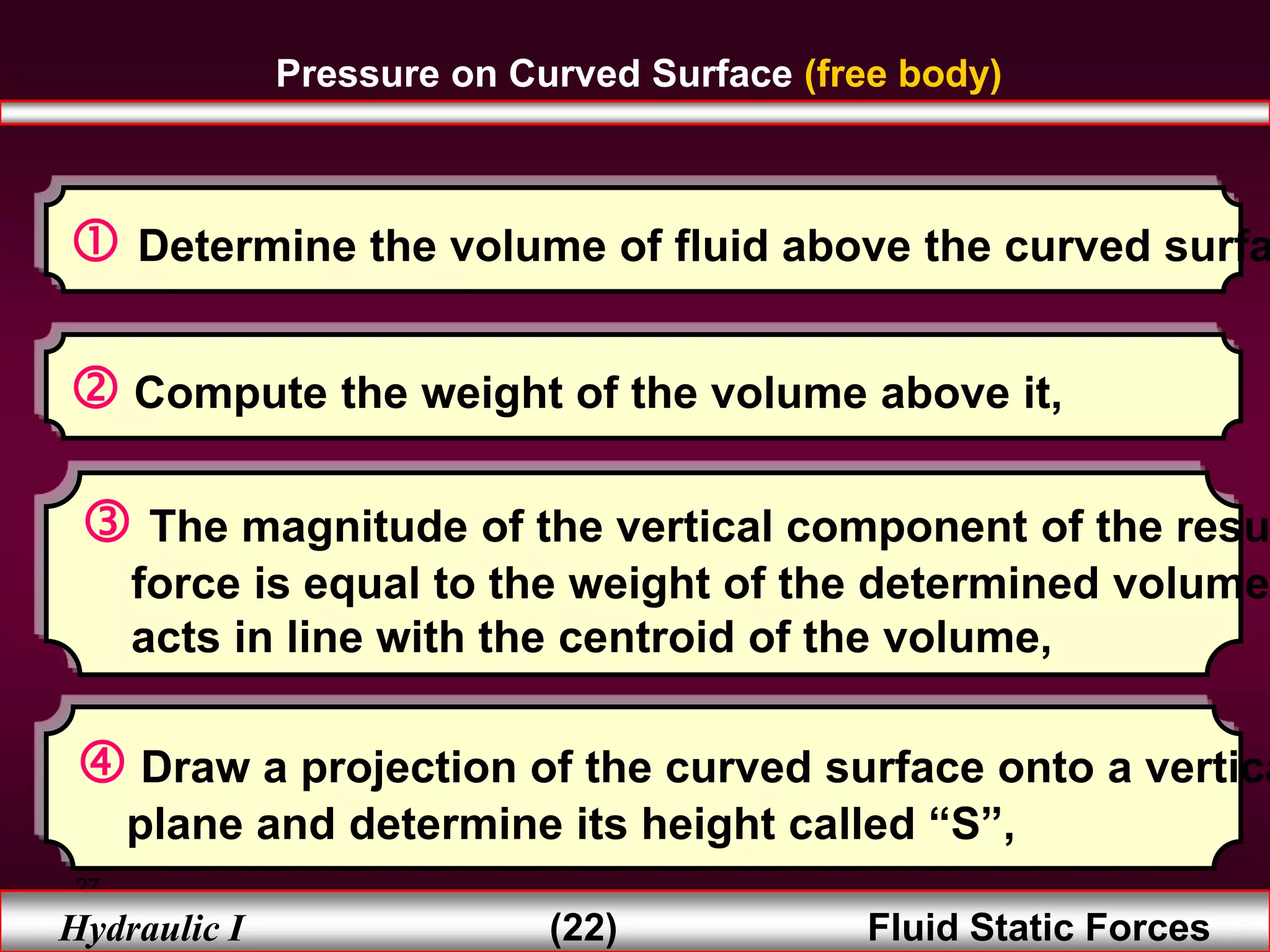
Pressure on Curved Surface (free body)
 Determine the volume of fluid above the curved surfa
 Compute the weight of the volume above it,
 The magnitude of the vertical component of the resu
force is equal to the weight of the determined volume.
acts in line with the centroid of the volume,
 Draw a projection of the curved surface onto a vertica
plane and determine its height called “S”,
28
Hydraulic I (23) Fluid Static Forces
Pressure on Curved Surface (free body)
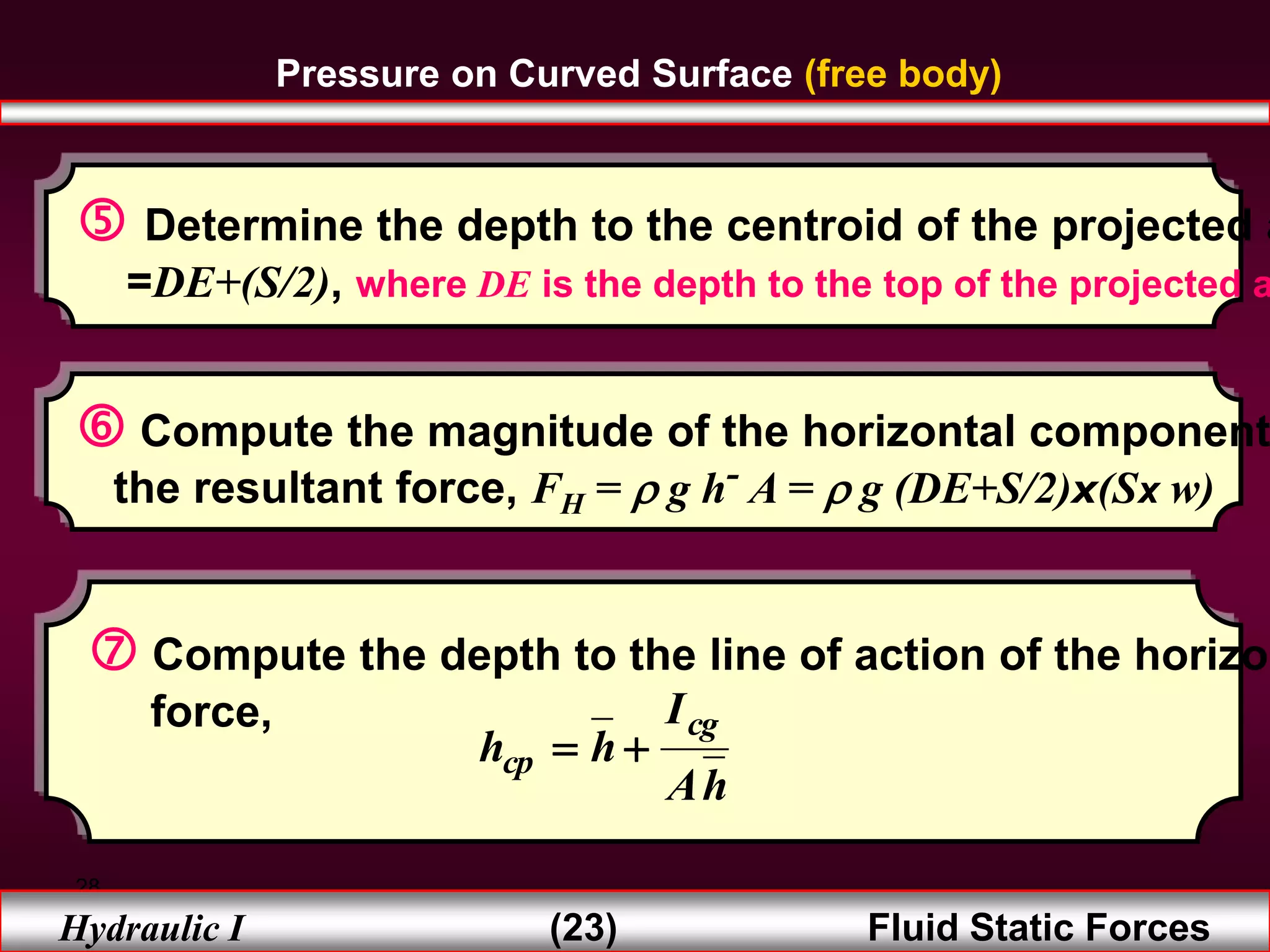
 Determine the depth to the centroid of the projected a
=DE+(S/2), where DE is the depth to the top of the projected a
 Compute the magnitude of the horizontal component
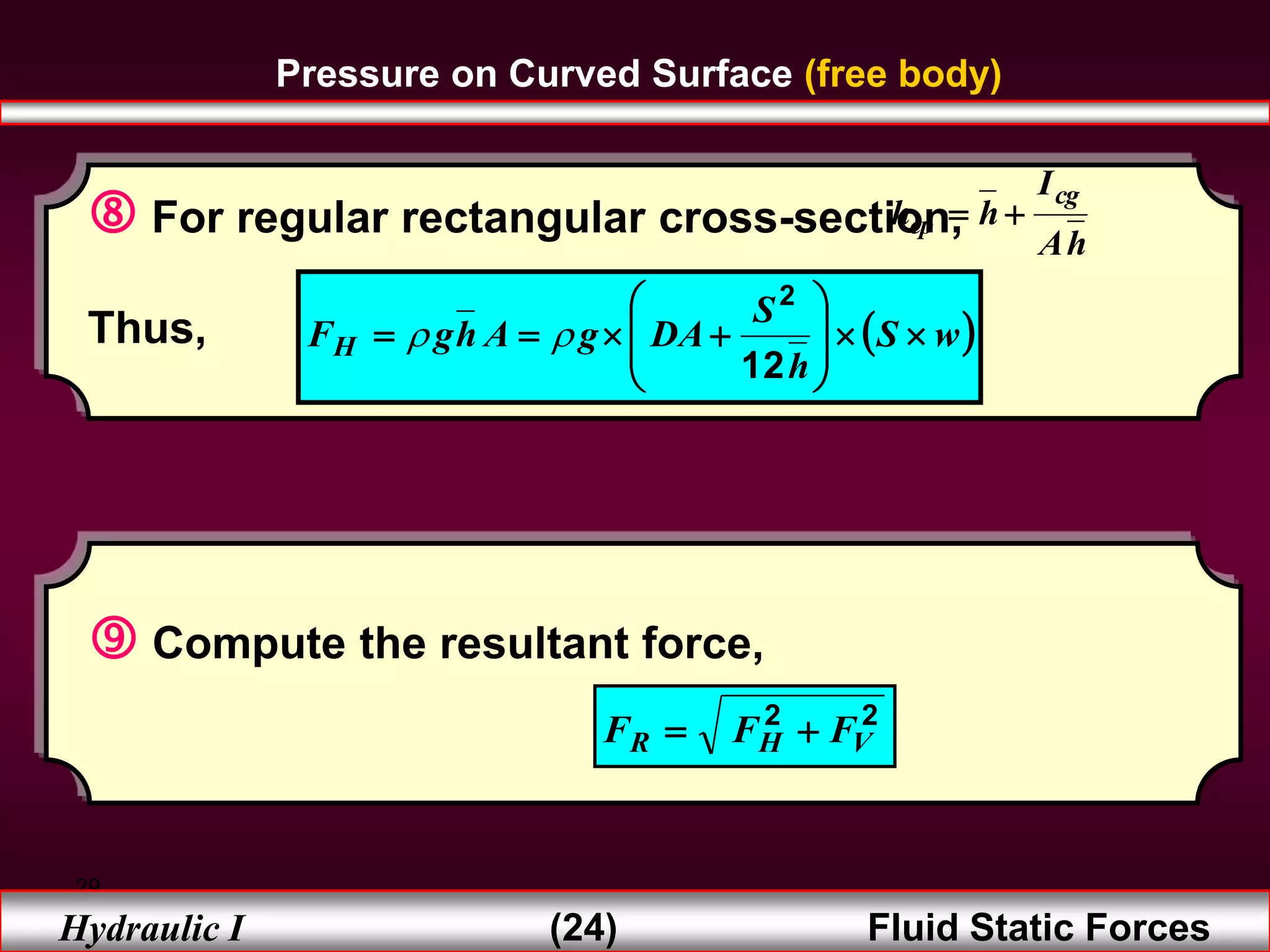
the resultant force, FH =  g h- A =  g (DE+S/2)x(Sx w)
 Compute the depth to the line of action of the horizon
force,
h
A
I
h
h
cg
cp 

29
Hydraulic I (24) Fluid Static Forces
Pressure on Curved Surface (free body)
 For regular rectangular cross-section,
Thus,
 Compute the resultant force,
h
A
I
h
h
cg
cp 

 
w
S
h
S
DA
g
A
h
g
FH 













12
2


2
2
V
H
R F
F
F 

30
Hydraulic I (25) Fluid Static Forces
Pressure on Curved Surface (free body)
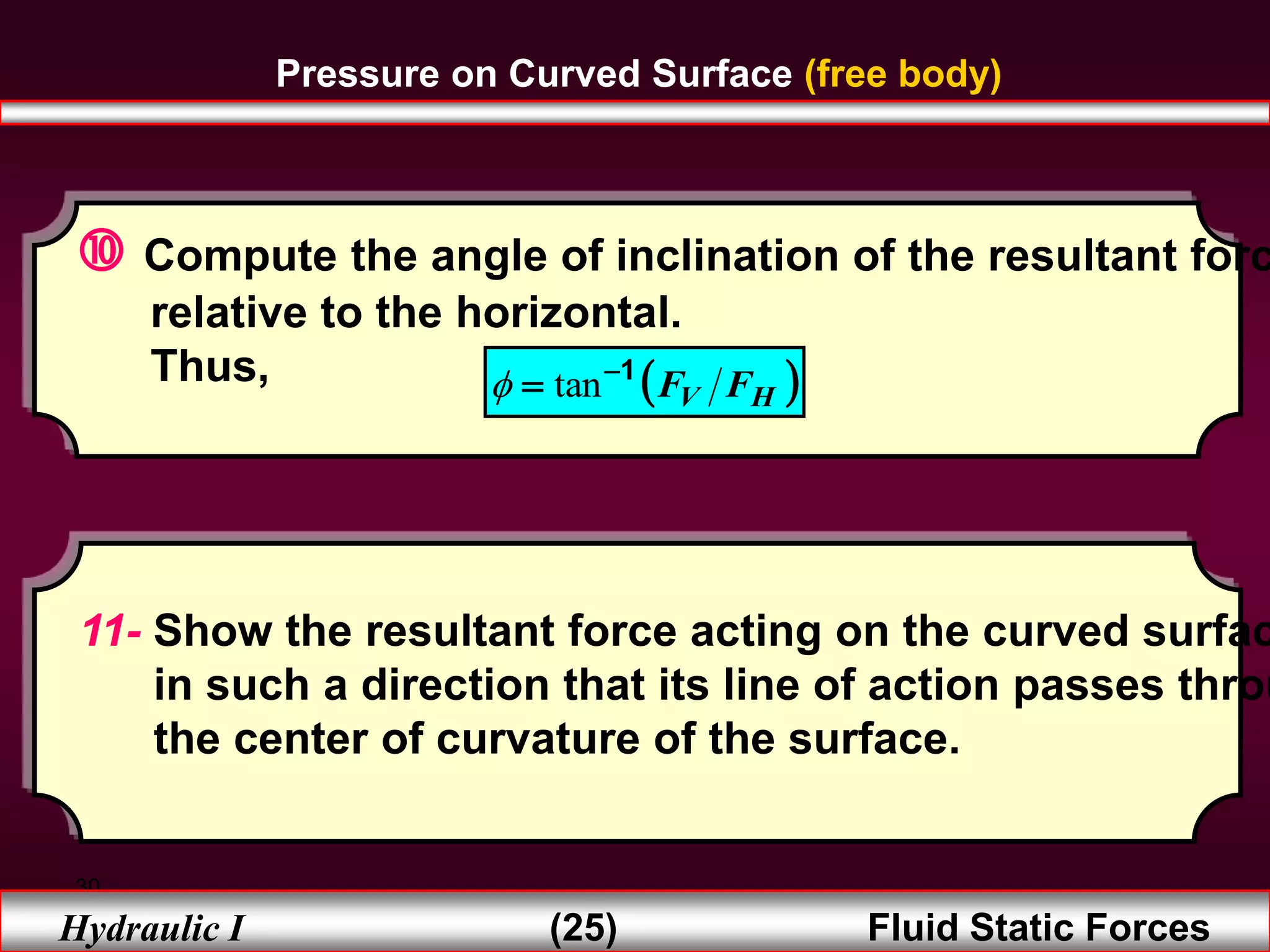
 Compute the angle of inclination of the resultant forc
relative to the horizontal.
Thus,
11- Show the resultant force acting on the curved surfac
in such a direction that its line of action passes throu
the center of curvature of the surface.
 
H
V F
F
1

 tan

31
Hydraulic I (26) Fluid Static Forces
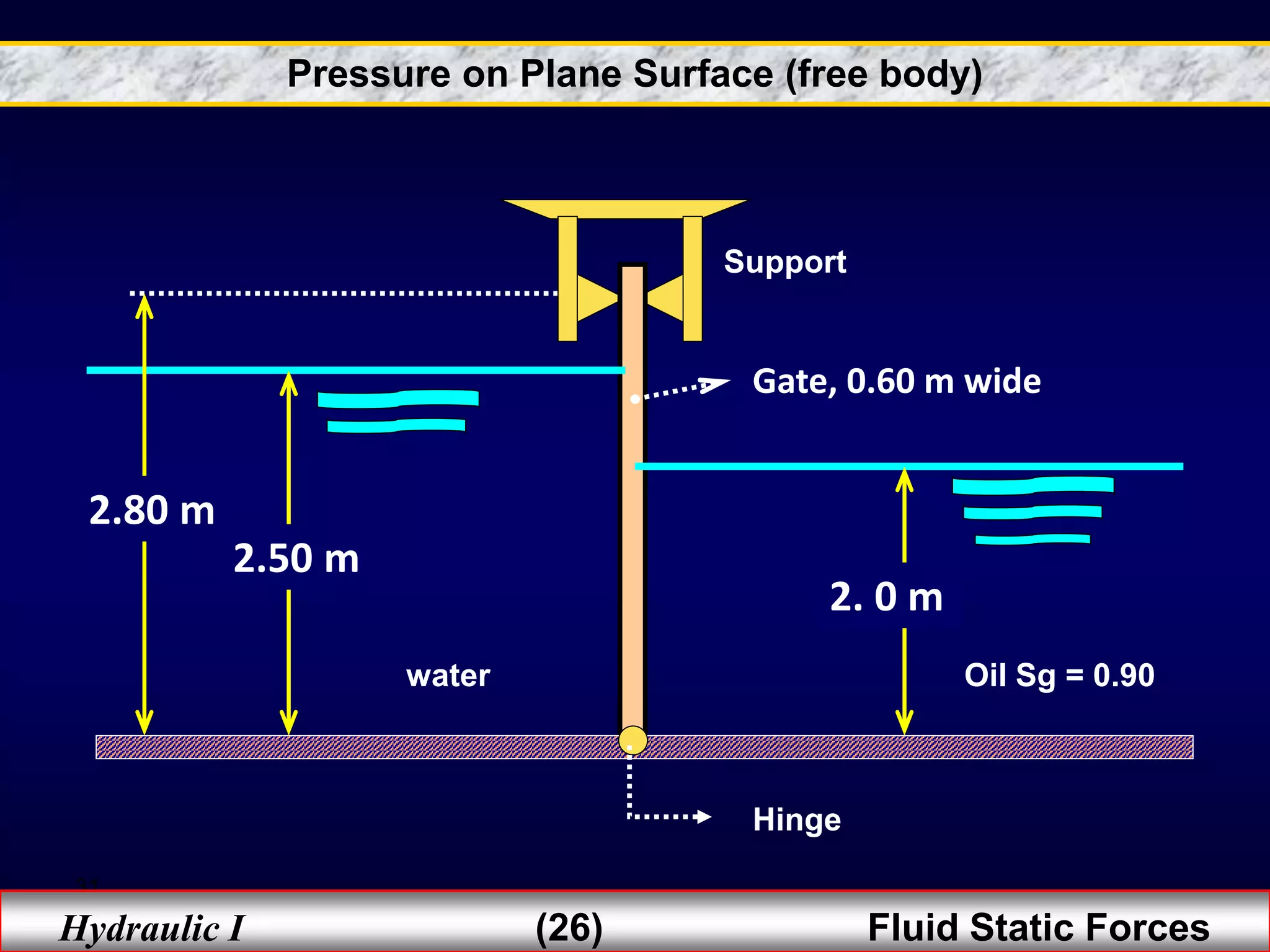
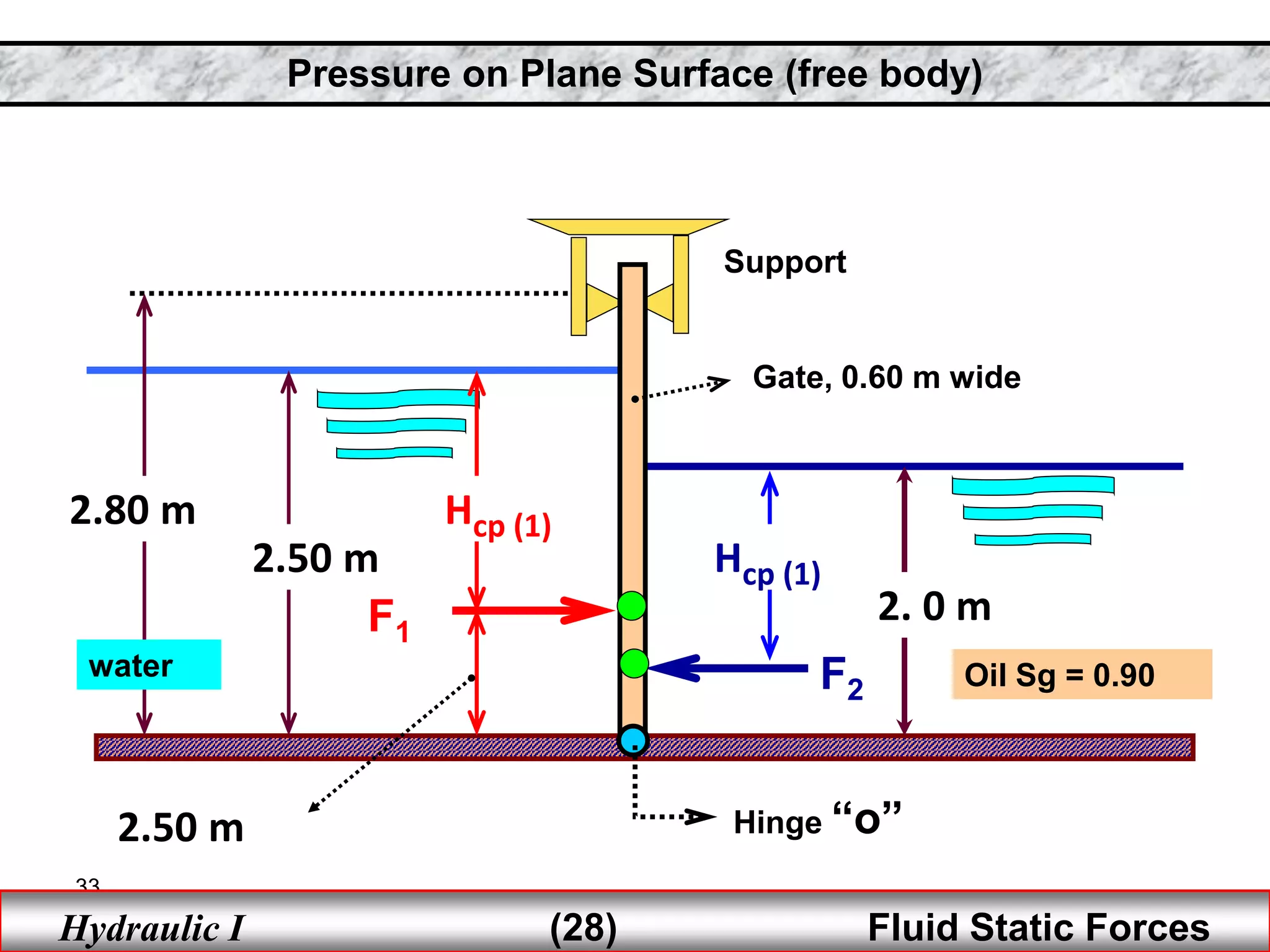
2.50 m
2.80 m
2. 0 m
water Oil Sg = 0.90
Support
Gate, 0.60 m wide
Hinge
Pressure on Plane Surface (free body)
32
Hydraulic I (27) Fluid Static Forces
The figure shows a gate hinged at its bottom
hinged at its bottom and held by a simple support
at its top. The gate separates two fluids. Compute
 the net force on the gate due to the fluid on each
side, and
 Compute the force on the hinge and on the
support.
Pressure on Plane Surface (free body)
33
Hydraulic I (28) Fluid Static Forces
2.50 m
2.80 m
2. 0 m
water Oil Sg = 0.90
Support
Gate, 0.60 m wide
Hinge “o”
F1
F2
Hcp (1)
Hcp (1)
2.50 m
Pressure on Plane Surface (free body)
34
35
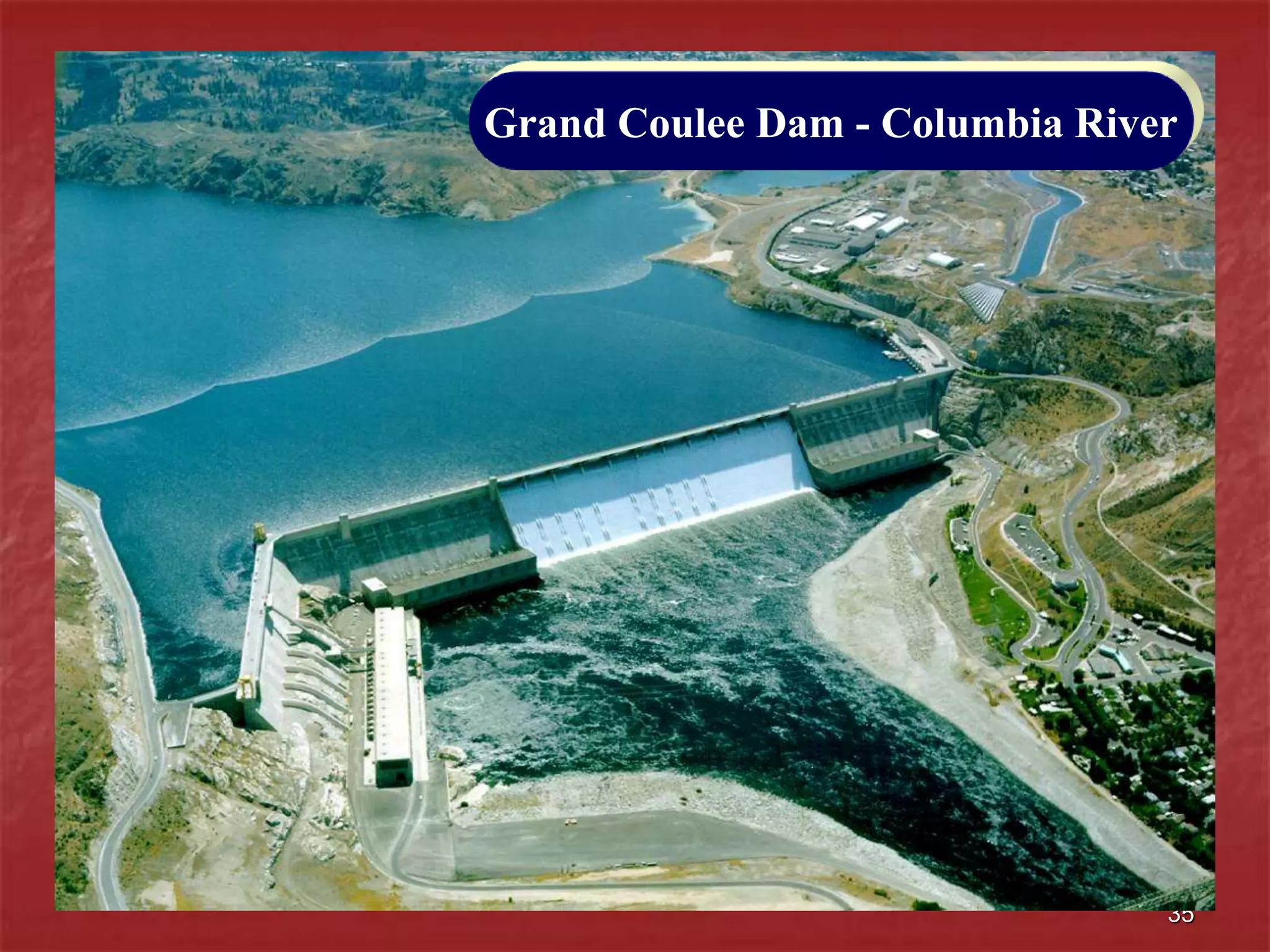
Grand Coulee Dam - Columbia River
36
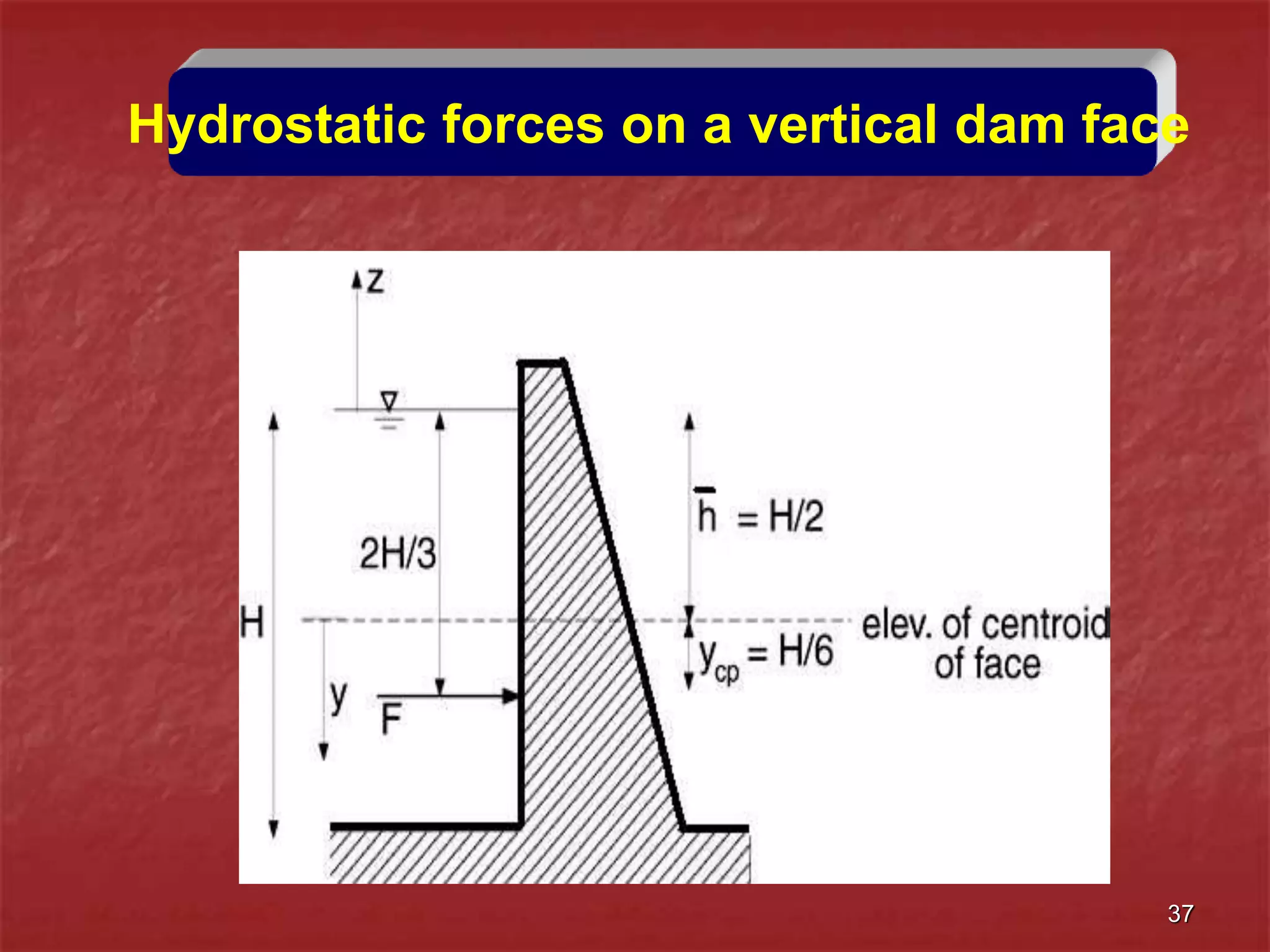
What are the magnitude and direction of the
force on the vertical rectangular dam (the shown
figure) of height H and width, w, due to
hydrostatic loads, and
 At what elevation is the center of pressure?
37
Hydrostatic forces on a vertical dam face
38
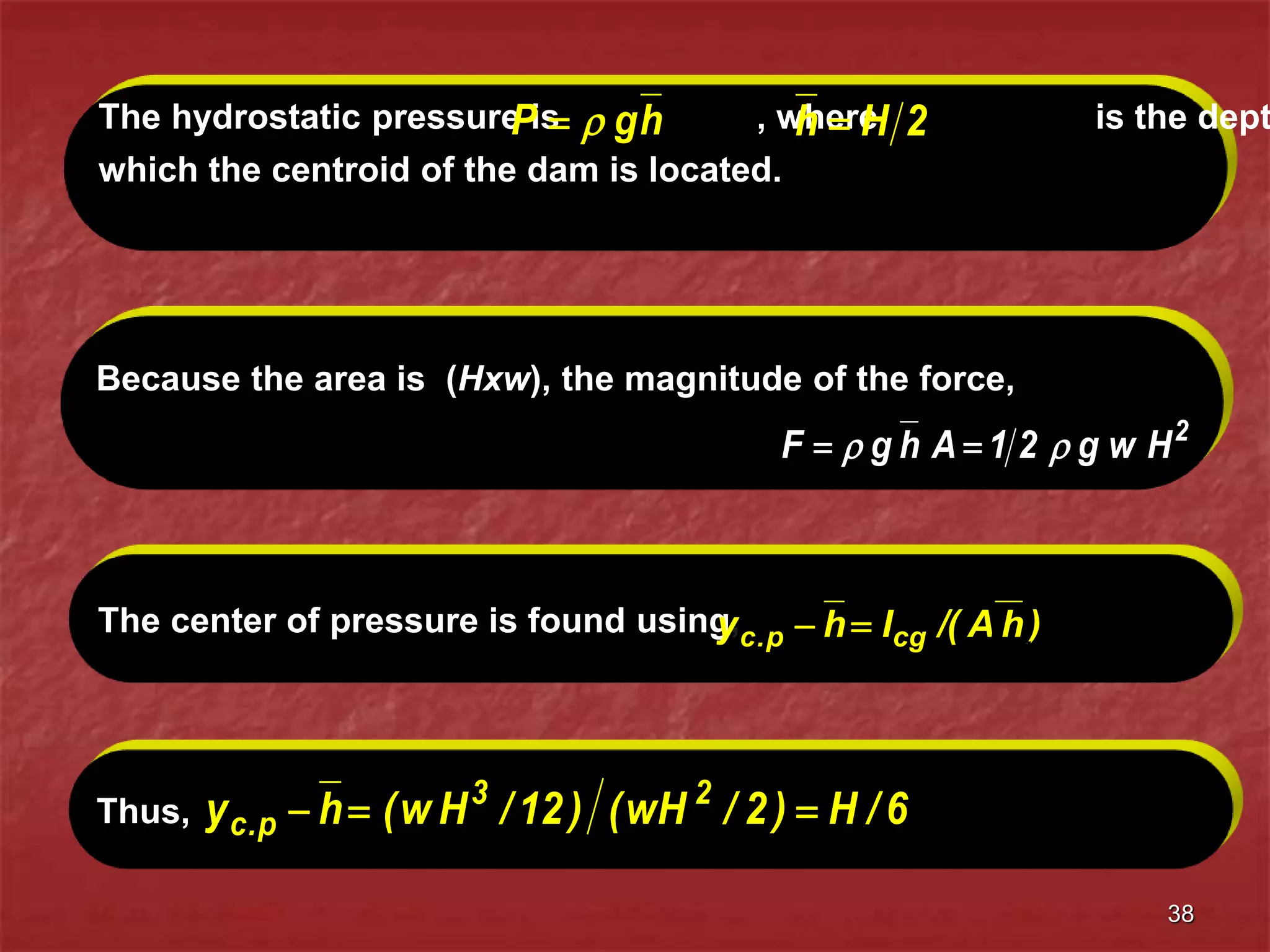
Because the area is (Hxw), the magnitude of the force,
2
H
w
g
2
1
A
h
g
F 
 

The center of pressure is found using, )
h
A
/(
I
h
y cg
p
.
c 
 12
/
H
w
I 3
cg 
Thus, 6
/
H
)
2
/
wH
(
)
12
/
H
w
(
h
y 2
3
p
.
c 


The hydrostatic pressure is , where is the dept
which the centroid of the dam is located.
h
g
P 
 2
H
h 
39
The direction of the force is normal and compressive to the dam face a
shown .
The center of pressure is therefore located at a distance H/6 directly b
the centroid of the dam, or a distance 2H / 3 of below the water surfac
40
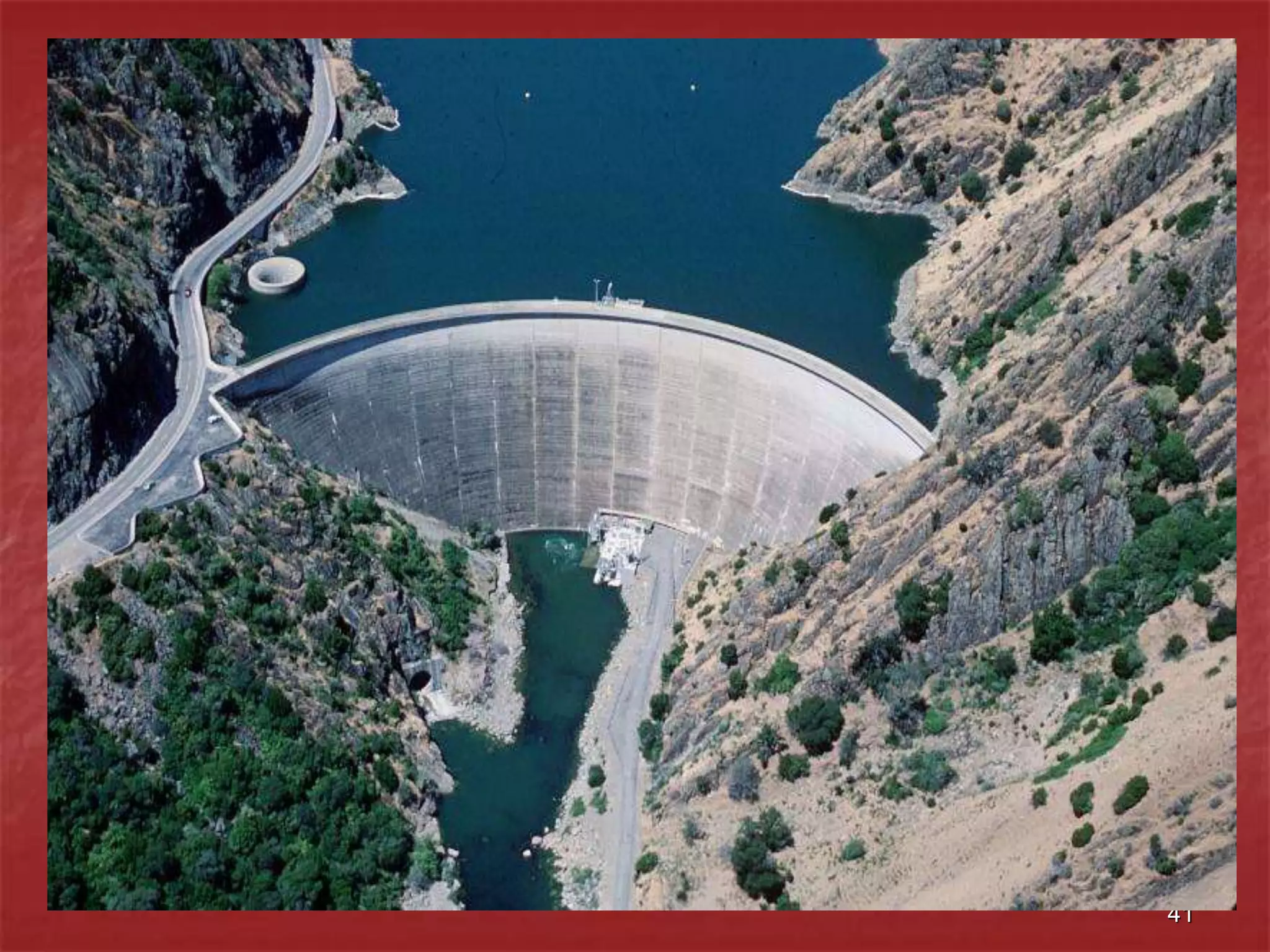
 What is the net horizontal force acting on a
constant radius arch-dam face due to
hydrostatic forces?
41
42
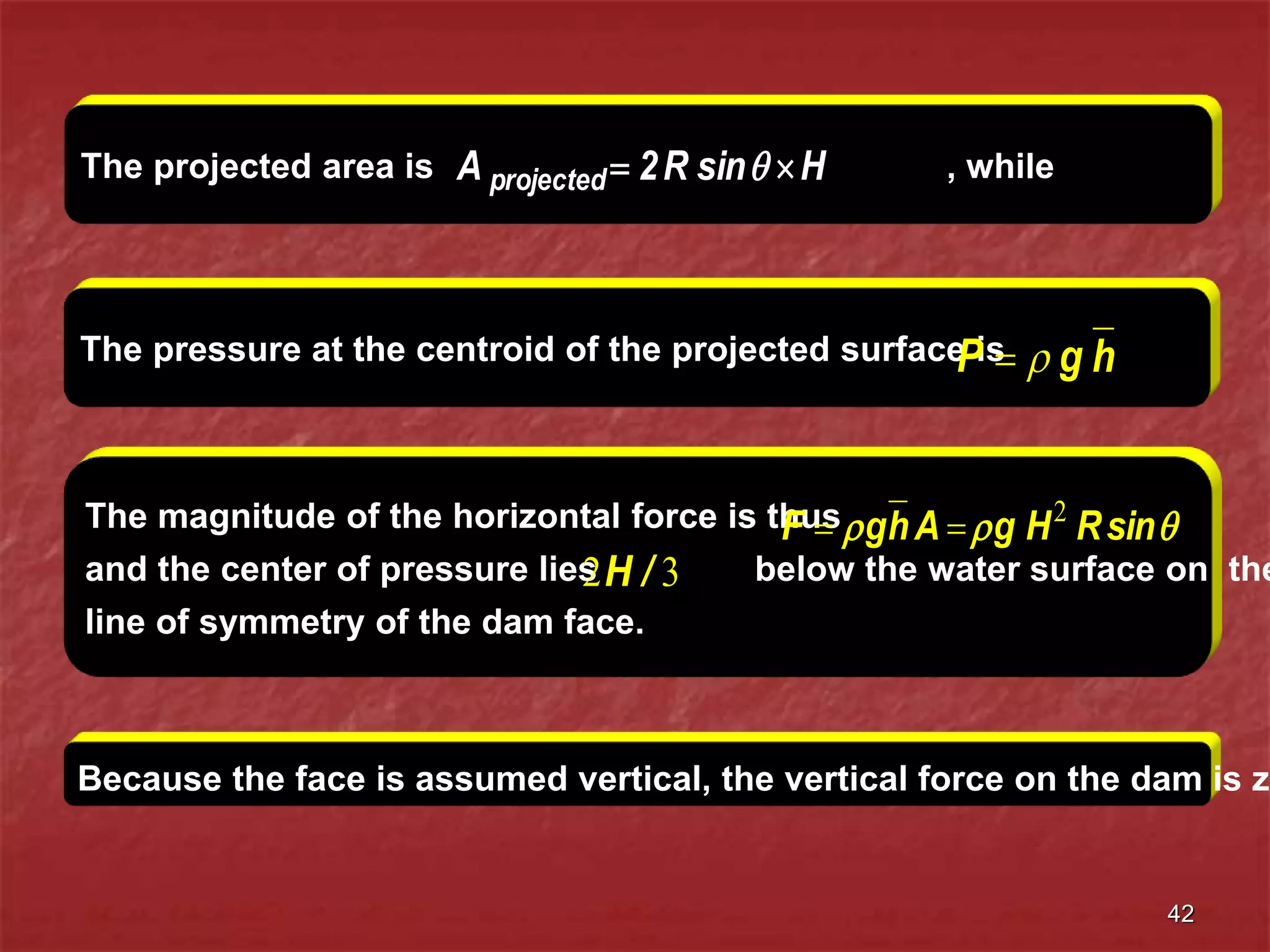
The projected area is , while
H
sin
R
2
A projected 
 
The pressure at the centroid of the projected surface is h
g
P 

The magnitude of the horizontal force is thus
and the center of pressure lies below the water surface on the
line of symmetry of the dam face.


 sin
R
H
g
A
h
g
F 2


3
2 /
H
Because the face is assumed vertical, the vertical force on the dam is ze
43
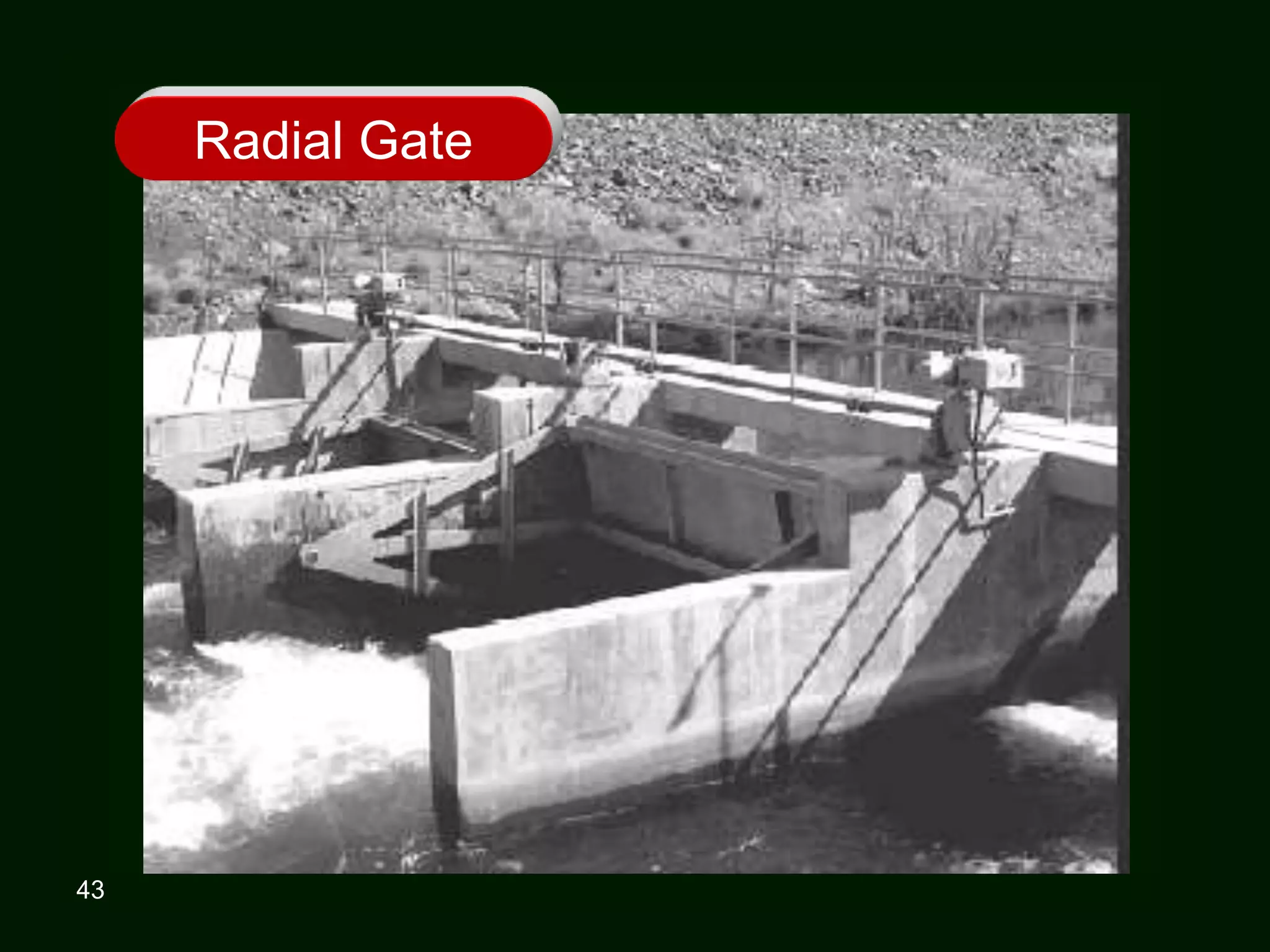
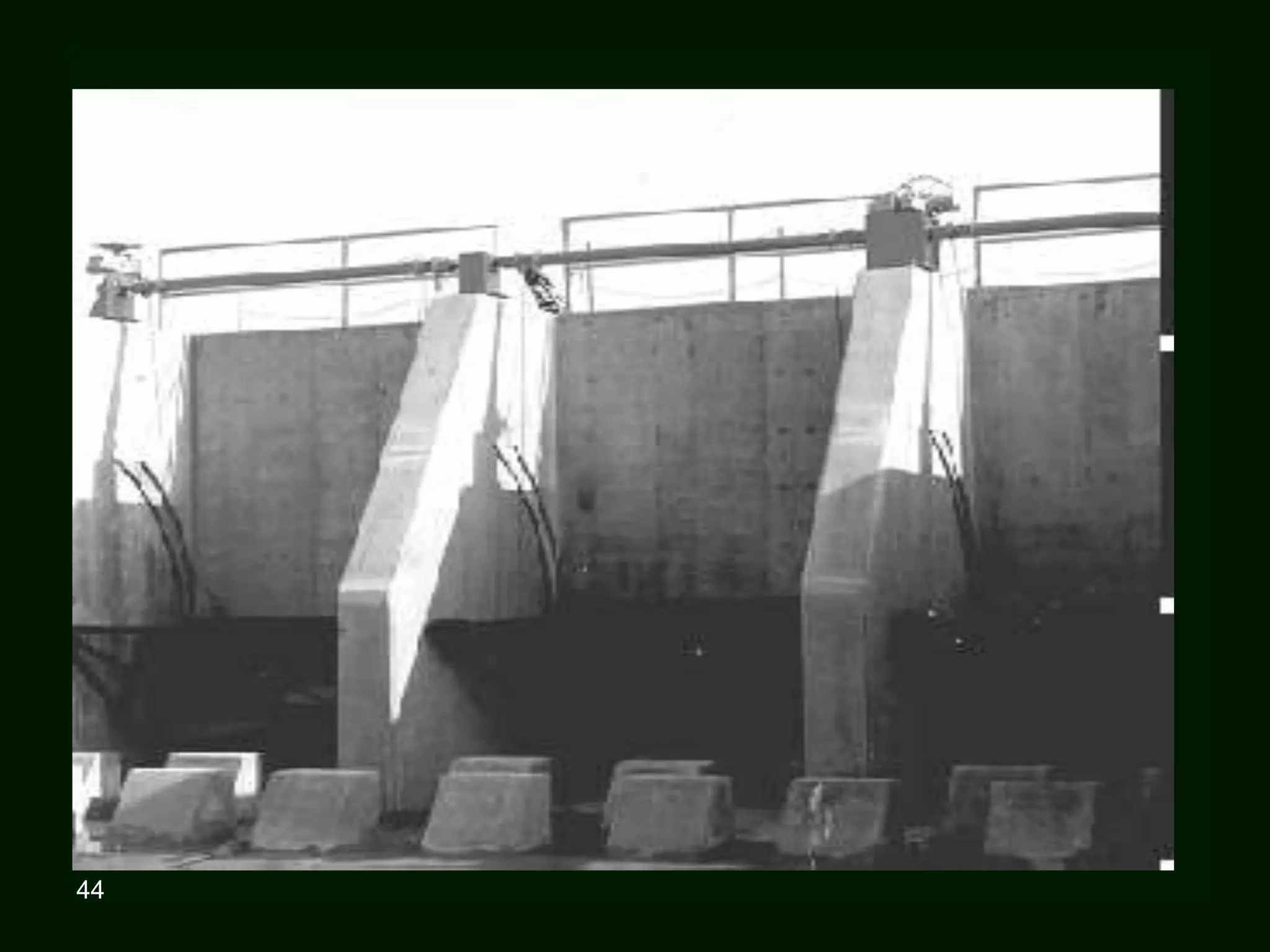
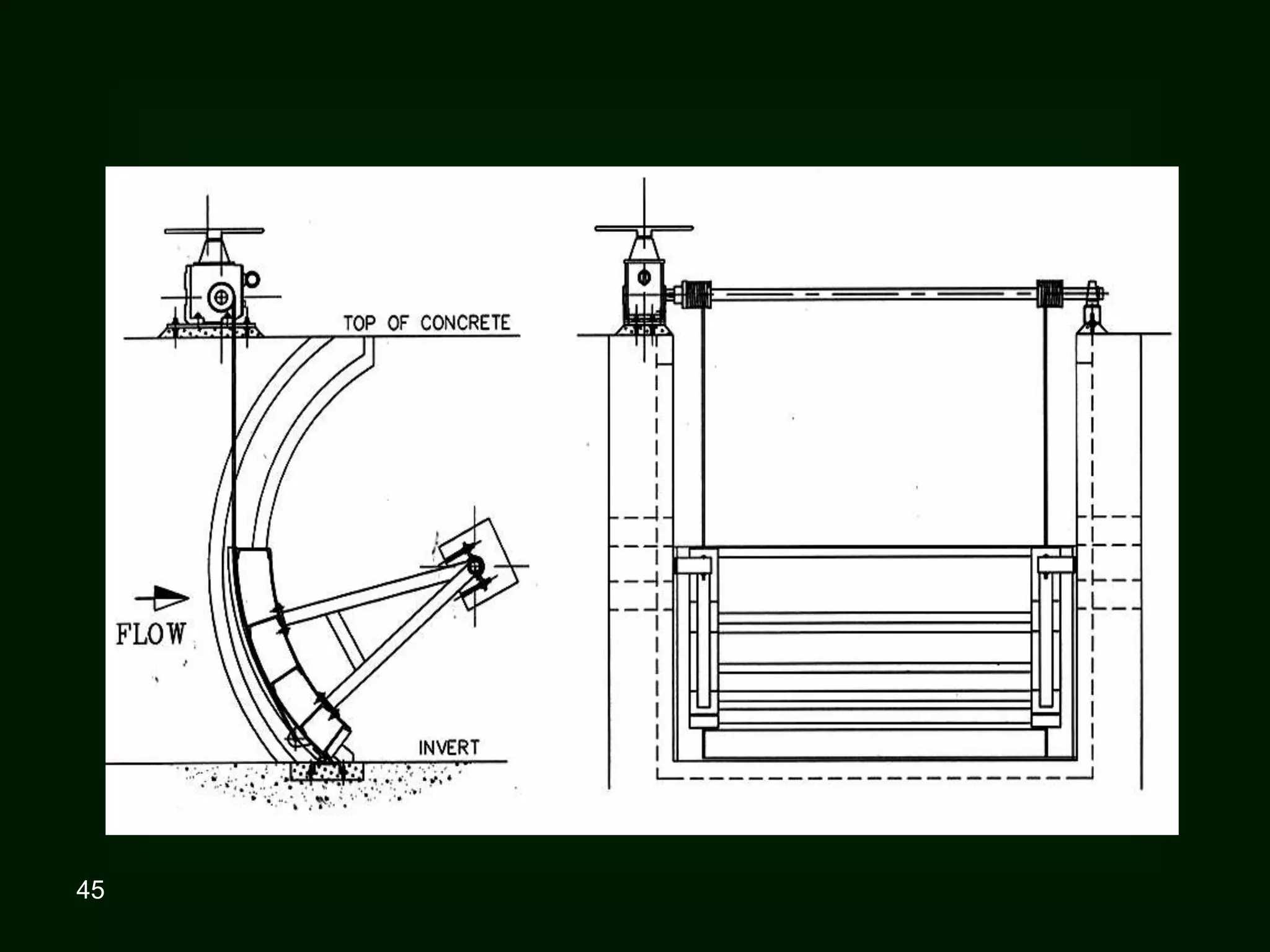
Radial Gate
44
45
46
Worked Example
Hydrostatic Forces
H.I.T May 2010
47
9.0 m
45 m
Wate
r
 Water Surface
9.0 m
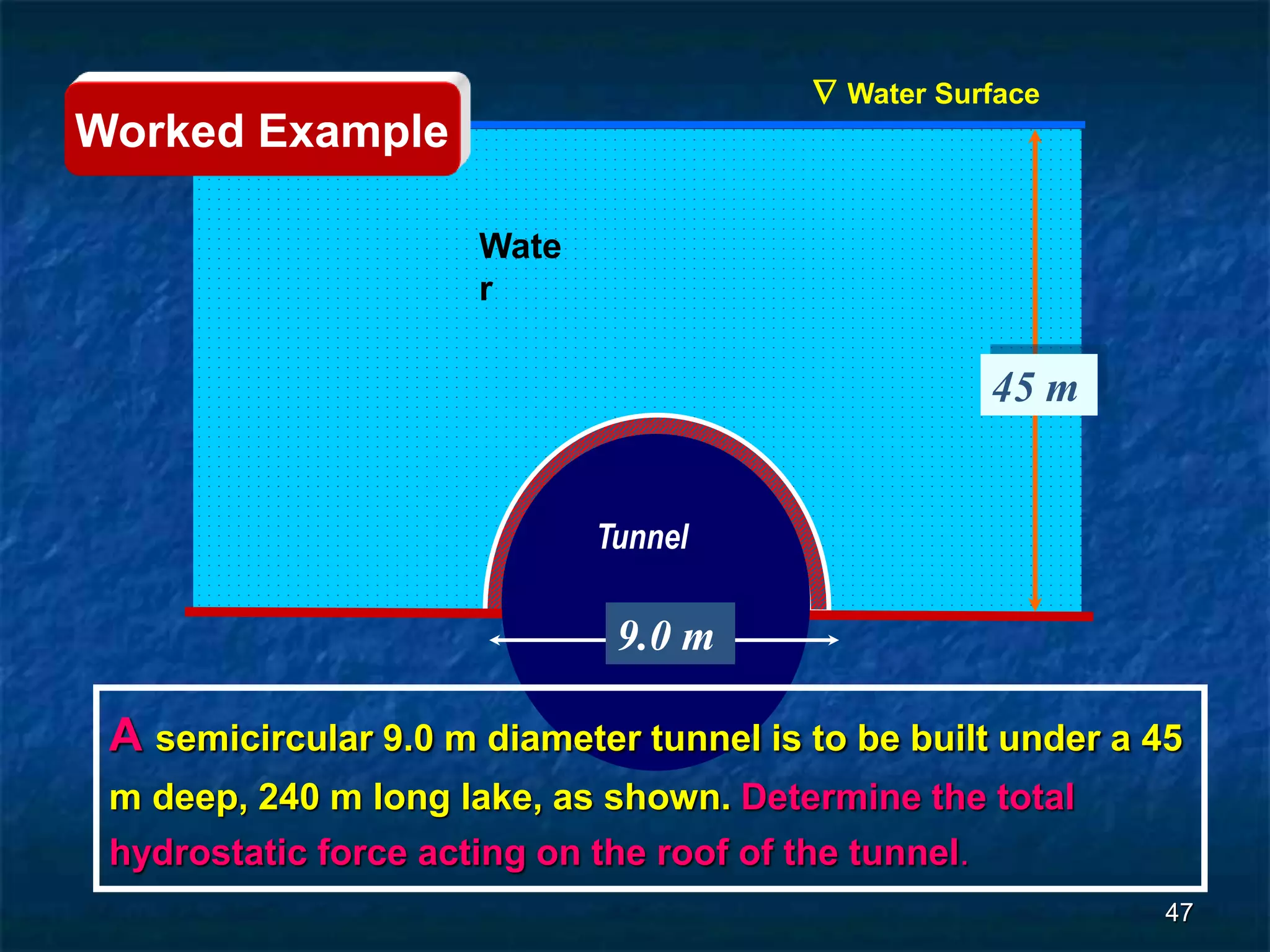
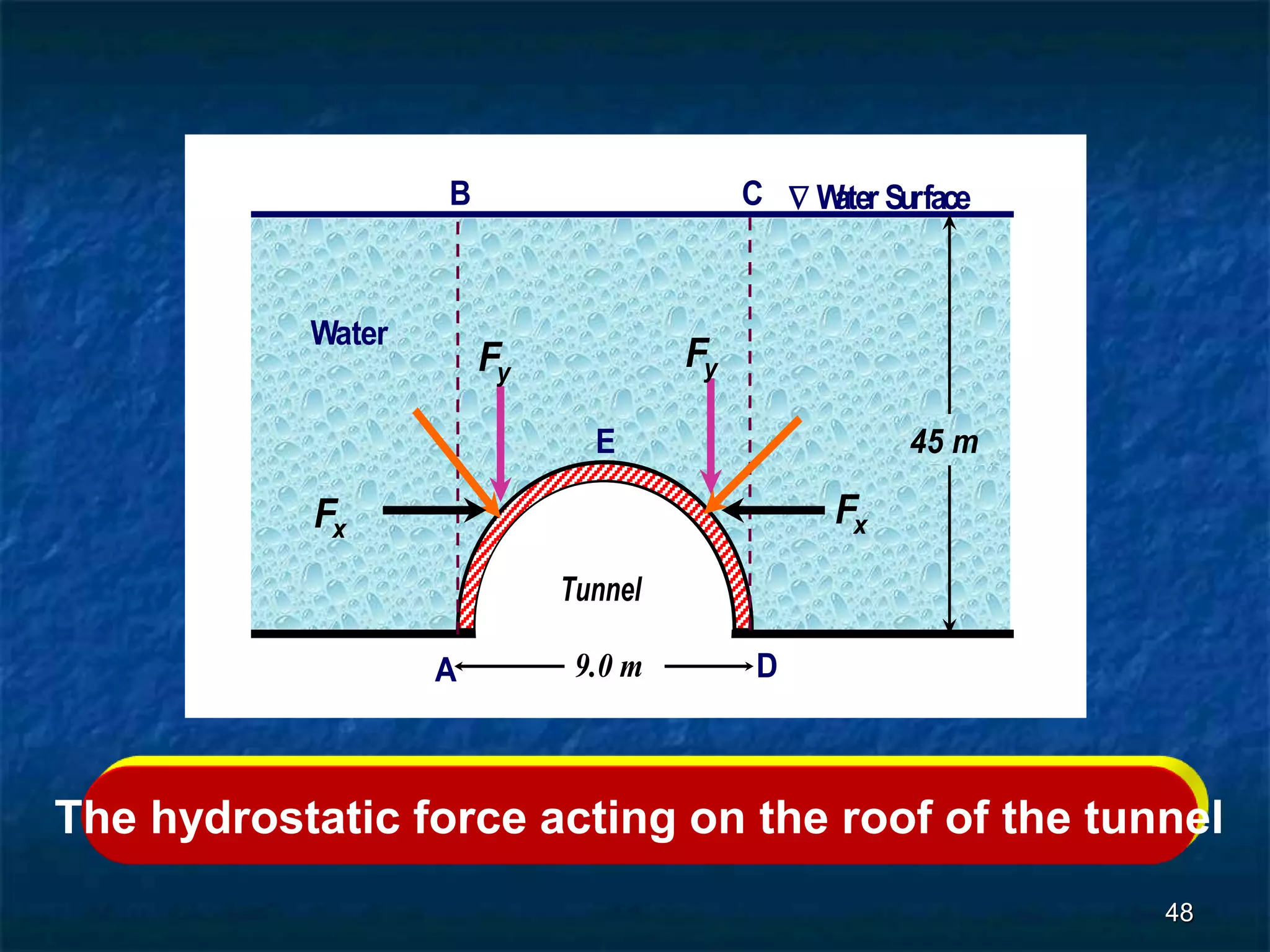
A semicircular 9.0 m diameter tunnel is to be built under a 45
m deep, 240 m long lake, as shown. Determine the total
hydrostatic force acting on the roof of the tunnel.
Tunnel
Worked Example
48
9.0 m
45 m
Water
 W
ater Surface
9.0 m
Tunnel
A
B C
D
E
Fx
Fy
Fx
Fy
The hydrostaticforce actingon the roof of the tunnel
The hydrostatic force acting on the roof of the tunnel
49
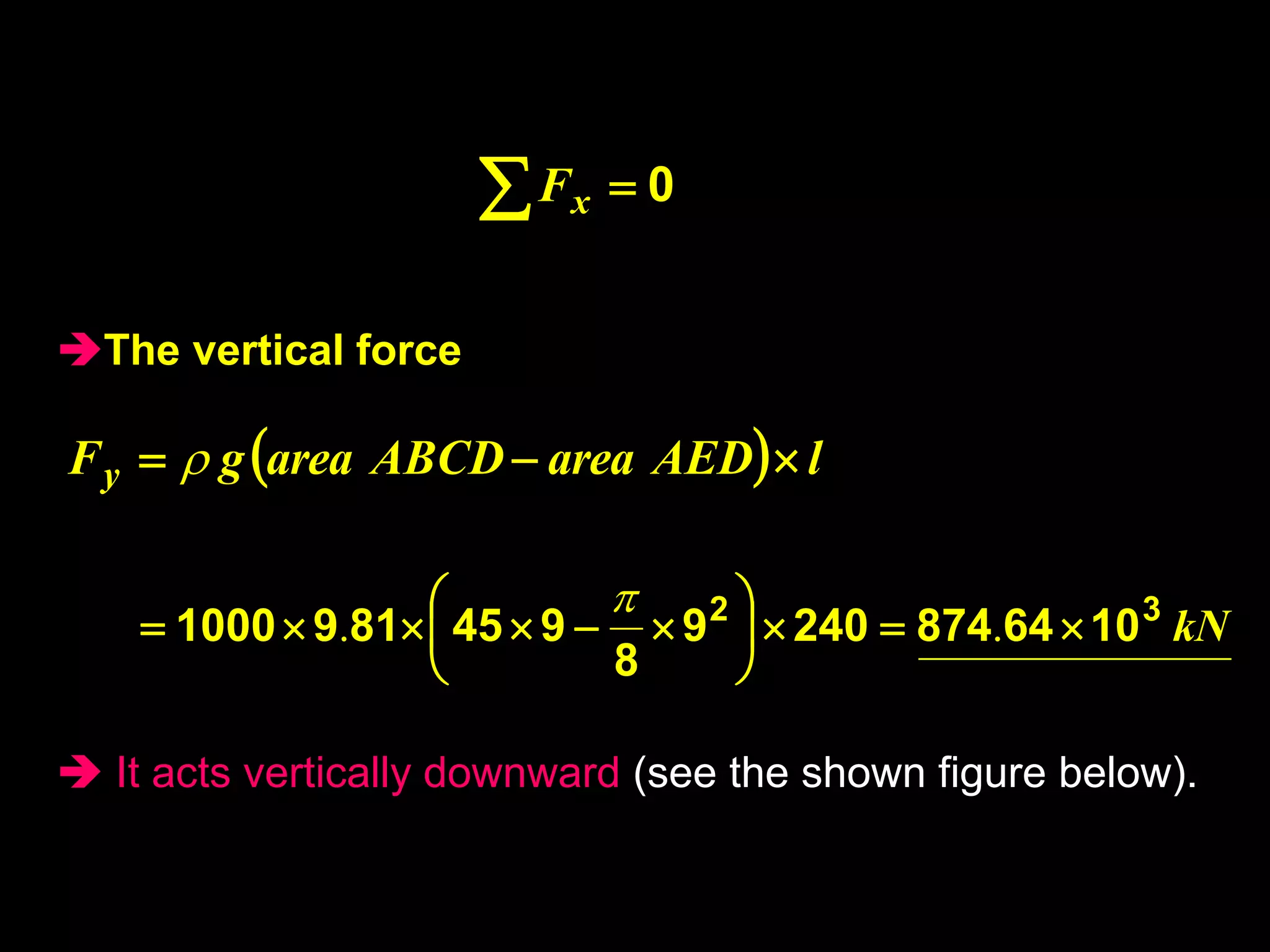
The vertical force
 It acts vertically downward (see the shown figure below).
0

 x
F
  l
AED
area
ABCD
area
g
Fy 

 
kN
3
2
10
64
874
240
9
8
9
45
81
9
1000 













 .
.


Lec of Fluid static forces .ppt

  • 1.
    1 Fluid Static Forces By: Dr:Ezzat El-sayed Gomaa
  • 2.
    2 Hydraulic I (2)Fluid Static Forces Hydrostatic Forces on Plane Surfaces - Magnitude,  - Direction, it is the easiest ! Why ?  - Line of action  To define the force, we need:
  • 3.
    3 Closed Duct Pipe Dam Hydraulic I(3) Fluid Static Forces Direction of Fluid Pressure on Boundaries
  • 4.
    4 Hydraulic I (4)Fluid Static Forces Hydrostatic Force on an Inclined Plane Surfaces  - Magnitude,  - Location
  • 5.
    5 X dA Hydraulic I (5)Fluid Static Forces Center of Pressure CP Center of Gravity CG y ỳ ycp   F P = g y sin  Free Surface     A A dA y g dA P F   sin Hydrostatic Force on Plane Inclined Surfaces
  • 6.
    6 Hydraulic I (6)Fluid Static Forces A y sin g dA sin y g dA P F A A A           Surfaces exposed to fluids experience a force due to the distribution in the fluid From solid mechanics the location of the center of gravity (centroid of the area) measured from the surface is A y A y A   1 ..(1)  - Magnitude Hydrostatic Force on Plane Inclined Surfaces
  • 7.
    7 Hydraulic I (7)Fluid Static Forces   A P A h g A sin y g F       Substituting into Eq. (1) gives: y h   sin y h   - Magnitude Hydrostatic Force on Plane Inclined Surfaces
  • 8.
    8 Hydraulic I (8)Fluid Static Forces A P A h g A P A h g A P F atm atm ) R (        The net pressure force on the plane, submerged surface is  - Note Hydrostatic Force on Plane Surfaces
  • 9.
    9 Hydraulic I (9)Fluid Static Forces Center of Pressure on an Inclined Plane Surface  - Line of Action of F Does the resultant force pass thought the center of gravity ?  No! lies below the centroid, since pressure increases with depth  Moment of the resultant force must equal the moment of the distributed pressure force dA y g y dF y F A A cp     2   sin
  • 10.
    10 X dA Hydraulic I (10)Fluid Static Forces y ỳ ycp   F P = g y sin  Free Surface     2 g . c cp 0 cp y A I A y y I sin g A sin y g y    or     C.G C.P y A I y y g . c cp  
  • 11.
    11 Hydraulic I (11)Fluid Static Forces  - Line of Action of F (center of pressure)  The location of the center of pressure is independent of the angle ,  The center of pressure is always below the centroid,  As the depth of immersion increase, the depth of the center of pressure approaches the centroid. y A I y y g . c cp  
  • 12.
    12 Hydraulic I (12)Fluid Static Forces  - Hoover Dam
  • 13.
    13 Hydraulic I (13)Fluid Static Forces  - Hoover Dam
  • 14.
    14 Hydraulic I (14)Fluid Static Forces  - Moment of Inertia for Common Shapes
  • 15.
    15  C.G C.P Free Surface A CompletelySubmerged Tilted Rectangular Plate   ) b a ( sin 2 / a S g A h g F              ) b a ( 2 / a S ) 12 / a b ( 2 / a S y 3 cp           sin 2 / a S h    h y cp y S F a  
  • 16.
    16  C.G C.P Free Surface  sin ) 2 / a ( h  y a cp y F   ) b a ( sin 2 / a g A h g F          h     a 3 2 ) b a ( 2 / a ) 12 / a b ( 2 / a y 3 cp       When the Upper Edge of the Submerged Tilted Rectangular Plate is at the Free Surface and thus (S = 0)  
  • 17.
    17  =90o C.G C.P Free Surface ACompletely Submerged Vertical Rectangular and thus ( = 0) a S 1 90 sin : where ) 2 / a S ( h o    cp cp h y  h y F   ) b a ( 2 / a S g A h g F             ) b a ( 2 / a S ) 12 / a b ( 2 / a S y 3 cp         
  • 18.
    18  =90o C.G C.P Free Surface h y cp cph y  0 S , 1 90 sin : where 2 / a h o    a F When the Upper Edge of the Submerged Vertical Rectangular Plate is at the Free Surface and thus (S = 0 &  = 90o)   ) b a ( 2 / a g A h g F            a 3 2 ) b a ( 2 / a ) 12 / a b ( 2 / a y 3 cp        
  • 19.
  • 20.
    20 Patm. h   F A Completely SubmergedHorizontal Rectangular Flat Plate The pressure distribution is constant =  g h, where h is the distance of the plate from the free surface. The effect of Patm. is assumed to be = 0 (gage) ) b a ( h g A h g F          It acts at the mid point of the plate
  • 21.
    21 19 S a o  Patm. Patm. h   F y h  F  sin y h   ACompletely Submerged Rectangular Flat Plate Consider a completely submerged rectangular plate of height “a” and width “b” at an angle  from the horizontal and whose top edge is horizontal at a distance S from the free surface along the plane of the plate (see the shown figure). The effect of Patm. Is assumed to be = 0 (gage) ) b a ( sin ) 2 a S ( g F        
  • 22.
    22 Arbitrary datum A B  gh =  g Z Surface Z h hn Hn-1 hi Lamina stratification P  
  • 23.
  • 24.
    24  F increasesas H increases ?  decreases as H increases?  is constant as H increases?  T increases as H increases?  T is constant as H increases? y ycp  y ycp  True or False???
  • 25.
    25 Hydraulic I (20)Fluid Static Forces Hydrostatic Force on a Curved Surface D C E B A FH W1 W2  Assume Patm=0 (gage) at the free surface,  The hydrostatic force on the surface EA : is Fx  The net vertical force on the curve surface AB is: FV=W1+W2 To find the line of action of the resultant force, balance the momentum about some convenient point
  • 26.
    26 Hydraulic I (21)Fluid Static Forces Pressure on Curved Surface (free body)  D B C yCp FV(1) FH FV(2) E   w EA EA DE g Fx            2  A   w ABE area BCDE area g FV      S
  • 27.
    27 Hydraulic I (22)Fluid Static Forces Pressure on Curved Surface (free body)  Determine the volume of fluid above the curved surfa  Compute the weight of the volume above it,  The magnitude of the vertical component of the resu force is equal to the weight of the determined volume. acts in line with the centroid of the volume,  Draw a projection of the curved surface onto a vertica plane and determine its height called “S”,
  • 28.
    28 Hydraulic I (23)Fluid Static Forces Pressure on Curved Surface (free body)  Determine the depth to the centroid of the projected a =DE+(S/2), where DE is the depth to the top of the projected a  Compute the magnitude of the horizontal component the resultant force, FH =  g h- A =  g (DE+S/2)x(Sx w)  Compute the depth to the line of action of the horizon force, h A I h h cg cp  
  • 29.
    29 Hydraulic I (24)Fluid Static Forces Pressure on Curved Surface (free body)  For regular rectangular cross-section, Thus,  Compute the resultant force, h A I h h cg cp     w S h S DA g A h g FH               12 2   2 2 V H R F F F  
  • 30.
    30 Hydraulic I (25)Fluid Static Forces Pressure on Curved Surface (free body)  Compute the angle of inclination of the resultant forc relative to the horizontal. Thus, 11- Show the resultant force acting on the curved surfac in such a direction that its line of action passes throu the center of curvature of the surface.   H V F F 1   tan 
  • 31.
    31 Hydraulic I (26)Fluid Static Forces 2.50 m 2.80 m 2. 0 m water Oil Sg = 0.90 Support Gate, 0.60 m wide Hinge Pressure on Plane Surface (free body)
  • 32.
    32 Hydraulic I (27)Fluid Static Forces The figure shows a gate hinged at its bottom hinged at its bottom and held by a simple support at its top. The gate separates two fluids. Compute  the net force on the gate due to the fluid on each side, and  Compute the force on the hinge and on the support. Pressure on Plane Surface (free body)
  • 33.
    33 Hydraulic I (28)Fluid Static Forces 2.50 m 2.80 m 2. 0 m water Oil Sg = 0.90 Support Gate, 0.60 m wide Hinge “o” F1 F2 Hcp (1) Hcp (1) 2.50 m Pressure on Plane Surface (free body)
  • 34.
  • 35.
    35 Grand Coulee Dam- Columbia River
  • 36.
    36 What are themagnitude and direction of the force on the vertical rectangular dam (the shown figure) of height H and width, w, due to hydrostatic loads, and  At what elevation is the center of pressure?
  • 37.
    37 Hydrostatic forces ona vertical dam face
  • 38.
    38 Because the areais (Hxw), the magnitude of the force, 2 H w g 2 1 A h g F     The center of pressure is found using, ) h A /( I h y cg p . c   12 / H w I 3 cg  Thus, 6 / H ) 2 / wH ( ) 12 / H w ( h y 2 3 p . c    The hydrostatic pressure is , where is the dept which the centroid of the dam is located. h g P   2 H h 
  • 39.
    39 The direction ofthe force is normal and compressive to the dam face a shown . The center of pressure is therefore located at a distance H/6 directly b the centroid of the dam, or a distance 2H / 3 of below the water surfac
  • 40.
    40  What isthe net horizontal force acting on a constant radius arch-dam face due to hydrostatic forces?
  • 41.
  • 42.
    42 The projected areais , while H sin R 2 A projected    The pressure at the centroid of the projected surface is h g P   The magnitude of the horizontal force is thus and the center of pressure lies below the water surface on the line of symmetry of the dam face.    sin R H g A h g F 2   3 2 / H Because the face is assumed vertical, the vertical force on the dam is ze
  • 43.
  • 44.
  • 45.
  • 46.
  • 47.
    47 9.0 m 45 m Wate r Water Surface 9.0 m A semicircular 9.0 m diameter tunnel is to be built under a 45 m deep, 240 m long lake, as shown. Determine the total hydrostatic force acting on the roof of the tunnel. Tunnel Worked Example
  • 48.
    48 9.0 m 45 m Water W ater Surface 9.0 m Tunnel A B C D E Fx Fy Fx Fy The hydrostaticforce actingon the roof of the tunnel The hydrostatic force acting on the roof of the tunnel
  • 49.
    49 The vertical force It acts vertically downward (see the shown figure below). 0   x F   l AED area ABCD area g Fy     kN 3 2 10 64 874 240 9 8 9 45 81 9 1000                . . 