Fluid Mechanics
By Samar Singhal
Hydrostatic Force on Inclined Surface
First Moment of Area
•The first moment of area of a shape, about a certain axis,
equals the sum over all the infinitesimal parts of the shape of
the area of that part times its distance from the axis .
•First moment of area is used to determine the centroid of an
area.
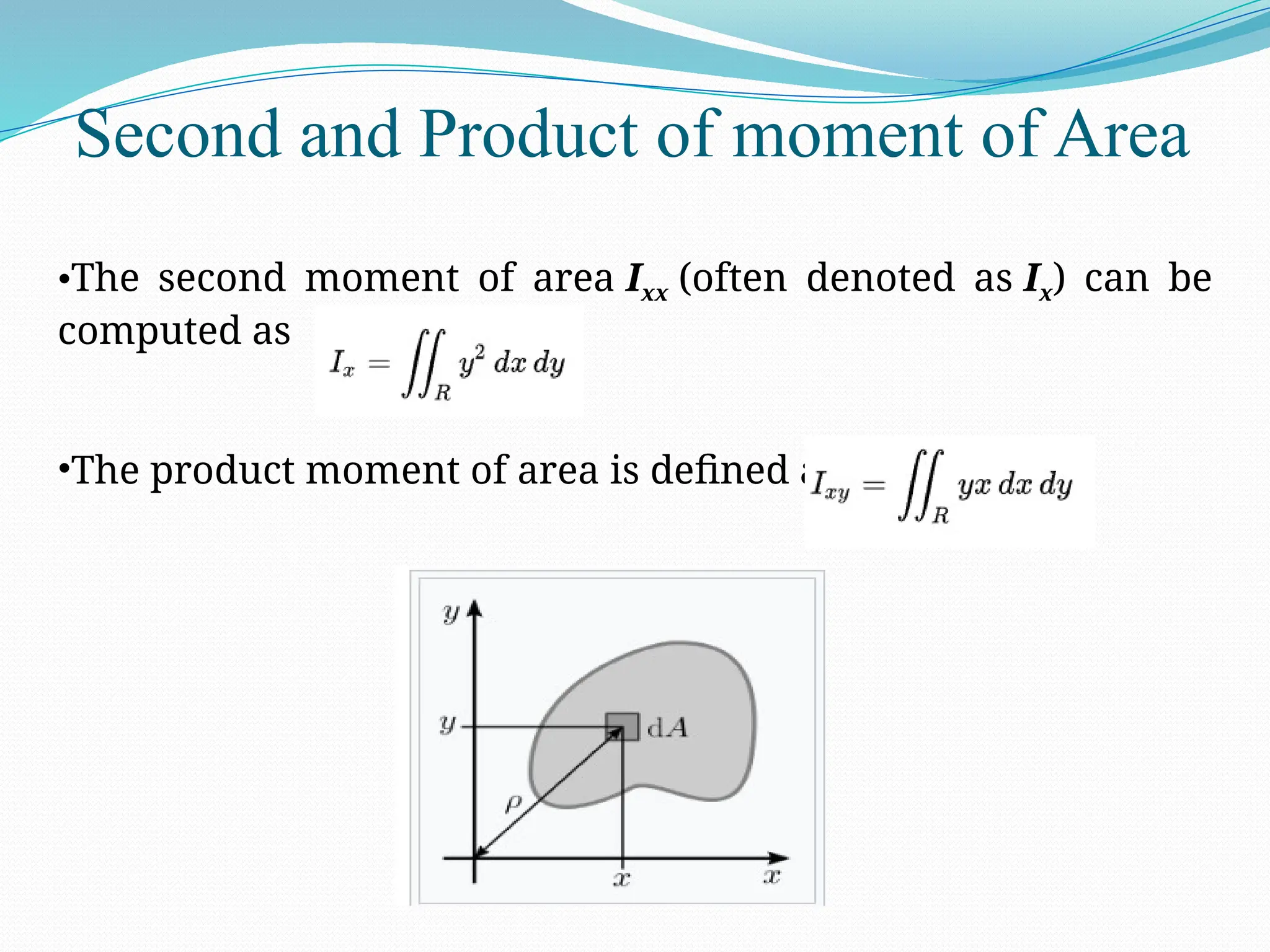
Second and Product of moment of Area
•The second moment of area Ixx (often denoted as Ix) can be
computed as
•The product moment of area is defined as
Product of moment of Area
•Green area need to balance the
red area.
•Automatically satisfied when x
and y are symmetry axes.
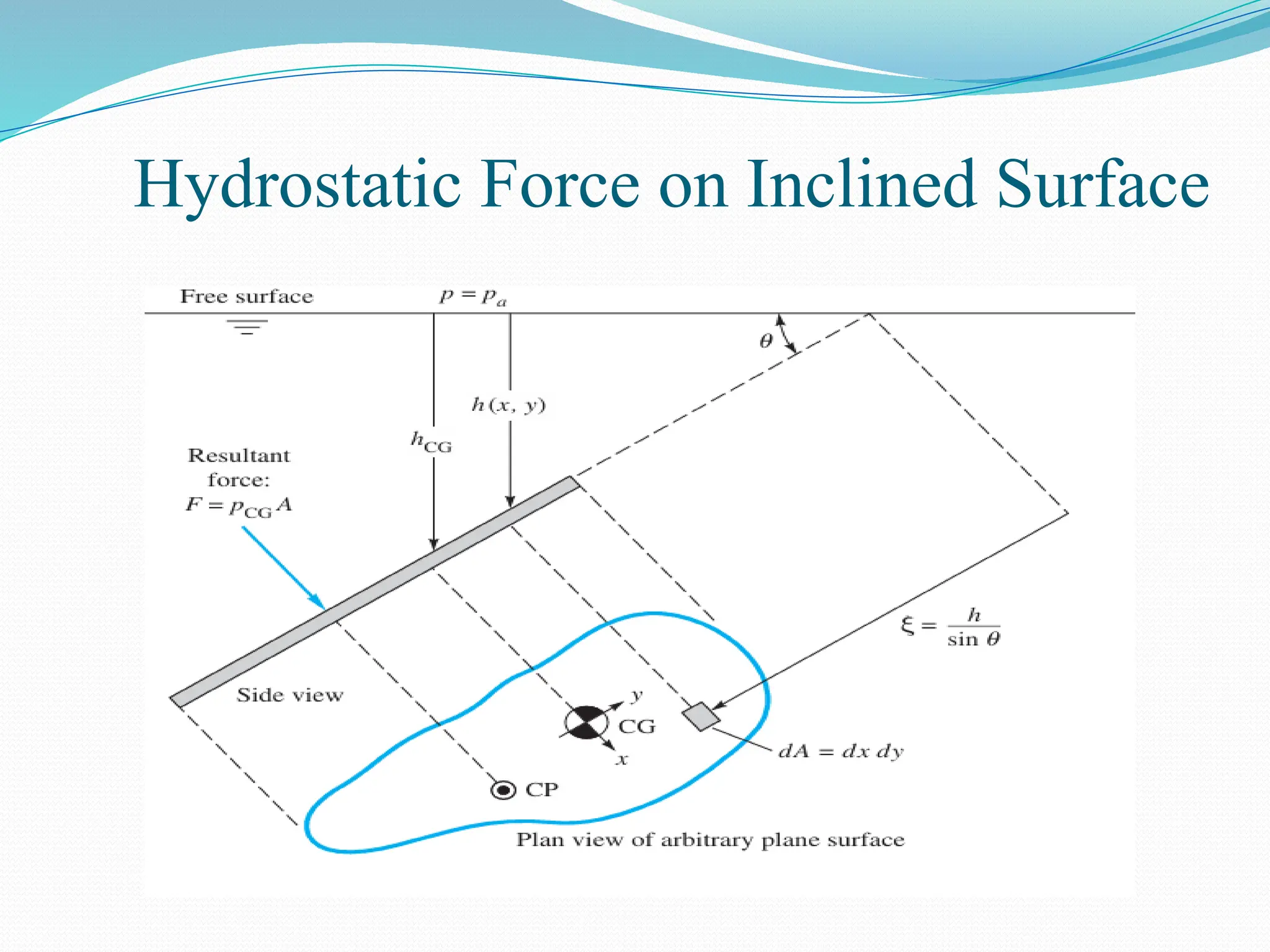
Hydrostatic Force on Inclined Surface
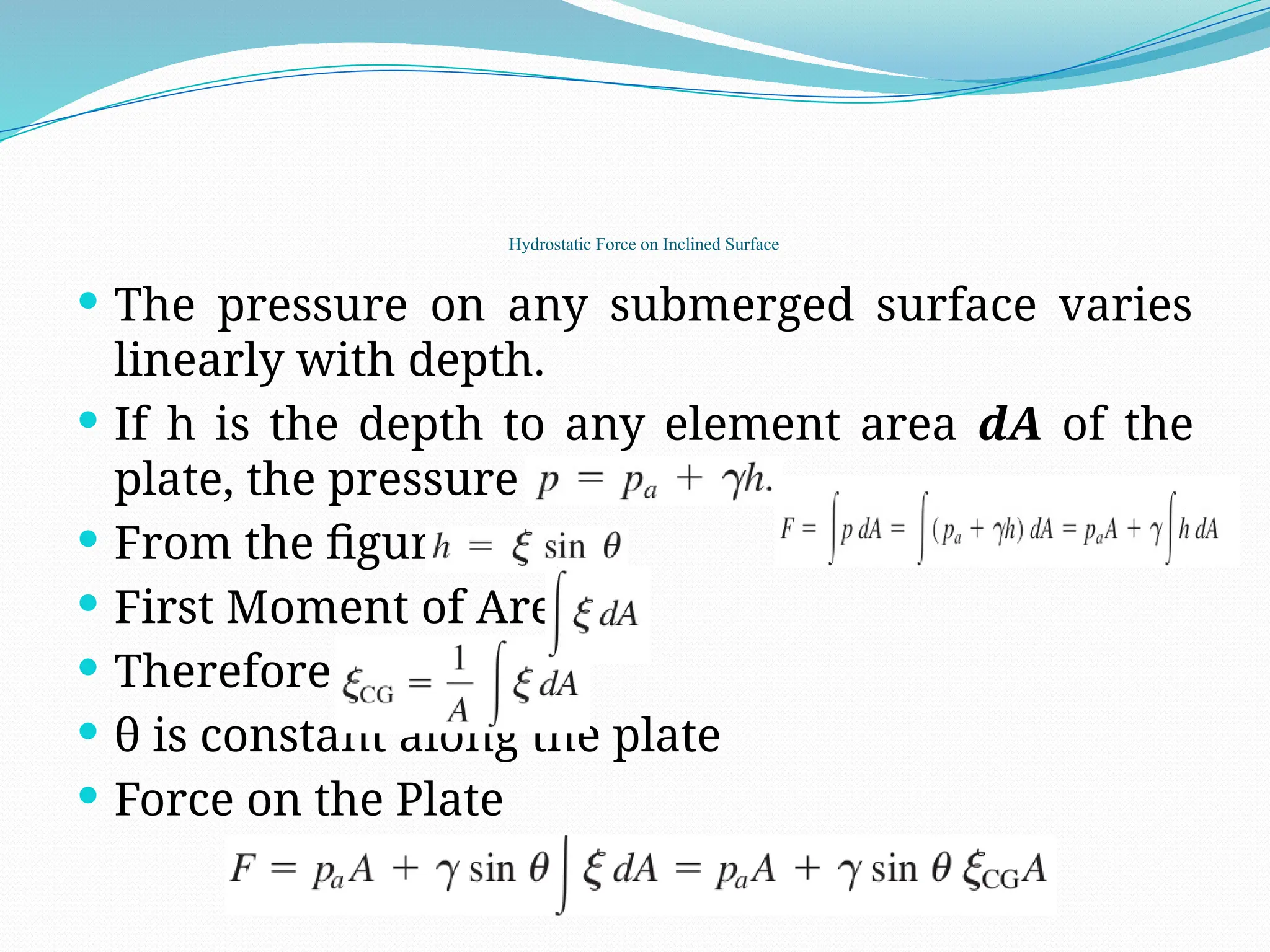
 The pressure on any submerged surface varies
linearly with depth.
 If h is the depth to any element area dA of the
plate, the pressure there is
 From the figure
 First Moment of Area
 Therefore
 θ is constant along the plate
 Force on the Plate
Hydrostatic Pressure on Inclined Surface
 But,
 Therefore Force on the plate can be written as
 whereas hcg the depth straight down from the surface to the
plate centroid pcg is the pressure at centroid of the plate.
 The force on one side of any plane submerged surface in a
uniform fluid equals the pressure at the plate centroid times
the plate area, independent of the shape of the plate or the
angle θ at which it is slanted.
Pressure Distribution
The hydrostatic pressure force on a plane surface is equal,
regardless of its shape, to the resultant of the three-
dimensional linear pressure distribution on that surface.
Special Cases
Center of Pressure
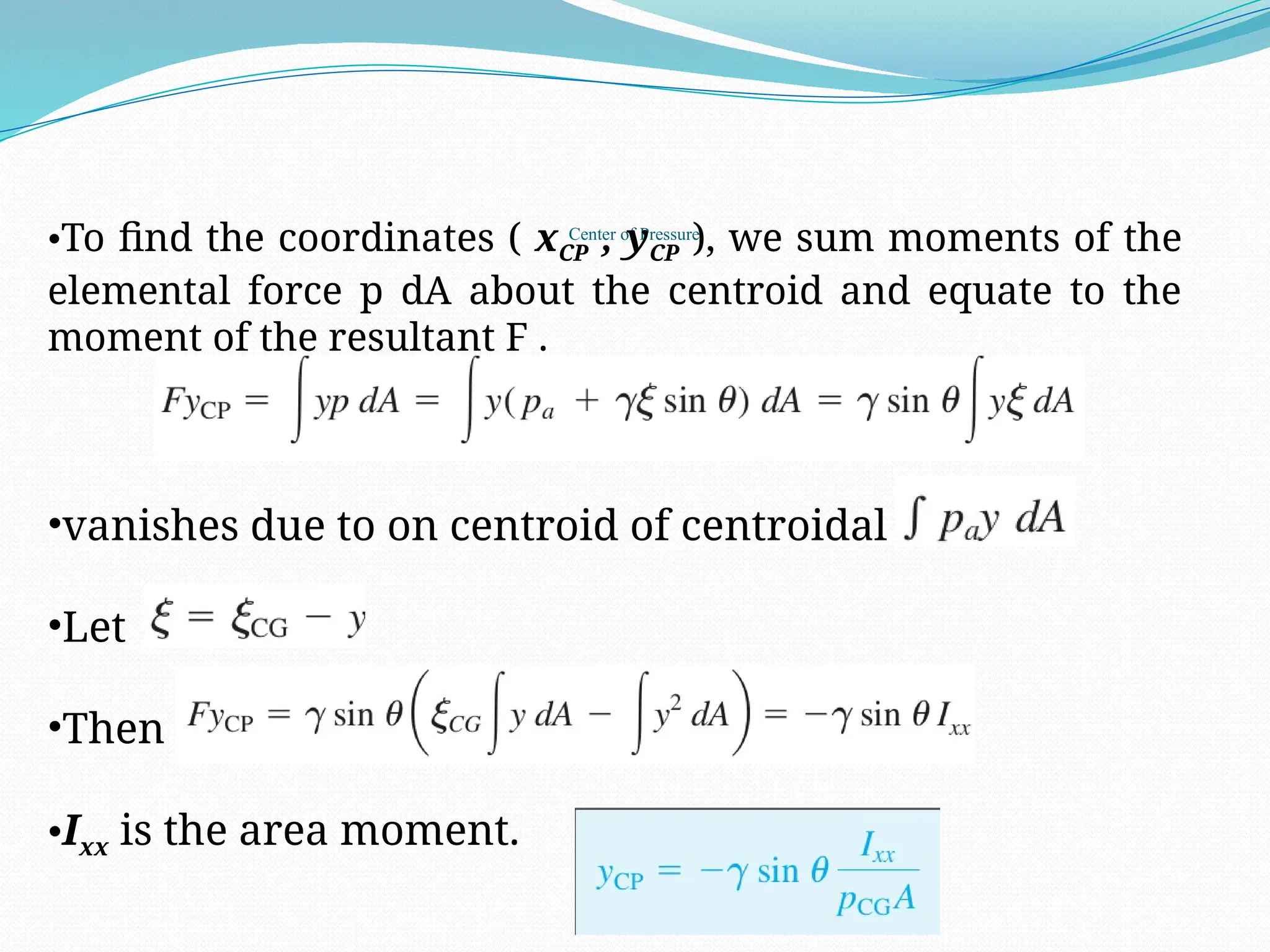
•To find the coordinates ( xCP , yCP ), we sum moments of the
elemental force p dA about the centroid and equate to the
moment of the resultant F .
•vanishes due to on centroid of centroidal axes
•Let
•Then
•Ixx is the area moment.
Center of Pressure
•The negative sign in Eq. shows that yCP is below the centroid
at a deeper level and, unlike F , depends on angle θ . If we
move the plate deeper, yCP approaches the centroid because
every term remains constant except pCG , which increases.
•determination of xCP
•For positive Ixy, xCP is negative because the dominant
Hydrostatic Force on Inclined Surface
•In most cases the ambient pressure pa is neglected because
it acts on both sides of the plate; for example, the other side
of the plate is inside a ship or on the dry side of a gate or
dam. In this case pCG = γhCG , and the center of pressure
becomes independent of specific weight:
Pressure Prism
•Length of prism is the linearly varying pressure.
Its volume is equal to the magnitude of the resultant
hydrostatic force acting on the plate since FR = ʃ P dA, and the
line of action of this force passes through the centroid of
this homogeneous prism. The projection of the centroid on
the plate is the pressure center.
Centroidal moments of inertia for various cross sections:
Hydrostatic thrust on a submerged
curved surface
Hydrostatic thrust on a submerged
curved surface
•The hydrostatic force on the elemental area dA is
•The force acts in a direction normal to the area dA.
•The components of the force dF in x, y and z directions are
•The components of the surface element dA projected on yz,
xz and xy planes are, respectively
Hydrostatic thrust on a submerged
curved surface
Forces can be written as:
Integrating the forces:
zc is the z cordinate of centroid of area Ax and Ay the
projected areas on yz and and xz planes respectively.
Center of Pressure
Point of action of Fx
Point of action of Fy
For a curved surface, the component of hydrostatic force in a
horizontal direction is equal to the hydrostatic force on the
Vertical component of force
Vertical component of the hydrostatic force:
where V is the volume of the body of liquid within the
region extending vertically above the submerged
surface to the free surface of the liquid.
Therefore, the vertical component of hydrostatic force
on a submerged curved surface is equal to the weight
of the liquid volume vertically above the solid surface
to the free surface of the liquid and acts through the
centre of gravity of the liquid in that volume.
Surface submerged in a multilayered
fluid
The hydrostatic force on a surface submerged in a
multilayered fluid can be determined by considering
parts of the surface in different fluids as different
surfaces.
Hydrostatic thrust on a submerged
curved surface
•We could sum the separate three components of these
elemental pressure forces, but it turns out that we need not
perform a laborious three-way integration.
•The horizontal component of force on a curved surface
equals the force on the plane area formed by the projection
of the curved surface onto a vertical plane normal to the
component.
•The vertical component of pressure force on a curved
surface equals in magnitude and direction the weight of the
entire column of fluid, both liquid and atmosphere, above
the curved surface.
Hydrostatic thrust on a submerged
curved surface
Hydrostatic thrust on a submerged
curved surface
Hydrostatic thrust on a submerged
curved surface
The horizontal component of the hydrostatic force acting on a curved
surface is equal (in both magnitude and the line of action) to
thehydrostatic force acting on the vertical projection of the curved
surface.
The vertical component of the hydrostatic force acting on a curved
surface is equal to the hydrostatic force acting on the horizontal
projection of the curved surface, plus (minus, if acting in the opposite
direction) the weight of the fluid block.
Buoyancy
When a body is either wholly or partially immersed in a
fluid, the hydrostatic lift due to the net vertical
component of hydrostatic pressure forces experienced
by the body is called the buoyant force and the
phenomenon is called buoyancy.
Buoyancy
•The resultant horizontal force in any direction for such a
closed surface is always zero.
•The vertical forces acting on the two ends of such a prism
•Therefore, the buoyant force (the net vertically upward
force) acting on the elemental prism is
•Integrating will give net buoyant force:
Line of action of the force
•The line of action of the force can be found by taking
moment of the force with respect to z-axis.
•Substituting the values:
•Which is the centroid of the displaced volume.
•Buoyant force FB equals to the weight of liquid displaced by
the submerged body of volume V and known as the
Archimedes principle.
•The principle states that the buoyant force on a submerged
body is equal to the weight of liquid displaced by the body,
and acts vertically upward through the centroid of the
displaced volume.
Float, Suspended and Sinking Body
Numericals
•A tank of oil has a right-triangular panel near the
bottom, as in Fig. Omitting pa , find the (a) hydrostatic
force and (b) CP on the panel.
Numericals
A long solid cylinder of radius 0.8 m hinged at point A is used
as an automatic gate, as shown in Fig. When the water level
reaches 5 m, the gate opens by turning about the hinge at point
A. Determine (a) the hydrostatic force acting on the cylinder and
its line of action when the gate opens and (b) the weight of the
cylinder per m length of the cylinder.
Fluid Mechanics hydrostatic pressure.pptx

Fluid Mechanics hydrostatic pressure.pptx

  • 1.
  • 2.
    Hydrostatic Force onInclined Surface
  • 3.
    First Moment ofArea •The first moment of area of a shape, about a certain axis, equals the sum over all the infinitesimal parts of the shape of the area of that part times its distance from the axis . •First moment of area is used to determine the centroid of an area.
  • 4.
    Second and Productof moment of Area •The second moment of area Ixx (often denoted as Ix) can be computed as •The product moment of area is defined as
  • 5.
    Product of momentof Area •Green area need to balance the red area. •Automatically satisfied when x and y are symmetry axes.
  • 6.
    Hydrostatic Force onInclined Surface  The pressure on any submerged surface varies linearly with depth.  If h is the depth to any element area dA of the plate, the pressure there is  From the figure  First Moment of Area  Therefore  θ is constant along the plate  Force on the Plate
  • 7.
    Hydrostatic Pressure onInclined Surface  But,  Therefore Force on the plate can be written as  whereas hcg the depth straight down from the surface to the plate centroid pcg is the pressure at centroid of the plate.  The force on one side of any plane submerged surface in a uniform fluid equals the pressure at the plate centroid times the plate area, independent of the shape of the plate or the angle θ at which it is slanted.
  • 8.
    Pressure Distribution The hydrostaticpressure force on a plane surface is equal, regardless of its shape, to the resultant of the three- dimensional linear pressure distribution on that surface.
  • 9.
  • 10.
    Center of Pressure •Tofind the coordinates ( xCP , yCP ), we sum moments of the elemental force p dA about the centroid and equate to the moment of the resultant F . •vanishes due to on centroid of centroidal axes •Let •Then •Ixx is the area moment.
  • 11.
    Center of Pressure •Thenegative sign in Eq. shows that yCP is below the centroid at a deeper level and, unlike F , depends on angle θ . If we move the plate deeper, yCP approaches the centroid because every term remains constant except pCG , which increases. •determination of xCP •For positive Ixy, xCP is negative because the dominant
  • 12.
    Hydrostatic Force onInclined Surface •In most cases the ambient pressure pa is neglected because it acts on both sides of the plate; for example, the other side of the plate is inside a ship or on the dry side of a gate or dam. In this case pCG = γhCG , and the center of pressure becomes independent of specific weight:
  • 13.
    Pressure Prism •Length ofprism is the linearly varying pressure. Its volume is equal to the magnitude of the resultant hydrostatic force acting on the plate since FR = ʃ P dA, and the line of action of this force passes through the centroid of this homogeneous prism. The projection of the centroid on the plate is the pressure center.
  • 14.
    Centroidal moments ofinertia for various cross sections:
  • 15.
    Hydrostatic thrust ona submerged curved surface
  • 16.
    Hydrostatic thrust ona submerged curved surface •The hydrostatic force on the elemental area dA is •The force acts in a direction normal to the area dA. •The components of the force dF in x, y and z directions are •The components of the surface element dA projected on yz, xz and xy planes are, respectively
  • 17.
    Hydrostatic thrust ona submerged curved surface Forces can be written as: Integrating the forces: zc is the z cordinate of centroid of area Ax and Ay the projected areas on yz and and xz planes respectively.
  • 18.
    Center of Pressure Pointof action of Fx Point of action of Fy For a curved surface, the component of hydrostatic force in a horizontal direction is equal to the hydrostatic force on the
  • 19.
    Vertical component offorce Vertical component of the hydrostatic force: where V is the volume of the body of liquid within the region extending vertically above the submerged surface to the free surface of the liquid. Therefore, the vertical component of hydrostatic force on a submerged curved surface is equal to the weight of the liquid volume vertically above the solid surface to the free surface of the liquid and acts through the centre of gravity of the liquid in that volume.
  • 20.
    Surface submerged ina multilayered fluid The hydrostatic force on a surface submerged in a multilayered fluid can be determined by considering parts of the surface in different fluids as different surfaces.
  • 21.
    Hydrostatic thrust ona submerged curved surface •We could sum the separate three components of these elemental pressure forces, but it turns out that we need not perform a laborious three-way integration. •The horizontal component of force on a curved surface equals the force on the plane area formed by the projection of the curved surface onto a vertical plane normal to the component. •The vertical component of pressure force on a curved surface equals in magnitude and direction the weight of the entire column of fluid, both liquid and atmosphere, above the curved surface.
  • 22.
    Hydrostatic thrust ona submerged curved surface
  • 23.
    Hydrostatic thrust ona submerged curved surface
  • 24.
    Hydrostatic thrust ona submerged curved surface The horizontal component of the hydrostatic force acting on a curved surface is equal (in both magnitude and the line of action) to thehydrostatic force acting on the vertical projection of the curved surface. The vertical component of the hydrostatic force acting on a curved surface is equal to the hydrostatic force acting on the horizontal projection of the curved surface, plus (minus, if acting in the opposite direction) the weight of the fluid block.
  • 25.
    Buoyancy When a bodyis either wholly or partially immersed in a fluid, the hydrostatic lift due to the net vertical component of hydrostatic pressure forces experienced by the body is called the buoyant force and the phenomenon is called buoyancy.
  • 26.
    Buoyancy •The resultant horizontalforce in any direction for such a closed surface is always zero. •The vertical forces acting on the two ends of such a prism •Therefore, the buoyant force (the net vertically upward force) acting on the elemental prism is •Integrating will give net buoyant force:
  • 27.
    Line of actionof the force •The line of action of the force can be found by taking moment of the force with respect to z-axis. •Substituting the values: •Which is the centroid of the displaced volume. •Buoyant force FB equals to the weight of liquid displaced by the submerged body of volume V and known as the Archimedes principle. •The principle states that the buoyant force on a submerged body is equal to the weight of liquid displaced by the body, and acts vertically upward through the centroid of the displaced volume.
  • 28.
  • 29.
    Numericals •A tank ofoil has a right-triangular panel near the bottom, as in Fig. Omitting pa , find the (a) hydrostatic force and (b) CP on the panel.
  • 30.
    Numericals A long solidcylinder of radius 0.8 m hinged at point A is used as an automatic gate, as shown in Fig. When the water level reaches 5 m, the gate opens by turning about the hinge at point A. Determine (a) the hydrostatic force acting on the cylinder and its line of action when the gate opens and (b) the weight of the cylinder per m length of the cylinder.