CALORIMETER
Shiza Arshad
Calorimetry
• Calorimetry is the field of science that deals with the
measurement of the state of a body with respect to the
thermal aspects in order to examine its physical and
chemical changes
• The changes could be physical such as melting,
evaporation or could also be chemical such as
burning, acid-base neutralization etc.
• Calorimetry is applied extensively in the fields of
thermochemistry in calculating the enthalpy, stability,
heat capacity etc.
History
• In 1761 Black introduced the thought of heat of
transformation which causes the creation of the
primary ice-calorimeters
• In the year 1780, a French nobleman and chemist
Lavoisier performed an experiment in which he used
the warmth from the guinea pig’s respiration to melt
snow surrounding his apparatus almost like a candle
burning, showing that respiratory gas exchange is the
combustion
What is a Calorimeter?
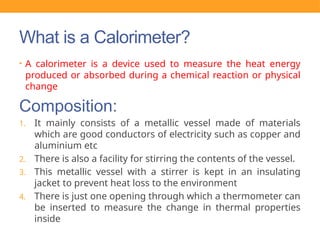
• A calorimeter is a device used to measure the heat energy
produced or absorbed during a chemical reaction or physical
change
Composition:
1. It mainly consists of a metallic vessel made of materials
which are good conductors of electricity such as copper and
aluminium etc
2. There is also a facility for stirring the contents of the vessel.
3. This metallic vessel with a stirrer is kept in an insulating
jacket to prevent heat loss to the environment
4. There is just one opening through which a thermometer can
be inserted to measure the change in thermal properties
inside
Working principle
• The body at higher temperature releases heat while the
body at lower temperature absorbs heat
• The principle of calorimetry indicates the law of
conservation energy, i.e. the total heat lost by the hot
body is equal to the total heat gained by the cold body
Heat Lost = Heat Gained
• Calorimeters work by isolating the reaction or substance
inside a chamber and measuring the temperature change
that occurs due to the heat released or absorbed
Working principle
1. Say in a calorimeter a fixed amount of sample is burned
2. The vessel is filled with water, and the sample is burned,
leading to the heating of the water
3. Heat loss by the sample is equal to the heat gained by
the water
4. This is why it is important to insulate the calorimeter
from the environment; to improve the accuracy of the
experiment
5. This change in heat can be measured through the
thermometer
6. Through such a measurement, we can find out both the
heat capacity of water and also the energy stored inside
a sample
Types of Calorimeter
1. Adiabatic Calorimeters
• Adiabatic calorimeters measure the change in enthalpy of a
reaction occurring in solution. During the reaction, the no
heat exchange with the surroundings is allowed and the
atmospheric pressure remains constant
• However, The adiabatic calorimeter is actually a wrong term
because it’s not fully adiabatic. Some amount of heat is
usually lost by the sample to the sample holder. A
mathematical correction factor, referred to as the phi-factor,
are often wont to adjust the calorimetric result to account for
these heat losses
Types of Calorimeter
2. Bomb Calorimeters
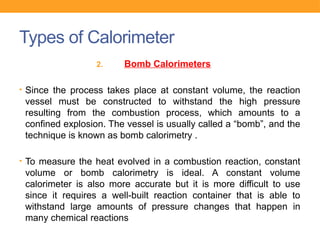
• Since the process takes place at constant volume, the reaction
vessel must be constructed to withstand the high pressure
resulting from the combustion process, which amounts to a
confined explosion. The vessel is usually called a “bomb”, and the
technique is known as bomb calorimetry .
• To measure the heat evolved in a combustion reaction, constant
volume or bomb calorimetry is ideal. A constant volume
calorimeter is also more accurate but it is more difficult to use
since it requires a well-built reaction container that is able to
withstand large amounts of pressure changes that happen in
many chemical reactions
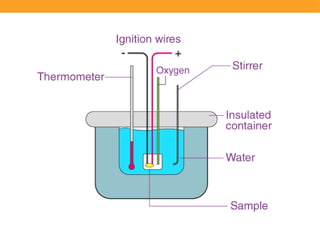
A bomb calorimeter
structure consists of the
following:
1. Steel bomb which
contains the reactants
2. Water bath in which
the bomb is
submerged
3. Thermometer
4. A motorized stirrer
5. Wire for ignition
Types of Calorimeter
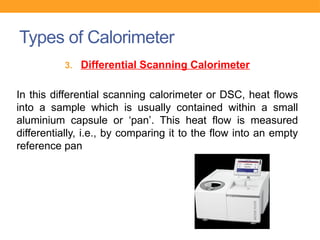
3. Differential Scanning Calorimeter
In this differential scanning calorimeter or DSC, heat flows
into a sample which is usually contained within a small
aluminium capsule or ‘pan’. This heat flow is measured
differentially, i.e., by comparing it to the flow into an empty
reference pan
Types of Calorimeter
4. Reaction Calorimeter
• A calorimeter used to start a reaction inside of a sealed,
insulated container is known as a reaction calorimeter
• Heat content is calculated by integrating heat flow versus
time after measuring reaction heats. Because industrial
processes are designed to operate at consistent
temperatures, this property is used in industry to survive
the heat
Types of Calorimeter
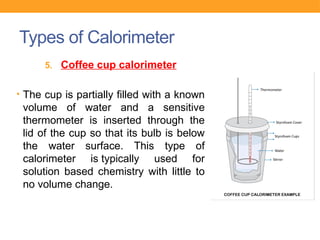
5. Coffee cup calorimeter
• The cup is partially filled with a known
volume of water and a sensitive
thermometer is inserted through the
lid of the cup so that its bulb is below
the water surface. This type of
calorimeter is typically used for
solution based chemistry with little to
no volume change.
Uses of Calorimeter
Food and Nutrition
1. Caloric Content: Calorimeters, especially bomb
calorimeters, measure the energy content in food by
burning a sample and measuring the heat produced
2. Metabolic Studies: They help study how different foods
affect metabolism by measuring the heat produced
during metabolic processes
Uses of Calorimeter
3. Diet Design: Calorimeters help nutritionists design
balanced diets by accurately measuring the caloric
content of various foods
4. Food Labeling: Caloric values obtained from
calorimeters are used in labeling food products,
providing consumers with important dietary information
5. Nutrient Bioavailability: Calorimetric studies can
assess how different cooking methods affect the
bioavailability of nutrients in foods
Uses of Calorimeter
Materials Science
1. Heat Capacity: Calorimeters determine the specific
heat capacity of materials, which is crucial for
applications like thermal management and material
selection in engineering
2. Phase Transitions: Differential Scanning Calorimeters
(DSCs) detect phase transitions (e.g., melting,
crystallization) in materials, important for quality control
in manufacturing
Uses of Calorimeter
Biochemistry and Medicine
1. Drug Interactions: Calorimeters help in studying the
thermodynamics of drug interactions with biomolecules,
aiding in drug development
2. Enzyme Activity: They measure heat changes in
enzymatic reactions, providing insights into enzyme
mechanisms
3. Cell Metabolism: Calorimeters assess metabolic rates
of cells, useful in medical research and diagnostics
Uses of Calorimeter
Industrial Applications
1. Quality Control: In manufacturing, calorimeters ensure
the quality and consistency of products by measuring
heat changes during production processes
2. Energy Efficiency: They are used to evaluate the
energy efficiency of combustion systems, such as
engines and boilers
Use in Nutrition field
• A calorimeter is an essential tool in the field of nutrition
and dietetics, used to measure the amount of heat
released or absorbed by a substance, which is crucial in
determining the energy content of food. There are
different types of calorimeters used in nutrition, including
bomb calorimeters and direct/indirect calorimeters.
• Here's a detailed explanation of their use
Bomb Calorimeter
• Principle:
• A bomb calorimeter measures the heat of combustion of a food
sample. It provides a direct measure of the energy content by burning
the sample in a controlled environment
• Procedure:
1.Preparation: A food sample is dried and ground to ensure uniformity.
2.Combustion: The sample is placed in a crucible inside the bomb (a
strong, sealed container) with a known amount of oxygen.
3.Ignition: The sample is ignited electrically, causing it to combust
completely.
4.Heat Measurement: The heat released by the combustion raises the
temperature of the surrounding water. The temperature change is
measured and used to calculate the energy content of the sample
Bomb Calorimeter
• Application:
1. Nutritional Labeling: Determines the caloric content of
foods for nutritional labeling
2. Research: Used in research to study the energy
content of different food components, like fats, proteins,
and carbohydrates
3. Quality Control: Ensures consistency in the caloric
content of food products
Direct Calorimeter
• Principle:
• Direct calorimetry measures the heat emitted by the
human body to calculate energy expenditure. It involves a
person staying in a specially designed room where the
heat they emit is measured directly.
• Procedure:
1.Environment Control: The individual stays in a thermally
insulated room.
2.Heat Detection: Sensors detect the heat emitted by the
person over a specific period.
3.Data Analysis: The heat measurements are used to
determine the total energy expenditure of the individual.
Direct Calorimeter
Direct Calorimeter
• Application:
1. Metabolic Studies: Provides precise measurements of
total energy expenditure
2. Diet Planning: Helps in tailoring diets based on
individual energy needs
3. Clinical Research: Used in clinical settings to study
metabolism in different health conditions
Indirect Calorimeter
• Principle:
• Indirect calorimetry estimates energy expenditure by measuring
oxygen consumption and carbon dioxide production. This
method is based on the principle that the oxidation of nutrients in
the body requires oxygen and produces carbon dioxide.
• Procedure:
1.Respiratory Measurement: The individual breathes into a
mouthpiece or mask connected to the calorimeter.
2.Gas Analysis: The calorimeter measures the volumes of
oxygen consumed and carbon dioxide produced.
3.Energy Calculation: These measurements are used to
calculate the respiratory quotient (RQ) and energy expenditure
using specific equations.
Indirect Calorimeter
• Application:
1. Basal Metabolic Rate (BMR) Measurement: Assesses
the energy expenditure at rest
2. Exercise Physiology: Determines energy expenditure
during physical activities
3. Nutritional Therapy: Helps in developing personalized
nutrition plans for weight management and clinical
nutrition
• Calorimeters play a crucial role in nutrition and dietetics
by providing accurate measurements of energy content in
foods and energy expenditure in humans
• Bomb calorimeters are primarily used to determine the
caloric content of foods, while direct and indirect
calorimeters are used to measure human energy
expenditure
• These tools are vital for nutritional labeling, diet planning,
metabolic research, and clinical nutrition, ensuring that
dietary recommendations and interventions are based on
precise and reliable data

Calorimeter.pptx practical theory with digram

  • 1.
  • 2.
    Calorimetry • Calorimetry isthe field of science that deals with the measurement of the state of a body with respect to the thermal aspects in order to examine its physical and chemical changes • The changes could be physical such as melting, evaporation or could also be chemical such as burning, acid-base neutralization etc. • Calorimetry is applied extensively in the fields of thermochemistry in calculating the enthalpy, stability, heat capacity etc.
  • 3.
    History • In 1761Black introduced the thought of heat of transformation which causes the creation of the primary ice-calorimeters • In the year 1780, a French nobleman and chemist Lavoisier performed an experiment in which he used the warmth from the guinea pig’s respiration to melt snow surrounding his apparatus almost like a candle burning, showing that respiratory gas exchange is the combustion
  • 4.
    What is aCalorimeter? • A calorimeter is a device used to measure the heat energy produced or absorbed during a chemical reaction or physical change Composition: 1. It mainly consists of a metallic vessel made of materials which are good conductors of electricity such as copper and aluminium etc 2. There is also a facility for stirring the contents of the vessel. 3. This metallic vessel with a stirrer is kept in an insulating jacket to prevent heat loss to the environment 4. There is just one opening through which a thermometer can be inserted to measure the change in thermal properties inside
  • 6.
    Working principle • Thebody at higher temperature releases heat while the body at lower temperature absorbs heat • The principle of calorimetry indicates the law of conservation energy, i.e. the total heat lost by the hot body is equal to the total heat gained by the cold body Heat Lost = Heat Gained • Calorimeters work by isolating the reaction or substance inside a chamber and measuring the temperature change that occurs due to the heat released or absorbed
  • 7.
    Working principle 1. Sayin a calorimeter a fixed amount of sample is burned 2. The vessel is filled with water, and the sample is burned, leading to the heating of the water 3. Heat loss by the sample is equal to the heat gained by the water 4. This is why it is important to insulate the calorimeter from the environment; to improve the accuracy of the experiment 5. This change in heat can be measured through the thermometer 6. Through such a measurement, we can find out both the heat capacity of water and also the energy stored inside a sample
  • 8.
    Types of Calorimeter 1.Adiabatic Calorimeters • Adiabatic calorimeters measure the change in enthalpy of a reaction occurring in solution. During the reaction, the no heat exchange with the surroundings is allowed and the atmospheric pressure remains constant • However, The adiabatic calorimeter is actually a wrong term because it’s not fully adiabatic. Some amount of heat is usually lost by the sample to the sample holder. A mathematical correction factor, referred to as the phi-factor, are often wont to adjust the calorimetric result to account for these heat losses
  • 9.
    Types of Calorimeter 2.Bomb Calorimeters • Since the process takes place at constant volume, the reaction vessel must be constructed to withstand the high pressure resulting from the combustion process, which amounts to a confined explosion. The vessel is usually called a “bomb”, and the technique is known as bomb calorimetry . • To measure the heat evolved in a combustion reaction, constant volume or bomb calorimetry is ideal. A constant volume calorimeter is also more accurate but it is more difficult to use since it requires a well-built reaction container that is able to withstand large amounts of pressure changes that happen in many chemical reactions
  • 10.
    A bomb calorimeter structureconsists of the following: 1. Steel bomb which contains the reactants 2. Water bath in which the bomb is submerged 3. Thermometer 4. A motorized stirrer 5. Wire for ignition
  • 11.
    Types of Calorimeter 3.Differential Scanning Calorimeter In this differential scanning calorimeter or DSC, heat flows into a sample which is usually contained within a small aluminium capsule or ‘pan’. This heat flow is measured differentially, i.e., by comparing it to the flow into an empty reference pan
  • 12.
    Types of Calorimeter 4.Reaction Calorimeter • A calorimeter used to start a reaction inside of a sealed, insulated container is known as a reaction calorimeter • Heat content is calculated by integrating heat flow versus time after measuring reaction heats. Because industrial processes are designed to operate at consistent temperatures, this property is used in industry to survive the heat
  • 13.
    Types of Calorimeter 5.Coffee cup calorimeter • The cup is partially filled with a known volume of water and a sensitive thermometer is inserted through the lid of the cup so that its bulb is below the water surface. This type of calorimeter is typically used for solution based chemistry with little to no volume change.
  • 14.
    Uses of Calorimeter Foodand Nutrition 1. Caloric Content: Calorimeters, especially bomb calorimeters, measure the energy content in food by burning a sample and measuring the heat produced 2. Metabolic Studies: They help study how different foods affect metabolism by measuring the heat produced during metabolic processes
  • 15.
    Uses of Calorimeter 3.Diet Design: Calorimeters help nutritionists design balanced diets by accurately measuring the caloric content of various foods 4. Food Labeling: Caloric values obtained from calorimeters are used in labeling food products, providing consumers with important dietary information 5. Nutrient Bioavailability: Calorimetric studies can assess how different cooking methods affect the bioavailability of nutrients in foods
  • 16.
    Uses of Calorimeter MaterialsScience 1. Heat Capacity: Calorimeters determine the specific heat capacity of materials, which is crucial for applications like thermal management and material selection in engineering 2. Phase Transitions: Differential Scanning Calorimeters (DSCs) detect phase transitions (e.g., melting, crystallization) in materials, important for quality control in manufacturing
  • 17.
    Uses of Calorimeter Biochemistryand Medicine 1. Drug Interactions: Calorimeters help in studying the thermodynamics of drug interactions with biomolecules, aiding in drug development 2. Enzyme Activity: They measure heat changes in enzymatic reactions, providing insights into enzyme mechanisms 3. Cell Metabolism: Calorimeters assess metabolic rates of cells, useful in medical research and diagnostics
  • 18.
    Uses of Calorimeter IndustrialApplications 1. Quality Control: In manufacturing, calorimeters ensure the quality and consistency of products by measuring heat changes during production processes 2. Energy Efficiency: They are used to evaluate the energy efficiency of combustion systems, such as engines and boilers
  • 19.
    Use in Nutritionfield • A calorimeter is an essential tool in the field of nutrition and dietetics, used to measure the amount of heat released or absorbed by a substance, which is crucial in determining the energy content of food. There are different types of calorimeters used in nutrition, including bomb calorimeters and direct/indirect calorimeters. • Here's a detailed explanation of their use
  • 20.
    Bomb Calorimeter • Principle: •A bomb calorimeter measures the heat of combustion of a food sample. It provides a direct measure of the energy content by burning the sample in a controlled environment • Procedure: 1.Preparation: A food sample is dried and ground to ensure uniformity. 2.Combustion: The sample is placed in a crucible inside the bomb (a strong, sealed container) with a known amount of oxygen. 3.Ignition: The sample is ignited electrically, causing it to combust completely. 4.Heat Measurement: The heat released by the combustion raises the temperature of the surrounding water. The temperature change is measured and used to calculate the energy content of the sample
  • 21.
    Bomb Calorimeter • Application: 1.Nutritional Labeling: Determines the caloric content of foods for nutritional labeling 2. Research: Used in research to study the energy content of different food components, like fats, proteins, and carbohydrates 3. Quality Control: Ensures consistency in the caloric content of food products
  • 22.
    Direct Calorimeter • Principle: •Direct calorimetry measures the heat emitted by the human body to calculate energy expenditure. It involves a person staying in a specially designed room where the heat they emit is measured directly. • Procedure: 1.Environment Control: The individual stays in a thermally insulated room. 2.Heat Detection: Sensors detect the heat emitted by the person over a specific period. 3.Data Analysis: The heat measurements are used to determine the total energy expenditure of the individual.
  • 23.
  • 24.
    Direct Calorimeter • Application: 1.Metabolic Studies: Provides precise measurements of total energy expenditure 2. Diet Planning: Helps in tailoring diets based on individual energy needs 3. Clinical Research: Used in clinical settings to study metabolism in different health conditions
  • 25.
    Indirect Calorimeter • Principle: •Indirect calorimetry estimates energy expenditure by measuring oxygen consumption and carbon dioxide production. This method is based on the principle that the oxidation of nutrients in the body requires oxygen and produces carbon dioxide. • Procedure: 1.Respiratory Measurement: The individual breathes into a mouthpiece or mask connected to the calorimeter. 2.Gas Analysis: The calorimeter measures the volumes of oxygen consumed and carbon dioxide produced. 3.Energy Calculation: These measurements are used to calculate the respiratory quotient (RQ) and energy expenditure using specific equations.
  • 26.
  • 27.
    Indirect Calorimeter • Application: 1.Basal Metabolic Rate (BMR) Measurement: Assesses the energy expenditure at rest 2. Exercise Physiology: Determines energy expenditure during physical activities 3. Nutritional Therapy: Helps in developing personalized nutrition plans for weight management and clinical nutrition
  • 28.
    • Calorimeters playa crucial role in nutrition and dietetics by providing accurate measurements of energy content in foods and energy expenditure in humans • Bomb calorimeters are primarily used to determine the caloric content of foods, while direct and indirect calorimeters are used to measure human energy expenditure • These tools are vital for nutritional labeling, diet planning, metabolic research, and clinical nutrition, ensuring that dietary recommendations and interventions are based on precise and reliable data

Editor's Notes

  • #2 Enthalpy: a thermodynamic quantity equivalent to the total heat content of a system. It is equal to the internal energy of the system plus the product of pressure and volume. H = E + PV H = enthalpy E = internal energy P = pressure V = volume
  • #25 The respiratory quotient, also known as the respiratory ratio (RQ), is defined as the volume of carbon dioxide released over the volume of oxygen absorbed during respiration.