MACS
389
International Communications
Fall 2017
M/W/F - 9 -9:50 AM
134 Armory
Final Essay
The main requirement for the semester is a term paper ( 8 -12
double space pages, Times new roman 12pt) based on
bibliographic research due on December 20. If any students have
already done previous research relevant to the course, they may
use a portion of the data and situate the results in connection with
topics or debates worked in the class.
First Draft due: December 11. You must bring one printed copy for
your reviewer.
Dec 6 - No class - work on your draft structure
Dec 8 – writing group activity
Dec 11 – Peer review activity
Dec 13 – Final Class
Preparing your
first draft
The expository essay is a genre of essay that requires the student
to investigate an idea, evaluate evidence, expound on the idea,
and set forth an argument concerning that idea in a clear and
concise manner. This can be accomplished through comparison
and contrast, definition, example, the analysis of cause and effect,
etc.
The structure of the expository essay is held together by the
following.
A clear, concise, and defined thesis statement that occurs in
the first paragraph of the essay.
It is essential that this thesis statement be appropriately narrowed
to follow the guidelines set forth in the assignment. If the student
does not master this portion of the essay, it will be quite difficult to
compose an effective or persuasive essay.
Clear and logical transitions between the introduction, body,
and conclusion.
Transitions are the mortar that holds the foundation of the essay
together. Without logical progression of thought, the reader is
unable to follow the essay’s argument, and the structure will
collapse.
Body paragraphs that include evidential support.
Each paragraph should be limited to the exposition of one general
idea. This will allow for clarity and direction throughout the essay.
What is more, such conciseness creates an ease of readability for
one’s audience. It is important to note that each paragraph in the
body of the essay must have some logical connection to the thesis
statement in the opening paragraph.
Evidential support (whether factual, logical, statistical, or
anecdotal).
Often times, students are required to write expository essays with
little or no preparation; therefore, such essays do not typically
allow for a great deal of statistical or factual evidence.
A bit of creativity!
Though creativity and artfulness are not always associated with
essay writing, it is an art form nonetheless. Try not to get stuck on
the formulaic nature of expository writing at the expense of writing
something interesting. Remember, though you may not be crafting
the next great novel, you are attempting to leave a lasting
impression on the people evaluating your essay.
A conclusion that does not simply restate the thesis, but
readdresses it in light of the evidence provided.
It is at this point of the essay that students will inevitably begin to
struggle. This is the portion of the essay that will leave the most
immediate impression on the mind of the reader. Therefore, it
must be effective and logical. Do not introduce any new
information into the conclusion; rather, synthesize and come to a
conclusion concerning the information presented in the body of
the essay.
A complete argument
Perhaps it is helpful to think of an essay in terms of a conversation
or debate with a classmate. If I were to discuss the cause of the
Great Depression and its current effect on those who lived
through the tumultuous time, there would be a beginning, middle,
and end to the conversation.
In fact, if I were to end the exposition in the middle of my second
point, questions would arise concerning the current effects on
those who lived through the Depression. Therefore, the expository
essay must be complete, and logically so, leaving no doubt as to
its intent or argument.
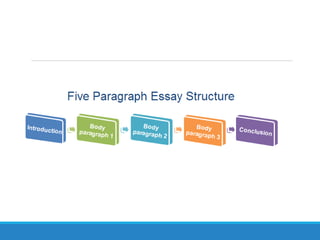
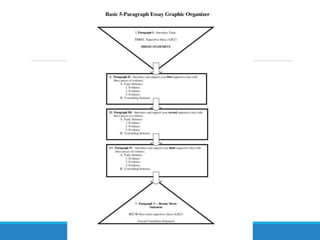
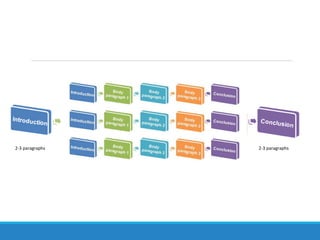
The five-paragraph Essay
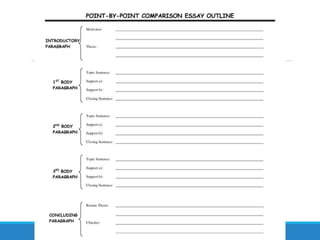
A common method for writing an expository essay is the five-
paragraph approach. This is, however, by no means the only
formula for writing such essays. If it sounds straightforward, that is
because it is; in fact, the method consists of:
an introductory paragraph
three evidentiary body paragraphs
a conclusion
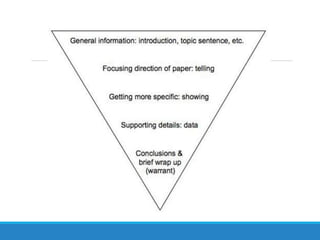
Introduction
Introduction
Ideally, your introduction will make your readers want to read
your paper.
Don’t be afraid to write a tentative introduction first and then
change it later
an intriguing example
a provocative quotation
a puzzling scenario
a vivid and perhaps unexpected anecdote
a thought-provoking question
Set the context –provide general information about the main
idea, explaining the situation so the reader can make sense of the
topic and the claims you make and support
State why the main idea is important –tell the reader why he or
she should care and keep reading. Your goal is to create a
compelling, clear, and convincing essay people will want to read
and act upon
State your thesis/claim –compose a sentence or two stating the
position you will support with sound reasoning, balanced
emotional appeal and author credibility.
Thesis
Statement
Tips for Writing Your Thesis Statement
1. Determine what kind of paper you are writing
◦ An expository (explanatory) paper explains something to the audience.
2. Your thesis statement should be specific—it should cover only
what you will discuss in your paper and should be supported with
specific evidence.
3. The thesis statement usually appears at the end of the first
paragraph of a paper.
4. Your topic may change as you write, so you may need to revise
your thesis statement to reflect exactly what you have discussed in
the paper.
Example of an expository (explanatory) thesis statement:
The Olympic games opening ceremony is one of the most
important media events because it is the most watched sporting
event in the world.
The paper that follows should:
Explain how Olympic games became the most watched world in
the world, by considering, the history of broadcasting, the
companies that produce it, the audiences of this event
The Body
A good paragraph should contain at least the following four
elements: Transition, Topic sentence, specific Evidence and analysis, and
a Brief wrap-up sentence (also known as a warrant) –TTEB!
A Transition sentence leading in from a previous paragraph to assure smooth
reading. This acts as a hand off from one idea to the next.
A Topic sentence that tells the reader what you will be discussing in the
paragraph.
Specific Evidence and analysis that supports one of your claims and that
provides a deeper level of detail than your topic sentence.
A Brief wrap-up sentence that tells the reader how and why this information
supports the paper’s thesis. The brief wrap-up is also known as the warrant.
The warrant is important to your argument because it connects your
reasoning and support to your thesis, and it shows that the information in the
paragraph is related to your thesis and helps defend it.
Conclusions
It is important to have a strong conclusion, since this is the last
chance you have to make an impression on your reader. The goal of
your conclusion isn’t to introduce any new ideas, but to sum up
everything you’ve written
Restate the main idea of your essay, or your thesis statement
Summarize the three subpoints of your essay
Leave the reader with an interesting final impression
Essay conclusions are pretty simple once you know the
framework. (Main Idea)
It all boils down to three main parts: a transition from the last body
paragraph, a summary of the thesis statement and main points of
the essay, and a closing statement that wraps everything up.
(summary)
If all students knew this simple formula, maybe essay writing
would be easier for everyone. (final impression)
2-3 paragraphs 2-3 paragraphs

Final Essay - MACS 389

  • 1.
  • 2.
    Final Essay The mainrequirement for the semester is a term paper ( 8 -12 double space pages, Times new roman 12pt) based on bibliographic research due on December 20. If any students have already done previous research relevant to the course, they may use a portion of the data and situate the results in connection with topics or debates worked in the class. First Draft due: December 11. You must bring one printed copy for your reviewer.
  • 3.
    Dec 6 -No class - work on your draft structure Dec 8 – writing group activity Dec 11 – Peer review activity Dec 13 – Final Class
  • 4.
  • 5.
    The expository essayis a genre of essay that requires the student to investigate an idea, evaluate evidence, expound on the idea, and set forth an argument concerning that idea in a clear and concise manner. This can be accomplished through comparison and contrast, definition, example, the analysis of cause and effect, etc.
  • 6.
    The structure ofthe expository essay is held together by the following. A clear, concise, and defined thesis statement that occurs in the first paragraph of the essay. It is essential that this thesis statement be appropriately narrowed to follow the guidelines set forth in the assignment. If the student does not master this portion of the essay, it will be quite difficult to compose an effective or persuasive essay.
  • 7.
    Clear and logicaltransitions between the introduction, body, and conclusion. Transitions are the mortar that holds the foundation of the essay together. Without logical progression of thought, the reader is unable to follow the essay’s argument, and the structure will collapse.
  • 8.
    Body paragraphs thatinclude evidential support. Each paragraph should be limited to the exposition of one general idea. This will allow for clarity and direction throughout the essay. What is more, such conciseness creates an ease of readability for one’s audience. It is important to note that each paragraph in the body of the essay must have some logical connection to the thesis statement in the opening paragraph.
  • 9.
    Evidential support (whetherfactual, logical, statistical, or anecdotal). Often times, students are required to write expository essays with little or no preparation; therefore, such essays do not typically allow for a great deal of statistical or factual evidence.
  • 10.
    A bit ofcreativity! Though creativity and artfulness are not always associated with essay writing, it is an art form nonetheless. Try not to get stuck on the formulaic nature of expository writing at the expense of writing something interesting. Remember, though you may not be crafting the next great novel, you are attempting to leave a lasting impression on the people evaluating your essay.
  • 11.
    A conclusion thatdoes not simply restate the thesis, but readdresses it in light of the evidence provided. It is at this point of the essay that students will inevitably begin to struggle. This is the portion of the essay that will leave the most immediate impression on the mind of the reader. Therefore, it must be effective and logical. Do not introduce any new information into the conclusion; rather, synthesize and come to a conclusion concerning the information presented in the body of the essay.
  • 12.
    A complete argument Perhapsit is helpful to think of an essay in terms of a conversation or debate with a classmate. If I were to discuss the cause of the Great Depression and its current effect on those who lived through the tumultuous time, there would be a beginning, middle, and end to the conversation. In fact, if I were to end the exposition in the middle of my second point, questions would arise concerning the current effects on those who lived through the Depression. Therefore, the expository essay must be complete, and logically so, leaving no doubt as to its intent or argument.
  • 13.
    The five-paragraph Essay Acommon method for writing an expository essay is the five- paragraph approach. This is, however, by no means the only formula for writing such essays. If it sounds straightforward, that is because it is; in fact, the method consists of: an introductory paragraph three evidentiary body paragraphs a conclusion
  • 17.
  • 18.
    Introduction Ideally, your introductionwill make your readers want to read your paper. Don’t be afraid to write a tentative introduction first and then change it later
  • 19.
    an intriguing example aprovocative quotation a puzzling scenario a vivid and perhaps unexpected anecdote a thought-provoking question
  • 20.
    Set the context–provide general information about the main idea, explaining the situation so the reader can make sense of the topic and the claims you make and support State why the main idea is important –tell the reader why he or she should care and keep reading. Your goal is to create a compelling, clear, and convincing essay people will want to read and act upon State your thesis/claim –compose a sentence or two stating the position you will support with sound reasoning, balanced emotional appeal and author credibility.
  • 21.
  • 22.
    Tips for WritingYour Thesis Statement 1. Determine what kind of paper you are writing ◦ An expository (explanatory) paper explains something to the audience.
  • 23.
    2. Your thesisstatement should be specific—it should cover only what you will discuss in your paper and should be supported with specific evidence.
  • 24.
    3. The thesisstatement usually appears at the end of the first paragraph of a paper.
  • 25.
    4. Your topicmay change as you write, so you may need to revise your thesis statement to reflect exactly what you have discussed in the paper.
  • 26.
    Example of anexpository (explanatory) thesis statement: The Olympic games opening ceremony is one of the most important media events because it is the most watched sporting event in the world. The paper that follows should: Explain how Olympic games became the most watched world in the world, by considering, the history of broadcasting, the companies that produce it, the audiences of this event
  • 27.
  • 29.
    A good paragraphshould contain at least the following four elements: Transition, Topic sentence, specific Evidence and analysis, and a Brief wrap-up sentence (also known as a warrant) –TTEB! A Transition sentence leading in from a previous paragraph to assure smooth reading. This acts as a hand off from one idea to the next. A Topic sentence that tells the reader what you will be discussing in the paragraph. Specific Evidence and analysis that supports one of your claims and that provides a deeper level of detail than your topic sentence. A Brief wrap-up sentence that tells the reader how and why this information supports the paper’s thesis. The brief wrap-up is also known as the warrant. The warrant is important to your argument because it connects your reasoning and support to your thesis, and it shows that the information in the paragraph is related to your thesis and helps defend it.
  • 30.
  • 31.
    It is importantto have a strong conclusion, since this is the last chance you have to make an impression on your reader. The goal of your conclusion isn’t to introduce any new ideas, but to sum up everything you’ve written
  • 32.
    Restate the mainidea of your essay, or your thesis statement Summarize the three subpoints of your essay Leave the reader with an interesting final impression
  • 33.
    Essay conclusions arepretty simple once you know the framework. (Main Idea) It all boils down to three main parts: a transition from the last body paragraph, a summary of the thesis statement and main points of the essay, and a closing statement that wraps everything up. (summary) If all students knew this simple formula, maybe essay writing would be easier for everyone. (final impression)
  • 34.

Editor's Notes

  • #27 The Olympic games opening ceremony is one of the most important media events because it is the most watched sporting event in the world. Explain how Olympic games became the most watched world in the world, by considering the history of broadcasting, the companies that produce it and the audiences of this event.
  • #34 The Olympic games opening ceremony is one of the most important media events because it is the most watched sporting event in the world.