Diodes and Applications
Revision (01)
1
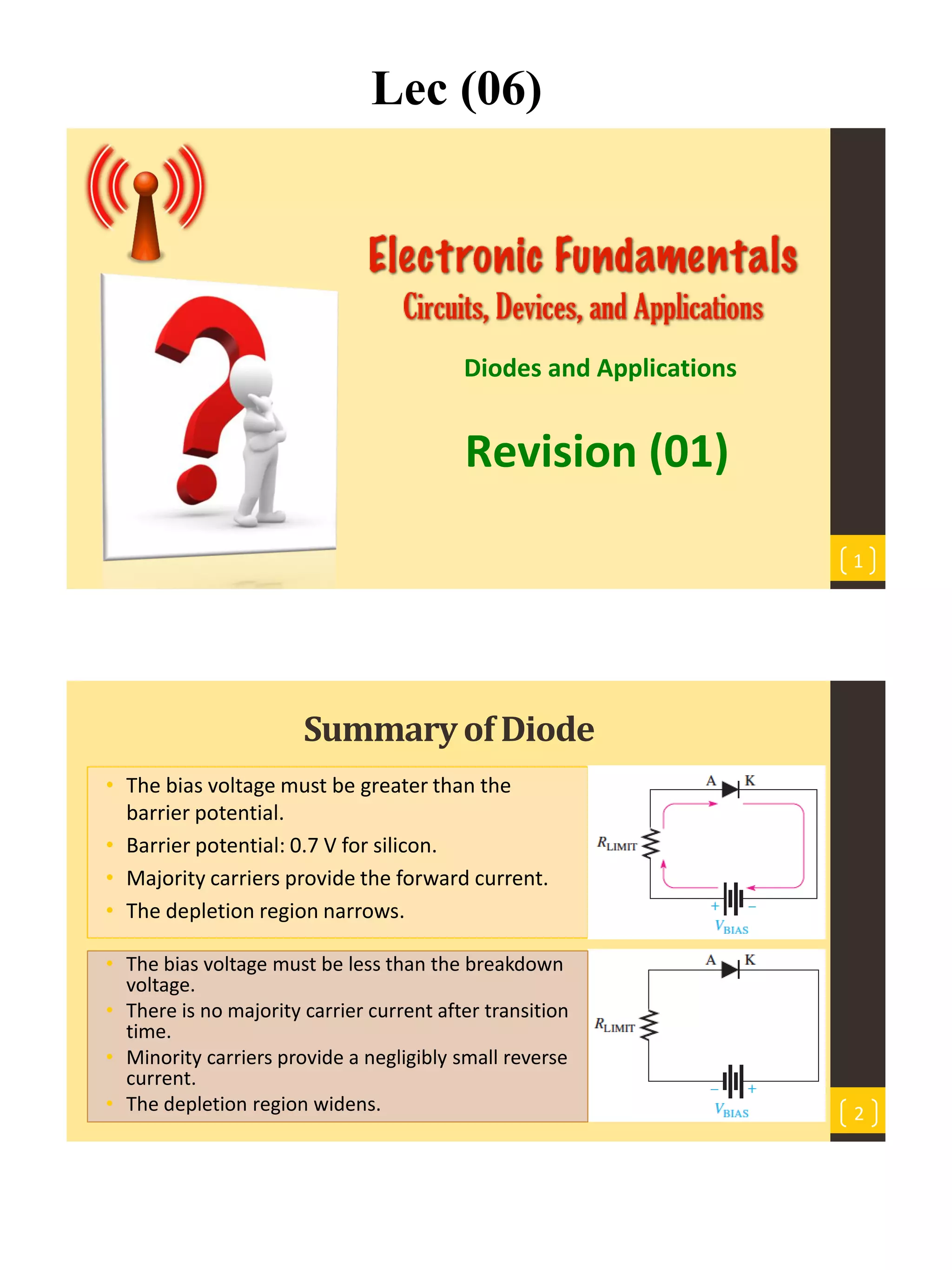
Summaryof Diode
• The bias voltage must be greater than the
barrier potential.
• Barrier potential: 0.7 V for silicon.
• Majority carriers provide the forward current.
• The depletion region narrows.
2
• The bias voltage must be less than the breakdown
voltage.
• There is no majority carrier current after transition
time.
• Minority carriers provide a negligibly small reverse
current.
• The depletion region widens.
Lec (06)
Example1
An ac voltage of peak value 20 V is connected in series with a silicon
diode and load resistance of 500 Ω. If the forward resistance of the
diode is 10 Ω, find:
• (a) peak current through the diode
• (b) peak output voltage.
What will be these values if the diode is considered as an ideal diode?
3
Solution. The diode will conduct during
the positive half-cycles of ac input
voltage. The equivalent circuit is
(a) peak current through the diode
VF = VPB + (If)peak [rf + RL]
(If)peak =
𝑉𝐹−𝑉𝑃𝐵
𝑟𝑓+𝑅𝐿
=
20−0.7
10+500
= 37.8 mA
4
(b) peak output voltage
Vout = (If)peak x RL = 37.8x10-3A x 500 Ω = 18.9 V
For an ideal diode VPB = 0 and rf = 0
(If)peak =
𝑉𝐹
𝑅𝐿
=
20
500
= 40 mA & Vout = (If)peak x RL = 40x10-3 A x 500 Ω = 20 V
Example2
5
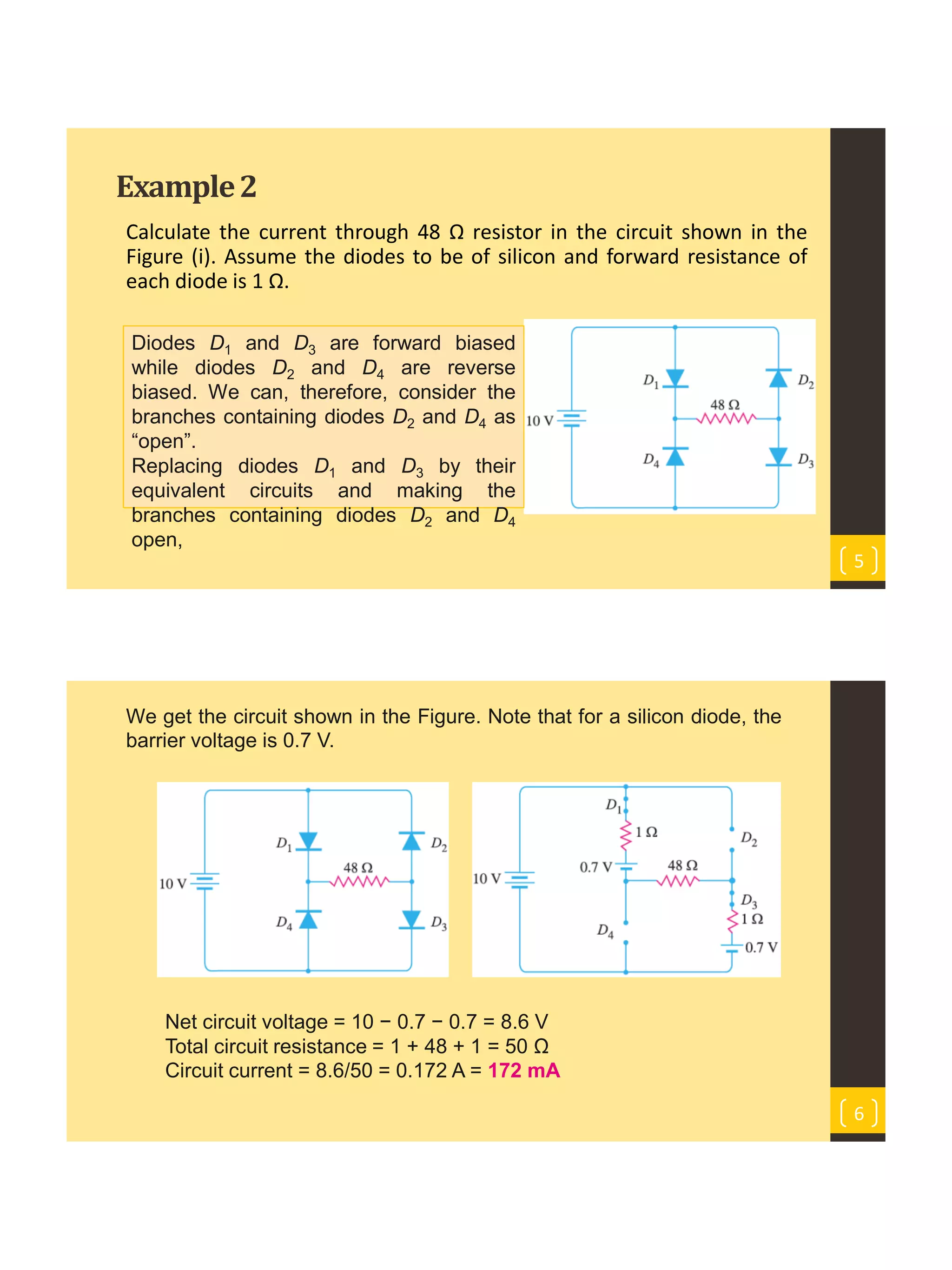
Calculate the current through 48 Ω resistor in the circuit shown in the
Figure (i). Assume the diodes to be of silicon and forward resistance of
each diode is 1 Ω.
Diodes D1 and D3 are forward biased
while diodes D2 and D4 are reverse
biased. We can, therefore, consider the
branches containing diodes D2 and D4 as
“open”.
Replacing diodes D1 and D3 by their
equivalent circuits and making the
branches containing diodes D2 and D4
open,
We get the circuit shown in the Figure. Note that for a silicon diode, the
barrier voltage is 0.7 V.
6
Net circuit voltage = 10 − 0.7 − 0.7 = 8.6 V
Total circuit resistance = 1 + 48 + 1 = 50 Ω
Circuit current = 8.6/50 = 0.172 A = 172 mA
Example3
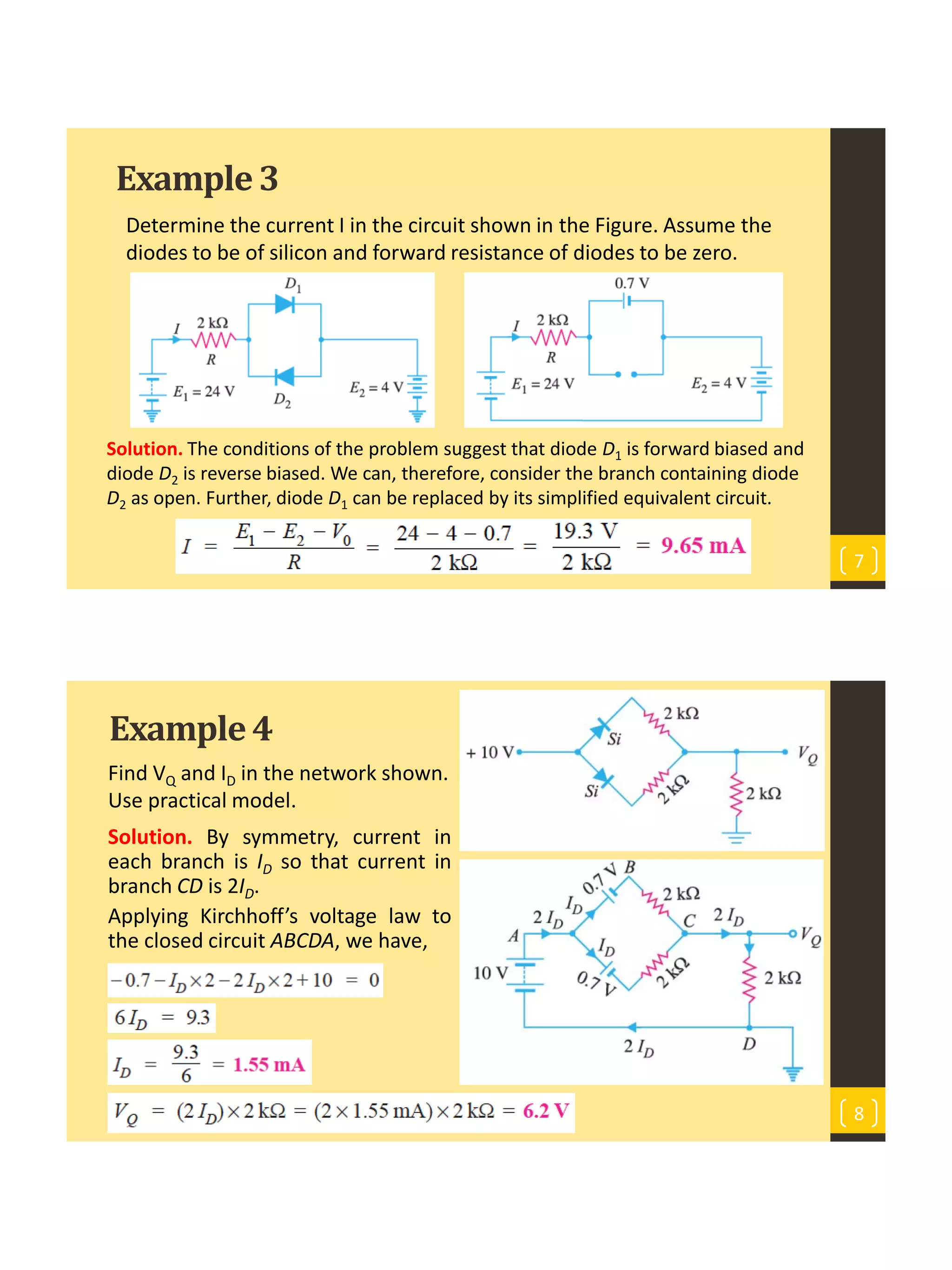
Determine the current I in the circuit shown in the Figure. Assume the
diodes to be of silicon and forward resistance of diodes to be zero.
7
Solution. The conditions of the problem suggest that diode D1 is forward biased and
diode D2 is reverse biased. We can, therefore, consider the branch containing diode
D2 as open. Further, diode D1 can be replaced by its simplified equivalent circuit.
Example4
Find VQ and ID in the network shown.
Use practical model.
8
Solution. By symmetry, current in
each branch is ID so that current in
branch CD is 2ID.
Applying Kirchhoff’s voltage law to
the closed circuit ABCDA, we have,
Example5
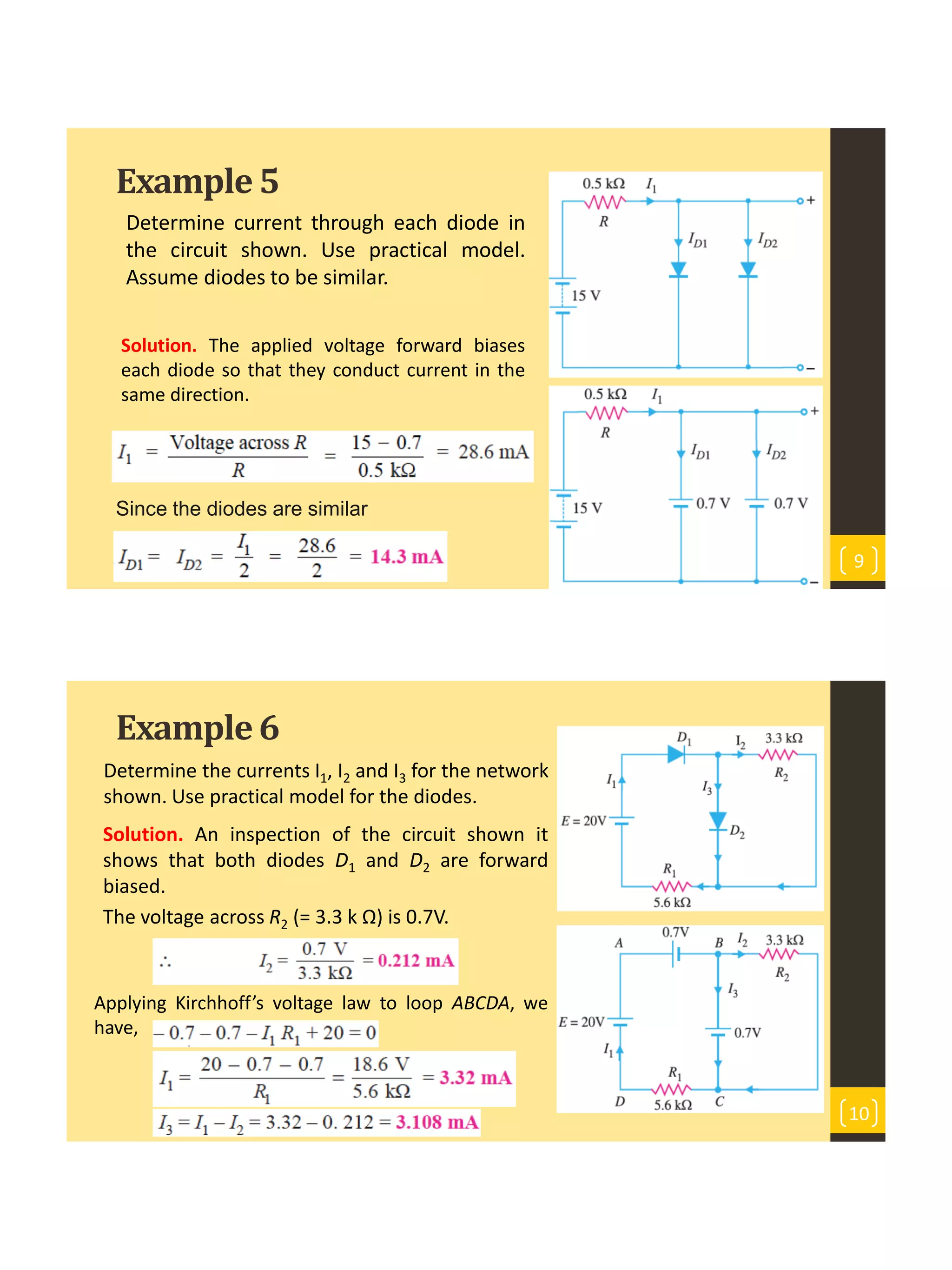
Determine current through each diode in
the circuit shown. Use practical model.
Assume diodes to be similar.
9
Solution. The applied voltage forward biases
each diode so that they conduct current in the
same direction.
Since the diodes are similar
Example6
Determine the currents I1, I2 and I3 for the network
shown. Use practical model for the diodes.
10
Solution. An inspection of the circuit shown it
shows that both diodes D1 and D2 are forward
biased.
The voltage across R2 (= 3.3 k Ω) is 0.7V.
Applying Kirchhoff’s voltage law to loop ABCDA, we
have,
Diodes and Applications
Revision (02)
1
Summaryof powersupplyrectifiers
2
Example1
3
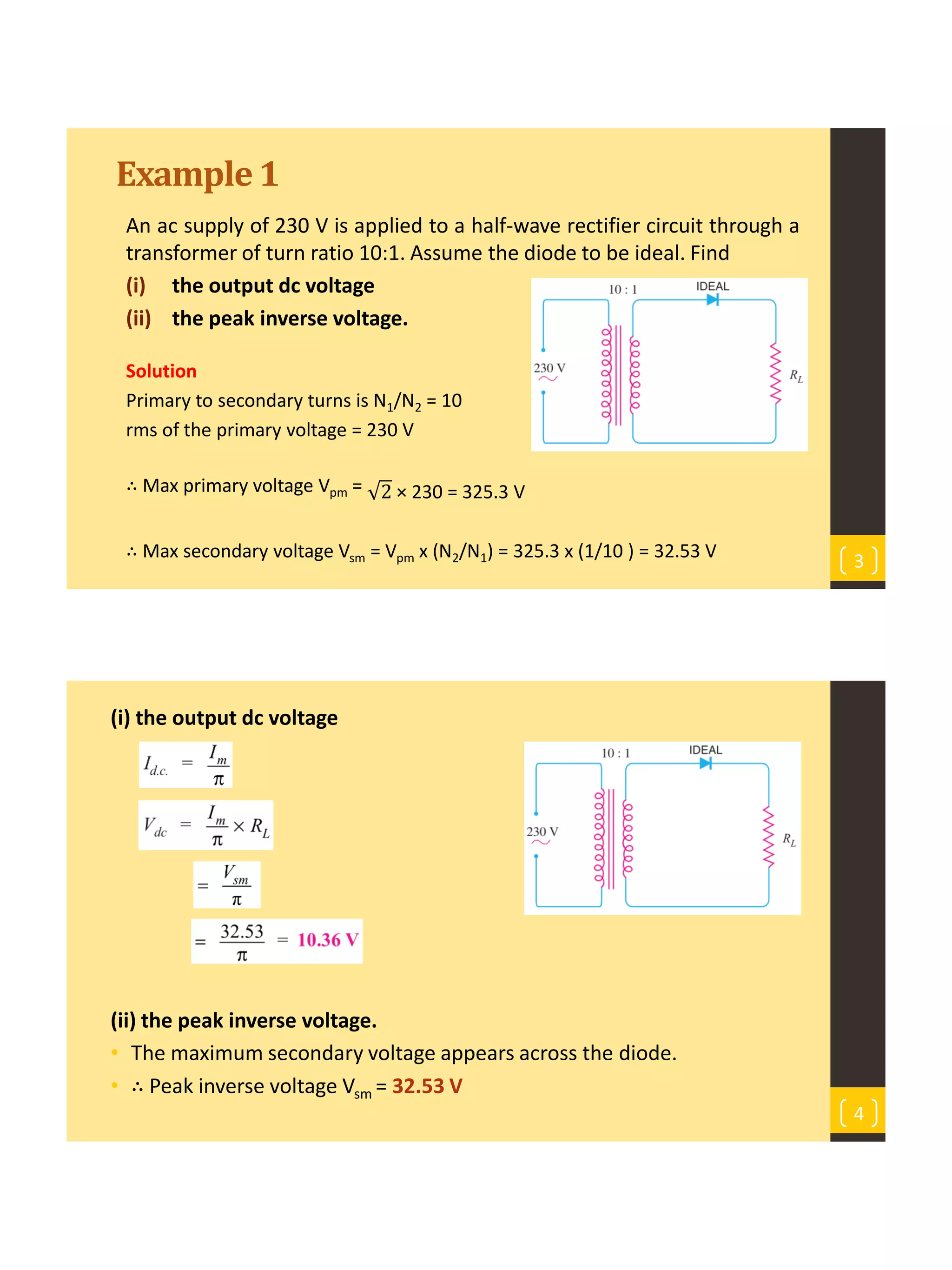
An ac supply of 230 V is applied to a half-wave rectifier circuit through a
transformer of turn ratio 10:1. Assume the diode to be ideal. Find
(i) the output dc voltage
(ii) the peak inverse voltage.
Solution
Primary to secondary turns is N1/N2 = 10
rms of the primary voltage = 230 V
∴ Max primary voltage Vpm = 2 × 230 = 325.3 V
∴ Max secondary voltage Vsm = Vpm x (N2/N1) = 325.3 x (1/10 ) = 32.53 V
(i) the output dc voltage
4
(ii) the peak inverse voltage.
• The maximum secondary voltage appears across the diode.
• ∴ Peak inverse voltage Vsm = 32.53 V
Example2
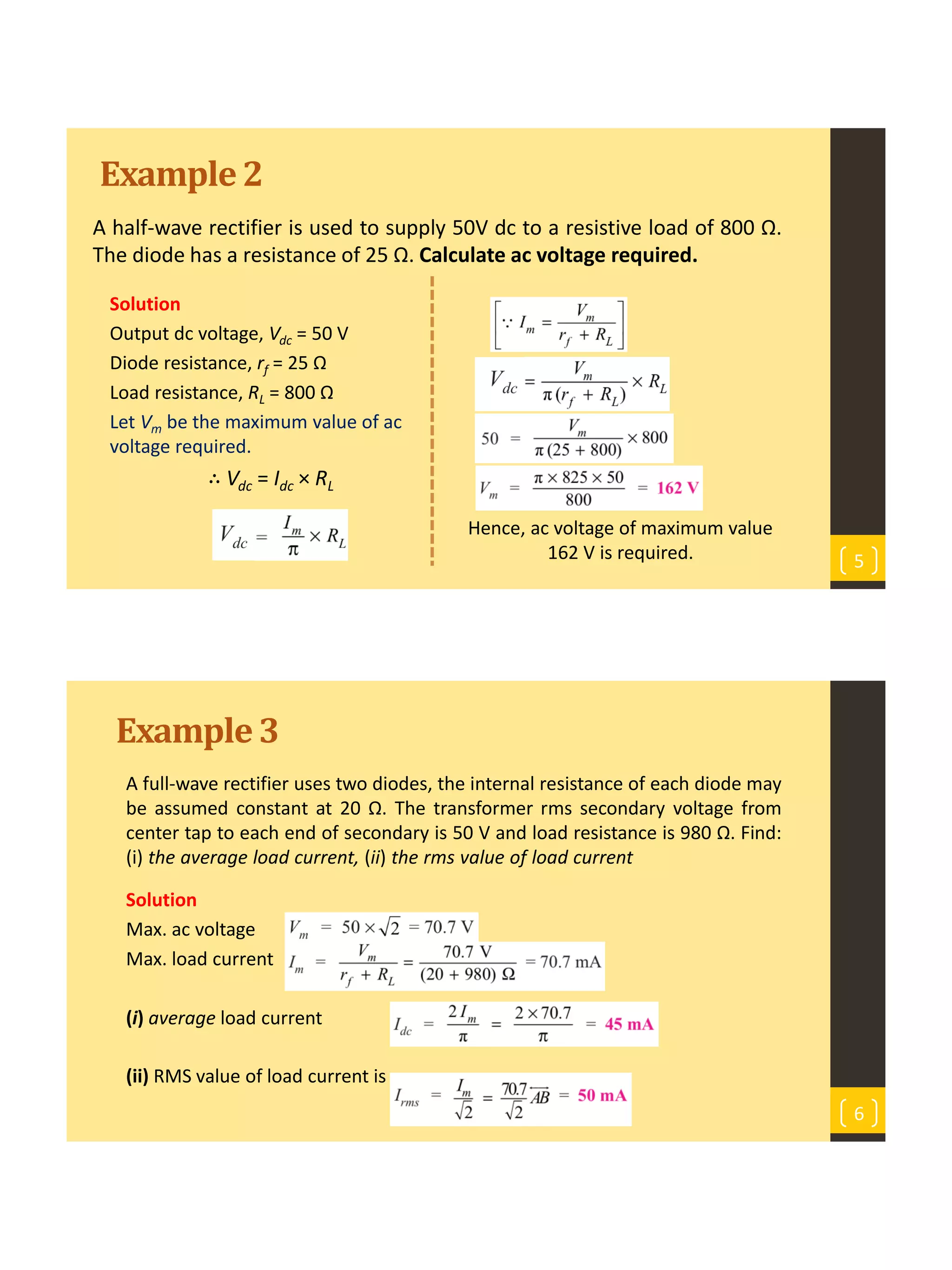
A half-wave rectifier is used to supply 50V dc to a resistive load of 800 Ω.
The diode has a resistance of 25 Ω. Calculate ac voltage required.
5
Solution
Output dc voltage, Vdc = 50 V
Diode resistance, rf = 25 Ω
Load resistance, RL = 800 Ω
Let Vm be the maximum value of ac
voltage required.
∴ Vdc = Idc × RL
Hence, ac voltage of maximum value
162 V is required.
Example3
A full-wave rectifier uses two diodes, the internal resistance of each diode may
be assumed constant at 20 Ω. The transformer rms secondary voltage from
center tap to each end of secondary is 50 V and load resistance is 980 Ω. Find:
(i) the average load current, (ii) the rms value of load current
Solution
Max. ac voltage
Max. load current
(i) average load current
(ii) RMS value of load current is
6
Example4
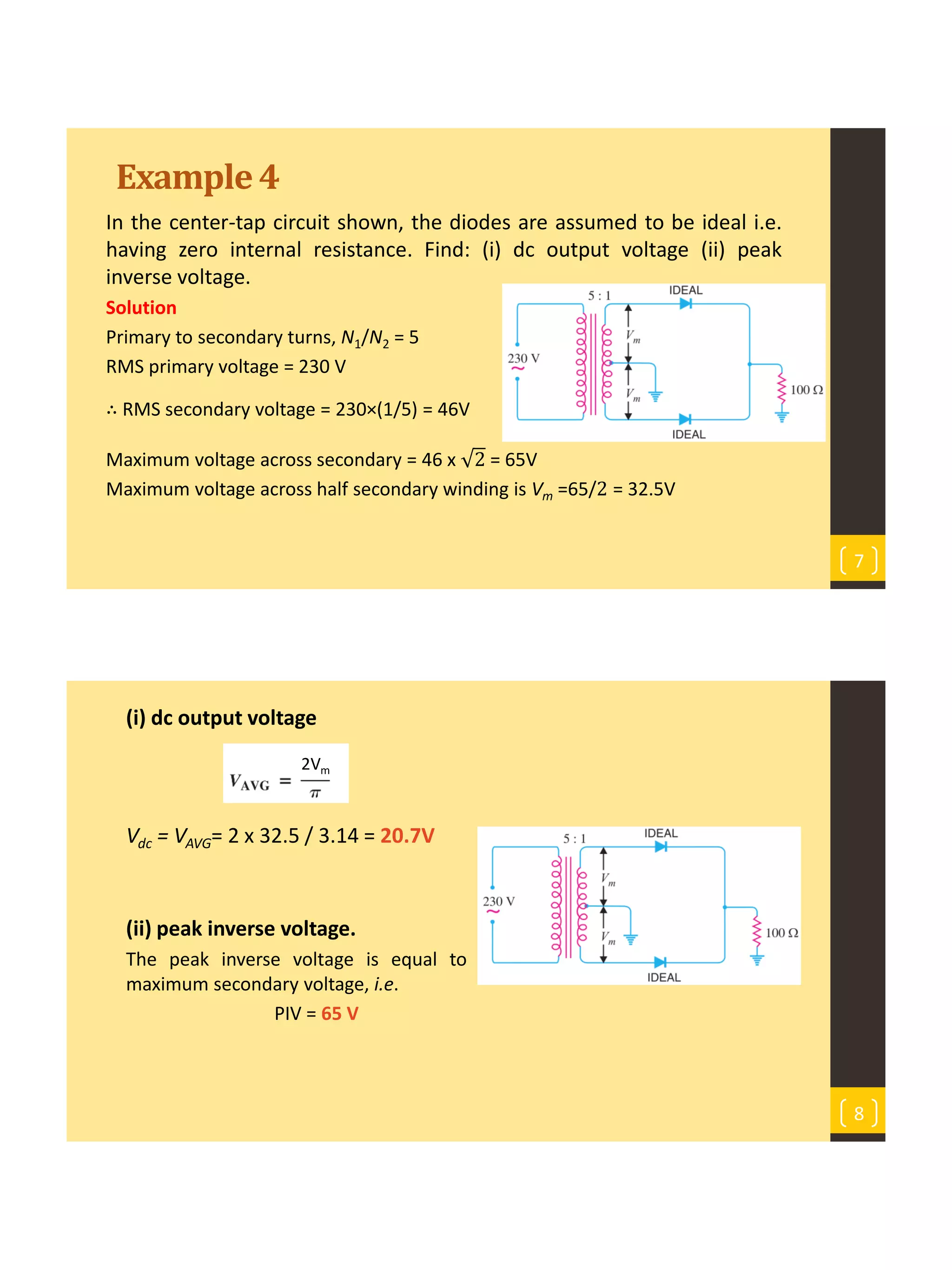
In the center-tap circuit shown, the diodes are assumed to be ideal i.e.
having zero internal resistance. Find: (i) dc output voltage (ii) peak
inverse voltage.
Solution
Primary to secondary turns, N1/N2 = 5
RMS primary voltage = 230 V
∴ RMS secondary voltage = 230×(1/5) = 46V
Maximum voltage across secondary = 46 x 2 = 65V
Maximum voltage across half secondary winding is Vm =65/2 = 32.5V
7
(i) dc output voltage
Vdc = VAVG= 2 x 32.5 / 3.14 = 20.7V
(ii) peak inverse voltage.
The peak inverse voltage is equal to the
maximum secondary voltage, i.e.
PIV = 65 V
8
2Vm
Example5
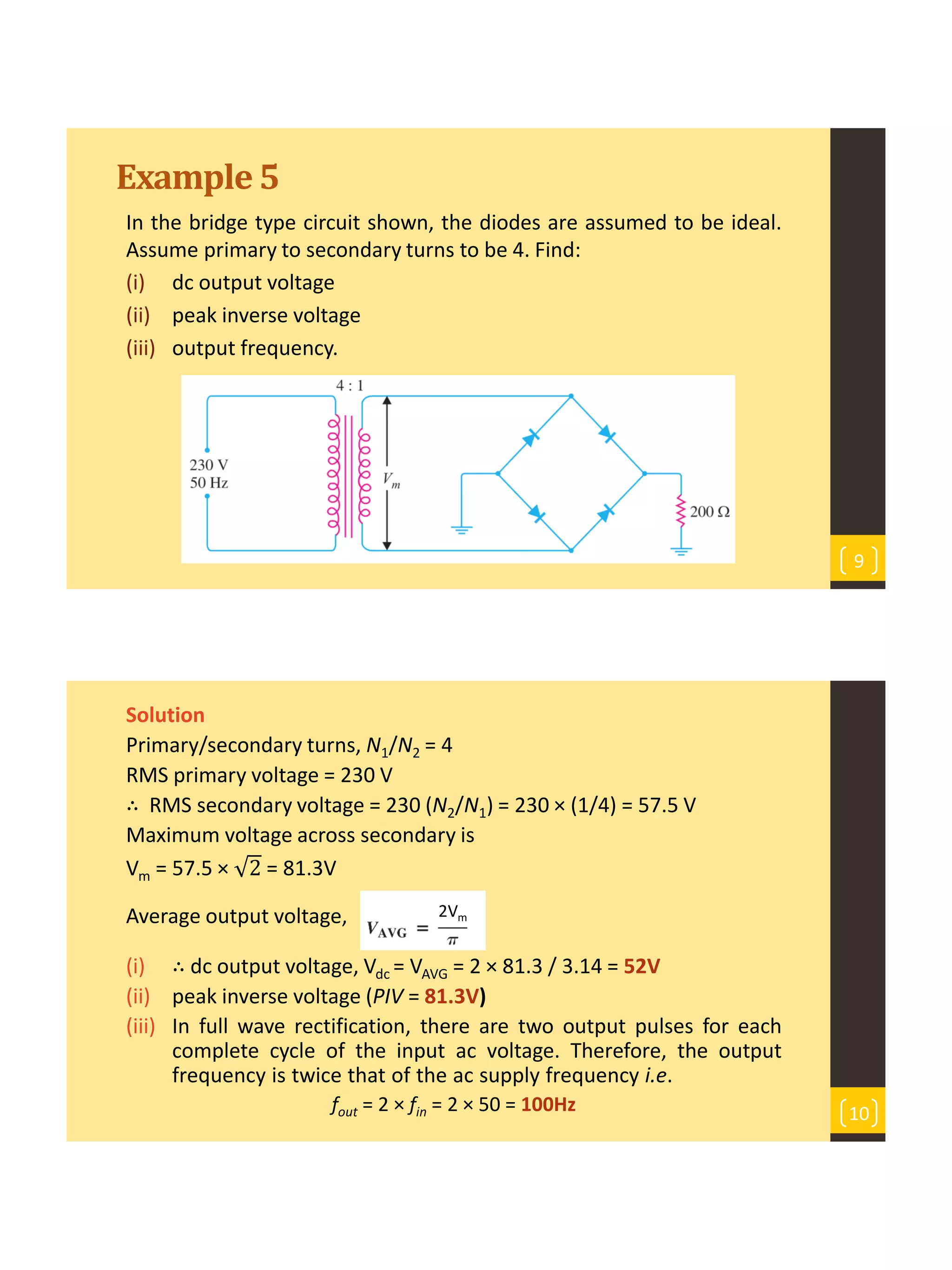
In the bridge type circuit shown, the diodes are assumed to be ideal.
Assume primary to secondary turns to be 4. Find:
(i) dc output voltage
(ii) peak inverse voltage
(iii) output frequency.
9
Solution
Primary/secondary turns, N1/N2 = 4
RMS primary voltage = 230 V
∴ RMS secondary voltage = 230 (N2/N1) = 230 × (1/4) = 57.5 V
Maximum voltage across secondary is
Vm = 57.5 × 2 = 81.3V
Average output voltage,
(i) ∴ dc output voltage, Vdc = VAVG = 2 × 81.3 / 3.14 = 52V
(ii) peak inverse voltage (PIV = 81.3V)
(iii) In full wave rectification, there are two output pulses for each
complete cycle of the input ac voltage. Therefore, the output
frequency is twice that of the ac supply frequency i.e.
fout = 2 × fin = 2 × 50 = 100Hz 10
2Vm
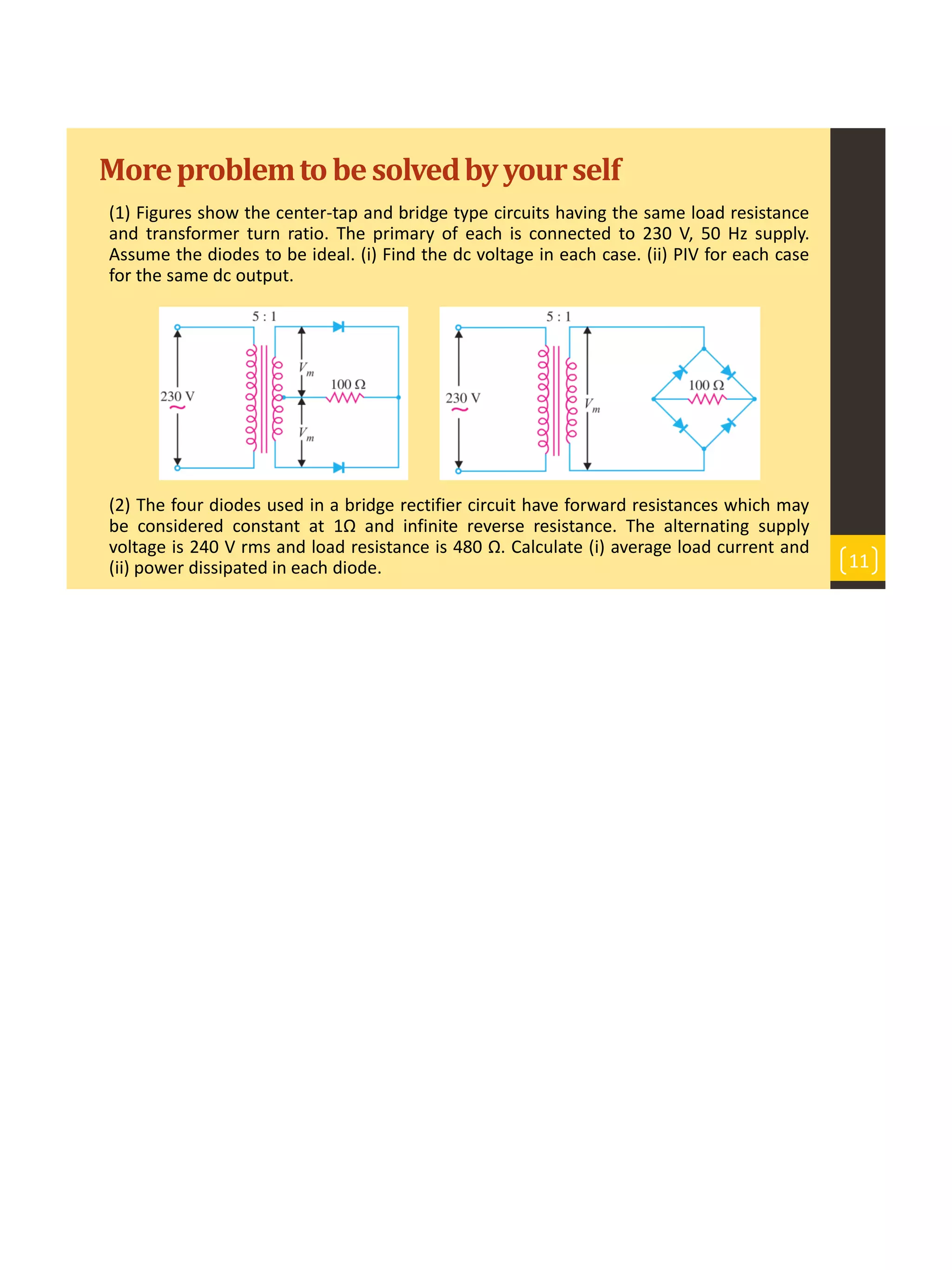
Moreproblemtobesolvedbyyourself
(1) Figures show the center-tap and bridge type circuits having the same load resistance
and transformer turn ratio. The primary of each is connected to 230 V, 50 Hz supply.
Assume the diodes to be ideal. (i) Find the dc voltage in each case. (ii) PIV for each case
for the same dc output.
(2) The four diodes used in a bridge rectifier circuit have forward resistances which may
be considered constant at 1Ω and infinite reverse resistance. The alternating supply
voltage is 240 V rms and load resistance is 480 Ω. Calculate (i) average load current and
(ii) power dissipated in each diode. 11

Lec 06 (2017).pdf

  • 1.
    Diodes and Applications Revision(01) 1 Summaryof Diode • The bias voltage must be greater than the barrier potential. • Barrier potential: 0.7 V for silicon. • Majority carriers provide the forward current. • The depletion region narrows. 2 • The bias voltage must be less than the breakdown voltage. • There is no majority carrier current after transition time. • Minority carriers provide a negligibly small reverse current. • The depletion region widens. Lec (06)
  • 2.
    Example1 An ac voltageof peak value 20 V is connected in series with a silicon diode and load resistance of 500 Ω. If the forward resistance of the diode is 10 Ω, find: • (a) peak current through the diode • (b) peak output voltage. What will be these values if the diode is considered as an ideal diode? 3 Solution. The diode will conduct during the positive half-cycles of ac input voltage. The equivalent circuit is (a) peak current through the diode VF = VPB + (If)peak [rf + RL] (If)peak = 𝑉𝐹−𝑉𝑃𝐵 𝑟𝑓+𝑅𝐿 = 20−0.7 10+500 = 37.8 mA 4 (b) peak output voltage Vout = (If)peak x RL = 37.8x10-3A x 500 Ω = 18.9 V For an ideal diode VPB = 0 and rf = 0 (If)peak = 𝑉𝐹 𝑅𝐿 = 20 500 = 40 mA & Vout = (If)peak x RL = 40x10-3 A x 500 Ω = 20 V
  • 3.
    Example2 5 Calculate the currentthrough 48 Ω resistor in the circuit shown in the Figure (i). Assume the diodes to be of silicon and forward resistance of each diode is 1 Ω. Diodes D1 and D3 are forward biased while diodes D2 and D4 are reverse biased. We can, therefore, consider the branches containing diodes D2 and D4 as “open”. Replacing diodes D1 and D3 by their equivalent circuits and making the branches containing diodes D2 and D4 open, We get the circuit shown in the Figure. Note that for a silicon diode, the barrier voltage is 0.7 V. 6 Net circuit voltage = 10 − 0.7 − 0.7 = 8.6 V Total circuit resistance = 1 + 48 + 1 = 50 Ω Circuit current = 8.6/50 = 0.172 A = 172 mA
  • 4.
    Example3 Determine the currentI in the circuit shown in the Figure. Assume the diodes to be of silicon and forward resistance of diodes to be zero. 7 Solution. The conditions of the problem suggest that diode D1 is forward biased and diode D2 is reverse biased. We can, therefore, consider the branch containing diode D2 as open. Further, diode D1 can be replaced by its simplified equivalent circuit. Example4 Find VQ and ID in the network shown. Use practical model. 8 Solution. By symmetry, current in each branch is ID so that current in branch CD is 2ID. Applying Kirchhoff’s voltage law to the closed circuit ABCDA, we have,
  • 5.
    Example5 Determine current througheach diode in the circuit shown. Use practical model. Assume diodes to be similar. 9 Solution. The applied voltage forward biases each diode so that they conduct current in the same direction. Since the diodes are similar Example6 Determine the currents I1, I2 and I3 for the network shown. Use practical model for the diodes. 10 Solution. An inspection of the circuit shown it shows that both diodes D1 and D2 are forward biased. The voltage across R2 (= 3.3 k Ω) is 0.7V. Applying Kirchhoff’s voltage law to loop ABCDA, we have,
  • 6.
    Diodes and Applications Revision(02) 1 Summaryof powersupplyrectifiers 2
  • 7.
    Example1 3 An ac supplyof 230 V is applied to a half-wave rectifier circuit through a transformer of turn ratio 10:1. Assume the diode to be ideal. Find (i) the output dc voltage (ii) the peak inverse voltage. Solution Primary to secondary turns is N1/N2 = 10 rms of the primary voltage = 230 V ∴ Max primary voltage Vpm = 2 × 230 = 325.3 V ∴ Max secondary voltage Vsm = Vpm x (N2/N1) = 325.3 x (1/10 ) = 32.53 V (i) the output dc voltage 4 (ii) the peak inverse voltage. • The maximum secondary voltage appears across the diode. • ∴ Peak inverse voltage Vsm = 32.53 V
  • 8.
    Example2 A half-wave rectifieris used to supply 50V dc to a resistive load of 800 Ω. The diode has a resistance of 25 Ω. Calculate ac voltage required. 5 Solution Output dc voltage, Vdc = 50 V Diode resistance, rf = 25 Ω Load resistance, RL = 800 Ω Let Vm be the maximum value of ac voltage required. ∴ Vdc = Idc × RL Hence, ac voltage of maximum value 162 V is required. Example3 A full-wave rectifier uses two diodes, the internal resistance of each diode may be assumed constant at 20 Ω. The transformer rms secondary voltage from center tap to each end of secondary is 50 V and load resistance is 980 Ω. Find: (i) the average load current, (ii) the rms value of load current Solution Max. ac voltage Max. load current (i) average load current (ii) RMS value of load current is 6
  • 9.
    Example4 In the center-tapcircuit shown, the diodes are assumed to be ideal i.e. having zero internal resistance. Find: (i) dc output voltage (ii) peak inverse voltage. Solution Primary to secondary turns, N1/N2 = 5 RMS primary voltage = 230 V ∴ RMS secondary voltage = 230×(1/5) = 46V Maximum voltage across secondary = 46 x 2 = 65V Maximum voltage across half secondary winding is Vm =65/2 = 32.5V 7 (i) dc output voltage Vdc = VAVG= 2 x 32.5 / 3.14 = 20.7V (ii) peak inverse voltage. The peak inverse voltage is equal to the maximum secondary voltage, i.e. PIV = 65 V 8 2Vm
  • 10.
    Example5 In the bridgetype circuit shown, the diodes are assumed to be ideal. Assume primary to secondary turns to be 4. Find: (i) dc output voltage (ii) peak inverse voltage (iii) output frequency. 9 Solution Primary/secondary turns, N1/N2 = 4 RMS primary voltage = 230 V ∴ RMS secondary voltage = 230 (N2/N1) = 230 × (1/4) = 57.5 V Maximum voltage across secondary is Vm = 57.5 × 2 = 81.3V Average output voltage, (i) ∴ dc output voltage, Vdc = VAVG = 2 × 81.3 / 3.14 = 52V (ii) peak inverse voltage (PIV = 81.3V) (iii) In full wave rectification, there are two output pulses for each complete cycle of the input ac voltage. Therefore, the output frequency is twice that of the ac supply frequency i.e. fout = 2 × fin = 2 × 50 = 100Hz 10 2Vm
  • 11.
    Moreproblemtobesolvedbyyourself (1) Figures showthe center-tap and bridge type circuits having the same load resistance and transformer turn ratio. The primary of each is connected to 230 V, 50 Hz supply. Assume the diodes to be ideal. (i) Find the dc voltage in each case. (ii) PIV for each case for the same dc output. (2) The four diodes used in a bridge rectifier circuit have forward resistances which may be considered constant at 1Ω and infinite reverse resistance. The alternating supply voltage is 240 V rms and load resistance is 480 Ω. Calculate (i) average load current and (ii) power dissipated in each diode. 11