1
LEAST LEARNED COMPETENCIES IN GRADE 7 SCIENCE STUDENTS:
BASIS FOR INTERVENTION
A Thesis
Presented to the Faculty of the College of Education
Negros Oriental State University Bayawan-Sta. Catalina Campus
In Partial Fulfillment
Of the Requirements for SPEC 17 (Research in Physics Education)
Bachelor of Secondary Education Major in Physical Science
By
Aimie R. Balaobao
Sarah Jane P. Dagodog
Kyle Lambert Melodia
Maila June P. Yala
Phoebe Sapepe
Nina Christine Zamora
December 2019
College of Education
Negros Oriental State University
2
Republic of the Philippines
NEGROS ORIENTAL STATE UNIVERSITY
RA 9299 JUNE 25, 2004
Bayawan-Santa Catalina Campus
Bayawan City
APPROVAL SHEET
This thesis entitled Least Learned Competencies in Grade 7 Science Students: Basis for
Intervention Prepared by: Balaobao, Aimie R., Sapepe, Phoebe, Melodia Kyle Lambert, Zamora
Nina Christine, Yala, Malai June and Dagodog, Sarah Jane. In partial fulfillment of the subject
SPEC Physical Science 17A (Research in Physics Education) has been examined, recommended
and approved for oral examination.
THESIS COMMITTEE
LIZA J. CABALLERO, Ed.D.
Research Adviser
ALBERT C. ALBINA, Ph.D. JAMES Y. BALASABAS
Member Member
PANEL OF EXAMINERS
Approved by the Committee on Oral Examination with a grade of ______________.
LIZA J. CABALLERO, Ed.D.
Chairman
ALBERT C. ALBINA, Ph.D. ARNEL TURFO, Ph.D. IVAN CORDEVILLA
Member Member Member
Accepted and Approved in partial fulfillment of the subject SPEC Physical Science 17A
(Research in Physics Education).
JOEL P. LIMSON, Ph.D.
University President
Date Signed: _______________
College of Education
Negros Oriental State University
3
DEDICATION
This thesis is humbly dedicated to our parents and friends who continuously give us the
best kind of knowledge and who taught us that even the largest task can be accomplished if it is
done one step at a time. Finally, this is also dedicated to all those who believe in the richness of
learning.
To our CED family, for their encouragement, Research and Extension Office Staff for the
unending support and generous sharing of their knowledge.
Above all, to the Lord almighty, the author of life with all the knowledge and wisdom.
College of Education
Negros Oriental State University
4
Acknowledgment
The researchers are very grateful to the God Almighty for without His graces and
blessings, this study would not have been possible.
Immeasurable appreciation and deepest gratitude for the help and support are extended to
the following persons who in one way or another have contributed in making this study possible.
To the Almighty who gives us strength and guidance to conduct this study and for being
the source of all wisdom, goodness, mercy, and love.
To the Mother of the College of Teacher Education, Liza J. Caballero Ed.D., for sharing
her professional expertise and knowledge in designing the program needed in the study.
To Dr. Albert Albina, for his warmth and responsiveness in supporting our study.
To Dr. Arnel Yurfo, for his supporting ideas of our study.
To Mr. Ivan Cordevilla, for guiding and correcting our study.
To the researcher’s friends and classmates, who have unending morale support. Lastly, to
their parents, for the moral and financial support, guidance, prayers and untiring and
unconditional love.
College of Education
Negros Oriental State University
5
Abstract
The purpose of this research is to determine the top 3 least learned competencies in Grade
7 Science based on the recent DUTP questionnaire last year. This study focuses on 4 local
schools. It will be the regulating factor in getting the measurement of the different science
competencies among Junior High Grade 7 students of Sta-Bayawan. The selection of the schools
was based on the performance of the students that shows the result in every competition both
division and regional levels. Therefore, this study sees great importance in assessing the top 3
least learned competencies in curricula of the selected schools. There were two objectives raised
in this study. One of which was: what are the least learned competencies in Science of Grade 7
students from a selected school in Bayawan City and Municipality of Sta. Catalina and the other
one were which among the competencies are least learned. There were 200 respondents in this
study,50 respondents for each school. They were the sample students from Junior High School
Grade 7 in four selected schools of Sta-Bayawan who were enrolled during this school year
2019-2020. The researcher adopted the descriptive survey method using the DUTP questionnaire
as the main tool in measuring Least Learned Competencies of Grade 7 Science Students. The
data obtained were analyzed, interpreted and tabulated using the average of each competency
among the four schools. The result showed that the top 3 Least learned competencies among four
junior high school students of Sta-Bayawan are competency 2(Describe the motion of an object
in terms of distance or displacement, speed, or velocity, and acceleration), competency 4(Explain
different modes of heat transfer), and competency 7(Investigates the components of substance).
Moreover, the schools that have the highest least learned competencies of Grade 7 are both Enzo
Nicolai T. Teves High School and Cawitan High School. Thus these certain competencies will be
College of Education
Negros Oriental State University
6
the basis for interventions for teachers to synthesize. In this manner, teachers will be aware of
how to improve the competencies being used that would fit the learners learning strategies.
College of Education
Negros Oriental State University
7
Executive Summary
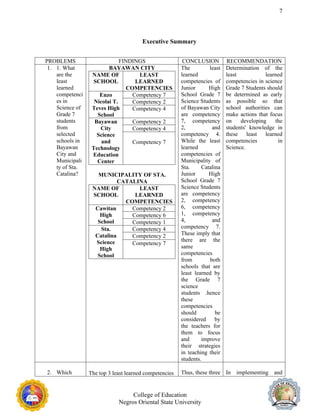
PROBLEMS FINDINGS CONCLUSION RECOMMENDATION
1. 1. What
are the
least
learned
competenci
es in
Science of
Grade 7
students
from
selected
schools in
Bayawan
City and
Municipali
ty of Sta.
Catalina?
BAYAWAN CITY
NAME OF
SCHOOL
LEAST
LEARNED
COMPETENCIES
Enzo
Nicolai T.
Teves High
School
Competency 7
Competency 2
Competency 4
Bayawan
City
Science
and
Technology
Education
Center
Competency 2
Competency 4
Competency 7
MUNICIPALITY OF STA.
CATALINA
NAME OF
SCHOOL
LEAST
LEARNED
COMPETENCIES
Cawitan
High
School
Competency 2
Competency 6
Competency 1
Sta.
Catalina
Science
High
School
Competency 4
Competency 2
Competency 7
The least
learned
competencies of
Junior High
School Grade 7
Science Students
of Bayawan City
are competency
7, competency
2, and
competency 4.
While the least
learned
competencies of
Municipality of
Sta. Catalina
Junior High
School Grade 7
Science Students
are competency
2, competency
6, competency
1, competency
4, and
competency 7.
These imply that
there are the
same
competencies
from both
schools that are
least learned by
the Grade 7
science
students .hence
these
competencies
should be
considered by
the teachers for
them to focus
and improve
their strategies
in teaching their
students.
Determination of the
least learned
competencies in science
Grade 7 Students should
be determined as early
as possible so that
school authorities can
make actions that focus
on developing the
students' knowledge in
these least learned
competencies in
Science.
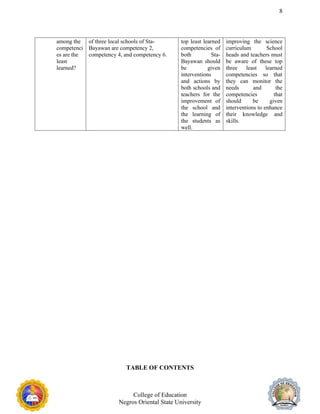
2. Which The top 3 least learned competencies Thus, these three In implementing and
College of Education
Negros Oriental State University
8
among the
competenci
es are the
least
learned?
of three local schools of Sta-
Bayawan are competency 2,
competency 4, and competency 6.
top least learned
competencies of
both Sta-
Bayawan should
be given
interventions
and actions by
both schools and
teachers for the
improvement of
the school and
the learning of
the students as
well.
improving the science
curriculum School
heads and teachers must
be aware of these top
three least learned
competencies so that
they can monitor the
needs and the
competencies that
should be given
interventions to enhance
their knowledge and
skills.
TABLE OF CONTENTS
College of Education
Negros Oriental State University
9
Abstract……………………………………………………………………………………….….5
Executive Summary……………………………………………………………………………...7
Table of Contents…………………………………………………………………………….….9
CHAPTER I: THE PROBLEM AND IT’S SCOPE
The Rationale of the Study…...……………………...………………………………………….11
Statement of the Problem……………………………………………………………………….13
Significance of the Study……………………………………………………………………….14
Scope and Delimitations…………………………………………………………………….….16
Definition of Terms……………………………………………………………………. ....…...17
Theoretical of the Study…………………………………………………………………….….18
Conceptual Framework of the Study…………………………………………………….….….19
Review of Related Literature…………………………………………………………….….….20
Research Respondents………………………………………………………………………….24
Research Instruments……………………………………………………………………….….24
Data Gathering Procedure……………………………………………………………….….….24
Research Methodology…………………………………………………………………………25
CHAPTER II: PRESENTATION, ANALYSIS, AND INTERPRETATION OF DATA
Table 1.0……………………………………………………………………………………….26
Table 1.1……………………………………………………………………………….….……27
College of Education
Negros Oriental State University
10
Table 1.2…………………………………………………………………………………….….27
Table 1.3…………………………………………………………………………………….….28
Table 2.0…………………………………………………………………………………….….29
CHAPTER III: SUMMARY OF FINDINGS, CONCLUSIONS, AND
RECOMMENDATIONS
Summary of Findings………………………………………………………………….….……31
Conclusions…………………………………………………………………………………….32
Recommendations……………………………………………………………………………...33
CHAPTER I
College of Education
Negros Oriental State University
11
THE PROBLEM AND ITS SCOPE
The Rationale of the Study
In mankind's existence, education is one of the most significant factors. Education hones
and improves an individual's character. Education is the very essence of all people's actions. For
so many decades, the Philippines is lagging behind other developing countries in Asia, especially
in the area of Science and Technology education. The DepEd's attempt to adapt to the
development of the new and advance education system of the neighboring countries is the
implementation of the K to 12 which is implemented on President Noynoy Aquino's term. It is
the educational system that may help the Department of Education catch up with the rest of the
world.
By adopting the modern education system which has been adopted initially by many
neighboring countries, there will be a major change or improvisation in the curriculum and
educational system in the Philippines. This aims to attain high-quality education and produce
globally competitive graduates. The attainment of producing high-quality graduates that can
compete globally might not be achieved by simply changing the curriculum and educational
system, but it calls for the improvement of teaching strategies for teachers as well as innovation
to the delivery of instructions, which is a big challenge for both students and the teachers.
Among the 8 major subjects in the current curriculum in Junior High School that needs more
facilities and equipment is science, for science teachers to properly hone and improve the
student's performance and competencies through different topic domains in science, especially
those competencies that need authentic activities like experiments. Science as a subject shall
provide an avenue for the learners to explore its wonder through experiments, actual/ true to life
activities and exploration.
College of Education
Negros Oriental State University
12
The National Achievement Test (NAT) results in our country give a rough estimate of
student performance in schools. The low mean percentage scores (MPS) tell us that there are
learners who are being tested with low mastery of concepts. In standardized testing, learners tend
not to reach their full potential and underperform. This shows the lack of content mastery of the
lessons and indicates academic underachievement. Underachievement is the failure to reach the
full potential of learners.
The main purpose of this research is to determine the top 3 least learned competencies in
Grade 7 Science based on the recent DUTP questionnaire last year which the study will focus on
3 local schools. It will be the regulating factor in getting the measurement of the different science
competencies in Grade 7 students. The selection of the schools will be based on the performance
of the students that shows the result in every competition both division and regional levels.
Therefore, the researchers of this study see great importance in assessing the top 3 to its least
learned competencies in the curricula of the selected schools. No formal study has been
conducted in our school so far about this; hence, this present study is the first of its kind in the
school NORSU-BSC.
Statement of the Problem
College of Education
Negros Oriental State University
13
The main objective of performing this research is to identify and compare the overall
result of the least learned competencies in Grade 7 Science in the 4 selected local schools in Sta-
Bayawan, based on (DUTP) Division Unified Test Program questionnaire. The aforementioned
questionnaire has 9 Competencies present in different types of topics in Science. This will be the
determining factor on which will be the least learned competencies based on the result of the
student’s exam.
This research investigates the ratings of least learned competencies in each school we
conducted. Specifically, it seeks to answer the following questions:
1. What are the least learned competencies in Science of Grade 7 students from selected
schools in Bayawan City and Municipality of Sta- Catalina?
2. Which among the competencies are the least learned?
Significance of the Study
College of Education
Negros Oriental State University
14
This study gave important information to the following group of people:
Bayawan City Science and Technology Education Center (BCSTEC). The findings of this
study will serve as their guide in enhancing the science curriculum to produce competent
learners.
Enzo Nicolai T. Teves High School (ENTTHS). The findings of this study will serve as their
guide in enhancing the science curriculum to produce competent learners.
Sta. Catalina Science High School. The findings of this study will serve as their guide in
enhancing the science curriculum to produce competent learners.
Cawitan High School. The findings of this study will serve as their guide in enhancing the
science curriculum to produce competent learners.
College of Education. The findings of this study give awareness to the college of education on
how they are going to mold their future science educators to produce science competent
educators.
Department of Education (DepEd). This will help to review and improve educational practice
in the department. Further, this research will also provide suggestions for strengthening the
research-to-practice channel.
Teachers and Education Practitioners
Practitioners have to comply with policies, and teachers are accountable for what learners
learn. This research gives teachers the tools to analyze and make informed decisions about their
practice. This will guide them on what competencies or learning standards to give much
importance in classroom instruction.
College of Education
Negros Oriental State University
15
Students of BCSTEC, ENTTHS, SCSHS, CHS. This study will help the students to reduce bad
feelings towards science subjects.
Researchers
Researchers will be inclined to do their best to contribute to the enhancement and
revision of the Philippine Science curriculum.
Future Researchers
This study will serve as a future reference for enhancing their research regarding the
Philippine Science curriculum.
Scope and Limitation
College of Education
Negros Oriental State University
16
The study dwelt on the Least learned Competencies of Grade 7 Science students S.Y.
2019-2020 in selected 4 local Junior High Schools of Sta-Bayawan drawing the causes from the
perspective of the DUTP takers in the identified Least Learned Competencies per subject area in
terms of the Subject Matter. The identified respondents were the student’s takers for these year
periods, particularly the Grade 7 Science Students. They answered the standardized
questionnaire (DUTP) provided by the researchers. The number of respondents was determined
by using Fishbowl Method Sampling. The duration of this study is intended only for 1 month–
December 2019.
Definition of Terms
College of Education
Negros Oriental State University
17
DUTP (Division Unified Test Program): Refers to the standardized questionnaire given by the
DepEd to every public school taking by students in the 2nd
grading period of the exams.
Curriculum: Refers to the lessons and academic content in Science taught in a school or a
specific course or program. It also refers to the knowledge and skills students are expected to
learn, which includes the learning standards or learning objectives they are expected to meet; the
units and lessons that teachers teach; the assignments and projects given to students; the books,
materials, videos, presentations, and readings used in a course; and the tests, assessments, and
other methods used to evaluate student learning.
Learning Competencies: Specific learning objectives that are expected to meet by the learners.
Bayawan City Science and Technology Education Center (BCSTEC). Operationally defined
as the school where the study conducted.
Enzo Nicolai T. Teves High School (ENTTHS). Operationally defined as the school where the
study conducted.
Sta, Catalina Science High School (SCSHS). Operationally defined as the school where the
study conducted.
Cawitan High School (CHS). Operationally defined as the school where the study conducted.
Students. Operationally defined as the respondents of the study. There were 200 respondents in
this study that comes from the Grade 7 level (four schools) of the Locale School of Sta-
Bayawan.
College of Education
Negros Oriental State University
18
Theoretical Framework of the Study
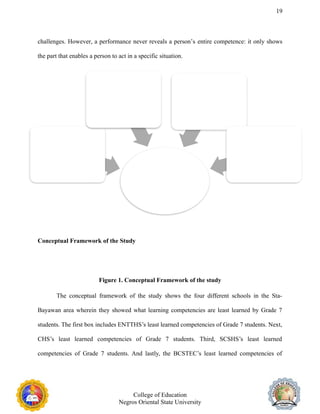
Figure 1. The Swiss Conference for Environmental Education
The Swiss conference for environmental education distinguishes between resources,
competences, and performances. It shows that there are two types of resources; one is the so-
called inner resources while the other is what we call the external resources. From our resources
come different competencies that are neither taught nor transferred but are acquired by students.
Once students acquire any competency, he/she shall be able to express performance and can thus
only be assessed in the actual achievement of a task when solving problems and dealing with
College of Education
Negros Oriental State University
Learning
Competencies
Enzo Nicolai T. Teves
High School
(Least Learned
Competencies of Grade 7
Science Students)
Cawitan High School
(Least Learned
Competencies of Grade 7
Science Students)
Sta. Catalina Science
High School
(Least Leaned
Competencies of Grade 7
Science Students)
Bayawan City Science
and Technology
Education Center
(Least Learned
Competencies of Grade 7
science Students)
19
challenges. However, a performance never reveals a person’s entire competence: it only shows
the part that enables a person to act in a specific situation.
Conceptual Framework of the Study
Figure 1. Conceptual Framework of the study
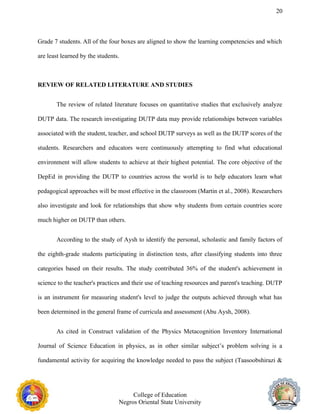
The conceptual framework of the study shows the four different schools in the Sta-
Bayawan area wherein they showed what learning competencies are least learned by Grade 7
students. The first box includes ENTTHS’s least learned competencies of Grade 7 students. Next,
CHS’s least learned competencies of Grade 7 students. Third, SCSHS’s least learned
competencies of Grade 7 students. And lastly, the BCSTEC’s least learned competencies of
College of Education
Negros Oriental State University
20
Grade 7 students. All of the four boxes are aligned to show the learning competencies and which
are least learned by the students.
REVIEW OF RELATED LITERATURE AND STUDIES
The review of related literature focuses on quantitative studies that exclusively analyze
DUTP data. The research investigating DUTP data may provide relationships between variables
associated with the student, teacher, and school DUTP surveys as well as the DUTP scores of the
students. Researchers and educators were continuously attempting to find what educational
environment will allow students to achieve at their highest potential. The core objective of the
DepEd in providing the DUTP to countries across the world is to help educators learn what
pedagogical approaches will be most effective in the classroom (Martin et al., 2008). Researchers
also investigate and look for relationships that show why students from certain countries score
much higher on DUTP than others.
According to the study of Aysh to identify the personal, scholastic and family factors of
the eighth-grade students participating in distinction tests, after classifying students into three
categories based on their results. The study contributed 36% of the student's achievement in
science to the teacher's practices and their use of teaching resources and parent's teaching. DUTP
is an instrument for measuring student's level to judge the outputs achieved through what has
been determined in the general frame of curricula and assessment (Abu Aysh, 2008).
As cited in Construct validation of the Physics Metacognition Inventory International
Journal of Science Education in physics, as in other similar subject’s problem solving is a
fundamental activity for acquiring the knowledge needed to pass the subject (Taasoobshirazi &
College of Education
Negros Oriental State University
21
Farley, 2013b). Thus, developing problem-solving expertise has become a central concern for
science education researchers and teachers (Mualen & Eylon, 2010; Taasoobshirazi &
Farley,2013a), who aim to foster the students use of strategies and skills, particularly
metacognitive ones.
The performance in achieving the outcome of this study is a major challenge for teachers
to guide decisions about which interventions could be effective in improving student
achievement (Chow et al., 2012). All these interventions, and similar ones, aim to enhance the
students' "motivation to learn," as defined by Brophy (2009) as engaging purposefully in
curricular activities by adopting their goals and thus trying to learn the concepts or master the
skills that they were designed to develop.
According to the study of Tyler, it has provided educational objective its definitive form.
Tyler's book Basic Principles of Curriculum and Instruction argued the importance of explicit
objectives in the curriculum design changes the behaviors' of the students toward learning.
Tyler's research was followed and elaborated by his student Benjamin S. Bloom and Bloom
developed the taxonomy of educational goals in the cognitive domain.
But in spite of a constitutional mandate, the budget allocation on education is lower than
required in the Philippines. The impact of economic crisis and the pressures of the increasing
population are forcing parents to send their children to overcrowded and ill-equipped public
educational institutions (Mydans as cited by Victorino, 2011).
A report published in the New York Times proved that education in the Philippines is
depleting. The educational system in the Philippines is often criticized because of the politics of
globalization. The educational system in the country is based on a globalized economy where
College of Education
Negros Oriental State University
22
nearly 10% of the overall population studies to work beyond the shores of the native land
(Meinardus as cited by Victorino, 2011).
Based on the studies of Javier, after one year the Status of the Implementation of Spiral
Approach in teaching Science, it was found out that in four areas such as Teaching Competency,
Learners' Competency, Assessment Tools and Instructional Materials, the least managed of them
all is the Learners' Competency. Even now at present, this problem has never been absolved
properly still it continues to be noticed in schools nationally. Since the implementation of the K
to 12 for high school was too soon, the learning gap for each subject area is experienced.
Students are too immature for the content of the four learning areas in science due to the content
that they had learned in their elementary levels (Javier 2013, et.al).
According to Gillies, defined academic underachievement as the perceived failure to
reach the potentials of learners. Biology is one of the least learned topics in Grade 7 Science.
Due to the learning gap, students will find it hard to understand and organize each topic at the
beginning of the second quarter. Students lack a deeper understanding of the given topics.
Although the learners' materials are cleared and easy to understand, students are having a hard
time in the topic and it was found out in the study of Javier (2013), that the science skills and
competencies that were expected to the students are not on the highest level which is one of the
factors that will lead to academic underachievement (Gillies 2008 et.al).
The Department of Education (DepEd) ensures that no student is left behind. Thus,
inclusive learning is one of the thrusts of the K to 12 Basic Education Curriculum. This thrust
ensures that all learners are given an equal chance to grow at their own pace through varied
learning activities. Differentiated instructions and contextualization allow teachers to provide
individual learners with the ability to concretize their learning.
College of Education
Negros Oriental State University
23
According to Connor, defined underachievement as a failure to meet the academic
requirements of the school setting. The issue of academic underachievement is one of great
concern, especially as it is not just a problem among gifted learners but prevails at all levels of
ability. This Presented at the DLSU Research Congress 2019 De La Salle University, Manila,
Philippines June 19 to 21, 2019 underachievement is often connected with the performance of
learners in standardized examinations as it is the most prevalent ways to assess and evaluate.
This explains that low academic achievement indicates academic underachievement.
Unfortunately, it still afflicts classroom instructions (Connor 2002).
College of Education
Negros Oriental State University
24
Research Respondents
The respondents of this study were the Grade 7 students of Bayawan City Science and
Technology Education Center, Enzo Nicolai T. Teves High School, Sta. Catalina Science High
School and Cawitan High School were enrolled during this school year (2019-2020).
Specifically, there were 200 students.
Research Instrument
The researchers used a standardized questionnaire (Division Unified Test Program) last
school year 2017-2018, together with the questionnaire was the respondent's profile as an
instrument in determining the least learned competencies of the students towards science subject.
Descriptive analysis was used in interpreting the data and used to determine the least learned
competencies of the students towards science subjects.
Data Gathering Procedure
The researchers asked permission from the principal of Bayawan City Science and
Technology Education Center, Enzo Nicolai T. Teves High School, Sta. Catalina Science High
School and Cawitan High School after the letter were approved. The researchers conducted the
study in BCSTEC, ENTTHS, SCSHS and CHS to the selected Grade 7 students. The respondent
was only given 30-40 minutes to answer the questionnaire. After the respondents have answered
the questionnaires, the researchers collected the questionnaires then tabulated and interpreted the
gathered data.
College of Education
Negros Oriental State University
25
Research Methodology
This section described the research methods, the research environments, the research
respondents, the research instrument and the data gathering procedure.
Research Design
In this study, the descriptive survey was employed by using the standardized Division
Unified Test Program (DUTP) as the main tool in gathering the data and getting the responses of
the Grade 7 students regarding to the least learned competencies towards science subject in
Bayawan City Science and Technology Education Center, Enzo Nicolai T. Teves High School,
Sta. Catalina Science High School, and Cawitan High School.9
Research Environment
This study was conducted in selected 4 Locale schools in Sta-Bayawan, namely; at
Bayawan City Science and Technology Education Center (BCSTEC) on December 10, 2019, at
@exactly 9:00 in the morning, located at Brgy. Cabcabon, Baywan City, Enzo Nicolai T. Teves
High School (ENTTHS) on November 28, 2019, @exactly 1:30 in the afternoon, located at
Brgy. Malabugas Bayawan City, Sta. Catalina Science High School (SCSHS) on December 02,
2019, @exactly 8:30 in the morning and Cawitan High School (CHS) on December 02, 2019,
@exactly 10:00 in the morning, located at Brgy. Cawitan Sta. Catalina Negros Oriental.
College of Education
Negros Oriental State University
26
CHAPTER II
PRESENTATION, ANALYSIS, AND INTERPRETATION OF DATA
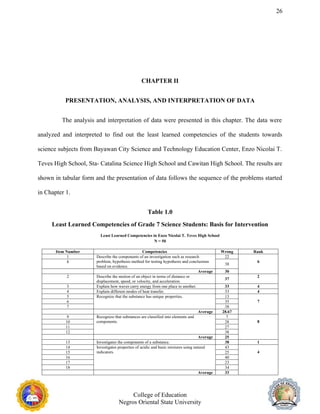
The analysis and interpretation of data were presented in this chapter. The data were
analyzed and interpreted to find out the least learned competencies of the students towards
science subjects from Bayawan City Science and Technology Education Center, Enzo Nicolai T.
Teves High School, Sta- Catalina Science High School and Cawitan High School. The results are
shown in tabular form and the presentation of data follows the sequence of the problems started
in Chapter 1.
Table 1.0
Least Learned Competencies of Grade 7 Science Students: Basis for Intervention
Least Learned Competencies in Enzo Nicolai T. Teves High School
N = 50
Item Number Competencies Wrong Rank
1 Describe the components of an investigation such as research
problem, hypothesis method for testing hypothesis and conclusions
based on evidence.
22
6
8
38
Average 30
2 Describe the motion of an object in terms of distance or
displacement, speed, or velocity, and acceleration.
37
2
3 Explain how waves carry energy from one place to another. 33 4
4 Explain different modes of heat transfer. 33 4
5 Recognize that the substance has unique properties. 13
7
6 35
7 38
Average 28.67
9 Recognize that substances are classified into elements and
components.
7
8
10 28
11 27
12 38
Average 25
13 Investigates the components of a substance. 38 1
14 Investigates properties of acidic and basic mixtures using natural
indicators.
43
4
15 25
16 40
17 23
18 34
Average 33
College of Education
Negros Oriental State University
27
19 Describe some properties of metals and non-metals such as luster,
malleability, ductility, and conductivity.
25
9
20 13
Average 19
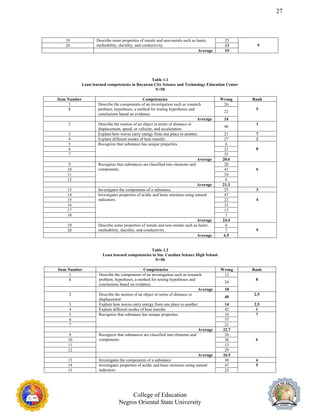
Table 1.1
Least learned competencies in Bayawan City Science and Technology Education Center
N=50
Item Number Competencies Wrong Rank
1 Describe the components of an investigation such as research
problem, hypothesis, a method for testing hypotheses and
conclusions based on evidence.
26
5
8
22
Average 24
2 Describe the motion of an object in terms of distance or
displacement, speed, or velocity, and acceleration.
46
1
3 Explain how waves carry energy from one place to another. 21 7
4 Explain different modes of heat transfer. 27 2
5 Recognize that substance has unique properties 6
8
6 21
7 35
Average 20.6
9 Recognize that substances are classified into elements and
components.
28
6
10 41
11 10
12 6
Average 21.3
13 Investigates the components of a substance. 25 3
14 Investigates properties of acidic and basic mixtures using natural
indicators.
47
4
15 22
16 33
17 13
18 7
Average 24.4
19 Describe some properties of metals and non-metals such as luster,
malleability, ductility, and conductivity.
6
9
20 7
Average 6.5
Table 1.2
Least learned competencies in Sta. Catalina Science High School
N=50
Item Number Competencies Wrong Rank
1 Describe the components of an investigation such as research
problem, hypothesis, a method for testing hypotheses and
conclusions based on evidence.
12
8
8
24
Average 18
2 Describe the motion of an object in terms of distance or
displacement
40
2.5
3 Explain how waves carry energy from one place to another 14 2.5
4 Explain different modes of heat transfer 42 1
5 Recognize that substance has unique properties 10 7
6 37
7 21
Average 22.7
9 Recognize that substances are classified into elements and
components
26
6
10 38
11 13
12 29
Average 26.5
13 Investigates the components of a substance 30 4
14 Investigates properties of acidic and basic mixtures using natural
indicators
47 5
15 23
College of Education
Negros Oriental State University
28
16 36
17 13
18 16
Average 27
19 Describe some properties of metals and non-metals such as luster,
malleability, ductility, and conductivity
11 9
20 6
Average 8.5
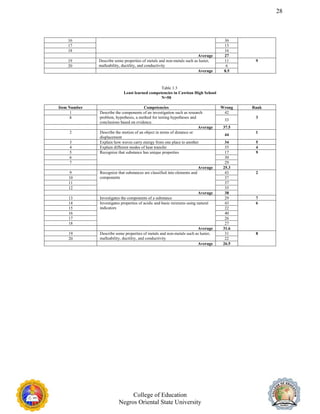
Table 1.3
Least learned competencies in Cawitan High School
N=50
Item Number Competencies Wrong Rank
1 Describe the components of an investigation such as research
problem, hypothesis, a method for testing hypotheses and
conclusions based on evidence.
42
3
8
33
Average 37.5
2 Describe the motion of an object in terms of distance or
displacement
44
1
3 Explain how waves carry energy from one place to another 34 5
4 Explain different modes of heat transfer 35 4
5 Recognize that substance has unique properties 17 9
6 30
7 29
Average 25.3
9 Recognize that substances are classified into elements and
components
43 2
10 37
11 37
12 35
Average 38
13 Investigates the components of a substance 29 7
14 Investigates properties of acidic and basic mixtures using natural
indicators
43 6
15 22
16 40
17 26
18 27
Average 31.6
19 Describe some properties of metals and non-metals such as luster,
malleability, ductility, and conductivity
31 8
20 22
Average 26.5
College of Education
Negros Oriental State University
29
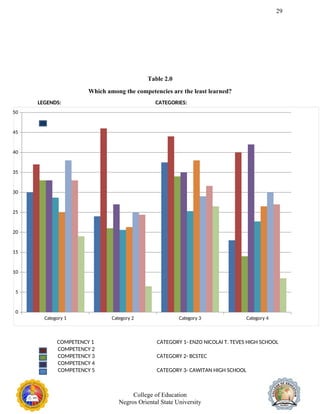
Table 2.0
Which among the competencies are the least learned?
LEGENDS: CATEGORIES:
COMPETENCY 1 CATEGORY 1- ENZO NICOLAI T. TEVES HIGH SCHOOL
COMPETENCY 2
COMPETENCY 3 CATEGORY 2- BCSTEC
COMPETENCY 4
COMPETENCY 5 CATEGORY 3- CAWITAN HIGH SCHOOL
College of Education
Negros Oriental State University
Category 1 Category 2 Category 3 Category 4
0
5
10
15
20
25
30
35
40
45
50
30
COMPETENCY 6
COMPETENCY 7 CATEGORY 4- STA. CATALINA SCIENCE HIGH SCHOOL
COMPETENCY 8
COMPETENCY 9
COMPETENCY 1 - Describe the components of an investigation such as research problem,
hypothesis method for testing hypothesis and conclusions based on
evidence.
COMPETENCY 2- Describe the motion of an object in terms of distance or displacement,
speed, or velocity, and acceleration
COMPETENCY 3- Explain how waves carry energy from one place to another.
COMPETENCY 4- Explain different modes of heat transfer
COMPETENCY 5- Recognize that substance has unique properties.
COMPETENCY 6- Recognize that substances are classified into elements and components
COMPETENCY 7- Investigates the components of a substance.
COMPETENCY 8- Investigates properties of acidic and basic mixtures using natural
indicators.
COMPETENCY 9- Describe some properties of metals and non-metals such as luster,
malleability, ductility, and conductivity.
College of Education
Negros Oriental State University
31
CHAPTER III
SUMMARY OF FINDINGS, CONCLUSIONS, AND RECOMMENDATIONS
This chapter is a summary of findings, conclusions, and recommendations.
SUMMARY OF FINDINGS
Problem 1:
Based on the findings obtained from the study conducted and in answering the
research question, it is evident that competency7(Investigates the components of a substance),
competency 2 (Describe the motion of an object in terms of distance or displacement, speed, or
velocity, and acceleration), and competency 4(Explain different modes of heat transfer) are the
highest least learned competencies of Grade 7 Junior High School students of both Enzo Nicolai
T. Teves High School and BCSTEC.On the other hand, competency 2(Describe the motion of an
object in terms of distance or displacement, speed, or velocity, and acceleration), competency 6
(Recognize that substances are classified into elements and components), and
competency1(Describe the components of an investigation such as research problem, hypothesis
method for testing hypothesis and conclusions based on evidence) are the least learned
competencies of Junior High School students of Cawitan High School. However for sta.
Catalina Science High School least learned competencies are competency 4(Explain different
modes of heat transfer), competency 2(Describe the motion of an object in terms of distance or
displacement, speed, or velocity, and acceleration) and competency 7(Investigates the
components of a substance).
College of Education
Negros Oriental State University
32
Problem 2:
Based on the findings obtained from the study conducted the top 3 least learned
competencies are competency 2 (Describe the motion of an object in terms of distance or
displacement, speed, or velocity, and acceleration), competency 4(Explain different modes of
heat transfer), and competency 6 (Recognize that substances are classified into elements and
components).
CONCLUSIONS
Thus, based on the data that we gathered, the top three least learned competency in the
schools of Bayawan-Sta. Catalina is competency 2, competency 4 and competency 6, averaging
from more than half to three fourth of the population of respondents having a hard time
understanding these competencies. Therefore, these certain competencies will be the basis for
interventions for teachers for them to properly create and synthesize more appropriate and proper
techniques and strategies in teaching students to master these competencies.
RECOMMENDATIONS
Based on the findings and conclusion of this study, the following recommendations were
made for:
1. As a basis for intervention, schools in both Sta-Bayawan areas should focus on
developing the students' knowledge in these least learned competencies in Science.
College of Education
Negros Oriental State University
33
2. The College of Education should continue molding future competent science educators
that will help in improving their competencies towards science subjects.
3. Department of Education should monitor the student’s academic records towards
science subjects to be aware of the progress of the science curriculum they were implementing
and to improve the science curriculum to foster a positive impact on science students.
4. The research department in NORSU-BSC can further encourage future student
researchers in using this data as the basis for future researches.
College of Education
Negros Oriental State University
34
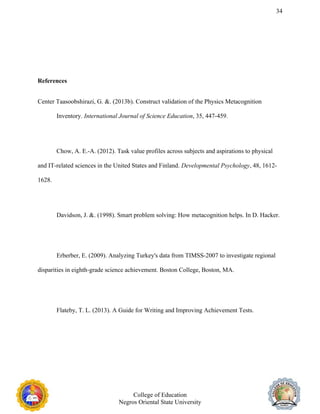
References
Center Taasoobshirazi, G. &. (2013b). Construct validation of the Physics Metacognition
Inventory. International Journal of Science Education, 35, 447-459.
Chow, A. E.-A. (2012). Task value profiles across subjects and aspirations to physical
and IT-related sciences in the United States and Finland. Developmental Psychology, 48, 1612-
1628.
Davidson, J. &. (1998). Smart problem solving: How metacognition helps. In D. Hacker.
Erberber, E. (2009). Analyzing Turkey's data from TIMSS-2007 to investigate regional
disparities in eighth-grade science achievement. Boston College, Boston, MA.
Flateby, T. L. (2013). A Guide for Writing and Improving Achievement Tests.
College of Education
Negros Oriental State University
35
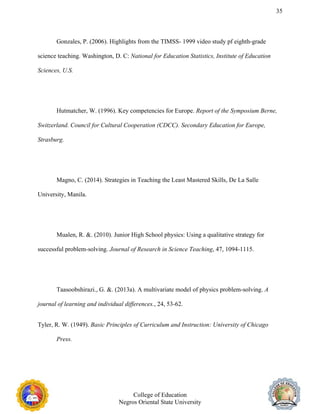
Gonzales, P. (2006). Highlights from the TIMSS- 1999 video study pf eighth-grade
science teaching. Washington, D. C: National for Education Statistics, Institute of Education
Sciences, U.S.
Hutmatcher, W. (1996). Key competencies for Europe. Report of the Symposium Berne,
Switzerland. Council for Cultural Cooperation (CDCC). Secondary Education for Europe,
Strasburg.
Magno, C. (2014). Strategies in Teaching the Least Mastered Skills, De La Salle
University, Manila.
Mualen, R. &. (2010). Junior High School physics: Using a qualitative strategy for
successful problem-solving. Journal of Research in Science Teaching, 47, 1094-1115.
Taasoobshirazi., G. &. (2013a). A multivariate model of physics problem-solving. A
journal of learning and individual differences., 24, 53-62.
Tyler, R. W. (1949). Basic Principles of Curriculum and Instruction: University of Chicago
Press.
College of Education
Negros Oriental State University
36
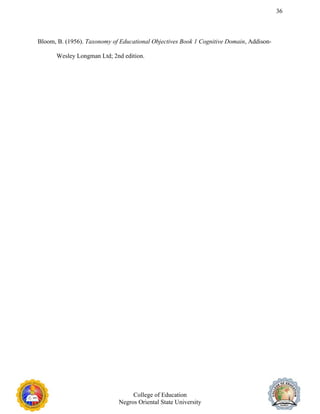
Bloom, B. (1956). Taxonomy of Educational Objectives Book 1 Cognitive Domain, Addison-
Wesley Longman Ltd; 2nd edition.
College of Education
Negros Oriental State University

Least Learned Competencies in Grade 7 Science Students: Basis for Intervention

  • 1.
    1 LEAST LEARNED COMPETENCIESIN GRADE 7 SCIENCE STUDENTS: BASIS FOR INTERVENTION A Thesis Presented to the Faculty of the College of Education Negros Oriental State University Bayawan-Sta. Catalina Campus In Partial Fulfillment Of the Requirements for SPEC 17 (Research in Physics Education) Bachelor of Secondary Education Major in Physical Science By Aimie R. Balaobao Sarah Jane P. Dagodog Kyle Lambert Melodia Maila June P. Yala Phoebe Sapepe Nina Christine Zamora December 2019 College of Education Negros Oriental State University
  • 2.
    2 Republic of thePhilippines NEGROS ORIENTAL STATE UNIVERSITY RA 9299 JUNE 25, 2004 Bayawan-Santa Catalina Campus Bayawan City APPROVAL SHEET This thesis entitled Least Learned Competencies in Grade 7 Science Students: Basis for Intervention Prepared by: Balaobao, Aimie R., Sapepe, Phoebe, Melodia Kyle Lambert, Zamora Nina Christine, Yala, Malai June and Dagodog, Sarah Jane. In partial fulfillment of the subject SPEC Physical Science 17A (Research in Physics Education) has been examined, recommended and approved for oral examination. THESIS COMMITTEE LIZA J. CABALLERO, Ed.D. Research Adviser ALBERT C. ALBINA, Ph.D. JAMES Y. BALASABAS Member Member PANEL OF EXAMINERS Approved by the Committee on Oral Examination with a grade of ______________. LIZA J. CABALLERO, Ed.D. Chairman ALBERT C. ALBINA, Ph.D. ARNEL TURFO, Ph.D. IVAN CORDEVILLA Member Member Member Accepted and Approved in partial fulfillment of the subject SPEC Physical Science 17A (Research in Physics Education). JOEL P. LIMSON, Ph.D. University President Date Signed: _______________ College of Education Negros Oriental State University
  • 3.
    3 DEDICATION This thesis ishumbly dedicated to our parents and friends who continuously give us the best kind of knowledge and who taught us that even the largest task can be accomplished if it is done one step at a time. Finally, this is also dedicated to all those who believe in the richness of learning. To our CED family, for their encouragement, Research and Extension Office Staff for the unending support and generous sharing of their knowledge. Above all, to the Lord almighty, the author of life with all the knowledge and wisdom. College of Education Negros Oriental State University
  • 4.
    4 Acknowledgment The researchers arevery grateful to the God Almighty for without His graces and blessings, this study would not have been possible. Immeasurable appreciation and deepest gratitude for the help and support are extended to the following persons who in one way or another have contributed in making this study possible. To the Almighty who gives us strength and guidance to conduct this study and for being the source of all wisdom, goodness, mercy, and love. To the Mother of the College of Teacher Education, Liza J. Caballero Ed.D., for sharing her professional expertise and knowledge in designing the program needed in the study. To Dr. Albert Albina, for his warmth and responsiveness in supporting our study. To Dr. Arnel Yurfo, for his supporting ideas of our study. To Mr. Ivan Cordevilla, for guiding and correcting our study. To the researcher’s friends and classmates, who have unending morale support. Lastly, to their parents, for the moral and financial support, guidance, prayers and untiring and unconditional love. College of Education Negros Oriental State University
  • 5.
    5 Abstract The purpose ofthis research is to determine the top 3 least learned competencies in Grade 7 Science based on the recent DUTP questionnaire last year. This study focuses on 4 local schools. It will be the regulating factor in getting the measurement of the different science competencies among Junior High Grade 7 students of Sta-Bayawan. The selection of the schools was based on the performance of the students that shows the result in every competition both division and regional levels. Therefore, this study sees great importance in assessing the top 3 least learned competencies in curricula of the selected schools. There were two objectives raised in this study. One of which was: what are the least learned competencies in Science of Grade 7 students from a selected school in Bayawan City and Municipality of Sta. Catalina and the other one were which among the competencies are least learned. There were 200 respondents in this study,50 respondents for each school. They were the sample students from Junior High School Grade 7 in four selected schools of Sta-Bayawan who were enrolled during this school year 2019-2020. The researcher adopted the descriptive survey method using the DUTP questionnaire as the main tool in measuring Least Learned Competencies of Grade 7 Science Students. The data obtained were analyzed, interpreted and tabulated using the average of each competency among the four schools. The result showed that the top 3 Least learned competencies among four junior high school students of Sta-Bayawan are competency 2(Describe the motion of an object in terms of distance or displacement, speed, or velocity, and acceleration), competency 4(Explain different modes of heat transfer), and competency 7(Investigates the components of substance). Moreover, the schools that have the highest least learned competencies of Grade 7 are both Enzo Nicolai T. Teves High School and Cawitan High School. Thus these certain competencies will be College of Education Negros Oriental State University
  • 6.
    6 the basis forinterventions for teachers to synthesize. In this manner, teachers will be aware of how to improve the competencies being used that would fit the learners learning strategies. College of Education Negros Oriental State University
  • 7.
    7 Executive Summary PROBLEMS FINDINGSCONCLUSION RECOMMENDATION 1. 1. What are the least learned competenci es in Science of Grade 7 students from selected schools in Bayawan City and Municipali ty of Sta. Catalina? BAYAWAN CITY NAME OF SCHOOL LEAST LEARNED COMPETENCIES Enzo Nicolai T. Teves High School Competency 7 Competency 2 Competency 4 Bayawan City Science and Technology Education Center Competency 2 Competency 4 Competency 7 MUNICIPALITY OF STA. CATALINA NAME OF SCHOOL LEAST LEARNED COMPETENCIES Cawitan High School Competency 2 Competency 6 Competency 1 Sta. Catalina Science High School Competency 4 Competency 2 Competency 7 The least learned competencies of Junior High School Grade 7 Science Students of Bayawan City are competency 7, competency 2, and competency 4. While the least learned competencies of Municipality of Sta. Catalina Junior High School Grade 7 Science Students are competency 2, competency 6, competency 1, competency 4, and competency 7. These imply that there are the same competencies from both schools that are least learned by the Grade 7 science students .hence these competencies should be considered by the teachers for them to focus and improve their strategies in teaching their students. Determination of the least learned competencies in science Grade 7 Students should be determined as early as possible so that school authorities can make actions that focus on developing the students' knowledge in these least learned competencies in Science. 2. Which The top 3 least learned competencies Thus, these three In implementing and College of Education Negros Oriental State University
  • 8.
    8 among the competenci es arethe least learned? of three local schools of Sta- Bayawan are competency 2, competency 4, and competency 6. top least learned competencies of both Sta- Bayawan should be given interventions and actions by both schools and teachers for the improvement of the school and the learning of the students as well. improving the science curriculum School heads and teachers must be aware of these top three least learned competencies so that they can monitor the needs and the competencies that should be given interventions to enhance their knowledge and skills. TABLE OF CONTENTS College of Education Negros Oriental State University
  • 9.
    9 Abstract……………………………………………………………………………………….….5 Executive Summary……………………………………………………………………………...7 Table ofContents…………………………………………………………………………….….9 CHAPTER I: THE PROBLEM AND IT’S SCOPE The Rationale of the Study…...……………………...………………………………………….11 Statement of the Problem……………………………………………………………………….13 Significance of the Study……………………………………………………………………….14 Scope and Delimitations…………………………………………………………………….….16 Definition of Terms……………………………………………………………………. ....…...17 Theoretical of the Study…………………………………………………………………….….18 Conceptual Framework of the Study…………………………………………………….….….19 Review of Related Literature…………………………………………………………….….….20 Research Respondents………………………………………………………………………….24 Research Instruments……………………………………………………………………….….24 Data Gathering Procedure……………………………………………………………….….….24 Research Methodology…………………………………………………………………………25 CHAPTER II: PRESENTATION, ANALYSIS, AND INTERPRETATION OF DATA Table 1.0……………………………………………………………………………………….26 Table 1.1……………………………………………………………………………….….……27 College of Education Negros Oriental State University
  • 10.
    10 Table 1.2…………………………………………………………………………………….….27 Table 1.3…………………………………………………………………………………….….28 Table2.0…………………………………………………………………………………….….29 CHAPTER III: SUMMARY OF FINDINGS, CONCLUSIONS, AND RECOMMENDATIONS Summary of Findings………………………………………………………………….….……31 Conclusions…………………………………………………………………………………….32 Recommendations……………………………………………………………………………...33 CHAPTER I College of Education Negros Oriental State University
  • 11.
    11 THE PROBLEM ANDITS SCOPE The Rationale of the Study In mankind's existence, education is one of the most significant factors. Education hones and improves an individual's character. Education is the very essence of all people's actions. For so many decades, the Philippines is lagging behind other developing countries in Asia, especially in the area of Science and Technology education. The DepEd's attempt to adapt to the development of the new and advance education system of the neighboring countries is the implementation of the K to 12 which is implemented on President Noynoy Aquino's term. It is the educational system that may help the Department of Education catch up with the rest of the world. By adopting the modern education system which has been adopted initially by many neighboring countries, there will be a major change or improvisation in the curriculum and educational system in the Philippines. This aims to attain high-quality education and produce globally competitive graduates. The attainment of producing high-quality graduates that can compete globally might not be achieved by simply changing the curriculum and educational system, but it calls for the improvement of teaching strategies for teachers as well as innovation to the delivery of instructions, which is a big challenge for both students and the teachers. Among the 8 major subjects in the current curriculum in Junior High School that needs more facilities and equipment is science, for science teachers to properly hone and improve the student's performance and competencies through different topic domains in science, especially those competencies that need authentic activities like experiments. Science as a subject shall provide an avenue for the learners to explore its wonder through experiments, actual/ true to life activities and exploration. College of Education Negros Oriental State University
  • 12.
    12 The National AchievementTest (NAT) results in our country give a rough estimate of student performance in schools. The low mean percentage scores (MPS) tell us that there are learners who are being tested with low mastery of concepts. In standardized testing, learners tend not to reach their full potential and underperform. This shows the lack of content mastery of the lessons and indicates academic underachievement. Underachievement is the failure to reach the full potential of learners. The main purpose of this research is to determine the top 3 least learned competencies in Grade 7 Science based on the recent DUTP questionnaire last year which the study will focus on 3 local schools. It will be the regulating factor in getting the measurement of the different science competencies in Grade 7 students. The selection of the schools will be based on the performance of the students that shows the result in every competition both division and regional levels. Therefore, the researchers of this study see great importance in assessing the top 3 to its least learned competencies in the curricula of the selected schools. No formal study has been conducted in our school so far about this; hence, this present study is the first of its kind in the school NORSU-BSC. Statement of the Problem College of Education Negros Oriental State University
  • 13.
    13 The main objectiveof performing this research is to identify and compare the overall result of the least learned competencies in Grade 7 Science in the 4 selected local schools in Sta- Bayawan, based on (DUTP) Division Unified Test Program questionnaire. The aforementioned questionnaire has 9 Competencies present in different types of topics in Science. This will be the determining factor on which will be the least learned competencies based on the result of the student’s exam. This research investigates the ratings of least learned competencies in each school we conducted. Specifically, it seeks to answer the following questions: 1. What are the least learned competencies in Science of Grade 7 students from selected schools in Bayawan City and Municipality of Sta- Catalina? 2. Which among the competencies are the least learned? Significance of the Study College of Education Negros Oriental State University
  • 14.
    14 This study gaveimportant information to the following group of people: Bayawan City Science and Technology Education Center (BCSTEC). The findings of this study will serve as their guide in enhancing the science curriculum to produce competent learners. Enzo Nicolai T. Teves High School (ENTTHS). The findings of this study will serve as their guide in enhancing the science curriculum to produce competent learners. Sta. Catalina Science High School. The findings of this study will serve as their guide in enhancing the science curriculum to produce competent learners. Cawitan High School. The findings of this study will serve as their guide in enhancing the science curriculum to produce competent learners. College of Education. The findings of this study give awareness to the college of education on how they are going to mold their future science educators to produce science competent educators. Department of Education (DepEd). This will help to review and improve educational practice in the department. Further, this research will also provide suggestions for strengthening the research-to-practice channel. Teachers and Education Practitioners Practitioners have to comply with policies, and teachers are accountable for what learners learn. This research gives teachers the tools to analyze and make informed decisions about their practice. This will guide them on what competencies or learning standards to give much importance in classroom instruction. College of Education Negros Oriental State University
  • 15.
    15 Students of BCSTEC,ENTTHS, SCSHS, CHS. This study will help the students to reduce bad feelings towards science subjects. Researchers Researchers will be inclined to do their best to contribute to the enhancement and revision of the Philippine Science curriculum. Future Researchers This study will serve as a future reference for enhancing their research regarding the Philippine Science curriculum. Scope and Limitation College of Education Negros Oriental State University
  • 16.
    16 The study dwelton the Least learned Competencies of Grade 7 Science students S.Y. 2019-2020 in selected 4 local Junior High Schools of Sta-Bayawan drawing the causes from the perspective of the DUTP takers in the identified Least Learned Competencies per subject area in terms of the Subject Matter. The identified respondents were the student’s takers for these year periods, particularly the Grade 7 Science Students. They answered the standardized questionnaire (DUTP) provided by the researchers. The number of respondents was determined by using Fishbowl Method Sampling. The duration of this study is intended only for 1 month– December 2019. Definition of Terms College of Education Negros Oriental State University
  • 17.
    17 DUTP (Division UnifiedTest Program): Refers to the standardized questionnaire given by the DepEd to every public school taking by students in the 2nd grading period of the exams. Curriculum: Refers to the lessons and academic content in Science taught in a school or a specific course or program. It also refers to the knowledge and skills students are expected to learn, which includes the learning standards or learning objectives they are expected to meet; the units and lessons that teachers teach; the assignments and projects given to students; the books, materials, videos, presentations, and readings used in a course; and the tests, assessments, and other methods used to evaluate student learning. Learning Competencies: Specific learning objectives that are expected to meet by the learners. Bayawan City Science and Technology Education Center (BCSTEC). Operationally defined as the school where the study conducted. Enzo Nicolai T. Teves High School (ENTTHS). Operationally defined as the school where the study conducted. Sta, Catalina Science High School (SCSHS). Operationally defined as the school where the study conducted. Cawitan High School (CHS). Operationally defined as the school where the study conducted. Students. Operationally defined as the respondents of the study. There were 200 respondents in this study that comes from the Grade 7 level (four schools) of the Locale School of Sta- Bayawan. College of Education Negros Oriental State University
  • 18.
    18 Theoretical Framework ofthe Study Figure 1. The Swiss Conference for Environmental Education The Swiss conference for environmental education distinguishes between resources, competences, and performances. It shows that there are two types of resources; one is the so- called inner resources while the other is what we call the external resources. From our resources come different competencies that are neither taught nor transferred but are acquired by students. Once students acquire any competency, he/she shall be able to express performance and can thus only be assessed in the actual achievement of a task when solving problems and dealing with College of Education Negros Oriental State University
  • 19.
    Learning Competencies Enzo Nicolai T.Teves High School (Least Learned Competencies of Grade 7 Science Students) Cawitan High School (Least Learned Competencies of Grade 7 Science Students) Sta. Catalina Science High School (Least Leaned Competencies of Grade 7 Science Students) Bayawan City Science and Technology Education Center (Least Learned Competencies of Grade 7 science Students) 19 challenges. However, a performance never reveals a person’s entire competence: it only shows the part that enables a person to act in a specific situation. Conceptual Framework of the Study Figure 1. Conceptual Framework of the study The conceptual framework of the study shows the four different schools in the Sta- Bayawan area wherein they showed what learning competencies are least learned by Grade 7 students. The first box includes ENTTHS’s least learned competencies of Grade 7 students. Next, CHS’s least learned competencies of Grade 7 students. Third, SCSHS’s least learned competencies of Grade 7 students. And lastly, the BCSTEC’s least learned competencies of College of Education Negros Oriental State University
  • 20.
    20 Grade 7 students.All of the four boxes are aligned to show the learning competencies and which are least learned by the students. REVIEW OF RELATED LITERATURE AND STUDIES The review of related literature focuses on quantitative studies that exclusively analyze DUTP data. The research investigating DUTP data may provide relationships between variables associated with the student, teacher, and school DUTP surveys as well as the DUTP scores of the students. Researchers and educators were continuously attempting to find what educational environment will allow students to achieve at their highest potential. The core objective of the DepEd in providing the DUTP to countries across the world is to help educators learn what pedagogical approaches will be most effective in the classroom (Martin et al., 2008). Researchers also investigate and look for relationships that show why students from certain countries score much higher on DUTP than others. According to the study of Aysh to identify the personal, scholastic and family factors of the eighth-grade students participating in distinction tests, after classifying students into three categories based on their results. The study contributed 36% of the student's achievement in science to the teacher's practices and their use of teaching resources and parent's teaching. DUTP is an instrument for measuring student's level to judge the outputs achieved through what has been determined in the general frame of curricula and assessment (Abu Aysh, 2008). As cited in Construct validation of the Physics Metacognition Inventory International Journal of Science Education in physics, as in other similar subject’s problem solving is a fundamental activity for acquiring the knowledge needed to pass the subject (Taasoobshirazi & College of Education Negros Oriental State University
  • 21.
    21 Farley, 2013b). Thus,developing problem-solving expertise has become a central concern for science education researchers and teachers (Mualen & Eylon, 2010; Taasoobshirazi & Farley,2013a), who aim to foster the students use of strategies and skills, particularly metacognitive ones. The performance in achieving the outcome of this study is a major challenge for teachers to guide decisions about which interventions could be effective in improving student achievement (Chow et al., 2012). All these interventions, and similar ones, aim to enhance the students' "motivation to learn," as defined by Brophy (2009) as engaging purposefully in curricular activities by adopting their goals and thus trying to learn the concepts or master the skills that they were designed to develop. According to the study of Tyler, it has provided educational objective its definitive form. Tyler's book Basic Principles of Curriculum and Instruction argued the importance of explicit objectives in the curriculum design changes the behaviors' of the students toward learning. Tyler's research was followed and elaborated by his student Benjamin S. Bloom and Bloom developed the taxonomy of educational goals in the cognitive domain. But in spite of a constitutional mandate, the budget allocation on education is lower than required in the Philippines. The impact of economic crisis and the pressures of the increasing population are forcing parents to send their children to overcrowded and ill-equipped public educational institutions (Mydans as cited by Victorino, 2011). A report published in the New York Times proved that education in the Philippines is depleting. The educational system in the Philippines is often criticized because of the politics of globalization. The educational system in the country is based on a globalized economy where College of Education Negros Oriental State University
  • 22.
    22 nearly 10% ofthe overall population studies to work beyond the shores of the native land (Meinardus as cited by Victorino, 2011). Based on the studies of Javier, after one year the Status of the Implementation of Spiral Approach in teaching Science, it was found out that in four areas such as Teaching Competency, Learners' Competency, Assessment Tools and Instructional Materials, the least managed of them all is the Learners' Competency. Even now at present, this problem has never been absolved properly still it continues to be noticed in schools nationally. Since the implementation of the K to 12 for high school was too soon, the learning gap for each subject area is experienced. Students are too immature for the content of the four learning areas in science due to the content that they had learned in their elementary levels (Javier 2013, et.al). According to Gillies, defined academic underachievement as the perceived failure to reach the potentials of learners. Biology is one of the least learned topics in Grade 7 Science. Due to the learning gap, students will find it hard to understand and organize each topic at the beginning of the second quarter. Students lack a deeper understanding of the given topics. Although the learners' materials are cleared and easy to understand, students are having a hard time in the topic and it was found out in the study of Javier (2013), that the science skills and competencies that were expected to the students are not on the highest level which is one of the factors that will lead to academic underachievement (Gillies 2008 et.al). The Department of Education (DepEd) ensures that no student is left behind. Thus, inclusive learning is one of the thrusts of the K to 12 Basic Education Curriculum. This thrust ensures that all learners are given an equal chance to grow at their own pace through varied learning activities. Differentiated instructions and contextualization allow teachers to provide individual learners with the ability to concretize their learning. College of Education Negros Oriental State University
  • 23.
    23 According to Connor,defined underachievement as a failure to meet the academic requirements of the school setting. The issue of academic underachievement is one of great concern, especially as it is not just a problem among gifted learners but prevails at all levels of ability. This Presented at the DLSU Research Congress 2019 De La Salle University, Manila, Philippines June 19 to 21, 2019 underachievement is often connected with the performance of learners in standardized examinations as it is the most prevalent ways to assess and evaluate. This explains that low academic achievement indicates academic underachievement. Unfortunately, it still afflicts classroom instructions (Connor 2002). College of Education Negros Oriental State University
  • 24.
    24 Research Respondents The respondentsof this study were the Grade 7 students of Bayawan City Science and Technology Education Center, Enzo Nicolai T. Teves High School, Sta. Catalina Science High School and Cawitan High School were enrolled during this school year (2019-2020). Specifically, there were 200 students. Research Instrument The researchers used a standardized questionnaire (Division Unified Test Program) last school year 2017-2018, together with the questionnaire was the respondent's profile as an instrument in determining the least learned competencies of the students towards science subject. Descriptive analysis was used in interpreting the data and used to determine the least learned competencies of the students towards science subjects. Data Gathering Procedure The researchers asked permission from the principal of Bayawan City Science and Technology Education Center, Enzo Nicolai T. Teves High School, Sta. Catalina Science High School and Cawitan High School after the letter were approved. The researchers conducted the study in BCSTEC, ENTTHS, SCSHS and CHS to the selected Grade 7 students. The respondent was only given 30-40 minutes to answer the questionnaire. After the respondents have answered the questionnaires, the researchers collected the questionnaires then tabulated and interpreted the gathered data. College of Education Negros Oriental State University
  • 25.
    25 Research Methodology This sectiondescribed the research methods, the research environments, the research respondents, the research instrument and the data gathering procedure. Research Design In this study, the descriptive survey was employed by using the standardized Division Unified Test Program (DUTP) as the main tool in gathering the data and getting the responses of the Grade 7 students regarding to the least learned competencies towards science subject in Bayawan City Science and Technology Education Center, Enzo Nicolai T. Teves High School, Sta. Catalina Science High School, and Cawitan High School.9 Research Environment This study was conducted in selected 4 Locale schools in Sta-Bayawan, namely; at Bayawan City Science and Technology Education Center (BCSTEC) on December 10, 2019, at @exactly 9:00 in the morning, located at Brgy. Cabcabon, Baywan City, Enzo Nicolai T. Teves High School (ENTTHS) on November 28, 2019, @exactly 1:30 in the afternoon, located at Brgy. Malabugas Bayawan City, Sta. Catalina Science High School (SCSHS) on December 02, 2019, @exactly 8:30 in the morning and Cawitan High School (CHS) on December 02, 2019, @exactly 10:00 in the morning, located at Brgy. Cawitan Sta. Catalina Negros Oriental. College of Education Negros Oriental State University
  • 26.
    26 CHAPTER II PRESENTATION, ANALYSIS,AND INTERPRETATION OF DATA The analysis and interpretation of data were presented in this chapter. The data were analyzed and interpreted to find out the least learned competencies of the students towards science subjects from Bayawan City Science and Technology Education Center, Enzo Nicolai T. Teves High School, Sta- Catalina Science High School and Cawitan High School. The results are shown in tabular form and the presentation of data follows the sequence of the problems started in Chapter 1. Table 1.0 Least Learned Competencies of Grade 7 Science Students: Basis for Intervention Least Learned Competencies in Enzo Nicolai T. Teves High School N = 50 Item Number Competencies Wrong Rank 1 Describe the components of an investigation such as research problem, hypothesis method for testing hypothesis and conclusions based on evidence. 22 6 8 38 Average 30 2 Describe the motion of an object in terms of distance or displacement, speed, or velocity, and acceleration. 37 2 3 Explain how waves carry energy from one place to another. 33 4 4 Explain different modes of heat transfer. 33 4 5 Recognize that the substance has unique properties. 13 7 6 35 7 38 Average 28.67 9 Recognize that substances are classified into elements and components. 7 8 10 28 11 27 12 38 Average 25 13 Investigates the components of a substance. 38 1 14 Investigates properties of acidic and basic mixtures using natural indicators. 43 4 15 25 16 40 17 23 18 34 Average 33 College of Education Negros Oriental State University
  • 27.
    27 19 Describe someproperties of metals and non-metals such as luster, malleability, ductility, and conductivity. 25 9 20 13 Average 19 Table 1.1 Least learned competencies in Bayawan City Science and Technology Education Center N=50 Item Number Competencies Wrong Rank 1 Describe the components of an investigation such as research problem, hypothesis, a method for testing hypotheses and conclusions based on evidence. 26 5 8 22 Average 24 2 Describe the motion of an object in terms of distance or displacement, speed, or velocity, and acceleration. 46 1 3 Explain how waves carry energy from one place to another. 21 7 4 Explain different modes of heat transfer. 27 2 5 Recognize that substance has unique properties 6 8 6 21 7 35 Average 20.6 9 Recognize that substances are classified into elements and components. 28 6 10 41 11 10 12 6 Average 21.3 13 Investigates the components of a substance. 25 3 14 Investigates properties of acidic and basic mixtures using natural indicators. 47 4 15 22 16 33 17 13 18 7 Average 24.4 19 Describe some properties of metals and non-metals such as luster, malleability, ductility, and conductivity. 6 9 20 7 Average 6.5 Table 1.2 Least learned competencies in Sta. Catalina Science High School N=50 Item Number Competencies Wrong Rank 1 Describe the components of an investigation such as research problem, hypothesis, a method for testing hypotheses and conclusions based on evidence. 12 8 8 24 Average 18 2 Describe the motion of an object in terms of distance or displacement 40 2.5 3 Explain how waves carry energy from one place to another 14 2.5 4 Explain different modes of heat transfer 42 1 5 Recognize that substance has unique properties 10 7 6 37 7 21 Average 22.7 9 Recognize that substances are classified into elements and components 26 6 10 38 11 13 12 29 Average 26.5 13 Investigates the components of a substance 30 4 14 Investigates properties of acidic and basic mixtures using natural indicators 47 5 15 23 College of Education Negros Oriental State University
  • 28.
    28 16 36 17 13 1816 Average 27 19 Describe some properties of metals and non-metals such as luster, malleability, ductility, and conductivity 11 9 20 6 Average 8.5 Table 1.3 Least learned competencies in Cawitan High School N=50 Item Number Competencies Wrong Rank 1 Describe the components of an investigation such as research problem, hypothesis, a method for testing hypotheses and conclusions based on evidence. 42 3 8 33 Average 37.5 2 Describe the motion of an object in terms of distance or displacement 44 1 3 Explain how waves carry energy from one place to another 34 5 4 Explain different modes of heat transfer 35 4 5 Recognize that substance has unique properties 17 9 6 30 7 29 Average 25.3 9 Recognize that substances are classified into elements and components 43 2 10 37 11 37 12 35 Average 38 13 Investigates the components of a substance 29 7 14 Investigates properties of acidic and basic mixtures using natural indicators 43 6 15 22 16 40 17 26 18 27 Average 31.6 19 Describe some properties of metals and non-metals such as luster, malleability, ductility, and conductivity 31 8 20 22 Average 26.5 College of Education Negros Oriental State University
  • 29.
    29 Table 2.0 Which amongthe competencies are the least learned? LEGENDS: CATEGORIES: COMPETENCY 1 CATEGORY 1- ENZO NICOLAI T. TEVES HIGH SCHOOL COMPETENCY 2 COMPETENCY 3 CATEGORY 2- BCSTEC COMPETENCY 4 COMPETENCY 5 CATEGORY 3- CAWITAN HIGH SCHOOL College of Education Negros Oriental State University Category 1 Category 2 Category 3 Category 4 0 5 10 15 20 25 30 35 40 45 50
  • 30.
    30 COMPETENCY 6 COMPETENCY 7CATEGORY 4- STA. CATALINA SCIENCE HIGH SCHOOL COMPETENCY 8 COMPETENCY 9 COMPETENCY 1 - Describe the components of an investigation such as research problem, hypothesis method for testing hypothesis and conclusions based on evidence. COMPETENCY 2- Describe the motion of an object in terms of distance or displacement, speed, or velocity, and acceleration COMPETENCY 3- Explain how waves carry energy from one place to another. COMPETENCY 4- Explain different modes of heat transfer COMPETENCY 5- Recognize that substance has unique properties. COMPETENCY 6- Recognize that substances are classified into elements and components COMPETENCY 7- Investigates the components of a substance. COMPETENCY 8- Investigates properties of acidic and basic mixtures using natural indicators. COMPETENCY 9- Describe some properties of metals and non-metals such as luster, malleability, ductility, and conductivity. College of Education Negros Oriental State University
  • 31.
    31 CHAPTER III SUMMARY OFFINDINGS, CONCLUSIONS, AND RECOMMENDATIONS This chapter is a summary of findings, conclusions, and recommendations. SUMMARY OF FINDINGS Problem 1: Based on the findings obtained from the study conducted and in answering the research question, it is evident that competency7(Investigates the components of a substance), competency 2 (Describe the motion of an object in terms of distance or displacement, speed, or velocity, and acceleration), and competency 4(Explain different modes of heat transfer) are the highest least learned competencies of Grade 7 Junior High School students of both Enzo Nicolai T. Teves High School and BCSTEC.On the other hand, competency 2(Describe the motion of an object in terms of distance or displacement, speed, or velocity, and acceleration), competency 6 (Recognize that substances are classified into elements and components), and competency1(Describe the components of an investigation such as research problem, hypothesis method for testing hypothesis and conclusions based on evidence) are the least learned competencies of Junior High School students of Cawitan High School. However for sta. Catalina Science High School least learned competencies are competency 4(Explain different modes of heat transfer), competency 2(Describe the motion of an object in terms of distance or displacement, speed, or velocity, and acceleration) and competency 7(Investigates the components of a substance). College of Education Negros Oriental State University
  • 32.
    32 Problem 2: Based onthe findings obtained from the study conducted the top 3 least learned competencies are competency 2 (Describe the motion of an object in terms of distance or displacement, speed, or velocity, and acceleration), competency 4(Explain different modes of heat transfer), and competency 6 (Recognize that substances are classified into elements and components). CONCLUSIONS Thus, based on the data that we gathered, the top three least learned competency in the schools of Bayawan-Sta. Catalina is competency 2, competency 4 and competency 6, averaging from more than half to three fourth of the population of respondents having a hard time understanding these competencies. Therefore, these certain competencies will be the basis for interventions for teachers for them to properly create and synthesize more appropriate and proper techniques and strategies in teaching students to master these competencies. RECOMMENDATIONS Based on the findings and conclusion of this study, the following recommendations were made for: 1. As a basis for intervention, schools in both Sta-Bayawan areas should focus on developing the students' knowledge in these least learned competencies in Science. College of Education Negros Oriental State University
  • 33.
    33 2. The Collegeof Education should continue molding future competent science educators that will help in improving their competencies towards science subjects. 3. Department of Education should monitor the student’s academic records towards science subjects to be aware of the progress of the science curriculum they were implementing and to improve the science curriculum to foster a positive impact on science students. 4. The research department in NORSU-BSC can further encourage future student researchers in using this data as the basis for future researches. College of Education Negros Oriental State University
  • 34.
    34 References Center Taasoobshirazi, G.&. (2013b). Construct validation of the Physics Metacognition Inventory. International Journal of Science Education, 35, 447-459. Chow, A. E.-A. (2012). Task value profiles across subjects and aspirations to physical and IT-related sciences in the United States and Finland. Developmental Psychology, 48, 1612- 1628. Davidson, J. &. (1998). Smart problem solving: How metacognition helps. In D. Hacker. Erberber, E. (2009). Analyzing Turkey's data from TIMSS-2007 to investigate regional disparities in eighth-grade science achievement. Boston College, Boston, MA. Flateby, T. L. (2013). A Guide for Writing and Improving Achievement Tests. College of Education Negros Oriental State University
  • 35.
    35 Gonzales, P. (2006).Highlights from the TIMSS- 1999 video study pf eighth-grade science teaching. Washington, D. C: National for Education Statistics, Institute of Education Sciences, U.S. Hutmatcher, W. (1996). Key competencies for Europe. Report of the Symposium Berne, Switzerland. Council for Cultural Cooperation (CDCC). Secondary Education for Europe, Strasburg. Magno, C. (2014). Strategies in Teaching the Least Mastered Skills, De La Salle University, Manila. Mualen, R. &. (2010). Junior High School physics: Using a qualitative strategy for successful problem-solving. Journal of Research in Science Teaching, 47, 1094-1115. Taasoobshirazi., G. &. (2013a). A multivariate model of physics problem-solving. A journal of learning and individual differences., 24, 53-62. Tyler, R. W. (1949). Basic Principles of Curriculum and Instruction: University of Chicago Press. College of Education Negros Oriental State University
  • 36.
    36 Bloom, B. (1956).Taxonomy of Educational Objectives Book 1 Cognitive Domain, Addison- Wesley Longman Ltd; 2nd edition. College of Education Negros Oriental State University